Article

High-Resolution Geochemical Characteristics of Agricultural Soils: Implications for Fertility Enhancement and Heavy Metal Risk Management in Eastern China

1
School of Geography and Planning, Huaiyin Normal University, Huaian 223300, China
2
School of Marine Science and Engineering, Nanjing Normal University, Nanjing 210023, China
3
School of Geography and Ocean Science, Nanjing University, Nanjing 210023, China
*
Author to whom correspondence should be addressed.
Sustainability 2026, 18(6), 3114; https://doi.org/10.3390/su18063114
Submission received: 24 February 2026 / Revised: 15 March 2026 / Accepted: 19 March 2026 / Published: 22 March 2026
(This article belongs to the Special Issue Soil Health and Agricultural Sustainability)

Abstract

Establishing the soil geochemical baseline and background values is critical for agricultural soil environmental management. This study collected 5207 topsoil (0–20 cm) and 1311 subsoil (150–180 cm) samples from an intensive agricultural area in Eastern China to quantify the element enrichment and depletion patterns, evaluate the integrated soil fertility, and assess the potential ecological risks, with a focus on disentangling the links between human activities and soil environmental changes. The results showed that most elements had higher baseline/background values than national averages, except for CaO, Mo, MgO, Sr, Na2O, and Br, reflecting the control of homogeneous parent material. Topsoil elements largely inherited subsoil characteristics, while anthropogenic disturbances such as fertilization and industrial activities caused the enrichment of Cd, Se, TN, TP, S, and SOC, and the depletion of I, V, and Mn. Soil fertility presented an obvious vertical heterogeneity, in which the topsoil had moderate-to-rich nutrients with a mean SOC of 10.05 g kg−1 and mean TN of 1.10 g kg−1, whereas the subsoil was severely deficient with a mean SOC of 1.96 g kg−1 and TN of 0.66 g kg−1. The integrated fertility index (IFI) indicated that the topsoil and subsoil in Changfeng and western Feixi exhibited higher fertility levels, while Feidong and Hefei had lower fertility levels. An ecological risk assessment identified western Feidong as a high-risk hotpot, with Cd as the primary contributor to potential ecological risk. The source analysis confirmed Ni, As, and Cr as geogenic, Cd as anthropogenic, and Pb and Cu as mixed natural–industrial–agricultural sources. Our findings highlight the necessity of adopting zoned precision fertilization to improve the nutrient efficiency and applying organic amendments to immobilize Cd and reduce the ecological risk. This study provides targeted strategies for soil fertility improvement, precision fertilization, and Cd risk control, supporting sustainable agricultural development.

1. Introduction

Soil forms a thin layer over the Earth’s surface that performs essential life-sustaining processes, serving as a dynamic natural resource for shelter and food production [1,2,3]. Elements in soils are critical yet unique environmental components, as they can be either hazardous or essential to human health [4,5]. Human activities, driven by global population growth and socioeconomic pressures, are now the key driver of change in land systems, leading to profound impacts on the soil environmental quality—particularly in intensive agricultural regions [6,7,8]. Hence, determining the soil geochemical baselines and background values has become a pressing issue, gaining attention for its role in deciphering human–environment interactions and guiding sustainable land management [9].
The term “geochemical baseline” refers to the actual concentration of an element or any chemical property in the superficial environment originating from both natural and anthropogenic sources. In contrast, the “geochemical background” is defined as a theoretical natural concentration of elements in the subsoil, reflecting the inherent chemical compositions and structural characteristics of parent materials uninfluenced by human activities [10,11,12,13]. Element concentrations in soils are not only shaped by natural factors such as parent materials, grain size, organic matter content, and weathering processes [14,15,16], but are increasingly modified by anthropogenic activities including agricultural management, fertilizer application, and industrial emissions in intensive agricultural areas. These dual influences result in substantial spatial variability in element concentrations, making it inappropriate to adopt universal background or baseline values. Therefore, targeted studies on local and regional geochemical baselines are essential for accurately differentiating between natural background variability and anthropogenic impacts, thereby providing a solid scientific basis for environmental management. Over the past several decades, geochemical surveys have been conducted at the national or continental scales worldwide. Surveys such as the Forum of European Geological Surveys (FORGES), the Western European Geological Surveys (WEGS), and Geochemical Mapping of Agricultural and Grazing Land Soil (GEMAS) were initiated to cover nearly the entire European continent [17,18,19]. The United States, Canada, and Mexico initiated the North American Soil Geochemical Landscapes Project (NASGL) to generate consistent soil geochemical data for North America [20], while similar progress has been made in Australia (National Geochemical Survey of Australia, NGSA) and China (Regional Geochemistry National Reconnaissance Program, RGNR) [21,22]. Research from these large-scale surveys mainly focused on developing geochemical atlases, maps, or databases to support mineral exploration, agriculture, land planning, and risk management. For instance, continental-scale geochemical mappings by Jordan et al. (2018), Ladenberger et al. (2015), and Birke et al. (2017) have clarified the sources and spatial patterns for Ni, In, and Cd in the agricultural and grazing land soil of Europe [19,23,24]. Reimann and de Caritat (2017) established the geochemical backgrounds for 59 elements in Australian topsoil and reported no major diffuse contamination by potential toxic elements in Australian topsoil [21]. Lo Medico et al. (2025) conducted a comprehensive investigation of the geochemical baseline and spatial distribution of major, trace, and rare earth elements in unpolluted Italian soils [25]. In China, Zhang et al. (2002) reported the background concentrations of 13 soil elements and their relationships with vegetation and parent materials in Tibet [26]. Despite these advances, we still lack a clear understanding of how soil geochemical baselines can effectively guide environmental management, particularly regarding how to assess the enrichment or depletion of elements and identify the impacts of anthropogenic activities, and, consequently, the soil quality in an area with particular geological features. This gap is especially critical in intensive agricultural regions, where intense human–land interactions make sustainable land management an urgent priority.
In the present study, we selected an intensive agricultural area in Eastern China, where soils share a uniform parent material of Xiashu loess. This characteristic minimizes the natural variability, making the region an ideal study site for investigating soil geochemical baselines and backgrounds, and for elucidating their implications for soil fertility and ecological risk assessment. Based on the high-resolution sampling of 6518 samples and analysis of 52 major and trace elements, the objectives of this study were as follows: (1) to establish geochemical baselines and backgrounds for major and trace elements in agricultural soils; (2) to explore element enrichment and depletion characteristics in both the topsoil and subsoil, and their associations with anthropogenic disturbances; and (3) to assess the soil fertility and potential ecological risks of hazardous elements, and to identify key anthropogenic drivers. This study aligns with the United Nations Sustainable Development Goals (SDGs), particularly SDG 2 (Zero Hunger) and SDG 15 (Life on Land), by improving the soil quality, ensuring food security, and maintaining the sustainability of terrestrial ecosystems [27,28]. By establishing the soil geochemical baselines and assessing fertility and ecological risks, this research provides a scientific basis for regional land management that supports the global agenda of sustainable development and environmental protection.

2. Materials and Methods

2.1. Study Area

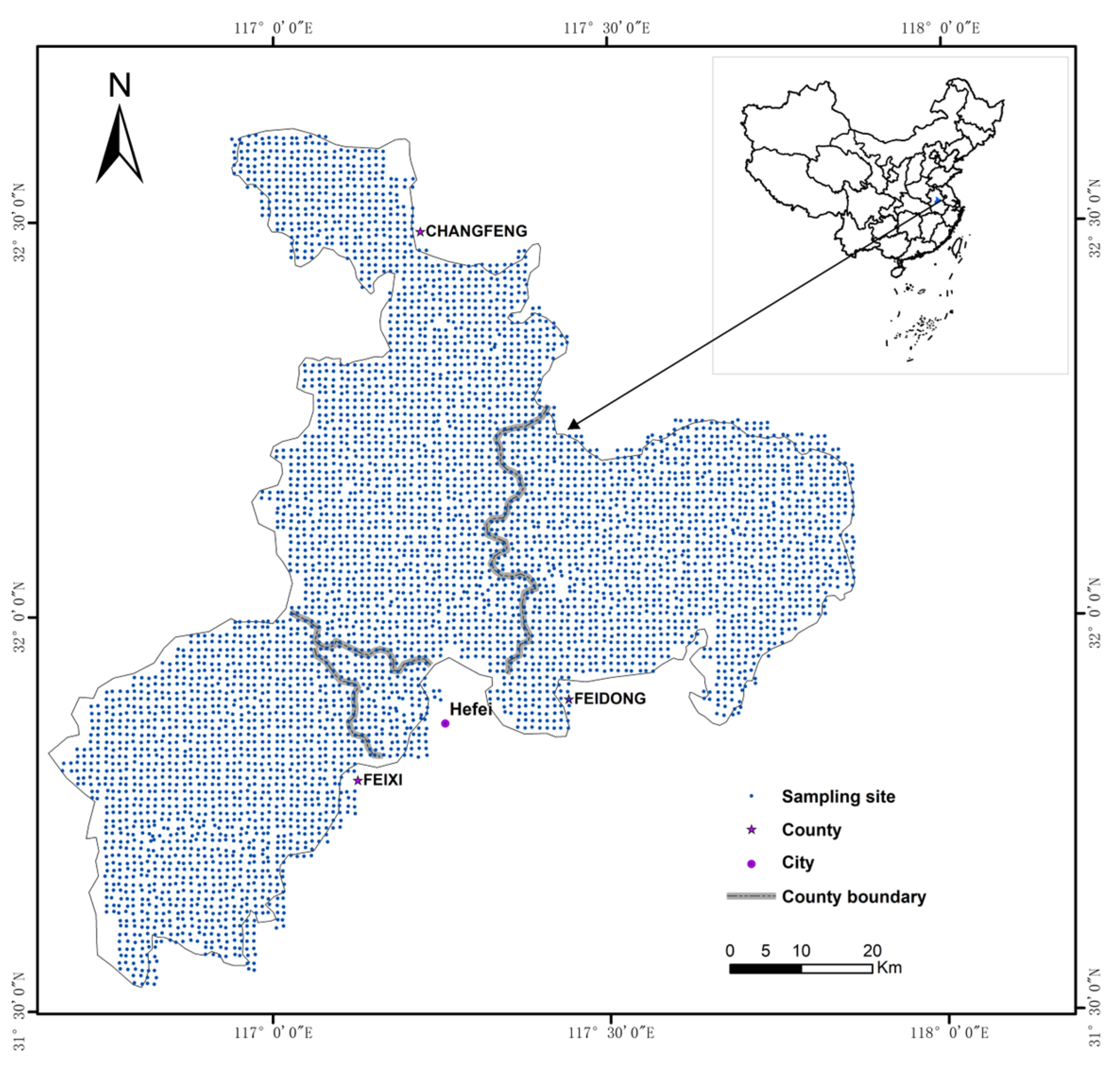
The study area, covering an area of 5247 km2, is located in the middle Anhui Province, Eastern China (between 31°30′–32°28′ N and 116°40′–117°53′ E), which mainly includes Hefei city, Feidong county, Feixi county, and Changfeng county (Figure 1). This region is situated in a climate transition zone in China where there is semi-humid weather in the warm temperate zone and humid monsoon weather in northern subtropical zone, with four distinct seasons, and an annual average temperature and precipitation ranging from 14.5 to 16 °C and 900 to 1100 mm, respectively. These suitable climate environments provide superior natural conditions for agricultural economic development. The geomorphic features are mainly hills and plains. The parent material is dominated by Xiashu loess in the late period of the Pleistocene. Paddy soil and yellow cinnamon soil are the dominant types, followed by skeletal soil and purple soil. There are other soil types like lime concretion black soil, yellow brown soil, and limestone soil, as well as alluvial soil sporadically distributed in the study area. In recent years, with the rapid development of intensive agriculture in this region, paddy–upland rotation has become the dominant land use type, with a considerable area of paddy land remaining. The primary cropping system adopted here is rice–wheat rotation.

2.2. Sampling and Chemical Analysis

A total of 6518 samples were collected from the study area, including 5207 samples from topsoil (0–20 cm) and 1311 samples from subsoil (150–180 cm) in 2003. Sampling was based on the specification of the National Multi-Purpose Regional Geochemical Survey carried out by China Geological Survey and Nanjing University. Surface (0–20 cm) soils were collected at a density of 1 sample/km2 and deep soils (150–180 cm) were taken at a density of 1 sample/4 km2. Prior to physical and chemical analyses in the laboratory, all soil samples were air-dried at room temperature to minimize loss of volatile elements. Following disaggregation, samples were sieved through 2 mm nylon mesh, pulverized, and then homogenized to minimize local variability in the geochemistry. The samples were stored and labelled in polyethylene containers at room temperature. The elemental geochemistry of these samples was measured at Anhui Institute of Geological Experiment, located in Hefei, Anhui Province, China. The major and trace elements were determined by an X-ray fluorescence spectrometer (XRF), inductively coupled plasma optical emission spectrometry (ICP-OES), graphite furnace atomic absorption spectrometry (GFAAS), and ion selective electrode (ISE) [29]. The precision and quality control were monitored using sample replicates and national standard reference materials.

2.3. Integrated Fertility Index (IFI)

This study graded the contents of nutrient elements according to the standard of the second national soil survey in China [30], which was listed in Table 1. Then, the data was standardized for further classification and calculation. The fertility index of single element was calculated following the grading standards. This calculation can make the fertility index of single element be at the same level with high comparability, and the fertility index is not increasing, reflecting that the crop’s requirements for the elements are not such that a higher value is better. For example, after the nutrient element content reaches the rich level, continuing to fertilize and increase their content cannot continue to increase crop yield [31]. The specific grading standard and calculation are as follows:
F = X i S i 6 ,   X i < S i 6 X i S i 6 S i 5 S i 6 + 1 ,   ( S i 6 < X i < S i 5 ) X i S i 5 S i 4 S i 5 + 2 ,   ( S i 5 < X i < S i 4 ) X i S i 4 S i 3 S i 4 + 3 ,   ( S i 4 < X i < S i 3 ) X i S i 3 S i 2 S i 3 + 4 ,   ( S i 3 < X i < S i 2 ) X i S i 2 S i 2 + 5 ,   ( S i 2 < X i )
where F is the fertility index of single element, Xi is the measured value of elements, and Sin is the standard limit value of the n level in the classification standards in Table 1.
The Nemero index has been widely used to assess integrated pollution or fertility index. This index is becoming one of the most common methods because it has higher accuracy and shows better correlation with crop yield than other evaluating methods. However, the Nemero index is less used to evaluate the trend of integrated soil fertility. Based on a high-resolution survey in agricultural soils, evolution trends of soil fertility were therefore evaluated by integrated fertility index (IFI). This index is based on the fertility index of single element and uses the improved Nemerow method to highlight the limiting factors of low fertility on crop growth. The maximum (Pi) in the Nemerow index is replaced with minimum (Pi) to calculate the IFI. The calculations were as follows:
I F I = m i n P i 2 + m e a n P i 2 2 × n 1 n  
where mean (Pi) is the average value of the fertility index of single element, and min (Pi) is the minimum value of the fertility index of single element. According to the calculated IFI values, soil fertility can be divided into very fertile, fertile, average, and poor [31]. The classification standards for IFI are shown in Table 2.

2.4. Potential Ecological Risk (PER)

The potential ecological risk index (PER), proposed by Håkanson (1980) based on the elemental abundance and release capacity, has been widely applied to assess the contamination degree of sediment and soil [32,33,34]. The equations used for calculation of PER are as follows:
C j i = C i C n i
C d = i n C j i
E j i = T n i × C j i
P E R = i n E j i
where C j i means the single element pollution factor of heavy metal i, C i is the content of heavy metal i in the sample, and C n i is the corresponding baseline or background value of heavy metal i. The sum of C j i represents the integrated pollution degree C d of the environment. E j i represents the potential ecological risk index of single element. T n i is the biological toxic factor for heavy metal i. The toxic response factors for Cr, Ni, Cu, As, Cd, and Pb are 2, 6, 5, 10, 30, and 5, respectively. PER is the comprehensive potential ecological risk index, which is the sum of E j i . It stands for the sensitivity of the biological community to the toxic substance and illustrates the potential risk caused by the contamination [35,36,37].

2.5. Statistical Analysis and Spatial Analysis Based on GIS

Mean ± 2 (3) SD (standard deviation) value is the most commonly used statistical parameter [38]. According to the method described elsewhere [39,40,41], geochemical backgrounds were calculated as mean ± 2 SD, with mean ± 3 SD for baselines in the study area. To be specific, the mean and standard deviation for the original dataset should be calculated firstly. Next, all values beyond the mean ± 2 SD (mean ± 3 SD) were screened out. This procedure needed to be repeated until all the values lie within this range. All statistical analyses were performed using statistical package, SPSS22.0. Descriptive statistics (minimum, maximum, arithmetic mean, standard deviation, and coefficient of variation (CV)) were calculated and linear regression analysis was performed in SPSS 22.0. The relative enrichment coefficients K1, K2, and K3 were calculated and the elements were classified according to the idea that the values of less than 0.9 and more than 1.1, respectively, represent depleted elements and enriched elements. The spatial distributions of IFI and PER in topsoil and subsoil were produced by utilizing GIS method. An interpolation method of ordinary kriging was employed using GIS mapping software (ArcGIS10.2) to forecast the spatial distribution of potential ecological risk. In addition, cluster analysis was employed on the dataset with the aim of identifying the geochemical associations and common origin among the focused elements in the platform of SPSS26.0.

3. Results and Discussion

3.1. Characteristics of Geochemical Baseline

Table 3 presents the geochemical baseline values of elements in the topsoil. Previous studies have established that elements predominantly derived from natural sources typically exhibit low coefficients of variation (CVs), whereas those influenced by anthropogenic activities tend to show significantly higher variability [16]. As illustrated in Table 3, there were a total of 46 elements whose CVs were less than 25%, while the remaining CVs of TP, Au, Br, Mn, and Hg ranged from 25% to 50%, except for I with a CV of 54.79%. These results indicate that the concentrations of most soil elements in the study area are relatively stable, reflecting a predominance of natural background controls. K1, defined as the relative enrichment coefficient, is calculated as the ratio of the soil geochemical baseline in this study area to the national arithmetic average in the soil A horizon [42]. Compared with the national average level, the contents of the topsoil elements, such as Nb, SiO2, Ce, Zr, Au, Ti, Y, B, Cr, etc., were much higher, as their corresponding K1 values exceeded 1.1. In contrast, the concentrations of the topsoil elements, such as CaO, Mo, MgO, Hg, Ag, Sr, Zn, K2O, Na2O, Br, etc., were much lower than the national level, with their K1 lower than 0.9. The contents of the remaining elements were comparable to the national average levels, reflecting the combined effects of the natural background conditions and localized anthropogenic disturbances in agricultural soils.

3.2. Characteristics of Geochemical Background

The geochemical background values of elements in the study area are listed in Table 4. The majority of CVs were less than 0.25, reflecting a uniform distribution of most soil elements. Only a few elements, such as Se, I, Br, and P, exhibited CVs ranging from 0.26 to 0.5. Overall, the spatial distribution of and variation in soil elements in the study area were not pronounced, which can be attributed to the relatively homogeneous parent material across the region. K2, defined as the relative coefficient, represents the ratio of the local soil element background value to the national average abundance [43]. Compared with the national soil element contents, the contents of elements in the subsoil, such as Pb, Cu, W, Ba, Au, As, Cr, Co, Mn, Ni, etc., were much higher than the national level, with the values of K2 being more than 1.1. In contrast, the concentrations of elements in the subsoil, such as Se, Mo, Cd, Sr, S, CaO, Na2O, MgO, etc., were even lower than the national level, with K2 values less than 0.9, among which the contents of Se, CaO, and SOC were lower than half of the national levels. The backgrounds of the remaining elements were roughly equivalent to the national level. Notably, despite CaO and MgO being major components of carbonate rocks, their contents in both the topsoil and subsoil were significantly lower than the national average level. This discrepancy is closely linked to the high chemical mobility of these alkaline earth metal oxides and the acidic soil environment prevalent in the study area, a condition often exacerbated by intensive agricultural practices such as the excessive nitrogen fertilization in intensive farming regions.

3.3. Enrichment and Depletion of Soil Elements

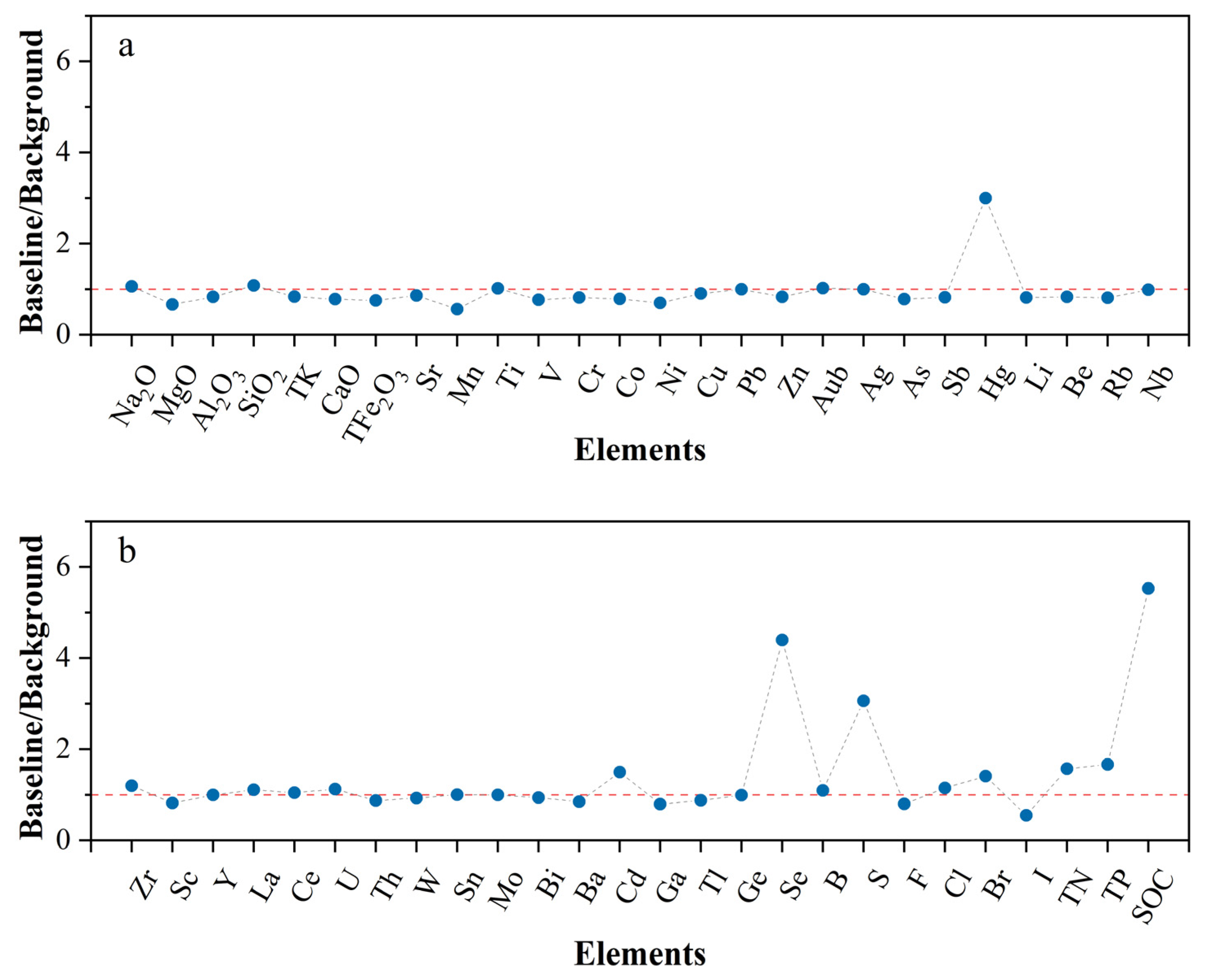
Although the aforementioned study has concluded that elements in the topsoil mainly originated from parent materials and inherited most characteristics of elements in the subsoil, there are still other sources for elements in the topsoil, such as atmospheric deposition, irrigation, fertilizers, pesticides, and so on. All of the above contributed to the differences between the topsoil and subsoil. Therefore, the relative abundance K3, defined as the ratio of the geochemical baseline to background, can reflect the characteristics of the elements’ enrichment and depletion in the soil-forming process. It is noteworthy that elements with K3 ranging from 0.9 to 1.1 accounted for the largest part of the whole elements, followed by elements which were scarce or relatively scarce in the soil (Figure 2). This indicates that most topsoil elements have inherited geochemical characteristics in the subsoil. Therefore, pedogenesis and human activities only play a slight role in most topsoil elements. Elements which were evidently or especially enriched included Cd (K3 = 1.50), Se (K3 = 4.40), TN, TP, S, and SOC (K3 = 5.54). These values were far higher than 1.1, indicating significant anthropogenic enrichment. The topsoil is the primary environment for plants growing and has a higher maturation degree than the subsoil [44]. As a consequence, SOC was enriched in the topsoil, and the long-term tillage and fertilization made TN and TP greatly enriched in the intensive agricultural area. The enrichment of the beneficial element Se was likely due to two reasons: one reason was related to the soil humus since Se could form a stable complex with humus, with it thus existing in the upper area; the other was that Se might exist in the soil in the form of selenite or even selenate state if there is good ventilation in the soil [45,46]. Ventilation is important for the migration of Se from the subsoil to the topsoil, because Se is more easily enriched in the soil through the evaporation of water. The enrichments of S and Cd were aroused by anthropogenic activities such as industrial production, household garbage, and atmospheric deposition [47].
Beneficial elements, I (K3 = 0.55), V (K3 = 0.77), and Mn (K3 = 0.56), were significantly depleted in the topsoil (Figure 2), with all of the baseline/background ratios below 0.8, indicating a strong leaching loss during pedogenesis. The depletion of V and Mn in the topsoil can be explained by their typical migration and transformation patterns under intensive anthropogenic activities. Manganese is predominantly bound to iron–manganese oxides and highly sensitive to redox conditions and the soil pH [48]. Under the acidic soil environment induced by long-term excessive nitrogen fertilization, manganese oxides are dissolved, releasing mobile Mn2+ that is readily leached downward with irrigation and rainfall [49]. Vanadium is mainly associated with iron and manganese oxides and exhibits a coupled leaching behavior with iron [50]. Soil acidification promotes the dissolution of iron–manganese oxides, and mobilizes previously stable V and facilitates its vertical migration. In addition, intensive cultivation, frequent waterlogging and drainage, and continuous crop uptake and harvest remove considerable amounts of bioavailable V and Mn without replenishment [51]. Therefore, these long-term intensive farming practices have directly contributed to the depletion of V and Mn in the topsoil of this study area.

3.4. Evaluation of Soil Fertility in Topsoil and Subsoil

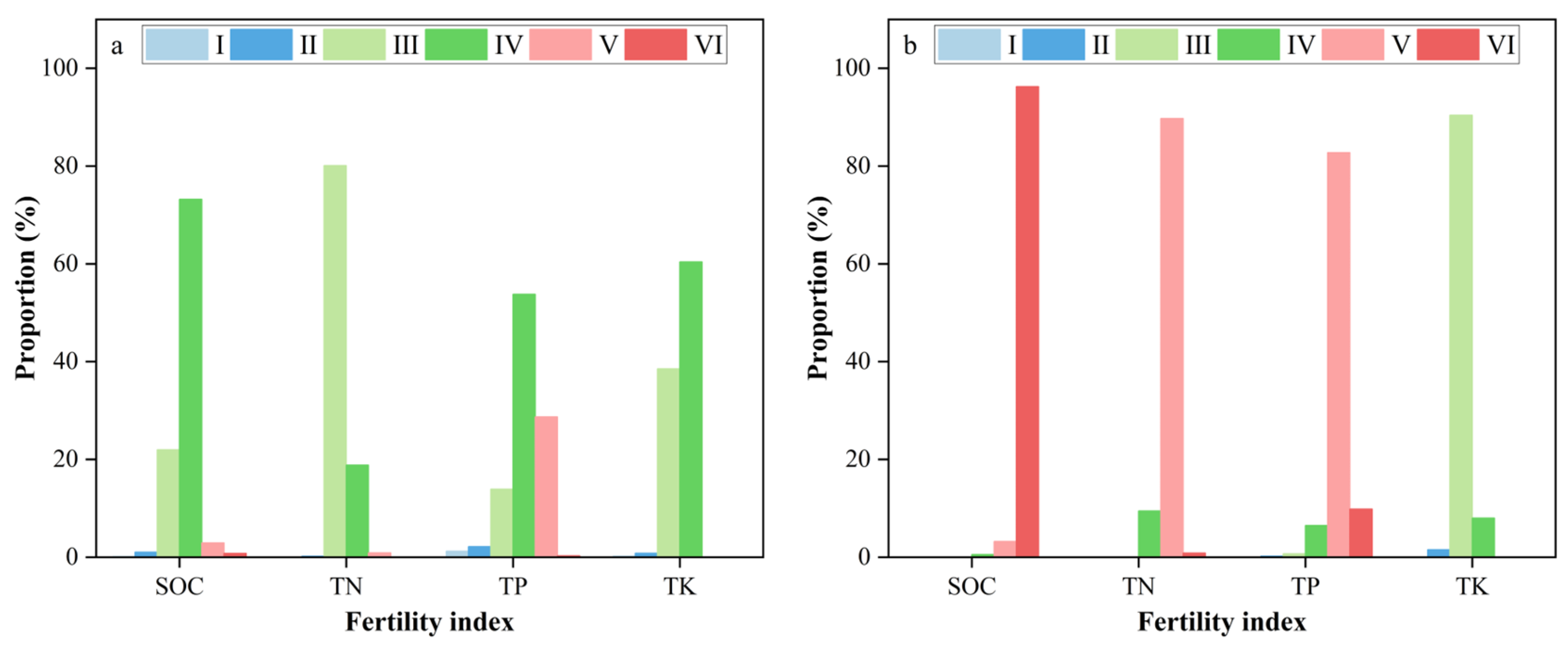
Soil fertility is an important indicator reflecting the ability of the soil to absorb and store water and nutrients, which plays important roles in nutrient dynamics and plant growth [52]. An investigation on agricultural soil fertility will facilitate rationalizing soil fertilization, improving crop yields, and maintaining the sustainable development of agriculture. Soil fertility evaluation within agricultural soils is urgently needed for understanding the soil fertility level and avoiding soil degradation [53,54,55]. In order to reveal the fertility in the topsoil and subsoil, this study analyzed the contents and distributions of SOC, TN, TP, and TK. The descriptive statistics of soil nutrient elements in the topsoil and subsoil are presented in Table 5, while the proportions of these soil fertility indices in different grades are exhibited in Figure 3. SOC is a key indicator for evaluating soil fertility and quality, playing a crucial role in improving soil physical and chemical properties as well as promoting plant growth. For the topsoil, the SOC content ranged from 0.80 to 28.80 g kg−1, with a mean of 10.05 g kg−1 and a CV of 25.7%. We found that 95.1% of the sample sites were classified as grade III and IV (Moderate), indicating a moderate to rich SOC content in the topsoil. Moreover, TN is the main soil nitrogen reservoir, which can provide essential nitrogen nutrition for crop growth. The TN content in the topsoil ranged from 0.40 to 1.62 g kg−1, with 80.1% of the sample sites classified as grade III, indicating a relatively rich and stable TN level in the topsoil. The TP content in the topsoil ranged from 0.15 to 2.90 g kg−1, with most sites classified as grades I~IV, suggesting an abundant or relatively abundant phosphorus content in most topsoil samples; however, 28.9% of the sampling sites were rated as grades V and VI, indicating relatively low phosphorus levels in some areas and a high spatial variability in TP. The TK content in the topsoil ranged from 9.88 to 39.59 g kg−1, with 39.5% of the sampling sites classified as grades I~III and 60.4% as grade IV, indicating a moderate to rich level of TK in the topsoil; notably, no sampling sites fell into grades V or VI, confirming its abundant and stable status. Despite their ecological importance, the SOC and TP levels were generally insufficient across the study area, highlighting the need for targeted organic and phosphorus fertilizer supplementation.
For the subsoil, the nutrient status differed significantly from that of the topsoil. The SOC and TN were extremely poor, with most of the sampling sites classified as grades V and VI. Specifically, the SOC content in the subsoil ranged from 0.20 to 9.10 g kg−1, and the TN content ranged from 0.32 to 0.91 g kg−1, both of which showed significantly lower mean values and higher variability compared to the topsoil. The TP content in the subsoil ranges from 0.14 to 4.19 g kg−1, with 89.2% of the samples classified as grades IV and V, indicating a general phosphorus deficiency in the subsoil. The TK content in the subsoil ranges from 11.0 to 38.7 g kg−1, with 90.4% of the sampling sites classified as grade III and only 8% as grade IV, and no sites in grades V or VI, which implies that the TK content in the study area is abundant and stable across the entire soil profile. The CVs of SOC and TP were relatively high, showing fluctuations, with the values exceeding 25% in both the topsoil and subsoil. This implies the contents of SOC and TP are affected by human activities in the study area. On the other hand, the CVs of TN and TK were both less than 15% with slight fluctuations, indicating that the contents of TN and TK were dominated with natural background conditions. Overall, agricultural soils in the study area were characterized by a low SOC and TN (particularly in subsoil) and abundant TP and TK. It is reported by Shaw et al. (2004) that the parent material plays an important role in soil formation, distribution, and genesis [56]. It can directly affect the composition of soil minerals and particles, and, to a large extent, dominate the physical and chemical properties and productivity of the soil. The parent material in this area is relatively uniform, mainly developed from Xiashu loess with weak weathering. As a result, phosphorus and potassium in minerals are difficult to release, and the leaching effect is weak, which is why the soil often retains high levels of phosphorus, potassium, and other mineral nutrients [53]. However, long-term intensive rice cultivation and seriously insufficient inputs of organic amendments and nitrogen fertilizer have led to the continuous depletion of SOC and TN in the whole region. Without targeted supplementation, even high-fertility soils will gradually degrade. This is consistent with the fact that topsoil SOC is generally insufficient across the entire study area with the mean content of 10.05 g kg−1, and subsoil SOC and TN are extremely deficient, with most grouped as Grades V and VI across the study area. Therefore, the poor fertility of agricultural soils, especially the low contents of SOC and TN in both the topsoil and subsoil, should be taken into account by the relevant authorities when formulating agricultural management policies.
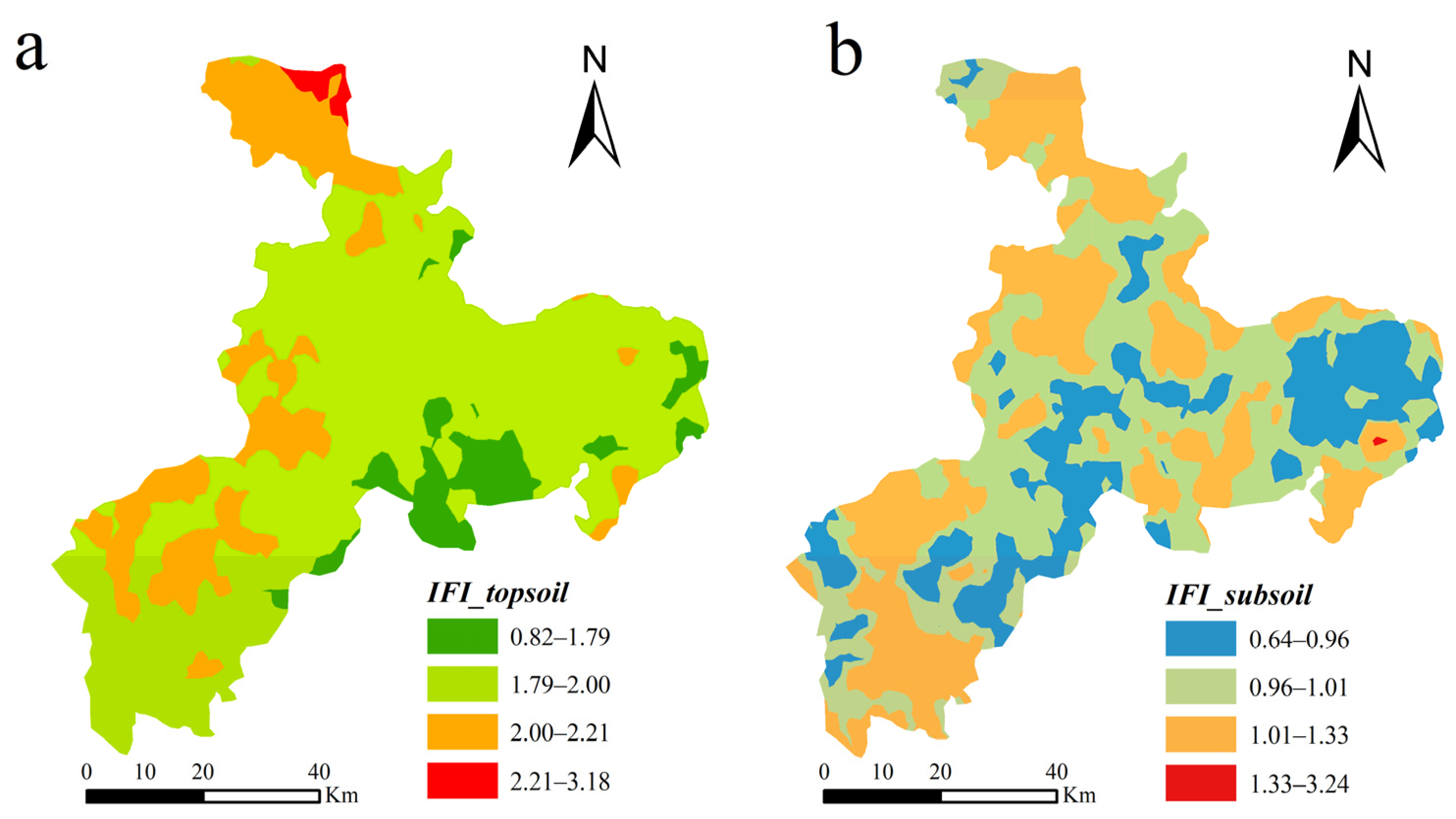
To further quantify the soil fertility, the IFI was employed, with the spatial distributions shown in Figure 4. It is observed that the IFI in the topsoil ranged from 0.82 to 3.18, with high values (1.79~3.18) in northern Changfeng and western Feixi, and low values (<1.79) in Feidong and Hefei. According to Chen et al. (2016), crops can achieve high yields with the IFI ranging from 1.63 to 2.01 [57]. However, the IFI in Feidong and Hefei is generally below 1.6, indicating average soil fertility. Measures should be taken to improve the soil fertility in order to achieve high crop yields. Overall, the IFI values are relatively low in the subsoil, generally ranging from 0.96 to 1.33. This is manifested by relatively high values in most areas of Changfeng and the southwestern Feixi, while the fertility in Feidong and Hefei areas is relatively low, generally ranging from 0.64 to 0.96. This phenomenon is likely to be linked with the fact that western Feixi features dryland as the main land use type, while northern Changfeng is characterized by paddy fields. This land use divergence has given rise to distinct fertilization strategies and field management practices. Additionally, consistent with the distribution trend of IFI in the topsoil, this indicates that the soil fertility in Feidong and Hefei needs to be improved immediately to ensure increased grain production.
Based on the spatial distribution of the IFI, targeted fertilizer management is proposed for different fertility zones. For high-IFI zones such as northern Changfeng and western Feixi, the soil fertility is relatively favorable, with moderate to rich levels of SOC, TN, and TK. Although the IFI values are higher in these regions, this high fertility is primarily attributed to the abundant and stable TK and TP contents, not to a sufficient SOC and TN. Fertilizer inputs should be maintained at the appropriate levels, with an emphasis on the balanced application of organic and inorganic fertilizers to preserve the soil fertility and mitigate agricultural non-point source pollution. For low-IFI zones such as Feidong and Hefei, the soil fertility is deficient. It is recommended that we increase organic fertilizer inputs, appropriately supplement nitrogen fertilizer, and reduce ineffective phosphorus and potassium applications [7]. Long-term straw return and organic amendment application are encouraged to improve the soil structure, increase SOC accumulation, and enhance the overall soil fertility [58]. By applying fertilizers according to the actual soil nutrient deficits in different zones, sustainable agricultural development can be effectively maintained.

3.5. Potential Ecological Risk of Hazardous Elements in Topsoil and Subsoil

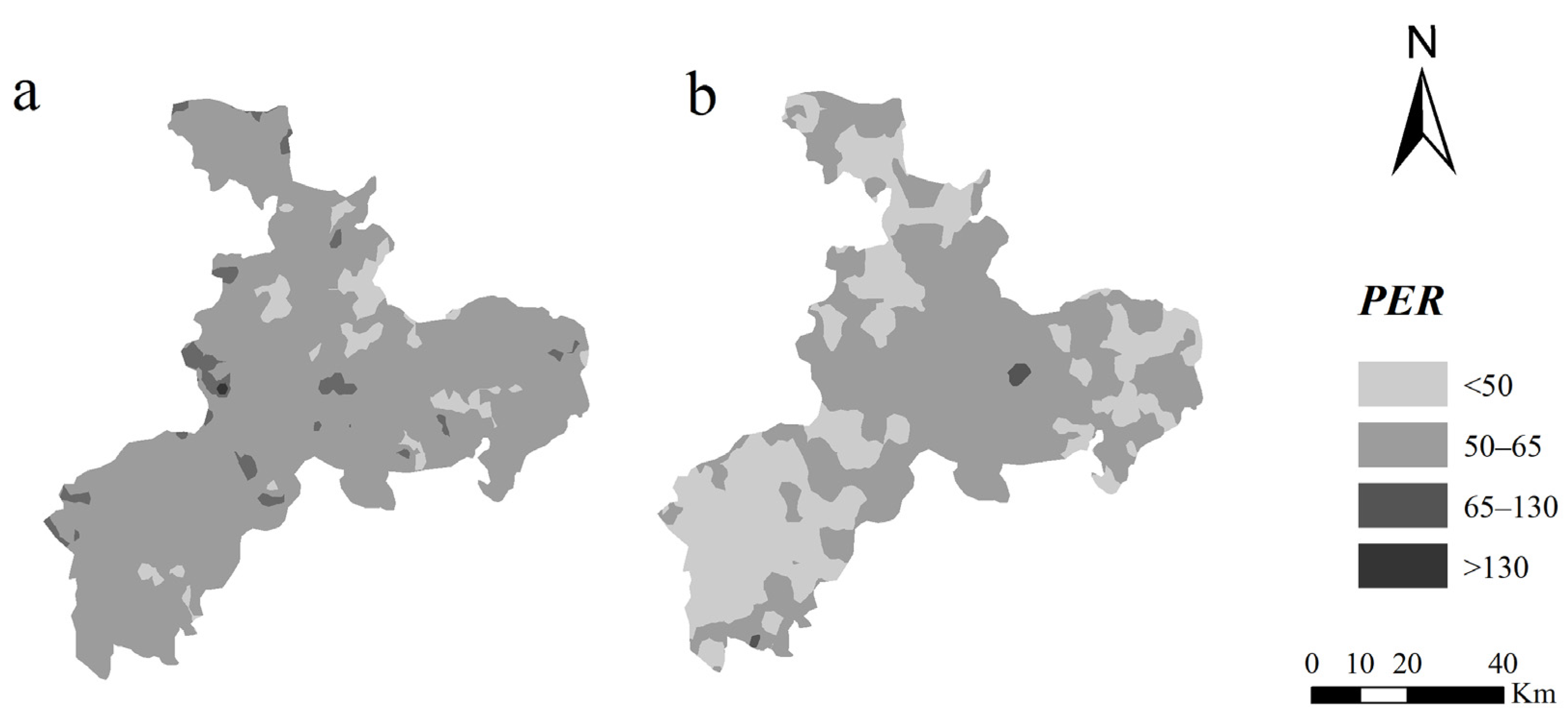
In order to assess the contamination levels in the study area, a potential ecological risk index (PER) is calculated in this study. The PER is classified as follows: PER < 50, extremely low risk; 50 ≤ PER < 65, low risk; 65 ≤ PER ≤ 130, moderate risk; and PER > 130, considerable risk [41]. The spatial distributions of PER in the topsoil and subsoil are presented in Figure 5a,b, respectively. The results indicate that both the topsoil and subsoil in this intensified agricultural area are not contaminated heavily with these hazardous elements. This may illustrate that anthropogenic activities in this intensive agricultural area do not significantly affect elemental enrichment nor depletion. In addition, the majority of PER in the topsoil is between 50 and 65, thus having a relatively low risk mainly in paddy–upland rotation land. Areas with considerable and high risks are sporadically distributed in northeastern Feixi and southwestern Changfengm together with western Feidong, which roughly corresponds to the distributions of water-cultivated land and industrial land by coincidence. It is easy to understand why a high PER is distributed in industrial land. And the reason why PER in water-cultivated land is higher than that in paddy–upland rotation land may be explained by the easier adsorption action of the paddy soil on pollutants. At the same time, PER in the subsoil is lower than those in the topsoil since areas with extremely low risks increase and areas with high risks disappear. As for the subsoil, areas with considerable risks are mainly distributed in western Feidong.
The assessment of the overall contamination in the soil can be also measured by another integrated index Cd. Considering Cd, all sites showed a moderate risk as the values of Cd are 6.0 in the topsoil and 6.1 in the subsoil, belonging to the moderate level of 5 ≤ Cd <10 [2]. In addition, with regard to the potential ecological risk index of individual metals E j i , we find that the E j i values of Cd in both the topsoil and subsoil are the highest. The aforementioned value is consistent with the conclusion proposed by Wei and Yang, who state that the pollution of Cadmium is widespread in agricultural soils in China compared with the low contamination of other metals [59]. Furthermore, it is acknowledged that Cd contributes significantly to the potential ecological risk of the environment [60,61,62], and paddy soils have been adversely affected by Cd contamination as the adsorption of Cd in paddy rice was stronger than that in corn, soybean, and other crops [63]. Therefore, Cd may be the most important contaminant in this region where the dominant crop is paddy rice. Zhao et al. (2015) suggested that the acidic nature of soils would cause the exceeding of the grain Cd limit in uncontaminated soils [64]. The topsoil in the study area exhibited generally low pH values, with a mean pH of 6.02, indicating an overall acidic condition. Such soil acidity can significantly enhance the solubility and bioavailability of Cd in soils, thereby promoting its uptake and accumulation in rice. Under acidic conditions, Cd is more easily released from mineral phases and soil colloids into the soil solution, raising its mobility and potential transfer from the soil to the crops [65,66]. Given that rice is the dominant staple crop in this region, an elevated Cd bioavailability may pose potential risks to crop safety and human health. Therefore, future research should focus on the Cd uptake and accumulation in the soil–crop system, the influence of the soil pH and organic matter on the Cd bioavailability, and the application of organic amendments to reduce the Cd mobility and bioavailability in agricultural soils.
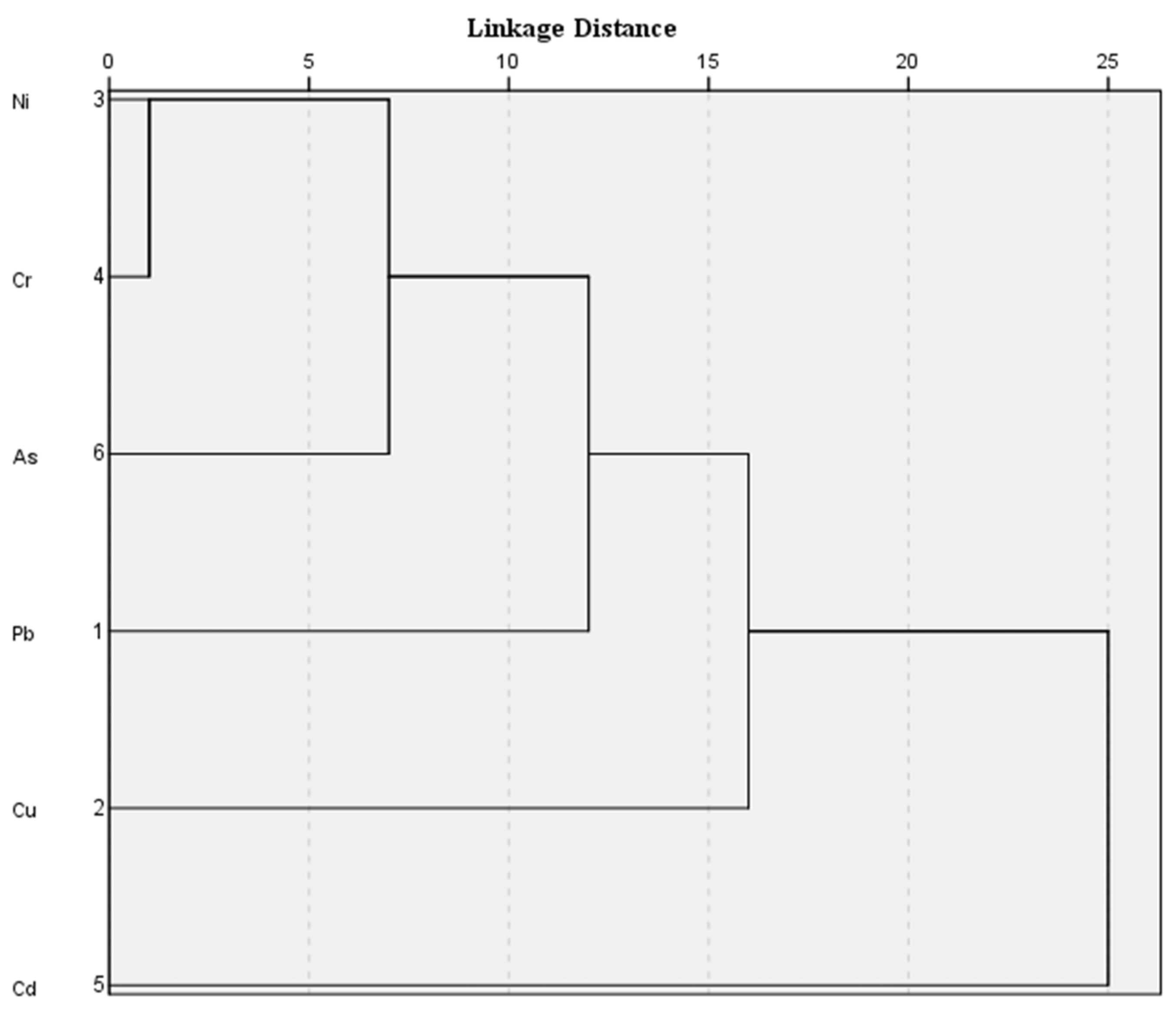
A cluster analysis was applied to determine the geochemical associations and identify the anthropogenic or geogenic sources of hazardous elements in soils [67,68,69,70]. Prior to the cluster analysis, the analytical data should be standardized. The results merged the elements into two clusters (Figure 6). The elements of Ni, As, Cr, Pb, and Cu were attributed to the first cluster, which was divided into two subsections. The sub-cluster 1a represented the association of Ni, As, and Cr, implying the common source, namely, soil parent materials. It is well-known that the contents of Cr and Ni are dependent on the contents in bedrocks. Soils originating from basic rocks contain much higher contents of Cr and Ni than soils from other basic rocks [71]. Wei and Yang (2010) found that Cr and Ni were the least prevalent pollutants in the urban soils in China [59]. According to Granier et al. (1990), Cr in natural soils is derived from the weathering of the parent material and subsequent pedogenesis [72]. The parent material in this region is uniform with Xiashu loess; hence, the Cr and Ni in our samples might be related to the loess-deposited parent rocks. Moreover, the content of As in the topsoil was much lower than that in the subsoil, conforming the natural source of As. Based on these, we infer that As, Cr, and Ni are very likely to be related to the loess-deposited parent rocks as the natural sources, which is in accordance with previous works [73]. The sub-cluster 1b exhibited an association between Pb and Cu, indicating that they are likely to come from anthropogenic sources such as agricultural inputs and vehicle emissions beside the influence from natural sources. Given the study area is an intensive agricultural zone, the accumulations of Pb and Cu are likely influenced by agricultural activities, such as the historical application of Cu-based fungicides and Pb-containing pesticides. Additionally, Pb pollution is also linked to traffic activities due to the use of Pb-based gasoline for some time, while Cu is often used in vehicle lubricants [74]. Therefore, traffic emission is also an important source of Pb and Cu pollution. Cd was settled as a separate cluster, which could be caused by anthropogenic activities such as the application of phosphate fertilizers, pesticides, sewage irrigation, and industrial activities, as has been found in previous studies in other areas [66]. Further studies are still needed to explain why the areas had higher potential ecological risks, and special attention should be paid to the priority control of the hazardous element Cd from adsorbing into the ground for the sake of lowering the risk to the local environment.

4. Conclusions

This study established the geochemical baseline and background values of 52 major and trace elements in an intensive agricultural area using high-resolution sampling, providing a critical reference for distinguishing natural geochemical variability from anthropogenic disturbances in agricultural landscapes. Controlled by homogeneous Xiashu loess, 46 elements showed low variation with their CV values being less than 25%, and most baseline values exceeded national averages, except for CaO, Mo, MgO, Sr, Na2O, and Br, confirming the dominant control by the parent material. Anthropogenic activities led to the significant enrichment of Cd (K3 = 1.50), Se (K3 = 4.40), SOC (K3 = 5.54), TN, TP, and S in the topsoil, and the depletion of V (K3 = 0.77), Mn (K3 = 0.56), and I (K3 = 0.55). Vertically, the topsoil had a moderate SOC with a mean content of 10.05 g kg−1), rich TN with a mean of 1.10 g kg−1, TP with a mean of 0.49 g kg−1, and TK of 14.72 g kg−1, whereas the subsoil was severely deficient in SOC and TN with mean contents of 1.96 g kg−1 and 0.66 g kg−1, respectively. Spatially, the IFI of the topsoil ranged from 0.82 to 3.18, with high values (1.79~3.18) in northern Changfeng and western Feixi, and low values (<1.79) in Feidong and Hefei, highlighting the need for targeted soil nutrient management. Cadmium (Cd) posed a moderate ecological risk at all sampling sites and was identified as the primary contributor to potential ecological risk, underscoring the urgency of targeted control measures for this hazardous element. The source analysis identified Ni, As, and Cr as geogenic, Cd as anthropogenic, and Pb/Cu as mixed sources. Based on the findings, we proposed the following recommendations: increasing organic and nitrogen inputs to alleviate SOC and TN deficiencies across the region, even in relatively high-fertility areas; adopting zone-specific fertilization to improve nutrient use efficiency and reduce non-point source pollution; and implementing organic amendments to immobilize Cd and reduce its ecological risk. Future research should focus on identifying the specific mechanisms of high-ecological-risk zones and quantifying the Cd migration and bioavailability in the soil–crop system.

Author Contributions

Conceptualization, M.F. and J.W.; methodology, J.W. and H.Z.; software, J.W.; writing—original draft preparation, J.W.; writing—review and editing, J.W., M.F., and C.G.; supervision, M.F.; project administration, J.W.; funding acquisition, M.F. All authors have read and agreed to the published version of the manuscript.

Funding

This research was funded by the National Natural Science Foundation of China (Grant No: 42101062).

Institutional Review Board Statement

Not applicable.

Informed Consent Statement

Not applicable.

Data Availability Statement

The data presented in this study are available upon request from the corresponding author.

Conflicts of Interest

The authors declare no conflicts of interest.

References

  1. Wienhold, B.J.; Andrews, S.S.; Karlen, D.L. Soil quality: A review of the science and experiences in the USA. Environ. Geochem. Health 2004, 26, 89–95. [Google Scholar] [CrossRef]
  2. Islam, S.; Ahmed, K.; Masunaga, S. Potential ecological risk of hazardous elements in different land-use urban soils of Bangladesh. Sci. Total Environ. 2015, 512, 94–102. [Google Scholar] [CrossRef]
  3. Oliver, M.A.; Gregory, P.J. Soil, food security and human health: A review. Eur. J. Soil Sci. 2015, 66, 257–276. [Google Scholar] [CrossRef]
  4. Buccianti, A.; Lima, A.; Albanese, S.; Cannatelli, C.; Esposito, R.; De Vivo, B. Exploring topsoil geochemistry from the CoDA (Compositional Data Analysis) perspective: The multi-element data archive of the Campania Region (Southern Italy). J. Geochem. Explor. 2015, 159, 302–316. [Google Scholar] [CrossRef]
  5. Do, V.H.; La, N.; Bergkvist, G.; Dahlin, A.S.; Mulia, R.; Öborn, I. Spatial and temporal variation in crop productivity and relation with soil fertility within upland agroforestry. Field Crop. Res. 2025, 320, 109675. [Google Scholar] [CrossRef]
  6. Zhou, G.; Ma, Z.; Han, S.; Chang, D.; Sun, J.; Liu, H.; Zhou, G.; Ma, Q.; Liu, J.; Wu, J.; et al. Green manuring combined with optimal water management achieves a triple-win for paddy soil quality, rice productivity, and environmental benefits. Agric. Ecosyst. Environ. 2025, 383, 109507. [Google Scholar] [CrossRef]
  7. Liu, X.; Li, Q.; Yan, F.; Xu, P.; Liu, D.; Dong, H.; Zhang, S.; Wang, X.; Zhu, B. Organic fertilization promotes soil organic carbon sequestration by offsetting gaseous losses in sloping purple soil croplands. Catena 2026, 267, 109948. [Google Scholar] [CrossRef]
  8. Wu, Q.; Liu, P.; Zhang, S.; Yan, G.; Tian, K.; Hu, W.; Wang, T.; Khim, J.; Hong, S.; Kwon, B.; et al. Tracing threats across the land–marine transition areas: Decoding heavy metal sources and risks in soil-water-sediment systems of northern and eastern coastal China. Mar. Pollut. Bull. 2026, 223, 118969. [Google Scholar] [CrossRef] [PubMed]
  9. Paternie, E.D.E.; Hakkou, R.; Nga, L.E.; Oyono, L.D.B.; Bessa, A.Z.E.; Oubaha, S.; Khalil, A. Geochemistry and geostatistics for the assessment of trace elements contamination in soil and stream sediments in abandoned artisanal small-scale gold mining (Bétaré-Oya, Cameroon). Appl. Geochem. 2023, 150, 105592. [Google Scholar] [CrossRef]
  10. Levitan, D.M.; Schreiber, M.E.; Seal, R.R., II; Bodnar, R.J.; Aylor, J.G., Jr. Developing protocols for geochemical baseline studies: An example from the Coles Hill uranium deposit, Virginia, USA. Appl. Geochem. 2014, 43, 88–100. [Google Scholar] [CrossRef]
  11. Gałuszka, A.; Migaszewski, Z.M.; Dołęgowska, S.; Michalik, A.; Duczmal-Czernikiewicz, A. Geochemical background of potentially toxic trace elements in soils of the historic copper mining area: A case study from Miedzianka Mt., Holy Cross Mountains, south-central Poland. Environ. Earth Sci. 2015, 74, 4589–4605. [Google Scholar] [CrossRef]
  12. Aytop, H.; Koca, Y.K.; Şenol, S. The importance of using soil series-based geochemical background values when calculating the enrichment factor in agricultural areas. Environ. Geochem. Health 2023, 45, 6215–6230. [Google Scholar] [CrossRef]
  13. Betušová, I.; Khouri, S.; Šofranko, M.; Šofranková, A.; Betuš, M. Assessment of Heavy Metal Soil Contamination and Remediation Strategies in Eastern Slovakia: A Case Study from Dargov. Agriculture 2026, 16, 117. [Google Scholar] [CrossRef]
  14. Li, C.; Zhang, C.; Yu, T.; Ma, X.; Yang, Y.; Liu, X.; Hou, Q.Y.; Li, B.; Lin, K.; Yang, Z.F.; et al. Identification of soil parent materials in naturally high background areas based on machine learning. Sci. Total Environ. 2023, 875, 162684. [Google Scholar] [CrossRef]
  15. Teng, Y.; Ni, S.; Wang, J.; Zuo, R.; Yang, J. A geochemical survey of trace elements in agricultural and non-agricultural topsoil in Dexing area, China. J. Geochem. Explor. 2010, 104, 118–127. [Google Scholar] [CrossRef]
  16. Karim, Z.; Qureshi, B.A.; Mumtaz, M. Geochemical baseline determination and pollution assessment of heavy metals in urban soils of Karachi, Pakistan. Ecol. Indic. 2015, 48, 358–364. [Google Scholar] [CrossRef]
  17. Plant, J.A.; Klaver, G.; Locutura, J.; Salminen, R.; Vrana, K.; Fordyce, F.M. The forum of European geological surveys geochemistry task group inventory 1994–1996. J. Geochem. Explor. 1997, 59, 123–146. [Google Scholar] [CrossRef]
  18. de Caritat, P.; Reimann, C.; Smith, D.B.; Wang, X. Chemical elements in the environment: Multi-element geochemical datasets from continental-to national-scale surveys on four continents. Appl. Geochem. 2018, 89, 150–159. [Google Scholar] [CrossRef]
  19. Jordan, G.; Petrik, A.; De Vivo, B.; Albanese, S.; Demetriades, A.; Sadeghi, M.; GEMAS Project Team. GEMAS: Spatial analysis of the Ni distribution on a continental-scale using digital image processing techniques on European agricultural soil data. J. Geochem. Explor. 2018, 186, 143–157. [Google Scholar] [CrossRef]
  20. Grunsky, E.C.; Drew, L.J.; Woodruff, L.G.; Friske, P.W.B.; Sutphin, D.M. Statistical variability of the geochemistry and mineralogy of soils in the Maritime Provinces of Canada and part of the Northeast United States. Geochem. Explor. Environ. Anal. 2013, 13, 249–266. [Google Scholar] [CrossRef]
  21. Reimann, C.; de Caritat, P. Establishing geochemical background variation and threshold values for 59 elements in Australian surface soil. Sci. Total Environ. 2017, 578, 633–648. [Google Scholar] [CrossRef] [PubMed]
  22. Xie, X.; Cheng, H. The suitability of floodplain sediment as a global sampling medium: Evidence from China. J. Geochem. Explor. 1997, 58, 51–62. [Google Scholar] [CrossRef]
  23. Ladenberger, A.; Demetriades, A.; Reimann, C.; Birke, M.; Sadeghi, M.; Uhlbäck, J.; Andersson, M.; Jönsson, E.; GEMAS Project Team. GEMAS: Indium in agricultural and grazing land soil of Europe—Its source and geochemical distribution patterns. J. Geochem. Explor. 2015, 154, 61–80. [Google Scholar] [CrossRef]
  24. Birke, M.; Reimann, C.; Rauch, U.; Ladenberger, A.; Demetriades, A.; Jähne-Klingberg, F.; Oorts, K.; Gosar, M.; Dinelli, E.; Halamić, J. GEMAS: Cadmium distribution and its sources in agricultural and grazing land soil of Europe—Original data versus clr-transformed data. J. Geochem. Explor. 2017, 173, 13–30. [Google Scholar] [CrossRef]
  25. Lo Medico, F.; Varrica, D.; Zuccolini, M.V.; Miola, M.; Scopelliti, G.; Alaimo, M.G. Geochemical baseline values and spatial distribution of major, trace, and rare earth elements in unpolluted soils of the Sicily region (Italy). Environ. Geochem. Health 2025, 47, 167. [Google Scholar] [CrossRef]
  26. Zhang, X.P.; Deng, W.; Yang, X.M. The background concentrations of 13 soil trace elements and their relationships to parent materials and vegetation in Xizang (Tibet), China. J. Asian Earth Sci. 2002, 21, 167–174. [Google Scholar] [CrossRef]
  27. Yin, C.; Zhao, W.; Pereira, P. Soil conservation service underpins sustainable development goals. Glob. Ecol. Conserv. 2022, 33, e01974. [Google Scholar] [CrossRef]
  28. Mazarji, M.; Bayero, M.T.; Minkina, T.; Sushkova, S.; Mandzhieva, S.; Tereshchenko, A.; Timofeeva, A.; Bauer, T.; Burachevskaya, M.; Kızılkaya, R.; et al. Realizing United Nations Sustainable Development Goals for greener remediation of heavy metals-contaminated soils by biochar: Emerging trends and future directions. Sustainability 2021, 13, 13825. [Google Scholar] [CrossRef]
  29. Lu, R.K. Analysis Method of Soil and Agricultural Chemistry; China Agricultural Science & Technology Press: Beijing, China, 1999. (In Chinese) [Google Scholar]
  30. National Soil Survey Center. Soils in China; China Agriculture Press: Beijing, China, 1998. [Google Scholar]
  31. Hynšt, J.; Urbánková, E.; Obdržálková, E.; Jančíková, S.; Smatanová, M. Effect of increasing rate of P fertilization on available P content in soil and plant uptake: Implications for P management. J. Plant Nutr. 2024, 47, 1834–1849. [Google Scholar] [CrossRef]
  32. Håkanson, L. An ecological risk index for aquatic pollution control: A sedimentological approach. Water Res. 1980, 14, 975–1001. [Google Scholar] [CrossRef]
  33. Williams, J.A.; Antoine, J. Evaluation of the elemental pollution status of Jamaican surface sediments using enrichment factor, geoaccumulation index, ecological risk and potential ecological risk index. Mar. Pollut. Bull. 2020, 157, 111288. [Google Scholar] [CrossRef]
  34. Yan, F.; Li, N.; Wang, J.; Wu, H. Ecological footprint model of heavy metal pollution in water environment based on the potential ecological risk index. J. Environ. Manag. 2023, 344, 118708. [Google Scholar] [CrossRef]
  35. Ustaoğlu, F.; Islam, M.S. Potential toxic elements in sediment of some rivers at Giresun, Northeast Turkey: A preliminary assessment for ecotoxicological status and health risk. Ecol. Indic. 2020, 113, 106237. [Google Scholar] [CrossRef]
  36. Zhang, X.; Liu, H.; Li, X.; Zhang, Z.; Chen, Z.; Ren, D.; Zhang, S. Ecological and health risk assessments of heavy metals and their accumulation in a peanut-soil system. Environ. Res. 2024, 252, 118946. [Google Scholar] [CrossRef]
  37. Arisekar, U.; Shakila, R.J.; Shalini, R.; Jeyasekaran, G.; Keerthana, M.; Arumugam, N.; Almansour, A.I.; Perumal, K. Distribution and ecological risk assessment of heavy metals using geochemical normalization factors in the aquatic sediments. Chemosphere 2022, 294, 133708. [Google Scholar] [CrossRef] [PubMed]
  38. Yaylalı-Abanuz, G. Determination of anomalies associated with Sb mineralization in soil geochemistry: A case study in Turhal (northern Turkey). J. Geochem. Explor. 2013, 132, 63–74. [Google Scholar] [CrossRef]
  39. Guo, H.; Ma, Z.; Hao, J.; Gao, H.; Wang, S. Characteristics and Significance of reference values of the geochemical elements in soil samples from eastern Hebei province. Rock Miner. 2007, 26, 281–286. (In Chinese) [Google Scholar] [CrossRef]
  40. Chen, X.R.; Chen, F.R.; Jia, S.J.; Chen, Y.N. Soil geochemical baseline and background in Yangtze River-Huaihe River basin of Anhui Province. Geol. China 2012, 39, 302–310. (In Chinese) [Google Scholar]
  41. Guo, W.; Liu, X.; Liu, Z.; Li, G. Pollution and potential ecological risk evaluation of heavy metals in the sediments around Dongjiang Harbor, Tianjin. Procedia Environ. Sci. 2010, 2, 729–736. [Google Scholar] [CrossRef]
  42. Chen, J.; Wei, F.; Zheng, C.; Wu, Y.; Adriano, D.C. Background concentrations of elements in soils of China. Water Air Soil Pollut. 1991, 57, 699–712. [Google Scholar] [CrossRef]
  43. Yan, M.C.; Gu, T.X.; Chi, Q.H.; Wang, C.S. Abundance of chemical elements of soils in China and supergenesis geochemistry characteristics. Geophys. Geochem. Explor. 1997, 21, 161–167. (In Chinese) [Google Scholar]
  44. Guo, F.; Wang, Y.; Zhu, H.; Zhang, C.; Sun, H.; Fang, Z.; Yang, J.; Zhang, L.; Mu, Y.; Man, Y.B.; et al. Crop productivity and soil inorganic carbon change mediated by enhanced rock weathering in farmland: A comparative field analysis of multi-agroclimatic regions in central China. Agric. Syst. 2023, 210, 103691. [Google Scholar] [CrossRef]
  45. Liu, R.; Zhou, W.J.; Yu, D.; Shang, G.D.; Zhou, Y.Z.; Xu, Z.Q.; Tang, D.; Cui, H.J.; Liao, C. Spatial distribution and enrichment characteristics of selenium in paddy soil and rice around the Dongting Lake. Environ. Pollut. 2024, 359, 124552. [Google Scholar] [CrossRef]
  46. Xu, Z.; Zhou, W.; Zhou, Y.; Cui, H.; Liu, R.; Shang, G. Factors controlling accumulation and bioavailability of selenium in paddy soils: A case study in Luxi County, China. Environ. Pollut. 2024, 348, 123196. [Google Scholar] [CrossRef]
  47. Shi, J.J.; Shi, Y.; Feng, Y.L.; Li, Q.; Chen, W.Q.; Zhang, W.J.; Li, H.Q. Anthropogenic cadmium cycles and emissions in Mainland China 1990–2015. J. Clean. Prod. 2019, 230, 1256–1265. [Google Scholar] [CrossRef]
  48. Zong, Y.; Li, Z.; Gui, R.; Chen, D.; Yuan, M.; Chai, Y.; Shan, S.; Wong, M.H. Manganese losses induced by severe soil acidification in the extensive Lei bamboo (Phyllostachys violascens) plantation stands in Eastern China. Chemosphere 2023, 339, 139669. [Google Scholar] [CrossRef]
  49. Li, H.; Santos, F.; Butler, K.; Herndon, E. A critical review on the multiple roles of manganese in stabilizing and destabilizing soil organic matter. Environ. Sci. Technol. 2021, 55, 12136–12152. [Google Scholar] [CrossRef] [PubMed]
  50. Timofeeva, Y.; Karabtsov, A.; Burdukovskii, M.; Vzorova, D. Strontium and vanadium sorption by iron-manganese nodules from natural and remediated Dystric Cambisols. J. Soils Sediments 2024, 24, 1220–1236. [Google Scholar] [CrossRef]
  51. Saha, N.; Ren, C.; Parry, D.; Huang, L. Geochemical factors governing vanadium speciation and mobilisation in technosol eco-engineered from bauxite residue under field conditions. J. Hazard. Mater. 2025, 495, 138920. [Google Scholar] [CrossRef] [PubMed]
  52. Yang, F.; Song, X.; Yang, R.; Li, X. Application of organic fertilization and chemical fertilization enhances the coupled and coordinated degree of soil fertility and economic benefits in corn farmland. Agriculture 2026, 16, 9. [Google Scholar] [CrossRef]
  53. Chen, S.; Lin, B.; Li, Y.; Zhou, S. Spatial and temporal changes of soil properties and soil fertility evaluation in a large grain-production area of subtropical plain, China. Geoderma 2020, 357, 113937. [Google Scholar] [CrossRef]
  54. Boudjabi, S.; Chenchouni, H. Soil fertility indicators and soil stoichiometry in semi-arid steppe rangelands. Catena 2022, 210, 105910. [Google Scholar] [CrossRef]
  55. Vincze, É.B.; Becze, A.; Laslo, É.; Mara, G. Beneficial soil microbiomes and their potential role in plant growth and soil fertility. Agriculture 2024, 14, 152. [Google Scholar] [CrossRef]
  56. Shaw, J.N.; West, L.T.; Bosch, D.D.; Truman, C.C.; Leigh, D.S. Parent material influence on soil distribution and genesis in a Paleudult and Kandiudult complex, southeastern USA. Catena 2004, 57, 157–174. [Google Scholar] [CrossRef]
  57. Chen, X.J.; Zhao, Y.N.; Chai, G.Q.; Zhang, Z.Z.; Zhang, Y.Q.; Shi, X.J. Integrated soil fertility and yield response to long-term different fertilization in purple soil. Trans. Chin. Soc. Agric. Eng. 2016, 32, 139–144. (In Chinese) [Google Scholar] [CrossRef]
  58. Wang, L.; Wang, E.; Chen, G.; Qian, X.; Liu, Q.; Gao, Y.; Zhang, H.; Liu, K.; Li, Z. Optimizing straw return to enhance grain production and approach carbon neutrality in the intensive cropping systems. Soil Tillage Res. 2025, 248, 106447. [Google Scholar] [CrossRef]
  59. Wei, B.; Yang, L. A review of heavy metal contaminations in urban soils, urban road dusts and agricultural soils from China. Microchem. J. 2010, 94, 99–107. [Google Scholar] [CrossRef]
  60. Luo, X.S.; Yu, S.; Zhu, Y.G.; Li, X.D. Trace metal contamination in urban soils of China. Sci. Total Environ. 2012, 421–422, 17–30. [Google Scholar] [CrossRef] [PubMed]
  61. Li, C.; Yang, Z.; Guan, D.X.; Yu, T.; Jiang, Z.; Wu, X.; Yang, Y.Y.; Luan, S.; Xu, H.F.; Huang, C.C.; et al. Spatial-machine learning framework for rapid identification of soil cadmium risk in high geochemical background areas. J. Hazard. Mater. 2025, 492, 138091. [Google Scholar] [CrossRef]
  62. Yan, X.; Guan, D.X.; Li, J.; Song, Y.X.; Tao, H.; Zhang, X.M.; Ma, M.; Ji, J.F.; Zhao, W.C. Fate of Cd during mineral transformation by sulfate-reducing bacteria in clay-size fractions from soils with high geochemical background. J. Hazard. Mater. 2023, 459, 132213. [Google Scholar] [CrossRef]
  63. Wang, M.; Chen, W.; Peng, C. Risk assessment of Cd polluted paddy soils in the industrial and township areas in Hunan, Southern China. Chemosphere 2016, 144, 346–351. [Google Scholar] [CrossRef] [PubMed]
  64. Zhao, F.J.; Ma, Y.; Zhu, Y.G.; Tang, Z.; McGrath, S.P. Soil contamination in China: Current status and mitigation strategies. Environ. Sci. Technol. 2015, 49, 750–759. [Google Scholar] [CrossRef]
  65. Zhao, P.; Huang, P.; Yan, X.; Chukwuma, A.; Yang, S.; Yang, Z.; Li, H.; Yang, W. Inhibitory effect of exogenous mineral elements (Si, P, Zn, Ca, Mn, Se, Fe, S) on rice Cd accumulation and soil Cd bioavailability in Cd-contaminated farmlands: A meta-analysis. Chemosphere 2023, 343, 140282. [Google Scholar] [CrossRef]
  66. Lin, X.Y.; Li, H.B.; Juhasz, A.L.; Jiao, D.D.; Zhou, L.; Xue, R.Y.; Tang, Y.; Luo, S.; Zhou, D.; Ma, L.Q. Lower cadmium bioavailability and toxicity in japonica rice than in indica rice: Mechanisms and health implications. Environ. Sci. Technol. 2025, 59, 1156–1169. [Google Scholar] [CrossRef]
  67. Kelepertzis, E. Accumulation of heavy metals in agricultural soils of Mediterranean: Insights from Argolida basin, Peloponnese, Greece. Geoderma 2014, 221–222, 82–90. [Google Scholar] [CrossRef]
  68. Mao, L.; Kong, H.; Li, F.; Chen, Z.; Wang, L.; Lin, T.; Lu, Z. Improved geochemical baseline establishment based on diffuse sources contribution of potential toxic elements in agricultural alluvial soils. Geoderma 2022, 410, 115669. [Google Scholar] [CrossRef]
  69. Yang, Q.; Yang, Z.F.; Zhang, Q.Z.; Ji, W.B.; Guan, D.X.; Liu, X.; Yu, T.; Wang, L.; Zhuo, X.X.; Ji, J.F. Transferability of heavy metal (loid) s from karstic soils with high geochemical background to peanut seeds. Environ. Pollut. 2022, 299, 118819. [Google Scholar] [CrossRef] [PubMed]
  70. Luo, Y.; Yang, C.; Zhou, S.; Zhang, B.; Su, S.; Lu, S.; Yang, Z.; Feng, B.; Liu, S.; Liu, L.; et al. Evaluation of soil heavy metals in major sugarcane-growing areas of Guangxi, China. Agronomy 2026, 16, 185. [Google Scholar] [CrossRef]
  71. Lv, J.; Liu, Y.; Zhang, Z.; Zhou, R.; Zhu, Y. Distinguishing anthropogenic and natural sources of trace elements in soils undergoing recent 10-year rapid urbanization: A case of Donggang, Eastern China. Environ. Sci. Pollut. Res. 2015, 22, 10539–10550. [Google Scholar] [CrossRef] [PubMed]
  72. Granier, L.; Chevreuil, M.; Carru, A.M.; Letolle, R. Urban runoff pollution by organochlorines (polychlorinated biphenyls and lindane) and heavy metals (lead, zinc and chromium). Chemosphere 1990, 21, 1101–1107. [Google Scholar] [CrossRef]
  73. Maanan, M.; Saddik, M.; Maanan, M.; Chaibi, M.; Assobhei, O.; Zourarah, B. Environmental and ecological risk assessment of heavy metals in sediments of Nador lagoon, Morocco. Ecol. Indic. 2015, 48, 616–626. [Google Scholar] [CrossRef]
  74. Aboubakar, A.; Douaik, A.; Mewouo, Y.C.M.; Madong, R.C.B.A.; Dahchour, A.; El Hajjaji, S. Determination of background values and assessment of pollution and ecological risk of heavy metals in urban agricultural soils of Yaoundé, Cameroon. J. Soils Sediments 2021, 21, 1437–1454. [Google Scholar] [CrossRef]
Figure 1. Locations of the study area and sampling sites.
Sustainability 18 03114 g001
Figure 2. Baseline/background ratios of the elements in the study area. The red dashed line represents the baseline/background value of 1. Blue data points above this line indicate element enrichment in the topsoil, whereas those below the line indicate element depletion.
Sustainability 18 03114 g002
Figure 3. Proportion of fertility index in topsoil (a) and subsoil (b) in different grades (I: Extremely rich; II: Rich; III: Relatively rich; IV: Moderate; V: Poor; and VI: Extremely poor).
Sustainability 18 03114 g003
Figure 4. Spatial distribution of Integrated fertility index (IFI) in topsoil (a) and subsoil (b).
Sustainability 18 03114 g004
Figure 5. Spatial distribution of potential ecological risk (PER) in topsoil (a) and subsoil (b).
Sustainability 18 03114 g005
Figure 6. Cluster analysis of hazardous elements in topsoil in the study area.
Sustainability 18 03114 g006
Table 1. Classification standards of soil nutrient elements.
IndicatorI
(Extremely Rich)
II (Rich)III (Relatively Rich)IV (Moderate)V (Poor)VI (Extremely Poor)
SOC (g kg−1)>23.217.4~23.211.6~17.45.8~11.63.5~5.8<3.5
TN (g kg−1)>21.5~21~1.50.75~10.5~0.75<0.5
TP (g kg−1)>10.8~10.6~0.80.4~0.60.2~0.4<0.2
TK (g kg−1)>2520~2515~2010~155~10<5
Table 2. Classification standards for Integrated fertility index (IFI).
IndicatorI (Extremely Rich)II (Rich)III (Moderate)IV (Poor)
Integrated fertility index (IFI)≥2.71.8~2.70.9~1.8<0.9
Table 3. Geochemical baseline values and statistic parameters in topsoil (SD: standard deviation; CV: coefficient of variation (%); baseline in mg kg−1).
ElementBaselineSDCVK1ElementBaselineSDCVK1
Na2O a1.190.1210.250.87Zr309.7729.399.491.24
MgO a0.930.1818.900.71Sc11.011.7315.750.99
Al2O3 a12.261.3210.750.98Y28.721.515.271.25
SiO2 a71.902.773.851.10La41.775.5613.321.05
CaO a0.710.1217.160.33U2.600.3714.120.86
TFe2O3 a4.360.7116.311.03Th12.861.3210.290.93
TK a17.61.709.780.78Ce80.969.1711.331.18
Sr98.279.589.750.59W1.960.3015.060.79
Mn483.73159.5832.990.83Sn3.300.6820.72
Ti5035.31251.965.001.33Mo0.420.0818.020.21
V77.9413.1616.880.95Bi0.300.0517.040.80
Cr68.828.8012.791.13Ba502.5644.868.931.07
Co13.393.2224.011.05Cd0.090.0220.750.96
Ni24.845.0420.290.92Ga14.681.7712.050.84
Cu24.693.1112.591.09Tl0.590.5913.700.95
Pb25.372.409.470.98Ge1.380.1913.570.81
Zn51.607.7715.070.70Se0.220.0522.070.77
Au b1.750.4827.571.25B57.4610.4518.191.20
Ag0.070.0116.570.53S190.9541.8421.91
As9.842.2522.820.88F406.5170.9717.460.85
Sb0.790.1721.930.65Cl52.9011.2121.19
Hg0.030.0141.350.52Br2.810.8128.770.52
Li32.084.6614.520.99I1.790.9854.790.47
Be2.080.2914.131.07TN a1.100.1210.99
Rb93.2610.6211.380.84TP a0.500.1325.53
Nb17.740.754.231.11SOC a10.011.9222.57
a baseline in g kg−1, b baseline in μg kg−1, K1 = baseline in the study area/national arithmetic average in soil A horizon.
Table 4. Geochemical background values and statistic parameters in subsoil (SD: standard deviation; CV: coefficient of variation (%); background in mg kg−1).
ElementBackgroundSDCVK2ElementBackgroundSDCVK2
Na2O a1.120.065.260.70Zr258.7119.707.621.03
MgO a1.400.1712.250.78Sc13.421.017.521.22
Al2O3 a14.730.563.801.17Y28.841.083.751.25
SiO2 a66.400.580.871.02La37.544.5512.110.99
CaO a0.910.2021.590.28U2.310.2510.970.86
TFe2O3 a5.810.345.801.26Th14.660.805.431.17
TK a21.01.507.110.84Ce77.466.187.981.08
Sr114.325.364.690.67W2.110.219.881.17
Mn860.12156.7018.221.43Sn3.290.4513.801.32
Ti4951.16158.783.211.15Mo0.420.0615.060.52
V101.585.905.801.24Bi0.320.039.521.07
Cr84.115.426.441.29Ba589.4134.375.831.18
Co17.053.4720.321.31Cd0.060.0122.890.65
Ni35.505.8316.421.37Ga18.420.573.121.08
Cu27.292.288.351.14Tl0.670.0710.881.12
Pb25.482.6910.561.11Ge1.390.1611.561.07
Zn62.045.959.590.91Se0.050.0128.510.24
Au b1.710.4224.341.22B52.486.6612.681.31
Ag0.070.0117.980.93S62.318.3013.320.42
As12.571.9815.741.26F508.5664.6212.711.06
Sb0.960.1111.751.20Cl45.948.1017.640.68
Hg0.010.0021.910.34Br1.990.8542.500.57
Li39.322.957.501.31I3.260.9629.431.48
Be2.500.156.151.39TN a0.700.1110.501.10
Rb114.746.715.841.15TP a0.300.1044.960.60
Nb17.940.583.211.12SOC a1.810.4023.170.51
a background in g kg−1, b background in μg kg−1, K2 = background in the study area/national arithmetic average in soil A horizon.
Table 5. Descriptive statistics of soil nutrient elements in topsoil and subsoil.
LayerElementMin (g kg−1)Max (g kg−1)Mean (g kg−1)CV
TopsoilTN0.401.621.1011.7%
TP0.152.900.4932.4%
SOC0.8028.8010.0525.7%
TK9.8839.5914.7211.7%
SubsoilTN0.320.910.6610.6%
TP0.144.190.3045.0%
SOC0.209.101.9642.5%
TK11.0438.6817.349.1%
Disclaimer/Publisher’s Note: The statements, opinions and data contained in all publications are solely those of the individual author(s) and contributor(s) and not of MDPI and/or the editor(s). MDPI and/or the editor(s) disclaim responsibility for any injury to people or property resulting from any ideas, methods, instructions or products referred to in the content.