1. Introduction
The Fourth Industrial Revolution has emerged from the deep integration of intelligent technologies, data-driven systems, and ubiquitous connectivity, fundamentally altering global industrial structures and economic organization [
1]. According to a 2023 report by the International Data Corporation (IDC) [
2], the global AI market is projected to exceed
$200 billion by 2025, with China’s market expected to reach
$30 billion, solidifying its role as a major force in global AI development. In response, major economies have elevated AI to a core national strategic priority. Notable policy efforts include a U.S.-led national strategy for advancing AI research and development [
3] and a coordinated AI policy framework implemented by the European Union [
4], aimed at reinforcing technological leadership and long-term competitive advantages.
In an effort to embed artificial intelligence more deeply into real-sector activities, a national policy framework for AI innovation pilot zones was introduced in 2019 by China’s central science and technology authority, officially initiating the Artificial Intelligence Innovation and Development Pilot Zones (AIIDPZ) program [
5]. By 2023, this initiative had expanded to 16 provinces, forming a nationwide pilot network. As a foundational sector of the national economy, the low-carbon transformation of the logistics industry plays a critical role in achieving China’s climate mitigation and carbon neutrality objectives [
6]. Data show that China’s total social logistics costs accounted for 14.7% of its GDP in 2022 [
7], while carbon emissions from transportation constituted approximately 10% of the national total [
8]. Therefore, promoting energy conservation and emission reduction in logistics is a key step toward the “Dual Carbon” targets. In this context, Green Total Factor Productivity (GTFP) serves as a key indicator for assessing high-quality development in the logistics industry, comprehensively reflecting the efficiency with which economic output is balanced with environmental impacts [
9]. The AIIDPZ policy can be viewed as an exogenous institutional shock that facilitates intelligent dispatching, smart warehousing, and digital supply chain integration, thereby reducing empty-load rates, improving energy efficiency, and lowering carbon emissions [
10].
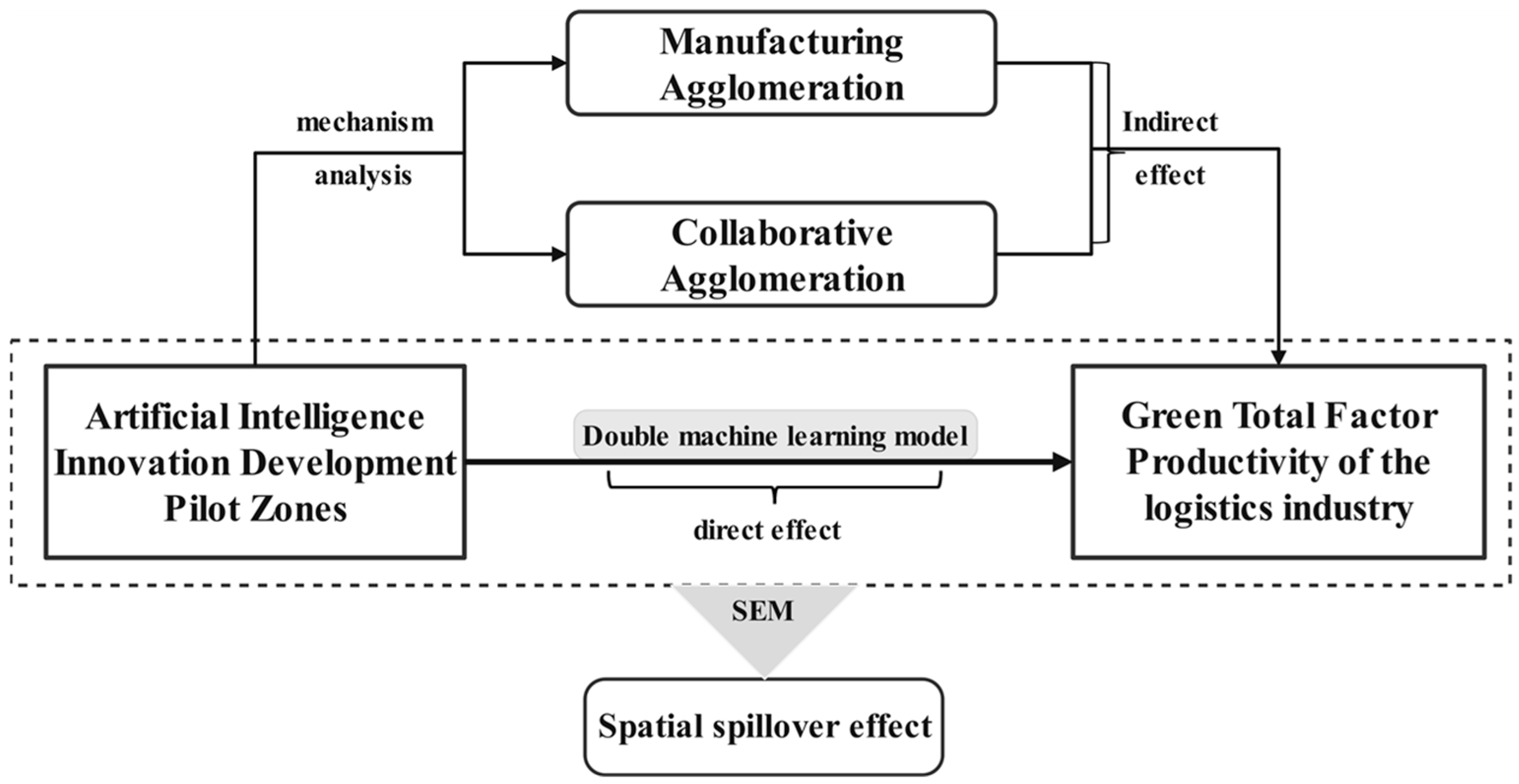
The digital economy is often characterized as a catalyst for green transformation. However, the causal impact of policy-driven AI deployment on the low-carbon development of the logistics industry remains ambiguous. Furthermore, its underlying mechanisms and spatial effects have been systematically underexplored. In this context, this study leverages China’s AIIDPZ policy as a quasi-natural experiment. Utilizing provincial panel data from 2012 to 2022, we employ a Double Machine Learning (DML) framework to examine the causal effects of this policy on the logistics industry’s GTFP. We analyze its heterogeneous impacts across different regions and investigate how AI enhances logistics GTFP by mitigating the degrees of manufacturing agglomeration and collaborative agglomeration, alleviating environmental externalities and resource competition. Furthermore, by integrating spatial econometric models, this study reveals the spatial spillover effects and spatiotemporal evolution characteristics of logistics GTFP. Collectively, our findings provide theoretical and empirical evidence for understanding how AI empowers the green development of the logistics sector.
2. Literature Review
The first category of literature focuses on the factors influencing logistics efficiency. Early studies primarily examined traditional drivers of the logistics industry’s Total Factor Productivity (TFP), including foreign direct investment [
11], infrastructure investment [
12], retail trade development [
13], and levels of informatization [
14]. With the rollout of the “Dual Carbon” objectives and the increasing focus on environmentally sustainable, low-emission development, this research focus has gradually shifted from conventional logistics industry’s TFP to GTFP, explicitly incorporating environmental constraints. For instance, Liu H. et al. identified a non-linear threshold effect between urbanization and the GTFP of the logistics industry [
15]. Liu W demonstrated that digital technologies simultaneously enhance logistics operational efficiency and environmental performance [
16]. Using the GDIM decomposition approach, Liang Y. et al. identified energy structure optimization and carbon regulation intensity as critical drivers of logistics industry’s GTFP [
17]. Furthermore, research on digital infrastructure and automation provides important insights for understanding this issue. McElheran et al. indicate that the significant increase in U.S. productivity signals a transition of artificial intelligence from the “investment phase” to the “harvest phase.” Firms that adopt AI to augment—rather than replace—human labor achieve dual growth in output and employment, offering a viable path for technology-enabled economic development [
18]. Meanwhile, Acemoglu and Restrepo highlight from an automation perspective that pursuing labor substitution alone, without enhancing human capabilities, may lead to resource misallocation and social welfare losses [
19]. These insights are particularly relevant to the labor-intensive logistics industry, which is undergoing rapid intelligent transformation, and provide a theoretical foundation for understanding how AI policies influence its green transition. However, these analyses typically focus on single-factor mechanisms and have not yet systematically examined the overall impact of institutional policy shocks on the logistics industry’s GTFP.
The second category concentrates on analyzing the effectiveness of artificial intelligence innovation and development. Theoretically, AI is widely regarded as a General-Purpose Technology (GPT) with pervasive effects on productivity across sectors [
20]. Empirical evidence has documented these effects at both the microeconomic and macroeconomic levels. At the micro level, AI adoption has been shown to facilitate high-quality firm development [
21] and significantly enhance Total Factor Productivity [
22]. At the macro level, AI development contributes to regional innovation capacity [
23], reshapes urban industrial structure evolution [
24], and supports the formation of new quality productivity in agriculture [
25]. Furthermore, some studies have begun to explore the environmental and green effects of AI. For example, using a Difference-in-Differences approach, Zhang L and Zhou B found that AI development promotes green finance by improving energy efficiency [
26]. Similarly, Dong X. et al. confirmed that AI significantly enhances both the quantity and quality of corporate green innovation [
27]. Furthermore, advances in spatial policy evaluation methods offer important methodological insights for identifying AI policy effects. Anselin et al. systematically explored spatial econometric model specifications, demonstrating the advantages of instrumental variable or generalized method of moments (IV-GMM) over traditional maximum likelihood estimation in addressing spatial dependence [
28]. Fratesi et al. emphasized the critical role of spatial spillovers in small-scale spatial analysis, highlighting that policy evaluation must account for interregional interdependencies [
29]. While emerging studies provide preliminary evidence on the green effects of AI, they predominantly rely on conventional policy evaluation methods, offering limited control over policy endogeneity and high-dimensional confounders. Moreover, these studies have not yet extended their analysis to the logistics sector—a key carbon-emitting industry—and largely overlook spatial spillover effects.
Despite these insights, important gaps remain. First, while existing studies have extensively examined AI’s economic and innovative impacts or focused on individual drivers of logistics GTFP, little research systematically integrates dedicated AI policies—such as the AIIDPZ—with logistics GTFP within a unified causal inference framework. Consequently, whether and how AI policies promote low-carbon logistics development remains largely unidentified. Second, methodologically, most empirical studies rely on conventional approaches such as difference-in-differences or static panel models, which are inherently limited in addressing policy endogeneity (e.g., self-selection bias, omitted variables) and high-dimensional confounders [
30], and they commonly overlook spatial spillover effects. Although spatial econometric methods have advanced, their integration with cutting-edge causal inference techniques to evaluate the green effects of AI policies remains scarce. Third, analytically, many evaluations remain a “black box,” offering limited insight into the transmission mechanisms, spatiotemporal dynamics, or regional heterogeneity of policy effects. How AI policies reshape industrial spatial structures—such as manufacturing agglomeration and collaborative agglomeration—to indirectly affect logistics GTFP, and whether these effects vary systematically across regions, are questions that have yet to be systematically answered.
This study addresses these gaps through three key innovations. First, it integrates AI policy and logistics GTFP into a unified causal framework, using China’s AIIDPZ policy as a quasi-natural experiment to rigorously identify the causal effects on the green transformation of the logistics industry. This extends the scope of AI policy evaluation and enriches the analysis of logistics GTFP determinants. Second, methodologically, it combines DML with spatial econometric modeling to effectively control for high-dimensional confounders and endogeneity while quantifying spatial spillovers and spatiotemporal patterns. DML’s orthogonalization and cross-fitting techniques alleviate model specification bias inherent in traditional methods, and the inclusion of spatial econometrics remedies the neglect of interregional interdependence—thereby achieving methodological integration and innovation. Third, in terms of analytical depth, grounded in Regional Innovation System theory, this study empirically tests the mechanism roles of manufacturing agglomeration and collaborative agglomeration, uncovering the indirect pathways through which AI policy influences logistics GTFP. Moreover, through heterogeneity analysis and spatiotemporal characterization, it systematically reveals how policy effects differ across regions and over time. Together, these elements form an integrated analytical framework—encompassing causal identification, mechanism testing, and spatial analysis—that systematically illuminates how AI policies can empower the green development of the logistics sector. The findings provide theoretical and empirical support for designing policies that harmonize economic growth with environmental sustainability.
4. Methodology
4.1. Model
A rigorous causal assessment of the AIIDPZ policy’s impact on logistics GTFP must address selection bias arising from the non-random placement of pilot zones. These zones were designated by the central government in batches based on national strategic priorities in China—emphasizing regional AI innovation capacity, digital infrastructure, and technological ecosystems—rather than logistics-sector green productivity. Thus, conditional on observable characteristics, the policy can be regarded as plausibly exogenous to pre-existing GTFP trends. Furthermore, the designation of AIIDPZ pilot zones was determined by the central government through a top-down policy process primarily targeting the promotion of artificial intelligence innovation ecosystems and digital infrastructure development. The selection criteria focused on technological capability, industrial innovation capacity, and regional strategic positioning, rather than the environmental performance or green productivity of the logistics sector. Therefore, the policy assignment is unlikely to be systematically correlated with pre-existing trends in logistics GTFP, reinforcing the plausibility of the exogeneity assumption in our empirical framework.
However, identification faces two key challenges. First, pilot zone assignment correlates with factors such as economic development, technological endowments, industrial structure, and environmental regulation, leading to potential selection bias. Second, these confounders are high-dimensional and may exhibit nonlinear relationships with GTFP, rendering traditional parametric approaches potentially misspecified. Conventional methods—Difference-in-Differences (DID), synthetic control, and propensity score matching—face limitations in this context. DID relies on strict parallel trends under low-dimensional linear controls; synthetic control is sensitive to donor pool selection and data availability; and propensity score matching involves subjective covariate specification and cannot adequately address high-dimensional confounding [
43].
To overcome these challenges, this study adopts the Double Machine Learning (DML) framework proposed by Chernozhukov V. et al. [
44]. DML flexibly estimates high-dimensional nuisance functions using machine learning while preserving valid inference for the treatment effect. Orthogonalization removes the influence of control variables from both the outcome and treatment equations, reducing omitted variable bias. Cross-fitting mitigates overfitting and regularization bias by splitting the sample into training and estimation subsets. Importantly, DML does not rely on strict parallel trends; instead, it flexibly controls for time-varying confounders, making it well-suited for staggered treatment settings with heterogeneous effects across cohorts and time. This improves robustness within the conditional independence framework without artificially imposing exogeneity.
Building on Zhang T and Li J [
45], this study adopts a double machine learning framework based on partial linear regression, specified as follows:
In Equations (1) and (2), represents the parameter of primary interest, capturing the average treatment effect of the AIIDPZ policy. The dependent variable is defined as the GTFP of the logistics sector for province in period . serves as the key independent indicator, taking a value of one for provinces officially included in the AIIDPZ program by time , and zero otherwise. The vector contains a set of high-dimensional covariates that jointly influence both policy exposure and GTFP in the logistics sector. The function captures the potentially nonlinear and unknown relationship between the high-dimensional covariates and the independent variable. To accommodate flexible machine-learning estimation, we follow the DML framework and approximate using a data-driven estimator . is the random error term with a conditional mean of zero.
Direct estimation of Equations (1) and (2) may induce regularization bias when the double machine learning framework relies on regularized machine-learning algorithms to approximate the unknown function
. Although such regularization helps control estimator variance, it may introduce bias into the estimation of the treatment effect
, particularly in finite samples. To improve convergence rates and mitigate the bias of the treatment effect estimator in finite samples, auxiliary regression Equations (3) and (4) are specified as follows:
Here, represents the conditional expectation of the treatment indicator given the high-dimensional covariate set , capturing the selection mechanism through which jointly affects policy assignment via and the outcome variable via . As with , is approximated in a nonparametric manner through data-driven learning algorithms, denoted by . represents the stochastic error term with a conditional mean of zero.
The consistent estimate of the policy effect
, as reported in Equation (5):
Implementation details. The DML estimator is implemented using StataMP 18 (64-bit) ’s ddml command with a Python 3.8 backend. A 5-fold cross-fitting procedure is applied that respects the panel structure by randomly splitting provinces into folds, keeping all observations of a given province together. Province and year fixed effects are included as additional controls within the high-dimensional covariate set. The machine learners (e.g., Random Forest) automatically account for these dummies, residualizing the dependent variable and treatment indicator to isolate policy variation net of unobserved heterogeneity and common time shocks. Nuisance functions are estimated using Random Forest (RF) in the baseline, with LASSO, Gradient Boosting (GB), and Neural Networks (NNET) used for robustness checks. Hyperparameter tuning is performed within each training fold using the package’s default automatic tuning to prevent information leakage; the random seed is fixed at 42 for all stochastic processes to guarantee reproducibility. The number of folds is set to K = 5 in the main analysis, with K = 3 and K = 7 used in sensitivity checks.
4.2. Variables
Dependent variable. The GTFP index is adopted to characterize the overall performance of the logistics sector when resource use and environmental constraints are jointly considered [
46,
47]. Relative to conventional TFP, the GTFP of the logistics industry explicitly incorporates undesirable outputs, such as energy consumption and carbon emissions, thereby internalizing environmental externalities and offering a more comprehensive assessment of green transition performance. Drawing upon the environmental efficiency literature, this study employs the Super-efficiency SBM-GML index model with undesirable outputs to measure the logistics industry’s GTFP [
48]. This model does not require a pre-specified production function and effectively addresses efficiency assessment involving multiple inputs and outputs, making it particularly suitable for analyzing the logistics sector under dual resource and environmental constraints. The measurement system is summarized in
Table 1. Input indicators include fixed asset investment in logistics [
49], labor input measured by the number of employees, and energy consumption [
50]. Desired outputs include logistics value added and freight turnover, while undesirable outputs are represented by logistics-related carbon emissions. The carbon emissions of the logistics industry are estimated following the methodology established in Ren Z [
51]. Energy consumption data for 16 fuel types (e.g., raw coal, cleaned coal, coke, crude oil, gasoline, kerosene, diesel, fuel oil, natural gas) are obtained from the regional energy balance tables in the China Energy Statistical Yearbook. CO
2 emission factors are calculated based on the IPCC (2006) Guidelines, using the formula: Emission factor = Net Calorific Value × Carbon Content per Unit Calorific Value × Carbon Oxidation Rate. The specific coefficients for each fuel type are consistent with IPCC default values and are adjusted to reflect China’s fuel characteristics. Emissions are calculated following the “terminal energy consumption” approach, excluding energy used as industrial raw materials (e.g., lubricants, asphalt) to avoid double-counting. The geographical scope covers 30 provinces in mainland China, and the time span is consistent with the panel data of this study (2012–2022).
Independent variable. The AIIDPZ policy was implemented in phases across provinces, with pilot provinces designated in multiple batches starting from 2019, as shown in
Table 2. To capture this staggered adoption, AIIDPZ is defined as a binary variable: it takes a value of 1 if a province has been designated as a pilot in a given year, and 0 otherwise. Once a province becomes a pilot, it remains 1 in all subsequent years. This setup naturally accommodates variation in the timing of treatment [
52].
Mechanism variables. Following Zhang H. et al., Zhang Z and Wu D [
53,
54], we employ manufacturing agglomeration (MA) and collaborative agglomeration (CA) as mechanism variables. Specifically, MA measures the concentration of manufacturing industries in a region using the location entropy index. CA evaluates the degree of industrial synergy by assessing the similarity in spatial distribution and the depth of agglomeration between AI-related industries and the logistics sector.
Control variables. To account for potential confounding factors that may simultaneously influence regional AI policy assignment and logistics GTFP, we select a set of appropriate control variables grounded in both theoretical reasoning and prior empirical literature on GTFP and logistics efficiency. Variable definitions are summarized in
Table 3. Following Ling S. et al. [
55], Shen N. et al. [
56], and Jiang Y and Sun J [
57], our controls capture four key dimensions: First, regional economic development and industrial structure (GDP per capita, industrial structure, industrial share) are included because more developed regions tend to have better digital infrastructure and innovation capacity, which may correlate with both pilot zone designation and logistics productivity. Second, government support and policy environment (R&D expenditure share, environmental protection spending, transport spending) are controlled for, as fiscal priorities directly shape the local innovation ecosystem and green transition incentives. Third, logistics infrastructure and factor endowments (logistics infrastructure, talent agglomeration) are essential determinants of the sector’s absorptive capacity for AI technologies. Fourth, openness to trade and investment (foreign trade volume, fixed asset investment) capture external knowledge spillovers and capital availability that can drive productivity improvements. This multi-dimensional approach ensures that our empirical strategy accounts for the main observable confounders identified in previous GTFP and logistics research. While DML mitigates bias from high-dimensional controls, the theoretical relevance of these variables—as validated by the cited studies—provides an additional layer of confidence in the conditional independence assumption underlying our causal identification.
4.3. Data
For this research, we collected a dataset that tracks 30 provinces over the years 2012 to 2022. China officially designated the first group of provinces as Artificial Intelligence Innovation Development Pilot Zones (AIIDPZ) in September 2019. The sample comprises 16 provinces designated as AIIDPZ, forming the treatment group, with the remaining provinces serving as the control group. Data used in this study were mainly obtained from the Statistical Yearbook of the National Bureau of Statistics of China and are summarized in
Table 4, which presents descriptive statistics for the variables.
5. Results and Analysis
5.1. Benchmark Regression
Guided by the theoretical framework and prior model specifications, DML is employed for estimation, with 5-fold CV applied for robustness. Specifically, the model implements the main and auxiliary regressions using the random forest (RF) algorithm. The estimation results are reported in
Table 5.
As shown in Column (1) of
Table 5, the AIIDPZ coefficient is 0.106 and statistically significant at the 1% level. Since the dependent variable GTFP is measured as an index and the independent variable is binary, this coefficient implies that the implementation of the AIIDPZ policy leads to an average increase of approximately 10.6% in logistics GTFP compared to non-pilot provinces, providing strong empirical support for Hypothesis H1. Column (2), which includes quadratic terms for the control variables, indicates that the policy effect remains robust and statistically significant, further confirming the robustness of the benchmark estimates.
5.2. Robustness Tests
To ensure the credibility of our baseline findings, we conduct a series of robustness checks addressing potential concerns related to parallel trends, outliers, functional form, sample selection, cross-validation folds, algorithm choice, and omitted variables. These tests confirm that our main conclusion is robust to alternative model specifications and potential confounding factors.
5.2.1. Parallel Trend Test
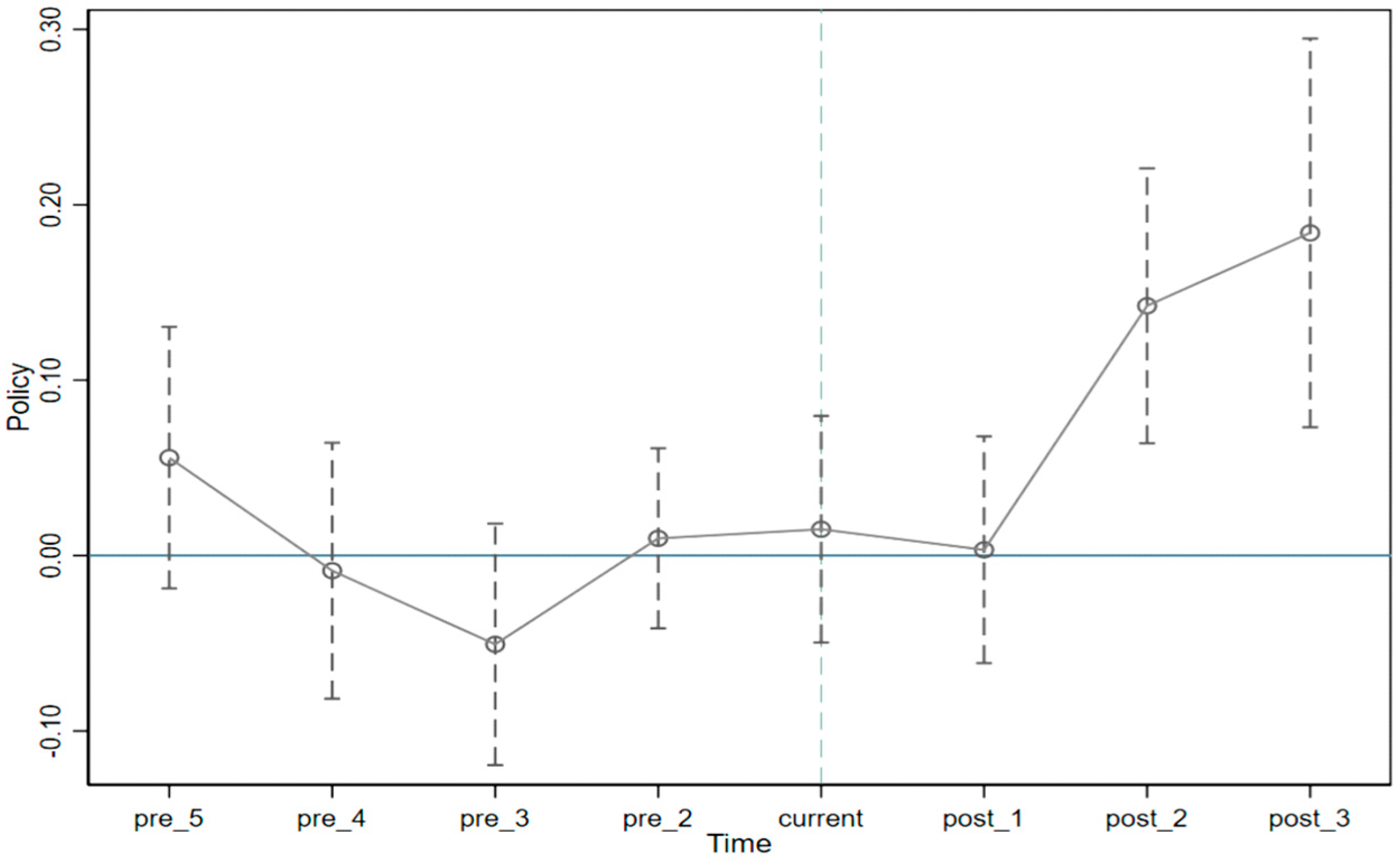
Although DML provides flexibility regarding parallel trends, assessing pre-policy comparability remains important in policy evaluation. We therefore employ an event study approach using the period immediately before implementation as the baseline. As shown in
Figure 2, all pre-policy coefficients are statistically insignificant, confirming that the parallel trends assumption holds. Post-policy coefficients are positively significant, indicating that the AIIDPZ policy enhances logistics GTFP. The insignificant effect in the first year after implementation suggests a short-term policy lag, likely reflecting the time required to establish supporting measures [
58].
5.2.2. Delete Outliers
To mitigate the potential influence of extreme outliers and account for substantial heterogeneity across provinces or years, continuous variables were winsorized at the 1% and 5% quantiles to mitigate the impact of outliers, except for policy variables. As shown in
Table 6 (Column 1), the coefficients of the AIIDPZ remain positive with 1% significance after trimming, confirming benchmark regression results are robust and not influenced by outliers.
5.2.3. Interactive Model
To address potential biases associated with functional form misspecification in the benchmark model, this study employs a more flexible interactive specification within the dual machine learning framework. This model allows for interactions between the policy variable and all high-dimensional control variables.
Table 6 (Column 2) contains the results of the estimation procedure. Within the interactive model, the AIIDPZ variable retains a positive and statistically significant coefficient at the 1% level, confirming that its impact on the logistics industry’s GTFP is robust and not sensitive to the choice of functional form.
5.2.4. Sample Adjustments
Focusing on a symmetric three-year window around the policy implementation (2016–2022) helps reduce potential confounding from distant-period data. Column (3) of
Table 6 demonstrates that the independent variable retains a positive effect with 5% significance, confirming that the policy’s impact is robust throughout the main implementation period.
5.2.5. Fold Adjustments
To assess the sensitivity of estimation results to different sample partitioning ratios, this study varied the cross-validation fold ratio from the baseline 1:4 (5 folds) to 1:2 (3 folds) and 1:6 (7 folds) for robustness checks. The results in
Table 7 (Column 1) show that across different partitioning ratios, the coefficients remained positively significant at the 5% level or higher, exhibiting stability. Across alternative sample partitions, the estimation results exhibit consistency, providing further evidence that the study’s conclusions are robust.
5.2.6. Algorithm Substitutions
To assess robustness to algorithmic choice, we re-estimate the model using LASSO, gradient boosting (GB), and neural networks (NNET). As shown in Column (2) of
Table 7, the AIIDPZ coefficient remains positive and statistically significant at least at the 5% level across all algorithms, confirming that our main finding is not driven by a specific modeling approach. NNET, as a deep learning algorithm, captures complex high-dimensional nonlinear relationships through the hierarchical stacking of neuron weights. Their more aggressive feature extraction and function approximation characteristics often lead to amplified coefficient values. In contrast, traditional machine learning algorithms such as RF, LASSO, and GB, based on decision tree ensembles or regularized linear estimation, have more conservative coefficient scales. Despite these numerical variations arising from model mechanics, the consistent sign and significance across all algorithms robustly support the core conclusion that the AIIDPZ policy significantly enhances logistics GTFP.
5.2.7. Additional Control Variables
To address potential omitted variable bias, we sequentially introduce three additional controls: transportation network density (road), measured as the total length of railway, highway, and waterway per km
2 of regional area; environmental regulation intensity (regul), calculated as the ratio of industrial pollution treatment investment to industrial value added; and energy consumption structure (ener), defined as the share of coal consumption in total regional energy consumption. Following a stepwise approach, we first include the linear term of road (Column 1), then add its quadratic term (Column 2). Next, we incorporate the linear terms of road and regul (Column 3), followed by their quadratic terms (Column 4). Finally, we add the linear terms of all three variables (Column 5) and subsequently their quadratic terms (Column 6). The original controls (
Table 3) and their quadratic terms are included throughout. As reported in
Table 8, the AIIDPZ coefficient remains positive and statistically significant at the 1% level across all specifications, with magnitudes ranging from 0.088 to 0.112—closely comparable to the baseline estimate of 0.106. The slight variations reflect the incremental inclusion of covariates rather than any substantive change in the policy effect, confirming that our main finding is robust to potential omitted variable bias.
5.3. Endogeneity Analysis
To further address potential endogeneity arising from omitted variables or reverse causality, we incorporate an instrumental variable (IV) strategy within the Double Machine Learning framework. Although DML mitigates bias from high-dimensional observable confounders, it does not fully eliminate the possibility that policy designation correlates with unobserved regional characteristics.
We construct an instrumental variable Z defined as the interaction between regional AI patent applications and the AIIDPZ policy dummy [
59]. Regions with stronger AI patent activity possess greater technological capacity and institutional readiness to effectively implement the policy when it is introduced. Thus, the interaction captures heterogeneity in policy implementation intensity and is strongly correlated with the endogenous treatment variable, satisfying the relevance condition. At the same time, AI patent stock alone does not directly enhance logistics GTFP in the absence of the AIIDPZ policy. Without the institutional coordination, financial incentives, and regulatory support provided under the AIIDPZ framework, AI patent activity is unlikely to translate into measurable improvements in logistics green productivity. Moreover, we control for observable factors that could independently affect GTFP, reducing potential alternative transmission channels. Hence, the instrument influences logistics GTFP only through its effect on the policy variable, satisfying the exclusion restriction. The interaction term thus captures the “policy-enabled activation effect” of technological endowment on policy intensity.
Within the DML-IV framework, estimation proceeds via an orthogonalized two-stage procedure. In the first stage, machine learning algorithms flexibly estimate the relationship between the instrument and the endogenous policy variable. In the second stage, the predicted treatment component is used to estimate the causal effect on GTFP while implementing orthogonal score construction and cross-fitting to ensure valid inference under high-dimensional controls. As reported in
Table 9, after accounting for endogeneity through the DML-IV approach, the AIIDPZ coefficient remains positive and statistically significant at the 5% level, consistent with baseline estimates. This consistency further supports the robustness and credibility of the estimated policy effect.
5.4. Heterogeneity Analysis
Regional imbalances in China’s economic development have led to substantial regional heterogeneity in the effectiveness of the AIIDPZ policy. We conduct grouped regression analyses across seven geographical divisions, with results summarized in
Table 10. Regions can be classified into three categories: (1) Key beneficiary regions, comprising East China, Central China, and Southwest China, where the policy effects are significant at the 1–5% level. East China rapidly assimilates AI technologies through its well-established industrial chains and digital infrastructure [
60]; Central China leverages “external technological empowerment” to circumvent traditional development pathways; Southwest China exploits the “East Data, West Computing” digital infrastructure advantage to effectively promote distinctive and cross-border logistics operations [
61]. (2) Transformation-Catching-Up Regions, including Northeast and Northwest China, the policy coefficients reach statistical significance at the 10% threshold. The Northeast’s legacy industrial base leverages the policy to upgrade traditional industries, while the underdeveloped Northwest regions alleviate information constraints via knowledge spillovers and capital inflows. (3) Complex Scenario Regions, comprising North and South China, exhibit statistically insignificant policy effects. In North China, internal developmental disparities dilute the average effects, whereas in South China, the outward-oriented economic structure and spontaneous market-driven technological upgrades diminish the marginal effectiveness of the policies. Evidence suggests that the effectiveness of the AIIDPZ policy is strongly dependent on regional industrial foundations and digital readiness. Therefore, promoting a close and effective alignment between artificial intelligence and the real economy requires regionally tailored policies rather than a generalized, one-size-fits-all approach.
5.5. Analysis of the Influence Mechanisms
To systematically examine the underlying mechanisms by which the AIIDPZ policy affects the logistics industry’s GTFP, we empirically test two potential mediating mechanisms: manufacturing agglomeration and collaborative agglomeration. Following the mechanism analysis methods of Chen et al. [
62], and Jiang T [
63], the outcomes of the empirical analysis are illustrated in
Table 11.
5.5.1. Manufacturing Agglomeration
Column (2) of
Table 11 reports the effect of the AIIDPZ policy on manufacturing agglomeration. The coefficient is −0.074, statistically significant at the 1% level in the negative direction, indicating that the policy’s implementation significantly reduces the spatial concentration of manufacturing enterprises within the region [
64]. This finding aligns with theoretical predictions: the AIIDPZ policy triggers spatial substitution and factor reallocation—encouraging energy-intensive manufacturing firms to relocate from congested areas and redirecting capital and talent toward AI-enabled service sectors. Theoretically, while manufacturing agglomeration can generate “agglomeration economies” that yield scale benefits (positive environmental externalities), it may also lead to “agglomeration diseconomies”—generating a large-scale, high-frequency logistics demand that further exacerbates regional traffic congestion, environmental pollution, and factor price inflation (negative environmental externalities) [
65,
66]. Further empirical evidence suggests that manufacturing agglomeration, particularly under energy-intensive industrial structures, significantly undermines the green efficiency of the logistics sector by intensifying regional transport congestion and energy consumption [
67]. This study finds that the policy reduces the level of manufacturing agglomeration, thereby alleviating the congestion pressures and negative environmental externalities that hinder the green transition of the logistics sector, creating favorable conditions for logistics GTFP improvement. Column (1) confirms the positive direct effect of the policy on GTFP, thereby establishing a clear mediating pathway: the AIIDPZ policy can enhance logistics green total factor productivity by mitigating the negative environmental externalities associated with excessive manufacturing agglomeration, thus supporting Hypothesis H2.
5.5.2. Collaborative Agglomeration
Column (3) of
Table 11 reports the effect of the AIIDPZ policy on collaborative agglomeration. The estimated coefficient for collaborative agglomeration is −0.049, negative and significant at the 10% level. These results indicate that the AIIDPZ policy reduces disorderly spatial co-location and integration between the AI industry and the logistics sector. This finding aligns with theoretical predictions: in the absence of effective coordination mechanisms and planning, rapid and disorderly co-agglomeration generates competition for land, energy, capital, and financial resources, leading to a “resource crowding-out effect” that outweighs short-term knowledge spillover benefits [
68]. Further empirical evidence suggests that industrial co-agglomeration may trigger intersectoral competition for resources, giving rise to crowding-out effects that ultimately hinder overall green total factor productivity [
69]. Our results show that by reducing this disorderly co-agglomeration, the AIIDPZ policy helps avoid resource competition that would otherwise divert financial resources away from logistics firms’ green technology upgrades. In other words, the policy mitigates the negative environmental externalities of agglomeration—resource crowding-out effects arising from congestion, competition, and coordination failures—rather than suppressing beneficial collaboration, thereby contributing to logistics GTFP improvement. This interpretation is consistent with the positive direct effect of the policy on GTFP (Column 1), confirming that the AIIDPZ policy promotes improvements in logistics GTFP by alleviating the resource crowding-out effects arising from collaborative agglomeration. Thus, Hypothesis H3 is supported.
5.6. Further Analysis
While the DML framework is employed to identify the causal impact of the AIIDPZ policy under high-dimensional confounding, it primarily captures the average treatment effect at the regional level. However, given the strong interregional linkages of the logistics industry and the diffusion characteristics of digital technologies, policy impacts may extend beyond the treated provinces through spatial spillovers. Therefore, we further incorporate spatial econometric models to examine whether the AIIDPZ policy generates spillover effects across neighboring regions. To formally examine spatial dependence and quantify interregional spillover effects, this study employs a Spatial Autoregressive Model (SAR). The SAR specification is selected because the logistics industry’s GTFP is likely to exhibit regional coordination and technology diffusion effects, efficiency improvements in one region can affect neighboring regions via demonstration and competitive effects. Prior to model estimation, an evaluation of potential spatial spillovers is conducted through the computation of Global Moran’s I statistics using provincial AIIDPZ policy dummy variables for the period 2019–2022.
The computation procedure is presented in Equation (6):
Among these,
denotes the number of provinces,
and
are the observed values for provinces
and
, respectively,
is the mean of the observed values, and
is the spatial weight matrix between provinces
and
. The spatial autocorrelation test results are presented in
Table 12.
The Moran’s I results reported in
Table 12 confirm significant positive spatial autocorrelation during the early implementation period (2019–2021), suggesting that provinces designated as AIIDPZ tend to cluster geographically. This spatial clustering justifies the adoption of a spatial econometric framework. Analysis indicates that the spatial distribution of the AIIDPZ policy has evolved over time, with policy intensity concentrated in several core urban clusters during the initial rollout in 2019, notably the Beijing–Tianjin–Hebei region, the Yangtze River Delta, and the Greater Bay Area (Moran’s I = 0.1167,
p < 0.01). The Moran’s I index decreased slightly to 0.0958 in 2020 and 0.0940 in 2021, while remaining statistically significant. By 2022, the Moran’s I index had fallen to 0.0460 and was no longer statistically significant, indicating a shift from a highly concentrated policy distribution in core regions to a more dispersed pattern across China. This trend reflects the strategic transition from localized pilot demonstrations to broader regional diffusion.
Following LeSage and Pace (2009), a SAR model as the baseline spatial specification is employed to account for such spatial dependence in the dependent variable [
70], with the model specification presented in Equation (7):
Among these, is the spatial autoregression coefficient, measuring the extent to which the logistics industry’s GTFP in neighboring regions influences that in the local region. The benchmark spatial weight matrix is constructed as an economic distance matrix, defined as the inverse of the absolute difference in per capita GDP between provinces. The matrix is row-standardized to ensure comparability across regions. To test robustness, an alternative economic–geographic nested spatial matrix is constructed by interacting geographic contiguity with economic similarity. This nested matrix captures both physical proximity and economic linkage intensity.
Unlike conventional regression models, coefficients in SAR models do not directly represent marginal effects. Therefore, following impact decomposition methodology, we calculate the direct effects (local impacts), indirect effects (spatial spillovers), and total effects (overall impacts).
Table 13 presents the estimation results of the SAR model. Specifically, Column (1) reports the results based on the economic distance spatial weight matrix, while Column (2) presents the results using the economic–geographic nested spatial weight matrix for robustness analysis.
The decomposed indirect effects derived from the SAR model indicate that the AIIDPZ policy exerts a robustly positive and significant spatial spillover affecting GTFP in the logistics industry. The estimated direct effect is 0.050, the indirect effect is 0.098, and the total effect is 0.147, with all effects significant at the 10% level. Notably, the magnitude of the indirect effect exceeds that of the direct effect, suggesting that the policy’s influence operates primarily through interregional transmission mechanisms rather than purely localized improvements. This pattern reflects the networked nature of the logistics industry, where digital infrastructure upgrading, intelligent scheduling systems, and supply-chain integration in one province can reduce coordination costs and carbon intensity across adjacent regions. From an economic perspective, the findings imply that AIIDPZ functions as a platform-type policy instrument that generates increasing returns through spatial diffusion and technology spillovers. From a policy standpoint, the dominance of spillover effects underscores the necessity of strengthening cross-regional coordination, data interoperability, and green logistics corridors to fully internalize positive externalities. Therefore, optimizing the spatial deployment of AI pilot zones should move beyond isolated provincial designation toward a more connectivity-oriented strategy that maximizes national-level green productivity gains. This finding aligns with China’s ongoing strategy of promoting integrated regional development and digital infrastructure interconnection across provinces. Using the economic–geographic nested matrix, the spillover effects remain robust. The persistence of significant spillovers confirms that the findings are not sensitive to alternative spatial weight specifications.
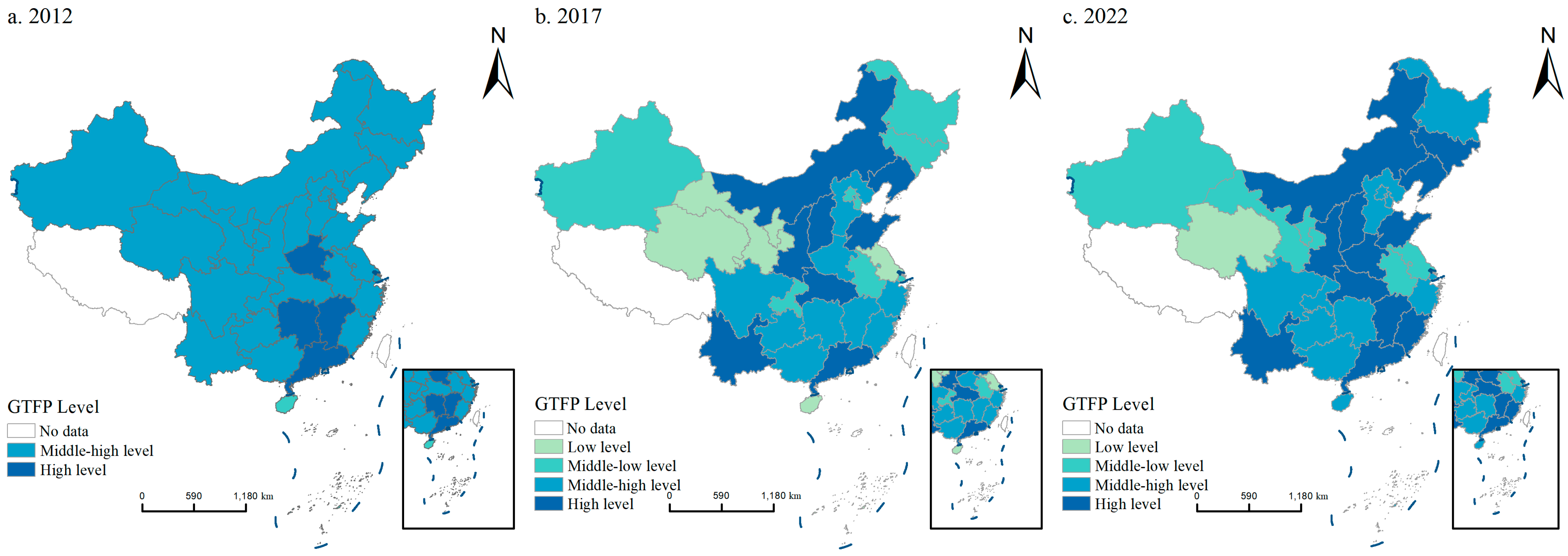
The temporal and spatial evolution of GTFP is further examined in the context of the logistics sector under AIIDPZ influence. Over time, a stepwise increase in sectoral GTFP is observed, corresponding closely to the rollout of the AIIDPZ policy. The period from 2012 to 2016 represents an exploratory phase, with average efficiency stabilizing at low-to-medium levels. Following the promulgation of China’s New Generation Artificial Intelligence Development Plan in 2017, an acceleration phase began, during which the average efficiency increased from low-to-medium to medium-to-high levels by 2020. The pilot zone policy initiated in 2019 marked a pivotal turning point. The period from 2021 to 2022 represents a stabilization phase, with average efficiency remaining at high levels, indicating a shift from isolated AI-driven breakthroughs toward systematic integration with green logistics. Spatially, the efficiency distribution follows a gradient characterized by Eastern leadership, Central rise, and Western catch-up. Eastern coastal provinces maintain high efficiency levels, benefiting from advanced digital infrastructure. Central regions show steady efficiency gains, reflecting AI’s enabling effects on traditional manufacturing areas. Western regions continue to exhibit relatively low efficiency, although provinces such as Gansu demonstrate gradual recovery, demonstrating the inclusive benefits of policy implementation. Notably, the coefficient of variation of efficiency across provinces has declined annually, suggesting a gradual convergence of regional disparities despite fluctuations, as the diffusion of AI technology facilitates coordinated regional development. In summary, the policy-driven improvement in the logistics industry’s GTFP under the AIIDPZ initiative reflects a dynamic process that intensifies over time and progresses spatially from regional imbalance toward coordinated development. Beyond confirming the aggregate policy effect, the analysis uncovers substantial regional heterogeneity.
Figure 3 visualizes the temporal and spatial evolution of GTFP within the logistics sector at the provincial level in China.
6. Conclusions and Policy Implications
6.1. Conclusions
This study exploits China’s New Generation Artificial Intelligence Innovation and Development Pilot Zones (AIIDPZ) policy as a quasi-natural experiment. Using provincial-level panel data from 2012 to 2022, and integrating the double machine learning framework with spatial econometric models, it systematically identifies the causal effects and the channels through which the AIIDPZ policy affects the logistics sector’s GTFP. The analysis is conducted within the conceptual frameworks of regional innovation systems and endogenous growth theory. The primary outcomes are reported below. First, the AIIDPZ policy significantly increases the logistics industry’s GTFP, and the result is consistently supported by extensive robustness checks. Second, the mechanism analysis indicates that the AIIDPZ policy promotes improvements in the logistics industry’s GTFP by mitigating the negative externalities associated with manufacturing agglomeration and collaborative agglomeration. Specifically, the policy alleviates the environmental externalities arising from excessive manufacturing concentration, thereby reducing congestion and pollution pressures that hinder green efficiency gains in logistics. Meanwhile, by easing the resource crowding-out effects embedded in collaborative agglomeration between the AI and logistics sectors, the policy ensures that technological spillovers are more effectively transformed into green productivity improvements. Third, heterogeneity analysis indicates substantial regional variation in policy effectiveness. The policy exerts the strongest positive impact in East China, Central China, and Southwest China; a moderate positive effect in Northeast and Northwest China; and no statistically significant effect in North and South China. These findings imply that the AIIDPZ policy’s effectiveness is contingent upon regional development levels and industrial structure characteristics. Fourth, the AIIDPZ policy contributes positively to neighboring regions through a significant spatial spillover mechanism. Beyond directly enhancing the logistics industry’s GTFP in local regions, the policy also generates substantial gains for neighboring provinces through spatial interactions. This contributes to a stepwise increase in the time evolution of logistics industry’s GTFP and establishes a spatial pattern characterized by “Eastern leadership, Central rise, and Western catch-up” across China. Overall, by employing a rigorous causal inference framework, this study systematically uncovers the multiple transmission channels, regional heterogeneity, and spatiotemporal dynamics through which AI policies affect green development in the logistics sector. The findings provide robust empirical evidence on the role of digital technologies in promoting industrial green transformation and offer a foundation for formulating differentiated and coordinated regional development policies.
Despite these contributions, several limitations warrant further research. First, due to data constraints, the analysis is conducted at the provincial level, potentially obscuring city- or firm-level heterogeneity. Future studies could employ more granular micro-level data to uncover firm-level behavioral mechanisms underlying policy-induced green productivity improvements. Second, while manufacturing agglomeration and collaborative agglomeration are identified as key transmission channels, other mechanisms—such as technology diffusion, green finance, and digital platform integration—may also mediate the relationship between AI policy and logistics GTFP. Exploring these additional pathways would provide a more comprehensive understanding of AI-driven industrial transformation. Third, as the findings are grounded in China’s institutional context, their external validity may depend on structural factors such as digital infrastructure, marketization level, and regional innovation capacity. Future cross-country comparisons could further assess the generalizability of AI-oriented industrial policies across different institutional settings.
6.2. Policy Implications
Given the empirical results and the overarching objective of achieving synergy between technological progress and environmental sustainability, relevant policy implications are articulated as follows.
First, design differentiated policy pathways tailored to regional development stages. Heterogeneity analysis shows that the AIIDPZ policy has the strongest positive effects in East China, Central China, and Southwest China; weaker effects in Northeast and Northwest China; and insignificant effects in North and South China. This implies that a uniform policy approach is ineffective. For eastern coastal regions, where digital infrastructure and logistics systems are mature, policies should focus on building an integrated “AI + Green Logistics” innovation ecosystem. This involves promoting smart ports, autonomous delivery networks, and scenario-based applications to generate scalable and replicable solutions. For western and northeastern regions with relatively weak industrial foundations, a phased strategy is recommended. In the short term, leverage basic AI dispatch tools to upgrade bulk commodity logistics and cross-border corridors (e.g., the China-Europe Railway Express), avoiding blind replication of coastal e-commerce models. In the medium term, develop specialized logistics niches—such as cold-chain logistics in the northwest or heavy equipment logistics in the northeast—by integrating AI-enabled route optimization and predictive maintenance. In the long term, through national initiatives like “East Data, West Computing,” transform these regions from resource suppliers into core nodes in the digital logistics network, hosting data-intensive applications and providing computational support for smart logistics systems nationwide.
Additionally, optimize industrial spatial layouts to foster green and collaborative agglomeration. Mechanism analysis indicates that the AIIDPZ policy enhances logistics GTFP by mitigating the negative environmental externalities of excessive manufacturing agglomeration and disorderly collaborative agglomeration. To operationalize these findings, policy design should guide the development of green and collaborative spatial layouts. In regions with high manufacturing concentration, policymakers should establish industrial entry assessment mechanisms based on logistics intensity and environmental impact to prevent excessive clustering of energy-intensive, high-emission industries. Governments should promote smart shared warehousing and multimodal transport hubs to relieve congestion pressures and reduce carbon emissions. For collaborative agglomeration, resource-sharing platforms between AI enterprises and logistics operators should be established to facilitate knowledge spillovers and mitigate early-stage competition for capital, talent, and infrastructure.
Finally, leverage spatial spillovers through cross-regional knowledge transfer and infrastructure integration. Spatial econometric results confirm significant positive spillovers to neighboring regions. To amplify these spillovers and promote balanced regional development, “AI + Logistics” cross-regional knowledge transfer platforms should be established to facilitate the sharing of best practices, green logistics technologies, and intelligent dispatching algorithms between eastern coastal provinces and inland regions. These platforms can take the form of joint innovation alliances, regular technology workshops, and open-source algorithm repositories. Furthermore, the AIIDPZ policy should be deeply integrated with national infrastructure strategies such as “East Data, West Computing” by prioritizing the deployment of AI-powered logistics data sub-centers in western computing hub nodes. These centers would host data-intensive computing tasks—such as predictive fleet management and real-time route optimization—generated by eastern logistics enterprises, transforming the western regions from mere data storage locations into intelligent computing service providers. Building on this, a “data computation in the west + logistics application in the west” closed-loop empowerment mechanism should be established, supporting local enterprises in developing customized applications like intelligent load planning and cross-border cold-chain logistics using nearby computing resources. This will enable central and western regions to transition from passive resource suppliers into active participants and beneficiaries of the digital logistics ecosystem.
In summary, effectively integrating artificial intelligence innovation with green logistics development necessitates a context-sensitive policy framework that balances technological advancement with environmental sustainability. These policy recommendations offer a structured approach for regions to design strategies tailored to their development conditions, collectively supporting long-term sustainable development objectives.