A Study on Safety Risk Identification and Governance in Universities Based on the 2-4-4R Model

Abstract
1. Introduction
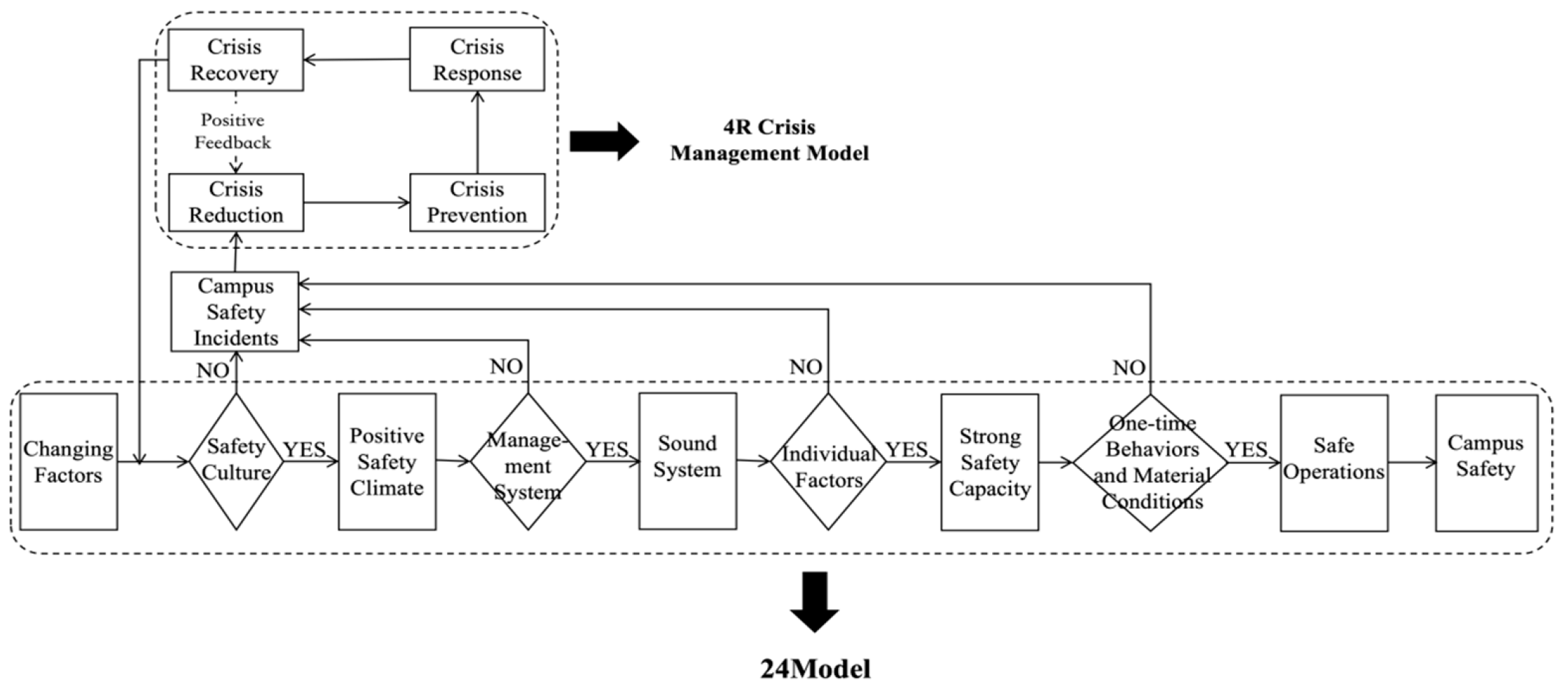
- How can the accident causation model 24Model and the 4R crisis management theory be integrated to form a more comprehensive model for university safety risk identification and governance?
- How can the 2-4-4R management framework be applied to identify risks in university safety accident cases and propose governance measures?
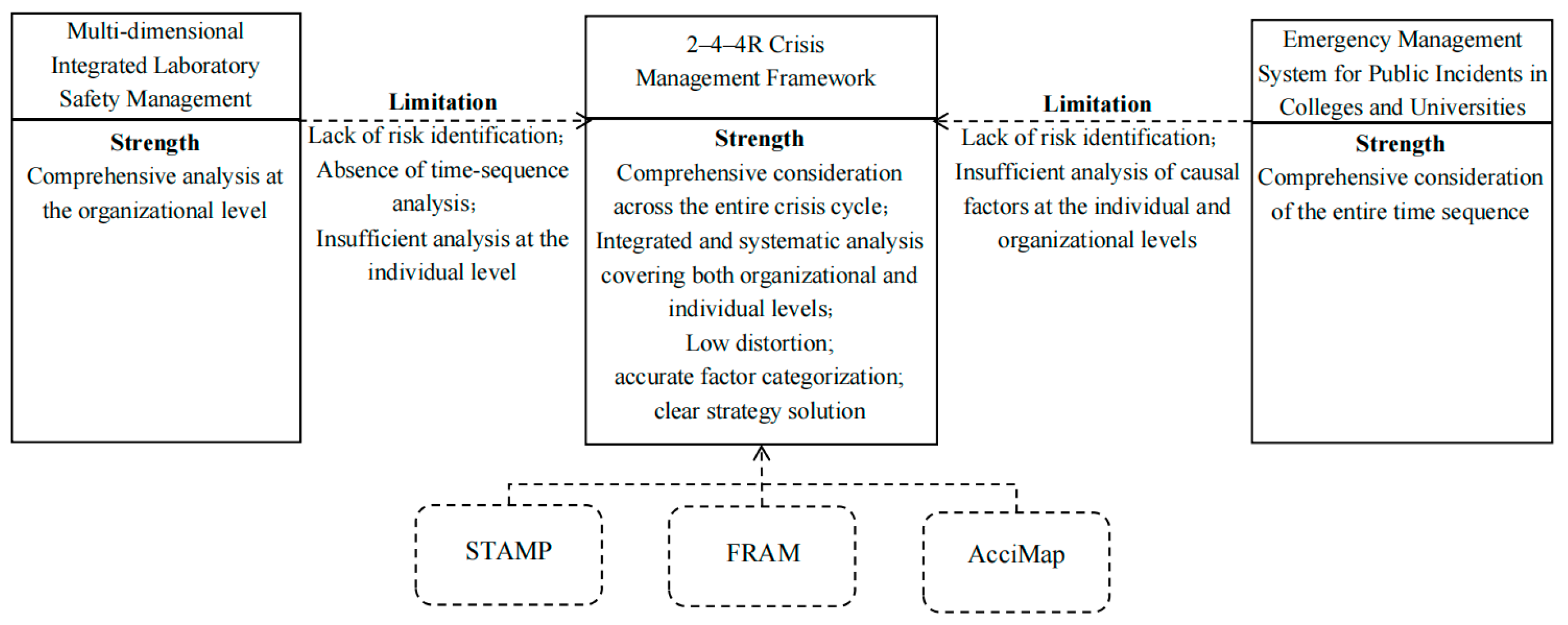
- What theoretical and practical advantages does the 2-4-4R management framework have in improving campus safety governance?
2. Literature Review
2.1. Methods for Campus Safety Risk Identification
2.2. Construction of the Campus Crisis Management System
3. Research Methods
3.1. Research Design
3.2. Case Selection and Analysis Method
4. Model Construction and Theoretical Analysis
4.1. Proposal of the 2-4-4R Management Model Framework
4.2. Safety Risk Identification in Universities Based on the Framework
4.3. Campus Safety Risk Governance Based on the Framework
4.3.1. Campus Safety Governance at the Organizational Level
4.3.2. Campus Safety Governance at the Individual Level
5. Model Application: A Case Analysis Based on a Laboratory Explosion Accident at a University in Beijing
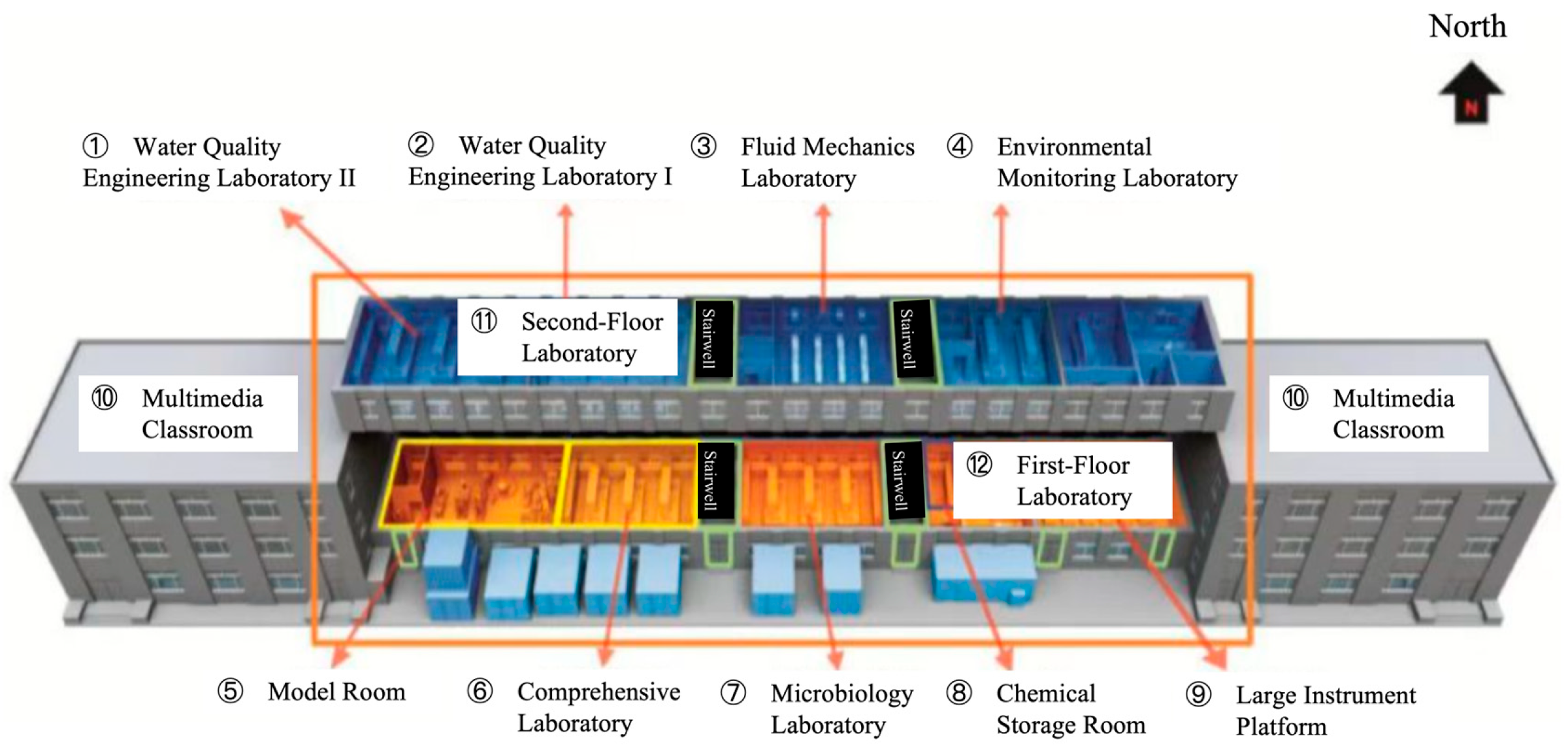
5.1. Accident Background and Case Overview
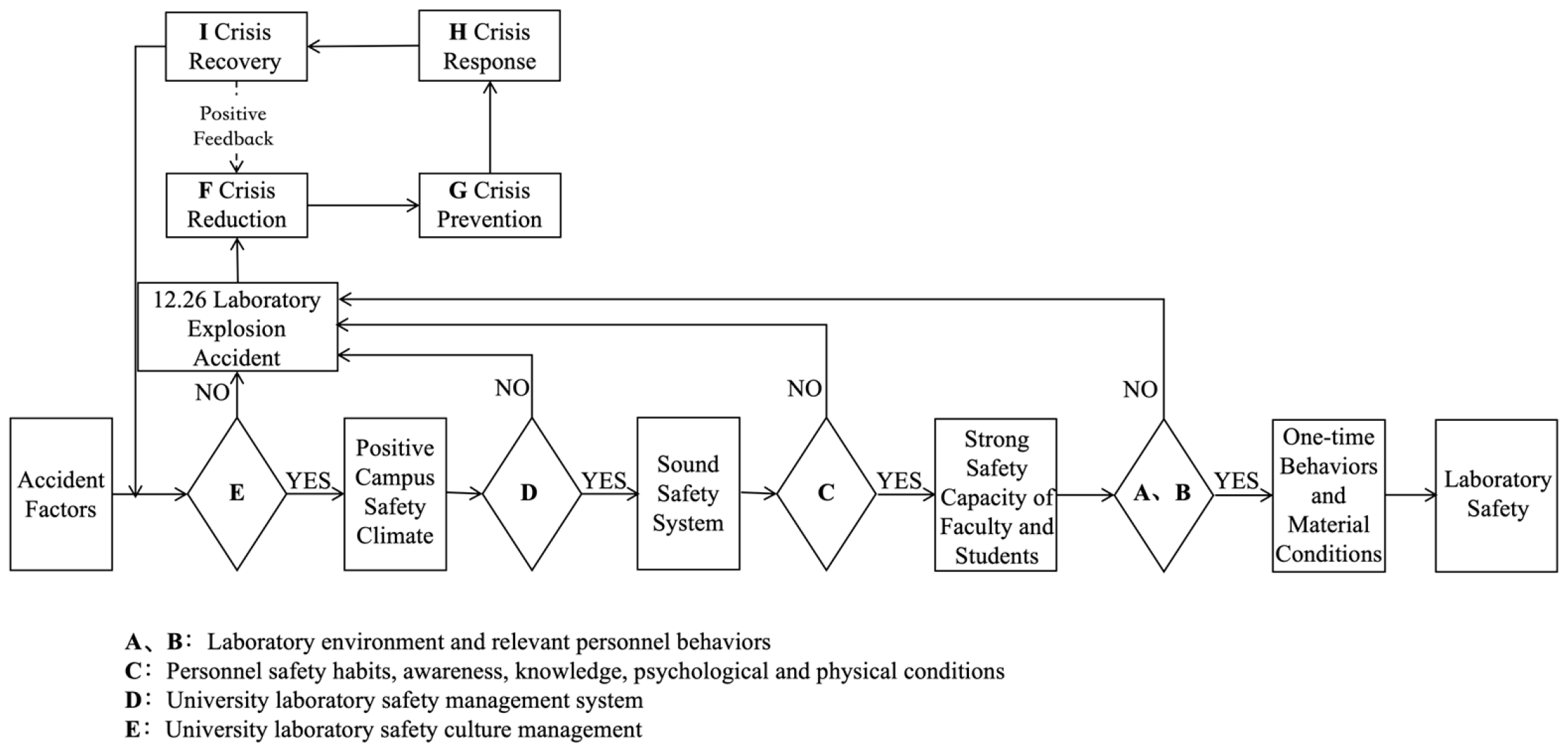
5.2. Laboratory Accident Risk Identification
5.3. Safety Governance Analysis Based on the 2-4-4R Model
6. Conclusions
6.1. Summary
6.2. Research Findings
6.3. Research Limitations and Future Directions
Author Contributions
Funding
Institutional Review Board Statement
Informed Consent Statement
Data Availability Statement
Conflicts of Interest
References
- Mercy, M.S.; Martha, C. Health and Safety Challenges in South African Universities: A Qualitative Review of Campus Risks and Institutional Responses. Int. J. Environ. Res. Public Health 2025, 22, 989. [Google Scholar]
- Ministry of Education, Department of Development Planning. Basic Situation of National Education Development in 2023. 2024. Available online: http://www.moe.gov.cn/fbh/live/2024/55831/sfcl/202403/t20240301_1117517.html (accessed on 18 February 2026).
- Guo, Z.; Ding, Y.; Liu, Y.; Gao, T.; Li, X. Statistical Analysis and Countermeasures of Laboratory Safety Incidents in Universities and Research Institutes from 2004 to 2024. Experimental Science and Technology, 1–6. 2025. Available online: https://link.cnki.net/urlid/51.1653.n.20250314.1014.002 (accessed on 30 December 2025).
- Xinhua, School-Related Crimes Drop for 12 Consecutive Years in China: Ministry. 2025. Available online: https://global.chinadaily.com.cn/a/202501/16/WS67886fa1a310f1265a1db3ae.html (accessed on 18 February 2026).
- Zhang, S. Research on Safety Management Strategies in University Campuses: A Review of Risk Analysis of Campus Safety Incidents. Sci. Technol. Manag. Res. 2022, 42, 267. [Google Scholar]
- Yang, F.; Mao, Y.; Tao, J. Safety management of university laboratories based on FDA accident causation model. Exp. Technol. Manag. 2021, 38, 307–311. [Google Scholar]
- Gong, S.; Chen, X.; Li, B.; Zhu, J. Campus food safety risk assessment based on safety management correlation model. Safety 2022, 43, 30–33+123+7. [Google Scholar]
- Shao, Y. Exploring the path of digital empowerment for handling campus crisis events in colleges and universities. Big Data Era 2025, 6, 64–70. [Google Scholar]
- Liu, X. Exploration and innovation of crisis management mechanism in college campuses. Mod. Vocat. Educ. 2020, 40, 226–227. [Google Scholar]
- Dehdashti, A.; Fatemi, F.; Janati, M.; Asadi, F.; Kangarloo, M.B. Data of risk analysis management in university campuses. BMC Res. Notes 2020, 13, 554. [Google Scholar] [CrossRef] [Scilit] [PubMed]
- Mabanglo, J.K. Campus security practices assessment of Philippine College of Science and Technology. Int. J. Adv. Res. Publ. 2020, 4, 14–19. [Google Scholar]
- Wang, L. Research on campus safety risk assessment based on multi-criteria decision-making. Syst. Sci. Math. 2021, 41, 2843–2854. [Google Scholar]
- Yang, J.; Dong, X.; Liu, S. Safety Risks of Primary and Secondary Schools in China: A Systematic Analysis Using AHP–EWM Method. Sustainability 2022, 14, 8214. [Google Scholar] [CrossRef] [Scilit]
- Li, X. Integrating big data intelligence into K-12 schools campus safety management. Front. Educ. Res. 2023, 6, 25–30. [Google Scholar] [CrossRef] [Scilit]
- Fu, G.; Chen, Y.; Xu, S.; Chen, P.; Yuan, C.; Wu, Y. Analysis of the “2-4” Model of Accident Causes and the Research of Its Sixth Edition. Chin. J. Saf. Sci. 2022, 32, 12–19. [Google Scholar]
- Rong, Z.; Lai, T. Construction of University Campus Safety System Based on Resilience Theory. J. Guangzhou Univ. Soc. Sci. Ed. 2022, 21, 44–59. [Google Scholar]
- Ford, J.L.; Ford, J.S.; Frei, S.S.; Pilny, A.; Berkelaar, B.L. A network under stress: Using embeddedness to understand uncertainty management and resilience in campus emergencies. J. Appl. Commun. 2016, 44, 316–335. [Google Scholar] [CrossRef] [Scilit]
- Xie, M. Research on Emergency Management Mechanisms for University Campus Emergencies. Sci. Educ. Lit. Rev. 2024, 4, 25–28. [Google Scholar]
- Yang, Y. Research and Practice on Cybersecurity Emergency Management System in Smart University Campuses. Cyberspace Secur. 2023, 14, 81–84, 93. [Google Scholar]
- Lauren, C.; Emina, H.; Kevin, W. “You are here”: Assessing the inclusion of maps in a campus emergency alert system. J. Contingencies Crisis Manag. 2021, 29, 332–340. [Google Scholar] [CrossRef] [Scilit]
- Li, S.; Zhu, Y.; Yang, J.; Gong, B. Research on Renewal Design of College Campus Based on Flood Bearing Resilience. Sustainability 2023, 15, 11489. [Google Scholar] [CrossRef] [Scilit]
- Brittany, H.; Naim, K.; Jeffrey, M. The use of social media for campus safety. J. Emerg. Manag. 2017, 15, 17–28. [Google Scholar] [CrossRef] [Scilit]
- Kalvach, Z.; Sláma, O.; Hrinko, M.; Hromada, M. Assessment the effectiveness of central crisis management at Charles University during the 2023 active shooter incident: A thematic analysis. Secur. J. 2025, 38, 36. [Google Scholar] [CrossRef] [Scilit]
- Yuan, C.; Fu, G.; Zhao, J.; Wu, Z.; Lyu, Q.; Wang, Y. Comparative study of FTA and 24Model: Taking the cause analysis of the Quanzhou Xinjia hotel collapse accident as an example. Int. J. Occup. Saf. Ergon. 2023, 30, 31–36. [Google Scholar]
- Xu, S.; Zhou, S.; Han, M.; Du, H. Analysis of Causes of University Safety Incidents and Strategies for Safety Education. Safety 2022, 43, 84–88. [Google Scholar]
- Liu, Z.; Sheng, J. Potential Risks and Countermeasures of University Student Safety and Stability under the Overall National Security Perspective. Sch. Party Build. Ideol. Educ. 2023, 1, 83–86. [Google Scholar]
- Cao, R.; Shan, C. Research on Campus Safety Culture Construction in Universities in the New Era. Univ. Logist. Res. 2021, 5, 43–44, 48. [Google Scholar]
- Chen, Y.; Luo, B.; Du, G. Construction of University Campus Safety Management System: Promoting Modernization of University Governance. Univ. Logist. Res. 2022, 11, 26–29. [Google Scholar]
- Xu, C.; Guo, L.; Zhao, C.; Ai, Z. Causes and Countermeasures of Flammable and Explosive Laboratory Accidents in Universities Based on the “2-4” Model. Exp. Technol. Manag. 2021, 38, 248–254. [Google Scholar]
- Zhou, J. Strengthening Campus Governance through Campus Safety Culture Construction: A Review of Prevention of Campus Safety Incidents and Safety Culture Construction. J. Saf. Environ. 2023, 23, 2145–2146. [Google Scholar]
- Yu, H.; Zhang, Y.; Qin, T.; Wang, J.; Zhang, Y.; Gao, Y. Research on Dormitory Fire Risk Assessment Method Considering Casualties in Universities. China Saf. Sci. J. 2022, 18, 81–86. [Google Scholar]
- Yang, J. Optimization and Management of Emergency Plans for University Emergencies under the New Situation. Saf. Health 2022, 1, 46–50. [Google Scholar]
- Beijing Jiaotong University. Investigation Report on the “12.26” Major Explosion Accident. 2018. Available online: https://baijiahao.baidu.com/s?id=1625348601432282183&wfr=spider&for=pc (accessed on 18 February 2026).
- Guo, H.; Tang, H.; Wang, K.; Yu, Y.; Wu, Y.; Xu, C. Analysis and Countermeasures of Hazardous Chemical Laboratory Accidents in Universities Based on the 24Model. Chin. J. Saf. Sci. 2022, 32, 168–174. [Google Scholar]
- Beijing Jiaotong University News Network. Available online: https://news.bjtu.edu.cn/ (accessed on 18 February 2026).
- Zhu, J.; Chen, J.; Zheng, J. Research on Public Event Emergency Management System in Universities: A Perspective Based on 4R Crisis Management Theory. Mod. Vocat. Educ. 2023, 1, 117–120. [Google Scholar]
- Yan, D.; Ma, Y. Constructing a Full-Process Community Emergency Information Management System: An Analysis Based on 4R Crisis Management Theory. North. Rev. 2021, 1, 78–87. [Google Scholar]
- Dong, Y.; Xu, H.; Yuan, H.; Liu, X. Construction of a Multi-Integrated Laboratory Safety Management System. Lab. Res. Explor. 2024, 43, 239–244. [Google Scholar]
- Research on accident causation models and an introduction to the “2–4” model. Safety 2023, 44, 9.



| Primary Indicators | Secondary Indicators | Tertiary Indicators |
|---|---|---|
| Safety Culture | Quality of Safety Management System | Campus Safety Management System Development Process |
| Formation of Safety Regulations | ||
| Quality of Safety Management Implementation | ||
| Effectiveness of Safety Management | ||
| Development of Emergency Response Plans | ||
| Degree of Safety Participation | Level of Participation by Campus Personnel | |
| Level of Participation by Management | ||
| Safety Education | ||
| Implementation of Safety Activities | ||
| Coverage of Campus Safety Facilities | ||
| Safety Environment | Level of Safety Regulation Enforcement | |
| Campus Safety Culture Development | ||
| Safety Awareness of Campus Personnel | ||
| Allocation of Campus Safety Facilities | ||
| Level of Campus Safety Management | ||
| Safety Management System | Personnel-Based Protection | Security Team Development |
| Attention to Special Groups | ||
| Physical Protection | Infrastructure Development | |
| Technological Protection | Technological Support and Safeguards | |
| Management of Modern Campus Information Platforms | ||
| Management-Based Protection | Performance Evaluation and Incentive Mechanisms | |
| Information Communication Efficiency | ||
| Emergency Response Operations | ||
| Development of Emergency Management Regulations | ||
| Optimization of Organizational Structure | ||
| Individual Factors | Safety Knowledge | Mastery of Campus Safety Regulations |
| Knowledge of Campus Risk Sources | ||
| Knowledge of Campus Safety Protection and Emergency Evacuation | ||
| Understanding of Consequences of Campus Safety Incidents | ||
| Safety Awareness | Awareness of the Importance of Campus Safety | |
| Concept of Healthy Living | ||
| Safety Habits | Daily Campus Life Habits | |
| Laboratory Operation Habits | ||
| Safety Physiology | Individual Safety Management Capability | |
| Campus Risk Identification Ability | ||
| Risk Response Capability | ||
| Physical Fitness | ||
| Safety Psychology | Mental Health Level | |
| One-Time Behaviors and Material Conditions | Unsafe Material Conditions | Condition of Buildings and Infrastructure |
| Status of Campus Security Systems | ||
| Status of Firefighting and Emergency Facilities | ||
| Condition of Teaching and Research Equipment and Facilities | ||
| Unsafe Actions | Improper Operations | |
| Subjective Actions |
| Crisis Stage | Organizational Level | Individual Level | ||
|---|---|---|---|---|
| Campus Safety Culture Development | Campus Safety Management System Development | Habitual Behaviors | One-Time Behaviors and Material Conditions | |
| Crisis Reduction | Educational and Normative Influence | Early Intervention | Formation of Good Habits | Avoidance of Risk Sources |
| Crisis Preparedness | Ideological Guidance | Plan Development | Maintenance of Good Habits | Routine Vigilance |
| Crisis Response | Awareness Formation | Activation of Emergency Mechanism | Application of Good Habits | Rapid and Appropriate Response |
| Crisis Recovery | Reflection and Summary | System Improvement | Maximization of Benefits and Avoidance of Harm | Support for Post-crisis Reconstruction |
| Level | Risk Category | Risk Factors | Case Manifestation |
|---|---|---|---|
| Individual Level | Individual Factors | Insufficient safety knowledge | Students lack operational knowledge of hazardous chemicals |
| Insufficient safety awareness | Insufficient awareness of the risks of violating experimental operation procedures | ||
| Unsafe Acts and Physical Conditions | Unsafe operations | Experiments conducted in violation of regulations; equipment not operated according to standard procedures | |
| Laboratory environment not meeting standards | Unreasonable laboratory layout; improper storage of flammable materials | ||
| Organizational Level | Safety Culture | Insufficient safety training | Students have insufficient safety awareness and inadequate understanding of the risks of hazardous chemicals |
| Insufficient safety culture development | The university has not formed a strong laboratory safety culture atmosphere | ||
| Safety Management System | Lack of laboratory supervision mechanisms | No effective routine laboratory safety supervision mechanism; no effective emergency response plan established | |
| Irregular management of hazardous chemicals | Inadequate management of the procurement and storage of hazardous chemicals |
Disclaimer/Publisher’s Note: The statements, opinions and data contained in all publications are solely those of the individual author(s) and contributor(s) and not of MDPI and/or the editor(s). MDPI and/or the editor(s) disclaim responsibility for any injury to people or property resulting from any ideas, methods, instructions or products referred to in the content. |
© 2026 by the authors. Licensee MDPI, Basel, Switzerland. This article is an open access article distributed under the terms and conditions of the Creative Commons Attribution (CC BY) license.
Share and Cite
Qi, P.; Cheng, Y. A Study on Safety Risk Identification and Governance in Universities Based on the 2-4-4R Model. Sustainability 2026, 18, 3087. https://doi.org/10.3390/su18063087
Qi P, Cheng Y. A Study on Safety Risk Identification and Governance in Universities Based on the 2-4-4R Model. Sustainability. 2026; 18(6):3087. https://doi.org/10.3390/su18063087
Chicago/Turabian StyleQi, Peng, and Yan Cheng. 2026. "A Study on Safety Risk Identification and Governance in Universities Based on the 2-4-4R Model" Sustainability 18, no. 6: 3087. https://doi.org/10.3390/su18063087
APA StyleQi, P., & Cheng, Y. (2026). A Study on Safety Risk Identification and Governance in Universities Based on the 2-4-4R Model. Sustainability, 18(6), 3087. https://doi.org/10.3390/su18063087