1. Introduction
Agritourism has become an increasingly important component of rural tourism and regional development, reflecting a broader shift in visitor preferences toward authenticity, locality, and immersive experience consumption. Recent studies indicate that agritourism contributes to farm income diversification, enhances community resilience, and strengthens local food systems, while generating distinctive forms of experiential value not typically found in urban leisure settings [
1,
2]. Unlike conventional tourism environments, agritourism is shaped by seasonal rhythms, human–land relationships, agricultural labor, and environmental variability, creating an experiential structure that is both heterogeneous and context dependent.
In Taiwan, the institutionalization of agritourism parallels global trends. Taiwan currently has over 100 officially designated agritourism areas under the Ministry of Agriculture framework, reflecting the sector’s policy integration and governance maturity. Despite this institutional consolidation, empirical understanding of how agritourism experiences translate into perceived value and satisfaction within authentic farming contexts remains limited. The hybrid nature of agritourism—combining natural landscapes, labor practices, cultural traditions, and rural social interaction—poses distinct theoretical challenges for experience research and warrants deeper examination of its underlying psychological mechanisms.
Within the broader evolution toward the experience economy [
3], experiential marketing provides a structured framework for understanding how sensory, affective, cognitive, behavioral, and relational components shape visitor responses [
4]. Evidence from tourism studies confirms that these experiential modules influence both perceived value and behavioral intentions [
5]. However, agritourism differs fundamentally from constructed or engineered experience spaces—such as theme parks—in which environmental stimuli and visitor pathways are carefully controlled. In contrast, agritourism experiences arise from natural variability, authentic farm work, local social relations, and embodied engagement with rural settings [
6]. This makes agritourism an important empirical setting for assessing the applicability of the Strategic Experiential Modules (Sense, Feel, Think, Act, Relate) to authenticity-based and labor-intensive tourism contexts. Despite growing interest, limited research has systematically evaluated how experiential marketing translates into perceived value and satisfaction in agritourism, leaving key theoretical and managerial questions insufficiently addressed.
The Memorable Tourism Experience (MTE) framework provides a complementary theoretical lens for understanding how emotional and cognitive processes generate lasting experiential outcomes [
7]. Although MTE has been widely applied in nature-based, food, and cultural tourism [
8], its application to agritourism remains underexplored, despite the high potential of farm-based activities, local interaction, and rural landscape immersion to create memorable experiences. Prior studies have identified links among experience quality, perceived value, and satisfaction in rural tourism [
9,
10], but the psychological mechanisms connecting these constructs have rarely been integrated within a coherent MTE-informed framework. Furthermore, empirical studies on the integration of experiential value and sustainability considerations in agritourism remain relatively limited.
In East Asian contexts, agritourism demand is largely driven by urban residents seeking experiential contrast from everyday life. Rural novelty, landscape aesthetics, and hands-on agricultural participation have been shown to enhance emotional response, well-being, and place attachment [
6,
11]. This cross-lifeworld contrast underscores the conceptual relevance of applying experiential marketing to agritourism. At the same time, destination management organizations (DMOs) have become increasingly involved in agritourism governance through branding, route development, certification schemes, and local food initiatives [
12,
13], yet their influence on experience formation has seldom been incorporated into empirical models.
Moreover, the growing emphasis on sustainable tourism development highlights the importance of understanding how experiential value can contribute to sustainable rural tourism, but the empirical integration of experiential marketing with sustainable rural development remains underexplored. Recent systematic reviews have emphasized that agritourism can serve as an effective tool for sustainable development by stimulating local economic activities, preserving cultural heritage, and supporting environmentally responsible tourism practices [
5]. However, few studies have empirically examined how experiential marketing contributes to these sustainability outcomes through tourists’ perceived value and satisfaction. To address these gaps, this study develops and empirically tests an integrated structural equation model linking agritourism experience, perceived value, and satisfaction, grounded in experiential marketing and MTE theory.
Given these findings, the study contributes by (1) validating the applicability of experiential modules in authentic agricultural environments, (2) proposing an MTE-informed model of agritourism experience formation, and (3) identifying the value formation mechanisms through which agritourism experiences influence satisfaction. These insights provide theoretical advancement for experience research and practical guidance for agritourism operators and DMOs in designing culturally embedded and value-driven rural tourism experiences that may support sustainable rural tourism development.
2. Literature Review
2.1. Conceptual Foundations and Recent Developments in Agritourism
Agritourism is widely conceptualized as a multifunctional rural development strategy integrating agricultural production, tourism, and community interaction. It generally refers to tourism activities that take place on farms and integrate agricultural production, rural landscapes, and direct interactions between visitors and farmers [
14]. Recent scholarship conceptualizes agritourism not merely as a leisure activity but as a socio-cultural space in which visitors, farmers, and local communities co-produce meanings associated with food, agriculture, and rural identity [
15].
From the perspective of the experience economy, agritourism can be viewed as a form of staged experiential consumption in which visitors actively participate in agricultural environments and co-create meaning through interaction with farmers, landscapes, and local culture [
3,
5]. Studies published after 2018 increasingly emphasize the distinctions between agritourism and artificially constructed leisure environments. Agritourism experiences are shaped by authenticity, seasonality, natural rhythms, and the materiality of farm work, and are characterized by highly experiential, place-specific learning and participation [
16]. Research across Southern and Northern Europe, North America, and East Asia consistently shows rising demand for farm-based engagement, food-related interactions, and immersive learning, all of which enhance visitors’ sensory and emotional involvement [
10,
15,
17].
In Asia, agritourism has expanded rapidly in Japan, South Korea, and Taiwan, typically through small, family-operated farms emphasizing local food, community culture, and environmental education [
18,
19]. Taiwan’s agritourism system is one of the most institutionalized in the region, currently comprising more than one hundred officially designated agritourism areas [
20,
21]. Despite this institutional development, empirical research examining how experiential marketing mechanisms shape visitor evaluations in agritourism remains limited. Existing studies tend to focus on destination attributes or visitor motivations, while few studies integrate experiential marketing, perceived value, and satisfaction within a unified quantitative framework.
2.2. Experiential Marketing in Tourism: Theoretical Developments and Rural Applications
Experiential marketing has become a foundational framework in tourism research for understanding sensory, emotional, cognitive, behavioral, and relational elements of visitor experience. Schmitt’s Strategic Experiential Modules (SEM)—Sense, Feel, Think, Act, and Relate—provide the conceptual basis for analyzing how marketing stimuli shape experiential responses [
4,
22]. Recent tourism studies, however, expand beyond Schmitt’s framework to consider immersive environments, co-creation, emotional connectedness, and social interaction as deeper determinants of experiential value [
23].
While the Memorable Tourism Experience (MTE) framework focuses on post-experience memory formation, Schmitt’s experiential modules are particularly useful for analyzing the immediate experiential stimuli that shape visitors’ perceptions during the consumption process [
24]. Memory-oriented studies further show that experiential cues play a central role in forming Memorable Tourism Experiences (MTEs), which in turn shape revisit intention [
25]. Current evidence highlights sensory richness, emotional resonance, and social interaction as critical drivers of satisfaction and loyalty [
26].
Despite its theoretical relevance, experiential marketing has been applied only sparingly in agritourism contexts. While existing studies recognize authenticity, social interaction, and hands-on participation as defining features of rural tourism, few have quantitatively operationalized Schmitt’s SEM model in farming environments. Liang et al. find that in rural settings, the Relate and Act dimensions tend to be more influential than in urban leisure environments because rural tourism relies heavily on community interaction and bodily engagement in agricultural activities [
27].
Extending experiential marketing to agritourism therefore requires examining how rurality—such as natural environments, seasonal rhythms, local culture, and farmer interaction—reshapes experiential mechanisms. This study contributes to this line of inquiry.
2.3. Perceived Value and Tourist Satisfaction: Multidimensional Structure and Recent Evidence
In rural and nature-based tourism contexts, perceived value is often shaped not only by functional benefits but also by authenticity, environmental immersion, and opportunities for learning about local culture and agriculture [
5,
28]. Perceived value remains a central construct in tourism behavior research, reflecting the visitor’s overall evaluation [
29], which is closely related to the evaluation after the experience [
30]. Contemporary perspectives emphasize its multidimensional nature, incorporating emotional, functional, social, monetary, and effort-based components [
31,
32]. Studies published after 2019 increasingly stress the importance of emotional and social value in experience-based and nature-based tourism [
9].
A substantial body of evidence demonstrates that perceived value is a key predictor of satisfaction, loyalty, and revisit intention. Recent research shows that perceived value often acts as a mediator linking experiential elements—such as sensory immersion, emotional engagement, and authenticity—to satisfaction [
33]. Empirical studies also indicate that when visitors experience meaningful social interaction, cultural learning, or personal growth during a trip, their overall value assessment increases significantly [
9], which in turn leads to higher levels of tourist satisfaction [
34].
Findings in agritourism exhibit similar patterns. Suhartanto et al. report that emotional and educational elements in rural homestays and farming activities strongly influence perceived value [
30,
35]. Kastenholz et al. and Liang find that agricultural participation enhances both emotional and cognitive value, which in turn improves satisfaction [
17,
27].
Despite these insights, agritourism research still lacks an integrated theoretical model linking experiential marketing, perceived value, and satisfaction. This study addresses this important gap by proposing a quantitative, empirically testable framework.
2.4. Hypotheses Development
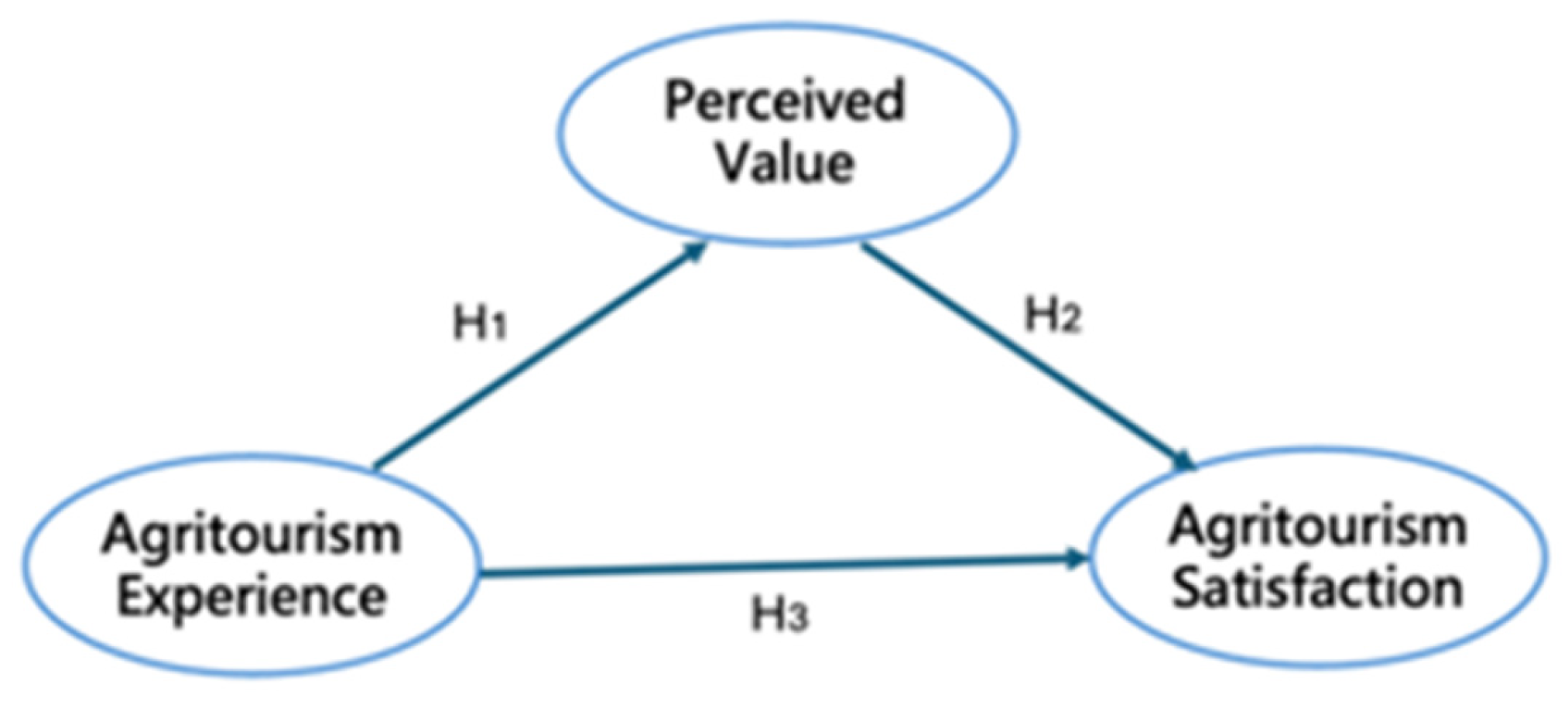
Building upon experiential marketing theory and the Memorable Tourism Experience (MTE) framework, this study proposes a dual-path structural model in which agritourism experience influences visitor satisfaction both directly and indirectly through perceived value. This structure reflects two complementary processes in experiential consumption: immediate affective responses and subsequent cognitive evaluation. In authenticity-based rural environments, where experiences emerge from embodied interaction with landscapes, agricultural labor, and local communities, both processes are expected to operate simultaneously.
2.4.1. Agritourism Experience on Perceived Value (H1)
Experiential marketing theory posits that sensory, emotional, cognitive, behavioral, and relational dimensions jointly shape the depth and quality of consumption experiences [
4]. In tourism and leisure contexts, these experiential components have been shown to enhance visitors’ functional, emotional, and social value perceptions [
31,
32]. Experiential stimuli do not merely generate temporary pleasure; they structure the evaluative meaning that visitors assign to their participation.
In agritourism settings, immersive engagement through hands-on agricultural activities, cultural interaction, and natural environment exposure creates conditions for emotional resonance, learning, and embodied involvement. These experiences enhance visitors’ perceptions of authenticity, meaningful participation, and personal enrichment, which in turn elevate perceived value [
5,
35]. Given the multisensory and participatory nature of farm-based tourism, richer experiential engagement is expected to translate into stronger value appraisals.
Therefore, we hypothesize:
H1. Agritourism experience positively influences perceived value.
2.4.2. Perceived Value on Agritourism Satisfaction (H2)
Perceived value has long been conceptualized as the consumer’s overall evaluation of the trade-off between benefits received and costs incurred [
29]. In tourism research, perceived value consistently emerges as one of the strongest predictors of satisfaction and behavioral outcomes [
28,
36]. While experiential dimensions capture what visitors feel and do, perceived value represents the cognitive appraisal through which those experiential elements are integrated into an overall evaluative judgment.
In experiential and nature-based tourism contexts, meaningful engagement, emotional involvement, and authenticity contribute to higher perceived value, which subsequently enhances satisfaction [
9]. Empirical evidence from agritourism studies similarly confirms that value perception plays a central role in shaping visitor satisfaction [
5,
35].
In the present framework, perceived value is positioned as the key mediating mechanism because it reflects the integrative cognitive assessment that directly precedes satisfaction judgments. While constructs such as authenticity or place attachment capture specific affective or relational dimensions, perceived value encompasses a broader evaluative synthesis that links experiential inputs to overall satisfaction.
Accordingly, we propose:
H2. Perceived value positively influences agritourism satisfaction.
2.4.3. Agritourism Experience on Agritourism Satisfaction (H3)
Beyond its indirect effect through perceived value, agritourism experience may also directly enhance satisfaction. Empirical studies in tourism frequently report both direct and indirect effects of experiential factors on satisfaction, suggesting that visitors may form affective evaluations before conducting cognitive value assessments [
37,
38]. Studies by Rahmawati & Kusumawati and Sharma et al. show that sensory and emotional experiences can generate immediate pleasure and satisfaction even prior to cognitive appraisal [
25,
36]. Volo similarly argues that immersive and affective experiences can elicit satisfaction independently of value judgments [
37].
Agritourism activities are highly interactive, enabling visitors to experience emotional fulfillment and positive sensory stimulation through farm work, cultural participation, and encounters with farmers. These experiences can directly elevate visitors’ overall evaluations, independent of perceived value [
16].
Thus, we hypothesize:
H3. Agritourism experience positively influences agritourism satisfaction.
Building on the theoretical foundations and hypotheses developed above, the following section presents the conceptual framework that integrates these proposed relationships into a unified structural model.
2.5. Conceptual Framework
Building upon the hypotheses developed in
Section 2.4, this study proposes an integrated structural framework linking agritourism experience, perceived value, and satisfaction. The model reflects a dual-path mechanism consistent with experiential consumption theory, in which agritourism experience influences visitor satisfaction both directly through affective responses and indirectly through cognitive value appraisal.
In this framework (
Figure 1), agritourism experience is conceptualized as a multidimensional construct derived from Schmitt’s Strategic Experiential Modules (Sense, Feel, Think, Act, Relate) [
4]. These experiential components capture the sensory immersion, emotional engagement, cognitive stimulation, participatory behavior, and relational interaction characteristic of authenticity-based rural tourism environments. Perceived value is positioned as the central evaluative mechanism through which visitors integrate experiential stimuli into an overall assessment of benefit and worth. Satisfaction represents the cumulative affective evaluation resulting from both immediate experiential pleasure and subsequent value-based judgment.
By integrating these constructs into a unified structural model, the framework advances prior fragmented approaches and provides a coherent basis for examining experiential mechanisms in agritourism.
Figure 1 presents the proposed structural model that guides the empirical analysis conducted through Structural Equation Modeling (SEM) in the subsequent sections.
3. Methodology
3.1. Research Context and Sampling Procedure
Taiwan provides a well-established institutional environment for agritourism research, with the Ministry of Agriculture formally designating numerous agritourism areas and registering 395 agritourism farms nationwide. These destinations operate under standardized administrative guidelines, offering a suitable context for examining experiential mechanisms within authentic farming settings.
This study employed a purposive stratified sampling strategy to select 12 representative destinations from the national registry, distributed across Northern (4 sites), Central (4 sites), and Southern (4 sites) Taiwan. These sites were selected as “information-rich cases” based on two rigorous criteria: (1) formal registration as an agritourism or leisure farm destination to ensure institutional comparability, and (2) provision of at least two visitor-participatory activities, such as harvesting, food processing, or ecological learning. This approach ensured that the selected sites possessed mature infrastructure, allowing the experiential marketing modules (Sense, Feel, Think, Act, Relate) to be fully operationalized.
Data collection occurred on-site between May and June 2024 using a visitor-intercept survey approach. Respondents were visitors who had completed at least one agritourism activity. A total of 426 questionnaires were distributed (averaging approximately 35 per site) to mitigate potential site-specific bias. Although convenience sampling was adopted—a common practice in field-based tourism research—sampling bias was mitigated through systematic data collection across weekdays/weekends and morning/afternoon periods. Participation was voluntary, anonymous, and based on informed consent. Of the 413 questionnaires collected, 398 were retained after removing incomplete cases, resulting in an effective response rate of 93.4%. Missing values accounted for less than 5% of the dataset and showed no systematic pattern; thus, listwise deletion was applied. Respondent demographics are summarized in
Table 1.
3.2. Measurement Instruments
The questionnaire consisted of three validated multi-item scales—experiential marketing, perceived value, and satisfaction—supplemented by demographic items. All constructs were measured using a five-point Likert scale (1 = strongly disagree; 5 = strongly agree).
Experiential marketing was measured using Schmitt’s Strategic Experiential Modules (SEMs), including Sense, Feel, Think, Act, and Relate [
4]. Items were adapted to reflect agritourism conditions and were subjected to content validation procedures. The final scale contained twelve items.
Perceived value was measured using the multidimensional frameworks of Sweeney & Soutar and Petrick, comprising quality, emotional response, monetary cost, behavioral cost, and reputation [
31,
32]. These dimensions have been validated in recent tourism and agricultural experience studies [
35,
39]. The final perceived value scale contained ten items.
Satisfaction was measured using a three-item scale reflecting overall evaluative judgment, grounded in Oliver’s satisfaction framework [
40]. To ensure linguistic and conceptual equivalence, all items underwent forward translation and back-translation following Brislin’s guidelines [
41].
3.3. Data Quality Assurance and Control for Common Method Variance
To minimize potential common method variance (CMV), the study implemented several procedural controls: respondents were assured of anonymity and confidentiality, item order was randomized to reduce response patterns, and experiential items were separated from evaluative items to avoid priming.
Post hoc statistical assessments were also conducted. Harman’s single-factor test indicated that no single factor accounted for a majority of variance (<40%). A single-factor confirmatory factor analysis (CFA) model exhibited poor fit, further suggesting that CMV did not substantially influence the results. Incorporating CMV diagnostics aligns with methodological best practices in quantitative agricultural and tourism research.
3.4. Preliminary Statistical Diagnostics
Prior to estimating the structural equation model, preliminary diagnostic checks were conducted. Skewness and kurtosis values for all constructs were within acceptable thresholds (|skewness| < 2; |kurtosis| < 7), supporting the use of maximum likelihood (ML) estimation. Sampling adequacy was confirmed with a Kaiser–Meyer–Olkin (KMO) value of 0.921, while Bartlett’s test of sphericity was significant (p < 0.001), indicating that the dataset was suitable for factor analytic procedures.
3.5. Data Analysis Strategy
The study followed the two-step structural equation modeling (SEM) approach recommended by Hair et al. [
42]. SEM was selected because the research model includes multiple latent variables and hypothesized direct and indirect effects that require simultaneous estimation.
Step 1: Measurement model. Confirmatory factor analysis (CFA) was used to assess indicator reliability, internal consistency reliability (Cronbach’s α, Composite Reliability), convergent validity (Average Variance Extracted), and discriminant validity [
43].
Step 2: Structural model. Path analysis was performed to test the hypothesized relationships among experiential marketing, perceived value, and satisfaction. Model adequacy was evaluated using multiple fit indices, including χ2/df, CFI, TLI, GFI, and RMSEA, consistent with SEM reporting standards.
Mediation analysis employed non-parametric bootstrapsping with 5000 resamples; indirect effects were evaluated using 95% bias-corrected confidence intervals.
The study complied with relevant ethical standards, and all respondents provided informed consent prior to participation.
4. Results
4.1. Measurement Model Evaluation
The analysis followed a two-step Structural Equation Modeling (SEM) approach. The first step involved evaluating the measurement model to assess the reliability and validity of the latent constructs, including indicator reliability, convergent validity, and discriminant validity. The second step estimated the structural model to test the hypothesized relationships and overall model fit.
Regarding indicator reliability, standardized factor loadings for all items were examined. One item exhibited a loading below the acceptable threshold of 0.593 and was therefore removed from the model (see
Table 2). Composite Reliability (CR) was subsequently calculated, as CR provides a more accurate estimate of internal consistency for latent constructs than Cronbach’s α. As shown in
Table 3, all constructs achieved CR values above 0.674, indicating satisfactory reliability.
For convergent validity, all constructs demonstrated Average Variance Extracted (AVE) values greater than 0.50, indicating that the variance explained by the items exceeded the measurement error and therefore met the standard criteria for convergent validity. Discriminant validity was evaluated using the Fornell and Larcker criterion [
7], which compares the square root of each construct’s AVE with its correlations with other constructs. As shown in
Table 3 and
Table 4, the square root of each AVE exceeded the corresponding inter-construct correlations, confirming satisfactory discriminant validity.
To further strengthen this assessment, the heterotrait–monotrait ratio (HTMT) was additionally examined. Based on the item-level Pearson correlation matrix, HTMT values for all construct pairs ranged from 0.69 to 0.78, which are below the conservative threshold of 0.85. These results further confirm satisfactory discriminant validity among experiential marketing, perceived value, and satisfaction.
Overall, the measurement model demonstrated adequate reliability, convergent validity, and discriminant validity, supporting its suitability for subsequent structural path analysis and hypothesis testing.
4.2. Overall Model Fit
Following data collection, a Confirmatory Factor Analysis (CFA) was conducted to assess the reliability and validity of the measurement scales used in the study. According to the guidelines proposed by Nunnally and Bernstein [
45], overall reliability coefficients (Cronbach’s α) for attitudinal or perceptual scales should exceed 0.80, while subscale reliabilities should surpass 0.70; values between 0.60 and 0.70 are considered acceptable in exploratory contexts. In this study, the reliability coefficients of all scales exceeded 0.87, and subscale reliabilities ranged from 0.67 to 0.89, indicating satisfactory internal consistency.
In line with recommendations by Bagozzi & Yi, multiple indices were used to evaluate the overall model fit [
46]. The seven fit indices examined included the chi-square statistic (χ
2), chi-square to degrees of freedom ratio (χ
2/df), the Goodness-of-Fit Index (GFI), Adjusted Goodness-of-Fit Index (AGFI), Normed Fit Index (NFI), Comparative Fit Index (CFI), and Root Mean Square Error of Approximation (RMSEA).
The fit indices are summarized in
Table 5. As suggested by Bagozzi and Yi, χ
2/df values below 3 indicate acceptable fit [
43]; the value obtained in this study was 2.52, meeting the required standard. Hair et al. recommend that GFI and AGFI values approach 1 [
42]; in this study, GFI = 0.90 and AGFI = 0.87, both of which demonstrate good fit. The CFI value of 0.95 exceeded the recommended threshold of 0.90, indicating excellent comparative fit. Finally, the RMSEA value of 0.06 was below the recommended cutoff of 0.08 [
42], suggesting satisfactory approximate fit.
The explanatory power of the model was assessed using the coefficient of determination (R2). The results show that agritourism marketing explains a substantial proportion of variance in perceived value (R2 = 0.70). Furthermore, agritourism marketing and perceived value jointly explain a considerable proportion of variance in agritourism satisfaction (R2 = 0.53). These findings indicate that the proposed model has strong explanatory power in the context of agritourism.
Overall, the results indicate that the measurement model achieved satisfactory fit across all indices, demonstrating adequate theoretical and empirical support. The model exhibits strong explanatory power and statistical stability, providing a sound basis for subsequent hypothesis testing and structural model evaluation.
4.3. Structural Model and Hypothesis Testing
After confirming that the measurement model demonstrated satisfactory reliability and validity, the structural model was evaluated to examine the estimated path coefficients and their statistical significance. To obtain robust parameter estimates, non-parametric bootstrapping was employed (sample size N = 398, with 5000 resamples). Standardized path coefficients, standard errors, and t-values were computed accordingly.
The results of the structural model are presented in
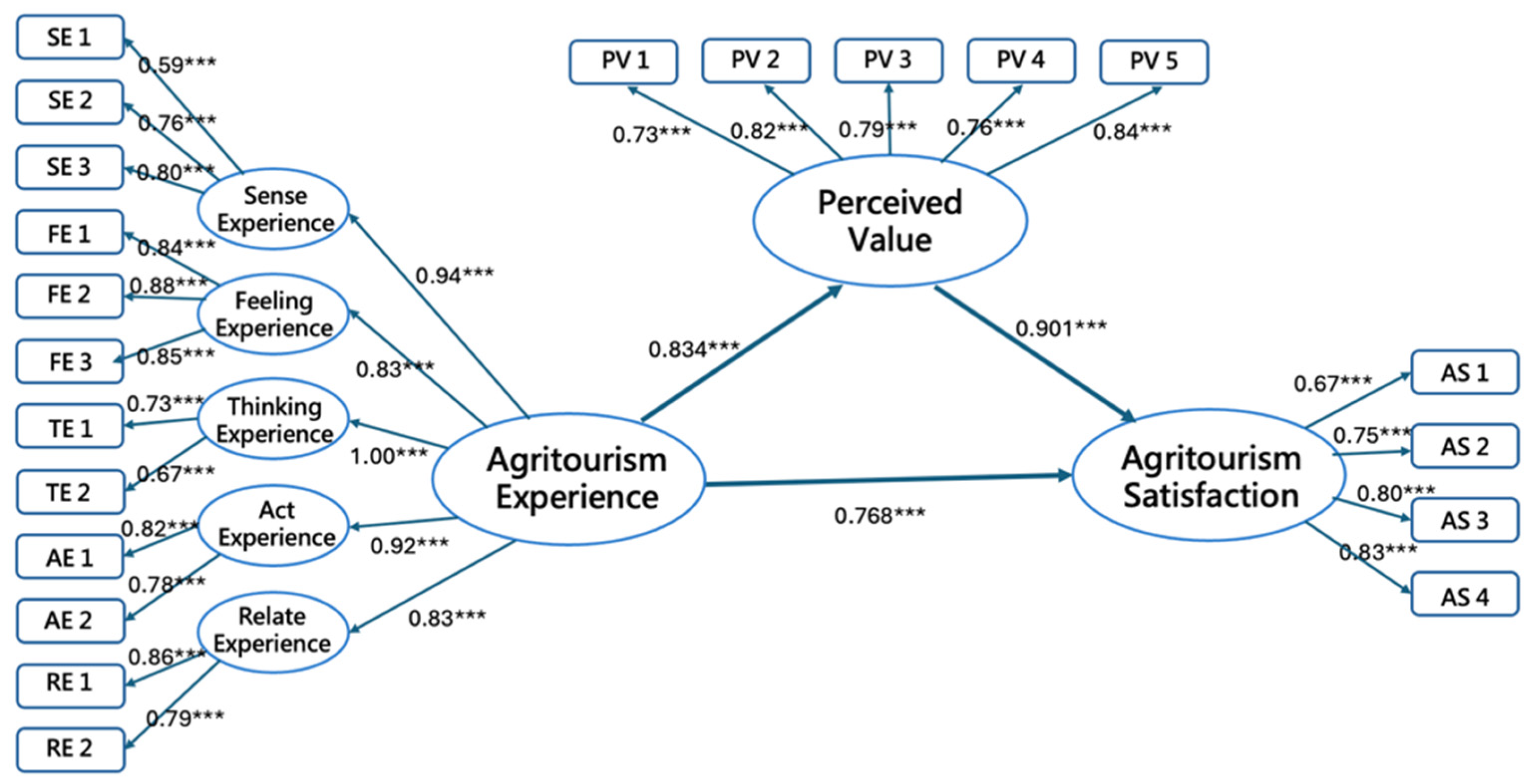
Table 6. All three hypotheses proposed in this study were supported. First, agritourism experience exerted a significant positive effect on perceived value (β = 0.834,
p < 0.01), supporting H1. Second, perceived value had a significant positive influence on visitor satisfaction (β = 0.901,
p < 0.01), providing support for H2. Third, agritourism experience also exhibited a significant direct effect on satisfaction (β = 0.768,
p < 0.01), confirming H3.
In addition, all subdimensions of the agritourism experience construct demonstrated significant factor loadings on their corresponding latent variable, indicating strong indicator representativeness. The loadings of each subdimension and the full structural relationships of the proposed model are illustrated in
Figure 2. Notably, agritourism experience and perceived value showed a high degree of association. Although experiential marketing remains an important determinant of agritourism satisfaction, the perceived value formed through actual participation appears to be the more proximal driver of satisfaction.
From a sustainability perspective, the strong explanatory power of agritourism marketing for perceived value and visitor satisfaction suggests that well-designed experiential strategies in agritourism can enhance tourists’ positive evaluations and satisfaction, which are essential for fostering repeat visitation and long-term engagement. Such outcomes contribute to the economic viability of rural destinations and support sustainable rural development by encouraging stable tourism demand and local value creation.
5. Discussion
This study advances the understanding of agritourism experience formation by integrating experiential marketing theory with perceived value and satisfaction in a structural equation model. The results provide clear empirical evidence that experiential elements significantly shape visitors’ value assessments and overall evaluations of agritourism. Two key psychological pathways emerge: experiential encounters generate immediate affective responses, while also informing subsequent cognitive value appraisals. This dual pathway reinforces the need for a more nuanced conceptualization of experiential processes in rural tourism settings, which differ substantively from the commercialized and highly designed experiences typically examined in mainstream tourism research.
A central theoretical contribution of this study is the articulation of how agritourism experiences differ from experiences occurring in constructed leisure environments. In contrast to theme parks or entertainment complexes—where narratives, spatial control, and standardized flows determine experience outcomes—agritourism is embedded within real agricultural labor, environmental variability, and the rhythms of rural life. Such conditions generate experiences that cannot be fully standardized or industrialized. The findings indicate that perceived value in agritourism is not derived from engineered stimuli, but instead from authenticity, place-based engagement, and meaningful human–land interactions. This establishes agritourism as a distinctive empirical site for expanding theories of the experience economy, particularly regarding how authenticity and relationality shape experiential quality.
From the perspective of Memorable Tourism Experiences (MTE) theory, this study further demonstrates that the components of experiential marketing align closely with MTE’s core dimensions—emotion, meaning, learning, novelty, and social connection. The structural model validates the psychological mechanism proposed in MTE frameworks: experiential quality influences satisfaction primarily through value appraisal. This evidence strengthens the theoretical bridge between MTE and rural tourism research by demonstrating how MTE processes unfold within farm-based activities, local cultural encounters, and community interactions. The findings therefore extend MTE theory into an empirical context where memory formation is likely driven by embodied participation and authentic human contact.
The study further clarifies experiential dynamics for urban visitors, who constitute the primary agritourism market segment in East Asia. Rural environments represent a marked contrast to urban life, generating unfamiliarity, authenticity, and temporal differentiation. These contrasts intensify both affective and cognitive responses, reinforcing the experiential marketing mechanism in ways less evident in routine leisure contexts. Agritourism thus offers not merely consumption but engagement with an alternative lifeworld.
From a governance and management perspective, the study indicates that expanding the consumer base and designing experiential activities can indeed enhance visitor satisfaction and thereby increase revisit intentions. In addition, agritourism operators in Asia, including Taiwan, are predominantly small-scale enterprises. Even when immersive and in-depth experiential activities are used to extend visitors’ length of stay, it remains necessary to integrate rural cultural landscapes in order to connect individual attractions into coherent tourism corridors.
In this context, Destination Management Organizations (DMOs) serve as key institutional actors within Taiwan’s agritourism system in Asia. Local tourism associations, slow-city networks, and regional tourism alliances collaborate closely with rural communities and tourist farms to shape experiential design, brand identity, thematic routes, and festival events. The Ministry of Agriculture’s Agritourist Area framework performs functions similar to those of a DMO, encompassing brand certification, quality monitoring, and integrated experiential planning. These findings underscore that agritourism governance frameworks should evaluate success not only through economic indicators, but also through experiential quality and value creation—dimensions that are essential to the long-term sustainability of rural areas.
From a sustainability perspective, the findings provide further insight into how experiential marketing supports sustainable rural development. Previous research has suggested that agritourism contributes to sustainability by generating alternative income sources, preserving local culture, and fostering responsible tourism practices. The present study extends this literature by empirically demonstrating that experiential marketing enhances perceived value and satisfaction—critical determinants of repeat visitation and sustained engagement. By strengthening perceived value through authentic, well-designed experiential offerings, agritourism operators can cultivate more stable tourism demand and reinforce local economic vitality without relying on mass tourism expansion. In this regard, experiential marketing functions not merely as a promotional tool, but as a strategic mechanism aligning destination competitiveness with sustainability objectives in rural tourism contexts.
6. Conclusions
This study contributes to agritourism scholarship in three significant ways. Empirically, it provides robust structural evidence demonstrating how experiential marketing influences satisfaction both directly and indirectly through perceived value. Conceptually, it advances understanding of value formation in authenticity-based rural contexts by showing that authenticity, sense of place, and social interaction operate as core mechanisms shaping visitor evaluations. Institutionally, it highlights the role of governance systems in structuring experiential environments, revealing how destination-level coordination affects perceived value and competitive positioning. In summary, these findings extend agritourism research beyond descriptive analyses and offer a more systematic account of experiential processes in sustainable rural tourism development.
Recent systematic reviews have identified agritourism as a catalyst for sustainable development, contributing to rural economic growth, cultural heritage preservation, and environmental conservation [
47]. By clarifying the experiential mechanisms underlying value creation and satisfaction, this study deepens understanding of how such sustainability outcomes may be reinforced through strategic experiential design.
The study is not without limitations. Data were collected from four regions in Taiwan, and cross-cultural generalizability remains to be assessed. The model does not incorporate additional constructs relevant to rural tourism, such as environmental ethics, land attachment, or cultural sustainability. Moreover, the analysis reflects only the visitor perspective. Future research could develop a triadic “visitor–farmer–DMO” framework to deepen theoretical insights into agritourism as both a governance structure and a site of experiential value co-creation. Furthermore, effective marketing strategies should ideally be tailored to diverse tourist profiles. A limitation of this study is the lack of a segmented analysis based on generational cohorts, which may introduce potential bias in generalizing the experiential outcomes. Future research should target specific groups—such as school-age youth, parents, and retirees—to analyze how their distinct needs influence agritourism experience, perceived value, and satisfaction. Such nuanced analysis would provide more precise theoretical validation and more actionable insights for agritourism operators to develop age-specific experiential programs.
Ultimately, agritourism should be understood not simply as a diversification strategy for rural economies, but as a relational and experiential platform through which authenticity, value creation, and sustainability can be mutually reinforced.
Author Contributions
Conceptualization, H.-Y.F. and H.-c.C.; methodology, H.-Y.F. and C.-L.T.; software, C.-L.T.; validation, H.-Y.F., H.-c.C. and C.-L.T.; formal analysis, C.-L.T.; data curation, H.-Y.F. and T.-Y.C.; writing—original draft preparation, H.-Y.F. and H.-c.C.; writing—review and editing, H.-c.C.; visualization, H.-Y.F.; project administration, T.-Y.C.; funding acquisition, H.-Y.F. All authors have read and agreed to the published version of the manuscript.
Funding
This research was funded by the Agency of Rural Development and Soil and Water Conservation, Ministry of Agriculture, Taiwan: ARDSWC-113-051.
Institutional Review Board Statement
Ethical review and approval were waived for this study in accordance with the Human Subjects Research Act of Taiwan (Articles 4 and 5). The study involved an anonymous, non-interventional questionnaire survey and did not collect identifiable personal data; therefore, ethics committee approval was not required under national legislation.
Informed Consent Statement
Informed consent was obtained from all subjects involved in the study.
Data Availability Statement
The raw data supporting the conclusions of this article will be made available by the authors on request.
Conflicts of Interest
The authors declare no conflicts of interest.
References
- Huang, S.C.; Veenstra, A. Resilience through diversification: Agritourism on Canadian family farms. Can. J. Agric. Econ. /Rev. Can. D’agroeconomie 2020, 68, 501–517. [Google Scholar]
- Martinus, K.; Boruff, B.; Nunez Picado, A. Authenticity, interaction, learning and location as curators of experiential agritourism. J. Rural. Stud. 2024, 108, 103294. [Google Scholar] [CrossRef] [Scilit]
- Pine, B.J., II; Gilmore, J.H. The Experience Economy; Harvard Business School Press: Brighton, MA, USA, 1999. [Google Scholar]
- Schmitt, B. Experiential marketing. J. Mark. Manag. 1999, 15, 53–67. [Google Scholar] [CrossRef] [Scilit]
- Loureiro, S.M.C. The role of the rural tourism experience economy in place attachment and behavioral intentions. Int. J. Hosp. Manag. 2014, 40, 1–9. [Google Scholar] [CrossRef] [Scilit]
- Zhang, H.; Xu, H. A structural model of liminal experience in tourism. Tour. Manag. 2019, 71, 84–98. [Google Scholar] [CrossRef] [Scilit]
- Fornell, C.; Larcker, D.F. Evaluating structural equation models with unobservable variables and measurement error. J. Mark. Res. 1981, 18, 39–50. [Google Scholar] [CrossRef] [Scilit]
- Sihombing, S.O.; Antonio, F.; Sijabat, R.; Bernarto, I. The Role of Tourist Experience in Shaping Memorable Tourism Experiences and Behavioral Intentions. Int. J. Sustain. Dev. Plan. 2024, 19, 1319–1335. [Google Scholar] [CrossRef] [Scilit]
- Chi, X.; Lee, S.K.; Ahn, Y.J.; Kiatkawsin, K. Tourist-perceived quality and loyalty intentions towards rural tourism in China. Sustainability 2020, 12, 3614. [Google Scholar] [CrossRef] [Scilit]
- Liu, C.H.S.; Huang, Y.C. A study of relationships among farm tourism experience, perceived value, and loyalty. Int. J. Tour. Res. 2020, 22, 415–427. [Google Scholar]
- Joyner, L.; Kline, C.; Oliver, J.; Kariko, D. Exploring emotional response to images used in agritourism destination marketing. J. Destin. Mark. Manag. 2018, 9, 44–55. [Google Scholar] [CrossRef] [Scilit]
- Volgger, M.; Erschbamer, G.; Pechlaner, H. Destination design: A heuristic for inter-organizational collaboration in tourism destinations. J. Destin. Mark. Manag. 2021, 19, 100557. [Google Scholar]
- Fusté-Forné, F. Food tourism and place identity in the era of the ‘slow’ traveler. J. Place Manag. Dev. 2023, 16, 89–104. [Google Scholar]
- Flanigan, S.; Blackstock, K.; Hunter, C. Agritourism from the perspective of providers and visitors: A typology-based study. Tour. Manag. 2014, 40, 394–405. [Google Scholar] [CrossRef] [Scilit]
- Chase, L.C.; Stewart, M.; Schilling, B.; Smith, B.; Walk, M. Agritourism: Toward a conceptual framework for industry analysis. J. Agric. Food Syst. Community Dev. 2018, 8, 13–19. [Google Scholar] [CrossRef] [Scilit]
- Tew, C.; Barbieri, C. The perceived benefits of agritourism: The provider’s perspective. Tour. Manag. 2012, 33, 215–224. [Google Scholar] [CrossRef] [Scilit]
- Kastenholz, E.; Carneiro, M.J.; Marques, C.P.; Loureiro, S.M.C. The dimensions of rural tourism experience: Impacts on arousal, memory, and satisfaction. J. Travel Tour. Mark. 2018, 35, 639–669. [Google Scholar] [CrossRef] [Scilit]
- Ohe, Y. Educational tourism in agriculture and identity of farm successors: Evidence from Japan. Tour. Econ. 2018, 24, 167–184. [Google Scholar] [CrossRef] [Scilit]
- Lee, C.-H.; Liu, C.-F.; Lin, Y.-T.; Yai, Y.-S.; Lin, C.-H. New agriculture business model in Taiwan. Int. Food Agribus. Manag. Rev. 2020, 23, 773–788. [Google Scholar] [CrossRef] [Scilit]
- Lee, T.H. Influence analysis of community resident support for sustainable tourism development. Tour. Manag. 2013, 34, 37–46. [Google Scholar] [CrossRef] [Scilit]
- Wang, Y.-S.; Sun, C.H. Promoting local agritourism: A case study of Indigenous agritourism businesses in Hualien County, Taiwan. FFTC J. Agric. Policy 2024, 5, 27–33. [Google Scholar]
- Schmitt, B.; Brakus, J.J.; Zarantonello, L. From experiential psychology to consumer experience. J. Consum. Psychol. 2015, 25, 166–171. [Google Scholar] [CrossRef] [Scilit]
- Rasoolimanesh, S.M.; Seyfi, S.; Rather, R.A.; Hall, C.M. Investigating the mediating role of visitor satisfaction in the relationship between memorable tourism experiences and behavioral intentions in heritage tourism context. Tour. Rev. 2022, 77, 687–709. [Google Scholar] [CrossRef] [Scilit]
- Kim, J.H.; Ritchie, J.R.B.; McCormick, B. Development of a scale to measure memorable tourism experiences. J. Travel Res. 2012, 51, 12–25. [Google Scholar] [CrossRef] [Scilit]
- Rahmawati, Z.R.; Kusumawati, A. The Relationship of Destination Attributes, Memorable Tourism Experiences, Satisfaction, and Revisit Intention. KnE Soc. Sci. 2024, 2024, 441–452. [Google Scholar] [CrossRef] [Scilit]
- Carvalho, P.; Alves, H. Customer value co-creation in the hospitality and tourism industry: A systematic literature review. Int. J. Contemp. Hosp. Manag. 2023, 35, 250–273. [Google Scholar] [CrossRef] [Scilit]
- Liang, A.R.D. Considering the role of agritourism co-creation in a culinary tourism context. Tour. Manag. Perspect. 2017, 23, 26–36. [Google Scholar]
- Williams, P.; Soutar, G.N. Value, satisfaction and behavioral intentions in an adventure tourism context. Ann. Tour. Res. 2009, 36, 413–438. [Google Scholar] [CrossRef] [Scilit]
- Zeithaml, V.A. Consumer perceptions of price, quality, and value: A means–end model and synthesis of evidence. J. Mark. 1988, 52, 2–22. [Google Scholar] [CrossRef] [Scilit]
- Tseng, S.C.; Wang, D.; Shen, C.C.; Chung, H.P. A study on the relationship between tourists’ experience and experience value and satisfaction in Taiwan’s farmer’s markets. Sustainability 2023, 15, 8347. [Google Scholar] [CrossRef] [Scilit]
- Sweeney, J.C.; Soutar, G.N. Consumer perceived value: The development of a multiple item scale. J. Retail. 2001, 77, 203–220. [Google Scholar] [CrossRef] [Scilit]
- Petrick, J.F. The roles of quality, value, and satisfaction in predicting cruise passengers’ behavioral intentions. J. Travel Res. 2004, 42, 397–407. [Google Scholar] [CrossRef] [Scilit]
- Teoh, M.W.; Wang, Y.; Kwek, A. Conceptualising co-created transformative tourism experiences: A systematic narrative review. J. Hosp. Tour. Manag. 2021, 47, 176–189. [Google Scholar] [CrossRef] [Scilit]
- Ammirato, S.; Felicetti, A.M.; Raso, C.; Pansera, B.A.; Violi, A. Agritourism and Sustainability: What We Can Learn from a Systematic Literature Review. Sustainability 2020, 12, 9575. [Google Scholar] [CrossRef] [Scilit]
- Suhartanto, D.; Dean, D.; Chen, B.T.; Kusdibyo, L. Tourist experience with agritourism attractions: What leads to loyalty? Tour. Recreat. Res. 2020, 45, 364–375. [Google Scholar] [CrossRef] [Scilit]
- El-Adly, M.I. Modelling the relationship between hotel perceived value, customer satisfaction, and customer loyalty. J. Retail. Consum. Serv. 2019, 50, 322–332. [Google Scholar] [CrossRef] [Scilit]
- Sharma, J.; Mohapatra, S.; Roy, S. Memorable tourism experiences (MTE): Integrating antecedents, consequences and moderating factor. Tour. Hosp. Manag. 2022, 28, 29–59. [Google Scholar] [CrossRef] [Scilit]
- Chen, C.F.; Chen, F.S. Experience quality, perceived value, satisfaction and behavioral intentions for heritage tourists. Tour. Manag. 2010, 31, 29–35. [Google Scholar] [CrossRef] [Scilit]
- Kim, K.H.; Park, D.B. Relationships among perceived value, satisfaction, and loyalty: Community-based ecotourism in Korea. J. Travel Tour. Mark. 2017, 34, 171–191. [Google Scholar] [CrossRef] [Scilit]
- Oliver, R.L. Satisfaction: A Behavioral Perspective on the Consumer, 2nd ed.; Routledge: New York, NY, USA, 2014. [Google Scholar]
- Brislin, R.W. Translation and content analysis of oral and written materials. In Handbook of Cross-Cultural Psychology; Triandis, H.C., Berry, J.W., Eds.; Allyn & Bacon: Boston, MA, USA, 1980; Volume 2, pp. 389–444. [Google Scholar]
- Hair, J.F., Jr.; Black, W.C.; Babin, B.J.; Anderson, R.E. Multivariate Data Analysis, 8th ed.; Cengage: Hampshire, UK, 2019. [Google Scholar]
- Bagozzi, R.P.; Yi, Y. On the evaluation of structural equation models. J. Acad. Mark. Sci. 1988, 16, 74–94. [Google Scholar] [CrossRef]
- Henseler, J.; Ringle, C.M.; Sarstedt, M. A new criterion for assessing discriminant validity in variance-based structural equation modeling. J. Acad. Mark. Sci. 2015, 43, 115–135. [Google Scholar] [CrossRef] [Scilit]
- Nunnally, J.C.; Bernstein, I.H. Psychometric Theory, 3rd ed.; McGraw-Hill: New York, NY, USA, 1994. [Google Scholar]
- Volo, S. The experience of emotion: Directions for tourism design. Ann. Tour. Res. 2021, 86, 103097. [Google Scholar] [CrossRef] [Scilit]
- Chen, C.A.; Yang, P.H.; Chiang, Y.J. A study of the Relationship between the visitors’ experience value and satisfaction—A case of Ban Tou community in Chiayi county. Sustain. Community-Based Tour. Stud. 2021, 5, 1–10. [Google Scholar]
| Disclaimer/Publisher’s Note: The statements, opinions and data contained in all publications are solely those of the individual author(s) and contributor(s) and not of MDPI and/or the editor(s). MDPI and/or the editor(s) disclaim responsibility for any injury to people or property resulting from any ideas, methods, instructions or products referred to in the content. |