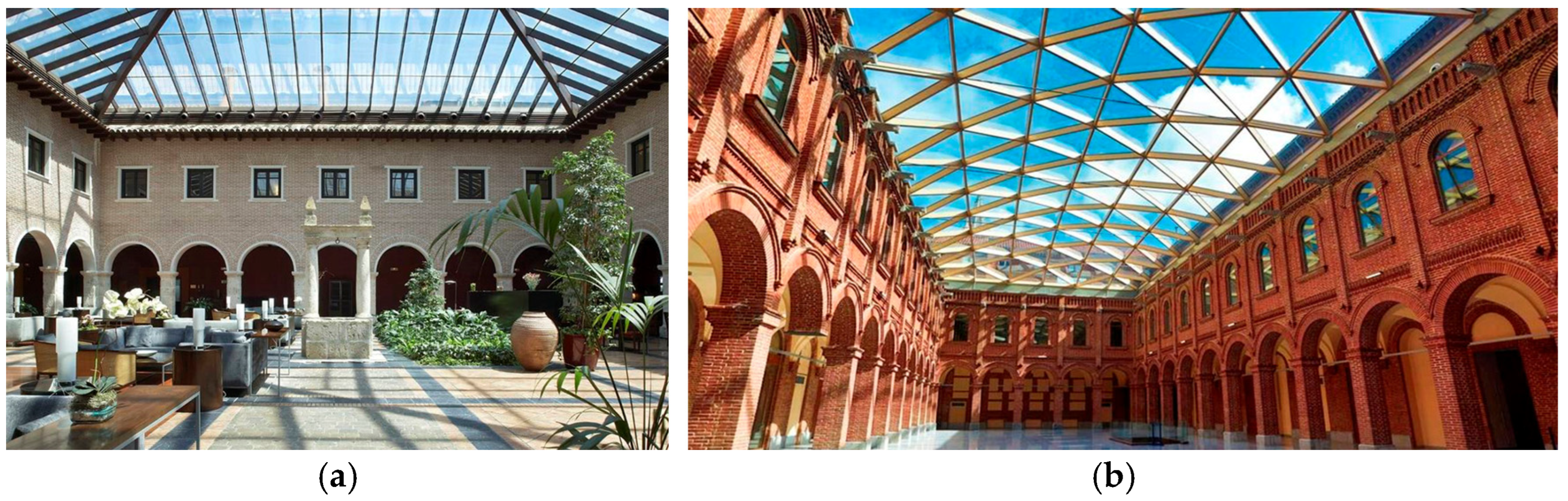
Climate-Resilient Design of Covered Historic Courtyards in Mediterranean Climates: The Role of Roof Geometry and Passive Strategies Under Future Scenarios



Abstract
1. Introduction
- RQ1. How does roof geometry influence thermal and energy performance under current climatic conditions?
- RQ2. How effective are passive design strategies across different Mediterranean climates?
- RQ3. What is the impact of future climate scenarios on the resilience of covered courtyard roof typologies?
2. Materials and Methods
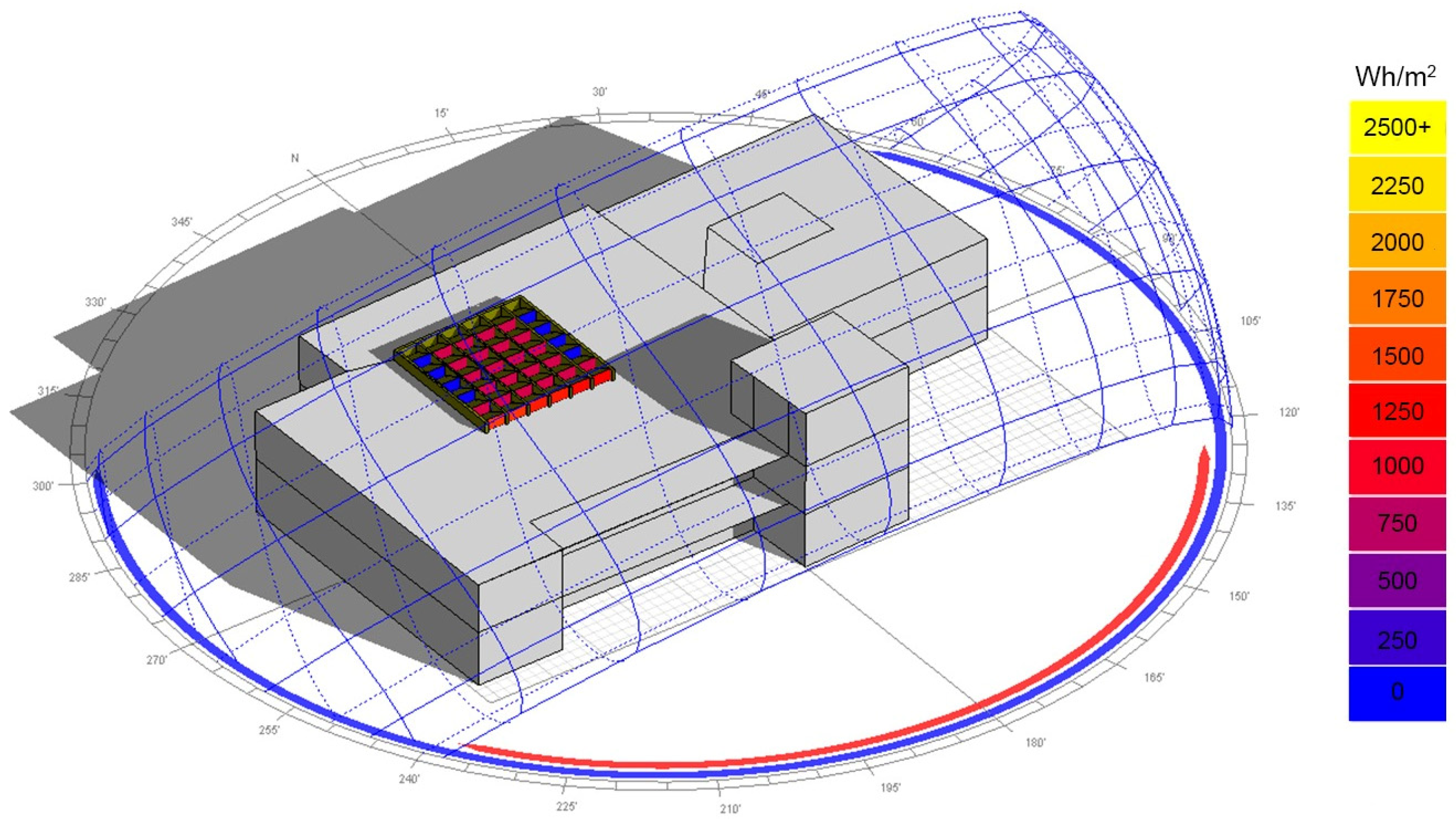
2.1. Case Study Geometry and Roof Typologies (SD/FLAT/SAW)
- Triangulated semi-dome roof (SD): A curved glazed geometry characterised by high solar exposure and a uniform shape factor.
- Nearly flat glass roof (FLAT): A continuous horizontal glazed surface with high direct solar transmittance during summer conditions.
- South-facing sawtooth roof with vertical glazing (SAW): An alternating sequence of opaque surfaces and south-oriented vertical glazed elements, specifically designed to modulate seasonal solar gains.
2.2. Study Locations and Köppen–Geiger Climate Classification
2.3. Future Climate Files: SSP4.5, 2050/2080
2.4. Design Variants: BD (Baseline Design) and EPD (Enhanced Passive Design)
2.5. Simulation Setup
2.6. Performance Indicators and Data Analysis
- Energy performance indicators (HVAC ON—Ideal Loads): Annual specific heating demand and annual specific cooling demand are reported in kWh/m2·year. Energy demand, rather than final energy consumption, is considered due to the idealised nature of the system, without explicit modelling of equipment or efficiencies [62].
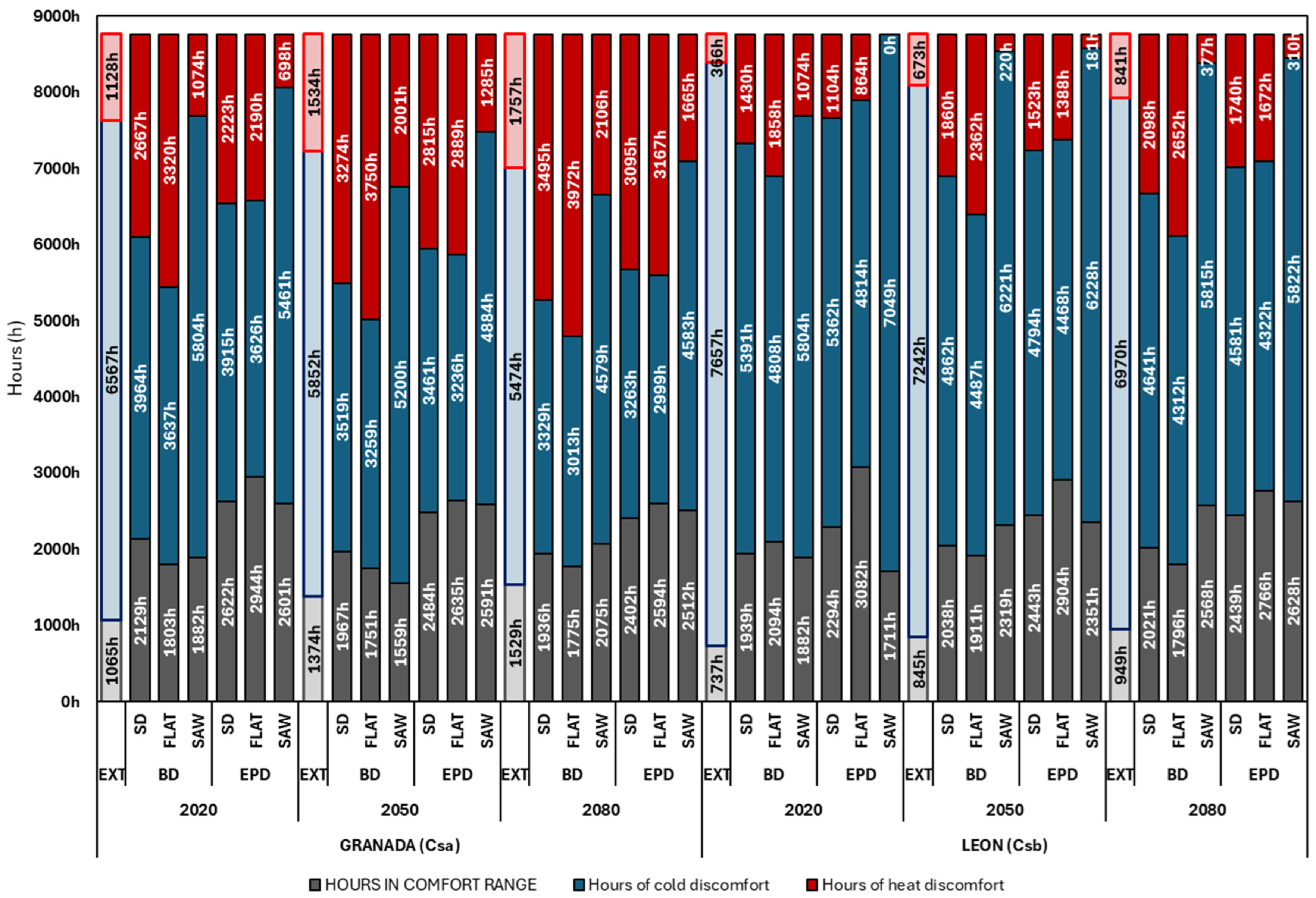
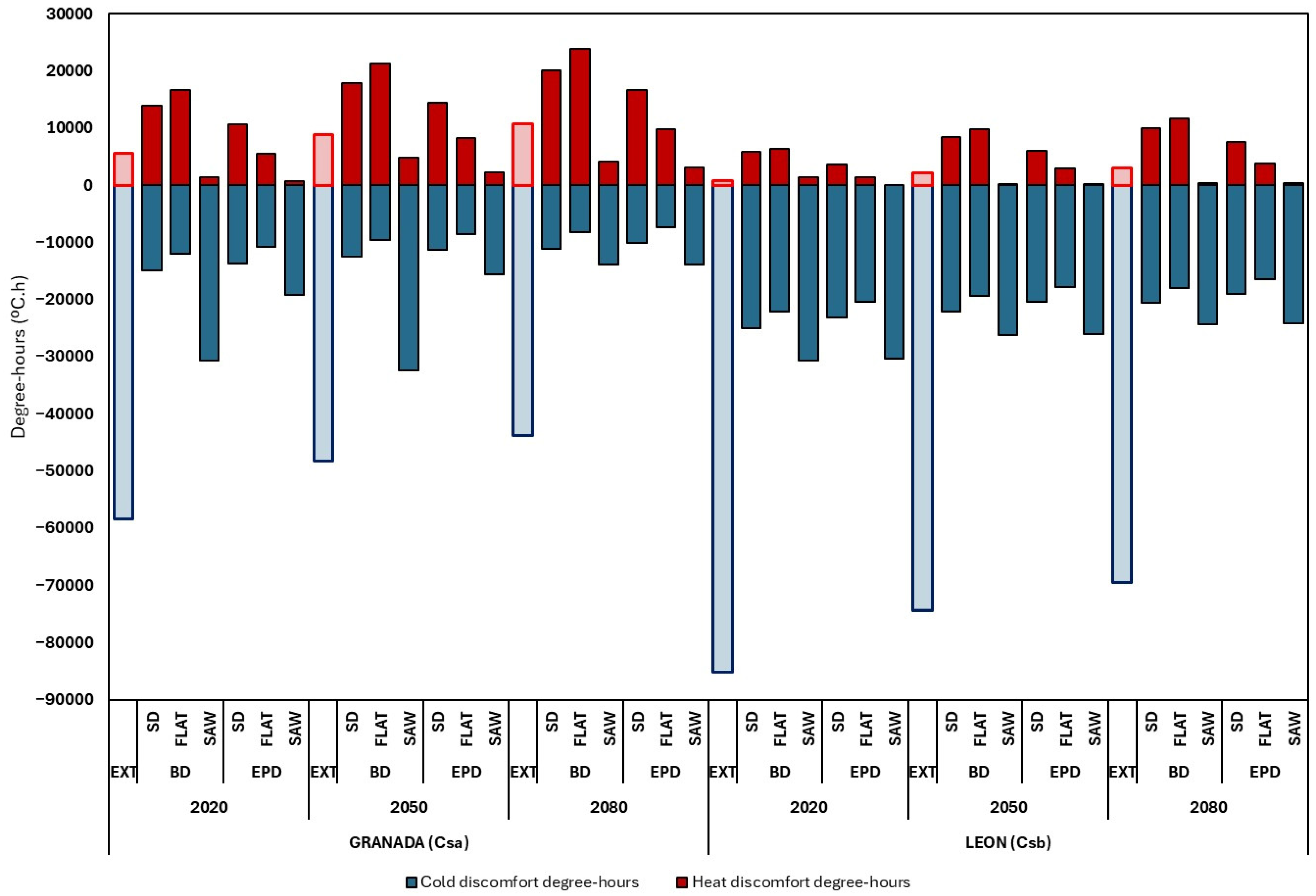
- Comfort and discomfort indicators (HVAC OFF—free-running): Using a static comfort criterion of 20–25 °C and an evaluation period of 8760 h/year based on indoor air temperature, the following metrics are quantified: (i) hours within the comfort range, (ii) hours of cold discomfort, and (iii) hours of heat discomfort. A strict static comfort range (20–25 °C, 24/7) was intentionally adopted as a conservative indicator of thermal stabilisation in free-running conditions, enabling robust comparison across typologies, climates, and future scenarios. In addition, discomfort severity is assessed through accumulated degree-hours [63] relative to the limits of the comfort range.
- Climate resilience and robustness indicators: For each performance metric X, sensitivity to future climate conditions is evaluated through relative variations. The relative variation of each performance indicator under future climate scenarios is quantified using the following expressions:
3. Results
3.1. Sensitivity Analysis
3.2. Free-Running Conditions: Hours in Comfort and Discomfort (20–25 °C)
3.2.1. Granada (Csa)
3.2.2. Leon (Csb)
3.2.3. Overall Interpretation
3.3. Free-Running Conditions: Discomfort Severity (Degree-Hours)
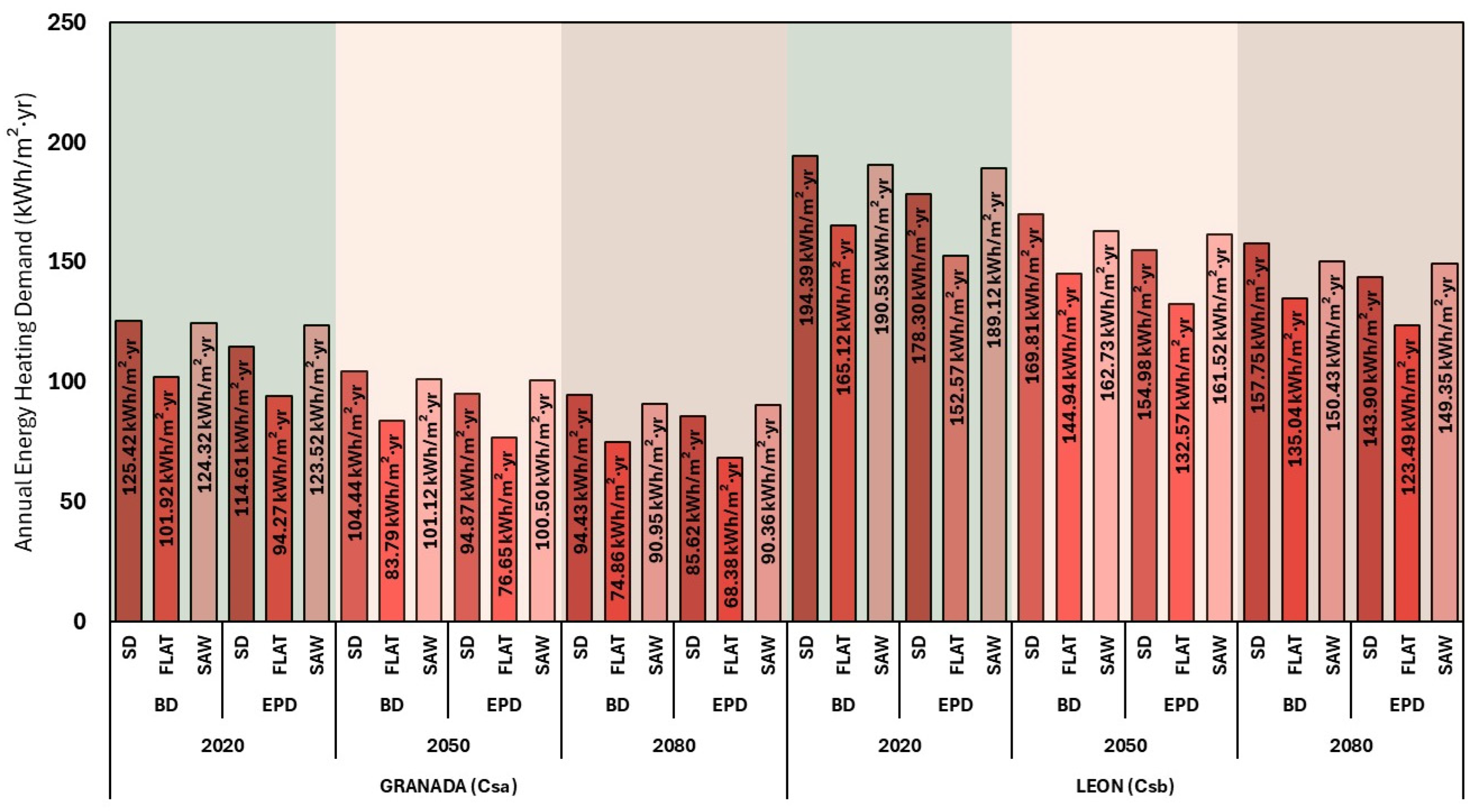
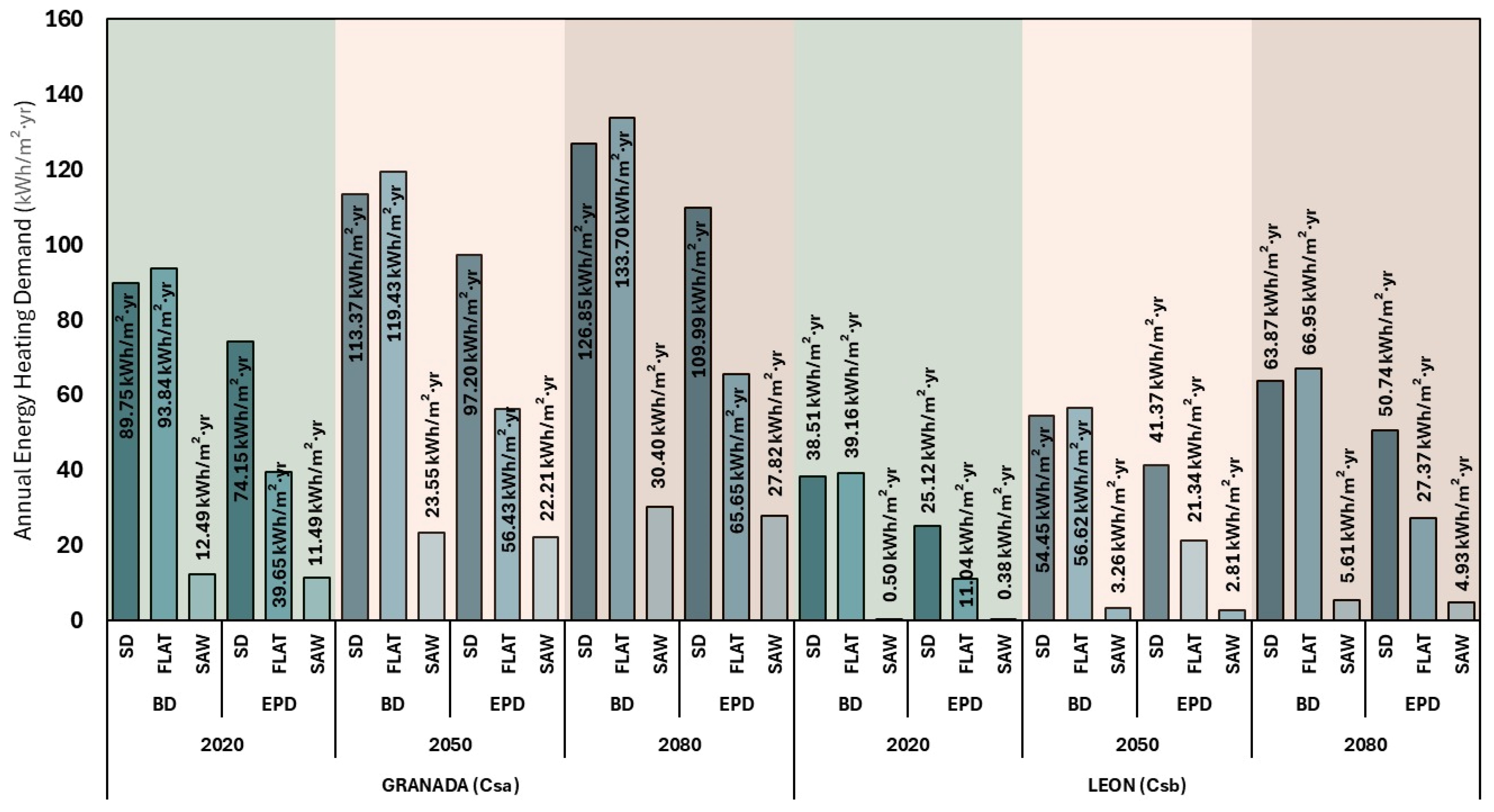
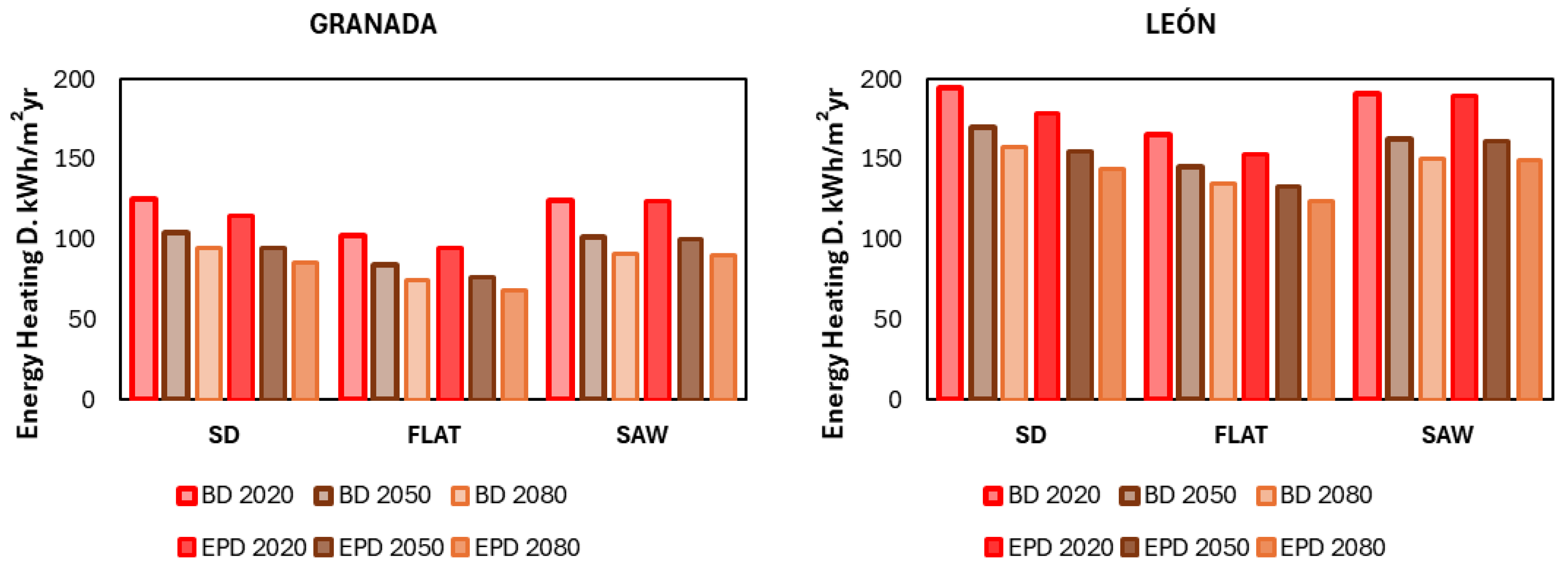
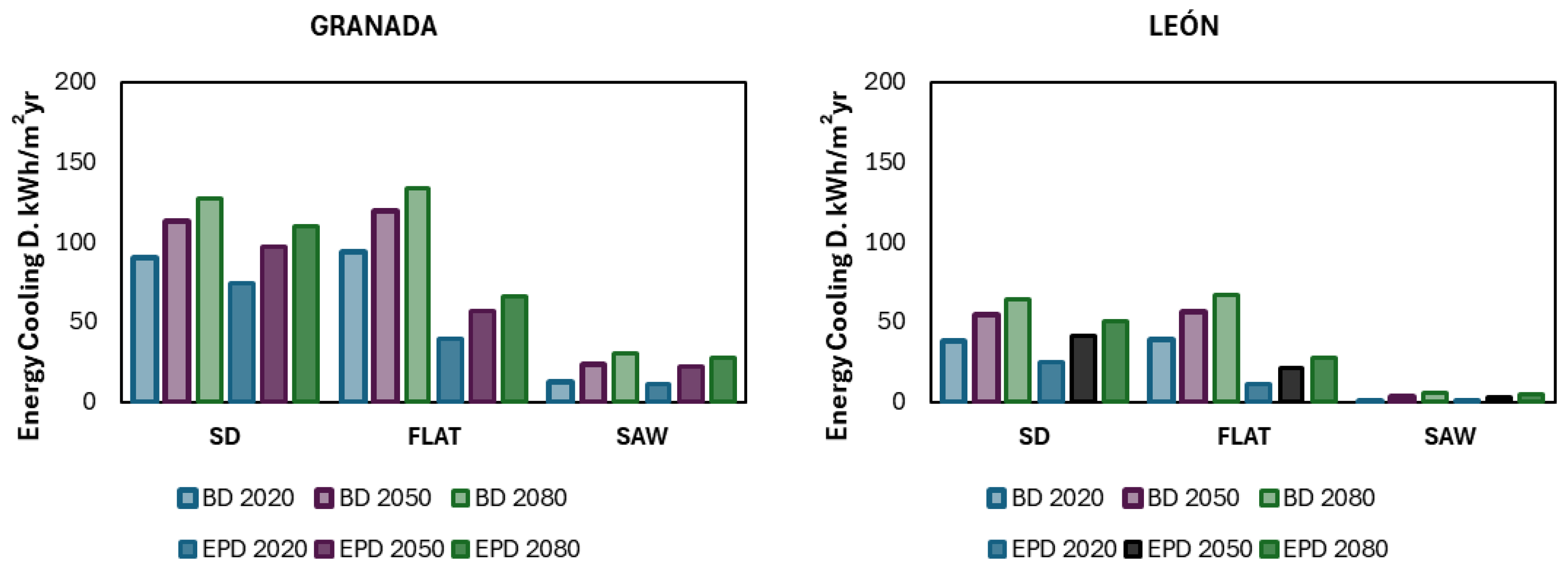
3.4. Heating and Cooling Energy Demand Results
3.5. Analysis of Energy Demand by Geographical Location Under Future Climate Scenarios
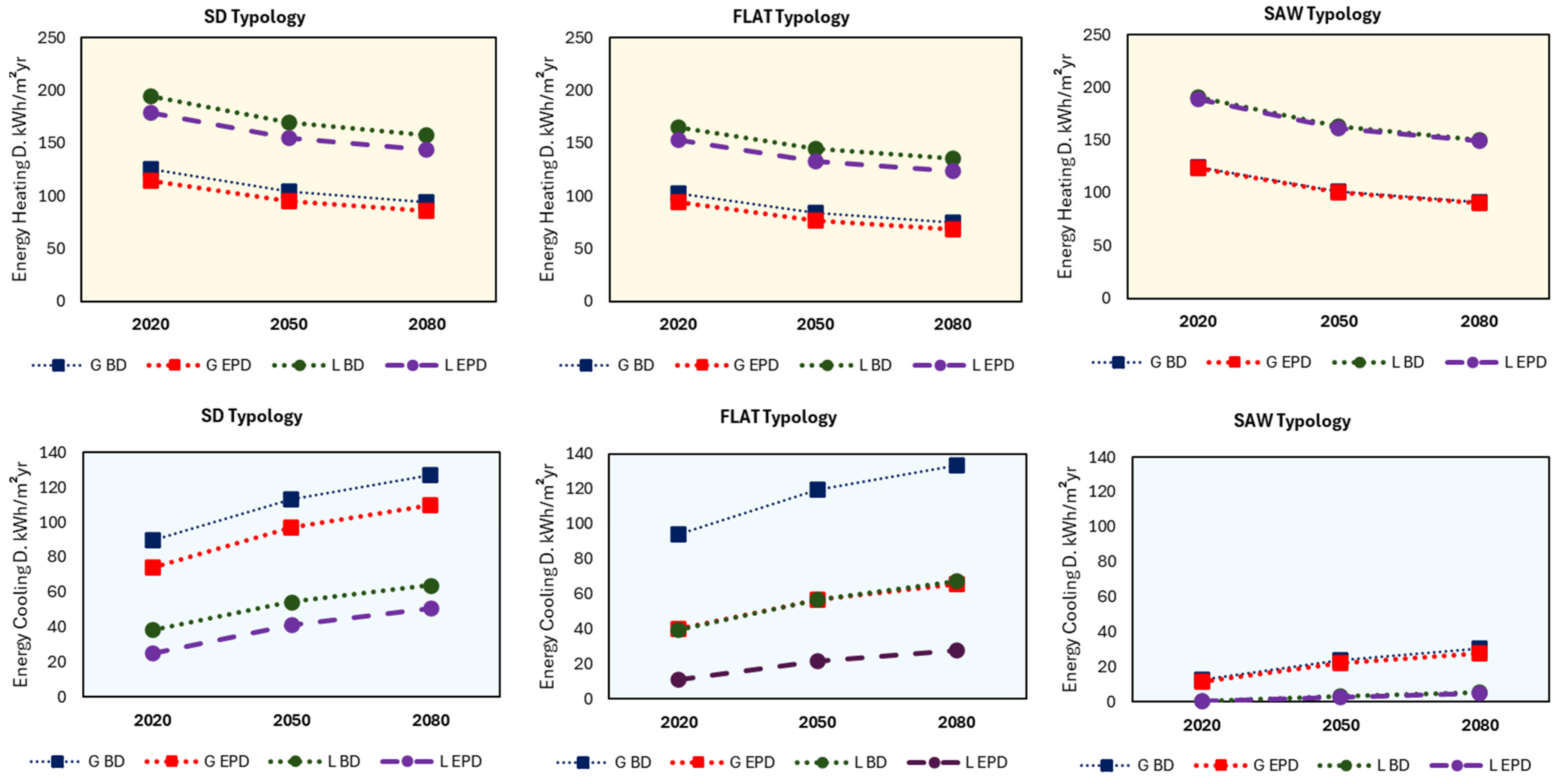
3.6. Analysis of Typological Performance Under Future Climate Scenarios
3.7. Variation in Energy Demand by Typology Under Future Climate Scenarios: Climate Resilience and Robustness Indicators
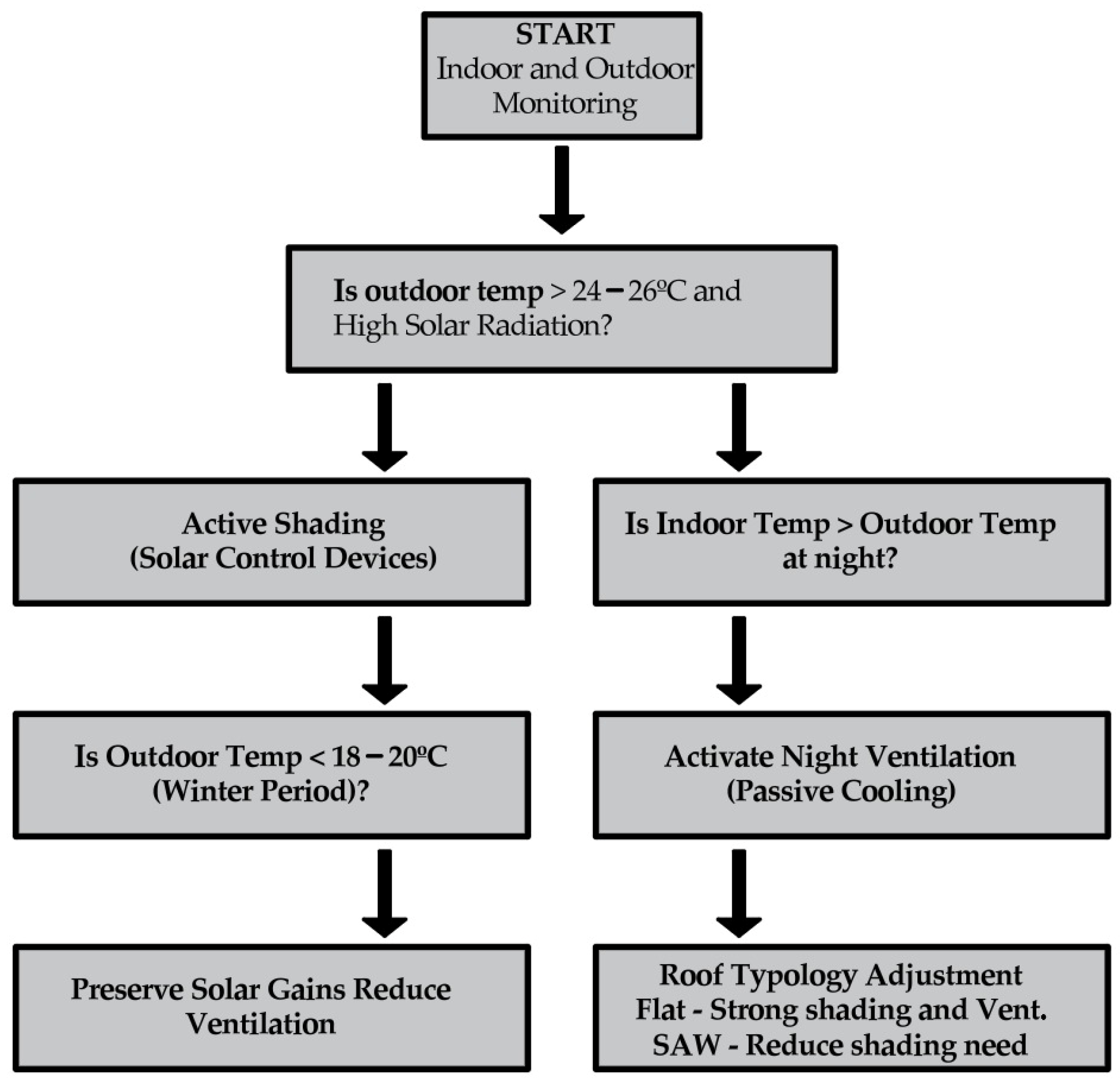
4. Discussion
5. Conclusions
Author Contributions
Funding
Institutional Review Board Statement
Informed Consent Statement
Data Availability Statement
Acknowledgments
Conflicts of Interest
References
- Soflaei, F.; Shokouhian, M.; Soflaei, A. Traditional courtyard houses as a model for sustainable design: A case study on BWhs mesoclimate of Iran. Front. Archit. Res. 2017, 6, 329–345. [Google Scholar] [CrossRef]
- Soflaei, F.; Shokouhian, M.; Abraveshdar, H.; Alipour, A. The Impact of Courtyard Design Variants on Shading Performance in Hot-Arid Climates of Iran. Energy Build. 2017, 143, 71–83. [Google Scholar] [CrossRef]
- Soflaei, F.; Shokouhian, M.; Tabadkani, A.; Moslehi, H.; Berardi, U. A simulation-based model for courtyard housing design based on adaptive thermal comfort. J. Build. Eng. 2020, 31, 101335. [Google Scholar] [CrossRef]
- Soflaei, F.; Shokouhian, M.; Mofidi-Shemirani, S.-M. Investigation of Iranian Traditional Courtyard as Passive Cooling Strategy: A Field Study on BS Climate. Int. J. Sustain. Built Environ. 2016, 5, 99–113. [Google Scholar] [CrossRef]
- Ghaffarianhoseini, A.; Berardi, U.; Ghaffarianhoseini, A. Thermal performance characteristics of unshaded courtyards in hot and humid climates. Build. Environ. 2015, 87, 154–168. [Google Scholar] [CrossRef]
- Martinelli, L.; Matzarakis, A. Influence of height/width proportions on the thermal comfort of courtyard typology for Italian climate zones. Sustain. Cities Soc. 2017, 29, 97–106. [Google Scholar] [CrossRef]
- Rodríguez-Algeciras, J.; Tablada, A.; Chaos-Yeras, M.; De la Paz, G.; Matzarakis, A. Influence of aspect ratio and orientation on large courtyard thermal conditions in the historical centre of Camagüey-Cuba. Renew. Energy 2018, 125, 840–856. [Google Scholar] [CrossRef]
- Lopez-Cabeza, V.P.; Alzate-Gaviria, S.; Diz-Mellado, E.; Rivera-Gomez, C.; Galan-Marin, C. Albedo influence on the microclimate and thermal comfort of courtyards under Mediterranean hot summer climate conditions. Sustain. Cities Soc. 2022, 81, 103872. [Google Scholar] [CrossRef]
- Cabeza-Prieto, A.; Camino-Olea, M.S.; Rodríguez-Esteban, M.A.; Llorente-Álvarez, A.; Pérez, M.P.S. Moisture influence on the thermal operation of the late 19th century brick facade, in a historic building in the city of zamora. Energies 2020, 13, 1307. [Google Scholar] [CrossRef]
- Llorente-Alvarez, A.; Camino-Olea, M.S.; Cabeza-Prieto, A.; Saez-Perez, M.P.; Rodríguez-Esteban, M.A. The thermal conductivity of the masonry of handmade brick Cultural Heritage with respect to density and humidity. J. Cult. Herit. 2022, 53, 212–219. [Google Scholar] [CrossRef]
- Cabeza-Prieto, A.; Camino-Olea, M.S.; Sáez-Pérez, M.P.; Llorente-álvarez, A.; Gavilán, A.B.R.; Rodríguez-Esteban, M.A. Comparative Analysis of the Thermal Conductivity of Handmade and Mechanical Bricks Used in the Cultural Heritage. Materials 2022, 15, 4001. [Google Scholar] [CrossRef] [PubMed]
- Camino-Olea, M.S.; Cabeza-Prieto, A.; Sáez-Pérez, M.P.; Llorente-álvarez, A.; Rodríguez-Esteban, M.A. Evaluation of the Behaviour of a Macroporous Mortar Coating with Respect to Rising Damp. Inz. Miner. 2024, 1, 1–8. [Google Scholar] [CrossRef]
- Rajapaksha, I.; Nagai, H.; Okumiya, M. A ventilated courtyard as a passive cooling strategy in the warm humid tropics. Renew. Energy 2003, 28, 1755–1778. [Google Scholar] [CrossRef]
- Jara, E.Á.R.; de la Flor, F.J.S.; Domínguez, S.Á.; Lissén, J.M.S.; Casado, A.R. Characterizing the air temperature drop in Mediterranean courtyards from monitoring campaigns. Sustainability 2017, 9, 1401. [Google Scholar] [CrossRef]
- Zamani, Z.; Heidari, S.; Azmoodeh, M.; Taleghani, M. Energy performance and summer thermal comfort of traditional courtyard buildings in a desert climate. Env. Prog Sustain. Energy 2019, 38, e13256. [Google Scholar] [CrossRef]
- Aldawoud, A. The influence of the atrium geometry on the building energy performance. Energy Build. 2013, 57, 1–5. [Google Scholar] [CrossRef]
- Aldawoud, A. Thermal performance of courtyard buildings. Energy Build. 2008, 40, 906–910. [Google Scholar] [CrossRef]
- Aldawoud, A.; Clark, R. Comparative analysis of energy performance between courtyard and atrium in buildings. Energy Build. 2008, 40, 209–214. [Google Scholar] [CrossRef]
- Taleghani, M.; Tenpierik, M.; van den Dobbelsteen, A. Energy performance and thermal comfort of courtyard/atrium dwellings in the Netherlands in the light of climate change. Renew. Energy 2014, 63, 486–497. [Google Scholar] [CrossRef]
- He, C.; Tian, W.; Shao, Z. Impacts of Courtyard Envelope Design on Energy Performance in the Hot Summer–Cold Winter Region of China. Buildings 2022, 12, 173. [Google Scholar] [CrossRef]
- Li, D.H.W.; Cheung, A.C.K.; Chow, S.K.H.; Lee, E.W.M. Study of daylight data and lighting energy savings for atrium corridors with lighting dimming controls. Energy Build. 2014, 72, 457–464. [Google Scholar] [CrossRef]
- Hao, Y.; Li, Z.; Wu, J.; Liu, J. Influence of the Geometric Shape of the Courtyard of Traditional Wooden Folk Houses on the Lighting Performance of Their Central Room: A Case Study of the Traditional Folk Houses of the Tujia People in Western Hunan, China. Buildings 2024, 14, 2390. [Google Scholar] [CrossRef]
- Meng, L.; Wu, J.; Liu, Q.; Xu, W. Research on Sustainable Spatial Governance in Rural Revitalization: A Case Study of the Most Beautiful Courtyard Design Competition and Renovation Practices in Fujian Province. Buildings 2024, 14, 2587. [Google Scholar] [CrossRef]
- Sharples, S.; Bensalem, R. Airflow in courtyard and atrium buildings in the urban environment: A win tunnel study. Solar Energy 2001, 70, 237–244. [Google Scholar] [CrossRef]
- Moosavi, L.; Mahyuddin, N.; Ab Ghafar, N.; Azzam Ismail, M. Thermal performance of atria: An overview of natural ventilation effective designs. Renew. Sustain. Energy Rev. 2014, 34, 654–670. [Google Scholar] [CrossRef]
- Jiang, L.; Lucchi, E.; Curto, D.D. Adaptive reuse and energy transition of built heritage and historic gardens: The sustainable conservation of Casa Jelinek in Trieste (Italy). Sustain Cities Soc. 2023, 97, 104767. [Google Scholar] [CrossRef]
- Torres-González, M.; Rodríguez-Antuña, L.; Bienvenido-Huertas, D.; Alducin-Ochoa, J.M.; León-Muñoz, M.; Rubio-Bellido, C. Courtyards as passive climate buffers: Enhancing thermal comfort and preventive conservation in mediterranean climates. Energy Build. 2025, 336, 115496. [Google Scholar] [CrossRef]
- Todaro, V.; D’Oria, M.; Secci, D.; Zanini, A.; Tanda, M.G. Climate Change over the Mediterranean Region: Local Temperature and Precipitation Variations at Five Pilot Sites. Water 2022, 14, 2499. [Google Scholar] [CrossRef]
- Wang, L.; Huang, Q.; Zhang, Q.; Xu, H.; Yuen, R.K.K. Role of atrium geometry in building energy consumption: The case of a fully air-conditioned enclosed atrium in cold climates, China. Energy Build. 2017, 151, 228–241. [Google Scholar] [CrossRef]
- de Luis, F.J.; Pérez-García, M. Parametric study of solar gains in saw-tooth roofs facing the equator. Renew. Energy 2004, 29, 1223–1241. [Google Scholar] [CrossRef]
- Muhaisen, A.S.; Gadi, M.B. Shading Performance of Polygonal Courtyard Forms. Build. Environ. 2006, 41, 1050–1059. [Google Scholar] [CrossRef]
- Lee, H.; Oertel, A.; Mayer, H. Enhanced human heat exposure in summer in a Central European courtyard subsequently roofed with transparent ETFE foil cushions. Urban Clim. 2022, 44, 101210. [Google Scholar] [CrossRef]
- Beck, H.E.; Zimmermann, N.E.; McVicar, T.R.; Vergopolan, N.; Berg, A.; Wood, E.F. Present and future köppen-geiger climate classification maps at 1-km resolution. Sci. Data 2018, 5, 180214. [Google Scholar] [CrossRef]
- Zhu, J.; Feng, J.; Lu, J.; Chen, Y.; Li, W.; Lian, P.; Zhao, X. A Review of the Influence of Courtyard Geometry and Orientation on Microclimate. Build. Environ. 2023, 236, 110269. [Google Scholar] [CrossRef]
- Azouqah, H.; Ariffin, A.R.M. The effect of courtyard and atrium on energy performance of buildings in hot and arid climates: A review. J. Umm Al-Qura Univ. Eng. Archit. 2025, 1–23. [Google Scholar] [CrossRef]
- Jiang, Z.; Gao, W.; Yao, W. Research on the wind environment in an enclosed courtyard: Effect of the opening position, size and wind angle. Urban Clim. 2023, 52, 101737. [Google Scholar] [CrossRef]
- Canas, I.; Martín, S. Recovery of Spanish vernacular construction as a model of bioclimatic architecture. Build. Environ. 2004, 39, 1477–1495. [Google Scholar] [CrossRef]
- Aste, N.; Angelotti, A.; Buzzetti, M. The influence of the external walls thermal inertia on the energy performance of well insulated buildings. Energy Build. 2009, 41, 1181–1187. [Google Scholar] [CrossRef]
- Vethanayagam, V.; Abu-Hijleh, B. Increasing Efficiency of Atriums in Hot, Arid Zones. Front. Archit. Res. 2019, 8, 284–302. [Google Scholar] [CrossRef]
- Asfour, O.S. A Comparison Between the Daylighting and Energy Performance of Courtyard and Atrium Buildings Considering the Hot Climate of Saudi Arabia. J. Build. Eng. 2020, 30, 101299. [Google Scholar] [CrossRef]
- Peng, F.; Xu, F.; Wen, B.; Gong, X.; Zhou, J.; Yang, Y. From courtyard to atrium: Spatial differentiation in the spontaneous evolution of vernacular architecture and its response to geo-climate. J. Asian Archit. Build. Eng. 2025, 1–32. [Google Scholar] [CrossRef]
- Cabeza-Prieto, A.; S-PMP; C-OMS. Comparative energy assessment of three glazed courtyard roof designs in a cold climate heritage building. Sustain. Energy Technol. Assess, 2026; in press. [Google Scholar]
- Yang, Q.; Lu, W.Z.; Xu, F.; Luo, X.; Wen, B. A passive strategy for energy-saving retrofitting of courtyard dwellings and its climatic adaptability. Energy Build. 2026, 352, 116811. [Google Scholar] [CrossRef]
- Wen, B.; Yang, Q.; Xu, F.; Zhou, J.; Zhang, R. Phenomenon of courtyards being roofed and its significance for building energy efficiency. Energy Build. 2023, 295, 113282. [Google Scholar] [CrossRef]
- Peel, M.C.; Finlayson, B.L.; McMahon, T.A. Updated world map of the Köppen-Geiger climate classification. Hydrol. Earth Syst. Sci. 2007, 11, 1633–1644. [Google Scholar] [CrossRef]
- Belcher, S.E.; Hacker, J.N.; Powell, D.S. Constructing design weather data for future climates. Build. Serv. Eng. Res. Technol. 2005, 26, 49–61. [Google Scholar] [CrossRef]
- Machard, A.; Inard, C.; Alessandrini, J.M.; Pelé, C.; Ribéron, J. A Methodology for Assembling Future Weather Files Including Heatwaves for Building Thermal Simulations from the European Coordinated Regional Downscaling Experiment (EURO-CORDEX) Climate Data. Energies 2020, 13, 3424. [Google Scholar] [CrossRef]
- Sánchez de la Flor, F.J.; Ruiz-Pardo, Á.; Diz-Mellado, E.; Rivera-Gómez, C.; Galán-Marín, C. Assessing the impact of courtyards in cooling energy demand in buildings. J. Clean. Prod. 2021, 320, 128742. [Google Scholar] [CrossRef]
- EnergyPlus. Available online: https://energyplus.net/weather-region/europe_wmo_region_6/ESP (accessed on 6 March 2022).
- O’Neill, B.C.; Carter, T.R.; Ebi, K.; Harrison, P.A.; Kemp-Benedict, E.; Kok, K.; Kriegler, E.; Preston, B.L.; Riahi, K.; Sillmann, J.; et al. Achievements and needs for the climate change scenario framework. Nat. Clim. Change 2020, 10, 1074–1084. [Google Scholar] [CrossRef]
- Riahi, K.; Van Vuuren, D.P.; Kriegler, E.; Edmonds, J.; O’Neill, B.C.; Fujimori, S.; Bauer, N.; Calvin, K.; Dellink, R.; Fricko, O.; et al. The Shared Socioeconomic Pathways and their energy, land use, and greenhouse gas emissions implications: An overview. Glob. Environ. Change 2017, 42, 153–168. [Google Scholar] [CrossRef]
- Rodrigues, E.; Fernandes, M.S.; Carvalho, D. Future weather generator for building performance research: An open-source morphing tool and an application. Build. Environ. 2023, 233, 110104. [Google Scholar] [CrossRef]
- Bilbao, J.; Miguel, A.; Franco, J.A.; Ayuso, A. Test reference year generation and evaluation methods in the continental Mediterranean area. J. Appl. Meteorol. 2004, 43, 390–400. [Google Scholar] [CrossRef]
- Allouhi, A.; El Fouih, Y.; Kousksou, T.; Jamil, A.; Zeraouli, Y.; Mourad, Y. Energy consumption and efficiency in buildings: Current status and future trends. J. Clean. Prod. 2025, 109, 118–130. [Google Scholar] [CrossRef]
- Muhaisen, A.S. Shading simulation of the courtyard form in different climatic regions. Build. Environ. 2006, 41, 1731–1741. [Google Scholar] [CrossRef]
- Taleb, H.M. Optimising Natural Ventilation Using Courtyard Strategies: CFD Simulation of a G+1 Office Building in Madinah. Int. J. Sustain. Energy 2020, 39, 659–678. [Google Scholar] [CrossRef]
- Inard, C.; Pfafferott, J.; Ghiaus, C. Free-running temperature and potential for free cooling by ventilation: A case study. Energy Build. 2011, 43, 2705–2711. [Google Scholar] [CrossRef]
- Ji, Y.; Duanmu, L.; Liu, Y.; Dong, H. Air infiltration rate of typical zones of public buildings under natural conditions. Sustain. Cities Soc. 2020, 61, 102290. [Google Scholar] [CrossRef]
- Tronchin, L.; Fabbri, K. Energy performance building evaluation in Mediterranean countries: Comparison between software simulations and operating rating simulation. Energy Build. 2008, 40, 1176–1187. [Google Scholar] [CrossRef]
- Hopfe, C.J.; Hensen, J.L.M. Uncertainty analysis in building performance simulation for design support. Energy Build. 2011, 43, 2798–2805. [Google Scholar] [CrossRef]
- Delgarm, N.; Sajadi, B.; Azarbad, K.; Delgarm, S. Sensitivity analysis of building energy performance: A simulation-based approach using OFAT and variance-based sensitivity analysis methods. J. Build. Eng. 2018, 15, 181–193. [Google Scholar] [CrossRef]
- Crawley, D.B.; Hand, J.W.; Kummert, M.; Griffith, B.T. Contrasting the capabilities of building energy performance simulation programs. Build. Environ. 2008, 43, 661–673. [Google Scholar] [CrossRef]
- Castaño-Rosa, R.; Barrella, R.; Sánchez-Guevara, C.; Barbosa, R.; Kyprianou, I.; Paschalidou, E.; Thomaidis, N.S.; Dokupilova, D.; Gouveia, J.P.; Kádár, J.; et al. Cooling degree models and future energy demand in the residential sector. A seven-country case study. Sustainability 2021, 13, 2987. [Google Scholar] [CrossRef]
- EN 16798-1:2019; Energy Performance of Buildings—Ventilation for Buildings—Part 1: Indoor Environmental Input Parameters for Design and Assessment of Energy Performance of Buildings Addressing Indoor Air Quality, Thermal Environment, Lighting and Acoustics. European Committee for Standardization (CEN): Brussels, Belgium, 2019.
- ASHRAE Standard 55-2020; Thermal Environmental Conditions for Human Occupancy. ASHRAE: Atlanta, GA, USA, 2020.
- ASHRAE. ASHRAE Handbook—Fundamentals; ASHRAE: Atlanta, GA, USA, 2021. [Google Scholar]
- Lee, H.; Romero, J. Climate Change 2023 Synthesis Report IPCC, 2023, Sections. In Climate Change 2023, Synthesis Report. Contribution of Working Groups I, II and III to the Sixth Assessment Report of the Intergovernmental Panel on Climate Change Core Writing Team; IPCC: Geneva, Switzerland, 2023; pp. 35–115. [Google Scholar] [CrossRef]
- IPCC. Climate Change 2021—The Physical Science Basis: Working Group I Contribution to the Sixth Assessment Report of the Intergovernmental Panel on Climate Change; Cambridge University Press: Cambridge, UK, 2023. [Google Scholar] [CrossRef]
- Berardi, U.; Jafarpur, P. Assessing the impact of climate change on building heating and cooling energy demand in Canada. Renew. Sustain. Energy Rev. 2020, 121, 109681. [Google Scholar] [CrossRef]
- Spinoni, J.; Vogt, J.V.; Barbosa, P.; Dosio, A.; McCormick, N.; Bigano, A.; Füssel, H. Changes of heating and cooling degree-days in Europe from 1981 to 2100. Int. J. Climatol. 2018, 38, e191–e208. [Google Scholar] [CrossRef]
- Deroubaix, A.; Labuhn, I.; Camredon, M.; Gaubert, B.; Monerie, P.-A.; Popp, M.; Ramarohetra, J.; Ruprich-Robert, Y.; Silvers, L.G.; Siour, G. Large uncertainties in trends of energy demand for heating and cooling under climate change. Nat. Commun. 2021, 12, 5197. [Google Scholar] [CrossRef]
- Larsen, M.A.D.; Petrović, S.; Radoszynski, A.M.; McKenna, R.; Balyk, O. Climate change impacts on trends and extremes in future heating and cooling demands over Europe. Energy Build. 2020, 226, 110397. [Google Scholar] [CrossRef]
- Tian, W.; De Wilde, P. Uncertainty and sensitivity analysis of building performance using probabilistic climate projections: A UK case study. Autom. Constr. 2011, 20, 1096–1109. [Google Scholar] [CrossRef]
- Andrić, I.; Koc, M.; Al-Ghamdi, S.G. A review of climate change implications for built environment: Impacts, mitigation measures and associated challenges in developed and developing countries. J. Clean. Prod. 2019, 211, 83–102. [Google Scholar] [CrossRef]
- Abbas, G.M.; Meral Akgül, Ç.; Dino, I.G. Resilient cooling of the Mediterranean office spaces under climate change. Archit. Eng. Des. Manag. 2024, 1–22. [Google Scholar] [CrossRef]
- Monge Palma, R.; Castro Medina, D.; Guerrero Delgado, M.C.; Sánchez Ramos, J.; Montero-Gutiérrez, P.; Álvarez Domínguez, S. Enhancing the building resilience in a changing climate through a passive cooling roof: A case study in Camas (Seville, Spain). Energy Build. 2024, 321, 114680. [Google Scholar] [CrossRef]
- Santamouris, M. Recent progress on urban overheating and heat island research. Integrated assessment of the energy, environmental, vulnerability and health impact. Synergies with the global climate change. Energy Build. 2020, 207, 109482. [Google Scholar] [CrossRef]
- Hosseini, M.; Javanroodi, K.; Nik, V.M. High-resolution impact assessment of climate change on building energy performance considering extreme weather events and microclimate—Investigating variations in indoor thermal comfort and degree-days. Sustain. Cities Soc. 2022, 78, 103634. [Google Scholar] [CrossRef]
- Arakawa Martins, L.; Soebarto, V.; Williamson, T. A systematic review of personal thermal comfort models. Build. Environ. 2022, 207, 108502. [Google Scholar] [CrossRef]
- De Dear, R.J.; Brager, G.S. Thermal comfort in naturally ventilated buildings: Revisions to ASHRAE Standard 55. Energy Build. 2002, 34, 549–561. [Google Scholar] [CrossRef]
- May-Tzuc, O.; Jiménez-Torres, M.A.; Cruz, A.D.R.C.Y.; Canul-Turriza, R.; Andrade-Durán, J.E.; Noh-Pat, F. Viabilidad del modelo de confort térmico adaptativo bajo condiciones de clima cálido subhúmedo: Ahorro energético en refrigeración en Campeche, México. Rev. Hábitat Sustentable 2023, 13, 120–131. [Google Scholar] [CrossRef]
- Pisello, A.L.; Pignatta, G.; Piselli, C.; Castaldo, V.L.; Cotana, F. Investigating the Dynamic Thermal Behavior of Building Envelope in Summer Conditions by Means of in-Field Continuous Monitoring. Am. J. Eng. Appl. Sci. 2016, 9, 505–519. [Google Scholar] [CrossRef]
- Liu, S.; Kwok, Y.T.; Lau, K.; Ng, E. Applicability of different extreme weather datasets for assessing indoor overheating risks of residential buildings in a subtropical high-density city. Build. Environ. 2021, 194, 107711. [Google Scholar] [CrossRef]
- Ozarisoy, B. Energy effectiveness of passive cooling design strategies to reduce the impact of long-term heatwaves on occupants’ thermal comfort in Europe: Climate change and mitigation. J. Clean. Prod. 2022, 330, 129675. [Google Scholar] [CrossRef]
- Kutty, N.A.; Barakat, D.; Darsaleh, A.O.; Kim, Y.K. A Systematic Review of Climate Change Implications on Building Energy Consumption: Impacts and Adaptation Measures in Hot Urban Desert Climates. Buildings 2024, 14, 13. [Google Scholar] [CrossRef]
- Ascione, F.; Bianco, N.; De Masi, R.F.; Mauro, G.M.; Vanoli, G.P. Resilience of robust cost-optimal energy retrofit of buildings to global warming: A multi-stage, multi-objective approach. Energy Build. 2017, 153, 150–167. [Google Scholar] [CrossRef]
- Sánchez-García, D.; Rubio-Bellido, C.; del Río, J.J.M.; Pérez-Fargallo, A. Towards the quantification of energy demand and consumption through the adaptive comfort approach in mixed mode office buildings considering climate change. Energy Build. 2019, 187, 173–185. [Google Scholar] [CrossRef]
- Rubel, F.; Kottek, M. Observed and projected climate shifts 1901-2100 depicted by world maps of the Köppen-Geiger climate classification. Meteorol. Z. 2010, 19, 135–141. [Google Scholar] [CrossRef]




| Parameter | BD (Baseline Design) | EPD (Enhanced Passive Design) |
|---|---|---|
| Glazing Type | Standard double glazing | Low-emissivity/selective double glazing |
| Ug (W/m2·K) | 2.8 | 1.2 |
| g (solar factor) | 0.70 | 0.50 |
| τv (visible transmittance) | 0.75 | 0.70 |
| Movable solar control | Not considered | Yes, with seasonal activation |
| Atrium natural ventilation | Fixed infiltration and minimal openings without control | Controlled natural ventilation |
| Opening criteria | Not applicable | Based on indoor–outdoor temperature. Opening when T_int > T_set and T_ext < T_int − ΔT, with ΔT ±+− 2–3 °C. |
| Night-time ventilation | Not modelled | Yes, scheduled night purge. Typical interval 22:00–08:00 subject to temperature criteria; automatic closure under unfavourable conditions. |
| Climate | Roof Typology | Demand | 0.5 ACH | 1 ACH (Base) | 2 ACH |
|---|---|---|---|---|---|
| León (Csb) | SD | Heating (kWh·yr−1) | 26,487 | 48,903 | 96,883 |
| Cooling (kWh·yr−1) | 20,665 | 19,800 | 19,951 | ||
| FLAT | Heating (kWh·yr−1) | 26,701 | 51,188 | 107,649 | |
| Cooling (kWh·yr−1) | 13,600 | 12,140 | 9492 | ||
| SAW | Heating (kWh·yr−1) | 30,318 | 59,064 | 117,719 | |
| Cooling (kWh·yr−1) | 65 | 157 | 461 | ||
| Granada (Csa) | SD | Heating (kWh·yr−1) | 19,977 | 38,884 | 79,930 |
| Cooling (kWh·yr−1) | 28,212 | 27,822 | 29,380 | ||
| FLAT | Heating (kWh·yr−1) | 15,217 | 32,250 | 70,193 | |
| Cooling (kWh·yr−1) | 29,301 | 27,845 | 28,229 | ||
| SAW | Heating (kWh·yr−1) | 18,929 | 38,540 | 79,209 | |
| Cooling (kWh·yr−1) | 2533 | 3872 | 6989 |
| Climate | Roof Typology | Demand | 0 W·m−2 | 5 W·m−2 (Base) | 8 W·m−2 | 10 W·m−2 |
|---|---|---|---|---|---|---|
| León | SD | Heating (kWh·yr−1) | 50,034 | 51,138 | 48,903 | 47,457 |
| Cooling (kWh·yr−1) | 16,367 | 18,462 | 19,800 | 20,731 | ||
| FLAT | Heating (kWh·yr−1) | 57,943 | 54,479 | 51,188 | 50,355 | |
| Cooling (kWh·yr−1) | 9378 | 10,256 | 12,140 | 12,039 | ||
| SAW | Heating (kWh·yr−1) | 68,558 | 62,537 | 59,064 | 56,816 | |
| Cooling (kWh·yr−1) | 10 | 79 | 157 | 234 | ||
| Granada | SD | Heating (kWh·yr−1) | 43,844 | 40,677 | 38,884 | 37,728 |
| Cooling (kWh·yr−1) | 23,570 | 26,178 | 27,822 | 28,955 | ||
| FLAT | Heating (kWh·yr−1) | 37,140 | 34,014 | 32,250 | 31,118 | |
| Cooling (kWh·yr−1) | 23,424 | 26,133 | 27,845 | 29,023 | ||
| SAW | Heating (kWh·yr−1) | 45,719 | 41,130 | 38,540 | 36,896 | |
| Cooling (kWh·yr−1) | 2100 | 3159 | 3872 | 4380 |
| Clim. | CONF | Typol. | Heating D. 2020 | Heating Demand 2050 | Heating Demand 2080 | Cooling D. 2020 | Cooling Demand 2050 | Cooling Demand 2080 | ||||
|---|---|---|---|---|---|---|---|---|---|---|---|---|
| kWh/m2·yr | kWh/m2·yr | Δ% | kWh/m2·yr | Δ% | kWh/m2·yr | kWh/m2·yr | Δ% | kWh/m2·yr | Δ% | |||
| SD | 125.42 | −20.98 | −16.73 | −30.99 | −24.71 | 89.75 | 23.62 | 26.32 | 37.1 | 41.34 | ||
| BD | FLAT | 101.92 | −18.13 | −17.79 | −27.06 | −26.55 | 93.84 | 25.59 | 27.27 | 39.86 | 42.48 | |
| Granada | SAW | 124.32 | −23.2 | −18.66 | −33.37 | −26.84 | 12.49 | 11.06 | 88.55 | 17.91 | 143.39 | |
| (Csa) | SD | 114.61 | −19.74 | −17.22 | −28.98 | −25.29 | 74.15 | 23.05 | 31.09 | 35.84 | 48.33 | |
| EPD | FLAT | 94.27 | −17.62 | −18.69 | −25.89 | −27.46 | 39.65 | 16.78 | 42.32 | 26 | 65.57 | |
| SAW | 123.52 | −23.02 | −18.64 | −33.17 | −26.85 | 11.49 | 10.72 | 93.3 | 16.33 | 142.12 | ||
| SD | 194.39 | −24.57 | −12.64 | −36.64 | −18.85 | 38.51 | 15.94 | 41.39 | 25.36 | 65.85 | ||
| BD | FLAT | 165.12 | −20.18 | −12.22 | −30.08 | −18.22 | 39.16 | 17.46 | 44.59 | 27.79 | 70.97 | |
| León | SAW | 190.53 | −27.8 | −14.59 | −40.11 | −21.05 | 0.5 | 2.76 | 552 | 5.11 | 1022 | |
| (Csb) | SD | 178.3 | −23.32 | −13.08 | −34.39 | −19.29 | 25.12 | 16.25 | 64.69 | 25.62 | 101.99 | |
| EPD | FLAT | 152.57 | −20 | −13.11 | −29.08 | −19.06 | 11.04 | 10.3 | 93.3 | 16.33 | 147.92 | |
| SAW | 189.12 | −27.59 | −14.59 | −39.77 | −21.03 | 0.38 | 2.43 | 639.47 | 4.55 | 1197.37 | ||
Disclaimer/Publisher’s Note: The statements, opinions and data contained in all publications are solely those of the individual author(s) and contributor(s) and not of MDPI and/or the editor(s). MDPI and/or the editor(s) disclaim responsibility for any injury to people or property resulting from any ideas, methods, instructions or products referred to in the content. |
© 2026 by the authors. Licensee MDPI, Basel, Switzerland. This article is an open access article distributed under the terms and conditions of the Creative Commons Attribution (CC BY) license.
Share and Cite
Sáez-Pérez, M.P.; Cabeza-Prieto, A. Climate-Resilient Design of Covered Historic Courtyards in Mediterranean Climates: The Role of Roof Geometry and Passive Strategies Under Future Scenarios. Sustainability 2026, 18, 3020. https://doi.org/10.3390/su18063020
Sáez-Pérez MP, Cabeza-Prieto A. Climate-Resilient Design of Covered Historic Courtyards in Mediterranean Climates: The Role of Roof Geometry and Passive Strategies Under Future Scenarios. Sustainability. 2026; 18(6):3020. https://doi.org/10.3390/su18063020
Chicago/Turabian StyleSáez-Pérez, Maria Paz, and Alejandro Cabeza-Prieto. 2026. "Climate-Resilient Design of Covered Historic Courtyards in Mediterranean Climates: The Role of Roof Geometry and Passive Strategies Under Future Scenarios" Sustainability 18, no. 6: 3020. https://doi.org/10.3390/su18063020
APA StyleSáez-Pérez, M. P., & Cabeza-Prieto, A. (2026). Climate-Resilient Design of Covered Historic Courtyards in Mediterranean Climates: The Role of Roof Geometry and Passive Strategies Under Future Scenarios. Sustainability, 18(6), 3020. https://doi.org/10.3390/su18063020