Article

ESG Practices and Sustainable Supply Chain Capability in a Compliance-Intensive Industry: Evidence from the Mexican Aerospace Sector

by
Jesús Sigifredo Gastélum-Valdez
1,*,
Marco Alberto Valenzo-Jiménez
2,*,
Jaime Apolinar Martínez-Arroyo
2,
Arcadio González-Samaniego
1 and
Mauricio Aurelio Chagolla-Farías
2
1
Secretariat of Sciences, Humanities, Technology and Innovation (SECIHTI), Ciudad de Mexico 03940, Mexico
2
Faculty of Accountability and Management, Universidad Michoacana de San Nicolás de Hidalgo, Morelia 58030, Mexico
*
Authors to whom correspondence should be addressed.
Sustainability 2026, 18(6), 3023; https://doi.org/10.3390/su18063023
Submission received: 1 February 2026 / Revised: 4 March 2026 / Accepted: 11 March 2026 / Published: 19 March 2026
(This article belongs to the Section Economic and Business Aspects of Sustainability)

Abstract

Sustainable Supply Chain Management (SSCM) increasingly integrates environmental, social, and governance (ESG) criteria to address sustainability risks and performance across multi-tier supply networks. However, it remains unclear whether ESG practices directly enhance supply chain outcomes or primarily operate through the development of higher-order management capabilities. This study examines how ESG practices influence supply chain resilience, operational performance, and sustainability performance in the Mexican aerospace industry, emphasizing the mediating role of Sustainable Supply Chain Management Capability (SSCM Capability). Data were collected through a structured survey administered at the Mexico Aerospace Fair (FAMEX) in April 2025, yielding 217 valid responses from Tier 1–3 aerospace firms. The research adopts a hypothesis-driven design integrating Partial Least Squares Structural Equation Modeling (PLS-SEM) and Necessary Condition Analysis (NCA) to combine sufficiency- and necessity-based perspectives. The findings show that ESG practices primarily create value by enabling SSCM Capability, which is central to improving all performance dimensions. While ESG practices directly contribute to operational and sustainability performance, resilience improvements depend mainly on capability development. NCA results further indicate that ESG practices are foundational to SSCM Capability and high performance, whereas SSCM Capability constitutes a necessary condition for resilience. These findings underscore the critical role of capability building in translating ESG commitments into robust supply chain performance within compliance-intensive aerospace ecosystems in emerging economies.

1. Introduction

Sustainable Supply Chain Management (SSCM) has evolved from a predominantly environmental agenda toward a broader strategic paradigm that integrates environmental, social, and governance (ESG) considerations as interconnected dimensions of sustainability performance and risk management in multi-level supply networks [1,2]. This shift is driven by growing stakeholder scrutiny, regulatory escalation, and the recognition that sustainability issues propagate operationally and reputationally across supply chain tiers—often materializing as disruptions, compliance failures, and performance volatility [3,4]. In parallel, the mainstreaming of ESG reporting and measurement has further pushed firms to operationalize sustainability beyond isolated initiatives, repositioning ESG as a managerial and governance architecture that shapes decisions, supplier relationships, and performance monitoring [5,6].
Despite this momentum, the literature continues to report persistent implementation challenges. SSCM and ESG initiatives frequently face barriers related to diffusion beyond first-tier suppliers, limited traceability, data quality and transparency gaps, and uneven enforcement across heterogeneous institutional contexts [7,8]. These challenges are particularly salient in stratified supply chain configurations, where focal firms have limited direct visibility and control and must rely on governance mechanisms, supplier development, and inter-organizational learning to reduce information asymmetries and opportunism [9,10,11]. Consequently, firms may comply symbolically with ESG requirements without generating consistent performance improvements—fueling mixed empirical results and ongoing debate about when and how ESG translates into operational, resilience, and sustainability outcomes [12,13].
An important gap persists between the scientific understanding of SSCM and ESG implementation and their effective manifestation in real hierarchical supply chain settings. While prior research has conceptually established the potential performance benefits of sustainability-oriented practices [2], firms operating in complex industrial ecosystems frequently struggle to translate formal ESG adoption into consistent operational and resilience outcomes [7,8]. This science–practice disconnect is particularly evident in vertically structured supply chain environments characterized by limited visibility, heterogeneous supplier capabilities, and uneven enforcement of governance [4,14]. As a result, the mechanisms by which ESG practices translate into measurable improvements in supply chain performance remain insufficiently understood. Addressing this gap requires examining the capability-building pathways linking ESG practices to supply chain outcomes [15,16].
A capability-based interpretation helps explain these inconsistencies. Rather than assuming that ESG adoption directly yields performance gains, recent SSCM research emphasizes the importance of higher-order organizational and relational capabilities that enable integration, monitoring, collaboration, learning, and transparency across supply chain partners [14,17]. Integration and visibility routines enhance coordination and reduce fragmentation across procurement, operations, quality, and logistics [18,19], while governance and due diligence mechanisms support accountability, traceability, and credible compliance across tiers [20,21]. In this view, ESG practices create structural pressure, but performance improvements ultimately depend on firms’ ability to develop and embed Sustainable Supply Chain Management (SSCM) capability as an operationally actionable mechanism [15,22].
This capability logic is especially relevant when supply chain resilience is considered as a performance outcome. Resilience—understood as the ability to prepare for, respond to, and recover from disruptions while maintaining acceptable performance—has become central in operations and supply chain management due to systemic shocks and cascading risks [23,24]. Importantly, resilience is not solely determined by buffers and redundancy; it is strongly shaped by dynamic capabilities that enable sensing, seizing, and reconfiguring resources under uncertainty [25,26,27]. SSCM capability can strengthen resilience by improving multi-tier visibility, enabling earlier risk detection, facilitating coordinated response, and supporting continuous improvement after disruptions [28,29]. Moreover, it remains unclear whether ESG practices alone are sufficient to deliver resilience improvements or whether such effects materialize primarily through capability-building mechanisms.
Against this background, the Mexican aerospace industry provides a compelling empirical context. The Mexican aerospace industry operates within a vertically structured global value chain characterized by strong OEM leadership and multi-stage supplier integration. According to recent sectoral reports, the industry comprises more than 350 firms operating across 19 states, generating over 60,000 direct jobs and exporting approximately USD 9.5 billion annually, positioning Mexico as one of the most dynamic aerospace manufacturing platforms in the Americas [30]. Production activities are geographically concentrated in five major clusters—Baja California, Sonora, Chihuahua, Querétaro, and Nuevo León—where firms specialize in engines, fuselage structures, landing systems, electronic subsystems, composites, and precision machining.
The supply chain follows a hierarchical configuration, led by Original Equipment Manufacturers (OEMs), which perform final aircraft and engine integration. Tier 1 suppliers provide major subsystems directly to OEMs, including landing gear systems, fuselage sections, propulsion modules, and integrated avionics systems. Tier 2 suppliers deliver specialized components and subassemblies—such as precision-machined parts, wiring harnesses, composite materials, structural elements, and electronic modules—that are incorporated into Tier 1 systems. Tier 3 suppliers primarily provide raw materials, process-intensive inputs, and highly specialized treatments that support upstream production stages [31]. This configuration reinforces the sector’s certification-driven nature, where traceability, quality assurance, and due diligence requirements cascade across tiers.
Moreover, aerospace supply chains represent compliance-intensive, high-reliability systems in which supplier performance is directly linked to safety, quality, and continuity requirements [19,20]. ESG expectations frequently function as a “license to operate” within these networks; however, meeting minimum compliance thresholds does not necessarily generate adaptive capacity or resilience. This structural configuration provides analytically meaningful boundary conditions for testing the ESG–capability–performance relationship within a multi-tier, high-regulation industrial ecosystem embedded in an emerging institutional environment [30,31]. Furthermore, firms operating in emerging economy settings frequently face institutional voids, resource constraints, and capability gaps that complicate the translation of ESG requirements into consistent outcomes across multi-tier networks [8,32].
ESG expectations frequently function as a “license to operate” within these networks; however, meeting minimum compliance thresholds does not necessarily generate adaptive capacity or resilience. This structural configuration provides analytically meaningful boundary conditions for testing the ESG–capability–performance relationship within a multi-tier, high-regulation industrial ecosystem embedded in an emerging institutional environment.
Accordingly, the study addresses the following research question: Do ESG practices directly improve supply chain performance outcomes, or do they primarily generate value by enabling SSCM capability development in compliance-intensive aerospace supply chains? To address this question, a set of theoretically grounded hypotheses is developed in Section 3 of the paper.
The research advances the sustainable supply chain management literature in three primary ways. First, from a theoretical perspective, it clarifies the mechanism through which ESG practices generate value in complex aerospace supply chains by demonstrating the central mediating role of SSCM capability. Second, from a methodological standpoint, it integrates Partial Least Squares Structural Equation Modeling (PLS-SEM) with Necessary Condition Analysis (NCA), jointly capturing sufficiency and necessity logics and identifying potential bottleneck conditions that are often overlooked in variance-based models alone [32,33]. Third, from a managerial perspective, it provides actionable insights for OEMs and Tier 1–3 suppliers operating in the Mexican aerospace ecosystem regarding the capability development efforts required to translate ESG adoption into measurable improvements in resilience, operational performance, and sustainability performance [34,35].

2. Literature Review

Sustainable Supply Chain Management (SSCM) has evolved from a predominantly environmental focus to a holistic strategic paradigm integrating Environmental, Social, and Governance (ESG) criteria across multi-tier supply networks [2]. Contemporary perspectives emphasize that supply chains must be evaluated not only by efficiency metrics but also by their resilience to ESG-related disruptions and alignment with stakeholder and regulatory expectations [1]. This shift is particularly salient in globally integrated and compliance-intensive industries such as aerospace, where sustainability failures in lower tiers can directly affect operational stability, regulatory standing, and organizational legitimacy.
From a capability-based and dynamic-capability perspective [25,26,27], structured sustainability practices do not automatically yield superior performance. Instead, performance gains depend on the development of higher-order organizational capabilities that enable integration, coordination, learning, and reconfiguration across supply chain tiers. In this view, ESG practices constitute structured governance mechanisms—policies, standards, monitoring systems, and compliance-oriented processes—while Sustainable Supply Chain Management (SSCM) capability reflects the firm’s dynamic ability to embed, align, and operationalize these practices within inter-organizational routines [15,17].
Accordingly, the present study conceptualizes ESG practices as antecedent structural conditions and SSCM capability as the transformation mechanism through which ESG requirements are translated into resilience, operational, and sustainability performance outcomes. The following sections consolidate existing research on ESG criteria in supply chain management and develop the study’s hypotheses based on this capability-building logic.

2.1. ESG Criteria in Sustainable Supply Chain Management

ESG criteria provide an integrative framework for structuring sustainability expectations across supply networks. Unlike earlier approaches focused primarily on environmental efficiency or isolated CSR initiatives, ESG consolidates environmental protection, social responsibility, and governance accountability into a unified managerial architecture [2].
In supply chain contexts, ESG criteria are operationalized through procurement policies, supplier evaluation systems, audit mechanisms, traceability tools, and collaborative improvement programs. These mechanisms increasingly function as concrete managerial instruments embedded in sourcing decisions and inter-organizational coordination processes rather than symbolic commitments [7].

2.1.1. Environmental Criteria in Supply Chains

Environmental criteria encompass initiatives to reduce environmental impacts across sourcing, production, logistics, and end-of-life processes, including emissions management, waste reduction, sustainable sourcing, hazardous substance control, and circular economy practices [36]. These criteria are increasingly formalized through supplier environmental assessments and monitoring systems that extend sustainability expectations upstream [37]. Beyond compliance, environmental practices are strategically linked to resource efficiency and innovation; still, evidence suggests that environmental initiatives alone are insufficient to ensure sustained performance without complementary social and governance mechanisms [38].

2.1.2. Social Criteria in Supply Chains

Social criteria address labor conditions, occupational health and safety, human rights, and stakeholder well-being across supply networks. In operational terms, they are implemented through supplier codes of conduct, labor audits, training programs, and grievance mechanisms [8]. While social criteria enhance relational stability and reduce the disruption risks associated with labor conflicts and reputational crises [39], their effective implementation remains challenging in multi-tier supply chains due to the complexity of monitoring and enforcement limitations [9].

2.1.3. Governance Criteria in Supply Chains

Governance criteria constitute the institutional infrastructure that enables the effective implementation of environmental and social practices. Governance mechanisms include compliance management systems, traceability tools, due diligence procedures, anti-corruption policies, and clearly defined accountability structures [20]. In regulated industries, governance capabilities are particularly critical, as they reduce opportunism, strengthen monitoring credibility, and enhance transparency, risk management, and performance assurance across supply chain tiers [40], supply chain transparency, risk management, and performance assurance [41].

2.1.4. Barriers to ESG Implementation Across the Supply Chain

Despite increasing adoption, ESG implementation continues to face persistent challenges in layered supply networks. Diffusion beyond first-tier suppliers remains limited due to resource constraints and uneven managerial sophistication across tiers [11]. Monitoring and traceability systems often suffer from fragmented data governance and limited transparency, increasing the risk of symbolic compliance [19]. Furthermore, governance mechanisms may become decoupled from operational decision-making when sustainability responsibilities are weakly embedded in procurement and operations functions [23].
Recent research further highlights the role of ESG-related uncertainty in shaping supply chain dynamics. Evidence from China demonstrates that divergent ESG ratings across evaluation agencies can generate ambiguity in sustainability signals, affecting supply chain financing conditions and risk allocation mechanisms [42]. When ESG assessments are inconsistent, firms may face higher financing costs and weakened trust relationships within supply networks, thereby complicating the translation of formal ESG commitments into tangible performance outcomes. This perspective reinforces the argument that ESG adoption alone does not guarantee improved operational or resilience outcomes; rather, the effectiveness of ESG practices depends on governance coherence, institutional alignment, and the development of integrative supply chain capabilities that mitigate informational asymmetries and sustainability-related uncertainty [12].
Taken together, these challenges suggest that ESG criteria provide a necessary but insufficient foundation for sustained supply chain performance. Effective translation of ESG requirements into operational practice requires higher-order organizational capabilities.

2.2. Sustainable Supply Chain Management Capability (SSCMC)

SSCM capability captures the firm’s ability to integrate sustainability considerations into supply chain decision-making, to coordinate activities across functions and partners, to monitor supplier performance, and to continuously adapt to environmental and regulatory uncertainty [17,22].
From a dynamic capability perspective, SSCM capability enables firms to sense sustainability-related risks, seize opportunities for improvement through coordinated action, and reconfigure supply chain processes in response to evolving stakeholder expectations [25]. In hierarchical supply chain environments, such capability is inherently relational, relying on supplier integration, information sharing, and collaborative learning mechanisms [43].
Core dimensions of SSCM capability include: (1) integration of sustainability into procurement and operations; (2) monitoring and control mechanisms; (3) collaboration and supplier development; and (4) transparency and information-sharing routines [44].
Empirical research increasingly conceptualizes ESG practices as antecedents of SSCM capability, as governance and sustainability requirements motivate firms to invest in coordination, monitoring, and relational capabilities [16]. Thus, SSCM capability serves as the mediating mechanism through which structured ESG practices are translated into measurable performance outcomes.

2.3. Sustainable Supply Chain Management Capability and Performance Outcomes

2.3.1. Supply Chain Resilience

Supply chain resilience refers to the ability to prepare for, respond to, and recover from disruptions while maintaining operational continuity [24]. Beyond structural buffers, resilience depends on managerial capabilities that enhance visibility, coordination, and adaptive learning [29]. By embedding sustainability criteria into supplier evaluation and risk monitoring systems, SSCM capability enhances early risk detection and coordinated response, thereby strengthening resilience [28].

2.3.2. Operational Performance

Operational performance encompasses delivery reliability, quality consistency, lead time stability, and cost efficiency [18]. When sustainability considerations are embedded within routine processes rather than treated as external demands, firms reduce variability, improve coordination, and enhance supplier reliability [45]. Governance-driven integration and supplier collaboration, therefore, enable reconciliation between sustainability objectives and operational excellence.

2.3.3. Sustainability Performance

Sustainability performance reflects environmental and social outcomes achieved across supply networks. It does not result solely from formal ESG adoption but from the firm’s ability to embed sustainability objectives into daily supply chain routines [46]. Through monitoring, collaboration, and continuous improvement mechanisms, SSCM capability enhances credible environmental and social performance while reducing the risk of symbolic adoption [37].
Prior research converges on three core insights: (1) ESG criteria establish formal governance and sustainability expectations across supply chains; (2) multi-tier implementation challenges persist due to coordination, monitoring, and enforcement limitations; and (3) higher-order organizational capabilities are required to translate structured ESG practices into resilience, operational, and sustainability performance outcomes.

3. Hypothesis Development

Building on the literature reviewed in Section 2, a capability-based perspective is adopted to explain how ESG criteria influence supply chain performance outcomes. Prior research in sustainable supply chain management consistently shows that sustainability-related practices do not automatically generate performance improvements; instead, their effects materialize through the development of organizational and inter-organizational capabilities that enable coordination, monitoring, and continuous improvement [14,17]. Accordingly, the hypotheses developed below reflect a structured logic in which ESG criteria serve as antecedents, Sustainable Supply Chain Management (SSCM) capability serves as the central mechanism, and resilience, operational performance, and sustainability performance constitute the focal outcomes.

3.1. ESG Criteria and Sustainable Supply Chain Management Capability

ESG criteria define formal expectations related to environmental protection, social responsibility, and governance across supply chains. However, empirical evidence indicates that adopting ESG-related policies or standards alone is insufficient to ensure effective implementation, particularly in complex, multi-tier supply networks [21]. Firms frequently struggle to translate ESG requirements into consistent practices unless they develop internal routines and relational mechanisms to support integration, monitoring, and enforcement.
From a capability-based perspective, ESG criteria act as important drivers of SSCM capability. Environmental criteria encourage firms to integrate sustainability considerations into sourcing, production, and logistics decisions, while social criteria require establishing monitoring, training, and engagement mechanisms to address labor and human rights issues across suppliers [11,47]. Governance criteria further reinforce this process by creating accountability structures, traceability systems, and compliance mechanisms that facilitate coordination and control across organizational boundaries [14].
Collectively, these ESG-related pressures stimulate investments in integration, collaboration, performance monitoring, and continuous improvement routines that constitute SSCM capability. Firms facing stronger ESG requirements are therefore more likely to develop advanced SSCM capabilities to manage sustainability-related complexity and effectively meet stakeholder expectations [14,17].
H1. 
ESG criteria are positively associated with Sustainable Supply Chain Management capability.

3.2. Sustainable Supply Chain Management Capability and Supply Chain Resilience

Supply chain resilience refers to the ability to anticipate, respond to, and recover from disruptions while maintaining operational continuity and acceptable performance levels. Recent research highlights that resilience is increasingly shaped by sustainability-related risks, including regulatory non-compliance, supplier failures, and environmental or social incidents [20,24].
SSCM capability contributes to resilience by enhancing visibility, coordination, and governance across supply chain networks. Sustainability-oriented monitoring systems and information-sharing routines improve early risk detection and enable proactive responses to emerging disruptions. Furthermore, collaborative relationships with suppliers—supported by SSCM capability—facilitate joint problem-solving and adaptive responses during disruption events, thereby strengthening relational resilience [14,48].
Governance-related elements of SSCM capability further reinforce resilience by enabling traceability, accountability, and coordinated decision-making during disruptions. Prior studies emphasize that due diligence and governance mechanisms are particularly critical for resilience in regulated and safety-critical industries, where sustainability-related failures can rapidly escalate into major operational disruptions [20,21].
Based on this reasoning, firms with stronger SSCM capabilities are expected to exhibit greater supply chain resilience.
H2a. 
Sustainable Supply Chain Management capability is positively associated with supply chain resilience.

3.3. Sustainable Supply Chain Management Capability and Operational Performance

Operational performance remains a central objective of supply chain management and is commonly reflected in delivery reliability, quality consistency, lead time stability, and cost efficiency. Although sustainability initiatives have sometimes been perceived as potential sources of operational complexity, recent empirical evidence suggests that sustainability-oriented practices can enhance operational performance when supported by appropriate management capabilities [43].
SSCM capability enables firms to embed sustainability considerations into core supply chain routines, such as procurement, supplier evaluation, and performance monitoring. This integration reduces process variability and improves supplier reliability, thereby supporting stable operational outcomes [18]. Moreover, sustainability-oriented collaboration and information-sharing mechanisms enhance coordination and planning accuracy, which further contribute to operational efficiency and consistency [44].
Empirical studies indicate that firms with stronger SSCM capabilities are better able to align sustainability objectives with operational priorities, reducing trade-offs and improving overall performance. Accordingly, SSCM capability is expected to positively influence operational performance [14].
H2b. 
Sustainable Supply Chain Management capability is positively associated with operational performance.

3.4. Sustainable Supply Chain Management Capability and Sustainability Performance

Sustainability performance reflects the extent to which firms achieve improvements in environmental and social outcomes across their supply chains, including reductions in emissions, increased resource efficiency, improved labor conditions, and responsible business conduct. The literature increasingly emphasizes that such outcomes depend on the firm’s ability to systematically implement and manage sustainability practices rather than on formal commitments alone [49].
SSCM capability plays a central role in translating sustainability intentions into tangible performance outcomes. Through integrated monitoring, collaboration, and governance mechanisms, firms can ensure consistent implementation of sustainability practices across suppliers and facilitate continuous improvement over time [37]. Governance-oriented capabilities further enhance transparency and accountability, reducing the likelihood of symbolic adoption and strengthening the credibility of sustainability performance claims [39].
In addition, SSCM capability supports the alignment of sustainability objectives with broader organizational goals by embedding sustainability metrics into decision-making and performance management systems. This alignment enhances the long-term effectiveness of sustainability initiatives and their contribution to organizational value creation [48].
Consequently, firms with higher levels of SSCM capability are expected to achieve superior sustainability performance across their supply chains.
H2c. 
Sustainable Supply Chain Management capability is positively associated with sustainability performance.

3.5. ESG Criteria on Performance Outcomes

While the primary focus is on the mediating role of SSCM capability, prior research suggests that ESG criteria may also exert direct effects on supply chain performance outcomes. Governance-related ESG criteria, for example, may directly enhance resilience by strengthening compliance and traceability, while environmental and social criteria may influence operational or sustainability performance through immediate risk mitigation and stakeholder alignment [20,28].
To assess whether SSCM capability fully or partially mediates the relationship between ESG criteria and performance outcomes, direct relationships between ESG criteria and resilience, operational performance, and sustainability performance are also examined.
H3a. 
ESG criteria are positively associated with supply chain resilience.
H3b. 
ESG criteria are positively associated with operational performance.
H3c. 
ESG criteria are positively associated with sustainability performance.
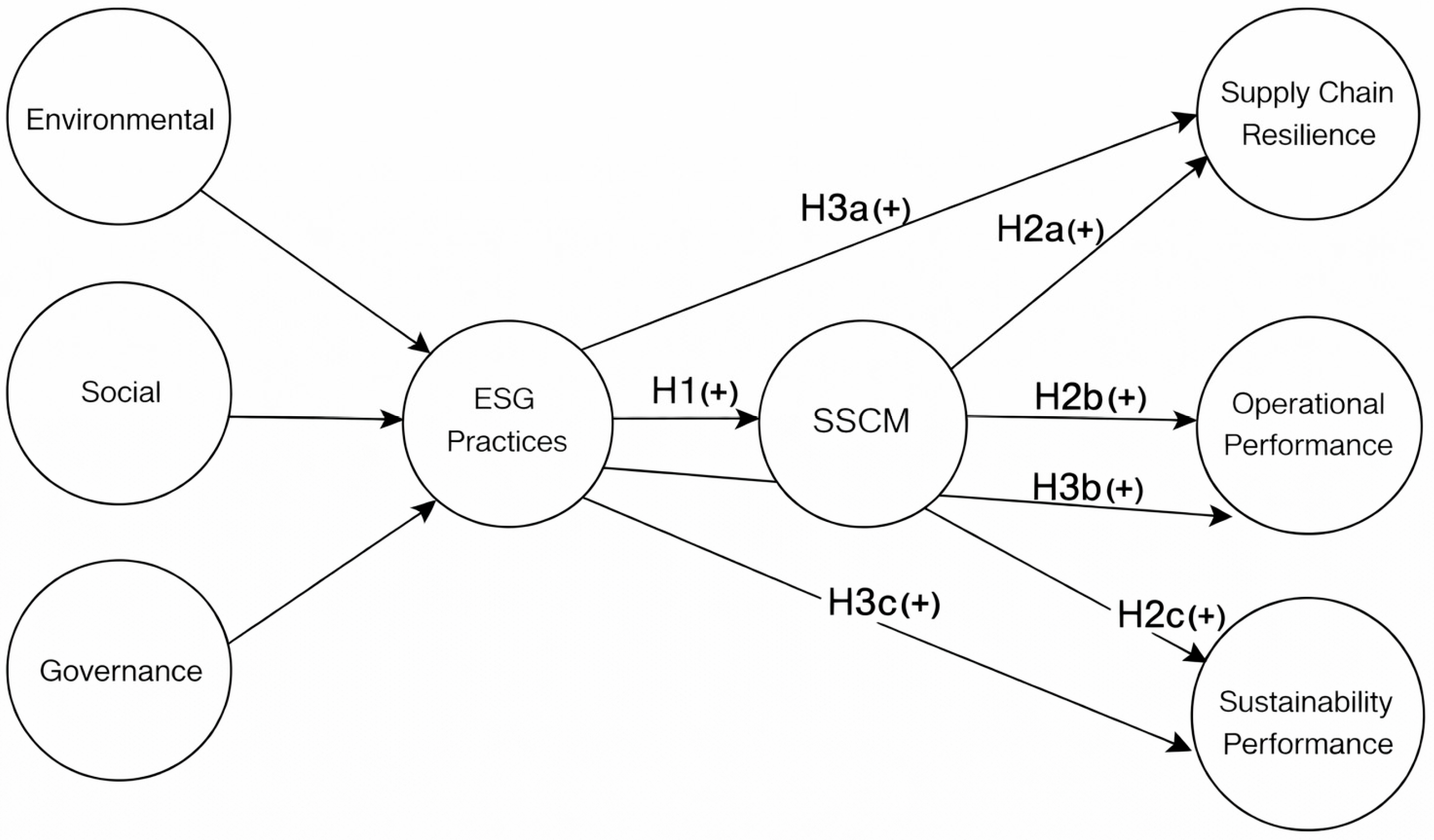
The seven hypotheses outlined above collectively propose an integrated mediation framework in which SSCM capability serves as the central mechanism translating ESG criteria into enhanced supply chain performance. This conceptualization posits that while ESG criteria may exert direct influences on performance outcomes (H3a), their primary effect operates indirectly through the development of SSCM capability (H1), which, in turn, drives improvements across the resilience, operational, and sustainability dimensions (H2a).
To visually synthesize these hypothesized relationships and provide a clear roadmap for empirical testing, Figure 1 presents the comprehensive research model. The model structure reflects the adopted capability-based perspective, positioning SSCM capability as a pivotal mediator between formal ESG expectations and realized performance outcomes. The inclusion of both indirect (through SSCM capability) and direct paths enables a nuanced examination of mediation patterns—distinguishing whether SSCM capability fully or partially explains the relationship between ESG criteria and performance outcomes.

4. Methodology

4.1. Sample and Data Collection

The research adopts a quantitative research design to empirically examine the relationships among ESG criteria, Sustainable Supply Chain Management capability (SSCMC), and supply chain performance outcomes in the Mexican aerospace industry. The aerospace sector provides a particularly suitable empirical context due to its complex, multi-tier supply chain structures, stringent regulatory and quality requirements (e.g., AS9100, NADCAP), and increasing exposure to environmental, social, and governance (ESG) expectations from global original equipment manufacturers (OEMs), regulators, and international customers.
Primary data were collected through a structured, self-administered survey conducted in person during the Mexico Aerospace Fair (FAMEX) 2025 (23–26 April 2025). The study employed a non-probabilistic purposive sampling strategy. Firms were selected based on their active participation in FAMEX and their operational involvement in the aerospace supply chain. The same inclusion criteria were applied across OEMs and Tier 1–3 suppliers engaged in aerostructures production, precision machining, avionics components, specialized processes (e.g., heat treatment, surface finishing), maintenance, and subcomponent manufacturing under internationally regulated quality and compliance standards. Respondents were required to hold managerial or professional positions directly related to supply chain management, sustainability, procurement, operations, or quality functions [50].
Although Tier 1, Tier 2, and Tier 3 suppliers differ in size, governance structures, and ESG maturity, the objective of the research was not to compare structural differences across supplier levels but to examine the underlying mechanism linking ESG practices to supply chain outcomes through SSCM capability. Consistent with the capability-based perspective adopted in this research, SSCM capability is conceptualized as a transversal organizational mechanism operating across heterogeneous firms within the aerospace ecosystem.
Of the 337 aerospace firms registered at FAMEX 2025, 217 completed and valid responses were obtained, yielding a response rate of 64.4%. Questionnaires were distributed directly to qualified respondents at their exhibition stands, and researchers were present to provide clarification when necessary.
To ensure data validity and reliability, predefined data quality screening procedures were applied. Responses were evaluated based on: (1) completeness, excluding surveys with more than 20% missing values; (2) response consistency, removing cases exhibiting straight-lining patterns or logically contradictory answers; and (3) minimum response time thresholds, excluding surveys completed in less than 50% of the median completion time. These procedures ensured that only engaged and substantively valid responses were retained for analysis. The final sample of 217 responses was deemed suitable for the analytical techniques used.
The sample size (n = 217) exceeds the minimum requirements for Partial Least Squares Structural Equation Modeling (PLS-SEM), satisfying the “10-times rule” and providing adequate statistical power to detect medium effect sizes [51].
To reduce the risk of common method bias, several procedural remedies were implemented following established guidelines [50]: respondents were assured of anonymity and confidentiality; survey items were presented in a randomized order where feasible; psychological separation was created between predictor and criterion constructs; and in-person administration allowed for clarification of ambiguous items. All constructs were measured using 5-point Likert scales (1 = strongly disagree; 5 = strongly agree). Participation was voluntary and conducted for academic purposes.

4.2. Measurement Development

The measurement instrument was developed based on an extensive review of prior literature on ESG criteria, sustainable supply chain management, and supply chain performance. Following established scale development procedures, measurement items were adapted from validated scales to ensure content validity and comparability with prior studies. The survey instrument underwent a multi-stage validation process: (1) initial item generation from literature; (2) expert review by three academics specializing in SCM and sustainability; (3) pretest with five industry professionals from Mexican aerospace firms; and (4) pilot testing with 30 respondents not included in the final sample. All items were measured on a five-point Likert scale ranging from 1 (“strongly disagree”) to 5 (“strongly agree”), consistent with recent empirical research in SSCM and ESG [51].
Table 1 provides an overview of the constructs, their measurement characteristics, and the key sources of adaptation. For comprehensive transparency, the complete item set, including full wording, is presented in Appendix A. The table specifies each construct’s type (reflective vs. formative) and hierarchical structure, which directly informs the analytical procedures employed in the PLS-SEM analysis.
As detailed in Table 2, ESG Practices were operationalized as a second-order formative construct comprising three first-order reflective dimensions (Environmental, Social, and Governance). This hierarchical structure captures the integrative yet multidimensional nature of ESG implementation in supply chains, where each dimension contributes uniquely to the overall construct [14,28]. The formative specification acknowledges that deficiencies in one dimension (e.g., Governance) may not be compensated by strengths in others, reflecting the practical reality of ESG management.
SSCM Capability was modeled as a reflective first-order construct, with items representing integration, collaboration, monitoring, and learning. This operationalization aligns with the dynamic capabilities perspective, where these elements collectively represent an organization’s ability to reconfigure resources for sustainability implementation [17,26].

4.3. Data Analysis Procedure

The data analysis followed a two-stage analytical approach designed to address both sufficiency and necessity relationships, consistent with recent methodological advancements in sustainability and supply chain research [53,54]. First, Partial Least Squares Structural Equation Modeling (PLS-SEM) was employed to examine sufficiency relationships—testing whether higher levels of predictor variables are associated with higher levels of outcome variables. Second, a Necessary Condition Analysis (NCA) was conducted to identify necessary conditions—the minimum levels of predictor variables required for the desired levels of outcomes. This dual-method approach provides a more comprehensive understanding of the relationships between ESG practices, SSCM capability, and performance outcomes.

4.3.1. Partial Least Squares Structural Equation Modeling (PLS-SEM)

PLS-SEM was selected as the primary analytical technique due to its suitability for predictive-oriented research, its ability to handle complex models with multiple constructs and mediation relationships, and its robustness with moderate sample sizes. The method is particularly appropriate for this research given the presence of a hierarchical component model (HCM), the inclusion of multiple endogenous constructs, and the study’s objective of explaining variance in supply chain performance outcomes rather than confirming an established covariance structure [51,55].
The analysis followed established two-stage procedures for PLS-SEM [51] using SmartPLS 4 version 4.1.1.7. In Stage 1, the measurement model was assessed to ensure reliability and validity. For reflective constructs, internal consistency reliability was evaluated using Cronbach’s alpha and composite reliability. Convergent validity was assessed through indicator loadings and average variance extracted (AVE). Discriminant validity was examined using the heterotrait–monotrait (HTMT) ratio of correlations, with values below 0.90 indicating adequate discriminant validity [56]. For formative constructs (ESG Practices as second-order), multicollinearity was assessed using variance inflation factors (VIF), and indicator weights were examined for significance and relevance [57].
In Stage 2, the structural model was evaluated. Collinearity was assessed using VIF values for predictor constructs. Path coefficients were estimated using bootstrapping with 5000 subsamples to determine statistical significance. The coefficient of determination (R2) was examined for endogenous constructs [51]. Effect sizes (f2) were calculated to assess the substantive impact of predictors. Predictive performance was assessed using the PLSpredict procedure, which evaluates out-of-sample predictive power by comparing PLS-SEM predictions with root mean squared error (RMSE) and mean absolute error (MAE) of the PLS-SEM model against a naïve linear regression benchmark (LM) [58].
ESG Practices were modeled as a second-order formative construct comprising three first-order reflective dimensions (Environmental, Social, Governance), reflecting their conceptual distinctiveness and complementary contributions to overall sustainability implementation. This specification acknowledges that each dimension provides unique, non-interchangeable information, where deficiencies in one area cannot be compensated by strengths in others—aligning with the practical reality of ESG management in supply chains. The repeated indicators approach was employed, with formative relationships (Mode B) between dimensions and the higher-order construct. Assessment followed established guidelines for formative measurement: convergent validity via redundancy analysis (correlations), indicator weight significance via bootstrapping (5000 subsamples), and multicollinearity checks using variance inflation factors (VIFs). This hierarchical modeling approach reduces complexity while maintaining theoretical accuracy, allowing examination of both overall ESG effects and specific dimensional contributions [34,58].

4.3.2. Necessary Condition Analysis

Complementing PLS-SEM, Necessary Condition Analysis (NCA) was conducted in RStudio version 2026.01.0+392 [53], which integrates PLS-SEM and NCA within a unified platform, ensuring methodological consistency and facilitating direct comparisons of analytical results.
To identify necessary conditions—the minimum levels of predictor variables required to achieve desired levels of outcome variables [54]. While PLS-SEM examines average effects (sufficiency relationships), NCA focuses on ceiling lines that represent the maximum possible outcome for given levels of a condition. This integrated approach within a single software platform ensures methodological consistency and facilitates direct comparison between sufficiency and necessity findings [35].
The analysis proceeded through four systematic steps [54]: First, bivariate scatter plots with ceiling lines were examined to visually assess potential necessary condition patterns. Second, the ceiling envelopment with free disposal hull (CE-FDH) technique was applied, as it makes no distributional assumptions and is appropriate for the Likert-scale data used. Third, effect sizes (d) were calculated. Fourth, statistical significance was assessed through permutation tests (default 10,000 permutations in RStudio), indicating a statistically significant necessary condition.
The analysis examined key relationships in the conceptual model: (1) between individual ESG dimensions and SSCM Capability; (2) between SSCM Capability and each performance outcome; and (3) direct relationships between ESG Practices and performance outcomes. For each significant necessary condition, bottleneck tables were generated specifying the minimum required level of the condition (expressed as a percentage of the scale maximum) to achieve outcome levels at the 10th and 90th percentiles.
This dual-analytic approach—sufficiency testing via PLS-SEM and necessity testing via NCA—provides a comprehensive understanding of the relationships in our model, distinguishing between factors that generally improve outcomes and factors that are essential prerequisites for success in ESG implementation within Mexican aerospace supply chains.

5. Results

This section presents the empirical findings of the study, which combine Partial Least Squares Structural Equation Modeling (PLS-SEM) and Necessary Condition Analysis (NCA). PLS-SEM was used to examine the sufficiency and strength of the proposed relationships in the structural model, while NCA was applied to identify necessary conditions—factors that must be present for an outcome to occur, even if they are not sufficient on their own [32,33]. This dual-method approach provides a more nuanced understanding of the mechanisms linking ESG practices to supply chain outcomes, addressing both the “what” (sufficient predictors) and the “must-have” (necessary conditions) aspects of the model.

5.1. PLS-SEM Results

5.1.1. Measurement Model Assessment

Before evaluating the structural relationships, the reliability and validity of the reflective measurement model were assessed in accordance with established PLS-SEM guidelines [53]. All constructs were evaluated for internal consistency, convergent validity, and discriminant validity, as shown in Table 2.
Table 2 presents the internal consistency reliability and convergent validity results for all reflective constructs. Cronbach’s alpha values range from 0.79 to 0.88, exceeding the recommended threshold of 0.70 and indicating satisfactory internal consistency [53]. Composite reliability (CR) values vary between 0.85 and 0.91, surpassing the minimum recommended level of 0.70 while remaining below the conservative upper limit of 0.95, suggesting the absence of indicator redundancy.
The Average Variance Extracted (AVE) values range from 0.54 to 0.64, all exceeding the 0.50 threshold, thereby confirming adequate convergent validity. These results indicate that each construct explains more than 50% of the variance of its indicators. Notably, SSCM Capabilities demonstrates strong reliability (CR = 0.91) and solid convergent validity (AVE = 0.58), supporting its role as a higher-order mediating construct within the structural model.
Finally, the measurement model demonstrates robust psychometric properties across all constructs. Internal consistency, convergent validity, and discriminant validity criteria are satisfied, ensuring that subsequent structural interpretations are not confounded by measurement deficiencies. The adequacy of both reflective and formative specifications supports the conceptual distinction between ESG Practices, a governance-oriented higher-order construct, and SSCM Capability, an operational capability construct.
Discriminant validity was assessed using the Heterotrait–Monotrait (HTMT) ratio of correlations [56]. As shown in Table 3, all HTMT values are below the conservative threshold of 0.85, indicating that each construct is empirically distinct from the others. The highest HTMT value observed was 0.64 (between SSCM Capabilities and SC Resilience), which is well below the recommended limit, confirming strong discriminant validity.
ESG Practices were modeled as a second-order construct composed of environmental, social, and governance dimensions, following a reflective-formative hierarchical component model [53]. To estimate this higher-order construct, a two-stage approach was employed [51]. In the first stage, latent variable scores for the environmental, social, and governance dimensions were obtained. In the second stage, these scores were used as formative indicators of the ESG Practices construct.
Because ESG Practices is specified as a formative construct, traditional reliability and convergent validity measures such as Cronbach’s alpha, composite reliability, and AVE are not applicable [59]. Instead, the assessment focused on collinearity and the statistical and substantive relevance of the formative indicators. To evaluate collinearity, the variance inflation factor (VIF) was calculated using the latent variable scores for the three ESG dimensions. As shown in Table 4, all VIF values were well below the conservative threshold of 3.3 [60], ranging from 1.15 to 1.21, confirming that multicollinearity among the formative indicators is not a concern.
Bootstrapping with 5000 subsamples [53] confirmed that the outer weights of all three ESG dimensions were statistically significant (p < 0.01), indicating that each dimension contributes meaningfully to the formation of the ESG Practices construct. The environmental dimension exhibited the strongest contribution (β = 0.51, t = 6.09, p < 0.001), followed by the governance dimension (β = 0.43, t = 5.39, p < 0.001), and the social dimension (β = 0.40, t = 4.77, p < 0.001). This pattern aligns with findings from prior studies in highly regulated and environmentally intensive industries such as aerospace and heavy manufacturing, where environmental compliance and resource-related practices often play a dominant role, while social and governance practices function as essential supporting dimensions [61,62].

5.1.2. Structural Model Assessment

Having established measurement validity, the structural model was assessed to examine the proposed causal relationships among ESG Practices, SSCM Capability, and supply chain performance outcomes. The structural model was evaluated by examining path coefficients, coefficient of determination (R2), effect sizes (f2), predictive relevance, and collinearity. Bootstrapping with 5000 subsamples was used to assess statistical significance [53].
To assess collinearity among predictor constructs in the structural model, inner variance inflation factor (VIF) values were examined. All VIF values were well below the conservative threshold of 3.3 [63] ranging from 1.00 to 1.44, confirming that multicollinearity does not bias the path coefficient estimates.
As shown in Table 5, six of the seven hypothesized relationships were statistically significant at p < 0.05. The strongest relationship was observed between ESG Practices and SSCM Capabilities (β = 0.55, t = 12.24, p < 0.001), supporting H1. SSCM Capabilities significantly predicted SC Resilience (β = 0.49, H2a), SC Operational Performance (β = 0.26, H2b), and SC Sustainability Performance (β = 0.35, H2c). Regarding the direct effects of ESG Practices, significant relationships were found with SC Operational Performance (β = 0.32, H3b) and SC Sustainability Performance (β = 0.25, H3c), but not with SC Resilience (β = 0.13, p = 0.060, H3a). In contrast, ESG Practices do not significantly predict SC Resilience (β = 0.13, p = 0.060), suggesting that resilience depends more strongly on capability development than on ESG adoption alone.
Table 6 reports the explanatory and predictive power of the endogenous constructs. The R2 values range from 0.26 to 0.32, indicating moderate explanatory power according to established PLS-SEM guidelines. These results are consistent with behavioral and supply chain research contexts, where complex multi-tier systems rarely exhibit high variance explanation.
The model explains 31% of the variance in SSCM Capabilities (R2 = 0.31), 32% in SC Resilience (R2 = 0.32), 26% in SC Operational Performance (R2 = 0.26), and 28% in SC Sustainability Performance (R2 = 0.28). These values indicate moderate explanatory power, consistent with behavioral and supply chain studies [53].
The Stone–Geisser Q2 values are all above zero, confirming predictive relevance for all endogenous constructs. The magnitude of Q2 values suggests small-to-medium predictive strength, reinforcing the model’s capability not only to explain in-sample relationships but also to provide meaningful out-of-sample predictive performance.
The effect size of ESG Practices on SSCM Capabilities was large (f2 = 0.44), indicating substantive relevance. SSCM Capabilities showed a medium effect on SC Resilience (f2 = 0.24) and small effects on the other outcomes. Although some effect sizes are small, they remain meaningful in complex multi-tier supply chain systems, where incremental capability improvements can yield cumulative performance gains. Other direct effects were small or negligible, following Cohen’s [64] guidelines.
Model fit indices further support the structural adequacy of the model. The standardized root mean square residual (SRMR = 0.06) falls below the recommended threshold of 0.08, indicating acceptable model fit. The normed fit index (NFI = 0.91) exceeds the 0.90 benchmark, suggesting satisfactory overall model quality. Consistent with variance-based SEM logic, model fit indices are interpreted as supplementary diagnostics rather than primary evaluation criteria in SEM-PLS models.
To assess the model’s out-of-sample predictive power, the PLSpredict procedure [58] was employed using SmartPLS 4 version 4.1.1.7. All Q2 predict values were positive, ranging from 0.05 to 0.25, confirming the model’s predictive relevance. For most indicators, the PLS-SEM root mean square error (RMSE) was lower than or equal to the linear model (LM) RMSE, indicating that the proposed model offers comparable or better predictive accuracy than a naive benchmark (see Appendix B for full results).
Collectively, the SEM results indicate that ESG Practices exert both direct and capability-mediated effects, with SSCM Capability accounting for a substantial proportion of performance improvements.

5.1.3. Indirect Effects and Mediation Analysis

To formally assess the mediating role of Sustainable Supply Chain Management (SSCM) Capability in the relationship between ESG Practices and supply chain performance outcomes, a bootstrapping procedure with 5000 resamples was conducted. Following contemporary PLS-SEM mediation guidelines, specific indirect effects were estimated, and statistical significance was evaluated using bias-corrected and accelerated (BCa) 95% confidence intervals [53,65].
The results in Table 7 indicate that all indirect effects are statistically significant. The indirect effect of ESG Practices on Operational Performance through SSCM Capability is positive and significant (β = 0.147; 95% BCa CI [0.065, 0.230]). Likewise, the indirect effect on Supply Chain Resilience is significant (β = 0.269; 95% BCa CI [0.179, 0.360]), as is the indirect effect on Sustainability Performance (β = 0.194; 95% BCa CI [0.120, 0.273]). In all cases, the confidence intervals do not include zero, confirming the presence of statistically significant mediation effects.
To determine the type of mediation, both direct and indirect paths were examined. In the case of Supply Chain Resilience, the direct effect of ESG Practices is not statistically significant, while the indirect effect through SSCM Capability remains significant. This pattern indicates full (indirect-only) mediation. In contrast, for Operational Performance and Sustainability Performance, both direct and indirect effects are statistically significant, indicating partial (complementary) mediation.
Variance Accounted For (VAF) values further support these conclusions. For Operational Performance, VAF equals 31.4%, and for Sustainability Performance, 43.7%, both indicating partial mediation. For Resilience, although the VAF is 67%, the non-significant direct path indicates indirect-only mediation.
Collectively, these findings provide robust empirical support for the capability-based explanation proposed in this study. ESG Practices contribute to performance improvements primarily by enabling SSCM Capability, which functions as the central transmission mechanism translating governance-oriented sustainability practices into operational, resilience, and sustainability outcomes.

5.2. Necessary Conditions Analysis (NCA)

To complement the sufficiency-oriented results obtained from the PLS-SEM analysis, a Necessary Condition Analysis (NCA) was conducted to examine whether ESG practices and SSCM capabilities constitute necessary conditions for key supply chain outcomes. While PLS-SEM focuses on estimating average net effects, NCA adopts a different analytical logic by identifying minimum threshold levels of antecedent conditions that must be present for an outcome to occur [32,54]. Following recent methodological recommendations, the analysis was performed using the ceiling envelopment–free disposal hull (CE-FDH) technique, and statistical significance was assessed through permutation tests with 10,000 resamples.
Table 8 reports the necessity effect sizes (d) and corresponding p-values for the analyzed relationships, providing evidence on whether ESG practices and SSCM capabilities operate as non-substitutable prerequisites for achieving higher levels of supply chain performance.
The results reveal that ESG practices constitute a statistically significant necessary condition for the development of SSCM capabilities (d = 0.132, p = 0.002), as well as for achieving higher levels of supply chain operational performance (d = 0.166, p < 0.001) and sustainability performance (d = 0.191, p < 0.001). These findings indicate that minimum thresholds of ESG implementation must be met before firms can attain improved operational efficiency and sustainability outcomes. In contrast, ESG practices do not emerge as a necessary condition for supply chain resilience (d = 0.109, p = 0.092), suggesting that resilience may also be achieved through alternative organizational or strategic mechanisms beyond ESG practices alone.
Additionally, SSCM capabilities exhibit consistent, statistically significant necessity effects across all three outcome variables. Notably, SSCM capabilities represent a moderately strong necessary condition for supply chain resilience (d = 0.257, p < 0.001), highlighting their critical role in enabling firms to withstand and recover from disruptions. SSCM capabilities also constitute necessary conditions for both operational performance (d = 0.167, p = 0.009) and sustainability performance (d = 0.215, p < 0.001).
The NCA results complement the SEM findings by demonstrating that ESG practices and SSCM capabilities are not only drivers of average performance but also non-substitutable prerequisites for achieving higher levels of supply chain performance. This distinction between sufficiency and necessity provides a more nuanced understanding of sustainability-oriented supply chain management in the aerospace industry context.

6. Discussion

6.1. Governance Structures, Capabilities, and Performance Thresholds

The findings advance sustainable supply chain management research by integrating variance-based sufficiency logic (PLS-SEM) with necessity-based reasoning (NCA). This dual approach enables a distinction between relationships that, on average, improve performance on average and structural conditions that act as performance bottlenecks [32,33].
The strong relationships between ESG Practices and SSCM Capability confirm that governance-oriented sustainability practices function primarily as structural antecedents of dynamic supply chain capabilities. This supports capability-based perspectives suggesting that sustainability investments generate value when embedded with integrative and coordination routines rather than operating as isolated compliance mechanisms [37,40].
An important asymmetry emerges when sufficiency and necessity are examined jointly. While ESG practices contribute directly to operational and sustainability performance, resilience depends mostly on SSCM Capability. This finding helps explain inconsistencies in prior ESG research [12], in which ESG effects appear heterogeneous across contexts. Treating ESG as a direct performance driver may overlook the mediating role of higher-order capabilities in transforming governance commitments into adaptive capacity [25].
From a dynamic capability perspective [25,26], resilience reflects the ability to integrate, reconfigure, and coordinate resources under uncertainty, rather than merely the presence of compliance mechanisms. The findings indicate that sustainability-oriented capabilities constitute foundational enablers of adaptive capacity more than ESG implementation per se [37].
The aerospace context further reinforces this interpretation. In highly regulated environments, ESG practices often serve as entry requirements or “license-to-operate” mechanisms within global value chains [9,39]. Importantly, compliance does not automatically translate into competitive advantage or resilience. Firms must develop procurement, integration, and governance capabilities that internalize sustainability requirements into operational processes [37,40].

6.2. Theoretical Implications

The research contributes to sustainable supply chain management theory in three primary ways. First, it empirically validates SSCM Capability as a central mediating construct linking ESG practices to performance outcomes. These findings reinforce the argument that ESG represents a governance architecture, while capability development determines whether those governance structures translate into operationalized performance [17,22].
Second, the integration of sufficiency and necessity logics advances methodological understanding in sustainability research. Identifying SSCM Capabilities as a necessary condition for resilience shifts the interpretation of performance drivers from average effects to structural prerequisites [32]. This difference addresses recent calls for more nuanced causal modeling in management research [35].
Finally, the study contributes to resilience theory by reframing resilience as a capability-driven outcome rather than as a function of redundancy or structural buffers alone. The findings highlight the role of sustainability-oriented integration and coordination routines as underlying enablers of adaptive performance [26,27].

6.3. Industry and Contextual Implications: Aerospace and Emerging Economy

The empirical evidence indicates that ESG practices play a foundational yet structurally bounded role in the aerospace supply chain context examined. While ESG practices establish minimum legitimacy thresholds and contribute to operational and sustainability performance, they do not independently generate adaptive resilience [12]. This distinction is particularly salient in highly regulated, certification-driven industries such as aerospace, where compliance mechanisms often function as institutional entry conditions rather than adaptive enablers [9].
The environmental dimension of ESG exhibited the strongest contribution within this pattern, which reflects the regulatory intensity and environmental risk exposure characteristic of aerospace manufacturing, where emissions control, hazardous material management, and quality assurance standards are tightly institutionalized [37]. In such settings, environmental compliance often constitutes the primary entry point for sustainability integration, while social and governance mechanisms evolve in response to stakeholder and institutional pressures [37,38].
However, ESG practices function largely as participation conditions within global value chains rather than as intrinsic sources of competitive advantage [9]. Meeting certification and due diligence requirements ensures supply chain access, but sustained resilience and performance depend on a firm’s ability to internalize sustainability expectations into procurement, monitoring, and interorganizational coordination routines [25]. This distinction clarifies why ESG adoption alone does not uniformly enhance resilience outcomes.
The Mexican aerospace industry provides a particularly relevant empirical setting for examining these dynamics. The sector combines high technological complexity, strong dependence on foreign OEMs, and integration into global supply chains with emerging economy institutional characteristics [30,31]. Firms must comply with international certification regimes while navigating resource constraints, capability gaps, and heterogeneous mechanisms to align external ESG pressures with internal operational routines [38].
Accordingly, the ESG Capability performance relationship observed in this study should be interpreted as context-sensitive rather than universal. Industry structure, governance intensity, regulatory regimes, and institutional maturity shape how sustainability practices translate into performance outcomes [17,49]. A cross-industry and cross-country comparison would further clarify the boundary conditions and contextual contingencies influencing sustainability-driven capability development [49].

6.4. Managerial Implications

The results carry practical implications for firms operating within the Mexican aerospace ecosystem, characterized by high regulatory intensity, tiered governance structures, and strong dependence on global OEMs [30].
For OEMs and lead firms, ESG practices should not be managed solely as cascading compliance requirements. Although ESG establishes minimum participation standards, resilience and sustained performance depend on the coordinated development of SSCM capabilities across tiers [39]. Audit-based monitoring alone is insufficient; structured supplier development programs, aligned sustainability metrics, and integration of ESG criteria into existing aerospace quality systems are required to strengthen interorganizational coordination and adaptive capacity [15,17].
Tier 1 suppliers positioned between global OEM demands and domestic supply constraints must embed ESG within core operational governance systems rather than treating it as a parallel reporting function. Integrating ESG into procurement, risk management, and supplier evaluation routines enhances coordination efficiency and reduces fragmentation [22]. In emerging-economy contexts, where institutional asymmetries and capability gaps persist, such integration becomes a stabilizing mechanism for performance consistency [8].
For Tier 2 and Tier 3 suppliers, incremental upgrading strategies are more feasible than comprehensive sustainability overhauls [11]. Prioritizing environmentally linked process improvements—such as energy efficiency and waste reduction—can simultaneously generate cost savings and strengthen capability foundations. Gradual embedding of ESG within production and quality routines supports organizational learning while reducing compliance fatigue [7].
At the ecosystem level, the findings highlight the importance of upgrading collective capabilities. In global value chain environments where multinational standards coexist with heterogeneous local capabilities, cluster-level coordination and shared learning platforms can mitigate institutional voids and enhance systemic resilience [9,19].
Digitalization should be understood as a capability multiplier rather than a standalone objective. Investments in data integration and supply chain visibility enhance sustainability and resilience only when embedded within governance structures and coordination routines. In compliance-intensive aerospace systems, technological adoption must reinforce, not substitute, capability development [28].
Altogether, the managerial implications are evident: in the Mexican aerospace industry, ESG practices function as entry conditions for participation in global supply chains, but sustained competitive advantage and resilience depend on the development of SSCM Capability. In highly regulated and institutionally constrained environments, it is capability orchestration—not compliance alone—that determines long-term performance [26,52].

6.5. Limitations and Future Research

Several limitations should be considered when interpreting the findings of this research. First, the use of a non-probabilistic purposive sampling strategy, restricted to firms participating in FAMEX 2025. Although the response rate was relatively high (64.4%), the sample may not fully represent the entire population of aerospace firms operating in Mexico, particularly smaller suppliers or firms not integrated into cluster-based networks. Consequently, the findings should be interpreted as analytically generalizable to similar regulated, multi-tier supply chain environments rather than statistically generalizable across industries.
Second, the structural model does not explicitly incorporate firm-level control variables or formally test for unobserved heterogeneity. Factors such as firm size, ownership structure, export orientation, technological sophistication, or supply chain position may influence both ESG implementation and capability development. Future research could address this limitation through multi-group analysis, moderation testing, or segmentation.
Third, the cross-sectional design limits the ability to capture the dynamic evolution of capabilities and performance outcomes over time. Longitudinal research designs would allow future studies to examine how ESG practices and SSCM capabilities co-evolve and influence long-term operational, resilience, and sustainability performance [19,46].
Fourth, the empirical context is limited to the Mexican aerospace sector. Although the mechanisms identified may apply to other regulated industries or incipient economies, institutional conditions, governance structures, and supply chain maturity may influence ESG–capability–performance relationships differently. Comparative studies across industries or countries would help clarify contextual contingencies and boundary conditions.
Finally, future research should further unpack the internal structure of SSCM Capability. Identifying which specific sub-capabilities—such as integration, monitoring mechanisms, collaboration, or digital transparency systems—most strongly influence different performance outcomes would advance theoretical and managerial understanding. Qualitative or mixed-method approaches could also provide deeper insights into micro-foundations of sustainability-oriented capability development.

7. Conclusions

The research examined how Environmental, Social, and Governance (ESG) practices influence supply chain performance in the Mexican aerospace industry, emphasizing the mediating role of Sustainable Supply Chain Management Capability (SSCM Capability). By integrating sufficiency logic through Partial Least Squares Structural Equation Modeling and necessity logic through Necessary Condition Analysis, the study provides a more comprehensive understanding of how sustainability-related practices translate into resilience, operational performance, and sustainability performance. This dual analytical perspective distinguishes between factors that generally improve performance and those that represent indispensable prerequisites for achieving high performance levels.
The findings show that ESG practices primarily create value by enabling the development of SSCM Capability rather than by directly improving all performance outcomes. While ESG practices positively influence operational and sustainability performance, they do not directly enhance supply chain resilience. In contrast, SSCM Capability emerges as the most influential construct, exerting strong effects on resilience, operational performance, and sustainability performance. The necessity analysis further reveals that SSCM Capability represents a critical bottleneck, particularly for resilience, indicating that without a minimum level of sustainability-oriented capabilities, firms cannot achieve high resilience regardless of other advantages or investments.
These results contribute to sustainable supply chain management research by reinforcing a capability-based interpretation of sustainability implementation. The study demonstrates that adopting ESG criteria alone is insufficient to ensure superior supply chain outcomes, especially in highly regulated and complex industries such as aerospace. Instead, performance improvements depend on the extent to which firms embed ESG expectations into coordinated organizational routines and inter-organizational processes, including integration, monitoring, collaboration, and governance. This perspective helps reconcile mixed findings in prior ESG research by clarifying why ESG adoption may improve certain outcomes while leaving others unaffected.
Finally, the study highlights the importance of contextual factors in shaping ESG–performance relationships. In emerging economies such as Mexico, firms face additional constraints related to resources, institutional support, and supplier maturity, which intensify the need for effective SSCM Capability development. By positioning SSCM Capability as the central mechanism translating ESG practices into tangible performance outcomes, this research offers a structured framework for understanding sustainability implementation in global, compliance-intensive supply chains. Future research can build on these insights by examining the evolution of SSCM capabilities over time and exploring how different capability dimensions contribute to specific performance outcomes across industries and regions.


Author Contributions

Conceptualization, J.S.G.-V. and M.A.V.-J.; methodology, J.S.G.-V.; software, A.G.-S.; validation, M.A.V.-J., J.A.M.-A. and M.A.C.-F.; formal analysis, J.A.M.-A.; investigation, J.S.G.-V.; resources, M.A.V.-J.; data curation, J.S.G.-V.; writing—original draft preparation, A.G.-S. and M.A.C.-F.; writing—review and editing, J.S.G.-V. and M.A.V.-J.; visualization, A.G.-S. and M.A.C.-F.; supervision, M.A.V.-J. and J.A.M.-A.; project administration, M.A.V.-J. All authors have read and agreed to the published version of the manuscript.

Funding

This research was funded by the Postdoctoral Research Program by the Secretariat of Science, Humanities, Technology and Innovation (SECIHTI) of Mexico.

Institutional Review Board Statement

Ethical review and approval were waived for this study by the Committee for Ethics in Research, Investigation and Biosecurity of the Universidad Michoacana de San Nicolás de Hidalgo as per Article 17 of the Reglamento de la Ley General de Salud en Materia de Investigación para la Salud in Mexico, which classifies anonymous survey-based research with adult professionals as research without risk.

Informed Consent Statement

Informed consent for participation was obtained from all subjects involved in the study.

Data Availability Statement

All data generated or analyzed during this study are available from the corresponding authors upon reasonable request.

Acknowledgments

The authors would like to thank the editor and the anonymous reviewers for their careful evaluation and constructive feedback throughout the review process. Their insightful comments significantly contributed to improving the clarity, rigor, and overall quality of this manuscript.

Conflicts of Interest

The authors declare no conflicts of interest.

Appendix A. Survey Questionnaire

Table A1. Survey Questionnaire.
ConstructCodeItem
Environmental E1Our company requires suppliers to comply with environmental regulations and standards.
E2Environmental compliance of key suppliers is regularly monitored or audited.
E3Environmental impact reduction initiatives are implemented across the supply chain.
E4Hazardous materials are managed through formal environmental controls.
E5Waste reduction or circular practices are promoted with suppliers.
E6Environmental criteria are included in supplier evaluations.
Social PracticesS1Occupational health and safety standards are required from suppliers.
S2Labor practices of suppliers are systematically monitored.
S3Suppliers receive training on social responsibility requirements
S4Reporting mechanisms exist for social compliance issues
S5Human rights considerations are assessed for key suppliers
S6Social non-compliance leads to corrective actions
Governance PracticesG1A formal supplier code of conduct is enforced
G2Anti-corruption controls are applied to suppliers
G3Traceability systems ensure supply chain accountability
G4ESG KPIs are monitored in supply chain operations
G5Roles for ESG compliance are clearly defined
G6ESG performance is reviewed by management
SSCM CapabilitiesC1We collaborate with suppliers to improve sustainability performance across the supply chain
C2We share sustainability-related information and performance data with key suppliers
C3Sustainability criteria are systematically integrated into procurement and sourcing decisions
C4We engage in continuous improvement initiatives with suppliers to address sustainability issues
C5Supplier sustainability performance is monitored using formal metrics and periodic reviews
C6Cross-functional teams (e.g., procurement, operations, quality) are aligned on sustainable supply chain objectives
C7Sustainability objectives are coordinated and aligned across supply chain partners
Supply Chain ResilienceR1Our supply chain can respond quickly to unexpected disruptions
R2We are able to recover operations rapidly after supply chain disruptions
R3We can adapt sourcing or production plans in response to unforeseen events
R4Alternative suppliers or sourcing options are available when disruptions occur
R5Formal contingency and risk management plans are in place across the supply chain
Operational PerformanceO1Delivery reliability in our supply chain meets or exceeds expectations
O2Product or service quality is consistent across operations
O3Lead times in the supply chain are stable and predictable
O4Cost variability caused by supply chain disruptions is low
O5Overall operational efficiency of the supply chain has improved in recent years
Sustainability PerformanceP1Environmental impacts associated with supply chain operations have decreased
P2Social compliance performance of suppliers has improved over time
P3Environmental, social, and governance (ESG) targets are consistently achieved
P4Resource efficiency (e.g., energy use, materials, waste) has improved across the supply chain
P5Overall sustainability performance of the supply chain has strengthened

Appendix B. PLSpredict

Table A2. PLSpredict results.
Q2 Predict PLS-SEM_RMSE PLS-SEM_MAE LM_RMSE LM_MAE A_RMSE A_MAE
P5 0.05 0.79 0.65 0.80 0.66 0.82 0.70
R4 0.06 0.84 0.70 0.85 0.71 0.87 0.75
O1 0.07 0.80 0.65 0.80 0.65 0.83 0.71
R2 0.08 0.85 0.68 0.85 0.68 0.88 0.74
R5 0.08 0.84 0.67 0.85 0.67 0.88 0.73
R1 0.09 0.88 0.72 0.89 0.73 0.93 0.78
P3 0.09 0.78 0.64 0.79 0.64 0.82 0.71
O4 0.10 0.81 0.67 0.81 0.67 0.85 0.73
P2 0.10 0.73 0.58 0.74 0.59 0.77 0.66
C7 0.11 0.79 0.65 0.79 0.66 0.84 0.72
P4 0.11 0.82 0.68 0.82 0.67 0.87 0.75
O2 0.12 0.79 0.64 0.80 0.64 0.85 0.73
O3 0.12 0.75 0.62 0.76 0.62 0.81 0.70
P1 0.12 0.76 0.59 0.77 0.60 0.81 0.69
C1 0.13 0.81 0.65 0.81 0.65 0.87 0.74
C5 0.13 0.79 0.63 0.80 0.63 0.85 0.73
R3 0.13 0.88 0.74 0.89 0.73 0.94 0.81
O5 0.14 0.77 0.62 0.77 0.62 0.82 0.71
C3 0.16 0.83 0.67 0.84 0.68 0.91 0.77
C4 0.18 0.76 0.62 0.76 0.62 0.84 0.72
C2 0.19 0.78 0.63 0.78 0.64 0.87 0.75
C6 0.25 0.76 0.62 0.76 0.61 0.87 0.75

References

  1. Ghadimi, P.; Wang, C.; Lim, M.K. Sustainable supply chain modeling and analysis: Past debate, present problems and future challenges. Resour. Conserv. Recycl. 2019, 140, 72–84. [Google Scholar] [CrossRef]
  2. Truant, E.; Borlatto, E.; Crocco, E.; Sahore, N. Environmental, social and governance issues in supply chains. A systematic review for strategic performance. J. Clean. Prod. 2024, 434, 140024. [Google Scholar] [CrossRef]
  3. Govindan, K.; Hasanagic, M. A systematic review on drivers, barriers, and practices towards circular economy: A supply chain perspective. Int. J. Prod. Res. 2018, 56, 278–311. [Google Scholar] [CrossRef]
  4. Govindan, K.; Shaw, M.; Majumdar, A. Social sustainability tensions in multi-tier supply chain: A systematic literature review towards conceptual framework development. J. Clean. Prod. 2021, 279, 123075. [Google Scholar] [CrossRef]
  5. Yadav, S.; Samadhiya, A.; Kumar, A.; Luthra, S.; Pandey, K.K. Environmental, Social, and Governance (ESG) Reporting and Missing (M) Scores in the Industry 5.0 Era: Broadening Firms’ and Investors’ Decisions to Achieve Sustainable Development Goals. Sustain. Dev. 2025, 33, 3455–3477. [Google Scholar] [CrossRef]
  6. Mendonça, J.A.; Roberto, F.R.A.; Kai, D.A.; Benitez, G.B. The Lock-In Effect on ESG and Business Performance Relationship: A Critical Examination and Meta-Analysis. Corp. Soc. Responsib. Environ. Manag. 2025, 32, 6912–6936. [Google Scholar] [CrossRef]
  7. Allenbacher, J.; Berg, N. How assessment and cooperation practices influence suppliers’ adoption of sustainable supply chain practices: An inter-organizational learning perspective. J. Clean. Prod. 2023, 403, 136852. [Google Scholar] [CrossRef]
  8. Nath, S.D.; Eweje, G.; Barua, S. Drivers and barriers for implementing social sustainability in supply chains: A qualitative investigation of a developing country’s multi-tier suppliers. Int. J. Logist. Manag. 2024, 35, 1332–1367. [Google Scholar] [CrossRef]
  9. Gereffi, G.; Lee, J. Economic and Social Upgrading in Global Value Chains and Industrial Clusters: Why Governance Matters. J. Bus. Ethics 2016, 133, 25–38. [Google Scholar] [CrossRef]
  10. Soundararajan, V.; Brown, J.A. Voluntary Governance Mechanisms in Global Supply Chains: Beyond CSR to a Stakeholder Utility Perspective. J. Bus. Ethics 2016, 134, 83–102. [Google Scholar] [CrossRef]
  11. Yawar, S.A.; Seuring, S. The role of supplier development in managing social and societal issues in supply chains. J. Clean. Prod. 2018, 182, 227–237. [Google Scholar] [CrossRef]
  12. Friede, G.; Busch, T.; Bassen, A. ESG and financial performance: Aggregated evidence from more than 2000 empirical studies. J. Sustain. Financ. Invest. 2015, 5, 210–233. [Google Scholar] [CrossRef]
  13. Husted, B.W.; de Sousa-Filho, J.M. Board structure and environmental, social, and governance disclosure in Latin America. J. Bus. Res. 2019, 102, 220–227. [Google Scholar] [CrossRef]
  14. Gualandris, J.; Longoni, A.; Luzzini, D.; Pagell, M. The association between supply chain structure and transparency: A large-scale empirical study. J. Oper. Manag. 2021, 67, 803–827. [Google Scholar] [CrossRef]
  15. Dai, J.; Xie, L.; Chu, Z. Developing sustainable supply chain management: The interplay of institutional pressures and sustainability capabilities. Sustain. Prod. Consum. 2021, 28, 254–268. [Google Scholar] [CrossRef]
  16. Kumar, G.; Meena, P.; Difrancesco, R.M. How do collaborative culture and capability improve sustainability? J. Clean. Prod. 2021, 291, 125824. [Google Scholar] [CrossRef]
  17. Beske, P.; Land, A.; Seuring, S. Sustainable supply chain management practices and dynamic capabilities in the food industry: A critical analysis of the literature. Int. J. Prod. Econ. 2014, 152, 131–143. [Google Scholar] [CrossRef]
  18. Flynn, B.B.; Huo, B.; Zhao, X. The impact of supply chain integration on performance: A contingency and configuration approach. J. Oper. Manag. 2010, 28, 58–71. [Google Scholar] [CrossRef]
  19. Busse, C.; Schleper, M.C.; Weilenmann, J.; Wagner, S.M. Extending the supply chain visibility boundary. Int. J. Phys. Distrib. Logist. Manag. 2017, 47, 18–40. [Google Scholar] [CrossRef]
  20. Hofmann, H.; Schleper, M.C.; Blome, C. Conflict Minerals and Supply Chain Due Diligence: An Exploratory Study of Multi-tier Supply Chains. J. Bus. Ethics 2018, 147, 115–141. [Google Scholar] [CrossRef]
  21. Tachizawa, E.M.; Wong, C.Y. The Performance of Green Supply Chain Management Governance Mechanisms: A Supply Network and Complexity Perspective. J. Supply Chain Manag. 2015, 51, 18–32. [Google Scholar] [CrossRef]
  22. Rebs, T.; Thiel, D.; Brandenburg, M.; Seuring, S. Impacts of stakeholder influences and dynamic capabilities on the sustainability performance of supply chains: A system dynamics model. J. Bus. Econ. 2019, 89, 893–926. [Google Scholar] [CrossRef]
  23. Ivanov, D.; Dolgui, A. Viability of intertwined supply networks: Extending the supply chain resilience angles towards survivability. A position paper motivated by COVID-19 outbreak. Int. J. Prod. Res. 2020, 58, 2904–2915. [Google Scholar] [CrossRef]
  24. Ivanov, D. Viable supply chain model: Integrating agility, resilience and sustainability perspectives—Lessons from and thinking beyond the COVID-19 pandemic. Ann. Oper. Res. 2022, 319, 1411–1431. [Google Scholar] [CrossRef] [PubMed]
  25. Teece, D.J. Explicating dynamic capabilities: The nature and microfoundations of (sustainable) enterprise performance. Strateg. Manag. J. 2007, 28, 1319–1350. [Google Scholar] [CrossRef]
  26. Teece, D.J. Business models and dynamic capabilities. Long Range Plan. 2018, 51, 40–49. [Google Scholar] [CrossRef]
  27. Chowdhury, M.M.H.; Quaddus, M. Supply chain resilience: Conceptualization and scale development using dynamic capability theory. Int. J. Prod. Econ. 2017, 188, 185–204. [Google Scholar] [CrossRef]
  28. Bechtsis, D.; Tsolakis, N.; Iakovou, E.; Vlachos, D. Data-driven secure, resilient and sustainable supply chains: Gaps, opportunities, and a new generalised data sharing and data monetisation framework. Int. J. Prod. Res. 2022, 60, 4397–4417. [Google Scholar] [CrossRef]
  29. Scholten, K.; Sharkey Scott, P.; Fynes, B. Mitigation processes—Antecedents for building supply chain resilience. Supply Chain Manag. Int. J. 2014, 19, 211–228. [Google Scholar] [CrossRef]
  30. Antena Igape Mexico. Nota Sectorial la Industria Aeroespacial en México; Antena Igape Mexico: Mexico City, Mexico, 2021. [Google Scholar]
  31. Federación Mexicana de la Industria Aeroespacial. Brochure 2025; Federación Mexicana de la Industria Aeroespacial: Mexico City, Mexico, 2025. [Google Scholar]
  32. Dul, J. Necessary Condition Analysis (NCA). Organ. Res. Methods 2016, 19, 10–52. [Google Scholar] [CrossRef]
  33. Richter, N.F.; Schubring, S.; Hauff, S.; Ringle, C.M.; Sarstedt, M. When predictors of outcomes are necessary: Guidelines for the combined use of PLS-SEM and NCA. Ind. Manag. Data Syst. 2020, 120, 2243–2267. [Google Scholar] [CrossRef]
  34. Becker, J.-M.; Cheah, J.-H.; Gholamzade, R.; Ringle, C.M.; Sarstedt, M. PLS-SEM’s most wanted guidance. Int. J. Contemp. Hosp. Manag. 2023, 35, 321–346. [Google Scholar] [CrossRef]
  35. Hauff, S.; Richter, N.F.; Sarstedt, M.; Ringle, C.M. Importance and performance in PLS-SEM and NCA: Introducing the combined importance-performance map analysis (cIPMA). J. Retail. Consum. Serv. 2024, 78, 103723. [Google Scholar] [CrossRef]
  36. Kazancoglu, Y.; Ekinci, E.; Mangla, S.K.; Sezer, M.D.; Kayikci, Y. Performance evaluation of reverse logistics in food supply chains in a circular economy using system dynamics. Bus. Strategy Environ. 2021, 30, 71–91. [Google Scholar] [CrossRef]
  37. Agyabeng-Mensah, Y.; Ahenkorah, E.; Afum, E.; Nana Agyemang, A.; Agnikpe, C.; Rogers, F. Examining the influence of internal green supply chain practices, green human resource management and supply chain environmental cooperation on firm performance. Supply Chain Manag. Int. J. 2020, 25, 585–599. [Google Scholar] [CrossRef]
  38. Kusi-Sarpong, S.; Gupta, H.; Sarkis, J. A supply chain sustainability innovation framework and evaluation methodology. Int. J. Prod. Res. 2019, 57, 1990–2008. [Google Scholar] [CrossRef]
  39. Soundararajan, V. The dark side of the cascading compliance model in global value chains. J. Ind. Bus. Econ. 2023, 50, 209–218. [Google Scholar] [CrossRef]
  40. Villena, V.H. The Missing Link? The Strategic Role of Procurement in Building Sustainable Supply Networks. Prod. Oper. Manag. 2019, 28, 1149–1172. [Google Scholar] [CrossRef]
  41. Esan, O.; Ajayi, F.A.; Olawale, O. Supply chain integrating sustainability and ethics: Strategies for modern supply chain management. World J. Adv. Res. Rev. 2024, 22, 1930–1953. [Google Scholar] [CrossRef]
  42. Dubey, R.; Altay, N.; Gunasekaran, A.; Blome, C.; Papadopoulos, T.; Childe, S.J. Supply chain agility, adaptability and alignment. Int. J. Oper. Prod. Manag. 2018, 38, 129–148. [Google Scholar] [CrossRef]
  43. Wong, C.Y.; Wong, C.W.Y.; Boon-itt, S. Effects of green supply chain integration and green innovation on environmental and cost performance. Int. J. Prod. Res. 2020, 58, 4589–4609. [Google Scholar] [CrossRef]
  44. Schoenherr, T.; Swink, M. Revisiting the arcs of integration: Cross-validations and extensions. J. Oper. Manag. 2012, 30, 99–115. [Google Scholar] [CrossRef]
  45. Pagell, M.; Wu, Z. Building a more complete theory of sustainable supply chain management using case studies of 10 exemplars. J. Supply Chain Manag. 2009, 45, 37–56. [Google Scholar] [CrossRef]
  46. Zhu, Q.; Sarkis, J.; Lai, K. Institutional-based antecedents and performance outcomes of internal and external green supply chain management practices. J. Purch. Supply Manag. 2013, 19, 106–117. [Google Scholar] [CrossRef]
  47. Dubey, R.; Bryde, D.J.; Foropon, C.; Tiwari, M.; Dwivedi, Y.; Schiffling, S. An investigation of information alignment and collaboration as complements to supply chain agility in humanitarian supply chain. Int. J. Prod. Res. 2021, 59, 1586–1605. [Google Scholar] [CrossRef]
  48. Awan, U.; Gölgeci, I.; Makhmadshoev, D.; Mishra, N. Industry 4.0 and circular economy in an era of global value chains: What have we learned and what is still to be explored? J. Clean. Prod. 2022, 371, 133621. [Google Scholar] [CrossRef]
  49. Podsakoff, P.M.; MacKenzie, S.B.; Lee, J.-Y.; Podsakoff, N.P. Common method biases in behavioral research: A critical review of the literature and recommended remedies. J. Appl. Psychol. 2003, 88, 879–903. [Google Scholar] [CrossRef]
  50. Hair, J.F.; Risher, J.J.; Sarstedt, M.; Ringle, C.M. When to use and how to report the results of PLS-SEM. Eur. Bus. Rev. 2019, 31, 2–24. [Google Scholar] [CrossRef]
  51. Dubey, R.; Gunasekaran, A.; Helo, P.; Papadopoulos, T.; Childe, S.J.; Sahay, B.S. Explaining the impact of reconfigurable manufacturing systems on environmental performance: The role of top management and organizational culture. J. Clean. Prod. 2017, 141, 56–66. [Google Scholar] [CrossRef]
  52. Hair, J.F.; Hult, G.T.M.; Ringle, C.M.; Sarstedt, M. A Primer on Partial Least Squares Structural Equation Modeling (PLS-SEM), 3rd ed.; SAGE: Thousand Oaks, CA, USA, 2022. [Google Scholar]
  53. Dul, J. Conducting Necessary Condition Analysis: For Business and Management Students; SAGE: Thousand Oaks, CA, USA, 2020. [Google Scholar]
  54. Ringle, C.M.; Sarstedt, M.; Mitchell, R.; Gudergan, S.P. Partial least squares structural equation modeling in HRM research. Int. J. Hum. Resour. Manag. 2020, 31, 1617–1643. [Google Scholar] [CrossRef]
  55. Henseler, J.; Ringle, C.M.; Sarstedt, M. A new criterion for assessing discriminant validity in variance-based structural equation modeling. J. Acad. Mark. Sci. 2015, 43, 115–135. [Google Scholar] [CrossRef]
  56. Hair, J.F.; Hult, G.T.M.; Ringle, C.M.; Sarstedt, M.; Danks, N.P.; Ray, S. Partial Least Squares Structural Equation Modeling (PLS-SEM) Using R; Springer International Publishing: Cham, Switzerland, 2021. [Google Scholar] [CrossRef]
  57. Shmueli, G.; Sarstedt, M.; Hair, J.F.; Cheah, J.-H.; Ting, H.; Vaithilingam, S.; Ringle, C.M. Predictive model assessment in PLS-SEM: Guidelines for using PLSpredict. Eur. J. Mark. 2019, 53, 2322–2347. [Google Scholar] [CrossRef]
  58. Sarstedt, M.; Hair, J.F.; Cheah, J.-H.; Becker, J.-M.; Ringle, C.M. How to Specify, Estimate, and Validate Higher-Order Constructs in PLS-SEM. Australas. Mark. J. 2019, 27, 197–211. [Google Scholar] [CrossRef]
  59. Diamantopoulos, A.; Siguaw, J.A. Formative Versus Reflective Indicators in Organizational Measure Development: A Comparison and Empirical Illustration. Br. J. Manag. 2006, 17, 263–282. [Google Scholar] [CrossRef]
  60. Rehman Khan, S.A.; Yu, Z. Assessing the eco-environmental performance: An PLS-SEM approach with practice-based view. Int. J. Logist. Res. Appl. 2021, 24, 303–321. [Google Scholar] [CrossRef]
  61. García-Machado, J.J.; Martínez-Ávila, M. Environmental Performance and Green Culture: The Mediating Effect of Green Innovation. An Application to the Automotive Industry. Sustainability 2019, 11, 4874. [Google Scholar] [CrossRef]
  62. Hair, J.F.; Howard, M.C.; Nitzl, C. Assessing measurement model quality in PLS-SEM using confirmatory composite analysis. J. Bus. Res. 2020, 109, 101–110. [Google Scholar] [CrossRef]
  63. Cohen, J. Statistical Power Analysis for the Behavioral Sciences; Routledge: Oxfordshire, UK, 2013. [Google Scholar] [CrossRef]
  64. Zhao, X.; Lynch, J.G.; Chen, Q. Reconsidering Baron and Kenny: Myths and Truths about Mediation Analysis. J. Consum. Res. 2010, 37, 197–206. [Google Scholar] [CrossRef]
  65. Nitzl, C.; Roldan, J.L.; Cepeda, G. Mediation analysis in partial least squares path modeling. Ind. Manag. Data Syst. 2016, 116, 1849–1864. [Google Scholar] [CrossRef]
Figure 1. Conceptual model of ESG criteria, sustainable supply chain management capability, and performance outcomes.
Sustainability 18 03023 g001
Table 1. Construct Overview and Measurement Sources.
ConstructTypeNumber of ItemsContent FocusKey Sources
ESG practices (2nd Order)Formative18Environmental compliance, social standards, governance mechanisms[37]
EnvironmentalReflective6Waste reduction, emissions control, hazardous materials[52]
SocialReflective6Labor practices, health & safety, human rights[11]
GovernanceReflective6Traceability, anti-corruption, accountability[10]
SSCM CapabilityReflective7Integration, collaboration, monitoring, learning[17]
Supply Chain ResilienceReflective5Response, recovery, adaptation to disruptions[24]
Operational PerformanceReflective5Cost, quality, delivery, flexibility[44]
Sustainability PerformanceReflective5Environmental, social, compliance outcomes[37]
Note: Complete item wording available in Appendix A. All constructs were measured on 5-point Likert scales (1 = Strongly Disagree, 5 = Strongly Agree).
Table 2. Reliability and Convergent Validity of Reflective Constructs.
ConstructCronbach’s Alpha Composite ReliabilityAVE
Environmental0.850.890.57
Governance0.870.900.61
Social0.860.890.58
SC Operational Performance0.810.870.57
SC Resilience0.860.900.64
SC Sustainability Performance0.790.850.54
SSCM Capabilities0.880.910.58
Table 3. Heterotrait–Monotrait (HTMT) Ratio Matrix.
ConstructEnvironmentalGovernanceSC Operation PerformanceSC ResilienceSC Sustainability PerformanceSSCM CapabilitiesSocial
Environmental
Governance0.41
SC Operation Performance0.480.38
SC Resilience0.380.340.49
SC Sustainability Performance0.360.40.440.43
SSCM Capabilities0.50.460.510.640.57
Social0.360.310.320.290.430.42
Table 4. Collinearity Assessment for Formative Dimensions of ESG Practices.
Formative DimensionsVIF
Environmental1.21
Social1.15
Governance1.18
Table 5. Structural Model Results (Path Coefficients, Hypothesis Testing, and Effect Sizes).
Hypothesisβt-Valuep-Valuef2Supported?
H1: ESG Practices → SSCM Capabilities0.5512.240.000.44Yes
H2a: SSCM Capabilities → SC resilience0.497.820.000.24Yes
H2b: SSCM Capabilities → SC Operational performance0.263.810.000.06Yes
H2c: SSCM Capabilities → SC Sustainability Performance0.355.540.000.12Yes
H3a: ESG Practices → SC Resilience0.131.860.060.02No
H3b: ESG Practices → SC Operational Performance0.324.440.000.09Yes
H3c: ESG Practices → SC Sustainability Performance0.253.590.000.06Yes
Table 6. Explanatory and Predictive Power of Endogenous Constructs.
Endogenous ConstructR2Interpretation (R2)Q2 (Stone–Geisser)Predictive Relevance
SSCM Capability0.31Moderate0.18Medium predictive relevance
SC Resilience0.32Moderate0.21Medium predictive relevance
SC Operational Performance0.26Moderate0.11Small-to-medium predictive relevance
SC Sustainability Performance0.28Moderate0.14Medium predictive relevance
Table 7. Indirect effects and mediation analysis (Bootstrapping 5000 resamples).
RelationshipDirect Effect (β)Indirect Effect (β)95% BCa CITotal Effect (β)VAF%Mediation Type
ESG → SSCM → Operational Performance0.32 ***0.147 ***[0.065; 0.230]0.46731.40%Partial
ESG → SSCM → Resilience0.13 (n.s.)0.269 ***[0.179; 0.360]0.399Full
ESG → SSCM → Sustainability Performance0.25 ***0.194 ***[0.120; 0.273]0.44443.70%Partial
Note: *** p < 0.01; n.s. = non-significant; VAF = Variance Accounted For.
Table 8. Necessary condition effects (NCA, CE-FDH, 10,000 permutations).
Condition (X)Outcome (Y)Effect Size (d)p-ValueConclusion
ESG PracticesSSCM Capabilities0.1320.002Necessary (Small)
ESG PracticesSC Resilience0.1090.092Not Necessary
ESG PracticesSC Operational Performance0.166<0.001Necessary (Small)
ESG PracticesSC Sustainability Performance0.191<0.001Necessary (Small)
SSCM CapabilitiesSC Resilience0.257<0.001Necessary (Moderate)
SSCM CapabilitiesSC Operational Performance0.1670.009Necessary (Small)
SSCM CapabilitiesSC Sustainability Performance0.215<0.001Necessary (Small-moderate)
Disclaimer/Publisher’s Note: The statements, opinions and data contained in all publications are solely those of the individual author(s) and contributor(s) and not of MDPI and/or the editor(s). MDPI and/or the editor(s) disclaim responsibility for any injury to people or property resulting from any ideas, methods, instructions or products referred to in the content.