1. Introduction
Wildlife-based commodities have become increasingly significant components of regional economies in the Global South, yet their governance remains highly fragmented and weakly aligned with sustainable development priorities. Rather than being shaped solely by ecological conditions or market demand, wildlife-based sectors operate within complex institutional environments where regulatory regimes, state capacity, and the strategic behavior of economic actors jointly influence development trajectories [
1,
2,
3,
4]. This perspective shifts analytical attention from technical compliance toward the institutional and political processes through which sustainability is defined, contested, and operationalized in practice.
The swiftlet nest trade exemplifies these dynamics. As one of Indonesia’s high-value wildlife-derived export commodities, the sector simultaneously generates rural income and confronts sanitation-sensitive production processes, strict international market standards, and uneven enforcement capacity across government levels. These characteristics place local governments at the intersection of competing mandates: they must facilitate economic growth, uphold public health and environmental protection, and maintain regulatory legitimacy under conditions of decentralization [
5,
6,
7,
8]. The result is a governance landscape marked by overlapping regulations, inconsistent implementation, and what scholars describe as “institutional noise”, which undermines predictability for producers and public authorities alike [
9,
10,
11].
Such institutional complexity becomes even more consequential when global normative frameworks—especially the Sustainable Development Goals (SDGs)—are translated into local governance practices. SDG 6 (Clean Water and Sanitation) foregrounds sanitation governance, waste control, and public health regulation, whereas SDG 9 (Industry, Innovation, and Infrastructure) emphasizes small and medium-sized enterprise (SME) upgrading, innovation systems, and industrial reliability [
12,
13,
14]. In practice, these goals intersect in the swiftlet nest sector through regulatory oversight, market access, and SME formalization, generating governance challenges that are institutional and political rather than merely technical [
15,
16,
17,
18].
Despite the importance of these dynamics, existing research on the swiftlet nest trade has predominantly been descriptive or retrospective, focusing on current practices rather than examining how alternative policy pathways may shape future development outcomes [
19,
20,
21]. This gap is significant because governance choices—regulation, investment incentives, and capacity-building—carry long-term consequences for environmental sustainability, SME competitiveness, and institutional credibility.
To address this gap, the present study asks: How do alternative governance arrangements influence sustainable development trajectories in the swiftlet nest trade, particularly with respect to SDGs 6 and 9?
To answer this question, the study employed a prospective governance analysis combining the MULTIPOL (Multiple Perspectives and Multiple Criteria Policy Analysis) method with focus group discussions (FGDs) and expert judgment. This design enabled the structured comparison of policy actions—Regulatory Strengthening (REG), Investment Facilitation (INV), and Literacy/Capacity Building (LIT)—across multiple criteria (regional welfare, local revenue, sustainability, and institutional literacy). MULTIPOL is used strictly as an operational decision-support tool that consolidates stakeholder assessments into comparative matrices, while FGDs and expert elicitation ensure deliberative grounding of the criteria and scenarios.
Methodologically, this approach advances the understanding of the swiftlet nest sector by moving beyond descriptive documentation toward anticipatory evaluation of alternative governance configurations. The focus on actor perspectives, institutional coherence, and policy sequencing aligns with emerging governance scholarship emphasizing foresight, coordination, and credibility as critical conditions for sustainability [
22,
23,
24,
25,
26,
27,
28,
29].
The remainder of the article proceeds as follows.
Section 2 explains the literature review,
Section 3 details the materials and methods, including data sources, FGD procedures, expert judgment protocol, and the operational application of the MULTIPOL method.
Section 4 presents the empirical results, organized around actor influence patterns, convergence–divergence matrices, and scenario-based evaluation of policy actions. It also discusses governance implications for SDG alignment and institutional coherence.
Section 5 concludes with policy implications, limitations, and directions for future research.
3. Materials and Methods
3.1. Study Design
This study employed a prospective governance analysis to compare alternative institutional configurations and assess their influence on development trajectories in the swiftlet nest sector. The approach integrates three components: the MULTIPOL (Multiple Perspectives and Multiple Criteria Policy Analysis) framework, focus group discussions (FGDs), and expert judgment. Prospective policy tools are widely used to evaluate governance alternatives under uncertainty and to illuminate institutional trade-offs [
43,
44,
45]. This design enables stakeholders to articulate priorities and assess the relative performance of policy actions—Regulatory Strengthening (REG), Investment Facilitation (INV), and Literacy/Capacity Building (LIT)—across multiple governance criteria [
46,
47].
The MULTIPOL (Multi-Policy Evaluation) method originates from the strategic foresight framework developed by Michel Godet and colleagues at the Conservatoire National des Arts et Métiers (CNAM), France, as part of a suite of prospective analysis tools including MICMAC and MACTOR [
48]. MULTIPOL has been applied in policy and foresight studies to compare alternative policy actions across multiple evaluation criteria and development scenarios, particularly in contexts characterized by institutional complexity and uncertainty [
49,
50].
The method was selected for this study for three reasons. First, the governance of the swiftlet nest sector involves multiple objectives—economic development, sanitation compliance, and resource sustainability—requiring a structured multi-criteria evaluation framework. Second, the research focuses on prospective governance pathways rather than causal estimation, making econometric approaches less appropriate. Third, the analysis relies on expert knowledge and stakeholder assessments, which MULTIPOL systematically integrates through comparative scoring across policy actions and scenarios. This allows for the transparent identification of policy priorities and institutional sequencing within a decentralized governance context.
3.2. Workflow, Criteria, and Scenario Construction
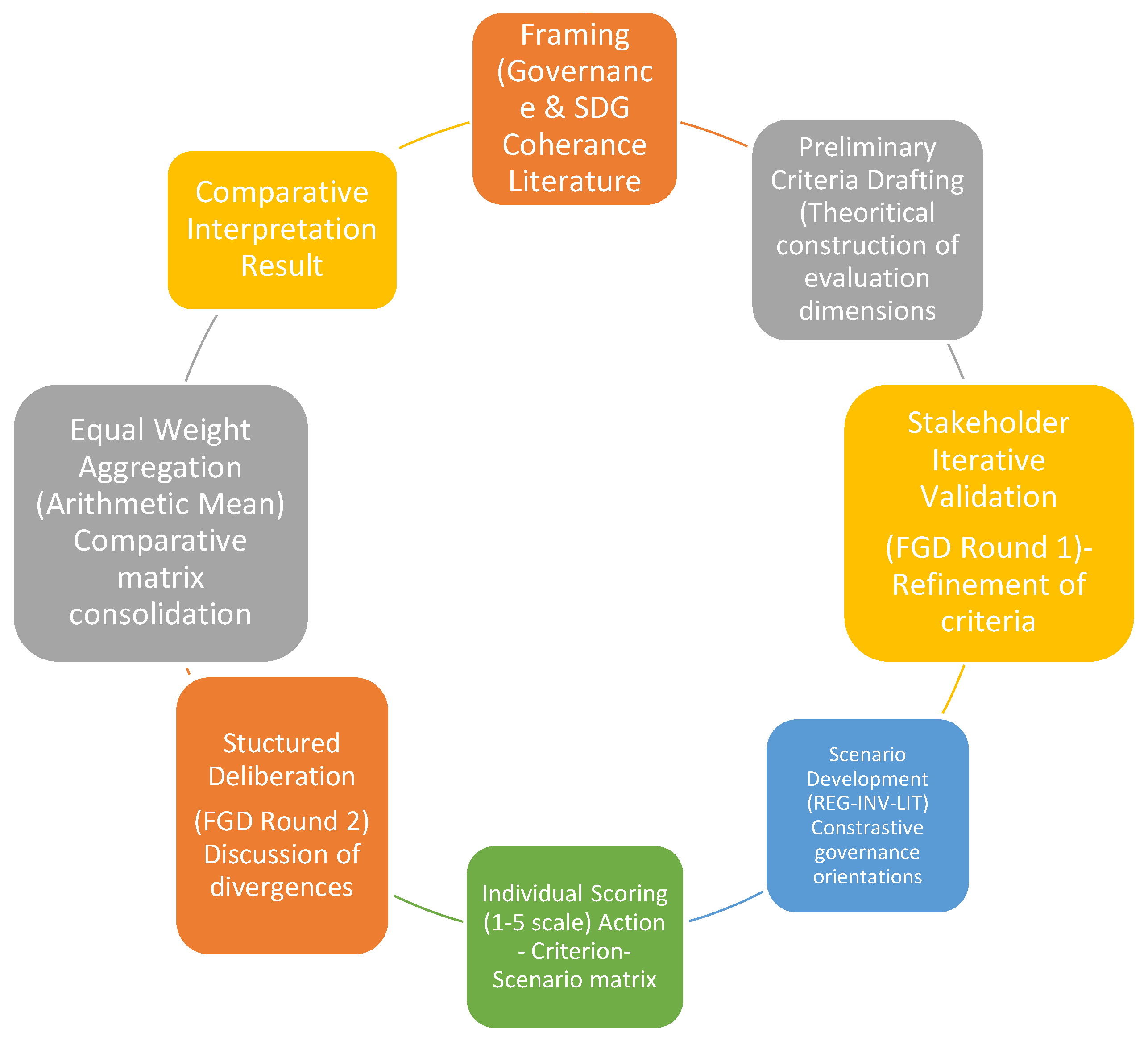
The overall research workflow combined conceptual grounding in governance and sustainability with iterative stakeholder engagement. The process is summarized in
Figure 1, which visualizes eight sequential and partially iterative stages: (1) conceptual framing and review of the governance and SDG coherence literature; (2) preliminary drafting of evaluation criteria; (3) first-round stakeholder validation of criteria; (4) development of contrastive governance scenarios; (5) individual scoring of policy actions; (6) structured deliberation on divergences; (7) equal-weight aggregation of scores; and (8) comparative interpretation of results.
Evaluation criteria were constructed through a two-stage process combining conceptual and participatory inputs. First, the research team defined a preliminary set of criteria drawing on governance, institutional capacity, and sustainable development frameworks. Second, these criteria were refined through discussion with stakeholders in the initial focus group round to ensure contextual relevance for the swiftlet nest sector. The final set consisted of four dimensions:
Regional welfare impact, capturing expected contributions to livelihoods and income distribution;
Local revenue contribution, focusing on implications for local government fiscal capacity;
Sustainability of the resource base, assessing ecological and compliance-related robustness;
Institutional literacy and capacity, reflecting improvements in regulatory understanding and organizational capability.
Scenario construction followed the same logic of combining conceptual clarity with stakeholder validation. Rather than attempting to forecast a single future, three analytically distinct governance orientations were formulated:
Regulatory strengthening (REG), emphasizing consolidation, clarity, and enforcement of rules;
Investment facilitation (INV), emphasizing incentives, infrastructure, and financial support for SMEs;
Literacy and capacity building (LIT), emphasizing knowledge, training, and institutional learning.
Each scenario represents a coherent governance orientation rather than a discrete project. This contrastive design allows for a systematic comparison of policy trade-offs under different institutional configurations.
3.3. Data Sources
Three categories of data were used:
Primary qualitative data from FGDs with district licensing offices, sanitary and quarantine agencies, SME actors, swiftlet farmers, exporters, and laboratory personnel.
Expert judgment from SPS (sanitary and phytosanitary) specialists, trade regulators, and sector practitioners. Structured expert elicitation enhances rigor in complex decision environments [
50].
Secondary sources, including SPS regulations, export documentation requirements, district licensing rules, and swiftlet industry guidelines.
Triangulating these datasets strengthens analytical validity and reduces single-source bias [
43].
3.4. Focus Group Discussions (FGDs)
FGDs consisted of three sequential sessions:
Introduction to governance scenarios and criteria;
Actor and problem mapping;
Scenario deliberation and scoring.
Participants were selected based on institutional relevance rather than representativeness. Stakeholder sampling followed a purposive strategy designed to capture institutional variation across the swiftlet nest governance system. A total of 18 participants took part in the structured focus group discussions and were grouped into five categories: (i) local government officials responsible for licensing and regional policy, (ii) quarantine and sanitary authorities involved in inspection and certification, (iii) SME association representatives, (iv) swiftlet farmers, and (v) exporters and traders.
Inclusion criteria required that participants (a) hold direct decision-making or operational responsibility in the sector, (b) have a minimum of three years’ experience in swiftlet-related activities or regulatory oversight, and (c) possess familiarity with local governance and export compliance processes. This ensured that assessments reflected informed institutional perspectives rather than general opinion.
3.5. World Café Method
FGDs employed the World Café method to promote broad participation and minimize dominance bias. Participants rotated across themed tables at fixed intervals, allowing them to meaningfully engage with multiple governance topics and refine the contributions of prior groups. This deliberative structure supports collaborative sense-making and institutional learning in governance settings [
9,
43].
3.6. MULTIPOL: Operational Procedures
MULTIPOL is presented strictly in operational form following established multi-criteria decision-analysis procedures [
51].
Step 1—Actor Identification
Actors were mapped through FGDs and validated using regulatory documents. Identified actors included: sanitary/quarantine authorities, licensing offices, trade departments, SMEs, exporters, producers, and laboratories.
Step 2—Criteria Selection
Criteria were developed iteratively in FGDs to ensure sectoral relevance. Final criteria included: regulatory effectiveness, coordination quality, SME upgrading potential, sanitation compliance, and regional economic impact. The participatory co-development of criteria is consistent with best practice in scenario-based governance analysis [
43].
Step 3—Influence–Dependence Scoring
Actors scored their influence on and dependence upon other actors using a 0–3 scale.
Round 1: anonymous scoring;
Round 2: moderated clarification;
Round 3: validation through expert judgment.
Structured expert elicitation helps mitigate groupthink and enhances score reliability [
50].
Step 4—Scenario Construction
Three institutional configurations were constructed:
Fragmented governance;
Partial coordination;
Integrated regulation.
Scenario construction followed established foresight principles to enable systematic comparison of governance alternatives [
44].
Step 5—Computational Workflow
Final scores were entered into a MULTIPOL-compatible spreadsheet to generate:
Influence–dependence matrices,
Convergence–divergence maps,
Policy scenario performance tables.
Outputs were manually validated for internal coherence. No weighting adjustments were applied unless justified through expert agreement.
3.7. Expert Judgment Procedures
Experts independently assessed scenario scores, influence–dependence relations, and criteria weighting. Expert judgment provides necessary depth for evaluating governance systems characterized by asymmetric information and uneven institutional capacities [
50].
3.8. Validation and Analytical Boundaries
Analytical validity was ensured through:
The findings aim for analytical—not statistical—generalization. They illuminate institutional dynamics relevant to wildlife-based commodity governance under decentralization [
53,
54,
55].
4. Result and Discussion
4.1. Stakeholder Configuration
The analysis drew from 18 stakeholders representing the institutional structure of the swiftlet nest trade. Their distribution ensures the adequate representation of regulatory, productive, and commercial actors. The composition and distribution of participants across stakeholder groups are summarized in
Table 1.
This configuration matters for interpreting the results, as influence and dependence patterns reflect institutional authority embedded in the governance system rather than economic scale alone.
4.2. Influence–Dependence Findings
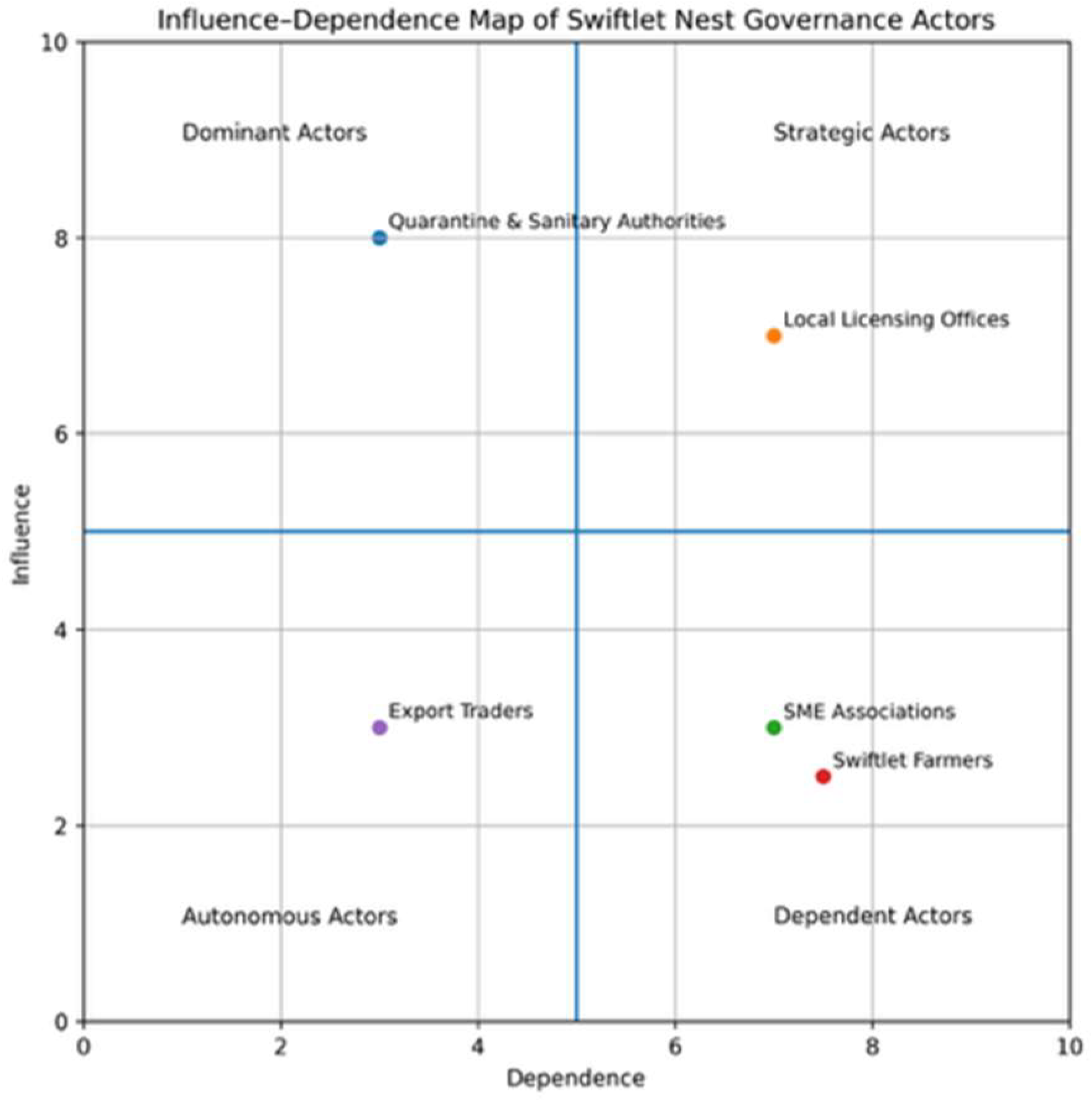
The MULTIPOL influence–dependence matrix demonstrated a highly asymmetrical configuration of institutional power. Regulatory authorities—especially quarantine and sanitation units—emerged as the most influential actors due to their control over certification, inspection timing, and documentation flows. Licensing offices showed high dependence, reflecting their reliance on upstream verification processes. SME associations, swiftlet farmers, and exporters demonstrated moderate influence but substantial dependence.
These patterns confirm that governance outcomes in the sector are shaped primarily by institutional authority rather than by market bargaining power, consistent with the governance literature [
56,
57,
58,
59].
Figure 2 illustrates the relative distribution of institutional influence and dependence among stakeholders in the swiftlet nest sector in Kapuas District. Quarantine and sanitary authorities occupied the dominant quadrant due to their control over inspection and certification processes. Licensing offices function as strategic actors with high regulatory influence but dependence on technical verification. Producers and SME associations appeared in the dependent quadrant, reflecting reliance on regulatory approval and market access. Export traders demonstrated limited institutional influence but moderate operational autonomy.
4.3. Performance Rankings Across Policy Actions
Aggregated scores showed that Regulatory Strengthening (REG) consistently ranked as the highest-performing action across all criteria.
Table 2 below shows the ranking of policy.
REG scores reflected the stakeholder perceptions that compliance reliability, documentation clarity, and inspection consistency are foundational for development. INV ranked second, while LIT ranked third, though with specific strengths in institutional literacy.
4.4. Criterion-Specific Results
Table 3 disaggregates performance across the four evaluation criteria. REG scores were highest in (a) sustainability of the resource base and (b) local revenue contribution—reflecting expectations that coherent regulation improves ecological governance and stabilizes fiscal flows. INV performed strongly on welfare and revenue but was perceived as conditional on regulatory stability. LIT ranked highest under institutional literacy.
These results confirm that the stakeholders saw the three actions not as substitutes but as interdependent components of a broader governance sequence.
4.5. Scenario-Based Evaluation
The scenario comparison matrix (REG, INV, LIT) revealed consistent patterns:
REG dominated across all criteria, indicating that actors view regulatory consolidation as the central prerequisite for sector upgrading.
- 2.
INV Scenario:
INV gained importance but REG remained dominant, since predictable regulation reduces uncertainty and transaction costs.
- 3.
LIT Scenario:
LIT performed strongly under its own scenario but remained interpreted as supportive of, rather than a replacement for, regulatory consolidation.
Table 4 below, shows the matrix of each scenario.
Taken together, these tables show that the stakeholders did not view the three policy orientations as mutually exclusive. Instead, they saw them as elements of a sequence in which regulatory consolidation provides the foundation for effective investment and, subsequently, for meaningful literacy and capacity-building efforts.
4.6. Convergence–Divergence Patterns
Stakeholders showed strong convergence around the importance of regulatory clarity, enforcement consistency, and inter-agency coordination. Divergence was most pronounced around investment facilitation (INV), where SMEs expect faster gains while regulators raise concerns over compliance readiness.
Table 5 summarizes the convergence–divergence structure of stakeholder assessments across policy actions and evaluation criteria. The matrix showed strong convergence around regulatory strengthening (REG), particularly for sustainability and local revenue, indicating broad agreement that regulatory clarity and enforcement are foundational for sector governance. Investment facilitation (INV) exhibited moderate convergence, mainly in relation to welfare and fiscal contributions, while literacy and capacity-building (LIT) showed the highest agreement under the institutional literacy dimension. Overall, the convergence patterns suggest that the stakeholders viewed regulatory coherence as the primary condition for effective investment and sustained institutional learning in the swiftlet nest sector.
Such convergence–divergence structures align with findings in multi-level governance research that emphasize credibility and coordination as central determinants of investment and compliance behavior [
11].
4.7. Sequencing Logic: REG → INV → LIT
Analysis across rankings, criteria, and scenarios revealed a consistent sequencing logic:
Acts as the foundational condition that reduces uncertainty, clarifies licensing, and stabilizes expectations.
- 2.
Investment (INV)
Only becomes effective when regulation is credible and coordinated.
- 3.
Literacy/Capacity (LIT)
Reinforces institutional learning and compliance once rules and investments are already established.
These patterns substantiate a governance-first interpretation of sector transformation: stakeholders tend to prioritize institutional coherence and regulatory credibility as prerequisites for sustainable upgrading. Investment and literacy interventions are not rejected; they are repositioned as second and third steps in a sequence of reforms that begins with making the “rules of the game” clear, consistent, and enforceable.
4.8. Governance Implications
Three implications emerged from the empirical results:
Stakeholders repeatedly framed uncertainty—not lack of capital or training—as the primary constraint. Clear rules reduce compliance ambiguity and enhance trust in inspection and certification processes [
56,
57,
58,
59].
- 2.
Investment effectiveness is institutionally conditioned.
INV produces upgrading outcomes only when regulatory ambiguity is resolved; otherwise, it risks reinforcing inequalities.
- 3.
Literacy is essential for embedding reforms.
Capacity-building is meaningful only when anchored to consistent regulatory expectations. LIT enhances documentation skills, sanitation behavior, and procedural understanding.
Overall, the empirical ranking patterns and scenario-based comparisons in this section demonstrate that the performance of policy actions in the swiftlet nest sector is shaped by their institutional sequencing and by the degree to which they contribute to regulatory coherence. The subsequent sections build on these findings to discuss more explicitly how these governance priorities relate to the SDG 6 and SDG 9 targets and to the broader debate on wildlife-based regional economies.
4.9. SDG Alignment and Policy Relevance
Stakeholders’ interpretation of SDGs 6 and 9 as normative governance frameworks highlights the discursive power of global development agendas. Rather than imposing fixed targets, as shown in the
Table 6 below the SDGs provide a language through which local actors articulate aspirations, justify policy choices, and negotiate trade-offs. This discursive function is increasingly recognized in social science research as a key mechanism through which global norms influence local governance.
In Kapuas, SDG references enabled stakeholders to frame sanitation and industrial upgrading not as isolated technical issues but as interconnected governance challenges. This framing facilitates dialogue across institutional boundaries, linking public health concerns with SME development and environmental sustainability. However, the stakeholders also acknowledged the risk of SDGs becoming symbolic if not anchored in concrete institutional reforms. This tension underscores the importance of embedding SDG narratives within credible governance arrangements.
Stakeholders interpreted SDGs as normative governance references, not merely as technical indicators. REG aligns with SDG 6 through sanitation governance and SDG 9 through regulatory reliability. INV supports SDG 9 through SME upgrading and SDG 6 when infrastructure addresses hygiene-related constraints. LIT reinforces both via improved institutional capacity.
These mappings demonstrate that SDG progress emerges from institutional coherence rather than isolated interventions. Regulatory strengthening aligns most directly with SDG 6 through improved sanitation governance and with SDG 9 through enhanced regulatory credibility. Investment facilitation supports SDG 9 by promoting SME upgrading and value-added industrial processes while also enabling SDG 6 outcomes when infrastructure improvements are targeted at sanitation-related constraints. Literacy and capacity building reinforces both SDGs by improving the understanding of sanitary requirements and strengthening long-term institutional learning.
Collectively, these mappings demonstrate that policy coherence—rather than isolated interventions—is essential for advancing SDG targets in wildlife-based regional economies. The analysis affirms that SDG progress depends on credible institutions capable of integrating regulatory, investment, and learning functions into a coherent governance pathway.
5. Conclusions
This study analyzed governance dynamics in the swiftlet nest trade in Kapuas District using a prospective policy analysis framework. By integrating the MULTIPOL method with expert judgment and structured deliberation, the research empirically assessed how three policy actions—regulatory strengthening (REG), investment facilitation (INV), and literacy/capacity-building (LIT)—performed under conditions of institutional fragmentation and regulatory uncertainty.
The empirical findings consistently showed that regulatory strengthening functions as the most influential and foundational governance lever. Stakeholders perceived regulatory clarity, cross-agency coordination, and predictable enforcement as essential preconditions for improving compliance, lowering transaction costs, and enabling SMEs to engage more effectively with domestic and export markets. REG establishes the institutional baseline that reduces uncertainty and stabilizes expectations among producers, processors, and regulatory authorities.
Investment facilitation emerged as an important but conditional driver of upgrading. Stakeholders acknowledged that investment incentives, credit access, and infrastructure development could expand market opportunities and improve processing quality. However, these benefits materialize only when investments are embedded within coherent regulatory structures. Without credible rules, investment interventions risk reinforcing asymmetries between better-connected exporters and smallholders.
Literacy and capacity-building interventions operated as complementary enablers of long-term sectoral resilience. Training on sanitation, documentation, and enterprise management becomes meaningful only when institutional expectations are clear and enforcement is consistent. Once REG and INV are aligned, literacy promotes institutional learning and supports behavioral improvements necessary for compliance with SPS standards and international market requirements.
Together, the findings reveal a clear sequencing logic: REG → INV → LIT. This sequence highlights that sustainable development in wildlife-based regional economies is an institutional accomplishment, dependent on the alignment of governance mechanisms, economic incentives, and actor capabilities. In this setting, SDGs 6 and 9 serve as guiding reference points for sanitation governance, SME upgrading, and industrial modernization, not merely as technical benchmarks.
5.1. Policy Implications
The findings of this study generate several policy implications for subnational governments and development practitioners engaged in wildlife-based and SME-driven economies.
Local governments should consolidate fragmented rules, clarify licensing pathways, and harmonize agency mandates. Strengthening regulatory clarity enhances credibility, reduces compliance burdens, and supports the shift from informal to formal market participation.
- 2.
Align Investment Programs With Credible Regulatory Foundations
Investment incentives should be introduced only after regulatory coherence is ensured. This prevents capture by better-resourced actors and ensures that investments promote broad sector upgrading rather than deepening inequalities.
- 3.
Institutionalize Structured and Rule-Linked Literacy Programs
Capacity-building efforts must be integrated into licensing and monitoring systems. Training on sanitation and documentation should not be ad hoc but embedded within formal governance processes to support continuous institutional learning.
- 4.
Strengthen Inter-Agency Coordination Platforms
Given the multi-authority nature of swiftlet governance, coordination mechanisms—such as integrated service windows or periodic inter-agency forums—are crucial to reducing procedural duplication and improving enforcement credibility.
- 5.
Embed Prospective Policy Tools in Local Governance Systems
The successful application of MULTIPOL suggests that anticipatory approaches can help local governments identify governance bottlenecks, evaluate policy trade-offs, and design more coherent development strategies.
5.2. Limitations and Directions for Future Research
As a qualitative and foresight-oriented study, the findings are shaped by stakeholder perceptions and institutional conditions at a particular moment in time. While this temporal specificity limits predictive claims, it does not undermine the analytical value of the study. On the contrary, it highlights the importance of capturing governance dynamics as they are experienced and interpreted by actors embedded within institutional contexts.
Future research could extend this analysis in several directions. Comparative studies across regions or countries would help identify how variations in institutional capacity and regulatory design influence governance outcomes in wildlife-based economies. Longitudinal research could examine how governance arrangements evolve over time, particularly in response to regulatory reforms or shifts in market conditions. Combining prospective policy analysis with empirical assessments of policy implementation would further enrich the understanding of how anticipatory governance translates into practice.
5.3. Concluding Remarks
The findings underscore that policy coherence—not isolated interventions—determines the feasibility of sustainable development pathways in the swiftlet nest sector. Regulatory credibility, coordinated investment, and structured institutional learning collectively form the governance architecture required to support sectoral upgrading, resilience, and alignment with SDGs 6 and 9. By clarifying which governance levers matter most and how they interact, this study offers actionable insights for subnational governments and development practitioners seeking to strengthen wildlife-based regional economies.