1. Introduction
Packages, including food packaging, are increasingly being designed with sustainability as a central consideration [
1]. Sustainability has become a growing priority for both producers and consumers, driven by heightened awareness of environmental impacts and waste management challenges [
2,
3]. Various approaches are being studied and implemented to improve solid waste management and reduce landfill waste [
4]. Within this broader context, recyclability has emerged as a particularly salient and tangible attribute of sustainable packaging [
5]. For consumers, recyclability represents a visible and actionable feature that allows them to feel personally engaged in sustainability efforts, and in some cases, consumers now expect everyday products to be packaged in recyclable materials [
6,
7,
8,
9].
At the same time, the use of plastic—especially single-use, non-recyclable plastic—is often viewed negatively by consumers who prioritize sustainability [
10,
11]. This perception presents a challenge for food packaging, as many food-contact applications require the functional benefits that plastics provide, including low cost, light weight, durability, and transparency for product visibility [
12,
13]. Cheese stick packaging exemplifies this challenge: multi-layer films produced through coextrusion or lamination are commonly used to provide the moisture, oxygen, and microbial barriers necessary to protect food quality and extend shelf life [
14,
15,
16,
17]. From a life cycle assessment perspective, the environmental impacts associated with food production typically exceed those of the packaging itself, making such material tradeoffs necessary in many cases [
18,
19,
20,
21]. However, non-food-contact components, such as secondary packaging, often present greater opportunities for redesign using recyclable materials without compromising food safety or quality [
22,
23].
When considering alternative materials for secondary packaging, factors such as material type, overall package mass, and functional performance must be evaluated [
15,
24,
25]. Package mass, in particular, can substantially influence environmental impact outcomes in life cycle assessments [
26,
27]. Efforts to redesign packaging for recyclability must also account for practical constraints, including accessibility to supply new materials, compatibility with existing production lines, functional requirements such as reclosability or ease of use, and the need to establish or modify supply chains [
27,
28,
29]. These changes often involve additional costs, making it valuable for producers to understand whether redesigning packaging for recyclability will meaningfully improve consumer recycling behavior and provide a return on investment [
28].
Even when packaging is technically recyclable, successful environmental outcomes depend on consumers correctly disposing of the package [
30,
31]. On-package recycling guidance labels have been developed to help consumers identify appropriate disposal pathways [
32,
33]. In North America, particularly the US and Canada, the How2Recycle (H2R) label from GreenBlue is the most recognized recycle labeling system [
34]. However, challenges remain for the adoption of successful recycling practices by consumers. Challenges include limited consumer understanding of recyclable materials, confusion surrounding plastic recycling, unclear or misunderstood instructions, and inconsistent access to recycling facilities [
35,
36]. Education, access to appropriate recycling infrastructure, and trust in the recycling system are all critical components of effective implementation [
37].
Against this backdrop, the present study examines consumer disposal behavior for both recyclable and non-recyclable used cheese stick packaging associated with a rapidly growing snack cheese product category generating approximately
$1.8 billion in annual U.S. sales and exhibiting over 5% year-over-year growth [
38]. Specifically, this study focuses on secondary packaging elements identified as recyclable through the H2R labeling system, including store drop-off recyclable flexible plastic films and widely recyclable corrugated fiberboard. This study further evaluates whether the presence of on-package recycling guidance affects consumer recycling behavior and whether providing prior education on interpreting H2R labels leads to improved recycling outcomes.
2. Materials and Methods
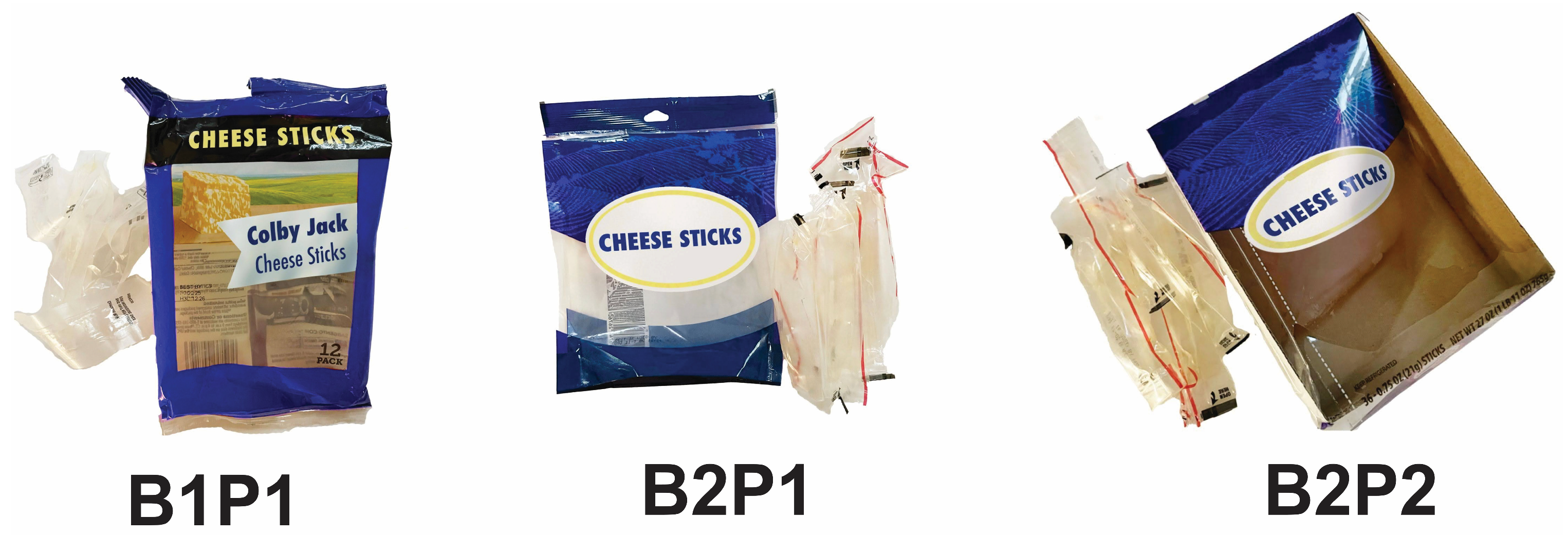
Three Colby-Jack cheese stick packages were selected as the packages of interest for this study (
Figure 1). The packages were from two different popular retail brands sold in the U.S. The images have been altered to mask brand identity, but the packages and images were not altered for the participants. The packages selected represented the most common cheese stick packaging options that are available in standard US retail stores: cheese stick multi-packs with a secondary package of a bag, with or without a gusseted bottom and zip-close top, or a boxed option. B1P1 included a store drop-off recyclable pouch packaging component, B2P1 had no recyclable packaging components, and B2P2 had a recyclable five-sided corrugated fiberboard tray component where the principal display panel was not covered by a sixth side of corrugated fiberboard that would make it an enclosed box, and therefore allowed for the product to be seen prior to purchase. The cheese itself was not used for this study, but the packaging was. The primary packages had individually wrapped cheese sticks in non-recyclable plastic. B1P1 wrappers peeled open and the wrappers for B2P1 and B2P2 tore open with an easy-tear-open feature.
Packages were weighed on a scale (Uline Balance Scale, Pleasant Prairie, WI, USA, accuracy level = 0.01 g) and an average mass of at least three packages was recorded. The thickness of the materials was also recorded using a digital caliper. All other specification and recycling information were determined by visual inspection and the H2R recycle labeling.
The packages were displayed on the countertop in a kitchen. There were other used food packages present as well. The kitchen was real and contained all standard home kitchen appliances and was not in a laboratory setting. The cheese itself was previously removed from the packages so only the packaging remained. Two cheese stick wrappers were clustered with each empty package to associate the wrappers with their secondary packaging. A total of 6 cheese stick wrappers were present for each participant. A blue recycling bin with a symbol of white chasing arrows in a triangle, commonly associated with recycling, and an equivalent plain black trash bin of the same size and brand (10.25 gallon, Moxie brand) were provided side by side for used packaging disposal. Both bins were present for all participants, even if the participants did not typically have such resources readily available in their own homes. The blue recycling bin had a translucent blue plastic liner, and the black trash bin had an opaque white liner. The colors of the bins and liners are standard for the region the study took place in: South Carolina, USA. A unique receptacle for store drop-off recycling was not provided in this kitchen setting as a standard kitchen in the USA would not include a receptacle for this. Later, in the digital survey portion of the study, questions about store drop-off recycling receptacles described store drop-off recycling further with “bring to a grocery/retail store collection usually inside or on the store patio” for clarification, since perhaps not everyone in the study would be consciously familiar with this method of recycling.
A total of 105 consenting adult consumer participants individually participated in the study. The participants were recruited to represent a balanced range of ages (18–69 years old), educational levels (high school through doctorate degrees), and gender (57% female, 43% male). Upon arrival, the participants were welcomed in person by a research assistant and received instructions via video to tidy up the kitchen as they normally would—given the resources and information provided. The recycling bin was described in the instructions to accept “all types of recyclable material” which would be representative of a recycling receptacle in the US where separating recyclable materials is not required. The participants tidied up in the kitchen independently without a research assistant in the room. Participants rang a bell once they were done with the tidying up portion of the study. They then were accompanied to a nearby office room to complete a digital survey. They also received instructions via video on details about completing the survey and told to request help if questions arose.
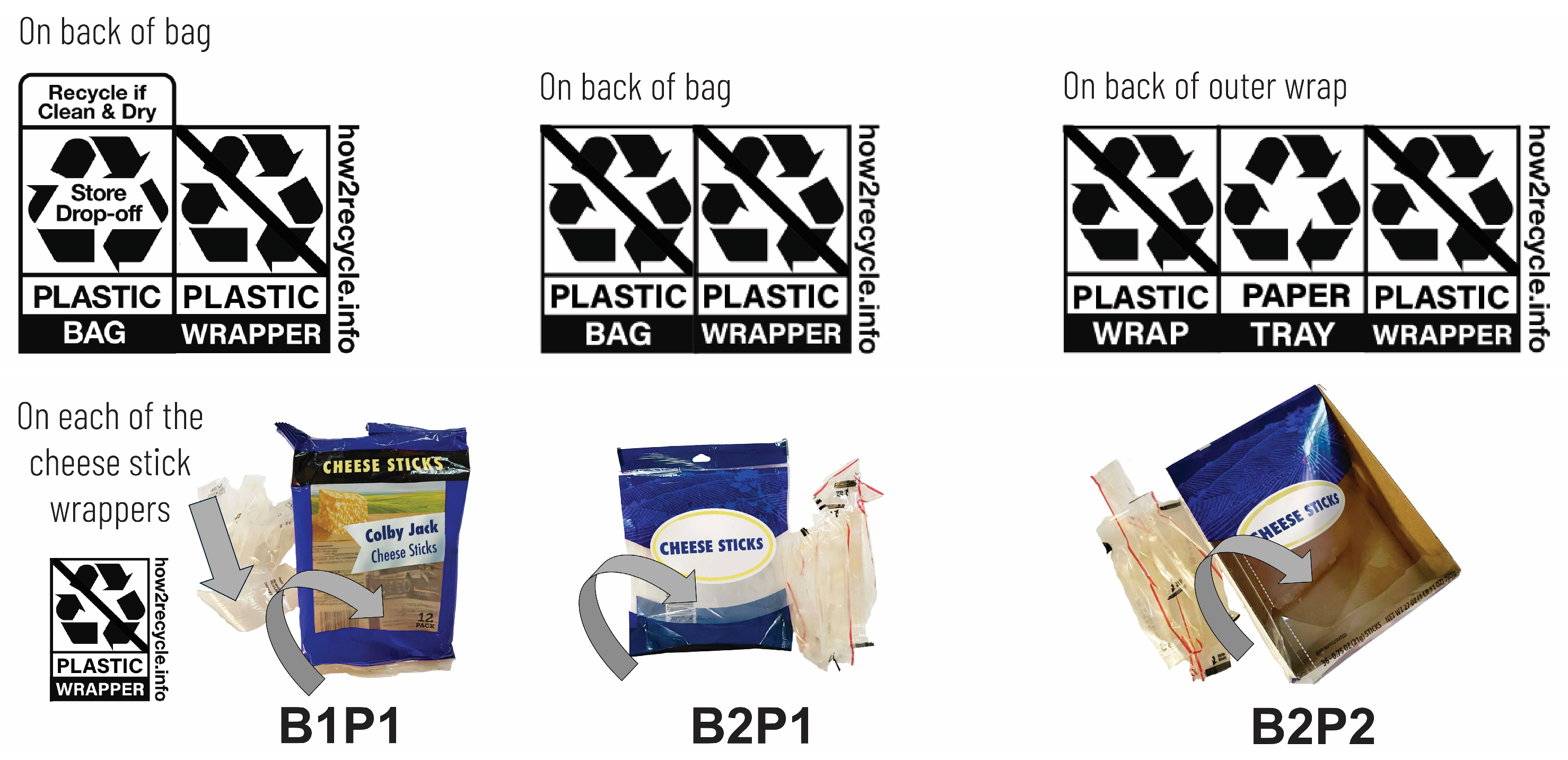
The participants were assigned to one of three treatment groups. One third of participants were assigned to group YesLabel and received packages that had the H2R label on them, like what is normally found in a US grocery store (
Figure 2). Another third of the participants were assigned to group EduYesLabel and received the same labeled packages, and, prior to entering the kitchen and receiving the instructions to clean up, watched a simple 90 s educational video explaining what a How2Recycle label is, where they are found, and how to interpret them on packages. A short video format was used to keep the educational material consistent between participants and at a length that could be delivered as short-form content on social media or as an advertisement. The script to this educational video is found in the
Supplementary Materials linked at the end of this article. The other third of the participants were assigned to the group NoLabel and received the same packages as before but with the How2Recycle labels removed or covered on the packages. The digital survey was identical for all participants. After completion of the survey, the participants were thanked and compensated for their volunteered time.
After participants completed the tidying up of the kitchen and disposal of the packages, a research assistant collected the bins and brought them into a neighboring laboratory space to be analyzed. The placement of each packaging piece, in either the recycling bin or trash bin, was recorded along with the participant ID including their assigned treatment group. Statistical analysis was later performed using JMP Pro 19.0.5. (912582). The Chi-square test of independence was used to determine whether categorical variables were related. For significant differences and post hoc analysis, the Pearson Chi-square test was used, and Fisher’s exact test was used alternatively when cell counts were small (<5). Analysis of means for proportions was used to assess differences among rates of uncertainty about the recyclability of specific pieces.
This human subject protocol study was approved by the Clemson University IRB. During the preparation of this manuscript, the authors used ChatGPT (OpenAI, version 5.2) for the purpose of assisting with summarizing author-generated text and findings. The authors have reviewed and edited the output and take full responsibility for the content of this publication.
3. Results and Discussion
3.1. Material Analysis
Current options for Colby-Jack cheese sticks typically include a plastic packaging component, most of which is non-recyclable [
39]. This is also the case for the packages included in this study. Each of the three packaging concepts have a plastic component and all use plastic as the food-contact primary package material. Each of the food-contact packaging components are non-recyclable plastic and are commonly made of a multi-layer laminated or coextruded film containing layers such as BOPP/PE, PET/AL/PE, or PET/EVOH/PE [
30,
40,
41]. Although some materials determined as non-recyclable in this study could be somewhat recycled chemically, since chemical recycling is not yet widely adopted, chemical recyclability is not considered recyclable for this study. For cheese packaging, if a portion of the packaging is recyclable, it is often a secondary or tertiary package component, as seen in this sampling with both the recyclable B1P1 bag and the B2P2 tray, both of which are non-food-contact packaging. Although some cheese food-contact packaging options are recyclable, like glass jars packaging grated parmesan, glass is not accepted in all regions’ recycling collection facilities and this also introduces other packaging concerns like the environmental impact of shipping a heavier package and how glass is more prone to breaking than a flexible film alternative [
42,
43]. Other food packages beyond cheese may also have various packaging options, with some options being recyclable and others not recyclable or perhaps different pieces of the packaging varying in recyclability. Specifications about each of the packaging components from this study are shown in
Table 1.
The five-sided corrugated fiberboard tray packaging system is designed to hold a larger unit quantity of product, in this case 36 cheese sticks, and therefore functions differently from the flexible bag formats that contain 12 cheese sticks. Although the corrugated tray has the greatest mass of an individual packaging component, this higher mass reflects its structural role in containing and protecting a larger number of units. If a corrugated tray of the same design were scaled to hold only one third of the product, or 12 cheese sticks, its mass would not be expected to decrease proportionally, resulting in a higher relative packaging mass per unit of food delivered compared with the bag-based options. In addition to mass considerations, the tray is rigid and therefore more susceptible to denting and creasing during handling, despite being widely recyclable due to its corrugated fiberboard construction. The corrugated tray system also includes a non-recyclable plastic film outer wrap, which increases total plastic use but serves multiple functional purposes: it secures the tray contents as a single retail unit, provides a moisture barrier that is particularly important in refrigerated environments, and allows for product visibility.
The non-recyclable B2P1 bag weighs twice as much as the store drop-off recyclable B1P1 bag and delivers the same amount of food product. The greater mass is partially a result of the gusseted bottom and zip-close features that B1P1 excludes. The functional packaging benefits of the features of bag reclosability and potential to stand independently as a singular bag would need to be considered when determining if those features warrant the extra packaging material and likely extra cost.
Store drop-off labeled polyethylene material, although recyclable, requires more effort for a consumer to get the package into the recycling system than a widely recyclable material. The consumer needs to interpret and understand what is being requested of them for correct consumer recycling efforts, set aside this material for recycling, and remember to bring it to a store drop-off recycling location for delivery into the recycling system [
44]. Producers also have drawbacks to consider when determining redesigning packaging for recyclability. Producers may need to acquire a new supplier or supply chain to provide recyclable packaging options all while considering compatibility with their forming, filling, and sealing equipment. The packaging options that producers already have easy access to are likely forms of non-recyclable food-contact packaging since it is common for a brand supplying cheese sticks to also supply other cheese cuts such as shredded cheese. Shredded cheese is very often packaged in bags that include a gusseted bottom and a zip-close feature. So, in order to package a product in a store drop-off recyclable package, an updated material and adjustments to package features would be needed.
The direct food-contact cheese stick wrappers varied between the two brands but were identical for the two products of the same brand (brand 2). The individual wrappers of B2P1/B2P2 weigh 38% more than the B1P1 brand cheese stick wrappers which have a formed flexible base and are therefore thinner for the portion of the package where the food is inserted. The shapes of the cheese sticks vary. The B1P1 cheese sticks are a square prism; the other B2P1/B2P2 cheese sticks are a rectangular prism. The rectangular prism B2P1/B2P2 cheese sticks are packaged as individual horizontal flow wraps and therefore have fringe overhangs only on two rather than all four sides, like with the B1P1 delaminating lid stock packaging that is all connected and perforated for consumers to later tear off a singular packaged cheese stick from the connected multi-pack group. Because of the lack of an overhanging packaging fringe, the B2P1/B2P2 cheese sticks can be grouped closer together and packaged more densely.
3.2. Consumer Recycling Rates
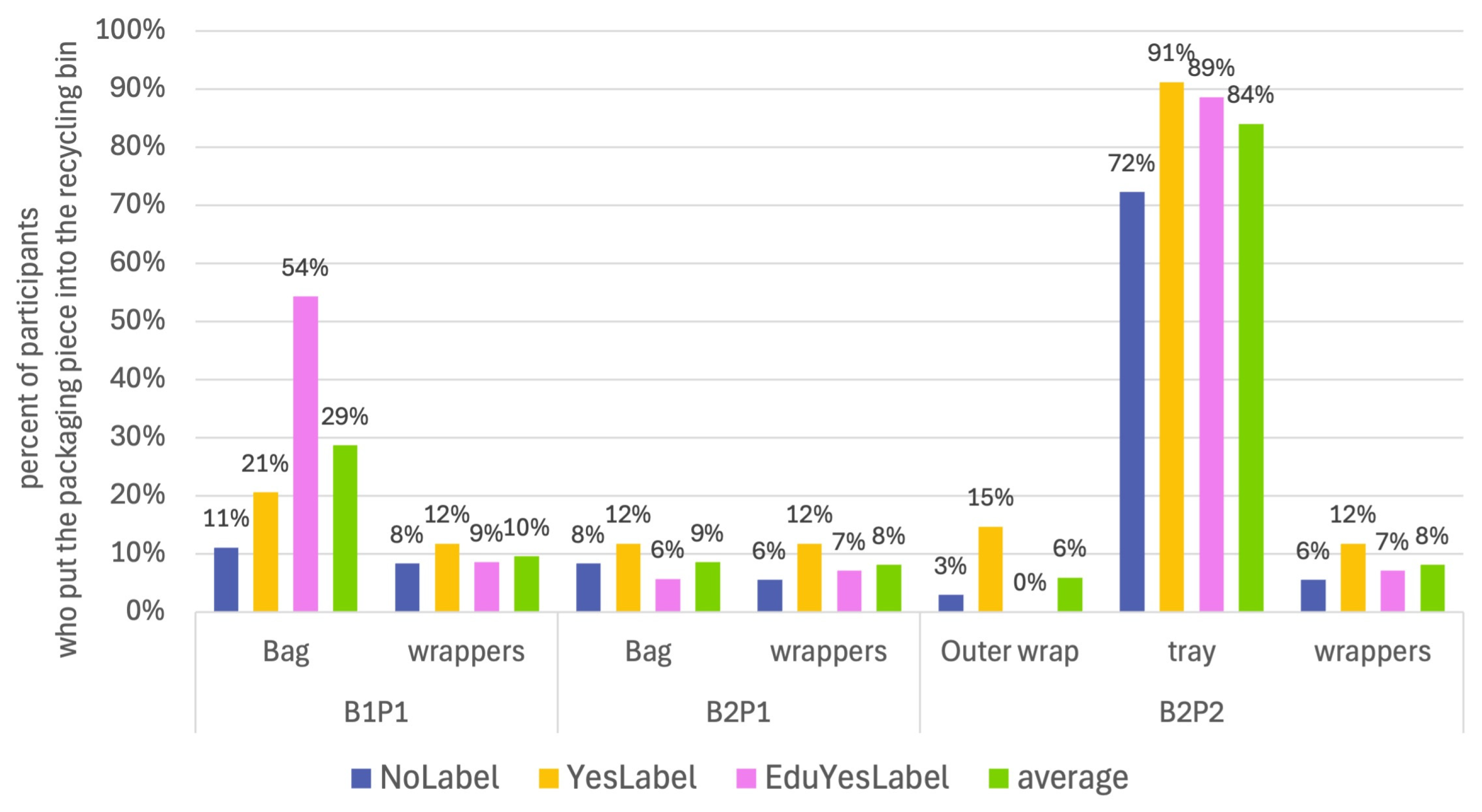
As participants cleaned up and placed packaging into either the trash or recycling bin, placements of the packages in the trash and recycling bins were recorded (
Figure 3).
Take note that these consumer recycling rates are possibly overestimates of what would happen in the participants’ homes. Not everyone has such access to recycling receptacles or programs that make consumer recycling easier such as curbside recycling pick-up or not needing to sort recyclable materials. Only 21% of the participants claimed to have access to curbside recycling pick-up, 66% were aware of publicly available recycling bins in their area, and 74% recognized having access to deliver packaging to a collection center directly to be further processed for recycling. However, only 11% of participants said they did not have to sort their recyclable materials where they currently live, work, or shop.
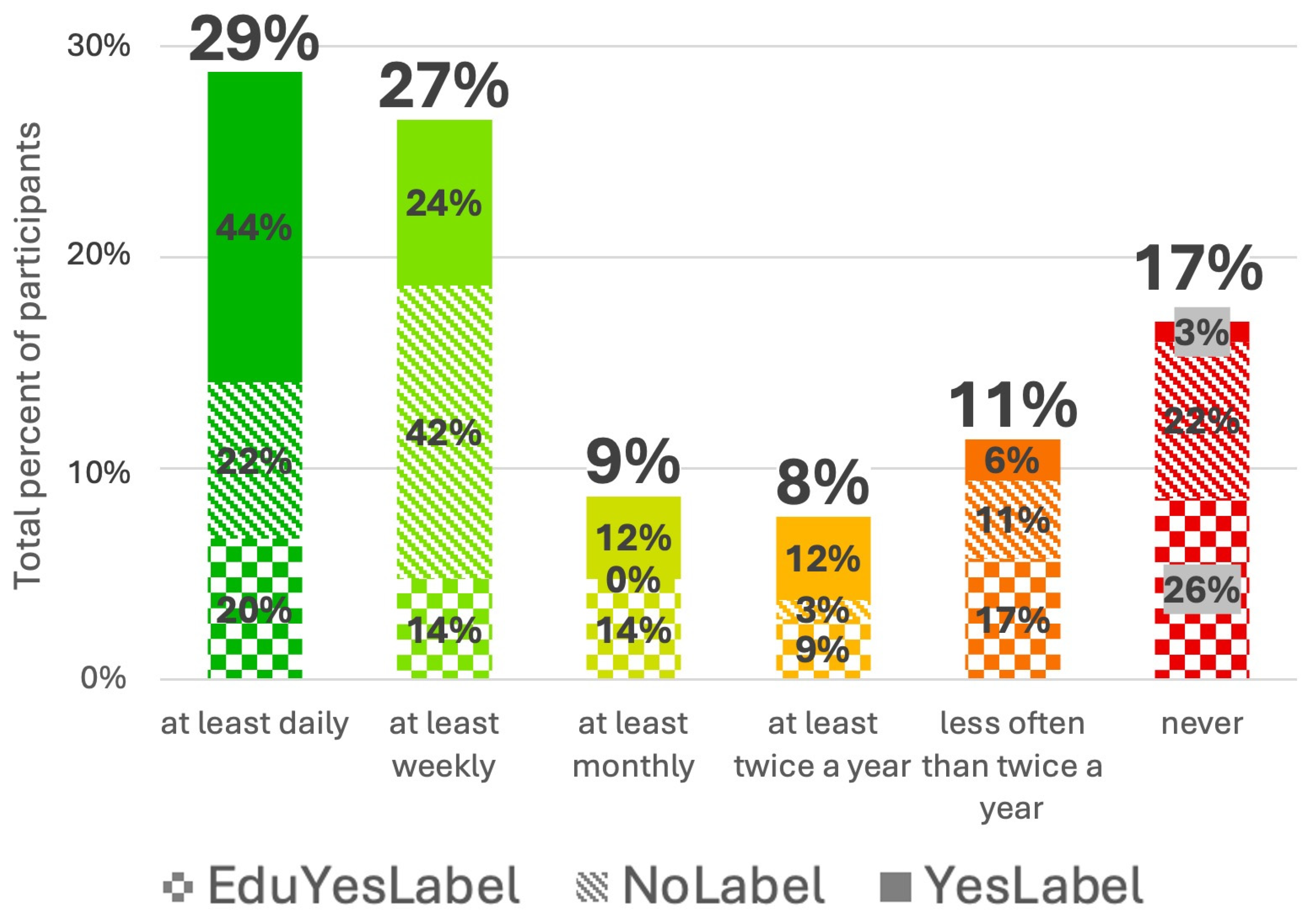
Self-reported frequency of the participants disposing of at least some of their used food packaging into recycling receptacles was collected in the survey and results are shown in
Figure 4.
From
Figure 3, the B2P2 tray was recycled overwhelmingly most often (
p < 0.0001), averaging 84% of participants placing this packaging piece into the recycling bin. The B1P1 bag was intermediate, at an average of 29%, but significantly higher (
p < 0.0001) than all wrapper-level components which were placed into recycling by about 9% of participants, and all wrapper-level pieces were statistically indistinguishable from one another when compared by pairwise collapsing across NoLabel/YesLabel/EduYesLabel. The B2P2 tray was recycled more often when it had the H2R label present (
p-value of 0.0401 for NoLabel vs. YesLabel; RD = 0.19; OR = 3.93), but adding in the educational material did not impact consumer recycling rates significantly. The additional educational material did not significantly impact consumer recycling rates for the corrugated fiberboard B2P2 tray, which may be due to the ceiling effect for such a familiarly recyclable material, or could be due to limitations in the effectiveness of the educational video; however, the educational material (group EduYesLabel) did increase the rate of placing the store drop-off recyclable B1P1 bag into the recycling bin (
p = 0.0038; RD = 0.33; OR = 4.41).
EduYesLabel participants recycled the B1P1 bag more frequently than the B2P1 bag (p = 0.0002; RD = 0.45; OR = 11.87). While the participants had direct access to both a trash and a recycling bin, the practice of placing store drop-off in a recycling bin is atypical and future research is needed to better understand this system of transportation from home to store drop-off recycling receptacles.
Although 76% participants in the follow-up survey categorized “printed recycling icons on packaging” as “very helpful” for knowing if something in general is recyclable, and only 5% categorized them as “not helpful”, the printed recycling icons on the packaging pieces were not enough to eliminate incorrect recycling, but the printed recycling icons did make a difference in the frequency of putting recyclable materials in the recycling bin, which is what was seen for the B2P2 tray and the B1P1 bag.
Ideally, none of the food-contact cheese stick wrappers would have been put into the recycling bin because they are not considered recyclable. Consumer recycling rates were uniformly low and statistically indistinguishable across all wrapper types within each NoLabel/YesLabel/EduYesLabel group. The B1P1 wrappers had the “not yet recyclable” H2R label printed on the actual wrappers for groups EduYesLabel and YesLabel in addition to the H2R label on the bag instructing on the disposal of the wrappers. In contrast, the B2P2 wrappers only had the H2R label on the outer wrap which referenced disposal of the wrappers and did not additionally have the H2R label on the wrappers themselves. There was no statistical difference found between the NoLabel and YesLabel or EduYesLabel groups for the B1P1 wrappers, so in this study the direct printing of the H2R label made no significant difference, but as there were relatively few participants who attempted to recycle the wrappers, it would be difficult to know if this same finding would hold true with an even larger participant pool.
Direct printing of an instruction on the cheese stick wrappers to not recycle them could be particularly helpful to avoid incorrect disposal if the product is consumed away from the secondary packaging bag. In this study, the cheese sticks were removed, so the wrappers were next to the empty bag ready to be disposed. In everyday life, the experience of consuming the cheese stick without seeing the bag is possible, even likely, since the cheese sticks are likely to be consumed over various eating occasions and perhaps packed into a to-go lunch or snack for another individual to consume, like a child or spouse for example, without referencing the H2R label on the bag.
The outer wrap of B2P2 was also not recyclable and had no difference in attempted consumer recycling rates compared to the other non-recyclable plastic package pieces (p ≥ 0.8003) even though it was displayed wrapped around the recyclable corrugated fiberboard B2P2 tray. Fewer than 5% of the participants who put the corrugated fiberboard B2P2 tray into the recycling bin still kept the outer plastic wrap on it.
3.3. Wishcycling and Feeling Unsure
Although we want recyclable items to be put into the recycling bin, we simultaneously want to avoid non-recyclable items going into the recycling bin. The concept of a person putting a non-recyclable item into the recycling bin with hopes of the item getting recycled is also known as wishcycling [
45,
46,
47]. In the present study, wishcycling was operationalized behaviorally as the placement of a non-recyclable packaging component into the recycling bin regardless of their internal feelings of hope, inattention, or confusion. A total of 85.71% of the 105 participants recycled at least one item. Wishcyclers made up a minor portion (18.88%) of the recyclers. All wishcyclers put at least one recyclable item into the recycling bin along with their non-recyclable packaging piece(s). The wishcyclers overall wishcycled 54.12% of the non-recyclable packaging pieces they had presented to them. A total of 41.18% of the wishcyclers put only one of the five non-recyclable packaging pieces (20% of the non-recyclable packaging pieces they had available to them) into the recycling bin. The remaining 58.82% wishcycled, on average, 78.00% of the non-recyclable packaging pieces they had presented to them. Over half of the wishcyclers incorrectly placed multiple non-recyclable items into the recycling bin.
The B1P1 store drop-off recyclable bag was not counted as part of wishcycled pieces for this study. Of those who wishcycled other pieces, 71% of them also put the B1P1 bag into the recycling bin. Perhaps they viewed the B1P1 bag similarly to the other flexible plastic film packaging pieces. Of those who did not wishcycle any pieces, 20% of them put the B1P1 bag in the recycling bin, the vast majority of whom (83%) were in group EduYesLabel.
Due to wishcyclers being a minor portion of participants, the overall count was fairly low: 17 wishcyclers out of 105 participants. Fisher’s exact test indicated an association between NoLabel/YesLabel/EduYesLabel groups and wishcycling behavior (p = 0.0433). YesLabel was greater than NoLabel (p = 0.0240, OR = 4.5833) and only marginally greater than EduYesLabel (p = 0.0589, OR = 3.2292). Wishcycling was most frequent in the group YesLabel (29.4% of participants in group YesLabel wishcycled) compared to groups NoLabel (8.3%) and EduYesLabel (11.4%).
In the survey portion of the study, a question was asked about feelings of confusion associated with a packaging piece(s). Participants selected images of the separate pieces which they felt confused or unsure about if that packaging piece should be recycled or not (
Table 2). Because the B2P1/B2P2 wrappers were identified with the secondary packaging, the data here are distinguishable for the B2P1 wrappers and the B2P2 wrappers. Analysis of means for proportions revealed significant differences in recyclability uncertainty across packaging components. The B2P2 tray showed significantly lower uncertainty than all other packages, exceeding the decision limits and indicating a proportion that differed from the overall mean. No other packaging components fell outside the decision limits. This aligned with the recycling actions of the NoLabel group. The B2P2 tray was placed into recycling by 72% of the group. The next-most-often recycled item was the B1P1 bag at only 11%. When looking at differences in treatment groups within a given packaging piece, only the wrappers in the NoLabel group showed greater uncertainty of recyclability.
The majority (70.56%) of wishcyclers did not claim to feel uncertain about the recyclability of any of the non-recyclable packaging pieces presented to them. Therefore, we can conclude the majority of wishcyclers did not feel unsure about packaging recyclability as they put non-recyclable items into the recycling bin.
Only two participants (11.76% of the wishcyclers) claimed to be uncertain about the recyclability of a piece they had erroneously wishcycled during the study. Ironically, further in the same survey, both of these participants claimed that if they were unsure about the recyclability of a food packaging piece, they would put that piece in the trash and not recycle it (
Table 3).
Also from the survey, we find that 76.47% of the wishcyclers claimed to be recycling food packaging once a month or more. The clear majority of the wishcyclers are likely incorrectly attempting to recycle non-recyclable food packaging regularly in their everyday lives.
Participants may have felt internal pressure to recycle because of the placement of the recycling bin right next to the trash bin and believing it would be a good thing for them to recycle more packages. From the survey, the participants responded to the general statement of “I believe that recycling is a good thing for people to do” with how much they personally agreed. A total of 77% strongly agreed, 21% somewhat agreed, 2% were neutral, and none responded with “somewhat disagree”, or “strongly disagree.” Since so many believed recycling is a good thing for people to do, they may have chosen to place items into recycling that they typically would not go out of their way to recycle because they believed it was a good thing to do, it was convenient to place into the recycling bin, or because it could have been at the top of their mind with the recycling bin present.
Consumer wishcycling could be reduced through the efforts of organizations and relying less on consumers. As discussed previously, education around consumer recycling guidance labeling made a difference in consumer behavior. Education about wishcycling could be similarly helpful. More packaging being redesigned for recyclability would also reduce wishcycling opportunities. Improving the comprehensibility of on-package recycling labeling and providing consistency of the labeling format would help to simplify consumers’ need to be educated prior to attempting to recycle as long as the information provided is sufficient to successfully identify and sort materials. Access to clearly labeled recycling receptacles and on-receptacle sorting guidance are other ways to encourage correct recycling practices. Reducing or eliminating the need for consumers to sort recyclable materials and instead passing that responsibility onto trained systems would demand less of a consumer and reduce the issue of wishcycling. Communication and transparency about the beneficial effects of consumer recycling efforts could also reinforce positive action and encourage continued effort from consumers.
3.4. Hierarchical Cluster Analysis of Participant Profiles
A hierarchical cluster analysis was conducted using self-reported variables of prior recycling frequency, noticing of H2R labels during the study, prior use of store drop-off recycling receptacles, and prior H2R familiarity and use. A four-cluster solution was selected based on the dendrogram structure. Clusters differed significantly in all categories input (p ≤ 0.0019).
Were not aware of store drop-off recycling receptacles.
Basically never used H2R prior to the study.
Often never attempt to recycle in their life regularly.
Overwhelmingly did not notice the H2R labels during the study.
Balanced across treatment groups.
Second-highest wishcycling rates (17 pieces for 23 people; proportion = 0.74).
Do not use store drop-off recycling receptacles.
Balanced prior knowledge of H2R labels.
Balanced prior consumer recycling rates.
Noticed a balanced amount of H2R labels—less rather than more.
Mostly in NoLabel treatment group and the remainder balanced between YesLabel and EduYesLabel group members.
Lowest wishcycling rates (10 pieces for 48 people; proportion = 0.21).
Cluster 3: Regular consumer recyclers putting in effort to be compliant
Discard into recycling very regularly, do not use store drop-off receptacles, notice H2R labels, and rely on H2R labels in their life and in the simulation (25% of participants):
Are aware of, but rarely use, store drop-off receptacles.
Strongest prior knowledge of H2R labels and very often use them.
Discard into recycling very regularly in their life.
Clearly noticed the most H2R labels during the simulation.
Mostly EduYesLabel treatment group and a good amount of YesLabel treatment group members.
Wishcycled somewhat (9 pieces for 26 people; proportion = 0.35).
Cluster 4: Vigorous consumer recyclers not seeking recycling guidance
Those that recycle regularly and frequently use store drop-off receptacles, but do not rely on H2R labels—may lead to high wishcycling rates (8% of participants):
Use store drop-off receptacles regularly.
Balanced prior knowledge of H2R labels.
Discard into recycling often in their lives.
Noticed fewer H2R labels during the simulation.
Mostly in YesLabel and NoLabel groups with very few EduYesLabel group members.
Highest wishcycling rates (10 pieces for 8 people; proportion = 1.38; only two participants substantially contributed to those 10 wishcycled pieces because they wishcycled all non-recyclable packaging pieces).
The contribution of variables to the separation of clusters was most significant for prior use of store drop-off recycling receptacles, then prior H2R familiarity and use, noticing of H2R labels during the study, and finally prior recycling frequency. Assigned treatment group (NoLabel, YesLabel, EduYesLabel) was not statistically different among the four behavioral profile clusters, nor did the clusters predict wishcycling outcomes.
These clusters help to identify and connect mindsets and actions that people may commonly have around consumer recycling. By better understanding these categories, efforts to improve consumer recycling practices can be more targeted to meet the common needs and misunderstandings of and to appeal to each cluster of consumers. In cluster 1, we see participants who are overall mostly unaware of H2R labels and perhaps could be encouraged to become convenient consumer recyclers who are aware of and compliant with the guidance of the H2R labels through some education about depositing widely accepted and easy-to-identify recyclable materials into recycling. Cluster 2 may benefit from easier access to recycling receptacles with sorting guidance on the receptacles referring to H2R labels, since this cluster is most likely to recycle if convenient. A good goal for cluster 3 would be to encourage and motivate them to use store drop-off recycling receptacles. They are already often referring to H2R labels in their lives and putting in effort to deposit into recycling and could adopt improved consumer recycling habits with improved on-package consumer recycling directions. In cluster 4, we see a great willingness to deposit into recycling that may actually need to be reined in. Adjusting H2R labeling would likely not impact this cluster as strongly as others because they are generally not looking for a label to guide their recycling habits. Since this group is frequenting store drop-off receptacles, larger signs and guidance at that point in the recycling process may be more effective than small on-packaging labels. Other systematic approaches to encourage correct consumer recycling behaviors beyond solely adjusting labeling should be considered.
3.5. Implementation and Consumer Purchase Intent
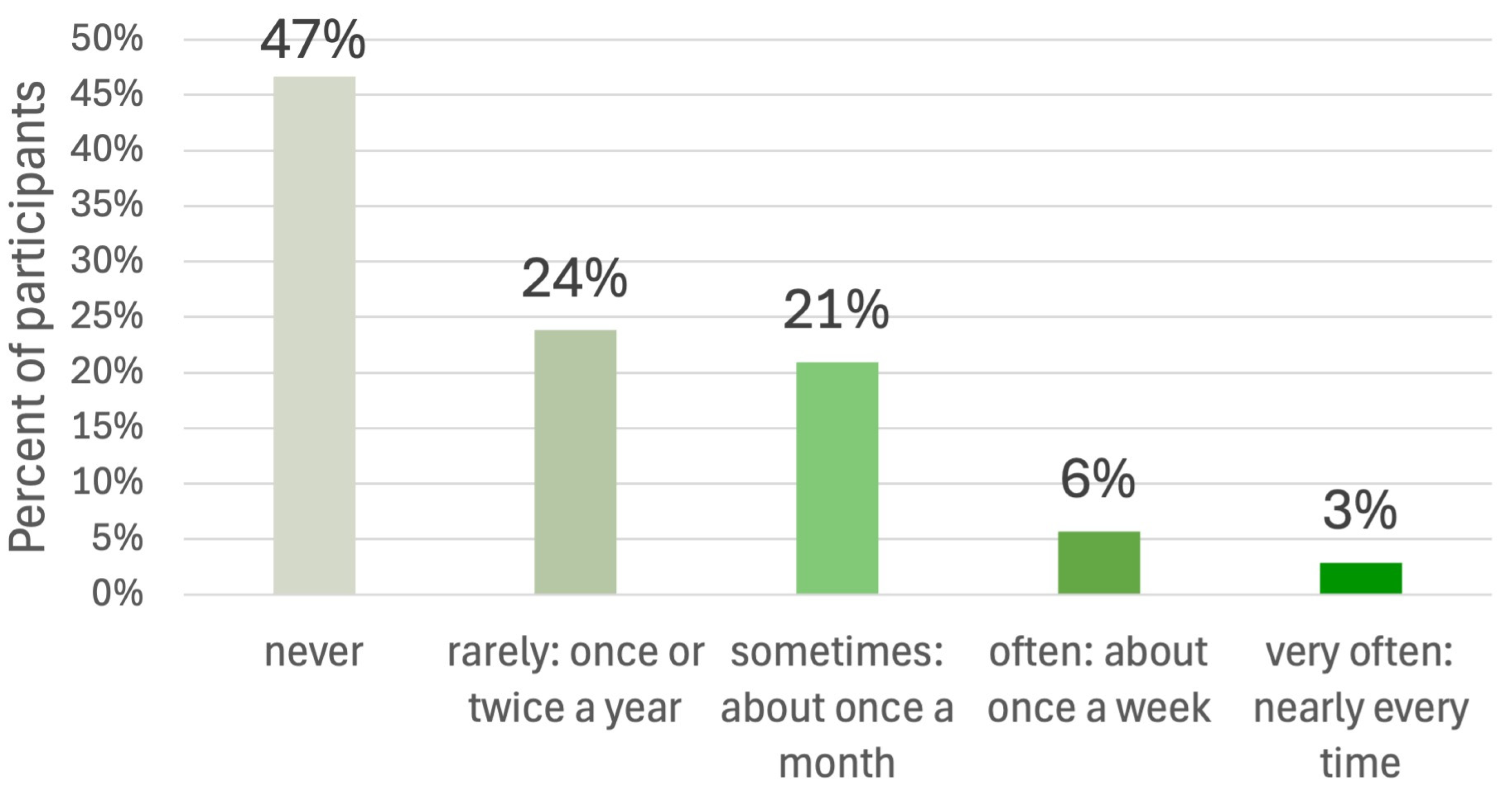
Another factor to consider when deciding to update packaging to be recyclable is if recyclability is a feature drawing in consumer purchasing interest. Altering packaging to be recyclable when the current design is not recyclable may increase interest in purchase of that product, but not likely for the majority of the population (
Figure 5). The majority of the participants claimed to never select a particular food product due to the recyclability of the packaging. A total of 9% of participants claimed to purchase a particular food product specifically because the package was recyclable. This survey question focused on just the concept of recyclability and did not explore the adjustment to consumer purchase intent if there were other changes such as a decrease in price, change in packaging artwork or claims, or alternative packaging material.
In order for packaging recyclability to remain a goal for companies, market demand from consumers’ intent to purchase would be needed to justify changes. Otherwise, production costs for recyclable material packaging, governmental regulations like the extended producer responsibility (EPR) policy being implemented in the US, or strict company values would be other driving factors to encourage the redesign of packages to be recyclable [
48,
49].
If a package is redesigned for recyclability, communication beyond an H2R label is likely needed to be most effective to make an adjustment in consumer recycling behavior. We saw this in
Figure 3 where the EduYesLabel group recycled the “store drop-off recyclable” packaging more than the YesLabel (
p = 0.0038) and NoLabel groups (
p < 0.0001). Alternatively, updates to the H2R label, like the recently released How2Recycle Pro labels, may help to increase consumer understanding of recyclability of packaging materials that are not widely understood to be recyclable, such as flexible plastic films, or may create a difference in store drop-off recycling of a widely recyclable plastic such as PET or HDPE [
50]. In a free response survey question of “what are the main barriers or frustrations you experience when trying to recycle?”, 18% of participants mentioned the topic of “not knowing what is recyclable”. Consumer understanding of the recyclability of packaging material is an ongoing challenge where future research may help.
4. Conclusions
Most cheese stick packaging is non-recyclable plastic. However, there are some options that do include recyclable portions, particularly secondary packaging, including store drop-off recyclable polyethylene and corrugated fiberboard. If packaging is going to be updated to be recyclable, especially store drop-off recyclable plastic, communicating updated recyclability via an H2R label only is likely insufficient. More communication, such as education, is needed to influence consumers to recycle store drop-off recyclable flexible plastic. Other organizational efforts improving recycling systems could also improve consumer recycling rates.
Cheese packaging materials that are commonly accepted into recycling facilities and are easier for consumers to access correct recycling receptacles for, like corrugated fiberboard, were recycled more often without additional educational material. A simple and short educational video such as the one shown to the EduYesLabel group could be developed and marketed via social media by organizations trying to educate consumers to improve at-home consumer recycling rates. Consumers have a better understanding around the recyclability of corrugated fiberboard than flexible mono-material polyethylene plastic. However, there are drawbacks and strengths to each material beyond recyclability, including material properties, costs, and environmental impact. The increase in consumer purchase intent due to packaging being recyclable was limited. The placement of non-recyclable materials into a recycling bin (wishcycling) was not significantly reduced by having a “not yet recyclable” H2R label present. Those who wishcycled often did so with many non-recyclable items and claimed to be recycling frequently in their everyday lives. This finding opens the opportunity for future research aiming to reduce wishcycling and improve communication for less familiar recyclable materials, such as store drop-off recyclable and non-recyclable plastic films. Future research could investigate if cheese stick wrappers with recycling or disposal instructions printed directly on the cheese stick wrappers influence disposal practices when consumed independently from the secondary packaging.