Article

Can ESG Promote Sustained Innovation in Specialized, Innovation-Driven SMEs? Evidence from China’s “Specialized, Refined, Unique, and Innovative” Enterprises

School of Finance and Trade, Liaoning University, Shenyang 110036, China
*
Author to whom correspondence should be addressed.
Sustainability 2026, 18(6), 2967; https://doi.org/10.3390/su18062967
Submission received: 3 February 2026 / Revised: 12 March 2026 / Accepted: 14 March 2026 / Published: 18 March 2026

Abstract

Sustained innovation is pivotal for establishing long-term technological advantages and ensuring corporate sustainability, which holds particular significance for “specialized, refined, unique, and innovative” (SRUI) enterprises that concentrate on niche segments and are innovation-intensive. Grounded in signaling theory and principal–agent theory, and situated within the practical context of financing constraints, this paper investigates how environmental, social, and governance (ESG) performance contributes to sustaining innovation in such firms. Using panel data from Chinese SRUI enterprises between 2010 and 2023, we measure sustained innovation along two dimensions: sustained innovation input and sustained innovation output. The results demonstrate that ESG performance significantly enhances sustained innovation among SRUI enterprises. Mechanism analysis reveals that ESG operates through three pathways: optimizing talent structure, mitigating managerial myopia, and strengthening working capital management. Heterogeneity tests further indicate that the positive effect of ESG on overall innovation sustainability is stronger with a younger management team and lower government subsidies. Moreover, in firms with heightened climate risk perception, ESG strongly promotes the sustained innovation input but exhibits a weaker effect on the continuity of innovative output. In enterprises with stronger big-data technology application capabilities, ESG significantly improves the continuity of patent output yet does not significantly affect the continuity of innovative input. This study extends the literature on the economic consequences of ESG from the perspective of sustained innovation, while providing new mechanistic evidence for understanding how highly specialized small and medium-sized enterprises build long-term innovation capacity.

1. Introduction

Innovation serves as the fundamental driver for enterprises to achieve long-term value growth [1,2]. However, amid intensifying geopolitical conflicts, climate events, and supply chain disruptions leading to a significant increase in business environment uncertainty [3,4,5], one-off technological breakthroughs rapidly lose value, rendering them insufficient to sustain long-term competitiveness. Consequently, firms must build capacity for sustained innovation—the ability to maintain continuous innovation activities over time. First introduced by Geroski et al. [6], sustained innovation refers to an enterprise’s ability to continuously engage in R&D activities and consistently generate technological outcomes over an extended period. This concept is distinct from innovation efficiency, which measures output per unit of input, and from innovation level, which captures the scale of innovation at a given point in time; rather, it emphasizes coherence and stability along the time dimension. Given its importance for long-term competitiveness, understanding the factors that enable firms to sustain innovation over time is a critical research question.
In recent years, environmental, social, and governance (ESG) performance has evolved from a moral concern into a strategic necessity for businesses [7,8]. While extensive literature documents ESG’s broad benefits—such as reducing information asymmetry, enhancing stakeholder trust, attracting long-term capital and improving corporate financial performance [9,10,11,12]—its specific impact on innovation remains empirically inconclusive. Proponents argue that ESG fosters innovation by alleviating financing constraints, strengthening governance, and increasing risk appetite [13,14,15]. Conversely, critics contend that ESG may suppress substantive innovation due to high disclosure costs or managerial “window-dressing” [16,17]. We suggest that this empirical divergence stems from two issues: first, the underlying theoretical mechanisms remain insufficiently clarified; and second, this problem is compounded by a prevalent static view of innovation that fails to capture its essential temporal continuity. By treating innovation as a one-off outcome rather than a continuous process, existing studies may obscure the long-term value of ESG, leading to mixed and often contradictory findings.
While very recent scholarship has begun to shift attention toward sustained innovation [18], this emerging evidence remains scarce and, more importantly, is predominantly based on samples of general listed companies. This creates a critical blind spot regarding specialized, innovation-driven SMEs, which operate under fundamentally different constraints and incentives. Therefore, instead of asking “Does ESG affect innovation?” generally, this study asks “How does ESG enable sustained innovation within specialized, innovation-driven SMEs?” These firms operate in specific technological niches as crucial, difficult-to-replace nodes in the industrial chain, with high innovation dependence and severe financial constraints. Yet it remains unclear whether and how ESG can effectively support sustained innovation in this unique context. China’s specialized, refined, unique, and innovative (SRUI) enterprises provide an ideal setting to answer this question. These enterprises are characterized by strong innovation dependence (competitive advantage relies on continuous technological accumulation), financial constraints (greater difficulties in accessing external financing than large firms), and policy salience (targeted by government support programs). While labeled differently, similar enterprise forms exist globally (e.g., innovative SMEs in the EU, tech startups in Bangalore) [19], enhancing the broader relevance of our findings.
To understand how ESG influences sustained innovation, this study uses panel data of Chinese SRUI enterprises from 2010 to 2023, drawing on signaling theory, principal–agent theory, and the financing constraints perspective. We examine ESG’s impact on sustained innovation—defined as sustained innovation input and output—and propose three mechanisms: talent structure optimization, managerial myopia mitigation, and working capital flexibility enhancement. Specifically, from the perspective of signaling theory, ESG practices signal long-term orientation to the labor market, attracting high-quality talent and thereby optimizing human capital structure. From the perspective of principal–agent theory, ESG governance mechanisms curb managerial short-termism, ensuring continuity in strategic execution. And from the financing constraints perspective, ESG enhances working capital flexibility by building trust-based relationships with stakeholders, enabling firms to smooth R&D investment amid cash flow fluctuations. Building on this framework, this study further investigates the boundary conditions of this relationship under different contexts.
The potential contributions of this paper are as follows:
(1)
This study pioneers a research focus on SRUI enterprises, addressing a gap in the literature regarding the relationship between ESG and the sustained innovation of highly specialized SMEs. By distinguishing between sustained innovation input and output, we provide a dynamic assessment of firms’ long-term technological accumulation capacity. Our findings reveal that ESG significantly promotes both dimensions, demonstrating that its value lies not only in scaling innovation but also in maintaining its cross-period continuity.
(2)
This study identifies and tests three mechanisms through which ESG supports sustained innovation: talent structure optimization, managerial myopia mitigation, and working capital flexibility enhancement. These mechanisms reveal that ESG’s true value lies in transforming sustainable governance into enduring technological accumulation capacity, moving beyond viewing ESG merely as an external reputation or financing tool.
(3)
This study delineates four boundary conditions that shape the ESG–innovation relationship. We show that ESG’s effect varies systematically across contexts—stronger in firms with younger management teams and lower subsidies; under high climate risk, it enhances input but not output continuity; and in firms with strong big-data capabilities, it boosts output without affecting input. These findings offer empirical grounding for designing differentiated ESG policies.

2. Theoretical Analysis and Research Hypotheses

Building on the concept of sustained innovation defined above, this section develops the theoretical framework linking ESG to sustained innovation in SRUI enterprises. According to traditional economic theory, the firm’s objective is shareholder value maximization. However, in modern corporations characterized by the separation of ownership and management, shareholders face challenges in fully supervising managerial behavior [20]. Compared to fixed asset investments, R&D investments involve higher information asymmetry and greater investment risk [21]. Because sustained innovation requires multi-year inputs with uncertain outcomes, managers—motivated by personal career security or short-term performance pressures—often prioritize short-term, visible results [22]. This may lead to frequent shifts in technology directions or premature termination of long-term projects, undermining knowledge accumulation and ultimately impeding sustained innovation. Information asymmetry also exists in the labor market. Highly skilled R&D professionals struggle to identify firms genuinely committed to long-term innovation, making them reluctant to join or stay, which creates R&D team instability. This instability not only raises recruitment and training costs but also generates negative externalities through the leakage of proprietary innovative knowledge, further disrupting R&D continuity [23]. More importantly, sustaining innovation requires continuous multi-year funding, yet SRUI enterprises, due to their small scale and high risk profile, generally face difficulties in external financing and rely heavily on volatile operating cash flows. Even with long-term strategies and stable teams in place, such firms may be forced to interrupt technological accumulation if they encounter short-term financial shocks that lead to insufficient R&D funding in a given year [24].
ESG practices offer a feasible pathway to address the aforementioned challenges. With the frequent occurrence of social issues in recent years, the public has increasingly emphasized the balance between corporate economic and social value, bringing sustainability principles represented by ESG to the forefront. In contrast to the traditional “shareholder primacy” logic, stakeholder theory [25] posits that enterprises should balance the long-term interests of multiple parties—including shareholders, employees, suppliers, and communities—rather than solely pursuing short-term profit maximization. Sustained innovation, as a form of inter-temporal commitment, heavily relies on a stable talent pool, long-term oriented strategic decisions, and a stable operational environment, which aligns precisely with the institutional foundation that ESG aims to build through coordinating diverse interests.
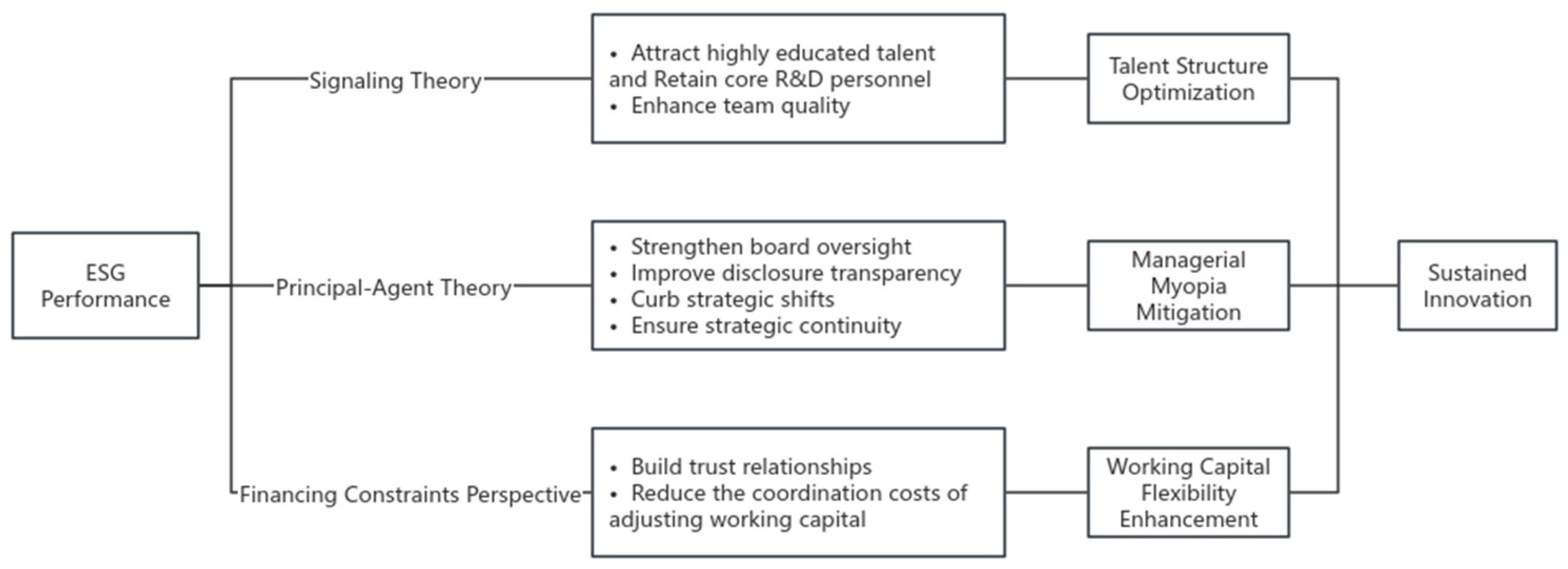
We argue that ESG can support sustained innovation through three primary channels: (1) by signaling long-term orientation to attract and retain high-quality talent (signaling theory); (2) by curbing managerial short-termism through strengthened governance (principal–agent theory); and (3) by enhancing working capital flexibility through trust-based stakeholder relationships (financing constraints perspective). These mechanisms collectively suggest that ESG should enable firms to maintain innovation activities over time. Accordingly, we propose the following hypothesis:
H1: 
Corporate ESG performance significantly promotes sustained innovation in SRUI enterprises.

2.1. Talent Structure Mechanism

Sustained innovation relies on the multi-year accumulation and transfer of technical knowledge, requiring not only a sufficiently large R&D team but also high-quality human capital. However, significant information asymmetry exists between firms and highly skilled talent in the labor market: highly educated job seekers find it difficult to identify which enterprises genuinely prioritize long-term human capital investment and thus approach employment decisions cautiously.
According to signaling theory [26], firms need to send observable and costly signals to the talent market to convey their true type. Continuous investment in the social dimension (S) of ESG—such as providing systematic training, safeguarding career development pathways, and fostering an inclusive work environment—constitutes a credible signal that the firm values employees’ long-term worth. This signal alleviates high-skill talent’s uncertainty about a firm’s long-term orientation, not only attracting external high-quality talent but also enhancing the retention willingness of core R&D personnel, thereby optimizing the firm’s human capital structure both in quantity and quality [27]. Research by Song [28] also indicates that firms with stronger ESG performance generally employ a higher proportion of highly educated R&D staff. This optimized human capital, in turn, serves as the micro-foundation for sustained innovation. A stable, highly qualified R&D team ensures knowledge continuity across innovation cycles, reduces disruptions from personnel turnover, and maintains the organizational momentum needed for long-term technological accumulation. Thus, talent structure optimization acts as a critical conduit through which ESG influences innovation sustainability. This logic yields that if ESG promotes sustained innovation through talent structure optimization, then ESG should be positively associated with the proportion of R&D personnel and highly educated employees, and this human capital advantage should translate into greater innovation continuity. Accordingly, we propose:
H2a: 
Corporate ESG performance promotes sustained innovation by optimizing talent structure.

2.2. Managerial Myopia Mechanism

Sustained innovation requires firms to systematically advance R&D activities along relatively stable technological trajectories over multiple consecutive years. However, due to long innovation cycles and uncertain outcomes, managers under short-term performance pressures often lack strategic patience and tend to frequently shift technical directions, discontinue long-term projects before they yield results, or switch to R&D topics that deliver more immediate returns [22]. Such strategic short-termism fragments R&D resources, erodes accumulated knowledge assets, and ultimately disrupts technological accumulation, preventing firms from achieving sustained innovation.
According to principal–agent theory [20], this type of short-termism stems from incentive misalignment under the separation of ownership and control: managers may sacrifice long-term innovation to meet short-term market expectations, motivated by career security or immediate compensation concerns. ESG practices in the governance dimension (G)—such as enhancing board independence, improving disclosure transparency, and incorporating long-term strategic goals into executive evaluations—significantly strengthen the ability of shareholders and external investors to oversee management’s strategic decisions [29]. When a firm’s ESG performance becomes a focus of market attention, arbitrary shifts in innovation direction or premature interruption of long-term projects carry higher reputational costs and internal accountability risks. This governance constraint reduces volatility in innovation strategy, thereby safeguarding sustained investment and laying the groundwork for continuous technological output.
This logic yields a testable implication: if ESG curbs managerial short-termism to support sustained innovation, then ESG should be negatively associated with managerial myopia. Accordingly, we propose:
H2b: 
Corporate ESG performance promotes sustained innovation by curbing managerial myopia.

2.3. Working Capital Flexibility Mechanism

In a perfect capital market, firms could costlessly switch between internal and external financing [30]. In reality, however, innovation activities—characterized by long cycles and high uncertainty—naturally face external financing constraints [31]. This issue is particularly prominent among SRUI enterprises: their light-asset structure, high R&D intensity, lack of collateral, and customer concentration significantly reduce access to external financing, forcing them to rely on internal cash flow to support R&D.
Yet internal cash flow itself is prone to sharp fluctuations due to macroeconomic volatility or industry shocks. Theoretically, when facing a cash flow shock, firms do not cut all investments proportionally but instead prioritize based on adjustment costs—reducing assets with lower adjustment costs first to protect projects like R&D that entail high adjustment costs and long-term strategic value [32]. Research shows that working capital—including accounts receivable, inventory, accounts payable, and prepayments—is highly liquid and carries relatively low adjustment costs [33]. Therefore, firms tend to reduce working capital during cash flow constraints. By accelerating receivables collection, minimizing inventory, and extending payment terms to suppliers, firms can free up cash to sustain critical R&D expenditures [34]. Proactive working capital management not only alleviates short-term liquidity pressure but also releases funds for other strategic uses, thereby generating additional free cash flow to provide financial support for sustained innovation [35].
ESG enhances working capital management through stable external partnerships built via social (S) and environmental (E) practices: by fulfilling social responsibilities and promoting green supply chains, firms build cooperative relationships with suppliers and customers based on long-term mutual trust. Such relationships reduce the coordination costs of adjusting working capital—when facing cash flow constraints, firms can more easily negotiate faster collection of receivables or reasonably extend payables without triggering supply disruptions or customer loss. Thus, by strengthening a firm’s ability to manage liquidity flexibly, ESG enables working capital to serve as a reliable buffer for smoothing R&D expenditures and preventing innovation disruption.
This logic yields a testable implication: if ESG enhances working capital flexibility to sustain innovation, then ESG should be positively associated with working capital management capability, and this financial flexibility should help firms maintain R&D investment during cash flow fluctuations. Accordingly, we propose:
H2c: 
Corporate ESG performance promotes sustained innovation through flexible working capital management.
The conceptual framework of this paper is illustrated in Figure 1.

3. Research Design

3.1. Data Sources and Sample Selection

This study utilizes data from China’s SRUI enterprises between 2010 and 2023 as the empirical sample. The sample period begins in 2010 due to data availability and to avoid the confounding effects of the 2008 global financial crisis. SRUI enterprises are identified based on the enterprise characteristic classification directly provided in the CSMAR database. This identifier is consistently available throughout the sample period, ensuring accurate identification of SRUI firms. The core explanatory variable, corporate ESG performance, is measured using the HuaZheng ESG rating data. Metrics related to corporate sustained innovation and other firm-level data are obtained from the CSMAR database and the CNRDS (Chinese Research Data Services Platform). City-level economic indicators are sourced from the City Statistical Yearbook.
This study matches firm-level data with corresponding city-level data based on corporate headquarters locations and processes the raw data according to the following principles: (1) excluding listed firms in the financial industry, as their regulatory environment, capital structure, and financial reporting standards differ significantly from those of other sectors; (2) excluding ST/*ST companies, which are typically in financial distress or face high operational uncertainty; and (3) excluding firm-year observations with missing key variables. To mitigate the influence of outliers, all continuous variables are winsorized at the 1st and 99th percentiles.

3.2. Variable Definitions

3.2.1. Sustained Innovation

Drawing on the conceptual distinction between persistent innovation input and output established by Triguero and Córcoles [36], and following the continuous measurement approaches developed in subsequent studies [37,38], this paper constructs indicators for sustained innovation input (IIP) and sustained innovation output (OIP) to comprehensively capture the sustained innovation behavior of SRUI enterprises. The specific calculation formulas are as follows:
I I P t = I I N t + I I N t 1 I I N t 1 + I I N t 2 × ( I I N t + I I N t 1 )
O I P t = O I N t + O I N t 1 O I N t 1 + O I N t 2 × ( O I N t + O I N t 1 )
where IIP t and OIP t represent the firm’s sustained innovation input and output in year t, respectively. I I N and O I N denote the firm’s R&D expenditure scale and number of invention patents, respectively. To address potential scale effects in the model, the logarithmic forms of both indicators will be used for empirical testing (due to differing requirements for data continuity, the number of observations for IIP and OIP varies).

3.2.2. Corporate ESG Performance

This study employs the HuaZheng ESG rating to measure corporate ESG performance, an indicator widely adopted in prior research [39,40]. The HuaZheng rating system evaluates firms across environmental (E), social (S), and governance (G) dimensions, aggregating multiple underlying indicators into a comprehensive letter rating on a nine-tier scale: C, CC, CCC, B, BB, BBB, A, AA, and AAA (from lowest to highest). In this paper, these ratings are assigned sequential numerical values from 1 to 9 (with C = 1 and AAA = 9) to quantify corporate ESG performance.

3.2.3. Control Variables

To mitigate potential endogeneity issues arising from omitted variables, this study incorporates a series of control variables at both the firm and city levels. Firm-level control variables include: firm size (Size), leverage ratio (Lev), return on assets (ROA), firm age (Age), cash flow ratio (Cash), ownership concentration (Top1), Tobin’s Q (TobinQ), proportion of independent directors (ID), and capital intensity (Intensity). City-level macroeconomic variables include: the share of secondary industry in GDP (Second) and per capita GDP (PGDP). Definitions of all key variables are provided in Appendix A Table A1.

3.2.4. Descriptive Statistics

Table 1 reports the descriptive statistics of the main variables. As shown, the two dimensions of sustained innovation exhibit distinct distribution patterns. Sustained innovation input (IIP) displays a relatively high mean and limited dispersion, suggesting that SRUI enterprises generally maintain stable continuity in R&D funding. In contrast, sustained innovation output (OIP) shows a substantially lower mean, wider variability, reflecting greater challenges and pronounced heterogeneity across firms in achieving continuous patent output. The core explanatory variable, ESG performance, is distributed at a moderate-to-lower level with adequate variation, supporting further causal inference. The distributions of all control variables are consistent with typical economic contexts and prior empirical literature, indicating that the sample is broadly representative.

3.3. Baseline Model Specification

The baseline regression model of this study is specified as follows:
IIP it   =   α 0   +   α 1 ESG it   +   α 2 Control it   +   α 3 Control ct   +   FIRMFE i   +   YEARFE t   +   ε it
OIP it =   α 0 +   α 1 ESG i t + α 2 Control it + α 3 Control ct +   FIRMFE i + YEARFE t + ε it
Subscripts i, c and t denote firm, city, and year, respectively. I I P it and O I P it represent the sustained innovation input and sustained innovation output of SRUI enterprises; E S G i t is the core explanatory variable, capturing corporate ESG performance; Control it and Control ct represent vectors of firm-level and city-level control variables, respectively; FIRMFE i and YEARFE t denote firm fixed effects and year fixed effects; ε it is the idiosyncratic error term. All variables are defined in Section 3.2. Based on the theoretical analysis presented earlier, if corporate ESG performance indeed promotes sustained innovation, the coefficient α 1 is expected to be positive and statistically significant.

4. Empirical Results and Analysis

4.1. Baseline Regression

We first conduct Variance Inflation Factor (VIF) tests to assess multicollinearity. The results show maximum VIF values of 1.57 for the IIP model and 1.62 for the OIP model, both well below the conventional threshold of 10, indicating no severe multicollinearity concerns.
Table 2 presents the baseline regression results. Across all specifications, ESG coefficients are positive and significant. With full controls (columns (2) and (4)), a one-unit increase in ESG raises IIP by 0.033 units and OIP by 0.124 units, equivalent to 3.2% and 8.4% of their standard deviations, confirming economic significance. Regarding model fit, adjusted R2 for IIP ranges from 0.779 to 0.865, indicating strong explanatory power. For OIP, R2 is lower, which is typical for innovation output models due to the volatile nature of patent data [41]. Similar patterns hold across subsequent tables, where OIP coefficients remain significant despite modest R2, reinforcing the robustness of our findings.
Thus, Hypothesis H1 is supported. These findings suggest that sound ESG practices not only help firms maintain long-term R&D investment but also effectively foster the continuous generation of innovative outcomes, highlighting the substantive role of ESG in driving high-quality, sustained innovation.

4.2. Robustness Tests

To verify the reliability of the baseline regression results, this study conducts robustness tests from five dimensions: replacing the core explanatory variable, replacing the dependent variable, excluding exceptional years, adjusting the clustering level, and changing the model specification. The results are presented in Table 3.
First, given differences across rating agencies in indicator construction, weight allocation, and data coverage, this study employs the composite ESG score provided by WIND as an alternative explanatory variable (Panel A columns (1)–(2)). The results show that the estimated coefficients of WIND ESG on both sustained innovation input (IIP) and output (OIP) remain positive and significant at the 1% level, indicating that the findings are not dependent on a particular ESG data source. On the other hand, to address the concern that the HuaZheng ESG rating (1–9) imposes an untested equal-interval assumption, we convert it into categorical dummy variables. Firms are grouped into low (scores 1–3), medium (4–6), and high (7–9), with low as the baseline. As shown in columns (3)–(4) of Panel A, both medium and high ESG dummies are positive and significant, with coefficients increasing monotonically. This confirms that our findings are robust and do not rely on the equal-interval assumption.
Second, since IIP and OIP in the baseline regressions are constructed based on patenting behavior, which may be subject to strategic patent applications or examination-cycle noise, we introduce in column (1) of Panel B a financial-statement-based innovation proxy: the change in intangible assets scaled by lagged total assets (INNO). This measure captures the intensity of continuous investment in knowledge capital accumulated through internal R&D [42]. The regression results show that the coefficient on ESG remains statistically significant for INNO, further corroborating the positive role of ESG in promoting sustained investment in substantive innovation resources. Additionally, following Cui et al. [43], we use the ratio of sustained R&D investment to operating revenue (IIP_alt) and the one-period lagged number of sustained patent grants (OIP_alt) as alternative measures of sustained innovation input and output. As shown in columns (2) and (3) of Panel B in Table 3, the coefficients on ESG remain positive and statistically significant, further confirming the robustness of our main findings.
Third, to mitigate the potential influence of the distinctive macro environment during the COVID-19 pandemic on corporate innovation behavior, we exclude observations from 2020–2023 and rerun the regressions using only the pre-pandemic period (2010–2019). Results in columns (1)–(2) of Panel C indicate that the main findings remain robust after removing years subject to major external shocks.
Finally, in columns (3)–(4) of Panel C, we adjust the clustering level to the industry dimension, and further incorporate industry × year high-dimensional fixed effects in columns (5)–(6) to absorb common shocks faced by different industries across years. The results show that the positive impact of ESG on IIP and OIP remains highly significant, confirming the robustness of the regression findings.

4.3. Endogeneity Tests

To mitigate potential endogeneity between corporate ESG performance and sustained innovation, this study employs an instrumental variables (IV) approach, propensity score matching (PSM), and a one-period lag of the explanatory variable for endogeneity testing.
(1)
Instrumental Variables Approach. This study selects the industry-year average ESG score of firms located in other provinces as the instrumental variable. This variable theoretically meets the relevance condition: due to industry-specific norms and peer learning effects, a firm’s ESG performance is influenced by the average practices of its industry peers, even those in different regions. At the same time, it plausibly satisfies the exclusion restriction because the ESG levels of other firms in the same industry but different provinces do not share the same local market conditions, resource constraints, or regional policy shocks that would directly influence the focal firm’s innovation activities. The test results are shown in columns (1) to (4) of Table 4. The first-stage tests indicate that the Cragg–Donald F-statistics all exceed the Stock–Yogo weak identification test critical value of 16.38 at the 10% significance level, rejecting the weak-instrument hypothesis. The second-stage regression results show that the coefficients of ESG on sustained innovation input and output remain positive and significant at the 1% level, confirming that the main conclusion holds after accounting for endogeneity.
(2)
Propensity Score Matching. To reduce the influence of sample self-selection bias on the conclusions, this study employs PSM to re-match the sample for testing. Firms are classified into high-ESG and low-ESG groups based on the industry–year average ESG score. We estimate propensity scores using a logit model with all covariates from the baseline regression. We then perform one-to-one nearest-neighbor matching with a caliper of 0.05 and restrict the analysis to the common support region. Appendix A Table A2 presents the balance tests. After matching, the standardized biases for all covariates are below 5% with no statistically significant differences between the matched groups, confirming the matching quality. The post-matching estimation results (columns (5) and (6) of Table 4) show that the coefficient on ESG remains positive and significant, indicating that the research findings are robust after mitigating selection bias and further validating the positive effect of ESG.
(3)
Lagged Explanatory Variable. This study incorporates a one-period lag of the core explanatory variable, ESG performance, into the regression. The results (columns (7) and (8) of Table 4) show that the coefficients of lagged ESG on sustained innovation input (IIP) and output (OIP) are both positive and significant, providing further support for the causal inference that ESG enhances firms’ sustained innovation.

5. Further Analysis

5.1. Mechanism Analysis

Building on the theoretical analysis, corporate ESG may positively influence the sustained innovation of SRUI enterprises through three channels: optimizing talent structure, mitigating managerial myopia, and enhancing the flexibility of working capital management. To empirically test these mechanisms, we follow the mechanism testing approach widely adopted in the literature [44], which designates each mechanism variable as the dependent variable and estimates the following model. All other variable definitions remain consistent with the baseline model.
M e c h a n i s m it =   β 0   + β 1 E S G i t + β 2 Control it + β 3 Control ct + FIRMFE i +   YEARFE t + ε it

5.1.1. Talent Structure

Human capital refers to the skills, knowledge, and experience embodied in workers [45]. To examine whether ESG promotes sustained innovation by optimizing talent structure, we measure human capital from two aspects: the proportion of R&D employees (Skill) and the proportion of employees with a master’s degree or higher (Edu). As shown in columns (1) and (2) of Table 5, the coefficients of ESG performance on both the R&D employee ratio and the high-education employee ratio are positive and significant, indicating that firms with stronger ESG performance tend to have a workforce structure more oriented toward technology-driven and knowledge-intensive profiles. While the coefficient on Edu appears modest, it is economically meaningful: a one-standard-deviation increase in ESG (SD = 0.934) is associated with a 2.12% increase relative to the sample mean of Edu. This result suggests that ESG practices are positively associated with the proportion of highly educated and R&D personnel, thereby optimizing the allocation of human capital within the firm. This optimization provides critical support for sustained innovation: highly educated employees contribute stronger cognitive abilities and frontier knowledge reserves, while R&D personnel drive technological accumulation and iteration. Together, they strengthen the firm’s capacity for sustained, high-quality innovation.
To further validate this channel, we examine whether the ESG-innovation link is stronger in firms with higher human capital levels. Specifically, we construct dummy variables indicating firms with above-industry–year median levels of Skill and Edu, denoted as High_Skill and High_Edu, respectively. As shown in Appendix A Table A3, the interaction terms ESG × High_Skill and ESG × High_Edu are positive. This indicates that the innovation benefits of ESG are amplified in firms with stronger human capital, providing consistent evidence for the talent structure channel. Therefore, talent structure optimization constitutes a significant transmission channel through which ESG influences sustained innovation.

5.1.2. Managerial Myopia

We measure managerial myopia through text analysis of listed companies’ annual reports. Following the content analysis approach proposed by Brochet et al. [46] and the Chinese vocabulary developed by Hu et al. [47], we construct our proxy based on the frequency of short-term oriented keywords in the Management Discussion and Analysis (MD&A) section. We first collect firms’ annual reports from the CNINFO website (CNINFO is the official information disclosure website designated by the China Securities Regulatory Commission, where listed companies publish financial reports, announcements, and other information; its website is: http://www.cninfo.com.cn) and extract the MD&A content. Using Python’s (version 3.14.3) Jieba segmentation module, we tokenize the MD&A text and compute keyword frequency ratios. Following Hu et al. [47], we identify a set of short-term oriented keywords (following Hu et al. (2021) [47], the keyword set was validated by three industry and academic experts through comparison with MD&A text samples, ultimately finalizing a list of 43 ‘short-termism’ keywords; the full list is available upon request). For each firm–year, we calculate the frequency of these short-term keywords in the MD&A section, divide it by the total word count of the MD&A text, and multiply by 100 to obtain our measure of managerial myopia (Myopia).
The mechanism test results in column (3) of Table 5 show that the coefficient of ESG performance on managerial myopia is significantly negative, indicating that stronger corporate ESG performance is associated with a weaker tendency toward managerial short-termism. This finding suggests that ESG practices help guide managers to look beyond short-term performance pressures and focus more on the long-term sustainable development of the firm. When managerial myopia is mitigated, firms are more likely to maintain stable and continuous R&D investment, avoiding cuts in innovation spending driven by the pursuit of short-term profits. This provides the necessary strategic patience and resource security for sustained innovation. To further validate this channel, we construct a dummy for high-myopia firms (above-industry–year median) and interact it with ESG. As shown in Appendix A Table A3, the interaction term ESG × High_Myopia is positive and significant, indicating that ESG’s innovation benefits are stronger in firms with more severe myopia—consistent with the myopia channel.

5.1.3. Working Capital Management

As noted in the preceding theoretical analysis, the key to maintaining the continuity of R&D and innovation in SRUI enterprises lies in how firms effectively respond to fluctuations in internal cash flow. When external financing is constrained, these fluctuations—triggered by changes in the external environment—can disrupt the stability of R&D investment [21]. Accordingly, when examining the supporting role of working capital management in sustaining innovation, this paper focuses on whether firms can mitigate cash-flow shocks through flexible working capital strategies, thereby avoiding disruptions in R&D activities. Drawing on the approach of Boisjoly et al. [33], we construct working capital sensitivity (WKS) as the mediating variable. A higher WKS indicates that the firm is better able to significantly reduce working capital usage when cash flow declines, reflecting stronger proactive management capabilities and greater adjustment flexibility.
First, we estimate the following time-series regression for each firm:
Δ W C it   =   β 0   +   β 1 C F i t   +   β 2 l n ( K i , t 1 )   +   ε it
where Δ W C it and C F i t denote the changes in standardized working capital and standardized operating cash flow, respectively, and l n ( K i , t 1 ) is the natural logarithm of lagged total assets, controlling for firm size effects. The estimated coefficient β 1 serves as the firm’s WKS indicator.
Table 5 reports the regression results of ESG performance on WKS. As shown in column (4), the coefficient on ESG performance is positive and significant. This indicates that firms with better ESG performance exhibit higher WKS, meaning they are able to adjust working capital more substantially to release liquidity when facing cash-flow fluctuations. Consequently, such firms can better ensure that R&D and innovation activities are not disrupted even under adverse shocks. This finding suggests that ESG strengthens the role of working capital as a low-adjustment-cost buffer by enhancing a firm’s proactive adjustment capability, thereby providing stable internal funding support for sustained innovation in a financially constrained environment.
To further validate this channel, we construct a dummy variable for firms with above-industry–year median WKS levels (High_WKS). As shown in Appendix A Table A3, the interaction term ESG × High_WKS is positive and statistically significant, indicating that the innovation benefits of ESG are amplified in firms with stronger working capital management capability. This provides consistent evidence for the working capital channel.

5.2. Heterogeneity Analysis

To examine the boundary conditions under which ESG promotes sustained innovation across different contexts, this paper further introduces four types of moderating variables for heterogeneity analysis. The analysis is conducted along four dimensions: climate risk perception, senior management team age, enterprise big-data technology application capability, and the level of government subsidies received. All moderating variables are constructed as continuous variables and incorporated into interaction terms to avoid information loss that might arise from categorical grouping.
(1)
Climate Risk Perception. As climate-related regulatory and market pressures intensify, a firm’s attention to climate risk may influence how it translates ESG into sustained innovation. Firms that frequently discuss climate policies, extreme weather impacts, or low-carbon transition costs in their annual reports are typically aware that climate change poses a tangible challenge to their long-term operations. Consequently, such firms may leverage ESG practices earlier to stabilize their R&D direction and maintain investment continuity. However, this heightened awareness comes with trade-offs. These firms may also devote considerable resources to meeting disclosure requirements or responding to regulatory scrutiny. Such efforts could hinder the effective conversion of resources into tangible innovation outputs. To identify this potential heterogeneity, this study constructs a climate risk perception indicator (Climate) based on the textual analysis of corporate annual reports (The specific steps for constructing the Climate Risk Perception Indicator are as follows: (1) Data Collection: Annual report texts of SRUI enterprises from 2010 to 2023 were sourced from the China Information Website. (2) Text Processing: The Jieba Chinese word segmentation tool was applied to process the annual report texts. Climate-risk-related terms were identified using a climate risk dictionary comprising 98 keywords, covering dimensions such as climate policy, transition costs, physical disasters, and regulatory compliance (see Appendix A Table A4 for details). (3) Index Calculation: The cumulative frequency of climate risk keywords in each annual report was calculated and divided by the total word count of that report to derive a firm-level climate risk perception index). This indicator quantifies management’s focus on climate-related topics, thereby reflecting the firm’s subjective assessment of transition and physical risks, as well as its strategic willingness to respond.
The regression results in columns (1)–(2) of Table 6 show that the interaction term between ESG and climate risk perception is significantly positive for IIP but not significant for OIP. This contrast suggests that firms with high climate risk perception leverage strong ESG practices to maintain R&D investment continuity. However, they do not achieve a corresponding improvement in sustained innovation output, such as patents. In other words, ESG primarily functions as a “stabilizer” in such firms, mitigating the impact of external pressures on R&D activities, but has not yet been transformed into an efficient mechanism for innovation conversion. This finding implies that while promoting climate-related disclosures, regulators may need to pay attention to whether firms possess the supporting mechanisms to translate risk awareness into actual innovation capacity, thereby helping to ensure that ESG practices are more than just a formality.
(2)
Management Team Age Structure. The senior management team plays a pivotal role in allocating corporate resources and implementing strategies. Consequently, its age composition may critically influence how effectively ESG initiatives are translated into sustained innovation. Compared to older managers, younger executives are generally more familiar with emerging technologies and sustainability trends, and are also more willing to commit to long-term investments in the face of uncertainty. This study uses executive biographical information from the CSMAR database to calculate the average age of the core management team each year as the moderating variable (TMTAge).
The empirical results (columns (3)–(4) in Table 6) show that the interaction term between ESG and management team age is significantly negative for both IIP and OIP. This indicates that in firms with younger management teams, the enhancing effect of ESG on the continuity of innovation input and output is significantly stronger. This finding supports the perspective of upper echelons theory: executives’ cognitive characteristics profoundly shape the effectiveness of strategy implementation, and younger managers are better able to translate the long-term governance value of ESG into concrete innovation actions.
(3)
Big-Data Technology Application Capability. With the development of the digital economy, a firm’s understanding and application capabilities of technologies such as big data and artificial intelligence may profoundly influence how ESG practices translate into sustained innovation. Firms with stronger big-data capabilities are more likely to leverage data-analysis tools to optimize R&D processes, forecast technology trends, and improve the efficiency of resource allocation. To measure this capability, this study constructs an index of corporate big-data technology application capability (DT) based on the textual content of listed companies’ annual reports (the indicator DT is constructed by summing the frequencies of keywords such as “big data,” “data mining,” “text mining,” “data visualization,” “heterogeneous data,” “credit investigation,” “augmented reality,” “mixed reality,” and “virtual reality” in the annual reports, adding one, and then taking the natural logarithm).
The regression results, shown in columns (5)–(6) of Table 6, indicate that the interaction term between ESG and DT has a significantly positive effect on OIP but no significant effect on IIP. This suggests that in firms with stronger big-data technology application capabilities, ESG’s role in promoting the continuity of patent output is significantly enhanced, while its impact on the continuity of R&D investment remains unchanged. In other words, big-data technology primarily functions in the “back-end” of innovation. It helps high-ESG firms more efficiently translate sustainable principles into verifiable technological outcomes, thereby improving the persistence of innovation output.
(4)
Government Subsidies. Government subsidies, as an important external incentive tool, warrant in-depth exploration regarding their interaction with firms’ endogenous ESG motivations. Theoretically, subsidies can alleviate financing constraints for innovation. However, they may also trigger a “crowding-out effect”. If firms view ESG more as a means to obtain subsidies rather than as a reflection of long-term strategy or genuine commitment to sustainable development, the actual governance role of ESG may be diluted. To examine this, this study constructs the Subsidy variable as the ratio of government subsidies to annual operating revenue.
The results in columns (7)–(8) of Table 6 show that the interaction term between ESG and government subsidies is significantly negative for both IIP and OIP. This indicates that in firms receiving higher subsidies, the promoting effect of ESG on sustained innovation is notably weaker. This finding suggests that external fiscal support partly substitutes for the motivation of firms to drive long-term innovation based on their own governance intentions. From a policy perspective, excessive reliance on subsidies may induce strategic “ESG-for-funding” behavior. Moving forward, policy design may consider reducing dependence on “transfusion-style” subsidies and instead foster an institutional environment centered on market mechanisms and governance self-discipline. Such an approach could help guide firms to internalize ESG as a core capability for supporting high-quality, sustained innovation.

6. Conclusions

6.1. Discussion of the Findings

This study, using a sample of China’s “Specialized, Refined, Unique, and Innovative” (SRUI) enterprises from 2010 to 2023 and grounded in signaling theory and principal–agent theory within the context of financing constraints, systematically examines the impact of corporate environmental, social, and governance (ESG) performance on the sustained innovation of such firms and its boundary conditions. While most existing ESG–innovation literature focuses on innovation level at a given point in time [7,48], and the few studies on sustained innovation are limited to general listed firms, this paper draws on the conceptual distinction between persistent innovation input and output established by Triguero and Córcoles [36] and follows the continuous measurement approaches developed in subsequent studies [37,38] to empirically test how ESG supports the continuity of innovation in SRUI enterprises from two dimensions: sustained innovation input and sustained innovation output. By examining both input and output dimensions of persistence, our approach provides a more complete picture of sustained innovation dynamics in SRUI enterprises than studies focusing solely on sustained innovation output. The results show that ESG has a significantly positive effect on both dimensions of persistence, indicating that sound ESG practices can promote the long-term stabilization of R&D advancement and continuous output generation in these technology-focused enterprises.
Mechanism tests reveal that ESG operates through three main pathways. First, at the talent level, high-ESG firms exhibit higher proportions of R&D personnel and highly educated employees. This finding aligns with Peng et al. [49], who argue that human capital agglomeration is a prerequisite for effectively translating R&D investment into innovation output. This study further demonstrates that ESG helps firms attract and retain high-quality talent, thereby providing fundamental support for sustained innovation. Second, at the governance level, ESG mitigates managerial short-termism, ensuring the cross-period stability of R&D strategy. This provides micro-level evidence for Lin et al. [50]’s emphasis that a long-term orientation enhances the continuity and foresight of strategic decisions. From the perspective of ESG practices, this paper shows that ESG itself serves as a key institutional arrangement for achieving long-term orientation and maintaining innovation continuity. Finally, at the operational level, drawing on the theory of investment adjustment costs [51,52], this study finds that ESG significantly enhances firms’ proactive management of working capital. High-ESG firms leverage flexible working capital management to release cash flow, effectively buffering the impact of internal financial fluctuations and external financing constraints on R&D activities, thereby extending the research of Boisjoly et al. (2020) [33] on working capital as a buffer tool under financing constraints.
Heterogeneity analysis further reveals the boundary conditions of ESG’s effects. In firms with higher perceived climate risk, ESG primarily plays a role in stabilizing R&D investment but does not simultaneously enhance the persistence of innovation output. This suggests that while firms facing external environmental pressures can leverage ESG to maintain a baseline of R&D, they may lack the capacity to effectively translate such investment into sustained technological outcomes. The younger the senior management team, the stronger the positive effect of ESG on sustained innovation, reflecting that younger managers are more inclined to integrate ESG principles into long-term technology strategies and maintain consistency in their execution. Notably, big-data technology application capability (DT) only significantly amplifies ESG’s positive impact on the persistence of patent output, with no discernible effect on the continuity of R&D investment. This indicates that its value is mainly realized in the “back-end” of innovation—i.e., accelerating the conversion of existing inputs into verifiable outcomes—rather than influencing the decision of whether to sustain investment. Finally, in firms receiving higher government subsidies, the marginal contribution of ESG to sustained innovation is notably diminished, implying that when firms can rely on government support to alleviate financial pressure, their intrinsic motivation to drive long-term innovation through ESG is correspondingly reduced.

6.2. Policy Implications

Based on the empirical findings of this study, the following policy recommendations are proposed to strengthen the role of ESG practices in promoting sustained corporate innovation:
First, given ESG’s positive impact on sustained innovation, our findings suggest that treating ESG as an institutional foundation for long-term innovation—rather than merely a compliance exercise—could be beneficial. Specifically, policy frameworks might consider mandating multi-year disclosure of R&D metrics (e.g., R&D spending, R&D headcount, patents) within ESG reports. Furthermore, encouraging rating agencies to incorporate “innovation continuity” into their scoring methodologies, alongside aligning financial institutions’ assessments with innovation persistence, could help better channel capital toward firms demonstrating long-term technological potential.
Second, to effectively operationalize the three identified mechanisms, our findings suggest that policy frameworks could focus on the following areas: (a) strengthening the “employee development” dimension in ESG ratings, potentially by incentivizing firms to disclose and improve their R&D talent structure; (b) incorporating “strategic continuity” into governance (G) evaluations, which may encourage firms to report on the stability of their R&D strategies and adopt mechanisms to curb managerial short-termism; and (c) recognizing working capital management capability as a key indicator of operational resilience, thereby encouraging firms to leverage flexible liquidity management to buffer R&D against financial shocks.
Third, policy design may benefit from being tailored to specific contexts. For firms with higher climate risk perception—where ESG enhances sustained input but not sustained output—policy efforts could focus on supporting the commercialization of R&D results. This might include technology extension services, patent application assistance, or innovation platforms that help translate sustained investment into tangible outcomes. Given that younger management teams amplify ESG’s effect on sustained innovation, policies could consider fostering a culture of long-termism among leadership. This could involve incentivizing the appointment or development of younger executives, who appear more effective at integrating ESG principles into sustained innovation strategies. Moreover, since big-data capability (DT) strengthens ESG’s effect on patent persistence, expanding digital infrastructure and data governance training for SMEs could enhance their ability to convert data-driven insights into innovation outputs. To address the finding that high subsidies weaken ESG’s innovation effect, subsidy allocation might prioritize firms with a track record of continuous R&D and patent output, with follow-on funding potentially tied to both ESG improvement and innovation consistency.
Finally, while the above recommendations are grounded in our empirical findings, we recognize that many SMEs face data and resource constraints that may limit their participation in comprehensive ESG rating systems. As a complementary approach, policymakers could consider developing simplified ESG indicator frameworks tailored to SME characteristics, focusing on key dimensions such as environmental impact, employee welfare, and governance structure. Such frameworks could help reduce the burden of data collection while still capturing essential ESG information, potentially extending the benefits of ESG practices to a broader population of SMEs. Government departments might also consider establishing diversified evaluation standards that account for heterogeneity across industries, regions, and firm life cycles, which could help ensure that ESG-based policies are both inclusive and effective.

6.3. Limitations and Future Research

Although this study provides systematic theoretical analysis and robust empirical evidence on how ESG supports sustained innovation in SRUI enterprises, certain limitations remain regarding measurement approaches and data availability, offering avenues for future research.
Regarding variable measurement, our proxies for managerial myopia, climate risk perception and big-data capability rely on textual analysis of annual reports. This is a widely used approach in recent literature [47,53] that effectively leverages publicly available data to capture firms’ disclosed strategic orientation. However, keyword frequencies may not fully reflect actual behaviors. Future research could complement our archival findings with survey-based or field-study approaches to provide more direct and granular evidence.
Additionally, this study relies on comprehensive ESG ratings (HuaZheng ESG) that require extensive data collection. Given the resource constraints faced by many small and medium-sized enterprises, future research could explore the development and validation of simplified ESG indicator frameworks tailored to SME characteristics, focusing on key dimensions such as environmental impact, employee welfare, and governance structure. Such simplified systems would help extend ESG research to broader SME populations and provide practical guidance for firms with limited data capabilities.
Addressing these limitations in future work would further strengthen our understanding of how ESG shapes sustained innovation in specialized firms.

Author Contributions

Conceptualization, Y.D.; Methodology, Y.D. and X.W.; Software, X.W.; Validation, Y.D.; Formal analysis, X.W.; Investigation, X.W.; Resources, X.W.; Data curation, X.W.; Writing—original draft, X.W.; Writing—review and editing, Y.D. and X.W.; Supervision, Y.D.; Project administration, Y.D. All authors have read and agreed to the published version of the manuscript.

Funding

This research received no external funding.

Institutional Review Board Statement

Not applicable.

Informed Consent Statement

Not applicable.

Data Availability Statement

The data presented in this study are available on request from the corresponding author.

Conflicts of Interest

The authors declare no conflicts of interest.

Appendix A

Table A1. Variable definitions.
VariablesSymbolMeasurement
Sustained innovation investmentIIPThe natural logarithm of the variable calculated in Equation (1).
Sustained innovation outputOIPThe natural logarithm of the variable calculated in Equation (2).
ESGESGHuazheng ESG ratings
Firm SizeSizeNatural logarithm of total assets
Leverage ratioLevTotal liabilities/Total assets
Return on assetsROANet profit/Total assets
Firm ageAgeThe natural logarithm of the difference between the fiscal year and the year of establishment plus one
Cash ratioCash(Cash and equivalents)/Current liabilities
Ownership concentrationTOP1Shareholding ratio of the largest shareholder
TobinQTobinQthe Tobin’s Q ratio of the firm in year t
The proportion
of independent directors
IDThe number of independent directors/Total board members
Asset IntensityIntensityTotal assets/sales
The share of secondary industry in GDPSecondSecondary Industry Output/Gross Domestic Product
GDP per capitaPGDPThe natural logarithm of the ratio of real GDP to permanent resident population.
Table A2. Balance test after PSM matching.
VariableSampleTreatedControl%Biast-Testp > t
SizeUnmatched21.75921.6217.15.990.000
Matched21.64321.68−4.6−1.480.138
LevUnmatched0.3290.376−26.5−9.240.000
Matched0.3480.3442.50.830.405
ROAUnmatched0.0460.02332.411.30.000
Matched0.0350.039−4.7−1.720.086
AgeUnmatched2.9312.946−5.3−1.870.062
Matched2.9412.93520.630.529
CashUnmatched0.0490.04113.14.570.000
Matched0.0430.043−1.2−0.40.692
Top1Unmatched0.2970.29420.690.492
Matched0.2980.2970.50.150.88
TobinQUnmatched2.3952.3423.91.350.178
Matched2.2962.342−3.3−1.10.273
IDUnmatched0.4010.39113.54.720.000
Matched0.3940.397−4.2−1.350.178
IntensityUnmatched2.5112.605−5.7−1.970.049
Matched2.5562.5341.30.430.669
SecondUnmatched36.8437.394−4.8−1.680.093
Matched37.19637.249−0.5−0.150.885
PGDPUnmatched11.70911.6894.71.650.099
Matched11.69411.7−1.4−0.430.669
This table reports balance tests before and after one-to-one nearest-neighbor matching with a caliper of 0.05. After matching, all covariates have standardized biases below 5% and t-tests are insignificant at the 5% level (all p > 0.05), indicating successful balancing.
Table A3. Supporting evidence for mechanism analysis.
Variables(1)(2)(3)(4)(5)(6)(7)(8)
IIPOIPIIPOIPIIPOIPIIPOIP
ESG0.0080.086 **0.163 ***0.096 ***0.019 *0.065 *0.075 ***0.135 ***
(0.012)(0.031)(0.018)(0.033)(0.011)(0.035)(0.012)(0.027)
High_edu−0.204 ***−0.055
(0.068)(0.115)
ESG × High_edu0.045 ***0.054 *
(0.016)(0.028)
High_skill 0.153−0.302
(0.113)(0.202)
ESG × High_skill 0.047 *0.105 **
(0.027)(0.047)
High_myopia −0.143 **−0.480 **
(0.059)(0.209)
ESG × High_myopia 0.028 **0.145 ***
(0.014)(0.049)
High_WKS 0.043 **0.080
(0.021)(0.053)
ESG × High_WKS 0.027 ***0.023 ***
(0.006)(0.006)
Constant−1.750−3.951 ***4.233 ***−5.860 ***−1.898 *−4.496 ***−0.1812.338 ***
(1.151)(0.748)(0.887)(1.571)(1.149)(1.105)(1.421)(0.121)
Obs45154254502644854515426047674594
Firm FEYESYESYESYESYESYESYESYES
Year FEYESYESYESYESYESYESYESYES
Adj-R20.8650.1180.3020.1020.8650.0490.6090.098
Robust standard errors clustered at the firm level are in parentheses. *** p < 0.01, ** p < 0.05, * p < 0.1.
Table A4. Climate risk category keywords.
Risk TypeWord Set
Serious Risks Keywords (34)typhoon, disaster, drought and flood, drought, severe, extreme, strong wind, frost, flooding, hurricane, urban water logging, storm, dust, debris flow, freezing, snow disaster, drought situation, landslide, flood, hail, tornado, rainstorm, rain and snow, heavy snow, freeze injury, flood disaster, earthquake, severe cold, tsunami, heavy rain, sandstorm, intense rainfall, freeze, water disaster
Chronic Risks Keywords (30)weather, humidity, water temperature, cooling, temperature, rainfall, cold, air temperature, heavy rain, precipitation, rainy season, rainwater, rain situation, overcast, winter, flood season, extreme cold, high humidity, water regime, sunlight, water shortage, water level, cold, surface, cold wave, climate, groundwater, flood situation, sedimentation, water storage
Transition Risks Keywords (34)energy, clean, energy saving, ecology, environment, intensive, solar energy, upgrading, transformation, recycling, utilization, wind power, natural gas, nuclear power, efficiency, fuel, regeneration, emission reduction, environmental protection, green, consumption reduction, low carbon, water saving, photovoltaic, fuel consumption, high efficiency, power consumption, energy consumption

References

  1. D’Attoma, I.; Ieva, M. Determinants of technological innovation success and failure: Does marketing innovation matter? Ind. Mark. Manag. 2020, 91, 64–81. [Google Scholar] [CrossRef]
  2. Wen, H.; Zhong, Q.; Lee, C. Digitalization, competition strategy and corporate innovation: Evidence from Chinese manufacturing listed companies. Int. Rev. Financ. Anal. 2022, 82, 102166. [Google Scholar] [CrossRef]
  3. Al-Thageb, S.A.; Algharabali, B.G.; Alabdulghafour, K.T. The pandemic and economic policy uncertainty. Int. J. Financ. Econ. 2022, 27, 2784–2794. [Google Scholar] [CrossRef]
  4. Bertrand, J.-L.; Parnaudeau, M. Understanding the economic effects of abnormal weather to mitigate the risk of business failures. J. Bus. Res. 2019, 98, 391–402. [Google Scholar] [CrossRef]
  5. Nickel, C. What do we talk about when we talk about the ‘return’ of geopolitics? Int. Aff. 2024, 100, 7–25. [Google Scholar] [CrossRef]
  6. Geroski, P.A.; Van Reenen, J.; Walters, C.F. How persistently do firms innovate? Res. Policy 1997, 26, 33–48. [Google Scholar] [CrossRef]
  7. Cabaleiro-Cerviño, G.; Mendi, P. ESG-driven innovation strategy and firm performance. Eurasian Bus. Rev. 2024, 14, 137–185. [Google Scholar] [CrossRef]
  8. Li, J.; Lian, G.; Xu, A. How do ESG affect the spillover of green innovation among peer firms? Mechanism discussion and performance study. J. Bus. Res. 2023, 158, 113648. [Google Scholar] [CrossRef]
  9. Ahmad, N.; Mobarek, A.; Roni, N.N. Revisiting the impact of ESG on financial performance of FTSE350 UK firms: Static and dynamic panel data analysis. Cogent Bus. Manag. 2021, 8, 1900500. [Google Scholar] [CrossRef]
  10. Chen, L.; Khurram, M.U.; Gao, Y.; Abedin, M.Z.; Lucey, B. ESG disclosure and technological innovation capabilities of the Chinese listed companies. Res. Int. Bus. Financ. 2023, 66, 101974. [Google Scholar] [CrossRef]
  11. Flammer, C. Competing for government procurement contracts: The role of corporate social responsibility. Strateg. Manag. J. 2018, 39, 1299–1324. [Google Scholar] [CrossRef]
  12. Houston, J.F.; Shan, H.Y. Corporate ESG profiles and banking relationships. Rev. Financ. 2022, 26, 3373–3417. [Google Scholar] [CrossRef]
  13. Li, Y.; Li, S. ESG performance and innovation quality. Int. Rev. Econ. Financ. 2024, 92, 1361–1373. [Google Scholar] [CrossRef]
  14. Sun, H.; Bai, T.; Fan, Y.; Liu, Z. Environmental, social, and governance performance and enterprise sustainable green innovation: Evidence from China. Corp. Soc. Responsib. Environ. Manag. 2024, 31, 3633–3650. [Google Scholar] [CrossRef]
  15. Zhai, Y.; Cai, Z.; Lin, H.; Yuan, M.; Mao, Y.; Yu, M. Does better environmental, social, and governance induce better corporate green innovation: The mediating role of financing constraints. Corp. Soc. Responsib. Environ. Manag. 2022, 29, 1513–1526. [Google Scholar] [CrossRef]
  16. Cohen, L.; Gurun, U.G.; Nguyen, Q.H. The ESG-innovation disconnect: Evidence from green patenting. Manag. Sci. 2026. [Google Scholar] [CrossRef]
  17. Manes-Rossi, F.; Nicolò, G. Exploring Sustainable Development Goals reporting practices: From symbolic to substantive approaches—Evidence from the energy sector. Corp. Soc. Responsib. Environ. Manag. 2022, 29, 1799–1815. [Google Scholar] [CrossRef]
  18. Li, H.; Wang, J.; Zhang, R.; Duan, M. Research on the impact of corporate ESG performance on sustained innovation in the VUCA context: Evidence from China. Sustainability 2025, 17, 5304. [Google Scholar] [CrossRef]
  19. Li, L.; Zhu, J. Can data assetization drive high-quality enterprise development? Evidence from China’s “specialized, refined, unique, and innovative” SMEs. PLoS ONE 2025, 20, e0335903. [Google Scholar] [CrossRef]
  20. Jensen, M.C.; Meckling, W.H. Theory of the firm: Managerial behavior, agency costs and ownership structure. J. Financ. Econ. 1976, 3, 305–360. [Google Scholar] [CrossRef]
  21. Hall, B.H. The financing of research and development. Oxf. Rev. Econ. Policy 2002, 18, 35–51. [Google Scholar] [CrossRef]
  22. Cremers, M.; Pareek, A.; Sautner, Z. Short-term investors, long-term investments, and firm value: Evidence from Russell 2000 index inclusions. Manag. Sci. 2020, 66, 4535–4551. [Google Scholar] [CrossRef]
  23. Akcigit, U.; Liu, Q. The role of information in innovation and competition. J. Eur. Econ. Assoc. 2015, 14, 828–870. [Google Scholar] [CrossRef]
  24. Chen, T.; Huang, Y.; Lin, C.; Sheng, Z. Finance and firm volatility: Evidence from small business lending in China. Manag. Sci. 2021, 68, 2226–2249. [Google Scholar] [CrossRef]
  25. Donaldson, T.; Preston, L.E. The stakeholder theory of the corporation: Concepts, evidence, and implications. Acad. Manag. Rev. 1995, 20, 65–91. [Google Scholar] [CrossRef]
  26. Spence, M. Job market signaling. Q. J. Econ. 1973, 87, 355–374. [Google Scholar] [CrossRef]
  27. Zuo, Y.; Jiang, S.Y.; Wei, J. Can corporate social responsibility mitigate the liability of newness? Evidence from China. Small Bus. Econ. 2022, 59, 573–592. [Google Scholar] [CrossRef]
  28. Song, J. Corporate ESG performance and human capital investment efficiency. Financ. Res. Lett. 2024, 62, 105239. [Google Scholar] [CrossRef]
  29. Dyck, A.; Lins, K.V.; Roth, L.; Wagner, H.F. Do institutional investors drive corporate social responsibility? International evidence. J. Financ. Econ. 2019, 131, 693–714. [Google Scholar] [CrossRef]
  30. Modigliani, F.; Miller, M.H. The cost of capital, corporation finance and the theory of investment. Am. Econ. Rev. 1958, 48, 261–297. [Google Scholar]
  31. Giebel, M.; Kraft, K. External financing constraints and firm innovation. J. Ind. Econ. 2019, 67, 91–126. [Google Scholar] [CrossRef]
  32. Fazzari, S.M.; Petersen, B.C. Working capital and fixed investment: New evidence on financing constraints. Rand J. Econ. 1993, 24, 328–342. [Google Scholar]
  33. Boisjoly, R.P.; Conine, T.E.; McDonald, M.B. Working capital management: Financial and valuation impacts. J. Bus. Res. 2020, 108, 1–8. [Google Scholar] [CrossRef]
  34. Jalal, A.; Khaksari, S. Cash cycle: A cross-country analysis. Financ. Manag. 2020, 49, 635–671. [Google Scholar]
  35. Flannery, M.J.; Öztekin, Ö. Working capital balances and financial policy. J. Corp. Financ. 2024, 87, 102618. [Google Scholar]
  36. Triguero, A.; Córcoles, D. Understanding innovation: An analysis of persistence for Spanish manufacturing firms. Res. Policy 2013, 42, 340–352. [Google Scholar] [CrossRef]
  37. Huang, Y.; Yan, J. The effects of artificial intelligence and digitalization on sustained corporate innovation. Financ. Res. Lett. 2026, 87, 108992. [Google Scholar]
  38. Wang, X.; Shi, Y.; Wang, J.; Wang, G.; Wei, Z.; Li, J. Does corporate ESG performance enhance sustained green innovation? Empirical evidence from China. Economics 2025, 19, 20250167. [Google Scholar] [CrossRef]
  39. Tang, L.; Hu, J.; Stauvermann, P.J.; Xiong, Z. The impact of short-term debt for long-term investment on corporate ESG performance. Financ. Res. Lett. 2026, 91, 109459. [Google Scholar]
  40. Zhang, L.; Chen, J.; Zeng, H. Media attention and financial returns to ESG performance. Financ. Res. Lett. 2026, 91, 109471. [Google Scholar]
  41. Hall, B.H.; Jaffe, A.; Trajtenberg, M. Market value and patent citations. Rand J. Econ. 2005, 36, 16–38. [Google Scholar]
  42. Xiao, C.; Song, A.; Gu, K. Analysis of R&D expense plus deduction incentive to improve the innovation capacity of enterprises—Based on the moderating effect of financing constraints. Tax. Res. 2024, 5, 80–87. [Google Scholar]
  43. Cui, X.; Wang, C.; Liao, J.; Fang, Z.; Cheng, F. Economic policy uncertainty exposure and corporate innovation investment: Evidence from China. Pac.-Basin Financ. J. 2021, 67, 101533. [Google Scholar] [CrossRef]
  44. He, Z.; Chen, W.; Chen, M.; He, S. Local government debt and commercial bank liquidity creation. Financ. Res. Lett. 2025, 80, 107317. [Google Scholar] [CrossRef]
  45. Becker, G.S. Human Capital: A Theoretical and Empirical Analysis, with Special Reference to Education; National Bureau of Economic Research: Cambridge, MA, USA, 1964. [Google Scholar]
  46. Brochet, F.; Loumioti, M.; Serafeim, G. Speaking of the short-term: Disclosure horizon and managerial myopia. Rev. Account. Stud. 2015, 20, 1122–1163. [Google Scholar] [CrossRef]
  47. Hu, N.; Xue, F.; Wang, H. Does managerial myopia affect long-term investment? Based on text analysis and machine learning. Manag. World 2021, 37, 139–156. [Google Scholar]
  48. Sun, X.; Xiong, X. ESG performance and corporate innovation. Res. Int. Bus. Financ. 2025, 76, 102817. [Google Scholar] [CrossRef]
  49. Peng, H.X.; Tan, H.P.; Zhang, Y. Human capital, financial constraints, and innovation investment persistence. Asian J. Technol. Innov. 2020, 28, 453–475. [Google Scholar] [CrossRef]
  50. Lin, Y.; Shi, W.L.; Prescott, J.E.; Yang, H. In the eye of the beholder: Top managers’ long-term orientation, industry context, and decision-making processes. J. Manag. 2019, 45, 3114–3145. [Google Scholar] [CrossRef]
  51. Bernstein, J.I.; Nadiri, M.I. Advances in Econometrics and Modelling; Springer: Berlin/Heidelberg, Germany, 1989. [Google Scholar]
  52. Hamermesh, D.S.; Pfann, G.A. Adjustment costs in factor demand. J. Econ. Lit. 1996, 34, 1264–1292. [Google Scholar]
  53. Sheng, X.; Guo, S.; Chang, X. Managerial myopia and firm productivity: Evidence from China. Financ. Res. Lett. 2022, 49, 103083. [Google Scholar] [CrossRef]
Figure 1. Conceptual framework.
Sustainability 18 02967 g001
Table 1. Descriptive statistics.
VariableNMeanSDMinMax
IIP516518.7301.02414.74823.107
OIP45992.9981.482−3.0457.276
ESG52874.1170.9341.0008.000
Size528721.6760.82219.68726.376
Lev52870.3510.1760.0380.934
ROA52870.0350.072−0.4160.255
Age52872.9380.2851.3863.689
Cash52870.0450.063−0.1950.266
Top152870.2970.1260.0750.740
TobinQ52302.3691.3840.80412.539
ID52870.3960.0750.2310.615
Intensity52872.5771.6800.37920.476
Second500237.20811.52314.90089.300
PGDP521311.6770.4329.84312.237
Table 2. Corporate ESG Performance and Sustained Innovation.
Variables(1)(2)(3)(4)
IIPIIPOIPOIP
ESG0.063 ***0.033 ***0.168 ***0.124 ***
(0.010)(0.008)(0.023)(0.025)
Size 0.933 *** 0.221 ***
(0.023) (0.033)
Lev 0.106 0.076
(0.076) (0.161)
ROA −0.759 *** 0.933 **
(0.121) (0.395)
Age −0.300 * −0.172 **
(0.163) (0.080)
Cash −0.172 0.027
(0.126) (0.394)
Top1 0.712 *** 0.554 ***
(0.143) (0.186)
TobinQ 0.017 ** 0.000
(0.008) (0.017)
ID −0.124 0.168
(0.104) (0.293)
Intensity −0.118 *** −0.047 ***
(0.007) (0.016)
Second 0.000 0.008 ***
(0.003) (0.002)
PGDP 0.104 0.326 ***
(0.083) (0.059)
Constant18.470 ***−1.8752.302 ***−6.084 ***
(0.041)(1.150)(0.099)(0.985)
Obs4909451545944254
Firm FEYESYESYESYES
Year FEYESYESYESYES
Adj-R20.7790.8650.0910.112
Robust standard errors clustered at the firm level are in parentheses. *** p < 0.01, ** p < 0.05, * p < 0.1. Sample size decreases from cols (1) to (2) and (3) to (4) due to missing values in control variables.
Table 3. Robustness tests.
Panel A. Replace ESG(1)(2)(3)(4)
IIPOIPIIPOIP
WIND ESG0.226 ***
(0.017)
0.195 ***
(0.039)
ESG_medium 0.052 ***
(0.018)
0.250 ***
(0.052)
ESG_high 0.405 **
(0.171)
0.545 *
(0.268)
Constant−3.891 ***
(0.558)
−6.005 ***
(1.275)
−1.771
(1.151)
2.797 ***
(0.042)
Obs3495314545154394
ControlsYESYESYESYES
Firm FEYESYESYESYES
Year FEYESYESYESYES
Adj-R20.5730.0470.8650.104
Panel B. Replace Dependent Variable(1)(2)(3)
INNOIIP_altOIP_alt
ESG0.001 **
(0.000)
0.041 ***
(0.008)
0.137 ***
(0.031)
Constant0.023
(0.016)
2.113
(1.141)
−4.118 ***
(1.293)
Obs488644883152
ControlsYESYESYES
Firm FEYESYESYES
Year FEYESYESYES
Adj-R20.0320.7970.039
Panel C. Other Robustness ChecksExclude Exceptional
Years
Adjust Clustering
Level
Modify Model Specification
(1)
IIP
(2)
OIP
(3)
IIP
(4)
OIP
(5)
IIP
(6)
OIP
ESG0.051 ***
(0.013)
0.070 *
(0.038)
0.033 ***
(0.010)
0.134 ***
(0.031)
0.052 ***
(0.012)
0.139 ***
(0.028)
Constant0.573
(2.078)
−5.032
(3.756)
−1.875
(1.875)
−4.604 *
(2.481)
−2.813 ***
(0.523)
−4.282 ***
(1.165)
Obs202320034515426046394142
ControlsYESYESYESYESYESYES
Firm FEYESYESYESYES
Year FEYESYESYESYES
IND × Year YESYES
Adj-R20.8390.1160.8650.0460.6380.109
Robust standard errors clustered at the firm level are in parentheses, except for Panel C columns (3)–(4) which are clustered at the industry level. *** p < 0.01, ** p < 0.05, * p < 0.1. Sample sizes vary across columns, with notable reductions in several robustness checks due to specific test requirements. Panel A (1)–(2) use data from WIND ESG, which has different coverage than HuaZheng ESG. Panel C (1)–(2) exclude the 2019–2023 period to avoid COVID-19 disruptions.
Table 4. Endogeneity tests.
VariablesIVPSMOne-Period Lag
(1)
ESG
(2)
IIP
(3)
ESG
(4)
OIP
(5)
IIP
(6)
OIP
(7)
IIP
(8)
OIP
ESG 0.435 *** 0.223 **0.045 ***0.181 ***
(0.063) (0.111)(0.015)(0.050)
L.ESG 0.034 ***0.109 ***
(0.009)(0.028)
IV0.460 ***
(0.034)
0.461 ***
(0.034)
Constant−3.123 ***
(0.593)
−3.915 ***
(0.562)
2.252 ***
(0.143)
2.071 ***
(0.461)
−2.973 *
(1.616)
−2.950 **
(1.347)
−1.286
(1.362)
−3.652 ***
(1.273)
ControlsYESYESYESYESYESYESYESYES
Firm FEYESYESYESYESYESYESYESYES
Year FEYESYESYESYESYESYESYESYES
CD Wald F245.561
[16.38]
223.232
[16.38]
Obs46514651450245023567343834193195
Adj-R2 0.8630.1180.8710.044
Robust standard errors clustered at the firm level are in parentheses. *** p < 0.01, ** p < 0.05, * p < 0.1. The Stock–Yogo weak identification test critical value at the 10% significance level is shown in brackets [16.38].
Table 5. Mechanism analysis.
Variables(1)(2)(3)(4)
SkillEduMyopiaWKS
ESG0.101 ***0.001 **−0.148 ***0.007 ***
(0.023)(0.000)(0.050)(0.002)
Constant0.018−0.1253.987 ***0.027 ***
(0.883)(0.092)(0.214)(0.007)
Obs4260442148924811
ControlsYESYESYESYES
Firm FEYESYESYESYES
Year FEYESYESYESYES
Adj-R20.2370.8880.3830.513
Robust standard errors clustered at the firm level are in parentheses. *** p < 0.01, ** p < 0.05.
Table 6. Heterogeneity analysis.
Variables(1)(2)(3)(4)(5)(6)(7)(8)
IIPOIPIIPOIPIIPOIPIIPOIP
ESG0.048 **0.114 ***0.423 **0.861 **0.039 ***0.065 *0.239 **0.633 **
(0.019)(0.026)(0.165)(0.413)(0.014)(0.033)(0.098)(0.295)
Climate−0.867 ***
(0.224)
0.188
(0.542)
ESG × Climate0.079 *0.011
(0.044)(0.125)
TMTAge 0.033 *0.056
(0.014)(0.035)
ESG × TMTAge −0.007 **−0.017 **
(0.003)(0.008)
DT 0.046−0.148
(0.045)(0.111)
ESG × DT 0.0060.053 **
(0.010)(0.026)
Subsidy 0.0600.181 *
(0.036)(0.096)
ESG × Subsidy −0.018 *−0.041 *
(0.010)(0.023)
Constant−3.148 ***−4.345 ***−6.120 ***−8.359 ***−2.378 ***−3.745 ***−4.102 ***−8.034
(0.452)(0.702)(0.806)(4.198)(0.509)(1.240)(0.963)(2.203)
Obs47764254477642453844340247764254
Firm FEYESYESYESYESYESYESYESYES
Year FEYESYESYESYESYESYESYESYES
Adj-R20.6430.1310.6230.1260.6300.1290.5920.132
Robust standard errors clustered at the firm level are in parentheses. *** p < 0.01, ** p < 0.05, * p < 0.1.
Disclaimer/Publisher’s Note: The statements, opinions and data contained in all publications are solely those of the individual author(s) and contributor(s) and not of MDPI and/or the editor(s). MDPI and/or the editor(s) disclaim responsibility for any injury to people or property resulting from any ideas, methods, instructions or products referred to in the content.