Article

Balancing Productivity, Grain Quality and Carbon Footprint in Malting Barley Through Soil Tillage Systems Under Mediterranean Conditions

by
Loukas Orfeas Loukakis
1,
Kyriakos D. Giannoulis
2,*,
Chris Cavalaris
2,
Christos Karamoutis
2,
Vasileios Kotoulas
3,
Panagiota Papastylianou
1 and
Garyfalia Economou
1
1
Faculty of Crop Science, Agricultural University of Athens, 11855 Athens, Greece
2
Department of Agriculture Crop Production and Rural Environment, University of Thessaly, Fytokou St., 38446 Volos, Greece
3
Athenian Brewery S.A., 102 Kifissos Avenue, 10210 Athens, Greece
*
Author to whom correspondence should be addressed.
Sustainability 2026, 18(6), 2956; https://doi.org/10.3390/su18062956
Submission received: 16 February 2026 / Revised: 9 March 2026 / Accepted: 16 March 2026 / Published: 17 March 2026

Abstract

Soil tillage significantly affects yield, grain quality, and the environmental footprint of cereals under Mediterranean rainfed conditions. This two-year field study evaluated five contrasting tillage systems: conventional tillage (CT), disc harrow (DH), chisel plough (CP), and two no-tillage systems, including long-term (NT1, 30 years) and recently established (NT2, 3–4 years), for their effects on yield and quality traits, and greenhouse gas (GHG) emissions of malting barley grown in Central Greece. Conventional tillage achieved the highest aboveground biomass (up to 12.1 t ha−1) and yield (up to 6.3 t ha−1), but resulted in lower thousand-grain weight (TGW) and reduced grain plumpness. In contrast, no-tillage systems produced slightly lower yields (4.3–5.2 t ha−1), significantly higher TGW (up to 58.3 g), and improved grain-size distribution, while maintaining grain protein concentration within acceptable malting thresholds (10.4–11.0%). Environmental assessment indicated substantially lower GHG emissions under no-tillage, with NT2 achieving the lowest carbon footprint (0.19–0.22 kg CO2 eq kg−1). Carbon footprint estimates revealed that carbon accounting tools prioritize short-term management transitions over long-term no-tillage systems. Year effects reflected differences in rainfall distribution and temperature during critical growth stages. Overall, no-tillage systems provided the most balanced agronomic, qualitative, and environmental performance for malting barley under Mediterranean conditions.

1. Introduction

Soil tillage remains one of the most critical agronomic decisions influencing cereal production across diverse environments. The degree and type of tillage directly affect soil structure, soil porosity, organic matter content, nutrient cycling, and water availability, ultimately shaping crop establishment, growth, yield, and long-term soil resilience [1,2]. Historically, conventional tillage, especially mouldboard ploughing, has dominated cereal-based systems due to its capacity to create a fine and uniform seedbed, reduce early weed pressure, and support vigorous crop establishment [3,4,5]. However, mounting evidence shows that intensive mechanical disturbance can degrade soil structure, accelerate organic matter oxidation, increase erosion risk, reduce water infiltration capacity, and contribute to significant greenhouse gas (GHG) emissions [6,7,8]. These concerns have gained further importance under ongoing global climate change, which imposes new limitations on soil stability, water storage, and crop productivity.
The Mediterranean region represents one of the most climate sensitive agricultural zones in the world and characteristically relies on shallow, erosive, and drought-prone soils [9,10]. Frequent dry spells and unpredictable rainfall patterns amplify the importance of sustainable soil and crop management strategies that protect soil structure and enhance water use efficiency (WUE) [10]. In barley systems grown under semi-arid Mediterranean conditions, rainfall is irregular and concentrated in specific periods, leading to high seasonal water deficits and substantial interannual variability in yield and grain quality [9,11]. The vulnerability of these systems is further magnified by projected increases in temperature extremes and altered rainfall distribution, which are expected to intensify evapotranspiration rates, accelerate organic matter decomposition, and reduce soil moisture storage capacity [12,13,14]. As a result, soil tillage practices have become the main topic to discussions regarding climate adaptation, carbon conservation, productivity stability under water-limited environments and cultivation costs.
Scientific community increasingly supports the adoption of conservation tillage systems, ranging from reduced tillage such as chisel ploughing to full no-tillage, to reduce soil disturbance, maintain surface residue cover, and enhance organic carbon storage [7,15]. Several long-term studies indicate that no-till systems enhance soil water-holding capacity, improve aggregate stability, increase water infiltration and retention, and promote higher soil carbon sequestration relative to conventional tillage [16,17,18]. Reduced tillage may provide similar benefits, including improved infiltration, enhanced aggregate stability, lower operational energy requirements, and decreased erosion losses [4,19,20]. These effects are particularly pronounced in semi-arid climates where soil surface residues play a key role in minimizing evaporation losses and protecting the soil profile from structural breakdown. As tillage intensity decreases, more carbon is retained within soil organic matter pools, reducing CO2 release associated with soil aeration, microbial oxidation, and aggregate disruption [21,22].
At the same time, conservation tillage practices are increasingly recognized for reducing total GHG emissions and improving carbon footprint at the crop-production scale, mainly due to the lower number of soil disturbance operations and reduced cumulative fuel consumption compared with conventional mouldboard ploughing systems [23,24]. Although concerns remain about weed pressure, disease carryover, soil compaction and occasional establishment challenges in no-till Mediterranean systems, the rotational tillage strategy (e.g., combining NT with periodic chiseling) has emerged as a practical compromise to maintain soil health while controlling weeds and minimizing compaction [7,13,25].
However, the agronomic impact of tillage intensity is not uniform. In northern Europe, yield reductions of 5–20% under strict no-till have been frequently documented due to poor establishment, residue interference, and lower soil temperatures [26,27]. In contrast, southern European environments, including Greece, often report equal or higher yields under no-till compared with conventional tillage, particularly under water-limited conditions [12,15]. These contrasting results highlight the critical interaction between tillage system, climatic zone, residue dynamics, soil physical properties, and crop rotation.
Environmental concerns linked to conventional tillage extend beyond carbon loss. Intensive soil disturbance disrupts biological networks that regulate nutrient turnover and stabilize carbon within aggregates. Reduced biological and structural integrity accelerates nitrogen mineralization, increases nitrate leaching, and enhances N2O emissions, particularly where nitrogen fertilization is high [24,28]. Such losses not only threaten environmental sustainability but also reduce nitrogen-use efficiency, an agronomic penalty particularly relevant in barley cultivation.
Alongside resource-use concerns, agriculture faces increasing pressure to reduce its overall climate footprint while meeting industrial and market quality expectations. Barley (Hordeum vulgare L.) is the fourth most widely cultivated cereal crop globally and holds unique industrial value for malting [29]. Producing high-quality malting barley requires achieving an optimal balance between grain yield and grain attributes such as size, protein content, malt extract, and diastatic power [30]. Protein concentration is especially critical, as excessive levels (>12%) reduce malt extract efficiency, impair modification, and may cause haze formation in beer, while values below approximately 9% can limit enzyme activity during malting [30]. In commercial malting practice, optimal grain protein concentration generally ranges between 9.2% and 11.5%, although acceptable limits may vary slightly depending on cultivar and malting specifications [24]. Grain size is equally important, as larger grains support more uniform steeping, germination and kilning efficiency; commercial malting standards generally require a high proportion of grain plumpness, typically expressed as >2.8 mm level, with acceptable malting quality commonly achieved when plumpness exceeds 85–90% [31,32]. In parallel, maltable fraction should exceed 90% and retention fraction 85% to ensure uniformity, high extract potential, and low grain loss during processing. These characteristics are influenced not only by genotype, but also by soil nitrogen availability, moisture conditions, and tillage practices, which collectively shape nitrogen uptake, biomass partitioning and grain filling patterns [33], thereby linking crop management directly to malting quality outcomes.
Under Mediterranean rainfed production, high year-to-year variability in rainfall and temperature adds complexity to managing barley for malting quality. Large fluctuations in moisture availability during stem elongation and grain filling stages may alter grain size distribution, retention fractions, and grain plumpness, key determinants of malt suitability and extract performance. Recent studies show that malting-barley traits are more sensitive to environmental variation than grain yield itself, reinforcing the need to integrate soil and climate management into crop planning [24].
Against this background, evaluating the performance of contrasting tillage systems in Mediterranean barley production offers a unique opportunity to address three converging priorities: enhancing or maintaining grain yield, improving grain quality traits relevant to malting, and reducing environmental emissions associated with production [29]. Reduced and no-till systems can enhance grain size distribution and increase thousand-grain weight by conserving soil moisture and supporting longer grain-filling duration [13,16,17,29]. Conversely, under favourable moisture supply, conventional tillage often delivers higher early plant establishment, biomass accumulation and spike density due to improved soil tilth and reduced mechanical impedance [7,27].
The present study therefore investigates five contrasting tillage regimes, conventional plough-based tillage, two reduced tillage systems (disc harrowing and chisel ploughing), and two no-tillage variants (long-term vs. short-term) over two growing seasons at Velestino, Greece, to quantify their effects on biomass production, grain yield, malting quality traits, GHG emissions, and carbon footprint. The objective is to identify trade-offs between productivity, grain quality, and environmental sustainability, and to assess the potential of conservation tillage systems, particularly no-tillage, to reduce emissions and improve grain characteristics without compromising yield stability. The findings aim to contribute to regional and global efforts to develop climate-resilient agronomic systems that optimize malting barley production while minimizing environmental impacts.

2. Materials and Methods

2.1. Site Description

The experiment was conducted over two consecutive growing seasons (2023–2024 and 2024–2025) within the framework of the long-term tillage experiment “THESUSTILL” at the University of Thessaly Farm in Velestino, Central Greece, using two adjacent experimental parcels. A commercial malting barley (Hordeum vulgare L.) variety, Fortuna (Ackermann Saatzucht GmbH & Co. KG, Irlbach, Germany), was used in both growing seasons. During the first growing season (Parcel 1; 39°23′43″ N, 22°45′26″ E), the previous crop was winter wheat, whereas during the second growing season (Parcel 2; 39°23′44″ N, 22°45′25″ E), the previous crop was vetch. Sowing was carried out on 12 December during the first growing season and on 20 December during the second growing season, using a seeding rate of 180 kg ha−1. Harvest took place on 10 June and 16 June for the first and second growing seasons, respectively.
Soil texture in both parcels was classified as clay, with Parcel 1 consisting of 17.8% sand, 33.0% silt, and 49.2% clay, and Parcel 2 consisting of 18.1% sand, 30.2% silt, and 48.3% clay. Basal fertilization was applied in both parcels at a rate of 40 kg N ha−1 and 40 kg P2O5 ha−1 using a compound fertilizer (20–20–0 + 22 SO3). Surface fertilization was performed with urea containing a urease inhibitor at a rate of 75 kg N ha−1 (40–0–0 + 5.7 S) and was applied at the end of the tillering stage. In addition, a biostimulant derived from marine algae (Ascophyllum nodosum) extracts (Goëmar GA142, 0–31–5) was applied at a rate of 1 L ha−1 with a dilution of 1:50 at the mid-tillering stage.
Weed control was carried out at the end of tillering using herbicide applications. Grass weeds were controlled with pinoxaden (6% w/v) in combination with clonquintocet-mexyl (1.55% w/v) at a rate of 0.75 L ha−1, while broadleaf weeds were controlled using MCPA 50% (dimethylamine salt 61.24%) at a rate of 2 L ha−1.
Meteorological data, including precipitation and temperature, were obtained from the meteorological station located at the University of Thessaly experimental farm in Velestino, which is situated close to the experimental fields.

2.2. Treatments and Experimental Design

The experiment was established following a randomized complete block (RCB) design with five tillage treatments, as described in detail by Cavalaris et al. [7], who provide a comprehensive description of the experimental layout and long-term management of the site. Each treatment was replicated within blocks, and the area of each experimental subplot was 6 × 6 m (36 m2). Adjacent treatments were separated by buffer alleys to minimize interference among tillage operations and treatment effects.
Conventional moldboard tillage (CT) involved moldboard plowing at a depth of 0.25–0.30 m, followed by seedbed preparation with two or three passes of either a disk harrow or a field cultivator at a depth of 0.07–0.09 m. A moldboard plow equipped with four 13-inch plowshares was used. Secondary tillage was carried out using a tandem disk harrow (Sambris S.A., Larissa, Greece) with disks 0.5 m in diameter. Plowing was generally conducted in autumn, while secondary tillage was performed a few days prior to sowing; this tillage system represents the most common soil preparation practice in Greece [7].
Reduced chisel plow-based tillage (CP) consisted of primary tillage using a chisel plow (heavy cultivator) (Pogiaridis S.A., Katerini, Greece) at a depth of 0.20–0.25 m, followed by one or two passes of a disk harrow or a field cultivator for seedbed preparation. The chisel plow was equipped with rigid tines 0.80 m long, spaced at 0.23 m intervals. This tillage system is commonly used for the establishment of winter crops in Greece.
Reduced disk harrow-based tillage (DH) consisted of shallow tillage using the same disk harrow employed for secondary tillage in the conventional system. The implement operated at a depth of 0.06–0.08 m. For autumn-sown crops, two to three passes were conducted a few days before sowing.
No-tillage (NT) was implemented through direct sowing without prior soil disturbance. Two no-tillage treatments were included: NT1, representing long-term no-tillage with 30 consecutive years without soil disturbance, and NT2, representing short-term no-tillage following chisel plow (CP) tillage, with a duration of 3 years in Parcel 1 and 4 years in Parcel 2. Under the NT treatments, all crop and natural vegetation residues were retained on the soil surface. Weed control in no-tillage plots was achieved through the application of glyphosate at a rate of 5–6 kg ha−1 within one week prior to sowing.
Sowing in all treatments was performed using a no-till seed drill (model Kuhn SD Liner 3000. Manufactured in the KUHN-HUARD plant at Châteaubriant, France).

2.3. Measurements

2.3.1. Plant Development (Phenology)

Plant development was monitored by recording crop phenology through eight parcel observations per growing season, covering the period from sowing to harvest. Phenological stages were determined using the Zadoks growth scale [34], based on the average phenological stage observed in each plot.

2.3.2. Yield and Yield Components

Aboveground biomass and grain yield were determined by harvesting an area of 6 × 1.5 m (9 m2 in total) from each experimental subplot using a plot combine harvester. The yield was expressed on an area basis (t ha−1). Harvest index (HI) was calculated as the ratio of grain yield to total aboveground biomass. Grain samples obtained from each subplot were subsequently used for the determination of thousand-grain weight (TGW). TGW was determined from a subsample of 100 cleaned grains per subplot, weighed using a precision balance, and the value was extrapolated to 1000 grains. This approach is commonly used in field experiments where multiple plot replicates are analyzed, allowing reliable estimation of TGW while maintaining practical efficiency in sample processing. Grain yield and TGW were standardized to a grain moisture content of 11%.
The number of spikes per square meter and the number of grains per spike were determined from samples collected from four quadrats of 0.25 m2 per plot, which were manually and randomly selected. The number of grains per spike was assessed by randomly selecting ten spikes from each sample.

2.3.3. Grain Size

Grain size distribution was assessed following the Analytica EBC “Sieving Test for Barley” protocol. Grain analysis was performed using a screening device Analysette 3 Spartan Pulverisette sieve shaker (Fritsch GmbH, Idar-Oberstein, Germany) fitted with four slotted sieves with apertures of 3 mm, 2.8 mm, 2.5 mm, and 2.2 mm. For each plot, a grain sample of 100 g per sub-plot were placed on the top sieve (3 mm) and mechanically shaken for 5 min. The grain fractions retained on each sieve were subsequently collected and weighed using a precision balance with an accuracy of ±0.01 g. Based on sieve retention, grains were categorized into four size classes: >3 mm, >2.8 mm, >2.5 mm (retention fraction), and >2.2 mm (maltable fraction).

2.3.4. Grain Protein Content

Grain protein content (GPC) was quantified using a grain sample per sub-plot. Total nitrogen concentration was determined according to the Kjeldahl method, and protein content was calculated by converting nitrogen values using a factor of 6.25.

2.3.5. Environmental Footprint Assessment (Cool Farm Tool)

The environmental footprint of malting barley production under the different tillage systems was quantified using the Cool Farm Tool (CFT, version 2.0), a farm-scale, process-based greenhouse gas (GHG) accounting model developed to estimate CO2, N2O, and CH4 emissions associated with crop production systems [35]. The tool integrates emission factors derived from the Intergovernmental Panel on Climate Change (IPCC) guidelines with empirical relationships that account for management practices, soil properties, climate conditions, and input use.
For each tillage treatment and growing season, the CFT was parameterized using site-specific and management-specific input data collected from the field experiment. These inputs included crop type (malting barley), grain yield, residue management, soil texture (clay), tillage intensity, fertilizer type, application rates, fuel use associated with tillage and sowing operations. Nitrogen fertilizer inputs included both basal and surface applications, with the model accounting for direct and indirect N2O emissions following fertilizer application, as well as emissions related to fertilizer manufacture and transport.
Fuel consumption for each tillage operation was estimated based on implement type, and number of passes, allowing the calculation of CO2 emissions from on-farm energy use. Differences among tillage systems were therefore explicitly reflected in the emission estimates through variations in fuel demand and soil disturbance intensity. Crop residue management under no-tillage treatments was represented by full residue retention on the soil surface, whereas residues were assumed to be incorporated under conventional and reduced tillage systems, affecting soil carbon turnover and associated emissions.
Total GHG emissions were expressed on an area basis (kg CO2 eq ha−1), while the carbon footprint of grain production was calculated by normalizing total emissions to grain yield and expressed as kg CO2 eq kg−1 of grain. This dual expression allowed the comparison of both absolute emissions and yield-scaled environmental efficiency across tillage systems and years.
The Cool Farm Tool has been widely applied and validated across a range of cropping systems, including cereals under Mediterranean and semi-arid conditions, and is considered suitable for assessing the environmental impacts of tillage intensity and residue management strategies [24]. Its use in the present study enabled a consistent and comparative evaluation of the environmental performance of conventional, reduced, and no-tillage systems in malting barley production.

2.4. Statistical Analysis

Prior to statistical analysis, data were examined for normality by assessing standardized residuals using the Shapiro–Wilk test. Homogeneity of variances was evaluated through visual inspection of residual plots.
A combined analysis of variance (ANOVA) was performed on pooled data to assess the effects of year (reflecting interannual variation in meteorological conditions), tillage treatment, and their interaction (Year × Treatment) on agronomic, yield, and grain quality traits of malting barley. The agronomic indicators analyzed included aboveground biomass, grain yield, harvest index (HI), spikes per square meter, grains per spike, thousand-grain weight (TGW), while grain quality traits included grain protein content (GPC), maltable fraction, retention fraction, and grain size fraction > 2.8 mm and >3 mm, as well as the carbon footprint of each tillage system expressed per unit area and per unit of grain yield.
When significant effects were detected, mean separation was conducted using Tukey’s honestly significant difference (HSD) test at a probability level of p ≤ 0.05. All statistical analyses and graphical outputs were performed using JMP Pro software, version 19 (SAS Institute Inc., Cary, NC, USA).

3. Results

3.1. Meteorological Data

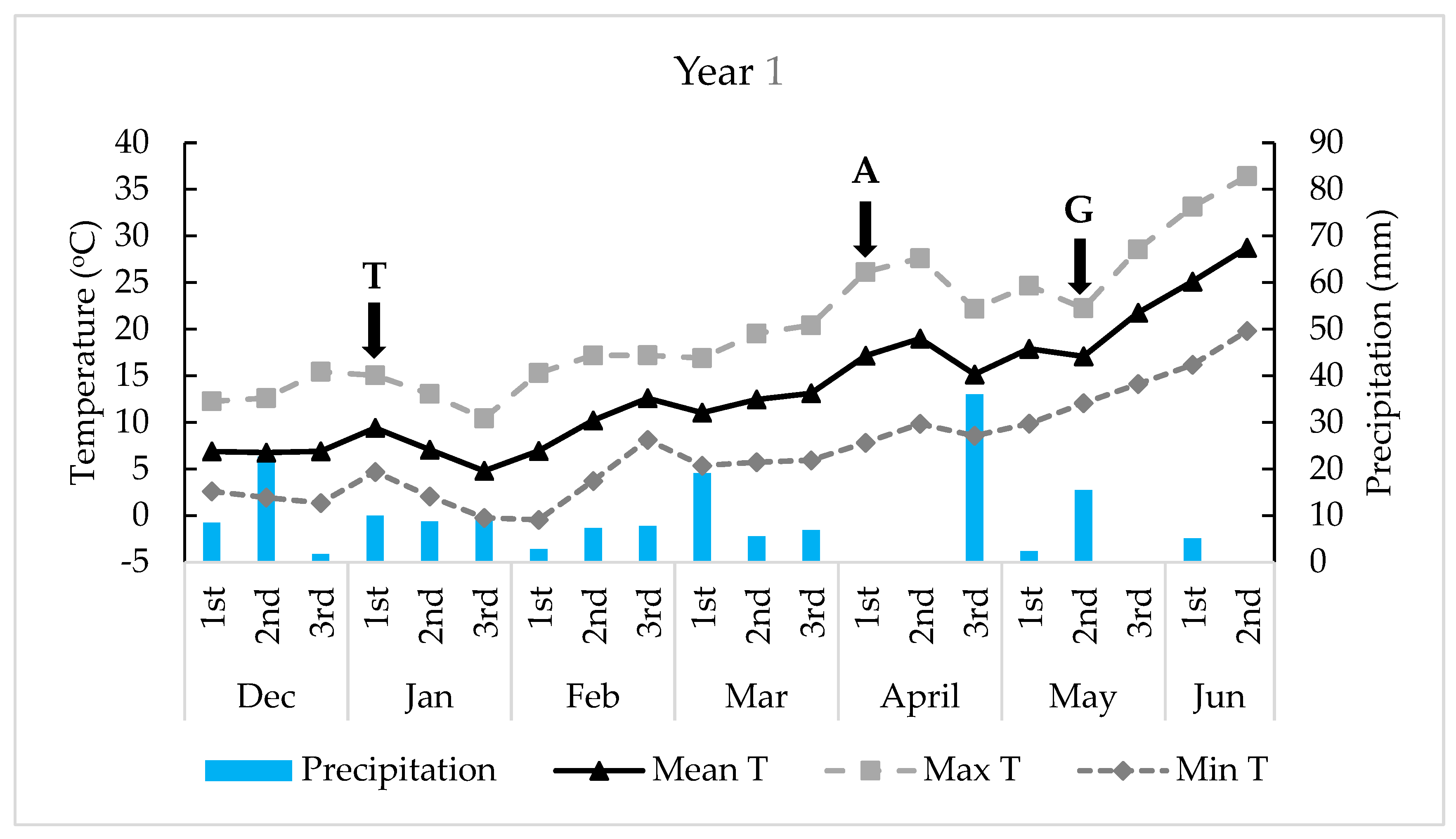
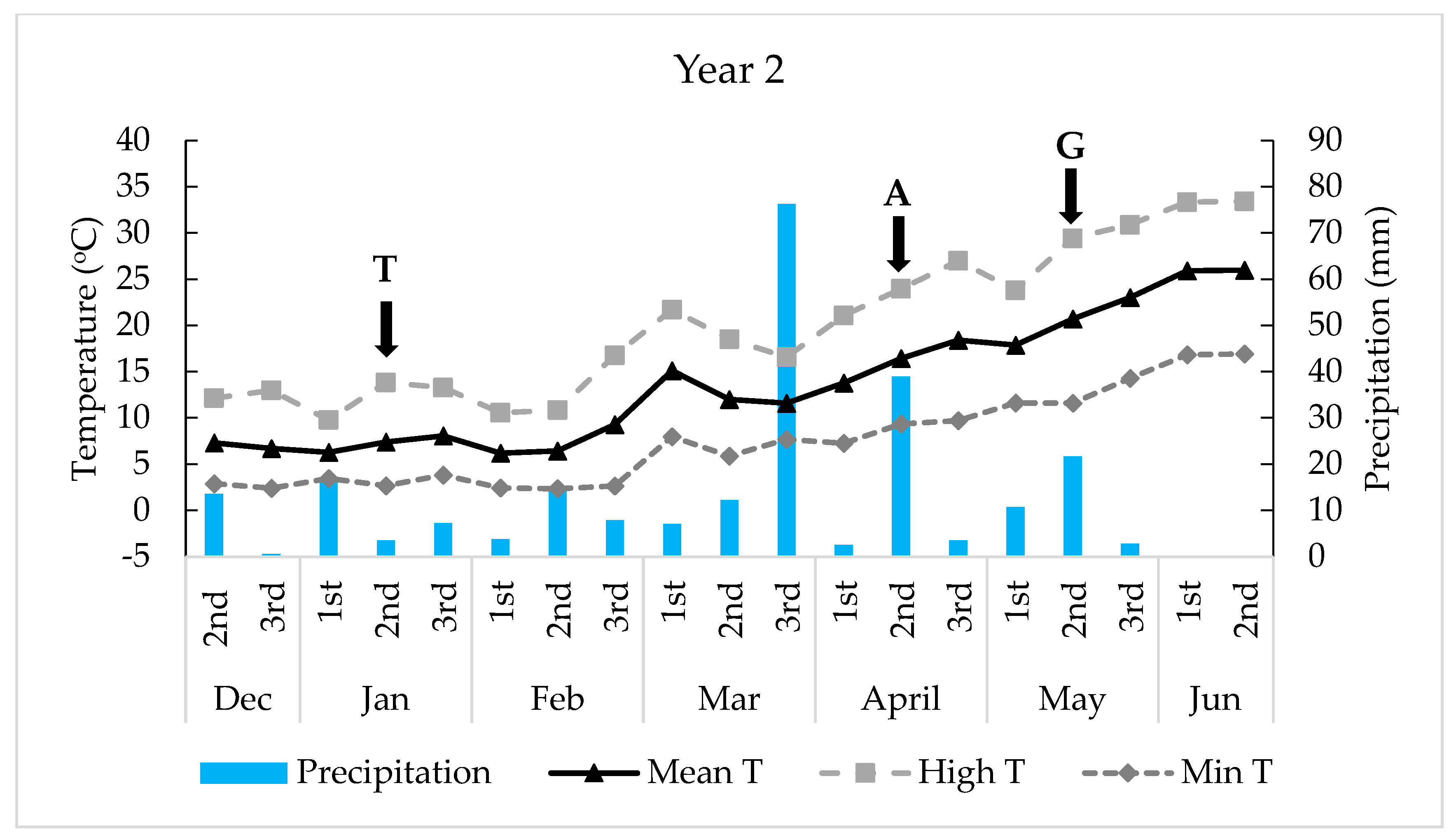
In Year 1, total precipitation reached 170.2 mm, with most rainfall concentrated in March and especially during the third ten-day period of April (36 mm). By contrast, Year 2 experienced significantly higher rainfall (243.4 mm), largely due to an unusually intense rainfall event in late March (76.3 mm in a single ten-day interval), which contributed disproportionately to the seasonal total (Figure 1).
Temperature trends aligned with the typical pattern of the region, with low winter minima and a steady increase toward late spring. Mean temperatures in Year 1 ranged from 4.81 °C to 28.74 °C, whereas in Year 2 they ranged from 6.18 °C to 25.98 °C (Figure 2). The wider range between minimum and maximum temperatures during spring in both seasons highlights a period of considerable thermal variation, which is physiologically important given that stem elongation and grain filling are highly sensitive developmental stages.

3.2. Yield-Related Traits

The analysis indicated that both year and tillage system significantly affected aboveground biomass (AB), grain yield (GY), and most yield components (Table 1). A strong Year × Treatment interaction further indicates that the relative performance of tillage systems varied depending on seasonal conditions.
Across both years, conventional tillage (CT) produced the highest aboveground biomass and grain yield. In Year 1, CT yielded 8.43 t ha−1 of aboveground biomass and 4.77 t ha−1 of grain, significantly surpassing DH, though it did not differ from NT1 and NT2 (Table 1). In Year 2, when environmental conditions were more favorable, CT again led all treatments, reaching the highest values, 12.15 t ha−1 and 6.34 t ha−1 for aboveground biomass and grain yield, respectively. The number of spikes m−2 followed a similar pattern, with CT achieving the highest values of spikes m−2 in both years (Table 1).
The two no-tillage systems (NT1 and NT2) performed well consistently and, in several cases, approached the yields of CT. In Year 1, NT1 and NT2 produced the highest values for TGW and grains spike−1, reaching 58.28 g and 58.07 g for TGW and 29 grains spike−1 for both treatments, respectively. Their aboveground biomass and grain yield, although ranged at lower levels compared to CT, did not differ statistically significantly and clearly outperformed DH and CP (Table 1). In Year 2, on NT1 and NT2, biomass, yield, and spike density increased compared to the previous growing season but the lowest values among the other three treatments were recorded. Between NT1 and NT2, NT1 demonstrated higher values in terms of yield characteristics (Table 1).
The chisel plough (CP) system exhibited an intermediate performance profile. In Year 1, its aboveground biomass, yield and spike density were lower than CT, NT1 and NT2, without differences (Table 1). Moreover, it demonstrated higher aboveground biomass, yield, and spike density than DH, with statistically significant differences only in spike density. In Year 2, differences among reduced-tillage systems were smaller, and CP’s performance converged with NT and DH. TGW under CP remained moderate across both seasons (Table 1).
The disc harrow (DH) system showed the lowest values for all quantitative traits except for TGW (Table 1). It consistently produced the lowest aboveground biomass and grain yield, particularly in Year 1 (3.36 t ha−1). Spike density was also lowest, indicating reduced tillering capacity. Although TGW under DH exceeded that of CT in Year 1, it remained below that of NT1 and NT2. In Year 2, aboveground biomass, yield, and spike density increased significantly, making it the third most productive treatment (Table 1).

3.3. Grain Quality Traits

The qualitative analysis revealed significant effects of both year and tillage treatment on all evaluated grain-quality parameters, including grain protein content (GPC), maltable fraction, retention fraction, and grain plumpness (>2.8 mm and >3.0 mm) (Table 2).
CT consistently produced the lowest GPC, 8.99% and 9.86% for Year 1 and Year 2, respectively, failing to reach the desired threshold of 9.2% in the first growing season. However, these lower protein concentrations were accompanied by reduced proportions of larger grains, especially in Year 2, where 48.05% of grains exceeded 2.8 mm, compared with 54.69% in Year 1. The maltable fraction, while high in Year 1 (97.65%), declined to 88.65% in Year 2, and similarly the retention fraction decreased from 87.95% to 80.15%, failing to reach the desirable levels for malting, underscoring the influence of year-to-year climatic variation and the higher yields.
The two no-tillage systems recorded the highest GPC values (up to 11.02%), yet remained within acceptable limits in both years, a typical response attributed to nutrient stratification in undisturbed soils. Despite these elevated levels, NT systems showed excellent grain size performance in Year 1, delivering high proportions of large grains (>2.8 mm: 64.86–68.78% for NT1 and NT2, respectively). Although grain size decreased in Year 2 across all treatments, the NT systems retained values comparable to CP, CT and DH. Notably, their maltable and retention fraction percentages reached the desirable levels, with 94.24% and 93.27% for NT1 and NT2, respectively, indicating that the elevated GPC did not compromise malting suitability under the conditions examined.
DH and CP displayed comparatively strong grain-size characteristics. In Year 1, DH produced 65.68% of grains > 2.8 mm and more than 40.23% >3.0 mm, values among the highest in the study. CP performed similarly to DH and, in some cases, exceeded it, achieving 69.59% and 40.96% of grains greater than 2.8 mm and 3.0 mm, respectively, with no significant differences. GPC in both systems remained within the desirable malting range (Table 2). In contrast, in Year 2, DH showed higher values than CP, reaching 60.70% and 30.42% compared with 57.81% and 28.18% for grains greater than 2.8 mm and 3.0 mm, respectively (Table 2). The maltable and retention fractions in both growing seasons for CP and DH reached the desirable levels for malting.

3.4. Environmental Impact (GHG Emissions and Carbon Footprint)

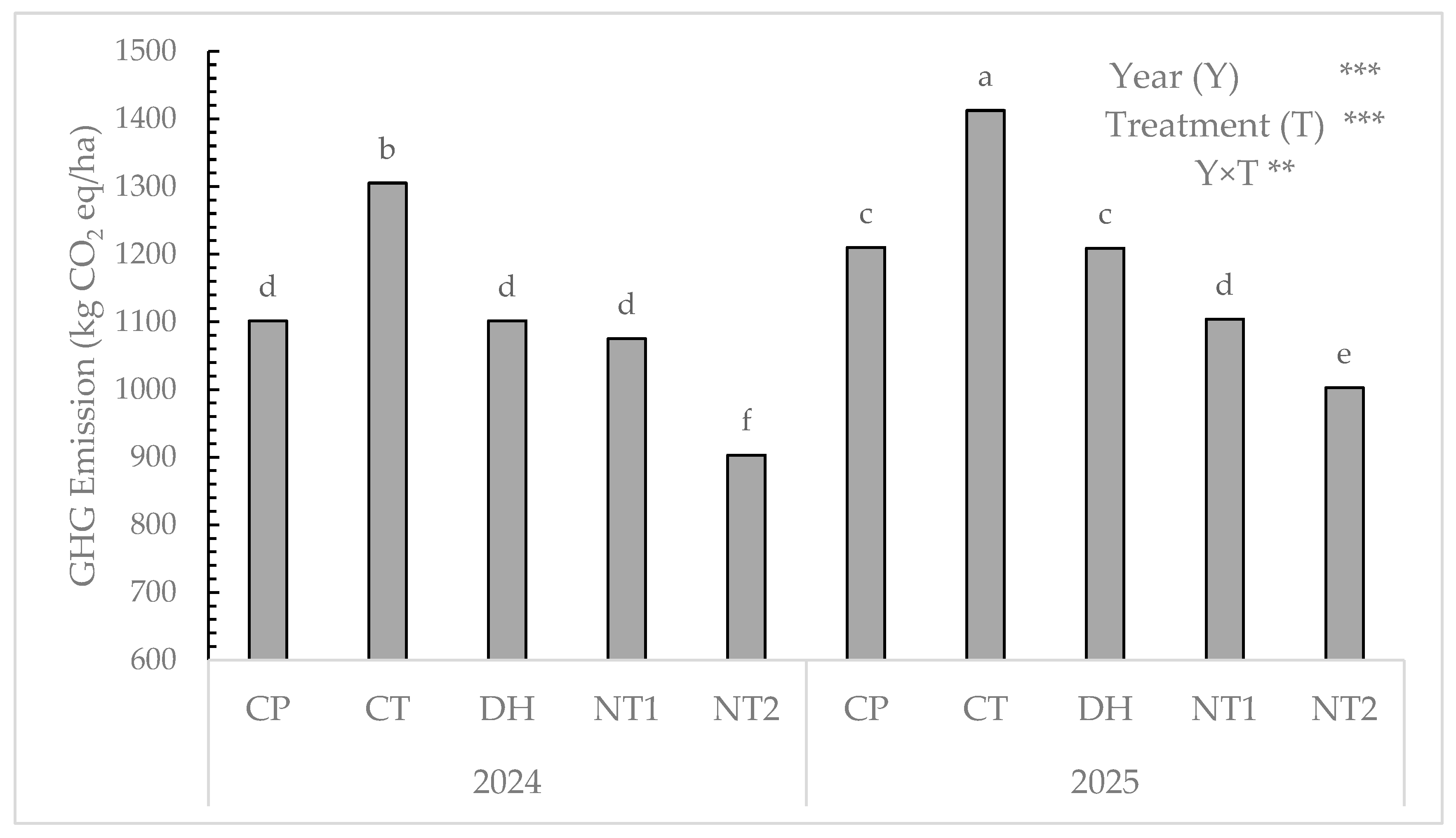
Greenhouse gas (GHG) emissions differed significantly among tillage systems and between growing seasons (Figure 3; Supplementary Table S1). In both years, conventional tillage (CT) generated the highest emissions, reaching approximately 1305 kg CO2 eq ha−1 in 2024 and 1412.5 kg CO2 eq ha−1 in 2025. All alternative tillage systems reduced emissions relative to CT, although the magnitude of reduction varied among treatments. Compared with CT, CP and DH resulted in similar and relatively moderate emission reductions (−15.6 to −14.3%) across both years, indicating a stable but limited mitigation effect. NT1 achieved greater reductions, particularly in 2025 (−21.8%), suggesting an enhanced environmental benefit under longer-term soil disturbance reduction. The largest and most consistent decreases were recorded under NT2, with GHG emissions reduced by 30.8% in 2024 and 29.0% in 2025 relative to CT (Figure 3; Supplementary Table S1).
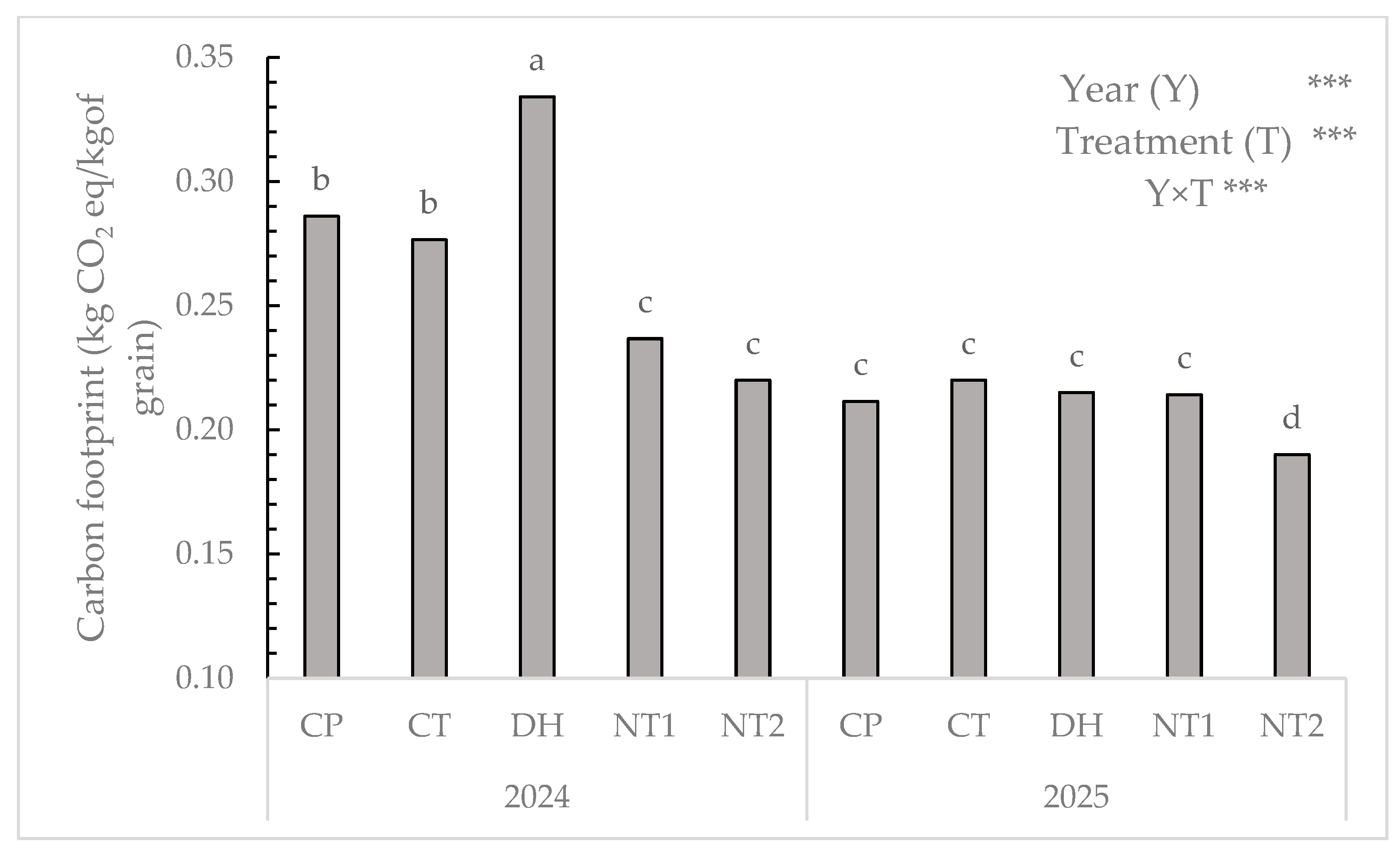
The carbon footprint per unit of grain exhibited a different pattern, reflecting the interaction between emissions and yield (Figure 4; Supplementary Table S1). In 2024, DH showed the highest carbon footprint, exceeding CT by 17.9%, despite lower absolute emissions, due to its reduced grain yield. In contrast, CP showed a slight increase in carbon footprint relative to CT in 2024 (+3.6%), while NT1 and NT2 achieved substantial reductions (−14.3% and −21.4%, respectively). In 2025, higher yields across all systems led to a general decline in carbon footprint. Under these conditions, CP, NT1, and NT2 reduced the carbon footprint by 4.6%, 4.6%, and 13.6%, respectively, compared with CT, whereas DH exhibited a footprint comparable to CT (Supplementary Table S1). The significant Year × Treatment interaction indicates that the effect of tillage systems on carbon footprint differed between the two growing seasons. In particular, the reduction in carbon footprint under no-tillage systems was more pronounced in the first year, while in the second year higher yields across treatments contributed to a general decline in yield-scaled emissions. Overall, NT2 consistently achieved the lowest carbon footprint in both years (0.22 and 0.19 kg CO2 eq kg−1), highlighting the superior environmental efficiency of this system across contrasting seasonal conditions.

4. Discussion

The results demonstrated that soil tillage systems exerted a significant influence on both productive and qualitative traits of malting barley, as well as on the environmental footprint of the crop. These outcomes are in strong agreement with previous research reporting that tillage intensity shapes crop performance and alters GHG emissions in soil systems [7,23,24,29]. In addition, the marked year-to-year variation observed in the current study confirms the pivotal role of climatic conditions during the growing seasons, further supporting the findings of earlier studies that highlight the sensitivity of barley yield and quality to environmental fluctuations [9,32].
The two growing seasons differed substantially in terms of total precipitation, with Year 2 receiving much higher rainfall (243.4 mm) compared to Year 1 (170.2 mm). The exceptionally high concentration of rainfall in March of Year 2, particularly the 76.3 mm during the third ten-day period (Figure 2), coincided with the stem elongation and spike formation stages, phases that are highly sensitive for malting barley. Adequate moisture during these stages is likely to enhance spikelet initiation, spike fertility, and consequently grain number [36,37,38,39], findings that are in agreement with the present study (Table 1). At the same time, this factor, combined with the overall higher rainfall, likely contributed to the increased aboveground biomass, grain yield, spike density and number of grains per spike observed in Year 2 across all tillage systems in malting barley (Hordeum vulgare L.) crops.
Conversely, in Year 1, temperatures during the grain-filling stage were lower (Figure 1), which likely prolonged the grain-filling duration and led to the production of larger grains, thus increasing both TGW and grain plumpness. These findings agree with the literature, which indicates that lower temperatures during grain filling prolong assimilate deposition, resulting in heavier and better-filled grains [40,41,42]. In contrast, drought during the late grain-filling stages limits the translocation of carbohydrates into the grain. Under such conditions, the total nitrogen content of the grain remains largely unchanged; however, grain size decreases because starch deposition is inhibited more strongly than nitrogen accumulation. Previous studies have shown that starch synthesis is far more vulnerable to post-anthesis stress than nitrogen incorporation, leading to smaller grains even when nitrogen content remains nearly unchanged [40,43,44,45].
In addition to climatic variability, the difference in the previous crop between the two growing seasons may have influenced the observed year effect. During the first season the previous crop was winter wheat, whereas in the second season it was vetch, a nitrogen-fixing legume. Legume residues are known to increase soil nitrogen availability through biological nitrogen fixation and residue mineralization [46,47], which may partially explain the higher grain yield and grain protein levels observed in Year 2. Therefore, the observed interannual differences likely reflect the combined influence of meteorological conditions and rotational effects. It should be noted that soil mineral nitrogen was not measured at the beginning of each growing season. Such measurements would have provided additional insight into nitrogen availability, particularly considering the contrasting previous crops (winter wheat in Year 1 and vetch in Year 2).
Across both years, the conventional tillage system (CT) provided the highest aboveground biomass production, grain yield, and spike density in both years. This superiority is in agreement with previous research indicating that intensive soil disturbance enhances early root development [48,49], improves seedbed uniformity [50], and promotes vigorous tillering [27,50], ultimately supporting higher yield potential [27,48,49,50,51]. However, despite exhibiting higher values for the productive traits, CT did not demonstrate stability across the two years and was highly dependent on environmental conditions, in agreement consistent with finding reported in the literature [52,53]. At the same time, the environmental and qualitative outcomes indicate that such advantages may come at a cost, as recent studies in malting barley have shown that increases in grain yield often lead to a deterioration of key quality traits, including grain plumpness, protein balance and malting performance, due to the physiological trade-offs associated with intensive production [33,54].
The reduced- and no-tillage systems revealed distinct and contrasting characteristics. No-tillage (NT1-long term and NT2-short term) maintained yield levels comparable to CT in the first year and only slightly lower in the second, despite the absence of soil disturbance. No-tillage (NT1 and NT2) maintained yield levels comparable to CT in the first year and only slightly lower in the second, despite the absence of soil disturbance.
This performance is consistent with previous findings indicating that no-tillage frequently achieves yield parity with conventional tillage under favorable climatic conditions. According to Pittelkow et al. [1], global analysis evidence shows that no-tillage commonly maintains 95–100% of CT yield potential in temperate environments. Similarly, long-term experiments in northern Europe reported by Arvidsson et al. [27] demonstrated that no-tillage often produces yields equal to those obtained under conventional tillage, with yield differences arising primarily in years with unfavorable weather conditions. Notably, NT systems consistently exhibited higher TGW, a response commonly associated with improved soil moisture conservation and a more stable grain-filling process under reduced soil disturbance. By retaining surface residues and limiting evaporation, NT sustains moisture availability and moderates temperature stress during grain filling, conditions especially advantageous in drier periods such as Year 1. Recent studies confirm that conservation and no-tillage practices enhance soil water-use efficiency and promote more stable grain filling in barley and wheat under moisture-limited Mediterranean environments, thereby supporting larger grain size [18,55,56]. Dolijanović et al. [55] demonstrated that conservation tillage enhances soil water retention and reduces evaporative losses across European environments, outcomes strongly linked to increased grain weight and plumpness. Similarly, Chandra et al. [18] reported that reduced and no-tillage practices improve soil biological activity and moisture conservation leading to enhanced barley productivity, while Perera et al. [56] emphasized that limiting soil disturbance reinforces crop resilience under drought and heat stress.
From a qualitative perspective, the NT systems exhibited the highest grain protein content (GPC), a response that can be attributed to nitrogen stratification near the soil surface under no-till management. Reduced soil disturbance favors the accumulation of mineral and organic nitrogen in the upper soil layers, enhancing N availability during grain filling and consequently increasing protein concentration [57]. This interpretation is supported by recent evidence showing that no-tillage improves nitrogen uptake efficiency in crops [58,59] and that reduced-tillage systems enhance soil fertility by enriching surface layers in nitrate, ammonium and organic N under Mediterranean conditions [60,61]. Although elevated protein levels can limit malting suitability, the NT systems compensated with excellent grain plumpness and consistently high maltable quality, which remained unaffected by the increased GPC. This is consistent with recent studies showing that malting performance is strongly influenced not only by grain protein concentration but also by grain plumpness, with optimal malting typically achieved when GPC lies within approximately 9.2–11.5% [24,62,63]. In contrast, grain protein concentration under conventional tillage in Year 1 reached 8.99%, which is slightly below the commonly accepted lower threshold for malting barley. Protein levels below approximately 9.2% may limit enzymatic activity during the malting process, indicating a potential risk of suboptimal malting quality under intensive tillage conditions in certain environments. Moreover, larger and well-filled grains are known to offset some of the adverse effects associated with moderately elevated protein levels by improving hydration, modification efficiency, and extract yield during malting [64]. Collectively, these findings suggest that NT systems can sustain or even enhance key grain quality traits relevant to the malting industry, provided that protein concentrations remain below the generally accepted threshold of approximately 11.5%.
Despite the contrasting environmental conditions, NT1 and NT2 exhibited remarkable stability, underscoring the robustness of these systems in maintaining both productive and qualitative traits across years. This is consistent with Cooray et al. [5], who demonstrated that conservation and no-tillage systems sustain high mean yields while reducing year-to-year yield variability, owing to enhanced soil moisture retention, improved soil structure and lower dependence on favourable weather conditions. These attributes contribute to greater production stability and reduced climate risk, in line with the performance observed in this study. Similarly, conservation tillage has been shown to improve water-use efficiency and buffer yield variations under drought-prone conditions [56]. Long-term assessments further demonstrate that conservation agriculture enhances oil structural integrity, increases soil organic carbon and microbial biomass, and supports stable crop productivity even under warming or highly variable climatic conditions [65]. Complementary results from no-till systems in semi-arid regions show improved soil quality, better moisture retention, and enhanced resilience to environmental stress, contributing to greater yield stability [66]. These patterns are consistent with long-term European data demonstrating that no-tillage yields remain stable over decades, with deviations occurring mainly in years with extreme weather [13,27], as well as global meta-analytic evidence showing that conservation agriculture practices generally sustain stable yields across temperate environments [1,66].
Intermediate responses were observed under the CP and DH systems, which produced moderate yields and favorable grain-size characteristics, positioning them between CT and NT. CP, in particular, showed a stable retention fraction and consistently high proportions of grains >2.8 mm, indicating that moderate soil disturbance can balance productivity and grain-quality preservation. Recent findings show that chiseling enhances soil structure and water infiltration [4,67], while moderate tillage practices can also improve infiltration and moisture availability compared with intensive tillage [17]. These hydrological advantages likely contributed to the strong grain-size performance of CP under the wetter conditions of Year 2.
The environmental data further underscored the influence of soil management intensity. CT generated the highest greenhouse gas (GHG) emissions in both years, whereas NT2 consistently produced the lowest emissions, achieving reductions of approximately 30.8% and 29.02% compared with CT in Year 1 and Year 2, respectively. In addition, the clayey nature of the soil at the experimental site may have further influenced greenhouse gas emissions under wetter conditions. Clay soils tend to retain higher amounts of water and exhibit lower gas diffusivity, which can reduce soil aeration and promote denitrification processes, potentially increasing N2O emissions during periods of high soil moisture. Similar relationships between tillage intensity, soil conditions and greenhouse gas emissions in barley-based systems have also been reported in recent studies [29]. These results are consistent with recent analytical and long-term evidence demonstrating that no-tillage substantially reduces fuel use, CO2 efflux, and overall GHG emissions without compromising yield [29,68,69,70]. The carbon footprint followed a complementary pattern: although absolute emissions increased in Year 2, the footprint per kilogram of grain declined due to higher yields, aligning with studies showing that yield-scaled emissions decrease as production efficiency improves [71]. Moreover, conservation-tillage systems have been shown to enhance soil organic carbon sequestration and improve environmental performance across diverse cropping systems [72,73]. Even under these contrasting conditions, NT2 maintained the lowest carbon footprint across years, reinforcing the environmental advantage of no-tillage under both favorable and unfavorable climatic scenarios. The lower carbon footprint estimated for the short-term no-tillage system (NT2) compared with the long-term no-tillage system (NT1) may partly reflect methodological characteristics of carbon accounting tools such as the Cool Farm Tool. These models typically assign carbon sequestration credits during the transition from conventional or reduced tillage to no-tillage systems. In contrast, long-term no-tillage systems are often assumed to have reached a near-equilibrium level of soil organic carbon, and therefore additional sequestration credits are not allocated. As a result, recently adopted no-tillage systems may appear to have lower carbon footprints than long-established systems, even though the latter may already maintain higher and more stable soil carbon stocks despite similar agronomic inputs (fuel, fertilizers and crop protection products). In particular, NT1 represents a long-term no-tillage system in which soil organic carbon stocks have largely reached equilibrium after more than three decades of continuous no-till management, whereas NT2 corresponds to a short-term transition to no-tillage, during which soil carbon sequestration is still actively increasing. Long-term studies have shown that soil organic carbon accumulation under no-tillage follows a saturation trajectory and gradually approaches a steady state over time [74,75].
The Cool Farm Tool quantifies soil carbon sequestration only when a change in soil management practice occurs (e.g., from conventional or reduced tillage to no-tillage), while long-established systems without recent management change are assumed to be at steady-state and therefore receive no additional carbon sequestration credit. Consequently, NT1 appears to have higher net CO2 emissions, not because the practice is environmentally inferior, but because the tool does not account for the long-term maintenance of elevated soil organic carbon stocks. In contrast, NT2 is credited for the ongoing transition towards reduced soil disturbance, resulting in lower calculated emissions. Similar limitations have been highlighted in soil carbon monitoring, reporting and verification frameworks, which tend to reward management changes rather than the persistence of conservation practices [76].
This methodological limitation, which has been widely discussed within the scientific community, highlights an important inconsistency in carbon accounting approaches that prioritize additionality over system stability. Such frameworks may underestimate the environmental value of long-term conservation practices and inadvertently favor short-term transitions, despite the well-documented benefits of sustained no-tillage for soil fertility, carbon storage and climate resilience [77,78]. Therefore, while the Cool Farm Tool is highly relevant for assessing carbon credits linked to management changes, caution is required when interpreting its outputs as indicators of overall environmental performance.
In conclusion, the results reveal a clear trade-off between agricultural productivity, grain quality, and environmental sustainability. Conventional tillage (CT) maximizes yield but imposes the highest environmental burden and produces smaller grains. In contrast, no-tillage (NT) systems reduce emissions and improve grain plumpness while maintaining competitive yields but may increase protein levels. Conservation practices (CPs) represent intermediate, stable options that balance productivity with environmental stewardship. These patterns are consistent with broader evidence indicating that tillage intensity governs fundamental soil processes, with reduced or simplified tillage enhancing soil organic carbon and biological functioning whereas plough-based systems accelerate organic matter mineralisation and carbon losses [57]. The integration of meteorological data strengthens these interpretations by how precipitation distribution and temperature variability modulate the expression of tillage effects.
Overall, the study highlights that no-tillage, particularly NT2, offers the most balanced strategy, combining environmental benefits with stable and satisfactory quantitative and qualitative performance. These findings support the adoption of conservational and no-till systems in malting barley production, particularly in regions where sustainability, resilience, and resource-efficient agriculture are increasingly prioritized. However, it should be noted that the results are based on two growing seasons and may partly reflect the specific meteorological conditions of the experimental period. Additional multi-year observations would further improve the understanding of the long-term stability of the observed agronomic and environmental responses.

5. Conclusions

This study demonstrates that soil tillage intensity significantly affects the agronomic performance, grain-quality traits, and the environmental footprint of malting barley under Mediterranean climatic conditions. Conventional tillage produced the highest grain yield, reaching up to 6.34 t ha−1, and the greatest aboveground biomass, but resulted in lower thousand-grain weight and reduced grain plumpness. In contrast, no-tillage systems produced slightly lower yields (4.3–5.2 t ha−1) but significantly higher thousand-grain weight (up to 58.3 g) and acceptable grain protein levels (10.4–11.0%), remaining within the typical malting quality thresholds. From an environmental perspective, the modeled results based on the Cool Farm Tool indicated lower greenhouse gas emissions and carbon footprint under no-tillage systems compared with conventional tillage. The short-term no-tillage system (NT2) showed the lowest carbon footprint (0.19–0.22 kg CO2 eq kg−1 grain), corresponding to estimated reductions of approximately 29–31% in total GHG emissions relative to conventional tillage.
Overall, the results indicate that no-tillage systems may provide a balanced strategy for malting barley production under Mediterranean rainfed conditions, combining competitive yield levels with improved grain-size characteristics and lower environmental impact. However, the findings are based on two growing seasons and may partly reflect the specific meteorological conditions during the study period. Future research should include longer-term experiments, direct measurements of greenhouse gas emissions, and the evaluation of additional barley cultivars to further assess the agronomic and environmental performance of conservation tillage systems under Mediterranean conditions. These findings suggest that conservation-based soil management strategies, including no-tillage systems, may represent a promising approach for malting barley systems where productivity, grain quality and environmental performance need to be jointly considered.

Supplementary Materials

The following supporting information can be downloaded at: https://www.mdpi.com/article/10.3390/su18062956/s1, Table S1: Percentage change (%) in greenhouse gas (GHG) emissions and carbon footprint of tillage systems relative to conventional tillage (CT).

Author Contributions

Conceptualization, C.C. and C.K.; methodology, K.D.G. and P.P.; formal analysis, L.O.L.; investigation, L.O.L.; resources, C.C., C.K. and V.K.; data curation, L.O.L.; writing—original draft preparation, L.O.L.; writing—review and editing, L.O.L., K.D.G. and C.C.; visualization, L.O.L.; supervision, G.E. and P.P.; project administration, G.E. All authors have read and agreed to the published version of the manuscript.

Funding

This research was funded by CLIMPACT (support for enhancing the operation of the National Network for Climate Change), financed by the National Development Program, General Secretariat of Research and Innovation, Greece (2023NA11900001).

Institutional Review Board Statement

Not applicable.

Informed Consent Statement

Not applicable.

Data Availability Statement

The original contributions presented in this study are included in the article/Supplementary Materials. Further inquiries can be directed to the corresponding author.

Conflicts of Interest

Author Vasileios Kotoulas was employed by the company Athenian Brewery SA. The remaining authors declare that the research was conducted in the absence of any commercial or financial relationships that could be construed as a potential conflict of interest.

Abbreviations

The following abbreviations are used in this manuscript:
CTConventional Tillage
DHDisc Harrow
CPChisel Plough
NT1Long-term No-Tillage (30 years)
NT2Short-term No-Tillage (3–4 years)
TGWThousand-Grain Weight
GPCGrain Protein Content
ANOVAAnalysis of Variance
CFTCool Farm Tool
GHGGreenhouse Gas(es)
CO2 eqCarbon Dioxide Equivalent

References

  1. Pittelkow, C.M.; Linquist, B.A.; Lundy, M.E.; Liang, X.; van Groenigen, K.J.; Lee, J.; van Gestel, N.; Six, J.; Venterea, R.T.; van Kessel, C. When does no-till yield more? A global meta-analysis. Field Crops Res. 2015, 183, 156–168. [Google Scholar] [CrossRef]
  2. Blanco-Canqui, H.; Ruis, S.J. No-tillage and soil physical environment. Geoderma 2018, 326, 164–200. [Google Scholar] [CrossRef]
  3. Brennan, J.; Forristal, P.D.; McCabe, T.; Hackett, R. The effect of soil tillage system on the nitrogen uptake, grain yield and nitrogen use efficiency of spring barley in a cool Atlantic climate. J. Agric. Sci. 2015, 153, 862–875. [Google Scholar] [CrossRef]
  4. Blanco-Canqui, H.; Wienhold, B.J.; Jin, V.L.; Schmer, M.R.; Kibet, L.C. Long-term tillage impact on soil hydraulic properties. Soil Tillage Res. 2017, 170, 38–42. [Google Scholar] [CrossRef]
  5. Cooray, A.; Rejesus, R.M.; Aglasan, S.; Li, Z.; Woodley, A. The impact of conservation tillage intensities on mean yields and yield risk. Soil Secur. 2024, 14, 100126. [Google Scholar] [CrossRef]
  6. Murindangabo, Y.T.; Kopecký, M.; Konvalina, P.; Ghorbani, M.; Perná, K.; Nguyen, T.G.; Bernas, J.; Baloch, S.B.; Hoang, T.N.; Eze, F.O.; et al. Quantitative Approaches in Assessing Soil Organic Matter Dynamics for Sustainable Management. Agronomy 2023, 13, 1776. [Google Scholar] [CrossRef]
  7. Cavalaris, C.; Gemtos, T.; Karamoutis, C. Rotational tillage practices to deal with soil compaction in carbon farming. Soil Syst. 2023, 7, 90. [Google Scholar] [CrossRef]
  8. Schwengbeck, L.; Hölting, L.; Witing, F. Modeling climate regulation of arable soils in Northern Saxony under the influence of climate change and management practices. Sustainability 2023, 15, 11128. [Google Scholar] [CrossRef]
  9. Saretto, F.; Roy, B.; Coelho, R.E.; Reder, A.; Fedele, G.; Oakes, R.; Brandimarte, L.; Lourenço, T.C. Impacts of Climate Change and Adaptation Strategies for Rainfed Barley Production in the Almería Province, Spain. Atmosphere 2024, 15, 606. [Google Scholar] [CrossRef]
  10. Stamou, A.; Bakousi, A.; Dosiou, A.; Tsifodimou, Z.-E.; Karachaliou, E.; Tavantzis, I.; Stylianidis, E. Mapping Drought Incidents in the Mediterranean Region with Remote Sensing: A Step Toward Climate Adaptation. Land 2025, 14, 1564. [Google Scholar] [CrossRef]
  11. Martin-Candilejo, A.; Martin-Carrasco, F.J.; Iglesias, A.; Garrote, L. Heading into the Unknown? Exploring Sustainable Drought Management in the Mediterranean Region. Sustainability 2024, 16, 21. [Google Scholar] [CrossRef]
  12. Ruisi, P.; Giambalvo, D.; Saia, S.; Di Miceli, G.; Frenda, A.S.; Plaia, A.; Amato, G. Conservation tillage in a semiarid Mediterranean environment: Results of 20 years of research. Ital. J. Agron. 2014, 9, 560. [Google Scholar] [CrossRef]
  13. Cicek, H.; Kim, I.; Blanco-Moreno, J.M.; Urrutia Larrachea, I.; Cheikh M’hamed, H.; Gultekin, I.; Ouabbou, H.; El Abidine, A.Z.; Schoeber, M.; El Gharras, O.; et al. Strategic Tillage in the Mediterranean: No Universal Gains, Only Contextual Outcomes. Environments 2025, 12, 422. [Google Scholar] [CrossRef]
  14. Liang, X.; Rehman, S.U.; Zhiqi, W.; Raza, M.A.; Haider, I.; Bin Khalid, M.H.; Saeed, A.; Iqbal, Z.; Fatima, S.; Siddiqa, A.; et al. Impacts of Conservation Tillage on Agricultural Land Development: A Review. J. Soil Sci. Plant Nutr. 2024, 25, 428–449. [Google Scholar] [CrossRef]
  15. Peixoto, D.S.; Silva, L.C.M.D.; de Melo, L.B.B.; Azevedo, R.P.; Araújo, B.C.L.; de Carvalho, T.S.; Moreira, S.G.; Curi, N.; Silva, B.M. Occasional tillage in no-tillage systems: A global meta-analysis. Sci. Total Environ. 2020, 745, 140887. [Google Scholar] [CrossRef] [PubMed]
  16. Liu, H.; Crawford, M.; Carvalhais, L.C.; Dang, Y.P.; Dennis, P.G.; Schenk, P.M. Strategic tillage on a Grey Vertosol after fifteen years of no-till management had no short-term impact on soil properties and agronomic productivity. Geoderma 2016, 267, 146–155. [Google Scholar] [CrossRef]
  17. Amami, R.; Ibrahimi, K.; Sher, F.; Milham, P.; Ghazouani, H.; Chehaibi, S.; Hussain, Z.; Iqbal, H.M.N. Impacts of Different Tillage Practices on Soil Water Infiltration for Sustainable Agriculture. Sustainability 2021, 13, 3155. [Google Scholar] [CrossRef]
  18. Chandra, P.; Khippal, A.K.; Prajapat, K.; Barman, A.; Singh, G.; Rai, A.K.; Ahlawat, O.P.; Verma, R.P.S.; Kumari, K.; Singh, G. Influence of tillage and residue management practices on productivity, sustainability, and soil biological properties of rice-barley cropping systems in Indo-Gangetic Plain of India. Front. Microbiol. 2023, 14, 1130397. [Google Scholar] [CrossRef] [PubMed]
  19. Busari, M.A.; Kukal, S.S.; Kaur, A.; Bhatt, R.; Dulazi, A.A. Conservation tillage impacts on soil, crop and the environment. Int. Soil Water Conserv. Res. 2015, 3, 119–129. [Google Scholar] [CrossRef]
  20. Akhtar, K.; Wang, W.; Ren, G.; Khan, A.; Feng, Y.; Yang, G.; Wang, H. Integrated use of straw mulch with nitrogen fertilizer improves soil functionality and soybean production. Environ. Int. 2019, 132, 105092. [Google Scholar] [CrossRef] [PubMed]
  21. Dachraoui, M.; Sombrero, A. Effect of tillage systems and different rates of nitrogen fertilisation on the carbon footprint of irrigated maize in a semiarid area of Castile and Leon, Spain. Soil Tillage Res. 2020, 196, 104472. [Google Scholar] [CrossRef]
  22. Gajda, A.M.; Czyż, E.A.; Klimkowicz-Pawlas, A. Effects of Different Tillage Intensities on Physicochemical and Microbial Properties of a Eutric Fluvisol Soil. Agronomy 2021, 11, 1497. [Google Scholar] [CrossRef]
  23. van Kessel, C.; Venterea, R.; Six, J.; Adviento-Borbe, M.A.; Linquist, B.; van Groenigen, K.J. Climate, duration, and N placement determine N2O emissions in reduced tillage systems: A meta-analysis. Glob. Change Biol. 2013, 19, 33–44. [Google Scholar] [CrossRef] [PubMed]
  24. De Santis, M.A.; Cammarano, D. Agronomic management factors impacting yield, quality stability, and environmental footprints of barley in a Mediterranean environment. Field Crops Res. 2024, 309, 109334. [Google Scholar] [CrossRef]
  25. McPheeters, D.; Bruns, M.A.; Karsten, H.D.; Dell, C.J. Integrated weed management with strategic tillage can maintain soil quality in continuous living cover systems. Front. Sustain. Food Syst. 2022, 6, 907590. [Google Scholar] [CrossRef]
  26. Soane, B.D.; Ball, B.C.; Arvidsson, J.; Basch, G.; Moreno, F.; Roger-Estrade, J. No-till in northern, western and south-western Europe: A review of problems and opportunities for crop production and the environment. Soil Tillage Res. 2012, 118, 66–87. [Google Scholar] [CrossRef]
  27. Arvidsson, J.; Etana, A.; Rydberg, T. Crop yield in Swedish experiments with shallow tillage and no-tillage 1983–2012. Eur. J. Agron. 2014, 52, 307–315. [Google Scholar] [CrossRef]
  28. Abdalla, K.; Chivenge, P.; Ciais, P.; Chaplot, V. No-tillage lessens soil CO2 emissions the most under arid and sandy soil conditions: Results from a meta-analysis. Biogeosciences 2016, 13, 3619–3633. [Google Scholar] [CrossRef]
  29. Bogale, A.A.; Kende, Z.; Tarnawa, A.; Miko, P.; Birkás, M.; Kovács, G.P.; Percze, A. Precision nutrient and soil tillage management for sustainable winter barley production (Hordeum vulgare L.) and tillage impact on soil CO2 emission. Agronomy 2025, 15, 2. [Google Scholar] [CrossRef]
  30. Asres, T.; Tadesse, D.; Wossen, T.; Sintayehu, A. Performance Evaluation of Malt Barley: From Malting Quality and Breeding Perspective. J. Crop Sci. Biotechnol. 2018, 21, 451–457. [Google Scholar] [CrossRef]
  31. Vahamidis, P.; Stefopoulou, A.; Kotoulas, V.; Bresta, P.; Nikolopoulos, D.; Karabourniotis, G.; Mantonanakis, G.; Vlachos, C.E.; Dercas, N.; Economou, G. Grain size variation in two-rowed malt barley under Mediterranean conditions: Phenotypic plasticity and relevant trade-offs. Field Crops Res. 2022, 279, 108454. [Google Scholar] [CrossRef]
  32. Loukakis, L.O.; Giannoulis, K.D.; Garoufali, E.; Karaviti, T.; Sotirakoglou, K.; Kotoulas, V.; Papastylianou, P.; Economou, G. Integration of biostimulants alongside various advanced nitrogen fertilization practices improve the yield, quality, and sustainability of malting barley in Mediterranean conditions. Agronomy 2025, 15, 2417. [Google Scholar] [CrossRef]
  33. Assefa, A.; Girmay, G.; Alemayehu, T.; Lakew, A. Performance evaluation and stability analysis of malt barley (Hordeum vulgare L.) varieties for yield and quality traits in Eastern Amhara, Ethiopia. CABI Agric. Biosci. 2021, 2, 31. [Google Scholar] [CrossRef]
  34. Zadoks, J.C.; Chang, T.T.; Konzak, C.F. A decimal code for the growth stages of cereals. Weed Res. 1974, 14, 415–421. [Google Scholar] [CrossRef]
  35. Cool Farm Alliance. Measurements That Count: Cool Farm Impact Report 2023; Cool Farm Alliance: London, UK, 2023; Available online: https://coolfarm.org/resources/measurements-that-count-impact-report-2023/ (accessed on 29 December 2025).
  36. Samarah, N.H. Effects of drought stress on growth and yield of barley. Agron. Sustain. Dev. 2005, 25, 145–149. [Google Scholar] [CrossRef]
  37. Farooq, M.U.; Khan, A.S.; Ishaaq, I.; Cheema, A.A.; Afzal, M.S.; Ali, A.; Zhu, J. Growing degree days during the late reproductive phase determine spike density and cognate yield traits. Agronomy 2018, 8, 217. [Google Scholar] [CrossRef]
  38. Vahamidis, P.; Karamanos, A.J.; Economou, G. Grain number determination in durum wheat as affected by drought stress: An analysis at spike and spikelet level. Ann. Appl. Biol. 2019, 174, 190–208. [Google Scholar] [CrossRef]
  39. Thabet, S.G.; Moursi, Y.S.; Karam, M.A.; Börner, A.; Alqudah, A.M. Natural variation uncovers candidate genes for barley spikelet number and grain yield under drought stress. Genes 2020, 11, 533. [Google Scholar] [CrossRef]
  40. Savin, R.; Nicolas, M.E. Effects of short periods of drought and high temperature on grain growth and starch accumulation of two malting barley cultivars. Aust. J. Plant Physiol. 1996, 23, 201–210. [Google Scholar] [CrossRef]
  41. Savin, R.; Nicolas, M.E. Effects of timing of heat stress and drought on growth and quality of barley grains. Aust. J. Agric. Res. 1999, 50, 357–364. [Google Scholar] [CrossRef]
  42. Hill, C.B.; Angessa, T.T.; Westcott, S.; McFawn, L.-A.; Shirdelmoghanloo, H.; Han, Y.; Li, C. Evaluation of the impact of heat stress at flowering on spikelet fertility and grain quality in barley. Agric. Commun. 2024, 2, 100066. [Google Scholar] [CrossRef]
  43. Wardlaw, I.F.; Moncur, L.J. The response of wheat to high temperature following anthesis. I. The rate and duration of kernel filling. Aust. J. Plant Physiol. 1995, 22, 391–397. [Google Scholar] [CrossRef]
  44. Kim, K.-H.; Kim, J.-Y. Understanding wheat starch metabolism in properties, environmental stress condition, and molecular approaches for value-added utilization. Plants 2021, 10, 2282. [Google Scholar] [CrossRef]
  45. Li, C.; Fu, K.; Guo, W.; Zhang, X.; Li, C.; Li, C. Starch and sugar metabolism response to post-anthesis drought stress during critical periods of elite wheat (Triticum aestivum L.) endosperm development. J. Plant Growth Regul. 2023, 42, 5476–5494. [Google Scholar] [CrossRef]
  46. Kebede, E. Contribution, utilization, and improvement of legumes-driven biological nitrogen fixation in agricultural systems. Front. Sustain. Food Syst. 2021, 5, 767998. [Google Scholar] [CrossRef]
  47. Liu, C.; Feng, X.; Xu, Y.; Kumar, A.; Yan, Z.; Zhou, J.; Yang, Y.; Peixoto, L.; Zeng, Z.; Zang, H. Legume-based rotation enhances subsequent wheat yield and maintains soil carbon storage. Agron. Sustain. Dev. 2023, 43, 64. [Google Scholar] [CrossRef]
  48. Brennan, J.; Hackett, R.; McCabe, T.; Grant, J.; Fortune, R.A.; Forristal, P.D. The effect of tillage system and residue management on grain yield and nitrogen use efficiency in winter wheat in a cool Atlantic climate. Eur. J. Agron. 2014, 54, 61–69. [Google Scholar] [CrossRef]
  49. Yang, Y.; Hu, Z.; Gu, F.; Wang, J.; Ding, Q. Effects of tillage methods on crop root growth trend based on 3D modeling technology. Agriculture 2022, 12, 1411. [Google Scholar] [CrossRef]
  50. Campiglia, E.; Mancinelli, R.; De Stefanis, E.; Pucciarmati, S.; Radicetti, E. The long-term effects of conventional and organic cropping systems, tillage managements and weather conditions on yield and grain quality of durum wheat (Triticum durum Desf.) in the Mediterranean environment of Central Italy. Field Crops Res. 2015, 176, 34–44. [Google Scholar] [CrossRef]
  51. Wang, L.; Gao, Y.; Ma, Z.; Wang, B. The quality of seedbed and seeding under four tillage modes. Agriculture 2025, 15, 1626. [Google Scholar] [CrossRef]
  52. Mancinelli, R.; Allam, M.; Petroselli, V.; Atait, M.; Jasarevic, M.; Catalani, A.; Marinari, S.; Radicetti, E.; Jamal, A.; Abideen, Z.; et al. Durum wheat production as affected by soil tillage and fertilization management in a Mediterranean environment. Agriculture 2023, 13, 433. [Google Scholar] [CrossRef]
  53. Hassani, K.K.; Moussadek, R.; Baghdad, B.; Zouahri, A.; Dakak, H.; Maher, H.; Bouabdli, A. Effect of no tillage and conventional tillage on wheat grain yield variability: A review. J. Environ. Earth Sci. 2024, 6, 57–70. [Google Scholar] [CrossRef]
  54. Sainju, U.M. Reduced nitrogen rate sustains malt barley yield and quality in malt barley–pea rotation. Agron. J. 2024, 116, 3021–3032. [Google Scholar] [CrossRef]
  55. Dolijanović, Ž.; Roljević Nikolić, S.; Šeremešić, S.; Jug, D.; Biljić, M.; Pešić, S.; Kovačević, D. Effects of conservation tillage and nitrogen management on yield, grain quality, and weed infestation in winter wheat. Agronomy 2025, 15, 1742. [Google Scholar] [CrossRef]
  56. Perera, M.D.A.M.; Wijesundara, W.R.A.T.P.; Dissanayaka, D.M.S.B.; De Silva, S.H.N.P. Enhancing resilience and productivity of drought-prone cropping systems through conservation agricultural practices. Plant Soil 2025, 518, 891–916. [Google Scholar] [CrossRef]
  57. Szostek, M.; Szpunar-Krok, E.; Pawlak, R.; Stanek-Tarkowska, J.; Ilek, A. Effect of different tillage systems on soil organic carbon and enzymatic activity. Agronomy 2022, 12, 208. [Google Scholar] [CrossRef]
  58. Omara, P.; Aula, L.; Oyebiyi, F.; Nambi, E.; Dhillon, J.S.; Carpenter, J.; Raun, W.R. No-tillage improves winter wheat (Triticum aestivum L.) grain nitrogen use efficiency. Commun. Soil Sci. Plant Anal. 2019, 50, 2411–2419. [Google Scholar] [CrossRef]
  59. Huang, D.; Chen, X.; Zhang, S.; Zhang, Y.; Gao, Y.; Zhang, Y.; Liang, A. No-tillage improvement of nitrogen absorption and utilization in a Chinese Mollisol using 15N-tracing method. Atmosphere 2022, 13, 530. [Google Scholar] [CrossRef]
  60. Tabaglio, V.; Gavazzi, C.; Menta, C. The influence of no-till, conventional tillage and nitrogen fertilization on physico-chemical and biological indicators after three years of monoculture barley. Ital. J. Agron. 2008, 3, 233–240. [Google Scholar] [CrossRef]
  61. Sinkevičienė, A.; Romaneckas, K.; Meškinytė, E.; Kimbirauskienė, R. The effect of different tillage methods on spring barley productivity and grain quality indicators. Agronomy 2025, 15, 1823. [Google Scholar] [CrossRef]
  62. Jaeger, A.; Zannini, E.; Sahin, A.W.; Arendt, E.K. Barley protein properties, extraction and applications, with a focus on brewers’ spent grain protein. Foods 2021, 10, 1389. [Google Scholar] [CrossRef]
  63. Kumar, D.; Sharma, A.K.; Narwal, S.; Sheoran, S.; Verma, R.P.S.; Singh, G.P. Utilization of grain physical and biochemical traits to predict malting quality of barley (Hordeum vulgare L.) under sub-tropical climate. Foods 2022, 11, 3403. [Google Scholar] [CrossRef]
  64. Park, J.; Chung, H.J.; Park, H.Y.; Park, H.J.; Oh, S.K. Comparative analysis of malt quality and starch characteristics of three South Korean barley cultivars. Food Sci. Biotechnol. 2024, 33, 1135–1145. [Google Scholar] [CrossRef] [PubMed]
  65. Teng, J.; Hou, R.; Dungait, J.A.J.; Zhou, G.; Kuzyakov, Y.; Zhang, J.; Tian, J.; Zhang, F.; Delgado-Baquerizo, M.; Cui, Z. Conservation agriculture improves soil health and sustains crop yields after long-term warming. Nat. Commun. 2024, 15, 8785. [Google Scholar] [CrossRef] [PubMed]
  66. Nurbekov, A.; Kosimov, M.; Shaumarov, M.; Khaitov, B.; Qodirova, D.; Mardonov, H.; Yuldasheva, Z. Short crop rotation under no-till improves crop productivity and soil quality in salt affected areas. Agronomy 2023, 13, 2974. [Google Scholar] [CrossRef]
  67. Silva, G.F.D.; Luperini, B.C.O.; Barcelos, J.P.D.Q.; Putti, F.F.; Mooney, S.J.; Calonego, J.C. Mechanical chiseling versus root bio-tillage on soil physical quality and soybean yield in a long-term no-till system. Agronomy 2025, 15, 1249. [Google Scholar] [CrossRef]
  68. Yue, K.; Fornara, D.A.; Heděnec, P.; Wu, Q.; Peng, Y.; Peng, X.; Ni, X.; Wu, F.; Peñuelas, J. No tillage decreases GHG emissions with no crop yield tradeoff at the global scale. Soil Tillage Res. 2023, 228, 105643. [Google Scholar] [CrossRef]
  69. Mühlbachová, G.; Růžek, P.; Kusá, H.; Vavera, R. CO2 emissions from soils under different tillage practices and weather conditions. Agronomy 2023, 13, 3084. [Google Scholar] [CrossRef]
  70. Sadiq, F.K.; Anyebe, O.; Matsika, T.A.; Tanko, F.; Abdulkadir, A.; Manono, B.O.; Abubakar, F.; Bello, S.K. Conservation agriculture for sustainable soil health management: A review of impacts, benefits and future directions. Soil Syst. 2025, 9, 103. [Google Scholar] [CrossRef]
  71. Meng, X.; Meng, F.; Chen, P.; Hou, D.; Zheng, E.; Xu, T. A meta-analysis of conservation tillage management effects on soil organic carbon sequestration and soil greenhouse gas flux. Sci. Total Environ. 2024, 954, 176315. [Google Scholar] [CrossRef]
  72. Sadiq, M.; Rahim, N.; Tahir, M.M.; Alasmari, A.; Alqahtani, M.M.; Albogami, A.; Ghanem, K.Z.; Abdein, M.A.; Ali, M.; Mehmood, N.; et al. Conservation tillage: A way to improve yield and soil properties and decrease global warming potential in spring wheat agroecosystems. Front. Microbiol. 2024, 15, 1356426. [Google Scholar] [CrossRef] [PubMed]
  73. Srivastava, R.K. Conservation tillage practices on GHG emissions, soil health and overall agricultural sustainability. Soil Use Manag. 2025, 41, e70096. [Google Scholar] [CrossRef]
  74. West, T.O.; Post, W.M. Soil organic carbon sequestration rates by tillage and crop rotation: A global data analysis. Soil Sci. Soc. Am. J. 2002, 66, 1930–1946. [Google Scholar] [CrossRef]
  75. Six, J.; Feller, C.; Denef, K.; Ogle, S.M.; de Moraes Sá, J.C.; Albrecht, A. Soil organic matter, biota and aggregation in temperate and tropical soils—Effects of no-tillage. Agronomie 2002, 22, 755–775. [Google Scholar] [CrossRef]
  76. Smith, P.; Soussana, J.-F.; Angers, D.; Schipper, L.; Chenu, C.; Rasse, D.P.; Batjes, N.H.; van Egmond, F.; McNeill, S.; Kuhnert, M.; et al. How to measure, report and verify soil carbon change to realize the potential of soil carbon sequestration for atmospheric greenhouse gas removal. Glob. Change Biol. 2020, 26, 219–241. [Google Scholar] [CrossRef]
  77. Powlson, D.S.; Stirling, C.M.; Thierfelder, C.; White, R.P.; Jat, M.L. Does conservation agriculture deliver climate change mitigation through soil carbon sequestration in tropical agro-ecosystems? Agric. Ecosyst. Environ. 2016, 220, 164–174. [Google Scholar] [CrossRef]
  78. Bossio, D.A.; Cook-Patton, S.C.; Ellis, P.W.; Fargione, J.; Sanderman, J.; Smith, P.; Wood, S.; Zomer, R.J.; von Unger, M.; Emmer, I.M.; et al. The role of soil carbon in natural climate solutions. Nat. Sustain. 2020, 3, 391–398. [Google Scholar] [CrossRef]
Figure 1. Ten-day precipitation and temperature variations in Velestino, Magnesia during the 2023–2024 (Year 1) cultivation season of malting barley. The figure illustrates mean, maximum, and minimum temperatures together with the corresponding precipitation values for each ten-day interval from December to June. The letters T, A, and G indicate the approximate phenological stages of the crop (Tillering, Anthesis, and Grain filling, respectively).
Sustainability 18 02956 g001
Figure 2. Ten-day precipitation and temperature variations in Velestino, Magnesia during the 2024–2025 (Year 2) cultivation season of malting barley. The figure illustrates mean, maximum, and minimum temperatures together with the corresponding precipitation values for each ten-day interval from December to June. The letters T, A, and G indicate the approximate phenological stages of the crop (Tillering, Anthesis, and Grain filling, respectively).
Sustainability 18 02956 g002
Figure 3. Greenhouse gas (GHG) emissions (kg CO2 eq ha−1) of malting barley under five soil tillage systems (CP, CT, DH, NT1, NT2) during the 2024 and 2025 growing seasons. Different letters above bars indicate significant differences among treatments within each year according to Tukey’s HSD test (p ≤ 0.05). CP: Chisel plough; CT: Conventional tillage; DH: Disc harrow; NT1: Long-term no-tillage; NT2: Short-term no-tillage. *** p < 0.001; ** p < 0.01; * p < 0.05.
Sustainability 18 02956 g003
Figure 4. Greenhouse gas emissions (kg CO2 eq ha−1) of the five soil tillage systems (CP, CT, DH, NT1, NT2) during the 2024 and 2025 growing seasons. Bars followed by different letters differ significantly according to Tukey’s test at p ≤ 0.05. The effects of Year (Y), Treatment (T) and their interaction (Y × T) were statistically significant (*** p < 0.001; p < 0.01). CP: Chisel plough; CT: Conventional tillage; DH: Disc harrow; NT1: Long-term no-tillage; NT2: Short-term no-tillage. *** p < 0.001; ** p < 0.01; * p < 0.05.
Sustainability 18 02956 g004
Table 1. Quantitative traits of malting barley as affected by year and soil tillage treatments, including mean values, Tukey (5%) groupings, and ANOVA significance levels. AB = aboveground biomass; GY = grain yield; HI = harvest index; TGW = thousand grain weight. CP: Chisel plough; CT: Conventional tillage; DH: Disc harrow; NT1: Long-term no-tillage; NT2: Short-term no-tillage. Means followed by different letters within the same column indicate significant differences according to Tukey’s HSD test at p ≤ 0.05.
Quantitative Traits
YearTreatmentAB (tn ha−1)GY (tn ha−1)HISpikes m−2Grains Spike−1TGW (g)
Year 1CP7.12 fg3.99 de0.557349 e2755.12 b
CT8.43 def4.77 cd0.566448 de2652.93 c
DH5.72 g3.36 e0.589220 f2756.60 ab
NT17.77 ef4.48 cd0.578426 de2858.28 a
NT27.27 efg4.27 cde0.589416 de2758.07 a
Year 2CP11.52 ab5.88 ab0.511645 ab2850.92 d
CT12.15 a6.34 a0.523732 a2648.65 e
DH10.73 abc5.78 ab0.539590 bc2853.17 c
NT19.89 bcd5.19 bc0.526507 cd2954.20 bc
NT28.99 cde5.02 bc0.558450 de2952.50 cd
ANOVA
Year (Y)*****************
Treatment (T)*********ns**
Y × T****ns***ns*
*** p < 0.001,** p < 0.01,* p < 0.05, and ns: no significant.
Table 2. Effects of tillage treatments and year on qualitative traits of malting barley (GPC, maltable percentage, retention, grain size fractions > 2.8 mm and >3.0 mm), including mean values, Tukey (5%) groupings, and ANOVA significance levels. GPC = grain protein content. CP: Chisel plough; CT: Conventional tillage; DH: Disc harrow; NT1: Long-term no-tillage; NT2: Short-term no-tillage. Means followed by different letters within the same column indicate significant differences according to Tukey’s HSD test at p ≤ 0.05.
Qualitative Traits
YearTreatmentGPC (%)Maltable (%)Retention (%)>2.8 mm (%)>3.0 mm (%)
Year 1CP9.88 c97.61 a92.10 ab69.59 a40.96 a
CT8.99 d97.65 a87.95 c54.69 ef25.36 de
DH9.87 c98.08 a91.92 ab65.68 abc40.23 a
NT111.02 a97.20 ab90.06 abc64.86 abc37.44 ab
NT29.99 c98.39 a93.02 a68.78 ab42.45 a
Year 2CP9.02 d93.49 c87.49 c57.81 de28.18 cd
CT9.86 c88.65 d80.15 d48.05 f20.40 e
DH9.98 c94.56 bc88.75 bc60.70 cde30.42 cd
NT110.99 a94.24 c91.29 abc62.17 bcd31.84 bc
NT210.43 b93.27 c90.92 abc 60.58 cde30.58 cd
ANOVA
Year (Y)**************
Treatment (T)**************
Y × T***********
*** p < 0.001, ** p < 0.01, * p < 0.05, and ns: no significant.
Disclaimer/Publisher’s Note: The statements, opinions and data contained in all publications are solely those of the individual author(s) and contributor(s) and not of MDPI and/or the editor(s). MDPI and/or the editor(s) disclaim responsibility for any injury to people or property resulting from any ideas, methods, instructions or products referred to in the content.