1. Introduction
Entrepreneurship is regarded as one of the fundamental drivers of economic growth, innovation, and long-term socio-economic sustainability [
1]. In the context of increasing global challenges related to environmental degradation, resource scarcity, and digital transformation, entrepreneurship has become a key mechanism for promoting sustainable development. The process by which entrepreneurial intention is formed is linked to the way in which individuals perceive opportunities, assess risks, and interpret environmental factors. In recent years, the rapid advancement of artificial intelligence (AI) technologies has begun to transform individuals’ propensity to start their own businesses as well as their decision-making processes [
2]. Positive attitudes toward AI and technological propensity enhance individuals’ opportunity awareness, adding a new cognitive dimension to entrepreneurial processes. An individual’s propensity toward AI technologies reflects their openness to innovation, trust in technology, and willingness to utilize digital tools. In this context, AI propensity can strengthen entrepreneurial alertness, namely the ability to scan, connect, and evaluate opportunities through digital technology competence and data-driven decision support.
Moreover, the willingness to adopt and use AI has been found to significantly enhance students’ entrepreneurial intentions. Recent studies indicate that (i) digital technology competence positively affects entrepreneurial alertness, which nourishes opportunity recognition and re-entrepreneurial intention; (ii) AI acceptance positively influences entrepreneurial intention among university students. Therefore, in this study, AI propensity is considered a crucial psychological and cognitive determinant influencing both entrepreneurial alertness (EA) and entrepreneurial intention (EI) [
3]. Entrepreneurial potential is no longer only influenced by conventional human characteristics or socio-economic background in today’s rapidly changing digital environment. Instead, students are increasingly negotiating opportunities that necessitate data-driven decision-making, digital literacy, and artificial intelligence (AI) preparation. According to recent World Economic Forum [
4] reports, graduates who are prepared for the future need to be resilient and creative but also must have the skills necessary to excel in emerging technologies. Incorporating such digital competencies into entrepreneurial education provides a crucial route to economic mobility for students in developing economies like Türkiye, particularly in light of the structural labor market difficulties and lack of job prospects apparent there. At the same time, national policy objectives have given entrepreneurship more prominence. University students are important catalysts for digital innovation and start-up activity according to Türkiye’s 2023 Entrepreneurship Strategy [
5], which calls for improved support systems in higher education, such as AI-integrated courses, entrepreneurial mentorship, and ecosystem alliances. However, the extent to which student curiosity is converted into actual entrepreneurial action remains inconsistent, indicating the need for a deeper understanding of internal motivators such as perceived behavioral control and risk awareness. These individual-level factors are capable of either encouraging or discouraging entrepreneurial endeavors, particularly when they are tempered by societal norms and digital fluency. Furthermore, international research indicates that disciplinary or geographic limitations no longer apply to entrepreneurial activity. As a result of the increased ability to access AI technologies and digital incubation platforms, students from a wide range of fields—including computer science, design, business, and education—are becoming more involved in interdisciplinary businesses [
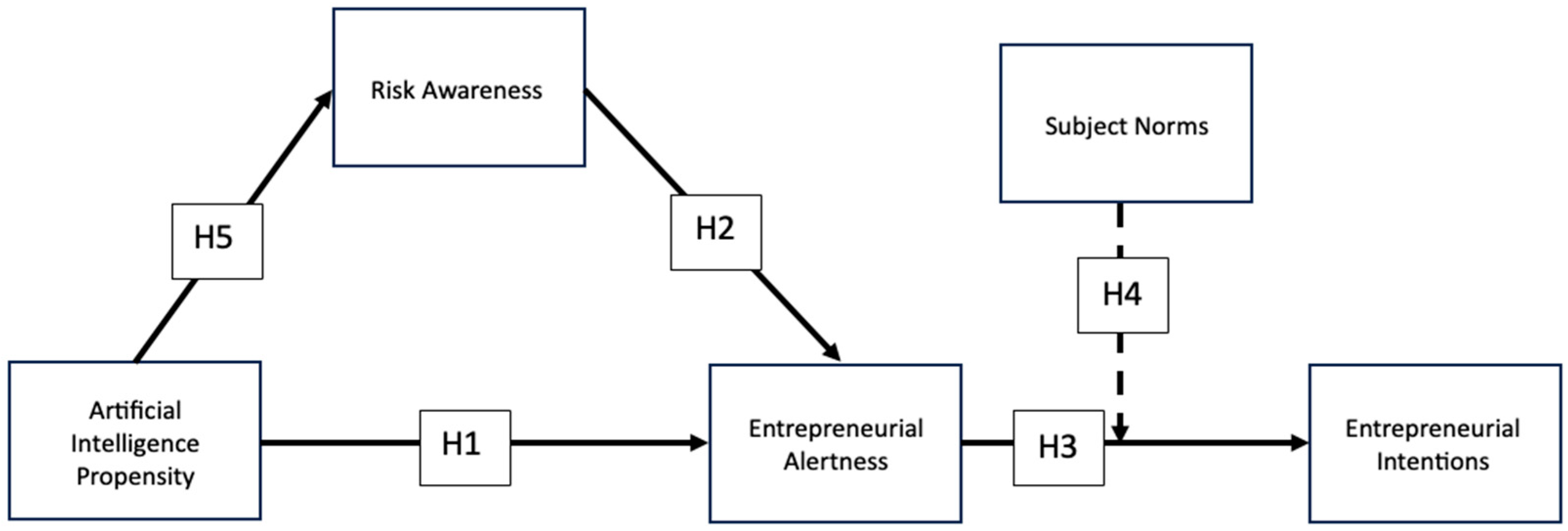
6]. This change highlights the need for a more comprehensive framework that takes into account social encouragement and technical adaptation. By investigating the ways in which risk awareness, entrepreneurial alertness, subjective norms, and AI propensity interact to influence entrepreneurial ambitions in the context of Turkish higher education, this study seeks to close that gap. Based on the gaps identified in the existing literature, this study aims to examine the role of artificial intelligence propensity in shaping sustainable entrepreneurial intentions among university students. Specifically, this study investigates how AI propensity influences entrepreneurial alertness through the mediating role of risk awareness, and how subjective norms moderate the relationship between entrepreneurial alertness and entrepreneurial intention.
Despite the increasing interest in artificial intelligence and entrepreneurship, limited research has examined how individuals’ propensity toward artificial intelligence influences entrepreneurial intention within a sustainability-oriented framework. Prior studies have largely focused on technology adoption or general entrepreneurial intention, often examining these constructs in isolation. Consequently, the combined role of technological readiness (AI propensity), cognitive factors such as risk awareness and entrepreneurial alertness, and social influences represented by subjective norms remains underexplored in the context of sustainability-oriented entrepreneurial behavior. To address this gap, the present study integrates artificial intelligence propensity with risk awareness and entrepreneurial alertness while examining the moderating role of subjective norms in shaping entrepreneurial intention. These factors are particularly relevant in sustainability-oriented entrepreneurship, as technological readiness may enable innovative sustainable solutions, risk awareness may influence responsible decision-making, and entrepreneurial alertness facilitates the recognition of sustainability-related opportunities. In this context, entrepreneurial intention is interpreted as an intention to engage in entrepreneurial activities that may contribute to sustainable and innovative economic development.
2. Literature Review and Hypothesis Development
This study is grounded in established perspectives from entrepreneurship and behavioral research, particularly the Theory of Planned Behavior (TPB) and entrepreneurial cognition theory. These theoretical perspectives suggest that entrepreneurial intentions are shaped by a combination of cognitive factors, technological readiness, and social influences. Within this framework, artificial intelligence propensity reflects individuals’ readiness to adopt emerging technologies, risk awareness represents cognitive evaluation of uncertainty, entrepreneurial alertness captures opportunity recognition capability, and subjective norms represent perceived social expectations. Together, these constructs provide a theoretical foundation for explaining how individuals develop entrepreneurial intentions within a sustainability-oriented context.
Building on the research gap identified in the Introduction, the following literature review discusses the theoretical and empirical foundations of artificial intelligence propensity, risk awareness, entrepreneurial alertness, and subjective norms, which together form the conceptual basis of the proposed research model. AI technologies are rapidly transforming the entrepreneurial ecosystem, redefining how individuals recognize opportunities, make decisions, and create value. In the context of sustainable development, this transformation is particularly important, as digital technologies enable more resource-efficient, socially inclusive, and environmentally responsible entrepreneurial solutions. Entrepreneurship today is no longer confined to accessing financial resources or identifying opportunities—it increasingly depends on individuals’ cognitive propensity toward technology, innovative thinking capacity, and willingness to use AI-based tools [
2]. Within sustainability-driven markets, such a propensity can facilitate the identification of green innovations, circular economy models, and socially impactful ventures.
Sustainable entrepreneurship extends beyond conventional venture creation by integrating environmental and social value creation alongside economic objectives. Unlike traditional entrepreneurial intentions, which primarily focus on opportunity recognition and profit generation, sustainability-oriented entrepreneurial intentions emphasize long-term environmental responsibility, social equity, and resource efficiency. As Seran et al. [
7] highlight in their conceptual framework for renewable energy prioritization, achieving sustainable development goals requires decision-making approaches that balance multiple value dimensions rather than focusing solely on economic outcomes. In this context, sustainability-oriented entrepreneurial intentions involve not only the feasibility of a venture but also its alignment with broader sustainability principles and long-term societal impact.
From the perspective of entrepreneurial cognition theory, individuals’ technological readiness and cognitive openness toward digital tools can significantly influence opportunity recognition and entrepreneurial decision-making. In this context, AI propensity reflects a psychological and cognitive construct encompassing an individual’s trust in AI technologies, readiness to adopt them, and ability to utilize digital tools for entrepreneurial purposes [
8]. This propensity enhances digital competence and data-driven decision-making, allowing entrepreneurs to process information efficiently and detect emerging opportunities in dynamic and sustainability-oriented markets. Recent studies demonstrate that individuals’ acceptance and use of AI significantly influence their entrepreneurial intentions and opportunity awareness. Reference [
3] found that AI adoption levels among international trade students positively predicted their entrepreneurial intentions, suggesting that familiarity with AI fosters proactive opportunity-seeking and innovation-oriented thinking. Similarly, entrepreneurial alertness, namely the ability to identify, connect, and evaluate new business opportunities [
9], is strengthened by AI propensity. Those who actively engage with AI tools benefit from algorithmic reasoning and data analysis, enabling them to recognize trends, sustainability challenges, and unmet market needs earlier than others. Moreover, AI not only impacts individual-level entrepreneurial behavior but also transforms the broader entrepreneurial ecosystem. AI-driven analytics facilitate market forecasting, automate business operations, optimize resource allocation, and reduce uncertainty—factors that collectively support entrepreneurial success and long-term sustainability.
In conclusion, artificial intelligence propensity functions as both a direct predictor of entrepreneurial intention and as a cognitive mechanism enhancing entrepreneurial alertness. Individuals’ trust in AI technologies, adoption readiness, and digital literacy have emerged as critical determinants of entrepreneurial potential in the digital age, particularly in ventures aiming to create sustainable economic and social value [
3].
Within entrepreneurial cognition theory, risk perception and evaluation play a central role in shaping entrepreneurial decision-making under uncertainty. Entrepreneurship inherently involves uncertainty and risk. Therefore, risk awareness stands out as a critical cognitive component that represents an individual’s capacity to perceive, interpret, and manage potential losses, uncertainties, and threats during the business creation process. In sustainability-oriented entrepreneurship, risk awareness also includes evaluating environmental, technological, and societal risks associated with innovation and long-term value creation. This concept not only covers perceptions of financial uncertainty but also includes how individuals construct and interpret risk within the context of entrepreneurial decision-making [
10].
In recent years, studies focusing on young individuals and university students have mostly shown that risk perception not only has a direct effect on entrepreneurial intention but also mediates relationships through cognitive and emotional mechanisms. For example, a study conducted by [
11] in South Africa found that self-esteem and the need for achievement increased the propensity of university students to take risks, and this propensity was strongly related to entrepreneurial intention. Likewise, a study by [
12] in Indonesia examined the effects of variables such as curriculum, risk awareness, optimism, and opportunity perception on students’ entrepreneurial intentions, revealing that risk awareness directly increased intention and that this effect was strengthened by curriculum-supported environments, including those promoting responsible and sustainability-conscious entrepreneurship.
According to these findings, risk awareness enables individuals to make better use of their environmental and personal resources, cope with uncertainty, and identify opportunities more effectively. Consequently, risk awareness not only involves recognizing risks but also activates mechanisms such as cognitive preparedness, emotional flexibility, and strategic evaluation throughout the entrepreneurial process, which are essential for sustainable opportunity exploitation.
Risk perception in dynamic environments involves complex cognitive processes that extend beyond simple awareness of uncertainty. Research suggests that individuals interpret risk signals through cognitive mechanisms shaped by experience, contextual cues, and temporal patterns. For instance, studies on subjective driving risk prediction demonstrate that human drivers’ cognitive perception of risk can be modeled using spatiotemporal distribution features, revealing systematic patterns in how individuals perceive and respond to uncertain situations [
13]. In entrepreneurial contexts, similar cognitive processes may influence how individuals evaluate potential threats and opportunities during venture creation. Understanding these cognitive dynamics may therefore enrich the conceptualization of risk awareness within sustainability-oriented entrepreneurial research.
Risk awareness refers to an individual’s proactive propensity toward identifying, interpreting, and managing uncertainty in entrepreneurial contexts [
14]. Unlike risk aversion, which reflects the propensity to avoid uncertainty, risk awareness entails being cognitively attuned to potential threats while remaining engaged in opportunity pursuit. In sustainability-driven environments characterized by technological disruption and environmental volatility, students who demonstrate higher risk awareness are more likely to perceive business threats early and adjust their behavior accordingly [
15]. Particularly in technology-driven contexts, risk awareness fosters mental readiness and enables better decision-making under uncertainty. As risk-alert individuals show higher probabilities for anticipating outcomes and developing contingencies, risk awareness is a crucial enabler of entrepreneurial alertness [
16]. Thus, it is expected to positively contribute to the scanning, associating, and evaluating dimensions of entrepreneurial cognition, especially in ventures aimed at sustainable innovation.
Subjective norms represent a key socio-cognitive construct that reflects how individuals perceive the social approval, support, and expectations they receive from their surroundings, such as family, friends, colleagues, or academic peers. In the context of sustainable entrepreneurship, these norms may also include societal expectations related to environmental responsibility, ethical business conduct, and long-term value creation. The positive or negative attitudes of the social environment toward entrepreneurial behavior can directly or indirectly influence individuals’ entrepreneurial propensity, self-confidence, and motivation to engage in such behavior [
17].
Recent research indicates that social context interacts strongly with the cognitive determinants of entrepreneurial intention. In the digital era, online networks, social media platforms, and entrepreneurial communities have expanded individuals’ perceptions of social norms, thereby creating a new social foundation that supports the transformation of entrepreneurial alertness into entrepreneurial intention [
18]. In this regard, subjective norms are not merely external environmental factors but also function as moderating mechanisms that facilitate the conversion of cognitive awareness into behavioral intention, particularly in sustainability-focused entrepreneurial ecosystems.
Subjective norms, a central construct in the Theory of Planned Behavior [
19], refer to the perceived social pressure to perform or not perform a specific behavior. In the context of entrepreneurship, these norms manifest as family expectations, peer encouragement, and institutional support. While often considered a weak direct predictor of intention in individualistic contexts, subjective norms gain strength in collectivist or transitional societies like Türkiye, where family and community influence career choices significantly [
20]. Moreover, recent research highlights their potential moderating role—amplifying or dampening the effect of internal drivers such as entrepreneurial alertness on intention [
21]. In digitally aware and sustainability-oriented ecosystems, the social legitimacy of entrepreneurship, reinforced by perceived support from peers and faculty, can shape whether cognitively alert students actually convert their insights into sustainable entrepreneurial intent. Based on these theoretical perspectives and prior empirical findings, the present study proposes a conceptual framework integrating artificial intelligence propensity, risk awareness, entrepreneurial alertness, and subjective norms to explain sustainability-oriented entrepreneurial intention among university students. In line with the theoretical arguments discussed above, the following hypotheses are proposed.
Beyond cognitive determinants, recent research also highlights the role of emotional and spiritual intelligence in shaping adaptive and creative behaviors in organizational contexts. Emotional intelligence has been associated with individuals’ capacity to manage complex social and ethical situations, while spiritual intelligence has been linked to purpose-driven motivation and value-based decision-making. For instance, Sapjee et al. [
22] demonstrate that emotional intelligence may enhance creativity through the mediating role of spiritual intelligence. In sustainability-oriented entrepreneurial contexts, such affective and value-based capabilities may support individuals in navigating ethical tensions and balancing economic, social, and environmental objectives. While the present study focuses primarily on cognitive mechanisms such as AI propensity, risk awareness, and entrepreneurial alertness, future research may further explore how emotional and spiritual intelligence interact with technological propensity in shaping sustainable entrepreneurial intentions.
5. Discussion
5.1. Discussion of Findings
The findings of this study provide a comprehensive understanding of how artificial intelligence (AI) propensity, risk awareness, subjective norms, and entrepreneurial alertness interact to shape sustainable entrepreneurial intentions among university students in Türkiye. The results demonstrate that AI-oriented cognitive engagement significantly influences both risk awareness and entrepreneurial alertness, confirming that technological readiness and digital competence serve as foundational drivers of opportunity recognition in contemporary digital ecosystems. In particular, students with higher AI propensity exhibit stronger analytical capabilities, enhanced environmental scanning, and improved interpretation of dynamic market signals, which supports previous findings emphasizing the role of AI-related cognition in entrepreneurial processes [
3].
Importantly, the results extend the prior literature by situating AI propensity within a sustainability-oriented entrepreneurship framework. In digitally transforming economies, sustainable entrepreneurial behavior increasingly depends on individuals’ ability to process complex environmental, technological, and social information simultaneously. AI tools enable students not only to detect emerging business opportunities but also to assess long-term risks, resource efficiency considerations, and innovation pathways that contribute to economic resilience. Thus, AI propensity functions as a cognitive mechanism that strengthens sustainable opportunity recognition rather than merely promoting short-term entrepreneurial ambition.
The strong positive association between risk awareness and entrepreneurial alertness further reinforces the importance of cognitive vigilance in sustainable entrepreneurship. Rather than discouraging entrepreneurial action, an awareness of uncertainty appears to enhance students’ capacity to evaluate risks prudently and strategically [
11]. This aligns with sustainability principles that emphasize responsible decision-making, long-term value creation, and balanced risk management. Students who perceive risk as manageable and interpretable are more capable of engaging in entrepreneurial initiatives that are resilient to environmental volatility and digital disruption.
Entrepreneurial alertness was confirmed as a direct predictor of entrepreneurial intention, supporting the theoretical perspective that opportunity recognition is the primary cognitive precursor of entrepreneurial behavior [
9]. Within a sustainability context, alertness becomes particularly critical because it enables individuals to identify socially and environmentally aligned opportunities alongside economic opportunities. In digitally enabled markets, the ability to connect disparate information streams and anticipate structural shifts contributes not only to venture creation but also to sustainable innovation trajectories.
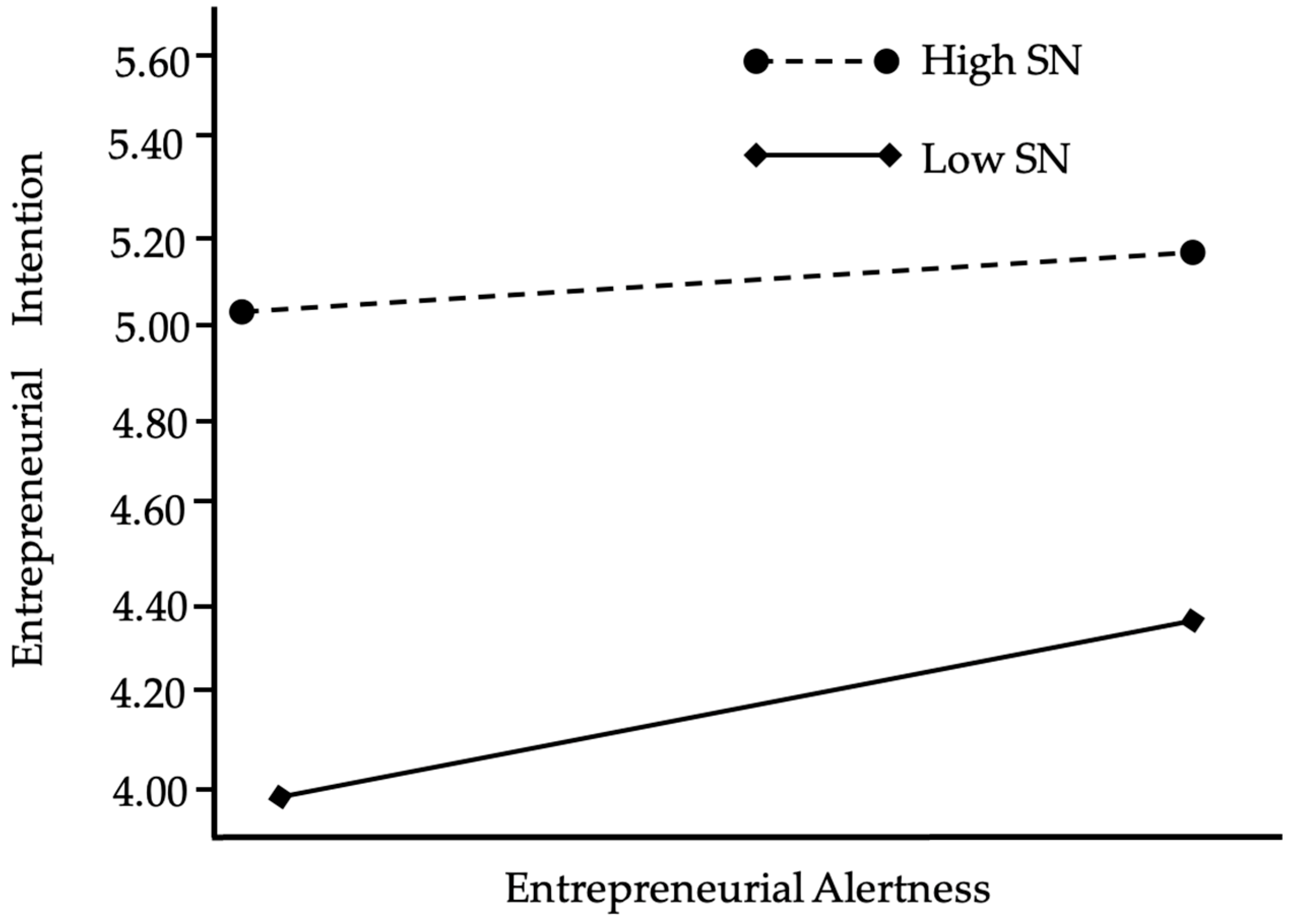
The moderating role of subjective norms reveals a more nuanced dynamic. The negative interaction effect suggests that when social expectations are strong, entrepreneurial alertness alone becomes less decisive for intention formation. Conversely, when subjective norms are weaker, alertness plays a more dominant role. This finding indicates that social environments can either amplify or buffer cognitive drivers. From a sustainability perspective, this highlights the importance of supportive ecosystems in translating technological readiness into action. In socially encouraging environments, AI-driven cognition may be complemented by collective legitimacy and institutional backing, facilitating sustainable entrepreneurial engagement. Where such support is lacking, cognitive factors must compensate.
5.2. Theoretical Implication
The cultural context of Türkiye may also influence how subjective norms operate in shaping entrepreneurial intentions. Positioned between Eastern collectivist traditions and Western individualistic propensities, Turkish society reflects a hybrid cultural environment in which social expectations and family influence can play an important role in entrepreneurial decision-making. In such contexts, subjective norms may become particularly influential in translating entrepreneurial alertness into entrepreneurial intention. Prior research suggests that cultural environments can shape how individuals interpret social expectations and institutional support structures in entrepreneurial processes [
37]. Therefore, future research may further explore how the mechanisms identified in this study operate across different cultural and institutional contexts.
Beyond subjective norms, the broader psychosocial safety climate of educational institutions and entrepreneurial ecosystems may also influence students’ willingness to pursue entrepreneurial careers. A psychosocial safety climate refers to an environment in which individuals feel supported in expressing ideas, taking initiative, and engaging in innovative activities without fear of negative social consequences. Research in organizational contexts suggests that supportive climates, autonomy, and peer support can strengthen individuals’ willingness to voice ideas and engage in proactive behaviors (Li et al. [
38]). Similarly, universities that foster psychological safety, provide autonomy in sustainability-related initiatives, and encourage collaborative learning environments may facilitate the translation of cognitive readiness—such as AI propensity and entrepreneurial alertness—into sustainable entrepreneurial intentions.
The integration of the Theory of Planned Behavior [
19] and UTAUT2 [
8] offers a theoretically enriched model explaining how technological propensity and social influence jointly shape entrepreneurial outcomes. By demonstrating that AI propensity indirectly influences intention through risk awareness and alertness, this study bridges digital cognition with sustainable entrepreneurial action. The findings contribute to the emerging discourse on digital sustainability, where technological adaptation, cognitive processing, and social reinforcement operate simultaneously in shaping future-oriented entrepreneurial behavior.
In addition to individual-level cognitive factors, sustainable entrepreneurship may also be influenced by broader multi-level dynamics that incorporate technological, organizational, and environmental contexts. The adoption and application of innovative technologies often depend on interactions between technological infrastructure, institutional support, and human capabilities. Recent research applying the technology–organization–environment–human (TOE-H) framework demonstrates that technological adoption decisions emerge from the combined influence of technological conditions, organizational readiness, environmental pressures, and human factors [
39]. From this perspective, the cognitive mechanisms examined in the present study—AI propensity and risk awareness—should also be interpreted within broader institutional and technological ecosystems that shape how entrepreneurial opportunities are recognized and pursued.
5.3. Practical Implication
The findings of this study are broadly consistent with recent empirical research suggesting that technological readiness and AI-related competencies play an important role in shaping entrepreneurial cognition and opportunity recognition in digitally transforming environments. Similar to prior studies, the results indicate that individuals with higher levels of AI propensity demonstrate stronger entrepreneurial alertness through enhanced information processing and opportunity evaluation capabilities. However, the present findings extend previous research by highlighting the mediating role of risk awareness, suggesting that AI propensity may also strengthen individuals’ capacity to interpret uncertainty constructively within sustainability-oriented entrepreneurial contexts. Furthermore, the moderating role of subjective norms emphasizes the importance of social and institutional support structures in translating opportunity recognition into entrepreneurial intention. This finding underlines the practical relevance of supportive entrepreneurial ecosystems, mentorship networks, and entrepreneurship education programs in fostering sustainable entrepreneurial engagement.
While the results highlight the positive influence of artificial intelligence propensity, risk awareness, and entrepreneurial alertness on sustainability-oriented entrepreneurial intentions, alternative interpretations of these relationships should also be considered. For instance, students who exhibit a higher propensity toward artificial intelligence technologies may already possess stronger digital competencies, greater exposure to innovation ecosystems, or higher levels of ambition and technological curiosity. These underlying characteristics could partially explain their higher levels of entrepreneurial alertness and opportunity recognition. Additionally, the use of a convenience sampling method may limit the generalizability of the findings, suggesting that future studies should replicate the analysis using more diverse samples or longitudinal research designs.
Furthermore, the negative interaction effect observed between entrepreneurial alertness and subjective norms may reflect contextual and cultural dynamics. In collectivist or transitional social environments, strong expectations from family, peers, or institutional actors may influence individuals’ entrepreneurial decision-making. Even when individuals demonstrate high entrepreneurial alertness and recognize opportunities, strong social expectations or perceived risks associated with entrepreneurship may weaken the translation of opportunity recognition into entrepreneurial intention. Therefore, subjective norms may play a complex moderating role within sustainability-oriented entrepreneurial ecosystems, reflecting the broader cultural and institutional context in which entrepreneurial decisions are made.
Overall, the results suggest that sustainable entrepreneurship in the digital era is not solely the outcome of technological access or environmental concern but rather the product of an integrated cognitive–social mechanism. AI readiness enhances analytical capacity; risk awareness strengthens responsible evaluation; entrepreneurial alertness translates cognition into opportunity recognition; and subjective norms determine whether these cognitive insights materialize into intention.
6. Conclusions
Sustainable entrepreneurship manifests across diverse domains, including smart urban mobility, the circular economy, and renewable energy, where digitalization enables new business models that address the economic, environmental, and social dimensions of sustainability. For instance, smart urban mobility initiatives demonstrate how digital technologies can support sustainable development through intelligent transport systems, shared mobility services, and data-driven urban planning [
40]. In this context, the cognitive mechanisms identified in this study—AI propensity, risk awareness, and entrepreneurial alertness—may operate differently depending on the specific sustainability domain. Students oriented toward smart city solutions, for example, may require different configurations of digital competence and risk perception than those focusing on circular economy initiatives or renewable energy ventures. Future research could therefore examine domain-specific variations in sustainability-oriented entrepreneurial intentions.
This study advances the understanding of sustainable entrepreneurial intention formation by demonstrating that AI propensity serves as a central cognitive driver influencing risk awareness and entrepreneurial alertness, which in turn predict entrepreneurial intention among university students in Türkiye. By embedding AI propensity within a sustainability-sensitive cognitive framework, the findings illustrate that technological readiness contributes to more analytical, vigilant, and opportunity-oriented entrepreneurial mindsets. The empirical findings demonstrate statistically significant relationships between artificial intelligence propensity, risk awareness, entrepreneurial alertness, subjective norms, and entrepreneurial intention.
The results underscore that sustainable entrepreneurship in digitally transforming societies depends on the interplay between technological competence, cognitive vigilance, and social support structures. AI propensity enhances students’ ability to interpret uncertainty constructively, risk awareness supports balanced decision-making, and entrepreneurial alertness bridges cognition and action. Meanwhile, subjective norms shape whether these cognitive drivers are reinforced or constrained by the surrounding social environment. However, given the cross-sectional nature of the data, the findings should be interpreted as associations observed at a specific point in time rather than as evidence of long-term causal sustainability outcomes.
From a sustainability standpoint, this study suggests that universities and policymakers aiming to foster long-term entrepreneurial resilience should integrate AI-focused digital literacy, data-driven decision-making exercises, and structured risk assessment training into entrepreneurship education. Embedding AI-supported analytical tools within curricula may strengthen students’ capacities to identify opportunities aligned with economic, technological, and societal sustainability objectives. Simultaneously, cultivating supportive social ecosystems—including mentorship networks, incubators, and collaborative innovation platforms—can enhance the translation of entrepreneurial alertness into sustainable entrepreneurial engagement.
In conclusion, this research contributes to sustainability scholarship by positioning AI propensity as a cognitive catalyst within a moderated mediation framework linking digital readiness, risk cognition, social influence, and entrepreneurial intention. The findings reinforce that sustainable entrepreneurship in the digital age emerges from the integration of technology, cognition, and social reinforcement, offering a holistic understanding of how future entrepreneurs can be equipped to operate responsibly and innovatively in rapidly evolving ecosystems.
7. Research Limitations and Future Research
This study has several limitations that should be considered when interpreting the findings. Firstly, the research relies on cross-sectional data collected from undergraduate students in Türkiye, which captures respondents’ perceptions at a single point in time. While the results reveal statistically significant relationships among artificial intelligence propensity, risk awareness, entrepreneurial alertness, subjective norms, and entrepreneurial intention, the cross-sectional design limits the ability to draw causal inferences or assess long-term sustainability-related outcomes.
Secondly, the sample consists exclusively of university students, which may restrict the generalizability of the findings to broader entrepreneurial populations or to individuals actively engaged in business ventures. Future research may extend the proposed framework by examining different demographic groups, including practicing entrepreneurs, early-stage start-up founders, or professionals operating in sustainability-oriented industries. Academic environments often expose students to sustainability-related education, innovation programs, and institutional support structures, which may shape their perceptions of sustainability-oriented entrepreneurship differently from individuals operating in real market conditions.
Thirdly, this study relies on self-reported survey measures, which may introduce potential response biases despite the use of established and validated measurement scales. Future studies may complement survey-based approaches with behavioral or longitudinal data in order to capture the dynamic evolution of entrepreneurial cognition and sustainability-oriented opportunity recognition over time.
Finally, future research may further expand the conceptual framework by incorporating additional sustainability-related constructs, such as environmental values, institutional sustainability support, or digital infrastructure access. Moreover, decomposing artificial intelligence propensity into specific subdimensions (e.g., AI usage frequency, trust in AI technologies, or digital literacy depth) may provide more nuanced insights into how technological readiness shapes sustainable entrepreneurial cognition and intention.