Visually Sustainable but Spatially Broken? A Two-Level Assessment of How Generative AI Encodes Sustainable Urban Design Principles

Abstract
1. Introduction
2. Literature Review
2.1. Generative AI and the Shift in Design Rationality: From Rule-Based Generation to Latent-Space Synthesis
2.2. Visual Greenwashing and the Risk of “Looking Sustainable”
2.3. The Plausibility Gap: Why Urban Design Is Especially Vulnerable
2.4. Sustainable Urban Design Principles and the Rationale for the Five Evaluation Dimensions
- (1)
- Walkability operationalizes the recurring focus on connected street networks, proximity, and mixed-use access, the most consistent spatial precondition for sustainability across all four frameworks.
- (2)
- Public space captures the centrality of a legible, accessible public realm as an organizing armature of sustainable neighborhoods, including entry conditions, edge definition, and activity distribution.
- (3)
- Green/blue infrastructure translates the “greening” and ecological-integration principles into system-level cues—continuity, functional placement, and the relationship of ecological elements to movement corridors and public space—distinguishing it from mere decorative vegetation.
- (4)
- Human-scale streetscape/urban design qualities reflect the emphasis on street-level experience, edge/frontage conditions, and pedestrian-oriented spatial proportion that walkability and urban design quality research has consistently identified as essential [29].
- (5)
- Mobility hierarchy/multimodality captures the sustainability planning emphasis on prioritizing active modes and transit integration within a coherent movement system, a dimension that requires not merely the presence of transit icons but the operational structure of stops, platforms, and interchange nodes.
3. Research Methods: A Two-Level Matrix Framework
3.1. Research Design and Data
3.2. Two-Level Assessment Framework and Rubric
3.2.1. Visual Representation Versus Spatial Logic
3.2.2. Evaluation Dimensions and Scoring Rubric
3.2.3. Expert Pilot Test and Codebook Refinement
3.2.4. Reliability Assessment and Final Coding
3.3. Qualitative Analytic Strategy
4. Results
4.1. Tool-Type Differences in Sustainability Encoding
4.2. Dimension-Level Visual–Spatial-Logic Gaps
4.3. Breakdown–Repair Patterns
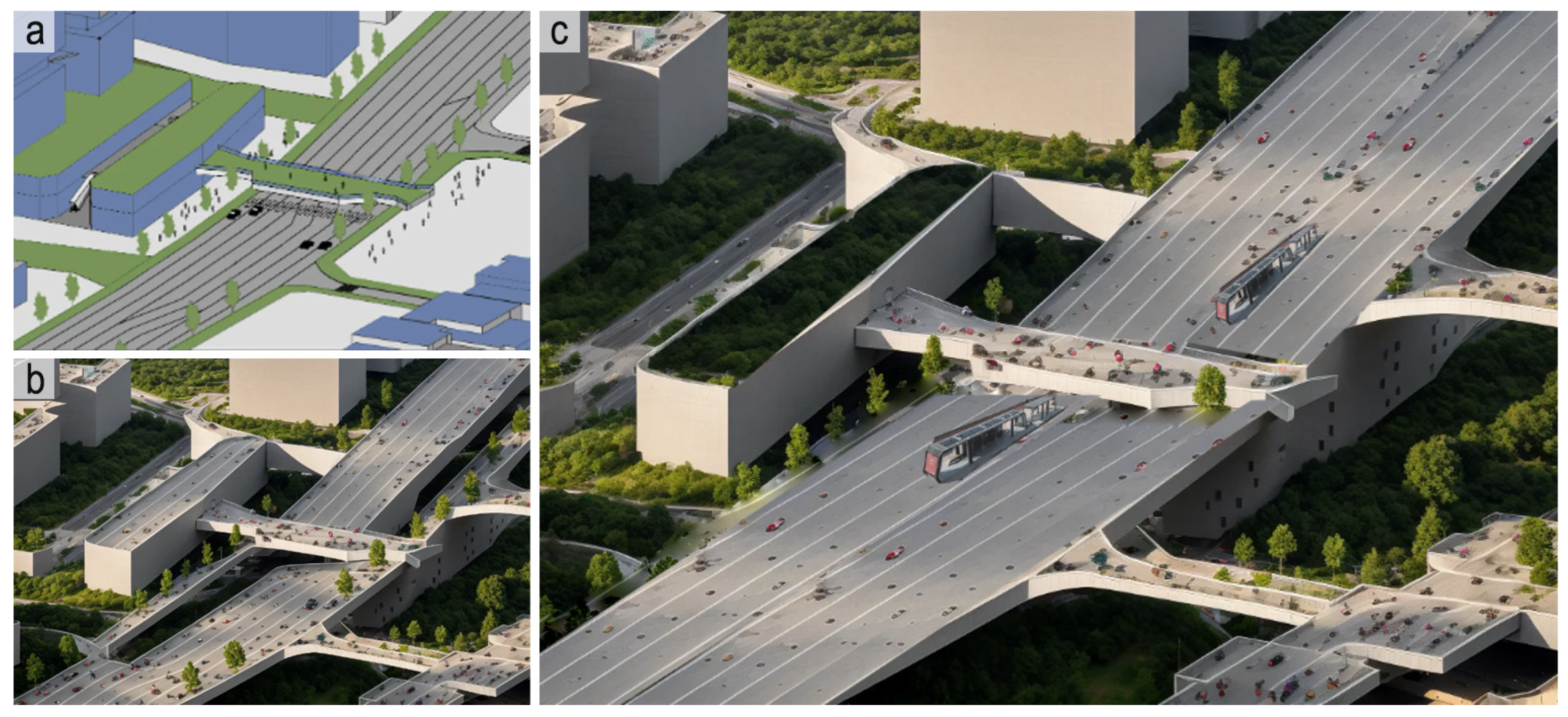
4.3.1. Case 1—Transfer Center: Program-Encoding Failure and External-Source Injection
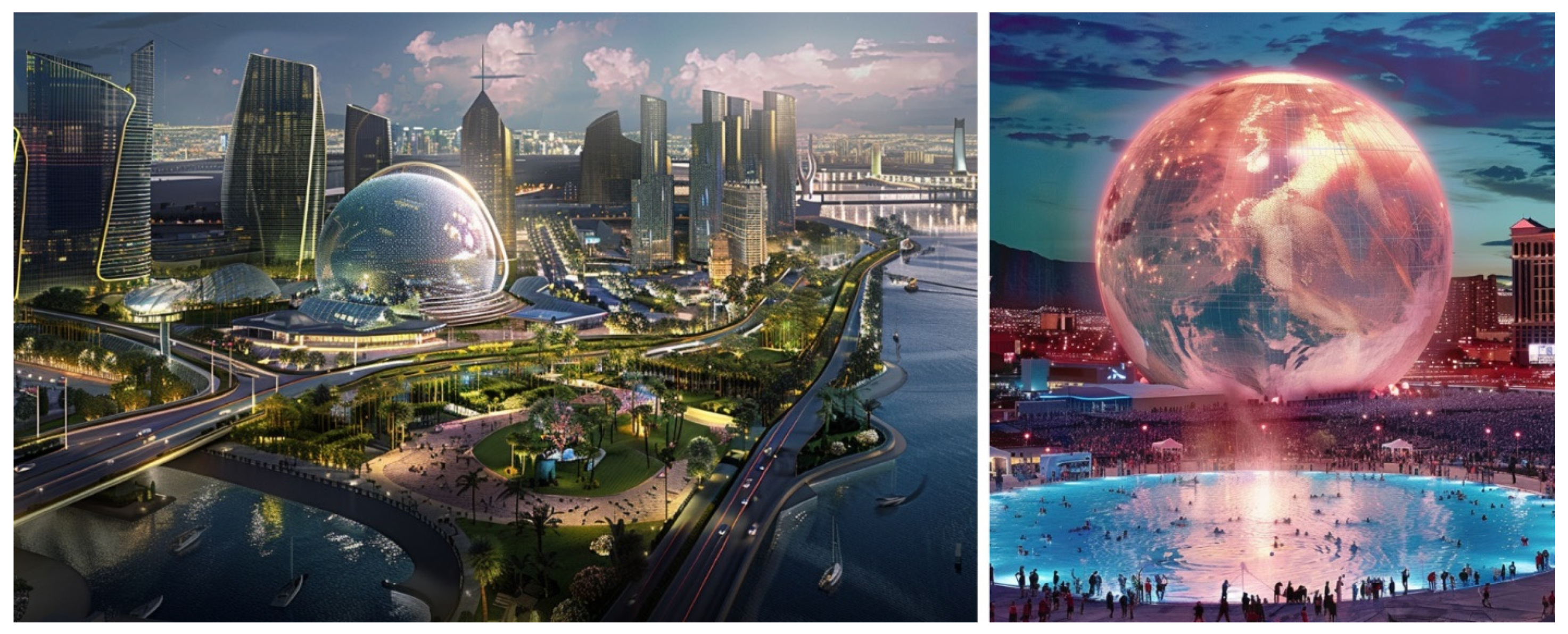
4.3.2. Case 2—Misa Island: Urban-Scale Prompting Limits and Reference Dependence
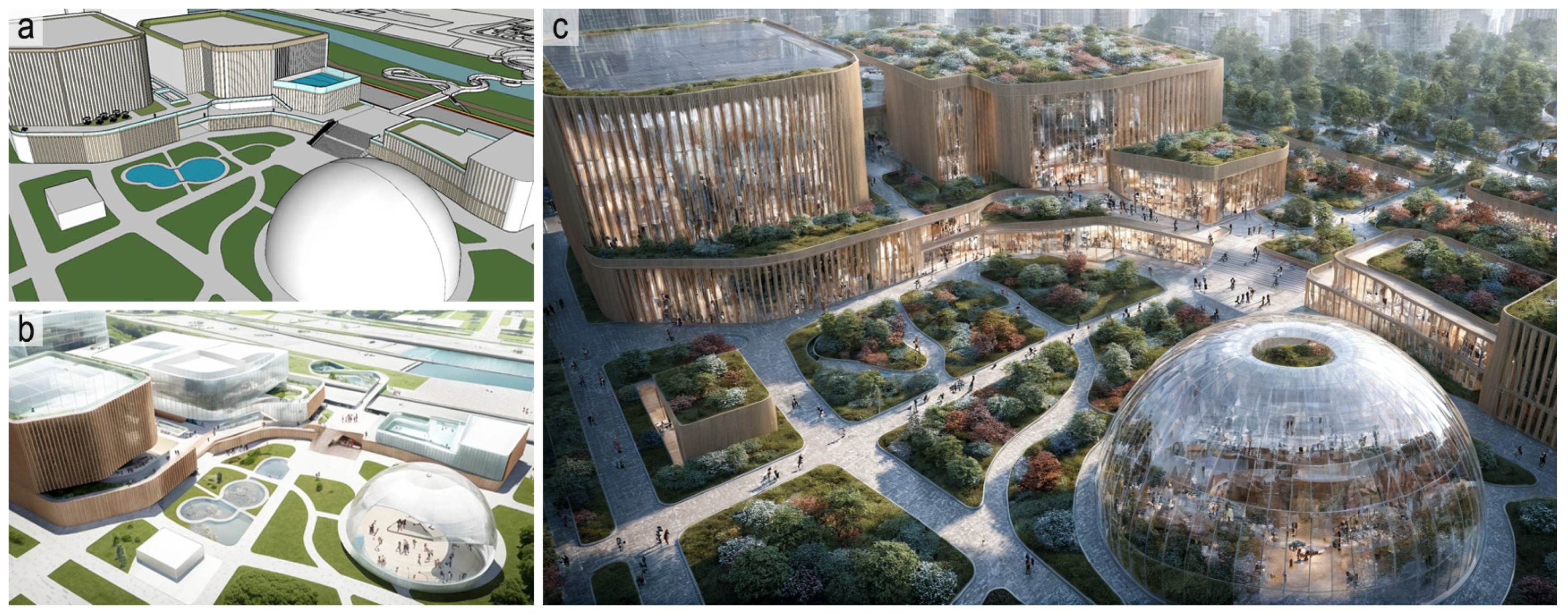
4.3.3. Case 3—Botanic Garden: Goal Conflict and Functional-Boundary Instability
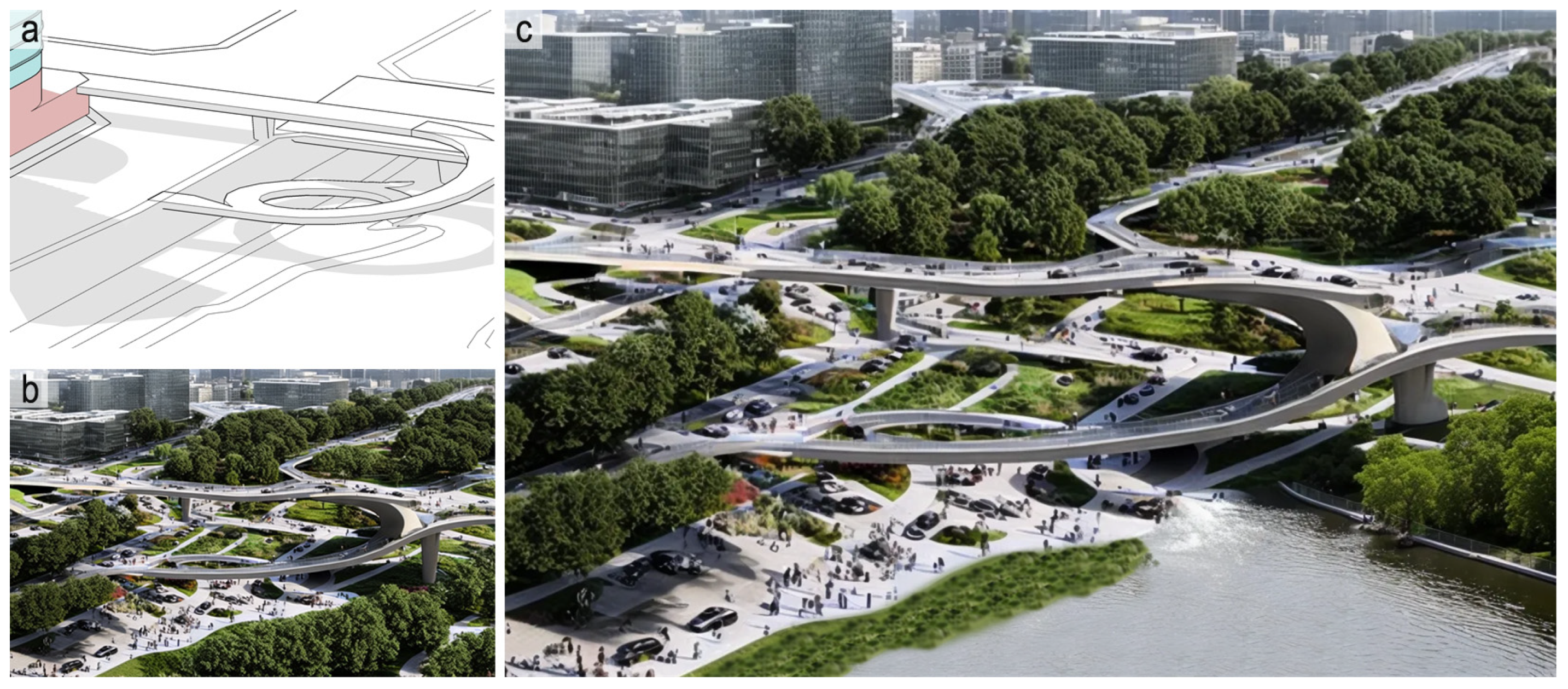
4.3.4. Case 4—Waterfront IC: Multi-Stage Repair of Directional and Flow Logic
4.3.5. Cross-Case Synthesis: Shared Breakdown–Repair Mechanisms
5. Discussion
5.1. The Visual–Logic Gap as a Structural Feature of Latent-Space Synthesis
5.2. Visual Greenwashing as an Emergent Risk in Generative Urban Design
5.3. Methodological Contribution: The Two-Level Framework and Audit-Trail Analysis
5.4. Guardrails for Education and Practice
6. Conclusions
Funding
Institutional Review Board Statement
Informed Consent Statement
Data Availability Statement
Acknowledgments
Conflicts of Interest
Appendix A
Appendix A.1. Codebook for Image-Level (Visual Representation) Scoring (0–2)
- 0: The image contains few or no pedestrian cues, and the scene reads as car-dominant.
- 1: Some pedestrian cues (e.g., people, sidewalks, benches, crossings) appear, but they function mainly as decoration or appear discontinuous.
- 2: Pedestrian-oriented cues are rich and consistent, producing a plausible walkable street/plaza atmosphere.
- 0: A public space cannot be clearly identified, or it appears only as an indistinct background element.
- 1: Activity cues suggest a public space, but the center, boundaries, and intended use remain ambiguous.
- 2: The public space type and use are legible (e.g., staying, meeting, activities), with strong cues of “publicness.”
- 0: Vegetation and water-related cues are largely absent.
- 1: Green/water elements are present but mainly decorative, with little indication of a system structure.
- 2: Green/blue infrastructure reads as a coherent system (e.g., greenway, waterfront park, continuous canopy) rather than isolated objects.
- 0: The scene lacks cues of human-scale street experience, showing monotonous façades or arbitrary/implausible detail.
- 1: Streetscape elements (doors/windows/trees/furniture/signage) appear, but scale, rhythm, and enclosure feel unstable or exaggerated.
- 2: The scene supports a convincing human-scale experience, including active ground-floor cues, readable façade rhythm, and plausible enclosure and detail.
- 0: Mobility hierarchy cues are minimal or missing, and vehicles/paths appear random or unstructured.
- 1: Transit/bike cues appear as icons, but stops, platforms, or hubs are not spatially legible.
- 2: Multiple modes (walk/bike/transit/vehicle) are clearly indicated, with plausible stop/hub cues that support a coherent hierarchy.
Appendix A.2. Codebook for Spatial-Logic-Level (Operability) Scoring (0–2)
- 0: Pedestrian routes are clearly broken, and access/crossings/connectivity are not feasible within the depicted structure.
- 1: Some pedestrian routes are readable, but connectivity or priority is unclear and pedestrian–vehicle logic conflicts are evident.
- 2: A continuous, readable pedestrian network is present, and crossings, entries, and connections can be explained with minimal contradictions.
- 0: Entries, boundaries, and level changes are non-functional or illogical, so the space cannot operate as a public realm.
- 1: The space partly works, but adjacency to buildings/streets is awkward, and circulation or activity zones conflict.
- 2: Access, edges, and activity layout are clear, and adjacency with surrounding streets/buildings is functionally coherent.
- 0: Green/blue elements are isolated or internally contradictory (e.g., implausible water/terrain/drainage relationships).
- 1: Some continuity is readable, but frequent breaks remain, and multifunctional logic is only implied rather than structured.
- 2: The system is coherent and connected, with ecological/hydrological/walkable continuity that is plausible and explainable.
- 0: Street-edge continuity and section proportions collapse, making pedestrian-scale experience physically unworkable.
- 1: Some segments are operable, but continuity, section proportions, or entry relationships break at key points.
- 2: Street edges and sections remain continuous and plausible, and entry relationships support an operable pedestrian-scale experience.
- 0: Turning radii, lane widths, stop access, or transfer paths are clearly infeasible, and any “hub” reads as sculptural rather than functional.
- 1: A hierarchy is partly readable, but stop/hub location, access, and transfer circulation are inconsistent.
- 2: A coherent hierarchy (walk–bike–transit–vehicle) is evident, with stops/hubs and transfers that are spatially plausible within the overall structure.
Appendix B
Appendix B.1. Distribution Summary of “Visual Representation” Scores (Image-Level), n = 36
| Visual Representation Dimension | 0 n (%) | 1 n (%) | 2 n (%) | Mean (SD) | Median [IQR] |
| Walkability | 0 (0.0) | 7 (19.4) | 29 (80.6) | 1.81 (0.40) | 2 [0.0] |
| Public Space | 1 (2.8) | 9 (25.0) | 26 (72.2) | 1.69 (0.52) | 2 [1.0] |
| Green/Blue Infrastructure | 1 (2.8) | 1 (2.8) | 34 (94.4) | 1.92 (0.37) | 2 [0.0] |
| Human-Scale Streetscape/Urban Design Qualities | 3 (8.3) | 8 (22.2) | 25 (69.4) | 1.61 (0.64) | 2 [1.0] |
| Mobility Hierarchy/Multimodality | 4 (11.1) | 17 (47.2) | 15 (41.7) | 1.31 (0.67) | 1 [1.0] |
Appendix B.2. Distribution Summary of “Spatial Logic” Scores (Logic-Level), n = 36
| Spatial Logic Dimension | 0 n (%) | 1 n (%) | 2 n (%) | Mean (SD) | Median [IQR] |
| Walkability | 17 (47.2) | 13 (36.1) | 6 (16.7) | 0.69 (0.75) | 1 [1.0] |
| Public Space | 13 (36.1) | 17 (47.2) | 6 (16.7) | 0.81 (0.71) | 1 [1.0] |
| Green/Blue Infrastructure | 2 (5.6) | 17 (47.2) | 17 (47.2) | 1.42 (0.60) | 1 [1.0] |
| Human-Scale Streetscape/Urban Design Qualities | 10 (27.8) | 19 (52.8) | 7 (19.4) | 0.92 (0.69) | 1 [1.0] |
| Mobility Hierarchy/Multimodality | 30 (83.3) | 5 (13.9) | 1 (2.8) | 0.19 (0.47) | 0 [0.0] |
References
- Rombach, R.; Blattmann, A.; Lorenz, D.; Esser, P.; Ommer, B. High-Resolution Image Synthesis with Latent Diffusion Models. In Proceedings of the IEEE/CVF Conference on Computer Vision and Pattern Recognition (CVPR), New Orleans, LA, USA, 18–24 June 2022; pp. 10684–10695. [Google Scholar] [CrossRef]
- Yiannoudes, S. Shaping Architecture with Generative Artificial Intelligence: Deep Learning Models in Architectural Design Workflow. Architecture 2025, 5, 94. [Google Scholar] [CrossRef]
- López Cervantes, J.C.; Sánchez Morales, C.E. Design in the Age of Predictive Architecture: From Digital Models to Parametric Code to Latent Space. Architecture 2026, 6, 25. [Google Scholar] [CrossRef]
- Phillips, C.; Jiao, J.; Clubb, E. Testing the Capability of AI Art Tools for Urban Design. IEEE Comput. Graph. Appl. 2024, 44, 37–45. [Google Scholar] [CrossRef]
- Cervero, R.; Kockelman, K. Travel Demand and the 3Ds: Density, Diversity, and Design. Transp. Res. Part D Transp. Environ. 1997, 2, 199–219. [Google Scholar] [CrossRef]
- Saelens, B.E.; Sallis, J.F.; Frank, L.D. Environmental Correlates of Walking and Cycling: Findings from the Transportation, Urban Design, and Planning Literatures. Ann. Behav. Med. 2003, 25, 80–96. [Google Scholar] [CrossRef]
- Frank, L.D.; Schmid, T.L.; Sallis, J.F.; Chapman, J.; Saelens, B.E. Linking Objectively Measured Physical Activity with Objectively Measured Urban Form: Findings from SMARTRAQ. Am. J. Prev. Med. 2005, 28, 117–125. [Google Scholar] [CrossRef] [PubMed]
- Ewing, R.; Cervero, R. Travel and the Built Environment: A Meta-Analysis. J. Am. Plan. Assoc. 2010, 76, 265–294. [Google Scholar] [CrossRef]
- Delmas, M.A.; Burbano, V.C. The Drivers of Greenwashing. Calif. Manag. Rev. 2011, 54, 64–87. [Google Scholar] [CrossRef]
- de Freitas Netto, S.V.; Sobral, M.F.F.; Ribeiro, A.R.B.; Soares, G.R.L. Concepts and Forms of Greenwashing: A Systematic Review. Environ. Sci. Eur. 2020, 32, 19. [Google Scholar] [CrossRef]
- McKenna, H.P. Toward a Rethinking and Reimagining of Urban Sustainability in an Era of AI. Urban Sci. 2025, 9, 401. [Google Scholar] [CrossRef]
- Carpo, M. The Second Digital Turn: Design Beyond Intelligence; MIT Press: Cambridge, MA, USA, 2017. [Google Scholar]
- del Campo, M.; Manninger, S. Strange, But Familiar Enough: The Design Ecology of Neural Architecture. Archit. Des. 2022, 92, 38–45. [Google Scholar] [CrossRef]
- Huang, S.-Y. The Connectionist Turn: How Contemporary Generative AI Reshapes Architectural Rationality. Architecture 2025, 5, 132. [Google Scholar] [CrossRef]
- Gu, X.Y.; Zhang, M.M.; Lyu, J.X.; Ge, Q. Generating Urban Road Networks with Conditional Diffusion Models. ISPRS Int. J. Geo-Inf. 2024, 13, 203. [Google Scholar] [CrossRef]
- Yu, D.; Wan, B.; Sheng, Q. Automated Generation of Urban Spatial Structures Based on Stable Diffusion and CoAtNet Models. Buildings 2024, 14, 3720. [Google Scholar] [CrossRef]
- Xu, S.; Jiang, H.; Wang, H. A Generative Urban Form Design Framework Based on Deep Convolutional GANs and Landscape Pattern Metrics for Sustainable Renewal in Highly Urbanized Cities. Sustainability 2025, 17, 4548. [Google Scholar] [CrossRef]
- Lyon, T.P.; Montgomery, A.W. The Means and End of Greenwash. Organ. Environ. 2015, 28, 223–249. [Google Scholar] [CrossRef]
- Schmuck, D.; Matthes, J.; Naderer, B. Misleading Consumers with Green Advertising? An Affect–Reason–Involvement Account of Greenwashing Effects in Environmental Advertising. J. Advert. 2018, 47, 127–145. [Google Scholar] [CrossRef]
- Parguel, B.; Benoît-Moreau, F.; Russell, C.A. Can Evoking Nature in Advertising Mislead Consumers? The Power of ‘Executional Greenwashing’. Int. J. Advert. 2015, 34, 107–134. [Google Scholar] [CrossRef]
- Gałecka-Drozda, A.; Wilkaniec, A.; Szczepańska, M.; Świerk, D. Potential Nature-Based Solutions and Greenwashing to Generate Green Spaces: Developers’ Claims versus Reality in New Housing Offers. Urban For. Urban Green. 2021, 65, 127345. [Google Scholar] [CrossRef]
- Quoquab, F.; Sivadasan, S.; Mohammad, J. Greenwashing in the Era of Sustainability: A Systematic Literature Review. Asia Pac. J. Mark. Logist. 2022, 34, 778–799. [Google Scholar] [CrossRef]
- Kronenberg, J.; Skuza, M.; Łaszkiewicz, E. To What Extent Do Developers Capitalise on Urban Green Assets? Urban For. Urban Green. 2023, 87, 128063. [Google Scholar] [CrossRef]
- Shin, M.H.; Kim, H.Y.; Gu, D.; Kim, H. LEED, Its Efficacy and Fallacy in a Regional Context—An Urban Heat Island Case in California. Sustainability 2017, 9, 1674. [Google Scholar] [CrossRef]
- Demirtas, E.; Ayas Onol, T. The Politics of Green Buildings: Neoliberal Environmental Governance and LEED’s Uneven Geography in Istanbul. Buildings 2026, 16, 363. [Google Scholar] [CrossRef]
- Holmgren, M.; Kabanshi, A.; Sörqvist, P. Occupant perception of “green” buildings: Distinguishing physical and psychological factors. Build. Environ. 2017, 114, 140–147. [Google Scholar] [CrossRef]
- Holmgren, M.; Sörqvist, P. Are Mental Biases Responsible for the Perceived Comfort Advantage in “Green” Buildings? Buildings 2018, 8, 20. [Google Scholar] [CrossRef]
- Huang, K.; Duan, C.; Sun, K.; Xie, E.; Li, Z.; Liu, X. T2I-CompBench++: An Enhanced and Comprehensive Benchmark for Compositional Text-to-image Generation. IEEE Trans. Pattern Anal. Mach. Intell. 2025, 47, 3563–3579. [Google Scholar] [CrossRef]
- Ewing, R.; Handy, S. Measuring the Unmeasurable: Urban Design Qualities Related to Walkability. J. Urban Des. 2009, 14, 65–84. [Google Scholar] [CrossRef]
- Farr, D. Sustainable Urbanism: Urban Design with Nature; John Wiley & Sons: Hoboken, NJ, USA, 2008. [Google Scholar]
- Jabareen, Y.R. Sustainable Urban Forms: Their Typologies, Models, and Concepts. J. Plan. Educ. Res. 2006, 26, 38–52. [Google Scholar] [CrossRef]
- Wheeler, S.M. Planning for Sustainability: Creating Livable, Equitable, and Ecological Communities; Routledge: London, UK, 2004. [Google Scholar]
- UN-Habitat. A New Strategy of Sustainable Neighbourhood Planning: Five Principles; United Nations Human Settlements Programme (UN-Habitat): Nairobi, Kenya, 2014. [Google Scholar]
- Yin, R.K. Case Study Research and Applications: Design and Methods, 6th ed.; SAGE: Thousand Oaks, CA, USA, 2018. [Google Scholar]
- Campbell, J.L.; Quincy, C.; Osserman, J.; Pedersen, O.K. Coding In-depth Semistructured Interviews: Problems of Unitization and Intercoder Reliability and Agreement. Sociol. Methods Res. 2013, 42, 294–320. [Google Scholar] [CrossRef]
- Beach, D.; Pedersen, R.B. Process-Tracing Methods: Foundations and Guidelines, 2nd ed.; University of Michigan Press: Ann Arbor, MI, USA, 2019. [Google Scholar]



| Dimension | Visual Level κw | Logic Level κw |
|---|---|---|
| Walkability | 0.83 | 0.74 |
| Public Space | 0.80 | 0.69 |
| Green/Blue Infrastructure | 0.86 | 0.82 |
| Human-Scale Streetscape/Urban Design Quality | 0.76 | 0.66 |
| Mobility Hierarchy/Multimodality | 0.64 | 0.58 |
| Dimension | Visual Level Mean | Logic Level Mean | Δ(Img − Logic) |
|---|---|---|---|
| Walkability | 1.8 | 0.7 | 1.1 |
| Public Space | 1.7 | 0.8 | 0.9 |
| Green/Blue Infrastructure | 1.9 | 1.4 | 0.5 |
| Human-scale Streetscape/Urban Design Quality | 1.6 | 0.9 | 0.7 |
| Mobility Hierarchy/Multimodality | 1.3 | 0.2 | 1.1 |
Disclaimer/Publisher’s Note: The statements, opinions and data contained in all publications are solely those of the individual author(s) and contributor(s) and not of MDPI and/or the editor(s). MDPI and/or the editor(s) disclaim responsibility for any injury to people or property resulting from any ideas, methods, instructions or products referred to in the content. |
© 2026 by the author. Licensee MDPI, Basel, Switzerland. This article is an open access article distributed under the terms and conditions of the Creative Commons Attribution (CC BY) license.
Share and Cite
Jung, S. Visually Sustainable but Spatially Broken? A Two-Level Assessment of How Generative AI Encodes Sustainable Urban Design Principles. Sustainability 2026, 18, 2943. https://doi.org/10.3390/su18062943
Jung S. Visually Sustainable but Spatially Broken? A Two-Level Assessment of How Generative AI Encodes Sustainable Urban Design Principles. Sustainability. 2026; 18(6):2943. https://doi.org/10.3390/su18062943
Chicago/Turabian StyleJung, Sanghoon. 2026. "Visually Sustainable but Spatially Broken? A Two-Level Assessment of How Generative AI Encodes Sustainable Urban Design Principles" Sustainability 18, no. 6: 2943. https://doi.org/10.3390/su18062943
APA StyleJung, S. (2026). Visually Sustainable but Spatially Broken? A Two-Level Assessment of How Generative AI Encodes Sustainable Urban Design Principles. Sustainability, 18(6), 2943. https://doi.org/10.3390/su18062943