Article

Rock Burst Risk Assessment for Coal Mining in Coal Pillars Under Complex Geological Conditions

1
China Coal Research Institute, Beijing 100013, China
2
Deep Mining and Rock Burst Research Branch, Chinese Institute of Coal Science, Beijing 100013, China
*
Authors to whom correspondence should be addressed.
Sustainability 2026, 18(6), 2939; https://doi.org/10.3390/su18062939
Submission received: 31 January 2026 / Revised: 13 March 2026 / Accepted: 16 March 2026 / Published: 17 March 2026

Abstract

To address the rock burst safety hazards encountered during coal seam mining in coal pillar areas under complex geological conditions and ensure sustainable and stable mine production, this study investigates the coal pillar area of a ventilation shaft in a mining area. Through an integrated approach incorporating field investigation, laboratory testing, numerical simulation, and engineering analogy, systematic research was conducted on rock burst mechanisms, geological modeling, and risk assessment. The results indicate that rock bursts in this coal pillar area represent tectonic-type disasters dominated by tectonic stress and induced by multi-factor coupling, with the coal seam exhibiting weak burst proneness. Based on a refined three-dimensional geological model constructed from borehole data, combined with mesh optimization and FDEM (Finite-Discrete Element Method) numerical simulations, precise delineation of rock burst hazard zones was achieved. These findings provide theoretical foundations and technical paradigms for safe mining operations in coal pillar area as under similar complex geological conditions, contributing to the sustainable development of coal resources through enhanced safety, extended mine service life, and optimized resource utilization.

1. Introduction

Coal remains a fundamental pillar of China’s energy security and continues to occupy a significant position in the medium- to long-term energy structure. As shallow and easily accessible resources gradually deplete, the inevitable trend is for mining operations to extend deeper underground and expand into regions with complex geological conditions [1,2]. Deep mining operations face complex geological environments characterized by high ground stress, elevated temperature, and high osmotic pressure, leading to significantly increased risks of coal-rock dynamic disasters [3,4]. Wagner [5] noted that deep mining represents a major challenge for rock engineering, where stress levels often place rock masses in a critical state close to failure. Ranjith et al. [6] systematically reviewed the opportunities and challenges associated with deep mining, emphasizing the pivotal role of rock mechanics and geotechnical engineering in deep resource extraction. From a sustainability perspective, ensuring safe and efficient extraction of deep coal resources is essential for maintaining energy supply stability, supporting regional economic development, and maximizing the utilization of finite mineral resources.
Coal pillar areas serve as crucial carriers of resources for mine production continuity, and their safe extraction is directly related to the sustainable development of mining operations. The mining district investigated in this study represents a large-scale backbone mine with a century-long mining history, which has long been tasked with ensuring the supply of scarce national coking coal resources. Due to its abundant geological reserves, the ventilation shaft coal pillar area has become the core area for subsequent production capacity continuity, making its safe extraction vital for sustaining the mine’s operational lifespan and regional energy security. However, influenced by its distinctive peninsula-shaped geometry, combined with intricate fault structures and syncline formations intersecting within the region, the stress field distribution in this coal pillar area exhibits complexity with pronounced stress concentration phenomena [7,8].
In recent years, sudden rock burst accidents have occurred in this area, resulting in significant casualties and property losses. These incidents not only expose the technical shortcomings in rock burst prevention and control for coal pillar areas under complex geological conditions but also highlight the urgency of conducting targeted risk assessment and prevention technology research. Rock bursts represent one of the most severe dynamic disasters in coal mining. He et al. [1] conducted systematic research on rock burst mechanisms and their control, indicating that rock burst occurrence is closely related to the stress state of coal-rock masses, coal-rock mechanical properties, and geological structures. Dou et al. [2] reviewed the research progress on rock burst monitoring, prediction, and prevention in Chinese coal mines, emphasizing the importance of multi-factor coupling analysis. Therefore, focusing on the unique geological and mining conditions of this coal pillar area, systematically investigating rock burst mechanisms, accurately delineating rock burst hazard zones, and proposing adaptive prevention and control technical solutions to address the challenges of safe mining in complex coal pillar areas, will not only ensure sustainable and stable production while extending the mine’s service life but also contribute to the sustainable development goals of the coal mining industry by enhancing worker safety, optimizing resource recovery, and reducing environmental and economic impacts. Such research provides valuable technical reference for domestic coal pillar mining under similar conditions, possessing significant engineering practical value and sustainability implications.
Regarding rock bursts as complex dynamic disasters, extensive research has been conducted by scholars both domestically and internationally, with research perspectives gradually shifting from single-factor analysis to multi-factor coupling effects. Early research primarily focused on the relationship between coal-rock mass strength and stress, proposing classical theories such as strength theory, energy theory, and burst proneness theory [9,10]. As research progressed, scholars gradually recognized that the coupling of multiple factors including geological structures, ground stress fields, and mining layouts represents the root cause of rock burst occurrence [3,11]. Zhang et al. [4] investigated the occurrence mechanisms and criteria of rock bursts in deep soft coal seams, revealing the special governing laws of rock bursts in soft coal. Wang et al. [12] conducted in-depth research on rock burst mechanisms under conditions of partings in extremely thick coal seams, establishing corresponding risk assessment methods. Pan and Dai [13] proposed theoretical formulas for rock bursts in coal mines, providing a theoretical foundation for quantitative analysis of rock bursts. Dou et al. [3] systematically studied rock burst disaster prevention and prediction methods in coal mines, establishing a complete technical system from mechanism investigation to forecasting.
In terms of research on rock burst-inducing factors, the influence of geological structures has received increasing attention. Shepherd et al. [14] early reviewed the relationship between coal mine outbursts and geological structures, laying the foundation for subsequent research. Cai et al. [7] investigated the mechanism of fault-induced rock bursts under the coupling of mining-induced static and dynamic loads, revealing the intrinsic relationship between fault activation and rock bursts. Shen et al. [8] conducted monitoring and modeling studies on stress states near major geological structures, providing a basis for coal pillar rock burst assessment. Xiao et al. [15] proposed effective control methods for rock bursts induced by shear instability of fault structures under complex geological conditions. The aforementioned studies demonstrate that accurately characterizing geological structural features and revealing their control effects on rock bursts constitute important prerequisites for achieving precise risk assessment.
To accurately characterize complex geological conditions, three-dimensional (3D) geological modeling technology has been widely applied in mining engineering practice. 3D geological modeling represents a core technology for achieving visualization and refined characterization of subsurface geological bodies. Kaufmann and Martin [16] established 3D geological modeling methods based on borehole data, cross-sections, and geological maps, applying them to coal mining districts. Che and Jia [17] employed weighted Kriging methods and multi-source data to construct 3D geological models of coal seams, improving modeling accuracy. Wu and Xu [18] systematically studied 3D geological modeling and its applications in digital mines, providing technical support for mine information construction. Conducting numerical simulation analysis based on refined geological models has become an important means for revealing rock burst occurrence mechanisms.
Numerical simulation methods play significant roles in rock mechanics and rock burst research. Jing [19] comprehensively reviewed techniques, advances, and existing problems in numerical modeling of rock mechanics and rock engineering, providing important references for research in this field. Jing and Hudson [20] systematically introduced numerical methods in rock mechanics, including the Finite Element Method (FEM) and Discrete Element Method (DEM). The combined Finite-Discrete Element Method (FDEM) integrates the advantages of both FEM and DEM, capable of simulating both continuous elastic deformation and discontinuous failure processes of coal-rock masses [21]. Specifically, FDEM has been extensively validated for investigating the mechanical behavior, damage characteristics, and energy evolution of rocks with complex fracture geometries [22,23], making it particularly suitable for capturing the stress accumulation and sudden energy release processes characteristic of rockbursts. Deng et al. [24] employed FDEM numerical simulations to investigate failure mechanisms of anisotropic rock masses in deeply buried tunnels, verifying the applicability of FDEM under complex geological conditions. Through numerical simulation means, quantitative analysis of stress evolution and energy accumulation patterns in coal-rock masses under mining disturbance can be realized, providing scientific bases for rock burst risk assessment.
Risk assessment represents a critical link in rock burst prevention and control, directly relating to the specificity and effectiveness of prevention measures. The comprehensive index method remains one of the most widely applied assessment methods, quantifying the influence weights of geological factors and mining technical factors on rock bursts to calculate comprehensive rock burst hazard indices [25,26]. Sousa et al. [27] applied data mining techniques to rock burst risk assessment, improving prediction accuracy. Liu et al. [28] proposed dynamic rock burst risk assessment and management methods for drill-and-blast tunnels, achieving dynamic risk control. The multi-factor coupling method is based on stress superposition principles, considering the coupling effects of multiple factors including tectonic stress, mining-induced stress, and coal-rock properties [25,29]. Wen et al. [30] proposed a rock burst risk assessment method based on equivalent rock mass strength, considering the influence of coal seam thickness and surrounding rock strength. Zhang et al. [25] proposed an improved comprehensive index method for deep mining, enhancing the accuracy of risk assessment. The multi-factor coupling method can more accurately reflect the occurrence patterns of rock bursts under complex geological conditions, particularly suitable for assessment in tectonic stress-dominated regions.
In summary, although scholars both domestically and internationally have achieved fruitful research results in the field of rock bursts, numerous challenges remain urgently to be addressed regarding rock burst risk assessment for coal pillar areas under complex geological conditions. Geological conditions vary significantly among different mining districts, with fault structures and ground stress field distributions exhibiting distinct characteristics, making it difficult to directly apply existing research results [31,32]. Peninsula-shaped coal pillars are subject to superimposed mining effects from multiple working faces, exhibiting complex stress concentration patterns where traditional coal pillar stability analysis methods demonstrate limited applicability [33,34]. Li et al. [35] investigated the mechanism of end face roof leaks based on stope roof structure movement under repeated mining, revealing that multi-panel extraction significantly alters roof stability and stress redistribution in coal pillar areas. Furthermore, studies on near-vertical coal seams have revealed unique caving characteristics of roof and floor and ground pressure behavior in steeply inclined seams [36], as well as specific deformation mechanisms and control technologies for rock pillars under such complex conditions [37]. The mechanisms of rock burst occurrence under the coupling of tectonic stress, mining-induced stress, and fault influences remain unclear [7,38]. The ventilation shaft coal pillar area in the studied mining district possesses unique geological and mining conditions, influenced by the combined effects of syncline structures, fault structures, and peninsula-shaped coal pillar geometry. The complex occurrence patterns of rock bursts mean that existing research results cannot be directly applied, necessitating specialized research. Addressing the highly nonlinear characteristics of the stress field induced by complex geological conditions in coal pillar areas, single technical approaches are insufficient for precise risk assessment. This study therefore establishes an integrated technical system of “3D geological modeling–mesh optimization–FDEM simulation,” the necessity of which is manifested in three aspects: (1) Geometric fidelity: Kriging interpolation enables the 3D geological model to accurately characterize fault displacements and pillar morphology, providing authentic geometric boundaries for stress analysis; (2) Computational reliability: Zonal mesh optimization resolves grid distortion issues in complex structural zones (fault belts and goaf boundaries), ensuring FDEM computational convergence; (3) Process authenticity: The FDEM method combines the advantages of FEM (continuous elastic deformation) and DEM (discontinuous fracture simulation), capable of reproducing the complete rock burst process of “stress accumulation–energy concentration–sudden release” in coal pillar areas. These three components form a closed loop of “geometric modeling–discrete decomposition–continuous computation,” overcoming the limitations of traditional methods that simplify geological models as homogeneous media or employ fixed grids. Building upon this technical foundation, this study further incorporates comprehensive risk assessment methodologies to construct a complete “geological modeling–numerical simulation–risk assessment” framework, providing theoretical foundations and technical paradigms for safe mining in coal pillar areas under similar complex geological conditions. The proposed methodology supports the sustainable development of deep coal mining by enabling precise hazard identification, optimizing mining layouts for improved resource recovery, and ensuring long-term operational safety and economic viability.

2. Materials and Methods

2.1. Principles of 3D Geological Modeling

Three-dimensional geological modeling represents a core technology for achieving visualization and refined characterization of subsurface geological bodies. The fundamental concept involves reconstructing continuous subsurface geological structures from discrete field investigation data through data standardization, stratigraphic correlation, and spatial interpolation.
The modeling workflow primarily comprises three critical stages: First, data preprocessing involves converting raw data such as borehole columnar sections and roadway excavation data into standardized log files containing critical information including borehole collar coordinates, lithology classifications, layer thicknesses, and dip angles. Simultaneously, marker bed identification is performed for coal-rock strata to ensure that identical lithologies are classified into consistent marker layers, thereby providing a unified data foundation for subsequent modeling. Second, stratigraphic surface construction entails extracting control point coordinates for the roof and floor of each stratum from the standardized log files. Using the ordinary Kriging interpolation method with a spherical variogram model, discrete control points are fitted into continuous 3D stratigraphic sur-faces. The Kriging method provides not only optimal unbiased estimates of stratigraphic surfaces but also quantifies interpolation uncertainty through the kriging variance, which is essential for assessing model reliability in regions with sparse borehole control. Finally, model integration involves combining stratum surfaces, roadway models, and goaf models through Boolean operations and other geometric manipulations to generate a complete 3D geological model encompassing strata, coal seams, roadways, and goafs, clearly presenting the geological structures and mining status of the study area.
This method effectively integrates multi-source geological data, achieving the transformation from “point data” to “surface models” and subsequently to “volume models,” thereby providing an accurate geometric foundation for subsequent numerical simulation and risk assessment.

2.2. Mesh Modeling Technology

During the import process of 3D geological models, geometry cleanup and repair is first performed. As the original geological model contains tiny gaps between stratigraphic surfaces, overlapping faces, and redundant feature lines, topological checking and geometric repair functions are employed to eliminate redundant geometric elements, repair surface cracks, and merge shared boundaries of adjacent strata. This ensures the integrity of the geometric model’s topological structure, preventing mesh gaps or element distortion during the meshing process.
Based on the cleaned geometric model, a zonal meshing strategy is adopted. According to the geometric complexity and mechanical response characteristics of different regions within the model, the entire model is divided into regular zones and complex zones. Structured meshing is applied to regular zones (such as homogeneous strata and simple coal seams), generating quadrilateral or hexahedral elements with regular shapes and orderly arrangements, thereby ensuring high computational accuracy. Unstructured meshing is employed for complex zones (such as fault zones, goaf boundaries, and stratigraphic pinch-out locations), generating triangular or tetrahedral elements that accommodate complex geometric configurations while avoiding excessive element distortion.
Mesh sizing follows the principle of “refinement in critical areas, coarsening in secondary areas.” For the No. 5 coal seam and its surrounding roof and floor rocks—the focus of this study—a base mesh size of 5 m is specified to ensure computational accuracy of the internal stress field within the coal seam. For regions with intense stress gradient variations, such as fault-affected zones and goaf boundaries, local mesh refinement is implemented with mesh sizes adjusted to 3 m to accurately capture stress concentration and energy accumulation phenomena. For boundary strata distant from the study area, mesh sizes are appropriately relaxed to 8–10 m, balancing computational accuracy with model scale control. Through this gradient refinement strategy, an optimal balance between computational precision and efficiency is achieved.

2.3. FDEM Numerical Simulation Technology

The Combined Finite-Discrete Element Method (FDEM) is a numerical simulation technique that integrates the advantages of the Finite Element Method (FEM) and the Discrete Element Method (DEM). It is capable of simulating both the continuous elastic deformation and the discontinuous failure processes of coal-rock masses, making it particularly suitable for simulating and analyzing dynamic disasters such as rock bursts.
The core principles comprise the following aspects: Element discretization employs triangular elements to simulate the elastic deformation of coal-rock masses, while quadrilateral joint elements are used to simulate yielding and failure. Joint elements can represent both natural fractures and newly generated fractures induced during the mining process. Mechanical computation involves applying initial stress fields based on in situ stress measurements, achieving model initialization and equilibrium through explicit time integration to simulate the true geological stress environment. Mining process simulation follows the actual excavation sequence through stepwise extraction, employing the Mohr-Coulomb yield criterion to determine the failure state of coal-rock masses and calculating the evolution of stress fields, as well as patterns of energy accumulation and release during mining. Failure mechanism characterization occurs when coal-rock mass stresses reach the yield criterion: joint elements undergo fracture, simulating discontinuous failure behaviors such as sliding and collapse of coal-rock masses, thereby reproducing the initiation process and failure modes of rock bursts.
This method enables quantitative characterization of the mechanical response of coal-rock masses under mining disturbance, providing quantitative support for the analysis of rock burst mechanisms and risk assessment.

2.4. Rock Burst Risk Assessment Methods

This study employs a combined approach integrating the Comprehensive Index Method and the Multi-factor Coupling Method to achieve precise delineation of rock burst hazard levels and hazardous zones within the study area.
The Comprehensive Index Method quantifies the influence weights of geological and mining technical factors on rock bursts to calculate the Comprehensive Rock Burst Hazard Index. Geological factors primarily include rock burst occurrence history, mining depth, roof strata structure, geological structures, in situ stress levels, and coal-rock burst proneness. Mining technical factors comprise working face layout, coal pillar width, mining methodology, and protective seam extraction status. Each factor is classified into hazard indices ranging from 0 to 3 according to its degree of influence. The Geological Factor Hazard Index (Wt1) and Mining Factor Hazard Index (Wt2) are calculated using specific formulas, with the maximum value of the two taken as the comprehensive hazard index. Based on this comprehensive index, rock burst hazard levels are classified as: no hazard (≤0.25), weak hazard (0.25–0.5), moderate hazard (0.5–0.75), and strong hazard (>0.75).
The Multi-factor Coupling Method is based on the Stress Superposition Principle, considering the coupled effects of multiple factors including tectonic stress, mining-induced stress, and coal-rock properties. By calculating the stress increments generated by each factor and superimposing them to obtain the total stress within the coal-rock mass, combined with the uniaxial compressive strength (UCS) of the coal-rock mass, the Rock Burst Hazard Coefficient (Ic) is calculated as: Ic = Total Stress/UCS. Hazard levels are then classified based on Ic values: no hazard (Ic < 1.2), weak hazard (1.2–1.5), moderate hazard (1.5–2.0), and strong hazard (Ic > 2.0), ultimately enabling precise identification of rock burst hazard zones.

2.5. Three-Dimensional Geological Modeling and Numerical Model Construction of the Coal Pillar Area

2.5.1. Three-Dimensional Geological Modeling Based on Borehole Data

Borehole Data Preprocessing
Three-dimensional borehole modeling serves as the foundation for stratigraphic modeling. According to project requirements, a total of ten boreholes were selected as data sources for 3D stratigraphic modeling: five boreholes within the ventilation shaft coal pillar area (Shanbu-01, Shan-6, Shan-12, Shanbu-03, Shihaojing) and five surrounding boreholes (Yuebu-1, Shanyuebu-04, Yue-2, Yue-019, Shanyuebu-3). The original borehole data were provided as CAD files of borehole columnar sections, which required conversion into standardized-format borehole log files (Table 1) to enable processing by 3D stratigraphic modeling software. The log files were formatted as Excel spreadsheets containing critical information including borehole ID, collar coordinates (X, Y, Z), borehole depth, lithology name, layer thickness, dip angle, core recovery rate, and marker bed identifier. For each corresponding borehole log Excel spreadsheet, marker bed classification was performed for coal-rock strata. While preserving the chronological stratigraphic information from the original borehole columnar sections, further refined subdivision was conducted within the chronostratigraphic units, primarily based on rock type nomenclature. Rock layers with identical bulk lithology were assigned uniform marker bed names, enabling the modeling software to recognize them as integrated rock strata during processing.
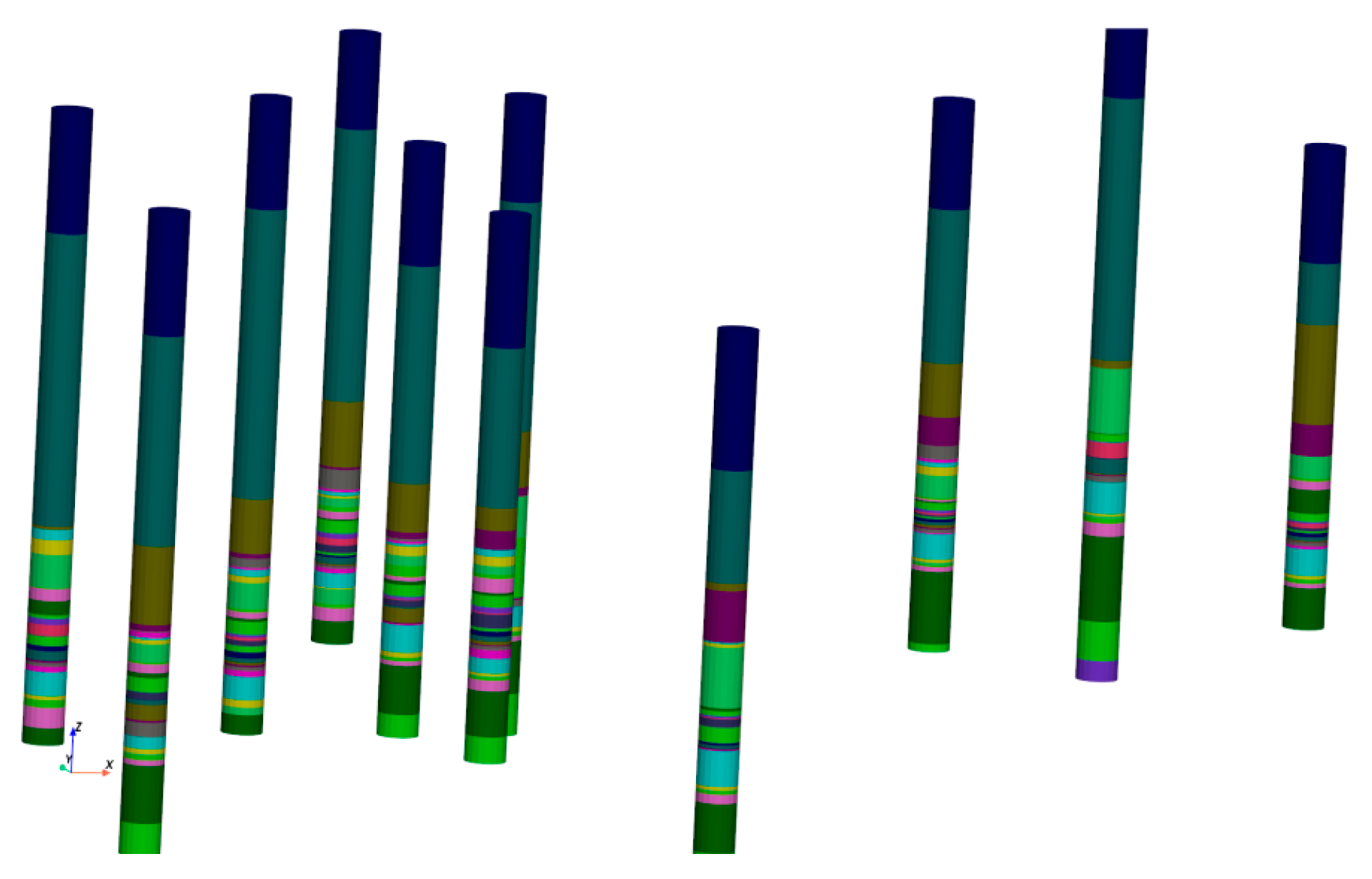
Three-dimensional geological modeling software was employed to parse the borehole log files and extract information for generating 3D borehole models. Due to the absence of borehole deviation survey data, all boreholes were assumed to be vertical without local inclination in this study. Based on collar coordinates, top and bottom depths of each stratum, and marker bed information, the spatial trajectory of each borehole was constructed, transforming one-dimensional depth data into continuous central axes in three-dimensional space. The top and bottom depths of each stratum (marker bed) corresponded to two points on the axis, thereby defining the position and extension of that stratum in 3D space. Geometric attributes were assigned to each stratigraphic section according to formation thickness, and cylindrical geometries were established by specifying borehole diameter. Each borehole was abstracted as a solid entity composed of multiple interconnected three-dimensional cylinders, with its morphology reflecting the subsurface drilling path and stratigraphic distribution. The model was subsequently optimized, integrated, and visualized to generate the complete three-dimensional borehole model (Figure 1). To enhance the realism and readability of the model, the modeling software automatically matched predefined color schemes based on marker bed names, thereby achieving intuitive visualization of geological attributes.
Three-Dimensional Geological Model Construction
Three-dimensional geological modeling software was employed to parse the standardized borehole data and extract three-dimensional coordinate control points for the roof and floor of each marker bed. Based on the ordinary Kriging interpolation method with the spherical variogram model described in Section Kriging Interpolation Parameters and Model Validation, spatial interpolation was performed on these control points to fit continuous three-dimensional surfaces representing the top and bottom of each stratum, accurately reflecting the undulating variations and spatial distribution of geological formations.
Kriging Interpolation Parameters and Model Validation
To ensure the reliability and accuracy of the constructed 3D geological model, it is essential to specify the geostatistical parameters employed in the Kriging interpolation and to validate the interpolation results.
Variogram Model Selection and Parameterization. The spherical variogram model was selected for characterizing the spatial correlation of stratigraphic elevation data, following established practices in coal seam modeling [16,17]. The spherical model is defined as:
Interpolation Uncertainty Assessment. The kriging interpolation method inherently provides a quantitative measure of interpolation uncertainty through the kriging variance, which reflects the estimation error variance at each interpolated location. The kriging variance is primarily determined by the spatial distribution of sample points and the variogram model parameters, increasing with distance from the nearest control points. In the core study area (ventilation shaft coal pillar area), where five boreholes are distributed within a relatively confined region, the spatial coverage of control points ensures relatively high confidence in the interpolated stratigraphic surfaces. Conversely, in peripheral regions distant from borehole locations, the kriging variance increases, indicating higher uncertainty in the interpolated elevations. This spatially variable uncertainty was taken into consideration during the subsequent numerical simulation, where the focus was placed on the well-constrained core area for rock burst risk assessment.
The experimental variograms were computed for each major stratigraphic horizon based on the spatial distribution of control points from the ten boreholes. Given the aver-age borehole spacing of approximately 500 m within the study area, the maximum lag distance was set to 1500 m to ensure sufficient sample pairs for reliable variogram estimation. The variogram parameters were determined through manual fitting of the experimental variograms, with the nugget-to-sill ratios ranging from 0.15 to 0.35 for different horizons, indicating moderate spatial continuity of the stratigraphic interfaces.
Spatial Distribution of Interpolation Uncertainty. The spatial distribution of kriging variance reveals distinct patterns of interpolation uncertainty across the study area. In the core study area (ventilation shaft coal pillar area), the relatively dense distribution of five boreholes within a confined region results in lower kriging variance, indicating higher confidence in the interpolated stratigraphic surfaces. In contrast, the peripheral regions of the model, particularly near the boundaries where borehole spacing increases significantly, exhibit substantially higher kriging variance, reflecting greater uncertainty in the interpolated elevations. However, these high-uncertainty regions are located outside the primary area of interest for rock burst risk assessment and therefore have limited impact on the reliability of the subsequent numerical simulations.
The validated 3D geological model, incorporating quantified interpolation uncertainty, provides a robust geometric foundation for the subsequent mesh generation and FDEM numerical simulation.
During the modeling process, particular emphasis was placed on the spatial occurrence of the No. 5 coal seam. Combined with roadway excavation data and measured goaf data, the coal seam boundaries and thickness were refined to ensure consistency between the seam model and actual subsurface conditions. Concurrently, fault data within the study area were integrated; based on fault strike, dip direction, dip angle, and displacement parameters, three-dimensional fault models were constructed to accurately characterize the truncation effects of faults on strata and coal seams.
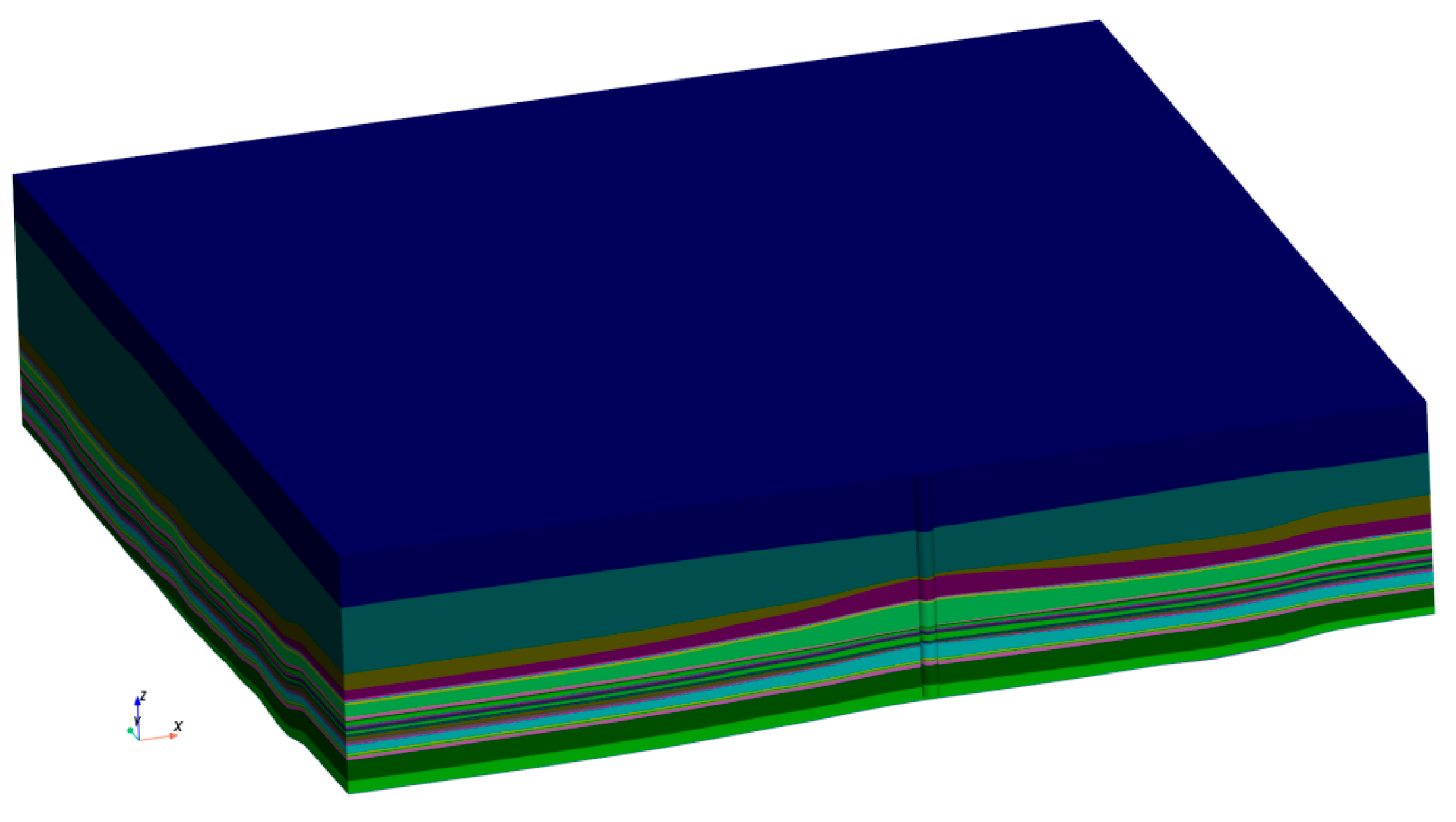
The final product was a complete three-dimensional geological model encompassing 31 strata, 41 goafs, main roadways, and faults. This model covered all geological elements within the study area, with stratum thickness, coal seam occurrence, and structural morphology all consistent with field investigation results, thereby achieving refined visualization of geological bodies in the study area (Figure 2).

2.5.2. Mesh Optimization

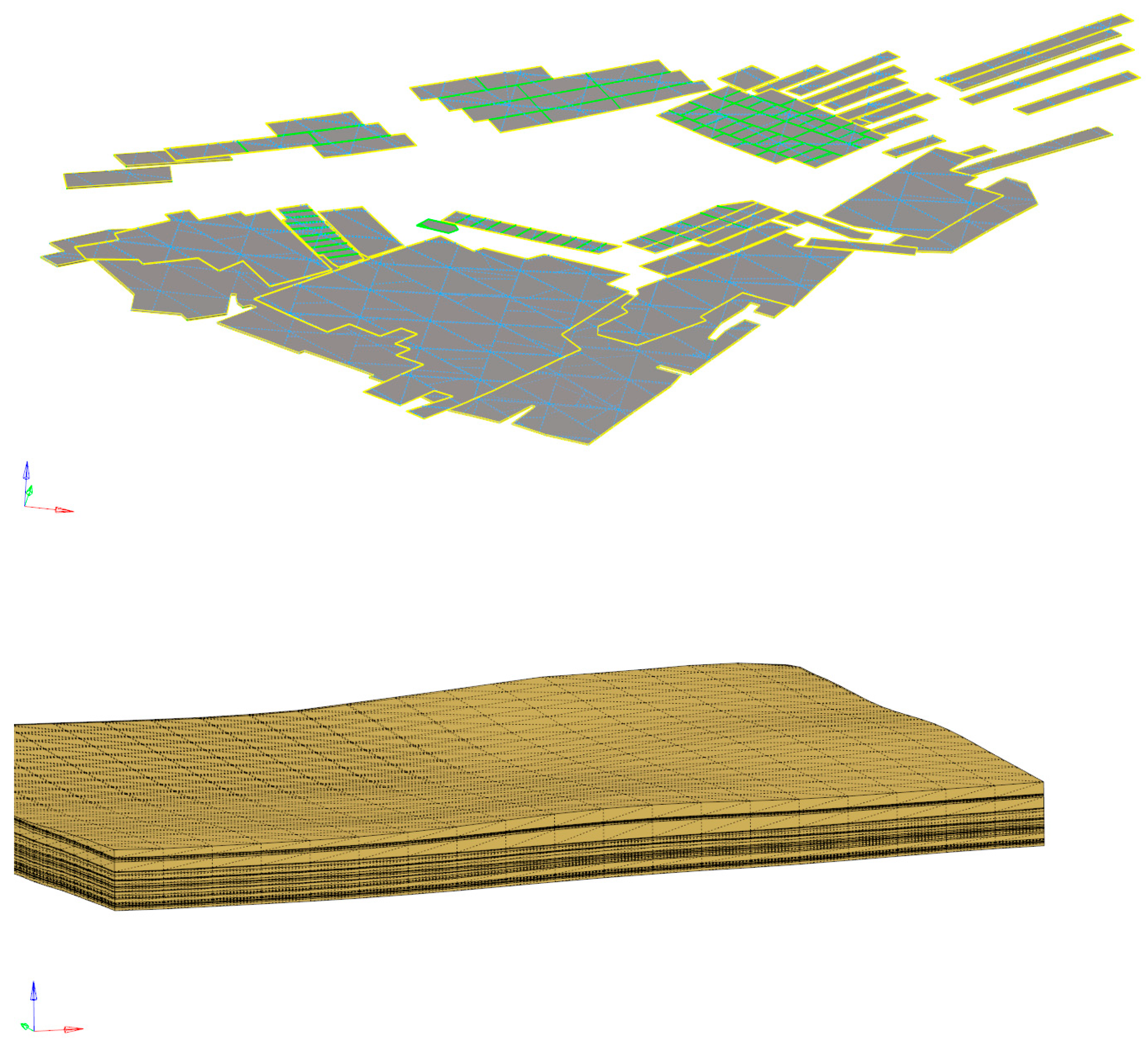
The completed three-dimensional geological model was exported as a universal geometric format file and imported into finite element pre-processing software for mesh generation. As illustrated in Figure 3, mesh generation represents the critical link connecting the geometric model to numerical computation, where mesh quality directly influences the accuracy and convergence of numerical simulations. Upon completion of meshing, mesh quality inspection and optimization were performed. The primary mesh quality evaluation indicators included element warpage, aspect ratio, Jacobian determinant, and minimum interior angle. The quality control criteria were established as follows: element warpage not exceeding 5°, aspect ratio not exceeding 5, Jacobian determinant not less than 0.7, and minimum interior angle not less than 30°. For elements failing to meet these quality standards, optimization methods including mesh smoothing, local remeshing, and node adjustment were applied until all elements satisfied the quality requirements. Additionally, mesh sensitivity analysis confirmed that stress field predictions in critical fault zones converge with <5% deviation between the adopted mesh (5 m base, 3 m refined) and a finer mesh (2.5 m), ensuring result independence from mesh density.

2.5.3. FDEM Numerical Model Construction and Parameter Assignment

Model Boundaries and Initial Conditions
Based on the geological boundary scope of the study area, the boundary conditions for the numerical model were established as follows: fixed displacement boundaries were applied to the four sides of the model to restrict horizontal displacement; a fixed displacement boundary was applied to the model base to restrict vertical displacement; and the model top was set as a free boundary to simulate the self-weight load of the overlying strata.
Based on the measured in situ stress data from the study area, the initial geo-stress field was applied: maximum horizontal principal stress σhmax = 22.34–23.72 MPa, minimum horizontal principal stress σhmin = 9.46–10.34 MPa, vertical stress σv = 14.31–15.40 MPa, with the maximum horizontal principal stress orientation of 125.48–140.73°. The horizontal principal stress was 1.51–1.56 times the vertical stress, consistent with the tectonic stress field characteristics of the study area. Table 2 presents the measured in situ stress results for the No. 5 coal seam in the ventilation shaft coal pillar area of the target mine.
The model was brought to initialization equilibrium through explicit integration, with the number of initialization time steps set to 8000 to ensure that the model achieved a stable state under the initial geo-stress field, thereby simulating the authentic subsurface stress environment. Given the limited spatial variability of measured stresses (σhmax varying by <6% across measuring points), the average values were applied as representative initial conditions, with sensitivity verification confirming that this simplification does not alter the delineated hazard zones or stress superposition patterns in critical areas.
Material Parameter Assignment
Referring to laboratory coal-rock mechanical test data, relevant literature, and field engineering experience, the physical and mechanical parameters of each coal-rock stratum were determined, including density, elastic modulus, Poisson’s ratio, internal friction angle, cohesion, and tensile strength. The specific parameters are presented in Table 3. The parameters for the No. 5 coal seam were determined based on field sampling tests: elastic modulus of 1.89 GPa, Poisson’s ratio of 0.31, internal friction angle of 32.84°, cohesion of 1.21 MPa, and tensile strength of 0.53 MPa, which are consistent with the mechanical characteristics of coal exhibiting weak burst proneness [39,40].
The material parameters listed in Table 3 were assigned to the corresponding strata and coal seams in the mesh model through the material assignment module of the self-developed FDEM code, ensuring consistency between the material parameters and the actual mechanical properties of the coal-rock masses. For fault zones, a friction coefficient of 0.3 and cohesion of 0.2 MPa were assigned to the fault contact surfaces to simulate the mechanical behavior of faults. These values were selected based on established practices in rock mechanics literature for simulating fault gouge and fractured rock masses, where friction coefficients typically range from 0.2 to 0.4 and cohesion values are significantly reduced compared to intact rock due to the presence of fracture surfaces and weathered materials [41,42]. For goaf areas, a weakening treatment was applied by reducing the elastic modulus of the coal-rock mass within the goaf range to 10% of the original parameters, simulating the caved state of the mined-out areas. This approach follows the widely adopted engineering practice in numerical modeling of caved zones, where the elastic modulus reduction to 5–15% of the original value is commonly employed to represent the load-bearing capacity of broken and recompacted rock masses in goaf areas [43,44]. The specific value of 10% was determined considering the degree of compaction and the time elapsed since mining completion in the study area.
The construction of the FDEM numerical model was thus completed, encompassing all computational elements including geometric configuration, boundary conditions, initial stress, and material parameters, providing a complete computational model for subsequent rock burst numerical simulations.

3. Results

3.1. Analysis of Numerical Simulation Results

Based on the established FDEM numerical model, stepwise excavation simulations were conducted following the actual mining sequence in the study area (excavating surrounding working faces first, followed by advancing the initial mining working face). The analysis focused on the evolution patterns of the stress field, characteristics of energy accumulation, and failure patterns of surrounding rock in the coal pillar area, providing quantitative bases for rock burst risk assessment.

3.1.1. Analysis of Numerical Simulation Results for Working Face 3652

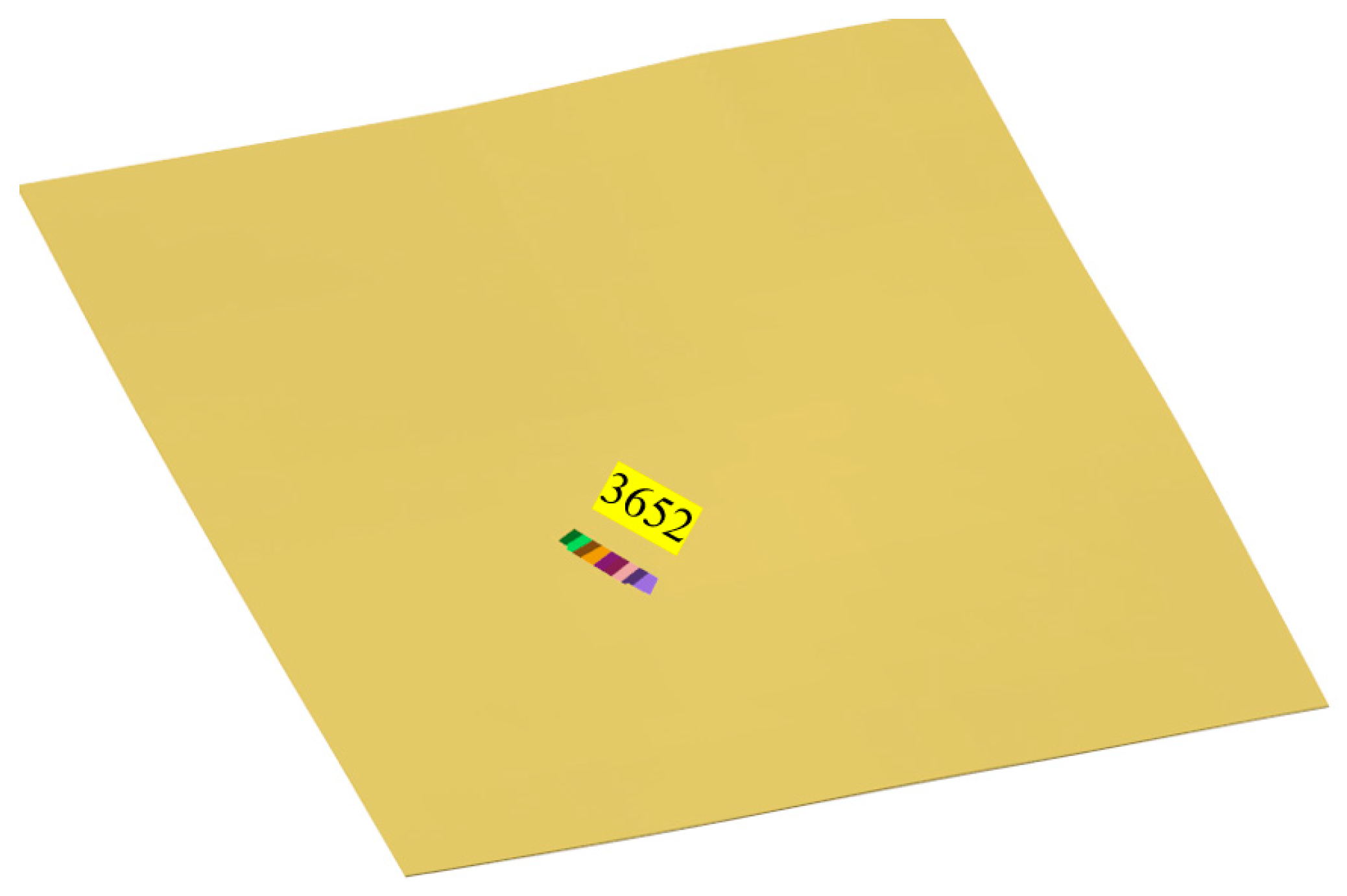
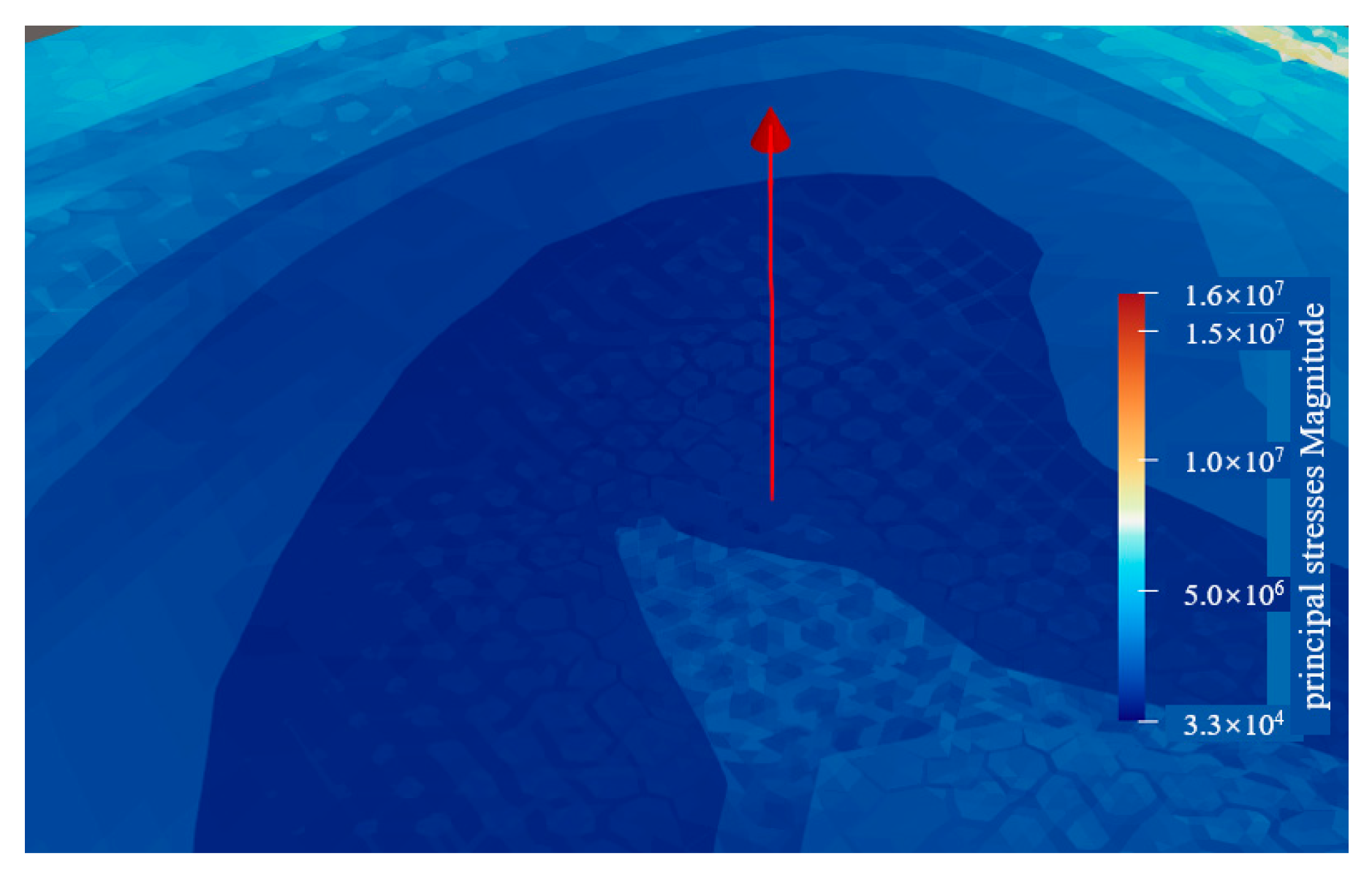
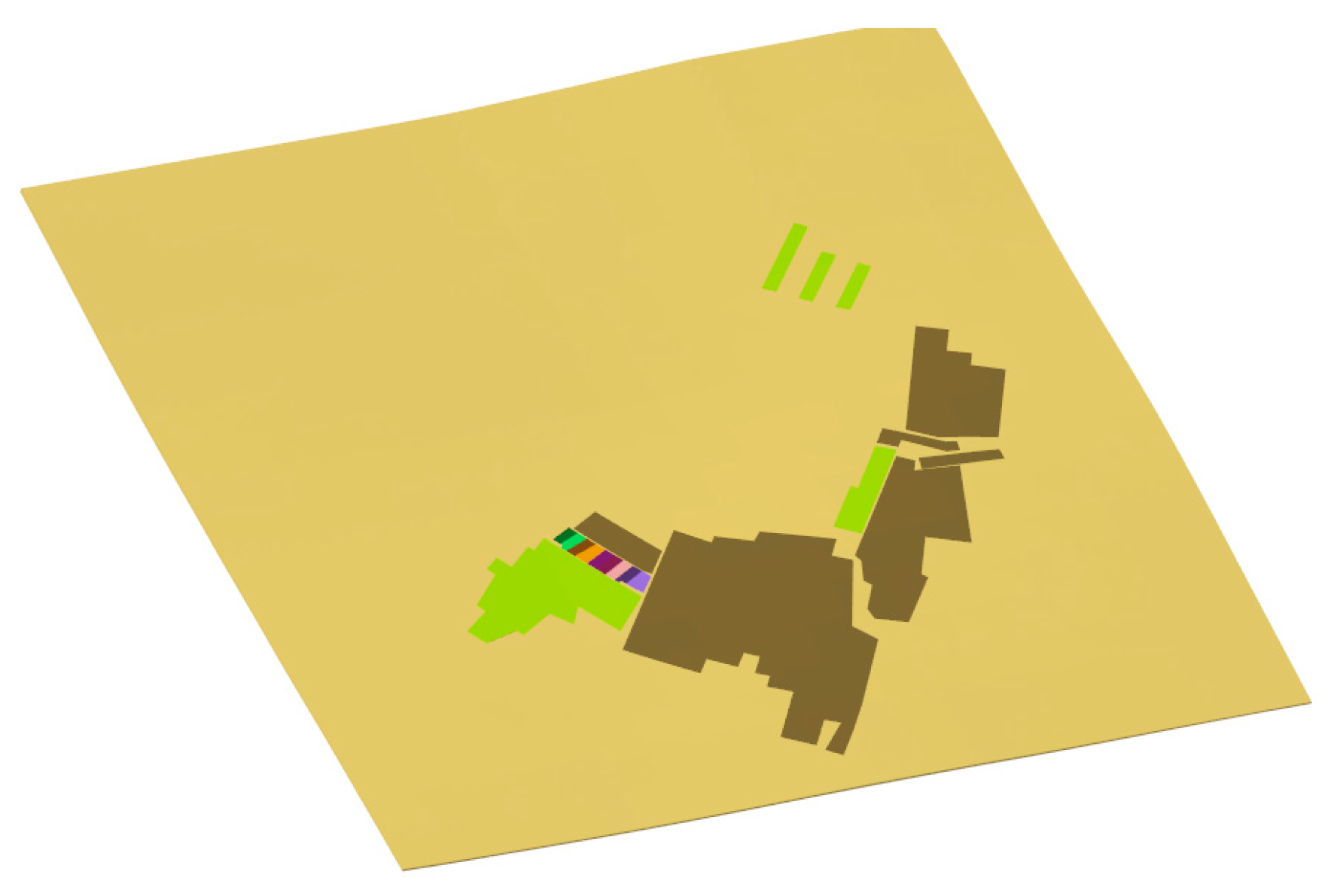
The mining of Working Face 3652 represented the first stage of the overall excavation sequence in the model, with progressive excavation conducted in 40 m increments. By comparing the principal stress data across five mining stages, the evolution patterns of the stress field in the coal seam working face during the mining process were analyzed to identify potential zones of principal stress concentration, stress relief, or anomalies, thereby providing a basis for safe production and support design. A schematic diagram showing the location of Working Face 3652 is presented in Figure 4.
As illustrated in Figure 5, during the initial mining stage, the overall major principal stress level is relatively high. The minimum value of 0.33 MPa indicates the presence of localized low principal stress zones, which may be attributed to stress relief or monitoring points located within fracture zones. Although the principal stress distribution remains within normal limits at this stage, allowing mining operations to continue, the already elevated stress levels create potential risk factors for subsequent rock burst incidents.
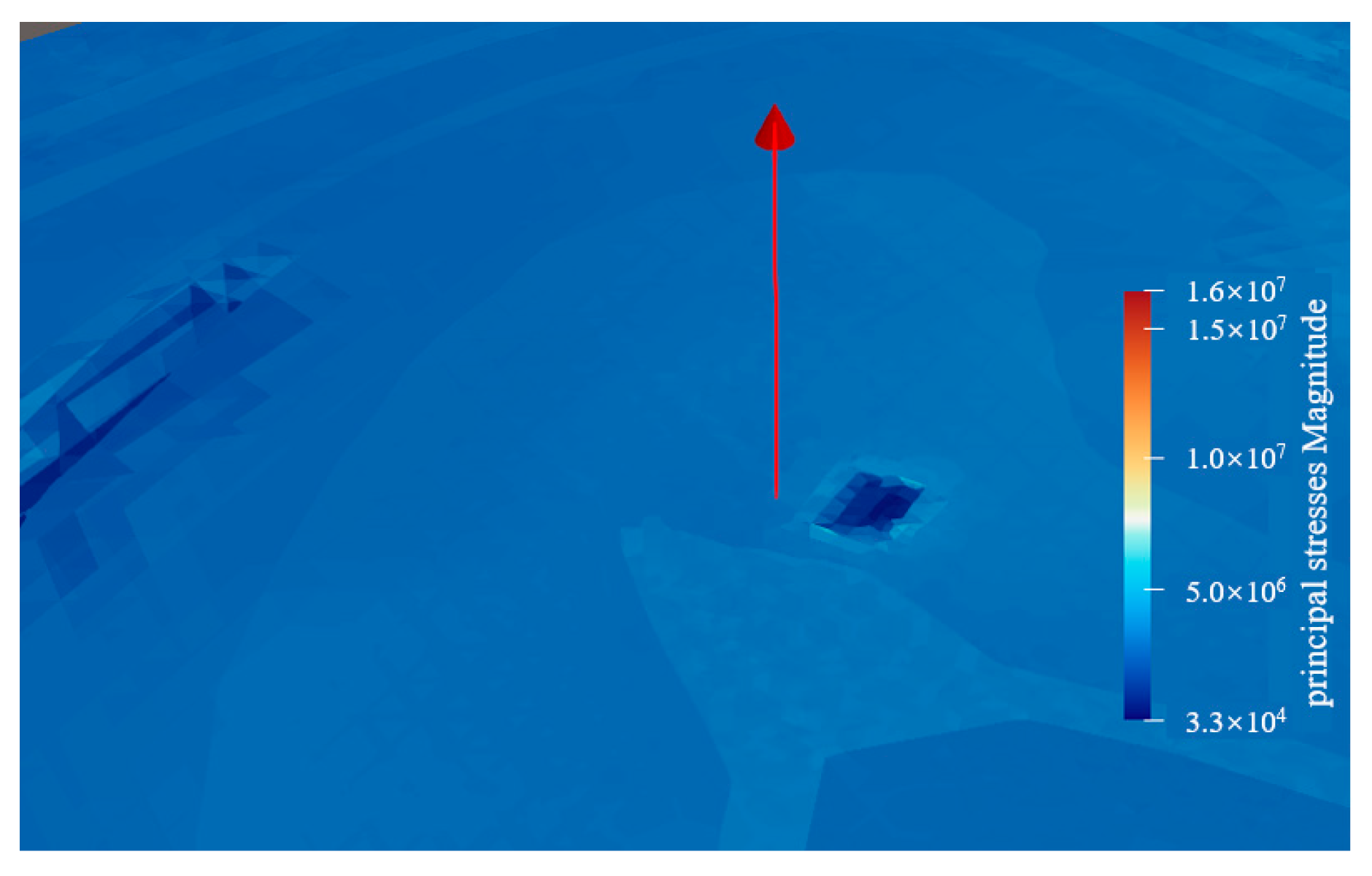
Following the first excavation step, the distribution of maximum principal stress in the vicinity of Working Face 3652 is illustrated in Figure 6.
As the mining of Working Face 3652 progressed, the major principal stress within the surrounding large-scale strata increased significantly overall, rising from 0.33 MPa to approximately 5 MPa. The principal stress around Working Face 3652 exhibited slight stress concentration, with stress levels marginally higher than the surrounding area, reaching maximum values of approximately 6–7 MPa. At this stage, the surrounding rock remained in a relatively stable condition, with mining operations appearing favorable. However, this stability was likely temporary, with principal stress accumulating progressively, indicating potential rock burst risks.
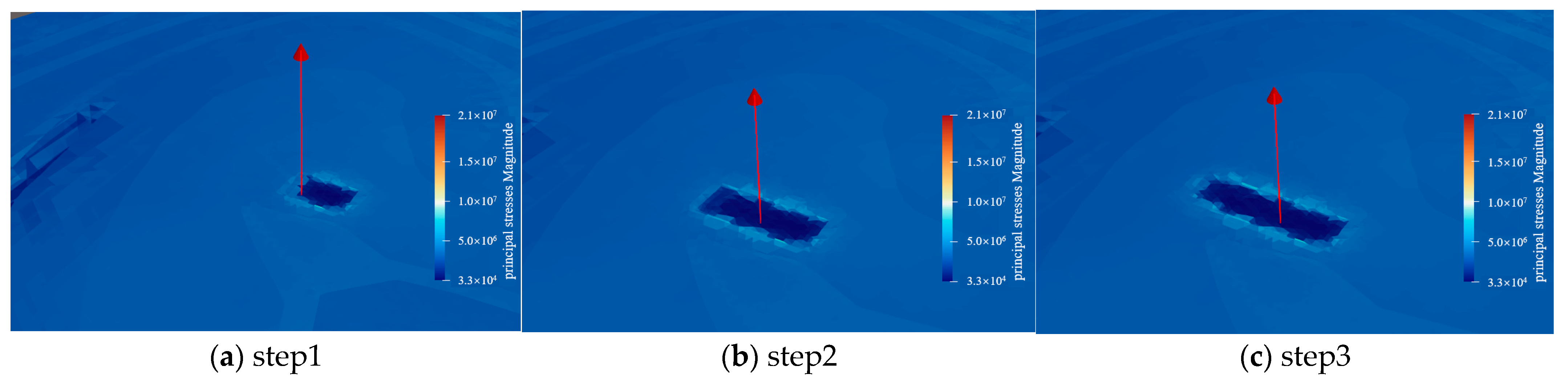
Subsequently, the second excavation step was conducted. To clearly characterize the evolution process, an excavation step length of approximately 100 m was adopted in this study, comprising four steps in total. Figure 7 presents the distribution of major principal stress in the strata surrounding Working Face 3652 following the second excavation step.
During subsequent mining steps, significant increases in the major principal stress levels around the roadways were clearly observable as the entries advanced, with distinct stress concentration phenomena emerging. The maximum principal stress rose to approximately 9–10 MPa, indicating pronounced stress concentration ahead of the working face. Such stress concentration represents a critical contributing factor to rock burst incidents. At this stage, the stability of the surrounding rock was severely compromised, with mining risks increasing substantially.
Following the extraction of Working Face 3652, stress concentration primarily manifested in the coal pillar area ahead of the working face. The formation mechanisms can be elucidated through three aspects:
First, the superposition effect of mining-induced stress: As the working face advanced, the coal mass ahead was subjected to abutment pressure. According to mine pressure theory, the peak abutment pressure is generally located 5–15 m ahead of the working face, with stress concentration coefficients reaching 2–3 times the original stress.
Second, influence of geological structures: Working Face 3652 is situated in close proximity to the syncline axis, where tectonic stress levels are relatively elevated (maximum horizontal principal stress reaching 22.34–23.72 MPa). The superposition of tectonic stress and mining-induced stress further amplifies local stress levels.
Third, coal pillar effect: With goafs present on both sides of Working Face 3652, an isolated coal pillar was formed. The limited width of the coal pillar induced stress transfer toward the pillar interior, resulting in stress concentration coefficients exceeding 2.5.
The stress level in this region (10 MPa) has exceeded 60% of the coal mass uniaxial compressive strength (approximately 8–10 MPa), with estimated elastic energy densities reaching 1.2–1.5 MJ/m3, indicating a moderate rock burst hazard.

3.1.2. Analysis of Numerical Simulation Results for No. 5 Coal Seam Working Face Mining Around the Ventilation Shaft Coal Pillar Area

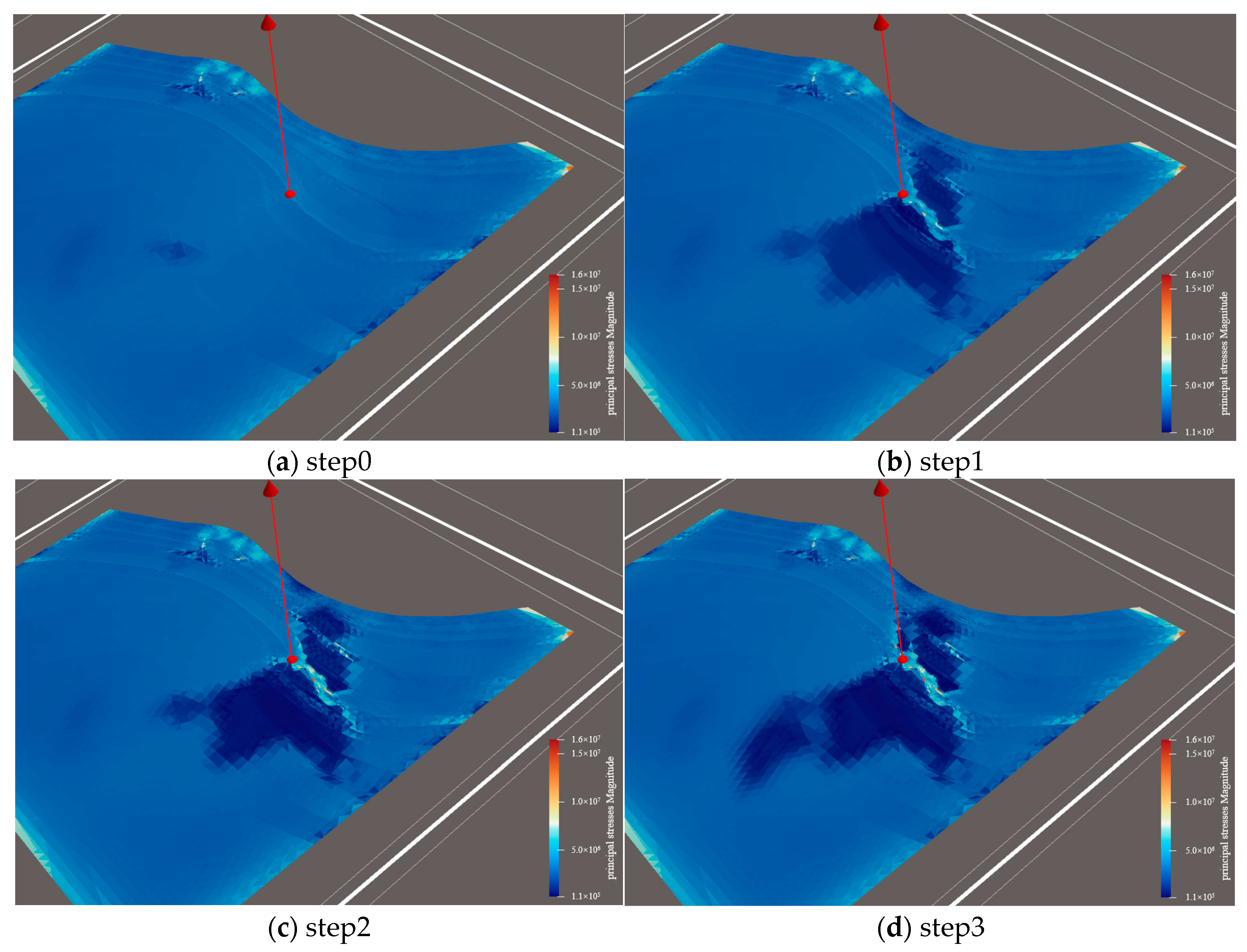
The mining of No. 5 coal seam working faces surrounding the ventilation shaft coal pillar area represents the second step of the overall mining sequence in the model. The schematic diagram showing the locations of these working faces is presented in Figure 8.
At time step 0, the principal stress conditions of the No. 5 coal seam working faces surrounding the ventilation shaft coal pillar area are shown in Figure 9.
As shown in Figure 9a, prior to the extraction of the No. 5 coal seam working faces surrounding the ventilation shaft coal pillar area, the overall principal stress level remained relatively low. The principal stress distribution exhibited regular patterns influenced by the stratigraphic structure, with mean principal stress values approximately ranging from 3 MPa to 5 MPa. Only localized areas exhibited elevated stress states due to structural influences from geological formations. At this stage, the surrounding rock remained in a relatively stable condition, with favorable mining conditions.
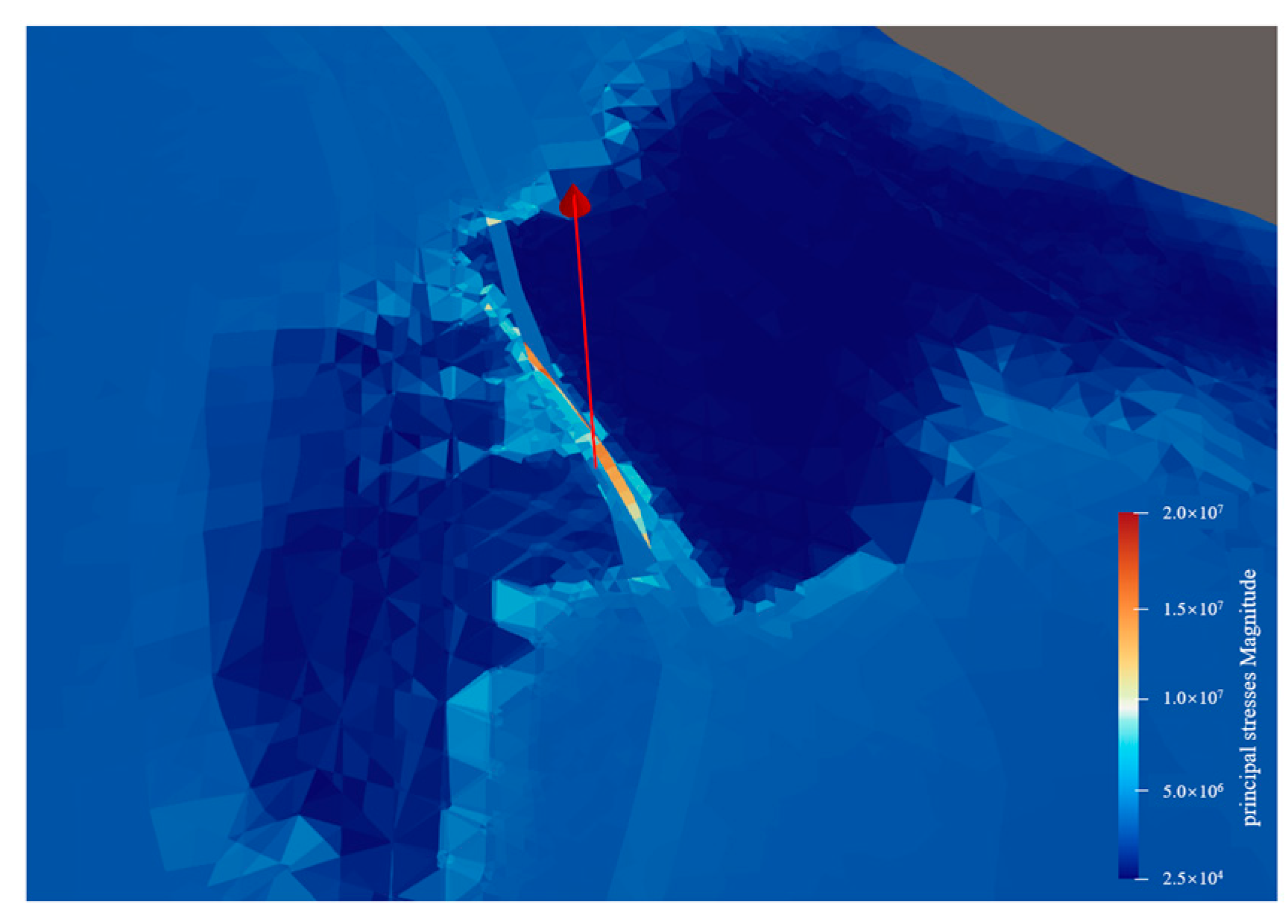
As shown in Figure 10, the major principal stress distribution for the No. 5 coal seam working faces surrounding the ventilation shaft coal pillar area at the final mining step reveals significant variations. As the mining steps progressed, varying degrees of stress concentration appeared around these working faces. In zones with lower stress concentration, stress levels ranged approximately from 4 MPa to 6 MPa, while high-stress concentration zones were located in the “pinch” areas between two adjacent mining working faces, where local major principal stress exceeded 15 MPa.
This indicates that special attention should be paid to the distance between adjacent working faces during the extraction of No. 5 coal seam working faces surrounding the ventilation shaft coal pillar area. When adjacent working faces are in close proximity, significant stress concentration phenomena will occur, exerting adverse effects on mining operations. This pronounced stress concentration affects the overall principal stress distribution and is detrimental to subsequent mining operations in adjacent seams.

3.1.3. Stress Field Evolution Characteristics During Extraction of Working Faces F5001 and F5002 in the Ventilation Shaft Coal Pillar Area

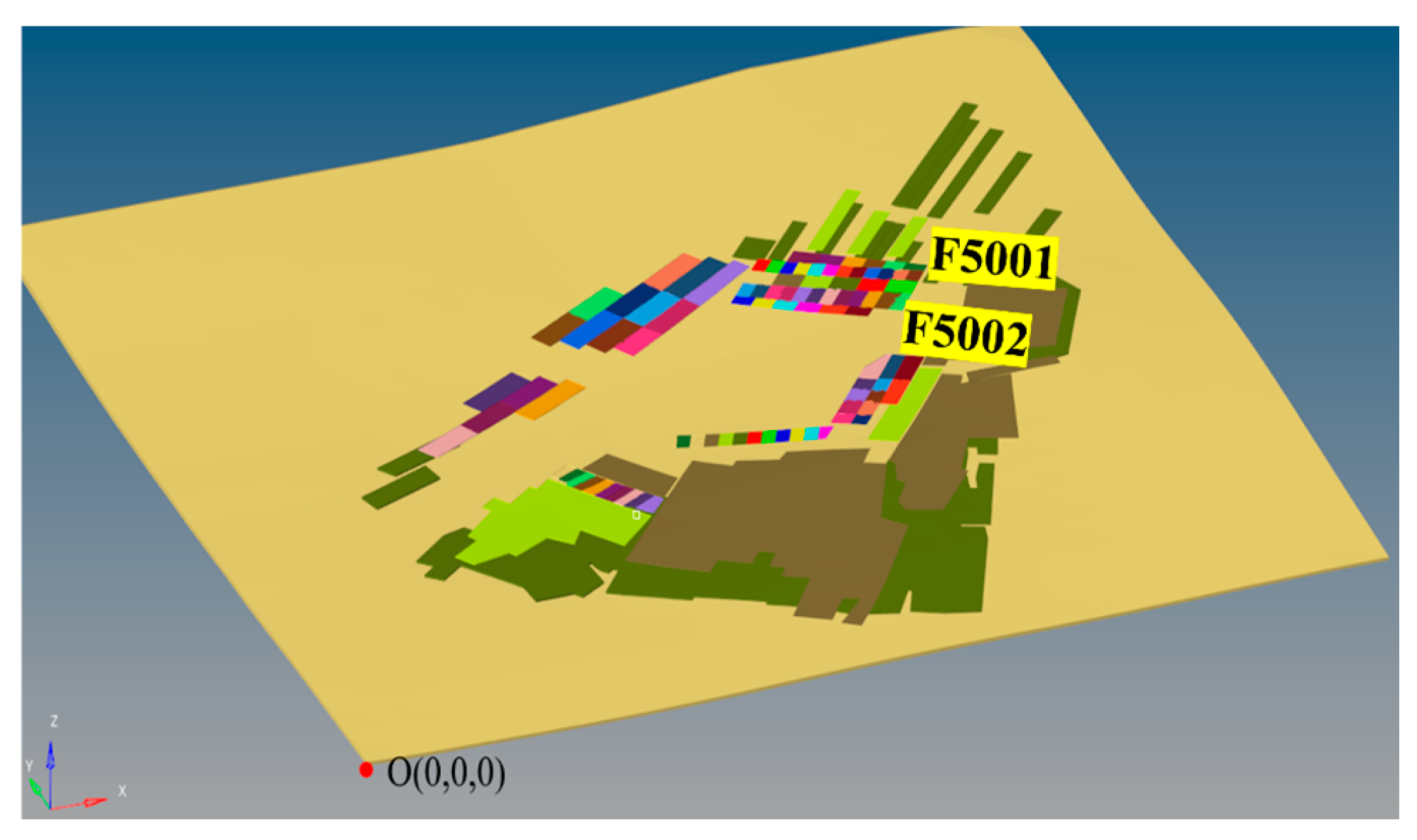
Working Faces F5001 and F5002 are located within the first mining district, and the model schematic is shown in Figure 11.
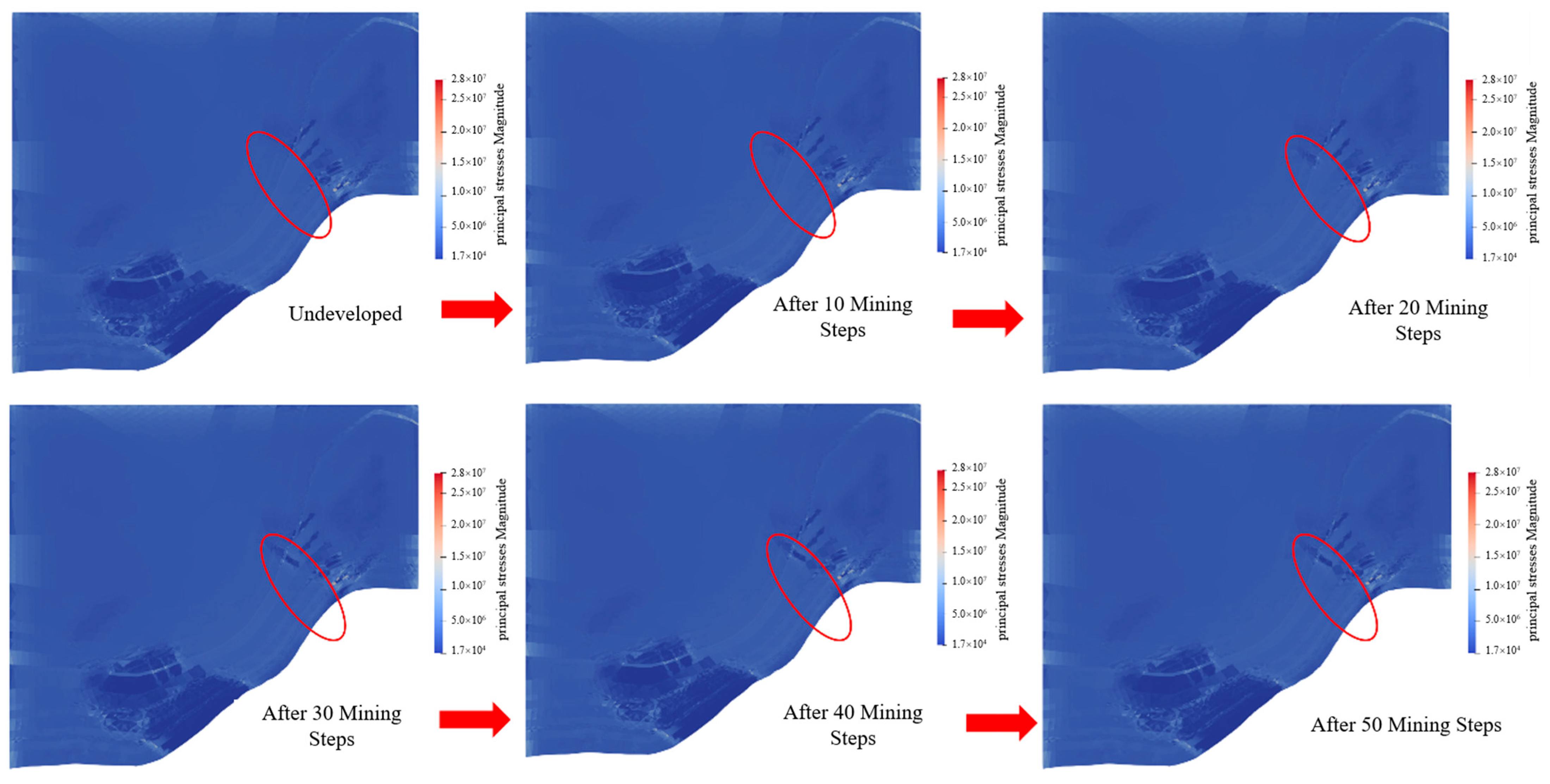
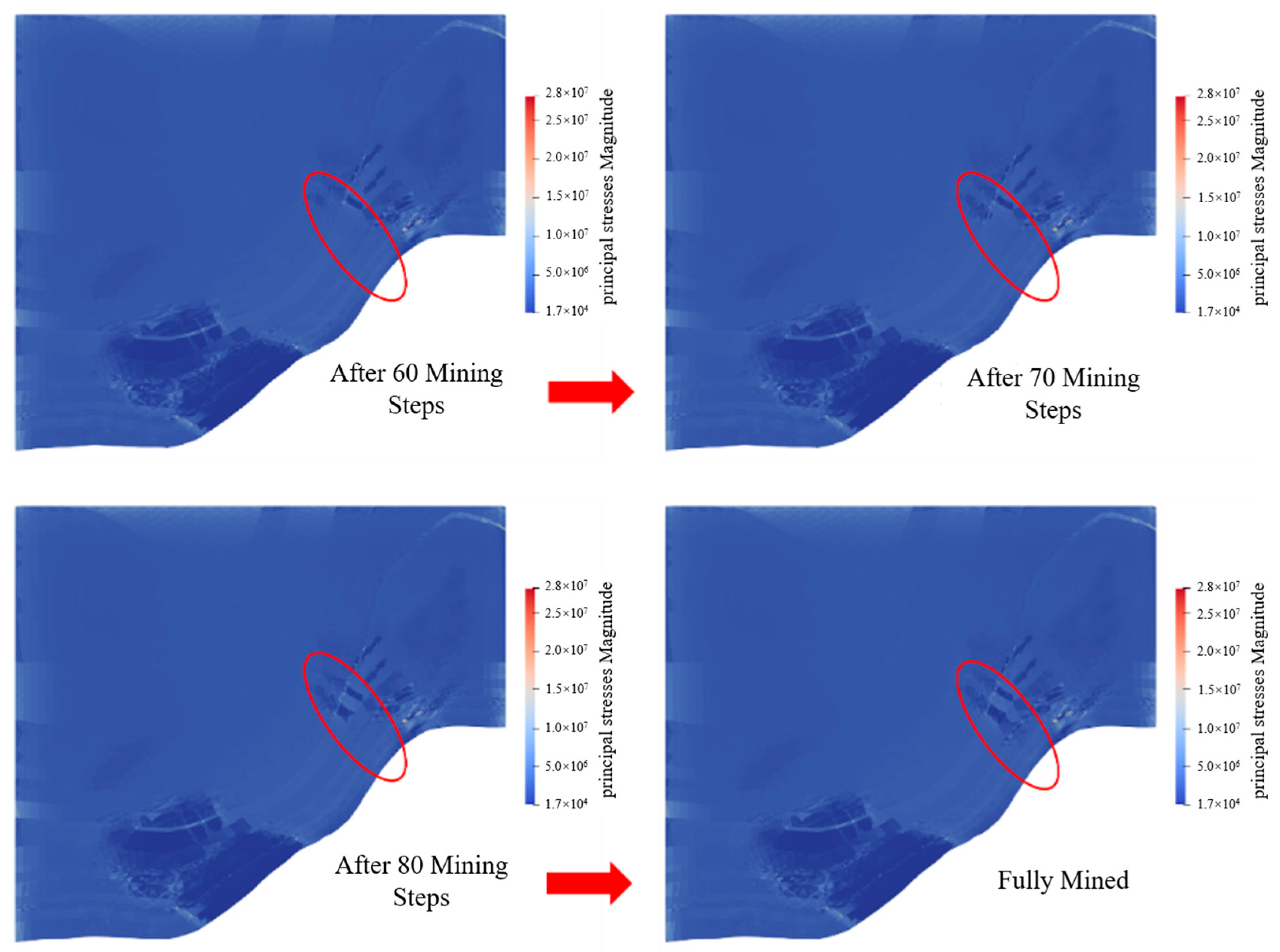
The simulation of working faces F5001 and F5002 was designed with a total of 95 time steps. Figure 12 presents the stress distribution within the ventilation shaft coal pillar area and the surrounding stress conditions of working face F5001 during its progressive extraction.
As illustrated in Figure 12, prior to mining activities, the maximum principal stress in the area where working face F5001 is located remained approximately at 10 MPa, indicating a relatively high stress state overall. As working face F5001 advanced and coal extraction progressed progressively, the stress state of the surrounding rock strata underwent significant changes, with the maximum principal stress exhibiting evident dynamic adjustment and gradually decreasing to below 5 MPa. This demonstrates the strong disturbance effect of mining activities on the original rock stress field. Notably, throughout the entire mining process, the stress influence exerted by working face F5001 on the adjacent ventilation shaft coal pillar area remained relatively limited. The maximum principal stress sustained by the ventilation shaft coal pillar area did not exhibit significant fluctuations during the entire monitoring period, maintaining a relatively stable level throughout. This indicates that the stress environment in this region is less affected by mining-induced disturbances and has maintained favorable structural stability.
Figure 13 presents the stress distribution within the ventilation shaft coal pillar area and the surrounding stress conditions of working face F5002 during its progressive extraction.
As illustrated in Figure 13, prior to mining activities, the maximum principal stress in the region where working face F5002 is located was similarly maintained at approximately 10 MPa, essentially consistent with the initial stress state of working face F5001. This reflects that the original rock stress field in this region is generally high. As working face F5002 began extraction and progressively advanced forward, mining-induced effects gradually became apparent, with significant adjustments occurring in the regional stress distribution. The maximum principal stress exhibited a dynamic decreasing trend, eventually falling below 5 MPa. This variation process is relatively similar to the response observed after mining of working face F5001, further indicating that mining activities are the key factor causing stress release.
On the other hand, throughout the entire mining process of working face F5002, the stress disturbance generated to the adjacent ventilation shaft coal pillar area was similarly weak. The maximum principal stress in the ventilation shaft coal pillar area did not exhibit significant fluctuations, consistently maintaining a relatively stable state. This indicates that the region possesses favorable anti-disturbance capability and structural integrity.
Based on the comprehensive mining responses of working faces F5001 and F5002, it can be concluded that after implementing the backfill mining technique, both working faces produced relatively weak additional stress impacts on the No. 5 coal seam ventilation shaft coal pillar area, without inducing significant stress concentration or violent adjustment. Therefore, the rock burst hazard faced by this No. 5 coal seam ventilation shaft coal pillar area is relatively low, with the overall condition remaining within a stable and controllable range.

3.2. Rock Burst Hazard Zoning

Combined with numerical simulation results, the Comprehensive Index Method and Multi-factor Coupling Method were employed to delineate rock burst hazard zones, clarifying the hazard levels and extents of each region.
The Comprehensive Index Method analyzes nearly 200 historically occurred rock burst incidents, and through comprehensive analysis and evaluation of the weights of geological and mining factors affecting rock burst occurrence in the mining area, calculates the respective hazard indices. The maximum value of these indices is taken as the final comprehensive rock burst hazard index. Based on this, the rock burst hazard of working faces is evaluated to determine the rock burst hazard level, status, and prevention and control countermeasures for the mining area.
The comprehensive index for rock burst hazard assessment and prediction in the mine is calculated by the following equation:
W t = max W t 1 , W t 2
W t 1 = W g i W m g i
W t 2 = W m j W m m j
where W t denotes the comprehensive index for rock burst hazard level assessment; W t 1 denotes the index reflecting the influence degree of geological factors on rock burst and rock burst hazard level assessment; W t 2 denotes the index reflecting the influence degree of mining technical factors on rock burst and rock burst hazard level assessment; W m g i denotes the maximum hazard index of various geological factors; W g i denotes the actual hazard index of various geological factors; W m m j denotes the maximum hazard index of various mining factors; and W m j denotes the actual hazard index of various mining factors.
The higher the value of the comprehensive rock burst hazard index W t , the higher the rock burst hazard level of the mining area.
According to the comprehensive rock burst hazard assessment index W t , the rock burst hazard degree is classified into four levels: no rock burst hazard, weak rock burst hazard, moderate rock burst hazard, and strong rock burst hazard (Table 4). Corresponding prevention and control countermeasures are implemented based on the assessed rock burst hazard level.
The fundamental concept of multi-factor coupling evaluation for rock burst hazard posits that within a specific influence range, the greater the number of factors influencing rock burst to which the coal-rock mass is subjected, the higher the rock burst hazard. In the vicinity of each rock burst-inducing factor, a zone of abrupt stress change exists within a certain range. Based on the original rock stress (σ0), the stress increment (Δσi) generated by each rock burst-inducing factor on the coal-rock mass within a specific range is first calculated. Subsequently, the stress increments from all rock burst-inducing factors at that point are superimposed to obtain the total stress (σd) of the coal mass:
σ d = σ 0 + Δ σ i
where σ0 denotes the original rock stress, Δσi denotes the stress increment generated by the i-th rock burst-influencing factor at that point, and σd denotes the total stress resulting from the superposition of various rock burst-influencing factors within a certain range.
The stress superposition of various rock burst hazard factors follows the principles of limited influence range and incremental superposition. The rock burst hazard coefficient is obtained by calculating the ratio of the total stress of the coal-rock mass to its uniaxial compressive strength, namely:
I c = σ d σ c
where Ic denotes the rock burst hazard coefficient, σd denotes the vertical stress at a given point, and [σc] denotes the uniaxial compressive strength of the coal-rock mass. The rock burst hazard level can be assessed according to the magnitude of by referring to Table 5.
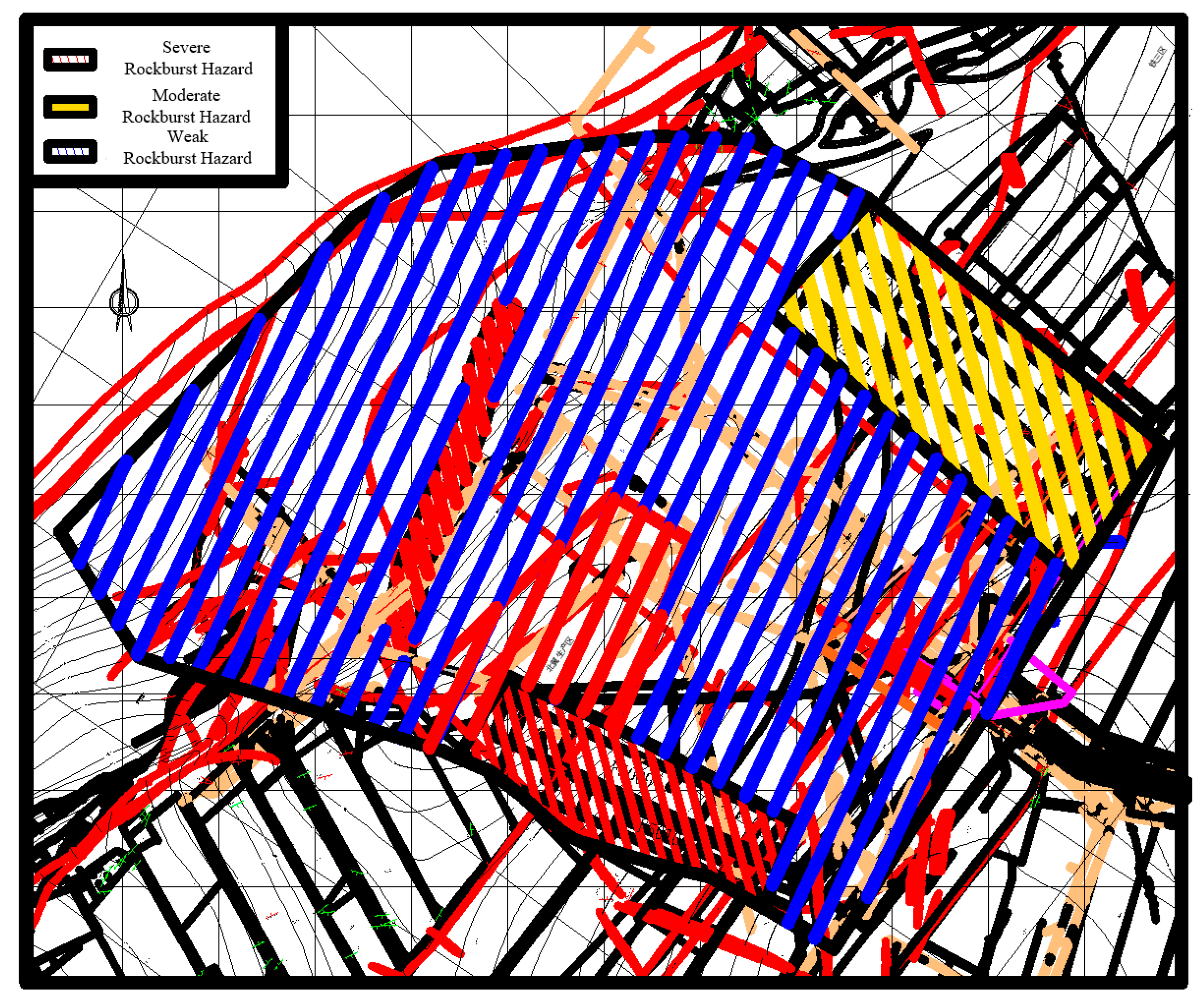
By superimposing the rock burst hazard classification results across different zones of the No. 5 coal seam in the ventilation shaft coal pillar area of the target mine, the final rock burst hazard zoning results for this area were obtained, as illustrated in Figure 14. The specific zoning ranges are presented in Table 6.
The rock burst hazard zoning results presented in Table 6 and Figure 14 demonstrate good consistency with the stress concentration zones identified through numerical simulations in Section 3.1. Specifically: (1) The severe hazard zone “adjacent area of Working Face F5009” corresponds to the high-stress concentration zone identified in the numerical simulation, where the “pinch” areas between adjacent working faces exhibited local major principal stress exceeding 15 MPa (Section 3.1.2), resulting from the superposition of tectonic stress, mining-induced stress, and syncline structural effects; (2) The severe hazard zone “adjacent area of Working Face F5010” characterized by isolated coal pillar conditions aligns with the stress concentration phenomenon observed ahead of Working Face 3652 in the numerical simulation (Section 3.1.1), where isolated coal pillars with limited width induced stress transfer toward the pillar interior with concentration coefficients exceeding 2.5; (3) The moderate hazard zone “adjacent area of F5001 and F5002 Working Faces” corresponds to the numerical simulation results showing that backfill mining produced relatively weak additional stress impacts on the coal pillar area without inducing significant stress concentration (Section 3.1.3), consistent with the moderate hazard classification. The complementary application of numerical simulation and comprehensive risk assessment methods enhances the reliability of hazard delineation: numerical simulation provides quantitative stress distribution data that validates the stress-based multi-factor coupling assessment, while the comprehensive index method incorporates geological and mining factors that extend beyond the scope of numerical modeling. This integrated approach ensures that both stress concentration mechanisms and comprehensive geological-mining conditions are considered in the final risk zoning.

4. Discussion

Combined with numerical simulation results and field accident analysis, the rock bursts in the study area are identified as tectonic-type rock bursts induced by multi-factor coupling. This study reveals a three-stage rock burst occurrence mechanism and quantifies the contribution proportions of various factors:
Stage I: Stress Superposition. Horizontal tectonic stress (22.34–23.72 MPa, accounting for 55–60% of total stress) serves as the basal stress. This combines with mining-induced stress from multiple working faces of the peninsula-shaped coal pillar (stress concentration coefficient of 2.5–3.0, accounting for 25–30% of total stress) and structural stress from syncline axes and faults (superposition increment of 5–10 MPa, accounting for 10–15% of total stress), resulting in local stress concentrations reaching 40–45 MPa and providing the essential stress conditions for rock burst development.
Stage II: Energy Accumulation. Coal-rock masses within high-stress concentration zones remain in elastic deformation states, achieving elastic energy densities of 1.5–2.0 MJ/m3 (estimated using the formula U = σ2/2E, where σ = 15~20 MPa and E = 1.89 GPa), exceeding the critical threshold of 1.5 MJ/m3. With energy unable to dissipate effectively, elastic strain energy continuously accumulates, establishing the energetic foundation for rock burst.
Stage III: Disturbance Triggering. External perturbations—including mining activities (excavation and extraction), roof collapse, and fault slip—disrupt the mechanical equilibrium of the coal-rock mass, resulting in instantaneous release of accumulated elastic strain energy and the subsequent initiation of rock burst.


5. Conclusions

This study addressed the challenges of rock burst risk assessment for coal seam mining in coal pillar areas under complex geological conditions, taking the ventilation shaft coal pillar area of a mining district as the research object. Through integrated methods comprising field investigation, laboratory testing, numerical simulation, and engineering analogy, systematic investigations were conducted into rock burst mechanisms, three-dimensional geological modeling, and risk assessment. The study revealed a three-stage tectonic-type rock burst occurrence mechanism, established an integrated technical system encompassing geological modeling–numerical simulation–risk assessment, and achieved precise delineation of rock burst hazard zones, providing theoretical foundations and technical support for safe mining operations in coal pillar areas under similar complex geological conditions.
(1)
Technical Methodology: This study established an integrated technical system encompassing geological modeling, mesh optimization, FDEM simulation, and risk assessment. A refined three-dimensional geological model was constructed based on data from ten boreholes, and high-quality mesh models were generated through finite element mesh optimization techniques. FDEM numerical simulation accurately revealed the evolutionary characteristics of stress fields, energy accumulation patterns, and surrounding rock failure mechanisms. By combining the Comprehensive Index Method and the Multi-factor Coupling Method, strong rock burst hazard zones (1.2 km2, encompassing the central part of the peninsula-shaped coal pillar, syncline axis, and fault-influenced areas), moderate hazard zones (1.5 km2), and weak hazard zones (2.3 km2) were delineated. The boundaries of no-mining zones and minable zones were clarified, providing a scientific basis for the selection of the initial mining face.
(2)
Rock Burst Mechanisms: This study revealed a three-stage tectonic-type rock burst mechanism characterized by tectonic stress dominance, mining-induced stress superposition, and fault-disturbance triggering. Tectonic stress (22.34–23.72 MPa, accounting for 55–60% of total stress) constitutes the basal stress field. This combines with mining-induced stress from multiple working faces in the peninsula-shaped coal pillar (stress concentration coefficient of 2.5–3.0, accounting for 25–30% of total stress) and structural stress from the syncline axis and faults (superposition increment of 5–10 MPa, accounting for 10–15% of total stress), resulting in local stress concentrations reaching 40–45 MPa. In these high-stress concentration zones, the elastic strain energy density of the coal-rock mass reaches 1.5–2.0 MJ/m3; exceeding the critical threshold, rock bursts are triggered upon external disturbance.

Author Contributions

X.J.: Investigation, visualization, formal analysis, writing—original draft. C.L.: Conceptualization, methodology, investigation, software, project administration, writing—review and editing. H.L. (Haitao Li): Project administration, funding acquisition, supervision, writing—review and editing. T.H.: Resources, validation, writing—review and editing. P.M.: Software, visualization, formal analysis. H.L. (Huaguang Liu): Investigation, visualization, formal analysis. Y.L.: Software, visualization, formal analysis. Z.L.: Investigation, visualization, formal analysis. All authors have read and agreed to the published version of the manuscript.

Funding

This research was funded by the National Natural Science Foundation of China (52374206, 52304089), and the Special Project of Science and Technology Innovation and Venture Capital of Tiandi Co., Ltd. (2024-TD-MS018, 2023-TD-ZD001-004, 2024ZD1000705).

Institutional Review Board Statement

Not applicable.

Informed Consent Statement

Not applicable.

Data Availability Statement

The authors confirm that the data supporting the findings of this study are available within the article.

Acknowledgments

The authors are grateful to the editors and the anonymous reviewers for their Insightful comments and suggestions.

Conflicts of Interest

The authors declare that they have no known competing financial interests or personal relationships that could have appeared to influence the work reported in this paper.

References

  1. He, M.; Ren, F.; Liu, D. Rockburst mechanism research and its control. Int. J. Min. Sci. Technol. 2018, 28, 797–809. [Google Scholar] [CrossRef]
  2. Dou, L.; Mu, Z.; Li, Z.; Cao, A.-Y.; Gong, S.-Y. Research progress of monitoring, forecasting, and prevention of rockburst in underground coal mining in China. Int. J. Coal Sci. Technol. 2014, 1, 278–288. [Google Scholar] [CrossRef]
  3. Dou, L.; Lu, C.; Mu, Z.; Gao, M.-S. Prevention and forecasting of rock burst hazards in coal mines. Min. Sci. Technol. 2009, 19, 585–591. [Google Scholar] [CrossRef]
  4. Zhang, J.; Jiang, F.; Yang, J.; Bai, W.; Zhang, L. Rockburst mechanism in soft coal seam within deep coal mines. Int. J. Min. Sci. Technol. 2017, 27, 225–230. [Google Scholar] [CrossRef]
  5. Wagner, H. Deep mining: A rock engineering challenge. Rock Mech. Rock Eng. 2019, 52, 1417–1446. [Google Scholar] [CrossRef]
  6. Ranjith, P.G.; Zhao, J.; Ju, M.; De Silva, R.V.; Rathnaweera, T.D.; Bandara, A.K. Opportunities and challenges in deep mining: A brief review. Engineering 2017, 3, 546–551. [Google Scholar] [CrossRef]
  7. Cai, W.; Dou, L.; Si, G.; Hu, Y. Fault-induced coal burst mechanism under mining-induced static and dynamic stresses. Engineering 2021, 7, 687–700. [Google Scholar] [CrossRef]
  8. Shen, B.; Duan, Y.; Luo, X.; van de Werken, M.; Dlamini, B.; Chen, L.; Vardar, O.; Canbulat, I. Monitoring and modelling stress state near major geological structures in an underground coal mine for coal burst assessment. Int. J. Rock Mech. Min. Sci. 2020, 132, 104375. [Google Scholar] [CrossRef]
  9. Amadei, B.; Stephansson, O. Rock Stress and Its Measurement; Springer Science & Business Media: Berlin/Heidelberg, Germany, 1997. [Google Scholar]
  10. Ljunggren, C.; Chang, Y.; Janson, T.; Christiansson, R. An overview of rock stress measurement methods. Int. J. Rock Mech. Min. Sci. 2003, 40, 975–989. [Google Scholar] [CrossRef]
  11. Pan, Y.; Wang, A. Disturbance response instability theory of rock bursts in coal mines and its application. Geohazard Mech. 2023, 1, 31–41. [Google Scholar] [CrossRef]
  12. Wang, J.; Jiang, F.; Meng, X.; Wang, X.-Y.; Zhu, S.-T.; Feng, Y. Mechanism of rock burst occurrence in specially thick coal seam with rock parting. Rock Mech. Rock Eng. 2016, 49, 2453–2466. [Google Scholar] [CrossRef]
  13. Pan, Y.; Dai, L. Theoretical formula of rock burst in coal mines. J. China Coal Soc. 2021, 46, 789–801. [Google Scholar]
  14. Shepherd, J.; Rixon, L.K.; Griffiths, L. Outbursts and geological structures in coal mines: A review. Int. J. Rock Mech. Min. Sci. 1981, 18, 267–283. [Google Scholar] [CrossRef]
  15. Xiao, Z.; Gu, S.; Zhang, Y.; Wang, H. An effective control method of rock burst induced by shear instability of fault structure under complicated geological conditions. Bull. Eng. Geol. Environ. 2023, 82, 186. [Google Scholar] [CrossRef]
  16. Kaufmann, O.; Martin, T. 3D geological modelling from boreholes, cross-sections and geological maps, application over former natural gas storages in coal mines. Comput. Geosci. 2008, 34, 278–290. [Google Scholar] [CrossRef]
  17. Che, D.; Jia, Q. Three-dimensional geological modeling of coal seams using weighted kriging method and multi-source data. IEEE Access 2019, 7, 118037–118045. [Google Scholar] [CrossRef]
  18. Wu, Q.; Xu, H. Three-dimensional geological modeling and its application in digital mine. Sci. China Earth Sci. 2014, 57, 176–188. [Google Scholar] [CrossRef]
  19. Jing, L. A review of techniques, advances and outstanding issues in numerical modelling for rock mechanics and rock engineering. Int. J. Rock Mech. Min. Sci. 2003, 40, 283–353. [Google Scholar] [CrossRef]
  20. Jing, L.; Hudson, J.A. Numerical methods in rock mechanics. Int. J. Rock Mech. Min. Sci. 2002, 39, 409–427. [Google Scholar] [CrossRef]
  21. Tatone, B.S.A.; Lisjak, A.; Mahabadi, O.K.; Vlachopoulos, N. Incorporating rock reinforcement elements into numerical analyses based on the hybrid finite-discrete element method (FDEM). In ISRM Congress; ISRM: Lisbon, Portugal, 2015. [Google Scholar]
  22. Yuan, H.; Liu, C.; Zhu, W.; Liu, X.; Qi, Q. Study on the mechanical behavior and energy characteristics of rocks with closed cracks based on combined finite-discrete element method. Comput. Geotech. 2025, 179, 107057. [Google Scholar] [CrossRef]
  23. Liu, C.; Liu, X.; Wu, C.; Wang, E.; Wang, S.; Peng, H. Investigation of multiscale failure mechanism of red bed soft rock using grain-based finite-discrete element method combined with X-ray micro-computerized tomography. KSCE J. Civ. Eng. 2023, 27, 1350–1367. [Google Scholar] [CrossRef]
  24. Deng, P.; Liu, Q.; Huang, X.; Pan, Y.; Wu, J. FDEM numerical modeling of failure mechanisms of anisotropic rock masses around deep tunnels. Comput. Geotech. 2022, 141, 104532. [Google Scholar] [CrossRef]
  25. Zhang, Q.; Wang, E.; Feng, X.; Wang, C.; Qiu, L.; Wang, H. Assessment of rockburst risk in deep mining: An improved comprehensive index method. Nat. Resour. Res. 2021, 30, 1235–1250. [Google Scholar] [CrossRef]
  26. Wen, Z.; Wang, X.; Tan, Y.; Zhang, H.; Huang, W.; Li, Q. A study of rockburst hazard evaluation method in coal mine. Shock. Vib. 2016, 2016, 8740868. [Google Scholar] [CrossRef]
  27. e Sousa, L.R.; Miranda, T.; e Sousa, R.L.; Tinoco, J. The use of data mining techniques in rockburst risk assessment. Engineering 2017, 3, 552–558. [Google Scholar] [CrossRef]
  28. Liu, G.F.; Feng, X.T.; Feng, G.L.; Chen, B.R.; Chen, D.F.; Duan, S.Q. A method for dynamic risk assessment and management of rockbursts in drill and blast tunnels. Rock Mech. Rock Eng. 2016, 49, 2877–2896. [Google Scholar] [CrossRef]
  29. Liu, Y.; Ouyang, Z.; Yi, H.; Qin, H. Study of the multilevel fuzzy comprehensive evaluation of rock burst risk. Sustainability 2023, 15, 13176. [Google Scholar] [CrossRef]
  30. Wen, J.; Li, H.; Jiang, F.; Yu, Z.; Ma, H.; Yang, X. Rock burst risk evaluation based on equivalent surrounding rock strength. Int. J. Min. Sci. Technol. 2019, 29, 691–698. [Google Scholar] [CrossRef]
  31. Cao, A.; Liu, Y.; Jiang, S.; Hao, Q.; Peng, Y.; Bai, X.; Yang, X. Numerical investigation on influence of two combined faults and its structure features on rock burst mechanism. Minerals 2021, 11, 1438. [Google Scholar] [CrossRef]
  32. Lan, T.; Sun, J.; Batugin, A.S.; Zhao, W.; Zhang, M.; Jia, W.; Zhang, Z. Dynamic characteristics of fault structure and its controlling impact on rock burst in mines. Shock. Vib. 2021, 2021, 7954876. [Google Scholar] [CrossRef]
  33. Yu, B.; Zhang, Z.; Kuang, T.; Liu, J. Stress changes and deformation monitoring of longwall coal pillars located in weak ground. Rock Mech. Rock Eng. 2016, 49, 3207–3223. [Google Scholar] [CrossRef]
  34. Kang, J.; Shen, W.; Bai, J.; Yan, S.; Wang, X.; Li, W.; Wang, R. Influence of abnormal stress under a residual bearing coal pillar on the stability of a mine entry. Int. J. Min. Sci. Technol. 2017, 27, 1049–1056. [Google Scholar] [CrossRef]
  35. Li, Q.; Wu, G.; Kong, D.; Han, S.; Ma, Z. Study on mechanism of end face roof leaks based on stope roof structure movement under repeated mining. Eng. Fail. Anal. 2022, 135, 106162. [Google Scholar] [CrossRef]
  36. Li, Q.; Yang, S.; Yue, H.; Kong, D. Study on Caving Characteristics of Roof and Floor and Law of Ground Pressure Behavior in Near-Vertical Coal Seams Mining: A Three-Dimensional Similarity Simulation Experiment. Rock Mech. Rock Eng. 2026, 59, 2155–2188. [Google Scholar] [CrossRef]
  37. Li, Q.; Yang, S.; Song, Y.; Wei, W.; Zhang, J. Study on deformation mechanism and control technology of rock pillar in near-vertical coal seams mining. Bull. Eng. Geol. Environ. 2026, 85, 89. [Google Scholar] [CrossRef]
  38. Jiao, Z.; Yuan, Q.; Zou, P.; Shi, B. Case study of the characteristics and mechanism of rock burst near fault in Yima Coalfield, China. Shock. Vib. 2021, 2021, 9950273. [Google Scholar] [CrossRef]
  39. Liu, C.; Liu, X.; Wang, E.; Wang, S.; Peng, H. Water-rock interfacial softening model of cemented soft rock: An experimental and numerical study. Results Eng. 2024, 23, 102710. [Google Scholar] [CrossRef]
  40. Liu, C.; Jiang, X.; Li, H.; Mu, P.; Liu, H.; Yuan, H.; Qi, Q.; Wang, S. Experimental and numerical study on rockburst triggering mechanism via spatiotemporal evolution of stress flow. Coal Sci. Technol. 2025, 53, 128–140. [Google Scholar]
  41. Barton, N.; Choubey, V. The shear strength of rock joints in theory and practice. Rock Mech. 1977, 10, 1–54. [Google Scholar] [CrossRef]
  42. Byerlee, J. Friction of rocks. Pure Appl. Geophys. 1978, 116, 615–626. [Google Scholar] [CrossRef]
  43. Salamon, M.D.G. Mechanism of caving in longwall coal mining. In Rock Mechanics Contributions and Challenges; CRC Press: Boca Raton, FL, USA, 2020; pp. 161–168. [Google Scholar]
  44. Yavuz, H. An estimation method for cover pressure re-establishment distance and pressure distribution in the goaf of longwall coal mines. Int. J. Rock Mech. Min. Sci. 2004, 41, 193–205. [Google Scholar] [CrossRef]
Figure 1. Three-dimensional borehole model.
Sustainability 18 02939 g001
Figure 2. Three-dimensional stratigraphic model.
Sustainability 18 02939 g002
Figure 3. Mesh model of coal seam and strata.
Sustainability 18 02939 g003
Figure 4. Schematic diagram showing the location of Working Face 3652.
Sustainability 18 02939 g004
Figure 5. In situ stress conditions of Working Face 3652 prior to mining.
Sustainability 18 02939 g005
Figure 6. In situ stress distribution following the first excavation step of Working Face 3652.
Sustainability 18 02939 g006
Figure 7. Subsequent excavation steps of Working Face 3652.
Sustainability 18 02939 g007
Figure 8. Schematic diagram showing locations of No. 5 coal seam working faces surrounding the ventilation shaft coal pillar area.
Sustainability 18 02939 g008
Figure 9. Variation in in situ stress with mining steps for No. 5 coal seam working faces surrounding the ventilation shaft coal pillar area.
Sustainability 18 02939 g009
Figure 10. Stress distribution of No. 5 coal seam working faces surrounding the ventilation shaft coal pillar area at the final mining step.
Sustainability 18 02939 g010
Figure 11. Location of working faces F5001 and F5002.
Sustainability 18 02939 g011
Figure 12. Stress distribution after mining of working face F5001.
Sustainability 18 02939 g012
Figure 13. Stress distribution after mining of working face F5002.
Sustainability 18 02939 g013
Figure 14. Rock burst hazard zoning of the ventilation shaft coal pillar area in the target mine.
Sustainability 18 02939 g014
Table 1. Drilling Log File in Standardized Format.
Layer No.From (m)To (m)Rock NameFormationBed Thickness (m)Coal Seam No.
102.35Yellow fine sandQuaternary2.35Quaternary
22.353.4SiltstoneQuaternary1.05
33.4103.52Yellow fine sandQuaternary100.12
4103.52146.61GravelQuaternary43.09
5146.61149.88ConglomeratePermian Guye Formation3.27
6149.88152.3SandstonePermian Guye Formation2.42
7152.3160.84Fine-grained sandstonePermian Tangjiaba Formation8.54
8534.79536.24Fine-grained sandstonePermian Tangjiaba Formation1.45
9536.24542.45Fine-grained sandstonePermian Tangjiaba Formation6.21
10542.45547.45SandstonePermian Tangjiaba Formation5
11547.45562.04Fine-grained sandstonePermian Tangjiaba Formation14.59
12562.04616.5Fine-grained sandstonePermian Tangjiaba Formation54.46
13616.5623.12Siltstone interbedded with sandstonePermian Tangjiaba Formation6.62Rock 4-1
14623.12635.55SiltstonePermian Tangjiaba Formation12.43
15635.55638.44Fine-grained sandstonePermian Tangjiaba Formation2.89Rock 4-2
16638.44647.17SiltstonePermian Tangjiaba Formation8.73
17647.17647.34Fine-grained sandstonePermian Tangjiaba Formation0.17Rock 4-3
18647.34655.75Siltstone interbedded with sandstonePermian Tangjiaba Formation8.41
19655.75668.6Fine-grained sandstonePermian Tangjiaba Formation12.85Rock 4-5
Table 2. In situ Stress Measurement Results of No.5 Coal Seam in the Coal Pillar Area of the Target Mine Air Shaft.
Measuring Pointσhmax/MPaσhmin/MPaσv/MPaσhmax/σvσhmaxhmin
TSKFJ-122.34 9.46 14.31 1.56 2.36
TSKFJ-223.72 10.34 15.40 1.54 2.29
TSKFJ-322.469.9314.87 1.51 2.26
Table 3. Assignment of Physico-Mechanical Parameters of Coal and Rock in the Calculation Model.
Coal and RockDensity/(kg·m−3)Elastic Modulus/GPaPoisson’s RatioInternal Friction Angle φ/(°)Cohesion C/MPaTensile Strength/MPa
Fine Sandstone27208.40.2335.35.12.53
Sandy Mudstone275010.50.1835.76.73.47
Siltstone2760210.13388.35.52
Silty Fine Sandstone268020.60.1337.28.94.91
Fine Sandstone268016.20.1536.97.94.35
Medium Sandstone267035.50.1238.811.66.71
Sandy Mudstone266011.30.1636.46.33.43
Siltstone264010.10.1534.95.83.05
Medium Sandstone2620310.1237.49.96.16
Siltstone27607.20.1743.81.52.56
Medium Sandstone262011.70.1538.110.26.29
Siltstone268012.60.13451.86.37
Medium Sandstone269019.50.1237.78.75.43
Siltstone26605.30.235.24.52.36
Fine Sandstone269012.80.1436.27.64.01
Medium-Coarse Sandstone2600370.1239.69.76.76
Coal Seam 515801.890.3132.841.210.53
Siltstone262030.2533.52.61.09
Medium-Fine Sandstone262015.70.1636.67.74.37
Siltstone265018.90.1537.48.44.95
Fine Sandstone26707.70.2435.85.72.79
Siltstone2620160.1536.47.23.73
Coal Seam 814603.090.2930.080.560.42
Sandy Mudstone27408.50.2355.12.51
Medium-Fine Sandstone268090.1837.68.54.59
Coal Seam 914603.090.2930.080.560.42
Medium Sandstone27608.90.1835.25.72.85
Note: The repeated occurrence of certain rock types (e.g., Siltstone, Medium Sandstone, Fine Sandstone, Sandy Mudstone) in Table 3 corresponds to different stratigraphic horizons within the 3D geological model. These rock types appear multiple times because they occur at various positions in the stratigraphic column (e.g., as roof rocks, floor rocks, or interbedded layers at different depths), and their mechanical parameters vary according to their specific burial depth, degree of compaction, and petrographic characteristics. The stratigraphic assignment of each entry is consistent with the borehole data and the established marker bed classification described in Section Borehole Data Preprocessing.
Table 4. Comprehensive Index and Grade Classification of Rockburst Hazard.
Hazard LevelHazard StatusComprehensive Index
ANo Rockburst W t ≤ 0.25
BWeak Rockburst0.25 < W t ≤ 0.5
CModerate Rockburst0.5 < W t ≤ 0.75
DSevere Rockburst W t > 0.75
Table 5. Classification Standard for Rockburst Hazard Level.
Ic1~1.21.2~1.51.5~2.0>2.0
Rockburst HazardNo Rockburst HazardWeak Rockburst HazardModerate Rockburst HazardSevere Rockburst Hazard
Table 6. Division Scope of Rockburst Hazard Zones in the Ventilation Shaft Coal Pillar Area.
No.Scope of Rockburst Hazard ZoneMain Rockburst Hazard FactorsRockburst Hazard Level
130 m around West-2 and West-3 FaultsAffected by burial depth, faults, etc.Severe Rockburst Hazard
2Adjacent area of Working Face F5009Axial part of short-axis syncline structure, coal pillar, burial depthSevere Rockburst Hazard
Adjacent area of Working Face F5010Isolated coal pillar, burial depth
3Adjacent area of F5001 and F5002 Working FacesBurial depth, backfill mining, etc.Moderate Rockburst Hazard
4Other areasAffected by burial depthWeak Rockburst Hazard
Disclaimer/Publisher’s Note: The statements, opinions and data contained in all publications are solely those of the individual author(s) and contributor(s) and not of MDPI and/or the editor(s). MDPI and/or the editor(s) disclaim responsibility for any injury to people or property resulting from any ideas, methods, instructions or products referred to in the content.