Article

Sustainable Integration of Offshore Wind Energy with Green Ammonia Production Systems

by
Dimitrios Apostolou
1,* and
George Xydis
1,2
1
Department of Mechanical Engineering, University of the Peloponnese, 1 Megalou Alexandrou Str., 26334 Patras, Greece
2
Department of Business Development and Technology, Aarhus University, Birk Centerpark 15, 7400 Herning, Denmark
*
Author to whom correspondence should be addressed.
Sustainability 2026, 18(6), 2938; https://doi.org/10.3390/su18062938
Submission received: 12 February 2026 / Revised: 9 March 2026 / Accepted: 12 March 2026 / Published: 17 March 2026

Abstract

Green ammonia is increasingly recognised as a sustainability enabler for decarbonising fertiliser production, energy storage, and maritime transport, but offshore wind-to-ammonia pathways remain subject to significant economic and operational uncertainty. This study evaluated the techno-economic and sustainability performance of integrating power-to-ammonia (PtA) with an operating offshore wind farm in Denmark under three supply-chain scenarios (SCs): SC1, a fully offshore PtA with vessel-based ammonia transport; SC2, a fully offshore PtA with pipeline export; and SC3, a hybrid offshore–onshore configuration. An hourly dispatch framework allocated wind electricity between grid export and ammonia production by comparing incremental operating margins, while accounting for minimum-load, ramping, storage, and logistics constraints. Hourly wind generation and DK1 electricity-price data for 2020–2025 are used to construct a deterministic base case and a 30-year block-bootstrap Monte Carlo analysis. Sensitivity analysis is performed by varying electrolyser rated power over 10–200 MW and ammonia selling price over 1400–3200 €/tNH3, with additional breakeven-price estimation and flexibility cases based on reduced minimum-load requirements and faster ramping. A screening-level climate indicator was additionally reported by estimating potential CO2 emissions avoided if delivered green ammonia displaces conventional natural-gas-based ammonia. Results indicated that SC3 is the most favourable configuration under the adopted assumptions, while overall project viability remained highly sensitive to PtA sizing, ammonia market value, operational flexibility, and the assumed infrastructure cost structure.

1. Introduction

During the last few decades one of the main environmental goals has been the decarbonisation of the energy sector, which is one of the main greenhouse gas (GHG) producers globally. The conventional methods of producing energy from fossil fuels such as coal, oil, and natural gas cannot keep up with the climate goals set by global agreements, such as the Paris Agreement. Signed in 2015 by most countries, its main point was the limitation of global warming to below 2 degrees Celsius—ideally, no more than 1.5 degrees. To meet these goals, new clean, practical, and affordable energy technologies are required [1].
As a potential renewable energy vector, green ammonia is one of the key solutions under investigation, showing the way to a more sustainable energy future. Beyond its traditional role in explosives, fertilisers, and industrial applications, ammonia has emerging potential as a clean fuel and a hydrogen energy carrier. When produced via renewable energy sources—such as wind or solar energy—green ammonia serves as a zero-carbon alternative to fossil fuels. Ammonia offers a flexible and efficient method for capturing, storing, and utilising renewable energy while significantly reducing global greenhouse gas emissions [2].
Offshore wind energy is a particularly promising source for green ammonia production, thanks to the vast untapped potential of sea-based wind resources. The electricity generated by offshore wind farms can power water electrolysis systems to produce hydrogen, which can then be turned into ammonia—creating a carbon-neutral and renewable energy cycle [3,4]. However, it is not quite the same trying to transform fossil-based hydrogen into green ammonia production, especially since traditional methods rely on natural gas. Conventional ammonia synthesis cannot—at least at a reasonable cost—handle the intermittency of renewable energy sources [5]; moreover, its reliance on fossil feedstocks leads to substantial CO2 emissions, which is incompatible with long-term decarbonisation of fertiliser production. While direct air capture (DAC) can reduce emissions in ‘blue’ ammonia pathways, full decarbonisation ultimately requires renewable-powered electrolysis for hydrogen supply [6]. Addressing these challenges requires significant initial investments, the advancement of efficient and affordable green ammonia production methods, the establishment of robust transportation and storage systems, and the implementation of supportive regulatory policies. A collaborative, multi-disciplinary strategy—integrating insights from engineering, environmental science, economics, and policy studies—is essential to overcome all these obstacles. Offshore wind energy leverages the strong and consistent winds found at sea compared to those on land. This advantage leads to higher energy output, making it a more reliable and efficient power source [7].
Green ammonia is synthesised by combining hydrogen (derived from water electrolysis powered by solar or wind energy) with nitrogen extracted from the air, earning its ‘green’ name from the carbon-free sources used for its production. By transforming renewable power into ammonia, energy can be stored for extended periods and shipped globally, overcoming, practically, a major hurdle in scaling up renewables.
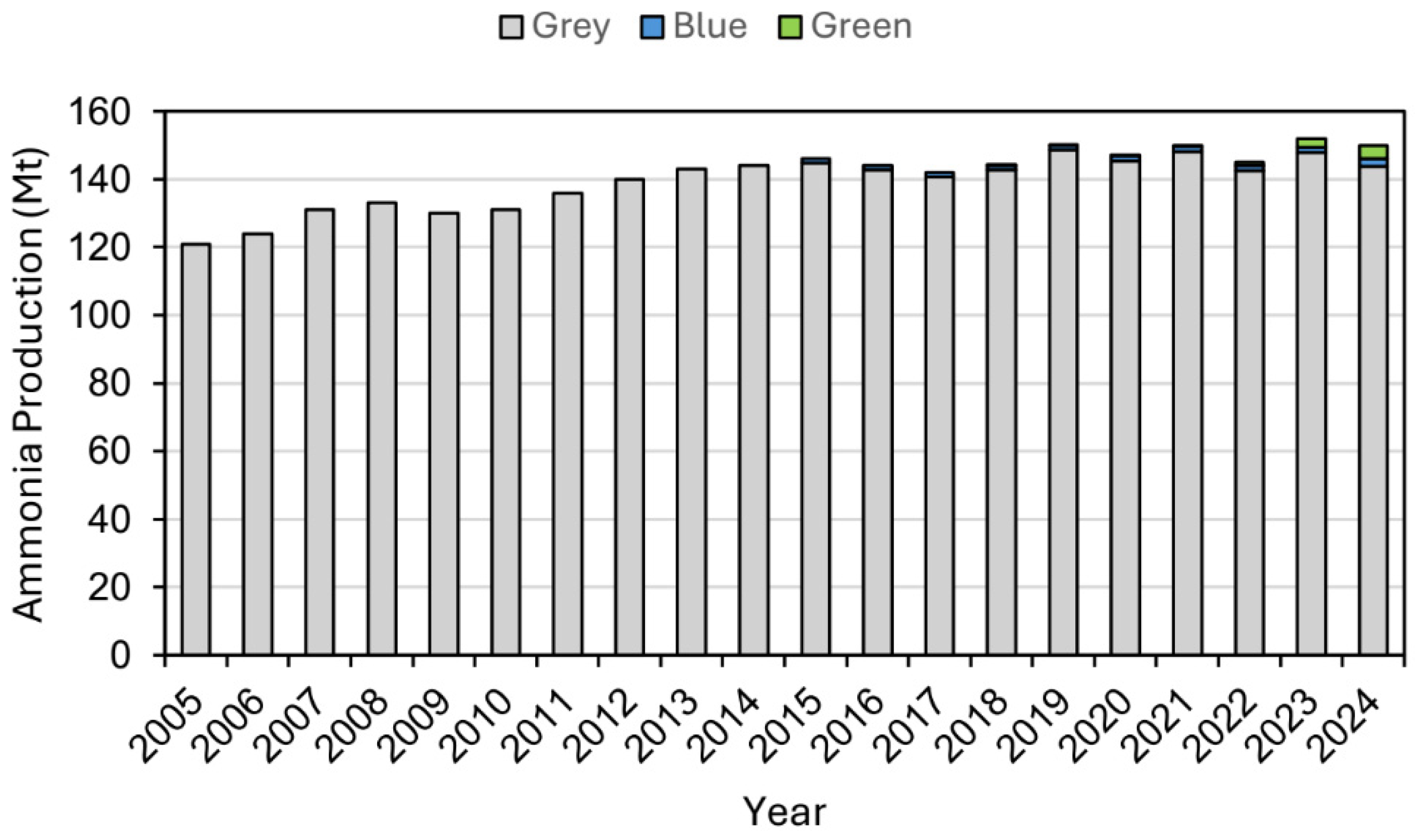
Conventional ammonia production, known as ‘grey’ ammonia, relies on the fossil fuel-powered Haber–Bosch process, with substantial CO2 emissions. In contrast, ‘blue’ ammonia incorporates carbon capture and storage (CCS) into traditional methods, reducing its environmental impact. Yet only ‘green’ ammonia—produced via sustainable energy sources—achieves full sustainability, despite issues remaining with regard to affordability and large-scale adoption [8]. Figure 1 illustrates the evolution of ammonia production (‘grey’, ‘blue’, ‘green’) in the last two decades based on estimations from International Energy Agency (IEA), International Renewable Energy Agency (IRENA), and industry white papers (e.g., US Geological Survey) [5,7,9], where it is apparent that although carbon-based production of ammonia still remains the main generation method, less intensive CO2 emission methods have been introduced in the later years.
Studies reveal that green ammonia is cost-competitive in areas with abundant renewable energy. For example, a study optimising Saudi Arabia’s solar and wind resources shows cost-competitive green ammonia and hydrogen production, positioning the region as a key future exporter of green fuels [10]. This trend is also supported by the advancements in electrolysis technology and the declining costs of renewable energy infrastructure, both of which bolster the business case for green ammonia generation [11]. Furthermore, as production globally scales up, economies of scale will enhance the green ammonia market, reduce costs and narrow the price gap between carbon-based ammonia and green ammonia [11]. Ammonia, as a fuel in the maritime sector, has greater energy density than hydrogen and easier liquefaction at manageable pressures; ammonia also provides more practical handling, presenting significant advances compared to hydrogen transport and storage [10].
Several barriers still need to be overcome when moving forward with green ammonia. Scaling up electrolysers, building ammonia plants, and creating trade systems for renewable energy-based ammonia involves several obstacles—technical, economic, and regulatory. Governmental assistance is crucial in addressing these challenges since it demands state funding coupled with smart regulations that stimulate private investment and promote innovation in the field [10].
Ishaq and Crawford conducted a detailed analysis of green ammonia production methods, emphasising the critical role of renewable energy integration in achieving full decarbonisation across the ammonia value chain—from production and storage, to different end-use applications. The investigation assessed green ammonia’s various applications—as an energy storage medium, zero-carbon fuel, and active component in carbon capture, utilisation and storage systems [12]. Complementing this, Ishaq and Dincer proposed an alternative option, a solar-based system that co-produces power and ammonia as a fuel. Their study stressed the growing viability of ammonia-focused energy units in future energy systems [13]. Fasihi et al. studied the global market potential with hybrid renewable energy plants showing that green ammonia could undercut coal-based production costs and its associated GHG emissions [10].
Akhtar and Liu conducted an economic assessment of importing green ammonia from Australia to South Korea to meet the country’s hydrogen demand. Their findings suggested that this scenario could become financially feasible by 2023 [11]. Allman and Daoutidis developed a model to determine the optimal size of a wind-based ammonia unit. In their study, they highlighted how deciding on the plant location and plant sizing could reduce costs, optimising the ammonia generation and, ultimately, overall profitability [14]. Similarly, another study which focused on a hybrid solar-wind setup proved that the ammonia production cost can be reduced to lower than 440 €/tNH3 and end up being rather competitive compared to fossil fuels [15]. Cameli et al. moving forward with stochastic optimisation—based on solar and wind resources—calculated how to lower the cost of hydrogen and ammonia [16].
Optimisation models for green hydrogen and ammonia generation and export, such as those announced by Saudi Arabia and other countries in the Middle East, assess the economic competitiveness and technical feasibility of green ammonia as a sustainable fuel alternative for decarbonisation [10]. Campion et al. developed an analogous financial model to investigate how varying solar and wind resources influence the green ammonia generation costs. Their framework enables a systematic evaluation of different renewable energy integration approaches for ammonia synthesis [17].
Turning to the financial literature, a recent analysis examined eight potential system designs for synthesising ammonia using wind energy from a 12 GW offshore wind farm in the North Sea. The research proved that a completely offshore production system incorporating solid oxide electrolysis (SOEC)—electricity to produce hydrogen—managed to achieve optimal energy efficiency and minimum capital expenditure (CAPEX). However, the LCOA for all renewable-based scenarios remained elevated compared to traditional fossil-fuelled ammonia production. The study concluded that achieving cost parity would require substantial regulatory support, either through green certificate schemes or carbon pricing mechanisms to become a viable option in the range of €129–336 per metric ton of CO2 emissions [18]. The study by Singlitico et al., which focused on location optimisation and setup, concluded that integrating electrolysis offshore can reduce green hydrogen costs to 2.4 €/kgH2, which is a rather competitive price if it is compared to fossil fuel-based hydrogen [19]. Durakovic et al. focused on transmission costs and offshore production proving that offshore can become more viable when including hydrogen, since a hydrogen hub in the long term can reduce the costs of building more transmission lines [20]. Therefore, by converting wind energy into green ammonia, renewable energy can become more cost efficient and can be stored and transported, enabling cross-sector decarbonization in sectors beyond just energy.
This paper aims to investigate green ammonia as an essential part of a sustainable energy system that can be produced by offshore wind energy. Although coupling offshore energy with green ammonia production seems very promising towards decarbonisation, there is limited research on the viability of such projects in regard to energy dispatch, location of the different components, logistics, and PtA system sizing. It needs to be noted that, certainly, high initial costs challenge green ammonia’s viability, but the decrease in renewable energy prices, future carbon taxes, technological advances, and the option for various revenue streams support it. As global energy systems evolve, green ammonia offers a way to combine economic growth with environmental sustainability. Therefore, the present work aims to answer the following three research questions (RQs):
  • Under what electricity price conditions is it economically optimal to divert wind-generated electricity from grid export to PtA production, when PtA can be configured as offshore, hybrid offshore–onshore, or offshore with pipeline export?
  • How does the incremental economic value of adding PtA to an existing wind farm (relative to selling all electricity to the electricity market) differ across alternative PtA supply-chain configurations?
  • How do the optimal PtA capacities and operational flexibility options (e.g., electrolyser/synthesis sizing and storage) interact with transport infrastructure choices to affect utilisation, and the project’s incremental financial performance?
This paper is structured into three main sections: the methodology used to develop the scenario of implementing a PtA system into an operational offshore wind farm, the data analysis conducted to derive the results, and the discussion of findings to evaluate whether the research questions were answered and how the study contributes to existing knowledge.

2. Materials and Methods

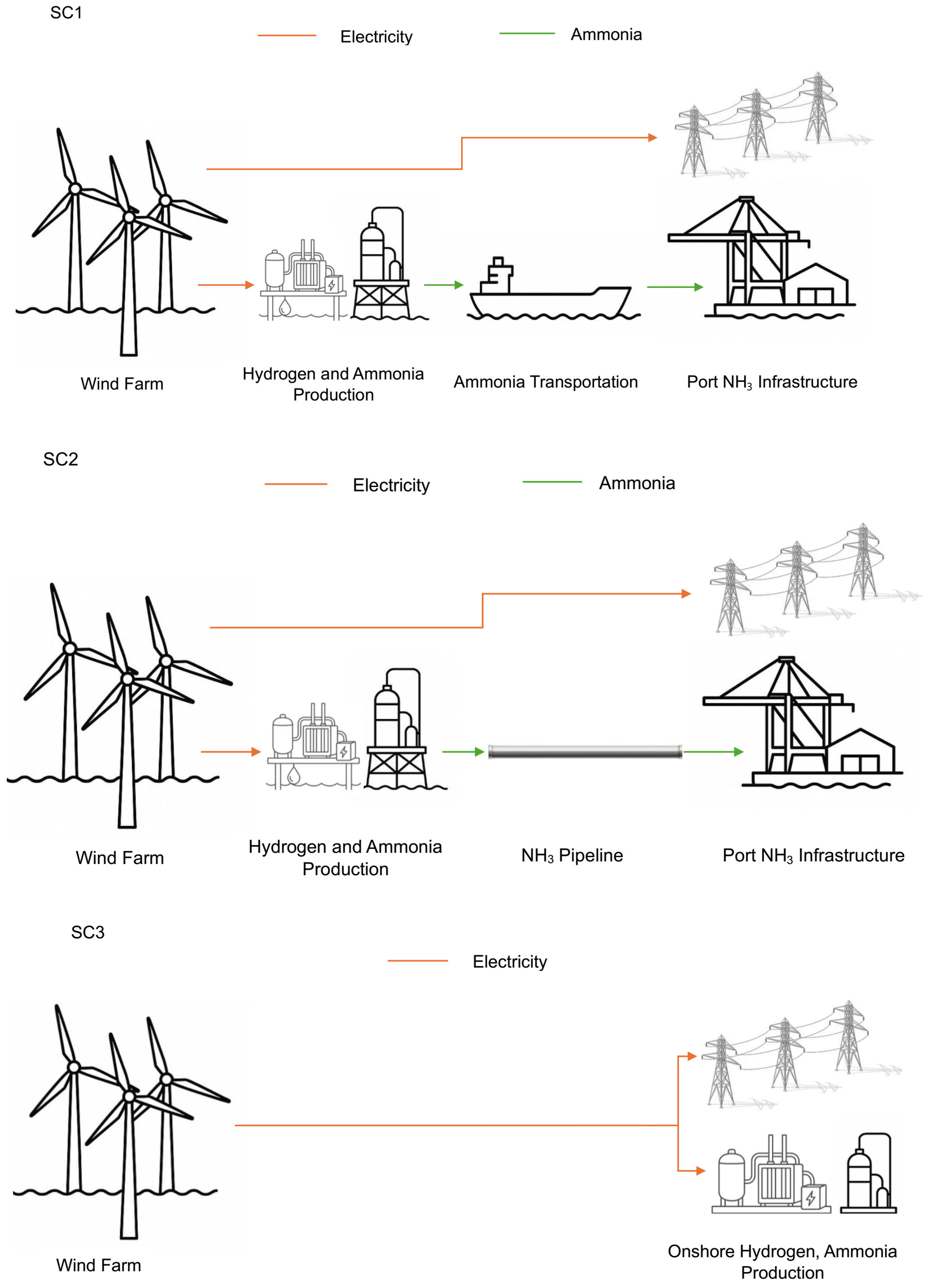
To ensure that the outcome of this study will provide adequate data for answering the respective RQs, three SCs have been considered (Figure 2):
  • SC1: The first SC included an entirely offshore ammonia production supply chain. In this case, hydrogen and ammonia production is located on-site at the offshore wind site. It stresses the benefits of reducing energy waste during transportation and optimal organisation of production schemes.
  • SC2: This case is similar to SC1 but focused on the transport logistics and costs that come with NH3 transport through pipelines.
  • SC3: The third SC comprised a hybrid offshore–onshore model. An SC where electricity is produced offshore, while hydrogen and ammonia are produced onshore.
Wind Farm: The proposed wind asset is assumed to be an operational offshore wind farm located in the Danish North Sea, 20 km off the coast of Esbjerg’s port. The wind farm is represented as 20 identical Vestas V164-8.3 MW turbines (Vestas Wind Systems A/S, Aarhus, Denmark), corresponding to a nominal installed capacity of 166 MW, with a hub height of approximately 100 m. The hourly electrical energy output of the wind farm is computed from reanalysis wind data and a turbine-specific power curve, producing an hourly generation time series that is subsequently coupled with hourly electricity market prices and scenario-specific PtA conversion and transport representations. The available wind energy can either be sold to the grid at the spot price or diverted to a PtA facility to produce ammonia for sale.
Hourly reanalysis fields were obtained from the Copernicus Climate Change Service ERA5 “hourly data on single levels” dataset [21]. The variables used were the 100 m eastward wind component u(t) and 100 m northward wind component v(t) (in m/s). The assumed wind-farm centroid is located approximately 20 km offshore from Esbjerg, Denmark; for data extraction the centroid was represented by WGS84 coordinates (lat, lon) = (55.48° N, 8.13° E), and the nearest ERA5 grid point (0.25° × 0.25°) was selected.
The hourly wind speed (VWF) is calculated by Equation (1) [21].
V W F ( t ) = u ( t ) 2 + v ( t ) 2
To calculate the hourly production of the wind farm, wind speed is mapped to single-turbine electrical power using the turbine-specific power curve for the Vestas V164 platform [22]. The power curve is represented as a discrete set of points between the wind speed and Pi in MW representing the corresponding turbine output. For each hour, single-turbine power output (Pturb) in MW is obtained via piecewise-linear interpolation between the two curve points that bracket the observed wind speed [23]:
P t u r b t = i n t e r p V W F t ; V W F i , P i ,
with output set to zero outside the operating range (below cut-in and above cut-out speeds) and held constant in the rated region according to the curve plateau. Total wind farm power (PWF) in MW is computed by scaling single-turbine power by the number of turbines (NT):
P W F t = N T · P t u r b ( t )
The energy production of the wind farm (EWF) in MWh, is given by Equation (4).
E W F t = P W F ( t ) · Δ t ,
with Δt = 1 h
The produced energy supplied to the grid (EGR) in MWh is given by Equation (5), where η G r is the efficiency of the transmission (corresponds to the cable and transformer losses ≈ 3%) [18].
E G R t = E W F t · η G r
Floating Platforms: The floating platforms consist of critical structures that are used for placing the offshore key components including the balance of plant (BoP) components of the wind farm (e.g., offshore transformers), the hydrogen, and the ammonia production facilities with each respective auxiliary equipment (e.g., storage, compressors, air separation unit—ASU).
The proposed SC topologies included the main technical equipment required for the PtA processes. The topologies development was based on several assumptions consisting of the rated power of the electrolysis plant, and consequently the sizing of the hydrogen—ammonia production outputs.
Hydrogen Production Plant: It includes a 100 MW proton exchange membrane (PEM) water electrolysis generator with its BoP components (e.g., desalination of seawater for SCs 1, 2, H2 compressor and storage). Hydrogen generation (mH2) in tH2 is calculated based on the energy input of the electrolyser (EEL), the efficiency of the plant ( η E L ) and the low heating value (LHV) of hydrogen (see Equations (6)–(8). ER in MWh is the electricity demand for the production of N2 and the Haber–Bosch synthesis process that equals to approximately 5% of the entire electricity used for ammonia production [5,24]. However, in the case of SC3, the energy supplied to the PtA facility is given by Equation (7).
E E L , S C 1,2 t = E W F ( t ) E R
E E L , S C 3 t = E G r ( t ) E R
m H 2 ( t ) = E E L ( t ) · η E L · L H V H 2 1
Cryogenic Air Separation Unit and Ammonia Production Plant: The ASU is a key component of the ammonia supply chain as it supplies the N2 reacting with H2 to produce NH3 through the Haber–Bosch process. Based on the Haber–Bosch reaction, 1 mole of N2 reacts with 3 moles of H2 to produce 2 moles of NH3 [25,26].
N2 + 3 H2 ⇌ 2 NH3
Therefore, by considering the molar masses of the reactants and the product (i.e., MH2, MNH3), and conversion efficiencies comprising losses in the synthesis loop (equilibrium limitation, purge, incomplete reaction) and incomplete ammonia recovery in the condenser/separator (i.e., ηHB, ηsep respectively), the mass of ammonia was calculated as:
m N H 3 , p r o d t = 2 · M N H 3 3 · M H 2 · m H 2 t · η H B · η s e p ,
with ηHB = 0.97 [27] and ηsep = 0.99 [28].
Subsea Infrastructure: It consists of the NH3 pipeline installation of SC2. The length of the pipeline installation has been assumed to be approximately 20 km offshore, similar to the wind farm location, with a pipeline diameter of 25 cm.
Transportation and Logistics: The transportation and logistics account for transporting ammonia in SC1 to shore via an ammonia vessel.
For SC1, ammonia produced offshore is buffered in an intermediate storage tank and transported to shore by a dedicated ammonia carrier (vessel). For SC2, ammonia is exported continuously through a subsea pipeline. For SC3, ammonia is produced onshore and therefore offshore ammonia transport is not required.
To ensure hourly feasibility, the model tracks ammonia inventory and limits exports by scenario-specific transport capacities (pipeline capacity or vessel loading events), so that revenue is based on delivered ammonia rather than unconstrained production.
The three SCs were investigated for an existing wind farm where for each Δt the PtA operating point is selected by comparing the incremental operating margin of grid export and ammonia production (Equations (16) and (17) and margin definitions below), subject to plant capacity, operational flexibility constraints (Equations (18)–(21)), and scenario-specific logistics and storage feasibility constraints (Equations (10)–(15)).
Logistics feasibility and inventory balance: For SC1, ammonia produced offshore is buffered in storage before delivery to shore. For SC2, it is assumed that the pipeline consists of the buffer storage, and no additional onshore storage is required.
Let S(t) in tNH3 denote the ammonia inventory at the end of hour t, mNH3,prod(t) in tNH3 the ammonia produced in hour t (Equation (9) after operational feasibility constraints), and mNH3,del(t) in tNH3 the ammonia delivered to the market in hour t. The inventory evolution is calculated by:
0 S ( t ) S m a x
0 m N H 3 , d e l t m t r a n s , m a x
S t = S t 1 + m N H 3 , p r o d t m N H 3 , d e l t ,
with Smax being the maximum ammonia storage capacity in tNH3.
For SC2, the delivery limit is mtrans,max = pipe,max · Δt, where pipe,max is the maximum pipeline transport rate (tNH3/h). For SC1, deliveries occur as discrete loading events:
m N H 3 , d e l t = y v ( t ) · m v e s s e l
S ( t 1 ) y v ( t ) · m v e s s e l
k = t τ v + 1 t y v ( k ) 1 ,
where mvessel is the vessel cargo capacity (tNH3 per voyage), yv(t) ∈ {0,1} indicates a vessel departure/loading in hour t, and τv (h) is the minimum turnaround time capturing sailing and port operations. For SC3, the same balance applies but with production and delivery co-located; hence, mNH3,del(t) = mNH3,prod(t).
If the storage upper bound would be violated (S(t) > Smax), PtA operation is curtailed, so that Equation (10) is satisfied; similarly, delivery cannot exceed the available inventory (Equation (14)). This ensures the operating schedule and associated revenue stream are feasible under the assumed logistics limits.
The hourly revenues of selling electricity in the day-ahead market (TGr) is calculated by Equation (16), while the revenues from ammonia sale (TNH3) are provided by Equation (17).
T G r t = λ G r t ·   E G r ( t )
T N H 3 t = λ N H 3 · m N H 3 , d e l ( t ) ,
where TGr represents the revenues from selling electricity to the grid in €, TNH3 represents the revenues from ammonia sales in €, λGr is the spot market price in €/MWh, and λNH3 is the ammonia selling price in €/tNH3.
Hourly day-ahead prices were retrieved from Energinet’s Energi Data Service, dataset “Elspotprices” [29]. Records were filtered to the DK1 bidding zone (PriceArea = DK1) and the SpotPriceEUR field (€/MWh) was used as the hourly electricity price series λGr(t). The timestamp HourUTC was used for time alignment.
ERA5 timestamps (i.e., wind speed data) are provided in UTC and the Elspotprices dataset provides both HourUTC and local-time HourDK fields; all analyses in this study used HourUTC to avoid daylight-saving ambiguities. The two datasets were merged on HourUTC. Any duplicate timestamps were removed; if missing timestamps occurred in either series, the corresponding hours were excluded from the paired wind–price dataset to maintain consistent hourly alignment.
To avoid overestimating PtA operation, the dispatch decision is formulated on an incremental profit basis rather than a revenue-only comparison. The hourly operating margin of electricity export is defined as:
MGr(t) = TGr(t) − CGr,var(t),
and the hourly operating margin of ammonia production as:
MNH3(t) = TNH3(t) − CNH3,var(t).
CGr,var(t) denotes any variable export-related costs (assumed negligible beyond the electrical losses already captured by ηGr), while CNH3,var(t) refers to variable costs that scale with operation, such as variable O&M/consumables and scenario-specific marginal logistics (e.g., pumping/compression for SC2 or vessel operation for SC1), expressed per hour (or equivalently per tonne of NH3 produced). Because the decision compares MNH3(t) with MGr(t) for the same available wind energy, the opportunity cost of electricity consumed by PtA is endogenously accounted for in the switching criterion.
Operational Dispatch with Flexibility Constraints: The baseline dispatch compares the hourly value of electricity export (MGr, based on Equation (16)) and ammonia production (MNH3, based on Equation (17)). However, PtA is not assumed to be fully flexible on an hourly basis: the down-stream air-separation and Haber–Bosch synthesis topology is typically constrained by minimum stable load and ramping limits to avoid thermal/catalyst stress and loss of stability. Therefore, hourly dispatch is computed using the margin-based rule but is enforced to be feasible through reduced-order flexibility constraints [30,31,32,33].
Let PPtA(t) be the aggregate electrical power allocated to PtA in hour t (including electrolysis, nitrogen separation and synthesis auxiliaries), PPtA,max the installed PtA electrical capacity, and u(t) ∈ {0,1} the PtA on/off state. The feasible operating region is represented as:
0 P P t A ( t ) u ( t ) · P P t A , m a x
P P t A ( t ) u ( t ) · f m i n · P P t A , m a x
P P t A t P P t A t 1 r u p · P P t A , m a x
P P t A t 1 P P t A t r d o w n · P P t A , m a x ,
where fmin is a dimensionless fraction of rated PtA load that must be maintained whenever the plant is online. Therefore Equation (19) poses a constraint for a minimum stable load that indicates a PtA operation below the f stated fraction and hence its operation cannot follow high-frequency price signals by deep part-load operation. Ramp-up and ramp-down limits (rup, rdown respectively) show the maximum increase and decrease in PtA load allowed from one hour to the next, expressed as a fraction of the rated load (Equations (20) and (21)). These parameters prevent unrealistic hour-to-hour switching and represent the limited turndown and dynamic response of the ammonia synthesis process compared with the electrolyser, while retaining a tractable rule-based dispatch model at hourly resolution.
The operating strategy is implemented as a net-margin-based dispatch rule subject to explicit feasibility constraints. The hourly margin comparison identifies whether ammonia production or grid export is economically preferred in hour t; however, actual operation is restricted by the PtA dynamic constraints, including the minimum stable operating level and ramp-up/ramp-down limits (Equations (18)–(21)), as well as the storage and logistics feasibility constraints (Equations (10)–(15)).
Flexibility parameterization: In the base-case (‘existing industrial synthesis process’), fmin is set to 0.60, consistent with the turndown understood to be achievable with existing ammonia reactor technology [30], and ramp limits are set to rup = 0.05 h−1 and rdown = 0.20 h−1, consistent with flexibility constraints used in recent green-ammonia scheduling studies [31]. A ‘flex-ready’ sensitivity set is also tested (fmin = 0.20; rup = rdown = 0.20 h−1) to represent modified designs that sustain deeper turndown; dynamic simulations of modified Haber–Bosch configurations report stable operation down to approximately 10% load with minute-scale ramping [33]. Cryogenic ASU designs can also reach at least 40% load with rapid ramping under appropriate control, so the synthesis loop typically remains the limiting unit [32].
Accordingly, the hourly operating rule is updated as follows: PtA operates in hour t if MNH3(t) > MGr(t) and a feasible setpoint PPtA(t) exists under Equations (18)–(21), and the implied ammonia inventory and delivery remain feasible under Equations (10)–(15). In practice, the unconstrained dispatch signal selects PtA (on/off) and a desired PtA load; the final PPtA(t) is then obtained by applying the minimum-load and ramp constraints and, if needed, curtailing PtA to prevent storage overflow. If wind availability is insufficient to satisfy the minimum-load constraint, PtA remains off and wind energy is exported to the grid (or curtailed in negative-price hours, when grid export is not allowed).
The hourly dispatch rule is based on a direct comparison between the net operating margin of diverting wind power to the PtA chain and the net operating margin of exporting electricity to the grid. Under the modelling assumptions adopted in this work—namely that (i) wind availability and market prices are exogenous inputs, (ii) the conversion of electricity to ammonia is represented through constant yield factors (linear mapping), and (iii) there is no explicit long-term arbitrage objective associated with intermediate inventories beyond feasibility—the optimal operational decision at each hour reduces to selecting the option with the higher net margin. Therefore, the switching condition (MNH3(t) > MGr(t)) corresponds to the per-hour profit-maximising solution of the relaxed (uncoupled) dispatch problem. However, in practice the operation is temporally coupled due to minimum stable load, ramp-up/ramp-down limits, and logistics feasibility (inventory balance and delivery constraints). For this reason, the final dispatch is not implemented as a purely ‘on/off’ decision. Instead, the margin-based switching signal is used as an operational target and is subsequently adjusted to remain feasible under the dynamic constraints of Equations (10)–(15) and Equations (18)–(21). In other words, the algorithm follows the margin-based preference whenever feasible, and curtails or modifies the PtA load when required by ramping, minimum-load limits, and storage/transport feasibility.
Project Development: Across studies, project development costs typically account for 10–18% of the total project’s CAPEX in offshore ammonia projects. These values include, among others, front-end engineering and design, permitting and offshore deployment, regulatory compliance, and construction management [18,34].
The components used in the investigated SCs with the respective rated power and cost parameters are described in Table 1.
Cost inputs were taken as reported in the cited sources and expressed in euros. Where a currency year was not explicitly stated, the publication year of the source was assumed. Values were interpreted on a real (constant euro) basis and were not escalated to a common currency year. No endogenous learning effects were modelled.
Technoeconomic analysis (TEA) is a critical research tool for evaluating ‘green’ ammonia production, as it systematically assesses both economic and technical performance across various production methods. By calculating metrics like LCOA, TEA offers a comprehensive way to compare the cost efficiency of various technologies and energy sources.
This study adopts a positivistic, deductive approach, relying on secondary data from credible sources such as academic journals, industry reports, and government publications. The main TEA data—including investment costs, operational expenses, energy outputs, and market prices—are analysed to compute financial indicators like LCOA, NPV, and internal rate of return (IRR).
The aforementioned multiple production scenarios were used to identify the most cost-effective pathways for ‘green’ ammonia. Each case addressed CAPEX and operational expenditure (OPEX), covering costs for facility setup, maintenance, and ammonia synthesis technologies. Financial modelling within TEA calculated the NPV, and IRR along with the breakeven price of NH3 to get positive NPV and IRR (in case of negative results) and LCOA through sensitivity analysis, helping investors identify potential returns and risks for each production scenario.
The calculation of the financial parameters to assess the above-mentioned economic tools was based on the following equations (Equations (22)–(25)) for the capital cost (ICo) in M€, the NPV, and the LCOA [18,37].
I C o = I C E L + I C P L + I C A m S y + I C A i r S + I C S . I n f r + I C L o g + I C s t + I C d e v e l o p ,
with
I C E L = P E L · C A P E X E L
I C P L = P E L · C A P E X P L
I C A m S y = m N H 3 , a n · C A P E X A m S y
I C A i r S = m N H 3 , a n · C A P E X A i r S
I C L o g = m v e s s e l · C A P E X L o g ( S C 1 )
I C L o g = L p i p e · C A P E X p i p e ( S C 2 ) ,
where ICPL is the floating platforms cost in M€, ICEL represents the hydrogen production plant cost in M€, ICAmSy is the capital cost of the ammonia synthesis plant in M€, ICAirS is the cost of the cryogenic air separation unit in M€, ICS.Infr is the subsea infrastructure cost in M€, ICLog represents the transportation via pipeline, (pipeline CAPEX and respective BOP) or logistics cost (CAPEX of the vessel) depending on the SC in M€. ICst is the ammonia storage tank in M€, while ICdevelop consists of the development costs (i.e., development of the project) in M€. m N H 3 , a n represents the annual mass of ammonia in tNH3/y. mvessel is the ammonia’s mass capacity of the vessel for SC1 in tNH3, and Lpipe represents the pipeline’s length in km for SC2.
The NPV was calculated using a standard annual equity cashflow (FCFE) formulation. Hourly dispatch outputs are aggregated to annual incremental operating value Ty (M€), where Ty represents the incremental annual revenues from ammonia sales and electricity export minus the baseline annual revenues obtained by exporting all available wind electricity to the day-ahead market without PtA. All monetary values are expressed in constant (real) euros; therefore, discount rates are interpreted as real rates.
The project is taken to be financed with equity fraction fe and debt fraction fd (Table 2), such that the year-0 equity outlay is Eo = fe · ICo and the initial loan principal is Do = fd · ICo. The equity NPV is computed as:
N P V = E o + y = 1 N F C F E y ( 1 + r e ) y ,
with
Annual free cashflows to equity:
F C F E y = E B T y T a x y + D e p y P r i n y
Earnings before taxes:
E B T y = E B I T y I n t y ,     T a x y = Φ · m a x ( 0 , E B I T y )
Interest, Principal, remaining balance:
I n t y = i · D y 1   ,     P r i n y = A I n t y   ,       D y = D y 1 P r i n y     f o r   y > n L ,   I n t y = P r i n y = 0
Loan annual payment:
A = D o · i · 1 + i n L 1 + i n L 1
Earnings before interest and taxes:
E B I T y = T y O P E X y D e p y
Depreciation and book value:
D e p y = δ · B V y 1   ,       B V y = B V y 1 D e p y   ,         B V o = I C o
Annual cash OPEX:
O P E X y = P O + O M C S + 1 S C 1 O M v + I n + R n + O M s t , y
To maintain consistency with the weighted average cost of capital (WACC) r reported in Table 2, re is derived as:
r = f e · r e + f d · i · 1 Φ     r e = r f d · i · 1 Φ f e
L C O A = I C o + y = 1 y O P E X y 1 + r y y = 1 N m N H 3 , d e l y 1 + r y
The IRR is the value of re that sets NPV = 0 for the series {-Eo, FCFE1-,…, FCFEN}.
Table 2 summarises the financial parameters used to compute the equity NPV of each scenario. The total initial investment at year 0 is ICo (Equation (22)), which represents the complete upfront CAPEX of the offshore wind-to-ammonia system, including the electrolyser, ammonia synthesis and air separation units, infrastructure, storage, and logistics (pipeline or vessel depending on the scenario). The project lifetime is N years.
The techno-operational model provided, for each year y, an annual incremental operating value Ty (in M€). Ty is obtained by aggregating the hourly dispatch results over the year (electricity export and delivered ammonia) and subtracting the annual revenues of the electricity-only baseline (i.e., exporting all available wind electricity to the day-ahead market without PtA). In this way, Ty represents the annual value created by the PtA pathway relative to the baseline.
Annual cash operating expenditure OPEXy is computed using the parameters in Table 2. PO is the annual personnel/labour cost (in M€/y). OMcs is the fixed annual O&M of system components (in M€/y). OMv is the annual vessel O&M cost (in M€/y) and is included only for the vessel-based logistics case (SC1). In is annual insurance (in M€/y) and Rn is annual land lease/rent (in M€/y). Degradation is represented in a reduced-order manner through scheduled stack replacement outlays OMst,y (in M€), treated as discrete one-off costs in the specified replacement years (e.g., years 11 and 21). This approach captures the main financial impact of component ageing over the project lifetime, but it does not explicitly model short-term degradation as a function of hourly cycling or ramping intensity. Therefore, the dispatch results should be interpreted as valid under the assumption that cycling-related wear is reflected in the replacement schedule rather than being penalised directly on an hour-to-hour basis.
Depreciation is modelled using a declining-balance rate δ applied to the asset book value BV. BVo is set equal to ICo at year 0. The annual depreciation amount Depy is a non-cash accounting cost that affects taxable income but is added back when computing cashflows. Corporate income tax is represented by the tax coefficient Φ and applied only to positive earnings before tax, using max(0,·) to avoid negative taxes.
The capital structure is defined by the equity fraction fe and debt fraction fd, with fe + fd = 1. Debt carries an annual interest rate i and is repaid over the loan tenor nL (in y). The loan tenor is the length of time over which the debt is amortised; for example, with nL = 20 years, interest and principal repayments occur only in years y ≤ 20 and are set to zero for y > 20 because the loan is fully repaid. The constant annual debt payment A is computed from i and nL and is split each year into an interest component Inty and a principal component Priny.
Discounting uses two related rates. The WACC r is the project-level discount rate associated with the assumed capital structure and is used for levelised cost metrics (e.g., LCOA). Equity cashflows are discounted with the equity discount rate re. This ensures the NPV calculation is internally consistent with the chosen debt/equity split, interest rate, and corporate tax rate.
To calculate equity NPV, the following steps were applied for each year y = 1, …, N. First, annual cash OPEX was computed. Second, depreciation (Depy) was computed and the book value (BVy) was updated using the declining-balance rule with rate δ and initial BVo. Third, earnings before interest and tax were calculated followed by the annual debt service. Using the constant annual payment A, interest (Inty) and principal (Priny) were computed and the outstanding debt balance was updated for y ≤ nL. Subsequently, earnings before tax and corporate tax were calculated. By taking all the above into consideration, the free cashflow to equity was computed. This formulation subtracted taxes on earnings after interest, added back depreciation because it is non-cash, and subtracted principal repayment because it is a cash outflow to debt holders. The NPV was computed by discounting the FCFE series at re and subtracting the initial equity outlay. The internal rate of return (IRR) was obtained as the value of re that set NPV equal to zero for the cashflow series.
Hourly dispatch decisions are computed using the operating rule defined above: PtA operates in hour t if MNH3(t) > MGr(t), a feasible PPtA(t) setpoint exists under the minimum-load and ramping constraints (Equations (18)–(21)), and the resulting ammonia production and delivery are feasible under the inventory and logistics constraints (Equations (10)–(15)); otherwise, electricity is exported to the grid (or curtailed in negative-price hours, when grid export is not allowed). Hourly cashflows are aggregated to annual incremental revenues Ty, where Ty represents the incremental annual revenues from ammonia sales and electricity export minus the baseline annual revenues obtained by exporting all available wind electricity to the day-ahead market without PtA (see financial model and NPV formulation).
Hourly wind generation and spot prices are available for the years 2020–2025. Initially, a base-case trajectory that represents a deterministic cumulative NPV pathway obtained under the reference techno-economic assumptions and without stochastic resampling has been studied. Because only a limited number of historical years are available, the observed annual incremental revenue and ammonia production series is repeated to span the full 30-year project lifetime. To avoid using this limited window as a deterministic forecast for a 30-year project lifetime, a block-bootstrap Monte Carlo procedure is applied [48]. The initial base-case economic analysis served as a benchmark against which the Monte Carlo results quantified inter-annual variability and uncertainty. For each Monte Carlo realisation, complete historical years are sampled with replacement from the set 2020–2025 and concatenated until a synthetic 30-year hourly trajectory is formed. Wind generation and electricity prices are sampled as paired years (i.e., wind and price from the same sampled calendar year are kept together), preserving seasonality and the empirical wind–price dependence embedded in the data. For each realisation, the dispatch is recomputed hour-by-hour using the same operating rule, and annual equity cashflows are then evaluated over the 30-year lifetime using the financial model parameters in Table 2. Because intact calendar years are resampled, the method retains the intra-year seasonal structure and the observed within-year wind–price co-variability. However, it implicitly assumes that the available years are representative draws from a stationary joint wind–price process; therefore, it does not capture structural market shifts or long-term trends beyond the historical window.
Financial outputs are reported as distributions rather than single-point estimates, using percentile statistics (e.g., P10/P50/P90) for NPV, IRR, and LCOA. Additionally, cumulative NPV charts are constructed by computing cumulative discounted cashflows per year across the Monte Carlo ensemble and reporting the median trajectory together with percentile bands.
The dispatch rule is unchanged under the uncertainty analysis; the Monte Carlo procedure only changes the sequence of historical wind–price years used to construct long-term hourly inputs, after which the same hourly decision rule is applied. The number of Monte Carlo realisations was selected to ensure convergence of percentile estimates (NPV P10/P50/P90), verified by monitoring changes in percentile values with increasing sample size.
To address the research question on sizing and flexibility, the financial evaluation is repeated across a parametric set of PtA capacities and ammonia-price flexibility options through a sensitivity analysis. For each configuration, the hourly switching/dispatch logic produced annual ammonia output, and electricity export, which are translated into NPV, IRR, and LCOA. In cases where the project is non-profitable under a given ammonia price assumption, the breakeven ammonia price is computed by solving for the constant ammonia selling price that yields NPV ≈ 0, with dispatch updated endogenously at each trial ammonia price, producing a breakeven price distribution across Monte Carlo realisations.
Comparing the resulting distributions (e.g., P10/P50/P90 of NPV/IRR/LCOA) across scenarios and configurations provided the basis for identifying economically preferred supply-chain designs and quantifying how plant sizing and operational flexibility affected utilisation and incremental financial performance.
Concisely, the workflow could be summarised as follows:
i.
ERA5 u100 and v100 were downloaded at the specified coordinates for 2020–2025 and VWS(t) was computed (Equation (1)).
ii.
VWS (t) was mapped to single-turbine power using the Vestas V164-8.3 MW power curve via piecewise-linear interpolation (Equation (2)), and wind-farm power and energy were computed (Equations (3) and (4)).
iii.
El-spotprices for DK1 for 2020–2025 were downloaded and merged with wind-farm output on HourUTC.
iv.
For each scenario and hour, the grid-export value and ammonia net margin were computed (Equations (16) and (17) and margin definitions), operational feasibility constraints were applied (Equations (18)–(21)), storage/inventory and logistics feasibility were updated (Equations (10)–(15)), and delivered ammonia mNH3,del(t) and exported electricity were recorded.
v.
Hourly results were aggregated to annual incremental operating value Ty and annual delivered ammonia.
vi.
Annual equity cashflows and financial metrics (NPV/IRR/LCOA) were computed using Equations (22)–(25) and Table 2.
vii.
For uncertainty analysis, synthetic 30-year sequences were generated via block-bootstrap resampling of complete historical years (2020–2025), and steps (i)–(vi) were repeated for each realisation.
Screening-level sustainability indicator (CO2avoidance): While the scope of this work is primarily techno-economic, a simple environmental indicator was included to contextualise sustainability implications. Potential direct CO2 emissions avoided were estimated by assuming that each tonne of produced green ammonia displaces conventional natural-gas-based ammonia. A benchmark emissions intensity of EFconv = 1.8 tCO2 per tNH3 was adopted for efficient natural-gas plants, consistent with values used in recent European decarbonisation analyses [49]. Annual avoided emissions were computed as:
C O 2 ,   y = m N H 3 , p r o d , y · E F c o n v
This screening metric excludes lifecycle/embodied emissions and does not represent system-wide marginal grid effects from diverting wind electricity; results are therefore indicative and attributional.


3. Results and Discussion

The dispatch algorithm and financial evaluation of the SCs described in the previous section of this research, have been executed in the ‘Spyder’ version 6 software platform through a developed ‘Python 3.12.11’ code for each SC able to calculate the respective economic factors.
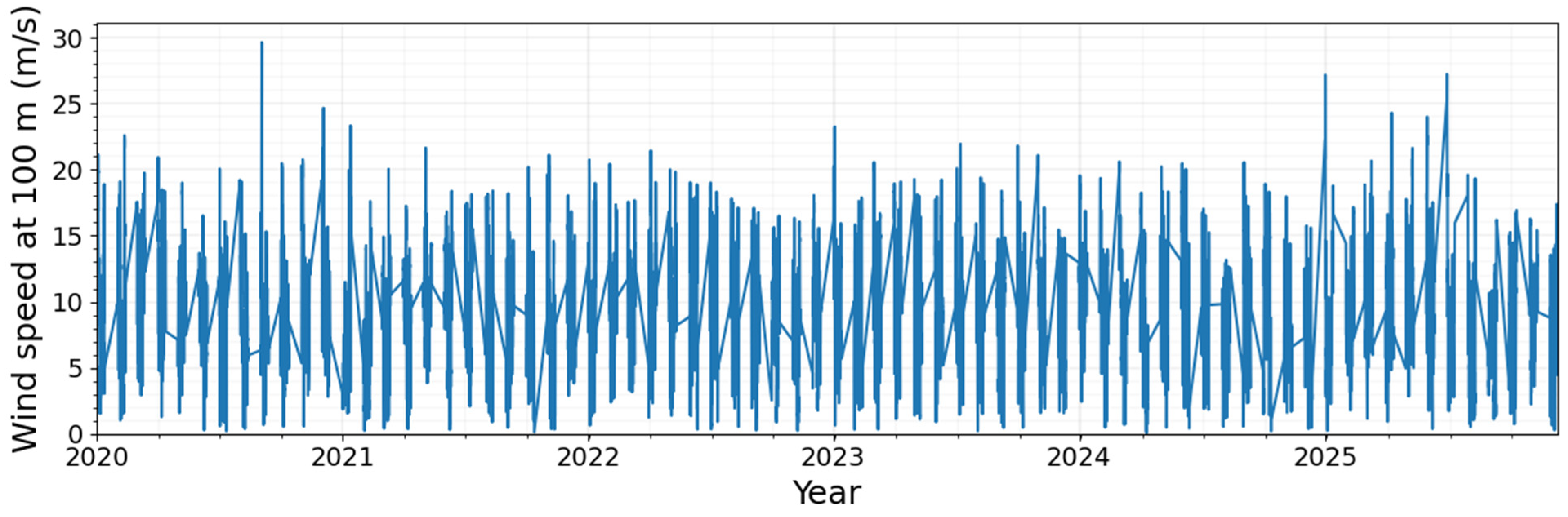
The wind speed data used for modelling the operational SCs include hourly values between 2020 and 2025 calculated via Equation (1) and are shown in Figure 3.
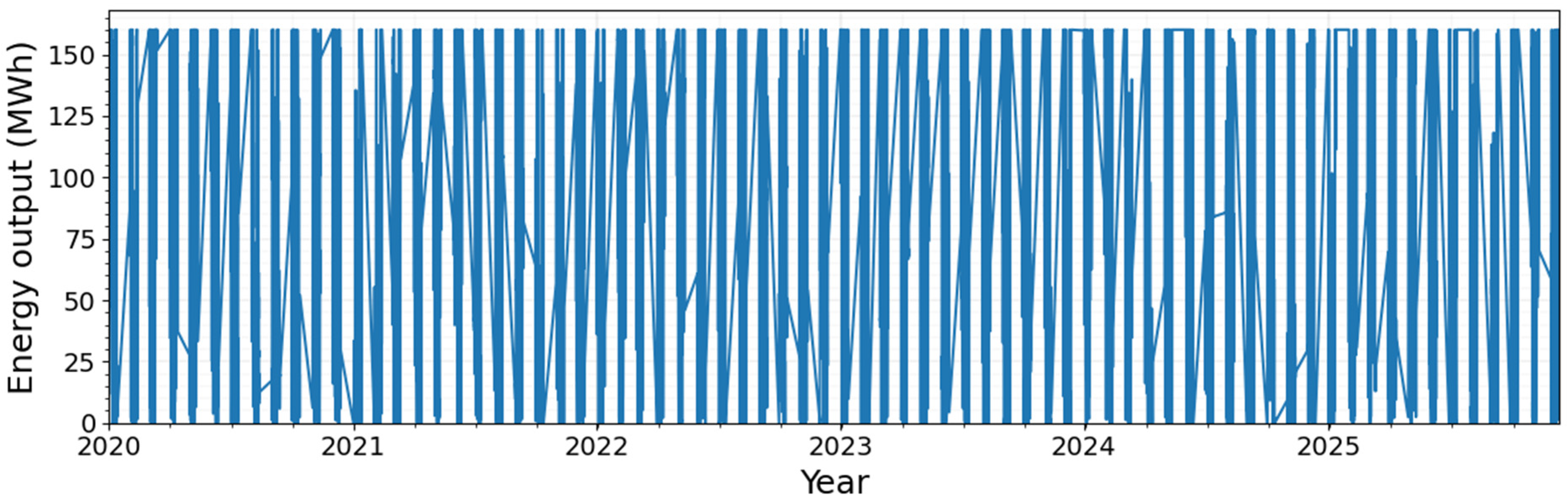
The wind-farm energy production, computed from Equations (2)–(4), is presented in Figure 4.
The dispatch decision is determined by comparing the incremental operating margin from exporting electricity to the grid with the incremental operating margin from diverting wind power to ammonia production, subject to PtA operational feasibility, storage/inventory feasibility, and logistics constraints. To this end, it was essential initially to calculate the potential hourly electricity exported to the grid and the hourly production of ammonia for all SCs.
The potential electricity exported to the grid is calculated by Equation (5) as it is subject to losses stemmed from transformers and cables. It follows the same pattern of energy flow from the wind farm (see Figure 4) discounted by the ηGr factor.
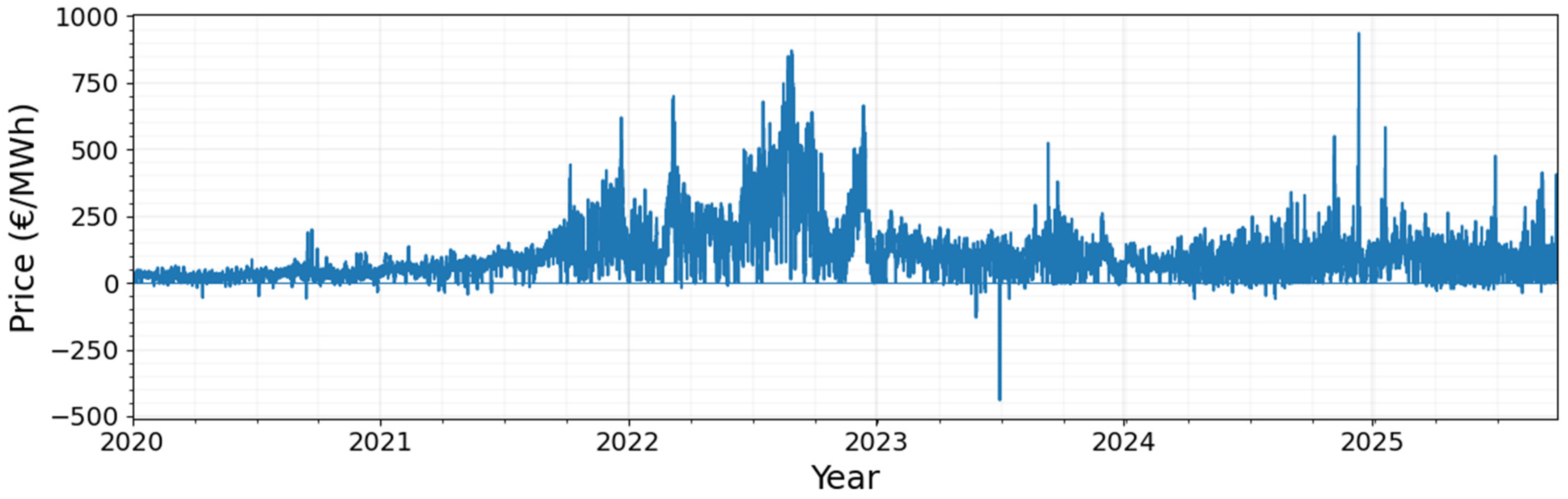
To calculate the revenues from selling that electricity to the grid, the spot prices for the time range 2020–2025 for the region DK1 where the assumed wind farm and PtA topology is located, are used [29]. Figure 5 indicates the retrieved price data.
Based on Figure 5, it can be observed that there are many cases where the electricity spot price is negative. At these periods the wind energy production is directed towards the PtA configuration, while any surplus produced by the wind farm energy has been curtailed.

3.1. Dispatched Energy for All SCs

As mentioned above, the hydrogen production system consisted of a 100 MW PEM electrolyser (along with its BoP). The overall chain efficiency of the electrolysis system has been taken to be 65% (low heating value–LHV based), corresponding to 51.2 MWh/tH2 [50]. The energy input to the hydrogen production system is dependent on the SC topology whereas in SCs 1 and 2, the energy input is calculated from Equation (6), and for SC3 from Equation (7).
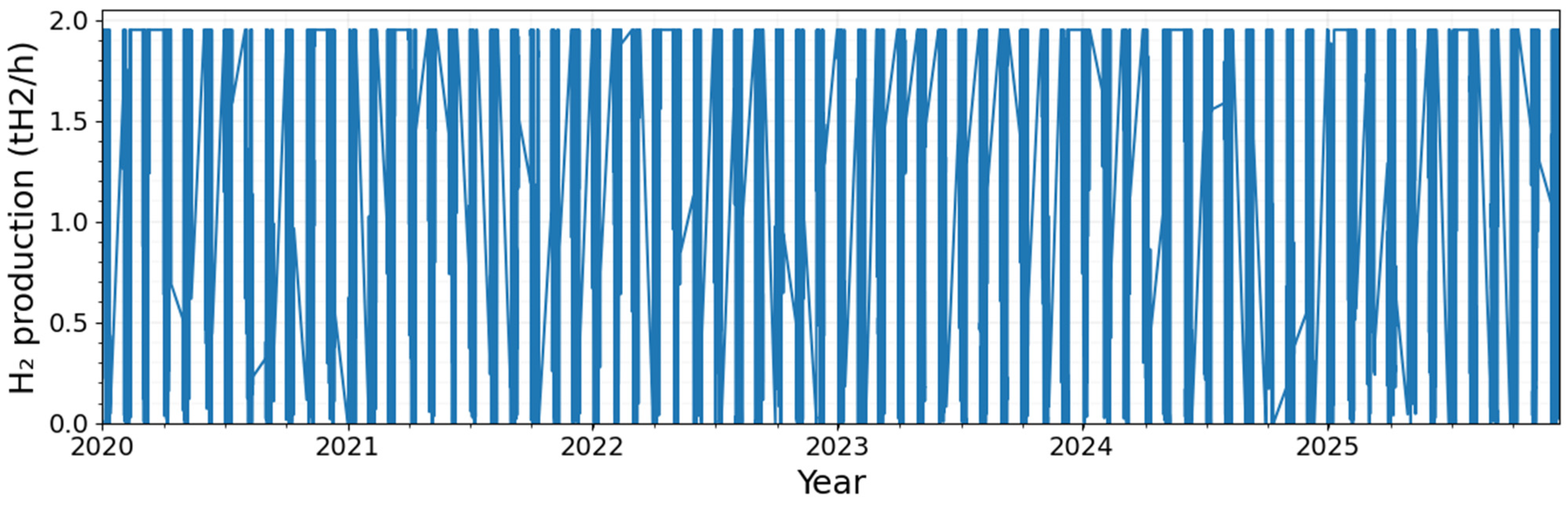
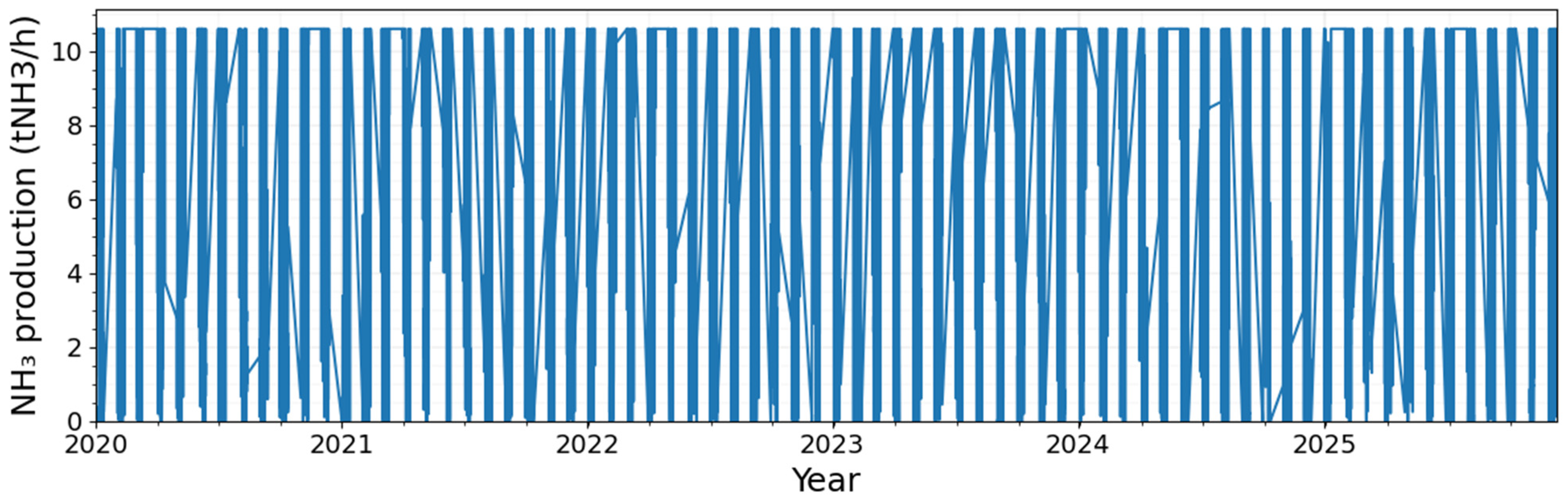
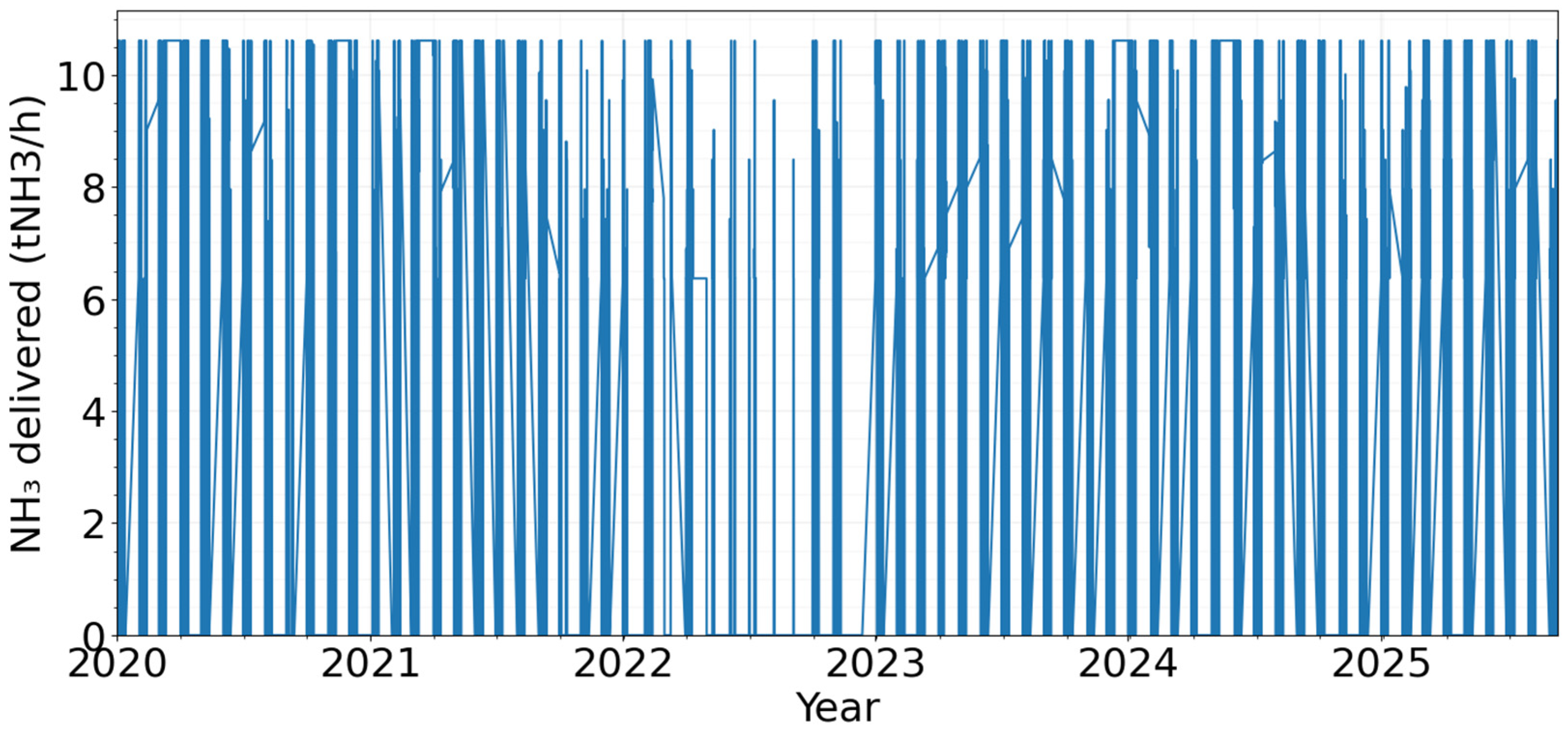
Hence, the hourly maximum production of hydrogen and ultimately ammonia based on the wind farm’s energy input were calculated by Equations (8) and (9). The results showing the potential hydrogen and ammonia production if the entire wind farm’s energy yield would be directed to the PtA configuration are presented in Figure 6 and Figure 7 respectively. Maximum hourly hydrogen and consequently ammonia production for all SCs is the same, with the only difference between SCs 1, 2 and 3 documented on the total amount of produced hydrogen and ammonia. Table 3 shows the differences in the annual amount of produced hydrogen and ammonia per SC.
To define the dispatch rule for the wind farm—PtA topology and Equations (16) and (17) were applied to compare the incremental operating margin of electricity export with that of ammonia production and thus identify the preferred dispatch option in each hour, subject to the feasibility constraints of the system. In this context, data depicted in Figure 5 were combined with the discounted wind farms energy to the grid (EGr) for Equation (16).
For Equation (17) a constant selling price of ‘green’ ammonia product for Europe has been taken to equal to 1200 €/tNH3 [51], and combined with the hourly production of ammonia as shown in Figure 7.
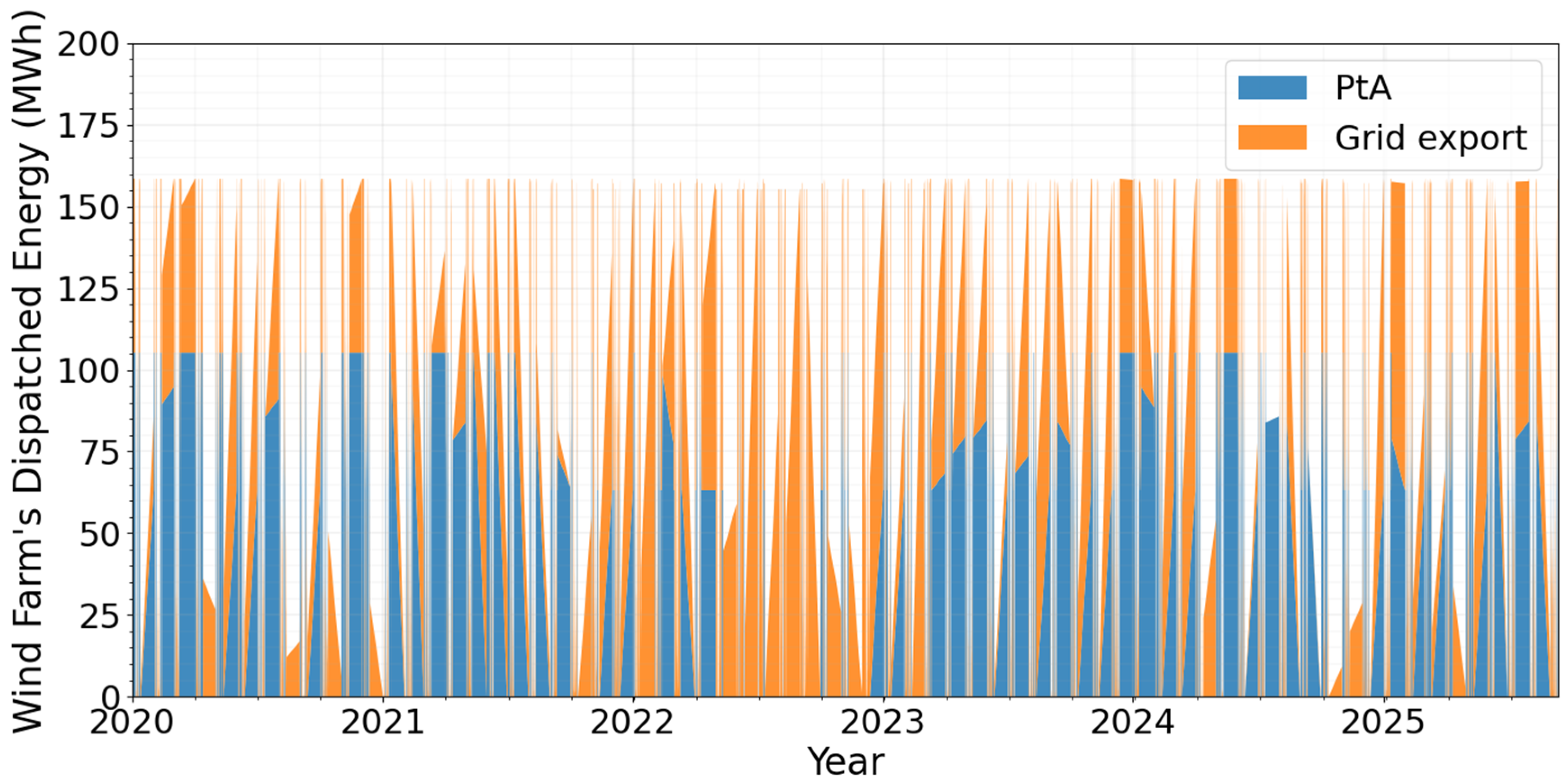
Figure 8 shows the final wind-energy dispatch between the grid and the PtA configuration for SC2 after applying the margin-based decision rule and the associated feasibility constraints. For SCs 1 and 3, the figures are similar with small differences stemmed from applying the SCs’ dispatch rules. However, this variation is not observable on the respective plots and thus they were not included in the research. The cumulative energy dispatched to the PtA and the electricity grid has been found to equal 737.4 GWh, 713.1 GWh for SCs 1, 740.6 GWh, 710.1 GWh for SC 2, and 747.4 GWh, 703.9 GWh for SC3 respectively.
The dispatched energy to the PtA system to optimise the revenue stream of the wind farm—PtA topology is then used to calculate the final ammonia product during the investigated period. Figure 9 shows the hourly production of ammonia for SC2. The respective figures for SC1 and SC3 are not included for the same reasons as for Figure 8, but the cumulative data are presented in Table 4.
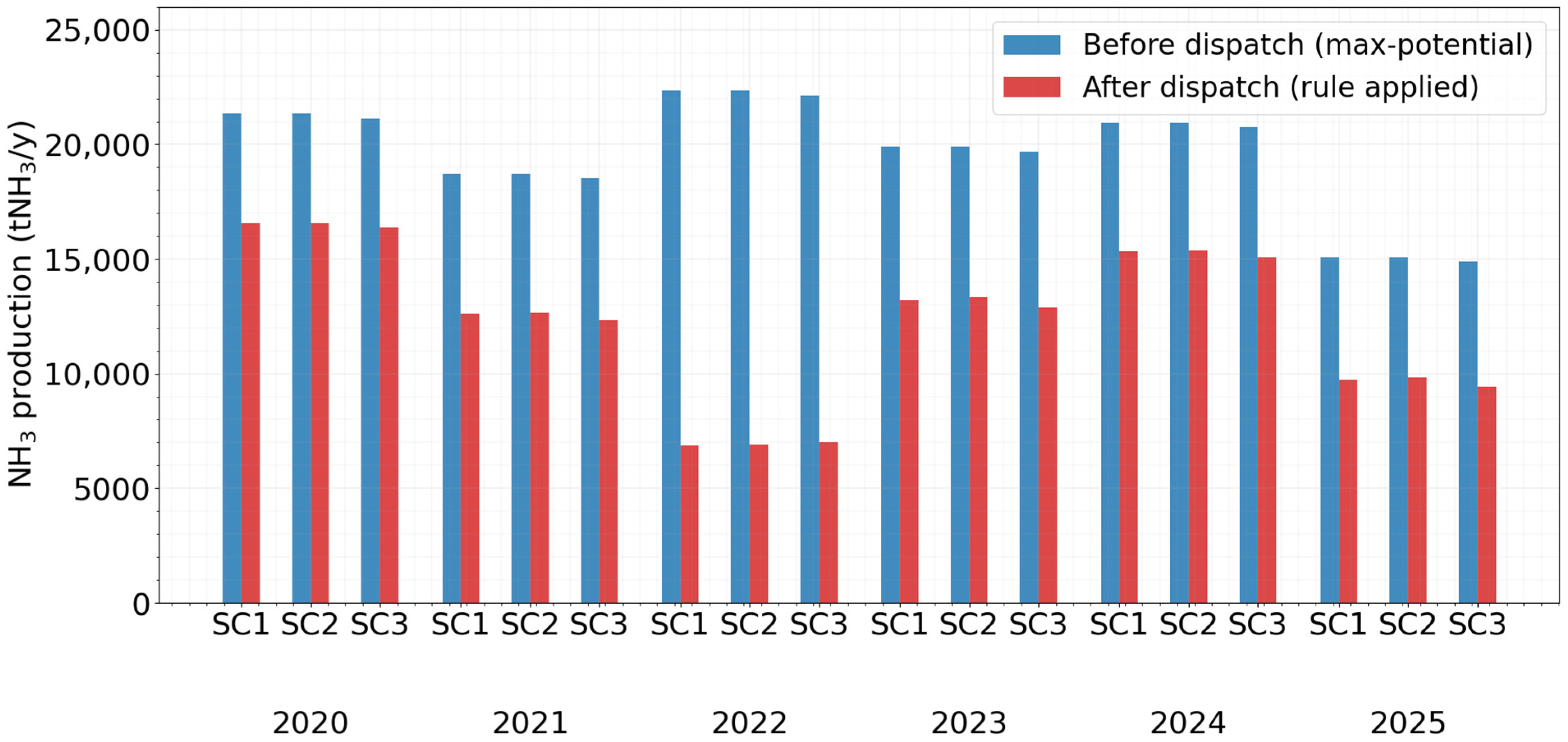
Table 4 summarises annual ammonia production for the observed period 2020–2025 before and after the application of the dispatch algorithm (see also Figure 10) and illustrates inter-annual variability in the historical sample. The after-dispatch algorithm application values are not treated as a deterministic forecast for the 30-year lifetime; instead, the underlying paired hourly wind–price years (2020–2025) are used as empirical building blocks in the block-bootstrap Monte Carlo procedure described in methodology section to produce distributions of NPV, IRR, and LCOA.
The produced ammonia based on the input supplied by the wind farm’s output is almost similar between all SCs, with a small deviation among SC1, 2 and SC3 due to the electricity offshore grid connections and transformer losses. In contrast, when the incremental dispatch rule was applied, ammonia production occurred only in hours when the net operating margin from PtA exceeded that of electricity export to the grid and operation remained feasible under the imposed constraints, resulting in much lower ammonia production than the theoretical maximum. Furthermore, according to Table 4 and Figure 10, SCs 1 and 2, although their topology in terms of production allocation facilities is similar, deviate in annual ammonia production. This occurs because the dispatch decision is formulated as a net-margin comparison between electricity export and ammonia production. In SC1, the additional per-tonne vessel cost reduces the netback value of ammonia, so fewer hours satisfy the condition where ammonia production yields a higher margin than grid export. Consequently, the algorithm diverts less wind energy to the PtA chain in SC1, resulting in lower realised annual NH3 production.
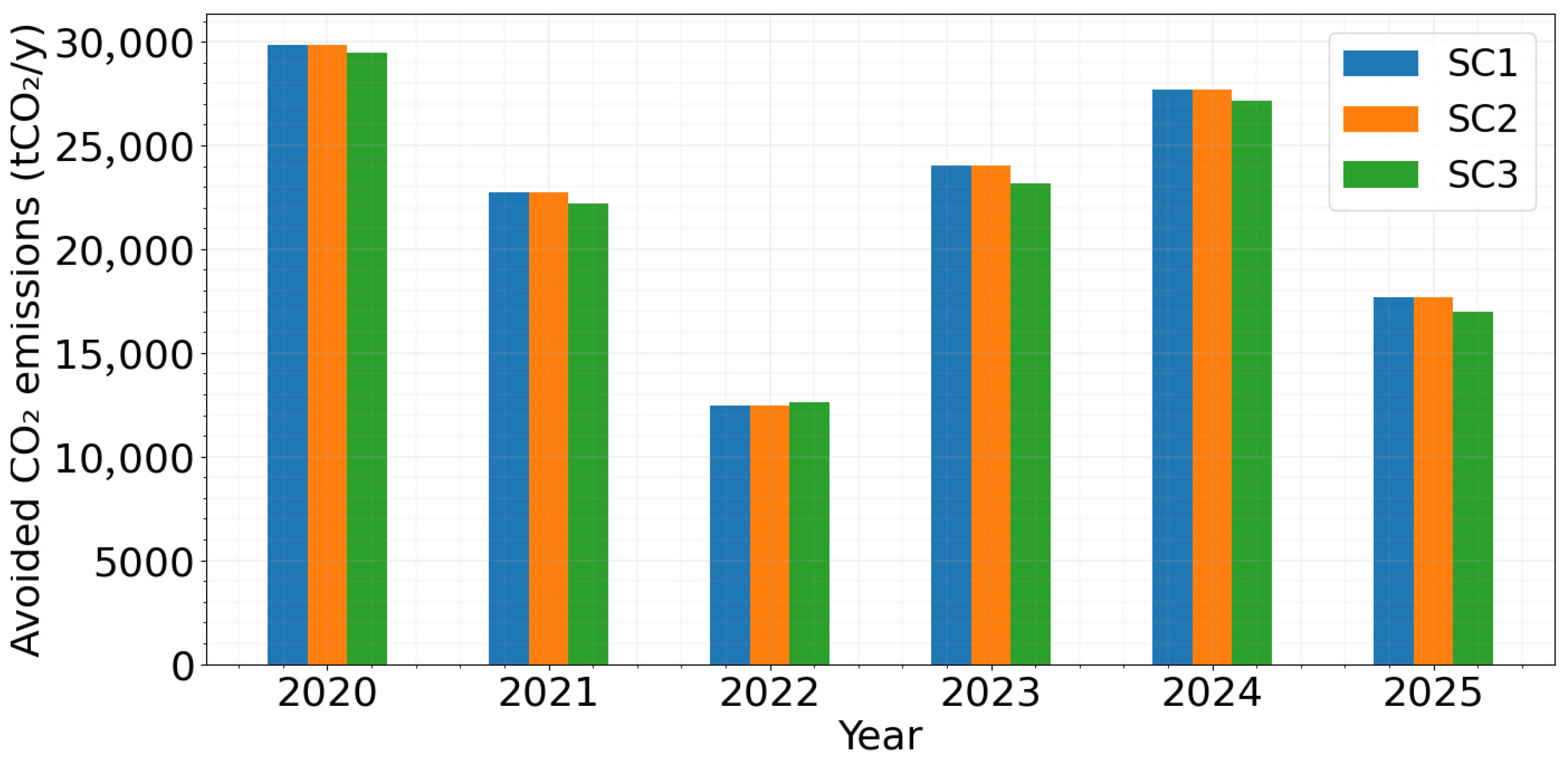
Screening avoided emissions: Using the benchmark EFconv = 1.8 tCO2/tNH3 and the after-dispatch delivered ammonia volumes (Table 4), the analysed 100 MW reference case corresponded to approximately 12–30 ktCO2/y (Figure 11) of potential direct emissions avoided across the historical years 2020–2025, with mean values of about 22.4 ktCO2/y for SC1–SC2 and 21.9 ktCO2/y for SC3. When the observed year-to-year sequence is repeated to span the 30-year project lifetime in the deterministic base case, this translates to roughly 0.67 MtCO2 avoided (SC1–SC2) and 0.65 MtCO2 avoided (SC3). These values are reported as a screening indicator and should be interpreted alongside the stated limitations (no embedded emissions and no marginal-grid assessment).

3.2. Financial Analysis for All SCs

To assess the viability of a coupled offshore wind energy and PtA facility, the proposed methodology initially focused on the allocation of the available energy produced by an operating wind farm between the electricity grid and the sustainable ammonia production facility. The dispatch algorithm applied for a specific timeframe between 2020 and 2025 and was developed accordingly to provide the highest economic profit for the wind farm—PtA investor, based on a margin-based switching criterion and operational feasibility constraints.
Within the modelling resolution adopted in the present TEA—namely constant conversion factors and simplified operational/logistics feasibility constraints—the corresponding fully co-optimised formulation can be interpreted in reduced form as a low-complexity dispatch representation. Under these assumptions, the proposed margin-based switching strategy serves as an approximate co-optimisation rule, while feasibility is enforced explicitly through the temporal coupling constraints (minimum load and ramp-rate limits) and the logistics constraints (inventory balance and delivery limits).
The storage and transport capacities used in the financial assessment (Table 5) and derived following the dispatch algorithm application and data from Table 1, are treated as scenario design parameters consistent with the selected supply-chain topologies (vessel capacity and onshore storage for SC1; pipeline transport and reduced onshore storage for SC2). Table 5 is used to illustrate historical production variability rather than to deterministically size the system for the full 30-year lifetime. It presents the size of the respective technical components used in the financial assessment of SCs 1 and 2 under investigation.
The required onshore footprint includes the storage of ammonia onshore for SCs 1 and 2, and the ammonia and hydrogen production plants in SC3. It is assumed equal to 95 m2/MW for the production of hydrogen process, 15 m2/tNH3/d for the ammonia production plant, and 0.06 m2/tNH3 for the NH3 final product tanks [18,52].
The financial evaluation of the project was based on calculations concerning the NPV, IRR, and LCOA of the project. A block-bootstrap Monte Carlo was implemented using historical calendar years (i.e., 2020–2025) as the resampling block. The hourly dispatch decisions presented in the previous section, were used in conjunction with CAPEX, OPEX, and the aggregated annual incremental revenues based on the annual ammonia production and electricity sales, calculated via Equations (22)–(25). For each simulation, a 30-year sequence was created by sampling historical years with replacement, preserving each sampled year as an intact block. Plant sizing (NH3 capacity, storage, and logistics where applicable) is fixed per scenario based on the design assumptions in Table 1, Table 2, Table 3 and Table 4; the Monte Carlo resampling only changes the sequence of wind–price years used to compute dispatch and annual cashflows.
Initially, in the base-case (deterministic) assessment, annual incremental revenues and ammonia outputs derived from the historical dispatch simulation are extended to the full 30-year project lifetime by repeating the available year-by-year sequence. Using this repeated operating profile, the scenario-specific CAPEX, and the resulting financial indicators (NPV, IRR, and LCOA) are documented in Table 6.
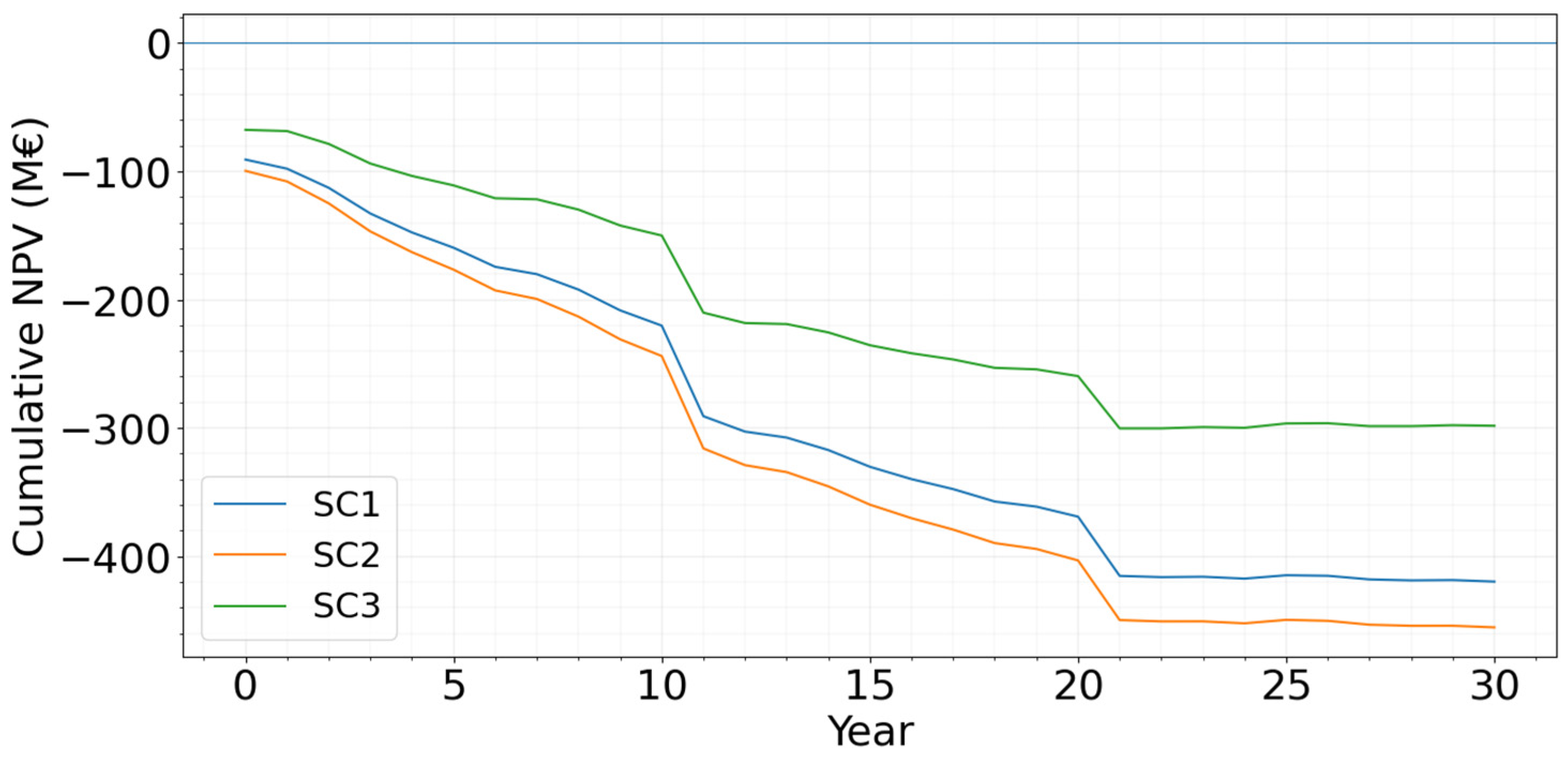
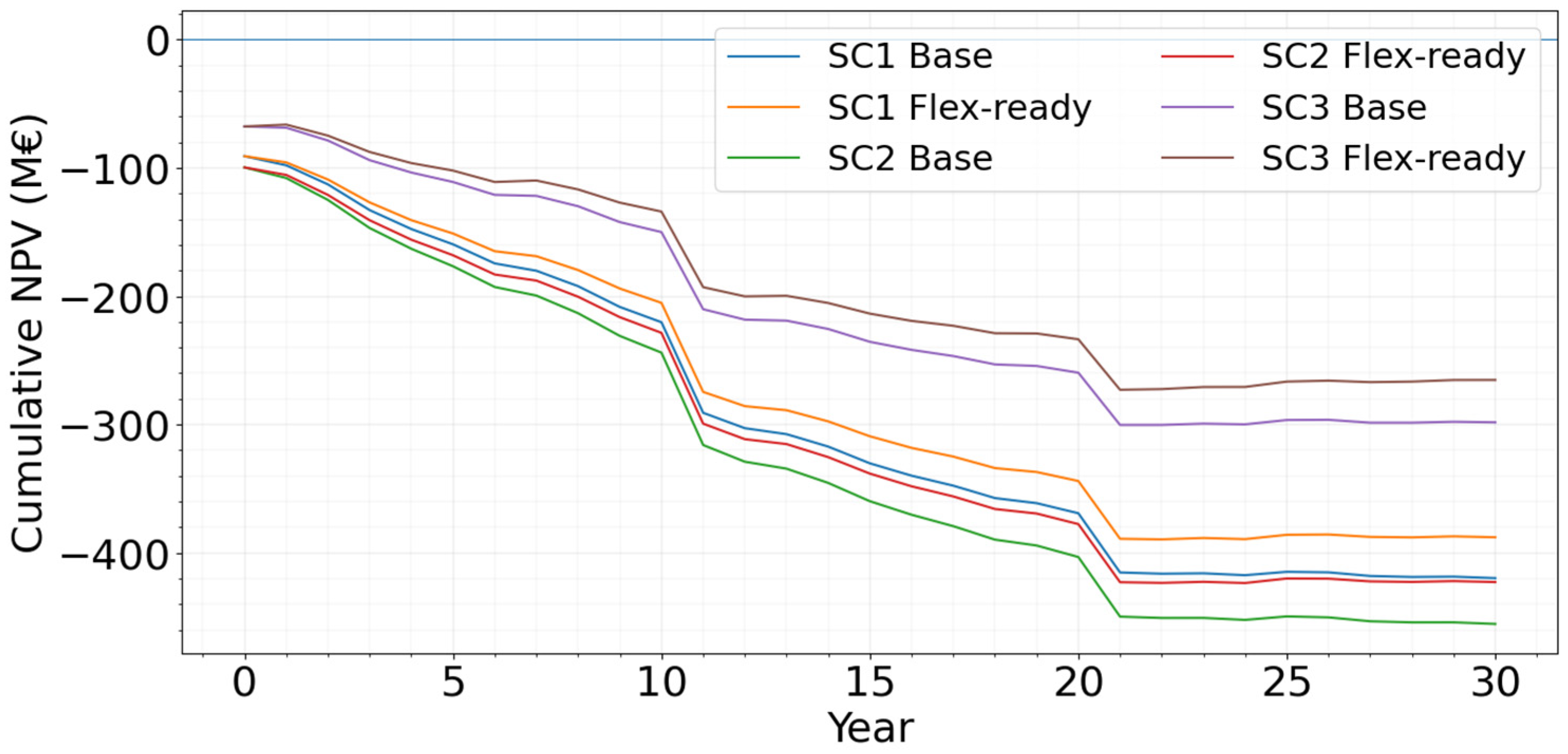
In Figure 12, the corresponding base-case cumulative NPV trajectory shows how discounted equity value evolves over time under reference assumptions, with visible step-changes at major scheduled stack-replacement years (e.g., years 11 and 21) due to one-off maintenance expenditures. The base-case cumulative NPV trajectories show the discounted equity value of each configuration over the 30-year project life, starting from the initial equity outlay at year 0. All three scenarios remain below zero throughout the project’s lifetime, indicating that under the base assumptions the project does not payback its upfront equity investment in discounted terms. SC3 consistently performs best (least negative cumulative NPV), while SC1 and SC2 follow very similar paths and remain more negative.
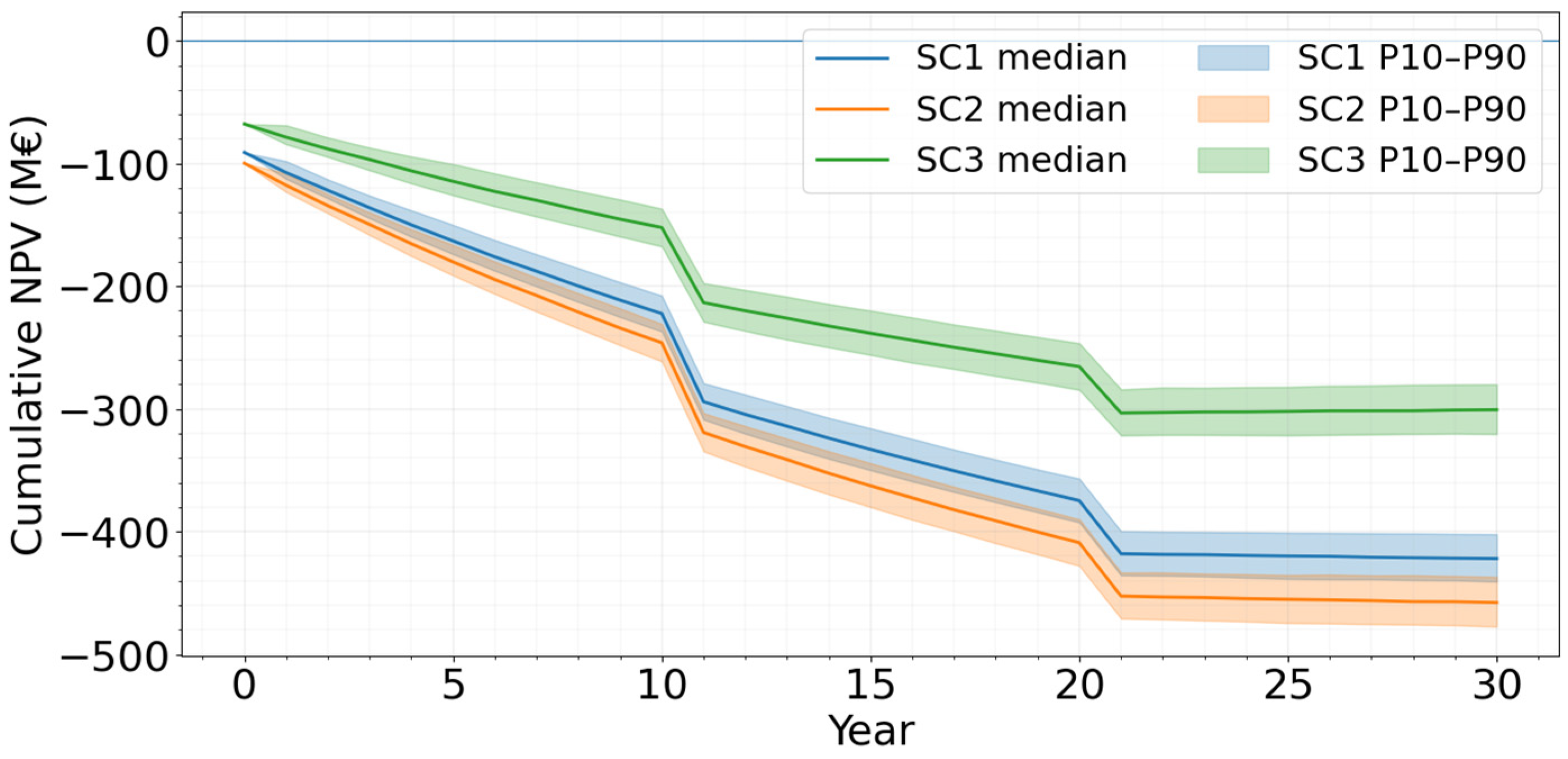
The results of the base-case assessment have been extended by applying a block-bootstrap Monte Carlo to the annual data, expressed as percentile bands (P10–P90) and a median (P50) of cumulative NPV over the project lifetime for each scenario.
Figure 13 shows the results of analysis. In each simulation, the model constructs a synthetic 30-year sequence by resampling historical years, preserving the within-year correlation between production and revenues, and then recomputes the discounted equity cashflows and the cumulative NPV path. For each scenario, the solid line represents the median cumulative NPV across simulations, while the shaded envelope (P10–P90) quantifies uncertainty due to year-to-year fluctuations in revenues and production.
According to Figure 13, it can be observed that the percentile bands widen over time because annual variability accumulates as cashflows are discounted and summed, while longer-term structural changes in market conditions are not captured by the resampling approach. The same pronounced downward steps around years 11 and 21 as in Figure 12, remain in every scenario because the stack-replacement schedule is deterministic in the model; uncertainty mainly affects the slope between these step changes rather than their timing. Across the full horizon, the uncertainty bands for SC1 and SC2 overlap strongly, implying similar risk–return profiles, whereas SC3 is consistently shifted upward (less negative) with its own uncertainty range. Importantly, even the upper (P90) trajectories remain below zero over the full life in the displayed results, suggesting a low likelihood of achieving a positive cumulative NPV under the assumed price/cost structure and the variability captured by the bootstrap. It is also apparent that for SC3, at the 21st year onward, the trajectory slope presents a positive angle suggesting that the project is generating positive discounted annual equity cash flows.

3.3. Sensitivity Analysis

To investigate the influence of PtA sizing and product-price uncertainty, a sensitivity analysis over (i) the electrolyser rated power and (ii) the ammonia selling price is performed. The same methodology to identify the dispatch pattern and the financial evaluation have been followed for each configuration, from which NPV, IRR and LCOA are computed for each scenario and sensitivity case. Where the financial parameters indicated a non-profitable business case, a breakeven price of the ‘green’ ammonia product to get a positive NPV was estimated.
In regard to the electrolysis system rated power, the sensitivity analysis has been performed under various power outputs beginning from a relatively small system of 10 MW, scaling up to 200 MW. The results are presented in Table 7. Figure 14 shows how the NPV alters among the different sized configurations.
It is worth noting that at low electrolyser rated power, the plant can often operate at higher effective utilisation, so the LCOA can end up close to the assumed selling price. As rated power increases, utilisation tends to fall (limited wind energy and dispatch constraints are spread across a larger installed electrolyser), which raises the cost per tonne and pushes LCOA away from the assumed selling price.
Figure 14 as mentioned above indicates the project’s NPV as a function of the electrolyser rated power while keeping the remaining assumptions fixed and re-applying the same hourly dispatch rule at each capacity. Across all three scenarios, NPV decreases as electrolyser capacity increases. This indicates that, under the assumed wind supply and price-driven operating logic, additional PtA capacity is not sufficiently utilised to recover its added CAPEX/OPEX: the marginal benefit of installing more electrolysis capacity is limited by the available hours in which PtA is dispatched and by the finite wind-energy input that can be diverted to ammonia production, whereas costs scale more directly with rated power. Scenario SC3 consistently yields the least negative NPV over the entire capacity range, while SC1 and SC2 track each other closely and remain more penalised as capacity grows. Moreover, it is important to observe that in the low-capacity range (≈10–50 MW), SC1 shows a higher NPV compared to SC2 at higher rated power values, meaning it is economically less penalised at small scale.
Overall, the sensitivity highlights that oversizing the electrolyser relative to the effective operating window and available feed energy can significantly worsen financial performance, and that the economically preferable region is towards lower rated capacities in this parameterisation.
Following the sensitivity analysis of electrolyser rated power—which quantified how PtA sizing affects capital intensity, utilisation, and the value captured through the dispatch rule—the assessment next examined the influence of ammonia market conditions. Whereas rated power primarily determined the volume of NH3 that can be produced (and therefore the utilisation and cost structure of the plant), the NH3 selling price determined the value per tonne of output shifting and also the hourly dispatch decision between ammonia production and electricity export. Accordingly, the financial evaluation is repeated over a range of constant NH3 selling prices (1400 to 3200 €/tNH3), with the dispatch logic re-optimised at each price level and the resulting annual production and revenues translated into NPV, IRR, and LCOA. Table 8 includes the results of the analysis, while Figure 14 demonstrates how sensitive the NPV is to the selling price of the ammonia output.
The sensitivity analysis confirms that the economics are strongly driven by the assumed NH3 selling price: increasing the price systematically raises NPV and improves IRR across all three scenarios. At lower prices all scenarios remain unprofitable (negative NPV), but SC3 consistently performs best, exhibiting substantially less negative NPVs than SCs1 and 2. SC3 reaches profitability first—its NPV turns positive at around 2600 €/tNH3 (with IRR moving from slightly negative to clearly positive), whereas SC1 and SC2 remain negative and only become marginally profitable at approximately 3100 €/tNH3.
Concerning the LCOA, SC3 shows the lowest LCOA throughout under the assumed techno-economic parameterisation (Table 1), followed by SC1 and then SC2, indicating a more favourable cost–revenue balance for SC3 within the adopted cost inputs. Moreover, LCOA declines as the selling price increases, reflecting that higher NH3 prices trigger more hours of PtA operation under the dispatch rule, which spreads largely fixed costs over more tonnes.
Figure 15 reports NPV as a function of the assumed constant ammonia selling price, similarly recomputing dispatch, annual production, and discounted cashflows for each price level. In contrast to the rated power sensitivity, the relationship here is strongly positive and close to linear: increasing the NH3 selling price leads to a nearly proportional improvement in NPV for all scenarios. As the selling price increases the curves approach and—for sufficiently high prices—cross the zero-NPV threshold. Visually, SC3 reaches profitability at a lower ammonia price than SC1 and SC2 and maintains a higher NPV throughout the explored price range, indicating a more favourable cost–revenue balance in that configuration. The crossing points represent the breakeven ammonia price required for a non-negative NPV under each scenario equalling to 3047, 3182, and 2572 €/tNH3 for SC1, SC2, and SC3 respectively.
The figure therefore shows that market value of ammonia is the dominant driver of financial viability within the tested range, with scenario ranking remaining stable (SC3 best, SC1/SC2 broadly similar) while absolute viability is governed by the achievable product price.
Additionally to the above, a flexibility sensitivity analysis was conducted by re-applying the hourly dispatch under ‘flex-ready’ operating constraints—lower minimum stable load and higher ramp-up/down limits—while keeping all techno-economic parameters (CAPEX, fixed OPEX, financing assumptions, and prices) identical to the base case, so that only the operational benefit of increased flexibility is isolated. Figure 16 compares the equity cumulative NPV trajectories for the base operating constraints and the flex-ready case across all three scenarios. In all cases, the flex-ready configuration produces a consistently higher (less negative) cumulative NPV than the corresponding base case, indicating that enhanced operational flexibility improves the project’s ability to capture value from variable wind generation and price signals. The benefit is most pronounced for SC1 and SC2, where the PtA plant is exposed to offshore logistics constraints; relaxing the minimum stable load and increasing ramping capability allows the system to operate profitably over a larger set of hours and reduces periods of non-optimal operation imposed by inflexibility. SC3 also benefits from flex-ready operation, but the improvement is comparatively smaller, reflecting its structurally higher baseline performance and reduced exposure to offshore export/logistics limitations.
The consistently higher performance of SC3 under the above sensitivities is mainly driven by the assumed cost structure of the supply chain. In SC3, the electrolysis plant is onshore and therefore avoids offshore-specific CAPEX elements and uses the lower onshore-electrolysis-specific cost compared to offshore (Table 1), while SC1 and SC2 carry offshore-electrolysis and platform-related cost components. At the same time, SC3 experiences transmission losses, which reduce the usable energy delivered to the PtA system, meaning that its advantage is not purely technical but emerges from the balance between reduced offshore CAPEX and additional conversion/export losses. Importantly, the electrolysis rated power and NH3 selling price sensitivities indicate that SC3 remains favourable within the explored ranges of rated power and product price, while acknowledging that alternative transport/infrastructure cost assumptions could alter the ranking.
The breakeven ammonia prices reported above (approximately 2500–3200 €/tNH3) are substantially higher than recent benchmark prices for conventional (fossil-based) ammonia in Europe and are also above many published estimates for early renewable-ammonia supply in favourable locations. For example, Platts assessed freight cost for NW Europe ammonia routes on the order of a few hundred €/tNH3 [53]. In contrast, recent decarbonisation analyses and industry reporting commonly discuss renewable-ammonia cost/price levels around 800–1200 €/tNH3 depending on electricity price, utilisation, and CAPEX assumptions [49]. The high breakeven levels in this study are primarily driven by the offshore CAPEX burden and limited PtA utilisation under the margin-based dispatch rule (many hours remain more valuable for grid export). Bridging the remaining gap in early markets would therefore likely require policy support in addition to continued technology cost reductions, such as capital grants, production premiums or contracts-for-difference for renewable hydrogen/ammonia, and carbon pricing or Carbon Contracts for Difference for hard-to-abate industrial demand [49]. As an order-of-magnitude illustration, an EU ETS allowance price in the order of 60–90 €/tCO2 [54] would correspond to 110–125 €/tNH3 of avoided CO2 value if green ammonia displaces efficient natural-gas ammonia at 1.8 tCO2/tNH3; this alone would not close a multi-hundred €/tNH3 gap but can contribute when combined with other support mechanisms.

3.4. Final Outcome and Novelty

The results quantify when it is economically preferable to allocate offshore wind generation to a power-to-ammonia (PtA) pathway rather than export to the electricity market, and how this decision propagates into incremental value relative to a “grid-only” baseline.
In the context of the stated RQs, the results showed that hourly diversion from grid export to PtA is optimal when the ammonia value per MWh of wind input exceeds the grid-export value per MWh and, additionally, whenever electricity prices are negative (PtA acts as an energy storage system to avoid uneconomic export). This rule applies across offshore, pipeline-export, and hybrid configurations. However, the threshold effectively shifts by configuration because each has different losses and cost burdens, which changes the net value comparison.
Concerning RQ2, the financial analysis indicated that adding a PtA produced negative incremental value relative to selling electricity to the market for all three configurations, but the magnitude differs: the hybrid offshore–onshore configuration consistently yielded the least negative incremental performance, while the two offshore configurations generated similar negative results.
Furthermore, in relation to RQ3, the outcome outlined that the optimal PtA capacity is jointly determined by how often PtA is dispatched under the electricity-vs-ammonia value rule, and the transport-chain cost/efficiency of each configuration. At low utilisation (i.e., when PtA is selected only in negative-price or low-opportunity-cost hours), smaller electrolyser capacities perform better because CAPEX is spread over limited operating hours, while increasing rated power mainly added underused capacity and weakened incremental NPV. Although higher utilisation could in principle improve the economics of larger systems, this effect was not sufficient to reverse the observed trend under the assumptions adopted. NH3 price is the dominant driver of this interaction as higher NH3 prices expand the set of hours where PtA is preferred over grid export, raising utilisation and shifting the optimum toward larger capacities and greater flexibility, while lower NH3 prices constrain PtA to a narrow operating window and favour smaller, more selective designs. These effects differ across infrastructure choices because each supply-chain configuration changes the effective delivered energy, logistics burden, and cost base, which in turn shifts the capacity optimum and the breakeven conditions for positive incremental performance.
Beyond ammonia-specific studies, the decision paradigm adopted in this research is structurally comparable to integrated energy system scheduling frameworks that allocate variable renewable generation among competing sinks under operational constraints. For example, Li et al. formulated an optimal scheduling model for an integrated energy system with uncertain renewables that leverages building thermal inertia to improve operational flexibility and renewable utilisation [55]. In a similar spirit, the present work aimed to evaluate how operational flexibility and infrastructure choices shape the value captured from variable offshore wind. The key difference is that, to retain transparency and tractability for a multi-scenario TEA with hourly data, a margin-based rule to generate an unconstrained dispatch signal was employed and then enforced feasibility using explicit flexibility and logistics constraints.
In summary, this work provided a comparative techno-economic assessment of integrating PtA as an incremental add-on to an operating wind farm, explicitly distinguishing between three realistic supply-chain configurations under the same wind and electricity-price time series. The novelty of the work lies therefore in the evaluation of three PtA supply-chain options, using the same wind-resource and day-ahead electricity price time series while determining operation endogenously through an hourly dispatch rule. Rather than prescribing fixed utilisation, the framework lets grid export and PtA conversion compete hour by hour, so that production profiles reflect real market conditions and the technical constraints of each configuration (e.g., transmission losses and transport route). This delivers a transparent comparison of incremental value (relative to electricity-only operation) in terms of NPV, IRR, and LCOA, and it clarifies how electrolyser sizing and NH3 price flexibility interact with infrastructure to shape utilisation and financial performance. From a sustainability perspective, the approach also quantifies how often renewable electricity is diverted into a storable, transportable energy carrier instead of being curtailed or exported, linking economic decision-making to the broader goal of converting variable wind output into lower-carbon ammonia pathways.

4. Conclusions

This study evaluated three offshore wind-to-ammonia (PtA) supply-chain configurations—offshore production with vessel logistics (SC1), offshore production with pipeline export (SC2), and a hybrid offshore–onshore pathway (SC3)—using an hourly, price-responsive dispatch rule that endogenously selects between electricity export and ammonia conversion. By framing PtA as an add-on to an existing offshore wind farm and benchmarking against an electricity-only baseline, the analysis quantified the incremental value of electrifying ammonia production under realistic wind and day-ahead market variability. The results showed that diversion to PtA is economically justified primarily during hours with low or negative electricity prices or when the implied value of ammonia per diverted MWh exceeded the value of grid export, highlighting the central role of electricity price conditions in determining optimal operational switching. In addition, a screening CO2 indicator suggested that the 100 MW reference case could avoid in the order of 0.65 MtCO2 over a 30-year lifetime if delivered green ammonia displaces efficient natural-gas-based ammonia (1.8 tCO2/tNH3). This estimate is indicative and does not include life-cycle emissions or marginal grid impacts.
Across the three configurations, incremental financial performance differed due to infrastructure and loss mechanisms (e.g., export losses and transport options) and their effects on utilisation and cost structure. Sensitivity analyses demonstrated that PtA capacity and ammonia selling price jointly govern economic outcomes. The electrolysis rated-power sensitivity showed that, across the tested range, increasing electrolyser capacity made NPV more negative in all scenarios, indicating that the additional CAPEX of larger PtA systems was not offset by sufficient utilisation under the available wind supply and dispatch pattern. On the other hand, higher ammonia prices expand the set of hours in which PtA is selected over grid export and improve NPV and LCOA across all scenarios. Conversely, at lower ammonia prices, dispatch shifted toward electricity export and the incremental benefit of PtA declined, leading to higher breakeven price requirements for positive NPV. Overall, the findings clarify how sizing, operational flexibility, and transport choices interact to shape both the achievable ammonia output and the incremental project economics.
Beyond profitability, the study provides decision-relevant insights for sustainability-oriented system design by identifying the market conditions under which variable offshore wind generation is preferentially converted into a storable and transportable energy carrier rather than being curtailed or exported. This supports the role of green ammonia as a pathway for integrating renewables, enabling long-duration energy storage and contributing to decarbonised ammonia supply for fertiliser and energy applications.
Future work can strengthen both the economic and sustainability assessment by: (i) incorporating additional value streams and system credits (e.g., utilisation of oxygen by-products where feasible and ancillary service revenues where market access exists); (ii) extending the framework with explicit life-cycle accounting to quantify embedded emissions and sustainability trade-offs across offshore, hybrid, and pipeline logistics; and (iii) testing alternative market participation and flexibility strategies (e.g., storage sizing, ramping constraints, and different electricity market products) thereby supporting the multiple end uses of ammonia. These extensions would improve the robustness of the cash-flow estimates and provide a clearer, quantified linkage between economic performance and sustainability outcomes.

Author Contributions

Conceptualization, G.X. and D.A.; methodology, D.A. and G.X.; software, D.A.; validation, D.A.; formal analysis, D.A.; investigation, D.A.; resources, D.A.; data curation, D.A.; writing—original draft preparation, D.A. and G.X.; writing—review and editing, G.X. and D.A.; visualisation, D.A. All authors have read and agreed to the published version of the manuscript.

Funding

This research received no external funding.

Institutional Review Board Statement

Not applicable.

Informed Consent Statement

Not applicable.

Data Availability Statement

Publicly available datasets were analysed in this study, including ERA5 hourly reanalysis wind fields (Copernicus Climate Change Service) and Energinet’s Energi Data Service ‘Elspotprices’ dataset for DK1 day-ahead electricity prices. The turbine power curve was taken from the cited Vestas V164 documentation/reference. The processed hourly wind–price time series and the Python version 6 workflow used to generate the results are available from the corresponding author upon reasonable request.

Conflicts of Interest

The authors declare no conflicts of interest.

Abbreviations

The following abbreviations are used in this manuscript:
ASUAir Separation Unit
BoPBalance of Plant
CAPEXCapital Expenditure
CCSCarbon Capture and Storage
DACDirect Air Capture
DK1Nord Pool bidding zone DK1 (Western Denmark)
EU ETSEuropean Union Emissions Trading System
FCFEFree Cash Flow to Equity
GHGGreenhouse gas
IEAInternational Energy Agency
IRENAInternational Renewable Energy Agency
IRRInternal Rate of Return
LCOALevelised Cost of Ammonia
LHVLower Heating Value
NPVNet Present Value
OPEXOperating Expenditure
PEMProton Exchange Membrane
PtAPower-to-Ammonia
RQResearch Question
SCScenario
SOECSolid Oxide Electrolysis Cell
TEATechno-Economic Analysis
WACCWeighted Average Cost of Capital

References

  1. Savaresi, A. The Paris Agreement: A new beginning? J. Energy Nat. Resour. Law 2016, 34, 16–26. [Google Scholar] [CrossRef]
  2. Jost, K.; Xydis, G. Offshore wind acceleration in the U.S. Atlantic coast and the 30 GW by 2030 target. Proc. Inst. Civ. Eng.-Energy 2023, 176, 169–176. [Google Scholar] [CrossRef]
  3. Oh, S.; Mun, H.; Park, J.; Lee, I. Techno-economic comparison of ammonia production processes under various carbon tax scenarios for the economic transition from grey to blue ammonia. J. Clean. Prod. 2024, 434, 139909. [Google Scholar] [CrossRef]
  4. Arellano-Prieto, Y.; Chavez-Panduro, E.; Rossi, P.S.; Finotti, F. Energy Storage Solutions for Offshore Applications. Energies 2022, 15, 6153. [Google Scholar] [CrossRef]
  5. International Energy Agency. Ammonia Technology Roadmap: Towards More Sustainable Nitrogen Fertilizer Production; IEA: Paris, France, 2021; Available online: https://www.iea.org/reports/ammonia-technology-roadmap (accessed on 12 June 2025).
  6. Chahrour, M.; Wulf, C.; Zapp, P. Assessing climate change impact of blue ammonia via carbon capture and utilization in life cycle modelling. J. Environ. Manag. 2025, 383, 125438. [Google Scholar] [CrossRef]
  7. U.S. Geological Survey, ‘Nitrogen Statistics and Information’. Available online: https://www.usgs.gov/centers/national-minerals-information-center/nitrogen-statistics-and-information (accessed on 12 June 2025).
  8. Florez, J.; AlAbbad, M.; Vazquez-Sanchez, H.; Morales, M.G.; Sarathy, S.M. Optimizing islanded green ammonia and hydrogen production and export from Saudi Arabia. Int. J. Hydrogen Energy 2024, 56, 959–972. [Google Scholar] [CrossRef]
  9. IRENA. Green Hydrogen: A Guide to Policy Making; International Renewable Energy Agency: Abu Dhabi, United Arab Emirates, 2020. [Google Scholar]
  10. Fasihi, M.; Weiss, R.; Savolainen, J.; Breyer, C. Global potential of green ammonia based on hybrid PV-wind power plants. Appl. Energy 2021, 294, 116170. [Google Scholar] [CrossRef]
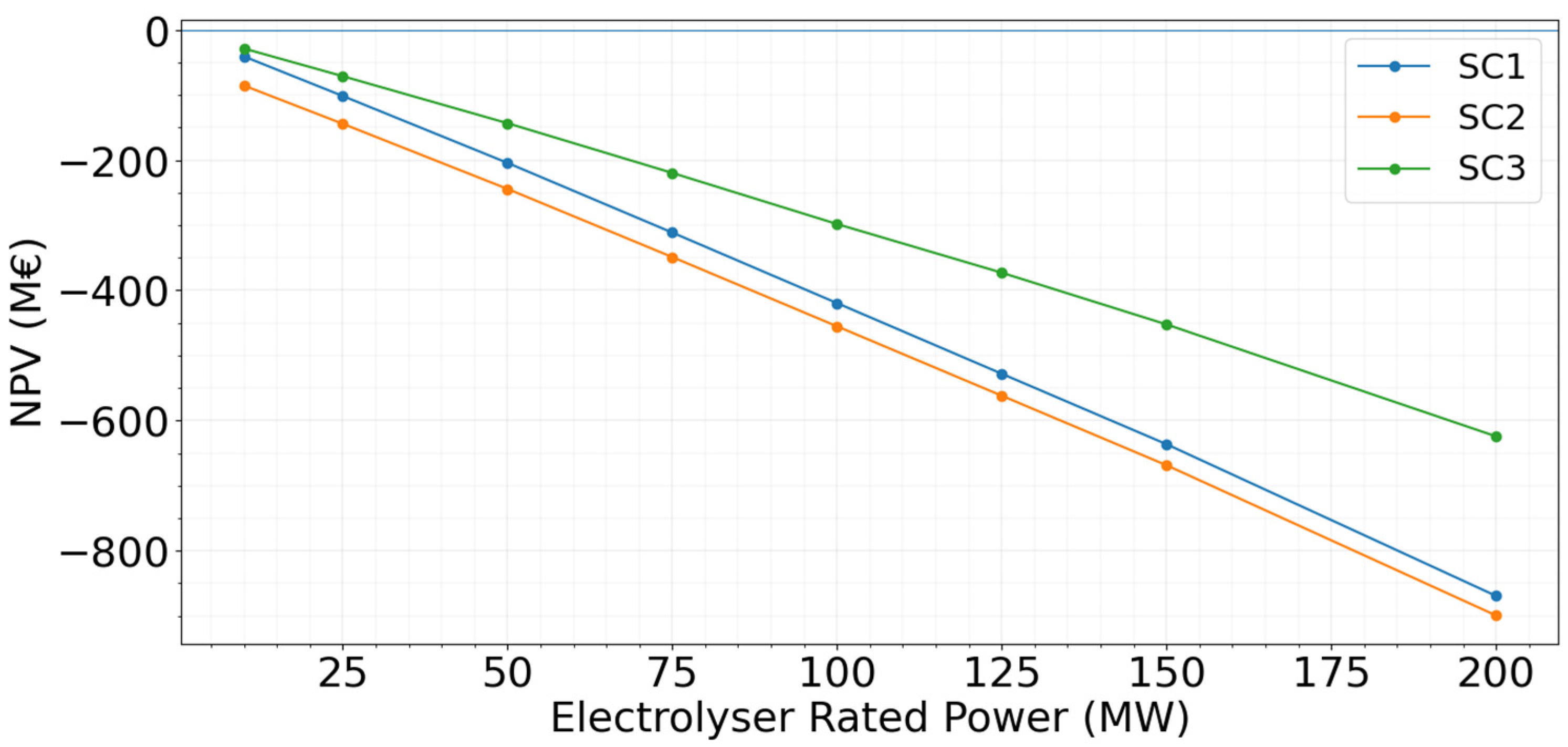
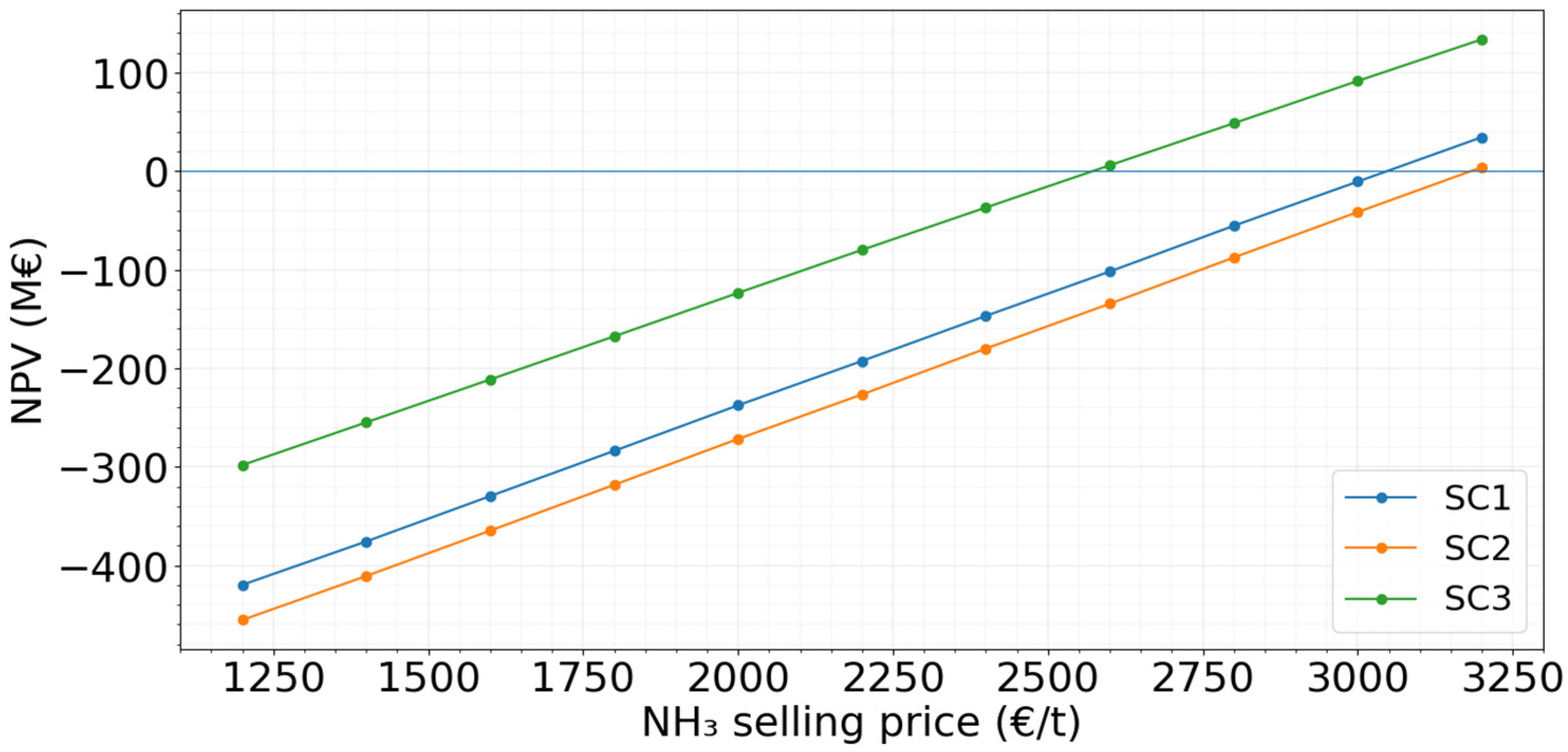
  11. Akhtar, M.S.; Liu, J. Process Design and Techno-economic analysis of Hydrogen Production using Green Ammonia Imported from Australia-A Korea Case Study. In Computer Aided Chemical Engineering; Türkay, M., Gani, R., Eds.; 31 European Symposium on Computer Aided Process Engineering; Elsevier: Amsterdam, The Netherlands, 2021; Volume 50, pp. 141–146. [Google Scholar]
  12. Ishaq, H.; Crawford, C. Review of ammonia production and utilization: Enabling clean energy transition and net-zero climate targets. Energy Convers. Manag. 2024, 300, 117869. [Google Scholar] [CrossRef]
  13. Ishaq, H.; Dincer, I. Dynamic modelling of a solar hydrogen system for power and ammonia production. Int. J. Hydrogen Energy 2021, 46, 13985–14004. [Google Scholar] [CrossRef]
  14. Allman, A.; Daoutidis, P. Optimal scheduling for wind-powered ammonia generation: Effects of key design parameters. Chem. Eng. Res. Des. 2018, 131, 5–15. [Google Scholar] [CrossRef]
  15. Armijo, J.; Philibert, C. Flexible production of green hydrogen and ammonia from variable solar and wind energy: Case study of Chile and Argentina. Int. J. Hydrogen Energy 2020, 45, 1541–1558. [Google Scholar] [CrossRef]
  16. Cameli, F.; Kourou, A.; Rosa, V.; Delikonstantis, E.; Galvita, V.; Van Geem, K.M.; Stefanidis, G.D. Conceptual process design and technoeconomic analysis of an e-ammonia plant: Green H2 and cryogenic air separation coupled with Haber-Bosch process. Int. J. Hydrogen Energy 2024, 49, 1416–1425. [Google Scholar] [CrossRef]
  17. Campion, N.; Nami, H.; Swisher, P.R.; Vang Hendriksen, P.; Münster, M. Techno-economic assessment of green ammonia production with different wind and solar potentials. Renew. Sustain. Energy Rev. 2023, 173, 113057. [Google Scholar] [CrossRef]
  18. Maia, M.M. Techno-Economic Analysis of Green Ammonia Production Using Offshore Wind Farms. Master’s Thesis, Danmark Tekniske Universitet, Lyngby, Denmark, 2021. Available online: https://skemman.is/handle/1946/39443 (accessed on 10 June 2025).
  19. Singlitico, A.; Østergaard, J.; Chatzivasileiadis, S. Onshore, offshore or in-turbine electrolysis? Techno-economic overview of alternative integration designs for green hydrogen production into Offshore Wind Power Hubs. Renew. Sustain. Energy Transit. 2021, 1, 100005. [Google Scholar] [CrossRef]
  20. Durakovic, G.; del Granado, P.C.; Tomasgard, A. Powering Europe with North Sea offshore wind: The impact of hydrogen investments on grid infrastructure and power prices. Energy 2023, 263, 125654. [Google Scholar] [CrossRef]
  21. Hersbach, H.; Bell, B.; Berrisford, P.; Biavati, G.; Horányi, A.; Muñoz Sabater, J.; Nicolas, J.; Peubey, C.; Radu, R.; Rozum, I.; et al. ERA5 Hourly Data on Single Levels from 1940 to Present. Available online: https://cds.climate.copernicus.eu/datasets/reanalysis-era5-single-levels?tab=download (accessed on 26 January 2026).
  22. Ramos, V.; Giannini, G.; Calheiros-Cabral, T.; López, M.; Rosa-Santos, P.; Taveira-Pinto, F. Assessing the Effectiveness of a Novel WEC Concept as a Co-Located Solution for Offshore Wind Farms. J. Mar. Sci. Eng. 2022, 10, 267. [Google Scholar] [CrossRef]
  23. Freeman, J.; Jorgenson, J.; Gilman, P.; Ferguson, T. Reference Manual for the System Advisor Model’s Wind Power Performance Model; Technical NREL/TP-6A20-60570; National Renewable Energy Laboratory: Denver, CO, USA, 2014. Available online: https://docs.nrel.gov/docs/fy14osti/60570.pdf (accessed on 26 January 2026).
  24. International Energy Agency. The Future of Hydrogen—Seizing Today’s Opportunities; IEA: Paris, France, 2019; Available online: https://iea.blob.core.windows.net/assets/9e3a3493-b9a6-4b7d-b499-7ca48e357561/The_Future_of_Hydrogen.pdf (accessed on 17 June 2025).
  25. Nosherwani, S.A.; Neto, R.C. Techno-economic assessment of commercial ammonia synthesis methods in coastal areas of Germany. J. Energy Storage 2021, 34, 102201. [Google Scholar] [CrossRef]
  26. AlZohbi, G. Ammonia from Hydrogen: A Viable Pathway to Sustainable Transportation? Sustainability 2025, 17, 8172. [Google Scholar] [CrossRef]
  27. Rahimpour, H.R.; Mokhtarani, B.; Salehabadi, A.; Zanganeh, J.; Moghtaderi, B. Sustainable ammonia production routes and barriers: A critical review. J. Environ. Chem. Eng. 2025, 13, 116397. [Google Scholar] [CrossRef]
  28. Spatolisano, E.; Figini, D. Absorption-enhanced Haber-Bosch for small-scale green NH3 production. A feasibility study. Energy Convers. Manag. 2025, 337, 119904. [Google Scholar] [CrossRef]
  29. Energinet, ‘Elspot Prices’, Energinet. Available online: https://www.energidataservice.dk/tso-electricity/Elspotprices (accessed on 27 January 2026).
  30. Tully, Z.; King, J.; Johnson, K. Hydrogen storage minimization under industrial flexibility constraints: A techno-economic analysis of off-grid green ammonia production. Int. J. Hydrogen Energy 2025, 111, 12–21. [Google Scholar] [CrossRef]
  31. Salmon, N.; Bañares-Alcántara, R. Impact of process flexibility and imperfect forecasting on the operation and design of Haber–Bosch green ammonia. RSC Sustain. 2023, 1, 923–937. [Google Scholar] [CrossRef]
  32. Cheng, M.; Verma, P.; Yang, Z.; Axelbaum, R.L. Flexible cryogenic air separation unit—An application for low-carbon fossil-fuel plants. Sep. Purif. Technol. 2022, 302, 122086. [Google Scholar] [CrossRef]
  33. Fahr, S.; Kender, R.; Bohn, J.-P.; Rehfeldt, S.; Peschel, A.; Klein, H. Dynamic simulation of a highly load-flexible Haber–Bosch plant. Int. J. Hydrogen Energy 2025, 102, 1231–1242. [Google Scholar] [CrossRef]
  34. Joyo, F.H.; Falasco, A.; Groppi, D.; Sferra, A.S.; Astiaso Garcia, D. Hydrogen and Ammonia Production and Transportation from Offshore Wind Farms: A Techno-Economic Analysis. Energies 2025, 18, 2292. [Google Scholar] [CrossRef]
  35. Schwaeppe, H.; Blumberg, G.; Heuser, P.M.; Schrief, A.; Gelfort, A.; Kneip, C.; Schneller, C.; Türkucar, T.; Schadek, U.; Maiwald, F.; et al. Assessment of Connection Concepts for Germany’s Far Out North Sea Offshore Wind Areas for an Efficient Energy Transition; Study on Connection Concepts for Offshore Wind. E-Bridge Consulting: Bonn, Germany, 2024. Available online: https://aquaventus.org/wp-content/uploads/2024/09/240829_AQV_ShortStudy_EN.pdf (accessed on 25 January 2026).
  36. Rezaei, M.; Akimov, A.; Gray, E.M.A. Techno-economics of offshore wind-based dynamic hydrogen production. Appl. Energy 2024, 374, 124030. [Google Scholar] [CrossRef]
  37. Apostolou, D. Optimisation of a hydrogen production—Storage—Re-powering system participating in electricity and transportation markets. A case study for Denmark. Appl. Energy 2020, 265, 114800. [Google Scholar] [CrossRef]
  38. Zhang, H.; Wang, L.; Van Herle, J.; Maréchal, F.; Desideri, U. Techno-economic comparison of green ammonia production processes. Appl. Energy 2020, 259, 114135. [Google Scholar] [CrossRef]
  39. Trotta, L.; Bernardini, V.; Ermini, M.V.; Campana, L.G.; Verna, M.; Raimondi, G.; Spazzafumo, G. Climate finance-driven feasibility study of a green ammonia and urea production plant in Italy. Int. J. Hydrogen Energy 2025, 137, 987–999. [Google Scholar] [CrossRef]
  40. Dinh, Q.V.; Pereira, P.H.T.; Dinh, V.N.; Nagle, A.J.; Leahy, P.G. Levelised cost of transmission comparison for green hydrogen and ammonia in new-build offshore energy infrastructure: Pipelines, tankers, and HVDC. Int. J. Hydrogen Energy 2024, 62, 684–698. [Google Scholar] [CrossRef]
  41. Bechrakis, D.A.; McKeogh, E.J.; Gallagher, P.D. Simulation and operational assessment for a small autonomous wind–hydrogen energy system. Energy Convers. Manag. 2006, 47, 46–59. [Google Scholar] [CrossRef]
  42. Apostolou, D.; Enevoldsen, P.; Xydis, G. Supporting green Urban mobility—The case of a small-scale autonomous hydrogen refuelling station. Int. J. Hydrogen Energy 2019, 44, 9675–9689. [Google Scholar] [CrossRef]
  43. Seo, Y.; An, J.; Park, E.; Kim, J.; Cho, M.; Han, S.; Lee, J. Technical–Economic Analysis for Ammonia Ocean Transportation Using an Ammonia-Fueled Carrier. Sustainability 2024, 16, 827. [Google Scholar] [CrossRef]
  44. Port of Brownsville. Leasing Policy—Table Lease Rental Rates; Port of Brownsville: Brownsville, TX, USA, 2021; Available online: https://www.portofbrownsville.com/wp-content/uploads/2021/12/Port-of-Brownsville-Leasing-Policy.pdf (accessed on 28 January 2026).
  45. Hulten, E.-C. Depreciation, Inflation, and the Taxation of Income from Capital; Urban Institute Press: Washington, DC, USA, 1981. [Google Scholar]
  46. Denmarks National Bank. Denmarks Nationalbank’s Official Interest Rates and Money and Capital Market Interest Rates by Item, Country and Methodology (Yearly Observations); Denmarks National Bank: København, Denmark, 2024. [Google Scholar]
  47. Đukan, M.; Kitzing, L. A bigger bang for the buck: The impact of risk reduction on renewable energy support payments in Europe. Energy Policy 2023, 173, 113395. [Google Scholar] [CrossRef]
  48. Lee, M.H.; Lee, J.S.; Lee, J.Y.; Kim, Y.H.; Park, Y.S.; Lee, K.M. Uncertainty Analysis of a GHG Emission Model Output Using the Block Bootstrap and Monte Carlo Simulation. Sustainability 2017, 9, 1522. [Google Scholar] [CrossRef]
  49. Alsulaiman, A.; Chyong, K. The Economics of Decarbonising Europe’s Ammonia Industry: Policy, Pathways, and Trade-Offs in a Hard-to-Abate Sector; OIES paper ET; The Oxford Institute for Energy Studies: Oxford, UK, 2025. [Google Scholar]
  50. IRENA. Green Hydrogen Cost Reduction: Scaling Up Electrolysers to Meet the 1.5 °C Climate Goal; International Renewable Energy Agency: Abu Dhabi, United Arab Emirates, 2020. [Google Scholar]
  51. Sun, R.; Li, J.; Sun, L. Economic Estimation of a Green Ammonia Production System from Off Gas. Chem. Eng. Trans. 2024, 114, 253–258. [Google Scholar] [CrossRef]
  52. Baboo, P. Ammonia Storage Tank Pre-Commissioning. Int. J. Eng. Res. Technol. 2019, 8, IJERTV8IS090209. [Google Scholar] [CrossRef]
  53. Gorman, M. NW Europe Ammonia Price Hits 2025 High Amid Supply Squeeze. S&P Global Energy. Available online: https://www.spglobal.com/energy/en/news-research/latest-news/fertilizers/091925-nw-europe-ammonia-price-hits-2025-high-amid-supply-squeeze (accessed on 3 March 2026).
  54. Statista, ‘EU-ETS price 2025–2026’, Statista. Available online: https://www.statista.com/statistics/1322214/carbon-prices-european-union-emission-trading-scheme/ (accessed on 3 March 2026).
  55. Li, Y.; Wang, C.; Li, G.; Wang, J.; Zhao, D.; Chen, C. Improving operational flexibility of integrated energy system with uncertain renewable generations considering thermal inertia of buildings. Energy Convers. Manag. 2020, 207, 112526. [Google Scholar] [CrossRef]
Figure 1. Annual ‘gray’, ‘blue’ and ‘green’ ammonia production 2005–2024. Based on [5,7,9].
Sustainability 18 02938 g001
Figure 2. Schematic representation of the three investigated SCs.
Sustainability 18 02938 g002
Figure 3. Wind speed at 100 m at wind farm area. Based on [21].
Sustainability 18 02938 g003
Figure 4. Energy produced by the wind farm.
Sustainability 18 02938 g004
Figure 5. Day ahead prices for DK1 2020–2025 [29].
Sustainability 18 02938 g005
Figure 6. Maximum potential of hydrogen production 2020–2025.
Sustainability 18 02938 g006
Figure 7. Maximum potential ammonia production 2020–2025.
Sustainability 18 02938 g007
Figure 8. Energy produced by the wind farm, dispatched to provide maximum profit (SC2).
Sustainability 18 02938 g008
Figure 9. Ammonia production after dispatch algorithm application (SC2).
Sustainability 18 02938 g009
Figure 10. Annual ammonia production before and after applying dispatch algorithm.
Sustainability 18 02938 g010
Figure 11. Annual avoided emissions per SC.
Sustainability 18 02938 g011
Figure 12. Base-case cumulative NPV trajectories.
Sustainability 18 02938 g012
Figure 13. Monte Carlo cumulative NPV trajectories.
Sustainability 18 02938 g013
Figure 14. Project’s NPV under sensitivity analysis of electrolysis rated power.
Sustainability 18 02938 g014
Figure 15. Project’s NPV under sensitivity analysis of ammonia selling price.
Sustainability 18 02938 g015
Figure 16. Cumulative NPV under flexibility sensitivity analysis for all SCs.
Sustainability 18 02938 g016
Table 1. Components used in the SCs with their corresponding specific CAPEX.
ComponentUnitsValue Reference
Floating Platforms—CAPEXPLM€/MWel0.44[35]
PEM Water Electrolysis Plant (including BoP)—Offshore—CAPEXEL,offM€/MWel1.7[35,36]
PEM Water Electrolysis Plant (including BoP)—Onshore—CAPEXEL,onM€/MWel1.5[37]
Cryogenic Air Separation Unit—CAPEXAirSM€/tNH3/y1.3 × 10−4[38]
Ammonia Synthesis Plant—CAPEXAmSyM€/tNH3/y9.2 × 10−4[39]
Subsea Infrastructure (Pipelines)—CAPEXpipeM€/km1.4[40]
Transportation and Logistics (via vessel)—CAPEXLogM€/tNH314.4 × 10−4[40]
Onshore Ammonia Storage Tank—CAPEXAStM€/tNH317.9 × 10−4[40]
Project Development-13% of total CAPEX[34]
Table 2. Data used for the calculation of the NPV formula.
ParameterSymbolValueUnitsSource
Income tax coefficientΦ0.22-[37]
Labour wagePO0.084M€/y[37]
OPEX SCsOMcs1.5% (ICoIClog) M€/y[37,41]
OPEX VesselOMv4% IClogM€/y[40]
Replacement cost of stacks at 11th and 21st year of operationOMst50% ICEL + 30% (ICAmSy + ICAirS)M€[18,42]
Variable cost due to vessel’s fuel costsCNH3,var2 × 10−5 mNH3,anM€[43]
Insurance costIn1.0% ICoM€/y[37]
Land-leaseRn1.3 × 10−6 FootprintM€/y[44]
Depreciation rate (declining)δ10% -[45]
Loan rate of interesti3.5%-[46]
Weighted average cost of capital r3.0%-[47]
Equity fractionfe30%-Assumption
Debt fractionfd70%-Assumption
Loan tenornL20yAssumption
Project lifetimeN30yAssumption
Table 3. Maximum potential of H2 and NH3 annual production prior dispatch.
YearSCH2 Annual Production (tH2)NH3 Annual Production (tNH3)
2020SC1,23922.121,342.9
SC33881.421,121.6
2021SC1,23442.818,734.6
SC33402.918,517.7
2022SC1,24109.522,362.9
SC34068.722,140.6
2023SC1,23658.419,907.9
SC33618.419,690.5
2024SC1,23849.920,950.1
SC33812.920,748.8
2025SC1,22772.115,085.2
SC32739.714,908.7
Table 4. NH3 annual production prior (potential) and after the dispatch algorithm application.
YearSCPrior Dispatch NH3 Production Potential (tNH3)After Dispatch Total NH3 Production (tNH3)
2020SC121,342.916,574.0
SC221,342.916,574.0
SC321,121.616,360.6
2021SC118,734.612,633.8
SC218,734.612,642.3
SC318,517.712,332.0
2022SC122,362.96869.7
SC222,362.96916.4
SC322,140.67009.3
2023SC119,907.913,206.6
SC219,907.913,341.8
SC319,690.512,876.5
2024SC120,950.115,329.2
SC220,950.115,370.6
SC320,748.815,076.2
2025SC115,085.29734.1
SC215,085.29824.7
SC314,908.79441.5
Table 5. Calculated data of the main key components for all SCs.
ComponentSC1SC2SC3Units
PEM Water Electrolysis Plant 100 100100MW
Cryogenic Air Separation Unit2.1 2.1 2.1M€
Ammonia Synthesis Plant15.2 15.2 15.0M€
Vessel CAPEX2.6--M€
Vessel OPEX0.3--M€/y
Vessel Capacity (mvessel)1783--tNH3
Vessel turnaround time (τv)168--h
Pipeline CAPEX-28.0-M€
Ammonia Storage Tank CAPEX29.729.729.2M€
Offshore NH3 Storage Capacity (Smax)1783--tNH3
Onshore Footprint99499411,153m2
Table 6. Financial results of the base-case assessment for all SCs.
SC1SC2SC3
CAPEX (M€)303.0322.3225.8
OPEX (M€/y)4.54.93.4
NPV (M€)−419.7−455.3−298.3
IRRN/AN/AN/A
LCOA (€/tNH3)2329.82492.81832.4
Table 7. Sensitivity analysis results on electrolysis system’s rated power.
Electrolysis Rated Power (MW)SCMax. Annual NH3 (tNH3)NPV (M€)IRRLCOA (€/tNH3)
10SC1/22854.1−40.9/−85.6-1486.6/2565.5
SC32844.6−28.7-1198.8
25SC1/26360.6−101.6/−144.3-1588.2/2055.9
SC36321.8−71.2-1270.9
50SC1/210,741.3−204.4/−244.3-1826.0/2093.7
SC310,614.6−143.4-1449.7
75SC1/214,001.8−311.3/−348.9-2078.3/2275.9
SC313,887.7−219.8-1640.7
100SC1/216,574.0−419.7/−455.3-2329.8/2492.8
SC316,360.6−298.3-1832.4
125SC1/218,470.7−528.2/−561.9-2606.7/2745.7
SC318,117.3−373.0-2060.5
150SC1/219,418.8−636.4/−668.7-2941.1/3064.9
SC318,889.2−452.4-2320.6
200SC1/217,442.1−869.4/−899.4-4090.9/4210.9
SC316,549.3−624.4-3256.7
Table 8. Sensitivity analysis results on ammonia selling price.
NH3 Selling Price (€/tNH3)SCNPV (M€)IRRLCOA (€/tNH3)
1400SC1 −375.7-2227.5
SC2−410.7-2375.8
SC3−254.9-1752.4
1600SC1−329.7-2152.6
SC2−364.7-2306.3
SC3−211.4-1696.7
1800SC1−283.8-2121.1
SC2−318.3-2273.8
SC3−167.7-1669.5
2000SC1−237.6-2085.6
SC2−271.7-2238.5
SC3−123.6-1641.8
2200SC1−192.6-2048.9
SC2−226.6-2197.9
SC3−79.9-1615.2
2400SC1−146.9−0.0672029.6
SC2−180.0−0.0792179.6
SC3−36.9−0.0021595.3
2600SC1−101.8−0.0372006.5
SC2−134.5−0.0502153.9
SC35.80.0431581.1
2800SC1−55.5−0.0051996.2
SC2−87.7−0.0212143.6
SC348.50.091569.3
3000SC1−10.7−0.0021979.7
SC2−41.6−0.0072125.3
SC391.40.1511560.0
3200SC134.30.0641971.5
SC23.90.0352118.2
SC3133.50.2041549.5
Disclaimer/Publisher’s Note: The statements, opinions and data contained in all publications are solely those of the individual author(s) and contributor(s) and not of MDPI and/or the editor(s). MDPI and/or the editor(s) disclaim responsibility for any injury to people or property resulting from any ideas, methods, instructions or products referred to in the content.