Fuel Supply Chain Prospects in the On-Going Transition to Sustainable Ship Propulsion: A Multifaceted Paradigm Ahead


Abstract
1. Introduction: Ship Energy in the Sustainable Era
2. The New Energy Challenge for Shipping: The Background
3. Comparative Analysis of Alternative Fuel Supply Chain KPIs
3.1. Alternative Fuels: Current Applications and Prospects
- A.
- Main emissions benefits
- B.
- Infrastructure availability, assessing whether the necessary fuel supply chains, bunkering facilities, and logistics networks are in place.

| FUEL | Main Emissions Benefits | Infrastructure Availability | Notable Real-World Examples |
|---|---|---|---|
| LNG | Up to 20–25% lower CO2 vs. HFO Significant reduction in Sox and | As of late 2023, ~200 ports globally offer LNG bunkering [16,43] | (a) Norwegian Ferries (Widespread adoption since early 2000s) [44] |
| Nox especially if produced as e-LNG via mild energy [2] | Mature in certain regions (Norway, Netherlands, U.S., Gulf) | (b) CMA CGM (30+ LNG vessels in operation/on order) [45] | |
| Hundreds of LNG-capable vessels in operation or on order [21,46] | (c) Various cruise lines (e.g., RCL, Carnival, MSC) have adopted LNG for new cruise ships [47] | ||
| Methanol | Lower CO2 than HFO if produced from renewable sources | Emerging bunkering hubs in N. Europe, Asia [48,49] | (a) Maersk: Orders for 18+ methanol-fueled container ships. First deliveries from 2024 [13] |
| Minimal SOx and particulate emissions [13,26] | Several pilot projects for renewable methanol production [13] | (b) Stena Line: Conducting trials for ro-pax vessels [49] (c) Growing interest from Waterfront Shipping (Methanex Corp.) in methanol-powered tankers [50] | |
| Ammonia | Zero CO2 at point of use. | Limited bunkering infrastructure in 2023; focus on demo projects (EU, Asia) [16] | (a) Wärtsilä & MAN ES developing ammonia-capable engines, targeted for commercial release by 2025–26 [51] |
| No SOx emissions Potentially low lifecycle GHG, if produced via green methods (electrolysis + renewables [36] | Ports of Rotterdam, Singapore, and Japan exploring ammonia corridors [16] | (b) H2Ships initiative exploring both hydrogen and ammonia bunkering [52] | |
| Hydrogen | Zero CO2 at point of use, if ‘green hydrogen’ which produces no SOx, NOx, or particulate matter | Very limited; pilot-scale bunkering ferry projects in Norway & EU [53,54] | (a) H2Ships: European program for hydrogen fueling solutions [52] |
| [55] | Infrastructure mostly in demonstration phases [56] | (b) Pilot ferries in Norway testing LH2 propulsion [57] (c) AquaVentus in Germany: hydrogen production/usage projects aiming for maritime applications [55,58] | |
| Biofuels | Potentially net-zero CO2 if sustainably sourced | Can use existing bunkering in most cases; compatibility depends on engine specs [59] | (a) GoodFuels trials with MSC reducing up to 80–90% net CO2 [47] |
| Reduction in SOx, NOx depends on feedstock and blend [60] | (b) Maersk and Shell collaborating to test advanced biofuel blends [59] | ||
| OIL | Traditional fossil-based fuel with high CO2 and pollutant emissions [60] | Extensive global bunkering infrastructure established over decades [16,44] | Dominant fuel for the majority of the global shipping fleet [44] |
- i.
- Well-to-Wake Emissions—Assessing total emissions from fuel production to onboard combustion [40].
- ii.
- Energy Density & Storage Requirements—Analyzing storage for different fuels [42].
- iii.
- Fuel Scalability & Infrastructure Readiness—Evaluating global bunkering supply network expansion [44].
- iv.
- Economic Feasibility—Considering lifecycle costs, including production, transportation, and onboard utilization [62].
- v.
- Technology Readiness Level—Used not only at a composite level but also at a more specific one which may be composed by TRL for specific components along the supply chain, e.g., TRL of propulsion (TRL P), or for Handling and Storage (TRL H & S) as in [9].
- vi.
- At the level of efficiency of the supply chain of an alternative fuel, main criteria include the ability to deliver the required energy sources to vessels in a cost-effective manner [63], reducing environmental impact [5], overcoming logistical challenges [64], aligning with sustainability goals and regulatory requirements [34], suitability for fuel adoption by major shipping lines [65], reducing logistical bottle-necks and supply chain risks [40] and enhancing long-term price stability and regulatory compliance [34]. In constructing a roadmap for alternative fuels [66], criteria proposed have been fuel availability, cost, R&D, safety regulations, propulsion technology, port infrastructure for the fuel, stakeholder support, carbon tax, emissions’ public awareness and early adopters.
3.2. Supply Chain Prospects for Alternative Shipping Fuels: An Exploration of KPIs
- a.
- How strong is the evaluation of the prospects of a specific shipping fuel supply chain both in absolute and relative terms, i.e., compared with other fuel options?
- b.
- Is there any strong variability among the components of such evaluations which may imply hidden risks for the sustainability of the respective supply chain?
4. A Larger World Fleet: Challenges and Opportunities for Alternative Fuels
- Ocean-going vessels are considered the most likely candidates to transition to ammonia or hydrogen in the long run, although significant technological and safety barriers remain [72,73]; nevertheless, hydrogen is currently considered as holding significant potential in the clean energy transition being an effective pathway for large-scale deep decarbonization [74].
- Cruise operators have already been increasingly interested in methanol and LNG to match strict emission controls near coastal, tourist and ECA areas [77].
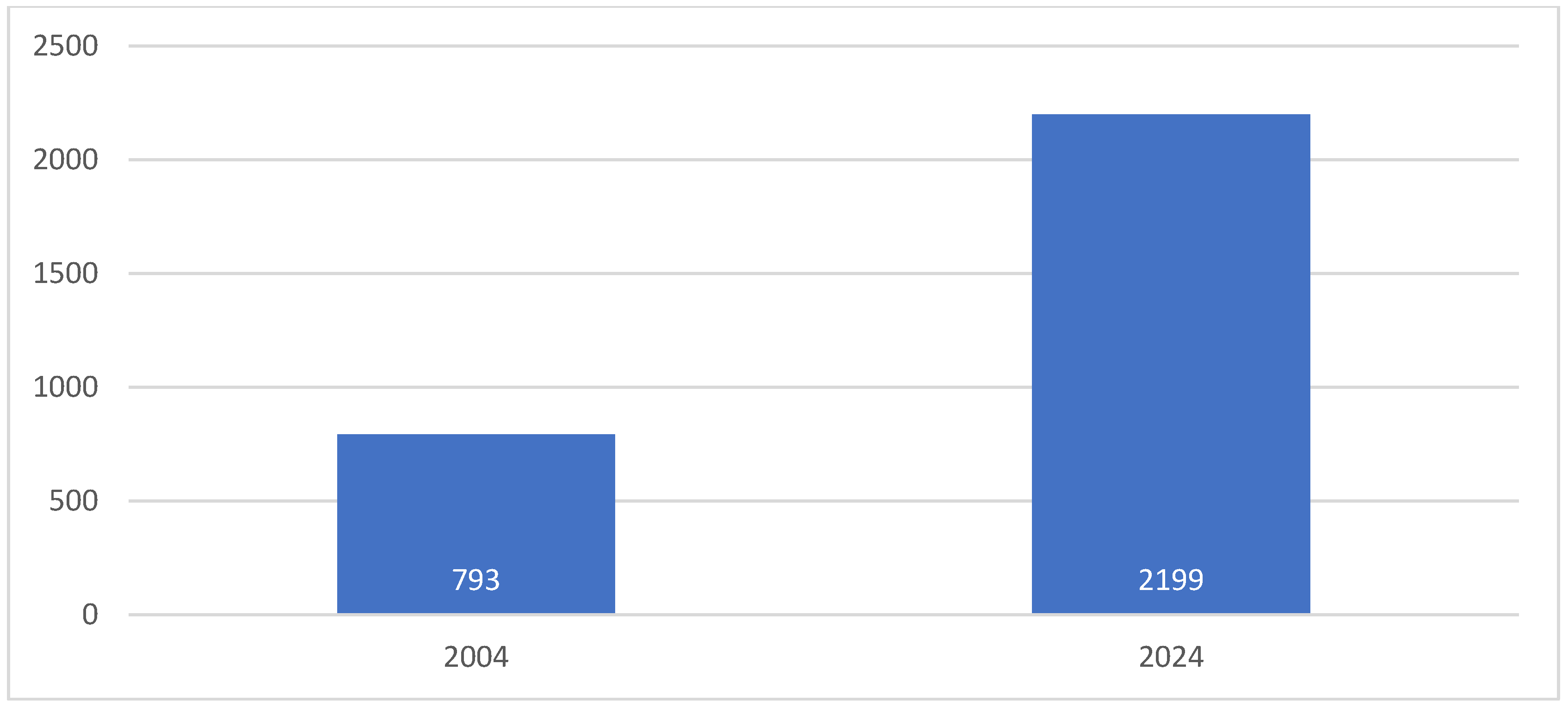
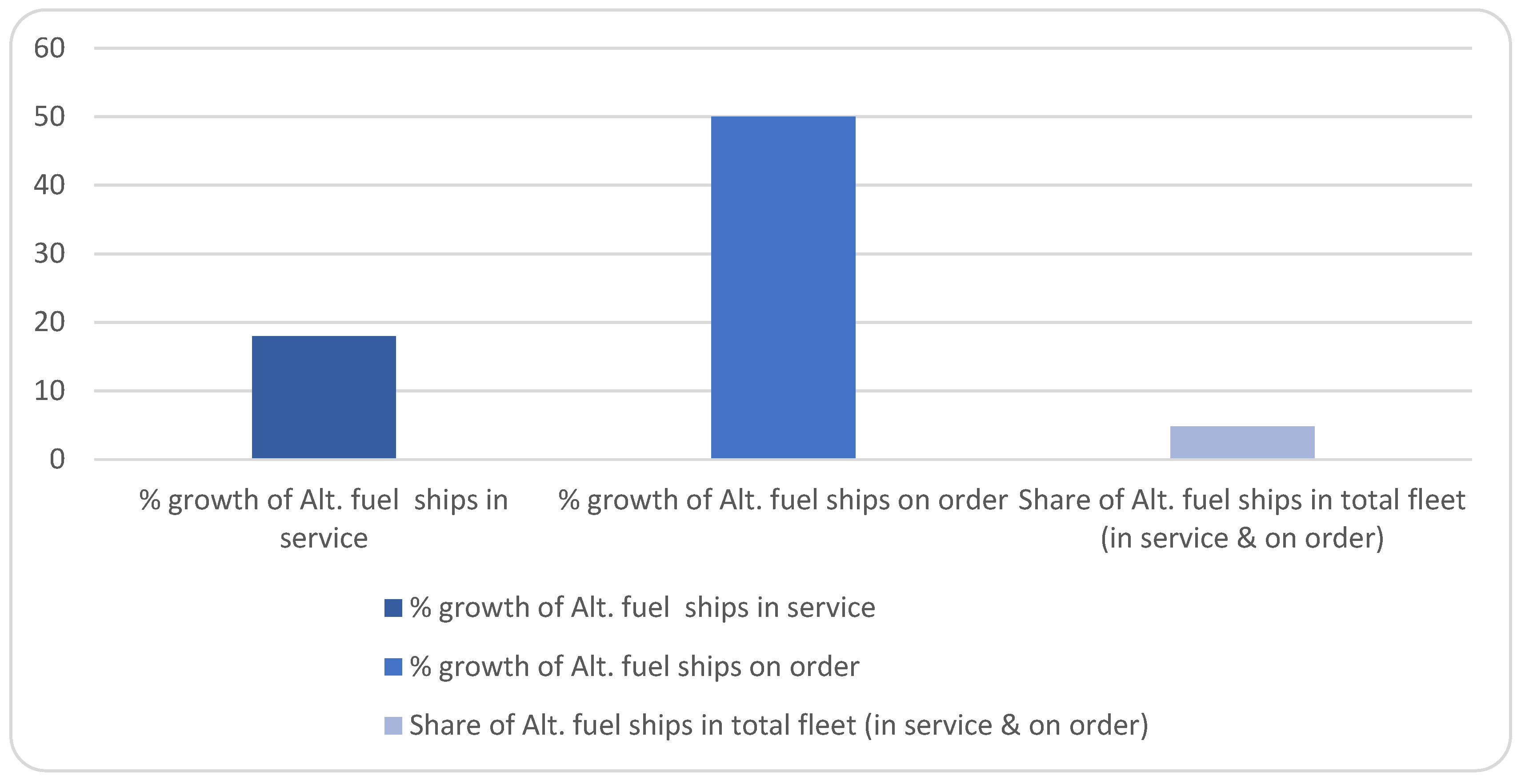
4.1. World Fleet Growth and Its Features: Another Scale for a Different Type of Transition?
4.2. Incorporating the Full Decarbonization Impact: The Next Steps
- a.
- Production of shipbuilding materials along all their own supply chain;
- b.
- Shipbuilding energy for the construction per se;
- c.
- Recycling of ships to be replaced, if technically or financially no candidates for retrofits; the latter could be a sustainable alternative for fuel options requiring less drastic retrofitting.
5. Conclusions: Operational Challenges in a Multi-Fuel Future
5.1. Alternative Fuels—Alternative Challenges
- (a)
- In terms of economic repercussions, it is possible that an intensification of the climate crisis may result in an acceleration of measures which may render obsolete relatively new hardware elements of alternative fuels’ propulsion systems; in the case of older vessels this may render the ship itself obsolete due to the limited amortization period creating an additional investment challenge for shipowners and related stakeholders [41,86].
- (b)
- Managerial aspects primarily involve the need to secure a properly serviced network of energy sources for the fleet having to now take into account alternative fuels as well; this is especially relevant to network-based operations such as liner shipping [87] where, for instance, management challenges include optimizing bunkering logistics in a port offering only two of five potential fuels.
- (c)
- Electricity/battery-based solutions—currently mostly chosen in the case of small ferries/passenger ships which operate in many, though not all, ways as in the container case discussed by [15]—seem to point to additional constraints for ocean-going vessels. Large freight ships have reduced autonomy considering the length of their standard voyages and the current lack of global density of fuel supply chain networks introducing a challenge in terms of adoption of most efficient alternative fuels without well-developed supply chains.
- (d)
- The repercussions of parallel fuel supply chains—and of new fuels in general—for shipping operations may be substantial, thus hindering the optimization of the latter which is put forward as a complementary strategy [88]. The issue of necessary skills [17] required for each fuel and respective propulsion system is a crucial aspect if the industry quickly evolves into a “multi-vessel energy source” future, with potentially multiple fuel distribution networks. While prioritizing training is proposed for fuels which would likely dominate in the near term, such as LNG and methanol, to ensure seafarers are adequately prepared for the evolving energy landscape, the overall shortage of seafarers, especially at the level of officers [89] may accentuate gaps further. Such shortages could affect optimal alternative fuel choices, creating an often not prioritized, yet critical challenge.
- (e)
- Finally, any need for significant modifications in ship hardware, e.g., engine(s)—or eventually for replacement of vessels themselves due to new fuel requirements—should be considered in the context of any Life-Cycle Assessment of alternative fuels. Any such approach should extend beyond methods of production, treatment, distribution etc., of fuels through any classic LCA methodology—even an all-encompassing and detailed well-to-wake one [12]—and should include the hardware dimension as well for all ships, a view shared, along with the initial suggestion of the authors in [25], by [90] when analyzing the case of ammonia.
- (f)
- Such a “shipyard-to-scrapyard” (StS) more holistic perspective would secure a more efficient fuel transition framework within which future policy interventions should take place adding depth to current LCA methodologies. This more encompassing assessment should at least include i. main and auxiliary engine energy and materials involved, ii. shipbuilding energy and construction materials or eventual retrofitting costs and iii. end-of-life recycling/disposal impacts at the withdrawal of the ship of life. This methodology could also eventually result in different rankings of specific fuels depending on the time-horizon adopted each time when including all stages—and not just specific ones—of the life of a ship itself and not only of the fuel it uses. Differences in the ranking order could also ensue, if onboard carbon capture and storage is taken into account, whereby even traditional fuels may even be a surviving option for the latter beyond currently forecasted dates, especially if the price of alternative fuels does not reduce [91].
5.2. Limitations Research of the Research
5.3. The Need for Further Research and Smart Policy Response Amidst the Climate Crisis
Supplementary Materials
Author Contributions
Funding
Institutional Review Board Statement
Data Availability Statement
Acknowledgments
Conflicts of Interest
Abbreviations
| BWM | Best-Worst Method |
| CV | Coefficient of Variation |
| DWT | Deadweight Tonnage |
| FAME | Fatty Acid Methyl Ester |
| GHG | Greenhouse Gases |
| HTGR | High-temperature gas-cooled reactors |
| HVO | Hydrotreated Vegetable Oil |
| IMO | International Maritime Organization |
| IGF (Code) | International Code of Safety for Ships using Gases or other Low-flashpoint Fuels Code |
| LCA | Life-Cycle Assessment |
| LBM | Liquefied Bio-Methane |
| LMCR | Liquid metal cooled reactors |
| LNG | Liquefied Natural Gas |
| KPIs | Key Performance Indicators |
| PWR | Pressurized-water reactor |
| SMART | Specific, Measurable, Attainable, Relevant, and Time (framework) |
| StS | Shipyard-to-Scrapyard |
| TOPSIS | Technique for Order of Preference by Similarity to Ideal Solution |
| TRL | Technological Readiness Levels |
| WAPS | Wind-assisted Propulsion Systems |
| ZNZ | Zero Near-Zero |
References
- DNV. Alternative Fuel Insights—Fleet and Orderbook. 2023. Available online: https://www.dnv.com (accessed on 5 February 2025).
- DNV. Maritime Forecast to 2050; DNV: Høvik, Norway, 2025; Available online: https://www.dnv.com/maritime/publications/maritime-forecast (accessed on 5 February 2025).
- Wiernicki, C. LNG Is a Transition Fuel. Tradewinds. Available online: https://www.tradewindsnews.com/opinion/lng-is-a-transition-fuel-a-shipping-fuel-in-transition-and-the-key-to-our-future/2-1-1704298 (accessed on 5 September 2024).
- DNV. Decision on the IMO Net-Zero Framework Delayed for One Year. DNV News, 17 October 2025. Available online: https://www.dnv.com/news/2025/decision-on-the-imo-net-zero-framework-delayed-for-one-year (accessed on 11 January 2026).
- Wang, J.; Li, H.; Yang, Z.; Ge, Y.E. Shore power for emission reduction. Transp. Res. Part E 2024, 188, 103639. [Google Scholar] [CrossRef]
- Bullock, S.; Larkin, A.; Köhler, J. Beyond fuel: The case for a wider perspective on shipping and climate change. Clim. Policy 2025, 25, 1326–1334. [Google Scholar] [CrossRef]
- International Maritime Organization. Fourth IMO GHG Study; IMO: London, UK, 2021. [Google Scholar]
- BIMCO; ICS. Manpower Report; ICS: London, UK, 2021. [Google Scholar]
- Lloyd’s Register. Zero Carbon Fuel Monitor. 2025. Available online: https://www.lr.org/en/knowledge/research/zcfm/ (accessed on 5 February 2026).
- Willmington, R. MAN to Deliver First Ammonia Dual-Fuel Engines. Lloyd’s List, 30 January 2025. Available online: https://www.lloydslist.com/LL1152410/MAN-to-deliver-first-ammonia-dual-fuel-engines-in-early-2026 (accessed on 16 February 2026).
- Lloyd’s Register. Engine Retrofit Report; LR: London, UK, 2023. [Google Scholar]
- Lloyd’s Register. The Future of Maritime Fuels. 2023. Available online: https://www.lr.org/en/knowledge/press-room/press-listing/press-release/2023/shipping-industry-faces-two-alternative-decarbonisation-paths-with-hydrogen-based-fuels-and-biofuels-vying-for-prominence/ (accessed on 5 February 2025).
- Maersk. Methanol Fuel Transition Report; Maersk: Copenhagen, Denmark, 2022; Available online: https://www.maersk.com/news/articles/2023/06/26/maersk-orders-six-methanol-powered-vessels (accessed on 15 February 2026).
- Port of Los Angeles. Zero Emissions Roadmap; POLA: Los Angeles, CA, USA, 2022. [Google Scholar]
- Zou, J.; Yang, B. Evaluation of alternative marine fuels from dual perspectives considering multiple vessel sizes. Transp. Res. Part D 2023, 115, 103583. [Google Scholar] [CrossRef]
- Port of Rotterdam Authority. LNG Bunkering Infrastructure Development. 2022. Available online: https://www.portofrotterdam.com (accessed on 7 February 2025).
- Calderón, M.; Illing, D.; Veiga, J. Facilities for bunkering of liquefied natural gas in ports. Transp. Res. Procedia 2016, 14, 2431–2440. [Google Scholar] [CrossRef]
- International Maritime Organization. IGF Code; IMO: London, UK, 2023. [Google Scholar]
- Lloyd’s Register. LR-RU-012 Classification Rules; LR: London, UK, 2024. [Google Scholar]
- Brindle, S. Brunel: The Man Who Built the World; Hachette UK: London, UK, 2013. [Google Scholar]
- Lloyd’s Register. Alternative-Fueled Ship Orders Grow 50% in 2024. 2025. Available online: https://www.lr.org/en/knowledge/insights-articles/alternative-fuelled-ship-orders-grow-50-in-2024/ (accessed on 7 February 2025).
- Tomos, B.A.D.; Stamford, L.; Welfle, A.; Larkin, A. Decarbonising international shipping: A life cycle perspective on alternative fuel options. Energy Convers. Manag. 2024, 299, 117848. [Google Scholar] [CrossRef]
- Mahmud, K.K.; Sheikh, W.; Chowdhury, M.M.H. Decision framework for sustainability assessment of alternative fuels to achieve shipping decarbonization. Ocean Coast. Manag. 2025, 265, 107637. [Google Scholar] [CrossRef]
- Urban, F.; Harahap Bromander, F.; Samavati, M.; Nurdiawati, A. Fuels for marine propulsion. In Decarbonisation of Maritime Transport; Elsevier: Amsterdam, The Netherlands, 2025; Chapter 6. [Google Scholar] [CrossRef]
- Kokkolis, A.; Thanopoulou, H. Are multiple ship “fuel” supply chains sustainable? In Proceedings of the IAME, Bergen, Norway, 25–27 June 2025. [Google Scholar]
- Methanex.com. Sustainability Report 2025. Available online: https://www.methanex.com/wp-content/uploads/2025-Sustainability-Report.pdf (accessed on 5 February 2026).
- Marchant, N. Grey, Blue, Green—Why Are There So Many Colours of Hydrogen? World Economic Forum. 2021. Available online: https://www.weforum.org/stories/2021/07/clean-energy-green-hydrogen/ (accessed on 5 February 2026).
- Leeson, D.; Mac Dowell, N.; Shah, N.; Petit, C.; Fennell, P.S. A techno-economic analysis and systematic review of carbon capture and storage (CCS) applied to the iron and steel, cement, oil refining and pulp and paper industries, as well as other high purity sources. Int. J. Greenh. Gas Con. 2017, 61, 71–84. [Google Scholar] [CrossRef]
- Forsberg, C. Nuclear power: Energy to produce liquid fuels and chemicals. Chem. Engin. Prog. 2010, 106, 41–44. [Google Scholar]
- Wartsila. Available online: https://www.wartsila.com/insights/article/lng-fuel-for-thought-in-our-deep-dive-q-a (accessed on 5 February 2026).
- CarbonNeutralLNG. Available online: https://www.carbonneutrallng.eu/the-project/faq/ (accessed on 5 February 2026).
- Sontakke, I.; Bergström, M.; Gosala, V.; Baldauf, M.; Ehlers, S. Techno-economic analysis of decarbonization pathways for a deep-sea container vessel. Ship Technol. Res. 2026, 73, 41–58. [Google Scholar] [CrossRef]
- Korányi, T.I.; Németh, M.; Beck, A.; Horváth, A. Recent advances in methane pyrolysis: Turquoise hydrogen with solid carbon production. Energies 2022, 15, 6342. [Google Scholar] [CrossRef]
- European Maritime Safety Agency. Update on Potential of Biofuels for Shipping. 2023. Available online: https://www.emsa.europa.eu (accessed on 5 February 2025).
- Lloyd’s Register. Biofuel: Fuel for Thought. 2024. Available online: https://maritime.lr.org/fft-biofuel (accessed on 8 February 2026).
- Mehr, A.S.; Scheffknecht, G.; Zohourian, R.; Maier, J.; Reinmoeller, M. A Dual-Route Ammonia Process: Combining Renewable and Low-Carbon Pathways. Digit. Chem. Eng. 2025, 18, 100282. [Google Scholar] [CrossRef]
- Bicer, Y.; Dincer, I.; Vezina, G.; Raso, F. Impact assessment and environmental evaluation of various ammonia production processes. Environ. Manag. 2017, 59, 842–855. [Google Scholar] [CrossRef] [PubMed]
- Willige, A. The Colors of Hydrogen. Expanding Ways of Decarbonisation. 2022. Available online: https://spectra.mhi.com/energy-transition/the-colors-of-hydrogen-expanding-ways-of-decarbonization#:~:text=Black%20and%20brown%20hydrogen%20represent,carbon%20monoxide%20into%20the%20atmosphere (accessed on 8 February 2026).
- Worldscale Association Ltd. Worldscale 28/2025: Worldscale Flat Rate Tables and Freight Benchmark for Tankers; Worldscale Association Ltd.: London, UK, 2025; Available online: https://www.worldscale.co.uk (accessed on 10 January 2026).
- Battaglia, V.; Angrisani, M.; Ferretti, M.; Risitano, M. Maritime energy efficiency: Emerging trends and key performance indicators. Int. J. Sustain. Dev. Plan. 2024, 19, 3749–3757. [Google Scholar] [CrossRef]
- Thanopoulou, H.A. Shipping Investment in the Watershed Years: “Come Fuel and High Uncertainty”. In The Handbook of Maritime Economics and Business; Informa Law from Routledge: London, UK, 2026. [Google Scholar]
- Akac, A.; Anagnostopoulou, A. A solution approach for decision-making on vessel fleet sustainability focusing on alternative fuels in a life-cycle basis. Transp. Res. Procedia 2024, 78, 79–86. [Google Scholar] [CrossRef]
- SEA-LNG. Bunkering. 2025. Available online: https://sea-lng.org/why-lng/bunkering/ (accessed on 13 January 2026).
- Fjord Line. Fjord Line is Rebuilding LNG-Ships to Resolve the Impact of the Energy Crisis. 2022. Available online: https://fjordline.no/en/p/press-and-media/press-releases/fjord-line-is-rebuilding-lng-ships-to-resolve-the-impact-of-the-energy-crisis (accessed on 6 February 2026).
- Kuehne+Nagel. The Week in Newbuildings: CMA CGM Orderbook Hits $9bn. 2022. Available online: https://mykn.kuehne-nagel.com/news/article/the-week-in-newbuildings-cma-cgm-orderbook-hi-07-Feb-2023 (accessed on 5 February 2026).
- Clarksons Research. Shipping Intelligence Network: LNG and Alternative Fuels Report; Clarksons: London, UK, 2023. [Google Scholar]
- MSC. LNG Fuel Tanks Installed on MSC World America. 2023. Available online: https://www.mscpressarea.com/en_US/press-releases/lng-fuel-tanks-installed-on-msc-world-america/ (accessed on 16 February 2026).
- Zeebrugge Port Authority. Methanol Bunkering Hubs Development. 2023. Available online: https://www.portofantwerpbruges.com/en/shipping/maritime-services/bunkering (accessed on 3 February 2025).
- Willmington, R. Stena to Retrofit More Ro-pax Ships for Methanol Fuel. Lloyd’s List, 27 June 2023. Available online: https://www.lloydslist.com/LL1145631/Stena-to-retrofit-more-ro-pax-ships-for-methanol-fuel (accessed on 13 February 2026).
- Methanex Corporation. Waterfront Shipping’s Methanol-Powered Tankers. 2023. Available online: https://www.mol.co.jp/en/pr/2023/23021.html (accessed on 5 February 2025).
- Wärtsilä. Annual Report: Innovation in Maritime Fuels; Wärtsilä: Helsinki, Finland, 2023. [Google Scholar]
- H2Ships Platform. Available online: https://h2ships.org (accessed on 5 February 2026).
- Interreg North-West Europe. H2SHIPS Project. 2021. Available online: https://vb.nweurope.eu/projects/project-search/h2ships-system-based-solutions-for-h2-fuelled-water-transport-in-north-west-europe/ (accessed on 7 February 2026).
- Aquaventus. Hydrogen Production in the North Sea. 2023. Available online: https://aquaventus.org/en/press-releases/aquasector-study-examines-potential-for-first-large-scale-offshore-hydrogen-park-in-german-north-sea/ (accessed on 25 February 2026).
- Agrawal, D.; Mahajan, N.; Singh, S.A.; Sreedhar, I. Green hydrogen production pathways for sustainable future with net zero emissions. Fuel 2024, 359, 130131. [Google Scholar] [CrossRef]
- Hydrogen Infrastructure. 2024. Available online: https://hydrogeneurope.eu/wp-content/uploads/2024/10/2024.10_HE_Hydrogen-Infrastructure-Report.pdf (accessed on 5 February 2026).
- H2 International. Norway: Two New Hydrogen Ferries to Enter Service in 2026. 2025. Available online: https://www.h2-international.com/news/mobility-norway-two-new-hydrogen-ferries-enter-service-2026 (accessed on 5 February 2026).
- Wang, Y.; Dong, G.; Yu, J.; Qin, C.; Feng, Y.; Deng, Y.; Zhang, M. In-situ green hydrogen production from offshore wind farms, a prospective review. Renew. Energy 2025, 239, 122099. [Google Scholar] [CrossRef]
- Altarriba, E.; Rahiala, S.; Tanhuanpää, T.; Lehikoinen, A. Comparing fuels and emission reduction technologies for sustainable shipping: A sustainability index weighting life cycle emissions and costs. J. Clean. Prod. 2025, 49, 145037. [Google Scholar] [CrossRef]
- Maersk; Shell. Advanced Biofuel Blends Collaboration. 2023. Available online: https://www.maersk.com (accessed on 5 February 2025).
- Moni, S.M.; Mahmud, R.; High, K.; Carbajales-Dale, M. Life cycle assessment of emerging technologies: A review. J. Ind. Ecol. 2020, 24, 52–63. [Google Scholar] [CrossRef]
- Law, L.C.; Foscoli, B.; Mastorakos, E.; Evans, S. A comparison of alternative fuels for shipping in terms of lifecycle energy and cost. Energies 2021, 14, 8502. [Google Scholar] [CrossRef]
- Qorri, A.; Mujkić, Z.; Kraslawski, A. Sustainability performance of supply chains. J. Clean. Prod. 2018, 189, 570–584. [Google Scholar] [CrossRef]
- Al-Mohannadi, A.A.; Ertogral, K.; Erkoc, M. Alternative Fuels in Sustainable Logistics—Applications, Challenges, and Solutions. Sustainability 2024, 16, 8484. [Google Scholar] [CrossRef]
- Patidar, A.; Sharma, M.; Agrawal, R.; Sangwan, K.S. Supply chain resilience and its KPIs. Manag. Environ. Qual. 2023, 34, 962–980. [Google Scholar] [CrossRef]
- Balci, G.; Phan, T.T.N.; Surucu-Balci, E.; Iris, Ç. A roadmap to alternative fuels for decarbonising shipping: The case of green ammonia. Res. Transp. Bus. Manag. 2024, 53, 101100. [Google Scholar] [CrossRef]
- Platypodis, E.; Lyridis, D.V.; Kostidi, E.; Maccari, A. Development of KPIs and QFD Method for Evaluating Alternative Maritime Fuels. In Proceedings of the International Congress of the International Maritime Association of the Mediterranean; Springer Nature: Cham, Switzerland, 2025; pp. 102–112. [Google Scholar]
- Zanobetti, F.; Pio, G.; Jafarzadeh, S.; Ortiz, M.M.; Cozzani, V. Decarbonization of maritime transport: Sustainability assessment of alternative power systems. J. Clean. Prod. 2023, 417, 137989. [Google Scholar] [CrossRef]
- European Maritime Safety Agency (EMSA). Potential Use of Nuclear Power for Shipping; EMSA: Lisbon, Portugal, 2024; Available online: https://www.researchgate.net/profile/Spyros-Hirdaris/publication/386567088_Potential_Use_of_Nuclear_Power_in_Shipping/ (accessed on 7 February 2026).
- Thanopoulou, H.; Theotokas, I.; Constantelou, A. Leading by following. Int. J. Marit. Hist. 2010, 22, 199–225. [Google Scholar] [CrossRef]
- UNCTAD. Review of Maritime Transport 2024; UNCTAD: Geneva, Switzerland, 2024. [Google Scholar]
- C&EN. The Shipping Industry Looks for Green Fuels; Chemical & Engineering News: Washington, DC, USA, 2022; Available online: https://cen.acs.org (accessed on 5 February 2025).
- Franco, A. Green Hydrogen and the Energy Transition: Hopes, Challenges, and Realistic Opportunities. Hydrogen 2025, 6, 28. [Google Scholar] [CrossRef]
- Dragoon, K.; Iliceto, A.; Korpås, M.; Markussen, P.; Pivovar, B.; Ruth, M.; Endler, E. Hydrogen as part of a 100% clean energy system: Exploring its decarbonization roles. IEEE Power Energy Mag. 2022, 20, 85–95. [Google Scholar] [CrossRef]
- Zeebrugge Port Authority. LNG Bunkering Operations Statistics, 2023. Available online: https://www.portofzeebrugge.be (accessed on 4 February 2025).
- Zeebrugge Port Authority. LNG Bunkering Operations Annual Review; Zeebrugge Port Authority: Zeebrugge, Belgium, 2023. [Google Scholar]
- Clarksons Research. Shipping Intelligence Network: LNG Update; Clarksons: London, UK, 2022. [Google Scholar]
- Hertwich, E.G.; Wood, R. The growing importance of scope 3 greenhouse gas emissions from industry. Environ. Res. Lett. 2018, 13, 104013. [Google Scholar] [CrossRef]
- Di Vaio, A.; Van Engelenhoven, E.; Raimo, N.; Garofalo, A. Strategic carbon disclosure and accountable efficiency: Reporting shipping industry scope 3 emissions. Bus. Strategy Environ. 2025, 35, 1003–1021. [Google Scholar] [CrossRef]
- Bansal, A.; Pranav, K.; Bhopale, M. A comprehensive life cycle assessment of an LNG carrier from cradle to grave. In Proceedings of the Abu Dhabi International Petroleum Exhibition and Conference; Society of Petroleum Engineers (SPE), Abu Dhabi, UAE, 4–7 November 2024. Paper No. D041S137R004. [Google Scholar]
- Tuan, D.D.; Wei, C. Cradle-to-gate life cycle assessment of ships: A case study of Panamax bulk carrier. Proc. Inst. Mech. Eng. Part M J. Eng. Marit. Environ. 2019, 233, 670–683. [Google Scholar] [CrossRef]
- Zhang, Y.; Chang, Y.; Wang, C.; Fung, J.C.H.; Lau, A.K.H. Life-cycle energy and environmental emissions of cargo ships. J. Ind. Ecol. 2022, 26, 2057–2068. [Google Scholar] [CrossRef]
- Yan, Z.; Li, G.; Wan, S. Oil crops: A potential source of biodiesel. Engineering 2023, 29, 39–41. [Google Scholar] [CrossRef]
- Arias, A.; Nika, C.E.; Vasilaki, V.; Feijoo, G.; Moreira, M.T.; Katsou, E. Assessing the future prospects of emerging technologies for shipping and aviation biofuels: A critical review. Renew. Sustain. Energy Rev. 2024, 197, 114427. [Google Scholar] [CrossRef]
- European Union. Regulation (EU) 2023/2405 (ReFuelEU Aviation). Off. J. Eur. Union 2023, L2405, 1–30. [Google Scholar]
- Wanaka, S.; Hiekata, K.; Takeuchi, T.; Taniguchi, M. Model-based assessment of marine fuel GHG intensity regulation with flexible compliance mechanisms. Transp. Res. Part D Transp. Environ. 2025, 131, 105102. [Google Scholar] [CrossRef]
- Johansen, M.L.; Holst, K.K.; Ropke, S. Designing the liner shipping network of tomorrow powered by alternative fuels. Transp. Sci. 2025, 59, 391–412. [Google Scholar] [CrossRef]
- Uygur, S.; Bolat, P.; Kayışoğlu, G.; Düzenli, E.; Bolat, F.; Arslan, O.; Wei, R.; Zhou, F.; Wang, Y.M. Modelling maritime GHG emission measures impact assessment: A case study for container shipping by system dynamics. Brodogradnja 2020, 71, 1–19. [Google Scholar] [CrossRef]
- DNV. DNV and SMF Study Highlights Upskilling Needs of Seafarers. 2023. Available online: https://www.dnv.com/news/dnv-and-smf-study-highlights-upskilling-needs-of-seafarers-in-the-areas-of-decarbonization-and-digitalization-244162/ (accessed on 7 February 2025).
- Wang, Y.; Xiao, X.; Ji, Y. A review of LCA studies on marine alternative fuels: Fuels, methodology, case studies, and recommendations. J. Mar. Sci. Eng. 2025, 13, 196. [Google Scholar] [CrossRef]
- Wang, H.; Zhou, P.; Jeong, B.; Mesbahi, A.; Mujeeb-Ahmed, M.P.; Jang, H.; Papadakis, A. Life cycle analysis of ammonia fuelled ship: Case ship studies for marine vessels. J. Clean. Prod. 2025, 520, 146105. [Google Scholar] [CrossRef]
- Hellström, M.; Rabetino, R.; Schwartz, H.; Tsvetkova, A.; Haq, S.H.U. GHG emission reduction measures and alternative fuels in different shipping segments and time horizons—A Delphi study. Mar. Policy 2024, 160, 105997. [Google Scholar] [CrossRef]
- Wang, Y.; Iris, Ç. Transition to near-zero emission shipping fleet powered by alternative fuels under uncertainty. Transp. Res. Part D Transp. Environ. 2025, 142, 104689. [Google Scholar] [CrossRef]
- Haq, S.H.; Crawford, C. Addressing freshwater scarcity and hydrogen production: Offshore wind and reverse osmosis synergies. Adv. Sustain. Syst. 2024, 8, 240039. [Google Scholar] [CrossRef]
- United Nations. World Population Prospects 2024; United Nations, Department of Economic and Social Affairs (UN DESA): New York, NY, USA, 2024. [Google Scholar]
- Osler, D. Shipowners Face Unlimited Liability for Alternative Fuel Spills. Lloyd’s List, 6 February 2025. Available online: https://www.lloydslist.com/LL1152492/Shipowners-face-unlimited-liability-for-alternative-fuel-spills-lawyers-warn (accessed on 6 February 2025).
- Svendsen, J.B.; Petit, E.; Selwyn, M.; Bjerregaard, A.K. Establishing Green Shipping Corridors to Accelerate the Use of Alternative Fuels. In Maritime Decarbonization: Practical Tools, Case Studies and Decarbonization Enablers; Springer Nature: Cham, Switzerland, 2023; pp. 433–449. [Google Scholar]
- Wang, H.; Daoutidis, P.; Zhang, Q. Ammonia-based green corridors for sustainable maritime transportation. Digit. Chem. Eng. 2023, 6, 100082. [Google Scholar] [CrossRef]
- Akram, H.W. Greening Maritime Transport Processes. In Eco-Logistics and Sustainable Supply Chain Innovations; IGI Global Scientific Publishing: Hershey, PA, USA, 2025; pp. 117–140. [Google Scholar]
- Zahid, S.; Jamil, U. Data-driven machine learning techniques for fuel economy prediction in sustainable transportation systems. Green Energy Intell. Transp. 2025, 5, 100303. [Google Scholar] [CrossRef]
- Doran, G.T. There’s a S.M.A.R.T. way to write management’s goals and objectives. Manag. Rev. 1981, 70, 35–36. [Google Scholar]
- Azevedo, R.R.; Cunha, D.R.; Oliveira, C.B.M.; Pereira, N.N.; de Lima, S.L. Challenges and strategies for SDG 14 in Brazilian ports. Rev. Gest. Secr. 2024, 15, e4593. [Google Scholar] [CrossRef]
- Zou, J.; Su, P.; Zhang, C. A Comparison of the Cost-Effectiveness of Alternative Fuels for Shipping in Two GHG Pricing Mechanisms: Case Study of a 24,000 DWT Bulk Carrier. Sustainability 2025, 17, 6001. [Google Scholar] [CrossRef]
- Yang, B.; Zou, J. Optimization of liner operations and fuel selection considering emission control areas. J. Environ. Public Health 2023, 1, 6351337. [Google Scholar] [CrossRef]
- Law, L.C.; Mastorakos, E.; Evans, S. Estimates of the decarbonization potential of alternative fuels for shipping as a function of vessel type, cargo, and voyage. Energies 2022, 20, 7468. [Google Scholar] [CrossRef]


| Fuel | Blue | Green | Turquoise | Grey/Brown | Pink |
|---|---|---|---|---|---|
| Oil | Theoretically possible if large-scale CCS is applied during extraction/refining [28] | Not applicable (no common renewable/oil pathway) | Not applicable | Typical fossil-based (extraction and refining without CCS) | Not applicable (nuclear for possible energy production savings [29] |
| Lng | “Blue” LNG if from fossil gas with CCS [2] | Green if derived from biomethane or synthetic methane using renewable energy [2,30,31] | Not applicable | Grey LNG from fossil natural gas (no CCS) [32] | Not applicable |
| Methanol | Blue methanol if fossil-based but CO2 is captured or sequestered [26] | Green if produced from renewable hydrogen + captured CO2 (biogenic or direct air) [26,32] | Limited references to turquoise methanol (methane pyrolysis → H2 → methanol) | Grey methanol from fossil sources (without CCS) [32] | Pink, if produced via nuclear-powered hydrogen plus captured CO2 |
| Batteries | Blue if grid electricity is fossil-based with CCS [2] | Green if electricity from renewable sources (solar, wind, hydro) | Not typically classified as turquoise, since term applies to methane pyrolysis | Grey if electricity used for charging is mainly fossil-based (no CCS) | Pink, if electricity comes from nuclear (low-carbon, but not renewable) |
| Hydrogen | Blue from fossil feedstock with CCS [2,31] | Green via electrolysis powered by renewables [32] | Turquoise from methane pyrolysis, yielding solid carbon instead of CO2 [33] | Grey from natural gas (steam methane reforming) or coal without CCS | Pink, if nuclear-powered electrolysis [33] |
| Biofuels | Blue is rare but could apply if biomass-to-fuel process captures & stores CO2 [34] | Green, if from sustainably sourced biomass with low net carbon footprint [12,35] | Not generally referred to as turquoise | Brown/Grey, if feedstock or process has high net emissions | Pink is theoretically possible, if biomass is processed with nuclear-derived energy [35] |
| Ammonia | Blue from fossil-based hydrogen with CCS [36] | Green, if synthesized from renewable hydrogen + air-derived nitrogen [36] | Turquoise, if hydrogen feedstock would be from methane pyrolysis [33] | Grey from fossil-based hydrogen (no CCS) | Pink if hydrogen feedstock is nuclear-powered [37,38] |
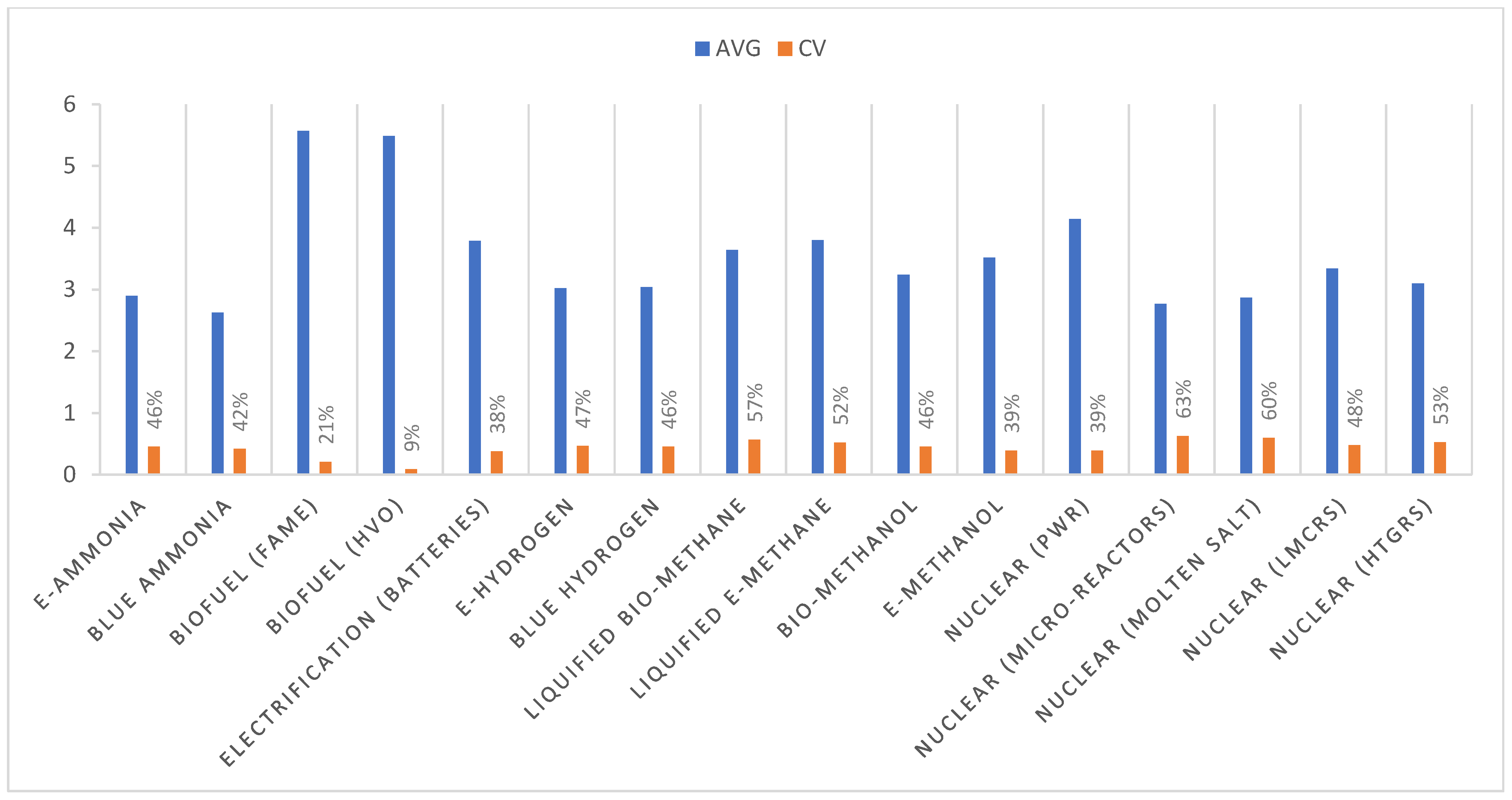
| ENERGY SOURCES | AVG | STD | CV | AVG | STD | CV |
|---|---|---|---|---|---|---|
| Original Values | Transformed Values | |||||
| E-AMMONIA | 3.62 | 2.02 | 56% | 2.9 | 1.36 | 46% |
| BLUE AMMONIA | 3.23 | 1.79 | 55% | 2.63 | 1.1 | 42% |
| BIOFUEL (FAME) | 6.46 | 1.98 | 31% | 5.57 | 1.19 | 21% |
| BIOFUEL (HVO) | 6.62 | 1.85 | 28% | 5.49 | 0.5 | 9% |
| ELECTRIFICATION (BATTERIES) | 4.77 | 2.65 | 56% | 3.79 | 1.45 | 38% |
| E-HYDROGEN | 3.77 | 2.28 | 60% | 3.02 | 1.4 | 47% |
| BLUE HYDROGEN | 3.85 | 2.41 | 63% | 3.04 | 1.4 | 46% |
| LIQUIFIED BIO-METHANE | 4.54 | 3.15 | 69% | 3.64 | 2.07 | 57% |
| LIQUIFIED E-METHANE | 4.69 | 3.04 | 65% | 3.8 | 1.97 | 52% |
| BIO-METHANOL | 4.08 | 2.69 | 66% | 3.24 | 1.5 | 46% |
| E-METHANOL | 4.38 | 2.53 | 58% | 3.52 | 1.38 | 39% |
| NUCLEAR (PWR) | 5.15 | 2.67 | 52% | 4.14 | 1.61 | 39% |
| NUCLEAR (MICRO-REACTORS) | 3.23 | 2.31 | 72% | 2.77 | 1.76 | 63% |
| NUCLEAR (MOLTEN SALT) | 3.38 | 2.29 | 68% | 2.87 | 1.72 | 60% |
| NUCLEAR (LMCRs) | 4 | 2.2 | 55% | 3.34 | 1.59 | 48% |
| NUCLEAR (HTGRs) | 3.62 | 2.18 | 60% | 3.1 | 1.65 | 53% |
Disclaimer/Publisher’s Note: The statements, opinions and data contained in all publications are solely those of the individual author(s) and contributor(s) and not of MDPI and/or the editor(s). MDPI and/or the editor(s) disclaim responsibility for any injury to people or property resulting from any ideas, methods, instructions or products referred to in the content. |
© 2026 by the authors. Licensee MDPI, Basel, Switzerland. This article is an open access article distributed under the terms and conditions of the Creative Commons Attribution (CC BY) license.
Share and Cite
Thanopoulou, H.; Kokkolis, A.P. Fuel Supply Chain Prospects in the On-Going Transition to Sustainable Ship Propulsion: A Multifaceted Paradigm Ahead. Sustainability 2026, 18, 2918. https://doi.org/10.3390/su18062918
Thanopoulou H, Kokkolis AP. Fuel Supply Chain Prospects in the On-Going Transition to Sustainable Ship Propulsion: A Multifaceted Paradigm Ahead. Sustainability. 2026; 18(6):2918. https://doi.org/10.3390/su18062918
Chicago/Turabian StyleThanopoulou, Helen, and Alexios Panagiotis Kokkolis. 2026. "Fuel Supply Chain Prospects in the On-Going Transition to Sustainable Ship Propulsion: A Multifaceted Paradigm Ahead" Sustainability 18, no. 6: 2918. https://doi.org/10.3390/su18062918
APA StyleThanopoulou, H., & Kokkolis, A. P. (2026). Fuel Supply Chain Prospects in the On-Going Transition to Sustainable Ship Propulsion: A Multifaceted Paradigm Ahead. Sustainability, 18(6), 2918. https://doi.org/10.3390/su18062918