Article

Ecological Impacts of Neltuma juliflora Invasion on Native Plant Diversity and Soil Quality in Hyper-Arid Qatar


by
Ahmed Elgharib
1,*,
María del Mar Trigo
1,
Elsayed Elazazi
2,3,
Mohamed M. Moursy
4 and
Alaaeldin Soultan
5,*
1
Department of Botany and Plant Physiology, University of Malaga, Campus de Teatinos s/n, E-29071 Malaga, Spain
2
Ecophysiology Unit, Plant Ecology and Range Management Department, Desert Research Center, 1 Mathaf El-Matarya St., El-Naam, Cairo 11753, Egypt
3
Biotechnology and Gene Bank, Agriculture Research Department, Ministry of Municipality, Doha P.O. Box 200022, Qatar
4
Botany and Microbiology Department, Faculty of Science (Boys Branch), Al-Azhar University, Cairo 11651, Egypt
5
Swiss Ornithological Institute, Sempach, 6204 Luzern, Switzerland
*
Authors to whom correspondence should be addressed.
Sustainability 2026, 18(6), 2908; https://doi.org/10.3390/su18062908
Submission received: 29 January 2026 / Revised: 27 February 2026 / Accepted: 12 March 2026 / Published: 16 March 2026

Abstract

Neltuma juliflora (Sw.) Raf. (syn. = Prosopis juliflora (Sw.) DC.) is among the world’s most aggressive woody invaders, yet its ecological impacts remain poorly quantified in hyper-arid environments, where soils are calcareous and ecosystems recover slowly from disturbance. In this study, we tested two hypotheses: (1) the presence of N. juliflora changes native plant diversity, as well as soil and key physicochemical properties in hyper-arid Qatar, and (2) agricultural farms act as primary sources of N. juliflora invasion. Using a comparative observational design across 62 sites (45 invaded and 17 non-invaded), we applied a generalised additive model (GAM) and a generalised linear mixed model (GLMM) to quantify invasion drivers and the impact of invasion on perennial species diversity, respectively. Additionally, we used the Wilcoxon rank-sum test to compare the soil properties in the invaded and non-invaded sites. Our results indicate that N. juliflora is positively associated with farms, with the probability of occurrence declining by ca. 20% for each kilometre farther away from agricultural farms. This pattern suggests substantial propagule pressure from agricultural farms. Perennial species richness declined from 7.5 species at 0% N. juliflora cover to 4.8 species at full cover (36% reduction). Invaded sites were characterised by higher amounts of coarse sand (16%); reduced silt–clay fractions (5%); and elevated salinity indicators, including electrical conductivity (0.744 dS m−1) and total dissolved solids (476 mg L−1), while major N–P–K pools remained unchanged. These findings demonstrate measurable invasion-related changes in soil conditions and native perennial diversity in hyper-arid ecosystems and highlight the role of agricultural land use as a key driver of biological invasion. From a sustainability perspective, early detection, targeted control near agricultural and grazing zones, and integration of invasive species monitoring into land-use planning frameworks are essential to prevent further ecosystem degradation, protect biodiversity, and enhance the resilience of desert landscapes under increasing climate and land-use pressures.

1. Introduction

Invasive biological organisms are among the major threats to biodiversity that can change biodiversity patterns and ultimately lead to biodiversity collapse [1,2,3]. Invasive plants alter the soil structure, nutrients, and plant–soil interaction [4,5]. Such alterations can be substantial and even permanent in hyper-arid environments where water and nutrient availability are limited [6,7].
Woody species are among the most widely introduced for practical purposes such as shade, fuel wood, and landscaping [8]. Such invasions often result in increased competition for resources, suppression of herbaceous plant growth, and reduced overall productivity [4,9,10]. In certain invaded ecosystems, increases in invaded species are often attributed to the dispersal of disturbance-tolerant species [11]. The expansion of invasion is usually accompanied by declines in native species, which reduce their conservation value and undermine overall biodiversity outcomes [2,12].
Neltuma juliflora (Sw.) Raf. is the currently accepted name for Prosopis juliflora (Sw.) DC., a species native to central Mexico that has been widely introduced to Africa and the Arabian Peninsula [13]. N. juliflora has been reported to be among the most aggressive and dominant alien woody species worldwide [14,15,16]. While N. juliflora was initially introduced as a means for dune fixation, fuel wood, and landscaping, it has spread rapidly across Africa, Asia, and the Arabian Peninsula, leading to serious negative ecological and economic impacts [17,18,19]. N. juliflora is characterised by its ability to establish deep root systems, produce high quantities of seeds, disperse well via livestock, survive well in harsh environmental conditions, and fix nitrogen from the atmosphere [20]. N. juliflora has been reported to have primarily invaded areas in Africa and the Arabian Peninsula that have easy access to ground water, such as gravel deserts, open plains, sand sheets, wadis, riverine zones, floodplains, and agricultural margins [21,22,23,24,25].
In Saudi Arabia, N. juliflora is primarily found in urban and suburban areas but has spread into natural landscapes, becoming the dominant invader in lowland environments [21,26]. In the United Arab Emirates, this species was introduced in the 1970s for desert greening but has since escaped from planted forests and landscaping, emerging as a severely invasive tree species [14,27,28,29]. Field observations carried out in arid biomes show that N. juliflora invasion often affects the physicochemical characteristics of soils, influencing underground processes in invader vegetation stands [26,30]. Recorded modifications include those related to soil texture, salinity, and nutrient content, differing in degree of effect based upon climatic conditions in arid biomes, the geological characteristics of local soils, and the degree of habitat disturbances caused by N. juliflora invasions [14,26,27]. In addition, it is well noted that N. juliflora-altered soils are associated with positive plant–soil interactions, which enhance invader activity while hindering the germination of native species in arid biomes, significantly hindering ecosystem recovery processes [31].
Qatar is characterised by hyper-arid climatic conditions, calcareous soils, and increasing human disturbance [32]. Depression habitats in Qatar, characterised by finely textured soil and episodic water accumulation, function as important biodiversity reservoirs but are increasingly pressured by grazing, urban expansion, and soil transport [17,32].
Although the concern about the invasion of N. juliflora in Qatar is increasing, there is a lack of knowledge of the effects of the tree on the soil and vegetation in the hyper-arid conditions of Qatar. Therefore, this study aimed to assess (1) whether the presence of N. juliflora changes native plant diversity, as well as soil and key physicochemical properties in hyper-arid Qatar, and (2) whether agricultural farms act as primary sources of N. juliflora invasion.

2. Materials and Methods

2.1. Study Area

The study was carried out in Qatar, an area with a hyper-arid climate with very limited annual precipitation, rarely exceeding 80–100 mm per year, with most rain occurring during the winter months [33,34]. December typically receives the highest average rainfall (~12–15 mm), with January and February showing similar low-level precipitation and rainfall decreasing into spring [35]. Summer temperatures often exceed 45 °C, and the rate of evapotranspiration far exceeds precipitation, making soil moisture a limited factor [34,36,37]. Soil types are dominantly calcareous, weakly developed, and often saline, especially in depressions and sabkha areas [38,39]. Despite their great ecological value in terms of biodiversity, habitats in Qatar are facing growing threats from human activities, including biological invasion, which could affect their sustainability [32,37]

2.2. Sampling Design

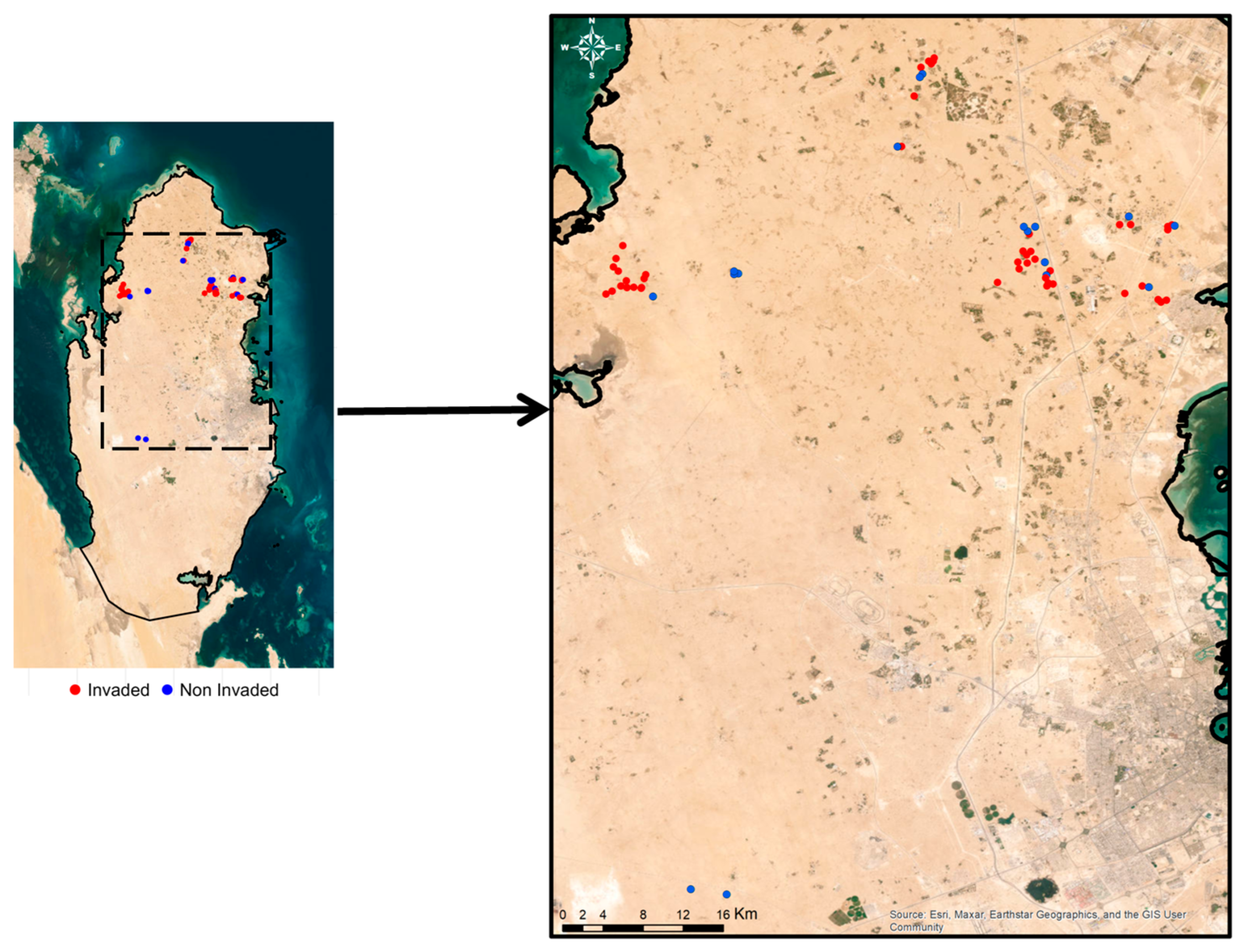
Field sampling was conducted between April and June 2025 using a stratified plot-based design. A previous molecular study found limited genetic variation among N. juliflora populations in Qatar [39]. Therefore, population genetic variability was not considered during sampling stratification. Instead, we stratified our sampling design based on the known geographic distribution of N. juliflora invasion in Qatar. Current records indicate that the invasion is concentrated in the northern region and comparatively less frequent in the southern areas [40,41]. Accordingly, we stratified our sampling design into four major regions across Qatar—northern, northeastern, northwestern, and southern regions [30,42]—to evaluate the effects of N. juliflora invasion on soil properties and species diversity in Qatar. The southern region was designated as the reference stratum for non-invaded conditions. Within each region, we selected invaded and non-invaded sites, with a minimum distance of approximately 1 km between sites to ensure spatial independence [27]. A total of 62 sites were selected [27]: 45 sites invaded by N. juliflora and 17 non-invaded sites representing comparable geomorphological and edaphic conditions. Plot-based approaches are widely used in invasion ecology to capture spatial variability while enabling robust statistical comparison between invaded and reference sites [2,4] (Figure 1). Each plot measured 15 × 15 m, a size chosen to encompass the canopy influence of mature N. juliflora individuals and adjacent soil zones, in line with previous studies investigating canopy-driven soil heterogeneity beneath invasive woody species [27,32,43].
Species richness is a measure of species diversity that reflects the number of distinct species present, regardless of the abundance (number of individual plants) of each species. Within each plot, species richness was calculated as the number of unique perennial species [2,44]. To enable direct comparison with other studies, species richness was then standardised and reported as the number of species/100 m2 [2,44]. Because annual species abundance in hyper-arid systems may fluctuate substantially in response to precipitation variability and grazing pressure [45], our study emphasised persistent vegetation components, particularly perennial species, which better reflect structural invasion effects and longer-term competitive interactions [2,7]. The canopy cover of N. juliflora was estimated based on the mean foliage diameter of individuals using the following equation [32]:
P l a n t   c o v e r   ( % ) = ( π ( d / 2 ) 2 × n u m b e r   o f   i n d i v i d u a l s   o f   t h e   s p e c i e s ) / T o t a l   a r e a × 100
where d represents the average foliage diameter (m) of individual plants.
This sampling design allows for the detection of spatial gradients in soil properties associated with canopy effects and has been widely applied in studies of woody plant invasion and resource island formation in arid environments [9,27,28].

2.3. Soil Analysis

Soil samples were collected from the surface layer (0–30 cm) [46]. At each site, three subsamples were collected within the site and composited to obtain one representative soil sample. Particle size was determined using a combined dry-sieving and Bouyoucos hydrometer method [47], and soil-texture classes were assigned according to the USDA Soil Texture Triangle [47]. Soil pH and electrical conductivity (EC) were measured in a 1:2.5 soil-to-water suspension using calibrated electrodes [48,49]. Soil organic matter was quantified using the Walkley–Black dichromate oxidation method [50], while calcium carbonate equivalent (CaCO3) values were determined by the calcimetric method based on CO2 evolution following acid neutralisation [51] Carbonate and bicarbonate ions were measured by titration, and chloride and sulphate were analysed using standard spectrophotometric and turbidimetric techniques [48,49].
Exchangeable base cations (Ca2+, Mg2+, Na+, and K+) were extracted with 1 M ammonium acetate (pH 7.0). Na+ and K+ were quantified using a flame photometer, whereas Ca2+ and Mg2+ were determined by atomic absorption spectrometry [52]. Plant-available micronutrients (Cu, Mn, Zn, Co, and Mo) were extracted using DTPA/EDTA and analysed by atomic absorption spectrophotometry [53]. Total elemental concentrations were determined following aqua regia digestion [54]. Total nitrogen was measured using the Kjeldahl method [46]. All laboratory analyses were conducted in triplicate, and mean values were used for statistical analysis to ensure analytical precision.
Instrumentation used included the following: Soil pH was measured using a calibrated bench pH meter (Jenway 3540, Jenway Ltd., Staffordshire, UK). Electrical conductivity (EC) and total dissolved solids (TDS) were determined using an EC/TDS meter (AD3000, Adwa Instruments, Szeged, Hungary). Soil samples were weighed using an analytical balance (AS 120.R2 Plus, Radwag, Poland). Available macro- and micronutrients were quantified spectrophotometrically using a visible spectrophotometer (722N, single-beam VIS, 325–1000 nm). Plant-available micronutrients (Cu, Mn, Zn, Co, and Mo) were quantified by atomic absorption spectrometry (AAnalyst 400, PerkinElmer Inc., Waltham, MA, USA) following DTPA/EDTA extraction. Exchangeable Na+ and K+ were quantified using a flame emission photometer (FP-640/FP640). Exchangeable Ca2+ and Mg2+ were determined using an atomic absorption spectrometer (AAnalyst 400, PerkinElmer, USA). Total nitrogen was determined using an automatic Kjeldahl analyser (K9860, Hanon Instruments). Soil samples were oven-dried prior to analysis using a laboratory drying oven (Model 3060, Safety Heating Equipment Co., Taipei, Taiwan). Particle size distribution was determined using a mechanical sieve shaker with stainless-steel sieves. All instruments were calibrated according to the manufacturers’ specifications prior to analysis.

2.4. Statistical Analysis

Prior to the statistical analysis, we assessed spatial autocorrelation using Moran’s I test with spatial weights defined by the 8 nearest neighbours (k = 8). The test on residuals from our soil texture analysis revealed no spatial autocorrelation (Moran’s I = −0.017, expected I = −0.016, p = 0.505), indicating that our sampling design did not violate the independence assumption. To assess the influence of anthropogenic land use on the distribution of N. juliflora, we modelled its presence/absence across survey sites as a function of distance to the nearest agricultural farm. N. juliflora was considered present in a site when its canopy cover was >0%. We fitted a generalised additive model (GAM) [55] with a binomial error distribution and logit link function implemented in the “mgcv” R package [56]. The model included a smooth term for distance to the nearest farm, allowing for potential non-linear responses while avoiding a priori assumptions about functional form.
To evaluate the effect of N. juliflora invasion intensity on native plant diversity, we modelled species richness (i.e., the total number of native perennial plant species per plot) as a function of N. juliflora canopy cover (%) across 62 survey sites. We fitted a generalised linear mixed model (GLMM) with a Poisson distribution and log link function and incorporated site as a random effect. The GLMM was fitted using the glmmTMB function implemented in the glmmTMB R package [57]. Model diagnostics were evaluated using the “DHARMa” R package [58].
Soil variables (including pH, electrical conductivity, organic matter, and texture) were compared between sites with and without N. juliflora invasion using the Wilcoxon rank-sum test [59], a non-parametric approach appropriate for data that violate assumptions of normality or homogeneity of variance. This test evaluates whether the distribution of a given soil variable differs significantly between two independent groups (invaded vs. non-invaded). While generalised linear models (GLMs) are valuable for controlling confounding variables, they require careful specification of the error distribution and can introduce model selection bias when the underlying data structure is complex [60]. For our specific research question—whether N. juliflora invasion alters soil properties—we prioritised methodological consistency with previous work and statistical robustness to unbalanced designs. The Wilcoxon rank-sum test is particularly appropriate for our data, as it: (1) makes no assumptions about the underlying distribution of soil properties, (2) is robust to outliers common in soil data, (3) maintains validity with imbalanced sample sizes, and (4) allows for direct comparison with previous studies in the region.

3. Results

3.1. Neltuma juliflora Distribution

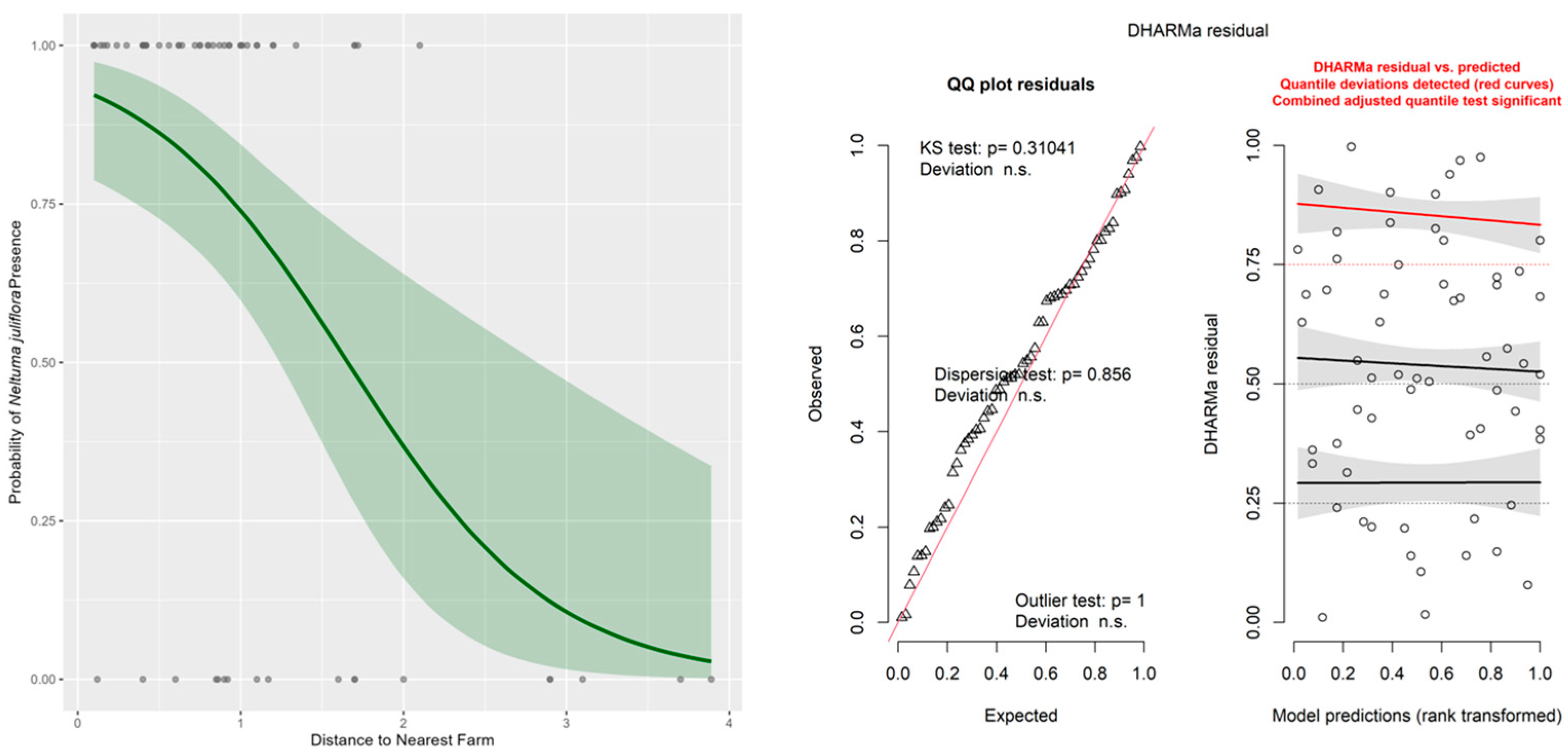
The probability of N. juliflora presence declined significantly with increasing distance from agricultural farms (GAM, binomial; χ2 = 9.85, p = 0.0017). The probability of N. juliflora presence was predicted to drop by 20% every 1 km increment (Figure 2). The residual diagnostics of GAM showed good correspondence with the theoretical distribution (KS test: p = 0.310), while dispersion and outlier tests confirmed no significant model issues (p = 0.856 and p = 1.0, respectively).

3.2. Impact of Invasive Species on Native Species Diversity

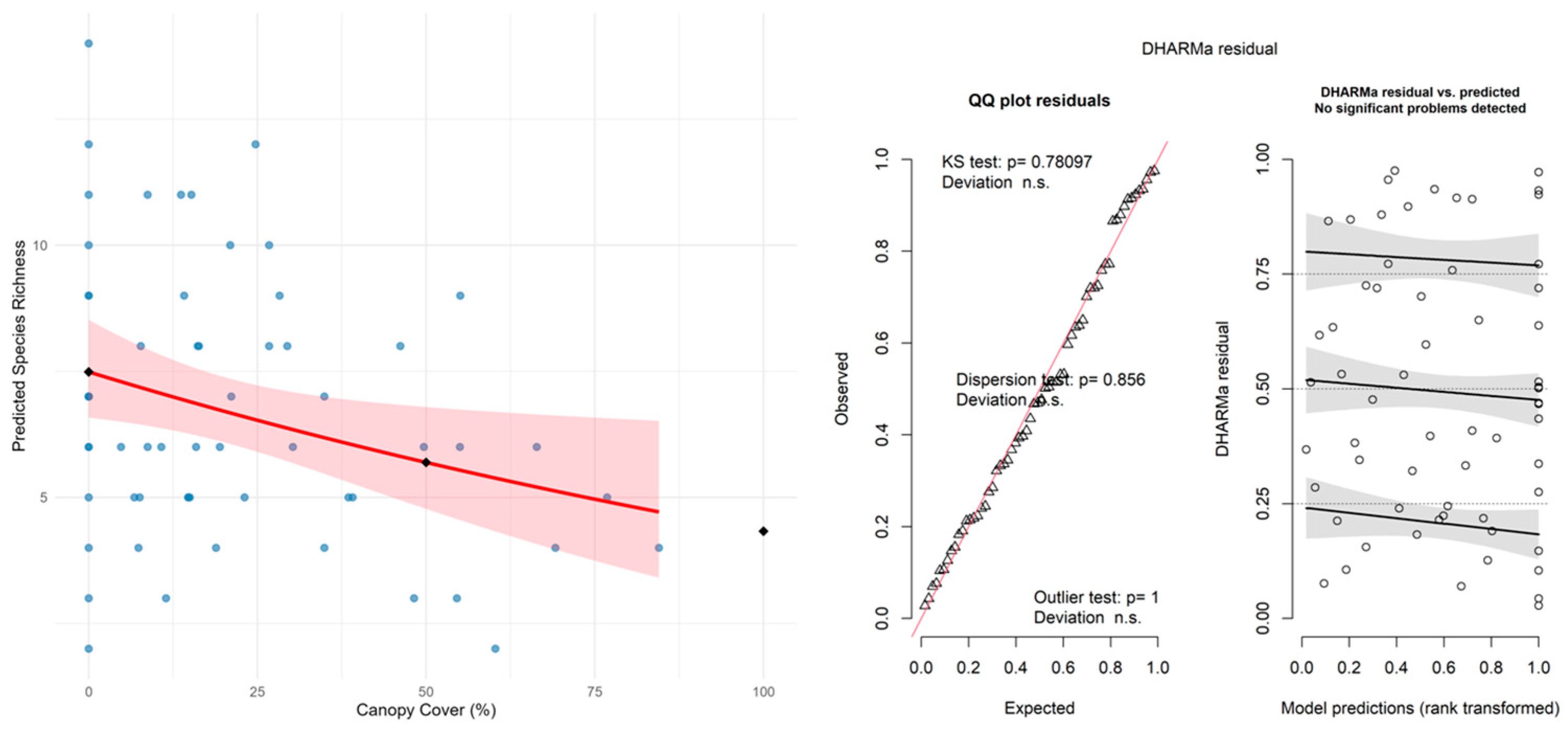
The residual diagnostics of GLMM showed good correspondence with the theoretical distribution (KS test: p = 0.781), while dispersion and outlier tests confirmed no significant model issues (p = 0.856 and p = 1.0, respectively). The GLMM revealed a significant negative relationship between N. juliflora canopy cover and perennial species richness (β = −0.00548, p = 0.0219). The GLMM showed that the native species richness declined from ca. 7.5 species at 0% canopy cover to about 4.8 species at 100% canopy cover, representing a 36% reduction in perennial species diversity with complete canopy coverage by the invasive species (Figure 3).

3.3. Soil Physical Properties

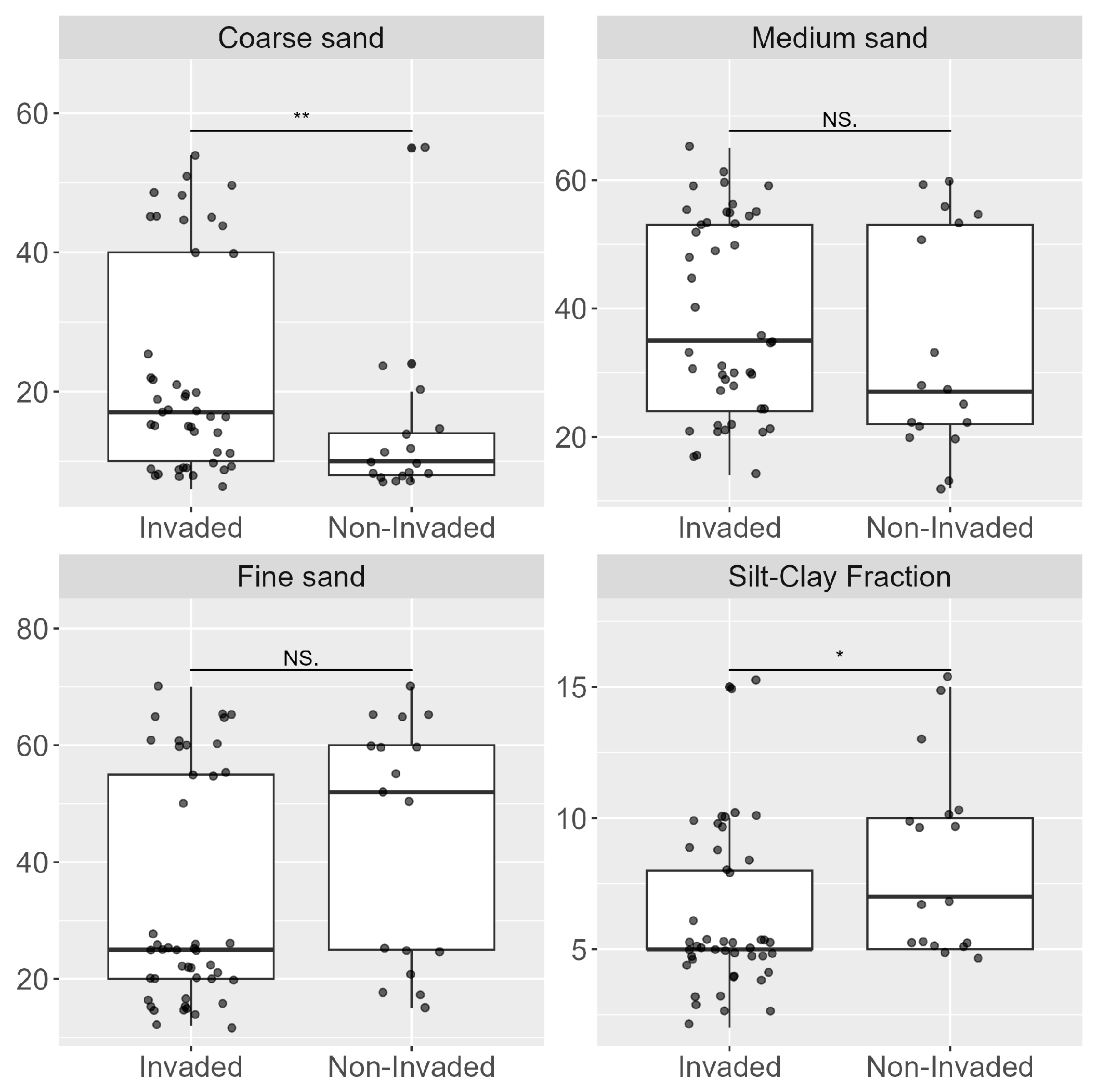
Soils associated with N. juliflora (i.e., Invaded sites) showed clear differences in their physical properties compared to non-invaded sites (Table 1 and Figure 4). Invaded sites were characterised by a significantly higher proportion of coarse sand than non-invaded sites, whereas the combined silt–clay fraction was significantly reduced in invaded areas. Medium and fine sand fractions did not differ significantly between invaded and non-invaded sites, although the proportion of fine sand tended to be lower in the N. juliflora-invaded sites.

3.4. Soil Physicochemical Properties

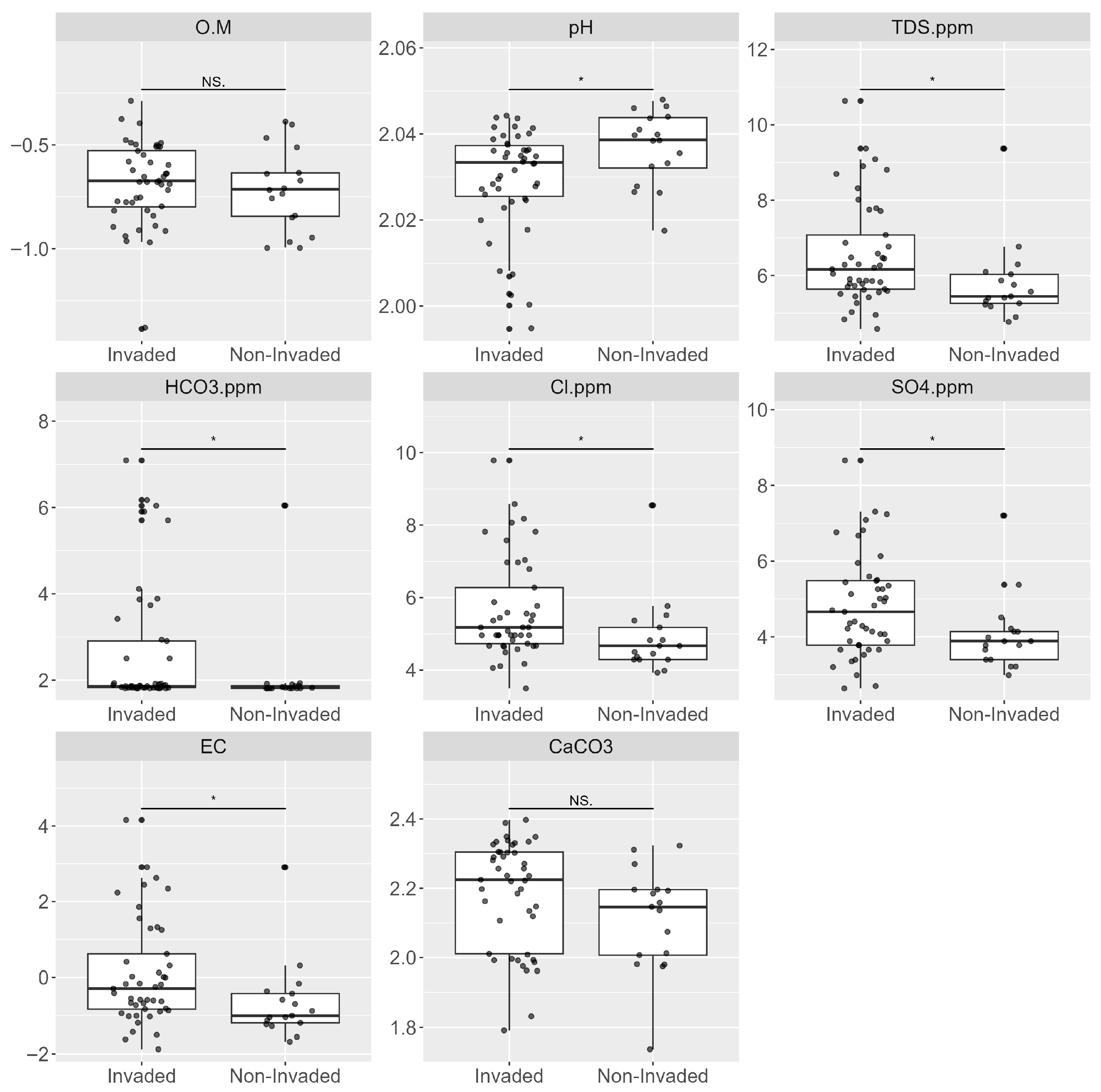
Soil physicochemical properties showed moderate but statistically significant differences between invaded and non-invaded sites (Table 2). Organic matter content did not differ significantly between N. juliflora-invaded and non-invaded sites (Figure 5). In contrast, several soil physiochemical parameters showed significant differences, with invaded sites exhibiting lower pH values (p = 0.018) and higher concentrations of total dissolved solids (p = 0.01), chloride (p = 0.01), sulphate (p = 0.024), and electrical conductivity (p = 0.012) compared with non-invaded sites. Bicarbonate concentrations and calcium carbonate content did not differ significantly between invaded and native soils.

3.5. Major Ions

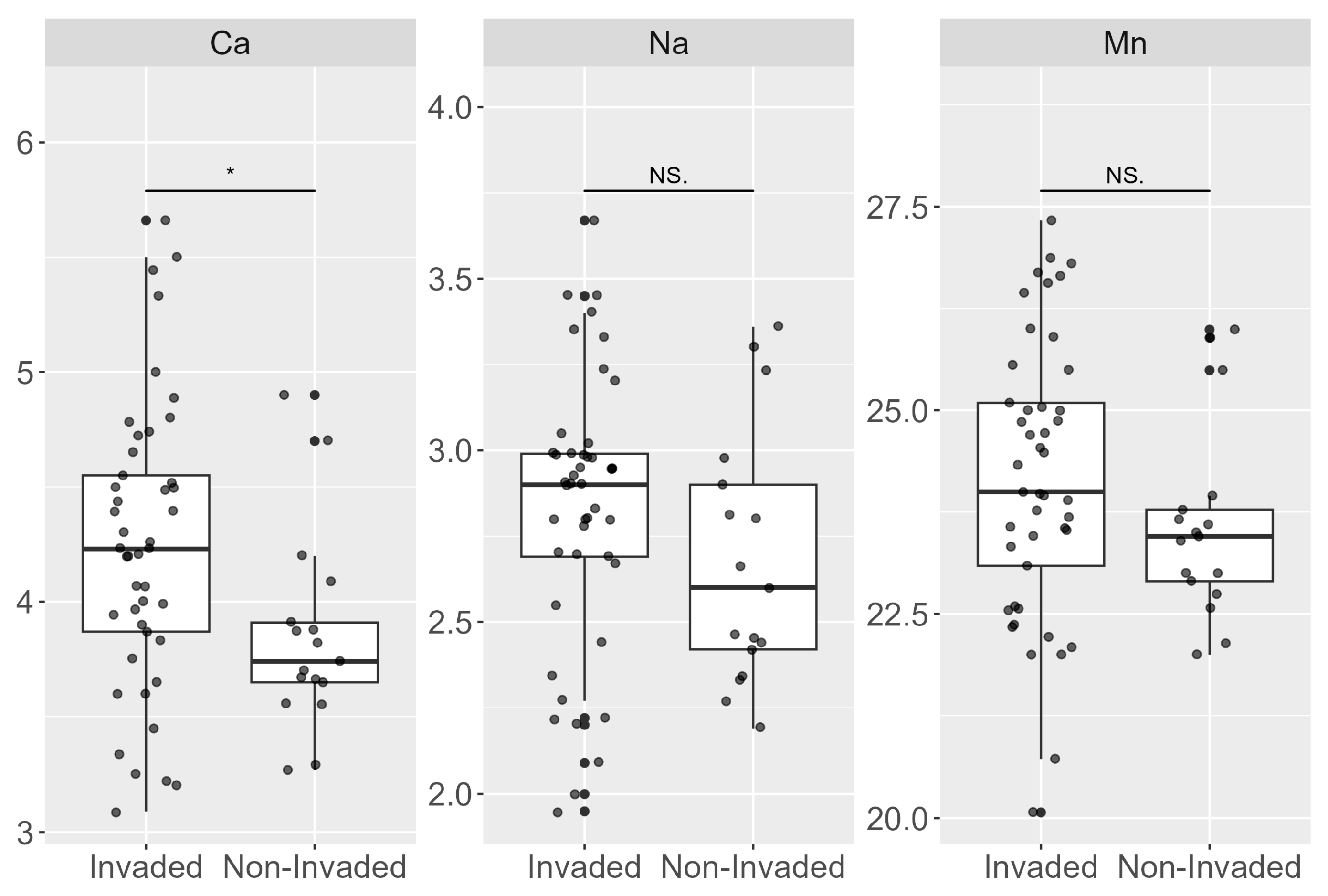
Concentrations of several macro- and micronutrients differed significantly between N. juliflora-invaded and non-invaded sites (Table 3). Invaded soils exhibited significantly higher concentrations of calcium, sodium, and magnesium, as well as manganese, cobalt, and copper (p < 0.05) (Figure 6), whereas molybdenum and zinc did not differ significantly between invaded and non-invaded sites.

3.6. Nitrogen, Phosphorus, and Potassium Availability

Total and available concentrations of nitrogen, phosphorus, and potassium did not differ significantly between N. juliflora-invaded and non-invaded sites (Table 4).

4. Discussion

4.1. Distribution Pattern and Agricultural Association

Most Prosopis species are regarded as “conflict” species because they have escaped cultivation and become invasive, causing substantial negative impacts on biodiversity, agricultural production, pasture resources, and water availability [15,16]. Our study showed a strong association between N. juliflora occurrences and agricultural farms, which strongly suggests farms were the dominant invasion nuclei in our study area. This pattern of invasion reflects the initial use of N. juliflora in urban landscapes during the 1970s and 1980s, when it was planted for desertification control, windbreaks, and landscape stabilisation [17]. Comparable invasion dynamics have been reported in the Awash River Basin in Ethiopia, where N. juliflora was deliberately planted in pasturelands and irrigated areas and later expanded into surrounding rangelands and riverbanks, mirroring patterns observed in Qatar [23,40,61,62,63]. During our field sampling, we found that N. juliflora is widely grown on farms, along roadsides and near grazing camps. This observation was reflected in our statistical analysis, where the GAM showed that distance from agricultural farms alone explains 22% of N. juliflora occurrence, with predicted presence exceeding 70% near farmsteads or orchards and declining sharply with increasing distance, indicating strong propagule pressure from farm-based sources. Its rapid growth; spiny morphology; very deep root system, usually exceeding 20–25 m [24]; and production of palatable pods for livestock collectively enhance the species’ ability to establish, persist, and spread once introduced [25]. Most often, farms are associated with grazing practices that facilitate secondary spread into adjacent rangelands and disturbed habitats. This highlights the long-standing implications of permanent introductions and the significant influence of human land use on current invasion processes present in hyper-arid ecosystems.

4.2. Impacts on Native Species Richness

Numerous studies have demonstrated that invasive plant species can extensively modify plant community attributes, including species diversity, richness, composition, and abundance [44,64,65]. For instance, in hyper-arid environments of the United Arab Emirates, interactions with N. juliflora canopy cover were shown to have a significant negative effect on the richness and density of associated plant species [27,28,66]. Similarly, studies from East Africa reported that medium and large N. juliflora individuals significantly reduce local species numbers and overall species richness [67]. Consistent with previous studies, our analysis indicates a strong negative relationship between N. juliflora canopy cover and native perennial diversity, with a reduction of 36% in species richness in the invaded sites compared to non-invaded sites. This result confirms that increasing N. juliflora canopy dominance suppresses native perennial communities and reinforces the global pattern of invasion-driven biodiversity loss, with direct implications for the persistence of native tree species and the structural integrity of hyper-arid ecosystems.

4.3. Soil Physical and Physicochemical Responses

Responses of soil texture to N. juliflora invasion are strongly context-dependent, reflecting differences in climate, geomorphology, and disturbance regimes [26,68]. In semi-arid systems such as the Afar region of Ethiopia, invasion has been shown to reduce sand content and increase clay and silt fractions, as tree canopies trap wind- and water-borne fine sediments and function as ecosystem engineers [62,63]. In contrast, in hyper-arid systems, our results showed a shift toward coarser soil textures, with significantly higher proportions of coarse sand and reduced silt–clay fractions in invaded sites (Table 1). While invasive plants are often reported to alter soil texture through litter accumulation and sediment trapping [27,28,67], our result likely reflects pre-existing site conditions and disturbance histories that facilitate invasion rather than soil modification caused by N. juliflora. For instance, coarse-textured soils are dominant in coastal plains, roadsides and disturbed sabkha margins [69,70], which often experience higher levels of anthropogenic disturbance, such as trampling, grazing pressure, and roadside maintenance, that may actively remove fine fractions, reinforcing the dominance of coarse sand in invaded locations [27,28,71,72].
Despite clear physical changes, soil chemical responses to N. juliflora invasion were more moderate. Soil pH remained within a narrow alkaline range across invaded and non-invaded sites, reflecting the strong buffering capacity of calcareous soils typical of northern Qatar [73,74]. Similar resistance to pH change has been documented in arid soils of the UAE and Saudi Arabia, where carbonate-rich substrates limit acidification or alkalinisation, even under invasive plant influence [26,27,28].
Soil electrical conductivity (EC) and total dissolved solids, as well as chloride and sulphate concentrations, were significantly higher in invaded sites, indicating localised salt accumulation beneath or around N. juliflora [75]. These findings are consistent with studies from the UAE, where increased EC and soluble ions beneath N. juliflora canopies were attributed to reduced leaching, enhanced evapotranspiration, and canopy-mediated microclimatic effects [27,28]. Although bicarbonate and calcium carbonate concentrations did not differ significantly, the observed increase in soluble salts suggests early-stage salinisation processes that may intensify with continued invasion, particularly in low-lying depression habitats and sabkha-adjacent areas [72,75,76].
The observed increases in calcium, sodium, and magnesium in invaded soils are consistent with redistribution and accumulation of soil ions associated with N. juliflora presence rather than extensive chemical transformation [30]. These elements are abundant in calcareous desert soils, and their enrichment in invaded sites likely reflects concentration effects associated with reduced soil turnover, litter accumulation, and altered hydrological pathways beneath invasive canopies [28,77]. Comparable patterns were reported in southwest Saudi Arabia, where invasive woody species increased certain base cations while leaving others unchanged [26].
Micronutrient responses were selective, with invaded sites exhibiting higher concentrations of manganese, cobalt, and copper, a pattern consistent with findings from other arid systems where invasive species modify trace-element availability through enhanced organic inputs, root exudation, and microbially mediated processes [78]. In contrast, the absence of significant differences in molybdenum and zinc underscores the element-specific nature of invasion effects, which are strongly influenced by soil parent material, moisture availability, and invasion stage, a mixed response also reported for N. juliflora-invaded systems [63,66].
The absence of significant differences in total and available nitrogen, phosphorus, and potassium between N. juliflora-invaded and non-invaded sites indicates that, at the current stage of invasion, major soil nutrient pools remain largely unchanged (Table 4). Similar patterns have been reported for arid and semi-arid systems across the Arabian Peninsula, where invasion-related effects on bulk N, P, and K pools are often weak, delayed, or obscured, particularly in calcareous soils, where strong geochemical buffering limits the influence of biological inputs [26,27,28,79]. In hyper-arid Qatar, several factors likely limit nitrogen enrichment in N. juliflora sites. For instance, a recent study showed that high salinity and substantial concentrations of trace elements and heavy metals in Qatari soils can inhibit nitrogenase activity and reduce effective N accumulation [79]. In calcareous desert soils typical of northern Qatar, strong geochemical buffering and high carbonate content can limit measurable shifts in bulk nitrogen pools [73]. In addition, overgrazing, which is commonly practised in our study area, is widely recognised as a primary driver of land degradation, often resulting in reduced soil nitrogen availability [80]. Therefore, the stability of total and available soil nutrients between invaded and non-invaded sites likely reflects the combined effects of aridity, salinity, and grazing pressure in northern Qatar, which constrain nutrient accumulation and buffer the invasion impact [81,82,83].

4.4. Management and Sustainable Actions

Management, consequently, should focus on the prevention and early control of invasions, founded on the basis of a monitoring program aimed at measuring the changes in the number, geographical distribution, and rate of expansion of N. juliflora to be carried out on a regular basis over a long period of time. This monitoring effort should utilise a combination of field observation, remote sensing, and geographical information systems to identify new invasions at an early stage, particularly on farmlands, grazing camps, and road margins. Active collaboration between the local population, the users of the land, and interested parties, including agricultural, municipal, and rangeland authorities, is necessary to ensure cooperation, the reporting of new invasions, and coordination between the management efforts and the interests of the local population. Best practices can be derived from other control programs targeting invasive species, such as the integrated national control program for Prosopis in Australia, which uses a combination of surveillance, mechanical and chemical control, collaboration, and restoration of natural ecosystems to reduce the risk of re-invasion.
Qatar has established a national legal framework to address invasive alien species within the broader context of sustainable land governance. Legislative Decree No. (30) of 2002 Promulgating the Environmental Protection Law provides the statutory basis for biodiversity conservation and the prevention of environmental degradation, including biological invasions [84]. Under this framework, the Ministry of Environment and Climate Change and the Ministry of Municipality have implemented ongoing control programmes targeting N. juliflora, combining mechanical removal, soil seed bank reduction, and restoration using native species such as Vachellia tortilis [85]. These actions contribute directly to Sustainable Development Goal (SDG) 15 (Life on Land), particularly Target 15.8 on invasive species prevention and control, and support SDG 13 (Climate Action) by strengthening ecosystem resilience and mitigating desertification risks in hyper-arid landscapes [86,87]. In this context, our findings provide empirical evidence supporting national management initiatives. The documented shifts in soil properties and reductions in native perennial diversity associated with N. juliflora presence indicate that invasion impacts are already measurable under arid conditions, reinforcing the urgency of early, targeted intervention and threshold-based ecological monitoring aligned with sustainability objectives.
Recommendations include prohibiting the further establishment of N. juliflora, conducting frequent surveys, and removing young individuals close to agricultural regions. In addition, the treatment of mature populations that have a high potential for further spreading of the species is recommended. Mechanical removal of the species should be accompanied by the regulation of grazing pressure and soil disturbance to prevent re-establishment. Restoration using native vegetation is a key step in preventing soil instability. Invasive species management must be incorporated into the management of rangelands and agricultural and infrastructure development to minimise the pressure of invasive species on the stability of Qatar’s desert ecosystems. This study used a spatial observational design limited to a single sampling period and did not consider farm age or land-use history. Future management should adopt an adaptive framework incorporating long-term monitoring, experimental removal, farm history, regeneration assessments, genetic analyses, and climate modelling to guide sustainable land management in hyper-arid Qatar.

4.5. Study Limitations and Future Research

This study has some limitations that should be acknowledged. First, sampling was conducted between April and June, following the primary winter rainfall period in hyper-arid Qatar. Annual (therophytic) species in these ecosystems are highly responsive to short-term precipitation pulses and grazing pressure, resulting in substantial interannual variability. Due to the short study duration, the exclusive effects of the invasive species on annual plants could not be quantified, as annual abundance and diversity fluctuate with irregular rainfall and grazing [45]. Therefore, the analysis focused on perennial species, which better reflect structural invasion impacts and longer-term competitive interactions [2,7]. Moreover, similar seasonal sampling windows (March–June) have been employed in regional arid invasion studies assessing soil and vegetation impacts of invasive species including N. juliflora [26], which allowed for direct comparison. Nevertheless, multi-seasonal monitoring would provide a more comprehensive assessment of ephemeral species dynamics under invasion pressure.
Second, the sample size was imbalanced, with the number of invaded sites (n = 45) was higher than that of non-invaded sites (n = 17), reflecting the current widespread distribution of N. juliflora in the study area. Although this imbalance mirrors ecological invasion prevalence, unequal sample sizes may influence statistical power between groups. Therefore, we used the Wilcoxon rank-sum non-parametric test for comparisons between the invaded and non-invaded groups. Since this test is a distribution-free test, it remains valid under moderate imbalance, provided independence is met [88].
Third, older farms may function as long-term propagule sources due to prolonged cultivation history and seed accumulation. Nevertheless, we could not incorporate this information into our analysis because it was not documented and not available. However, we suggest that incorporating farm age would enable future studies to test whether invasion intensity correlates with farm age.

5. Conclusions

This study, together with previous studies, adds evidence that invasive species have negative impacts on biodiversity. We showed that the establishment of N. juliflora is strongly associated with agricultural farms, indicating that agricultural farms are probably the primary source of the invasive species. We also showed that increases in N. juliflora cover lead to changes in native plant diversity. Soil properties were also affected by the presence of N. juliflora. These findings highlight the role of agricultural land use in facilitating N. juliflora spread and its subsequent impacts on native diversity and soil properties in hyper-arid Qatar. While context-specific, our results offer a cautionary template for managing N. juliflora invasions in similar agro-pastoral landscapes across the Arabian Peninsula and North Africa.

Supplementary Materials

The following supporting information can be downloaded at: https://www.mdpi.com/article/10.3390/su18062908/s1, Table S1. Site locations and native vegetation data associated with N. juliflora invasion in Qatar. Table S2. Soil physical and chemical properties measured across invaded and non-invaded sites in Qatar. Figure S1. Representative non-invaded rangeland site dominated by native desert vegetation in Qatar. Figure S2. Invaded site showing young N. juliflora sprouts, indicating active regeneration and spread. Figure S3. N. juliflora individuals located adjacent to an agricultural farm, illustrating a potential source of invasion. Figure S4. Heavily invaded site dominated by N. juliflora canopy with visibly reduced native plant richness.

Author Contributions

Conceptualization, A.E. and A.S.; methodology, A.E., A.S. and M.d.M.T.; software, A.S.; validation, A.E., A.S. and M.M.M.; formal analysis, A.E. and A.S.; investigation, A.E. and E.E.; resources, A.E., E.E. and M.M.M.; data curation, A.S. and A.E.; writing—original draft preparation, A.E.; writing—review and editing, A.S., M.d.M.T., E.E. and M.M.M.; visualization, A.S.; supervision, A.S. and M.d.M.T.; project administration, A.E.; funding acquisition, A.E. All authors have read and agreed to the published version of the manuscript.

Funding

This research received no external funding.

Institutional Review Board Statement

Not Applicable.

Informed Consent Statement

Not Applicable.

Data Availability Statement

The original contributions presented in this study are included in the article/Supplementary Materials. Further inquiries can be directed to the corresponding author.

Acknowledgments

The authors gratefully acknowledge the logistical and technical support provided during fieldwork and laboratory preparation. Special thanks are extended to Sami Ismail Hassan for his assistance in the field, particularly in arranging soil sample collection, organizing datasheets, and supporting data recording during field surveys.

Conflicts of Interest

The authors declare no conflicts of interest.

References

  1. Czortek, P.; Królak, E.; Borkowska, L.; Bielecka, A. Impacts of Soil Properties and Functional Diversity on the Performance of Invasive Plant Species Solidago canadensis L. on Post-Agricultural Wastelands. Sci. Total Environ. 2020, 729, 139077. [Google Scholar] [CrossRef]
  2. Hejda, M.; Pyšek, P.; Jarošík, V. Impact of Invasive Plants on the Species Richness, Diversity and Composition of Invaded Communities. J. Ecol. 2009, 97, 393–403. [Google Scholar] [CrossRef]
  3. Mack, R.N.; Simberloff, D.; Lonsdale, W.M.; Evans, H.; Clout, M.; Bazzaz, F.A. Biotic Invasions: Causes, Epidemiology, Global Consequences, and Control. Ecol. Appl. 2000, 10, 689. [Google Scholar] [CrossRef]
  4. Dassonville, N.; Vanderhoeven, S.; Vanparys, V.; Hayez, M.; Gruber, W.; Meerts, P. Impacts of Alien Invasive Plants on Soil Nutrients Are Correlated with Initial Site Conditions in NW Europe. Oecologia 2008, 157, 131–140. [Google Scholar] [CrossRef]
  5. Ehrenfeld, J.G. Effects of Exotic Plant Invasions on Soil Nutrient Cycling Processes. Ecosystems 2003, 6, 503–523. [Google Scholar] [CrossRef]
  6. Whitford, W.G.; Duval, B.D. Ecology of Desert Systems; Academic Press: Cambridge, MA, USA, 2019; ISBN 0081026552. [Google Scholar]
  7. Maestre, F.T.; Eldridge, D.J.; Soliveres, S.; Kéfi, S.; Delgado-Baquerizo, M.; Bowker, M.A.; García-Palacios, P.; Gaitán, J.; Gallardo, A.; Lázaro, R.; et al. Structure and Functioning of Dryland Ecosystems in a Changing World. Annu. Rev. Ecol. Evol. Syst. 2016, 47, 215–237. [Google Scholar] [CrossRef] [PubMed]
  8. Courtois, P.; Figuieres, C.; Mulier, C.; Weill, J. A Cost–Benefit Approach for Prioritizing Invasive Species. Ecol. Econ. 2018, 146, 607–620. [Google Scholar] [CrossRef]
  9. Archer, S. Tree-Grass Dynamics in a Prosopis-Thornscrub Savanna Parkland: Reconstructing the Past and Predicting the Future. Écoscience 1995, 2, 83–99. [Google Scholar] [CrossRef]
  10. Pimentel, D.; Lach, L.; Zuniga, R.; Morrison, D. Environmental and Economic Costs of Nonindigenous Species in the United States. Bioscience 2000, 50, 53–65. [Google Scholar] [CrossRef]
  11. Kneitel, J.M.; Perrault, D. Disturbance-Induced Changes in Community Composition Increase Species Invasion Success. Community Ecol. 2006, 7, 245–252. [Google Scholar] [CrossRef]
  12. Kumar, S.; Mathur, M. Impact of Invasion by Prosopis juliflora on Plant Communities in Arid Grazing Lands. Trop. Ecol. 2014, 55, 33–46. [Google Scholar]
  13. Royal Botanic Gardens, Kew. Prosopis Juliflora (Sw.) DC. Available online: https://powo.science.kew.org/results?q=Prosopis juliflora (accessed on 17 January 2026).
  14. Dakhil, M.A.; El-Keblawy, A.; El-Sheikh, M.A.; Halmy, M.W.A.; Ksiksi, T.; Hassan, W.A. Global Invasion Risk Assessment of Prosopis juliflora at Biome Level: Does Soil Matter? Biology 2021, 10, 203. [Google Scholar] [CrossRef]
  15. Shackleton, R.T.; Le Maitre, D.C.; Pasiecznik, N.M.; Richardson, D.M. Prosopis: A Global Assessment of the Biogeography, Benefits, Impacts and Management of One of the World’s Worst Woody Invasive Plant Taxa. AoB Plants 2014, 6, plu027. [Google Scholar] [CrossRef] [PubMed]
  16. Pasiecznik, N.M.; Felker, P.; Harris, P.J.C.; Harsh, L.N.; Cruz, G.; Tewari, J.C.; Cadoret, K.; Maldonado, L.J. The Prosopis Juliflora-Prosopis Pallida Complex: A Monograph; HDRA: Coventry, UK, 2001; Volume 172. [Google Scholar]
  17. Batanouny, K.H. Ecology and Flora of Qatar; Alden Press Ltd. for the Centre for Scientific and Applied Research, University of Qatar: Doha, Qatar, 1981. [Google Scholar]
  18. Mungoche, J.; Wasonga, O.V.; Ikiror, D.; Akala, H.; Gachuiri, C.; Gitau, G. Prosopis juliflora (Sw.) DC in the Drylands: A Review of Invasion, Impacts and Management in Eastern Africa. Sustain. Environ. 2025, 11, 2521946. [Google Scholar] [CrossRef]
  19. Sintayehu, D.W.; Dalle, G.; Bobasa, A.F.; Pimentel, D.; Lach, L.; Zuniga, R.; Morrison, D. Impacts of Climate Change on Current and Future Invasion of Prosopis juliflora in Ethiopia: Environmental and Socio-Economic Implications. Heliyon 2000, 6, e04596. [Google Scholar] [CrossRef]
  20. Rout, M.E.; Callaway, R.M. An Invasive Plant Paradox. Science 2009, 324, 734–735. [Google Scholar] [CrossRef]
  21. Thomas, J.; El-Sheikh, M.A.; Alfarhan, A.H.; Alatar, A.A.; Sivadasan, M.; Basahi, M.; Al-Obaid, S.; Rajakrishnan, R. Impact of Alien Invasive Species on Habitats and Species Richness in Saudi Arabia. J. Arid Environ. 2016, 127, 53–65. [Google Scholar] [CrossRef]
  22. Hussain, M.I.; Shackleton, R.T.; El-Keblawy, A.; Del Mar Trigo Pérez, M.; González, L. Invasive Mesquite (Prosopis juliflora), an Allergy and Health Challenge. Plants 2020, 9, 141. [Google Scholar] [CrossRef] [PubMed]
  23. Shiferaw, H.; Teketay, D.; Nemomissa, S.; Assefa, F. Some Biological Characteristics That Foster the Invasion of Prosopis juliflora (Sw.) DC. at Middle Awash Rift Valley Area, North-Eastern Ethiopia. J. Arid Environ. 2004, 58, 135–154. [Google Scholar] [CrossRef]
  24. Laxén, J.P.E. Is Prosopis a Curse or a Blessing?: An Ecological Economic Analysis of an Invasive Alien Tree Species in Sudan; Viikin Tropiikki-Instituutti: Helsinki, Finland, 2007. [Google Scholar]
  25. Kamiri, H.W.; Choge, S.K.; Becker, M. Management Strategies of Prosopis juliflora in Eastern Africa: What Works Where? Diversity 2024, 16, 251. [Google Scholar] [CrossRef]
  26. Abbas, A.M.; Soliman, W.S.; Alomran, M.M.; Alotaibi, N.M.; Novak, S.J. Four Invasive Plant Species in Southwest Saudi Arabia Have Variable Effects on Soil Dynamics. Plants 2023, 12, 1231. [Google Scholar] [CrossRef]
  27. El-Keblawy, A.; Al-Rawai, A. Impacts of the Invasive Exotic Prosopis juliflora (Sw.) D.C. on the Native Flora and Soils of the UAE. Plant Ecol. 2007, 190, 23–35. [Google Scholar] [CrossRef]
  28. El-Keblawy, A.; Abdelfatah, M.A. Impacts of Native and Invasive Exotic Prosopis Congeners on Soil Properties and Associated Flora in the Arid United Arab Emirates. J. Arid Environ. 2014, 100–101, 1–8. [Google Scholar] [CrossRef]
  29. Hussain, M.I.; Tsombou, F.M.; El-Keblawy, A. Surface Canopy Position Determines the Photosystem II Photochemistry in Invasive and Native Prosopis Congeners at Sharjah Desert, UAE. Forests 2020, 11, 740. [Google Scholar] [CrossRef]
  30. Sadeq, M.A.M.; Abido, M.S.; Salih, A.A.; Alkhuzai, J.A. The Effects of Mesquite (Prosopis juliflora) on Soils and Plant Communities in the Deserted Rangelands of Bahrain. Int. J. For. Res. 2020, 2020, 1–8. [Google Scholar] [CrossRef]
  31. Ali, H.E.; Al-Wahaibi, A.M.; Shahid, M.S. Plant–Soil Feedback and Plant Invasion: Effect of Soil Conditioning on Native and Invasive Prosopis Species Using the Plant Functional Trait Approach. Front. Plant Sci. 2024, 15, 1321950. [Google Scholar] [CrossRef]
  32. Elgharib, A.; Trigo, M.d.M.; Moursy, M.M.; Soultan, A. Vegetation Analysis and Environmental Relationships of Qatar’s Depression Habitat. Plants 2025, 14, 1807. [Google Scholar] [CrossRef]
  33. Karanisa, T.; Amato, A.; Richer, R.; Abdul Majid, S.; Skelhorn, C.; Sayadi, S. Agricultural Production in Qatar’s Hot Arid Climate. Sustainability 2021, 13, 4059. [Google Scholar] [CrossRef]
  34. Eldos, H.I.; Tahir, F.; Athira, U.N.; Mohamed, H.O.; Samuel, B.; Skariah, S.; Al-Ghamdi, S.G.; Al-Ansari, T.; Sultan, A.A. Mapping Climate Change Interaction with Human Health through DPSIR Framework: Qatar Perspective. Heliyon 2025, 11, e42455. [Google Scholar] [CrossRef] [PubMed]
  35. AI Mamoon, A.; Joergensen, N.E.; Rahman, A.; Qasem, H. Design Rainfall in Qatar: Sensitivity to Climate Change Scenarios. Nat. Hazards 2016, 81, 1797–1810. [Google Scholar] [CrossRef]
  36. Abdullah, M.; Abulibdeh, A.; Ghanimeh, S.; Hamdi, H.; AI Awah, H.; Al Awadhi, T.; Mohan, M.; Al-Ali, Z.; Sukkar, A.; El Kenawy, A.M. Characterizing the Dynamics of Climate and Native Desert Plants in Qatar. J. Arid Environ. 2024, 225, 105274. [Google Scholar] [CrossRef]
  37. Sillitoe, P.; Alshawi, A.A.; Al-Amir Hassan, A.K. Challenges to Conservation: Land Use Change and Local Participation in the Al Reem Biosphere Reserve, West Qatar. J. Ethnobiol. Ethnomed. 2010, 6, 28. [Google Scholar] [CrossRef]
  38. Batanouny, K.H. Plants in the Deserts of the Middle East; Springer: Berlin/Heidelberg, Germany, 2000; ISBN 3540525726. [Google Scholar]
  39. Batanouny, K.H. Halophytes and Halophytic Plant Communities in the Arab Region: Their Potential as a Rangeland Resource. In Halophytes as a Resource for Livestock and for Rehabilitation of Degraded Lands; Springer: Berlin/Heidelberg, Germany, 1994; pp. 139–163. [Google Scholar]
  40. Saleh, I.; Ahmed, T.; Halboosi, R.; Abu-Dieyeh, M. Genetic Diversity of Prosopis juliflora in the State of Qatar and Its Valuable Use against Postharvest Pathogen of Mango Fruits. Sci. Rep. 2022, 12, 11012. [Google Scholar] [CrossRef] [PubMed]
  41. Bibi, S.; Bibi, A.; Al-Ghouti, M.A.; Abu-Dieyeh, M.H. Allelopathic Effects of the Invasive Prosopis juliflora (Sw.) DC. on Native Plants: Perspectives toward Agrosystems. Agronomy 2023, 13, 590. [Google Scholar] [CrossRef]
  42. Bonham, C.D.; Mergen, D.E.; Montoya, S. Plant Cover Estimation: A Contiguous Daubenmire Frame. Rangelands 2004, 26, 17–22. [Google Scholar] [CrossRef]
  43. Schlesinger, W.H.; Raikes, J.A.; Hartley, A.E.; Cross, A.F. On the Spatial Pattern of Soil Nutrients in Desert Ecosystems: Ecological Archives E077-002. Ecology 1996, 77, 364–374. [Google Scholar] [CrossRef]
  44. Collier, M.H.; Vankat, J.L.; Hughes, M.R. Diminished Plant Richness and Abundance below Lonicera Maackii, an Invasive Shrub. Am. Midl. Nat. 2002, 147, 60–71. [Google Scholar] [CrossRef]
  45. Wu, Y.; Li, H.; Cui, J.; Han, Y.; Li, H. Precipitation Variation: A Key Factor Regulating Plant Diversity in Semi-Arid Livestock Grazing Lands. Front. Plant Sci. 2024, 15, 1294895. [Google Scholar] [CrossRef]
  46. Woods, L.E. Active Organic Matter Distribution in the Surface 15 Cm of Undisturbed and Cultivated Soil. Biol. Fertil. Soils 1989, 8, 271–278. [Google Scholar] [CrossRef]
  47. Gee, G.W.; Or, D. 2.4 Particle-size Analysis. In Methods of Soil Analysis: Part 4 Physical Methods; Soil Science Society of America: Madison, WI, USA, 2002; Volume 5, pp. 255–293. [Google Scholar]
  48. Rhoades, J.D. Salinity: Electrical Conductivity and Total Dissolved Solids. In Methods of Soil Analysis: Part 3 Chemical Methods; Soil Science Society of America: Madison, WI, USA, 1996; Volume 5, pp. 417–435. [Google Scholar]
  49. Richards, L.A. Diagnosis and Improvement of Saline and Alkali Soils; US Government Printing Office: Washington, DC, USA, 1954.
  50. Nelson, D.W.; Sommers, L.E. Total Carbon, Organic Carbon, and Organic Matter. In Methods of Soil Analysis: Part 2 Chemical and Microbiological Properties; Soil Science Society of America: Madison, WI, USA, 1982; Volume 9, pp. 539–579. [Google Scholar]
  51. Loeppert, R.H.; Suarez, D.L. Carbonate and Gypsum. In Methods of Soil Analysis: Part 3 Chemical Methods; Soil Science Society of America: Madison, WI, USA, 1996; Volume 5, pp. 437–474. [Google Scholar]
  52. Thomas, G.W. Exchangeable Cations. In Methods of Soil Analysis: Part 2 Chemical and Microbiological Properties; Soil Science Society of America: Madison, WI, USA, 1982; Volume 9, pp. 159–165. [Google Scholar]
  53. Lindsay, W.L.; Norvell, W.A. Development of a DTPA Soil Test for Zinc, Iron, Manganese, and Copper. Soil Sci. Soc. Am. 1978, 42, 421–428. [Google Scholar] [CrossRef]
  54. Epa, U.S. Method 3050B: Acid Digestion of Sediments, Sludges, and Soils. Environ. Prot. Agency 1996, 2, 3–5. [Google Scholar]
  55. Hastie, T.; Tibshirani, R. Generalized Additive Models. Stat. Sci. 1986, 1, 297–310. [Google Scholar] [CrossRef]
  56. Wood, S.; Scheipl, F. gamm4: Generalized Additive Mixed Models Using ‘mgcv’ and ‘lme4’. R Package Version 0.2–6, 2017. Available online: https://CRAN.R-project.org/package=gamm4 (accessed on 11 March 2026).
  57. McGillycuddy, M.; Popovic, G.; Bolker, B.M.; Warton, D.I. Parsimoniously Fitting Large Multivariate Random Effects in GlmmTMB. J. Stat. Softw. 2025, 112, 1–19. [Google Scholar] [CrossRef]
  58. Hartig, F. DHARMa: Residual Diagnostics for Hierarchical (Multi-Level/Mixed) Regression Models; R Package Version 0.4.7; CRAN: Boston, MA, USA, 2024. [Google Scholar]
  59. Wilcoxon, F. Individual Comparison by Ranking Methods. Biom. Bull. 1945, 1, 80–83. [Google Scholar] [CrossRef]
  60. Zuur, A.F.; Ieno, E.N.; Elphick, C.S. A Protocol for Data Exploration to Avoid Common Statistical Problems. Methods Ecol. Evol. 2010, 1, 3–14. [Google Scholar] [CrossRef]
  61. Haregeweyn, N.; Tsunekawa, A.; Tsubo, M.; Meshesha, D.; Melkie, A. Analysis of the Invasion Rate, Impacts and Control Measures of Prosopis Juliflora: A Case Study of Amibara District, Eastern Ethiopia. Environ. Monit. Assess. 2013, 185, 7527–7542. [Google Scholar] [CrossRef] [PubMed]
  62. Shiferaw, W.; Demissew, S. Effects of the Invasive Alien Prosopis juliflora (Sw.) DC and Its Management Options in Ethiopia: A Review. In Tropical Plant Species and Technological Interventions for Improvement; IntechOpen: London, UK, 2023; pp. 1–25. [Google Scholar] [CrossRef]
  63. Shiferaw, W.; Demissew, S.; Bekele, T.; Aynekulu, E.; Pitroff, W. Invasion of Prosopis juliflora and Its Effects on Soil Physicochemical Properties in Afar Region, Northeast Ethiopia. Int. Soil Water Conserv. Res. 2021, 9, 631–638. [Google Scholar] [CrossRef]
  64. Hoffmann, W.A.; Lucatelli, V.M.P.C.; Silva, F.J.; Azeuedo, I.N.C.; Marinho, M.D.S.; Albuquerque, A.M.S.; Lopes, A.D.O.; Moreira, S.P. Impact of the Invasive Alien Grass Melinis Minutiflora at the Savanna-Forest Ecotone in the Brazilian Cerrado. Divers. Distrib. 2004, 10, 99–103. [Google Scholar] [CrossRef]
  65. Prieur-Richard, A.H.; Lavorel, S.; Linhart, Y.B.; Dos Santos, A. Plant Diversity, Herbivory and Resistance of a Plant Community to Invasion in Mediterranean Annual Communities. Oecologia 2002, 130, 96–104. [Google Scholar] [CrossRef]
  66. El-Keblawy, A.; Abdelfattah, M.A.; Khedr, A. Relationships between Landforms, Soil Characteristics and Dominant Xerophytes in the Hyper-Arid Northern United Arab Emirates. J. Arid Environ. 2015, 117, 28–36. [Google Scholar] [CrossRef]
  67. Berhanu, A.; Tesfaye, G. The Prosopis Dilemma, Impacts on Dryland Biodiversity and Some Controlling Methods. J. Drylands 2006, 1, 158–164. [Google Scholar]
  68. Jamil, M.D.; Waheed, M.; Akhtar, S.; Bangash, N.; Chaudhari, S.K.; Majeed, M.; Hussain, M.; Ali, K.; Jones, D.A. Invasive Plants Diversity, Ecological Status, and Distribution Pattern in Relation to Edaphic Factors in Different Habitat Types of District Mandi Bahauddin, Punjab, Pakistan. Sustainability 2022, 14, 13312. [Google Scholar] [CrossRef]
  69. Al-Fred, M.A. Sand Dune and Sabkha Vegetations of Eastern Saudi Arabia. Int. J. Bot. 2008, 4, 196–204. [Google Scholar] [CrossRef]
  70. Srour, N.; Thiffault, E.; Boucher, J.F. Assessing the Physical Stability of Soil Organic Carbon in Roadside Ecosystems. Urban Sci. 2025, 9, 90. [Google Scholar] [CrossRef]
  71. Raiesi, F.; Riahi, M. The Influence of Grazing Exclosure on Soil C Stocks and Dynamics, and Ecological Indicators in Upland Arid and Semi-Arid Rangelands. Ecol. Indic. 2014, 41, 145–154. [Google Scholar] [CrossRef]
  72. Al-Rowaily, S.L.; El-Bana, M.I.; Al-Bakre, D.A.; Assaeed, A.M.; Hegazy, A.K.; Ali, M.B. Effects of Open Grazing and Livestock Exclusion on Floristic Composition and Diversity in Natural Ecosystem of Western Saudi Arabia. Saudi J. Biol. Sci. 2015, 22, 430–437. [Google Scholar] [CrossRef] [PubMed]
  73. Shomar, B. Geochemistry of Soil and Groundwater in Arid Regions: Qatar as a Case Study. Groundw. Sustain. Dev. 2015, 1, 33–40. [Google Scholar] [CrossRef]
  74. Shomar, B.; Amr, M.; Al-Saad, K.; Mohieldeen, Y. Natural and Depleted Uranium in the Topsoil of Qatar: Is It Something to Worry About? Appl. Geochem. 2013, 37, 203–211. [Google Scholar] [CrossRef]
  75. Mesene, M. Soil Quality Variation between Prosopis juliflora Dominated Land and Adjacent Land Use Types: The Case of Dupti Sub-Watershed, Afar Regional State, Ethiopia. J. Resour. Dev. Manag. 2017, 30, 85–97. [Google Scholar]
  76. Hassan, W.A.; Al Shaye, N.A.; Fadl, M.A.; Alsherif, E.A. Climate Change Heightens the Threat Posed by the Invasive Prosopis Juliflora (SW.) D.C. in the Jeddah Region, Saudi Arabia. Pol. J. Environ. Stud. 2024, 33, 161–172. [Google Scholar] [CrossRef] [PubMed]
  77. Abd El-Ghani, M.M. Vegetation Composition of Egyptian Inland Saltmarshes. Bot. Bull. Acad. Sin. 2000, 41, 305–314. [Google Scholar]
  78. Liao, C.; Peng, R.; Luo, Y.; Zhou, X.; Wu, X.; Fang, C.; Chen, J.; Li, B. Altered Ecosystem Carbon and Nitrogen Cycles by Plant Invasion: A Meta-Analysis. New Phytol. 2008, 177, 706–714. [Google Scholar] [CrossRef]
  79. Ejaz, M.R.; Badr, K.; Shabani, F.; Ul Hassan, Z.; Zouari, N.; Al-Thani, R.; Jaoua, S. Comprehensive Investigation of Qatar Soil Bacterial Diversity and Its Correlation with Soil Nutrients. Microbiol. Res. 2025, 16, 196. [Google Scholar] [CrossRef]
  80. Chen, S.; Wang, M.; Zhang, C.; Yu, T.; Xin, X.; Bai, K.; Zhu, X.; Yan, R. Impacts of Grazing Disturbance on Soil Nitrogen Component Contents and Storages in a Leymus Chinensis Meadow Steppe. Agronomy 2023, 13, 1574. [Google Scholar] [CrossRef]
  81. Prescott, C.E. The Influence of the Forest Canopy on Nutrient Cycling. Tree Physiol. 2002, 22, 1193–1200. [Google Scholar] [CrossRef]
  82. Slama, I.; Ghnaya, T.; Savouré, A.; Abdelly, C. Combined Effects of Long-Term Salinity and Soil Drying on Growth, Water Relations, Nutrient Status and Proline Accumulation of Sesuvium portulacastrum. Comptes Rendus Biol. 2008, 331, 442–451. [Google Scholar] [CrossRef] [PubMed]
  83. Brown, J.J.; Das, P.; Al-Saidi, M. Sustainable Agriculture in the Arabian/Persian Gulf Region Utilizing Marginal Water Resources: Making the Best of a Bad Situation. Sustainability 2018, 10, 1364. [Google Scholar] [CrossRef]
  84. State of Qatar. Legislative Decree No. (30) of 2002 Promulgating the Environmental Protection Law; State of Qatar: Doha, Qatar, 2002; Available online: https://www.almeezan.qa/LawPage.aspx?id=4114&language=en (accessed on 19 February 2026).
  85. Harmful Mesquite Trees Removed. Gulf Times. 27 September 2025. Available online: https://www.gulf-times.com/article/711543/qatar/harmful-mesquite-trees-removed (accessed on 19 February 2026).
  86. Louman, B.; Keenan, R.J.; Kleinschmit, D.; Atmadja, S.; Sitoe, A.A.; Nhantumbo, I.; de Camino Velozo, R.; Morales, J.P. SDG 13: Climate Action—Impacts on Forests and People. In Sustainable Development Goals: Their Impacts on Forests and People; Cambridge University Press: Cambridge, UK, 2019; pp. 419–444. [Google Scholar]
  87. Sayer, J.; Sheil, D.; Galloway, G.; Riggs, R.A.; Mewett, G.; MacDicken, K.G.; Arts, B.; Boedhihartono, A.K.; Langston, J.; Edwards, D.P. SDG 15: Life on Land–The Central Role of Forests in Sustainable Development. In Sustainable Development Goals: Their Impacts on Forests and People; University Press: Cambridge, UK, 2019; pp. 482–509. [Google Scholar]
  88. Fay, M.P.; Proschan, M.A. Wilcoxon-Mann-Whitney or t-Test? On Assumptions for Hypothesis Tests and Multiple Interpretations of Decision Rules. Stat. Surv. 2010, 4, 1–39. [Google Scholar] [CrossRef] [PubMed]
Figure 1. Site map of the study area in Qatar, showing the distribution of the invaded and non-invaded sites.
Sustainability 18 02908 g001
Figure 2. Predicted probability of N. juliflora presence in relation to distance from agricultural farms (left panel) and model residual diagnostics (right panel). The green line is the fitted line of the generalised additive model, and the shaded area is the 95% confidence interval.
Sustainability 18 02908 g002
Figure 3. Native species richness in relation to N. juliflora canopy cover based on a generalised linear mixed model (Poisson distribution). The red line in the left panel is the predicted species richness in response to the N. juliflora canopy cover, the black points show the predicted species richness at three different canopy levels (0%, 50%, and 100%), and the shaded areas indicate 95% confidence intervals. The middle and right panels are the model diagnostics, which show that the model assumptions were not violated.
Sustainability 18 02908 g003
Figure 4. Relationship between soil particle size distribution in N. juliflora-invaded and non-invaded sites, showing differences in coarse sand, medium sand, fine sand, and combined silt–clay fractions, where “NS” indicates not significant; “*” indicates significance at p < 0.05; and “**” indicates significance at p < 0.001.
Sustainability 18 02908 g004
Figure 5. Comparison of soil physicochemical properties (log-transformed) between N. juliflora-invaded and native (non-invaded) sites, including organic matter (OM), pH, total dissolved solids (TDS), bicarbonate (HCO3), chloride (Cl), sulphate (SO42−), electrical conductivity (EC), and calcium carbonate (CaCO3), where “NS” indicates not significant, and “*” indicates significance at p < 0.05.
Sustainability 18 02908 g005
Figure 6. Comparison of significant soil macro- and micronutrient concentrations between N. juliflora-invaded and non-invaded sites, illustrating differences in calcium (Ca), sodium (Na), and manganese (Mn), where “NS” indicates not significant, and “*” indicates significance at p < 0.05.
Sustainability 18 02908 g006
Table 1. Particle size (%) in soils from N. juliflora-invaded and non-invaded sites. Values are presented as medians (interquartile range, IQR), and “n” refers to the number of surveyed sites. Differences between invaded and non-invaded sites were tested using the Wilcoxon rank-sum test.
ParameterInvaded Median (IQR) Non-Invaded Median (IQR) Wilcoxon Up-Value
Particle size
Coarse sand16 (30)10 (6)554.000.007 *
Medium sand35 (29)27 (31)445.000.327
Fine sand25 (35)52 (35)217.500.080
Silt + clay5 (3)7 (5)231.000.013
* Significant differences (p < 0.05) are shown in bold.
Table 2. Organic matter and soil physicochemical properties in N. juliflora-invaded and non-invaded sites. Values are presented as medians (interquartile range, IQR). Differences between invaded and non-invaded sites were assessed using the Wilcoxon rank-sum test.
ParameterInvaded Median (IQR) Non-Invaded Median (IQR) Wilcoxon Up-Value
Organic matter and soil chemistry
Organic matter51 (0.14)49 (0.10)433.500.4
pH7.46 (0.09)7.68 (0.09)232.000.018 *
TDS476 (904)232 (224)543.500.010
HCO36.4 (12.1)6.2 (0.4)525.500.23
Cl177 (419)107 (104)544.000.010
SO42−106 (197)48.8 (33)526.000.024
EC0.744 (1.42)0.363 (0.35)541.500.012
CaCO39.25 (2.55)8.55 (1.55)502.500.590
* Significant differences (p < 0.05) are shown in bold.
Table 3. Macro- and micronutrient concentrations in soils from N. juliflora-invaded and non-invaded sites. Values are presented as medians (interquartile range, IQR). Differences between invaded and non-invaded sites were assessed using the Wilcoxon rank-sum test.
ParameterInvaded Median (IQR) Non-Invaded Median (IQR) Wilcoxon Up-Value
Macronutrients
Ca80.3 (140)32.9 (35.9)545.000.010 *
Na85.9 (172)58.9 (34.7)526.500.020
Mg24.9 (57.1)12.9 (16.6)546.000.010
MicronutrientsMn1.22 (0.92)0.94 (0.10)546.000.010
Co0.37 (0.13)0.28 (0.07)516.500.040
Mo0.10 (0.06)0.07 (0.06)484.000.100
Zn0.99 (0.41)0.93 (0.14)502.000.060
Cu0.66 (0.38)0.52 (0.15)516.000.036
* Significant differences (p < 0.05) are shown in bold.
Table 4. Total and available nitrogen (N), phosphorus (P), and potassium (K) concentrations in soils from N. juliflora-invaded and non-invaded sites. Values are presented as medians (interquartile range, IQR). Differences between invaded and non-invaded sites were assessed using the Wilcoxon rank-sum test.
ParameterInvaded Median (IQR) Non-Invaded Median (IQR) Wilcoxon Up-Value
Total N0.04 (0.01)0.04 (0.01)358.500.700
Available N13.8 (1.2)14.0 (1.5)343.000.500
Total P0.14 (0.02)0.15 (0.03)304.000.200
Available P6.6 (1.9)6.9 (0.74)307.000.240
Total K1.8 (0.9)1.8 (0.9)375.500.900
Available K96.8 (23.9)99.0 (18.6)301.500.200
Disclaimer/Publisher’s Note: The statements, opinions and data contained in all publications are solely those of the individual author(s) and contributor(s) and not of MDPI and/or the editor(s). MDPI and/or the editor(s) disclaim responsibility for any injury to people or property resulting from any ideas, methods, instructions or products referred to in the content.