Article

Coupling Mechanisms and Policy Effects of the Carbon–Electricity–Energy Ternary Market: A System Dynamics Approach

1
School of Nuclear Science and Engineering, North China Electric Power University, Beijing 102206, China
2
MOE Key Laboratory of Resources and Environmental Systems Optimization, Ministry of Education, North China Electric Power University, Beijing 102206, China
3
State Grid Energy Research Institute, Beijing 102209, China
*
Author to whom correspondence should be addressed.
Sustainability 2026, 18(6), 2909; https://doi.org/10.3390/su18062909
Submission received: 19 January 2026 / Revised: 12 March 2026 / Accepted: 12 March 2026 / Published: 16 March 2026

Abstract

In the context of China’s transition from “dual control of energy consumption” to “dual control of carbon emissions,” understanding the synergistic mechanisms among carbon emission trading (CET), energy use rights trading (EURT), and electricity markets is critical for achieving the nation’s dual carbon goals. This study develops a system dynamics (SD) model to examine the coupled interactions within this “carbon–electricity–energy” ternary market system, focusing on thermal power enterprises as the primary analytical subject. The model reveals that the ternary market framework drives energy conservation and emission reduction through three key mechanisms: price signal transmission, dual regulatory constraints, and mutual quota recognition. These mechanisms propagate low-carbon incentives throughout the industrial chain by transmitting cost signals to end-users via electricity prices. Compared to binary market structures, the ternary framework achieves superior outcomes, it facilitates higher renewable energy consumption, maintains more stable price levels, enhances market liquidity for both carbon and energy rights, and improves resource allocation efficiency alongside environmental–economic performance. However, the simulation also exposes critical inefficiencies under the current “dual control of energy consumption” regime. The parallel operation of EURT and CET markets creates functional overlap and duplicated compliance burdens. This redundancy increases enterprise costs without commensurate environmental gains, validating the necessity of transitioning to carbon-focused dual control. Further analysis demonstrates that a mutual recognition mechanism between carbon and energy rights effectively alleviates dual compliance pressures and improves enterprise profitability. Optimal market performance emerges when the recognition ratio is appropriately calibrated. Additionally, gradually increasing the share of auctioned quotas while maintaining appropriate levels of free allowances can drive emission reductions without compromising enterprise profitability. This research provides both theoretical foundations and practical policy recommendations for building an efficient multi-market coordination mechanism, facilitating the policy transition, and advancing low-carbon transformation in China’s power sector.

1. Introduction

Achieving carbon peaking by 2030 and carbon neutrality by 2060 represents China’s core commitment to addressing global climate change and fulfilling international obligations [1]. This “dual carbon” agenda necessitates a profound and systemic transformation across all economic and social sectors [2]. Since 2021, China’s energy governance has entered a critical transition phase. The traditional “dual control of energy consumption” framework, which regulates both total energy use and energy intensity, has proven insufficient for low-carbon development as it fails to distinguish between fossil and renewable energy sources [3]. This institutional limitation potentially constrains clean energy expansion [4]. To address these shortcomings, China has initiated a policy transition toward “dual control of carbon emissions”, which directly targets carbon emission intensity and total emissions while providing institutional support for energy structure optimization and renewable energy integration [5].
During the critical phase of policy transition, a systematic investigation of the synergistic mechanisms among multiple markets, including carbon emission trading (CET), energy use rights trading (EURT), and electricity trading (ET), has become increasingly important [6,7]. Currently, China has established a trading market system in the low-carbon energy field, including the carbon emission rights market, energy use rights market, and green certificate market, among which the carbon emission rights market is currently the most mature market, while energy use rights trading is still in the local pilot stage. The “Action Plan for Carbon Peaking Before 2030” explicitly proposes to strengthen the coordination and integration among market mechanisms. In the power sector, carbon costs and energy consumption costs jointly affect generation decisions of thermal power enterprises, and these cost changes are further transmitted to end-users through electricity prices, forming cross-market feedback loops that link the three markets beyond simple coexistence. The synergistic development of the three markets (ET-CET-EURT) will help achieve low-carbon development goals, improve energy efficiency, and promote sustainable economic growth. Notably, in 2025, the Chinese government further clarified the policy direction by proposing to “strengthen the coordination between energy use rights and carbon emission rights, and promote the orderly exit of energy use rights trading pilots in relevant regions in conjunction with the development of the national carbon emission trading market”, indicating that the institutional relationship between the two markets is being fundamentally reassessed. However, during the transition from “dual control of energy consumption” to “dual control of carbon emissions”, it remains unclear how coordination within the ternary market can be achieved, whether policy conflicts and institutional barriers exist, and how market mechanism design can support a smooth transition.
Existing studies have extensively examined low-carbon technologies, market-based instruments, quota allocation mechanisms. In the area of carbon–electricity binary market coupling, Wang et al. [8] and Chi et al. [9] employ system dynamics models to analyze carbon cost pass-through and quota allocation effects on the electricity market, while Zhang et al. [10] review the challenges arising from differences in operating rhythms and price formation mechanisms between the two markets. In the area of ternary market interactions, Chang et al. [11], Zhang et al. [12], and Li et al. [13] investigate the coupling effects among carbon, electricity, and green certificate markets using SD and equilibrium modeling approaches. More broadly, Jeroen [14] systematically assess how interactions between climate policy instruments produce positive or negative synergistic effects, and Wen [15] demonstrate that the synergistic effect of emissions trading and energy efficiency policies generates non-additive welfare gains. In terms of multi-market coordination, Safarzadeh et al. [16] demonstrate that mandatory penalty policies are more effective than energy-saving subsidies in incentivizing traditional suppliers to shift toward sustainable energy production. Amundsen [17] establishes a compatibility model for emission permit markets, green certificate markets, and white certificate markets. Zhang et al. [18] propose a feasibility framework for coordination and integration of market mechanisms. Other studies, including Li [19], Sun [20] and Pan [21], analyze the correlation between the carbon market and the energy use rights market, focusing on quota compliance and synergistic effects. Zhang et al. [22] further employ a dual pilot quasi-natural experiment to show that the joint implementation of EURT and CET produces significantly stronger effects on corporate low-carbon transition than either instrument alone. Xu et al. [23] demonstrate that market-based environmental instruments can synergistically promote power structure transformation and [24] highlight that policy stability is a critical prerequisite for the effectiveness of such instruments.
Despite these advances, the existing literature exhibits three notable gaps. First, most studies focus on single or binary market configurations [14], yet in the ternary configuration, CET price and EURT price simultaneously compress enterprise profitability from the carbon emission side and the energy consumption side, respectively, and their effects converge at the generation decision node, where a reduction in power output simultaneously reduces both carbon allowance demand and energy use rights demand, creating coupled feedback loops that cannot be decomposed into pairwise effects. Moreover, these cost signals are transmitted to downstream end-users through the electricity price mechanism, forming a complete closed-loop feedback that no binary model can replicate [10]. Second, existing ternary studies predominantly examine the carbon, electricity, and green certificate combination, while few incorporate the energy use rights market into a unified coupling framework, despite the fact that CET and EURT impose overlapping compliance obligations on the same enterprises, creating duplicated regulatory burdens absent in other configurations [22]. Third, the policy coordination challenges during the transition from “dual control of energy consumption” to “dual control of carbon emissions” remain largely unexplored, particularly the potential role of mutual recognition mechanisms in alleviating these duplicated burdens. Although China’s regional pilot carbon markets have incorporated industries such as steel and cement, the national carbon market was established with the power sector as its entry point, and EURT pilots similarly concentrate on enterprises in which thermal power plays a dominant role. Given that the power sector is the single largest contributor to both carbon emissions and energy consumption, focusing on thermal power enterprises provides a representative system boundary. Other instruments such as tradable green certificate (TGC) markets, China Certified Emission Reduction (CCER) offset mechanisms, renewable energy subsidy schemes, and cross-border trading arrangements serve different regulatory functions and do not directly address the CET-EURT institutional overlap that constitutes the core focus of this study [25].
Therefore, to address the aforementioned gaps, this paper constructs a system dynamics (SD) model of the “carbon–electricity–energy” ternary market [5], focusing on thermal power enterprises as the primary analytical subject. Through multi-scenario simulation encompassing ternary versus binary market comparisons, energy–carbon rights mutual recognition mechanisms, and quota auction policy designs, this study systematically examines the coupled interactions, coordination effects, and policy implications within the ternary market system during the transition from “dual control of energy consumption” to “dual control of carbon emissions”. The findings provide theoretical insights and policy-relevant recommendations for enhancing multi-market coordination and supporting the achievement of “dual carbon” goals.

2. Interactions in the Carbon–Electricity–Energy Ternary Market

This section examines the interaction mechanisms among the carbon, electricity, and energy use rights markets. These mechanisms operate through price signal transmission and feedback loops across markets, forming the interdependence structure of the ternary system. When the joint operation of the CET, EURT, and ET markets produces outcomes that exceed the sum of each market’s effects in isolation, such interactions give rise to synergistic effects rather than merely reflecting the cumulative impact of independent regulatory constraints [15]. The negative feedback loops within the CET and EURT markets drive the system toward equilibrium, while the combined cost pressure on thermal power enterprises promotes a positive feedback cycle of power structure transformation toward renewable energy. These interdependencies constitute the structural foundation upon which synergistic effects may arise.

2.1. Carbon–Electricity Market Interactions

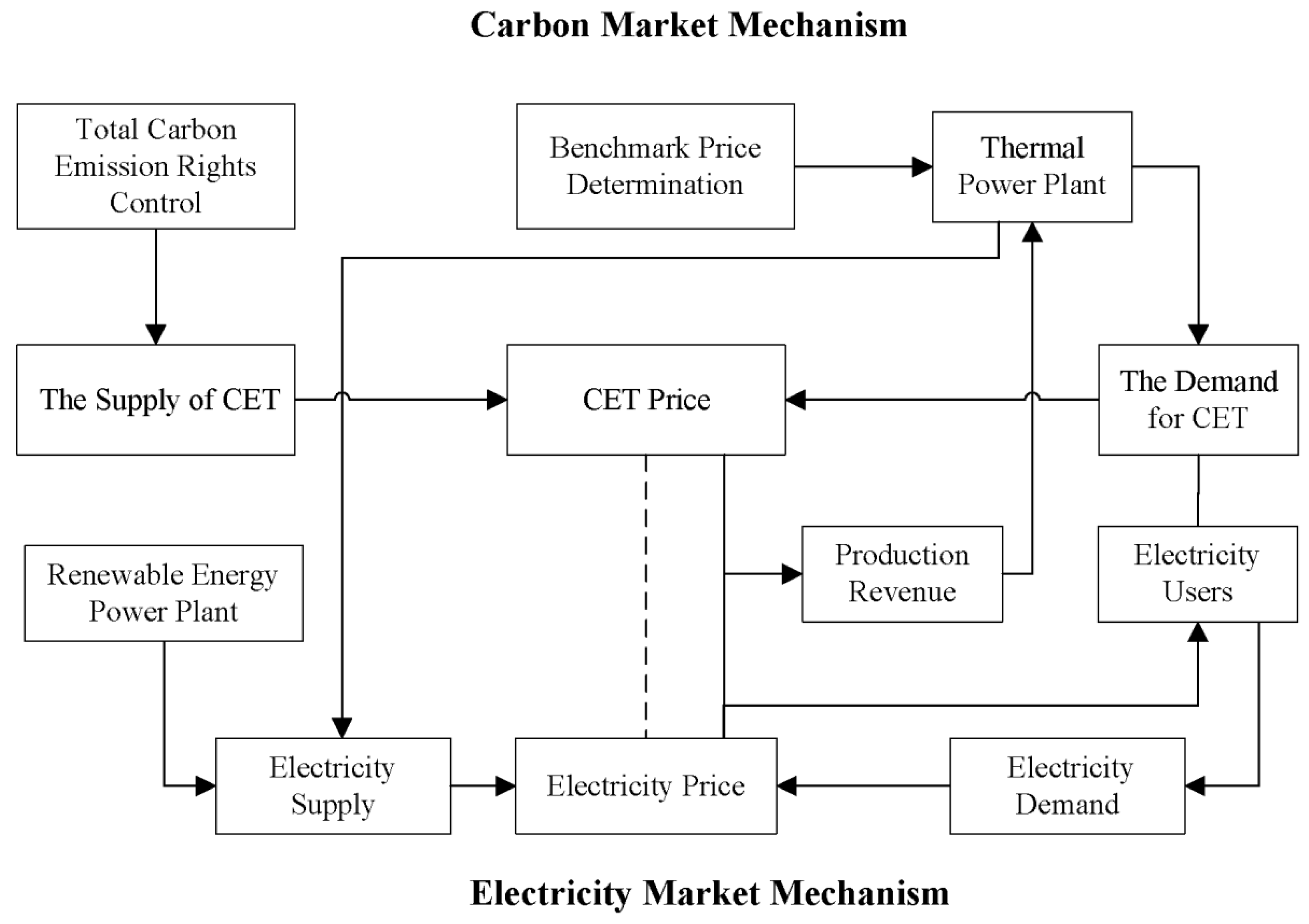
Carbon emissions trading (CET) refers to market-based transactions of emission allowances and nationally certified voluntary emission reductions among regulated entities [26]. When a firm’s actual carbon emissions fall below its allocated allowance, the surplus can be sold in the carbon market; conversely, firms with excess emissions must purchase additional allowances to ensure compliance [27,28]. The carbon–electricity market interaction mechanism is primarily transmitted through key variables such as carbon quotas, enterprise profits, and electricity supply and demand (Figure 1). When an enterprise’s internal abatement capacity is insufficient to meet its emission targets, participation in carbon trading increases the marginal cost of electricity generation for thermal power producers, compressing profit margins and influencing generation decisions. In turn, changes in generation output alter carbon emission levels and allowance demand, feeding back into the CET market supply–demand balance and adjusting the carbon price. As a result, enterprises are incentivized to reduce emissions either by lowering unit generation or by investing in emission reduction technologies. In addition, changes in enterprise profitability further affect electricity generation behavior, altering supply–demand conditions in the electricity market. These adjustments transmit carbon cost signals to downstream electricity consumption sectors through electricity prices, thereby enabling carbon price signals to guide low-carbon optimization and development across the entire industrial chain.

2.2. Interaction Mechanism Between ET and EURT Market

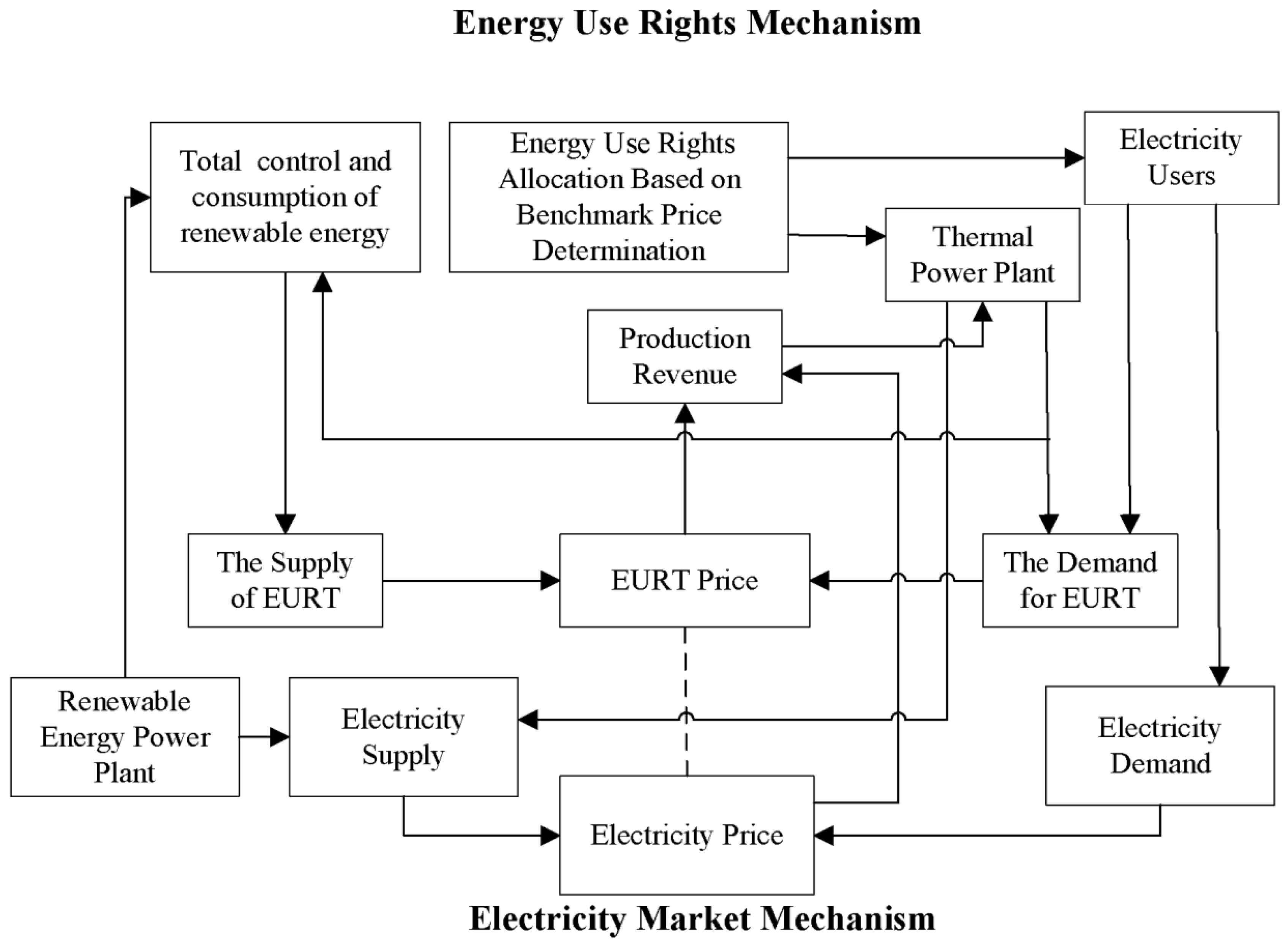
Energy use rights refer to the entitlement of energy-consuming entities within a region to consume a specified amount of primary energy over a given period. Under a regional cap on total energy consumption, enterprises whose actual energy use exceeds their allocated quotas are required to purchase additional quotas through the trading platform, while those with surplus quotas may sell them in the market. Energy use rights trading (EURT) increases energy use costs and reinforces energy consumption constraints on regulated enterprises. For thermal power producers, these effects raise the marginal cost of electricity generation and compress profit margins, thereby influencing generation decisions [29]. Consequently, reduced generation lowers total energy consumption and EURT allowance demand, which feeds back to the EURT market supply–demand balance and moderates the EURT price (as shown by the feedback pathway from Thermal Power Plant through The Demand for EURT to EURT Price in Figure 2). Consequently, firms are incentivized to improve energy efficiency through technological upgrading in order to achieve compliance. Through electricity price linkages, increased energy use costs in thermal power generation are indirectly transmitted to electricity prices, guiding downstream electricity consumers to engage in energy-saving behavior.

2.3. Mutual Recognition Between EURT Market and CET Market

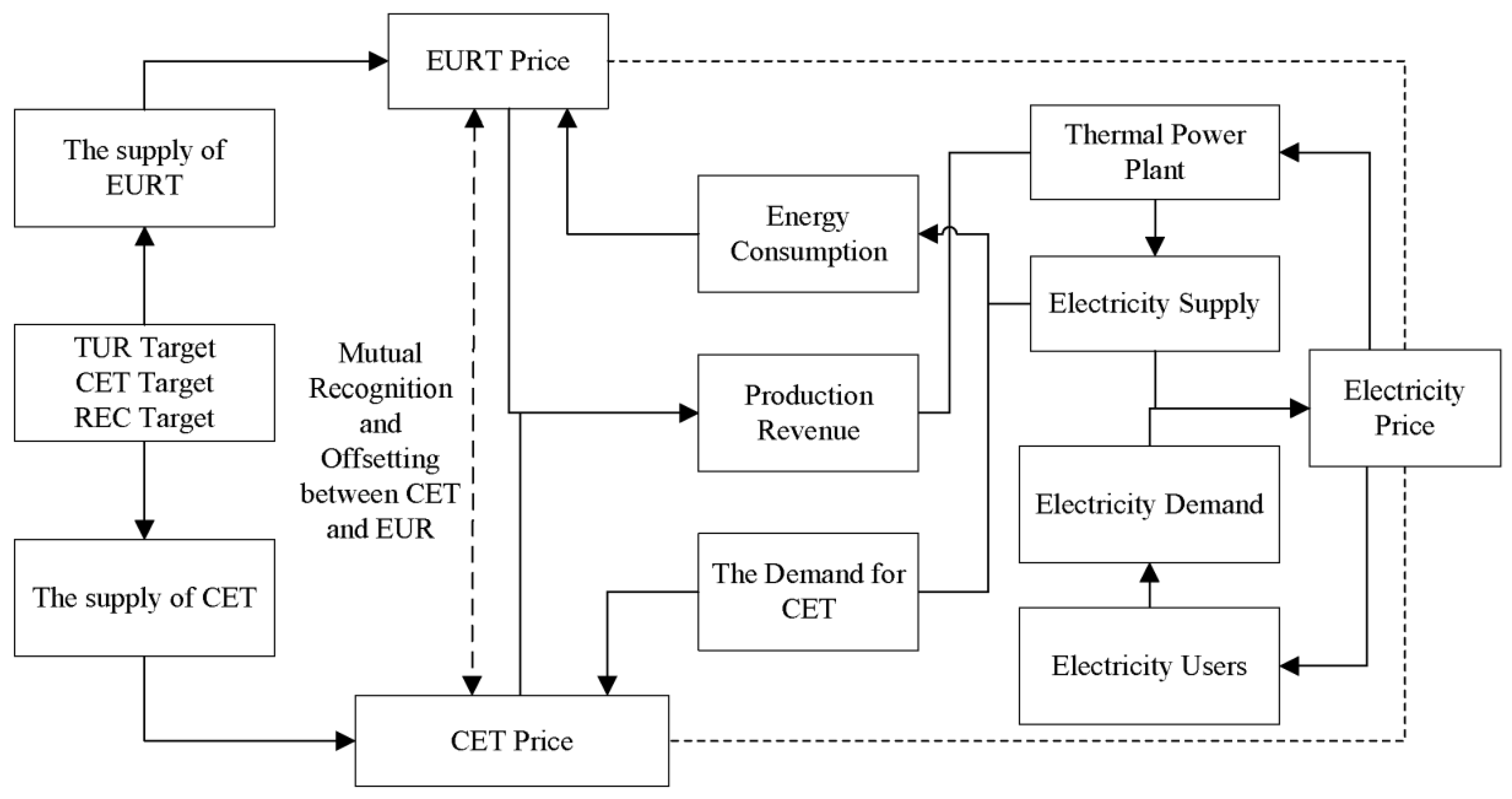
Similarly to the carbon market, the energy use rights trading (EURT) mechanism is a cap-based, market-oriented policy instrument that promotes investment in energy conservation and green technologies through the tradable allocation of energy consumption quotas [30]. In a broad sense, the energy use rights market and the carbon market share a common market-based regulatory logic, both aiming to incentivize energy conservation and emission reduction through total quantity control and tradable quotas. From a regulatory perspective, however, the two mechanisms play complementary yet distinct roles. Energy use rights trading (EURT) represents a form of front-end governance, constraining energy consumption at the source of greenhouse gas generation by promoting energy structure optimization and efficiency improvements. In contrast, carbon emission trading (CET) functions as an end-of-pipe regulatory mechanism, directly limiting enterprise carbon emissions. Through these differentiated regulatory pathways, EURT primarily targets energy conservation with co-benefits for emission reduction, while CET directly targets emission reduction and indirectly encourages improvements in energy efficiency. As a result, the two systems exhibit strong synergistic effects in practice, jointly promoting low-carbon and energy-efficient development (Figure 3).
Due to the synergistic nature of energy conservation and emission reduction, some regions have adopted similar institutional frameworks and data infrastructure for both CET and EURT. This convergence creates potential overlaps in coverage scope and quota allocation. When enterprises participate in both markets simultaneously, their energy-use activities become subject to dual quota constraints and compliance obligations. To address these redundancies, Liu [31] proposes a joint compliance mechanism that allows mutual offsetting between the two systems: certified emission reductions can offset excess energy consumption, while verified energy use rights can offset excess emissions, subject to defined offset limits. This mechanism serves as a critical institutional innovation for market integration. By enabling mutual recognition between carbon and energy rights markets, it alleviates the dual compliance burden on enterprises while providing greater flexibility in meeting regulatory requirements. Specifically, surplus allowances in one market can partially offset compliance obligations in the other, while generation decisions are simultaneously shaped by carbon costs, energy costs, and electricity revenue, forming coupled feedback loops that distinguish the ternary system from any binary subsystem. The approach reduces duplicated efforts and resource inefficiencies, ultimately supporting more sustainable pathways toward economic and environmental objectives [20].

3. Construction of the CET–ET–EURT Market System Dynamics Model

3.1. System Boundary Setting

This study considers thermal power enterprises covered by the national carbon market as the trading entities. To enhance the clarity and analytical tractability of the model, the following system boundary assumptions are adopted [9,32]:
(1)
As the power sector was established as the entry point of China’s national carbon market and remains the largest contributor to both carbon emissions and energy consumption, and as regional EURT pilots similarly concentrate on thermal power enterprises, this study adopts thermal power enterprises as the system boundary, with trading participants in both the carbon allowance market and the energy use rights allowance market limited to thermal power generation enterprises, while other major energy-consuming and emission-intensive industries are excluded.
(2)
Given the substantial differences in market participation mechanisms among various types of power generation enterprises in the carbon market, EURT market, and electricity market, this study assumes that firms do not simultaneously operate conventional energy units and renewable energy units. Specifically, thermal power enterprises in the model refer to firms that operate only coal-fired power generation units, whose revenues are derived solely from coal-fired electricity generation. Since CCER offsets function as a supplementary compliance tool with distinct supply and pricing dynamics that differ from allowance-based trading, the analysis considers only transactions of carbon emission allowances and energy use rights allowances, while CCER offsets and other energy-saving and emission-reduction measures, such as CCER offsets, are temporarily excluded.
(3)
To concentrate on the core transmission mechanisms through which carbon costs and energy use costs are transmitted to electricity prices, electricity prices are assumed to be determined primarily by electricity supply and demand. The effects of different trading arrangements (e.g., medium- and long-term contracts, spot market trading), transmission and distribution tariffs, government regulation, and other institutional factors are not considered. To reflect the regulated pricing constraints in China’s electricity market, upper and lower bounds on electricity prices are imposed in the model.
(4)
In accordance with the Notice on Further Improving the Work Related to Excluding New Renewable Energy Consumption from Total Energy Consumption Control issued by the National Development and Reform Commission, electricity consumption generated from new renewable energy sources is excluded from total energy consumption.
(5)
To isolate the effect of the mutual recognition ratio on market coordination performance, additional costs associated with the mutual recognition and exchange of EURT allowances and CET allowances—such as transaction, registration, and verification costs—are not considered.
(6)
Macroeconomic parameters, including GDP growth rate, carbon emission intensity reduction rate, and energy consumption intensity reduction rate, are assumed to follow fixed trajectories over the simulation period. External economic shocks such as fuel price volatility and macroeconomic fluctuations are not incorporated, so as to isolate the effects of market mechanism design on trading behavior and policy outcomes.

3.2. Causal Relationship Analysis

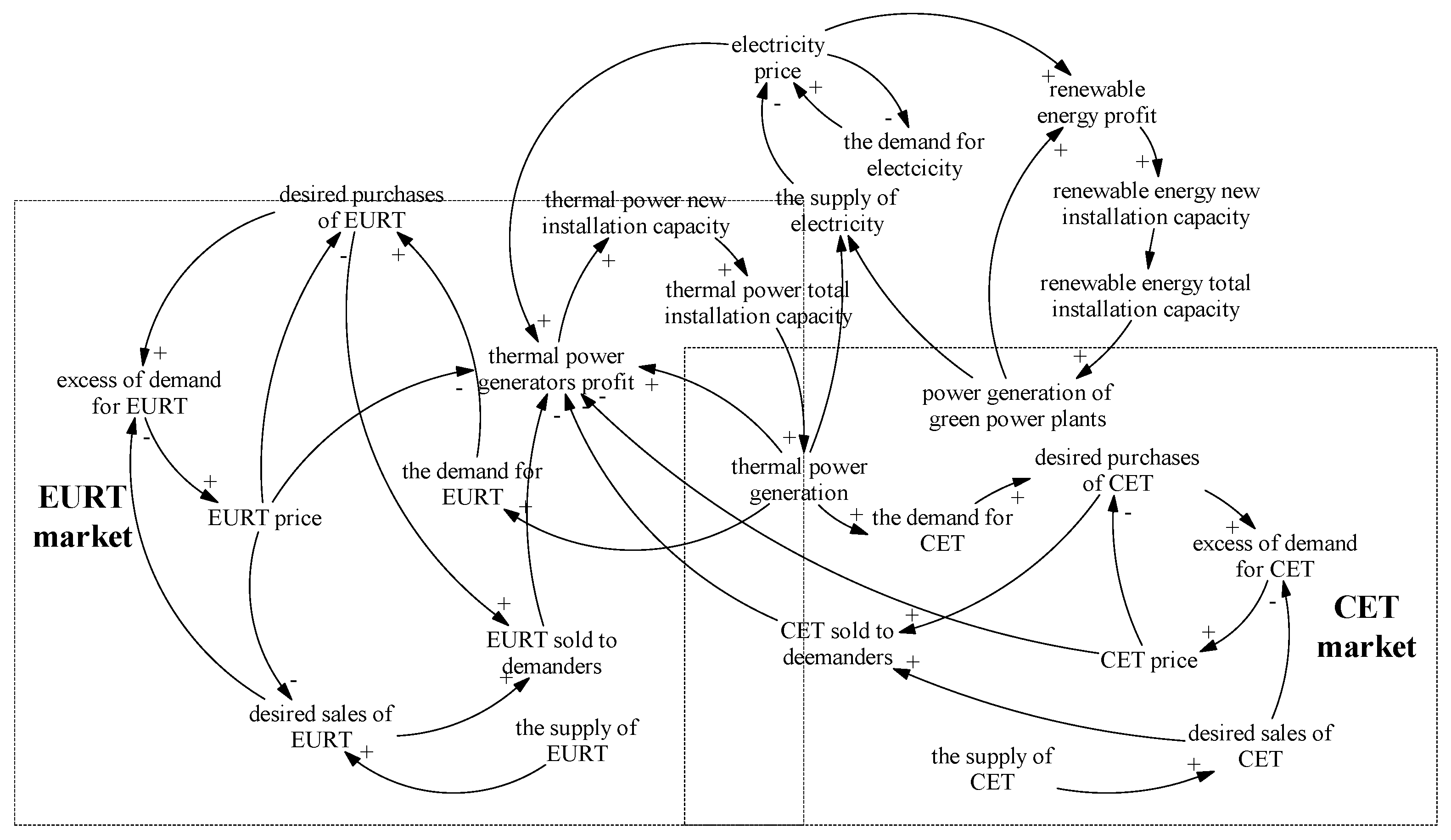
Building on the preceding analysis of the synergistic interaction between the CET market and the EURT market, thermal power enterprises, as the primary contributors to energy consumption and carbon emissions, simultaneously participate in both markets to satisfy the dual regulatory requirements of energy conservation and emission reduction. At the macro level, national energy consumption and emission levels, together with policy objectives, influence the government’s allocation of allowances, thereby determining market supply and trading prices. At the micro level, enterprises adjust their compliance strategies, trading volumes, and technological investment decisions in response to market rules and allowance prices. Through these interactions, a causal framework is established through which thermal power enterprises achieve allowance compliance (as illustrated in Figure 4). On this basis, two key market feedback loops can be identified:
The CET loop can be described as follows: actual carbon emissions → supply–demand conditions in the carbon emission trading (CET) market → CET price → CET volume → enterprise profit → power generation output → actual carbon emissions. This loop illustrates the compliance pathway of thermal power enterprises with respect to carbon emission allowances. Within this causal loop, thermal power enterprises generate electricity while simultaneously producing carbon emissions, which creates demand in the carbon market. When an enterprise’s internal emission reduction capacity is insufficient to meet its compliance targets, demand for carbon allowances increases. As market supply gradually becomes unable to fully satisfy demand, carbon prices rise. Changes in carbon prices, in turn, feed back into the supply–demand balance of the carbon allowance market. From the perspective of enterprise profitability, firms participate in the secondary market as buyers to cover excess emissions by purchasing carbon allowances, which increases production costs. Higher compliance costs affect generation decisions, incentivizing enterprises to reduce actual carbon emissions either by decreasing electricity output or by investing in emission-reduction technologies in order to meet carbon compliance requirements.
The EURT loop can be summarized as follows: enterprise total energy consumption → supply–demand conditions in the EURT market → EURT price → EURT volume → enterprise profit → unit input–output decisions → enterprise total energy consumption. This loop reflects the compliance pathway of thermal power enterprises with respect to energy use rights allowances. In the EURT market, when a thermal power enterprise’s energy consumption exceeds its allocated energy use rights, it can purchase additional EURT allowances in the secondary market to fulfill its obligations. In contrast, renewable energy power plants do not consume fossil energy during electricity generation and therefore are not included in energy use rights accounting within the power sector [33]. The purchase of energy use rights increases generation costs for thermal power enterprises. To mitigate these additional costs, firms reduce their energy consumption by lowering power generation or investing in energy-saving technologies. Through the combined effects of the CET and EURT mechanisms, the generation costs of thermal power enterprises increase, thereby constraining their electricity generation capacity. This process promotes the green transformation of the power sector, enhances the share of renewable energy consumption, and ultimately establishes a self-reinforcing positive cycle within the electricity market.

3.3. System Dynamics Model

3.3.1. Electricity Market Module

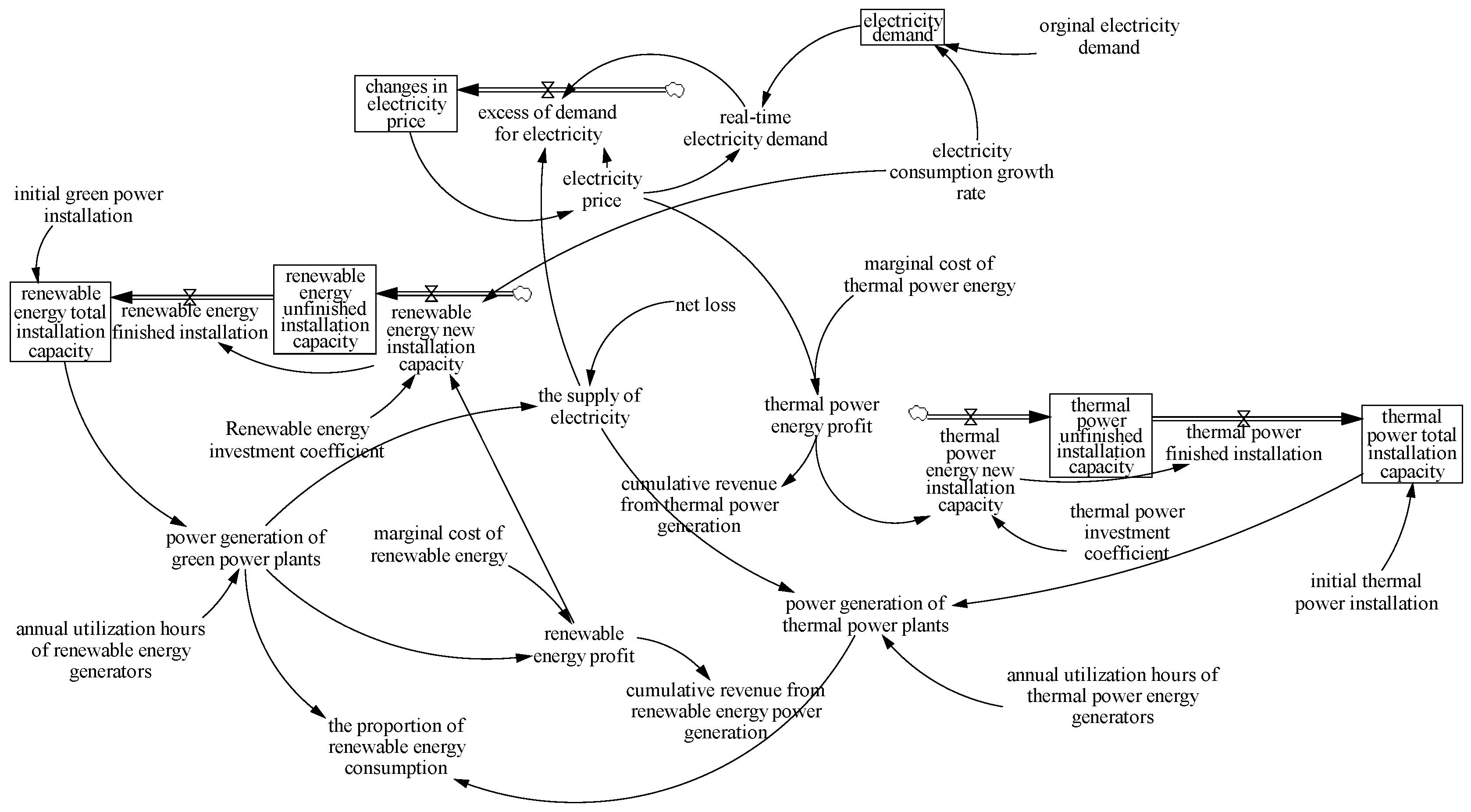
Under the defined system boundaries, electricity prices are assumed to be determined solely by the relationship between electricity supply and demand. Power generation enterprises adjust their generation decisions primarily in response to production profitability and aggregate electricity demand. From a macro-level perspective, the electricity price formation mechanism is analyzed based on variations in electricity supply and overall social electricity demand. The stock-flow diagram of the electricity market module is presented in Figure 5.
The main function settings are as follows:
V e p = p e 0 + E e
P e = IF   THEN   ELSE ( SMOOTH 3 I ( V e p , 5 , 0.38 ) > 0.75 ,   0.75 , IF   THEN   ELSE ( SMOOTH 3 I ( V e p , 5 , 0.38 ) < 0.33 , 0.33 ,     SMOOTH 3 I ( V e p , 5 , 0.38 ) ) )
w c = ( P e C c ) × V e T P u × Q u t r P c × Q c t r
w g = ( P e C g ) × V e T
V e T = ( I c 0 + w c × i c × r e 10000 ) × t c 12
V e g = ( I g 0 + w g × i g × r e 10000 ) × t g 12
S e = ( V e T + V e g ) × ( 1 n )
D e = d e 0 12 + d e 0 r e 12
E e = P e D e S e D e
where V e p denotes the change in electricity price; P e denotes the electricity price; E e represents excess demand in the electricity market; w c and w g denote the profit margins of thermal power generation and renewable power generation, respectively; C c and C g are the marginal costs for thermal power and renewable power generation, respectively; V e T and V e g are the thermal power generation and renewable power generation, respectively; I c 0 and I g 0 are the initial installed capacity for thermal power and initial installed capacity for renewable energy, respectively; i c and i g are the investment coefficients for thermal power installed capacity and renewable energy installed capacity, respectively; r e is the electricity demand growth rate; t c and t g are the annual utilization hours for thermal power installed capacity and renewable energy installed capacity, respectively; S e is the electricity supply; D e is the electricity demand; n is the network loss.

3.3.2. Carbon Market Module

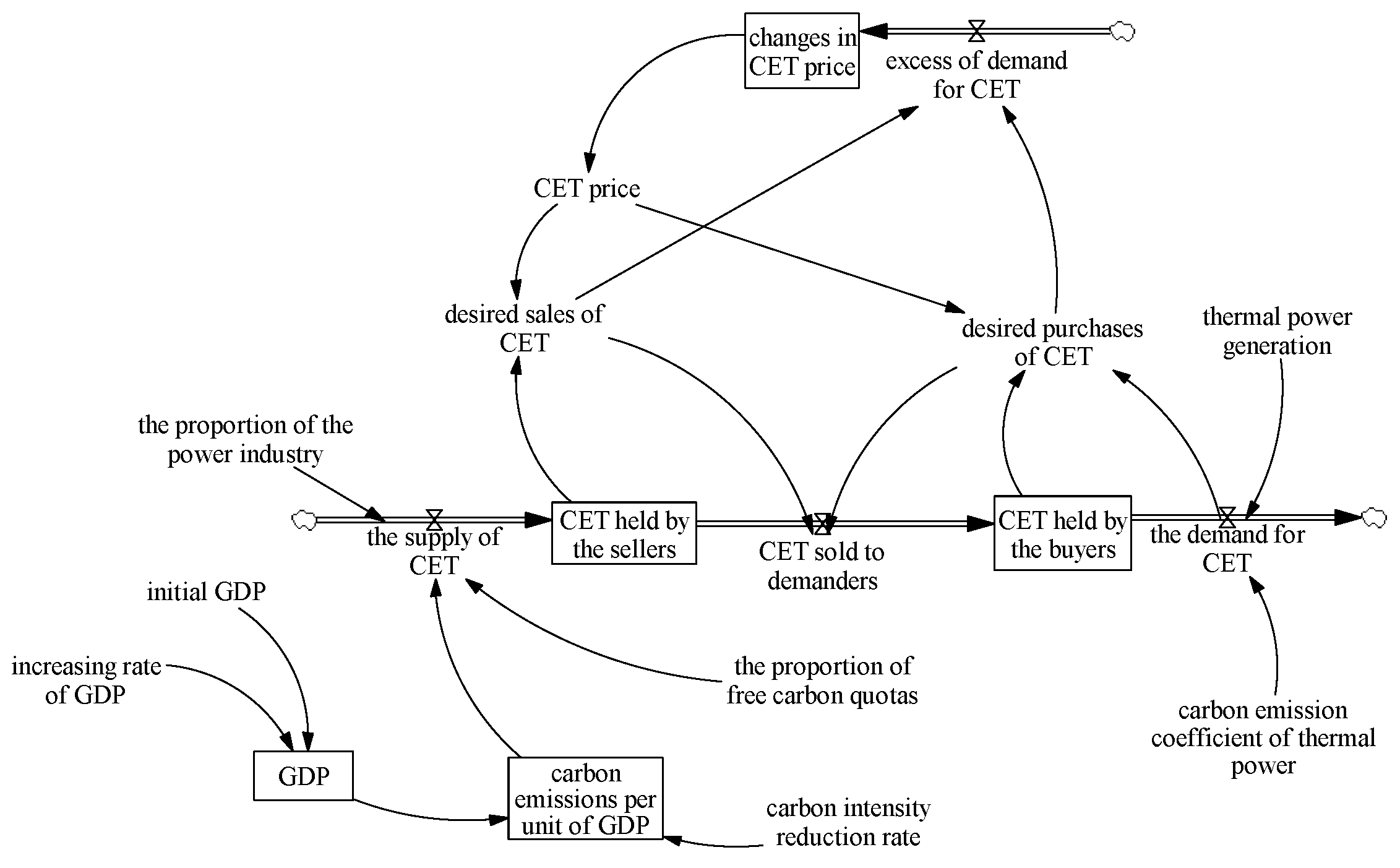
In the carbon market, the government’s carbon emission reduction targets are jointly determined by GDP growth and carbon emission intensity, which in turn influence the supply of CET allowances. Demand for CET allowances is primarily driven by electricity generation from conventional energy sources. Given enterprises’ carbon allowance holdings and prevailing carbon prices, excess demand in the CET market is determined, thereby affecting CET price levels and trading volumes. The stock-flow structure of the carbon market is illustrated in Figure 6.
The main functional relationships are as follows:
V c p = P c 0 + E c
P c = IF   THEN   ELSE ( SMOOTH 3 I ( V c p , 3 , 90 ) > 900 , 900 , IF   THEN   ELSE ( SMOOTH 3 I ( V c p , 3 , 90 ) < 10 , 10 ,   SMOOTH 3 I ( V c p , 3 , 90 ) ) )
Q c p w d = I F   T H E N   E L S E ( Q p c > D c , 0 , p c 0 P c × ( D c Q p c ) )
Q c s w d = Q s c P c p c 0
E c = I F   T H E N   E L S E ( Q c p w d Q c s w d Q c s w d > 30 , 30 , I F   T H E N   E L S E ( Q c p w d Q c s w d Q c s w d < 30 , 30 , Q c p w d Q c s w d Q c s w d ) )
Q c t = I F   T H E N   E L E N ( MIN ( Q c p w d , Q c s w d ) < 0 , 0 , MIN ( Q c p w d , Q c s w d ) )
Q c t r = I F   T H E N   E L E N ( P c > P u / a , ( 1 b ) Q c t , Q c t + a b Q u t )
where V c p is the carbon price change; P c is the carbon price; E c is the carbon price excess demand; Q c p w d is the expected carbon allowance purchase volume; Q c s w d is the expected carbon allowance sale volume; Q p c and Q s c are the carbon market buyer allowance holdings and seller allowance holdings, respectively; Q c t is the carbon allowance trading volume; Q c t r is the carbon allowance trading volume after the mutual recognition and offset mechanism between the two rights.

3.3.3. Energy Use Rights Market Module

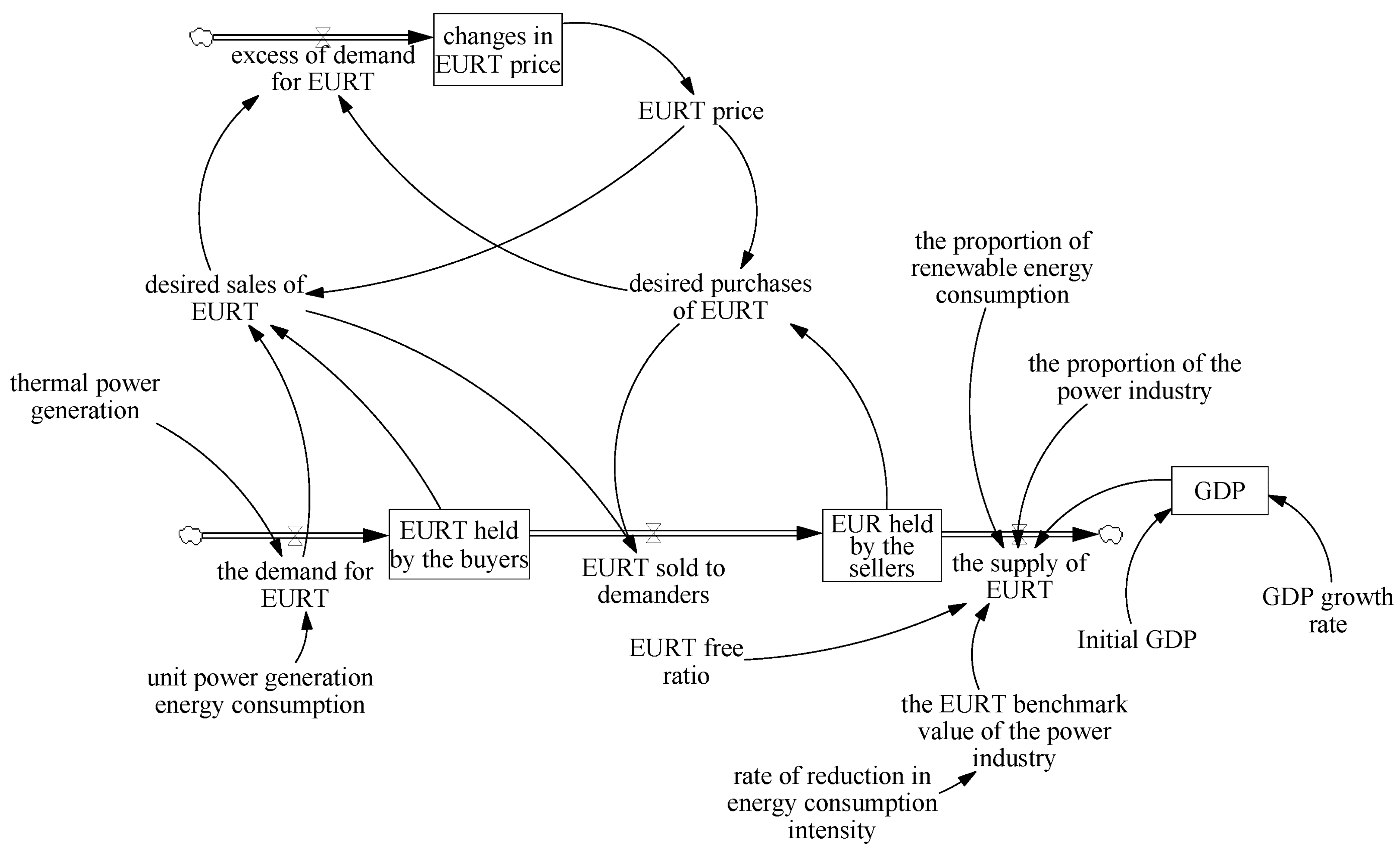
Both energy use rights and carbon emission rights are policy instruments through which the government allocates allowances to regulated entities under an overall quantity control framework and permits market-based trading. The supply of EURT allowances is jointly determined by GDP growth and energy consumption intensity, while demand is primarily driven by electricity generation from conventional energy sources. The stock-flow structure of the energy use rights market is illustrated in Figure 7.
The main functional relationships in Figure 7 are as follows:
V u p = P u 0 + E u
P u = IF   THEN   ELSE ( SMOOTH 3 I ( V u p , 3 , 200 ) > 1000 ,   1000 , IF   THEN   ELSE ( SMOOTH 3 I ( V u p , 3 , 200 ) < 100 ,   100 ,   SMOOTH 3 I ( V u p , 3 , 200 ) ) )
Q u p w d = I F   T H E N   E L S E ( Q p u > D u , 0 , p u 0 P u × ( D u Q p u ) )
Q u s w d = Q s u P u p u 0
E c = I F   T H E N   E L S E ( Q u p w d Q u s w d Q u s w d > 100 , 100 , I F   T H E N   E L S E ( Q u p w d Q u s w d Q u s w d < 100 , 100 , Q u p w d Q u p w d Q u s w d ) )
Q u t = I F   T H E N   E L E N ( MIN ( Q u p w d , Q u s w d ) < 0 ,   0 ,   MIN ( Q u p w d , Q u s w d ) )
Q u t r = I F   T H E N   E L E N ( P u > P c a , ( 1 b ) Q u t , Q u t + b Q c t / a )
where V u p is the energy use rights price change; P u is the energy use rights price; E u is the energy use rights excess demand; Q u p w d is the expected energy use rights purchase volume; Q u s w d is the expected energy use rights sale volume; Q p u and Q s u are the energy use rights market buyer allowance holdings and seller allowance holdings, respectively; Q u t is the energy use rights trading volume; Q u t r is the energy use rights trading volume after the mutual recognition and offset mechanism between the two rights.
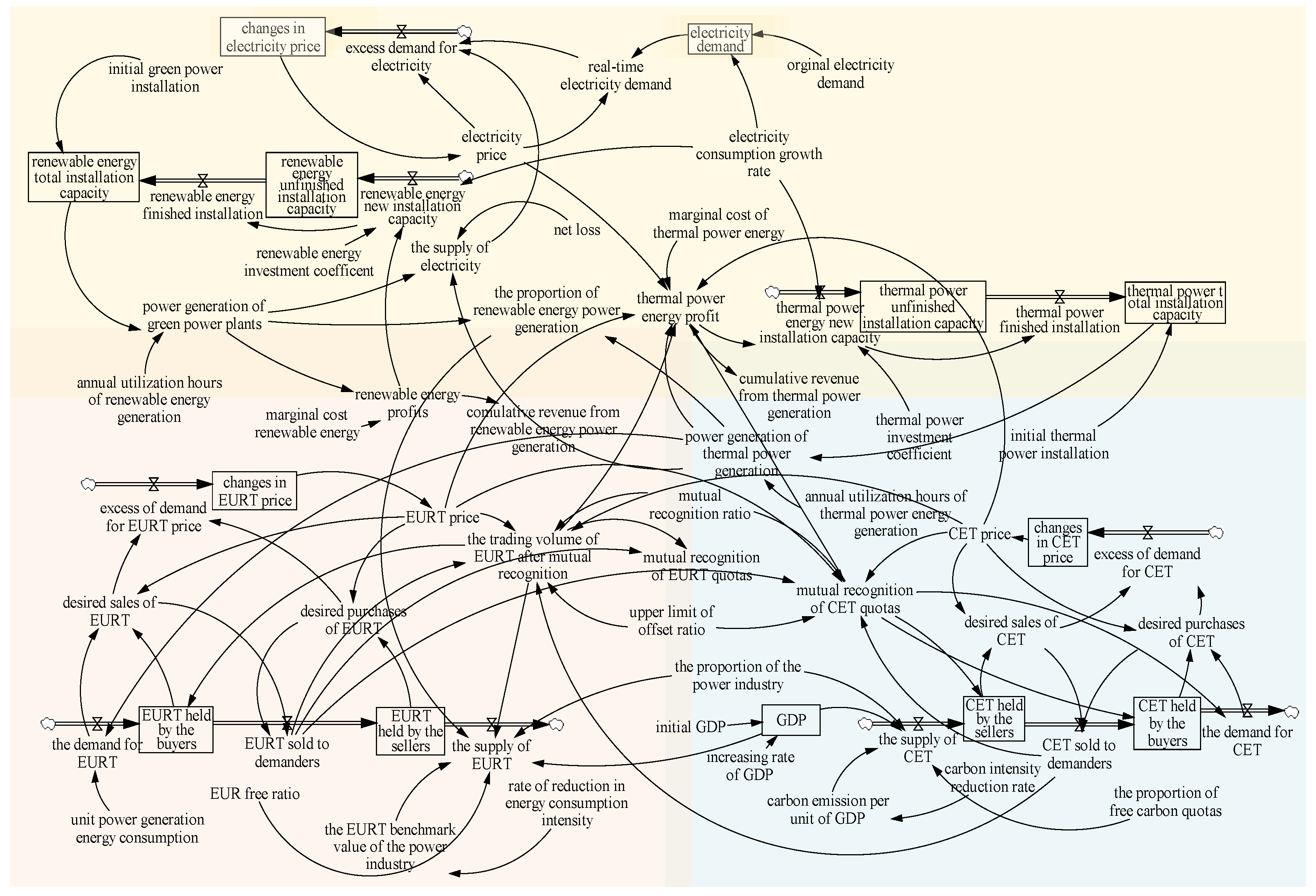
Based on the identified causal loops and stock-flow structures of the carbon market, electricity market, and energy use rights market, a system dynamics trading simulation model of the carbon–electricity–energy ternary coupled market is constructed, as shown in Figure 8.

3.4. Model Data and Scenario Design

Taking 2023 as the base year, the simulation time step is set at a monthly scale, with a simulation time of 120 months. The main parameter settings and data sources of the model are shown in Table 1.
This study introduces a joint compliance mechanism to examine the coordinated operation of the carbon market and the EURT market. A conversion coefficient is established between energy use rights trading targets and carbon emission trading targets, enabling mutual conversion between the two types of allowances. Based on the CO2 emission coefficient per unit of standard coal, the baseline scenario sets the mutual recognition ratio between carbon allowances and energy use rights allowances at 2.46:1 [20], indicating that one unit of energy use rights allowance can offset 2.46 units of carbon allowance. The maximum proportion of allowances eligible for mutual offset between the two markets is set at 3%. Simulation results under this joint compliance mechanism are compared with those obtained under the independent operation of the carbon market and the EURT market, in order to analyze the evolution of key variables in the carbon market, energy use rights market, and electricity market. The scenario settings are reported in Table 2.

4. Results

4.1. Baseline Scenario

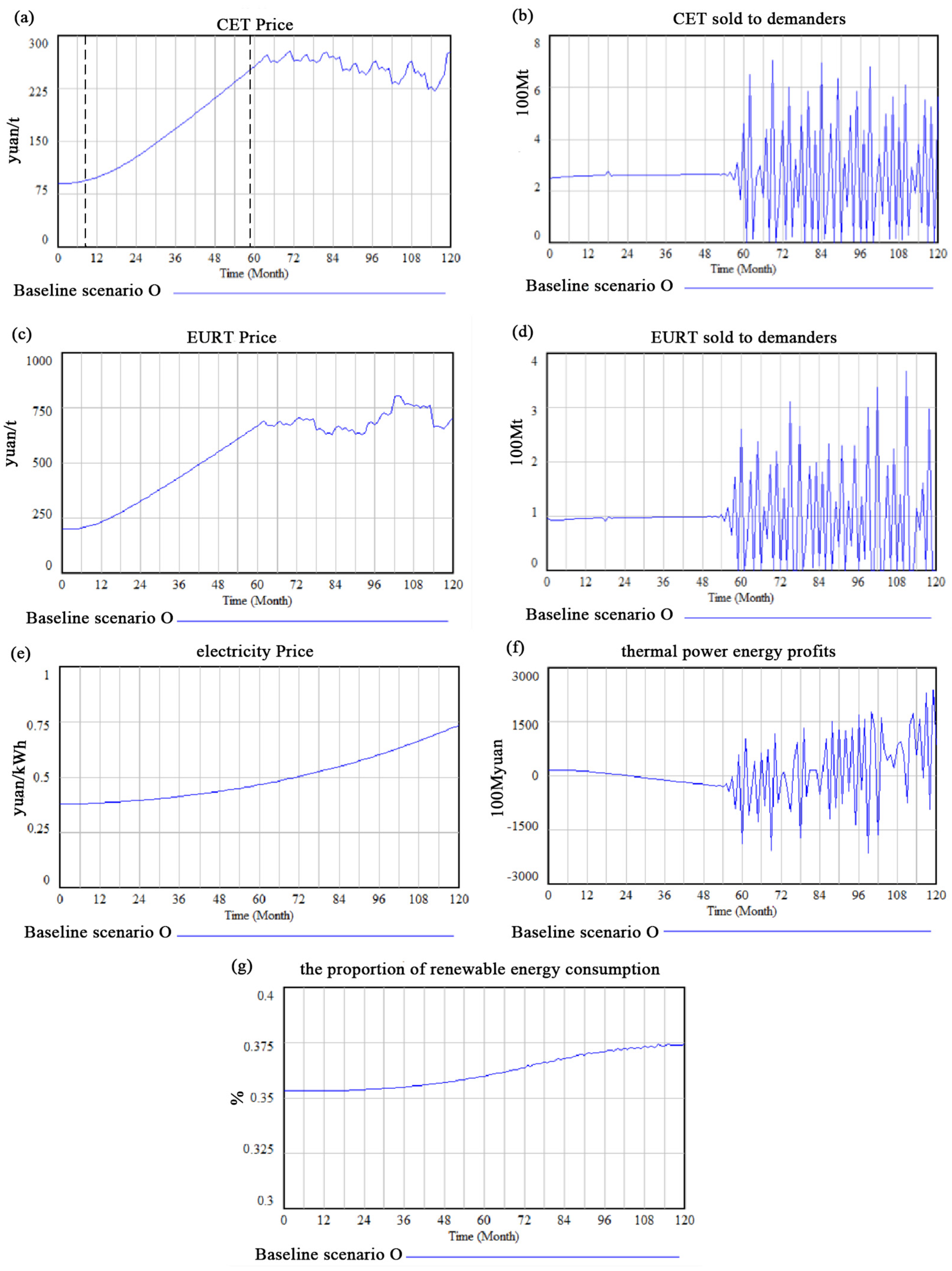
To establish a reference benchmark for subsequent policy scenario comparisons, the baseline scenario simulates the ternary market under current institutional parameters. Based on the previously established system dynamics trading simulation model of the carbon–electricity–energy ternary market, this study conducts a ten-year simulation of market trading dynamics, using the status of the power industry, carbon market, and energy use rights market at the end of 2023 as the baseline. From the perspective of market operation cycles, the simulated price trajectories can be divided into three stages: the baseline initial stage, the steady rise stage, and the regular fluctuation stage (Figure 9).
Baseline initial stage (months 1–8): In the early stage of the carbon market, thermal power enterprises already hold a certain amount of carbon emission trading (CET) allowances, resulting in relatively low demand for carbon allowances. At the same time, power generation enterprises remain in an observation phase with respect to the carbon market, and CET prices therefore remain close to the baseline level. Similarly, in the initial stage of the energy use rights market, energy use rights allowances are allocated based on enterprises’ production conditions. Thermal power enterprises hold sufficient energy use rights to largely meet their own energy consumption needs, leading to low market demand and stable energy use rights prices at the baseline level. In the electricity market, because both carbon prices and energy use rights prices remain low, their impacts on profit margins and generation decisions of thermal power enterprises are limited. As a result, changes in electricity supply–demand conditions are minimal, and electricity prices remain at their initial baseline level. Driven by stable energy use rights prices, carbon prices, electricity prices, and growing electricity demand, thermal power enterprises continue to invest in power generation during this stage.
Steady rise stage (months 8–56): Following the implementation of carbon trading and EURT transactions, compliance costs associated with carbon allowances and energy use rights gradually increase thermal power generation costs. As the duration of market operation remains relatively short, both carbon prices and energy use rights prices are still at comparatively low levels during the early part of this stage. Power generation therefore continues to increase in line with rising electricity demand, leading to a steady growth in demand for both carbon allowances and energy use rights. As existing allowances become insufficient to meet enterprises’ energy conservation and emission reduction requirements, supply shortages emerge in both markets, driving up CET prices and energy use rights prices. Rising allowance prices increase generation costs and gradually compress enterprise profit margins, weakening incentives for power generation [8]. Consequently, electricity supply tightens, and electricity prices begin to rise steadily.
Regular fluctuation stage (months 56–120): As shown in Figure 9b,d, after a prolonged period of price increases, supply–demand conditions in the CET and EURT markets begin to adjust. Higher allowance prices raise generation costs and continuously compress profit margins of thermal power enterprises. To mitigate compliance risks, enterprises tend to reduce power generation, which lowers demand for carbon allowances and energy use rights. As enterprises’ allowance holdings gradually become sufficient to meet their own needs, short-term oversupply emerges in both markets, trading activity declines, and allowance prices fall. When market prices decline, generation costs decrease, stimulating renewed investment by thermal power enterprises and increasing demand for carbon allowances and energy use rights, which again leads to supply shortages. In addition, to hedge against dual compliance risks, enterprises tend to retain a portion of carbon allowances and energy use rights, further intensifying supply–demand tensions and pushing prices upward. As illustrated in Figure 9a,c, prices in this stage exhibit persistent fluctuations and gradually converge toward equilibrium under market mechanisms [12,39], with CET prices and energy use rights prices fluctuating around 260 yuan per ton of CO2 and 700 yuan per ton of standard coal, respectively.

4.2. Multi-Market Scenario Comparison

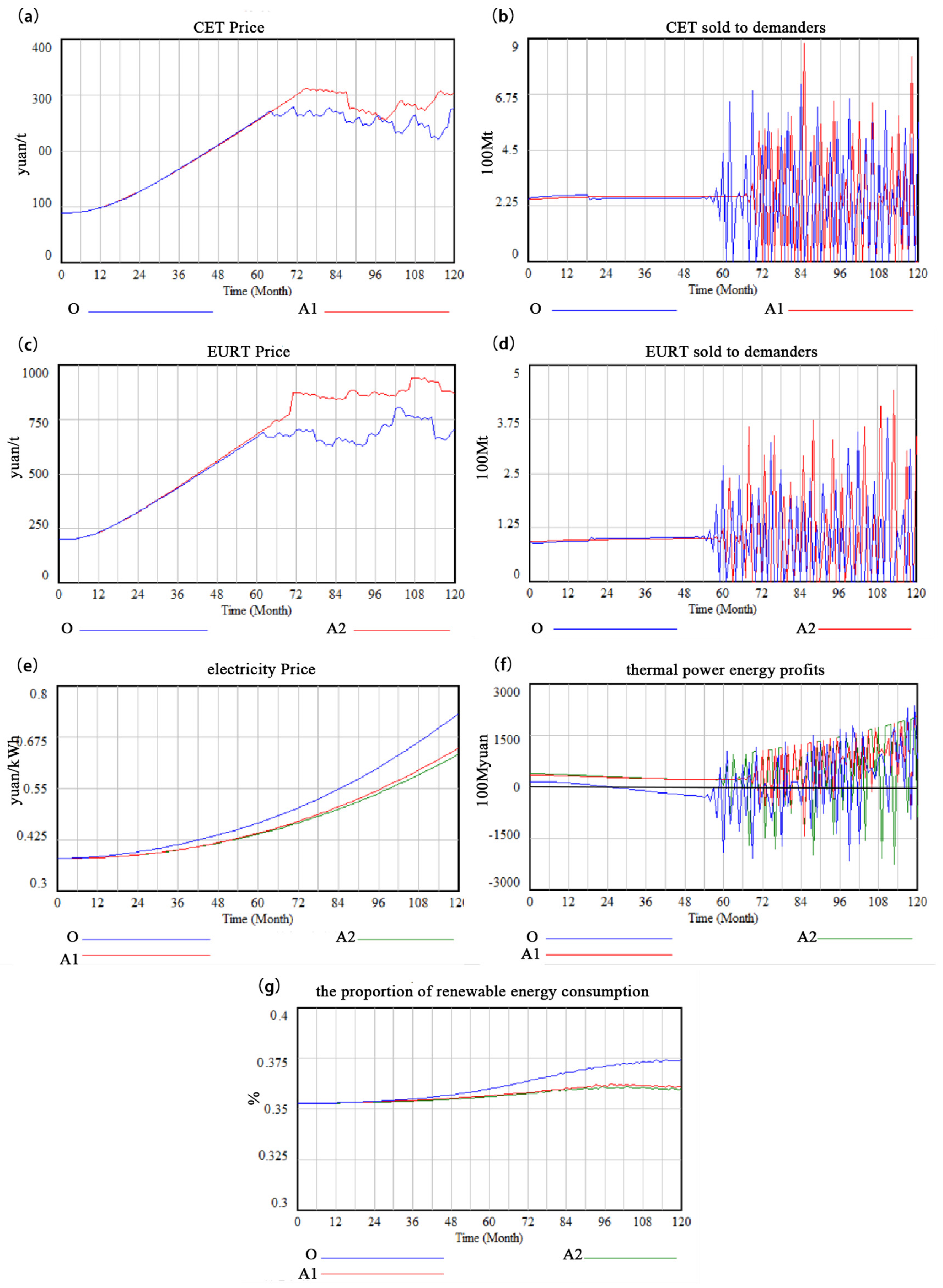
The baseline scenario demonstrates the evolutionary dynamics of the ternary market under current institutional parameters. A natural question that follows is whether the ternary configuration produces distinct market outcomes compared with binary market structures in which only one regulatory constraint operates alongside the electricity market. To examine this question, scenario simulations are conducted for three market configurations; namely, the carbon–electricity–energy ternary coupled market, the carbon–electricity coupled market, and the energy use rights–electricity coupled market. The simulation results are presented in Figure 10.
Overall, the ternary market configuration more effectively stimulates market activity, mitigates liquidity risks associated with trading to some extent, enhances enterprises’ willingness to participate in the market, and improves the allocation efficiency of energy resources [11]. Compared with the carbon–electricity binary market, trading activity in the carbon market is more pronounced under the ternary market configuration. Specifically, CET volume in the ternary market begins to exhibit significant fluctuations from the 56th month onward, entering an active trading phase 14 months earlier than in the carbon–electricity market (Figure 10b). Similarly, the performance of the energy use rights market varies across different coupling scenarios. Compared with the energy–electricity market, trading in energy use rights under the ternary market configuration becomes active 6 months earlier (Figure 10d).
In the electricity market, energy conservation and emission reduction costs in upstream power generation are transmitted to electricity prices through the price transmission mechanism [8,28]. As shown in Figure 10e,f, under the dual constraints imposed by the carbon market and the EURT market, thermal power generation costs in the ternary market are significantly higher than those in the carbon–electricity and energy–electricity coupling scenarios. Higher generation costs further compress the generation capacity of thermal power enterprises, thereby affecting electricity supply–demand dynamics. Consequently, electricity prices in the ternary market are higher than those in the other two scenarios. In addition, due to the introduction of a mutual recognition mechanism between carbon emission rights and energy use rights, thermal power enterprises are able to use a portion of their carbon allowances to offset energy use rights when energy use rights prices are excessively high, thereby strengthening market regulation. As a result, both CET volume and energy use rights trading volume in the ternary market exhibit earlier trading fluctuations (Figure 10b,d).

4.3. Energy–Carbon Rights Mutual Recognition Scenario

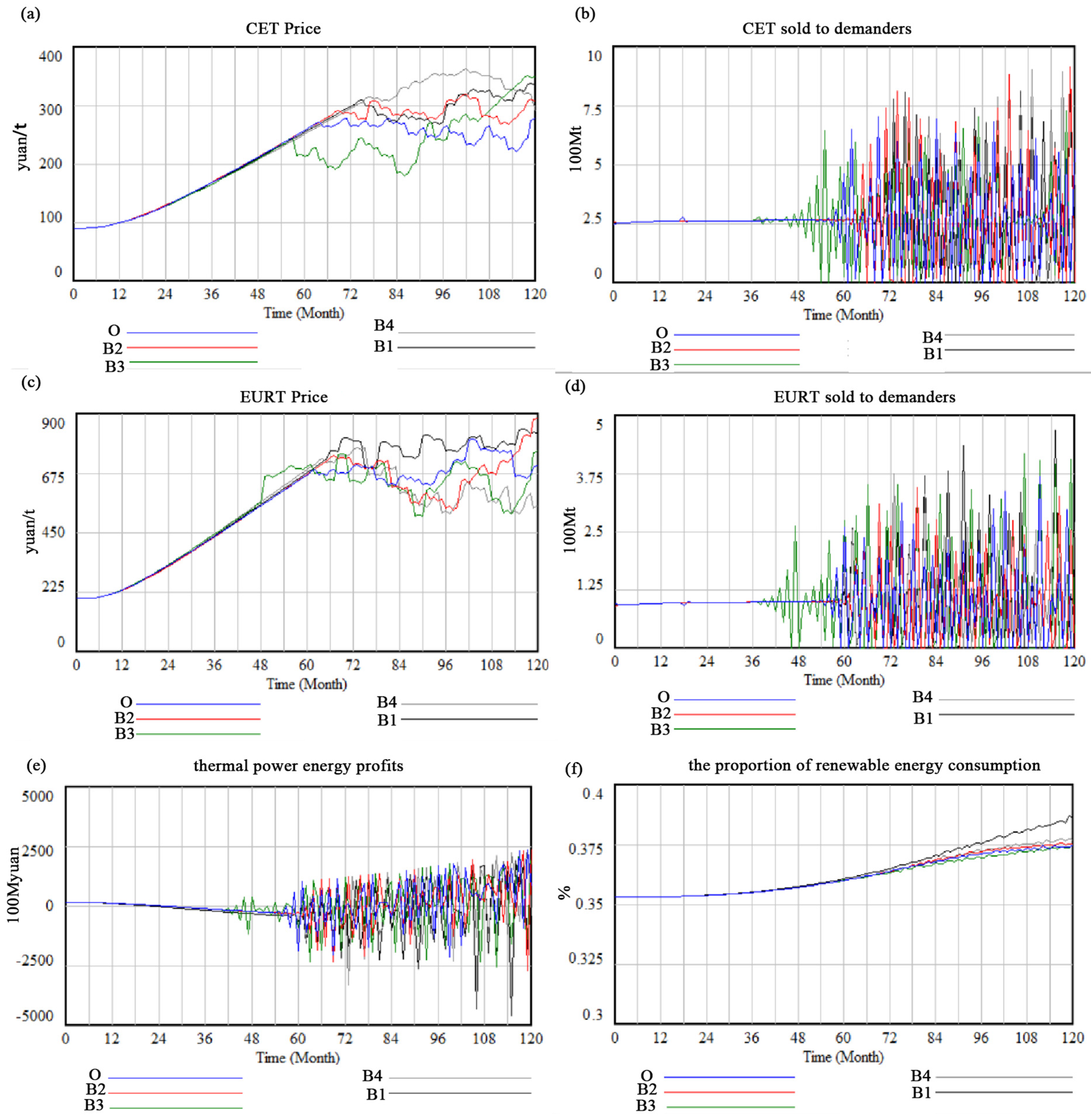
The multi-market comparison in Section 4.2 confirms that the ternary configuration produces stronger low-carbon incentives than binary configurations. A further question is how the dual compliance burden arising from this configuration can be coordinated through institutional design. Thermal power enterprises inevitably generate higher carbon emissions as energy consumption increases. Conversely, energy-saving measures adopted by thermal power units simultaneously reduce carbon emissions. From the perspective of compliance, the purchase of energy use rights and carbon allowances ultimately serves the same objective—meeting enterprises’ carbon emission requirements. As a result, significant overlap exists in enterprises’ compliance activities across the carbon market and the energy use rights market. This overlap creates duplicated compliance burdens, making it necessary to introduce an allowance mutual recognition and offset mechanism to coordinate the two markets [20,40]. Based on the ternary market simulation framework, this study designs three mutual recognition scenarios between energy use rights and carbon emission rights to examine the effects of the mutual recognition mechanism on the coordination performance of the ternary market. The simulation results are presented in Figure 11.
After introducing the mutual recognition mechanism, trading activity in both the carbon market and the EURT market is significantly higher than under the scenario in which the two markets operate independently [19]. Selecting an appropriate mutual recognition ratio effectively enhances market liquidity and participation. When the mutual recognition ratio between energy use rights and carbon emission rights increases, a given amount of energy use rights allowances can offset a larger quantity of carbon allowances; conversely, a lower mutual recognition ratio implies a smaller offset effect. Thermal power enterprises therefore tend to purchase allowances in the market with relatively lower prices in order to minimize production costs. As shown in Figure 11b,d, compared with the baseline scenario, trading activity in both the carbon market and the energy use rights market is lower under the alternative mutual recognition scenarios. In the carbon market, the scenario with a mutual recognition ratio of 2.7 enters the active trading phase 10 months earlier than the baseline scenario. In contrast, the scenario with a ratio of 2 enters the active trading phase 6 months later than the baseline, while the scenario with a ratio of 3 exhibits a trading pattern similar to the no mutual recognition scenario and enters the active phase 6 months later than the ratio-2 scenario. In the energy use rights market, the ratio-2.7 scenario enters the active trading phase 15 months earlier than the baseline scenario. When the mutual recognition ratio increases to 3, the active phase is delayed by 3 months relative to the baseline, whereas the ratio-2 scenario shows an active period similar to the no mutual recognition scenario and is delayed by 3 months compared with the ratio-3 scenario.
As illustrated in Figure 11a,c, under the no mutual recognition scenario, carbon prices and energy use rights prices remain at relatively high levels compared with the baseline scenario. This leads to a substantial increase in thermal power generation costs and a significant decline in enterprise profits (Figure 11e), thereby severely compressing thermal power generation capacity. Carbon prices and energy use rights prices are further transmitted to electricity prices: electricity prices are similar to the baseline in the early stage but exceed the baseline level in the later stage. Although the no mutual recognition scenario strongly promotes energy conservation, low-carbon transformation, and higher renewable energy consumption, most thermal power enterprises experience persistent negative profits, which is unfavorable for the sustainable development of the power industry. When the mutual recognition ratio is set at 2 or 3, carbon prices remain higher than in the baseline scenario, increasing enterprises’ market trading costs, although price fluctuations are relatively stable. In contrast, energy use rights prices are higher than the baseline during the early active stage and decline continuously in the later stage, resulting in weaker market stability and elevated trading risks. When the mutual recognition ratio is 2.7, carbon prices during the active trading period are lower than in the baseline scenario, while energy use rights prices remain close to baseline levels. As shown in Figure 11f, the renewable energy consumption ratio ultimately reaches 37.7% when the mutual recognition ratio is 3, 37.49% when the ratio is 2.7, and 37.52% when the ratio is 2, all of which exceed the baseline level of 37.42%. These results indicate that, under the mutual recognition mechanism, enterprises flexibly shift allowance purchases toward lower-priced markets, thereby reducing production costs and promoting green transformation in the power sector [22].

4.4. Quota Auction Scenario

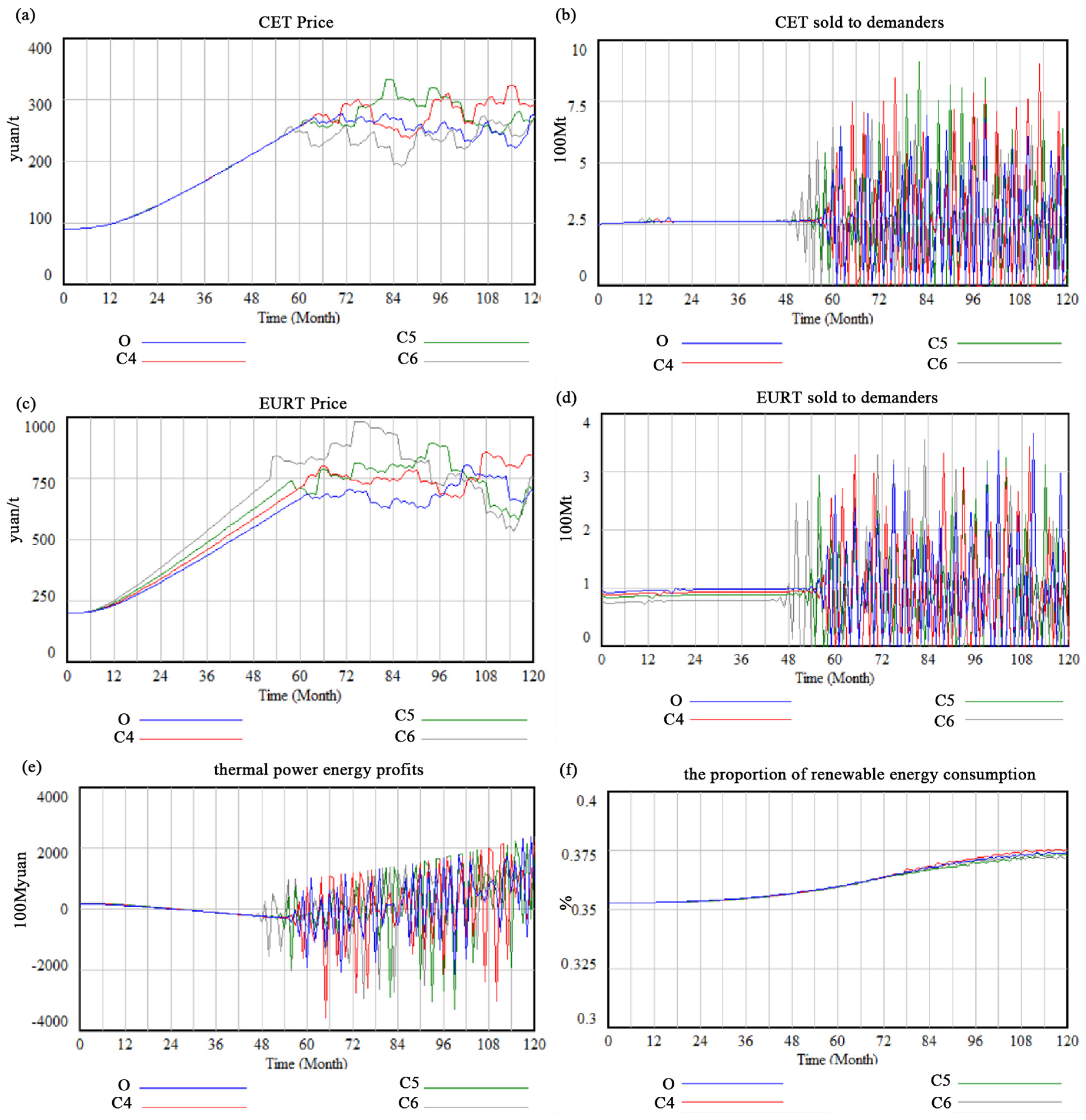
Section 4.2 and Section 4.3 examine the effects of market configuration and mutual recognition mechanism design on ternary market coordination. In addition to these institutional arrangements, allowance allocation methods represent another critical policy lever that shapes market behavior. From a policy perspective, to effectively regulate major energy-consuming and high-emission enterprises and to strengthen the guiding role of market mechanisms, the introduction of an allowance auction mechanism can improve the efficiency of energy resource allocation. Building on the established ternary market model, this study further conducts simulation analyses of allowance policy scenarios in both the carbon market and the EURT market to examine the impacts of an allowance auction system on trading behavior within the ternary market.

4.4.1. Energy Use Rights Quota Auction System

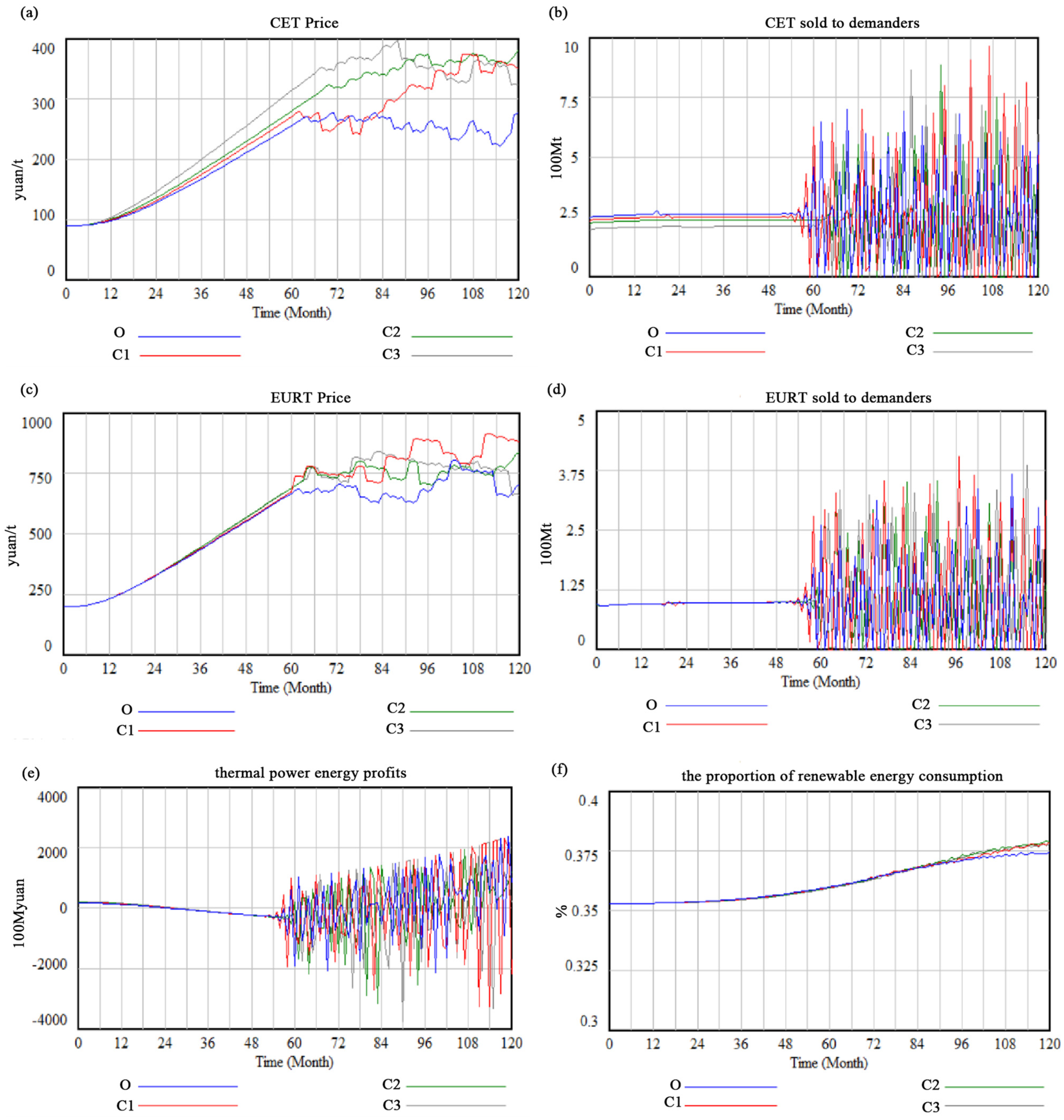
The model incorporates an auction mechanism for EURT allowances. As the proportion of freely allocated EURT allowances decreases, market demand for energy use rights increases and supply–demand conditions tighten, leading to higher energy use rights prices. Rising allowance prices increase power generation costs for enterprises, influence generation decisions, and induce changes in electricity market supply–demand conditions. Through the mutual recognition mechanism between energy use rights and carbon emission rights, these effects are further transmitted to the carbon market and the electricity market.
As shown in Figure 12b,d, from the perspective of trading volume fluctuations, an expanding allowance gap enhances trading activity in the EURT market relative to the baseline scenario. Carbon market trading activity is also indirectly affected through enterprises’ generation decisions and the energy rights mutual recognition mechanism. As illustrated in Figure 12a,c, increasing the allowance gap tightens supply–demand conditions in the EURT market. During the steady rise stage, energy use rights prices increase as the proportion of free allowances decreases. In the regular fluctuation stage, when the free allocation proportions are 95% and 90%, price levels remain broadly similar and are both higher than in the baseline scenario. When the free allocation proportion is further reduced to 80%, energy use rights prices reach the highest level among all allowance scenarios. Reductions in free EURT allowances also exert indirect effects on carbon market prices, although the magnitude of carbon price changes remains relatively limited. When the free allocation proportions are 95% and 90%, carbon prices are higher than in the baseline scenario. As the free proportion declines further, thermal power generation costs increase substantially and enterprise profits decrease (Figure 12e), imposing significant production pressure on thermal power enterprises and markedly compressing their generation capacity. By reducing electricity generation to lower energy conservation and emission reduction requirements, supply–demand conditions in the carbon market become relatively more balanced than in the baseline scenario. In contrast, due to the enlarged allowance gap, the EURT market continues to exhibit relatively tight supply–demand conditions. Overall, the introduction of an allowance auction mechanism effectively promotes the green transformation of the power sector [9]. As shown in Figure 12f, renewable energy consumption ratios increase under all auction scenarios. In particular, when the free allocation proportion of allowances is set at 95%, renewable energy consumption reaches a higher level of 37.64%.

4.4.2. Carbon Allowance Auction Scenario

The introduction of a carbon allowance auction system leads to changes in carbon prices, indirectly increasing power generation costs for enterprises and further affecting the EURT market and the electricity market. As shown in Figure 13b,d, from the perspective of trading volume fluctuations, when the allowance gap expands, trading activity in both the carbon market and the EURT market is stronger than in the baseline scenario when the free allocation proportion of carbon allowances is 95%. However, as the allowance gap continues to widen, the volume of tradable allowances in the market gradually decreases, resulting in a decline in overall market trading activity.
As illustrated in Figure 13a,c, with the expansion of the allowance gap, supply–demand conditions in the carbon market tighten, and carbon prices rise as the proportion of freely allocated allowances decreases. Rising carbon prices significantly increase thermal power generation costs and reduce enterprise profits (Figure 13e), thereby substantially compressing thermal power generation capacity and, to some extent, incentivizing enterprises to invest in low-carbon technologies [32]. Nevertheless, when the free allocation proportion is relatively high, carbon prices remain at elevated levels, imposing considerable production pressure on enterprises and potentially undermining their long-term financial sustainability. Under the mutual recognition mechanism between energy use rights and carbon emission rights, enterprises are able to purchase EURT allowances to offset a portion of their carbon allowance requirements. As the carbon allowance gap increases, demand for EURT allowances rises accordingly, affecting supply–demand conditions in the EURT market and leading to higher energy use rights prices. When the free allocation proportion of carbon allowances is 95%, energy use rights prices reach relatively higher levels. As shown in Figure 13f, the implementation of the allowance auction system improves renewable energy consumption ratios across all scenarios. In particular, when the carbon allowance free proportion is 95%, renewable energy consumption increases to 37.87%. Overall, as the carbon allowance auction system is introduced and the allowance gap expands, enterprises’ holdings of free allowances decline. To meet emission reduction targets, thermal power enterprises respond by reducing power generation or increasing investment in emission-reduction technologies, thereby lowering carbon emissions and reducing demand for carbon allowances. This mechanism effectively promotes the green transformation of the power sector.

4.5. Results Discussion

The validity of the model is assessed from three perspectives. First, the simulated carbon price trajectory, rising gradually from 90 yuan per ton, is qualitatively consistent with the observed trend in China’s national carbon market, where average trading prices rose from approximately 50–70 yuan per ton during 2021–2023 to 90–100 yuan per ton in 2024. The simulated three-stage evolutionary pattern of market development is also consistent with the typical maturation trajectory of cap-and-trade systems documented in the existing literature, and the key simulation outcomes are in line with the findings reported in related studies on carbon–electricity market coupling [39]. Second, all model parameters are derived from official statistical sources, formal policy documents, and authoritative market data, as documented in Table 1. Third, dimensional consistency across all model equations has been verified to ensure logical coherence.
Under the combined effects of the carbon market, EURT market, and electricity market, thermal power enterprises face dual constraints from carbon emission rights and energy use rights, leading to a compression of their power generation capacity and promoting energy conservation and low-carbon transformation. Meanwhile, with continued growth in electricity demand, rising thermal power generation costs further restrict the expansion of thermal power generation. Through the price transmission mechanism, energy conservation and emission reduction costs are indirectly passed on to electricity prices and distributed to end users via electricity trading, thereby encouraging electricity consumers to participate in energy-saving and emission-reduction efforts and facilitating the green transformation of the power sector.
Compared with binary market configurations, the ternary market imposes dual constraints on thermal power enterprises, leading to higher generation costs, reduced generation capacity, and stronger incentives for energy conservation and low-carbon transformation. Under the coupled operation of the ternary market, the overall profitability of thermal power enterprises reaches its lowest level, which accelerates their low-carbon transition. The simulation results further support this conclusion: the renewable energy consumption ratio in the ternary market is significantly higher than in the other two scenarios, ultimately reaching 37.42%. Overall, the ternary market configuration effectively regulates market trading behavior, promotes efficient resource allocation, facilitates the low-carbon transformation of the power generation mix, and supports the achievement of renewable energy consumption targets in the power sector.
Compared with the no mutual recognition scenario, the introduction of an allowance mutual recognition and offset mechanism effectively reduces thermal power generation costs, alleviates duplicated compliance burdens arising from dual allowances, enhances market activity, and grants enterprises greater flexibility in choosing compliance strategies. This flexibility allows firms to optimize resource allocation in response to market conditions and mitigates compliance pressure on thermal power enterprises. However, the mutual recognition ratio must be aligned with government emission reduction targets. An appropriately designed mutual recognition ratio can improve market coordination, achieve efficient resource allocation, and maximize overall social and economic benefits.
Both the EURT allowance auction system and the carbon allowance auction system play critical roles in environmental policy implementation and climate governance. These mechanisms provide market-based instruments for achieving governmental energy conservation and emission reduction objectives, while enhancing resource allocation efficiency through price signals. Although the introduction of allowance auction systems increases thermal power generation costs, it also guides the industry toward green and low-carbon transformation. Appropriately setting the proportion of freely allocated allowances can encourage enterprises to actively participate in energy conservation and emission reduction efforts. By strengthening coordination between carbon allowance and EURT allowance auction systems, energy consumption and carbon emissions can be jointly regulated more effectively, enabling efficient resource allocation and the maximization of overall economic and environmental benefits.
The feedback loop mechanisms identified in this study, whereby excess allowance demand drives prices upward, higher prices increase generation costs and reduce output, and reduced output alleviates demand pressure and moderates prices, operate through supply–demand-driven price formation logic. These negative feedback mechanisms drive the CET and EURT markets toward equilibrium, while the combined cost pressure from both markets progressively shifts the generation mix toward renewable energy through a positive feedback cycle. From a broader economic perspective, these dynamics reflect the transmission of regulatory costs through the industrial chain, where compliance costs imposed on upstream power generators are ultimately distributed to downstream end-users through the electricity price mechanism, influencing consumption behavior and resource allocation across the power sector.
The cross-market coordination mechanisms identified in this study, including the convergence of multiple compliance costs at the enterprise production decision node and the subsequent transmission of these costs to downstream users through electricity prices, represent structural properties of multi-market interaction that would apply to alternative multi-market configurations provided that the regulated instruments share common compliance entities. However, the internal mechanisms of each individual market, including allowance allocation rules, cap structures, and mutual recognition designs, are institutionally specific and cannot be directly transferred to configurations involving different regulatory instruments. The specific quantitative results regarding mutual recognition ratios and quota auction proportions are therefore dependent on the institutional parameters of the configuration examined in this study.
Several limitations of this study should be acknowledged. First, the model is constructed under a set of boundary assumptions that represent an idealized analytical environment. Factors such as CCER offset mechanisms, strategic behavioral responses of market participants, and macroeconomic fluctuations are not incorporated. In particular, CCER offsets function as an important supplementary compliance tool in China’s carbon market, and their exclusion may lead to higher simulated carbon prices relative to actual market conditions. Future research could integrate a CCER module as an additional supply-side factor within the carbon market, with its own supply and pricing dynamics. Second, the current model focuses exclusively on thermal power enterprises as the system boundary. While this focus is justified by the institutional configuration of China’s national carbon market and EURT pilots, caution is warranted when generalizing the findings to broader multi-sector settings that include energy-intensive industries such as steel and cement. Extending the model to incorporate additional regulated industries would enhance the comprehensiveness of the analysis. Third, due to the relatively short operational history of China’s national carbon market and the pilot status of the EURT market, comprehensive time-series data for formal historical error testing are not yet available. As more market data accumulate over time, rigorous historical validation should be conducted to further strengthen the credibility of the model outputs.

5. Conclusions

This study develops a system dynamics model of the carbon–electricity–energy ternary coupled market, with thermal power enterprises as the primary decision-making agents. The model captures the coupled feedback loop structure in which CET and EURT compliance costs converge at the enterprise generation decision node and are subsequently transmitted to downstream end-users through the electricity price mechanism, forming a closed-loop transmission chain that spans all three markets. This ternary coupling framework enables the simultaneous examination of carbon emission constraints, energy consumption constraints, and electricity market dynamics within a unified analytical structure, providing an integrated perspective that existing binary market models cannot offer.
Multi-scenario simulations yield three core findings. The ternary market configuration produces stronger low-carbon incentives than either binary configuration, with earlier active trading phases, higher renewable energy consumption ratios, and more effective price signal transmission across markets. The mutual recognition mechanism between CET and EURT allowances serves as a critical institutional arrangement during the policy transition period, effectively alleviating duplicated compliance burdens and enhancing enterprise compliance flexibility, though the recognition ratio must be carefully calibrated to avoid market distortions. A gradual quota auction strategy outperforms abrupt reforms, as a moderate auction proportion can stimulate market-driven emission reduction and increase renewable energy consumption while maintaining acceptable enterprise profitability and market liquidity.
The parallel operation of the EURT market and the carbon market currently gives rise to functional overlap, duplicated compliance obligations, and double-counting of environmental benefits, increasing enterprise compliance costs and regulatory complexity. Given the stable conversion relationship between energy consumption and carbon emissions, whereby higher energy consumption by thermal power enterprises inevitably leads to higher emissions and energy-saving measures simultaneously reduce both, enterprise trading activities across the two markets are highly overlapping. Incorporating energy efficiency management elements into the carbon market quota allocation mechanism—for example, by establishing differentiated allocation methods based on enterprise energy efficiency levels—could enable the carbon market to simultaneously address carbon emission control and energy efficiency objectives, potentially reducing the duplicated compliance and administrative costs arising from the parallel operation of the two markets.
Building on the system boundary defined in this study, several directions for future research are identified. Incorporating strategic behavioral responses of market participants into the model would provide a more realistic representation of trading dynamics. Extending the analytical scope to include energy-intensive industries such as steel and cement would enable the exploration of cross-sector market interactions and broader policy implications. The integration of a CCER offset module as an additional supply-side factor in the carbon market would allow for the analysis of its effects on carbon price formation and enterprise compliance flexibility. Introducing more refined electricity price regulation designs that reflect the institutional characteristics of China’s electricity market would further improve the realism of the simulation. Consideration of macroeconomic fluctuation scenarios, including coal price volatility and GDP growth variability, would also enhance the practical applicability of the model.

Author Contributions

Conceptualization, W.P., X.Z. and Y.W. (Yu Wang); Methodology, Z.P., Y.W. (Yuexin Wang), J.G., X.W. and W.L.; Software, W.P. and X.W.; Validation, J.G. and W.P.; Formal analysis, X.W. and W.L.; Resources, X.Z. and Y.W. (Yu Wang); Data curation, Z.P. and Y.W. (Yuexin Wang); Writing—original draft, Z.P.; Writing—review & editing, J.G. and W.L.; Visualization, W.L.; Supervision, X.Z. and Y.W. (Yu Wang); Funding acquisition, X.Z. and Y.W. (Yu Wang) All authors have read and agreed to the published version of the manuscript.

Funding

This research received no external funding.

Institutional Review Board Statement

Not applicable.

Informed Consent Statement

Not applicable.

Data Availability Statement

The original contributions presented in this study are included in the article. Further inquiries can be directed to the corresponding author.

Acknowledgments

During the preparation of this manuscript, Claude 4.5 was used solely for language translation assistance.

Conflicts of Interest

Authors Xiaoxuan Zhang and Yu Wang are employed by the company State Grid Energy Research Institute. The remaining authors declare that the research was conducted in the absence of any commercial or financial relationships that could be construed as a potential conflict of interest.

References

  1. Liu, L.; Wang, X.; Wang, Z. Recent progress and emerging strategies for carbon peak and carbon neutrality in China. Greenh. Gases Sci. Technol. 2023, 13, 811–828. [Google Scholar] [CrossRef]
  2. Liu, Z.; Deng, Z.; Davis, S.; Ciais, P. Monitoring global carbon emissions in 2022. Nat. Rev. Earth Environ. 2023, 4, 205–206. [Google Scholar] [CrossRef] [PubMed]
  3. Zhang, L.; Wei, Y. Energy use rights trading policy and energy consumption. Energy Policy 2025, 198, 114253. [Google Scholar] [CrossRef]
  4. Wang, Q.; Zhang, F. The effects of trade openness on decoupling carbon emissions from economic growth—Evidence from 182 countries. J. Clean. Prod. 2021, 279, 123838. [Google Scholar] [CrossRef]
  5. Zhao, X.; Ma, X.; Chen, B.; Shang, Y.; Song, M. Challenges toward carbon neutrality in China: Strategies and countermeasures. Resour. Conserv. Recycl. 2022, 176, 105959. [Google Scholar] [CrossRef]
  6. Qin, H.Y.; Zhang, H.; Li, C.X. Introduction to the United States energy saving certification mechanism. Energy Conserv. Environ. Prot. 2010, 3, 24–27. [Google Scholar]
  7. Shi, J.R.; Liao, Z.L. Development and enlightenment of the EU tradable white certificate mechanism. Environ. Sci. Manag. 2011, 36, 11–16. [Google Scholar]
  8. Wang, H.R.; Feng, T.T.; Zhong, C. Effectiveness of CO2 cost pass-through to electricity prices under “electricity-carbon” market coupling in China. Energy 2023, 266, 126387. [Google Scholar] [CrossRef]
  9. Chi, Y.Y.; Zhao, H.; Hu, Y.; Yuan, Y.K.; Pang, Y.X. The impact of allocation methods on carbon emission trading under electricity marketization reform in China: A system dynamics analysis. Energy 2022, 259, 125034. [Google Scholar] [CrossRef]
  10. Zhang, R.; Lu, Z.; Shahidehpour, M.; Li, Z.; Yan, L. Deciphering the electricity–carbon market nexus: Challenges and prospects of electricity–carbon coupling. Energy Internet 2024, 1, 34–51. [Google Scholar] [CrossRef]
  11. Chang, X.; Wu, Z.; Wang, J.; Zhang, X.; Zhou, M.; Yu, T.; Wang, Y. The coupling effect of carbon emission trading and tradable green certificates under electricity marketization in China. Renew. Sustain. Energy Rev. 2023, 187, 113750. [Google Scholar] [CrossRef]
  12. Zhang, W.; Ji, C.; Liu, Y.; Hao, Y.; Song, Y.; Cao, Y.; Qi, H. Dynamic interactions of carbon trading, green certificate trading, and electricity markets: Insights from system dynamics modeling. PLoS ONE 2024, 19, e0304478. [Google Scholar] [CrossRef]
  13. Li, J.; Hu, Y.; Chi, Y.; Liu, D.; Yang, S.; Gao, Z.; Chen, Y. Analysis on the synergy between markets of electricity, carbon, and tradable green certificates in China. Energy 2024, 302, 131808. [Google Scholar] [CrossRef]
  14. Van den Bergh, J.C.J.M.; Castro, J.; Drews, S.; Exadaktylos, F.; Foramitti, J.; Klein, F.; Konc, T.; Savin, I. Designing an effective climate-policy mix: Accounting for instrument synergy. Clim. Policy 2021, 21, 745–764. [Google Scholar] [CrossRef]
  15. Wen, S.; Jia, Z. Call for multi-policy approach: Synergistic effects of emissions trading scheme energy efficiency policies. J. Environ. Manag. 2024, 360, 121186. [Google Scholar] [CrossRef]
  16. Safarzadeh, S.; Hafezalkotob, A.; Jafari, H. Energy supply chain empowerment through tradable green and white certificates: A pathway to sustainable energy generation. Appl. Energy 2022, 323, 119601. [Google Scholar] [CrossRef]
  17. Amundsen, E.S.; Bye, T. Simultaneous Use of Black, Green, and White Certificate Systems: A rather messy business. Energy J. 2018, 39, 103–126. [Google Scholar] [CrossRef]
  18. Zhang, X.; Zhang, M.S.; Su, C. Research on the coordination and integration of carbon emission rights trading, energy use rights trading, and electricity trading mechanisms. Environ. Prot. 2022, 50, 21–24. [Google Scholar]
  19. Li, Y.; Zhu, L. Research on the synergistic effect of energy use rights trading and carbon market and strategies for energy-intensive industries. Ind. Technol. Econ. 2019, 38, 136–142. [Google Scholar]
  20. Sun, J.Q.; Zhang, Z.L.; Zhou, Z.Q.; Zhang, Y.Y.; Zhao, H.R. Quota compliance strategy of thermal power enterprises under the synergy of energy use rights market and carbon market. China Environ. Sci. 2024, 44, 1840–1850. [Google Scholar]
  21. Pan, X.B.; Liu, W.T. Research on the coordination issues of China’s energy use rights and carbon emission rights trading systems. J. North China Electr. Power Univ. (Soc. Sci.) 2024, 2, 31–39. [Google Scholar]
  22. Zhang, Z.; Chen, S.; Huang, Y. How the Dual Pilot Policy Impacts Corporate Low-Carbon Transition. Econ. Anal. Policy 2025, 88, 661–686. [Google Scholar] [CrossRef]
  23. Xu, R.G.; Pata, U.K.; Dai, J.P. Sustainable Growth through Green Electricity Transition and Environmental Regulations: Do Risks Associated with Corruption and Bureaucracy Matter? Politická Ekon. 2024, 72, 228–254. [Google Scholar] [CrossRef]
  24. Xu, R.G.; Murshed, M.; Li, W.J. Does Political (De)stabilization Drive Clean Energy Transition? Politická Ekon. 2024, 72, 357–374. [Google Scholar] [CrossRef]
  25. Yue, T.; Hu, C.L.Y.-J.; Wang, H. Impacts of overlapping regulation on the electricity market. Renew. Energy 2025, 237, 121969. [Google Scholar] [CrossRef]
  26. Zheng, S.Z. Synergy and application of energy use rights trading and carbon emission rights trading. China Power Enterp. Manag. 2020, 16, 56–59. [Google Scholar]
  27. Song, Y.L. Research on Electricity Market Trading Mechanism Considering Carbon Trading and Green Certificate Trading. Ph.D. Thesis, Shanghai Dianji University, Shanghai, China, 2020. [Google Scholar]
  28. Tang, B.J.; Li, R.; Wang, X.; Zou, W.; Xu, P.; Wang, C.; Liu, Y.; Huo, H.; Xu, D. Linkage mechanism and synergistic effect of China’s carbon market and electricity market. J. Beijing Inst. Technol. 2023, 25, 25–33. [Google Scholar]
  29. Wang, K.; Su, X.; Wang, S. How does the energy-consuming rights trading policy affect China’s carbon emission intensity? Energy 2023, 276, 27611. [Google Scholar] [CrossRef]
  30. Bi, J.Y. Building a coordination mechanism between energy use rights and carbon emission rights. Leg. Pers. 2021, 5, 33–35. [Google Scholar]
  31. Liu, M.M. On the institutional coordination dimension of constructing China’s energy use rights trading system. China Popul. Resour. Environ. 2017, 27, 217–224. [Google Scholar]
  32. Yu, X.; Wu, Z.; Wang, Q.; Sang, X.; Zhou, D. Exploring the investment strategy of power enterprises under the nationwide carbon emissions trading mechanism: A scenario-based system dynamics approach. Energy Policy 2020, 140, 111409. [Google Scholar] [CrossRef]
  33. Zhang, D.; Hao, M.; Morse, S. Can China achieve its 2030 energy development targets by fulfilling carbon intensity reduction commitments? Energy Econ. 2019, 83, 61–73. [Google Scholar] [CrossRef]
  34. National Bureau of Statistics of China. China Statistical Yearbook; China Statistics Press: Beijing, China, 2026.
  35. National Bureau of Statistics of China. National Data; National Bureau of Statistics of China: Beijing, China, 2026.
  36. China Carbon Emission Trading Network. Global Leading Carbon Market Portal; China Carbon Emission Trading Network: Shanghai, China, 2026. [Google Scholar]
  37. The State Council of the People’s Republic of China. Notice on the Action Plan for Carbon Peaking Before 2030; The State Council of the People’s Republic of China: Beijing, China, 2026.
  38. General Office of the National Development and Reform Commission. Notice on Further Improving the Work Related to Excluding New Renewable Energy Consumption from Total Energy Consumption Control. Fa Gai Yun Xing [2022] No. 1258. Available online: https://www.ndrc.gov.cn/xxgk/zcfb/tz/202211/t20221116_1341323.html (accessed on 11 March 2026).
  39. Feng, T.T. Research on the Coupling Effect Analysis Model of Green Certificate Trading and Carbon Trading on the Electricity Market. Ph.D. Thesis, North China Electric Power University, Beijing, China, 2016. [Google Scholar]
  40. Gao, H. Research on the synergistic mechanism of energy use rights and carbon emission rights trading. China Energy 2021, 43, 54–59. [Google Scholar]
Figure 1. Carbon–electricity market interaction mechanism.
Sustainability 18 02909 g001
Figure 2. Interaction mechanism of energy–electricity market.
Sustainability 18 02909 g002
Figure 3. Mutual recognition and offset mechanism of energy–carbon markets.
Sustainability 18 02909 g003
Figure 4. Causal relationship diagram of ternary market transactions.
Sustainability 18 02909 g004
Figure 5. Stock flow chart of the electricity market.
Sustainability 18 02909 g005
Figure 6. Carbon market stock flow map.
Sustainability 18 02909 g006
Figure 7. Stock flow map of energy rights market.
Sustainability 18 02909 g007
Figure 8. Three-way market stock flow chart.
Sustainability 18 02909 g008
Figure 9. Simulation results of the baseline scenario.
Sustainability 18 02909 g009
Figure 10. Simulation results of different market transactions.
Sustainability 18 02909 g010
Figure 11. Results of the mutual recognition of energy rights scenario.
Sustainability 18 02909 g011
Figure 12. Simulation results of the energy use rights quota auction scenario.
Sustainability 18 02909 g012
Figure 13. Simulation results of the carbon quota auction scenario.
Sustainability 18 02909 g013
Table 1. Main parameter settings and data sources.
VariableValueSource
Initial value of electricity demand9224.1 billion kWh“China Statistical Yearbook” [34]. “China Energy Big Data Report” [35]. National Bureau of Statistics
Electricity demand growth rate6.7%
Initial GDP value126,058.2 billion yuan
GDP growth rate5.2%
Initial renewable energy installed capacity1531.25 million kW
Annual renewable energy utilization hours2226 h
Initial thermal power installed capacity1390.99 million kW
Annual thermal power utilization hours4466 h
Network loss4.5%
Initial carbon price value90 yuan/tonCarbon market trading platform [36]
Initial electricity price value0.38 yuan/kWhElectricity trading platform
Monthly carbon emission intensity reduction rate0.29%“Action Plan for Carbon Peaking Before 2030” [37]. “China Energy Outlook 2030” [1,38]
Monthly energy consumption intensity reduction rate0.23%
Table 2. Scenario design.
Scenario SettingScenario ContentVariable Setting
Baseline scenario OCarbon–electricity–energy marketEURT:CET = 1:2.46
Independent market AA1: Carbon–electricity market/
A2: Energy–electricity market/
Mutual recognition scenario BB1: No mutual recognition/
B2: Mutual recognition ratio 2EURT:CET = 1:2
B3: Mutual recognition ratio 2.7EURT:CET = 1:2.7
B4: Mutual recognition ratio 3EURT:CET = 1:3
Quota auction scenario CC1: EURT free proportion 95%EURT free allowance proportion = 95%
C2: EURT free proportion 90%EURT free allowance proportion = 90%
C3: EURT free proportion 80%EURT free allowance proportion = 80%
C4: Carbon allowance free proportion 95%Carbon allowance free proportion = 95%
C5: Carbon allowance free proportion 90%Carbon allowance free proportion = 90%
Carbon allowance free proportion 80%Carbon allowance free proportion = 80%
Disclaimer/Publisher’s Note: The statements, opinions and data contained in all publications are solely those of the individual author(s) and contributor(s) and not of MDPI and/or the editor(s). MDPI and/or the editor(s) disclaim responsibility for any injury to people or property resulting from any ideas, methods, instructions or products referred to in the content.