Review

Sustainable Environmental Analysis of Soil, Water, and Machine Interactions: A Review

1
Department of Agricultural and Biosystems Engineering, College of Agriculture and Food, Qassim University, Buraydah 51452, Saudi Arabia
2
Department of Environment and Natural Resources, College of Agriculture and Food, Qassim University, Buraydah 51452, Saudi Arabia
*
Author to whom correspondence should be addressed.
Sustainability 2026, 18(6), 2900; https://doi.org/10.3390/su18062900
Submission received: 9 February 2026 / Revised: 12 March 2026 / Accepted: 13 March 2026 / Published: 16 March 2026
(This article belongs to the Special Issue Sustainable Environmental Analysis of Soil and Water—2nd Edition)

Abstract

Sustainable agriculture in arid and semi-arid regions critically depends on the interactions between soil physical properties, water dynamics, and mechanized field operations. In this context, soil physical attributes, such as texture, bulk density, aggregate stability, and soil water potential, play a crucial role in determining soil–water–machine interactions. Soil attributes such as texture, bulk density, aggregate stability, and soil water potential govern both water movement and retention, as well as traction efficiency, draft energy, and compaction under mechanized traffic. Deviations from the optimal soil moisture range in sandy or calcareous soils increase wheel slip, energy consumption, and soil structural degradation, resulting in uneven infiltration and reduced water-use efficiency. This review synthesizes recent research on these coupled processes, emphasizing how soil mechanics and hydraulics collectively influence irrigation performance and mechanization energy requirements. The novelty of this study lies in presenting an integrated soil–machine–water conceptual framework that captures the continuous interactions and interdependencies among soil physical state, machine behavior, and water movement. By highlighting these dynamic relationships, this review provides a systems-level perspective on energy and water interactions in dryland agroecosystems, offering a foundation for predicting the environmental implications of mechanized operations under arid conditions. Overall, the review demonstrates that sustainable mechanized agriculture in arid regions requires integrated management of soil physical state, machine operation, and irrigation timing, where maintaining soil moisture within an optimal operational range is the key factor for reducing energy losses, preventing soil compaction, and improving water productivity.

1. Introduction

Sustainable environmental analysis of soil and water resources has become a central requirement for achieving resilient, resource-efficient, and environmentally sound agricultural systems, particularly under conditions of increasing mechanization, climate variability, and water scarcity. Soil and water represent the two most critical natural resources sustaining agricultural production, ecosystem stability, and food security, especially in arid and semi-arid regions where natural constraints intensify resource vulnerability. In such environments, soil serves not only as a medium for plant growth but also as a structural and mechanical foundation that directly supports agricultural machinery, while simultaneously functioning as a porous hydraulic system governing water storage, movement, and availability to crops.
Projected climate change is expected to further intensify soil–water–machine interactions through long-term shifts in temperature regimes and precipitation patterns. Global climate models consistently indicate an increased frequency of extreme heat events and altered rainfall distribution, leading to prolonged dry periods and more intense but irregular precipitation episodes [1,2]. These changes directly affect soil moisture dynamics, aggregate stability, and load-bearing capacity, thereby modifying wheel–soil contact conditions and traction performance over time [3]. Repeated machine traffic under hotter and drier soil conditions can accelerate structural degradation, reduce infiltration capacity, and amplify feedback between compaction and water stress, ultimately reshaping the soil–water–machine relationship under future climate scenarios. Integrating climate projections into the soil–machine–water framework is therefore essential for evaluating the long-term sustainability of mechanized agricultural systems in arid and semi-arid environments.
Soil is a complex, heterogeneous, three-phase system composed of solid mineral and organic components, liquid water, and gaseous air. Its physical condition controls the transmission of mechanical stresses induced by agricultural traffic and determines the hydraulic behavior regulating infiltration, redistribution, and retention of water within the root zone. Consequently, soil physical properties such as texture, bulk density, porosity, aggregate stability, penetration resistance, and moisture content govern both mechanical performance and water dynamics within agricultural systems [4,5,6]. These properties define soil strength, deformability, and load-bearing capacity, while also controlling pore continuity, hydraulic conductivity, and wetting-front development.
In modern agricultural production systems, mechanization efficiency, traction performance, fuel consumption, and draft power requirements are therefore strongly dependent on inherent soil physical conditions rather than on machine specifications alone. Numerous studies have demonstrated that soil properties exert a dominant influence on wheel–soil interaction, traction efficiency, and energy demand. For example, under identical axle loads, wheel slip can increase substantially when soil matric potential shifts from near field capacity to dry conditions due to reductions in soil shear strength and elastic modulus [7]. Similarly, tillage draft energy is strongly influenced by moisture-dependent plastic and liquid limits that control aggregate deformation and failure mechanisms during soil disturbance [8].
These interactions become more pronounced in arid regions such as the Arabian Peninsula and North Africa, where soils are commonly coarse-textured, calcareous, low in clay and organic matter, and structurally weak [9]. Under such conditions, soil cohesion and aggregate stability are limited, making soils highly susceptible to compaction even under moderate agricultural traffic. Repeated machine passes can increase bulk density, reduce macroporosity, and disrupt pore connectivity, leading to restricted water infiltration and reduced soil water availability [10]. As a result, irrigation efficiency declines and long-term soil and water sustainability is threatened.
Soil compaction induced by agricultural machinery should therefore not be regarded solely as a mechanical consequence of traffic but rather as a key regulator of soil water behavior. Machine-induced stresses compress macropores, reduce saturated hydraulic conductivity (Ksat), and limit both vertical and lateral water movement within the soil profile [11]. In irrigated systems, wheel tracks often act as zones of reduced infiltration, generating spatially heterogeneous wetting patterns and limiting effective water distribution within the root zone [12]. These effects are particularly critical in drip and subsurface drip irrigation systems, where localized water delivery relies heavily on soil hydraulic continuity for uniform wetting.
The relationship between soil moisture status, machine operation, and soil structural response defines a narrow optimal moisture range for agricultural traffic and tillage. Within this range, soil resistance to deformation is sufficient to support machine loads while minimizing energy demand and structural damage. Operating under excessively dry conditions increases draft energy due to elevated soil strength, whereas operating under wet conditions results in severe compaction and long-term degradation of soil structure [13]. Maintaining field operations within this optimal soil moisture window is therefore essential for achieving both energy efficiency and sustainable soil–water functioning.
Under increasing water scarcity, the need to integrate soil, machine, and water processes becomes even more critical. Machine traction behavior and fuel consumption indirectly influence irrigation performance, as slip-induced compaction alters hydraulic conductivity, restricts wetting-front propagation, and ultimately reduces water-use efficiency [14]. Agricultural systems must therefore be viewed through a unified soil–machine–water interaction framework, in which soil physical condition, machine performance, and water dynamics interact through continuous feedback mechanisms [15]. Within this framework, changes in machine operation affect soil structure, soil structure controls water movement, and soil water status in turn influences traction efficiency and energy demand.
Recent technological developments strongly support this integrated perspective. Precision agriculture systems increasingly combine soil moisture sensors with real-time monitoring of wheel slip, draft force, and traction efficiency using electronic control units and telemetry-based data analysis [16]. Machine learning approaches have further demonstrated the potential to predict wheel slip and draft requirements using shallow soil moisture measurements and basic soil physical indicators, enabling adaptive adjustment of tire pressure, ballast weight, and working depth during field operations [17]. In parallel, controlled traffic farming systems restrict machinery movement to permanent traffic lanes, thereby reducing compaction in cropped zones and preserving favorable soil physical and hydraulic properties that enhance water infiltration, root development, and irrigation uniformity [18].
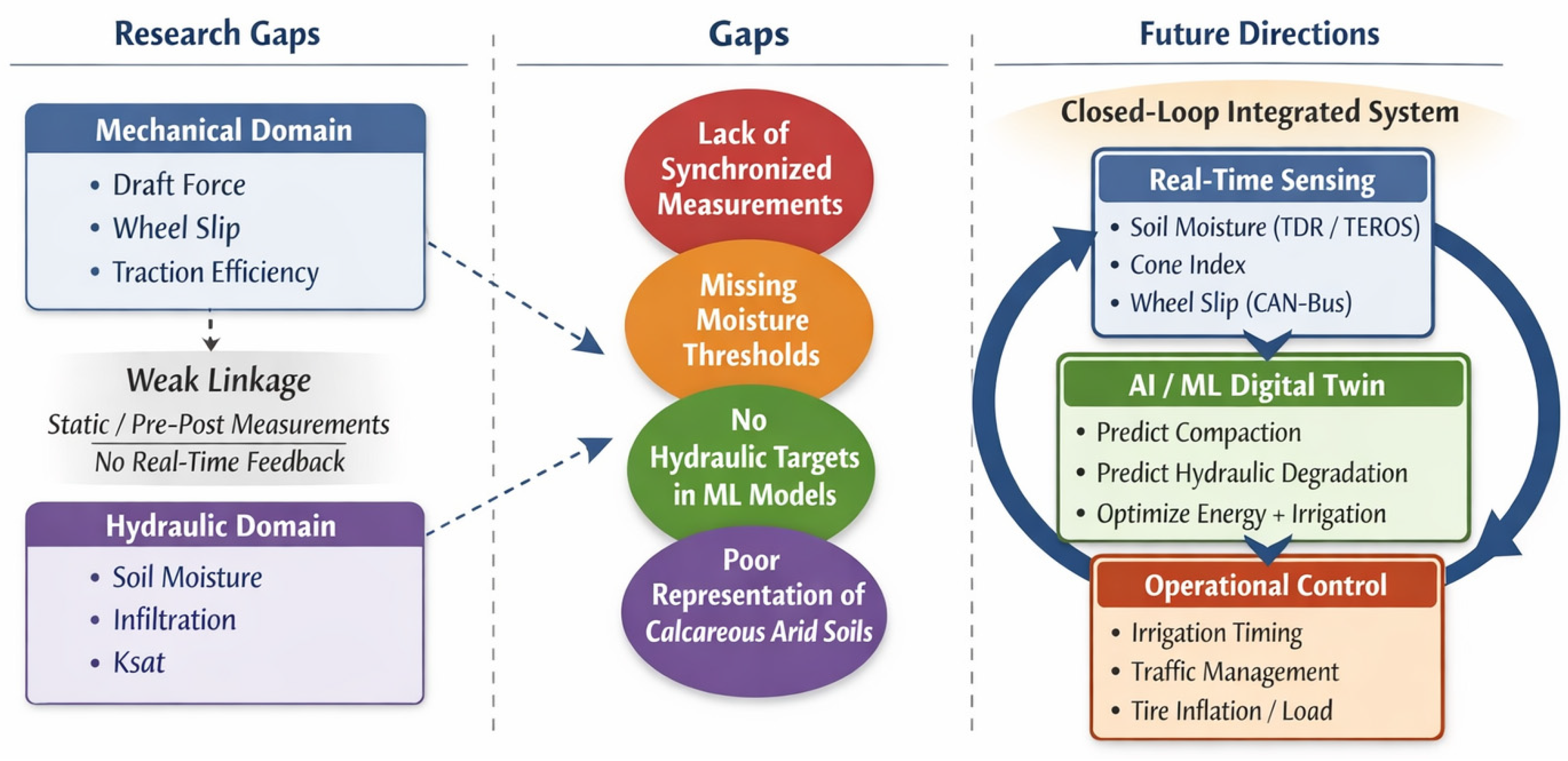
Despite these advances, significant research gaps remain. Soil physics research has traditionally emphasized hydraulic properties and water flow processes, while mechanization studies have focused primarily on traction performance and energy demand, and irrigation research has prioritized water application efficiency and uniformity. Only a limited number of studies explicitly quantify how soil physical properties simultaneously govern mechanical energy requirements and soil water dynamics within a unified analytical framework [5,6]. Furthermore, most experimental investigations have been conducted under temperate climatic conditions, whereas sandy and calcareous soils typical of arid and semi-arid regions remain poorly represented [9]. As a result, mechanization and irrigation guidelines developed for temperate systems are often transferred directly to arid environments without sufficient validation, potentially reducing their effectiveness and compromising long-term soil and water sustainability.
To address these limitations, integrated field-based research approaches are required that simultaneously measure soil physical properties, mechanical behavior, and water dynamics under real operating conditions. The combined use of soil moisture sensors, penetration resistance measurements, hydraulic conductivity tests, and real-time monitoring of wheel slip, axle load, and draft energy can provide a comprehensive understanding of soil–machine–water interactions [11,12]. Predictive models linking mechanical stresses with soil hydraulic responses can further support the development of environmentally sustainable, energy- and water-efficient mechanization strategies for arid agricultural systems, including controlled traffic systems, optimized tire selection and inflation, and irrigation scheduling based on actual soil moisture status [10,13].
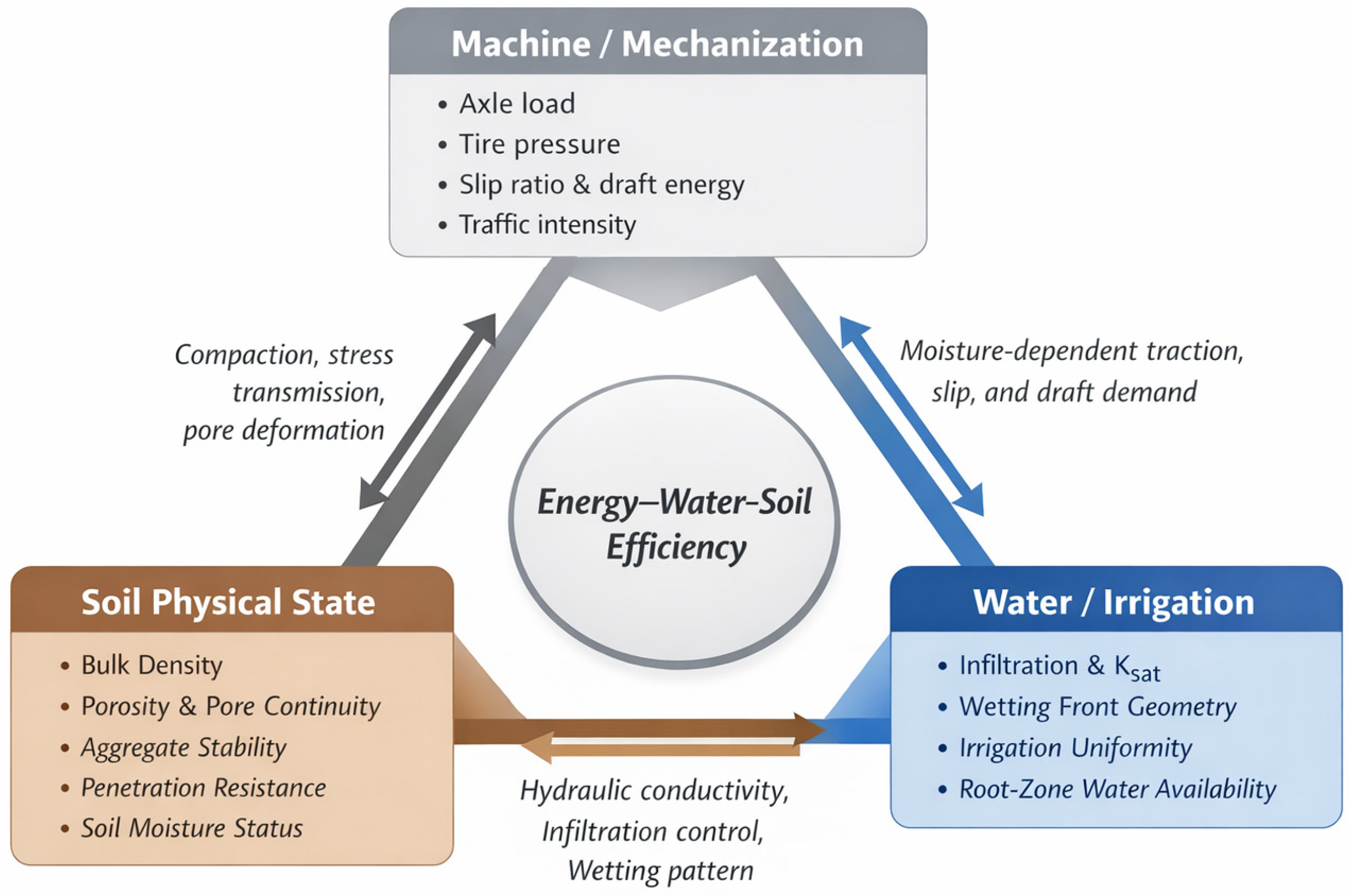
To explicitly illustrate these coupled interactions, an integrated soil–machine–water conceptual framework is proposed and presented in Figure 1. This framework highlights how machine parameters such as axle load, tire pressure, slip ratio, draft energy, and traffic intensity interact with soil physical properties including bulk density, porosity, aggregate stability, penetration resistance, and moisture status, which in turn regulate water movement, infiltration patterns, wetting-front geometry, and irrigation uniformity. These interactions form a continuous feedback loop that ultimately determines overall energy efficiency, water-use efficiency, and soil sustainability in arid agricultural systems.
Accordingly, soil physical properties should be regarded as the primary controlling factors governing both traction efficiency and irrigation performance. Mechanization and irrigation are therefore not independent engineering processes but interconnected components of a single environmental system in which soil serves as the central linking medium. Thus, the main objective of this review is to synthesize and critically evaluate recent research addressing the coupled interactions among soil physical properties, water dynamics, and agricultural machinery within the context of sustainable environmental analysis of soil and water resources in arid and semi-arid regions.

2. Method of Review

This review synthesizes recent experimental and modeling studies examining how soil physical properties influence machinery traction energy and irrigation water dynamics in arid and semi-arid environments, with emphasis on sustainable soil and water management. The literature was compiled from Scopus, Web of Science, ScienceDirect, and Google Scholar. Priority was given to peer-reviewed studies published between 2000 and 2025, while earlier seminal works were included only to clarify fundamental concepts of soil compaction, traction behavior, and soil water movement.
The search combined controlled terms and general keywords, including soil–machine interaction, soil compaction, traction efficiency, wheel slip, draft force, bulk density, cone index, hydraulic conductivity, wetting front deformation, arid soil, irrigation hydraulics, and pore deformation under stress. Studies were included when they reported measurable field, laboratory, or modeling results linking at least one mechanical process, such as traction, draft, or compaction, with a soil physical or hydraulic property. Studies without quantitative data or those outside the scope of soil mechanics and irrigation were excluded. After the screening and selection process, the final set of studies was organized into five main thematic groups:
  • Soil physical properties affecting mechanical and hydraulic behavior;
  • Traction and wheel–soil interface mechanics;
  • Draft force and energy requirements;
  • Compaction-induced hydraulic changes;
  • Integrated soil–machine–water conceptual frameworks supporting sustainable resource use.
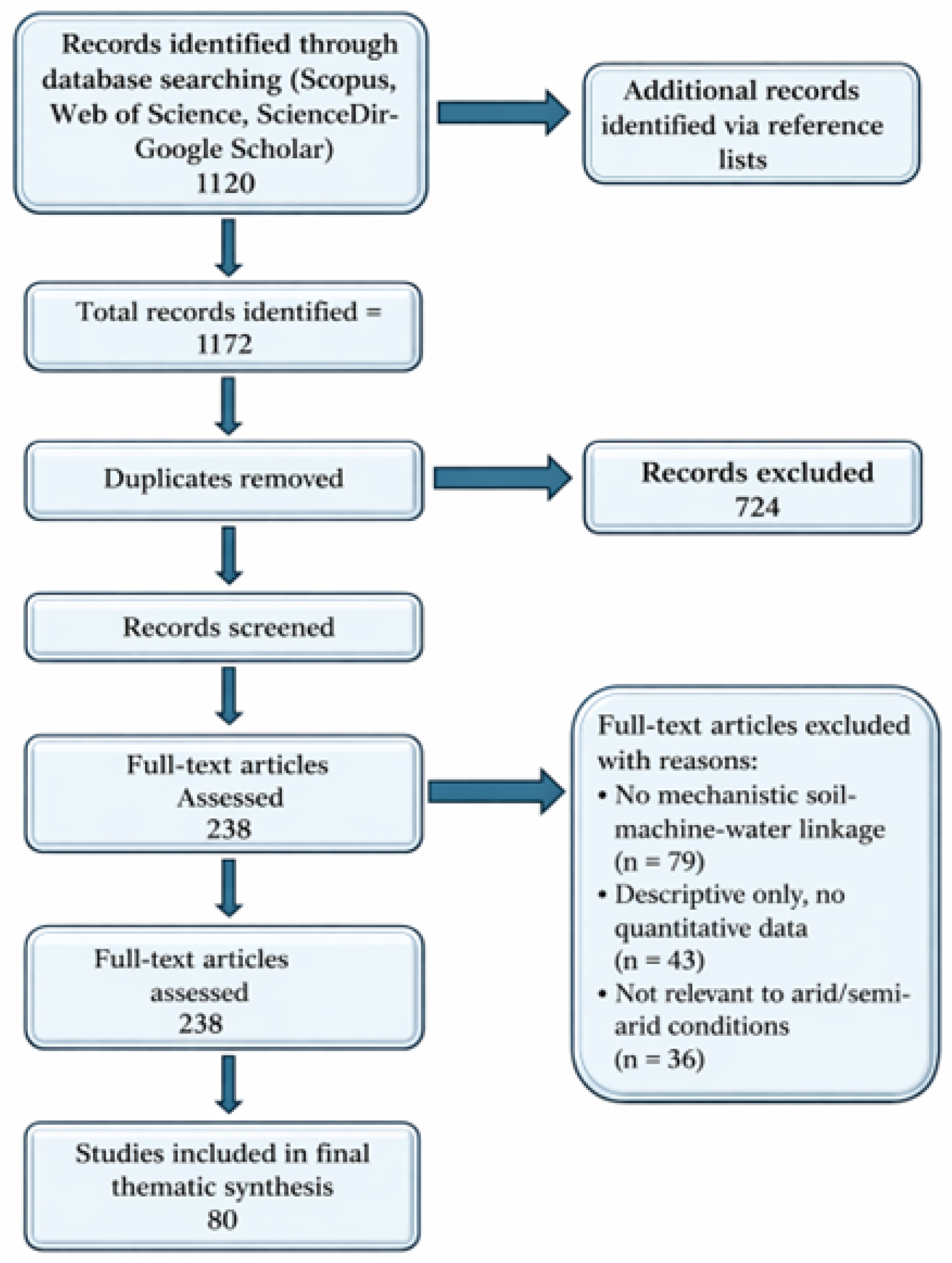
The synthesis approach relied on thematic–mechanistic integration to reveal converging patterns and gaps across the three domains. The PRISMA-style flow diagram in Figure 2 summarizes the review process.

3. Scope and Limitations of the Review

The review focuses on the interconnected mechanical and hydraulic processes that control machine traction, draft energy, and irrigation performance in arid and semi-arid agricultural systems. It places particular emphasis on mechanistic, quantitative, and model-based studies, aiming to build an integrated soil–machine–water framework that can support sustainable soil and water management. The review is based exclusively on peer-reviewed studies published between 2010 and 2025, which were systematically selected using the screening and eligibility procedure outlined in the PRISMA-style flow diagram (Figure 2). Earlier foundational works were incorporated selectively when they provided essential theoretical contributions relevant to soil compaction, traction mechanics, or hydraulic conductivity.
Several limitations must be acknowledged. First, soil–machine–water coupling is a relatively new research area, and there is still a shortage of studies measuring mechanical and hydraulic variables simultaneously under field conditions. Second, the review focuses on arid and semi-arid soil, which limit the generalizability of the findings to temperate or high-organic-matter regions. Third, variability in experimental designs, soil sampling depths, machine loading conditions, and hydraulic measurement protocols across the literature introduces inconsistencies when comparing results. Fourth, non–peer-reviewed reports, theses, and local field datasets were excluded to maintain methodological rigor.
Despite these limitations, this review provides a coherent accumulation of research and identifies crucial gaps that can support future modeling efforts, integrated mechanization–irrigation planning, and strategies for sustainable soil and water management in water-limited environments.

4. Machine–Soil–Water Interactions and Mechanization Dynamics

4.1. Soil Physical Properties Relevant to Machine–Water Performance

Soil physical properties govern the mechanical behavior of the soil mass during machinery operations and simultaneously regulate water flow, infiltration, and storage. Their combined influence is fundamental in determining how efficiently traction can be generated, how much energy is required to perform tillage, and how irrigation water can penetrate the root zone without excessive losses. Oduma’s [19] results showed that soil type affects the average efficiency of the machinery and that tillage decreased the soil water content and increased evaporation. The capacity of soil to sustain wheel loads without excessive deformation is not merely a mechanical attribute; it is directly intertwined with pore geometry, volumetric water content, structural resilience, and soil texture evolution under repeated traffic events [20]. Likewise, the geometry and continuity of macropores, which determine infiltration and wetting patterns under surface drip and SDI systems, are highly sensitive to compaction severity and moisture conditions, creating feedback interactions between mechanization energy and irrigation hydraulics [21]. This section provides a synthesis of the major soil physical variables that dominate both soil–machine and soil–water processes. These physical qualities are essential for attaining sustainable mechanical–hydraulic management by reducing energy consumption, maintaining soil structure, and improving water efficiency in arid agricultural environments.

4.1.1. Texture, Structure, and Aggregation Quality

Soil texture is the most important property that shows how much sand, silt, and clay are in the soil. This affects how easily other materials can move over it, how much area the soil has, its electrochemical properties, and how well its particles stick together and fight the weight of a wheel [22]. In arid regions, sandy soil has weak bonding between particles, very little clay coating, and a low surface area. As a result, particles mainly interact through friction rather than cohesion. This makes sandy soil fragile and very sensitive to small changes in soil moisture [23]. Even slightly wetting or drying can quickly change wheel traction and the way water moves into the soil. In contrast, clay soil forms stronger and more connected structures. However, when soil moisture increases and water films become thicker, these soil behave in a plastic way, which causes a strong increase in draft force and energy demand during tillage, especially near saturation [24].
Soil structure, defined as the arrangement of soil aggregates and pore spaces, controls how mechanical loads from wheels and implements are transferred into the soil. Well-aggregated soil can better resist shear stress caused by wheel slip and maintain continuous pore channels that allow water to flow easily [25]. Therefore, aggregate stability plays a dual role, as it improves both machine traction and water movement in the soil, directly linking mechanization performance with irrigation efficiency. When soil texture, structure, and aggregation are evaluated simultaneously, the mechanical and hydraulic response of soil becomes more predictable. Sandy soils, characterized by weak interparticle bonding and limited aggregation, often exhibit a brittle response, where slight variations in moisture content result in pronounced changes in shear strength and increased wheel slip, a condition frequently observed in arid sandy environments [23]. Conversely, soils with a higher clay fraction and continuous water films tend to undergo plastic deformation under moist conditions, as documented in [24]. Such plastic behavior is associated with higher energy demand during field operations and can restrict water movement within the soil profile. Soils with strong and stable aggregates, as described in [25], display an intermediate and more elastic response, allowing mechanical stresses to be distributed more evenly while preserving effective pathways for water transmission.

4.1.2. Bulk Density and Porosity Indicators

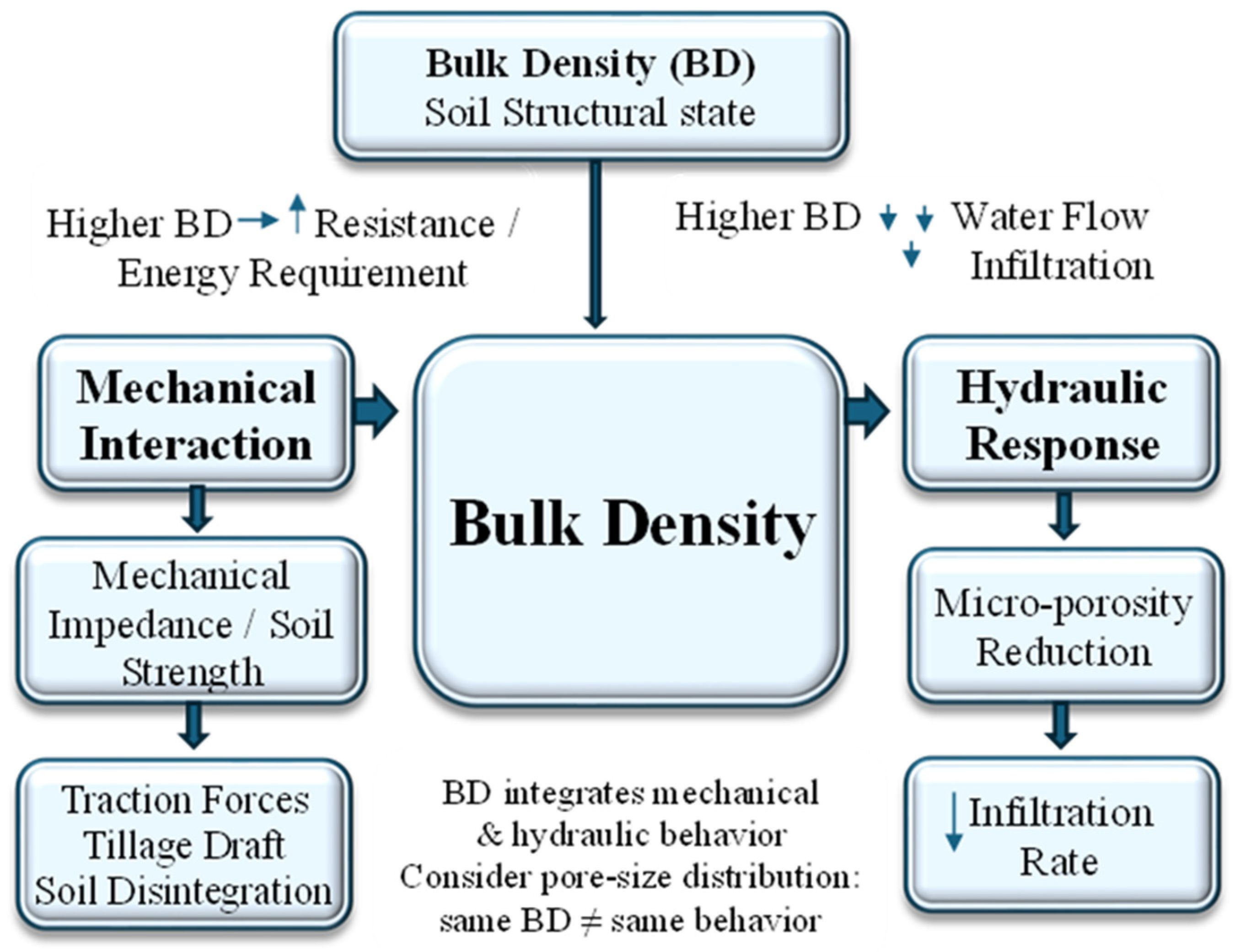
Bulk density (BD) represents the structural state of the soil and is a key indicator of both mechanical impedance and hydraulic behavior (Figure 3). An increase in BD makes the soil more resistant to wheel traffic and tillage operations, which leads to higher energy demand for traction and for soil cutting and fragmentation by implements [26]. In terms of soil water movement, higher BD reduces macropore volume, lowers saturated hydraulic conductivity (Ksat), and restricts water infiltration under surface and subsurface drip irrigation systems [27]. Consequently, BD acts not merely as a compaction index but as a Linking parameter directly linking mechanization energy and irrigation performance [8].
Research emphasizes that BD must be interpreted together with pore-size distribution, as two soils with identical BD values can exhibit fundamentally different mechanical and hydraulic behaviors depending on whether compaction occurred under wet or dry conditions [28].
Texture alone does not uniquely control compaction susceptibility or infiltration behavior. Soils with identical particle-size distribution may differ substantially in bulk density (BD), total porosity (n = 1 − BD/PD, where PD is the particle density), macroporosity, and hydraulic conductivity due to structural differences. Because traffic primarily alters pore continuity rather than particle size, both porosity and volumetric water content (θ) are incorporated alongside BD to characterize mechano-hydraulic response [29,30]. These parameters collectively determine pore connectivity and infiltration efficiency, particularly under repeated machinery traffic.
Predictive assessment of BD and porosity allows estimation of soil response under applied mechanical loads and varying moisture states. As BD rises and macropores are progressively reduced, soils shift toward higher mechanical impedance, lower shear compliance, and increased draft forces, consistent with Mwiti et al. [26]. Simultaneously, reduction in structural pore domains impairs hydraulic continuity, limiting infiltration and saturated flow, in agreement with López Rodero [27]. Soil reaching elevated BD under wetter conditions, as highlighted by Tan et al. [28], making it more susceptible to plastic deformation and disproportionately large reduced hydraulic conductivity compared with soil compacted under drier states, even if BD values are similar. This integrated view supports the concept of Ketena et al. [8] that BD acts as a linking parameter for predicting both mechanical and hydraulic soil behavior. When combined with soil porosity, it provides a practical engineering basis for scheduling mechanized operations and irrigation. This approach helps maintain soil structure, enhance water-use efficiency, and promote sustainable mechanical–hydraulic management in arid and semi-arid agricultural systems.

4.1.3. Penetration Resistance and Soil Strength Curves

Penetration resistance integrates texture, water content, soil structure, and BD into a single mechanical indicator. High penetration resistance is associated with increased draft demand, higher engine torque requirements, elevated wheel slip, and greater fuel consumption [31]. Soil strength curves, which describe how mechanical resistance varies with matric potential, have become central to precision mechanization modeling as they enable predictive mapping of “trafficable moisture content” [32]. In addition, penetration resistance has a direct effect on root elongation, which links mechanization practices to irrigation efficiency, since restricted root growth reduces the soil volume explored by roots and limits effective water uptake [33].
A predictive assessment can be made by considering the combined effects of soil texture, moisture condition, and packing structure on changes in soil strength under mechanical loading. As soil water content decreases and matric suction increases, penetration resistance rises sharply due to stronger capillary bonding between particles. This shifts soil behavior toward a more brittle state, increasing draft force requirements and wheel slip levels, in agreement with trends reported in [31]. Conversely, near field capacity, mechanical resistance decreases, but the soil transitions into a plastic response domain where deformation becomes more permanent and the strength curve flattens, as illustrated by [32].
These mechanical adjustments are directly related to hydraulic performance. Root growth becomes more constrained when soil penetration resistance rises, which lowers the plant’s capacity to draw water and may have an impact on irrigation scheduling and water-use efficiency [33]. Together, soil strength and penetration resistance curves offer a useful method of predicting how wheel traffic would impact the soil, including whether it is likely to experience brittle fractures, plastic deformation, or near-elastic reaction under various moisture levels. Predicting effects on traction efficiency and the ensuing irrigation demand is another benefit of these interactions. Using this strategy promotes sustainable mechanization and more efficient water management in dry agricultural areas. Farmers and planners can better balance irrigation needs and mechanized energy requirements by integrating soil strength and penetration resistance into field-level decision-making. This strengthens the concepts of sustainable soil and water management in arid climates.

4.1.4. Soil Moisture Range: Field Capacity–Plastic Limit–Dry Strength

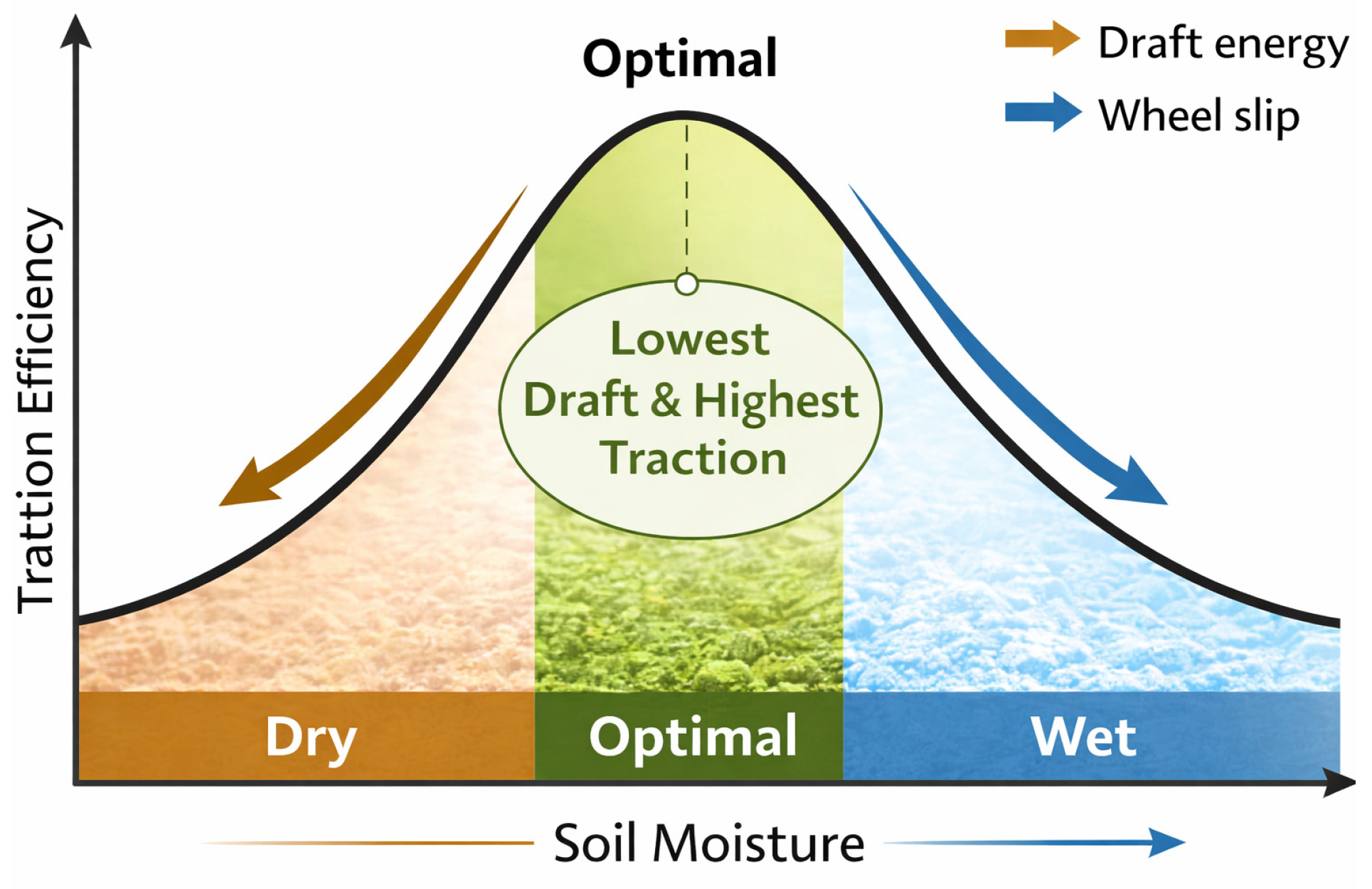
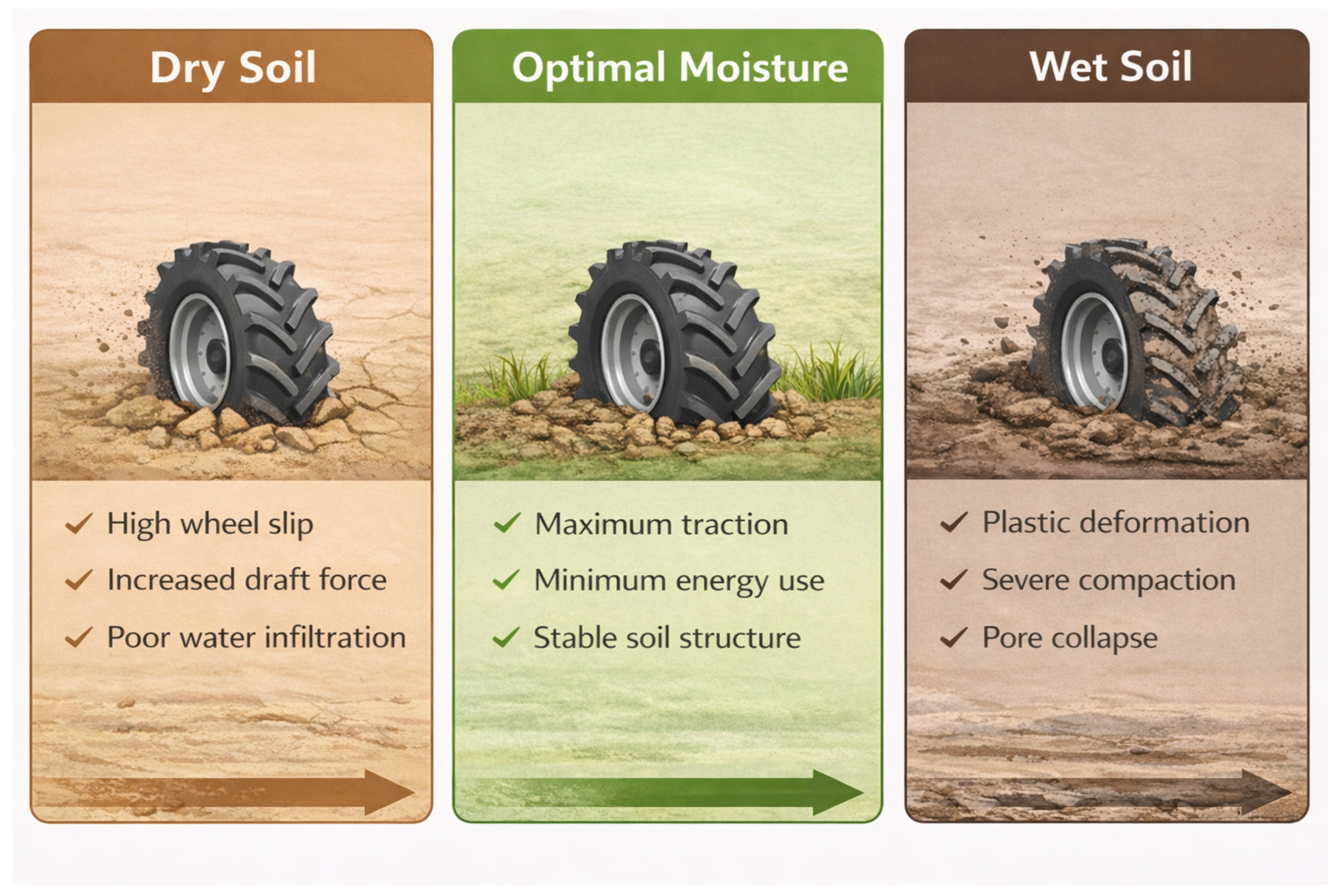
Soil moisture is the main changing factor that controls the mechanical behavior of soil aggregates. It determines whether aggregates deform in a plastic or elastic way or fail through brittle breakage. Predictive models show that draft energy reaches its lowest value near the plastic limit, while it increases rapidly under very dry or fully saturated conditions [34]. Recent research has applied digital soil mapping integrated with predictive moisture models to better capture spatial and temporal variability of soil water content [35]. This approach allows more precise planning of mechanized operations and irrigation scheduling by identifying areas within the optimal operational moisture range, thereby enhancing traction efficiency, reducing energy losses, and minimizing soil compaction. When soil moisture increases from the plastic limit toward field capacity, aggregates tend to deform in a ductile manner. This behavior reduces energy losses during tillage but can increase the risk of compaction when heavy machinery is used. In contrast, under dry conditions near the plastic limit or below the wilting point, aggregates behave in a brittle way, which increases soil cracking and the formation of zones with high mechanical resistance. To explicitly conceptualize these effects, soil moisture status can be divided into Dry, Optimal, and Wet conditions, where traction efficiency, draft energy, and soil structural response vary accordingly (Figure 4).
Simulations of soil moisture dynamics indicate that these changes strongly narrow the suitable moisture range for effective tillage. They also reveal uneven responses of soil to moisture conditions, where wet soil may unexpectedly stick to tillage tools, while dry soil may require much higher draft forces than expected. In addition, predictive models linking soil water retention with mechanical resistance show that water movement in the soil is highly sensitive to small changes in moisture content. Water infiltration and redistribution paths can change abruptly between field capacity and dry strength limits, which directly affects water availability in the root zone [37,38].
In arid and semi-arid agroecosystems, extreme heat stress substantially accelerates the transition of soil from an optimal plastic state toward dry and brittle conditions. Elevated air temperature and intensified solar radiation increase surface evaporation rates and enhance soil moisture depletion following irrigation or rainfall events, thereby shortening the duration during which soil water content remains within the mechanically favorable range between field capacity and plastic limit. Studies in dryland environments have shown that higher thermal loads can rapidly reduce near-surface volumetric water content, leading to increased soil strength and penetration resistance within a narrow time window after irrigation [39,40]. As soil dries beyond the plastic limit under high-temperature regimes, matric suction intensifies and interparticle bonding forces strengthen, resulting in a brittle structural response under mechanical loading. Empirical evidence further indicates that soil mechanical resistance and traction demand increase nonlinearly as moisture content declines under hot, evaporative conditions, particularly in fine-textured soils common to irrigated arid regions [41,42].
This thermally driven narrowing of the operational moisture window increases the likelihood that field operations are conducted either under excessively dry conditions, characterized by elevated draft force and fuel consumption, or under marginally wet states where structural deformation risk remains significant. To increase water-use efficiency, prevent soil structural damage, and improve energy efficiency, irrigation and mechanized operations must therefore be carefully synchronized using this predictive understanding of temperature–moisture interactions. When tillage and irrigation are scheduled within the optimal soil moisture range, draft energy requirements can be reduced, soil porosity can be preserved, and continuous water flow pathways can be maintained. In dry and semi-arid agricultural systems, this coordinated mechanical–hydraulic management directly supports sustainable soil and water use. Incorporating dynamic soil moisture thresholds into irrigation planning and mechanization scheduling thus becomes a fundamental component of sustainable management, ensuring structural stability, minimizing energy losses, and enhancing water-use efficiency under climate-stressed dryland conditions.

4.1.5. Variation Under Arid and Semi-Arid Climates

Arid soil shows unique physical behaviors because of their sandy texture, weak structure, low organic matter content, and high temperature fluctuations. Even small changes in gravimetric water content, as little as 3%, can significantly affect soil mechanical responses, altering wheel slip and draft requirements [43]. The low content of natural binding agents, such as organic matter, makes these soil highly prone to permanent structural collapse under axle loads, which can quickly reduce water infiltration and disrupt wetting patterns under drip irrigation [44].
Simulation-based predictions of operational scenarios suggest that mechanization strategies such as controlled traffic farming, low ground-pressure tires, and shallow operational depths must be carefully synchronized with irrigation schedules to avoid soil moisture intervals that predispose soil to compaction [45]. Implementing these strategies allows both energy-efficient tillage and optimized water application, minimizing long-term degradation of soil physical properties. These insights highlight the need to adjust machinery operation and irrigation practices to the specific conditions of arid and semi-arid soil. Adjusting tillage schedules, managing wheel loads, and timing irrigation based on how the soil physically responds can save energy, preserve soil structure, and improve water-use efficiency. This approach directly supports soil and water conservation, especially in resource-limited environments. By taking local climate conditions and soil behavior into account, field planning can better balance the intensity of mechanization with soil strength and irrigation performance. In doing so, it promotes more sustainable mechanical–hydraulic management by aligning machine operations with soil resilience and enhancing water-use efficiency in arid and semi-arid agricultural systems.

4.2. Soil–Machine Interaction Mechanics

Soil–machine interaction is a multifunctional mechanical coupling domain where traction generation, soil deformation, load transfer, stress dissipation, and hydraulic redistribution occur simultaneously under dynamic operating conditions. The efficiency of power transmission into effective drawbar work, fuel consumption rates, soil load-bearing capacity, soil structural evolution, pore network continuity, and long-term field-scale hydrological efficiency is fundamentally controlled by soil–machine interactions. Field traffic generated by tractors, sprayers, harvesters, and tillage implements induce mechanical stresses that alter soil physical and mechanical properties. Mechanistic studies consistently demonstrate that optimal mechanization performance is attained only when machine configuration parameters including axle load, tire inflation pressure, soil–tire contact geometry, and implement design are appropriately synchronized with the prevailing soil mechanical state, particularly soil moisture content, BD, penetration resistance, and aggregate structure stability [46,47,48].
Effective management of soil–machine interactions is a key determinant of sustainable soil and water conservation. Inappropriate mechanization practices can have significances beyond higher fuel use. They often lead to increased soil compaction, a reduction in both saturated and unsaturated hydraulic conductivity, and reduced water availability within the root zone. Therefore, aligning mechanization operations with proper irrigation scheduling and continuous monitoring of soil conditions is important. Such combination helps optimize energy efficiency, maintain soil structural stability, and enhance water infiltration.
Finally, contributing to the long-term sustainability of agricultural systems in arid and semi-arid regions.

4.2.1. Traction and Wheel–Soil Interface Mechanics

Soil–machine traction develops when tires or tracks mobilize sufficient soil shear resistance to counteract applied circumferential forces. The traction coefficient is strongly governed by the shear strength of soil aggregates, which is primarily controlled by soil moisture content, clay fraction, and compaction state [49]. At intermediate matric suction, soil aggregates undergo predominantly elastic deformation with limited inter-aggregate slippage, leading to the formation of stable shear planes and maximum traction efficiency [50]. Under near-saturated conditions, cohesive inter-particle bonds weaken, soil plasticity increases, and wheel slip frequently exceeds 25–35% in sandy loam and loam soils [51]. Conversely, under extremely dry conditions, aggregate breakdown into non-cohesive particles reduces the effective soil–tire contact area, promoting micro-rutting and vibration-induced energy dissipation [52].
Moisture range for energy-efficient mechanized operations, which also coincides with minimal soil structural disturbance and limited degradation of hydraulic conductivity. The bell-shaped relationship between soil moisture content and traction efficiency, wheel slip, and draft energy is conceptually illustrated in Figure 5.
Identification of these optimal moisture contents enables synchronization of tillage operations with irrigation scheduling to minimize fuel consumption, preserve macropore continuity, and maintain root-zone water availability. Operating within this optimal range supports sustainable soil and water management in arid agroecosystems by reducing unnecessary energy expenditure while maintaining effective mechanical and hydraulic soil function.

4.2.2. Slip Ratio vs. Contact Pressure vs. Moisture Content

Slip ratio is one of the most sensitive indicators of soil–machine synchronization, as it reflects the dynamic balance between applied traction and soil resistance, which is strongly governed by soil moisture through matric suction, affecting both undrained shear strength and apparent cohesion [54]. Increasing the wheel contact area by lowering tire inflation pressure reduces contact stress, enlarges the gross contact patch, and simultaneously decreases rut depth [55].
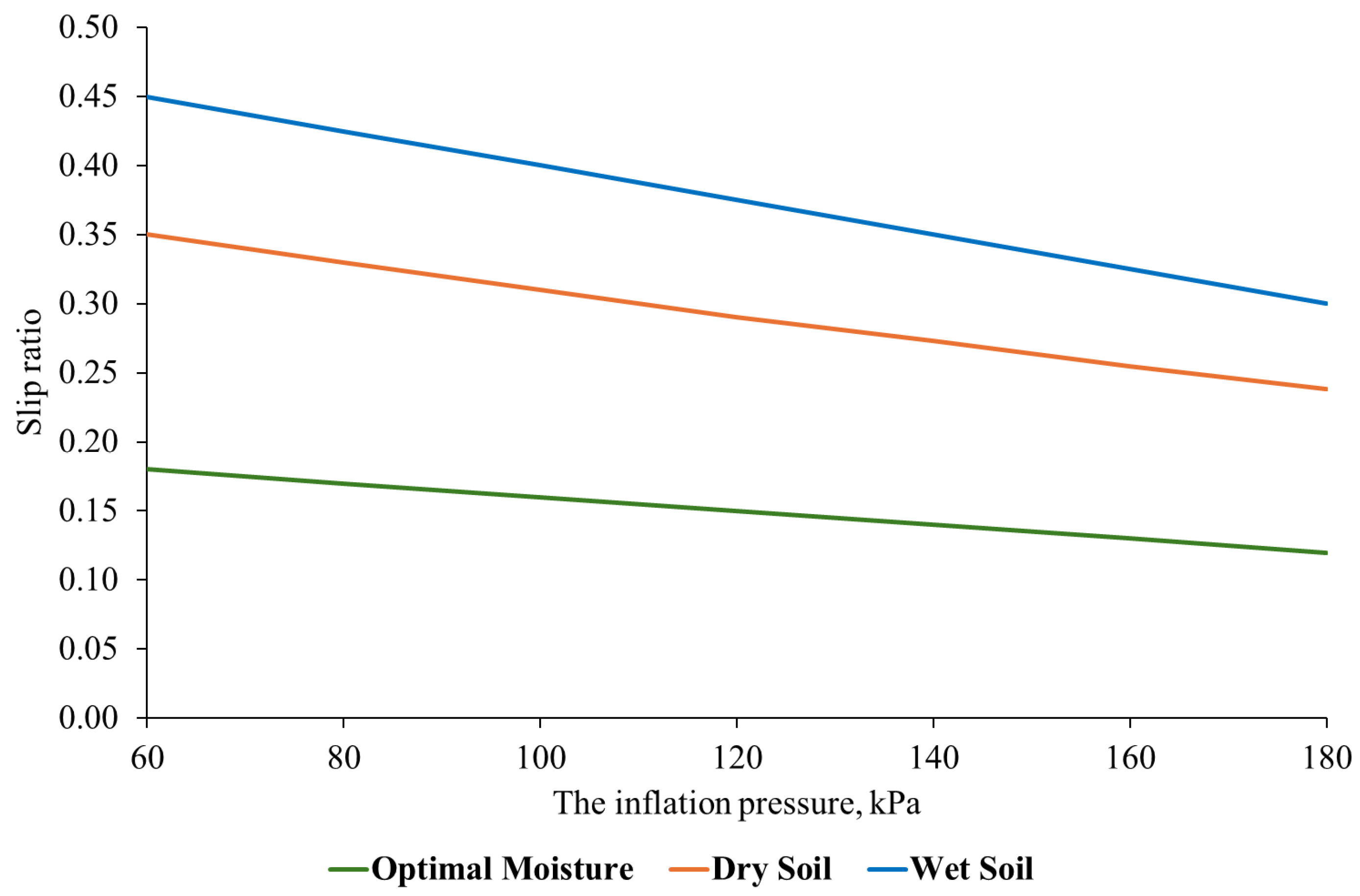
Field telemetry from European controlled experiments demonstrates that reducing inflation from 140 kPa to 85 kPa lowered slip by 9–18% and fuel consumption by 6–14% under clay loam soil [56]. Conversely, high inflation concentrates stress, accelerates pore collapse, and increases cone index growth rate in subsequent passes [57]. Additionally, slip shows a substantial correlation with irrigation cycles and precipitation timing, especially in arid areas where soil mechanical strength varies on a weekly basis [58].
The relationship between tire pressure, moisture state, and slip reaction is synthetically illustrated in Figure 6, which demonstrates how lower inflation consistently reduces slip in dry, ideal, and wet soil conditions. Mechanized farms can minimize fuel consumption, prevent soil compaction, and preserve hydraulic continuity by actively controlling slip through tire inflation, axle load, and operational scheduling. This method directly supports sustainable soil and water management in arid and semi-arid regions. By effectively controlling wheel slip, mechanized energy requirements can be balanced with soil hydraulic performance, improving operational efficiency while maintaining soil–water functionality under arid conditions.
Soil physical parameters, including texture, structure, BD, porosity, and water content, directly govern shear strength and frictional resistance at the wheel–soil interface. These factors consequently determine the draft power requirements and wheel slip ratio during mechanized operations. Wheel slip (s) can be calculated as, Equation (1).
s = v t v a v t
where vt is the theoretical velocity and va is the actual velocity. Any reduction in frictional resistance caused by excessive soil moisture or structural degradation increases the draft energy demand and risk of slippage [59]. Therefore, variations in soil compaction and surface roughness resulting from these physical properties directly control the mechanical performance of agricultural machinery.
This friction–slip relationship is also closely linked to tire inflation pressure and the resulting tire–soil contact mechanics, which directly influence draft power and soil deformation during field operations. Quantitative investigations indicate that tire inflation pressure does not monotonically reduce draft power because both excessive and insufficient inflation may increase energy demand. Under constant axle load and soil water content, reducing tire inflation pressure enlarges the tire–soil contact area but does not always produce a proportional reduction in rut depth. Experimental studies reported that decreasing tire inflation from approximately 160 kPa to 80–90 kPa increased the contact area by about 20–30%, whereas rut depth decreased only by 5–12% under similar ballast conditions. At the same time, extremely low inflation pressures may increase rolling resistance and draft power by approximately 8–15% because of excessive tire deformation and internal energy dissipation. Conversely, high inflation pressures (>180 kPa) reduce the contact area and concentrate stress at the soil surface, which can increase draft requirements by 10–20% due to higher sinkage resistance and soil compaction. These findings demonstrate that optimal traction efficiency occurs within an intermediate inflation pressure range that balances contact area, soil deformation, and rolling resistance, highlighting the importance of quantitative tire pressure management in mechanized agricultural systems [41,59,60,61].

4.2.3. Draft Power Requirements for Tillage Tools

Draft force represents the vector sum of soil shear rupture, plastic displacement of mass, adhesion resistance, and friction against the implement surface. Soil moisture exerts a non-linear influence on draft; even a 4–6% change in gravimetric moisture can double draft for cohesive soil [62]. Dry soil requires brittle fracture that is energetically expensive, while wet soil behave as viscous plastic media, making the intermediate “friable” region the only favorable content [63,64]. Recent CFDDEM hybrid simulations confirm that the cohesion–moisture–draft relationship follows a non-linear, asymptotic shape regardless of tillage geometry [65]. By planning tillage within ideal energy ranges based on predictive modeling of draft requirements under varying soil wetness. Fuel consumption can be reduced while preserving soil structure and reducing compaction. This evidence highlights the fundamental relationship between irrigation scheduling and tillage activities. For the reason that poorly scheduled mechanization in relation to soil moisture can simultaneously increase energy consumption, deteriorate soil structure, and decrease water infiltration efficiency [66]. Gong et al. [66] demonstrated that Machine learning models can effectively estimate tractor performance under varying soil conditions using key soil physical properties such as moisture content, cone index, and particle composition. Among the tested algorithms, CatBoost showed the highest predictive accuracy for engine torque, power, slip ratio, and axle power, indicating that machine learning approaches can reduce reliance on extensive field testing for evaluating tractor performance.
Optimizing the synchronization between tillage timing and irrigation cycles represents a critical strategy for sustainable energy use, soil conservation, and water-efficient management in arid agricultural systems. In arid environments, integrated and sustainable mechanization-irrigation practices are enhanced by the simultaneous optimization of energy consumption and soil hydraulic performance. These are made possible by predictive management of draft force and power requirements as a function of soil moisture contents.

4.2.4. Soil Compaction Induced by Traffic: Interaction Between Axle Load and Soil Moisture

In this section, the interaction between axle load and soil moisture refers to the combined influence of traffic load and the soil’s moisture condition on the degree of soil compaction, recognizing that the soil’s capacity to withstand mechanical stress varies significantly with its moisture status.
Soil compaction is increasingly recognized as a mechanization-linked hydrological and energy risk. The capacity of soil to bear axle loads is strongly moisture-dependent; under wetter conditions, the same 9-ton axle load can induce a three- to six-fold greater increase in BD compared with drier conditions [20]. Saffih-Hdadi et al. [67] showed that soil compaction can be effectively predicted using models based on soil mechanical parameters and physical properties such as water content, BD, and texture.
Soil compaction not only increases the mechanical energy demand of subsequent field operations but also disrupts macropore continuity, restricts water infiltration, enhances surface runoff, accelerates evaporative losses through shallow water lensing, and limits effective rooting depth [68]. House et al. [69] showed the effect of traffic on the performance of furrow irrigation, reporting variation in irrigation performance as a response to soil compaction caused by traffic.
Even after corrective tillage interventions, long-term field experiments show that legacy compaction effects can raise fuel consumption by roughly 5–12% in subsequent operations [70]. By recognizing compaction-prone areas through predictive assessment of the relationship between axle load and soil moisture status, proactive traffic management and targeted mitigation techniques become possible.
Soil compaction should therefore be viewed not merely as an agronomic limitation, but as an interactive process linking energy use, irrigation performance, and soil physical behavior. This interaction reflects the need to coordinate mechanization planning with water management strategies to ensure sustainable resource use in arid and semi-arid farming systems [71]. Actively managing traffic-induced compaction can improve the energy efficiency of mechanized operations while maintaining soil hydraulic properties, thereby supporting long-term soil and water conservation in arid environments.

4.2.5. Controlled Traffic Farming (CTF) Concept and Evidence

Controlled Traffic Farming (CTF) is a mechanization strategy that confines wheel passes to permanent lanes, spatially segregating trafficked and non-trafficked zones. By concentrating machinery traffic on designated lanes, CTF improves traction stability, limits seasonal variations in wheel slip, and protects the structural condition of non-trafficked soil sections. As a result, soil functions such as hydraulic conductivity, porosity, and oxygen diffusion are preserved, which supports root development and improves irrigation efficiency [72].
Field treats carried out in Australia, Denmark, and Saudi Arabia show that, the adoption of CTF can reduce fuel consumption by 12–22%, increase irrigation water productivity by 9–17%, and improve traction efficiency by 15–28% when compared with conventional random traffic systems [73]. Moreover, predictive modeling of CTF performance helps optimize traffic lane placement and manage traffic intensity under varying soil and climatic conditions, leading to further improvements in both energy and water use efficiency. CTF signifies a highly integrated approach that links mechanization, soil hydrology, and energy management to support sustainable soil and water use while lowering CO2-equivalent emissions per unit of harvested yield. It’s compatible with wider sustainability objectives, particularly in the context of post-COP28 commitments, highlights the role of CTF as a strategic practice for arid and semi-arid agricultural systems [74]. By restricting wheel traffic and preserving soil structure, CTF enhances energy efficiency, increases water-use productivity, and contributes to long-term soil conservation in arid farming environments.

4.3. Soil–Water Dynamics Relevant to Traction and Draft Energy

Soil–water dynamics represent a key interface within the soil–machine–water system, where soil physical integrity directly controls water infiltration, redistribution, retention, and plant-available water under mechanized field operations. In arid and semi-arid regions, soils are highly sensitive to structural degradation from wheel traffic and tillage, with even minor increases in BD or disruptions in macropore continuity causing significant impacts on hydraulic behavior [75]. Mechanical disturbances from agricultural machinery alter pore size distribution, tortuosity, and connectivity, affecting both saturated and unsaturated hydraulic conductivity, lateral flow pathways, and wetting front geometry [76]. Thus, water movement in these soils is closely linked to mechanical stress, connecting traffic-induced compaction not only to irrigation energy requirements but also to the long-term sustainability of crop water management in arid agricultural systems [77].

4.3.1. Infiltration Mechanics Under Variable Compaction

Infiltration in arid and semi-arid soils is largely controlled by macropore networks, which are highly susceptible to collapse under mechanical stress. Empirical studies show that repeated wheel traffic can reduce vertical infiltration rates by 40–60% due to the closure of pores larger than 50 μm [78], often producing an exponential decline in water penetration [79]. This compaction redirects water laterally along dense subsurface layers, causing localized saturation beneath wheel tracks while adjacent non-trafficked areas remain drier, creating significant spatial heterogeneity in root-zone moisture. Such variability poses challenges for precision irrigation, as sensors in non-compacted zones may overestimate water availability for crops growing within compacted areas [12]. Field evidence indicates that restoring infiltration in compacted soils typically requires mechanical interventions, such as subsoiling, or repeated wetting–drying cycles to re-establish macropore continuity [80]. Therefore, predictive modeling of infiltration under varying compaction levels can guide optimized irrigation scheduling, enable simultaneous control of mechanical energy use and water distribution efficiency, and support sustainable soil–water management in arid agricultural systems.

4.3.2. Hydraulic Conductivity and Pore Deformation Under Stress

Water flow and mechanical soil stress are directly connected with saturated hydraulic conductivity (Ksat). Due to the vulnerability of the biggest pores, it decreases dramatically with compaction intensity [77]. Even under moderate traffic intensity, coarse-textured desert soils with low organic matter content and minimal clay fraction exhibit pronounced reductions in saturated hydraulic conductivity. In such soils, compaction not only reduces the magnitude of Ksat but also induces marked anisotropy in hydraulic behavior, where horizontal flow may increase along shear planes generated by wheel slip, while vertical conductivity is substantially diminished [81]. This directional shift in water movement alters irrigation dynamics in drip and subsurface drip systems, frequently producing shallower and wider wetting bulbs that enhance surface evaporation while simultaneously reducing deep percolation losses [82]. Integrated field measurements that combine cone index mapping with double ring infiltrometer tests have proven effective for quantifying changes in Ksat under varying mechanical loading conditions and traffic intensities [65].
To achieve uniform soil moisture distribution and minimize energy losses, irrigation system design can be supported by predictive models that explicitly relate saturated hydraulic conductivity to compaction severity. Such models are particularly valuable in arid and semi-arid agricultural systems, where efficient coordination of irrigation and mechanization directly underpins sustainable water use, reduced fuel consumption, and soil conservation. By predicting zones of reduced hydraulic conductivity, farm managers can strategically adjust traffic patterns, tillage timing, and irrigation application rates within an integrated soil–machine–water framework. This approach reduces unnecessary energy expenditure, improves water distribution efficiency, and preserves soil structural integrity. In arid and semi-arid environments, linking hydraulic conductivity dynamics with soil compaction processes therefore enables sustainable mechanization planning, enhances irrigation uniformity, lowers energy demand, and maintains long-term soil health.
Under warming conditions, however, hydraulic resilience becomes increasingly sensitive to atmospheric evaporative demand. Elevated vapor pressure deficit (VPD) intensifies surface evaporation and upward capillary flux, thereby compounding the hydraulic constraints imposed by compaction-induced reductions in saturated hydraulic conductivity. When surface or subsurface layers are compacted, vertical percolation is restricted and transient shallow water lensing may develop above denser horizons. High VPD accelerates moisture depletion in the upper profile while deeper layers remain partially hydraulically disconnected, reducing effective infiltration efficiency and increasing irrigation frequency requirements. Recent studies demonstrate that rising evaporative demand under climate warming exacerbates soil drying dynamics, alters pore water distribution, and reduces the soil’s buffering capacity against hydraulic stress [83,84,85,86]. Consequently, the interaction between compaction and elevated VPD creates a dual mechanical–atmospheric stress regime that narrows the functional hydraulic window, increases corrective energy demand, and further challenges sustainable water management in arid agricultural systems.

4.3.3. Wetting Front Deformation Under Mechanical Disturbance

The wetting front represents a highly responsive indicator of the soil hydraulic behavior under mechanical loading. In non-compacted sandy soils, wetting fronts commonly develop near-spherical shapes governed by capillary action and gravitational forces. Traffic-induced compaction modifies this behavior, leading to flattened, lens-like, or laterally stretched wetting fronts [87]. Advanced imaging methods, such as X-ray computed tomography (CT) and electrical resistivity tomography (ERT), have shown that compacted wheel tracks can divert infiltration laterally, creating non-uniform water distribution within the root zone [88]. This deformation increases the complexity of irrigation management and often requires adjustments in emitter location, spacing, or application timing to ensure uniform soil wetting and effective crop water uptake. From a sustainability standpoint, reliable prediction of wetting front deformation is essential because it directly affects water-use efficiency and irrigation-related energy consumption. Predictive modeling can account for lateral water movement in compacted areas and guide precise emitter placement, thereby improving water delivery efficiency, reducing losses, and lowering pumping energy demand. Combining mechanical and hydraulic evaluations allows farm managers to plan irrigation schedules that sustain favorable soil moisture patterns while avoiding localized compaction. This integrated approach supports healthy root development, stabilizes crop productivity, and reduces both water and fuel use. Consequently, effective prediction and control of wetting front deformation under mechanical stress contribute to sustainable mechanical–hydraulic management by promoting efficient water distribution, preserving soil structural condition, and minimizing overall energy requirements

4.3.4. Air Entry Value, Suction, and Soil Strength Correlation

The soil air entry value, defined as the matric potential at which air begins to replace water in pores, is strongly affected by compaction [89]. The air-entry potential increases with soil strength, necessitating larger ponding pressures to start infiltration. In both sandy and loamy soil, recent research shows a nearly linear relationship between cone index readings and air entrance values [90]. Because mechanical data can be used as stand-ins for hydrological behavior, this relationship offers a useful diagnostic link. Managers can anticipate the start of infiltration in compacted zones and adjust irrigation scheduling by keeping an eye on cone index dynamics [91]. Predictive monitoring using cone index trends can forecast infiltration initiation and prevent under- or over-irrigation in sensitive zones. Monitoring air entry values and their correlation with soil strength provides a predictive tool for sustainable soil–water management, optimizing irrigation timing while reducing energy and water losses under arid conditions.

4.3.5. Impacts on Irrigation Uniformity and Energy–Water Coupling

Soil compaction influences both irrigation uniformity and energy performance. In drip irrigation systems, compaction increases soil resistance, requiring higher operating pressures to sustain uniform emitter discharge [92]. For surface irrigation, reduced infiltration opportunity time under compacted conditions promotes runoff and lowers uniformity coefficients [93]. Sprinkler systems are particularly sensitive, as uneven infiltration in compacted zones leads to under-irrigation and crop stress [94]. Field investigations in arid environments indicate that soil compaction may decrease overall irrigation efficiency by 10–35%, depending on compaction intensity and irrigation method [95]. In addition, the mechanical energy required to overcome increased soil strength during tillage indirectly raises irrigation energy demand, highlighting the close energy–water interaction that underpins sustainable agricultural management [77].

4.3.6. Mitigation Strategies for Coupled Soil–Water Degradation

Effective mitigation of compaction-related degradation of hydraulic properties relies on maintaining or restoring pore connectivity. Controlled traffic farming (CTF) confines wheel paths to permanent lanes, preserving non-trafficked zones with low BD and high infiltration [94]. Organic amendments enhance aggregate stability and elasticity, allowing soil to resist and recover from compression. Subsoiling under dry conditions reopens collapsed macropores and restores vertical conductivity [95,96]. Furthermore, the integration of real-time soil moisture monitoring, penetrometer feedback, and machine learning models enables predictive management of field operations to avoid hydraulic risk zones [97]. Such predictive strategies allow identification of high-risk compaction areas and dynamic adjustment of mechanized operations, thereby maintaining optimal soil water distribution while enhancing energy efficiency. These approaches demonstrate that soil–machine–water management can be treated as a coordinated engineering problem, in which mechanical performance, hydraulic behavior, and energy demand are simultaneously optimized rather than addressed independently.
Soil compaction affects most hydraulic processes important for agricultural performance, such as infiltration, saturated hydraulic conductivity, water movement in the soil, air entry, and irrigation uniformity. As a result, there is a clear link between soil structure, irrigation efficiency, and the energy required for farm machinery. These responses show that soil hydraulic behavior should not be considered separately, but as a combined effect of mechanical loading, soil moisture, and pore structure. The soil moisture conditions referred to as dry, optimal, and wet in Table 1 follow the ranges reported in the cited literature for arid and semi-arid soils. Table 1 presents typical quantitative ranges showing how soil moisture influences traction efficiency, slip ratio, draft force, cone index, and saturated hydraulic conductivity under arid and semi-arid conditions, and provides a practical basis for the mitigation measures discussed in this section.
Accordingly, sustainable mitigation strategies such as controlled traffic farming, organic amendments, subsoiling, and predictive moisture-based machine scheduling provide not only physical restoration of soil hydraulic function but also long-term improvements in resource-use efficiency. Moving toward integrated soil–machine–water management frameworks can help arid farming systems achieve higher levels of environmental performance, ensuring that mechanization and irrigation practices jointly contribute to soil conservation and agricultural sustainability. Implementing mitigation strategies such as CTF, organic amendments, subsoiling, and predictive scheduling therefore reinforces sustainable mechanical–hydraulic management by restoring soil hydraulic function, optimizing energy and water use, and enhancing long-term soil resilience in arid agricultural environments.

4.4. Integrated Conceptual Framework of the Soil–Machine–Water System

The soil–machine–water system constitutes a unified and dynamically interacting continuum in which soil physical properties, mechanical traction behavior, and irrigation hydraulics jointly determine field-scale performance. Recent evidence indicates that mechanization and irrigation should not be treated separately. Mechanical energy losses, reflected in wheel slip, excessive draft, and reduced traction, directly contribute to soil structural degradation, disrupting pore connectivity and lowering infiltration and hydraulic performance [95]. In this context, soil acts both as a load-bearing medium and a porous hydrological matrix, creating a tightly coupled feedback between energy use, soil structural dynamics, and water-use efficiency [77].

4.4.1. The Soil Physical State as the Coupling Node

The soil physical condition represented by BD, aggregate stability, moisture status, and structural integrity acts as the primary coupling point between irrigation efficiency and mechanization performance. Maintaining soil moisture within an optimal range enhances shear strength, limits wheel slip, and reduces draft demand, while preserving macropore continuity and effective water movement [100]. When moisture exceeds field capacity, soil becomes highly susceptible to compaction, leading to increased BD, reduced macropore connectivity, and lower saturated hydraulic conductivity (Ksat) [42]. In contrast, excessively dry soil behaves in a brittle manner, reducing wheel–soil contact and traction. Field evidence from arid loamy and sandy soils shows that cone index values above 2 MPa are associated with marked declines in Ksat and irrigation uniformity [63]. These results confirm that soil structural integrity governs not only mechanical performance but also hydraulic behavior and water-use efficiency. Consequently, predictive assessment of soil physical states can define critical moisture thresholds, supporting proactive mechanized operations that conserve soil structure, improve irrigation performance, and enable sustainable mechanical–hydraulic management in arid agricultural systems.

4.4.2. Traction-Induced Soil Compaction and Its Impact on Infiltration

The relationship between mechanical traction and water inefficiency can be described as follows: high wheel slip leads to increased rutting, which raises soil compaction, reduces infiltration, lowers root-zone moisture uniformity, and subsequently increases draft energy in later operations. Field studies show that wheel slip exceeding 20% can increase compaction severity by 50–90%, resulting in 30–60% reductions in infiltration rates depending on soil texture, organic matter content, and aggregate stability [42]. This demonstrates that suboptimal traction directly impairs irrigation efficiency, generating combined energy and water losses.
Predictive simulations of the traction–compaction–infiltration continuum allow real-time adjustment of tire pressure, machine ballast, and operational speed to minimize soil structural damage and energy consumption. Incorporating these mechanistic insights into mechanization planning enables proactive modification of operational parameters to prevent excessive soil degradation [101]. Felix [102] reported that tractor ploughing significantly increased soil compaction in sandy loam soils, leading to higher BD, reduced hydraulic conductivity, and lower infiltration in tyre passage areas compared with ploughed and unplugged zones. The results indicate that tractor traffic negatively affects soil physical and hydraulic properties, highlighting the importance of minimizing the area impacted by machinery to protect soil water movement and crop growth. Managing this traction–compaction–infiltration relationship enhances energy efficiency, preserves soil structure, and maintains irrigation effectiveness in arid agricultural systems, supporting sustainable mechanized and hydraulic management.
It should be noted that the traction–compaction–infiltration loop predominantly applies to field operations performed near irrigation or rainfall events, when soil moisture approaches field capacity and the risk of structural deformation is high. Harvest traffic, in contrast, generally occurs under relatively dry soil conditions and therefore represents a different mechanical boundary state characterized by higher soil strength and lower susceptibility to compaction [103].

4.4.3. Irrigation State Influences Mechanization Energy Demand and Performance

The relationship between irrigation and mechanization is reciprocal: draft energy consumption and the risk of compression are directly impacted by soil moisture, which is controlled by irrigation. All soil strength parameters change with the change in moisture content in sandy loam soil, the shear cohesion reached a maximum value with the increase in the moisture content before reaching a point where after that shear cohesion had a low value. The internal friction angle of the sandy loam soil decreases with the increase in the moisture. Draft energy requirements can be greatly increased by operations carried out right after irrigation or rainfall, especially in sandy soil with little plasticity, which can cause rapid structure collapse [98]. In arid situations, even small changes in gravimetric soil moisture (less than 4%) can push soil conditions outside the ideal traction range [6]. The performance of machinery can be greatly affected by the soil water content. Ojomo et al. [104] found that 3% change in the soil water content decreased the performance efficiency of a weeding machine by more than 12%. Predictive modeling of post-irrigation soil conditions allows field operations to be scheduled to minimize energy use while preserving soil structure. By aligning mechanization timing with soil moisture, farmers can reduce wheel slip, prevent excessive compaction, and maintain macropore continuity, ensuring effective water infiltration and uniform root-zone moisture. In dry and semi-arid regions, considering post-irrigation soil conditions support sustainable mechanization and irrigation planning, optimize energy efficiency, maintain soil integrity, and enhances water-use efficiency.

4.4.4. A Unified Decision Variable: “Operational Moisture State”

According to recent integrated frameworks, soil moisture can function as a single operational variable controlling system-wide efficiency, concurrently determining traction efficiency by lowering fuel consumption and slip, draft energy requirements by avoiding excessive resistance, compaction risk by preserving pore connectivity, hydraulic conductivity by guaranteeing efficient infiltration, and irrigation uniformity by minimizing energy and water loss [17,105]. Moisture below a lower barrier improves draft energy, moisture over an upper threshold increases compaction, and moisture within the ideal range enhances combined energy and water efficiency. These operational boundaries can be statistically defined by precision agriculture technologies. This single decision variable can be operationalized by emerging AI-based systems that can dynamically modify traffic routing, tractor load, and tire inflation in response to real-time soil moisture data [16]. Predictive modeling of post-irrigation soil states allows forecasting draft energy requirements and adjusting operational timing to maintain energy efficiency while preventing structural damage.

4.4.5. The Soil–Machine–Water Triangle

The integrated system can be conceptualized as a triangular exchange network where soil, machine, and water variables continuously influence one another. Machine performance such as slip, draft, and traffic intensity induces soil compaction and energy losses, while soil structural properties, density, and moisture simultaneously govern both mechanical and hydraulic behavior. Irrigation and mechanization efficiency are interconnected through water movement and infiltration, which determines soil moisture distribution and operational energy requirements. Because soil moisture influences traction and draft, mechanization affects hydraulic conductivity and infiltration uniformity, and water management impacts compaction and energy demand, no single component of this system can be managed in isolation. Predictive models simulating responses to operational changes enable integrated decision-making that balances water use, energy input, and soil structural integrity. Consequently, sustainability assessments should consider energy–water–soil productivity alongside crop–water productivity, highlighting the benefits of preserving soil structure while optimizing energy and water efficiency at the field scale [12,106].
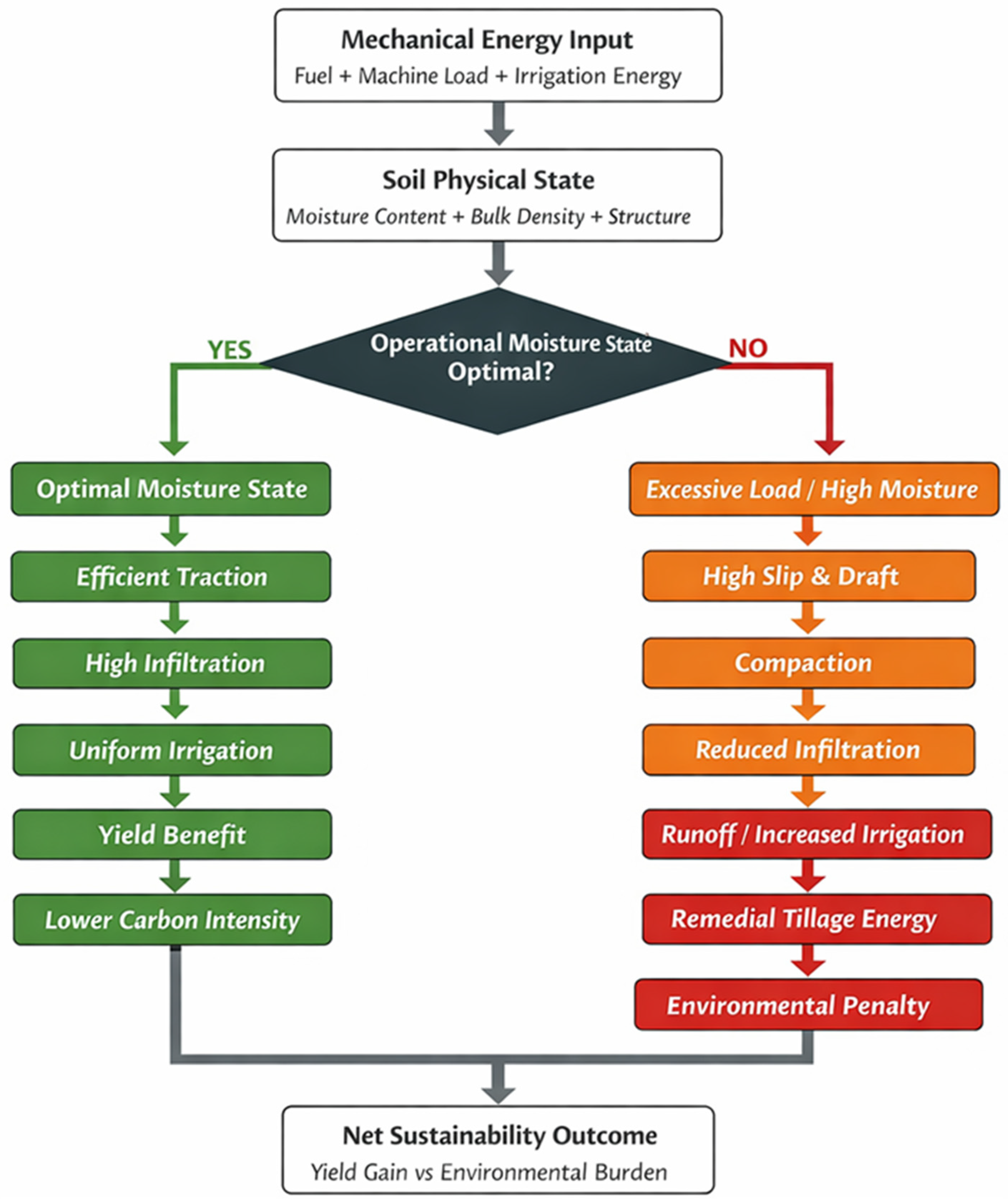
Figure 7 illustrates the sustainability flow pathway of mechanical energy within the Soil–Machine–Water system. Mechanical energy inputs interact with the soil physical state, particularly moisture content and structural stability, generating either a productive pathway characterized by efficient traction and enhanced infiltration, or a degradation pathway associated with compaction, runoff, and corrective energy demand. The flowchart visually integrates mechanical work, soil hydraulic response, and environmental performance within a unified decision structure.

4.5. Quantitative Sustainability Assessment Framework

While the proposed soil–machine–water framework establishes mechanistic relationships among traction efficiency, soil structural stability, and hydraulic conductivity, a rigorous sustainability evaluation requires integration with standardized environmental performance metrics. Contemporary sustainability assessment in agricultural systems increasingly relies on Life Cycle Assessment (LCA), carbon footprint accounting, and energy–water productivity indicators to quantify environmental burdens associated with mechanization and irrigation [107,108]. The methodological principles established by International Organization for Standardization through ISO 14040 [109] and ISO 14044 [110] provide the formal structure for defining system boundaries, functional units, inventory flows, and impact categories in agricultural LCA studies.
In arid and semi-arid systems, mechano-hydraulic inefficiencies directly translate into increased fuel consumption, irrigation energy demand, and indirect greenhouse gas emissions. Excessive slip ratios and elevated draft forces increase diesel use per hectare, while compaction-induced reductions in saturated hydraulic conductivity increase pumping requirements and irrigation frequency. These cascading effects can be captured within an LCA boundary that include field operations, fuel combustion, irrigation energy, machinery manufacturing, and soil structural degradation impacts [111,112]. Recent agricultural LCA applications emphasize the importance of expanding traditional fuel-based accounting toward system-level energy integration, particularly where soil degradation alters long-term productivity and input requirements [113,114].
A simplified carbon intensity indicator for soil–machine–water interactions may be expressed as, Equation (2).
C I = E f E F f + E i E F e Y
where CI represents carbon intensity (kg CO2-eq t−1 yield), Ef is fuel energy consumption (MJ ha−1), EFf is the emission factor of diesel fuel (kg CO2-eq MJ−1), Ei is irrigation energy consumption (kWh ha−1), EFe is the electricity emission factor, and Y is crop yield (t ha−1).
To operationalize this framework, an explicit Life Cycle Assessment system boundary is defined for mechanized soil–water systems. The proposed boundary adopts a cradle-to-field-performance perspective in which environmental burdens are quantified across three interrelated energy domains: direct operational energy, embodied manufacturing energy, and compaction-induced remedial energy. This boundary expands conventional farm energy accounting by internalizing delayed structural degradation costs resulting from suboptimal operational moisture conditions and excessive axle loading.
Direct operational energy includes diesel consumption for tillage, planting, and traffic operations, as well as electrical or diesel energy for irrigation pumping. Numerous studies report that slip-induced fuel losses may range between 12% and 22%, depending on soil texture and moisture state [115]. In deep aquifer systems typical of arid regions, irrigation energy demand may exceed 1500–2500 kWh ha−1 season−1, rendering hydraulic efficiency highly sensitive to soil compaction effects [114].
Embodied manufacturing energy accounts for the cumulative energy required to extract raw materials, manufacture tractors and implements, and transport machinery to the farm. This energy is allocated over the machine’s operational lifespan and normalized per hectare. Agricultural LCA studies indicate that embodied machinery energy may represent 5–20% of total mechanization-related emissions, depending on intensity of use and lifespan assumptions [113].
Compaction-induced remedial energy represents a critical extension of traditional boundaries. Soil compaction caused by high axle loads under elevated moisture states often necessitates subsoiling or deep tillage operations to restore porosity and hydraulic conductivity. These corrective interventions typically require 30–60% higher draft power than conventional tillage, generating a delayed but measurable environmental penalty [112]. Additionally, reduced infiltration capacity may increase irrigation frequency, thereby compounding energy demand. By explicitly including remedial energy (Er), the framework internalizes the long-term environmental consequences of mechanization mismanagement.
Beyond carbon intensity, sustainability assessment incorporates Energy–Water Productivity defined as crop yield per unit of combined direct and indirect energy input. This integrated indicator aligns mechanization efficiency with hydraulic functionality, reflecting the coupled nature of soil structure and irrigation performance. In calcareous arid soils characterized by structural fragility and low organic binding agents, the environmental amplification effect of compaction is particularly pronounced [111].
The defined LCA system boundaries for the Soil–Machine–Water sustainability framework are summarized in Table 2.
In addition to the carbon intensity metrics defined within the Life Cycle Assessment (LCA) boundary, two integrative performance indicators are proposed to explicitly connect mechanical energy consumption with soil environmental functionality. Life cycle–based environmental indicators are increasingly used in agricultural systems to quantify the environmental burden associated with mechanized operations and resource use [116,117]. The first indicator, Carbon Footprint per Unit of Infiltration (CFI), is defined as, Equation (3).
C F I = C O 2 t o t a l I   s e a s o n
where CO2total represents total greenhouse gas emissions per hectare (kg CO2-eq ha−1) including direct, embodied, and remedial components, and I season is the cumulative seasonal infiltration depth (mm). Soil compaction caused by mechanized field traffic is known to significantly reduce soil infiltration capacity and hydraulic conductivity, thereby affecting water availability and environmental sustainability [40,117]. By normalizing carbon emissions against seasonal infiltration performance, the CFI indicator directly links soil hydraulic functionality with environmental carbon burden.
The second indicator, Net Energy Gain (NEG), evaluates the balance between productive energy output and total system energy input (Equation (4)).
N E G = E o u t p u t E t o t a l
where Eoutput represents the calorific energy contained in harvested biomass (MJ ha−1), while Etotal includes the aggregated direct energy inputs (fuel, lubrication, and labor), embodied energy in machinery and inputs, and energy required for soil remediation practices. Energy balance indicators such as net energy gain and energy return ratios are widely used to evaluate sustainability and efficiency in agricultural production systems [116,117,118,119].
Together, these indicators extend sustainability assessment beyond conventional fuel-based accounting and provide a measurable linkage between traction mechanics, soil structural functionality, and environmental performance.
Embedding explicitly defined LCA system boundaries within the Soil–Machine–Water framework transforms the framework from a conceptual integration model into a quantitatively operational sustainability assessment structure. By systematically linking operational soil moisture conditions, traction efficiency, soil structural degradation, hydraulic conductivity decline, and compaction-induced remedial energy demand within a unified boundary, the framework enables measurable environmental performance evaluation at the field scale. Such integration aligns the methodology with internationally recognized LCA standards and strengthens its applicability for mechanization planning in arid and semi-arid water-limited agroecosystems [117,118].

4.6. Quantitative Mechano-Hydraulic Modeling Framework

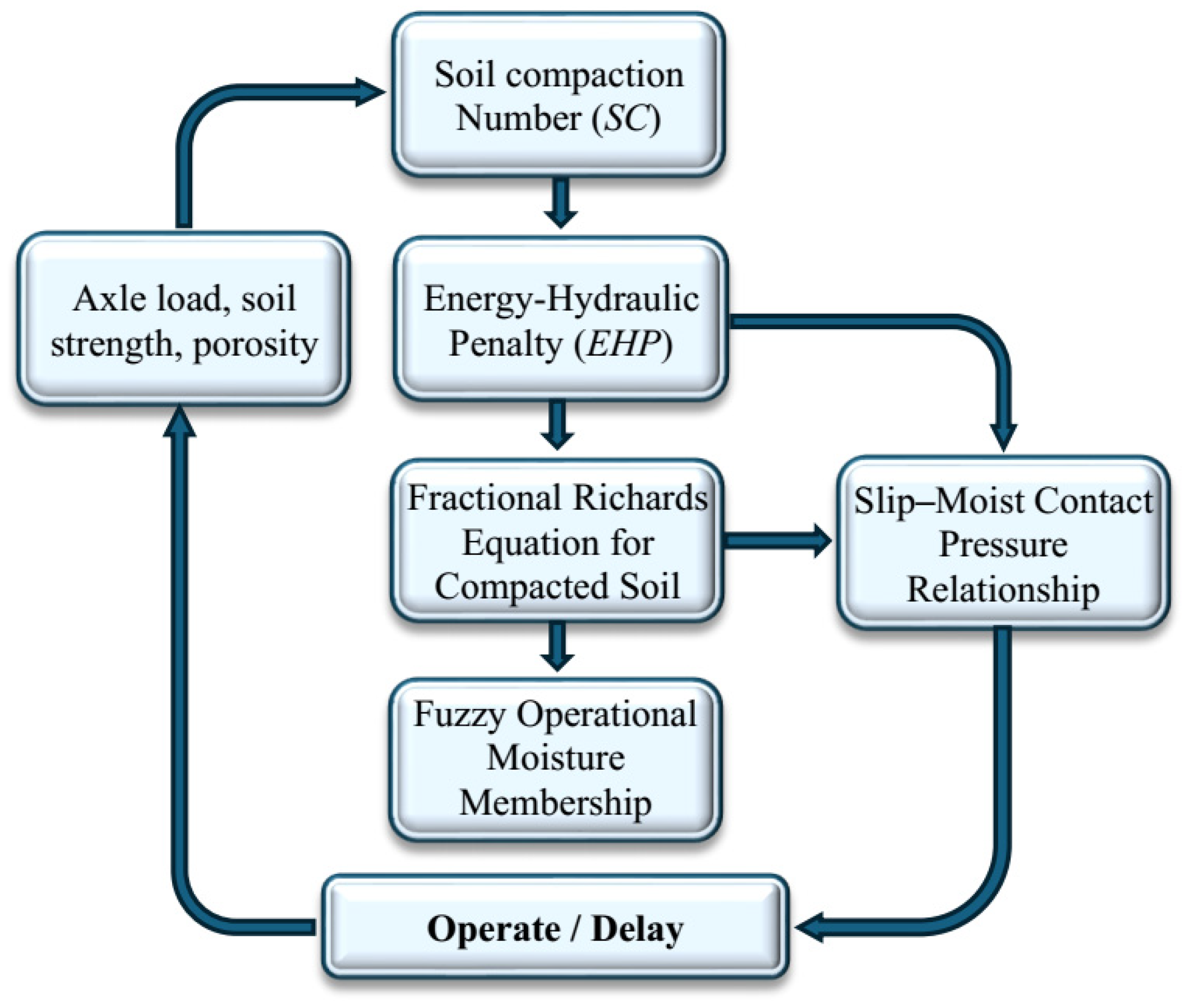
A quantitative framework that explicitly integrates mechanical loading with soil hydraulic behavior is essential for predicting how field operations modify soil structure, moisture dynamics, and energy requirements in arid agricultural systems. While conceptual descriptions provide qualitative insight into soil–machine–water interactions, predictive and operational decision-making requires mathematically coupled models that link axle load, slip, bulk density, soil moisture, and hydraulic conductivity. The following framework introduces a set of non-traditional yet physically interpretable models that jointly quantify compaction risk, energy penalties, and hydraulic response under mechanized field conditions. These relations can be calibrated using field-scale measurements and provide the foundation for integrated mechanization–irrigation control strategies (Figure 8).

4.6.1. Soil–Compaction Number (Sc)

The Soil–Compaction Number (Sc) is introduced as a dimensionless operational index quantifying the susceptibility of a soil to compaction under applied axle loading. Within the integrated framework, Sc represents the primary mechanical trigger controlling subsequent soil structural and hydraulic responses, as conceptually illustrated in Figure 8. The Soil–Compaction Number is defined by Equation (5).
S c = W σ ref ϕ α
where W is axle load (kN), σref is reference soil strength (kPa), Φ is volumetric porosity (–), and α is an empirical coefficient describing the sensitivity of the soil texture to loading. Higher values of S c indicate elevated compaction risk, consistent with findings reported for controlled traffic and non-traffic systems [79,120].

4.6.2. Energy Loss Due to Compaction (EHL)

Mechanical inefficiencies arising from wheel slip and compaction-induced changes in soil BD are integrated into a single mechano-hydraulic metric termed the Energy loss due to compaction (EHL). This parameter links traction losses directly to degradation in soil hydraulic function. The energy loss due to compaction is formulated as shown in Equation (6).
E H P = η S β e x p ( γ Δ B D )
where S is slip ratio, ΔBD is the increase in bulk density (kg m−3), and η, β, and γ are calibration parameters. The exponential term reflects the nonlinear amplification of hydraulic resistance with increasing compaction, consistent with recent measurements in structured and partially compacted soil [121].
Within the framework illustrated in Figure 8, EHL functions as a coupling node between mechanical energy losses and degradation of hydraulic properties.

4.6.3. Fractional Richards Equation for Compacted Soil

To represent anomalous water transport behavior commonly observed in compacted and structurally heterogeneous soil, classical Richards’ equation is extended using fractional-order time derivatives. The resulting formulation captures non-Fickian flow associated with restricted pore networks and preferential pathways. The governing equation is expressed in Equation (7).
α θ t α = [ K ( θ , ρ b ) ψ ] + f
where 0 < α ≤ 1 is the fractional derivative order, θ is volumetric water content, K (θ, ρb) is hydraulic conductivity modified by bulk density, ψ is pressure head, and f represents sink or source terms. Fractional formulations have been successfully applied to compacted soil where nonlinear diffusion dominates [122]. This equation establishes the hydraulic response branch of the integrated framework shown in Figure 8

4.6.4. Weibull-Scaled Hydraulic Conductivity Model

Repeated machinery loading induces spatial variability in soil structure that cannot be adequately captured using deterministic hydraulic conductivity values. To represent this heterogeneity, saturated hydraulic conductivity is modeled stochastically using a Weibull-scaled formulation given in Equation (8).
K ( x ) = K 0 e x p ( λ Δ ρ b ( x ) ) W ( k , λ w )
where K0 is baseline saturated hydraulic conductivity, λ is a compaction sensitivity coefficient, and W (k, λw) is a Weibull-distributed random variable with shape parameter k and scale parameter λw. Similar probabilistic approaches have been used to represent microscale hydraulic variability in compacted agricultural soil [123,124]. This component captures spatial uncertainty within the hydraulic branch of Figure 8.

4.6.5. Slip–Moisture–Contact Pressure Relationship

Traction behavior is governed by nonlinear interactions between soil moisture state and contact pressure at the wheel–soil interface. The operational relationship between slip ratio, volumetric water content, and contact stress is described by Equation (9).
S ( θ , p c ) = S 0 ( e m θ + n p c q )
where θ is volumetric water content, pc is contact pressure (kPa), and S0, m, n, and q are empirical coefficients. This formulation reproduces the characteristic reduction in slip at intermediate moisture levels and the sharp increase in slip under excessively dry or wet conditions [125,126]. In Figure 8, this relationship links soil moisture dynamics with mechanical energy demand.

4.6.6. Fuzzy Operational Moisture Membership Function

Because field-operational moisture ranges lack sharp thresholds, a fuzzy logic approach is employed to quantify soil workability and operational suitability. The fuzzy membership function is defined in Equation (10).
μ o p ( θ ) = e x p [ ( θ θ opt σ ) 4 ]
where μop represents operational suitability, θopt is the optimal moisture content, and σ is a dispersion parameter controlling sensitivity. Similar fuzzy indices have been applied to soil workability and compaction-risk modeling [127]. This function serves as the decision-layer overlay in the integrated framework shown in Figure 8.

4.7. Research Gaps and Future Directions

Despite the growing recognition of the coupled soil–machine–water system, substantial research gaps still hinder the development of a fully integrated agricultural engineering framework for optimizing energy consumption and water productivity in arid and semi-arid farming systems [16]. A major weakness in the current literature lies in its methodological fragmentation. Investigations addressing traction performance and field trafficability commonly evaluate draft force, wheel slip, and tractive efficiency as isolated mechanical indicators, without parallel assessment of soil hydraulic conditions or water movement within the root zone. In contrast, studies focused on irrigation and soil–water processes typically prioritize infiltration dynamics, evaporation rates, and soil moisture redistribution, while overlooking in situ measurements of critical mechanical parameters such as cone index, temporal changes in bulk density, and stress propagation induced by machinery under actual field operations [95]. As a consequence of this disciplinary separation, many existing soil–machine–water interaction models, although theoretically consistent, remain poorly parameterized and insufficiently validated under realistic arid and semi-arid conditions [128]. These research gaps and emerging future directions are conceptually summarized in Figure 9.
The absence of synchronized measurements linking mechanical loading to soil structural evolution and hydraulic response limits the capacity of these models to represent feedback mechanisms controlling soil compaction, pore structure modification, mechanical impedance, and water flow. This limitation is particularly pronounced in dry environments, where soil physical behavior exhibits strong sensitivity to moisture status, leading to nonlinear responses in soil strength and machinery energy demand. Addressing these deficiencies requires coordinated, multi-domain field experiments capable of simultaneously capturing mechanical stresses, soil deformation and structural response, hydraulic behavior, and machinery energy expenditure in real time. Such an integrated measurement strategy enables a shift from assumption-based analyses toward predictive, process-oriented modeling grounded in soil physics and agricultural machinery engineering principles [12,79]. By coupling real-time observations of soil strength, compaction dynamics, moisture variability, and machine performance, future research can provide more reliable assessments of field trafficability, water use efficiency, and energy optimization under operational conditions.
These efforts directly support the objectives of the Special Issue, which aims to promote sustainable soil, water, and energy management through mechanistically based, interdisciplinary frameworks that reflect the complex interactions governing agroecosystems in water-limited regions.

4.7.1. Lack of Mechanization–Hydrology Co-Measurement Under Field Conditions

Even though we know more about how soil, machines, and water interact, most studies still focus on just one of two areas: mechanical or hydraulic responses. They also don’t monitor both areas at the same time in the situations they would be used in. Draft, wheel slip, and mechanical stress can be measured very accurately with laboratory soil bins, but these setups can’t measure how soil entry behaves when loads are applied in the real world [6]. In the same way, field tests usually only check the moisture level in the soil or the cone index before and after a traffic event, which doesn’t give us a lot of information about how hydraulic reactions change over time [129]. This lack of co-measurement makes it harder to study how wheel slip, rut formation, and water entry affect each other over time, especially in sandy soil that is common in dry areas [130]. Integrated field platforms must be built that combine both mechanical and hydraulic measurements in real time. This includes TDR or TEROS soil moisture sensors, wheel slip telemetry through CAN-bus ECUs, proximal gamma density measurements, and an automated Guelph permeameter. This technology will help make farming possible in dry areas. These combined systems can predict mechanical–hydraulic feed-back in real time, making it possible to change the way they work based on their output. This can improve energy efficiency, protect the structure of the soil, and better handle water. These methods directly help with the goals of improving long-term water and soil conservation and management in farming [17].
Developing real-time, co-measurement platforms enable sustainable mechanical–hydraulic management by integrating soil structure, traction, and irrigation dynamics, optimizing energy use, and preserving water and soil resources in arid agricultural systems.

4.7.2. Limited Operational Thresholds for “Moisture Contents”

While the concept of an optimal soil moisture content is widely recognized, precise operational thresholds for different soil textures remain underexplored [99]. Finding the moisture limits in useful forms like gravimetric, volumetric, or matric potential is very important for setting rules for how to best use both machines and watering systems [131]. In arid systems, where moisture variation is often less than 4%, even minor deviations can lead to significant increases in draft energy or compaction risk, adversely affecting both traction efficiency and water-use efficiency. Developing predictive models that link soil moisture to mechanical responses can establish dynamic and texture-specific moisture thresholds, enabling farmers to schedule irrigation and mechanized operations in a way that preserves soil structure, reduces energy expenditure, and maximizes water productivity. Establishing universal or region-specific moisture limits for sandy loams, loamy sands, and calcareous soil represents a major research frontier in integrated mechanization–irrigation management [63]. Such efforts directly contribute to sustainable water and soil conservation goals by ensuring that operational practices simultaneously safeguard soil integrity, enhance hydraulic function, and optimize resource use in arid agricultural systems. Establishing precise soil moisture thresholds for mechanized operations supports sustainable management by aligning traction, draft energy, and irrigation efficiency with soil structural preservation and water conservation in arid environments.
In addition to establishing static operational moisture thresholds, future predictive models must account for the shifting baseline of soil moisture regimes driven by climate-induced changes in monsoon timing and drought intensity. Climate variability alters the temporal distribution and persistence of soil moisture, effectively changing the conditions under which machinery–soil–water interactions occur and narrowing the window of mechanically optimal moisture states [132,133]. Models that incorporate dynamic atmospheric forcing, including altered rainfall patterns and increased evaporative demand, would enable robust prediction of soil mechanical and hydraulic responses under non-stationary climate conditions. By integrating climate-driven moisture variability into sensitivity analyses, future research can better anticipate operational risks, adapt irrigation–mechanization scheduling, and improve resilience of soil–machine–water systems in arid agricultural landscapes [25].

4.7.3. Absence of Machine Learning Models That Include Hydraulic Outputs

Machine learning applications in mechanized agriculture have largely focused on predicting draft force, slip, or fuel consumption [16]. Very few models incorporate hydraulic outputs such as Ksat, infiltration uniformity, or air entry potential under dynamic compaction conditions [106]. Including hydraulic variables as target outputs would allow predictive digital twins to simulate full operational cycles: load application → soil compaction → hydraulic loss → irrigation energy cost. Integrating hydraulic targets into ML models allows predictive digital twins to simulate the full operational cycle—load application → compaction → hydraulic loss → irrigation energy cost—enabling proactive scheduling. Preliminary studies demonstrate feasibility, but current datasets remain sparse and geographically limited [77,107].
Focusing on arid calcareous soil fills critical knowledge gaps and allows sustainable mechanization–irrigation strategies that optimize energy efficiency, maintain soil integrity, and enhance water-use efficiency in challenging arid environments.

4.7.4. Weak Representation of Arid Calcareous Soil

Most mechanization–hydrology studies have traditionally focused on temperate, clay-rich soil, while calcareous, gypsum-bearing, and quartz-dominated soil common in arid regions remain underrepresented [95,104]. These soil are characterized by low organic matter, weak aggregate stability, and high soluble salt content, which strongly affect compaction behavior, pore collapse thresholds, and hydraulic resilience under mechanical loading [101,128]. Consequently, mechanization guidelines and irrigation practices developed for temperate soil are often unsuitable for arid calcareous soil, where infiltration, soil strength, and root-zone moisture distribution respond differently to machinery traffic and water applications.
Developing predictive models specifically adapted to arid calcareous soil is therefore essential to guide machinery selection, traffic management, and irrigation scheduling in water-scarce agricultural systems. Such models can support soil-specific mechanization strategies that reduce energy consumption, limit water losses, and preserve soil structural integrity. Focusing on these soil types directly supports sustainable agriculture objectives by improving water-use efficiency, maintaining soil physical quality, and enabling integrated soil–machine–water management in arid environments [6].

4.7.5. Integrated Operational Optimization Models Are Not Yet Closed Loop

Commercial precision agriculture systems currently optimize tire inflation, ballast, or draft depth based on slip or fuel consumption alone [79]. No platform yet integrates real-time soil hydraulic variables (e.g., Ksat, infiltration patterns) into operational decision-making. Developing closed-loop, predictive control systems that fuse soil moisture, traction, and AI-driven decision rules could dynamically optimize field operations for energy and water efficiency. Transitioning from reactive to predictive control architecture requires fused sensing networks linking moisture sensors, traction sensors, and AI-based controllers in a closed-loop manner [16]. Developing such predictive systems represents a critical research and engineering frontier [134]. Creating closed-loop operational models that integrate mechanization and hydraulic feedback enables sustainable mechanical–hydraulic management by optimizing energy and water efficiency while maintaining soil health in arid agricultural systems. In this context, real-time data from TDR sensors or a Guelph permeameter can feed directly into a tractor’s CAN bus, enabling on-the-fly adjustments of tire inflation, draft depth, or operational speed. Such cyber-physical loops allow continuous optimization of traction and energy use while preserving soil structure and improving irrigation uniformity, representing a practical implementation of predictive mechanization–hydraulic management [135,136].

4.7.6. Soil Remediation for Semi-Arid Mechanized Agriculture

Existing compaction mitigation strategies—cover crops, deep ripping, or organic mulch—are largely based on temperate soil and often fail in low-clay, low-organic-matter sandy soil [106]. Evidence-based optimization of biochar, gypsum, or composted olive-mill residues, combined with shallow subsoiling and controlled traffic farming integrated with subsurface drip irrigation, represents a promising but underexplored approach [128]. Predictive assessment of these interventions can evaluate both hydraulic recovery and draft energy reduction, enabling site-specific mechanization–irrigation strategies. Evaluating these interventions for both hydraulic recovery and reduction in draft energy is critical to closing the mechanization–irrigation remediation cycle [99].
To enable energy- and water-efficient dry agriculture, future research must integrate region-specific remediation techniques, AI-driven predictive modeling, and high-resolution, time-synchronized data. The next frontier in sustainable mechanized irrigation management is the establishment of operational soil moisture contents, closed-loop control systems, and verified digital twins for desert soil.
In addition, there is a critical need for long-term (multi-decadal) field data on hydraulic recovery following remediation interventions. Such longitudinal measurements will allow a more accurate evaluation of soil structure restoration, infiltration capacity, and water retention over extended periods, ensuring that applied strategies genuinely sustain soil–water functionality under repeated mechanized traffic. Incorporating multi-decadal hydraulic monitoring into future studies represents a primary research gap for achieving truly sustainable soil remediation in semi-arid environments [112,137,138].
By improving long-term soil and water resource conservation in dry agriculture, lowering draft energy, and restoring hydraulic function, customized remediation techniques for semi-arid soil enhance sustainable soil–machine–water management.

4.7.7. Autonomous Agricultural Robotics and Altered Soil Loading Patterns

Emerging autonomous agricultural robots represent a fundamentally different mechanization paradigm compared with conventional tractor-based systems, with direct implications for traffic intensity and soil loading patterns. Lightweight robotic platforms are typically designed to operate with reduced axle loads but higher traffic frequency and more distributed field coverage, which may lower peak contact stresses while increasing cumulative wheel passes [139,140]. Such altered loading regimes are expected to modify soil compaction dynamics, pore deformation processes, and subsequent soil hydraulic behavior relative to heavy machinery. However, current soil–machine–water interaction models are predominantly developed for high-mass tractors and do not explicitly account for the adaptive navigation, swarm operation, and distributed loading characteristics of autonomous field robots [141]. Consequently, the long-term impacts of autonomous robotic traffic on soil physical quality, infiltration capacity, and irrigation performance remain poorly quantified, representing an important emerging research gap for sustainable mechanization and water management in arid and semi-arid agricultural systems.
In contrast to conventional heavy tractors, emerging swarm robotics platforms—composed of multiple lightweight, autonomous units—fundamentally alter the distribution of axle loads and traffic patterns in agricultural fields. Reduced axle loads decrease contact stresses and diminish soil compaction risk, potentially extending the range of moisture contents under which safe mechanical operations can be performed [142]. Moreover, swarm configurations distribute cumulative wheel passes across a wider area, which may preserve pore continuity and hydraulic conductivity more effectively than concentrated loading by heavy machinery [138,141]. This distributed mechanization paradigm suggests that lightweight robots maintain traction efficiency with lower energy expenditure while reducing deleterious impacts on soil structure, particularly in marginally moist or structurally vulnerable soils. Consequently, comparative studies evaluating trafficability, draft energy requirements, and moisture sensitivity of swarm robotics versus heavy mechanization are needed to inform future design and operational strategies within the Soil–Machine–Water framework.

4.8. Practical Field Recommendations for Farmers

Supporting farmers who operate in dry and semi-arid environments requires translating the interplay between soil, machinery, and water into useful field instructions. The operational procedures that reduce compaction, preserve infiltration effectiveness, and maximize traction and draft performance are outlined in the guidelines that follow.

4.8.1. Optimal Tire Inflation Pressure

The most effective approach for decreasing wheel slip, excessive soil stress, and rut depth is always to use moderate tire inflation pressures. A fair compromise between traction and soil protection is usually achieved for conventional agricultural tractors with rear-wheel pressures between 80 and 110 kPa and slightly lower front-wheel pressures. Extremely high pressures, especially in calcareous and sandy soil, tend to hasten pore collapse and raise ground stress. Compaction danger can be reduced and traction performance greatly increased by modifying tire pressure in accordance with field moisture and implementation load. By lowering soil compaction, increasing traction effectiveness, and maintaining water penetration channels in arid agricultural areas, maintaining ideal tire inflation promotes sustainable mechanical–hydraulic management.

4.8.2. Timing of Mechanical Operations After Irrigation

Field operations should ideally be carried out after the soil has drained from near saturation to a more stable state. In most sandy soils, this condition is often reached within 24–48 h after irrigation, while loam and clay-loam soils may require 48–72 h before they become suitable for traffic. Operating machinery immediately after irrigation increases the likelihood of structural collapse and reduced infiltration, whereas waiting too long in very dry conditions increases draft energy and soil brittleness. Coordinating mechanized operations with the natural drainage cycle helps maintain both energy efficiency and soil integrity. Scheduling field operations based on post-irrigation soil conditions enables sustainable management by aligning mechanization energy requirements with optimal soil moisture, preserving soil structure, and enhancing irrigation efficiency. Agricultural operation timing is crop dependent.
Field traffic immediately after irrigation is generally avoided except in flooded systems such as paddy rice. In arid and semi-arid regions, crops such as wheat and maize require a drying interval before machinery entry to prevent soil compaction at near-field capacity moisture contents, typically 1–3 days in sandy soils and 3–5 days in loam soils. Rice transplanting under flooded conditions constitutes a distinct mechanized–hydraulic regime with different operational requirements. Therefore, crop-specific operational moisture thresholds and machinery timing are integrated into the Soil–Machine–Water framework to guide mechanization under variable soil and irrigation conditions [103].
It should be noted that, except for flooded systems such as paddy rice, most agricultural fields do not reach field capacity; therefore, relative water content is not a practical indicator for the discussion of mechanized operations in dry and semi-arid soils.
Table 3 summarizes crop-specific operational moisture windows, machinery operation timing, and tire pressure recommendations for semi-arid calcareous soils, providing practical field guidelines for sustainable mechanized agriculture.

4.8.3. Practical Moisture Limits for Different Soil Types

To reduce compaction and improve the effectiveness of tillage and traction, farmers can rely on approximate moisture intervals that indicate when soil is most workable. The ideal moisture range for sandy soil is typically between 6 and 10% gravimetric moisture, which minimizes rutting and provides sufficient shear strength. While loam and clay-loam soil are usually workable between 14 and 20 percent, sandy-loam soil usually performs best between 10 and 14 percent. To prevent needless energy use and soil degradation, farmers might utilize these ranges as useful indicators rather than rigid thresholds to determine whether to water or when to postpone operations. By reducing compaction, maximizing draft energy, and guaranteeing efficient irrigation in arid and semi-arid areas, the use of realistic soil moisture ranges as operating parameters encourages sustainable soil–machine–water management.

4.9. Optimal Machinery and Irrigation Systems According to Soil Type

A key contribution of this review is the development of an integrated soil-specific framework that aligns mechanization choices and irrigation system selection with the mechanical–hydraulic behavior of arid-region soil. Building on the mechanical and hydraulic interactions described in Section 4.5 and Section 4.6, this section synthesizes soil texture, strength, bearing capacity, and infiltration response into operational recommendations for sandy, sandy loam/loam, and calcareous arid soil. The aim is to provide a unified engineering perspective that optimizes traction efficiency, minimizes draft energy, and maintains irrigation uniformity under field conditions.

4.9.1. Sandy Soil: Machinery and Irrigation Optimization

Sandy soil is widespread in arid agricultural regions and is defined by very low cohesion, high permeability, and limited structural stability. Their mechanical response is highly moisture dependent, exhibiting brittle failure under dry conditions and plastic deformation when excessively wet, which results in a narrow optimal moisture range for both traction efficiency and irrigation performance.
From a mechanization perspective, minimizing ground contact stress is critical to reduce rutting and irreversible pore deformation. The use of low-pressure tires, dual-wheel configurations, adjustable tire inflation systems, and lightweight tractors is therefore recommended. Implementing Controlled Traffic Farming helps confine compaction to permanent wheel tracks and preserves pore continuity in cropped zones, while shallow tillage operations using chisel plows or light disk implements are more suitable than intensive deep tillage.
Regarding water management, subsurface drip irrigation is particularly appropriate for sandy soil due to their high saturated hydraulic conductivity and rapid vertical water movement. Applying water through low-volume, pulsed irrigation can maintain soil moisture within the optimal traction window and reduce the risk of saturation and deep percolation losses. In some cases, reduced emitter spacing is required to improve wetting uniformity. Coordinated optimization of machinery and irrigation in sandy soil supports sustainable soil–machine–water management by limiting compaction, maintaining traction performance, and ensuring efficient water use within a narrow moisture regime.

4.9.2. Sandy-Loam and Loam Soil: Machinery and Irrigation Optimization

Although these soils have a moderate bearing capacity and better aggregation, they are nonetheless susceptible to compaction and shear changes brought on by moisture. Draft energy and slip ratio are highly sensitive to changes in moisture.
From a mechanization perspective, effective traction control is provided by medium-powered tractors with adjustable ballast and moderate tire inflation pressures. Subsoilers, standard disks, and moldboard plows are examples of implements that function well in the right moisture conditions. Although loam soil may withstand a certain amount of unconfined traffic if bulk density is monitored, CTF is advantageous.
The best irrigation method is drip irrigation, which permits a greater emitter spacing than sandy soil. Sprinkler irrigation can also be successful, but after irrigation, machinery should be kept out of traffic for 48 to 72 h. Compaction in loam soil can change irrigation uniformity and wetting-front geometry by reducing Ksat by 30 to 60%. Predictive irrigation schedule and moisture sensors are advised. By maintaining soil structure, regulating draft energy, and enhancing irrigation uniformity under fluctuating moisture levels, modifying equipment and irrigation techniques for sandy-loam and loam soil promote sustainable resource management.

4.9.3. Calcareous Arid Soil: Machinery and Irrigation Optimization

Calcareous soil in arid climate is characterized by high carbonate content, low organic matter, and weak aggregate stability, which makes them highly vulnerable to structural degradation and pore collapse under relatively moderate axle loads. Their mechanical behavior is strongly moisture dependent, requiring careful coordination between machinery operation and irrigation management.
From mechanization, the use of tracked tractors, lightweight implements, and harvesters with low axle loads is preferable to reduce contact stress. Tire inflation pressures should be kept as low as operationally feasible, and field traffic should be confined to controlled lanes to limit the spatial extent of compaction. Deep tillage should be applied only under dry and mechanically stable conditions, while subsoiling can be effective in restoring pore continuity when soil moisture is below field capacity.
In terms of irrigation, subsurface drip irrigation is particularly suitable for calcareous soil as it minimizes surface sealing and crust formation. Low-intensity, continuous water application helps stabilize aggregates and reduces susceptibility to compaction. Proper filtration and periodic acidification are necessary to prevent emitter clogging caused by carbonate precipitation. In addition, the application of organic and mineral amendments, such as compost, biochar, or gypsum, can enhance structural resilience and improve irrigation uniformity.
Adopting optimized machinery and irrigation strategies in calcareous arid soil supports sustainable soil–water management by mitigating structural collapse, improving infiltration, and strengthening the functional integration between mechanization and irrigation in water-limited environments.

4.9.4. Unified Soil-Specific Operational Recommendations

Table 4 summarizes the optimal mechanization configurations and irrigation systems for the dominant arid-region soil types, integrating the mechanical–hydraulic interactions previously discussed.
The recommendations presented in Table 4 represent generalized operational guidance synthesized from the cited literature for major soil types commonly encountered in arid and semi-arid agricultural regions.
Traction, draft energy, and irrigation efficiency can be managed comprehensively throughout arid-region soil by combining soil-specific operating approaches with useful field recommendations. Farmers can minimize soil compaction, preserve pore continuity, and maximize water infiltration by matching the mechanical–hydraulic behavior of sandy, sandy-loam/loam, and calcareous soil with tire configuration, irrigation techniques, and tractor choices.
By maintaining soil structural integrity, encouraging even water distribution, and supporting energy-efficient mechanization, these combined approaches directly assist sustainable soil and water management. Putting such integrated solutions into practice promotes resilient agricultural systems, lowers the chance of water inefficiency and soil degradation, and advances the main objectives of sustainable management in arid and semi-arid farming environments.

5. Conclusions

This review highlights that soil physical properties govern both machinery traction efficiency and irrigation hydraulic behavior in arid agroecosystems. Key parameters such as soil texture, bulk density, pore continuity, matric potential, and structural stability control stress transmission from machinery while simultaneously regulating hydraulic conductivity, infiltration patterns, and root-zone water storage, indicating that traction performance and irrigation dynamics reflect the soil’s integrated mechanical–hydraulic state. Wheel slip and soil compaction strongly influence this interaction. In sandy arid soils, small increases in slip can modify wetting patterns and water redistribution, while compaction reduces saturated hydraulic conductivity and increases irrigation demand. Because arid soils have weak structural stability, the optimal moisture range that allows both efficient traction and hydraulic continuity is narrow, and operating outside this range increases draft energy and disrupts soil pore structure. Improving water productivity therefore requires precision mechanization strategies that account for both mechanical and hydraulic soil responses, including low-pressure tires, optimized ballast, variable tillage depth, and Controlled Traffic Farming. Future advances should focus on integrated cyber–physical systems where soil sensors, tractors, and irrigation systems operate within predictive digital frameworks to minimize combined energy and water losses. Consequently, sustainable mechanized agriculture in arid regions depends on managing soil, machinery, and water as a unified system to preserve soil structure, optimize water distribution, and enhance long-term resource efficiency.
The proposed Soil–Machine–Water framework contributes to sustainable agricultural development by integrating carbon intensity, energy–water productivity, and soil hydraulic functionality into mechanization planning. By reducing compaction-induced energy penalties, improving irrigation efficiency, and internalizing long-term environmental costs, the framework supports resource-efficient food production, responsible energy use, and climate-resilient management in arid and semi-arid agroecosystems. These contributions align with SDGs 2, 6, 7, 12, and 13 through enhanced water productivity, lower energy intensity, and improved environmental performance of mechanized dryland systems.
Future research should develop predictive Digital Twins that include soil health and carbon sequestration indicators alongside mechanization and irrigation metrics. This integration will enable sustainable evaluation of soil–water–machine interactions, optimizing energy and water use while preserving soil quality and promoting carbon storage.

Author Contributions

Conceptualization, M.G. and A.M.A.; methodology, M.G., A.M.A., A.A. (Ahmed Alzoheiry) and A.A. (Abdulaziz Alharbi); investigation, A.M.A., A.A. (Ahmed Alzoheiry) and A.A. (Abdulaziz Alharbi); data curation, A.A. (Ahmed Alzoheiry), and A.A. (Abdulaziz Alharbi); visualization, M.G. and A.A. (Abdulaziz Alharbi); writing—original draft preparation, M.G., A.A. (Ahmed Alzoheiry) and A.M.A.; review and editing, M.G., A.M.A., A.A. (Ahmed Alzoheiry) and A.A. (Abdulaziz Alharbi). All authors have read and agreed to the published version of the manuscript.

Funding

This research received no external funding.

Institutional Review Board Statement

Not applicable.

Informed Consent Statement

Not applicable.

Data Availability Statement

The original contributions presented in the study are included in the article; further inquiries can be directed at the corresponding author.

Acknowledgments

The Researchers would like to thank the Deanship of Graduate Studies and Scientific Research at Qassim University for financial support (QU-APC-2026).

Conflicts of Interest

The authors declare no conflicts of interest.

References

  1. Masson-Delmotte, V.; Zhai, P.; Pirani, A.; Connors, S.L.; Péan, C.; Berger, S.; Zhou, B. Climate change 2021: The physical science basis. In Contribution of Working Group I to the Sixth Assessment Report of the Intergovernmental Panel on Climate Change; Cambridge University Press: Cambridge, UK, 2021; Volume 2, p. 2391. [Google Scholar]
  2. Trenberth, K.E.; Dai, A.; Van Der Schrier, G.; Jones, P.D.; Barichivich, J.; Briffa, K.R.; Sheffield, J. Global warming and changes in drought. Nat. Clim. Change 2014, 4, 17–22. [Google Scholar] [CrossRef] [Scilit]
  3. Hatfield, J.L.; Boote, K.J.; Kimball, B.A.; Ziska, L.H.; Izaurralde, R.C.; Ort, D.; Thomson, A.M.; Wolfe, D. Climate impacts on agriculture: Implications for crop production. Agron. J. 2011, 103, 351–370. [Google Scholar] [CrossRef] [Scilit]
  4. Navarro-Pedreño, J.; Almendro-Candel, M.; Zorpas, A. The increase of soil organic matter reduces global warming, myth or reality? Sci 2021, 3, 18. [Google Scholar] [CrossRef] [Scilit]
  5. Cheng, Y.; Zhang, X.; Liu, Z.; Wu, H.; Jiang, H.; Wang, R.; Jiang, L.; Wang, Z.; Zhu, S.; Lu, Z. Increasing Risks of Water Supply Reduction and Flow Disruptions from the Headwaters to the Lower Reaches of the Yellow River in Future Earth Scenarios. ESS Open Arch. 2024. [Google Scholar] [CrossRef] [Scilit]
  6. Naorem, A.; Jayaraman, S.; Dang, Y.P.; Dalal, R.C.; Sinha, N.K.; Rao, C.S.; Patra, A.K. Soil constraints in an arid environment—Challenges, prospects, and implications. Agronomy 2023, 13, 220. [Google Scholar] [CrossRef] [Scilit]
  7. Kim, W.-S.; Kim, Y.-J.; Park, S.-U.; Kim, Y.-S. Influence of soil moisture content on the traction performance of a 78-kW agricultural tractor during plow tillage. Soil Tillage Res. 2021, 207, 104851. [Google Scholar] [CrossRef] [Scilit]
  8. Ketena, S.; Gebresenbet, G.; Kolhe, K.P.; Dananto, M.; Seifu, Y.; Mathwos, M. Impacts of soil physical and mechanical behaviors under different tillage depths for agrotechnical operation in Bukito, Sidama, Ethiopia. Sci. Rep. 2025, 15, 19951. [Google Scholar] [CrossRef] [Scilit] [PubMed]
  9. Fallahzade, J.; Karimi, A.; Naderi, M.; Shirani, H. Soil mechanical properties and wind erosion following conversion of desert to irrigated croplands in central Iran. Soil Tillage Res. 2020, 204, 104665. [Google Scholar] [CrossRef] [Scilit]
  10. Budhathoki, S. Quantification of Soil Macropore Characteristics Using X-Ray Computed Tomography. Master’s Thesis, Auburn University, Auburn, AL, USA, 2021. [Google Scholar]
  11. Zhu, X.; Peng, W.; Xie, Q.; Ran, E. Effects of soil compaction stress combined with drought on soil pore structure, root system development, and maize growth in early stage. Plants 2024, 13, 3185. [Google Scholar] [CrossRef] [Scilit]
  12. Zhang, Z.; Yin, H.; Zhao, Y.; Wang, S.; Han, J.; Yu, B.; Xue, J. Spatial heterogeneity and driving factors of soil moisture in alpine desert using the geographical detector method. Water 2021, 13, 2652. [Google Scholar] [CrossRef] [Scilit]
  13. Tsyliuryk, O.; Tkalich, Y.; Kolesnykova, K.; Rudakov, Y.; Tkalich, Y. Modern trends and development directions of soil tillage systems in the world and Ukraine. Agrology 2025, 8, 48–54. [Google Scholar] [CrossRef] [Scilit]
  14. Ghonimy, M.; Ibrahim, M.M.; Helmy, H.S.; Alzoheiry, A. Power requirements for olive mechanical harvesting using trunk shaker. Sci. Rep. 2024, 14, 25585. [Google Scholar] [CrossRef] [Scilit]
  15. Badgujar, C.; Das, S.; Figueroa, D.M.; Flippo, D. Application of computational intelligence methods in agricultural soil–machine interaction: A review. Agriculture 2023, 13, 357. [Google Scholar] [CrossRef] [Scilit]
  16. Obour, P.B.; Ugarte, C.M. A meta-analysis of the impact of traffic-induced compaction on soil physical properties and grain yield. Soil Tillage Res. 2021, 211, 105019. [Google Scholar] [CrossRef] [Scilit]
  17. Mirpanahi, S.; Almassi, M.; Javadi, A. Applying multi-criteria decision making method to analyze stability and mechanization patterns in small farms. Environ. Sustain. Indic. 2023, 20, 100295. [Google Scholar] [CrossRef] [Scilit]
  18. Millington, A. The Effect of Low Ground Pressure and Controlled Traffic Farming Systems on Soil Properties and Crop Development for Three Tillage Systems. Doctoral Dissertation, Harper Adams University, Newport, UK, 2019. [Google Scholar]
  19. Oduma, O. Effect of soil physical properties on performance of agricultural field machineries in the tropical region of Nigeria. Agric. Eng. Int. CIGR J. 2018, 20, 25–31. [Google Scholar]
  20. Keller, T.; Lamandé, M.; Naderi-Boldaji, M.; de Lima, R.P. Soil Compaction Due to Agricultural Field Traffic: An Overview of Current Knowledge and Techniques for Compaction Quantification and Mapping. In Advances in Understanding Soil Degradation; Springer: Cham, Switzerland, 2021; pp. 287–312. [Google Scholar]
  21. Kumar, N.; Upadhyay, G.; Choudhary, S.; Patel, B.; Naresh; Chhokar, R.; Gill, S. Resource conserving mechanization technologies for dryland agriculture. In Enhancing Resilience of Dryland Agriculture Under Changing Climate: Interdisciplinary and Convergence Approaches; Springer: Singapore, 2023; pp. 657–688. [Google Scholar]
  22. Lopez Bravo, E.; Ramon, H.; De Baerdemaeker, J.; Herrera, M. Simulation of Soil and Tillage-Tool Interaction by the Discrete Element Method; LIBIS: Heidelberg, Germany, 2013. [Google Scholar]
  23. Olugbenga, A.G. Micro-Mechanical Properties of Niger Delta Sandstone Rock Using Advanced Experiments and Multi-scale Modelling. Doctoral Dissertation, University of Leeds, Leeds, UK, 2016. [Google Scholar]
  24. Singh, V.; Gupta, R.K.; Kahlon, M.; Toor, A.; Singh, K.; Al-Ansari, N.; Mattar, M.A. Effect of different tillage and residue management options on soil water transmission and mechanical behavior. Land 2023, 12, 1895. [Google Scholar] [CrossRef] [Scilit]
  25. Huang, X.; Horn, R.; Ren, T. Soil structure effects on deformation, pore water pressure, and consequences for air permeability during compaction and subsequent shearing. Geoderma 2022, 406, 115452. [Google Scholar] [CrossRef] [Scilit]
  26. Mwiti, F.M.; Gitau, A.N.; Mbuge, D.O. Edaphic response and behavior of agricultural soil to mechanical perturbation in tillage. AgriEngineering 2022, 4, 335–355. [Google Scholar] [CrossRef] [Scilit]
  27. López Rodero, R. Prevención de la Compactación del Suelo por Operaciones Agrícolas: Una Perspectiva Geotécnica; Universitat Politècnica de València: València, Spain, 2020. [Google Scholar]
  28. Tan, Y.; Miao, Z.; Abdul, M.M.; Grift, T.E.; Ting, K. Electrical capacitance as a proxy measurement of miscanthus bulk density, and the influence of moisture content and particle size. Comput. Electron. Agric. 2017, 134, 102–108. [Google Scholar] [CrossRef] [Scilit]
  29. Hillel, D. Introduction to Environmental Soil Physics; Elsevier: Amsterdam, The Netherlands, 2004. [Google Scholar]
  30. Jury, W.A.; Horton, R. Soil Physics; Wiley: Hoboken, NJ, USA, 2004. [Google Scholar]
  31. Liu, K.; Benetti, M.; Sozzi, M.; Gasparini, F.; Sartori, L. Soil compaction under different traction resistance conditions—A case study in North Italy. Agriculture 2022, 12, 1954. [Google Scholar] [CrossRef] [Scilit]
  32. Reiser, D.; Sharipov, G.M.; Hubel, G.; Nannen, V.; Griepentrog, H.W. Development and experimental validation of an agricultural robotic platform with high traction and low compaction. Agriculture 2023, 13, 1510. [Google Scholar] [CrossRef] [Scilit]
  33. Lema, B.; Mesfin, S.; Kebede, F.; Abraha, Z.; Fitiwy, I.; Haileselassie, H. Evaluation of soil physical properties of long-used cultivated lands as a deriving indicator of soil degradation, north Ethiopia. Phys. Geogr. 2019, 40, 323–338. [Google Scholar] [CrossRef] [Scilit]
  34. Guo, W.; Yang, W.; Ge, Z.; Wang, B.; Li, L. Investigation on overburden failure and subsurface subsidence characteristics in fully mechanized top-coal caving of “Three-Soft” Thick coal seams. Sci. Rep. 2025, 15, 24833. [Google Scholar] [CrossRef] [Scilit]
  35. Fathololoumi, S.; Biswas, A. Incorporating digital soil mapping-derived soil properties for enhanced soil moisture prediction. Soil Tillage Res. 2026, 256, 106901. [Google Scholar] [CrossRef] [Scilit]
  36. Hefner, M.; Labouriau, R.; Nørremark, M.; Kristensen, H.L. Controlled traffic farming increased crop yield, root growth, and nitrogen supply at two organic vegetable farms. Soil Tillage Res. 2019, 191, 117–130. [Google Scholar] [CrossRef] [Scilit]
  37. Geris, J.; Verrot, L.; Gao, L.; Peng, X.; Oyesiku-Blakemore, J.; Smith, J.U.; Hodson, M.E.; McKenzie, B.M.; Zhang, G.; Hallett, P.D. Importance of short-term temporal variability in soil physical properties for soil water modelling under different tillage practices. Soil Tillage Res. 2021, 213, 105132. [Google Scholar] [CrossRef] [Scilit]
  38. Markowska, M.; Baker, A.; Treble, P.C.; Andersen, M.S.; Hankin, S.; Jex, C.N.; Tadros, C.V.; Roach, R. Unsaturated zone hydrology and cave drip discharge water response: Implications for speleothem paleoclimate record variability. J. Hydrol. 2015, 529, 662–675. [Google Scholar] [CrossRef] [Scilit]
  39. Brevik, E.C.; Cerdà, A.; Mataix-Solera, J.; Pereg, L.; Quinton, J.N.; Six, J.; Van Oost, K. The interdisciplinary nature of SOIL. Soil 2015, 1, 117–129. [Google Scholar] [CrossRef] [Scilit]
  40. Assouline, S.; Or, D. Conceptual and parametric representation of soil hydraulic properties: A review. Vadose Zone J. 2013, 12, vzj2013-07. [Google Scholar] [CrossRef] [Scilit]
  41. Keller, T.; Sandin, M.; Colombi, T.; Horn, R.; Or, D. Historical increase in agricultural machinery weights enhanced soil stress levels and adversely affected soil functioning. Soil Tillage Res. 2019, 194, 104293. [Google Scholar] [CrossRef] [Scilit]
  42. Shah, A.N.; Tanveer, M.; Shahzad, B.; Yang, G.; Fahad, S.; Ali, S.; Bukhari, M.A.; Tung, S.A.; Hafeez, A.; Souliyanonh, B. Soil compaction effects on soil health and cropproductivity: An overview. Environ. Sci. Pollut. Res. 2017, 24, 10056–10067. [Google Scholar] [CrossRef] [Scilit]
  43. Battiato, A.; Diserens, E. Tractor traction performance simulation on differently textured soil and validation: A basic study to make traction and energy requirements accessible to the practice. Soil Tillage Res. 2017, 166, 18–32. [Google Scholar] [CrossRef] [Scilit]
  44. Hamdy, D. Origin and characteristics of collapsible soil state of the art report. Innov. Infrastruct. Solut. 2024, 9, 401. [Google Scholar] [CrossRef] [Scilit]
  45. Ayankojo, I.T.; Morgan, K.T.; Mahmoud, K. Evaluation of soil water and nitrogen distribution by site-specific irrigation scheduling method in tomato crop grown on sandy soil. Soil Sci. Soc. Am. J. 2019, 83, 761–771. [Google Scholar] [CrossRef] [Scilit]
  46. Alhammadi, M.S.; Al-Shrouf, A.M. Irrigation of sandy soil, basics and scheduling. In Crop Production; IntechOpen: London, UK, 2013. [Google Scholar]
  47. Seehusen, T.; Riggert, R.; Fleige, H.; Horn, R.; Riley, H. Soil compaction and stress propagation after different wheeling intensities on a silt soil in South-East Norway. Acta Agric. Scand. Sect. B Soil Plant Sci. 2019, 69, 343–355. [Google Scholar] [CrossRef] [Scilit]
  48. Wichtmann, T.; Tafili, M.; Staubach, P.; Machacek, J.; Schmüdderich, C.; Lieske, W. Perspectives, demands and challenges of future research in Soil Mechanics and Soil Dynamics. In Herausforderungen in der Geotechnik-25 Jahre Institut Für Geotechnik und Baubetrieb; Technische Universität Hamburg, Institut für Geotechnik und Baubetrieb: Hamburg, Germany, 2023; pp. 25–85. [Google Scholar]
  49. El Hariri, A.; Ahmed, A.E.E.; Kiss, P. Review on soil shear strength with loam sand soil results using direct shear test. J. Terramech. 2023, 107, 47–59. [Google Scholar] [CrossRef] [Scilit]
  50. Ghaaowd, I.; Fox, P.; McCartney, J. Shearing behavior of interfaces between tire-derived aggregate and three soil materials. J. Mater. Civ. Eng. 2020, 32, 04020120. [Google Scholar] [CrossRef] [Scilit]
  51. Horiko, S.; Ishigami, G. Experimental study on wheel-soil interaction mechanics using in-wheel sensor and particle image velocimetry part II: Analysis and modeling of shear stress of lightweight wheeled vehicle. J. Terramech. 2020, 91, 243–256. [Google Scholar] [CrossRef] [Scilit]
  52. Obour, P.B.; Lamandé, M.; Edwards, G.; Sørensen, C.; Munkholm, L.J. Predicting soil workability and fragmentation in tillage: A review. Soil Use Manag. 2017, 33, 288–298. [Google Scholar] [CrossRef] [Scilit]
  53. Rudolph, S.; Marchant, B.P.; Weihermüller, L.; Vereecken, H. Assessment of the position accuracy of a single-frequency GPS receiver designed for electromagnetic induction surveys. Precis. Agric. 2019, 20, 19–39. [Google Scholar] [CrossRef] [Scilit]
  54. Sattler, K.; Elwood, D.; Hendry, M.; Huntley, D.; Holmes, J.; Wilkinson, P.; Chambers, J.; Donohue, S.; Meldrum, P.; Macciotta, R. Quantifying the contribution of matric suction on changes in stability and displacement rate of a translational landslide in glaciolacustrine clay. Landslides 2021, 18, 1675–1689. [Google Scholar] [CrossRef] [Scilit]
  55. Chen, B.; Ding, P.; Wei, G.; Xiong, C.; Wang, F.; Yu, J.; Yu, H.; Zou, Y. A Study on the Contact Characteristics of Tires–Roads Based on Pressure-Sensitive Film Technology. Materials 2023, 16, 6323. [Google Scholar] [CrossRef] [Scilit]
  56. Al-Mastawi, K.E.; Dahham, G.A.; Yahya, L.M. Effects of soil moisture content, tire inflation pressure, and tillage speed on tractive performance of 2WD tractor in Northern Iraq. Nongye Jixie Xuebao/Trans. Chin. Soc. Agric. Mach. 2022, 53, 132–139. [Google Scholar]
  57. Tekeste, M.Z.; Way, T.R.; Birkenholz, W.; Brodbeck, S. Effect of increased deflection tire technology on soil compaction. J. ASABE 2023, 66, 75–84. [Google Scholar] [CrossRef] [Scilit]
  58. Battiato, A.; Alaoui, A.; Diserens, E. Impact of normal and shear stresses due to wheel slip on hydrological properties of an agricultural clay loam: Experimental and new computerized approach. J. Agric. Sci. 2015, 7, 1–19. [Google Scholar] [CrossRef] [Scilit]
  59. Wong, J.Y. Terramechanics and Off-Road Vehicle Engineering: Terrain Behaviour and Off-Road Mobility; Elsevier: Amsterdam, The Netherlands, 2024. [Google Scholar]
  60. Battiato, A.; Diserens, E. Influence of tyre inflation pressure and wheel load on the traction performance of a 65 kW MFWD tractor on a cohesive soil. J. Agric. Sci. 2013, 5, 197–215. [Google Scholar] [CrossRef] [Scilit]
  61. Angelucci, L.; Varani, M.; Pinet, F.; Martin, V.; Vertua, A.; Molari, G.; Mattetti, M. The role of tyres and soil conditions in enhancing the efficiency of agricultural tractors. Soil Tillage Res. 2025, 251, 106570. [Google Scholar] [CrossRef] [Scilit]
  62. Cardei, P.; Sfiru, R.; Muraru, S.; Condruz, P. Soil moisture influence in the soil tillage operations. In Proceedings of the E3S Web of Conferences; EDP Sciences: Les Ulis, France, 2020; p. 03002. [Google Scholar]
  63. Eriki, J.A. Stabilisation of Tropical Soil with Hydrated Lime and Plastic Blend. Doctoral Dissertation, Federal University of Technology, Minna, Nigeria, 2022. [Google Scholar]
  64. Walter, J.R. A CFD-DEM Study of the Aerodynamic Characteristics of Non-Spherical Biological Particles. Master’s Thesis, The University of Saskatchewan, Saskatoon, SK, Canada, 2021. [Google Scholar]
  65. Liu, X.; Yang, D. Irrigation schedule analysis and optimization under the different combination of P and ET0 using a spatially distributed crop model. Agric. Water Manag. 2021, 256, 107084. [Google Scholar] [CrossRef] [Scilit]
  66. Gong, S.Y.; Baek, S.M.; Baek, S.Y.; Kim, Y.J.; Kim, W.S. Machine Learning-Based Estimation of Tractor Performance in Tillage Operations Using Soil Physical Properties. Agronomy 2025, 15, 2228. [Google Scholar] [CrossRef] [Scilit]
  67. Saffih-Hdadi, K.; Défossez, P.; Richard, G.; Cui, Y.J.; Tang, A.M.; Chaplain, V. A method for predicting soil susceptibility to the compaction of surface layers as a function of water content and bulk density. Soil Tillage Res. 2009, 105, 96–103. [Google Scholar] [CrossRef] [Scilit]
  68. Fan, Y.; Miguez-Macho, G. Infiltration depth, rooting depth, and regolith flushing—A global perspective. PNAS Nexus 2024, 3, pgae514. [Google Scholar] [CrossRef] [Scilit]
  69. House, M.L.; Powers, W.L.; Eisenhauer, D.E.; Marx, D.B.; Fekersillassie, D. Spatial analysis of machine-wheel traffic effects on soil physical properties. Soil Sci. Soc. Am. J. 2001, 65, 1376–1384. [Google Scholar] [CrossRef] [Scilit]
  70. Liu, K. Parameters Optimisation of Agricultural Machinery for Soil Compaction Mitigation and Crop Yield Enhancement; University of Padova: Padova, Italy, 2024. [Google Scholar]
  71. Correa, J.; Postma, J.A.; Watt, M.; Wojciechowski, T. Soil compaction and the architectural plasticity of root systems. J. Exp. Bot. 2019, 70, 6019–6034. [Google Scholar] [CrossRef] [Scilit]
  72. Jia, M.; Xu, J.; Gao, C.; Mu, M.; E, G. Long-Term Cross-Slope Variation in Highways Built on Soft Soil under Coupling Action of Traffic Load and Consolidation. Sustainability 2022, 15, 33. [Google Scholar] [CrossRef] [Scilit]
  73. Luhaib, A.A.A. The Impact of Controlled Traffic Farming on Energy Use and Timeliness of Field Operations. Doctoral Dissertation, University of Southern Queensland, Toowoomba, QLD, Australia, 2019. [Google Scholar]
  74. Koh, R.; Kern, J.; Galelli, S. Hard-coupling water and power system models increases the complementarity of renewable energy sources. Appl. Energy 2022, 321, 119386. [Google Scholar] [CrossRef] [Scilit]
  75. Horn, R.F. Soils in Agricultural Engineering: Effect of Land-Use Management Systems on Mechanical Soil Processes. In Hydrogeology, Chemical Weathering, and Soil Formation; Hunt, A., Egli, M., Faybishenko, B., Eds.; Wiley & Sons: Hoboken, NJ, USA, 2021; pp. 187–199. [Google Scholar]
  76. Muddle, D.E. The Effects of Soil Macroporosity on the Hydrology of Infrastructure Slopes. Doctoral Dissertation, University of Bath, Bath, UK, 2017. [Google Scholar]
  77. Shaheb, M.R.; Venkatesh, R.; Shearer, S.A. A review on the effect of soil compaction and its management for sustainable crop production. J. Biosyst. Eng. 2021, 46, 417–439. [Google Scholar] [CrossRef] [Scilit]
  78. ten Damme, L.; Schjønning, P.; Munkholm, L.J.; Green, O.; Nielsen, S.K.; Lamandé, M. Soil structure response to field traffic: Effects of traction and repeated wheeling. Soil Tillage Res. 2021, 213, 105128. [Google Scholar] [CrossRef] [Scilit]
  79. Zabrodskyi, A. The Effect of Maintaining Operating Parameters of Agricultural Tires to Minimize Soil Compaction. Doctoral Dissertation, Vytautas Magnus University Kaunas, Kaunas, Lithuania, 2023. [Google Scholar]
  80. Hebb, C.C. Persistence of Subsoiling Effects on the Soil Physical and Hydraulic Properties in a Reconstructed Soil. Master’s Thesis, University of Alberta, Edmonton, AB, Canada, 2016. [Google Scholar]
  81. Yeh, H.-F.; Tsai, Y.-J. Analyzing the effect of soil hydraulic conductivity anisotropy on slope stability using a coupled hydromechanical framework. Water 2018, 10, 905. [Google Scholar] [CrossRef] [Scilit]
  82. He, X.; Sun, H.; Gu, C.; Yang, J.; Wang, J.; Ge, M. Laboratory tests on the traffic-induced cyclic behavior of anisotropically overconsolidated clay under different drainage conditions. Soil Dyn. Earthq. Eng. 2024, 182, 108692. [Google Scholar] [CrossRef] [Scilit]
  83. Fathi, A.; Tirado, C.; Rocha, S.; Mazari, M.; Nazarian, S. Incorporating calibrated numerical models in estimating moduli of compacted geomaterials from integrated intelligent compaction measurements and laboratory testing. Transp. Res. Rec. 2020, 2674, 75–88. [Google Scholar] [CrossRef] [Scilit]
  84. Grossiord, C.; Buckley, T.N.; Cernusak, L.A.; Novick, K.A.; Poulter, B.; Siegwolf, R.T.; McDowell, N.G. Plant responses to rising vapor pressure deficit. New Phytol. 2020, 226, 1550–1566. [Google Scholar] [CrossRef] [Scilit]
  85. Westgeest, A.J. Control of Nighttime Transpiration and Its Effects on Water-Use Efficiency in Grapevine. Doctoral Dissertation, Montpellier SupAgro, Montpellier, France, 2020. [Google Scholar]
  86. Li, X.; Yu, H.; Pan, Y. The Spatially Variable Impacts of Soil Moisture-Atmosphere Coupling on Surface Air Temperature Over the Central-East Asian Drylands. Earth Syst. Environ. 2025, 1–22. [Google Scholar] [CrossRef] [Scilit]
  87. Balsamo, F.; Storti, F.; Gröcke, D. Fault-related fluid flow history in shallow marine sediments from carbonate concretions, Crotone basin, south Italy. J. Geol. Soc. 2012, 169, 613–626. [Google Scholar] [CrossRef] [Scilit]
  88. Ayetan, O. Assessment of Agricultural Soil Compaction by Implements Traffic Using X-Ray Computed Tomography (CT). Doctoral Dissertation, University of Guelph, Guelph, ON, Canada, 2025. [Google Scholar]
  89. Chen, G.; Weil, R.R.; Hill, R.L. Effects of compaction and cover crops on soil least limiting water range and air permeability. Soil Tillage Res. 2014, 136, 61–69. [Google Scholar] [CrossRef] [Scilit]
  90. Liao, K.; Feng, J.; Lai, X.; Zhu, Q. Effects of environmental factors on the influence of tillage conversion on saturated soil hydraulic conductivity obtained with different methodologies: A global meta-analysis. Soil 2022, 8, 309–317. [Google Scholar] [CrossRef] [Scilit]
  91. Wei, S. Towards Sustainable Irrigation Management: A Machine Learning Approach to Monitoring and Optimization. Doctoral Dissertation, Arizona State University, Tempe, AZ, USA, 2024. [Google Scholar]
  92. Lu, P.; Liu, Y.; Yang, Y.; Zhu, Y.; Jia, Z. Evaluating Soil Water–Salt Dynamics Under Brackish Water Drip Irrigation in Greenhouses Subjected to Localized Topsoil Compaction. Agriculture 2024, 14, 412. [Google Scholar] [CrossRef] [Scilit]
  93. Mazarei, R.; Mohammadi, A.S.; Ebrahimian, H.; Naseri, A.A. Temporal variability of infiltration and roughness coefficients and furrow irrigation performance under different inflow rates. Agric. Water Manag. 2021, 245, 106465. [Google Scholar] [CrossRef] [Scilit]
  94. Lal, B.; Gautam, P. A Review on Soil-Water-Plant Interactions as Implications for Irrigation Efficiency and Crop Productivity. Plant Arch. 2025, 25, 2261–2276. [Google Scholar]
  95. Yang, P.; Dong, W.; Heinen, M.; Qin, W.; Oenema, O. Soil compaction prevention, amelioration and alleviation measures are effective in mechanized and smallholder agriculture: A meta-analysis. Land 2022, 11, 645. [Google Scholar] [CrossRef] [Scilit]
  96. Pulido-Moncada, M.; Katuwal, S.; Kristensen, J.B.; Munkholm, L.J. Effects of bio-subsoilers on subsoil pore-system functionality: Case study with intact soil columns. Geoderma 2021, 385, 114897. [Google Scholar] [CrossRef] [Scilit]
  97. Parewai, I.; Köppen, M. A digital twin approach for soil moisture measurement with physically based rendering simulations and machine learning. Electronics 2025, 14, 395. [Google Scholar] [CrossRef] [Scilit]
  98. El Hariri, A.; Ahmed, A.E.E.; Kiss, P. Sandy loam soil shear strength parameters and its colour. Appl. Sci. 2023, 13, 3847. [Google Scholar] [CrossRef] [Scilit]
  99. Lang, S.; Cavagnaro, T.; Chittleborough, D.; Tavakkoli, E.; Wilhelm, N. Cereal root growth in a sandy soil with a hardsetting subsurface horizon was restricted only under dry conditions. Plant Soil 2025, 517, 1655–1672. [Google Scholar] [CrossRef] [Scilit]
  100. Sun, R.; Ma, J.; Sun, X.; Zheng, L.; Bai, S. Responses of soil water–root coupling and coupling effects on grapevines to irrigation methods in extremely arid region. Agric. Water Manag. 2024, 302, 108984. [Google Scholar] [CrossRef] [Scilit]
  101. Dolowy, P. The Non-Invasive Detection of Soil Compaction and the Effect of Traffic Management on Crop Performance. Doctoral Dissertation, University College Dublin, School of Biosystems and Food Engineering, Dublin, Ireland, 2022. [Google Scholar]
  102. Felix, K.A. Effect of agricultural machinery on physical and hydraulic properties of agricultural soils. J. Soil Sci. Environ. Manag. 2021, 12, 58–66. [Google Scholar] [CrossRef] [Scilit]
  103. Hamza, M.A.; Anderson, W.K. Soil compaction in cropping systems: A review of the nature, causes and possible solutions. Soil Tillage Res. 2005, 82, 121–145. [Google Scholar] [CrossRef] [Scilit]
  104. Ojomo, A.O.; Ale, M.O.; Ogundele, J.O. Effect of moisture content on the performance of a motorized weeding machine. IOSR J. Eng. 2012, 2, 49. [Google Scholar] [CrossRef] [Scilit]
  105. Xing, Y.; Wang, X. Precision agriculture and water conservation strategies for sustainable crop production in arid regions. Plants 2024, 13, 3184. [Google Scholar] [CrossRef] [Scilit] [PubMed]
  106. Salman, A.K.; Alhadeethi, I.K.; Mohammed, A.M. Assessing irrigation system efficiency within the Water-Energy-Food Nexus: Introducing energy performance metrics. Agric. Water Manag. 2025, 317, 109665. [Google Scholar] [CrossRef] [Scilit]
  107. Policarpo, M.C.; Aguiar, E.C. How self-expressive benefits relate to buying a hybrid car as a green product. J. Clean. Prod. 2020, 252, 119859. [Google Scholar] [CrossRef] [Scilit]
  108. Aguilera, E.; Guzmán, G.; Alonso, A. Greenhouse gas emissions from conventional and organic cropping systems in Spain. II. Fruit tree orchards: E. Aguilera et al. Agron. Sustain. Dev. 2015, 35, 725–737. [Google Scholar] [CrossRef] [Scilit]
  109. ISO 14040; Environmental Management—Life Cycle Assessment—Principles and Framework. International Organization for Standardization: Geneva, Switzerland, 2006.
  110. ISO 14044; Environmental Management—Life Cycle Assessment—Requirements and Guidelines. International Organization for Standardization: Geneva, Switzerland, 2006.
  111. Yang, J.; Liu, S.; Ma, L.; Zhao, S.; Liu, H.; Dai, Q.; Liu, J. Mechanism analysis of carbide slag capture of CO2 via a gas-liquid-solid three-phase fluidization system. J. Clean. Prod. 2021, 279, 123712. [Google Scholar] [CrossRef] [Scilit]
  112. Lal, R. Soil organic matter and water retention. Agron. J. 2020, 112, 3265–3277. [Google Scholar] [CrossRef] [Scilit]
  113. Poore, J.; Nemecek, T. Reducing food’s environmental impacts through producers and consumers. Science 2018, 360, 987–992. [Google Scholar] [CrossRef] [Scilit] [PubMed]
  114. Lynch, J.; Cain, M.; Pierrehumbert, R.; Allen, M. Demonstrating GWP*: A means of reporting warming-equivalent emissions that captures the contrasting impacts of short-and long-lived climate pollutants. Environ. Res. Lett. 2020, 15, 044023. [Google Scholar] [CrossRef] [Scilit]
  115. Zhang, X.; Davidson, E.A.; Mauzerall, D.L.; Searchinger, T.D.; Dumas, P.; Shen, Y. Managing nitrogen for sustainable development. Nature 2015, 528, 51–59. [Google Scholar] [CrossRef] [Scilit]
  116. He, B.; Zhang, D.; Gu, Z.; Zhu, X.; Cao, X. Skeleton model-based product low carbon design optimization. J. Clean. Prod. 2020, 264, 121687. [Google Scholar] [CrossRef] [Scilit]
  117. Clune, S.; Crossin, E.; Verghese, K. Systematic review of greenhouse gas emissions for different fresh food categories. J. Clean. Prod. 2017, 140, 766–783. [Google Scholar] [CrossRef] [Scilit]
  118. Qi, X.; Ogden, E.L.; Bostan, H.; Sargent, D.J.; Ward, J.; Gilbert, J.; Rowland, L.J. High-density linkage map construction and QTL identification in a diploid blueberry mapping population. Front. Plant Sci. 2021, 12, 692628. [Google Scholar] [CrossRef] [Scilit] [PubMed]
  119. Hercher-Pasteur, J.; Loiseau, E.; Sinfort, C.; Hélias, A. Energetic assessment of the agricultural production system. A review. Agron. Sustain. Dev. 2020, 40, 29. [Google Scholar] [CrossRef] [Scilit]
  120. Negi, M.; Sharma, S.; Singh, M. Plant-Driven Soil Dynamics: Exploring the Role of Roots, Fungi and Soil Traffic in Shaping the Soil Structure. Commun. Soil Sci. Plant Anal. 2025, 56, 2727–2746. [Google Scholar] [CrossRef] [Scilit]
  121. Chen, X.; Niu, S.; Zhang, X. Effect of Soil Compaction Under Short-Duration Loading on Aggregate Stability and Saturated Hydraulic Conductivity in a Chinese Mollisol. Land Degrad. Dev. 2025, 36, 1551–1563. [Google Scholar] [CrossRef] [Scilit]
  122. Ben-Noah, I.; Hidalgo, J.J.; Jimenez-Martinez, J.; Dentz, M. Solute Trapping and the Mechanisms of Non-Fickian Transport in Partially Saturated Porous Media. Water Resour. Res. 2023, 59, e2022WR033613. [Google Scholar] [CrossRef] [Scilit]
  123. Mbarki, Y.; Gumiere, S.J.; Celicourt, P.; Brédy, J. Study of the effect of the compaction level on the hydrodynamic properties of loamy sand soil in an agricultural context. Front. Water 2023, 5, 1255495. [Google Scholar] [CrossRef] [Scilit]
  124. Zeqiraj, D. 3D stochastic modeling of flow and solute transport in karst vadose zone. Case Stud. Chem. Environ. Eng. 2022, 6, 100217. [Google Scholar] [CrossRef] [Scilit]
  125. Goering, C.E.; Stone, M.L.; Smith, D.W.; Turnquist, P.K. Off-Road Vehicle Engineering Principles; American Society of Agricultural Engineers: St. Joseph, MI, USA, 2003. [Google Scholar]
  126. Zeng, H.; Zhao, C.; Chen, S.; Xu, W.; Zang, M. Numerical simulations of tire-soil interactions: A Comprehensive Review. Arch. Comput. Methods Eng. 2023, 30, 4801–4829. [Google Scholar] [CrossRef] [Scilit]
  127. Kpankpari, R. Freeze-Thaw Cycle, Soil Moisture, and Thawing Temperature Effects on Nitrogen Dynamics in a Black Chernozemic Sandy Loam. Doctoral Dissertation, University of Manitoba, Winnipeg, MB, USA, 2025. [Google Scholar]
  128. Laxman, T.; Yamuna, C.; Reddy, T.R.; Sudhakar, C. Impact of conservation tillage on soil properties and crop yield: A review. Int. J. Res. 2024, 7, 862–867. [Google Scholar] [CrossRef] [Scilit]
  129. Nick, S.M.; Copty, N.K.; Saygın, S.D.; Öztürk, H.S.; Demirel, B.; Emadian, S.M.; Erpul, G.; Sedighi, M.; Babaei, M. Impact of soil compaction and irrigation practices on salt dynamics in the presence of a saline shallow groundwater: An experimental and modelling study. Hydrol. Process. 2024, 38, e15135. [Google Scholar] [CrossRef] [Scilit]
  130. Caicedo, B.; Tristancho, J.; Thorel, L.; Leroueil, S. Experimental and analytical framework for modelling soil compaction. Eng. Geol. 2014, 175, 22–34. [Google Scholar] [CrossRef] [Scilit]
  131. Nachum, S. Soil Water Potential in Geosciences: An Overview. Geosciences 2025, 15, 123. [Google Scholar] [CrossRef] [Scilit]
  132. Wei, Y.; Yu, H.; Huang, J.; Zhou, T.; Zhang, M.; Ren, Y. Drylands climate response to transient and stabilized 2 °C and 1.5 °C global warming targets. Clim. Dyn. 2019, 53, 2375–2389. [Google Scholar] [CrossRef] [Scilit]
  133. Rahmati, M.; Amelung, W.; Brogi, C.; Dari, J.; Flammini, A.; Bogena, H.; Vereecken, H. Soil moisture memory: State-of-the-art and the way forward. Rev. Geophys. 2024, 62, e2023RG000828. [Google Scholar] [CrossRef] [Scilit]
  134. Wang, X.; Li, J.; Zheng, Y.; Li, J. Smart systems engineering contributing to an intelligent carbon-neutral future: Opportunities, challenges, and prospects. Front. Chem. Sci. Eng. 2022, 16, 1023–1029. [Google Scholar] [CrossRef] [Scilit]
  135. Wolfert, S.; Ge, L.; Verdouw, C.; Bogaardt, M.J. Big data in smart farming–A review. Agric. Syst. 2017, 153, 69–80. [Google Scholar] [CrossRef] [Scilit]
  136. Barnett, J.; Duke, M.; Au, C.K.; Lim, S.H. Work distribution of multiple Cartesian robot arms for kiwifruit harvesting. Comput. Electron. Agric. 2020, 169, 105202. [Google Scholar] [CrossRef] [Scilit]
  137. Ruiz-Garcia, L.; Lunadei, L.; Barreiro, P.; Robla, J.I. A review of wireless sensor technologies and applications in agriculture and food industry: State of the art and current trends. Sensors 2009, 9, 4728–4750. [Google Scholar] [CrossRef] [Scilit]
  138. Bronick, C.J.; Lal, R. Soil structure and management: A review. Geoderma 2005, 124, 3–22. [Google Scholar] [CrossRef] [Scilit]
  139. Bechar, A.; Vigneault, C. Agricultural robots for field operations: Concepts and components. Biosyst. Eng. 2016, 149, 94–111. [Google Scholar] [CrossRef] [Scilit]
  140. Spagnuolo, M.; Todde, G.; Caria, M.; Furnitto, N.; Schillaci, G.; Failla, S. Agricultural robotics: A technical review addressing challenges in sustainable crop production. Robotics 2025, 14, 9. [Google Scholar] [CrossRef] [Scilit]
  141. Parvathi, S.; Selvi, S.T. Detection of maturity stages of coconuts in complex background using Faster R-CNN model. Biosyst. Eng. 2021, 202, 119–132. [Google Scholar] [CrossRef] [Scilit]
  142. Fountas, S.; Mylonas, N.; Malounas, I.; Rodias, E.; Hellmann Santos, C.; Pekkeriet, E. Agricultural robotics for field operations. Sensors 2020, 20, 2672. [Google Scholar] [CrossRef] [Scilit]
Figure 1. Integrated soil–machine–water conceptual framework for arid agricultural systems.
Sustainability 18 02900 g001
Figure 2. PRISMA-style Flow Diagram of Literature Selection.
Sustainability 18 02900 g002
Figure 3. Conceptual model showing how bulk density integrates mechanical impedance and hydraulic conductivity behavior in arid soil.
Sustainability 18 02900 g003
Figure 4. Dry, optimal, and wet soil moisture states affecting mechanization and irrigation. The conceptual curves illustrate the optimal soil moisture range for field operations and the associated soil structural behavior. The arrows indicate the progression of soil moisture conditions from dry to optimal and then to wet. This figure is the author’s own illustration, inspired by representative studies in arid and semi-arid soils [3,36].
Sustainability 18 02900 g004
Figure 5. Traction efficiency, wheel slip, and draft energy under dry, optimal, and wet soil conditions. Conceptual curves highlight the influence of soil moisture on wheel–soil interaction, energy demand, and traction performance, supported by experimental and field studies in sandy and calcareous soils [3,50,53].
Sustainability 18 02900 g005
Figure 6. Slip ratio response to tire inflation pressure under three soil moisture conditions [56].
Sustainability 18 02900 g006
Figure 7. Sustainability Flow Pathway of Mechanical Energy within the Soil–Machine–Water System.
Sustainability 18 02900 g007
Figure 8. Integrated mechano-hydraulic interactions among soil, machinery, and water in arid agricultural systems.
Sustainability 18 02900 g008
Figure 9. Conceptual framework of research gaps and future directions in integrated soil–machine–water systems for arid and semi-arid agriculture.
Sustainability 18 02900 g009
Table 1. Representative quantitative ranges for traction efficiency, slip ratio, draft force, cone index, and saturated hydraulic conductivity under varying soil moisture conditions in arid and semi-arid soil compiled from [56,57,98,99].
ParameterMoisture ContentNotes
DryOptimalWet
Traction efficiency, %35–5565–8228–45Optimal around PLFC range
Slip ratio, %18–288–1525–40Slip increases sharply above FC
Draft force, kN m−16–93.5–57–11Draft nearly doubles when moisture deviates from friable range
Draft increase per 1% moisture change, %3–7Strongest sensitivity in cohesive soil
Cone index, MPa1.8–2.51.0–1.60.4–0.9CI declines exponentially with moisture
Saturated hydraulic conductivity (Ksat), mm h−125–8040–1205–30Compaction reduces Ksat by 30–60%
Infiltration reduction after a single wheel pass, %10–205–1235–60Strongly dependent on axle load and texture
Fuel consumption loss due to suboptimal moisture, %12–2218–35Based on traction/slip interactions
Table 2. Defined LCA system boundaries for the Soil–Machine–Water sustainability framework.
System ComponentProcesses IncludedPrimary Energy FlowEnvironmental IndicatorsMechanistic Link
Direct operational energyTillage, planting, traffic, irrigation pumpingDiesel and electricityFuel use, CO2-eq emissions, energy intensitySlip ratio, draft force, moisture-dependent traction
Embodied manufacturing energyRaw material extraction, tractor and implement production, transportIndustrial energy inputsAllocated MJ ha−1, embedded CO2-eqMachine mass, lifespan, utilization rate
Compaction-induced remedial energySubsoiling, deep ripping, additional irrigation cyclesAdditional diesel and pumping energyCorrective fuel use, delayed CO2-eq emissionsBulk density increase, Ksat reduction, infiltration decline
Table 3. Operational moisture windows, machinery timing, and tire pressure recommendations for major crops in semi-arid calcareous soils.
Crop TypeGrowth StageTypical Irrigation PracticeRecommended Operational Moisture Window (θop)Machinery Operation TimingTire Pressure RecommendationNotes for Semi-Arid Calcareous Soil
Wheat (winter cereal)Tillering–Stem elongationSprinkler/Pivot60–80% of available water (below FC)48–72 h after irrigation70–100 kPaAvoid traffic near irrigation peak to limit subsoil compaction
HarvestNo irrigationDry soil (<50% AW *)Direct harvest under dry conditions90–120 kPaHigher pressure acceptable due to high soil strength
AlfalfaPost-cut regrowthSurface/Pivot65–75% AW2–3 days after irrigation60–90 kPaFrequent traffic → recommend CTF
PotatoTuber bulkingDrip70–85% AWMechanical operations before irrigation event60–80 kPaSensitive to compaction affecting tuber expansion
Date PalmMature orchardBasin/Drip55–75% AWMaintenance during declining moisture phase80–110 kPaDeep-rooted; focus on subsoil protection
Vegetables (open field)Vegetative stageDrip65–80% AWLight equipment only; 24–48 h post irrigation60–80 kPaShallow root systems sensitive to surface sealing
* AW = Available Water (percentage of soil water available between field capacity and wilting point); → indicates that frequent traffic leads to the recommendation of Controlled Traffic Farming (CTF).
Table 4. Optimal Machinery and Irrigation Systems for Major Soil Types in Arid Agricultural Regions.
Soil TypeOptimal MachineryOptimal IrrigationOperational NotesSoil SustainabilityReferences
Sandy soilLow-pressure tires; lightweight tractors; shallow tillage; CTFSDI or surface dripMaintain frequent low-volume irrigation; avoid operations near saturationMaintains aggregate structure; minimal compaction; moderate carbon retention[45,46,99,100]
Sandy-loam/Loam soilMedium tractors; adjustable ballast; moderate tillage; selective CTFDrip or sprinklerAvoid traffic 48–72 h post-irrigation; monitor BD and CI to prevent compactionPreserves soil structure and porosity; supports organic matter stability[16,98,107,123]
Calcareous soilTracks; lightweight machinery; controlled traffic; limited deep tillageSDI + amendmentsAvoid high axle loads; mitigate emitter clogging; maintain moisture below FC during tillageReduces risk of structural degradation; improves long-term infiltration and water retention[6,65,95,129]
Disclaimer/Publisher’s Note: The statements, opinions and data contained in all publications are solely those of the individual author(s) and contributor(s) and not of MDPI and/or the editor(s). MDPI and/or the editor(s) disclaim responsibility for any injury to people or property resulting from any ideas, methods, instructions or products referred to in the content.