1. Introduction
The problem of uneven (unbalanced) territorial development represents a current topic of numerous scientific and professional studies both on the global and on the European level [
1,
2,
3,
4]. The significance of the research on this subject is also pointed out by the Territorial Agenda 2030, a framework for actions directed toward the promotion of territorial cohesion in Europe, where balanced territorial development is set as one of the six major development priorities [
5].
Even though it is closely connected with the regional development, which predominantly refers to the economic aspect of the development of administratively defined regions, the territorial development, besides the economic one, also comprises social, environmental, and spatial aspects of the development of a territory that does not need to be administratively defined [
6,
7]. This integral approach to the perception of a territorial development has established it as an important aspect of spatial planning, which further implies that regional development is only one of the aspects of territorial development.
Along with the development of theoretical concepts that tended to explain the uneven territorial development, various procedures were developed for its quantification. This involved the formulation of indicators for monitoring, which could be further used as analytical instruments and further help in the decision-making system [
8]. One of them is the potential accessibility, which proved to be a powerful indicator and instrument of sustainable territorial development in numerous studies, since it integrates multiple development dimensions and provides an integral access to territory perception and differentiation [
9,
10,
11]. With increasing accessibility, interactions between settlements are expected to intensify, enhancing access to services, labor markets, and economic activities. This can result in concentration of functions, economic activities and population in areas with higher accessibility, which directly impacts the shape of the urban system [
12].
This research implemented the model of potential accessibility to the population of the centers of local self-government units (hereinafter LSGU), which pointed to the possibility of using this kind of indicator as an analytical instrument in territorial development research.
The main aim of this paper is to examine the sustainable territorial development of the Republic of Serbia from a new angle, which, besides using demographic and socioeconomic indicators (that are most often used in previous spatial studies), takes into consideration the significance of the transport infrastructure in the development of a space. In accordance with the main aim of the research, the potential accessibility to population index was formulated initially based on Hansen’s model of accessibility:
where
Ai is the accessibility of place
i and represents the sum of all opportunities at destination
j, and
f (
dij) is a distance decay function of travel time between
i and
j. In this paper, we used the population of each LSGU center as a measure of opportunities based on the assumption that it represents the significance of the center in the urban system related to its functions and economic development. Travel time to each LSGU center was used as an impedance, and for the calculation of the distance decay parameter, we used a negative exponential function.
For the establishment of this model, GIS (Geographic Information System) tools were used, and they had the key role in spatial analysis, data modeling, and cartographic presentation of the research results.
2. Research Background
Uneven territorial development has its theoretical foundations in the classic regional development theories, which developed from the 1930s to the 1970s. The theories originating from this period tended to explain the uneven regional development by perceiving it primarily through its economic dimension. In their foundations, they started from the economic and spatio-structural factors, while some of them did not connect the development with geographic space. The most significant among them are Christaller’s Central Place Theory [
13], Myrdal and Hirschman’s Process of Circular Cumulative Causation [
14,
15,
16], Perroux’s Growth Pole Theory [
17], which was followed by Boudeville, the founder of the polarized regions concept [
18,
19]. Modern theories developed from the 1990s upgrade the classic ones, starting from the development of the new economic geography, through the theory of clusters and endogenous growth, etc. The most prominent representatives of these theories are Krugman and Porter, more specifically, Krugman’s new economic geography analysis of agglomeration effects, concentration, and divergency of a region [
20,
21]. In contrast, Porter emphasizes that a region develops its competitiveness on specialized cluster of industries [
22,
23]. Among the modern approaches, the theory of endogenous development is the one that stands out, and it focuses on endogenous resources of a region: human capital, institutions, and social capital [
24,
25]. Torre highlights the major significance of the innovation theory and the endogenous development theory in understanding territorial development [
6,
22,
23].
Along with the development of theoretical concepts, there were attempts to quantify the process of uneven regional development, i.e., regional development disparities, which comprised the use of various economic and demographic indicators, as well as composite indices later on. Besides the direct application of indicators, various models were developed, such as graph theory and gravity and potential models [
26,
27,
28]. Gravity and potential models start from the premise that every place in space has the potential for interaction with all other places in the space. The forerunner of these models is Reilly’s Law of Retail Gravitation [
29]. The model implemented in this study has its foundation in the gravity and potential models, based on using the terms and laws of physics in order to explain the changes and processes happening in a space [
29,
30,
31,
32,
33]. By using the mentioned models, especially Hansen’s, the concept of accessibility to scientific research was introduced. Hansen developed a model according to which the accessibility of a certain location declines with the expenses (or the travel time) to that location, and it is proportional to the possibilities or the significance of that location [
30]. Besides Hansen, Stewart also contributed to this approach by introducing the population potential which, analogously to the potential in physics, introduce this term into the sociological research with the supposition that every place has a potential for the interaction in space which is proportional to the size and significance of that place, and inversely proportional to the expenses, i.e., the travel time to get to the place [
31,
34].
After these pioneer works, various accessibility indicators were developed, and they have been used in scientific studies in various scientific disciplines with the aim of determining territorial cohesion, the effects of investments in the transport infrastructure on the regional development and the interaction of centers in space. In the late 1990s and the early 2000s, authors started showing interest in the systematization of accessibility measures depending on their theoretical basis, the data they use, and the focus of their research. Handy and Niemeier classified accessibility measures into three groups: isochrones (they highlight the number of destinations accessible in a given travel time), gravity-based measures (rely on the premise that accessibility decreases with increasing travel time to the destination), and utility-based measures (which measure accessibility at the individual level) [
8]. Further classification of measures was conducted by Geurs and Ritsema van Eck [
35] and Geurs and van Wee [
9], who categorized measures into four groups: infrastructure-based measures, location-based measures, person-based measures and utility-based measures. In the scientific literature, there is no consensus about the best approach to measuring accessibility; rather, their use is based on the topic, aim, territorial level, and data availability. Infrastructure-based measures have a focus on the performance of the road network (congestion, average travel speed). They are easy to use and interpret, but they do not include a land use component in the distribution of spatial activities, so they are not useful for the evaluation of accessibility impact on land use and transport policy plans. Location-based measures integrate traffic and land use components and are mostly used for macro-level analyses. They have several subgroups: distance measures, contour measures, potential measures, measures based on balancing factors of spatial intersection models, and measures derived from time-space geography [
9]. Derived from the gravity model, potential measures are often used in planning as well as land-use and transport evaluations [
35]. Person-based measures are based on an individual space-time approach and are used for small regions and subsets of the population. They start with the assumption that availability is observed according to the individual at a certain time and in a specific manner. Although they offer the most realistic results, in terms of data, they are also the most demanding group of measures for calculation and interpretation. Utility-based measures interpret accessibility as an outcome of transport choices. They provide a useful basis for user-benefit evaluations of both land-use and transport investment but exclude spatio-temporal constraint. Their main disadvantage is the complexity and difficulty of interpretation by policy makers [
36]. The group of potential measures, derived from the Hansen model, has been used in numerous European studies conducted at the macro level and has proven to be adequate when it comes to measuring the impact of infrastructure on spatial development. Regarding the aim, territorial coverage, as well as the limited data available at the settlement level, the Hansens model is considered the most adequate choice for this research.
One of the most comprehensive studies on accessibility was conducted by ESPON (European Spatial Planning Observation Network) within the project TRACC 2013 (Transport Accessibility at Regional/Local Scale and Patterns in Europe) where various assessments of accessibility are carried out on the territories of member states of the European Union and the project has developed numerous accessibility indicators on various detail levels (regional, local, global) [
37]. Apart from this study, numerous authors have dealt with the development of transport accessibility indicators. Contemporary attempts at quantifying the unbalanced territorial development process, apart from the basics of the abovementioned methods, implied the development of new methods by creating composite indices, using various statistical methods and analyses, as well as modern GIS technologies. Ribeiro et al. examine whether infrastructural projects carried out during the 1990s, whose aim was the strengthening of regional cohesion through the improvement of accessibility to peripheral regions, managed to reach their aim on the territory of Portugal by using the accessibility analysis as an indicator of balanced territorial development [
38]. Regianni et al. highlight the significance of accessibility in researching the unbalanced distribution of economic activities, or the unbalanced development of regional performances. In their study, they use potential accessibility for identifying the main development centers in Germany and for the assessment of homogeneity and non-homogeneity in space [
39]. When analyzing the potential accessibility, Stepniak & Rosik examine the effects of highway construction on accessibility, territorial cohesion, and spatial investment overflows in Poland [
40]. Rosik et al. have made comprehensive research in the development of potential accessibility indicators by measuring accessibility changes for a period of sixty years in Germany, France, Spain, Poland and Romania [
41].
Relying on previous European accessibility research, this research extends existing approaches by recognizing the importance (hierarchy) of centers as nodes in the functional organization of space. In this regard, accessibility was observed between the center of LSGU and all other settlements, where the importance of the center in the hierarchy was observed through its population size. Also, one of the main advantages of this research in relation to existing European studies is the territorial level of research, i.e., settlement level, unlike previous European studies conducted at NUTS 2, NUTS 3, or municipal level. Focusing on lower territorial levels prevents the masking of intra-municipal differences, which can occur when aggregating data to higher territorial levels.
The previous studies conducted on the territory of the Republic of Serbia made a significant contribution to the understanding of accessibility, firstly through its qualitative approach, and then through quantitative analysis. Their focus was mainly on delimiting settlements that were part of the specific isochrones [
42,
43,
44,
45]. The novelty of this study lies in formulating a composite index at the settlement level that takes into consideration the hierarchy of LSGU centers represented through their population.
One of the studies that mentions the possibility of implementing gravity and potential models and introduces it in the domestic literature is the research by Žikić from the 1980s, which, by using the tools available at that time and having limited information and technology support, implements a gravity model for singling out nodal regions [
46]. Also, Vresk points out that gravity and potential models can be used to determine the level of interaction or the potential for interaction, which can also reflect the approach used in this paper that directly points to the territorial disproportion and the imbalance of the territory of the Republic of Serbia regarding the accessibility of settlements to the centers of LSGUs perceived through their interaction [
26].
3. Study Area
The Republic of Serbia is situated in Southeastern Europe, with an area of 88,361 km
2, a population of 6,647,003 inhabitants according to the latest available data from the 2022 census, and an average population density of about 75 inhabitants/km
2 (
Figure 1).
According to the Law on Territorial Organization of the Republic of Serbia [
47], its territory comprises 174 LSGU, of which 145 are municipalities, 28 cities, and the city of Belgrade (as a separate territorial unit) and two autonomous provinces (Vojvodina and Kosovo and Metohija). The territory of LSGUs (municipalities/cities) consists of settlements that make up their integral parts.
The settlement network of the Republic of Serbia shows a heterogeneous set of 6158 settlements, of which 4242 are on the territory of Central Serbia, 467 in AP Vojvodina, and 1449 in AP Kosovo and Metohija, 193 of them being the settlements of an urban type. Due to the lack of data for AP Kosovo and Metohija, this paper analyzes the settlement network without this part of the territory, which comprises 4709 settlements in total. Data relating to the population of Kosovo and Metohija are not available for the same period as data for the rest of the territory of the Republic of Serbia, since they are not conducted by the same institution. Combining them would be methodologically incorrect. Data on the road network, especially when it comes to the network of state roads, is not available from the Public Enterprise “Roads of Serbia” for the territory of the Autonomous Province of Kosovo and Metohija, nor is the same classification for the road network used. Based on numerous contemporary studies (settlement level) conducted in Serbia that did not include the Autonomous Province of Kosovo and Metohija, we considered it methodologically appropriate to exclude this territory in order to ensure data consistency and comparability and to avoid potential misinterpretation of the results. The exclusion does not affect the overall validity of the findings, as the analysis is based on officially available and methodologically harmonized data for the remaining territory of the Republic of Serbia.
Besides the favorable geographic position, the Republic of Serbia also has a developed road network and relatively good traffic connection of the urban centers, which have especially been improved in the last ten years through the construction of highways and expressways. Its most important transport artery is A1 highway (i.e., European road E-75), a part of Pan-European corridors, namely Corridor 10 (Austria–Greece) with its four branches (the most important of which is Salzburg–Ljubljana–Zagreb–Niš–Skopje–Veles–Thessaloniki) and the branches B (Budapest–Novi Sad–Belgrade) and C (Niš–Sofia–Dimitrovgrad–Istanbul) that pass through Serbia. The total length of the road network, according to the data of the Statistical Office of the Republic of Serbia, is about 45,408 km, and about 69% of them are with modern roadways [
48]. The total length of state roads of the 1st order (IA and IB categories) is 4001 km (all with modern roadways), and of the ones of the 2nd order (IIA and IIB) is 31,884 km (99% of which are with modern roadways). The total length of municipal roads is 31,884 km, 56% of which are with modern roadways [
48]. The density of the road network varies, and it is also closely connected with the morphological type of settlements, which significantly differ throughout the territory of the Republic of Serbia, especially in the territories of Vojvodina and Central Serbia.
Urban System Development in Serbia: Current State
Serbia, like the majority of Southeastern European countries, is not sufficiently urbanized. According to the data of the World Bank for 2024, about 57.4% of the population of Serbia lived in urban settlements, whereas the average for the European Union for the same period was 75.9% [
49].
A lower level of urbanization is the consequence of the fact that Serbia was not under intensive urbanization until the second half of the 20th century. According to the data from the Statistical Office of the Republic of Serbia, until the 1970s, the major share of the population lived in rural settlements. Causal connections between industrialization, urbanization, and population could be seen through the spatial distribution of population, which meant their concentration in urban settlements and industrial centers [
50]. This can be clearly seen in
Table 1, which shows the changes in the shares of urban and other (rural) population in the Republic of Serbia in the period 1948–2022.
Today, on the territory of the Republic of Serbia, according to the methodology of the Statistical Office of the Republic of Serbia, 193 settlements are considered urban, whereas all the other settlements belong to the category of others (in the territory of Serbia, there is a settlement division between urban and others based on the administrative–legal criteria (urban settlements were given that status by the act of the LSGU) [
51,
52]). Based on the last census data, around 62% of the population of the Republic of Serbia (4,120,782 inhabitants) lived in urban settlements.
The settlement network of the Republic of Serbia is characterized by heterogeneity and disproportion represented by the unbalanced distribution of settlements, population, accessibility to centers, workforce capacities, and highly educated population, with the prominent concentration of population in urban centers (based on the 2022 Census data, as much as 62% of the population lived in one of the urban settlements). The settlements significantly differ in their size structure, the area they cover, morpho-physiognomy, and the function representation. Especially noticeable are the differences in the level of equipment and urbanization of the settlement on the territories of Vojvodina and Central Serbia, which are the consequence of their geographic predisposition and socio-historical context.
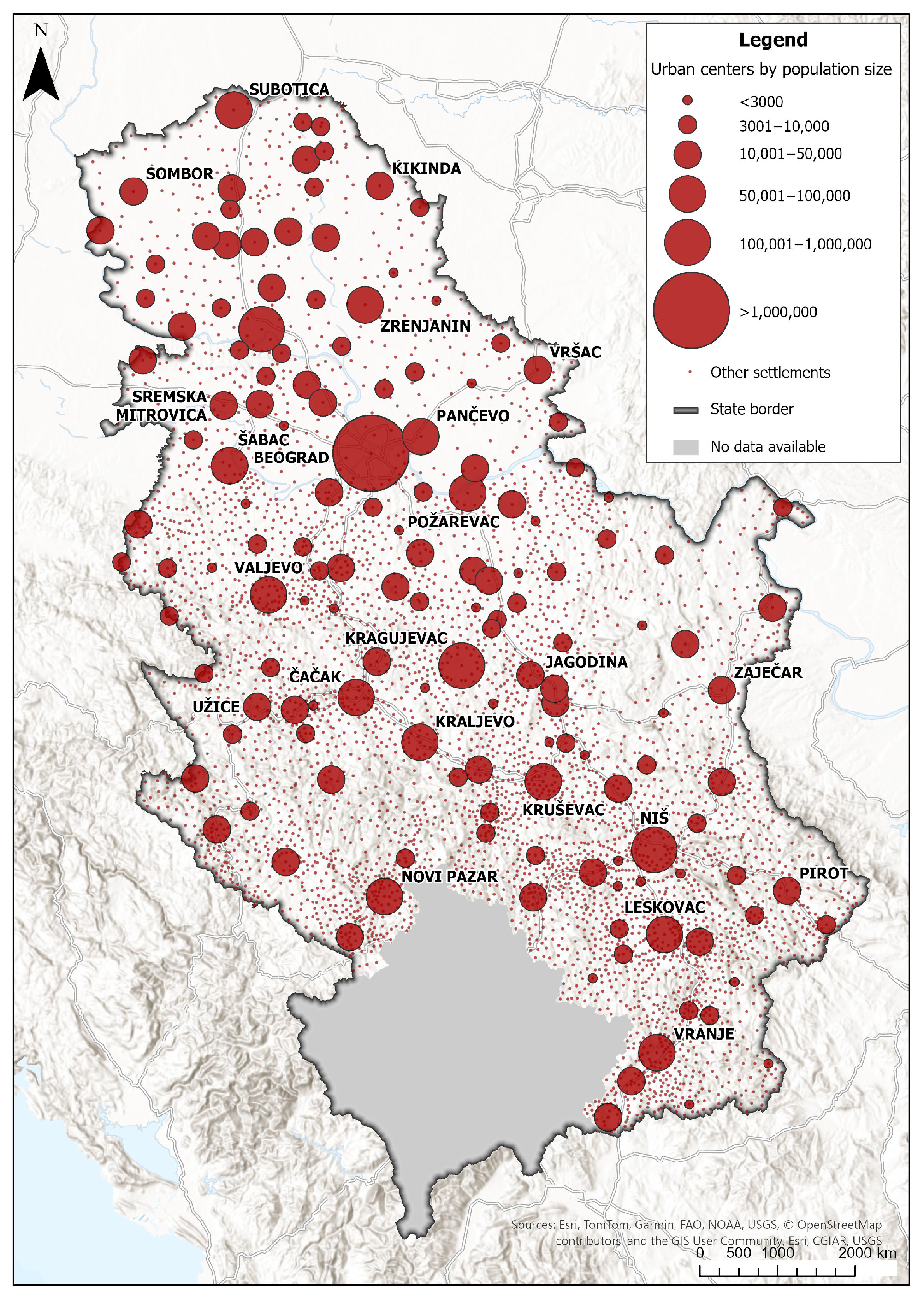
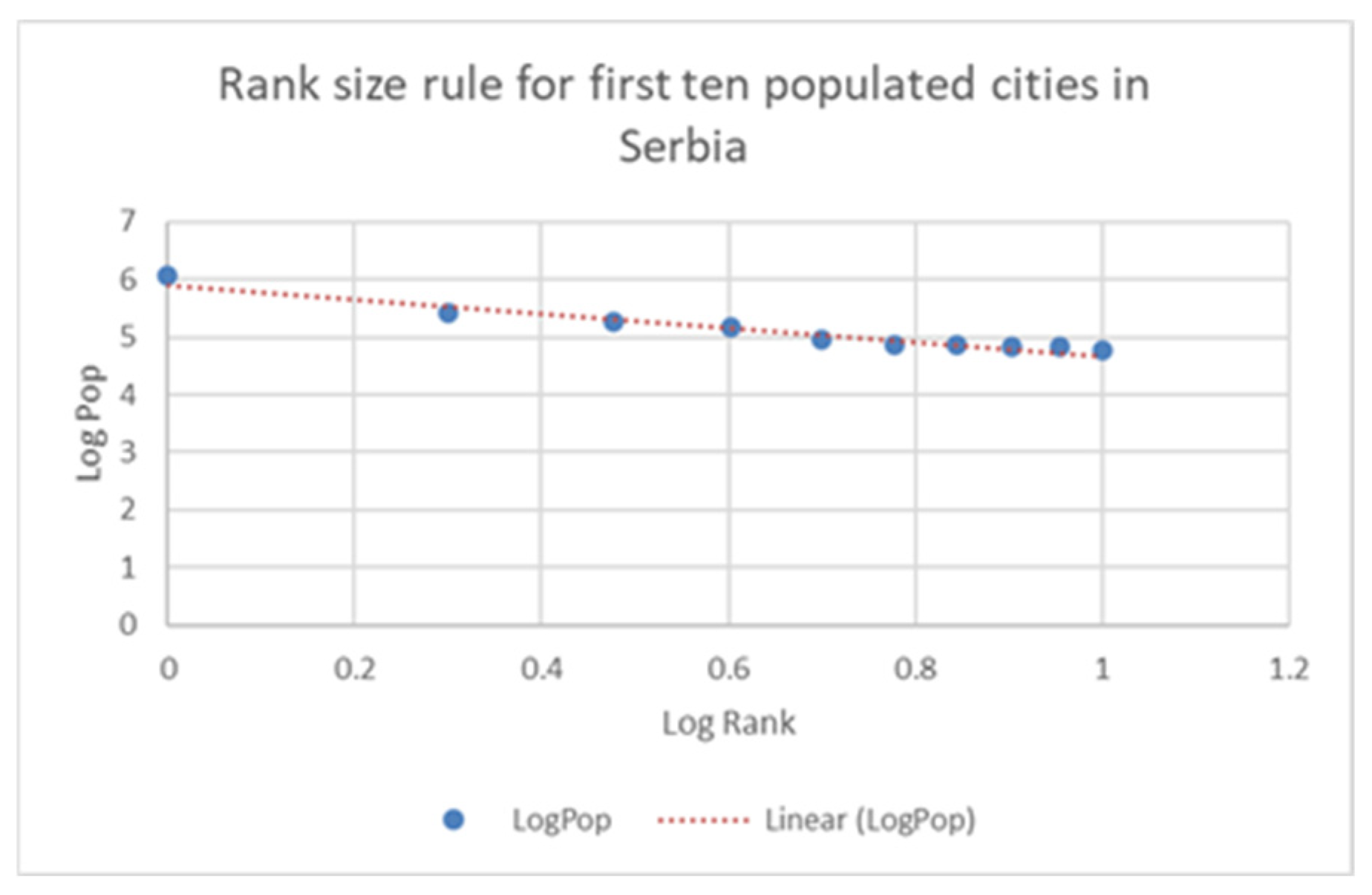
The population is unevenly distributed, which is why the urban system has a distinctly irregular form, with prominent disproportion, especially between the capital city, Belgrade, and the rest of the territory (
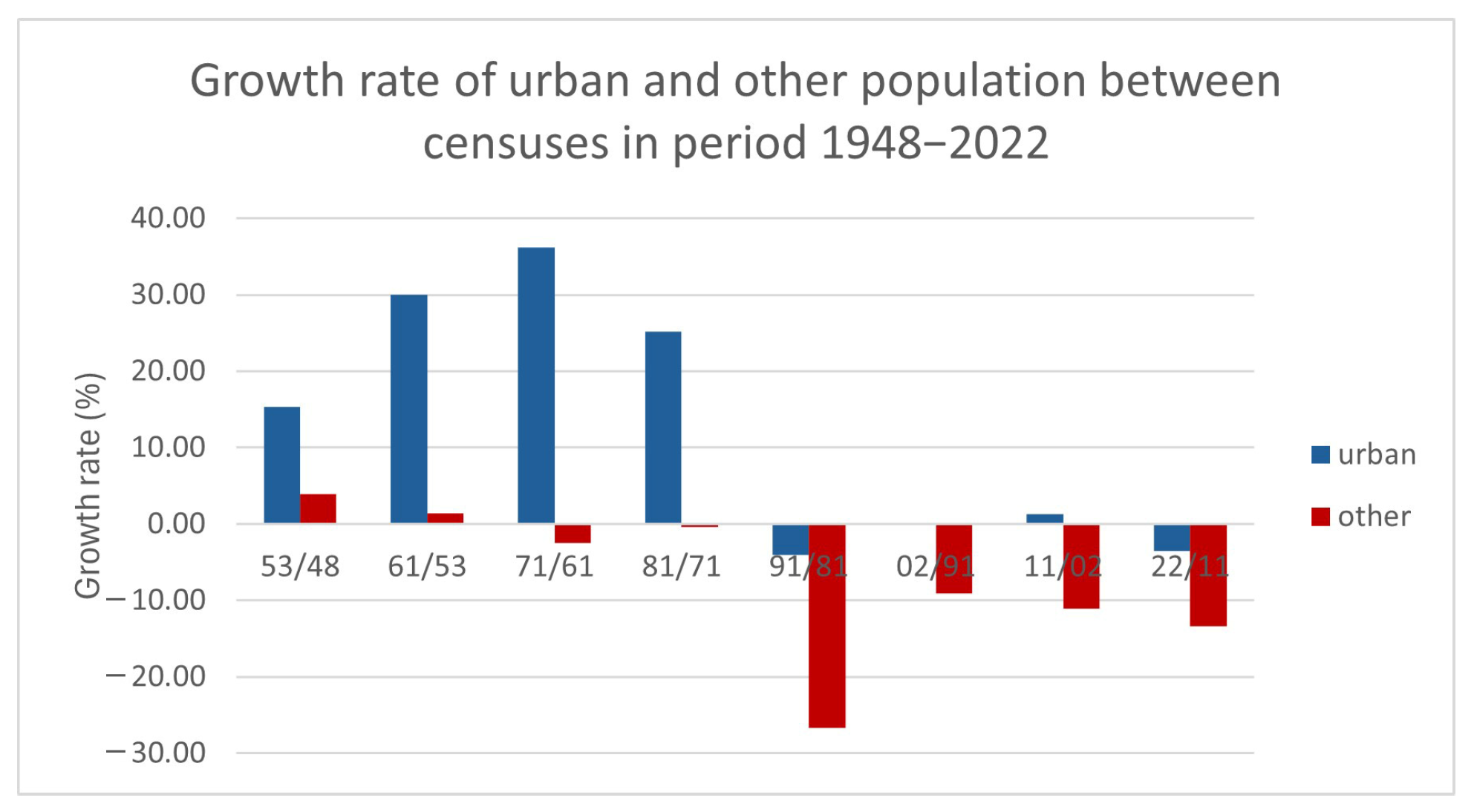
Figure 2). In the urban system, the domination of the capital city is quite noticeable (18% of the population of the Republic of Serbia lives in Belgrade). Observing the size structure of cities, the absence of cities with over 200,000 inhabitants is quite visible. The only one in this category is Novi Sad. The process of depopulation has been intensified in the last two decades, both in urban and in rural settlements, with the decline rate being significantly higher in rural settlements (
Figure 3 and
Figure 4).
According to Krunić et al., the cities in Serbia face deep structural changes: depopulation, weakening of function, and territorial polarization [
53]. By analyzing the data of the change in the number of inhabitants from the last three censuses, only in a few cities, the growth in the number of inhabitants can be noticed (Belgrade, Novi Sad, Lazarevac, Tutin) and with distinctly low growth rates, which shows that urban settlements are also affected by the depopulation process, like the entire country. The centers weakened in population experience a parallel loss in their functional capacities, and they do not manage to completely integrate either their administrative space or expand the boundaries of their influence [
44].
Such an image of the urban system, where the dominance of the capital city, Belgrade, is emphasized, is not in accordance with the solutions defined through planning documents of the highest hierarchal level of the Republic of Serbia where balanced and polycentric development is advocated by the Spatial plan of the Republic of Serbia (hereinafter SPRS) 2010–2020 [
54] and the Draft of SPRS from 2021 to 2035 [
55]. According to the Draft of SPRS from 2021 to 2035, in the urban system of the Republic of Serbia, what can clearly be noticed are the primary zones of agglomerating and intensive spatial–functional connections along the valleys or corridors of the most important rivers in Serbia: middle part of Podunavlje, the valleys of Velika, Zapadna, and Južna Morava rivers, which are recognized in the Serbian professional and scientific literature as the development axes. Therefore, in the geospace of Serbia, the following formed structures can be distinguished: the metropolitan area of Belgrade (which represents the polycentric urban agglomeration developed by agglomerating settlements on the line of Novi Sad–Inđija–Stara Pazova–Belgrade–Pančevo–Smederevo with secondary urban centers of the City of Belgrade: Obrenovac, Lazarevac, Mladenovac); urban area of Novi Sad or Novi Sad agglomeration with the zone of influence (Temerin, Žabalj, Sremski Karlovci, Titel, Inđija, Vrbas, Bačka Palanka, Bač, Bački Petrovac, Irig, Srbobran), which, together with Belgrade, forms Belgrade-Novi Sad metropolitan area; urban area of Niš with a large zone of influence that make Niš agglomeration; urban areas along the development axes—Podunavlje-Posavina (Sombor, Apatin, Bačka Palanka; Novi Sad, Ruma, Sremska Mitrovica, Šabac, Beograd, Pančevo, Smederevo, Požarevac which is further connected with the secondary Timok axis—Veliko Gradište, Golubac, Kladovo, and Negotin), axis of the Velika Morava (Smederevo–Požarevac–Jagodina–Paraćin–Ćuprija) where the influence of Kragujevac is also felt, the axis of the Južna Morava (Niš–Leskovac–Vranje), axis of the Zapadna Morava (Užice–Čačak–Kraljevo and Kruševac); urban areas of Kragujevac, Novi Pazar, Valjevo, and Bor as the most important urban areas outside the axes with greater influence; and local urban centers.
4. Data and Methodology
For the needs of this research, data from various sources were used—statistical and publicly available and open geospatial. The data on the number of inhabitants were used from the latest available Census 2022 published by the Statistical Office of the Republic of Serbia [
51].
The data on the road network on the territory of the Republic of Serbia were obtained from the Public Enterprise “Roads of Serbia” [
56], the open database OpenStreetMap (OSM) [
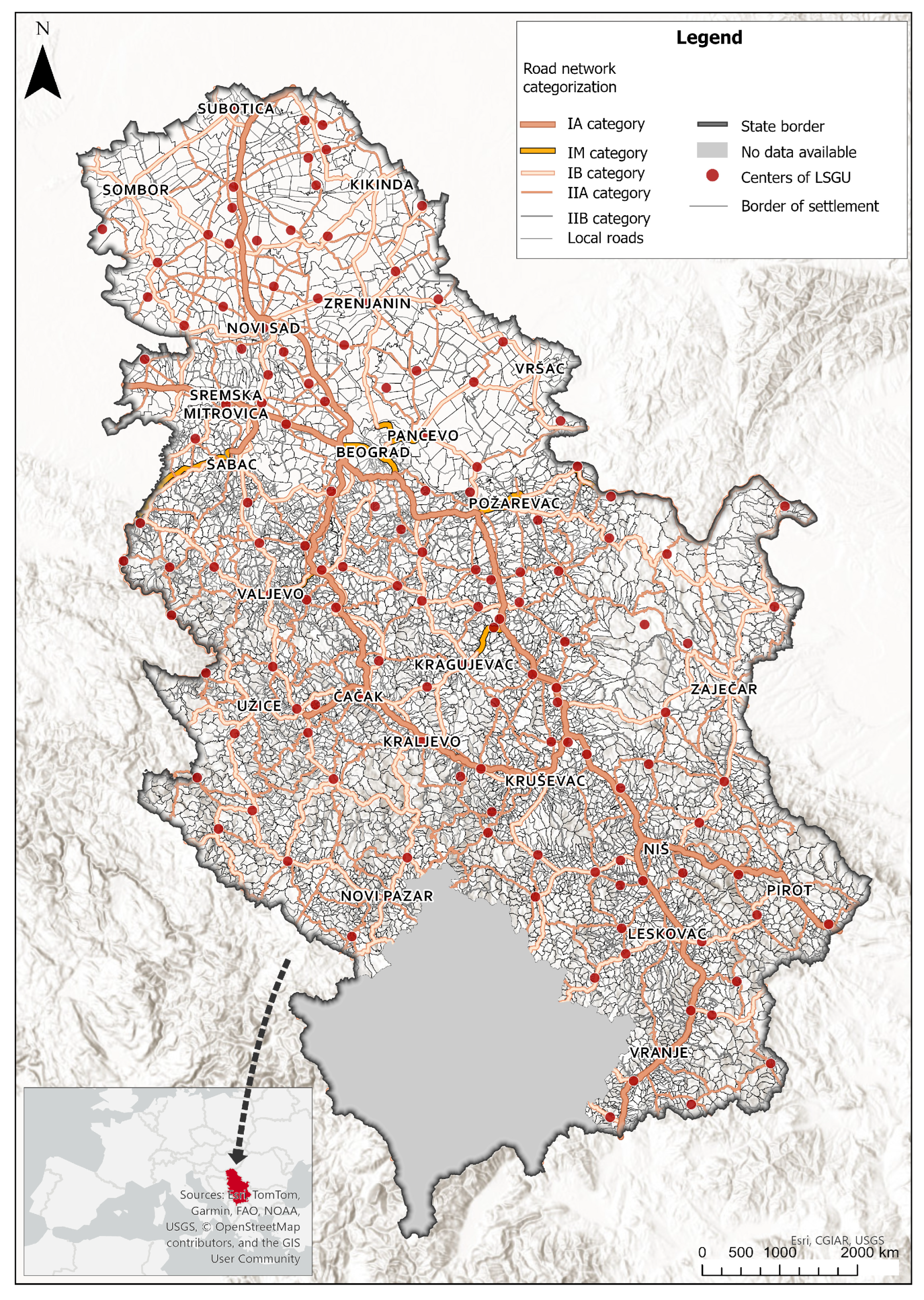
57], and by digitalization based on the satellite groundwork available within the ArcGIS Pro software (version 3.2.0, Esri). The road network obtained in this way, along with the network of state roads, also comprises local roads necessary for the everyday functioning of the population and establishing the connections between settlements.
The analysis of the potential accessibility to the population of LSGU centers in this paper basically implements Hansen’s model [
30], but it has undergone certain corrections due to the characteristics of the space it examines and the subject and aim of this research. The hypotheses that were kept were that the possibility of a place for interaction in space rises with the level of its importance and falls with the expenses (travel time) to that place. In numerous scientific studies carried out for the territory of Serbia, the population of LSGU centers proved to be a significant indicator of the development of functions and the importance of LSGU centers, which is why it was used to observe the importance of a certain center [
43,
50,
52]. In this research, the accessibility to the population of LSGU centers is directly proportional to the number of inhabitants of that center, and inversely proportional to the travel time to it. The aim of the implementation of this model is to point out the functional connection, territorial inequality in the accessibility to LSGU centers, and also to the dominance of certain centers due to the concentration of population in them, which is why no measuring of interactions between each settlement was carried out. This choice of analysis was supported by the fact that LSGU centers in Serbia have much greater values in terms of function, number of inhabitants, and other amenities in comparison with other settlements, so the values of accessibility indices were obtained in such a way that they represent extreme values, which further implies that it is not possible to notice the clear diversification of a territory. This choice of the input data analysis is in line with previous scientific research carried out in the Serbian scientific literature, which perceives urban centers as the poles of development in the space and, through their functions, they encourage various processes (daily migrations, economic development, etc.) [
58,
59,
60].
In order to examine which centers have the ability to integrate a larger number of settlements, as well as which settlements are in the interaction with a several centers at the same time, which means that they have better predispositions for multiple activities (from economy, demographic potential, workforce capacities, etc.), a matrix was formed in ArcGIS Pro 3.2.0 software where the destinations are all the LSGU centers in Serbia (151 centers), and the starting points are all the other settlements (4709 settlements) which are located within the 60 min isochron (the LSGU centers on the territory of the Autonomous Province of Kosovo and Metohija were excluded from this analysis due to the lack of data or their incompleteness). The isochrone of 60 min is considered the maximum relevant travel time threshold in regional and spatial planning for functionally relevant interactions with urban and regional centers [
55,
61,
62]. In addition, we empirically conducted an analysis that included thresholds of 45, 90 and 120 min, but the threshold of 60 min proved to be most appropriate for our research. The lower threshold resulted in omitting settlements near Belgrade, due to the greater area of this center. The higher threshold showed unrealistic functional interactions between settlements and centers. For the travel speed, the average car speed was used, depending on the road category, so they range from 110 km/h for highways and expressways, 80 km/h for IB class roads, 60 km/h for IA class roads, 40 km/h for IIB class roads and local roads [
63]. Final analysis of the network was carried out using the shortest travel time. What is obtained in that way is the travel time from an LSGU center to every individual settlement at the maximum time distance of 60 min.
The next step in the analysis is the implementation of modified Hansen’s formula [
30], according to which the accessibility of a certain location decreases with the increase in the time to reach it:
where
Ai—accessibility of place
i (every settlement on the territory of the Republic of Serbia),
Pj—population of location
j (LSGU center),
dij—distance or travel time between
i and
j (a settlement and a LSGU center within the time isochron of 60 min),
f(
dij)—distance decay function of travel time.
The equation assumes that the intensity of interaction is inversely proportional to the expenses (in this case, travel time) and directly proportional to the attractiveness of the location (in this case, expressed through the number of inhabitants), which means that the potential of the population is equal to the size of the number of inhabitants of a LSGU center pondered on the travel time from a settlement to that center.
The function used in the equation for calculating the accessibility of each individual settlement is the distance decay function. Distance decay function is a decay function used in geographic research for determining the level of interaction between locations. At the basics of this function is a supposition that the possibility for interaction between places decreases as the distance between them increase and it relies on the first law of geography [
64,
65], and for its calculation, the negative exponential function was used, which was also affirmed through other scientific studies, either of review or empirical type [
66,
67,
68,
69,
70]. By using negative
, it is achieved that the value of the exponential function decreases with the increase in travel time:
where β represents the distance decay parameter. The parameter value was calibrated empirically based on the assumption that the half value of destination opportunities should be reached at a median travel time. This approach was taken by numerous authors and studies: Östh [
71], Stępniak and Rosik [
72], Rosik et al. [
41,
73].
After calculating the potential accessibility for each of the 4709 settlements, an average accessibility (
Aa) was calculated, and in relation to it, the accessibility index was also calculated, which represents the standard procedure implemented in previous analyses of potential accessibility [
37,
41,
74]:
where
Ii—accessibility index of settlement
i,
Ai—accessibility of settlement
i,
Aa—average accessibility of all the settlements included in the analysis (4709 settlements).
The implementation of this model makes it possible to determine which settlements have above-average and below-average accessibility in comparison with the average being 100, which is closely correlated with the perceived territorial development and realized development disparities regarding the influence of centers on the sustainable development of a territory.
5. Results
Based on the input data analysis and by using the methodology described in the previous chapter, the obtained results show potential accessibility to the population of LSGU centers on the territory of the Republic of Serbia on the settlement level. The value of accessibility for every settlement ranges from 2607 to 4,179,382, which is why it was later also expressed through the population-weighted average, where 100 = 573,659. This number represents the average accessibility of all the settlements on the territory of the Republic of Serbia. Based on this value, it is possible to identify the settlements that have deviations in terms of below-average accessibility and above-average accessibility.
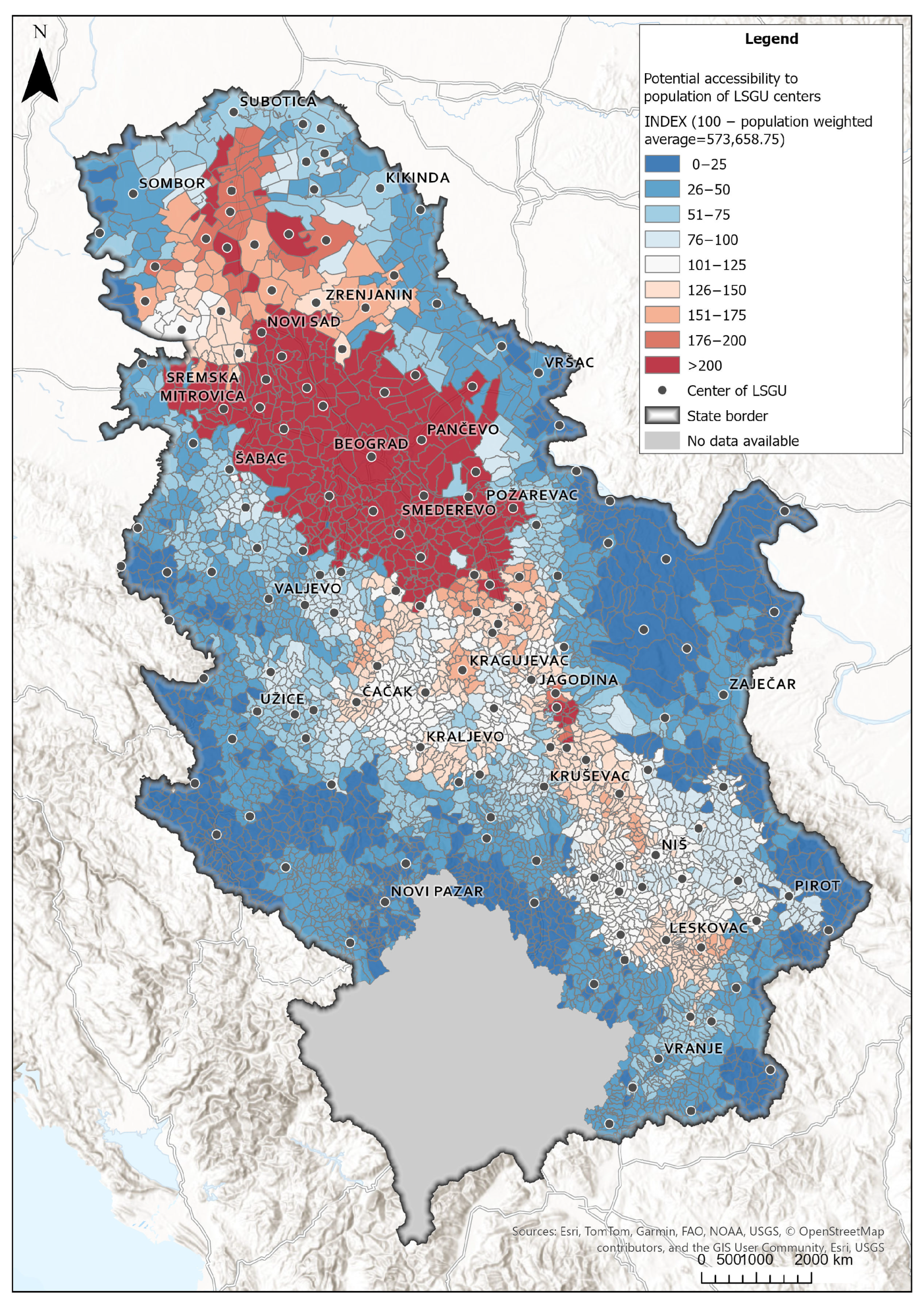
The map in
Figure 5 shows the classification of the index of accessibility to the population of LSGU centers in several categories. The settlements with the index value lower than 100 are considered the settlements with accessibility below average. There are as many as 3216 such settlements on the territory of the Republic of Serbia (about 68% of the total number of settlements), whereas 1493 settlements are characterized by the accessibility above average (about 32% of settlements).
In the category of settlements whose index value is below 100, observed in quarters, the most represented are the settlements with the index value between 25 and 50 (25% of settlements). They are followed by settlements with the index value lower than 25 (20% of settlements), the settlements with the index between 50 and 75 (15% of settlements), and the settlements with the index between 75 and 100 (about 8% of settlements).
The settlements with the lowest index (up to 25) are mostly found in the border, mountainous, isolated parts of the Republic of Serbia, and next to the poorly connected roads. The centers in their environment are also characterized by a depopulation process. These settlements are mostly located in the eastern, southeastern, western and southwestern parts of the country, with a few such settlements in its northern and northeastern parts.
Besides the border northwestern, northeastern, and southern parts of the country, the settlements with the index of 26–50 also include mountain settlements and the settlements at the bottom of the mountains, with bad transport connection on the territories of southwestern and eastern Serbia (depopulation settlements).
The settlements with the index range of 51–75 are positioned in the northern and northwestern border parts of the Republic of Serbia and hilly parts of Central Serbia, where they are characterized by a relatively favorable transport connection.
The settlement with the index 76–100 situated next to Central Serbia and partly in Western Serbia (settlements in the plains along A2 highway and state roads of IB order which stretch throughout central Serbia), comprise a large area between Niš and Pirot (the area of A4 highway), the area from Niš to Leskovac (along A1 highway, i.e., E-75), and a few of such settlements can be found in Vojvodina.
The settlements with the index above 100 can also be observed within a certain scale, based on quarters. Among them, the most represented settlements are those with the index value above 125 (11% of the total number of settlements), followed by the settlements with indices 125–150 (9% of settlements), 150–175 (3% of settlements), 175–200 (1% of settlements), and the settlements with the index above 200 make up around 8% of the total number of settlements.
The settlements whose index is in the range between 101 and 125 are located near the centers of western Pomoravlje (Čačak, Kraljevo, part of the development axis along the Zapadna Morava), as well as in the direction toward Gornji Milanovac and Kragujevac, and further toward Jagodina. The second group of these settlements is characteristic of the area of Niš agglomeration formed along the A1 highway, i.e., European highway E-75.
The index of 126–150 characterizes the settlements along the development axis by the Zapadna Morava (in the area from Kraljevo toward Kruševac), the settlements along the newly constructed A2 highway (the area from Čačak toward Gornji Milanovac), the settlements around the regional center of Leskovac along E-75 highway, and a large number of settlements along highway corridor A1 or E-75, all the way to Belgrade agglomeration.
The index with the value 151–175 is characteristic of the settlements located along the highway on the territory of AP Vojvodina, in the close vicinity of Novi Sad, as well as for the settlements near Zrenjanin. In central Serbia, it is present in settlements around Kragujevac, Niš, and along the southern borders of the Belgrade agglomeration.
The settlements with the index value 176–200 can be found in Vojvodina, along the A1 (E-75) highway in the area from Bački Petrovac toward Subotica.
The index with the value above 200 is found in the Belgrade agglomeration and the surroundings, which lean to the Novi Sad agglomeration, i.e., the metropolitan area of the City of Belgrade. Settlements in this category have the index of accessibility to the population of LSGU centers, which is 2–7 times higher than the average for Serbia. Due to its cover area and the choice of time isochron of 60 min within which the analysis was carried out, the settlement of Belgrade is not the settlement with the highest value within this group of settlements. Such settlements are Petrovaradin, Sremska Kamenica, Topola, which have access to a larger number of centers with greater importance in that time isochron (viewed through the number of inhabitants (Belgrade, Novi Sad, Kragujevac, etc.).
The results of the accessibility index indicate a polarization in the urban system of Serbia, where the core-periphery spatial pattern is clearly noticed. The core areas are represented by extremely high values of the accessibility index formed around the metropolitan area of Belgrade (in the area of the agglomerations of Belgrade and Novi Sad). High accessibility index values also occur in the area of the development axis: Zapadna Morava and Velika Morava. In addition to the fact that these are the most infrastructurally developed parts of Serbia, these areas are also the most developed in terms of population. The concentration of population in these areas is the result of multiple consequences, both the infrastructural development and functional development, thanks to the proximity of the centers. It is also noticed that settlements that are better connected in terms of infrastructure to more development centers within a 60 min isochron have higher accessibility indices, and therefore better development predispositions, which is the case with settlements in central Serbia.
Extremely low values of the accessibility index can be seen in isolated mountain areas of Serbia, which are the result of poor infrastructure development in these areas, as well as decades of depopulation processes. The processes of depopulation and the weakening of the functional capacities of the centers in these areas can be considered as a consequence of the inability of these areas to integrate into the wider environment.
Results obtained in this research can serve the policy makers, since at the settlement level they are diversifying the entire national territory. In this sense, it is possible to assume that settlements with extremely low accessibility indexes require planning interventions, which imply an integral approach of planning that not only includes transport planning, but also implies planning of socioeconomic development of space and demographic revitalization. Further development of these areas cannot be ensured only through infrastructural investments, although they represent an initial step.
6. Discussion
The results obtained in the previous chapter point to the heterogeneity and disproportions of the urban system of the Republic of Serbia, where certain common characteristics can be noticed. The index values of the potential accessibility to population of LSGUs centers are below the average and characteristic for settlements in the border parts of the territory due to their poorer possibility of interaction, depopulation settlements and the ones at higher altitudes (settlements with poor transport connection). Above-average values of the index are connected with the parts of central Serbia along the important transport arteries, which were recognized in the Serbian literature as the development axes: the Danube–Sava development axis and the development axis of the Zapadna Morava and the Velika Morava. The area of outstandingly high transport accessibility is also characterized by the expanded belt which refers to Belgrade metropolitan area (where the urban area of Novi Sad is also integrated), urban agglomerations (Niš agglomeration and the one along the development axis of the Zapadna Morava stretching on the line Užice–Čačak–Kraljevo–Kruševac), the area around Kragujevac as the regional center of development, and urban centers in Vojvodina along A1 (E-75) highway.
The results of this research correspond with similar studies carried out at the level of Europe and some European countries. The findings obtained in the TRACC project [
37], which comprised the territory of Europe, just like the results obtained in this research, point to great differences between central parts of the territory represented by capital cities (Belgrade in the case of Serbia) and peripheral parts of the territory. Similar studies carried out by other authors emphasize that the highest indices of accessibility are around national centers, as well as around larger urban centers. Even though it has certain methodological differences, since it does not perceive the interaction on the mutual relation among the settlements, but every LSGU center with every settlement (the aim is to show the importance and role of centers on the development of the territory itself), or different datasets are taken into consideration (grid datasets, NUTS3 level), the results of this research correspond partly with the works of authors such as Ribiero et al., Reaggiani et al., Rosik & Stepniak, where the highest index of accessibility was recorded in urban centers and in their surroundings [
38,
39,
40,
41].
The importance of accessibility and combining spatial and statistical indicators was previously recognized in the studies by Nevenić et al., Srnić et al., Gajić Protić et al. [
42,
44,
45]. In these studies, accessibility was made only one of the variables that were included in the specific model for delimiting urban or rural areas, and it was represented using isochrones. The accessibility was thus perceived as spatial accessibility defined through time distance from LSGUs centers or urban centers. Even though these studies propagate different concepts of territorial development, which is why the exact comparisons are not possible, their approaches make up the starting point of this research.
The model implied in this research showed great analogy with the ideas presented through Topic Study No. 3 (Population, settlements, and social development) carried out within the Spatial Plan of the Republic of Serbia 2021–2035, according to which the urban system of Serbia could also be perceived through the center-periphery concept [
75]. The analogy was established through the results, which clearly differentiate a territory into the central part (whose backbone is the Belgrade metropolitan area with Novi Sad agglomeration, urban areas of Niš and Kragujevac, and urban areas along the axis of the Zapadna Morava), and peripheral areas. Thus, this study is the one that confirms the relevance of using potential accessibility to the population of LSGU centers on the national and strategic level in the process of decision-making. The results in this research provide a significantly more sophisticated image in terms of the spatial distribution of population, functions, work centers, etc., than the mentioned study.
Considering that peripheral areas have low accessibility indices, which are a consequence of decades of depopulation processes and poor transport connectivity, it is unlikely that development will occur through infrastructure investments [
12]. Observing the spatial pattern formed from these results, it is unrealistic to expect that the influence of Belgrade, which causes strong polarization, will weaken. Based on these findings, polycentric strategies are not a realistic scenario when it comes to Serbia. Investments, therefore, should be directed toward regional and local centers that have developed functional capacities, from where development impulses would spread to the surrounding area. However, this approach also carries certain risks that, through the strengthening of these centers, it may deepen a mechanism of polarization between central and peripheral areas, through the draining of human resources and capital from peripheral areas and the additional strengthening of the function of developed areas. Therefore, it is necessary for strategies to carefully balance possible diffusion effects with measures directed towards alleviating spatial inequalities. An integral approach to development that would also imply demographic revitalization measures, with the strengthening of secondary transport connections between peripheral areas and their local and regional centers, supports their integration into the wider environment.
As the majority of models, this model also has certain deficiencies. Insufficient accuracy of the model has been noticed related to the parts of a territory with an insufficiently covered network of local roads, which is why the accuracy of the model largely leans on the exact topology of the input vector data. Also, the model is applied in limited national conditions, without taking into consideration the cross-border impact of the cities in the surroundings, and thus, the settlements in the border parts of the territory are initially in an unfavorable position.
Despite the limitations found in this approach, the final result of the implementation of this model greatly succeeded in pointing to the unbalanced urban system in Serbia, which results in the possibility for its further implementation in scientific studies as an analytical instrument of territorial development, especially as an indicator that could point to the centrality, or peripherality, of certain parts of the territory. The greatest contribution of this paper is forming the composite index, which takes into consideration transport infrastructure as one of the important segments of sustainable territorial development. Thus, it introduces a new dimension and the concept of potential accessibility in the study of territorial development.
7. Conclusions
Previous studies, especially where gravity and potential models of transport accessibility are used, put more emphasis on the impact of the transport infrastructure in the specific space and the implementation of such models as help in deciding on future investments. In this research, through the use of potential accessibility to the population of LSGUs centers on the territory of Serbia, it has been shown that a similar, but modified approach can be used for perceiving sustainable territorial development as well.
The identified development disproportions (anomalies) of the urban system certainly affect the sustainable territorial development of the entire territory, since towns/cities, i.e., the centers of LSGU in this case, are those which bear the development (poles, hotspots) in geospace. Their significance (presented in various ways, either as the number of inhabitants, workforce of population, number of jobs, functions, etc.) and the possibility of other settlements to interact with them, to connect by function relations, in the specific time interval define the geospace and affect the formation of certain spatial structures. The model formed through this research and its analogy with actual spatial patterns in the urban system of Serbia, as well as with the center–periphery concept, point to the possibility of its implication in future research related to the indicators of territorial cohesion and agglomeration detecting in spatial planning documents. Its additional significance is reflected in the fact that it represents the first research of this type for the territory of the Republic of Serbia and the introduction of the accessibility concept in studying sustainable territorial development. Future studies could be directed toward perceiving other factors where one center has a prominent importance in space (either it being a work function, gross added value, number of companies, share of workforce, share of highly educated population, etc.) and taking into consideration when forming a model.




 ,
,