The Material Passport for a Circular Construction Industry: A PRISMA Based Systematic Review


Abstract
1. Introduction
2. Materials and Methods
2.1. Search Strategy
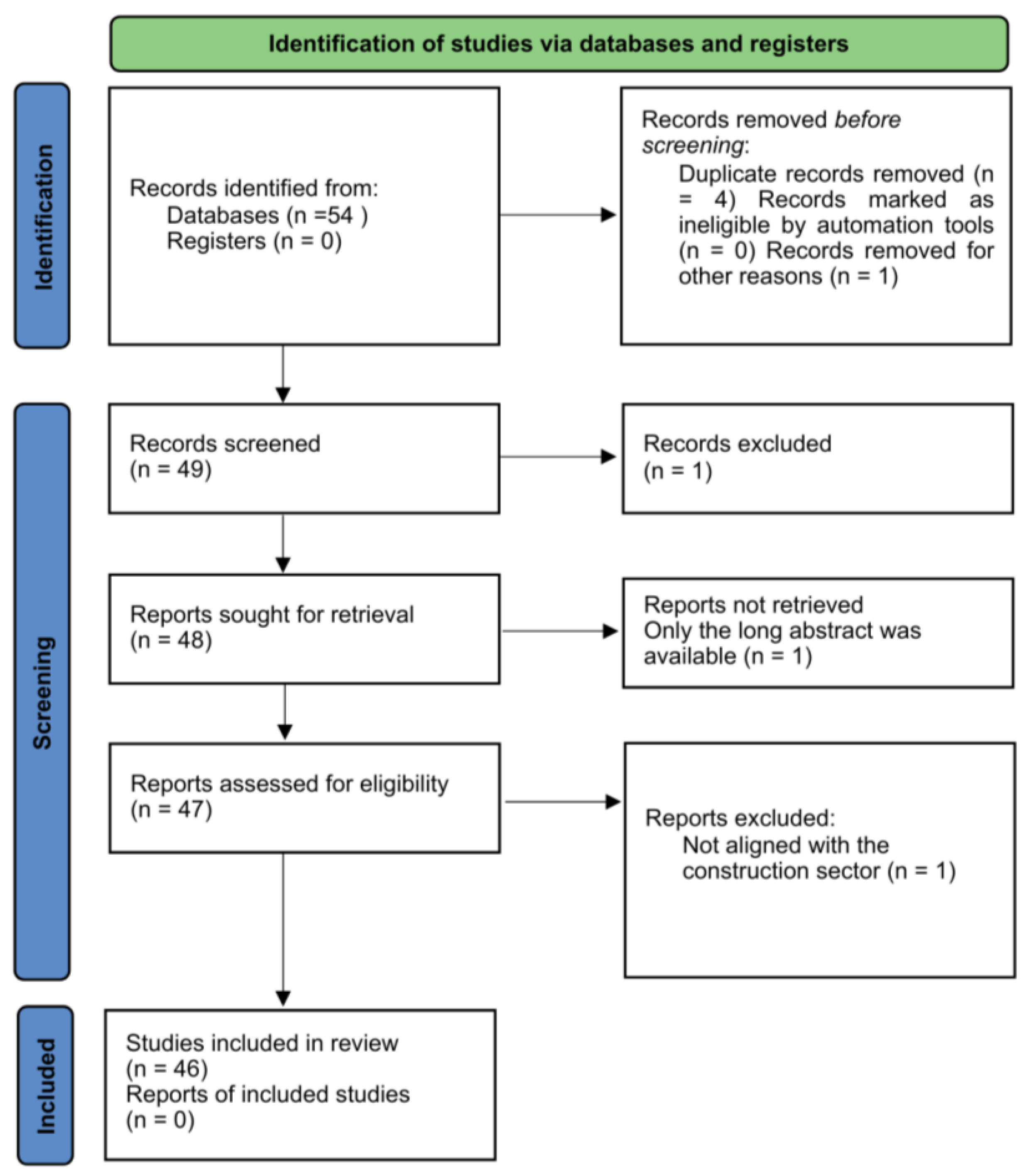
2.2. Screening Process
2.3. Process of Reviewing
2.4. Bibliometric Analysis and Qualitative Content Analysis
3. Results
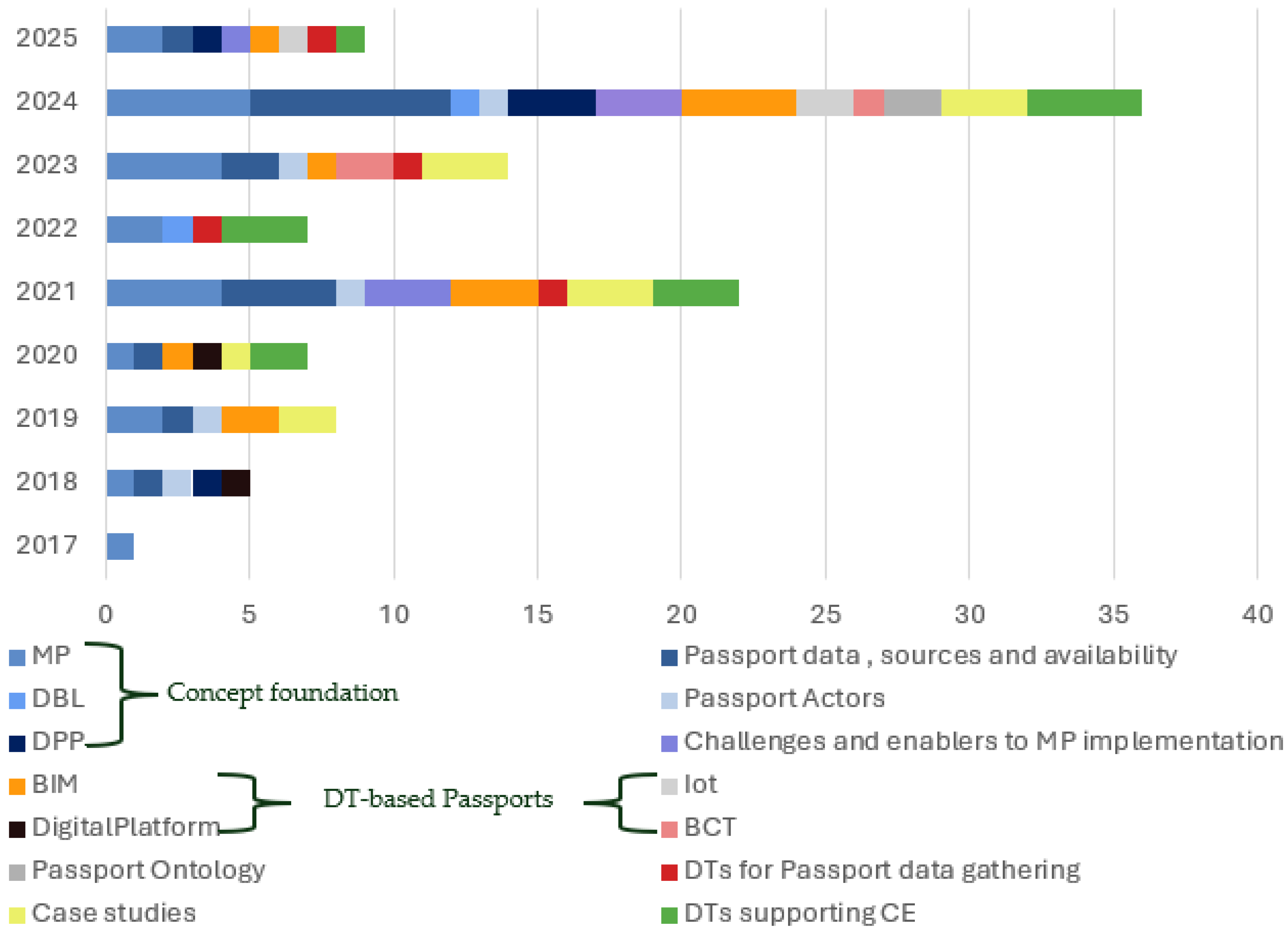
3.1. Bibliometric Analysis
3.2. Material Passports: A Tool Supporting a Circular Economy in the Construction Industry
3.2.1. Material Passports at the Material Scale
3.2.2. Material Passports at the Building Scale
3.2.3. Material Passports Throughout a Building Life Cycle
3.2.4. Material Passports Versus Digital Product Passports and Digital Building Logbooks
3.3. Challenges Hindering Material Passport Implementation in the AEC
3.3.1. Lack of Regulations
3.3.2. Data Availability and Consistency
3.3.3. Social Resistance
3.3.4. Need for Digital Tools
3.3.5. Economic Feasibility
3.4. Material Passports’ Data, Structure and Supporting Technologies
3.4.1. Material Passport Content
3.4.2. Actors Involved in Material Passports
- -
- AEC Organization Actors [39,49]: These include BIM managers, architects, engineers, consultants, maintenance contractors, maintenance managers, project managers, and demolition contractors. These professionals play a significant role in entering data for MPs [29]. Additionally, Honic et al. [49] suggest including extra stakeholders who can assist with the consultation or management of the MP creation process.
- -
- -
- Regulatory Bodies: Institutions involved in the CE and sustainability are vital for MP generation, as they establish regulations for construction materials and provide information regarding recycling potentials [49]. Public authorities [50], municipalities, and end-users are identified as having a smaller role in the MP process [29].
3.4.3. Data Sources for Material Passports and Information Availability
3.4.4. Digital Tools’ Role in Overcoming Data Scarcity in the Built Environment
3.4.5. Digital Tools’ Growing Role in Supporting Material Passports
4. Discussion
4.1. Towards a Definition of Material Passports
4.2. Material Passports for Decision-Making Throughout Life-Cycle Stages
4.3. Addressing the Data Scarcity Challenge
4.4. Synergies Between Digital Tools Supporting Material Passports
4.5. IoT, Sensor Data and Dynamic Updates of Material Passports
5. Conclusions
Supplementary Materials
Author Contributions
Funding
Institutional Review Board Statement
Informed Consent Statement
Data Availability Statement
Conflicts of Interest
Abbreviations
| MP | Material Passport |
| DPP | Digital Product Passport |
| DBL | Digital Building Logbook |
| DT | Digital Tool |
| CE | Circular Economy |
| BE | Built Environment |
| AEC | Architecture, Engineering, and Construction |
| LCC | Life-Cycle Cost |
| LCA | Life-Cycle Assessment |
| EPD | Environmental Product Declaration |
| TDS | Technical Data Sheet |
| MSDS | Material Safety Datasheet |
| EPC | Energy Performance Certification |
| BIM | Building Information Modeling |
| BCT | Blockchain Technology |
| IPFS | InterPlanetary File System |
| IoT | Internet of Things |
| GIS | Geographic Information System |
| LIBS | Laser-Induced Breakdown Spectroscopy |
| GPR | Ground-Penetrating Radar |
| LLM | Large Language Model |
| AI | Artificial Intelligence |
| RFID | Radio Frequency Identification |
| NFC | Near-Field Communication |
| DPM | Digital Product Marking |
| DigiM | Digital Marketplace |
| IFC | Industry Foundation Classes |
Appendix A

| Project Name | Funding Type |
|---|---|
| BAMB—Buildings as Material Banks | HORIZON 2020—European Commission |
| CHARM—Circular Housing Asset Renovation & Management | Interreg—North-West Europe |
| BASAJAUN—Building A Sustainable Joint between Rural and Urban Areas Through Circular And Innovative Wood Construction Value Chains | HORIZON 2020—European Commission |
| ICEBERG—Innovative Circular Economy-Based solutions demonstrating the Efficient recovery of valuable material Resources from the Generation of representative End-of-Life building materials | HORIZON 2020—European Commission |
| ReCreate—Reusing precast concrete for a circular economy | HORIZON 2020—European Commission |
| CURIOSIT—Circular design and development of Sustainable products in 4 key sectors in Central Europe | Interreg—Central Europe |
| BIMaterial—Process design for BIM-based, material building passport | Austrian Ministry of Transport, Innovation and Technology through the program “Stadt der Zukunft” (City of future) by FFG (Austrian Research Promotion Agency) |
| SCI_BIM—Scanning and data capturing for Integrated Resources and Energy Assessment using Building Information Modelling | Ministry Republic of Austria: Transport, Innovation and Technology through the Austrian Research Promotion Agency (FFG) |
| CIRCULUX | FNR (Fond National du Luxembourg)–AFR this project is also connected to FNR CORE project CIRCULAR |
| ProFlow—Prototype for products’ information flow | Project grant Vinnova in Sweden |
| Build Digital Project | Department of Public Expenditure, Infrastructure, Public Service Reform and Digitalisation of the Republic of Ireland |
Appendix B
| Publication Title | Year | Ref. | Conceptual Foundation | Actors | MP Data | MP Challenges and Enablers | DTs for Data Gathering | BIM | IoT | BCT | Platform | Ontologies | Circularity Assessment | DT Supporting CE | CE Challenges and Enablers | Case studies |
|---|---|---|---|---|---|---|---|---|---|---|---|---|---|---|---|---|
| Materials Passports: Optimising value recovery from materials | 2016 | [36] | MP | |||||||||||||
| Circularity information management for buildings: The example of materials passports | 2018 | [37] | MP | x | x | x | ||||||||||
| Improving the recycling potential of buildings through Material Passports (MP): An Austrian case study | 2019 | [38] | MP | x | x | x | x | |||||||||
| Data- and stakeholder management framework for the implementation of BIM-based Material Passports | 2019 | [49] | MP | x | x | x | ||||||||||
| Calculation and evaluation of circularity indicators for the built environment using the case studies of UMAR and Madaster | 2020 | [51] | x | x | x | x | ||||||||||
| The impact of 4ir digital technologies and circular thinking on the United Nations sustainable development goals | 2020 | [83] | x | |||||||||||||
| Digital platform for circular economy in AEC industry | 2020 | [58] | MP | x | ||||||||||||
| Methodological review: Socio-cultural analysis criteria for BIM modeling and material passport tracking of agriwaste as a building construction raw material | 2020 | [55] | x | |||||||||||||
| Coherent investigation on a smart kinetic wooden façade based on material passport concepts and environmental profile inquiry | 2021 | [67] | MP | x | ||||||||||||
| Circular digital built environment: An emerging framework | 2021 | [64] | x | |||||||||||||
| Material Passports for the end-of-life stage of buildings: Challenges and potentials | 2021 | [52] | x | x | x | |||||||||||
| Material Passports and Circular Economy | 2021 | [39] | MP | x | x | x | x | x | x | x | ||||||
| Scanning and data capturing for BIM-supported resources assessment: A case study | 2021 | [56] | x | x | x | x | ||||||||||
| Materials passport’s review: challenges and opportunities toward a circular economy building sector | 2021 | [28] | MP | x | x | |||||||||||
| Implementation stage for circular economy in the Danish building and construction sector | 2021 | [77] | x | |||||||||||||
| Building circularity assessment in the architecture, engineering, and construction industry: A new framework | 2021 | [40] | MP | x | x | |||||||||||
| How do Different Tools Contribute to Climate Change Mitigation in a Circular Building Environment?—A Systematic Literature Review | 2022 | [61] | x | x | ||||||||||||
| Digitalization for a circular economy in the building industry: Multiple-case study of Dutch social housing organizations | 2022 | [74] | x | x | ||||||||||||
| Contribution of New Digital Technologies to the Digital Building Logbook | 2022 | [48] | DBL | X (for DBL) | x | |||||||||||
| Circular economy in facades | 2022 | [72] | MP | x | x | |||||||||||
| Assessment of Sustainable Use of Material Resources in the Architecture, Engineering and Construction IndustryȁA Conceptual Framework Proposal for Austria | 2022 | [62] | MP | x | ||||||||||||
| Data requirements and availabilities for material passports: A digitally enabled framework for improving the circularity of existing buildings | 2023 | [29] | MP | x | x | x | x | |||||||||
| Green and Healthy Materials | 2023 | [69] | MP | x | ||||||||||||
| The Circular Economy and Circular Building Practices in Luxembourg | 2023 | [66] | x | |||||||||||||
| Developing a construction waste material ‘passport’ for cross-jurisdictional trading | 2023 | [35] | MP | x | x | |||||||||||
| Soft Technologies for the Circular Transition: Practical Experimentation of the Product “Material Passport” | 2023 | [41] | MP | x | x | x | ||||||||||
| A blockchain non-fungible token-enabled ‘passport’ for construction waste material cross-jurisdictional trading | 2023 | [59] | x | |||||||||||||
| Enhancing Life Cycle Costing (LCC) in Circular Construction of Buildings by Applying BIM: A Literature Review | 2024 | [76] | x | |||||||||||||
| Development of steel circularity passport: Literature review, research gaps, and program rules in New Zealand | 2024 | [30] | MP | x | x | |||||||||||
| A Digital Framework for the Implementation of the Circular Economy in the Construction Sector: Expert Opinions | 2024 | [65] | MP DBL | x | x | x | x | |||||||||
| From LCA to circular design: A comparative study of digital tools for the built environment | 2024 | [68] | x | x | x | |||||||||||
| Achieving net zero neighborhoods: A case study review of circular economy initiatives for South Wales | 2024 | [73] | x | x | ||||||||||||
| Implementing materials passports in the construction industry: empirical evidence from Ghana | 2024 | [54] | MP | x | x | |||||||||||
| A modular ontology modeling approach to developing digital product passports to promote circular economy in the built environment | 2024 | [44] | DPP | x | x | |||||||||||
| Circular information flows in industrialized housing construction: the case of a multi-family housing product platform in Sweden | 2024 | [50] | MP | x | x | x | ||||||||||
| Exploring the significance and priority of digital product passports implementation in building renovation projects targeting circular economy | 2024 | [45] | DPP | x | ||||||||||||
| Data-driven and LCA-based Framework for environmental and circular assessment of Modular Curtain Walls | 2024 | [47] | DPP | x | x | x | x | |||||||||
| Augmenting materials passports to support disassembly planning based on building information modelling standards | 2024 | [42] | MP | x | x | x | ||||||||||
| Industry 4.0 and the circular economy: using design-stage digital technology to reduce construction waste | 2024 | [63] | x | x | ||||||||||||
| Enabling circularity in Turkish construction: a case of BIM-based material management utilizing material passports | 2024 | [43] | MP | x | x | x | x | |||||||||
| RFID-based material passport system in a recycled concrete circular chain | 2024 | [57] | MP | x | ||||||||||||
| Blockchain-Enabled Provenance Tracking for Sustainable Material Reuse in Construction Supply Chains | 2024 | [60] | x | |||||||||||||
| Data carriers for circular construction supply chains: An exploratory quantitative analysis | 2025 | [46] | DPP | x | ||||||||||||
| Assessment of Energy and Resource Efficiency Through Sustainable Planning, Construction, and Operation Using Building Information Modeling (BIM) | 2025 | [70] | MP (briefly) | x | x | |||||||||||
| Material and Building Passports as Supportive Tools for Enhancing Circularity in Buildings | 2025 | [53] | MP | x | x | x | x | |||||||||
| Current methodologies of creating material passports: A systematic literature review | 2025 | [31] | MP | review | x | review |
Appendix C
| Category | Information | Ref. |  |  |  |  |  |  |
|---|---|---|---|---|---|---|---|---|
| Building level | ||||||||
| General Information | Building name, location, type | [29] | x | x | ||||
| Number of floors and Gross floor area | [29] | x | x | |||||
| Building construction year and building permit year | [29] | x | x | |||||
| Owner and history of ownership | [29,30] | x | x | x | ||||
| Administrator, contractor and maintenance contractor information | [29,30] | x | x | x | ||||
| Building material composition | [38,52,58] | x | x | x | x | |||
| Digitization level | [29] | |||||||
| Sustainability | Certification or Building Energy label | [29] | x | x | ||||
| Life-Cycle Assessment (LCA) | [38,49,56] | x | x | |||||
| Disposal indicator | [58] | x | x | |||||
| Circularity indicator | [39,51] | x | x | |||||
| Dynamic information | Monitoring of consumption | [28] | x | |||||
| History of events (e.g., vehicle collision, flood, landslide, geotechnical issues) | [30] | x | ||||||
| Annual maintenance cost | [50] | x | ||||||
| System | ||||||||
| Component | ||||||||
| General information | Name | [29,37,40,41,43,51] | x | |||||
| Picture | [28,41,57] | x | x | |||||
| ID | [28,29,40,43,51,52] | x | ||||||
| Last update | [28] | x | x | x | x | x | ||
| Traceability (e.g., RFID, Barcode, etc.) | [28,41,57] | x | x | |||||
| Product description | [28,29,37,40,41,43,51] | x | ||||||
| Supplier/Manufacturer name and contact details | [28,29,35,37,40,41,43,46,51] | x | x | x | ||||
| Ownership/Ownership history | [37,41] | x | x | |||||
| Position and location (in the building) | [29,30,37,43] | x | x | |||||
| Assembly instructions/manual | [29,41] | x | ||||||
| 2nd hand material Transaction Record | Selling price | [35] | x | x | ||||
| Date and place of trading | [35] | x | ||||||
| Issuing date | [35] | x | ||||||
| Provenance (e.g., Site, Project X etc.) | [35] | x | ||||||
| Logistics | Transportation distance | [31] | x | x | ||||
| Transportation requirements, handling and storage instructions | [28] | x | x | |||||
| Packaging, supply chain management | [28,41] | x | ||||||
| Dimensions | Weight | [28,29,40,41,51] | x | x | x | x | ||
| Volume/Area | [29,38,41,49,51,58] | x | x | x | x | |||
| Thickness | [38,49,58] | x | x | x | x | |||
| Quantity | [29,43] | x | x | x | ||||
| Product dimensions | [29,40,41] | x | x | x | ||||
| Material composition | Material composition | [28,38,41,49,53] | x | |||||
| Material family | [51] | x | ||||||
| Material feedstock sources and quality | [51] | x | x | |||||
| Material density | [38,41,58] | x | ||||||
| Production and durability | Manufacturing date | [28,29] | x | |||||
| Manufacturing process and techniques | [41,43] | x | ||||||
| Manufacturing location | [43] | x | ||||||
| Production waste | [41] | x | ||||||
| Lifespan | [28,37,38,40,41,51,58] | x | ||||||
| Warranty and expected use time | [28,29,41] | x | ||||||
| Labels and certifications | [28,30,41,43] | x | ||||||
| Physical and Chemical properties | Thermal conductivity, U-value | [38,49] | x | |||||
| Structural data (e.g., tensile resistance, elongation, modulus of elasticity, resistance of delamination, Charpy value, weldability) | [28,30,41] | x | x | |||||
| Optical properties | [41] | x | ||||||
| Seismic resistance | [30] | x | x | |||||
| Level of purity | [58] | x | ||||||
| Fire resistance | [30,41] | x | ||||||
| Chemical composition | [30] | x | x | |||||
| Defects/Degradation | [29,30] | x | x | x | ||||
| Safety | Hazard, contamination, additives | [28,29,35,51,53,58] | x | x | x | |||
| Material treatment | [28,29,41] | x | ||||||
| Safety, security recommendations | [28,29] | x | ||||||
| Circularity | Design for: durability/disassembly/adaptability/circularity | [41] | x | x | ||||
| Renewable/non-renewable content | [28,29,41] | x | ||||||
| Recycling potential/mass | [29,38,41,43,49] | x | x | |||||
| Efficiency of the recycling process | [51] | x | x | |||||
| Decomposability | [28,29] | x | ||||||
| Future pathways (End-of-life considerations) | [28,51,53,58] | x | x | |||||
| Disposal options | [29] | x | x | |||||
| Availability in the future for reuse: (time) | x | |||||||
| Reusability | [29,41,43,70] | |||||||
| End-of-lifeRemanufacturing suitability | [43] | |||||||
| Life-cycle assessment/Environmental impact (e.g., GWP, AP, PEI ….) | [28,29,40,41,43,49,58,70] | x | x | x | ||||
| Disassembly instructions/protocols/manuals | [28,29,43,53] | x | x | x | x | x | ||
| Assembly instruction/manual/installation | [29,41] | x | x | x | ||||
| Connection details/separability/connectivity | [28,29,37,38,42,51,52,58] | x | x | x | ||||
| Accessibility | [29,37,38,42,51] | x | x | x | ||||
| Disassembly: tool/method/time/cost/revenue/distance/energy consumption etc. | [42] | x | x | x | ||||
| Circularity feature of materials’ input and output: % recycled, reused, refurbished, remanufactured, repaired | [29,35,40,41,53] | x | x | x | ||||
| Material criticality | [28] | x | ||||||
| Operation and Maintenance | Verifications made during use/Inspections and maintenance | [28,29,30] | x | |||||
| Updates during operations | [28,37] | x | ||||||
| Latest uses/operations | [28] | x | ||||||
| Cleaning and maintenance instructions | [28,29] | x | x | x | ||||
| Maintenance and repair logs | [29] | x | ||||||
| Availability of spare parts | [29] | x | x | x | ||||
| Economic | Business model | [41] | x | |||||
| LCC assessment | [41] | x | x | |||||
| End-of-life economic value | [29] | x | ||||||
| Economic feature | [40] | x | ||||||
| Other | Digitization (BIM product) | [28,29,41] | x | x | x | x | ||
| Technical documents | [41] | x | ||||||
| Classification (Standard classification system) | [41,43,58] | x | x | |||||
References
- Almeida, P.; Solas, M.; Renz, A.; Bühler, M.M.; Gerbert, P.; Castagnino, S.; Rothballer, C. Shaping the Future of Construction: A Breakthrough in Mindset and Technology; World Economic Forum: Geneva, Switzerland, 2016. [Google Scholar]
- Eurostat. 2022. Available online: https://ec.europa.eu/eurostat/statistics-explained/index.php?title=Waste_statistics (accessed on 20 January 2026).
- Li, C.; Pradhan, P.; Chen, G.; Kropp, J.P.; Schellnhuber, H.J. Carbon footprint of the construction sector is projected to double by 2050 globally. Commun. Earth Environ. 2025, 6, 831. [Google Scholar] [CrossRef]
- European Commission. The European Green Deal: Striving to be the First Climate-Neutral Continent. 2019. Available online: https://commission.europa.eu/strategy-and-policy/priorities-2019-2024/european-green-deal_en (accessed on 2 February 2026).
- Kirchherr, J.; Reike, D.; Hekkert, M. Conceptualizing the circular economy: An analysis of 114 definitions. Resour. Conserv. Recycl. 2017, 127, 221–232. [Google Scholar] [CrossRef]
- Kirchherr, J.; Yang, N.H.N.; Schulze-Spüntrup, F.; Heerink, M.J.; Hartley, K. Conceptualizing the Circular Economy (Revisited): An Analysis of 221 Definitions. Resour. Conserv. Recycl. 2023, 194, 107001. [Google Scholar] [CrossRef]
- Ellen MacArthur Foundation. Towards a Circular Economy: Business Rationale for an Accelerated Transition; Ellen MacArthur Foundation: Isle of Wight, UK, 2015. [Google Scholar]
- European Commission. First Circular Economy Action Plan. 2015. Available online: https://environment.ec.europa.eu/topics/circular-economy-topics/first-circular-economy-action-plan_en (accessed on 20 January 2026).
- Desing, H.; Brunner, D.; Takacs, F.; Nahrath, S.; Frankenberger, K.; Hischier, R. A circular economy within the planetary boundaries: Towards a resource-based, systemic approach. Resour. Conserv. Recycl. 2020, 155, 104673. [Google Scholar] [CrossRef]
- European Commission. Circular Economy Act. 2025. Available online: https://environment.ec.europa.eu/strategy/circular-economy_en (accessed on 22 January 2026).
- European Commission. Waste Framework Directive. 2008. Available online: https://environment.ec.europa.eu/topics/waste-and-recycling/waste-framework-directive_en (accessed on 20 January 2026).
- Potting, J.; Hekkert, M.P.; Worrell, E.; Hanemaaijer, A. Circular Economy: Measuring Innovation in the Product Chain; The Netherlands Environmental Assessment Agency (PBL): The Hague, The Netherlands, 2017. [Google Scholar]
- Ellen MacArthur Foundation. Delivering the Circular Economy A Toolkit for Policymakers; Ellen MacArthur Foundation: Isle of Wight, UK, 2015. [Google Scholar]
- Ellen MacArthur Foundation. An Approach to Measuring Circularity; Ellen MacArthur Foundation: Isle of Wight, UK, 2015. [Google Scholar]
- Hart, J.; Adams, K.; Giesekam, J.; Densley Tingley, D.D.; Pomponi, F. Barriers and drivers in a circular economy: The case of the built environment. In Procedia CIRP, 2019; Elsevier: Amsterdam, The Netherlands, 2019; pp. 619–624. [Google Scholar]
- Marchesi, M.; Salles, A.; Buzatu, R.; Karaca, F.; De Simone, M.; Fohl, F.; Karacor, E.; Yiatros, S.; Tsoka, S.; Puma, G.C.C.; et al. Technical Barriers and Challenges to Circular Strategies Implementation. In Springer Tracts in Civil Engineering; Springer: Cham, Switzerland, 2026; pp. 3–122. [Google Scholar]
- Heinrich, M.; Lang, W. Materials Passports—Best Practice—Innovative Solutions for a Transition to a Circular Economy in the Built Environment; Buildings As Material Banks (BAMB): Brussels, Belgium, 2019. [Google Scholar]
- European Commission. Buildings as Material Banks: Integrating Materials Passports with Reversible Building Design to Optimise Circular Industrial Value Chains. 2015. Available online: https://cordis.europa.eu/project/id/642384 (accessed on 20 January 2026).
- European Commission. Commission launches consultation on the Digital Product Passport. 2024. Available online: https://single-market-economy.ec.europa.eu/news/commission-launches-consultation-digital-product-passport-2025-04-09_en (accessed on 22 January 2026).
- European Commission; Executive Agency for Small and Medium-Sized Enterprises; Vito; Energy Ville; R2M Solution; BPI. Study on the Development of a European Union Framework for Digital Building Logbooks—Final Report; European Commission: Brussels, Belgium, 2021. [Google Scholar]
- European Parliament. Regulation (EU) 2024/1781 of the European Parliament and of the Council of 13 June 2024 Establishing a Framework for the Setting of Ecodesign Requirements for Sustainable Products, Amending Directive (EU) 2020/1828 and Regulation (EU) 2023/1542 and Repealing Directive 2009/125/EC. Available online: https://eur-lex.europa.eu/eli/reg/2024/1781/oj (accessed on 8 January 2026).
- European Parliament. Laying down Harmonised Rules for the Marketing of Construction Products and Repealing Regulation (EU) No 305/2011. 2024. Available online: http://data.europa.eu/eli/reg/2024/3110/oj (accessed on 5 March 2026).
- European Parliament. REPORT on the Proposal for a Directive of the European Parliament and of the Council on the Energy Performance of Buildings (Recast). 2023. Available online: https://www.europarl.europa.eu/doceo/document/A-9-2023-0033_EN.html (accessed on 5 March 2026).
- European Commission. A Renovation Wave for Europe—Greening Our Buildings, Creating Jobs, Improving Lives. 2020. Available online: https://eur-lex.europa.eu/legal-content/EN/TXT/?uri=celex:52020DC0662 (accessed on 5 March 2026).
- European Commission; Directorate-General for Internal Market, Industry, Entrepreneurship and SMEs; Tecnalia; Cobuilder; UNE Normalización Española. Feasibility Study on the Establishment of the Construction Products Regulation (CPR) Digital Product Passport (DPP) System. 2025. Available online: https://data.europa.eu/doi/10.2873/7605332 (accessed on 6 March 2026).
- European Commission. Development of a Business Case on the Roll out of Digital Building Logbooks. 2025. Available online: https://single-market-economy.ec.europa.eu/document/download/fef82c27-db20-40b5-8005-673f180d4eae_en?filename=2025%20Development%20of%20a%20business%20case%20on%20the%20roll%20out%20of%20Digital%20Building%20Logbooks.pdf (accessed on 5 March 2026).
- European Commission. Draft Standardisation Request to the European Committee for Standardisation as Regards Digital Building Logbooks. 2026. Available online: https://single-market-economy.ec.europa.eu/document/download/158335d5-e6fa-4531-94e4-c1db30c0386f_en?filename=Draft%20standardisation%20request%20as%20regards%20digital%20building%20logbooks.pdf (accessed on 6 March 2026).
- Munaro, M.R.; Tavares, S.F. Materials passport’s review: Challenges and opportunities toward a circular economy building sector. Built Environ. Proj. Asset Manag. 2021, 11, 767–782. [Google Scholar] [CrossRef]
- Çetin, S.; Raghu, D.; Honic, M.; Straub, A.; Gruis, V. Data requirements and availabilities for material passports: A digitally enabled framework for improving the circularity of existing buildings. Sustain. Prod. Consum. 2023, 40, 422–437. [Google Scholar] [CrossRef]
- Andisheh, K. Development of steel circularity passport: Literature review, research gaps, and program rules in New Zealand. Waste. Manag. Bull. 2024, 2, 11–27. [Google Scholar] [CrossRef]
- Markou, I.; Sinnott, D.; Thomas, K. Current methodologies of creating material passports: A systematic literature review. Case Stud. Constr. Mater. 2025, 22, e04267. [Google Scholar] [CrossRef]
- PRISMA. Preferred Reporting Items for Systematic Reviews and Meta-Analyses (PRISMA). 2024. Available online: https://www.prisma-statement.org (accessed on 14 August 2025).
- Page, M.J.; Moher, D.; Bossuyt, P.M.; Boutron, I.; Hoffmann, T.C.; Mulrow, C.D.; Shamseer, L.; Tetzlaff, J.M.; Akl, E.A.; Brennan, S.E.; et al. PRISMA 2020 explanation and elaboration: Updated guidance and exemplars for reporting systematic reviews. BMJ 2021, 372, n160. [Google Scholar] [CrossRef]
- Aria, M.; Cuccurullo, C. bibliometrix: An R-tool for comprehensive science mapping analysis. J. Informetr. 2017, 11, 959–975. [Google Scholar] [CrossRef]
- Lu, W.; Peng, Z.; Webster, C.; Wu, L. Developing a construction waste material ‘passport’ for cross-jurisdictional trading. J. Clean. Prod. 2023, 414, 137509. [Google Scholar] [CrossRef]
- Luscuere, L.M. Materials Passports: Optimising value recovery from materials. Proc. Inst. Civ. Eng. Waste Resour. Manag. 2016, 170, 25–28. [Google Scholar] [CrossRef]
- Luscuere, L.; Mulhall, D. Circularity information management for buildings: The example of materials passports. In Designing for the Circular Economy; Taylor and Francis: Abingdon, UK, 2018; pp. 369–380. [Google Scholar]
- Honic, M.; Kovacic, I.; Rechberger, H. Improving the recycling potential of buildings through Material Passports (MP): An Austrian case study. J. Clean. Prod. 2019, 217, 787–797. [Google Scholar] [CrossRef]
- Hoosain, M.S.; Paul, B.S.; Raza, S.M.; Ramakrishna, S. Material Passports and Circular Economy. In An Introduction to Circular Economy; Springer: Singapore, 2021; pp. 131–158. [Google Scholar]
- Zhang, N.; Han, Q.; de Vries, B. Building circularity assessment in the architecture, engineering, and construction industry: A new framework. Sustainability 2021, 13, 12466. [Google Scholar] [CrossRef]
- Caroli, T. Soft Technologies for the Circular Transition: Practical Experimentation of the Product “Material Passport”. In Technological Imagination in the Green and Digital Transition; Springer: Cham, Switzerland, 2023. [Google Scholar]
- Sanchez, B.; Honic, M.; Leite, F.; Herthogs, P.; Stouffs, R. Augmenting materials passports to support disassembly planning based on building information modelling standards. J. Build. Eng. 2024, 90, 109083. [Google Scholar] [CrossRef]
- Topraklı, A.Y. Enabling circularity in Turkish construction: A case of BIM-based material management utilizing material passports. Smart Sustain. Built Environ. 2024; ahead-of-print. [Google Scholar] [CrossRef]
- Kebede, R.; Moscati, A.; Tan, H.; Johansson, P. A modular ontology modeling approach to developing digital product passports to promote circular economy in the built environment. Sustain. Prod. Consum. 2024, 48, 248–268. [Google Scholar] [CrossRef]
- Mêda, P.; Hjelseth, E.; Calvetti, D.; Sousa, H. Exploring the significance and priority of digital product passports implementation in building renovation projects targeting circular economy. Smart Sustain. Built Environ. 2024; ahead-of-print. [Google Scholar] [CrossRef]
- Byers, B.S.; Stengele, K.; De Wolf, C. Data carriers for circular construction supply chains: An exploratory quantitative analysis. J. Clean. Prod. 2025, 494, 145053. [Google Scholar] [CrossRef]
- Morganti, L.; Esnarrizaga, P.E.; Pracucci, A.; Zaffagnini, T.; Cortes, V.G.; Rudenå, A.; Brunklaus, B.; Larraz, J.A. Data-driven and LCA-based Framework for environmental and circular assessment of Modular Curtain Walls. J. Facade Design Eng. 2024, 12, 9–42. [Google Scholar] [CrossRef]
- Gómez-Gil, M.; Espinosa-Fernández, A.; López-Mesa, B. Contribution of New Digital Technologies to the Digital Building Logbook. Buildings 2022, 12, 2129. [Google Scholar] [CrossRef]
- Honic, M.; Kovacic, I.; Sibenik, G.; Rechberger, H. Data- and stakeholder management framework for the implementation of BIM-based Material Passports. J. Build. Eng. 2019, 23, 341–350. [Google Scholar] [CrossRef]
- Kedir, F.; Hall, D.M.; Brantvall, S.; Lessing, J.; Hollberg, A.; Soman, R.K. Circular information flows in industrialized housing construction: The case of a multi-family housing product platform in Sweden. Constr. Innov. 2024, 24, 1354–1379. [Google Scholar] [CrossRef]
- Heisel, F.; Rau-Oberhuber, S. Calculation and evaluation of circularity indicators for the built environment using the case studies of UMAR and Madaster. J. Clean. Prod. 2020, 243, 118482. [Google Scholar] [CrossRef]
- Honic, M.; Kovacic, I.; Aschenbrenner, P.; Ragossnig, A. Material Passports for the end-of-life stage of buildings: Challenges and potentials. J. Clean. Prod. 2021, 319, 128702. [Google Scholar] [CrossRef]
- Leindecker, G.; Askar, R.; Güngör, B.; Blázquez, T.; Turbina, N.; Gómez-Gil, M.; Karanafti, A.; Bragança, L.; De Wolf, C. Material and Building Passports as Supportive Tools for Enhancing Circularity in Buildings. In Springer Tracts in Civil Engineering; Springer: Cham, Switzerland, 2025; pp. 507–543. [Google Scholar]
- Gasue, R.; Aklashie, S.; Dompey, A.M.A.; Agyekum, K.; Opoku, D. Implementing materials passports in the construction industry: Empirical evidence from Ghana. Int. J. Build. Pathol. Adapt. 2024, 44, 15–35. [Google Scholar] [CrossRef]
- Wandiga, C.A. Methodological review: Socio-cultural analysis criteria for BIM modeling and material passport tracking of agriwaste as a building construction raw material. MRS. Energy Sustain. 2020, 7, 25. [Google Scholar] [CrossRef]
- Kovacic, I.; Honic, M. Scanning and data capturing for bim-supported resources assessment: A case study. J. Inf. Technol. Constr. 2021, 26, 624–638. [Google Scholar] [CrossRef]
- Vahidi, A.; Gebremariam, A.T.; Di Maio, F.; Meister, K.; Koulaeian, T.; Rem, P. RFID-based material passport system in a recycled concrete circular chain. J. Clean. Prod. 2024, 442, 140973. [Google Scholar] [CrossRef]
- Kovacic, I.; Honic, M.; Sreckovic, M. Digital platform for circular economy in aec industry. Eng. Proj. Org. J. 2020, 9, 16. [Google Scholar] [CrossRef]
- Wu, L.; Lu, W.; Peng, Z.; Webster, C. A blockchain non-fungible token-enabled ‘passport’ for construction waste material cross-jurisdictional trading. Autom. Constr. 2023, 149, 104783. [Google Scholar] [CrossRef]
- Wilson, S.; Adu-Duodu, K.; Li, Y.; Sham, R.; Almubarak, M.; Wang, Y.; Solaiman, E.; Perera, C.; Ranjan, R.; Rana, O. Blockchain-Enabled Provenance Tracking for Sustainable Material Reuse in Construction Supply Chains. Future Internet 2024, 16, 135. [Google Scholar] [CrossRef]
- Caldas, L.R.; Silva, M.V.; Silva, V.P.; Carvalho, M.T.M.; Filho, R.D.T. How Different Tools Contribute to Climate Change Mitigation in a Circular Building Environment?—A Systematic Literature Review. Sustainability 2022, 14, 3759. [Google Scholar] [CrossRef]
- Schützenhofer, S.; Kovacic, I.; Rechberger, H. Assessment of Sustainable Use of Material Resources in the Architecture, Engineering and Construction Industry—A Conceptual Framework Proposal for Austria. J. Sustain. Dev. Energy Water Environ. Syst. 2022, 10, 1100417. [Google Scholar] [CrossRef]
- Talla, A.; McIlwaine, S. Industry 4.0 and the circular economy: Using design-stage digital technology to reduce construction waste. Smart Sustain. Built Environ. 2024, 13, 179–198. [Google Scholar] [CrossRef]
- Çetin, S.; De Wolf, C.; Bocken, N. Circular digital built environment: An emerging framework. Sustainability 2021, 13, 6348. [Google Scholar] [CrossRef]
- Charef, R. A Digital Framework for the Implementation of the Circular Economy in the Construction Sector: Expert Opinions. Sustainability 2024, 16, 5849. [Google Scholar] [CrossRef]
- Hild, P. The Circular Economy and Circular Building Practices in Luxembourg. Circ. Econ. Sustain. 2023, 3, 1963–1988. [Google Scholar] [CrossRef]
- Almusaed, A.; Yitmen, I.; Almsaad, A.; Akiner, İ.; Akiner, M.E. Coherent investigation on a smart kinetic wooden façade based on material passport concepts and environmental profile inquiry. Materials 2021, 14, 3771. [Google Scholar] [CrossRef]
- Dervishaj, A.; Gudmundsson, K. From LCA to circular design: A comparative study of digital tools for the built environment. Resour. Conserv. Recycl. 2024, 200, 107291. [Google Scholar] [CrossRef]
- Friedman, A. Green and Healthy Materials. In Urban Book Series; Springer: Singapore, 2023; pp. 203–227. [Google Scholar]
- Jablonski, M.; Markovič, P.; Jablonski, M.; Hitka, M. Assessment of Energy and Resource Efficiency Through Sustainable Planning, Construction, and Operation Using Building Information Modeling (BIM). In Studies in Systems, Decision and Control; Springer: Cham, Switzerland, 2025; pp. 593–612. [Google Scholar]
- Kragh, M.K.; Jakica, N. Circular economy in facades. In Rethinking Building Skins: Transformative Technologies and Research Trajectories; Elsevier: Amsterdam, The Netherlands, 2022; pp. 519–539. [Google Scholar]
- Edwards, J.; Xia, H.; Li, Q.J.; Wells, P.; Milisavljevic-Syed, J.; Gallotta, A.; Salonitis, K. Achieving net zero neighborhoods: A case study review of circular economy initiatives for South Wales. J. Clean. Prod. 2024, 469, 143117. [Google Scholar] [CrossRef]
- Çetin, S.; Gruis, V.; Straub, A. Digitalization for a circular economy in the building industry: Multiple-case study of Dutch social housing organizations. Resour. Conserv. Recycl. Adv. 2022, 15, 200110. [Google Scholar] [CrossRef]
- European Commission. Level(s) European Framework for Sustainable Buildings. Available online: https://green-forum.ec.europa.eu/green-business/levels_en (accessed on 26 January 2026).
- Alasmari, E.; AlJaber, A.; Martinez-Vazquez, P.; Baniotopoulos, C. Enhancing Life Cycle Costing (LCC) in Circular Construction of Buildings by Applying BIM: A Literature Review. In Springer Tracts in Civil Engineering; Springer: Cham, Switzerland, 2024; pp. 407–417. [Google Scholar]
- Ottosen, L.M.; Jensen, L.B.; Astrup, T.F.; McAloone, T.C.; Ryberg, M.; Thuesen, C.; Lütken, S.; Christiansen, S.; Damø, A.J.; Odgaard, M.H. Implementation stage for circular economy in the danish building and construction sector. Detritus 2021, 16, 26–30. [Google Scholar] [CrossRef]
- Building One. Available online: https://www.onetools.de/fr/buildingone-fr/ (accessed on 29 January 2026).
- Material Passport—Madaster. Available online: https://madaster.com/material-passport/ (accessed on 29 January 2026).
- German Sustainable Building Council (DGNB). DGNB Building Resource Passport. Available online: https://www.dgnb.de/en/sustainable-building/circular-building/building-resource-passport (accessed on 29 January 2026).
- Platform CB’23. Available online: https://platform-cb23-tool-v2.vercel.app/ (accessed on 29 January 2026).
- CIRDAX. Available online: https://www.cirdax.com/ (accessed on 29 January 2026).
- Terndrup, M.; Stella, A.; Pilcher, N.; Nilson, S. Waterman Materials Passports Framework Introducing a Standardised Approach to Materials Passports in the Construction Industry. 2023. Available online: https://www.watermangroup.com/watermanmaterialspassportsframework/ (accessed on 29 January 2026).
- Hoosain, M.S.; Paul, B.S.; Ramakrishna, S. The impact of 4ir digital technologies and circular thinking on the united nations sustainable development goals. Sustainability 2020, 12, 10143. [Google Scholar] [CrossRef]
- Page, M.J.; McKenzie, J.E.; Bossuyt, P.M.; Boutron, I.; Hoffmann, T.C.; Mulrow, C.D.; Shamseer, L.; Tetzlaff, J.M.; Akl, E.A.; Brennan, S.E.; et al. The PRISMA 2020 statement: An updated guideline for reporting systematic reviews. BMJ 2021, 372, n71. [Google Scholar] [CrossRef]




| Author | Affiliation | Country | Publications | Internal h_index | Total Citation Count | Publication Start Year |
|---|---|---|---|---|---|---|
| HONIC M | Vienna University of Technology Swiss Federal Institute of Technology in Zürich (ETH Zurich) | Austria Switzerland | 7 | 6 | 456 | 2019 |
| KOVACIC I | Vienna University of Technology | Austria | 6 | 6 | 413 | 2019 |
| RECHBERGER H | Vienna University of Technology | Austria | 3 | 3 | 233 | 2019 |
| DE WOLF | Swiss Federal Institute of Technology in Zürich | Switzerland | 3 | 1 | 200 | 2021 |
| ÇETIN S | Delft University of Technology | The Netherlands | 3 | 2 | 249 | 2021 |
| GRUIS V | Delft University of Technology | The Netherlands | 2 | 1 | 49 | 2023 |
| GOMEZ-GIL M | University of Zaragoza | Spain | 2 | 1 | 21 | 2022 |
| HOOSAIN MS | University of Johannesburg | South Africa | 2 | 2 | 144 | 2020 |
| LU W | University of Hong Kong | Hong Kong | 2 | 2 | 54 | 2023 |
| LUSCUERE LM | EPEA Nederland B.V. | The Netherlands | 2 | 2 | 85 | 2016 |
| PAUL BS | University of Johannesburg | South Africa | 2 | 2 | 144 | 2020 |
| PENG Z | University of Hong Kong | Hong Kong | 2 | 2 | 54 | 2023 |
| RAMAKRISHNA S | National University of Singapore | Singapore | 2 | 2 | 144 | 2020 |
| STRAUB A | Delft University of Technology | The Netherlands | 2 | 1 | 49 | 2023 |
| WEBSTER C | University of Hong Kong | Hong Kong | 2 | 2 | 54 | 2023 |
| WU L | University of Hong Kong | Hong Kong | 2 | 2 | 54 | 2023 |
| ADU-DUODU K | Newcastle University | UK | 2 | 1 | 2 | 2024 |
| BOCKEN N | Maastricht University | The Netherlands | 1 | 1 | 200 | 2021 |
| HEISEL F | Karlsruhe Institute of Technology | Germany | 1 | 1 | 116 | 2020 |
| RAU-OBERHUBER S | Turntoo | The Netherlands | 1 | 1 | 116 | 2020 |
 | Themes | Refs | |
| 56% | Concept | [30] | |
| 37% | MPs | [28,29,35,36,37,38,39,40,41,42,43] | |
| 13.3% | DPPs/Product Passports | [44,45,46,47] | |
| 3.3% | DBLs | [48] | |
| 36.7% | Passport actors | [29,37,39,49,50] | |
| 36.7% | Passport content, data requirements and data availability | [28,29,30,37,38,39,40,41,42,43,44,47,50,51,52,53] | |
| 23.3% | Challenges and enablers | [28,30,39,43,52,53,54] | |
| 63% | DT-supported passports | [31] | |
| 33% |
| [38,39,41,42,43,49,52,53,55,56] | |
| 6.6% |
| [46,57] | |
| 10% |
| [37,51,58] | |
| 10% |
| [35,59,60] | |
| 6.6% | Passport ontology | [44,47] | |
| 13.3% | DTs for data collection | [28,29,48,56] |
Disclaimer/Publisher’s Note: The statements, opinions and data contained in all publications are solely those of the individual author(s) and contributor(s) and not of MDPI and/or the editor(s). MDPI and/or the editor(s) disclaim responsibility for any injury to people or property resulting from any ideas, methods, instructions or products referred to in the content. |
© 2026 by the authors. Licensee MDPI, Basel, Switzerland. This article is an open access article distributed under the terms and conditions of the Creative Commons Attribution (CC BY) license.
Share and Cite
El Ammari, H.; Guerriero, A. The Material Passport for a Circular Construction Industry: A PRISMA Based Systematic Review. Sustainability 2026, 18, 2858. https://doi.org/10.3390/su18062858
El Ammari H, Guerriero A. The Material Passport for a Circular Construction Industry: A PRISMA Based Systematic Review. Sustainability. 2026; 18(6):2858. https://doi.org/10.3390/su18062858
Chicago/Turabian StyleEl Ammari, Hajar, and Annie Guerriero. 2026. "The Material Passport for a Circular Construction Industry: A PRISMA Based Systematic Review" Sustainability 18, no. 6: 2858. https://doi.org/10.3390/su18062858
APA StyleEl Ammari, H., & Guerriero, A. (2026). The Material Passport for a Circular Construction Industry: A PRISMA Based Systematic Review. Sustainability, 18(6), 2858. https://doi.org/10.3390/su18062858