Equity in Coastal Resilience: A Framework for University Engagement in Community-Based Projects

 , , ,
, , , 
Abstract
1. Introduction
1.1. Community Resilience, Planning, and Equity
1.2. University Engagement with Communities
1.3. Community-Engaged and Applied Projects for Resilience and Equity
2. Materials and Methods
2.1. A National Workshop
2.2. Data Collection
2.3. Analysis
3. Results
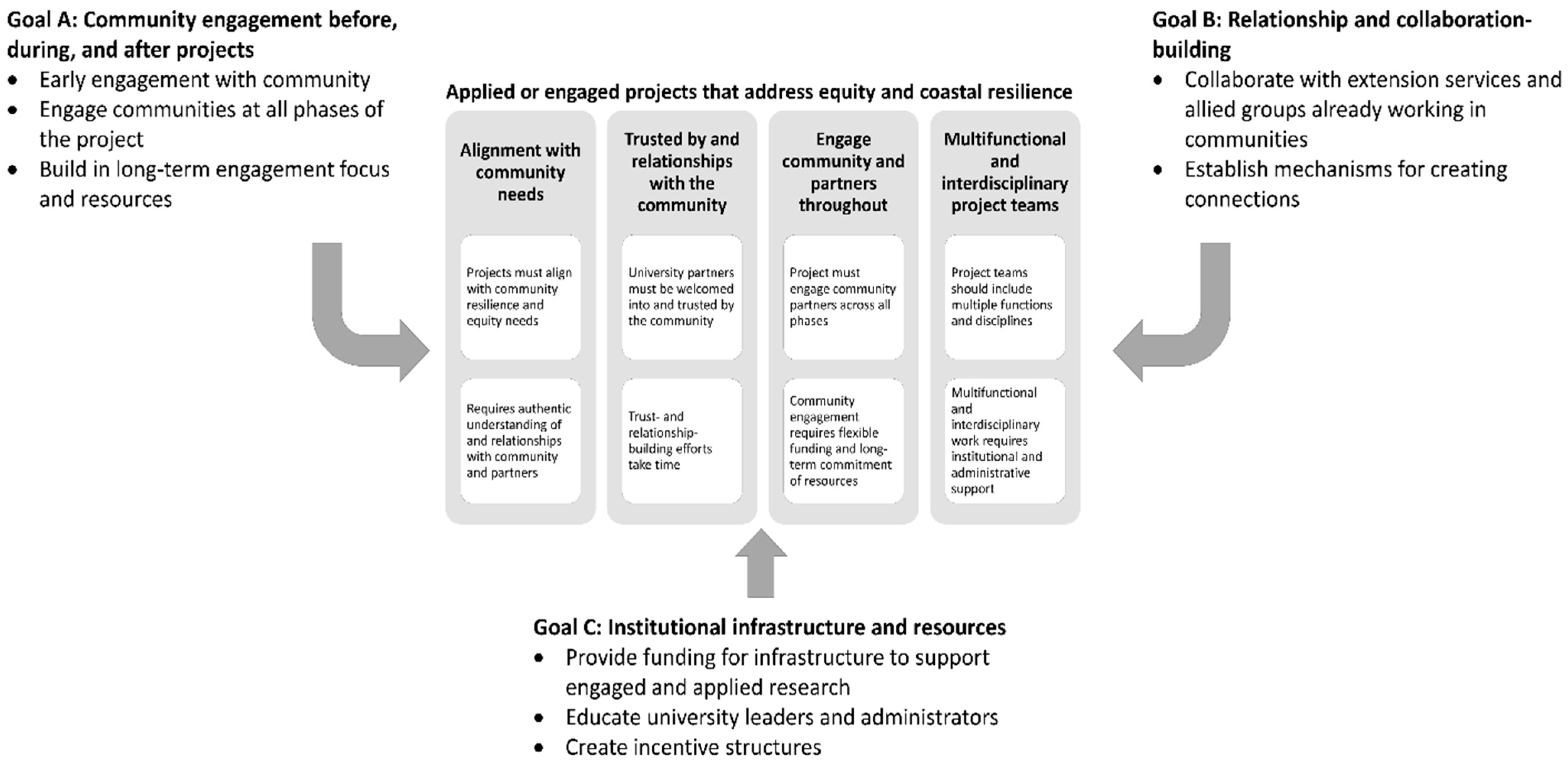
- Projects must align with community resilience and equity needs, which requires developing an authentic understanding of and relationships with the community and community partners.
- University partners must be welcomed into and trusted by the community to conduct projects, but trust- and relationship-building efforts take time and are not considered within the project, funding, or academic tenure timelines.
- The project must engage community partners across all phases, which requires flexible funding to support community involvement and long-term commitment of resources. (In the context of these findings, we refer to funding and research support to broadly include research grants and other funding such as product development, commercialization, and other activities.)
- Project teams should include multiple functions and disciplines, but multifunctional and interdisciplinary work requires institutional and administrative support.
3.1. Four Primary Themes
3.2. Equitable Resilience and the Three Dimensions of Justice
4. Discussion
4.1. A Framework for University Partnerships with Community Stakeholders
4.1.1. Goal A: Emphasize Community Engagement Before, During, and After Projects
- Engage early with the community and key members in the community to establish trust and build relationships.
- Engage communities at all phases of the project, such as through regular community check-ins.
- Build long-term focus and requisite resources into projects to account for the time to build relationships, compensate individuals or groups in the community participating in the project, and undertake long-term monitoring or checking back on communities.
4.1.2. Goal B: Build Relationships and Collaborations
- Collaborate with extension services and allied groups already working in communities that can help facilitate a whole-of-community approach spanning multiple disciplines, functions, and sectors.
- Establish mechanisms for creating connections between universities, communities, government and nonprofit agencies, funding programs, and industry.
4.1.3. Goal C: Provide Supportive Institutional Infrastructure and Resources
- Provide and fund infrastructure to support engaged and applied research, such as funding for staff positions to support community engagement activities that underpin successful engaged and applied research (examples: extension or engagement specialists, community liaisons, community coordinators).
- Educate university leaders and administrators on the importance of community-based engaged and applied research, and the need to provide institutional support and resources.
- Create incentive structures that recognize and reward community engagement efforts, value engaged and applied research, foster the creation of interdisciplinary research teams, and prioritize relationship building as an important outcome.
4.1.4. From Goals to Indicators
4.1.5. Linking Themes, Justice Dimensions, Framework Goals, and Indicators
4.2. Recommendations for Practice
4.3. Limitations
5. Conclusions
Author Contributions
Funding
Institutional Review Board Statement
Informed Consent Statement
Data Availability Statement
Acknowledgments
Conflicts of Interest
References
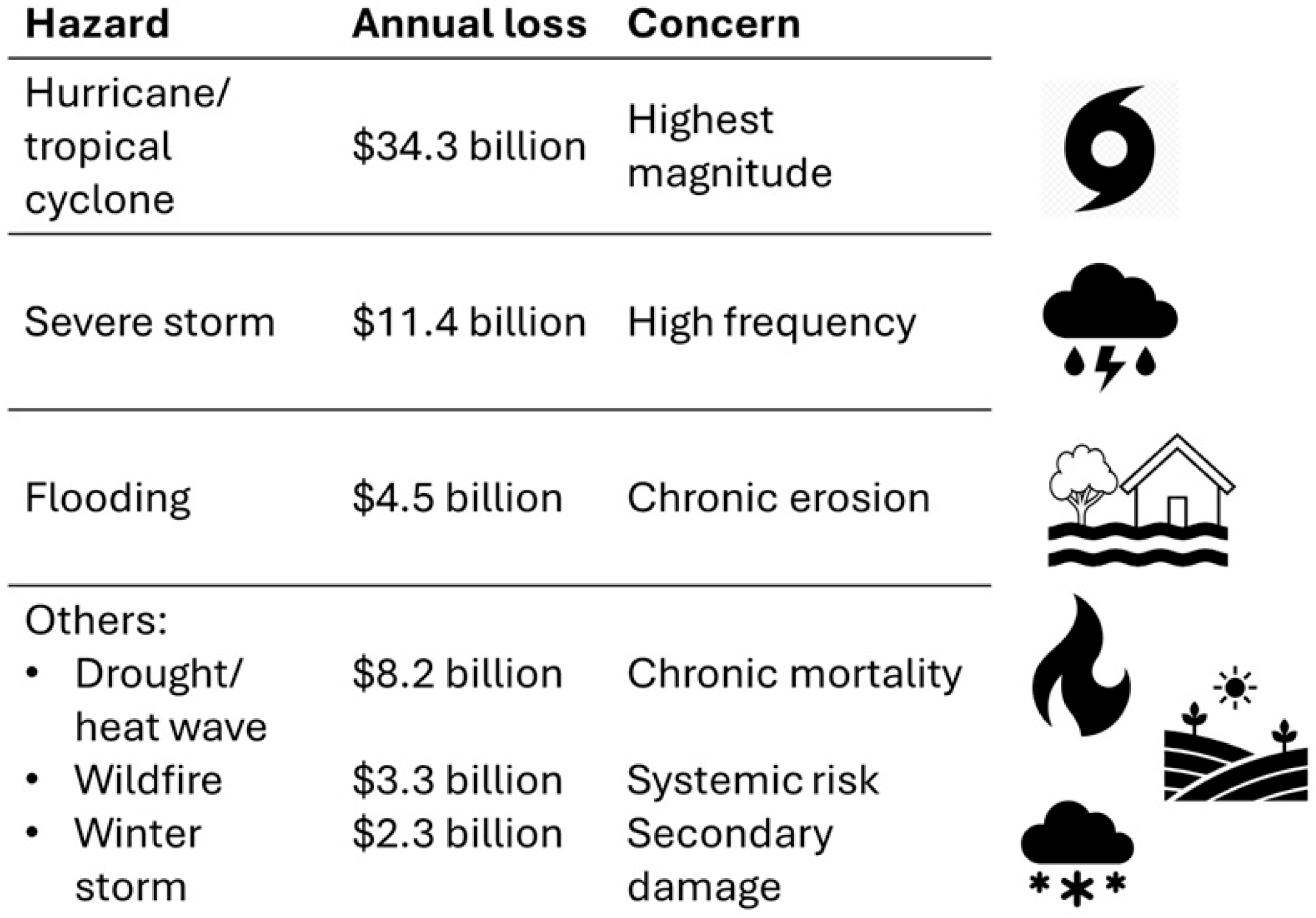
- National Centers for Environmental Information (NCEI). Billion-Dollar Weather and Climate Disasters. Available online: https://www.ncei.noaa.gov/access/billions/state-summary/US (accessed on 4 March 2026).
- National Academies of Sciences, Engineering, and Medicine. Building and Measuring Community Resilience: Actions for Communities and the Gulf Research Program; The National Academies Press: Washington, DC, USA, 2019; 152p. [Google Scholar]
- Cutter, S.L.; Ash, K.D.; Emrich, C.T. The geographies of community disaster resilience. Glob. Environ. Change 2014, 29, 65–77. [Google Scholar] [CrossRef]
- Cutter, S.L.; Emrich, C.T.; Mitchell, J.T.; Boruff, B.J.; Gall, M.; Schmidtlein, M.C.; Burton, C.G.; Melton, G. The long road home: Race, class, and recovery from Hurricane Katrina. Environ. Sci. Policy Sustain. Dev. 2006, 48, 8–20. [Google Scholar] [CrossRef]
- Fitzpatrick, T. Community Disaster Resilience. In Disasters and Public Health, 2nd ed.; Clements, B.W., Casani, J.A.P., Eds.; Butterworth-Heinemann: Oxford, UK, 2016; pp. 57–85. [Google Scholar]
- Dobie, S.; Doran, P.J.; Norton, R.K.; Hughes, S.; Goode, M.J. Defining coastal resilience in the Great Lakes: A systematic review and critical comparison. J. Great Lakes Res. 2022, 48, 1361–1374. [Google Scholar] [CrossRef]
- Wilson, G.A. Community resilience, globalization, and transitional pathways of decision-making. Geoforum 2012, 43, 1218–1231. [Google Scholar] [CrossRef]
- Fox, N.; Tilt, J.H.; Ruggiero, P.; Stanton, K.; Bolte, J. Toward equitable coastal community resilience: Incorporating principles of equity and justice in coastal hazard adaptation. Camb. Prism. Coast. Futures 2023, 1, e36. [Google Scholar] [CrossRef]
- Yusuf, J.-E.W.; Denckla Cobb, T.; Andrews, E.; Gladfelter, S.; Montrose, G. The Resilience Adaptation Feasibility Tool (RAFT) as an Approach for Incorporating Equity into Coastal Resilience Planning and Project Implementation. Shore Beach 2022, 90, 53–63. [Google Scholar] [CrossRef]
- Agyeman, J.; Schlosberg, D.; Craven, L.; Matthews, C. Trends and Directions in Environmental Justice: From Inequity to Everyday Life, Community, and Just Sustainabilities. Annu. Rev. Environ. Resour. 2016, 41, 321–340. [Google Scholar] [CrossRef]
- Bulkeley, H.; Edwards, G.A.S.; Fuller, S. Contesting climate justice in the city: Examining politics and practice in urban climate change experiments. Glob. Environ. Change 2014, 25, 31–40. [Google Scholar] [CrossRef]
- Pelling, M.; Garschagen, M. Put equity first in climate adaptation. Nature 2019, 569, 327–329. [Google Scholar] [CrossRef]
- Lang, D.J.; Wiek, A.; Bergmann, M.; Stauffacher, M.; Martens, P.; Moll, P.; Swilling, M.; Thomas, C.J. Transdisciplinary research in sustainability science: Practice, principles, and challenges. Sustain. Sci. 2012, 7, 25–43. [Google Scholar] [CrossRef]
- Hemmerling, S.A.; DeMyers, C.; Parfait, J.; Piñero, E.; Baustian, M.M.; Bregman, M.; Di Leonardo, D.; Esposito, C.; Georgiou, I.Y.; Grismore, A.; et al. A community-informed transdisciplinary approach to coastal restoration planning: Maximizing the social and ecological co-benefits of wetland creation in Port Fourchon, Louisiana, USA. Front. Environ. Sci. 2023, 11, 1105671. [Google Scholar] [CrossRef]
- Berkes, F.; Ross, H. Community resilience: Toward an integrated approach. Soc. Nat. Resour. 2013, 26, 5–20. [Google Scholar] [CrossRef]
- Arnstein, S.R. A Ladder of Citizen Participation. J. Am. Inst. Plan. 1969, 35, 216–224. [Google Scholar] [CrossRef]
- Nichols, C.R.; Wright, L.D.; Bainbridge, S.J.; Cosby, A.; Hénaff, A.; Loftis, J.D.; Cocquempot, L.; Katragadda, S.; Mendez, G.R.; Letortu, P.; et al. Collaborative Science to Enhance Coastal Resilience and Adaptation. Front. Mar. Sci. 2019, 6, 404. [Google Scholar] [CrossRef]
- Waddell, S.L.; Jayaweera, D.T.; Mirsaeidi, M.; Beier, J.C.; Kumar, N. Perspectives on the health effects of hurricanes: A review and challenges. Int. J. Environ. Res. Public Health 2021, 18, 2756. [Google Scholar] [CrossRef]
- Handwerger, L.R.; Sugg, M.M.; Runkle, J.D. Present and future sea level rise at the intersection of race and poverty in the Carolinas: A geospatial analysis. J. Clim. Change Health 2021, 3, 100028. [Google Scholar] [CrossRef]
- Yusuf, J.-E.W.; St. John, B., III; Covi, M.; Nicula, J.G. Engaging stakeholders in planning for sea level rise and resilience. J. Contemp. Water Res. Educ. 2018, 164, 112–123. [Google Scholar] [CrossRef]
- Fitzgibbons, J.; Mitchell, C.L. Just urban futures? Exploring equity in “100 Resilient Cities”. World Dev. 2019, 122, 648–659. [Google Scholar] [CrossRef]
- Cox, R.S.; Hamlen, M. Community disaster resilience and the Rural Resilience Index. Am. Behav. Sci. 2015, 59, 220–237. [Google Scholar] [CrossRef]
- Saja, A.M.A.; Teo, M.; Goonetilleke, A.; Ziyath, A.M. An inclusive and adaptive framework for measuring social resilience to disasters. Int. J. Disaster Risk Reduct. 2018, 28, 862–873. [Google Scholar] [CrossRef]
- Miller Hesed, C.D.; Van Dolah, E.R.; Paolisso, M. Engaging faith-based communities for rural coastal resilience: Lessons from collaborative learning on the Chesapeake Bay. Clim. Change 2020, 159, 37–57. [Google Scholar] [CrossRef]
- Hamin, E.M.; Abunnasr, Y.; Roman Dilthey, M.; Judge, P.K.; Kenney, M.A.; Kirshen, P.; Sheahan, T.C.; DeGroot, D.J.; Ryan, R.L.; McAdoo, B.G.; et al. Pathways to Coastal Resiliency: The Adaptive Gradients Framework. Sustainability 2018, 10, 2629. [Google Scholar] [CrossRef]
- Federal Emergency Management Agency. Engaging Faith-based and Community Organizations: Planning Considerations for Emergency Managers; Federal Emergency Management Agency: Washington, DC, USA, 2025.
- Byrne, J.V. Public Higher Education Reform Five Years After the Kellogg Commission on the Future of State and Land-Grant Universities; National Association of State Universities and Land-Grant Colleges: Washington, DC, USA; W.K. Kellogg Foundation: Battle Creek, MI, USA, 2006. [Google Scholar]
- Kellogg Commission on the Future of State and Land-Grant Universities. Returning to Our Roots: The Engaged Institution; National Association of State Universities and Land-Grant Colleges: Washington, DC, USA, 1999. [Google Scholar]
- Martin, L.L.; Smith, H.; Phillips, W. Bridging “town & gown” through innovative university-community partnerships. Innov. J. Public Sect. Innov. J. 2005, 10, 1–16. [Google Scholar]
- Minkler, M.; Blackwell, A.G.; Thompson, M.; Tamir, H. Community-based participatory research: Implications for public health funding. Am. J. Public Health 2003, 93, 1210–1213. [Google Scholar] [CrossRef]
- Kūlana Noiʻi Working Group. Kūlana Noiʻi v. 2; University of Hawaiʻi Sea Grant College Program: Honolulu, HI, USA, 2021. [Google Scholar]
- Yusuf, W.; Covi, M.; Bukvic, A.; Allen, T.; Oguntuyo, T. Fostering University Collaboration and Building Capacity to Respond to Coastal Resilience Challenges in Virginia: Findings from the Rotating Resilience Roundtables Workshop Spring 2019; Old Dominion University: Norfolk, VA, USA, 2019. [Google Scholar]
- Gibson, C.M. New times demand new scholarship I: Research universities and civic engagement: A leadership agenda. J. High. Educ. Outreach Engagem. 2012, 16, 235–270. [Google Scholar]
- Rozance, M.A.; Krosby, M.; Meadow, A.M.; Snover, A.; Ferguson, D.B.; Owen, G. Building capacity for societally engaged climate science by transforming science training. Environ. Res. Lett. 2020, 15, 125008. [Google Scholar] [CrossRef]
- Anderson, J.; Douglass, J.A. Promoting Civic Engagement at the University of California: Recommendations from the Strategy Group on Civic and Academic Engagement; Center for Studies in Higher Education, University of California Berkeley: Berkeley, CA, USA, 2005. [Google Scholar]
- Eisenhauer, E.; Maxwell, K.; Kiessling, B.; Henson, S.; Matsler, M.; Nee, R.; Shacklette, M.; Fry, M.; Julius, S. Inclusive engagement for equitable resilience: Community case study insights. Environ. Res. Commun. 2024, 6, 125012. [Google Scholar] [CrossRef]
- Matin, N.; Forrester, J.; Ensor, J. What is equitable resilience? World Dev. 2018, 109, 197–205. [Google Scholar] [CrossRef]
- Raub, K.B.; Platter, H.; O’Mara, E.; Panikkar, B. Evaluating the Incorporation of Climate Justice Concerns Within Resilience Plans Across Eleven U.S. Coastal Cities. J. Clim. Resil. Justice 2023, 1, 33–54. [Google Scholar] [CrossRef]
- Siddiq, H.; Jones, F.; Magnes, Z.; Booker-Vaughns, J.; Young-Brinn, A.; Williams, C.; Washington, M.; Agonafer, E.; Solomon, O.; Oliva, A. Using community-partnered participatory research to value the “Community Lens” and promote equity in community–academic partnerships. Health Equity 2023, 7, 543–554. [Google Scholar] [CrossRef]
- Turner, T.N.; Piso, Z. Sustaining Community-University Partnered Sustainability Research: A Typology Grounded in Community Partners’ Goals and Motivations. J. High. Educ. Outreach Engagem. 2024, 28, 119–136. [Google Scholar]
- Sanchez-Youngman, S.; Adsul, P.; Gonzales, A.; Dickson, E.; Myers, K.; Alaniz, C.; Wallerstein, N. Transforming the field: The role of academic health centers in promoting and sustaining equity based community engaged research. Front. Public Health 2023, 11, 1111779. [Google Scholar] [CrossRef]
- Chew, S.; Chief, K. Community-engaged participatory climate research with the Pyramid Lake Paiute Tribe. Ecol. Soc. 2023, 28, 16. [Google Scholar] [CrossRef]
- Sheikhattari, P.; Apata, J.; Silver, G.B.; Mehravaran, S.; Mitchell, E.; Assari, S. Small CBPR grants program: An innovative model to build sustainable academic-community partnerships. Metrop. Univ. 2023, 34, 7. [Google Scholar] [CrossRef]



Lessons learned
|
| Goal and Indicator | Measurement |
|---|---|
| Goal A. Emphasize community engagement before, during, and after projects | |
| Pre-project engagement activities | Count of pre-grant or pre-proposal meetings with community partners. |
| Compensation practices for community participation | Percentage of projects that budget for and provide compensation (e.g., stipends, honoraria, food, childcare, travel support). |
| Post-project follow-up | Percentage of projects that conduct follow-up activities within 6–12 months after project completion. |
| Goal B. Build relationships and collaborations | |
| Active agency and community partnerships | Annual count of formalized partnerships or MOUs with government agencies, nonprofits, community groups, tribal entities, extension services, etc., and year-over-year growth. |
| Diversity of agency and community partnerships | Percentage distribution of partners by sector (e.g., nonprofit, community-based, government, academic). |
| Interdisciplinary and multi-functional research teams | Annual count of projects involving multiple disciplines or functional roles, and year-over-year growth. |
| Collaborative spaces | Annual count of networking events, workshops, information sharing sessions, or similar cross-sector engagement activities. |
| Goal C. Provide supportive institutional infrastructure and resources | |
| Dedicated funding lines or internal grant programs | Total amount of seed grants, engagement funds, or administrative support budgets allocated to community-engaged or applied resilience projects. |
| Staffing for engagement infrastructure | Count of institutional staff positions supporting applied and engaged resilience projects (e.g., engagement specialists, community coordinators, project managers). |
| Tenure and promotion criteria that reward engagement | Percentage of faculty whose tenure/promotion portfolios include engaged or applied research components. |
Disclaimer/Publisher’s Note: The statements, opinions and data contained in all publications are solely those of the individual author(s) and contributor(s) and not of MDPI and/or the editor(s). MDPI and/or the editor(s) disclaim responsibility for any injury to people or property resulting from any ideas, methods, instructions or products referred to in the content. |
© 2026 by the authors. Licensee MDPI, Basel, Switzerland. This article is an open access article distributed under the terms and conditions of the Creative Commons Attribution (CC BY) license.
Share and Cite
Yusuf, J.-E.; Whytlaw, J.L.; Saitgalina, M.; Nwandu-Vincent, O.M.; Anuar, K.A.; Allen, T.; Behr, J. Equity in Coastal Resilience: A Framework for University Engagement in Community-Based Projects. Sustainability 2026, 18, 2815. https://doi.org/10.3390/su18062815
Yusuf J-E, Whytlaw JL, Saitgalina M, Nwandu-Vincent OM, Anuar KA, Allen T, Behr J. Equity in Coastal Resilience: A Framework for University Engagement in Community-Based Projects. Sustainability. 2026; 18(6):2815. https://doi.org/10.3390/su18062815
Chicago/Turabian StyleYusuf, Juita-Elena (Wie), Jennifer L. Whytlaw, Marina Saitgalina, Ogechukwu M. Nwandu-Vincent, Khairul A. Anuar, Thomas Allen, and Joshua Behr. 2026. "Equity in Coastal Resilience: A Framework for University Engagement in Community-Based Projects" Sustainability 18, no. 6: 2815. https://doi.org/10.3390/su18062815
APA StyleYusuf, J.-E., Whytlaw, J. L., Saitgalina, M., Nwandu-Vincent, O. M., Anuar, K. A., Allen, T., & Behr, J. (2026). Equity in Coastal Resilience: A Framework for University Engagement in Community-Based Projects. Sustainability, 18(6), 2815. https://doi.org/10.3390/su18062815