Low-Rate Bauxite Residue Application Controls Nickel Adsorption, Fractionation, and Mobility in Soils of Different Physicochemical Properties

 , ,
, ,
Abstract
1. Introduction
2. Materials and Methods
2.1. Soils and Bauxite Residue (BR)
2.2. Nickel Sorption by Soils and Soil–BR Mixtures
2.3. Sequential Extraction of Ni and Mobility Factor (MF)
2.4. Adsorption Isotherms
2.4.1. Langmuir Adsorption Isotherm
2.4.2. Freundlich Adsorption Isotherm
2.5. Statistical Analysis
3. Results and Discussion
3.1. Nickel Adsorption
3.1.1. Soils
3.1.2. Soils and Bauxite Residue
3.1.3. Adsorption Isotherms
3.2. Sequential Extraction
3.2.1. Soils
3.2.2. Soils and Bauxite Residue
3.3. Mobility Factor
4. Conclusions
Author Contributions
Funding
Institutional Review Board Statement
Informed Consent Statement
Data Availability Statement
Conflicts of Interest
Abbreviations
| Ni | Nickel |
| BR | Bauxite Residue |
| MF | Mobility Factor |
| EC | Electrical Conductivity |
| SOM | Soil Organic Matter |
| CEC | Cation Exchange Capacity |
| CCE | Calcium Carbonate Equivalent |
| DCB | Dithionite–Citrate–Bicarbonate |
| XRPD | X-ray Powder Diffraction |
| FTIR | Fourier-transform Infrared |
References
- Armiento, G.; Cremisini, C.; Nardi, E.; Pacifico, R. High Geochemical Background of Potentially Harmful Elements in Soils and Sediments: Implications for the Remediation of Contaminated Sites. Chem. Ecol. 2011, 27, 131–141. [Google Scholar] [CrossRef]
- Alloway, B.J. (Ed.) Heavy Metals in Soils: Trace Metals and Metalloids in Soils and Their Bioavailability. In Environmental Pollution; Springer: Dordrecht, The Netherlands, 2013; Volume 22, ISBN 978-94-007-4469-1. [Google Scholar]
- El-Naggar, A.; Ahmed, N.; Mosa, A.; Niazi, N.K.; Yousaf, B.; Sharma, A.; Sarkar, B.; Cai, Y.; Chang, S.X. Nickel in Soil and Water: Sources, Biogeochemistry, and Remediation Using Biochar. J. Hazard. Mater. 2021, 419, 126421. [Google Scholar] [CrossRef]
- Islam, M.A.; Awual, M.R.; Angove, M.J. A Review on Nickel(II) Adsorption in Single and Binary Component Systems and Future Path. J. Environ. Chem. Eng. 2019, 7, 103305. [Google Scholar] [CrossRef]
- Kicińska, A.; Pomykała, R.; Izquierdo-Diaz, M. Changes in Soil pH and Mobility of Heavy Metals in Contaminated Soils. Eur. J. Soil Sci. 2022, 73, e13203. [Google Scholar] [CrossRef]
- Ding, S.; Guan, D.-X.; Dai, Z.-H.; Su, J.; Teng, H.H.; Ji, J.; Liu, Y.; Yang, Z.; Ma, L.Q. Nickel Bioaccessibility in Soils with High Geochemical Background and Anthropogenic Contamination. Environ. Pollut. 2022, 310, 119914. [Google Scholar] [CrossRef] [PubMed]
- Derakhshan Nejad, Z.; Jung, M.C.; Kim, K.-H. Remediation of Soils Contaminated with Heavy Metals with an Emphasis on Immobilization Technology. Environ. Geochem. Health 2018, 40, 927–953. [Google Scholar] [CrossRef] [PubMed]
- Lwin, C.S.; Seo, B.-H.; Kim, H.-U.; Owens, G.; Kim, K.-R. Application of Soil Amendments to Contaminated Soils for Heavy Metal Immobilization and Improved Soil Quality—A Critical Review. Soil Sci. Plant Nutr. 2018, 64, 156–167. [Google Scholar] [CrossRef]
- Nie, X.; Huang, X.; Li, M.; Lu, Z.; Ling, X. Advances in Soil Amendments for Remediation of Heavy Metal-Contaminated Soils: Mechanisms, Impact, and Future Prospects. Toxics 2024, 12, 872. [Google Scholar] [CrossRef]
- Salgado, L.; Aparicio, L.; Afif, E.; Fernández-López, E.; Gallego, J.R.; Forján, R. A Second Life for Mining Waste as an Amendment for Soil Remediation. J. Mater. Cycles Waste Manag. 2024, 26, 2971–2979. [Google Scholar] [CrossRef]
- Sorvari, J.; Wahlström, M. Industrial By-Products. In Handbook of Recycling; Elsevier: Amsterdam, The Netherlands, 2024; pp. 259–285. ISBN 978-0-323-85514-3. [Google Scholar]
- Kumar, U.; Kumar, I.; Singh, P.K.; Dwivedi, A.; Singh, P.; Mishra, S.; Seth, C.S.; Sharma, R.K. Nickel Contamination in Terrestrial Ecosystems: Insights into Impacts, Phytotoxicity Mechanisms, and Remediation Technologies. Rev. Environ. Contam. Toxicol. 2025, 263, 2. [Google Scholar] [CrossRef]
- Zafeiriou, I.; Ioannou, D.; Angelopoulos, P.; Georgiou, E.; Gasparatos, D.; Massas, I. Nickel Dynamics and Immobilization in Soil-Bauxite Residue Systems: Insights from Sequential Extraction and FTIR Analysis. Environ. Sci. Pollut. Res. 2025, 32, 17730–17746. [Google Scholar] [CrossRef]
- Angelopoulos, P.; Georgiou, M.; Oustadakis, P.; Taxiarchou, M.; Karadağ, H.; Eker, Y.; Dobra, G.; Boiangiu, A.; Demir, G.; Arslan, S.; et al. Preliminary Characterization of Three Metallurgical Bauxite Residue Samples. Mater. Proc. 2021, 5, 66. [Google Scholar]
- Raj, R.; Yadav, B.; Yadav, J.S.; Kumar, S. Red Mud Utilisation for Sustainable Construction and Soil Improvement: A Comprehensive Review. Discov. Sustain. 2024, 5, 398. [Google Scholar] [CrossRef]
- Zhou, Y.; Cui, Y.; Yang, J.; Chen, L.; Qi, J.; Zhang, L.; Zhang, J.; Huang, Q.; Zhou, T.; Zhao, Y.; et al. Roles of Red Mud in Remediation of Contaminated Soil in Mining Areas: Mechanisms, Advances and Perspectives. J. Environ. Manag. 2024, 356, 120608. [Google Scholar] [CrossRef]
- Klute, A.; Page, A.L. (Eds.) Methods of Soil Analysis. In Agronomy, 2nd ed.; American Society of Agronomy; Soil Science Society of America: Madison, WI, USA, 1982; ISBN 978-0-89118-088-3. [Google Scholar]
- Bouyoucos, G.J. A Recalibration of the Hydrometer Method for Making Mechanical Analysis of Soils. Agron. J. 1951, 43, 434–438. [Google Scholar] [CrossRef]
- Nelson, D.W.; Sommers, E. Total Carbon, Organic Carbon, and Organic Matter; American Society of Agronomy; Soil Science Society of America: Madison, WI, USA, 1982; pp. 539–579. [Google Scholar]
- Bilias, F.; Barbayiannis, N. Evaluation of Sodium Tetraphenylboron (NaBPh4) as a Soil Test of Potassium Availability. Arch. Agron. Soil Sci. 2017, 63, 468–476. [Google Scholar] [CrossRef]
- Gasparatos, D.; Haidouti, C.; Tarenidis, D. Characterization of Iron Oxides in Fe-Rich Concretions from an Imperfectly-Drained Greek Soil: A Study by Selective-Dissolution Techniques and X-Ray Diffraction. Arch. Agron. Soil Sci. 2004, 50, 485–493. [Google Scholar] [CrossRef]
- Gasparatos, D.; Haidouti, C.; Haroulis, A.; Tsaousidou, P. Estimation of Phosphorus Status of Soil Fe-Enriched Concretions with the Acid Ammonium Oxalate Method. Commun. Soil Sci. Plant Anal. 2006, 37, 2375–2387. [Google Scholar] [CrossRef]
- Ostovar, S.; Saravani, H.; Akbari, M.; Salehpour, A.; Sabaghi, M.; Rezazadeh, E. The Effective Adsorption of Ni(II) and Nitrate from Aquatic Systems by Superparamagnetic MoS2/γ-Fe2O3 Nanocomposites: Optimization through RSM-CCD Design. Arab. J. Chem. 2024, 17, 105599. [Google Scholar] [CrossRef]
- Zafeiriou, I.; Gasparatos, D.; Ioannou, D.; Katsikini, M.; Pinakidou, F.; Paloura, E.C.; Massas, I. Se(IV)/Se(VI) Adsorption Mechanisms on Natural and on Ca-Modified Zeolite for Mediterranean Soils Amended with the Modified Zeolite: Prospects for Agronomic Applications. Environ. Sci. Pollut. Res. 2023, 30, 41983–41998. [Google Scholar] [CrossRef]
- Tessier, A.; Campbell, P.G.C.; Bisson, M. Sequential Extraction Procedure for the Speciation of Particulate Trace Metals. Anal. Chem. 1979, 51, 844–851. [Google Scholar] [CrossRef]
- Klik, B.K.; Gusiatin, Z.M.; Kulikowska, D. Suitability of Environmental Indices in Assessment of Soil Remediation with Conventional and next Generation Washing Agents. Sci. Rep. 2020, 10, 20586. [Google Scholar] [CrossRef] [PubMed]
- Kabala, C.; Singh, B.R. Fractionation and Mobility of Copper, Lead, and Zinc in Soil Profiles in the Vicinity of a Copper Smelter. J. Env. Qual. 2001, 30, 485–492. [Google Scholar] [CrossRef] [PubMed]
- Langmuir, I. THE ADSORPTION OF GASES ON PLANE SURFACES OF GLASS, MICA AND PLATINUM. J. Am. Chem. Soc. 1918, 40, 1361–1403. [Google Scholar] [CrossRef]
- Foo, K.Y.; Hameed, B.H. Insights into the Modeling of Adsorption Isotherm Systems. Chem. Eng. J. 2010, 156, 2–10. [Google Scholar] [CrossRef]
- Golia, E.E.; Kantzou, O.-D.; Chartodiplomenou, M.-A.; Papadimou, S.G.; Tsiropoulos, N.G. Study of Potentially Toxic Metal Adsorption in a Polluted Acid and Alkaline Soil: Influence of Soil Properties and Levels of Metal Concentration. Soil Syst. 2023, 7, 16. [Google Scholar] [CrossRef]
- Ramachandran, V.; D’Souza, S.F. Adsorption of Nickel by Indian Soils. J. Soil Sci. Plant Nutr. 2013, 13, 165–173. [Google Scholar] [CrossRef]
- Gupta, S.S.; Bhattacharyya, K.G. Adsorption of Ni(II) on Clays. J. Colloid Interface Sci. 2006, 295, 21–32. [Google Scholar] [CrossRef]
- Covelo, E.F.; Andrade, M.L.; Vega, F.A. Heavy Metal Adsorption by Humic Umbrisols: Selectivity Sequences and Competitive Sorption Kinetics. J. Colloid Interface Sci. 2004, 280, 1–8. [Google Scholar] [CrossRef]
- Wang, T.; Liu, W.; Xiong, L.; Xu, N.; Ni, J. Influence of pH, Ionic Strength and Humic Acid on Competitive Adsorption of Pb(II), Cd(II) and Cr(III) onto Titanate Nanotubes. Chem. Eng. J. 2013, 215–216, 366–374. [Google Scholar] [CrossRef]
- Hua, Y.; Heal, K.V.; Friesl-Hanl, W. The Use of Red Mud as an Immobiliser for Metal/Metalloid-Contaminated Soil: A Review. J. Hazard. Mater. 2017, 325, 17–30. [Google Scholar] [CrossRef]
- Lee, S.-H.; Kim, E.Y.; Park, H.; Yun, J.; Kim, J.-G. In Situ Stabilization of Arsenic and Metal-Contaminated Agricultural Soil Using Industrial by-Products. Geoderma 2011, 161, 1–7. [Google Scholar] [CrossRef]
- Brown, S.; Christensen, B.; Lombi, E.; McLaughlin, M.; McGrath, S.; Colpaert, J.; Vangronsveld, J. An Inter-Laboratory Study to Test the Ability of Amendments to Reduce the Availability of Cd, Pb, and Zn in Situ. Environ. Pollut. 2005, 138, 34–45. [Google Scholar] [CrossRef] [PubMed]
- Gray, C.W.; Dunham, S.J.; Dennis, P.G.; Zhao, F.J.; McGrath, S.P. Field Evaluation of in Situ Remediation of a Heavy Metal Contaminated Soil Using Lime and Red-Mud. Environ. Pollut. 2006, 142, 530–539. [Google Scholar] [CrossRef] [PubMed]
- Lombi, E.; Zhao, F.-J.; Zhang, G.; Sun, B.; Fitz, W.; Zhang, H.; McGrath, S.P. In Situ Fixation of Metals in Soils Using Bauxite Residue: Chemical Assessment. Environ. Pollut. 2002, 118, 435–443. [Google Scholar] [CrossRef] [PubMed]
- Friesl, W.; Horak, O.; Wenzel, W.W. Immobilization of Heavy Metals in Soils by the Application of Bauxite Residues: Pot Experiments under Field Conditions. Z. Pflanzenernähr. Bodenk. 2004, 167, 54–59. [Google Scholar] [CrossRef]
- Peltier, E.; Lelie, D.V.D.; Sparks, D.L. Formation and Stability of Ni−Al Hydroxide Phases in Soils. Environ. Sci. Technol. 2010, 44, 302–308. [Google Scholar] [CrossRef]
- Roberts, D.R.; Scheidegger, A.M.; Sparks, D.L. Kinetics of Mixed Ni−Al Precipitate Formation on a Soil Clay Fraction. Environ. Sci. Technol. 1999, 33, 3749–3754. [Google Scholar] [CrossRef]
- Anah, L.; Astrini, N. Isotherm Adsorption Studies of Ni(II) Ion Removal from Aqueous Solutions by Modified Carboxymethyl Cellulose Hydrogel. IOP Conf. Ser.: Earth Environ. Sci. 2018, 160, 012017. [Google Scholar] [CrossRef]
- Atanes, E.; Nieto-Márquez, A.; Cambra, A.; Ruiz-Pérez, M.C.; Fernández-Martínez, F. Adsorption of SO2 onto Waste Cork Powder-Derived Activated Carbons. Chem. Eng. J. 2012, 211–212, 60–67. [Google Scholar] [CrossRef]
- Revel, M.; Van Drimmelen, C.K.E.; Weltje, L.; Hursthouse, A.; Heise, S. Effects of Rare Earth Elements in the Aquatic Environment: Implications for Ecotoxicological Testing. Crit. Rev. Environ. Sci. Technol. 2025, 55, 334–375. [Google Scholar] [CrossRef]
- Liu, T.; Li, J.; Liu, L.; Jiang, Y.; Sun, S.; Deng, T.; Wang, S.; Tang, Y.; Ni, Z.; Lin, Q.; et al. Mobilization of Water-Dispersible Colloidal Chromium and Nickel in Basalt-Derived Paddy Soils: Role of Fe (Hydr)Oxides and Organic Matter. J. Hazard. Mater. 2025, 496, 139188. [Google Scholar] [CrossRef] [PubMed]
- Ettler, V.; Waldhauserová, J.; Drahota, P.; Tuhý, M.; Mihaljevič, M.; Racek, M. Metal(Loid)s and Their Bioaccessibility in Urban Soils from Residential Areas of a Medieval Mining Town. Environ. Geochem. Health 2025, 47, 64. [Google Scholar] [CrossRef] [PubMed]
- Fernández-Martínez, R.; Corrochano, N.; Álvarez-Quintana, J.; Ordóñez, A.; Álvarez, R.; Rucandio, I. Assessment of the Ecological Risk and Mobility of Arsenic and Heavy Metals in Soils and Mine Tailings from the Carmina Mine Site (Asturias, NW Spain). Environ. Geochem. Health 2024, 46, 90. [Google Scholar] [CrossRef]
- Laha, T.; Gupta, N.; Pal, M.; Koley, A.; Masto, R.E.; Hoque, R.R.; Balachandran, S. Chemical Speciation and Health Risk Assessment of Potentially Toxic Elements in Playground Soil of Bell Metal Commercial Town of Eastern India. Environ. Geochem. Health 2024, 46, 453. [Google Scholar] [CrossRef]
- Gleyzes, C.; Tellier, S.; Astruc, M. Fractionation Studies of Trace Elements in Contaminated Soils and Sediments: A Review of Sequential Extraction Procedures. TrAC Trends Anal. Chem. 2002, 21, 451–467. [Google Scholar] [CrossRef]
- Kalyvas, G.; Gasparatos, D.; Papassiopi, N.; Massas, I. Topsoil Pollution as Ecological Footprint of Historical Mining Activities in Greece. Land Degrad. Dev. 2018, 29, 2025–2035. [Google Scholar] [CrossRef]
- Trivedi, P.; Axe, L. Ni and Zn Sorption to Amorphous versus Crystalline Iron Oxides: Macroscopic Studies. J. Colloid. Interface Sci. 2001, 244, 221–229. [Google Scholar] [CrossRef]
- Pavel, P.-B.; Diacu, E.; Barbu, C.H. Long-Term Effects on the Fractionation and Mobility of Heavy Metals in a Polluted Soil Treated with Bauxite Residues. Rev. Chim. 2015, 66, 13–16. [Google Scholar]
- González-Costa, J.J.; Reigosa, M.J.; Matías, J.M.; Fernández-Covelo, E. Analysis of the Importance of Oxides and Clays in Cd, Cr, Cu, Ni, Pb and Zn Adsorption and Retention with Regression Trees. PLoS ONE 2017, 12, e0168523. [Google Scholar] [CrossRef]
- Gräfe, M.; Power, G.; Klauber, C. Bauxite Residue Issues: III. Alkalinity Assoc. Chemistry. Hydrometall. 2011, 108, 60–79. [Google Scholar] [CrossRef]
- Zhu, F.; Zhou, J.; Xue, S.; Hartley, W.; Wu, C.; Guo, Y. Aging of Bauxite Residue in Association of Regeneration: A Comparison of Methods to Determine Aggregate Stability & Erosion Resistance. Ecol. Eng. 2016, 92, 47–54. [Google Scholar] [CrossRef]
- Tang, J.; He, J.; Liu, T.; Xin, X. Removal of Heavy Metals with Sequential Sludge Washing Techniques Using Saponin: Optimization Conditions, Kinetics, Removal Effectiveness, Binding Intensity, Mobility and Mechanism. RSC Adv. 2017, 7, 33385–33401. [Google Scholar] [CrossRef]
- Yang, T.; Hodson, M.E. Investigating the Use of Synthetic Humic-like Acid as a Soil Washing Treatment for Metal Contaminated Soil. Sci. Total Environ. 2019, 647, 290–300. [Google Scholar] [CrossRef] [PubMed]
- Gusiatin, Z.M.; Klimiuk, E. Metal (Cu, Cd and Zn) Removal and Stabilization during Multiple Soil Washing by Saponin. Chemosphere 2012, 86, 383–391. [Google Scholar] [CrossRef] [PubMed]
- Sundaray, S.K.; Nayak, B.B.; Lin, S.; Bhatta, D. Geochemical Speciation and Risk Assessment of Heavy Metals in the River Estuarine Sediments—A Case Study: Mahanadi Basin, India. J. Hazard. Mater. 2011, 186, 1837–1846. [Google Scholar] [CrossRef]


| Step | Fraction | Reagents | Procedure |
|---|---|---|---|
| 1 | F1 Exchangeable | 8 mL 1.0 M MgCl2 (pH = 7) | 1 h shaking 120 rpm room temperature |
| 2 | F2 Carbonate-bound | 8 mL 1 Μ sodium acetate (NaOAc) (pH = 5 with HOAc) | 5 h shaking 120 rpm room temperature |
| 3 | F3 Reducible—bound to Fe/Mn oxides | 20 mL 0.04 M NH2OH.HCl in 25% (v/v) HOAc (pH = 2.0) | 6 h shaking 120 rpm T = 96 ± 0.5 °C |
| 4 | F4 Oxidizable—bound to organic matter and sulfides | 3 mL 0.02 M HNO3 + 5 mL 30% H2O2 (pH = 2 with HNO3) | 1 h digestion room temperature occasionally shaking |
| 3 mL 30% H2O2 (pH = 2) | 1 h digestion T = 85 ± 5 °C occasionally shaking | ||
| 5 mL 3.2 M NH4OAc in 20% (v/v) HNO3 and the mixture diluted to 20 mL | 3 h digestion T = 85 ± 5 °C occasionally shaking 30 min shaking 120 rpm room temperature | ||
| 5 | F5 Residual | 9 mL conc. HCl + 3 mL conc. HNO3 | Digested in a microwave 15 min until T = 200 °C 15 min at 200 °C |
| Soil Properties | Soil | ||||
|---|---|---|---|---|---|
| S1 | S2 | S3 | S4 | S5 | |
| Clay % | 19.0 | 21.0 | 27.0 | 37.0 | 23.1 |
| Silt % | 28.0 | 37.50 | 20.0 | 20.0 | 38.4 |
| Sand % | 53.0 | 41.50 | 53.0 | 43.0 | 38.5 |
| O.M. % | 1.11 | 0.99 | 1.53 | 1.86 | 1.56 |
| CEC (cmolc kg−1) | 13.39 | 18.78 | 22.17 | 30.26 | 18.35 |
| pH (1:1) | 5.41 | 7.58 | 6.03 | 6.89 | 7.56 |
| CaCO3 eq. | - | 1.6 | - | - | 2.4 |
| Fed % | 2.19 | 1.13 | 2.91 | 2.84 | 0.95 |
| Feo% | 0.14 | 0.09 | 0.33 | 0.37 | 0.12 |
| Mnd % | 0.19 | 0.04 | 0.17 | 0.15 | 0.04 |
| Mno % | 0.31 | 0.04 | 0.21 | 0.18 | 0.03 |
| Soil–BR pH (1:1) | 6.82 | 7.61 | 6.70 | 7.20 | 7.55 |
| Soil | Soil–BR | |
|---|---|---|
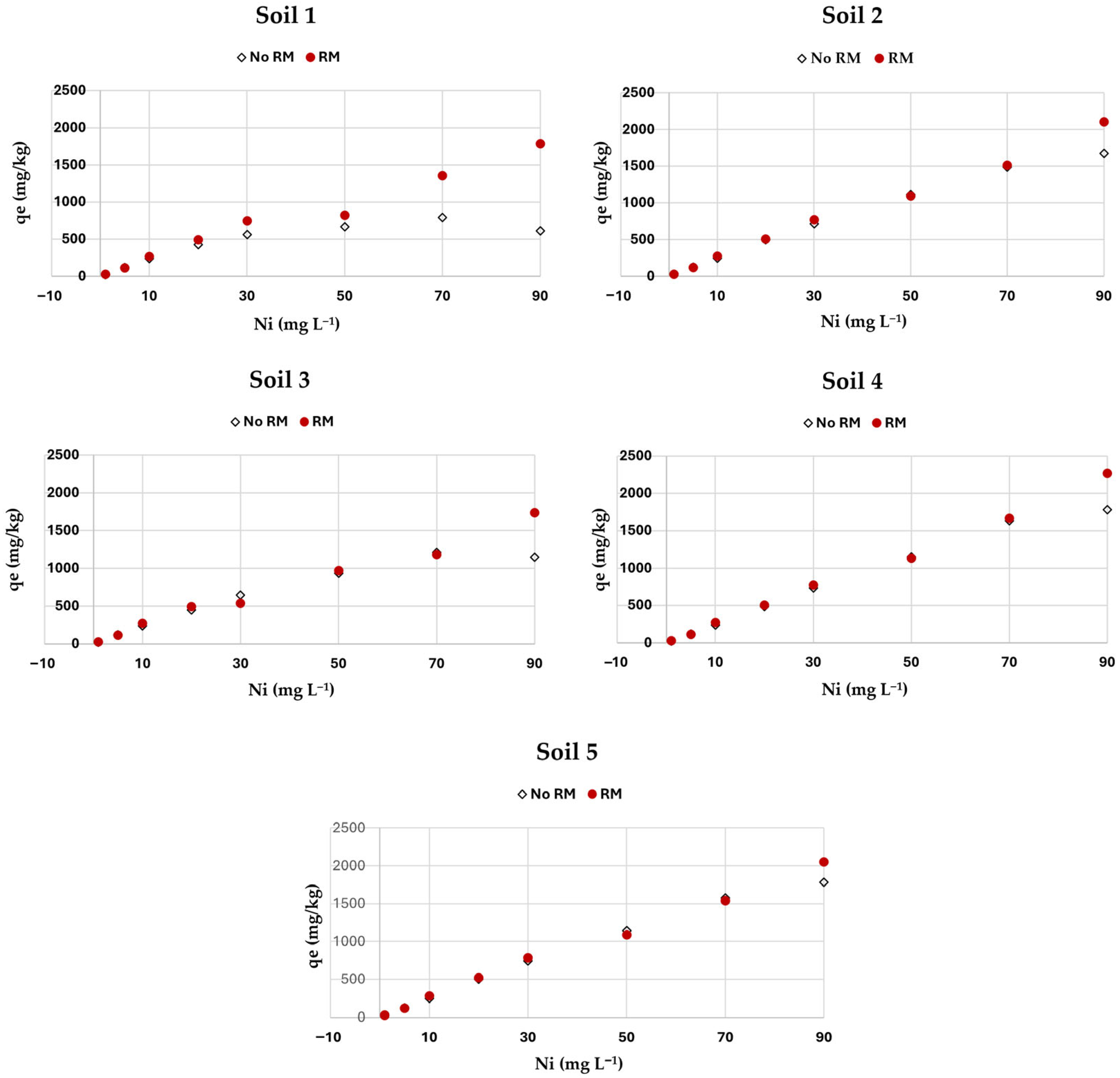
| S1 | 21.20–688.50 (425.01) | 27.38–1785.00 (719.78) |
| S2 | 23.08–1752.50 (730.48) | 27.53–2101.75 (799.47) |
| S3 | 20.83–1227.50 (593.51) | 26.78–1736.25 (686.48) |
| S4 | 20.43–1863.00 (768.46) | 27.60–2271.00 (836.19) |
| S5 | 22.58–1859.50 (762.32) | 28.23–2049.00 (801.96) |
| Soil | Langmuir | Freundlich | ||||||
|---|---|---|---|---|---|---|---|---|
mg g−1 | mg g−1 | L g−1 | n | |||||
| S1 | 0.69 | 0.74 | 0.37 | 0.99 *** | 2.08 | 8.16 | 0.81 ** | |
| S1-BR | 1.79 | 2.10 | 0.12 | 0.97 *** | 1.42 | 9.59 | 0.96 *** | |
| S2 | 1.75 | 2.02 | 0.25 | 0.95 *** | 1.49 | 12.19 | 0.89 ** | |
| S2-BR | 2.21 | 2.65 | 0.13 | 0.94 *** | 1.32 | 11.05 | 0.96 *** | |
| S3 | 1.23 | 1.42 | 0.17 | 0.97 *** | 1.59 | 9.04 | 0.87 ** | |
| S3-BR | 1.74 | 1.83 | 0.13 | 0.93 *** | 1.54 | 9.33 | 0.93 *** | |
| S4 | 1.86 | 2.65 | 0.17 | 0.95 *** | 1.20 | 12.18 | 0.96 *** | |
| S4-BR | 2.27 | 4.21 | 0.07 | 0.89 ** | 1.17 | 11.06 | 0.99 *** | |
| S5 | 1.86 | 2.28 | 0.26 | 0.94 *** | 1.37 | 13.00 | 0.90 *** | |
| S5-BR | 2.05 | 2.06 | 0.26 | 0.97 *** | 1.50 | 12.52 | 0.93 *** |
| F1% | F2% | F3% | F4% | F5% | |
|---|---|---|---|---|---|
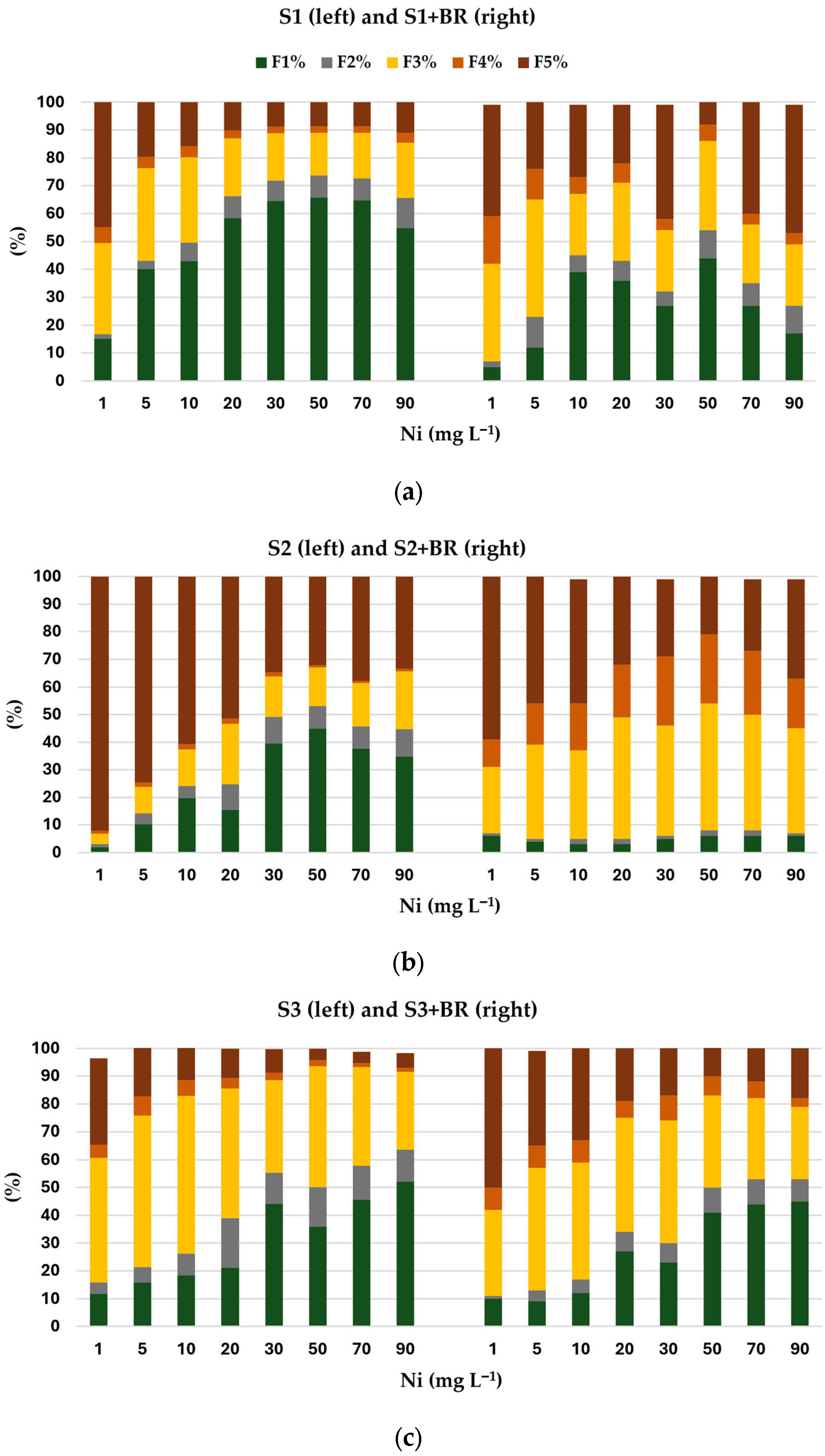
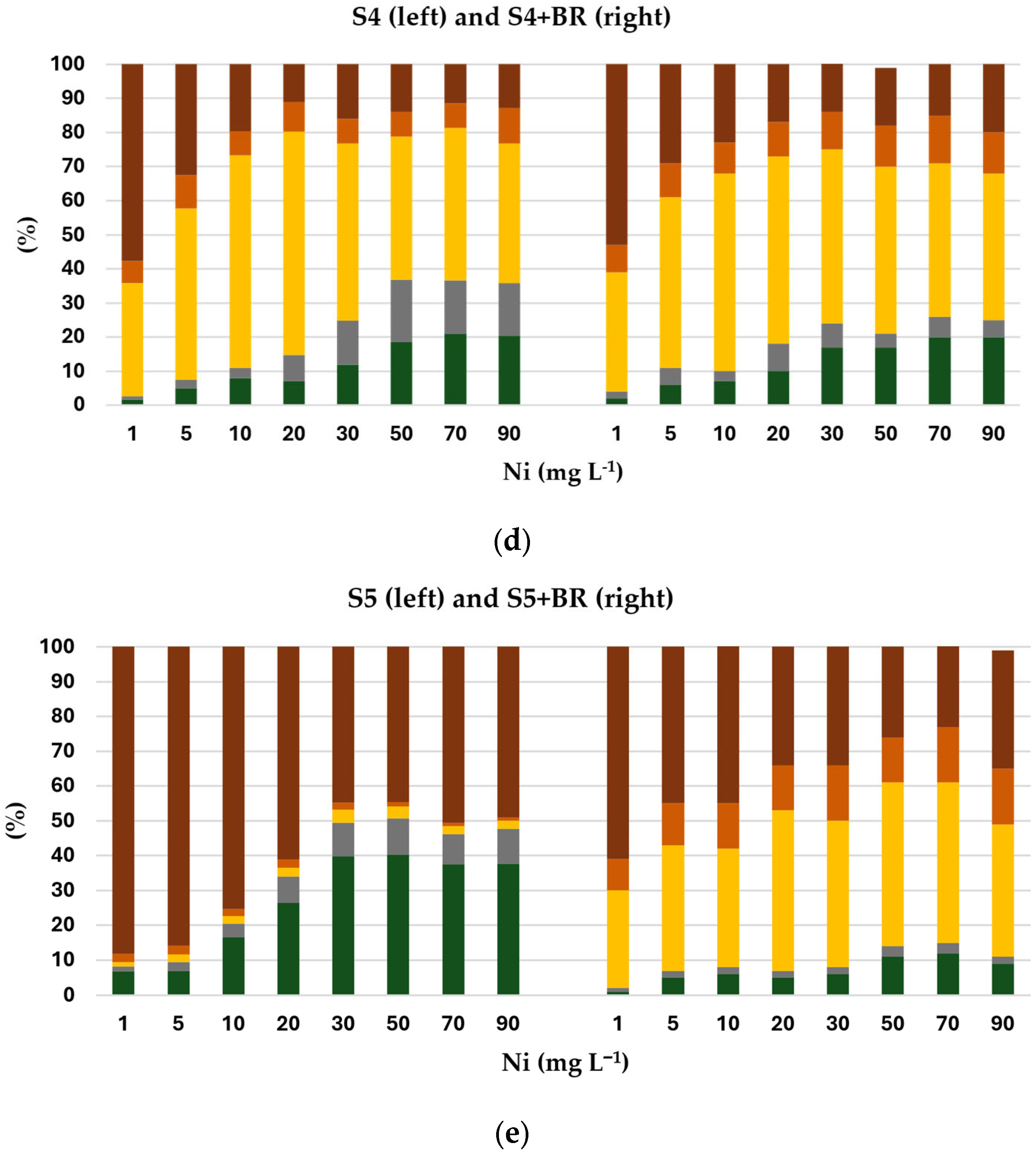
| S1 | 50.79 a (p < 0.01) | 6.64 a | 23.21 a | 3.38 a | 15.97 b (p < 0.05) |
| S1-BR | 25.88 b | 7.38 a | 28.00 a | 7.38 a | 30.75 a |
| S2 | 25.57 a (p < 0.01) | 6.77 a (p < 0.001) | 14.19 b (p < 0.001) | 1.32 b (p < 0.001) | 52.14 a |
| S2-BR | 4.88 b | 1.50 b | 37.50 a | 19.00 a | 36.63 a |
| S3 | 30.62 a | 10.53 a (p < 0.05) | 42.80 a | 3.60 b | 11.92 b |
| S3-BR | 26.38 a | 6.25 b | 36.25 a | 6.88 a (p < 0.01) | 24.25 a (p < 0.05) |
| S4 | 11.71 a | 9.50 a | 48.85 a | 8.03 b | 21.89 a |
| S4-BR | 12.38 a | 5.00 a | 48.25 a | 10.75 a (p < 0.01) | 23.62 a |
| S5 | 26.46 a (p < 0.01) | 6.83 a (p < 0.01) | 2.49 b | 1.78 b | 62.44 a (p < 0.01) |
| S5-BR | 6.88 b | 2.12 b | 39.63 a (p < 0.001) | 13.50 a (p < 0.001) | 38.00 b |
Disclaimer/Publisher’s Note: The statements, opinions and data contained in all publications are solely those of the individual author(s) and contributor(s) and not of MDPI and/or the editor(s). MDPI and/or the editor(s) disclaim responsibility for any injury to people or property resulting from any ideas, methods, instructions or products referred to in the content. |
© 2026 by the authors. Licensee MDPI, Basel, Switzerland. This article is an open access article distributed under the terms and conditions of the Creative Commons Attribution (CC BY) license.
Share and Cite
Massas, I.; Zafeiriou, I.; Ioannou, D.; Georgiou, E.; Barmpika, D.; Bravou, A. Low-Rate Bauxite Residue Application Controls Nickel Adsorption, Fractionation, and Mobility in Soils of Different Physicochemical Properties. Sustainability 2026, 18, 2807. https://doi.org/10.3390/su18062807
Massas I, Zafeiriou I, Ioannou D, Georgiou E, Barmpika D, Bravou A. Low-Rate Bauxite Residue Application Controls Nickel Adsorption, Fractionation, and Mobility in Soils of Different Physicochemical Properties. Sustainability. 2026; 18(6):2807. https://doi.org/10.3390/su18062807
Chicago/Turabian StyleMassas, Ioannis, Ioannis Zafeiriou, Dafni Ioannou, Evgenia Georgiou, Danai Barmpika, and Aikaterini Bravou. 2026. "Low-Rate Bauxite Residue Application Controls Nickel Adsorption, Fractionation, and Mobility in Soils of Different Physicochemical Properties" Sustainability 18, no. 6: 2807. https://doi.org/10.3390/su18062807
APA StyleMassas, I., Zafeiriou, I., Ioannou, D., Georgiou, E., Barmpika, D., & Bravou, A. (2026). Low-Rate Bauxite Residue Application Controls Nickel Adsorption, Fractionation, and Mobility in Soils of Different Physicochemical Properties. Sustainability, 18(6), 2807. https://doi.org/10.3390/su18062807