Article

From Isotopic Evidence to Economic Valuation: A “Water–Carbon–Economy” Nexus Framework for Climate-Resilient Urban Forestry in Southwestern China


1
College of Economics and Management, Baoji University of Arts and Sciences, Baoji 721013, China
2
College of Agriculture Forestry Ecology, Shaoyang University, Shaoyang 422000, China
3
College of Marxism, Yunnan University, Kunming 650500, China
*
Author to whom correspondence should be addressed.
Sustainability 2026, 18(6), 2775; https://doi.org/10.3390/su18062775
Submission received: 23 January 2026 / Revised: 2 March 2026 / Accepted: 10 March 2026 / Published: 12 March 2026

Abstract

Optimizing public investment in urban green infrastructure under water scarcity is a core challenge in resource economics. Against the backdrop of global climate change—characterized by rising temperatures, increased frequency and intensity of droughts, and altered precipitation patterns—this study addresses the critical knowledge gap in quantifying the economic returns on the physiological adaptations of urban trees, which are central to their value as natural capital. We integrated dual-water isotope (δ2H, δ18O) and leaf carbon isotope (δ13C) analyses to mechanistically decode the water use strategy of Machilus yunnanensis (M. yunnanensis) in drought-prone Kunming, China. The results show strategic seasonal plasticity: a shift from shallow soil water (10–50 cm) in the wet season to deeper soil sources (50–90 cm) and stem reserves in the dry season, coupled with a dynamic, diurnally variable water use efficiency (WUE13C). We then constructed a transparent economic valuation model translating these traits into three quantifiable benefit streams: (1) operational cost savings (EV1) from reduced irrigation demand; (2) enhanced marginal productivity of water (EV2) in ecosystem service generation; and (3) climate resilience value (EV3) via mitigated mortality risk. Our “Water–Carbon–Economy” nexus framework provides a generalizable methodology for assessing the cost-effectiveness and risk-adjusted returns of urban forest species, demonstrating that tree selection based on such eco-efficient traits is not merely an ecological choice but a sound economic investment, offering direct implications for budget-constrained municipalities seeking to maximize green infrastructure benefits under climate uncertainty.

1. Introduction

Against the backdrop of global climate change and rapid urbanization, the management of urban green spaces has evolved from an aesthetic concern to a critical socio-economic investment in public health, climate resilience, and sustainable resource use [1]. Climate change, driven by rising concentrations of greenhouse gases, is fundamentally altering global weather patterns, leading to the increased frequency and severity of extreme events such as prolonged droughts and heatwaves and erratic precipitation, which pose a profound threat to both natural ecosystems and managed agricultural systems. The complex challenges facing urban green spaces under the dual pressures of human activity and climate change are comprehensively reviewed in [2], which highlights the urgent need for integrated assessment frameworks. For instance, the authors of [3] project that climate-induced declines in major staple crop yields will severely challenge the goal of increasing global food production by 60% by 2050 to meet burgeoning demand, underscoring the urgent need for technological advancements in smart and sustainable agriculture. The escalating pressure on water resources is equally critical for urban environments. With over 80 major cities experiencing extreme drought in recent decades and urban populations projected to reach 70% of the global total by 2050, the economic pressure on municipal water budgets is intensifying. Urban trees provide invaluable ecosystem services, such as carbon sequestration, air purification, and urban heat island mitigation, even though they also represent a significant water demand [4,5], and in addition to these direct benefits, they contribute to cost savings through natural pest regulation; for instance, the authors of [6] demonstrated that biological pest control in urban forests can generate significant economic returns, highlighting the value of sustainable management practices. Therefore, optimizing the water use efficiency (WUE) of urban greenery is not merely an ecological question but a core issue of resource economics and natural capital management, directly impacting the cost-effectiveness, risk profile, and long-term viability of green infrastructure investments [7]. This framing positions urban forestry as a portfolio of biological assets, where selecting species with high resource use efficiency is akin to choosing investments with superior risk-adjusted returns [8].
Research into plant stress physiology and molecular strategies, such as those comprehensively reviewed in [9], has elucidated the complex mechanisms that plants employ to adapt to adverse conditions, including drought and temperature extremes. Building on the foundational research in [10,11], ref. [9] highlights key adaptations, from physiological adjustments, such as stomatal regulation and osmotic adjustment, to sophisticated antioxidant defense systems [12]. Furthermore, advances in understanding the genetic and molecular bases of these responses, as discussed in [13,14], have opened new avenues for enhancing stress tolerance through breeding and biotechnological approaches, and complementary agronomic strategies, such as leveraging beneficial plant–microbe interactions to improve water and nutrient uptake under stress [15], further contribute to a multi-faceted approach for building resilience. These strategies, which range from morphological adaptations to adjustments in water uptake and utilization, are crucial for survival under water-limited conditions, and empirical evidence underscores this urgency, confirming that urban trees experience greater growth decline than rural trees due to amplified water stress [16]. Yet, the species-specific physiological strategies that underpin such vulnerability and resilience—such as dynamic water source partitioning and efficiency adjustments—remain poorly quantified. This knowledge gap represents a critical economic analytical shortfall, fundamentally limiting the development of evidence-based management protocols and, more specifically, hindering the quantification of the economic returns on physiological adaptation—a key parameter for optimizing public investment in climate-resilient natural capital.
Stable isotope techniques, particularly the use of dual isotopes of hydrogen and oxygen (δ2H and δ18O), have become powerful tools for tracing water movement within the Soil–Plant–Atmosphere Continuum (SPAC), identifying plant water uptake depths and quantifying the contributions of different sources [17,18,19]. Concurrently, the leaf carbon isotope composition (δ13C) serves as a reliable proxy for long-term intrinsic water use efficiency (WUE13C) [9]. Integrating dual water isotopes with carbon isotope analysis allows for a systematic investigation of plant survival strategies from the two dimensions of water acquisition (“source”) and utilization efficiency (“sink”), and this precise quantification forms the scientific basis for informed water resource management and cost–benefit analyses [20,21]. When viewed through an economic lens, these isotopic metrics provide the essential biophysical micro-foundations for modeling input substitution, the marginal productivity of water, and adaptive capacity. Research applications have advanced in natural ecosystems, and economic analyses have demonstrated the cost-effectiveness of alternative irrigation sources such as reclaimed water [22,23,24].
However, critical gaps persist at the intersection of precise ecohydrological mechanism elucidation and practical socio-economic valuation, especially for urban greening. First, targeted research on the dominant urban greening tree species in specific climatic regions—particularly in monsoon-influenced areas with pronounced seasonal drought—remains scarce. Second, and most pertinent to resource economics, a fundamental disconnect remains: The existing ecohydrological studies often lack formal economic integration, failing to translate physiological adaptations, such as those detailed in [9] and in the extensive body of work it synthesizes, into standardized economic metrics, such as marginal irrigation cost savings, the enhanced marginal value product of water in service delivery, or the option value of reduced mortality risk [25,26]. Conversely, socio-economic assessments frequently lack the granular, species-specific physiological data needed to justify and optimize management investments [27]. For example, while the socio-economic value of green spaces for mitigating waterlogging is recognized [28], the fundamental question of how the inherent water use strategy of a specific tree species directly influences that species’ cost-effectiveness and resilience dividend remains an unresolved empirical and theoretical question in environmental investment analysis.
To address this critical gap, this study takes M. yunnanensis—a keystone native evergreen broadleaf tree widely planted in drought-prone Kunming, southwestern China—as a model system. Kunming, characterized by a subtropical plateau monsoon climate, experiences over 80% of its annual precipitation during the wet season (May–October), leaving a prolonged dry season [29]. While M. yunnanensis is empirically considered adaptable, a systematic, mechanistic understanding of its water use strategy is lacking, hindering both evidence-based planning and a clear economic valuation of its adaptation traits. We conducted comprehensive year-round field monitoring from July 2020 to July 2021, employing a dual-isotope (δ2H and δ18O) approach to analyze various water pools alongside leaf δ13C to monitor the intrinsic WUE13C. The objectives were threefold: (1) to quantify seasonal shifts in water source contributions using δ2H and δ18O; (2) to reveal the diurnal and seasonal dynamics of the intrinsic WUE13C using δ13C; and (3) to explicitly link these physiological strategies to a transparent economic valuation model, thereby bridging the biophysical and economic analyses of urban natural capital. We hypothesized the following: (1) M. yunnanensis exhibits significant seasonal plasticity in water uptake sources, shifting from shallow soil water in the wet season to deeper soil and stem-stored water in the dry season; (2) this plasticity is accompanied by dynamic adjustments in the intrinsic water use efficiency (WUE13C), as reflected by δ13C-derived metrics; and (3) these physiological traits can be translated into quantifiable economic benefits, including irrigation cost savings, enhanced ecosystem service productivity, and reduced mortality risk, thereby providing a biophysically grounded basis for valuing urban trees as natural capital. By extending the traditional “Water–Carbon” nexus to a “Water–Carbon–Economy” nexus, this study provides both species-specific evidence and a generalizable framework for assessing the economic efficiency of climate-adaptive traits in urban forestry, contributing directly to the literature on resource management and environmental investment under uncertainty.

2. Materials and Methods

2.1. Site Description

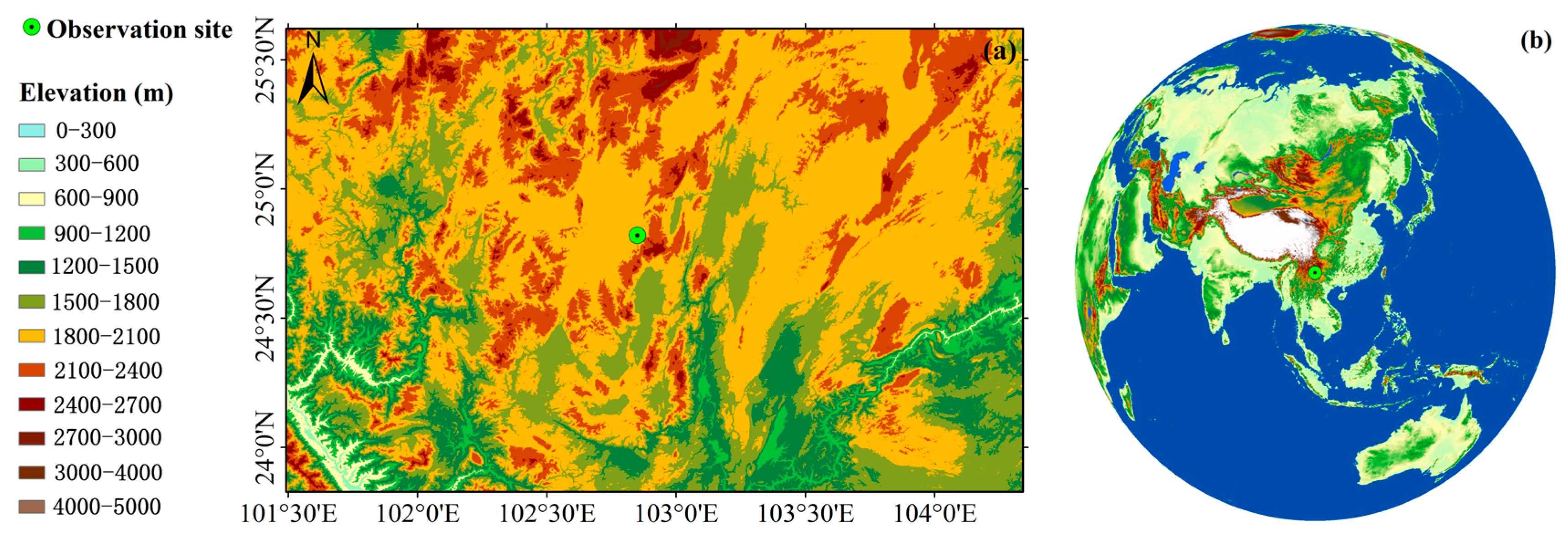
We conducted observations of water isotopes in precipitation, plant, and soil waters from July 2020 to July 2021 at the urban forestland located at the Chenggong Campus of Yunnan University (24°49′ N, 102°51′ E; 1990 m above sea level) in Kunming, the middle of the Yunnan–Guizhou Plateau, Southwest China (Figure 1). This region features an altitude monsoon climate, with Indian monsoon intrusion in summer and continental monsoon in winter. The average annual precipitation is 790 mm, with a distinctive seasonality of over 85% of the annual precipitation falling in summer from June to September, while there is little precipitation in the dry winter season from November to the following April [29]. The monthly air temperature varies from 7.7 °C in January to 20.6 °C in July, with an annual average of 14.7 °C [30]. The primary soil type is red soil [31], and the forests consists primarily of urban forest, including M. yunnanensis, Pinus yunnanensis, and Photinia serrulata, in addition to some minor components of other woodland species and shrubs, such as Bougainvillea spectabilis, Festuca rubra, and Oxalis corniculata. In this study, we selected M. yunnanensis as the target tree for water source and water use efficiency observation via water isotopes, with the height of the community varying from 3 to 6 m in the sampling plot. In this study, the growing season is defined as the period from May to September.

2.2. Sampling and Measurement

We performed the monitoring of water isotopes in soil water, xylem water, stem water, and leaf water simultaneously from July 2020 to July 2021. In each measurement, a hollow-stem auger (Haglöf, Västernorrland, Sweden) was used to collect xylem samples from three M. yunnanensis individuals with three replications at 13:00, with a sampling frequency of 1–2 times per month, totaling 109, 41, 216, 216 soil, xylem, stem, and leaf water samples collected for isotope analysis. All three individuals were mature trees (diameter at breast height: ~15–20 cm; height: ~4–5 m) and were selected to represent the typical urban planting conditions. Xylem samples were taken at chest height [32]. The collected stem samples from the base of the plant (green tissue, e.g., outer leaf) were stripped and only the white (i.e., non-transpiring) tissue was used for measurement; all stem sample individuals had leaf samples, i.e., they were transpiring water. We measured the stem and leaf samples at 9:00, 11:00, 13:00, 15:00, 17:00, and 19:00 at different sides of the tree (east, west, south, north) and from three mature trees to obtain representative measurements. For each sampling time, three leaves were collected from each cardinal direction, which were pooled to form a composite sample, and three technical replicates were analyzed. Leaf samples were separated into two parts for hydrogen/oxygen and carbon stable isotope analyses, respectively. The leaf sample collection followed the national standards of “Observation Methodology for Long-term Forest Ecosystem Research from (GB/T33027-2016)” [33]. Soil samples were collected at 13:00 at depths of 5, 10, 20, 30, 40, 50, 60, 70, 80, and 90 cm with three replications at each measurement, with a hand auger at sites near the three trees, and the average value was used for representativeness. Soil samples were taken from three pits located within 2 m of each tree, and samples from the same depth were homogenized before analysis to obtain a representative profile for each tree. All plant (M. yunnanensis) and soil samples were measured using the isotope analyzer (Picarro L2140-i, Picarro Inc., Santa Clara, CA, USA) in solid mode combined with an induction module (IM, Picarro Inc., Santa Clara, CA, USA). The solid mode allowed for the simultaneous measurement of the isotopic compositions of small solid samples and the removal of organic contamination from within the samples in the field [34]. To minimize post-sampling evaporation effects, all plant and soil samples were sealed immediately in airtight glass vials and stored at −20 °C until analysis, which was performed within one week of collection. A measurement of the plant and soil waters immediately after sampling also reduced the influence of evaporation on the water isotopes. Three laboratory standard waters were used for calibration—S118O = −2.83‰, δ2H = −27.42‰), S218O = −29.84‰, δ2H = −222.84‰), and S318O = −15.29‰, δ2H = −110.30‰)—which roughly cover the ranges of the measured water isotope ratios. The samples were corrected for drift and memory using the procedure described in [35]. The measured precisions are ±0.20‰ for δ18O and ±0.69‰ for δ2H. The detailed measurement and calibration processes followed the protocol in [36].
We also collected precipitation for isotope measurement during the same period nearby on the Yunnan University campus. Daily precipitation samples were collected at 20:00 on the rainy day using a container [37] specifically designed to avoid the re-evaporation of the collected water samples, and all samples were stored in plastic bottles and frozen in a refrigerator before laboratory analysis. A total of 145 daily precipitation samples were collected and analyzed in-laboratory using a Picarro L2140-i liquid water isotope analyzer (Picarro L2140-i, Picarro Inc., Santa Clara, CA, USA) for both δ18O and δ2H, and all measured results were normalized to the VSMOW (Vienna Standard Mean Ocean Water), with precisions within ±0.05‰ for δ18O and ±0.5‰ for δ2H.

2.3. Micrometeorological Measurements

We installed the eddy covariance (EC) instrument meteorology station in the sampling station, including an open-path infrared CO2/H2O gas analyzer (Li-7500 A, Li-Cor, Lincoln, NE, USA) and a three-dimensional sonic anemometer thermometer (CSAT3B, Campbell Scientific Inc., Logan, UT, USA) mounted 3 m above the ground. The data were stored on a CR6 data logger and CF storage card at a sampling frequency of 10 Hz. The raw data acquired at 10 Hz were processed using EdiRe postprocessing software (Version 1.5.0.11, University of Edinburgh, UK), and quality control of the half-hourly flux data was conducted as described in the earlier literature [38]. The micrometeorological parameters (air temperature, relative humidity, wind speed, precipitation amount, four-component radiation, three soil temperature and soil moisture profile layers, soil heat flux, etc.) were recorded under 1 Hz. Additional details concerning the data acquisition are described in [39]. The energy balance closure ratio was evaluated at this site based on measurements from the EC system, and the results show a relatively high energy balance closure ratio of 0.88, indicating that the energy balance closure problem [40] is not a major concern for this site or system.

2.4. Data Analysis

2.4.1. Contributions of Different Water Sources to M. yunnanensis

In this study, we used a stable isotope mixing model, the MixSIAR model, to calculate the contributions of different water sources to M. yunnanensis, and we used the direct contrast method and MixSIAR model to comprehensively analyze the plant water sources. The soil moisture mainly used by plants was directly determined via the direct comparison method, and the plant water sources were qualitatively analyzed. The MixSIAR model was used to estimate the water use ratio of plants to various water sources and the average depth of soil water use, and to quantitatively analyze the sources of plant water. We selected MixSIAR for quantitative analysis because its Bayesian framework offers distinct advantages over deterministic methods such as IsoSource, including the incorporation of source variability and prior information, as well as the provision of the full posterior distribution of source contributions, thereby enabling robust uncertainty quantification [41]. The model integrates features from both SIAR and MixSIR, supporting multi-isotope data, random effects, and combined residual + process error modules, making it widely applicable in ecohydrological studies [42,43].
In this study, the water sources were defined as the soil waters in the 5–90 cm layers and the stem water, and they were divided into six groups according to their isotopic compositions using uninformative priors (Dirichlet distribution with α = 1 for all sources) in MixSIAR, with source variances included in the model to account for within-source isotopic variability. The model was run with three Markov chain Monte Carlo (MCMC) chains, each with 300,000 iterations, discarding the first 200,000 as burn-in and thinning every 100 iterations to reduce autocorrelation, and convergence was assessed using the Gelman–Rubin diagnostic (R-hat < 1.1 for all parameters). The model was implemented in R using the MixSIAR package [42], within which the increments were set at 2% solution, and solutions within a tolerance level of ±0.05% were counted as feasible. The sensitivity was analyzed with different fractional increments (0.5, 2%) and at different uncertainty levels (0.1, 0.3, and 0.4), with the results showing no significant differences in the fractional increment and uncertainty level changes.

2.4.2. Δ13C (Carbon Isotope Discrimination) and WUE13C Calculation

The leaf samples were ultrasonically washed with distilled water, air-dried, and oven-dried at 60 °C for at least 72 h to a constant weight, and they were then ground and finally sieved through a 1 mm mesh screen. We used a Picarro G2201-i (Picarro Inc., Santa Clara, CA, USA) high-frequency wavelength-scanned cavity ring-down spectroscopy (WS-CRDS) analyzer for the carbon isotope measurement, according to the PDB (belemnite from the Pee Dee Formation) standard. The precision was <0.12%, and the leaf δ13C value was determined using the following equation:
δ 13 C = R s a m p l e R s t a n d a r d 1 × 1000
where Rsample and Rstandard are the 13C/12C ratios in the samples and the PDB (Pee Dee Formation) standard, respectively [44].
Isotopic effects can also be expressed by isotopic discrimination values (Δ). Because CO2 is the source of plant photosynthesis, its photosynthetic discrimination value can be described as follows [45]:
13 C = ( δ 13 C a δ 13 C p ) / ( 1 + δ 13 C p / 1000 )
where δ13Ca and δ13Cp represent the δ13C values of air and plant samples, respectively. The δ13Ca was assumed to be −8‰, according to [44]. In C3 plants, Δ13C is primarily determined by the ratio of intercellular to ambient leaf CO2 via the following formula:
13 C = a + ( b a ) C i C a
where a (4.4‰) represents the diffusive discrimination of 13C in air through stomata, b (27‰) represents the net discrimination associated with carboxylation, and Ca and Ci are the air and intercellular partial pressures of CO2, respectively [44,46].
In plants, the leaf conductance to water vapor (gH2O) is related to the leaf conductance of CO2 (gCO2), as per the following equation:
g H 2 O = 1.6 g c o 2
where 1.6 is the water vapor-to-CO2 diffusivity ratio.
Further, the leaf net photosynthesis (A) is related to the gH2O as the following equation:
A = g c o 2 ( C a C i )
where A is the net photosynthesis, and gCO2 is the leaf conductance of CO2 [47].
Given Equations (3)–(5), Δ13C can be converted to the ratio A/gH2O (WUE13C) via the following equation [48]:
W U E 13 C = A g H 2 O = b 13 C 1.6 ( b a )

2.5. Economic Valuation Framework

The economic value (EV) of M. yunnanensis’s adaptive strategy is disaggregated into three components, each derived from the isotopic and physiological data. This translation from biophysical traits to economic metrics addresses a core need in environmental accounting: moving from qualitative descriptions of ecosystem services to quantitative, marginal analyses of resource use efficiency [49].
EV1: Operational Cost Savings from Irrigation Substitution. This metric represents the avoided cost of supplemental watering due to the tree’s ability to access deeper soil water and stem reserves during drought, a direct application of the concept of input substitution in production economics:
EV1 = ΔV_irri × P_water + ΔC_maint
where ΔV_irri is the volume of irrigation water substituted, estimated from the MixSIAR-modeled shift in water source proportions (Figure 10) and local evapotranspiration estimates. Specifically, we used the seasonal difference in the deep soil water contribution (dry season minus wet season) multiplied by the average daily transpiration rate (from eddy covariance measurements) and the length of the dry season (180 days). The transpiration rate was estimated as 2.5 mm d−1, derived from the EC system. P_water is the marginal price of municipal irrigation water, obtained from the Kunming Water Authority (2023 report, 6.2 CNY m−3 for green space irrigation), and ΔC_maint encompasses the saved labor and energy costs from the reduced irrigation frequency, estimated at 0.5 CNY tree−1 yr−1 based on local maintenance records.
EV2: Value of Enhanced Water Productivity. Higher intrinsic WUE13C implies greater ecosystem service output per unit of water transpired, reflecting an increase in the total factor productivity of the water input. We focus on carbon sequestration as a representative service:
EV2 = (ΔA/Δg_H2O) × V_C
where the ratio (ΔA/Δg_H2O) is the change in the net carbon assimilation per change in water loss, derived from the δ13C-WUE13C relationship (Equation (6)). We used the observed seasonal increase in the WUE (from the wet to dry season) of 15% to estimate a proportional increase in carbon assimilation per unit water. Assuming a baseline carbon sequestration rate of 5 kg C tree−1 yr−1 for M. yunnanensis [4], the increment attributable to higher WUE is 0.75 kg C tree−1 yr−1. V_C is the social or market value of sequestered carbon. We used a range of carbon prices: from 50 CNY t−1 CO2 (current China national ETS price) to 200 CNY t−1 CO2 (social cost of carbon for 2030, from integrated assessment models). Converted to C, this gives 0.18–0.73 CNY kg−1 C.
EV3: Climate Resilience Value. This metric captures the avoided loss from reduced drought-induced mortality, modeled as a risk premium analogous to the option value of adaptation in environmental economics:
EV3 = (R_mortality × V_replacement) × (1 − θ_adapt)
where R_mortality is the baseline annual mortality risk for non-adapted species under drought stress, taken as 2% for non-native, drought-sensitive species in Kunming (from municipal forestry records). V_replacement is the net present cost of sapling purchase, planting, and establishment, estimated at 300 CNY tree−1 (including the sapling cost (100 CNY), planting labor cost (150 CNY), and initial irrigation cost (50 CNY)). θ_adapt (0 ≤ θ ≤ 1) is the relative risk reduction factor attributed to the species’ adaptive plasticity, inferred from its sustained physiological function during the observed dry period. Based on the observed maintenance of transpiration and WUE during dry months, we assigned θ_adapt = 0.6, i.e., a 60% reduction in mortality risk.
Sensitivity and Uncertainty: The key parameters (P_water, V_C, R_mortality) were assigned plausible ranges based on local market data and the literature. We performed a Monte Carlo simulation with 10,000 iterations, assuming triangular distributions for each parameter: P_water (4–8 CNY m−3; mode 6.2); V_C (0.1–0.8 CNY kg−1 C; mode 0.4); R_mortality (1–5%; mode 2%). The 90% confidence intervals for EV1, EV2, and EV3 were calculated and are reported in the results. This probabilistic approach explicitly accounts for uncertainty in both isotopic and economic parameters, providing a robust basis for decision making. The primary contribution of this section is the development of a transparent, replicable valuation model that parameterizes economic value directly with biophysical measurements, providing a concrete method for assessing urban trees as productive natural capital assets [8].

2.6. Statistical Analyses

All statistical analyses were performed using R (version 4.2.1). Prior to the parametric tests, the normality of the data distribution was assessed using the Shapiro–Wilk test, and the homogeneity of variances was verified using Levene’s test. When these assumptions were violated, non-parametric alternatives (Kruskal–Wallis test) were applied. Differences in isotopic compositions among water sources and seasons were tested using one-way ANOVA followed by Tukey’s HSD post hoc test, and correlations between variables were assessed using Pearson’s correlation coefficient after confirming linearity and normality. The meanings of the significance thresholds (p < 0.05 (*), p < 0.01 (**), p < 0.001 (***)) indicate lower and higher significance, and p > 0.05 indicates non-significant values (“ns”).

3. Results

3.1. Seasonal Variations in Environmental Variables

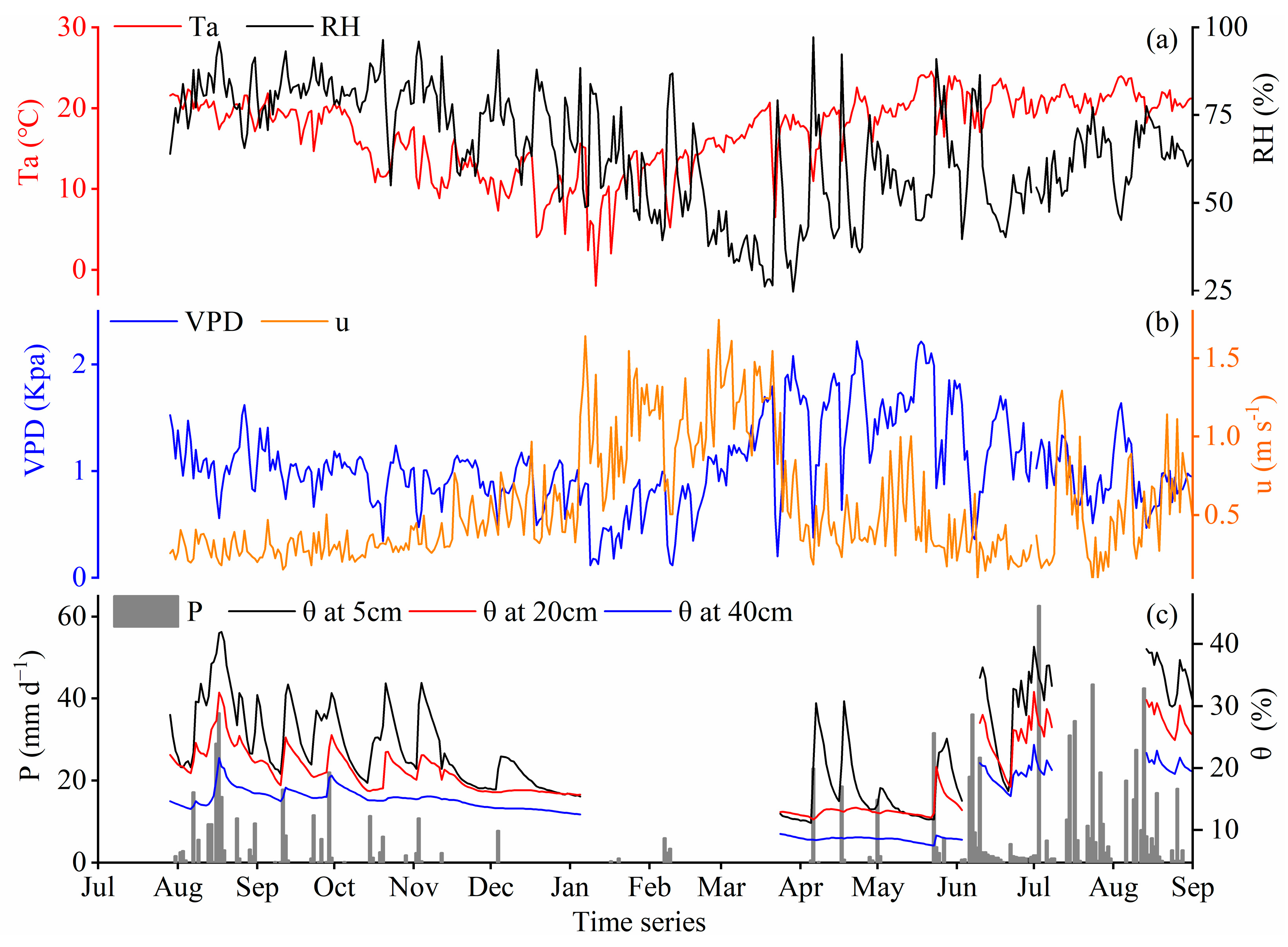
Detailed information on the seasonality of the environmental variables is essential to the assessment of seasonal variations in water source and water use efficiency. Figure 2 shows the seasonal variations in daily air temperature (Ta), relative humidity (RH), vapor pressure deficit (VPD), wind speed (u), daily sum of precipitation amount (P), and volumetric soil water content (θ) at different depths from the in-situ flux observation. Figure 2a shows the seasonal variations in Ta and RH during the monitoring period. The daily air temperature was 17.0 during the monitoring period, varying from −1.9 to 24.5 °C, and the RH was 64.9, varying from 24.8 to 97.2. The seasonal variations in u and VPD during the monitoring period are shown in Figure 2b. The daily wind speed was 0.6 m s−1 during the monitoring period, varying from 0.1 to 1.7 m s−1, and the mean vapor pressure deficit varied between 0.1 and 2.2 Kpa. Figure 2c exhibits the seasonal variations in the daily average precipitation and soil moisture content. The daily average precipitation was 2.4 mm d−1. Although we only have a soil moisture observation at a shallow surface, it reflects the root zone moisture as well. The daily averaged θ at the site was maintained at a high level during the observation period. The large fluctuation in the soil moisture content at a 5 cm depth was caused by rapid evaporation and precipitation replenishment, while the soil moisture content was quite constant at the 40 cm depth, and the slight variations were in response to precipitation events but with a lag of a couple of days.

3.2. Relationship Between δ18O and δ2H of Different Water Pools

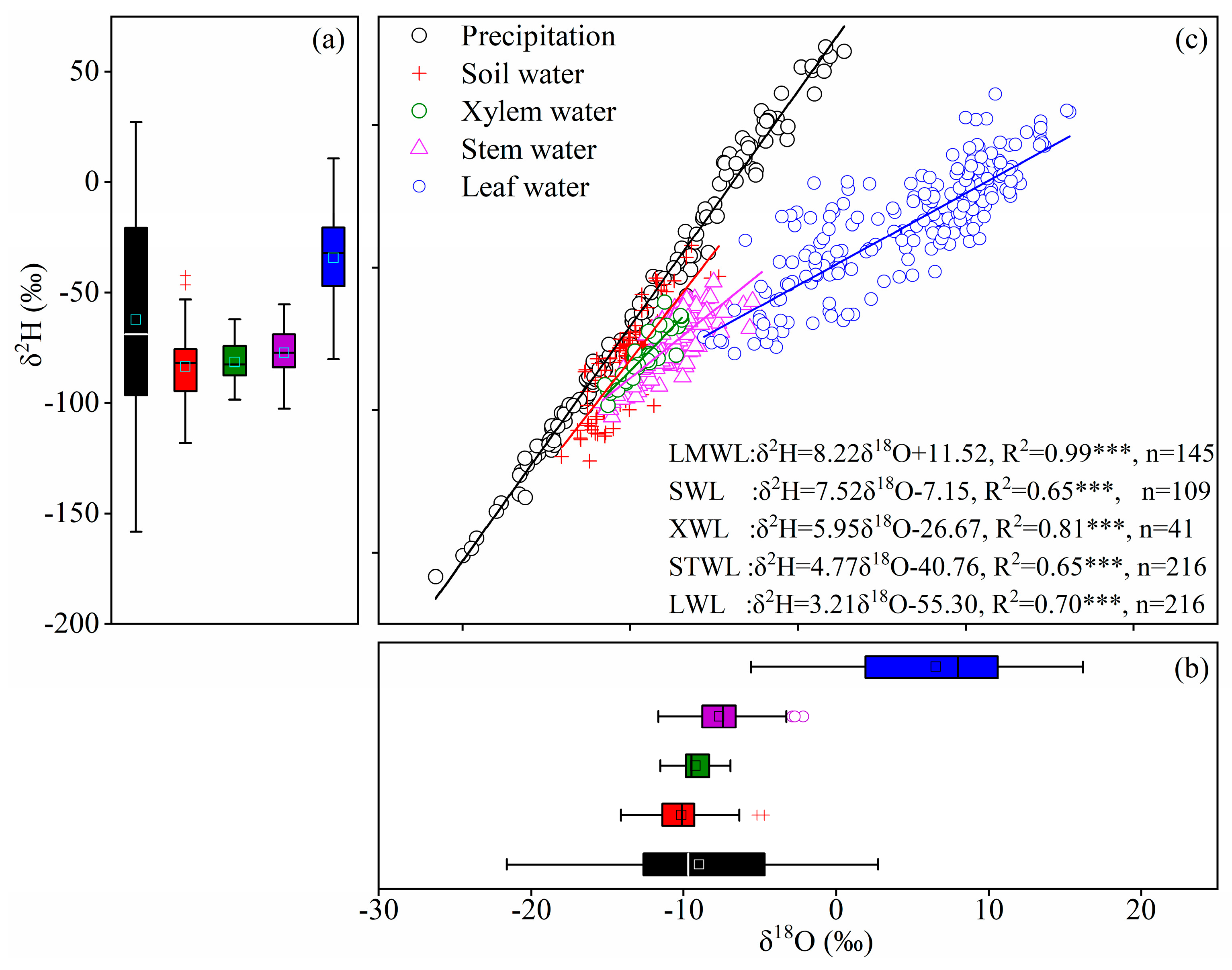
The dual-isotope plot (δ2H-δ18O) reveals distinct fractionation patterns across ecosystem water pools, reflecting their respective hydrological processes [50]. The local meteoric water line (LMWL), defined as δ2H = 8.22 δ18O + 11.52 (R2 = 0.99, p < 0.001, n = 145) (Figure 3), is consistent with the global meteoric water line (GMWL) [51,52]. In contrast, the soil water samples (δ18O: −14.10 to −4.72‰; δ2H: −117.91 to −42.24‰) deviate below the LMWL, forming a soil water line (SWL) (δ2H = 7.52δ18O − 7.15; R2 = 0.65, p < 0.001, n = 109). This lower slope and intercept indicate significant evaporative enrichment post-infiltration, despite some moderation via vegetation cover [53]. Plant water isotopes demonstrate a progressive enrichment sequence. The xylem water line (XWL) (δ2H = 5.95δ18O − 26.67; R2 = 0.81, p < 0.001, n = 41) plots intermediately between soil and stem waters. Further isotopic enrichment is observed in stem water (STWL: δ2H = 4.77δ18O − 40.76; R2 = 0.65, p < 0.001, n = 216) and culminates in leaf water (LWL: δ2H = 3.21δ18O − 55.30; R2 = 0.70, p < 0.001, n = 216). The successively lower slopes and more negative intercepts from the SWL to the LWL quantitatively trace the strong gradient of evaporative fractionation through the Soil–Plant–Atmosphere Continuum, with leaf water exhibiting the most pronounced isotopic enrichment during transpiration.

3.3. Seasonal Variations in Precipitation Isotopes in Forest Ecosystem

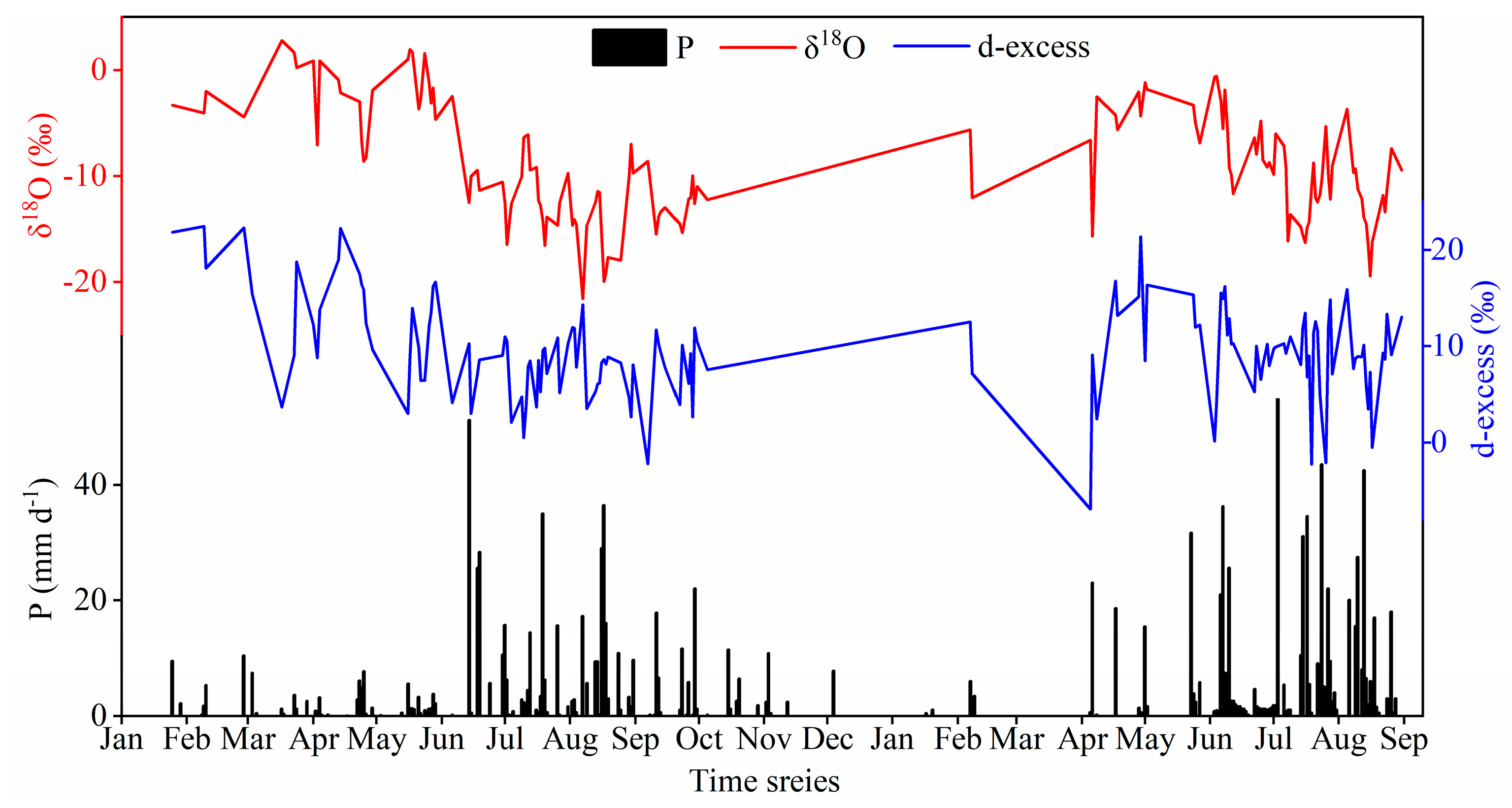
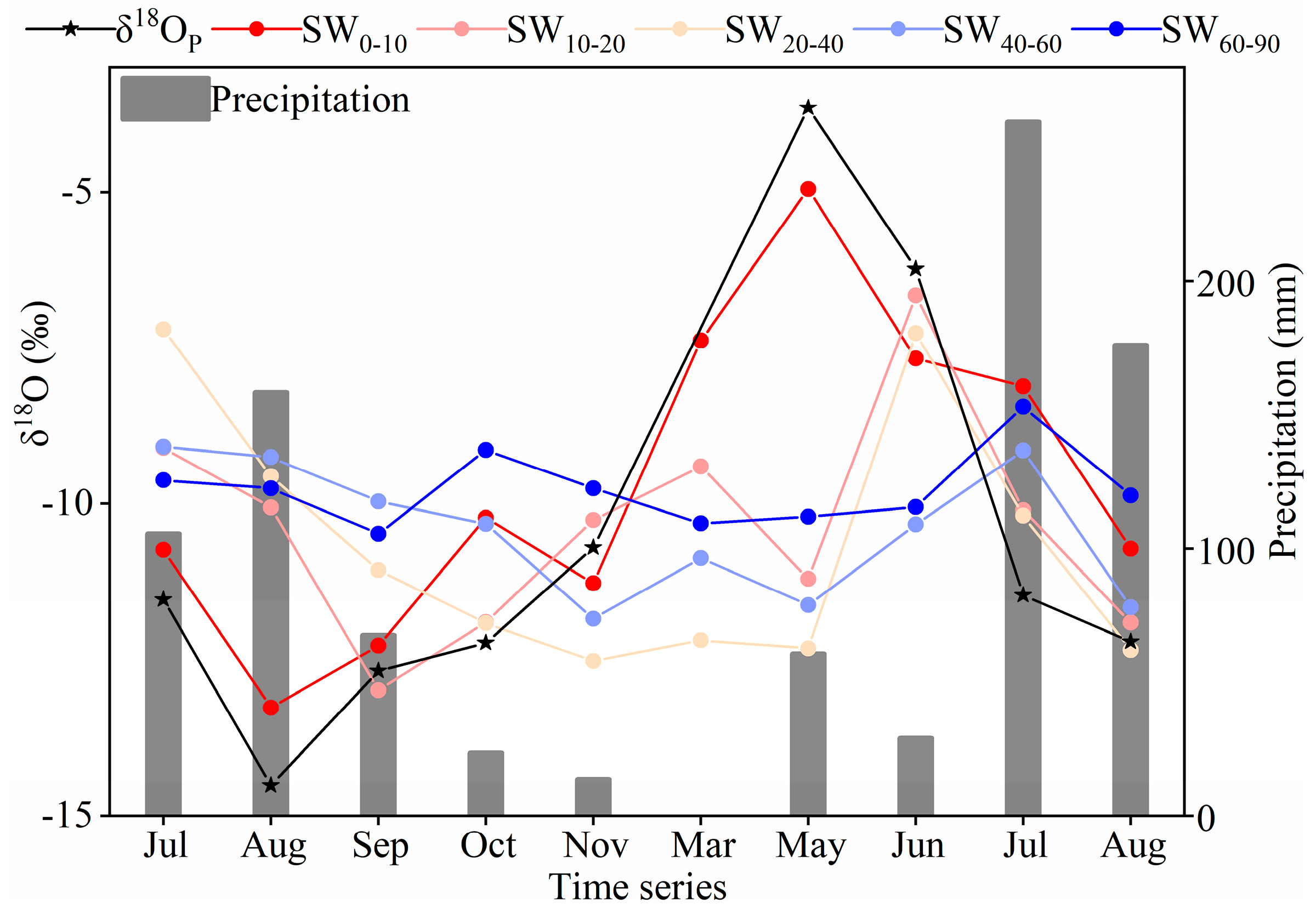
Because the seasonal variations in stable hydrogen and oxygen isotopes were mainly consistent, it was reasonable to use only δ18O to identify the seasonal variations in the stable isotopic composition. We present the daily precipitation δ18O and d-excess and precipitation amount from Kunming in Figure 4. The daily isotopic compositions of the precipitation samples ranged from −21.6 to 2.7‰ for δ18O (−9.0‰ on average) and from −6.9 to 22.4‰ for d-excess (9.5‰ on average). The precipitation δ18O showed a seasonal shift from the higher value in the earlier summer of January–June to the lower δ18O period of the rainy season until October. This seasonal precipitation was consistent with the seasonal feature of the monsoon-type precipitation signal. The seasonal variation in the precipitation d-excess showed an opposite trend to the δ18O changes, likely a signal of the enhancing evaporation enrichment of precipitation during the dry season in spring and early summer. The slightly lower precipitation d-excess on days with less rainfall was probably related to the re-evaporation of falling raindrops, which lowered the d-excess in the remaining rainfall.

3.4. Isotopic Composition of Soil Water at Different Depths

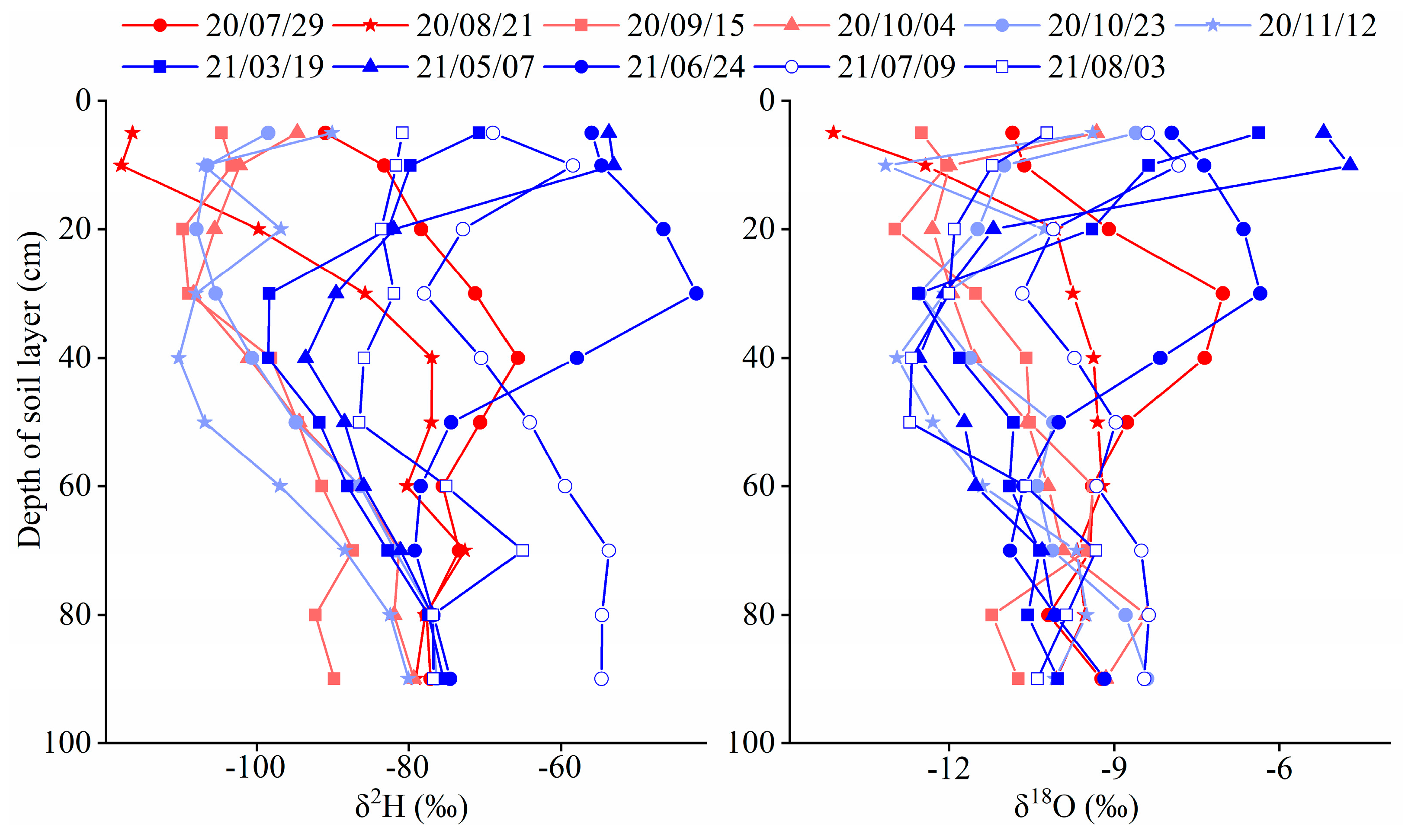
The isotopic composition of the soil water revealed distinct vertical stratification and contrasting seasonal dynamics between the shallow and deep layers (Figure 5). The soil water δ18O values ranged from −14.1‰ to −4.7‰, and a clear depth gradient was observed: values in the upper 60 cm were the most depleted in August (−14.1‰) and became progressively enriched, reaching their maximum (−4.7‰) by the following May. This pattern reflects the direct infiltration and subsequent evaporation of monsoon rainfall. In contrast, soil water below 60–90 cm exhibited markedly dampened seasonal fluctuations, with values varying only between −11.52‰ (May) and −8.37‰ (July). This attenuation indicates a transition zone where precipitation signals are mixed and buffered. The depth profile of the mean δ18O further highlights this shift, showing greater variability (−10.32 ± 1.95‰) in the active 0–70 cm layer relative to the homogeneous deep layer below 70 cm (−9.69 ± 0.76‰).
The d-excess, an indicator of secondary evaporation, provided complementary insights. In the shallow zone (0–70 cm), the mean d-excess increased with depth (e.g., from −8.3 ± 9.3‰ at 5 cm to 0.2 ± 8.8‰ at 60 cm) while its variability decreased, robustly evidencing strong kinetic fractionation at the soil–atmosphere interface. Conversely, in the deep zone (70–90 cm), the mean d-excess showed a slight decreasing trend with relatively low variability (e.g., from 0.8 ± 8.2‰ at 70 cm to −1.2 ± 6.0‰ at 90 cm). This dichotomy confirms that the shallow soil is dominated by the rapid, evaporation-influenced turnover of seasonal precipitation, whereas the deep soil constitutes a stable reservoir with a longer residence time, integrating precipitation signals over extended periods. These processes create a stratified water source landscape critical for understanding plant uptake strategies.

3.5. Seasonal Variations in Plant Xylem, Stem, and Leaf Water Isotopes

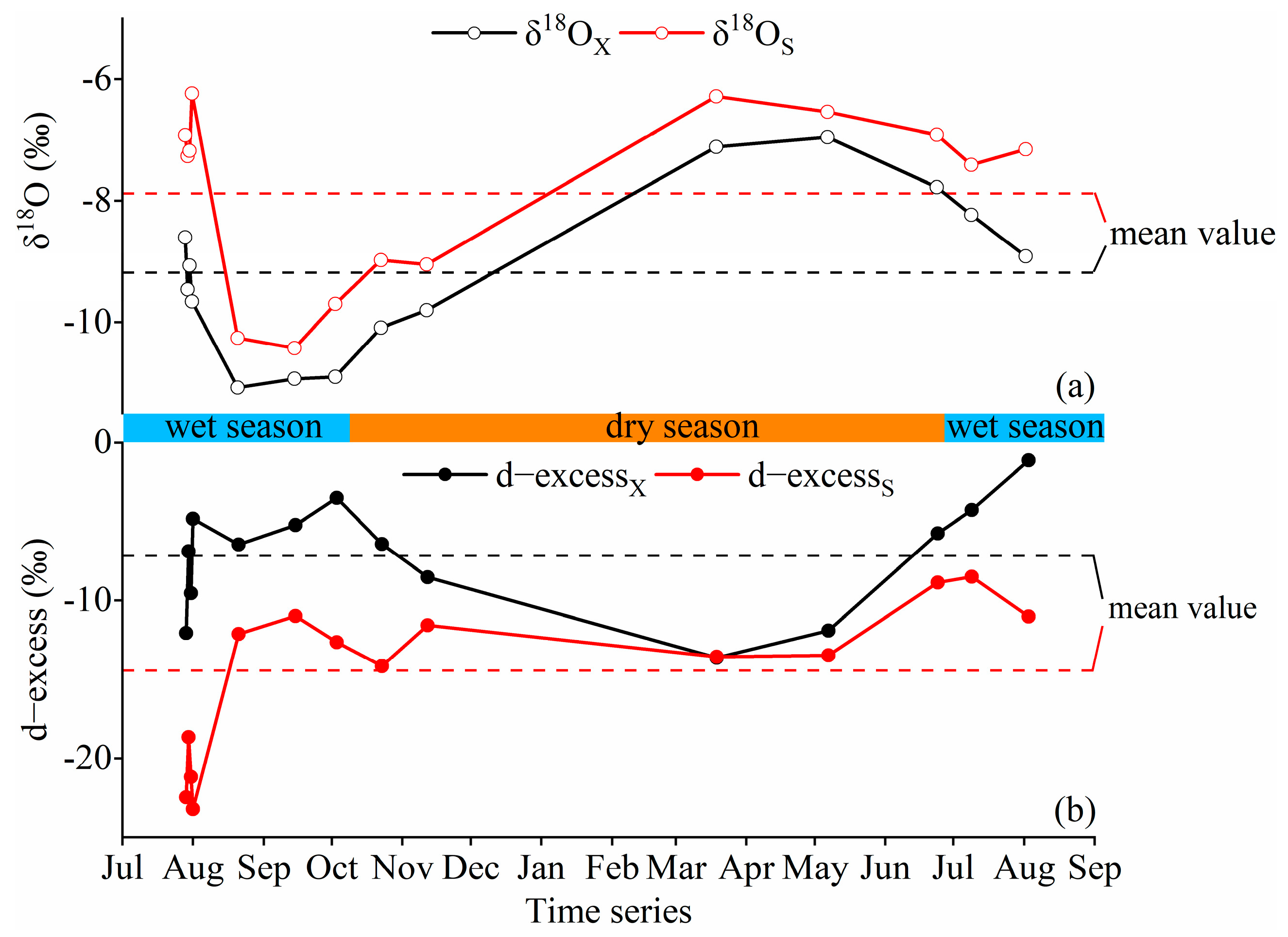
A comparison of the seasonal variations in the δ18O and d-excess in xylem and stem waters during the observation period is shown in Figure 6. There are pronounced seasonal variations in the δ18O in xylem (δ18OX) and stem (δ18OS) waters, and they are synchronized, and the correlation coefficient (R) of δ18OX with δ18OS is 0.71 (p < 0.001). In the rainy season, the δ18OX and δ18OS for M. yunnanensis rapidly decreased, while they gradually increased in the dry season and maintained high values (Figure 6a). Moreover, the δ18OX and δ18OS were the lowest in August (Figure 6a) and thereafter became more enriched as time progressed. The δ18OX and δ18OS ranged from −11.5‰ to −6.92‰ (−9.2 ± 1.3‰ on average) and from −10.5‰ to −4.5‰ (−7.8 ± 1.5‰ on average), respectively. The average monthly δ18O of the soil water samples was −10.1 ± 1.71‰, and the δ18OX was very close to the soil water δ18O but had a certain degree of enrichment in comparison, while the δ18OX for M. yunnanensis was significantly lower than that for stem water (p < 0.001, n = 216). The seasonal pattern of xylem and stem waters was similar to that of the δ2H during the observations (Supplementary Figure S1), indicating a close hydraulic linkage between xylem and stem waters within the interval. The seasonal variations in the d-excess in xylem and stem waters are not significant nor synchronized, while the correlation coefficient (R) of the d-excess in xylem water with stem water is 0.1, as their evaporation enrichment mechanisms are different (Figure 6b).
The seasonal variations in the δ18OL and d-excess of leaf water compared with the leaf water enrichment during the observation period are shown in Supplementary Figure S2. Leaf water becomes enriched in heavy isotopes during transpiration due to equilibrium and kinetic effects [54]. In general, in the rainy season (June–October), the δ18OL decreased rapidly, and after the dry season (October–June), the δ18OP increased gradually. The seasonal variations in the δ18OL of leaf water are in phase with the leaf water enrichment; however, the d-excess of leaf water is the opposite. The seasonal pattern of leaf water enrichment was similar to that of the δ2HL of leaf water during the observations (Supplementary Figure S3).

3.6. Daily and Seasonal Variations in Carbon Isotope Composition (δ13C) and Water Use Efficiency (WUE13C) of M. yunnanensis

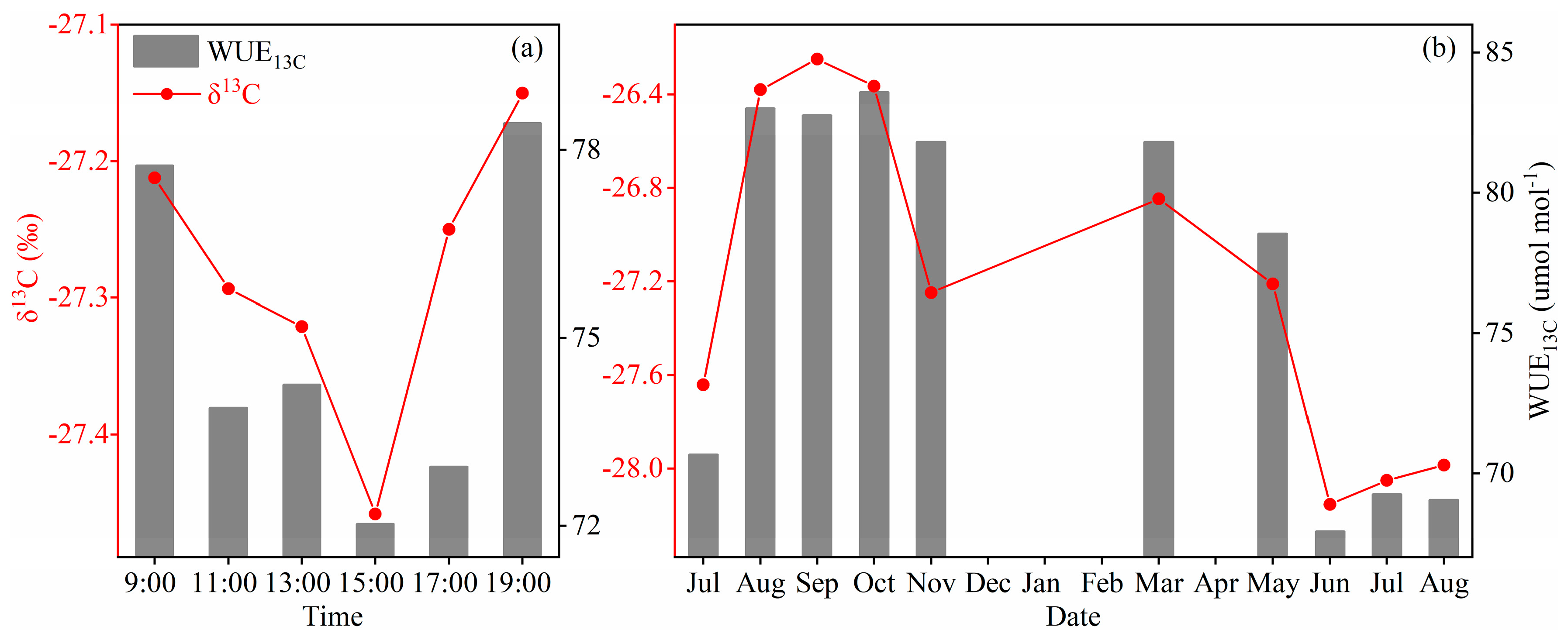
The daily and seasonal variation dynamics of the WUE13C reflect water requirements at different developmental stages. Here, we show the daily and seasonal changes in the plant δ13C and WUE13C of M. yunnanensis (Figure 7) to identify its potential driving mechanisms. The daily variation in the WUE13C shows a “V” shape. The low WUE13C value was observed from 11:00 to 17:00 (noon), the high value was observed at 9:00 and 19:00 (morning and evening), and the WUE13C was significantly lower at 15:00 than at the other times (Figure 7a). The seasonal variation trends of the WUE13C were as follows: an initial rapid increased from July to August, less variability from August to October (rainy season), no significant decrease from October to the following March (dry season), and a rapid decrease after March (Figure 7b). The seasonal variation in the plant δ13C was similar to that of the WUE13C: both were the lowest in June under the yearly dryer atmospheric conditions (Figure 7b), indicating that water availability is the most important limiting factor for plant growth and has been observed to affect the WUE13C.

4. Discussion

4.1. Water Source Dynamics: Creating a Stratified Resource Landscape

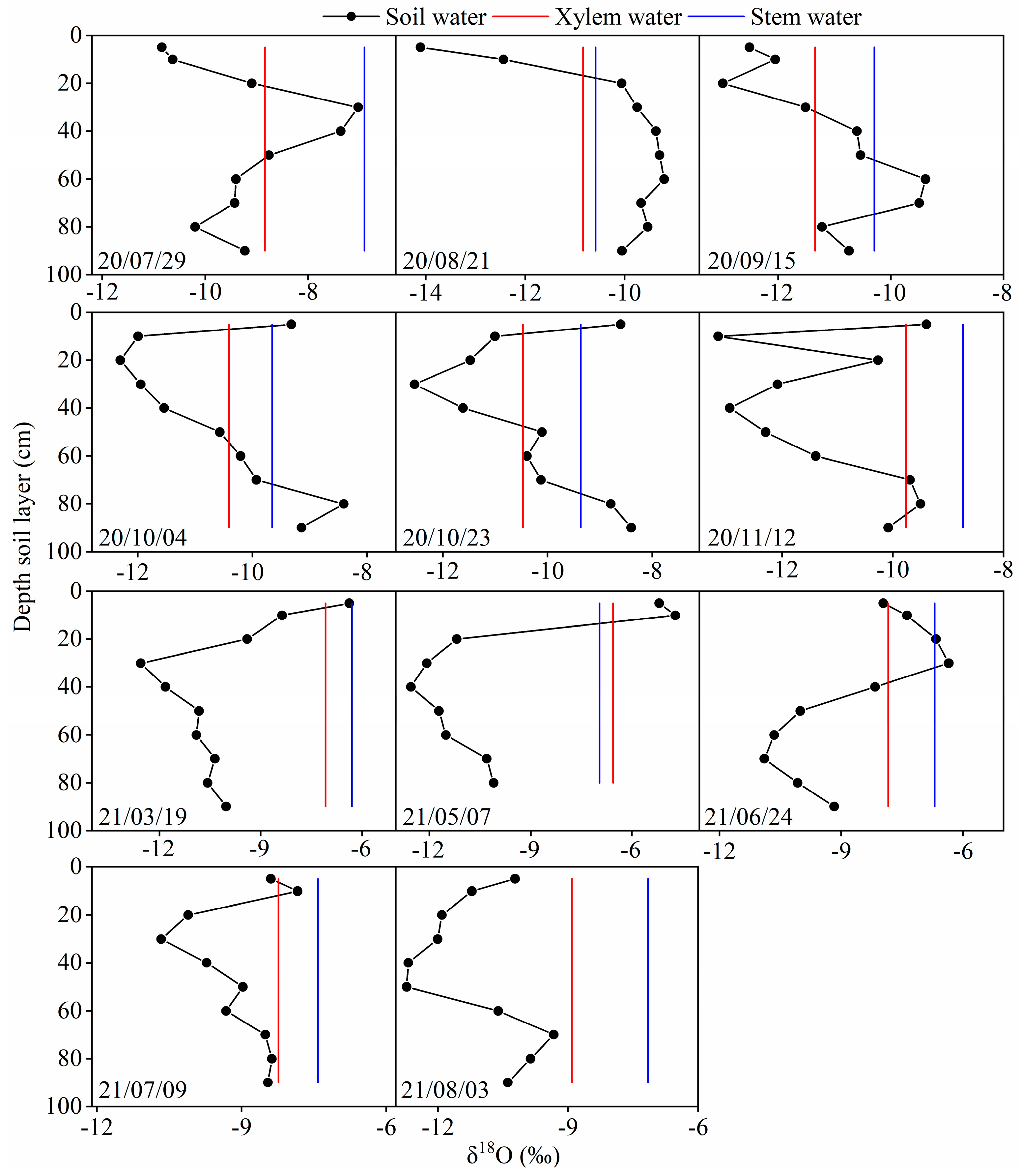
The soil water δ18O dynamics are governed by precipitation recharge and soil evaporation, exhibiting a clear depth-dependent response to precipitation inputs (Figure 8). Following isotopically depleted monsoon rainfall, a significant decrease in the δ18O in the upper 0–40 cm soil layer indicated direct infiltration and mixing, suggesting preferential flow pathways [55,56]. During the pre-monsoon season, higher precipitation δ18O and strong surface evaporation led to enriched isotopic values in shallow soil, with the depth of the evaporative front, identified per the methods in [57], varying between 20–40 cm and 40–60 cm across seasons.
The temporal variability in the soil water δ18O decreased markedly with depth, with shallow soil (0–10 cm) showing high fluctuations, tracking individual precipitation events and experiencing strong kinetic fractionation from evaporation. In contrast, soil water below 60–90 cm exhibited a significantly dampened isotopic signal, indicating the mixing of precipitation over longer timescales and the dominance of liquid-phase transport [58,59]. This pattern, where deeper soil acts as a buffer with a stable isotopic signature, aligns with findings from other semi-arid ecosystems [53,60]. The stratified water source landscape created by these processes—a dynamic shallow reservoir and a stable deep reserve—forms the physical basis for plant water foraging and has direct implications for managing irrigation as an economic input, as it delineates naturally available versus human-supplied water zones.

4.2. Water Sources and Relative Contribution Proportions to M. yunnanensis

4.2.1. Qualitative Analysis of Plant Water Sources

The dual-isotope plot reveals pronounced seasonal plasticity in the water uptake by M. yunnanensis (Figure 9). During the wet season (July to September), the xylem water δ18O values closely aligned with those of the soil water at 20–50 cm depth, indicating the predominant use of shallow-to-middle soil layers. Conversely, in the dry season (October to June), xylem water isotopes matched contributions from very shallow (0–10 cm) and deeper (50–90 cm) soil sources. This adaptive strategy of shifting uptake depths in response to soil moisture availability is a well-documented drought tolerance mechanism [61,62], potentially driven by root growth into deeper layers [63] or reduced shallow root activity under dry conditions [64], as seen in other species [65,66]. From an economic perspective, this plasticity represents a form of intrinsic resource arbitrage, allowing the tree to substitute costly irrigation with freely available soil water during drought, thereby generating direct cost savings. Occasional mismatches between xylem and soil water δ18O suggest that ecohydrological separation between mobile and immobile water pools may occur even in urban settings [67,68,69,70,71], highlighting the complexity of water availability. Such ecohydrological separation implies that plant-available water may not always be isotopically identical to the bulk soil water sampled, introducing uncertainty in source attribution. While our MixSIAR model incorporates source variability to partially account for this uncertainty, quantifying the exact impact of ecohydrological separation remains challenging. Root water uptake is generally assumed to occur without isotopic fractionation [72]; however, recent studies suggest that under severe drought, xylem water may undergo fractionation due to cavitation or refilling processes [69]. In our study, the close alignment of xylem water isotopes with soil and stem water pools during most seasons suggests that fractionation effects, if present, are minimal. Nevertheless, future research combining the high-frequency isotopic monitoring of soil and plant water with tracer experiments is needed to better constrain these uncertainties and refine source partitioning models.

4.2.2. Quantitative Analysis of Plant Water Sources Based on MixSIAR Model

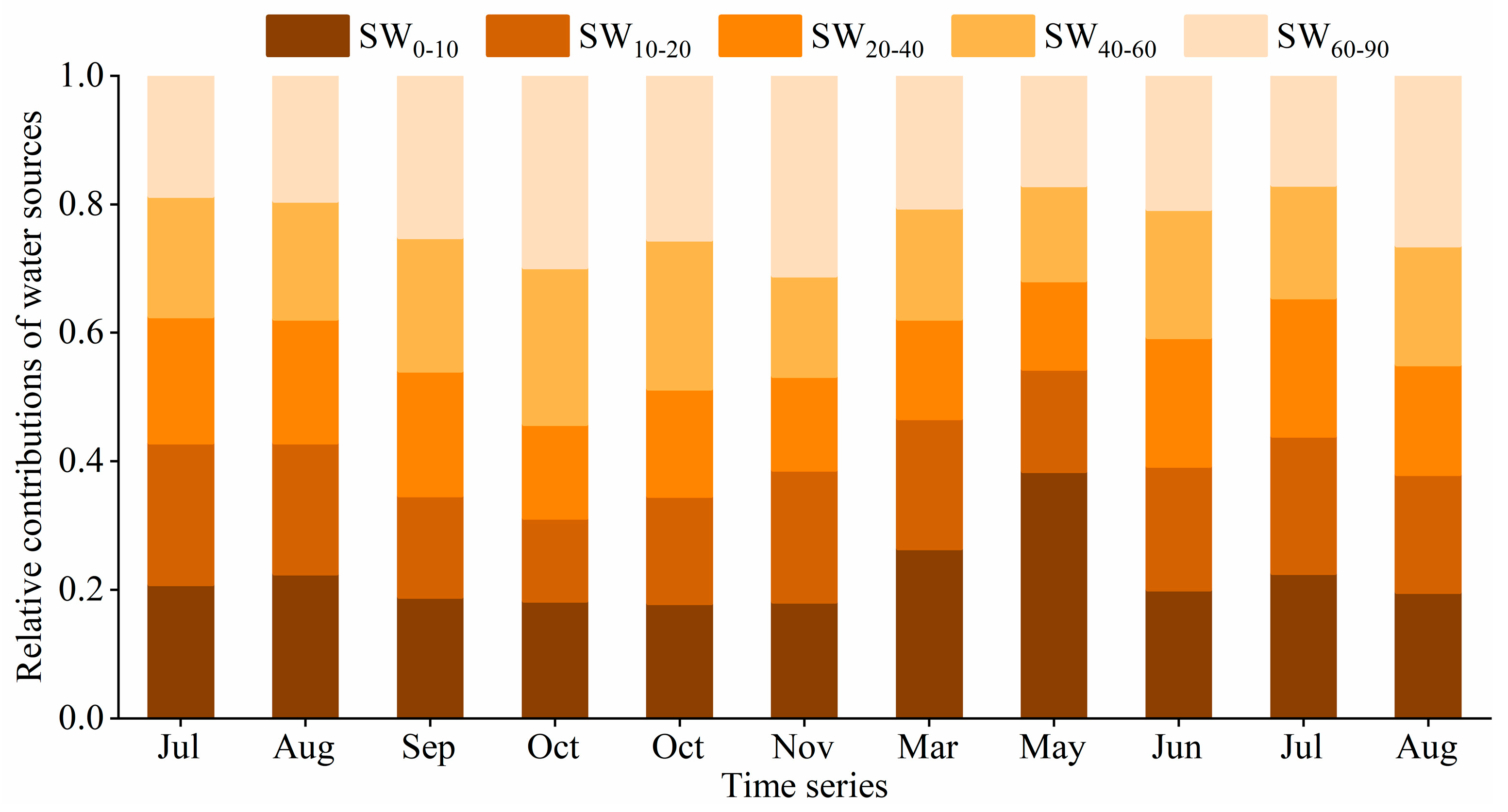
Significant isotopic differences between water pools allowed for quantitative source apportionment using a linear mixing model based on isotope mass balance [61,62,65,72,73,74]. According to the MixSIAR model output (Figure 10), shallow soil (0–40 cm), deep soil (40–90 cm), and stem waters contributed 30%, 40%, and 30% on average, respectively, over the entire period. A clear seasonal shift was quantified: the deep soil water contribution increased to 40–70% in the dry season, while stem water uses also rose (mean contribution: 0.35 vs. 0.23 in the wet season). This shift from shallow to deep sources as soil moisture declines is a common adaptive strategy [66,75,76]. These quantitative contributions (e.g., deep soil providing 40–70% of dry-season water) are critical for economic translation, as they provide the coefficients to calculate the volume of irrigation water substituted (ΔV_irri), forming the basis for estimating operational cost savings (EV1).

4.3. Water Use Strategies of M. yunnanensis: Linking Physiological Adaptations to Economic Value

The isotopic analyses delineate how M. yunnanensis copes with water variability. For urban resource management, the critical question is how these adaptive traits translate into measurable economic benefits. Recent advances in ecosystem valuation, such as the “3M” framework (multi-dimensional indicators, multi-source data, and multi-method adaptation) proposed in [77] for Gross Ecosystem Product accounting, demonstrate the importance of integrating regional heterogeneity and uncertainty analyses to enhance the policy relevance of such valuations. This requires reframing physiological plasticity—seasonal water source switching and dynamic WUE13C—within resource economics. We explicitly link the quantified ecohydrological strategies to three key economic dimensions: operational cost reduction, enhanced ecosystem service productivity, and climate resilience. This translation underscores the species’ utility as “natural capital” and provides a replicable framework for the cost–benefit evaluation of urban greening projects. The water-foraging plasticity identified here represents a key adaptive trait that may interact with other resource acquisition strategies. For instance, recent evidence suggests a decoupling between leaf and topsoil elements in street trees, indicating complex, depth-dependent nutrient uptake [78]. Therefore, integrating the management of water use efficiency with nutrient dynamics within a broader “water–nutrient–carbon” framework could further optimize multiple ecosystem services simultaneously, an important direction for future urban ecological research.

4.3.1. Seasonal Water Source Plasticity for Operational Cost Mitigation

This study explicitly quantified a seasonal switching strategy (Figure 9 and Figure 10). During the wet season, M. yunnanensis primarily utilized shallow-to-middle soil water (10–50 cm), reducing its reliance on supplemental irrigation; this plasticity is a well-documented strategy [61]. In the dry season, dependence shifted to deep soil water (50–90 cm) and stem water reserves. Economically, this shift substitutes costly irrigation with naturally stored soil water [79], implying a substantial reduction in the dry-season irrigation demand in cities such as Kunming. The economic value (EV1) is EV1 = (ΔV_irri × P_water) + ΔC_maint, where ΔV_irri is the irrigation water saved, P_water is the unit water price, and ΔC_maint represents the saved maintenance costs [23]. This positions M. yunnanensis as a “low-maintenance asset” that reduces long-term operational expenditures. The concept of substituting potable water with alternative sources is gaining traction in water-scarce regions; for instance, the authors of [80] demonstrated that rainwater harvesting could reduce drinking water consumption for irrigation by over 4000 m3·yr−1 in three urban green spaces in the Algarve, Portugal, aligning with our finding that leveraging natural water sources—whether deep soil reserves or harvested rainfall—generates direct and scalable economic savings.

4.3.2. Dynamic Water Use Efficiency Enhances Resource Productivity

Regarding water use efficiency, the δ13C data revealed complex spatiotemporal dynamics (Figure 7). Diurnally, the WUE13C showed a “V”-shaped pattern—lower at midday (11:00–17:00) and higher in the early morning and late afternoon—suggesting that for precision irrigation scheduling, avoiding periods of the lowest WUE13C (midday) to minimize unproductive transpirational losses and enhance the actual productivity of each unit of irrigation water is recommended [47]. Seasonally, the WUE13C increased rapidly at the beginning of the wet season (July–August) and remained relatively high throughout the dry season, with the notably higher WUE13C in the early dry season indicating more efficient carbon assimilation per unit of water transpired under scarcity [44]. Integrating this physiological metric into economic assessments, its value (EV2) manifests as the increased marginal productivity of the water input. Within ecosystem service valuation frameworks, a higher WUE13C directly translates to greater per-tree carbon sequestration values and cooling benefits per unit of water consumed [4]. Beyond these regulating services, the design of urban green spaces profoundly influences their social value. For instance, the authors of [81] demonstrated that the micro-scale vegetation structure and spatial layout in Shanghai significantly affect leisure-time physical activities, underscoring the need for health-oriented design to maximize public well-being benefits.
In summary, the coordinated strategy of seasonal water source switching and enhanced WUE13C confers significant drought resilience, which carries intrinsic “risk mitigation value” (EV3), a key benefit of urban green infrastructure for climate adaptation [82,83]. By mitigating drought-induced mortality, this strategy directly reduces tree replacement capital costs and safeguards continuous ecosystem service delivery, and this value can be estimated using replacement cost methods or factored into long-term analyses as a reduced “risk premium” [84]. Therefore, selecting M. yunnanensis is not only an ecological decision but also a sound investment in resilient urban green infrastructure.

4.3.3. Water Use Strategies and Economic Translation

The isotopic analyses delineate how M. yunnanensis copes with water variability, and we explicitly link these strategies to three economic dimensions:
Seasonal Water Source Plasticity for Cost Mitigation (EV1): The quantified shift from shallow to deep soil water in the dry season substitutes costly irrigation with naturally stored water. An illustrative calculation demonstrates this logic: Assuming a mature tree substitutes ~1.08 m3 of irrigation water per dry season (based on a 60% uptake shift from isotopic data and estimated transpiration) at a local water price of 6.2 CNY m−3, the direct annual saving (EV1) is approximately 6.7 CNY per tree. Scaled to a municipal planting of 10,000 trees, the aggregate savings approach 67,000 CNY annually, concretizing the fiscal logic of investing in species with such plasticity. A sensitivity analysis (Monte Carlo simulation, 10,000 iterations) yielded a 90% confidence interval of 4.2–9.1 CNY tree−1 yr−1 for EV1, reflecting uncertainty in water price and transpiration estimates. This range underscores the robustness of the savings even under conservative assumptions.
Dynamic WUE13C Enhancing Resource Productivity (EV2): The observed diurnal “V”-shaped WUE13C pattern and seasonal WUE13C enhancement indicate more efficient carbon assimilation per unit of water under scarcity. Within ecosystem service valuation frameworks, this higher WUE13C directly translates to greater per-tree carbon sequestration and cooling benefits per unit of water consumed [4], representing an increased marginal value product of the water input (EV2). It is important to note that the δ13C-derived WUE reflects the intrinsic physiological efficiency (carbon gain per unit water loss) rather than the absolute carbon sequestration. While higher WUE may indicate greater potential for carbon uptake under water-limited conditions, direct measurements of biomass accumulation or net ecosystem exchange are needed to confirm actual sequestration benefits. Therefore, EV2 should be interpreted as a productivity-enhancement potential, subject to validation with growth data. Our Monte Carlo analysis for EV2 gave a 90% CI of 0.13–0.62 CNY tree−1 yr−1, reflecting uncertainty in carbon pricing and the precise WUE–growth relationship.
Coordinated Strategy for Resilience Value (EV3): The combined strategy of source switching and enhanced WUE13C confers significant drought resilience, carrying intrinsic “risk mitigation value” (EV3) by reducing the probability and expected cost of drought-induced mortality, thereby safeguarding continuous ecosystem service delivery and avoiding replacement capital costs—a key benefit for climate adaptation planning. Using the parameter values above, EV3 was estimated at 2.4 CNY tree−1 yr−1, with a 90% CI of 1.1–4.2 CNY tree−1 yr−1, which represents the annualized avoided loss per tree.
The total annual economic value of the adaptive traits (EV1 + EV2 + EV3) for a single M. yunnanensis tree is approximately 10.1 CNY (range: 5.5–15.3 CNY). Aggregated over a city-scale planting of 100,000 trees, the annual benefit reaches 1.01 million CNY, justifying upfront investments in selecting and managing such species.

4.4. Implications for Environmental and Resource Economic Theory

Beyond the specific case of M. yunnanensis, our integrated approach and findings offer several broader implications for environmental and resource economic theory and practice.
First, we operationalize the concept of “natural capital” at the organismal level, showing how a tree’s physiological traits function as a risk-mitigating asset that generates direct financial savings (EV1) and enhances factor productivity (EV2). This moves valuation beyond static stock-and-flow models toward dynamic, trait-based asset pricing for urban ecosystems [8].
Second, our framework informs the design of efficient public spending and policy instruments. By quantifying EV3 (resilience value), it provides a rationale for “resilience premiums” in public procurements or subsidies for climate-adapted species. Furthermore, the quantified water savings (ΔV_irri) could be integrated into local water rights markets or offset schemes, creating a direct market signal for investing in water-efficient urban forests, thereby aligning with the theory of co-benefit internalization in environmental policy design [85].
Finally, our interdisciplinary method—using isotopic data to parameterize an economic model—exemplifies a next-generation approach to non-market valuation, reducing reliance on stated preference methods for complex biophysical processes and instead building value estimates based on observable, engineering-style measurements of resource use efficiency. This approach enhances the objectivity and transferability of economic assessments for green infrastructure across different institutional and climatic settings, contributing to the broader goal of integrating ecology and economics for sustainability [86].

5. Conclusions and Policy Implications

5.1. Conclusions

This study integrated dual-water isotope (δ2H, δ18O) and carbon isotope (δ13C) techniques to mechanistically quantify the adaptive water use strategy of M. yunnanensis and, crucially, its direct economic implications, thereby bridging a critical gap between ecohydrology and resource economics in urban forestry. First, isotopic evidence reveals significant seasonal plasticity in the water acquisition of M. yunnanensis: the species primarily utilizes shallow-to-middle soil water (10–50 cm) during the wet season but strategically shifts to deeper soil water (50–90 cm) and stem water reserves during the prolonged dry season, demonstrating a facultative foraging strategy that minimizes its dependency on surface moisture. Second, the δ13C analysis shows distinct diurnal and seasonal dynamics in the intrinsic water use efficiency (WUE13C). The characteristic diurnal “V”-shaped pattern (with lower midday WUE13C) and the seasonally elevated WUE13C during the dry period together indicate a physiological capacity for efficient carbon assimilation under water scarcity. Third, and central to our thesis, we explicitly link these physiological adaptations to a framework of tangible economic value: (1) operational cost reduction through irrigation savings enabled by source substitution; (2) enhanced resource productivity, as higher WUE13C increases the ecosystem service output per unit of water consumed; and (3) increased resilience value by mitigating drought-induced mortality risk, thereby safeguarding public green assets. This tripartite value proposition provides a quantifiable, physiologically grounded basis for appraising urban trees as “natural capital.”

5.2. Economic Policy Recommendations

5.2.1. The Development of Differentiated Precision Irrigation Schedules

Municipal greening departments should implement “seasonally differentiated irrigation” that mirrors the plastic water use patterns of M. yunnanensis. This strategy involves significantly reducing or suspending irrigation during the wet season and its immediate aftermath. Crucially, daily irrigation should be scheduled to avoid periods of the lowest plant WUE13C (e.g., midday) to enhance the application efficiency and reduce unproductive water losses [87]. This approach leverages the economic principle of optimizing input use (water) to match the temporal productivity of the biological asset (the tree), thereby maximizing the return on each unit of water invested. Implementation can be achieved by integrating the phenological and water-source phase diagrams from this study into the decision support modules of existing urban smart irrigation systems. This integration, supported by a sensor network that monitors soil moisture and meteorological conditions, would enable automated, data-driven irrigation that aligns with the real-time physiological needs of plants, and the resulting water savings would translate directly into reduced operational costs and enhanced drought resilience, providing a clear cost–benefit rationale for upfront investments in sensor and control technologies. A pilot program covering 10 hectares of urban green space could be implemented over two years to validate the water savings and refine the irrigation algorithms before citywide rollout.

5.2.2. The Establishment of a “Water Productivity”-Centric Tree Species Selection and Evaluation System

Urban planning and forestry departments should formally introduce “water use efficiency (WUE13C)” and “water source plasticity” as mandatory screening criteria, prioritizing native, drought-adapted species with high water–economic productivity, such as M. yunnanensis. For project appraisal, the “ecosystem service value per unit of water consumption” over a species’ life cycle should be calculated to inform cost–benefit analyses [27]. The implementation pathway requires creating an open-access urban tree species eco-economic database that archives key species-specific parameters (including isotopic indicators of the WUE13C and water uptake depth, established management costs, and modeled ecosystem service values) and is coupled with user-friendly assessment tools for planners. Adopting such a physiology-informed selection system is critical, as it directly addresses the widespread growth suppression in urban trees driven by water stress [16], thereby transforming green infrastructure from a water-sensitive cost center into a drought-resilient, value-generating asset. We recommend that the database be hosted by a national forestry research institute and updated every five years to incorporate new scientific findings and local growth data.

5.2.3. The Explicit Incorporation of Water-Saving Benefits into Urban Green Space Ecosystem Service Accounting

When assessing and monetizing the benefits of urban forests (e.g., carbon sequestration, cooling), the “water savings” and corresponding “water-saving value” achieved through a plant’s inherent adaptive strategies must be concurrently accounted for [88], which requires integrating the economic valuation framework (EV1, EV2) developed in this study with widely used urban forest assessment tools (e.g., i-Tree). Developing localized model modules that embed these water-saving co-benefits will make them a standard, quantifiable component of return-on-investment (ROI) analyses for green infrastructure projects, thereby strengthening the economic rationale for fiscal support and improving the accuracy of project valuations. As an example, the i-Tree Eco model could be extended with a “water-saving module” that uses species-specific WUEs and root depth parameters to estimate irrigation reductions under local climate scenarios.

5.2.4. The Design of Incentive-Compatible Fiscal and Market Mechanisms

Governments and municipal authorities could explore establishing a “Water-Smart Green Space” certification and a linked subsidy or incentive scheme. Projects that utilize certified low-water-consumption and high-resilience species (such as M. yunnanensis) and implement precision irrigation could receive grants, tax benefits, or preferential scoring in public tenders. Furthermore, the volume of water sustainably saved by such green spaces could be quantified and potentially included in regional water rights trading or ecological compensation frameworks, transforming documented ecological performance into direct economic incentives. Implementation requires proactive collaboration between water utilities, greening departments, and finance agencies to formulate robust technical standards, verification protocols, and certification procedures. A phased approach could begin with voluntary certification, followed by mandatory inclusion in all publicly funded greening projects after three years and eventual integration into municipal water offset programs.

5.2.5. The Promotion of Cross-Sectoral Collaborative Governance and Capacity Building

The effective implementation of the above integrated policies hinges on breaking down administrative silos. We recommend establishing a permanent inter-departmental collaborative mechanism—such as an “Urban Water–Green Resource Synergy Management Group”—that includes representatives from water resource management, urban greening, public finance, and climate adaptation departments. This body should co-develop essential protocols for data sharing, joint planning guidelines, and integrated performance metrics for green infrastructure, and this governance effort must be complemented by regular cross-disciplinary training and workshops to enhance the mutual understanding of the critical links between plant physiology, hydrology, and resource economics among policymakers and practitioners. Annual workshops and a shared online platform for data and best practices would facilitate continuous learning and adaptation.

Supplementary Materials

The following supporting information can be downloaded at https://www.mdpi.com/article/10.3390/su18062775/s1: Figure S1: Seasonal variation of xylem and stem water isotopes from July 2020 to September 2021 at Kunming: (a) δ2H, (b) d-excess.; Figure S2: Seasonal variation of leaf water isotopes from July 2020 to September 2021 at Kunming: (a) δ18OL, (b) leaf water enrichment, (c) d-excess. Figure S3: Seasonal variation of leaf water isotopes from 2020-2021 at Kunming: (a) δ2H, (b) leaf water enrichment, (c) d-excess.

Author Contributions

J.H.: methodology, writing—original draft, writing—review and editing, supervision, project administration, funding acquisition, conceptualization. Y.Z.: investigation, data curation, software. Z.S.: investigation, methodology. X.W.: visualization, writing—review and editing. Y.Y.: investigation, resources. All authors have read and agreed to the published version of the manuscript.

Funding

This study was supported by the Annual Project of the Shaanxi Provincial Social Science Foundation (Grant No. 2024D052), the Special Scientific Research Program of the Shaanxi Provincial Department of Education (Grant No. 23JK0010), and the Graduate Innovation Research Project of Baoji University of Arts and Sciences (Grant No. YJSCX25YB28).

Institutional Review Board Statement

Not applicable.

Informed Consent Statement

Not applicable.

Data Availability Statement

The data presented in this study are available on request from the corresponding author.

Conflicts of Interest

The authors declare that they have no known competing financial interests or personal relationships that could have appeared to influence the work reported in this paper.

References

  1. United Nations Environment Programme. Making Peace with Nature: A Scientific Blueprint to Tackle the Climate, Biodiversity and Pollution Emergencies; UNEP: Nairobi, Kenya, 2021. [Google Scholar]
  2. Sun, Y.; Miao, Y.; Zou, Y.; Jing, X. Urban Green Spaces Under Dual Pressures of Human Activity and Climate Change: A Comprehensive Review. Sustainability 2026, 18, 2365. [Google Scholar] [CrossRef]
  3. Raza, A.; Khare, T.; Zhang, X. Novel Strategies for Designing Climate-Smart Crops to Ensure Sustainable Agriculture and Future Food Security. J. Sustain. Agric. Environ. 2025, 4, e70048. [Google Scholar] [CrossRef]
  4. Nowak, D.J. Understanding i-Tree: Summary of Programs and Methods; Gen. Tech. Rep. NRS-200; U.S. Department of Agriculture, Forest Service, Northern Research Station: Madison, WI, USA, 2023. [CrossRef]
  5. Egerer, M.; Annighöfer, P.; Arzberger, S.; Burger, S.; Hecher, Y.; Knill, V.; Probst, B.; Suda, M. Urban oases: The social-ecological importance of small urban green spaces. Ecosyst. People 2024, 20, 2315991. [Google Scholar] [CrossRef]
  6. Tsiaras, S.; Koulelis, P.P.; Petrakis, P.V. Economic Benefits of Biological Pest Control in Urban Forestry: A Sustainable Management Approach. Proceedings 2025, 117, 21. [Google Scholar] [CrossRef]
  7. Qi, P.; Sun, J.; Zhang, G. Optimal allocation of water and land resources considering crop water demand process from the perspective of water-carbon-economy nexus. J. Hydrol. 2025, 654, 132831. [Google Scholar] [CrossRef]
  8. Fenichel, E.P.; Abbott, J.K. Natural capital: From metaphor to measurement. J. Assoc. Environ. Resour. Econ. 2014, 1, 1–27. [Google Scholar] [CrossRef]
  9. Franco Navarro, J.D.; Padilla, Y.G.; Álvarez, S.; Calatayud, Á.; Colmenero Flores, J.M.; Gómez Bellot, M.J.; Acosta Motos, J.R. Advancements in Water-Saving Strategies and Crop Adaptation to Drought: A Comprehensive Review. Physiol. Plant. 2025, 177, e70332. [Google Scholar] [CrossRef] [PubMed]
  10. Farooq, M.; Wahid, A.; Kobayashi, N.; Fujita, D.; Basra, S.M.A. Plant drought stress: Effects, mechanisms and management. In Sustainable Agriculture; Springer: Dordrecht, The Netherlands, 2009; pp. 153–188. [Google Scholar] [CrossRef]
  11. Arve, L.E.; Torre, S.; Olsen, J.E.; Tanino, K. Stomatal responses to drought stress and air humidity. In Abiotic Stress in Plants—Mechanisms and Adaptations; INTECH: Rijeka, Croatia, 2011. [Google Scholar] [CrossRef]
  12. Noctor, G.; Foyer, C.H. Ascorbate and glutathione: Keeping active oxygen under control. Annu. Rev. Plant Physiol. Plant Mol. Biol. 1998, 49, 249–279. [Google Scholar] [CrossRef]
  13. Umezawa, T.; Fujita, M.; Fujita, Y.; Yamaguchi-Shinozaki, K.; Shinozaki, K. Engineering drought tolerance in plants: Discovering and tailoring genes to unlock the future. Curr. Opin. Biotechnol. 2006, 17, 113–122. [Google Scholar] [CrossRef] [PubMed]
  14. Parmar, N.; Singh, K.H.; Sharma, D. Genetic engineering strategies for biotic and abiotic stress tolerance and quality enhancement in horticultural crops: A comprehensive review. 3 Biotech 2017, 7, 239. [Google Scholar] [CrossRef]
  15. Ruiz-Lozano, J.M.; Porcel, R.; Azcón, C.; Aroca, R. Regulation by arbuscular mycorrhizae of the integrated physiological response to salinity in plants: New challenges in physiological and molecular studies. J. Exp. Bot. 2012, 63, 4033–4044. [Google Scholar] [CrossRef]
  16. Wu, Q.; Zaw, Z.; Yang, J.; Yang, R.; Li, Z.; Hauer, R.J.; Li, H.; Fan, Z.; Lu, H.; Sterck, F. Urbanization associated with greater tree growth declines in urban than in rural forests. Urban For. Urban Green. 2025, 104, 128599. [Google Scholar] [CrossRef]
  17. Gao, C.X.; Sun, C.J.; Chen, W.; Meng, S.T.; Cong, J.M. Typical plant water use strategies in the eastern Loess Plateau under the background of ecological restoration. Geogr. Res. 2024, 43, 1958–1976. [Google Scholar] [CrossRef]
  18. Zhang, B.J.; Li, Z.X.; Feng, Q.; Zhang, B.T.; Gui, J. A review of isotope ecohydrology in the cold regions of Western China. Sci. Total Environ. 2022, 857, 159438. [Google Scholar] [CrossRef]
  19. Han, J.J.; Tian, L.D.; Cai, Z.Y.; Ren, W.; Liu, W.W.; Li, J.; Tai, J.R. Season-specific evapotranspiration partitioning using dual water isotopes in a Pinus yunnanensis ecosystem, southwest China. J. Hydrol. 2022, 608, 127852. [Google Scholar] [CrossRef]
  20. Li, B.; Shi, P.; Li, Z. Partitioning and controlling factors of evapotranspiration: 1. Hydrological modeling constrained with isotope-based water balance decoupling. Agric. Ecosyst. Environ. 2024, 364, 108908. [Google Scholar] [CrossRef]
  21. Durodola, O.S.; Rothfuss, Y.; Hawes, C.; Smith, J.U.; Valentine, T.; Geris, J. Stable water isotopes reveal modification of cereal water uptake strategies in agricultural co-cropping systems. Agric. Ecosyst. Environ. 2025, 381, 109439. [Google Scholar] [CrossRef]
  22. Liu, J.; Penna, D.; Xiao, X.; Guo, L.; Chen, G.; Jiang, C.; Wu, H.; Wang, S.; Jiang, Z.; Jin, Z. Towards an isotope-based conceptual catchment model of the ecohydrological cycle in the Critical Zone on the Loess Plateau of China. J. Hydrol. 2025, 656, 133042. [Google Scholar] [CrossRef]
  23. Lv, C.; He, Y.; Zhang, W.; Gu, C.; Li, Y.; Yan, D. Quantitative Analysis of Eco-economic Benefits of Urban Reclaimed Water Greening Based on Emergy Theory. Water Resour. Manag. 2021, 35, 5029–5047. [Google Scholar] [CrossRef]
  24. Santos, M.S.N.D.; Wancura, J.H.C.; Oro, C.E.D.; Vezaro, F.D.; Ody, L.P.; Tres, M.V.; Zabot, G.L. Urban agriculture and water recycling: A comprehensive outlook on current panorama. Environ. Dev. 2025, 54, 101156. [Google Scholar] [CrossRef]
  25. Shi, W.; Cheng, K.M.; Wang, J.S. Progress on the accounting purpose-based ecosystem service valuation methods. Chin. J. Appl. Ecol. 2021, 32, 1518–1530. [Google Scholar] [CrossRef]
  26. Salmani, H.; Gil-García, L.; González-López, H. Integrating hydrological and economic modeling to assess the impacts of adaptation policies. Eur. Geosci. Union Gen. Assem. 2025, 14–19. [Google Scholar] [CrossRef]
  27. Kudaya, F.S.; König, A.; Fuchs-Hanusch, D. Analyzing variability and possible trends in NDVI for urban water management: A remote-sensing approach for long term monitoring of green infrastructure. In Proceedings of the EGU General Assembly 2025, Vienna, Austria, 27 April–2 May 2025. [Google Scholar]
  28. Yang, X.; Duan, C.; Chen, B.; Wang, H. The socio-economic value of urban green spaces in mitigating waterlogging and enhancing well-being. Resour. Conserv. Recycl. 2025, 212, 108010. [Google Scholar] [CrossRef]
  29. Zhu, Y.M.; Zhao, D.; Yang, R.W. Interannual coverability of summer monsoon precipitation in Yunnan, China, and diabatic heating anomalies over the Arabian Sea—Bay of Bengal. Clim. Dyn. 2021, 57, 2063–2077. [Google Scholar] [CrossRef]
  30. Bi, R.X. Stable Isotope Characteristics and Water Vapor Analysis of Precipitation in Chenggong Region, Kunming. Master’s Thesis, Yunnan Normal University, Yunnan, China, 2018. [Google Scholar]
  31. Wang, S.J.; Wang, H.; Li, J.H. Effects of soil temperature and moisture on the temporal variations of soil respiration under forest and lawn in Kunming. J. Northwest For. Univ. 2016, 31, 306–310. [Google Scholar]
  32. Dawson, T.E.; Ehleringer, J.R. Isotopic enrichment of water in the “woody” tissues of plants: Implications for plant water source, water uptake, and other studies which use the stable isotopic composition of cellulose. Geochim. Cosmochim. Acta 1993, 57, 3487–3492. [Google Scholar] [CrossRef]
  33. GB/T 33027-2016; Methodology for Field Long-Term Observation of Forest Ecosystem. Standards Press of China: Beijing, China, 2016.
  34. Quade, M.; Klosterhalfen, A.; Graf, A.; Brüggemann, N.; Hermes, N.; Vereecken, H.; Rothfuss, Y. In-situ monitoring of soil water isotopic composition for partitioning of evapotranspiration during one growing season of sugar beet (Beta vulgaris). Agric. For. Meteorol. 2019, 266, 53–64. [Google Scholar] [CrossRef]
  35. Geldern, R.V.; Barth, J.A.C. Optimization of instrument setup and post-run corrections for oxygen and hydrogen stable isotope measurements of water by isotope ratio infrared spectroscopy (IRIS). Limnol. Oceanogr. Methods 2012, 10, 1024–1036. [Google Scholar] [CrossRef]
  36. Cui, J.B.; Tian, L.D.; Gerlein-Safdi, C.; Qu, D.M. The influence of memory, sample size effects, and filter paper material on online laser-based plant and soil water isotope measurements. Rapid Commun. Mass Spectrom. 2017, 31, 509–522. [Google Scholar] [CrossRef]
  37. Gröning, M.; Lutz, H.O.; Roller-Lutz, Z.; Kralik, M.; Gourcy, L.; Pöltenstein, L. A simple rain collector preventing water re-evaporation dedicated for δ18O and δ2H analysis of cumulative precipitation samples. J. Hydrol. 2012, 448, 195–200. [Google Scholar] [CrossRef]
  38. Xu, X.J.; Zhou, G.M.; Liu, S.G.; Du, H.Q.; Mo, L.F.; Shi, Y.J.; Jiang, H.; Zhou, Y.F.; Liu, E.B. Implications of ice storm damages on the water and carbon cycle of bamboo forests in southeastern China. Agric. For. Meteorol. 2013, 177, 35–45. [Google Scholar] [CrossRef]
  39. Liu, X.M.; Zhang, D. Trend analysis of reference evapotranspiration in northwest China: The roles of changing wind speed and surface air temperature. Hydrol. Process. 2012, 27, 3941–3948. [Google Scholar] [CrossRef]
  40. Wilson, K.B.; Hanson, P.J.; Mulholland, P.J.; Baldocchi, D.D.; Wullschleger, S.D. A comparison of methods for determining forest evapotranspiration and its components: Sap-flow, soil water budget, eddy covariance and catchment water balance. Agric. For. Meteorol. 2001, 106, 153–168. [Google Scholar] [CrossRef]
  41. Phillips, D.L.; Gregg, J.W. Source partitioning using stable isotopes: Coping with too many sources. Oecologia 2003, 136, 261–269. [Google Scholar] [CrossRef]
  42. Stock, B.; Semmens, B. MixSIAR: Bayesian Mixing Models in R. R Package Version 3.1.12. 2016. Available online: https://cran.r-project.org/package=MixSIAR (accessed on 15 November 2020).
  43. Li, Z.J.; Liu, X.Y.; Li, Z.X.; Feng, Q.; Liu, M.Q.; Xu, B.; Gui, J.; Cui, Q.; Zhao, Y.; Xue, J. Study on recharge source and influence mechanism of plant water in the Three-River Headwaters Region, China. J. Hydrol. 2023, 618, 129180. [Google Scholar] [CrossRef]
  44. Farquhar, G.D.; Ehleringer, J.R.; Hubick, K.T. Carbon isotope discrimination and photosynthesis. Annu. Rev. Plant Physiol. Plant Mol. Biol. 1989, 40, 503–537. [Google Scholar] [CrossRef]
  45. Martínez-Sancho, E.; Dorado-Liñán, I.; Gutiérrez Merino, E.; Matiu, M.; Helle, G.; Heinrich, I.; Menzel, A. Increased water-use efficiency translates into contrasting growth patterns of Scots pine and sessile oak at their southern distribution limits. Glob. Change Biol. 2017, 24, 1012–1028. [Google Scholar] [CrossRef]
  46. Maxwell, T.M.; Silva, L.C.R.; Horwath, W.R. Integrating effects of species composition and soil properties to predict shifts in montane forest carbon-water relations. Proc. Natl. Acad. Sci. USA 2018, 115, E4219–E4226. [Google Scholar] [CrossRef] [PubMed]
  47. Peñuelas, J.; Canadell, J.G.; Ogaya, R. Increased water-use efficiency during the 20th century did not translate into enhanced tree growth. Glob. Ecol. Biogeogr. 2011, 20, 597–608. [Google Scholar] [CrossRef]
  48. Yan, W.; Zhong, Y.; Zheng, S.; Shangguan, Z. Linking plant leaf nutrients/stoichiometry to water use efficiency on the Loess Plateau in China. Ecol. Eng. 2016, 87, 124–131. [Google Scholar] [CrossRef]
  49. Boyd, J.; Banzhaf, S. What are ecosystem services? The need for standardized environmental accounting units. Ecol. Econ. 2007, 63, 616–626. [Google Scholar] [CrossRef]
  50. Good, S.P.; Noone, D.; Bowen, G. Hydrologic connectivity constrains partitioning of global terrestrial water fluxes. Science 2015, 349, 175–177. [Google Scholar] [CrossRef]
  51. Craig, H. Isotopic variations in meteoric waters. Science 1961, 133, 1702–1703. [Google Scholar] [CrossRef]
  52. Rozanski, K.; Araguás-Araguás, L.; Gonfiantini, R. Isotopic patterns in modern global precipitation. In Climate Change in Continental Isotopic Records; Geophysical Monograph Series; American Geophysical Union: Washington, DC, USA, 1993; Volume 78, pp. 1–36. [Google Scholar] [CrossRef]
  53. Dubbert, M.; Cuntz, M.; Piayda, A.; Werner, C. Partitioning evapotranspiration—Testing the Craig and Gordon model with field measurements of oxygen isotope ratios of evaporative fluxes. J. Hydrol. 2013, 496, 142–153. [Google Scholar] [CrossRef]
  54. Flanagan, L.B.; Comstock, J.P.; Ehleringer, J.R. Comparison of modeled and observed environmental influences on the stable oxygen and hydrogen isotope composition of leaf water in Phaseolus vulgaris L. Plant Physiol. 1991, 96, 588–596. [Google Scholar] [CrossRef]
  55. Schwinning, S.; Sala, O.E. Hierarchy of responses to resource pulses in arid and semi-arid ecosystems. Oecologia 2004, 141, 211–220. [Google Scholar] [CrossRef] [PubMed]
  56. Eggemeyer, K.D.; Awada, T.; Harvey, F.E.; Wedin, D.A.; Zhou, X.; Zanner, C.W. Seasonal changes in depth of water uptake for encroaching trees Juniperus virginiana and Pinus ponderosa and two dominant C4 grasses in a semiarid grassland. Tree Physiol. 2009, 29, 157–169. [Google Scholar] [CrossRef] [PubMed]
  57. Allison, G.B. A review of some of the physical, chemical and isotopic techniques for estimating groundwater recharge. In Isotope Techniques in the Study of Environmental Change; IAEA: Vienna, Austria, 1998; pp. 3–10. [Google Scholar]
  58. Barnes, C.J.; Allison, G.B. The distribution of deuterium and oxygen-18 in dry soils: 1. Theory. J. Hydrol. 1983, 60, 141–156. [Google Scholar] [CrossRef]
  59. Kendall, C.; McDonnell, J.J. (Eds.) Isotope Tracers in Catchment Hydrology; Elsevier: Amsterdam, The Netherlands, 1998. [Google Scholar] [CrossRef]
  60. Wang, Y.; Li, W.; Cai, W.; Bai, J.; Wang, J.; Hong, Y. Seasonal Shifts in Water Utilization Strategies of Typical Desert Plants in a Desert Oasis Revealed by Hydrogen and Oxygen Stable Isotopes and Leaf δ13C. Plants 2026, 15, 340. [Google Scholar] [CrossRef]
  61. Rothfuss, Y.; Javaux, M. Reviews and syntheses: Isotopic approaches to quantify root water uptake: A review and comparison of methods. Biogeosciences 2017, 14, 2199–2224. [Google Scholar] [CrossRef]
  62. Zhou, H.; Zhao, W.; Zhang, G. Varying water utilization of Haloxylon ammodendron plantations in a desert-oasis ecotone. Hydrol. Process. 2015, 31, 825–835. [Google Scholar] [CrossRef]
  63. Schwärzel, K.; Zhang, L.; Streudle, G.; Bernhofer, C. The distributed process-based watershed model BROOK90 for simulating water, energy, and matter fluxes: A review. Water 2020, 12, 3406. [Google Scholar] [CrossRef]
  64. Wang, J.; Fu, B.; Lu, N.; Zhang, L. Seasonal variation in water uptake patterns of three alpine species based on stable isotopes in the semi-arid Heihe River Basin. J. Hydrol. 2021, 598, 126248. [Google Scholar] [CrossRef]
  65. Schwendenmann, L.; Pendall, E.; Sanchez-Bragado, R.; Kunert, N.; Hölscher, D. Tree water uptake in a tropical plantation varying in tree diversity: Interspecific differences, seasonal shifts and complementarity. Ecohydrology 2015, 8, 1–12. [Google Scholar] [CrossRef]
  66. Kong, Y.; Wang, L.; Wang, S.; Zhao, X. Seasonal variations in water uptake and transpiration of plants: Evidence from stable isotopes and modeling. Agric. For. Meteorol. 2022, 315, 108818. [Google Scholar] [CrossRef]
  67. Brooks, J.R.; Barnard, H.R.; Coulombe, R.; McDonnell, J.J. Ecohydrologic separation of water between trees and streams in a Mediterranean climate. Nat. Geosci. 2010, 3, 100–104. [Google Scholar] [CrossRef]
  68. Evaristo, J.; McDonnell, J.J. Prevalence and magnitude of groundwater use by vegetation: A global stable isotope meta-analysis. Sci. Rep. 2017, 7, 44110. [Google Scholar] [CrossRef] [PubMed]
  69. Chen, Y.; Helliker, B.R.; Tang, X.; Li, F.; Zhou, Y.; Song, X. Stem water cryogenic extraction biases estimation in deuterium isotope composition of plant source water. Proc. Natl. Acad. Sci. USA 2020, 117, 33345–33350. [Google Scholar] [CrossRef]
  70. Penna, D.; Hopp, L.; Scandellari, F.; Allen, S.T.; Benettin, P.; Beyer, M.; Geris, J.; Klaus, J.; Marshall, J.D.; Schwendenmann, L.; et al. Ideas and perspectives: Tracing terrestrial ecosystem water fluxes using hydrogen and oxygen stable isotopes—Challenges and opportunities from an interdisciplinary perspective. Biogeosciences 2018, 15, 6399–6415. [Google Scholar] [CrossRef]
  71. Qiu, D.; Zhu, G.; Bhat, M.; Wang, L.; Liu, Y.; Sang, L.; Lin, X.; Zhang, W.; Sun, N. Water use strategy of nitraria tangutorum shrubs in ecological water delivery area of the lower inland river: Based on stable isotope data. J. Hydrol. 2023, 624, 129075. [Google Scholar] [CrossRef]
  72. Dawson, T.E.; Ehleringer, J.R. Streamside trees that do not use stream water. Nature 1991, 350, 335–337. [Google Scholar] [CrossRef]
  73. Javaux, M.; Rothfuss, Y.; Vanderborght, J.; Vereecken, H.; Brüggemann, N. Isotopic composition of plant water sources. Nature 2016, 536, E1–E3. [Google Scholar] [CrossRef]
  74. Sprenger, M.; Tetzlaff, D.; Soulsby, C. Soil water stable isotopes reveal evaporation dynamics at the soil-plant-atmosphere interface of the critical zone. Hydrol. Earth Syst. Sci. 2017, 21, 3839–3858. [Google Scholar] [CrossRef]
  75. Evaristo, J.; Jasechko, S.; McDonnell, J.J. Global separation of plant transpiration from groundwater and streamflow. Nature 2019, 525, 91–94. [Google Scholar] [CrossRef]
  76. Yang, B.; Wen, X.; Sun, X. Seasonal variations in depth of water uptake for a subtropical coniferous plantation subjected to drought in an East Asian monsoon region. Agric. For. Meteorol. 2015, 201, 218–228. [Google Scholar] [CrossRef]
  77. Zhang, Q.; Wu, J.; Cen, T.; Zhong, Y. A 3M Framework for Gross Ecosystem Product Valuation in Natural Protected Areas: Integrating Parameter Localization with Uncertainty Analysis. Sustainability 2026, 18, 2216. [Google Scholar] [CrossRef]
  78. He, T.; Du, E.; Yang, X.; Guo, Y.; Xia, N.; de Vries, W. Urban-rural shifts in elemental composition in leaves and topsoil of street trees in a subtropical city of China. Urban For. Urban Green. 2025, 104, 128677. [Google Scholar] [CrossRef]
  79. Ehleringer, J.R.; Dawson, T.E. Water uptake by plants: Perspectives from stable isotope composition. Plant Cell Environ. 1992, 15, 1073–1082. [Google Scholar] [CrossRef]
  80. Matias, P.; Manuela, M.D.S.; Teigo, J.; Duarte, A. Urban vegetation benefits in mediterranean cities for climate change adaptation and water usage efficiency—A case study in Algarve, Portugal. Front. Environ. Sci. 2025, 13, 1520934. [Google Scholar] [CrossRef]
  81. Niu, X.; Zhao, Y.; Liu, X.; Ye, Z.; Hu, Y.; Shang, K. Designing Health-Oriented Vegetation Structure in Urban Green Spaces: Insights from Leisure-Time Physical Activity in Shanghai. Sustainability 2026, 18, 2171. [Google Scholar] [CrossRef]
  82. Escobedo, F.J.; Giannico, V.; Jim, C.Y.; Sanesi, G.; Lafortezza, R. Urban forests, ecosystem services, green infrastructure and nature-based solutions: Nexus and evolving concepts. Urban For. Urban Green. 2018, 37, 3–12. [Google Scholar] [CrossRef]
  83. Baró, F.; Calderon-Argelich, A.; Langemeyer, J.; Connolly, J.J.T. Under one canopy? Assessing the distributional environmental justice implications of street tree benefits in Barcelona. Urban For. Urban Green. 2019, 102, 54–64. [Google Scholar] [CrossRef] [PubMed]
  84. Groot, R.; Brander, L.; van der Ploeg, S.; Costanza, R.; Bernard, F.; Braat, L.; Christie, M.; Crossman, N.; Ghermandi, A.; Hein, L.; et al. Global estimates of the value of ecosystems and their services in monetary units. Ecosyst. Serv. 2012, 1, 50–61. [Google Scholar] [CrossRef]
  85. Shobe, W.M.; Burtraw, D. Rethinking environmental federalism in a warming world. Environ. Resour. Econ. 2020, 77, 679–710. [Google Scholar] [CrossRef]
  86. Polasky, S.; Kling, C.L.; Levin, S.A.; Carpenter, S.R.; Daily, G.C.; Ehrlich, P.R.; Lubchenco, J. Role of economics in analyzing the environment and sustainable development. Proc. Natl. Acad. Sci. USA 2019, 116, 5233–5238. [Google Scholar] [CrossRef] [PubMed]
  87. Dinar, A.; Zilberman, D. (Eds.) Handbook of Water Economics; Edward Elgar Publishing: Cheltenham, UK, 2020. [Google Scholar]
  88. Song, P.X.; Tan, Y.P.; Edwards, P.; Richards, D. The economic benefits and costs of trees in urban forest stewardship: A systematic review. Urban For. Urban Green. 2018, 29, 162–170. [Google Scholar] [CrossRef]
Figure 1. The geographic setting of Kunming (a) and its location (marked by the green circle) on the Yunnan–Guizhou Plateau (b).
Sustainability 18 02775 g001
Figure 2. Seasonal variations in (a) daily mean temperature (Ta) and relative humidity (RH); (b) vapor pressure deficit (VPD) and wind speed (u); and (c) daily sum of precipitation amount (P) and volumetric soil water content (θ) at 5 cm depth (blue line), 20 cm depth (red line), and 40 cm depth (black line) during the observation period. Due to a malfunction in the soil moisture monitoring probes, volumetric soil water content data were unavailable for the periods from 5 January to 24 March 2021, from 4 June to 9 June 2021, and from 9 July to 13 August 2021. Consequently, for each depth, there are 281 data points for the volumetric soil water content throughout the entire monitoring period, while there are 400 data points for each of the other parameters—(a) daily mean temperature (Ta) and relative humidity (RH), (b) vapor pressure deficit (VPD) and wind speed (u), and (c) daily sum of precipitation amount (P).
Sustainability 18 02775 g002
Figure 3. δ18O versus δ2H in precipitation (open black circles), soil water (red cross marker), xylem water (open green circles), stem water (open purple triangles), and leaf water (open blue circles). All regression lines are significant at p < 0.001 (***). (a) and (b) present the δ18O and δ2H of different water bodies, respectively, and (c) presents the linear regression lines of δ18O and δ2H in different water pools. The boxes indicate the 25th and 75th percentiles, with the median as the thick black line and the average as the square. The error bars indicate the minimum and maximum values, and the circles indicate outliers (3/2 times the central box).
Sustainability 18 02775 g003
Figure 4. The daily precipitation δ18O and d-excess compared with the precipitation amount in Kunming during July 2020–September 2021. The δ18O values are plotted on the left y-axis, the d-excess on the right y-axis, and the precipitation amount on the secondary right y-axis (bars). A total of 145 daily precipitation samples were collected and analyzed.
Sustainability 18 02775 g004
Figure 5. The variation characteristics of δ18O isotopes of the soil water depth profiles for eight sampling campaigns at the same location from 2020 to 2021.
Sustainability 18 02775 g005
Figure 6. Seasonal variations in xylem and stem water isotopes from July 2020 to September 2021 at Kunming: (a) δ18O; (b) d-excess.
Sustainability 18 02775 g006
Figure 7. Daily and seasonal variations in δ13C and water use efficiency (WUE13C) of M. yunnanensis. (a) The daily variation in the plant δ13C and WUE13C of M. yunnanensis. (b) The seasonal variation in the plant δ13C and WUE13C of M. yunnanensis.
Sustainability 18 02775 g007
Figure 8. The monthly variation in precipitation and water isotopes at different soil depths at Kunming from July 2021 to August 2021. The data represent monthly means.
Sustainability 18 02775 g008
Figure 9. The relationships between δ18O and soil, xylem, and stem waters from 2020 to 2021 at Kunming. The red line represents the xylem water δ18O and the blue line represents the stem water δ18O.
Sustainability 18 02775 g009
Figure 10. The relative contributions of water sources with the MixSIAR model.
Sustainability 18 02775 g010
Disclaimer/Publisher’s Note: The statements, opinions and data contained in all publications are solely those of the individual author(s) and contributor(s) and not of MDPI and/or the editor(s). MDPI and/or the editor(s) disclaim responsibility for any injury to people or property resulting from any ideas, methods, instructions or products referred to in the content.