A Fuzzy Logic-Based Model for Measuring Perception of Urban Spaces During Walking Experience


Abstract
1. Introduction
1.1. Perception of Urban Spaces
1.2. The Relationship Between Pedestrian Behaviour and Urban Space Perception
1.3. The Relationship Between Walkability and Perception in Urban Spaces
1.4. Measurement of Walkability and Perception in Urban Spaces
1.5. Fuzzy Logic Method
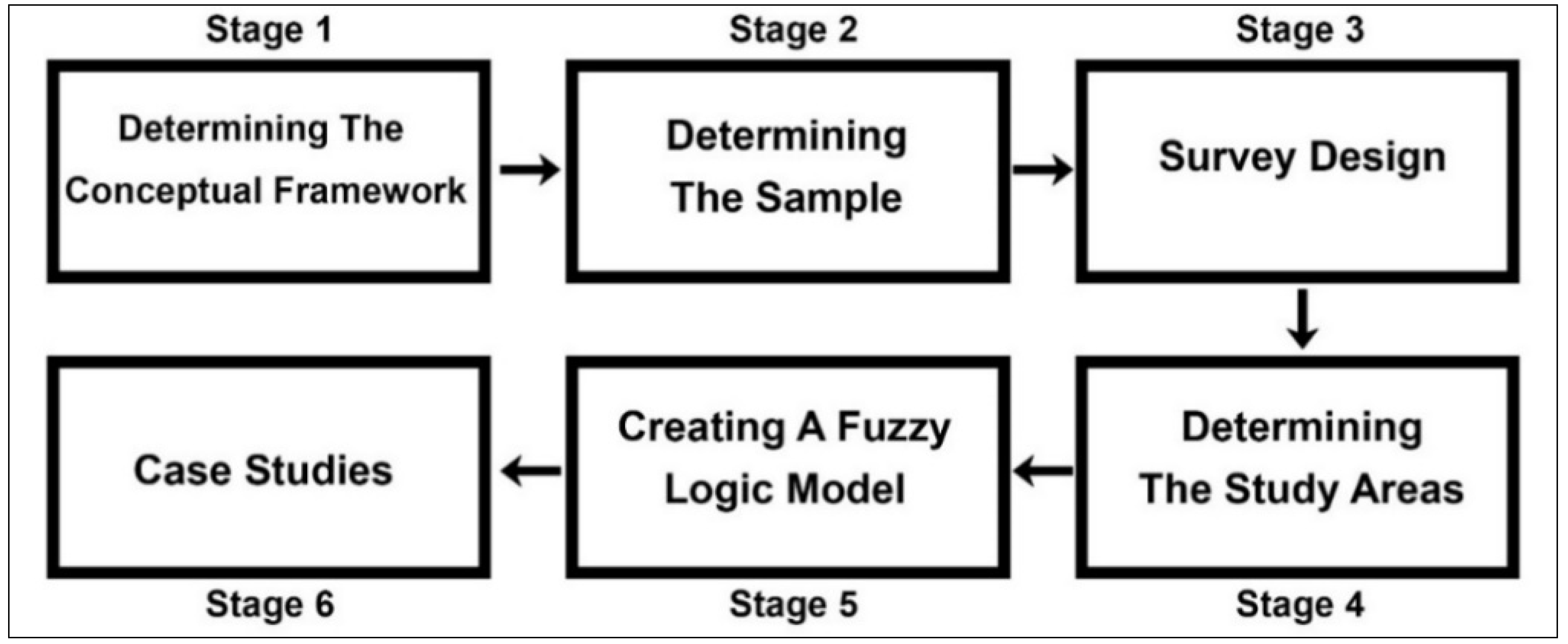
2. Materials and Methods
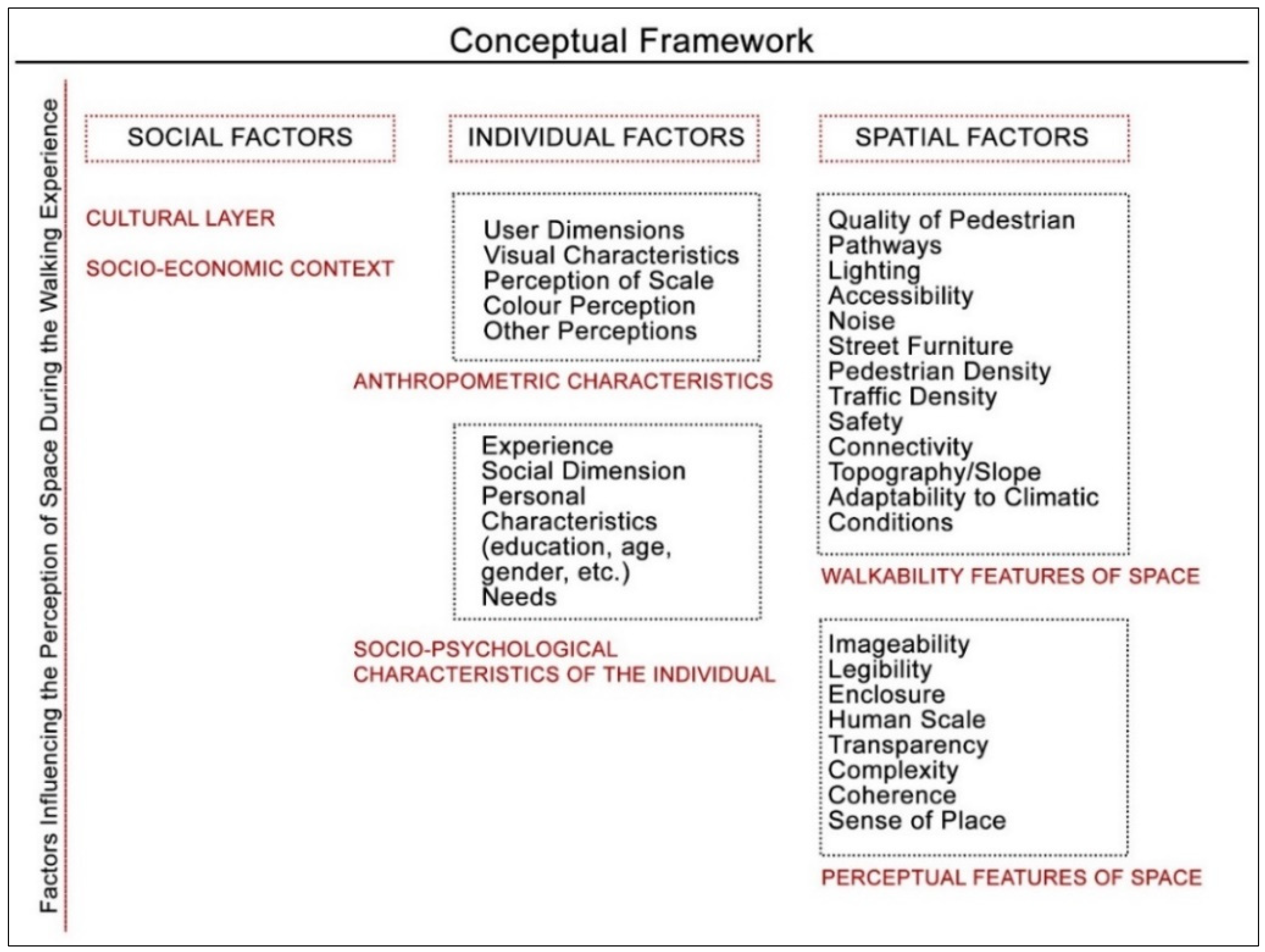
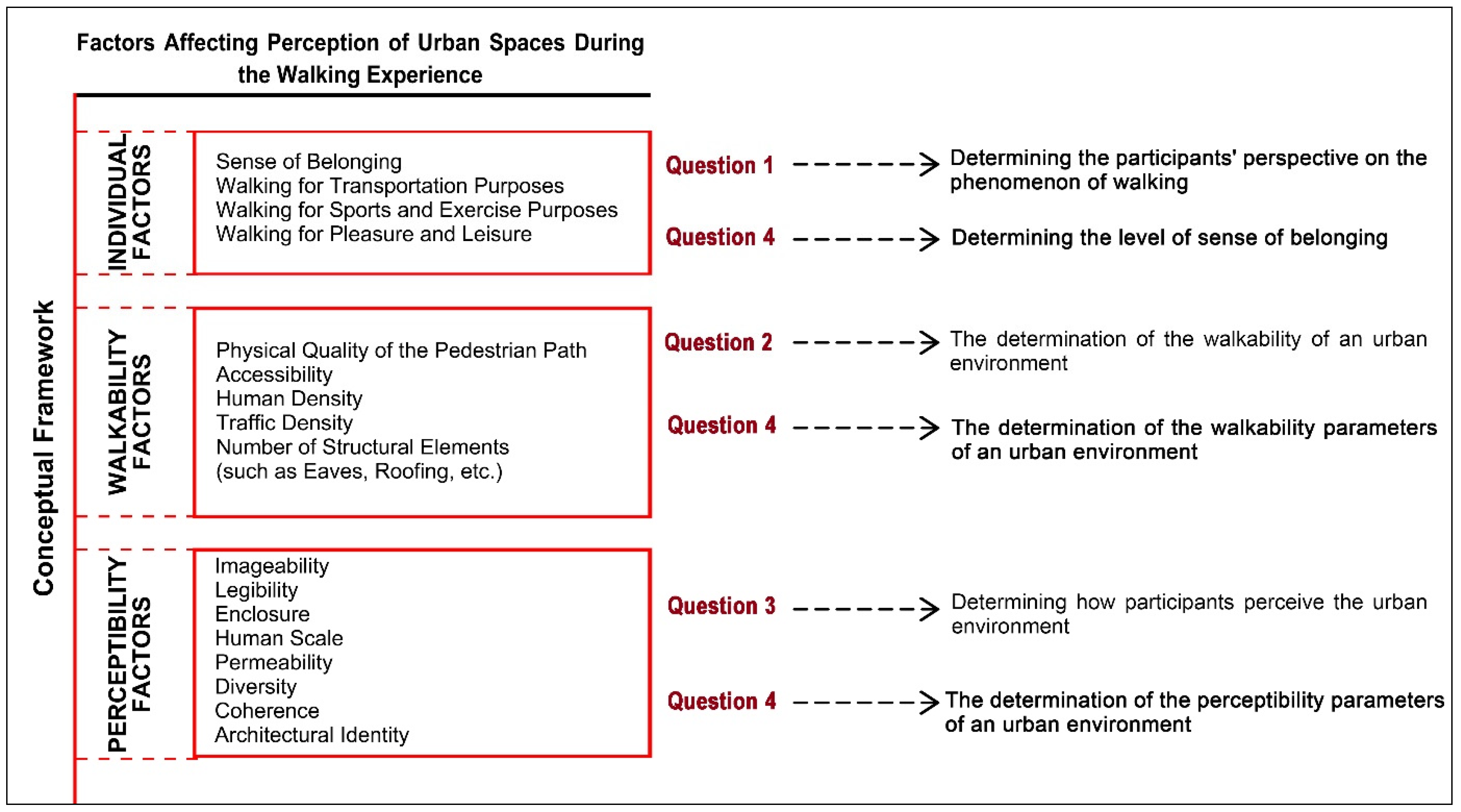
2.1. Factors Affecting Perception of Urban Spaces During the Walking Experience
2.2. Determining the Sample
2.3. Survey Design
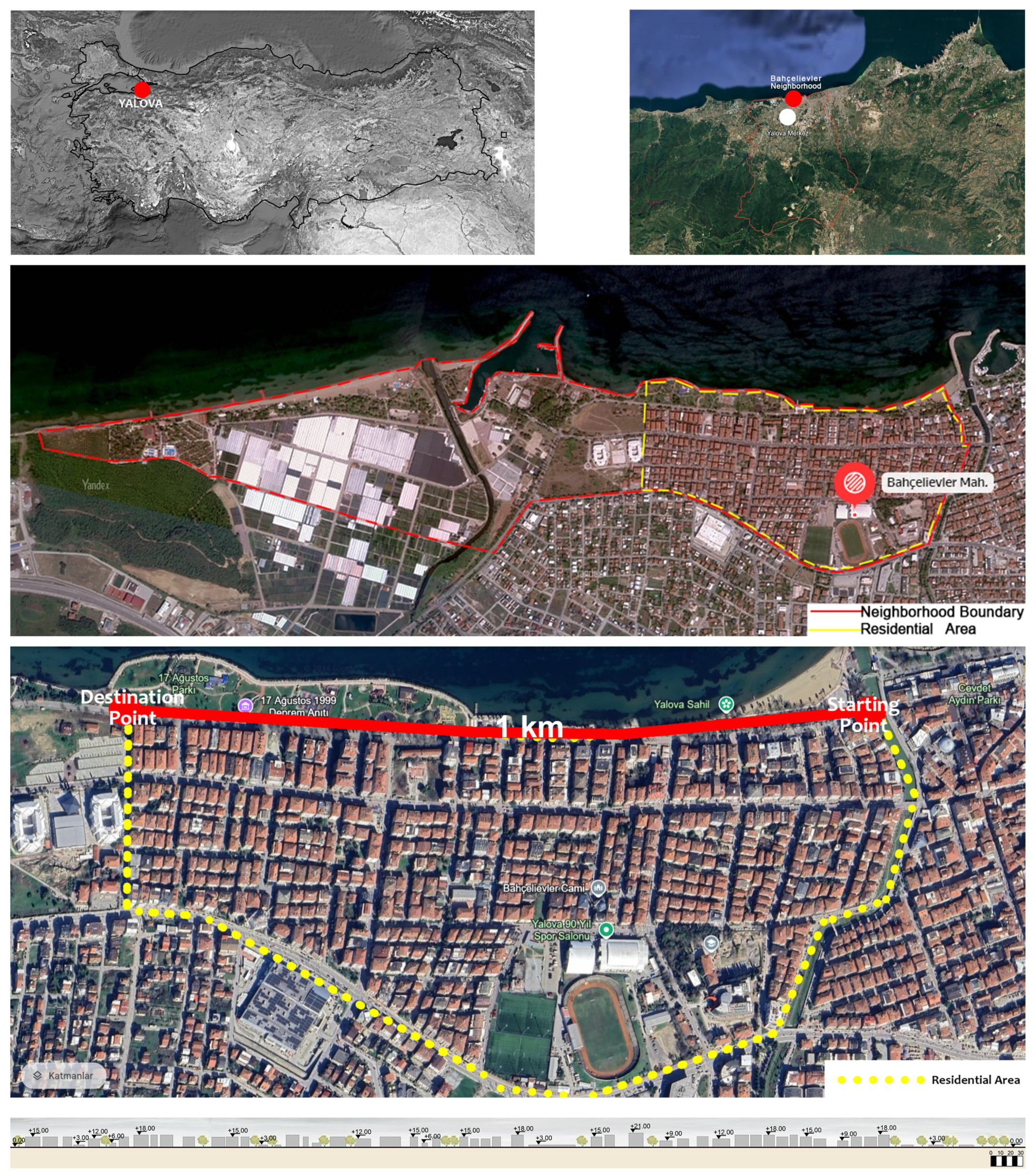
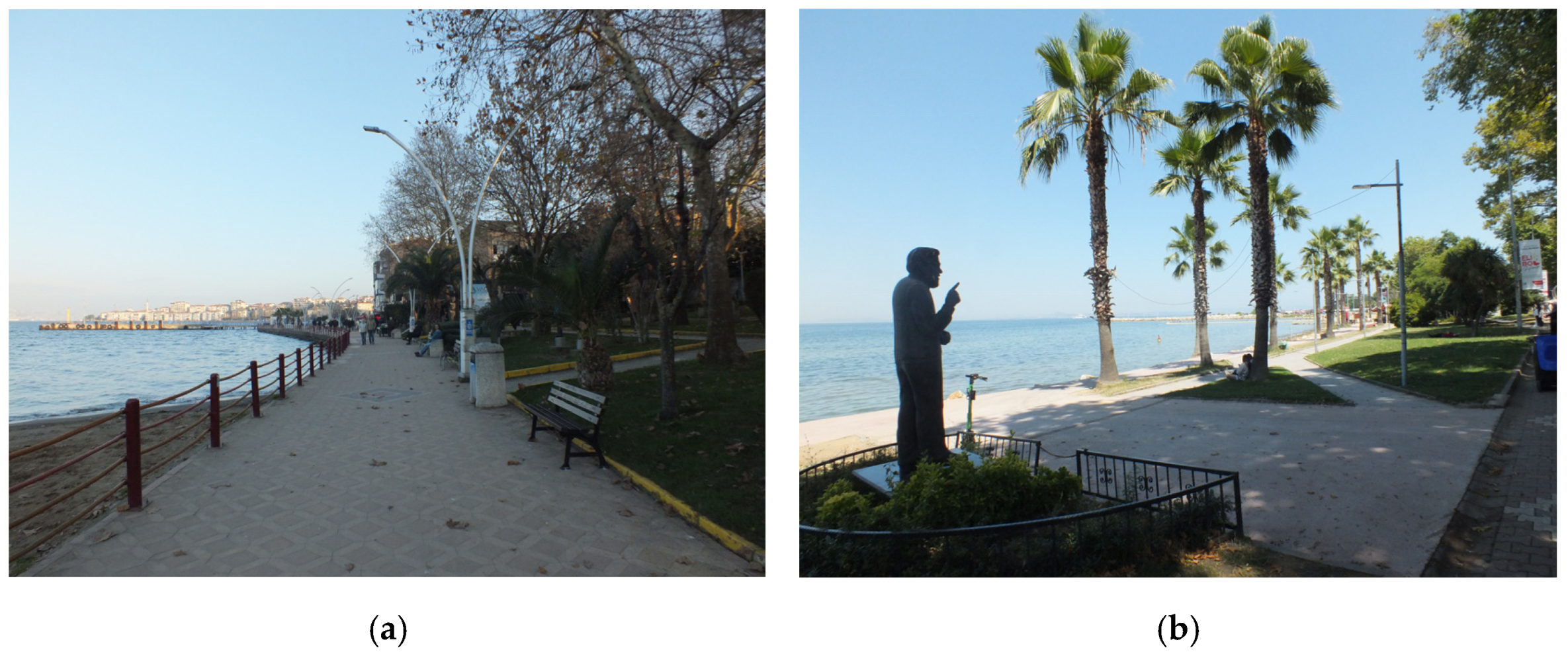
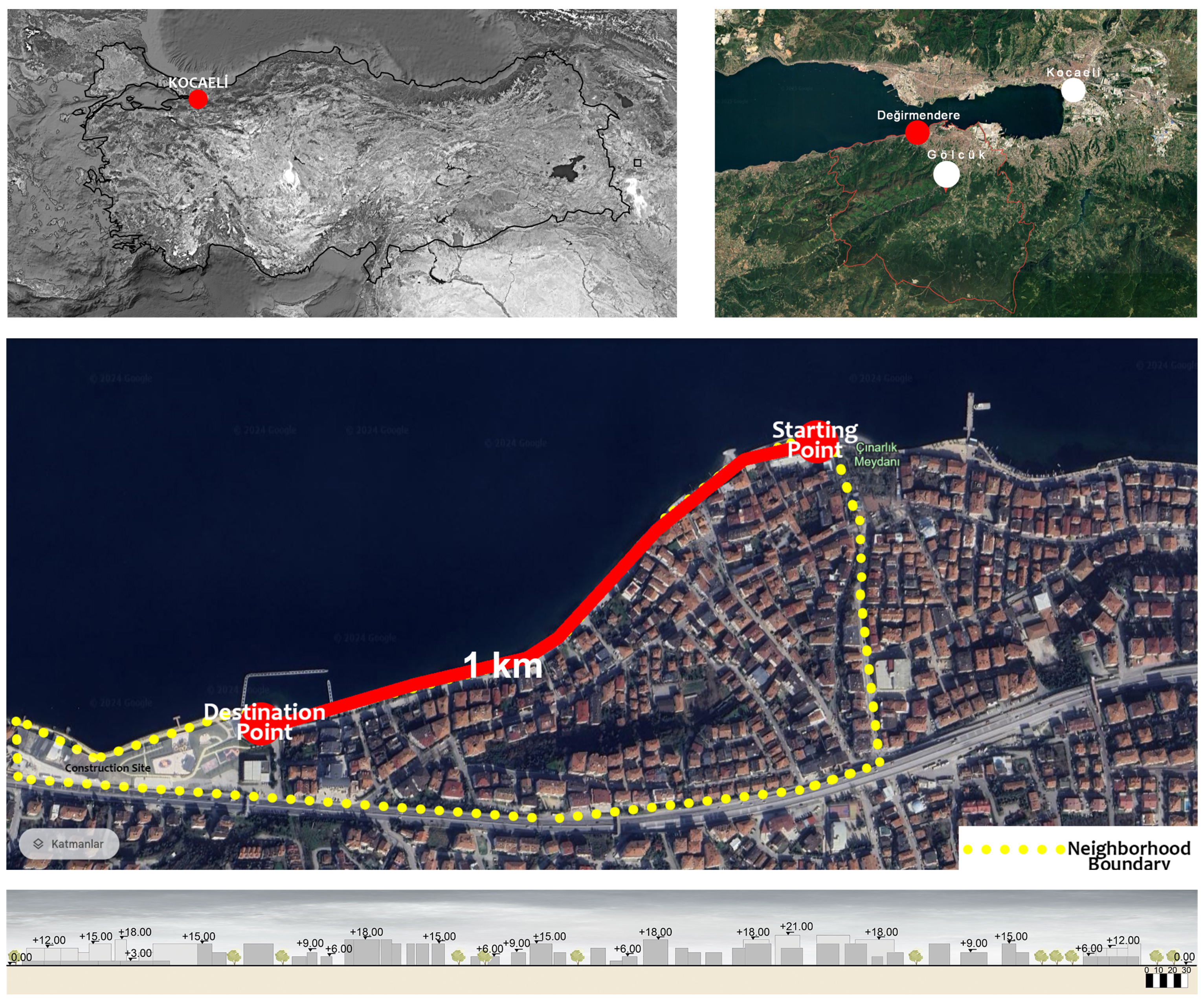
2.4. The Case Study Areas
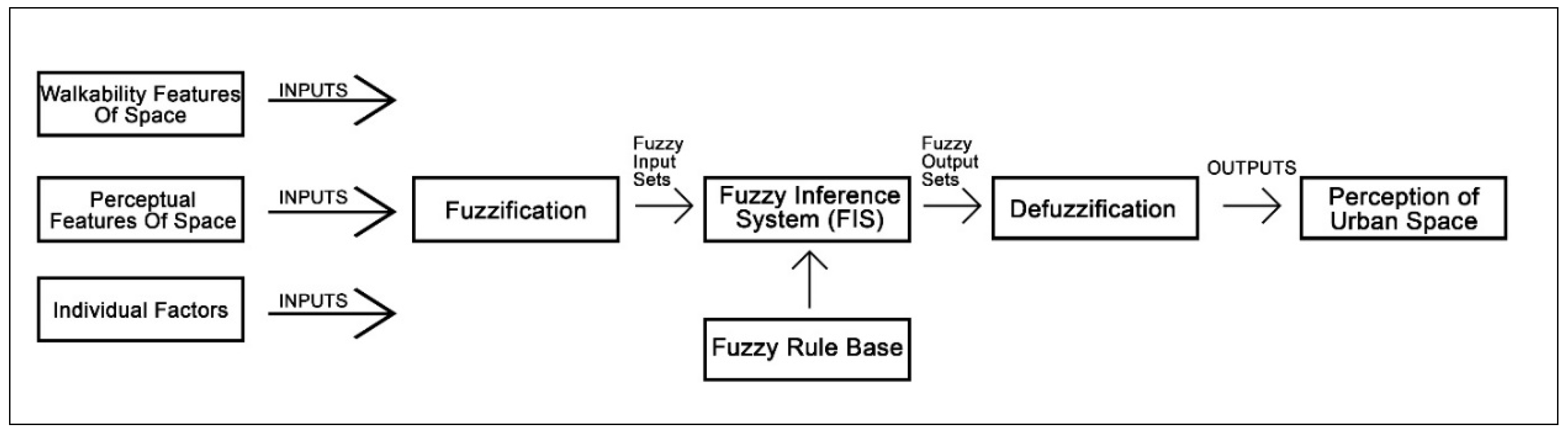
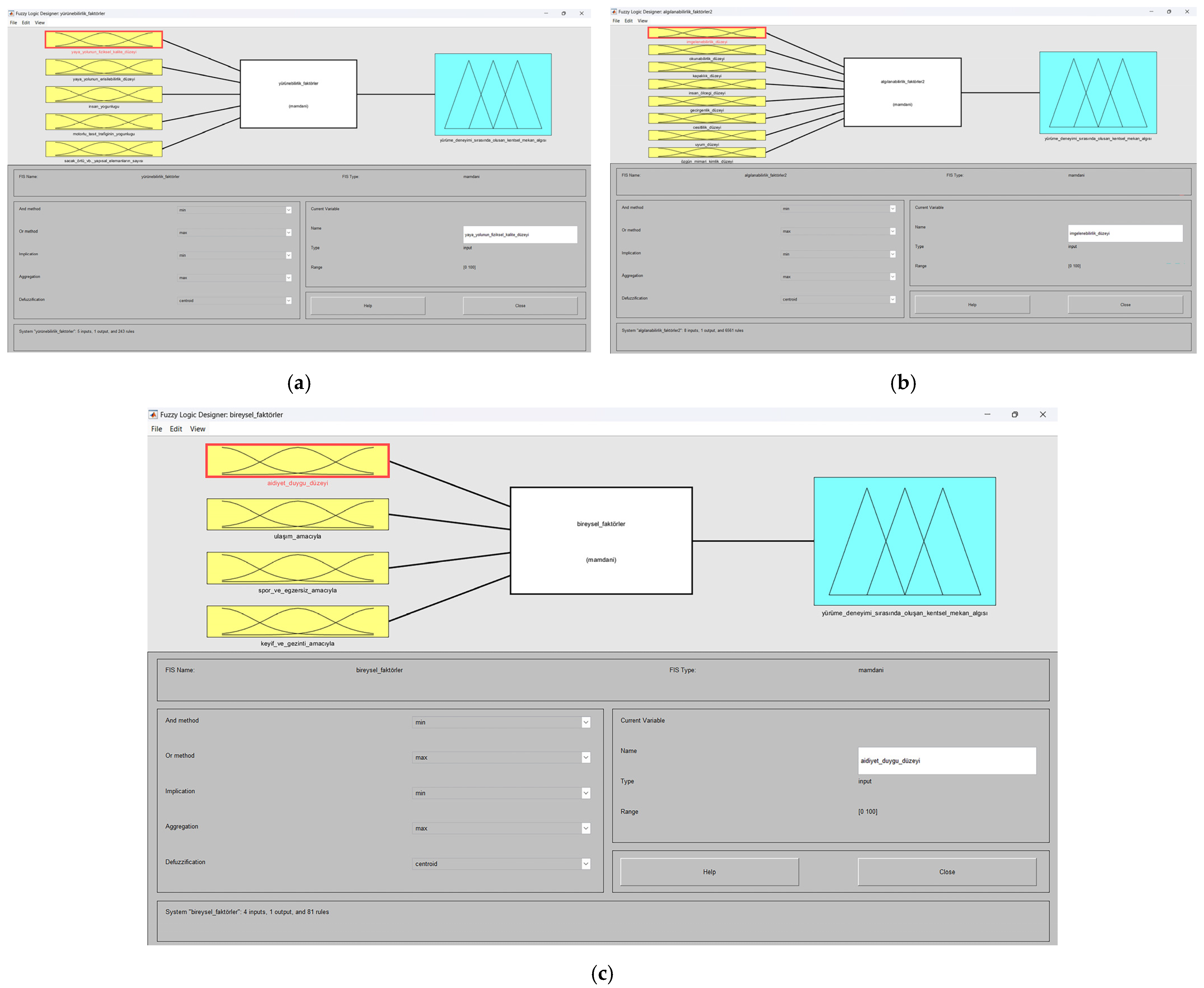
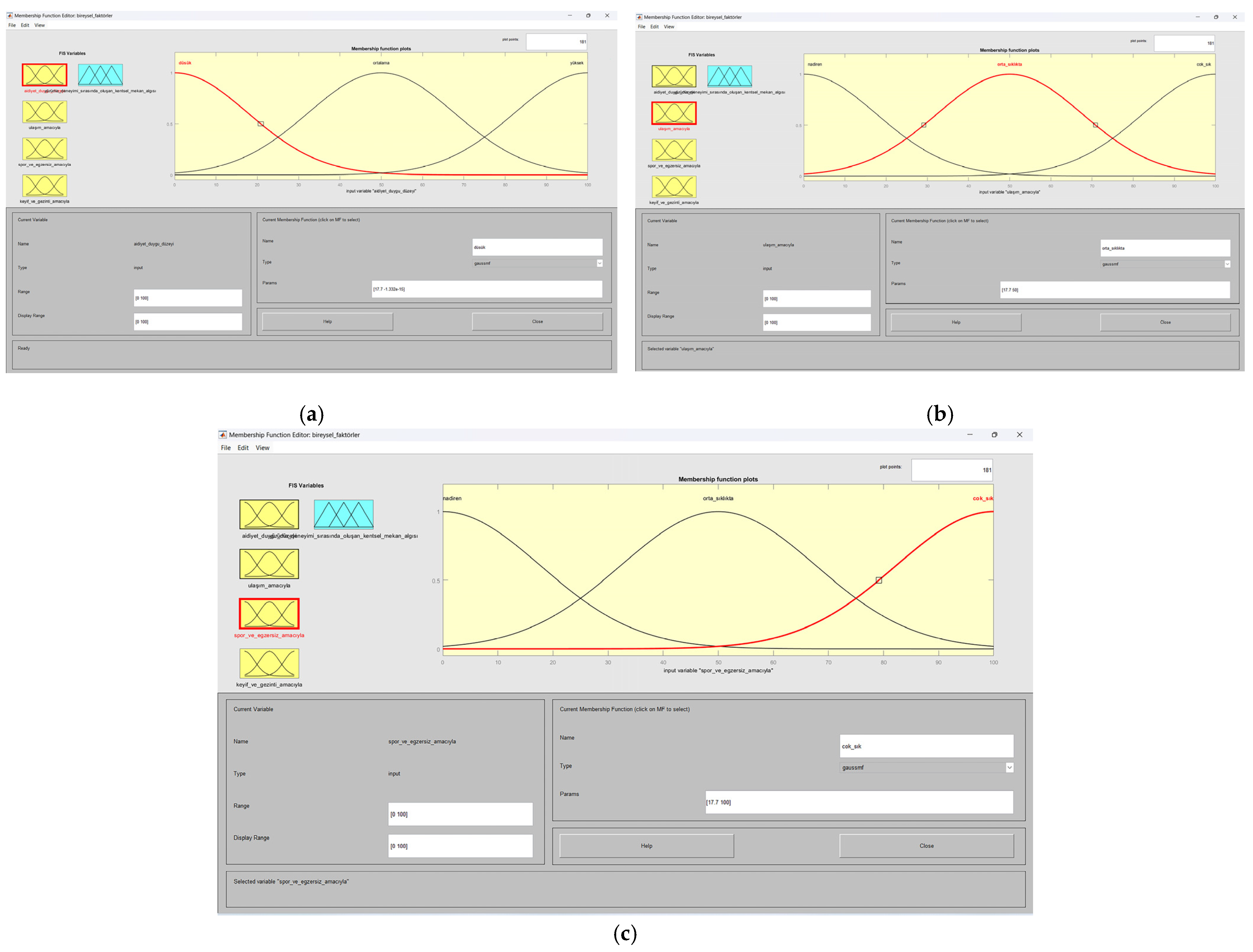
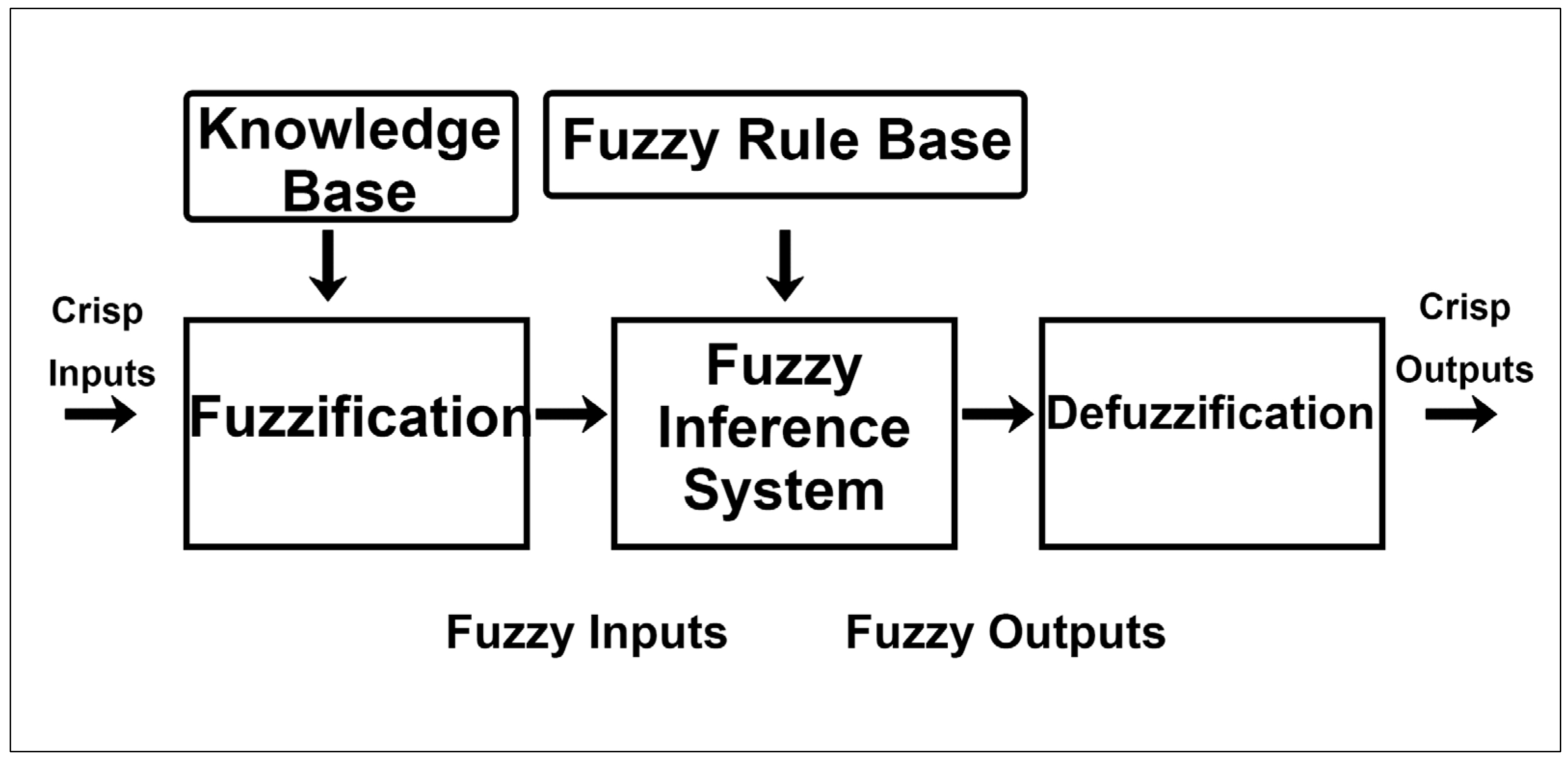
2.5. Development of the Fuzzy Logic Model
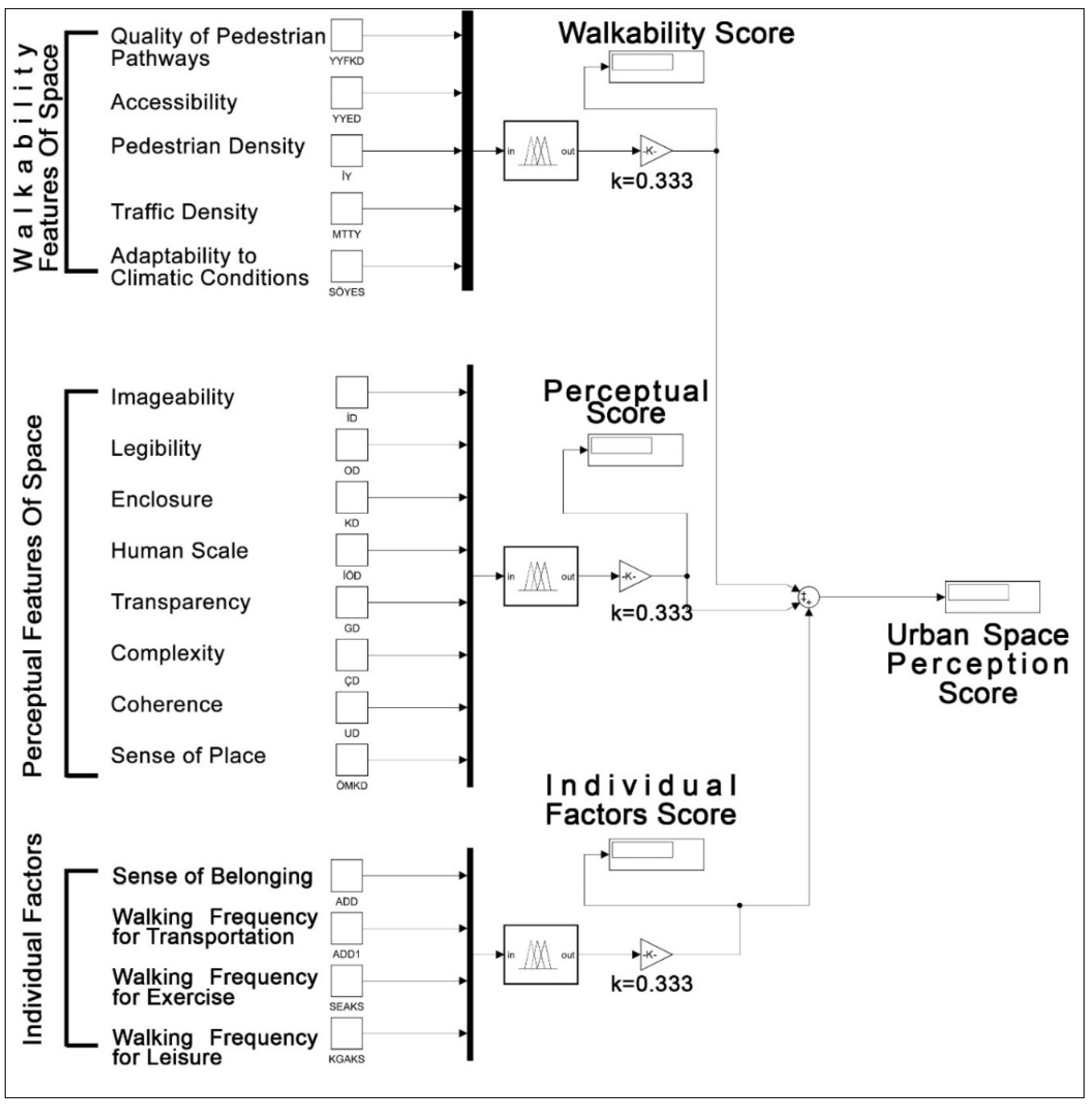
- Individual Factors Rule 1: If the individual’s sense of belonging is low, and they rarely walk for transportation, sport and exercise, as well as leisure and strolling purposes, then the perception of the urban space formed during the walking experience is negative.
- Perceptual Factors Rule 1: If the pedestrian pathway’s level of imageability is low, the level of legibility is low, the level of enclosure is low, the level of human scale is low, the level of permeability is low, the level of diversity is low, the level of coherence is low, and the level of unique architectural identity is low, then the perception of the urban space formed during the walking experience is negative.
- Walkability Factors Rule 1: If the pedestrian pathway’s level of physical quality is low, the level of accessibility is low, the level of human density on the pathway is low, the density of motor vehicle traffic is low, and the number of structural elements such as eaves and coverings is low, then the perception of the urban space formed during the walking experience is negative.
3. Results
3.1. Results from Survey Data
3.2. Results from the Evaluation Using the Fuzzy Logic Model
4. Discussion and Conclusions
Limitations and Future Research
Supplementary Materials
Author Contributions
Funding
Institutional Review Board Statement
Informed Consent Statement
Data Availability Statement
Acknowledgments
Conflicts of Interest
Abbreviations
| TÜİK | Turkish Statistical Institute |
| TÜBİTAK | The Scientific and Technological Research Council of Türkiye |
References
- Pallasmaa, J. Tenin Gözleri: Mimarlık ve Duyular; İnka Yayınları: İzmir, Turkey, 2019. [Google Scholar]
- Gehl, J. İnsan İçin Kentler; Koç Üniversitesi Yayınları: İstanbul, Turkey, 2020. [Google Scholar]
- Pinder, D. Arts of Urban Exploration. Cult. Geogr. 2005, 12, 383–411. [Google Scholar] [CrossRef]
- Lynch, K. Kentin İmgesi; Başaran, İ., Ed.; İş Bankası Yayınları: İstanbul, Turkey, 1960. [Google Scholar]
- Erturan Topgül, G.A. Kentlerde Yürünebilirliğin Çok Boyutlu Yaklaşım ve Hareketli Yöntemlerle Analizi. Ph.D. Thesis, Mimar Sinan Fine Arts University, İstanbul, Turkey, 2021. [Google Scholar]
- Jaśkiewicz, M.; Besta, T. Is Easy Access Related to Better Life? Walkability and Overlapping of Personal and Communal Identity as Predictors of Quality of Life. Appl. Res. Qual. Life 2014, 9, 505–516. [Google Scholar] [CrossRef]
- Wang, H.; Yang, Y. Neighbourhood Walkability: A Review and Bibliometric Analysis. Cities 2019, 93, 43–61. [Google Scholar] [CrossRef]
- Wang, L.; Ma, L.; Yang, J.; Wu, J. Human Somatosensory Processing and Artificial Somatosensation. Cyborg Bionic Syst. 2021, 2021, 9843259. [Google Scholar] [CrossRef]
- Oliva, A.; Mack, M.L.; Shrestha, M.; Peeper, A. Identifying the Perceptual Dimensions of Visual Complexity of Scenes. In Proceedings of the 26th Annual Meeting of the Cognitive Science Society, Chicago, IL, USA, 4–7 August 2004. [Google Scholar]
- Mostafavi, A. Architecture, Biometrics, and Virtual Environments Triangulation: A Research Review. Archit. Sci. Rev. 2022, 65, 504–521. [Google Scholar] [CrossRef]
- Rapoport, A. Human Aspects of Urban Form; Pergamon Press: Oxford, UK, 1977. [Google Scholar]
- Lang, J.T. Creating Architectural Theory: The Role of the Behavioral Sciences in Environmental Design; Van Nostrand Reinhold: New York, NY, USA, 1987. [Google Scholar]
- Ocakçı, M. Kent İmgesi (İmajı). In Kentsel Planlama Ansiklopedi Sözlük; Ersoy, M., Ed.; Ninova Yayıncılık: İstanbul, Turkey, 2016. [Google Scholar]
- Rapoport, A. History and Precedent in Environmental Design; Springer: Boston, MA, USA, 1990. [Google Scholar] [CrossRef]
- Forsyth, A.; Hearst, M.; Oakes, J.M.; Schmitz, K.H. Design and Destinations: Factors Influencing Walking and Total Physical Activity. Urban Stud. 2008, 45, 1973–1996. [Google Scholar] [CrossRef]
- Saelens, B.E.; Handy, S.L. Built Environment Correlates of Walking: A Review. Med. Sci. Sports Exerc. 2008, 40, S550. [Google Scholar] [CrossRef] [PubMed]
- Sugiyama, T.; Neuhaus, M.; Cole, R.; Giles-Corti, B.; Owen, N. Destination and Route Attributes Associated with Adults’ Walking: A Review. Med. Sci. Sports Exerc. 2012, 44, 1275–1286. [Google Scholar] [CrossRef] [PubMed]
- Farkic, J.; Peric, D.; Lesjak, M.; Petelin, M. Urban Walking: Perspectives of Locals and Tourists. Geogr. Pannonica 2015, 19, 212–222. [Google Scholar] [CrossRef]
- Mehta, V. Walkable Streets: Pedestrian Behavior, Perceptions and Attitudes. J. Urban. Int. Res. Placemaking Urban Sustain. 2008, 1, 217–245. [Google Scholar] [CrossRef]
- Göregenli, M. Çevre Psikolojisi: İnsan Mekân İlişkileri; İstanbul Bilgi Üniversitesi Yayınları: İstanbul, Turkey, 2010. [Google Scholar]
- Deutsch, K.; Goulias, K. Investigating the Impact of Sense of Place on Travel Behavior Using an Intercept Survey Methodology; University of California Transportation Center: Berkeley, CA, USA, 2009. [Google Scholar]
- Farr, D. Sustainable Urbanism: Urban Design with Nature; John Wiley & Sons: Hoboken, NJ, USA, 2011. [Google Scholar]
- Montello, D.R. Navigation. In The Cambridge Handbook of Visuospatial Thinking; Cambridge University Press: Cambridge, UK, 2005; pp. 257–294. [Google Scholar] [CrossRef]
- Halu, Z.Y. Transactional Approach for Walkable Urban Spaces: Hierarchy of Walking Needs. J. Environ. Prot. Ecol. 2019, 20, 302–312. [Google Scholar]
- Arthur, P.; Passini, R. Wayfinding: People, Signs, And Architecture; Focus Strategic Communications: Brantford, ON, Canada, 2002. [Google Scholar]
- Guo, Z.; Loo, B.P.Y. Pedestrian Environment and Route Choice: Evidence from New York City and Hong Kong. J. Transp. Geogr. 2013, 28, 124–136. [Google Scholar] [CrossRef]
- Wozniak, M.; Filomena, G.; Wronkowski, A. What’s Your Type? A Taxonomy of Pedestrian Route Choice Behaviour in Cities. Transp. Res. Part F Traffic Psychol. Behav. 2025, 109, 1257–1274. [Google Scholar] [CrossRef]
- Siewwuttanagul, S.; Hayashida, Y.; Inohae, T. Identifying Pedestrian Movement Behaviour Using Object Detection Methods and Land-Use Agglomeration Analysis. ISPRS Ann. Photogramm. Remote Sens. Spat. Inf. Sci. 2018, 4, 123–128. [Google Scholar] [CrossRef]
- Fonseca, F.; Ribeiro, P.J.G.; Conticelli, E.; Jabbari, M.; Papageorgiou, G.; Tondelli, S.; Ramos, R.A.R. Built Environment Attributes and Their Influence on Walkability. Int. J. Sustain. Transp. 2022, 16, 660–679. [Google Scholar] [CrossRef]
- Gehl, J. Life Between Buildings: Using Public Place; Island Press: Washington, DC, USA, 2011; Volume 297. [Google Scholar]
- Southworth, M. Designing the Walkable City. J. Urban Plan. Dev. 2005, 131, 246–257. [Google Scholar] [CrossRef]
- Jin, S.; Kim, E.J. Correlation of the Walk Score and Environmental Perceptions with Perceived Neighborhood Walkability: The Quantile Regression Model Approach. Sustainability 2024, 16, 7074. [Google Scholar] [CrossRef]
- Ewing, R.; Handy, S.; Brownson, R.C.; Clemente, O.; Winston, E. Identifying and Measuring Urban Design Qualities Related to Walkability. J. Phys. Act. Health 2006, 3, S223–S240. [Google Scholar] [CrossRef]
- Ramírez, T.; Hurtubia, R.; Lobel, H.; Rossetti, T. Measuring Heterogeneous Perception of Urban Space with Massive Data and Machine Learning: An Application to Safety. Landsc. Urban Plan. 2021, 208, 104002. [Google Scholar] [CrossRef]
- Chen, N.; Wang, L.; Xu, T.; Wang, M. Perception of Urban Street Visual Color Environment Based on the CEP-KASS Framework. Landsc. Urban Plan. 2025, 259, 105359. [Google Scholar] [CrossRef]
- Huang, C.; Wei, F.; Han, Q.; Xu, J.; Qiu, S.; Ban, X.; Huang, Y.; Huang, T. Visual and Emotional Interaction between People and Post-Industrial Riverscape Based on the Significance of “Original—New Placement”. Ecol. Indic. 2024, 163, 112135. [Google Scholar] [CrossRef]
- Shi, J.; Yan, Y.; Li, M.; Zhou, L. Measuring the Convergence and Divergence in Urban Street Perception among Residents and Tourists through Deep Learning: A Case Study of Macau. Land 2024, 13, 345. [Google Scholar] [CrossRef]
- Sun, D.; Zhou, F.; Lin, J.; Yang, Q.; Lyu, M. A Study on Landscape Feature and Emotional Perception Evaluation of Waterfront Greenway. Environ. Res. Commun. 2024, 6, 095023. [Google Scholar] [CrossRef]
- Freitas, F.; Berreth, T.; Chen, Y.-C.; Jhala, A. Characterizing the Perception of Urban Spaces from Visual Analytics of Street-Level Imagery. AI Soc. 2023, 38, 1361–1371. [Google Scholar] [CrossRef]
- Gönül, A.; Durak, S. On Measuring the Change in Historical City Centres: An Attempt at Comparing Human Perception and Deep Learning through Visual Quality of Street Space. Multimed. Tools Appl. 2025, 84, 39283–39305. [Google Scholar] [CrossRef]
- Ogawa, Y.; Oki, T.; Zhao, C.; Sekimoto, Y.; Shimizu, C. Evaluating the Subjective Perceptions of Streetscapes Using Street-View Images. Landsc. Urban Plan. 2024, 247, 105073. [Google Scholar] [CrossRef]
- Qin, Y.; Wu, X.; Yu, T.; Jiang, S. Enhancing Student-Centered Walking Environments on University Campuses through Street View Imagery and Machine Learning. PLoS ONE 2025, 20, e0321028. [Google Scholar] [CrossRef]
- Luo, S.; Shi, J.; Lu, T.; Furuya, K. Sit down and Rest: Use of Virtual Reality to Evaluate Preferences and Mental Restoration in Urban Park Pavilions. Landsc. Urban Plan. 2022, 220, 104336. [Google Scholar] [CrossRef]
- Lee, S.; Lee, C.; Nam, J.W.; Abbey-Lambertz, M.; Mendoza, J.A. School Walkability Index: Application of Environmental Audit Tool and GIS. J. Transp. Health 2020, 18, 100880. [Google Scholar] [CrossRef] [PubMed]
- Li, Y.; Yabuki, N.; Fukuda, T. Measuring Visual Walkability Perception Using Panoramic Street View Images, Virtual Reality, and Deep Learning. Sustain. Cities Soc. 2022, 86, 104140. [Google Scholar] [CrossRef]
- Park, S.; Deakin, E.; Lee, J.S. Perception-Based Walkability Index to Test Impact of Microlevel Walkability on Sustainable Mode Choice Decisions. Transp. Res. Rec. 2014, 2464, 126–134. [Google Scholar] [CrossRef]
- Lo, R.H. Walkability: What Is It? J. Urban. Int. Res. Placemaking Urban Sustain. 2009, 2, 145–166. [Google Scholar] [CrossRef]
- Sallis, J.F.; Cervero, R.B.; Ascher, W.; Henderson, K.A.; Kraft, M.K.; Kerr, J. An Ecological Approach to Creating Active Living Communities. Annu. Rev. Public Health 2006, 27, 297–322. [Google Scholar] [CrossRef]
- Yıldırım, Ö.C.; Çelik, E. Understanding Pedestrian Behavior and Spatial Relations: A Pedestrianized Area in Besiktas, Istanbul. Front. Archit. Res. 2023, 12, 67–84. [Google Scholar] [CrossRef]
- Zadeh, L.A. Fuzzy Sets. Inf. Control 1965, 8, 338–353. [Google Scholar] [CrossRef]
- Tanaka, K.; Sugeno, M. Stability Analysis and Design of Fuzzy Control Systems. Fuzzy Sets Syst. 1992, 45, 135–156. [Google Scholar] [CrossRef]
- Mert, Z.G.; Yilmaz, S. Fuzzy Modeling Approach Based on Property Location Quality for Grading Neighborhood Level of Family Housing Units. Expert Syst. Appl. 2009, 36, 3603–3613. [Google Scholar] [CrossRef]
- AlShareef, F.; Aljoufie, M. Identification of the Proper Criteria Set for Neighborhood Walkability Using the Fuzzy Analytic Hierarchy Process Model: A Case Study in Jeddah, Saudi Arabia. Sustainability 2020, 12, 9286. [Google Scholar] [CrossRef]
- Doğan, U. Examining Urban Design Characteristics of City Centers Using Walkability Criteria: Case of Turkey. J. Urban Plan. Dev. 2021, 147, 04021003. [Google Scholar] [CrossRef]
- Fonseca, F.; Ribeiro, P.; Jabbari, M.; Petrova, E.; Papageorgiou, G.; Conticelli, E.; Tondelli, S.; Ramos, R. Smart Pedestrian Network: An Integrated Conceptual Model for Improving Walkability. In Proceedings of the International Conference on Society with Future: Smart and Liveable Cities, Braga, Portugal, 4–6 December 2020; pp. 125–142. [Google Scholar] [CrossRef]
- Nyagah, P. A Multi Procedural Approach to Evaluating Walkability and Pedestrian Safety. Ph.D. Thesis, University of Nevada, Las Vegas, NV, USA, 2015. [Google Scholar]
- Oestreich, L.; Torres, T.B.; Ruiz-Padillo, A. Fuzzy Analysis of Students’ Perception of Traffic Safety in School Environments: The Case of a Small Brazilian City. Int. J. Inj. Contr. Saf. Promot. 2021, 28, 255–265. [Google Scholar] [CrossRef] [PubMed]
- Soares Müller, A.P.; Ruiz-Padillo, A. Fuzzy Micro-Scale Accessibility Indexes from the Perception of Pedestrians with Disabilities: Case Study of a Medium-Sized Latin American City. Case Stud. Transp. Policy 2025, 21, 101534. [Google Scholar] [CrossRef]
- Jabbari, M.; Fonseca, F.; Ramos, R. Combining Multi-Criteria and Space Syntax Analysis to Assess a Pedestrian Network: The Case of Oporto. J. Urban Des. 2018, 23, 23–41. [Google Scholar] [CrossRef]
- Jabbari, M.; da Fonseca, F.P.; Ramos, R.A.R. Assessing the Pedestrian Network Conditions in Two Cities: The Cases of Qazvin and Porto. In Urban Heritage Along the Silk Roads; Springer: Berlin/Heidelberg, Germany, 2020; pp. 229–245. [Google Scholar] [CrossRef]
- Yıldız, B.; Cağdaş, G. Agent-Based Modeling for User Movements Using Fuzzy. JCoDe J. Comput. Des. 2021, 2, 243–264. [Google Scholar]
- Lee, E.; Dean, J. Perceptions of Walkability and Determinants of Walking Behaviour among Urban Seniors in Toronto, Canada. J. Transp. Health 2018, 9, 309–320. [Google Scholar] [CrossRef]
- Blečić, I.; Congiu, T.; Fancello, G.; Trunfio, G.A. Planning and Design Support Tools for Walkability: A Guide for Urban Analysts. Sustainability 2020, 12, 4405. [Google Scholar] [CrossRef]
- Neuman, W.L. Social Research Methods: Qualitative and Quantitative Approaches; Pearson Education Limited: Essex, UK, 2011. [Google Scholar]
- Özdemir, M. Nitel Veri Analizi: Sosyal Bilimlerde Yöntembilim Sorunsalı Üzerine Bir Çalışma. Eskişehir Osman. Üniversitesi Sos. Bilim. Derg. 2010, 11, 323–343. [Google Scholar]
- Baltaci, A. Nitel Araştırma Süreci: Nitel Bir Araştırma Nasıl Yapılır? Ahi Evran Üniversitesi Sos. Bilim. Enstitüsü Derg. 2019, 5, 368–388. [Google Scholar] [CrossRef]
- Özyılmaz Küçükyağcı, P. Kent Meydanlarının Mekân Tasarımı Niteliklerinin Bulanık Mantık Ile Değerlendirilmesi. Ph.D. Thesis, Istanbul Technical University, İstanbul, Turkey, 2020. [Google Scholar]
- Wang, R.; Ren, S.; Zhang, J.; Yao, Y.; Wang, Y.; Guan, Q. A Comparison of Two Deep-Learning-Based Urban Perception Models: Which One Is Better? Comput. Urban Sci. 2021, 1, 3. [Google Scholar] [CrossRef]
- Polatoğlu, Ç. Mimarlıkta Görsel Etki Değerlendirme Yöntem ve Teknikleri; Yıldız Teknik Üniversitesi Basım Yayın Merkezi: İstanbul, Turkey, 2012. [Google Scholar]
- Küller, R. (Ed.) Beyond Semantic Measurement. In Architectural Psychology, Proceedings of Lund Conference; Studentlitteratur AB: Lund, Sweden, 1973. [Google Scholar]
- Yildiz Kuyrukçu, E.; Özdemir Erdoğan, T. Perceptional Differences in Architectural Facade Perception Due to Architectural Education. Int. Ref. J. Des. Archit. 2021, 23, 114–145. [Google Scholar] [CrossRef]
- Aytuğ, A. Mimaride Doku Kullanımının Psikolojik Etkileri Üzerine Bir Araştırma. Stud. Psychol. 1987, 17, 37–46. [Google Scholar]
- Ertürk, S. Mekan Bileşenlerinin Tasarımında Doku Boyutu; KTÜ İnşaat ve Mimarlık Fakültesi Yayınları: Trabzon, Turkey, 1979. [Google Scholar]
- Hershberger, R.G.; Cass, R.C. Predicting User Responses to Buildings. In Man-Environment Interactions: Evaluations and Applications; Cambridge University Press: Cambridge, UK, 1974; pp. 117–143. [Google Scholar]
- Temel, S.C.; Kuru, R.; Seçal, S. Tarihi Çevrede Eski Yeni Birlikteliğinin Öznel İzlenimler Üzerinden Değerlendirilmesi: Divanyolu Caddesi (Beyazıt-Sirkeci Aksı) Örneği. Sanat Tasarım Derg. 2021, 27, 379–405. [Google Scholar] [CrossRef]
- Yıldırım, K.; Arslan, H.D. Perceptual Evaluation of Traditional Turkish House Façade. ICONARP Int. J. Archit. Plan. 2021, 9, 742–768. [Google Scholar] [CrossRef]
- TÜİK. Available online: https://biruni.tuik.gov.tr/medas/?kn=95&locale=tr (accessed on 15 September 2025).
- Yalova Municipality. Yalova İli, Merkez İlçesi, Bahçelievler Mahallesi 1/1000 Ölçekli Uygulama İmar Planı Revizyonu Plan Açıklama Raporu; Yalova Municipality: Yalova, Türkiye, 2022.
- Özyılmaz Küçükyağcı, P.; Ocakçı, M. A Mamdani-Based Fuzzy Logic Model for Evaluating the Design Quality of Urban Squares. ICONARP Int. J. Archit. Plan. 2025, 13, 286–312. [Google Scholar] [CrossRef]
- Shamoi, P.; Toganas, N.; Muratbekova, M.; Kadyrgali, E.; Yerkin, A.; Igali, A.; Ziyada, M.; Adilova, A.; Karatayev, A.; Torekhan, Y. COLIBRI Fuzzy Model: Color Linguistic-Based Representation and Interpretation. IEEE Access 2025, 13, 205932–205956. [Google Scholar] [CrossRef]
- Akdemir, H.G. On Generalized Picture Fuzzy Numbers with Gaussian Membership Functions. J. Syst. Sci. Syst. Eng. 2025. [Google Scholar] [CrossRef]





| Methods | Survey-Based Qualitative Studies | Discrete Choice Models | Machine Learning/Deep Learning Approaches | Sensor-Based Methods (VR, EEG, Eye Tracking, etc.) |
|---|---|---|---|---|
| Type of Data | Survey/Interview Data Qualitative Data Quantitative Data | Image-Based Data Image Segmentation | Image-Based Data Physiological Data Quantitative Data | Physiological Data Quantitative Data |
| Strengths | Allows the direct expression of individual perceptions | Enables the analysis of the effects of visual variables on perception | It can model complex relationships with more variables. | It can directly measure perceptual responses. |
| Limitations | Conducting studies with large sample sizes is required in order to generalise the results. The quantification of subjective/linguistic data related to perception is difficult. | A large amount of data needs to be handled. High Implementation Cost. Detachment from the real walking experience. Addresses the non-visual and qualitative (subjective) components of perception in a limited manner. | Addresses the non-visual and qualitative (subjective) components of perception in a limited manner. | High Implementation Cost, Limited sample size and representativeness issues, Typically based on a virtual environment, Detachment from the real walking experience. |
| Gender/Age | 18 | 19 | 20 | 21 | 22 |
|---|---|---|---|---|---|
| Female | 1 | 2 | 5 | 3 | 2 |
| Male | 1 | 5 | 5 | 3 | 1 |
| Location | Population | Area Size (km2) | Population Density (Persons/km2) | Location ID | Settlement Plan | Functional Feature |
|---|---|---|---|---|---|---|
| Değirmendere Yalı Neighbourhood (Gölcük, Kocaeli) | 4985 | 0.31 | 16,081 | -Coastal -Earthquake | -Organic Settlement Plan | -Residential + Commercial |
| Bahçelievler Neighbourhood (Center, Yalova) | 12,596 | 1.31 (0.80) a | 9615 (15,745) b | -Coastal -Earthquake | -Grid Settlement Plan | -Residential + Commercial |
| Inputs | Membership Functions | ||
|---|---|---|---|
| 0–33.3 | 33.4–66.6 | 66.7–100 | |
| Physical Quality Level of the Pedestrian Path | Low | Average | High |
| Accessibility Level of the Pedestrian Path | Low | Average | High |
| Human Density | Low | Average | High |
| Motor Vehicle Traffic Density | Low | Average | High |
| Number of Structural Elements such as Eaves, Roofing, etc. | Low | Average | High |
| Level of Imageability | Low | Average | High |
| Legibility Level | Low | Average | High |
| Enclosure Level | Low | Average | High |
| Human Scale Level | Low | Average | High |
| Permeability Level | Low | Average | High |
| Diversity Level | Low | Average | High |
| Coherence Level | Low | Average | High |
| Architectural Identity Level | Low | Average | High |
| Sense of Belonging Level | Low | Average | High |
| Walking for Transportation Purposes | Rarely | Moderately | Very frequently |
| Walking for Sports and Exercise Purposes | Rarely | Moderately | Very often |
| Walking for Pleasure and Leisure | Rarely | Moderately | Very often |
| Outputs | Membership Functions | ||
|---|---|---|---|
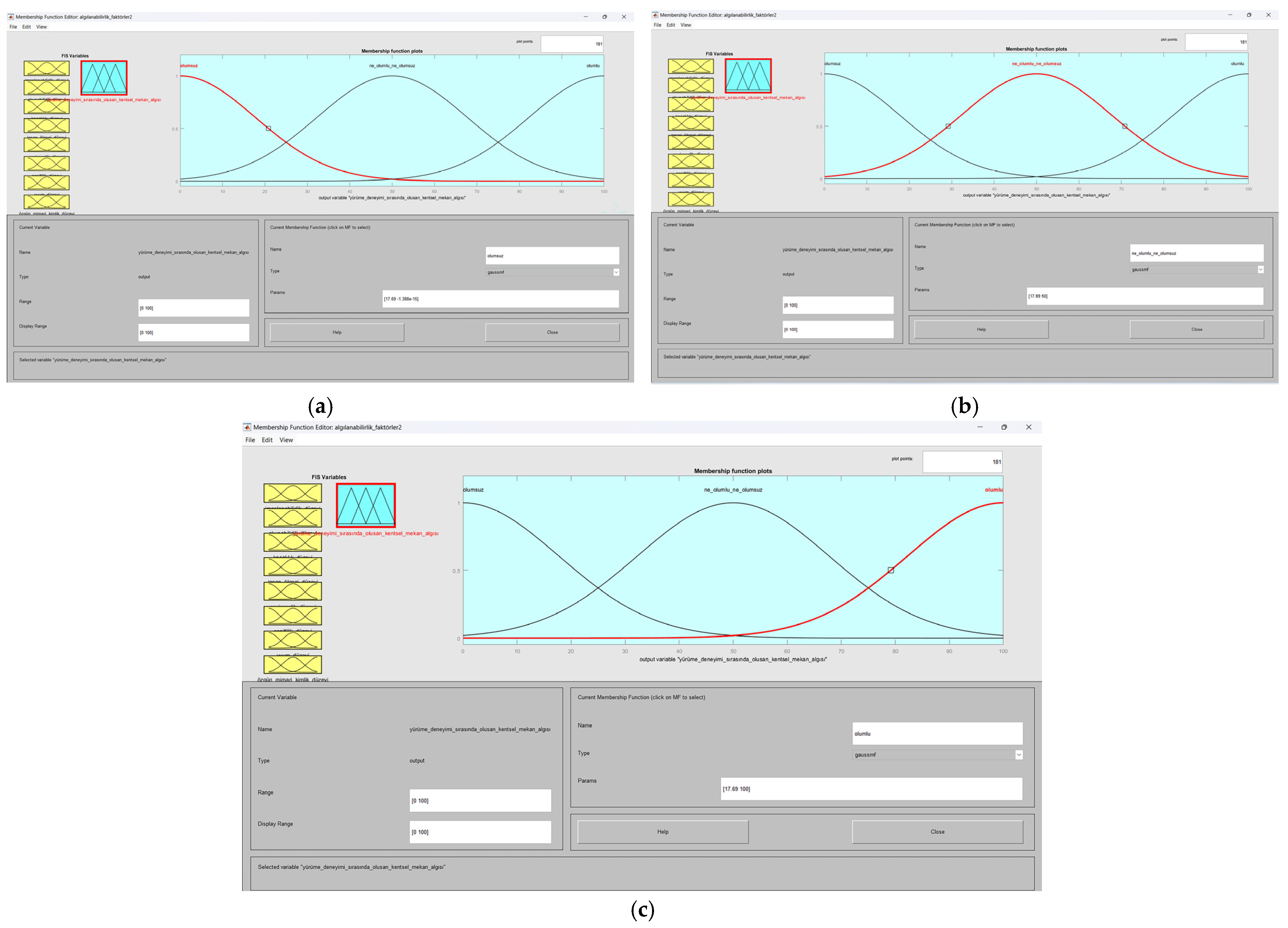
| 0–33.3 | 33.4–66.6 | 66.7–100 | |
| Perception of Urban Spaces During Walking Experience | Negative | Neither Negative Nor Positive | Positive |
| Location | Bahçelievler Neighbourhood (Yalova) | Değirmendere Yalı Neighbourhood (Kocaeli) |
|---|---|---|
| Walkability Score | 82.80 | 78 |
| Factors | Parameters | Bahçelievler Neighbourhood (Yalova) | Value Range | Değirmendere Yalı Neighbourhood (Kocaeli) | Value Range |
|---|---|---|---|---|---|
| Walkability Factors | Physical Quality Level of the Pedestrian Path | 69.6 | High | 58.40 | Average |
| Accessibility Level of the Pedestrian Path | 55.16 | Average | 50.80 | Average | |
| Population Density | 55.44 | Average | 55.60 | Average | |
| Motor Vehicle Traffic Density | 67.00 | High | 63.20 | Average | |
| Number of Structural Elements such as Eaves, Roofing, etc. | 47.00 | Average | 39.20 | Average | |
| Perceptual Factors | Level of Imageability | 71.40 | High | 49.60 | Average |
| Legibility Level | 83.80 | High | 80.40 | High | |
| Enclosure Level | 69.00 | High | 63.40 | Average | |
| Human Scale Level | 75.20 | High | 71.20 | High | |
| Permeability Level | 74.60 | High | 73.20 | High | |
| Diversity Level | 71.00 | High | 50.80 | Average | |
| Coherence Level | 72.20 | High | 58.28 | Average | |
| Architectural Identity Level | 57.00 | Average | 49.00 | Average | |
| Individual F. | Sense of Belonging Level | 66.6 | High | 52.80 | Average |
| Semantic Differential Scales | Bahçelievler Neighbourhood (Yalova) | Value Range | Değirmendere Yalı Neighbourhood (Kocaeli) | Value Range |
|---|---|---|---|---|
| ordinary–striking | 66.00 | High | 50.40 | Average |
| uninteresting–interesting | 52.40 | Average | 41.60 | Average |
| irregular–regular | 67.60 | High | 64.80 | Average |
| undefined boundaries–defined boundaries | 72.80 | High | 67.60 | High |
| cramped–spacious | 78.00 | High | 68.80 | High |
| incompatible–compatible | 73.80 | High | 61.20 | Average |
| Overall Average | 68.43 | High | 59.07 | Average |
| Location | Walkability Factor Value | Perceptibility Factor Value | Individual Factors Value | Fuzzy Logic Result | Linguistic Equivalent |
|---|---|---|---|---|---|
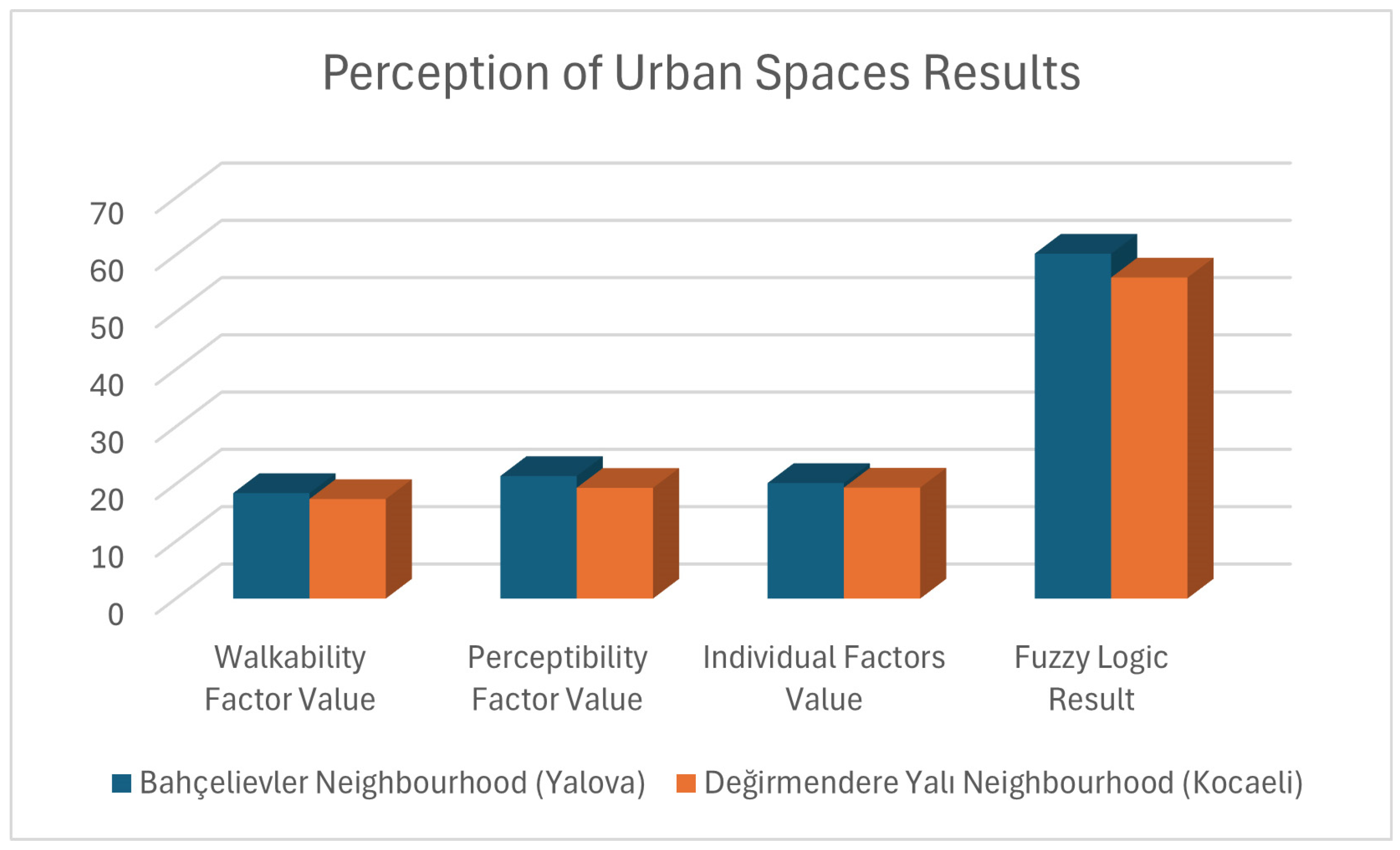
| Bahçelievler Neighbourhood (Yalova) | 18.398 | 21.378 | 20.146 | 60.21 | Neither Negative Nor Positive |
| Değirmendere Yalı Neighbourhood (Kocaeli) | 17.37 | 19.32 | 19.36 | 56.042 | Neither Negative Nor Positive |
| Location | Pearson Correlation Coefficient | p Value |
|---|---|---|
| Değirmendere Yalı Neighbourhood (Kocaeli) | 0.720 | <0.001 |
| Bahçelievler Neighbourhood (Yalova) | 0.418 | 0.038 |
| Methods | Other Methods. (Survey, Discrete Choice Models, Machine Learning, Sensor-Based Methods) | Fuzzy Logic-Based Models |
|---|---|---|
| Type of Data | Survey/Interview Data Qualitative Data Quantitative Data Image-Based Data Image Segmentation Physiological Data | Survey/Interview Data Quantitative Data Qualitative Data |
| Strengths | Allows the direct expression of individual perceptions Enables the analysis of the effects of visual variables on perception It can model complex relationships with more variables. It can directly measure perceptual responses. | It can incorporate uncertainty and subjective evaluations into the model’s structure. Can be applied with small samples. Is based on real walking experiences. It can model perception in a multidimensional and holistic way. It provides a systematic approach to measuring perception. Due to the flexible structure of the model, different parameters can be integrated into the system. |
| Limitations | Conducting studies with large sample sizes is required in order to generalise the results. The quantification of subjective/linguistic data related to perception is difficult. High Implementation Cost. Detachment from the real walking experience. | The sensitivity of the proposed model to context-specific characteristics. An increase in the number of rules generated and the computational load as the number of inputs integrated into the model increases. |
Disclaimer/Publisher’s Note: The statements, opinions and data contained in all publications are solely those of the individual author(s) and contributor(s) and not of MDPI and/or the editor(s). MDPI and/or the editor(s) disclaim responsibility for any injury to people or property resulting from any ideas, methods, instructions or products referred to in the content. |
© 2026 by the authors. Licensee MDPI, Basel, Switzerland. This article is an open access article distributed under the terms and conditions of the Creative Commons Attribution (CC BY) license.
Share and Cite
Baran, E.; Özbayraktar, M.; Yılmaz, S. A Fuzzy Logic-Based Model for Measuring Perception of Urban Spaces During Walking Experience. Sustainability 2026, 18, 2781. https://doi.org/10.3390/su18062781
Baran E, Özbayraktar M, Yılmaz S. A Fuzzy Logic-Based Model for Measuring Perception of Urban Spaces During Walking Experience. Sustainability. 2026; 18(6):2781. https://doi.org/10.3390/su18062781
Chicago/Turabian StyleBaran, Esra, Mehtap Özbayraktar, and Serhat Yılmaz. 2026. "A Fuzzy Logic-Based Model for Measuring Perception of Urban Spaces During Walking Experience" Sustainability 18, no. 6: 2781. https://doi.org/10.3390/su18062781
APA StyleBaran, E., Özbayraktar, M., & Yılmaz, S. (2026). A Fuzzy Logic-Based Model for Measuring Perception of Urban Spaces During Walking Experience. Sustainability, 18(6), 2781. https://doi.org/10.3390/su18062781