Article

Heatwave Effects of Emerging Industry Clustering in Chinese Urban Agglomerations

1
Postdoctoral Research Station in Ethnology, Guangxi Minzu University, Nanning 530008, China
2
College of Physical Education and Health, Guangxi Normal University, Guilin 541004, China
3
School of Management, Guangxi Minzu University, Nanning 530008, China
*
Authors to whom correspondence should be addressed.
Sustainability 2026, 18(6), 2697; https://doi.org/10.3390/su18062697
Submission received: 20 January 2026 / Revised: 2 March 2026 / Accepted: 6 March 2026 / Published: 10 March 2026

Abstract

Under the dual pressures of global warming and high-density urbanization, extreme heatwaves have emerged as a critical ecological risk constraining the sustainable development of Chinese urban agglomerations. Based on multi-source remote sensing, meteorological, and economic data for 19 major urban agglomerations from 2014 to 2023, this study develops an emerging industrial agglomeration–energy activity–thermal environment response framework. Using XGBoost-SHAP interpretable machine learning and GeoSHAPLEY spatial decomposition, the nonlinear and spatially heterogeneous impacts of industrial agglomeration on heatwave characteristics are systematically quantified. Results indicate that the heatwave index increased from 0.619 to 0.637, with the model explaining 80.7 percent and 74.7 percent of variance in duration and frequency, respectively. Moreover, emerging industrial agglomeration ranks among the top contributors to both duration and frequency, explaining over 20 percent of duration variability and surpassing traditional industrial and socioeconomic factors. Heatwave duration and frequency exhibit nonlinear relationships. During early agglomeration, energy efficiency improvements generated marginal cooling of five to eight percent, whereas intensified agglomeration amplifies duration by over ten percent through energy-intensive activities and infrastructure heat islands. Meanwhile, green innovation at high agglomeration levels mitigates six to nine percent of the warming effect. In addition, spatial differentiation of industrial agglomeration, reflected by a Gini increase from 0.685 to 0.728 and inter-regional contribution around 62 percent, underpins heat risk heterogeneity. Furthermore, natural endowments, socioeconomic development, infrastructure, environmental regulation, and technological innovation significantly moderate these effects, with high-tech innovation attenuating heatwave amplification. Consequently, the thermal effects of industrial agglomeration follow a three-stage spatial evolution of warming, stabilization, and counter-regulation. These findings highlight that coordinated optimization of industrial spatial layout and green technological innovation is crucial for enhancing climate resilience and promoting low-carbon transformation in urban agglomerations.

1. Introduction

1.1. Research Background

Global climate warming is intensifying worldwide. The frequency and severity of extreme weather events have increased markedly in recent decades. These changes threaten human health, economic stability, and sustainable development [1]. Extreme heatwaves have become one of the most critical climate risks. Their intensity, duration, and spatial coverage have expanded across most terrestrial regions. Heatwaves now pose substantial risks to population health and economic productivity. China is among the countries most affected by climate change. Due to its monsoonal climate and rapid urbanization, urban heatwave events have increased in both frequency and duration. Clear regional disparities have also emerged. Heatwave formation is shaped not only by atmospheric conditions but also by human activities. Industrial agglomeration, energy consumption intensity, and urban expansion significantly influence the urban thermal environment [2]. Emerging industries are transforming China’s production systems and spatial organization. These industries are driven by technological innovation and factor concentration. Their expansion promotes economic upgrading. However, it also alters energy consumption patterns and heat emission structures. As a result, urban thermal processes are reshaped. This transformation may intensify or mitigate urban heat risk, depending on development stage and structural conditions.
Emerging industries are a key driver of China’s new-type industrialization and its transition toward low-carbon and high-efficiency development. These industries are knowledge-intensive and technology-driven. In theory, they should improve energy structure and efficiency through technological upgrading and process optimization. Such improvements could help reduce climate-related pressure on urban systems [3]. However, under existing energy structures and conventional production models, the environmental potential of emerging industry agglomeration has not been fully realized. In some cases, rapid clustering has led to high-density energy consumption and intensive data-processing demand. Digital facilities, advanced manufacturing systems, and supporting infrastructure generate both explicit and implicit heat emissions during operation. The thermal impacts of emerging industrial agglomeration are not linear. Multiple mechanisms operate simultaneously. Agglomeration alters surface energy balance and intensifies localized thermal circulation. It also increases cooling system loads. These processes may enhance localized heat accumulation and extend heatwave duration [4]. For example, cluster-based layouts of high-end equipment manufacturing and information technology industries depend heavily on electricity-intensive production and continuous heat dissipation. This dependence places additional pressure on urban energy systems. It may also interact with spatial morphology and surface materials, creating new forms of thermal environmental risk.
Notably, urban agglomerations, as critical units of national economic growth and spatial governance, have attracted increasing scholarly attention within existing research frameworks examining the relationship between industrial development and the urban thermal environment [5]. Although substantial progress has been made, several structural limitations remain. First, at the industrial dimension, most studies treat aggregate industry or high-technology sectors as homogeneous analytical categories, with limited differentiation among emerging industrial subsectors in terms of energy structure, technological trajectories, and heat emission mechanisms. As a result, the role of intra-industrial structural heterogeneity in shaping thermal environmental responses remains insufficiently identified. Second, at the spatial scale, extant research predominantly focuses on single-city analyses, emphasizing the association between intra-urban heat island intensity and industrial activity. Such an approach tends to overlook the structural transmission effects generated by intercity division of labor, functional stratification, and spatial coordination within urban agglomerations. Consequently, the structural amplification or buffering mechanisms of industrial agglomeration at the urban agglomeration scale have not been systematically examined. Third, with respect to regulatory mechanisms, existing analyses often consider geographic endowments, development stages, and spatial proximity separately, lacking an integrated multi-scale and multi-factor coupling framework. This limitation constrains the ability to characterize the dynamic moderating processes linking industrial agglomeration and heatwave effects. It is further necessary to clarify that the widely used concept of the “urban heat island effect” in thermal environment studies typically emphasizes the temperature differential between core built-up areas and suburban zones within a single city, focusing on micro-scale thermal distribution patterns. However, urban agglomerations represent composite spatial systems composed of multiple core cities and their surrounding functional regions. The formation of thermal risk at this scale extends beyond localized surface heat accumulation and involves cross-city energy flows, industrial specialization and coordination, and spatial restructuring processes that generate regional heat transmission and cumulative effects. Therefore, identifying the impact of emerging industrial agglomeration on high-temperature heatwaves at the urban agglomeration scale requires simultaneous consideration of intra-urban heat island intensification and inter-urban structural diffusion mechanisms, thereby clarifying the distinctions and linkages between city-level effects and regional systemic effects within a multi-scale analytical framework. The aforementioned deficiencies and scale-related complexities indicate the necessity of constructing an integrated analytical framework at the urban agglomeration level that incorporates industrial structural heterogeneity, spatial structural effects, and multi-scalar regulatory mechanisms, in order to more systematically elucidate the intricate relationship between emerging industrial agglomeration and high-temperature heatwave effects. Urban agglomerations at different stages of development exhibit substantial disparities in energy structure, environmental governance capacity, and infrastructural conditions. Such stage-specific evolutionary characteristics may render the impact of emerging industrial agglomeration on high-temperature heatwaves markedly nonlinear and heterogeneous. Grounded in the above theoretical logic and empirical context, this study addresses the following research questions: Does emerging industrial agglomeration exert a significant influence on the intensity of high-temperature heatwaves at the urban agglomeration scale? Is there a nonlinear relationship between the two? Do geographic endowments and intercity spatial interactions systematically moderate this relationship? Does the underlying mechanism vary significantly across urban agglomerations at different developmental stages? Accordingly, the study proposes the following hypotheses: H1: Emerging industrial agglomeration has a significant effect on the intensity of high-temperature heatwaves in urban agglomerations. H2: A nonlinear relationship exists between emerging industrial agglomeration and high-temperature heatwaves. H3: Geographic endowments and spatial adjacency structures significantly moderate the impact of emerging industrial agglomeration on high-temperature heatwaves. H4: The effect of emerging industrial agglomeration on high-temperature heatwaves differs significantly across urban agglomerations at different stages of development.
Building on this rationale, this study focuses on 19 major urban agglomerations in China. It integrates enterprise patent data, spatial points-of-interest information, meteorological observations, and socioeconomic indicators covering the period from 2014 to 2023. The aim is to systematically investigate the mechanisms through which emerging industrial agglomeration affects heatwave outcomes at the urban agglomeration scale. First, based on the Reference Table of Strategic Emerging Industries and International Patent Classification (2021, Trial), patent records are used to spatially identify eight categories of emerging industries. These include biotechnology, new materials, high-end equipment manufacturing, new energy, energy conservation and environmental protection, next-generation information technology, digital creativity, and related service industries. The Gini coefficient is then applied to measure spatial disparities in the distribution of these sectors. Second, heatwave exposure intensity across urban agglomerations is estimated using high-resolution meteorological data. An XGBoost–SHAP model is constructed to evaluate the global importance of emerging industrial agglomeration and to detect its nonlinear effects on extreme heatwaves. Third, the Geographically Weighted Shapley Additive Explanations (GeoSHAPLEY) spatial decomposition method is introduced to analyze spatial heterogeneity. This approach enables an examination of how geographic conditions and inter-city spatial interactions moderate the relationship between industrial agglomeration and heatwave effects. In addition, heterogeneity analyses are conducted across urban agglomerations at different stages of development. The contributions of this study are reflected in three main aspects. First, from an interdisciplinary perspective that bridges industrial geography and urban climatology, it develops a systematic analytical framework to evaluate how emerging industrial agglomeration influences extreme heatwaves. This framework addresses the spatial-scale limitations observed in prior studies. Second, by incorporating explainable machine learning techniques, including XGBoost-SHAP and GeoSHAPLEY, the study identifies nonlinear response patterns and spatially heterogeneous mechanisms linking industrial agglomeration and heatwave intensity. This integration provides a methodological advancement for analyzing complex socio-environmental systems. Third, through empirical investigation at the urban agglomeration scale, the study clarifies the causal pathway through which the spatial configuration of emerging industries reshapes the urban thermal environment. The findings offer scientific support for industrial restructuring, energy efficiency enhancement, and the development of heat-resilient urban systems. Overall, by systematically characterizing the multi-level interactions between emerging industrial agglomeration and heatwave dynamics, this study reveals the structural linkages between industrial spatial reorganization and climate-related risk formation. It provides both analytical insights and practical implications for coordinating innovation-driven industrial transformation with climate-adaptive urban development.

1.2. Literature Review

Emerging industrial agglomeration refers to the spatial concentration of high-end production factors, innovative resources, and knowledge capital within specific locations, and constitutes a key driving force for regional economic transformation and high-quality development [6]. Existing research on industrial agglomeration generally follows two theoretical pathways. The first is grounded in New Economic Geography and the theory of economies of scale, emphasizing that agglomeration enhances production efficiency and regional competitiveness by reducing transaction costs, reinforcing knowledge spillovers, and improving factor allocation efficiency. The second pathway is based on the theories of congestion and externalities, highlighting that excessive agglomeration may lead to resource constraints, increased environmental pressure, and higher spatial congestion costs [7]. Within the international research landscape, the relationship between industrial agglomeration and environmental externalities has emerged as a critical theme at the intersection of economic geography and urban climatology. Empirical studies in Europe and North America have examined the interactions among manufacturing clusters, technology-intensive industrial layouts, and regional energy consumption patterns. These studies suggest that spatial concentration may enhance energy efficiency through economies of scale and technological spillovers, yet it may simultaneously intensify localized thermal emissions and carbon intensity due to infrastructure consolidation and increased production density. Some scholars, drawing on the urban metabolism and energy flow perspectives, further reveal that the expansion of high-tech parks and digital infrastructure significantly alters surface energy balance dynamics. Nevertheless, most international studies focus on single-city cases or specific industrial sectors, and rarely investigate the comprehensive effects of emerging industrial agglomeration at the scale of urban agglomerations characterized by cross-city spatial interdependencies. Early studies primarily approached agglomeration from an industry attribute perspective, employing statistical measures such as location quotient, Gini coefficient, and Herfindahl index to quantify agglomeration levels, with a particular focus on its role in promoting regional economic growth and structural optimization [8,9,10,11]. These studies generally concur that emerging industries—characterized by high technological intensity, low resource consumption, strong growth potential, and pronounced innovation-driven spillover effects—play a significant role in promoting regional economic upgrading. With the further development of new economic geography and theories of innovative spaces, scholars have increasingly recognized that geographical proximity, network connectivity, and knowledge spillovers constitute critical mechanisms underlying the formation and evolution of emerging industrial agglomeration [12,13,14]. Industrial agglomeration thus extends beyond mere spatial concentration in a statistical sense, representing instead a multidimensional process of spatial reorganization of production factors. However, with the development of innovation geography and spatial network theory, scholars have increasingly recognized that agglomeration is not merely an economic statistical phenomenon, but a dynamic process embedded within spatial structures and functional division systems. Some studies have introduced geographic information system (GIS)–based methods, employing techniques such as kernel density estimation, spatial autocorrelation analysis, K-function analysis, and standard deviation ellipses to reveal the spatial clustering patterns and dynamic evolutionary trajectories of emerging industries at municipal, provincial, and urban agglomeration scales [15]. The findings indicate that emerging industries exhibit pronounced core–periphery patterns of concentration and diffusion in geographical space, alongside strong spatial autocorrelation and spillover effects in functional space, exerting significant influences on surrounding regions in terms of economic development, factor mobility, and environmental change [16]. Collectively, these insights suggest that the research paradigm on industrial agglomeration has been shifting from static statistical measurement toward dynamic spatial process analysis, thereby providing a methodological foundation for exploring the environmental and climatic effects of emerging industrial agglomeration. Current theoretical debates focus on whether emerging industrial agglomeration primarily operates as a mechanism for enhancing green efficiency or as a mechanism reinforcing resource intensity? The former emphasizes that technological spillovers and the diffusion of energy-saving innovations may reduce energy consumption per unit of output, whereas the latter highlights that the densification of digital infrastructure and operation of high-computation equipment can increase latent energy loads and waste heat emissions. The interplay between these two mechanisms constitutes the central theoretical tension in understanding the environmental effects of industrial agglomeration.
The urban thermal environment has become one of the focal issues in the context of global climate change. A growing body of research indicates that urbanization-induced land cover change, increased energy consumption, and anthropogenic waste heat emissions constitute major drivers of urban heat islands and the increasing frequency of extreme heat waves [17,18,19]. Early studies largely focused on the macroclimatic scale, employing remotely sensed data and ground-based meteorological observations to analyze trends in land surface temperature and their spatial patterns [20,21]. In recent years, with the refinement of city-scale data, scholars have increasingly examined the integrated mechanisms through which land-use structure, building density, green space coverage, energy consumption, and industrial activities jointly shape the urban thermal environment [22,23,24,25,26]. Among these factors, industrial structure has been widely recognized as a core determinant of spatial disparities in urban thermal conditions [27]. Areas dominated by energy-intensive and high-emission industries often form pronounced “heat island cores,” whereas clusters of high-tech industries and modern service sectors may generate “latent heat island effects” due to high building density and elevated energy loads [28,29]. Moreover, research on extreme heat waves has progressively expanded from a narrow focus on “climate hazards” toward an integrated “human–environment system” perspective. By developing urban thermal vulnerability models and exposure risk assessment frameworks, existing studies have revealed the nonlinear effects of factors such as economic density, population distribution, and energy-use structure on heat wave risk [30,31]. In recent years, spatial heterogeneity and linkages with industrial activities have been incorporated into analytical frameworks [32,33], demonstrating that industrial agglomeration and the urban thermal environment are connected through complex interactive mechanisms. On the one hand, agglomeration can enhance the efficiency of infrastructure and energy systems, thereby helping to mitigate heat loads per unit of output; on the other hand, the spatial intensification of industrial activities, combined with high-density population and traffic flows, amplifies localized heat accumulation, consequently increasing the frequency and intensity of extreme heat waves.
Existing research on the relationship between emerging industrial agglomeration and urban thermal environments exhibits notable differentiation across spatial scales. From a spatial-scale perspective, recent international research in urban climatology has increasingly addressed multi-city regional systems and metropolitan structures in relation to extreme climate risks. Studies on European metropolitan regions and North American megaregions indicate that intercity commuting networks, functional industrial division, and shared energy infrastructures shape regional thermal patterns through energy transmission and pollution diffusion pathways. However, these studies primarily emphasize transportation systems and land-use transformations, while paying comparatively limited attention to the regional thermal implications of emerging industrial restructuring. Particularly in the context of developing economies undergoing rapid industrial upgrading and digital transformation, the mechanisms through which intra-agglomeration industrial stratification and spatial coordination amplify or mitigate heatwave risks remain insufficiently explored. A substantial body of literature has focused on single cities or urban-scale analyses, emphasizing the effects of land use structure, industrial layout density, and energy consumption intensity on urban heat island phenomena. While these studies help to elucidate the formation mechanisms of local thermal environments, they often overlook functional division and factor flows between cities. With the acceleration of regional integration, urban agglomerations have increasingly become critical units for analyzing the spatial effects of industry. Within urban agglomerations, multi-center structures and hierarchical industrial patterns emerge, and significant differences exist among cities in terms of energy composition and environmental governance capacity. Against this backdrop, industrial agglomeration not only affects local thermal conditions but may also alter heatwave risks at the regional scale through cross-city spatial spillovers. Nevertheless, systematic analyses of internal structural effects within urban agglomerations and their implications for extreme high-temperature events remain relatively limited.
From the perspective of industry type, existing research has largely focused on traditional manufacturing and high-energy-consumption sectors, emphasizing their role in altering urban energy balance through concentrated energy use and waste heat emissions. A relatively consistent understanding has emerged regarding the mechanism linking energy input, increased emissions, and intensified thermal environments [34]. In contrast, the environmental effects of emerging industries are more complex [35]. On one hand, emerging industries, centered on technological innovation and high value-added activities, may theoretically reduce environmental pressure through improved energy efficiency and structural optimization [36,37]. On the other hand, the expansion of digital infrastructure, operation of high-computation devices, and increased cooling system loads may, in the short term, elevate energy density and the intensity of direct heat emissions [38,39]. Existing studies have yet to fully identify the differentiated thermal effects of emerging industrial agglomeration across distinct stages of development [40]. Most research emphasizes single-dimension mechanisms and lacks an integrated discussion of the coupling between economic spatial processes and thermophysical processes. Particularly in the context of emerging industries, technological spillovers, increased energy density, and spatial form restructuring may occur simultaneously, with their combined effects exhibiting pronounced nonlinearity and stage-dependent characteristics.
From the perspective of analytical frameworks, most studies rely on linear econometric models to estimate the average effects of industrial activities on urban thermal environments. Methodologically, international studies have progressively adopted spatial econometric models, multilevel regression frameworks, and machine-learning techniques to identify nonlinear drivers and spatial spillovers of urban thermal dynamics. For instance, spatial Durbin models have been employed to detect neighboring spillover effects of industrial structure on urban heat island intensity, while ensemble algorithms such as random forests and gradient boosting have been used to capture complex interactions between meteorological conditions and anthropogenic activities. Nevertheless, most existing approaches focus primarily on variable importance ranking or spatial dependence testing, with limited capacity for interpretable decomposition of multi-scale moderating mechanisms. In particular, there remains a lack of integrative analytical frameworks that simultaneously incorporate industrial agglomeration characteristics, geographical endowments, and spatial interaction structures. Therefore, the adoption of explainable machine-learning models becomes necessary to uncover the nonlinear and spatially heterogeneous mechanisms linking emerging industrial agglomeration to heatwave intensity. While such approaches offer stability in estimating marginal effects, they are limited in capturing stage-dependent turning points and intensity-dependent characteristics. In the interaction between industrial agglomeration and heatwave intensity, threshold effects, inverted-U relationships, or diminishing marginal trends may exist. Industrial expansion may initially amplify energy demand, whereas technological maturation may alleviate thermal emissions through efficiency improvements. Using linear models with pre-specified functional forms may therefore underestimate or even overlook these nonlinear mechanisms, highlighting the need for more flexible identification frameworks.
In recent years, machine learning methods have increasingly been applied to urban thermal environment prediction and simulation. Compared with traditional regression models, algorithms such as gradient boosting trees can accommodate high-dimensional variables and complex interactions, demonstrating superior predictive performance. However, relying solely on predictive accuracy does not reveal the structural causal pathways among variables. Interpretable machine learning offers new tools for understanding complex systems. Frameworks based on SHAP value decomposition enable the identification of marginal contributions, interaction strengths, and nonlinear response patterns of variables [41,42]. When combined with spatial decomposition methods, they can further uncover cross-scale spatial heterogeneity mechanisms. Although these methods have been preliminarily applied in thermal environment research, they have yet to be systematically integrated into an analytical framework linking emerging industrial agglomeration and heatwave responses.
In summary, existing research exhibits notable gaps in integrating spatial scales, differentiating industry types, identifying nonlinear mechanisms, and consolidating methodological approaches. In particular, at the urban agglomeration scale, the structural effects of emerging industrial agglomeration on extreme heatwaves and the associated multi-scale moderating mechanisms have not been sufficiently examined. To address these gaps, this study develops an analytical framework linking emerging industrial agglomeration, energy activities, and heatwave responses. At the urban agglomeration scale, it identifies sectoral heterogeneity, structural effects, and multi-scale moderating mechanisms, and employs interpretable machine learning methods to reveal nonlinear driving pathways and spatial heterogeneity, thereby bridging theoretical and methodological shortcomings in the literature.
A synthesis of existing studies indicates that, although research on emerging industrial agglomeration and urban thermal environments has achieved preliminary progress, several limitations remain. First, there is a debate regarding the direction of influence: whether emerging industrial agglomeration mitigates or exacerbates extreme heatwaves remains unresolved, with systematic verification lacking. Second, there is a debate concerning the functional form of the effect: whether the impact of industrial agglomeration exhibits threshold effects or inverted-U nonlinear patterns. Most empirical studies rely on linear frameworks, which are insufficient to capture stage-dependent turning mechanisms. Third, there is a debate regarding spatial scale: existing research primarily focuses on single administrative units, overlooking multi-center structures within urban agglomerations and cross-city spillover effects, and has not systematically revealed the moderating role of spatial interactions on heatwave outcomes. Fourth, methodological limitations persist: traditional spatial econometric models are constrained in identifying high-dimensional interactions and nonlinear relationships, and a comprehensive analytical framework integrating interpretable machine learning remains absent.
Building on this, the marginal contributions of this study are threefold. First, at the theoretical level, emerging industrial agglomeration is conceptualized as a ternary coupled process of technological spillovers, energy density, and spatial form restructuring. Second, at the methodological level, the study integrates emerging industry point-of-interest (POI) data with multi-source meteorological and remote sensing datasets, employing an XGBoost-SHAP interpretable machine learning model alongside the GeoSHAPLEY spatial decomposition approach to reveal the nonlinear driving pathways and spatial heterogeneity of agglomeration effects on heatwaves. Third, the study incorporates moderating factors across multiple dimensions, including natural endowments, socio-economic conditions, technological innovation, and environmental regulation, to examine their interactive roles in the relationship between industrial agglomeration and extreme heatwave intensity, providing empirical support and policy insights for low-carbon and climate-adaptive urban agglomeration development. By strengthening theoretical integration and mechanism identification, this study aims to bridge the disciplinary gap between industrial geography and urban climate research, thereby advancing a systematic understanding of the environmental effects of emerging industrial agglomeration.

2. Materials and Methods

2.1. Theoretical Model

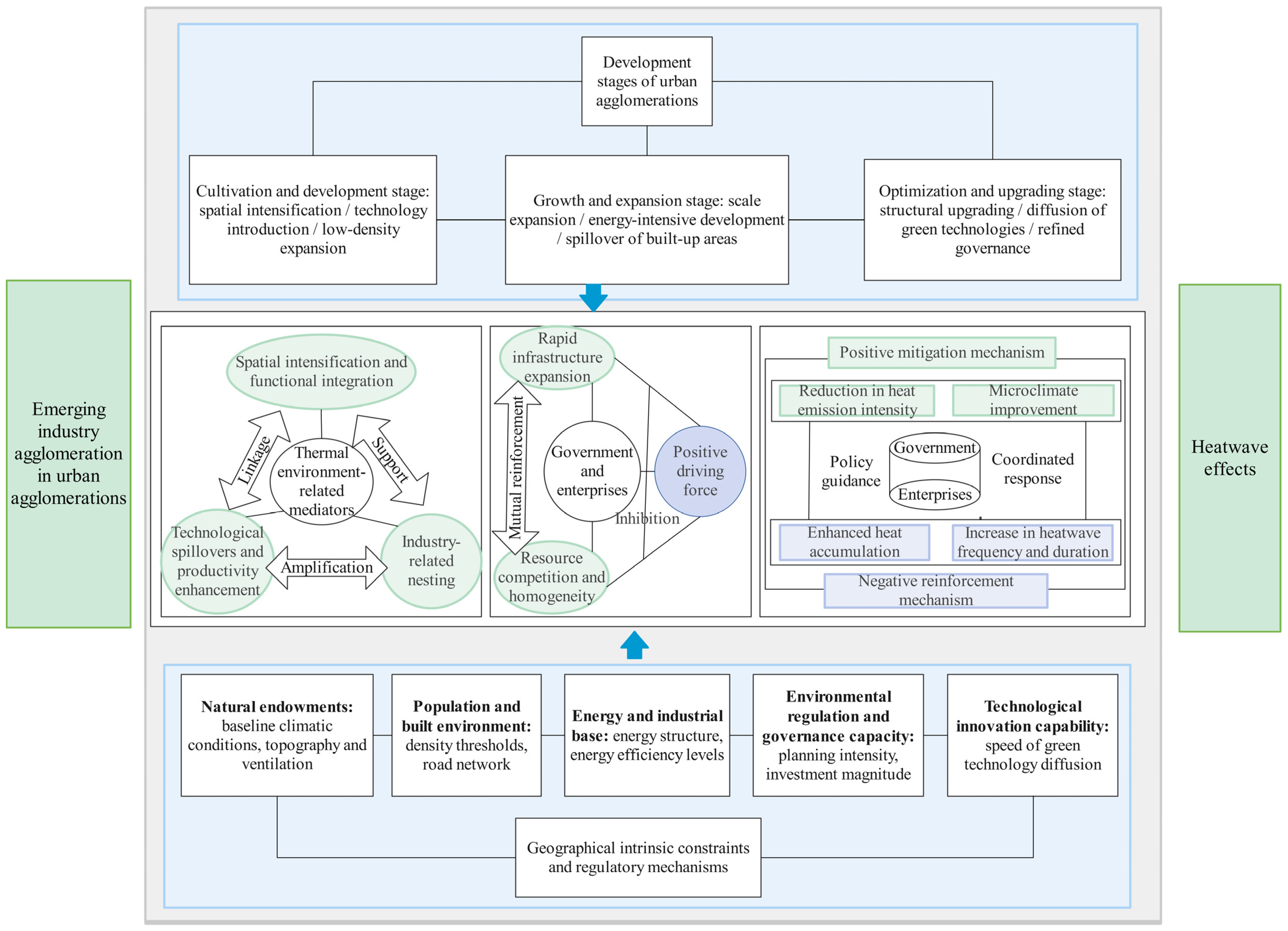
Emerging industrial agglomeration within urban agglomerations is a key driving force of China’s new-type industrialization. It is reshaping regional production systems and spatial structures in profound ways. Its influence on extreme heatwaves is not unidirectional. Instead, it produces stage-dependent outcomes through the interaction of multiple mechanisms. Figure 1 presents the theoretical framework that explains this stage dependence between emerging industrial agglomeration and urban heatwave dynamics. The framework integrates the “agglomeration–environmental externalities” perspective, economies of scale and cost reduction theory, innovation spillover theory, and eco-economic system feedback theory. Through this integration, it clarifies the causal pathways and dynamic feedback relationships linking industrial agglomeration, energy activities, and thermal environmental responses. From a theoretical standpoint, New Economic Geography posits that industrial agglomeration enhances production efficiency through factor concentration and scale advantages, while simultaneously generating externalities. Such externalities may manifest as technological diffusion and efficiency gains, but may also appear as resource crowding and intensified environmental pressure. Eco-economic system theory further suggests that the spatial concentration of production activities reshapes regional energy metabolism structures and thermal balance conditions, thereby influencing the stability of local climate systems. Consequently, the environmental implications of emerging industrial agglomeration extend beyond carbon emissions and resource efficiency; they may also operate through changes in energy transformation density and localized heat exchange processes, ultimately affecting the intensity and dynamics of extreme heatwaves. In theory, emerging industries are characterized by high knowledge intensity, advanced technological content, and strong innovation-driven dynamics. When these industries cluster, they can generate positive externalities. Green technology substitution, production structure optimization, and scale-based collaboration can improve energy efficiency. These mechanisms help alleviate thermal environmental pressure under rapid urbanization. Emerging industrial agglomerations are often anchored in transportation conditions and environmental endowments. Within urban agglomerations, they form high-potential technological innovation fields. Breakthrough energy-saving technologies and process optimization can recalibrate regional thermal baselines and reduce heat emission intensity. As agglomeration expands, high–value-added and low–thermal-load industries attract capital, talent, and other production factors toward core areas. This process crowds out traditional high–energy-consumption and high–thermal-load sectors. It optimizes industrial structure and spatial configuration. It also fosters relatively low-heat urban forms. Platform-based collaboration and intelligent coordination further strengthen these effects. Resource-sharing mechanisms among emerging industries enhance energy-use efficiency. They also reduce thermal pressure associated with building cooling demands and equipment heat dissipation. Together, these processes constitute an innovation-driven mechanism of heat risk mitigation at the urban agglomeration scale. However, this positive mechanism is not unlimited. When the scale of emerging industrial agglomeration exceeds the ecological and spatial carrying capacity of urban agglomerations, negative externalities begin to accumulate. Under such conditions, technological spillovers and efficiency gains may gradually transform into thermal environmental risks. Energy-intensive manufacturing, equipment operation, and data-processing activities generate substantial energy consumption and heat emissions. These activities accelerate regional heat accumulation. Meanwhile, increased production density and intensified spatial hardening enhance surface heat storage and thermal retention. They alter local atmospheric circulation patterns. As a result, extreme heatwaves become more persistent and more difficult to dissipate. Excessive agglomeration also induces resource crowding, factor congestion, and spatial polarization. Micro-level improvements in energy efficiency may then be offset by systemic increases in overall thermal load. This process creates a “thermal rebound effect.” Over time, it contributes to the cumulative amplification of regional climate risks.
The left module of Figure 1 conceptualizes emerging industrial agglomeration as the core driving variable, encompassing the spatial concentration of high-technology industries, the clustering of capital and human talent, and the enhancement of knowledge density. From this central module, two principal pathways extend rightward.
The first pathway is the scale-induced heating mechanism. As agglomeration expands, increased industrial density elevates energy consumption intensity, intensifies equipment operating loads, and sustains continuous data processing and manufacturing activities, thereby raising anthropogenic heat emissions. Simultaneously, infrastructure expansion and surface hardening enhance land heat storage capacity and heat retention effects, altering local atmospheric circulation and reinforcing heat accumulation. In the figure, this pathway is represented by a unidirectional arrow pointing toward the “heatwave intensification” module, indicating that scale externalities may dominate thermal environmental responses in the short term. The second pathway is the structure-optimization cooling mechanism. As emerging industrial agglomeration fosters knowledge spillover networks and technological collaboration platforms, green technology substitution, production process optimization, and improvements in energy efficiency become feasible. High value-added and low-energy-intensity sectors gradually replace traditional high-heat-load industries, leading to a more optimized industrial structure and spatial configuration. Intelligent scheduling and resource-sharing mechanisms reduce building cooling demand and equipment heat dissipation intensity, thereby alleviating heat accumulation pressures at the urban agglomeration scale. In the figure, a separate set of arrows links the modules of innovation spillovers, efficiency enhancement, and thermal mitigation, illustrating the potential cooling effects generated by structural adjustment. Within this schematic structure, dynamic feedback loops connect the two pathways. As heatwave risks intensify, institutional regulation and technological innovation may be strengthened, which in turn reshapes the externality structure of industrial agglomeration. Accordingly, Figure 1 depicts a bidirectional process of thermal feedback, institutional adjustment, and industrial reconfiguration, underscoring that agglomeration effects are not static outcomes but dynamic processes embedded within governance evolution and technological change. Building upon the aforementioned mechanisms, this study further categorizes the development of urban agglomerations into three stages and presents them in the upper section of Figure 1 as a stage-based analytical framework. In the cultivation and initial development stage, industrial agglomeration is predominantly driven by factor inputs and scale expansion. Technological capabilities remain relatively limited, the energy structure is largely dependent on traditional fossil fuels, and environmental regulations have yet to be fully strengthened. Under such conditions, the scale-enhancement mechanism dominates. The combined effects of increased energy consumption, waste heat emissions, and extensive land surface modification significantly intensify the frequency and duration of heatwaves, exhibiting a typical pattern of aggravated “scale-induced externalities.” In the expansion and growth stage, innovation capacity and institutional regulation gradually improve, and the structural optimization mechanism begins to exert influence. However, due to path dependence and rising population density, the scale-enhancement mechanism does not completely dissipate; instead, the two mechanisms coexist and interact. The thermal environment thus demonstrates a structural tension characterized by the coexistence of mitigation and accumulation effects, resulting in nonlinear fluctuations in heatwave dynamics. In the optimization and upgrading stage, the logic of industrial growth shifts from scale expansion toward ecological efficiency orientation. With the marketization of green technologies, substitution of clean energy, and the continuous improvement of regional collaborative governance systems, the innovation-driven structural optimization mechanism progressively becomes dominant. The energy system evolves toward diversification and decarbonization, industrial chains upgrade toward higher value-added and lower energy-intensive activities, and spatial organization becomes more compact and orderly. Consequently, urban thermal environmental pressure is substantially alleviated, and heatwaves exhibit a stage-specific declining trend. In summary, the impact of emerging industrial agglomeration in urban agglomerations on heatwave effects displays pronounced stage dependence and contextual constraints. Its underlying logic can be conceptualized as a dynamic evolutionary process characterized by early-stage scale dominance, mid-stage bidirectional interaction, and late-stage structural optimization dominance. This theoretical model provides explicit mechanistic hypotheses and a stage-based analytical framework for subsequent empirical investigation.

2.2. Data and Research Methods

2.2.1. Study Area and Data Sources

Study Area
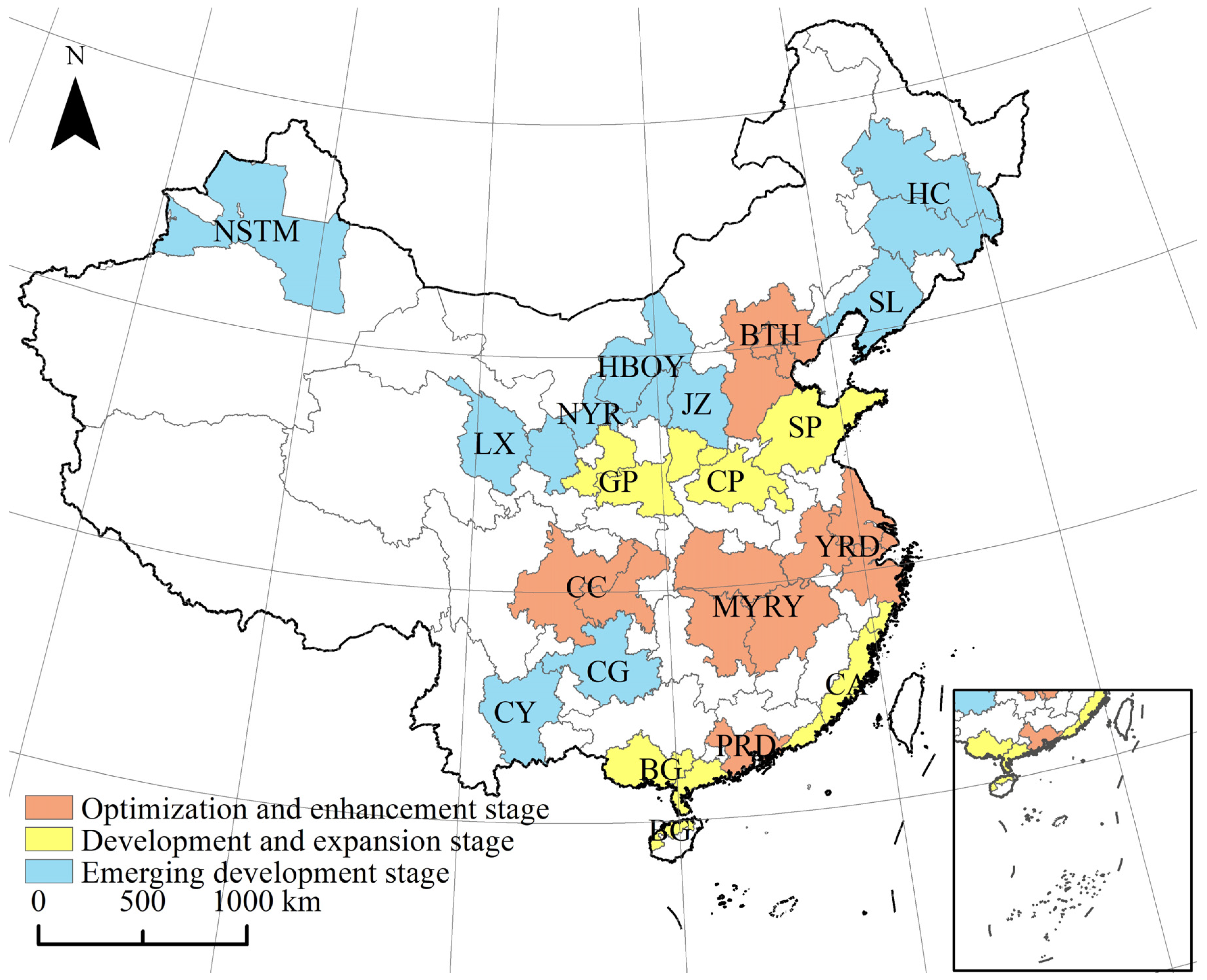
Based on the 14th Five-Year Plan for Urban Agglomeration Development [43], this study classifies the 19 urban agglomerations into three categories according to their development stages: the cultivation and development stage, the growth and expansion stage, and the optimization and upgrading stage. The cultivation and development stage includes nine urban agglomerations: Ha-Chang (HC), Central and Southern Liaoning (SL), Central Shanxi (JZ), Central Guizhou (CG), Central Yunnan (CY), Hohhot–Baotou–Ordos–Yulin (HBOY), Lanzhou–Xining (LX), Ningxia Yellow River (NYR), and Northern Slope of Tianshan Mountains (NSTM). The growth and expansion stage comprises five urban agglomerations: Shandong Peninsula (SP), Coastal Area of Guangdong-Fujian-Zhejiang (CA), Central Plains (CP), Guanzhong Plain (GP), and Beibu Gulf (BG). The optimization and upgrading stage includes another five urban agglomerations: Beijing–Tianjin–Hebei (BTH), the Yangtze River Delta (YRD), the Pearl River Delta (PRD), Chengdu–Chongqing (CC), and the Middle Reaches of the Yangtze River (MRYR). The specific spatial distribution of the study area is illustrated in Figure 2, Figure 2 illustrates the spatial distribution of the sampled urban agglomerations, revealing a pronounced east–west gradient in geographic concentration.
Data Sources and Preprocessing
In light of the practical demand for developing emerging industries, and considering the advantages of POI data—namely high locational accuracy, rapid updating frequency, fine-grained industrial classification, and strong geographic indicative value—this study employs POI data of emerging industries to characterize the spatial agglomeration patterns of emerging industrial factors.
With respect to emerging industry POI data, this study identifies strategic emerging industries and their subcategories based on the International Patent Classification (IPC) codes specified in the Reference Table of Strategic Emerging Industries and International Patent Classification (2021, Trial) issued by the China National Intellectual Property Administration (CNIPA) (Table A1). By querying CNIPA and relevant patent databases, patent lists corresponding to each strategic emerging industry are obtained. These patent lists are then matched with Chinese enterprise patent information from 2014 to 2023 using patent identification numbers, thereby generating a roster of Chinese enterprises engaged in strategic emerging industries during the study period. Subsequently, the geographic location information of enterprises in this roster is collected by web scraping from the Amap (Gaode Map) platform. To enhance the spatial accuracy and reproducibility of the POI dataset, this study established a standardized data-cleaning protocol. Duplicate records were identified using a “three-element matching” approach based on enterprise name, unified social credit code, and geographic coordinates. Records were classified as duplicates and removed when any two of the three elements were completely identical. Outlier detection employed a dual strategy combining spatial trimming and statistical testing. First, POI points located outside the administrative boundaries of the study area were eliminated through spatial clipping. Second, spatial anomalies were identified using Z-score standardization, with an absolute Z-value greater than 3 defined as the threshold for outliers, followed by random sampling and manual verification. For coordinate correction, all original WGS-84 coordinates were transformed into the China Geodetic Coordinate System 2000 through batch projection conversion in ArcGIS 10.8. Records with location accuracy below the street level, particularly those derived from fuzzy matching, were excluded. After processing, a total of 3,475,560 valid POI records were retained.
Regarding socioeconomic indicators, the data employed in this study are drawn from the China City Statistical Yearbook and the China Urban Construction Statistical Yearbook for the period 2014–2023. Data on final energy consumption from hydropower, wind power, and solar power for each city are obtained from the National Energy Administration. Cities such as Haibei, Aba Prefecture, and Diqing Prefecture were excluded due to missing core variables for more than three consecutive years. For isolated missing observations in individual years, linear interpolation was applied. The final balanced sample consists of 170 cities.

2.2.2. Emerging Industry Agglomeration

To comprehensively explore and analyze the agglomeration characteristics of emerging industrial factors across urban agglomerations, this study employs a spatial agglomeration index [44] to measure the degree and patterns of spatial concentration of emerging industries in each city. This index captures the share of regional resources relative to the national total and is characterized by its relative and standardized nature. As such, it enables an accurate representation of spatial distribution, ensures cross-regional comparability, and effectively mitigates scale-related biases. The index is calculated as follows:
D i t = R i t / A i t R t / A t
where D i t denotes the spatial agglomeration index of strategic emerging industrial factors in city i in year t; R i t represents the quantity of emerging industrial factors in city i in year t; and A i t denotes the administrative area of city i in year t. R t refers to the total quantity of emerging industrial factors across all cities in year t, and A t represents the total administrative area of all cities in year t.

2.3. Dagum Gini Coefficient and Its Decomposition Method

To further elucidate regional disparities and their sources, the Dagum Gini coefficient was employed to measure and decompose the relative differences in emerging industry agglomeration and high-temperature heatwave effects at the national level and across the four major regions [45].
At present, the Dagum Gini coefficient is widely applied in the study of spatial disparities, and its calculation formula is given as follows:
G = j = 1 k h = 1 k i = 1 n j r = 1 n h y ji y h r 2 n 2 y ¯
where G denotes the overall Gini coefficient; k is the number of prefecture-level cities nationwide; n represents the number of cities; j and h are regional indices; and i and r denote city indices. y j i ( y h r ) indicates the emerging industry agglomeration level and the heatwave effect of high temperatures for city i ( r ) in region j ( h ) , while y ¯ represents the average level of emerging industry agglomeration and the heatwave effect of high temperatures within a region. A larger Gini coefficient implies greater regional disparities in emerging industry agglomeration and the heatwave effect of high temperatures. The overall Gini coefficient G can be decomposed into three components: the within-region disparity contribution ( G w ) , the between-region disparity contribution ( G b ) , and the transvariation intensity contribution ( G t ) [46].

2.4. Measurement of Heatwave Effects

At present, there is no internationally unified definition of heatwaves. In the Chinese literature, the identification of heatwave events generally falls into three categories: (1) definitions based on temperatures exceeding an absolute threshold [47]; (2) definitions based on temperatures exceeding a relative threshold set by specific percentiles; and (3) definitions that jointly consider temperature and humidity [48]. Given China’s vast territory and pronounced regional heterogeneity in climatic backgrounds—such as the north–south differences in temperature and humidity—which in turn lead to substantial variations in human environmental tolerance, this study adopts a heatwave index integrating temperature and humidity (Hi) to identify heatwave events in China. The calculation of this index is presented in Equation (3).
H i = 1.2 E T E T + 0.35 i = 1 N 1 1 n   d i × E T i E T + 0.15 i = 1 N 1 1 n   d i + 1
where E T denotes the daily heat index, i.e., the apparent temperature representing the perceived temperature; E T is the critical heat threshold, above which human thermal perception exceeds the apparent temperature of the day and heat stress is experienced; N represents the duration (in days) of a heat event; n   d i denotes the number of days between the i-th day prior to the current day and the current day; and E T i is the heat index on the i-th day prior to the current day. The specific calculation of the heat index E T is given in Equation (4).
E T = 1.8 T a 0.55 T a 26 1 0.6 + 32   R H 60 % 1.8 T a 0.55 T a 26 1 R H + 32   R H > 60 %
where T a denotes the ambient air temperature (°C), and RH represents relative humidity, with RH ∈ [0, 100%].
With respect to the heat threshold E T , daily meteorological data from May to September during the study period were first collected. Samples with maximum temperatures exceeding 33 °C were identified [49], and the corresponding heat index values were calculated. The 50th percentile of the resulting distribution was then selected as the regional heat threshold, with the quantile estimated using the empirical formula presented in Equation (5). The choice of the 50th percentile as the benchmark threshold is justified on two grounds. First, the median effectively mitigates the structural influence of extreme high-temperature observations on threshold determination, thereby enhancing cross-regional comparability among urban agglomerations with heterogeneous climatic conditions. Second, as the central point of the sample distribution, the 50th percentile provides a stable representation of the baseline level of regional heat intensity, making it suitable for long-term comparative analysis across regions and time periods. To assess the robustness of the threshold specification, sensitivity analyses were conducted by adjusting the critical value to the 40th and 60th percentiles, respectively. The results indicate that variations in quantile selection do not lead to substantive changes in the spatial distribution patterns of heatwave duration and frequency, the stage-based ranking of urban agglomerations, or the relative importance of core driving factors. Model explanatory power remains stable across specifications. These findings demonstrate that the empirical conclusions are robust to alternative threshold definitions. Given the advantages of the median in terms of distributional stability and cross-regional consistency, this study ultimately adopts the 50th percentile as the benchmark threshold.
Q i p = 1 γ X j + γ X j + 1 int   ( pn + 1 + P / 3 ) γ = p n + 1 + p 3 j
where Q i p denotes the i-th quantile value, p represents the quantile (set to 50%), γ is the weight of the (j+1)-th ordered observation, X denotes the heat index sample arranged in ascending order, j is the index of the j-th ordered observation, and n is the total number of observations in the sequence.
Based on Equations (3)–(5), the heatwave index for each urban agglomeration was calculated and subsequently classified into three intensity levels: mild, moderate, and severe. The classification criteria for heatwave intensity are presented in Table 1.
The onset day (HWO), termination day (HWT), and duration (HWD) of heatwaves are used to characterize the temporal dynamics of heatwave events. The onset day represents the first occurrence of a heatwave within a given year for a specific urban agglomeration, while the termination day denotes the last occurrence of a heatwave in that urban agglomeration. Accordingly, the duration of the heatwave for the urban agglomeration is defined as the period between the onset and termination days, which can be expressed by Equation (6).
HWD = HWT − HWO

2.5. XGBoost-SHAP-GEO Model: Driving Factors and Mechanisms of Urban Agglomeration Heatwave Effects

2.5.1. Variable Selection

This study aims to analyze the driving factors of heatwaves in urban agglomerations and their underlying mechanisms by constructing a multidimensional driving model based on XGBoost-SHAP-GEO (Table 2). The model incorporates three tiers of variables: dependent variables, core explanatory variables, and control variables. The dependent variables include heatwave duration (DHT) and heatwave frequency (FHT), which capture the intensity and recurrence of high-temperature events within urban agglomerations, providing foundational quantitative metrics for assessing the spatial distribution and spatiotemporal evolution of heatwaves. The core explanatory variables consist of the spatial agglomeration indices of eight types of emerging industries: high-end equipment manufacturing industry (HEMI), related service industry (RSI), new materials industry (NMI), new energy industry (NEI), next-generation information technology industry (ITI), digital creative industry (DCI), energy-saving and environmental protection industry (EEI), and biotechnology industry (BI). These variables are used to examine the potential impact of industrial spatial concentration on heatwave events and to elucidate the coupling relationship between industrial layout and the urban thermal environment. To enhance the explanatory power of the model, a set of control variables is selected across five dimensions: natural endowments, socio-economic development, population and infrastructure, environmental regulation, and technological innovation. In terms of natural endowments, this study selects water resource development and utilization rate, energy production, and the share of clean energy production. The water resource development and utilization rate directly relates to a city’s resource carrying capacity under high-temperature conditions, influencing the adaptive capacity of agriculture, industry, and residential life. Energy production reflects the stability of urban energy supply and the intensity of the urban heat island effect; ensuring energy provision under high temperatures is crucial for urban resilience. The share of clean energy production indicates the greenness of the energy structure, with higher proportions of clean energy contributing to reduced pollution emissions and thermal load during heatwaves, thereby enhancing urban climate adaptability. Regarding socio-economic development, the study includes per capita GDP growth rate, energy consumption per unit of GDP, the industrial advancement index, and industrial energy intensity. Per capita GDP growth rate represents economic vitality and disaster prevention capacity, as cities with higher economic levels generally possess more comprehensive infrastructure and emergency systems. Energy consumption per unit of GDP measures economic efficiency, with high-energy-use regions potentially exacerbating local thermal conditions. The industrial advancement index reflects the level of industrial structural optimization, where upgrading industries can reduce energy consumption and environmental burden, it is calculated using the industrial structure hierarchy weighting method, defined as I A I = S i × i , where S i denotes the proportion of value added by industry i to GDP, and i = 1, 2, 3 represents the primary, secondary, and tertiary industries, respectively. Industrial energy intensity directly affects local thermal load and serves as a critical indicator of energy utilization efficiency under high-temperature conditions. At the population and infrastructure level, this study selects population density, road network density, and freight turnover. Population density determines the concentration of heat, with high-density areas prone to urban heat island effects, thereby increasing the intensity and spatial extent of heatwaves. Road network density reflects the spatial layout of transportation and infrastructure, influencing airflow and heat dissipation. Freight turnover indicates the intensity of urban logistics and transport activities, where high levels of logistics activity can elevate local energy consumption and heat emissions. Regarding environmental regulation, total investment in environmental pollution control is used as an indicator to reflect government input in ecological and environmental improvement. Higher levels of environmental governance investment can effectively reduce air pollution and enhance urban ecological quality, thereby mitigating the compound risks associated with heatwaves. In terms of technological innovation, average years of schooling, patent application efficiency, and R&D expenditure intensity are selected. Residents’ educational attainment influences public awareness and behavioral capacity in responding to extreme heat events. Patent application efficiency reflects the capacity for technology innovation and knowledge transfer, where high-level innovation facilitates the development of green technologies and materials to address high temperatures, Patent application efficiency is defined as the ratio of the number of invention patents granted to R&D expenditure, expressed as Patent application efficiency = Number of invention patents granted/R&D expenditure. R&D expenditure intensity indicates the strength of technological innovation support and serves as a critical guarantee for enhancing urban resilience to extreme climatic conditions, R&D investment intensity is measured as the ratio of internal R&D expenditure to GDP, expressed as R&D investment intensity = Internal R&D expenditure/GDP.

2.5.2. XGBoost

XGBoost, or Extreme Gradient Boosting, is a distributed gradient boosting framework based on decision trees, widely applied across various machine learning tasks, including data mining and predictive analytics. Conceptually, XGBoost builds a strong predictive model by combining a series of simple base models through an additive modeling approach. In this process, it iteratively corrects the errors generated by preceding models, thereby enhancing the overall predictive performance of the ensemble.
The objective function of XGBoost consists of two components: the loss function and the regularization term, as expressed in Equation (7).
L ( ) = i = 1 n l y i , y ^ i + k = 1 K Ω ( f k )
Here, n denotes the number of samples in the training dataset, and I refers to the i-th sample; l y i , y ^ i is the loss function, which measures the discrepancy between the true value y i and the predicted value y ^ i for the i-th sample—for instance, mean squared error is commonly used in regression tasks, while logarithmic loss is typical in classification tasks. K represents the total number of trees, and k denotes the k-th tree; Ω ( f k ) is the regularization term, which serves to control the model’s complexity and prevent overfitting. A common form of Ω f k is shown in Equation (8).
Ω f k = γ T + 1 2 λ j = 1 T ω j 2
Here, T denotes the number of leaf nodes in the k-th tree, and ω j represents the weight of the j-th leaf node. γ and λ are hyperparameters that regulate the penalty strength on the number of leaf nodes and the squared sum of leaf node weights, respectively.
To optimize the objective function, XGBoost employs a second-order Taylor expansion. Suppose that at the t-th iteration, the predicted value is y ^ i ( t ) , which can be expressed as the sum of the prediction from the previous t − 1 iterations, y ^ i ( t 1 ) , and the prediction of the t-th tree for sample x i , denoted as f t ( x i ) . The calculation is given by Equation (9).
y ^ i ( t ) = y ^ i ( t 1 ) + f t ( x i )
After performing a second-order Taylor expansion of the objective function and omitting the constant terms, the objective function can be further simplified as shown in Equation (10).
L ( t ) = i = 1 n [ g i f t x i + 1 2 h i f t 2 ( x i ) ] + Ω ( f t )
g i = l ( y i , y ^ i ( t 1 ) ) y ^ i ( t 1 )
h i = 2 l ( y i , y ^ i ( t 1 ) ) ( y ^ i t 1 ) 2
Here, g i denotes the first-order derivative (gradient) of the loss function with respect to the i-th data point, while h i represents the second-order derivative (Hessian) of the loss function for the same data point.
SHAP analysis is grounded in the Shapley value concept from cooperative game theory and provides an effective means to interpret the prediction process and feature importance of machine learning models. A SHAP value can be understood as the contribution of an individual input feature to the model’s prediction, and it can be used to reveal threshold effects and interaction synergies among different industries [50]. This is expressed in Equation (13).
φ i = S N \ { i } S ! n S 1 ! n ! ( v S I v ( S ) )
Here, N denotes the complete set of features, and S represents a subset of features affecting feature i. S N \ { i } refers to all possible subsets excluding feature i, and the weighting factor S ! n S 1 ! ensures proper normalization across all possible feature combinations. A positive φ i value indicates a favorable contribution to the prediction, whereas a negative value represents a suppressive effect.
Building on this, the GeoShapley method incorporates critical spatial considerations by treating geographic coordinates as a composite GEO feature rather than as independent variables. The method calculates the joint spatial contribution as follows:
y ^ = φ 0 + φ G E O + j = 1 p φ j + j = 1 p φ G E O , j
Here, φ 0 denotes the global intercept derived from the background data; φ G E O represents the spatial fixed effect, which can be interpreted as a local intercept; φ j indicates the contribution of non-spatial features; and φ G E O , j captures the interaction term between spatial and non-spatial features. The spatial contribution φ G E O is calculated as follows:
φ GEO = S N \ \ { G E O } | S | ! ( | N | | S | g ) ! ( | N | g + 1 ) ! ( V ( S { G E O } ) V ( S ) )
Here, S represents the set of non-spatial features; V(S) denotes the model prediction excluding the geographic features, while V S G E O includes the LAT and LON coordinates. The choice of dimension g = 2 aims to preserve geographic integrity. When g = 1, the model reduces to the traditional Shapley framework, omitting the spatial component:
φ { G E O , j } = S N \ \ { G E O , j } | S | ! ( | N | | S | g 1 ) ! ( | N | g + 1 ) ! Δ { G E O , j }
Δ { G E O j } = V ( S { G E O , j } ) V ( S { G E O } ) V ( S { j } ) + V ( S )
This concept is implemented using the open-source GeoShapley Python 0.1.0.0 code. The method effectively captures the synergistic effects between geographic context and individual features while retaining an additive decomposition framework, thereby simplifying spatial analysis. Because it inherently accounts for spatial autocorrelation and heterogeneity, there is no need to employ auxiliary spatial statistics methods such as Moran’s I.
To enhance methodological reproducibility, the model parameters are explicitly reported as follows: learning rate equals 0.05, maximum tree depth equals 6, subsample ratio equals 0.8, column sampling rate per tree equals 0.8, and the number of estimators equals 500. Hyperparameters were optimized using five-fold cross-validation combined with grid search. Model performance was evaluated using the Root Mean Square Error (RMSE) and the coefficient of determination R2. To mitigate overfitting, early stopping was implemented with 50 stopping rounds.

3. Results

3.1. Spatiotemporal Dynamics of Emerging Industry Agglomeration in Chinese Urban Agglomerations

3.1.1. Spatiotemporal Trends

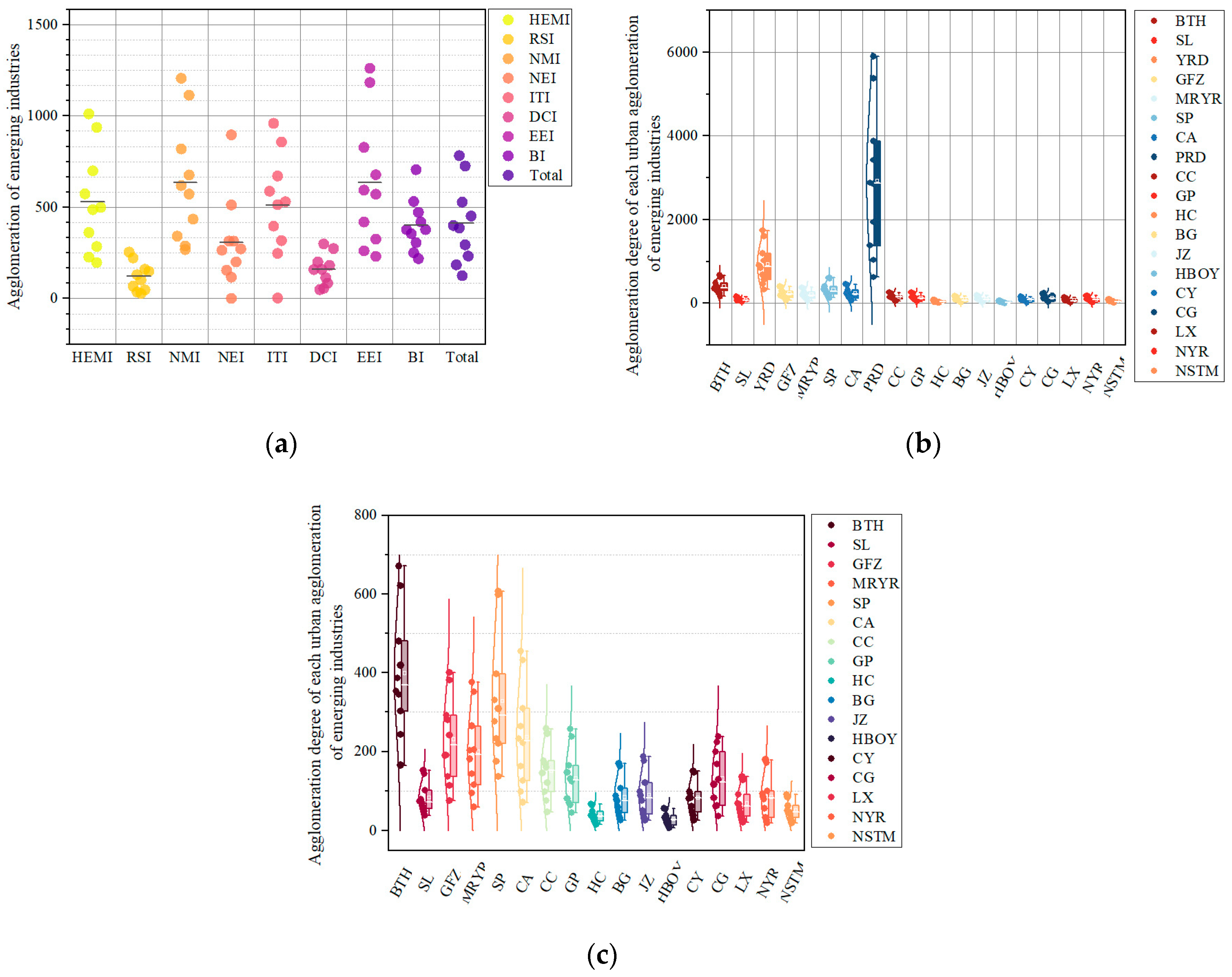
This study measures the overall development level of each urban agglomeration by the average strategic emerging industry (SEI) agglomeration degree of its constituent cities and conducts a comprehensive analysis using multidimensional indicators, including HEMI, RSI, NMI, NEI, ITI, DCI, EEI, and BI (as shown in Figure 3). Figure 3 demonstrates substantial regional and sectoral heterogeneity in emerging industry agglomeration, with eastern urban agglomerations exhibiting markedly higher clustering intensity. Overall, from 2014 to 2023, the spatial agglomeration of SEIs in Chinese urban agglomerations has continuously strengthened, the spatial agglomeration of emerging industries in Chinese urban agglomerations increased steadily from 0.421 to 0.587, representing a cumulative growth of 39.43 percent and an average annual growth rate of approximately 3.82 percent, exhibiting a clear temporal growth trend. In terms of sub-indicators, The HEMI, NMI, EEI, and BI indicators showed the most significant increases, with average annual growth rates of 4.76 percent, 4.21 percent, 5.08 percent, and 4.64 percent, respectively, particularly between 2017 and 2021, reflecting strong agglomeration effects of high-tech industries, innovation capacity, and economic efficiency. RSI, ITI, and DCI indicators grew steadily, with annual increases ranging from 2.41 percent to 2.93 percent, indicating gradual improvements in regional innovation capability and infrastructure development. The NEI declined slightly from 0.463 in 2020 to 0.458, a decrease of 1.08 percent, indicator remained relatively stable during the COVID-19 pandemic in 2020 but rebounded rapidly by 2023; however, it rebounded sharply to 0.521 in 2023, exceeding the pre-pandemic level by 0.058, suggesting that post-pandemic industrial restructuring and policy stimuli significantly promoted the allocation of innovative resources. Spatially, there are notable disparities in development levels among urban agglomerations. The PRD and YRD rank at the forefront nationally, with agglomeration levels of 0.703 and 0.689, respectively, both above the national average and exhibiting the fastest growth rates, supported by strong economic foundations, dense innovation resources, and well-developed industrial chains. The BTH, CC, and MRYR urban agglomerations show steady improvement, with index values ranging from 0.561 to 0.612, primarily driven by industrial base, technological innovation, and talent accumulation. In contrast, some central and western urban agglomerations (e.g., SL, CP, GP, and HC) exhibit relatively slower growth, with index values below 0.48, particularly in NEI and DCI, indicating that innovation capacity and infrastructure development still require further enhancement. Moreover, the COVID-19 pandemic in 2020 caused short-term disruptions in SEI agglomeration across urban agglomerations; however, most indicators rebounded quickly post-pandemic, surpassing pre-pandemic levels, demonstrating strong resilience in the development of SEIs. Long-term trends indicate that SEI resources are increasingly concentrating in core leading urban agglomerations, displaying a “rich-get-richer” spatial pattern and intensified regional differentiation, providing empirical support for the formulation of differentiated regional policies. Note: the horizontal lines in Figure 3a indicates the median.

3.1.2. Regional Disparities in Emerging Industry Agglomeration Across Chinese Urban Agglomerations

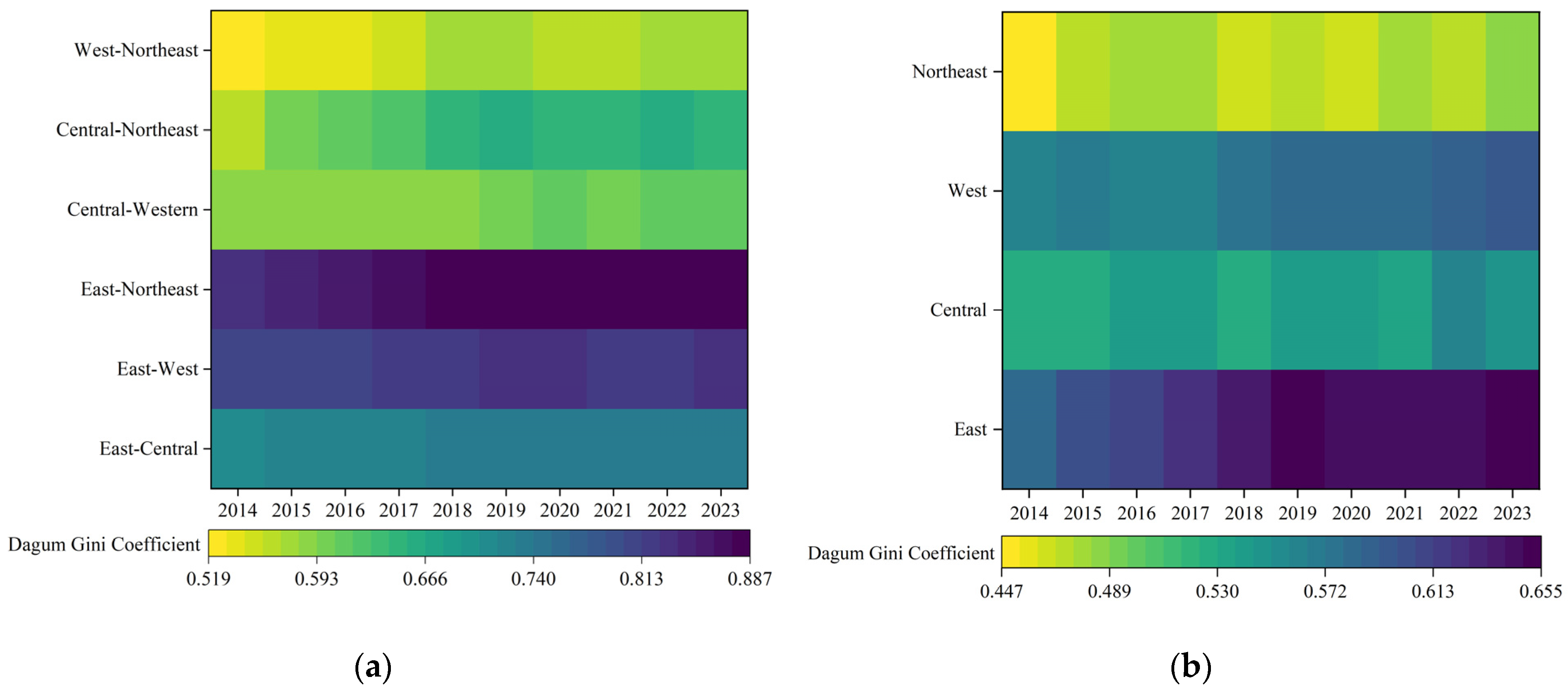
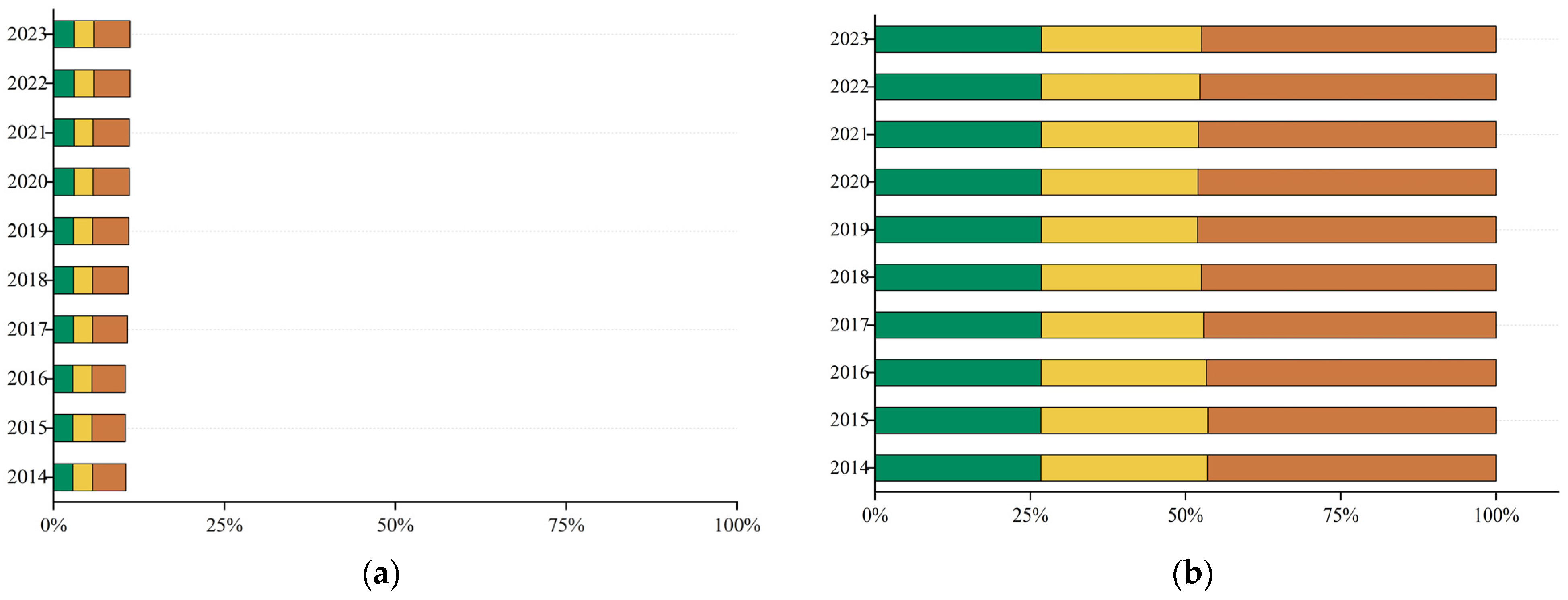
The Dagum Gini coefficient and its decomposition method were applied to further analyze the regional disparities and temporal evolution of strategic emerging industry agglomeration in Chinese urban agglomerations. The results are presented in Table 3 and Figure 4 and Figure 5. Figure 4 shows that interregional disparities constitute the primary source of overall inequality in emerging industry agglomeration, Figure 5 further confirms that between-group variation exceeds within-group heterogeneity, highlighting the structural dominance of macro-regional positioning.
From 2014 to 2023, the overall disparity in strategic emerging industry agglomeration across Chinese urban agglomerations exhibited a persistent expansion trend, with the Gini coefficient rising from 0.685 to 0.728, with an increase of 6.28%, indicating a continuous intensification of spatial unevenness. Decompositional analysis reveals that inter-regional differences consistently dominated, with a contribution rate stable between 61% and 63%, reaching a peak of 63.18% in 2019; the contribution of intra-regional differences increased slightly from 27.25% to 28.67%; the contribution of hyper-variance density remained between 9% and 10%, showing minimal fluctuation. Overall, the disparity structure demonstrates strong stability, with no substantive change in its primary sources. (1) Intra-regional differences. The Gini coefficients within the four major regions remained at moderately high levels, displaying stable yet differentiated internal structures. The eastern region exhibited the most pronounced internal disparities, with a mean Gini coefficient of 0.630, showing a continuous upward trend from 0.585 in 2014 to 0.655 in 2023, reflecting an obvious expansion in the internal agglomeration gradient. The western region had a mean of 0.575, with slight upward fluctuations; the central region’s mean was 0.538, remaining generally stable; and the northeastern region had the lowest mean at 0.470, with minimal variation. Overall, the intra-regional pattern follows a hierarchy of “highest in the east, followed by the west, stable in the central region, and lowest in the northeast.” (2) Inter-regional differences. The inter-regional Gini coefficients exhibited an overall fluctuating upward trend, with disparity levels displaying pronounced regional structural characteristics. The largest gap was observed between the Northeast and the Eastern region, consistently remaining above 0.82; differences between the Eastern-Central and Eastern-Western regions ranged from 0.72 to 0.83, maintaining relatively high levels; the gap between the Central and Western regions was the lowest, approximately 0.58–0.61, showing a tendency toward convergence. Overall, inter-regional disparities follow a pattern of “Eastern region significantly leading, inland regions converging, and pronounced north–south differences.” (3) Contribution to disparities. The overall sources of disparity indicate that inter-regional differences dominate absolutely, accounting for 62.04%, followed by intra-regional differences at 28.21%, with hyper-variance density contributing the least at 9.74%. This disparity structure demonstrates that the primary source of unevenness in the agglomeration pattern of strategic emerging industries across Chinese urban agglomerations stems from systematic inter-regional gaps.

3.2. Spatiotemporal Dynamics of Heatwave Effects in Chinese Urban Agglomerations

3.2.1. Spatiotemporal Trends

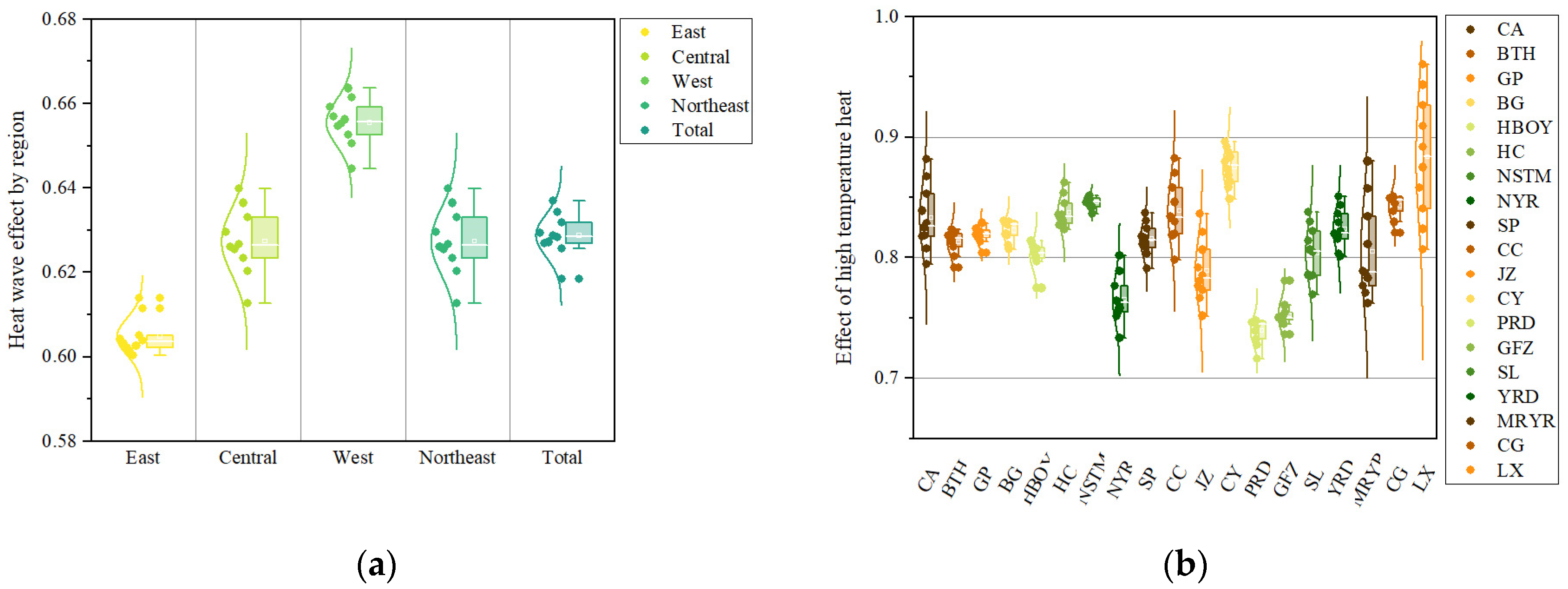
As shown in Figure 6, from 2014 to 2023, Figure 6 depicts the spatial pattern of heatwave intensity, the high-temperature heatwave effects across Chinese urban agglomerations exhibited an overall gradual upward trend, with pronounced regional disparities. In terms of regional patterns (Figure 6a), western urban agglomerations consistently recorded the highest heatwave effects. Central regions ranked second. Eastern regions showed slightly lower values, while northeastern regions remained at comparatively low levels. This configuration forms a spatial pattern characterized as “high in the west, low in the east, with central regions in between.” At the national level, the urban agglomeration heatwave effect index rose from 0.619 in 2014 to 0.637 in 2023. This change represents a cumulative increase of 2.91% and an average annual growth rate of 0.31%. The results indicate a steady intensification of extreme high-temperature impacts across urban clusters. At the urban agglomeration level (Figure 6b), inter-cluster disparities remain substantial. Western and northwestern clusters, including CY, GP, and NYR, consistently exhibited high heatwave intensity. In contrast, eastern coastal clusters such as PRD, YRD, and CA maintained relatively lower levels. However, these eastern clusters have shown a gradual upward trend in recent years. Central clusters, including CP, MRYR, and CC, demonstrated steady increases in the heatwave effect index. Northeastern clusters, such as SL, HC, and HBOY, remained comparatively lower. The gap between western and northeastern regions has remained above 0.08 for an extended period. After 2020, this gap widened slightly, indicating a continued spatial expansion of extreme heat impacts nationwide. Notably, the national heatwave effect index rebounded steadily after 2020. This rebound may be associated with broader global climate change trends and the strengthening of urban heat island effects. At the same time, inter-cluster disparities exhibited signs of gradual convergence. This pattern suggests a partial balancing of regional heatwave risks, despite persistent structural differences. In summary, Chinese urban agglomerations display a composite pattern characterized by steadily rising long-term heatwave intensity, uneven spatial distribution, pronounced east–west differentiation, and gradual convergence over time. These findings provide empirical support for climate resilience planning and high-temperature risk management at the urban agglomeration scale.

3.2.2. Regional Disparities in Heatwave Effects Across Chinese Urban Agglomerations

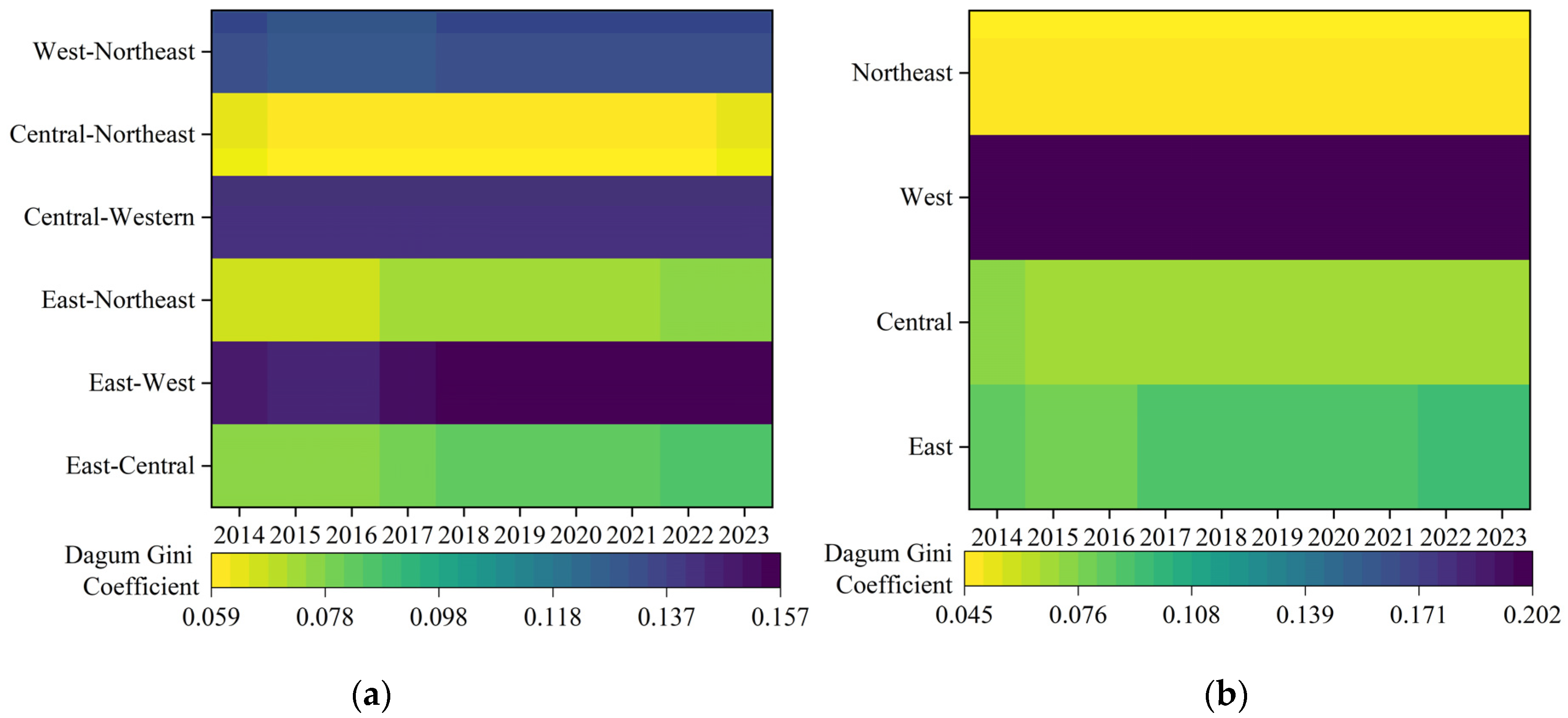
As shown in Table 4, from 2014 to 2023, the overall disparity in high-temperature heatwave effects across Chinese urban agglomerations slightly increased, with the overall Gini coefficient rising from 0.107 in 2014 to 0.112 in 2023. This indicates that the distributional differences in heatwave effects among urban agglomerations are generally low and remain relatively stable. The decomposition of disparity contributions reveals that the contribution of supervariable density is the highest, approximately 46–48%, while the contributions of within-region and between-region differences are similar, around 26–27%, indicating that the clustering of extreme events is the primary driver of overall disparities. (1) Within-region differences: As shown in Figure 7a,b, Figure 7 indicates that interregional differences are the main contributor to overall inequality in heatwave effects. The Gini coefficients within each region are generally low, with mean values of 0.088, 0.071, and 0.046 for the eastern, central, and northeastern regions, respectively, while the western region exhibits the highest value at 0.201. This reflects that, except for the western region, the internal disparities in heatwave effects are relatively small and stable, presenting a pattern of “relative differentiation in the west, relative equilibrium in other regions.” (2) Between-region differences: As illustrated in Figure 8a,b, Figure 8 reveals that structural disparities between urban agglomeration groups outweigh intragroup variation in thermal intensity. The inter-regional Gini coefficients are low, with a maximum of 0.157, and the overall disparity shows a slow upward trend over time, indicating that heatwave effect levels across regions are generally comparable. Differences between the western region and other regions are the largest, while other inter-regional differences are relatively small, forming an overall pattern of “general equilibrium with local concentration.” (3) Contribution of regional disparities: The total disparity mainly arises from supervariable density (47.31%) and between-region differences, followed by within-region differences (26.74% and 25.95%), reflecting that the clustering of extreme events and regional disparities are the key determinants of the spatial distribution of high-temperature heatwave effects.

3.3. Mechanisms of Emerging Industry Agglomeration’s Impact on Heatwave Effects in Urban Agglomerations

3.3.1. Variable Testing

To control for multicollinearity, all explanatory variables were subjected to Variance Inflation Factor (VIF) testing, with 7.5 adopted as the identification threshold (Figure 9a). Figure 9 demonstrates that coefficient estimates remain stable after excluding high-VIF variables, confirming the robustness of the regression specification. Although previous studies commonly treat VIF = 10 as a conventional benchmark for severe multicollinearity [51,52], recent methodological research suggests that in contexts where explanatory variables exhibit structural interdependencies or theoretical overlap, a more conservative threshold (e.g., 5–7.5) can effectively reduce the risk of biased parameter estimates and enhance model stability and interpretive reliability. Given the potential structural coupling among industrial agglomeration, energy structure, population density, and spatial variables in this study, a threshold of 7.5 was applied as a prudent screening standard to strengthen model identification robustness. Seven variables exceeded this threshold—namely, the spatial agglomeration of high-end equipment manufacturing, the spatial agglomeration of new materials industry, the spatial agglomeration of energy-saving and environmental protection industry, energy production volume, the share of clean energy production, the industrial advancement index, and R&D expenditure intensity—and were therefore excluded from the baseline model. To assess whether variable exclusion affected substantive conclusions, further robustness analyses were conducted: (1) the VIF threshold was relaxed to 10; (2) stepwise regression was employed for variable selection; and (3) ridge regression was applied as an alternative estimation approach for comparative testing. The results indicate that, across different screening criteria and model specifications, the direction and statistical significance of core variables remain highly consistent. In particular, geographic endowment factors (GEO) and new energy industry agglomeration (NEI) consistently emerge as the primary contributors across models, and the ranking of variable importance does not change substantially. Further comparison shows that relaxing the threshold to 10 does not significantly alter variable retention or estimation outcomes, and both model explanatory power and coefficient directions remain stable, suggesting that multicollinearity is not a decisive driver of the main findings. These results indicate that variable exclusion does not alter the substantive narrative: the heatwave effects in urban agglomerations are primarily determined by geographic constraints and energy structure transition pathways rather than by a few highly correlated variables. Therefore, adopting the conservative VIF > 7.5 threshold improves estimation precision and parameter stability without introducing systematic bias in mechanism identification, ensuring methodological robustness and interpretive consistency. Figure 10 illustrates that the correlation structure among variables remains consistent before and after variable screening, alleviating concerns of multicollinearity bias. The correlation matrix (Figure 10a) shows strong spatial clustering (|p| > 0.8) among the spatial agglomeration of high-end equipment manufacturing, the spatial agglomeration of new materials industry, the spatial agglomeration of energy-saving and environmental protection industry, energy production volume, the share of clean energy production, the industrial advancement index, and R&D expenditure intensity. VIF results confirm these associations, indicating severe multicollinearity in the model and necessitating the exclusion of these seven problematic variables.
The optimized diagnostics, shown in Figure 9b and Figure 10b, indicate that all retained variables have VIF values below 7.5 and correlation coefficients below 0.8. This successfully resolves the multicollinearity issue, rendering the revised model more robust and reliable, and enhancing the credibility of its coefficient estimates. This combined linear and nonparametric approach establishes a rigorous feature selection protocol for machine learning models driven by geospatial factors. Preliminary analysis suggests that linear models may inadequately capture system dynamics, supporting the use of machine learning models for further evaluation.

3.3.2. Model Performance Evaluation

As shown in Figure 11, the XGBoost model demonstrates excellent predictive performance. For the overall urban cluster DHT and FHT, the model achieves strong performance with R2 values of 0.807 and 0.747, respectively. To assess the model’s applicability and robustness across different regions, performance evaluations were conducted for DHT and FHT at the national urban cluster level, as well as separately for the cultivation stage clusters, development stage clusters, and optimization stage clusters. Results, also presented in Figure 11, indicate consistently high predictive accuracy. Specifically, for cultivation stage clusters, the model fits DHT and FHT well, with R2 values of 0.827 and 0.741, respectively. For development stage clusters, DHT and FHT exhibit good model fit, with R2 values of 0.725 and 0.701. In the optimization stage clusters, DHT and FHT also show strong fit, with R2 values of 0.790 and 0.769. Scatter plots of predicted versus observed values closely align along the ideal y = x line, and RMSE and MAE values differ between DHT and FHT, with DHT showing relatively higher levels and FHT remaining lower. The RMSE of all models was controlled within the range of 0.041 to 0.063, and the MAE was lower than 0.052. The 95% of the predicted points were distributed within the ±10% error band. These results fully demonstrate the model’s high generalizability and robustness, indicating that it can accurately capture data characteristics across diverse regions and provide highly reliable analytical conclusions.

3.3.3. SHAP Analysis: Variable Importance for Heatwave Effects in Urban Agglomerations

This study employs the XGBoost-SHAP framework to investigate the driving factors of high-temperature heatwave effects. Figure 12 ranks the relative importance of explanatory variables, identifying geographic endowment and emerging industry agglomeration as dominant drivers. As shown in Figure 12, geographic coordinates (LAT, LON) emerge as the primary contributors, indicating that spatial spillover effects play a critical role in shaping variations in heatwave impacts. These findings underscore the necessity of adopting spatially explicit and interpretable approaches in the analysis.
To further investigate the spatial spillover effects, this study introduces the GeoShapley framework, integrating longitude and latitude as a composite geographic feature (GEO). As shown in Figure 12a,b, geographic coordinates (GEO) constitute the primary contributor to the amplification of high-temperature heatwave effects, indicating that environmental factors—such as topography and regional policy variations—indirectly influence heatwave impacts, though these mechanisms remain to be further explored. However, within urban agglomerations, the interaction between GEO and the spatial agglomeration of emerging industries does not exhibit a strictly positive or negative contribution to heatwave effects, suggesting the presence of significant nonlinear moderating effects in the spatial spillover process.

3.3.4. Nonlinear Interaction Analysis of Emerging Industry Sector Agglomeration

Given the large number of interaction terms, to avoid excessive complexity and to highlight key effects, this section presents and discusses only the six most significant interaction combinations, ranked by SHAP interaction importance. Existing studies generally suggest that the agglomeration of individual emerging industry sectors can generate diverse environmental externalities. To investigate the nonlinear interactions between emerging industry agglomeration and high-temperature heatwave effects, SHAP interaction analysis was employed. In this analysis, the sign of the SHAP values indicates the direction of the interaction, while the absolute magnitude reflects its strength. Figure 13 highlights nonlinear effects and threshold dynamics in the relationship between emerging industry agglomeration and heatwave intensity. As shown in Figure 13, for DHT dimension, interactions such as GEO × NEI, GEO × ECPG, GEO × ITI × NEI, PD, and GEO × NEI exhibit an S-shaped nonlinear pattern characterized by “rapid initial increase followed by gradual growth.” This indicates that in the early stages of agglomeration, lagging energy production structures, insufficient technological upgrading, and rising population activity intensity jointly accelerate the warming of the local thermal environment. As agglomeration levels further increase, scale economies and technological spillovers gradually emerge, and improved resource allocation efficiency reduces marginal warming effects. Key inflection intervals were further identified: the GEO × NEI interaction shows a transition primarily within standardized NEI values of 0.42–0.48. When agglomeration is below 0.42, a 0.1-unit increase in agglomeration corresponds to an average 0.73% increase in DHT, indicating dominance of structural heating effects; beyond 0.48, the marginal effect declines to 0.29%, as scale economies and technological synergies begin to moderate the rate of unit energy consumption growth, indicating the onset of a scale-induced cooling mechanism. This threshold feature confirms that the impact of emerging industry agglomeration on heatwave duration is not linearly amplifying but exhibits stage-dependent transitions. When GEO × PD and GEO × R&D interact, the effect on heatwave duration shows a pronounced positive trend, suggesting that population concentration and increased transportation network density amplify spatial heat accumulation, activity intensity, and surface energy balance, thereby prolonging heatwave duration. Conversely, the interactions between BI × PD and GEO × ITI exhibit significant negative effects on heatwave duration, implying that the bioindustry and information technology sectors may enhance urban energy efficiency, green infrastructure, or technological regulation capacity, thus mitigating high-temperature heatwave impacts.
Regarding high-temperature heatwave frequency, Figure 14 illustrates significant interaction effects, particularly the amplifying role of geographic constraints in shaping agglomeration-driven thermal responses, as shown in Figure 14, interactions such as GEO × NEI with NEI, GEO × PD with GEO × ITI, and NEI with PD exhibit a “V-shaped” pattern in relation to FHT as agglomeration increases. The inflection points are primarily concentrated between 0.37 and 0.41. This pattern likely reflects that in the early stages of agglomeration—below 0.37—a 0.1-unit increase in agglomeration corresponds to a 0.41% decrease in FHT, as factors such as industrial structure optimization and the spatial redistribution of population density enhance energy use efficiency and urban ventilation capacity, thereby suppressing the frequency of heat events. However, once agglomeration exceeds the threshold (i.e., above 0.41), a 0.1-unit increase results in a 0.52% rise in FHT. This is due to the compounded effects of concentrated population and functional clustering, which drive simultaneous increases in energy demand and transportation activity intensity, thereby amplifying structural heating effects and increasing heatwave occurrence frequency. Conversely, when GEO × R&D interacts with RSI, PD interacts with GEO × ENPA, and RSI interacts with GEO × R&D, increasing agglomeration produces an “S-shaped” nonlinear relationship with heatwave frequency. This may indicate that improvements in transportation accessibility, expansion of the service sector, and intensified technological activity rapidly increase heatwave frequency at early stages. Once a certain threshold is reached, structural upgrades, enhanced management efficiency, or slower expansion reduce marginal effects, leading to a gradual weakening of the impact.

3.3.5. Heterogeneity Analysis of Variable Effects on Heatwave Effects Across Different Development Stages of Urban Agglomerations

Based on the aforementioned results, it is evident that, at the overall scale, the driving factors of high-temperature heatwave effects exhibit significant differences in variable importance. To further elucidate the formation mechanisms and dynamic heterogeneity of heatwave effects across urban agglomerations at different developmental stages, this study categorizes urban agglomerations into three types: the emerging development stage, the growth and expansion stage, and the optimization and enhancement stage. Heterogeneity analyses of the DHT and FHT response mechanisms are then conducted for each type, as illustrated in Figure 15. Figure 15 summarizes stage-specific feature importance, revealing a dynamic shift in dominant drivers across industrial development phases. To quantitatively compare the relative importance of key driving factors across different stages, a stage-wise ranking was constructed based on the mean absolute SHAP values. During the emerging stage, the dominant factors for DHT are ranked as NEI > GEO × PD > R&D > GTV > ECPG, indicating that industrial scale expansion and the spatial superposition of population are the primary contributors to heat amplification. In the growth stage, the ranking shifts to GEO > NEI > IEC > PD > ENPA, highlighting that spatial concentration becomes the dominant determinant. In the optimization stage, the ranking is NEI > ECPG > ENPA > GEO > PD, reflecting a marked increase in the significance of green energy structure and innovation efficiency. Collectively, these rankings demonstrate a progressive transition of the driving mechanism from being “scale-expansion dominated” toward being “structure- and innovation-regulation dominated.”
Heterogeneous Mechanisms of Heatwave Duration Effects Across Development Stages
In urban agglomerations at the emerging development stage, the duration of high-temperature events is primarily dominated by industrial agglomeration and spatial organization factors. The scatter plots indicate the absolute dominance of new energy industry agglomeration (NEI), as its mean absolute SHAP value far exceeds those of other variables, suggesting that industrial clustering significantly increases energy consumption density and waste heat emission per unit area, thereby prolonging the duration of heat events. The coupling effect of transportation activity and spatial factors, as reflected by GEO × GTV, exhibits a stable negative effect, indicating that in urban agglomerations with pronounced locational advantages, the efficient layout of logistics networks enhances air circulation and heat dissipation, effectively mitigating local heat accumulation. The interaction between transportation activity and spatial conditions, represented by GEO × GTV, exhibits a stable negative effect. This finding indicates that urban agglomerations with strong locational advantages and well-organized logistics networks benefit from improved air circulation and enhanced heat dissipation capacity. These mechanisms effectively mitigate localized heat accumulation. At the same time, the interaction between energy structure and transportation activity, reflected in GEO × ECPG, shows a strengthening positive effect as agglomeration intensity increases. This pattern implies that when energy structure transformation lags behind the pace of industrial concentration, the thermal burden intensifies. The mixed positive and negative contributions of GTV further suggest that transportation systems can produce both “heat-amplifying” and “heat-dissipating” effects. The direction of influence depends on the development context and infrastructure configuration. Nonlinear threshold characteristics are also observed in population and infrastructure variables. RND, PD, and their interaction terms exhibit significant nonlinear relationships. These results indicate that population density and road infrastructure, when combined with spatial agglomeration, amplify intra-urban thermal heterogeneity and intensify localized heat responses.
During the development and expansion stage, the driving mechanism of DHT evolves into a pattern characterized by spatial agglomeration dominance, coupled with energy and technological influences. GEO ranks highest in mean absolute SHAP value. Its strong positive contribution indicates that highly concentrated spatial organization strengthens the coupling of regional heat island effects and prolongs heatwave persistence. The interaction between education level and spatial agglomeration, captured by GEO × AYE, presents a mixed distribution of positive and negative SHAP values. This rebound pattern suggests that improvements in management capacity and environmental awareness associated with higher education may be partially offset by increased energy demand arising from intensified population clustering. Consequently, the net thermal effect remains uncertain. Stage-specific effects related to energy efficiency and technological innovation are reflected in variables such as GEO × PD, IEC, and GEO × ENPA. These variables exhibit pronounced nonlinear patterns across development phases. The results indicate that during the simultaneous expansion of industrial activity and functional agglomeration, gains in energy efficiency and technological upgrading are insufficient to fully counterbalance the rising urban heat load.
In the optimization and enhancement stage, the driving mechanism of DHT shifts systematically from an “industry–energy-driven” pattern to one dominated by “green innovation and spatial regulation.” Emerging industry agglomeration continues to exert a strong influence. NEI maintains the highest importance ranking. Its positive contribution suggests that although high-tech clustering improves economic performance, the energy-intensive characteristics and spatial concentration of technological infrastructure continue to elevate localized thermal load. Energy structure greening, represented by ECPG, exerts a stable negative effect on DHT. This inhibitory influence indicates that a cleaner energy mix reduces carbon intensity and waste heat emissions, thereby mitigating the persistence of high-temperature events. GEOdisplays a bidirectional effect at this stage. The coexistence of positive and negative SHAP values reflects a dual mechanism. On one hand, agglomeration enhances resource allocation efficiency. On the other hand, excessive concentration increases heat accumulation. This configuration forms a typical “synergistic–inhibitory” dynamic. Finally, synergistic optimization effects among innovation efficiency, transportation networks, and population distribution are evident in variables such as ENPA, GEO × RND, and GEO × PD. These variables show negative impacts on DHT. The results indicate that an advanced innovation system, well-structured road networks, and coordinated population distribution reduce heat retention and significantly shorten the duration of extreme heat events.
Heterogeneous Mechanisms of Heatwave Frequency Effects Across Development Stages
In the nurturing and development stage of urban clusters, FHT is primarily shaped by ecological governance capacity, energy structure transformation, and the population–transportation system. Environmental governance investment exerts a pronounced negative effect. TEPC emerges as the most critical inhibitory factor. Higher levels of investment in environmental governance improve ecological carrying capacity and environmental regulation effectiveness. These improvements reduce thermal accumulation and significantly decrease the frequency of high-temperature events. The nonlinear influence of clean energy proportion is captured by ECPG. At low to medium levels, ECPG shows a positive contribution to FHT. This pattern indicates that during the early phase of green energy transition, the substitution effect of clean energy remains limited. The structural transformation of the energy system has not yet generated sufficient scale or efficiency gains to offset cumulative heat emissions. Consequently, the heat-mitigating effect of green energy remains underdeveloped at this stage. The differentiated roles of population agglomeration and transportation systems are reflected in the intertwined positive and negative SHAP values of GEO × PD and GTV. These mixed effects demonstrate that the impact of traffic intensity and population activity on heatwave frequency is highly context-dependent. Under certain spatial configurations, dense population and transportation networks intensify energy use and localized heat release. In other configurations, coordinated infrastructure and spatial organization enhance airflow and reduce heat retention. The presence of both directions of influence underscores the structural sensitivity of FHT to spatial layout conditions. The nonlinear threshold effect of industrial agglomeration further indicates that once clustering surpasses a critical scale, its marginal positive impact weakens and may even reverse. This phenomenon reveals a clear agglomeration threshold and highlights the existence of a “crowding effect,” in which excessive concentration offsets earlier efficiency gains and increases thermal pressure.
During the growth and expansion stage of urban clusters, the influence mechanism of FHT evolves into a pattern characterized by “innovation agglomeration–population agglomeration dominance.” Technological innovation efficiency becomes the leading positive driver. ENPA ranks as the most influential variable. Its strong positive contribution suggests that innovation activities, particularly when concentrated in energy-intensive sectors, stimulate production expansion and electricity consumption, thereby increasing the frequency of high-temperature events. Population density also exhibits a clear amplifying effect. Highly concentrated populations generate elevated residential energy demand and transportation emissions. These processes increase anthropogenic heat release and contribute to more frequent heatwave occurrences. The nonlinear moderating role of industrial energy consumption intensity is reflected in IEC. At lower levels, IEC promotes economic vitality and industrial productivity. However, when energy consumption intensity exceeds a certain threshold, cumulative heat emissions rise sharply, leading to a noticeable increase in heatwave frequency.
In the optimization and enhancement stage of urban clusters, the driving mechanism of FHT gradually shifts away from a high-energy-consumption structure toward a green innovation–oriented system. Geographic agglomeration continues to play a central role. GEO remains a key explanatory factor, and its positive and negative SHAP values coexist. This bidirectional pattern indicates that spatial concentration simultaneously promotes resource coordination and intensifies heat accumulation. The balance between these two effects determines the net thermal outcome. NEI and PD retain strong positive contributions. Their core effects indicate that the agglomeration of emerging industries and high population density continue to form primary spatial nodes of frequent heat events. These concentrated functional zones exhibit high energy demand, dense infrastructure, and intensified anthropogenic heat release, which collectively sustain localized heat load effects. Transportation and logistics activity, represented by GTV, demonstrates a significant negative moderating influence. Optimized logistics systems and improved traffic organization enhance urban ventilation efficiency and spatial heat dissipation capacity. This mechanism provides a relatively stable mitigating effect on heatwave frequency. Finally, the dynamic moderating roles of green innovation elements—including ENPA, AYE, ECPG, GEO × PD, and GEO × ECPG—display a “strengthening-then-weakening” nonlinear pattern across different levels of agglomeration. At intermediate stages, green innovation enhances mitigation capacity and reduces heatwave frequency. As agglomeration deepens, however, marginal mitigation effects gradually decline. This evolutionary trajectory suggests that urban clusters are progressively forming an integrated and systematic heat-risk mitigation mechanism along green development pathways, although structural constraints remain during advanced stages of spatial concentration.
Integrating the stage-specific heterogeneity and nonlinear threshold analyses above, two dynamic transition pathways of dominant mechanisms can be identified. The structural heating effect primarily emerges when industrial agglomeration reaches medium-to-high levels and the energy structure remains lagging; under these conditions, population density and transportation network intensification interact, industrial energy intensity rises, and the thermal burden on the urban environment continues to accumulate. Conversely, the scale-induced cooling effect gradually manifests under conditions of increased clean energy share, enhanced innovation efficiency, and optimized transportation organization, mitigating per-unit spatial heat accumulation through improved resource allocation efficiency and technology diffusion.
Therefore, the impact of emerging industrial agglomeration on high-temperature heatwave effects is not unidirectional; rather, it exhibits alternating dominance of the two mechanisms across different development stages and threshold intervals. These findings provide empirical support for the theoretical model’s proposed “scale-induced cooling—structural heating dynamic transition framework.”

4. Discussion and Conclusions

4.1. Discussion

Against the dual backdrop of accelerating climate change and the deepening implementation of the national “dual-carbon” strategy, whether industrial upgrading inevitably leads to environmental improvement has long been a critical debate between ecological modernization theory and new economic geography. Existing studies generally converge into two strands of judgment: one posits that technological progress and industrial structural optimization can mitigate environmental pressures through efficiency gains and clean energy substitution; the other argues that industrial agglomeration, via scale expansion and energy intensification, may exacerbate resource consumption and ecological risks. However, both strands of research are predominantly grounded in linear or static analytical frameworks, with limited attention to the shifting dominance of mechanisms across different development stages. Empirical results at the urban agglomeration scale in this study demonstrate that emerging industrial agglomeration exerts pronounced stage-dependent and context-specific effects on high-temperature heatwave outcomes, thereby offering a dynamic integrative perspective on the aforementioned theoretical divergence.
First, regarding the spatiotemporal evolution of high-temperature heatwave effects, existing studies often attribute the intensification of the thermal environment to land-use expansion, increases in impervious surface ratios, or rising carbon emissions, emphasizing the cumulative effects of built environment growth. This study concurs with such research on the general trend that intensified economic activity elevates heat risk; however, it further reveals that regional disparities do not continuously widen but instead exhibit a coexistence of stage-dependent convergence and structural differentiation [53]. While prior research primarily highlights the cumulative impacts of land-use expansion and energy emissions, the present study shows that, with industrial structural adjustment and strengthened environmental governance, some urban agglomerations have already experienced a marginal attenuation of heatwave effects [54]. This suggests that urban heat risk is not an irreversible cumulative process but is dynamically influenced by institutional regulation and technological change, exhibiting stage-specific adjustments. Unlike explanations that focus on a single emission pathway, this study demonstrates that heatwave intensification is embedded within the processes of industrial spatial restructuring and densification of energy behaviors, with marginal changes contingent on technology diffusion and governance capacity enhancement. The observed differences arise because this study incorporates industrial upgrading and innovation variables, thereby identifying phases in which heat risk exhibits marginal attenuation, indicating that urban thermal environments are not irreversibly cumulative but possess institutional and technological modifiability.
Second, regarding the evolution of emerging industry agglomeration patterns and their thermal environmental effects, new economic geography theory generally posits that agglomeration enhances production efficiency but is simultaneously accompanied by congestion costs and environmental externalities. This study observes an increase in heatwave sensitivity during the agglomeration intensification stage, consistent with prior findings that scale effects and congestion costs coexist [11]. However, the study further identifies a significant nonlinear relationship between agglomeration and heatwaves: in the early stage of agglomeration, a “scale-induced cooling effect” may emerge [55]; during the intermediate stage, a “structure-induced heating effect” becomes predominant [56]; and in advanced stages, diffusion of green technologies may induce a moderating trend [57]. Unlike studies that treat agglomeration externalities as unidirectionally intensifying, this research demonstrates that their effects exhibit stage-dependent transitions. The observed difference arises because this study employs interpretable machine learning methods to identify threshold intervals, thereby capturing mechanism transition points that conventional linear models are unable to detect, revealing the asymmetric and dynamic nature of these processes.
Third, in identifying the driving mechanisms through which emerging industry agglomeration affects heatwave impacts, existing studies have often emphasized the decisive role of natural endowments or climatic context, while paying relatively little attention to the moderating functions of institutional capacity and innovation systems. This study confirms that geographic baseline factors constitute the foundational constraints shaping urban agglomerations’ thermal environments, consistent with prior findings [58]; however, it also demonstrates that environmental regulation investment and technological innovation capacity significantly mitigate the amplifying effect of industrial agglomeration on heatwaves. These results partially support the ecological modernization theory perspective that “institutions and technology can reshape environmental pressure pathways,” but further indicate that the effectiveness of such regulatory mechanisms varies across development stages [59,60]. Therefore, the impact of industrial upgrading on climate risk is not structurally predetermined but depends on the pace of energy structure transformation, governance capacity, and the maturity of innovation systems. Spatial differences in urban agglomeration heat environments thus arise from variations in these structural conditions [61,62].
Overall, by constructing and empirically validating a “stage-dependent and context-sensitive industrial climate externality framework,” this study integrates scale effects, structural transformation, and institutional regulation mechanisms at the theoretical level, systematically explaining why emerging industry agglomeration generates differentiated thermal responses at different stages of development. This finding not only reconciles the previously opposing perspectives of “technological mitigation” versus “scale-induced exacerbation” but also underscores the conditionality and modifiability of the climate impacts of industrial upgrading.

4.2. Conclusions

This study takes 19 Chinese urban agglomerations over the period 2014–2023 as the research sample and integrates a heatwave identification model, spatial agglomeration measures, the geographical detector, and the XGBoost–SHAP approach to systematically examine the spatiotemporal characteristics and driving mechanisms of heatwave effects associated with emerging industry agglomeration. The main conclusions are as follows:
First, the heatwave effects in Chinese urban agglomerations show an overall increasing trend, with a spatial pattern characterized by “higher in the east and south, lower in the west and north.” The YRD, PRD, and BTH regions represent typical high-value zones. Heatwave intensity and frequency significantly increase in economically active areas, indicating a spatial coupling between economic agglomeration and climate risk, while interregional differences display clear stage-dependent and structural divergence patterns.
Second, there exists a significant “inverted U-shaped” relationship between emerging industry agglomeration and heatwave effects. During the early stage of agglomeration, technological innovation and industrial upgrading may mitigate thermal load through improved energy efficiency. However, at high-intensity agglomeration stages, the operation of energy-intensive facilities, infrastructure-induced urban heat island effects, and increased impervious surface coverage may intensify local heat accumulation. This indicates that industrial upgrading does not automatically confer climate benefits, and its thermal consequences are stage-dependent.
Third, geographic spatial factors exert fundamental constraints on heatwave formation. Urban agglomerations at different development stages exhibit marked heterogeneity: optimized and advanced urban agglomerations are more influenced by energy structure and innovation capacity; developing and growing agglomerations are more affected by industrial spillovers and traffic activity intensity; while nascent or cultivating agglomerations are primarily constrained by natural endowments and economic foundations. These differences reflect how China’s regional development gradients and institutional environments shape the pathways of climate risk transmission.
Fourth, environmental regulation, technological innovation, and population–infrastructure factors exhibit a dual moderating effect on heatwave impacts. Environmental governance investment significantly suppresses heatwave risk, although its effectiveness depends on local fiscal capacity and enforcement intensity. Meanwhile, increased innovation input and higher patenting efficiency enhance the technical capability of urban agglomerations to adapt to extreme climate events, but their effects are subject to temporal lag. These findings highlight the critical role of institutional capacity and policy implementation conditions in shaping the industry–climate relationship.
Based on these insights, this study does not advocate for the simple suppression of industrial agglomeration. Rather, under China’s hierarchical governance system and significant regional heterogeneity, industrial layout and climate adaptation policies should be coordinated more prudently. In highly agglomerated urban clusters, energy structure optimization and building energy retrofitting should be reinforced in alignment with existing territorial spatial planning and the “dual carbon” (carbon peak and carbon neutrality) goals. Conversely, in urban agglomerations at earlier development stages, industrial cultivation should be coupled with enhanced green infrastructure and climate risk assessment to avoid the path dependence of “expansion first, governance later.”
In summary, this study elucidates the spatial coupling mechanism between emerging industry agglomeration and heatwave effects in Chinese urban agglomerations, providing empirical evidence for understanding climate risk during China’s green transition. Nonetheless, relevant policy pathways must be designed in consideration of the current fiscal decentralization system, regional coordination strategies, and spatial planning frameworks, balancing institutional constraints with local development objectives.
Although this study makes meaningful progress in elucidating the heatwave effects of emerging industrial agglomeration, several limitations remain. First, at the data level, the analysis primarily relies on industrial POI data to proxy agglomeration intensity and does not fully account for heterogeneity in firm size, energy consumption intensity, or production efficiency. Future research could integrate firm-level annual reports or remotely sensed data to enhance spatial resolution and measurement accuracy. Second, at the methodological level, while the XGBoost–SHAP framework is effective in identifying nonlinear relationships, it has limited capacity to characterize dynamic interactions among variables. Subsequent studies could incorporate dynamic spatial Durbin models or causal inference approaches to provide more rigorous validation. Third, with respect to external factors, this study does not fully incorporate the combined effects of physical and social moderating variables, such as urban ventilation corridors, vegetation cover, and social adaptive capacity. Future work could introduce climate simulation outputs and social resilience indicators to enable a multidimensional coupled analysis of the “industry–environment–climate” system.

Author Contributions

Conceptualization, Y.C.; methodology, Y.C. and X.W.; investigation, W.H. and X.W.; resources, Y.C.; data curation, Y.C.; writing—original draft preparation, W.H.; writing—review and editing, W.H. and X.W.; supervision, Y.C.; project administration, X.W.; funding acquisition, Y.C. All authors have read and agreed to the published version of the manuscript.

Funding

This research was funded by Guangxi Philosophy and Social Sciences Planning Project, Innovation Project of Guangxi Graduate Education, Research Project on Philosophy and Social Sciences in Guangxi (grant numbers: 25JB142 & XYCB2025032 & No. 24JLB001).

Institutional Review Board Statement

Not applicable.

Informed Consent Statement

Not applicable.

Data Availability Statement

The data presented in this study are available on request from the corresponding author. The data are not publicly available due to privacy and ethical restrictions.

Conflicts of Interest

The authors declare no conflicts of interest.

Abbreviations

The following abbreviations are used in this manuscript:
GeoSHAPLEYGeographically Weighted Shapley Additive Explanations
YRDYangtze River Delta
PRDPearl River Delta
BTHBeijing-Tianjin-Hebei
MYRMiddle Reaches of the Yangtze River
CCChengdu-Chongqing
SLSouthern Liaoning
SPShandong Peninsula
CACoastal Area of Guangdong-Fujian-Zhejiang
HCHa-Chang
CPCentral Plains
GPGuanzhong Plain
BGBeibu Gulf
NSTMNorthern Slope of Tianshan Mountains
JZCentral Shanxi
HBOYHohhot–Baotou–Ordos–Yulin
CYCentral Yunnan
CGCentral Guizhou
LXLanzhou–Xining
NYRNingxia Yellow River
DHTheatwave duration
FHTheatwave frequency
HEMIhigh-end equipment manufacturing industry
RSIrelated service industry
NMInew materials industry
NEInew energy industry
ITInext-generation information technology industry
DCIdigital creative industry
EEIenergy-saving and environmental protection industry
BIbiotechnology industry
POIpoint-of-interest
GISgeographic information system
SEIstrategic emerging industry
VIFVariance Inflation Factor
GEOgeographic endowment factors
NEInew energy industry agglomeration

Appendix A

Table A1. Comparison table of emerging industries and international patent classification numbers.
Emerging IndustryIPC Code Range (Examples)Subcategories (Examples)
High-end Equipment ManufacturingIPC B23 (Machine tools; other metal-working equipment); IPC B24 (Grinding; polishing)Intelligent manufacturing equipment; aerospace equipment
Related Services IndustryVaries across service domains and involves multiple IPC classesTechnology transfer and commercialization services
New MaterialsIPC C08 (Organic macromolecular compounds); IPC C09 (Dyes; paints; polishes; natural resins; adhesives; compositions not otherwise provided for; applications of materials not otherwise provided for)Advanced functional materials; high-performance composite materials
New EnergyIPC H02J (Circuit arrangements or systems for supplying or distributing electric power); IPC B60L (Electric propulsion or power supply for electric vehicles)Renewable energy technologies such as solar and wind power; electric and hybrid vehicles
Next-generation Information TechnologyIPC H04 (Electric communication technique)Cloud computing; big data; Internet of Things
Digital Creative IndustryIPC G06F (Electric digital data processing); IPC G06T (Image data processing or generation)Digital content creation; digital games
Energy-saving and Environmental Protection IndustryIPC Y10S (Selected cross-sectional technologies) related to energy conservation and environmental protectionHigh-efficiency energy-saving technologies; resource recycling technologies
Biotechnology IndustryIPC C12N (Microorganisms or enzymes; compositions thereof; propagating, preserving, or maintaining microorganisms; mutation or genetic engineering; culture media)Biopharmaceuticals; bio-agriculture

References

  1. Wang, H.; Li, J.; Zheng, F.; Li, F. The synergistic effect of the summer NAO and northwest pacific SST on extreme heat events in the central–eastern China. Clim. Dyn. 2023, 61, 4283–4300. [Google Scholar] [CrossRef]
  2. Li, M.; Huang, X.; Yan, D.; Lai, S.; Zhang, Z.; Zhu, L.; Lu, Y.; Jiang, X.; Wang, N.; Wang, T.; et al. Coping with the concurrent heatwaves and ozone extremes in China under a warming climate. Sci. Bull. 2024, 69, 2938–2947. [Google Scholar] [CrossRef]
  3. Liu, L.; Wu, C.; Zhu, Y. Employment effect of structural change in strategic emerging industries. Processes 2023, 11, 599. [Google Scholar] [CrossRef]
  4. Cui, Z.; Yang, F.; Ren, F.R.; Wei, Q.; Xi, Z. Air quality evaluation and improvement of China’s three major urban agglomerations based on the modified MetaFrontier dynamic slack-based measures model. Front. Ecol. Evol. 2021, 9, 729012. [Google Scholar] [CrossRef]
  5. Shen, N.; Peng, H. Can industrial agglomeration achieve the emission-reduction effect? Socio-Econ. Plan. Sci. 2021, 75, 100867. [Google Scholar] [CrossRef]
  6. Qing, Z.Y. Strategic Emerging Industries Agglomeration, Spatial Spillover and Economic Growth Based on Chinese provincial panel data. Agro Food Ind. Hi-Tech 2017, 28, 3020–3022. [Google Scholar]
  7. Cao, J.; Zhu, Y.; Zhu, H.; Zhao, S.; Zhang, J. Evolution Model and Driving Mechanism of Urban Logistics Land: Evidence from the Yangtze River Delta. Land 2024, 13, 616. [Google Scholar] [CrossRef]
  8. Lin, H.L.; Li, H.Y.; Yang, C.H. Agglomeration and productivity: Firm-level evidence from China’s textile industry. China Econ. Rev. 2011, 22, 313–329. [Google Scholar] [CrossRef]
  9. The Nguyen, H. Economic agglomeration and technical efficiency of small and medium-sized enterprises: Evidence from Vietnam. J. Asia Pac. Econ. 2023, 28, 716–737. [Google Scholar] [CrossRef]
  10. Zhou, L.; Shi, Y.; Cao, X. Evaluation of land intensive use in Shanghai pilot free trade zone. Land 2019, 8, 87. [Google Scholar] [CrossRef]
  11. Peng, H.; Wang, Y.; Hu, Y.; Shen, H. Agglomeration production, industry association and carbon emission performance: Based on spatial analysis. Sustainability 2020, 12, 7234. [Google Scholar] [CrossRef]
  12. Koo, Y.; Park, S.O. Structural and spatial characteristics of personal actor networks: The case of industries for the elderly in Korea. Pap. Reg. Sci. 2012, 91, 43–65. [Google Scholar] [CrossRef]
  13. Plechero, M.; Kulkarni, M.; Chaminade, C.; Parthasarathy, B. Explaining the past, predicting the future: The influence of regional trajectories on innovation networks of new industries in emerging economies. Ind. Innov. 2021, 28, 932–954. [Google Scholar] [CrossRef]
  14. Zhan, Y.; Wang, T.; Bi, X. Creative production in the digital age: A network analysis of the digital game industry in China. Geoforum 2024, 157, 104158. [Google Scholar] [CrossRef]
  15. Lu, C.; Pang, M.; Zhang, Y.; Li, H.; Lu, C.; Tang, X.; Cheng, W. Mapping urban spatial structure based on poi (point of interest) data: A case study of the central city of Lanzhou, China. ISPRS Int. J. Geoinf. 2020, 9, 92. [Google Scholar] [CrossRef]
  16. Lin, C.Y. The role of intermediary spaces in crafting the smart city industry and urban futures: A case study of Taipei City. Urban Geogr. 2025, 46, 1970–1992. [Google Scholar] [CrossRef]
  17. Deng, X.; Cao, Q.; Wang, L.; Wang, W.; Wang, S.; Wang, S.; Wang, L. Characterizing urban densification and quantifying its effects on urban thermal environments and human thermal comfort. Landsc. Urban Plan. 2023, 237, 104803. [Google Scholar] [CrossRef]
  18. Wang, Y.; Liang, Z.; Ding, J.; Shen, J.; Wei, F.; Li, S. Prediction of urban thermal environment based on multi-dimensional nature and urban form factors. Atmosphere 2022, 13, 1493. [Google Scholar] [CrossRef]
  19. Li, P.; Xu, T.; Wei, S.; Wang, Z.H. Multi-objective optimization of urban environmental system design using machine learning. Comput. Environ. Urban. Syst. 2022, 94, 101796. [Google Scholar] [CrossRef]
  20. Liu, Q.; Yan, C.; Xiao, Q.; Yan, G.; Fang, L. Separating vegetation and soil temperature using airborne multiangular remote sensing image data. Int. J. Appl. Earth Obs. Geoinf. 2012, 17, 66–75. [Google Scholar] [CrossRef]
  21. Shang, G.; Yuan, Q.; Zhang, X.; Sun, M.; Liu, S.; Hu, Y.; Yan, Z.; Gao, Y.; Zhang, C. Remote sensing inversion of land surface temperature for cloud coverage areas based on NDVI in the North China Plain. Int. J. Remote Sens. 2024, 45, 7361–7376. [Google Scholar] [CrossRef]
  22. Kuang, W.; Yang, T.; Liu, A.; Zhang, C.; Lu, D.; Chi, W. An EcoCity model for regulating urban land cover structure and thermal environment: Taking Beijing as an example. Sci. China Earth Sci. 2017, 60, 1098–1109. [Google Scholar] [CrossRef]
  23. Ding, P.; Zhou, X. Numerical Study on Effect of High-rise Building on Wind and Thermal Environments in Idealized Urban Array: Impacts of Planar Density. J. Appl. Fluid Mech. 2023, 17, 497–518. [Google Scholar]
  24. Zhang, Y.; Wang, Y.; Ding, N.; Yang, X. Assessing the contributions of urban green space indices and spatial structure in mitigating urban thermal environment. Remote Sens. 2023, 15, 2414. [Google Scholar] [CrossRef]
  25. Kim, K.; Yi, C.; Lee, S. Impact of urban characteristics on cooling energy consumption before and after construction of an urban park: The case of Gyeongui line forest in Seoul. Energy Build. 2019, 191, 42–51. [Google Scholar] [CrossRef]
  26. Ullah, Z.; Mehmood, M.S.; Zhai, S.; Qin, Y. Analysis of LULC and urban thermal variations in industrial cities using earth observation indices and machine learning: A case study of Gujranwala, Pakistan. Remote Sens. 2025, 17, 2474. [Google Scholar] [CrossRef]
  27. Li, Y.; Sun, Y.; Li, J.; Gao, C. Socioeconomic drivers of urban heat island effect: Empirical evidence from major Chinese cities. Sustain. Cities Soc. 2020, 63, 102425. [Google Scholar] [CrossRef]
  28. Epting, J.; Scheidler, S.; Affolter, A.; Borer, P.; Mueller, M.H.; Egli, L.; García-Gil, A.; Huggenberger, P. The thermal impact of subsurface building structures on urban groundwater resources–a paradigmatic example. Sci. Total Environ. 2017, 596, 87–96. [Google Scholar] [CrossRef]
  29. Su, H.; Han, G.; Li, L.; Qin, H. The impact of macro-scale urban form on land surface temperature: An empirical study based on climate zone, urban size and industrial structure in China. Sustain. Cities Soc. 2021, 74, 103217. [Google Scholar] [CrossRef]
  30. Yin, C.; Yang, Y.; Chen, X.; Yue, X.; Liu, Y.; Xin, Y. Changes in global heat waves and its socioeconomic exposure in a warmer future. Clim. Risk Manag. 2022, 38, 100459. [Google Scholar] [CrossRef]
  31. Huang, K.T.; Yang, S.R.; Matzarakis, A.; Lin, T.P. Identifying outdoor thermal risk areas and evaluation of future thermal comfort concerning shading orientation in a traditional settlement. Sci. Total Environ. 2018, 626, 567–580. [Google Scholar] [CrossRef]
  32. Xing, X.; Zhang, M.; Li, K.; Hao, P.; Dong, L. Spatial heterogeneity of first flowering date in Beijing’s main urban area and its response to urban thermal environment. Int. J. Biometeorol. 2022, 66, 1929–1954. [Google Scholar] [CrossRef]
  33. Yang, Z.; Chen, Y.; Wu, Z.; Qian, Q.; Zheng, Z.; Huang, Q. Spatial heterogeneity of the thermal environment based on the urban expansion of natural cities using open data in Guangzhou, China. Ecol. Indic. 2019, 104, 524–534. [Google Scholar] [CrossRef]
  34. He, C.; Zhou, L.; Yao, Y.; Ma, W.; Kinney, P.L. Estimating spatial effects of anthropogenic heat emissions upon the urban thermal environment in an urban agglomeration area in East China. Sustain. Cities Soc. 2020, 57, 102046. [Google Scholar] [CrossRef]
  35. Xiong, Y.; Zhang, F. Effect of human settlements on urban thermal environment and factor analysis based on multi-source data: A case study of Changsha city. J. Geogr. Sci. 2021, 31, 819–838. [Google Scholar] [CrossRef]
  36. Wei, W.; Zhao, L.; Liu, Z. How does industrial agglomeration affect firms’ energy consumption? Empirical evidence from China. Indoor Built Environ. 2023, 32, 1523–1536. [Google Scholar] [CrossRef]
  37. Sun, R.; Wang, Y.; Chen, L. A distributed model for quantifying temporal-spatial patterns of anthropogenic heat based on energy consumption. J. Clean. Prod. 2018, 170, 601–609. [Google Scholar] [CrossRef]
  38. Dai, J.; Wang, K.; Gao, X. Spatial structure and land use control in extended metropolitan region of Zhujiang River Delta, China. Chin. Geogr. Sci. 2010, 20, 298–308. [Google Scholar] [CrossRef]
  39. Yuan, S.; Zhu, C.; Yang, L.; Xie, F. Responses of ecosystem services to urbanization-induced land use changes in ecologically sensitive suburban areas in Hangzhou, China. Int. J. Environ. Res. Public Health 2019, 16, 1124. [Google Scholar] [CrossRef] [PubMed]
  40. Zhang, N.; Deng, J.; Gu, Y.; Ahmad, F. Does the agglomeration of high-tech industries improve the efficiency of China’s green economy? Analysis based on the marketization. Front. Environ. Sci. 2023, 11, 1326393. [Google Scholar] [CrossRef]
  41. Wang, S.; Zhang, Q.; Gao, P.; Wang, C.; An, J.; Wang, L. Coupled Impact of Points of Interest and Thermal Environment on Outdoor Human Behavior Using Visual Intelligence. Buildings 2024, 14, 2978. [Google Scholar] [CrossRef]
  42. Yang, Y.; Yuan, Y.; Han, Z.; Liu, G. Interpretability analysis for thermal sensation machine learning models: An exploration based on the SHAP approach. Indoor Air 2022, 32, e12984. [Google Scholar] [CrossRef]
  43. The 14th Five-Year Plan and Long-Range Objectives Through 2035 [EB/OL]. Available online: https://en.ndrc.gov.cn/policies/202303/P020240307594916415618.pdf (accessed on 1 March 2026).
  44. Liu, G.; Zhang, L.; He, B.; Jin, X.; Zhang, Q.; Razafindrabe, B.; You, H. Temporal changes in extreme high temperature, heat waves and relevant disasters in Nanjing metropolitan region, China. Nat. Hazards 2015, 76, 1415–1430. [Google Scholar] [CrossRef]
  45. Xu, R.; Yang, F.; Wu, S.; Xue, Q. Spatio-Temporal Evolution and Drivers of Carbon Emission Efficiency in China’s Iron and Steel Industry. Sustainability 2024, 16, 4902. [Google Scholar] [CrossRef]
  46. Dagum, C. A new approach to the decomposition of the Gini income inequality ratio. Empir. Econ. 1997, 22, 515–531. [Google Scholar] [CrossRef]
  47. Kong, Q.; Kong, H.; Miao, S.; Zhang, Q.; Shi, J. Spatial coupling coordination evaluation between population growth, land use and housing supply of urban agglomeration in China. Land 2022, 11, 1396. [Google Scholar] [CrossRef]
  48. Li, L.; Wang, L.; Feng, T.; Tang, J.; Huang, J.; Cai, Z. Multi-Index Analysis of Spatiotemporal Variations of Dry Heat Waves and Humid Heat Waves in China. Atmosphere 2023, 14, 1660. [Google Scholar] [CrossRef]
  49. Gunther, S.H.; Kjellstrom, T.; Lee, J.K.W. Advancing heat wave definitions: A policy review towards prioritizing health impacts of extreme heat. Environ. Res. Lett. 2025, 20, 033004. [Google Scholar] [CrossRef]
  50. Grekousis, G. Geographical-XGBoost: A new ensemble model for spatially local regression based on gradient-boosted trees. J. Geogr. Syst. 2025, 27, 169–195. [Google Scholar] [CrossRef]
  51. O’brien, R.M. A caution regarding rules of thumb for variance inflation factors. Qual. Quant. 2007, 41, 673–690. [Google Scholar] [CrossRef]
  52. Cheng, J.; Sun, J.; Yao, K.; Xu, M.; Cao, Y. A variable selection method based on mutual information and variance inflation factor. Spectrochim. Acta Part A Mol. Biomol. Spectrosc. 2022, 268, 120652. [Google Scholar] [CrossRef]
  53. Du, H.; Yang, S.; Fan, Q.; Cai, A.; Li, Z. Relationship between urban thermal environment and carbon emissions in the Yangtze River Delta: Land use pattern-process perspective. Sustain. Cities Soc. 2025, 130, 106649. [Google Scholar] [CrossRef]
  54. Li, C.; Zhang, N.; Ren, K.; Zhao, W.; Wu, J.; Sun, Y. Biophysical drivers of seasonal hysteresis of urban heat islands across climates and urban landscapes. J. Geophys. Res. 2024, 129, e2023JD040446. [Google Scholar] [CrossRef]
  55. Broersma, L.; Oosterhaven, J. Regional labor productivity in the Netherlands: Evidence of agglomeration and congestion effects. J. Reg. Sci. 2009, 49, 483–511. [Google Scholar] [CrossRef]
  56. Luo, Y.; Shen, J.; Cui, D.E.; Tian, Z.; Guo, W.; Liu, Z.; Zhang, L. An energy-environment coupled simulation framework for multi-scale and multi-facet evaluation of data center. Appl. Therm. Eng. 2025, 258, 124637. [Google Scholar] [CrossRef]
  57. Kwok, K.C.S.; Hu, G. Wind energy system for buildings in an urban environment. J. Wind. Eng. Ind. Aerodyn. 2023, 234, 105349. [Google Scholar] [CrossRef]
  58. Zhou, J.; Fang, Z.; Yin, G.; Chen, J.; Zhou, X.; Jing, R.; Wang, M. Automated roof segmentation for assessing urban scale energy performance and indoor thermal environment of photovoltaic and green roofs. Energy 2025, 338, 138958. [Google Scholar] [CrossRef]
  59. Lee, E.S. Assessing Climate Vulnerability for Resilient Urban Planning: A Multidiagnosis Approach. Sens. Mater. 2023, 35, 3479–3498. [Google Scholar] [CrossRef]
  60. Apreda, C.; D’Ambrosio, V.; Di Martino, F. A climate vulnerability and impact assessment model for complex urban systems. Environ. Sci. Policy 2019, 93, 11–26. [Google Scholar] [CrossRef]
  61. Zhi, D.; Zhao, H.; Chen, Y.; Song, W.; Song, D.; Yang, Y. Quantifying the heterogeneous impacts of the urban built environ-ment on traffic carbon emissions: New insights from machine learning techniques. Urban Clim. 2024, 53, 101765. [Google Scholar] [CrossRef]
  62. Fan, H.; Kamran, S.M.; Li, M.; Zhou, Q. Congestion costs and differences in the regional distribution of FDI in China. Qual. Quant. 2017, 51, 1789–1809. [Google Scholar] [CrossRef]
Figure 1. The mechanism of the agglomeration of emerging industries in urban agglomerations on the effect of high-temperature heatwaves.
Sustainability 18 02697 g001
Figure 2. Distribution map of urban agglomerations.
Sustainability 18 02697 g002
Figure 3. Spatial agglomeration degree of emerging industries: (a) spatial agglomeration levels of emerging industries by sector; (b) spatial agglomeration levels of emerging industries across urban agglomerations; (c) spatial agglomeration degree of emerging industries in Chinese cities.
Sustainability 18 02697 g003
Figure 4. Gini coefficients and contribution rates of interregional and intraregional differences in emerging industry agglomeration across the four major regions to the overall disparity: (a) Gini coefficients of interregional and intraregional disparities contributing to overall disparity across the four major regions; (b) contribution rates of interregional and intraregional disparities to overall disparity across the four major regions. Note: Green indicates intra-regional differences; yellow indicates inter-regional differences; orange color indicates hyper-variance density.
Sustainability 18 02697 g004
Figure 5. Intergroup and intragroup disparities in emerging industry agglomeration from different perspectives: (a) intergroup disparities in emerging industry agglomeration from different perspectives; (b) intragroup disparities in emerging industry agglomeration from different perspectives.
Sustainability 18 02697 g005
Figure 6. The high-temperature heatwave effects in various urban agglomerations and regions: (a) heatwave effects across urban agglomerations; (b) regional heatwave effects.
Sustainability 18 02697 g006
Figure 7. Gini coefficients and contribution rates of interregional and intraregional differences in high-temperature heatwave effects across the four major regions to the overall disparity: (a) Gini coefficients of interregional and intraregional disparities contributing to overall disparity across the four major regions; (b) Contribution rates of interregional and intraregional disparities to overall disparity across the four major regions. Note: Green indicates intra-regional differences; yellow indicates inter-regional differences; orange color indicates hy-per-variance density.
Sustainability 18 02697 g007
Figure 8. Intergroup and intragroup disparities in heatwave effects from different perspectives: (a) intergroup disparities in heatwave effects from different perspectives; (b) intragroup disparities in heatwave effects from different perspectives.
Sustainability 18 02697 g008
Figure 9. Collinearity Test: (a) effects of emerging industries on high-temperature duration: results before variable exclusion; (b) effects of emerging industries on high-temperature duration: results after variable exclusion; (c) effects of emerging industries on high-temperature frequency: results before variable exclusion; (d) effects of emerging industries on high-temperature frequency: results after variable exclusion.
Sustainability 18 02697 g009
Figure 10. Correlation Coefficients: (a) effects of emerging industries on high-temperature duration: results before variable exclusion; (b) effects of emerging industries on high-temperature duration: results after variable exclusion; (c) effects of emerging industries on high-temperature frequency: results before variable exclusion; (d) effects of emerging industries on high-temperature frequency: results after variable exclusion.
Sustainability 18 02697 g010
Figure 11. Model Performance Evaluation: (a) effects of overall emerging industries on high-temperature duration across urban agglomerations; (b) effects of overall emerging industries on high-temperature frequency across urban agglomerations; (c) effects of emerging industries at the cultivation stage on high-temperature duration; (d) effects of emerging industries at the cultivation stage on high-temperature frequency; (e) effects of emerging industries at the growth stage on high-temperature duration; (f) effects of emerging industries at the growth stage on high-temperature frequency; (g) effects of emerging industries at the optimization and upgrading stage on high-temperature duration; (h) effects of emerging industries at the optimization and upgrading stage on high-temperature frequency.
Sustainability 18 02697 g011aSustainability 18 02697 g011b
Figure 12. Ranking of feature importance and scatter plot: (a) effects of emerging industries on high-temperature duration; (b) effects of emerging industries on high-temperature frequency.
Sustainability 18 02697 g012
Figure 13. Local interaction effects among the influencing factors under DHT conditions: (a) SHAP dependence plot for BI and PD; (b) SHAP dependence plot for GEO and ITI; (c) SHAP dependence plot for GEO × ITI and NEI; (d) SHAP dependence plot for GEO × NEI and GEO × ECPG; (e) SHAP dependence plot for GEO × PD and GEO × RND; (f) SHAP dependence plot for PD and GEO × NEI. Note: dotted lines represent the confidence interval of the estimated relationship; orange area represents highlights the nonlinear threshold interval.
Sustainability 18 02697 g013
Figure 14. Local interaction effects among the influencing factors under FHT conditions: (a) SHAP dependence plot for GEO × NEI and NEI; (b) SHAP dependence plot for GEO × PD and GEO × ITI; (c) SHAP dependence plot for GEO × RND and RSI; (d) SHAP dependence plot for NEI and PD; (e) SHAP dependence plot for PD and GEO × ENPA; (f) SHAP dependence plot for RSI and GEO × RND. Note: dotted lines represent the confidence interval of the estimated relationship; orange area represents highlights the nonlinear threshold interval.
Sustainability 18 02697 g014
Figure 15. Summary Diagram of SHAP feature importance of urban agglomerations in each stage: (a) effects of emerging industries at the cultivation stage on high-temperature duration; (b) effects of emerging industries at the cultivation stage on high-temperature frequency; (c) effects of emerging industries at the growth stage on high-temperature duration; (d) effects of emerging industries at the growth stage on high-temperature frequency; (e) effects of emerging industries at the optimization and upgrading stage on high-temperature duration; (f) effects of emerging industries at the optimization and upgrading stage on high-temperature frequency.
Sustainability 18 02697 g015
Table 1. Heatwave Ratings.
Mild HeatwaveModerate HeatwaveSevere Heatwave
2.8 ≤ H i < 6.56.5 ≤ H i < 10.5 H i 10.5
Table 2. Definitions of variables for analysis of energy efficiency driving factors.
Variable TypeVariable SymbolVariable Description
Dependent VariablesDHTDuration of high-temperature events
FHTFrequency of high-temperature events
Core Explanatory VariablesHEMISpatial agglomeration of high-end equipment manufacturing industry
RSISpatial agglomeration of related service industries
NMISpatial agglomeration of new materials industry
NEISpatial agglomeration of new energy industry
ITISpatial agglomeration of next-generation information technology industry
DCISpatial agglomeration of digital creative industry
EEISpatial agglomeration of energy-saving and environmental protection industry
BISpatial agglomeration of bio-industry
Control VariablesWRUWater resource development and utilization rate
EPVEnergy production volume
PCEPProportion of clean energy production
GDPGrowth rate of GDP per capita
ECPGEnergy consumption per unit of GDP
IAIIndustrial upgrading index
IECIndustrial energy consumption intensity
PDPopulation density
RNDRoad network density
GTVFreight turnover volume
TEPCTotal investment in environmental pollution control
AYEAverage years of education
ENPAEfficiency of patent applications
R&DIntensity of R&D expenditure
Table 3. Dagum Gini coefficient of agglomeration degree of emerging industries in Chinese urban agglomerations and its decomposition.
Year2014201520162017201820192020202120222023Mean Value
Overall disparity0.6850.6940.6980.7060.7140.7220.7210.7190.7200.7280.711
Table 4. Overall disparities in heatwave effects across Chinese urban agglomerations.
Year2014201520162017201820192020202120222023Mean Value
Overall disparity0.1070.1050.1050.1090.1090.1100.1110.1110.1120.1120.109
Disclaimer/Publisher’s Note: The statements, opinions and data contained in all publications are solely those of the individual author(s) and contributor(s) and not of MDPI and/or the editor(s). MDPI and/or the editor(s) disclaim responsibility for any injury to people or property resulting from any ideas, methods, instructions or products referred to in the content.