1. Introduction
For over eight decades, Saudi Arabia’s economic trajectory has been closely tied to developments in global oil markets. Since the discovery of oil in the 1930s, petroleum exports had a significant impact on every aspect of Saudi Arabia’s fiscal structure, trade composition, and macroeconomic policy. The oil sector has historically served as the principal engine of growth, accounting for over two-thirds of GDP and the bulk of government revenues during the 1970s and early 1980s. While this hydrocarbon wealth fueled rapid modernization, it also introduced long-term vulnerabilities. Dependence on a single commodity made the economy susceptible to volatile price cycles, external shocks, and procyclical fiscal imbalances that periodically disrupted growth momentum. Each boom–bust phase underscored the fragility of an undiversified economic base and amplified the need for a more sustainable and balanced model of development.
Recognizing this challenge, the Saudi Arabian government has, across successive development plans, emphasized diversification as a national priority. Yet, the scope and pace of progress remained constrained until the launch of Vision 2030 in 2016, a comprehensive policy framework designed to transform Saudi Arabia into a knowledge-based, innovation-driven economy. Vision 2030 aims not only to expand the production base but also to improve institutional efficiency, foster private-sector participation, and ensure long-term fiscal stability. Despite several reform efforts before 2016, empirical assessments of diversification outcomes have often yielded mixed evidence, prompting renewed interest in understanding how effectively the non-oil sector has evolved in response to recent policy shifts.
Historically, Saudi Arabia’s production structure has undergone a gradual transformation. In the early 1970s, the oil sector contributed roughly 65–70 percent of total GDP, while the non-oil sector accounted for only 30–35 percent. This imbalance reflected the overwhelming dependence on crude oil exports as the primary driver of national income and fiscal capacity. However, as the government implemented multi-year development plans emphasizing industrialization, infrastructure, and social investment, the relative weight of the non-oil economy began to grow. By the 1990s, the oil sector’s share had declined to approximately 45–50 percent. At the same time, non-oil activities, including manufacturing, construction, trade, and public services, accounted for nearly half of total GDP.
The 2000s and 2010s marked an acceleration in this trend. Structural reforms in finance, tourism, logistics, and the digital economy supported a steady expansion of private enterprise. The introduction of Vision 2030 further strengthened this momentum by targeting new growth engines, including renewable energy, entertainment, and high-value manufacturing. According to recent estimates, non-oil activities now account for 55–60 percent of GDP, suggesting a reduction in oil dependence. The government’s commitment to large-scale initiatives such as NEOM, the Red Sea Project, Qiddiya, and Soudah Peaks has catalyzed the rise of new industries and positioned the non-oil economy as the primary driver of output growth.
This transformation is also reflected in macroeconomic performance indicators. Since the adoption of Vision 2030, non-oil GDP growth has accelerated from around 1.8 percent in 2016 to nearly 5 percent by 2023, with non-oil revenues surpassing 56 percent of total GDP by 2025 [
1,
2]. These gains have been reinforced by the National Transformation Program (NTP), which enhanced the regulatory environment, promoted private-sector participation, and broadened fiscal capacity through measures such as the implementation of VAT, privatization, and public–private partnerships. Massive public investment in mega-projects and strategic infrastructure has not only stimulated domestic demand but also fostered employment and technological spill-overs across various non-oil sectors [
3]. The country through its NTP and Vision 2030 National Transformation Program (NTP) outlines the agenda for balanced and sustainable growth [
4].
Recent data highlight the growing importance of Saudi Arabia’s non-oil sector in driving overall economic growth, as reported by the IMF [
5]. The non-oil economy expanded by 4.4 percent in real terms, despite a reduction in oil output, reflecting the broader impact of Vision 2030 reforms that have strengthened investment, private-sector engagement, and market diversification. Much of this momentum stemmed from the private non-oil sector, which recorded robust growth of 4.9 per cent, supported by an improved business environment and rising investment in tourism, trade, manufacturing, construction, and services. Government non-oil activities also grew by 2.1 per cent, indicating continued public commitment to infrastructure and development programs. Together, these trends underscore how both private and public initiatives have strengthened the non-oil sector’s role as a key driver of the Kingdom’s economic growth, particularly when adjustments in oil production impact the hydrocarbon sector.
Recent assessments further corroborate these developments. The Global Economic Diversification Index [
6] ranks Saudi Arabia among the fastest-reforming resource-rich economies, citing sustained progress in tourism, logistics, and entertainment. The index attributes these improvements to structural reforms, increased private-sector engagement, and substantial capital inflows into non-oil industries. Nevertheless, while the direction of change is positive, the process remains incomplete. The country continues to face challenges in ensuring that diversification efforts translate into durable, broad-based growth that can withstand global shocks and fluctuations in oil prices.
This study contributes to the policy and academic discourse by examining the relationship between Saudi Arabia’s GDP and the sectoral contributions of oil and non-oil activities, using the Quantile Regression (QR) approach. Unlike conventional mean-based models, quantile regression captures the heterogeneity of sectoral effects across different levels of economic performance. It enables us to determine whether the non-oil sector has a more substantial stabilizing effect during downturns and how both sectors interact during periods of expansion. The analysis offers a distributional perspective on diversification dynamics, revealing not only whether diversification has occurred, but also under which growth conditions it becomes most effective. Such insights are crucial for designing policies that enhance the resilience of the Saudi economy and facilitate its transition toward sustainable, innovation-driven growth in line with Vision 2030.
From a sustainability perspective, diversification is expected to reduce vulnerability to external shocks and enhance long-run macroeconomic stability. These theoretical insights suggest that the elasticities of GDP with respect to oil and non-oil sector activities may differ across growth regimes rather than remain constant at the conditional mean. Building on this reasoning, the present study addresses the following analytical research questions:
RQ1: Does the impact of oil-sector activity on GDP differ across low, median, and high regimes of growth?
RQ2: Does the non-oil sector exert any significant stabilizing effect during economic slowdowns?
RQ3: Are sectoral elasticities symmetric across the conditional growth distribution, or are there any structural asymmetries?
Grounded in the literature on resource dependence, economic diversification, and nonlinear growth dynamics, we formulate the following testable hypotheses:
H1. The elasticity of GDP with respect to oil-sector activity is significantly larger at the upper quantiles of the growth distribution than at the lower quantiles. This hypothesis postulates that oil booms amplify economic expansions through fiscal and investment channels.
H2. The elasticity of GDP with respect to non-oil-sector activity is relatively stronger at the lower quantiles of the growth distribution. This hypothesis captures the stabilizing role of diversification in cushioning the impact of adverse oil shocks indicating economic resilience.
H3. Sectoral coefficients differ significantly across quantiles, suggesting nonlinear, state-dependent growth dynamics. This hypothesis recognizes that adjustment patterns in resource-dependent economies may be asymmetric over the business cycle.
By formally evaluating heterogeneity and asymmetry, this study contributes to the sustainability-oriented literature on economic diversification in oil-exporting economies. Rather than focusing solely on average effects, the empirical framework examines whether diversification primarily functions as a stabilizer during downturns, a growth accelerator during expansions, or both. Accordingly, the objective of this paper is to empirically assess (i) stabilization effects, (ii) structural transformation dynamics, and (iii) the relative dominance of sectoral elasticities across different growth regimes, thereby offering policy-relevant insights into the long-term sustainability of growth in resource-dependent economies.
2. Literature Review
The question of how resource-rich economies can diversify and achieve sustainable growth has long been central to development economics [
7]. The literature on economic diversification in oil-dependent nations, particularly within the Gulf region, emphasizes the structural and institutional barriers that impede transformation beyond hydrocarbons. Foundational theoretical frameworks, such as the resource curse [
8] and Dutch disease [
9], provide an essential backdrop for understanding these challenges. Both perspectives argue that resource abundance, while a source of immediate wealth, can distort long-term development incentives. High revenues from natural resources often lead to overvalued exchange rates, rent-seeking behavior, and the neglect of tradable sectors such as manufacturing and agriculture. Consequently, economic structures become excessively concentrated in resource extraction and public sector activities, resulting in fiscal vulnerability and limited diversification [
10].
Building on these frameworks, a vast body of empirical research demonstrates that the success of diversification depends less on the sheer scale of resource endowments and more on the institutional quality and governance capacity that manage them. Gelb [
11,
12] argues that strong fiscal institutions, transparent management of oil revenues, and disciplined macroeconomic policies are essential for transforming resource wealth into long-term development outcomes. Similarly, Sachs and Warner [
13] and Sala-i-Martin and Subramanian [
14] find that countries rich in natural resources often experience slower growth, partly because of institutional inefficiencies and the crowding out of innovation. These dynamics can be particularly acute in oil-exporting economies, where the public sector becomes the primary driver of employment and investment, leaving little room for private initiative.
The debate over whether natural resources are a blessing or a curse has been examined from multiple perspectives, with scholars offering varying explanations for the mixed economic outcomes observed in resource-rich countries. Lederman and Maloney [
15] argue that natural resources are neither a curse nor a destiny, but can foster growth when combined with human capital development, technological progress, and sound governance. Similarly, Ross [
16] explores the political economy of the resource curse, showing that poor governance, rather than resource abundance itself, fuels economic decline through mechanisms such as the rentier effect, repression effect, and modernization effect. Building on this, Mehlum et al. [
17] contend that the impact of resource wealth depends on institutional quality, where “producer-friendly” institutions promote innovation and productivity. In contrast, “grabber-friendly” ones enable corruption and rent extraction. Collectively, these studies highlight that natural resource wealth can either hinder or enhance development depending on how effectively countries manage revenues, strengthen institutions, and invest in knowledge-driven, diversified economies.
In the case of Saudi Arabia, these theoretical and empirical insights are particularly relevant. The country’s vast hydrocarbon reserves have long underpinned its fiscal stability and social development, but they have also created a structural bias toward oil dependence. A study by Alsharif et al. [
18] highlights a persistent negative relationship between oil rents and non-oil export shares across petroleum-exporting nations, including Saudi Arabia. Their findings suggest that while resource wealth offers investment opportunities, it may also reinforce economic inertia if not supported by coherent diversification strategies. Similarly, Esanov [
19] and Arezki et al. [
20] identify institutional quality, human capital, and infrastructure as key determinants of successful diversification. Their research underscores that resource wealth can promote sustainable development only when managed within transparent fiscal frameworks and channeled toward productivity-enhancing investments.
Within this context, Saudi Arabia’s Vision 2030 framework represents a deliberate attempt to reverse the constraints traditionally associated with the resource curse. By emphasizing fiscal reform, private-sector expansion, and human capital development, Vision 2030 aims to transform oil revenues into a foundation for innovation and inclusive growth. Matallah and Matallah [
21] observe that the dominance of hydrocarbons historically limited the development of non-oil industries, agriculture, and services. However, the reform agenda now seeks to use oil income strategically to finance technological progress, infrastructure, and industrial diversification, a theme central to the country’s contemporary development strategy. Expanding non-oil GDP forms a core pillar of Saudi Vision 2030. While non-oil activities have developed over time, their growth remains closely tied to oil-driven government spending, reflecting the incomplete nature of economic diversification in Saudi Arabia [
22].
Comparative studies offer valuable lessons for the Saudi context. Ross and Werker [
23] in their study on Africa, Cherif et al. [
24] in their research on Gulf countries, and Hassan et al. [
25] in their study on oil-exporting countries stress that innovation, institutional transparency, and export sophistication are critical drivers of successful diversification. Though resource-poor countries like Singapore, South Korea, Taiwan and Hongkong have shown higher economic growth rates than resource-rich economies like Algeria, Venezuela, Iran, and Nigeria, studies identify Norway [
26,
27] and Botswana [
28] as an exemplary model, demonstrating how prudent fiscal management, productivity-enhancing investments, building effective institutions and the establishment of a sovereign wealth fund enabled the country to overcome the resource curse as natural resource revenues supported strong and sustained growth. These experiences highlight that resource dependence need not inevitably lead to economic stagnation if managed with strategic foresight and institutional strength. The experiences challenge the assumption that resource wealth inevitably hampers development.
Another stream of literature focuses on the mechanisms through which resource dependence can be transformed into economic opportunity. Farooki and Kaplinsky [
29] emphasize the importance of strengthening linkages between the resource sector and the broader economy through production, fiscal, and consumption channels. They argue that diversification is most effective when resource rents are reinvested into manufacturing and technology-intensive sectors capable of generating spillovers and employment. Similarly, Callen et al. [
30] and Hertog [
31] examine labor market dynamics in the Gulf Cooperation Council (GCC) countries, noting that public-sector dominance and a heavy reliance on expatriate labor often suppress productivity and private-sector competitiveness. Eyraud et al. [
32], drawing on cross-country experiences from Chile, Botswana, and Norway, propose a shift toward medium-term fiscal frameworks centered on precautionary savings, financial buffer accumulation, and insurance against large shocks, offering a more practical alternative that aligns with the empirical realities of commodity-dependent economies.
For Saudi Arabia, these findings underscore the importance of ongoing labour market reforms, such as localization initiatives (Saudization) and skills upgrading, which are integral components of the National Transformation Program (NTP). Zafar and Ali [
33] report that Saudi Arabia is making serious efforts to reduce its heavy dependence on oil by promoting non-oil sectors under Vision 2030. They note that while the country has made noticeable progress, particularly through expanding services, tourism, and private-sector participation, the economy remains closely tied to oil revenues. Havrlant and Darandary [
34] view the Vision as a fundamental shift from a state-led, oil-financed model toward one driven by private enterprise, entrepreneurship, and global competitiveness. The emphasis on non-oil investment, privatization, and the creation of new industries, such as renewable energy, logistics, and tourism, reflects an intentional effort to broaden the production base and enhance resilience to external shocks.
Recent empirical analyses provide encouraging signs of progress. The Global Economic Diversification Index [
6] reports a steady rise in Saudi Arabia’s diversification score, attributing this improvement to large-scale investments in tourism, entertainment, and renewable energy, as well as to regulatory modernization. Likewise, Jolo et al. [
35] identify gross capital formation, financial development, education, and institutional quality as significant determinants of diversification. Their results suggest that while foreign direct investment (FDI) can stimulate growth, excessive dependence on oil-linked capital inflows may perpetuate cyclical vulnerability. The authors emphasize that sustainable diversification requires domestic innovation and value creation rather than reliance on external rents.
A growing body of empirical research shows that Saudi Arabia’s economic growth remains closely linked to oil price movements [
36,
37], despite sustained diversification efforts under Vision 2030. Many studies agree that oil revenues continue to shape overall economic performance, though they differ in how oil shocks affect GDP and non-oil sectors. Several studies show that oil booms expand fiscal space and stimulate growth. When oil prices rise, government revenues increase, public spending expands, and investment activity accelerates. This often leads to short-run growth through fiscal multipliers and crowding-in effects. In contrast, oil downturns reduce fiscal capacity and limit the state’s ability to sustain public investment and to finance reforms. As a result, oil price movements influence growth not only directly but also indirectly through fiscal channels, sovereign wealth management, and sectoral reallocation mechanisms [
38,
39].
At the same time, the literature documents important asymmetries in oil–growth transmission. Several studies find that positive oil price shocks generate stronger and more persistent expansionary effects than the contractionary effects of negative shocks [
39,
40]. A related concern in the literature is that oil booms may actually slow diversification. Sweidan and Elbargathi (2023) [
41] show that higher oil prices increase economic concentration in both the short and long runs. Instead of encouraging structural change, oil booms may reinforce rent-based growth patterns. During boom periods, GDP growth can be strong but narrowly based and heavily state-led. In contrast, oil downturns, although painful in the short run, may create incentives for reform and structural adjustment. Indeed, major oil price collapses have sometimes acted as turning points that pushed diversification efforts forward [
42].
Other studies shift the focus from oil revenue itself to structural fundamentals arguing that long-run growth resilience depends more on human capital, financial development, and institutional quality than on short-term fluctuations in oil revenue [
43]. This pattern reflects the procyclical nature of fiscal policy in oil-exporting economies. When oil prices rise, government spending increases rapidly, which boosts liquidity, capital formation, and aggregate demand. When prices fall, however, the adjustment is often partially cushioned through reserves, borrowing, or stabilization mechanisms. The result is an asymmetric response in which oil booms amplify GDP more strongly than oil busts reduce it [
44,
45].Stronger non-oil fundamentals can reduce GDP volatility and improve the economy’s ability to absorb negative oil shocks. This perspective suggests that sustainable diversification requires deep structural reform rather than temporary growth driven by oil booms.
Overall, the literature paints a consistent picture. Saudi Arabia’s growth path remains strongly influenced by oil price dynamics, mainly through fiscal transmission mechanisms. Positive oil shocks tend to generate rapid output expansion, while negative shocks constrain fiscal space and may slow reform financing. Whether these shocks produce short-lived fluctuations or lasting structural change depends largely on how oil revenues are managed and whether they are transformed into productive non-oil capital.
Many scholars consider the private sector’s share of GDP an important indicator of economic diversification. A larger private sector is often seen as a sign that the economy relies less on the state and, by extension, less on oil revenues. This finding supports the idea that strengthening private sector activity can promote sustainable growth. Despite this progress, the private sector’s overall share in GDP remains relatively modest. Although it has increased over time, it is still not large enough to fully offset oil dependence [
46,
47]. This suggests that diversification remains incomplete. Studies also report that private investment contributes more significantly to economic growth than public investment [
48].
Moreover, the relationship between private sector expansion and diversification is not always straightforward. Guendouz and Ouassaf [
49] find that a higher private-sector share is associated with lower diversification. At first glance, this appears contradictory. However, this result may indicate that much of the private sector activity remains concentrated in oil-related industries or in sectors that depend heavily on government spending and subsidies. In other words, private ownership does not automatically mean structural diversification. If private firms operate in oil-linked or state-supported sectors, the economy may still remain vulnerable to oil price cycles [
50].
Overall, resource-dependent economies face persistent structural constraints that complicate long-term sustainable development. These economies are commonly characterized by structural dualism, high revenue volatility, and procyclical fiscal behavior [
51,
52]. Under such conditions, the contribution of individual sectors to aggregate output is unlikely to remain stable across different phases of the economic cycle. Instead, sectoral impacts may vary systematically between periods of expansion and contraction. Oil revenues, for instance, often stimulate rapid growth during boom periods through increased fiscal expenditure and investment multipliers. However, this dependence can also intensify macroeconomic instability during downturns, particularly when fiscal space narrows. In contrast, the development of non-oil activities is generally associated with structural transformation, export diversification, and improved economic resilience [
53,
54].
Collectively, the literature highlights several recurring themes: the need for institutional reform, human capital development, and innovation-driven industrialization. For Saudi Arabia, the synthesis of these insights is embodied in Vision 2030, which seeks to reposition the Kingdom within a globalized economy through structural transformation and long-term economic resilience. The country’s diversification journey thus provides a compelling case for examining how policy reform, institutional strengthening, and sectoral evolution interact to shape growth trajectories in resource-dependent nations.
3. Methodology
This study examines the relationship between sectoral diversification and economic growth in Saudi Arabia from 1970 to 2024. Annual time-series data are used to capture the long-term structural dynamics of the Saudi economy, ranging from the oil boom of the 1970s to the post-Vision 2030 reform era, with a specific focus on the contributions of the oil and non-oil sectors to the country’s gross domestic product (GDP). The data has been taken from the Saudi Arabian Monetary Agency, the country’s central bank (
www.sama.gov.sa/en-US/EconomicReports/Pages/report.aspx?cid=123 (accessed on 10 November 2025). The empirical analysis incorporates three key variables: gross domestic product, which represents overall economic performance; the oil sector’s contribution to GDP; and the non-oil sector’s contribution to GDP.
All variables are expressed in natural logarithms to stabilize variance and allow the estimated coefficients to be interpreted as elasticities. The study examines the growth rates of each variable. This uses the formula: Similar transformation is also done for the oil sector’s ( and the non-oil sector’s contribution to GDP . All analyses are conducted using EViews 10. And, ChatGPT-5.3 is used to improve the language and readability of the manuscript.
The study performs basic stationarity tests using the Augmented Dickey–Fuller test. This is followed by OLS estimation, where
is regressed on
and
. Following this residual diagnostics, structural break tests are also performed using the Bai-Perron multiple structural break test. Next, we test for endogeneity by regressing
and
on
, where
is the log of the growth rate of Illinois crude oil prices (a proxy for global oil prices, as provided by
www.inflationdata.com (accessed on 15 February 2026).
The primary objective is to assess whether the contributions of the oil and non-oil sectors to economic growth vary across different growth regimes. To capture this distributional heterogeneity, the study employs the quantile regression (QR) framework. For a given quantile
, the
-th conditional quantile of
given
(where
is a vector of
and
) is specified as:
where
denotes the conditional quantile function. It indicates the level of economic growth associated with a given quantile
, conditional on the explanatory variables. This formulation allows us to examine how the relationship between sectoral output and economic growth differs across various points of the growth distribution. The vector
represents the set of parameters estimated for each quantile
Quantile regression estimates
are obtained by minimizing the sum of the asymmetric absolute deviations defined by the check function:
where
is the regression residual and
is an indicator function. The check function
gives different weights to positive and negative residuals. This asymmetric treatment allows the model to estimate conditional quantiles rather than the conditional mean, thereby identifying how the effects of the oil and non-oil sectors vary across different quantiles. The estimator is obtained as:
where the operator “arg min” denotes the value of the parameter vector
that minimises the objective function. This approach is robust to outliers and heteroskedasticity, and allows the marginal effects of oil and non-oil sectors to differ across the GDP distribution.
This specification allows the slope coefficients to vary across quantiles, thereby capturing potential distributional heterogeneity in the response of economic growth to contributions from the oil and non-oil sectors. To test whether sectoral effects vary across these regimes, we conduct Wald tests of slope equality across quantiles. The null hypothesis assumes that the coefficients are constant across quantiles. Rejection of the null indicates significant heterogeneity in sectoral impacts. We also implement a symmetric quantile Wald test to examine whether the effects at lower and upper quantiles are symmetric around the median. Rejection of this hypothesis provides evidence of asymmetric or state-dependent behavior.
Lower quantiles ( capture periods of relatively weak economic performance, often associated with oil price downturns or fiscal consolidation, whereas upper quantiles ( reflect expansionary phases driven by oil booms or diversification-led growth. This multi-quantile framework allows the impact of oil and non-oil sector activities on economic growth to vary across different points of the conditional GDP distribution, thereby capturing potential structural asymmetries in Saudi Arabia’s growth process.
The empirical strategy adopted in this study is grounded in the quantile regression framework. Unlike ordinary least squares (OLS), which estimates conditional mean effects, quantile regression allows slope coefficients to vary across the conditional distribution of the dependent variable, thereby capturing heterogeneity and asymmetric responses. This property is particularly relevant for oil-dependent economies, where growth dynamics are frequently state-dependent due to commodity price volatility, fiscal adjustments, and external shocks. The Wald tests for slope equality and symmetry across quantiles used in this study follow the inferential procedures established in the quantile regression literature. All quantile regression formulas, including the check function, estimator, and Wald tests, are based on the framework developed by Koenker and Bassett [
55], Koenker and Machado [
56], and further formalized by Koenker [
57]. Several recent studies employ quantile regression on growth measures to capture heterogeneous effects across distributions [
58,
59]. In the context of oil-dependent economies, quantile regression-based growth rates have been used to analyze asymmetric effects of natural resources and structural dynamics across different economic states [
60,
61,
62].
Further, as a robustness check, the study plans to use a Markov-switching regression model with regimes specified by equations that switch based on a condition. The Markov switching model follows the regime-switching framework developed by Hamilton [
63], in which parameters evolve according to a latent first-order Markov process. Here, we assume two regimes: one in which the oil sector plays the dominant role, and the other in which the non-oil sector plays the major role (with strengthened diversification). The equations for the two regimes can be represented as:
Here
is the indicator of regimes that takes values of 1 or 2 depending on the regime at that time. In Equation (4), β
1 and β
2 measure the effects of the oil and non-oil sectors on economic growth in Regime 1, while in Equation (5), the coefficients
b1 and
b2 measure these effects of the oil and non-oil sectors on economic growth in Regime 2. These coefficients help us to estimate separate relationships for each regime and identify how the roles of the oil and non-oil sectors change across different structural phases of the economy. And
ϵₜ represents the error term, which accounts for other factors that may influence economic growth but are not included in the model. During estimation, the model uses a first-order autoregressive (AR1) model, assuming that the growth rate of GDP influences the previous year’s growth rate, even if the economy changes from regime 1 to regime 2. Also, it estimates the transition probabilities using the matrix:
where
is the probability of staying in regime 1 (oil dominant regime) if the economy is currently in regime 1;
is the probability of moving from regime 1 to regime 2 (non-oil dominant regime);
is the probability of moving from regime 2 to regime 1; and
is the probability of staying in regime 2 if the economy is currently in regime 2.
The model allows the relationship between sectors and growth to change over time without predefining break dates. Instead of choosing specific years for structural shifts, the model lets the data identify different growth phases. Each regime reflects a distinct state of the economy, in which the oil and non-oil sectors contribute in different proportions. This approach captures gradual adjustments, the persistence of growth patterns, and structural changes that naturally arise within the Saudi economy.
4. Results
We first applied the Augmented Dickey–Fuller (ADF) test to GDP growth (LGR), oil-sector share growth (LOR), and non-oil-sector share growth (LNOR). The results show that all variables are stationary in levels under the relevant specifications. LGR, LOR, and LNOR are stationary across different test settings (
Table 1). This means the series does not contain unit roots, and the risk of spurious regression is low. Since the variables are already stationary, there is no need to test for cointegration.
After confirming stationarity, we estimated a simple OLS model. Both oil (0.408) and non-oil (0.406) growth have positive and statistically significant effects on GDP growth. The model fits the data well, explaining about 87% of the variation in growth (R2 = 0.868). We then checked whether the model satisfies standard assumptions. The tests show no serial correlation and no heteroskedasticity. The Ramsey RESET test does not suggest any functional form problems. Although the residuals are not perfectly normal, this is common in macroeconomic data and does not affect the consistency of OLS estimates. The low Variance Inflation factor (VIF) score of 1.0084 indicates the absence of multicollinearity.
Next, we examined parameter stability. The CUSUM test suggests overall stability, but the CUSUM of Squares test indicates some structural changes over time. To explore this further, we applied the Bai–Perron structural break test. The results strongly reject the hypothesis of no breaks and identify two break dates, around 1983/84 and 1992. These periods coincide with major oil market shocks and economic adjustments. Next, as global crude oil prices do not significantly affect oil share growth (F = 0.27), there is no clear evidence of endogeneity in the model. This means that the regression results are unlikely to be distorted by simultaneity bias.
Overall, the regression is not spurious and passes key diagnostic checks. However, the presence of structural breaks suggests that the relationship between sectoral growth and GDP growth may change under different economic conditions. For this reason, we move beyond average effects and use quantile regression. This method allows us to see how the impact of oil and non-oil sectors differs during low-growth, normal-growth, and high-growth periods. It provides a more detailed and realistic picture of how diversification evolves over time. Also, as the residuals are not normally distributed and the CUSUMSQ test indicates possible instability in the model’s parameters, the study uses quantile regression. This method does not require the errors to follow a specific distribution and allows examination of how effects vary across levels of GDP growth, rather than assuming a single average effect.
4.1. Four Quantile Estimates
To address the primary objective, variations in the contributions of the oil and non-oil sectors to economic growth across different growth regimes are examined using Quantile Regression, which provides an insightful picture of how sectoral diversification has evolved under varying growth conditions. The results are reported in
Table 2. At the median quantile (τ = 0.5), which reflects normal or average growth conditions, both the oil and non-oil sectors have positive, statistically significant effects on GDP. The oil coefficient is 0.405, while the non-oil coefficient is slightly higher at 0.505. This shows that during typical growth periods, both sectors matter, but the non-oil sector plays a somewhat stronger role. Growth at the median level is therefore supported jointly by oil revenues and expanding non-oil activities. The non-oil sector is no longer a minor contributor; rather, it has become an important pillar of growth.
At the 75th quantile (τ = 0.75), which captures high-growth or expansionary periods, both sectors again remain positive and statistically significant. The oil elasticity is 0.420, and the non-oil elasticity is 0.469. The two coefficients are close in size, but the non-oil sector has a slightly stronger effect. This suggests that during economic booms, growth is not driven solely by oil. Non-oil activities expand alongside oil and contribute almost equally to overall GDP growth.
At the lower quantile (τ = 0.25), which corresponds to periods of weak or slow growth, both the oil and non-oil sectors have positive, statistically significant effects on GDP. The oil elasticity is 0.383, while the non-oil elasticity is 0.375, showing that their contributions are almost equal during downturns. Compared to higher growth states, the oil effect is slightly smaller, suggesting that oil is less powerful in driving growth when the economy slows. At the same time, the non-oil sector continues to make a steady contribution. This indicates that during difficult periods, growth is supported by both sectors together, and the non-oil sector helps maintain stability rather than allowing output to fall sharply.
Looking across quantiles, both sectors remain positive and significant at the 25th, 50th, and 75th percentiles. However, their relative strength changes. The oil coefficient rises gradually from 0.383 at the lower quantile to 0.420 at the upper quantile. In contrast, the non-oil coefficient increases more clearly, from 0.375 at τ = 0.25 to 0.469 at τ = 0.75. This pattern suggests that non-oil growth becomes more important as the economy moves into stronger growth phases. Overall, the results point to steady but gradual diversification, where oil remains important but non-oil sectors are playing an increasingly strong role.
4.2. Ten Quantile Estimates
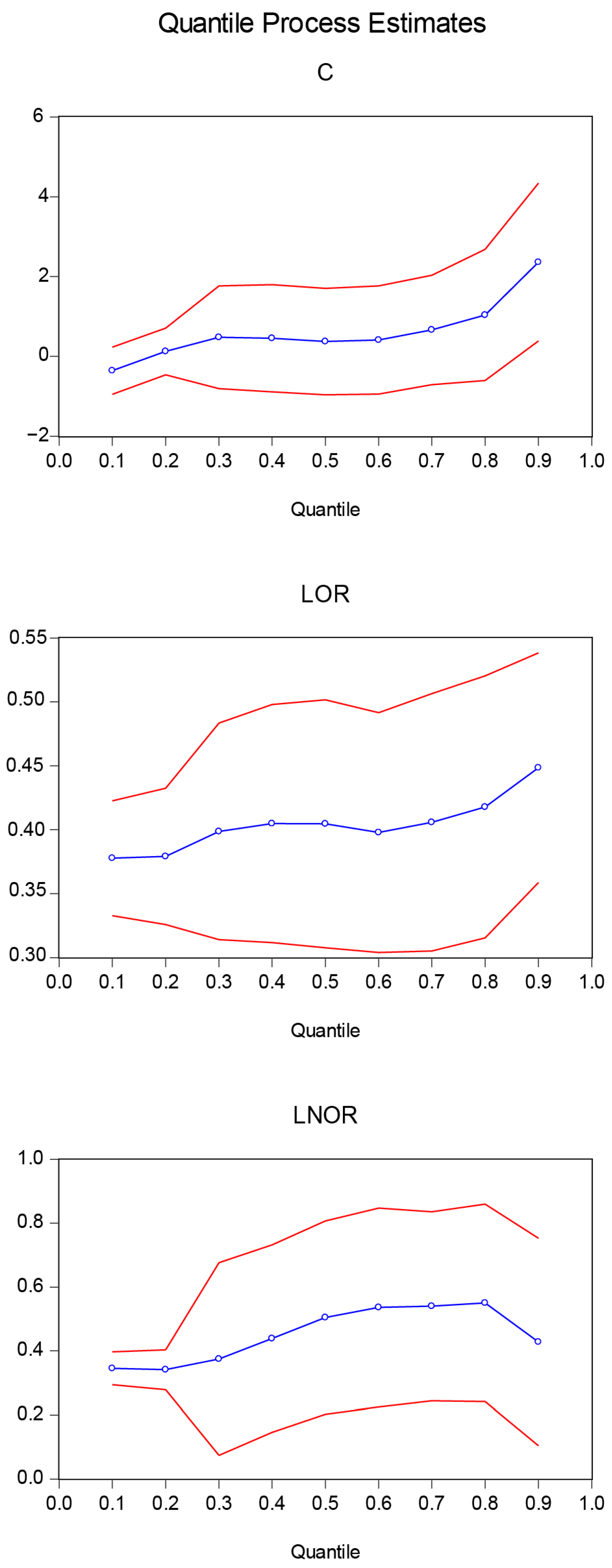
To provide a systematic analysis across deciles, we re-estimated the model using ten quantiles rather than only four. This allows us to see the pattern more clearly across the full growth distribution. The results from the ten-quantile model indicate that for the oil sector (LOR), the coefficient is positive and statistically significant at all quantiles in both models. In the four-quantile results, the oil effect increases slightly as we move from lower to higher growth levels. The ten-quantile results show this pattern more smoothly. The oil coefficient rises gradually from 0.378 at the 10th percentile to 0.448 at the 90th percentile. This means that oil remains important in all growth conditions, and its impact becomes somewhat stronger during high-growth periods.
The non-oil sector (LNOR) shows a similar overall pattern. In the four-quantile model, its effect is positive and significant at all reported quantiles. In the ten-quantile model, the coefficient remains positive throughout. It is statistically significant from the 20th percentile onward and generally increases toward the middle and upper parts of the distribution. The only weaker result appears at the very lowest growth level (τ = 0.1), where the effect is not statistically significant. This suggests that non-oil contributions are less stable during periods of extremely low growth. Overall, the ten-quantile results support the original conclusions. Oil remains structurally important, while the non-oil sector makes meaningful and increasingly strong contributions across most growth states.
Next, the test for slope equality is applied to confirm that the determinants of the dependent variable exert heterogeneous effects across its conditional distribution (
Table 3). The evidence of asymmetry indicates that economic responses differ between low and high regimes. In Model 1 (four quantiles), the Quantile Slope Equality Test gives a high
p-value (0.525). This means we cannot reject the idea that the slope coefficients are similar across quantiles. In simple terms, the effects of the oil and non-oil sectors do not differ sharply across low, middle, and high-growth states. The Symmetric Quantiles Test also shows a high
p-value (0.502). This suggests that the relationship between sectoral growth and GDP growth is broadly balanced between the lower and upper parts of the distribution.
Model 2 (ten quantiles) tells the same story, but rather more clearly (
Table 3). The Quantile Slope Equality Test has a high
p-value (0.957), and the Symmetric Quantiles Test also reports a high
p-value (0.997). These results show that there are no strong statistical breaks or sharp asymmetries across the distribution. The differences we observe across quantiles are gradual, not dramatic.
Overall, both models point in the same direction. The effects of oil and non-oil sectors remain fairly stable across growth levels. Using ten quantiles instead of four does not change the main conclusions. It simply confirms that the results are smooth, consistent, and robust.
Further,
Figure 1 plots the estimated coefficients across the full range of quantiles. The horizontal axis shows the quantiles, from 0.10 (low-growth periods) to 0.90 (high-growth periods). The vertical axis shows the estimated elasticities. Because the model is in logarithms, each coefficient can be read as a percentage effect. For example, a value of 0.50 means that a 1% increase in that sector is associated with a 0.5% increase in GDP at that growth level. The figure shows how the roles of the oil and non-oil sectors change across different economic conditions. For LOR, the coefficient is positive across all quantiles and increases slightly at higher quantiles. For LNOR, the coefficients are positive and increasing between the lower and middle quantiles. After peaking at around 0.6 and 0.8, there is a small decrease at the 0.9 quantiles. And as the confidence band is above zero, all the coefficients are significant.
Upon looking at the pattern, it is evident that the oil coefficient increases gradually as we move from low-growth to high-growth quantiles. This suggests that oil becomes slightly more influential when the economy is performing strongly. The change is smooth, not abrupt. The non-oil sector also shows a positive effect across almost all quantiles. Its coefficient increases from the lower to the middle and upper parts of the distribution, and in several cases, it exceeds the oil coefficient. This indicates that non-oil activities are increasingly important, especially during both normal and high-growth periods. Overall, the figure shows steady changes rather than sharp shifts. Oil remains important throughout, but the non-oil sector strengthens as growth improves. This visual evidence supports the idea of gradual diversification, in which the economy becomes more balanced without completely abandoning oil.
The empirical results provide strong evidence of asymmetric sectoral dynamics within the Saudi economy. During low-growth periods, the non-oil sector emerges as the principal stabilizing force, mitigating the adverse effects of declining oil revenues and external volatility. This highlights the growing significance of the private sector. During high-growth phases, however, the oil sector remains a dominant driver, reflecting its ongoing role in fueling fiscal expansion, generating foreign exchange earnings, and supporting large-scale public investments. The persistence of oil’s macroeconomic significance indicates that diversification, though progressing, remains partial rather than complete. The Saudi economy remains sensitive to global oil prices, although not as acutely as in previous decades.
The distributional evidence also reveals that diversification has enhanced economic resilience. The more substantial non-oil impact at lower quantiles suggests that Saudi Arabia is now better equipped to withstand external shocks, particularly those stemming from global energy-market volatility. In contrast, the convergence of oil and non-oil coefficients at higher quantiles suggests that structural reforms have allowed both sectors to contribute synergistically to growth, marking a transition toward a more balanced economic model.
Nevertheless, the persistence of oil’s influence, especially in upper quantiles, highlights the dual structure of the Saudi economy, having a growing non-oil base operating alongside a dominant oil sector that continues to underpin expansion. This duality underscores the importance of sustained policy commitment to promoting productivity growth, fostering innovation ecosystems, and enhancing private-sector competitiveness.
The quantile-based results, therefore, offer a nuanced understanding of how Saudi Arabia’s diversification has evolved. They demonstrate that diversification is not a binary shift from oil to non-oil, but a gradual rebalancing process where the two sectors increasingly interact to shape long-term development outcomes. This layered transformation provides an empirical foundation for the next stage of Saudi Arabia’s economic reform, which aims not merely to expand the non-oil sector, but to embed it as a self-sustaining engine of inclusive and innovation-led growth.
The non-oil sector exerts a consistently positive, statistically significant effect across all quantiles, with the most substantial impact at the lower end of the growth distribution. This implies that non-oil activities, particularly services, manufacturing, tourism, and logistics, have become crucial for stabilizing the economy during downturns. Conversely, the oil sector’s contribution intensifies at higher quantiles, underscoring its continued dominance during periods of economic boom. This dual pattern confirms that, while diversification in Saudi Arabia has made considerable progress, it remains partial and cyclical, strengthening during periods of low growth but still relying on hydrocarbons during expansions.
4.3. Robustness Analysis: Markov Switching Regression Results
To check whether the quantile regression results reflect deeper structural changes in the economy, we estimate a two-state Markov switching model. This model allows the effects of oil-sector growth (LOR) and non-oil-sector growth (LNOR) to vary across different regimes. We also include an AR(1) term to capture short-run growth persistence. This approach helps us identify hidden growth phases and see how the role of each sector shifts over time.
The results show two clear and economically meaningful regimes (
Table 4). In Regime 1, the non-oil sector seems to be the main driver of growth, with a much larger elasticity (0.869). The oil effect is 0.293, but it remains statistically significant. In Regime 2, the pattern changes. In Regime 2, oil plays the leading role. Its elasticity is strong and statistically significant (0.512). The non-oil sector also contributes positively, but its effect is smaller (0.168). The AR(1) term is negative and significant (−0.399), which suggests some correction after periods of unusually high or low growth.
The transition probabilities show that both regimes are persistent (
Table 5). Regime 1 lasts about 13.5 years on average, while Regime 2 lasts about 8.4 years. These are not short-lived shocks. They reflect longer structural phases. When the economy is in Regime 1, the probability of remaining in Regime 1 next year is 92.6%, and the probability of switching from Regime 1 to Regime 2 is 7.4%. Next, when the economy is in Regime 2, the probability of remaining in Regime 2 is 11.9%, and the probability of moving from Regime 2 to Regime 1 is 88%. Both regimes are highly persistent. The economy does not switch randomly from one state to another. Instead, once it enters a regime, it tends to remain there for several years.
In economic terms, Regime 1 represents an oil-dominant growth phase. Regime 2 reflects a more diversified phase, where the non-oil sector plays a stronger role. However, oil remains important in both regimes. Diversification does not mean replacing oil completely. Instead, it means rebalancing oil and non-oil activities.
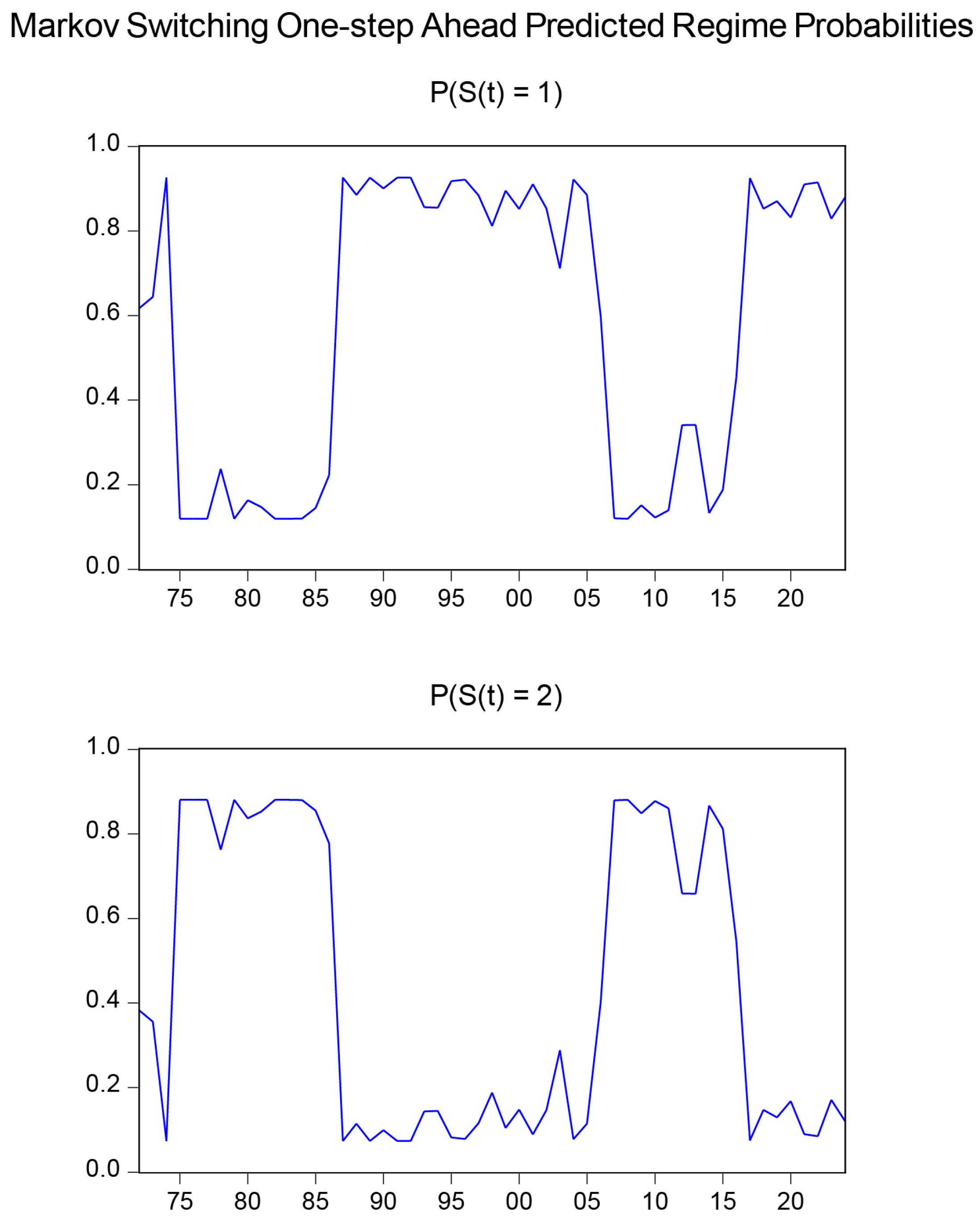
The Markov switching graph (
Figure 2) shows the predicted probability of each regime over time. The x-axis shows the years, from 1972 to 2024. The y-axis shows the probability value, which ranges from 0 to 1. A value close to 1 means the economy is very likely to be in that regime in a given year. A value close to 0 means it is unlikely to be in that regime. The top panel shows the probability of being in Regime 1 (the diversified regime). The bottom panel shows the probability of being in Regime 2 (the oil-based regime). Because the model has only two regimes, the probabilities move in opposite directions. When one goes up, the other goes down. These graphs help us see when the economy shifts between oil-based growth and more diversified growth over time.
In the upper graph depicting the diversified phase, the probability of Regime 1 is low during the late 1970s to the mid-1980s. This means the economy was more likely to be in the oil-based regime during this period. Then, during the late 1980s to mid-2000s, the probability rises sharply and remains very high (close to 1). This suggests a long, persistent, diversified phase. But around 2008–2015, the probability fell again. This indicates a shift back toward oil-based growth during this turbulent global period. Finally, after 2016, the probability increases once more, suggesting a renewed diversification push.
In the lower graph depicting the oil-based phase, for the period from the late 1970s to the mid-1980s, there is a high probability of oil-based growth. Then, in the late 1980s to mid-2000s, the probability is very low, indicating that oil was not the dominant structural driver during this phase. But around 2008–2015, oil dominance rises again, and, lastly, post-2016, oil probability declines as diversification strengthens. Overall, the probability patterns suggest gradual diversification within an economic structure where oil influence periodically resurfaces.
The Markov-switching results provide complementary evidence to the quantile regression results on the evolution of Saudi Arabia’s growth structure. The quantile estimates show that the contribution of the non-oil sector increases notably in middle- and upper-income states, while oil remains positive across the entire distribution. This indicates that diversification gains strength particularly during stronger economic conditions. The Markov-switching model extends this finding by revealing two persistent structural regimes: a diversified regime and an oil-based regime. Periods dominated by the diversified regime coincide with phases in which non-oil elasticity is structurally stronger, while oil-dominant phases reflect a return to traditional growth dependence. Importantly, oil remains significant in both regimes, confirming that diversification represents a gradual rebalancing rather than a structural break. Taken together, the results suggest that Saudi Arabia’s transition toward sustainability is nonlinear and state-dependent, operating both within growth distributions and across long-run structural phases.
5. Discussion
Overall, the results suggest that oil acts mainly as a growth accelerator during expansions, while the non-oil sector contributes more to stability during slower periods. Diversification, therefore, does not simply reduce dependence on oil in an accounting sense. It strengthens resilience by supporting the economy during periods of economic weakness. These findings provide empirical evidence that sustainable development in oil-dependent economies requires both growth enhancement and stabilisation mechanisms across different economic states.
The findings of this study are broadly consistent with the existing literature on economic diversification in resource-rich economies. Similar to earlier studies that emphasize the stabilizing role of non-oil activities in oil-dependent economies [
7,
10,
20], the results confirm that Saudi Arabia’s non-oil sector contributes positively to growth across all economic regimes, with its influence particularly strong during periods of low growth. This supports the argument that diversification enhances resilience against oil price volatility, as highlighted by Auty [
8], Corden and Neary [
9], and Arezki et al. [
20]. In line with Matallah and Matallah [
21] and Alabdulwahab [
22], the oil sector is found to remain a significant driver of growth, especially during expansionary phases, underscoring the incomplete nature of diversification in Saudi Arabia. The results are also similar to Zafar and Ali [
33] that Saudi Arabia is clearly moving toward diversification, but the journey is gradual and oil still plays a dominant role.
The results of this study is in line with the findings of previous studies like; Saudi Arabia has achieved some progress toward its goal of economic diversification, although the outcome remains partial rather than complete as suggested by Houfi [
39]; oil price increases remain the dominant driver of economic expansion, while structural reform efforts have not yet eliminated oil dependence as highlighted by Elhassan [
40]; in Saudi Arabia oil prices exert a statistically significant and persistent negative effect on diversification of Sweidan and Elbargathi [
41]; asymmetric oil shock decompositions as conceived by Raid et al. [
42]; sustainable diversification in Saudi Arabia is primarily driven by structural reforms rather than short-term oil revenue dynamics as opined by AlAbdi et al. [
43]; and that oil is still the main engine driving the economy as suggested by Albassam [
47].
5.1. Assessment of Research Questions and Hypotheses
The study addresses three central questions: whether the oil sector behaves differently across growth regimes, whether the non-oil sector plays a stabilising role during slowdowns, and whether sectoral elasticities are symmetric across the growth distribution. The empirical results directly address these questions and provide clear answers.
First, the findings show that the impact of oil-sector activity on GDP is not constant. The elasticity increases as we move from lower to higher quantiles of the growth distribution. Oil contributes positively at all levels of growth, but its effect is much stronger during expansionary phases. This directly answers RQ1 and supports H1. The evidence confirms that oil activity amplifies growth during boom periods, consistent with fiscal and investment transmission channels in resource-dependent economies.
Second, the results indicate that the non-oil sector plays a relatively stronger and more stable role at lower growth quantiles. During slowdowns, its contribution becomes comparatively more important. This directly addresses RQ2 and supports H2. The findings suggest that diversification enhances resilience by cushioning the economy when oil-driven growth weakens. In this sense, the non-oil sector functions as a stabilising force rather than merely an additional source of output.
Third, the Wald tests reveal significant differences in coefficients across quantiles. The elasticities are not symmetric across the low and high regimes of growth. This provides a clear answer to RQ3 and supports H3. The Saudi economy exhibits nonlinear, state-dependent dynamics, meaning that sectoral effects vary with the economic environment.
Taken together, the results move the analysis beyond a simple descriptive comparison of oil and non-oil shares. They show that oil mainly acts as a growth accelerator during expansions, while the non-oil sector helps stabilise the economy during downturns. Hence, the study demonstrates that diversification contributes not only to structural transformation but also to macroeconomic resilience, which is an essential element of sustainable development in oil-dependent economies.
Together, these findings imply that Saudi Arabia’s growth process remains oil-influenced but increasingly supported by non-oil activity, particularly in median and upper-growth regimes. However, interpreting these results solely as confirmation of structural diversification would be premature without considering alternative explanations.
One competing interpretation concerns the increase in oil elasticity at higher quantiles. The stronger oil effect during expansionary periods may reflect cyclical oil-market conditions rather than deep structural features of the domestic economy. Periods of elevated oil elasticity may coincide with global oil price booms, coordinated production adjustments, or temporary revenue windfalls, thereby amplifying oil’s contribution to GDP growth. In this case, the rising elasticity at upper quantiles could capture cyclical production dynamics rather than structural transformation. Thus, while the quantile evidence confirms oil’s persistent importance, it does not independently distinguish between structural oil dependence and cyclical oil-driven expansions.
Similarly, the strong, statistically significant non-oil coefficients at the median and upper quantiles may partly reflect demand spillovers from oil booms rather than fully autonomous non-oil dynamism. During periods of high oil revenues, increased public expenditure and liquidity can stimulate construction, services, and manufacturing activity. Under this interpretation, non-oil growth is partly oil-financed rather than entirely independent. The weakening of non-oil significance in the lowest quantile is consistent with this view that during severe downturns, when oil revenues contract sharply, the non-oil sector appears less capable of sustaining growth independently. Therefore, the quantile evidence suggests partial diversification, but not complete insulation from oil cycles.
At the same time, the results reveal an important structural feature. Non-oil growth remains positive and economically meaningful across nearly the entire growth distribution. Even if oil cycles influence non-oil expansion, the magnitude and persistence of the non-oil coefficients indicate that the sector has become embedded in the broader growth process. Moreover, the failure to reject the equality of slopes across quantiles suggests relative stability in the relationship between sectoral shares and GDP growth. This stability is more consistent with gradual structural adjustment than with purely transitory fluctuations.
The Markov-switching evidence strengthens the conclusion that Saudi Arabia’s growth structure is evolving in a complementary rather than a transformational manner. The existence of a regime in which non-oil elasticity exceeds oil elasticity indicates measurable progress toward diversification. However, the continued statistical significance of oil in both regimes confirms that oil remains structurally embedded in the growth process.
The persistence of both regimes suggests that diversification is not confined to temporary episodes but reflects deeper structural adjustments. At the same time, the absence of any regime in which oil becomes irrelevant indicates that diversification has not yet reached a stage of structural decoupling. Instead, the results point to gradual rebalancing, in which non-oil sectors increasingly support growth while oil continues to anchor macroeconomic performance.
Overall, the Markov switching analysis provides regime-based confirmation of the quantile regression findings. Both approaches converge on a consistent conclusion: Saudi Arabia’s economic transformation is incremental and complementary. The economy exhibits meaningful diversification gains, yet oil remains a central structural driver across growth states. This robustness exercise therefore reinforces the interpretation that diversification is progressing through the relative strengthening of non-oil sectors rather than an abrupt structural transition.
5.2. Policy Recommendation
The results from the 4-quantile model, the 10-quantile regression, and the Markov Switching model tell a consistent story. Saudi Arabia’s growth does not follow a single, stable pattern. The roles of the oil and non-oil sectors differ depending on whether the economy is growing slowly, moderately, or strongly. Growth also shifts between persistent structural regimes. This means policymakers cannot rely on a single, fixed strategy.
1. Adopt state-contingent macroeconomic policy. Oil has the strongest impact on growth during normal or moderate expansion phases and in the oil-dominant regime. During these periods, the government should avoid expanding spending simply because oil revenues rise. Instead, it should save part of the windfall and invest in long-term productivity. When the economy enters a diversification-oriented phase or a high-growth state, policymakers should push reforms more aggressively. These moments offer a real opportunity to strengthen non-oil sectors and make structural change permanent.
2. Protect non-oil sectors during slow growth. The lower quantiles indicate that non-oil sectors continue to support growth even as the economy slows. Oil becomes relatively less dominant in these states. This means diversification of sectors helps stabilize the economy. During downturns, the government should avoid cutting investment in non-oil industries. Supporting SMEs, non-oil manufacturing, and domestic value-added activities can improve resilience and reduce vulnerability to oil shocks.
3. Strengthen oil revenue management. The Markov Switching results show that the oil-dominant regime tends to last for many years. Oil-driven growth phases are not short-lived. Because of this persistence, Saudi Arabia needs strong fiscal anchors. The government should continue building buffers, follow medium-term spending frameworks, and reduce the link between oil prices and public expenditure. This will help prevent repeated cycles of oil dependence.
4. Focus on increasing non-oil growth impact, not just size. Diversification is not only about raising the share of non-oil output. What matters more is how strongly non-oil activity drives overall GDP. The results show that this impact changes across growth states. Policymakers should therefore focus on raising productivity, encouraging technology adoption, attracting high-quality investment, and strengthening private-sector participation. These steps will strengthen and make non-oil growth more sustainable.
5. Make diversification reforms permanent. Although the results show progress, oil still plays a major role in many growth states. Structural change remains incomplete. To ensure lasting transformation under Saudi Vision 2030, the government must embed reforms in institutions, not just in short-term programs. Stronger governance, better regulation, and deeper markets will help prevent the economy from sliding back into oil dependence.
In short, the evidence shows that Saudi Arabia’s growth process is nonlinear and regime-dependent. Policy must reflect this reality. A flexible, state-aware, and long-term approach will offer the best chance of sustained, stable economic transformation. The results help us understand how the linkages between the oil and non-oil sectors, and between these sectors and GDP, change under different growth conditions. But it does not prove that one sector directly causes growth in a strict sense. The estimates show patterns and associations that vary across states of the economy, not clean, isolated causal effects. So, we should treat the policy suggestions as practical guidance drawn from the data, not as deterministic policy prescriptions that will automatically produce certain outcomes.
5.3. Limitations and Directions for Future Research
This study has some limitations. First, it uses annual data. Annual data may mask important differences within non-oil sectors and fail to fully capture short-run changes. Although the Markov model identifies distinct growth regimes, annual data limits the precision with which we can observe transitions. Second, both quantile regression and the Markov model focus on relationships rather than strict causality. Sectoral growth and GDP growth can influence each other. Future studies could use structural VAR models, time-varying parameter models, or instrumental variables to better identify causal effects.
Third, the Markov model assumes that transition probabilities remain constant over time. In reality, reforms, global oil shocks, or institutional changes may alter these probabilities. Future research could allow transition probabilities to change over time and link them to policy or oil price variables. Fourth, this study focuses only on Saudi Arabia. While this provides detailed insight, the findings may not apply to all oil-exporting countries. Future research could compare Saudi Arabia with other GCC countries or resource-rich economies such as Norway, Nigeria, or Chile. Future studies could also use quarterly data, sector-level productivity measures, export diversification indices, or governance indicators. These extensions would help explain why some regimes persist and how reforms influence long-term diversification.