Education Increases Solar Radiation Modification Literacy but Reinforces Caution: Evidence from a Pre–Post University Study


Abstract
1. Introduction
2. Literature Review
2.1. SRM in the Climate Intervention Landscape: Promise, Limits, and Uncertainty
2.2. Governance, Legitimacy, and Justice as Inseparable Dimensions of SRM Perceptions
2.3. What Shapes Public and Stakeholder Perceptions of SRM?
2.4. From Perceptions to Learning: Why Education Is Not a Simple “Information Deficit” Fix
2.5. Research Gap and Positioning of the Present Study
3. Materials and Methods
3.1. Course Context, Sampling, and Study Timeline
3.2. Educational Module Design and Implementation
3.3. Participants, Survey Administration, and Ethics
3.4. Measures and Data Processing
3.5. Quantitative Analysis
3.6. Qualitative Coding of Open-Ended Responses
4. Results
4.1. Sample Characteristics
4.2. Baseline Climate and Policy Attitudes
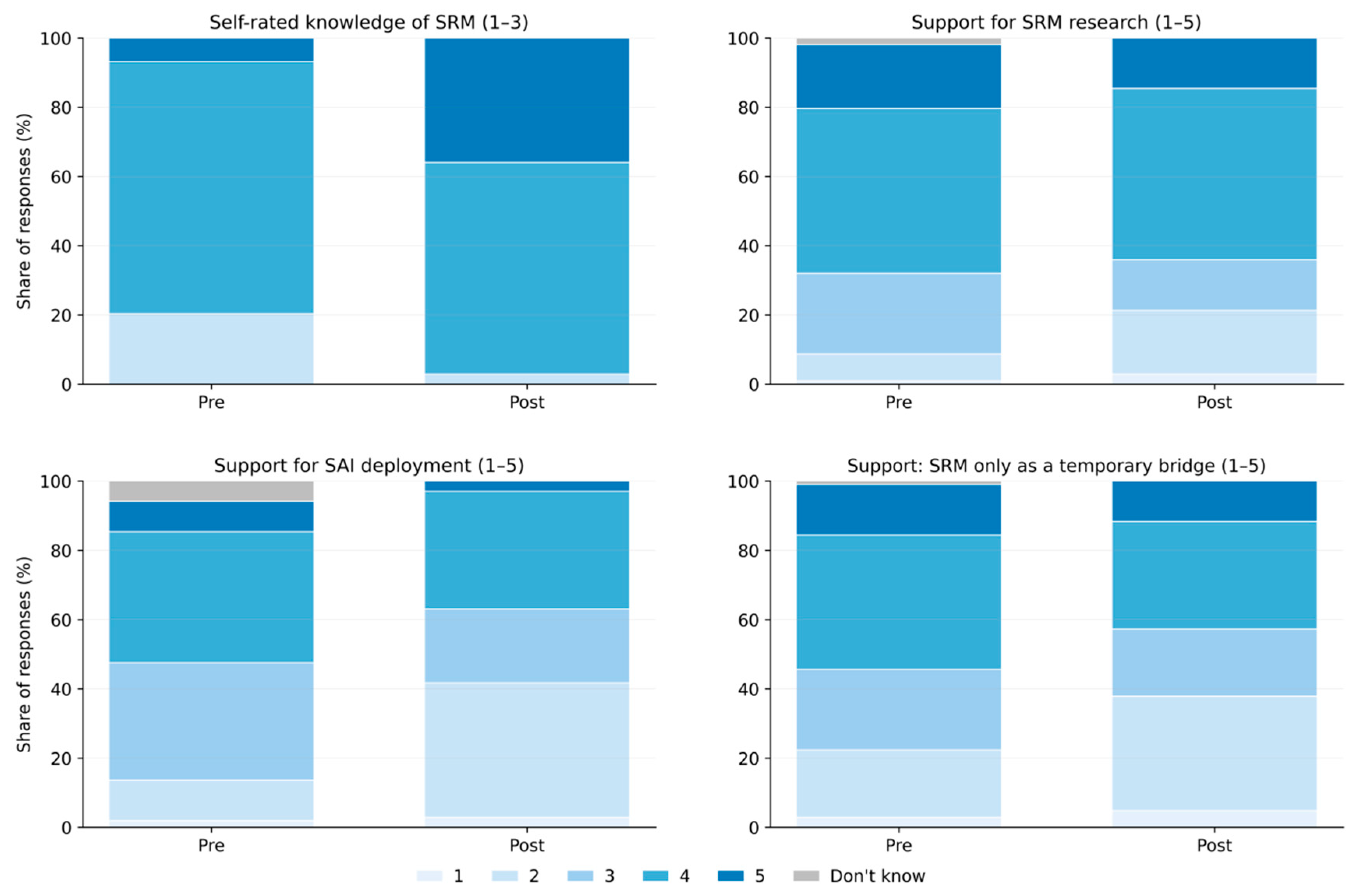
4.3. Pre–Post Changes in SRM Knowledge and Attitudes
4.4. Post-Lecture Beliefs: Literacy, Benefits vs. Risks, Governance, and Moral Hazard
4.5. Correlates of Post-Lecture Support
4.6. Themes in Open-Ended Responses
5. Discussion
5.1. From Awareness to Caution: Instruction Reshapes SRM Judgments
5.2. “Research Yes, Deployment No”: Distinguishing Epistemic Value from Risk Acceptance
5.3. Preference for Low-Carbon Development and the Salience of Moral Hazard
5.4. Implications for SRM Education and Deliberative Course Design
5.5. Limitations and Future Research
6. Conclusions
- (1)
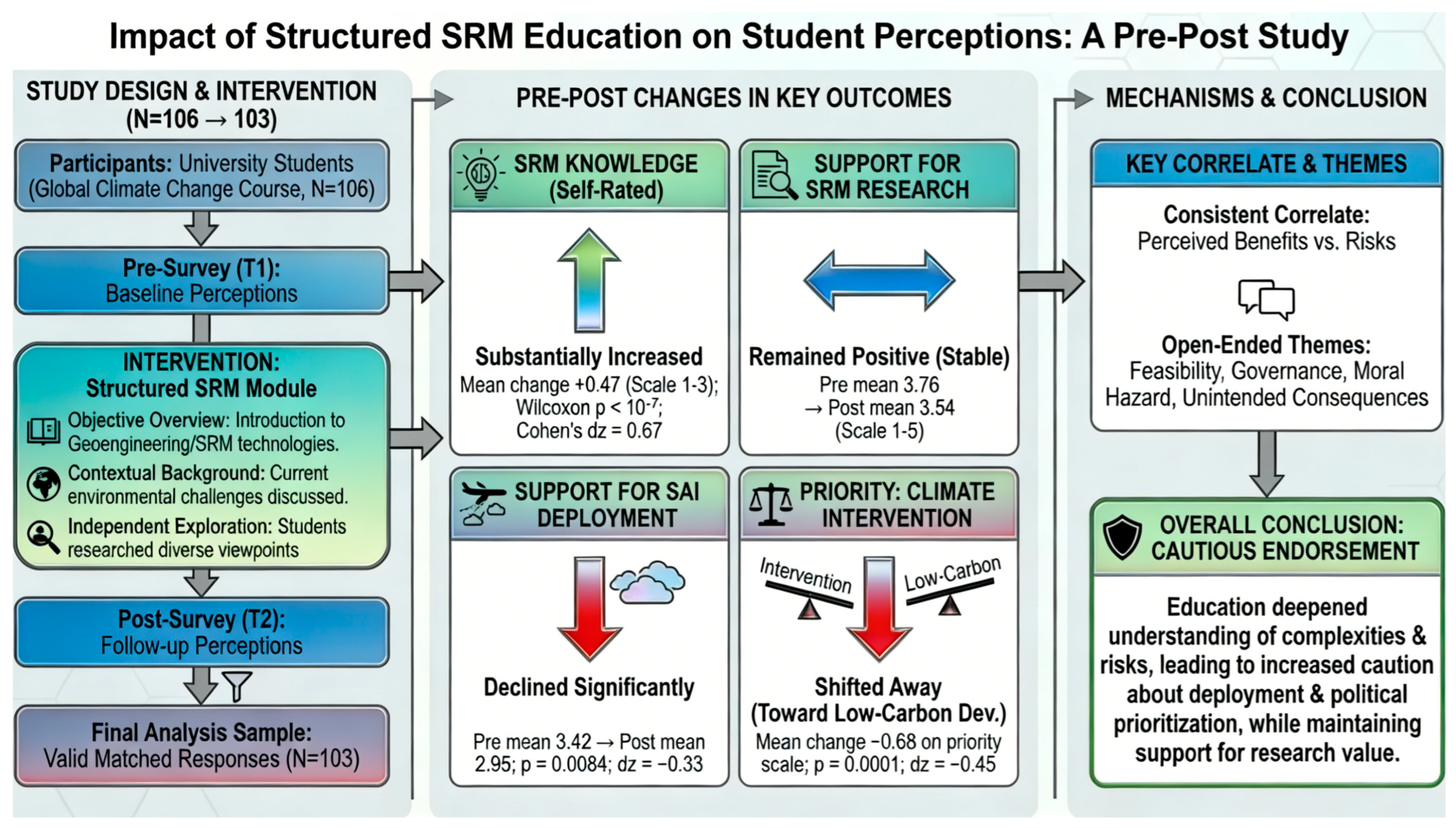
- Self-rated SRM knowledge increased substantially after the classroom module (dz = 0.67).
- (2)
- Support for SAI deployment declined (dz = −0.33), and students shifted toward prioritizing low-carbon development over climate intervention (dz = −0.45).
- (3)
- Most students continued to view SRM research as valuable, but expressed reluctance to accept SRM-related risks and emphasized governance, moral hazard, and unintended consequences.
Author Contributions
Funding
Institutional Review Board Statement
Informed Consent Statement
Data Availability Statement
Conflicts of Interest
Abbreviations
| SRM | Solar radiation modification |
| SAI | Stratospheric aerosol injection |
| CDR | Carbon dioxide removal |
| IPCC | Intergovernmental Panel on Climate Change |
| CI | Confidence interval |
Appendix A. Details of the Survey Questionnaires Used in This Study
Appendix A.1. Pre-Geoengineering Lecture Survey
Appendix A.2. Post-Geoengineering Lecture Survey
References
- IPCC. Climate Change 2021: The Physical Science Basis. Contribution of Working Group I to the Sixth Assessment Report of the Intergovernmental Panel on Climate Change; Cambridge University Press: Cambridge, UK, 2021. [Google Scholar]
- IPCC. Climate Change 2022: Impacts, Adaptation and Vulnerability. Contribution of Working Group II to the Sixth Assessment Report; Cambridge University Press: Cambridge, UK, 2022. [Google Scholar]
- IPCC. Climate Change 2022: Mitigation of Climate Change. Contribution of Working Group III to the Sixth Assessment Report; Cambridge University Press: Cambridge, UK, 2022. [Google Scholar]
- National Academies of Sciences, Engineering, and Medicine. Reflecting Sunlight: Recommendations for Solar Geoengineering Research and Research Governance; The National Academies Press: Washington, DC, USA, 2021. [Google Scholar] [CrossRef]
- National Research Council. Climate Intervention: Carbon Dioxide Removal and Reliable Sequestration; The National Academies Press: Washington, DC, USA, 2015; ISBN 0-309-30529-2. [Google Scholar]
- National Research Council. Climate Intervention: Reflecting Sunlight to Cool Earth; The National Academies Press: Washington, DC, USA, 2015. [Google Scholar]
- UNEP. One Atmosphere: An Independent Expert Review on Solar Radiation Modification Research and Deployment; United Nations Environment Programme: Nairobi, Kenya, 2023. [Google Scholar]
- The Royal Society. Geoengineering the Climate: Science, Governance and Uncertainty; The Royal Society: London, UK, 2009. [Google Scholar]
- Gardiner, S.M.; McKinnon, C.; Fragnière, A. (Eds.) The Ethics of “Geoengineering” the Global Climate; Routledge: London, UK, 2021. [Google Scholar]
- Hourdequin, M. Climate change, climate engineering, and the ‘global poor’: What does justice require? Ethics Policy Environ. 2018, 21, 270–288. [Google Scholar] [CrossRef]
- Young, D.N. Who can govern from a house on fire? International order, state responsibility, and the problem of solar radiation modification. Ethics Int. Aff. 2024, 38, 243–254. [Google Scholar] [CrossRef]
- Biermann, F.; Oomen, J.; Gupta, A.; Ali, S.H.; Conca, K.; Hajer, M.A.; Kashwan, P.; Kotzé, L.J.; Leach, M.; Messner, D.; et al. Solar geoengineering: The case for an international non-use agreement. WIREs Clim. Change 2022, 13, e754. [Google Scholar] [CrossRef]
- Sovacool, B.K.; Baum, C.M.; Cantoni, R.; Low, S. Actors, legitimacy, and governance challenges facing negative emissions and solar geoengineering technologies. Environ. Polit. 2024, 33, 340–365. [Google Scholar] [CrossRef] [PubMed]
- Corner, A.; Pidgeon, N.; Parkhill, K. Perceptions of geoengineering: Public attitudes, stakeholder perspectives, and the challenge of “upstream” engagement. WIREs Clim. Change 2012, 3, 451–466. [Google Scholar] [CrossRef]
- Macnaghten, P.; Szerszynski, B. Living the global social experiment: An analysis of public discourse on solar radiation management and its implications for governance. Glob. Environ. Change 2013, 23, 465–474. [Google Scholar] [CrossRef]
- Mercer, A.M.; Keith, D.W.; Sharp, J.D. Public understanding of solar radiation management. Environ. Res. Lett. 2011, 6, 044006. [Google Scholar] [CrossRef]
- Raimi, K.T. Public perceptions of geoengineering. Curr. Opin. Psychol. 2021, 42, 66–70. [Google Scholar] [CrossRef]
- Carlisle, D.P.; Feetham, P.M.; Wright, M.J.; Teagle, D.A.H. The public remain uninformed and wary of climate engineering. Clim. Change 2020, 160, 303–322. [Google Scholar] [CrossRef]
- Contzen, N.; Perlaviciute, G.; Steg, L.; Reckels, S.C.; Alves, S.; Bidwell, D.; Böhm, G.; Bonaiuto, M.; Chou, L.-F.; Corral-Verdugo, V.; et al. Public opinion about solar radiation management: A cross-cultural study in 20 countries around the world. Clim. Change 2024, 177, 65. [Google Scholar] [CrossRef]
- Baum, C.M.; Fritz, L.; Low, S.; Sovacool, B.K. Public perceptions and support of climate intervention technologies across the Global North and Global South. Nat. Commun. 2024, 15, 2060. [Google Scholar] [CrossRef]
- Filho, W.L.; Sima, M.; Sharifi, A.; Luetz, J.M.; Salvia, A.L.; Mifsud, M.; Olooto, F.M.; Djekic, I.; Anholon, R.; Rampasso, I.; et al. Handling climate change education at universities: An overview. Environ. Sci. Eur. 2021, 33, 109. [Google Scholar] [CrossRef]
- Kelly, O.; Illingworth, S.; Butera, F.; Dawson, V.; White, P.; Blaise, M.; Martens, P.; Schuitema, G.; Huynen, M.; Bailey, S.; et al. Education in a warming world: Trends, opportunities and pitfalls for institutes of higher education. Front. Sustain. 2022, 3, 920375. [Google Scholar] [CrossRef]
- Monroe, M.C.; Plate, R.R.; Oxarart, A.; Bowers, A.; Chaves, W.A. Identifying effective climate change education strategies: A systematic review of the research. Environ. Educ. Res. 2019, 25, 791–812. [Google Scholar] [CrossRef]
- Aeschbach, V.M.-J.; Schwichow, M.; Rieß, W. Effectiveness of climate change education—A meta-analysis. Front. Educ. 2025, 10, 1563816. [Google Scholar] [CrossRef]
- Dietz, T. Decisions for Sustainability: Facts and Values; Cambridge University Press: Cambridge, UK, 2023; ISBN 978-1-009-16940-0. [Google Scholar]
- Sie, A.; Brechin, S.R.; Borick, C.P. Geoengineering priorititization: A study of a proposed expression of mitigation deterrence. Clim. Change 2025, 178, 194. [Google Scholar] [CrossRef]
- Dove, Z.; Hernandez, A.; Talati, S.; Jinnah, S. Global perspectives on solar geoengineering: A novel framework for analyzing research in pursuit of effective, inclusive, and just governance. Energy Res. Soc. Sci. 2024, 118, 103779. [Google Scholar] [CrossRef]
- Cummings, C.L.; Lin, S.H.; Trump, B.D. Public perceptions of climate geoengineering: A systematic review of the literature. Clim. Res. 2017, 73, 247–264. [Google Scholar] [CrossRef]
- Sugiyama, M.; Asayama, S.; Kosugi, T.; Ishii, A.; Watanabe, S. Public attitude toward solar radiation modification: Results of a two-scenario online survey on perception in four Asia–Pacific countries. Sustain. Sci. 2025, 20, 423–438. [Google Scholar] [CrossRef]
- Parker, A.; Irvine, P.J. The risk of termination shock from solar geoengineering. Earths Future 2018, 6, 456–467. [Google Scholar] [CrossRef]
- Trisos, C.H.; Amatulli, G.; Gurevitch, J.; Robock, A.; Xia, L.; Zambri, B. Potentially dangerous consequences for biodiversity of solar geoengineering implementation and termination. Nat. Ecol. Evol. 2018, 2, 475–482. [Google Scholar] [CrossRef]
- Crutzen, P.J. Albedo enhancement by stratospheric sulfur injections: A contribution to resolve a policy dilemma? Clim. Change 2006, 77, 211–220. [Google Scholar] [CrossRef]
- Keith, D.W. Geoengineering the climate: History and prospect. Annu. Rev. Energy Environ. 2000, 25, 245–284. [Google Scholar] [CrossRef]
- Stilgoe, J.; Owen, R.; Macnaghten, P. Developing a framework for responsible innovation. Res. Policy 2013, 42, 1568–1580. [Google Scholar] [CrossRef]
- Frumhoff, P.C.; Stephens, J.C. Towards legitimacy of the solar geoengineering research enterprise. Philos. Trans. R. Soc. A 2018, 376, 20160459. [Google Scholar] [CrossRef]
- Parson, E.A.; Reynolds, J.L. Solar geoengineering: Scenarios of future governance challenges. Futures 2021, 133, 102806. [Google Scholar] [CrossRef]
- Honegger, M.; Michaelowa, A.; Pan, J. Potential implications of solar radiation modification for achievement of the Sustainable Development Goals. Mitig. Adapt. Strateg. Glob. Change 2021, 26, 21. [Google Scholar] [CrossRef]
- Young, D.N. Considering stratospheric aerosol injections beyond an environmental frame: The intelligible ‘emergency’ techno-fix and preemptive security. Eur. J. Int. Secur. 2023, 8, 262–280. [Google Scholar] [CrossRef]
- Corry, O.; McLaren, D.; Kornbech, N. Scientific models versus power politics: How security expertise reframes solar geoengineering. Rev. Int. Stud. 2024, 1–20. [Google Scholar] [CrossRef]
- Corner, A.; Pidgeon, N. Like artificial trees? The effect of framing by natural analogy on public perceptions of geoengineering. Clim. Change 2015, 130, 425–438. [Google Scholar] [CrossRef]
- Corner, A.; Pidgeon, N. Geoengineering, climate change scepticism and the “moral hazard” argument: An experimental study of UK public perceptions. Philos. Trans. R. Soc. A 2014, 372, 20140063. [Google Scholar] [CrossRef]
- Merk, C.; Wagner, G. Presenting balanced geoengineering information has little effect on mitigation engagement. Clim. Change 2024, 177, 11. [Google Scholar] [CrossRef]
- Raimi, K.T.; Maki, A.; Dana, D.; Vandenbergh, M.P. Framing of geoengineering affects support for climate change mitigation. Environ. Commun. 2019, 13, 300–319. [Google Scholar] [CrossRef]
- Corner, A.; Parkhill, K.; Pidgeon, N.; Vaughan, N.E. Messing with nature? Exploring public perceptions of geoengineering in the UK. Glob. Environ. Change 2013, 23, 938–947. [Google Scholar] [CrossRef]
- Pidgeon, N.; Parkhill, K.; Corner, A.; Vaughan, N. Deliberating stratospheric aerosols for climate geoengineering and the SPICE project. Nat. Clim. Change 2013, 3, 451–457. [Google Scholar] [CrossRef]
- Low, S.; Fritz, L.; Baum, C.M.; Sovacool, B.K. Public perceptions on solar geoengineering from focus groups in 22 countries. Commun. Earth Environ. 2024, 5, 352. [Google Scholar] [CrossRef]
- Magistro, B.; Debnath, R.; Wennberg, P.O.; Alvarez, R.M. Partisanship overcomes framing in shaping solar geoengineering perceptions: Evidence from a conjoint experiment. npj Clim. Action 2025, 4, 29. [Google Scholar] [CrossRef]
- Aldy, J.E.; Felgenhauer, T.; Pizer, W.A.; Tavoni, M.; Belaia, M.; Borsuk, M.E.; Ghosh, A.; Heutel, G.; Heyen, D.; Horton, J.; et al. Social science research to inform solar geoengineering. Science 2021, 374, 815–818. [Google Scholar] [CrossRef]
- Mezirow, J. Transformative learning: Theory to practice. New Dir. Adult Contin. Educ. 1997, 74, 5–12. [Google Scholar] [CrossRef]
- Posner, G.J.; Strike, K.A.; Hewson, P.W.; Gertzog, W.A. Accommodation of a scientific conception: Toward a theory of conceptual change. Sci. Educ. 1982, 66, 211–227. [Google Scholar] [CrossRef]
- Sadler, T.D. Informal reasoning regarding socioscientific issues: A critical review of research. J. Res. Sci. Teach. 2004, 41, 513–536. [Google Scholar] [CrossRef]
- Zeidler, D.L.; Sadler, T.D.; Simmons, M.L.; Howes, E.V. Beyond STS: A research-based framework for socioscientific issues education. Sci. Educ. 2005, 89, 357–377. [Google Scholar] [CrossRef]
- Kolstø, S.D. Scientific literacy for citizenship: Tools for dealing with the science dimension of controversial socioscientific issues. Sci. Educ. 2001, 85, 291–310. [Google Scholar] [CrossRef]
- Ruddigkeit, D.; Bruggink, H.; Gupta, A. Solar geoengineering governance: A fragmented institutional landscape covering multi-dimensional impacts. Eur. J. Risk Regul. 2025, 16, 1294–1305. [Google Scholar] [CrossRef]
- Baum, C.M.; Fritz, L.B.; Low, S.; Sovacool, B.K. Like diamonds in the sky? Public perceptions, governance, and information framing of solar geoengineering activities in Mexico, the United Kingdom, and the United States. Environ. Polit. 2024, 33, 868–895. [Google Scholar] [CrossRef] [PubMed]
- Borick, C.; Mills, S.; Rabe, B. National Surveys on Energy and Environment [United States]; Inter-University Consortium for Political and Social Research (ICPSR): Ann Arbor, MI, USA, 2019. [Google Scholar] [CrossRef]
- Leiserowitz, A.; Maibach, E.; Rosenthal, S.; Kotcher, J.; Goddard, E.; Carman, J.; Verner, M.; Myers, T.; Ettinger, J.; Fine, J.; et al. Climate Change in the American Mind: Politics & Policy, Spring 2025; Yale University and George Mason University: New Haven, CT, USA, 2025; Available online: https://climatecommunication.gmu.edu/all/climate-change-in-the-american-mind-politics-and-policy-spring-2025/ (accessed on 2 March 2026).
- Gardiner, S.M. Is “arming the future” with geoengineering really the lesser evil? In Climate Ethics: Essential Readings; Oxford University Press: Oxford, UK, 2010. [Google Scholar]
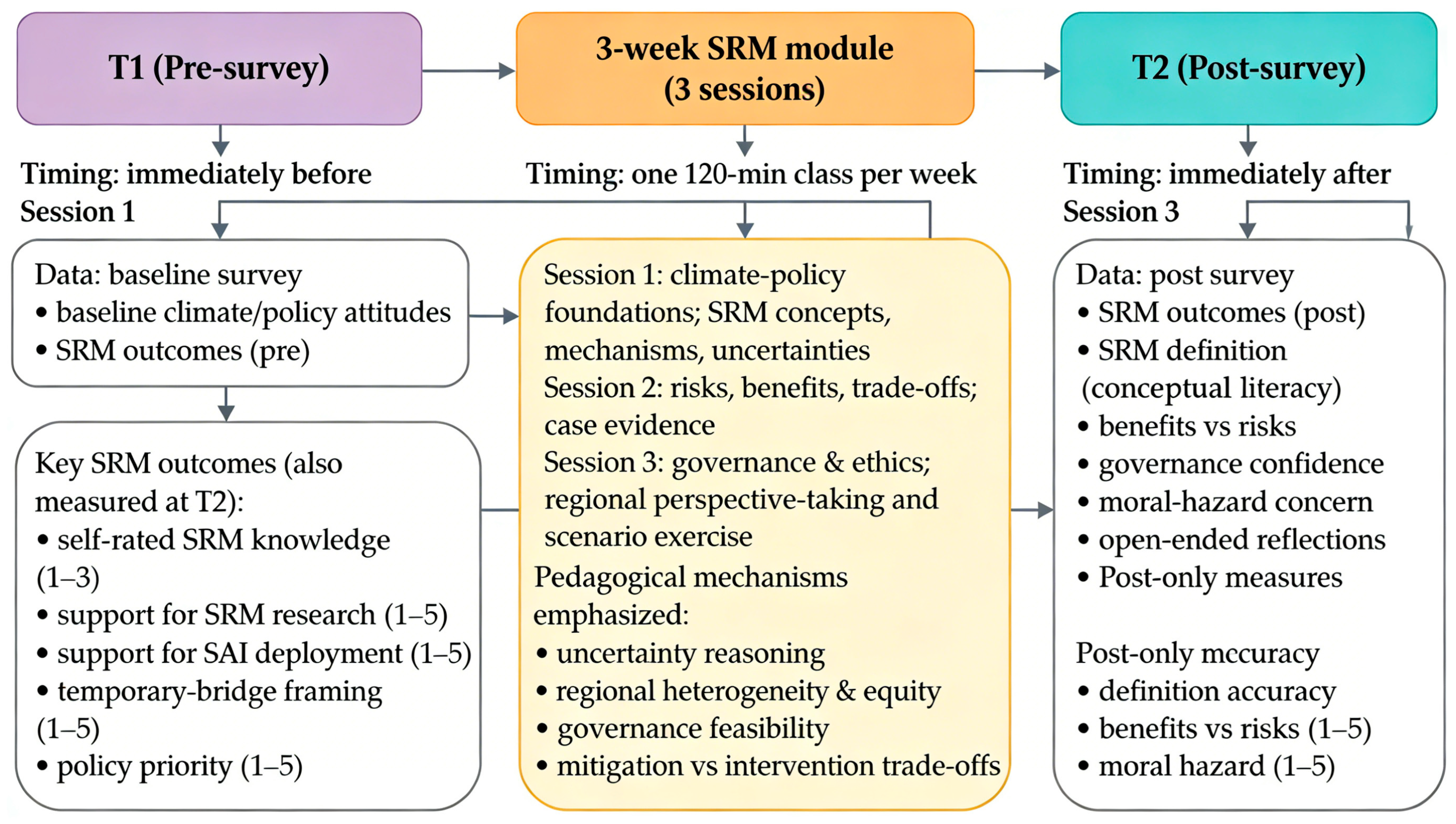



| Session | Topic | Reading/Materials | Activity (In-Class) | Output |
|---|---|---|---|---|
| S 1 | Climate policy foundations; governance; vulnerability, resilience, and inequality | Slides C5: “Climate Mitigation and Adaptation & Fundamentals of Climate Policy” (includes UNFCCC principles; climate governance; vulnerability and structural inequalities; climate justice/equity) | Mini-lecture + guided discussion on governance principles (fairness, CBDR, precaution) and why vulnerability/adaptive capacity differ across regions | Participation notes; short written responses to “questions for thought” (optional) |
| S 2 | Exponential growth; planetary boundaries; emission gaps; social cost of carbon and discounting | Slides C6: “Exponential Growth, Planetary Boundaries and Social Costs of Carbon” (includes SCC, discounting, damage functions; governance framing) | Concept questions + short calculations/discussion on discounting and how normative assumptions change policy conclusions | Completed worksheet/calculation notes; discussion summary |
| S 3 | Mitigation policy instruments and co-benefits; SRM as contingency (Plan B); SRM risks, uncertainties, governance/ethics | Slides C7: “Climate Mitigation: Approaches & Policies” (includes mitigation instruments, co-benefits literature; SRM proposals; regional impacts; governance/ethics; reflective.org simulator; SRM scenario game prompts) | Structured perspective-taking “SRM Scenario Game” in regional groups + plenary comparison of trade-offs and governance conditions | Group decision memo + plenary reflection; administered post-survey (T2) after session |
| Major | N | % |
|---|---|---|
| Natural Sciences | 21 | 20.4 |
| Engineering | 16 | 15.5 |
| Business and Economics | 2 | 1.9 |
| Medicine and Health Sciences | 7 | 6.8 |
| Arts | 2 | 1.9 |
| Computer Science | 1 | 1.0 |
| Environmental Sciences | 24 | 23.3 |
| Law | 6 | 5.8 |
| Agriculture and Forestry | 11 | 10.7 |
| Other | 13 | 12.6 |
| Outcome | Pre Mean (SD) | Pre Median [IQR] | Pre DK% | Post Mean (SD) | Post Median [IQR] | Post DK% |
|---|---|---|---|---|---|---|
| Self-rated knowledge (1–3) | 1.86 (0.51) | 2 [0] | — | 2.33 (0.53) | 2 [1] | — |
| Support for SRM research (1–5) | 3.76 (0.88) | 4 [1] | 1.9 | 3.54 (1.05) | 4 [1] | 0.0 |
| Support for SAI deployment (1–5) | 3.42 (0.90) | 3 [1] | 5.8 | 2.95 (0.98) | 3 [2] | 0.0 |
| Support: SRM as temporary bridge (1–5) | 3.43 (1.06) | 4 [1] | 1.0 | 3.12 (1.14) | 3 [2] | 0.0 |
| Priority: Low-carbon (1) to intervention (5) | 3.08 (1.03) | 3 [2] | 2.9 | 2.40 (1.09) | 2 [1] | 0.0 |
| Outcome | N Pairs | Mean Δ | p (Raw) | p (Holm) | Cohen’s dz | r (Wilcoxon) |
|---|---|---|---|---|---|---|
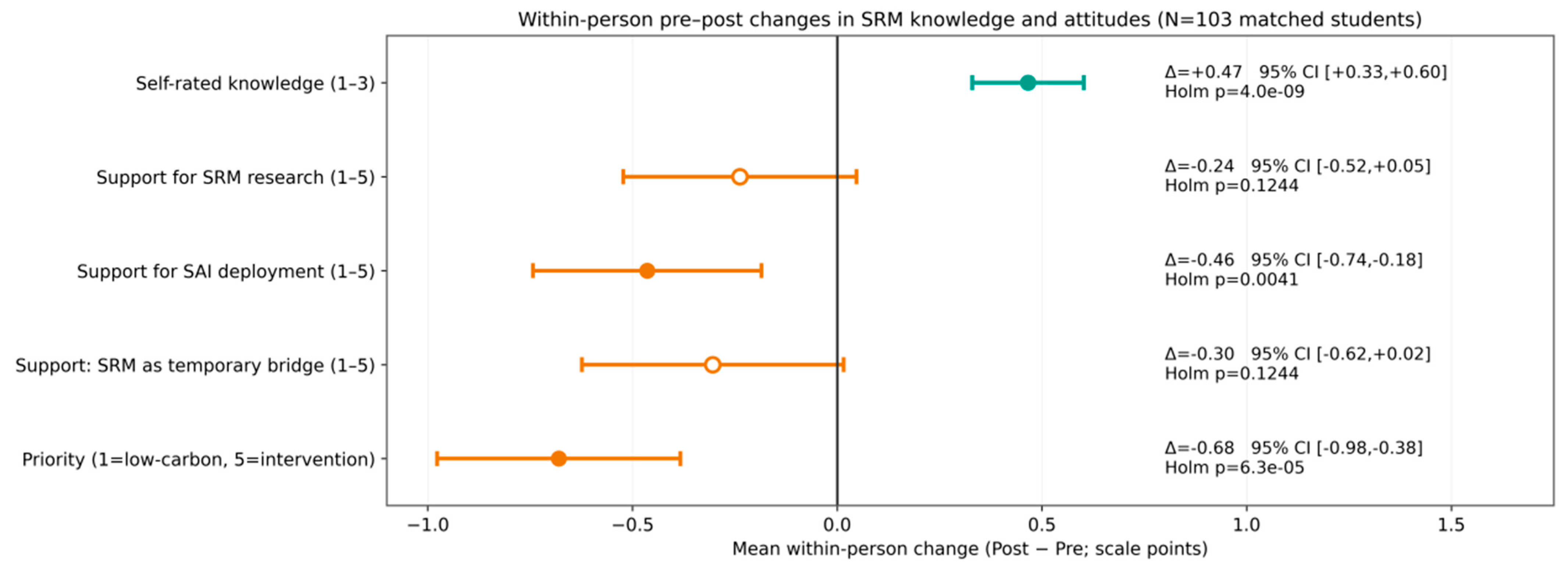
| Self-rated SRM knowledge (1–3) | 103 | 0.47 | 1.93 × 10⁻⁸ | 9.64 × 10⁻⁸ | 0.67 | 0.55 |
| Support for SRM research (1–5) | 101 | −0.24 | 0.1191 | 0.1191 | −0.16 | −0.16 |
| Support for SAI deployment (1–5) | 97 | −0.46 | 0.0028 | 0.0084 | −0.33 | −0.27 |
| Agreement: SRM as a temporary bridge (1–5) | 102 | −0.30 | 0.0585 | 0.1169 | −0.19 | −0.17 |
| Policy priority: low-carbon (1) → intervention (5) | 100 | −0.68 | 2.50 × 10⁻⁵ | 0.0001 | −0.45 | −0.40 |
| Predictor (Standardized) | Post Support: Research | Post Support: SAI Deployment | Post Support: Temporary Bridge |
|---|---|---|---|
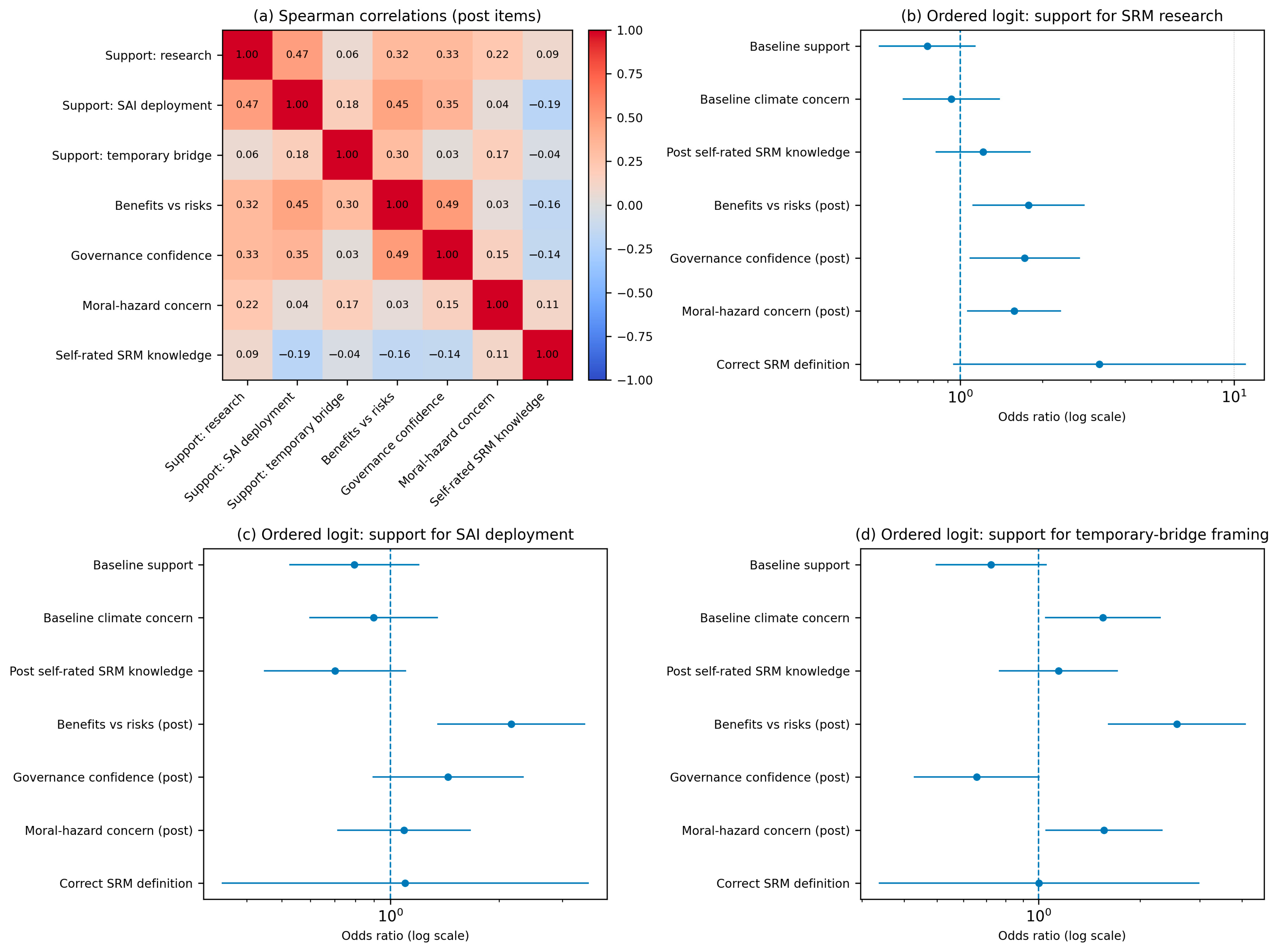
| Baseline support | 0.76 [0.50, 1.14] | 0.79 [0.52, 1.20] | 0.72 [0.50, 1.06] |
| Baseline climate concern | 0.93 [0.62, 1.40] | 0.90 [0.60, 1.36] | 1.55 * [1.05, 2.30] |
| Post self-rated SRM knowledge | 1.21 [0.81, 1.81] | 0.70 [0.45, 1.11] | 1.15 [0.76, 1.72] |
| Perceived benefits vs. risks (post) | 1.78 * [1.11, 2.85] | 2.16 ** [1.35, 3.47] | 2.57 *** [1.60, 4.11] |
| Governance confidence (post) | 1.72 * [1.08, 2.74] | 1.44 [0.89, 2.34] | 0.66 [0.43, 1.01] |
| Moral-hazard concern (post) | 1.57 * [1.06, 2.34] | 1.09 [0.71, 1.67] | 1.56 * [1.05, 2.33] |
| Correct SRM definition | 3.23 [0.94, 11.04] | 1.10 [0.34, 3.55] | 1.00 [0.34, 2.99] |
| Theme | N (of 103) | % |
|---|---|---|
| Feasibility/cost/technical readiness | 39 | 37.9 |
| Risks and unintended consequences | 30 | 29.1 |
| Moral hazard and mitigation priority | 23 | 22.3 |
| Governance and accountability | 22 | 21.4 |
| Temporary/emergency use | 13 | 12.6 |
| Ethics/fairness/distribution | 4 | 3.9 |
Disclaimer/Publisher’s Note: The statements, opinions and data contained in all publications are solely those of the individual author(s) and contributor(s) and not of MDPI and/or the editor(s). MDPI and/or the editor(s) disclaim responsibility for any injury to people or property resulting from any ideas, methods, instructions or products referred to in the content. |
© 2026 by the authors. Licensee MDPI, Basel, Switzerland. This article is an open access article distributed under the terms and conditions of the Creative Commons Attribution (CC BY) license.
Share and Cite
Gao, P.; Sie, A.; Xia, L.; Gao, C. Education Increases Solar Radiation Modification Literacy but Reinforces Caution: Evidence from a Pre–Post University Study. Sustainability 2026, 18, 2689. https://doi.org/10.3390/su18062689
Gao P, Sie A, Xia L, Gao C. Education Increases Solar Radiation Modification Literacy but Reinforces Caution: Evidence from a Pre–Post University Study. Sustainability. 2026; 18(6):2689. https://doi.org/10.3390/su18062689
Chicago/Turabian StyleGao, Pengyao, Amanda Sie, Lili Xia, and Chaochao Gao. 2026. "Education Increases Solar Radiation Modification Literacy but Reinforces Caution: Evidence from a Pre–Post University Study" Sustainability 18, no. 6: 2689. https://doi.org/10.3390/su18062689
APA StyleGao, P., Sie, A., Xia, L., & Gao, C. (2026). Education Increases Solar Radiation Modification Literacy but Reinforces Caution: Evidence from a Pre–Post University Study. Sustainability, 18(6), 2689. https://doi.org/10.3390/su18062689