Article

Optimization of Last-Mile Logistics Delivery Routes for Ground-Vehicle and Drone Parallel Distribution from Pre-Warehouses Considering Customer Priorities

1
School of Economics and Management, China University of Mining and Technology, Xuzhou 221116, China
2
Department of Management Science, Lancaster University Management School, Lancaster LA1 4YX, UK
*
Authors to whom correspondence should be addressed.
Sustainability 2026, 18(6), 2679; https://doi.org/10.3390/su18062679
Submission received: 27 January 2026 / Revised: 23 February 2026 / Accepted: 2 March 2026 / Published: 10 March 2026
(This article belongs to the Special Issue Advances in Sustainable Supply Chain Management and Logistics)

Abstract

Pre-warehouse last-mile delivery is currently constrained by service radiuses and intense delivery pressures. Meanwhile, national policies are increasingly promoting a transition toward green logistics. By undertaking deliveries to remote or dispersed locations, UAVs can streamline truck routes and minimize the fuel consumption and emissions typically exacerbated by urban traffic congestion. Accordingly, this paper establishes a Ground-Vehicle and Drone Parallel Distribution Model with Priorities (PW-PDSVRP-P), quantifying customer priorities via delivery delay functions to align efficiency with social service requirements. A master–slave hybrid Large Neighborhood Search algorithm is developed and validated through a Hema Fresh case study in Xuzhou. Results define a clear “economic advantage zone” for drone adoption and reveal an adaptive assignment strategy: drones serve as mass-delivery tools in low-cost scenarios but act as “surgical tools” to prune inefficient truck segments in high-cost environments. These findings confirm that air–ground collaboration fosters a more resilient urban distribution system by balancing operational costs with environmental and social sustainability goals.

1. Introduction

The rapid evolution of e-commerce has propelled the instant retail model into the spotlight, fueled by consumer demand for unprecedented speed and convenience. This trend is powerfully illustrated by the Chinese market. According to a recent report by the Chinese Academy of International Trade and Economic Cooperation, China’s instant retail market surged to 650 billion yuan in 2023, marking a remarkable year-on-year growth of 28.89% [1]. This expansion is not confined to urban centers; the market in county-level areas alone reached 150 billion yuan, underscoring its deep geographical penetration. The same report forecasts the total market to exceed 2 trillion yuan by 2030, signaling its sustained strategic importance. While these figures highlight the scale of the Chinese market, the logistical challenges are global; major urban centers from New York to London are facing similar bottlenecks where traditional fuel-powered fleets intensify traffic congestion and carbon emissions, hindering the long-term environmental sustainability of urban distribution.
Concurrent with this market explosion, drone-assisted delivery has emerged as a compelling solution, driven by robust governmental tailwinds. China has emerged as an ideal primary testbed for pioneering drone-assisted delivery networks, driven by robust governmental tailwinds. The development of the “low-altitude economy” was first articulated in China’s National Comprehensive Transportation Network Plan [2]. This high-level vision has since been translated into tangible, industry-specific standards [3] and elevated to a strategic emerging industry [4]. This convergence of market-driven demand and robust policy support has created an unprecedentedly fertile ground for new delivery technologies. The strategic importance of the low-altitude economy has been further solidified by recent top-level policy directives. In July 2024, a key decision [5] mandated the development of the “low-altitude economy.” This was reinforced in the March 2025 Government Work Report, which called for promoting the “safe and healthy development” of emerging industries, specifically naming the low-altitude economy as a component of the nation’s drive to cultivate new quality productive forces [6].
This proactive domestic environment aligns with a broader international movement toward standardizing drone operations. Regulatory frameworks established by the FAA in the United States and the EASA in the European Union are creating enabling environments for commercial UAS adoption. Furthermore, the rapid pace of technological iteration, recently accelerated by the high-frequency technical cycles observed in modern geopolitical conflicts, has significantly enhanced the accessibility of drone hardware, although their sustainable integration remains contingent on navigating complex regional compliance and pilot-related costs.
In this context, drone delivery has emerged as a particularly compelling solution, especially for the pre-warehouse operational model. The pre-warehouse model, designed for rapid fulfillment, is inherently constrained by a limited radius. The unique characteristics of drones—high-speed, point-to-point transit, and a naturally circular flight range—make them ideally suited to not only serve customers efficiently within this area but also to extend its operational frontier. Moreover, as electric-powered vehicles, drones offer a significant reduction in the carbon footprint per delivery compared to ground vehicles, while their ability to bypass road networks mitigates urban congestion and the associated energy waste from vehicle idling.
However, drones are not a panacea. Their widespread adoption is hindered by inherent limitations such as limited payload capacity and battery endurance, necessitating that a significant portion of deliveries still rely on traditional ground vehicles. This complementary nature of drones and trucks logically points towards a collaborative delivery system. Recognizing this potential, industry giants [7,8] are actively experimenting with hybrid truck–drone delivery models, signaling a clear industry trend towards such synergistic solutions. From an economic sustainability perspective, such hybrid systems allow for the optimized allocation of diverse carrier resources, ensuring long-term operational viability by balancing high-cost truck routes with low-cost drone sorties.
The challenge, then, for both academics and practitioners, is to determine the most effective collaborative configuration. The academic literature has formalized these emerging concepts into several distinct operational models, primarily categorized into four approaches: Flying sidekick traveling salesman problem (FSTSP), the parallel mode, the vehicle-supported mode, and the drone-supported vehicle mode [9,10]. The suitability of each model is highly dependent on the specific operational context. Previous research suggests that for scenarios where customers are distributed radially around a central depot—a geographical layout that closely mirrors the pre-warehouse model—the parallel mode, as conceptualized in the Parallel Drone Scheduling Vehicle Routing Problem (PDSVRP), often yields superior performance in terms of delivery time and resource utilization [11].
The evolution of PDSVRP research can be understood as a progression through three distinct, yet overlapping, streams aimed at enhancing model realism and applicability.
Early foundational work focused primarily on the fundamental challenge of scaling the operational fleet. The initial single-truck, single-drone models [12] were quickly extended to accommodate multiple drones. This included the development of integrated scheduling frameworks to coordinate synchronized operations between heterogeneous fleets [13]. Subsequent advancements further increased fleet complexity by introducing the collective drone concept, which allows multiple UAVs to synchronize their movements to enhance lifting capabilities and overcome the payload limitations of independent sorties [14]. While crucial in establishing the problem’s scalability, these models [13,14] often operated under simplified assumptions, such as unlimited truck capacity and service range, that overlooked the variable costs and energy consumption rates critical for economic and environmental sustainability.
A second, more pragmatic research stream emerged to address these simplifications by incorporating critical operational constraints. A significant advancement was the integration of customer time windows, which transformed the problem from a simple scheduling task into a time-constrained logistics challenge [13]. Equally critical has been the shift toward realistic drone endurance modeling. While early studies treated flight range as a constant, the recent literature emphasizes the fundamental tradeoff among battery capacity, payload weight, and flight time. Because heavier parcels non-linearly accelerate battery discharge, ignoring this payload-energy dynamic can lead to physically infeasible routing solutions [15,16]. To account for this, researchers have begun incorporating payload-dependent energy consumption models or proposing infrastructural workarounds, such as the strategic placement of drone charging and battery swapping facilities [17]. Beyond drone-specific constraints, the broader PDSVRP framework has transitioned from a simplified TSP-based structure to a more comprehensive VRP formulation. By explicitly incorporating finite vehicle capacity and maximum tour duration, these models significantly boost the practical relevance of air–ground systems for resource-efficient urban distribution [18,19,20].
Concurrently, a third stream has broadened the problem’s scope and objectives. The traditional single-objective focus on minimizing makespan has been expanded to multi-objective frameworks that also consider total system cost [21]. The strict separation of parallel and collaborative modes has been challenged by hybrid models [19], while the introduction of dynamism and lead-time constraints has adapted the problem for same-day delivery contexts [22]. This line of work, which even explores multimodal fleets including electric and autonomous vehicles [23], demonstrates the PDSVRP’s evolution into a highly flexible and powerful tool for modeling diverse, modern logistics systems.
The literature on PDSVRP, while technically evolving, has yet to fully address two critical gaps in the highly time-sensitive context of pre-warehouse-based instant retail. First, most existing models treat customers as a homogeneous group, neglecting the strategic requirement for customer prioritization. In sustainable logistics management, failing to safeguard service levels for high-value customers can lead to asset attrition, thereby undermining the provider’s long-term economic stability. Second, current studies on pre-warehouse last-mile delivery remain predominantly centered on traditional ground-based transportation. This leaves significant room for optimizing distribution through hybrid systems, as the potential for drones to bypass urban congestion and guarantee rapid fulfillment for premium orders remains largely under-explored.
To bridge these gaps, this paper introduces the PDSVRP from a Pre-Warehouse with Priorities (PW-PDSVRP-P). This new model extends the classical PDSVRP by incorporating two novel features: (1) A comprehensive objective function rooted in the customer pyramid theory, which dynamically weighs priority-based costs for delayed service against the operational expenses of heterogeneous fleets. Unlike traditional hard time windows, early arrivals incur no penalty, but any delay beyond the promised deadline accumulates a penalty cost scaled by the customer’s priority tier. This mechanism ensures that high-margin or time-critical orders are prioritized via rapid drone dispatch when necessary. (2) A more realistic constraint set capturing both customer time windows and differentiated operational ranges for trucks and drones.
To solve this complex model, we propose a highly effective hybrid LNS algorithm as our primary solution methodology. Its performance is benchmarked against the Gurobi solver 10.0.1 and SSIRs. Through extensive computational experiments, we validate the effectiveness of our model and algorithms, providing insights into how a prioritized truck–drone system fosters sustainable last-mile logistics by balancing operational costs and service-level objectives.
The remainder of this paper is organized as follows: Section 2 presents the mathematical formulation, Section 3 details the solution methodologies, Section 4 discusses the experimental results, and Section 5 concludes the paper.

2. The Pre-Warehouse Parallel Drone Scheduling Vehicle Routing Problem Considering Priority

2.1. Problem Description and Notation

The PW-PDSVRP-P is formally defined on a graph G = ( N , A ), where N = {0}   C represents the set of nodes, consisting of a central depot and a set C of n customers.
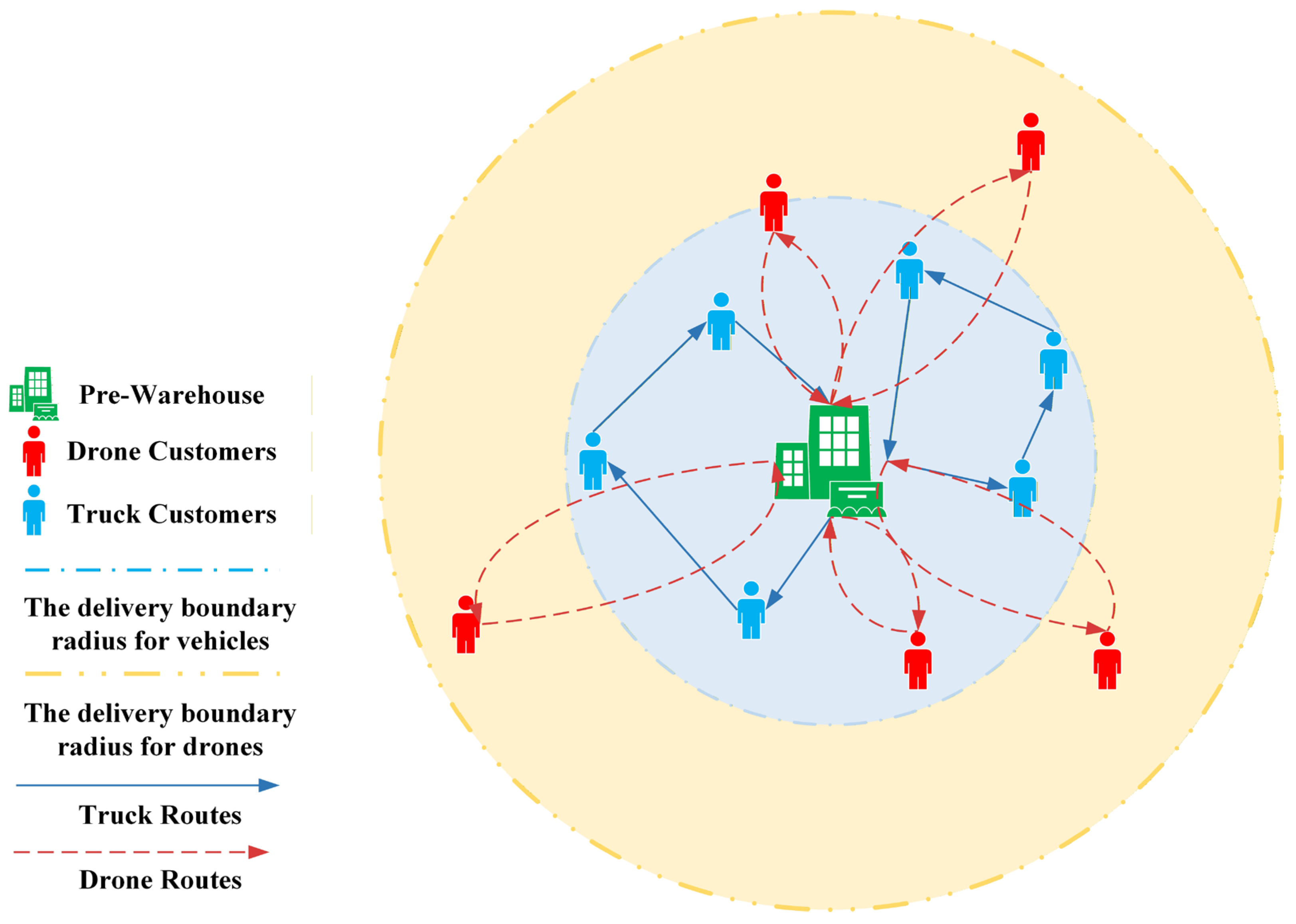
A key feature is a dual-radius strategy: a hyperlocal truck radius to ensure rapid ground response and a larger drone radius to extend the service frontier by bypassing urban congestion. This framework naturally partitions customers into three subsets. Some customers are designated as C T , being ineligible for drone service due to constraints like high demand ( w i > Q D ) or unsafe landing conditions. Conversely, C D are those located outside the truck’s radius but still within the drone’s reach. The final subset, C T D , comprises clients situated in the overlapping service area who are eligible for either vehicle type. Each customer i C is characterized by a specific delivery deadline T i defining a soft time window. To ensure a transparent integration of service requirements, the model tracks the arrival time at each node for both ground and aerial fleets, penalizing any violation of T i through a cumulative tardiness variable L i in the objective function. A visual illustration of a potential solution for the PW-PDSVRP-P is depicted in Figure 1. For clarity and convenient reference, all sets, parameters, and decision variables are consolidated and presented in Table 1.
The formulation of the PW-PDSVRP-P is based on the following key assumptions:
1.
Deterministic Information: The geographical locations, demand ( w i ), and latest arrival time ( T i ) of all customers are deterministic and known in advance.
2.
Homogeneous Fleets: All trucks share capacity ( Q T ) and speed ( v T ), while all drones share capacity ( Q D ) and speed ( v D ).
3.
Constant Travel Speeds: Both trucks and drones are assumed to travel at constant speeds, and travel times are calculated based on Euclidean distances.
4.
No Split Deliveries: Each customer’s demand must be satisfied in its entirety by a single delivery from one vehicle.
5.
Negligible Service Times: The time required for loading and unloading goods at the depot and at customer locations is considered negligible and is therefore omitted from the model.
6.
Full Battery and Availability: Each vehicle is assumed to have sufficient battery/fuel to complete any feasible tour assigned to it within its maximum operational time. All vehicles and drones are available at the depot at time zero.

2.2. Mathematical Formulation

We extend the canonical PDSVRP framework [18] by incorporating novel constraints and objective terms tailored for pre-warehouse-based instant retail. The objective is to minimize a comprehensive system cost, which aggregates three key components: (1) the fixed costs associated with vehicle deployment; (2) the variable, distance-based travel costs for the entire fleet; (3) priority-weighted penalties for any service tardiness. In the third component, the penalty coefficient π i is determined through a customer segmentation framework based on RFM theory. By applying this three-dimensional clustering approach, customers are classified into three distinct tiers—Star, Active, and Regular—reflecting their historical transactional value and strategic significance to the pre-warehouse platform. Accordingly, π i is defined as a tier-specific constant ( π S t a r > π A c t i v e > π R e g u l a r ) that reflects differentiated service-level agreements and the marginal opportunity cost of customer churn for each segment of the customer pyramid.
Although explicit carbon emissions are not modeled, the distance-based cost structure serves as a widely adopted proxy for energy consumption and environmental impact, allowing the model to implicitly capture sustainability-related trade-offs. The detailed formulation is presented as follows:
M i n i m i z e   Z = c f T i ϵ C T C T U x 0 i +   c v T i ϵ 0 C T C T U j ϵ C T C T U x i j d i j + c f D m ϵ D Y m + 2   c v D m ϵ D i ϵ C U C T U y i m d 0 i + i ϵ C π i L i
The objective function is minimized subject to a set of constraints that collectively define the feasible solution space. These constraints are detailed sequentially in the following subsections.
i N T , i j x i j i N T , i j x j i = 0 j C T C T D
i N T , i j x i j + m V D y j m = 1 j C T D
i N T , i j x i j = 1 j C T
m V D y j m = 1 j C D
j C T C T U x 0 j K
j C D C T D y j m M Y m m V D
Constraint (2) enforces flow conservation for the truck routes. Constraint (3) guarantees that each customer in C T D is served exactly once. Constraint (4) ensures that every truck-only customer ( C T ) is visited by exactly one truck. Similarly, Constraint (5) ensures that every drone-only customer ( C D ) is assigned to exactly one drone for delivery. Constraint (6) limits the number of trucks used. Constraint (7) links the drone assignment variable y j m to the drone usage variable Y m . It states that a drone m can be assigned to serve customers only if it is officially deployed ( Y m = 1), which incurs a fixed cost in the objective function.
u i u j + Q T x i j Q T w j i , j C T C T D , i j
w i u i Q T i C T C T D
w j m V D y j m Q D j C D C T D , m V D
Constraints (8) and (9) are the coupled MTZ constraints for sub-tour elimination and capacity enforcement. The continuous variable u i tracks the cumulative load of a truck along its route. Constraint (10) represents the capacity constraint for each drone “machine”, ensuring the job size w j does not exceed the machine’s processing capacity Q D .
A j A i + d i j v T M 1 x i j i , j C T C T D , i j
A j d 0 j v T M 1 x 0 j j C T C T D
A i + d i 0 v T T m a x T + M 1 x i 0 i C T C T D
L i A i T i i C T C T D
Constraints (11)–(14) establish the time-flow logic and service window requirements for the truck fleet. Specifically, Constraints (11) and (12) utilize a standard big-M formulation to ensure the arrival time A j at a successor node accurately accounts for the travel duration from its predecessor or the depot. Constraint (13) enforces the truck’s maximum tour duration limit ( T m a x T ). Crucially, Constraint (14) defines the truck-based tardiness L i by linking the actual arrival time A i to the customer’s deadline T i , allowing the system to quantify and penalize service delays.
S j , m a r r = s j m + d 0 j v D M 1 y j m j , l C D C T D , m V D , j l
S j , m r e t = s j m + 2 d 0 j v D M 1 y j m j C D C T D , m V D
s l m S j , m r e t M 1 z j l m j , l C D C T D , m V D , j l
z j l m + z l j m = i { j , l } y i m 1 j , l C D C T D , m V D , j < l
S j , m r e t T m a x D + M 1 y j m j C D C T D , m V D
L i S i , m a r r T i M 1 y i m i C D C T D , m V D
The scheduling of the drone fleet can be viewed as a variant of the Parallel Machine Scheduling Problem, where drones act as parallel machines and customer deliveries are the jobs to be scheduled. Our solution approach is inspired by the following PMSP models: [24,25,26]. Constraints (15)–(20) govern the drone scheduling logic and its corresponding time-window compliance. Unlike the continuous truck tour, drone sorties are modeled as discrete service cycles. Constraints (15) and (16) define the key temporal milestones for each sortie: the customer arrival time S j , m a r r and the return-to-depot time S j , m r e t . Constraints (17) and (18) enforce the precedence and sequencing requirements for missions assigned to the same UAV, while Constraint (19) respects the flight endurance limit ( T m a x D ). To maintain consistency with the ground fleet, Constraint (20) calculates the drone-based tardiness L i based on the arrival time S i , m a r r . This unified treatment of L i across both modes ensures that customer priority and service windows are transparently and consistently managed throughout the entire distribution network.
x i j { 0,1 } i , j { 0 } C T C T D , i j
y i m { 0,1 } i C D C T D , m V D
Y m { 0,1 } m V D
z j l m { 0,1 } j , l C D C T D , m V D
L i 0 i   C
A i , u i 0 i C T C T D
s j m , S j , m a r r , S j , m r e t 0 j C D C T D , m V D
Constraints (21)–(24) define the binary nature of the primary decision variables. These include the truck routing variables x i j , the drone assignment variables y i m and Y m , and the drone sequencing variables z j l m . Constraints (25)–(27) specify the non-negativity of all continuous variables in the model. This includes the tardiness variable L i , the truck-related temporal and load variables A i , u i and all drone-related timing variables s j m , S j , m a r r , S j , m r e t . The precise domain for each variable corresponds to the specific subset of customers it applies to.

3. Algorithm Design

3.1. The LNS Algorithmic Framework

The framework operates on a master–slave architecture where the LNS functions as a high-level allocator, iteratively refining the partition of customers between the truck and drone fleets. The solution methodology is developed as a hybrid metaheuristic utilizing a master–slave architecture. The high-level master framework employs Large Neighborhood Search (LNS), which is fundamentally a metaheuristic characterized by its iterative evolution through successive “Destroy and Recreate” cycles to explore the global customer allocation space and escape local optima. In contrast, the low-level sub-solvers (SolveVRP and SolvePMS) are categorized as classical constructive heuristics. These slave algorithms function as non-iterative, single-pass evaluation engines; they do not involve internal iterative optimization but instead provide the computational speed required to assess the master-level allocation schemes rapidly.
This model is strictly a static optimization framework, serving as a tactical pre-planning tool for pre-warehouse logistics. All routing and assignment decisions are finalized prior to the execution phase. Consequently, the current scope is bounded to a deterministic environment where all delivery tasks are assumed to be successfully completed. Therefore, the algorithm does not support online adaptation or real-time re-optimization during active tasks, and explicit contingency rules for failed sorties or task re-assignments are excluded from this study.
As shown in the initialization phase, the process begins by receiving the initial customer sets and invoking the slave heuristics to establish a baseline performance. This initial state is registered as both the current operating solution ( S c u r r e n t ) and the global best solution ( S b e s t ), providing a rigorous benchmark for the subsequent iterative search.
Upon entering the master loop the metaheuristic begins its exploration by applying significant structural modifications to the solution configuration. This is achieved through the LNSSearch function, which corresponds to the “Destroy and Recreate” block. By deconstructing the current customer allocation and re-inserting nodes into alternate fleets using the greedy insertion logic, the algorithm can transcend the boundaries of local minima that typically trap standard local search methods. A critical aspect of this architecture is the master–slave interaction occurring in lines 8–10 of Algorithm 1. Once the LNS master proposes a candidate allocation ( C c a n d ), the framework delegates the precise routing and cost calculation to the slave solvers. This feedback loop is indispensable because the master level only manages set membership, while the true objective value is contingent upon the optimized schedules produced by the sub-problem solvers, ensuring the search is always guided by accurate data.
Algorithm 1: LNS Main Framework
Input :   Initial   truck   customers   C t r u c k i n i t ,   Initial   UAV   customers   C u a v i n i t ,   Max   LNS   iterations   I l n s
Output :   Optimized   truck   routes   R t r u c k ,   Optimized   UAV   routes   R u a v ,   Total   cos t   T C
1 C t r u c k b e s t C t r u c k i n i t ;   C u a v b e s t C u a v i n i t
2 R t r u c k b e s t , C o s t t r u c k b e s t SolveVRP ( C t r u c k b e s t )
3 R u a v b e s t , C o s t u a v b e s t SolvePMS ( C u a v b e s t )
4 C o s t b e s t = C o s t t r u c k b e s t + C o s t u a v b e s t
5 C t r u c k c u r r e n t C t r u c k b e s t ;   C u a v c u r r e n t C u a v b e s t ;   C o s t c u r r e n t C o s t b e s t
6 For   i 1   to   I l n s  do
7    C t r u c k c a n d , C u a v c a n d LNSSearch C t r u c k c u r r e n t , C u a v c u r r e n t
8    R t r u c k c a n d , C o s t t r u c k c a n d SolveVRP C t r u c k c a n d
9    R u a v c a n d , C o s t u a v c a n d SolvePMS C u a v c a n d
10    C o s t c a n d = C o s t t r u c k c a n d + C o s t u a v c a n d
11    If   C o s t c a n d < C o s t c u r r e n t  then
12      C t r u c k c u r r e n t C t r u c k c a n d ; C u a v c u r r e n t C u a v c a n d ; C o s t c u r r e n t C o s t c a n d
13      If   C o s t c u r r e n t < C o s t b e s t  then
14        C t r u c k b e s t C t r u c k c u r r e n t ; C u a v b e s t C u a v c u r r e n t ; C o s t b e s t C o s t c u r r e n t
15      End if
16    End if
17End for
18 R t r u c k , C o s t t r u c k SolveVRP ( C t r u c k b e s t )
19 R u a v , C o s t u a v SolvePMS ( C u a v b e s t )
20 T C C o s t t r u c k + C o s t u a v
21 Return   R t r u c k , R u a v , T C
The search trajectory is governed by a hierarchical acceptance mechanism, represented by the decision diamonds in the flowchart and the conditional statements. If the candidate solution demonstrates a cost improvement over the current state ( f ( S ) < f ( S ) ), it is accepted as the new current solution to serve as the starting point for the next iteration. Simultaneously, the algorithm compares the new state against the global best; if a superior configuration is identified, S b e s t is updated to preserve the most efficient configuration encountered during the search. This iterative process concludes when the maximum iteration count ( I l n s ) is reached. To ensure the final output attains the highest possible precision, the framework performs a final execution of the SolveVRP and SolvePMS solvers on the best-found allocation. This finalization step yields the optimized vehicle routes ( R t r u c k ), drone schedules ( R u a v ), and the minimum total cost ( T C ), which constitute the definitive output of the PW-PDSVRP-P solution framework.

3.2. LNS Operators and Marginal Cost Evaluation

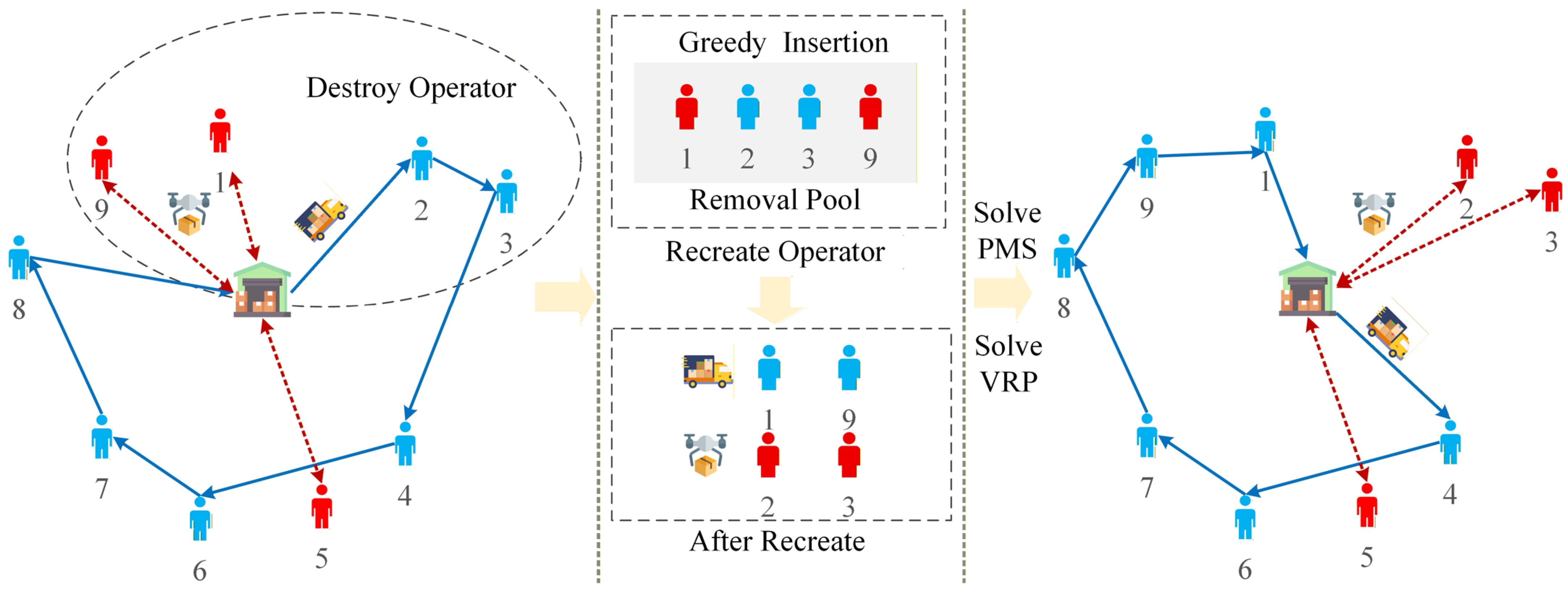
The efficacy of the LNS depends on a strategic balance between diversification and intensification, a process visually conceptualized in Figure 2 and formally defined in Algorithm 2. In each iteration, the search executes a structural reconfiguration of the current solution by deconstructing the existing customer allocation and rebuilding it through a cost-driven competitive mechanism.
As illustrated in Figure 2 and Algorithm 2, the procedure initiates a Destroy phase by identifying the set of shared customers, C T D , who are eligible for both delivery modes. Based on a predefined destruction rate ρ , the Random Destroy operator selects a subset of these nodes to be moved into a “removal pool,” effectively stripping them from their current truck routes or drone sorties. This unbiased deconstruction is critical for promoting broad exploration, as it breaks the existing local topology and allows the algorithm to jump to distant, potentially superior regions of the solution space.
Algorithm 2: LNS Iteration
Function :   LNS _ Iteration ( C t r u c k , C u a v )
Input :   Current   truck   customers   C t r u c k ,   Current   UAV   customers   C u a v ,   Destruction   rate   ρ
Output :   Candidate   truck   customers   C t r u c k c a n d ,   Candidate   UAV   customers   C u a v c a n d
1 C s h a r e d   c C t r u c k   C u a v   c . i s s h a r e d
2 N d e s t r o y C s h a r e d   × ρ
3   Randomly   select   N d e s t r o y   customers   from   C s h a r e d
4 C t r u c k d e s t r o y e d C t r u c k C r e q u e s t
5 C u a v d e s t r o y e d C u a v C r e q u e s t
6 C t r u c k c a n d C t r u c k d e s t r o y e d , C u a v c a n d C u a v d e s t r o y e d
7 R t r u c k t e m p , SolveVRP ( C t r u c k c a n d )
8 Shuffle ( C r e q u e s t )
9 for   each   customer   c in   C r e q u e s t   do
11   Δ C o s t t r u c k E v a l u a t e T r u c k I n s e r t i o n C o s t R t r u c k t e m p ,   c
12   Δ C o s t u a v   C a l c u l a t e U A V M i s s i o n C o s t c
13   If   Δ C o s t t r u c k < Δ C o s t u a v   and   i s t r u c k f e a s i b l e  then
14     A d d   c   t o   C u a v c a n d
15   else
16     A d d   c   t o   C t r u c k c a n d
17   End if
18End for
19 Return   C t r u c k c a n d , C u a v c a n d
20End function
In the subsequent Recreate phase, the algorithm reconstructs the solution by re-inserting the customers from the pool. To prevent systematic bias in the reconstruction, the pool is first shuffled to randomize the insertion order. The reconstruction logic is governed by a Competitive Greedy Insertion strategy, where each customer is evaluated for two competing delivery modes. For the truck fleet, the algorithm identifies the optimal feasible insertion point between consecutive nodes in the existing routes, accounting for the additional travel distance and the resulting temporal shift that affects the tardiness penalties of all downstream customers. Simultaneously, the marginal cost of drone assignment is calculated by evaluating whether the customer should be integrated into an existing drone’s scheduled sequence of sorties or requires the deployment of a new virtual drone.
This dual-operator evaluation ensures that the solution is reconstructed with high intensification, focusing on immediate cost minimization. The framework maintains high computational efficiency by using sub-problem solvers to establish a temporary routing baseline ( R t r u c k t e m p ) and then applying incremental delta-evaluations to calculate marginal costs rather than re-solving the entire VRP or PMS for every candidate position. As depicted in the transition to the “Repaired Solution”, each customer is finally assigned to the mode and position that yields the minimum aggregate cost increase. This iterative “Destroy and Recreate” cycle repeats until the termination criteria are met, producing a candidate allocation that optimally balances delivery efficiency with the strategic priorities of the customer pyramid.

3.3. Core Subroutines: VRPTW and PMSP Solvers

The efficacy of our LNS frameworks relies on the rapid and accurate evaluation of solutions. To achieve this, we developed specialized heuristic solvers for the two embedded subproblems: a VRPTW solver for the truck fleet and a PMSP solver for the drone fleet. These solvers function as the core “cost-engine” of our algorithms, enabling both the incremental evaluation during the recreate step and the final cost calculation of candidate solutions.

3.3.1. VRPTW Subproblem Solver

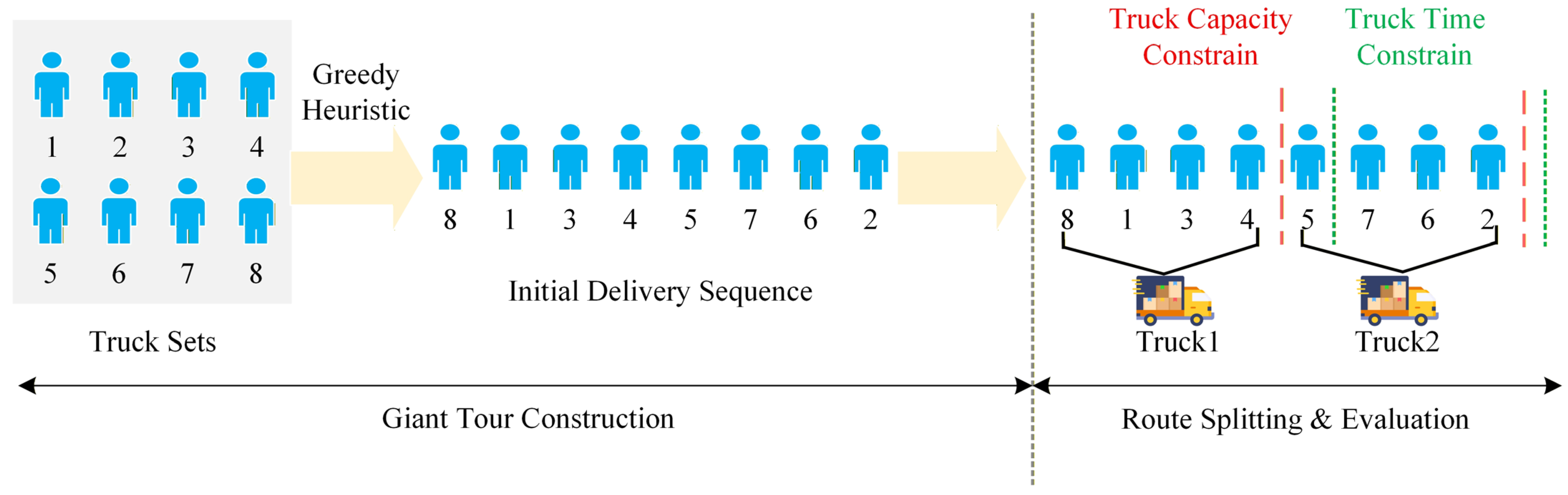
To address the CVRPTW for the truck fleet, we employ a classic and computationally efficient two-stage heuristic approach: Giant Tour Construction followed by Route Splitting. This methodology allows for the rapid generation of high-quality, feasible solutions from any given set of truck-assigned customers.
The first stage, Giant Tour Construction, aims to generate a promising preliminary ordering of the customers. For this, we utilize a Greedy Construction Heuristic that implements a nearest-neighbor strategy. The procedure begins with a random customer and iteratively appends the geographically closest unvisited customer to the end of the sequence. The output of this stage is a single, ordered list of all truck customers, representing a “giant tour” that does not yet consider vehicle constraints.
The second stage, Route Splitting & Evaluation, is a deterministic decoding procedure. It takes the giant tour sequence as input and partitions it into a set of feasible vehicle routes. The algorithm processes the customer sequence in the given order, iteratively adding customers to the current truck route as long as doing so violates neither the truck’s capacity Q T nor the maximum tour duration T m a x T . Whenever a customer cannot be added, the current route is finalized by returning to the depot, and a new route is initiated with that customer. During this process, all costs—including fixed vehicle deployment costs, variable travel costs, and any tardiness penalties incurred—are accumulated. The final output is a complete set of feasible truck routes and their total aggregated cost. The entire two-stage process is visually summarized in Figure 3 and Algorithm 3.
Algorithm 3: SolveVRP
Function :   SolveVRP C t r u c k
Input :   C u s t o m e r   s e t   C t r u c k , C a p a c i t y Q T , M a x T i m e T m a x T , G A P a r a m e t e r s N p o p
Output :   O p t i m i z e d t r u c k r o u t e s   R , M i n i m u m t o t a l c o s t   Z
1 P o p I n i t i a l i z e N p o p p a r t i c l e s e a c h   p a r t i c l e p   i s   a   r a n d o m   p e r m u t a t i o n   o f   C t r u c k
2 Z , R
3 For   i t e r 1   t o   I p s o  do
4     For   e a c h   p a r t i c l e   p   in   P o p  do
5      k 1 , r k { 0 } , q c u r r e n t 0 , t c u r r e n t 0 , Z p 0
6      R p
7      For   e a c h c u s t o m e r   c i     i n   p a r t i c l e p s   p e r m u t a t i o n  do
8        Δ t d i s t r k . l a s t , c i / v t
9        t b a c k d i s t c i , 0 / v t
10        if   w c u r r e n t + w i Q T   a n d   t c u r r e n t + Δ t + t b a c k T m a x T    then
11           r k r k { c i } ; w c u r r e n t w c u r r e n t + w i
12           t c u r r e n t t c u r r e n t + Δ t
13        Else
14           r k r k { 0 } ; R p R p { r k }
15           Z p Z p + C a l c R o u t e C o s t r k + C 0
16           k k + 1 , r k { 0 , c i }
17           q c u r r e n t d i , t c u r r e n t d i s t 0 , c i / v t r u c k
18        End if
19      End for
20      r k r k { 0 } ; R p R p { r k }
21      Z p Z p + C a l c R o u t e C o s t r k + C 0
22      If   i f   Z p < Z   then   Z Z p ; R R p ; g L i n e p . p o s i t i o n
23      End if
24    End for
25    Update particle positions and velocities based on gLine and pBest
26End for
27 Return   R , Z
28End Function

3.3.2. IPMS Subproblem Solver

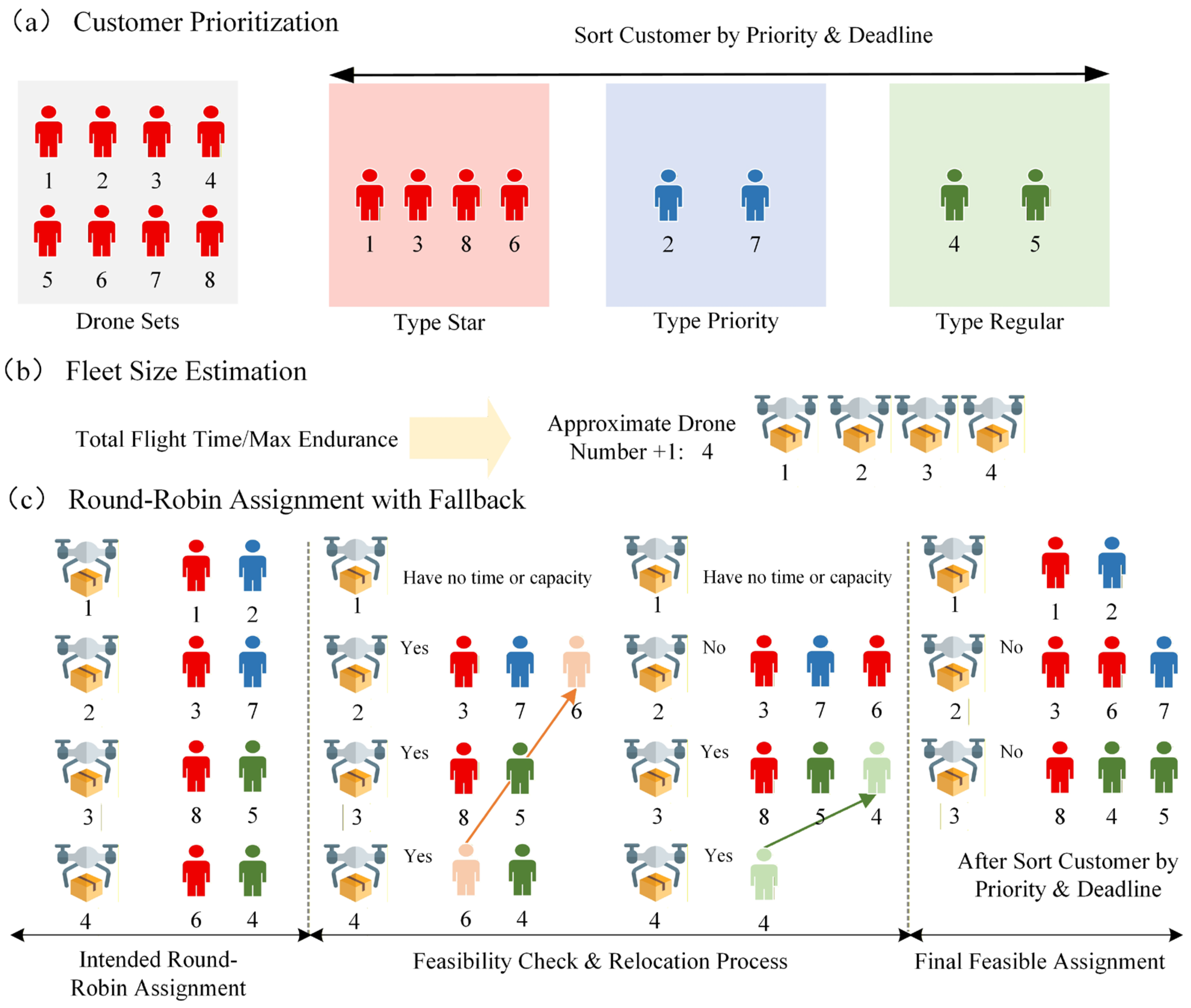
To solve the PMSP subproblem, we developed a fast and effective heuristic that combines customer prioritization with a load-balancing assignment strategy, as illustrated in Figure 4 and Algorithm 4.
First, all customers assigned to the drone fleet are sorted in ascending order, primarily by their priority class and secondarily by their delivery deadline, ensuring that critical and time-sensitive orders are considered first. The algorithm then estimates the minimum required drone fleet size by dividing the total mission flight time by the maximum endurance per drone.
The core of the heuristic is an intelligent Round-Robin assignment. The algorithm iterates through the prioritized customer list, assigning customers to the estimated drone fleet in a cyclical fashion to evenly distribute the workload. For each assignment, feasibility is checked against the drone’s cumulative flight time. If an assignment is infeasible, a fallback strategy is enacted: the algorithm first searches for any other active drone that can accommodate the mission. If none is found and the fleet limit has not been reached, a new drone is activated. This procedure returns a set of high-quality, well-balanced drone schedules.
Algorithm 4: SolvePMS
Function :   SolvePMS C u a v
Input :   C u s t o m e r   S e t   C u a v ,   M a x   D r o n e s   N m a x U ,   C a p c i t y   Q U , E n d u r a n c e   T m a x U , S p e e d   v u a v
Output :   UAV   Routes   R U ,   UAV   Total   Cos t   Z U
1 C s o r t e d S o r t   C u a v   b y   S h o p p i n g H a b i t S i   d e s c .   t h e n   W a i t T i m e W i   a s c .
2 T t o t a l c i C u a v 2 d i s t 0 , c i / v u a v
3 N e s t min N m a x U , T t o t a l / T m a x U
4 I n i t i a l i z e   N e s t   e m p t y   r o u t e s   R U = { r 1 , , r }   N e s t   a n d   f i n i s h t i m e s   T f i n i s h = { 0 , , 0 }
5 For   e a c h   c u s t o m e r c i   i n   C s o r t e d  do
6    a s s i g n e d   f a l s e
7    k i 1 ( m o d N e s t ) + 1
8    Δ t 2 d i s t 0 , c i / v u a v
9    If   c i . d e m a n d Q U a n d T f i n i s h k + Δ t T m a x U  then
10      A s s i g n c i t o r o u t e r k ;   T f i n i s h k T f i n i s h k + Δ t
11      a s s i g n e d   t r u e
12    Else
13      k arg min j { 1 R U } { T f i n i s h j T f i n i s h j + Δ t T m a x U }
14      if   k e x i s t s   then
15        A s s i g n c i   t o   r k ;   T f i n i s h k T f i n i s h k + Δ t ;   a s s i g n e d t r u e
16      elseif   R U < N m a x U  then
17        R U R U { { 0 , c i , 0 } } ;   T f i n i s h n e w Δ t
18        a s s i g n e d   t r u e
19      End if
20    End if
21End for
22 Z U C a l c u l a t e D e t a i l e d C o s t R U
23 Return   R U ,   Z U
24End Function

4. Experiments and Results

This section presents a comprehensive evaluation of the proposed PW-PDSVRP-P model and the Hybrid LNS algorithm. The computational study is organized into two primary stages: First, we conduct a rigorous algorithmic validation by benchmarking our Hybrid LNS against the commercial exact solver, Gurobi, and SISSRs algorithm. Second, we perform a real-world case study based on Hema Fresh operations in Xuzhou, China, to demonstrate the model’s practical utility and derive actionable managerial insights.

4.1. Algorithm Results

All experiments were run on a PC with an AMD Ryzen 7 7735H CPU (manufactured by TSMC, Hsinchu, Taiwan, China) and 16 GB RAM. A suite of context-specific test instances was synthesized based on the spatial and operational parameters derived from our real-world case study. This approach ensures that the synthetic dataset preserves the geographical nuances and demand patterns of pre-warehouse delivery environments, allowing for a realistic assessment of the algorithm’s performance and its managerial implications. In line with the standard configurations reported in recent studies on drone–truck delivery [18], the operational parameters were set as follows: for trucks, capacity is 1500 kg, speed is 30 km/h, and max duration is 8 h; for drones, capacity is 20 kg, speed is 60 km/h, and max endurance is 2 h.
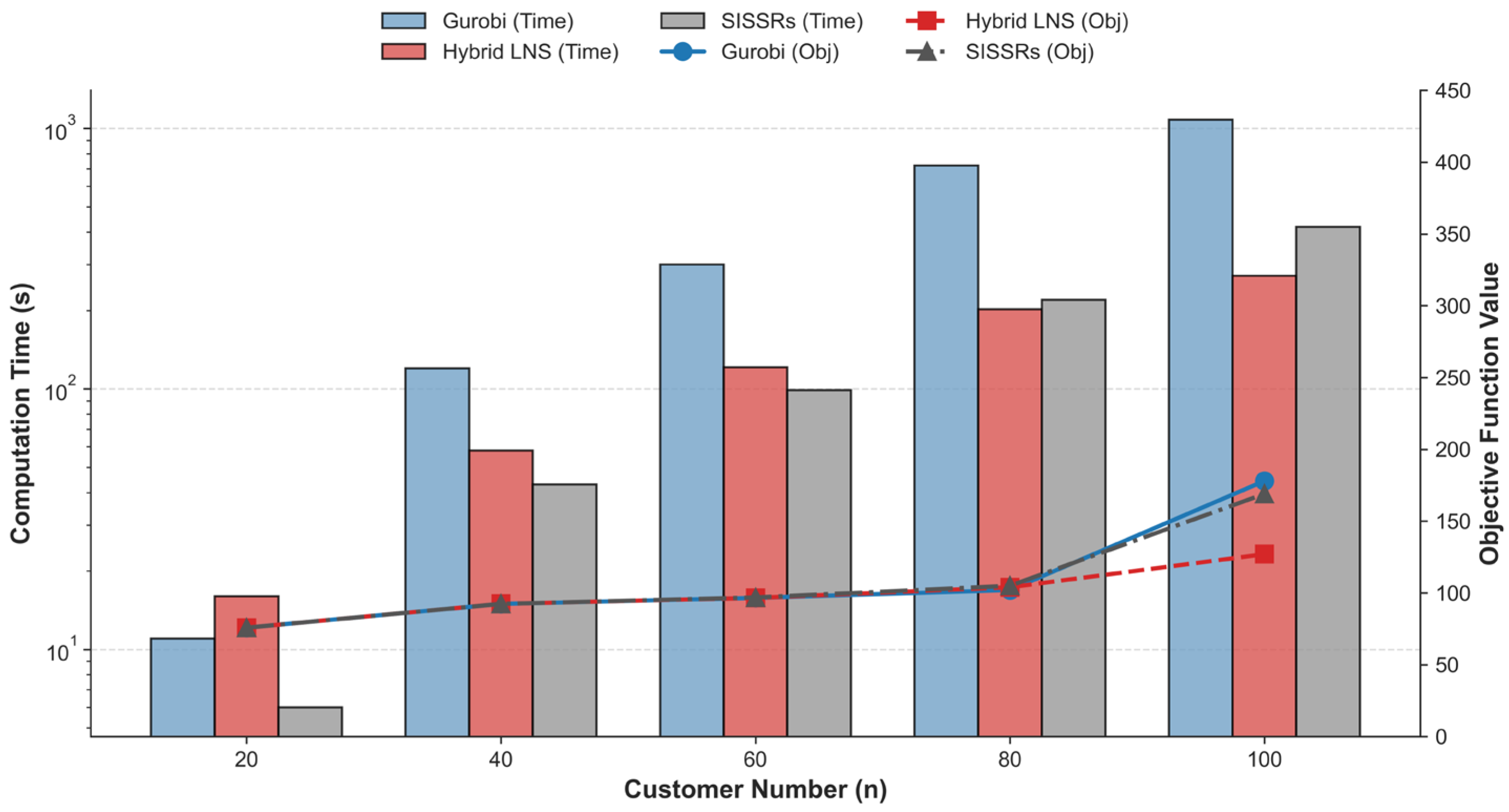
The proposed Hybrid LNS algorithm was configured based on preliminary parameter tuning, utilizing a maximum of 50 iterations and a destruction rate of 0.3. To provide a robust performance benchmark, the commercial solver Gurobi was assigned a maximum runtime limit of 1080 s per instance, representing the practical bounds of exact optimization. Furthermore, the SISSRs metaheuristic [18] was implemented as a secondary state-of-the-art baseline to evaluate the relative effectiveness of our neighborhood search operators. The comparative performance across these three methods, focusing on both solution quality (objective values) and computational efficiency (CPU time), is visualized in Figure 5.
The comparative performance of the commercial solver Gurobi, the state-of-the-art benchmark SISSRs, and the proposed Hybrid LNS algorithm is visualized in Figure 5. The figure employs a dual-axis representation: the bar charts (left y-axis) denote the computational overhead in seconds using a logarithmic scale to accommodate the vast disparity in runtimes, while the line plots (right y-axis) track the evolution of the objective function values.
The objective value trajectories demonstrate a significant performance divergence as the problem complexity increases. For small-to-medium instances ( n 60 ), all three methods converge to nearly identical objective values, validating the reliability of the heuristic operators in handling baseline constraints. At the n = 80 scale, Gurobi maintains a marginal lead (Obj = 102.0), though this is achieved at the expense of a substantially higher computational cost compared to the metaheuristics. A critical juncture is observed at the n = 100 scale, where the combinatorial explosion of the PW-PDSVRP-P model leads to a severe convergence stagnation for the exact solver. Gurobi’s truncated solution (Obj = 178.0) after 1080 s is surpassed even by the SISSRs benchmark (Obj = 169.0). Most notably, our Hybrid LNS algorithm achieves a breakthrough in solution quality, yielding an objective value of 127.0. This represents a 28.6% improvement over Gurobi and a 24.8% improvement over SISSRs. These results confirm that the targeted relocation and exchange operators within our framework are far more effective at navigating the high-dimensional, highly coupled search space than the randomized deconstruction mechanism of SISSRs or the branch-and-bound logic of exact methods under time pressure.
From a computational perspective, Figure 5 highlights the deterioration in the search efficiency of the exact solver. Despite a substantial overhead of 1080s at n = 100 , Gurobi fails to effectively explore the exponentially expanding branching tree, rendering the exact approach computationally intractable for large-scale operations. In comparing the two metaheuristics, the Hybrid LNS algorithm demonstrates significantly better scalability than SISSRs. As the customer count reaches 100, the computation time for SISSRs escalates to 419 s, whereas Hybrid LNS converges in only 272 s, a 35% reduction in computational overhead. This efficiency is directly rooted in the master–slave architecture, which decouples the high-level allocation search from the low-level routing evaluation. By offloading sub-problem optimization to specialized heuristics, the master framework maintains a predictable and efficient search trajectory. These results confirm that Hybrid LNS offers the most robust trade-off, delivering the highest-quality solutions with the greatest computational economy for high-pressure last-mile distribution.

4.2. Model Comparison and Sensitivity Analysis

4.2.1. Model Result and Comparison

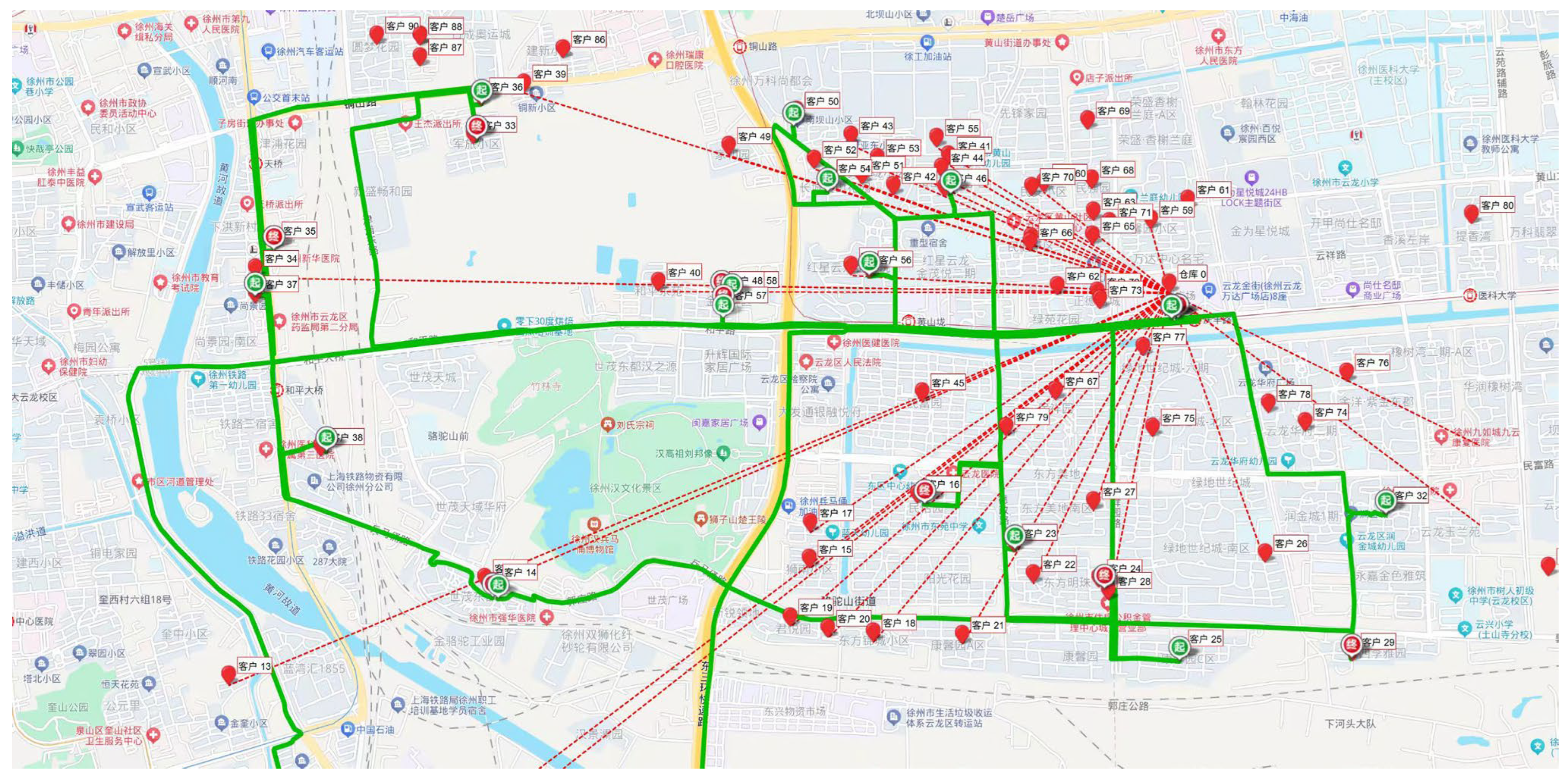
Beyond benchmark validation, we evaluate the practical applicability of the PW-PDSVRP-P model through a real-world case study centered on a Hema Fresh supermarket in Xuzhou, China. This case study serves as an illustrative application to demonstrate the model’s performance within a specific high-density urban logistics environment. We collected and adapted operational data, including depot location, customer distribution, and demand requirements, to reflect actual service conditions. A representative solution for a 60-customer instance is visualized in Figure 6, where solid green lines indicate truck routes and dashed red lines represent drone sorties, all rendered on a Baidu Map of the study area. These results provide a proof-of-concept for the proposed collaborative framework; however, we emphasize that the specific cost-savings and delivery patterns are case-specific outcomes and should be viewed as a methodological template rather than a broadly generalizable benchmark.
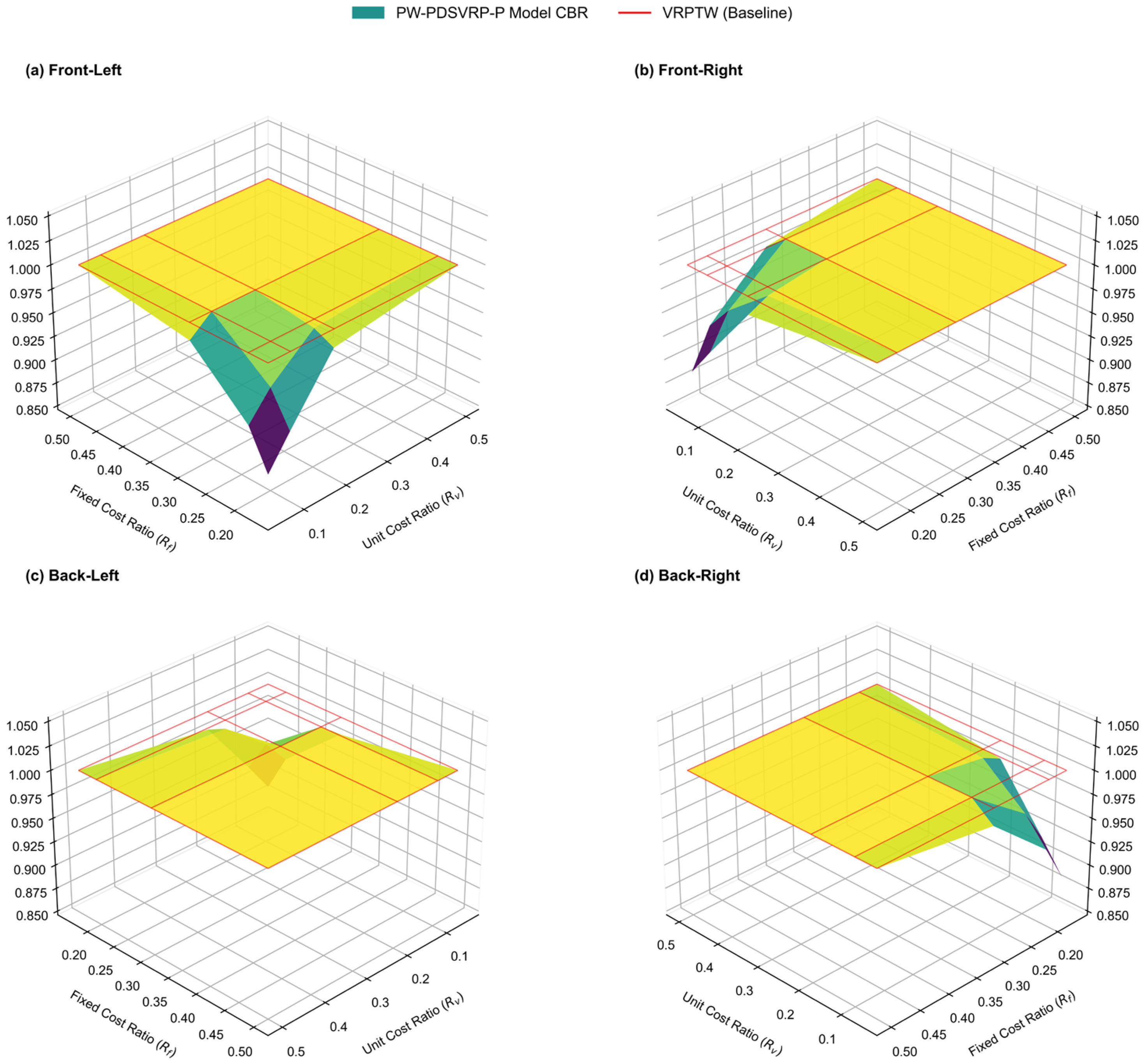
To establish a generalized decision-making framework, we perform a sensitivity analysis using normalized cost ratios. Figure 7 visualizes the resulting total cost ratio surfaces of our collaborative model versus the truck-only benchmark.
Figure 7 presents four distinct viewpoints of the same three-dimensional cost Ratio landscape. The operational parameters are standardized by defining the Fixed Cost Ratio ( R F = c f D / c f T ) and the Unit Cost Ratio ( R V = c v D / c v T ). The resulting Cost Benefit Ratio (CBR) is defined as the total cost of the PW-PDSVRP-P model divided by the pure VRPTW baseline (fixed at 109 in this instance). The results reveal a distinct economic advantage zone. When the drone’s fixed cost is significantly lower than the truck’s (e.g., at R F = 0.167 ), the collaborative model demonstrates substantial economic vitality. At the lowest unit cost ratio ( R V = 0.05 ), the system achieves its maximum efficiency with a CBR of 0.887, representing an 11.3% cost reduction. As R V increases, this advantage gradually erodes, following a near-linear upward trajectory until the CBR approaches the baseline. A critical observation is the “Modal Convergence” at higher cost levels. As R F rises to 0.3, the economic advantage zone shrinks significantly, yielding savings only at extremely low unit costs ( R V = 0.05 , CBR = 0.982). Notably, when R F reaches 0.50, the CBR remains constant at 1.00 across the entire spectrum of unit cost ratios.
This indicates that the algorithm intelligently identifies a “break-even limit”: In the low-ratio region, the model achieves maximum savings by utilizing drones as a mass-delivery tool, assigning a larger volume of customers to the UAV fleet to capitalize on their low marginal cost. However, as the cost ratios increase, it becomes highly selective, deploying drones as tactical “surgical tools” intended only to prune the most inefficient, circuitous segments from the truck routes. When the marginal cost of activating drones exceeds the potential savings from truck tour pruning. In such scenarios, the model adaptively re-verts to a pure-truck distribution pattern to avoid financial inefficiency.
To provide empirical substantiation for the link between the identified economic advantage zone and physical sustainability outcomes, Table 2 provides a quantitative analysis of the physical footprint migration across representative cost scenarios. By evaluating the system’s response as the R F = 0.167 , R V decreases from 0.2 to 0.05, we observe a systematic modal shift that underpins the environmental gains.
The empirical data in Table 2 demonstrates that the economic advantage zone is intrinsically linked to a reduction in Vehicle Miles Traveled (VMT) by the ground fleet. As the R V decreases from 0.2 to 0.05, the model effectively implements the “surgical pruning” strategy discussed above, resulting in a 14.5% plunge in total truck mileage (from 20.75 km to 17.74 km).
In urban logistics, this shrinkage of the ground-based physical footprint provides a robust empirical basis for assessing sustainability outcomes. A lower truck VMT is closely associated with mitigated road-level congestion and a decreased reliance on fuel-powered transport. By reassigning the most circuitous and emission-intensive route segments to electric-powered drone sorties, the model facilitates a more resource-efficient distribution pattern. These findings suggest that the cost-saving incentives of the PW-PDSVRP-P framework do not merely yield financial benefits but effectively support the transition toward sustainable urban distribution by reducing the physical road burden.

4.2.2. Sensitivity Analysis

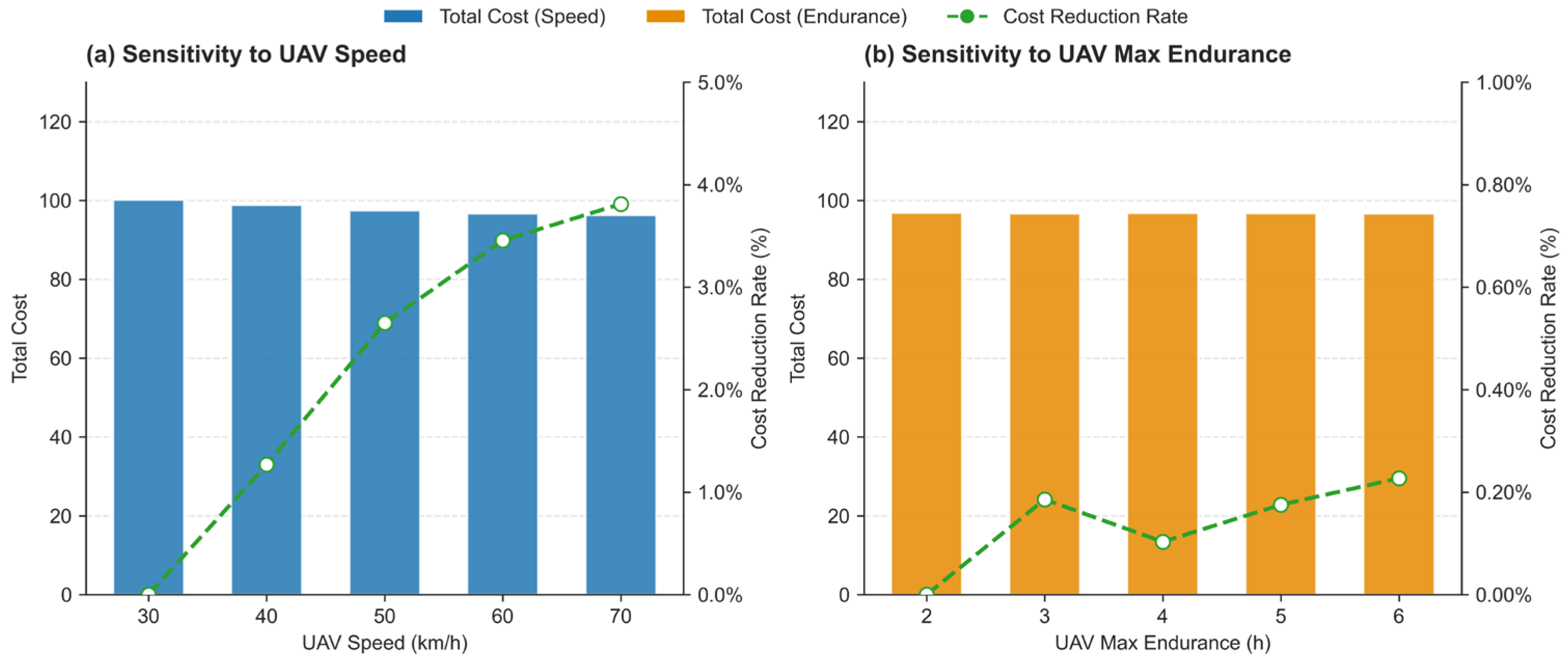
To derive actionable managerial insights, we conduct a sensitivity analysis on two key operational parameters of the drones: flight speed and maximum flight endurance. By systematically varying these parameters while holding all others constant, we can assess their impact on the overall system cost and quantify the marginal benefit of technological improvements. The results of this analysis are presented in Figure 8.
Figure 8 comprises two panels, each illustrating the model’s response to a specific parameter change. In both panels, the bar charts represent the total operational cost (left y-axis), while the dashed line plot represents the cost reduction rate (right y-axis) relative to the baseline scenario in each respective analysis.
Figure 8a illustrates a clear and consistent inverse relationship between UAV flight speed and the total operational cost. The results affirm that increasing drone velocity is a primary driver for cost reduction. As the speed rises from 30 km/h to 70 km/h, the total system cost drops from 100.12 to 96.31.
The fundamental mechanism behind this improvement lies in the enhancement of drone operational capacity. Higher flight speeds directly translate into shorter service durations for each individual sortie ( 0 i 0 ). Given a fixed battery endurance, reducing the time required per delivery allows a single UAV to accommodate a larger volume of customer assignments within its operational window. This increased “turnover rate” enables the model to aggressively shift more customers from the high-cost truck fleet to the more economical drone fleet, thereby maximizing the synergy of the parallel system.
However, the analysis also reveals that the marginal benefit of speed acceleration follows a pattern of diminishing returns. While the initial jump from 30 km/h to 40 km/h yields a noticeable cost drop, the reduction rate begins to level off as the speed approaches 70 km/h. This “flattening” effect occurs because, within the restricted 3 km service radius of a pre-warehouse, the absolute travel time per mission becomes so small that further speed increases offer negligible time-savings. At this stage, the system’s bottleneck is no longer the drone’s speed or capacity, but rather the intrinsic marginal cost of point-to-point sorties compared to an already optimized, high-density truck tour. Consequently, while speed is a vital asset for extending the service frontier, its ability to further optimize an already efficient hybrid network eventually reaches an economic plateau.
Figure 8b examines the impact of maximum flight endurance, revealing a distinct plateau effect where the “load height” (total operational cost) becomes effectively decoupled from the endurance parameter beyond the 2 h threshold. As endurance extends from 2 h to 6 h, the total cost remains almost entirely constant, fluctuating minimally between 96.86 and 96.64.
Reconciling this observation with our model’s assumptions provides a clear explanation for this decoupling. According to Assumption 2 (Independent Sortie Model), each drone mission is a simple back-and-forth trip starting and ending at the depot. Within the hyperlocal radius, the flight time for any single delivery is relatively short (typically 10–15 min). Consequently, an endurance of 2 h already provides sufficient temporal capacity to exhaust all customer assignments for which a drone is more cost-effective than a truck. Beyond this point, the endurance parameter shifts from being a binding constraint to a redundant one. Even if the technical endurance is increased to 6 h, the algorithm intelligently identifies that shifting the remaining customers—who are already part of a high-density, efficient truck tour—to point-to-point drone sorties would incur a higher marginal cost due to the loss of ground-based economies of scale.
It is worth noting that while payload and endurance are modeled as independent fixed thresholds to establish this strategic baseline, the LNS framework is well-suited to handle more complex, non-linear couplings through its task reassignment mechanism. Since the algorithm works by moving customers between the truck and drone fleets via relocation and exchange operators, it possesses the structural flexibility to adapt to varying mission constraints. If a weight-dependent energy discharge model were integrated in future work, the LNS would simply use these existing operators to shift heavier tasks back to the truck fleet whenever battery safety limits are approached. This methodological robustness ensures that our solution framework remains valid even as carrier energy models become more sophisticated.

5. Conclusions

5.1. Key Findings & Managerial Implications

This study introduces the PW-PDSVRP-P Model and develops a highly effective hybrid Large Neighborhood Search (LNS) algorithm to solve it. By comparing our approach against the exact solver Gurobi and traditional heuristics (e.g., SSIRs), we demonstrate that the proposed hybrid LNS offers a computationally efficient and superior tool for large-scale operational planning. Building upon this methodological foundation, our computational analysis reveals two primary operational findings. First, we identify a clear “economic advantage zone” for drone adoption: the collaborative truck–drone model can reduce total costs by up to 11.3% compared to truck-only systems, though this advantage diminishes as UAV operational costs surpass a critical break-even point. Second, the model exhibits an adaptive assignment strategy, dynamically shifting the role of drones from a high-volume delivery mechanism in low-cost scenarios to a targeted routing optimization tool when operational costs are high. Finally, although the computational experiments in this study were contextualized within specific urban landscapes in China, the proposed PW-PDSVRP-P model and the hybrid LNS algorithm serve as a robust, universally applicable methodology.
Returning to the specific operational insights, the identification of a critical break-even point offers a strategic guide for fleet investment, particularly when viewed through the lens of logistics governance. Methodologically, our PW-PDSVRP-P model abstracts the complexities of drone operations into a specific operational cost parameter. While mathematically straightforward, this abstraction provides a highly practical mechanism to quantify the economic burden of regulatory compliance. As aviation authorities such as the FAA and EASA establish regulatory frameworks for Beyond Visual Line of Sight (BVLOS) operations, compliance becomes a direct operational variable. Requirements like mandatory third-party airspace monitoring, specific pilot-to-aircraft ratios, or geofencing constraints ultimately manifest as elevated fixed or unit costs per drone dispatch. By adjusting this single operational cost parameter within our model, managers can effectively evaluate how varying degrees of regulatory stringency impact the break-even point.
At the operational level, the model’s adaptive assignment logic demonstrates that dispatching decisions should be highly dynamic and cost-dependent. When drone OPEX is relatively low, drones function efficiently as a high-volume delivery mechanism to relieve the truck’s payload. Conversely, as drone operating costs rise, their role should shift to a targeted routing optimization tool. In this scenario, dispatchers can utilize the algorithm to assign drones exclusively to geographically isolated nodes, thereby preventing the primary ground vehicle from making costly and time-consuming detours.
Beyond cost optimization, the integration of the customer pyramid concept provides a tangible framework for service differentiation and social sustainability. In real-world logistics, time windows and vehicle capacities are strictly constrained. The priority-weighted penalty mechanism allows operators to translate these constraints into tiered Service Level Agreements (SLAs). By prioritizing drone dispatches to bypass ground congestion, companies can reliably fulfill urgent, high-margin requests, such as medical supplies or premium e-commerce orders. Even during peak demand periods where some nodes may experience delays, the algorithm inherently protects the service levels of the most valuable customer segments. This ensures resource allocation is both economically viable and aligned with broader social responsibility goals, allowing operators to justify premium pricing models while maintaining critical service standards.

5.2. Limitations and Future Research

This study opens several avenues for future research. While the proposed model provides a foundational strategic framework, it relies on several simplifying assumptions—namely deterministic travel times, constant speeds, homogeneous fleets, and negligible service times. These simplifications, though necessary to ensure computational tractability and consistent with the established PDSVRP literature [18,20], may limit the immediate realism of the results. A critical spatial limitation of the current PW-PDSVRP-P model is its reliance on a 2D topographical framework, assuming unobstructed flight paths suitable for flat terrains. Extending this model to integrate 3D spatial modeling and geographic information systems (GIS) will be critical to navigate complex topographies (e.g., mountains) and urban obstacles (e.g., high-rises, no-fly zones).
Furthermore, sustainability is currently evaluated through distance-based cost metrics. Future extensions should integrate high-fidelity, payload-dependent energy consumption models to capture the non-linear impact of battery degradation and payload weight on drone endurance, as well as explicit emissions data for trucks. Finally, successfully scaling this collaborative model requires addressing specific logistics governance constraints.


Author Contributions

Conceptualization, Z.Z.; Methodology, H.W. and Z.Z.; Software, Z.Z.; Validation, Z.Z., Z.W., S.L., L.H., X.L., J.T. and S.Y.; Formal analysis, Z.W.; Investigation, Z.Z.; Data curation, Z.Z. and S.L.; Writing—original draft, Z.Z.; Writing—review and editing, H.W., Z.Z., M.L., Z.W., L.H., X.L., J.T. and S.Y.; Visualization, Z.Z. and S.L.; Supervision, H.W., M.L. and L.L.; Project administration, H.W., M.L. and L.L.; Funding acquisition, H.W. All authors have read and agreed to the published version of the manuscript.

Funding

This research was funded by the Fundamental Research Funds for the Central Universities of China University of Mining and Technology (No. 2024ESJSK01); Project of Philosophy and Social Sciences in Jiangsu Universities (2024SJYB0776).

Institutional Review Board Statement

Not applicable.

Informed Consent Statement

Not applicable.

Data Availability Statement

The original contributions presented in this study are included in article. Further inquiries can be directed to the corresponding authors.

Conflicts of Interest

The authors declare no conflicts of interest.

Abbreviations

The following abbreviations are used in this manuscript:
PDSVRPParallel Drone Scheduling Vehicle Routing Problem
PW-PDSVRP-PParallel Drone Scheduling Vehicle Routing Problem from a Pre-Warehouse with Priorities
VRPTWVehicle Routing Problem with Time Window
PMSPParallel Machine Scheduling Problem
LNSLarge Neighborhood Search

References

  1. Chinese Academy of International Trade and Economic Cooperation. Jishi lingshou hangye fazhan baogao [Development Report of the Instant Retail Industry]. Available online: https://www.caitec.org.cn/upfiles/file/2024/11/20241213113011188.pdf (accessed on 6 October 2025).
  2. The Central People’s Government of the People’s Republic of China. Guojia zonghe liti jiaotong wang guihua gangyao [Outline of the National Comprehensive Three-Dimensional Transportation Network Plan]. Available online: https://www.gov.cn/zhengce/2021-02/24/content_5588654.htm (accessed on 6 October 2025).
  3. Civil Aviation Administration of China (CAAC). Chengshi changjing wuliu diandong duo xuanyi wuren jiashi hangkongqi (qing xiaoxing) xitong jishu yaoqiu [Technical Requirements for Light and Small Electric Multi-Rotor Unmanned Aircraft Systems for Urban Logistics Scenarios]. Available online: http://www.caac.gov.cn/XXGK/XXGK/BZGF/HYBZ/202203/t20220311_212298.html (accessed on 6 October 2025).
  4. Xinhua News Agency. Zhongyang jingji gongzuo huiyi zai beijing juxing, xi jinping fabiao zhongyao jianghua [Central Economic Work Conference Held in Beijing, Xi Jinping Delivers Important Speech]. Available online: https://www.gov.cn/yaowen/liebiao/202312/content_6919834.htm (accessed on 6 October 2025).
  5. The State Council of the People’s Republic of China. 2024 nian guowuyuan zhengfu gongzuo baogao [2024 State Council Government Work Report]; The Central People’s Government of the People’s Republic of China: Beijing, China, 2024. [Google Scholar]
  6. The Central People’s Government of the People’s Republic of China. Zhengfu gongzuo baogao: Zai di shisi jie quanguo renmin daibiao dahui di san ci huiyi shang de baogao [Report on the Work of the Government: Delivered at the Third Session of the 14th National People’s Congress]. Available online: https://www.gov.cn/zhuanti/2025qglh/2025zfgzbgjd/index.htm (accessed on 6 October 2025).
  7. Amazon. Amazon Has Launched our Most Advanced Delivery Drone Yet—Here’s Everything You Need to Know. Available online: https://www.aboutamazon.com/news/operations/mk30-drone-amazon-delivery-packages (accessed on 7 October 2025).
  8. DHL. Unmanned Aerial Vehicles in Logistics a DHL Perspective on Implications and Use Cases for the Logistics Industry. Available online: https://www.dhl.com/discover/content/dam/dhl/downloads/interim/full/dhl-trend-report-uav.pdf (accessed on 7 October 2025).
  9. Madani, B.; Ndiaye, M. Hybrid truck-drone delivery systems: A systematic literature review. IEEE Access 2022, 10, 92854–92878. [Google Scholar] [CrossRef]
  10. Ren, X.; Huang, H.; Yu, S.-W.; Feng, S.; Liang, G.Q.; Amazon. Review on vehicle-UAV combined delivery problem. Control. Decis. 2021, 36, 2313–2327. [Google Scholar] [CrossRef]
  11. Ding, Y.; Wan, J.; Lin, W.; Wang, K. Coordinated last-mile deliveries with trucks and drones: A comparative study of operational modes. J. Air Transp. Res. Soc. 2024, 3, 100025. [Google Scholar] [CrossRef]
  12. Mbiadou Saleu, R.G.; Deroussi, L.; Feillet, D.; Grangeon, N.; Quilliot, A. The parallel drone scheduling problem with multiple drones and vehicles. Eur. J. Oper. Res. 2022, 300, 571–589. [Google Scholar] [CrossRef]
  13. Ham, A.M. Integrated scheduling of m-truck, m-drone, and m-depot constrained by time-window, drop-pickup, and m-visit using constraint programming. Transp. Res. Part C Emerg. Technol. 2018, 91, 1–14. [Google Scholar] [CrossRef]
  14. Montemanni, R.; Dell’Amico, M.; Corsini, A. Parallel drone scheduling vehicle routing problems with collective drones. Comput. Oper. Res. 2024, 163, 106514. [Google Scholar] [CrossRef]
  15. Dorling, K.; Heinrichs, J.; Messier, G.G.; Magierowski, S. Vehicle routing problems for drone delivery. IEEE Trans. Syst. Man Cybern. Syst. 2017, 47, 70–85. [Google Scholar] [CrossRef]
  16. Meng, S.; Li, D.; Liu, J.; Chen, Y. The multi-visit drone-assisted routing problem with soft time windows and stochastic truck travel times. Transp. Res. Part B Methodol. 2024, 190, 103101. [Google Scholar] [CrossRef]
  17. Kim, S.; Moon, I. Traveling salesman problem with a drone station. IEEE Trans. Syst. Man Cybern. Syst. 2019, 49, 42–52. [Google Scholar] [CrossRef]
  18. Nguyen, M.A.; Dang, G.T.; Hà, M.H.; Pham, M. The min-cost parallel drone scheduling vehicle routing problem. Eur. J. Oper. Res. 2022, 299, 910–930. [Google Scholar] [CrossRef]
  19. Wang, D.; Hu, P.; Du, J.; Zhou, P.; Deng, T.; Hu, M. Routing and scheduling for hybrid truck-drone collaborative parcel delivery with independent and truck-carried drones. IEEE Internet Things J. 2019, 6, 10483–10495. [Google Scholar] [CrossRef]
  20. Montemanni, R.; Dell’Amico, M. Constraint programming models for the parallel drone scheduling vehicle routing problem. EURO J. Comput. Optim. 2023, 11, 100078. [Google Scholar] [CrossRef]
  21. Singh, S. Drone-assisted delivery optimization: Balancing time and cost with multiple truck routes for efficient service. Comput. Ind. Eng. 2025, 203, 111061. [Google Scholar] [CrossRef]
  22. Ramos, T.R.P.; Vigo, D. A new hybrid distribution paradigm: Integrating drones in medicines delivery. Expert Syst. Appl. 2023, 234, 120992. [Google Scholar] [CrossRef]
  23. Kaplan, M.M.; Heaslip, K.P. The parallel scheduling vehicle routing problem for multimodal package delivery. In Proceedings of the IEEE Intelligent Vehicle Symposium (IV), Jeju Island, Republic of Korea, 2–5 June 2024; pp. 3050–3056. [Google Scholar]
  24. Jinlin, L.I.; Chenglong, Y. Parallel machine scheduling problem considering mold constraits and machine opening cost. Oper. Res. Manag. Sci. 2024, 33, 105–111. [Google Scholar]
  25. Li, K.; Xu, S.L.; Cheng, B.; Yang, S. Parallel machine scheduling problem with machine cost to minimize the maximal lateness. Syst. Eng. Theory Pract. 2019, 39, 165–173. [Google Scholar] [CrossRef]
  26. Li, K.; Yang, Y.; Liu, B. Uniform parallel machine scheduling problem with machine cost to minimize the maximal lateness. Oper. Res. Manag. Sci. 2019, 28, 178–184. [Google Scholar]
Figure 1. The pre-warehouse parallel drone scheduling vehicle routing problem.
Sustainability 18 02679 g001
Figure 2. Illustration of the Destroy and Recreate operator.
Sustainability 18 02679 g002
Figure 3. The two-stage heuristic for the VRP subproblem.
Sustainability 18 02679 g003
Figure 4. Greedy Drone Assignment heuristic for the PMS subproblem. (a) Customer Prioritization; (b) Fleet Size Estimation; (c) Round-Robin Assignment with Fallback.
Sustainability 18 02679 g004
Figure 5. The comparative results of objective function and computation time.
Sustainability 18 02679 g005
Figure 6. Visualization of a representative solution for the Hema Fresh case study. The base map contains local Chinese street names. The translated definitions for the key data markers are as follows: the central distribution center is denoted by the black building icon labeled "仓库 0" (Depot 0), and the delivery nodes are indicated by the term "客户" followed by their respective IDs (e.g., "客户 36" represents Customer 36). Furthermore, the green pins containing the character "起" (Start) signify the starting points of specific sub-routes, while the red pins with "终" (End) indicate the ending or return points. Finally, the solid green lines illustrate the designated truck routes, whereas the dashed red lines represent the UAV flight paths.
Sustainability 18 02679 g006
Figure 7. Comparison of Total Cost Ratio Surface between the PW-PDSVRP-P and VRPTW Models. (a) Front-Left; (b) Front-Right; (c) Back-Left; (d) Back-Right.
Sustainability 18 02679 g007
Figure 8. Sensitivity of Total Cost and Cost Reduction Rate to Speed and Endurance. (a) Sensitivity to UAV Speed; (b) Sensitivity to UAV Max Endurance.
Sustainability 18 02679 g008
Table 1. Sets, parameters and decision variables of the model.
NotationDescription
N Set of all nodes, where N = {0} ∪   C , with 0 being the depot
C Set of all customers, C = C T   C D     C T D
C T The set of customers that can only be served by trucks
C D The set of customers that can only be served by drones
C T D The set of customers that can be served by both trucks and drones
V T Set of available trucks, indexed by k ∈ {1, … K}
V D Set of available drones, indexed by m ∈ {1, … D}
d i j The distance from node i to node j
w i The demand of customer i
T i Delivery deadline (i.e., latest arrival time) for customer i
π i Priority-weighted tardiness penalty per unit of time for customer i
c f T Fixed cost for deploying a single truck
c v T Variable travel cost per unit of distance for a truck
c f D Fixed cost for deploying a single drone
c v D Variable travel cost per unit of distance for a drone
Q T The maximum load capacity of the truck
Q D The maximum load capacity of the drone
T m a x T Maximum tour duration for a truck
T m a x D Maximum fight endurance for a drone
v T Average speed of a truck
v D Average speed of a drone
M A large num
x i j The binary variable indicating whether the truck provides delivery from customer i to customer j (1 if it does, 0 otherwise)
y i m The binary variable indicating whether the drone m provides delivery to customer point i (1 if it does, 0 otherwise).
z i l k The binary variable indicating whether the drone k delivers to customer point i before customer point l (1 if it does, 0 otherwise).
Y m The binary variable indicating whether drone m is used (1 if used, 0 otherwise).
u i Cumulative load of a truck immediately after visiting customer i
A i Arrival time of a truck at customer i
s i m The time at which the m drone starts the delivery to customer point i
S i m a r r The time at which the m drone delivers the item to customer point i
S i m r e t The time at which the m drone completes the delivery to customer point i and returns to the warehouse
L i Tardiness of service for customer i   ( m a x {0, c o m p l e t i o n _ t i m e i T i })
Table 2. Evolution of Truck and UAV Mileage across Differentiated Cost Scenarios.
Cost Ratio (UAV/Truck)Truck Mileage (km)UAV Mileage (km)Reduction in Truck Mileage (%)
0.220.7530.46Baseline
0.118.3351.2511.7%
0.0517.7465.1714.5%
Disclaimer/Publisher’s Note: The statements, opinions and data contained in all publications are solely those of the individual author(s) and contributor(s) and not of MDPI and/or the editor(s). MDPI and/or the editor(s) disclaim responsibility for any injury to people or property resulting from any ideas, methods, instructions or products referred to in the content.