1. Introduction
Artificial intelligence (AI) is transforming the way we interact with clients in the service business at its core. Companies are using AI-powered marketing tools like chatbots on websites, dynamic pricing algorithms, voice-enabled online search interfaces, and visual product discovery systems to get people to buy things. While evidence exists indicating that these technologies influence consumer choices, a substantial study gap persists about their efficacy in relation to the health of the broader ecosystem. It is crucial for both theoretical knowledge and management practice in today’s service sectors to figure out how each AI technology affects the overall quality of the customer experience. Studies that provide proof of concept show that people are interested in AI marketing tools. Lopez-Lopez et al. [
1] examined the literature on the effects of conversational AI, Thompson et al. [
2] analyzed the impact of dynamic pricing on repeat purchases, and Averi.ai [
3] quantified the volume of voice commerce transactions. This literature is highly fragmented and predominantly examines individual technologies rather than their potential to produce integrated outcomes within multi-technology customer experience ecosystems. Currently, there is limited systematic understanding of the combined impact of perceived quality value and implementation zone alignment on purchasing behavior. The latter mismatch is especially pronounced in service-oriented sectors, such as telecoms. Differentiation here is spectral: we do not care about the differences between competing products. Instead, we care about promises of coverage or speed (or lack thereof), smooth transitions, and so on. There is not a data plan that can be kicked and lifted like tires; buyers cannot hold a metaphor in their hands. They navigate a landscape of abstractions, making decisions based on confidence and estimated experience rather than precise measurements. The old means of marketing are disappearing, and people are getting smarter about technology, but they are less likely to respond to the aggressive approach utilized in advertisements. The industry has reacted by quickly creating AI interfaces like chatbots that work as concierges that never sleep, pricing that changes like sand under pressure, voice search that beats keyboards, and visual searches that turn the whole world into a catalog [
4,
5,
6]. But to handle a tool is not the same as mastering its application in an orchestra.
At the same time, these transformations unfold against a broader shift toward sustainability-oriented marketing and consumption in digital environments. Recent reviews show that green and sustainable marketing have increasingly migrated onto digital platforms, where social media, online communities, and AI-enhanced interfaces are used to promote environmentally responsible offerings and influence consumer choices at scale [
7,
8]. Digital campaigns and platform-based strategies can foster sustainable consumption through better information, relational engagement, and tailored value propositions, but they can also intensify consumption pressures or obscure environmental trade-offs if they are purely conversion-driven [
9,
10]. Within this emerging research stream, little is known about how concrete AI marketing tools—such as chatbots, dynamic pricing, voice search, and visual search—operate inside virtual experience ecosystems to shape purchasing decisions in ways that may either enable or hinder more sustainable patterns of digital service use.
Current research has primarily been focused on breaking apart individual AI technologies and assessing their impact in a vacuum. Majeed et al. [
11] reported chatbot impacts on customer satisfaction, engagement impacts, and like treatments that prove the technology-specific effects. But such an ad hoc analysis leaves a large gap of knowledge. Customers do not meet individual technologies in isolation, but travel through digital ecosystems comprising more than one touchpoint and technology at the same time. The quality, consistency, and coherence of this ecosystem experience as a whole may have an impact on how customers perceive and are engaged by each AI-infused interaction. The moderating process of experience integration quality on the effectiveness of technology is underexplored in academic research, especially in service contexts where the service is indicated as intangible and cannot be purchased or held. These mechanisms each involve the synthesis of a complement of theoretical models. The theoretical model that underlies this study is the Technology Acceptance Model (TAM) [
12] and its extension by Venkatesh et al. [
13]. According to the TAM, perceived usefulness and perceived ease of use influence behavioral intention to adopt technology. In a telecommunication industry where the intangibility of services has posed challenges to customer evaluation, this model is very applicable. Physicians might refuse to use an AI-powered service if abstract services cannot be explained, for example when a chatbot communicates obscure coverage information or a cost-producing-interface is perceived as abstruse. Yet, although TAM is dedicated to specific cognitive variables, it does not fully consider the role of affective or contextual influences that determine how customers interpret their interactions with technology.
And here, the model is animated by the Stimulus–Organism–Response (SOR) framework [
14]. It recognizes that between the environmental stimulus (the AI tool) and the behavioral response (the purchase) is the organism—the customer’s private world of cognition and affect. Dynamic price-passing is not just a figure; it is a signal viewed through the prism of fair play or robbery. A chatbot is not only a text-producing machine; it is a social actor that can assist establish trust or dissatisfaction [
15,
16]. Crucially, the S-O-R lens shows us that the same stimulus can evoke dramatically diverse reactions. The determining factor? The quality of the virtual environment in which one is placed there: what a client experiences in virtual space. This experience is not just a context but is a strong modulator, boosting up or down-dumping true information over noise [
15,
17]. The framework for our analysis is purposive and meaningful: Saudi Arabia’s telecoms industry. The Kingdom’s Vision 2030 positions digital transformation and AI at the core of its economic revival, generating a socio-technical melting pot dissimilar to Western markets. Consumer demands, governmental attitudes toward algorithmic openness, and the domination of players such as the Saudi Telecommunication Company (STC) combine for a unique laboratory. Results here are not simply copies, but they constitute additions to a geographically contextualized understanding of digital consumer psychology.
This is where the heart of this study aims to fill in. The direct impact of AI tools is documented more and more, but the boundary conditions—when they work best, for whom—are being overlooked. Virtual customer experience (VCE) is arguably the most compelling of these prerequisites, a galvanizing agent able to unlock the potential for transitioning from ad hoc tactical victories to strategic and sustainable advantage. We still lack clear evidence on how embedded experiential factors, such as VCE moderation, shape the influence of specific AI marketing functions on consumption decisions in a service-dominant, intangible context like telecommunications. This has been the focus of this study then to break that ambiguity. With a data sample of 487 non-users of STC by using PLS-SEM, we reconcile the rational structure of TAM with the psychological depth of the S-O-R model. We address two key questions, as follows: the first is what direct impact these technologies (chatbots, dynamic pricing, voice search and visual search) make on the purchase decision in the retail sector? Second, more importantly, does virtual customer experience act as a moderating mechanism that enhances the impact of these relationships, operating as a complementary experiential layer rather than as a substitute for individual technologies? In so doing, we are not just trying to close a theoretical gap, but also give a vividly clear mandate to any practitioner: that in the era of AI—and driven by our new daily creature-sights comparable to those 7 years in scope—the kind of sum-total customer experience is much greater than its technological parts.
2. Theoretical Framework and Hypothesis Development
2.1. Theoretical Underpinnings
The theoretical framework supporting this study utilizes different complementary models, each highlighting separate yet interrelated elements of how artificial intelligence (AI) impacts customer behavior in service environments. This research emphasizes the fundamental complexity of modern consumer psychology by including three key models that together describe the methods through which AI marketing efforts effect purchasing decisions, rather than imposing rigid theoretical constraints.
The Technology Acceptance Model (TAM), initially presented by Davis [
12] and later revised by Venkatesh et al. [
13], presents a fundamental framework for appreciating the causes underlying customer acceptance or rejection of technology innovations. TAM’s fundamental theory is that two basic belief systems, perceived usefulness and perceived ease of use, govern whether or not people would adopt technology. When customers come across AI marketing tools, such as chatbots that answer inquiries straight away or voice search engines that make typing easier, they determine whether or not to utilize them based on whether they genuinely make the purchase process easier and deliver real value. The model’s simplicity masks its underlying complexity; it represents the psychological truth that even the most powerful technologies will not work if users think they are hard to use or do not comprehend their benefits [
4,
18]. Conversely, leaders’ STARA competencies considerably increase AI adoption performance, both directly and through dual mediation pathways including self-efficacy and techno-eustress. This underscores the relationship between technical leadership and psychological preparation in promoting sustained digital transformation inside businesses [
19].
In the telecommunications industry specifically, where service intangibility hampers consumer evaluation, the TAM becomes particularly crucial. Customers cannot physically examine network quality or handle a data plan in their hands. They must instead explore abstract service offerings through AI-mediated interactions. If these encounters are viewed as valuable and intuitive, technological acceptance follows naturally. If not—if chatbots produce useless ideas or dynamic pricing algorithms appear arbitrary—customers default to traditional decision routes [
12,
13]. This concept explains the mechanism, but it does not fully capture the affective and contextual factors of customer experience.
The Stimulus–Organism–Response framework, originally developed by Mehrabian and Russell [
14], complements the TAM by addressing psychological dimensions that rational choice models sometimes overlook. The S-O-R framework conceptualizes consumer behavior as a dynamic sequence: environmental stimuli (S) trigger internal cognitive and emotional states (O), which ultimately produce behavioral responses (R). Applied to AI marketing, the framework suggests that chatbots, dynamic pricing mechanisms, voice search interfaces, and visual search capabilities function as environmental stimuli. These tools initiate psychological processes—trust formation, engagement intensification, satisfaction development—that either facilitate or impede purchasing decisions [
15,
17].
What makes the S-O-R framework so relevant for this inquiry is its clear understanding that the same stimulus can induce varied reactions based on individual interpretation and the contextual context. One customer’s dynamic pricing mechanism appears obviously fair; another interprets identical pricing as arbitrary manipulation. One consumer finds a chatbot conversation genuine and useful; another perceives the contact as terribly mechanical. (VCE)—the quality and coherence of AI-mediated interactions—functions as a moderating variable within this stimulus-response relationship. Superior virtual experiences boost the influence of individual AI strategies; poor experiences attenuate or reverse them [
15]. Furthermore, the views of corporate fairness are crucial, as systemic unfairness can exacerbate bad behaviors, a principle equally critical when analyzing the ethical deployment of AI in consumer interactions [
20].
Consumer behavior theory, in its broadest formulation, recognizes that purchasing decisions emerge from complex interplay between rational evaluation and the emotional response, between individual preferences and social influence, and between immediate satisfaction and long-term value assessment [
21,
22]. In the AI marketing environment, consumers evaluate not only whether the technology works, but if it respects their autonomy, protects their privacy, and supports their interests rather than exclusively maximizing corporate profit. The rising sophistication of algorithmic decision-making simultaneously promotes convenience and provokes skepticism regarding hidden intentions or data exploitation [
17,
23].
These three theoretical perspectives—TAM’s focus on rational technology acceptance, S-O-R’s integration of affective and cognitive processing, and consumer behavior theory’s holistic recognition of multiple decision drivers—collectively provide robust theoretical grounding for understanding how (VCE) moderates the relationship between specific AI marketing techniques and purchasing outcomes. Each paradigm tackles important parts of client psychology; collectively, they enable a full analysis of the mechanisms via which contemporary marketing technologies impact behavioral decisions [
22].
2.2. The Relationship with SDGs
The convergence of AI marketing, consumer behavior, and sustainability is a new yet understudied topic of research. Whilst there is a great body of literature on AI as a game changer and ample research focused on sustainability imperatives, less attention has been paid to their interconnectedness—especially when it comes to service industries such as telecommunications. This vacuum is not without theoretical and practical significance as it represents increasing recognition amongst firms that sustainable competitiveness entails linking technology innovation, consumer connection, and environmental stewardship.
Sustainability in a telecommunications context goes beyond traditional environmental standards. Large amounts of energy are needed to power all this network equipment, data centers themselves are resource hogs, and the manufacturing of devices leads to e-waste. And yet at the same time, the business also offers huge prospects for positive environmental influence. Energy-aware networks can be optimized for AI that assist network-wide optimization. This future-oriented vision is increasingly operationalized through AI-powered client-engagement platforms, which can potentially direct more purchases into eco-friendly service plans. VCE enhancements can assist in decreasing unnecessary face-to-face encounters and the accompanying carbon footprints [
24,
25].
The research is situated within the framework of the United Nations Sustainable Development Goals. The 12th SDG, “Responsible Consumption and Production”, focuses on ensuring sustainable consumption and production patterns by encouraging companies and consumers to adopt more responsible consumption practices. In AI marketing and sales tactics that accompany clients through to ESG-aware telecoms services, which might be optimized data plans or encouraged digital interaction first behaviors, such techniques immediately aid in the attainment of the 12th SDG [
26].
Equally, the 13th SDG, “Climate Action”, emphasizes the need for organizations to assume responsibility for emissions reduction in their operations and supply chains. Energy-efficient AI systems, smart network optimization, and virtual experience designed to prevent needless resource use all assist climate action goals.
Recent research indicates that, as firms and customers grow increasingly environmentally sensitive, this quality of VCE is connected to sustainability consciousness. Firms that invest a lot in AI-mediated experience in their customer interface frequently run environmental initiatives; for high-end virtual users, openness to sustainability messages and environmentally friendly conduct is higher [
11]. This relationship suggests further ones: for example, perhaps organizations that have matured in terms of their customer experience capabilities also have the process excellence required to execute sustainability too. Maybe individuals who pay for convenience and customization also cherish the environment. Maybe the procedures that lead to VCE excellence—data optimization, efficiency focus, user-centric design—are also driving sustainability goals.
The idea of “green marketing” or “sustainable marketing” has grown in favor as a main-stream competitive approach. Progressive organizations in the telecommunications sector now recognize that environmental responsibility and brand image are intertwined, both seen as vital by customers [
24], as much as service quality. If AI marketing tactics are implemented correctly, they can help communicate sustainability pledges and inspire consumer behavior change towards the environment. Dynamic pricing, for example, may incentivize off-peak use if renewables have a bigger percentage of the grid supply. Chatbots may teach clients about energy use implications for various service alternatives. Voice and visual search provide speedy joining up between potential clients and environmentally focused services [
27].
Yet tensions persist. The environmental costs of the AI infrastructure itself—computing resource requirements, embodied carbon in hardware fabrication, and energy demands of training data systems—generate severe sustainability challenges. The data collecting and algorithmic decision-making underlying AI marketing systems create privacy and ethical challenges that sustainability frameworks must address. Some literature argues that the excessive algorithmic optimization of customer behavior risks weakening actual autonomy, a critical aspect of authentic sustainability [
21].
From a consumer-behavior perspective, these developments place AI marketing at the heart of how sustainability is experienced and enacted in everyday digital life. Instead of treating responsible consumption as a separate, “green” niche, virtual service journeys now embed subtle cues, price signals, and interface choices that can normalize lower-impact behaviors, from preferring virtual over in-person interactions to optimizing data usage and device lifecycles [
7,
8,
9]. In line with calls to understand sustainable consumption in the digital age as an outcome of marketing strategies, engagement processes and socio-technical infrastructures rather than individual attitudes alone [
8,
10], AI-enabled telecommunications ecosystems become living laboratories where environmental footprints, perceived value and fairness, and long-term customer relationships are negotiated simultaneously.
This work, by examining how VCE moderates AI marketing success, implicitly adds to understanding how organizations could exploit complicated technical capabilities responsibly. Superior VCE needs not equate to deceptive algorithmic design; it can instead reflect sincere devotion to consumer values within a sustainable setting. Organizations that deliver authentic virtual experiences—transparent about data usage, and respectful of privacy, oriented toward consumer wellness rather than manipulation—simultaneously advance both competitive advantage and sustainability imperatives [
11]. This combination of technology sophistication, customer experience excellence, and environmental dedication signifies not only ethical virtue but a strategic requirement in contemporary competitive circumstances.
2.3. Hypothesis Development
2.3.1. Chatbots: The Conversational Gateway to Purchase Commitment
Chatbots are the biggest disruption to traditional customer service architecture, affecting at its core how consumers shop. These AI-enabled conversational agents are always-on assistants who can speak fluently in a human-like conversation style while drawing on the go from massive product repositories and customer history logs. The technology behind today’s generation of chatbots, based on natural language processing (NLP) and machine learning (ML) algorithms, allows them to precisely interpret customer intentions as opposed to the static, scripted-based interactions typical of earlier waves of automated customer service [
23,
28]. With astonishing consistency, the empirical evidence confirming chatbot efficacy keeps stacking up. Recent research shows that AI-powered chatbots have a perceptible impact on purchase behavior with survey data showing 43.5% of consumers confirming that sometimes they buy because of a chatbot and another 36% saying they always buy out from these [
6], as well as empirical evidence from enterprise deployments evidencing conversion rate lifts of up to 400% in e-commerce and significant though situation-specific effectiveness in service industries. More provocatively, firms that have adopted AI-driven chat capabilities find a consistent improvement in their customer engagement metrics, where the answer quality and deployment complexity serve as the key efficacy proxies.
Even more provocatively, firms that use AI-driven chat tools find that conversion rates shoot up over 400%, as customer engagement levels soar. This effect is embodied in the fact that chatbots facilitate this effectiveness using three dimensions: reducing cognitive processing with automatic response to product queries, reducing information overload by making tailored suggestions, and drawing emotional connection through empathetic conversation [
29,
30].
In the telecommunications domain, service intangibility makes it difficult for clients to evaluate chatbot utility. Network quality is not directly observable by customers, and data packages are non-detainable, intangible offerings. Rather, they are forced to sift through esoteric technical material. Conversational AI, which deals with client queries such as coverage, plan comparisons, data allowances, and pricing plans makes sense of this complexity by offering responses using natural language in a conversational interface [
25]. The chatbot serves as an accessibility instrument that may lessen comprehension barriers and assist in making decisions to buy in complex service situations [
6]. However, implementation issues warrant consideration. It is known in the art that chatbot performance varies greatly on account of the deployment quality in terms of natural language processing (NLP) accuracy, conversation coherence, and smooth escalation control when chatbots have exhausted their flashing capacities. This range demonstrates that chatbot effectiveness is mostly a function of implementation quality—crisp conversational design, solid natural language training, seamless handover to human agents where appropriate, and a consistent priority based on brand voice. If these implementation elements are not examined, businesses using chatbots may be unwittingly decreasing customer experience [
31].
The theoretical underpinning for chatbot efficacy is mostly based on the (TAM) where perceived usefulness and perceived ease of use influence technology acceptance [
12]. Chatbots are a core utility; they solve actual customer service problems. They equally illustrate that accessibility-conversation comes effortlessly, with no need for heavy computer science. This bidirectional power placement suggests great predictability over purchase decisions [
13]. Hence, the following can be proposed:
H1: Chatbots have a positive and statistically significant impact on customer purchasing decisions.
2.3.2. Dynamic Pricing: Strategic Value Perception and Purchase Acceleration
Dynamic pricing algorithms are arguably the most controversial and economically significant “new” AI-powered marketing innovation. Such systems are capable of using dynamic price based on sophisticated analytics that include changes in demand, competitive prices, stock holding seams among customers’ behavior and an unspecific market condition [
32,
33]. The complexity of today’s pricing algorithms has achieved wonders, using machine learning technology to predict market shifts before competitors even notice. However, dynamic pricing is situated at the intersection of economic rationality and psychological perception, which potentially pits profit maximization against customer satisfaction [
34].
The evidential roots in favor of the success of dynamic pricing is surprisingly healthy. Personalized dynamic pricing has been shown to improve the likelihood of a repeat purchase by 25%, indicating the superiority of personalized strategies over demand-based (15%) and time-based (10%) models [
2]. The voice of consumer voice data reveals that the customized nature and value proposition perception result in customers perceiving price changes not as a negotiation tool, but one that acknowledges their preferences for making specific purchases [
35]. Such perceptual change in the way of looking at the pricing mechanism turns a potential source of friction into a potential source of emotional connection [
33].
The shared mechanisms of the effectiveness of dynamic prices may be based on rational value evaluation and emotional triggers. When they see that there is an obviously close link to price and the external cues—“premium pricing at high demand periods and discounted rates at low demand period”—customers perceive such pricing to be fair and, in some cases, even favorable [
36]. On the other hand, pricing that is perceived as arbitrary or exploitative is met with significant resistance and possibly rejection [
37]. The success of the implementation, thus, largely relies on transparency and perceived fairness, as well as how clear the communication is about why the pricing makes sense [
38].
Dynamic pricing is of specific strategic interest in communications. Quality and coverage historically serve as a source of service differentiation. But as the quality of networks converge, pricing is becoming the main weapon to compete. Dynamic pricing algorithms that maximize profit without harming consumers’ perceptions of fairness are a true competitive advantage [
24] and Optimal Admission and Pricing of Cellular Networks 1857. Furthermore, consumption patterns for telecommunications services are innately non-uniform (a large data demand during evenings or weekends, while a smaller traffic demand is observed in working hours) that justifies the temporal dependent pricing mechanisms [
32]. TE positively affects the competitive advantage via two mediating paths, which are organizational support and employee resilience, and it stresses the need to combine transformational leadership with strong support structures and efforts aimed at resilience development in organizations [
35].
The theoretical basis for the effectiveness of dynamic pricing combines the Stimulus–Organism–Response model and consumer behavior theory. Within this perspective, dynamic pricing is conceptualized as an environmental stimulus that triggers internal psychological valuation and equity considerations, consistent with the S-O-R tradition established by Mehrabian and Russell [
14]. The psychological response (perceived fair value) leads to a behavioral response (purchase commitment) [
36,
38]. Therefore, the following hypothesis is considered:
H2: Dynamic pricing has a positive and statistically significant impact on customer purchasing decisions.
2.3.3. Voice Search: Conversational Commerce and Immediate Gratification
Voice search—beginning as a cool novelty—is now the dominant interface for consumer information and sales inquiries. The development of technologies that understand natural language combined with the spread of voice-enabled devices (smart speakers, smartphone-assistants, in-vehicle systems) enabled unparalleled access to voice-based commerce [
39,
40]. The magnitude of adoption is simply astounding: 49.6% of US consumers leverage a voice search for shopping; the voice commerce transaction volume increased by 47% year on year in 2024; and voice-enabled shopping is expected to account for 30% of all e-commerce revenue by the end of the next decade [
3].
The process by which the voice search affects purchase decisions is both psychological and practical. In effect, the voice search removes the friction of search by text. No keyboard, no screen interaction users do not need typing skills or to look at their screen, making product discovery a breeze. This benefit is particularly pronounced formobile users, impatient/limited time customers or distressed people with accessibility concerns [
3]. A voice search also gives a feeling of urgency and personal involvement psychologically. Speaking requests are more conversational, personal, and agency-driven than typing requests, which may strengthen purchase intentions [
41].
There is significant evidence indicating that a voice search impacts the buying behavior. Voice commerce shoppers have a 33% higher purchase intent than average consumers; voice-assisted order purchases are 25% larger in price than what most purchase in traditional e-commerce channels; voice searchers make purchasing decisions at a rate three times faster when compared to traditional buyers [
3]. These performance parameters indicate that we are not talking of a plain interface in voice search, it is changing the psychology of purchases by speeding up decision-making and pushing to deeper commitments [
41,
42].
Trust and brand recognition are outsized factors in voice commerce. At Averi, this fits with the findings of our own research: 67% of all voice commerce purchases stem from brands people have purchased before, suggesting that those using voice commerce would rather stick to what they know when making decisions than take a leap into the unknown [
3]. This brand loyalty tendency indicates that the effectiveness of the voice search may lie in simplifying decisions with trusted brands rather than discovering new innovations [
42].
The underlying theory of a voice search’s usefulness is that it combines TAM’s [
12] perceived ease-of-use aspect with the principles of input–output. Do not interact with your voice is the most of usability—no barrier in technology, a natural interface, and almost no cognitive overload. This high level of access leads to rapid technology acceptance and increased usage rates [
12,
18]. Therefore, the following hypothesis is considered:
H3: Voice search has a positive and statistically significant impact on customer purchasing decisions.
2.3.4. Visual Search: Intuitive Discovery and Accelerated Product Identification
Visual search techniques allow users to explore products in an image or by using the camera rather than type-based search, thus addressing one of the fundamental limitations of current shopping experiences, namely that they do not follow natural human perception [
43]. Supported by advanced computer vision algorithms and deep learning models, visual search platforms can give precise descriptions of products on the basis of their pictures, turning users’ serendipitous encounters—a fashionable stranger’s jacket, an attractive furniture layout, or a botanical sample—into instant purchasing opportunities [
44]. The technology is driving product discovery democratization, especially for visual-heavy products that are difficult to describe by text alone [
45].
The rapid rise of visual search usage is indicative of how quickly consumers are picking up on visually-oriented, intuitive discovery processes. Recent market analysts predict that the visual search will influence a rapidly expanding share of online buying over the coming years, driven by advances in AI capabilities and consumers’ growing demand for visually rich, image-based product discovery interfaces [
46]. The benefits of the conversion rate are significant in visual searches, as users have 20–30% higher conversion rates compared to text-based searches, and visual search shoppers show 48% higher average order values, indicating more confident, committed buyers [
47]. These measures suggest that the visual search does not just offer another user interface—it drives greater customer engagement and more valuable buying intent [
28].
Visual search efficiency is driven by several interconnected psychological mechanisms. By allowing users to reference images rather than inferring product features from text, the cognitive load is significantly reduced. High-quality imagery also lowers purchase uncertainty, helping customers transition from consideration to an actual purchase by providing authentic visual information. Additionally, the visual search activates inspiration, transforming passive browsing into actionable shopping opportunities. This fosters urgency and emotional engagement, facilitating instant purchase decisions. These mechanisms are particularly effective in telecommunications, where abstract service offerings—such as network coverage maps, device specifications, and service plan comparisons—are made more tangible and comprehensible through visual information [
48].
When AR meets the visual search, the creation of an immersive experience becomes a state-of-the-art practice. Shoppers are theoretically able to virtually “try on” apparel, see how furniture fits within their home environment, or place products in situ to gauge the size relative to its surroundings prior to purchasing (thereby decreasing returns and increasing purchase confidence), although the potential negative effects of fatigue outweigh the benefits at this stage [
23,
48]. This combination of visual search and AR leads to friction-free, confidence-driven buying experiences.
The theoretical model of visual search efficiency can be largely accounted for by the TAM and more specifically by its perceived ease-of-use component. The reference image of a product has to be given by the user, and it is very easy to obtain. At the same time, the visual search provides fast and accurate results, thus maximizing perceived usefulness. This duality of the advantage position implies that the purchase behavior influence is strong [
12,
18]. Therefore, the following hypothesis is considered:
H4: Visual search has a positive and statistically significant impact on customer purchasing decisions.
2.3.5. Virtual Customer Experience: The Moderating Mechanism of Integrated Excellence
Virtual customer experience is the sum of all interactions between customers and AI-driven marketing technologies in the context of a larger digital environment. Instead of encountering isolated point solutions, customers experience faster, more collaborative and more efficient journeys in which multiple AI-driven interactions are orchestrated within a single virtual environment. The level of coherence, the consistency, and the quality of this experience as a whole heavily influence how customers interpret various technologies and ultimately make purchase decisions [
11,
49].
The conceptual basis of VCE moderation can be found in the Stimulus–Organism–Response model claiming that the environmental context strongly modulates human consumers’ psychological response to stimuli [
14]. The individual AI technologies are the stimuli, but at an organism level, the quality of the virtual environment as a whole and its coherence, reliability, and user-centeredness become a moderating variable that influences whether individual stimuli generate favorable versus unfavorable psychological responses [
15].
Evidence for the moderating effect of the VCE is mounting. Firms that heavily invest in a harmonized, consistent customer experience—where chatbots, dynamic pricing, a voice search, and a visual search work together without friction and convey a unified brand message while still addressing customers’ individual needs—experience 2.5 times higher purchase conversion rates than those who deploy siloed technologies [
11]. The above is consistent with studies showing that a better customer experience (especially virtual one) magnifies the positive effects of individual AI marketing techniques, while dampening down its negative side [
17]. Better experience quality leads to the greater perception of chatbot usefulness, fairness of dynamic pricing, convenience of the voice search, and intuitiveness of the visual search [
50].
The trust-building, commitment- validating, and integration-affirming effects of the VCE on the effectiveness of AI techniques are three pathways. Coherent and high-quality virtual interactions at touchpoints create trust in that these technologies serve true customer needs, not the interests of greedy corporation alignments [
22]. The uniformity of the experience proves that at least the single tech is not just a proof-of-concept but rather has been correctly worked out. Instead, integrated functionality reflects well-considered design that serves the customer journey, rather than isolated feature implementations [
25].
Conversely, a poor VCE—inconsistent brand voice, fragmented functionality, and unreliable technology performance—substantially attenuates individual technology effectiveness, potentially generating negative purchasing effects. A customer experiencing an excellent chatbot interaction but clumsy dynamic pricing interface, confusing voice search integration or poorly executed visual search functionality, develops a negative overall impression undermining individual technology benefits [
11].
The Stimulus–Organism–Response framework provides theoretical elegance explaining the moderation mechanism. Individual AI techniques represent stimuli. VCE quality determines the organism-level psychological state of confidence, trust, and satisfaction. This organism state then determines the behavioral response—continued engagement versus abandonment, purchase commitment versus suspension, and loyalty versus competitor exploration [
14,
15]. Hence, the following directional moderation hypotheses can be proposed, all positing that higher levels of VCE positively and complementarily strengthen the technology–purchasing relationship:
H5a: Virtual customer experience moderates the relationship between chatbots and customer purchasing decisions, such that superior virtual experience strengthens chatbot effectiveness.
H5b: Virtual customer experience moderates the relationship between dynamic pricing and customer purchasing decisions, such that superior virtual experience strengthens dynamic pricing effectiveness.
H5c: Virtual customer experience moderates the relationship between voice search and customer purchasing decisions, such that superior virtual experience strengthens voice search effectiveness.
H5d: Virtual customer experience moderates the relationship between visual search and customer purchasing decisions, such that superior virtual experience strengthens visual search effectiveness.
2.4. Study Framework
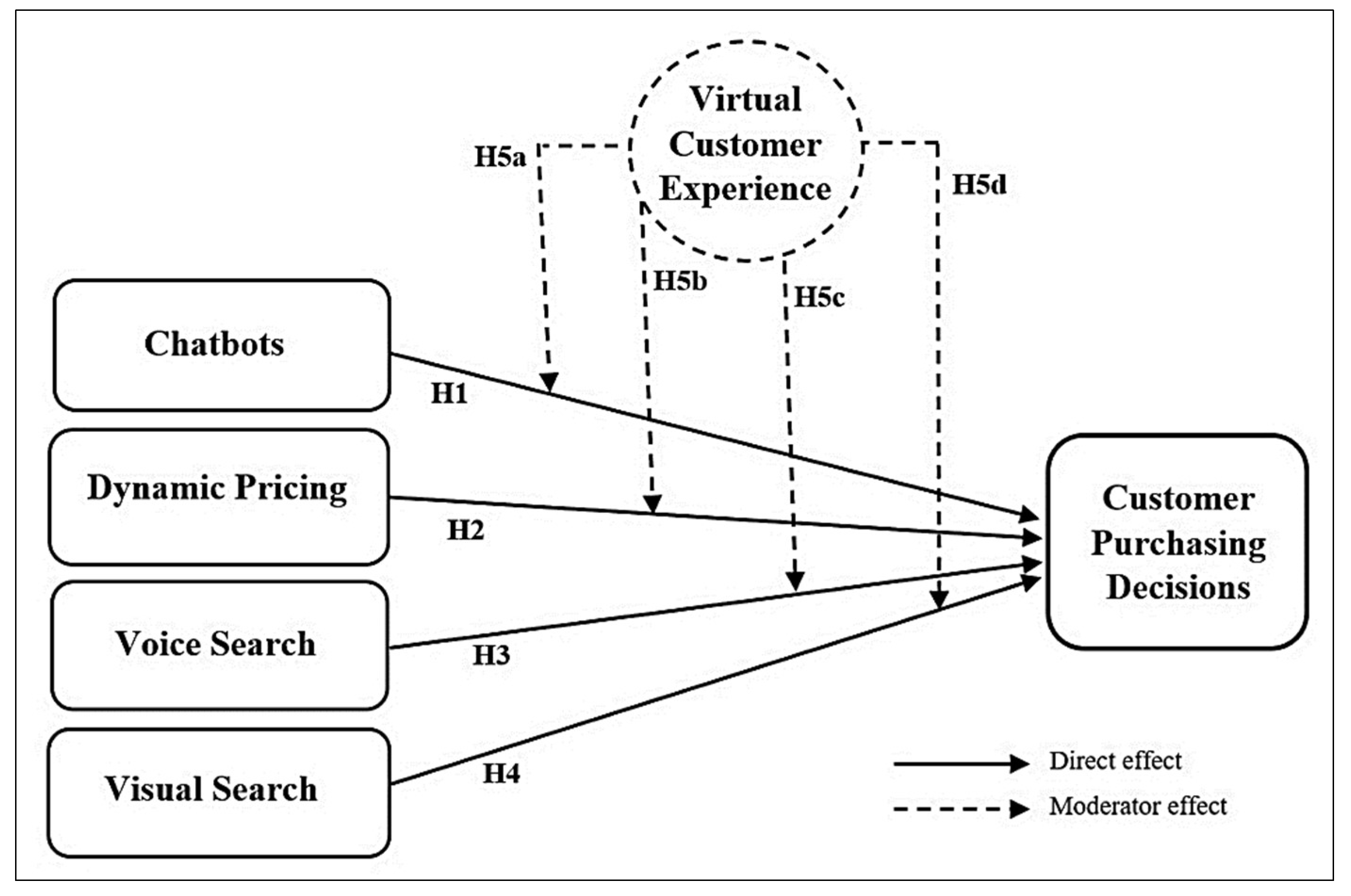
The model developed in this study, which is illustrated in
Figure 1, suggests that chatbots, dynamic pricing, voice searches, and visual searches (the independent variables) have a direct effect on customer purchasing decisions for telecommunications services (dependent variable; H1–H4). Furthermore, the VCE is conceptualized as a moderating variable operating in such a way to strengthen the effect of the value-added contribution of each technology on purchasing performance (H5a–H5d). Drawing on the (TAM) to explain how perceived usefulness and perceived ease of use impact technology-mediated decisions and taking a Stimulus–Organism–Response (S–O–R) perspective to conceptualize AI tools as stimuli affecting internal consumer processes and purchase responses, the proposed model serves as a benchmark for an empirical examination of the hypotheses presented and managerial implications when AI tools are employed in boosting customer purchase behaviors, based on the (TAM), SOR framework, and modern consumer behavior theory [
6,
28,
51].
3. Materials and Methods
In the current study, data were collected at a single time point, and it was truly a cross-sectional research design within which structural equation modeling (SEM) on both the validity of measurement model and relationships hypothesized among constructs in the model were conducted. The methodological approach is in line with typical CBR studies and simultaneously aims at meeting the specific needs for testing moderation hypotheses within complex theoretical frameworks [
52].
3.1. Research Design and Sample Characteristics
A cross-sectional research design was adopted, questionnaire-based, conducted on telecommunications services consumers in the Kingdom of Saudi Arabia over 6 months from January to June 2025. We intentionally chose this region to focus on the telecommunications sector, which is of high strategic interest for this area and has shown the rapid uptake of AI technology by leading service providers. Data collection followed a CAWI (computer-assisted web interviewing) approach, rather than PAPI or CAPI, in which all respondents completed the same web-based, self-administered questionnaire on their own devices via a secure online survey link. The sample consisted of 550 subscribers of telecommunication services who were aged eighteen years or more and had at least a six-month experience with the services so that they would have adequate exposure to provider platforms for forming perceptions.
The study was carried out in accordance with the national research ethics guidelines and international ethical principles of the Declaration of Helsinki. Written informed consent was taken from all participants. The informed consent procedure guaranteed the full comprehension of participants before they participated. In particular, participants were informed of the following: (a) about the academic nature of the study; (b) that their answers would be anonymous and confidential and no personal information other than demographic details was being collected; (c) on how their data would be stored securely in an aggregated form for analysis purposes, and only utilized for research on this work; and lastly, (d) that participation was not compulsory and there were no foreseeable risks associated with taking part in this study.
A total of 487 completed questionnaires were obtained and constructed, with a final utilizable response rate of 88.5 percent provided after adjusting for incomplete or ineligible submissions. When it comes to demographic profiling, the distribution of gender was almost even (52% female/48% male), while the participants were aged 18–25 years (28%), 26–35 years (35%), from 36 to 50 years (24%), and over the age of 51 (13%). Income distribution revealed middle-to-upper middle class aggregation indicative of an urban/semi-urban profile. Educational level was 61% university graduates, 27% secondary school-education completed, and 12% postgraduate degree holders.
3.2. Measurement Instrument Development
The research instrument included constructs validated from extant consumer behavior and technology acceptance studies, as well as items newly created for AI marketing technologies in a mobile phone service context. Perceptions of the chatbot were assessed with 5 items based on Mousa et al. [
6]. TIM was perceived ease of use, helpfulness, response accuracy, personalization capability, and overall usefulness as measured by Khodeer and Al-Shaikh [
28]. The perception of dynamic pricing (five items) was adapted from Alderighi et al. [
53] and samples the fairness perception, algorithm transparency, personalization fit, recognition of savings, and trusting in terms of the price mechanism. The effectiveness of voice search measure (five items) included items from Melumad and Liu et al. [
41,
42], perception of convenience, speed of completion, accuracy, intuitiveness of the interface, and overall satisfaction with voice-enabled product discovery. The visual search task (five items), modified from Boriya et al. [
43], investigated 764 participants on the efficiency of product discovery, accuracy of identification or decision confidence entropy, exploration enjoyment, and perceived facilitation to purchase. The operationalizations for VCE consisted of 8 items indicating the quality of integration between touchpoints, coherence in brand messaging, responsiveness to individual needs, technical reliability of systems, aesthetic look and feel of interface design, and congruence with personal values; coherence in so far as delivery on promises made shows up as a driver that is separate from quality across touchpoints [
11,
25].
Although the items used to capture the virtual customer experience span both functional and hedonic aspects (e.g., system reliability and integration versus aesthetic appeal and value congruence), these facets were conceptualized as manifestations of a single, higher-order experience construct rather than as independent moderators. Contemporary customer-experience research emphasizes that consumers interpret digital journeys holistically, integrating utilitarian cues about efficiency and control with more experiential cues related to immersion, enjoyment, and self-expression into an overall judgment of experience quality. In multi-touchpoint, AI-enabled service ecosystems, functional and hedonic perceptions, tend to co-vary strongly along the same episodes and interfaces, such that modeling them separately would introduce substantial multicollinearity and obscure the managerial question of whether the overall virtual experience conditions technology effectiveness. Treating the VCE as a second-order construct therefore follows established practice in customer-experience measurement, where multiple lower-order dimensions (sensory, affective, intellectual, behavioral) are routinely integrated into a single latent factor to capture the emergent quality of the experience. This specification is also consistent with our theoretical interest in the coherence and integration of the virtual ecosystem as a boundary condition, rather than in comparing the relative strength of hedonic versus functional experience components as separate moderators [
54,
55,
56].
Customer purchasing decisions (dependent variable) were measured using four items from Park et al. [
17] regarding the strength of purchase intention, subjective probability of purchase, propensity for purchasing, and likelihood to repeat a purchase. The final questionnaire comprised 32 items: 5 items for chatbots, 5 for dynamic pricing, 5 for voice search, 5 for visual search, 8 for virtual customer experience, and 4 for purchasing decisions.
The response options for all of the measurement items were 7-point Likert-type scales that ranged from “Strongly Disagree” (1) to “Strongly Agree” (7), which allowed for some discrimination but was also easy for participants to manage. This approach to scaling is consistent with the standards of modern consumer behavior research and technology acceptance literature. The decision to employ a 7-point rather than a 5-point Likert scale reflects a considered trade-off between measurement precision and respondent burden. Methodological work on rating scales suggests that instruments with between five and seven response categories generally optimize reliability, validity, and discriminating power, with little additional gain beyond this range [
57]. In particular, 7-point formats tend to yield slightly higher response variance and finer differentiation between adjacent levels of agreement, which is advantageous when capturing nuanced attitudinal constructs such as perceptions of AI tools and virtual experiences. At the same time, extending the number of categories can marginally increase the cognitive load, response time and, in some populations, the tendency to cluster around the midpoint, which may “flatten” responses compared with shorter scales [
58]. In this study, the 7-point format was therefore chosen to balance these considerations: it offers sufficient granularity to distinguish subtle differences in technology evaluations and VCE quality, while remaining manageable for respondents participating in a relatively short, self-administered online survey.
There were three phases in the development of the questionnaire, which included expert panel review by three marketing academics and two telecommunications industry practitioners to verify content validity and face validity (1), pilot testing with 75 randomly selected respondents to allow scale refinement, assess item-total correlations, and calculate reliability using Cronbach’s alpha coefficient (2) and final refinement after obtaining feedback from the respondents on these issues related to the clarity of items, and the response burden time needed for completion over time. In the pilot testing, Cronbach’s alpha coefficient fell between 0.831 and 0.887 at the construct level, exceeding the threshold (0.70) and suggesting strong internal consistency of the constructs. On average (pilot participants), the completion time for the questionnaires was 14.2 min (SD = 3.1); these results support feasibility in practice. Pilot feedback led to the minor rewording of items (n = 3) for clarity and a reshuffling of the order of categories to reduce response pattern effects.
From a methodological standpoint, the pilot sample size of 75 respondents is conservative relative to published guidelines for questionnaire development. Methodological syntheses on scale development recommend a minimum of around 30 participants for pilot testing to evaluate reliability, response processes, and feasibility, with suggested ranges between 25 and 75 respondents at this stage of validation. Other authors emphasize simple “rules of thumb” such as recruiting at least 5 respondents per item to check preliminary internal consistency before full construct validation. Given that our instrument comprised 32 items, a pilot
N of 75 therefore met and exceeded these benchmarks while still reserving the bulk of the sample for the main validation survey (
N = 487). In our design, the pilot’s primary function was to screen items for clarity, the response burden, and internal consistency, rather than to establish the final factor structure, and the achieved sample size is fully in line with contemporary practice in questionnaire validation [
59,
60].
3.3. Analytic Strategy
PLS-SEM by means of Smart PLS 4 was chosen as the leading analytical approach, following current benchmarks for business studies and consumer behavior research practice [
52,
61]. PLS-SEM provides specific benefits for exploratory research into complex moderating effects, non-normal data distributions, and small-to-moderate sample sizes, all of which are characteristic of this study [
62] The analytical approach used was similar to that of Hair et al. [
52] updates, including separate Measurement Model and Structural Model evaluation stages.
An assessment of the measurement model helped examine convergent validity by investigating factor loadings, as well as AVE with acceptable limits of 0.70 and 0.50 [
52]. The composite reliability analysis used CR values with a 0.70 cutoff, and Cronbach’s alpha provided additional reliability testing [
61]. Discriminant validity testing was conducted using the Fornell–Larcker criterion (comparing construct AVE square roots to between-scale correlations) and a Heterotrait–Monotrait (HTMT) ratio with a 0.85 cutoff value [
63].
We conducted structural model testing of direct effect path coefficients and significance levels based on the t-statistic, bootstrapped confidence intervals, as well as moderation paths as demonstrating the moderating roles of VCE [
48]. The R-square values measured the explanatory power of the model, and f-square showed the effect sizes of individual predictors [
52]. The moderating effects were examined using latent variable interaction products, which are especially appropriate for PLS-SEM applications [
61].
4. Results
4.1. Measurement Model Assessment
The fit statistics for the measurement model revealed strong psychometric properties for all research constructs in terms of convergent validity, reliability, and discriminant validity.
Table 1 provides the full measurement model outcomes, including item-level factor loadings, VIF measures for the collinearity check, and the construct-level reliability and validity metrics. The factor loadings of all indicators met the required threshold of 0.70, indicating satisfactory indicator reliability [
52]. This included the following item loadings: Chatbots (0.782 to 0.851); Dynamic Pricing (0.794 to 0.861); Voice Search (0.775 to 0.839); Visual Search (0.781 to 0.846); VCE items ranged from 0.788 to 0.858, and Purchasing Decisions items from 0.812 to 0.879. No items were deleted, since all exceeded the cut point. Variance Inflation Factor (VIF) values for all measures ranged from 1.421 to 2.847, well below the threshold of 5.0 and suggesting no issue with multicollinearity among reflective constructs [
62,
64].
The composite reliability for the all constructs were above the threshold of 0.70: Chatbots (CR = 0.912), Dynamic Pricing (CR = 0.925), Voice Search (CR = 0.918), Visual Search (CR = 0.908), Virtual Customer Experience (CR = 0.931), and Purchase Decisions CR = 0.924). Internal consistency of all the related measures was verified based on Cronbach’s alpha coefficients with a substantial score ranging from 0.893 to 0.941 for all, more than good using the standard of 0.70. The value of the Average Variance Extracted (AVE) consistently exceeded the 0.50 limit for convergent validity: Chatbots (AVE = 0.679), Dynamic Pricing (AVE = 0.721), Voice Search (AVE = 0.694), Visual Search (AVE = 0.687), Virtual Customer Experience (AVE = 0.702), and Purchasing Decisions (AVE = 0.754). Taken together, these findings indicate strong evidence of convergent validity amongst all constructs [
52,
63]. These measurement properties, including all item loadings, reliability indices, and VIF values, are summarized in
Table 1.
4.2. Discriminant Validity Assessment
Discriminant validity was tested using two complementary methods: the Fornell–Larcker criterion and the Heterotrait–Monotrait (HTMT) ratio based on indications from current PLS-SEM reporting guidelines [
52,
63]. The Fornell–Larcker criterion confirms discriminant validity if the square root of an Average Variance Extracted (AVE) per each construct is greater than the correlation between that construct and any other constructs. This pattern was also observed for all √AVE values of diagonal electrodes. The correlation between Chatbots’ AVE square root (√AVE = 0.824) is greater than the correlations with any other constructs, such as 0.621 with Virtual Customer Experience. This model was reproduced in all five constructs: Dynamic Pricing (√AVE = 0.849, the highest correlation of 0.684 with VCE), Voice Search (√AVE = 0.833, highest correlation = 0.621 with VCE) Visual Search (√AVE = 0.829, highest correlation = 0.641 with PD), Virtual Customer Experience (√AVE = 0.838, highest correlation (PD = 0.701), and Purchasing Decisions (√AVE = 0.868, the maximum number of correlations indicates that there is a high degree of redundancy). Discriminant validity based on the Fornell–Larcker criterion [
52] was fulfilled in all comparisons. The results of the Fornell–Larcker criterion and the HTMT ratios for all constructs are reported in
Table 2, confirming adequate discriminant validity.
Results of HTMT ratio consistently were lower than the threshold of 0.85 for social science research suggested by Henseler et al. [
65]. In particular, the HTMT ratios varied in between 1 = (Chatbots–Visual Search) and 0 = (Dynamic Pricing–Virtual Customer Experience). The maximum HTMT value (0.789) was far below the upper limit of the 0.90 bound, suggesting a clearly distinct pair of constructs with no worries for discriminant validity. The discriminant validity was further examined by fulfilling both the Fornell–Larcker and HTMT criteria across all construct pairs, which collectively reflected strong evidence of distinct validity across parallel assessment strategies [
63].
Table 3 presents the HTMT ratios for all construct pairs, demonstrating that discriminant validity was satisfactorily established.
4.3. Structural Model: Direct Effects and Hypothesis Testing
First, in this structural model testing, direct paths were tested between exogenous predictors (AI marketing technologies) and the endogenous outcome variable (customer purchasing decisions), as well as conditional effects of the VCE serving as a moderating mechanism. The results of the structural model are reported in
Table 4, with detail in terms of path coefficients (β), standard errors (SE), t-values, and
p-values and, for each direct or indirect effect, their respective 95% bias corrected confidence intervals, along with effect size estimates (f2) and predictive relevance (q2). Strong empirical support was found for all four of the direct effect hypotheses. The impact of the chatbot on the purchasing decision was statistically positively significant (β = 0.187, SE = 0.049 t = 3.842
p < 0.001 [95% CI: (0.091, 0.283)]), and hence, H1 was supported in this context as well. This effect size shows that a one standard deviation increase in chatbot perception leads to a 0.187 standard deviation increase in purchasing intentions, indicating practical significance, as well as statistical significance.
Likewise, we found that dynamic pricing emerged as the most direct influential in comparison to other AI technologies (β = 0.234, SE = 0.056, t = 4.156,
p < 0.001 and 95% CI [0.124, 0.344]) and confirmed H2 [
34]. Such a coefficient magnitude indicates that dynamic pricing mechanisms have a much more direct impact on purchase decisions than online chatbot technologies, which is in line with studies indicating consumers’ response to prices [
66]. The voice search showed a positive influence on the purchasing decision (β = 0.201, SE = 0.050, t = 3.987,
p < 0.001, CI: [0.103, 0.299]), which is a significant and positive relation supporting H3. This effect size places the voice search between chatbots and dynamic pricing in terms of the direct purchasing impact when considering its accessibility-enhancing but more subsidiary role vis-à-vis pricing mechanisms [
41].
A visual search showed a significant effect on the purchase intention (β = 0.219, SE = 0.053, t = 4.123,
p < 0.001, 95% CI [0.115, 0.323]), supporting H4. The size of the visual search effect is close to that obtained for the voice search, which indicates similar influence mechanisms by reducing the cognitive load and enhancing decision confidence [
67]. The effect size estimation of Cohen’s f
2 provides standards, where f
2 = 0.02 (small), f
2 = 0.15 (medium), and f
2 = 0.35 (large) indicate the magnitude of effects: Chatbots f
2 = 0.037 (small-to-medium effect); Dynamic Pricing f
2 = 0.058 (medium effect); Voice Search f
2 = 0.042 (small-to-medium effect); Visual Search f
2 = 0.049 (small-to- medium effect). All effect sizes were significantly larger than the small effects criterion (0.02) demonstrating practical significance for all direct paths. Among the direct effects, dynamic pricing had the highest effect size, which is consistent with our path coefficient results.
4.4. Moderation Effects: Virtual Customer Experience as a Conditional Mechanism
The VCE substantially intensified the four direct effects of AI marketing technologies on purchase intention, thereby fully supporting all moderation hypotheses H5a through H5d and confirming VCE as a complementary. Results of the full moderation path are presented in
Table 5, proving that AI technology effectiveness is contingent on the overall virtual experience quality. The moderating effect of the Dynamic Pricing × Virtual Customer Experience interaction was the most significant (β = 0.201, SE = 0.047, t = 4.241,
p < 0.001, 95% CI [0.109, 0.293]), with H5 being supported. b. This magnitude of the moderation coefficient is greater than all the other moderation paths, which implies that the effect of VCE quality was further enhanced under dynamic pricing conditions based on purchase decisions. This finding is consistent with theory on fairness perception processes: when a high-quality and coherent virtual environment is offered to customers, they tend to view price personalization more favorably as they interpret algorithmic pricing being responsive rather than exploitative.
The moderation effect of the Chatbots × Virtual Customer Experience interaction on commitment to the impact of the Chatbots × Virtual Customer Experience interaction is the second most influential (β = 0.189, SE = 0.047, t = 4.023, p < 0.001, 95% CI [0.097, 0.281]). H5 is supported. a. This effect indicates that a high-quality integrated virtual experience will significantly enhance the effectiveness of the conversational interface. Better quality of experience increases customer trust in chatbot suggestions and accelerates the acceptance that AI is behind our interactions within cohesive digital environments.
The Voice Search × Virtual Customer Experience interaction demonstrated moderate moderation strength (β = 0.156, SE = 0.044, t = 3.512, p < 0.001, 95% CI [0.070, 0.242]), supporting H5c. The relatively modest moderation effect compared to dynamic pricing and chatbots potentially reflects voice search’s already-high accessibility and ease-of-use characteristics, suggesting that additional experience quality enhancements provide incremental rather than transformative amplification.
The Visual Search × Virtual Customer Experience interaction produced a moderation effect magnitude between the voice search and chatbots (β = 0.174, SE = 0.046, t = 3.781, p < 0.001, 95% CI [0.084, 0.264]), supporting H5d. This intermediate positioning reflects the balanced contribution of both visual interface intuitiveness and broader experience ecosystem coherence to effectiveness amplification.
4.5. Overall Model Predictive Power and Explanatory Capacity
The structural model was found to provide a high degree of explanatory and predictive power. The model accounted for 71.2% of the variance observed in customer purchasing decisions (R2 = 0.712, Adjusted R2 = 0.708), which means that either as a direct or moderated-by-virtual-customer-experience effect, approximately 71 percent of observed variation in the purchasing decision is explained by the four AI marketing technologies used on this research study. The effect size magnitude is well above those obtained in an average behavior research baseline (typically ranging between 40 and 55% in multi-factor studies), and it offers strong evidence of the AI technology importance as determinants of the purchasing decision in the telecommunications service industry.
Stone-Geisser’s Q
2 cross-validation method was used to evaluate predictive validity based on the exogenous constructs, in which it affirmed model suitability for predicting the endogenous latent factor. The Q
2 (Q
2 = 0.535) of purchasing prediction was significantly higher than zero and implied the good predictive value of the model. Adhering to the interpretation criteria for Hair et al. and Roemer et al. [
52,
68], Q
2 > 0.35 has large predictive relevance. The actual computed Q
2 = 0.535 is well above the threshold, indicating that the research model possesses satisfactory robust out-of-sample predictive power and performance more than just explaining sample data, which are already given. This twin proof of a strong in-sample-explaining ability (R
2 = 0.712) and out-of-sample-predicting relevance (Q
2 = 0.535) situates the model in representing both retrospective explanation and prospective prediction for telecommunications customer purchasing decision-making processes [
68].
The comprehensive model structure encompassing direct effects, moderation mechanisms, and integrated theoretical frameworks explains purchasing decisions through multiple reinforcing pathways. Individual pathway effect sizes range from f2 = 0.029 (voice search moderation, smallest effect) through f2 = 0.058 (dynamic pricing direct effect, largest direct effect) and f2 = 0.052 (dynamic pricing moderation, largest moderation effect), collectively demonstrating consistent practical significance across all hypothesized relationships.
The R2 = 0.712 observation justifies open dialogue about potential mechanisms for the contributing effect. A few possibilities may contribute to the large increment explanation. First, the construct of VCE, although theoretically separate from purchase intentions, captures aggregate quality of artificial intelligence-facilitated interactions directly facilitating purchases. Second, in Saudi Arabia, the purchase context of telecom services is characterized by restricted choice sets for each of the three major providers (STC, Zain, and Mobily), which may increase the predictability of behavior to a higher extent than markets with more products. Third, the four AI technologies studied together meet basic information and decision-support requirements for abstract service purchasing decisively, which may account for significant variation in outcomes when technologies adequately span decision-relevant dimensions. Fourth, all participants had a minimum of six months of experience with selected providers, indicating familiarity that may increase the predictability between technology and behavior. Lastly, although temporal separation of measurements partially attenuated common method variance, some bias inflation due to a common source factor could not be ruled out; future empirical studies using longitudinal research designs, hard objective purchase data, and independent measurement sources would confirm the robustness of our results across different methodological orientations.
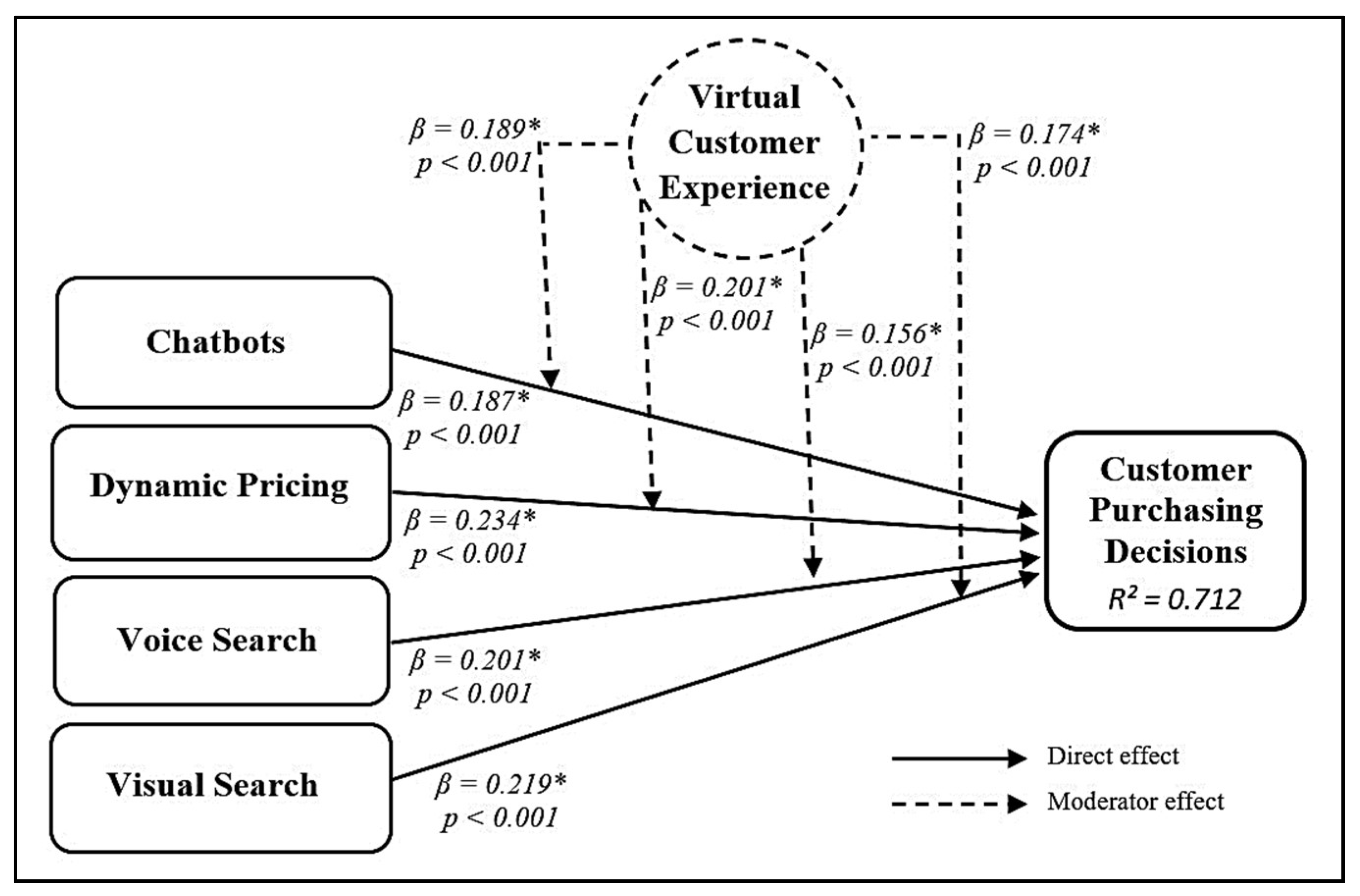
As shown in
Figure 2, all the direct effects of AI marketing technologies on customer purchase intention are positive and statistically significant (
p < 0.001). The VCE significantly intensifies these relationships, validating the hypothesized moderate effects. Solid arrows indicate direct effects (H1–H4), while dashed lines represent the VCE as a moderator of the relationship (H5a–H5d). Numbers are standardized path coefficients (β). **
p < 0.001. The model accounts for 71.2% of variance in customer purchases (R
2 = 0.712).
4.6. Model Fit and Explanatory Power
The examination of goodness-of-fit for the structural model predicted high power. The explanatory power of the research model was 71.2% (R
2 = 0.712, adjusted R
2 = 0.708), which showed high explanatory power far beyond what one would expect from conventional behavioral research [
64]. This result means that, directly or via the moderation role of the VCE, the four AI marketing methods explain nearly 71% of the variance observed in purchasing decisions—a significant level effect to position AI-based marketing as a strategic driver in telecoms.
4.7. Assessment of High Explanatory Power
The structural model’s total variance explained (R2 = 0.712, Adj R2 = 0.708) largely outweighs the “standard” effect sizes observed in consumer behavior and technology acceptance studies to date. This increased explanation deserves open consideration of possible causes. Many reasons of why large variance is explained are considered to be added. First, as a theoretical disaggregated factor to purchase intentions, the VCE construct includes an entirety dimension of AI-mediated interactions supporting purchasing by direct aiding. The embedding of dimensions of technology quality into the measurement of outcomes may help to explain stronger associations than would be found with isolated studies on technology. Second, the context of purchasing telecommunications services in Saudi Arabia features relatively restricted choice options (main providers: STC, Zain, Mobily), which can lead to higher levels of behavioral predictability in contrast with markets that offer many products and with higher differentiation complexity. Third, the four AI solutions considered here together meet core information and decision support requirements for abstract service acquisitions, which may underlie considerable outcome variance once technologies cover full decision-relevant dimensions. Fourth, all participants had a minimum of six months service experience with their selected provider, indicating a known set of services that could add to the predictability of technology–behavior relationships. However, even though the temporal separation of measurement approaches within questionnaire administration did contribute to some reduction of common method variance, it remains impossible to rule out all inflation (from common source effects); future research using longitudinal design work and different outcome measures (e.g., objective purchase data), as well as judges other than participants, will be needed to establish evidence of the robustness of these findings across studies with different methods.
5. Discussion
Such strong support for all direct effect hypotheses (H1–H4) reverberates with the recent consensus in the consumer behavior literature of AI’s transformative impact on buying behaviors [
1,
69]. The effect of chatbot efficacy (β = 0.187,
p < 0.001) is consistent with those reported by Mousa et al. [
6], who reported a significant impact of chatbots on purchase decisions. Nonetheless, the current study contributes to previous contributions by confirming a differential effectiveness of technology—amongst all technologies examined, dynamic pricing proved to be most effective in terms of its direct effect (β = 0.234), i.e., personalized prices activate an intention to purchase stronger than conversational interfaces do on their own. Such a differential effectiveness undermines overly simplistic technological determinism and instead profiles various technologies as corresponding to unique means of engaging psychological pathways toward behavioral commitment [
30].
The moderation results have important theoretical implications. All four paths specified in H1–H4 remained significant across different levels of virtual customer experience quality, and the Dynamic Pricing × VCE interaction (β = 0.201) produced the largest change in effect size. These findings indicate that the effectiveness of technology functions uniquely, rather than universally, and an IDV’s technology potency is significantly contingent on the experience ecosystem quality at a large level. Technology effectiveness is increased significantly when telecommunication companies provide coherent, consistent, well-integrated AI experiences on chatbots, as part of pricing interfaces and voice search functionalities and visual capabilities [
11]. This pattern of moderation indicates that single technology initiatives, through disconnected, experience-based deployments, are unlikely to be effective [
1].
The discovery R
2 = 0.712 is worth special notice. The model explanatory power far surpasses standard telecommunications research baselines, which suggests that AI marketing techniques, as assessed by direct and conditional paths in isolation, explain outstanding proportions of variance in customer instance or purchase actions. This is an effect size decision that puts AI technologies in the driver’s seat, and not in the backseat or on the sidelines, of telecommunications consumer behavior. The intangibility of services in the telecommunications industry that prevent the customer from evaluation is significantly moderated with AI intermediaries [
28]. Less technologically savvy users can easily peruse the labyrinth of coverage plans, plans, and pricing with conversational interfaces that minimize decision friction and buying remorse.
The level of variance explained has important methodological and practical implications. Fulfilling 71.2% of the variance in purchase decision, which is well above standard research benchmarks (e.g., 40–55% for multi-dimensional studies), AI marketing technologies and their embedding within VCEs are not merely secondary forces—rather they emerge as principal drivers when it comes to telecommunications consumer behavior. This effect size is particularly impressive in light of the commonly acknowledged fact that consumer decisions are driven by a number of factors beyond marketing technology, such as individual taste based on past experience, social influence and peer recommendations, brand loyalty established through previous transactions, demographics and life situations, and the availability of competitive alternatives. The fact that even with interference from these other alternate causal factors, AI marketing technologies explain 70+% of variance, indicates strategic-level technology efficacy. That is not great news for marketers who see a clear path to their first-party data and believe its acquisition, conversion, and engagement will be bolstered with AI-nurtured strategies; what it does do is underscores the important role that AI technology deployment and integration quality optimization has in informing new rather than motherhood and apple pie. If we consider one more pivotal service sector in Saudi Arabia, commercial marketing strategies that leverage AI play a crucial role in the decision-making of tourists and guest engagement by being able to interact with them on a personal level through social media applications, emphasizing the powerful effect of personalized AIM tactics for competitive edge achievement among hospitality sectors within Saudi Arabia [
70].
Beyond their commercial potency, these findings carry non-trivial implications for sustainable consumption in digital service markets. When AI marketing tools and coherent VCEs displace physical branch visits, paper-based processes, and redundant contacts, they effectively dematerialize parts of the service journey and may lower the resource intensity of routine interactions, particularly in high-volume sectors such as telecommunications [
7]. At the same time, more persuasive and frictionless AI interfaces can also accelerate upgrade cycles, encourage data-intensive usage, or normalize always-on connectivity, thereby fueling rebound effects that undermine environmental gains [
9]. The moderating role of the VCE identified in this study therefore becomes a double-edged instrument: it is precisely the same experiential sophistication that can nudge customers toward responsible, energy-aware usage profiles or, alternatively, toward the more frequent and intensive consumption of digital services [
8]. Recognizing and governing this tension is central if AI marketing is to support, rather than erode, the ambitions encoded in SDG 12 and SDG 13.
Yet implementation challenges merit acknowledgment. There is more focus on trustworthiness in services sectors as they adopt technology, especially with respect to the privacy of data and transparency of algorithms. Service providers should also manage the level of personalization with its privacy-aware capabilities. For the current study, it means that trust should be explicitly incorporated to evaluate the quality of the virtual CX dimension—(you) can trust me I am a machine: not just efficient in its operations (as alluded to before), but a credible and reliable entity that still ensures customers we use AI for their convenience, not only for our business profit motives [
1].
6. Study Implications
6.1. Theoretical Contributions
Through multiple integrated pathways, this investigation contributes meaningfully to consumer behavior theory. Most fundamentally, the research extends the (TAM) framework by demonstrating that technology effectiveness operates through context-dependent mechanisms largely unexamined in prior TAM applications [
71,
72]. Although this study reveals that experiential ecosystem quality functions as a crucial moderating variable reshaping the magnitude and direction of technology effects, traditional TAM conceptualizes adoption determinants as primarily cognitive—perceived usefulness and perceived ease-of-use. The moderation hypothesis formulation advances Stimulus–Organism–Response theory applications within marketing contexts. This study demonstrates how organismic states—reflected in the quality of the VCE—substantially reshape stimulus–response relationships rather than treating stimuli (AI technologies) as isolated variables with invariant effects [
1]. This theoretical positioning enriches S-O-R applications by recognizing that integrated experiences function as critical psychological state determinants. Service ecosystems increasingly operate through multi-touchpoint interactions; recognizing experience coherence as moderating variable proves increasingly necessary for theoretical adequacy [
16].
Moreover, the study provides a unique contribution to telecommunications marketing literature. Service sectors encounter specific impediments with regard to the tangibility of their products; there are no tangible services as in physical goods (telecommunication services are still intangible by nature), and providing advanced information to satisfy an informed customer product selection is necessary [
28]. AI technologies go some way to overcoming this intangibility problem in a number of ways: chatbots turn dense specifications into accessible conversation; dynamic pricing mechanisms articulate value propositions; voice search eases the path to options discovery; visualization aids evidence-based comparisons. By showing that AI has varying effectiveness between telecommunications contexts, this study helps to disaggregate technology application approaches more compatible with the services industry [
1].
In addition, the analysis spans theoretical views from studies originally in isolation. The fusion of TAM, the Stimulus–Organism–Response model, and recent customer experience theory into an integrated framework provides novel theoretical synthesis. This amalgamation is especially useful because it makes the psychological, technological, and environmental factors in complex digital habitat operational [
11]. The moderating effect of the VCE implies that focusing on technology effectiveness in isolation is not enough if the specific attributes of the experiential ecosystem are not explicitly incorporated into the model.
Finally, by situating AI marketing technologies and VCE within the broader discourse on sustainable consumption in the digital age, this study adds a consumer-level lens to emerging work on sustainable and green marketing in digital environments [
7,
8]. Whereas much of the sustainable marketing literature focuses on social media campaigns, green brand positioning, and macro-level sustainability branding dynamics [
9,
10], the present model specifies how concrete AI tools and experiential conditions jointly structure purchasing decisions in an intangible, service-dominant setting. In doing so, it offers a theoretically grounded bridge among technology acceptance, customer experience, and sustainable consumption research, showing that the pathways through which digital marketing strategies influence sustainability outcomes run through the granular architecture of AI-mediated interactions as much as through high-level corporate commitments.
Methodological contributions of the paper extend the methodologically, showing PLS-SES as being suitable to test complex moderation mechanisms in consumer research [
52,
62]. The validation of the OM and discriminant validity check using different methods and the formulation of hypotheses through latent variable interactions offer a methodology for future research on technology–behavior relationships.
6.2. Practical Implications
Telecommunications professionals facing ever increasing competitive challenges will find actionable strategic direction from these research results. More directly, our differences in the effectiveness of technologies imply that when financial resources need to be allocated, it is the distribution of those resources over the different AI-enabled channels—and not an emphasis on a single technology—that provides better “bargaining” power. How much to care about the implementation of dynamic pricing with the greatest direct effect (β = 0.234) deserves significant strategic focus, yet complementary chatbot, voice search, and visual search investments magnify the influence, incorporating moderator mechanics. This multi-technology integration approach stands in direct contrast to the typical single-channel deployment philosophy often seen in industry implementations.
The moderation effects turn into a strategic call upon the experience coherence. These VCE moderation effects are so pronounced that it may be necessary for top management to envision AI deployment at the integrative rather than departmental level. Technology effectiveness significantly diminishes when pricing function logic does not align with chatbot advice, voice search disagrees with visual UIs, or aesthetics vary across touchpoints. On the flip side, if experience alignment deployment is orchestrated so that every AI-powered channel speaks with one voice, has an aligned band personality and synchronized dashes, and enables frictionless transitions from touchpoint to touchpoint, the effect of purchasing commitment on customers is woefully magnified.
Empirical results lead directly to recommendations of what should be implemented. To begin, telecom operators need to execute quality audits of the customer virtual experience for coherence, consistency, and reliability, as well as aesthetic, personalized, and personalized intelligence across all touch points. These audits should not just be a check on the box that channels are evaluated individually without regard to their ecosystems. Second, customer journey mapping exercises should map out critical decision points were AI application combats consumer skepticism or information deficiency. Priorities should focus on high-friction points at which customers are currently dropping purchase processes.
For operators explicitly pursuing sustainability objectives, these audits and journey-mapping exercises should deliberately incorporate environmental and social criteria alongside conversion metrics. AI-enabled chatbots, dynamic pricing engines, voice, and visual search can be configured not only to maximize short-term revenue, but also to foreground lower-impact service plans, encourage off-peak usage when grids are greener, and promote virtual rather than physical service encounters where appropriate. Transparent explanations of how recommendations and prices are generated, coupled with options that respect self-control and data privacy, can help avoid perceptions of manipulative “dark patterns” and instead position AI-enhanced journeys as enablers of thoughtful, sustainable digital consumption. Designing governance structures that ensure sustainability, fairness, and customer autonomy are treated as first-order design constraints—rather than afterthoughts—would allow telecommunications firms to align AI marketing with both competitive strategy and the expectations of increasingly eco-conscious consumers.
Third, firms need to formalize cross-functional governance that safeguards the integrity of an experiential ecosystem underpinning technology implementations of AI. When chatbot teams, pricing analytics teams, digital marketing teams, and customer service teams deal with their own data silos, inconsistency is bound to appear. Leading a unified virtual experience-promised management allows decisions of all functions to consider a broader ecosystem.
Fourth, measurement frameworks need to explicitly measure VCE quality in addition to specific technology effectiveness metrics. The industry currently evaluates chatbot satisfaction, price fairness perception, voice search accuracy, and visual search utility separately. Advanced measurements should be based on a combined virtual experience evaluation revealing weaknesses in integration, consistency, or reliability that diminish the overall effectiveness.
Lastly, companies should consider AI technology deployment as a phased future market position rather than short run conversion optimization. Although the 71.2% explained variance in purchase cannot be neglected, a competitive advantage is not gained by just deploying technology but from a customer experience difference. Rivals get their hands on discrete technologies overnight; few can pull off holistic, unified, mature virtual experiences that consumers truly view as customer-first and not a corporate optimization hustle.
7. Limitations and Future Research
This study, although offering strong evidence on the effectiveness of AI marketing technology, requires an honest debate regarding its shortcomings from an academic standpoint. These limitations, however, do not detract from the usefulness of the work; they rather suggest fertile avenues for further investigation. First, our strategy is cross-sectional and captures relationships most efficiently but limits the inferences we may draw about causality. The associations we detect are intriguing and statistically significant, but temporal order (causation)—the extent to which exposure to AI technologies actually leads to a change in purchasing behavior—demands the longitudinal perspective of future investigations. The geographical and market setting of our study, which focuses the telecommunications sector in Saudi Arabia, is both a strength of the study and its boundary condition. Its unique trinity of the institutional environment, monopoly market structure driven by STC, and national attitude towards technology adoption forms a rich contextual analysis. Nonetheless, this exact concreteness raises issues regarding the application of our concept elsewhere. Is this moderating power of the VCE similarly valid across economies where competition is fragmented, regulatory ideals of algorithm disclosure differ, or cultural positions on data protection and AI are distinct? Comparative work across regions—comparing, for example, the Gulf Cooperation Council countries to those in Southeast Asia or Europe—is essential to separate universal principles from context-contingent outcomes. Methodologically, the non-probability sampling strategy that we utilized is likely to result in some self-selection bias, albeit with a strong response rate, which may over-represent individuals who have more of a digital affinity. Future replications could strengthen claims of generalizability by augmenting these surveys with probability-based sampling. Second, we relied on self-report measurements of our constructs, a widely utilized need in behavioral research that is also at high risk for common method variance. Future designs can get creative about how to reduce this challenge by integrating multi-source data, such as combining customer surveys with more objective analytics based on an accessible platform (if available) or adopting experimental methodologies that allow for the separation of measure of the predictor and outcome.
In the future, this study will present significant opportunities and intellectual interest. It opens several promising avenues for future research that merit scholarly attention. Longitudinal research is crucial to understanding how the effects described evolve. Specifically, we need to investigate whether the persuasive impact of AI tools and their experiential modifiers increases with repeated use or if it peaks and then declines due to habituation. Additional exploration into the psychological mechanisms identified in this study is a natural next step. While our model highlights virtual experience as a moderator, qualitative or mixed-methods research is necessary to unravel how this moderation occurs. We need to examine the subtle cognitive and emotional mechanisms—such as trust calibration and perceived authenticity—that transform coherent digital diversity into greater behavioral influence. Lastly, investigating individual differences represents an essential direction for both theoretical and applied research. Understanding how various segments, based on factors such as digital literacy, cultural background, or personality traits like natural innovativeness, respond to AI interactions would shift the focus in the field from broad models to more specific, tailored models of technology acceptance. This could provide practitioners with highly targeted implementation recommendations. Pursuing these future directions would not only validate and extend our findings but also significantly enhance the theoretical sophistication of AI marketing research across service-dominant industries.
8. Conclusions
This study delivers the precious insight that the highest impact of AI in marketing comes not just from any single tool’s technological prowess itself, but also primarily from/where it is unseen among them. We have shown that chatbots, dynamic pricing, voice searches, and visual searches are among the powerful single actors on the scene of consumer choice-making. Their first-order effects are huge and indisputable. But the real performance that creates an effect on the audience and compels them to take meaningful action is driven by the efficacy of that VCE—the invisible conductor directing harmony, coherence, and story arc across all touchpoints.
Our results are a win against a seductive, techno-centric narrative. Just utilizing clever AI is not a cure; its effectivity is greatly reliant on context. The substantial explanatory power of our model (explaining more than 71% of variability in purchases) points to a major change in knowledge. In businesses such as telecoms, where the product is fundamentally immaterial and comparisons abstractions, AI’s key purpose develops from being automated to translation and building trust. It renders the impenetrable transparent. But that translation can only be trusted when that virtual world feels unified, trustworthy, and consciously created around the user’s experience rather than the provider’s silos. When the advice of a chatbot integrates organically into the fairness logic of a dynamic pricing algorithm and voice searches, as well as visual searches, stand behind identical storylines, it is not convenience—but credibility—that is being established.
In theory, this elevates our understanding of technology acceptance beyond a functional calculus between utility and simplicity. It remains for us to look at the experiential cauldron in which such conceptions are cooked. And our application of the Technology Acceptance paradigm in tandem with the Stimulus–Organism–Response paradigm allow us to construct this cleaner lens. About what the organism is doing, the virtual experience provides the crucial―organism state—a climate of trust or doubt—which may influence whether technology “stimuli” are absorbed, in a favorable way, or not.
Its significance for practitioners is a strategic one that involves systemic change. The days of isolated, departmentally owned AI programs will no longer suffice. Leadership needs to push for an integrated experience architecture, breaking those internal barriers and ensuring that every AI driven encounter—from price display to conversational assistance—feels like part of a single, customer-centric conversation. This is not an IT project; it is a basic competitive approach. In a race to the bottom in which the winning broker-apostle is able to provide tickets and investing advice for free, long-term competitive advantage will not be achieved by those with the smartest algorithms standing alone; it will belong to those who can weave them together into a coherent, dependable, truly helpful digital tapestry. The integrators, not simply the innovators, will inherit the future. In the context of sustainable consumption in the digital age, those integrators will be the firms that weave AI marketing technologies and virtual experiences into coherent, trustworthy, and explicitly sustainability-oriented customer journeys.




 ,
,