Sustainability-Oriented Multi-Objective Low-Carbon Dispatch for an Electricity–Hydrogen Coupling Multi-Microgrid

Abstract
1. Introduction
1.1. Background and Motivation
1.2. Innovations and Contributions
- (1)
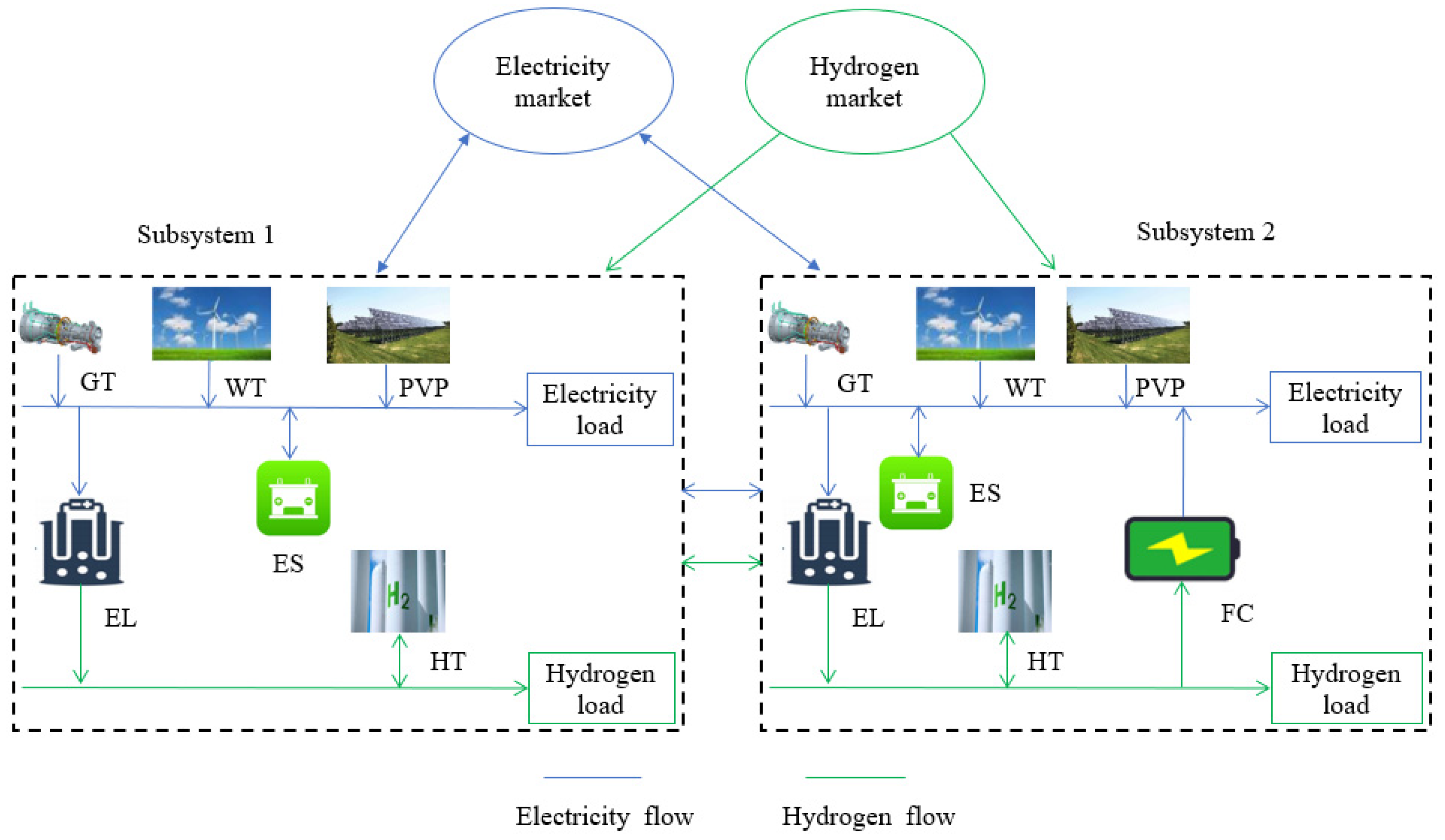
- Designs an EHCMMG comprising an electricity–hydrogen subsystem and an electricity–hydrogen–electricity subsystem. The cluster facilitates internal bidirectional electricity and hydrogen exchange, enhancing operational flexibility and energy efficiency. In addition, it engages in external electricity and hydrogen markets to balance supply and demand while enabling user participation in integrated electricity–hydrogen DR through incentive mechanisms.
- (2)
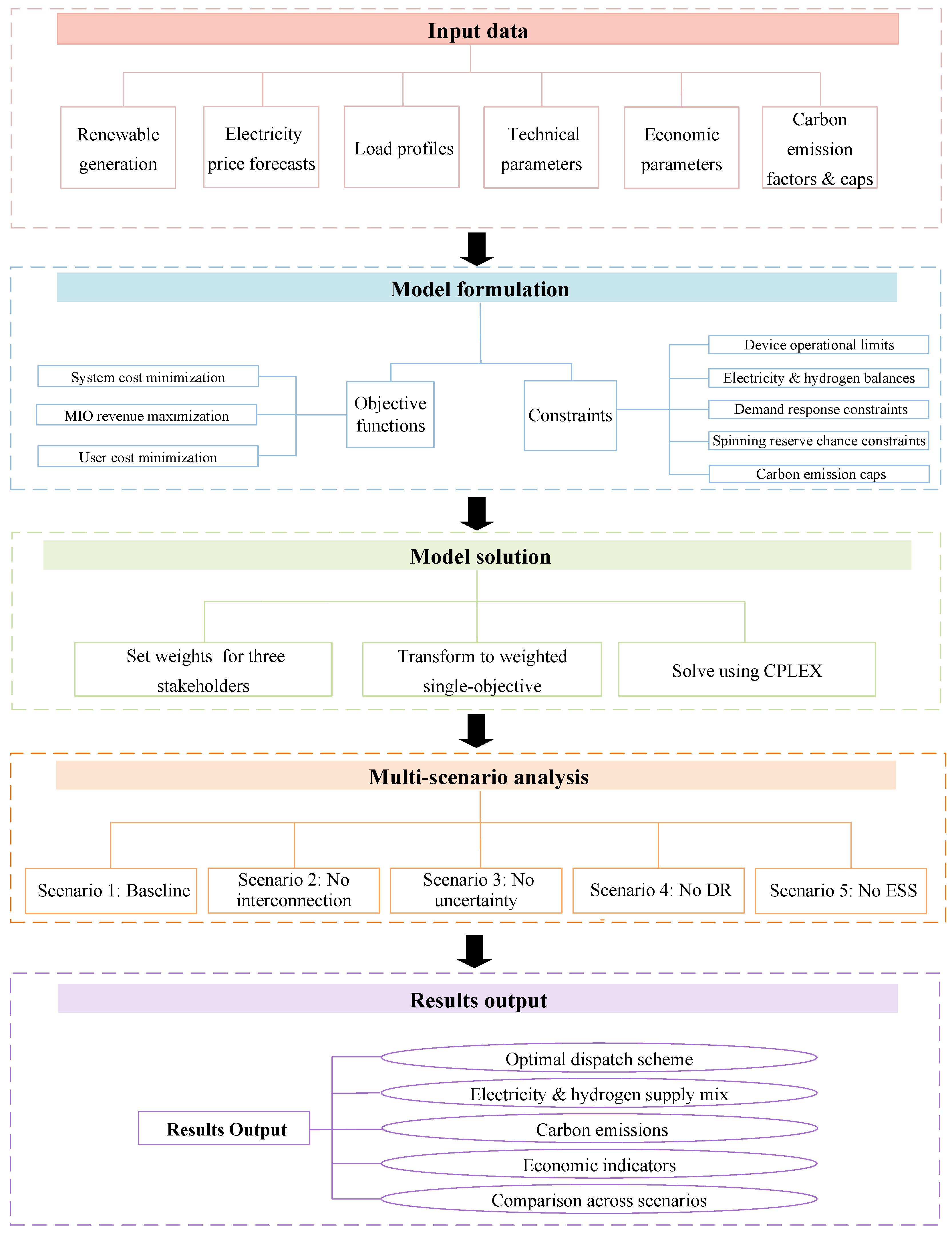
- Develops a multi-objective scheduling optimization model based on electricity price forecasting to balance the interests of multiple stakeholders, including the system itself, external energy suppliers, and end-user. The model simultaneously considers carbon emission constraints, electricity and hydrogen balance constraints, and various forms of incentive-based DR for electricity and hydrogen loads.
- (3)
- Proposes an integrated modeling method that combines spinning reserve capacity constraints with chance-constrained programming to account for operational uncertainties. This approach enables coordinated optimization of both economic performance and system reliability under uncertain operating conditions.
1.3. Paper Organization
2. Literature Review
2.1. Optimization Objects and Objectives
2.2. Demand Response
2.3. Uncertainty in Renewable Energy Generation
2.4. Gaps in Previous Research
- (1)
- The research scope has evolved from single microgrids to MMG. Optimization objectives have expanded from operation cost minimization to profit maximization, carbon emission reduction, and user comfort. However, a collaborative framework for cross-regional, multi-market, and multi-level EHCMMG that simultaneously addresses economic viability, low-carbon transition, and stakeholder equity, is still lacking. Current work often overlooks the heterogeneous objectives of stakeholders such as system operators, market entities, and end-user. Moreover, integrating electricity price forecasting into scheduling models would significantly enhance their practical relevance and decision-support value.
- (2)
- Single-energy DR focuses on the electricity load, dual-energy DR emphasizes coordinated optimization in coupled systems such as electricity-heating and electricity-gas, and research extends further to the coordinated scheduling of three or more types of loads, covering various response modes such as price-based, incentive-based, and substitution-based mechanisms. However, existing research has not yet thoroughly explored the coordinated response mechanisms of shiftable, transferable, and reducible electricity–hydrogen loads, and the joint control strategies for these diverse flexible resources remain to be further investigated.
- (3)
- Current research employs a variety of optimization techniques, such as chance-constrained programming, distributionally robust optimization, data-driven methods, and interval optimization, to tackle uncertainties in different operational scenarios. However, a unified methodological framework that integrates chance constraints and spinning reserve capacity constraints to effectively manage uncertainties under deep decarbonization pathways remains to be thoroughly explored.
3. Structure Description and Mathematical Modeling
3.1. Structure Description
3.2. Mathematical Modeling
- (1)
- Wind turbine ()
- (2)
- Photovoltaic panel ()
- (3)
- Gas turbine ()
- (4)
- Electrolyzer ()
- (5)
- Fuel cell ()
- (6)
- Energy storage system ()
4. Multi-Objective Chance-Constrained Dispatch Optimization for EHCMMG
4.1. Objectives
- (1)
- System side
- (2)
- Market side
- (3)
- User side
4.2. Constraints
- (1)
- Network constraints
- (2)
- Constraints of and operation
- (3)
- Shiftable load () constraints
- (4)
- Transferable load () constraints
- (5)
- Curtailable load () constraints
- (6)
- Electricity balance constraints
- (7)
- Hydrogen balance constraints
- (8)
- Spinning reserve chance constraints
- (9)
- Carbon emission constraints
4.3. Model Solution
5. Electricity Price Prediction Based on TBATS Model
6. Case Study
6.1. Scenario Setting
6.2. Basic Data
6.3. Results and Discussion
6.4. Multi-Scenario Analysis
6.5. Sensitivity Analysis
6.6. Engineering Reference Significance
7. Conclusions
- (1)
- The price forecast-driven multi-objective optimal scheduling model balances the interests of the system side, market side, and user side. In the baseline scenario, the cluster cost, MIO net revenue, and user energy cost amount to CNY 17.502, 12.684, and 5.556 million, respectively, while total carbon emissions reach 8168.126 tons.
- (2)
- The interconnection among subsystems enhances the economic efficiency of both the cluster and its users but simultaneously decreases the revenue of the MIO and leads to higher carbon emissions. This trade-off underscores the importance of balancing economic gains with low-carbon objectives in the design of multi-energy systems.
- (3)
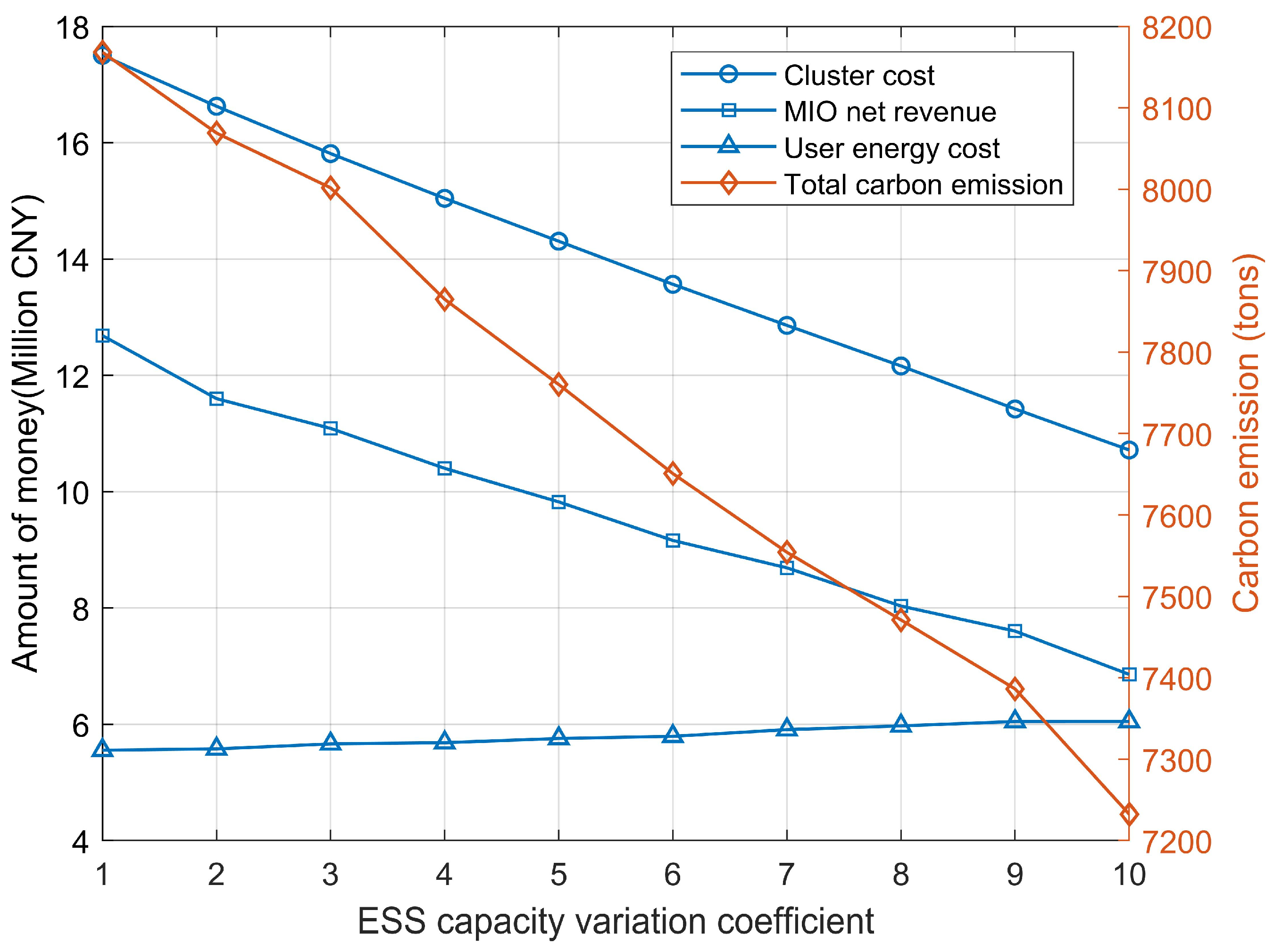
- As the ESS capacity coefficient increases from 1 to 10, the cluster cost decreases by 38.8% and carbon emissions fall by 11.5%. In contrast, the user energy cost rises by 8.9%, and MIO’s net revenue is reduced. Overall, expanding capacity enhances system-wide economic and environmental performance.
Author Contributions
Funding
Institutional Review Board Statement
Informed Consent Statement
Data Availability Statement
Conflicts of Interest
Abbreviations
| ARMA | Auto Regressive Moving Average | Curtailable electricity load | |
| Curtailable hydrogen load | Curtailable load | ||
| CNY | Chinese Yuan | DR | Demand response |
| EHCMMG | Electricity–hydrogen coupling multi-microgrid | Electrolyzer | |
| Electricity storage | Energy storage system | ||
| Fuel cell | Fixed electricity load | ||
| Fixed hydrogen load | Gas turbine | ||
| Hydrogen tank | Mean absolute error | ||
| Mean error | MIO | Market integrated operator | |
| MMG | Multi-microgrid | NSGA-II | Non-dominated sorting genetic algorithm II |
| O&M | Operation and maintenance | Photovoltaic | |
| Photovoltaic panel | Root mean square error | ||
| Shiftable electricity load | Shiftable hydrogen load | ||
| Shiftable load | TBATS | Trigonometric seasonality, Box–Cox transformation, ARMA errors, trend and seasonal components | |
| Transferable electricity load | Transferable hydrogen load | ||
| Transferable load | Wind turbine |
References
- Lu, M.; Teng, Y.; Chen, Z.; Song, Y. A bi-level optimization strategy of electricity-hydrogen-carbon integrated energy system considering photovoltaic and wind power uncertainty and demand response. Sci. Rep. 2025, 15, 18. [Google Scholar] [CrossRef] [PubMed]
- Gulraiz, A.; Al Bastaki, A.J.; Magamal, K.; Subhi, M.; Hammad, A.; Allanjawi, A.; Zaidi, S.H.; Khalid, H.M.; Ismail, A.; Hussain, G.A.; et al. Energy advancements and integration strategies in hydrogen and battery storage for renewable energy systems. iScience 2025, 28, 111945. [Google Scholar] [CrossRef] [PubMed]
- Su, X.; Zhang, Q.; Fu, Z.; Wu, J.; Qin, T.; Li, C.; Huang, S.; Bi, K. The coordinated multi-energy trading framework for integrated energy systems considering electricity-hydrogen trading and carbon emission flow. Energy 2025, 339, 139145. [Google Scholar] [CrossRef]
- Li, J.; Liu, D.; Shi, M.; Wang, J.; Yu, C.; Guo, H. A collaborative leasing decision model for electric-hydrogen energy storage in urban park microgrid cluster considering demand response willingness and competitive bidding. J. Energy Storage 2026, 142, 119609. [Google Scholar] [CrossRef]
- Wu, G.; Li, T.; Xu, W.; Xiang, Y.; Su, Y.; Liu, J.; Liu, F. Chance-constrained energy-reserve co-optimization scheduling of wind-photovoltaic-hydrogen integrated energy systems. Int. J. Hydrog. Energy 2023, 48, 6892–6905. [Google Scholar] [CrossRef]
- Wu, X.; Qi, S.; Wang, Z.; Duan, C.; Wang, X.; Li, F. Optimal scheduling for microgrids with hydrogen fueling stations considering uncertainty using data-driven approach. Appl. Energy 2019, 253, 113568. [Google Scholar] [CrossRef]
- Tostado-Véliz, M.; Kamel, S.; Hasanien, H.M.; Turky, R.A.; Jurado, F. A mixed-integer-linear-logical programming interval-based model for optimal scheduling of isolated microgrids with green hydrogen-based storage considering demand response. J. Energy Storage 2022, 48, 104028. [Google Scholar] [CrossRef]
- MansourLakouraj, M.; Niaz, H.; Liu, J.J.; Siano, P.; Anvari-Moghaddam, A. Optimal risk-constrained stochastic scheduling of microgrids with hydrogen vehicles in real-time and day-ahead markets. J. Clean. Prod. 2021, 318, 128452. [Google Scholar] [CrossRef]
- Wang, S.; Wang, S.; Zhao, Q.; Dong, S.; Li, H. Optimal dispatch of integrated energy station considering carbon capture and hydrogen demand. Energy 2023, 269, 126981. [Google Scholar] [CrossRef]
- Huang, C.; Zong, Y.; You, S.; Træholt, C.; Zheng, Y.; Wang, J.; Zheng, Z.; Xiao, X. Economic and resilient operation of hydrogen-based microgrids: An improved MPC-based optimal scheduling scheme considering security constraints of hydrogen facilities. Appl. Energy 2023, 335, 120762. [Google Scholar] [CrossRef]
- Rezaei, N.; Pezhmani, Y. Optimal islanding operation of hydrogen integrated multi-microgrids considering uncertainty and unexpected outages. J. Energy Storage 2022, 49, 104142. [Google Scholar] [CrossRef]
- Pezhmani, Y.; Oskouei, M.Z.; Rezaei, N.; Mehrjerdi, H. A centralized stochastic optimal dispatching strategy of networked multi-carrier microgrids considering transactive energy and integrated demand response: Application to water–energy nexus. Sustain. Energy Grids Netw. 2022, 31, 100751. [Google Scholar] [CrossRef]
- Yang, K.; Li, C.; Jing, X.; Zhu, Z.; Wang, Y.; Ma, H.; Zhang, Y. Energy dispatch optimization of islanded multi-microgrids based on symbiotic organisms search and improved multi-agent consensus algorithm. Energy 2022, 239, 122105. [Google Scholar] [CrossRef]
- Wu, K.; Li, Q.; Chen, Z.; Lin, J.; Yi, Y.; Chen, M. Distributed optimization method with weighted gradients for economic dispatch problem of multi-microgrid systems. Energy 2021, 222, 119898. [Google Scholar] [CrossRef]
- Alex, A.; Petrone, R.; Tala-Ighil, B.; Bozalakov, D.; Vandevelde, L.; Gualous, H. Optimal techno-enviro-economic analysis of a hybrid grid connected tidal-wind-hydrogen energy system. Int. J. Hydrog. Energy 2022, 47, 36448–36464. [Google Scholar] [CrossRef]
- Rezaei, N.; Pezhmani, Y.; Khazali, A. Economic-environmental risk-averse optimal heat and power energy management of a grid-connected multi microgrid system considering demand response and bidding strategy. Energy 2022, 240, 122844. [Google Scholar] [CrossRef]
- Fang, R. Multi-objective optimized operation of integrated energy system with hydrogen storage. Int. J. Hydrog. Energy 2019, 44, 29409–29417. [Google Scholar] [CrossRef]
- Xu, Y.; Liu, R.; Tang, L.; Wu, H.; She, C. Risk-averse multi-objective optimization of multi-energy microgrids integrated with power-to-hydrogen technology, electric vehicles and data center under a hybrid robust-stochastic technique. Sustain. Cities Soc. 2022, 79, 103699. [Google Scholar] [CrossRef]
- Wang, L.; Zhang, B.; Li, Q.; Song, W.; Li, G. Robust distributed optimization for energy dispatch of multi-stakeholder multiple microgrids under uncertainty. Appl. Energy 2019, 255, 113845. [Google Scholar] [CrossRef]
- Mansouri, S.A.; Ahmarinejad, A.; Nematbakhsh, E.; Javadi, M.S.; Esmaeel Nezhad, A.; Catalão, J.P.S. A sustainable framework for multi-microgrids energy management in automated distribution network by considering smart homes and high penetration of renewable energy resources. Energy 2022, 245, 123228. [Google Scholar] [CrossRef]
- Roustaee, M.; Kazemi, A. Multi-objective stochastic operation of multi-microgrids constrained to system reliability and clean energy based on energy management system. Electr. Power Syst. Res. 2021, 194, 106970. [Google Scholar] [CrossRef]
- Li, K.; Ye, N.; Li, S.; Wang, H.; Zhang, C. Distributed collaborative operation strategies in multi-agent integrated energy system considering integrated demand response based on game theory. Energy 2023, 273, 127137. [Google Scholar] [CrossRef]
- Yuan, G.; Gao, Y.; Ye, B. Optimal dispatching strategy and real-time pricing for multi-regional integrated energy systems based on demand response. Renew. Energy 2021, 179, 1424–1446. [Google Scholar] [CrossRef]
- Chen, J.; Qi, B.; Rong, Z.; Peng, K.; Zhao, Y.; Zhang, X. Multi-energy coordinated microgrid scheduling with integrated demand response for flexibility improvement. Energy 2021, 217, 119387. [Google Scholar] [CrossRef]
- Fan, W.; Tan, Z.; Li, F.; Zhang, A.; Ju, L.; Wang, Y.; De, G. A two-stage optimal scheduling model of integrated energy system based on CVaR theory implementing integrated demand response. Energy 2023, 263, 125783. [Google Scholar] [CrossRef]
- Tan, Z.; Yang, S.; Lin, H.; De, G.; Ju, L.; Zhou, F. Multi-scenario operation optimization model for park integrated energy system based on multi-energy demand response. Sustain. Cities Soc. 2020, 53, 101973. [Google Scholar] [CrossRef]
- Lu, Q.; Guo, Q.; Zeng, W. Optimal dispatch of community integrated energy system based on Stackelberg game and integrated demand response under carbon trading mechanism. Appl. Therm. Eng. 2023, 219, 119508. [Google Scholar] [CrossRef]
- Pan, C.; Jin, T.; Li, N.; Wang, G.; Hou, X.; Gu, Y. Multi-objective and two-stage optimization study of integrated energy systems considering P2G and integrated demand responses. Energy 2023, 270, 126846. [Google Scholar] [CrossRef]
- Li, Y.; Han, M.; Shahidehpour, M.; Li, J.; Long, C. Data-driven distributionally robust scheduling of community integrated energy systems with uncertain renewable generations considering integrated demand response. Appl. Energy 2023, 335, 120749. [Google Scholar] [CrossRef]
- Xu, J.; Yi, Y. Multi-microgrid low-carbon economy operation strategy considering both source and load uncertainty: A nash bargaining approach. Energy 2023, 263, 125712. [Google Scholar] [CrossRef]
- Ju, L.; Tan, Q.; Zhao, R.; Gu, S.; Jiaoyang; Wang, W. Multi-objective electro-thermal coupling scheduling model for a hybrid energy system comprising wind power plant, conventional gas turbine, and regenerative electric boiler, considering uncertainty and demand response. J. Clean. Prod. 2019, 237, 117774. [Google Scholar] [CrossRef]
- Li, Y.; Bu, F.; Li, Y.; Long, C. Optimal scheduling of island integrated energy systems considering multi-uncertainties and hydrothermal simultaneous transmission: A deep reinforcement learning approach. Appl. Energy 2023, 333, 120540. [Google Scholar] [CrossRef]
- Tostado-Véliz, M.; Mansouri, S.A.; Rezaee-Jordehi, A.; Icaza-Alvarez, D.; Jurado, F. Information Gap Decision Theory-based day-ahead scheduling of energy communities with collective hydrogen chain. Int. J. Hydrogen Energy 2023, 48, 7154–7169. [Google Scholar] [CrossRef]
- Du, Y.; Li, X.; Tan, C.; Tan, Z. Two-stage multi-objective distributionally robust operation optimization and benefits equalization of an off-grid type electric-hydrogen-ammonia-methanol coupling system. Renew. Energy 2024, 236, 121433. [Google Scholar] [CrossRef]
- Zhang, J.; Liu, Z. Low carbon economic scheduling model for a park integrated energy system considering integrated demand response, ladder-type carbon trading and fine utilization of hydrogen. Energy 2024, 290, 130311. [Google Scholar] [CrossRef]
- Dai, B.; Wang, H.; Li, B.; Li, C.; Tan, Z. Capacity model and optimal scheduling strategy of multi-microgrid based on shared energy storage. Energy 2024, 306, 132472. [Google Scholar] [CrossRef]
- Xu, C.; Wu, X.; Shan, Z.; Zhang, Q.; Dang, B.; Wang, Y.; Wang, F.; Jiang, X.; Xue, Y.; Shi, C. Bi-level configuration and operation collaborative optimization of shared hydrogen energy storage system for a wind farm cluster. J. Energy Storage 2024, 86, 111107. [Google Scholar] [CrossRef]
- Wang, Q.; Zhou, Y.; Li, N.; Jiao, Y.; Dong, J.; Wei, X. Optimal scheduling of regional integrated energy systems considering multi-loads demand response. Electr. Power Syst. Res. 2026, 253, 112569. [Google Scholar] [CrossRef]
- Windler, T.; Busse, J.; Rieck, J. One month-ahead electricity price forecasting in the context of production planning. J. Clean. Prod. 2019, 238, 117910. [Google Scholar] [CrossRef]
- Osman, H.; Azab, A.; AlGhazi, A.; Duffuaa, S.; Baki, F. Forecasting electric vehicle charging loads using random forest and gene expression programming ensemble models. Results Eng. 2025, 28, 108369. [Google Scholar] [CrossRef]
- Rahman, M.; Rashid, F. Analysis of CO2 emissions from natural gas-fired power plants and an emission control strategy. J. CO2 Util. 2025, 102, 103256. [Google Scholar] [CrossRef]
- Elkhouly, M.; Alhadidi, T.; Rakha, H. Modeling traffic vehicular counts at an urban intersection using complex seasonal modeling techniques. KSCE J. Civ. Eng. 2025, 29, 100040. [Google Scholar] [CrossRef]
- Lu, Z.; Li, Y.; Zhuo, G.; Xu, C. Configuration optimization of hydrogen-based multi-microgrid systems under electricity market trading and different hydrogen production strategies. Sustainability 2023, 15, 6753. [Google Scholar] [CrossRef]
- Shang, J.; Gao, J.; Jiang, X.; Liu, M.; Liu, D. Optimal configuration of hybrid energy systems considering power to hydrogen and electricity-price prediction: A two-stage multi-objective bi-level framework. Energy 2023, 263, 126023. [Google Scholar] [CrossRef]



| Evaluation Metrics | |||
|---|---|---|---|
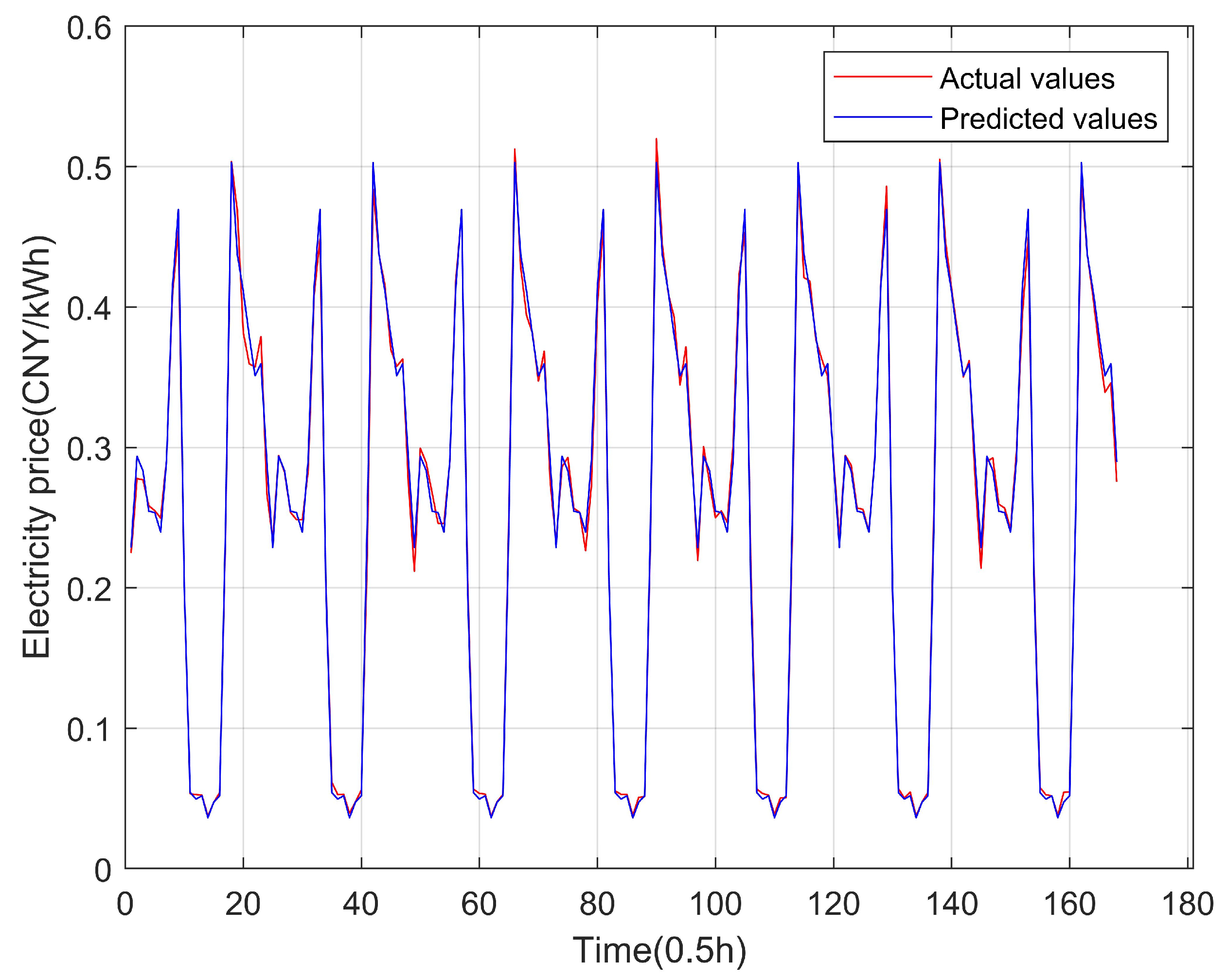
| Error value | 0.0029 | 0.0092 | 0.0072 |
| Scenarios | Subsystem Interconnections | Uncertainty | DR | |
|---|---|---|---|---|
| 1 | √ | √ | √ | √ |
| 2 | √ | √ | √ | |
| 3 | √ | √ | √ | |
| 4 | √ | √ | √ | |
| 5 | √ | √ | √ |
| Scenarios | Cluster Cost (Million CNY) | MIO Net Revenue (Million CNY) | User Energy Cost (Million CNY) | Total Carbon Emissions (Tons) |
|---|---|---|---|---|
| 1 | 17.502 | 12.684 | 5.556 | 8168.126 |
| 2 | 27.804 | 22.564 | 5.721 | 6957.788 |
| 3 | 17.548 | 12.255 | 5.551 | 8096.230 |
| 4 | 34.176 | 40.487 | 23.172 | 6746.355 |
| 5 | 19.026 | 14.120 | 5.280 | 7961.262 |
Disclaimer/Publisher’s Note: The statements, opinions and data contained in all publications are solely those of the individual author(s) and contributor(s) and not of MDPI and/or the editor(s). MDPI and/or the editor(s) disclaim responsibility for any injury to people or property resulting from any ideas, methods, instructions or products referred to in the content. |
© 2026 by the authors. Licensee MDPI, Basel, Switzerland. This article is an open access article distributed under the terms and conditions of the Creative Commons Attribution (CC BY) license.
Share and Cite
Lu, Z.; Geng, S.; Wang, J. Sustainability-Oriented Multi-Objective Low-Carbon Dispatch for an Electricity–Hydrogen Coupling Multi-Microgrid. Sustainability 2026, 18, 2665. https://doi.org/10.3390/su18052665
Lu Z, Geng S, Wang J. Sustainability-Oriented Multi-Objective Low-Carbon Dispatch for an Electricity–Hydrogen Coupling Multi-Microgrid. Sustainability. 2026; 18(5):2665. https://doi.org/10.3390/su18052665
Chicago/Turabian StyleLu, Zhiming, Shuai Geng, and Jiayu Wang. 2026. "Sustainability-Oriented Multi-Objective Low-Carbon Dispatch for an Electricity–Hydrogen Coupling Multi-Microgrid" Sustainability 18, no. 5: 2665. https://doi.org/10.3390/su18052665
APA StyleLu, Z., Geng, S., & Wang, J. (2026). Sustainability-Oriented Multi-Objective Low-Carbon Dispatch for an Electricity–Hydrogen Coupling Multi-Microgrid. Sustainability, 18(5), 2665. https://doi.org/10.3390/su18052665