Article

Utilizing Solar-Induced Chlorophyll Fluorescence for Drought Monitoring and Net Ecosystem Productivity Response in Northwest China


1
Faculty of Geomatics, Lanzhou Jiaotong University, Lanzhou 730070, China
2
National-Local Joint Engineering Research Center of Technologies and Applications for National Geographic State Monitoring, Lanzhou 730070, China
3
Key Laboratory of Science and Technology in Surveying & Mapping, Lanzhou 730070, China
4
Key Laboratory of Urban Land Resources Monitoring and Simulation, Ministry of Natural Resources, Lanzhou 730070, China
*
Author to whom correspondence should be addressed.
Sustainability 2026, 18(5), 2654; https://doi.org/10.3390/su18052654
Submission received: 23 January 2026 / Revised: 27 February 2026 / Accepted: 2 March 2026 / Published: 9 March 2026

Abstract

Against the backdrop of global change, frequent and severe droughts pose major threats to ecosystems, and quantifying ecosystem anomalies driven by hydrothermal stress remains challenging. Based on this, we propose a drought-monitoring framework centered on solar-induced chlorophyll fluorescence (SIF) and develop an SIF-based Vegetation Health Index (SHI) to improve monitoring performance. Compared with existing SIF-based drought indices (e.g., TFDI and TSWDI), SHI provides a more direct representation of photosynthetic stress, making it more suitable for elucidating drought-response mechanisms. In addition, we use net ecosystem productivity (NEP) to represent carbon sequestration and apply multiple correlation analyses to investigate NEP responses to drought and their spatiotemporal differentiation across vegetation types. Results indicate an overall wetting trend in the study region during 2001–2024, and SIF-based indices perform better in characterizing drought and vegetation responses. The dominant coupling scale between NEP and drought is annual, with an overall lag of 0–3 months: croplands show the strongest coherence and the shortest lag (0–1 month), grasslands are intermediate, and forests show longer lags (2–5 months) as well as a more persistent response window. This study highlights SHI’s advantages for drought monitoring and carbon sink diagnostics, supporting differentiated drought mitigation and management in NWC.

1. Introduction

Drought is one of the most far-reaching natural disasters under global change. By altering hydrothermal regimes and ecological processes, it profoundly affects the ecological environment, agricultural production, and the carbon sink function of terrestrial ecosystems [1]. Drought is generally classified into meteorological drought, agricultural drought, hydrological drought, and socio-economic drought [2]. Based on different data sources, methods, and principles, a variety of drought indices have been developed to characterize drought for monitoring, assessment, and early warning.
Meteorological drought is usually caused by an imbalance between precipitation and evaporation. As early as 1965, Palmer developed the Palmer Drought Severity Index (PDSI), which quantifies drought on the basis of water balance by integrating environmental factors such as precipitation, evapotranspiration, and soil moisture [3]. Subsequently, in 2004, Wells and colleagues proposed the self-calibrating Palmer Drought Severity Index (scPDSI), which improves spatial comparability and has been widely used in meteorological drought assessment [4]. In addition, the Standardized Precipitation Index (SPI) [5] and the Standardized Precipitation Evapotranspiration Index (SPEI) [6] have also been widely applied to identify drought events due to their low data requirements and computational simplicity [7]. Agricultural drought refers to situations in which soil moisture is insufficient in meeting crop water demand, and the Standardized Soil Moisture Index (SSI) is a representative indicator for its evaluation [8]. Hydrological drought indices mainly include the Standardized Runoff Index (SRI) [9], the Surface Water Supply Index (SWSI) [10], and the Water Storage Deficit Index (WSDI) [11], and they are commonly used to characterize runoff dynamics. These four types of drought exert major impacts on the structure and functioning of ecosystems, posing direct threats to vegetation productivity and biodiversity and leading to vegetation stress, ecological degradation, soil erosion, and the destruction of habitats [12,13,14,15]. Accordingly, the concept of ecological drought—which characterizes the impacts of drought on ecosystems—has been proposed and has attracted great attention over the past decade [16].
“Ecological drought” is defined as the ecosystem feedbacks caused by episodic deficits in available water resources [16] and results from the combined effects of meteorological, agricultural, hydrological, and socio-economic droughts. In previous studies, indices based on vegetation “greenness” such as NDVI, EVI, and their derivatives VCI and VHI [17,18] have been widely used for ecological drought monitoring. Additionally, recent studies have accounted for the complexity of drought drivers and processes by developing integrated drought indices based on climate–vegetation coupling, leveraging multi-source data and ensemble frameworks to improve drought-monitoring performance [19,20]. However, reflectance-based indices do not directly reflect photosynthesis and exhibit limitations such as saturation, temporal lag, and insensitivity to physiological stress, which constrain their ability to characterize the impacts of rapid, compound drought events on the carbon cycle [21].
With the rapid advancement of remote sensing, solar-induced chlorophyll fluorescence (SIF) offers a new pathway to directly indicate photosynthesis at the canopy scale. SIF arises from nanosecond re-emission by chlorophyll after photon absorption and is directly linked to internal photochemical mechanisms [22,23,24,25]. It is therefore more sensitive to light-use efficiency (LUE) and environmental stressors. It also substantially alleviates the saturation problem of traditional greenness indices, thereby improving drought monitoring and the interpretability of carbon sink dynamics [26,27]. Numerous studies have already used SIF to monitor drought events—for example, the temperature–fluorescence drought index (TFDI) [28] and the temperature–SIF–water balance drought index (TSWDI) [29]. SIF has been shown to reflect drought more sensitively, and building drought indices centered on SIF is emerging as a promising approach for regional drought monitoring [26,30]. However, most existing work concentrates on performance evaluation for drought detection and identification, and few studies directly couple SIF-based drought indices with ecological process variables to examine drought impacts across ecosystems and to systematically characterize vegetation’s synchronous, lagged, and recovery responses.
To address this knowledge gap, we focus on Northwest China (NWC). Using long-term monthly time series, we develop a drought-monitoring framework centered on SIF and investigate the drought–carbon sink coupling characteristics. The key innovations of this study are as follows: (1) We construct a SIF-based Vegetation Health Index (SHI) by integrating the SIF-based Vegetation Condition Index (SVCI) with the Temperature Condition Index (TCI) to better track drought stress; (2) we couple SHI with net ecosystem productivity (NEP) and use cross wavelet transform and wavelet coherence analysis to quantify the ecosystem carbon sink responses to drought, with a particular focus on synchronous versus lagged coupling, response windows, and differences among vegetation types. The objectives are as follows: (i) to quantify the performance of SIF-based drought indices in NWC; (ii) to reveal the monthly spatiotemporal characteristics of NEP and the drought index; (iii) to analyze in depth NEP’s lagged responses and recovery behaviors under compound hot–dry stress.

2. Materials and Methods

2.1. Study Area

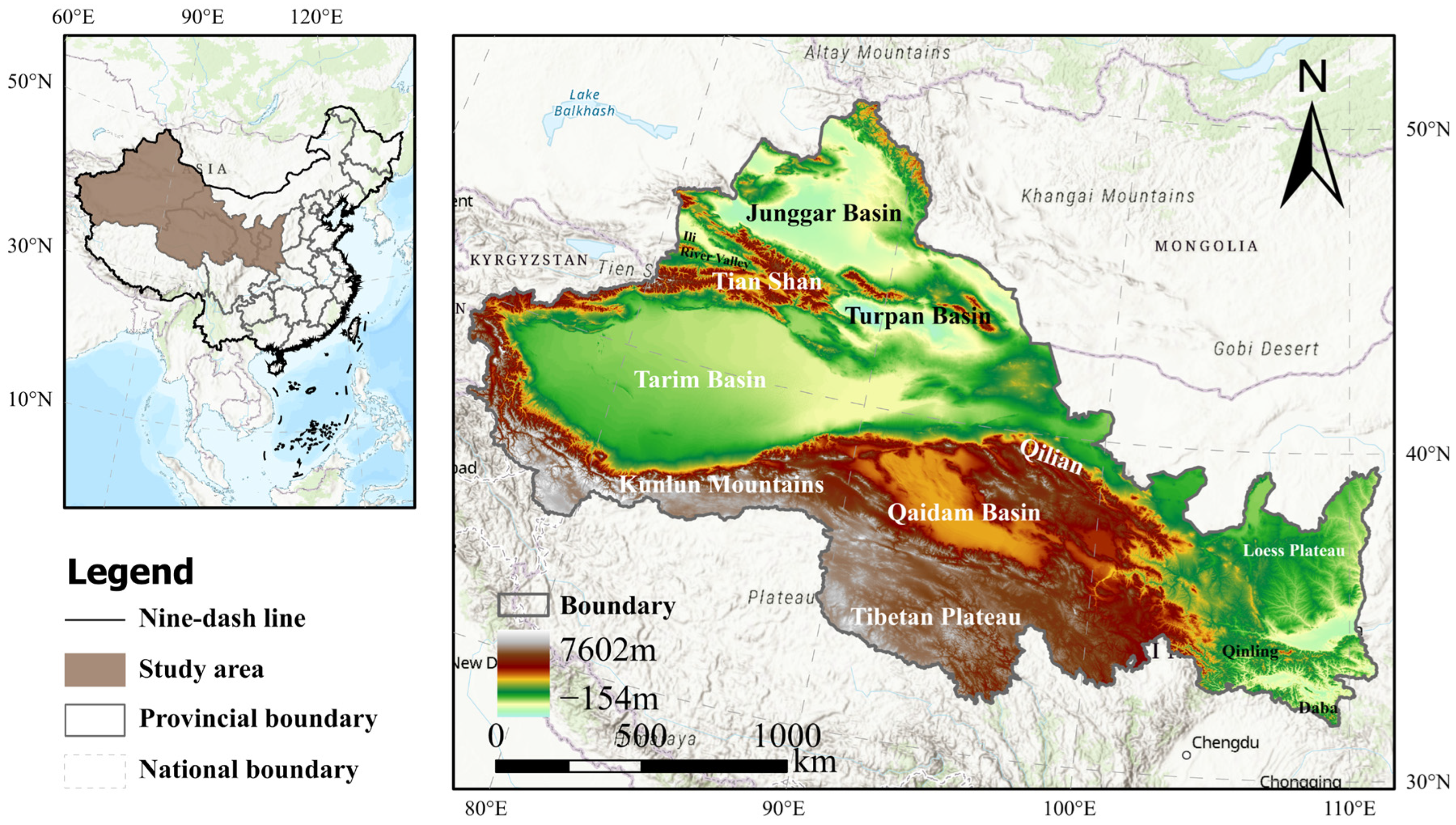
The Northwest China Region (NWC) is located in the interior of the Eurasian continent and comprises five provincial-level administrative units: Xinjiang, Qinghai, Gansu, Ningxia, and Shaanxi (Figure 1). The region is dominated by arid and semi-arid climates, characterized by low annual precipitation, high potential evapotranspiration, and pronounced seasonal and interannual variability in temperature and precipitation. The terrain is diverse, including deserts, Gobi, mountains, and plateaus, with elevations ranging from below sea level in certain basins to over 5000 m at the margins of the Qinghai–Tibet Plateau. The combination of complex topography and a large latitudinal and longitudinal span results in marked climatic and ecological spatial heterogeneity, forming a natural pattern dominated by desert, grassland, and alpine ecosystems, interspersed with oases and croplands distributed in river valleys and irrigated areas. With fragile ecosystems and limited water resources, the region is highly sensitive to climate change and extreme climatic events, making it an ideal area for investigating vegetation responses to drought stress.

2.2. Research Data

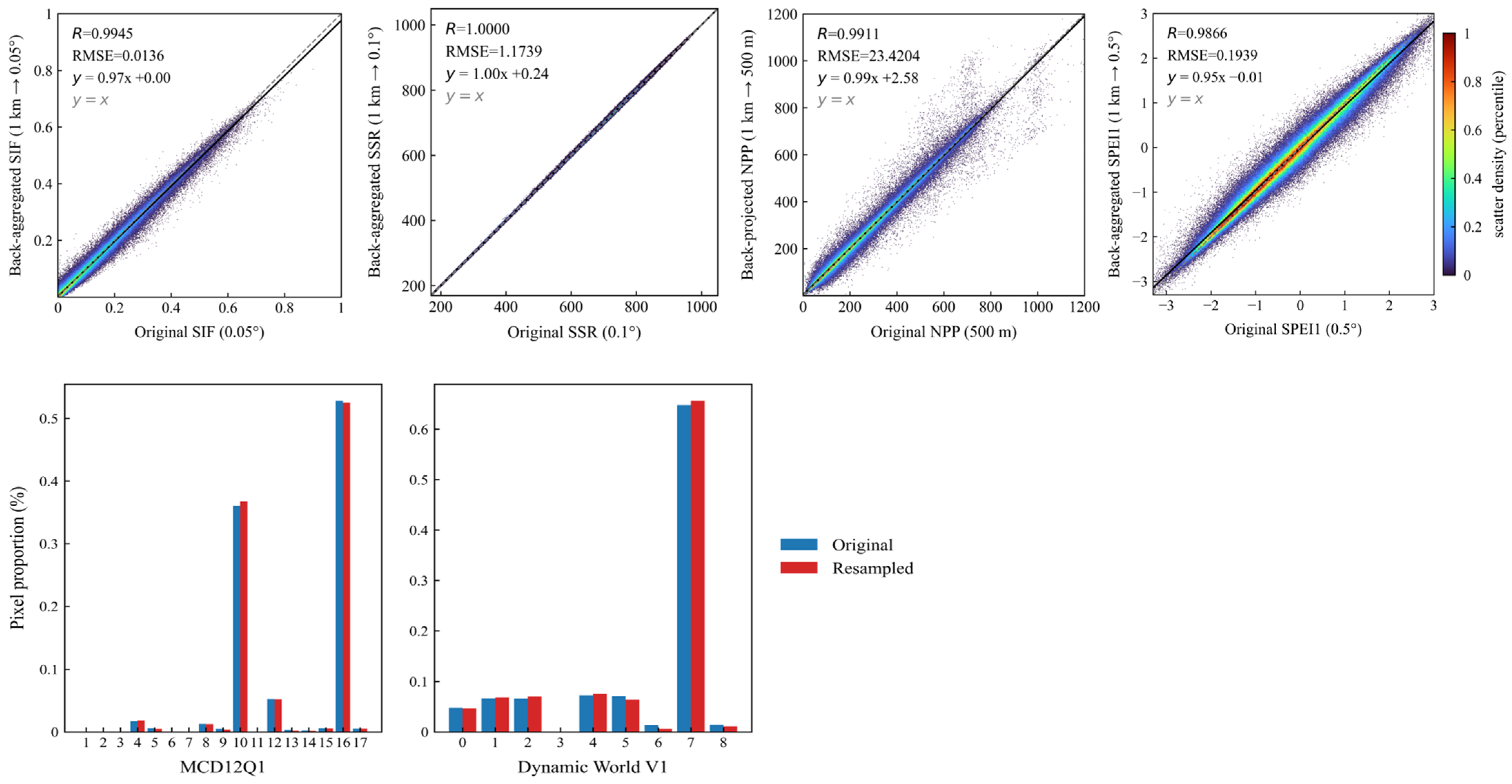
A variety of data sources used in this study are listed in Table 1, covering the period 2001–2024. All datasets were harmonized to the WGS84 grid and 1 km spatial resolution of the Tem/Pre datasets. Continuous variables were resampled using bilinear interpolation, whereas the categorical land use data were resampled using the nearest neighbor method. Figure 2 presents the consistency check after resampling. Although minor local deviations exist, the standard resampling procedures preserve overall consistency and are adequate for subsequent integrated analyses.

2.2.1. Global OCO-2-Based Solar-Induced Fluorescence (GOSIF) Data

Due to the integration of ecosystem proxies, solar-induced chlorophyll fluorescence (SIF) has become an effective indicator for detecting ecosystem photosynthetic capacity. It can effectively capture vegetation dynamics and interannual variability under different climatic conditions and, to some extent, reflect vegetation responses to water-stressed environments. The SIF dataset used in this study is the GOSIF, with a spatial resolution of 0.05°. The GOSIF dataset was developed by Li and Xiao [31] based on discrete OCO-2 SIF, MODIS, and meteorological reanalysis data. Compared to the discrete SIF data from OCO-2, GOSIF offers better spatial resolution, continuous global coverage, and longer temporal records.

2.2.2. Meteorological Data and Drought Indices

The monthly total precipitation and monthly mean temperature were derived from the 1 km monthly dataset for China developed by Peng Shouzhang et al., which was generated by integrating CRU TS4.08 with the high-resolution WorldClim climate dataset [32]. In addition, CRU TS4.08 has been widely used to calculate gridded drought indices, Vicente-Serrano et al. developed the global SPEIbase from monthly precipitation and potential evapotranspiration data [33], and the dataset has since been updated using newer CRU TS versions.
The solar radiation data used in this study was obtained from the ECMWF Reanalysis v5 (ERA5)-Land dataset, which provides a consistent and high-resolution representation of land surface variables. The dataset has a spatial resolution of 0.1° and an original temporal resolution of 1 h. In this study, the original hourly data were aggregated to generate monthly totals.

2.2.3. MODIS Data

MODIS products include four datasets: NPP, NDVI, LST, and land cover type.
The land cover data utilized in this study were obtained from the MODIS MCD12Q1 product, which provides global land cover type information at a spatial resolution of 500 m. The data are generated annually based on the Global Vegetation Classification Scheme of the International Geosphere–Biosphere Program (IGBP) and cover the period from 2001 to 2022.
The MODIS NDVI data (MOD13A2), MODIS LST data (MOD11A1), and MODIS NPP data (MOD17A3H) were all obtained from the Land Processes Distribution Activity Archive Center of the US Geological Survey. The NDVI dataset has a 16-day temporal interval, and the Maximum Value Composite (MVC) method was applied to minimize the effects of cloud cover and haze, producing monthly NDVI time series. The LST dataset was processed by averaging daily values to produce monthly LST time series. The MODIS NPP data has a spatial resolution of 500 m and an annual temporal resolution, spanning from 2001 to 2023. These NPP data were used in this study to validate the accuracy of the NPP simulation results.

2.2.4. Other Data

This study used the near-real-time (NRT) land cover data from Dynamic World V1, provided by Google and the World Resources Institute, as supplementary data. The Dynamic World dataset has a spatial resolution of 10 m and a temporal interval of 2–5 days. The annual land cover data for 2021 to 2024 were generated by calculating the mode, extending the study period to 2024.
To evaluate the feasibility of various drought indices for drought monitoring, we used drought records from the Bulletin of Flood and Drought Disasters in China (2006–2024) published by the Ministry of Water Resources of China (http://www.mwr.gov.cn/sj/tjgb/zgshzhgb/, accessed on 30 September 2025). The study area and administrative boundary vector data used for mapping in this study were obtained from the Tianditu Map Service Center of China (https://cloudcenter.tianditu.gov.cn/).

2.3. Methods

2.3.1. Drought Indices

Drought indices derived from NDVI (e.g., VCI and VHI) have been widely used for agricultural drought monitoring across many regions of the world [17,34,35,36,37,38,39,40]. Compared with NDVI, solar-induced chlorophyll fluorescence (SIF) is more sensitive to water and thermal stress, which confers clear advantages for constructing drought indicators. In this study, building on the principles of VCI and VHI, we developed a SIF-based Vegetation Condition Index (SVCI) and a SIF-based Health Index (SHI) to characterize drought conditions in NWC and to evaluate their reliability. The formulas are as follows:
S V C I i j k = S I F i j k S I F i j m i n S I F i j m a x S I F i j m i n ,
T C I i j k = L S T i j m a x L S T i j k L S T i j m a x L S T i j m i n ,
S H I = α × S V C I + 1 α × T C I ,
where S I F i j k and L S T i j k denote the SIF and LST in month j of year k; max and min refer to the multi-year maximum and minimum over the study area during 2001–2024. The parameter α is the weight of SVCI (α = 0.50) and was determined by the entropy method [41]. TCI denotes the Temperature Condition Index. Lower values of TCI, SVCI, and SHI indicate more severe drought (Table 2). The drought-class thresholds used in this study were determined based on commonly adopted classification schemes in the published literature [29,42].
In addition, drought frequency was calculated as
f = m n × 100 % ,
where f represents the frequency of moderate or more severe droughts, m is the number of months with moderate or more severe droughts, and n is the total number of months during 2001–2024.

2.3.2. Trend Analysis

In this study, the Theil–Sen trend estimator and the Mann–Kendall significance test were employed to analyze temporal variations in NEP, SVCI, VCI, SHI, and VHI. The Theil–Sen method, robust against outliers, is well suited for characterizing interannual and seasonal changes in long-term ecological series. The Mann–Kendall test, a non-parametric approach, was used to assess the significance of monotonic trends. The standardized statistic Z was used to determine significance, with Z > 1.96 (p < 0.05) indicating a significant trend and Z > 3.29 (p < 0.001) a highly significant trend.

2.3.3. Correlation Analysis

To investigate the response of NEP to drought anomalies, Spearman’s rank correlation analysis was conducted on the normalized NEP series with a lag of 0 to 5 months and drought indices. The normalized NEP data, which removed seasonal trends and spatial heterogeneity, are more suitable for comparison with drought indices. Spearman’s rank correlation focuses on monotonic relationships and is more robust to outliers, making it appropriate for assessing potentially non-linear vegetation responses to drought. In addition, the Pearson correlation coefficient (R), which emphasizes linear co-variability, was used to test the consistency between different drought indices (e.g., SVCI, VCI, VHI, and SHI) and SPEI-1.

2.3.4. Cross Wavelet Transform and Wavelet Coherence Analysis

Cross wavelet and wavelet coherence analyses are widely used to measure the relationship between time series in the frequency domain. By calculating the cross spectral density of the drought indices and NEP, the cross wavelet transform (XWT) can effectively analyze their joint energy distribution in the time–frequency domain, identifying regions with consistent periodic strength. Wavelet coherence (WTC) reveals the consistency of the changing trends between the two time series in the time–frequency domain, identifying regions where both time series change together.
The cross wavelet transform (XWT) between two time series x(t) and y(t) is defined as
W x y s , t = W x s , t W y * s , t ,
Further calculation of wavelet coherence (WTC) is given by
R 2 s , t = | S ( s 1 W x y ) | 2 S s 1 | W x | 2 · S ( s 1 | W y | 2 ) ,
where W x ( s , t ) and W y ( s , t ) are the wavelet spectra of the two time series, and W y * is the complex conjugate of W y ; S is a smoothing operator, and s is the wavelet scale. R 2 [ 0 ,   1 ] , with values closer to 1 indicating stronger local correlation. Additionally, the phase difference in the wavelet is used to describe the direction and time lag between the NEP and drought index time series. The “→” symbol indicates co-directional phase change, meaning a positive correlation between the two; the “←” symbol represents counter-directional phase change, indicating a negative correlation; “↑” and “↓” represent lag and lead relationships for the first time series relative to the second by π 2 . Significance is evaluated through Monte Carlo testing with a red noise background at the 95% level, and boundary effects are handled using the Cone of Influence (COI). Results are interpreted only within the COI.

2.3.5. Land Cover Reclassification

In subsequent analyses, land use categories were reclassified into four generalized types—forest, grassland, cropland, and non-vegetated land. To minimize the influence of land use change on carbon sink trends, we restricted the analysis to areas where land use composition remained unchanged (Table S1). The spatial distribution of the four generalized land cover types in the study area is shown in Figure S1.

2.3.6. Net Ecosystem Productivity (NEP) Estimation Model

This study uses NEP as an indicator of vegetation response. NEP is defined as the difference between NPP produced by photosynthesis and heterotrophic soil respiration R h ,
N E P ( x , t ) = N P P ( x , t ) R h ( x , t ) ,
where N E P ( x , t ) , N P P ( x , t ) , and R h ( x , t ) denote the net ecosystem productivity, net primary productivity, and heterotrophic soil respiration, respectively, for pixel x in month t (gC/m2). In this study, monthly NPP is estimated using a modified CASA model [43]. The model estimates NPP based on remotely sensed absorbed photosynthetically active radiation (APAR, MJ/m2) and actual light-use efficiency (ε, gC/MJ), overcoming the limitation of using a fixed global maximum LUE and thus being more suitable for regional NPP estimation [44]. Its basic form is
N P P x , t = A P A R x , t × ε x , t = S O L ( x , t ) × F P A R ( x , t ) × 0.5 × ε ( x , t )
where S O L ( x , t ) represents the total solar radiation (MJ/m2) at pixel x in month t; F P A R ( x , t ) denotes the fraction of absorbed radiation by vegetation at pixel x in month t; ε ( x , t ) is the actual light-use efficiency (gC/MJ) under temperature and moisture stress; and the constant 0.5 represents the proportion of solar radiation that is photosynthetically active and usable by vegetation [45], namely the photosynthetically active radiation ratio.
Since there is currently no unified method for estimating Rh, this study adopts the regression equations of temperature (°C), precipitation (mm), and carbon emissions established by Pei [46,47] to estimate monthly Rh (gC/m2). The Rh is calculated as follows:
R h x , t = 0.22 × { exp 0.0913 T x , t + Ln 0.3145 P x , t + 1 } ×                                       30 × 46.5 %
where T is the monthly mean temperature (°C), and P is the monthly total precipitation (mm).
All calculations and statistical analyses were performed in Python (v3.9) and MATLAB (R2024b).

3. Results

3.1. Spatiotemporal Patterns of Drought

3.1.1. Temporal Trends of Drought

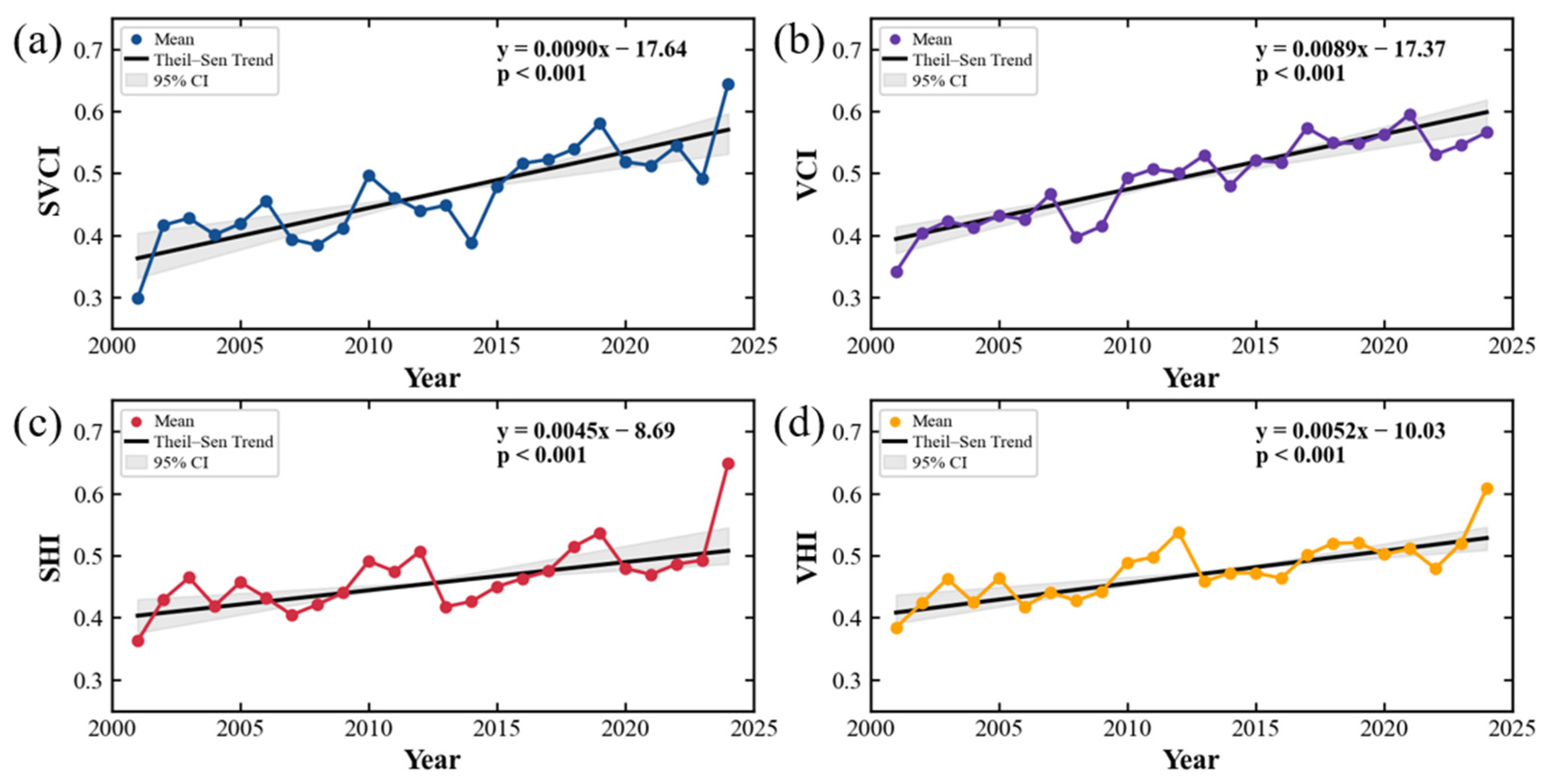
From 2001 to 2024, all four drought indices in NWC—SVCI, VCI, SHI, and VHI—exhibited significant upward trends (Figure 3 and Figure 4), with Theil–Sen slopes of 0.0090, 0.0098, 0.0045, and 0.0052 per year, respectively (p < 0.001). These results indicate a general alleviation of regional drought stress (Figure 3). Among the indices, SVCI and VCI showed the steepest increases, reflecting both improvements in vegetation condition and enhanced drought resistance driven by photosynthetic activity. SVCI, SHI, and VHI reached their minimum in 2001 and their maximum in 2024. As shown in Figure 3c, SHI ranged from 0.35 to 0.66 and displayed an overall increasing trend. Superimposed on this trend were distinct declines around 2007, 2013, and 2021, indicative of drought episodes, consistent with the drought records reported in the Bulletin of Flood and Drought Disasters in China.
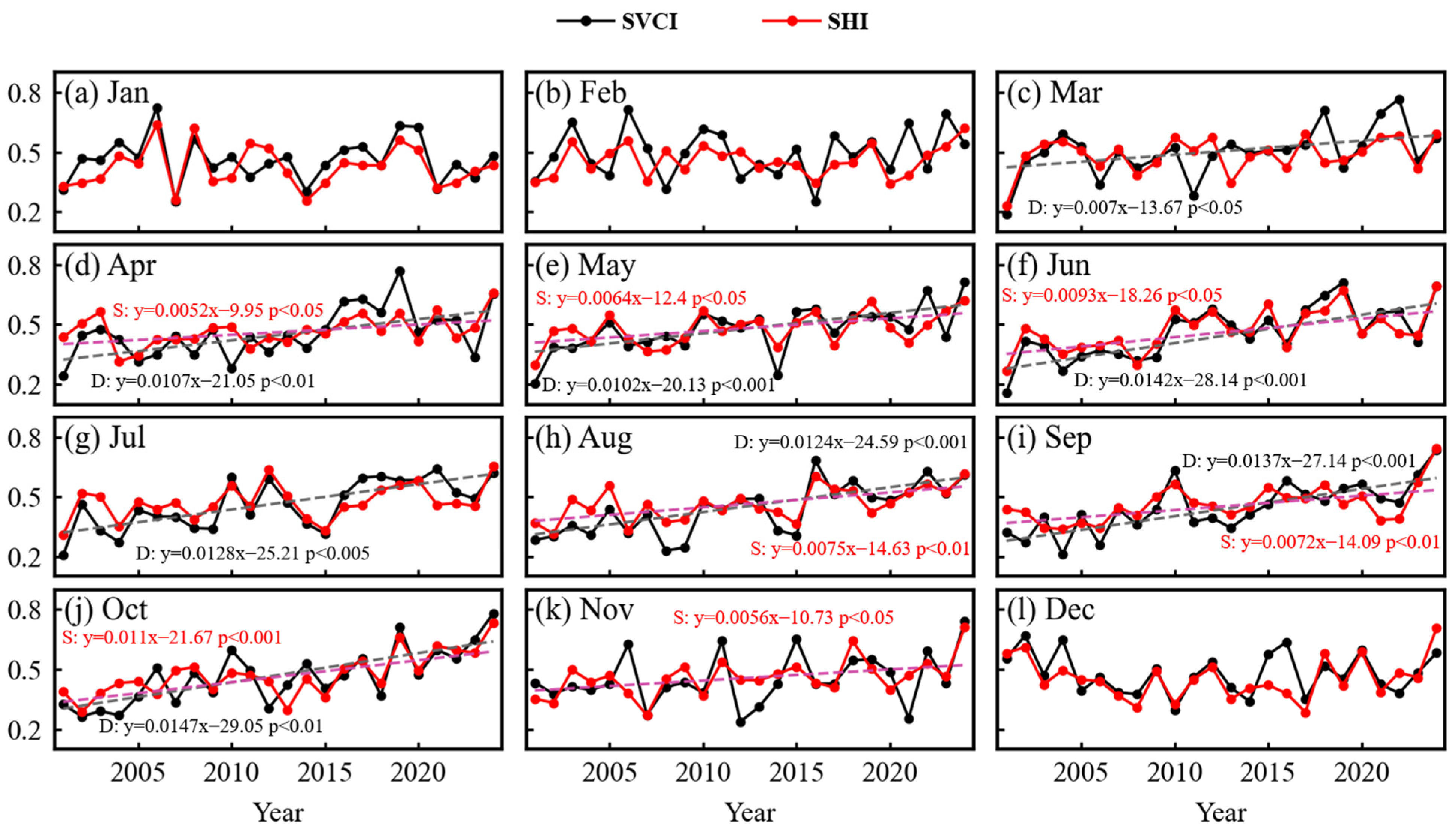
Clear seasonal differences were evident in the interannual trajectories of SVCI and SHI (Figure 4). Both indices increased significantly during the growing season (April–October), whereas winter trends were weaker and largely insignificant, possibly related to the propensity for winter-spring droughts in Northwest China. A wetting signal emerged in early spring and intensified thereafter, with the most pronounced improvements from summer to early autumn. The strongest rises occurred in October (SVCIslope = 0.0147; SHIslope = 0.011), followed by June (SVCIslope = 0.0142; SHIslope = 0.0093). Moreover, SVCI showed steeper slopes than SHI, indicating that the photosynthesis-based moisture stress index is more sensitive to wetting trends. By contrast, SHI continued to increase significantly at the end of the growing season, highlighting the smoothing effect of the composite index under late-season thermal constraints.

3.1.2. Spatial Patterns of Drought

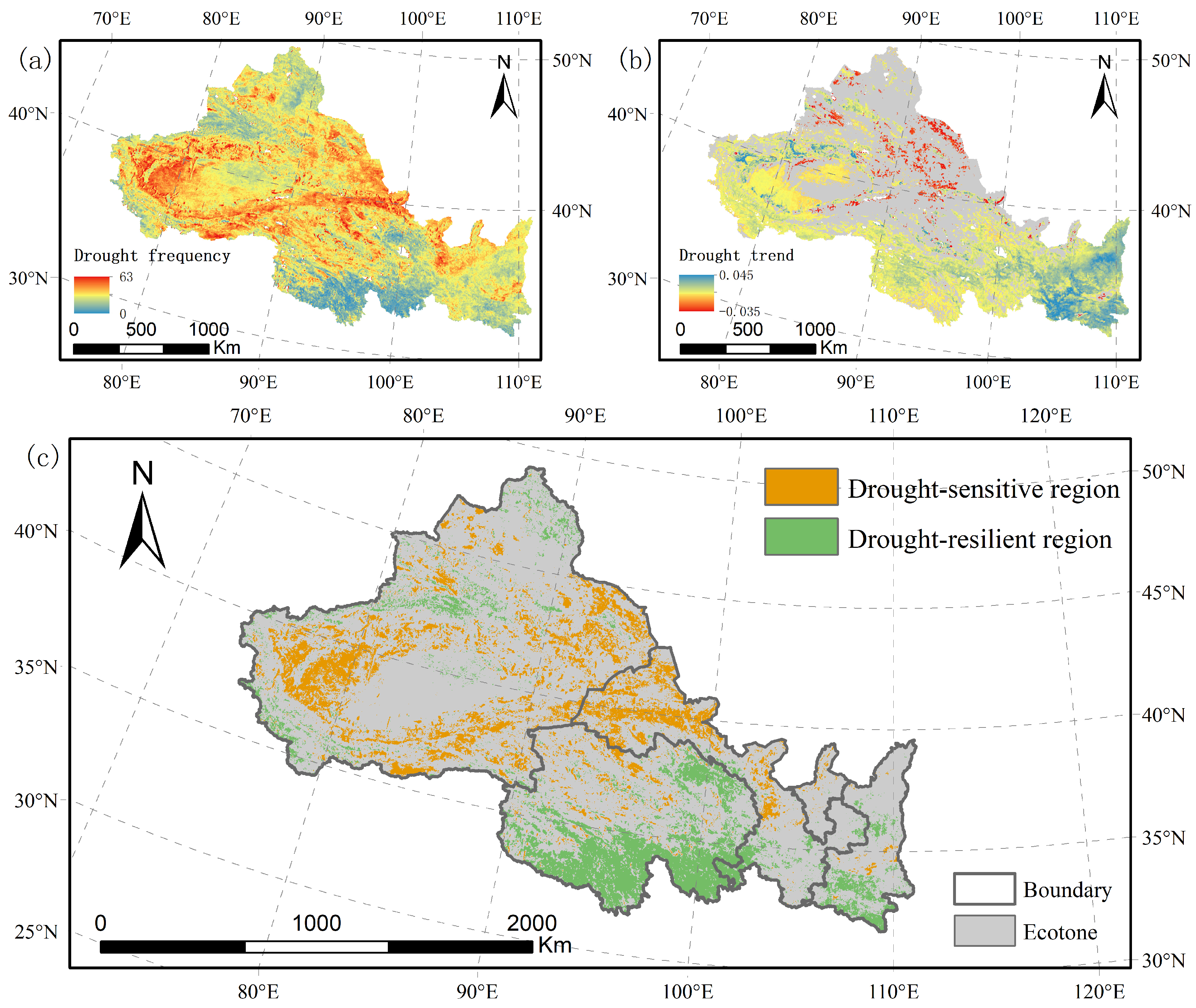
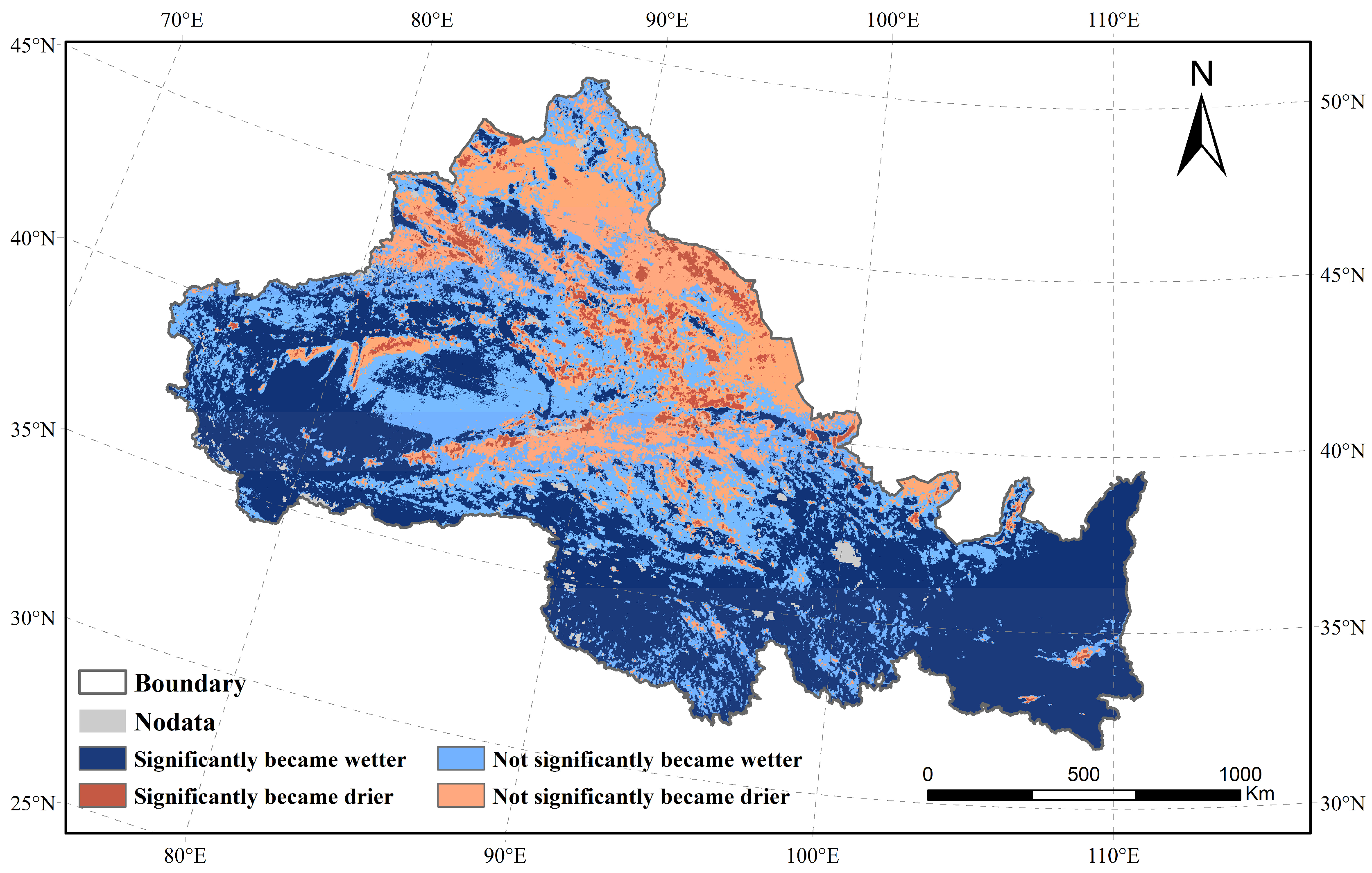
NWC drought frequency exhibits a pronounced spatial gradient (Figure 5a). High frequencies cluster in the arid basins and ecotones, especially in the transition zones between deserts and oases, where water availability is persistently limited and interannual variability is high. In contrast, lower frequencies occur in relatively humid sectors along mountain and plateau margins. The spatial distribution of trends (Figure 5b and Figure 6) further confirms the wetting tendency in NWC: extensive wetting is observed across the southern and eastern parts of NWC; although parts of northern Xinjiang show some intensification of drought, there are most areas that are not statistically significant; central areas also exhibits an overall wetting tendency, with localized drying patches embedded within a broader background of nonsignificant trends and wetting. Overall, the spatial pattern is dominated by widespread wetting, punctuated by scattered drying hotspots, highlighting the spatial heterogeneity of drought dynamics.
Using drought frequency f (Figure 5a), interannual trend slope (Figure 5b), and statistical significance (Figure 6), NWC was further classified into drought-sensitivity zones (Figure 5c). Areas with high drought frequency or significant drying were designated as drought-sensitive regions, while regions with significant wetting and low drought occurrence were defined as drought-resilient regions. The results show that drought-sensitive regions were primarily concentrated in the transitional belt between arid and semi-arid regions in the northwestern interior, whereas drought-resilient regions dominated the humid southeast. In addition, several mountainous and valley areas, such as the Ili Valley and the Qilian Mountains, exhibited strong drought resilience. This spatial pattern reflects the joint influence of climatic gradients and vegetation distribution.
Overall, the spatiotemporal evolution of drought indices during 2001–2024 indicates an overall alleviation of drought stress across NWC, characterized by significant wetting in the southeast, persistent drying in parts of the northwest, and drought alleviation that is concentrated in the growing season.

3.2. Spatiotemporal Patterns of NEP Under Drought

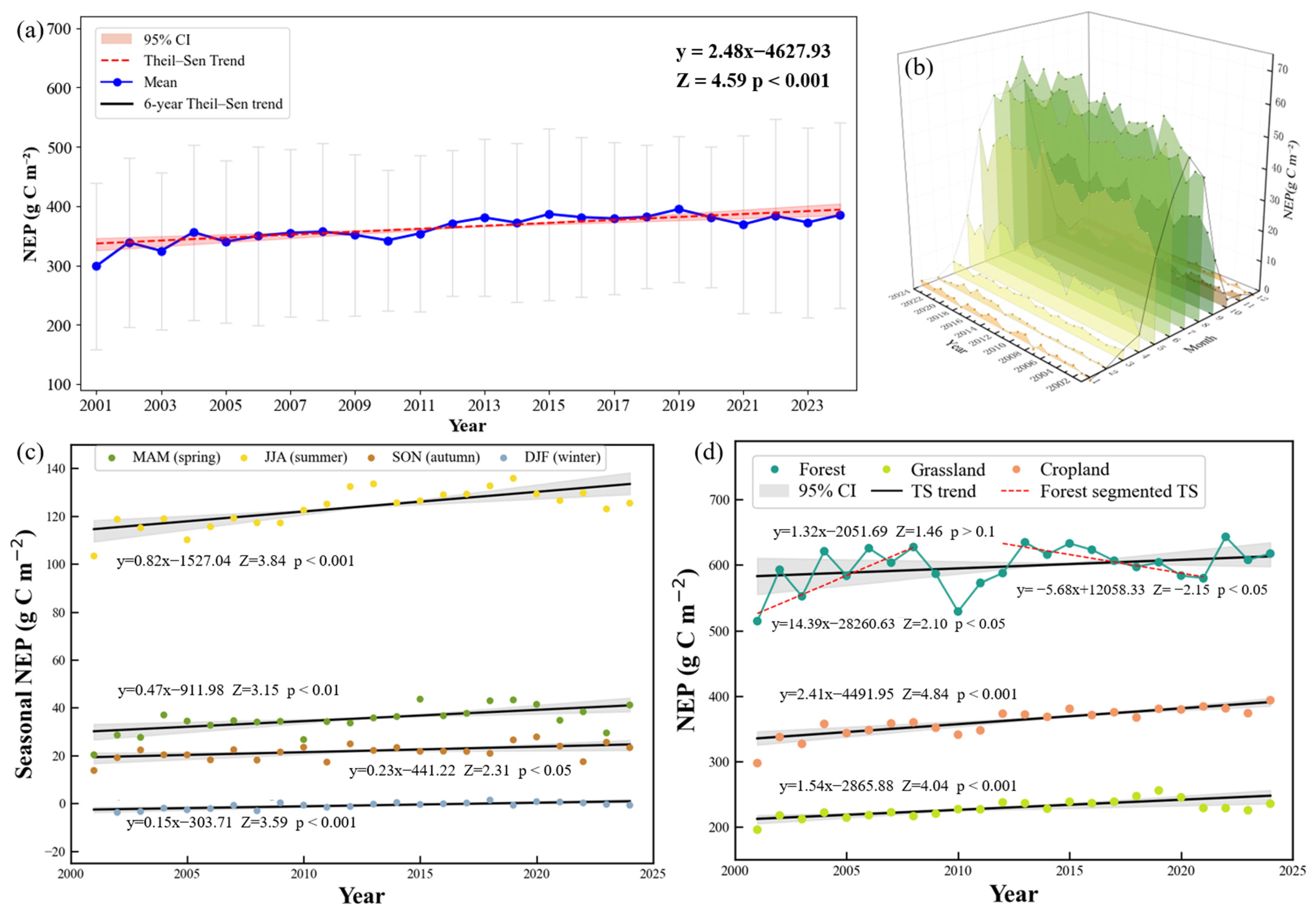
During 2001–2024, vegetation NEP in NWC showed a significant increasing trend (mean growth rate of 2.48 g C m−2 yr−1, Z = 4.59, p < 0.001; Figure 7a). Interannual fluctuations partly tracked the drought chronology: the troughs in 2013–2014 and 2021 (Figure 7a) coincided with SHI/SVCI drought anomalies, whereas the overall rise in NEP paralleled the multi-year wetting tendency. At the seasonal scale (Figure 7b,c), NEP showed a characteristic unimodal seasonal pattern, peaking in July–August and approaching zero or negative values in winter. Summer NEP strengthened markedly over 2001–2024 (0.82 g C m−2 yr−1, p < 0.001), followed by spring (0.47 g C m−2 yr−1, p < 0.01) and autumn (0.23 g C m−2 yr−1, p < 0.05), with a relatively modest increase in winter (0.15 g C m−2 yr−1, p < 0.05), indicating the dominant role of the growing season in driving long-term NEP dynamics. The enhancement of regional productivity is seasonally in phase with drought alleviation, highlighting the tight coupling between vegetation productivity and drought dynamics.
Figure 7d further shows interannual NEP trends across land cover types. NEP in croplands and grasslands increased significantly at rates of 2.41 and 1.54 g C m−2 yr−1 (p < 0.001), respectively, consistent with the widespread wetting trend. Forest NEP exhibited a more complex trajectory, whereas the overall trend is not significant (p ≥ 0.1). Segmented Theil–Sen analysis revealed a rapid increase before 2008 (1.32 g C m−2 yr−1, p < 0.05), a 2010 minimum followed by recovery, and a subsequent decline after 2013 (−5.68 g C m−2 yr−1, p < 0.05), suggesting possible saturation effects or disturbance impacts in forest carbon sinks. Differences among land cover types and seasons highlight the role of cropland and grassland in the NWC carbon sink and the importance of seasonal dynamics in regulating the regional carbon balance.
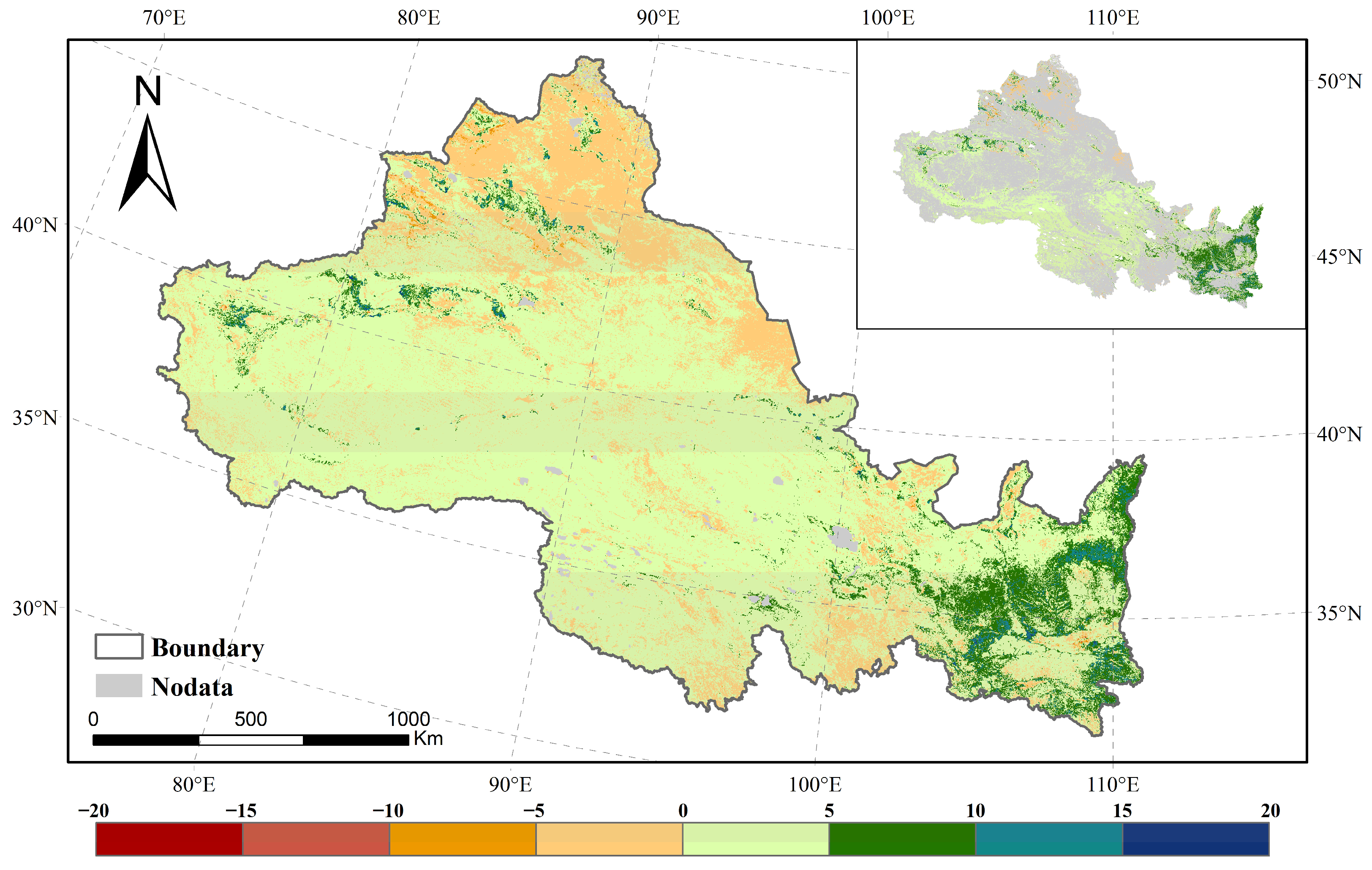
The spatial trend of vegetation NEP across NWC shows a pronounced southeast–northwest gradient (Figure 8). From 2001 to 2024, NEP increased by 0–10 g C m−2 yr−1 over most vegetated areas, with notable hotspots in eastern Shaanxi, southeastern Gansu, and southern Ningxia. In contrast, weak increases or negative trends are mainly found in arid desert interiors, sparsely vegetated Gobi surfaces, and parts of northern Xinjiang. The overall pattern aligns with the signals indicated by the drought indices, reflecting the constraints of sparse vegetation or water–heat stress on regional productivity. The significance inset (upper right) indicates that the most spatially coherent and significant increases (p < 0.05) are concentrated in croplands and grasslands. Overall, the recent strengthening of the regional carbon sink is concentrated in areas where drought pressure has eased, whereas chronically arid or sparsely vegetated regions show weak or negative responses.
To evaluate the reliability of the CASA NPP estimates, we performed an indirect validation by comparing our estimated NPP with the MODIS MOD17A3 NPP product. The results show a significant agreement (R2 = 0.76, p < 0.01; MAPE = 28.91%), and details are provided in the Supplementary Materials (Figure S2).

3.3. Vegetation NEP Response to Drought

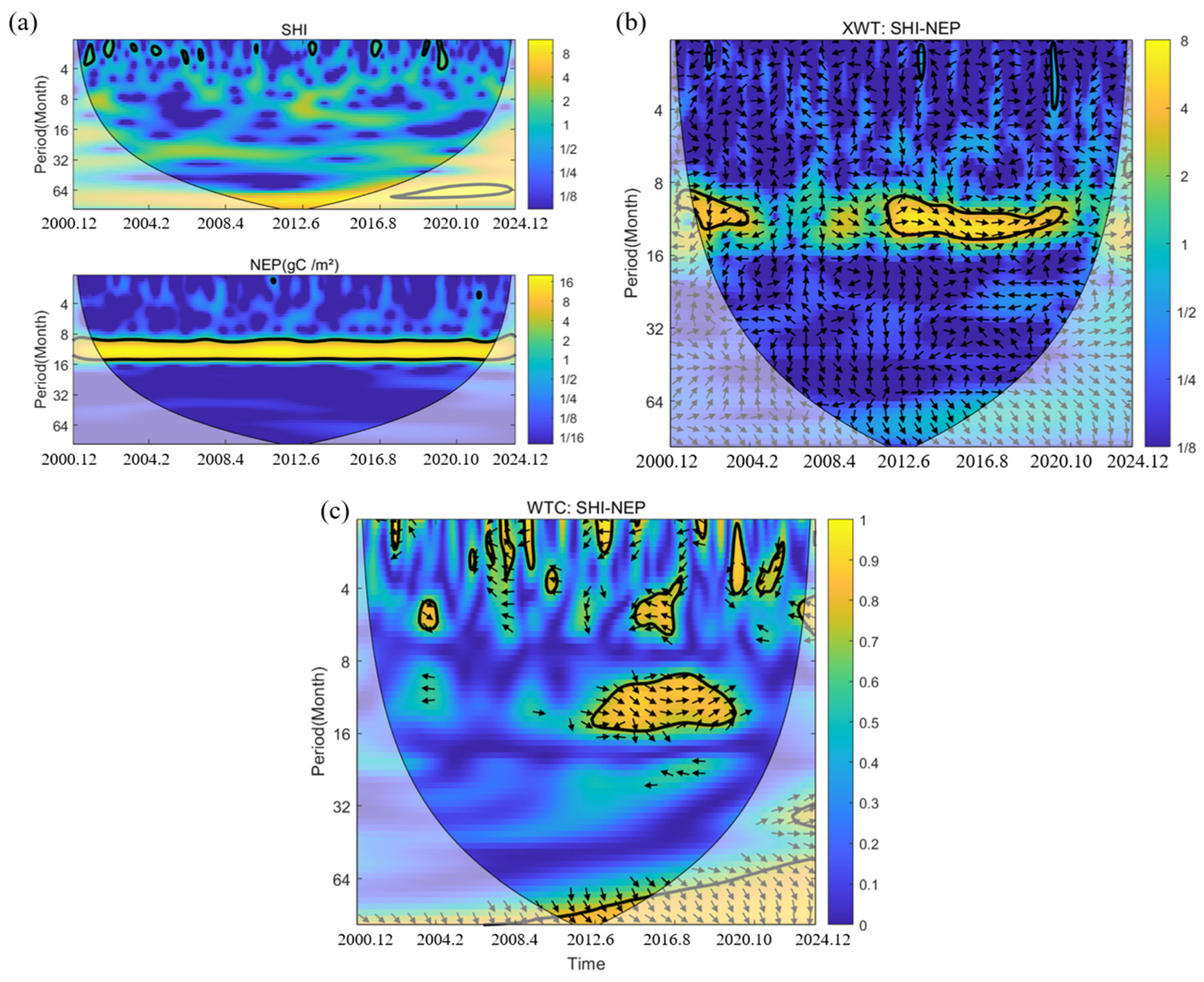
Building on the composite drought index developed in this study, we conducted cross wavelet transform (XWT) and wavelet coherence (WTC) analyses on the monthly SHI and NEP series to quantify the response–lag relationship between drought and vegetation productivity. The continuous wavelet power spectrum (Figure 9a) shows that, during 2001–2024, vegetation NEP in NWC exhibits pronounced periodicity, with a dominant period close to one year (8–16 months), indicating fluctuations primarily near the transition between intra-annual and inter-annual scales. The XWT reveals a persistent, significant coherence band with a period of 8–16 months during 2012–2020 (Figure 9b). The arrows denote the relative phase of the two series; rightward arrows with a slight upward or downward tilt indicate that SHI and NEP show positive correlation and suggest lag effects between them. The WTC (Figure 9c) further quantifies their time–frequency association. The results indicate high coherence between SHI and NEP in the 8–16 months band, suggesting that, at a near-annual scale, NEP shows a relatively clear response to persistent drought anomalies due to cumulative effects. By contrast, NEP responses to short term drought anomalies are weaker and less stable. WTC identifies a stable high-coherence region (R2 > 0.8) at the 8–16 months scale during 2012–2020. Within this band, phase arrows shift from lower-right to upper-right, indicating that NEP lags SHI by about 1–2 months at the onset of drought events but leads SHI by about 1–2 months toward the later stage of events, which may reflect a delayed productivity response to drought stress followed by recovery in the late phase.
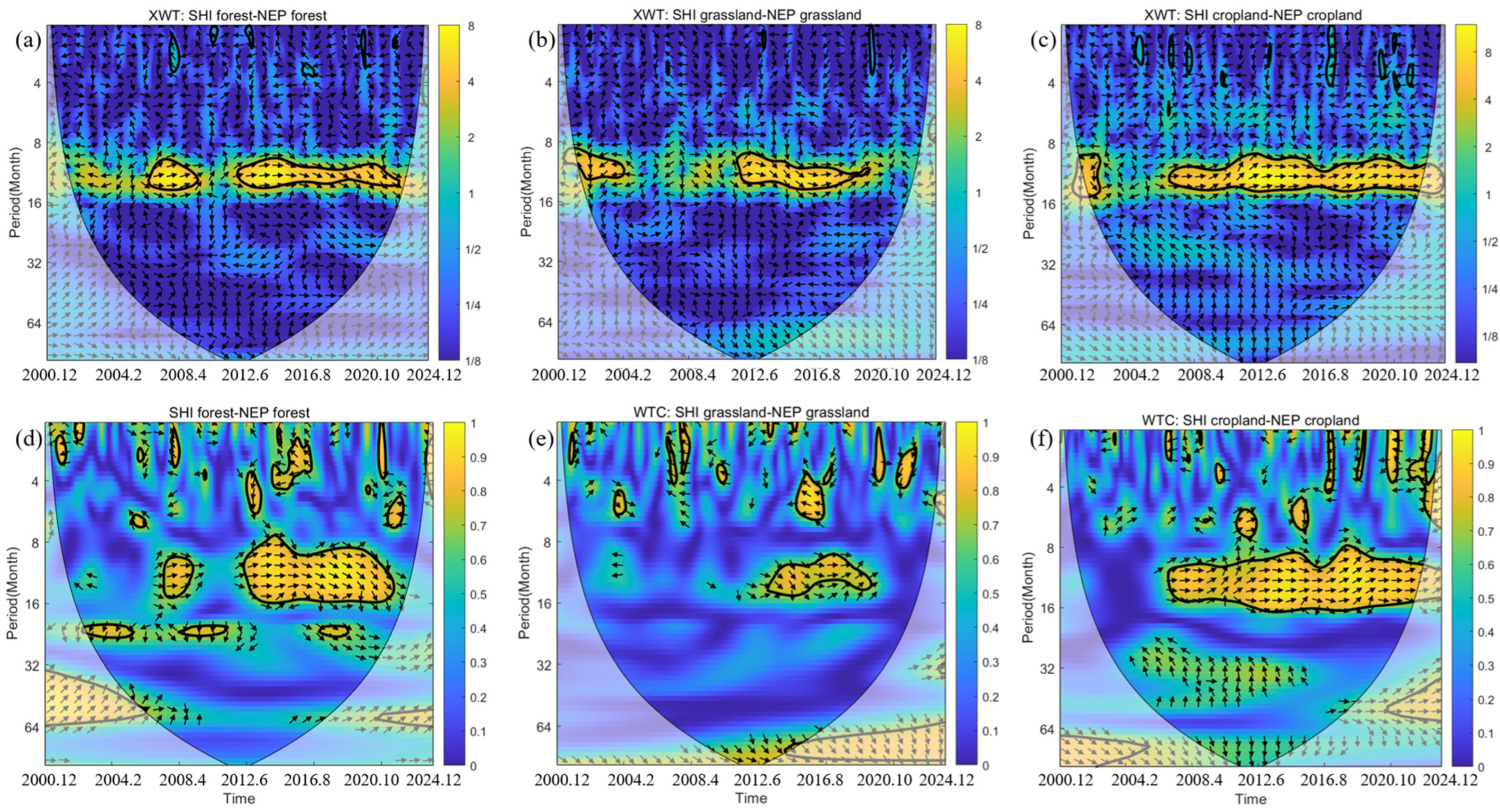
Figure 10 reveals the coupling strength and time-lag characteristics between SHI and NEP across different land cover types. In cropland (Figure 10c,f), a sustained, broad-resonance band and high-coherence zone emerge within the 8–16 months frequency range, indicating a significant positive correlation between SHI and NEP with a short time lag (0–1 month). This suggests that drought events and hydrothermal conditions have the most pronounced impact on croplands, and their response is the fastest. For grasslands (Figure 10b,e), a significant band also appears in the 8–16 months range, but intermittent resonance and smaller consistency regions in the time–frequency domain still indicate that grassland vegetation has strong drought resistance and is relatively insensitive to drought. Within this frequency range, the phase characteristics are consistent with the overall regional results: in the early stages of the event, NEP lags behind SHI by about 1–2 months, and later, it leads by about 1–2 months, reflecting the drought resistance and recovery capacity of grassland vegetation. In forests (Figure 10a,d), the significant areas show distinct fragmentation, with resonance patches occasionally appearing in the 16–24 months range in addition to the 8–16 months range. The lower-right phase indicates that NEP is in phase with SHI but lags behind by a longer duration (approximately 2–5 months), with occasional phase transitions.
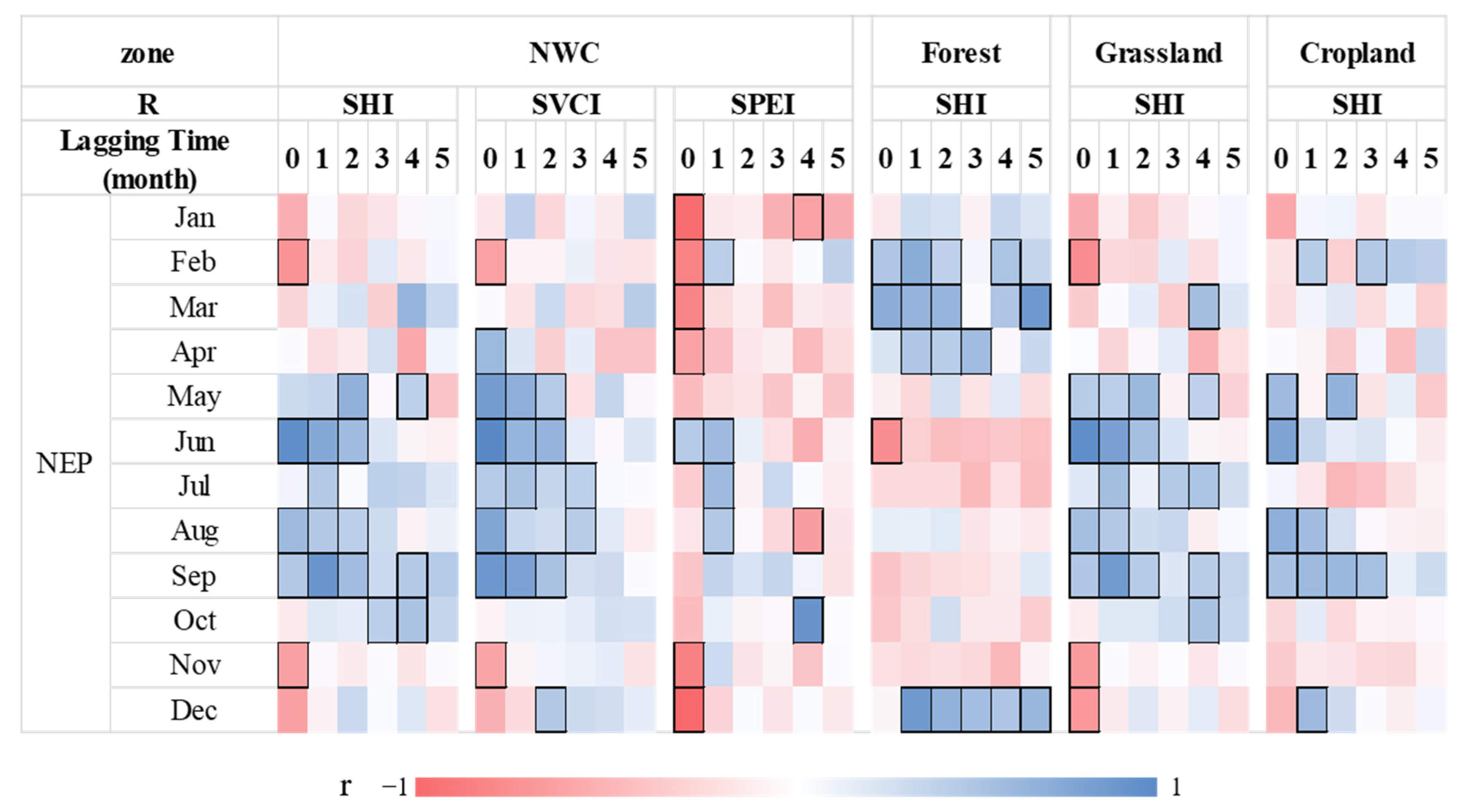
XWT and WTC analyses reveal the association between NEP and SHI in the time–frequency domain, and the phase arrows indicate potential lag effects between the two series. We further used Spearman rank correlations for synchronous and lagged relationships (τ = 0–5 months) to test the contemporaneous and delayed effects of drought anomalies on NEP. As shown in Figure 11, SHI and NEP show significant correlations in May–October with lags of τ = 0–2 months and a sustained response over 0–4 months, in agreement with the wavelet phase indications; SVCI and NEP are significantly correlated in April–September with a continuous significant window of 0–3 months and little apparent lag, reflecting the nearly synchronous response of the carbon sink to a photosynthesis-based agricultural drought index; SPEI exhibits contemporaneous negative correlations in winter months and only a significant positive correlation in June–August with a one-month lag, indicating that a single meteorological drought index has limited indicative power for vegetation carbon fluxes. In addition, the drought indices (SHI, SVCI, SPEI) are generally significantly positively correlated with NEP during the growing season (April–October), whereas correlations are weak and unstable in the non-growing season, consistent with the seasonal phase of the spatiotemporal dynamics of NEP and the drought indices. SHI generally shows higher correlations than SVCI in late summer to early autumn, suggesting that when thermal constraints intensify, a composite index that incorporates temperature better captures NEP responses to combined heat and drought stress.
Overall, in NWC, NEP and the drought indices exhibit persistently high coherence at 8–16 months scales, with NEP lagging drought by about 0–3 months. Response speed follow a cropland > grassland > forest gradient. The growing season is the main contributor, with the strongest coupling in late summer to early autumn. During periods of heightened thermal constraint, SHI better captures NEP responses to compound heat and drought stress than either the single SIF index (SVCI) or the meteorological drought index (SPEI-1).

4. Discussion

4.1. Advantages of SIF for Drought Monitoring

During 2001–2024, the SIF-based drought indices increased significantly overall, and SVCI exhibited a larger rise than the traditional drought indices VCI and VHI (Figure 3). SHI successfully captured five drought events in Northwest China, as documented in the China Bulletin of Flood and Drought Disasters, including the 2007 winter–spring drought [48] and the 2008 summer drought, whereas SVCI showed a slight lag and VCI did not capture these events (Figure 3 and Figure 4). SPEI shows weaker correlations with NEP and a clear one-month lag, and even negative correlations in winter (Figure 12), while the SIF-based drought indices display markedly stronger correlations with NEP and a timelier response. Zhou et al. confirmed in a method evaluation that SIF (including red/far-red bands) characterizes drought better than traditional VIs [49]; He et al. argued that SIF reliably indicates intra-annual crop productivity and responds faster than reflectance-based VIs [50]. These findings are consistent with our results, indicating that SIF-based drought indices provide greater biophysical specificity in drought monitoring and are also ideal indicators for investigating carbon sink responses to drought.
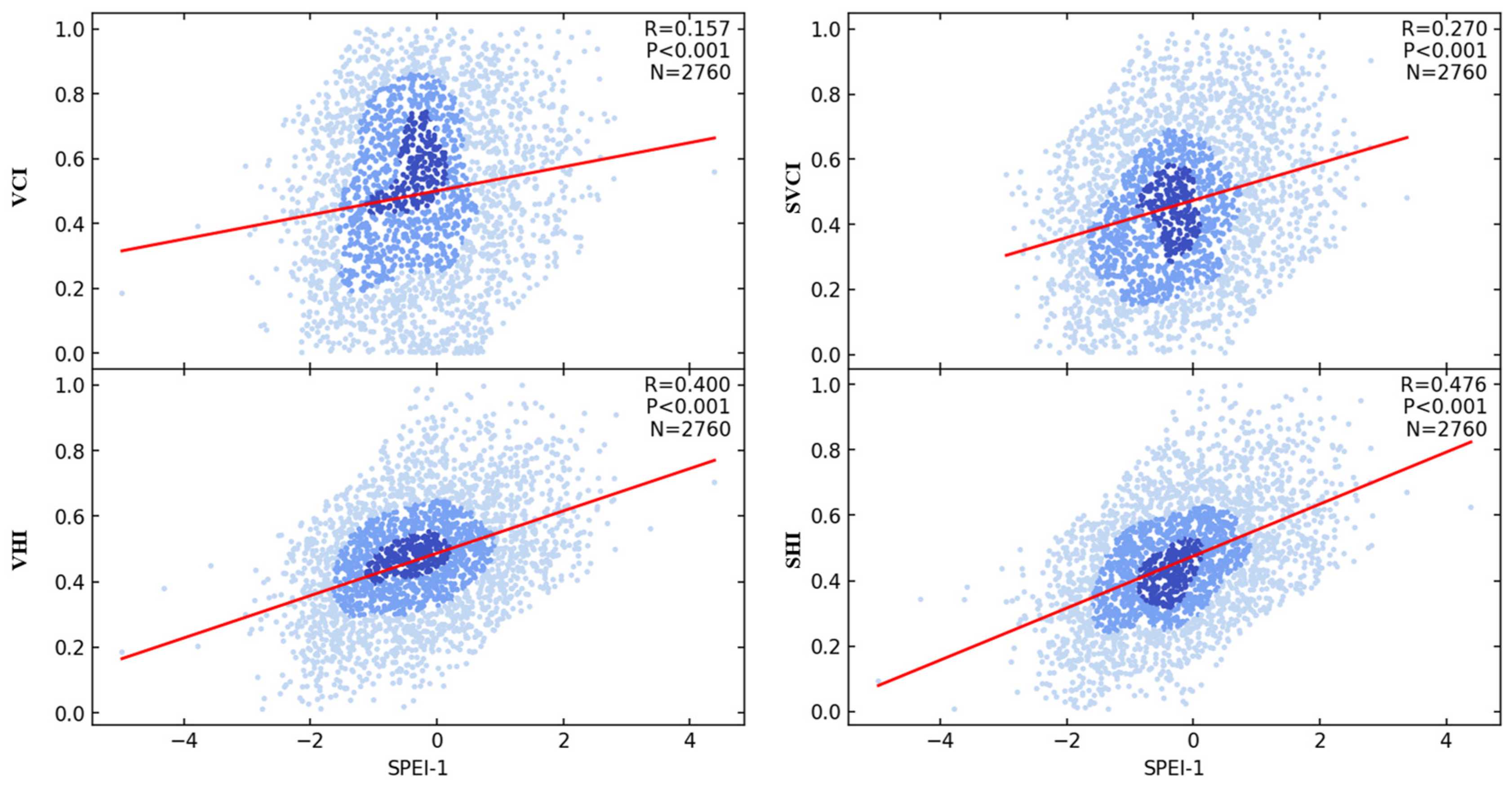
At the continental scale in North America, Jiao et al. [51]. reported that “satellite SIF is highly sensitive to meteorological drought.” To further assess SIF’s advantages for drought monitoring, we evaluated correlations between SPEI-1 and the drought indices VCI, SVCI, VHI, SHI (i.e., their correspondence to meteorological drought), and we obtained consistent conclusions. SIF-based drought indices correlate with SPEI significantly more strongly than traditional NDVI-based indices (Figure 12): SVCI (R = 0.270, p < 0.001) clearly exceeds VCI (R = 0.157, p < 0.001), an increase of 0.113 (≈72% relative); the composite SHI (SIF and LST) also outperforms VHI (NDVI and LST) (R = 0.476 vs. 0.400, p < 0.001), an improvement of 0.076 (≈19%). Li et al. [31,52,53] further showed that SIF directly represents photosynthetic physiology (≈APAR × Φ_F) and is less prone to saturation than NDVI, enabling faster, more sensitive responses before canopy structural changes become evident—providing a mechanistic explanation for our findings.

4.2. Drought Responses of Net Ecosystem Productivity

During 2001 to 2024, the response of NEP to drought in the NWC region is dominated by the annual scale (≈8–16 months) and exhibits a short lag of about 0–3 months. This temporal pattern is consistent with the soil moisture memory effect and the time required for canopy water–energy fluxes to adjust: anomalies in precipitation and recharge can persist in the root zone and subsequently propagate to photosynthesis over ensuing weeks to months [54,55,56]. Under compound hot and dry conditions in late summer to early autumn, the SHI, which incorporates LST factor, shows a stronger coupling with NEP than the SVCI that is based solely on SIF [57], indicating that a “water-dominated, heat-modulated” framework better explains the observed time–frequency correlations in the carbon sink.
Clear differences emerge among land cover types. Croplands display the strongest coherence (R2 > 0.8) within the 8–16 months band and a near synchronous, short-lag coupling (τ ≈ 0–1 month). This likely reflects the ability of SIF to directly track photosynthetic physiology and thus to rapidly capture physiological responses to water stress [53,58], as well as a greater sensitivity of cropland NEP to drought [59]. However, the duration of this response is shorter, consistent with irrigation and agronomic management buffering drought impacts, accelerating recovery, and dampening high-frequency drought shocks [60]. Grasslands show smaller coherent regions at the annual scale, yet Spearman correlations reveal a robust coupling between growing season grassland NEP and drought with a short lag (τ ≈ 0–2 months), reflecting the sensitivity of shallow root systems to precipitation anomalies and surface soil moisture [61]. Forests often exhibit longer lags of 2–5 months and more persistent responses, indicative of deep rooting and internal carbon–water stores that buffer during drought and require compensatory replenishment during recovery [62]—i.e., a characteristic “delay–memory.” In addition, drought legacy effects can continue to influence NEP for months after an event [54,63,64].
Our findings are broadly consistent with prior studies in several respects. Firstly, the 0–3 months short lag aligns with the widely reported soil moisture memory and ecohydrological persistence in semi-arid ecosystems [56]. Secondly, the rapid response and recovery of croplands accord with evidence that irrigation and management mitigate hot–dry stress and sustain productivity [65]. Meanwhile, our finding of weaker wavelet coherence for grasslands contrasts with the Spearman correlation analysis and with studies reporting pronounced declines in grassland NPP during extreme events [66,67,68]. We posit that this divergence stems from scale effects: wavelet coherence emphasizes correlations in the time–frequency domain, and the 8–16 months band is not directly comparable to the monthly/daily/hourly scales considered in Spearman analyses and flux tower observations. Future work could integrate daily SIF with meteorological and hydrological drought indices to quantitatively analyze the joint controls of drought factors and land cover types on the length and persistence of response lags.

4.3. Prospects and Limitations

This study proposes a drought monitoring framework based on SIF, which has direct application value and good regional transferability. The response differences of different land use types suggest that differentiated drought adaptation and mitigation strategies can be formulated. The main limitation lies in the insufficient separation of the attribution of drought drivers and physiological mechanisms, so lag estimates may reflect mixed controls and the relative contributions of moisture and heat stress remain difficult to quantify [69]. Differences in the dominant stressor across regions may also lead to varying performance among drought indices. Furthermore, in areas with strong topographic relief, the 1 km spatial resolution of the multi-source datasets may cause pixel mixing across elevation bands and land cover types, which increases uncertainty in correlation analyses and lag inference. Finally, current NEP estimation models are mostly based on empirical and statistically parameterized models [70], and the limited coverage of NWC flux stations restricts the accuracy validation based on observed data. Whether the NEP estimation results can be applied to large scale carbon sink research needs further validation based on observational data [71].
To the best of our knowledge, this study is the first attempt to develop an SIF-based composite drought index to explore the relationship between NEP and drought responses. In future work, we will use higher spatiotemporal resolution datasets, combine them with finer topographic stratification, introduce key process variables (soil moisture, evapotranspiration, and VPD), and integrate meteorological, hydrological, and socio-economic drought drivers, thereby further examining the mechanisms of carbon sink responses to drought.

5. Conclusions

Using multi-source remote sensing and meteorological data from 2001–2024, this study develops a drought-monitoring framework (SVCI, SHI) centered on solar-induced chlorophyll fluorescence (SIF) and systematically analyzes the synchronous, lagged, and recovery responses of vegetation net ecosystem productivity (NEP) to drought in the Northwest China arid region (NWC). SVCI, VCI, SHI, and VHI all increased significantly, indicating an overall alleviation of regional drought, and SIF-based indices markedly outperform traditional VI and meteorology indices in characterizing drought and its impacts. The dominant NEP–drought coupling scale is annual (8–16 months), with a stable high-coherence zone (R2 > 0.8) within the 8–16 months band and an overall lag of 0–3 months. Land cover types exhibit a clear gradient in response strength and memory: croplands show the strongest coherence at 8–16 months and the shortest lag (τ ≈ 0–1 month); grasslands display robust growing season concurrent to short-lag coupling (τ ≈ 0–2 months) but smaller time–frequency consistency regions; forests typically exhibit longer lags (≈2–5 months) and more persistent response windows, reflecting “delay–memory” effects associated with deep rooting and internal carbon–water stores. The results indicate that the SIF-based composite drought index SHI can support near-real-time early warning and post-event diagnosis of NEP decline and recovery. The drought-sensitivity zoning and the differentiated responses among landcover types point to the need for tailored drought adaptation and management strategies, with particular attention to risk management in the northern Xinjiang transition belt and ecotones. The differentiated drought responses and recovery capacities among land cover types highlight functional biodiversity and ecosystem resilience under climate change.

Supplementary Materials

The following supporting information can be downloaded at https://www.mdpi.com/article/10.3390/su18052654/s1. Figure S1: Reclassified land cover map of the study area; Figure S2: Pixel-based spatial validation of CASA-derived NPP; Table S1: Reclassification crosswalk.

Author Contributions

Conceptualization, and Supervision, Q.B.; Methodology, Validation, Formal analysis, Investigation, Visualization, and Writing—original draft, L.Z.; Data curation, W.Y., H.Z., and H.L. All authors have read and agreed to the published version of the manuscript.

Funding

This research was funded by the Open Fund of the Key Laboratory of Urban Land Resources Monitoring and Simulation, Ministry of Natural Resources (grant No. KF-2023-08-01), and by the West Light Foundation of the Chinese Academy of Sciences (grant No. 25JR6KA004). The APC was funded by the same grants.

Institutional Review Board Statement

Not applicable.

Informed Consent Statement

Not applicable.

Data Availability Statement

The datasets used in this study are publicly available, and links to the public datasets are provided in the manuscript. This study did not generate new data. All processed data and analysis codes are available from the corresponding author upon reasonable request.

Conflicts of Interest

The authors declare no conflicts of interest. The funders had no role in the design of the study; in the collection, analyses, or interpretation of data; in the writing of the manuscript; or in the decision to publish the results.

Abbreviations

The following abbreviations are used in this manuscript:
LSTLand Surface Temperature
NDVINormalized Difference Vegetation Index
SIFSolar-Induced Chlorophyll Fluorescence
SPEIStandardized Precipitation-Evapotranspiration Index
VCIVegetation Condition Index
SVCISIF-Based Vegetation Condition Index
VHIVegetation Health Index
SHISIF-based Vegetation Health Index
MKMann–Kendall
TSTheil–Sen
NEPNet Ecosystem Productivity
RPearson correlation coefficient

References

  1. Piao, S.; Zhang, X.; Chen, A.; Liu, Q.; Lian, X.; Wang, X.; Peng, S.; Wu, X. The Impacts of Climate Extremes on the Terrestrial Carbon Cycle: A Review. Sci. China Earth Sci. 2019, 62, 1551–1563. [Google Scholar] [CrossRef]
  2. Wilhite, D.A.; Glantz, M.H. Understanding: The Drought Phenomenon: The Role of Definitions. Water Int. 1985, 10, 111–120. [Google Scholar] [CrossRef]
  3. Palmer, W.C. Meteorological Drought; U.S. Weather Bureau: Washington, DC, USA, 1965; p. 58.
  4. Wells, N.; Goddard, S.; Hayes, M.J. A Self-Calibrating Palmer Drought Severity Index. J. Clim. 2004, 17, 2335–2351. [Google Scholar] [CrossRef]
  5. McKee, T.B.; Doesken, N.J.; Kleist, J. The Relationship of Drought Frequency and Duration to Time Scales. In Proceedings of the 8th Conference on Applied Climatology, Anaheim, CA, USA, 17–22 January 1993. [Google Scholar]
  6. Vicente-Serrano, S.M.; Beguería, S.; López-Moreno, J.I. A Multiscalar Drought Index Sensitive to Global Warming: The Standardized Precipitation Evapotranspiration Index. J. Clim. 2010, 23, 1696–1718. [Google Scholar] [CrossRef]
  7. Li, L.; She, D.; Zheng, H.; Lin, P.; Yang, Z.-L. Elucidating Diverse Drought Characteristics from Two Meteorological Drought Indices (SPI and SPEI) in China. J. Hydrometeorol. 2020, 21, 1513–1530. [Google Scholar] [CrossRef]
  8. Hao, Z.; AghaKouchak, A. Multivariate Standardized Drought Index: A Parametric Multi-Index Model. Adv. Water Resour. 2013, 57, 12–18. [Google Scholar] [CrossRef]
  9. Shukla, S.; Wood, A.W. Use of a Standardized Runoff Index for Characterizing Hydrologic Drought. Geophys. Res. Lett. 2008, 35, GL032487. [Google Scholar] [CrossRef]
  10. Shafer, B.A.; Dezman, L.E. Development of a Surface Water Supply Index (SWSI) to Assess the Severity of Drought Conditions in Snowpack Runoff Areas. In Proceedings of the Western Snow Conference, Reno, NV, USA, 19–23 April 1982; Colorado State University: Fort Collins, CO, USA, 1982; pp. 164–175. [Google Scholar]
  11. Sinha, D.; Syed, T.H.; Famiglietti, J.S.; Reager, J.T.; Thomas, R.C. Characterizing Drought in India Using GRACE Observations of Terrestrial Water Storage Deficit. J. Hydrometeorol. 2017, 18, 381–396. [Google Scholar] [CrossRef]
  12. Ciais, P.; Reichstein, M.; Viovy, N.; Granier, A.; Ogée, J.; Allard, V.; Aubinet, M.; Buchmann, N.; Bernhofer, C.; Carrara, A.; et al. Europe-Wide Reduction in Primary Productivity Caused by the Heat and Drought in 2003. Nature 2005, 437, 529–533. [Google Scholar] [CrossRef] [PubMed]
  13. Zhao, M.; Running, S.W. Drought-Induced Reduction in Global Terrestrial Net Primary Production from 2000 Through 2009. Science 2010, 329, 940–943. [Google Scholar] [CrossRef] [PubMed]
  14. Anderegg, W.R.L.; Flint, A.; Huang, C.; Flint, L.; Berry, J.A.; Davis, F.W.; Sperry, J.S.; Field, C.B. Tree Mortality Predicted from Drought-Induced Vascular Damage. Nat. Geosci. 2015, 8, 367–371. [Google Scholar] [CrossRef]
  15. Masroor, M.; Sajjad, H.; Rehman, S.; Singh, R.; Hibjur Rahaman, M.; Sahana, M.; Ahmed, R.; Avtar, R. Analysing the Relationship between Drought and Soil Erosion Using Vegetation Health Index and RUSLE Models in Godavari Middle Sub-Basin, India. Geosci. Front. 2022, 13, 101312. [Google Scholar] [CrossRef]
  16. Crausbay, S.D.; Ramirez, A.R.; Carter, S.L.; Cross, M.S.; Hall, K.R.; Bathke, D.J.; Betancourt, J.L.; Colt, S.; Cravens, A.E.; Dalton, M.S.; et al. Defining Ecological Drought for the Twenty-First Century. Bull. Am. Meteorol. Soc. 2017, 98, 2543–2550. [Google Scholar] [CrossRef]
  17. Kogan, F.N. Application of Vegetation Index and Brightness Temperature for Drought Detection. Adv. Space Res. 1995, 15, 91–100. [Google Scholar] [CrossRef]
  18. Kogan, F. World Droughts in the New Millennium from AVHRR-based Vegetation Health Indices. EoS Trans. 2002, 83, 557–563. [Google Scholar] [CrossRef]
  19. Khosravi, Y.; Ouarda, T.B.M.J.; Homayouni, S. Developing an Ensemble Machine Learning Framework for Enhanced Climate Projections Using CMIP6 Data in the Middle East. npj Clim. Atmos. Sci. 2025, 8, 174. [Google Scholar] [CrossRef]
  20. Khosravi, Y.; Homayouni, S.; St-Hilaire, A. An Integrated Dryness Index Based on Geographically Weighted Regression and Satellite Earth Observations. Sci. Total Environ. 2024, 911, 168807. [Google Scholar] [CrossRef]
  21. AghaKouchak, A.; Farahmand, A.; Melton, F.S.; Teixeira, J.; Anderson, M.C.; Wardlow, B.D.; Hain, C.R. Remote Sensing of Drought: Progress, Challenges and Opportunities. Rev. Geophys. 2015, 53, 452–480. [Google Scholar] [CrossRef]
  22. Porcar-Castell, A.; Tyystjärvi, E.; Atherton, J.; van der Tol, C.; Flexas, J.; Pfündel, E.E.; Moreno, J.; Frankenberg, C.; Berry, J.A. Linking Chlorophyll a Fluorescence to Photosynthesis for Remote Sensing Applications: Mechanisms and Challenges. J. Exp. Bot. 2014, 65, 4065–4095. [Google Scholar] [CrossRef]
  23. Kalaji, H.M.; Schansker, G.; Brestic, M.; Bussotti, F.; Calatayud, A.; Ferroni, L.; Goltsev, V.; Guidi, L.; Jajoo, A.; Li, P.; et al. Frequently Asked Questions about Chlorophyll Fluorescence, the Sequel. Photosynth. Res. 2017, 132, 13–66. [Google Scholar] [CrossRef]
  24. Baker, N.R. Chlorophyll Fluorescence: A Probe of Photosynthesis In Vivo. Annu. Rev. Plant Biol. 2008, 59, 89–113. [Google Scholar] [CrossRef]
  25. Belgio, E.; Johnson, M.P.; Jurić, S.; Ruban, A.V. Higher Plant Photosystem II Light-Harvesting Antenna, Not the Reaction Center, Determines the Excited-State Lifetime—Both the Maximum and the Nonphotochemically Quenched. Biophys. J. 2012, 102, 2761–2771. [Google Scholar] [CrossRef]
  26. Liu, L.; Yang, X.; Zhou, H.; Liu, S.; Zhou, L.; Li, X.; Yang, J.; Han, X.; Wu, J. Evaluating the Utility of Solar-Induced Chlorophyll Fluorescence for Drought Monitoring by Comparison with NDVI Derived from Wheat Canopy. Sci. Total Environ. 2018, 625, 1208–1217. [Google Scholar] [CrossRef]
  27. Song, L.; Guanter, L.; Guan, K.; You, L.; Huete, A.; Ju, W.; Zhang, Y. Satellite Sun-induced Chlorophyll Fluorescence Detects Early Response of Winter Wheat to Heat Stress in the Indian Indo-Gangetic Plains. Glob. Change Biol. 2018, 24, 4023–4037. [Google Scholar] [CrossRef] [PubMed]
  28. Zhang, Z.; Xu, W.; Qin, Q.; Long, Z. Downscaling Solar-Induced Chlorophyll Fluorescence Based on Convolutional Neural Network Method to Monitor Agricultural Drought. IEEE Trans. Geosci. Remote Sens. 2021, 59, 1012–1028. [Google Scholar] [CrossRef]
  29. Liu, Y.; Yu, X.; Dang, C.; Yue, H.; Wang, X.; Niu, H.; Zu, P.; Cao, M. A Dryness Index TSWDI Based on Land Surface Temperature, Sun-Induced Chlorophyll Fluorescence, and Water Balance. ISPRS J. Photogramm. Remote Sens. 2023, 202, 581–598. [Google Scholar] [CrossRef]
  30. Wang, S.; Huang, C.; Zhang, L.; Lin, Y.; Cen, Y.; Wu, T. Monitoring and Assessing the 2012 Drought in the Great Plains: Analyzing Satellite-Retrieved Solar-Induced Chlorophyll Fluorescence, Drought Indices, and Gross Primary Production. Remote Sens. 2016, 8, 61. [Google Scholar] [CrossRef]
  31. Li, X.; Xiao, J. A Global, 0.05-Degree Product of Solar-Induced Chlorophyll Fluorescence Derived from OCO-2, MODIS, and Reanalysis Data. Remote Sens. 2019, 11, 517. [Google Scholar] [CrossRef]
  32. Peng, S.; Ding, Y.; Liu, W.; Li, Z. 1 Km Monthly Temperature and Precipitation Dataset for China from 1901 to 2017. Earth Syst. Sci. Data 2019, 11, 1931–1946. [Google Scholar] [CrossRef]
  33. Vicente Serrano, S.M.; Beguería, S.; López-Moreno, J.I.; Angulo-Martínez, M.; El Kenawy, A.M. A New Global 0.5° Gridded Dataset (1901–2006) of a Multiscalar Drought Index: Comparison with Current Drought Index Datasets Based on the Palmer Drought Severity Index. J. Hydrometeorol. 2010, 11, 1033–1043. [Google Scholar] [CrossRef]
  34. Bayarjargal, Y.; Karnieli, A.; Bayasgalan, M.; Khudulmur, S.; Gandush, C.; Tucker, C.J. A Comparative Study of NOAA–AVHRR Derived Drought Indices Using Change Vector Analysis. Remote Sens. Environ. 2006, 105, 9–22. [Google Scholar] [CrossRef]
  35. Zeng, J.; Zhou, T.; Qu, Y.; Bento, V.A.; Qi, J.; Xu, Y.; Li, Y.; Wang, Q. An Improved Global Vegetation Health Index Dataset in Detecting Vegetation Drought. Sci. Data 2023, 10, 338. [Google Scholar] [CrossRef]
  36. Han, Y.; Li, Z.; Huang, C.; Zhou, Y.; Zong, S.; Hao, T.; Niu, H.; Yao, H. Monitoring Droughts in the Greater Changbai Mountains Using Multiple Remote Sensing-Based Drought Indices. Remote Sens. 2020, 12, 530. [Google Scholar] [CrossRef]
  37. Zou, L.; Cao, S.; Sanchez-Azofeifa, A. Evaluating the Utility of Various Drought Indices to Monitor Meteorological Drought in Tropical Dry Forests. Int. J. Biometeorol. 2020, 64, 701–711. [Google Scholar] [CrossRef]
  38. Salazar, L.; Kogan, F.; Roytman, L. Using Vegetation Health Indices and Partial Least Squares Method for Estimation of Corn Yield. Int. J. Remote Sens. 2008, 29, 175–189. [Google Scholar] [CrossRef]
  39. Liu, W.; Wang, S.; Zhou, Y.; Wang, L.; Zhu, J.; Wang, F. Lightning-Caused Forest Fire Risk Rating Assessment Based on Case-Based Reasoning: A Case Study in DaXingAn Mountains of China. Nat. Hazards 2016, 81, 347–363. [Google Scholar] [CrossRef]
  40. Kogan, F.; Salazar, L.; Roytman, L. Forecasting Crop Production Using Satellite-Based Vegetation Health Indices in Kansas, USA. Int. J. Remote Sens. 2012, 33, 2798–2814. [Google Scholar] [CrossRef]
  41. Fu, X.; Chen, H. Comprehensive Power Quality Evaluation Based on Weighted Rank Sum Ration Method. Electr. Power Autom. Equip. 2015, 35, 128–132. [Google Scholar] [CrossRef]
  42. Zhang, L.; Jiao, W.; Zhang, H.; Huang, C.; Tong, Q. Studying Drought Phenomena in the Continental United States in 2011 and 2012 Using Various Drought Indices. Remote Sens. Environ. 2017, 190, 96–106. [Google Scholar] [CrossRef]
  43. Potter, C.S.; Randerson, J.T.; Field, C.B.; Matson, P.A.; Vitousek, P.M.; Mooney, H.A.; Klooster, S.A. Terrestrial Ecosystem Production: A Process Model Based on Global Satellite and Surface Data. Glob. Biogeochem. Cycles 1993, 7, 811–841. [Google Scholar] [CrossRef]
  44. Zhu, W.; Pan, Y.; He, H.; Yu, D.; Hu, H. Simulation of Maximum Light Use Efficiency for Some Typical Vegetation Types in China. Chin. Sci. Bull. 2006, 51, 700–706. [Google Scholar] [CrossRef]
  45. Zhu, W.; Pan, Y.; Zhang, J. Estimation of Net Primary Productivity of Chinese Terrestrial Vegetation Based on Remote Sensing. Chin. J. Plant Ecol. 2007, 31, 413–424. [Google Scholar]
  46. Pei, Z.; Ouyang, H.; Zhou, C.; Xu, X. Carbon Balance in an Alpine Steppe in the Qinghai-Tibet Plateau. J. Integr. Plant Biol. 2009, 51, 521–526. [Google Scholar] [CrossRef]
  47. Pei, Z.; Zhou, C.; Ouyang, H.; Yang, W.-B. A Carbon Budget of Alpine Steppe Area in the Tibetan Plateau. Geogr. Res. 2010, 29, 102–110. [Google Scholar]
  48. Shi, X.; Ding, H.; Wu, M.; Shi, M.; Chen, F.; Li, Y.; Yang, Y. A Comprehensive Drought Monitoring Method Integrating Multi-Source Data. PeerJ 2022, 10, e13560. [Google Scholar] [CrossRef] [PubMed]
  49. Zhou, L.; Lin, J.; Wu, J.; Du, R.; Chen, M.; Zhao, B.; Yang, R. Assessing the Potential of Red Solar-Induced Chlorophyll Fluorescence for Drought Monitoring in Different Growth Stages of Winter Wheat. Ecol. Indic. 2024, 161, 111960. [Google Scholar] [CrossRef]
  50. He, L.; Magney, T.; Dutta, D.; Yin, Y.; Köhler, P.; Grossmann, K.; Stutz, J.; Dold, C.; Hatfield, J.; Guan, K.; et al. From the Ground to Space: Using Solar-Induced Chlorophyll Fluorescence to Estimate Crop Productivity. Geophys. Res. Lett. 2020, 47, e2020GL087474. [Google Scholar] [CrossRef]
  51. Jiao, W.; Chang, Q.; Wang, L. The Sensitivity of Satellite Solar-Induced Chlorophyll Fluorescence to Meteorological Drought. Earth’s Future 2019, 7, 558–573. [Google Scholar] [CrossRef]
  52. Meroni, M.; Rossini, M.; Guanter, L.; Alonso, L.; Rascher, U.; Colombo, R.; Moreno, J. Remote Sensing of Solar-Induced Chlorophyll Fluorescence: Review of Methods and Applications. Remote Sens. Environ. 2009, 113, 2037–2051. [Google Scholar] [CrossRef]
  53. Magney, T.S.; Bowling, D.R.; Logan, B.A.; Grossmann, K.; Stutz, J.; Blanken, P.D.; Burns, S.P.; Cheng, R.; Garcia, M.A.; Köhler, P.; et al. Mechanistic Evidence for Tracking the Seasonality of Photosynthesis with Solar-Induced Fluorescence. Proc. Natl. Acad. Sci. USA 2019, 116, 11640–11645. [Google Scholar] [CrossRef]
  54. Schwalm, C.R.; Anderegg, W.R.L.; Michalak, A.M.; Fisher, J.B.; Biondi, F.; Koch, G.; Litvak, M.; Ogle, K.; Shaw, J.D.; Wolf, A.; et al. Global Patterns of Drought Recovery. Nature 2017, 548, 202–205. [Google Scholar] [CrossRef]
  55. Orth, R.; Seneviratne, S.I. Propagation of Soil Moisture Memory to Streamflow and Evapotranspiration in Europe. Hydrol. Earth Syst. Sci. 2013, 17, 3895–3911. [Google Scholar] [CrossRef]
  56. Orth, R.; Seneviratne, S.I. Analysis of Soil Moisture Memory from Observations in Europe. J. Geophys. Res. Atmos. 2012, 117, 15115. [Google Scholar] [CrossRef]
  57. Zhang, Y.; Xiao, X.; Zhou, S.; Ciais, P.; McCarthy, H.; Luo, Y. Canopy and Physiological Controls of GPP during Drought and Heat Wave. Geophys. Res. Lett. 2016, 43, 3325–3333. [Google Scholar] [CrossRef]
  58. Xu, S.; Atherton, J.; Riikonen, A.; Zhang, C.; Oivukkamäki, J.; MacArthur, A.; Honkavaara, E.; Hakala, T.; Koivumäki, N.; Liu, Z.; et al. Structural and Photosynthetic Dynamics Mediate the Response of SIF to Water Stress in a Potato Crop. Remote Sens. Environ. 2021, 263, 112555. [Google Scholar] [CrossRef]
  59. Xiao, C.; Zaehle, S.; Yang, H.; Wigneron, J.-P.; Schmullius, C.; Bastos, A. Land Cover and Management Effects on Ecosystem Resistance to Drought Stress. Earth Syst. Dyn. 2023, 14, 1211–1237. [Google Scholar] [CrossRef]
  60. Lobell, D.B.; Bonfils, C.J.; Kueppers, L.M.; Snyder, M.A. Irrigation Cooling Effect on Temperature and Heat Index Extremes. Geophys. Res. Lett. 2008, 35, L09705. [Google Scholar] [CrossRef]
  61. Schwinning, S.; Sala, O.E. Hierarchy of Responses to Resource Pulses in Arid and Semi-Arid Ecosystems. Oecologia 2004, 141, 211–220. [Google Scholar] [CrossRef]
  62. Oliveira, R.S.; Eller, C.B.; Barros, F.d.V.; Hirota, M.; Brum, M.; Bittencourt, P. Linking Plant Hydraulics and the Fast–Slow Continuum to Understand Resilience to Drought in Tropical Ecosystems. New Phytol. 2021, 230, 904–923. [Google Scholar] [CrossRef] [PubMed]
  63. Yu, X.; Orth, R.; Reichstein, M.; Bahn, M.; Klosterhalfen, A.; Knohl, A.; Koebsch, F.; Migliavacca, M.; Mund, M.; Nelson, J.A.; et al. Contrasting Drought Legacy Effects on Gross Primary Productivity in a Mixed versus Pure Beech Forest. Biogeosciences 2022, 19, 4315–4329. [Google Scholar] [CrossRef]
  64. Chitra-Tarak, R.; Xu, C.; Aguilar, S.; Anderson-Teixeira, K.J.; Chambers, J.; Detto, M.; Faybishenko, B.; Fisher, R.A.; Knox, R.G.; Koven, C.D.; et al. Hydraulically-vulnerable Trees Survive on Deep-water Access during Droughts in a Tropical Forest. New Phytol. 2021, 231, 1798–1813. [Google Scholar] [CrossRef] [PubMed]
  65. Sacks, W.J.; Cook, B.I.; Buenning, N.; Levis, S.; Helkowski, J.H. Effects of Global Irrigation on the Near-Surface Climate. Clim. Dyn. 2009, 33, 159–175. [Google Scholar] [CrossRef]
  66. Lei, T.; Feng, J.; Lv, J.; Wang, J.; Song, H.; Song, W.; Gao, X. Net Primary Productivity Loss under Different Drought Levels in Different Grassland Ecosystems. J. Environ. Manag. 2020, 274, 111144. [Google Scholar] [CrossRef] [PubMed]
  67. Hoover, D.L.; Knapp, A.K.; Smith, M.D. Resistance and Resilience of a Grassland Ecosystem to Climate Extremes. Ecology 2014, 95, 2646–2656. [Google Scholar] [CrossRef]
  68. Wang, Q.; Yang, Y.; Liu, Y.; Tong, L.; Zhang, Q.; Li, J. Assessing the Impacts of Drought on Grassland Net Primary Production at the Global Scale. Sci. Rep. 2019, 9, 14041. [Google Scholar] [CrossRef]
  69. Fahad, S.; Bajwa, A.A.; Nazir, U.; Anjum, S.A.; Farooq, A.; Zohaib, A.; Sadia, S.; Nasim, W.; Adkins, S.; Saud, S.; et al. Crop Production under Drought and Heat Stress: Plant Responses and Management Options. Front. Plant Sci. 2017, 8, 1147. [Google Scholar] [CrossRef]
  70. Zhu, X.-J.; Yu, G.-R.; He, H.-L.; Wang, Q.-F.; Chen, Z.; Gao, Y.-N.; Zhang, Y.-P.; Zhang, J.-H.; Yan, J.-H.; Wang, H.-M.; et al. Geographical Statistical Assessments of Carbon Fluxes in Terrestrial Ecosystems of China: Results from Upscaling Network Observations. Glob. Planet. Chang. 2014, 118, 52–61. [Google Scholar] [CrossRef]
  71. Zhang, W.; Luo, G.; Yuan, X.; Li, C.; Xie, M.; Wang, Y.; Ma, X.; Shi, H.; Hamdi, R.; Hellwich, O.; et al. New Data-Driven Method for Estimation of Net Ecosystem Carbon Exchange at Meteorological Stations Effectively Increases the Global Carbon Flux Data. Methods Ecol. Evol. 2023, 14, 2449–2463. [Google Scholar] [CrossRef]
Figure 1. Study area.
Sustainability 18 02654 g001
Figure 2. Resampling accuracy check.
Sustainability 18 02654 g002
Figure 3. Interannual trends during 2001–2024 showing (a) SVCI, (b) VCI, (c) SHI, (d) VHI.
Sustainability 18 02654 g003
Figure 4. Monthly interannual variations in SVCI and SHI during 2001–2024.
Sustainability 18 02654 g004
Figure 5. Monthly drought frequency (a), spatial distribution of interannual SHI trends (b), and drought-sensitivity classification in NWC (c) during 2001–2024.
Sustainability 18 02654 g005
Figure 6. Spatial distribution of SHI slopes.
Sustainability 18 02654 g006
Figure 7. Spatiotemporal dynamics of vegetation NEP in NWC (2001–2024): (a) Interannual variations trend (error bars represent ±1 SD across the study area.); (b) monthly variations; (c) seasonal trends (MAM, JJA, SON, DJF); (d) trends by land cover type (forest, grassland, cropland). Shaded bands show 95% CIs.
Sustainability 18 02654 g007
Figure 8. Spatial distribution of vegetation NEP trends in NWC during 2001–2024. The upper-right inset shows areas where the trends are statistically significant (p < 0.05).
Sustainability 18 02654 g008
Figure 9. Wavelet power spectrum (a), XWT (b), and WTC (c) of SHI and NEP at monthly resolution for 2001 to 2024. The color bar indicates energy density or correlation. The thin black solid line marks the cone of influence, and the thick solid line marks regions significant against red noise at the 95% confidence level. Arrow directions show the phase relation: rightward arrows mean the two series are in phase; leftward arrows mean they are out of phase; a vertical upward arrow means the first series lags by one quarter of a period; a vertical downward arrow means the first series leads by one quarter of a period.
Sustainability 18 02654 g009
Figure 10. XWT (ac) and WTC (df) between SHI and NEP across different land cover types, 2001–2024.
Sustainability 18 02654 g010
Figure 11. Spearman tests of synchronous and lagged correlations between NEP anomalies and drought indices (SHI, SVCI, SPEI) across different land cover types. Black outlines denote coefficients that pass the significance test p < 0.05.
Sustainability 18 02654 g011
Figure 12. Spatiotemporal pixel-wise validation of drought indices (VCI, SVCI, VHI, SHI) against SPEI-1.
Sustainability 18 02654 g012
Table 1. Data information description.
DataProductionUnitSpatial ResolutionTemporal ResolutionSource
SIFGOSIFmW m−2·μm−1·sr−10.05°Monthlyhttp://data.globalecology.unh.edu/data/GOSIF_v2/ (accessed on 12 August 2025)
PreDownscaled TS4.08mm1 kmMonthlyhttps://zenodo.org/records/3114194 (accessed on 20 February 2026)
TemDownscaled TS4.08°C1 kmMonthlyhttps://zenodo.org/records/3185722 (accessed on 20 February 2026)
SOLERA5-landMJ/m20.1°hourlyhttps://cds.climate.copernicus.eu/datasets/reanalysis-era5-land (accessed on 15 July 2025)
Land cover typeMCD12Q1 500 myearhttps://lpdaac.usgs.gov/
Land cover typeDynamic World V1 10 m2–5 dayshttps://www.dynamicworld.app
NDVIMOD13A2 1 km16 dayshttps://lpdaac.usgs.gov/
NPPMOD17A3Hg·C·m−2500 myearhttps://lpdaac.usgs.gov/
LSTMOD11A1K1 km1 dayhttps://lpdaac.usgs.gov/
SPEISPEIbase v2.10 0.5°Monthlyhttps://spei.csic.es/database.html (accessed on 14 August 2025)
Table 2. Classification scheme of the drought indices.
Drought ClassesSVCI/TCI/VCISHI/VHISPEI
Extreme drought0–0.10–0.1<−2
Severe drought0.1–0.20.1–0.2−2–−1.5
Moderate drought0.2–0.30.2–0.3−1.5–−1
Mild drought0.3–0.40.3–0.4−1–−0.5
Abnormal drought0.4–0.5 −0.5–0
No drought0.5–10.4–1>0
Disclaimer/Publisher’s Note: The statements, opinions and data contained in all publications are solely those of the individual author(s) and contributor(s) and not of MDPI and/or the editor(s). MDPI and/or the editor(s) disclaim responsibility for any injury to people or property resulting from any ideas, methods, instructions or products referred to in the content.