Strategic Interaction of Online Travel Platforms: Cancellation Policies Under Heterogeneous Reputation Sensitivity

Abstract
1. Introduction
2. Literature Review
3. Problem Description and Formulation
3.1. Problem Description
3.2. Hypotheses
3.3. Model Formulation
4. Model Solution and Equilibrium Analysis
4.1. Model Solution
4.2. Parameter Interpretation and Numerical Illustration
4.3. Equilibrium Analysis
- Market with Low Reputation Sensitivity
- Market with Divergent Reputation Effects
- Market with High Reputation Sensitivity
5. Evolutionary Simulation Analysis
- Market Scale and Price: Currently, the common hotel commission rate in the market typically ranges from 10% and 20%. The commission rate is set to 20% in hypothetical numerical scenarios. According to official data from the Chinese Market Supervision Administration [32], the average price of five-star hotels in Guangdong Province was CNY 886 per transaction in that period.
- Cancellation Behaviour (): The paper assumes that under the strict cancellation policy, per-room cancellation loss: hotel price cancellation fee 29.5%.
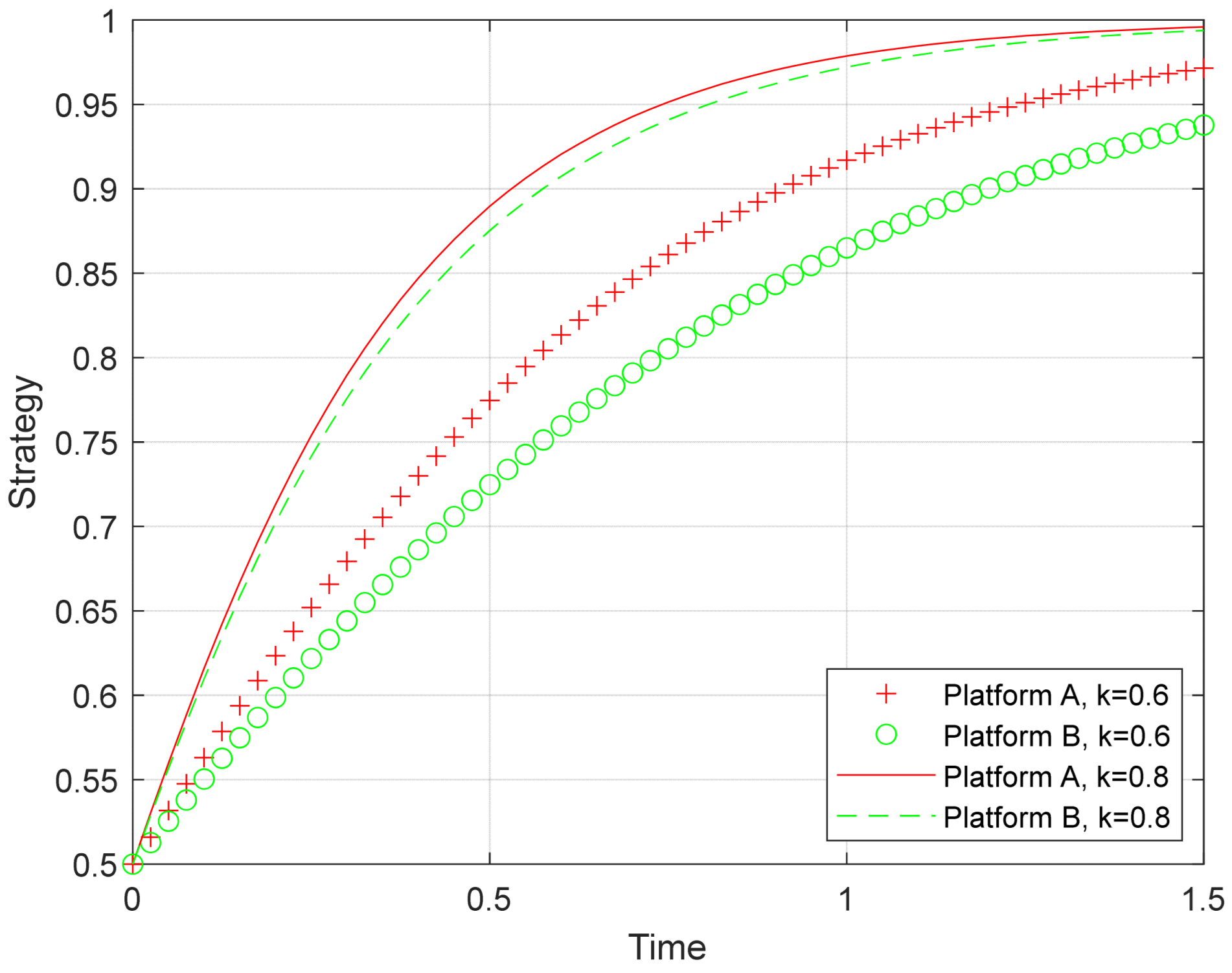
- Figure 3 describes the influence of the change in cancellation rate on the cancellation policy when the other parameters are consistent. When the cancellation rate of users is 0.8 under the strict cancellation policy, both sides of the platform are more inclined to adopt a lenient cancellation policy. When the cancellation rate drops to 0.6 under the strict cancellation policy, the platform will obviously slow the implementation of the lenient policy. This change reflects the platform’s attitude towards its strict cancellation policy becoming more friendly and inclusive, with fewer constraints on user cancellations. On the contrary, when the strict cancellation policy cannot significantly reduce users’ cancellation rates on the original basis, the platform will be more inclined to adopt a lenient cancellation policy.
- 2.
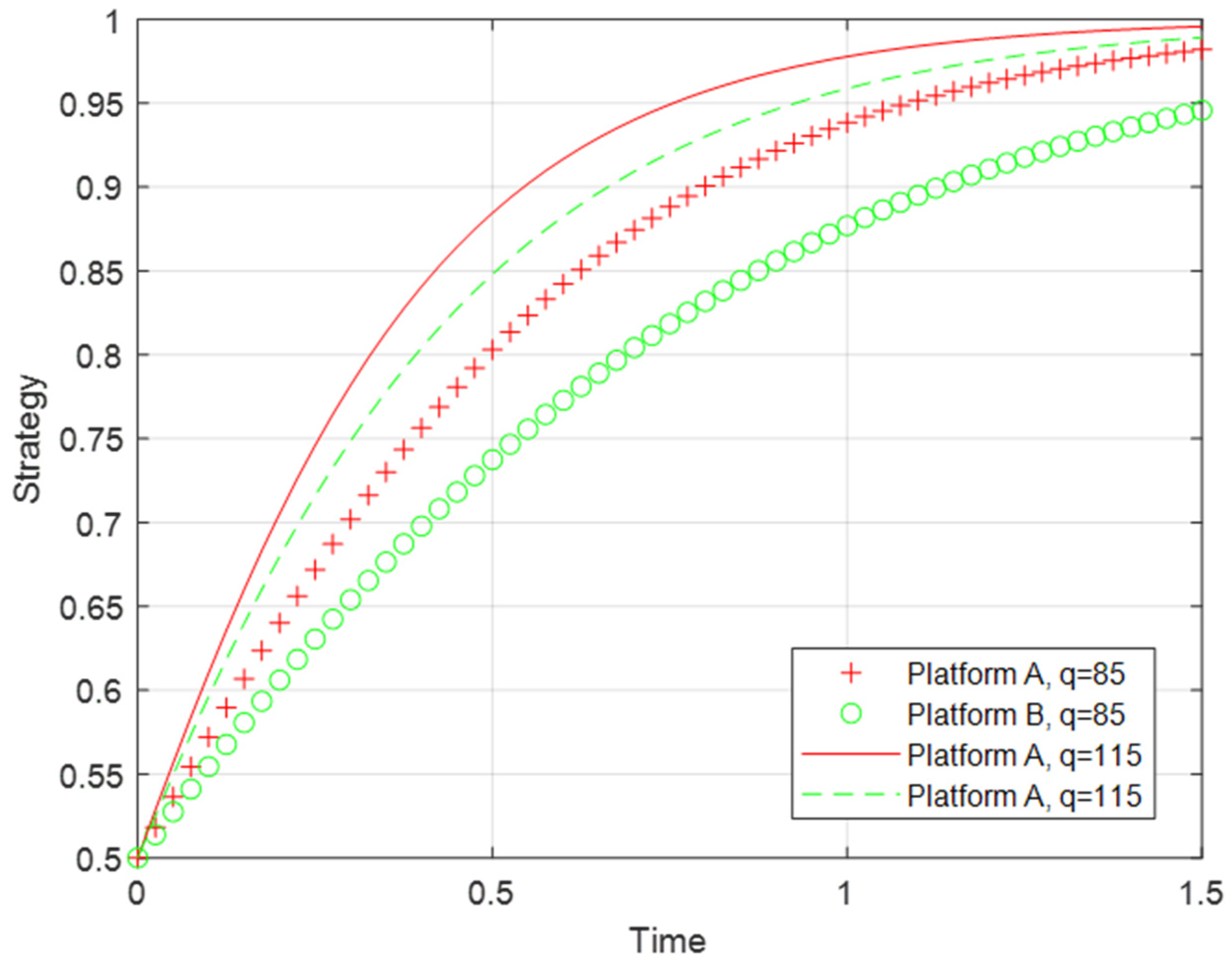
- Figure 4 describes the influence of the change in reputational loss on the cancellation policy when the other parameters are consistent. As reputational losses decrease, platforms converge more slowly toward lenient cancellation policies. With the reputational damage caused by the strict cancellation policy, the platform will be more inclined toward a lenient policy. This is also consistent with the real situation. When users express greater dissatisfaction or complaints about strict cancellation rules, the platform tends to be more cautious in implementing them. As a whole, higher reputational losses dampen both the speed and extent of platforms’ shift toward strict cancellation policies.
- 3.
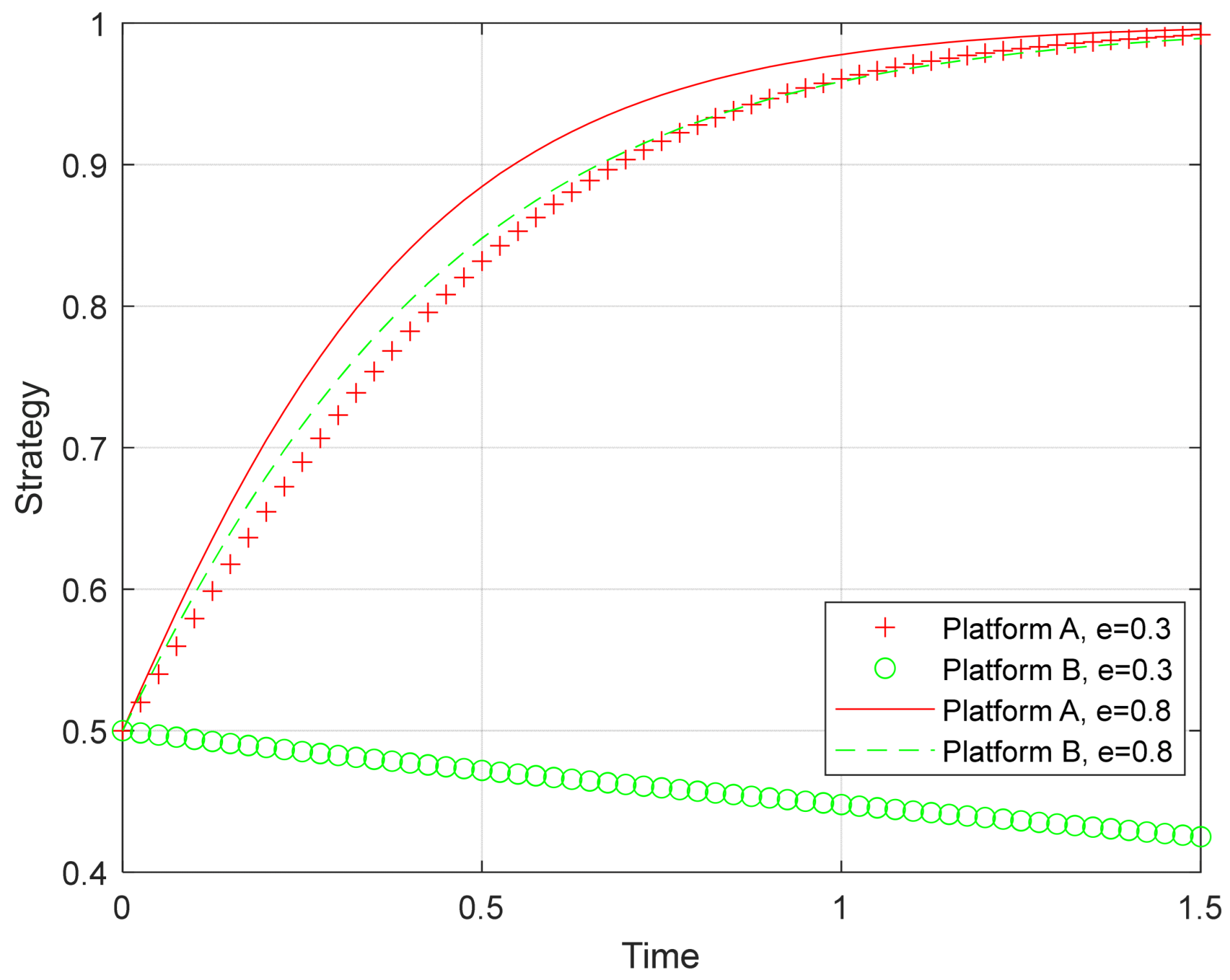
- Figure 5 describes the influence of the change in platforms’ sensitivity to reputational loss on the cancellation policy when the other parameters are consistent. When decreases to 0.3, it indicates there is high heterogeneity among platforms in their sensitivity to reputational loss. When implementing strict cancellation policies, Platform A (the reputation-sensitive platform) suffers greater reputational losses, whereas Platform B (the platform less dependent on reputation) incurs smaller losses. As a result, Platform B deviates from the previous equilibrium—where both platforms adopted lenient policies—and proactively shifts toward a strict cancellation policy.
6. Conclusions, Implications, and Limitations
6.1. Conclusions
6.2. Managerial Implications
- (1)
- In markets where user-driven reputational constraints are weak, platforms often treat cancellation policies primarily as cost-control instruments. Our results show that without intervention, fierce competition can lead to asymmetric equilibria ( or ), while high differentiation may trap the market in a dual-strict equilibrium . To avoid the inefficiency of homogeneous strictness, platforms should proactively pursue strategic differentiation. One platform might maintain strict terms for cost efficiency, while the other introduces partial leniency to capture niche segments.
- (2)
- When some platforms in the market are significantly affected by reputation while others are not, reputation becomes a strategically exploitable lever for differentiation. This regime reveals a counterintuitive dynamic in which market structure dictates welfare more than reputation risk itself. We identify a “Competition Trap” in which low differentiation forces both platforms to adopt strict policies to survive margin pressure, despite moderate reputational risks. Conversely, high differentiation can lead to a “Free-Rider Asymmetry” , where one platform exploits user lock-in to remain strict. In this situation, platforms must avoid blind imitation. High-reputation-sensitivity brands should leverage leniency as a trust signal, while cost-oriented platforms must carefully calibrate strictness to avoid regulatory backlash.
- (3)
- In highly mature markets where social media amplifies service failures, reputation loss becomes catastrophic. Our model shows that the market naturally converges towards lenient equilibria ( or ), regardless of differentiation levels. Strict policies are no longer viable. In this situation, platforms should view reasonably lenient policies not as a competitive tactic but as a baseline service commitment. Leading platforms can spearhead industry-wide upgrades to cancellation standards, erecting barriers to entry for competitors who cannot afford the reputational risk of strict terms.
6.3. Limitations and Future Research Directions
Author Contributions
Funding
Institutional Review Board Statement
Informed Consent Statement
Data Availability Statement
Conflicts of Interest
References
- Guo, X.; Zheng, X.; Ling, L.; Yang, C. Online coopetition between hotels and online travel agencies: From the perspective of cash back after stay. Tour. Manag. Perspect. 2014, 12, 104–112. [Google Scholar] [CrossRef] [Scilit]
- Arzoumanidis, I.; Petti, L.; Raggi, A. Online booking platforms: Towards making more sustainable choices. Clean. Prod. Lett. 2022, 3, 100009. [Google Scholar] [CrossRef] [Scilit]
- Křečková, R.; Šálková, D.; Procházková, R.; Trnka, R. Determinants of Accommodation Choice on Digital Platforms: Price, Cleanliness, and Trust. J. Tour. Serv. 2025, 16, 173–194. [Google Scholar] [CrossRef] [Scilit]
- Ye, Q.; Liang, S.; Wei, Z.; Law, R. Effects of reputation on guest satisfaction: From the perspective of two-sided reviews on Airbnb. Int. J. Contemp. Hosp. Manag. 2023, 35, 3718–3736. [Google Scholar] [CrossRef] [Scilit]
- Gavilan, D.; Avello, M.; Martinez-Navarro, G. The influence of online ratings and reviews on hotel booking consideration. Tour. Manag. 2018, 66, 53–61. [Google Scholar] [CrossRef] [Scilit]
- Liu, X.; Li, C.; Nicolau, J.L.; Han, M. The value of rating diversity within multidimensional rating system: Evidence from hotel booking platform. Int. J. Hosp. Manag. 2023, 110, 103434. [Google Scholar] [CrossRef] [Scilit]
- Touni, R.; Kim, W.G.; Haldorai, K.; Rady, A. Customer engagement and hotel booking intention: The mediating and moderating roles of customer-perceived value and brand reputation. Int. J. Hosp. Manag. 2022, 104, 103246. [Google Scholar] [CrossRef] [Scilit]
- Phonthanukitithaworn, C.; Naruetharadhol, P.; Wongsaichia, S.; Mahajak, N.; Ketkaew, C. Identifying the relationship between travel agent’s web service quality and E-brand reputation. Cogent. Bus. Manag. 2021, 8, 1999784. [Google Scholar] [CrossRef] [Scilit]
- Newberry, P.; Zhou, X. Heterogeneous effects of online reputation for local and national retailers. Int. Econ. Rev. 2019, 60, 1565–1587. [Google Scholar] [CrossRef] [Scilit]
- Adner, R.; Chen, J.; Zhu, F. Frenemies in platform markets: Heterogeneous profit foci as drivers of compatibility decisions. Manage. Sci. 2020, 66, 2432–2451. [Google Scholar] [CrossRef] [Scilit]
- Kim, W.G.; Lee, H.Y. Comparison of web service quality between online travel agencies and online travel suppliers. J. Travel. Tour. Mark. 2005, 17, 105–116. [Google Scholar] [CrossRef] [Scilit]
- Park, Y.A.; Gretzel, U.; Sirakaya-Turk, E. Measuring web site quality for online travel agencies. J. Travel. Tour. Mark. 2007, 23, 15–30. [Google Scholar] [CrossRef] [Scilit]
- Ku, E.C.; Fan, Y.W. The decision making in selecting online travel agencies: An application of analytic hierarchy process. J. Travel. Tour. Mark. 2009, 26, 482–493. [Google Scholar] [CrossRef] [Scilit]
- Kim, J.; Franklin, D.; Phillips, M.; Hwang, E. Online travel agency price presentation: Examining the influence of price dispersion on travelers’ hotel preference. J. Travel. Res. 2020, 59, 704–721. [Google Scholar] [CrossRef] [Scilit]
- Wicaksono, A.; Maharani, A. The effect of perceived usefulness and perceived ease of use on the technology acceptance model to use online travel agency. J. Bus. Manag. Rev. 2020, 1, 313–328. [Google Scholar] [CrossRef] [Scilit]
- Riasi, A.; Schwartz, Z.; Chen, C.C. A proposition-based theorizing approach to hotel cancellation practices research. Int. J. Contemp. Hosp. Manag. 2018, 30, 3211–3228. [Google Scholar] [CrossRef] [Scilit]
- Leung, D.; Seah, C. The impact of crisis-induced changes in refund policy on consumers’ brand trust and repurchase intention. Int. J. Hosp. Manag. 2022, 105, 103272. [Google Scholar] [CrossRef] [Scilit]
- Jeng, S.P. Increasing customer purchase intention through product return policies: The pivotal impacts of retailer brand familiarity and product categories. J. Retail. Consum. Serv. 2017, 39, 182–189. [Google Scholar] [CrossRef] [Scilit]
- Chen, C.C.; Xie, K.L. Differentiation of cancellation policies in the US hotel industry. Int. J. Hosp. Manag. 2013, 34, 66–72. [Google Scholar] [CrossRef] [Scilit]
- Choi, Y.; Kim, J.Y. A signaling theory of reservation cancellation policies. Econ. Model. 2024, 130, 106588. [Google Scholar] [CrossRef] [Scilit]
- Altin, M.; Chen, C.C.; Riasi, A.; Schwartz, Z. Go moderate! How hotels’ cancellation policies affect their financial performance. Tour. Econ. 2023, 29, 2165–2182. [Google Scholar] [CrossRef] [Scilit]
- Lu, X.; Fan, Y.; Qin, Z.; Fang, W. Evolutionary Game Study of Choice of Hotel Cancellation Policies Based on Cancellation Rate. ORMS 2022, 31, 37. [Google Scholar]
- Ye, F.; Yan, H.; Wu, Y. Optimal online channel strategies for a hotel considering direct booking and cooperation with an online travel agent. Int. T. Oper. Res. 2019, 26, 968–998. [Google Scholar] [CrossRef] [Scilit]
- Chang, Y.W.; Hsu, P.Y.; Lan, Y.C. Cooperation and competition between online travel agencies and hotels. Tourism Manag. 2019, 71, 187–196. [Google Scholar] [CrossRef] [Scilit]
- Lee, H.A.; Denizci Guillet, B.; Law, R. An examination of the relationship between online travel agents and hotels: A case study of Choice Hotels International and Expedia. com. Cornell Hosp. Q. 2013, 54, 95–107. [Google Scholar] [CrossRef] [Scilit]
- Peters, H.; Schröder, M.; Vermeulen, D. Hotelling’s location model with negative network externalities. IJGT 2018, 47, 811–837. [Google Scholar] [CrossRef] [Scilit]
- Armstrong, M. Competition in two-sided markets. Rand. J. Econ. 2006, 37, 668–691. [Google Scholar] [CrossRef] [Scilit]
- Sierag, D.D.; Koole, G.M.; van der Mei, R.D.; Van der Rest, J.I.; Zwart, B. Revenue management under customer choice behaviour with cancellations and overbooking. Eur. J. Oper. Res. 2015, 246, 170–185. [Google Scholar] [CrossRef] [Scilit]
- Antonio, N.; De Almeida, A.; Nunes, L. Big data in hotel revenue management: Exploring cancellation drivers to gain insights into booking cancellation behavior. Cornell Hosp. Q. 2019, 60, 298–319. [Google Scholar] [CrossRef] [Scilit]
- Pan, B.; Zhang, L.; Smith, K. A mixed-method study of user behavior and usability on an online travel agency. Inf. Technol. Tour. 2011, 13, 353–364. [Google Scholar] [CrossRef] [Scilit]
- Investigation Report on Hotel Booking and Cancellation Rules of Online Travel Platforms. 2024. Available online: https://www.gdcc315.cn/html/web/bhdt/1829053295216246786.html (accessed on 23 January 2026).
- Statistical Investigation Report on National Star-Rated Tourist Hotels in the Second Quarter of 2024. 2024. Available online: https://zwgk.mct.gov.cn/zfxxgkml/tjxx/202409/t20240902_955009.html (accessed on 23 January 2026).
- Xiong, W.; Lan, W. No-show and cancellation behavior characteristics of hotel customers—A case study of Sheraton Dameisha Resort, Shenzhen. Tour. Res. 2012, 4, 51–59. [Google Scholar]



| Platform B | |||
|---|---|---|---|
| The Policy | L | S | |
| Platform A | L | ||
| S | |||
| Det(J) | Tr(J) | |
|---|---|---|
| Situation | The Condition | Equilibrium Point |
|---|---|---|
| ; | ||
| ; | ||
| ; | ||
| ; | ||
| ; | ||
| ; | ||
| ; | ||
| ; | ||
| ; |
| Parameter | Interpretation |
|---|---|
| can be interpreted as the present value of expected future demand loss per transaction resulting from the strict cancellation policy. | |
| can be interpreted as the additional loss incurred by adopting the lenient cancellation policy relative to the strict cancellation policy, quantified by the higher cancellation rate under the lenient policy. | |
| can be interpreted as the difference in reputation loss between platforms when platforms adopt strict cancellation policies. A smaller value of e indicates a larger disparity in reputation impact between the two platforms. | |
| represents the average commission rate that the platform charges hotels per transaction. | |
| denotes users’ preference for different platforms. This preference heterogeneity stems from variations in users’ valuations of service quality, cost-effectiveness, and other attributes, as well as differences in usage habits. | |
| denotes the probability that Platform A adopts a lenient cancellation policy. | |
| denotes the probability that Platform B adopts a lenient cancellation policy. |
| () | Platform A | Platform B | |
|---|---|---|---|
| 40 | Strict cancellation policy | Strict cancellation policy | |
| 50 | Lenient cancellation policy | Strict cancellation policy | |
| 60 | Lenient cancellation policy | Lenient cancellation policy |
Disclaimer/Publisher’s Note: The statements, opinions and data contained in all publications are solely those of the individual author(s) and contributor(s) and not of MDPI and/or the editor(s). MDPI and/or the editor(s) disclaim responsibility for any injury to people or property resulting from any ideas, methods, instructions or products referred to in the content. |
© 2026 by the authors. Licensee MDPI, Basel, Switzerland. This article is an open access article distributed under the terms and conditions of the Creative Commons Attribution (CC BY) license.
Share and Cite
Fan, J.; Qian, W.; Ji, C. Strategic Interaction of Online Travel Platforms: Cancellation Policies Under Heterogeneous Reputation Sensitivity. Sustainability 2026, 18, 2651. https://doi.org/10.3390/su18052651
Fan J, Qian W, Ji C. Strategic Interaction of Online Travel Platforms: Cancellation Policies Under Heterogeneous Reputation Sensitivity. Sustainability. 2026; 18(5):2651. https://doi.org/10.3390/su18052651
Chicago/Turabian StyleFan, Jinlong, Wuyong Qian, and Chunyi Ji. 2026. "Strategic Interaction of Online Travel Platforms: Cancellation Policies Under Heterogeneous Reputation Sensitivity" Sustainability 18, no. 5: 2651. https://doi.org/10.3390/su18052651
APA StyleFan, J., Qian, W., & Ji, C. (2026). Strategic Interaction of Online Travel Platforms: Cancellation Policies Under Heterogeneous Reputation Sensitivity. Sustainability, 18(5), 2651. https://doi.org/10.3390/su18052651