1. Introduction
Storm surge, defined as abnormal sea-level rise induced by intense atmospheric disturbances, is one of the most destructive coastal hazards worldwide. In China, it is primarily triggered by tropical cyclones, extratropical cyclones, and cold waves [
1], often causing cascading impacts such as coastal flooding, salinization, and landslides [
2,
3]. Guangdong Province, located along the South China Sea, experiences frequent storm surges [
4] and accounted for 37% of China’s direct storm surge losses from 2010 to 2023 [
5], highlighting the need for intelligent emergency response mechanisms.
The multifactorial and cascading characteristics of marine storm surge disasters pose persistent challenges to emergency management [
6,
7]. With the continuous expansion of emergency systems, response plans have become increasingly numerous and complex, involving multiple administrative levels and departments [
8]. Different disaster types and response levels correspond to different plans, and manual consultation significantly delays rescue operations [
8]. Therefore, efficient “scenario–response” methods are required to dynamically generate response strategies for diverse disaster scenarios.
Although progress has been made in scenario deduction, plan knowledgeization, and ontology modeling [
9], existing studies lack structured parsing models for event chains and emergency plans and insufficiently model their corresponding relationships under the “scenario–response” framework [
10]. Traditional knowledge extraction approaches also suffer from limited efficiency and accuracy, hindering large-scale data processing [
11]. Moreover, reasoning capabilities under the “scenario–response” mode remain inadequate for dynamic emergency strategy generation.
Knowledge graphs (KGs) provide a promising solution [
12]. As intelligent knowledge representation frameworks, KGs can model multidimensional relationships among disaster events, emergency plans, geographic entities, and response actions, improving interpretability, consistency, and traceability [
13]. They are well suited for integrating heterogeneous and structurally complex disaster data [
14]. Recent studies have applied KGs to disaster management, primarily focusing on data integration, information retrieval, and graph construction. However, domain-specific KGs that systematically couple disaster evolution with structured emergency response logic to support dynamic reasoning remain limited, especially in marine storm surge management [
8,
9].
To address these challenges, this study proposes a scenario–response–driven spatiotemporal knowledge recommendation framework for marine storm surge disasters. Unlike conventional KG-based approaches that emphasize static knowledge organization or entity-centric querying, the proposed framework adopts a scenario-oriented reasoning architecture that couples disaster event-chain evolution with structured emergency response processes within a unified semantic representation. The main contributions are as follows:
An ontology-driven structured modeling approach for disaster event chains and emergency plans, together with a knowledge fusion mechanism to construct a “scenario–response”—driven marine storm surge spatiotemporal knowledge graph;
An improved OSS-CasRel knowledge extraction model enhanced by a domain-specific marine storm surge lexicon to improve extraction efficiency and accuracy;
A “scenario–response”-oriented reasoning method capable of dynamically recommending response strategies based on real-time disaster event scenarios.
2. Literature Review
2.1. Event Chain Research
Disaster event chains refer to structured sequences of causally linked disaster events in which a primary hazard triggers temporally and spatially correlated secondary or derivative events. Unlike single-hazard analysis, event chain modeling emphasizes cascading effects, system coupling, and cross-domain interactions within complex disaster systems [
15,
16]. This insight has shifted disaster research from traditional “single-hazard analysis” toward complex system approaches emphasizing cross-system chain reactions. Current research on event chains mainly addresses knowledge construction, scenario deduction, and risk assessment. For example, Zhang et al. [
17] integrated a three-dimensional ocean model (FVCOM) with a one-dimensional hydrodynamic model (HEC-RAS) to simulate urban inundation driven by compound storm surge and runoff processes. Wang et al. [
18] developed a multidimensional “scenario–event” model and employed semantic associations to model the full lifecycle evolution of urban flood disasters.
Methodologically, event chain research demonstrates increasing diversity and integration. Representative approaches include empirical statistical analysis, probabilistic modeling, complex networks and graph theory, numerical simulation and system dynamics, as well as knowledge graphs and large language models (LLMs) emerging in recent years [
19]. Gariano and Guzzetti [
20] identified rainfall–landslide triggering thresholds using regression analysis of historical data. He et al. [
21] proposed a spatiotemporal association mining framework based on directed spatiotemporal paths and probabilistic sequence modeling to reveal dependencies among geographic events. Ekkirala and Ramesh [
22] constructed weighted directed disaster networks using graph theory to identify transformation pathways from extreme rainfall to landslides and secondary flooding. With advances in artificial intelligence, knowledge graphs combined with LLMs further enable extraction of causal event logic from large-scale unstructured texts.
However, current research primarily concentrates on pre-disaster prevention and disaster evolution analysis. The linkage between dynamically evolving event chains and executable emergency plans remains insufficiently structured. As a result, automatic generation of response strategies based on event chain logic is still underexplored.
2.2. Scenario-Response Research
A scenario in this study refers to a structured semantic representation of disaster conditions, including hazard type, location, exposed elements, stage, and environmental context. The scenario–response paradigm integrates spatiotemporal data, historical disaster processes, and emergency plan logic to support context-aware decision-making. It emphasizes structured modeling of historical scenarios and spatial information to build knowledge repositories that enable rapid, precise, and context-aware response decisions for sudden disasters. Within this framework, response elements—such as responsible entity, response level, handling phase, and key actions—form the structured output of reasoning.
Efficient knowledge representation is fundamental to implementing this mode. Xu et al. [
23] developed an earthquake emergency response knowledge model integrating geographic ontologies, addressing semantic interoperability in multi-source heterogeneous data and improving command targeting. With advances in artificial intelligence, scenario-aware knowledge representation has evolved from symbolic logic toward neural semantic modeling. Wang et al. [
24] fused static and dynamic semantic embeddings and fine-tuned large language models (LLMs) with domain knowledge to extract fine-grained flood information from social media, supporting real-time scenario identification and response triggering.
For response strategy formulation, researchers commonly combine multi-criteria decision analysis (MCDA) with geographic information systems (GIS) [
25]. Esmaelian et al. [
26] integrated GIS with the PROMETHEE IV algorithm to optimize emergency service station locations in urban evacuation planning. Zhang et al. [
27] applied a fuzzy multi-attribute decision-making model to allocate rescue resources using population data, kernel density mapping, and expert validation. Additionally, some cutting-edge research has proposed a service-oriented collaborative decision support method that integrates geospatial resources and task chains, breaking the “resource silos” in emergency decision-making and improving the collaborative execution efficiency of emergency plans in complex environments [
28,
29].
Although associations between disaster scenarios and response plans have been established in prior work, limited research addresses dynamic reasoning that automatically generates response strategies from evolving disaster scenarios. The intelligence level of scenario-driven emergency decision-making therefore remains constrained.
2.3. Knowledge Graph Research in Disaster Domain
Knowledge graphs (KGs) are semantic knowledge representation frameworks capable of explicitly modeling relationships among geographic entities and incorporating critical spatiotemporal information, making them suitable for integrating heterogeneous disaster data [
12,
13]. In disaster applications, KG construction relies on domain ontology design to systematically define core concepts, relations, and attributes, providing a semantic foundation for knowledge extraction and fusion [
30,
31,
32].
High-quality KG construction depends on effective named entity recognition (NER) and relation extraction (RE). Research has evolved from rule-based methods to deep learning approaches, which significantly improve extraction accuracy in large-scale geospatial semantic processing [
33]. For example, Hu et al. [
34] enhanced geographic entity recognition using a geographically augmented GPT framework, while Sun et al. [
31] combined ontology modeling and deep learning to construct a landslide hazard KG supporting knowledge recommendation.
To improve extraction efficiency, joint entity–relation extraction paradigms have been proposed to avoid error propagation inherent in pipeline methods. Among them, the CasRel model [
35] addresses relation overlap through an end-to-end architecture and achieves high extraction accuracy. Accordingly, this study improves the CasRel model to enhance knowledge extraction efficiency in the marine storm surge domain.
Knowledge graphs have been preliminarily applied in natural disaster research. At the modeling level, Zhang et al. [
36] enhanced reasoning in complex geographic scenarios using KG embeddings and meta-path transformers, while Ge et al. [
37] proposed a spatial KG construction framework for semantic data analysis. In visualization and environment reconstruction, Zhu et al. [
38] developed a knowledge-guided 3D disaster visualization framework, and Zhang et al. [
39] proposed a personalized virtual landslide environment construction method based on KGs and deep neural networks.
With the rapid development of large language models (LLMs), recent disaster knowledge graph (KG) research has begun to integrate LLMs into event extraction, graph construction, and decision support processes [
8]. LLM-based agents have been applied to hazard KG construction, improving entity alignment and reducing cumulative extraction errors compared with conventional pipelines [
40]. In parallel, KG-grounded prompting strategies have been introduced to enhance emergency decision-making by constraining LLM reasoning with structured knowledge [
8]. These studies demonstrate the potential of LLM-enhanced semantic modeling for heterogeneous disaster texts. However, because LLM generation remains probabilistic, ensuring ontology alignment, structural consistency, and controllable reasoning in domain-specific emergency management remains a critical challenge.
Overall, existing research primarily focuses on knowledge extraction and graph construction, while exploration of how to conduct dynamic logical reasoning based on spatial knowledge graphs in disaster scenarios and how to drive intelligent emergency decision generation remains insufficient.
3. Study Area and Data
3.1. Study Area
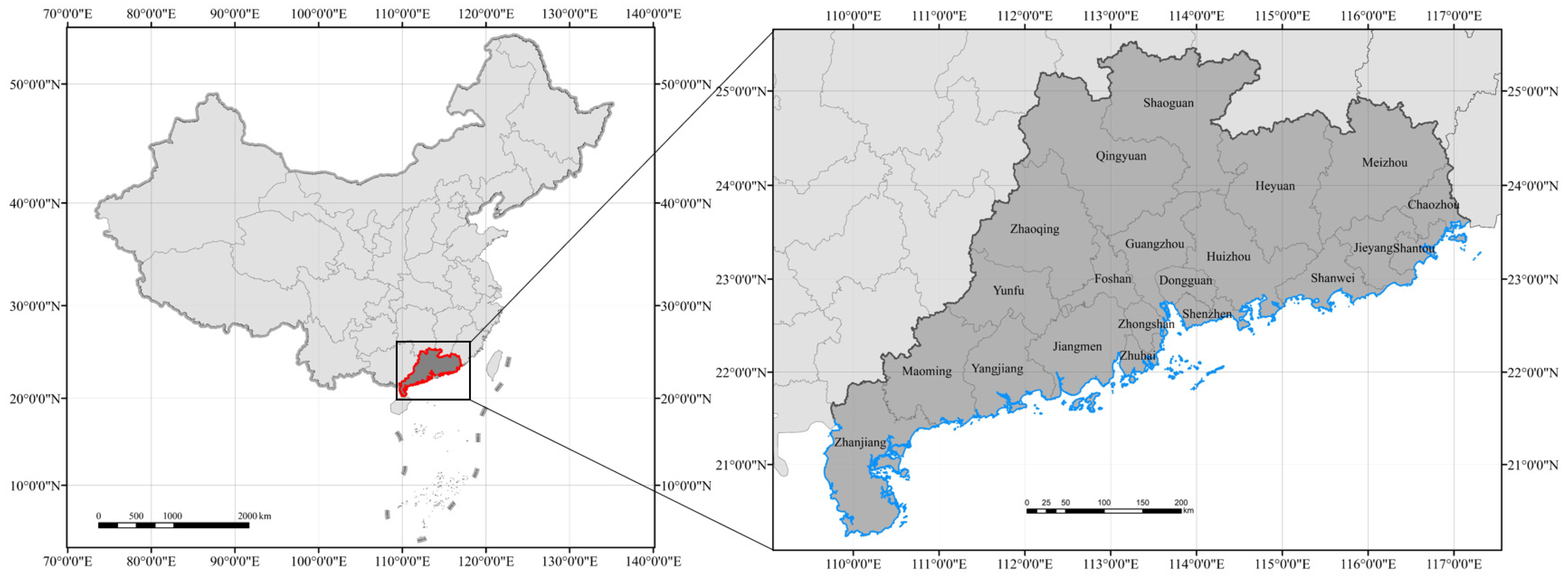
Guangdong Province is located in the southernmost region of mainland China, bordering Fujian and Guangxi provinces, with the South China Sea to the south, spanning between 20°09′∼24°14′ N and 109°45′∼117°20′ E. The terrain gradually elevates from south to north, featuring both land and sea, numerous harbors, extremely rich coastal tidal flat resources, and relatively complex geomorphological types [
41]. As shown in
Figure 1, the mainland coastline of Guangdong Province extends approximately 4114.4 km, with complex coastal morphology and gentle coastal terrain. During summer and autumn, the combined effects of tropical cyclones and monsoon systems easily generate strong winds and large waves, significantly increasing the exposure risk and potential losses of storm surges and related marine disasters to coastal areas [
42]. According to the China Storm Surge Disaster Historical Records (1949–2009) [
43] and data from the annual China Marine Disaster Bulletins from 2010 to 2023, Guangdong Province experienced 151 storm surge disasters from 1949 to 2023, resulting in 4518 fatalities, approximately 5.55 million damaged houses, economic losses of 87.276 billion yuan, and significant damage to the ecological environment.
The high frequency, severity, and complexity of storm surge disasters in Guangdong Province make research on storm surge scenario-response knowledge recommendation of significant practical importance and urgency. As one of China’s most economically developed provinces, Guangdong’s coastal areas are densely populated with concentrated infrastructure, and storm surge disasters cause extensive and severe impacts [
44]. Simultaneously, storm surge disaster event chains in Guangdong Province are complex, often accompanied by multiple secondary disasters, with significantly different response strategies under different disaster scenarios, making traditional manual plan consultation methods unable to meet rapid response requirements [
17]. Furthermore, the large number of related emergency plans and numerous involved departments make it a critical bottleneck for improving emergency response efficiency to quickly match and recommend optimal response plans from massive plans within limited time. Therefore, constructing a “scenario-response” based marine storm surge spatiotemporal knowledge recommendation system can dynamically recommend precise response strategies for different storm surge disaster scenarios in Guangdong Province, significantly enhancing the scientificity, timeliness, and targeting of emergency decision-making, which has important strategic significance for reducing disaster losses and protecting people’s lives and property safety.
3.2. Study Data
3.2.1. Disaster Event Data
A total of 1850 marine storm surge–related disaster events that occurred in Guangdong Province over the past two decades were systematically collected and classified according to disaster categories. The data were mainly obtained from the Guangdong Marine Disaster Bulletin, marine disaster–related academic journals, and online news reports. Based on the classification scheme defined in the National Overall Emergency Response Plan for Public Emergencies, the disaster events were categorized into four major types. The statistics of collected disaster event types and quantities are shown in
Table 1. It should be noted that not all disasters listed in the table are marine storm surge disasters. This is because marine storm surge disasters are often not single disaster events but complex disaster events resulting from propagation through a series of complex secondary and derivative disaster chains. For example, seawater backflow may lead to farmland salinization and other environmental pollution issues. The events collected in this study cover all possible disaster types that may occur.
3.2.2. Emergency Plan Data
Emergency plans were mainly collected from official government portals at the provincial, municipal, district and subdistrict levels in Guangdong Province. A total of 1043 emergency plans related to marine storm surge disasters were collected and organized, including documents such as the Guangdong Provincial Meteorological Disaster Emergency Plan, Shenzhen Flood Control Emergency Plan, Longgang District Meteorological Disaster Emergency Plan, and Henggang Subdistrict Natural Disaster Emergency Plan. The statistics of plan categories and quantities are summarized in
Table 2.
3.2.3. Dataset Annotation and Quality Assurance
Prior to annotation, all documents were preprocessed through text normalization, removal of duplicated or non-informative sections (e.g., tables of contents and administrative headers), and segmentation into structured textual units suitable for entity–relation extraction.
The subject–predicate–object triples were annotated using a human-in-the-loop strategy supported by GPT-3. Based on the predefined ontology (
Section 4.3.1), GPT-3 first performed semantic segmentation and candidate triple generation. The second author manually reviewed and corrected all outputs, ensuring entity boundary precision and relation type consistency, including disaster events, responsible departments, response levels, response measures, time, and location.
To guarantee annotation reliability, ontology-based guidelines were established in advance. Ambiguous cases were resolved according to ontology definitions and official policy documents. A randomly sampled subset was independently re-examined to verify entity classification and relation consistency, and discrepancies were corrected before final consolidation.
The finalized annotations were formatted in JSON to construct the training and validation datasets for the OSS-CasRel model.
4. Methodology
4.1. Overall Technical Framework
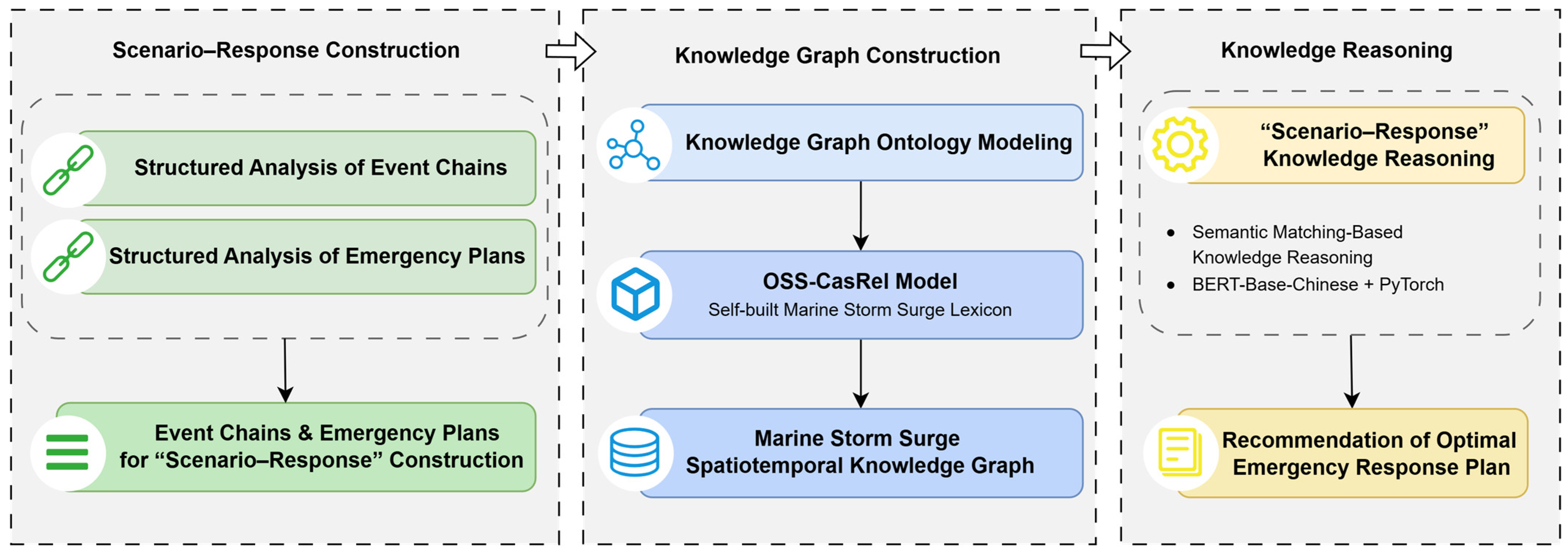
As shown in
Figure 2, the overall technical framework of this study consists of three major components.
Construction of a “scenario–response” disaster handling framework integrating event chains and emergency plans. Based on historical storm surge disaster data, event chains are constructed and analyzed to characterize disaster evolution processes, while relevant emergency plans are structurally modeled. By integrating disaster evolution mechanisms and emergency response procedures, a unified “scenario–response” disaster handling framework is established to provide a semantic foundation for subsequent knowledge modeling and reasoning.
Ontology design and knowledge graph construction driven by the scenario–response paradigm. Based on the analysis of knowledge representation patterns of storm surge event chains and emergency plans, the ABC ontology is extended to construct a scenario–response-driven spatiotemporal knowledge graph ontology for marine storm surge disasters, and the mapping relationships between scenario elements and response schemes are explicitly defined. To address the limitations of existing knowledge extraction methods in terms of accuracy and efficiency, an improved OSS-CasRel model combined with a domain lexicon is adopted for triple extraction, and Neo4j is used for knowledge storage and visualization.
Scenario–response-driven knowledge reasoning. The scenario–response reasoning process is formalized as a semantic matching task between scenario texts and response texts. Textual embeddings and feature representations are obtained using the BERT-Base-Chinese model, and a text-matching model is implemented within the PyTorch framework to identify the optimal response scheme under a given scenario. The reasoning results are structurally decomposed and visualized based on the constructed knowledge graph to generate executable emergency response schemes.
4.2. Construction of the Scenario–Response Disaster Handling Framework Integrating Event Chains and Emergency Plans
4.2.1. Structural Analysis of Event Chains
The transmission of disaster events can be attributed to changes in one or more of the following influencing factors: hazard-inducing factors, hazard-formative environments, hazard-affected bodies and disaster-resistance capacities, which may trigger new disaster events. A disaster event chain is a systematic representation that reveals how disaster elements are triggered, propagated and derived across temporal and spatial dimensions. By linking primary events with their subsequent secondary and derivative events, the entire disaster evolution process can be described. Emergency managers can conduct scenario matching and inference for ongoing events, as well as anticipate potential secondary and derivative disasters to issue early warnings [
45]. Chen et al. [
46] proposed a formalized expression method for event chains, indicating that spatiotemporal constraints act as “catalysts” for triggering secondary and derivative disasters.
Spatiotemporal constraint analysis is applied to investigate storm surge propagation mechanisms and secondary/derivative disaster patterns. Accordingly, the typical secondary and derivative relationships of marine storm surge disaster events are summarized in
Table 3, in which disaster events are classified into four hierarchical levels based on their propagation relationships.
4.2.2. Structural Analysis of Emergency Plans
In the field of emergency management, emergency plans are generally regarded as structured knowledge systems that guide complex disaster response processes. They contain hierarchical plan categories, standardized handling procedures and key operational contents, providing actionable guidance for decision makers and executors at multiple administrative levels. According to disaster management lifecycle theory, emergency management plans typically cover major stages, including preparedness, response and recovery [
19].
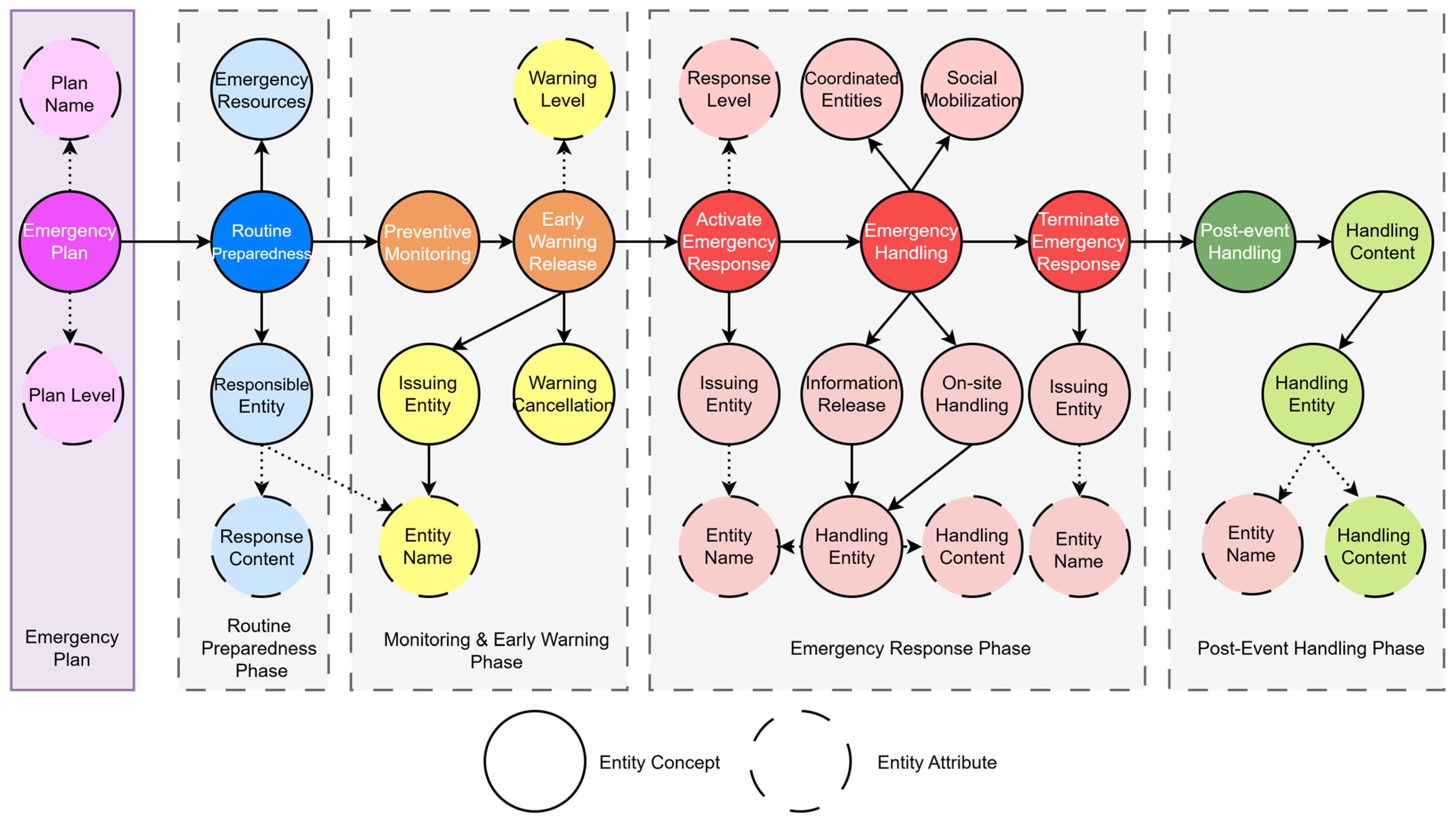
Based on official documents such as the National Natural Disaster Relief Emergency Plan (2016), Emergency Relief Work Procedures (2015), and the Guangdong Provincial Meteorological Disaster Emergency Plan (2021), emergency response processes are classified into four sequential stages: routine preparedness, monitoring and early warning, emergency response and post-disaster disposal. Ontology theory is employed to establish the conceptual system of emergency knowledge elements, and relationships among different types of elements are analyzed to derive the emergency plan entity–relation representation model, as illustrated in
Figure 3.
4.2.3. Scenario–Response Disaster Handling Framework
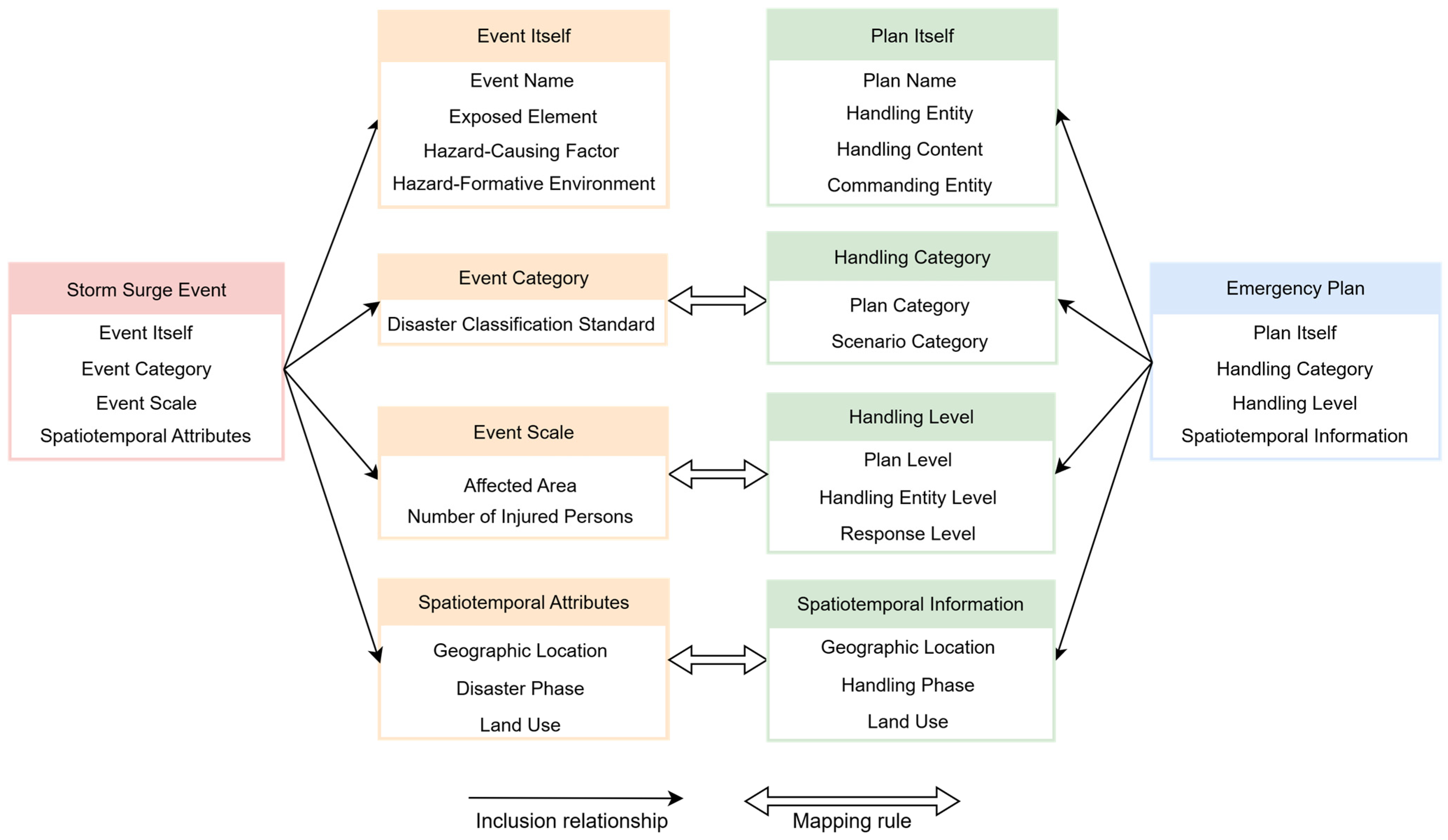
By integrating the above structural analyses of storm surge disaster events and emergency plans, and analyzing the storm surge disaster handling chain [
24], a comprehensive scenario–response disaster handling framework is constructed, as illustrated in
Figure 4.
Each event in the event chain is characterized by four categories of key attributes: event itself, event category, event scale and spatiotemporal attributes. The event itself describes core information such as event name, hazard-inducing factors, hazard-formative environments and hazard-affected bodies, which supports accurate event characterization and specialized plan retrieval. Event category is defined according to the classification criteria in the National Overall Emergency Response Plan for Public Emergencies, facilitating the matching of relevant plans and response forces. Event scale reflects the severity of impacts in terms of casualties, economic losses and affected areas, which constrains the applicable response level of emergency plans. Spatiotemporal attributes include temporal stages and spatial locations: in this study, historical event dates are not emphasized; instead, temporal attributes are represented by disaster development stages (e.g., pre-impact, during-impact, recession and post-disaster recovery), which correspond to the response stages of emergency plans (routine preparedness, early warning, emergency response and post-disaster disposal). Spatial locations determine the applicable regional plans.
Correspondingly, emergency plans are represented by four types of response attributes: plan itself, handling category, handling level and spatiotemporal information. The plan itself includes the plan name, commanding bodies, executing bodies and disposal contents, and is aligned with the “event itself” attributes. The handling category defines the applicable disaster types of plans according to national standards. The handling level indicates the administrative level (provincial, municipal, district and below) of plans and executing bodies, enabling accurate plan selection based on event scale. Spatiotemporal information corresponds to response stages and applicable regions. These response attributes are explicitly aligned with event attributes to support the generation of scientific and effective emergency response schemes.
4.3. Scenario–Response Driven Ontology Design and Knowledge Graph Construction
4.3.1. Ontology Design
In the ontology design of the marine storm surge scenario–response knowledge graph, the scenario component provides a unified semantic representation of the conceptual hierarchy, attribute structure, and relational associations of disaster event chains and disaster scenarios. A disaster scenario ontology is formally defined as:
where
Scene_Concept denotes the set of all scenario concepts, including conceptual definitions and hierarchical classifications;
Scene_Property defines intrinsic attributes of disaster scenarios such as disaster name, occurrence time and location;
Scene_Relation represents semantic associations between scenarios, including secondary, derivative and concurrent relationships;
Scene_Restriction defines axioms describing constraint relationships between scenarios (e.g., seawater backflow may induce flooding, and is a component of the “rainstorm–flooding” disaster chain); and
Scene_Instance denotes concrete instances of disaster scenarios, such as storm surge events occurring in Shenzhen, Guangdong Province.
The response component of the marine storm surge scenario–response knowledge graph provides a unified semantic description of hierarchical concepts, properties and relations of emergency response entities, disposal actions and command structures in emergency plans. An emergency response subject ontology is defined as:
where
Subject_Concept denotes the set of response subject concepts and their hierarchical classifications;
Subject_Property defines intrinsic attributes such as subject name and type;
Subject_Relation describes semantic relations between subjects, including containment relations;
Subject_Restriction specifies axioms constraining subject relations; and
Subject_Instance represents specific response entities, such as emergency command centers.
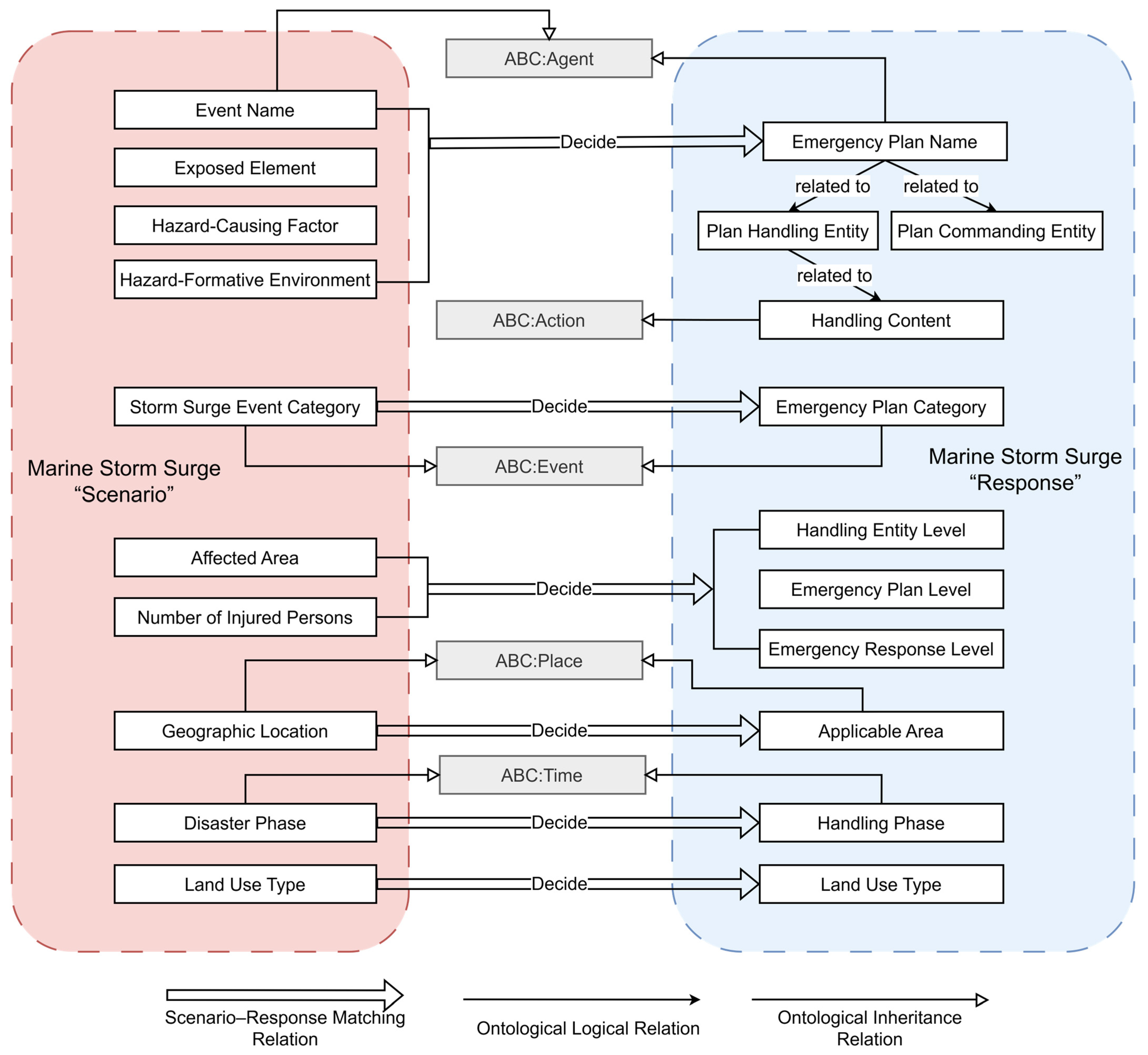
To enhance semantic interoperability and generalizability, this study adopts ontology reuse by incorporating relevant concepts from the ABC ontology model. The ABC (Actors, Behaviors, and Consequences) ontology is a generic conceptual model proposed by Lagoze and Hunter [
47] that provides a foundational framework for representing events and their causal relationships across diverse domains. The ABC ontology is based on three core concepts: Actors (entities that perform actions or are affected by events), Behaviors (actions or processes that occur), and Consequences (results or outcomes of behaviors). This three-dimensional structure enables the representation of complex event relationships and causal chains, making it particularly suitable for modeling disaster event chains and emergency response processes. In the context of this study, the ABC ontology’s Actor concept aligns with emergency response entities (commanding entity, handling entity), Behavior corresponds to emergency response actions (handling content, response procedures), and Consequence relates to disaster impacts and response outcomes (affected area, plan level). By reusing and adapting ABC ontology concepts, this study improves semantic connectivity among response subjects and enhances the applicability of the ontology to marine storm surge disasters and emergency plan modeling. The integrated scenario–response spatiotemporal knowledge graph ontology is illustrated in
Figure 5.
4.3.2. OSS-CasRel Model
Joint entity–relation extraction models identify entities and relations within a unified framework, thereby avoiding error propagation and alignment costs inherent to pipeline approaches. Among them, the cascade-based CasRel model [
21] is widely adopted due to its strong extraction performance and its ability to handle relation overlap, where multiple triples may share entities and/or relations within a single sentence.
In the original CasRel implementation for Chinese, tokenization is typically performed at the character level or based on the default WordPiece tokenizer in BERT-Base-Chinese, where each Chinese character is treated as an individual token. Although this strategy ensures high coverage and compatibility with pretrained models, it may fragment domain-specific terms into multiple unrelated character tokens, thereby weakening semantic coherence.
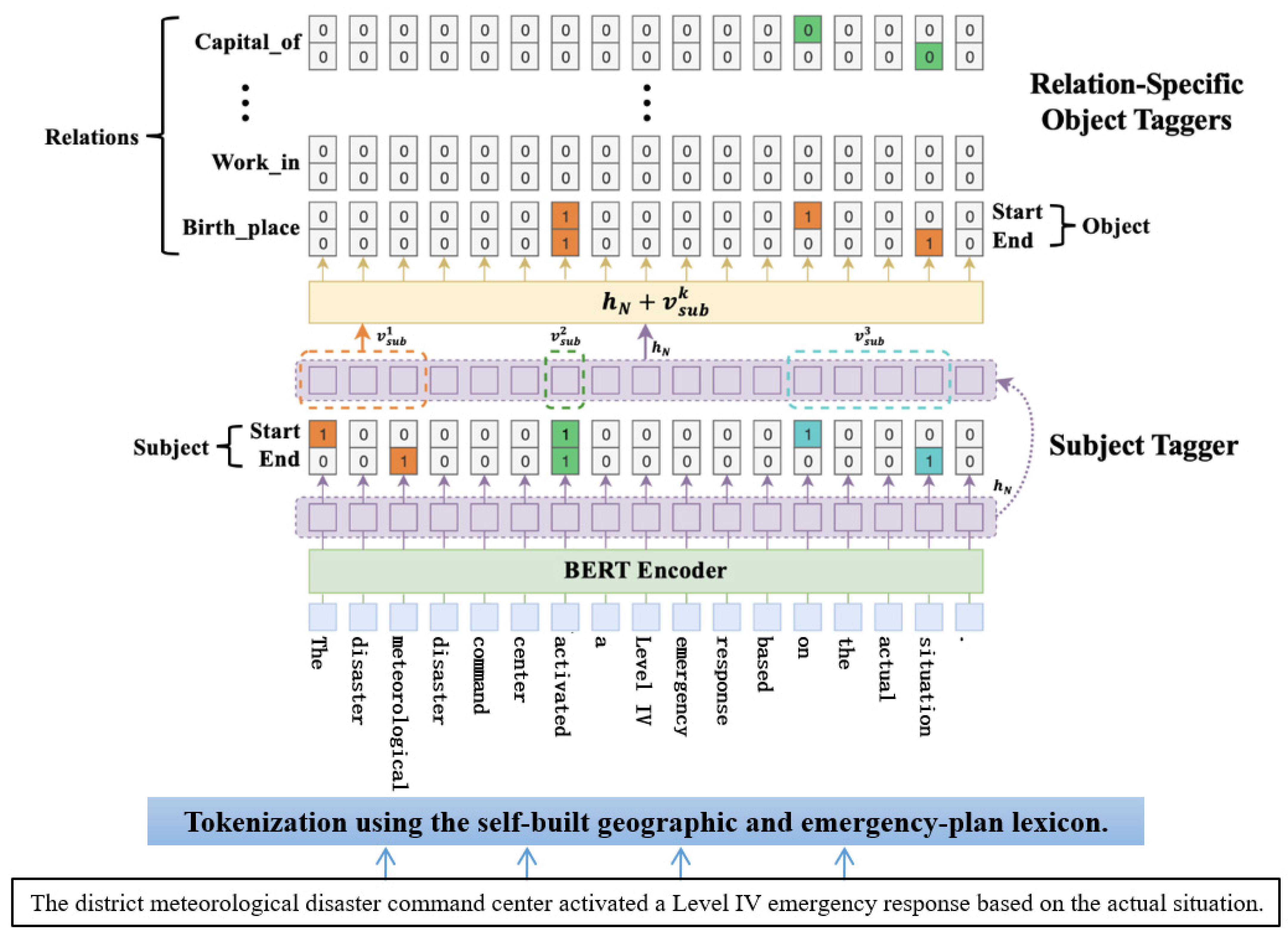
To address this limitation, OSS-CasRel adopts a lexicon-aware tokenization strategy guided by the self-constructed storm surge domain lexicon. Specifically, the input text is first segmented using a domain-enhanced Jieba tokenizer, in which predefined domain terms are matched preferentially to preserve multi-character entity boundaries. The resulting word-level tokens are then aligned with the BERT WordPiece tokenizer to ensure compatibility with pretrained embeddings.
The architecture of OSS-CasRel is illustrated in
Figure 6.
Given an input sentence, it is first represented as a token sequence obtained by lexicon-aware tokenization:
where
denotes the
-th token in the input sequence, and
is the total number of tokens.
The input sequence is encoded by BERT-Base-Chinese to generate contextualized token representations:
where
represents the contextual embedding of token
.
Following the cascade architecture of CasRel, OSS-CasRel first performs subject entity extraction by predicting the start and end positions of subject spans:
where
and
denote the probabilities of token
being the head and tail of a subject entity, respectively.
and
are learnable weight matrices and bias terms for subject boundary prediction.
denotes the sigmoid activation function. Subject spans are determined by selecting token positions whose predicted probabilities exceed a predefined threshold.
For each detected subject span
and a given relation type
, object entity extraction is conducted in a subject-conditioned manner:
where
denotes the aggregated representation of the predicted subject span
, and
represents the concatenation of the token representation and the subject representation. Relation-specific parameters
and
are used to predict the object boundaries under relation
. Object spans are retained when the corresponding boundary probabilities exceed the confidence threshold.
Finally, entity–relation triples are constructed by pairing each detected subject span with its corresponding relation-specific object spans. The extraction result is formally represented as:
where
denotes the extracted subject entity span,
represents the predefined relation type, and
denotes the corresponding object entity span under relation
. A triple is accepted only when both subject and object boundary predictions satisfy the confidence threshold, ensuring the reliability of the extracted entity–relation pair.
In this study, subject and object entities correspond to disaster-related conceptual elements (e.g., hazard source, affected region, response level, responsible agency) extracted from marine storm surge disaster reports and emergency plan texts. The above formulation enables joint extraction of entities and relations, while domain adaptation is achieved through lexicon-aware tokenization and domain-specific fine-tuning.
4.4. Scenario–Response Driven Knowledge Reasoning
The scenario–response knowledge reasoning task is defined as a semantic matching problem between scenario texts and response texts. Given a scenario text, the goal is to identify the optimal emergency plan and its associated response element set from the knowledge graph.
A scenario text is represented as:
where
denotes disaster event nodes and their attribute nodes;
EC denotes connected event category nodes;
ES denotes connected event scale nodes; and
ESTA denotes connected spatiotemporal attribute nodes.
A response text is represented as:
where
Plan denotes emergency plan nodes and their attribute nodes;
PC denotes connected handling category nodes;
PL denotes connected handling level nodes; and
PSTA denotes connected spatiotemporal attribute nodes.
Both the “scenario” text and the “response” text are composed of associated nodes from the constructed marine storm surge “scenario-response” knowledge graph. This matching approach based on associated node information in the knowledge graph has stronger scientificity and interpretability. Specifically, contains the following node types: event name, exposed element, hazard-causing factor, hazard-formative environment, disaster category, affected area, number of injured, geographic location, disaster phase, land use, and others. contains the following node types: emergency plan name, handling entity, handling content, commanding entity, plan category, plan level, response level, geographic location, handling phase, land use, and others. The above node information is associated through triple relationships in the knowledge graph, forming structured representations of “scenario” and “response” texts.
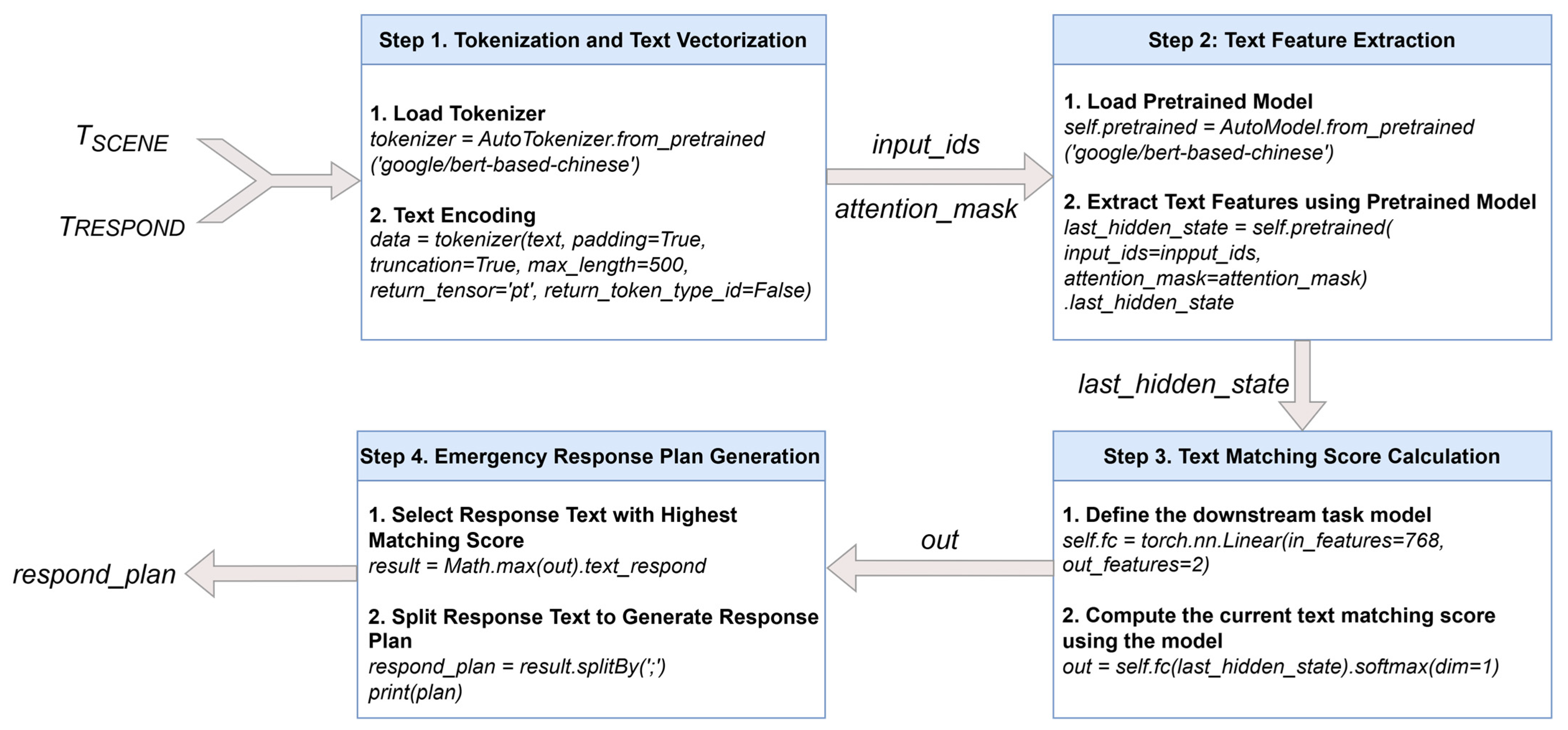
As illustrated in
Figure 7, the knowledge embedding and reasoning workflow proceeds as follows:
and are concatenated as a unified text input;
Tokenization and vectorization are performed via the BERT-Base-Chinese tokenizer;
Contextual embeddings (last_hidden_state) are generated through the pretrained encoder;
A downstream text matching model computes similarity scores;
The highest-scoring response text is selected and structurally decomposed to generate an executable emergency response scheme;
The reasoning results are visualized based on the scenario–response knowledge graph.
5. Experimental Design and Results Analysis
5.1. Construction of the Scenario–Response Visual Knowledge Graph
To construct the scenario–response knowledge graph, Typhoon Chanchu (No. 1 of 2006) affecting Shenzhen and the Shenzhen Typhoon Emergency Plan were selected as a representative case. Knowledge extraction was conducted following the ontology defined in
Section 4.3.1. Disaster events and emergency plans were transformed into structured JSON-formatted corpora for model training and validation.
The dataset was partitioned at the document level using an approximate 7:3 ratio prior to sentence-level sample construction. Specifically, source documents were first divided into training and validation subsets, and entity–relation samples were then generated separately within each subset. This document-level separation ensures that textual content from the same source document does not appear in both subsets, thereby preventing potential data leakage and enabling fair generalization evaluation. The final training set contains 13,414 samples, while the validation set contains 5312 samples.
The OSS-CasRel model was implemented in PyTorch (version 2.10.0) and trained using a GPU-accelerated environment. To ensure reproducibility, a fixed random seed (226) was adopted throughout the experiments. The encoder was initialized with the pre-trained BERT-base-Chinese model (12 layers, hidden size 768).
The maximum input sequence length was set to 100. The model was trained for 5 epochs with a batch size of 8. The Adam optimizer was employed with an initial learning rate of 1 × 10⁻⁵. All model parameters, including those of the BERT encoder, were fine-tuned during training.
For entity boundary prediction, a masked binary cross-entropy loss was applied. Loss values were computed over valid tokens only and normalized by the number of effective tokens to avoid bias introduced by padding.
After repeated experiments, the baseline CasRel model achieved an extraction accuracy of 65% on the validation set, while the proposed OSS-CasRel model reached 80%. A triple is regarded as correct only if both entity boundaries and relation types exactly match the ground truth. Comparative results between OSS-CasRel and other representative joint extraction models are shown in
Table 4. PRGC and BiRTE are also improved variants based on CasRel.
The results demonstrate that the OSS-CasRel model significantly enhances extraction accuracy on storm surge disaster and emergency plan texts, indicating its effectiveness in structured, terminology-intensive emergency management corpora.
Extracted entity–relation triples generated by the OSS-CasRel model were stored in the Neo4j graph database to construct the marine storm surge scenario–response knowledge graph. In this case study, a total of 19,562 entities and 373 relations were extracted and incorporated into the graph.
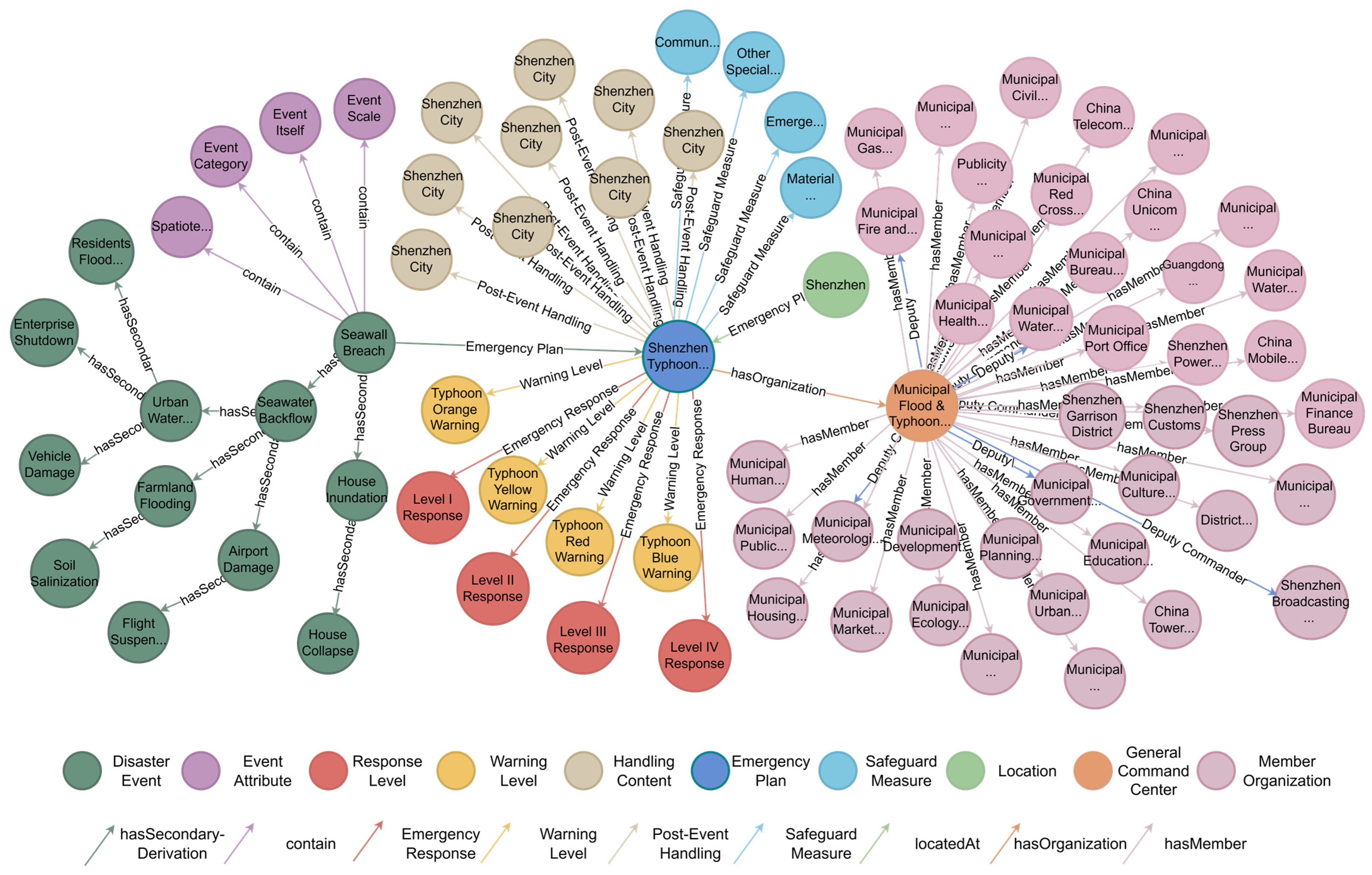
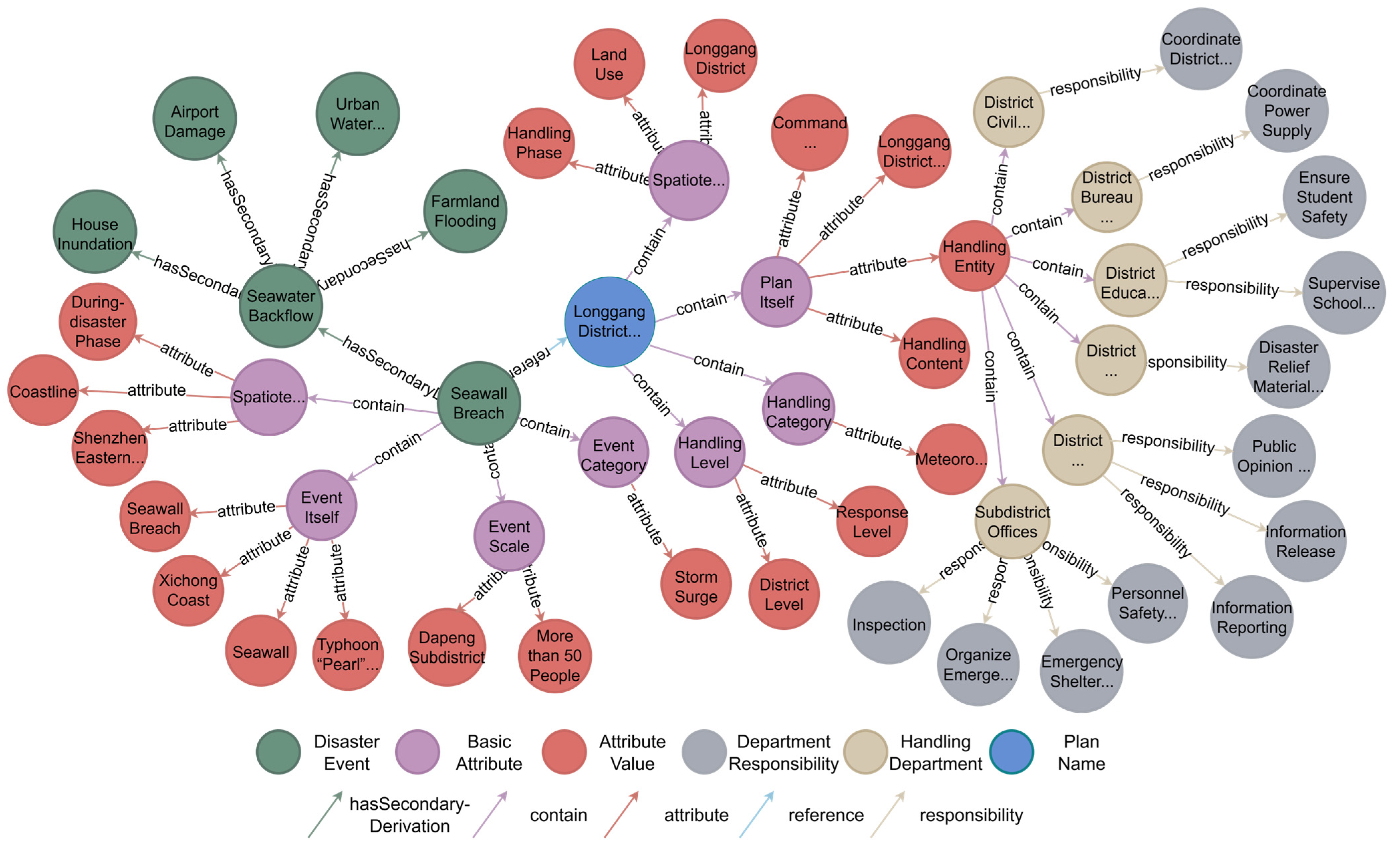
Due to the large scale and high connectivity of the constructed knowledge graph,
Figure 8 presents a representative subgraph rather than the complete graph. In the visualization, green nodes denote specific disaster events within the event chain, blue nodes represent emergency plans, purple nodes indicate commanding entities, red nodes correspond to response levels, and gray nodes represent handling entities.
Figure 8 illustrates the nodes and semantic connections involved in the “Seawall Breach” event and its associated emergency response process. The “Seawall Breach” node is linked to the “Shenzhen Typhoon Emergency Response Plan” node, which further connects to its associated handling entity nodes. Each handling entity node is then connected to corresponding handling content nodes.
5.2. Scenario–Response Knowledge Reasoning
Based on the scenario–response knowledge graph constructed in
Section 4.3 and the reasoning workflow described in
Section 4.4, scenario and response information were organized according to the formal definitions of scenario texts (T_SCENE) and response texts (T_RESPOND). These structured semantic representations were used as inputs to the matching model.
The reasoning model adopted a BERT-based text matching architecture. T_SCENE and T_RESPOND were concatenated and fed into the BERT-base-Chinese encoder, followed by a classification layer for semantic matching. The model was fine-tuned using cross-entropy loss. The maximum sequence length was set to 100, the batch size was 8, and the learning rate was 1 × 10⁻⁵. The Adam optimizer was employed, and all encoder parameters were updated during training. To ensure consistency, the dataset partition and training settings were aligned with those used in the extraction experiments.
A coastal seawall breach event at Xichong Coast, Dapeng Subdistrict, Longgang District, Shenzhen, together with the Longgang District Meteorological Disaster Emergency Plan, was selected as a case study. The representation of related entities and relations in the knowledge graph is illustrated in the left part of
Figure 9. In this visualization, green nodes denote disaster events, blue nodes denote emergency plans, purple nodes represent attribute categories of both disaster events and emergency plans, and red nodes indicate specific attribute values. The constructed scenario text (T_SCENE), response text (T_RESPOND), and associated node information are summarized in
Table 5. Land-use types follow the national standard Current Land Use Classification (GB/T 21010–2017) [
48].
For each scenario, the concatenated T_SCENE and T_RESPOND were input into the reasoning model following the workflow in
Figure 7. The response text with the highest matching score was selected as the recommended scheme. The corresponding response elements—including plan name, handling entity, handling content, commanding entity, plan category, plan level, response level, geographic location, handling phase, and land-use type—were then extracted and visualized in the knowledge graph (right part of
Figure 9). In this visualization, blue nodes denote the recommended plan name, purple nodes represent attribute categories, red nodes indicate attribute values, brown nodes denote handling entities, and gray nodes represent handling content.
To quantitatively evaluate the recommendation performance of the proposed “scenario–response” reasoning model, an overlap-based semantic accuracy metric is adopted.
Let a disaster scenario
correspond to a ground-truth emergency response semantic set:
where each
denotes an atomic response semantic element defined in the “scenario–response” ontology, such as response level, responsible subject, response stage, spatial scope, and key disposal actions extracted from official emergency plans.
Given the same scenario
, the proposed reasoning model outputs a recommended response semantic set:
where
represents a predicted response semantic element inferred by the model.
The scenario–response semantic accuracy is defined as:
In addition to the
-oriented metric, Precision and
score can be defined under the same semantic set formulation as:
Here, reflects the proportion of ground-truth response semantic elements correctly covered by the recommended scheme, while measures the proportion of predicted semantic elements that are correct. The score provides a balanced assessment between coverage and correctness.
Since emergency response schemes are typically semi-structured compositions of multiple complementary response elements, exact sentence-level matching is not suitable for evaluation. In emergency management contexts, omission of critical response components (e.g., responsible departments, response levels, or spatial scope) may introduce operational risks. Therefore, semantic coverage is prioritized in the present evaluation framework.
5.3. Overall Results and Analysis
The training set for the scenario–response knowledge reasoning model contains 1044 samples, and the validation set contains 642 samples. For each scenario in the validation set, scenario–response reasoning was conducted following the workflow described in
Figure 7. The overlap ratios between the inferred response elements and the corresponding ground-truth nodes in the knowledge graph were calculated. The experimental results are summarized in
Table 6.
The experimental results indicate that administrative and structural elements—such as plan name (96%), handling entity (95%), and plan level (95%)—achieved the highest overlap ratios. These elements typically contain explicit hierarchical identifiers and region-specific administrative keywords, making them relatively easier to align semantically within the knowledge graph framework.
In contrast, handling content (90%) and plan category (90%) exhibit comparatively lower overlap rates. These elements often consist of longer, multi-clause textual descriptions and involve cross-sentence semantic dependencies, increasing alignment complexity. This performance gap highlights the inherent challenge of fine-grained semantic matching for long-form disposal instructions.
From an operational perspective, emergency personnel primarily rely on accurate identification of the emergency plan name to retrieve the full structured response graph. Once the recommended plan name is correctly matched, all associated nodes—including handling entities, disposal actions, commanding authorities, and other response attributes—can be directly accessed through the knowledge graph visualization. Therefore, although certain fine-grained attributes exhibit comparatively lower coverage, the high matching consistency of core structural elements ensures practical applicability of the proposed scenario–response reasoning framework.
Overall, the overlap ratios ranging from 90% to 96% demonstrate stable semantic coverage across core emergency response elements. Nevertheless, further validation using cross-case testing or expert-based evaluation would strengthen the robustness assessment of the reasoning framework.
6. Discussion
This study proposes a scenario–response-driven spatiotemporal knowledge graph framework that integrates marine storm surge event chains with structured emergency plans. The experimental results presented in
Section 5 provide empirical support for the effectiveness of the proposed approach across both knowledge extraction and reasoning stages.
In the extraction phase, the OSS-CasRel model achieved an accuracy of 80% on the validation set, outperforming CasRel (65%), PRGC (68%), and BiRTE (72%). The improvement indicates that lexicon-aware tokenization combined with domain-specific fine-tuning enhances entity boundary recognition and relation classification in terminology-intensive emergency management texts. These findings underscore the importance of domain adaptation when applying joint entity–relation extraction models to specialized disaster corpora.
In the scenario–response reasoning experiments, semantic overlap rates for key response elements ranged from 90% to 96%. Structural elements such as plan name (96%), handling entity (95%), and plan level (95%) exhibited particularly high consistency with official emergency plans, while handling content reached 90% overlap. The relatively lower performance for long-form disposal content reflects the inherent difficulty of fine-grained semantic alignment across multi-clause procedural descriptions. Nevertheless, the stable coverage of core structural elements demonstrates that the framework can reliably identify and organize critical response components under diverse disaster scenarios.
From a methodological perspective, most existing disaster knowledge graph studies primarily focus on knowledge extraction, graph construction, visualization, or entity-centric retrieval. Although these approaches improve semantic organization and information accessibility, they generally treat disaster events and emergency plans as separate knowledge components and do not explicitly model the alignment between disaster evolution and response logic. In contrast, the proposed framework structurally couples event-chain evolution with hierarchical response processes under a unified ontology and establishes attribute-level alignment between scenario elements and response elements. This design enables interpretable scenario-to-response mapping rather than simple document retrieval or static graph querying. The experimental performance in both extraction and reasoning stages supports the validity of this integrated modeling strategy.
From a computational perspective, the framework relies on BERT-Base-Chinese and joint extraction models, with reasoning implemented through a single forward-pass semantic matching mechanism. Because the process does not require iterative graph traversal or multi-step symbolic inference, computational complexity remains stable and manageable. Although large-scale stress testing was not conducted, the modular architecture and lightweight inference workflow suggest feasibility for near real-time decision-support applications.
Operationally, the system is designed as a human-in-the-loop decision-support tool rather than a fully automated decision-making mechanism. Emergency personnel construct structured scenario texts based on observed disaster attributes, after which the model recommends the most relevant emergency plan via semantic matching. Once the plan name is identified, associated response entities and procedural nodes can be directly retrieved and visualized from the knowledge graph. This input–matching–retrieval workflow reduces reliance on manual document consultation while maintaining interpretability and operational controllability in time-sensitive response contexts.
Although the empirical evaluation focuses on Guangdong Province, the methodological architecture is not inherently region-specific. Event-chain modeling, ontology-driven semantic alignment, and structured scenario–response reasoning are conceptually independent of local administrative settings. By reconstructing domain ontologies and adapting lexicons to different disaster governance contexts, the framework can potentially be extended to other coastal regions and even to different hazard types, such as floods, typhoons, earthquakes, or public health emergencies.
Several limitations should also be acknowledged. The dataset remains geographically concentrated, and broader cross-regional validation is necessary to assess generalizability. The evaluation of response recommendation primarily relies on semantic overlap metrics that emphasize coverage rather than precision, and additional expert-based or multi-metric evaluation strategies would provide a more comprehensive assessment. Furthermore, long and complex disposal descriptions remain challenging for fine-grained semantic alignment.
Overall, the findings suggest that integrating structured knowledge graphs with domain-adapted extraction and semantic reasoning models provides a feasible and interpretable pathway toward intelligent emergency management for marine storm surge disasters, while further empirical validation and deployment-oriented testing remain important future directions.
7. Conclusions
Marine storm surge disasters involve rapid evolution, cascading impacts, and complex multi-departmental coordination requirements. Traditional response strategies relying on manual consultation of unstructured emergency plans face limitations in handling dynamic and heterogeneous disaster scenarios.
This study constructs a scenario–response spatiotemporal knowledge graph integrating disaster event chains and emergency plans. By introducing a domain-specific storm surge lexicon and the OSS-CasRel joint extraction model, knowledge extraction accuracy reached 80%, outperforming several baseline methods. Based on the constructed knowledge graph, a scenario–response semantic reasoning framework was further developed, achieving 90–96% semantic overlap across key emergency response elements in validation experiments.
The results indicate that the proposed approach effectively organizes heterogeneous disaster knowledge into structured semantic representations, enhances extraction robustness in terminology-dense texts, and supports interpretable response recommendation under diverse disaster scenarios.
The present study remains geographically focused on Guangdong Province and is evaluated under a specific experimental framework. Broader cross-regional validation, multi-scenario testing, and real-world deployment assessment are necessary to further examine generalizability and operational robustness. Future research may explore the integration of large language models and advanced reasoning strategies to improve long-text semantic alignment and adaptive response generation.
By bridging structured knowledge representation with deep learning–based reasoning, this study provides a methodological foundation for intelligent emergency management in marine storm surge contexts.
Author Contributions
Conceptualization, T.H., W.L. and Y.L.; Methodology, T.H.; Software, T.H. and C.G.; Validation, C.G.; Formal analysis, C.G.; Investigation, C.G.; Resources, W.L.; Writing—original draft, T.H.; Writing—review & editing, T.H., C.G., W.L. and Y.L.; Visualization, T.H.; Supervision, W.L. and Y.L.; Project administration, W.L.; Funding acquisition, W.L. All authors have read and agreed to the published version of the manuscript.
Funding
This research was funded by Guangdong Province Marine Economic Development (Six Major Marine Industries) Special Fund Project, grant number GDNRC [2023]25.
Institutional Review Board Statement
Not applicable.
Informed Consent Statement
Not applicable.
Data Availability Statement
Data and materials are available upon request. The data are not publicly available due to privacy.
Acknowledgments
All the authors wish to thank all who assisted in conducting this work.
Conflicts of Interest
Author Weihong Li is an employee of Guangdong ShiDaWeiZhi Information Technology Co., Ltd., Guangzhou 510631, China. All authors declare that the research was conducted in the absence of any commercial or financial relationships that could be construed as a potential conflict of interest.
References
- Camelo, J.; Mayo, T.L.; Gutmann, E.D. Projected climate change impacts on hurricane storm surge inundation in the coastal United States. Front. Built Environ. 2020, 6, 588049. [Google Scholar] [CrossRef]
- Yu, L.; Qin, H.; Huang, S.; Wei, W.; Jiang, H.; Mu, L. Quantitative study of storm surge risk assessment in an undeveloped coastal area of China based on deep learning and geographic information system techniques: A case study of Double Moon Bay. Nat. Hazards Earth Syst. Sci. 2024, 24, 2003–2024. [Google Scholar] [CrossRef]
- Morim, J.; Wahl, T.; Rasmussen, D.J.; Calafat, F.M.; Vitousek, S.; Dangendorf, S.; Kopp, R.E.; Oppenheimer, M. Observations reveal changing coastal storm extremes around the United States. Nat. Clim. Change 2025, 15, 538–545. [Google Scholar] [CrossRef]
- Zhang, C.; Yin, K.; Shi, X.; Yan, X. Risk assessment for typhoon storm surges using geospatial techniques for the coastal areas of Guangdong, China. Ocean Coast. Manag. 2021, 213, 105880. [Google Scholar] [CrossRef]
- Ministry of Natural Resources of the People’s Republic of China. China Marine Disaster Bulletin. 2023. Available online: https://gi.mnr.gov.cn/202404/t20240429_2844013.html (accessed on 30 December 2025).
- Yanites, B.J.; Clark, M.K.; Roering, J.J.; West, A.J.; Zekkos, D.; Baldwin, J.W.; Cerovski-Darriau, C.; Gallen, S.F.; Horton, D.E.; Kirby, E.; et al. Cascading land surface hazards as a nexus in the Earth system. Science 2025, 388, eadp9559. [Google Scholar] [CrossRef] [PubMed]
- Fan, X.; Scaringi, G.; Korup, O.; West, A.J.; van Westen, C.J.; Tanyas, H.; Hovius, N.; Hales, T.C.; Jibson, R.W.; Allstadt, K.E.; et al. Earthquake-induced chains of geologic hazards: Patterns, mechanisms, and impacts. Rev. Geophys. 2019, 57, 421–503. [Google Scholar] [CrossRef]
- Chen, M.; Tao, Z.; Tang, W.; Qin, T.; Yang, R.; Zhu, C. Enhancing emergency decision-making with knowledge graphs and large language models. Int. J. Disaster Risk Reduct. 2024, 113, 104804. [Google Scholar] [CrossRef]
- Ma, X. Knowledge graph construction and application in geosciences: A review. Comput. Geosci. 2022, 161, 105082. [Google Scholar] [CrossRef]
- Liu, H.; Hu, Z.W.; Yang, Z.; Wang, M. Model-data matching method for natural disaster emergency service scenarios: Implementation based on a knowledge graph and community discovery algorithm. Nat. Hazards 2024, 120, 4233–4255. [Google Scholar] [CrossRef]
- Liu, S.; Huang, M.; Yang, G.; Zhou, W. Multimodal deep learning for entity relation extraction and spatiotemporal decision knowledge graph construction in earthquake emergency rescue. Sci. Rep. 2025, 15, 40277. [Google Scholar] [CrossRef]
- Abu-Salih, B. Domain-specific knowledge graphs: A survey. J. Netw. Comput. Appl. 2021, 185, 103076. [Google Scholar] [CrossRef]
- Ji, S.; Pan, S.; Cambria, E.; Marttinen, P.; Yu, P.S. A survey on knowledge graphs: Representation, acquisition, and applications. IEEE Trans. Neural Netw. Learn. Syst. 2021, 33, 494–514. [Google Scholar] [CrossRef]
- Du, J.; Wang, S.; Ye, X.; Sinton, D.S.; Kemp, K. GIS-KG: Building a large-scale hierarchical knowledge graph for geographic information science. Int. J. Geogr. Inf. Sci. 2022, 36, 873–897. [Google Scholar] [CrossRef]
- Pescaroli, G.; Alexander, D. Understanding compound, interconnected, interacting, and cascading risks: A holistic framework. Risk Anal. 2018, 38, 2245–2257. [Google Scholar] [CrossRef]
- Zheng, L.; Wang, F.; Zheng, X.; Liu, B. Discovering the relationship of disasters from big scholar and social media news datasets. In Social Sensing and Big Data Computing for Disaster Management; Routledge: London, UK, 2020; pp. 144–166. [Google Scholar]
- Zhang, Z.; Lu, Y.; Hu, D.; Guo, F.; Yu, Z.; Song, Z.; Chen, P.; Wu, J.; Huang, W. A cross-scale modeling framework for simulating typhoon-induced compound floods and assessing the emergency response in urban regions. Ocean Coast. Manag. 2023, 245, 106863. [Google Scholar] [CrossRef]
- Wang, S.; Li, R.; Wu, H. Integrated expression and analysis of urban flood disaster events from the perspective of multi-spatial semantic fusion. Int. J. Appl. Earth Obs. Geoinf. 2024, 132, 104032. [Google Scholar] [CrossRef]
- Tura, N.; Ojanen, V. Sustainability-oriented innovations in smart cities: A systematic review and emerging themes. Cities 2022, 126, 103716. [Google Scholar] [CrossRef]
- Gariano, S.L.; Guzzetti, F. Landslides in a changing climate. Earth-Sci. Rev. 2016, 162, 227–252. [Google Scholar] [CrossRef]
- He, Z.; Deng, M.; Cai, J.; Xie, Z.; Guan, Q.; Yang, C. Mining spatiotemporal association patterns from complex geographic phenomena. Int. J. Geogr. Inf. Sci. 2020, 34, 1162–1187. [Google Scholar] [CrossRef]
- Ekkirala, H.C.; Ramesh, M.V. Spatiotemporal assessment of multi-hazard risk using graph-based analysis for case studies in India. Sci. Rep. 2026, 16, 5837. [Google Scholar] [CrossRef]
- Xu, J.; Nyerges, T.L.; Nie, G. Modeling and representation for earthquake emergency response knowledge: Perspective for working with geo-ontology. Int. J. Geogr. Inf. Sci. 2014, 28, 185–205. [Google Scholar] [CrossRef]
- Wang, S.; Li, R.; Wu, H.; Li, J.; Shen, Y. Fine-grained flood disaster information extraction incorporating multiple semantic features. Int. J. Digit. Earth 2025, 18, 2448221. [Google Scholar] [CrossRef]
- Chen, Y.B.; Chen, Y.L.; Ke, W.; Jiang, S.; Zhao, Z.; Guo, R. Research on the dimensional model of Pan-maps continuous representation. J. Geo-Inf. Sci. 2026, 28, 287–299. [Google Scholar] [CrossRef]
- Esmaelian, M.; Tavana, M.; Santos Arteaga, F.J.; Mohammadi, S. A multicriteria spatial decision support system for solving emergency service station location problems. Int. J. Geogr. Inf. Sci. 2015, 29, 1187–1213. [Google Scholar] [CrossRef]
- Zhang, Z.; Demšar, U.; Rantala, J.; Virrantaus, K. A fuzzy multiple-attribute decision-making modelling for vulnerability analysis on the basis of population information for disaster management. Int. J. Geogr. Inf. Sci. 2014, 28, 1922–1939. [Google Scholar] [CrossRef]
- Fang, Z.; Yue, P.; Zhang, M.; Xie, J.; Wu, D.; Jiang, L. A service-oriented collaborative approach to disaster decision support by integrating geospatial resources and task chain. Int. J. Appl. Earth Obs. Geoinf. 2023, 117, 103217. [Google Scholar] [CrossRef]
- Guo, R.Z.; Chen, Y.B.; Zhao, Z.G.; Ma, D.; He, B.; Wang, W.X.; Hong, W.Y.; Li, M.M. The Transformation of the Scientific Concept of GIS: From Map-Based GIS to Space-Oriented GIS. Acta Geod. Cartogr. Sin. 2024, 53, 1853–1862. [Google Scholar] [CrossRef]
- Hogan, A.; Blomqvist, E.; Cochez, M.; D’amato, C.; De Melo, G.; Gutierrez, C.; Kirrane, S.; Gayo, J.E.L.; Navigli, R.; Neumaier, S.; et al. Knowledge graphs. ACM Comput. Surv. 2021, 54, 1–37. [Google Scholar] [CrossRef]
- Sun, Q.; Ding, Y.; Hou, J.; Zhu, Q.; Wu, Y.; Wu, T.; Wang, X.; Zhao, X.; Shao, S. LHAKG: A knowledge graph construction framework for landslide hazard assessment by using XLNet-BiLSTM-CRF from geoscience literature. Int. J. Digit. Earth 2025, 18, 2577292. [Google Scholar] [CrossRef]
- Li, Y.; Thomas, M.A.; Osei-Bryson, K.M. Ontology-based data mining model management for self-service knowledge discovery. Inf. Syst. Front. 2017, 19, 925–943. [Google Scholar] [CrossRef]
- Duan, Y.; Liang, M.; Li, Y.; Gao, R.; Chen, J.; Chen, Z.S.; Wang, H. Big data fusion-driven geospatial knowledge graph construction method for sustainable smart cities. Sustain. Cities Soc. 2025, 103, 107027. [Google Scholar] [CrossRef]
- Hu, Y.; Mai, G.; Cundy, C.; Choi, K.; Lao, N.; Liu, W.; Lakhanpal, G.; Zhou, R.Z.; Joseph, K. Geo-knowledge-guided GPT models improve the extraction of location descriptions from disaster-related social media messages. Int. J. Geogr. Inf. Sci. 2023, 37, 2289–2318. [Google Scholar] [CrossRef]
- Wei, Z.; Su, J.; Wang, Y.; Tian, Y.; Chang, Y. A novel cascade binary tagging framework for relational triple extraction. In Proceedings of the 58th Annual Meeting of the Association for Computational Linguistics, Online, 5–10 July 2020; Association for Computational Linguistics: Stroudsburg, PA, USA, 2020; pp. 1476–1488. [Google Scholar] [CrossRef]
- Zhang, P.; Yang, M.; Yang, T.; Kong, B.; Yu, H.; Ai, T. Using knowledge graph embeddings and meta-path transformers for geographic context-aware predictions of building functions. Int. J. Geogr. Inf. Sci. 2025, 39, 1–34. [Google Scholar] [CrossRef]
- Ge, X.; Yang, Y.; Chen, J.; Li, W.; Huang, Z.; Zhang, W.; Peng, L. Disaster prediction knowledge graph based on multi-source spatio-temporal information. Remote Sens. 2022, 14, 1214. [Google Scholar] [CrossRef]
- Zhu, J.; Zhang, J.; Zhu, Q.; Li, W.; Wu, J.; Guo, Y. A knowledge-guided visualization framework of disaster scenes for helping the public cognize risk information. Int. J. Geogr. Inf. Sci. 2024, 38, 626–653. [Google Scholar] [CrossRef]
- Zhang, Y.; Zhu, J.; Zhu, Q.; Xie, Y.; Li, W.; Fu, L.; Zhang, J.; Tan, J. The construction of personalized virtual landslide disaster environments based on knowledge graphs and deep neural networks. Int. J. Digit. Earth 2020, 13, 1637–1655. [Google Scholar] [CrossRef]
- Huang, Y.; Xia, Y.; Tao, R.; Jiao, D.; Min, X.; Zheng, J.; Jiang, Y.; Wu, W.; Du, P. A LLM-based agent for the construction of typhoon knowledge graphs. Environ. Model. Softw. 2026, 197, 106856. [Google Scholar] [CrossRef]
- People’s Government of Guangdong Province. Geographical Overview of Guangdong Province. Available online: http://www.gd.gov.cn/zjgd/sqgk/zrdl/index.html (accessed on 30 December 2025).
- Li, K.; Li, G.S. Vulnerability assessment of storm surges in the coastal area of Guangdong Province. Nat. Hazards Earth Syst. Sci. 2011, 11, 2003–2010. [Google Scholar] [CrossRef]
- Fang, W.; Yu, F.; Dong, J.; Shi, X. Storm surge disasters in China. In Natural Disasters in China; Shi, P., Ed.; IHDP/Future Earth–Integrated Risk Governance Project Series; Springer: Berlin/Heidelberg, Germany, 2016; pp. 233–260. [Google Scholar] [CrossRef]
- Gao, Z.; Geddes, R.R.; Ma, T. Direct and indirect economic losses using typhoon-flood disaster analysis: An application to Guangdong Province, China. Sustainability 2020, 12, 8980. [Google Scholar] [CrossRef]
- Singh, K.; Maiti, J.; Dhalmahapatra, K. Chain of events model for safety management: Data analytics approach. Saf. Sci. 2019, 118, 568–582. [Google Scholar] [CrossRef]
- Chen, Y.; Zhang, J.; Zhou, A.; Yin, B. A modeling method for a disaster chain—Taking the coal mining subsidence chain as an example. Hum. Ecol. Risk Assess. 2018, 24, 1388–1408. [Google Scholar] [CrossRef]
- Lagoze, C.; Hunter, J. The ABC ontology and model. J. Digit. Inf. 2001, 2, 1–18. [Google Scholar] [CrossRef]
- GB/T 21010–2017; Current Land Use Classification. Standardization Administration of China: Beijing, China, 2017.
| Disclaimer/Publisher’s Note: The statements, opinions and data contained in all publications are solely those of the individual author(s) and contributor(s) and not of MDPI and/or the editor(s). MDPI and/or the editor(s) disclaim responsibility for any injury to people or property resulting from any ideas, methods, instructions or products referred to in the content. |