2.1. The Broadband China Policy
Since 1994, China has achieved full connectivity with the global internet. After years of development, China’s digital public infrastructure has made tremendous breakthroughs. However, this development has been accompanied by issues such as regional imbalance in deployment, incomplete integration of applications, and low service efficiency [
37]. Early manifestations included a triple digital divide: First, an urban-rural divide in China’s digital public infrastructure development. By 2012, while fiber to the home (FTTH) had begun rolling out in urban areas, vast rural regions still relied primarily on low-speed ADSL, with some administrative villages lacking broadband access altogether. Second, a regional divide in digital public infrastructure development. Network density and quality in eastern coastal regions far exceeded those in central and western regions [
38]. Third, China faced an international digital public infrastructure gap, with overall broadband performance lagging behind developed nations. By the end of 2012, China’s average broadband penetration rate was approximately 13%, far below the 26% penetration rate in developed countries. Nearly 40% of Chinese users still relied on access speeds below 4 Mbps, significantly lower than the mainstream 18 Mbps speeds in developed countries [
38]. This has become a critical bottleneck constraining the digital transformation and upgrading of agriculture.
To alleviate the constraints imposed by deficiencies in digital public infrastructure on the digital development of China’s agriculture and rural areas, in 2013, the State Council released the implementation plan for the Broadband China policy and set phased objectives. First, China planned to achieve fiber to the home in urban areas and broadband access in rural villages by 2015. China aimed to achieve 95% broadband coverage in administrative villages by 2015, with urban and rural household broadband access speeds reaching 20 Mbps and 4 Mbps, respectively. Second, China planned to establish a technologically advanced broadband network infrastructure covering both urban and rural areas by 2020, targeting over 98% broadband coverage in administrative villages and boosting access speeds to 50 Mbps in urban areas and 12 Mbps in rural areas. To implement this top-level design, the Ministry of Industry and Information Technology (MIIT) and the National Development and Reform Commission (NDRC) selected a total of 117 demonstration cities in three batches between 2014 and 2016. Applicant cities were required to meet at least four of several key indicators, including “20 Mbps or higher broadband access capacity for urban households” and “fixed broadband household penetration rate.” Since the policy’s implementation, China’s broadband network infrastructure has achieved leapfrog development. By 2023, broadband coverage in administrative villages nationwide had far exceeded initial targets, with rural broadband users reaching nearly 200 million. In rural areas, users with access speeds of 100 Mbps or higher accounted for 96.5% of the total. Concurrently, 4G coverage in administrative villages exceeded 99%, while 5G networks achieved extensive coverage in key regions.
2.2. Policy Implementation and Agricultural Production
Some scholars have pointed out that the Broadband China policy not only impacts the construction of infrastructure such as the internet itself, but also extends the application of such infrastructure to both the production and consumption ends of economic and social development [
39]. Beyond the expansion of network coverage, the actual implementation of the Broadband China policy has generated multi-dimensional impacts across different stages of agricultural production. As a nationwide strategic initiative, the policy not only improved rural broadband penetration but also integrated digital infrastructure into agricultural production, circulation, and market participation processes.
At the production stage, improved digital connectivity facilitates access to technical information, digital financial services, and precision agricultural technologies. Empirical evidence suggests that digital infrastructure enhances regional human capital accumulation, technological development capacity, and digital inclusive finance, thereby strengthening agricultural economic resilience [
40]. It also significantly improves agricultural green total factor productivity [
41] and promotes technological progress and farmland scale expansion in grain production [
42], indicating that digital infrastructure contributes to productivity enhancement and sustainable agricultural development. At the income and circulation stage, digital infrastructure reduces transaction frictions and broadens market access. It has been found that digital infrastructure construction significantly increases farmers’ income by expanding market participation channels [
43]. Meanwhile, improved digital connectivity enhances agricultural participation in global value chains and raises export value-added [
41], suggesting that broadband expansion strengthens agricultural competitiveness in both domestic and international markets.
Theoretically, digital public infrastructure forms the foundation for economic digitization, yet its efficacy ultimately relies on broadband networks for transmission and coordination. Functionally, the Broadband China policy transcends a mere telecommunications network initiative. Based on this, this study argues that the Broadband China policy serves as an effective proxy variable for digital public infrastructure development levels.
2.3. Theoretical Analysis and Research Hypotheses
Agricultural modernization differs fundamentally from industrial upgrading due to the inherent structural characteristics of agricultural production. Unlike manufacturing sectors, agriculture is typically characterized by highly dispersed production units, small-scale household operations, strong dependence on timely market information, pronounced seasonality, and high transportation and preservation requirements. These structural features generate persistent information asymmetry, limited technological diffusion, and constrained economies of scale, thereby impeding productivity growth and structural transformation. Consequently, improvements in digital connectivity may exert significant impacts on agricultural modernization by alleviating these structural bottlenecks.
The widespread adoption of broadband networks has directly alleviated the long-standing information barriers in rural areas. According to information economics theory, the free flow of information is a prerequisite for optimizing resource allocation and reducing transaction costs. In traditional agriculture, the dispersion of economic entities resulted in high costs for farmers to obtain market information, leading to inefficient allocation of production factors and poor market connectivity for agricultural products [
44]. The judicious application of information technology can nearly double the operational efficiency of the agro-industrial complex [
45].
Through the staged expansion of high-speed broadband networks and universal telecommunications services, the Broadband China policy substantially improved rural information accessibility. New infrastructure, such as 5G communications and satellite internet, not only enables small-scale farmers in remote areas to remotely access broader markets, expanding the sales radius for agricultural products, but also allows demand-side entities to access richer supply information [
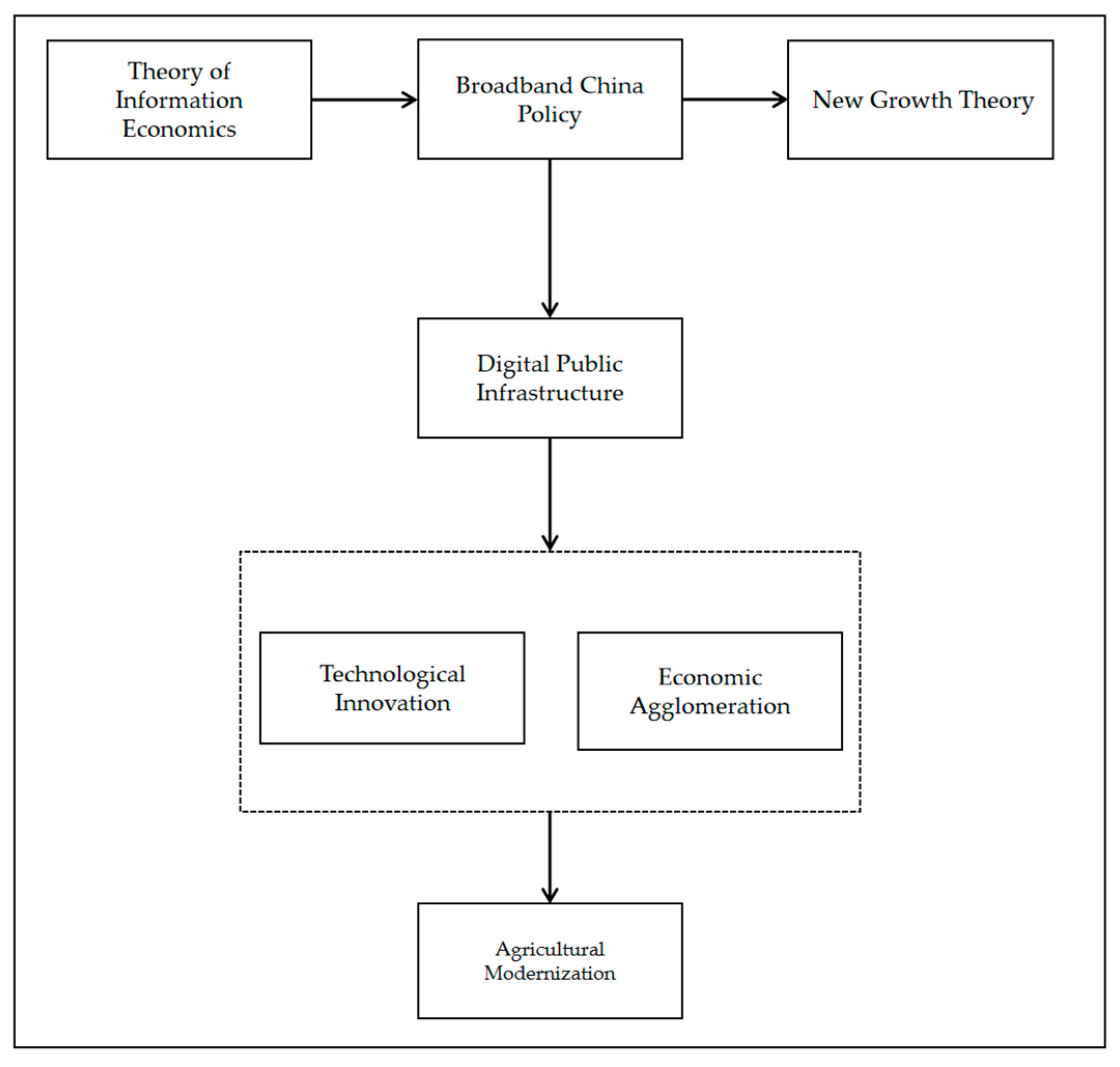
46]. This improvement in information efficiency enhances the allocation of land, labor, and capital, thereby laying the foundation for agricultural modernization. The theoretical framework of the relationship between digital public infrastructure and agricultural modernization is illustrated in
Figure 1. Based on this, this study proposes Hypothesis 1:
H1: Digital public infrastructure can promote agricultural modernization.
Figure 1.
Theoretical Framework of Digital Public Infrastructure and Agricultural Modernization.
Figure 1.
Theoretical Framework of Digital Public Infrastructure and Agricultural Modernization.
Beyond improving information efficiency, digital public infrastructure also facilitates technological upgrading in agriculture. Under the new growth theory, technological progress serves as the core driver of endogenous economic growth [
47]. Agricultural technological innovation, however, has long been constrained by limited R&D investment, slow diffusion of technical knowledge, and weak linkages between research institutions and farmers. The popularization of the Broadband China policy has facilitated the inflow of innovation factors into the digital agriculture sector. Digital public infrastructure not only provides technical support for building e-commerce platforms for agricultural products, smart agriculture cloud platforms, and agricultural socialized service platforms by matching supply and demand information online [
25].
Moreover, digital connectivity generates a data productivity effect [
48,
49], whereby information generated through digital platforms reduces uncertainty in investment decisions and improves the efficiency of resource allocation toward agricultural R&D activities. The positive feedback mechanism between digital adoption and technological upgrading reinforces endogenous innovation capacity within the agricultural sector [
50,
51]. Through enhanced knowledge spillovers and accelerated technology adoption, digital public infrastructure contributes to productivity enhancement and structural upgrading in agriculture.
On the other hand, digital public infrastructure promotes structural reorganization and agglomeration within the agricultural economy. Krugman incorporated spatial factors into economic growth models [
52], after which agglomeration economies became a core driver of endogenous economic growth, significantly boosting urban economic development [
53]. Broadband expansion lowers coordination costs across regions, improves logistics information systems, and strengthens supply chain integration. In the agricultural context, digital connectivity supports the formation of leading agribusiness enterprises, specialized cooperatives, and modern agricultural industrial parks. These clusters enable intensive resource allocation, scale expansion, and specialization [
54], improve agricultural production efficiency [
55,
56], and promote knowledge sharing and technology spillovers within the clusters [
57]. For micro-entities in agricultural production, farmers can fully benefit from the infrastructure, specialized supporting services, and knowledge-technology spillover effects generated by industrial clusters, thereby reducing average agricultural production costs [
58].
Taken together, digital public infrastructure promotes agricultural modernization through a multi-layered mechanism: by reducing information frictions, accelerating technological diffusion, and facilitating factor reallocation and agglomeration effects. Accordingly, this study proposes:
H2: Digital public infrastructure can promote agricultural modernization by driving technological innovation and economic agglomeration.
However, many rural areas in China suffer from insufficient logistics network coverage [
59] and regional development imbalances [
60]. The effectiveness of digital infrastructure is not uniform across regions. The agricultural sector exhibits strong dependence on complementary physical infrastructure and local information environments. Agricultural products are regionally concentrated, seasonal, and highly sensitive to logistics efficiency. In areas with underdeveloped logistics systems, improvements in digital connectivity may not fully translate into effective market access due to high transportation costs and limited cold chain coverage. Therefore, the interaction between digital and physical infrastructure conditions influences policy outcomes.
Furthermore, agricultural markets involve numerous farmers and dispersed buyers, where information asymmetry is prevalent during transactions [
61]. As carriers of culture, the diversity of dialects not only hinders effective communication between groups [
62] but also forces market participants to incur higher information search costs. Even in areas with broadband coverage, regions with high information search costs due to language diversity and cultural fragmentation face greater obstacles in effective information exchange. In contrast, regions with lower information search costs are more conducive to internalizing the benefits brought by improved digital connectivity. Therefore, the impact of digital public infrastructure on agricultural modernization depends on the level of complementary logistics development and the prevailing information search environment. Accordingly, this study proposes:
H3: The driving effect of digital public infrastructure is more pronounced in regions with higher logistics development levels and lower information search costs.