Circular Human Resource Management and Corporate Sustainability: The Conditional Role of Green Thinking and Environmental Management Investment

Abstract
1. Introduction
2. Theoretical Framework and Hypotheses Development
2.1. Natural Resource-Based View and Institutional Theory
2.2. Circular Human Resource Management and Corporate Sustainability
2.3. Circular Human Resource Management and Green Thinking
2.4. Green Thinking and Corporate Sustainability
2.5. Mediating Role of Green Thinking
2.6. Moderating Role of Environmental Management Investment
2.7. Control Variables: Firm Age and Firm Size
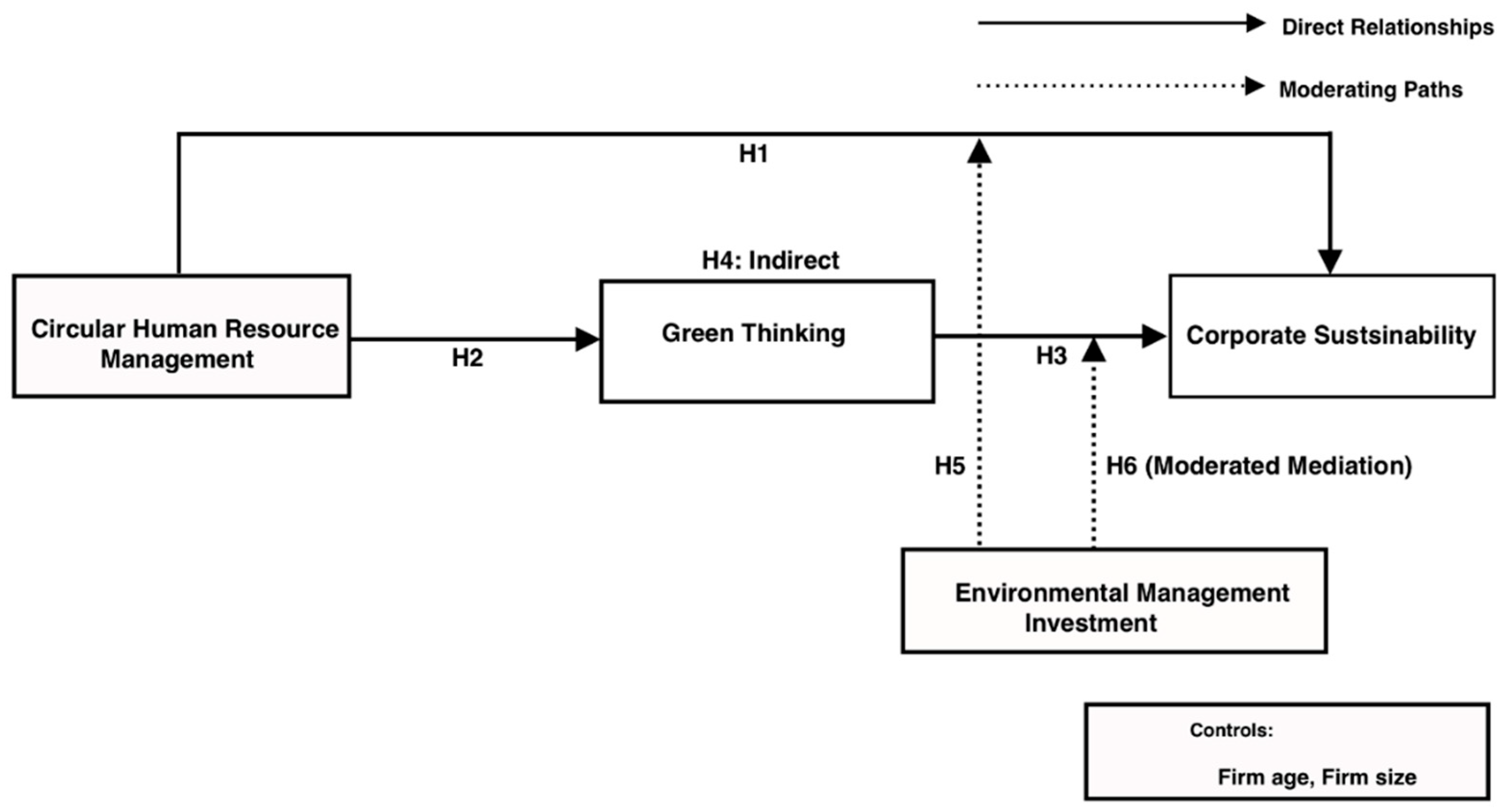
2.8. Research Model
3. Method
3.1. Sampling and Data Collection
3.2. Measures
3.3. Common Method Bias (CMB) and Non-Response Bias
3.4. Data Analysis Procedures
4. Results
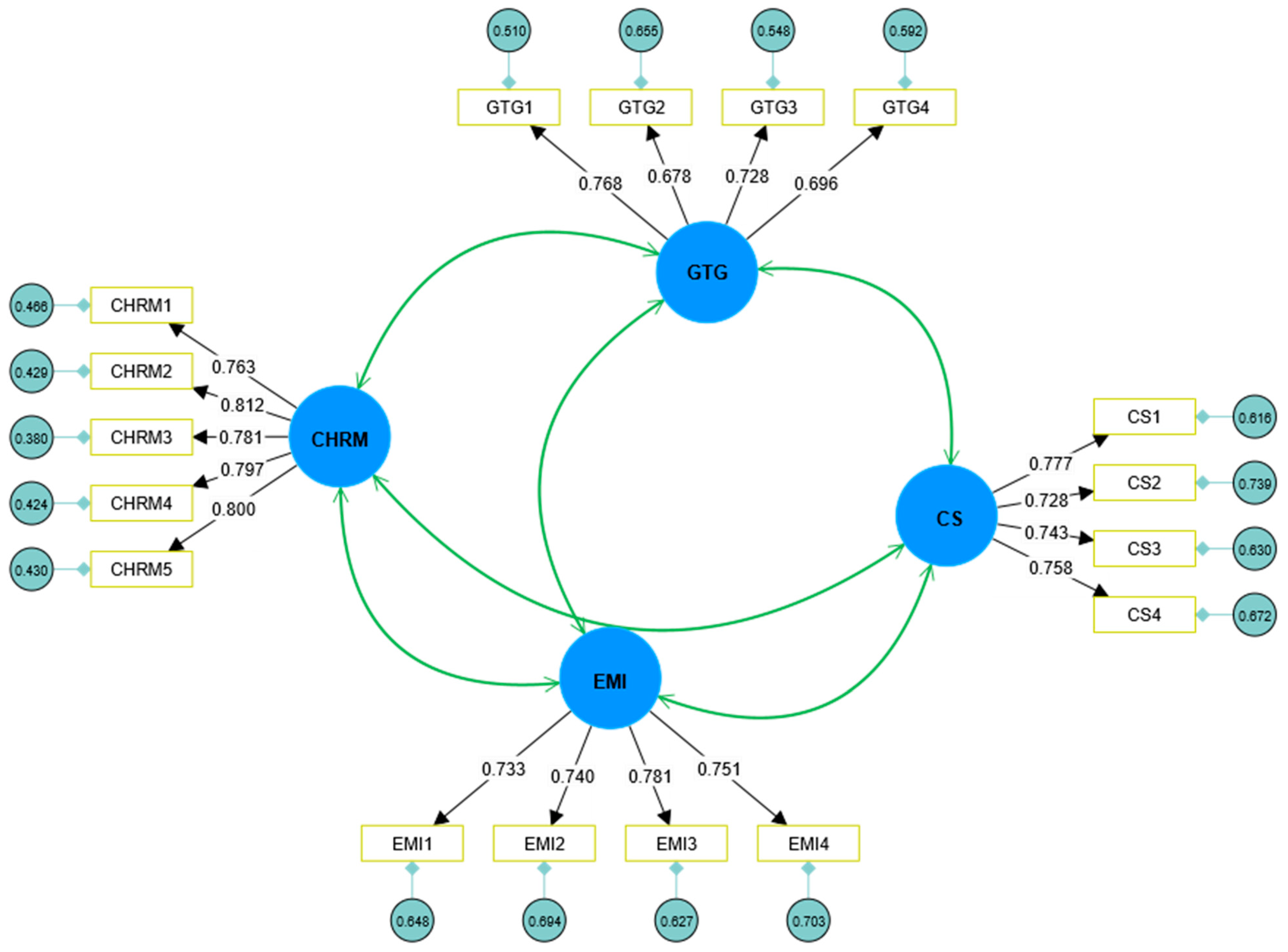
4.1. Confirmatory Factor Analysis (CFA)
4.2. Direct and Indirect Hypothesis Testing Results
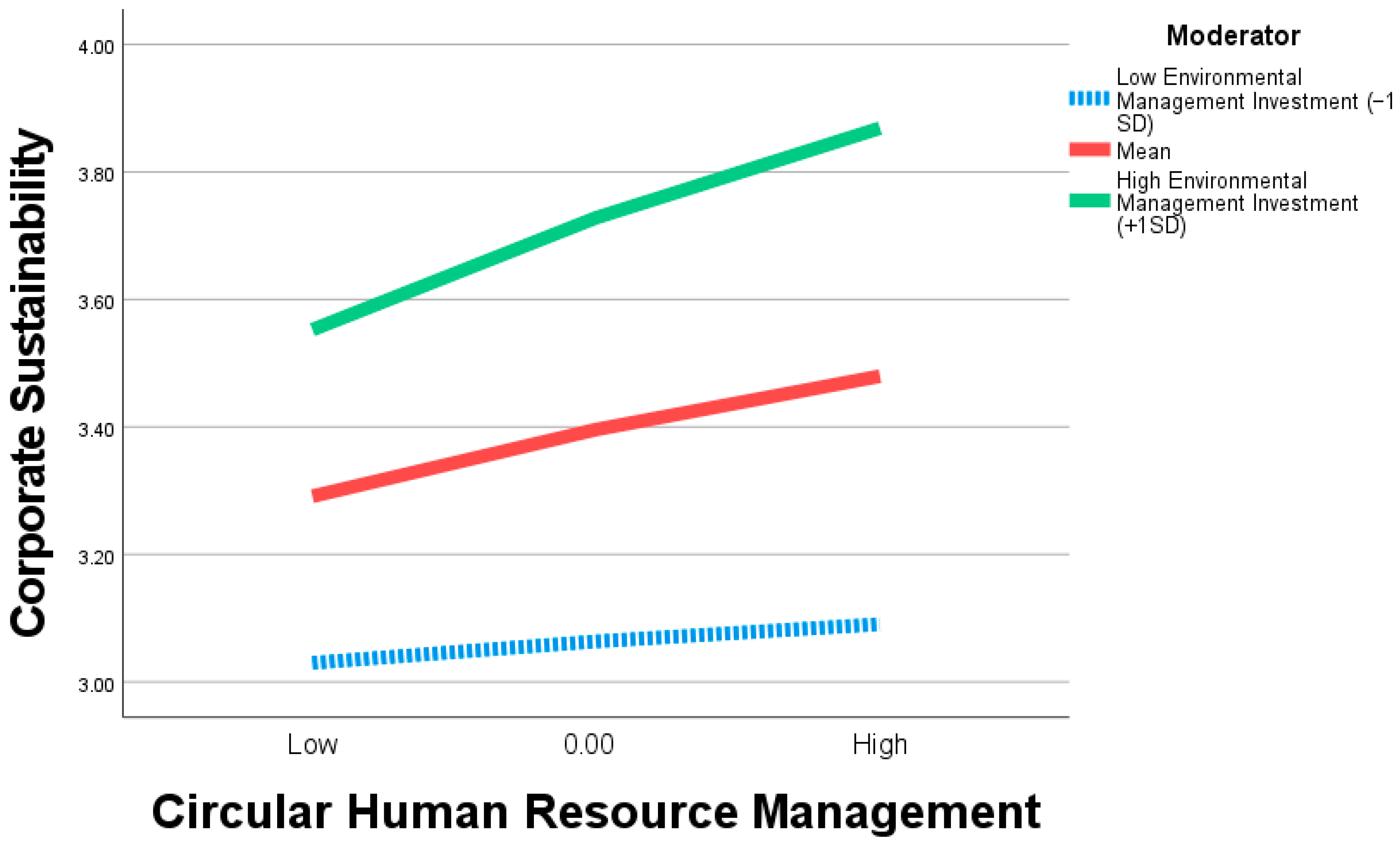
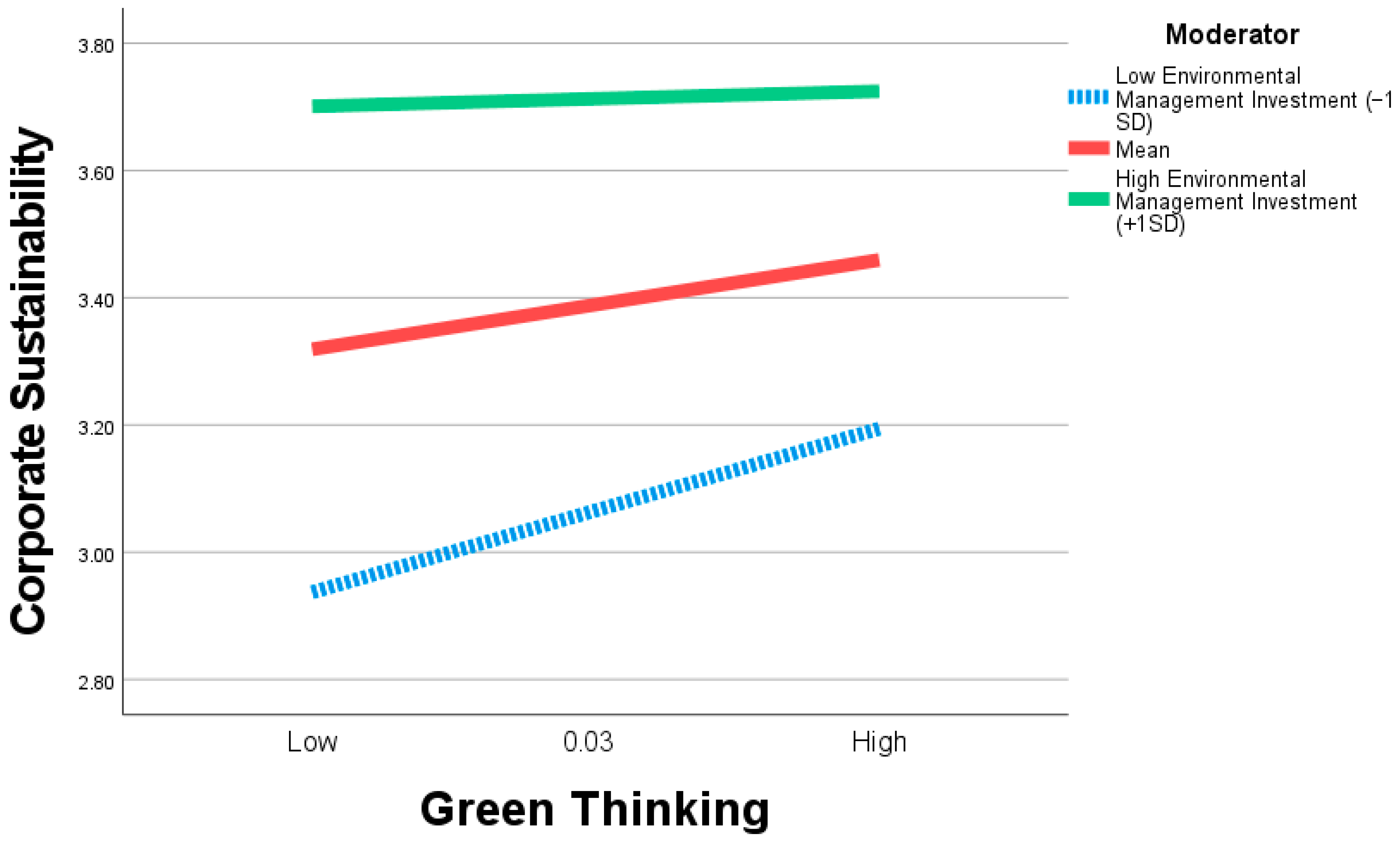
4.3. Moderation Analysis
5. Discussions and Implications
5.1. Discussion of Findings
5.2. Theoretical Implications
5.3. Practical Implications
5.4. Limitations and Future Research Directions
Author Contributions
Funding
Institutional Review Board Statement
Informed Consent Statement
Data Availability Statement
Conflicts of Interest
Appendix A. Measurement Items

| Construct | Code | Measurement Items | Source |
|---|---|---|---|
| Circular Human Resource Management (CHRM) | CHRM1 | When hiring, we ensure that future employees are aligned with circular economy (CE) values. | Del Giudice et al. [4]; Jabbour et al. [5]. |
| CHRM2 | We offer CE-related training to improve employees’ skills and knowledge. | ||
| CHRM3 | Employees receive recognition or rewards for proactive management of CE issues. | ||
| CHRM4 | Employees are actively involved in implementing CE practices within the company. | ||
| CHRM5 | We encourage different work teams to discuss how to develop CE management practices. | ||
| Green Thinking (GTG) | GTG1 | Our firm demonstrates concern for environmental issues. | Begum et al. [23]. |
| GTG2 | Environmental conditions influence our firm’s considerations of quality of life. | ||
| GTG3 | Our firm is eager to learn how to protect and preserve the environment. | ||
| GTG4 | Our firm routinely develops green ideas, solutions, and strategies for environmental welfare. | ||
| Environmental Management Investment (EMI) | EMI1 | Our company has invested resources in recycling materials over the past three years. | Pagell et al. [84]. |
| EMI2 | Our company has invested in employee training related to pollution prevention. | ||
| EMI3 | Our company has invested in workplace health and safety programs. | ||
| EMI4 | Our company has invested in waste reduction initiatives. | ||
| Corporate Sustainability (CS) | CS1 | Our firm reduces hazardous waste and emissions to comply with environmental regulations. | El-Kassar & Singh [45]; Li et al. [85]; Mousa & Othman [86]. |
| CS2 | Our firm minimizes the consumption of resources such as energy, water, electricity, gas, and fuel. | ||
| CS3 | Our firm achieves profit growth due to reductions in energy consumption and material usage. | ||
| CS4 | Our firm is committed to ethical conduct and service quality to meet public and governmental expectations. |
References
- Rihal, J.; Alzubi, A.; Aljuhmani, H.Y.; Berberoğlu, A. From Ethics to Ecology: How Ethical Leadership Drives Environmental Performance through Green Organizational Identity and Culture. PLoS ONE 2025, 20, e0336608. [Google Scholar] [CrossRef] [Scilit]
- Amui, L.B.L.; Jabbour, C.J.C.; de Sousa Jabbour, A.B.L.; Kannan, D. Sustainability as a Dynamic Organizational Capability: A Systematic Review and a Future Agenda toward a Sustainable Transition. J. Clean. Prod. 2017, 142, 308–322. [Google Scholar] [CrossRef] [Scilit]
- Uzorka, A.; Akiyode, O.; Isa, S.M. Strategies for Engaging Students in Sustainability Initiatives and Fostering a Sense of Ownership and Responsibility towards Sustainable Development. Discov. Sustain. 2024, 5, 320. [Google Scholar] [CrossRef] [Scilit]
- Del Giudice, M.; Chierici, R.; Mazzucchelli, A.; Fiano, F. Knowledge Management and Logistics Performance in Digitalized Firms. Int. J. Logist. Manag. 2021, 32, 337–356. [Google Scholar]
- Jabbour, C.J.C. Circular Economy Practices and Environmental Management. J. Environ. Manag. 2020, 264, 110416. [Google Scholar]
- Zihan, W.; Makhbul, Z.K.M.; Alam, S.S. Green Human Resource Management in Practice: Assessing the Impact of Readiness and Corporate Social Responsibility on Organizational Change. Sustainability 2024, 16, 1153. [Google Scholar] [CrossRef] [Scilit]
- Tiwari, P. The Impact of Green Human Resource Management Practices on the Environmental Performance of Organisations. J. Knowl. Econ. 2025, 17, 400–427. [Google Scholar] [CrossRef] [Scilit]
- Obeidat, S.M.; Abdalla, S.; Al Bakri, A.A.K. Integrating Green Human Resource Management and Circular Economy to Enhance Sustainable Performance: An Empirical Study from the Qatari Service Sector. Empl. Relat. Int. J. 2022, 45, 535–563. [Google Scholar] [CrossRef] [Scilit]
- Castro-Lopez, A.; Entrialgo, M.; Liao, C.T.; Santos-Vijande, M.L. Towards Circular Economy through Innovation: The Role of Entrepreneurial Orientation and Human Resource Management. Int. Entrep. Manag. J. 2024, 21, 36. [Google Scholar] [CrossRef] [Scilit]
- Bui, T.-D.; Tran, T.P.T.; Ha, H.M.; Lim, M.K.; Tseng, M.-L. Sustainable Resource Management towards Circular Supply Chain in Dairy Industry in Vietnam: A Hierarchical Structure and Interdependence Relationships. Int. J. Logist. Res. Appl. 2026, 1–33. [Google Scholar] [CrossRef] [Scilit]
- Subramanian, N.; Suresh, M. The Contribution of Organizational Learning and Green Human Resource Management Practices to the Circular Economy: A Relational Analysis—Part I. Learn. Organ. Int. J. 2022, 29, 428–442. [Google Scholar] [CrossRef] [Scilit]
- Ly, B. Beyond Conventional HRM: Catalyzing Circular Economy Performance with Green Practices and Inclusive Leadership. Asia Pac. Manag. Rev. 2025, 30, 100373. [Google Scholar] [CrossRef] [Scilit]
- Chams, N.; García-Blandón, J. On the Importance of Sustainable Human Resource Management for the Adoption of Sustainable Development Goals. Resour. Conserv. Recycl. 2019, 141, 109–122. [Google Scholar] [CrossRef] [Scilit]
- Crossley, R.M.; Elmagrhi, M.H.; Ntim, C.G. Sustainability and Legitimacy Theory: The Case of Sustainable Social and Environmental Practices of Small and Medium-Sized Enterprises. Bus. Strategy Environ. 2021, 30, 3740–3762. [Google Scholar] [CrossRef] [Scilit]
- Mauro, T.G.; Borges-Andrade, J.E. Human Resource System as Innovation for Organisations. Innov. Manag. Rev. 2020, 17, 197–214. [Google Scholar] [CrossRef] [Scilit]
- Aboalhool, T.; Alzubi, A.; Iyiola, K. Humane Entrepreneurship in the Circular Economy: The Role of Green Market Orientation and Green Technology Turbulence for Sustainable Corporate Performance. Sustainability 2024, 16, 2517. [Google Scholar] [CrossRef] [Scilit]
- Singh, R.; Joshi, A.; Dissanayake, H.; Iddagoda, A.; Khan, S.; Félix, M.J.; Santos, G. Integrating Industry 4.0, Circular Economy, and Green HRM: A Framework for Sustainable Transformation. Sustainability 2025, 17, 3082. [Google Scholar] [CrossRef] [Scilit]
- Mert, G.; Akkaya, B.; Palazzo, M. Entrepreneurial Ecosystems and Sustainable Innovation. Int. Entrep. Manag. J. 2025, 21, 68. [Google Scholar] [CrossRef] [Scilit]
- Akhavan, P.; Philsoophian, M. Human Resource Management Theory and the Circular Economy: Digital Technologies and Improvisation. Manag. Decis. 2025. Epub ahead of printing. [Google Scholar] [CrossRef] [Scilit]
- Hadi, N.U.; Imran Khan, M. Factors Influencing Circular Economy Business Model Adoption: Evidence from NCA and PLS-SEM. J. Open Innov. Technol. Mark. Complex. 2026, 12, 100697. [Google Scholar] [CrossRef] [Scilit]
- Baquero, A. Unveiling the Path to Green Innovation: The Interplay of Green Learning Orientation, Knowledge Management Capability and Manufacturing Firm’s Capability to Orchestrate Resources. J. Bus. Ind. Mark. 2024, 39, 2205–2221. [Google Scholar] [CrossRef] [Scilit]
- Boakye, D.J.; Tingbani, I.; Ahinful, G.S.; Nsor-Ambala, R. The Relationship between Environmental Management Performance and Financial Performance of Firms Listed in the Alternative Investment Market (AIM) in the UK. J. Clean. Prod. 2021, 278, 124034. [Google Scholar] [CrossRef] [Scilit]
- Begum, H.; Abbas, K.; Alam, A.F. Strategic Foresight and Future Readiness in Business Environments. Foresight 2022, 24, 456–475. [Google Scholar] [CrossRef] [Scilit]
- Li, W.; Li, W.; Seppänen, V.; Koivumäki, T. Effects of Greenwashing on Financial Performance: Moderation through Local Environmental Regulation and Media Coverage. Bus. Strategy Environ. 2023, 32, 820–841. [Google Scholar] [CrossRef] [Scilit]
- Hart, S.L.; Dowell, G. A Natural-Resource-Based View of the Firm: Fifteen Years After. J. Manag. 2011, 37, 1464–1479. [Google Scholar]
- Mamash, A.; Iyiola, K.; Aljuhmani, H.Y. The Role of Circular Economy Entrepreneurship, Cleaner Production, and Green Government Subsidy for Achieving Sustainability Goals in Business Performance. Sustainability 2025, 17, 3990. [Google Scholar] [CrossRef] [Scilit]
- Albannai, N.; Alzubi, A.B.; Aljuhmani, H.Y. How Environmental Management Systems Enable Sustainability Transition: The Roles of Green Transition and Policy Support in Driving Circular Product Innovation. Sustainability 2026, 18, 2060. [Google Scholar] [CrossRef] [Scilit]
- Emeagwali, O.L.; Aljuhamni, H.Y. Introductory Chapter: Strategic Management—A Dynamic Approach. In Strategic Management—A Dynamic View; IntechOpen: London, UK, 2019. [Google Scholar]
- Arsawan, I.W.E.; Kartikasari, A.; Suhartanto, D.; Choirisa, S.F. Transitioning Towards Circular Economy Practices: The Role of Organizational Capabilities and Environmental Dynamism—Evidence From Indonesia. Bus. Strategy Environ. 2026, 35, 18–35. [Google Scholar] [CrossRef] [Scilit]
- Donghui, Z.; Yusoff, W.S.; Salleh, M.F.M.; Lin, N.S.; Jamil, A.H.; Abd Rani, M.J.; Shaari, M.S. The Impact of ESG and the Institutional Environment on Investment Efficiency in China through the Mediators of Agency Costs and Financial Constraints. Soc. Sci. Humanit. Open 2025, 11, 101323. [Google Scholar] [CrossRef] [Scilit]
- Kiefer, C.P.; Carrillo-Hermosilla, J.; del Río, P. How Does Corporate Environmental Culture Enable the Eco-Innovation Transition of Firms towards the Circular Economy? Corp. Soc. Responsib. Environ. Manag. 2024, 31, 5911–5937. [Google Scholar] [CrossRef] [Scilit]
- Hart, S.L. Innovation, Creative Destruction and Sustainability. Res. Technol. Manag. 2005, 48, 21–27. [Google Scholar] [CrossRef] [Scilit]
- Hart, S.L. A Natural-Resource-Based View of the Firm. Acad. Manag. Rev. 1995, 20, 986–1014. [Google Scholar] [CrossRef] [Scilit]
- Doh, J.; Rodrigues, S.; Saka-Helmhout, A.; Makhija, M. International Business Responses to Institutional Voids. J. Int. Bus. Stud. 2017, 48, 293–307. [Google Scholar] [CrossRef] [Scilit]
- Ma, J.; Lin, C.-Y.; Altantsetseg, P.; Moslehpour, M. Optimizing Sustainable Performance through Green Entrepreneurial Orientation, Market Orientation, Green Supply Chain Management Practices, Environmental Dynamism, and Resource Capabilities: Evidence from Technological Firms. Int. Entrep. Manag. J. 2025, 21, 99. [Google Scholar] [CrossRef] [Scilit]
- Ali, F.; Ashfaq, M.; Begum, S.; Ali, A. How “Green” Thinking and Altruism Translate into Purchasing Intentions for Electronics Products: The Intrinsic-Extrinsic Motivation Mechanism. Sustain. Prod. Consum. 2020, 24, 281–291. [Google Scholar] [CrossRef] [Scilit]
- Alsafadi, Y.; Aljuhmani, H.Y. The Influence of Entrepreneurial Innovations in Building Competitive Advantage: The Mediating Role of Entrepreneurial Thinking. Kybernetes 2023, 53, 4051–4073. [Google Scholar] [CrossRef] [Scilit]
- Begum, S.; Ashfaq, M.; Xia, E.; Awan, U. Does Green Transformational Leadership Lead to Green Innovation? The Role of Green Thinking and Creative Process Engagement. Bus. Strategy Environ. 2022, 31, 580–597. [Google Scholar] [CrossRef] [Scilit]
- Sharma, S.; Albishri, N.; Zafar, H.; Singhal, A.B.; Singh, G. Shades of Green and Transformational Leadership: Predicting Employees’ Green Creativity and Green Work Engagement at Work. Acta Psychol. 2025, 259, 105393. [Google Scholar] [CrossRef] [Scilit]
- Nath, P.; Ramanathan, R. Environmental Management Practices, Environmental Technology Portfolio, and Environmental Commitment: A Content Analytic Approach for UK Manufacturing Firms. Int. J. Prod. Econ. 2016, 171, 427–437. [Google Scholar] [CrossRef] [Scilit]
- Durrani, N.; Raziq, A.; Mahmood, T.; Khan, M.R. Barriers to Adaptation of Environmental Sustainability in SMEs: A Qualitative Study. PLoS ONE 2024, 19, e0298580. [Google Scholar] [CrossRef] [Scilit]
- Oduro, S.; Haylemariam, L.G. Effect of Social and Environmental Sustainability on SME Competitiveness: A Meta-Analytic Review. Manag. Rev. Q 2025. [Google Scholar] [CrossRef] [Scilit]
- Begum, S.; Ashfaq, M.; Luu, T.T.; Wang, D. Does Green Training Foster Green Service Innovation? The Influence of Organizational Learning Capability and Human Capital. Int. J. Hosp. Manag. 2025, 130, 104266. [Google Scholar] [CrossRef] [Scilit]
- Madrid-Guijarro, A.; Duréndez, A. Sustainable Development Barriers and Pressures in SMEs: The Mediating Effect of Management Commitment to Environmental Practices. Bus. Strategy Environ. 2024, 33, 949–967. [Google Scholar] [CrossRef] [Scilit]
- El-Kassar, A.N.; Singh, S.K. Green Innovation and Organizational Performance: The Role of Human Capital. Technol. Forecast. Soc. Change 2019, 144, 483–498. [Google Scholar] [CrossRef] [Scilit]
- Arranz, C.F.A.; Kwong, C.; Sena, V. The Effect of Consumption and Production Policies on Circular Economy Business Models: A Machine Learning Approach. J. Ind. Ecol. 2023, 27, 1089–1104. [Google Scholar] [CrossRef] [Scilit]
- Osei, V.; Bai, C.; Asante-Darko, D.; Kwarteng, A. Competitive Strategy and Circular Economy Practice Implementation toward Corporate Sustainability Performance. Bus. Strategy Environ. 2024, 33, 5284–5302. [Google Scholar] [CrossRef] [Scilit]
- Xie, T.; Yu, G. The Impact of Intelligent Investment on Corporate Green Innovation: Moderating Effects of Executive Green Perception and Environmental Regulation. Financ. Res. Lett. 2024, 69, 106089. [Google Scholar] [CrossRef] [Scilit]
- Legese, M.A.; Zhou, S.; Tiruneh, W.A.; Ying, H. How Green HRM Enhances Sustainable Organizational Performance: A Capability-Building Explanation Through Green Innovation and Organizational Culture. Sustainability 2026, 18, 764. [Google Scholar] [CrossRef] [Scilit]
- Jamil, K.; Zhang, W.; Anwar, A.; Mustafa, S. Driving SME Sustainability via the Influence of Green Capital, HRM, and Leadership. Sustainability 2025, 17, 6076. [Google Scholar] [CrossRef] [Scilit]
- Ragazou, K.; Garefalakis, A.; Papademetriou, C.; Samara, A. (Eds.) Sustainability Through Green HRM and Performance Integration; IGI Global Scientific Publishing: Hershey, PA, USA, 2025. [Google Scholar]
- Khan, M.; Majid, A.; Ahmed, A. Circular Economy Practices in Manufacturing SMEs: A Perspective of Environmental Management in Developing Countries. Sustain. Futures 2025, 9, 100418. [Google Scholar] [CrossRef] [Scilit]
- Sohu, J.M.; Makhdoom, Q.; Qureshi, W.A.; Junejo, I.; Khan, A.U. SMEs’ Response to Green Intellectual Capital and Environmental Regulations: A Pathway to Competitive Advantage Using a Hybrid Approach of SEM-fsQCA. J. Intellect. Cap. 2025. Epub ahead of printing. [Google Scholar] [CrossRef] [Scilit]
- Masudin, I.; Mudrifah, M.; Zulfikarijah, F. Circular Economy as a Catalyst: Exploring the Impact of Green Training and High-Performance Work Systems (HPWS) on Sustainable Performance. Circ. Econ. Sust. 2026, 6, 1. [Google Scholar] [CrossRef] [Scilit]
- Singh, R.; Joshi, A.; Raghuveer, K.; Kumar, V. Evaluating HRM Practices for Embracing the Digital Circular Economy in Indian Manufacturing Firms: An Analytical Study. Strategy Leadersh. 2025, 53, 49–72. [Google Scholar] [CrossRef] [Scilit]
- Purgał-Popiela, J. Sustainability in Human Resource Management Practices Used by Small and Medium-Sized Enterprises: A Systematic Review. Cent. Eur. Manag. J. 2024, 33, 87–106. [Google Scholar] [CrossRef] [Scilit]
- Sikander, A. Innovative Approaches to Workforce Training for a Circular Economy. Green Environ. Technol. 2024, 1, 47–57. [Google Scholar]
- Forenten, E.S.; Mensah, P.O.; Yong, J.Y.; Mensah, H.K. Green Minds, Green Outcomes: Green Intellectual Capital Drives Environmental Performance via Creativity, Moderated by Leadership and Regulations in Ghana. Bus. Strat. Env. 2026. Epub ahead of printing. [Google Scholar] [CrossRef] [Scilit]
- Chadha, A.; Gupta, A.; Tewari, V.; Dwivedi, Y.K. Sustainable Practices: Organisational Citizenship Behaviour and Psychological Contract Fulfilment. Manag. Decis. 2024, 63, 1674–1702. [Google Scholar] [CrossRef] [Scilit]
- da Silva, S.B.G.; Barros, M.V.; Radicchi, J.Â.Z.; Puglieri, F.N.; Piekarski, C.M. Opportunities and Challenges to Increase Circularity in the Product’s Use Phase. Sustain. Futures 2024, 8, 100297. [Google Scholar] [CrossRef] [Scilit]
- Enbaia, E.; Alzubi, A.; Iyiola, K.; Aljuhmani, H. The Interplay Between Environmental Ethics and Sustainable Performance: Does Organizational Green Culture and Green Innovation Really Matter? Sustainability 2024, 16, 10230. [Google Scholar] [CrossRef] [Scilit]
- Matoh, S.; Russell, S.V.; Roelich, K.; Randles, S. Circular Business Model Innovation and Cognitive Framing: Addressing the “Missing Micro”. Bus. Strategy Environ. 2024, 33, 8656–8667. [Google Scholar] [CrossRef] [Scilit]
- Ahmad, F.; Bask, A.; Laari, S.; Robinson, C.V. Business Management Perspectives on the Circular Economy: Present State and Future Directions. Technol. Forecast. Soc. Change 2023, 187, 122182. [Google Scholar] [CrossRef] [Scilit]
- Ahmadov, T.; Foli, S.; Durst, S.; Gerstlberger, W. The Transition to a Circular Economy: Different Paths for International and Non-International Micro-Manufacturing Firms. Discov. Sustain. 2024, 5, 178. [Google Scholar] [CrossRef] [Scilit]
- Tran, N.K.H. An Empirical Investigation on the Impact of Green Human Resources Management and Green Leadership on Green Work Engagement. Heliyon 2023, 9, e21018. [Google Scholar] [CrossRef] [Scilit]
- Freihat, L.; Al-Qaaida, M.; Huneiti, Z.; Abbod, M. Green Human Resource Management/Supply Chain Management/Regulation and Legislation and Their Effects on Sustainable Development Goals in Jordan. Sustainability 2024, 16, 2769. [Google Scholar] [CrossRef] [Scilit]
- Niu, J.; Qiang, M.; Chen, M. Can the Management’s Green Cognition Promote the Enterprise’s Green Transformation? Based on the Perspective of Carbon Emissions. Int. Rev. Econ. Financ. 2025, 102, 104290. [Google Scholar] [CrossRef] [Scilit]
- Dilip, B. Greening the Workplace: Exploring the Dynamics of Environmental Knowledge, Individual Green Values, Supervisory Support, and Green Behavior in IT Organizations. Sage Open 2025, 15, 21582440251357383. [Google Scholar] [CrossRef] [Scilit]
- Dahinine, B.; Laghouag, A.; Bensahel, W.; Alsolami, M.; Guendouz, T. Modelling the Combined Effect of Green Leadership and Human Resource Management in Moving to Green Supply Chain Performance Enhancement in Saudi Arabia. Sustainability 2024, 16, 3953. [Google Scholar] [CrossRef] [Scilit]
- Neiroukh, S.; Emeagwali, O.L.; Aljuhmani, H.Y. Artificial Intelligence Capability and Organizational Performance: Unraveling the Mediating Mechanisms of Decision-Making Processes. Manag. Decis. 2025, 63, 3501–3532. [Google Scholar] [CrossRef] [Scilit]
- Ashergawi, M.; Aljuhmani, H.Y.; Alzubi, A.B. Empowering Green Innovation Through Artificial Intelligence: The Strategic Role of Organizational Agility and Technological Readiness in the Turkish Construction Sector. Eng. Manag. J. 2026, 1–21. [Google Scholar] [CrossRef] [Scilit]
- Durman, S.; Iyiola, K.; Alzubi, A.B.; Aljuhmani, H.Y. Dynamic Capabilities in Action: Digital Capability, Business Model Innovation and Absorptive Capacity. Manag. Decis. 2025. Epub ahead of printing. [Google Scholar] [CrossRef] [Scilit]
- ISO 14001; Environmental Management Systems-Requirements with Guidance for Use. ISO: Geneva, Switzerland, 2015.
- Agan, Y.; Acar, M.F.; Borodin, A. Drivers of Environmental Processes and Their Impact on Performance: A Study of Turkish SMEs. J. Clean. Prod. 2013, 51, 23–33. [Google Scholar] [CrossRef] [Scilit]
- Ozgul, B. Does Green Transformational Leadership Develop Green Absorptive Capacity? The Role of Internal and External Environmental Orientation. Systems 2022, 10, 224. [Google Scholar] [CrossRef] [Scilit]
- Aksoy, M.; Yilmaz, M.K.; Tatoglu, E.; Basar, M. Antecedents of Corporate Sustainability Performance in Turkey: The Effects of Ownership Structure and Board Attributes on Non-Financial Companies. J. Clean. Prod. 2020, 276, 124284. [Google Scholar] [CrossRef] [Scilit]
- Demirel, B.; Erdogan, M. Corporate Sustainability Reporting in the BIST Sustainability Index. Int. J. Bus. Soc. Res. 2016, 6, 21–31. [Google Scholar] [CrossRef] [Scilit]
- Elfghi, O.; Iyiola, K.; Alzubi, A.B.; Aljuhmani, H.Y. Improvisation and New Venture Performance: Unpacking the Roles of Entrepreneurial Self-Efficacy and Learning Orientation. Sustainability 2026, 18, 975. [Google Scholar] [CrossRef] [Scilit]
- Ma, Y.; Zhang, Q.; Yin, H. Environmental Management and Labor Productivity: The Moderating Role of Quality Management. J. Environ. Manag. 2020, 255, 109795. [Google Scholar] [CrossRef] [Scilit] [PubMed]
- Kumar, N.; Stern, L.W.; Anderson, J.C. Conducting Interorganizational Research Using Key Informants. Acad. Manag. J. 1993, 36, 1633–1651. [Google Scholar] [CrossRef] [Scilit]
- Podsakoff, P.M.; MacKenzie, S.B.; Lee, J.-Y.; Podsakoff, N.P. Common Method Biases in Behavioral Research: A Critical Review of the Literature and Recommended Remedies. J. Appl. Psychol. 2003, 88, 879–903. [Google Scholar] [CrossRef] [Scilit] [PubMed]
- Rajhi, M.; Aljuhmani, H.Y. Fostering Sustainable Innovation Through Communication Quality: The Sequential Role of Trust in Leadership and Organizational Commitment in Team-Based Enterprises. Sustainability 2026, 18, 554. [Google Scholar] [CrossRef] [Scilit]
- Cole, D.A.; Maxwell, S.E. Testing Mediational Models With Longitudinal Data: Questions and Tips in the Use of Structural Equation Modeling. J. Abnorm. Psychol. 2003, 112, 558–577. [Google Scholar] [CrossRef] [Scilit] [PubMed]
- Pagell, M.; Krumwiede, D.W.; Sheu, C. Efficacy of Environmental and Supplier Relationship Investments—Moderating Effects of External Environment. Int. J. Prod. Res. 2007, 45, 2005–2028. [Google Scholar] [CrossRef] [Scilit]
- Li, Y.; Ding, R.; Cui, L.; Lei, Z.; Mou, J. The Impact of Sharing Economy Practices on Sustainability Performance in the Chinese Construction Industry. Resour. Conserv. Recycl. 2019, 150, 104409. [Google Scholar] [CrossRef] [Scilit]
- Mousa, S.K.; Othman, M. The Impact of Green Human Resource Management Practices on Sustainable Performance in Healthcare Organisations: A Conceptual Framework. J. Clean. Prod. 2020, 243, 118595. [Google Scholar] [CrossRef] [Scilit]
- Armstrong, J.S.; Overton, T.S. Estimating Nonresponse Bias in Mail Surveys. J. Mark. Res. 1977, 14, 396–402. [Google Scholar] [CrossRef] [Scilit]
- Aljuhmani, H.Y.; Emeagwali, O.L.; Ababneh, B. The Relationships between CEOs’ Psychological Attributes, Top Management Team Behavioral Integration and Firm Performance. Int. J. Organ. Theory Behav. 2021, 24, 126–145. [Google Scholar] [CrossRef] [Scilit]
- Afthanorhan, A.; Awang, Z.; Majid, N.A.; Foziah, H.; Ismail, I.; Halbusi, H.A.; Tehseen, S. Gain More Insight from Common Latent Factor in Structural Equation Modeling. J. Phys. Conf. Ser. 2021, 1793, 012030. [Google Scholar] [CrossRef] [Scilit]
- Farnana, K.; Alzubi, A.B.; Aljuhmani, H.Y.; Khadem, A. Fostering a Green Workplace: How Responsible Leadership Inspires Voluntary Green Behavior through Perceived Insider Status and Green Work Climate. Kybernetes 2026. Epub ahead of printing. [Google Scholar] [CrossRef] [Scilit]
- Collier, J. Applied Structural Equation Modeling Using AMOS: Basic to Advanced Techniques, 1st ed.; Routledge: New York, NY, USA, 2020. [Google Scholar]
- Gaskin, J.E.; Lowry, P.B.; Rosengren, W.; Fife, P.T. Essential Validation Criteria for Rigorous Covariance-Based Structural Equation Modelling. Inf. Syst. J. 2025, 35, 1630–1661. [Google Scholar] [CrossRef] [Scilit]
- Hayes, A.F. Introduction to Mediation, Moderation, and Conditional Process Analysis, 2nd ed.; A Regression-Based Approach; The Guilford Press: New York, NY, USA, 2017. [Google Scholar]
- Hayes, A.F.; Rockwood, N.J. Regression-Based Statistical Mediation and Moderation Analysis in Clinical Research: Observations, Recommendations, and Implementation. Behav. Res. Ther. 2017, 98, 39–57. [Google Scholar] [CrossRef] [Scilit]
- Swieai, W.; Alzubi, A.B.; Aljuhmani, H.Y.; Topal, H. Unpacking the Role of Proactive Personality in Enhancing Safety Behavior: A Moderated Mediation Model in Turkish Healthcare Organizations. J. Health Organ. Manag. 2025. Epub ahead of printing. [Google Scholar] [CrossRef] [Scilit]
- Hu, L.; Bentler, P.M. Cutoff Criteria for Fit Indexes in Covariance Structure Analysis: Conventional Criteria versus New Alternatives. Struct. Equ. Model. A Multidiscip. J. 1999, 6, 1–55. [Google Scholar] [CrossRef] [Scilit]
- Hair, J.F.; Black, W.C.; Babin, B.J.; Anderson, R.E. Multivariate Data Analysis, 7th ed.; Pearson: Upper Saddle River, NJ, USA, 2009. [Google Scholar]
- Byrne, B.M. Structural Equation Modeling with AMOS: Basic Concepts, Applications, and Programming, 3rd ed.; Routledge: New York, NY, USA, 2016. [Google Scholar]
- Nunnally, J.C. Psychometric Theory, 2nd ed.; McGraw-Hill Companies: New York, NY, USA, 1978. [Google Scholar]
- Fornell, C.; Larcker, D.F. Evaluating Structural Equation Models with Unobservable Variables and Measurement Error. J. Mark. Res. 1981, 18, 39–50. [Google Scholar] [CrossRef] [Scilit]
- Aljuhmani, H.Y.; Emeagwali, O.L.; Ababneh, B. Revisiting the Miles and Snow Typology of Organizational Strategy: Uncovering Interrelationships between Strategic Decision-Making and Public Organizational Performance. Int. Rev. Public Adm. 2021, 26, 209–229. [Google Scholar] [CrossRef] [Scilit]
- Awwad, R.I.; Aljuhmani, H.Y.; Hamdan, S. Examining the Relationships Between Frontline Bank Employees’ Job Demands and Job Satisfaction: A Mediated Moderation Model. Sage Open 2022, 12, 21582440221079880. [Google Scholar] [CrossRef] [Scilit]
- Subramanian, N.; Suresh, M. The Contribution of Organizational Learning and Green Human Resource Management Practices to the Circular Economy: A Relational Analysis—Evidence from Manufacturing SMEs (Part II). Learn. Organ. Int. J. 2022, 29, 443–462. [Google Scholar] [CrossRef] [Scilit]
- Tetteh, F.K.; Kwateng, K.O.; Tukue, T.; Mensah, J. Green Supply Chain Management Practices: Review, Framework and Future Research Directions. J. Responsible Prod. Consum. 2025, 2, 112–150. [Google Scholar] [CrossRef] [Scilit]
- Christina, J.L.; Alamelu, R.; Nigama, K. Synthesizing the Impact of Sustainable Human Resource Management on Corporate Sustainability through Multi Method Evidence. Discov. Sustain. 2025, 6, 666. [Google Scholar] [CrossRef] [Scilit]
- Ali, M.; Shujahat, M.; Fatima, N.; Lopes de Sousa Jabbour, A.B.; Vo-Thanh, T.; Salam, M.A.; Latan, H. Green HRM Practices and Corporate Sustainability Performance. Manag. Decis. 2024, 62, 3681–3703. [Google Scholar] [CrossRef] [Scilit]
- Verma, A.; Sharma, G.; Mahendru, N. Sustainable Human Resource Management and Organizational Performance: A Systematic Literature Review on Green Human Resource Practices and Impact on Corporate Sustainability. Corp. Soc. Responsib. Environ. Manag. 2025. Epub ahead of printing. [Google Scholar] [CrossRef] [Scilit]



| n = 616 | Classification | Frequency | % |
|---|---|---|---|
| Firm size (number of employees) | Less than 50 | 2 | 0.32 |
| 50–150 | 389 | 63.15 | |
| Between 151 and 249 | 225 | 36.53 | |
| Firm age (years) | 3–5 | 9 | 1.46 |
| 6–10 | 96 | 15.58 | |
| 11–15 | 102 | 16.56 | |
| 16–20 | 284 | 46.11 | |
| Above 20 | 125 | 20.29 | |
| Nature of business | Textile and apparel | 148 | 24.03 |
| Food processing/beverages | 122 | 19.81 | |
| Electrical/electronics assembly | 28 | 4.55 | |
| Wood, paper and printing | 42 | 6.82 | |
| Metals and machinery | 33 | 5.36 | |
| Chemicals and plastics | 27 | 4.38 | |
| General construction/building construction | 76 | 12.33 | |
| IT and digital services | 41 | 6.66 | |
| Others | 99 | 16.06 |
| Variables | Codes | SFL | AVE | CR | α |
|---|---|---|---|---|---|
| Circular Human Resource Management (CHRM) | 0.625 | 0.901 | 0.892 | ||
| CHRM1 | 0.763 | ||||
| CHRM2 | 0.812 | ||||
| CHRM3 | 0.781 | ||||
| CHRM4 | 0.797 | ||||
| CHRM5 | 0.800 | ||||
| Green Thinking (GTG) | 0.516 | 0.826 | 0.809 | ||
| GTG1 | 0.768 | ||||
| GTG2 | 0.678 | ||||
| GTG3 | 0.728 | ||||
| GTG4 | 0.696 | ||||
| Environmental Management Investment (EMI) | 0.565 | 0.849 | 0.838 | ||
| EMI1 | 0.733 | ||||
| EMI2 | 0.740 | ||||
| EMI3 | 0.781 | ||||
| EMI4 | 0.751 | ||||
| Corporate Sustainability (CS) | 0.565 | 0.853 | 0.838 | ||
| CS1 | 0.777 | ||||
| CS2 | 0.723 | ||||
| CS3 | 0.743 | ||||
| CS4 | 0.758 | ||||
| Hypothesis | Paths | β | S.E. | T-Values | LL | UL | R2 |
|---|---|---|---|---|---|---|---|
| H1 | CHRM → CS | 0.384 | 0.044 | 12.269 *** | 0.100 | 0.257 | 0.251 |
| H2 | CHRM → GTG | 0.176 | 0.038 | 4.586 *** | 0.100 | 0.251 | |
| H3 | GTG → CS | 0.236 | 0.044 | 5.368 *** | 0.150 | 0.322 | |
| H4 | CHRM → GTG → CS | 0.091 | 0.021 | 0.051 | 0.132 |
| Hypothesized Paths | Effect | S.E. | T-Values | 95% CI | |
|---|---|---|---|---|---|
| LL | UL | ||||
| Model 1: Green Thinking (GTG) | |||||
| Covariate: Firm age → GTG | 0.004 | 0.013 | 0.012 (ns) | −0.106 | 0.039 |
| Covariate: Firm size → GTG | 0.022 | 0.008 | 0.041 (ns) | −0.062 | 0.017 |
| CHRM → GTG | 0.384 | 0.031 | 12.269 *** | 0.322 | 0.445 |
| R2 = 0.109 | |||||
| Model 2: Corporate Sustainability (CS) | |||||
| Covariate: Firm age → CS | −0.011 | 0.057 | 0.186 (ns) | −0.121 | 0.101 |
| Covariate: Firm size → CS | 0.063 | 0.016 | 0.393 (ns) | −0.025 | 0.038 |
| CHRM → CS | 0.097 | 0.036 | 2.649 ** | 0.025 | 0.169 |
| GTG → CS | 0.102 | 0.044 | 2.297 * | 0.015 | 0.189 |
| EMI → CS | 0.435 | 0.045 | 10.227 *** | 0.351 | 0.518 |
| H5: CHRM × EMI → CS | 0.095 | 0.048 | 2.096 * | 0.006 | 0.183 |
| H6: GTG × EMI → CS | 0.104 | 0.051 | 2.002 * | 0.020 | 0.206 |
| R2 = 0.269 | |||||
| The specific conditional values of EMI on the CHRM-CS relationship | |||||
| +1SD (above the mean) | 0.176 | 0.052 | 3.352 ** | 0.073 | 0.279 |
| Mean | 0.105 | 0.037 | 2.843 * | 0.032 | 0.177 |
| −1SD (below the mean) | 0.034 | 0.048 | 0.709 (ns) | −0.060 | 0.127 |
| The specific conditional values of EMI on the indirect effect of CHRM on the CS relationship through GTG | |||||
| +1SD (above the mean) | 0.172 | 0.057 | 2.996 ** | 0.059 | 0.284 |
| Mean | 0.094 | 0.044 | 2.106 * | 0.063 | 0.181 |
| −1SD (below the mean) | 0.016 | 0.061 | 0.260 (ns) | −0.104 | 0.135 |
| Index of moderated mediation by environmental management investment | |||||
| Index | BootSE | BootLLCI | BootULCI | ||
| CHRM → GTG → CS | 0.040 | 0.022 | 0.032 | 0.083 | |
Disclaimer/Publisher’s Note: The statements, opinions and data contained in all publications are solely those of the individual author(s) and contributor(s) and not of MDPI and/or the editor(s). MDPI and/or the editor(s) disclaim responsibility for any injury to people or property resulting from any ideas, methods, instructions or products referred to in the content. |
© 2026 by the authors. Licensee MDPI, Basel, Switzerland. This article is an open access article distributed under the terms and conditions of the Creative Commons Attribution (CC BY) license.
Share and Cite
Alsakkouh, H.; Khadem, A.; Alzubi, A.B. Circular Human Resource Management and Corporate Sustainability: The Conditional Role of Green Thinking and Environmental Management Investment. Sustainability 2026, 18, 2637. https://doi.org/10.3390/su18052637
Alsakkouh H, Khadem A, Alzubi AB. Circular Human Resource Management and Corporate Sustainability: The Conditional Role of Green Thinking and Environmental Management Investment. Sustainability. 2026; 18(5):2637. https://doi.org/10.3390/su18052637
Chicago/Turabian StyleAlsakkouh, Hasan, Amir Khadem, and Ahmad Bassam Alzubi. 2026. "Circular Human Resource Management and Corporate Sustainability: The Conditional Role of Green Thinking and Environmental Management Investment" Sustainability 18, no. 5: 2637. https://doi.org/10.3390/su18052637
APA StyleAlsakkouh, H., Khadem, A., & Alzubi, A. B. (2026). Circular Human Resource Management and Corporate Sustainability: The Conditional Role of Green Thinking and Environmental Management Investment. Sustainability, 18(5), 2637. https://doi.org/10.3390/su18052637