Article

Circular Human Resource Management and Corporate Sustainability: The Conditional Role of Green Thinking and Environmental Management Investment

Department of Business Administration, Institute of Graduate Research and Studies, University of Mediterranean Karpasia, Mersin 33010, Turkey
*
Author to whom correspondence should be addressed.
Sustainability 2026, 18(5), 2637; https://doi.org/10.3390/su18052637
Submission received: 21 January 2026 / Revised: 23 February 2026 / Accepted: 5 March 2026 / Published: 8 March 2026
(This article belongs to the Special Issue Advances in Business Model Innovation and Corporate Sustainability)

Abstract

Despite growing interest in circular economy practices, limited empirical research explains how circular-oriented HR systems translate into measurable sustainability outcomes, particularly within manufacturing SMEs operating under resource constraints. This study investigates whether and under what conditions Circular Human Resource Management (CHRM) contributes to corporate sustainability by examining the mediating role of green thinking and the moderating role of environmental management investment (EMI). Drawing on the Natural Resource-Based View and Institutional Theory, the study addresses the gap between symbolic adoption of circular HR practices and their substantive sustainability impact. Data were collected from 616 senior and middle managers in environmentally exposed manufacturing SMEs in Turkey and analyzed using confirmatory factor analysis and moderated mediation techniques. The findings indicate that CHRM is positively associated with corporate sustainability, both directly and indirectly through green thinking, although the strength of these effects depends on the level of environmental investment. Specifically, sustainability gains are significantly stronger in firms that complement cognitive capabilities with tangible environmental infrastructure. These results suggest that circular HR practices alone are insufficient without supportive organizational investment. The study contributes by clarifying the conditional mechanisms through which employee-centered circular capabilities generate sustainability value and by delineating boundary conditions in SME contexts.

1. Introduction

The intensifying challenges of climate change, environmental degradation, and global resource depletion have compelled organizations to rethink how sustainability is generated and sustained over time [1]. Rather than viewing sustainability as an outcome of isolated environmental initiatives, recent research increasingly frames it as a capability-based process that depends on how organizations mobilize, renew, and align internal resources with long-term environmental objectives [2]. Within this perspective, the circular economy (CE) has gained prominence as a systemic approach aimed at preserving value through regeneration, reuse, and continuous resource cycling [3]. While CE research has traditionally emphasized technological solutions and material flows, emerging scholarship recognizes that circular transitions depend fundamentally on organizational systems—particularly human resource architectures that shape employee capabilities, decision logics, and long-term skill renewal [4,5].
Human resource management has therefore emerged as a critical yet theoretically unsettled domain within circular economy research. Existing studies have largely relied on green human resource management (green HRM) frameworks that emphasize environmental awareness, compliance, and efficiency-oriented behaviors [6,7]. While these approaches explain incremental environmental improvements, they are less capable of explaining how firms regenerate sustainability competencies over time or embed circular logic across the employee lifecycle [8]. Circular Human Resource Management (CHRM) has been proposed as a broader construct that emphasizes regenerative capability development, circular skill renewal, and lifecycle-oriented HR practices supporting continuous learning and redeployment [9,10]. However, the current literature treats CHRM primarily as an extension of green HRM rather than as a qualitatively distinct capability configuration, leaving unclear whether CHRM generates substantively different sustainability outcomes or merely re-labels established green HR practices [11,12].
More critically, prior research often assumes a linear and automatic relationship between sustainability-oriented HR practices and organizational sustainability outcomes. This assumption overlooks two unresolved tensions in the literature. First, sustainability-oriented HR systems may be adopted symbolically to signal legitimacy without fundamentally transforming employee cognition or organizational routines [13,14]. Second, even substantively designed HR systems may fail to translate into performance outcomes when firms lack complementary investments and environmental infrastructure [15]. These tensions suggest that the effectiveness of CHRM is conditional rather than universal.
This challenge is particularly salient in small and medium-sized enterprises (SMEs), which operate under constrained resources, limited environmental infrastructure, and fragmented institutional pressures [16,17]. In such environments, sustainability practices may serve legitimacy-seeking purposes rather than capability-building functions [18]. Yet empirical research has rarely examined the micro-level cognitive mechanisms and organizational boundary conditions that determine whether circular HR practices become embedded capabilities or remain symbolic gestures [19].
Addressing this gap requires attention to both psychological mechanisms and structural enablers. At the micro level, sustainability-oriented HR practices are unlikely to affect performance unless employees internalize environmental principles and cognitively frame decisions through a sustainability-oriented lens. Green thinking—conceptualized as employees’ capacity to interpret trade-offs, prioritize long-term ecological value, and generate environmentally aligned solutions—captures this cognitive translation mechanism more precisely than general environmental awareness or pro-environmental attitudes [20,21]. Existing studies acknowledge the importance of employee attitudes but rarely conceptualize sustainability-oriented cognition as a mediating capability that converts HR systems into operational sustainability outcomes.
At the organizational level, Environmental Management Investment (EMI) reflects the extent to which firms allocate financial and structural resources to environmental systems, technologies, and training [22]. Without such investment, even well-designed HR systems and pro-environmental cognition may remain underutilized. Conversely, investments alone may produce limited impact if employees lack sustainability-oriented cognitive framing [23,24]. This suggests a configurational logic in which internal capabilities and resource commitments must align.
To theorize this conditional alignment, this study integrates the Natural Resource-Based View (NBRV) and Institutional Theory. The NBRV conceptualizes CHRM and green thinking as intangible resources capable of generating environmental advantage when effectively deployed [25]. Institutional Theory explains how regulatory ambiguity, normative pressures, and legitimacy concerns shape whether such capabilities are substantively enacted or symbolically adopted [26]. Rather than treating these theories in parallel, this study positions them as complementary: NBRV explains capability generation, while Institutional Theory explains capability activation and constraint [27,28,29]. Sustainability performance therefore emerges not from isolated practices, but from the alignment between regenerative HR capabilities, employee cognition, environmental investments, and institutional context.
Accordingly, this study examines how CHRM influences corporate sustainability in manufacturing SMEs, focusing on the mediating role of green thinking and the moderating role of environmental management investment. Using data from 616 senior and middle managers in manufacturing SMEs in Istanbul and Izmir, the study empirically tests a moderated mediation model that explains when and how circular HR practices generate substantive sustainability outcomes rather than symbolic compliance.
This study makes three theoretically bounded contributions. First, it reconceptualizes CHRM as a regenerative capability configuration distinct from compliance-oriented green HRM, clarifying its theoretical scope. Second, it advances process understanding by identifying green thinking as a cognitive micro-foundation that mediates the CHRM–sustainability link. Third, it introduces EMI as a boundary condition that conditions the productivity of sustainability-oriented cognition, thereby integrating capability and institutional perspectives in explaining corporate sustainability in SMEs.
The structure of the article unfolds in five parts. After this introduction, the theoretical underpinnings and hypotheses are elaborated. The subsequent section details the research design and measurement approach. Empirical results are then reported, and the paper concludes with a discussion of implications, limitations, and directions for further inquiry.

2. Theoretical Framework and Hypotheses Development

2.1. Natural Resource-Based View and Institutional Theory

The conceptual model developed in this study is grounded in an integrative application of the Natural Resource-Based View (NBRV) and Institutional Theory, which together explain why sustainability-oriented human resource capabilities emerge, how they are enacted, and under what conditions they translate into corporate sustainability outcomes in manufacturing SMEs [30,31,32]. Rather than positioning these perspectives as parallel explanations, this study advances a conditional capability framework in which internal environmental capabilities require institutional activation to generate substantive performance effects.
The NBRV, originally articulated by Hart [33], extends the traditional resource-based view by arguing that long-term competitiveness increasingly depends on the development of environmental capabilities that reduce ecological harm, conserve resources, and enable sustainable innovation. From the NBRV perspective, environmental strategies generate value only when embedded in firm-specific capabilities that are path-dependent, socially complex, and difficult to imitate [25]. Importantly, NBRV assumes that once such capabilities are developed, they can be deployed to create environmental and competitive advantages. However, this assumption may be overly optimistic in contexts characterized by resource scarcity and institutional ambiguity [34,35].
In the present study, CHRM is conceptualized as a regenerative environmental capability that embeds circular economy principles within recruitment, training, rewards, and employee involvement systems. Through these practices, firms cultivate sustainability-oriented competencies that extend beyond compliance and support long-term capability renewal. Green thinking constitutes a complementary cognitive capability, enabling employees to interpret environmental trade-offs, generate sustainability-oriented solutions, and align daily decisions with circular objectives [36,37,38,39]. EMI reflects a tangible resource commitment that provides environmental infrastructure, pollution prevention systems, and sustainability-related investments necessary for capability utilization [40]. Together, these elements form a capability configuration; yet, NBRV alone cannot explain why similar configurations produce heterogeneous sustainability outcomes across firms.
Manufacturing SMEs often operate under financial constraints, limited environmental expertise, and inconsistent regulatory enforcement [1,41,42]. In such contexts, sustainability-oriented HR systems may exist formally but remain underutilized, underfunded, or symbolically implemented. The presence of an environmental capability does not guarantee its activation. This gap between capability possession and capability deployment represents a central limitation of a purely NBRV-based explanation [43].
Institutional Theory addresses this limitation by emphasizing that organizational practices are shaped not only by efficiency considerations but also by legitimacy-seeking behavior within a given institutional environment [44]. Regulatory requirements, normative expectations, and competitive pressures influence whether firms adopt, enact, or merely signal sustainability practices. In emerging economies—where regulatory enforcement may be uneven and normative expectations evolving—firms face ambiguous institutional cues that shape the depth of sustainability implementation [18,45]. Under weak institutional pressure, firms may adopt CHRM symbolically to enhance legitimacy while minimizing substantive investment. Under stronger regulatory or normative pressure, firms are more likely to internalize and operationalize environmental capabilities [27].
Institutional forces also influence the cognitive environment within organizations. External sustainability expectations can legitimize environmental initiatives internally, shaping shared norms and reinforcing green thinking among employees [23]. Thus, institutional pressures do not simply trigger adoption; they shape the intensity, authenticity, and strategic priority of capability deployment.
Integrating the NBRV and Institutional Theory therefore provides explanatory leverage that neither framework offers independently. While NBRV clarifies the nature of sustainability-oriented capabilities, Institutional Theory explains the conditions under which those capabilities are substantively enacted rather than symbolically adopted [31,46,47]. Without NBRV, institutional analysis risks explaining conformity without performance differentiation. Without Institutional Theory, NBRV risks assuming automatic capability deployment, overlooking contextual constraints and decoupling dynamics [48].
This integrative perspective suggests that corporate sustainability in SMEs is a conditional achievement emerging from the alignment of regenerative HR capabilities, employee cognitive orientation, complementary environmental investment, and institutional reinforcement [49,50]. Sustainability outcomes materialize not merely from capability possession, but from capability activation within supportive institutional and resource conditions [51].
Accordingly, this theoretical synthesis underpins the study’s hypothesized relationships by explaining how CHRM functions as an internal environmental capability, how green thinking mediates its translation into performance outcomes, and how environmental management investment strengthens or constrains these relationships within institutional contexts. The framework therefore moves beyond linear capability assumptions and provides a contingent foundation for the direct, mediating, and moderating mechanisms proposed in the research model.

2.2. Circular Human Resource Management and Corporate Sustainability

CHRM represents an evolution of sustainable HRM that embeds circular economy (CE) principles into organizational people-management systems, including recruitment, training, reward structures, and employee participation systems [4,5]. Unlike traditional green HRM—which primarily emphasizes environmental compliance and efficiency—CHRM adopts a regenerative logic focused on continuous skill renewal, circular capability development, and lifecycle-oriented workforce management [12,19]. This shift from compliance-oriented “greening” to regenerative capability formation is the core conceptual distinction that differentiates CHRM from mainstream green HRM approaches.
From a NBRV perspective, CHRM can function as an internal environmental capability by enhancing the firm’s stock of socially complex and path-dependent human capital resources [25]. Employees trained under circular logic are better equipped to identify inefficiencies, reduce waste, and support sustainability-oriented innovation [52]. However, NBRV does not imply that the mere existence of an environmental capability produces performance gains. Rather, the sustainability advantage emerges only when CHRM is enacted consistently, renewed over time, and integrated into operational routines.
This capability–performance translation is especially fragile in SMEs. Financial constraints, managerial overload, and short-term survival pressures may inhibit substantive CHRM implementation [42,44,53]. Institutional Theory highlights the risk of symbolic adoption, whereby firms adopt sustainability-oriented HR systems to signal legitimacy without transforming day-to-day practices [31,54]. In such cases, CHRM may remain formal (policy-level) while being operationally decoupled from sustainability outcomes, particularly under regulatory ambiguity and uneven enforcement conditions common in emerging-economy manufacturing contexts.
Accordingly, the CHRM–corporate sustainability relationship is theoretically plausible but empirically contingent. CHRM should strengthen corporate sustainability only when it is implemented substantively rather than ceremonially and when organizational conditions allow employee capabilities to be deployed rather than merely displayed. Testing this relationship in SME contexts therefore addresses whether CHRM operates as a regenerative capability or merely as a legitimacy mechanism [20,45,55].
H1. 
Circular Human Resource Management has a positive effect on corporate sustainability.

2.3. Circular Human Resource Management and Green Thinking

Green thinking (GTG) refers to employees’ cognitive framing of work-related decisions through a sustainability-oriented lens, shaping how environmental trade-offs are interpreted and resolved [23]. Unlike environmental awareness or pro-environmental attitudes—which capture knowledge or affect—green thinking reflects applied cognitive processing embedded in everyday problem-solving [38,39]. It represents an interpretive capability that guides how employees prioritize resources, evaluate alternatives, and construct solutions under environmental constraints.
Although HR systems influence employee cognition, CHRM does not automatically reshape cognitive schemas. In SMEs, sustainability-oriented HR practices may be implemented superficially due to resource constraints, managerial overload, or competing short-term production priorities [56]. Under such conditions, employees may comply behaviorally without internalizing circular logic cognitively. As a result, formal HR structures may exist without producing substantive shifts in sustainability-oriented thinking.
From the NBRV, green thinking constitutes an intangible cognitive capability that enhances a firm’s ability to recognize environmental opportunities and risks [25]. However, capability development requires repeated reinforcement and alignment across HR subsystems rather than isolated interventions. CHRM fosters this capability through consistent signaling: circular recruitment criteria that attract sustainability-oriented talent, CE-based training that links environmental principles to task execution, participatory mechanisms that legitimize eco-innovation, and reward systems that reinforce sustainability-driven problem-solving [57,58]. Through such systemic alignment, CHRM restructures interpretive frames rather than merely transmitting environmental information.
Institutional Theory further refines this relationship by emphasizing that cognitive transformation occurs only when organizational signals are perceived as legitimate and credible [26]. If sustainability-oriented HR systems lack visible managerial commitment, financial support, or alignment with external environmental expectations, employees may interpret them as symbolic compliance mechanisms [59]. In such cases, CHRM may influence formal routines without altering cognitive schemas. Therefore, the CHRM–green thinking link is contingent upon institutional coherence and perceived authenticity.
Accordingly, CHRM has the theoretical potential to foster green thinking by embedding circular logic into everyday organizational practices. Yet this influence is neither automatic nor uniform; it depends on substantive implementation, systemic reinforcement, and credible institutional signaling. Testing this relationship in SME manufacturing contexts allows examination of whether CHRM operates as a cognitive capability builder rather than a symbolic structural reform.
H2. 
Circular Human Resource Management has a positive effect on green thinking.

2.4. Green Thinking and Corporate Sustainability

Green thinking contributes to corporate sustainability by shaping how employees interpret resource use, waste cycles, and operational trade-offs [23,36]. Rather than influencing sustainability through attitudinal commitment alone, green thinking alters how environmental constraints are cognitively framed within daily task execution. In circular business contexts, sustainability outcomes depend heavily on cumulative micro-level decisions rather than isolated environmental initiatives [26,60]. Employees who cognitively frame processes through circular logic are more likely to identify reuse opportunities, reduce material inefficiencies, and prevent waste accumulation before it becomes structurally embedded.
However, green thinking alone does not guarantee sustainability performance. Employees may recognize environmentally superior solutions but lack discretion, infrastructural support, or managerial alignment to implement them effectively [38,61]. This distinction highlights a critical tension: cognition enables recognition of sustainability opportunities, but realization depends on organizational translation mechanisms [62,63]. Thus, green thinking represents a necessary but insufficient condition for sustainability improvement.
From the NBRV, green thinking constitutes a valuable but latent intangible resource whose performance effects depend on complementary organizational capabilities and supportive resource configurations [25]. Its strategic value materializes only when cognitive insight is converted into coordinated organizational action. Institutional Theory further refines this logic by suggesting that sustainability-oriented cognition becomes consequential when environmental norms are embedded in shared routines, evaluation systems, and collective expectations [45]. Without such institutional reinforcement, cognitive engagement may remain episodic, individualized, or symbolically expressed.
In SME manufacturing contexts, where formal sustainability systems are often limited, the role of employee cognition becomes particularly consequential. When green thinking is substantively embedded and reinforced, it can function as a decentralized driver of sustainability performance; when weakly reinforced, it may generate awareness without measurable organizational impact. This conditional reasoning clarifies why empirical testing of the green thinking–corporate sustainability link is necessary rather than self-evident.
H3. 
Green thinking positively affects corporate sustainability.

2.5. Mediating Role of Green Thinking

Green thinking serves as the cognitive translation mechanism linking CHRM to corporate sustainability. CHRM restructures HR systems around circular logic, but structural alignment alone does not guarantee performance improvement. Sustainability outcomes emerge only when employees internalize and operationalize circular principles in daily decision-making [8,36]. Thus, the mediation logic addresses a fundamental question: how do organizational HR capabilities become behaviorally and strategically consequential?
Unlike related constructs such as environmental awareness or green psychological capital, green thinking reflects applied interpretive capacity rather than affective commitment or motivational readiness [64]. It shapes how employees frame resource constraints, evaluate trade-offs, and select among competing operational alternatives. CHRM influences sustainability by repeatedly exposing employees to circular decision frameworks through recruitment criteria, training programs, performance evaluation systems, and reward structures [19]. Through this repeated and aligned exposure, CHRM restructures interpretive schemas rather than merely transmitting environmental information.
From the NBRV perspective, green thinking represents a tacit and socially complex cognitive capability that activates the latent sustainability potential embedded in CHRM [25,65]. CHRM provides structural inputs, but green thinking determines whether those inputs are recombined into coordinated sustainability-enhancing actions. Institutional Theory complements this explanation by suggesting that repeated and credible HR signals legitimize sustainability-oriented cognition, embedding it within shared organizational norms [8]. Without such cognitive internalization, institutional pressures may produce formal compliance without substantive sustainability performance.
Importantly, this mediation is not assumed to be automatic. Employees may possess environmental knowledge or pro-environmental values yet fail to influence organizational sustainability if they lack the cognitive tools required to integrate circular principles into operational routines. Therefore, green thinking functions as the mechanism that converts structural capability into strategic execution. In SME contexts—where formal sustainability infrastructures are often limited—this cognitive pathway becomes especially decisive.
Accordingly, green thinking is theorized not as a procedural mediator but as a necessary cognitive activation mechanism that explains why and how CHRM contributes to corporate sustainability under circular economy conditions.
H4. 
Green thinking mediates the relationship between Circular Human Resource Management and corporate sustainability.

2.6. Moderating Role of Environmental Management Investment

Environmental Management Investment (EMI) reflects the deliberate allocation of financial, technical, and infrastructural resources toward environmental systems and sustainability-oriented programs, including pollution prevention technologies, waste reduction mechanisms, and environmental training initiatives [66]. While EMI is often treated as a direct driver of sustainability performance, its effectiveness depends on how it interacts with existing organizational capabilities rather than operating independently [67,68].
EMI does not substitute for CHRM; rather, it conditions whether CHRM-driven capabilities can be enacted substantively. Even when employees exhibit strong green thinking fostered through CHRM, their ability to implement sustainability-oriented decisions remains constrained without adequate environmental systems, tools, and managerial backing [69]. Conversely, high levels of EMI without corresponding cognitive alignment may generate compliance-oriented investments with limited integration into everyday routines. Thus, EMI alone cannot guarantee sustainability gains; its influence is contingent upon cognitive and structural alignment.
From the NBRV perspective, sustainability outcomes arise from complementarity between intangible capabilities (such as green thinking) and tangible resource commitments (such as EMI) [25]. CHRM and green thinking create interpretive and behavioral potential, whereas EMI provides the material conditions necessary for scaling and institutionalizing sustainability initiatives. EMI therefore enhances the productivity of cognitive capabilities by converting environmentally oriented ideas into operationally feasible actions. Without such complementarity, both cognitive and financial investments risk underutilization.
Institutional Theory further refines this moderating logic by suggesting that EMI functions as a visible signal of organizational commitment [45]. When environmental investments are perceived as authentic and aligned with HR systems, they reinforce the legitimacy of sustainability norms and encourage employees to act upon green thinking. However, when EMI is externally imposed, minimally resourced, or symbolically communicated, its moderating influence weakens. In such cases, investment may satisfy external expectations without strengthening internal sustainability enactment. This conditional reasoning clarifies why EMI should amplify—rather than replace—the effects of CHRM.
Building on this logic, EMI is expected to strengthen the direct relationship between CHRM and corporate sustainability by enabling the operationalization of circular HR practices through supportive environmental infrastructure. Moreover, EMI is theorized to enhance the indirect effect of CHRM on sustainability through green thinking by ensuring that cognitively generated sustainability solutions are feasible, scalable, and organizationally reinforced. Accordingly, sustainability performance is theorized to emerge from alignment among structural capability (CHRM), cognitive activation (green thinking), and resource commitment (EMI), rather than from any single factor in isolation.
H5. 
EMI positively moderates the relationship between CHRM and corporate sustainability.
H6. 
EMI positively moderates the indirect effect of CHRM on corporate sustainability through green thinking.

2.7. Control Variables: Firm Age and Firm Size

Firm age and firm size are included as control variables to account for structural characteristics that may influence sustainability outcomes. Firm size is widely recognized as a determinant of environmental performance, as larger firms typically possess more financial resources, advanced technologies, and formalized systems that enable environmental investments and sustainability initiatives [18,70]. Conversely, smaller firms may rely more heavily on employee-driven sustainability behaviors and low-cost environmental practices. Firm age captures the influence of organizational learning, accumulated experience, and maturity in adopting sustainability practices. Older firms may demonstrate stronger institutional alignment with environmental norms, whereas younger firms may be more flexible but less structured in sustainability implementation [45,71]. Controlling these variables ensures the effects of CHRM, green thinking, and EMI are isolated from general structural influences on sustainability performance.

2.8. Research Model

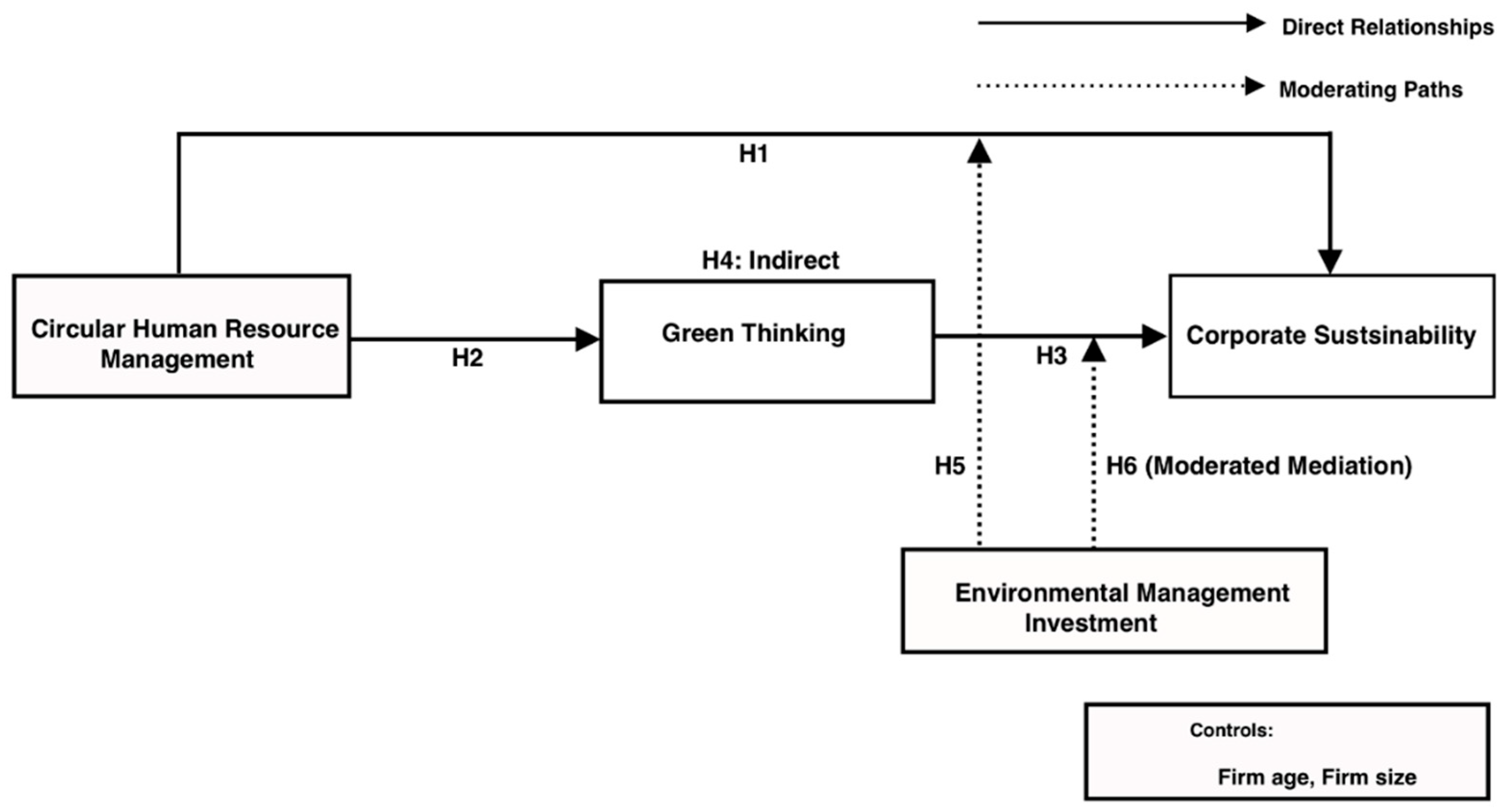
As illustrated in Figure 1, the proposed research model integrates theoretical relationships derived from the NBRV and Institutional Theory. The model positions CHRM as the main antecedent influencing corporate sustainability both directly and indirectly through green thinking. Green thinking (GTG) serves as the mediating variable that explains how CHRM-induced environmental learning and cognitive engagement translate into sustainability outcomes. EMI is introduced as a moderator that strengthens the CHRM, sustainability link and amplifies the indirect effect through green thinking, forming a moderated-mediation structure. Firm age and firm size are included as control variables to account for structural differences across SMEs. The overall model captures the multilevel and conditional processes through which HR practices, cognitive orientations, and organizational investments jointly shape sustainability performance.
Taken together, the theoretical framework integrates the NRBV and Institutional Theory to explain corporate sustainability as a conditional organizational outcome arising from the alignment of internal capabilities and external pressures. Specifically, Circular Human Resource Management and green thinking represent intangible, employee-centered capabilities, whose effectiveness depends on environmental management investment as a contextual enabler, highlighting that sustainability in SMEs is not automatic but contingent upon cognitive–resource complementarity within institutional environments.

3. Method

3.1. Sampling and Data Collection

The empirical setting consists of manufacturing small and medium-sized enterprises located in Istanbul and Izmir, two of Turkey’s most active industrial regions, particularly in textile, food processing, electrical assembly, and related manufacturing segments. Firms were identified through official registries maintained by KOSGEB and the Union of Chambers and Commodity Exchanges of Turkey (TOBB) [72].
A purposive sampling approach was adopted to ensure that participating firms possessed at least a minimal structural orientation toward environmental management. Specifically, eligible enterprises met three criteria: (1) certification under ISO 14001 standards [73,74,75], (2) inclusion in sustainability-oriented listings associated with the BIST sustainability framework [76,77], and (3) classification as SMEs employing fewer than 250 employees according to national regulations [78]. This targeted strategy was implemented to examine circular HR practices within organizations where environmental systems are formally recognized. Firms lacking such foundational structures may not provide an appropriate context for assessing circular human resource configurations or environmental investment mechanisms [79].
It is acknowledged that this sampling strategy prioritizes environmentally engaged SMEs rather than representing the full population of Turkish SMEs. Consequently, the findings are most applicable to firms with existing environmental commitments and may not generalize to enterprises operating without formal sustainability orientation.
Data were obtained from senior- and middle-level managers serving as key informants. These individuals were selected due to their involvement in strategic HR and environmental initiatives and their access to organization-wide information [80]. Although managerial surveys are widely used in sustainability research, potential perceptual bias cannot be entirely excluded. To reduce this risk, procedural safeguards were incorporated, as described below [81].
The study followed a quantitative design with data collected between February and April 2025. A two-wave structure was implemented to separate measurement of predictor and outcome variables. CHRM, GTG, and EMI were assessed in the first wave, while corporate sustainability was measured three weeks later. Responses were matched across waves using anonymous identification codes. This temporal separation was introduced solely to mitigate common method variance and does not constitute a longitudinal design capable of establishing causal ordering [82,83].
Surveys were distributed both electronically and in printed format to accommodate respondent preference. Of the 1115 questionnaires distributed, 637 were returned. After removing incomplete and invalid submissions, 616 usable responses were retained, corresponding to a response rate of 55.25%.
The sample primarily comprises medium-sized enterprises. Approximately 63.15% of participating firms employ between 50 and 150 workers, while 36.53% employ between 151 and 249 employees. Only 0.32% fall below the 50-employee threshold. In addition, 82.96% of firms have operated for more than ten years, indicating that the results largely reflect sustainability practices within established rather than newly founded SMEs. Industry distribution details are provided in Table 1.

3.2. Measures

The study employed previously validated measurement instruments to preserve construct consistency and enhance methodological robustness. All constructs were assessed using a five-point Likert-type scale (1 = strongly disagree; 5 = strongly agree). The use of established scales ensured alignment with prior empirical work while minimizing risks associated with ad hoc instrument development.
Since the original instruments were developed in English, linguistic adaptation was required for application in the Turkish manufacturing context. A structured translation procedure was implemented. Initially, a bilingual academic translated the survey into Turkish. An independent bilingual scholar subsequently performed a reverse translation into English. Both versions were compared systematically, and discrepancies were resolved through consensus discussions to ensure conceptual equivalence rather than literal correspondence.
Content adequacy and contextual clarity were evaluated prior to data collection. The instrument was reviewed by a panel consisting of ten academics specializing in sustainability and human resource management, along with five manufacturing managers familiar with circular economy practices. Feedback focused on wording precision, contextual appropriateness, and managerial interpretability. Minor adjustments were introduced to enhance clarity while preserving theoretical meaning. A complete list of items is provided in Appendix A (Table A1).
CHRM was operationalized using five items derived from Del Giudice et al. [4] and Jabbour et al. [5]. The scale captures the degree to which circular economy principles are embedded within recruitment criteria, training systems, performance evaluation, and employee participation structures. The construct reflects formal integration of circular logic into HR architecture rather than general environmental advocacy.
GTG was assessed through four items adapted from Begum et al. [23]. The scale evaluates the extent to which sustainability considerations shape organizational reasoning, problem interpretation, and decision framing. In this study, green thinking represents a collective cognitive orientation toward environmentally responsible evaluation processes, distinguishing it from affect-based or awareness-based environmental constructs [38].
EMI was measured using four items adapted from Pagell et al. [84]. Respondents reported the extent of financial, temporal, and human resource commitments directed toward environmental systems during the preceding three years. The items capture investments in recycling infrastructure, pollution prevention initiatives, environmental training, and workplace safety programs. EMI therefore reflects tangible resource deployment supporting environmental strategy execution.
Corporate Sustainability (CS) was evaluated using four items adapted from El-Kassar and Singh [45], Li et al. [85], and Mousa and Othman [86]. The scale measures integrated sustainability performance across environmental impact reduction, operational efficiency, ethical responsibility, and sustainability-related financial outcomes. This operationalization conceptualizes sustainability as multidimensional organizational performance rather than isolated environmental indicators.

3.3. Common Method Bias (CMB) and Non-Response Bias

Given the perceptual nature of survey data, several design features were incorporated to reduce potential method-related distortions [81]. First, a temporal separation strategy was implemented. Independent variables (CHRM, green thinking, and EMI) were collected during the first wave of data collection, whereas corporate sustainability was measured three weeks later. This time-lagged structure limits respondents’ ability to infer logical linkages across constructs and mitigates consistency-driven responding.
To evaluate the possibility of non-response bias, early and late respondents were compared following the procedure recommended by Armstrong and Overton [87]. Independent comparisons across key constructs did not reveal statistically significant differences. While this test does not fully eliminate the possibility of systematic bias, the results suggest that response timing did not materially influence the study variables.
Beyond procedural controls, statistical diagnostics were conducted. An exploratory factor analysis was first performed to examine whether a dominant single factor accounted for the majority of covariance among the measurement items. The first extracted factor explained 33.17% of total variance, which is below the commonly referenced 50% criterion [88]. Although this preliminary test does not conclusively rule out method variance, it indicates that no single latent dimension overwhelmingly drives responses.
To further assess potential common method influence, a common latent factor analysis was conducted using AMOS. A constrained single-factor model was estimated and compared with the proposed multi-factor measurement model. The single-factor solution demonstrated poor model fit (CMIN/df = 6.116, RMSEA = 0.201, CFI = 0.552, IFI = 0.552, TLI = 0.499, NFI = 0.504), whereas the hypothesized model exhibited substantially stronger fit indices (CMIN/df = 1.610, RMSEA = 0.031, CFI = 0.987, IFI = 0.987, TLI = 0.984, NFI = 0.966). The marked deterioration in fit under the single-factor constraint supports the distinctiveness of the constructs and reduces concerns that a shared measurement artifact explains the observed relationships [89].
Notwithstanding these precautions, it is acknowledged that perceptual survey designs cannot completely eliminate method-related bias. Consequently, the empirical results are interpreted as indicative of theoretically consistent associations rather than definitive causal effects. Taken together, the procedural safeguards and statistical assessments provide reasonable confidence that common method variance does not substantially threaten the study’s conclusions.

3.4. Data Analysis Procedures

Preliminary analyses were conducted using IBM SPSS Statistics (Version 27) to generate descriptive statistics and examine bivariate correlations among the study variables. These initial diagnostics provided an overview of data distribution and inter-construct associations prior to structural testing [90].
The measurement structure was evaluated through confirmatory factor analysis (CFA) in AMOS (Version 24). Convergent validity and discriminant validity were assessed through factor loadings and inter-construct distinctiveness. Rather than relying on a single goodness-of-fit indicator, overall model adequacy was determined using a combination of indices, including the chi-square to degrees-of-freedom ratio (CMIN/df), RMSEA, CFI, TLI, IFI, and NFI, in line with established measurement evaluation practices [91,92].
Hypothesis testing was conducted using Hayes’ PROCESS macro [93]. The indirect effect of Circular Human Resource Management on corporate sustainability through green thinking was examined using Model 4. To evaluate conditional indirect effects involving Environmental Management Investment, Model 15 was estimated. Indirect and interaction effects were calculated using bias-corrected bootstrapping procedures with 5000 resamples [94,95]. An effect was considered statistically supported when the associated 95% confidence interval excluded zero.
Although the two-wave design introduces temporal separation between predictors and outcome variables, the relatively short interval does not allow for definitive causal claims. Therefore, the analytical results are interpreted as theoretically consistent associations within the proposed conditional process framework rather than as evidence of strict causality.

4. Results

4.1. Confirmatory Factor Analysis (CFA)

The adequacy of the measurement structure was examined prior to hypothesis testing. A four-construct solution representing Circular Human Resource Management, Green Thinking, Environmental Management Investment, and Corporate Sustainability was estimated using confirmatory factor analysis.
Model fit statistics indicated strong alignment between the proposed structure and the observed data [96]. The chi-square to degrees-of-freedom ratio (CMIN/df) was 1.610, and the RMSEA value of 0.031 suggests minimal residual misfit. Incremental indices further supported measurement adequacy (CFI = 0.987, IFI = 0.987, TLI = 0.984, NFI = 0.966). Taken together, these indicators suggest that the covariance structure implied by the model corresponds closely to the empirical data patterns within the sampled SMEs.
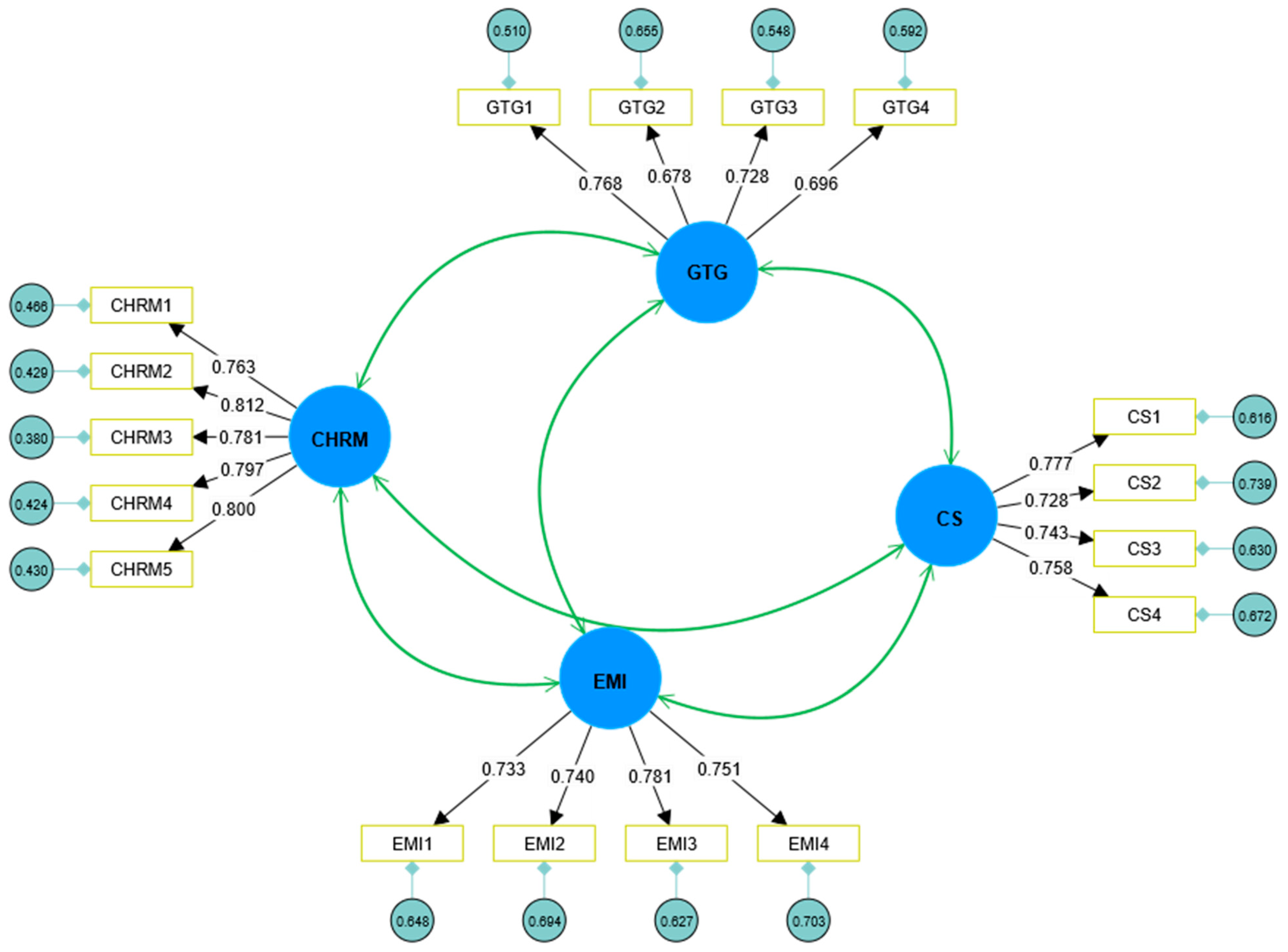
Item-level diagnostics demonstrated acceptable reliability. Standardized loadings ranged from 0.678 to 0.812 (Figure 2), indicating that each observed indicator meaningfully reflects its intended latent construct. Internal consistency was verified through both composite reliability (0.826–0.901) and Cronbach’s alpha (0.809–0.892), exceeding commonly referenced adequacy benchmarks [97,98,99].
Convergent validity was assessed through average variance extracted (AVE), with values spanning 0.516 to 0.625 (Table 2). Although the AVE for green thinking approached the lower bound of conventional criteria, it remains acceptable given the cognitively complex nature of the construct and its behavioral measurement context [100,101].
Construct distinctiveness was evaluated using the Fornell–Larcker criterion. For each latent variable, the square root of AVE exceeded its inter-construct correlations, indicating empirical separation among conceptually related constructs [100]. This is particularly relevant for CHRM and green thinking, which share theoretical proximity but remain statistically distinguishable.
To further ensure estimation stability, variance inflation factors were examined and found to be below 3.3 for all indicators [102], suggesting that multicollinearity does not threaten parameter precision.
Overall, the results indicate that the measurement framework is empirically sound and supports proceeding to structural relationship testing.

4.2. Direct and Indirect Hypothesis Testing Results

The proposed direct and mediation relationships were examined using conditional process analysis [93]. Estimates derived from PROCESS Model 4 are reported in Table 3.
The analysis indicates that Circular Human Resource Management is positively associated with corporate sustainability (β = 0.384, t = 12.269, p < 0.001). This coefficient reflects a substantive effect size, suggesting that firms embedding circular logic within HR architectures tend to report higher levels of sustainability performance. The model accounts for 25.1% of the variance in corporate sustainability (R2 = 0.251), which represents a meaningful proportion of explained variance in SME contexts where environmental outcomes are influenced by multiple external and operational contingencies.
A positive relationship was also observed between CHRM and green thinking (β = 0.176, t = 4.586, p < 0.001). Although comparatively smaller than the direct CHRM–sustainability path, this coefficient indicates that circular HR systems are associated with discernible shifts in sustainability-oriented cognitive framing. In turn, green thinking is positively linked to corporate sustainability (β = 0.236, t = 5.368, p < 0.001), suggesting that sustainability-related interpretive orientation is reflected in measurable organizational outcomes.
The indirect pathway was evaluated using bias-corrected bootstrapping based on 5000 resamples. The estimated indirect effect of CHRM on corporate sustainability via green thinking was 0.091 (SE = 0.021), with a 95% confidence interval of [0.051, 0.132]. Because zero falls outside this interval, the mediating effect is statistically supported. The magnitude of the indirect effect corresponds to approximately 23.7% of the total effect, indicating that green thinking explains a meaningful, though not exhaustive, portion of the relationship between CHRM and sustainability performance.
Importantly, the direct effect of CHRM remains statistically significant after accounting for green thinking, indicating partial rather than full mediation. This pattern suggests that circular HR systems operate through both structural alignment mechanisms and cognitive activation processes. Accordingly, the empirical evidence supports H1 through H4.

4.3. Moderation Analysis

Conditional effects were evaluated using PROCESS Model 15 [93]. Prior to estimating interaction terms, continuous predictors were mean-centered to reduce potential multicollinearity. Firm size and firm age were retained as control variables. The relevant coefficients are reported in Table 4.
After introducing interaction terms, the direct association between CHRM and corporate sustainability remains positive and statistically significant (β = 0.097, t = 2.649, p < 0.01). The reduction in coefficient magnitude relative to the mediation model reflects the inclusion of interaction variance rather than a substantive attenuation of the core relationship. Incorporating moderation increases the explained variance to R2 = 0.269, representing an incremental improvement (ΔR2 ≈ 0.018). Although modest, such gains are non-trivial within SME sustainability contexts characterized by multi-layered environmental and institutional constraints.
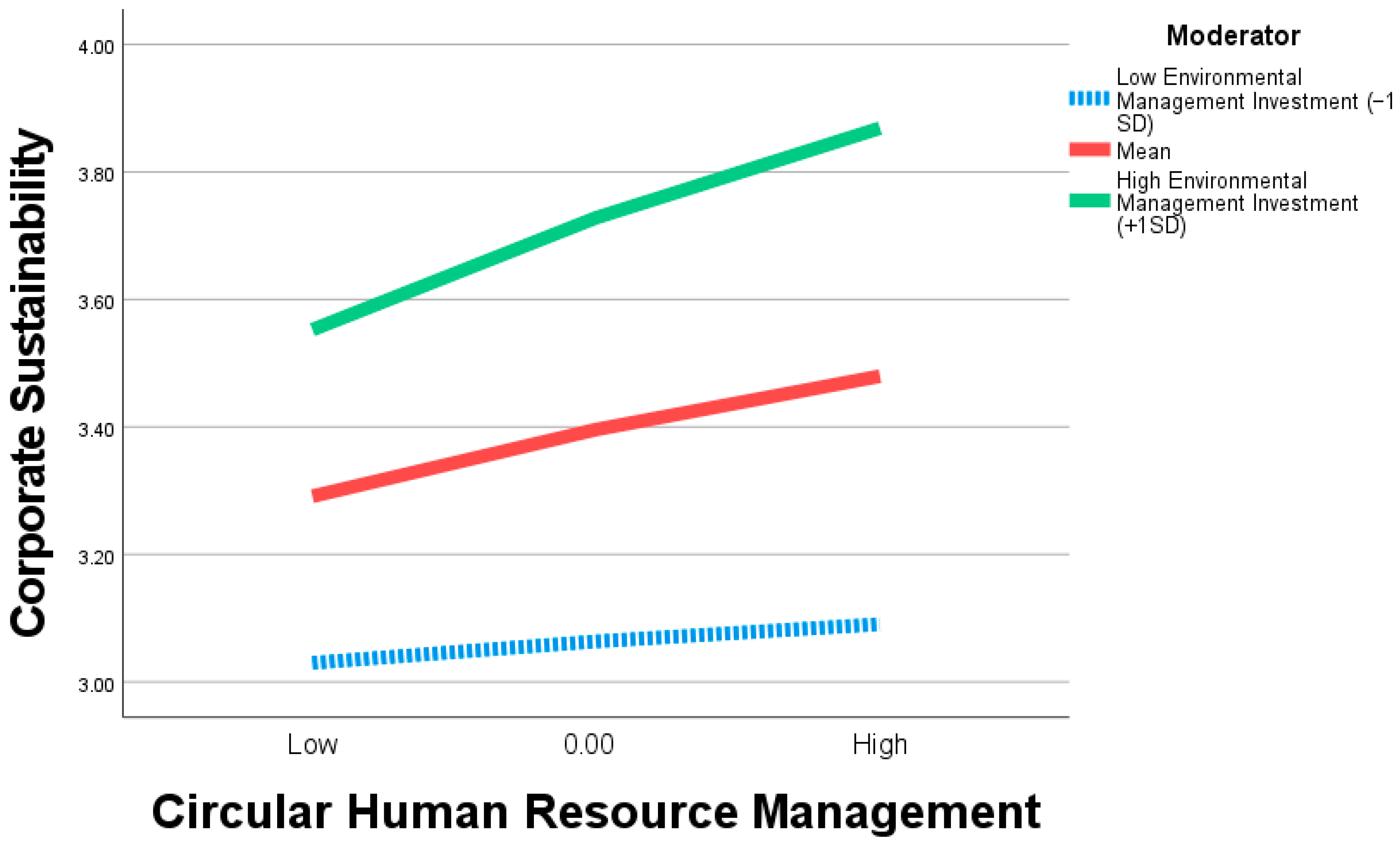
The interaction between CHRM and Environmental Management Investment is significant (β = 0.095, t = 2.096, p < 0.05), indicating that the strength of the CHRM–sustainability association varies across levels of EMI. As illustrated in Figure 3, simple slopes were estimated at one standard deviation above and below the mean of EMI.
Under high EMI conditions, CHRM exhibits a stronger positive association with corporate sustainability (β = 0.176, t = 3.352, p < 0.01). In contrast, when EMI is low, the relationship becomes statistically indistinguishable from zero (β = 0.034, t = 0.709, ns). This divergence suggests that circular HR architectures translate into measurable sustainability outcomes primarily when accompanied by tangible environmental resource commitments. In the absence of such investments, HR-based circular initiatives appear less impactful at the performance level. These findings provide empirical support for H5.
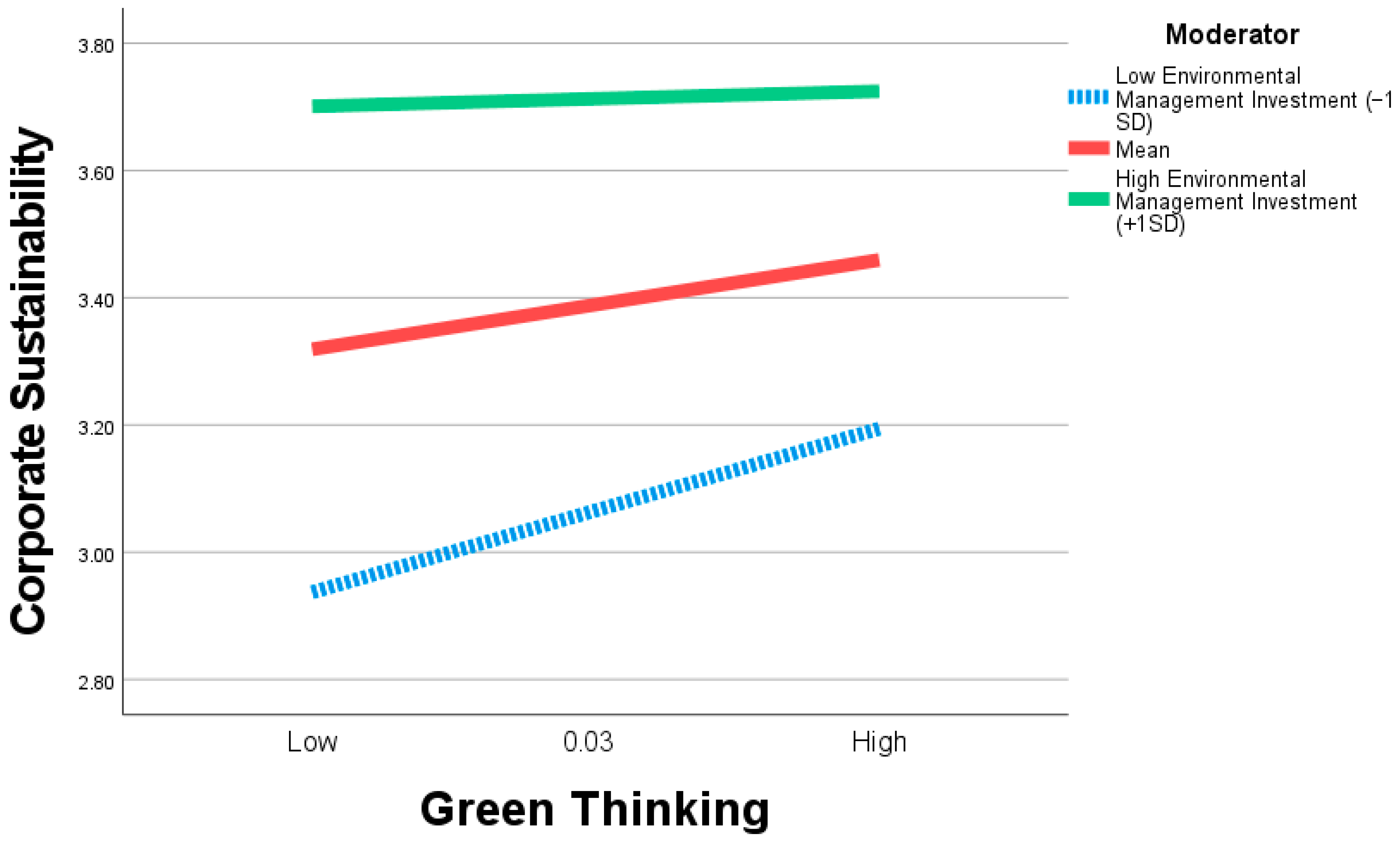
A similar conditional pattern emerges for the indirect pathway through green thinking. The interaction between green thinking and EMI is significant (β = 0.104, t = 2.002, p < 0.05), indicating that the mediation effect depends on the level of environmental investment (Figure 4). When EMI is high, the indirect effect of CHRM on sustainability via green thinking is statistically supported (β = 0.172, t = 2.996, p < 0.01). Conversely, at low EMI levels, the indirect pathway is not statistically significant (β = 0.016, t = 0.260, ns). This pattern implies that cognitive orientation contributes to sustainability performance primarily when organizations provide infrastructural support for implementation.
The index of moderated mediation confirms this conditional process (index = 0.040, SE = 0.022, 95% CI [0.032, 0.083]), indicating that EMI systematically conditions the strength of the indirect effect. Substantively, these results suggest that sustainability outcomes in SMEs depend on the interaction between structural HR systems, employee-level cognitive framing, and resource allocation decisions. The evidence therefore supports H5 and H6.

5. Discussions and Implications

5.1. Discussion of Findings

This study examined how CHRM, green thinking, and EMI jointly shape corporate sustainability in manufacturing SMEs. The significant direct effect of CHRM on corporate sustainability supports the NBRV’s proposition that internally embedded environmental capabilities can generate sustained performance advantages [25]. However, beyond confirming capability logic, the findings suggest that circular HR architectures operate as structural coordination mechanisms that align employee roles, incentives, and routines around regenerative objectives. In SME contexts—where formal environmental systems are often limited—this structural alignment may substitute for more capital-intensive sustainability interventions.
Notably, the direct effect of CHRM was stronger than the indirect pathway through green thinking. This pattern indicates that structural capability alignment may produce immediate operational efficiencies, whereas cognitive transformation unfolds more gradually. Rather than implying that cognition is secondary, this distinction suggests a dual-speed mechanism: CHRM reshapes organizational routines directly while simultaneously cultivating interpretive change through green thinking. This nuance refines prevailing green HRM narratives by demonstrating that circular HR systems function not merely as awareness-enhancing tools but as performance-relevant infrastructures [103].
The model explains approximately 27% of the variance in corporate sustainability. While meaningful in SME sustainability research—where outcomes are shaped by regulatory volatility, supply-chain pressures, and resource constraints—this explanatory scope reinforces that sustainability is a multi-level phenomenon rather than a capability-specific outcome. Remaining variance likely reflects leadership orientation, technological adoption, external stakeholder influence, and institutional pressures beyond the focal variables [104,105,106]. Recognizing these limits strengthens interpretive caution and situates CHRM within a broader sustainability ecosystem.
The mediation findings confirm that green thinking serves as a cognitive activation mechanism linking CHRM to sustainability outcomes. Importantly, the partial mediation observed suggests that CHRM influences sustainability both through structural routinization and through cognitive reframing. This challenges overly sequential HR–attitude models and supports a complementary view in which structural and cognitive pathways coexist [59,65]. From a micro-foundational perspective, green thinking represents the interpretive layer through which employees transform circular principles into context-specific actions, thereby embedding sustainability into everyday decision-making.
The moderating role of EMI further clarifies this complementarity. The results indicate that cognitive and structural capabilities achieve measurable sustainability impact primarily when reinforced by tangible environmental investments. In low-EMI conditions, CHRM’s positive association with sustainability weakened, underscoring that capability activation requires infrastructural enablement. From an NBRV standpoint, this finding reinforces resource complementarity logic: intangible cognitive capabilities and tangible investments must co-evolve to generate sustained advantage [25,40]. From an Institutional Theory perspective, EMI operates as a credibility signal that legitimizes sustainability-oriented HR systems, reducing the likelihood of symbolic adoption.
At the same time, alternative explanations warrant consideration. Firms with pre-existing sustainability orientations may simultaneously invest in CHRM and EMI, creating reciprocal reinforcement dynamics. Although temporal separation was implemented, the cross-sectional design precludes definitive causal inference. Accordingly, the findings should be interpreted as theoretically consistent associations rather than deterministic causal claims.
Regarding business model innovation, interpretive precision is essential. While CHRM and green thinking may function as micro-foundational enablers of sustainable business model adaptation, this study does not directly measure business model transformation. The contribution therefore lies in identifying the human-capital and cognitive conditions that make circular business model innovation more plausible, rather than in demonstrating business model redesign empirically.
Collectively, the findings suggest that sustainability in manufacturing SMEs emerges from the alignment of structural capability (CHRM), cognitive activation (green thinking), and resource commitment (EMI). This integrative perspective reframes circular transition as a conditional, multi-layered process rather than a universally transformative managerial solution. By emphasizing complementarities, boundary conditions, and non-automatic activation, the study advances sustainability scholarship beyond linear green HRM assumptions.

5.2. Theoretical Implications

This study advances sustainability and human resource management scholarship by clarifying the theoretical positioning of CHRM within the Natural Resource-Based View (NBRV). Rather than treating CHRM as a peripheral extension of green HRM, the findings reposition CHRM as a regenerative capability architecture that systematically embeds circular logic into organizational design. This distinction addresses a gap in the literature where green HRM has often been framed as awareness-enhancing or compliance-driven rather than capability-configuring [4,25,107]. By conceptualizing CHRM as a structural capability configuration, the study shifts the debate from whether HR “matters” for sustainability to how HR architectures shape the micro-foundations of circular transition in SMEs.
Second, the study contributes to micro-foundational sustainability research by identifying green thinking as a cognitive activation mechanism linking structural HR systems to corporate sustainability outcomes [21,23,36,38]. This clarifies an underdeveloped area in prior research, which has frequently assumed that HR practices influence sustainability primarily through motivation or pro-environmental behavior. Instead, the results suggest that interpretive cognition—how employees frame resource trade-offs and operational decisions—constitutes a distinct intermediate capability. The partial mediation observed further indicates that structural HR design and cognitive activation operate in parallel rather than sequentially, reinforcing a complementary logic rather than a purely attitudinal pathway [59,65].
Third, by incorporating EMI as a moderating condition, the study addresses critiques that capability-based theories often under-specify contextual enablers and boundary conditions [25,40]. The findings reinforce a capability–resource complementarity perspective, demonstrating that intangible capabilities (CHRM and green thinking) require tangible infrastructural commitment to yield sustainability advantages. This refines NBRV by emphasizing capability activation rather than capability possession as the critical explanatory mechanism.
The integration of Institutional Theory further deepens this contribution. EMI operates not only as a resource base but also as a legitimacy signal that strengthens internal alignment around sustainability norms [45]. This dual interpretation advances institutional accounts of sustainability by linking legitimacy processes to capability deployment, thereby bridging symbolic adoption and substantive implementation debates.
Finally, the moderated mediation framework contributes to sustainability scholarship by modeling sustainability as a conditional, process-based outcome rather than a linear capability-performance link. Within the context of the Special Issue on business model innovation, the findings suggest that circular HR systems and sustainability-oriented cognition function as micro-foundational enablers of adaptive business model logics, even though business model constructs were not directly measured. The theoretical contribution therefore lies in explicating HR–cognition–investment complementarities that make sustainable business model adaptation more plausible, while clearly delineating the scope of inference.

5.3. Practical Implications

The findings provide actionable guidance for manufacturing SMEs seeking to enhance sustainability through organizational design rather than relying exclusively on technological upgrades. The evidence suggests that CHRM can function as a practical entry point for sustainability transformation, particularly in resource-constrained firms. For manufacturing SMEs in sectors such as textiles, food processing, or machinery assembly, this may involve integrating environmental criteria directly into job descriptions, incorporating waste-reduction targets into supervisor performance evaluations, and linking small financial or recognition-based incentives to measurable improvements in material efficiency or energy savings. These practices require limited capital expenditure yet systematically align employee behavior with circular objectives.
The mediating role of green thinking highlights that managerial attention must extend beyond formal HR policies to cognitive engagement. Managers can operationalize this by organizing short, problem-focused sustainability workshops tied to actual production bottlenecks (e.g., fabric waste, packaging surplus, excess energy consumption), establishing cross-departmental “green task groups,” and embedding sustainability reflection into routine production meetings rather than treating it as a separate initiative. Such approaches embed circular reasoning into daily operational decision-making instead of confining it to symbolic campaigns.
The results also demonstrate that EMI strengthens the returns of CHRM initiatives. In practical terms, even incremental investments—such as upgrading to basic recycling infrastructure, implementing low-cost energy monitoring systems, or allocating dedicated time for environmental training—can enhance the effectiveness of HR-driven sustainability efforts. However, the findings do not imply that higher investment automatically guarantees stronger outcomes. For SMEs with severe financial constraints, prioritizing targeted investments that directly remove operational bottlenecks may yield greater impact than broad, capital-intensive environmental projects. This underscores the importance of strategic alignment between HR systems and investment decisions.
At a managerial level, the study suggests that sustainability initiatives should be sequenced rather than simultaneously deployed. Firms may first establish CHRM foundations (recruitment alignment and performance-linked sustainability metrics), then cultivate green thinking through structured learning mechanisms, and subsequently scale environmental investments as resource availability permits. This phased approach may reduce implementation risk and enhance organizational acceptance.
Finally, the implications should be interpreted within realistic boundaries. The study does not suggest that CHRM, green thinking, and EMI alone are sufficient to transform an entire business model or offset structural market pressures. External factors—such as supply chain constraints, regulatory volatility, or customer demand dynamics—remain influential. Accordingly, practitioners should view the proposed framework as a complementary capability configuration rather than a universal solution. The practical value of the findings lies in clarifying how internal HR design, cognitive development, and targeted investment can reinforce each other under SME conditions, not in prescribing a one-size-fits-all sustainability strategy.

5.4. Limitations and Future Research Directions

While this study advances understanding of Circular Human Resource Management and corporate sustainability, several boundary conditions should be acknowledged. First, the sample consists primarily of environmentally exposed SMEs (i.e., ISO 14001-certified and BIST sustainability-index-affiliated firms) rather than a fully representative cross-section of all SMEs. Accordingly, the findings are most applicable to firms that already operate under formal environmental frameworks, and caution should be exercised in generalizing the results to less regulated or environmentally disengaged SME populations. Future research could examine whether the proposed relationships hold in more heterogeneous or resource-constrained SME contexts. Second, although data were collected in two waves to reduce method bias, the overall design remains cross-sectional; longitudinal research would help clarify how CHRM, green thinking, and environmental investment co-evolve over time. Third, reliance on managerial self-reports may limit objectivity, suggesting value in integrating employee-level assessments or objective sustainability metrics in future studies. Finally, additional mediators (e.g., eco-innovation capability or environmental commitment) and contextual moderators (e.g., digitalization intensity or regulatory stringency) could further refine understanding of how circular HR systems operate under varying institutional and competitive conditions.

Author Contributions

Conceptualization, H.A.; supervision, A.K.; project administration, A.B.A. and A.K.; Validation, H.A. and A.B.A.; Writing—original draft, H.A.; Writing—review and editing, H.A. and A.K. All authors have read and agreed to the published version of the manuscript.

Funding

This study received no external funding.

Institutional Review Board Statement

The study was conducted in accordance with the Declaration of Helsinki, and approved by the Ethics Committee of Akdeniz Karpaz Üniversitesi (protocol code AKUN-ETEK-30/26, Approval Date: 14 January 2025).

Informed Consent Statement

Informed consent was obtained from all subjects involved in the study.

Data Availability Statement

The data from this study can be requested from the corresponding author, Hasan Alsakkouh.

Conflicts of Interest

The authors declare no conflicts of interest.

Appendix A. Measurement Items

Table A1. Construct Operationalization and Measurement Items.
ConstructCodeMeasurement ItemsSource
Circular Human Resource Management (CHRM)CHRM1When hiring, we ensure that future employees are aligned with circular economy (CE) values.Del Giudice et al. [4]; Jabbour et al. [5].
CHRM2We offer CE-related training to improve employees’ skills and knowledge.
CHRM3Employees receive recognition or rewards for proactive management of CE issues.
CHRM4Employees are actively involved in implementing CE practices within the company.
CHRM5We encourage different work teams to discuss how to develop CE management practices.
Green Thinking (GTG)GTG1Our firm demonstrates concern for environmental issues.Begum et al. [23].
GTG2Environmental conditions influence our firm’s considerations of quality of life.
GTG3Our firm is eager to learn how to protect and preserve the environment.
GTG4Our firm routinely develops green ideas, solutions, and strategies for environmental welfare.
Environmental Management Investment (EMI)EMI1Our company has invested resources in recycling materials over the past three years.Pagell et al. [84].
EMI2Our company has invested in employee training related to pollution prevention.
EMI3Our company has invested in workplace health and safety programs.
EMI4Our company has invested in waste reduction initiatives.
Corporate Sustainability (CS)CS1Our firm reduces hazardous waste and emissions to comply with environmental regulations.El-Kassar & Singh [45]; Li et al. [85]; Mousa & Othman [86].
CS2Our firm minimizes the consumption of resources such as energy, water, electricity, gas, and fuel.
CS3Our firm achieves profit growth due to reductions in energy consumption and material usage.
CS4Our firm is committed to ethical conduct and service quality to meet public and governmental expectations.

References

  1. Rihal, J.; Alzubi, A.; Aljuhmani, H.Y.; Berberoğlu, A. From Ethics to Ecology: How Ethical Leadership Drives Environmental Performance through Green Organizational Identity and Culture. PLoS ONE 2025, 20, e0336608. [Google Scholar] [CrossRef]
  2. Amui, L.B.L.; Jabbour, C.J.C.; de Sousa Jabbour, A.B.L.; Kannan, D. Sustainability as a Dynamic Organizational Capability: A Systematic Review and a Future Agenda toward a Sustainable Transition. J. Clean. Prod. 2017, 142, 308–322. [Google Scholar] [CrossRef]
  3. Uzorka, A.; Akiyode, O.; Isa, S.M. Strategies for Engaging Students in Sustainability Initiatives and Fostering a Sense of Ownership and Responsibility towards Sustainable Development. Discov. Sustain. 2024, 5, 320. [Google Scholar] [CrossRef]
  4. Del Giudice, M.; Chierici, R.; Mazzucchelli, A.; Fiano, F. Knowledge Management and Logistics Performance in Digitalized Firms. Int. J. Logist. Manag. 2021, 32, 337–356. [Google Scholar]
  5. Jabbour, C.J.C. Circular Economy Practices and Environmental Management. J. Environ. Manag. 2020, 264, 110416. [Google Scholar]
  6. Zihan, W.; Makhbul, Z.K.M.; Alam, S.S. Green Human Resource Management in Practice: Assessing the Impact of Readiness and Corporate Social Responsibility on Organizational Change. Sustainability 2024, 16, 1153. [Google Scholar] [CrossRef]
  7. Tiwari, P. The Impact of Green Human Resource Management Practices on the Environmental Performance of Organisations. J. Knowl. Econ. 2025, 17, 400–427. [Google Scholar] [CrossRef]
  8. Obeidat, S.M.; Abdalla, S.; Al Bakri, A.A.K. Integrating Green Human Resource Management and Circular Economy to Enhance Sustainable Performance: An Empirical Study from the Qatari Service Sector. Empl. Relat. Int. J. 2022, 45, 535–563. [Google Scholar] [CrossRef]
  9. Castro-Lopez, A.; Entrialgo, M.; Liao, C.T.; Santos-Vijande, M.L. Towards Circular Economy through Innovation: The Role of Entrepreneurial Orientation and Human Resource Management. Int. Entrep. Manag. J. 2024, 21, 36. [Google Scholar] [CrossRef]
  10. Bui, T.-D.; Tran, T.P.T.; Ha, H.M.; Lim, M.K.; Tseng, M.-L. Sustainable Resource Management towards Circular Supply Chain in Dairy Industry in Vietnam: A Hierarchical Structure and Interdependence Relationships. Int. J. Logist. Res. Appl. 2026, 1–33. [Google Scholar] [CrossRef]
  11. Subramanian, N.; Suresh, M. The Contribution of Organizational Learning and Green Human Resource Management Practices to the Circular Economy: A Relational Analysis—Part I. Learn. Organ. Int. J. 2022, 29, 428–442. [Google Scholar] [CrossRef]
  12. Ly, B. Beyond Conventional HRM: Catalyzing Circular Economy Performance with Green Practices and Inclusive Leadership. Asia Pac. Manag. Rev. 2025, 30, 100373. [Google Scholar] [CrossRef]
  13. Chams, N.; García-Blandón, J. On the Importance of Sustainable Human Resource Management for the Adoption of Sustainable Development Goals. Resour. Conserv. Recycl. 2019, 141, 109–122. [Google Scholar] [CrossRef]
  14. Crossley, R.M.; Elmagrhi, M.H.; Ntim, C.G. Sustainability and Legitimacy Theory: The Case of Sustainable Social and Environmental Practices of Small and Medium-Sized Enterprises. Bus. Strategy Environ. 2021, 30, 3740–3762. [Google Scholar] [CrossRef]
  15. Mauro, T.G.; Borges-Andrade, J.E. Human Resource System as Innovation for Organisations. Innov. Manag. Rev. 2020, 17, 197–214. [Google Scholar] [CrossRef]
  16. Aboalhool, T.; Alzubi, A.; Iyiola, K. Humane Entrepreneurship in the Circular Economy: The Role of Green Market Orientation and Green Technology Turbulence for Sustainable Corporate Performance. Sustainability 2024, 16, 2517. [Google Scholar] [CrossRef]
  17. Singh, R.; Joshi, A.; Dissanayake, H.; Iddagoda, A.; Khan, S.; Félix, M.J.; Santos, G. Integrating Industry 4.0, Circular Economy, and Green HRM: A Framework for Sustainable Transformation. Sustainability 2025, 17, 3082. [Google Scholar] [CrossRef]
  18. Mert, G.; Akkaya, B.; Palazzo, M. Entrepreneurial Ecosystems and Sustainable Innovation. Int. Entrep. Manag. J. 2025, 21, 68. [Google Scholar] [CrossRef]
  19. Akhavan, P.; Philsoophian, M. Human Resource Management Theory and the Circular Economy: Digital Technologies and Improvisation. Manag. Decis. 2025. Epub ahead of printing. [Google Scholar] [CrossRef]
  20. Hadi, N.U.; Imran Khan, M. Factors Influencing Circular Economy Business Model Adoption: Evidence from NCA and PLS-SEM. J. Open Innov. Technol. Mark. Complex. 2026, 12, 100697. [Google Scholar] [CrossRef]
  21. Baquero, A. Unveiling the Path to Green Innovation: The Interplay of Green Learning Orientation, Knowledge Management Capability and Manufacturing Firm’s Capability to Orchestrate Resources. J. Bus. Ind. Mark. 2024, 39, 2205–2221. [Google Scholar] [CrossRef]
  22. Boakye, D.J.; Tingbani, I.; Ahinful, G.S.; Nsor-Ambala, R. The Relationship between Environmental Management Performance and Financial Performance of Firms Listed in the Alternative Investment Market (AIM) in the UK. J. Clean. Prod. 2021, 278, 124034. [Google Scholar] [CrossRef]
  23. Begum, H.; Abbas, K.; Alam, A.F. Strategic Foresight and Future Readiness in Business Environments. Foresight 2022, 24, 456–475. [Google Scholar] [CrossRef]
  24. Li, W.; Li, W.; Seppänen, V.; Koivumäki, T. Effects of Greenwashing on Financial Performance: Moderation through Local Environmental Regulation and Media Coverage. Bus. Strategy Environ. 2023, 32, 820–841. [Google Scholar] [CrossRef]
  25. Hart, S.L.; Dowell, G. A Natural-Resource-Based View of the Firm: Fifteen Years After. J. Manag. 2011, 37, 1464–1479. [Google Scholar]
  26. Mamash, A.; Iyiola, K.; Aljuhmani, H.Y. The Role of Circular Economy Entrepreneurship, Cleaner Production, and Green Government Subsidy for Achieving Sustainability Goals in Business Performance. Sustainability 2025, 17, 3990. [Google Scholar] [CrossRef]
  27. Albannai, N.; Alzubi, A.B.; Aljuhmani, H.Y. How Environmental Management Systems Enable Sustainability Transition: The Roles of Green Transition and Policy Support in Driving Circular Product Innovation. Sustainability 2026, 18, 2060. [Google Scholar] [CrossRef]
  28. Emeagwali, O.L.; Aljuhamni, H.Y. Introductory Chapter: Strategic Management—A Dynamic Approach. In Strategic Management—A Dynamic View; IntechOpen: London, UK, 2019. [Google Scholar]
  29. Arsawan, I.W.E.; Kartikasari, A.; Suhartanto, D.; Choirisa, S.F. Transitioning Towards Circular Economy Practices: The Role of Organizational Capabilities and Environmental Dynamism—Evidence From Indonesia. Bus. Strategy Environ. 2026, 35, 18–35. [Google Scholar] [CrossRef]
  30. Donghui, Z.; Yusoff, W.S.; Salleh, M.F.M.; Lin, N.S.; Jamil, A.H.; Abd Rani, M.J.; Shaari, M.S. The Impact of ESG and the Institutional Environment on Investment Efficiency in China through the Mediators of Agency Costs and Financial Constraints. Soc. Sci. Humanit. Open 2025, 11, 101323. [Google Scholar] [CrossRef]
  31. Kiefer, C.P.; Carrillo-Hermosilla, J.; del Río, P. How Does Corporate Environmental Culture Enable the Eco-Innovation Transition of Firms towards the Circular Economy? Corp. Soc. Responsib. Environ. Manag. 2024, 31, 5911–5937. [Google Scholar] [CrossRef]
  32. Hart, S.L. Innovation, Creative Destruction and Sustainability. Res. Technol. Manag. 2005, 48, 21–27. [Google Scholar] [CrossRef]
  33. Hart, S.L. A Natural-Resource-Based View of the Firm. Acad. Manag. Rev. 1995, 20, 986–1014. [Google Scholar] [CrossRef]
  34. Doh, J.; Rodrigues, S.; Saka-Helmhout, A.; Makhija, M. International Business Responses to Institutional Voids. J. Int. Bus. Stud. 2017, 48, 293–307. [Google Scholar] [CrossRef]
  35. Ma, J.; Lin, C.-Y.; Altantsetseg, P.; Moslehpour, M. Optimizing Sustainable Performance through Green Entrepreneurial Orientation, Market Orientation, Green Supply Chain Management Practices, Environmental Dynamism, and Resource Capabilities: Evidence from Technological Firms. Int. Entrep. Manag. J. 2025, 21, 99. [Google Scholar] [CrossRef]
  36. Ali, F.; Ashfaq, M.; Begum, S.; Ali, A. How “Green” Thinking and Altruism Translate into Purchasing Intentions for Electronics Products: The Intrinsic-Extrinsic Motivation Mechanism. Sustain. Prod. Consum. 2020, 24, 281–291. [Google Scholar] [CrossRef]
  37. Alsafadi, Y.; Aljuhmani, H.Y. The Influence of Entrepreneurial Innovations in Building Competitive Advantage: The Mediating Role of Entrepreneurial Thinking. Kybernetes 2023, 53, 4051–4073. [Google Scholar] [CrossRef]
  38. Begum, S.; Ashfaq, M.; Xia, E.; Awan, U. Does Green Transformational Leadership Lead to Green Innovation? The Role of Green Thinking and Creative Process Engagement. Bus. Strategy Environ. 2022, 31, 580–597. [Google Scholar] [CrossRef]
  39. Sharma, S.; Albishri, N.; Zafar, H.; Singhal, A.B.; Singh, G. Shades of Green and Transformational Leadership: Predicting Employees’ Green Creativity and Green Work Engagement at Work. Acta Psychol. 2025, 259, 105393. [Google Scholar] [CrossRef]
  40. Nath, P.; Ramanathan, R. Environmental Management Practices, Environmental Technology Portfolio, and Environmental Commitment: A Content Analytic Approach for UK Manufacturing Firms. Int. J. Prod. Econ. 2016, 171, 427–437. [Google Scholar] [CrossRef]
  41. Durrani, N.; Raziq, A.; Mahmood, T.; Khan, M.R. Barriers to Adaptation of Environmental Sustainability in SMEs: A Qualitative Study. PLoS ONE 2024, 19, e0298580. [Google Scholar] [CrossRef]
  42. Oduro, S.; Haylemariam, L.G. Effect of Social and Environmental Sustainability on SME Competitiveness: A Meta-Analytic Review. Manag. Rev. Q 2025. [Google Scholar] [CrossRef]
  43. Begum, S.; Ashfaq, M.; Luu, T.T.; Wang, D. Does Green Training Foster Green Service Innovation? The Influence of Organizational Learning Capability and Human Capital. Int. J. Hosp. Manag. 2025, 130, 104266. [Google Scholar] [CrossRef]
  44. Madrid-Guijarro, A.; Duréndez, A. Sustainable Development Barriers and Pressures in SMEs: The Mediating Effect of Management Commitment to Environmental Practices. Bus. Strategy Environ. 2024, 33, 949–967. [Google Scholar] [CrossRef]
  45. El-Kassar, A.N.; Singh, S.K. Green Innovation and Organizational Performance: The Role of Human Capital. Technol. Forecast. Soc. Change 2019, 144, 483–498. [Google Scholar] [CrossRef]
  46. Arranz, C.F.A.; Kwong, C.; Sena, V. The Effect of Consumption and Production Policies on Circular Economy Business Models: A Machine Learning Approach. J. Ind. Ecol. 2023, 27, 1089–1104. [Google Scholar] [CrossRef]
  47. Osei, V.; Bai, C.; Asante-Darko, D.; Kwarteng, A. Competitive Strategy and Circular Economy Practice Implementation toward Corporate Sustainability Performance. Bus. Strategy Environ. 2024, 33, 5284–5302. [Google Scholar] [CrossRef]
  48. Xie, T.; Yu, G. The Impact of Intelligent Investment on Corporate Green Innovation: Moderating Effects of Executive Green Perception and Environmental Regulation. Financ. Res. Lett. 2024, 69, 106089. [Google Scholar] [CrossRef]
  49. Legese, M.A.; Zhou, S.; Tiruneh, W.A.; Ying, H. How Green HRM Enhances Sustainable Organizational Performance: A Capability-Building Explanation Through Green Innovation and Organizational Culture. Sustainability 2026, 18, 764. [Google Scholar] [CrossRef]
  50. Jamil, K.; Zhang, W.; Anwar, A.; Mustafa, S. Driving SME Sustainability via the Influence of Green Capital, HRM, and Leadership. Sustainability 2025, 17, 6076. [Google Scholar] [CrossRef]
  51. Ragazou, K.; Garefalakis, A.; Papademetriou, C.; Samara, A. (Eds.) Sustainability Through Green HRM and Performance Integration; IGI Global Scientific Publishing: Hershey, PA, USA, 2025. [Google Scholar]
  52. Khan, M.; Majid, A.; Ahmed, A. Circular Economy Practices in Manufacturing SMEs: A Perspective of Environmental Management in Developing Countries. Sustain. Futures 2025, 9, 100418. [Google Scholar] [CrossRef]
  53. Sohu, J.M.; Makhdoom, Q.; Qureshi, W.A.; Junejo, I.; Khan, A.U. SMEs’ Response to Green Intellectual Capital and Environmental Regulations: A Pathway to Competitive Advantage Using a Hybrid Approach of SEM-fsQCA. J. Intellect. Cap. 2025. Epub ahead of printing. [Google Scholar] [CrossRef]
  54. Masudin, I.; Mudrifah, M.; Zulfikarijah, F. Circular Economy as a Catalyst: Exploring the Impact of Green Training and High-Performance Work Systems (HPWS) on Sustainable Performance. Circ. Econ. Sust. 2026, 6, 1. [Google Scholar] [CrossRef]
  55. Singh, R.; Joshi, A.; Raghuveer, K.; Kumar, V. Evaluating HRM Practices for Embracing the Digital Circular Economy in Indian Manufacturing Firms: An Analytical Study. Strategy Leadersh. 2025, 53, 49–72. [Google Scholar] [CrossRef]
  56. Purgał-Popiela, J. Sustainability in Human Resource Management Practices Used by Small and Medium-Sized Enterprises: A Systematic Review. Cent. Eur. Manag. J. 2024, 33, 87–106. [Google Scholar] [CrossRef]
  57. Sikander, A. Innovative Approaches to Workforce Training for a Circular Economy. Green Environ. Technol. 2024, 1, 47–57. [Google Scholar]
  58. Forenten, E.S.; Mensah, P.O.; Yong, J.Y.; Mensah, H.K. Green Minds, Green Outcomes: Green Intellectual Capital Drives Environmental Performance via Creativity, Moderated by Leadership and Regulations in Ghana. Bus. Strat. Env. 2026. Epub ahead of printing. [Google Scholar] [CrossRef]
  59. Chadha, A.; Gupta, A.; Tewari, V.; Dwivedi, Y.K. Sustainable Practices: Organisational Citizenship Behaviour and Psychological Contract Fulfilment. Manag. Decis. 2024, 63, 1674–1702. [Google Scholar] [CrossRef]
  60. da Silva, S.B.G.; Barros, M.V.; Radicchi, J.Â.Z.; Puglieri, F.N.; Piekarski, C.M. Opportunities and Challenges to Increase Circularity in the Product’s Use Phase. Sustain. Futures 2024, 8, 100297. [Google Scholar] [CrossRef]
  61. Enbaia, E.; Alzubi, A.; Iyiola, K.; Aljuhmani, H. The Interplay Between Environmental Ethics and Sustainable Performance: Does Organizational Green Culture and Green Innovation Really Matter? Sustainability 2024, 16, 10230. [Google Scholar] [CrossRef]
  62. Matoh, S.; Russell, S.V.; Roelich, K.; Randles, S. Circular Business Model Innovation and Cognitive Framing: Addressing the “Missing Micro”. Bus. Strategy Environ. 2024, 33, 8656–8667. [Google Scholar] [CrossRef]
  63. Ahmad, F.; Bask, A.; Laari, S.; Robinson, C.V. Business Management Perspectives on the Circular Economy: Present State and Future Directions. Technol. Forecast. Soc. Change 2023, 187, 122182. [Google Scholar] [CrossRef]
  64. Ahmadov, T.; Foli, S.; Durst, S.; Gerstlberger, W. The Transition to a Circular Economy: Different Paths for International and Non-International Micro-Manufacturing Firms. Discov. Sustain. 2024, 5, 178. [Google Scholar] [CrossRef]
  65. Tran, N.K.H. An Empirical Investigation on the Impact of Green Human Resources Management and Green Leadership on Green Work Engagement. Heliyon 2023, 9, e21018. [Google Scholar] [CrossRef]
  66. Freihat, L.; Al-Qaaida, M.; Huneiti, Z.; Abbod, M. Green Human Resource Management/Supply Chain Management/Regulation and Legislation and Their Effects on Sustainable Development Goals in Jordan. Sustainability 2024, 16, 2769. [Google Scholar] [CrossRef]
  67. Niu, J.; Qiang, M.; Chen, M. Can the Management’s Green Cognition Promote the Enterprise’s Green Transformation? Based on the Perspective of Carbon Emissions. Int. Rev. Econ. Financ. 2025, 102, 104290. [Google Scholar] [CrossRef]
  68. Dilip, B. Greening the Workplace: Exploring the Dynamics of Environmental Knowledge, Individual Green Values, Supervisory Support, and Green Behavior in IT Organizations. Sage Open 2025, 15, 21582440251357383. [Google Scholar] [CrossRef]
  69. Dahinine, B.; Laghouag, A.; Bensahel, W.; Alsolami, M.; Guendouz, T. Modelling the Combined Effect of Green Leadership and Human Resource Management in Moving to Green Supply Chain Performance Enhancement in Saudi Arabia. Sustainability 2024, 16, 3953. [Google Scholar] [CrossRef]
  70. Neiroukh, S.; Emeagwali, O.L.; Aljuhmani, H.Y. Artificial Intelligence Capability and Organizational Performance: Unraveling the Mediating Mechanisms of Decision-Making Processes. Manag. Decis. 2025, 63, 3501–3532. [Google Scholar] [CrossRef]
  71. Ashergawi, M.; Aljuhmani, H.Y.; Alzubi, A.B. Empowering Green Innovation Through Artificial Intelligence: The Strategic Role of Organizational Agility and Technological Readiness in the Turkish Construction Sector. Eng. Manag. J. 2026, 1–21. [Google Scholar] [CrossRef]
  72. Durman, S.; Iyiola, K.; Alzubi, A.B.; Aljuhmani, H.Y. Dynamic Capabilities in Action: Digital Capability, Business Model Innovation and Absorptive Capacity. Manag. Decis. 2025. Epub ahead of printing. [Google Scholar] [CrossRef]
  73. ISO 14001; Environmental Management Systems-Requirements with Guidance for Use. ISO: Geneva, Switzerland, 2015.
  74. Agan, Y.; Acar, M.F.; Borodin, A. Drivers of Environmental Processes and Their Impact on Performance: A Study of Turkish SMEs. J. Clean. Prod. 2013, 51, 23–33. [Google Scholar] [CrossRef]
  75. Ozgul, B. Does Green Transformational Leadership Develop Green Absorptive Capacity? The Role of Internal and External Environmental Orientation. Systems 2022, 10, 224. [Google Scholar] [CrossRef]
  76. Aksoy, M.; Yilmaz, M.K.; Tatoglu, E.; Basar, M. Antecedents of Corporate Sustainability Performance in Turkey: The Effects of Ownership Structure and Board Attributes on Non-Financial Companies. J. Clean. Prod. 2020, 276, 124284. [Google Scholar] [CrossRef]
  77. Demirel, B.; Erdogan, M. Corporate Sustainability Reporting in the BIST Sustainability Index. Int. J. Bus. Soc. Res. 2016, 6, 21–31. [Google Scholar] [CrossRef][Green Version]
  78. Elfghi, O.; Iyiola, K.; Alzubi, A.B.; Aljuhmani, H.Y. Improvisation and New Venture Performance: Unpacking the Roles of Entrepreneurial Self-Efficacy and Learning Orientation. Sustainability 2026, 18, 975. [Google Scholar] [CrossRef]
  79. Ma, Y.; Zhang, Q.; Yin, H. Environmental Management and Labor Productivity: The Moderating Role of Quality Management. J. Environ. Manag. 2020, 255, 109795. [Google Scholar] [CrossRef] [PubMed]
  80. Kumar, N.; Stern, L.W.; Anderson, J.C. Conducting Interorganizational Research Using Key Informants. Acad. Manag. J. 1993, 36, 1633–1651. [Google Scholar] [CrossRef]
  81. Podsakoff, P.M.; MacKenzie, S.B.; Lee, J.-Y.; Podsakoff, N.P. Common Method Biases in Behavioral Research: A Critical Review of the Literature and Recommended Remedies. J. Appl. Psychol. 2003, 88, 879–903. [Google Scholar] [CrossRef] [PubMed]
  82. Rajhi, M.; Aljuhmani, H.Y. Fostering Sustainable Innovation Through Communication Quality: The Sequential Role of Trust in Leadership and Organizational Commitment in Team-Based Enterprises. Sustainability 2026, 18, 554. [Google Scholar] [CrossRef]
  83. Cole, D.A.; Maxwell, S.E. Testing Mediational Models With Longitudinal Data: Questions and Tips in the Use of Structural Equation Modeling. J. Abnorm. Psychol. 2003, 112, 558–577. [Google Scholar] [CrossRef] [PubMed]
  84. Pagell, M.; Krumwiede, D.W.; Sheu, C. Efficacy of Environmental and Supplier Relationship Investments—Moderating Effects of External Environment. Int. J. Prod. Res. 2007, 45, 2005–2028. [Google Scholar] [CrossRef]
  85. Li, Y.; Ding, R.; Cui, L.; Lei, Z.; Mou, J. The Impact of Sharing Economy Practices on Sustainability Performance in the Chinese Construction Industry. Resour. Conserv. Recycl. 2019, 150, 104409. [Google Scholar] [CrossRef]
  86. Mousa, S.K.; Othman, M. The Impact of Green Human Resource Management Practices on Sustainable Performance in Healthcare Organisations: A Conceptual Framework. J. Clean. Prod. 2020, 243, 118595. [Google Scholar] [CrossRef]
  87. Armstrong, J.S.; Overton, T.S. Estimating Nonresponse Bias in Mail Surveys. J. Mark. Res. 1977, 14, 396–402. [Google Scholar] [CrossRef]
  88. Aljuhmani, H.Y.; Emeagwali, O.L.; Ababneh, B. The Relationships between CEOs’ Psychological Attributes, Top Management Team Behavioral Integration and Firm Performance. Int. J. Organ. Theory Behav. 2021, 24, 126–145. [Google Scholar] [CrossRef]
  89. Afthanorhan, A.; Awang, Z.; Majid, N.A.; Foziah, H.; Ismail, I.; Halbusi, H.A.; Tehseen, S. Gain More Insight from Common Latent Factor in Structural Equation Modeling. J. Phys. Conf. Ser. 2021, 1793, 012030. [Google Scholar] [CrossRef]
  90. Farnana, K.; Alzubi, A.B.; Aljuhmani, H.Y.; Khadem, A. Fostering a Green Workplace: How Responsible Leadership Inspires Voluntary Green Behavior through Perceived Insider Status and Green Work Climate. Kybernetes 2026. Epub ahead of printing. [Google Scholar] [CrossRef]
  91. Collier, J. Applied Structural Equation Modeling Using AMOS: Basic to Advanced Techniques, 1st ed.; Routledge: New York, NY, USA, 2020. [Google Scholar]
  92. Gaskin, J.E.; Lowry, P.B.; Rosengren, W.; Fife, P.T. Essential Validation Criteria for Rigorous Covariance-Based Structural Equation Modelling. Inf. Syst. J. 2025, 35, 1630–1661. [Google Scholar] [CrossRef]
  93. Hayes, A.F. Introduction to Mediation, Moderation, and Conditional Process Analysis, 2nd ed.; A Regression-Based Approach; The Guilford Press: New York, NY, USA, 2017. [Google Scholar]
  94. Hayes, A.F.; Rockwood, N.J. Regression-Based Statistical Mediation and Moderation Analysis in Clinical Research: Observations, Recommendations, and Implementation. Behav. Res. Ther. 2017, 98, 39–57. [Google Scholar] [CrossRef]
  95. Swieai, W.; Alzubi, A.B.; Aljuhmani, H.Y.; Topal, H. Unpacking the Role of Proactive Personality in Enhancing Safety Behavior: A Moderated Mediation Model in Turkish Healthcare Organizations. J. Health Organ. Manag. 2025. Epub ahead of printing. [Google Scholar] [CrossRef]
  96. Hu, L.; Bentler, P.M. Cutoff Criteria for Fit Indexes in Covariance Structure Analysis: Conventional Criteria versus New Alternatives. Struct. Equ. Model. A Multidiscip. J. 1999, 6, 1–55. [Google Scholar] [CrossRef]
  97. Hair, J.F.; Black, W.C.; Babin, B.J.; Anderson, R.E. Multivariate Data Analysis, 7th ed.; Pearson: Upper Saddle River, NJ, USA, 2009. [Google Scholar]
  98. Byrne, B.M. Structural Equation Modeling with AMOS: Basic Concepts, Applications, and Programming, 3rd ed.; Routledge: New York, NY, USA, 2016. [Google Scholar]
  99. Nunnally, J.C. Psychometric Theory, 2nd ed.; McGraw-Hill Companies: New York, NY, USA, 1978. [Google Scholar]
  100. Fornell, C.; Larcker, D.F. Evaluating Structural Equation Models with Unobservable Variables and Measurement Error. J. Mark. Res. 1981, 18, 39–50. [Google Scholar] [CrossRef]
  101. Aljuhmani, H.Y.; Emeagwali, O.L.; Ababneh, B. Revisiting the Miles and Snow Typology of Organizational Strategy: Uncovering Interrelationships between Strategic Decision-Making and Public Organizational Performance. Int. Rev. Public Adm. 2021, 26, 209–229. [Google Scholar] [CrossRef]
  102. Awwad, R.I.; Aljuhmani, H.Y.; Hamdan, S. Examining the Relationships Between Frontline Bank Employees’ Job Demands and Job Satisfaction: A Mediated Moderation Model. Sage Open 2022, 12, 21582440221079880. [Google Scholar] [CrossRef]
  103. Subramanian, N.; Suresh, M. The Contribution of Organizational Learning and Green Human Resource Management Practices to the Circular Economy: A Relational Analysis—Evidence from Manufacturing SMEs (Part II). Learn. Organ. Int. J. 2022, 29, 443–462. [Google Scholar] [CrossRef]
  104. Tetteh, F.K.; Kwateng, K.O.; Tukue, T.; Mensah, J. Green Supply Chain Management Practices: Review, Framework and Future Research Directions. J. Responsible Prod. Consum. 2025, 2, 112–150. [Google Scholar] [CrossRef]
  105. Christina, J.L.; Alamelu, R.; Nigama, K. Synthesizing the Impact of Sustainable Human Resource Management on Corporate Sustainability through Multi Method Evidence. Discov. Sustain. 2025, 6, 666. [Google Scholar] [CrossRef]
  106. Ali, M.; Shujahat, M.; Fatima, N.; Lopes de Sousa Jabbour, A.B.; Vo-Thanh, T.; Salam, M.A.; Latan, H. Green HRM Practices and Corporate Sustainability Performance. Manag. Decis. 2024, 62, 3681–3703. [Google Scholar] [CrossRef]
  107. Verma, A.; Sharma, G.; Mahendru, N. Sustainable Human Resource Management and Organizational Performance: A Systematic Literature Review on Green Human Resource Practices and Impact on Corporate Sustainability. Corp. Soc. Responsib. Environ. Manag. 2025. Epub ahead of printing. [Google Scholar] [CrossRef]
Figure 1. Conceptual research model.
Sustainability 18 02637 g001
Figure 2. Results from CFA showing standardized factor loadings.
Sustainability 18 02637 g002
Figure 3. Two-way interaction of CHRM and EMI on CS.
Sustainability 18 02637 g003
Figure 4. The indirect effect of CHRM on CS through GTG at different levels of EMI.
Sustainability 18 02637 g004
Table 1. Sample Information.
n = 616ClassificationFrequency%
Firm size (number of employees)Less than 5020.32
50–15038963.15
Between 151 and 24922536.53
Firm age (years)3–591.46
6–109615.58
11–1510216.56
16–2028446.11
Above 2012520.29
Nature of business Textile and apparel 14824.03
Food processing/beverages 12219.81
Electrical/electronics assembly284.55
Wood, paper and printing426.82
Metals and machinery335.36
Chemicals and plastics274.38
General construction/building construction7612.33
IT and digital services416.66
Others9916.06
Table 2. Reliability and validity analysis results.
VariablesCodesSFLAVECRα
Circular Human Resource Management (CHRM)0.6250.9010.892
CHRM10.763
CHRM20.812
CHRM30.781
CHRM40.797
CHRM50.800
Green Thinking (GTG)0.5160.8260.809
GTG10.768
GTG20.678
GTG30.728
GTG40.696
Environmental Management Investment (EMI)0.5650.8490.838
EMI10.733
EMI20.740
EMI30.781
EMI40.751
Corporate Sustainability (CS)0.5650.8530.838
CS10.777
CS20.723
CS30.743
CS40.758
Note: CHRM = circular human resource management; GTG = green thinking; EMI = environmental management investment; CS = corporate sustainability; α = Cronbach’s alpha; CR = composite reliability, AVE = average variance extracted. Goodness of model fit metrics: CMIN/df = 1.610; GFI = 0.966, RMSEA = 0.031; CFI = 0.987; IFI = 0.987; TLI = 0.984; NFI = 0.966.
Table 3. Results of hypotheses: direct effects and mediation.
HypothesisPathsβS.E.T-ValuesLLULR2
H1CHRM → CS0.3840.04412.269 ***0.1000.2570.251
H2CHRM → GTG0.1760.0384.586 ***0.1000.251
H3GTG → CS0.2360.0445.368 ***0.1500.322
H4CHRM → GTG → CS0.0910.021 0.0510.132
Note: S.E. = standard error, LL = lower level of confidence interval, UL = upper level of confidence interval; *** p < 0.001. Solid arrows represent direct and indirect effects.
Table 4. Results of hypotheses: moderated mediation results.
Hypothesized PathsEffectS.E.T-Values95% CI
LLUL
Model 1: Green Thinking (GTG)
Covariate: Firm age → GTG0.0040.0130.012 (ns)−0.1060.039
Covariate: Firm size → GTG0.0220.0080.041 (ns)−0.0620.017
CHRM → GTG0.3840.03112.269 ***0.3220.445
R2 = 0.109
Model 2: Corporate Sustainability (CS)
Covariate: Firm age → CS−0.0110.0570.186 (ns)−0.1210.101
Covariate: Firm size → CS0.0630.0160.393 (ns)−0.0250.038
CHRM → CS0.0970.0362.649 **0.0250.169
GTG → CS0.1020.0442.297 *0.0150.189
EMI → CS0.4350.04510.227 ***0.3510.518
H5: CHRM × EMI → CS0.0950.0482.096 *0.0060.183
H6: GTG × EMI → CS0.1040.0512.002 *0.0200.206
R2 = 0.269
The specific conditional values of EMI on the CHRM-CS relationship
+1SD (above the mean)0.1760.0523.352 **0.0730.279
Mean0.1050.0372.843 *0.0320.177
−1SD (below the mean)0.0340.0480.709 (ns)−0.0600.127
The specific conditional values of EMI on the indirect effect of CHRM on the CS relationship through GTG
+1SD (above the mean)0.1720.0572.996 **0.0590.284
Mean0.0940.0442.106 *0.0630.181
−1SD (below the mean)0.0160.0610.260 (ns)−0.1040.135
Index of moderated mediation by environmental management investment
IndexBootSE BootLLCIBootULCI
CHRM → GTG → CS0.0400.022 0.0320.083
Note: * p < 0.05, ** p < 0.01, *** p < 0.001, ns = not significant. Solid arrows represent direct and interaction effects.
Disclaimer/Publisher’s Note: The statements, opinions and data contained in all publications are solely those of the individual author(s) and contributor(s) and not of MDPI and/or the editor(s). MDPI and/or the editor(s) disclaim responsibility for any injury to people or property resulting from any ideas, methods, instructions or products referred to in the content.