Article

Reducing Methane Emissions from Municipal Solid Waste Landfills via Conversion into Electricity
by
Ioan Bitir-Istrate
1,
Laura Alexandra Dobre-Doroftei
2,* and
Gheorghe Militaru
3
1
Department of Energy Generation and Use, National University of Science and Technology Politehnica Bucharest, 060042 Bucharest, Romania
2
Doctoral School of Entrepreneurship, Business Engineering and Management, National University of Science and Technology Politehnica Bucharest, 060042 Bucharest, Romania
3
Department of Entrepreneurship and Management, Faculty of Entrepreneurship, Business Engineering and Management, National University of Science and Technology Politehnica Bucharest, 060042 Bucharest, Romania
*
Author to whom correspondence should be addressed.
Sustainability 2026, 18(5), 2619; https://doi.org/10.3390/su18052619
Submission received: 27 January 2026 / Revised: 18 February 2026 / Accepted: 28 February 2026 / Published: 7 March 2026

Abstract

Reducing biogas produced by solid waste landfills is a key solution in achieving climate neutrality goals, contributing to GHG emission reduction. This study aimed to investigate the opportunity to invest in a landfill biogas energy production plant when the quality of the biogas (methane concentration) is low. The research was conducted on three municipal solid waste landfills located in Bacău, Ilfov, and Brașov in Romania. Due to improper selective collection and recycling, the average methane content in these landfills is between 7 and 30%. The methodology used to conduct the research combined scientific and digital bibliographic sources, data processing and economic calculations using MS Excel, and the estimation of landfill gas emissions using LandGEM software. The analysis showed sales prices ranging between 155 and 450 [EUR/MWh]. However, the environmental analysis highlights that only the third landfill, with a methane concentration of over 30%, truly contributes to reducing emissions. Also, the use of high quantities of natural gas for energy production is incompatible with the European Union’s climate neutrality objectives. These results demonstrate the need for more efficient technologies or methods for producing and using biogas from waste before it reaches the landfill.

1. Introduction

The last decades have shown that if the world is to remain the way it is or improve, the decisions and actions must be aimed at conserving resources, ensuring efficiency and sustainability, but above all at protecting the environment by reducing pollution and greenhouse gas emissions. The main greenhouse gas is methane, as it has a stronger climate change exacerbating effect than CO2 over short periods of time. Among the sectors with increased methane emissions is the waste sector. It is estimated that 30% of global methane emissions are generated by solid waste landfills [1,2].
Over the past five decades, methane emissions from the waste industry in the US and the European Union (EU) have fallen by approximately 34%. In the US, the reduction in emissions was due to a decrease in municipal solid waste landfilling, an increase in recycling, waste-to-energy and composting, and the implementation of methane capture and utilization programs. In the EU, in 2022, the main method of municipal solid waste management was recycling, followed by waste-to-energy. In both situations, it was found that intensive recycling, in addition to reducing the amount of waste from municipal solid waste landfills, leads in particular to the elimination of biodegradable material such as paper and paperboard, yard trimmings, and food scraps, which contributes significantly to reducing greenhouse gases (GHGs) [3]. The countries that contribute most to GHG emissions are China with 21.1%, the United States with 14.1%, and India with 5.2%. In addition to the efforts required to control GHG emissions from landfills, air and water pollution, odor, and the risk of explosions are among the biggest challenges. Recycling, composting through anaerobic digestion, incineration, and gasification are among the few solutions that can be used to reduce gas emissions from landfills [4].
To enhance the sustainable management of municipal waste, waste segregation, material recovery, and recycling must be improved [5]. Key strategies include promoting composting and recycling initiatives, along with the implementation of strict regulatory measures [6]. Recycling the recoverable fractions of municipal solid waste (MSW) has substantial environmental benefits. Implementing a circular economy, which includes achievable MSW management targets for all countries worldwide, has the potential to achieve net-zero emissions from the global MSW management sector by 2050 [7].
Particularly in developing countries, but also globally, landfilling is the main method of treating municipal solid waste [8]. Landfills can help reduce energy costs and can also be used to generate revenue. However, if municipal solid waste is not collected, transferred, and managed properly, huge amounts of methane could be released into the atmosphere, contributing to global warming [9].
In terms of municipal solid waste management, in 2022, Romania had a low recycling rate of 12%, significantly below the EU-27 average, and a high landfill rate of 74% [10]. The main reasons for Romania’s poor performance are excessively low composting and anaerobic digestion rates, caused by the fact that Romania does not have enough capacity for the separate collection and adequate treatment of bio-waste. The available capacity for treating separately collected bio-waste is approximately 27% of the amount generated (approximately 1.7 million tons) [11]. Romania is also among the countries with the poorest performance in terms of economic viability and sustainability of circular waste management practices, as well as in terms of the efficiency and effectiveness of the practices used to achieve sustainability goals [12].
An analysis of the composition of municipal solid waste in Pitesti, Craiova, and Slatina in 2009 revealed an organic fraction content of approximately 50% in all three cases [13]. Between 2006 and 2010, the organic matter content (biodegradable, paper and cardboard, textiles, wood) in the composition of municipal waste in Romania was approximately 67.2%, of which 49.6% was biodegradable. During the period analyzed, the biodegradable fraction showed slight variation, while the non-biodegradable fraction decreased due to increased recycling in urban areas. In 2014, the average waste gas production in Romania was estimated at 41,690 m3/h, with an annual methane production of approximately 183 Mm3/year [14]. The organic matter content of municipal solid waste is one of the most important factors determining the amount of landfill gas production and gas composition. Solid municipal waste in Bihor County between 2005 and 2011 had an organic content of approximately 60% (biodegradable materials, paper and cardboard, textiles, sanitary textiles, and wood), of which approximately 46% was biodegradable material [15].
In Romania, landfill gas and the technological system for treating and improving these types of gas are not sufficiently discussed. They are largely seen as generating major difficulties, and there are no energy recovery solutions for them. Strategies for using natural gas to improve the energy sector at the national level focus only on fossil fuels and do not include landfill gas as an alternative fuel [16]. There are major challenges for Romania in the field of municipal waste management. Although the country generates the lowest amount of municipal waste per capita, approximately 303 kg/person (in 2022), compared to the EU average of 511 kg, a very large proportion (75% in 2022) continues to be landfilled. Romania needs to invest in separate collection, sorting, and recycling infrastructure, implement strong policies and legislative measures, and promote a circular economy model [17].
The concept of generating electricity from landfill gas is mature and widely discussed in scientific literature. Globally, where the quality and quantity of gas are sufficient, it is commercially practiced. Although the proposal to mix low-quality gases with natural gas is not a new technological solution, the literature research carried out in this paper highlights the fact that a small number of articles study this solution in real situations, especially in Romania, many of which are theoretical or laboratory research.
The novelty of this article consists in carrying out an opportunity analysis from a technical, economic and environmental point of view starting from the real conditions reported by three existing and currently functional landfills, which play an important role in the transition to more sustainable waste management. Multiple studies have been carried out on the potential for energy production from municipal landfills, but these have often not been coordinated, or the coordination with the reality of the landfill and its reported emissions were not highlighted in them, and many of these have not been analyzed in a national context. Thus, this paper contains a new technical-economic analysis, consistent with the reported real conditions of some deposits in a developing country, Romania.
The objective of this article was to study whether it is appropriate to invest in a facility that would reduce emissions by converting the methane resulting from landfills into electricity, under what conditions, and how this could be achieved. The results of this study show that the direct use of biogas in engines is not possible due to the low concentration of methane, and that the solution to this problem is to use natural gas mixed with the biogas emitted. However, this leads to the conclusion that, although methane emissions released into the atmosphere from the landfill will be reduced, the use of a high amount of natural gas in the engine leads to high combustion gas emissions.

2. Literature Review

2.1. Study of the Possibility of Using Biogas in Dual-Fuel Engines

A sustainable solution to limit the negative impacts of solid landfill emissions is to produce energy from generated biogas. It has lower emissions level due to its high self-ignition temperature and high-octane number, making it suited for use in dual-fuel engines [18].
Several researchers have chosen to modify Diesel engines to dual fuel in order to study the conditions for using biogas in various concentrations with other gases such as natural gas, hydrogen, etc. In [19], a Lister Petter TR2 diesel engine was converted from a compression-ignition (CI) to a spark-ignition engine for use in tests with 100% biogas and biogas in blends with gaseous fuels such as natural gas, hydrogen or propane. The study showed that the combination of 50% biogas and 50% natural gas at 1800 rpm achieved the highest power output of 8.66 kW and the highest generating efficiency of 29.8% compared to the blends enriched with hydrogen (8.6 kW) and propane (8 kW). After converting to spark ignition and using the 50–50% biogas-natural gas mix, the power output increased compared to the original Diesel compression ignition engine by 8.25%. The 50–50% biogas-methane mix, considered to be equivalent to purified biogas (80% CH4 and 20% CO2) demonstrated high energy density, high flame speed due to high methane concentration. Although it has high methane concentration, the exclusive use of biogas had an efficiency of 28.7% to obtain 7.5 kW, due to low energy density and low combustion duration [19]. If a compression ratio of 15.5:1 is maintained, the optimal blend is biogas enriched with 50% natural gas, with 12 degrees of advance in spark timing and an equivalence ratio of 0.95. Exceeding these values leads to knocking. Using the same 50–50% biogas-methane blend resulted in a 12% increase in efficiency at 7 kW operation compared to 3 kW and lower emissions of nitrogen oxides, carbon monoxide and methane (g/kWh). Using an increased concentration of methane (by blending biogas with natural gas) decreases NOx/kWh by reducing the amount of biogas, which had the highest NOx (nitrogen oxides) emissions for all loads evaluated [20]. However, NOx emissions increase with improving burning characteristics (increasing compression ratio and spark timing) [21]. To increase the thermal efficiency and power output of biogas engines, high combustion pressure and high turbulent flame speed are required to achieve low combustion duration and low heat losses. This is necessary due to the high octane of biogas and low laminar flame speed. The low combustion temperature results in lower NOx emissions [22].
In [23], emissions resulting from the use of biogas in a conventional spark ignition engine (11:1 compression ratio) with a maximum power output of 48 kW at 2850 rpm were studied. Biogas was simulated by combining natural gas, carbon dioxide and nitrogen. Measurements were carried out for three different mixtures of these gases, 60% natural gas–40% CO2, 75% natural gas–25% CO2 and, respectively, 55% natural gas–35% CO2–10% N2. For the third mixture, with only 55% natural gas, a maximum power reduction of 15% compared to 100% natural gas, a reduction in NOx emissions of 40% and an increase in CO emissions by an average of 16% were observed [23]. At a temperature of 1000 K in the combustion chamber, using biogas with 60% methane in an NS-03T spark ignition engine with a maximum power of 3 kW and an efficiency of 32% produces the equivalent of 50 kWh/day. If the engine is fueled with biogas with 80% methane concentration, the required mass flow rate is 20 m3/h. A lower concentration of methane in biogas, around 40%, increases the biogas flow by 135% to reach a required mass flow of 47 m3/h. Specific biogas consumption is influenced by the relative humidity. An increase in relative humidity leads to an increase in specific biogas consumption. On the other hand, lower temperatures in the combustion chamber, around 600 K, lead to a decrease in biogas consumption from 47 to 28.9 m3/h (61.4% reduction), but also to a significant reduction of 70.8% in power (from 2089 kW to 1480 kW). Above temperatures of 800 K, the variation in biogas specific consumption reaches 7% and is influenced by the relative humidity. Exceeding this temperature leads to less than 4% variation of the specific biogas consumption and less influence of humidity [24].
For a methane concentration in the biogas of 49% and a lower heating value of 16.59 MJ/m3, a six-cylinder G3600 spark ignition engine can maintain maximum load. The lower heating value of biogas is generally twice as low as that of natural gas with a lower heating value between 33.5 and 44.7 MJ/m3. A variation in the methane content from 45% to 58% with an average value of 53.6% leads to lower heating values of 15.24 MJ/m3 and 19.64 MJ/m3 [25].
In [18,19,20], presented above, carbon dioxide has been considered as a main element in biogas blends, with impact on engine efficiency because it decreases the adiabatic flame temperature, but increasing its share in biogas leads to decrease in engine efficiency [26]. As the CO2 concentration increased over 40%, the engine performance decreased due to lower peak pressure and lower combustion rate and normal engine operation is affected. The main influence of carbon dioxide is the increased compression ratio. The average effective brake pressure and brake thermal efficiency increase with increasing compression ratio. In a Ricardo E6 engine with a speed range between 1000 and 3000 rpm and a compression ratio between 4.5:1 and 20:1, it was found that increasing the carbon dioxide concentration from 20% to 40% leads to a 3% power decrease. At compression ratios between 13:1 and 15:1 and relative air–fuel ratios between 1.05 and 0.95, power and thermal efficiency reached their highest values. This resulted in relatively low HC (hydrocarbon) and CO (carbon monoxide) but high NOx (nitrogen oxides) emissions [26].
Also, in the case of dual-fuel compression-ignition engines, an increase in CO2 content leads to a decrease in engine efficiency [27]. The increase in brake specific fuel consumption is proportional to the amount of CO2 in the biogas [28]. At 1500 rpm and loads in the range of 100 and 200 Nm the overall air-fuel equivalence ratio does not fall below 1.4, this ratio being strongly influenced by the methane concentration of the biogas. For a biogas with a methane concentration between 50% and 100%, at a speed of 3000 rpm and a load of 200 Nm, the ratio varies between 1.16 and 1.25 [29]. Methane supplementation in dual-fuel compression ignition engines helps to reduce NOx emissions, noise and vibration [30].
To conclude this section, literature sources have highlighted the fact that dual-fuel engines can be fueled with biogas for electricity generation. Also, the use of biogas and natural gas in dual-fuel engines has increased efficiency comparable to conventional diesel engines. Last, but not least, it is very important that the concentration of methane in the mixture does not go below 50% for the proper functioning of the engine.

2.2. Solutions to Enhance the Combustion Properties of Biogas for Utilization in Dual-Fuel Engines for Energy Production

In order to increase its calorific value, improve biogas combustion and decrease the corrosion problem, the CH4 concentration must be increased, and impurities must be removed. The calorific value is upgraded by removing the CO2 from the biogas. The main technologies available on the market are absorption, adsorption, cryogenic separation, and membrane separation [31]. The most widely used adsorption technology for biogas purification is water scrubbing [32]. Because it is 26 times more soluble than methane in water, CO2 is absorbed by water at 25 °C [33]. By using a pressurized water purification system (Scrubber), in [34] the highest CO2 purification rate of biogas was obtained of 4.3% at a temperature of 10 °C and pressure of 10 bar. After biogas purification, the average methane concentration reached 85%. The initial CO2 content of the biogas averaged 21% v/v. It was observed that the efficiency of CO2 purification increases with decreasing temperature and increasing pressure [34].
In Europe, the most widely used technologies for increasing methane concentration are water scrubbing and amine absorption. In the case of the water scrubber, the solubility of CO2 and CH4 is directly proportional to pressure, and the optimum value is 1 MPa. Decreasing pressure leads to an excess increase in water consumption. In the case of biogas (63% CH4 and 34% CO2) with a flow rate of 20 Nm3/h, an increase in the methane concentration to about 90% can be achieved by adding 4 m3/h of water, with a total energy consumption of 5.25 kW. Methane loss during water absorption was around 7.1–7.6% [35]. Reference [36] proposed removing CO2 and H2S from a column filled with raw biogas using fine water foggers connected to a drip irrigation system. The results show that after purification the methane concentration increased to 45% (1.5 bar), 45.66% (3.0 bar) and 51.29% (4.0 bar), 55.10%, 53.96% and 59.65% of CO2 was dissolved in water, and 73.60%, 77.99% and 79.18% H2S reacted in the water scrubber unit. Performance improvement can be achieved by changing the unit [36].
The removal of CO2, H2S and H2O from a biogas with 62% methane and 33% CO2 concentration was tested. They used two modalities, physical adsorption and chemical transformation using two different sets of purification agents, (Ca(OH)2) + activated carbon + silica gel and Ca(OH)2 + zero-valent iron (Fe0) + Na2SO4. The degree of CO2 removal and methane concentration enrichment after applying purification solutions at different concentrations are presented in Table 1 [37].
The results showed that the use of the first method had better results in terms of CH4 enrichment efficiency [37]. In [38], a biogas with 52.5% methane concentration was introduced into a Ca(OH)2 solution in order to study the chemical adsorption process of carbon dioxide and found that at a biogas flow capacity of 0.004 m3/s and a speed of 0.32 m/s, the methane concentration increased to 75.8% (i.e., by 23.3%) [38]. Also, using a Ca(OH)2 solution, CO2 removal was obtained from a biogas with 70% methane, 27% CO2. The hourly emission rate before capture was about 2260 kg. This process results in water and solid waste CaCO3 [39].
In [40], mixtures with different concentrations of hydrogen and biogas were tested using a four-stroke spark ignition engine at an engine speed of 1200 rpm and an engine load of 10 kW. The engine efficiency obtained was 29.26%, with emissions of 1678.32 g/kWh CO2 and 39 ppm NOx at an excess air ratio of 2 for a hydrogen concentration in the biogas of 15%. The generating efficiency did not increase linearly with the hydrogen concentration in the gas mixture. When the hydrogen concentration was raised from 5 to 10%, the generating efficiency improved by only 1.24% [40]. By mixing between 5 and 30% hydrogen with biogas in a 60 kW SI (spark ignition) engine operated at 1800 rpm in [41], the maximum engine efficiency at an air ratio of 1.3 is 32.3% at 10% hydrogen concentration, with hydrogen contributing to the enhanced combustion characteristics. Increasing hydrogen concentration decreases total hydrocarbon emissions but increases NOx emissions [41]. Increasing the hydrogen concentration by up to 10% in mixture with biogas increases performance and reduces emissions, the optimum hydrogen concentration being 10%. Tests on a spark ignition engine at an equivalence ratio of 0.95 showed a drastic reduction in hydrocarbon emissions of 870 ppm for this concentration. At a hydrogen concentration of 15%, with very lean mixtures, the efficiency and power output of the engine increase, but with rich mixtures the ignition timing needs to be retarded to avoid knocking [42]. Increasing the compression ratio leads to lower CO2 emissions but higher NOx emissions. At a compression ratio below 8.5, 100% biogas combustion does not occur, but if less than 20% hydrogen concentration is added, the combustion process improves significantly. Increasing the hydrogen concentration above 20% leads to lower NOx emissions [43].
In [19], using a Lister Petter TR2 engine modified for 100% gaseous fuels, a series of tests were performed at a detonation pressure between 0.3 and 0.5 bar with different mixtures of biogas, natural gas, propane and hydrogen. The 54% biogas–36% methane–10% hydrogen and the 57% biogas–38% methane–5% hydrogen mixtures had similar characteristics but higher consumption than the highest strength mixture (50–50% biogas–natural gas) due to the lower combustion duration. The 50–50% biogas–natural gas, 57% biogas–38% methane–5% hydrogen, and 54% biogas–36% methane–10% hydrogen mixtures achieved the highest output power, close to 8.7 kW [19].
To achieve maximum thermal efficiency and minimum emissions for a Honda GX200 gasoline engine modified to run on a mixture of biogas and hydrogen, tests carried out in [44] showed that this is possible at a maximum concentration of 20% hydrogen in the mixture. Regardless of the variation in the methane concentration in the biogas, this mixture improves engine cycle performance by 6%. At the same time, CO and HC emissions are reduced by 5–10 times, but NOx emissions are 10–15% higher compared to the exclusive use of biogas [44]. On the same engine (4.8 kW at 3600 rpm), but with a mixture of syngas-biogas-hydrogen, to avoid a significant increase in NOx emissions, the optimal hydrogen content is 20% and biogas content 30% [45]. SI engines modified for biogas blends can utilize a hydrogen concentration between 1–8%. Hydrogen acts as an enhancer as it improves flame qualities, increases intake temperature and compression ratio, and is a key solution in achieving the optimal balance between high performance and low emissions. However, the widespread use of hydrogen is discouraged by its high production cost [21].

3. Materials and Methods

This section describes the working methodology applied in this paper. The main purpose of the paper is to analyze the opportunity of producing energy from biogas emitted from municipal solid waste landfills in countries where selective collection and anaerobic digestion are not applied or are not properly implemented.
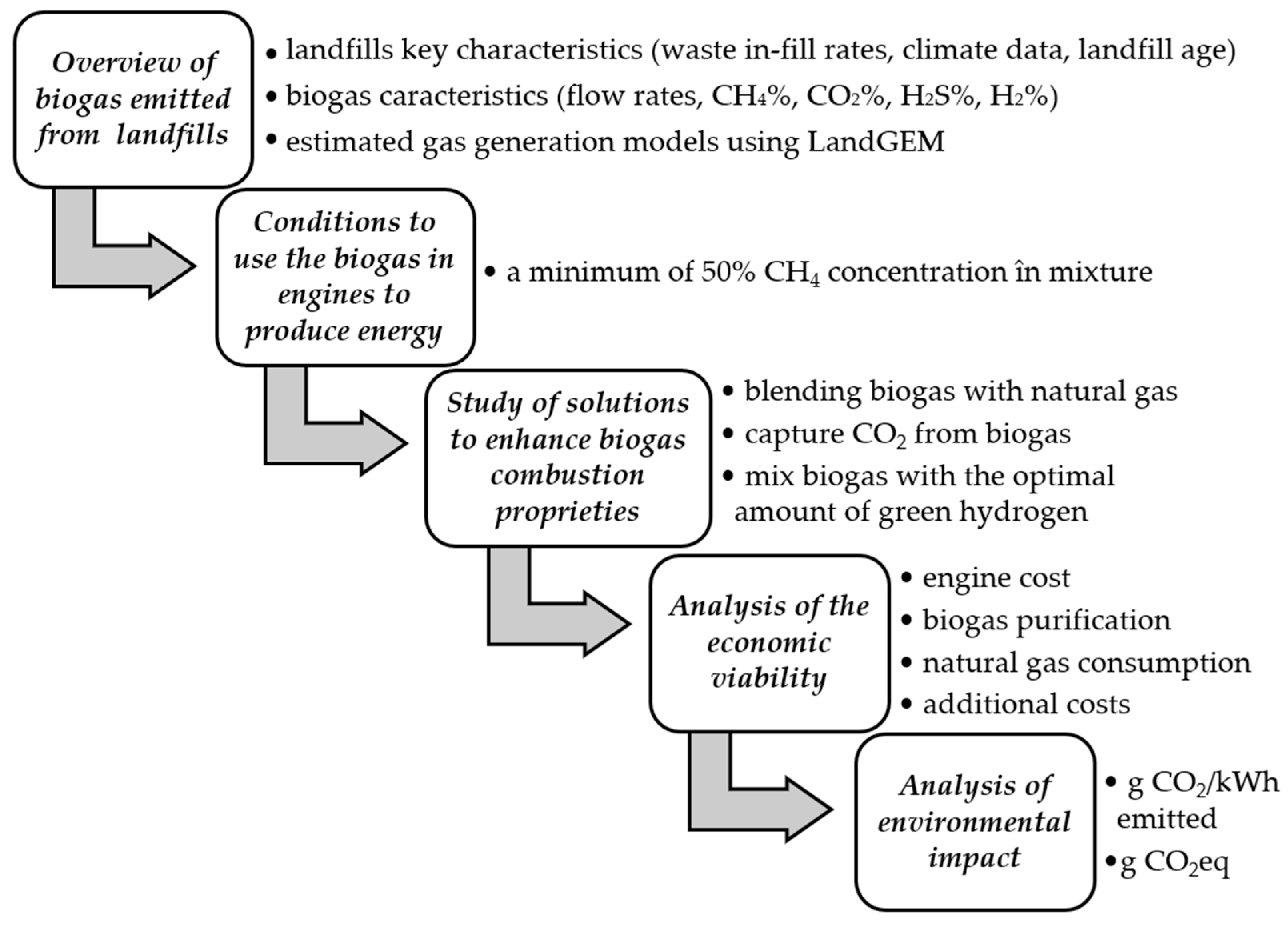
The opportunity of producing energy from landfill biogas is analyzed in this paper from three perspectives: technical, economic, and environmental. The technical perspective included the study of emissions from three landfills selected as case studies and the determination of the conditions for using the landfill biogas in a dual-fuel engine to produce energy. Also, the possibilities of increasing the methane concentration by purifying and mixing it with natural gas were studied, so that the biogas can be used in engine. The economic perspective included analyzing the prices at which energy can be sold for the investment to be viable. In terms of environmental impact, emissions were analyzed in relation to current and future requirements for net zero emissions by 2050. Thus, as can be seen in Figure 1, the working methodology was divided into five main steps.
To begin with, the characteristics (biogas flow rates, concentrations of CH4, CO2, H2S, H2) of the biogas emitted by three solid waste landfills selected as case studies for this article are presented. The three landfills chosen as case studies are municipal solid waste landfills in Romania, a developing country, where selective collection and recycling have not been properly implemented or have been very limited, which has led to the disposal of very large quantities of waste in such landfills. Therefore, they are currently sources of greenhouse gas emissions. All three have high total capacities, over 25,000 tons of waste and receive over 10 tons of waste daily, which means a high impact in terms of emissions. Moreover, they are part of the over 40 compliant landfills and have a high importance in Romania’s actions to comply with European legislation on reducing environmental impact. The values shown in Table 2, Table 3 and Table 4 are estimates based on the values of wells taken in every month of the year, reported by companies. The calculation was performed by adding up the biogas emitted from all extraction wells in one hour. To calculate annual emissions, the amount was multiplied by 24 h per day and the number of days specific to each month in which the measurement was taken. Methane and carbon dioxide concentrations were calculated as average values for each monthly measurement taken.
Subsequently, research was conducted to identify the conditions under which biogas from the three landfills selected as case studies for energy production could be used in a dual-fuel engine.
Furthermore, several possible solutions for using biogas from municipal landfills in dual-fuel engines are analyzed. The first solution considered is mixing biogas with natural gas to increase the methane content to 50%. The second solution is to capture CO2 from biogas to increase its methane concentration. The last solution proposed for analysis is to mix biogas with the optimal amount of green hydrogen. Calculations are performed in percentages of gas in the mixture.
Next, the economic viability of using the biogas and natural gas mixture with a methane concentration of 50% with and without biogas filtration in an engine for energy production was analyzed. The analysis includes the investment costs (engines, biogas storage tank and water scrubber) and the necessary operating costs (natural gas, maintenance, energy, water). The revenue results from the sales of energy produced to the national grid.
A system operating period of 15 years was chosen for the analysis, which was performed for all three case studies in both situations, with and without biogas purification. The Internal Rate of Return (IRR) was used in order to determine the minimum price at which energy should be sold so that the investment can be recovered. It was calculated using the IRR formula in Microsoft Excel and the minimum rate of return (MIRR) has been chosen to be 10%.
There are four key steps at this stage:
  • Selecting suitable engines for producing energy from a mixture of biogas and natural gas and determining the number of engines needed to utilize the biogas emitted annually from landfills. Also, a brief analysis to establish an average price was carried out, using data available online.
  • Choosing a method for purifying biogas and estimating the costs of purchasing the respective system using scientific articles that analyzed these costs. Due to its low costs, the water scrubber solution was chosen as the purification solution.
  • Calculate an approximate annual cost for the purchase of natural gas needed to operate the system. The gas prices were chosen from natural gas supply offers by using the comparison tool provided by the National Regulatory Authority for Energy in Romania on the official website. Prices are specific to each county and consumption category, and are considered constant throughout the entire period analyzed.
  • Analyzing the additional costs necessary for the proper functioning of the system, such as tanks for the storage of biogas to ensure continuous operation of the engines. The number of tanks was chosen considering the quantity of biogas emitted per day for each storage facility, and their price was inspired by scientific literature in the field of biogas storage for energy production. Also based on the analysis of scientific literature in the field, it was decided that the annual maintenance costs of the generator would be 5 €/MWh and the service life of the generator systems would be 30,000 running hours before overhaul. The cost of this overhaul was assumed to be 20% of the initial purchase cost. It was also considered that, for the overhaul to be carried out, approximately two weeks of non-operation, i.e., 336 h, would be required, during which time no revenue would be generated. Also, in the case of biogas purification, it is necessary to add the costs of operating the scrubber, such as scrubber energy consumption, water consumption, and maintenance costs. Water and energy consumption were approximate considering the maximum hourly quantity of biogas to be purified and the associated costs were taken from the service providers’ websites based on the quantity and location of the landfills. The water prices used in the calculations include 9% VAT. The annual operation and maintenance cost of a landfill gas collection system was also integrated.
Finally, an environmental impact analysis was carried out. The analysis was carried out using methane emission estimates produced by the LandGEM software (version 3.1) developed by the U.S. EPA over a 20-year period. The comparison of emissions caused using a mix of natural gas and biogas methane for energy production, considering engine slip emissions, with the CO2 equivalent emissions of methane emitted from the landfill was carried out. It was also discussed the European Union’s ambitions to achieve climate neutrality by 2050 and the need to reduce emissions from energy production to an initial value of 250 g CO2/kWh with plans to rapidly reduce emissions intensity to 100 g CO2/kWh (Kg CO2/MWh). The analysis considered the amount of natural gas required for each case study and the emissions from energy production using it.

4. Results

4.1. Presentation of Selected Landfills as Case Studies for the Analysis of Biogas Emitted

This section will analyze the potential of solid waste landfills to produce biogas and its quality. Information on air emissions from three municipal solid waste landfills was used for this analysis.
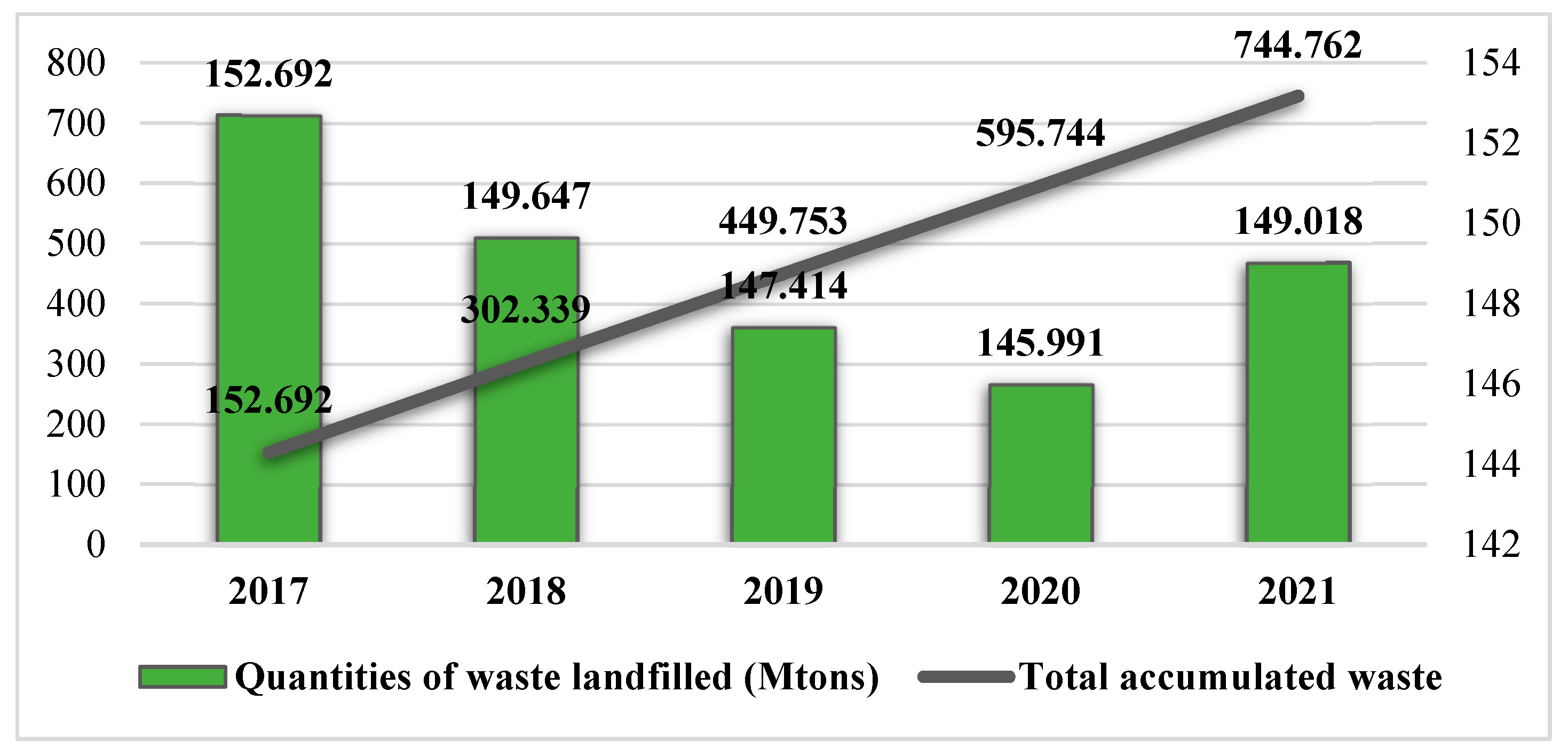
Solid waste landfill in Bacău municipality, Bacău County, Romania is composed of four storage cells with a maximum storage capacity of 5,250,000 m3 (approximately 6,825,000 tons). Operations began in 2011. Cell 1 has a volume of 855,000 and operated between 2011 and 2018 [46]. Figure 2 presents the quantity of waste landfilled between 2017 and 2021, in cell 1 and after 2018 in cell 2 [47].
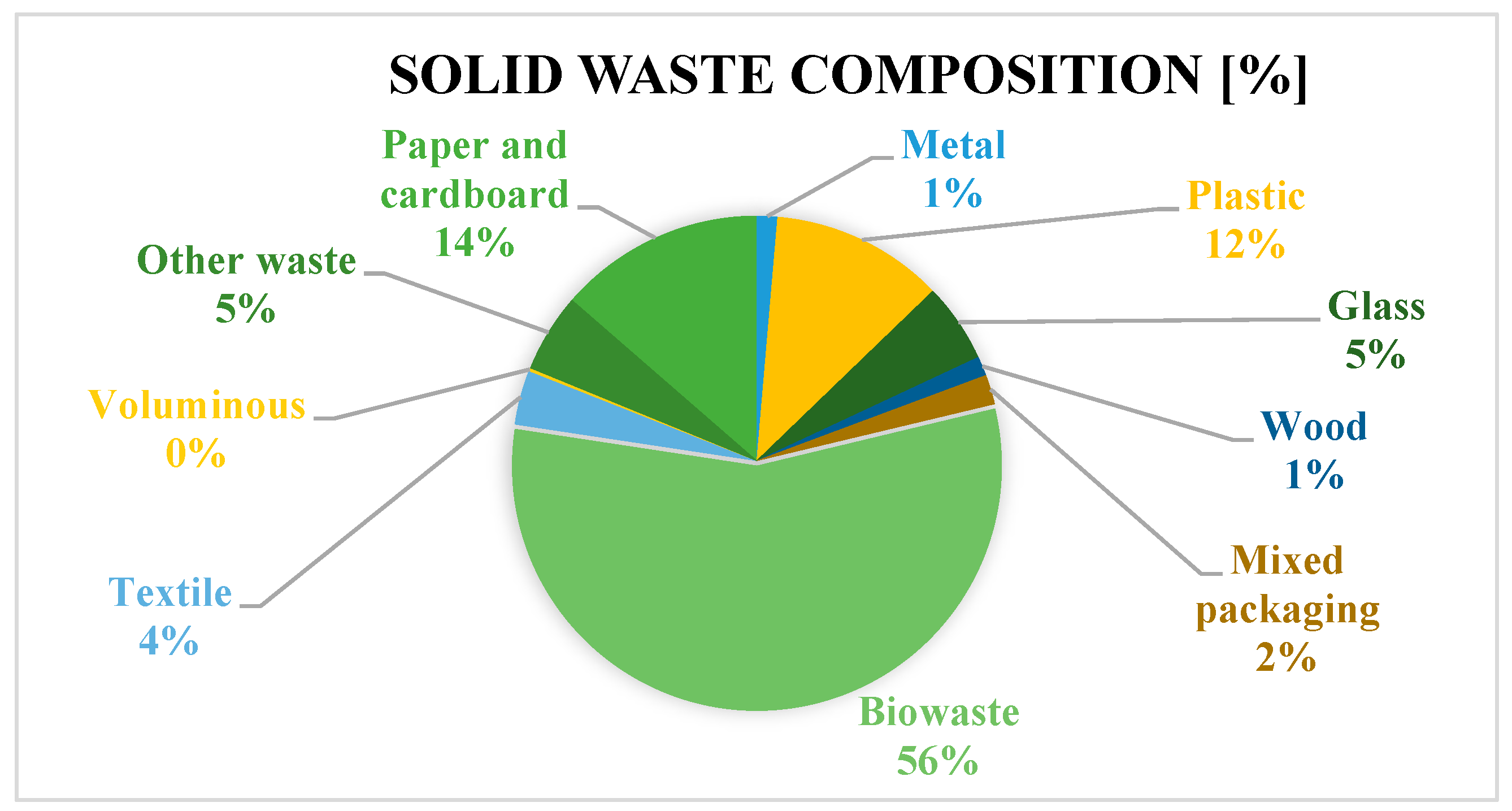
Figure 3 presents the composition of municipal waste in Bacău between in 2021. The content of organic material (biowaste, paper and cardboard, textile, wood) is about 74.65%, out of which 56% is biodegradable. The data highlight a high methane generation potential [48].
A characteristic feature of Bacău County is the insular distribution of temperatures, conditioned by the specific relief. The air temperature records average annual values of 9 °C (in the eastern half of the county) where the landfill is located. The average temperature for the warmest month (July) is 20 °C, and for the coldest month (January) it is −4 °C for the eastern part of the county. Precipitation ranges from 550 mm at the eastern border of the county [49].
Cell 2, the only one in operation according to the 2020 Environmental Report [50] the landfill has an area of 77,200 m2. The total cell 2 estimated storage capacity is 1,756,000 m3, or approx. 2,282,800 tons. For cell 2, the landfill has a system consisting of 28 biogas extraction and collection wells connected to collection substations. From these substations the gas is transported to a controlled biogas combustion station. In 2022, emissions from 10 exhaust pipes were sampled and analyzed [50]. Table 2 contains sampling data, minimum and maximum temperatures, speed, total biogas flow rate, and flow rates of main components such as methane (CH4), carbon dioxide (CO2), hydrogen sulfide (H2S), hydrogen (H2).
Table 2. Data from the 10 biogas extraction wells from Bacău landfill in each month of 2022.
Sampling DateTemp.
[°C]
Avg. Speed
[m/s]
Biogas [Nm3/h]CH4
[%]
CO2
[%]
H2S
[g/Nm3]
H2
[g/Nm3]
26 Jan.13.3–34.20.14158.27.7617.930.062.74
17 Febr.31.9–34.20.13146.97.7122.20.204.07
21 Mar.18.9–40.70.404522.346.30.041.82
21 Apr.18.2–41.90.951216.714.2111.181.120.11
10 May31.1–401.001438.16.345.420.580.07
15 June33.6–47.80.791134.218.4813.281.380.11
05 July43.9–60.60.34484.9610.287.491.300.10
10 Aug.27.3–49.11.311639.510.388.211.280.16
06 Sept.32.5–45.171.111346.610.0511.232.300.32
11 Oct.26.1–47.880.52682.9211.499.702.000.25
17 Nov.23.7–35.970.891096.36.285.190.620.06
14 Dec.15.3–46.872.042678.511.6610.191.220.16
Considering the number of days in the year 2022 and 24 h in a day, it results a biogas flow rate emitted from the 10 extraction wells of 9,155,637.6 Nm3/year, averaging about 24,949.64 Nm3/day. If the emissions from the other 18 extraction wells are assumed to be approximately equal to that of the 10 wells studied, then total biogas flow rate emitted to the atmosphere is about 25,635,785.28, with an average of about 69,858.99 Nm3/day. Methane concentration varies between 1.83% and 29.39% in the biogas emitted, with an average of 9.75%.
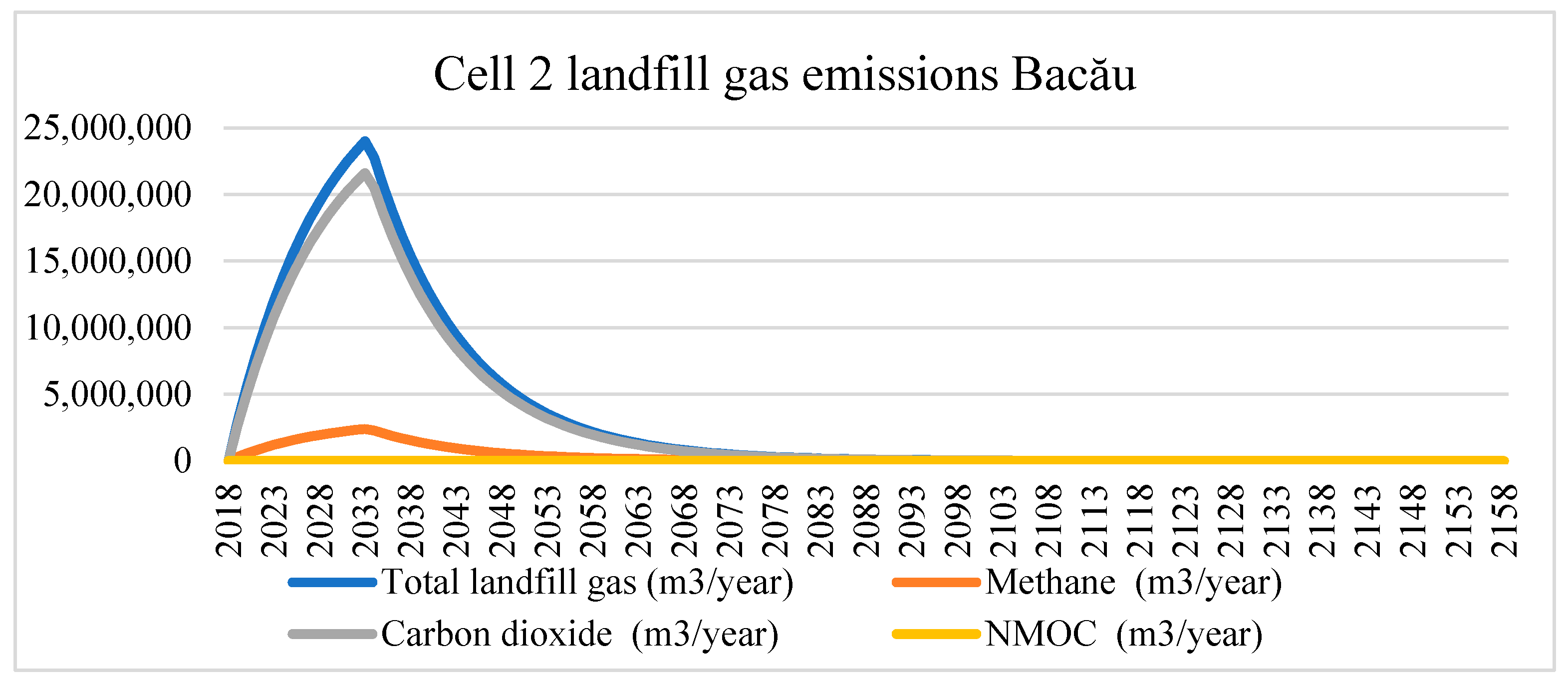
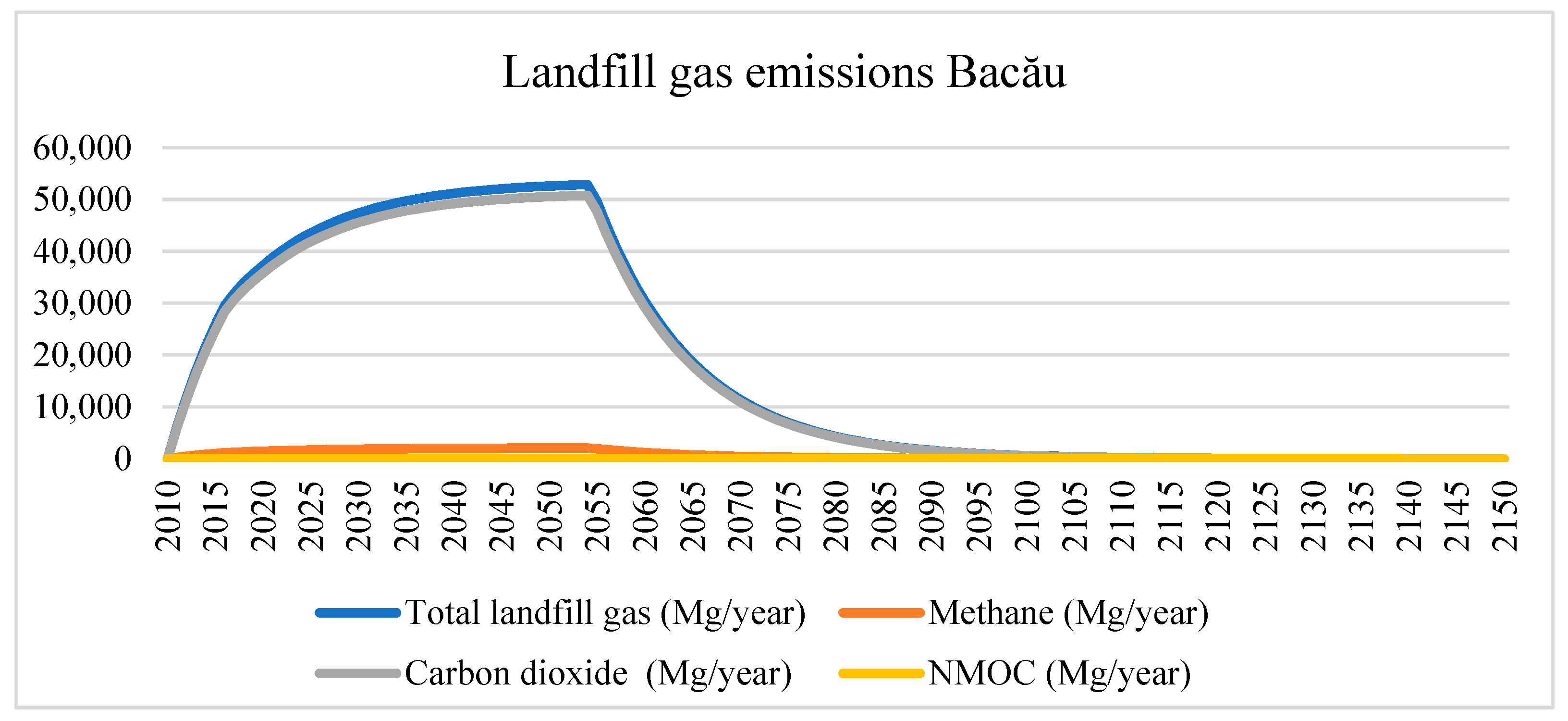
Using the information presented above and LandGEM software, Figure 4 was obtained, which shows the estimated landfill gas and methane emissions for cell 2, i.e., Bacău landfill.
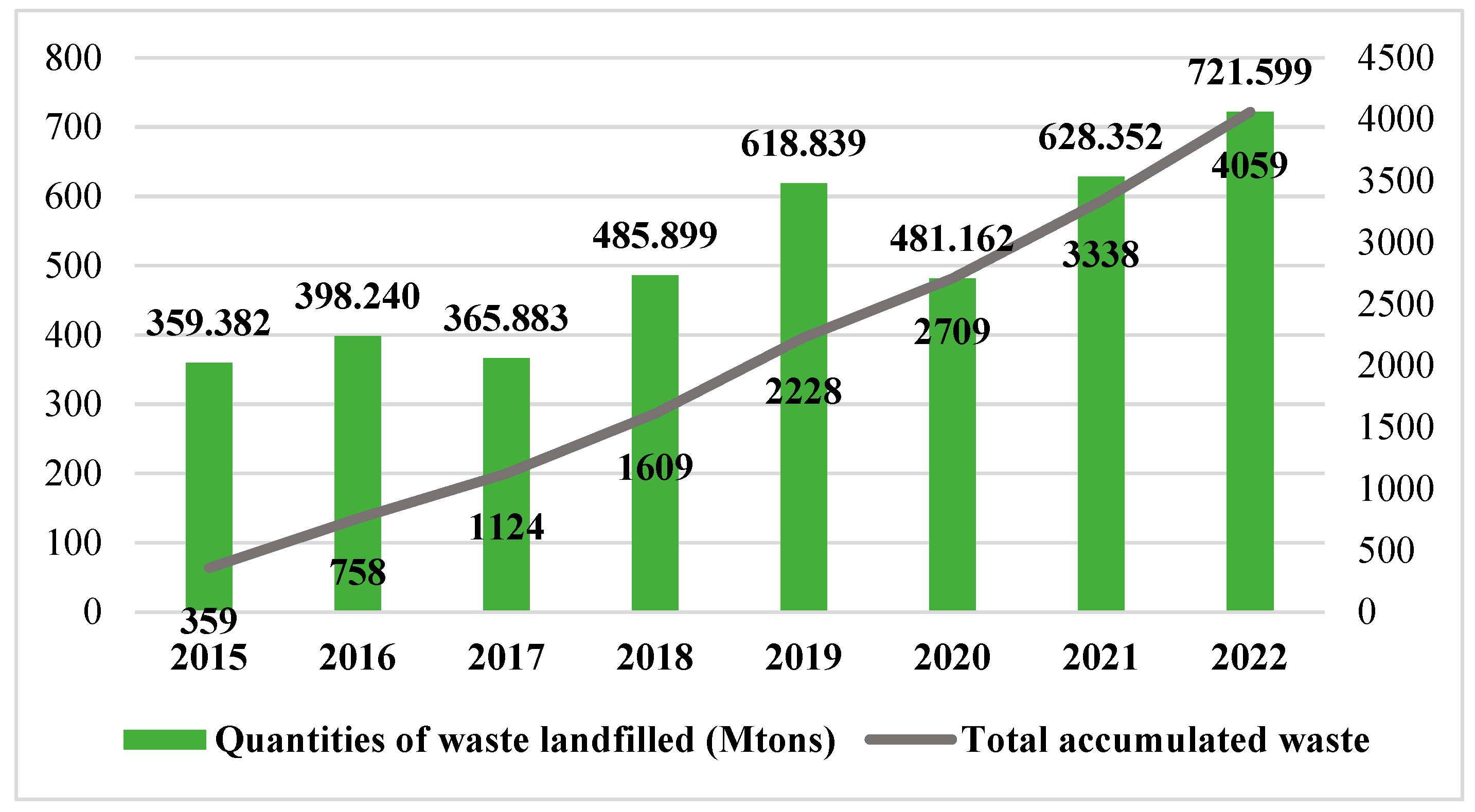
Vidra Ecological Landfill for urban and industrial solid waste, Vidra municipality, Sintești village, Ilfov County, Romania has a landfill divided into eight solid waste storage cells, with a maximum storage capacity of 11,500,000 m3. The Vidra (Ilfov) ecological landfill was built and has been in operation since 2001. The estimated amount of waste based on the tender documentation is approximately 745,000 tons/year [51], and the amount received between 2015 and 2022 at Ilfov is presented in Figure 5.
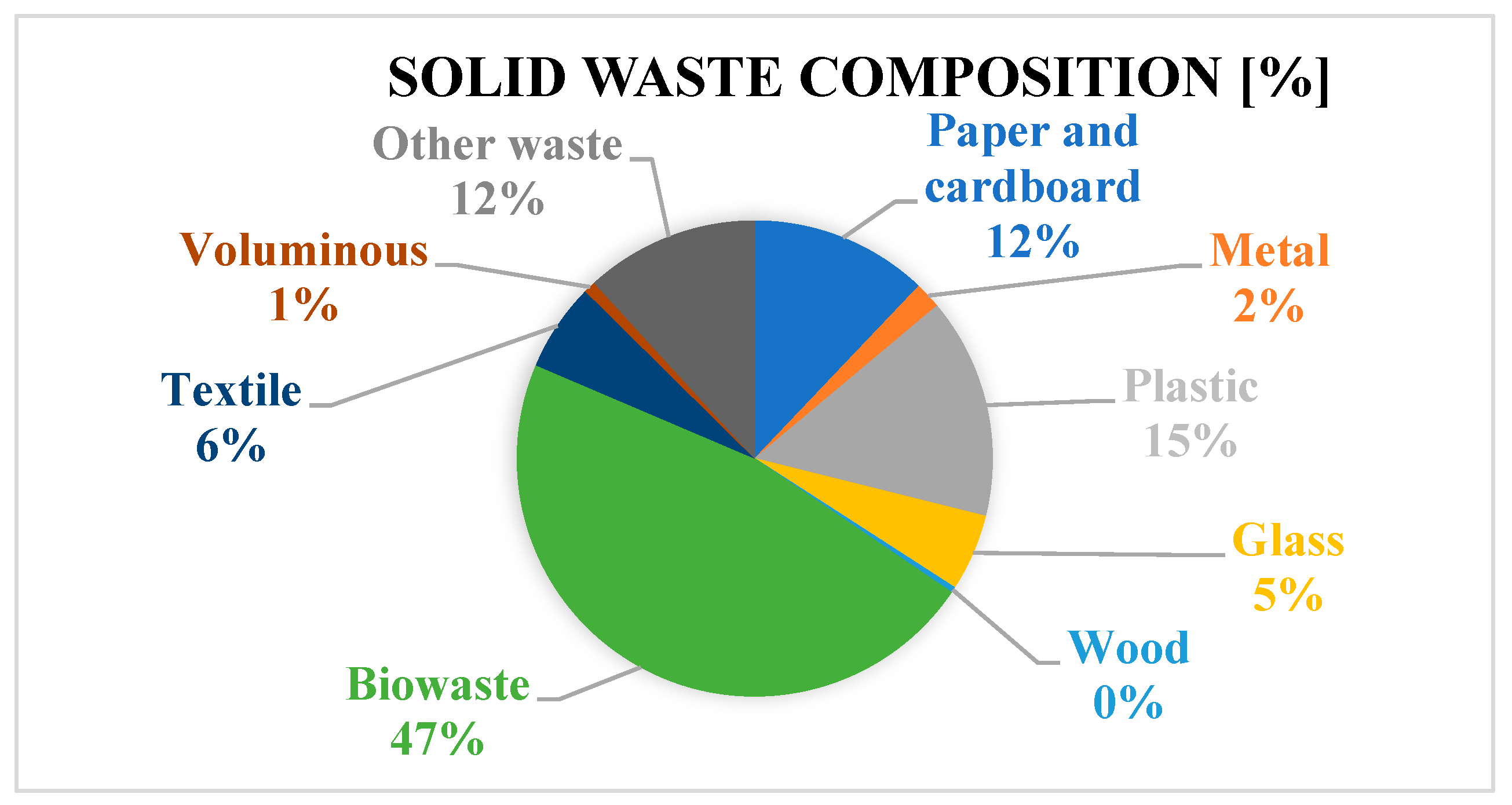
Figure 6 presents the composition of municipal waste in Ilfov in 2018. The content of organic material (biowaste, paper and cardboard, textile, wood) is about 65.4%, out of which 47% is biodegradable [52].
The climatic characteristics of Ilfov County are specific to a temperate continental climate with arid features, favorable to droughts, but also to the plain climate that brings the north wind. According to this type of climate, the average annual temperature is 11–12 °C, the average temperature in January being −2 °C, and that in July being 25 °C.
Precipitation amounts are extremely variable throughout the year, or even from one year to the next, with annual averages generally exceeding 600 mm. The average annual relative humidity of the air is 76–78%. The prevailing winds are from the northeast and southwest, with their frequency decreasing from south to north. Analysis of atmospheric circulation shows that winds from the northeast are the most frequent (20.8%), while those from the south are the least frequent (3.1%) [53].
According to information from the Annual Environmental Report for 2022 [54], municipal and assimilable industrial waste from the municipality of Bucharest and Ilfov County are deposited in this landfill. The landfill has a collection and treatment installation consisting of biogas extraction and collection wells interconnected and connected to collection substations. The collected biogas is then transported to a Controlled Combustion Plant. According to the same report, monitoring of the eight wells on cell 7 was carried out and data was collected on discharged biogas flow rates, concentrations of CH4, CO2, H2S, H2 (Table 3). Cell 7 has an area of 49,142 m2 [54].
Table 3. Data from the eight biogas extraction wells from Ilfov landfill in each month of 2022.
Sampling DateTemp.
[°C]
Avg. Speed
[m/s]
Biogas [Nm3/h]CH4
[%]
CO2
[%]
H2S
[g/Nm3]
H2
[g/Nm3]
26 Jan.14–15.31.8108.89.4610.770.0410.013
19 Febr.14.9–6.12.13116.29.410.460.0420.012
26 Mar.14.3–16.32.37110.412.1711.870.0470.013
28 Apr.12.8–173.74102.55.9511.370.0370.015
31 May12.3–16.74.42109.25.7211.330.0370.017
01 July13.1–16.24.391156.2811.690.0390.018
01 Aug.12.5–163.57107.16.911.280.0360.015
01 Sept.12.8–15.74.29111.66.9211.930.0370.018
29 Sept.13.4–15.94.44114.36.3912.130.0350.02
21 Oct.14.1–15.65.24120.76.6313.750.050.023
29 Nov.14.2–19.55.79133.16.6414.290.0520.025
27 Dec.13.5–15.25.59141.2715.050.0580.027
Data from [54].
Considering the number of days of the year 2022 and 24 h in a day, the biogas flow rate emitted from the 8 extraction wells is 1,014,758.4 Nm3/year, with an average of about 2780.16 Nm3/day. The methane concentration varies between 0% and 13.6% in the emitted biogas, with an average of 7.46%.
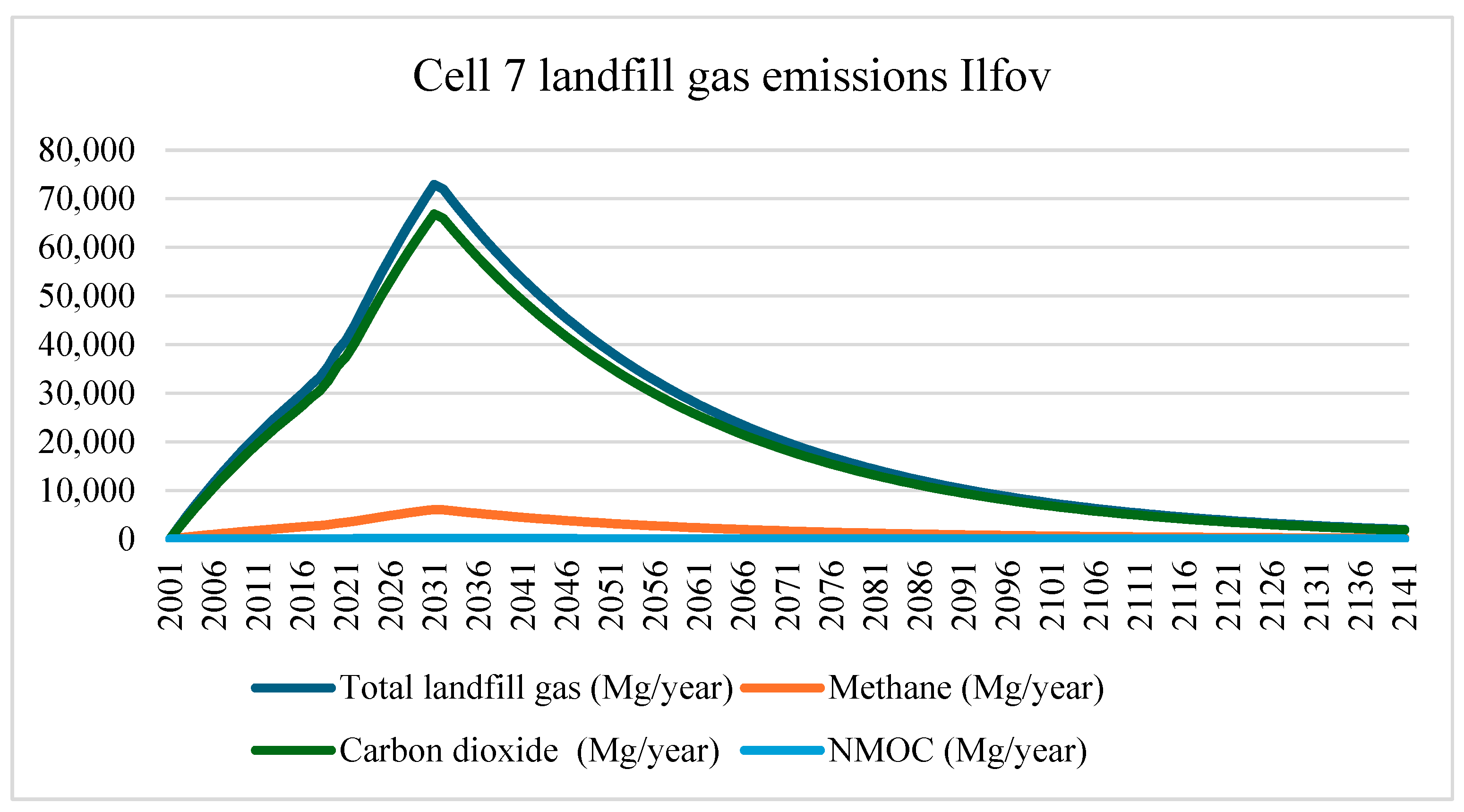
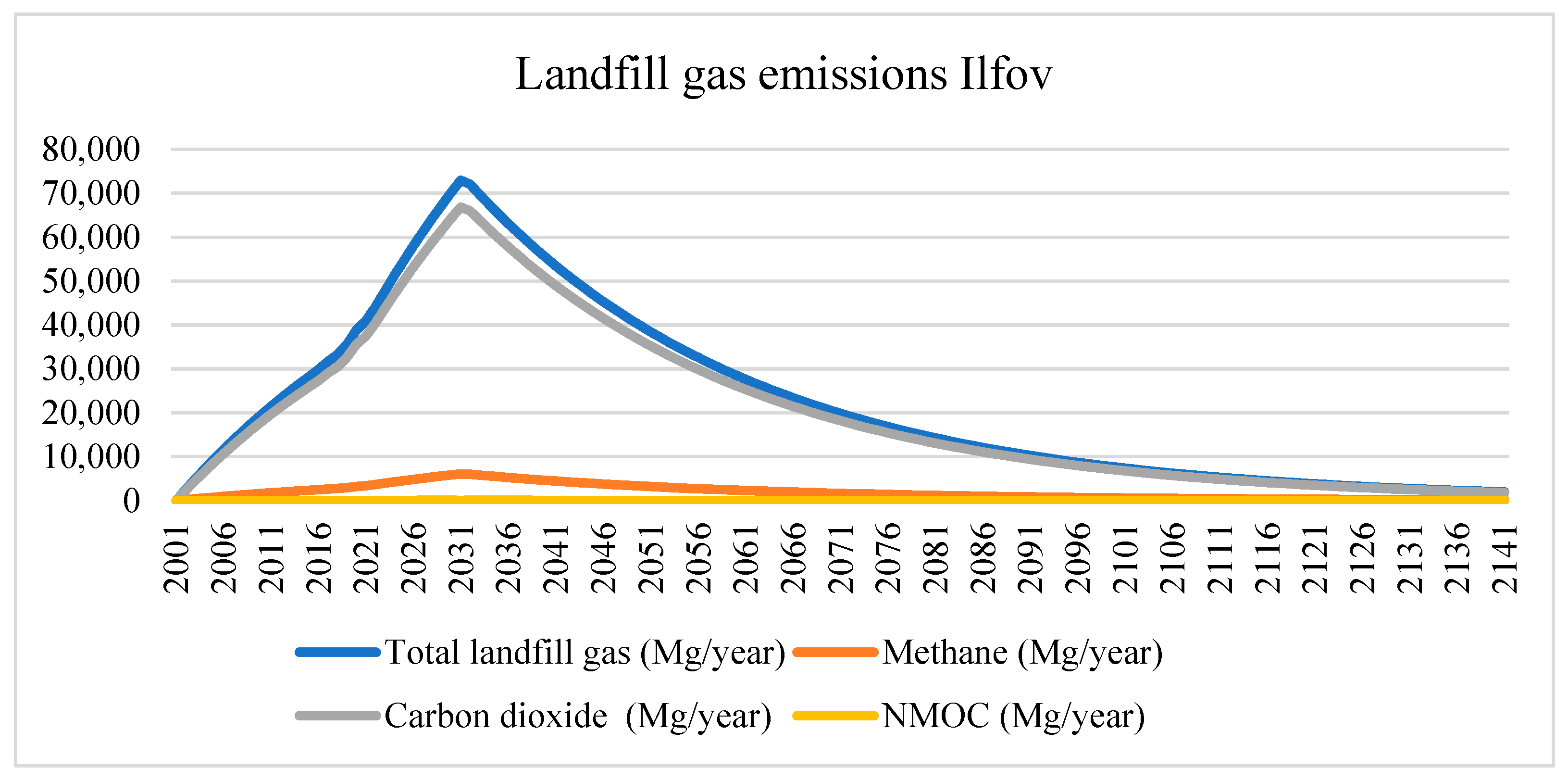
Figure 7 was obtained using the information presented above and LandGEM software, and it shows the estimated landfill gas and methane emissions for the cell 7, Ilfov landfill.
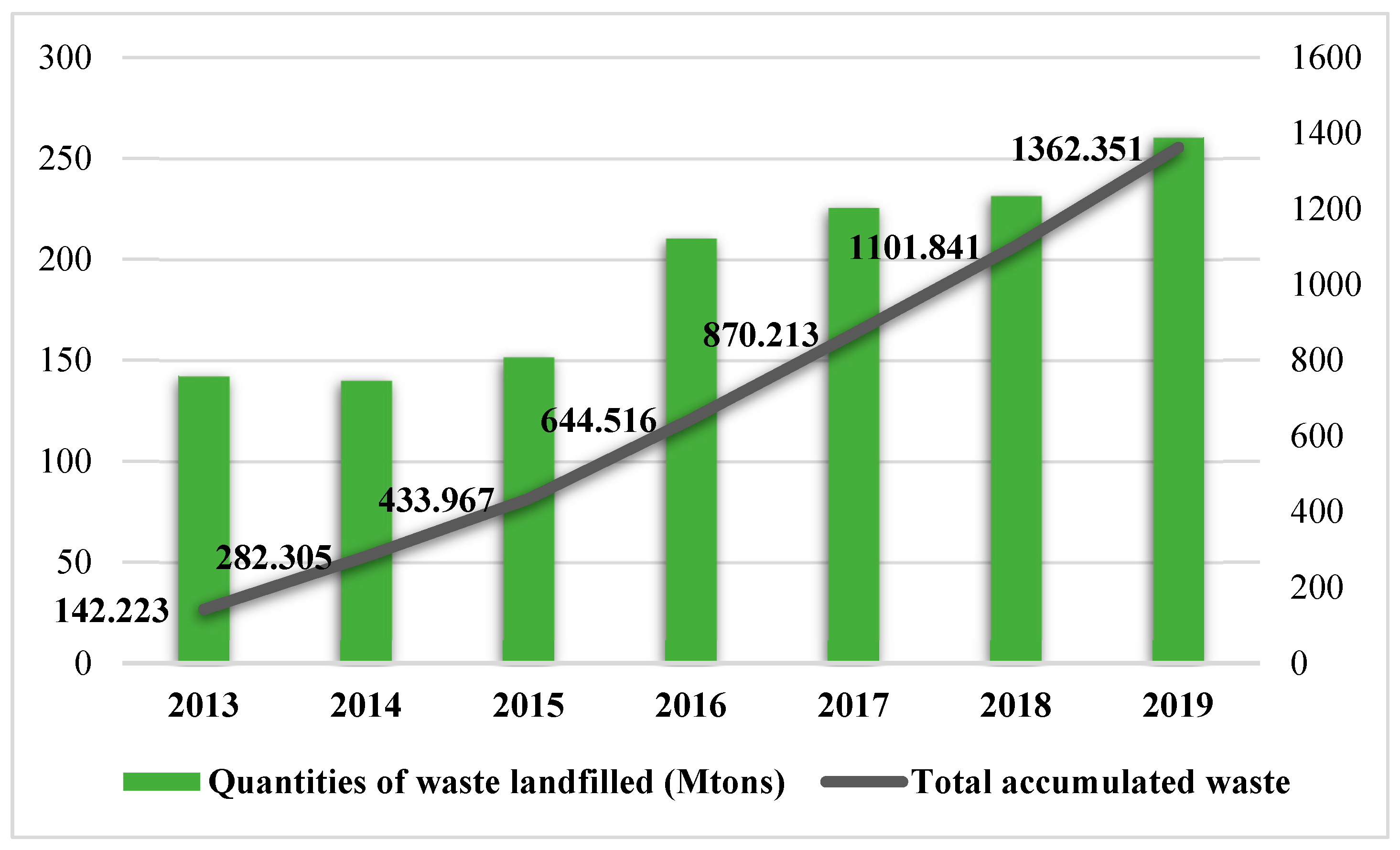
Municipal solid waste landfill Săcele, Municipality of Brașov, Brașov County, Romania consists of six solid waste storage cells with a maximum storage capacity of 11,230,000 m3 (8,984,000 tons at an average density of compacted waste of 0.8 t/m3). Operations began in 2003 and the minimum expected operating life of the entire landfill is 25 years [55]. The amount received between 2013 and 2019 at Brașov is presented in Figure 8.
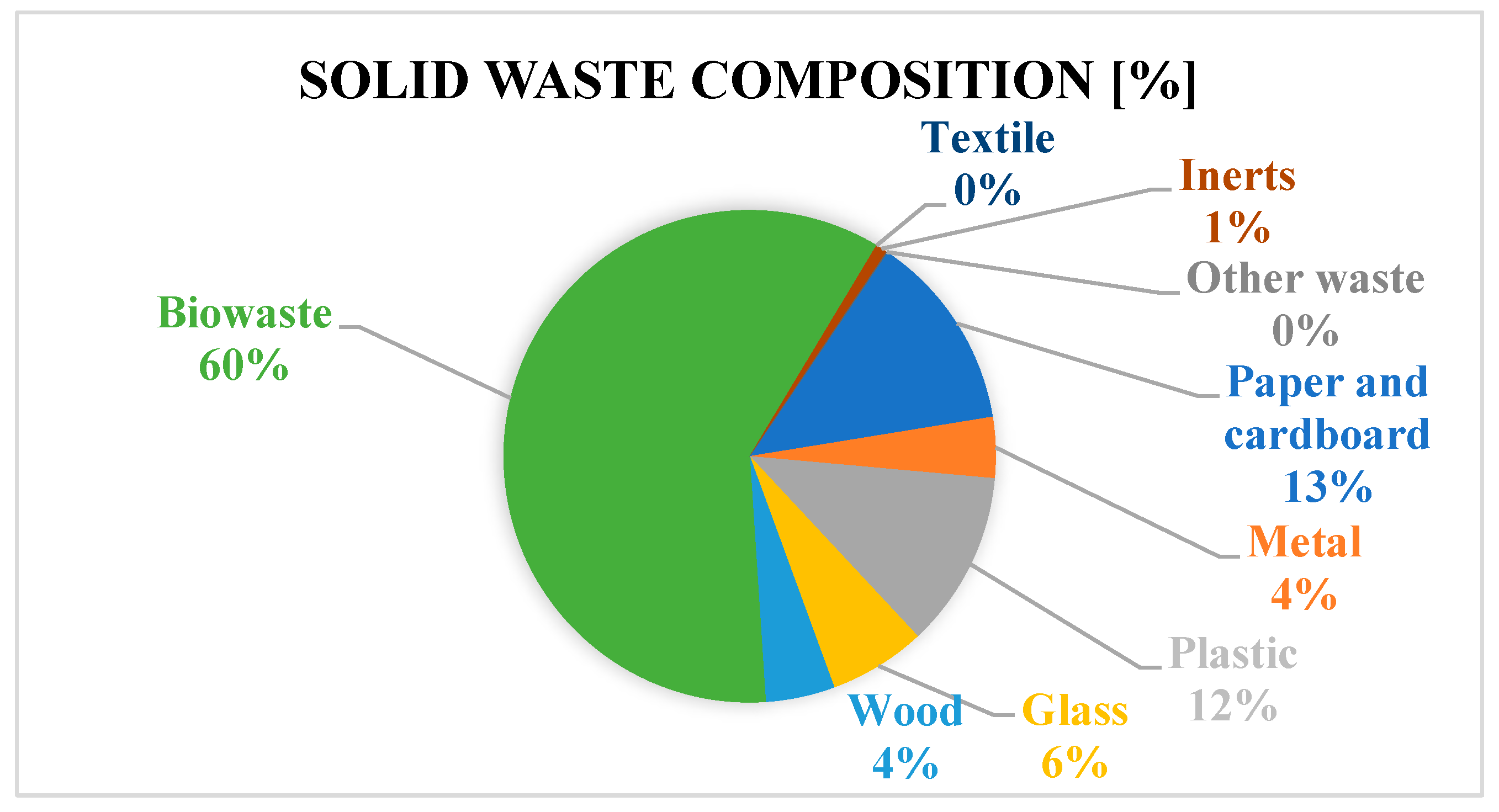
Figure 9 presents the composition of municipal waste in Brașov in 2019. The content of organic material (biowaste, paper and cardboard, textile, wood) is about 77.21%, out of which 60% is biodegradable [56].
In Brașov, the average temperature in January is −3.9 °C, and in July it is 17.8 °C. The average annual temperature for the entire depression is 6 °C, and the monthly averages vary between −5 °C in January and 11 °C in July. Annual precipitation is low, reaching values between 600 and 700 mm, due to the central position of the depression in relation to the mountain ranges. The prevailing winds blow from the NW (20%), SW (15%), W, and E (10%); the average annual speed of the prevailing winds is 7–8 m/s; the frequency of days with calm weather is 37% [55].
Cells 3 and 4 are in operation, cell 3 being more than 75% filled and covering an area of 22,500 m2 [57]. The total cell 3 estimated storage capacity is approx. 955,245 m3, or approx. 764,196 tons, calculated at an average density of compacted waste of 0.8 t/m3 [55]. The measurements were taken from the Annual Environmental Report for the year 2021 [58]. Nine interconnected biogas extraction and collection wells were located on cell 3 and connected to a controlled biogas combustion plant when the biogas methane concentration of maximum 25%. According to the same report, monitoring of the nine wells on cell 3 was carried out and data on biogas flow rates and concentrations of CH4, CO2, H2S, H2 were collected in Table 4.
Table 4. Data from the nine biogas extraction wells from Brașov landfill in each month of 2021.
Sampling DateTemp.
[°C]
Avg. Speed
[m/s]
Biogas [Nm3/h]CH4
[%]
CO2
[%]
H2S
[g/Nm3]
H2
[g/Nm3]
08 Febr.14.6–16.6-3.69723.356.27-0.049
01 Mar.15.4–19.3-3.72219.746.13-0.049
16 Apr.17.4–18.5-3.12622.956.05-0.048
05 May18.4–24.2-1.40319.174.11-0.042
28 May20.3–25.6-1.25420.534.49-0.036
15 July27.1–28-8.75337.76.43-0.034
04 Aug.28–29-9.59841.688.27-0.023
06 Sept.28-9.04643.676.59-0.066
28 Sept.26.5–26.7-7.59543.638.9-0.166
15 Oct.19.1–26.4-8.70132.255.58-0.039
12 Dec.18.9–27.6-8.51234.585.35-0.018
14 Dec.19.1–26.7-8.64932.985.37-0.028
Data from [58].
Considering the number of days in the year 2021 and 24 h in a day, the biogas flow rate emitted from the eight extraction wells is 54,060.85 Nm3/year, with an average of about 148.104 Nm3/day. The methane concentration varies between 6.7% and 61% in the biogas emitted, with an average of 31%.
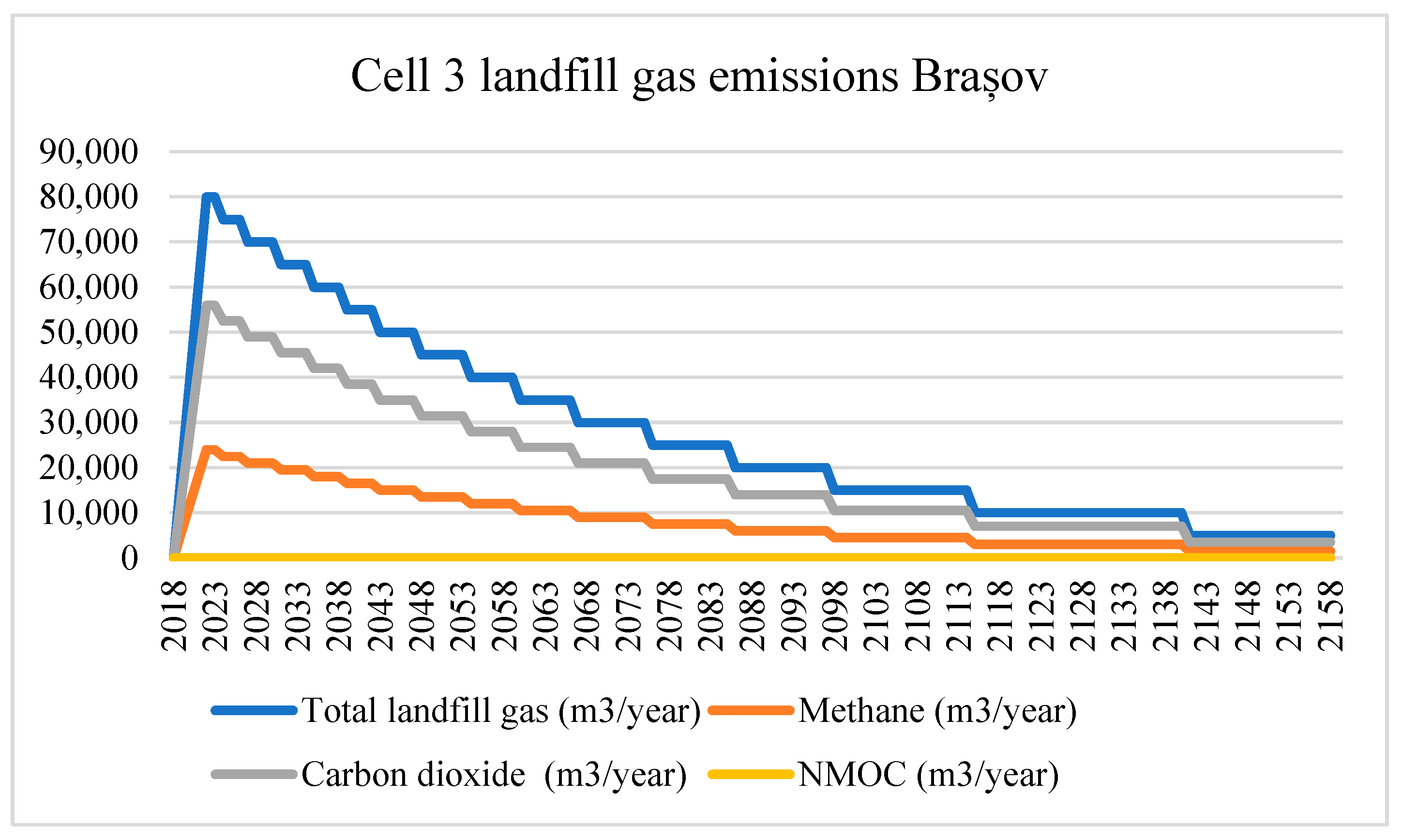
Figure 10 was obtained using the information presented above and LandGEM software, and it shows the estimated landfill gas and methane emissions for the cell 3, Brașov landfill.
The potential for producing electricity from landfill gas depends on the efficiency of the technology or equipment used, and the amount of methane that can be captured [59]. If a mixture of biogas and natural gas with a methane concentration of 50% is used in a dual-fuel engine with an efficiency of 28%, assuming a lower calorific value of methane of 37.2, the electricity that could be produced from the emissions from the three municipal landfills is calculated using (1)
E e   ( k W h )   =   V C H 4   m 3 h × L H V C H 4   M J m 3 × ƞ e l   × ƞ c o l 3.6
where
E e is the electricity generation efficiency;
V C H 4 is the methane generated from the landfill;
L H V C H 4 is the lower heating value of methane;
ƞ e l is the electricity generation efficiency;
ƞ c o l is the methane collection efficiency [1,2,59].

4.2. Solutions for Utilizing Biogas from Municipal Landfills in Dual-Fuel Engines

From the research conducted in Section 2.2 of this article, it was emphasized that the combustion of biogas with a methane concentration below 30–40% is not possible. Therefore, this section analyzes several possible solutions for utilizing biogas from municipal landfills in dual-fuel engines.
The first solution considered is the blending of biogas with natural gas until the methane content is increased to 50%. The second solution is to capture CO2 from biogas to increase its methane concentration. The last solution proposed for consideration is to mix biogas with the optimal amount of green hydrogen.
In the following, the possibility of using the three methods for each landfill chosen as a case study will be briefly analyzed.
In the first case study analyzed, the total biogas flow rate emitted to the atmosphere is approximately 25,635,785.28 Nm3/year, with an average of approximately 2926.46 Nm3/h. The methane concentration varies between 1.83% and 29.39% in the biogas emitted, with an average of 9.75%. To be used in an engine, the concentration of methane in the biogas must be at least 50%, so to obtain this value, biogas and natural gas were mixed, the optimal mixture being 50% biogas–50% natural gas (95% × 48% + 9.75% × 52% = 50.67%). This implies that to reach the methane concentration of 50% in the mixture of biogas and natural gas, the amount of the mixture will require doubling the amount to 49,299,587.077 Nm3/year, which means that the amount of CH4 is about 24,649,793.54 Nm3/year.
Using as an example a Jenbacher biogas engine with an output of 850–1250 kW and 6500–10,000 MWh/year of electricity produced, with a consumption of 1.7–2.5 million m3 of methane [60], it was calculated that if there are approximately 25.6 million Nm3/year of methane, then to utilize this amount it is necessary to install 10 biogas engines with an output of 1250 kW. The 10 engines would have a total installed capacity of 12.5 MW. The calculations show high costs in buying 10 engines as well as in purchasing a very large amount of natural gas.
The concentration of CO2 in the biogas emitted from the landfill in Bacău are on average 10.69% per year.
The biogas equation for Bacău landfill would be
9.75% CH4 + 10.69% CO2 + 79.56% other gases = 100%
According to the research presented above, the entire CO2 concentration can be removed, but this will increase the methane concentration from 9.75 to 10.917%, or about 1%. Also, from previous research, currently the most stable mixture of biogas and hydrogen is 10% hydrogen concentration.
Under these conditions the concentration equation for Bacău landfill will be
10% H2 + 8.775% CH4 + 9.621% CO2 + 71.604% other gases = 100%
For the second case study, the biogas flow rate emitted is 1,014,710.4 Nm3/year, with an average of about 115.84 Nm3/h. The methane concentration ranges from 0% to 13.6% in the biogas emitted, with an average of 7.46%.
As in the above case, to be used in an engine, the methane concentration in the biogas must be at least 50%, so to obtain this value the biogas and natural gas were mixed, the optimal mixture being 50% biogas–50% natural gas (95% × 49% + 7.46% × 51% = 50.35%)
This assumes that to reach the methane concentration of 50% in the mixture of biogas and natural gas, the amount of natural gas will be 111.297 Nm3/h, and the amount of the mixture will reach 227.137 m3/h or 1,989,722.353 Nm3/year.
If two engines Jenbacher J208 of 249 kW are purchased with a mixture consumption of 127 Nm3/h at 50% methane concentration [61], then the total installed capacity will be 498 kW, with a consumption of 254 Nm3/h and a production of about 3901.109 MWh/year.
For CO2 biogas purification, the CO2 concentration in the biogas emitted from the Ilfov landfill is on average 12.165% per year.
The biogas equation for Ilfov landfill would be
7.46% CH4 + 12.165% CO2 + 79.56% other gases = 100%
According to previous research, the entire CO2 concentration can be removed, but this will increase the methane concentration from 7.46% to 8.493%, or about 1%. Also, from the research carried out previously, currently the most stable mixture of biogas and hydrogen is 10% hydrogen concentration.
Under these conditions the concentration equation for Ilfov landfill will be
10% H2 + 6.714% CH4 + 10.948% CO2 + 72.338% other gases = 100%
In the third case analyzed, the biogas flow rate is 54,060.85 Nm3/year, with an average of about 6.171 Nm3/h. Methane concentration varies between 6.7% and 61% in the biogas emitted, with an average of 31%.
As in the above case, to be used in an engine, the methane concentration in the flue gas must be at least 50%, so to achieve this value, biogas and natural gas have been mixed, the optimal mixture being 70% biogas–30% natural gas (95%*30% + 31%*70% = 50.2%)
If a 3 kW engine (output 2089 W) is chosen, with a consumption of and 47 m3/h of biogas [24] at lower methane concentration, then the amount of biogas should be about 33 m3/h biogas and 14 m3/h natural gas.
Given that the average biogas production per day is 148.112 Nm3/day, if stored, it can be used for energy production for four peak hours of the day.
To purify the biogas of CO2, the CO2 concentration in the biogas emitted from the landfill in Brașov is on average 6.129% per year.
The biogas equation for Brașov landfill would be
31% CH4 + 6.129% CO2 + 62.848% other gases = 100%
According to previous research, the entire CO2 concentration can be removed. This will help to increase the methane concentration from 31% to 33.048%, i.e., by about 2%. Also, from the research done previously, currently the most stable mixture of biogas and hydrogen is 10% hydrogen concentration.
Under these conditions the concentration equation for Brașov landfill will be
10% H2 + 27.9% CH4 + 5.517% CO2 + 56.583% other gases = 100%

4.3. Economic Viability

This section analyzes the economic viability of using a biogas and natural gas mixture with a methane concentration of 50% with and without biogas filtration. The costs are the investment costs (engines, biogas storage tank and water scrubber) and the necessary operating costs (natural gas, maintenance, energy, water). The revenue results from the sale of the energy produced.

4.3.1. Biogas Regulatory Framework

To feed biogas into a natural gas grid, unwanted components need to be removed from the gas and the burning properties of the gas need to be adjusted. In addition to excluding the gas accompanying substances by cleaning and processing the biogas, further conditioning to adjust the Wobbe Index and the calorific value to the target grid is required, depending upon the case in point [62].
The EN16726 standard [63] incorporates normative recommendations for oxygen requirements, the Wobbe Index and a review of the parameters present in the current standard, including hydrogen content and the minimum value adapted for relative density, sulfur and methane number. Controlling the oxygen level in the gas network is important to avoid corrosion in both underground and aboveground installations. There are also risks of combustion, changes in gas quality due to reaction and oxidation and possible microbial growth in the gas storage environment [64].
In gas infrastructure, oxygen concentration should not exceed 1%. Most applications can tolerate an oxygen level of 0.01% or higher, while certain types of underground storage are sensitive to oxygen contents greater than 0.001%. The Wobble index entry range should be within 46.44 MJ/m3 and 54 MJ/m3 [15 °C/15 °C]. Class Specified shall be assigned to exit points if equal with entry range or bandwidth of ≤3.7 MJ/m3 [63].
The Wobbe Index is a measure of the thermal energy released on the burner of a gas appliance or the energy transported through a pipe and is an important variable to assess the interchangeability of fuel gases. When replacing one fuel gas with another, the output of the burner changes in proportion to the ratio of the Wobbe index [62].
In Romania, the types of gases and the corresponding supply pressures in accordance with Regulation (EU) 2016/426 on appliances burning gaseous fuels are listed in Table 5 [65].
Also, in order to be able to integrate a gas into the national natural gas network, it must comply with the same minimum quality requirements as the natural gas in the network. These requirements can be found in Table 6 [66].
For the proper operation of biogas engines, certain contaminants such as H2S and siloxanes must be kept within the engine tolerance limits. Table 7 resumes these key contaminants [67].

4.3.2. Collection System

For a non-hazardous landfill with a total volume of 1,000,000 m3, the landfill gas system costs EUR 458,982.86. The cost of the LFG system is determined by the cost of the collection wells and slotted pipes, the connecting pipes and regulating stations for transport, as well as the extraction station and flare for disposal [68].
In 2001, in the UK, for a waste gas collection system with wells spaced at 4/ha (approximately 50 m, installed at an average depth of 25 m, with a collection pipe network based on pipe diameters ranging from 125 mm to 315 mm (MDPE pipe) and a gas flare to handle 2000 m3/h of waste gas (GBP 100,000, 10 year life) the unit capital cost is approximately GBP 3000/well, including installation costs. The maintenance cost for the gas field infrastructure is estimated at approximately 20% of the installation cost per year. The annual operating costs for the flare should be GBP 4000 for electricity (7 p/kWh) and GBP 4000 for maintenance. Costs vary widely across UK sites United due to large differences in site-specific aspects, which can greatly influence costs. Damage to gas wells and their collection during waste disposal operations is the largest factor influencing operating costs [69].
Using data from source [70], the costs of purchasing and implementing a gas collection system for the three landfills were estimated in Table 8 and Table 9. The estimate took into account the number of wells on each cell 28 (cell 2, Bacău landfill), 8 (cell 7, Ilfov landfill) and 9 (cell 3, Brașov landfill) and the landfill gas collection substations 3 (Bacău), 1 (Ilfov) and 1 (Brașov).
Given the estimated biogas production, drillings are carried out in the body of the cells, in order to create wells for collecting the resulting biogas. The drillings are carried out at variable depths, ranging from 10 to 45 m. The extraction wells are equipped with biofilters and are made of containers and a truncated conical base, made of galvanized steel mesh, which are filled with crushed stone, inside having a perforated PEHD pipe.
The gas extracted from the wells is directed and transported to the collection stations—biogas pressure regulation, through a horizontal transport network. Each regulation station is made of a polyethylene tube, equipped with connections for each biogas transport pipe from the collection wells. Because biogas is saturated with water vapor, condensation forms inside the piping. At each individual control station, condensate tanks made of polyethylene with a capacity of at least 1 cubic meter will be provided to collect the condensate. Connections between intermediate control stations and main perimeter pipelines transport the biogas to a combustion plant [71].
The rehabilitation of the degassing system of the Bacau landfill in 2019 reached a cost of 217,867.94 RON in 2019, approximately 45,811.96 EUR (at a euro rate of 4.7557 RON/EUR) [72].
These costs have not been integrated into the investment costs because these systems are strictly necessary to reduce emissions from landfills. Degassing systems exist in every landfill that operates in accordance with the environmental legislation in force, such as those analyzed in the article. On the other hand, the annual operational and maintenance costs were added.

4.3.3. Engine Cost

In 2016, the purchase of two 0.9 MW engines for electricity generation had a cost of USD 1.6 million (EUR 1,519,757 in December 2024), i.e., about 844.3 EUR/kW. Annual operation and maintenance costs were about USD 14.5 (EUR13.8) per hour of operation. The storage capacity in this case had an investment cost between 58 USD/m3 and 60 USD/m3 of biogas [73].
In 2019, the costs of realizing a biogas power plant ranged between EUR 4.2 million and EUR 4.8 million, of which 35% is the cost of the biogas engine. The cost of an engine of about 1 MW (1500 rpm), with 20 cylinders, 40% efficiency and consumption of 547 ± 5% Nm3/h, amounts to EUR 1 million. The remaining 65% of the costs are for the fermenters, biogas filtration unit, storage tank, etc. Added to this are the engine maintenance costs, which vary between 115 and 180 thousand EUR/year. In general, after 7–8 years of operation, refurbishments are necessary, the costs of which amount to EUR 275,000 [74].
Fixed costs vary between 2.1 and 7% of the capital cost/year and include labor, maintenance, replacement, equipment insurance. Variable operation and maintenance costs average 3.2 JOD/MWh (4.28 EUR/MWh December 2024) and include incremental serving costs, other fuel costs and unplanned maintenance. Typically, generator systems require overhaul after 30,000–60,000 h of operation. Overhaul costs have been estimated at 20% of the purchase cost of the generator unit [75].
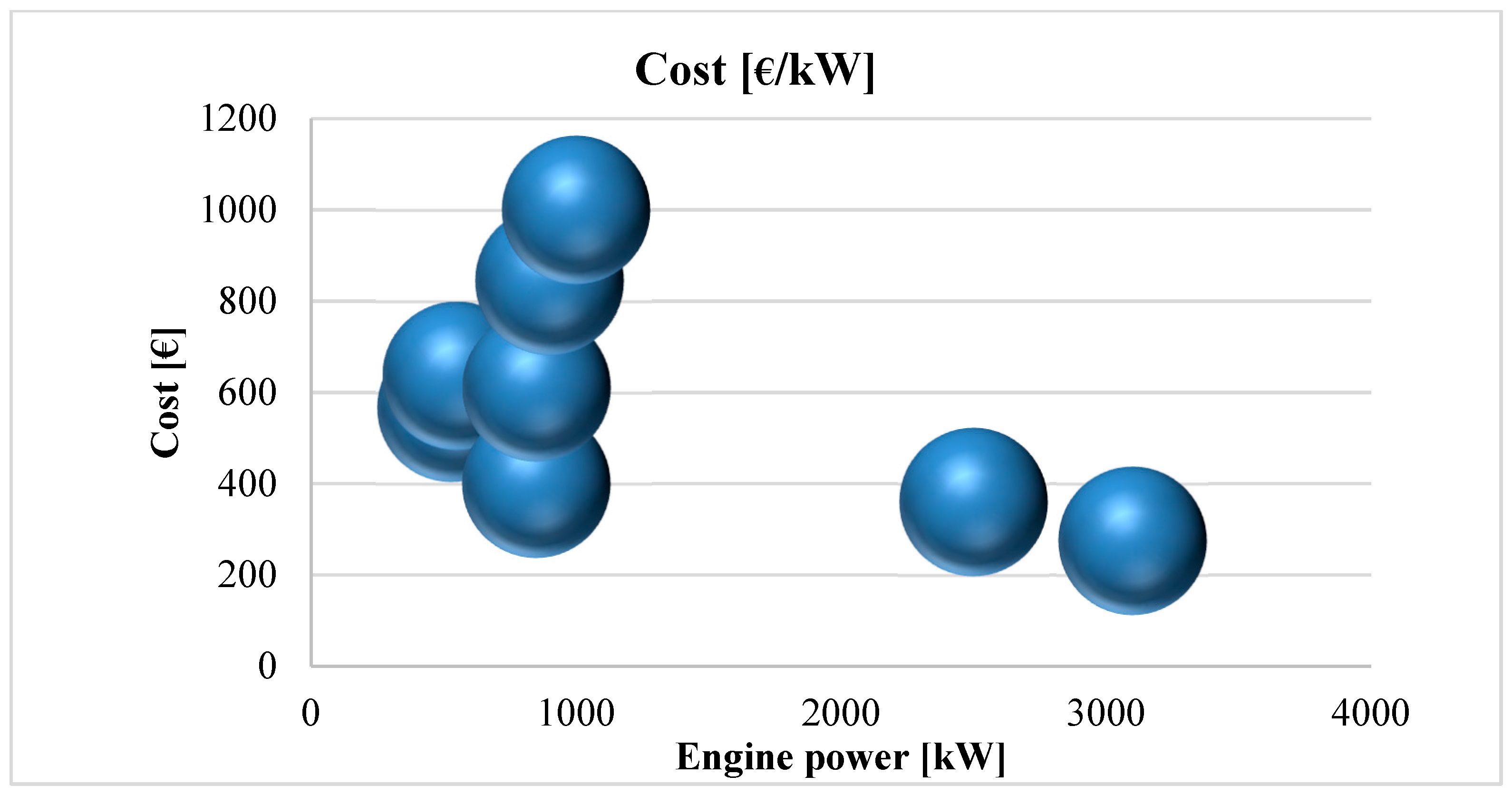
The prices of such engines may differ depending on the manufacturer, purpose (CHP, electricity), power, and other factors. Compared to previous years, inflation has increased, but technological developments have had an impact on reducing costs. Information on the purchase prices of such biogas power engines is relatively scarce. Thus, a brief analysis of the available information on the costs of purchasing such engines was carried out and an average price of 450 EUR/kW was established. The analysis is shown in Table 10 and Figure 11 shows the variation in the purchase prices of biogas engines in EUR/kW depending on the engine power.

4.3.4. Biogas Purification

Of all impurities in biogas, CO2 generally has the highest percentage and leads to negative effects on the production system and lower calorific value. It was also found that the lifetime of the generators was increased by about two years when purified biogas was used [82].
The prices differ depending on the technology used (Water Scrubbing, Organic physical scrubbing, Membrane technology, Pressure Swing Adsorption) and the amount of purified biogas. The purchase and operating costs decrease with increasing purified amount from 10,400 to 3500 EUR/(m3/h) and 14.4 to 6.5 ct/m3/h, respectively, among the cheapest being the membrane technology, but only for quantities up to 1000 m3/h [31]. The costs for purchasing a biogas filtration system available on the market were in 2018 between PHP 50,000 and PHP 500,000 (Camda China Biogas Upgrading) or PHP 290,000 and PHP 750,000 (KDCL-50 series Biogas Purifying System), i.e., between EUR 810.91 and EUR 12,163.63 (in December 2024). Using simple materials and technologies available on the market (water scrubber, silica gel, iron sponge filter, activated carbon), it was possible to develop a purification system with a total cost of EUR 324.36 (PHP 20,000.00) [83]. A similar system has been developed in [84] at a total cost of 41,000 Rs (EUR 460.5 in December 2024), significantly cheaper than commercially available systems costing between Rs 100,000 and Rs 100,000 (EUR 1123.19 and EUR 11,231.89) [84].
Water scrubbing has high efficiency (over 97% CH4) and can purify not only CO2, but also small amounts (below 300 cm3/m3) of H2S, but costs 0.105 EUR/m3 at a purified biogas of 250 Nm3 per hour and 0.052 EUR/m3 at a purified biogas of 2000 Nm3 per hour and energy consumption of 0.4–0.5 kWh/m3. However, it has low flexibility to the variation of biogas quantity [85]. Nevertheless, it was decided to use water scrubbing as a biogas purification method. The data used were taken from reference [86]. The values used for the calculations are average values and are presented in Table 11.

4.3.5. Natural Gas

Natural Gas Price
The natural gas market sector in the European Union Member States is complex and dynamic. Changes in market share, natural gas consumption for household and non-household consumers reflect the impact of economic, social, technological and political factors on this sector [87].
According to Eurostat information and analysis, during the 2008–2020 period, prices for non-household consumers in European countries had a relatively low variation, with an average of EUR 34.5/MWh ranging between EUR 28.1 and EUR 42/MWh. The data show a price increase from the second half of 2009, from EUR 31/MWh to EUR 42/MWh in 2013, followed by a decrease to EUR 29/MWh by the second half of 2017. The geopolitical situation in 2021 led to a price increase to EUR 86.7/MWh recorded in the second half of 2022, followed by a decrease until the first half of 2024 (EUR 61.9/MWh) and then a slight increase to EUR 66.1/MWh in the first half of 2025 [88].
In 2023, gas prices for non-household consumers varied significantly, with Romania being among the countries with the lowest prices, having a cost of EUR 40/MWh, thus indicating a low cost for supply and energy [87].
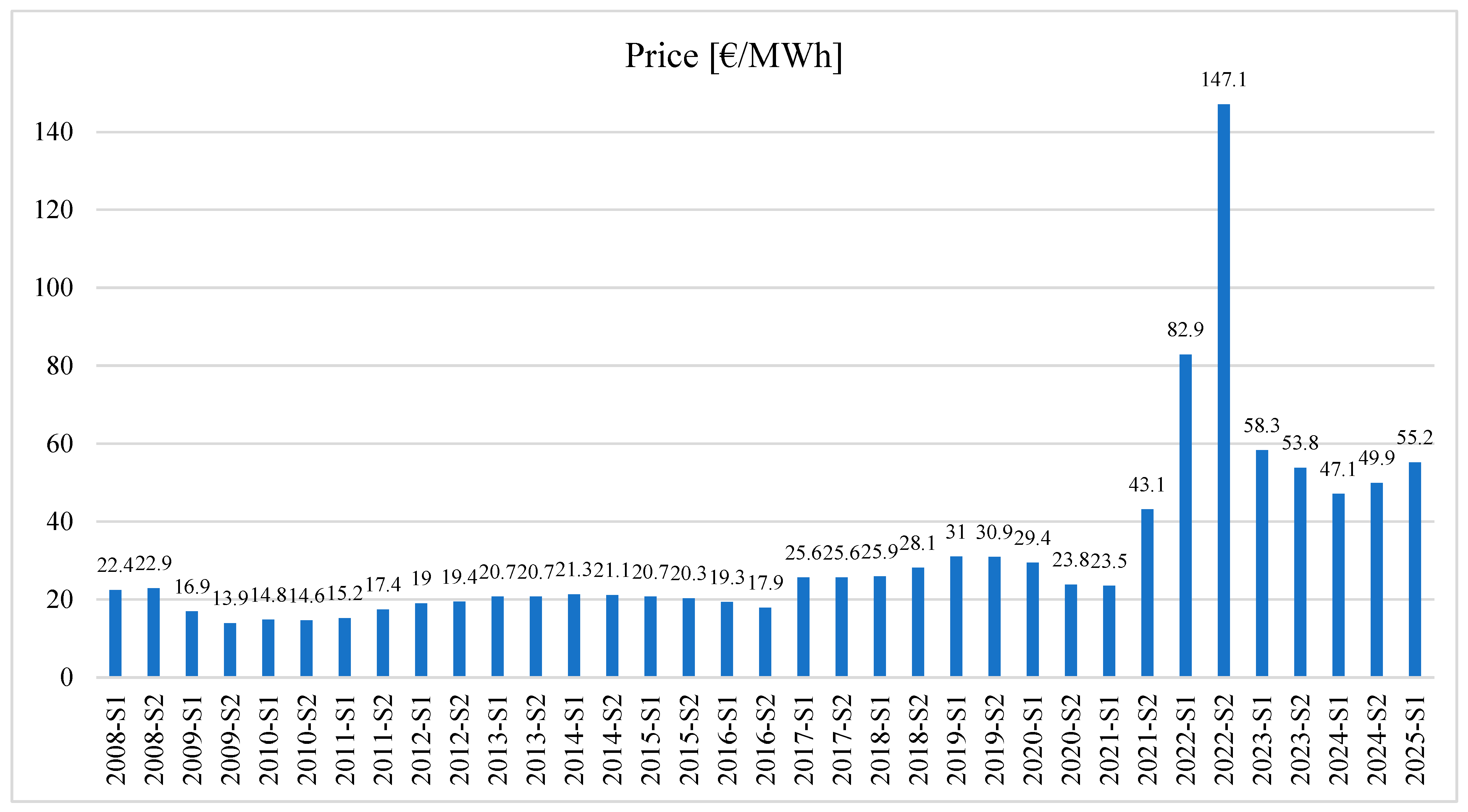
According to Eurostat data, in Romania, the average price from 2024 to the first half of 2025 was approximately EUR 50.73/MWh, reaching EUR 55.2/MWh in the first half of 2025. Figure 12 was produced using data available on the Eurostat website [89].
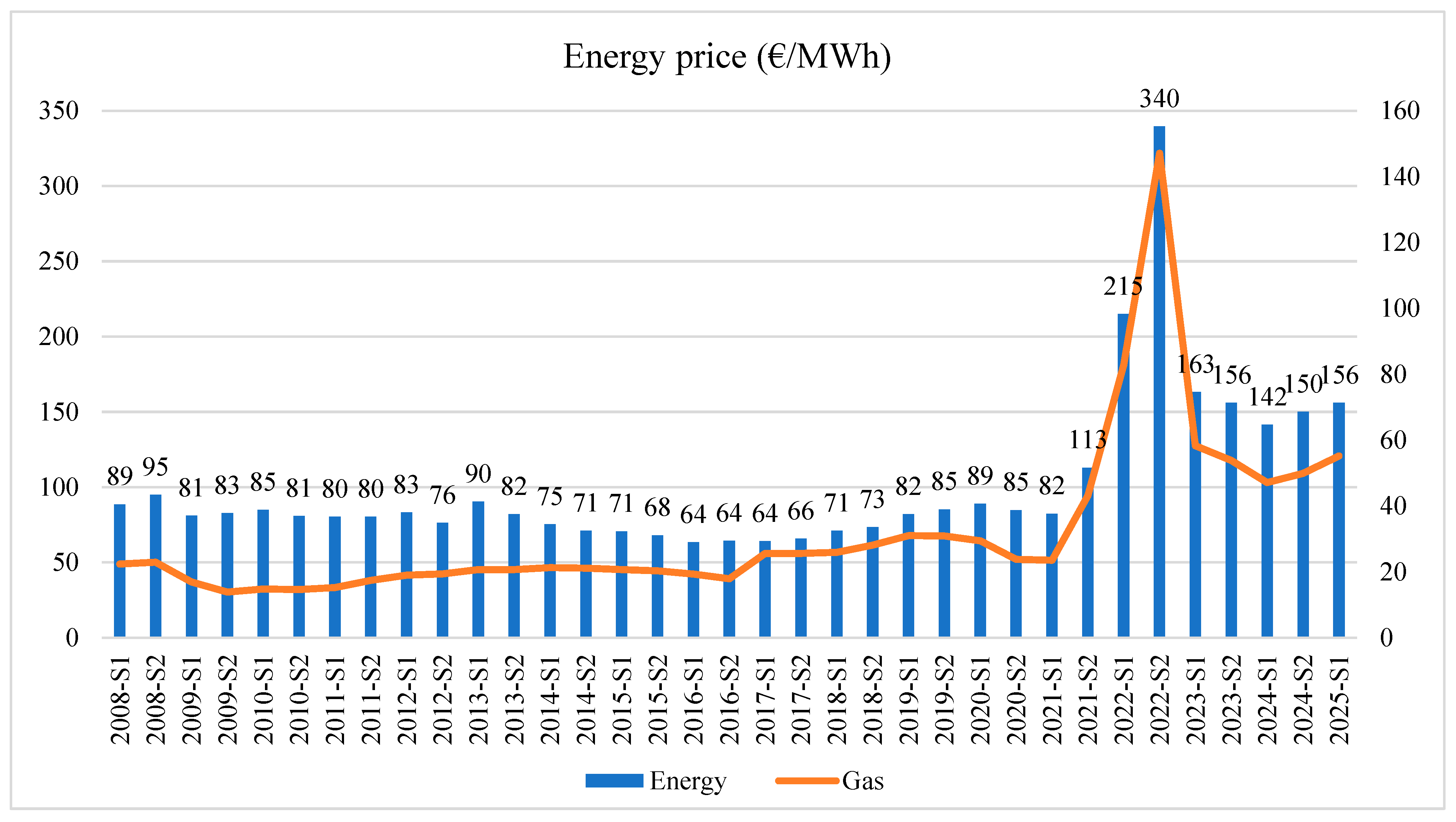
As can be seen in Figure 12, in Romania, during the 2008–2020 period, prices for non-household consumers varied between 14 and 31 EUR/MWh, with an average of 21.6 EUR/MWh. The data show a decrease from the second half of 2008 to the second half of 2009, from 22.9 to 13.9 EUR/MWh. From the second half of 2010 to the second half of 2014, the price increases from 14.6 to 21.1 EUR/MWh, after which it decreases until the second half of 2016, to 17.9 EUR/MWh. In the first half of 2017 it increases to 25.6 EUR/MWh and continues to increase until the first half of 2019 to 31, after which it decreases until the first half of 2021 to 23.5 EUR/MWh. The crisis in 2021 led to an increase in prices to 147.1 EUR/MWh recorded in the second half of 2022, followed by a decrease until the first half of 2024 (47.1 EUR/MWh) and then a slight increase to 55.2 EUR/MWh in the first half of 2025. After the peak in 2022, prices decreased but remained almost 60% higher compared to the average of the 2008–2020 period, at an average of approximately 53 EUR/MWh [89].
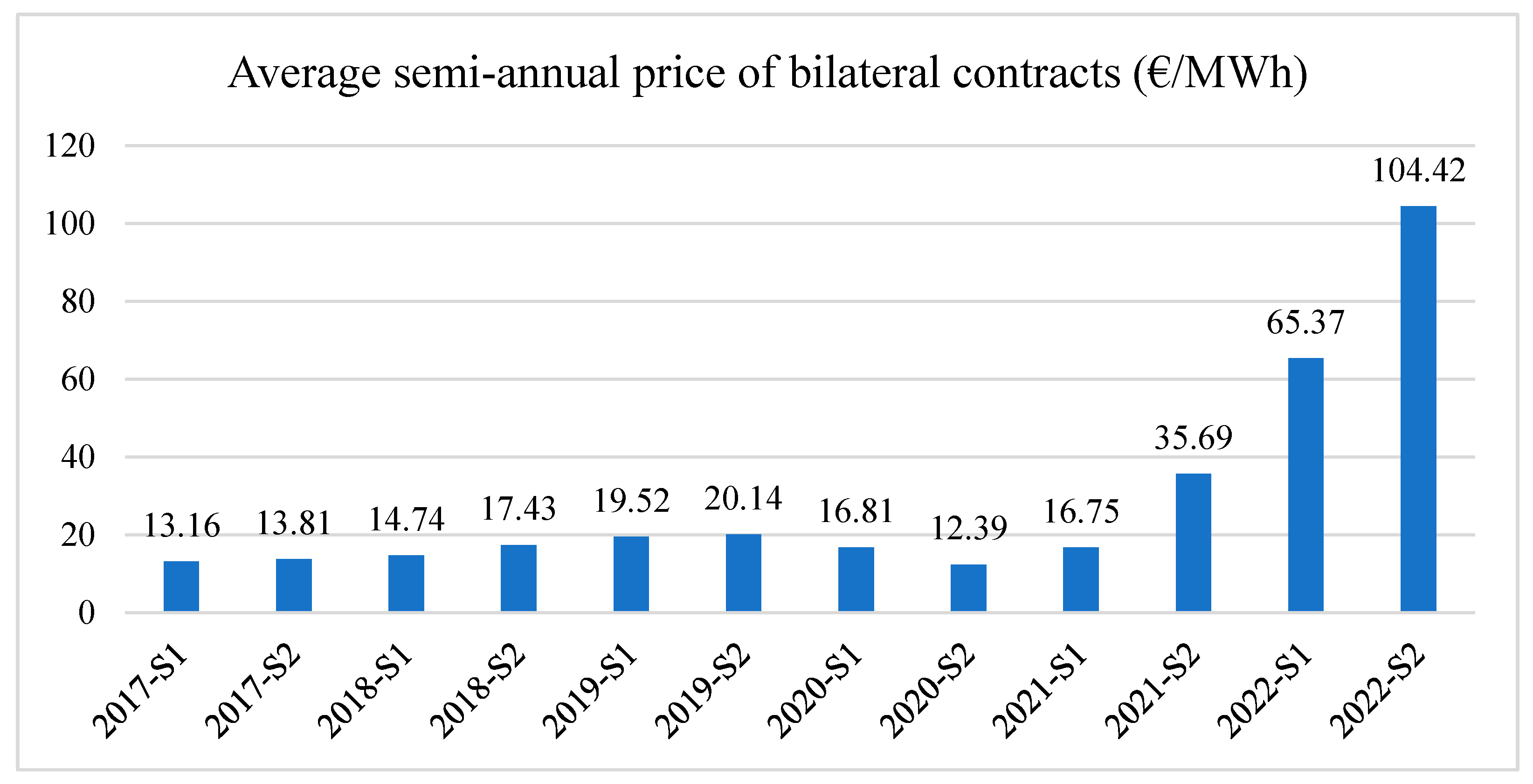
Given the volatility of prices, many companies prefer to conclude bilateral contracts with suppliers or directly with natural gas producers for a fixed period of at least one year. Figure 13 below shows the evolution of bilateral contract prices from 2017 to 2022, when due to high prices the Romanian state resorted to price caps [90].
According to data reported annually by National Regulatory Authority for Energy, in this case during the period 2017–2020, at a December 2024 euro exchange rate of 4.9741 RON, the price of natural gas varied between 10.9 and 20.76 EUR/MWh, with an average of 16 EUR/MWh. During the peak 2021–2022 period, the maximum price of 124.65 was recorded in August 2022. However, it is noted that the prices of Bilateral contracts during the crisis 2021–2022 period were approximately 20% lower, highlighting the advantages of concluding such contracts. Thus, if we take as an example the evolution of gas prices in the period 2008–2020 applied to the prices in 2025 and the conditions for concluding advantageous bilateral contracts, it is expected that they will vary between 50 and 70 EUR/MWh in the next 10–15 years [90].
The major influencing factors in the next years are:
  • At European level, there is a desire to reduce the use of fossil fuels, especially in the energy production sector, so it is expected that natural gas marketing taxes will increase in the coming years. All taxes increased from 7.1% in 2008 to 20.5% in the first half of 2021 and then decreased to 6.6% in the second half of 2022, after which they increased again to 15.2% in the second half of 2024, reaching 16.5% in the first half of 2025 [88].
  • Romania is a natural gas producing country. According to ANRE reports, Romania secures approximately 80% of its annual natural gas consumption from domestic production, securing between 2,398,564 and 17,354,342 MWh in 2017–2022. During the period 2017–2022, the lowest secured quantity was almost 50% (2,398,564 MWh) in July 2022 [90].
  • OMV Petrom, the largest integrated energy company in Southeastern Europe, and Romgaz, the largest producer and main supplier of natural gas in Romania, have approved the development plan for commercial natural gas fields in the Neptun Deep area of the Black Sea. First production is expected in 2027. Peak production will be approximately 8 billion cubic meters per year (~140,000 boe/day), for about 10 years [91].
Moreover, natural gas represented 25% of the country’s total energy consumption in 2023, which means a high impact of the evolution of natural gas prices on the price of electricity [92].
The influence of the price of natural gas on the price of energy can also be seen in the graph in Figure 14, where the price of energy has approximately the same evolution as that of natural gas [93].
Natural Gas Consumption
According to the previous section, the increase in methane concentration will be realized by mixing biogas with natural gas.
In the first case study, the landfill located in Bacău, the amount of natural gas required is approximately 23,663,801.8 Nm3/year, i.e., about 243,211,299 MWh. If natural gas is purchased at a price of 293.52 RON/MWh, then the total annual cost for purchasing the necessary amount of natural gas will reach 71,387,379.9 RON/year (EUR 14,344,897).
In the second case study, the landfill located in Ilfov, the amount of natural gas that must be added to the mixture to increase the methane concentration is approximately 974,963,953 Nm3/year, i.e., about 10,020,463 MWh. If natural gas is purchased at a price of 299.77 RON/MWh, then the total cost will be 3,003,834.19 RON/year (EUR 603,603.78).
In the third case study, the landfill located in Brașov, the amount of natural gas required is approximately 23,168,936 Nm3/year, i.e., about 238,125 MWh. If natural gas is purchased at a price of 306.71 RON/MWh, the cost for one year of purchasing natural gas will be 73,035,319 RON (EUR 14,676.04).
The gas prices were chosen from natural gas supply offers by using the comparison tool provided by ANRE (National Regulatory Authority for Energy) website [94] as average prices specific to each county and consumption quantity category in which the studied landfills fall. Assuming bilateral contracts concluded with an average price of approximately 60 EUR/MWh. All this information can be found in Table 12.
In the first case study it was decided to purchase 10 engines with an output of 1250 kW [60] each that would utilize almost all the biogas available. For the second case, it was decided to use two Jenbacher J208 engines of 249 kW [61] each. For the third case a 3 kW engine modified to run on biogas (output of 2089 W) [24] was initially chosen, with a consumption of 47 m3/h of biogas at a lower methane concentration (40%), but the calculations showed that regardless of the methane concentration, even if it increases, the project is not feasible, so it was decided to perform the calculations with the same engine as in the second case study, this being the smallest biogas engine offered by the manufacturer Jenbacher (J208, 249 kW) [61]. More detailed information plus the cost of the engines can be found in Table 13.

4.3.6. Additional Costs

As regards the storage of biogas to ensure continuous operation of the engines, it was considered for all the three cases analyzed that a quantity of biogas emitted for one day would be stored and used the following day. The amount of biogas emitted during one day by the first landfill analyzed is 70,235 Nm3; that is why seven tanks of 10,000 m3 were purchased. For the second case study, the amount of biogas emitted per day will be about 2780.16 Nm3, therefore it was decided to purchase a 3000 m3 tank. In the third case study, because the biogas throughput is very low, 148.11 Nm3, it was decided to purchase a 200 m3 tank. The cost of investing in storage capacity was estimated using information from [73] to be approximately EUR 56/m3 (between USD 58/m3 and USD 60/m3) of biogas.
The annual maintenance costs of the generator were calculated as 5 €/MWh. For carrying out significant overhauls of the generator systems, a service life of 30,000 running hours was chosen before the overhaul because the biogas used has multiple unknown components that can lead to a faster degradation of the engine. However, the number of years to perform the overhaul was approximated higher. The cost of this overhaul was assumed to be 20% of the initial purchase cost. In the case of the first case study, it was found that an overhaul was required at 3.43 years, i.e., approximately 3.5 years. For the second case study the need for overhaul is 3.83 years, so in this case the overhaul will be carried out every 4 years. And in the third case study, the number of hours of operation is so low that the period at which the overhaul needs to be carried out exceeds the period analyzed in this paper.
It was also considered that, for the overhaul to be carried out, approximately two weeks of non-operation, i.e., 336 h, would be taken into account, during which time no revenue would be generated. In all three cases there will be downtime of the generating systems due to the amount of biogas. In the first case study, there was a downtime of about 7 h per year. If the overhaul is carried out once every 3.5 years, this means that the downtime due to the amount of biogas will be 24.4 (approximately one day), with the remaining downtime hours being considered as a cost and subtracted from the revenue realized in the years of the overhaul. In cases 2 and 3, the downtime due to biogas quantity is 926,447 h and 8,151,891 h, respectively, i.e., higher than the considered overhaul period. The size, number and cost of the biogas tanks, as well as the overhaul period and cost for each deposit analyzed are shown in Table 14.
For all the three cases analyzed, it will be considered that the Water Scrubber will be a suitable size to purify the whole amount of biogas per hour. In the case of the first landfill analyzed, the biogas flow rate varies between 411.32 Nm3/h and about 7500 Nm3/h. Therefore, it was decided to purchase a Water Scrubber which can purify an amount of 7500 Nm3/h. For the second case study it is observed from Table 3 that the variation of the hourly biogas flow rate is between 102 Nm3/h and 141.2 Nm3/h. Therefore, a scrubber of 150 Nm3/h will be chosen. For the third case, the variation of the hourly biogas flow rate is between 1.254 Nm3/h and 9.598 Nm3/h. Therefore, in this case the chosen scrubber will be a very small one of 10 Nm3/h. The purchase cost of the scrubbers was calculated using the data in Table 11. The cost of the water scrubber used for each deposit was approximated using data form source [86] is in Table 15.
After the purification of biogas and removal of CO2, the methane concentrations of the biogas will increase, and the amounts of biogas and natural gas needed to increase the CH4 concentration will be lower as can be seen in Table 16.
Scrubber energy consumption, water consumption, and maintenance costs will be added to the annual operating costs (Table 17). Water and energy consumption were used from the parameter table (Table 11), and the associated costs were taken (in December 2024) from the service providers’ websites based on the quantity and location of the landfills [95,96]. The water prices used in the calculations include 9% VAT. Maintenance cost was calculated using parameters from Table 11.
For this article, a 15-year period of operation of the generator system and equipment listed above was considered. Also, a parallel analysis of the associated cost and viability of the project with and without biogas purification was carried out for all three landfills analyzed as case studies.
Final cost calculations were performed as follows:
Without purification:
Investment = Engines cost + Tank cost
Annual costs = Natural gas purchase cost + Engines maintenance cost + O&M for collection and flare cost
Costs over the analyzed period = Cost of the overhaul every 3–4 years + Downtime cost
Revenue = Sale of energy produced annually
With purification:
Investment = Engines cost + Tank cost + Water Scrubber cost
Annual costs = Natural gas purchase cost + Engines maintenance cost + Scrubber electricity consumption cost + Scrubber water consumption cost + Scrubber maintenance cost + O&M for collection and flare cost
Costs over the analyzed period = Cost of the overhaul every 4–5 years + Downtime cost
Revenue = Sale of energy produced annually
For both situations, the Internal Rate of Return (IRR) was calculated using the IRR formula in Microsoft Excel. Thus, the IRR value in the table below does not take into account the discounting nor the possibility of crediting the loan needed for the investment, assuming that it will be fully paid off at the time of purchase. The minimum rate of return (MIRR) has also been chosen to be 10%. The main aim of this step is to obtain a minimum energy sales price at which the investment is profitable.
For the first case study (Bacău landfill), the centralization of the costs can be found in Table 18.
In the first case study, in the situation without purification, the minimum selling price of the energy produced is 154.23 EUR/MWh (RON 767/MWh), while in the situation with purification it is higher, 172.12 EUR/MWh (RON 856/MWh). Purifying biogas can, however, lead to the prevention of malfunctions or reduce unexpected maintenance costs.
In general, energy prices on Romania’s day-ahead market vary roughly between 60.32 and 341.83 EUR/MWh (300 and 1700 RON/MWh) [97]. Under these conditions, given the continuous energy production, as well as the relatively average price compared to the market, it is very likely that representatives from the area of industries with continuous activity conditions would be interested in concluding a bilateral contract for energy delivery at these prices, perhaps even negotiating a contract at a higher price such as 180.97 EUR/MWh (900 RON/MWh).
For the second case study (Ilfov landfill), the centralization of the costs can be found in Table 19.
For the second case study, in the situation without biogas purification the minimum price at which the investment is considered profitable is 183.18 EUR/MWh (911 RON/MWh) and in the situation with purification it is 204.10 (1015 RON/MWh). In the situation without purification, in which the assembly can produce energy for 21.5 h per day, continuous delivery contracts can also be tried. In the situation with purification, the daily operation will drop to 18.5, which means that the system can stop generating during the night (1–5 am) when consumption is very low and prices are low. A good alternative in this case can be a mix between delivery on the day-ahead energy market, signing bilateral contracts for electricity delivery and participating on the intraday energy market at times of high consumption when prices are very high, aiming to ensure an average price above 201.08 EUR/MWh (1000 RON/MWh).
For the third case study (Brașov landfill), the centralization of costs is shown in Table 20.
For the third case study, if the emitted biogas is not purified the minimum price at which the investment is profitable is 390.1 EUR/MWh (1940 RON/MWh), and if it is purified the minimum price will increase to 438.76 EUR/MWh (2182 RON/MWh) with very low chance of entering the energy market.

4.4. Environmental Impact Analysis

4.4.1. Landfill Estimated Emissions

Generalizing the data collected and specifically for cell 2, a 20-year estimate of methane emissions produced by the municipal landfill in Bacău was further made, as shown in Figure 15.
The software approximates the methane emissions of the Bacau landfill, accumulated over 20 years, as 36,843 tons of CH4.
Generalizing the data collected and specifically for cell 7, a 20-year estimate of methane emissions produced by the Ilfov municipal landfill was further made, as shown in Figure 16.
The software approximates the methane emissions of the Ilfov landfill, accumulated over 20 years, as 101,443tons CH4.
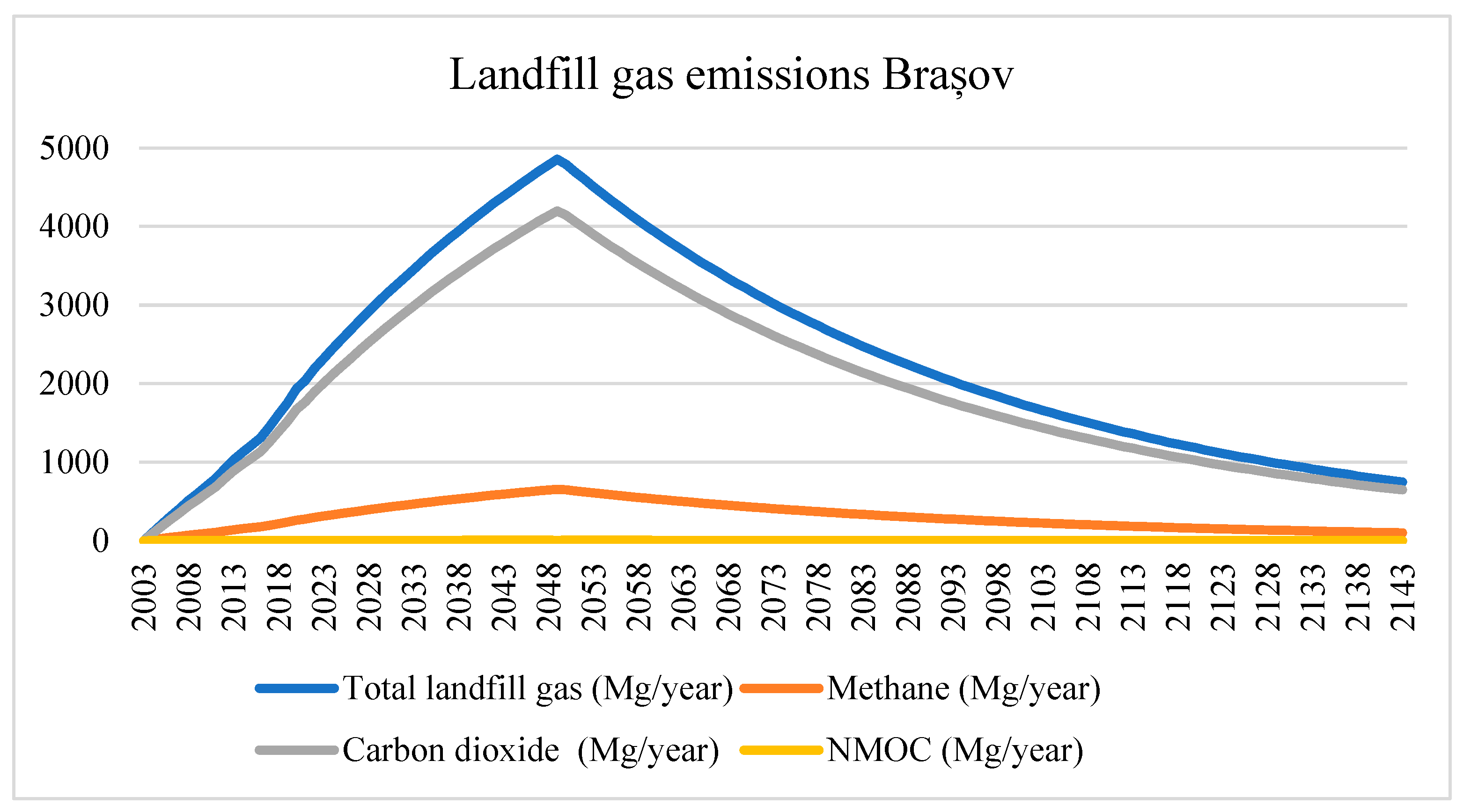
Generalizing the data collected and specifically for cell 3, a further estimate of the methane emissions produced by the Brașov municipal landfill over a 20-year period was made, as shown in Figure 17.
The software approximates the methane emissions of the Brașov landfill, accumulated over 20 years, as 8519 tons of CH4.
Once estimated the annual LFG production is possible to determine the methane emissions in tons of carbon dioxide equivalent (tCO2-eq), with Equation (4):
T C O 2 e q = 21 ·   ρ C H 4 K g m 3   · C H 4   % ·   Q L F G
where
ρ C H 4 = methane density = 0.717 K g m 3 ;
C H 4   = methane content [%];
Q L F G = annual LFG production m 3 y e a r [15].
Using Equation (2) and the estimated methane emissions obtained using LandGEM software, the CO2eq (equivalent emissions) of the three landfills over the next 20 years are shown in Table 21.
In order to be able to analyze whether energy production using the methane quantities calculated by LandGEM from biogas produced by landfills mixed with natural gas has lower or higher emissions than those of the landfill, it was calculated, using the energy production values (Table 18, Table 19 and Table 20), and the estimated quantity of methane using the data in Table 12 for the situation without filtration and Table 16 for the situation with filtration. The calculations were made taking into account the methane density as equal to 0.717 kg/m3, and the results are found in Table 22.
In Table 23, using the data from Table 22 and Table 21, the energy production of the three deposits over the 20-year period was approximated.
Using the amount of natural gas required for electricity production in the two situations (with and without purification) of the three deposits over a period of 20 years, and considering the CO2 emissions of using natural gas in an engine as equal to 1.9141, the CO2 emissions resulting from the combustion of natural gas in the engine for energy production were calculated in Table 24.
Table 25 presents the approximate CO2 emissions resulting from the use of natural gas in a dual-fuel engine.
The combustion of methane in an engine also has emissions, part of them from the combustion itself, and part from the methane slips. The GE Jenbacher Lean-burn engine has a maximum methane slip of 2.5% [98].
Therefore, to the emissions produced using natural gas in the engine are added the emissions produced by the combustion of methane. A factor of 2.75 CO2 emissions from flaring methane [99] was used for the calculation.
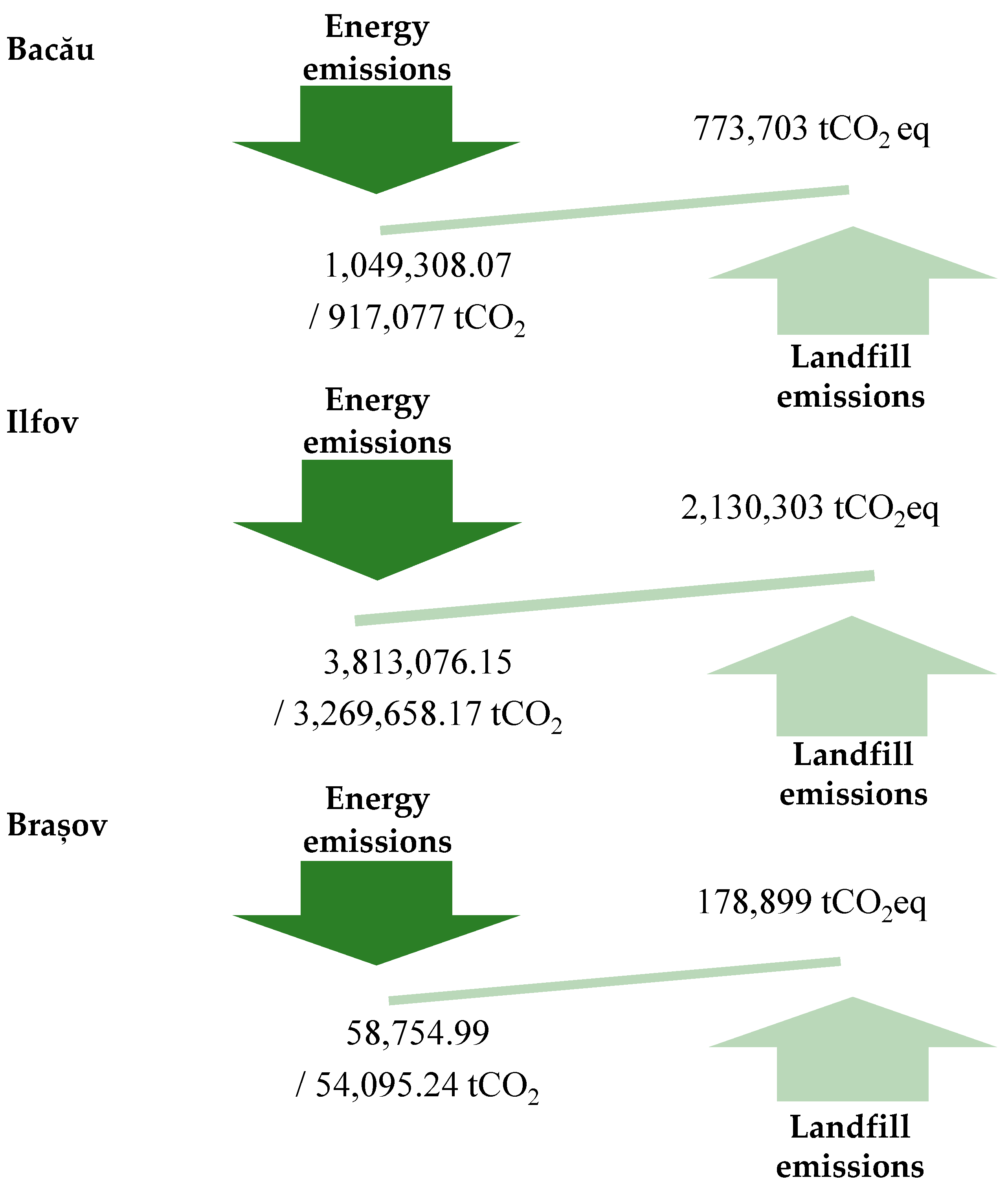
This leads to an increase in emissions by approximately 98,785.29 t CO2 in the case of the Bacău landfill, 271,994.04 in the case of the Ilfov landfill and 22,841.57 tons of CO2 in the case of the Brașov landfill, caused by using methane in the engine. Also, will be added the CO2eq emissions caused by the methane slips, respectively, 19,342.575 t CO2eq from Bacău landfill, 53,257.575 CO2eq from Ilfov landfill and 4472.475 CO2eq from Brașov landfill.
Comparing the tCO2eq emissions produced in 20 years by the two landfills with the emissions produced by the use of natural gas for energy production, it can be seen in Figure 18 that the approximate tCO2eq emissions of the landfills are higher than the emissions from energy production.
In the above-analyzed situation of emissions produced by the use of a mixture of biogas and natural gas in an engine, the emission coefficient of tons CO2eq/MWh is approximately 0.5.
According to available information, the emission coefficient of tons CO2eq/MWh produced in the Romanian energy system was 0.281 tons CO2eq in 2022 [100], on the other hand, in the same year Romania had a production of 10,474 GWh, recording emissions of 16 MtCO2, which means an emission factor of 1.527 t CO2/MWh of energy produced from coal [101]. This suggests the opportunity to use the biogas-natural gas mixture for energy production for the transition to less polluting production.

4.4.2. Emissions Legislation

Currently, average emissions from the energy sector in European countries are around 270 g CO2/kWh. These must fall rapidly, otherwise any power plant that cannot comply with the limit risks being decommissioned earlier than its expected operating life. In other words, a new power plant could initially have an emissions threshold of 250 (<270 g CO2/kWh), with plans to rapidly reduce emissions intensity to 100 g CO2/kWh (Kg CO2/MWh) [102,103].
To analyze the environmental impact, greenhouse gas emissions will first be calculated for all three landfills, in both cases with and without purification. The amount of emissions in kg CO2/MWh produced annually, was calculated using (3)
A m o u n t   o f   n . g . m 3 y e a r × 1.914   K g   C O 2 m 3 A m o u n t   o f   e n e r g y   M W h y e a r = Amount   of   emissions   K g   C O 2 M W h
where
1.9141 [kg CO2/m3] = the emission factor of natural gas used in an engine to produce energy [104];
Amount of n.g. (natural gas) [m3/year] = annual amount of natural gas needed to increase the methane concentration of the mixture to 50% so that the engines can operate;
Amount of energy [MWh/year] = annual amount of energy produced using the biogas and natural gas mixture in engine.
Amount of emissions of kg CO2/MWh produced as a result of energy production from the biogas-natural gas mixture in engines are shown in Table 26.
As can be seen, in the current version, where natural gas is used in a mixture of approximately 50% and 30%, respectively, in terms of environmental impact through the resulting emissions, the solution does not have favorable results. To have a useful effect in terms of emissions, there must be a higher concentration of methane in the biogas so that the amount of natural gas needed in the mixture for it to be used in engines is reduced.
Thus, to comply with the emission limits, the maximum amount of natural gas that can be used per year was calculated using (4)
250   K g   C O 2 M W h × A m o u n t   o f   e n e r g y   M W h y e a r 1.914   K g   C O 2 m 3 = Amount   of   n . g .   m 3 y e a r
where
250 [Kg CO2/kWh] = the emission limit;
Amount of energy [MWh/year] = annual amount of energy produced using the biogas and natural gas mixture in engines;
1.9141 [kg CO2/m3] = the emission factor of natural gas used in an engine to produce energy [104];
Amount of n.g. (natural gas) [m3/year] = annual amount of natural gas needed to increase the methane concentration of the mixture to 50% so that the engines can operate.
The maximum amount of natural gas that can be used without exceeding the emission limit of 250 Kg CO2/MWh is shown in Table 27.
Table 28 shows the percentage of natural gas used in each case analyzed to comply with the limit of 250 kg CO2/MWh.
The maximum amount of natural gas that can be used without exceeding the emission limit of 100 kg CO2/MWh is shown in Table 29.
Table 30 shows the percentage of natural gas used in each case analyzed to comply with the limit of 100 kg CO2/MWh.
Following the analysis, it was observed that if the percentage of natural gas in the biogas-natural gas mixture exceeds 25%, in both situations (with and without biogas purification) for all three case studies analyzed, the emission limit of 250 kg CO2/MWh is exceeded. Furthermore, to comply with the emission limit of 100 kg CO2/MWh in the future, the percentage of natural gas used in the mixture must be below 10%.
In order to comply with the above limits and use the percentage of natural gas in Table 28 and Table 30, the methane concentrations in biogas must be higher. Thus, if natural gas is considered to have a methane concentration of 95%, in order to comply with the limit of 250 kg CO2/MWh, the methane concentration in biogas must be increased according to Table 31, and in order to comply with the limit of 100 kg CO2/MWh, the methane concentration in biogas must be increased according to Table 32.
The results of the analysis carried out in this section highlight the fact that energy production in an engine using a mixture of biogas and natural gas leads to high emissions that exceed the accepted limits for kg CO2 emitted per MWh produced. This is mainly due to the use of a large amount of natural gas in the mixture. The way to reduce the amount of natural gas used is to increase the methane concentration in the biogas emitted from landfills. Given that, for the engine to operate, the methane concentration in the mixture must be 50%, in order to comply with the limit of 250 kg CO2/kWh, the methane concentration in the biogas from landfills must be approximately 35%. Also, to comply with the 100 kg CO2/kWh limit, the methane concentration in biogas from landfills must increase to 45%.
Moreover, the production of emissions leads to higher costs. Under the EU Emissions Trading System, a carbon certificate needs to be purchased for each ton of CO2 emitted. In 2024, the value of a carbon certificate was EUR 64.74 [105] per ton of CO2 emitted, which means that the costs of ensuring the annual coverage of energy production by blending biogas with natural gas are added to the costs of the annual purchase of emission certificates. These annual prices can be found in Table 33.
Costs that would lead to an increase in the prices of the energy produced with 15% (without purification) and 13% (with purification) for Bacău landfill, almost 15% (without purification) and 13% (with purification) for Ilfov landfill and 8% (without purification) and 6.5% (with purification) for Brașov landfill.
According to the 2025 report on progress in the competitiveness of clean energy technologies, Romania’s high costs currently hinder the use of biomethane, with the capital cost of a biogas plant using anaerobic digestion being around 1500–2000 EUR/KW, and the total cost of biogas production and enrichment estimated at around 100 EUR/MWh. Similarly, the capital cost of a biomethane gasification plant is 2000–3600 EUR/KW, and the production cost is around 89–112 EUR/MWh [106].
In addition to emissions caused by methane use and natural gas used in engine, there are also other slip methane emissions. Which varies between 0.4 and 15.0% of the total production of some biogas plants [107].
There are no methane reduction catalysts available on the market for lean-burn engines. However, selective catalytic reduction is an option for optimizing emissions as it allows the unit to operate with a lower lambda (air–fuel ratio), which results in lower methane emissions. In the case of biogas upgrading technology, depending on the type of technology applied, the methane concentration in the waste gas varies due to variable separation efficiency. Components containing biogas should be monitored frequently to identify leaks. This includes inspections with leak detection systems such as methane cameras and portable lasers. Finally, the transfer of gases between multiple storage systems should be controlled to avoid unbalanced filling levels, as well as pressure ratios [108].

5. Discussion

This paper presents a study on the opportunity to reduce greenhouse gas emissions into the atmosphere from municipal solid waste landfills by converting biogas into electricity in countries where selective collection and recycling are not carried out properly or are carried out at a very low level. Landfills are major emitters of greenhouse gases and represent a serious problem, especially in developing countries where waste management, and selective collection in particular, is not carried out properly. The presence of high levels of contaminants in the waste stream indicates that separation at source is recommended [2].
Romania was among these countries until recently, when selective collection began to be implemented. However, years of poor waste management have left behind numerous landfills that emit greenhouse gases. Thus, feasible solutions are being sought to reduce emissions, especially methane emissions.
The possibilities for reducing emissions from landfills are quite limited, and one of these solutions is to convert them into energy. In general, energy production is a problem in developing countries, so using landfill biogas for energy production can have multiple benefits, including reducing emissions and producing energy, aspects also discussed in references [1,9].
The results of the study showed a low concentration of methane in the biogas emitted by landfills. In order to be used in engines for energy production, biogas must be mixed with natural gas to achieve a methane concentration of 50% in the mixture. Although this solution is technically and economically feasible for two out of three cases analyzed, the emissions analysis showed that in those cases, the energy production emissions exceed the CO2eq emissions associated with landfills methane. Also, the use of large quantities of natural gas leads to exceeding the limits imposed by the European Union to achieve climate neutrality by 2050. Furthermore, the annual purchase of the necessary natural gas increases the costs of converting biogas into energy.
For a real reduction in methane emissions through energy production, investments are needed in selective collection systems at source, selective transport and recycling centers. These must be supported by policies and legislative measures that determine citizens to become responsible for the correct implementation of selective collection and recycling. Information campaigns are needed, both in schools and through the media, on the necessity and correct way to carry out selective collection and existing recycling points, but also on possible fees in case of non-compliance.
Biogas from waste should be considered as an option to replace or reduce the use of fossil fuels in the mix of sources used in the Romanian energy system. In addition to reducing emissions, it offers more stability compared to wind, solar or hydro, being able to support the system. Due to its variable parameters, biogas is not considered a viable energy source in Romania. Therefore, investments in research and the implementation of pilot projects are needed to test possible efficient solutions for producing biogas so that it can be used for energy production. Biogas parameters are largely influenced by the types of waste, the organic matter content and the optimal conditions for performing anaerobic digestion. Thus, actions in this regard are selective collection and recycling, and the use of anaerobic digestion, as highlighted in reference [2].
Anaerobic digestion is a solution often addressed in previous research and scientifically proven to be an efficient technology for producing biogas that can be used for energy production. In recent years, several anaerobic digestion (AD) technologies have been proposed, due to the benefits for the environment and society [109]. Reference [59] confirms that compared with anaerobic digestion, landfill gas to energy technology has lower power generation potential.
The main limitation of this study is that it focuses on landfills in Romania, with data collected from a single area of Europe and analyzing a limited number of landfills. In the future, the study should be expanded to investigate landfills in other countries or regions where collection is not selective, as well as the number of landfills studied. Furthermore, the data collected is limited to a single year, and the evolution of emissions from solid waste landfills is not linear, so the analysis needs to be extended over a longer period, 10–20 years, to analyze the evolution of emissions. Moreover, the analysis focused on biogas emitted from landfills but did not analyze the composition of the waste deposited in such sites.
Another important limitation of the manuscript is that it does not address upstream emissions associated with natural gas supply such as extraction and transportation, whose fugitive methane emissions are a real problem, especially in Romania. Assessments carried out in 2019 in the southern area of Romania, where the largest oil and gas infrastructure operator, OMV Petrom, operates, estimate 5.4 kg/h per site, arriving at an annual emission estimate of 120 kt CH4 (min = 79 kt and max = 180 kt) assuming constant emissions throughout the year [110].
Finally, the analysis is theoretical, based on opportunity, but to study the impact, this analysis must be physically validated.

6. Conclusions

The objective of this article was to study whether it is appropriate to invest in a landfill biogas energy production plant when the quality of the biogas (methane concentration) is low. The benefits sought through this investment are energy production and the reduction of methane emissions from landfills. The results of the study show that the methane concentration in biogas emitted from solid waste landfills is low. In order for the biogas to be used in engines for energy production, it was mixed with natural gas. Even with the high costs of purchasing natural gas, two out of three solutions analyzed are technically and economically feasible. However, the environmental impact analysis showed that the use of large quantities of natural gas leads to high emissions. Therefore, in countries where selective collection and recycling are not carried out properly, if energy production from biogas is desired, future analyses must study upstream the possibilities of obtaining higher quality biogas through processes and technologies that facilitate the production of biogas with a higher methane concentration. One such solution could be anaerobic digestion.
The analysis carried out in this document is of theoretical importance, but the results obtained need to be physically validated. The analysis showed that in countries where waste management, especially selective collection and recycling, is not properly implemented, reducing methane emissions from solid waste landfills by using them for energy production may require finding solutions. Mixing biogas with small amounts of natural gas may be a short-term solution, but possible solutions need to be explored before the waste reaches the landfill.
Developing countries often face obstacles in their attempt to catch up with developed countries, energy being a key factor in their evolution. Thus, high energy prices and the lack of capital to make the necessary investments to develop and modernize the grid so as to allow the integration of renewable energy sources, but also the costs associated with investing in renewable energy sources lead to the continued use of fossil fuels. This in turn attracts more costs, coming from carbon credit mechanisms that act to discourage the production of energy from fossil fuels. In this situation, a circle is formed in which capital is used to support the production of energy from fossil fuels and in mechanisms to protect the population by capping prices (as is the case in Romania), instead of being invested in modernization and renewable energy sources.
One of the main reasons why it is important to study the opportunities for producing energy from landfill biogas is that it can replace energy produced from fossil fuels.

Author Contributions

Conceptualization, I.B.-I. and G.M.; methodology, I.B.-I. and L.A.D.-D.; analysis, I.B.-I. and L.A.D.-D.; writing—original draft preparation, L.A.D.-D.; writing—review and editing, all authors. All authors have read and agreed to the published version of the manuscript.

Funding

This research received no external funding.

Institutional Review Board Statement

Not applicable.

Informed Consent Statement

Not applicable.

Data Availability Statement

No new data were created or analyzed in this study. Data sharing is not applicable to this article.

Conflicts of Interest

The authors declare no conflicts of interest.

References

  1. Purmessur, B.; Surroop, D. Power generation using landfill gas generated from new cell at the existing landfill site. J. Environ. Chem. Eng. 2019, 7, 103060. [Google Scholar] [CrossRef]
  2. Amponsem, B.; Bensah, E.C.; Antwi, E.; Ahiekpor, J.C.; Boahen, B.; Mensah, I.; Narra, S. Electricity generation from biogas as resource recovery potential from solid waste composition in a mixed-income municipality. Clean. Waste Syst. 2023, 4, 100067. [Google Scholar] [CrossRef]
  3. Paleologos, E.K.; Mohamed, A.-M.O.; Mohamed, D.; Al Nahyan, M.T.; Farouk, S.; Singh, D.N. Decarbonization of the Waste Industry in the U.S.A. and the European Union. Sustainability 2025, 17, 563. [Google Scholar] [CrossRef]
  4. Mor, S.; Ravindra, K. Municipal solid waste landfills in lower- and middle-income countries: Environmental impacts, challenges and sustainable management practices. Process Saf. Environ. Prot. 2023, 174, 510–530. [Google Scholar] [CrossRef]
  5. Armoo, E.A.; Narra, S.; Mohammed, M.; Boahemaa, B.; Beguedou, E.; Kemausuor, F.; Agyenim, F.B. Hybrid Waste-to-Energy Solutions within a Circular Economy Framework Directed towards Sustainable Urban Waste Management in Ghana. Sustainability 2024, 16, 4976. [Google Scholar] [CrossRef]
  6. Cheniti, H.; Kerboua, K.; Sekiou, O.; Aouissi, H.A.; Benselhoub, A.; Mansouri, R.; Zeriri, I.; Barbari, K.; Gilev, J.B.; Bouslama, Z. Life Cycle Assessment of Municipal Solid Waste Management within Open Dumping and Landfilling Contexts: A Strategic Analysis and Planning Responses Applicable to Algeria. Sustainability 2024, 16, 6930. [Google Scholar] [CrossRef]
  7. Oo, P.Z.; Prapaspongsa, T.; Strezov, V.; Huda, N.; Oshita, K.; Takaoka, M.; Ren, J.; Halog, A.; Gheewala, S.H. The role of global waste management and circular economy towards carbon neutrality. Sustain. Prod. Consum. 2024, 52, 498–510. [Google Scholar] [CrossRef]
  8. Falsafi, A.; Falsafi, A.; Abdulkareem, M.; Horttanainen, M. Assessing dioxin emissions change in the transition from landfilling of MSW to waste-to-energy. Environ. Sci. Pollut. Res. 2025. [Google Scholar] [CrossRef]
  9. Boongla, Y.; Changphuek, S.; Saehuang, A. Estimation of Characteristics, Methane Generated and Sustainability of Municipal Landfill Waste in Urban City, Thailand. Recycling 2025, 10, 15. [Google Scholar] [CrossRef]
  10. European Environment Agency (EEA). Waste Management Country Profile with a Focus on Municipal and Packaging Waste Romania. 2025. Available online: https://www.eea.europa.eu/en/topics/in-depth/waste-and-recycling/municipal-and-packaging-waste-management-country-profiles-2025/ro-municipal-waste-factsheet.pdf/@@download/file#:~:text=Until%202022%2C%20Romania%20has%20not%20made%20progress,38%25%20in%202021%2C%20needs%20improvement%20as%20well (accessed on 22 December 2025).
  11. EC. The Early Warning Report for Romania, Commission Staff Working Document No SWD(2023) 199 Final. 2023. Available online: https://eur-lex.europa.eu/legal-content/EN/TXT/HTML/?uri=SWD:2023:199:FIN (accessed on 22 December 2025).
  12. D’Adamo, I.; Daraio, C.; Di Leo, S.; Gastaldi, M.; Rossi, E.N. Driving EU sustainability: Promoting the circular economy through municipal waste efficiency. Sustain. Prod. Consum. 2024, 50, 462–474. [Google Scholar] [CrossRef]
  13. Negoi, R.M.; Ragazzi, M.; Apostol, T.; Rada, E.C.; Mãrculescu, C. Bio-Drying of Romanian Municipal Solid Waste: An Analysis of Its Viability. UPB Sci. Bull. Series C 2009, 71, 193–204. [Google Scholar]
  14. Collaguazo, G.; Badea, A.; Marculescu, C. Estimation of the energetic potential of household solid waste based on two management strategies: Landfilling and thermal conversion. UPB Sci. Bull. Series C 2015, 77, 419–430. [Google Scholar]
  15. Collaguazo, G.; Badea, A.; Stan, C.; Apostol, T.; Paraschiv, G.; Pásztai, Z. Landfill gas to Energy Conversion from Oradea Municipal Waste Landfill in Romania. Environ. Eng. Manag. J. 2019, 18, 311–320. [Google Scholar] [CrossRef]
  16. Mertan, D.L.; Retezan, A.; Dan, D.; Blezniuc, R.I.; Bumbar, F. Exploiting the Energy Potential of Landfill Gases from Organic Materials Derived from Municipal Waste-Using Sustainable Alternative fuel on Natural Gas Utilization Facilities. Rev. Romana De Ing. Civila 2024, 15, 31–41. [Google Scholar] [CrossRef]
  17. Gavrila, G.O.; Vasile, G.G.; Calinescu, S.M.; Constantin, C.; Tanase, G.; Cirstea, A.; Stancu, V.; Danciulescu, V.; Orbeci, C. Assessment of CH4 and CO2 Emissions from a Municipal Waste Landfill: Trends, Dispersion, and Environmental Implications. Atmosphere 2025, 16, 752. [Google Scholar] [CrossRef]
  18. Mohamed Musthafa, M. Production of Biogas from Multiple Feedstocks and its Application as a Fuel for Spark Ignition Engines—A Review. Eur. J. Sustain. Dev. Res. 2020, 4, 3. [Google Scholar] [CrossRef]
  19. Gómez-Montoya, J.P.; Amell, A.A.; Olsen, D.B.; Amador Diaz, G.J. Strategies to improve the performance of a spark ignition engine using fuel blends of biogas with natural gas, propane and hydrogen. Int. J. Hydrogen Energy 2018, 43, 21592–21602. [Google Scholar] [CrossRef]
  20. Gomez Montoya, J.P.; Amell Arrieta, A.A.; Zapata Lopez, J.F. Spark ignition engine performance and emissions in a high compression engine using biogas and methane mixtures without knock occurrence. Therm. Sci. 2015, 19, 1919–1930. [Google Scholar] [CrossRef]
  21. Kukoyi, T.O.; Muzenda, E.; Akinlabi, E.T.; Mashamba, A.; Mbohwa, C.; Mahlatsi, T. Biogas use as fuel in spark ignition engines. In Proceedings of the 2016 IEEE International Conference on Industrial Engineering and Engineering Management (IEEM), Bali, Indonesia, 4–7 December 2016; pp. 1064–1069. [Google Scholar] [CrossRef]
  22. Montoya, J.P.G. Part 2. Conceptual Design of Efficient Spark Ignition Engines Using Biogas and Natural Gas. In Proceedings of the 2023 IEEE Colombian Conference on Communications and Computing (COLCOM), Bogota, Colombia, 26–28 July 2023; pp. 1–6. [Google Scholar] [CrossRef]
  23. Midkiff, K.C.; Bell, S.R.; Rathnam, S.; Bhargava, S. Fuel Composition Effects on Emissions From a Spark-Ignited Engine Operated on Simulated Biogases. ASME J. Eng. Gas Turbines Power 2001, 123, 132–138. [Google Scholar] [CrossRef]
  24. Caetano, B.C.; Santos, N.D.S.A.; Hanriot, V.M.; Sandoval, O.R.; Huebner, R. Energy conversion of biogas from livestock manure to electricity energy using a Stirling engine. Energy Convers. Manag. X 2022, 15, 100224. [Google Scholar] [CrossRef]
  25. Mueller, G.P. Landfill Gas Application Development of the Caterpillar G3600 Spark-Ignited Gas Engine. ASME J. Eng. Gas Turbines Power 1995, 117, 820–825. [Google Scholar] [CrossRef]
  26. Huang, J.; Crookes, R.J. Assessment of simulated biogas as a fuel for the spark ignition engine. Fuel 1998, 77, 1793–1801. [Google Scholar] [CrossRef]
  27. Śmieja, M.; Wierzbicki, S. Analysis of potential application of biogas fuel in modern compression-ignition engines. In Proceedings of the 10th International Conference “Environmental Engineering” (ICEE-2017), Vilnius, Lithuania, 27–28 April 2017. [Google Scholar] [CrossRef]
  28. Mustafi, N.N.; Raine, R.R.; Verhelst, S. Combustion and emissions characteristics of a dual fuel engine operated on alternative gaseous fuels. Fuel 2013, 109, 669–678. [Google Scholar] [CrossRef]
  29. Wierzbicki, S.; Boruta, G.; Piętak, A.; Mikulski, M.; Krzywonos, L. The impact of the share of biogas in a supply dose on load parameters in the combustion chamber of a dual-fuel compression-ignition engine. J. KONES 2016, 23, 407–414. [Google Scholar] [CrossRef]
  30. Tripathi, G.; Dhar, A. Performance, emissions, and combustion characteristics of methane-diesel dual-fuel engines: A review. Front. Therm. Eng. 2022, 2, 870077. [Google Scholar] [CrossRef]
  31. Chen, X.Y.; Vinh-Thang, H.; Ramirez, A.A.; Rodrigue, D.; Kaliaguine, S. Membrane gas separation technologies for biogas upgrading. RSC Adv. 2015, 5, 24399–24448. [Google Scholar] [CrossRef]
  32. Kadam, R.; Panwar, N.L. Recent advancement in biogas enrichment and its applications. Renew. Sustain. Energy Rev. 2017, 73, 892–903. [Google Scholar] [CrossRef]
  33. Bauer, F.; Hulteberg, C.P.; Persson, T.; Tamm, D. Biogas Upgrading—Review of Commercial Technologies; (SGC Rapport); Svenskt Gastekniskt Center AB: Linköping, Sweden, 2013; Volume 270, Available online: https://portal.research.lu.se/en/publications/biogas-upgrading-review-of-commercial-technologies/ (accessed on 2 August 2024).
  34. Peña Dávila, G.; Dávila-del-Carpio, G. Purificación del Biogás para la producción de Biometano, a través de sistemas de filtración de CO2 y vapor de agua. Veritas 2020, 21, 45–50. [Google Scholar] [CrossRef]
  35. Zhuk, H.; Ivanov, Y.; Onopa, L.; Krushnevych, S.; Soltanibereshne, M. Effectiveness of Water-Amine Combined Process for CO2 Extraction from Biogas. Environ. Clim. Technol. 2024, 28, 135–148. [Google Scholar] [CrossRef]
  36. Yadav, S.D.; Kumar, B.; Thipse, S.S. Biogas purification: Producing natural gas quality fuel from biomass for automotive applications. In Proceedings of the 2013 International Conference on Energy Efficient Technologies for Sustainability, Nagercoil, India, 10–12 April 2013; pp. 450–452. [Google Scholar] [CrossRef]
  37. Al Mamun, M.R.; Torii, S.; Rahman, M.M.; Karim, M.R. Physico-chemical elimination of unwanted CO2, H2S and H2O fractions from biomethane. Sustain. Energy Fuels 2019, 3, 166–172. [Google Scholar] [CrossRef]
  38. Rajagukguk, K.; Wisnu, A. Design of Biogas Purification to Reduce Carbon Dioxide (CO2) And Hydrogen Sulfide (H2S). J. Tek. Mesin 2019, 7, 3–8. [Google Scholar]
  39. Sukpancharoen, S. Pinch Analysis of Heat Exchanger Network in the Produce Hydrogen and Electricity from Biogas Integrated with CO2 Capture. In Proceedings of the 2021 7th International Conference on Advanced Computing and Communication Systems (ICACCS), Coimbatore, India, 19–20 March 2021; pp. 780–787. [Google Scholar] [CrossRef]
  40. Jeong, C.; Kim, T.; Lee, K.; Song, S.; Chun, K.M. Generating efficiency and emissions of a spark-ignition gas engine generator fuelled with biogas–hydrogen blends. Int. J. Hydrogen Energy 2009, 34, 9620–9627. [Google Scholar] [CrossRef]
  41. Park, C.; Park, S.; Lee, Y.; Kim, C.; Lee, S.; Moriyoshi, Y. Performance and emission characteristics of a SI engine fueled by low calorific biogas blended with hydrogen. Int. J. Hydrogen Energy 2011, 36, 10080–10088. [Google Scholar] [CrossRef]
  42. Porpatham, E.; Ramesh, A.; Nagalingam, B. Effect of hydrogen addition on the performance of a biogas fuelled spark ignition engine. Int. J. Hydrogen Energy 2007, 32, 2057–2065. [Google Scholar] [CrossRef]
  43. Nguyen, Q.T.; Le, M.D. Effects of Compression Ratios on Combustion and Emission Characteristics of SI Engine Fueled with Hydrogen-Enriched Biogas Mixture. Energies 2022, 15, 5975. [Google Scholar] [CrossRef]
  44. Bui, V.G.; Bui, T.M.T.; Ong, H.C.; Bui, V.H.; Nguyen, T.T.X.; Atabani, A.E.; Pham, L.H.P.; Hoang, A.T. Optimizing Operation Parameters of a Spark-Ignition Engine Fueled with Biogas-Hydrogen Blend in Hybrid Renewable Energy System Working on Solar and Biomass. SSRN Electron. J. 2021. [Google Scholar] [CrossRef]
  45. Bui, V.G.; Bui, T.M.T.; Tran, V.N.; Huang, Z.; Hoang, A.T.; Tarelko, W.; Bui, V.H.; Pham, X.M.; Nguyen, P.Q.P. Flexible syngas-biogas-hydrogen fueling spark-ignition engine behaviors with optimized fuel compositions and control parameters. Int. J. Hydrogen Energy 2023, 48, 6722–6737. [Google Scholar] [CrossRef]
  46. ADIS Bacău. Strategia de Dezvoltare a Serviciului de Salubrizare Revizuire 2024. Available online: https://primariatgtrotus.ro/wp-content/uploads/2024/12/xerox.pdf (accessed on 6 February 2026).
  47. Adis Bacău, Depozitul de Deșeuri, 2023. Available online: https://adisbacau.ro/depozitul-de-deseuri/ (accessed on 6 February 2026).
  48. Raport de Monitorizare—Monitorizarea Planului Judeţean de Gestionare a Deşeurilor în Județul Bacău Pentru Anul 2021; Agenţia Pentru Protecţia Mediului Bacău: Bacău, Romania, 2021. Available online: https://www.csjbacau.ro/dm_cj/portalweb.nsf/AllByUNID/9D78671BF9E3847FC2258963003FB656/$FILE/Raport%20de%20monitorizare%20a%20Planului%20Judetean%20de%20gestionare%20a%20%20deseurilor%20in%20judetul%20Bacau%20pentru%20anul%20%202021.pdf (accessed on 6 February 2026).
  49. S.C. Resourcing Environmental Consulting S.R.L.; S.C. Tadeco Consulting S.R.L. Raport de Mediu—Extinderea Sistemului de Management Integrat al Deșeurilor din Județul Bacău, în Perioada 2020–2023; Consiliul Județean Bacău: Bacău, Romania, 2022. Available online: https://www.csjbacau.ro/dm_cj/portalweb.nsf/3A3114905D3C5EA3C2258875003FDD5C/%24FILE/Raport%20de%20Mediu.pdf (accessed on 6 February 2026).
  50. Stefan Rascanu. Annual Environmental Report 2020; ECO SUD S.A.: Bacău City, România, 2020; Available online: http://apmbc-old.anpm.ro/upload/166570_RAM%202020%20Depozit%20deseuri%20Bacau.pdf (accessed on 19 July 2024). (In Romanian)
  51. Avram, H.; Balint, A.; Bajenaru, L.; Bobar, H.; Stoian, A.D.; Moale, C.; Darlea, A.; Stepanek, R.; Pantan, R. Raport de Amplasament Elaborat Pentru Revizuirea Autorizaţiei Integrate de Mediu, 2023. Available online: https://Anmap.gov.ro/documents/22999/33570855/20231205 RA CMID Vidra rev 3_compressed 2023.pdf#:~:text=Depozitarea propriu-zisă a deşeurilor în depozit. Depozitul,b”%2C încadrat în baza OG 2/2021 privind (accessed on 7 February 2026).
  52. SC Ramboll South East Europe SRL. Planul Județean de Gestionare a Deșeurilor; Consiliul Județean Ilfov: Ilfov, Romania, 2020. Available online: https://ecoteca.ro/documente/PJGD/221220_PJGD_Ilfov_CompressPdf.pdf (accessed on 8 February 2026).
  53. Radu, M. Maria—Iuliana Mărcuș, Studiu de Oportunitate—Pentru Implementarea Sistemului de Management Integrat al Deșeurilor în Județul Ilfov—Componenta 1. Colectarea Separată și Transportul Deșeurilor Municipal; Asociația de Dezvoltare Intercomunală Pentru Gestionarea Integrată a Deșeurilor Ilfov (ADIGIDI): Ilfov, Romania, 2022. Available online: https://adigidi.ro/wp-content/uploads/2023/03/HAGA-nr.3-din-28.02.2023-aprobare-documente-SMID_GDPR.pdf (accessed on 8 February 2026).
  54. ECO SUD S.A. Annual Environmental Report—Vidra Ecological Landfill 2022; ECO SUD S.A.: Vidra Commune, Romania, 2022; Available online: http://apmif.anpm.ro/documents/22999/77151454/RAM+2022+SC+ECO+SUD+SA.pdf/fe86f1aa-fde9-43e3-9fe7-4dbbb77cfcb4 (accessed on 19 July 2024). (In Romanian)
  55. MABECO SRL. Raport Privind Impactul Asupra Mediului Pentru Proiectul Execuţie Celula 4 Depozit Ecologic Zonal Brașov, Prin Excavare Agregate Minerale (Perimetru Temporar Durbav—FIN-ECO 4), 2020. Available online: https://www.brasovcity.ro/file-zone/mediu/anunturi/Raport%20privind%20impactul%20asupra%20mediului.pdf (accessed on 8 February 2026).
  56. S.C. EPMC Consulting S.R.L. Planul Județean de Gestionare a Deșeurilor în Județul BRAȘOV (2020–2025); Consiliul Județean Brașov: Brașov, Romania, 2020. Available online: https://cjbrasov.ro/wp-content/uploads/2022/08/PJGD_BV_2020-2025_final_mai-2021-1.pdf (accessed on 8 February 2026).
  57. Mirela, S. Annual Environmental Report 2023; FIN-ECO S.A.: Brașov City, Romania, 2023; Available online: http://www.anpm.ro/documents/15795/76525949/47+RAM+2023+FIN+ECO+SA.pdf/247b6af8-b0cc-42b4-ad31-128c5e545b84 (accessed on 20 July 2024). (In Romanian)
  58. Mirela, T. Annual Environmental Report 2021; FIN-ECO S.A.: Brașov City, Romania, 2022; Available online: http://www.anpm.ro/documents/15795/77144477/33+RAM+2021+RAM+2021+Fin+Eco+3098_01.03.2022.pdf/0cd2b6bf-597f-402c-b9f5-3ab7917efce6 (accessed on 20 July 2024). (In Romanian)
  59. Cudjoe, D.; Han, M.S.; Nandiwardhana, A.P. Electricity generation using biogas from organic fraction of municipal solid waste generated in provinces of China: Techno-economic and environmental impact analysis. Fuel Process. Technol. 2020, 203, 106381. [Google Scholar] [CrossRef]
  60. Clarke Energy. Gaze de Depozit. Available online: https://www.clarke-energy.com/ro/applications/landfill-gas/ (accessed on 28 July 2024).
  61. Clarke Energy. Biogaz. Available online: https://www.clarke-energy.com/ro/applications/biogas/ (accessed on 28 July 2024).
  62. Burmeister, F.; Senner, J.; Tali, E. Conditioning of Biogas for Injection into the Natural Gas Grid; Biogas; Kumar, S., Ed.; 2012; ISBN 978-953-51-0204-5. Available online: http://www.intechopen.com/books/biogas/conditioning-of-biogas-for-injection-into-the-natural-gas-grid (accessed on 11 February 2026).
  63. van Almsick, T. The Newly Revised European H-Gas Standard EN 16726:2025; ENTSOG Gas Quality Workshop: Bruxelles, Belgium, 2025; Available online: https://www.entsog.eu/sites/default/files/2025-12/S1.1%20CEN%20-%20EN16726.pdf (accessed on 12 February 2026).
  64. Osei Owusu, G. Biomethane Standards: Facilitating Renewable Gas Uptake. 2024. Available online: https://www.europeanbiogas.eu/news/biomethane-standards-facilitating-renewable-gas-uptake/ (accessed on 12 February 2026).
  65. Jurnalul Ofícial al Uniunii Europene. Tipurile de gaze și presiunile de alimentare corespunzătoare în conformitate cu articolul 4 alineatul (1) din Regulamentul (UE) 2016/426 al Parlamentului European și al Consiliului din 9 martie 2016 privind aparatele consumatoare de combustibili gazoși și de abrogare a Directivei 2009/142/CE (Prezenta publicare se bazează pe informațiile primite de Comisie din partea statelor membre), PUB/2025/229, JO C, C/2025/1714, 18.3.2025. 2025. Available online: https://eur-lex.europa.eu/legal-content/RO/TXT/HTML/?uri=OJ:C_202501714#ntr5-C_202501714RO.000101-E0005 (accessed on 12 February 2026).
  66. S.N.T.G.N. TRANSGAZ S.A. Calitatea Gazelor. Available online: https://www.transgaz.ro/ro/clienti/servicii-de-transport/calitatea-gazelor#:~:text=Clienti%20*%20Licitatii.%20*%20Servicii%20de%20transport.%20Servicii%20de%20transport (accessed on 12 February 2026).
  67. Kuhn, J.N.; Elwell, A.C.; Elsayed, N.H.; Joseph, B. Requirements, techniques, and costs for contaminant removal from landfill gas. Waste Manag. 2017, 63, 246–256. [Google Scholar] [CrossRef]
  68. Pivato, A.; Masi, S.; De Caprio, D.; Tommasin, A. Sanitary landfill costs from design to aftercare: Criteria for defining unit cost. Detritus 2018, 4, 140–156. [Google Scholar] [CrossRef]
  69. McKendry, P. Modelling of Landfill Gas Production and Cost Estimates for Landfill Construction and Operation, Nigeria. In Proceedings of the BCTC (British Crop Protection Council) Conference, Brighton, UK, 12–15 November 2001; Available online: https://www.researchgate.net/publication/388068300_Modelling_of_Landfill_Gas_Production_and_Cost_Estimates_for_Landfill_Construction_and_Operation_Nigeria (accessed on 12 February 2026).
  70. Mahful, R.; Managi, S. Economic and environment feasibility of landfill gas project in Indonesia. IOP Conf. Ser. Mater. Sci. Eng. 2018, 403, 012018. [Google Scholar] [CrossRef]
  71. Ungureanu, D.; Cergă, V.; Ardelean, R.; Repede, D. Raport de Amplasament—S.C. FIN—ECO S.A. Braşov Depozit Ecologic Zonal de Deșeuri Nepericuloase Brașov. 2021. Available online: https://litera9.com/wp-content/uploads/2021/08/193745_Raport-Amplasament-Fin-Eco-2021-iunie-completat.pdf (accessed on 12 February 2026).
  72. Bacău, P.M. Expunere de Motive la Proiectul de Hotărâre Privind Aprobarea Documentației Tehnico-Economice Faza DALI Pentru Obiectivul de Investiții “ Închidere Celula I din Cadrul Depozitului Conform de Deșeuri Bacău”. 2019. Available online: https://municipiulbacau.ro/wp-content/uploads/2019/06/20.proiect-dali-celula-i.pdf (accessed on 12 February 2026).
  73. Yechiel, A.; Shevah, Y. Optimization of energy generation using landfill biogas. J. Energy Storage 2016, 7, 93–98. [Google Scholar] [CrossRef]
  74. Benato, A.; Macor, A. Italian Biogas Plants: Trend, Subsidies, Cost, Biogas Composition and Engine Emissions. Energies 2019, 12, 979. [Google Scholar] [CrossRef]
  75. Jarrar, L.; Ayadi, O.; Al Asfar, J. Techno-economic aspects of electricity generation from a farm based biogas plant. J. Sustain. Dev. Energy Water Environ. Syst. 2020, 8, 476–492. [Google Scholar] [CrossRef]
  76. MAN E3262 LE202 Complete Biogas Container Set, Gas Engine Exchange. Available online: https://www.gasengineexchange.com/products/man-e3262-le202-complete-biogas-container-set (accessed on 29 July 2024).
  77. MAN E3262 LE212 CHP Biogas Unit, Gas Engine Exchange. Available online: https://www.gasengineexchange.com/products/man-e3262-le212-chp-biogas-unit (accessed on 29 July 2024).
  78. Jenbacher 316 Natural Gas Generator Set, Gas Engine Exchange. Available online: https://www.gasengineexchange.com/products/jenbacher-316-natural-gas-generator-set (accessed on 29 July 2024).
  79. Containerised Jenbacher JMC 316 GS-N.L CHP Natural Gas Generator Set, Gas Engine Exchange. Available online: https://www.gasengineexchange.com/products/containerised-jenbacher-jmc-316-gs-n-l-chp-natural-gas-generator-set (accessed on 29 July 2024).
  80. Caterpillar G3520H Natural Gas Genset, Gas Engine Exchange. Available online: https://www.gasengineexchange.com/products/caterpillar-g3520h-natural-gas-generator-set (accessed on 29 July 2024).
  81. 3.1 MW 2018 New Jenbacher J620 GSF25 Natural Gas Generator Set. 2018. Available online: https://www.uspeglobal.com/listings/4027364-3-1-mw-2018-new-jenbacher-j620-gsf25-natural-gas-generator-set (accessed on 28 July 2024).
  82. Paglinawan, A.C.; Mojica, E.E. Electrical performance analysis of biogas fuelled generator with purifier. In Proceedings of the 2016 International SoC Design Conference (ISOCC), Jeju, Republic of Korea, 23–26 October 2016; pp. 3–4. [Google Scholar] [CrossRef]
  83. Mojica, E.E.; Ardaniel, A.-A.S.; Leguid, J.G.; Loyola, A.T. Development of a low-cost biogas filtration system to achieve higher-power efficient AC generator. AIP Conf. Proc. 2018, 1930, 020042. [Google Scholar] [CrossRef]
  84. Patil, S.; Kalbande, S.R.; Kamble, A.K. Design and development of biogas cleaning system. Pharma Innov. J. 2023, 12, 1586–1590. [Google Scholar]
  85. Awe, O.W.; Zhao, Y.; Nzihou, A.; Minh, D.P.; Lyczko, N. A Review of Biogas Utilisation, Purification and Upgrading Technologies. Waste Biomass Valorization 2017, 8, 267–283. [Google Scholar] [CrossRef]
  86. Francisco López, A.; Lago Rodríguez, T.; Faraji Abdolmaleki, S.; Galera Martínez, M.; Bello Bugallo, P.M. From Biogas to Biomethane: An In-Depth Review of Upgrading Technologies That Enhance Sustainability and Reduce Greenhouse Gas Emissions. Appl. Sci. 2024, 14, 2342. [Google Scholar] [CrossRef]
  87. Buşu, M.; Lupu, R. Analiza Evoluţiei Sectorului Gazelor Naturale la Nivelul UE în Contextul Politicilor de Concurenţă. 2024. Available online: https://www.revistadeconcurenta.ro/wp-content/uploads/journals/2024/2024-1-ro-gaze.pdf (accessed on 10 February 2026).
  88. Natural Gas Price Statistics, Eurostat, 2025. Available online: https://ec.europa.eu/eurostat/statistics-explained/index.php?title=Natural_gas_price_statistics (accessed on 10 February 2026).
  89. Eurostat. Data Browser—Gas Prices for Non-Household Consumers—Bi-Annual Data (from 2007 Onwards). 2025. Available online: https://ec.europa.eu/eurostat/databrowser/view/nrg_pc_203__custom_20111927/default/table (accessed on 10 February 2026).
  90. ANRE. Rapoarte Piața Gaze Naturale, 2026. Available online: https://arhiva.anre.ro/ro/gaze-naturale/rapoarte/rapoarte-piata-gaze-naturale (accessed on 10 February 2026).
  91. OMV Petrom și Romgaz Anunță Decizia de a Dezvolta Neptun Deep, cel mai Mare Proiect de Gaze Naturale din Zona Românească a Mării Negre, 2023. Available online: https://www.romgaz.ro/sites/default/files/2023-09/Comunicat%20ROMGAZ%20-%20OMV%20Petrom%20privind%20proiectul%20neptun%20Deep.pdf (accessed on 10 February 2026).
  92. IEA. Romania, 2026. Available online: https://www.iea.org/countries/romania (accessed on 10 February 2026).
  93. Eurostat. Data Browser—Electricity Prices for Non-Household Consumers—Bi-Annual Data (from 2007 Onwards); Eurostat: Luxembourg, 2025. [CrossRef]
  94. ANRE. Comparator Oferte-Tip de Furnizare a Gazelor Naturale. Available online: https://posf.ro/comparator?comparatorType=gas (accessed on 20 November 2024).
  95. Autoritatea Națională de Reglementare pentru Serviciile Comunitare de Utilități Publice. Evidență Prețuri și Tarife. Available online: https://www.anrsc.ro/alimentare-cu-apa-si-canalizare/avizare-aprobare-preturi-tarife/evidenta-preturi-si-tarife/ (accessed on 15 December 2024).
  96. ANRE. Comparator Oferte-Tip de Furnizare a Energiei Electrice. Available online: https://posf.ro/comparator?comparatorType=electric (accessed on 22 December 2024).
  97. OPCOM. Tranzacţii—Rezultate. Available online: https://www.opcom.ro/grafice-ip-raportPIP-si-volumTranzactionat/ro (accessed on 22 December 2024).
  98. Climate Action Reserve. Summary of Comments & Responses on the Draft Coal Mine Methane Project Protocol, 2009. Available online: https://climateactionreserve.org/wp-content/uploads/2009/03/Staff-Response-to-Public-Comments-Version-1.0.pdf (accessed on 16 February 2026).
  99. IPCC 2006. 2006 IPCC Guidelines for National Greenhouse Gas Inventories, Prepared by the National, Greenhouse Gas Inventories Programme; Eggleston, H.S., Buendia, L., Miwa, K., Ngara, T., Tanabe, K., Eds.; IGES: Kanagawa, Japan; Available online: https://beta.ghg.inergy.vn/upload/others/2025/03/27/Vol%202%20-%20IPCC%202006%20-%20Energy%20-%20B%E1%BA%A3n%20%C4%91%E1%BA%A7y%20%C4%91%E1%BB%A7-ed024a64-eec2-4c39-a541-15fe744889cd.pdf (accessed on 10 February 2026).
  100. Nowtricity. Real Time Live Emissions from Energy Production by Country. Available online: https://www.nowtricity.com/country/romania/ (accessed on 10 February 2026).
  101. IEA. Romania—Coal Supply. Available online: https://www.iea.org/countries/romania/coal (accessed on 10 February 2026).
  102. Sinner, J.; Mok, L.; Sandback, A.; Godfrey, J.; Kidney, S. 7 Key Points About the EU Taxonomy’s 100g Emissions Threshold, ECOS—Environmental Coalition on Standards. 2021. Available online: https://ecostandard.org/wp-content/uploads/2021/12/EUTaxonomy_100g_7points.pdf#:~:text=A%20key%20feature%20of%20the%20recommendations%20around,geothermal%20energy%20or%20gaseous%20and%20liquid%20fuels (accessed on 2 October 2025).
  103. COGEN Europe. EU Taxonomy Putting Industry in the Dark. Available online: https://cogeneurope.eu/eu-taxonomy-putting-industry-in-the-dark/ (accessed on 2 October 2025).
  104. Greenhouse Gas Protocol. Identifying and Calculating Emissions, Calculating Emission Answers. 2023. Available online: https://ghgprotocol.org/sites/default/files/2023-05/6a_EX_Answers_Calculating%20Emissions%20%28updated%29.doc (accessed on 2 October 2025).
  105. International Carbon Action Partnership. EU Emissions Trading System (EU ETS). Available online: https://icapcarbonaction.com/en/ets/eu-emissions-trading-system-eu-ets (accessed on 13 February 2026).
  106. Comisia Europeană. Progresele în Materie de Competitivitate a Tehnologiilor Energetice Curate. 2025. Available online: https://eur-lex.europa.eu/legal-content/RO/TXT/HTML/?uri=CELEX:52025DC0074 (accessed on 13 February 2026).
  107. Scheutz, C.; Fredenslund, A.M. Total methane emission rates and losses from 23 biogas plants. Waste Manag. 2019, 97, 38–46. [Google Scholar] [CrossRef]
  108. Liebetrau, J.; Reinelt, T.; Agostini, A.; Linke, B. Methane Emissions from Biogas Plants METHODS for Measurement, Results and Effect on Greenhouse Gas Balance of Electricity Produced; Murphy, J.D., Ed.; IEA Bioenergy: Paris, France, 2017; Available online: https://www.ieabioenergy.com/wp-content/uploads/2018/01/Methane-Emission_web_end_small.pdf (accessed on 16 February 2026).
  109. Streche, C.; Collaguazo, G.; Stan, C.; Apostol, T.; Rusu, V.; Vladuca, I.; Badea, A. Performances of Anaerobic Digestion Technologies to Treat the Organic Fraction of Municipal solid Waste. UPB Sci. Bull. Series C 2016, 78, 225–236. [Google Scholar]
  110. Stavropoulou, F.; Vinković, K.; Kers, B.; de Vries, M.; van Heuven, S.; Korbeń, P.; Schmidt, M.; Wietzel, J.; Jagoda, P.; Necki, J.M.; et al. High potential for CH4 emission mitigation from oil infrastructure in one of EU’s major production regions. Atmos. Meas. Tech. 2023, 23, 10399–10412. [Google Scholar] [CrossRef]
Figure 1. Outline of the methodological approach.
Sustainability 18 02619 g001
Figure 2. Quantity of Bacău landfilled waste between 2017 and 2021. Data from [47].
Sustainability 18 02619 g002
Figure 3. Percentage composition of household waste in 2021, determined by the sanitation operator in the municipality of Bacău. Data from [48].
Sustainability 18 02619 g003
Figure 4. Landfill gas estimation and methane emissions from cell 2, Bacău municipal landfill.
Sustainability 18 02619 g004
Figure 5. Quantity of Ilfov landfilled waste between 2015 and 2022. Data from [51].
Sustainability 18 02619 g005
Figure 6. Percentage composition of household waste in 2018, in the municipality of Ilfov. Data from [52].
Sustainability 18 02619 g006
Figure 7. Landfill gas estimation and methane emissions from the Ilfov municipal landfill.
Sustainability 18 02619 g007
Figure 8. Quantity of Brașov landfilled waste between 2015 and 2022. Data from [56].
Sustainability 18 02619 g008
Figure 9. Percentage composition of household waste in 2019, determined by the sanitation operator in the municipality of Brașov. Data from [56].
Sustainability 18 02619 g009
Figure 10. Landfill gas estimation and methane emissions from the cell 3, Brașov landfill.
Sustainability 18 02619 g010
Figure 11. Variation in prices per kW depending on engine power.
Sustainability 18 02619 g011
Figure 12. Romanian natural gas price between 2008 and 2025 [89].
Sustainability 18 02619 g012
Figure 13. Romanian bilateral contracts natural gas price between 2017 and 2022.
Sustainability 18 02619 g013
Figure 14. Romanian natural gas and energy price evolution between 2008 and 2025 [93].
Sustainability 18 02619 g014
Figure 15. Landfill gas estimation and methane emissions from the Bacău landfill.
Sustainability 18 02619 g015
Figure 16. Landfill gas estimation and methane emissions from the Ilfov landfill.
Sustainability 18 02619 g016
Figure 17. Landfill gas estimation and methane emissions from the Brașov landfill.
Sustainability 18 02619 g017
Figure 18. CO2eq emissions produced by landfills vs. emissions resulting from energy production.
Sustainability 18 02619 g018
Table 1. CO2 removal rate.
Ca(OH)2 Concentration
[g/L]
CO2 Content After Set 1 of Purification Agents [%]CO2 Content After Set 2 of Purification Agents [%]
122.126.85
312.820.7
57.4213.6
73.96.6
102.654.8
Amount of Purifier [g]CH4 content after set 1 of purification agents [%]CH4 content after set 2 of purification agents [%]
176.271.2
278.6574.6
482.5479.86
686.5784.56
892.590.24
1097.5595.02
Adapted from [37].
Table 5. Gas types and corresponding supply pressures in Romania.
Gas FamilySecond (H Group)
minmax
Gross calorific value (GCV) [MJ/m3]36.942.3
Wobbe index [MJ/m3]47.251.41
Volumetric composition of the gas in % of total content:
C1 to C5 content (sum)No limit is specified for the content (sum) of C1 to C5, C2H6 < 12 mol%
N2 + CO2 contentN2 ≤ 5 mol%
CO2 ≤ 2.5 mol%
CO content<2.5 mol%
Unsaturated HC contentNo specified limit
Hydrogen content<0.1 mol%
Information on toxic components contained in gaseous fuelH2S ≤ 5 mg/m3 (total sulfur content < 50 mg/m3 at network entrance; organic halogens < 1.5 mg/m3)
minnommax
Supply pressure at the inlet to the appliances [mbar]172025
Supply pressure at the supply point [mbar] 20
Permissible pressure loss in the gas installations of the end user [mbar] 1
Reference conditions for the Wobbe index and gross calorific value (GCV)
Reference temperature for combustion [°C] 15 °C
Reference temperature for volume measurement [°C] 15 °C
Reference pressure for volume measurement [mbar] 1013.25 mbar
Data from [65].
Table 6. Chemical composition of natural gas.
Name and Chemical Formula of the ComponentsContent in Molar %
metan (C1) 85
azot (N2) 10
carbon dioxid (CO2) 8
oxigen (O2) 0.02
hydrogen sulfide (H2S) 6.8 mg/m3
total sulfur over a short period 100 mg/m3
Data from [66].
Table 7. Internal combustion engines tolerance of LFG-to-energy processes to key contaminants.
Manufacturer/
Type
Contaminant
H2S
(mg/Nm3
CH4)
Siloxanes
(mg/Nm3
CH4)
Halides
(mg/Nm3
CH4)
Ammonia
(mg/Nm3
CH4)
Caterpillar214021713105
Jenbacher11502010055
Waukesha71550300-
Deutz220010100
Data from [67].
Table 8. Collection system purchasing costs.
EngineBacău
[EUR]
Ilfov
[EUR]
Brașov
[EUR]
Drilling and pipe crew mobilization15,00015,00015,000
Installed cost of vertical gas extraction wells95,39627,25630,663
Installed cost of wellheads and pipe gathering system458,176.88130,907.68147,271.14
Installed cost of knockout, blower, and flare system141,950.57189,082.36114,195.14
Engineering, permitting, and surveying18,866.125390.326064.11
Total758,115367,211312,768
Table 9. Collection system maintenance costs.
EngineBacău
[EUR]
Ilfov
[EUR]
Brașov
[EUR]
Annual O&M for collection 70,05620,01622,518
Annual O&M for flare 14,72749094909
Table 10. Engine average price per kWh in EUR.
EngineFuelCapacity [kW]YearPrice
[EUR]
Price [EUR/kW]Source
MAN E3262 LE202 Biogas5302020300,000566.038 [76]
MAN E3262 LE212 CHP Biogas5502019350,000636.364 [77]
Jenbacher 316 Generator SetNatural gas8502024340,000400 [78]
Containerized Jenbacher JMC 316 CHP Natural gas8512023520,000611.046 [79]
Caterpillar G3520H Natural gas25002024900,000360 [80]
Jenbacher J620 GSF25 Natural gas31002018852,700275 [81]
Average cost [EUR/kW]Biogas 474.74
Table 11. Water scrubber parameters.
ParameterFlow [Nm3/h]
Specific CAPEX for different (EUR/(Nm3/h))1000500250100
1530272047505000
Maintenance costs (% of CAPEX)2.5
Electricity consumption (kWh/Nm3)0.3
Water demand (dm3/Nm3)2.2
Adapted from [86].
Table 12. Quantities of biogas, natural gas and mixture and CH4 concentrations for the three landfills.
Solid Waste LandfillBacău
Landfill
Ilfov
Landfill
Brașov
Landfill
Biogas flow per hour [Nm3/h] 2926.46115.846.171
Biogas flow per year [Nm3/year]25,635,785.281,014,758.4054,060.85
Average biogas CH4 concentration [%]9.757.4631
Average concentration CH4 natural gas [%]959595
Percentage of biogas in mixture [%]525170
Percentage of natural gas in mixture [%]484930
Average concentration CH4 mixture [%]50.6750.3550.2
Required flow of natural gas per hour [Nm3/h]2701.35111.2972.645
Required flow of natural gas per year [Nm3/year]23,663,801.80974,963.95323,168.936
Required flow of natural gas per year [MWh/year]243,211.3010,020.463238.125
Annual biogas–natural gas mixture flow [Nm3/year]49,299,587.081,989,722.3577,229.787
Price of natural gas [RON/MWh]293.52299.77306.71
Purchase cost of natural gas per year [RON/year]71,387,379.903,003,834.1973,035.32
Purchase cost of natural gas per year [EUR/year]14,344,897603,603.7814,676.04
Table 13. Number, power, consumption and cost of the engines used to carry out the research.
Solid Waste LandfillBacău
Landfill
Ilfov
Landfill
Brașov
Landfill
No. of engines1021
Engine power [kW]1250249249
Total engine power [kW]12,500498249
Engine consumption [Nm3]570.78127127
Total engines consumption [Nm3/h]5707.8254127
Operating hours [h/year]87537833.553608
Engine cost [EUR]5,625,000224,100112,050
Table 14. Biogas tanks and maintenance costs.
Solid Waste LandfillBacău
Landfill
Ilfov
Landfill
Brașov
Landfill
Tank dimension [m3]10,0003000200
Tank cost [EUR]566,970.04168,00011,200
Number of tanks711
Total tanks cost [EUR]3,968,790.28168,00011,200
Engine maintenance cost [EUR/year]547,06419,505.55757.10
Revision period [years]3.5441
Revision cost [EUR]1,125,00044,82022,410
Table 15. Water scrubber details used to purify biogas from the three landfills from Romania.
Solid Waste LandfillBacău
Landfill
Ilfov
Landfill
Brașov
Landfill
Scrubbing Quantity (Nm3/h)1000100100
Water Scrubber units7.51.50.1
Average Cost Water Scrubbing EUR/(Nm3/h)11,4757500500
Table 16. Biogas and natural gas flow rates, concentrations and costs after biogas purification.
Solid Waste LandfillBacău
Landfill
Ilfov
Landfill
Brașov
Landfill
Biogas flow per hour [Nm3/h] 2613.62101.7485.793
Biogas flow per year [Nm3/year]22,895,319.83891,31350,747.461
Average biogas CH4 concentration [%]10.9178.4933.024
Average concentration CH4 natural gas [%]959595
Percentage biogas in mixture [%]535272
Percentage of natural gas in mixture [%]474828
Average concentration CH4 mixture [%]50.4450.0250.38
Required flow of natural gas per hour [Nm3/h]2317.7493.922.253
Required flow of natural gas per year [Nm3/year]20,303,396.83822,750.519,735.124
Required flow natural gas per year [MWh/year]208,67410,020.463202.833
Annual biogas–natural gas mixture flow [Nm3/year]43,198,716.671,714,063.5477,229.787
Price natural gas [RON/MWh]293.52299.77306.71
Purchase cost natural gas per year [RON/year]61,249,934.662,534,869.2162,210.91
Purchase cost natural gas per year [EUR/year]12,307,833.75509,28612,500.94
Table 17. Biogas tanks and maintenance costs, and water scrubber annual operating costs.
Solid Waste LandfillBacău
Landfill
Ilfov
Landfill
Brașov
Landfill
Tank dimension [m3]10,0002500150
Tank cost [EUR]566,970.04140,0008400
Number of tanks611
Total tanks cost [EUR]3,401,820.24140,0008400
Scrubber average electricity consumption [kWh/Nm3]0.30.30.3
Total electricity consumption [kWh]7,690,735.584304,427.5216,218.255
Total electricity cost [RON/year]9,410,244.09349,813.95019,308.22
Total electricity cost [€/year]1,893,066.4670,281.873884.25
Scrubber water consumption [dm3/Nm3]2.22.22.2
Water price [RON/m3]8.628.298.29
Total cost water consumption [RON/Year]486,157.03218,507.164985.962
Total cost water consumption [EUR/Year]97,674.853723.1198.35
Scrubber maintenance cost [EUR/year]286.875187.512.5
Engine maintenance cost [EUR/year]477,15116,803.221690.951
Revision period [years]44.554
Revision cost [EUR]1,125,00044,82022,410
Table 18. Economic profitability calculation of the Bacău landfill.
No Purification With Purification
Investment [EUR]9,593,790.28Investment [EUR]9,038,295.24
Annual costs [EUR/year]14,976,744.21Annual costs [EUR/year]14,776,012.92
Energy produced [MWh/year]109,412.84Energy produced [MWh/year]95,430.20
Price
[EUR/MWh]
Revenue
[EUR/MWh]
RIR [%]Price
[EUR/MWh]
Revenue [EUR/MWh]RIR [%]
201.08 22,000,490.9158201.08 19,188,891.7340
180.97 19,800,441.8237180.97 17,270,002.5520
154.23 16,874,376.5310.2172.12 16,425,691.3210
Table 19. Economic profitability calculation of the Ilfov landfill.
No Purification With Purification
Investment [EUR]392,100Investment [EUR]371,600
Annual costs [EUR/year]648,034.33Annual costs [EUR/year]625,206.69
Energy produced [MWh/year]3901.11Energy produced [MWh/year]3360.64
Price
[EUR/MWh]
Revenue
[€/MWh]
RIR [%]Price
[EUR/MWh]
Revenue [EUR/MWh]RIR [%]
201.08 784,426.3628201.08 675,750.887
180.97705,983.728205.10689,265.8911.2
183.18714,612.4210.1204.10685,887.1410.1
Table 20. Economic profitability calculation of the Brașov landfill.
No Purification With Purification
Investment [EUR]123,250Investment [EUR]120,950
Annual costs [EUR/year]42,860.14Annual costs [EUR/year]17,286.99
Energy produced [MWh/year]151.42Energy produced [MWh/year]138.19
Price
[EUR/MWh]
Revenue
[€/MWh]
RIR [%]Price
[EUR/MWh]
Revenue [EUR/MWh]RIR [%]
361.94454,804.605402.16 55,573.984
402.1660,894.0012422.26858,352.687
390.159,067.1810438.7660,631.2210
Table 21. Amount of CO2eq emissions in 20 years.
Solid Waste LandfillStart
Year
CH4 Emissions
[Tones]
CO2eq
[Tones]
Bacău201036,843773,703
Ilfov2001101,4432,130,303
Brașov20038519178,899
Table 22. Amount of energy produced by a tone of methane.
Solid Waste LandfillNo Purification
[MWh/Tones CH4]
With Purification
[MWh/Tones CH4]
Bacău61.0517153.24964
Ilfov71.8732961.93910
Brașov12.6014211.50041
Table 23. Energy production produced with methane emitted over a 20-year period.
Solid Waste LandfillNo Purification
[MWh]
With Purification
[MWh]
Bacău2,249,328.4711,961,876.384
Ilfov7,291,042.7126,283,288.337
Brașov107,351.5197,972.025
Table 24. CO2 emissions from burning natural gas to produce one MWh of energy.
Solid Waste LandfillNo Purification
[Tone CO2]
With Purification
[Tone CO2]
Bacău0.413980.40724
Ilfov0.478370.46861
Brașov0.292870.27336
Table 25. Total emissions from energy production over a 20-year period.
Solid Waste LandfillNo Purification
[Tone CO2]
With Purification
[Tone CO2]
Bacău931,180.2798,949.14
Ilfov3,487,824.532,944,406.55
Brașov31,440.9526,781.2
Table 26. Amount of CO2 emissions per MWh produced.
Solid Waste LandfillNo Purification
[Kg CO2/MWh]
With Purification
[Kg CO2/MWh]
Bacău413.981>270407.237>270
Ilfov478.371>270468.609>270
Brașov292.878>270273.356>270
Table 27. Amount of natural gas to respect the emission limit of 250 kg CO2/MWh.
Solid Waste LandfillNo Purification
[m3/Year]
With Purification
[m3/Year]
Bacău14,290,376.6812,464,108.46
Ilfov509,522.75438,932.14
Brașov19,776.9218,048.95
Table 28. Natural gas percentage to respect the emission limit of 250 kg CO2/MWh.
Solid Waste LandfillNo Purification
[%]
With Purification
[%]
Bacău28.98728.853
Ilfov25.60825.608
Brașov25.60825.608
Table 29. Amount of natural gas to respect the emission limit of 100 kg CO2/MWh.
Solid Waste LandfillNo Purification
[m3/Year]
With Purification
[m3/Year]
Bacău5,716,150.674,985,643.38
Ilfov203,809.10175,572.85
Brașov7910.777219.58
Table 30. Natural gas percentage to respect the emission limit of 100 kg CO2/MWh.
Solid Waste LandfillNo Purification
[%]
With Purification
[%]
Bacău11.59511.541
Ilfov10.24310.243
Brașov10.24310.243
Table 31. Methane concentrations in biogas to respect the emission limit of 250 kg CO2/MWh.
Solid Waste LandfillNo Purification
[%]
With Purification
[%]
Bacău31.6431.76
Ilfov34.5234.52
Brașov34.5134.51
Table 32. Methane concentrations in biogas to respect the emission limit of 100 kg CO2/MWh.
Solid Waste LandfillNo Purification
[%]
With Purification
[%]
Bacău44.8744.87
Ilfov44.8744.87
Brașov44.8744.87
Table 33. Annual allowances for natural gas energy production.
Solid Waste LandfillNo Purification
[€]
With Purification
[€]
Bacău2,932,390.7272,515,973.261
Ilfov120,816.396101,954.283
Brașov2871.0682445.554
Disclaimer/Publisher’s Note: The statements, opinions and data contained in all publications are solely those of the individual author(s) and contributor(s) and not of MDPI and/or the editor(s). MDPI and/or the editor(s) disclaim responsibility for any injury to people or property resulting from any ideas, methods, instructions or products referred to in the content.