A Study on Landscape Satisfaction in Micro-Scale Waterfront Spaces: Evidence from the Grand Canal in Wuxi


Abstract
1. Introduction
- (1)
- In microscale waterfront spaces, which functional, environmental, and cultural symbolic elements collectively constitute the structure of residents’ landscape satisfaction?
- (2)
- Do these spatial elements exhibit nonlinear and asymmetric influences in the satisfaction formation process? How can the KANO model be used to systematically classify them into basic attributes, expected attributes, and pleasing attributes?
- (3)
- How can the attribute structure identified by the KANO model be transformed into an operational renewal framework to support refined renewal strategies for optimizing the functions and enhancing the cultural experience of microscale waterfront spaces?
2. Literature Review
2.1. Research on Micro-Scale Waterfront Spaces
2.2. Study on Satisfaction and Emotional Perception of Waterfront Landscape
3. Materials and Methods
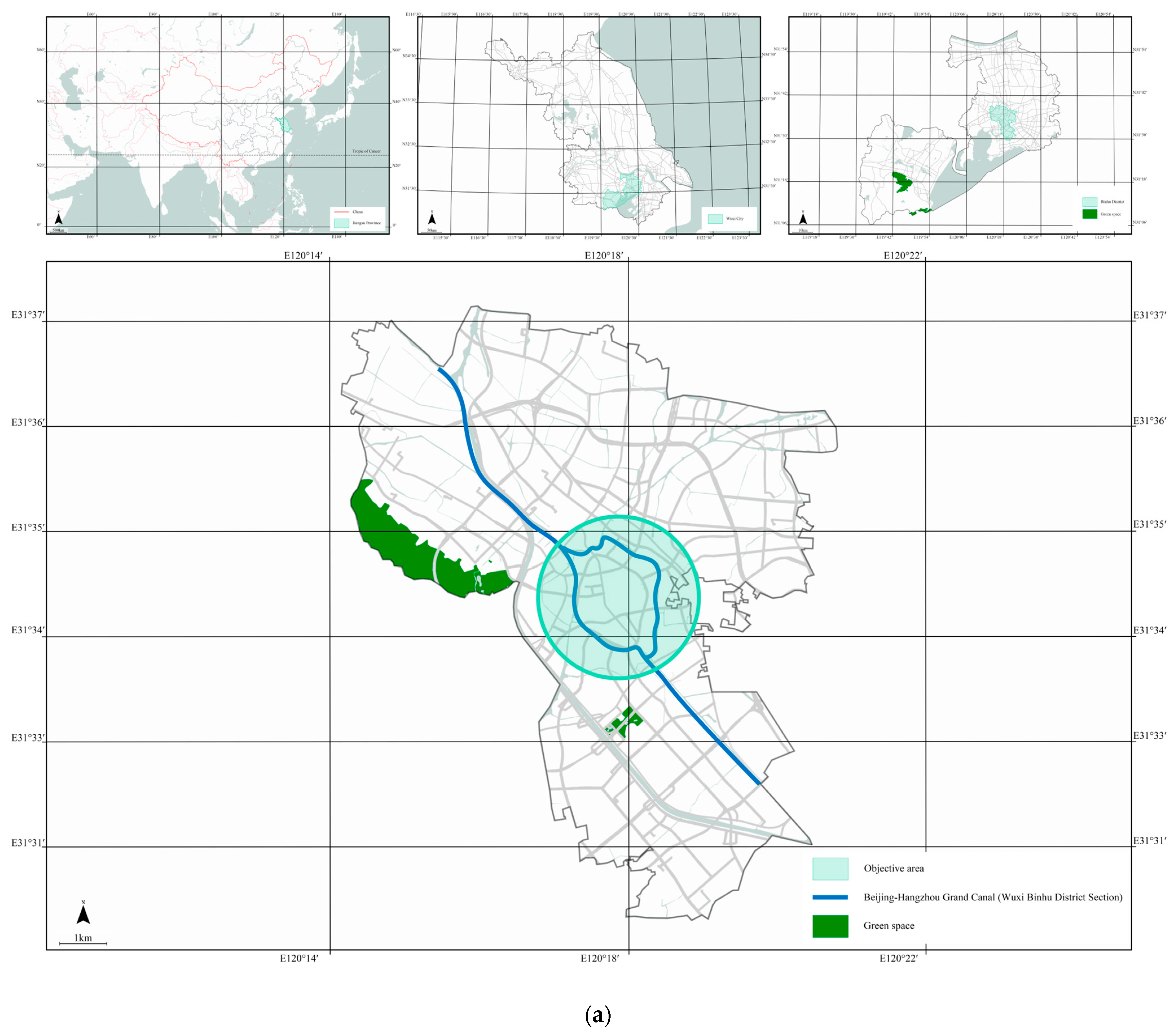
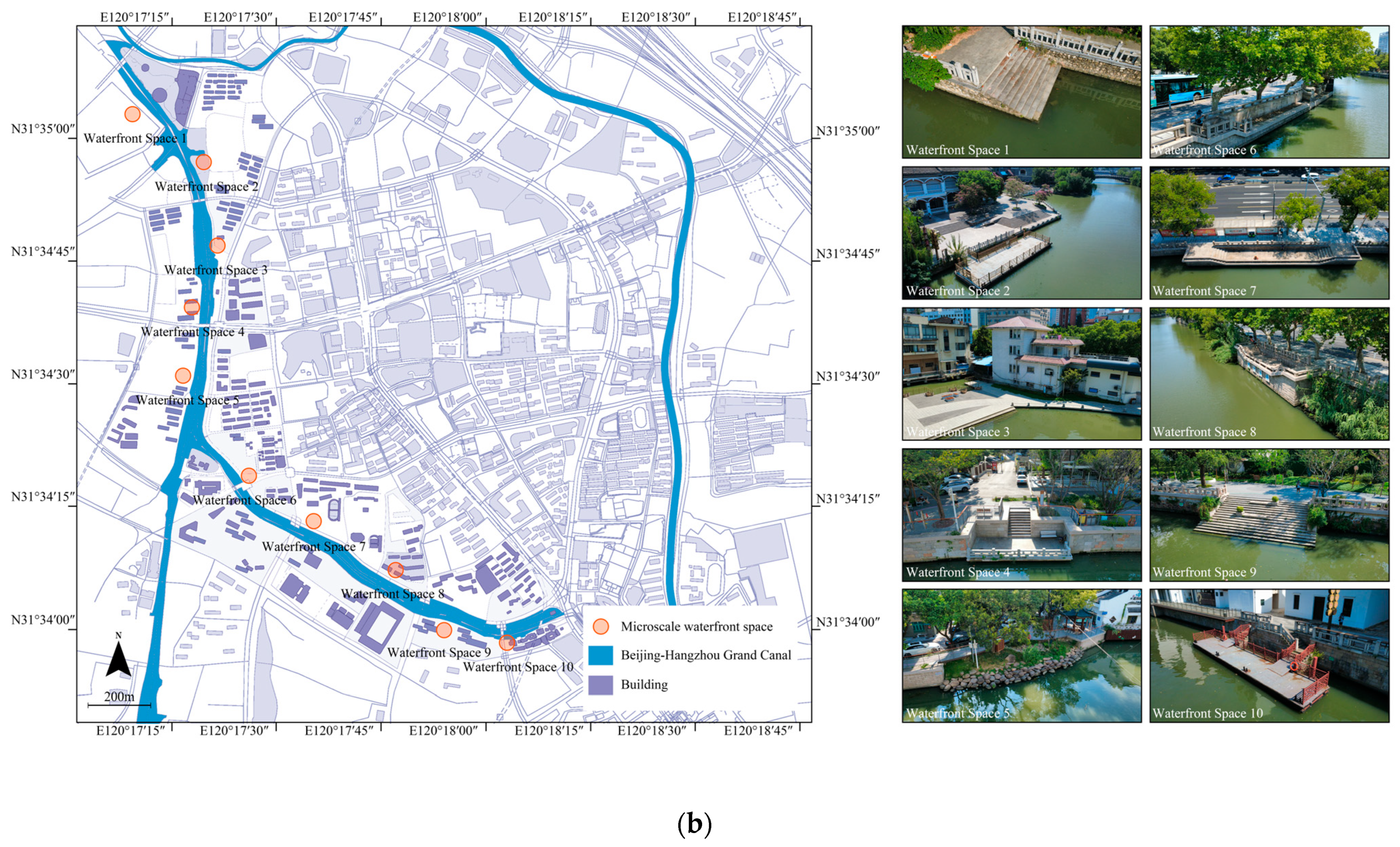
3.1. Study Area and Evaluation Entity Selection
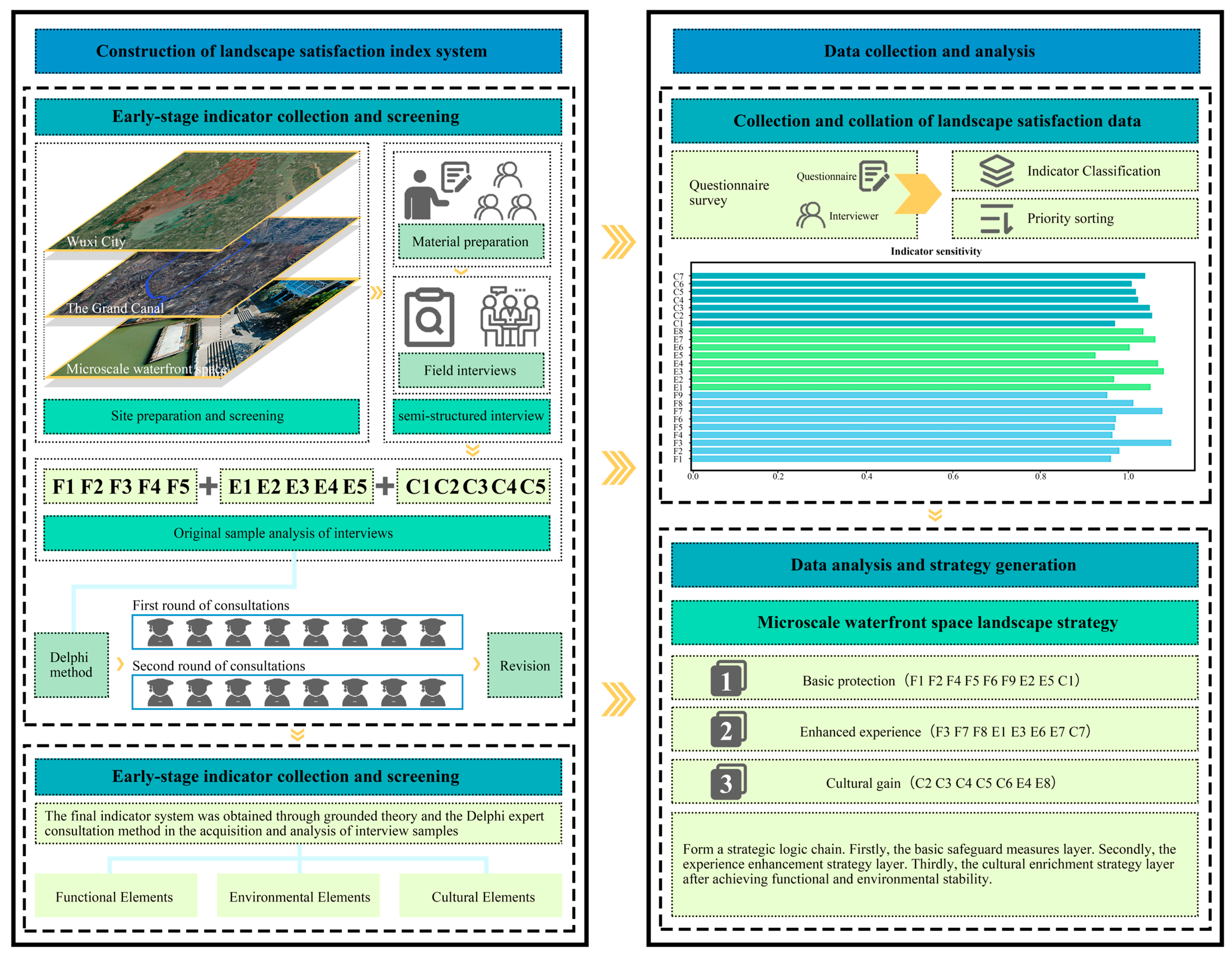
3.2. Research Framework
3.3. Construction of the Comprehensive Evaluation Indicator System
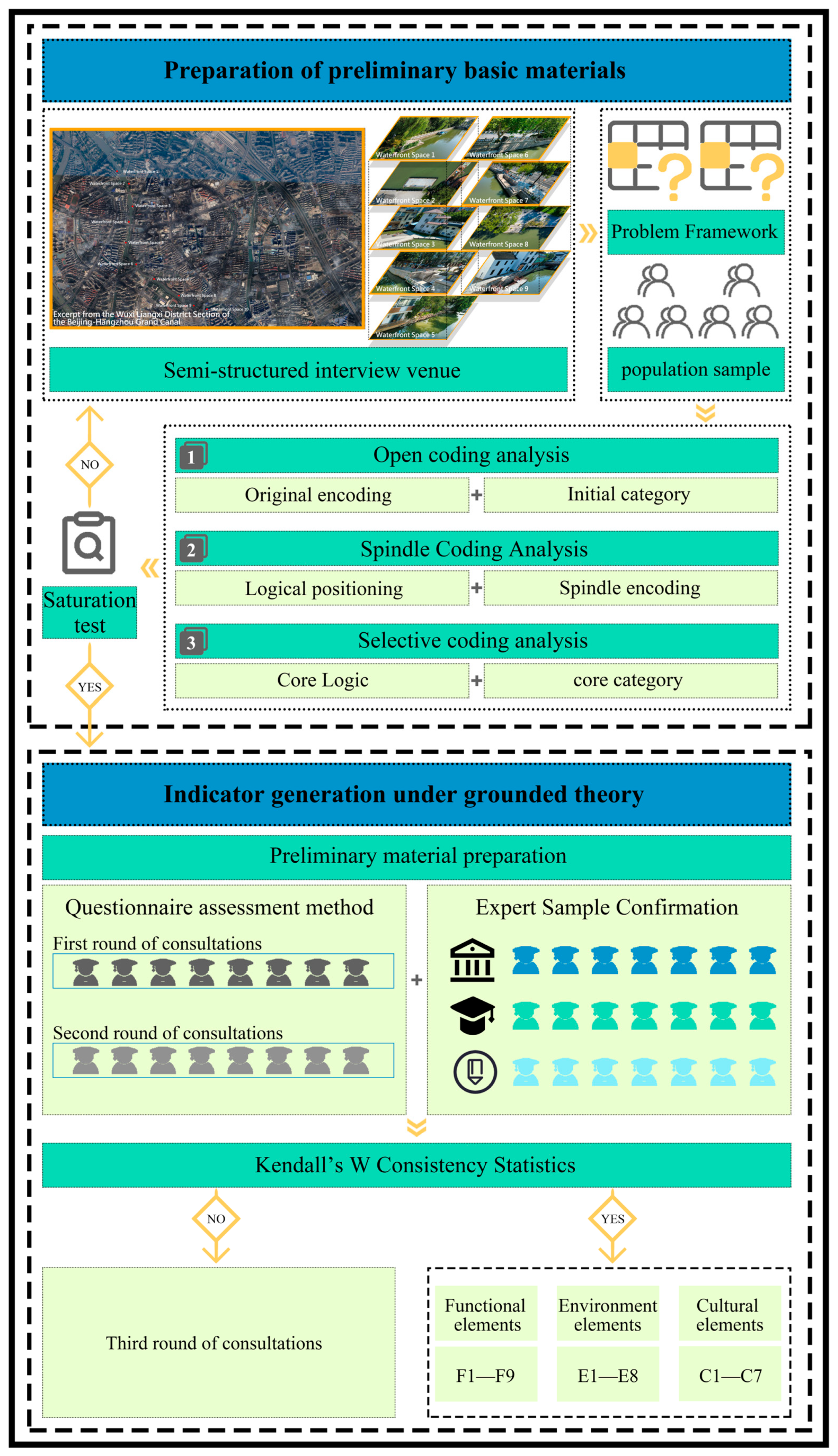
3.3.1. Grounded Theory
- (1)
- Open Coding Analysis
- (2)
- Principal Component Analysis
- (3)
- Selective Coding Analysis
- (4)
- Theoretical Saturation Test
3.3.2. Delphi Expert Consultation Method
- (1)
- Survey Design and Expert Consultation
- (2)
- Expert Feedback and Indicator Revision
- (3)
- Final confirmation of the indicator system
3.3.3. KANO Model Evaluation
- (1)
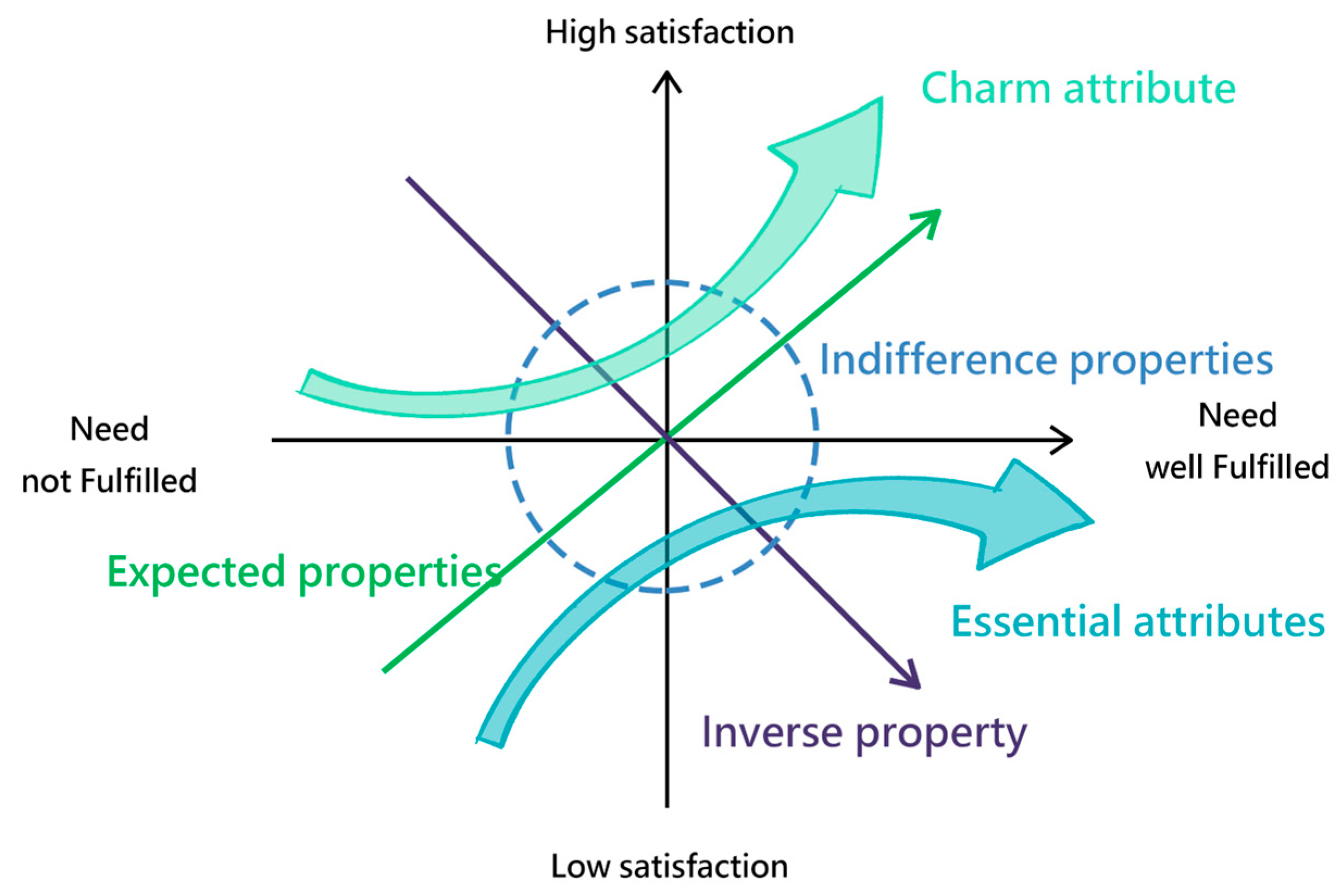
- KANO Model
- (1)
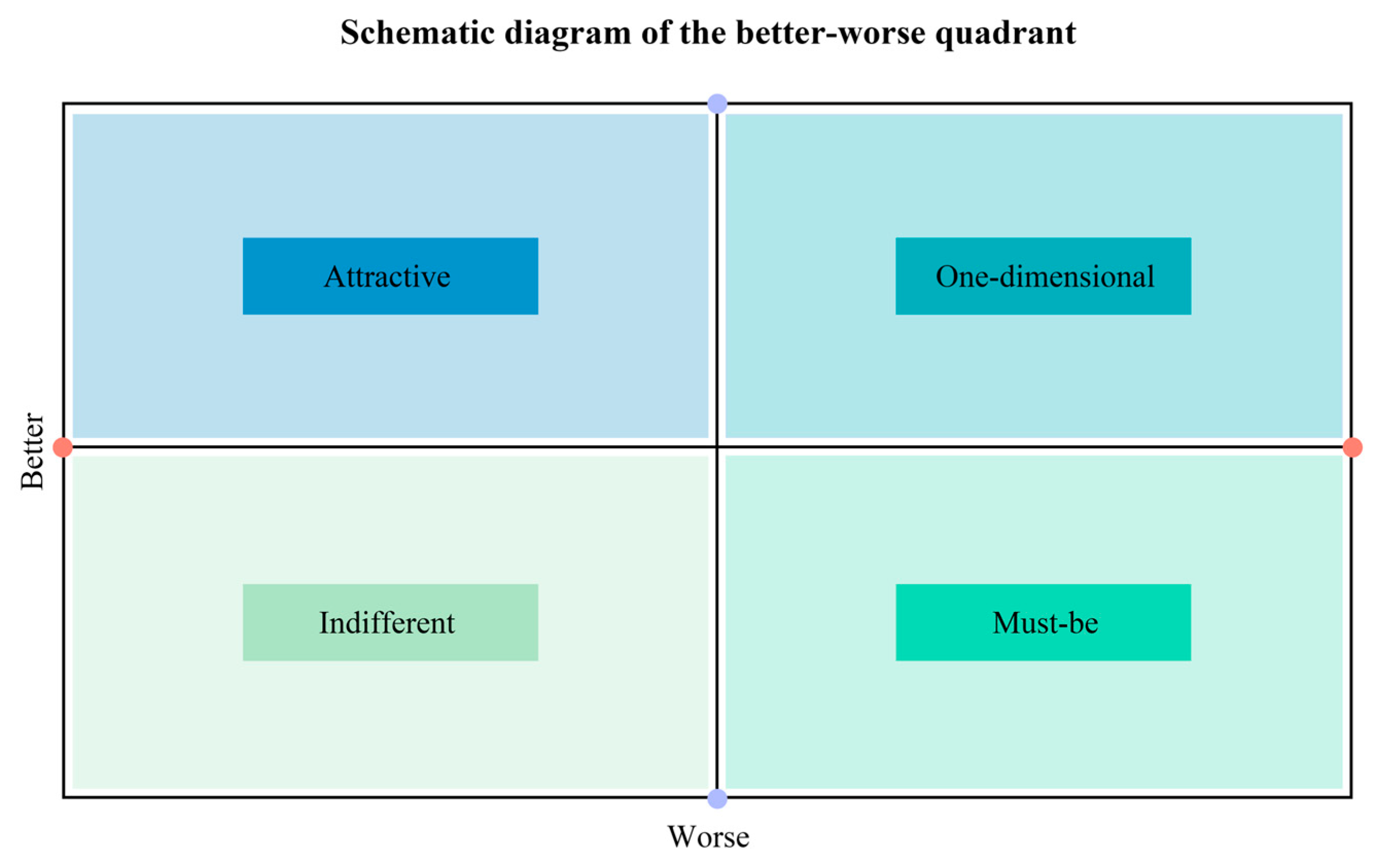
- Must-be (M)
- (2)
- One-dimensional (O)
- (3)
- Attractive (A)
- (4)
- Indifferent (I)
- (5)
- Reverse (R)
- (6)
- Questionable (Q)

- (2)
- Questionnaire Design
3.4. Data Sources and Data Processing
4. Result
4.1. Kano Classification Results of Landscape Satisfaction Indicators
4.2. Better–Worse Coefficient Analysis and Two-Dimensional Quadrant Distribution
4.3. Indicator Sensitivity and Priority Ranking
5. Discussion
5.1. Reinterpreting Waterfront Satisfaction: Beyond Linear Evaluation Frameworks
5.2. Theoretical Advancement: An Asymmetric Chain Mechanism of Satisfaction Generation
5.3. Empirical and Contextual Contributions: Micro-Scale Canal Spaces in High-Density Heritage Cities
5.4. Practical Implications for Sustainable Micro-Renewal
6. Conclusions
Author Contributions
Funding
Institutional Review Board Statement
Informed Consent Statement
Data Availability Statement
Acknowledgments
Conflicts of Interest
Abbreviations
| GT | Grounded Theory |
| Mean | Arithmetic Mean |
| SD | Standard Deviation |
| CV | Coefficient of variation |
| W | Coefficient of consistency |
| M | Must-be |
| O | One-dimensional |
| A | Attractive |
| I | Indifferent |
| R | Reverse |
| Q | Questionable |
| S | Sensitivity |
Appendix A

| Number | Gender | Age (Years) | Years Resided (Years) | Occupation Type |
|---|---|---|---|---|
| R01 | Male | 29 | 5 | Company employee |
| R02 | Female | 38 | 10 | Middle school teacher |
| R03 | Male | 63 | 25 | Retired resident |
| R04 | Female | 49 | 20 | Self-employed business owner |
| R05 | Male | 22 | 3 | College student |
| R06 | Female | 70 | 40 | Retired resident |
| R07 | Male | 41 | 15 | Urban planner |
| R08 | Female | 28 | 6 | Cultural and creative designer |
| R09 | Male | 52 | 18 | Civil servant |
| R10 | Female | 58 | 30 | Community volunteer |
| R11 | Male | 33 | 7 | Food service worker |
| R12 | Female | 46 | 15 | Urban management staff |
| R13 | Male | 67 | 32 | Retired teacher |
| R14 | Female | 31 | 5 | Community social worker |
| R15 | Male | 57 | 28 | Artisan |
| R16 | Female | 39 | 12 | Cultural heritage docent |
| R17 | Male | 72 | 38 | Retired civil servant |
| R18 | Female | 34 | 8 | Urban Planner |
| R19 | Male | 27 | 6 | Photographer |
| R20 | Female | 59 | 25 | Community Organizer |
| R21 | Male | 42 | 10 | Restaurant Owner |
| R22 | Female | 50 | 18 | Medical Professional |
| R23 | Male | 23 | 4 | Undergraduate Student |
| R24 | Female | 32 | 7 | Landscape Architect |
| R25 | Male | 61 | 30 | Retired Worker |
| R26 | Female | 47 | 15 | Community Resident Representative |
| R27 | Male | 53 | 22 | Freelancer |
| R28 | Female | 36 | 9 | Internet Professional |
| R29 | Male | 43 | 12 | Small Business Owner |
| R30 | Female | 66 | 35 | Retired Teacher |
| R31 | Male | 27 | 6 | Urban Volunteer |
| R32 | Female | 52 | 20 | Community Secretary |
| R33 | Male | 37 | 10 | Graphic Designer |
| R34 | Female | 56 | 25 | Public Affairs Manager |
| R35 | Female | 30 | 8 | Freelancer |
| R36 | Male | 45 | 12 | State-Owned Enterprise Engineer |
| R37 | Female | 53 | 22 | Community Librarian |
| R38 | Male | 60 | 30 | Retired Grassroots Cadre |
| R39 | Female | 27 | 4 | New Media Operator |
| R40 | Male | 34 | 7 | Cultural Tourism Practitioner |
| R41 | Female | 68 | 40 | Retired Medical Personnel |
| R42 | Male | 39 | 14 | Small Restaurant Operator |
| R43 | Female | 24 | 3 | Graduate Student |
| R44 | Male | 51 | 20 | Water Patrol Officer |
| R45 | Female | 43 | 10 | Psychological |
| R46 | Male | 58 | 28 | Counselor |
| R47 | Female | 36 | 8 | Traditional Artisan |
| R48 | Male | 70 | 38 | Kindergarten Teacher |
| R49 | Female | 30 | 6 | Retired Engineer |
| R50 | Male | 47 | 15 | Hotel and Convention Services Staff |
| R51 | Female | 55 | 26 | Elementary School Teacher |
| R52 | Male | 41 | 12 | Community Health Station Nurse |
| R53 | Female | 61 | 33 | Self-Media Photographer |
| R54 | Male | 29 | 5 | Retired State-Owned Enterprise Employee |
| R55 | Female | 48 | 18 | Sports Coach |
| Interview Participants | Problem Code | Interview Outline |
|---|---|---|
| Functional Elements | Q1 | How do you typically reach the waterfront area? Is the route convenient? |
| Q2 | Did you encounter any obstacles or inconveniences during your journey? | |
| Q3 | Does the continuity of the waterfront walkway meet your walking or access needs? | |
| Q4 | Do you consider the current infrastructure (seating, trash bins, lighting, railings, etc.) to be adequate? | |
| Q5 | Is there any infrastructure you believe is “essential but currently lacking”? | |
| Q6 | Are your typical activities (walking, exercising, socializing, accompanying elderly or children, etc.) adequately supported? | |
| Q7 | Do you feel safe using the waterfront space at different times of the day? Why? | |
| Q8 | Are there any areas or situations that make you feel unsafe? | |
| Q9 | How would you rate the management of the waterfront area (cleanliness, maintenance, order management, etc.)? | |
| Q10 | If additional or improved functional facilities could be added, which one would most significantly enhance your experience? | |
| Environmental Elements | Q1 | How would you rate the visual landscape of the waterfront space (greenery, water visibility, landscape layering, etc.)? |
| Q2 | Are there any environmental details you particularly like or dislike? | |
| Q3 | Do cleanliness and maintenance conditions affect your willingness to stay here? | |
| Q4 | Do you find the temperature, wind, sunlight, humidity, and other conditions comfortable? | |
| Q5 | Are there any situations causing you noticeable discomfort? In which season or time of day is this most pronounced? | |
| Q6 | Would microclimate factors cause you to shorten your stay? | |
| Q7 | Did the surrounding noise environment (vehicles, crowds, construction, etc.) affect you? | |
| Q8 | Did the odors, water quality, or environmental hygiene impact your experience? | |
| Q9 | Which environmental factors, if improved, would most enhance your stay experience? | |
| Q10 | Were there any environmental features that “unexpectedly made you feel comfortable or relaxed”? What were they? | |
| Cultural Elements | Q1 | While using the waterfront space, could you sense the historical and cultural significance of the Grand Canal? |
| Q2 | Which spatial elements evoke cultural or historical associations for you? (e.g., old docks, architectural facades, story markers) | |
| Q3 | Are there areas where you feel “cultural elements are diluted or absent”? Why? | |
| Q4 | Do specific locations or views trigger particular memories or emotions for you? | |
| Q5 | Do you perceive a unique “sense of place” in the waterfront atmosphere? How is it manifested? | |
| Q6 | If not, what do you believe causes this absence? | |
| Q7 | Do cultural elements influence how often or how you use the waterfront space? | |
| Q8 | Do you consider cultural expression “essential” or “nice to have”? Please explain. | |
| Q9 | How would you like to see cultural expression enhanced in the future? Examples include light narratives, cultural pathways, or scene restoration. | |
| Q10 | If cultural expression were strengthened, would you be more inclined to linger here or bring family members? Why? |
| Classification | Number | Original Statement | Preliminary Abstract Concepts | Conceptual Classification |
|---|---|---|---|---|
| Functional elements | F01 | “Walking from the residential area to the river requires crossing the road, which is very inconvenient.” | Inconvenient access routes | Accessibility |
| F02 | “The steps down to the riverbank are too steep, making it dangerous for the elderly to climb up and down.” | Unfriendly elevation changes | Safe Accessibility | |
| F03 | “Wheelchairs simply cannot be pushed down to the riverbank.” | Lack of accessible facilities | Barrier-Free Systems | |
| F04 | “The walkway suddenly ends, forcing people to backtrack.” | Insufficient trail continuity | Spatial Connectivity | |
| F05 | “The passage under the bridge is too narrow for two people to pass side-by-side.” | Inadequate walking width | Walking Comfort | |
| F06 | “There are too few lights at night, making people feel uneasy walking.” | Insufficient nighttime lighting | Nighttime Safety | |
| F07 | “The lights are bright, but the color is odd—hard to see the path.” | Mismatched lighting color temperature | Nighttime Lighting Quality | |
| F08 | “There are too few places to rest; you get tired after walking a short while.” | Insufficient rest facilities | Rest Stop Provision | |
| F09 | “Some benches are too low for the elderly to sit comfortably.” | Unreasonable seating dimensions | Ergonomic Adaptation | |
| F10 | “Trash cans are too far away, so people just leave their trash on the ground.” | Uneven distribution of sanitation facilities | Sanitation System Completeness | |
| F11 | “There’s no shelter from the rain by the river—you have to run when it rains.” | Absence of rain shelters | Weather Protection Facilities | |
| F12 | “There aren’t enough places for children to play.” | Insufficient children’s play equipment | Family-Friendly Design | |
| F13 | “The fitness equipment is all broken and unusable.” | Aged fitness equipment | Fitness Facility Quality | |
| F14 | “There’s nowhere to stretch or start jogging.” | Unclear exercise organization | Sports Route Design | |
| F15 | “No guardrails along the water—it feels dangerous.” | Inadequate safety protection | Waterfront Safety Protection | |
| F16 | “The guardrails are too high, blocking the view.” | Unreasonable guardrail height | Safety and Visibility Balance | |
| F17 | “I didn’t see any emergency rescue equipment.” | Absence of first-aid facilities | Emergency Systems | |
| F18 | “There are too few parking spots—it’s impossible to park.” | Insufficient parking facilities | Parking Accessibility | |
| F19 | “Shared bikes are parked haphazardly, crowding the walkways.” | Inadequate shared transportation management | Spatial Order Management | |
| F20 | “Construction barriers remain up, making walking inconvenient.” | Disorganized construction management | Spatial Governance | |
| F21 | “Severe water pooling after rain.” | Insufficient drainage systems | Rainwater Management | |
| F22 | “Loose paving tiles wobble underfoot.” | Unstable paving structures | Pedestrian Safety | |
| F23 | “Surfaces are too slippery, especially dangerous when wet.” | Poor slip resistance on surfaces | Walking Safety | |
| F24 | “Public restrooms are nearly impossible to find.” | Inconspicuous sanitation facilities | Public Sanitation Facilities | |
| F25 | “Restroom conditions are so poor I wouldn’t dare use them.” | Low-quality sanitation facilities | Sanitary Experience | |
| F26 | “Public Wi-Fi is too weak to load pages.” | Unreliable communication infrastructure | Communication Support System | |
| F27 | “Signage is too vague to understand directions.” | Unclear wayfinding signage | Wayfinding System | |
| F28 | “Signs are placed in particularly hidden locations.” | Inefficient wayfinding placement | Wayfinding System Layout | |
| F29 | “Bicycles, e-bikes, and pedestrians are all crammed together.” | Mixed traffic flow | Traffic Organization | |
| F30 | “Patrols are too infrequent, making it unsafe.” | Insufficient patrol management | Public Safety Management | |
| F31 | “Few people at night, feels unmanaged.” | Lack of nighttime order maintenance | Nighttime Management | |
| F32 | “Some dark corners along the river make people hesitant to approach.” | Existence of safety blind spots | Spatial Safety | |
| F33 | “Weekends are too crowded.” | Inadequate pedestrian capacity | Capacity Management | |
| F34 | “Street vendors severely obstruct pathways.” | Interference from street vendors | Order Maintenance | |
| F35 | “Lacks intimate spaces for sitting and chatting.” | Scarce social spaces | Social Support | |
| F36 | “Insufficient drinking water stations along the river.” | Insufficient public drinking water facilities | Lifestyle Convenience | |
| F37 | “No designated areas for pet activities.” | Absence of pet-designated zones | User Zoning Management | |
| F38 | “Poorly marked walking routes make it easy to get lost.” | Inadequate pedestrian navigation | Pedestrian Guidance System | |
| Environmental elements | E01 | “Winter winds feel exceptionally cold.” | Uncomfortable wind conditions | Microclimate Experience |
| E02 | “It’s too sunny in summer with nowhere to escape the heat.” | Insufficient shade | Microclimate Regulation | |
| E03 | “The area near the water is extremely humid and stuffy.” | Unpleasant humidity | Climate Suitability | |
| E04 | “There’s a musty smell in the air.” | Unpleasant waterfront odors | Olfactory Environment | |
| E05 | “The river water looks very murky.” | Low water transparency | Water Feature Quality | |
| E06 | “Trash often floats on the water surface.” | Poor water cleanliness | Water Sanitation | |
| E07 | “Sometimes you can smell sewage.” | Unpleasant water odors | Water Quality Issues | |
| E08 | “The greenery along the riverbank is trimmed unevenly.” | Inadequate vegetation maintenance | Greenery Management | |
| E09 | “Plants are too monotonous with no layering.” | Landscape species homogeneity | Landscape Diversity | |
| E10 | “Lacks plants with distinct flowering seasons.” | Lack of seasonal landscape variation | Seasonal Expressiveness | |
| E11 | “Very few birds, lacking ecological vibrancy.” | Insufficient biodiversity | Habitat Quality | |
| E12 | “Tall buildings in front block river views.” | Poor visual permeability | Spatial Visuality | |
| E13 | “Nighttime lighting is too bright and glaring.” | Light pollution | Nighttime Lighting Environment | |
| E14 | “Some areas are too dark to see clearly.” | Insufficient nighttime illumination | Nighttime Visual Safety | |
| E15 | “Excessive noise along the river from constant traffic.” | Traffic noise disturbance | Acoustic Environmental Stress | |
| E16 | “Construction noise is exceptionally loud.” | Construction noise pollution | Soundscape Environment | |
| E17 | “It gets extremely noisy when crowded, unsuitable for relaxation.” | Intense human noise disturbance | Soundscape Comfort | |
| E18 | “There’s dust in the air.” | Poor air quality | Air Environment | |
| E19 | “The ground colors are chaotic and visually uncomfortable.” | Inconsistent pavement color schemes | Pavement Visual Experience | |
| E20 | “The paving style clashes with the surrounding environment.” | Unified pavement styles | Landscape Cohesion | |
| E21 | “Lacks waterfront platforms, too distant from the water.” | Insufficient water accessibility | Spatial Waterfront Experience | |
| E22 | “The riverbank slopes are too steep to approach safely.” | Low shoreline accessibility | Shore Line Friendliness | |
| E23 | “The nighttime scenery is monotonous, lacking depth.” | Monotonous nighttime scenery | Nighttime Aesthetics | |
| E24 | “During the day, it looks ordinary and unremarkable.” | Lacking site character | Visual Appeal | |
| E25 | “The plaza area feels too open and oppressive.” | Imbalanced spatial scale | Spatial Proportionality | |
| E26 | “Small spaces are crowded; sitting down gets interrupted.” | High spatial crowding | Spatial Capacity Experience | |
| E27 | “The breeze across the water feels pleasant.” | Good natural wind sensation | Sensory Comfort (Positive) | |
| E28 | “Hearing the water at night is actually relaxing.” | Good water sound experience | Soundscape Pleasure | |
| E29 | “Sunlight reflecting on the water feels warm.” | Good light and shadow experience | Light and Shadow Comfort | |
| E30 | “The shaded areas under the bridge are too dark and cold.” | Poor shaded area environment | Microclimate | |
| E31 | “Mosquitoes and insects by the river are very bothersome.” | Significant insect disturbance | Habitat Management | |
| E32 | “On rainy days, the puddles reflect light intensely.” | Surface glare issues | Light Pollution | |
| E33 | “The pavement is uneven.” | Low ground surface evenness | Walking Comfort | |
| E34 | “There’s no natural sound by the river, only traffic noise.” | Lack of natural sound sources | Soundscape Naturalness | |
| E35 | “The cultural landscape blends poorly with the environment.” | Low environmental and cultural integration | Landscape Integration | |
| E36 | “The color scheme is too chaotic.” | Chaotic color schemes | Landscape Style Consistency | |
| E37 | “Moldy walls along the riverbank.” | Poor building facade maintenance | Visual Environment Quality | |
| Cultural elements | C01 | “Hard to tell this is the Grand Canal Cultural District.” | Weak historical ambiance | Historical Context Presentation |
| C02 | “Lacks tangible artifacts representing the canal’s history.” | Lack of physical cultural carriers | Heritage Display | |
| C03 | “The old wharf only has a monument left, no real relics.” | Insufficient historical artifacts | Heritage Authenticity | |
| C04 | “Cultural signage is too academic, hard to understand.” | Difficult-to-understand cultural interpretations | Cultural Accessibility | |
| C05 | “No storytelling approach.” | Inadequate narrative expression | Cultural Narrative System | |
| C06 | “Too few cultural markers, hard to spot while walking.” | Poor placement of cultural markers | Cultural Orientation System | |
| C07 | “The historical wall content is outdated and hasn’t been refreshed.” | Outdated cultural displays | Cultural Renewability | |
| C08 | “There are too few festive events; it lacks liveliness.” | Weak festival culture | Cultural Activity | |
| C09 | “No one tells the stories of the canal.” | Discontinuity in oral traditions | Community Cultural Heritage | |
| C10 | “Modern architecture disrupts the traditional ambiance.” | Diminished cultural landscape | Cultural Visual Integrity | |
| C11 | “The building facades don’t match the canal-side style.” | Inconsistent traditional appearance | Characteristic Features | |
| C12 | “There’s no traditional music or sounds.” | Absence of sound culture | Soundscape Culture | |
| C13 | “More old photographs would be appreciated.” | Insufficient historical imagery | Historical Visualization | |
| C14 | “The cultural route is disjointed.” | Discontinuous cultural pathways | Cultural Path System | |
| C15 | “Didn’t see any intangible cultural heritage projects.” | Inadequate intangible cultural heritage presentation | Intangible Cultural Heritage Experience | |
| C16 | “No cultural guidebook or map.” | Lack of cultural navigation | Cultural Information System | |
| C17 | “Exhibition panels are too superficial.” | Shallow cultural interpretation depth | Cultural Depth Presentation | |
| C18 | “Some sculptures have no connection to the canal.” | Misaligned cultural symbols | Symbolic Consistency | |
| C19 | “The cultural atmosphere feels overly commercialized.” | Overwhelming commercial atmosphere | Cultural Purity | |
| C20 | “Young people don’t connect with the canal.” | Weak cultural identity | Cultural Participation | |
| C21 | “Surrounding restaurants lack canal-themed offerings.” | Lack of culturalized operations | Local Cultural Operations | |
| C22 | “The nightscape lacks culturally themed lighting.” | Weak cultural light and shadow presentation | Light and Shadow Culture | |
| C23 | “Too few cultural performances.” | Insufficient performance activities | Cultural Experience Activities | |
| C24 | “The narrative feels pieced together and disjointed.” | Incomplete narrative structure | Cultural Narrative Logic | |
| C25 | “Lacks introductions to historical figures.” | Absence of character stories | Historical Image System | |
| C26 | “Historical maps are unavailable.” | Inadequate historical spatial cognition | Historical Sense of Space | |
| C27 | “Cultural elements don’t integrate with modern facilities.” | Low cultural environment integration | Cultural Integration | |
| C28 | “The canal’s points of interest are too weak.” | Insufficient memory symbols | Place Memory | |
| C29 | “Many stories from elderly community members remain unrecorded.” | Uncollected folk narratives | Community Cultural Resources | |
| C30 | “Lacks experiential cultural activities.” | Lack of interactive cultural activities | Experiential Culture | |
| C31 | “Children lack understanding of canal culture.” | Absence of cultural education | Public Cultural Education | |
| C32 | “Cultural displays are too static.” | Monotonous expression forms | Multimodal Cultural Presentation | |
| C33 | “Materials along the riverbank don’t resemble traditional canal styles.” | Inadequate material cultural expression | Material Culturalist | |
| C34 | “No showcase of traditional craftsmanship.” | Absence of craft culture | Artisan Culture Presentation | |
| C35 | “Hope for light shows with cultural narratives.” | Need for light and shadow storytelling | Cultural Nightscape Presentation | |
| C36 | “No community-participatory cultural events.” | Weak community co-creation culture | Cultural Participation Mechanisms | |
| C37 | “Insufficient cultural-themed landscapes.” | Insufficient landscape cultural symbols | Cultural Landscape Shaping |
| Original Concepts (Cpt) | Initial Categories (F) | Dimension |
|---|---|---|
| Cpt01 Inconvenient Access Routes | F1 Accessibility | Functional Elements |
| Cpt02 Poor Safety When Crossing Streets | F2 Pathways and Connectivity | |
| Cpt03 Discontinuous Walkways | F3 Barrier-Free Systems | |
| Cpt04 Insufficient Walkway Width | F4 Nighttime Lighting and Safety | |
| Cpt05 Lack of Accessible Passage | F5 Rest Facilities | |
| Cpt06 Improper Placement of Accessibility Features | F6 Sanitation and Hygiene Facilities | |
| Cpt07 Inadequate Nighttime Lighting | F7 Emergency and Security Facilities | |
| Cpt08 Inappropriate lighting quality | F8 Transportation and Connections | |
| Cpt09 Insufficient seating | F9 Construction and Maintenance Management | |
| Cpt10 Uncomfortable seating | F10 Paving and Walking Safety | |
| Cpt11 Inadequate sanitation facilities | F11 Wayfinding and Information Systems | |
| Cpt12 Insufficient/unclean public restrooms | F12 Social and Family Micro-Spaces | |
| Cpt13 Lack of emergency equipment (life rings, AED) | F13 Space Capacity and Order Management | |
| Cpt14 Inadequate security monitoring and patrols | F14 Nighttime Management and Order | |
| Cpt15 Inconvenient parking/shuttle access | F15 Communication and Information Infrastructure | |
| Cpt16 Disorganized shared bicycle management | E1 Microclimate (Shade/Wind) | |
| Cpt17 Poor construction barrier management | E2 Humidity and Thermal Comfort | |
| Cpt18 Aging/damaged facilities | E3 Water Body Visual Quality | |
| Cpt19 Poor ground slip resistance | E4 Olfactory and Air Quality | |
| Cpt20 Uneven/potholed pavement | E5 Acoustic Environment | |
| Cpt21 Unclear wayfinding system | E6 Vegetation and Landscape Diversity | |
| Cpt22 Inappropriate signage placement/language | E7 Nightscape and Lighting Design | |
| Cpt23 Insufficient social micro-spaces | E8 Visual Connectivity and Material Coordination | |
| Cpt24 Inadequate children’s activity facilities | E9 Water Accessibility and Shoreline Access | |
| Cpt25 Insufficient site capacity (crowding) | E10 Spatial Scale and Proportion | |
| Cpt26 Street vendors disrupting order | E11 Ecological/Habitat Quality | |
| Cpt27 Lack of nighttime management | E12 Seasonal Expression and Attractiveness | |
| Cpt28 Inadequate communication/network coverage | E13 Building/Facade Maintenance | |
| Cpt29 Insufficient Shade | C1 Historical Context Presentation | Environmental Elements |
| Cpt30 Excessive Wind Along Waterfront | C2 Cultural Interpretation and Legibility | |
| Cpt31 Excessive Humidity/Dampness | C3 Cultural Circulation and Narrative Coherence | |
| Cpt32 Strong Summer Heat Island Effect | C4 Community Memory and Oral Traditions | |
| Cpt33 Turbid Water Quality | C5 Cultural Activities and Site Activation | |
| Cpt34 Floating Debris in Water | C6 Cultural Identity and Intergenerational Transmission | |
| Cpt35 Unpleasant Water Odor | C7 Cultural Information Dissemination | |
| Cpt36 High Airborne Dust | C8 Nighttime Cultural Presentation | |
| Cpt37 Road/construction noise | C9 Cultural Facilities and Operations | |
| Cpt38 Lack of natural sound sources | C10 Forms of Cultural Presentation | |
| Cpt39 Monotonous greenery layering | C11 Cultural Preservation and Renewal | |
| Cpt40 Insufficient greenery maintenance | Initial Categories (F) | |
| Cpt41 Monotonous nightscape lighting design | F1 Accessibility | |
| Cpt42 Light pollution/glare | F2 Pathways and Connectivity | |
| Cpt43 Poor visual permeability (obstructed by buildings) | F3 Barrier-Free Systems | |
| Cpt44 Paving/materials incompatible with surroundings | F4 Nighttime Lighting and Safety | |
| Cpt45 Insufficient waterfront access platforms | F5 Rest Facilities | |
| Cpt46 Excessively steep shoreline gradients | F6 Sanitation and Hygiene Facilities | |
| Cpt47 Imbalanced spatial scale | F7 Emergency and Security Facilities | |
| Cpt48 Ground glare/reflections | F8 Transportation and Connections | |
| Cpt49 Low biodiversity | F9 Construction and Maintenance Management | |
| Cpt50 Ecological disturbances (mosquitoes, etc.) | F10 Paving and Walking Safety | |
| Cpt51 Weak seasonal variation | F11 Wayfinding and Information Systems | |
| Cpt52 Slow maintenance response | F12 Social and Family Micro-Spaces | |
| Cpt53 Facade soiling/mold stains | F13 Space Capacity and Order Management | |
| Cpt54 Conflict between materials and historical texture | F14 Nighttime Management and Order | |
| Cpt55 Weak historical atmosphere | F15 Communication and Information Infrastructure | Cultural Elements |
| Cpt56 Lack of physical historical relics | E1 Microclimate (Shade/Wind) | |
| Cpt57 Insufficient cultural interpretation | E2 Humidity and Thermal Comfort | |
| Cpt58 Superficial cultural narratives | E3 Water Body Visual Quality | |
| Cpt59 Disrupted cultural circulation routes | E4 Olfactory and Air Quality | |
| Cpt60 Misaligned cultural symbols | E5 Acoustic Environment | |
| Cpt61 Unrecorded community oral histories | E6 Vegetation and Landscape Diversity | |
| Cpt62 Absence of intangible cultural heritage/craftsmanship displays | E7 Nightscape and Lighting Design | |
| Cpt63 Scarce festive events | E8 Visual Connectivity and Material Coordination | |
| Cpt64 Activities heavily commercialized | E9 Water Accessibility and Shoreline Access | |
| Cpt65 Weak cultural identity among youth | E10 Spatial Scale and Proportion | |
| Cpt66 Lack of cultural experiences for children | E11 Ecological/Habitat Quality | |
| Cpt67 Insufficient cultural guide materials | E12 Seasonal Expression and Attractiveness | |
| Cpt68 Absence of historical maps/archival photographs | E13 Building/Facade Maintenance | |
| Cpt69 Lack of culturally themed nighttime lighting | C1 Historical Context Presentation | |
| Cpt70 Missing nodes of place memory | C2 Cultural Interpretation and Legibility | |
| Cpt71 Insufficient operation of cultural facilities | C3 Cultural Circulation and Narrative Coherence | |
| Cpt72 Lack of community co-creation participation mechanisms | C4 Community Memory and Oral Traditions | |
| Cpt73 Monotonous/static cultural presentation formats | C5 Cultural Activities and Site Activation | |
| Cpt74 Materials/details incompatible with historical context | C6 Cultural Identity and Intergenerational Transmission | |
| Cpt75 Lagging cultural content updates | C7 Cultural Information Dissemination | |
| Cpt76 Local businesses lacking cultural relevance |
| Initial Categories | Main Axis Codification | Axis Coding Logical Positioning |
|---|---|---|
| Accessibility, Pathways & Connectivity, Barrier-Free Systems | F1 Spatial Accessibility and Continuity | Conditions (Directly Impact Usability) |
| Nighttime Lighting & Safety, Nighttime Management & Order | F2 Nighttime Accessibility and Safety | Context (Determines Temporal/Spatial Availability) |
| Rest Facilities, Social & Family-Friendly Micro-Spaces | F3 Rest and Social Support System | Action/Interaction Strategy (Promotes Staying and Interaction) |
| Sanitation & Hygiene Facilities, Public Toilets | F4 Environmental Hygiene Support System | Context (Influences Usage Comfort) |
| Paving & Pedestrian Safety | F5 Walking Comfort and Pedestrian Safety | Conditions (Directly Impact Physical Experience) |
| Emergency & Security Facilities | F6 Safety Response and Risk Protection System | Action/Interaction Strategy (Responds to Emergencies) |
| Transportation & Connectivity, Shared Mobility Management | F7 Slow Mobility–Transportation Coordination System | Context (Influences Overall Traffic Distribution) |
| Communication & Information Infrastructure, Wayfinding Systems | F8 Information and Navigation Support System | Action/Interaction Strategy (Enhances Spatial Understandability) |
| Space Capacity & Order Management, Street Vending Management | F9 Spatial Order and Capacity Management | Outcome (Order Enhancement → Experience Improvement) |
| Microclimate (Shade/Wind), Thermal Comfort | E1 Microclimate Comfort System | Context (Influences Extended Stay) |
| Water Body Visual Quality, Olfactory & Air Quality | E2 Water Environment and Air Quality Experience | Conditions (Influences Sensory Experience) |
| Acoustic Environment (Traffic/Natural Sounds) | E3 Soundscape Environment and Noise Regulation | Context |
| Vegetation Diversity & Greenery Maintenance | E4 Vegetation Landscape and Habitat Quality | Action/Interaction Strategy (Ecological Enhancement) |
| Nightscape Lighting & Glare Control | E5 Nightscape Lighting Environment and Light-Shadow Experience | Action/Interaction Strategy |
| Visual Transparency, Material Harmony, Building Facade Maintenance | E6 Visual Accessibility and Landscape Consistency | Context (Influences Aesthetic and Recognizability) |
| Waterfront Platforms, Shoreline Accessibility | E7 Water Accessibility and Waterfront Approachability | Conditions (Determines Waterfront Experience Potential) |
| Spatial Scale and Experience Capacity, Seasonal Expression | E8 Spatial Scale and Seasonal Expression | Outcome (Influencing Staying Behavior) |
| Historical Context Presentation, Authenticity of Historical Remnants | C1 Historical Context Reconstruction and Cultural Authenticity | Conditions (Cultural Experience Foundation) |
| Cultural Interpretation and Legibility, Narrative Depth | C2 Cultural Interpretation and Narrative System | Action/Interaction Strategy (Enhancing Understanding and Immersion) |
| Cultural Circulation Continuity, Cultural Symbol Consistency | C3 Cultural Circulation and Cultural Symbol Coordination | Context (Influencing Narrative Coherence) |
| Community Memory, Intangible Heritage Crafts, Oral Traditions | C4 Community Cultural Resources and Local Memory System | Conditions (Cultural Authenticity) |
| Cultural Events, Festival Activation, Cultural Participation | C5 Cultural Activities and Participation Mechanisms | Action/Interaction Strategy (Activating Place Culture) |
| Nighttime Cultural Lighting, Themed Cultural Nightscapes | C6 Nighttime Cultural Presentation System | Context (Nighttime Cultural Atmosphere) |
| Cultural Information Dissemination, Educational Function, Cultural Renewal | C7 Cultural Dissemination and Sustainable Operation System | Outcome (Enhanced Cultural Identity) |
| Core Category Code | Core Categories | Axial Coding Classification |
|---|---|---|
| A | Accessibility and Mobility Systems | (F1) Spatial Accessibility and Continuity |
| (F5) Walking Comfort and Safety | ||
| (F7) Slow Mobility-Transport Coordination System | ||
| (E8) Spatial Scale and Seasonal Expression | ||
| B | Safety and Resilience | (F2) Nighttime Accessibility and Safety |
| (F6) Safety Response and Risk Protection System | ||
| (E7) Water Accessibility and Waterfront Approachability | ||
| C | Environmental Comfort and Ecological Quality | (E1) Microclimate Comfort System |
| (E2) Water Environment and Air Quality Experience | ||
| (E3) Soundscape Environment and Noise Regulation | ||
| (E4) Vegetation Landscape and Habitat Quality | ||
| D | Cultural Narratives and Heritage Authenticity | (C1) Historical Context Reconstruction and Cultural Authenticity |
| (C2) Cultural Interpretation and Narrative System | ||
| (C3) Cultural Circulation and Symbolic Coherence | ||
| (C4) Community Cultural Resources and Local Memory System | ||
| E | Social Activation and Activity Orchestration | (F3) Rest and Social Support System |
| (C5) Cultural Activities and Participation Mechanisms | ||
| (C6) Nighttime Cultural Presentation System | ||
| F | Governance, Information, and Cognitive Mediation | (F8) Information and Navigation Support System |
| (F9) Spatial Order and Capacity Management | ||
| (E5) Walking Comfort and Pedestrian Safety | ||
| (E6) Visual Accessibility and Landscape Coherence | ||
| (F4) Environmental Sanitation Support System | ||
| (C7) Cultural Dissemination and Sustainable Operations System |
| Interview Number | Respondent Profile | Original Interview Material |
|---|---|---|
| R1 | Female, 47 years old, local resident, evening walker | I take a walk along the Grand Canal every evening, but recently some sections have been quite dimly lit. Areas with dense tree cover especially make me feel a bit unsafe. The riverside path is generally continuous, though a few corners require detours. I find the scenery quite pleasant overall, though there aren’t many resting spots, which can be tiring after walking for a while. Additionally, I really enjoy viewing old photographs of the canal, but there are currently few display points; it would be better if the stories of the old streets were told more comprehensively. The experience is generally comfortable, but a richer cultural atmosphere would enhance it further. |
| R2 | Male, 32 years old, new migrant resident, weekend user | I’ve lived here less than a year and find the Grand Canal environment pleasant, though shared bikes park chaotically on weekends, sometimes blocking paths. The river occasionally has an odor in summer. Cultural markers are abundant, but the text feels academic—as an outsider with little historical background, I struggle to understand it. Audio or video guides would be helpful. Overall good, but details need better management. |
| R3 | Male, 68 years old, local resident, long-term user | I’ve lived by the river for over thirty years and witnessed tremendous changes. It’s much better now, though some banks remain steep—my wife hesitates to get too close. Summer pavilions have limited seating, often filling up quickly. Cultural displays feel lacking; many focus on grand narratives rather than stories tied to local life. Our community elders know countless tales—compiling these would truly capture the canal’s authentic spirit. |
| R4 | Female, 25 years old, local university student, night photography user | I enjoy evening strolls and photography here. The nightscape is generally okay, but the colors of some lights are jarring and don’t photograph well. Some lights are too bright and glaring. I do read the cultural display boards, but the content feels overly official and isn’t very engaging. Interactive elements like AR or short videos would be great. The trash bins are spaced too far apart; sometimes I have to walk a long way with my trash. |
| R5 | Male, 54 years old, jogger, frequent user during early morning and evening | I come here to run every day. The path is generally good, but watch out for areas where tree roots have pushed up the surface—it’s easy to twist an ankle. The section under the bridge is quite dark, and running through it before dawn can feel a bit scary. The breeze feels great, but the humidity can be quite heavy at times. Some signs aren’t very visible; I ended up walking for a while looking for the restroom. The sound of the water is very soothing—it’s the most relaxing part for me. |
| R6 | Female, 30 years old, family user with young children | I often bring my kids here to play, but there aren’t enough dedicated children’s activity areas. The open spaces look nice but aren’t very kid-friendly. The railing height is appropriate, but there are gaps in some spots that are too wide, so you have to keep a close eye on the kids. The greenery is nice, but mosquitoes can be a problem in summer. It would be great to have cultural trails suitable for kids, like stamp collecting or small games, combining play with learning about the canal. |
| R7 | Male, 41 years old, freelancer, daytime work and leisure user | I often come to the riverbank for coffee—the atmosphere is pleasant, though construction noise can be loud at times. The wooden platforms are nice but limited in number. Some platforms are close to the water; integrating cultural information like canal history or old wharves would enhance the experience. The cultural displays feel scattered; they could be connected into a cohesive route. Trash accumulates more on weekends, so cleanup frequency could be increased. |
| R8 | Female, 62 years old, retired teacher, plant observer and leisurely walker | I enjoy observing plants, but the variety here isn’t extensive, and seasonal changes aren’t very noticeable. Some pavilion facades look worn, affecting the overall appearance. The cultural display panels present information in a straightforward manner without a strong narrative thread. A more layered storytelling approach would make them more engaging. Evening strolls have a pleasant atmosphere, but lighting in some areas is too uniform, lacking depth and dimension. |
| Group | Number of People | Expert Composition |
|---|---|---|
| Group A | 8 | Government officials and urban planners responsible for heritage protection policies and public space governance in Wuxi and other nationally designated historical and cultural cities |
| Group B | 11 | Scholars and researchers from universities specializing in urban morphology, cultural landscape preservation, and human-environment interactions |
| Group C | 5 | Practicing architects and landscape designers with hands-on experience in micro-renewal projects for historic districts, including several individuals who participated in the design of the Wuxi section of the Grand Canal. |
| Spindle Category Code | Mean (1–5) | SD | CV | Experts Lacking Clear Definitions | Experts Noting Redundancy | Retention Decision |
|---|---|---|---|---|---|---|
| F1 | 4.45 | 0.52 | 0.12 | 1 | 1 | Retain |
| F2 | 4.1 | 0.68 | 0.17 | 0 | 2 | Retain |
| F3 | 4.3 | 0.55 | 0.13 | 0 | 0 | Retain |
| F4 | 4.35 | 0.47 | 0.11 | 0 | 0 | Retain |
| F5 | 4.4 | 0.5 | 0.11 | 0 | 0 | Retain |
| F6 | 4.05 | 0.74 | 0.18 | 0 | 1 | Retain |
| F7 | 4 | 0.82 | 0.21 | 0 | 2 | Retain |
| F8 | 3.4 | 0.76 | 0.22 | 8 | 6 | Revise |
| F9 | 4.15 | 0.6 | 0.15 | 0 | 1 | Retain |
| E1 | 4.25 | 0.58 | 0.14 | 0 | 0 | Retain |
| E2 | 4.5 | 0.45 | 0.1 | 1 | 0 | Retain |
| E3 | 4.05 | 0.7 | 0.17 | 0 | 1 | Retain |
| E4 | 4.2 | 0.61 | 0.15 | 0 | 0 | Retain |
| E5 | 3.3 | 0.95 | 0.29 | 7 | 8 | Revise |
| E6 | 4.1 | 0.66 | 0.16 | 0 | 1 | Retain |
| E7 | 4.35 | 0.49 | 0.11 | 0 | 0 | Retain |
| E8 | 3.95 | 0.88 | 0.22 | 0 | 3 | Retain |
| C1 | 4.55 | 0.4 | 0.09 | 0 | 0 | Retain |
| C2 | 4.2 | 0.58 | 0.14 | 0 | 1 | Retain |
| C3 | 4 | 0.72 | 0.18 | 0 | 2 | Retain |
| C4 | 4.3 | 0.57 | 0.13 | 0 | 0 | Retain |
| C5 | 4.05 | 0.69 | 0.17 | 0 | 1 | Retain |
| C6 | 3.2 | 0.9 | 0.28 | 8 | 7 | Revise |
| C7 | 4 | 1.05 | 0.26 | 6 | 4 | Revise |
| Indicator Classification | Indicator Code | Mean | SD | CV | Processing |
|---|---|---|---|---|---|
| First Round of Met Indicators | F1 | 4.6 | 0.49 | 0.11 | Retain |
| F2 | 4.35 | 0.62 | 0.14 | Retain | |
| F3 | 4.5 | 0.51 | 0.11 | Retain | |
| F4 | 4.55 | 0.46 | 0.1 | Retain | |
| F5 | 4.45 | 0.54 | 0.12 | Retain | |
| F6 | 4.25 | 0.65 | 0.15 | Retain | |
| F7 | 4.2 | 0.7 | 0.17 | Retain | |
| F9 | 4.4 | 0.55 | 0.13 | Retain | |
| E1 | 4.45 | 0.5 | 0.11 | Retain | |
| E2 | 4.65 | 0.4 | 0.09 | Retain | |
| E3 | 4.2 | 0.63 | 0.15 | Retain | |
| E4 | 4.4 | 0.56 | 0.13 | Retain | |
| E6 | 4.3 | 0.62 | 0.14 | Retain | |
| E7 | 4.55 | 0.48 | 0.11 | Retain | |
| E8 | 4.2 | 0.68 | 0.16 | Retain | |
| C1 | 4.7 | 0.35 | 0.07 | Retain | |
| C2 | 4.4 | 0.59 | 0.13 | Retain | |
| C3 | 4.25 | 0.65 | 0.15 | Retain | |
| C4 | 4.5 | 0.52 | 0.12 | Retain | |
| C5 | 4.3 | 0.6 | 0.14 | Retain after modification | |
| First Round of Unmet Indicators | F8 | 4.1 | 0.71 | 0.17 | Retain after modification |
| E5 | 4.05 | 0.75 | 0.19 | Retain after modification | |
| C6 | 4 | 0.78 | 0.2 | Retain after modification | |
| C7 | 4.15 | 0.7 | 0.17 | Processing |
References
- Ding, J.; Luo, L.; Shen, X.; Xu, Y. Influence of Built Environment and User Experience on the Waterfront Vitality of Historical Urban Areas: A Case Study of the Qinhuai River in Nanjing, China. Front. Archit. Res. 2023, 12, 820–836. [Google Scholar] [CrossRef]
- Hilell, K.B.; Allweil, Y. Infrastructure Development and Waterfront Transformations: Physical and Intangible Borders in Haifa Port City. Urban Plan. 2021, 6, 43–57. [Google Scholar] [CrossRef]
- Che, Y.; Yang, K.; Chen, T.; Xu, Q. Assessing a Riverfront Rehabilitation Project Using the Comprehensive Index of Public Accessibility. Ecol. Eng. 2012, 40, 80–87. [Google Scholar] [CrossRef]
- Avni, N.; Teschner, N. Urban Waterfronts: Contemporary Streams of Planning Conflicts. J. Plan. Lit. 2019, 34, 408–420. [Google Scholar] [CrossRef]
- Dyson, K.; Yocom, K. Ecological Design for Urban Waterfronts. Urban Ecosyst. 2015, 18, 189–208. [Google Scholar] [CrossRef]
- Goodwin, R.F. Redeveloping Deteriorated Urban Waterfronts: The Effectiveness of US Coastal Management Programs. Coast. Manag. 1999, 27, 239–269. [Google Scholar] [CrossRef]
- Hillman, M.; Brierley, G. A Critical Review of Catchment-Scale Stream Rehabilitation Programmes. Prog. Phys. Geogr. Earth Environ. 2005, 29, 50–76. [Google Scholar] [CrossRef]
- Zeng, C.; Dai, T.; Wang, F.; Wu, J. Assessing Urban Spatial Vitality in Post-Port Areas: A Multimodal Data Analysis of Shanghai, Liverpool, and Marseille. Humanit. Soc. Sci. Commun. 2025, 12, 1195. [Google Scholar] [CrossRef]
- Li, X.; Kozlowski, M.; Ismail, S.B.; Salih, S.A. Spatial Distribution Characteristics of Leisure Urban Spaces and the Correlation with Population Activity Intensity: A Case Study of Nanjing, China. Sustainability 2024, 16, 7160. [Google Scholar] [CrossRef]
- Wang, H.; Yu, Z.; Liu, X. Deciphering Urban Soundscapes: A Study of Sensory Experiences at Hong Kong Victoria Harbour Waterfronts Using Social Media. Comput. Environ. Urban. Syst. 2025, 120, 102307. [Google Scholar] [CrossRef]
- Nian, X.; Cao, Y.; Li, Y.; Zhang, Y.; Hong, B. Effects of Environmental Factors on Multisensory Perceptions of Comfort, Safety, and Pleasure in Autumnal Urban Riverfront Spaces. Sustain. Cities Soc. 2025, 131, 106710. [Google Scholar] [CrossRef]
- Sun, D.; Li, Q.; Gao, W.; Huang, G.; Tang, N.; Lyu, M.; Yu, Y. On the Relation between Visual Quality and Landscape Characteristics: A Case Study Application to the Waterfront Linear Parks in Shenyang, China. Environ. Res. Commun. 2021, 3, 115013. [Google Scholar] [CrossRef]
- Vallega, A. Urban Waterfront Facing Integrated Coastal Management. Ocean Coast. Manag. 2001, 44, 379–410. [Google Scholar] [CrossRef]
- Bunce, S.; Desfor, G. Introduction to “Political Ecologies of Urban Waterfront Transformations.”. Cities 2007, 24, 251–258. [Google Scholar] [CrossRef]
- Sairinen, R.; Kumpulainen, S. Assessing Social Impacts in Urban Waterfront Regeneration. Environ. Impact Assess. Rev. 2006, 26, 120–135. [Google Scholar] [CrossRef]
- Lyu, M.; Meng, Y.; Gao, W.; Yu, Y.; Ji, X.; Li, Q.; Huang, G.; Sun, D. Measuring the Perceptual Features of Coastal Streets: A Case Study in Qingdao, China. Environ. Res. Commun. 2022, 4, 115002. [Google Scholar] [CrossRef]
- Wang, Y.; Wu, F.; Zhang, F. Participatory Micro-Regeneration: Governing Urban Redevelopment in Qinghe, Beijing. Urban Geogr. 2024, 46, 21–42. [Google Scholar] [CrossRef] [PubMed]
- Herzog, T.R. A Cognitive Analysis of Preference for Urban Spaces. J. Environ. Psychol. 1992, 12, 237–248. [Google Scholar] [CrossRef]
- Nasar, J.L. The Evaluative Image of the City; SAGE Publications: Thousand Oaks, CA, USA, 1998. [Google Scholar]
- Purcell, M. Excavating Lefebvre: The Right to the City and Its Urban Politics of the Inhabitant. Geojournal 2002, 58, 99–108. [Google Scholar] [CrossRef]
- Zhang, S.; Xiong, K.; Fei, G.; Zhang, H.; Chen, Y. Aesthetic Value Protection and Tourism Development of the World Natural Heritage Sites: A Literature Review and Implications for the World Heritage Karst Sites. Herit. Sci. 2023, 11, 30. [Google Scholar] [CrossRef] [PubMed]
- Bo, L.; Abdul Rani, M.F. The Value of Current Sense of Place in Architectural Heritage Studies: A Systematic Review. Buildings 2025, 15, 903. [Google Scholar] [CrossRef]
- Kong, S.; Li, H.; Yu, Z. A Review of Studies on the Mechanisms of Cultural Heritage Influencing Subjective Well-Being. Sustainability 2024, 16, 10955. [Google Scholar] [CrossRef]
- Jiang, X.; Li, X.; Wang, M.; Zhang, X.; Zhang, W.; Li, Y.; Cong, X.; Zhang, Q. Multidimensional Visual Preferences and Sustainable Management of Heritage Canal Waterfront Landscape Based on Panoramic Image Interpretation. Land 2025, 14, 220. [Google Scholar] [CrossRef]
- Tang, Q.; Cao, J.; Yin, C.; Cheng, J. Examining the Nonlinear Relationships between Park Attributes and Satisfaction with Pocket Parks in Chengdu. Urban For. Urban Green. 2024, 101, 128548. [Google Scholar] [CrossRef]
- Llinares, C.; Page, A.; Llinares, J. An Approach to Defining Strategies for Improving City Perception. Case Study of Valencia, Spain. Cities 2013, 35, 78–88. [Google Scholar] [CrossRef]
- Hoyle, B. Port- City Renewal in Developing Countries. The Waterfront at Dar Es Salaam, Tanzania. Erdkunde 2002, 56, 114–129. [Google Scholar] [CrossRef]
- Kostopoulou, S. On the Revitalized Waterfront: Creative Milieu for Creative Tourism. Sustainability 2013, 5, 4578–4593. [Google Scholar] [CrossRef]
- Chen, L.; Leng, H.; Dai, J.; Liu, Y.; Yuan, Z. Urban Waterfront Regeneration on Ecological and Historical Dimensions: Insight from a Unique Case in Beijing, China. Land 2024, 13, 674. [Google Scholar] [CrossRef]
- Li, S.; Ye, Y.; Chen, H.; Yang, Y.; Huang, Y.; Wu, Z. Vitality Analysis and Improvement of Micro Urban Spaces in Cold Regions. Int. Rev. Spat. Plan. Sustain. Dev. 2024, 12, 95–117. [Google Scholar] [CrossRef] [PubMed]
- Liu, T.; Mohd Yunos, M.Y.; Muthuveeran, A.A.S.; Mundher, R.; Ismail, N.A. Cultural Elements’ Influence on Visual Preferences in Urban Waterfronts’ Walkways in Malaysia. Front. Built Environ. 2024, 10, 1393187. [Google Scholar] [CrossRef]
- Feng, H.; Feng, L.; Huang, F.; Sun, J.; Chen, J. Synergistic Cooling Effects of Urban Blue-Green Spaces at Microscale: Using the Synergistic Cooling Composite Index. Sustain. Cities Soc. 2025, 131, 106768. [Google Scholar] [CrossRef]
- Abdurahiman, S.; Kasthurba, A.K.; Nuzhat, A. Assessing the Socio-Cultural Impact of Urban Revitalisation Using Relative Positive Impact Index (RPII). Built Herit. 2024, 8, 8. [Google Scholar] [CrossRef]
- Chan, S.H.G.; Lee, W.H.H.; Tang, B.M.; Chen, Z. Legacy of Culture Heritage Building Revitalization: Place Attachment and Culture Identity. Front. Psychol. 2024, 14, 1314223. [Google Scholar] [CrossRef]
- Koohsari, M.J.; Yasunaga, A.; Oka, K.; Nakaya, T.; Nagai, Y.; McCormack, G.R. Place Attachment and Walking Behaviour: Mediation by Perceived Neighbourhood Walkability. Landsc. Urban Plan. 2023, 235, 104767. [Google Scholar] [CrossRef]
- Pulles, K.; Conti, I.A.M.; de Kleijn, M.B.; Kusters, B.; Rous, T.; Havinga, L.C.; Ikiz Kaya, D. Emerging Strategies for Regeneration of Historic Urban Sites: A Systematic Literature Review. City Cult. Soc. 2023, 35, 100539. [Google Scholar] [CrossRef]
- Scannell, L.; Gifford, R. Defining Place Attachment: A Tripartite Organizing Framework. J. Environ. Psychol. 2010, 30, 1–10. [Google Scholar] [CrossRef]
- Kyle, G.; Graefe, A.; Manning, R.; Bacon, J. Effects of Place Attachment on Users’ Perceptions of Social and Environmental Conditions in a Natural Setting. J. Environ. Psychol. 2004, 24, 213–225. [Google Scholar] [CrossRef]
- Chen, L.; Ma, Y. How Do Ecological and Recreational Features of Waterfront Space Affect Its Vitality? Developing Coupling Coordination and Enhancing Waterfront Vitality. Int. J. Environ. Res. Public Health 2023, 20, 1196. [Google Scholar] [CrossRef] [PubMed]
- Yu, Y.; Huang, G.; Sun, D.; Lyu, M.; Bart, D. Exploring the Impact of Waterfront Street Environments on Human Perception. Buildings 2025, 15, 1678. [Google Scholar] [CrossRef]
- Yan, C.; Cai, X.; Wu, Y.; Tang, X.; Zhou, Y.; Yang, Q.; Li, F.; Lan, S.; Lin, L. How Do Urban Waterfront Landscape Characteristics Influence People’s Emotional Benefits? Mediating Effects of Water-Friendly Environmental Preferences. Forests 2023, 15, 25. [Google Scholar] [CrossRef]
- Shao, Z.; Tang, Y.; Zhang, J. Users’ Perceptions of Public Space Quality in Urban Waterfront Regeneration: A Case Study of the South Bank of the Qiantang River in Hangzhou, China. Land 2026, 15, 125. [Google Scholar] [CrossRef]
- Chen, J.; Duan, X.; Zhang, W.; Li, X.; Feng, H.; Zhou, R.; Zhu, R. A Study on the Perception Evaluation of Public Spaces in Urban Historic Waterfront Areas Based on AHP–Cloud Modelling: The Case of the Xiaoqinhuai Riverside Area in Yangzhou. Land 2025, 14, 2402. [Google Scholar] [CrossRef]
- Zhai, Y.; Fan, B.; Yu, J.; Gong, R.; Yin, J. Effects of Spatial Type and Scale of Small Urban Open Spaces on Perceived Restoration: An Online Survey-Based Experiment. Land 2024, 13, 1370. [Google Scholar] [CrossRef]
- Yin, J.; Feng, J.; Wu, R.; Jia, M. Tourists’ Perception of Macau’s City Image: Based on the Analysis of User-Generated Content (UGC) Text Data. Buildings 2023, 13, 1721. [Google Scholar] [CrossRef]
- Mariette, N.; du Toit, J. Conversations on Conversion: Unanticipated Consequences of Converting Student Public Space. J. Archit. Plan. Res. 2019, 36, 91–101. [Google Scholar]
- Cao, J.; Kang, J. A Perceptual Structure of Soundscapes in Urban Public Spaces Using Semantic Coding Based on the Grounded Theory. Int. J. Environ. Res. Public Health 2023, 20, 2932. [Google Scholar] [CrossRef]
- Zhuo, K.; Zacharias, J. Motivations and Expectations in the Planned Visits to Commercial Public Space Post Pandemic: A Grounded Theory Approach. J. Leis. Res. 2025, 56, 231–250. [Google Scholar] [CrossRef]
- Lewartowska, E.; Anguelovski, I.; Oscilowicz, E.; Triguero-Mas, M.; Cole, H.; Shokry, G.; Perez-del-Pulgar, C.; Connolly, J.J.T. Racial Inequity in Green Infrastructure and Gentrification: Challenging Compounded Environmental Racisms in the Green City. Int. J. Urban Reg. Res. 2024, 48, 294–322. [Google Scholar] [CrossRef]
- Corbin, J.; Strauss, A. Basics of Qualitative Research: Techniques and Procedures for Developing Grounded Theory; SAGE Publications: Thousand Oaks, CA, USA, 2014; ISBN 978-1-4833-1568-3. [Google Scholar]
- Schifano, J.; Niederberger, M. How Delphi Studies in the Health Sciences Find Consensus: A Scoping Review. Syst. Rev. 2025, 14, 14. [Google Scholar] [CrossRef] [PubMed]
- Adu-McVie, R.; Yigitcanlar, T.; Erol, I.; Xia, B. Classifying Innovation Districts: Delphi Validation of a Multidimensional Framework. Land Use Policy 2021, 111, 105779. [Google Scholar] [CrossRef]
- Mekonnen, A.A. Criteria for Urban Streets Suitability for Car-Free Day Initiatives. Transp. Res. Interdiscip. Perspect. 2024, 28, 101197. [Google Scholar] [CrossRef]
- Nusir, M.; Alshirah, M.; ALMashaqbeh, S.; Uddin, M.Y.; Ahmad, S.; Fakhfakh, S. The Delphi Method to Analyze the Expert Views on Possible Futures of the Smart City Adoption and Development in Developing Countries: The Case of Jordan. PeerJ Comput. Sci. 2024, 10, e2061. [Google Scholar] [CrossRef]
- Schmalz, U.; Spinler, S.; Ringbeck, J. Lessons Learned from a Two-Round Delphi-Based Scenario Study. MethodsX 2020, 8, 101179. [Google Scholar] [CrossRef]
- Niederberger, M.; Schifano, J.; Deckert, S.; Hirt, J.; Homberg, A.; Köberich, S.; Kuhn, R.; Rommel, A.; Sonnberger, M. Delphi Studies in Social and Health Sciences—Recommendations for an Interdisciplinary Standardized Reporting (DELPHISTAR). Results of a Delphi Study. PLoS ONE 2024, 19, e0304651. [Google Scholar] [CrossRef] [PubMed]
- Iaione, C.; De Nictolis, E.; Santagati, M.E. Participatory Governance of Culture and Cultural Heritage: Policy, Legal, Economic Insights from Italy. Front. Sustain. Cities 2022, 4, 777708. [Google Scholar] [CrossRef]
- Cunha Ferreira, T.; Freitas, P.M.; Frigolett, C.; Mendonça, H.; Silva, A.T. The Contribution of Stakeholder Engagement to Cultural Significance Assessment: The Case of Values-Based Conservation Management Planning for the Ocean Swimming Pool, Portugal. Built Herit. 2024, 8, 26. [Google Scholar] [CrossRef]
- Mukherjee, A.; Banerji, H. Disparities in Expert and Community Perceptions of Industrial Heritage and Implications for Urban Well-Being in West Bengal, India. Npj Herit. Sci. 2025, 13, 44. [Google Scholar] [CrossRef]
- Kim, N.; Yu, Y.; Lee, Y.-W.; Ryu, K.-J. An Integrated Delphi-AHP Study on the Systematic Improvement of Sea Anchors for Fishing Operations. J. Mar. Sci. Eng. 2025, 13, 1796. [Google Scholar] [CrossRef]
- Beiderbeck, D.; Frevel, N.; von der Gracht, H.A.; Schmidt, S.L.; Schweitzer, V.M. Preparing, Conducting, and Analyzing Delphi Surveys: Cross-Disciplinary Practices, New Directions, and Advancements. MethodsX 2021, 8, 101401. [Google Scholar] [CrossRef]
- Landeta, J.; Lertxundi, A. Quality Indicators for Delphi Studies. Futur. Foresight Sci. 2024, 6, e172. [Google Scholar] [CrossRef]
- Xie, L.; Feng, M.; Cheng, J.; Huang, S. Developing a Core Competency Training Curriculum System for Emergency Trauma Nurses in China: A Modified Delphi Method Study. BMJ Open 2023, 13, e066540. [Google Scholar] [CrossRef] [PubMed]
- Fan, L.; Cheng, G.; Yan, N. Assessing Local Cultural Awareness in University EFL Learners: A Delphi and AHP-Based Index Framework. PLoS ONE 2025, 20, e0332233. [Google Scholar] [CrossRef] [PubMed]
- Jang, J.-H.; Noh, Y.; Kim, J.-S. Validation of a Digital Human-Based Safety Education Framework for Migrant Construction Workers in Korea Using the CIPP Model and a Modified Delphi Study. Sustainability 2025, 17, 169. [Google Scholar] [CrossRef]
- Gao, M.; Che, W.; Qi, S. The Construction of a Physical Literacy Assessment Index System for Junior High School Students: A Chinese Study. Sci. Rep. 2024, 14, 23938. [Google Scholar] [CrossRef]
- Yang, L.; Zhou, W.; Gao, Y.; Wu, T.; Zhang, H.; Gan, X. Development and Validation of the Missed Intensive Nursing Care Scale. BMC Nurs. 2024, 23, 165. [Google Scholar] [CrossRef]
- Sun, H.; Wang, Y.; Cai, H.; Wang, P.; Jiang, J.; Shi, C.; Wei, Y.; Hao, Y. The Development of a Performance Evaluation Index System for Chinese Centers for Disease Control and Prevention: A Delphi Consensus Study. Glob. Health Res. Policy 2024, 9, 28. [Google Scholar] [CrossRef] [PubMed]
- Gao, X.; Wang, G.; Innes, J.L.; Zhao, Y.; Zhang, X.; Zhang, D.; Mi, F. Forest Ecological Security in China: A Quantitative Analysis of Twenty Five Years. Glob. Ecol. Conserv. 2021, 32, e01821. [Google Scholar] [CrossRef]
- Lin, J.; Li, X.; Lin, J. Evaluation of Age-Appropriate Public Seats in Comprehensive Parks and Sustainable Design Strategies Based on the Kano-Importance–Performance Analysis Model. Sustainability 2024, 16, 6914. [Google Scholar] [CrossRef]
- Huang, S. An Assessment of the Perceptual Elements of Urban Streets Based on the Context of Urban Tourism—The Case of Sheffield. Front. Public Health 2024, 12, 1380723. [Google Scholar] [CrossRef]
- Hu, R.; Tao, X.; Gong, J.; Wang, F. Quality Function Deployment Approach to Urban Ecological Public Art Design Centred on Resident Needs. Sci. Rep. 2024, 14, 22814. [Google Scholar] [CrossRef]
- Barsalou, M. Illuminating the Kano Model with a Case Study. TEM J. 2023, 12, 614–622. [Google Scholar] [CrossRef]
- Pan, M.; Li, N.; Huang, X. Asymmetrical Impact of Service Attribute Performance on Consumer Satisfaction: An Asymmetric Impact-Attention-Performance Analysis. Inf. Technol. Tour. 2022, 24, 221–243. [Google Scholar] [CrossRef]
- Li, S.; Zhu, B.; Zhang, Y.; Liu, F.; Yu, Z. A Two-Stage Nonlinear User Satisfaction Decision Model Based on Online Review Mining: Considering Non-Compensatory and Compensatory Stages. J. Theor. Appl. Electron. Commer. Res. 2024, 19, 272–296. [Google Scholar] [CrossRef]
- Yu, P.; Zhang, Y. A Satisfaction Study of Waterfront Public Spaces in Winter Cities from a Demand Perspective: A KANO-IPA Model Analysis Based on Northeastern China. Land 2025, 14, 92. [Google Scholar] [CrossRef]
- Huang, L.S.; Han, Y.; Ye, Y. Coastal Waterfront Vibrancy: An Exploration from the Perspective of Quantitative Urban Morphology. Buildings 2022, 12, 1585. [Google Scholar] [CrossRef]
- Yu, G.; Tang, J.J.; Na, J.; Ma, T. Nighttime as Experiences: The Influence of Perceived Value on Urban Waterfront Night Cruise Loyalty. SAGE Open 2022, 12, 21582440221102431. [Google Scholar] [CrossRef]
- Wu, X.; Li, X. Multi-Source Data-Driven Quality Assessment of Waterfront Public Spaces in Urban Contexts. Land. 2025, 14, 231. [Google Scholar] [CrossRef]
- Yuan, Z.; Luo, J.; Liu, Y.; Xu, L.; Chen, L.; Xu, W. Toward Climate-Adaptive Waterfront Walking Spaces: Thresholds and Cross-Modal Mechanisms of Multi-Sensory Comfort. Urban For. Urban Green. 2026, 118, 129278. [Google Scholar] [CrossRef]
- Wu, W.; Tan, W.; Chen, W.Y.; Wang, R. Disentangling the Non-Linear Impacts of Natural Attributes of Urban Built Environment on Life Satisfaction. Cities 2024, 155, 105496. [Google Scholar] [CrossRef]
- Zhu, J.; Wang, S.; Ma, H.; Shan, T.; Xu, D.; Sun, F. Nonlinear Effect of Urban Visual Environment on Residents’ Psychological Perception—An Analysis Based on XGBoost and SHAP Interpretation Model. City Environ. Interact. 2025, 27, 100202. [Google Scholar] [CrossRef]
- Shen, Y.; Kokkranikal, J.; Christensen, C.P.; Morrison, A.M. Perceived Importance of and Satisfaction with Marina Attributes in Sailing Tourism Experiences: A Kano Model Approach. J. Outdoor Recreat. Tour. 2021, 35, 100402. [Google Scholar] [CrossRef]
- Mkpojiogu, E.O.C.; Hashim, N.L. Understanding the Relationship between Kano Model’s Customer Satisfaction Scores and Self-Stated Requirements Importance. SpringerPlus 2016, 5, 197. [Google Scholar] [CrossRef] [PubMed]
- Zhou, K.; Yao, Z. Analysis of Customer Satisfaction in Tourism Services Based on the Kano Model. Systems 2023, 11, 345. [Google Scholar] [CrossRef]
- Xu, Y.; Li, S.; Juan, Y.-K.; Guo, H.; Lin, H. A Kano–IS Model for the Sustainable Renovation of Living Environments in Rural Settlements in China. Buildings 2022, 12, 1230. [Google Scholar] [CrossRef]
- Kermanshachi, S.; Nipa, T.J.; Nadiri, H. Service Quality Assessment and Enhancement Using Kano Model. PLoS ONE 2022, 17, e0264423. [Google Scholar] [CrossRef] [PubMed]
- He, L.; Timothy, D.J. Authentic or Comfortable? What Tourists Want in the Destination. Front. Sustain. Tour. 2024, 3, 1437014. [Google Scholar] [CrossRef]
- Popa, Ș.C.; Olariu, A.A.; Mircioiu, C.-E. An Innovative Customer-Centric Approach to Enhancing the Competitiveness of Tourism Destinations. J. Innov. Knowl. 2026, 13, 100922. [Google Scholar] [CrossRef]
- Tian, D.; Wang, Q.; Law, R.; Zhang, M. Influence of Cultural Identity on Tourists’ Authenticity Perception, Tourist Satisfaction, and Traveler Loyalty. Sustainability 2020, 12, 6344. [Google Scholar] [CrossRef]
- Korkou, M.; Tarigan, A.K.M.; Hanslin, H.M. The Multifunctionality Concept in Urban Green Infrastructure Planning: A Systematic Literature Review. Urban For. Urban Green. 2023, 85, 127975. [Google Scholar] [CrossRef]
- Zhao, Q.; Zhang, L.; Hou, J. Developing a Cultural Sustainability Assessment Framework for Environmental Facilities in Urban Communities. Npj Herit. Sci. 2025, 13, 107. [Google Scholar] [CrossRef]
- Mouratidis, K. Urban Planning and Quality of Life: A Review of Pathways Linking the Built Environment to Subjective Well-Being. Cities 2021, 115, 103229. [Google Scholar] [CrossRef]
- Shan, C.; Yang, R.; Feng, J. A Study on the Spatial Narrative of Historical Urban Landscape Based on Water–Land Symbiosis: The Case of Suzhou Ancient City in China. Land 2025, 14, 2413. [Google Scholar] [CrossRef]
- Ikemoto, F.; Sakura, K.; Astaburuaga, A.T. The Influence of Historical Irrigation Canals on Urban Morphology in Valencia, Spain. Land 2021, 10, 738. [Google Scholar] [CrossRef]
- Dong, W.; Zhang, C.; Han, W.; Wang, J. Localized Canal Development Model Based on Titled Landscapes on the Grand Canal, Hangzhou Section, China. Land 2024, 13, 1178. [Google Scholar] [CrossRef]
- Fanzini, D.; Miao, S.; Casoni, G. Methods and Instruments for the Transformative Design of the Public Space: Insight from the Ancient Canal of Yangzhou in China. Front. Built Environ. 2024, 10, 1408827. [Google Scholar] [CrossRef]
- Liu, R.; Gao, W.; Yang, F. Authenticity, Integrity, and Cultural–Ecological Adaptability in Heritage Conservation: A Practical Framework for Historic Urban Areas—A Case Study of Yicheng Ancient City, China. Buildings 2025, 15, 1304. [Google Scholar] [CrossRef]
- Wang, S.; Zhang, J.; Wang, F.; Dong, Y. How to Achieve a Balance between Functional Improvement and Heritage Conservation? A Case Study on the Renewal of Old Beijing City. Sustain. Cities Soc. 2023, 98, 104790. [Google Scholar] [CrossRef]
- Li, J.; Zhang, Y.; Jin, H. Integrating Community Fabric and Cultural Values into Sustainable Landscape Planning: A Case Study on Heritage Revitalization in Selected Guangzhou Urban Villages. Sustainability 2025, 17, 7327. [Google Scholar] [CrossRef]
- Hanna, E.; Comín, F.A. Urban Green Infrastructure and Sustainable Development: A Review. Sustainability 2021, 13, 11498. [Google Scholar] [CrossRef]
- Zhang, S.; Adam, M.; Ghafar, N.A. How Satisfaction Research Contributes to the Optimization of Urban Green Space Design—A Global Perspective Bibliometric Analysis from 2001 to 2024. Land 2024, 13, 1912. [Google Scholar] [CrossRef]
- Istrate, A.-L.; Mitchell, A.; Russell, P.; Murphy, S. Comparative Analyses of Publicness in Urban Squares within a Diversifying Metropolis. Urban Des. Int. 2024, 30, 150–168. [Google Scholar] [CrossRef]
- Zhang, X.; Yu, Y.; Cao, L. Multi-Dimensional Benefit Evaluation of Urban Spaces Driven by Consumer Preferences. Land 2025, 14, 2322. [Google Scholar] [CrossRef]
- Yang, H.; Oguchi, K. City-Level Integrated Traffic Management with User Preferences under Connected Environment. Sustainability 2024, 16, 10378. [Google Scholar] [CrossRef]
- Iamtrakul, P.; Chayphong, S.; Yoshitsugu, H. Exploring the Perception of Quality of Life in Urban Daily Commuting for Sustainable Urban Transport in Bangkok, Thailand. Transportation 2026, 53, 257–283. [Google Scholar] [CrossRef]
- Lewicka, M. Place Attachment, Place Identity, and Place Memory: Restoring the Forgotten City Past. J. Environ. Psychol. 2008, 28, 209–231. [Google Scholar] [CrossRef]
- Cai, S.; Hu, Y.; He, J.; Li, K. The Impact of Embodied Cognition on Place Attachment and Supportive Behavior toward Historic Buildings in Heritage Sites: Exploring the Moderating Role of Resident Identity Climate. Front. Psychol. 2025, 16, 1702052. [Google Scholar] [CrossRef] [PubMed]


| Core Categories | Number of Indicators Included | Kendall’s W | χ2 (df) | p-Value |
|---|---|---|---|---|
| Functional Elements | 9 | 0.63 | 121.4 (df = 8) | <0.001 |
| Environmental Elements | 8 | 0.68 | 114.2 (df = 7) | <0.001 |
| Cultural Elements | 7 | 0.71 | 102.2 (df = 6) | <0.001 |
| Comprehensive Indicator System | 24 | 0.67 | 369.8 (df = 23) | <0.001 |
| Core Categories | Number of Indicators Included | Kendall’s W | χ2 (df) | p-Value |
|---|---|---|---|---|
| Functional Elements | 9 | 0.57 | 109.4 (df = 8) | <0.001 |
| Environmental Elements | 8 | 0.60 | 100.8 (df = 7) | <0.001 |
| Cultural Elements | 7 | 0.63 | 90.7 (df = 6) | <0.001 |
| Comprehensive Indicator System | 24 | 0.59 | 325.7 (df = 23) | <0.001 |
| Element Number | Factor Classification | Indicator Number | Indicator Name |
|---|---|---|---|
| F | Functional elements | F1 | Spatial Accessibility and Continuity |
| F2 | Nighttime Accessibility and Safety | ||
| F3 | Rest and Social Support Systems | ||
| F4 | Environmental Hygiene and Maintenance Support | ||
| F5 | Walking Comfort and Pedestrian Safety | ||
| F6 | Safety Response and Risk Protection Systems | ||
| F7 | Slow Mobility and Access Coordination Systems | ||
| F8 | Information and Navigation Support Systems | ||
| F9 | Spatial Order and Capacity Management | ||
| E | Environmental factors | E1 | Microclimate Comfort |
| E2 | Water and Air Quality Experience | ||
| E3 | Soundscape Environment and Noise Regulation | ||
| E4 | Vegetation Landscape and Ecological Habitat | ||
| E5 | Nighttime Lighting Environment and Light Pollution Control | ||
| E6 | Visual Accessibility and Landscape Consistency | ||
| E7 | Water Accessibility and Waterfront Approachability | ||
| E8 | Spatial Scale and Seasonal Expression | ||
| C | Cultural elements | C1 | Historical Context Reconstruction and Cultural Authenticity |
| C2 | Cultural Interpretation and Narrative Systems | ||
| C3 | Cultural Circulation Organization and Cultural Symbol Coordination | ||
| C4 | Community Cultural Resources and Local Memory Systems | ||
| C5 | Cultural Event Capacity and Participation Mechanisms | ||
| C6 | Nighttime Cultural Presentation Systems | ||
| C7 | Cultural Dissemination and Sustainable Operations Systems |
| Type | Like | Must | Indifferent | Acceptable | Dislike |
|---|---|---|---|---|---|
| Like | Q | A | A | A | O |
| Must | R | I | I | I | M |
| Indifferent | R | I | I | I | M |
| Acceptable | R | I | I | I | M |
| Dislike | R | R | R | R | Q |
| F1 Spatial Accessibility and Continuity | Like (5) | Must (4) | Indifferent (3) | Acceptable (2) | Dislike (1) | |
|---|---|---|---|---|---|---|
| Functional issues | If this factor (spatial accessibility and continuity) performs well, how would you feel? | |||||
| Dysfunctional issues | If this factor (spatial accessibility and continuity) is poorly implemented or absent, how would you feel? | |||||
| Indicator Number | M% | O% | A% | I% | R% | Q% | Result |
|---|---|---|---|---|---|---|---|
| F1 | 68.1 | 21.4 | 6.3 | 3.2 | 0.8 | 0.2 | M |
| F2 | 72.6 | 18.9 | 5.1 | 2.8 | 0.5 | 0.1 | M |
| F3 | 12.3 | 58.7 | 20.5 | 6.8 | 1.2 | 0.5 | O |
| F4 | 65.4 | 23.1 | 7.2 | 3.5 | 0.6 | 0.2 | M |
| F5 | 70.3 | 20.1 | 6.7 | 2.4 | 0.3 | 0.2 | M |
| F6 | 75.2 | 16.8 | 5.4 | 2.1 | 0.4 | 0.1 | M |
| F7 | 18.5 | 52.3 | 22.7 | 5.9 | 0.4 | 0.2 | O |
| F8 | 9.8 | 48.6 | 30.1 | 9.2 | 1.8 | 0.5 | O |
| F9 | 60.7 | 25.4 | 8.3 | 4.7 | 0.7 | 0.2 | M |
| E1 | 22.4 | 50.6 | 18.9 | 6.5 | 1.1 | 0.5 | O |
| E2 | 67.8 | 21.7 | 6.9 | 2.8 | 0.6 | 0.2 | M |
| E3 | 15.2 | 54.3 | 23.4 | 5.7 | 1 | 0.4 | O |
| E4 | 10.5 | 46.2 | 35.8 | 6.2 | 0.9 | 0.4 | A |
| E5 | 58.9 | 24.1 | 10.2 | 5.3 | 1.2 | 0.3 | M |
| E6 | 28.7 | 42.5 | 21.3 | 6 | 1 | 0.5 | O |
| E7 | 14.8 | 51.6 | 26.4 | 5.8 | 1.1 | 0.3 | O |
| E8 | 8.9 | 44.7 | 38.2 | 6.7 | 1 | 0.5 | A |
| C1 | 63.5 | 24.8 | 8.1 | 2.9 | 0.5 | 0.2 | M |
| C2 | 11.6 | 49.3 | 31.2 | 6.5 | 0.9 | 0.5 | A |
| C3 | 13.4 | 50.1 | 28.6 | 6.4 | 1 | 0.5 | A |
| C4 | 9.2 | 42.7 | 39.8 | 6.8 | 1.1 | 0.4 | A |
| C5 | 7.8 | 40.5 | 43.6 | 6.7 | 0.9 | 0.5 | A |
| C6 | 6.5 | 38.2 | 46.3 | 7.2 | 1.3 | 0.5 | A |
| C7 | 12.1 | 47.4 | 32.5 | 6.6 | 1 | 0.4 | O |
| Indicator Number | Indicator Name | Better | Worse |
|---|---|---|---|
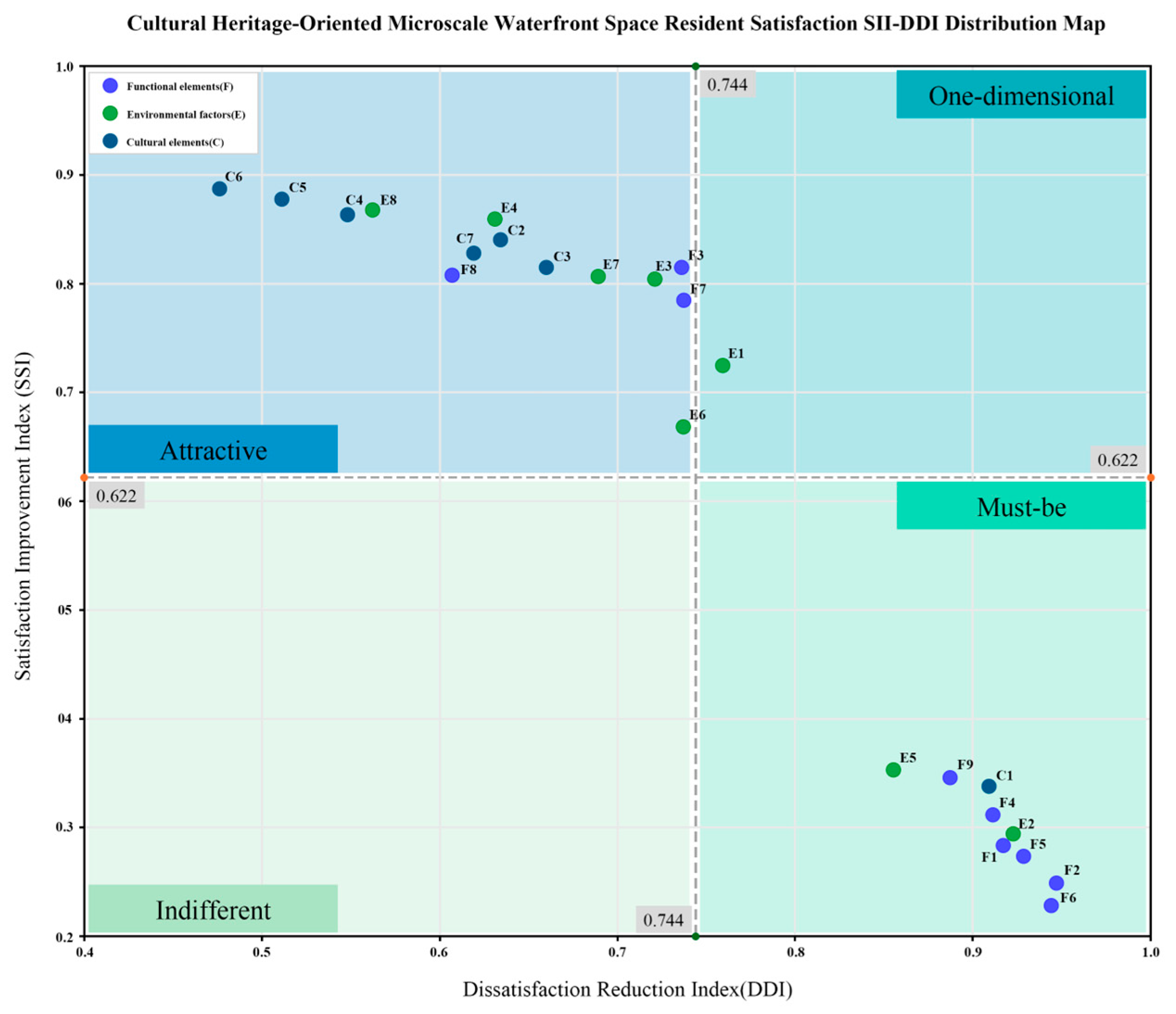
| F1 | Spatial Accessibility and Continuity | 0.284 | −0.917 |
| F2 | Nighttime Accessibility and Safety | 0.249 | −0.947 |
| F3 | Rest and Social Support Systems | 0.815 | −0.736 |
| F4 | Environmental Hygiene and Maintenance Support | 0.312 | −0.911 |
| F5 | Walking Comfort and Pedestrian Safety | 0.274 | −0.928 |
| F6 | Safety Response and Risk Protection Systems | 0.228 | −0.944 |
| F7 | Slow Mobility and Access Coordination Systems | 0.785 | −0.737 |
| F8 | Information and Navigation Support Systems | 0.808 | −0.607 |
| F9 | Spatial Order and Capacity Management | 0.346 | −0.887 |
| E1 | Microclimate Comfort | 0.725 | −0.759 |
| E2 | Water and Air Quality Experience | 0.294 | −0.922 |
| E3 | Soundscape Environment and Noise Regulation | 0.805 | −0.721 |
| E4 | Vegetation Landscape and Ecological Habitat | 0.86 | −0.631 |
| E5 | Nighttime Lighting Environment and Light Pollution Control | 0.353 | −0.855 |
| E6 | Visual Accessibility and Landscape Consistency | 0.669 | −0.737 |
| E7 | Water Accessibility and Waterfront Approachability | 0.807 | −0.689 |
| E8 | Spatial Scale and Seasonal Expression | 0.868 | −0.562 |
| C1 | Historical Context Reconstruction and Cultural Authenticity | 0.338 | −0.909 |
| C2 | Cultural Interpretation and Narrative Systems | 0.841 | −0.634 |
| C3 | Cultural Circulation Organization and Cultural Symbol Coordination | 0.815 | −0.66 |
| C4 | Community Cultural Resources and Local Memory Systems | 0.864 | −0.548 |
| C5 | Cultural Event Capacity and Participation Mechanisms | 0.878 | −0.511 |
| C6 | Nighttime Cultural Presentation Systems | 0.888 | −0.476 |
| C7 | Cultural Dissemination and Sustainable Operations Systems | 0.829 | −0.619 |
| Factor Classification | Indicators | Sensitivity |
|---|---|---|
| Functional elements | (F1) Spatial Accessibility and Continuity | 0.960 |
| (F2) Nighttime Accessibility and Safety | 0.979 | |
| (F3) Rest and Social Support System | 1.097 | |
| (F4) Environmental Hygiene and Maintenance Support | 0.963 | |
| (F5) Walking Comfort and Safety | 0.968 | |
| (F6) Safety Response and Analytical Protection System | 0.971 | |
| (F7) Slow Mobility and Access Coordination System | 1.077 | |
| (F8) Information and Navigation Support System | 1.011 | |
| (F9) Spatial Order and Capacity Management | 0.951 | |
| Environmental factors | (E1) Microclimate Comfort | 1.050 |
| (E2) Water Quality and Air Quality Monitoring | 0.967 | |
| (E3) Soundscape Environment and Noise Regulation | 1.080 | |
| (E4) Vegetation Landscape and Ecological Habitat | 1.067 | |
| (E5) Nighttime Lighting Environment and Light Pollution Control | 0.924 | |
| (E6) Visual Accessibility and Landscape Consistency | 1.002 | |
| (E7) Water Accessibility and Waterfront Approachability | 1.061 | |
| (E8) Spatial Scale and Seasonal Expression | 1.034 | |
| Cultural elements | (C1) Historical Context Reconstruction and Cultural Authenticity | 0.969 |
| (C2) Cultural Interpretation and Narrative Systems | 1.053 | |
| (C3) Cultural Circulation Organization and Symbolic Coherence | 1.048 | |
| (C4) Community Cultural Resources and Local Memory Systems | 1.022 | |
| (C5) Cultural Event Capacity and Participation Mechanisms | 1.016 | |
| (C6) Nighttime Cultural Presentation Systems | 1.007 | |
| (C7) Cultural Dissemination and Sustainable Operation Systems | 1.035 |
Disclaimer/Publisher’s Note: The statements, opinions and data contained in all publications are solely those of the individual author(s) and contributor(s) and not of MDPI and/or the editor(s). MDPI and/or the editor(s) disclaim responsibility for any injury to people or property resulting from any ideas, methods, instructions or products referred to in the content. |
© 2026 by the authors. Licensee MDPI, Basel, Switzerland. This article is an open access article distributed under the terms and conditions of the Creative Commons Attribution (CC BY) license.
Share and Cite
Liu, W.; Chen, J.; Li, X.; Xiao, Y.; Wang, X.; Zhu, R. A Study on Landscape Satisfaction in Micro-Scale Waterfront Spaces: Evidence from the Grand Canal in Wuxi. Sustainability 2026, 18, 2606. https://doi.org/10.3390/su18052606
Liu W, Chen J, Li X, Xiao Y, Wang X, Zhu R. A Study on Landscape Satisfaction in Micro-Scale Waterfront Spaces: Evidence from the Grand Canal in Wuxi. Sustainability. 2026; 18(5):2606. https://doi.org/10.3390/su18052606
Chicago/Turabian StyleLiu, Wei, Jizhou Chen, Xiaobin Li, Yueling Xiao, Xuqi Wang, and Rong Zhu. 2026. "A Study on Landscape Satisfaction in Micro-Scale Waterfront Spaces: Evidence from the Grand Canal in Wuxi" Sustainability 18, no. 5: 2606. https://doi.org/10.3390/su18052606
APA StyleLiu, W., Chen, J., Li, X., Xiao, Y., Wang, X., & Zhu, R. (2026). A Study on Landscape Satisfaction in Micro-Scale Waterfront Spaces: Evidence from the Grand Canal in Wuxi. Sustainability, 18(5), 2606. https://doi.org/10.3390/su18052606