Why AI Adoption Fails to Create Digital Green Innovation: The Transformative Role of Knowledge-Based Dynamic Capabilities



Abstract
1. Introduction
2. Theoretical Foundation
2.1. Digital Green Innovation
2.2. Theoretical Foundations on Enabling Digital Green Innovation
2.3. Digital Green Innovation Driven by AIC: AI–Employee Collaboration
3. Hypothesis Development
3.1. The Role of AIC on Digital Green Innovation
3.2. Mediating Role of KBDC
4. Research Methodology
4.1. Sample and Data Collection
4.2. Questionnaire Design
5. Empirical Tests and Analysis Results
5.1. Common Method Bias
5.2. Structural Equation Model
6. Discussion
7. Theoretical Contributions
8. Practical Contributions
9. Future Research
Author Contributions
Funding
Institutional Review Board Statement
Informed Consent Statement
Data Availability Statement
Conflicts of Interest
Abbreviations
| AI | Artificial Intelligence |
| KAC | Knowledge Acquisition Capability |
| KGC | Knowledge Generation Capability |
| KCC | Knowledge Combination Capability |
| AIC | Artificial Intelligence Capabilities |
| KBV | Knowledge-Based View |
| DCV | Dynamic Capability View |
| KBDC | Knowledge-based Dynamic Capabilities |
| CMB | Common Method Bias |
| VIFs | Variance Inflation Factors |
Appendix A. Study Measures
| Employee Level Artificial Intelligence Capabilities (AIC) | 37 items | |
| AI trust | Chowdhury et al. (2022) [37] | I have confidence in the use of AI technology. I believe AI technology can facilitate routine and trivial tasks through automation. I believe my organization will be able operate AI technology reliably or consistently without failing. I believe that AI technology will consistently operate providing adequate and efficient results within a broad spectrum of processes. I believe AI adoption will result in creation of new jobs. I have a positive attitude towards adoption of AI. I believe AI technology can help in developing new skills which will benefit my career development activities. I have a positive attitude towards its impact of intra-organizational business operations. I believe AI will positively change employee dynamics within the organization. AI adoption will not result in reduced focus on human skills such as creative intellect in my job. I believe AI adoption will enhance the quality of my work. |
| AI job role clarity | Chowdhury et al. (2022) [37] | I have clarity in social hierarchy where AI and human will co-exist (i.e., social status of employees being higher than AI systems) will drive AI adoption within my organization/sector. I have clarity on how my roles and responsibilities will change as a result of AI adoption. I have clarity on the expectations from my work as a result of AI adoption. I have clarity on the organizational strategy towards AI adoption. I have clarity on how my performance will be measured in an environment where AI–employees will coexist. I have clarity how the nature of my work will change. I have clarity on how AI systems will be used in my organization. I have clarity on why AI systems will be used for specific tasks in my organization. I have clarity on the role of human intelligence within a collaborative working environment where AI–employees will coexist. I have clarity on the nature of collaboration between AI–employee to accomplish business activities. |
| AI skills | Chowdhury et al. (2022) [37] | I have knowledge about AI systems. I have relevant skills to use AI systems in my work. I have competencies to understand how AI systems will execute. I have developed new skills because of AI education. I have recognized certifications demonstrating knowledge in AI. I have skills to interpret the AI outputs. I have skills to prepare inputs for AI systems. |
| AI understanding | Chowdhury et al. (2022) [37] | I understand the capabilities of AI systems. I understand the limitations of AI systems. I understand the context of using AI. I understand what to expect from AI systems. I understand the purpose of using AI. I understand the benefits of using AI for the organization. I understand the benefits of using AI in my daily job activities. I understand that AI will enhance the efficiency of my work. I understand that AI will enable to accomplish analytical activities efficiently and effectively in my job. |
| Knowledge-Based Dynamic Capability (KBDC) | 16 items | |
| Knowledge acquisition capability | Zheng et al. (2011) [28] | Our firm could acquire technological knowledge. Our firm could acquire marketing knowledge. Our firm could acquire managerial knowledge. Our firm could acquire manufacturing and process knowledge. Our firm could acquire other knowledge and expertise. |
| Knowledge generation capability | Zheng et al. (2011) [28] | Our firm could create technological knowledge. Our firm could create marketing knowledge. Our firm could create managerial knowledge. Our firm could create knowledge. Our firm could create technological knowledge. |
| Knowledge combination capability | Zheng et al. (2011) [28] | Our firm could combine internal and external knowledge. Our firm could integrate knowledge from different segments, teams and individuals. Our firm could combine knowledge in different technological or market fields. Our firm could combine new knowledge with the original knowledge pool. Our firm could adapt the internal structure and process to combine knowledge effectively. Our firm could coordinate internal and external networks to combine knowledge effectively. |
| Digital Green Innovation | 5 items | |
| Digital green innovation | Yin and Yu (2022) [4] | The use of artificial intelligence to produce green products to increase customer satisfaction. Using artificial intelligence to increase the market share of green products. Using artificial intelligence to increase the performance of green product production process. Use artificial intelligence to increase sales of green products. The number of enterprise digital green related patents increased. |
| Notice: The items were prepared using a 5-point Likert scale (1 = completely disagree; 2 = disagree; 3 = neither agree nor disagree; 4 = agree; 5 = completely agree). | ||
References
- Lin, J.; Zeng, Y.; Wu, S.; Luo, X.R. How does artificial intelligence affect the environmental performance of organizations? The role of green innovation and green culture. Inf. Manag. 2024, 61, 103924. [Google Scholar] [CrossRef]
- Rana, N.P.; Chatterjee, S.; Dwivedi, Y.K.; Akter, S. Understanding dark side of artificial intelligence (AI) integrated business analytics: Assessing firm’s operational inefficiency and competitiveness. Eur. J. Inf. Syst. 2022, 31, 364–387. [Google Scholar] [CrossRef]
- Dwivedi, Y.K.; Hughes, L.; Ismagilova, E.; Aarts, G.; Coombs, C.; Crick, T.; Duan, Y.; Dwivedi, R.; Edwards, J.; Eirug, A. Artificial Intelligence (AI): Multidisciplinary perspectives on emerging challenges, opportunities, and agenda for research, practice and policy. Int. J. Inf. Manag. 2021, 57, 101994. [Google Scholar] [CrossRef]
- Yin, S.; Yu, Y. An adoption-implementation framework of digital green knowledge to improve the performance of digital green innovation practices for industry 5.0. J. Clean. Prod. 2022, 363, 132608. [Google Scholar] [CrossRef]
- Ayoub, H.S.; Sopuru, J.C. Reconfiguring Strategic Capabilities in the Digital Era: How AI-Enabled Dynamic Capability, Data-Driven Culture, and Organizational Learning Shape Firm Performance. Sustainability 2026, 18, 1157. [Google Scholar] [CrossRef]
- Kopka, A.; Grashof, N. Artificial intelligence: Catalyst or barrier on the path to sustainability? Technol. Forecast. Soc. Change 2022, 175, 121318. [Google Scholar] [CrossRef]
- Davenport, T.; Guha, A.; Grewal, D.; Bressgott, T. How artificial intelligence will change the future of marketing. J. Acad. Mark. Sci. 2020, 48, 24–42. [Google Scholar] [CrossRef]
- Chowdhury, S.; Dey, P.; Joel-Edgar, S.; Bhattacharya, S.; Rodriguez-Espindola, O.; Abadie, A.; Truong, L. Unlocking the value of artificial intelligence in human resource management through AI capability framework. Hum. Resour. Manag. Rev. 2023, 33, 100899. [Google Scholar] [CrossRef]
- Singh, S.K.; Del Giudice, M.; Chiappetta Jabbour, C.J.; Latan, H.; Sohal, A.S. Stakeholder pressure, green innovation, and performance in small and medium-sized enterprises: The role of green dynamic capabilities. Bus. Strategy Environ. 2022, 31, 500–514. [Google Scholar] [CrossRef]
- Li, L.; Zhu, W.; Wei, L.; Yang, S. How can digital collaboration capability boost service innovation? Evidence from the information technology industry. Technol. Forecast. Soc. Change 2022, 182, 121830. [Google Scholar] [CrossRef]
- Mikalef, P.; Gupta, M. Artificial intelligence capability: Conceptualization, measurement calibration, and empirical study on its impact on organizational creativity and firm performance. Inf. Manag. 2021, 58, 103434. [Google Scholar] [CrossRef]
- Arashpour, M. AI explainability framework for environmental management research. J. Environ. Manag. 2023, 342, 118149. [Google Scholar] [CrossRef] [PubMed]
- Santos, M.R.; Carvalho, L.C. AI-driven participatory environmental management: Innovations, applications, and future prospects. J. Environ. Manag. 2025, 373, 123864. [Google Scholar] [CrossRef] [PubMed]
- Shiwei, W.; Jinmin, D.; Shuang, P. How Does Digital Economy Promote Green Innovation? Empirical Evidence from Chinese Cities. China Econ. Transit. (CET) 2022, 5, 408. [Google Scholar]
- Wang, B.; Tao, F.; Fang, X.; Liu, C.; Liu, Y.; Freiheit, T. Smart manufacturing and intelligent manufacturing: A comparative review. Engineering 2021, 7, 738–757. [Google Scholar] [CrossRef]
- Bohari, A.A.M.; Skitmore, M.; Xia, B.; Teo, M.; Khalil, N. Key stakeholder values in encouraging green orientation of construction procurement. J. Clean. Prod. 2020, 270, 122246. [Google Scholar] [CrossRef]
- Chin, T.; Shi, Y.; Singh, S.K.; Agbanyo, G.K.; Ferraris, A. Leveraging blockchain technology for green innovation in ecosystem-based business models: A dynamic capability of values appropriation. Technol. Forecast. Soc. Change 2022, 183, 121908. [Google Scholar] [CrossRef]
- Liu, X.; Liu, F.; Ren, X. Firms’ digitalization in manufacturing and the structure and direction of green innovation. J. Environ. Manag. 2023, 335, 117525. [Google Scholar] [CrossRef]
- Teece, D.J.; Pisano, G.; Shuen, A. Dynamic capabilities and strategic management. Strateg. Manag. J. 1997, 18, 509–533. [Google Scholar] [CrossRef]
- Teece, D.J. The foundations of enterprise performance: Dynamic and ordinary capabilities in an (economic) theory of firms. Acad. Manag. Perspect. 2014, 28, 328–352. [Google Scholar] [CrossRef]
- Chatterjee, S.; Chaudhuri, R.; Kumar, A.; Aránega, A.Y.; Biswas, B. Development of an integrative model for electronic vendor relationship management for improving technological innovation, social change and sustainability performance. Technol. Forecast. Soc. Change 2023, 186, 122213. [Google Scholar] [CrossRef]
- Reis, C.; Ruivo, P.; Oliveira, T.; Faroleiro, P. Assessing the drivers of machine learning business value. J. Bus. Res. 2020, 117, 232–243. [Google Scholar] [CrossRef]
- Fainshmidt, S.; Wenger, L.; Pezeshkan, A.; Mallon, M.R. When do dynamic capabilities lead to competitive advantage? The importance of strategic fit. J. Manag. Stud. 2019, 56, 758–787. [Google Scholar] [CrossRef]
- Kaur, V. Knowledge-based dynamic capabilities: A scientometric analysis of marriage between knowledge management and dynamic capabilities. J. Knowl. Manag. 2023, 27, 919–952. [Google Scholar] [CrossRef]
- Khaksar, S.M.S.; Chu, M.-T.; Rozario, S.; Slade, B. Knowledge-based dynamic capabilities and knowledge worker productivity in professional service firms The moderating role of organisational culture. Knowl. Manag. Res. Pract. 2023, 21, 241–258. [Google Scholar] [CrossRef]
- Han, Y.; Chen, G. The relationship between knowledge sharing capability and innovation performance within industrial clusters: Evidence from China. J. Chin. Econ. Foreign Trade Stud. 2018, 11, 32–48. [Google Scholar] [CrossRef]
- Lee, J.-C.; Chen, C.-Y. Exploring the determinants of software process improvement success: A dynamic capability view. Inf. Dev. 2019, 35, 6–20. [Google Scholar] [CrossRef]
- Zheng, S.; Zhang, W.; Du, J. Knowledge-based dynamic capabilities and innovation in networked environments. J. Knowl. Manag. 2011, 15, 1035–1051. [Google Scholar] [CrossRef]
- Du, S.; Xie, C. Paradoxes of artificial intelligence in consumer markets: Ethical challenges and opportunities. J. Bus. Res. 2021, 129, 961–974. [Google Scholar] [CrossRef]
- Faraj, S.; Pachidi, S.; Sayegh, K. Working and organizing in the age of the learning algorithm. Inf. Organ. 2018, 28, 62–70. [Google Scholar] [CrossRef]
- Krakowski, S.; Luger, J.; Raisch, S. Artificial intelligence and the changing sources of competitive advantage. Strateg. Manag. J. 2023, 44, 1425–1452. [Google Scholar] [CrossRef]
- Rampersad, G. Robot will take your job: Innovation for an era of artificial intelligence. J. Bus. Res. 2020, 116, 68–74. [Google Scholar] [CrossRef]
- Huang, M.H.; Rust, R.; Maksimovic, V. The feeling economy: Managing in the next generation of artificial intelligence (AI). Calif. Manag. Rev. 2019, 61, 43–65. [Google Scholar] [CrossRef]
- Hossain, M.A.; Agnihotri, R.; Rushan, M.R.I.; Rahman, M.S.; Sumi, S.F. Marketing analytics capability, artificial intelligence adoption, and firms? Competitive advantage: Evidence from the manufacturing industry. Ind. Mark. Manag. 2022, 106, 240–255. [Google Scholar] [CrossRef]
- Fountaine, T.; McCarthy, B.; Saleh, T. Building the AI-powered organization. Harv. Bus. Rev. 2019, 97, 62–73. [Google Scholar]
- Makridakis, S. The forthcoming Artificial Intelligence (AI) revolution: Its impact on society and firms. Futures 2017, 90, 46–60. [Google Scholar] [CrossRef]
- Chowdhury, S.; Budhwar, P.; Dey, P.K.; Joel-Edgar, S.; Abadie, A. AI-employee collaboration and business performance: Integrating knowledge-based view, socio-technical systems and organisational socialisation framework. J. Bus. Res. 2022, 144, 31–49. [Google Scholar] [CrossRef]
- Cetindamar Kozanoglu, D.; Abedin, B. Understanding the role of employees in digital transformation: Conceptualization of digital literacy of employees as a multi-dimensional organizational affordance. J. Enterp. Inf. Manag. 2021, 34, 1649–1672. [Google Scholar] [CrossRef]
- Wilson, H.J.; Daugherty, P.R. Collaborative intelligence: Humans and AI are joining forces. Harv. Bus. Rev. 2018, 96, 114–123. [Google Scholar]
- Yin, S.; Yu, Y.; Zhang, N. The effect of digital green strategic orientation on digital green innovation performance: From the perspective of digital green business model innovation. Sage Open 2024, 14, 21582440241261130. [Google Scholar] [CrossRef]
- Hao, S.; Zhang, H.; Song, M. Big data, big data analytics capability, and sustainable innovation performance. Sustainability 2019, 11, 7145. [Google Scholar] [CrossRef]
- Tian, H.; Li, Y.; Zhang, Y. Digital and intelligent empowerment: Can big data capability drive green process innovation of manufacturing enterprises? J. Clean. Prod. 2022, 377, 134261. [Google Scholar] [CrossRef]
- Grant, R.M. Toward a knowledge-based theory of the firm. Strateg. Manag. J. 1996, 17, 109–122. [Google Scholar] [CrossRef]
- Li, D.; Zheng, M.; Cao, C.; Chen, X.; Ren, S.; Huang, M. The impact of legitimacy pressure and corporate profitability on green innovation: Evidence from China top 100. J. Clean. Prod. 2017, 141, 41–49. [Google Scholar] [CrossRef]
- Sahoo, S.; Kumar, A.; Upadhyay, A. How do green knowledge management and green technology innovation impact corporate environmental performance? Understanding the role of green knowledge acquisition. Bus. Strategy Environ. 2023, 32, 551–569. [Google Scholar] [CrossRef]
- Engelman, R.M.; Fracasso, E.M.; Schmidt, S.; Zen, A.C. Intellectual capital, absorptive capacity and product innovation. Manag. Decis. 2017, 55, 474–490. [Google Scholar] [CrossRef]
- Makhloufi, L. Do knowledge sharing and big data analytics capabilities matter for green absorptive capacity and green entrepreneurship orientation? Implications for green innovation. Ind. Manag. Data Syst. 2024, 124, 978–1004. [Google Scholar] [CrossRef]
- Ameen, N.; Tarba, S.; Cheah, J.H.; Xia, S.; Sharma, G.D. Coupling artificial intelligence capability and strategic agility for enhanced product and service creativity. Br. J. Manag. 2024, 35, 1916–1934. [Google Scholar] [CrossRef]
- Malone, T.W. How human-computer ‘superminds’ are redefining the future of work. MIT Sloan Manag. Rev. 2018, 59, 34–41. [Google Scholar]
- Jarrahi, M.H.; Kenyon, S.; Brown, A.; Donahue, C.; Wicher, C. Artificial intelligence: A strategy to harness its power through organizational learning. J. Bus. Strategy 2023, 44, 126–135. [Google Scholar] [CrossRef]
- Paschen, J.; Wilson, M.; Ferreira, J.J. Collaborative intelligence: How human and artificial intelligence create value along the B2B sales funnel. Bus. Horiz. 2020, 63, 403–414. [Google Scholar] [CrossRef]
- Khan, A.N.; Soomro, M.A.; Pitafi, A.H. AI and employee performance: The role of knowledge and techno-pessimism in the digital age. J. Knowl. Manag. 2025, 30, 172–191. [Google Scholar] [CrossRef]
- Davenport, T. Managing Support Knowledge with AI: Talla Helps Toast; Forbes: Jersey City, NJ, USA, 2019. [Google Scholar]
- Arias-Pérez, J.; Vélez-Jaramillo, J. Understanding knowledge hiding under technological turbulence caused by artificial intelligence and robotics. J. Knowl. Manag. 2022, 26, 1476–1491. [Google Scholar] [CrossRef]
- Makarius, E.E.; Mukherjee, D.; Fox, J.D.; Fox, A.K. Rising with the machines: A sociotechnical framework for bringing artificial intelligence into the organization. J. Bus. Res. 2020, 120, 262–273. [Google Scholar] [CrossRef]
- Robertson, J.; Caruana, A.; Ferreira, C. Innovation performance: The effect of knowledge-based dynamic capabilities in cross-country innovation ecosystems. Int. Bus. Rev. 2023, 32, 101866. [Google Scholar] [CrossRef]
- Lee, M.-J.; Kim, Y.; Roh, T. Exploring the role of digital servitization for green innovation: Absorptive capacity, transformative capacity, and environmental strategy. Technol. Forecast. Soc. Change 2024, 207, 123614. [Google Scholar] [CrossRef]
- Ambrosius, J. Strategic talent management in emerging markets and its impact on employee retention: Evidence from Brazilian MNCs. Thunderbird Int. Bus. Rev. 2018, 60, 53–68. [Google Scholar] [CrossRef]
- Winter, S.G. Understanding dynamic capabilities. Strateg. Manag. J. 2003, 24, 991–995. [Google Scholar] [CrossRef]
- China, A. Development Report 2018; China Institute for Science and Technology Policy at Tsinghua University: Beijing, China, 2018. [Google Scholar]
- Yang, C.; Huang, C. Quantitative mapping of the evolution of AI policy distribution, targets and focuses over three decades in China. Technol. Forecast. Soc. Change 2022, 174, 121188. [Google Scholar] [CrossRef]
- Manyika, J.; Chui, M.; Miremadi, M.; Bughin, J.; George, K.; Willmott, P.; Dewhurst, M. A future that works: AI, automation, employment, and productivity. McKinsey Glob. Inst. Res. Tech. Rep. 2017, 60, 1–135. [Google Scholar]
- Jiang, Y.; Guo, Y.; Bashir, M.F.; Shahbaz, M. Do renewable energy, environmental regulations and green innovation matter for China’s zero carbon transition: Evidence from green total factor productivity. J. Environ. Manag. 2024, 352, 120030. [Google Scholar] [CrossRef] [PubMed]
- Suhr, D.D. Exploratory or Confirmatory Factor Analysis? SaS Institute: Cary, NC, USA, 2006. [Google Scholar]
- Fosso Wamba, S.; Queiroz, M.M.; Pappas, I.O.; Sullivan, Y. Artificial intelligence capability and firm performance: A sustainable development perspective by the mediating role of data-driven culture. Inf. Syst. Front. 2024, 26, 2189–2203. [Google Scholar] [CrossRef]
- Hair, J.F.; Risher, J.J.; Sarstedt, M.; Ringle, C.M. When to use and how to report the results of PLS-SEM. Eur. Bus. Rev. 2019, 31, 2–24. [Google Scholar] [CrossRef]
- Waqas, M.; Honggang, X.; Ahmad, N.; Khan, S.A.R.; Iqbal, M. Big data analytics as a roadmap towards green innovation, competitive advantage and environmental performance. J. Clean. Prod. 2021, 323, 128998. [Google Scholar] [CrossRef]
- Wang, N.; Wan, J.; Ma, Z.; Zhou, Y.; Chen, J. How digital platform capabilities improve sustainable innovation performance of firms: The mediating role of open innovation. J. Bus. Res. 2023, 167, 114080. [Google Scholar] [CrossRef]
- Bencsik, A. The sixth generation of knowledge management–the headway of artificial intelligence. J. Int. Stud. 2021, 14, 84–101. [Google Scholar] [CrossRef]
- Tsui, E. The role of IT in KM: Where are we now and where are we heading? J. Knowl. Manag. 2005, 9, 3–6. [Google Scholar] [CrossRef]
- Brougham, D.; Haar, J. Smart technology, artificial intelligence, robotics, and algorithms (STARA): Employees’ perceptions of our future workplace. J. Manag. Organ. 2018, 24, 239–257. [Google Scholar] [CrossRef]
- Tariq, A.; Badir, Y.F.; Tariq, W.; Bhutta, U.S. Drivers and consequences of green product and process innovation: A systematic review, conceptual framework, and future outlook. Technol. Soc. 2017, 51, 8–23. [Google Scholar] [CrossRef]
- Bag, S.; Dhamija, P.; Singh, R.K.; Rahman, M.S.; Sreedharan, V.R. Big data analytics and artificial intelligence technologies based collaborative platform empowering absorptive capacity in health care supply chain: An empirical study. J. Bus. Res. 2023, 154, 113315. [Google Scholar] [CrossRef]



| Descriptive Statistical Item | Group Category | Frequency | Percentage (%) |
|---|---|---|---|
| Age of Organization | Over 50 years | 1 | 0.33 |
| 36 to 50 years | 7 | 2.34 | |
| 26 to 35 years | 10 | 3.34 | |
| 16 to 25 years | 71 | 23.75 | |
| 9 to 15 years | 139 | 46.49 | |
| 3 to 8 years | 71 | 23.75 | |
| Less than 3 years | 0 | 0.00 | |
| Size of Organization | Over 500 | 80 | 26.36 |
| 101 to 500 | 116 | 38.80 | |
| 51 to 100 | 68 | 22.74 | |
| 21 to 50 | 26 | 5.70 | |
| 11 to 20 | 7 | 2.34 | |
| 1 to 10 | 2 | 0.67 | |
| Location | Guangdong | 32 | 10.70 |
| Hebei | 25 | 8.36 | |
| Sichuan | 23 | 7.69 | |
| Shanghai | 22 | 7.36 | |
| Beijing | 20 | 6.69 | |
| Henan | 17 | 5.69 | |
| Hunan | 16 | 5.35 | |
| Jiangsu | 14 | 4.68 | |
| Shandong | 13 | 4.35 | |
| Fujian | 12 | 4.01 | |
| Hubei | 12 | 4.01 | |
| Liaoning | 11 | 3.68 | |
| Zhejiang | 10 | 3.34 | |
| Shanxi | 8 | 2.68 | |
| Tianjin | 8 | 2.68 | |
| Jiangxi | 7 | 2.34 | |
| Yunnan | 7 | 2.34 | |
| Guangxi | 6 | 2.01 | |
| Guizhou | 6 | 2.01 | |
| Shaanxi | 6 | 2.01 | |
| Anhui | 5 | 1.67 | |
| Chongqing | 5 | 1.67 | |
| Inner Mongolia | 5 | 1.67 | |
| Gansu | 4 | 1.34 | |
| Heilongjiang | 4 | 1.34 | |
| Ningxia | 1 | 0.33 |
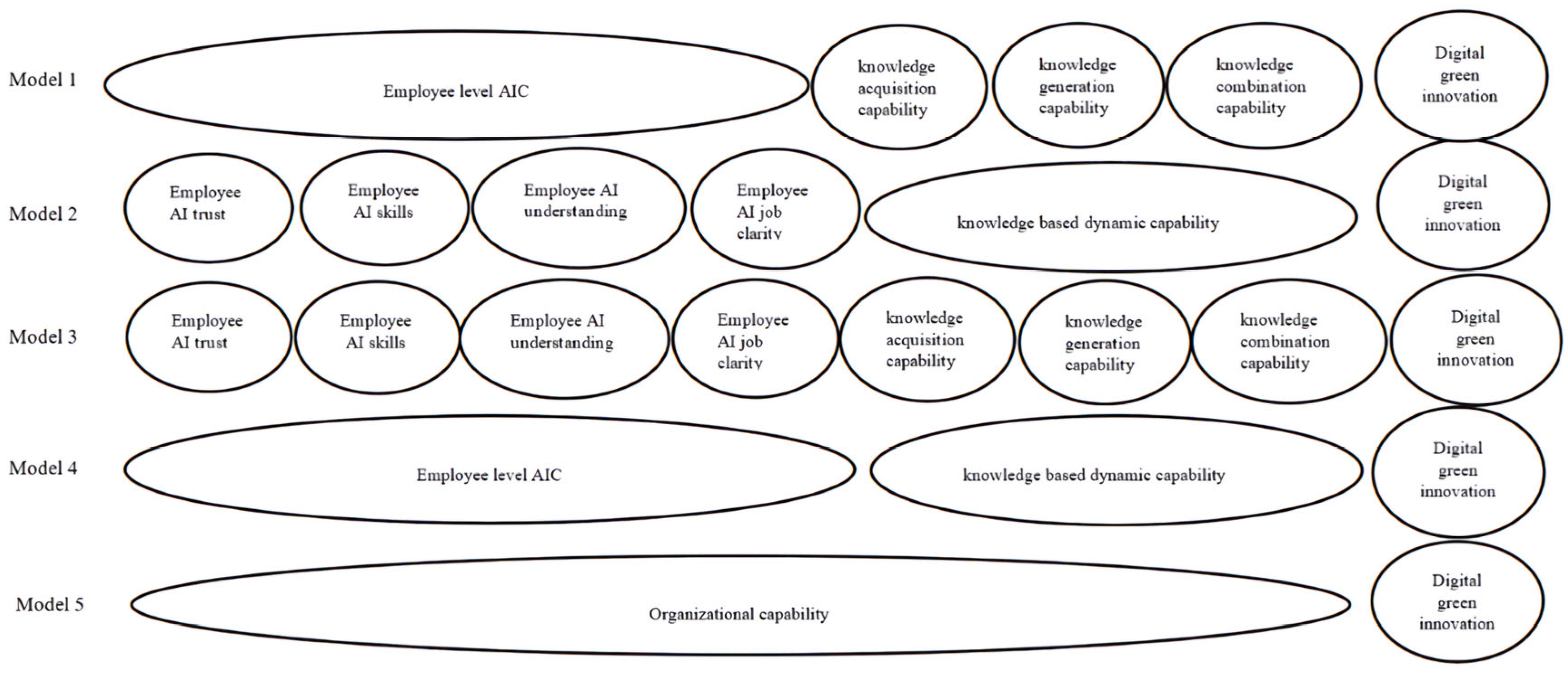
| Model | χ2/df | NFI | GFI | TLI | CFI | RMSEA | SRMR |
|---|---|---|---|---|---|---|---|
| Model 1 | 1.208 | 0.917 | 0.985 | 0.982 | 0.985 | 0.026 | 0.041 |
| Model 2 | 1.914 | 0.745 | 0.704 | 0.852 | 0.859 | 0.055 | 0.070 |
| Model 3 | 1.190 | 0.843 | 0.833 | 0.969 | 0.971 | 0.025 | 0.041 |
| Model 4 | 3.262 | 0.563 | 0.494 | 0.634 | 0.648 | 0.087 | 0.093 |
| Model 5 | 3.917 | 0.474 | 0.442 | 0.582 | 0.545 | 0.099 | 0.113 |
| Goodness of Fit | 1–3 | >0.8 | >0.8 | >0.8 | >0.8 | <0.05 | <0.05 |
| Path Dependency | Std. Estimate | AVE | CR | ||
|---|---|---|---|---|---|
| AIC | → | Trust | 0.828 | 0.5608 | 0.8356 |
| AIC | → | Clarity | 0.683 | ||
| AIC | → | Skills | 0.726 | ||
| AIC | → | Understanding | 0.751 | ||
| KAC | → | KAC1 | 0.737 | 0.5394 | 0.8541 |
| KAC | → | KAC2 | 0.722 | ||
| KAC | → | KAC3 | 0.733 | ||
| KAC | → | KAC4 | 0.732 | ||
| KAC | → | KAC5 | 0.748 | ||
| KGC | → | KGC1 | 0.796 | 0.6045 | 0.8841 |
| KGC | → | KGC2 | 0.824 | ||
| KGC | → | KGC3 | 0.738 | ||
| KGC | → | KGC4 | 0.740 | ||
| KGC | → | KGC5 | 0.786 | ||
| KCC | → | KCC1 | 0.754 | 0.6055 | 0.9019 |
| KCC | → | KCC2 | 0.728 | ||
| KCC | → | KCC3 | 0.815 | ||
| KCC | → | KCC4 | 0.811 | ||
| KCC | → | KCC5 | 0.788 | ||
| KCC | → | KCC6 | 0.769 | ||
| Digital Green Innovation | → | Digital Green Innovation1 | 0.738 | 0.5510 | 0.8598 |
| Digital Green Innovation | → | Digital Green Innovation2 | 0.740 | ||
| Digital Green Innovation | → | Digital Green Innovation3 | 0.746 | ||
| Digital Green Innovation | → | Digital Green Innovation4 | 0.725 | ||
| Digital Green Innovation | → | Digital Green Innovation5 | 0.762 | ||
| Dimensions | KCC | DGIP | KGC | KAC | AIC |
|---|---|---|---|---|---|
| KCC | 0.778 | ||||
| Digital Green Innovation | 0.389 | 0.742 | |||
| KGC | 0.412 | 0.368 | 0.777 | ||
| KAC | 0.208 | 0.316 | 0.196 | 0.734 | |
| AIC | 0.305 | 0.365 | 0.329 | 0.206 | 0.749 |
| AVE | 0.606 | 0.551 | 0.605 | 0.540 | 0.561 |
| Construct | Full Collinearity VIF |
|---|---|
| AIC | 3.014 |
| KAC | 2.557 |
| KGC | 2.933 |
| KCC | 2.926 |
| Digital Green Innovation | 2.478 |
| Model Fit Indices | χ2/df | NFI | GFI | TLI | CFI | RMSEA | SRMR |
|---|---|---|---|---|---|---|---|
| 1.260 | 0.898 | 0.912 | 0.974 | 0.977 | 0.030 | 0.072 | |
| Goodness-of-Fit | 1–3 | >0.8 | >0.8 | >0.8 | >0.8 | <0.05 | <0.05 |
| Path Dependency | Estimate | S.E. | C.R. | p | ||
|---|---|---|---|---|---|---|
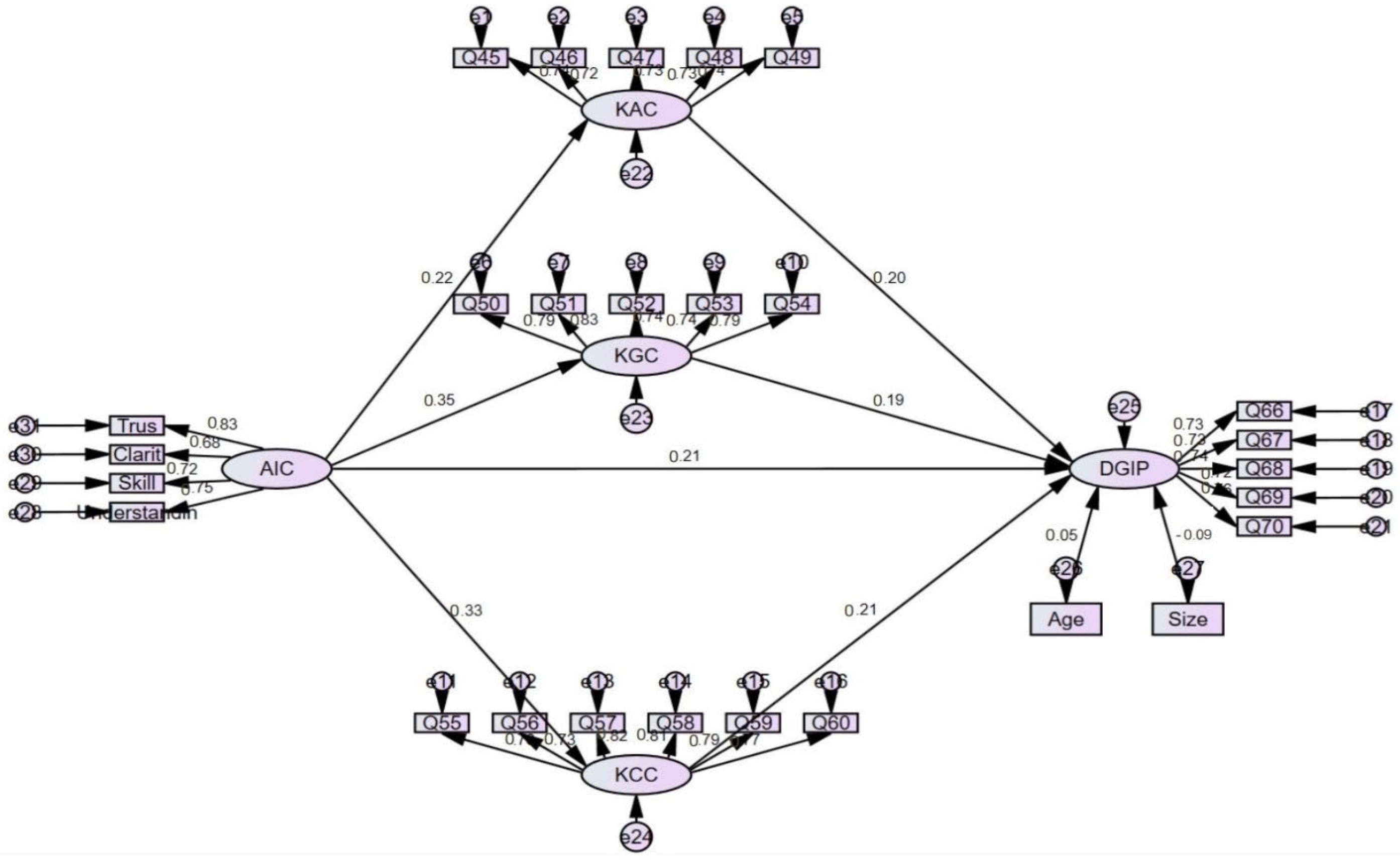
| AIC | → | KAC | 0.223 | 0.084 | 3.236 | 0.001 |
| AIC | → | KGC | 0.352 | 0.106 | 5.162 | <0.001 |
| AIC | → | KCC | 0.33 | 0.092 | 4.862 | <0.001 |
| KAC | → | Digital Green Innovation | 0.196 | 0.069 | 3.069 | 0.002 |
| KGC | → | Digital Green Innovation | 0.193 | 0.056 | 2.946 | 0.003 |
| KCC | → | Digital Green Innovation | 0.212 | 0.063 | 3.266 | 0.001 |
| AIC | → | Digital Green Innovation | 0.206 | 0.097 | 2.789 | 0.005 |
| Age | → | Digital Green Innovation | 0.055 | 0 | 0.98 | 0.327 |
| Size | → | Digital Green Innovation | −0.085 | 0.047 | −1.531 | 0.126 |
| Path Dependency | Estimate | SE | BC 95%CI | |
|---|---|---|---|---|
| Lower | Upper | |||
| Standardized Indirect Effect | ||||
| AIC→KAC→Digital Green Innovation | 0.044 | 0.022 | 0.013 | 0.103 |
| AIC→KGC→Digital Green Innovation | 0.068 | 0.030 | 0.019 | 0.140 |
| AIC→KCC→Digital Green Innovation | 0.070 | 0.028 | 0.026 | 0.138 |
| Standardized Direct Effects | ||||
| AIC→Digital Green Innovation | 0.206 | 0.074 | 0.057 | 0.350 |
| Standardized Total Effects | ||||
| AIC→Digital Green Innovation | 0.387 | 0.068 | 0.252 | 0.516 |
Disclaimer/Publisher’s Note: The statements, opinions and data contained in all publications are solely those of the individual author(s) and contributor(s) and not of MDPI and/or the editor(s). MDPI and/or the editor(s) disclaim responsibility for any injury to people or property resulting from any ideas, methods, instructions or products referred to in the content. |
© 2026 by the authors. Licensee MDPI, Basel, Switzerland. This article is an open access article distributed under the terms and conditions of the Creative Commons Attribution (CC BY) license.
Share and Cite
Ji, Z.; Tian, F. Why AI Adoption Fails to Create Digital Green Innovation: The Transformative Role of Knowledge-Based Dynamic Capabilities. Sustainability 2026, 18, 2560. https://doi.org/10.3390/su18052560
Ji Z, Tian F. Why AI Adoption Fails to Create Digital Green Innovation: The Transformative Role of Knowledge-Based Dynamic Capabilities. Sustainability. 2026; 18(5):2560. https://doi.org/10.3390/su18052560
Chicago/Turabian StyleJi, Zhe, and Feng Tian. 2026. "Why AI Adoption Fails to Create Digital Green Innovation: The Transformative Role of Knowledge-Based Dynamic Capabilities" Sustainability 18, no. 5: 2560. https://doi.org/10.3390/su18052560
APA StyleJi, Z., & Tian, F. (2026). Why AI Adoption Fails to Create Digital Green Innovation: The Transformative Role of Knowledge-Based Dynamic Capabilities. Sustainability, 18(5), 2560. https://doi.org/10.3390/su18052560