1. Introduction
Poland is currently undergoing an energy transition and is seeking to reduce the dominant role of coal in electricity generation. This process is driven both by the imperatives of sustainable development and by economic and social considerations. Rapid industrial growth requires a steadily increasing supply of electricity, which in turn fosters the expansion of renewable energy sources, including solar, wind, geothermal, hydro and biomass [
1,
2].
Historically, Poland has relied heavily on coal. In 1990, 96% of electricity generation was derived from coal, with 56% from hard coal and 40% from lignite [
3]. By 2024, these figures had declined to 34.9% and 21.3%, respectively. Nevertheless, the reduction in coal-based generation has not been fully offset by renewable energy sources, whose development remains insufficiently dynamic, resulting in a growing reliance on electricity imports. Between 2014 and 2023, national energy consumption increased by 3.6% (142 PJ), while supply decreased by 19.2% (−539 PJ) [
4,
5].
Poland remains a central actor in European coal production, with hard coal extraction accounting for approximately 96% of total EU coal mining following the closure of mines in other member states [
6,
7]. Resistance to coal phase-out persists among coal companies, trade unions, certain segments of society and the government. Such opposition is driven by concerns over declining income, adverse past experiences with structural transitions, fears of rising energy costs, and the risk of unemployment in coal-dependent regions [
8].
The imperative for energy transformation in Poland stems primarily from international and European commitments to reduce greenhouse gas emissions, as enshrined in the Polish National Energy and Climate Plan (NECP). The NECP was prepared in line with the requirements of Regulation (EU) 2018/1999 of the European Parliament and of the Council on the Governance of the Energy Union and Climate Action [
9]. Institutional theory highlights that firms respond to external pressures from regulators, industry norms and societal expectations by adopting ESG-oriented practices [
10]. Consequently, enterprises must not only comply with legal mandates but also integrate environmentally sustainable strategies that balance ecological responsibility with economic efficiency [
11]. Stricter environmental regulations may even lead to the abandonment of extracting or utilizing certain assets, such as fossil fuel resources, which in such cases are referred to as ‘stranded assets’. This phenomenon entails significant consequences for both companies and countries and their developmental trajectories [
12,
13].
Poland ranks fifth globally in terms of per-unit greenhouse gas emissions from energy consumption, with electricity and heat generation responsible for 34% of national emissions [
4]. The energy sector faces a dual challenge: securing capital for decarbonization investments while maintaining financial stability and bearing the costs of EU Emissions Trading System (ETS) allowances [
14]. To ensure continued access to financing, energy companies must provide transparent and comprehensive disclosures on both financial performance and non-financial indicators, particularly in the Environmental, Social and Governance domains (ESG). This expectation aligns with stakeholder theory, which posits that a firm’s legitimacy and long-term success depend on managing relationships with a broad spectrum of stakeholders [
15].
The European Union has significantly strengthened corporate reporting obligations through regulatory initiatives such as the Corporate Sustainability Reporting Directive (CSRD) [
16], the European Sustainability Reporting Standards (ESRS) [
17], the EU Taxonomy Regulation [
18] and the Omnibus Program [
19,
20]. The construction of the EU Taxonomy, which identifies only a limited set of environmentally sustainable activities in legal regulations, by definition excludes entities generating electricity from hard coal. The introduction of a universal mandatory taxonomy reporting requirement will result in these entities, despite undertaking numerous environmentally beneficial initiatives, being perceived unfavorably by investors [
21].
Recently established frameworks will directly affect the energy sector by raising compliance costs, intensifying climate risk management requirements, and influencing access to financial capital. The 2023 ESG Global Survey conducted by BNP Paribas revealed that 51% of institutional investors already incorporate ESG factors into investment decisions and portfolio management [
22]. Importantly, adverse ESG disclosures are expected to limit credit availability and negatively impact corporate ratings [
23,
24].
Given the circumstances outlined above, the authors identified a research gap concerning the perception of ESG reporting within entities in the Polish energy sector. Previous research on ESG disclosure has largely centered on Western Europe and North America, leaving Central and Eastern European (CEE) countries relatively underexplored [
25]. Although the energy sector has been the subject of academic inquiry in the context of ESG requirements [
26,
27,
28,
29], only a limited number of studies have examined the general perception of ESG reporting among respondents directly involved in the reporting process. [
30,
31,
32] The authors were unable to identify more up-to-date research addressing the general perception of ESG reporting among respondents directly involved in reporting within Polish energy sector entities—an industry that is simultaneously one of the largest contributors to greenhouse gas emissions and of strategic importance to the country. The theoretical framework adopted in this study draws on stakeholder theory and institutional theory and is used to address the identified research gap by formulating expectations regarding perceived benefits, perceived complexity, and organizational preparedness for ESG reporting. From the perspective of stakeholder theory, ESG reporting may be perceived by organizations as a source of benefits, including enhanced transparency, strengthened relationships with key stakeholders, and improved reputation and access to capital. These stakeholder expectations tend to be particularly pronounced in relation to corporations perceived as posing significant risks to the natural environment, such as those operating in the mining or energy sectors. Consequently, the intensity and diversity of stakeholder demands in these industries may contribute to a higher perceived complexity of the ESG reporting process, due to the need to collect, integrate, and disclose heterogeneous and often highly specialized information [
25,
33,
34,
35]. From the perspective of institutional theory, compliance with ESG reporting regulations applicable to the energy sector may represent a particularly challenging task, given the high degree of issue complexity and the extensive level of detail required in disclosures. In this context, organizational preparedness for ESG reporting depends largely on the extent to which firms have adapted their structures, procedures, and competencies to meet evolving regulatory, normative, and mimetic pressures [
34,
36].
Our interest focused on whether professionals involved in ESG reporting in Poland’s energy sector recognize the benefits of extended reporting, and whether they are able to identify such benefits in different contexts. Furthermore, it was considered important to examine whether the survey participants understand the newly introduced regulatory requirements, and how they assess the difficulties associated with implementing these new reporting obligations in the energy sector. The authors also sought to analyze how respondents evaluate their level of preparedness for compliance with the new reporting duties.
Building on the above, the objectives of this article are to identify the anticipated benefits of extended legal regulations for ESG reporting, to assess the level of difficulty associated with achieving compliance within the energy sector, and to evaluate the readiness of the Polish energy sector for ESG reporting connected with EU Taxonomy as perceived by respondents engaged in the reporting process. Furthermore, the study seeks to identify key variables that differentiate respondents’ perceptions, including organizational size (measured in terms of employment) and participation in the public market.
This study adopts an exploratory research approach based exclusively on survey data and respondents’ perceptions, which is justified by the novelty of the regulatory framework and the limited empirical evidence on ESG reporting practices in the energy sector. At this early stage of implementation, understanding how ESG professionals interpret new reporting requirements, perceive their benefits, and assess implementation challenges is crucial. Exploratory, perception-based research is particularly suitable when phenomena are still evolving and when the objective is to capture how meaning is constructed by individuals directly involved in operationalizing new regulations. As ESG professionals will be responsible for preparing and validating disclosures in practice, their awareness, attitudes, and perceived preparedness constitute a relevant and informative source of evidence. Prior qualitative research emphasizes that perceptions and interpretations are central to understanding organizational behavior, especially in contexts characterized by uncertainty and regulatory change [
37,
38]
This study provides valuable insights into differences in the perceived significance of ESG reporting entities already producing ESG and taxonomy reports, and those still preparing to meet these requirements. The findings aim to contribute to the growing body of research on sustainable finance and the financial relevance of ESG disclosure in accordance with stakeholder theory and institutional theory. In particular, the study provides empirical evidence on how entities within the Polish energy sector perceive the benefits and challenges of ESG reporting, thereby addressing an underexplored research gap in the context of economies heavily dependent on fossil fuels. By capturing perspectives from organizations at different stages of ESG implementation, the research highlights both the opportunities associated with enhanced transparency and the obstacles linked to regulatory compliance, resource constraints and market expectations. These insights are especially relevant in light of the European Union’s regulatory agenda, which increasingly positions ESG disclosure as a determinant of capital allocation, risk assessment and corporate legitimacy.
The paper is structured as follows: It first provides an analysis of ESG reporting requirements and the EU Taxonomy, with particular consideration of the specific characteristics of the energy sector and a review of the pertinent literature, along with the development of research hypotheses. This is followed by a detailed exposition of the empirical strategy, encompassing the analytical framework and the data employed. The subsequent section reports the empirical findings, while the final section offers a critical discussion of the results, concluding observations and limitations.
2. ESG Reporting and the EU Taxonomy Framework Relevant to the Energy Sector
The EU’s sustainability reporting architecture has tightened markedly for energy companies, moving from principles-based non-financial disclosures under the Non-Financial Reporting Directive (NFRD) [
39] toward prescriptive, assured and machine readable sustainability statements under the Corporate Sustainability Reporting Directive [
16] with content specified by the European Sustainability Reporting Standards [
17] and tightly coupled to the EU Taxonomy [
18]. The EU Taxonomy Regulation establishes a unified classification framework for sustainable economic activities within the European Union. Its primary objective is to provide clarity on which activities can be considered environmentally sustainable, thereby directing capital flows towards projects that support the EU’s climate and environmental objectives [
18]. The regulation defines six environmental objectives: climate change mitigation, climate change adaptation, sustainable use and protection of water and marine resources, transition to a circular economy, pollution prevention and control, and protection and restoration of biodiversity and ecosystems. In order for an activity to be deemed taxonomy-aligned, it must make a substantial contribution to at least one of these objectives, “Do No Significant Harm” (DNSH) to any of the others, and comply with minimum social safeguards [
40].
Article 8 of the EU Taxonomy Regulation specifies the disclosure requirements for companies subject to the NFRD and, more recently, the CSRD. Under these provisions, companies are required to publish Key Performance Indicators (KPIs) that demonstrate the extent to which their business activities are taxonomy-eligible (falling within the scope of the taxonomy) and taxonomy-aligned (meeting technical screening criteria (TSC), DNSH requirements and social safeguards). For non-financial undertakings, the mandated KPIs include the proportion of turnover, capital expenditure (CapEx) and operational expenditure (OpEx) associated with taxonomy-aligned activities [
40,
41]. Financial institutions, by contrast, are required to disclose sector-specific KPIs, such as the Green Asset Ratio (GAR), which measures the share of Taxonomy-aligned assets in their portfolios [
18,
42]. The rationale behind Article 8 disclosures lies in enhancing the transparency and comparability of sustainability-related information across sectors. By quantifying the proportion of environmentally sustainable activities, these disclosures are designed to inform investors, regulators and other stakeholders, ultimately facilitating the reallocation of capital towards sustainable economic transformation in line with the EU Green Deal [
42,
43].
Under the CSRD, in-scope undertakings must report in XHTML with XBRL tagging and obtain (at least) limited assurance. This applied to the first wave of companies (large Public Interest Entities with over 500 employees) from the 2024 financial year (reports in 2025). The Stop-the-Clock Directive [
20] amended the CSRD [
16] to reduce the immediate burden of sustainability reporting. This postpones the entry into force of the ESRS [
17] for many companies, while leaving the first wave of large public-interest entities unchanged. Under the new rules, Wave 2 companies (other large enterprises) will now report for the first time in 2028 covering the 2027 financial year, and Wave 3 companies (listed SMEs and certain small financial institutions) in 2029 covering the 2028 financial year. Wave 4 non-EU companies remain on their original timeline, reporting in 2029 for the 2028 financial year. The directive also gives the European Commission time to simplify and recalibrate the ESRS, especially for SMEs [
20].
Table 1 presents the mandatory ESG reporting requirements applicable to energy companies.
For energy firms, ESRS E1 (Climate change) is the central standard. It embeds double materiality and requires, inter alia: governance and strategy disclosures; climate transition plans aligned with EU targets; Scope 1–3 GHG inventories with methodologies; decarbonization levers and CapEx/OpEx to deliver the plan; climate-resilience (scenario) analysis; and energy consumption/intensity metrics [
46]. ESRS E2 (Pollution) complements E1 by requiring policies, targets and metrics on air, water and soil pollutants (e.g., NOₓ, SOₓ, PM, hazardous substances), along with due-diligence linkages to affected communities and waste-related pollution [
47]. Both standards are enacted via Commission Delegated Regulation (EU) 2023/2772 [
17].
Critically, CSRD/ESRS disclosures interlock with the EU Taxonomy and Article 8 of Regulation (EU) 2020/852 [
18]. Energy companies must determine the taxonomy eligibility and alignment of their activities (and disclose the turnover, CapEx and OpEx shares under Article 8 KPIs), notably for electricity generation and network activities. The Taxonomy Climate Delegated Act 9 [
40] sets technical screening criteria (TSC) for substantial contribution to climate mitigation/adaptation and DNSH—a key principle in the EU Taxonomy Regulation. Commission Delegated Regulation (EU) 2022/1214 added criteria for fossil gas and nuclear [
44] and, later, for the remaining four environmental objectives [
45]. For the power sector, relevant activity sections include: 4.1 solar PV, 4.3 wind, 4.5 hydropower, 4.10 storage of electricity, and 4.9 transmission and distribution of electricity—each with TSC (e.g., lifecycle GHG thresholds, environmental safeguards and DNSH) [
48].
Implementation in the energy sector should start from ESRS E1 materiality (most energy enterprises will find climate “material”), with mapping economic activities to the taxonomy sections (generation technologies, storage, transmission/distribution) being crucial. Following this, companies should align their transition plans [
46] with the taxonomy alignment pathways and ensure that Article 8 KPI computation controls reconcile with financials. Pollution hot-spots [
47] frequently intersect with DNSH checks under the taxonomy, so evidence requires coordination across both to avoid inconsistencies. This is finally followed by building early XBRL tagging so that CSRD statements meet ESEF-style digital requirements (already used for financial statements in the EU) [
17].
4. Materials and Methods
The primary method for data collection was CATI, targeting enterprises obligated to report under ESG regulations, as well as organizations preparing to meet these requirements. When CATI was not applicable, the CAWI technique was utilized as a complementary approach.
It should be noted that the survey encompassed a broader range of issues related to ESG reporting and included industries beyond the energy sector alone. Nevertheless, given the importance of this sector for the Polish economy (and most likely for the economies of other countries as well), the authors identified specific research problems that require particular attention, and therefore analyzed the responses of respondents employed exclusively within this sector. The general characteristics for the full sample are outlined below.
The sample comprised two groups of enterprises. The first included listed non-financial companies already subject to ESG and EU Taxonomy disclosure obligations, and meeting at least two of the three CSRD thresholds (over 500 employees, balance sheet total above €20 million, or turnover exceeding €40 million) binding at the time of conducting the study. The second group consisted of non-financial enterprises preparing to implement ESG and EU Taxonomy reporting, and satisfying at least two of the following criteria: more than 250 employees, balance sheet total over €20 million, or revenue above €40 million.
After eliminating 78 incomplete questionnaires, the final dataset consisted of 325 valid responses. Overall, the sample was composed of answers from 78 listed companies with workforces exceeding 500 employees that, additionally, satisfied at least one of the CSRD thresholds, 107 listed companies with fewer than 500 employees meeting two CSRD criterion, and 140 non-listed enterprises also meeting two CSRD criterion.
The respondents were employees involved in the ESG reporting process within a given entity. In the absence of dedicated personnel, directors, managers and executives from accounting, controlling and financial analysis were approached, as well as members of the management or the supervisory board. Within each enterprise, only one individual with relevant knowledge and experience related to the subject matter of the study was designated as the respondent. Organizations from the financial sector were intentionally excluded. Respondents selected the industry represented by their institutions from a predefined list. There were 19 industries to choose from, as well as an “other” option. The largest groups were the energy and service industries (43 questionnaires each), whereas the smallest were the metallurgical and textile industries (1 and 2 questionnaires, respectively). Three additional industries were reported via the “other” option.
Accordingly, the energy-sector subsample consisted of 43 questionnaires (one respondent per one company) from respondents employed in three groups of entities: 201–250 employees (3 firms meeting two other CSRD criteria), 251–500 employees (20 firms), and over 500 employees (20 firms).
The number of responses should be interpreted against the background of the limited population of large energy-sector enterprises operating in Poland. According to official statistical data published by the Polish Central Statistical Office in “Enterprises active in Q2 2025 Report’, the category “Electricity generation and supply” includes 49 active enterprises employing more than 250 employees [
94]. Of the 43 questionnaires, 40 were completed by employees of enterprises employing more than 250 persons (i.e., entities that satisfy the employment threshold and therefore meet at least one of the CSRD size criteria). The remaining three questionnaires came from enterprises employing 201–250 persons; these entities did not meet the employment threshold, but were classified as meeting the remaining two CSRD size criteria. The mentioned report contains only aggregated information on the number of companies for the 50–249 employees (169 enterprises). In these cases, identification of a subset employing 201–250 persons and simultaneously exceeding both financial thresholds is not possible. Given this limitation and the small number of observations (
n = 3), these cases were pooled with the 251–500 category.
All respondents in this sector had higher education, with 44% reporting having completed a degree related to economics. Among the energy sector subsample, 70% held a managerial/directorship position, 7% served on the management or board/supervisory board, and the rest were ESG specialists (9%) or accounting staff (14%).
Focusing on the energy sector, we analyzed the structure of the responses. First, we examined response frequencies. Depending on the question, variables were measured on a nominal scale (yes/no) or an ordinal scale (Likert scale). As noted earlier, we investigated whether responses differed by listing status and by entity size (number of employees).
These two dimensions, employment size and stock market listing, were the main focus when examining differences in respondents’ perceptions of ESG reporting. Employment size (one of the three CSRD criteria) indirectly affects whether a company is already required to submit reports or will be required to do so in the near future (and therefore the time available for preparation). With respect to listing status, investors may be particularly interested in the ESG reports of the companies they intend to invest in, which is especially relevant for publicly traded companies.
Due to the size of the sample, further division into additional categories would lead to small cell counts and reduced statistical power. Therefore, binary groupings for the comparative analyses were used.
Given the variables’ discrete nature, non-parametric tests were used. There was one respondent in each enterprise, so the independence of observations was assumed. For nominal variables, the chi-squared test was used to examine the relationship between responses, provided that at least 80% of the cells had an expected frequency of ≥5 and no expected count was <1; otherwise, Fisher’s exact test was applied. For the Likert scale, we used the Mann–Whitney U test or the Kruskal–Wallis test (with post hoc tests warranted). In conjunction with these, we used the Fligner–Killeen test (based on absolute deviations from the median) to assess variance heterogeneity. While this test does not guarantee identical distribution shapes, a non-statistical result supports interpreting between group differences primarily as differences in location rather than dispersion for discrete ordinal results. In the econometric analysis, a binary logit model was used for binary variables and an ordinal logit model for the Likert scale (in cases of strong asymmetry in the distribution of responses, model estimation was disregarded as unreliable). Principal component analysis (PCA) was also used to reduce dimensionality and to construct an aggregate indicator (where groups of variables were considered).
Cluster analysis was also performed due to the fact that several questions belonged to a common domain. Average linkage was used to group the variables, as well as Kendall’s tau to quantify similarity (with dissimilarity as 1-τ).
For each test, the p-value was reported. However, if the article states that the null hypothesis was rejected or that there are no grounds for rejecting it, this means that an interpretation was made at the significance level of 0.05, as adopted by the authors. All calculations were performed via spreadsheets, Statistica version 13.3 (TIBCO Software Inc., Santa Clara, CA, USA) and an R script (R version 4.4.2, using RStudio version 2024.12.0+467).
5. Results
The results are presented below in the order of the hypotheses tested. As noted earlier, in addition to analyzing item responses, the authors examined whether responses differed across grouping variables. Specifically, the grouping variables were the entity’s status as a publicly traded company and its size (measured by number of employees), in line with the CSRD criteria for ESG disclosures and the EU Taxonomy requirements in force at the time of the study. Selected results presented in tables, specifically, the Fligner–Killeen test used to assess the homogeneity of variance or other selected tests (e.g., yielding non-significant results), are reported in
Appendix A.
Table 2 presents the breakdown of the sample by combinations of grouping variables, i.e., company size and the entity’s status as a public trading entity. The “Total” row reports the overall breakdown by trading status (outside vs. in public trading), whereas the “Total” column reports the overall breakdown by company size; accordingly, the table provides both the joint distributions and the two marginal distributions.
It should be emphasized that the variables—company size (up to 500 employees and over 500 employees) and the variable determining whether or not the company is publicly traded—were not dependent according to the results of the chi-square test at the 0.05 significance level (
Table A1 in
Appendix A).
Respondents were asked how they perceive the expanded legal requirements in terms of potential benefits for their companies. The survey included the question: “To what extent, in your opinion, have ESG regulations increased the transparency and comparability of environmental disclosures in non-financial reports over the last three years?” In the presentation of the results below, the questions are labeled “Question_no…”.
Table 3 shows the distribution of responses to Question_1.
As can be seen, only 7.0% (three respondents) reported no effect at all. The remainder said that the impact was present, although to varying degrees. Most respondents indicated that the legal regulations of the previous three years had had a moderate impact on the transparency and comparability of environmental disclosures in non-financial reports. Approximately 18.6% considered this impact to be large or very large, while approximately 23.3% considered it to be small.
In terms of the differences between the responses of people from publicly traded vs. non-publicly traded companies, and by workforce size (up to 500 vs. over 500 employees), the significance of these differences was tested using the Mann–Whitney U test.
Table 4 shows the test results.
It can be concluded from the test results that there are significant differences in responses according to the grouping variable “company size”. In the case of the grouping variable “the entity’s status as a publicly traded entity”, at the 0.05 significance level and based on the exact two-sided
p-value, the threshold is not met (i.e.,
p > 0.05). In the Fligner–Killeen test, there were no grounds for rejecting the null hypothesis in either case, as seen in
Table A2 in
Appendix A.
Modeling of relationships between variables using an ordinal logit model was also employed.
Table 5 below presents the results of the estimations carried out.
The result is interesting because, unlike the Mann–Whitney U test, both variables are significantly associated with the response to Question_1. Although the Mann–Whitney U test yields
p = 0.061, which is close to 0.05, it exceeds the conventional 5% threshold, whereas the
p-value in
Table 6 for the entity’s status as a publicly traded entity is slightly below 0.05. For company size, the association with the responses to Question 1 remains significant even after controlling for the entity’s status as a publicly traded entity. Moreover, for this variable, the odds of choosing responses indicating a stronger impact are significantly higher than in the reference group.
Table 6 presents the frequency distribution of responses to Question_1 according to the grouping variable.
Focusing on the grouping variable “company size,” it can be seen that respondents from smaller companies are more pessimistic about the impact of ESG regulations over the previous three years on increasing the transparency and comparability of environmental disclosures in non-financial reports.
Another analysis addressed the following question: “In your opinion, what benefits can be expected in the next 3 to 5 years from the implementation of extended regulations on non-financial reporting and taxonomy?” (Question_2). In this case, areas were additionally (arbitrarily) identified where such benefits could occur.
Table 7 presents these areas and, for clarity, assigns codes used throughout the document.
Table 8 presents the distribution of the respondents’ answers to the question.
As shown in the table, on average, approximately 7% (three respondents) do not expect any benefits in the given areas in the coming years. The rest expect certain benefits from the extended regulations on non-financial reporting and EU Taxonomy. Most respondents expect a moderate to large impact, with around 30% of respondents in each category. Within individual areas, it can be seen that the number of respondents expecting very large benefits in the coming years in areas B5 and B7 (25.6% and 27.9%) is significantly higher than in other areas. In the case of large and moderate benefits, there are some differences in the number of responses across areas, but the structure of these responses is broadly similar. With regard to the expected small effect, it can be concluded that the respondents were most skeptical in areas B3 and B6. With regard to the “no effect at all” category, the numbers are small
The internal consistency of the scale comprising eight statements concerning expected benefits was calculated using Cronbach’s alpha coefficient, which amounted to 0.952. This value indicates high internal consistency and high reliability of the scale.
The principal component analysis for variables B1 to B8 yielded a single component solution. The dominant component has an eigenvalue of 6.022 and explains 75.3% of variance (R2X = 0.753). Benefits B1–B8 all show high positive loadings, while the strongest component contributes from B5, B1, B7, and B8 (
Table 9).
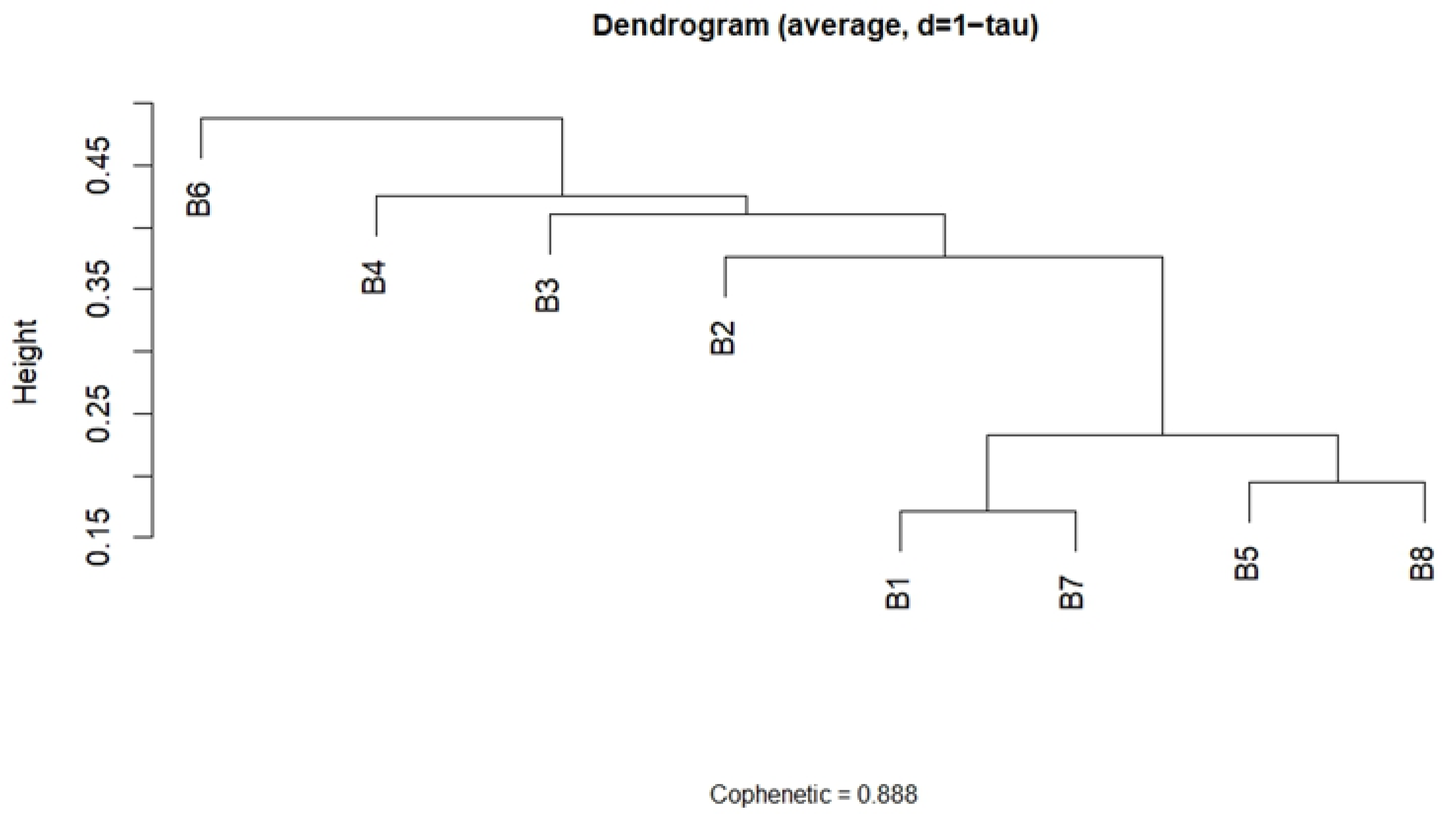
One may also consider whether there are any similarities in the respondents’ answers in particular areas. For this purpose, cluster analysis of the respondents’ answers was conducted. Kendall’s tau correlation (t) was used to determine the similarity between variables (responses), the dissimilarity was defined as (1−t), and average linkage was used to group the variables. To verify the quality of the dendrogram, the cophenetic correlation coefficient was applied, which assesses how closely the cophenetic distances implied by the dendrogram correspond to the original distances in the distance matrix. A value closer to one indicates high consistency. The obtained coefficient value equals 0.88, indicating high consistency. The cluster dendrogram is shown in
Figure 1.
Two to three clusters can be distinguished depending on the “cut” on the height axis. Assuming that the responses are grouped into three clusters, we obtain a clearly distinct cluster in the case of area B6 (Competition between entities in a given sector will increase), where the benefits in this area are perceived differently than in other cases (based on
Table 7, it can be inferred that the respondents are more skeptical here than elsewhere about the magnitude of the benefits of increased competition in a given sector). The next cluster, B2, B3 and B4, can be linked to standardization (regulations), i.e., the benefits of harmonizing the standard for environmentally sustainable investment and moving away from other standards for non-financial reporting. The last cluster indicates similarities in responses regarding the benefits in terms of available information and finance. The observed clustering patterns are consistent with the PCA results, which indicate one dominant dimension of expected benefits, while at the same time there are meaningful subgroups of the most similar items.
Significant differences in responses by grouping variables, i.e., the entity’s status as a publicly traded entity and company size, were verified using the Mann–Whitney U test, with the results presented in
Table 10 and
Table 11, respectively.
Table A3 and
Table A4 present the results of the Fligner–Killeen test (
Appendix A).
With regard to the grouping variable “the entity’s status as a publicly traded entity”, there are no grounds for rejecting the null hypothesis (no significant differences) in almost every case, including after applying the Holm–Bonferroni correction to B1–B8. The exception at the unadjusted level is B6, but it is not significant after correction.
For the grouping variable “company size” before correction, we can identify significant differences in five cases. Under the Holm–Bonferroni procedure, the lowest
p-value (B3:
p* = 0.0014) is below 0.05/8 = 0.0063 and remains significant. The next lowest value (B7:
p* = 0.0177) exceeds 0.05/7 = 0.0071, so according to the stepdown procedure only B3 remains significant. Thus, there is evidence of at least one difference between groups within the B1–B8 “family”, but this finding should be interpreted cautiously due to the sample size (
n = 43). In the Fligner–Killeen test, there were no grounds for rejecting the null hypothesis (
Table A3), except for one case in
Table A4—B5.
The survey also included a question about the expected benefits of implementing extended ESG regulations, namely: “To what extent, in your opinion, do ESG regulations affect your company’s operational activities in terms of implementing and applying environmentally sustainable practices?” (marked as Question_3). The distribution of the respondents’ answers is presented in
Table 12.
The response “To a moderate extent” stands out in the table. Nearly half of the respondents chose this option, or 46.5% to be precise. “To a small extent” was chosen by 27.9% of respondents, which is more than the total number of responses, indicating a greater than moderate effect. Approximately 5% selected “No effect at all”. It may be cautiously inferred that, on average, the ESG regulations introduced have had an impact on the operational activities of nearly half of the entities in terms of the implementation and application of environmentally sustainable measures (according to the respondents). The remaining responses indicated a small effect or no effect rather than considering the impact to be greater than average.
In this case, the Mann–Whitney U test was used to check for significant differences based on grouping variables. The results was presented in
Table 13. The result of the Fligner–Killeen test is presented in
Table A5 (there are no grounds for rejecting the null hypothesis).
Table 14 presents the results of the estimation parameters of the ordered logit model (modeling of relationships between variables).
As can be seen in the table, the results are analogous to those of the previous test. A statistically significant association is observed between the answers to question 3 and the variable company size, even after controlling for the variable the entity’s status as a publicly traded entity. Distribution of responses to Question 3 in these groups is shown below (
Table 15).
As can be seen, the respondents from smaller companies overwhelmingly expect the regulations to have a small or moderate impact on their operations. For the respondents from larger companies, expectations are also moderate in most cases (in about half), but it is notable that some employees expect that the impact will be significant.
According to the authors, the results presented above are sufficient to confirm hypothesis H1, namely ESG professionals representing entities in the Polish energy sector perceive the extended legal requirements for ESG reporting as a factor that provides benefits across various areas.
Some of the questions in the survey concerned the process of preparing ESG reports and factors that may influence this process. One of the questions was: “Do you think that preparing an ESG (non-financial) report is complicated?”, labeled as Question_4. The answers to this question are presented in
Table 16.
Approximately 58% of respondents considered the process to be complicated, which implies that about every other respondent shared this view. The chi-square test did not reveal any significant differences between the responses, whether grouped by the company’s status as a publicly traded entity or by company size (up to vs. above 500 employees), as seen in
Table A6.
With regard to modeling dependencies using the logit function, the results obtained show that there is no case in which the logit models indicate that the company’s status as listed or unlisted, or the size of its workforce, are significantly related to the perception of ESG reporting as complex. The conclusion is the same in the combined model. The predictors remain insignificant in each case, so there is no basis for concluding that there are significant differences in the likelihood of a Yes (the report is complex) response between the groups (
Table A7).
Those who found preparing an ESG (non-financial) report complicated were asked to answer the next question, Question_5: “If you answered ‘yes’ to the previous question, do you think that the complexity of preparing the report is influenced by imprecise and unclear legal regulations in this area?”
Table 17 shows the distribution of the answers to this question (please note that 58.1% of the total sample (25 people) answered this question).
Of the people who considered ESG reporting to be complicated, 88% people believed that this was due, at least in part, to imprecise and unclear legal regulations in this area. This should not be considered as the only factor contributing to such complexity; however, it was clearly identified as one of the factors.
In this case, the assumptions of the chi-square test of independence are not met; therefore, Fisher’s exact test was used to verify whether there are significant differences between responses according to grouping variables: the first determining whether the entity is publicly traded or not, and the second being company size (up to vs. above 500 employees). There are no significant differences in the responses according to grouping variables (
Table A8). Furthermore, due to the small sample size (
n = 25) and the strongly asymmetric distribution of response, logit models were not estimated in this case.
The next question concerned the assessment of eligibility and compliance criteria in the context of taxonomic indicators, i.e., “In your opinion, are the eligibility and compliance criteria for determining taxonomic indicators sufficiently clear and precise in the regulations?” The question was labeled as Question_6.
The distribution of the responses is highly imbalanced (
Table 18), as over 90% of respondents indicated (in their opinion) that these regulations are not sufficiently precise and clear. The chi-square test cannot be used because expected cell counts are not met and the “Yes” category is under-represented; therefore, Fisher’s exact test was applied. According to the test results (
Table 19), there is a significant difference between the responses according to company size. Furthermore, due to the asymmetric distribution of response, logit models were not estimated in this case (9,3% answer Yes, which would make regression estimates unstable and unreliable).
The breakdown of the responses into groups (company size) does not show large discrepancies overall (
Table 20). Given the small number of “Yes” responses, the result should be interpreted with caution (the reliability of the test in this case may be negligible).
Based on the results presented above, hypothesis H2 is supported, i.e., respondents from entities within the Polish energy sector involved in ESG reporting perceive ESG reporting as a complicated process, a perception that is influenced (among other factors) by insufficiently precise legal regulations. Respondents perceive ESG reporting as a complex process (58.1%), and about half of the entire sample (88% of the 58.1%) indicate a lack of precision in the regulations. More than 90% of the respondents point to the unclear criteria of the EU Taxonomy. Nevertheless, due to the sample size and its multifactorial nature, conclusions must be drawn with caution.
The authors were interested in whether the issue of preparing an entity for reporting translates into the respondents’ perception of possible benefits. The survey included the question: “To what extent, in your opinion, is the entity you work for prepared to prepare taxonomy reports (in terms of, among other things, access to data, IT support, staff training, coordination of work between departments, internal procedures)?”, labeled as Question_7.
Table 21 shows the percentage share of each possible answer.
None of the respondents considered the entity they work for to be very well prepared for preparing taxonomic reports. It can also be seen that the number of companies that are well prepared (according to the respondents) is negligible (two respondents). Approximately 11.6% of respondents declared that the entity they work for is unprepared. Meanwhile, approximately 25.6% and 58.1% of respondents considered the preparedness of the companies they work for to be small and moderate, respectively. According to the authors, these results are not very optimistic.
In this case, the Mann–Whitney U test (after excluding the response “To a very large extent”) did not reveal any significant differences according to the grouping variables (
Table A9). In the Fligner–Killeen test, there were also no grounds for rejecting the null hypothesis in either case (
Table A10). The results from the ordered logit model also indicate no statistical significance between the response to Question_7 and the entity’s status as a publicly traded entity or company size (
Table A11).
To verify whether there are any associations between the benefits (or, more precisely, their magnitude) and the company’s readiness for reporting, Kendall’s tau correlations between these variables were assessed (
Table 22).
It should be emphasized that, in general, the answers to the questions in the survey were arranged in different orders, from “best” to “worst” or vice versa (this avoided monotony in the choice of answers). This was the case here, as the answers to question 7 ranged (1 to 5) from “To a very large extent” to “Not prepared”, while questions B1 to B8 ranged (1 to 5) from “No benefits” to “Very large benefits”. Accordingly, a negative Kendall’s tau here means that perceived benefits increase as the company’s readiness to report increases. In addition, a Kruskal–Wallis test was performed. The results are presented in
Table 23, in ascending order by
p-value.
Table A12 contains the results of the Fligner–Killeen test, where only in the case of B3 are there grounds for rejecting the null hypothesis.
As can be seen, in six cases (considering each test separately) there are grounds for conducting post hoc comparisons. When treating the benefits (B1 to B8) as a single family, a multiple comparisons adjustment was applied using the Holm–Bonferroni procedure, with all six cases remaining for post hoc examination.
Table 24 presents the post hoc tests for all six variables in the same order as in
Table 23 (without B4 and B6).
The trend is that responses regarding benefits differ primarily between the “Not prepared” group and the remaining preparedness categories. Across B1, B2, B3, B5, B7, and B8, at least two of the three contrasts involving “Not prepared” are significant, whereas comparison differences among the prepared groups are non-significant. Together with the moderate response, negative Kendall’s tau-b correlations and the Kruskal–Wallis results, this pattern suggests a monotonic, albeit stepwise, relationship: the largest gap separates “no preparation” from “some preparation”, while differences within the prepared categories attenuate or vanish.
The table below (
Table 25) presents the aggregated values of the variables. More specifically, for each benefit from B1 to B8, the tables show the percentage for Top2 (“To a very large extent” + “To a large extent”), the “Moderate” response, and the two pessimistic responses (Bottom2) by readiness: “Not prepared” vs. “Prepared at any level” (for Question 7).
The results are consistent with the statistical analysis. Those who consider their employer to be unprepared for reporting in general do not expect benefits. Among employees of companies that have already made some progress in preparing for reporting, almost 100% expect to obtain some form of benefit.
The above tests were conducted to verify hypothesis H3, according to which there is a relationship between the perceived benefits of ESG and taxonomy reporting and the perception of ESG reporting as a complicated process, as well as the level of preparedness for reporting. Nevertheless, the authors recommend exercising caution when inferring that entities not prepared for reporting will not reap the indicated benefits (respondents’ opinions are being examined). A more defensible conclusion (given the size of the sample) is that respondents from companies that have already begun preparations for reporting expect to reap benefits, and the vast majority expect these benefits to be at least moderate.
Another area of interest for the authors was the respondents’ opinion on the need to increase expenditure (human and financial) in order to comply with ESG reporting regulations. For the questions “Do you think that adapting non-financial/ESG reporting in your company to legal requirements requires increased expenditure on new technologies (e.g., implementation of a new system, AI, blockchain, data analytics, use of databases, etc.)” (labeled as Question_8), and “Do you think that adapting non-financial/ESG reporting in your company to legal requirements requires increased expenditure in terms of human resources (e.g., increased employment, training)?” (labeled as Question_9), the respondents’ answers are presented in
Table 26 and
Table 27, respectively.
While one in four companies in the energy sector can be considered sufficiently prepared in terms of technology (according to the respondents), almost every respondent indicated shortages in human resources or training. The respondents’ answers clearly indicate that, in their opinion, additional preparations should be made within the company to ensure that the ESG reporting procedure runs smoothly. This supports hypothesis H4, which posits that readiness for ESG reporting in energy sector enterprises requires the allocation of additional financial, organizational, and technological resources, as perceived by ESG professionals. Such preparations obviously involve additional financial outlays for the company, but these may bring measurable benefits in the future. According to the respondents, the prevailing opinion was that these outlays would be large or moderate.
For Question_8 and Question_9, Fisher’s exact test was also used (the assumptions of the chi-square test are not met). In no case did the tests reveal any significant differences between the answers to questions 8 and 9 according to the grouping variables. The results are presented in
Table A13 and
Table A14. The binary logit analysis also did not reveal any significant relationships for Question_8 (
Table A15). For Question_9, logit model parameters were not estimated due to the highly imbalanced distribution of responses.
6. Discussion
According to the results of the survey, conducted primarily using the CATI method, nearly half of the respondents (46.5%) expect a moderate impact of extended legal regulations on ESG reporting on the operational activities of their enterprises, particularly in the context of implementing and applying environmentally sustainable practices. Furthermore, 11.6% of the respondents anticipate a very high impact of these regulations, whereas 32.6% of them expect only a minor or negligible effect on their pro-environmental initiatives. The findings appear to diverge somewhat from those of Abakah et al. [
26], who suggest that policymakers can encourage sustainable behavior through appropriate actions. Likewise, the results do not fully align with previous research investigating, for instance, the influence of the stringency of environmental policy instruments on the adoption of renewable energy [
50], or the ways in which government regulations can shape firms’ commitment to environmental and social objectives [
51,
52,
54,
88].
In accordance with the findings of our study, the surveyed representatives of the Polish energy sector nevertheless anticipate benefits arising from the expanded ESG reporting requirements. Specifically, 18.6% of respondents expect a substantial or very substantial increase in the transparency and comparability of environmental disclosures in non-financial reports, while 51.2% foresee a moderate improvement in this respect. The results of our study are consistent with the prevailing stream of research, which suggests that the strengthening of regulatory requirements for ESG reporting—particularly through the implementation of the ESRS and the EU Taxonomy—is intended to reduce the risk of greenwashing and enhance the credibility and comparability of sustainability disclosures [
23,
31,
34,
71,
77,
91,
92].
Our research demonstrates that a significant proportion of respondents expect, to a large or very large extent, the following benefits from the implementation of extended non-financial reporting regulations and taxonomy:
- −
For environmentally sustainable companies, the availability of various subsidies, tax exemptions, loans and financial instruments forming part of the EU Green Deal will increase (48.8% of respondents).
- −
Investors’ capital will be directed towards environmentally sustainable enterprises (37.2% of respondents).
- −
Other non-financial reporting standards (e.g., GRI) will cease to be applied (32.6% of respondents).
- −
A uniform standard for environmentally sustainable investment will be established (46.5% of respondents).
- −
Access to data from companies’ non-financial reports will increase (53.5% of respondents).
- −
Competition among entities within a given sector will intensify (30.3% of respondents).
- −
The comparability of reported information across different companies will increase (58.1% of respondents).
- −
The impact of environmentally sustainable activities on firms’ financial performance will increase (39.6% of respondents).
Respondents’ expectations are particularly pronounced with respect to the enhanced comparability of reported information and the increased accessibility of data from non-financial reports. The inclusion of new disclosures in ESG rankings is expected to facilitate access to capital for these entities, while also contributing to the development of a positive social reputation. The findings are consistent with the anticipated benefits of non-financial reporting presented in the literature, particularly with regard to the expected advantages associated with the harmonization of ESG reporting practices [
77,
78,
79,
80] as well as the impact on financial performance and access to capital [
27,
28,
61,
64,
65,
66,
67,
68,
69,
71]. It should be noted that the samples used in the literature likely included representatives of renewable energy-producing entities. For these firms, the expanded ESG disclosures—and particularly the opportunity to present their activities in terms of turnover, capital expenditure (CapEx) and operational expenditure (OpEx) as taxonomy-aligned and environmentally sustainable—undoubtedly constitute an opportunity for improved performance and an enhanced attractiveness for investors. This is consistent with earlier research by Nipper et al. [
71], who argue that by incorporating EU Taxonomy disclosures into their investment decisions, investors may contribute to increased competition within the sector. It should be emphasized, however, that 32.3% of respondents only expect benefits from the expansion of non-financial reporting to a moderate extent, while 17.7% perceive such advantages to a small extent. This may be attributable to the early stage of ESG regulation implementation in which some of the entities represented by the respondents currently find themselves, thereby prompting a more cautious approach.
Before the benefits of consistent and comparable reports can be fully realized, respondents currently identify numerous difficulties in applying the new regulations. The majority (58.1%) assessed the preparation of an ESG report as complicated, regardless of whether the surveyed entity was publicly listed or not. No differences were observed in this respect with regard to company size, as measured by the number of employees. Our findings thus demonstrate that even some of the large, publicly traded companies already producing ESG and taxonomy reports continue to perceive them as highly difficult. Among the reasons cited are the insufficient precision and clarity of the legal provisions in this area (briefly presented in part 2 of this paper), as indicated by 88% of respondents who had previously characterized reporting obligations as complicated. Moreover, 90.7% of respondents explicitly confirmed that the eligibility and alignment criteria for determining taxonomy indicators are not sufficiently clear or precise in the regulations. Our findings in this regard do not diverge from previously published conclusions. Previous regulatory frameworks have been subject to criticism in the literature. For instance, Wagenhofer [
82] noted that sustainability reporting standards compelled firms to disclose extensive amounts of input-oriented data of questionable utility, while simultaneously imposing significant costs. The absence of standardized aggregate indicators obliged external stakeholders to interpret the disclosed information independently, thereby reducing comparability. According to Szadziewska and Kujawski [
29], although energy-sector companies largely complied with legal requirements for environmental disclosures, divergences in the scope and quality of the reported information impeded cross-company comparability. Companies have frequently emphasized their positive environmental initiatives while downplaying adverse impacts, and the lack of external verification of disclosures has raised concerns regarding their credibility. The implementation and interpretation of ESG reporting requirements have proved particularly challenging, given that the legal framework is complex, difficult to interpret, and insufficiently precise [
69,
77,
81,
85,
86,
87]. Nevertheless, as Mäkelä [
93] emphasized, rather than justifying delays in their adoption, these obstacles highlighted the need for institutional support, the development of professional standards, and broader societal involvement in order to establish sustainability reporting as a credible and reliable component of organizational and public decision-making.
The perceived difficulties in ESG and taxonomy reporting, together with the awareness of the broad and demanding scope of reporting requirements in the energy sector, as presented in our article, undoubtedly influenced the respondents’ critical assessment of the degree of preparedness for reporting. A total of 58.1% of respondents from the energy sector engaged in the reporting process assessed the level of preparedness of the entity in which they were employed as “to a moderate extent.” Only 4.7% of respondents selected “to a large extent,” while none indicated “to a very large extent.” As many as 11.6% considered themselves unprepared, and 25.6% selected “to a small extent.” Statistical tests did not reveal differences depending on whether the entity was publicly listed or not, nor on company size as measured by the number of employees. Thus, once again, our study demonstrates that even for entities already engaged in ESG and EU Taxonomy reporting, the process continues to pose a substantial challenge. Similar conclusions were previously reached by Bąk et al. [
31] and by Hońko et al. [
30] and Wacławik et al. [
32]. The results may be also compared with findings from Italian studies, where Gazzola et al. [
83] similarly argued that the overall level of ESG reporting readiness among the analyzed Italian firms is relatively low and uneven, indicating that most companies remain at an early or transitional stage of preparation for mandatory CSRD-compliant reporting. However, Italian firms with greater financial scale and larger employee bases tend to achieve higher readiness scores, and publicly listed SMEs appear better prepared than their smaller, non-listed counterparts. Similar conclusions were presented by Leal Filho et al. [
84], who argue that ESG reporting readiness across European companies remains uneven and largely incomplete, with many firms still at an early or transitional stage of preparation for full ESRS compliance, while only larger firms and multinational enterprises demonstrate a higher degree of alignment with existing sustainability frameworks.
The respondents in our study further indicated a continued need to increase spending on IT support and employee training. According to our findings, the majority of respondents identified this necessity (76.7% with regard to investments in new technologies and 97.7% in the area of training and expanding human resources). Our findings are consistent with earlier academic studies in this area [
31,
32], as well as with reports prepared by organizations [
22,
89]. The research also yielded interesting conclusions regarding the expected differences in the grouping variables in other areas of research. Looking at both the company size (employment of up to vs. above 500) and the entity’s status as a publicly traded entity, it can be concluded (according to the tests used) that if there are any differences in the responses, they are more likely attributable to the size of the company. This is the case for the question “To what extent, in your opinion, have ESG regulations in the last three years increased the transparency and comparability of environmental disclosures in non-financial reports?”. Significant differences were observed in responses between professionals from companies employing more than 500 people (35% of whom assessed the impact of ESG regulations as high or very high) and respondents from companies with fewer than 500 employees (only 4.35% assessed the impact of ESG regulations as high). The size of the respondent’s organization was also relevant for questions “In your opinion, are the eligibility and compliance criteria for determining taxonomic indicators sufficiently clear and precise in the regulations?” and “To what extent, in your opinion, do ESG regulations influence your company’s operations towards the implementation and application of environmentally sustainable practices?”, as well as in the case of questions about the benefits of reporting. The impact of entity size as a grouping variable was previously analyzed [
55,
59,
63,
68,
83]. For example, according to Strouhal et al. [
25], larger enterprises, especially those operating in international markets, are more likely to interpret ESG requirements as a strategic lever to strengthen corporate credibility, improve access to capital, mitigate risks, and reinforce their competitive position.
It should be noted that the results of the statistical and econometric analyses are consistent. In the vast majority of cases (with one borderline case), the conclusions regarding the presence or absence of relationships between the dependent variables and grouping variables were the same. The econometric models confirmed the significance of the relationships and additionally indicated their direction.
7. Conclusions
The Polish energy sector faces multifaceted challenges arising from the urgent need for transformation and the growing imperative to align with the principles of sustainable development. On the one hand, enterprises must address existing structural dependencies on conventional energy sources, while on the other they are required to implement innovative technologies and business models that facilitate decarbonization. This process is further complicated by regulatory uncertainties, substantial financial and organizational demands, and the necessity to adapt to international ESG standards. Consequently, the sector’s capacity to reconcile energy security with environmental objectives will be a decisive factor in determining the pace and effectiveness of Poland’s energy transition. Considering the above, the main objective of the study was to identify the anticipated benefits of extended legal regulations on ESG reporting, to assess the level of difficulty associated with achieving compliance within the energy sector, and to evaluate the readiness of the Polish energy sector for ESG reporting connected with the EU Taxonomy, as perceived by respondents engaged in the reporting process. Despite the sample comprising 43 entities from the energy sector, it represents a significant share of the population of large entities in the energy sector in Poland (employment of more than 250 persons). The research objective was achieved through the verification of four research hypotheses. The overall tenor of the presented findings may be assessed as optimistic. Respondents identified numerous benefits arising from expanded and harmonized ESG reporting. In line with the first hypothesis, these benefits primarily include increased comparability of reported information across different companies (58.1% of respondents), improved access to diverse sources of capital (48.8% of respondents), harmonization of standards for environmentally sustainable investments (46.5% of respondents), and an enhanced impact of environmentally sustainable activities on firms’ financial performance (39.6% of respondents). The results of the study also confirmed the second hypothesis, as 58.1% of respondents consider ESG reporting to be a complex undertaking. Among them, 88% point to inadequate regulatory precision, while more than 90% of the entire sample identify unclear EU Taxonomy criteria as a significant challenge. Overall, with regard to hypothesis H3, the study reveals a perceptual link between respondents’ assessment of reporting preparedness and their expectations regarding the benefits of ESG and taxonomy reporting. Based on the conducted tests, the results indicate that, despite partial technological readiness in energy companies, respondents perceive a need for substantial additional financial, organizational, and human resource investments to ensure effective ESG reporting, thereby supporting hypothesis H4.
The findings of this study, although based exclusively on respondents’ perceptions, provide valuable insights into the early-stage implementation of extended ESG reporting requirements. Perception-based evidence is particularly relevant in this context, as the quality, consistency, and credibility of future disclosures will depend not only on formal compliance mechanisms, but also on the attitudes, understanding, and conviction of those responsible for reporting in practice. Respondents’ beliefs regarding the purposefulness and legitimacy of extended reporting influence how diligently reporting obligations are fulfilled and how challenges are addressed. Consequently, the results should not be interpreted as limitations of subjective assessment, but rather as an important reflection of the interpretive and cognitive conditions under which ESG disclosures are produced. In exploratory research, such insights constitute a meaningful contribution by identifying prevailing perceptions, potential barriers, and areas requiring further guidance or regulatory clarification.
This study contributes to broader debates on ESG reporting effectiveness, regulatory burden, and institutional adaptation by demonstrating that the success of extended ESG reporting depends not only on regulatory design, but also on how reporting requirements are perceived and internalized by ESG professionals. The findings show that perceived reporting complexity, regulatory ambiguity and organizational preparedness can significantly shape ESG disclosures and influence the informative value received by shareholders and other stakeholders. Perceived expectations regarding the benefits of reporting may encourage report preparers to make efforts to ensure high-quality disclosures, while the need for additional financial, organizational, and human resources highlights the practical burden imposed on reporting entities. These insights form the basis for concrete policy recommendations. For policymakers and regulators, the results underscore the importance of improving regulatory clarity, guidance, and implementation support to reduce uncertainty and enhance reporting effectiveness. For management boards and the owners of companies the findings highlight the need to invest in capacity building, training, and internal coordination to ensure credible and efficient ESG disclosures. Finally, for stakeholders relying on ESG information, the study emphasizes that the quality and usefulness of ESG reporting are closely linked to the institutional and cognitive conditions under which disclosures are produced.
In summary, it is essential to emphasize the pivotal role of the European Union, international organizations and national governments in developing a coherent reporting framework. The current situation, following the entry into force of the “Stop-the-Clock” Directive, has generated considerable uncertainty among businesses. Firms wish to comply with the new regulations and have already incurred substantial expenditure in preparing for reporting, hiring consultants and implementing new technologies. The key responsibility of legislators, therefore, is to provide clear guidance on the anticipated simplifications in reporting as soon as possible, and to develop solutions that are both practically implementable and capable of advancing the broader objectives set for ESG reporting.
The research encompassed a key segment of the Polish energy sector, and by reaching individuals directly involved in the ESG reporting process, the results can be regarded as representative. Future research on ESG reporting in the energy sector may be extended in at least few directions. Firstly, it would be scientifically valuable to compare the findings presented here with results obtained in subsequent reporting years, once the deferred obligations for smaller entities come into effect and the final reporting model has been established. Secondly, the study could be deepened by including expert interviews with individuals actively engaged in ESG reporting, with a focus on sector-specific features of the reporting process. Next, an important avenue for future inquiry is to broaden the research sample to include other European Union member states, thereby enabling cross-country comparisons and enhancing the generalizability of the findings. Finally, future research may build on the present findings by combining perception-based evidence with observable economic or financial indicators, where data availability allows. Such an approach could help further explore the relationship between perceived ESG impacts and measurable economic outcomes, using the current study as an initial reference point.
8. Limitations
As in most studies of this type, our research also has limitations. One of the main limitations of the analyses based on the survey data was the sample size, which consisted of 43 observations. The sample included 40 surveys from companies employing more than 250 people, where according to official statistical data in Q2 2025 the category “Electricity generation and supply” includes 49 active enterprises employing more than 250 employees [
49]. (The sample also included three cases with employment below this threshold, but these were not considered separately.) The sample size reflects the limited population of large enterprises in the Polish energy sector. Limitations stemming from the small sample size undoubtedly affect the statistical power and reliability of the tests. It also limits the statistical power and stability of econometric model estimation, which could reduce the reliability of inferences about relationships. It is clear that a larger sample would provide greater certainty with regard to the results. In addition, the use of grouping variables further partitions the sample, hence the grouping variables used are binary. Considering more detailed divisions within the sector with the current sample size would lead to too small subgroups and unstable results.
It should also be remembered that the answers given by respondents were probably intended to be objective, but that some degree of subjectivity is inherent in such studies. For example, when asked about increasing resources (human, financial or technological) for the preparation of ESG reports, the vast majority were in favor of increases. Nevertheless, as individuals usually prefer to have the option of additional help rather than not having it, some of these needs may be perceived rather than necessary. However, this does not change the fact that the percentage of “Yes” answers to these questions is so high that even if some of these needs were indeed partly apparent, it would probably not change the conclusion—only the magnitude of the effect would be smaller.
There is also the issue of incomplete (discarded) questionnaires and potential non-response bias. As already mentioned, the survey yielded 325 correctly completed questionnaires and 78 questionnaires that were excluded from the analysis. The authors do not have information about the companies whose questionnaires were excluded. Assuming that all 78 excluded questionnaires come from the energy sector is unrealistic. A more plausible assumption is that the sectoral composition of the excluded questionnaires is similar to the analyzed sample (43/325, i.e., approx. 13%).
Let us consider the value
, which indicates the current percentage of one selected answer to a given question (
denotes the number of respondents who chose this option):
where
and
are the values of this percentage after adding
new surveys, respectively, when none of the additional respondents select this answer and when all of them select it:
The maximum possible change (spread) equals:
Without knowledge of , it is impossible to quantify the uncertainty associated with missing responses. However, assuming that (13% of 78 excluded questionnaires), the maximum possible spread equals percentage points. Such extreme scenarios could change some conclusions, especially when the p-value was close to the 0.05 significance level. Nevertheless, these extreme scenarios are unlikely. If the additional responses come from the same population (with proportions similar to the analyzed sample), most statistical decisions would remain unchanged.
It should also be noted that although ESG reporting is a global issue, the regulatory framework differs across jurisdictions in terms of the degree of mandatory application and the level of detail required. Moreover, individual countries are at different stages of implementing relevant legal regulations; therefore, the opinions of ESG professionals presented in this study may differ from findings reported in other national contexts and discussed in the discussion section. An additional limitation of this study arises from its perception-based and exploratory design. The analysis does not triangulate survey responses with observable economic or financial outcomes (such as cost of capital, investment flows, credit assessments, or capital expenditure decisions) This is mainly because the survey was anonymous and although it is possible to collect publicly available firm data, it is not possible to link those data to individual survey responses; therefore, it does not allow for causal attribution or for disentangling the effects of ESG reporting from other concurrent economic, regulatory, or geopolitical factors. As a result, respondents’ assessments may reflect broader contextual influences, and the findings should be interpreted as context-dependent perceptions rather than as evidence of direct economic effects or regulatory impacts.
The authors do not aim to make broad generalizations beyond the studied context. Instead, the focus on the Polish energy sector was motivated by its specific structural and institutional characteristics. Poland is the only country in the European Union that remains a producer of hard coal and one of the few such producers globally, which makes it a relevant setting for examining ESG reporting challenges in carbon-intensive industries. While the findings are necessarily context-dependent, they are intended to serve as an empirical reference point and comparative baseline for future studies in other national or sectoral contexts rather than as a basis for universal causal claims.