Article

Impact of Enterprise Digital Transformation on Green Innovation Dynamics—Empirical Evidence from Growth Enterprise Market-Listed Companies


1
School of Management, Wuhan University of Technology, Wuhan 430070, China
2
Hubei Product Innovation Management Research Center, Wuhan 430070, China
3
School of Entrepreneurship, Wuhan University of Technology, Wuhan 430070, China
*
Authors to whom correspondence should be addressed.
Sustainability 2026, 18(5), 2539; https://doi.org/10.3390/su18052539
Submission received: 16 December 2025 / Revised: 24 February 2026 / Accepted: 27 February 2026 / Published: 5 March 2026

Abstract

Promoting corporate digital transformation is a crucial lever for enhancing green innovation dynamics. This paper takes Growth Enterprise Market (GEM)-listed companies from 2013 to 2023 as the research object, focusing on investigating the direct impact of enterprise digital transformation on green innovation dynamics, its indirect transmission mechanism through R&D intensity, and the non-linear threshold effect from the perspective of external market institutions and internal R&D Intensity synergy. It also examines the differential moderating role of market contextual factors. The research results indicate that enterprise digital transformation overall has a significantly positive promoting effect on green innovation dynamics. However, it exhibits stable empowerment on green innovation output, while its impact on green innovation input shows a dynamic evolutionary characteristic shifting from short-term suppression to long-term promotion. R&D intensity plays a significant mediating role therein. More critically, the promoting effect of digital transformation on green innovation dynamics in output dimension exhibits a significant dual-threshold effect based on the synergy level between external market institution and internal R&D intensity. As the synergy level crosses the critical thresholds sequentially, the empowering effect of digital transformation on green innovation output shows a significant stepwise enhancement feature. Furthermore, the marketization index dynamically moderates the above relationships, while a high market competition environment exacerbates the short-term suppression of input. The conclusions of this study provide empirical reference and theoretical support for optimizing the coordinated development strategy of corporate digital transformation and green innovation dynamics and formulating differentiated context-adapted policies in the digital economy era.

1. Introduction

Against the backdrop of intensifying global climate change and the elevation of the “dual-carbon” goals to a national strategy, green innovation has become a critical path for enterprises to achieve sustainable development and build core competitiveness [1,2,3]. However, green innovation is characterized by long cycles, substantial investment, and high risk, posing severe challenges to achieving innovation sustainability [4,5]. How to stimulate long-term, stable motivation for green innovation has become a common focus for both academia and practitioners [6,7,8,9,10]. Simultaneously, digital transformation, centered on big data, artificial intelligence, and the Internet of Things, is profoundly reshaping corporate operational models and strategic thinking, providing a new technological foundation and organizational logic for corporate innovation activities [11,12,13]. How to leverage corporate digital transformation to stimulate endogenous green innovation dynamics has become a key issue to be addressed [14]. Notably, this technological restructuring and innovation upgrading do not occur in isolation. As core structural forces, external market institutions and competitive landscapes are deeply embedded in this process: they not only delineate innovation boundaries through rule-setting but also provide incentive guidance via resource allocation. Their role is far from merely being a background factor; they are key drivers in the co-evolution of digital and green initiatives. How to stimulate endogenous green innovation dynamics through corporate digital transformation while adapting to the external market environment, ultimately enhancing green innovation levels, has become a pressing issue to be solved [15,16].
In recent years, extensive empirical research has shown that corporate digital transformation can significantly enhance green innovation levels [17]. For example, some scholars point out that corporate digital transformation can significantly promote green innovation by alleviating financing constraints [18], optimizing resource allocation [19,20], and enhancing information sharing [21,22,23]. Other scholars have found that digital transformation not only enhances green technology innovation capabilities but also helps companies understand customers’ real needs and develop corresponding products by optimizing information disclosure mechanisms. It aids managers in making optimal decisions using technologies like big data, thereby improving production efficiency, reducing resource waste, and optimizing environmental performance [24,25]. These studies provide a solid foundation for understanding the relationship between digital transformation and green innovation, yet significant limitations remain: on the one hand, the issue of how the enterprise digital transformation impact green innovation dynamics has not been fully explored, such as whether the phased variation and cumulative adjustment across input and output dimensions of green innovation are affected by the enterprise digital transformation [26]; on the other hand, existing research mostly examines the direct effects of digital transformation in isolation or sporadically mentions the influence of environmental factors like marketization and competition intensity [27,28,29]. However, it fails to deeply analyze how market institutions interact with internal corporate capabilities and overlooks whether such interactions have critical thresholds [30]. This results in the boundary conditions and internal logic of the digital-green synergy not being fully clarified.
Furthermore, digital transformation, by reducing information asymmetry, optimizing resource allocation, and enhancing organizational flexibility and openness, may strengthen a firm’s ability to identify and utilize innovation opportunities [4]. The internalization of this ability essentially manifests as an enhancement in corporate R&D intensity—that is, the strategic tendency of firms to go beyond passive responses, proactively anticipate changes, undertake risks, and pioneer innovation activities. Crucially, due to its strong positive externalities and uncertain short-term economic returns, green innovation particularly requires firms to possess forward-looking innovation willingness and commitment to sustained investment. Whether and how digital transformation can translate into long-term commitment to green innovation dynamics by shaping corporate R&D investment decisions and improving R&D intensity is an important theoretical issue that needs clarification. From the perspective of a resource-based viewpoint and dynamic capabilities theory, digital transformation reshapes firms’ resource allocation logic and innovation capability systems, while such empowerment for green innovation must rely on sustained R&D investment as the core transmission carrier [31]. R&D intensity, as a core indicator of firms’ long-term innovation willingness and resource commitment, constitutes the key bridge linking digital transformation and green innovation dynamics [32,33]. Existing studies have reached a broad consensus on the driving effect of R&D intensity on green innovation, and initially confirmed the transmission logic that digital transformation acts on green innovation through R&D investment decisions, but still paid insufficient systematic attention to the specific formation mechanism and boundary conditions of this mediating path. Meanwhile, existing research primarily focuses on the direct impact of digital transformation on innovation performance, paying less attention to its transmission path through affecting corporate R&D intensity to influence green innovation dynamics. Moreover, it insufficiently considers the synergistic effects between external market institutional environments and R&D intensity, neglecting the outcomes of the combined influence of internal and external factors. This leaves the specific mechanisms through which digital transformation empowers green innovation unclear.
Growth Enterprise Market-listed companies, as representatives of China’s new economy and high-tech enterprises, are characterized by strong innovation demand, high growth potential, and sensitivity to policy and market signals. Their unique positioning serving the “Three Innovations and Four New” enterprises (referring to companies aligning with the major trends of “innovation, creativity, and creation,” or the deep integration of traditional industries with “new technologies, new industries, new business formats, and new models”) and relatively flexible governance structures make them an ideal sample for observing the interactive relationships among digital transformation, innovation strategy, and green practices. However, in-depth research targeting this group remains scarce. The high innovation activity and strong market sensitivity of GEM-listed companies make the need for synergy between digital transformation and green innovation more urgent [34], and discussions on related mechanisms hold greater theoretical and practical value. Based on this, within the Chinese context, it is of great significance to explore the relationship between the enterprise digital transformation and green innovation dynamics of GEM-listed companies and to clarify the internal mechanism of digital transformation affecting green innovation dynamics.
Therefore, this study takes GEM-listed companies in China as the research object to deeply explore the following core questions: (1) Does corporate digital transformation significantly promote its green innovation dynamics level? (2) Does R&D intensity play a mediating role between corporate digital transformation and its green innovation dynamics? (3) How does market contextual factors moderate the relationship between corporate digital transformation and green innovation dynamics? (4) Does the impact of corporate digital transformation on its green innovation dynamics level exhibit threshold effects based on differences in the synergy level between external market institution and internal R&D intensity? This research aims to reveal the direct mechanisms of the impact of digital transformation on green innovation dynamics and the indirect mechanisms transmitted via the synergy of marketization and R&D intensity, considering the particularities of GEM-listed companies. The findings are expected to not only enrich the theoretical system in the fields of corporate digital transformation and green innovation dynamics, providing a scientific basis for policymakers, but also offer practical references for GEM-listed companies and broader Chinese companies to achieve green transformation and innovation-driven high-quality development in the digital economy era.

2. Theoretical Analysis and Research Hypothesis

2.1. Enterprise Digital Transformation and Green Innovation Dynamics

Enterprise digital transformation refers to the proactive, systematic, and holistic transformation and upgrading undertaken by enterprises in the context of the global digital economy revolution to adapt to the market environment and survival needs, involving the introduction of digital technologies such as big data, the Internet of Things, and artificial intelligence [35]. This transformation fundamentally reshapes corporate operational models and strategic direction [36]. Its impact on green innovation dynamics is not singularly linear but rather exhibits a heterogeneous dynamic effect across the dual dimensions of input and output based on the innovation process theory [37,38]. It both promotes growth in green innovation output through technological empowerment and may exert a phased influence on short-term green input due to resource allocation adjustments, with this effect evolving alongside the transformation stages [39].
From the dimension of green innovation output, digital transformation has a stable positive empowering effect [40]. The application of digital technologies breaks down barriers to knowledge flow within and outside the organization [41], enabling knowledge transfer and recombination across departments and entities [42], significantly improving the efficiency with which enterprises absorb and integrate green technology knowledge, and accelerating the R&D of green products, optimization of green processes, and commercialization of green patents. Simultaneously, digital transformation optimizes information disclosure, reduces information asymmetry between firms and financial institutions, alleviates financing constraints [43,44], and provides sustained financial support for green innovation output. Big data analytics and AI technologies can also help firms accurately identify green market demand and technological innovation opportunities, optimizing green innovation strategic decision-making [45], further strengthening the positive effect on the output side.
From the dimension of green innovation input, the impact of digital transformation exhibits a dynamic evolutionary characteristic shifting from short-term marginal suppression to long-term synergistic positivity. This characteristic aligns with the “double-edged sword” attribute of digital transformation [46]. In the initial stage of transformation, the introduction of digital technologies, the construction of digital infrastructure, and the cultivation of digital talent require substantial investment of scarce resources such as capital and manpower, causing short-term crowding-out of explicit green innovation input. Concurrently, issues such as inadequate technological fit and increased decision-making process complexity may lead to temporarily reduced efficiency of green input, manifesting as a marginal suppression effect. However, as transformation matures, the compatibility between digital technologies and green innovation improves. The dividends brought by digitalization, such as optimized resource allocation and reduced operational costs, are gradually released. This not only offsets the initial resource crowding-out but also creates more space for green input, shifting the input-side effect from suppression to positive synergy. This dynamic evolutionary process essentially reflects the transition of enterprises from a digital transformation adaptation period to a digital-green synergy period and echoes the guiding role of the external policy environment. Therefore, based on the above theoretical analysis and literature support, this paper proposes the following hypothesis:
H1. 
Enterprise digital transformation has a significantly positive promoting effect on green innovation dynamics, and this effect exhibits heterogeneous dynamic characteristics across the dual dimensions of input and output.
H1a. 
Corporate digital transformation has a stable and significantly positive promoting effect on the green innovation output dimension.
H1b. 
The impact of corporate digital transformation on the green innovation input dimension exhibits a dynamic evolutionary characteristic—showing a short-term marginal suppression effect initially, transitioning to a positive effect in the long run.

2.2. Enterprise Digital Transformation, R&D Intensity, and Green Innovation Dynamics

R&D intensity, as a core standardized indicator measuring firms’ strategic commitment to innovation and resource allocation in technological research and development, reflects firms’ willingness to proactively adjust development strategies, optimize internal resource allocation, and advance sustained innovation activities in response to changes in the external institutional and market environment [47]. Regarding digital transformation, for one thing, when firms fully perceive the comprehensive empowerment effect of digital transformation on operational efficiency and innovation potential, they will embrace the wave of digitalization with a more proactive strategic attitude. To further amplify the value of digital transformation and improve their cross-departmental resource integration and technology transformation capabilities, firms will rely on data-driven analysis of industry development trends and market demand changes to improve the matching degree between R&D project layout and long-term economic development trends, which in turn drives a sustained increase in their overall R&D investment level [33]. For another thing, the introduction of digital technology not only breaks internal information silos and enhances firms’ independent innovation capabilities, but also greatly improves their sensitivity and responsiveness to changes in the external market environment and policy orientation. Existing studies have confirmed that digital transformation can effectively strengthen firms’ R&D intensity [31], and this empowerment effect is particularly prominent in key links such as market information acquisition, innovation resource allocation, and market demand response. At the same time, the promotion of digital transformation in the industry has a significant herd effect [48,49,50]. According to social learning theory, firms in the same industry will imitate and learn from the strategic behaviors of leading enterprises in the social context of industry competition and make targeted strategic responses to the innovation actions of competitors. This means that when firms observe that competitors have consolidated their innovation competitive advantage through the combination of digital transformation and sustained high R&D investment, they will adjust their R&D investment strategies in a timely manner and increase their R&D intensity to maintain the dynamic balance of market competition. In addition, digital transformation narrows the distance between firms and end consumers and effectively reduces the information asymmetry between the two sides. Firms can more accurately capture consumers’ green consumption preferences and market demand for environmentally friendly technologies, and to maintain a positive corporate image of responsible innovation and consolidate the competitive advantage of technological innovation, they will further strengthen R&D investment and maintain a stable and high level of R&D intensity [32,51]. All the above logical paths show that digital transformation can form a driving effect on firms’ R&D intensity from both internal strategic decision-making and external market competition. In light of this, hypothesis 2 is proposed:
H2. 
Enterprises’ digital transformation can significantly enhance their R&D intensity.
Moreover, corporate R&D intensity is the core driving force determining the outcomes of green technological innovation, and its critical mediating role in the transmission path from digital transformation to green innovation has been widely validated by existing high-quality empirical studies [31,33]. The enhancement of corporate R&D intensity means sustained and stable strategic resource commitment to technological research and development, which will directly drive the continuous increase in investment in R&D personnel, core equipment, and special R&D funds, laying a solid resource foundation for the whole cycle of green technology research, development, and commercial transformation [32,52]. Simultaneously, in a digitalized context, the data processing capability and information advantage brought by digital transformation can be fully released through high R&D intensity: firms with higher R&D intensity can more effectively capture and utilize frontier market information and green technology trends, helping them timely adjust the R&D direction of green technologies, improve the conversion efficiency of R&D investment, and ultimately achieve more abundant and higher-quality green technological innovation outcomes [23,33]. The intensity of a firm’s R&D funding investment is a core factor affecting its green technological innovation, which not only significantly promotes the increase in the quantity of green innovation outputs, but also effectively improves the quality and sustainability of green innovation, which is a key prerequisite for enterprises to realize the whole process of green value creation. Furthermore, the continuous enhancement of R&D intensity is an important support for enterprises to build a green manufacturing information system in the digital context. This system organically integrates technology R&D information, green process technologies, enterprise operation management, and high-quality green resources, and its construction and stable operation cannot be separated from the continuous support of R&D investment. It can not only further optimize the allocation efficiency of enterprise innovation resources, but also effectively coordinate the division of labor and collaboration among different functional departments, reduce the trial and error cost and time cost of green innovation, and significantly enhance the efficiency, quality, and sustainability of enterprise green value creation [24], ultimately improving the sustainability of the whole process from green product design, processing, and manufacturing to market value conversion [52]. It is worth noting that digitalization itself does not directly create green innovation value; its value realization in the field of green development highly depends on the enterprise’s existing innovation foundation and R&D strategic intent [46]. Combined with the conclusion of hypothesis 2 that corporate digital transformation is conducive to enhancing R&D intensity, and the core logic that R&D intensity can significantly drive the improvement of green innovation dynamics, this paper proposes the following hypothesis:
H3. 
Enterprise R&D intensity plays a significant mediating role in the impact of digital transformation on green innovation dynamics.

2.3. Moderating Effects and Contextual Constraints

The external market constitutes the co-evolutionary field for the interaction between corporate digital transformation and green innovation dynamics, primarily exerting contextual constraints through two core dimensions: institutional environment and competitive intensity [53]. Regarding the institutional environment, the influence of regional marketization level is complex. On the one hand, a higher marketization level implies more developed factor markets, stronger intellectual property protection, and more effective knowledge spillover mechanisms, providing institutional guarantees for the deep integration of digital technologies and green innovation. In the long run, this helps strengthen the positive empowering effect of digital transformation on green innovation output [46,54]. On the other hand, marketization is accompanied by stricter environmental regulations and more transparent supervision, which may create compliance pressure in the short term, intensifying the resource crowding-out effect of digital transformation on green innovation input. Research shows that a nonlinear relationship may exist between external regulation and digitalization, driving firms to adopt different innovation strategies [55,56], revealing that the moderating role of the marketization index may vary depending on the stage of effect (input/output) and time window (current period/long term). Regarding competition intensity, the influence of industry market competition intensity is selective. Intense market competition triggers survival pressure, forcing firms to prioritize allocating scarce resources to digital transformation that can quickly enhance competitiveness, thereby potentially exacerbating the short-term suppression of digitalization on green innovation input [57]. However, the core of green innovation output lies in long-term technological conversion efficiency, a process dominated by internal capabilities and possibly less directly affected by market competition intensity. Based on the above analysis, this paper proposes the following moderating effect hypotheses:
H4. 
Contextual factors at the market level have differential moderating effects on the relationship between digital transformation and green innovation dynamics.
H4a. 
The current-period marketization index strengthens the inhibitory effect of digital transformation on green innovation input; in the lagged one period, the marketization index strengthens the promoting effect of digital transformation on green innovation output.
H4b. 
Only in highly competitive market environments is the inhibitory effect of digital transformation on green innovation input significantly strengthened.

2.4. The Threshold Effect of Corporate Digital Transformation on Green Innovation Dynamics in Terms of the Synergy Level of External Market Institutions and Internal R&D Intensity

Threshold effect refers to the phenomenon where the relationship between variables changes at a critical point [58]. In the relationship between corporate digital transformation and green innovation dynamics, corporate R&D intensity may exert different moderating effects at different levels. Specifically, when corporate R&D intensity is low, digital transformation may only provide partial resource support and be insufficient to drive the sustained development of green innovation [59]. When corporate R&D intensity is high, the resource and information advantages brought by digital transformation can be more effectively integrated and utilized, thereby significantly enhancing the sustainability of green innovation. However, the effective exertion of this internal capability highly depends on the external institutional environment in which it is situated. A high marketization level implies more intense competitive pressure, more developed factor markets, and lower barriers to commercializing innovation outcomes [60]. At this point, internal R&D intensity and external marketization level can generate coupling synergy: the external market provides stimuli and resource support, and internal capabilities are responsible for absorption, conversion, and, in turn, drive upgrades, jointly acting on the green innovation dynamics process through complex interactions. Therefore, the effectiveness of corporate R&D intensity likely forms a synergistic system together with the external marketization degree. When the synergy level of the two is low, the driving force of digital transformation on green innovation is limited. Once this synergy level crosses a certain critical threshold, internal dynamics and external empowerment will resonate, significantly amplifying the green innovation effect of digital transformation. Based on this, this paper proposes the threshold effect hypothesis:
H5. 
The impact of corporate digital transformation on green innovation dynamics exhibits a threshold effect based on the “synergy level between external market institutions and internal R&D intensity.” That is, when the synergy level crosses a specific threshold, the promoting effect of digital transformation will significantly strengthen.
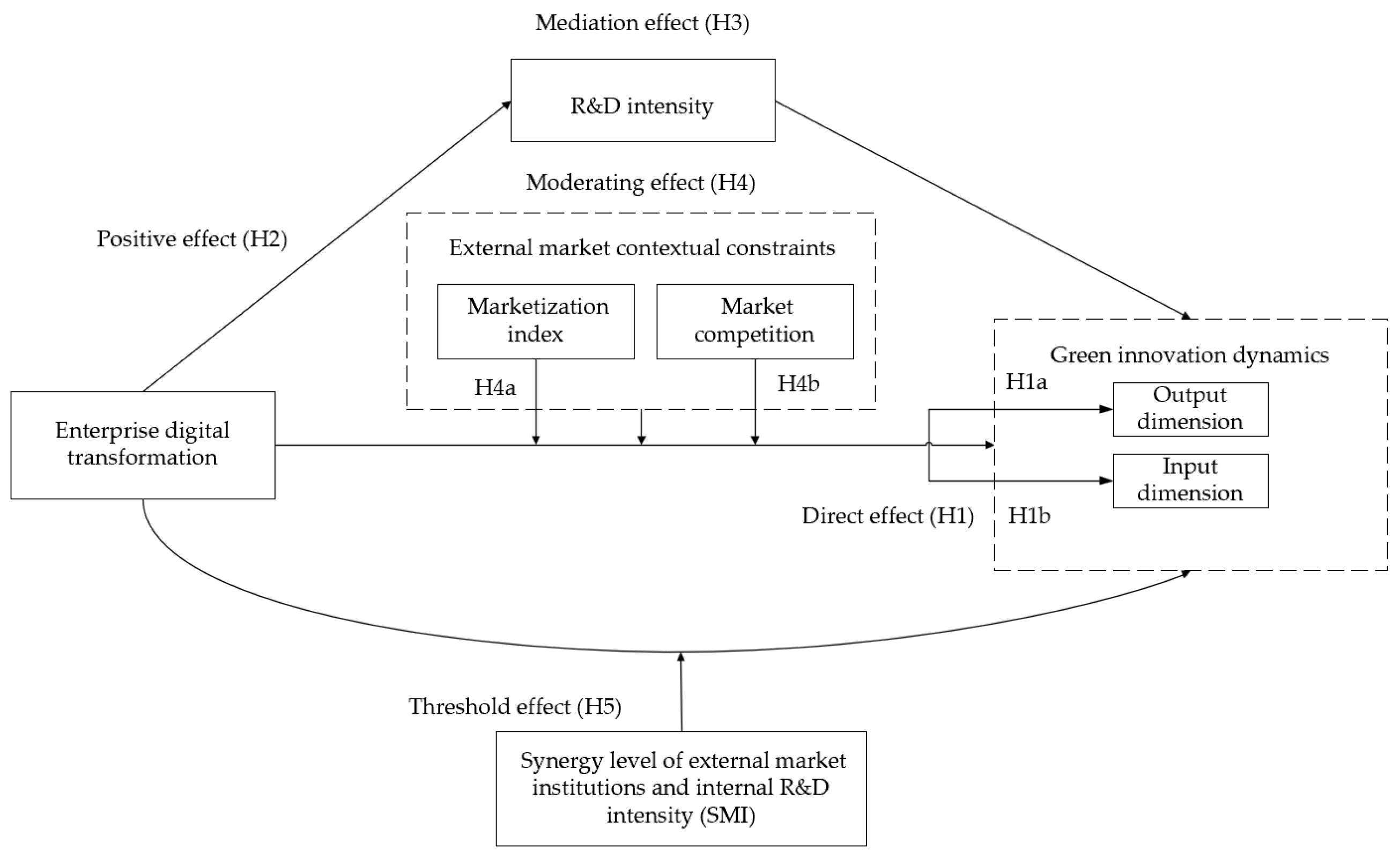
In summary, the theoretical model diagram of this study is shown in Figure 1.

3. Method and Data

3.1. Model Construction

3.1.1. Baseline Model

To explore the impact of enterprise digital transformation on its green innovation dynamics, this study established a benchmark regression model, as follows:
l n G i d s i t = ln α + β ln E d t i t + k = 1 n δ k ln X i t + ϕ t + γ i + ε i t
where G i d s denotes the dual-dimensional green innovation dynamics of firm i in year t (s = 1 for Gid_in, i.e., green input; s = 2 for Gid_out, i.e., green output), Edt represents digital transformation level of enterprises, X denotes control variables, n is the number of control variables, and k refers to the kth control variable. β and δ k are the parameters to be estimated, ϕ t is the time fixed effect, γ i is an individual fixed effect, and t and i refer to time and region, respectively.

3.1.2. Mediation Model

To further investigate if there exists a mediating effect for R&D intensity between enterprise digital transformation and its green innovation dynamics, this study developed the following mediation models inspired by Zhang et al.’s methods [61].
Total effect model:
l n G i d s i t = ln α 1 + c ln E   d t i t + k = 1 n θ k ln X i t + ϕ t + γ i + ε i t
Indirect effect model:
l n R D i i t = ln α 2 + a ln E   d t i t + k = 1 n θ k ln X i t + ϕ t + γ i + ε i t
Direct effect model:
l n G i d s i t = ln α 3 + c ln E   d t i t + b l n R D i i t + k = 1 n θ k ln X i t + ϕ t + γ i + ε i t
First, it is necessary to evaluate the significance of the parameter c in Equation (2). If it is significant, it then goes to step two, examining the significance of a and b. If both a and b are significant, the R&D intensity of enterprises is an intermediary between enterprise digital transformation and its green innovation dynamics. A Sobel test needs to be run to see whether there is a mediation effect if a or b is not significant. The significance of parameter c in Equation (4) must next be investigated. If significant, enterprise digital transformation affects green innovation dynamics of enterprises both directly and indirectly, with enterprise R&D intensity acting as a partial mediator. Otherwise, enterprise R&D intensity is a full intermediary, which means only the indirect effect through R&D intensity exists.

3.1.3. Moderating Effect Model

Considering the transmission lag in the moderating effect of the marketization system and the need to mitigate endogeneity, current-period and lagged one-period moderating effect models are constructed respectively to examine the dynamic moderating role of the marketization index on the relationship between digital transformation and corporate green innovation dynamics.
Current-period moderating effect model:
l n G i d s i t = ln α 1 + β 1 l n E d t i t + β 2 l n M i i t + β 3 l n E d t i t × l n M i i t + k = 1 n θ k ln X i t +   ϕ t + γ i + ε i t
Lagged one-period moderating effect model:
l n G i d s i t = ln α 2 + β 4 l n E d t i t 1 + β 5 l n M i i t 1 + β 6 l n E d t i t 1 × l n M i i t 1 + k = 1 n θ k ln X i t + ϕ t + γ i + ε i t                
Among these, l n M i i t is the moderating variable (marketization index); l n E d t i t × l n M i i t is the interaction term between digital transformation and the marketization index. The core focus is on the significance and sign of coefficients β 3 (current period) and β 6 (lagged one period). In the lagged one-period model, l n E d t i t 1 , l n M i i t 1 , and the interaction term are all lagged by one period to mitigate simultaneity endogeneity, aligning with the practical logic that institutional effects may exhibit a time lag.

3.1.4. Panel Threshold Regression Model

The panel threshold model constructed by Hansen [62] is a typical model investigating the nonlinear links between variables. To explore whether the synergy between external marketization level and internal corporate R&D intensity has a threshold effect on the impact of corporate digital transformation on green innovation dynamics, we take the marketization index × corporate R&D intensity as the threshold variable and construct the following double-threshold panel model:
l n G i d s i t = ln α + β 1 ln E d t i t I l n M i i t × l n R D i i t γ 1 + β 2 ln E d t i t I γ 1 < l n M i i t × l n R D i i t γ 2 + β 3 ln E d t i t I l n M i i t × l n R D i i t > γ 2 + k = 1 n δ k ln X i t + ϕ t + γ i + ε i t
where γ1 < γ2 are the double threshold values; I(⋅) is the indicator function, taking 1 if the condition in the parentheses is satisfied, otherwise 0; other variables are defined as before.

3.2. Variable Selection

3.2.1. Explained Variable

Regarding green innovation dynamics (lnGid), based on evolutionary economics (innovation as a dynamic cumulative process), dynamic capability theory (innovation capability requires continuous input-output iteration), and innovation process theory (innovation is a closed loop from resource input to process transformation to outcome output), Triguero and Córcoles (2013) [38] first proposed a dual-dimensional analytical framework of innovation input and output—this classic framework provides a core logical basis for measuring green innovation dynamics in this study. Different from the binary judgment of “whether innovation is sustained”, this study focuses on the dynamic change characteristics of green innovation (i.e., the marginal evolution of input scale and output efficiency over time) and extends the framework to construct a continuous indicator of green innovation dynamics, which can more accurately capture the degree of dynamic adjustment of enterprises’ green innovation activities. The specific definitions are as follows:
Input dimension (lnGid_in): Uses environmental protection investment as the core indicator, reflecting the direct resource input by firms for green innovation. It covers key areas such as green technology R&D, environmental equipment procurement, and green production process upgrades, serving as the material foundation for the continuous advancement of green innovation [63,64]. Sustainability of green innovation input = (The year-on-year growth rate of the sum of a firm’s environmental protection investments in years t − 1 and t compared to the sum in years t − 2 and t − 1) multiplied by (the sum of total environmental protection investments in years t − 1 and t). Data are sourced from disclosure items in listed companies’ annual report footnotes such as “Environmental Protection Investment” and “Social Responsibility”.
Output dimension (lnGid_out): Patents possess irreplaceable proxy value in reflecting the intensity of an enterprise’s technological output, the depth of its knowledge accumulation, and the breadth of its market intentions. Existing research indicates that patent application volume exhibits a significant positive correlation with corporate R&D efficiency, the height of technological barriers, and long-term market performance [64,65], which are representative in evaluating corporate innovation output performance [66]. Therefore, drawing on existing research, this paper treats green patent activities as an exogenous indicator of technological knowledge accumulation and commercialization capabilities [67]. The continuous degree of green innovation output is reflected by the comparison of green patent application counts across periods. Sustainability of green innovation output = (The year-on-year growth rate of the sum of a firm’s green patent applications in years t − 1 and t compared to the sum in years t − 2 and t − 1) multiplied by (the sum of patent applications in years t − 1 and t). Among these, the count of green patent applications is obtained by compiling the number of green patents from listed companies, subsidiaries, associated, and jointly controlled enterprises based on patent classification numbers using the WIPO green patent list.

3.2.2. Explanatory Variables

Enterprise digital transformation (lnEdt). Past research primarily used dummy variables constructed based on whether a firm underwent digital transformation or had digital investment projects as proxies for digital transformation, making it difficult to reflect the full picture of digital transformation. Corporate annual reports, as annual operational summaries for external reporting, are windows through which firms communicate information and express their digital transformation and green development direction, largely reflecting their future development trajectory. Utilizing text analysis methods that integrate advanced technologies such as natural language processing, machine learning, and data mining, we can better extract valuable information from unstructured corporate annual reports, deeply understand and interpret corporate digital behavior, track dynamic changes during the transformation process, identify new concepts and future trends, and quantify the effectiveness of corporate digital transformation. Compared to traditional numerical measures, this approach offers greater flexibility and insight [68]. Therefore, drawing on existing research practices, this paper follows the core connotation of digital transformation—the full-chain logic of technological foundation, organizational support, and business application—covering three core dimensions: “Technology Categories (AI, blockchain, etc.), Organizational Empowerment (digital facilities, platforms, etc.), Digital Applications (technological innovation, process optimization, business expansion, etc.)”. This encompasses a total of 139 keywords to cover key aspects of digital transformation, avoiding the one-sidedness of single-dimension measurement. Due to the right-skewed characteristic of word frequency, we take the natural logarithm of the word frequency count plus one as the measurement indicator for the corporate digital transformation index. The specific dictionary is provided in Appendix A.

3.2.3. Mediating Variables

R&D intensity (lnRDi). As the core mediating variable in this study, this variable is measured by the ratio of an enterprise’s annual R&D expenditure to its operating revenue, with logarithmic processing applied to the original ratio to alleviate heteroscedasticity, denoted as lnRDi. A higher value indicates stronger R&D intensity of the enterprise. This measurement follows the standard framework adopted by the OECD Frascati Manual and EU Innovation Scoreboard, and is a widely validated, universally used indicator in mainstream innovation research. It has been applied as the core measure of R&D input in classical studies: Graves (1989) [69] used this ratio to examine the long-term patterns and stability of corporate R&D expenditure in a 20-year analysis of seven U.S. R&D-intensive industries. This measurement approach is also employed in numerous studies concerning corporate R&D investment decisions. This method can effectively eliminate the interference of firm size differences on absolute R&D investment [70], enabling reliable horizontal comparability across enterprises, and the objective financial panel data can accurately reflect the dynamic changes of corporate R&D input without subjective measurement bias.

3.2.4. Threshold Variables

Synergy level of external market institutions and internal R&D Intensity (SMI). The threshold effect of enterprise digital transformation on green innovation dynamics is not determined by a single variable but is the result of the synergistic effect of the external institutional environment and internal enterprise capability. The marketization index reflects the development level of the regional institutional environment, providing external guarantees for releasing the green innovation effect of digital transformation. R&D intensity reflects internal innovation willingness and resource integration capability, determining the absorption and conversion efficiency of digital resources. The synergy level between the two is key to crossing the threshold and activating the positive effect. Therefore, this paper uses the interaction term “Marketization Index (lnMi) × Enterprise R&D Intensity (lnRDi)” to measure this synergy level (SMI). A higher value of the interaction term indicates a stronger synergy level between the external institutional environment and internal innovation capability.

3.2.5. Moderating Variables

Marketization Index (lnMi). The marketization index uses the provincial total marketization index from the “China Provincial Marketization Index Report” as the base data, reflecting the development level of the regional institutional environment. Drawing on mature practices in existing research, the average annual growth rate of the marketization index is used for prediction and supplementation. Additionally, to extend grouping tests, this study also incorporates “Market Competition Intensity (lnCom)”, measured using the Herfindahl–Hirschman Index (HHI) of operating revenue within the industry. A smaller HHI value indicates higher market competition intensity. Samples are divided into high-competition and low-competition groups based on the annual-industry median for grouped regression [71].

3.2.6. Control Variables

A company’s operational traits have a significant influence on how well green technology innovation works. Referencing prior research, this study incorporates the enterprise size (lnEs), asset liability ratio (lnAlr), listing age (lnEla), and management shareholding ratio (lnBs) into the model to control the influence of pertinent elements. The enterprise’s asset liability ratio is calculated using the following formulas: Alr = (total liabilities/year-end total assets × 100), the age of enterprise listing = year-year of initial listing + 1, and the management shareholding ratio = the quantity of shares held by directors, senior executives, and supervisors/total quantity of shares × 100.

3.2.7. Data Sources and Description

The data of GEM-listed companies from 2013 to 2023 is the empirical subject. The samples are screened using the following guidelines: (1) companies with ST or * ST trading status or financial companies are excluded; (2) companies that have already been delisted are excluded; (3) companies with many missing values are excluded; (4) the missing values for enterprises with fewer values are excluded. After screening the samples above, data from 315 GEM-listed companies are determined, with a total of 3465 sample observations. All empirical analyses and data processing in this paper were conducted using Stata 17.0 (StataCorp LLC, College Station, TX, USA). The financial information for listed companies was obtained from the China Stock Market & Accounting Research (CSMAR) Database (Shenzhen, China), and the information for corporate annual reports was collected from the Juchao Information Website (Shenzhen, China). Table 1 displays the data’s descriptive statistical analysis.

4. Empirical Results

4.1. The Baseline Model Test

4.1.1. Regression Result of the Baseline Model

This paper selects a fixed-effects panel regression model to examine the impact of digital transformation on the dual dimensions of green innovation dynamics. Table 2 presents the regression results for green output (lnGid_out), and Table 3 for green input (lnGid_in); columns (1) and (4) include only the core explanatory variable, columns (2) and (5) add control variables, and columns (3) and (6) further control for individual and time fixed effects. The results show that, in column (3), the estimated coefficients for digital transformation (lnEdt) is significantly positive, indicating that corporate digital transformation has a significantly positive effect on green output; in column (6), the estimated coefficient for digital transformation (lnEdt) is negative and marginally significant (coefficient −0.054, p = 0.055). However, after regressing on the subsample from 2020 onwards, this effect turns significantly positive (column 7 coefficient 0.157, p = 0.081). This dynamic change reveals the evolutionary logic of digital transformation’s impact on green input, shifting from short-term adaptation to long-term synergy, rather than being a singular fixed effect. This is likely because, in the early transformation stage, the firm’s resource investment in digitalization forms a phased crowding-out effect on the explicit green input of the current period, and at this time, the compatibility between digital technology and green input is insufficient, with synergistic effects not yet apparent, thus manifesting as short-term suppression. As the enterprise’s transformation enters a mature stage, improved policy guidance, deepened application of digital technologies, and enhanced corporate resource allocation capabilities enable digital transformation to create space for green input by optimizing processes and reducing costs, forming long-term synergy. Hypothesis 1 is validated. Regarding the control variables, in the output dimension, the coefficient for firm size (lnEs) is significantly positive, possibly because larger firms have more abundant financial resources, more complete technological systems, and stronger risk resilience, making them more capable of engaging in green innovation dynamics; the coefficient for listing age (lnEla) is significantly negative, possibly because firms listed longer may focus more on short-term performance and reduce green innovation input, or, influenced by path dependency, may no longer focus on green innovation after meeting environmental regulation requirements; the coefficients for asset–liability ratio (lnAlr) and management shareholding ratio (lnBs) are not significant, possibly because the high uncertainty of green innovation leads firms to prefer using internal funds rather than relying on external financing for investment, and the impact of management shareholding on green innovation dynamics is also interfered with by multiple factors such as management interest orientation and corporate incentive mechanisms. In the input dimension, the coefficient for firm size (lnEs) is significantly positive, indicating that larger firms, with stronger financial strength and resource integration capabilities, are more capable of bearing the high costs and long-term return risks associated with explicit green innovation input; the coefficient for listing age (lnEla) is significantly negative, possibly because firms listed longer, influenced by path dependency in traditional business models, place insufficient strategic emphasis on green innovation input, tending to maintain existing production layouts rather than undertake new long-term investments; the coefficients for asset–liability ratio (lnAlr) and management shareholding ratio (lnBs) are not significant, possibly because green innovation input largely depends on internal fund planning, with limited influence from external debt pressure on decision-making. Additionally, the unclear short-term returns of green input and incentive mechanisms not focusing on long-term innovation goals may result in the incentive effect of management shareholding on green input not being fully realized.

4.1.2. Robustness Tests

To ensure the reliability of the research conclusions, this paper conducts robustness tests through methods such as replacing the explanatory variable, omitting control variables, and adjusting the sample size. Specifically, (1) the explanatory variable is re-measured using a standardized method to replace the original variable; (2) all control variables are omitted to re-examine the core relationship; (3) based on year-end total assets, firms in the top and bottom 5% are excluded, retaining only the middle 90% of the sample for regression analysis [72].
The robustness test results in Table 3 show that, in columns (1) and (4) (replacing explanatory variable), columns (2) and (5) (omitting control variables), and columns (3) and (6) (adjusting sample size), the coefficients for digital transformation (lnEdt) across both dimensions are significant and their signs are consistent with the baseline regression results. The regression conclusions are robust and reliable.

4.2. The Mediation Effect Test

As analyzed in the theoretical hypotheses above, corporate digital transformation is conducive to enhancing corporate R&D intensity, thereby promoting green innovation dynamics. To test the mediating role of R&D intensity, this paper estimates the regression of the mediation effect model. The results are shown in Table 4. Columns (1) and (4) show the total effect regression results. The coefficient of digital transformation (lnEdt) on green output is significantly positive at the 5% level, and its coefficient on green input is marginally significantly negative, again validating H1. Columns (2) and (5) show the regression results for the mediating variable. The coefficients of digital transformation (lnEdt) are significantly positive at the 1% level in both, indicating that corporate digital transformation significantly enhances R&D intensity. Hypothesis 2 is validated; Columns (3) and (6) show the direct effect regression results. The coefficient of digital transformation (lnEdt) remains significant, but the coefficients of R&D intensity (lnRDi) are not significant. Further verification of the mediation effect through the Sobel test shows that in the input dimension, the Z-value is 1.68 (p = 0.089), and in the output dimension, the Z-value is 2.85 (p < 0.01), indicating that R&D intensity plays a significant partial mediating role between digital transformation and green innovation dynamics across both dimensions. This confirms that proactive innovation indeed plays a crucial mediating role between corporate digital transformation and its green innovation dynamics. Hypothesis 3 is validated.

4.3. Moderating Effect and Grouping Tests

The preceding analysis reveals the basic pathways through which digital trans-formation affects corporate green innovation dynamics. However, this process does not occur in a vacuum but is embedded within a complex external environment. This section places firms within their regional institutional environment to explore how external market institutions modify the aforementioned relationships. We first examine its linear moderating effect and then investigate the potential nonlinear threshold effects stemming from its synergy with internal corporate capabilities.

Dynamic Moderating Effect of Marketization Index

To examine the moderating effect of marketization index (lnMi), we construct a model including the interaction term lnEdt × lnMi [73,74]. Considering the time lag of institutional influence, Table 5 reports results for both the current period and the lagged one period.
The current-period regression results show that in the green innovation input dimension, the coefficients for digital transformation, marketization index, and their interaction term are all significantly negative. This result confirms the compliance pressure effect—in regions with a higher degree of marketization, stricter environmental regulations, more transparent information disclosure, and more comprehensive public supervision, firms perceive higher compliance costs and risks associated with green investment. While advancing digital transformation, they may become more cautious, or even temporarily avoid new long-term explicit green input, leading to the short-term suppression of green input by digital transformation being further strengthened by the marketization system. In the green innovation output dimension, the coefficient for digital transformation is significantly positive, but neither the marketization index nor the interaction term passes the significance test. This suggests that the pressures or benefits of the institutional environment are difficult to transmit to the output stage in the current period. The empowerment of digitalization on green output still relies on its own technological conversion and has not yet formed synergy with the institutional environment.
After lagging digital transformation, marketization index, and their interaction term by one period to mitigate endogeneity and effect lag issues, the study finds that in the green innovation output dimension, the coefficients for digital transformation, marketization index, and their interaction term are all significantly positive (Table 5). This fully reflects the efficiency guarantee effect of the marketization system—in the long run, firms gradually leverage the high-quality factor markets, knowledge spillovers, and intellectual property protection provided by the institutional environment. The technological capabilities accumulated through digital transformation and the stock resources of green innovation are efficiently converted. The marketization system not only itself has a positive empowering effect on green output but also further strengthens the positive effect of digital transformation, creating synergistic dividends between technology and institutions. In the green innovation input dimension, all coefficients are insignificant. The reason for this result may be the immediate nature of the current-period compliance pressure. Over time, as firms optimize resource allocation and adapt to institutional requirements, the short-term crowding-out effect of digital transformation on green input has been significantly absorbed and no longer shows a significant negative trend. Meanwhile, the potentially positive guiding effect of the marketization index and the potentially negative amplifying effect of the interaction term on the input side did not pass statistical tests. This indicates that the influence of institutional pressure has completely dissipated, and in the long-term dimension, the positive moderating effect of the marketization system on the input side requires reliance on more stringent synergistic conditions, making it difficult for a single moderating variable to show a significant effect. Hypothesis 4a is validated.
To further examine the heterogeneous impact of market competition environment on the relationship between digital transformation and green innovation dynamics, this study conducts a grouping regression based on the degree of market competition, and the results are reported in Table 6. In the green innovation input dimension, the coefficient of digital transformation is significantly negative at the 5% level in the high market competition group, while it is not statistically significant in the low market competition group. This indicates that in a highly competitive market environment, digital transformation has a more significant short-term crowding-out effect on green innovation input, as firms tend to allocate limited resources to digital infrastructure construction to maintain competitive advantages, thus squeezing the input scale of explicit green R&D. In the green innovation output dimension, the coefficient of digital transformation is significantly positive at the 1% level in the low market competition group, while it is not significant in the high market competition group. This suggests that firms in low-competition markets have more stable profit margins and resource reserves, which can better support the conversion of digital capabilities into green innovation output, and the stable empowering effect of digital transformation on green output is more prominent. The above heterogeneous results confirm that market competition level has a significant asymmetric moderating effect on the dual dimensions of green innovation dynamics, and Hypothesis 4b is validated.

4.4. The Threshold Effect Test

4.4.1. Threshold Value Test

To examine whether the impact of digital transformation on green innovation dynamics exhibits threshold effects based on differences in the synergy level between external market institutions and internal R&D intensity, the significance test is first conducted using SMI (lnMi × lnRDi) as the threshold variable.
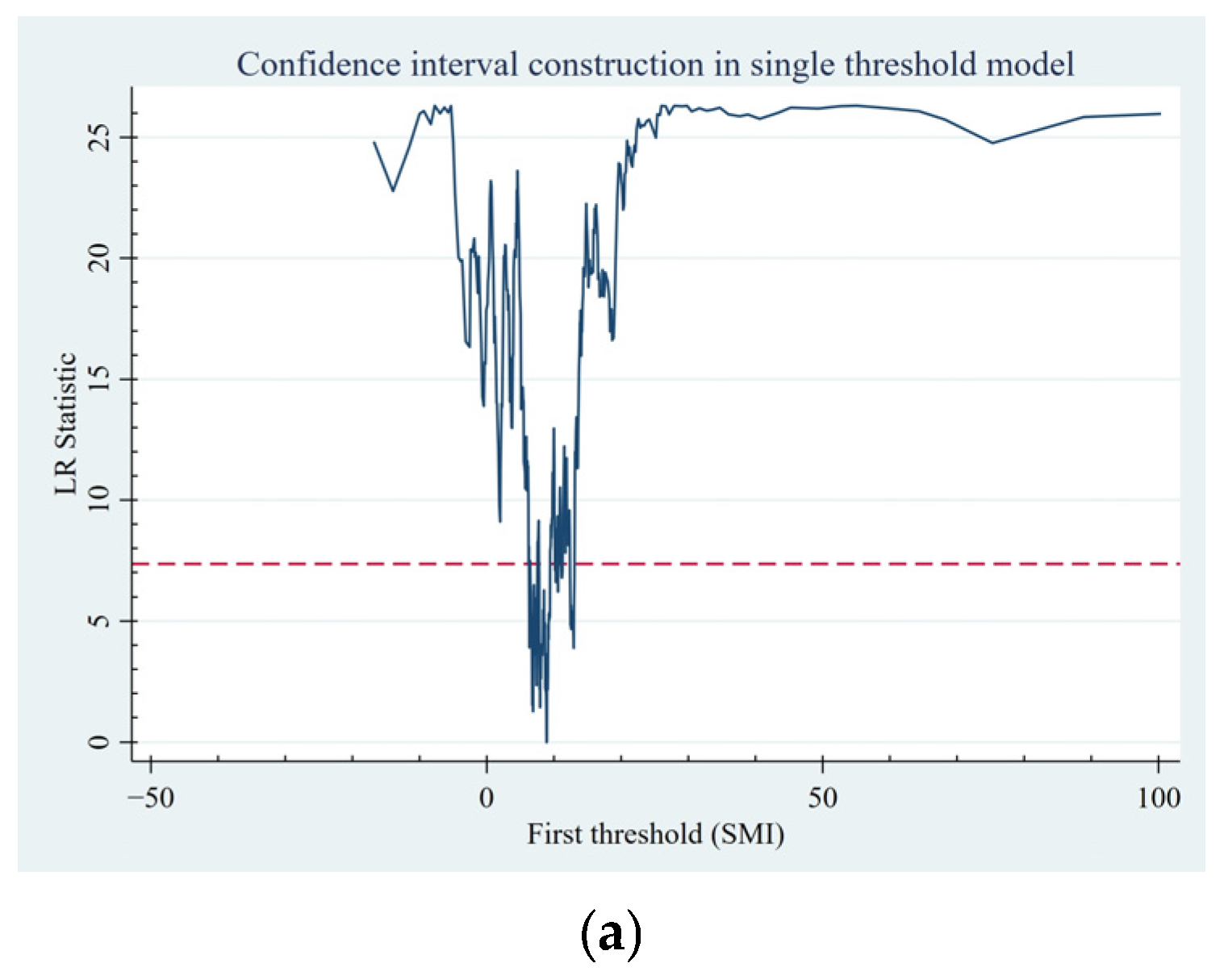
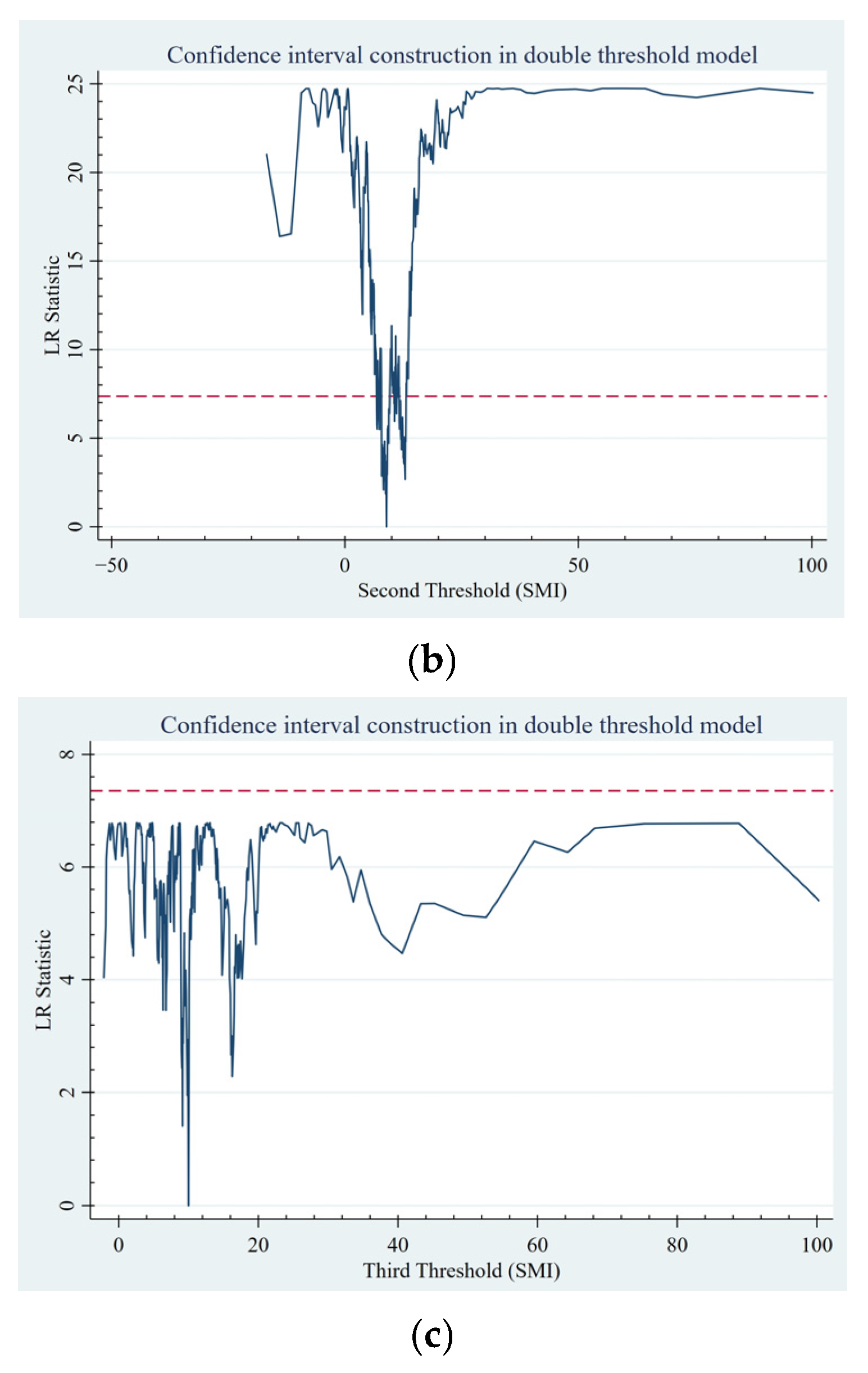
For the green innovation dynamics of input dimension, the single threshold effect test shows an F value of 4.150 and a p value of 0.137, which fails the significance test at the 10% level. Therefore, even if the double and triple threshold tests show statistical significance, they do not have valid econometric meaning. For this reason, this paper only conducts a threshold effect analysis on the green innovation dynamics of output dimension, and the test results are shown in Table 7. It shows that the single and double threshold values for the green innovation dynamics of output dimension pass the significance test at the 1% level, while the triple threshold fails the significance test. This indicates that the impact of enterprise digital transformation on the dynamic level of green innovation output has a significant double threshold effect based on the SMI synergy level. This paper further tests the authenticity of the threshold values based on the Likelihood Ratio (LR) test method. Figure 2a–c are the LR plots for the single, double, and triple threshold value estimations, respectively. According to the test results, within the 95% confidence interval, the single and double threshold values pass the authenticity test, while the triple threshold value does not. That is, the impact of enterprise digital transformation on green innovation dynamics of output dimension exhibits a double threshold regarding the SMI synergy level.

4.4.2. Regression Results and Analysis of Panel Threshold Model

Table 8 reports the panel threshold regression results of the double threshold model, using the synergy level of external market institution and internal R&D intensity (SMI) as the threshold variable. The results indicate that, (1) in the low synergy interval (SMI < −2.545)—characterized by a low external marketization degree (e.g., weak regional intellectual property protection, insufficient policy support for green innovation, and poor factor market liquidity) and weak internal R&D intensity—a 1% increase in digital transformation leads to a significant 0.46% decrease in green patent output. The underlying logic for this result is that firms face dual bottlenecks of resource constraints and insufficient capabilities. The early stage of digital transformation requires substantial capital investment in infrastructure construction, technology introduction, and organizational change, which crowds out green R&D resources in the short term. Furthermore, a weak external institutional environment fails to provide effective safeguards for green innovation, and firms lack the motivation for sustained investment in green technologies, ultimately resulting in a “crowding-out effect” of digital transformation on green innovation output. This stage is commonly observed among small and medium-sized innovative enterprises in less developed regions or traditional firms in the initial phase of digital transformation. (2) In the medium synergy interval (−2.545 ≤ SMI < 8.905), where the external marketization environment gradually improves and internal R&D intensity increases steadily, a 1% increase in digital transformation leads to a significant 0.28% increase in green patent output. At this stage, the synergistic effect between external institutional guarantees and internal capabilities begins to emerge. The technological empowerment brought by digital transformation gradually offsets the short-term impact of resource crowding-out. Firms start applying digital technologies to green innovation scenarios. However, as the synergy level remains in the medium range, the effect is not fully unleashed, manifesting as a positive but relatively moderate promoting effect. (3) In the high-synergy interval (SMI ≥ 8.905), where the external marketization environment is largely well-developed and internal R&D intensity reaches a high level, a 1% increase in digital transformation leads to a significant 0.761% increase in green patent output. Compared with the medium synergy interval, the promoting effect is nearly tripled, showing a clear stepwise enhancement feature. At this stage, the synergy between external institutions and internal corporate capabilities forms a deep coupling. Digital technologies are deeply embedded throughout the entire green innovation chain, and the green innovation empowerment effect of digital transformation is significantly amplified. Concurrently, network effects within the external innovation ecosystem begin to manifest, reflecting the scale effects and ecosystem effects under high-level internal and external synergy.
This finding of the double threshold effect confirms the theoretical logic of synergy driven by the external institutional environment and internal innovation capability: only when a firm’s internal R&D intensity and the external marketization environment form effective synergy can digital transformation continuously release its green innovation dividends. With the continuous improvement of the synergy level, the promoting effect of digital transformation on green innovation output shows a significant stepwise enhancement trend, and the empowerment effect is significantly strengthened after crossing the critical thresholds. Hypothesis 5 is validated.

5. Discussion

This paper integrates corporate digital transformation, R&D intensity, and dual-dimensional green innovation dynamics into a unified analytical framework. From the research perspective of GEM-listed companies, it introduces the marketization index and market competition intensity as contextual variables. Employing multiple econometric methods such as mediation effect, moderation effect, and panel threshold models, the study comprehensively reveals the direct mechanisms, indirect transmission paths, and nonlinear boundary conditions of how digital transformation affects green innovation dynamics. The core value and findings of the research can be elaborated from two aspects, theoretical deepening and practical implications, while also providing an outlook for future research directions based on the empirical results and research limitations.
At the theoretical level, this study addresses multiple gaps in existing research, further deepening the understanding of the link between digital transformation and green innovation. First, it expands the dimensional deconstruction and theoretical foundation of green innovation dynamics. Based on the innovation process theory, this study decomposes green innovation dynamics into two dimensions (input and output), empirically verifying the heterogeneous dynamic effects of digital transformation on both. This addresses the limitations of existing research that often emphasizes static over dynamic analysis and output over input, providing more granular empirical support for green innovation theory. Second, it reveals the mediating transmission mechanism of R&D intensity, clarifying its partial mediating role between digital transformation and green innovation dynamics, with this mechanism being more pronounced in the output dimension. This establishes a complete logical chain from digital technology to internal capability and then to green outcomes, filling the gap in existing research that often neglects the transmission path through internal capabilities. Third, it constructs a dual-threshold synergistic mechanism involving the external environment and internal capabilities. It clarifies the dual-stage dynamic moderating effect of the marketization index, the selective constraining role of market competition intensity, and the dual-threshold effect of the “Synergy Level of External Market Institutions and Internal R&D intensity (SMI)”. This transcends the limitations of single-variable analysis and enriches research on the boundary conditions of digital transformation effects.
At the practical level, this study provides differentiated references for GEM-listed companies enterprises and policymakers. For enterprises, they should focus on the output-empowerment logic of digital transformation, emphasize the cultivation of R&D intensity, and accelerate the conversion of digital technologies into green patents by strengthening R&D investment and optimizing resource allocation. Simultaneously, firms need to adjust their strategies based on their own R&D intensity level and the synergy with the external marketization environment. In the early stages of transformation, a reasonable balance between digitalization and green innovation investment should be maintained to avoid excessive resource crowding-out. Once the transformation matures, the scale of green input can be gradually expanded to fully release the empowerment dividends. For policymakers, attention should be paid to the heterogeneous characteristics of digital transformation and green innovation. Differentiated support policies tailored to the innovation needs and growth characteristics of GEM-listed companies should be introduced, balancing short-term relief with long-term empowerment to promote the synergistic development of both.
Although this paper adopts multiple methods to ensure the reliability of conclusions, there remain several expandable research avenues. First, this study selects Growth Enterprise Market (GEM)-listed companies as samples, whose high-growth and innovation-driven characteristics make them typical representatives for exploring the relationship between digital transformation and green innovation, yet this also leads to the difficulty in directly generalizing the conclusions to enterprises with different ownership types and industry attributes (e.g., small and medium-sized enterprises, non-listed enterprises, and traditional industry enterprises). Future research could expand the sample scope to include enterprises of diverse ownership types and industries to enhance the generalizability of conclusions. Second, while the measurement of core variables aligns with existing research paradigms (e.g., using annual report keyword frequency to measure digital transformation and patent data to measure green innovation output), data availability constraints prevent precise differentiation between “formal expression” and “substantive implementation” of digital transformation, and fail to cover non-patent forms of green innovation output. Future research could integrate multi-dimensional data such as digital investment and third-party ratings to optimize the measurement system, and supplement non-patent green innovation indicators. Third, although this paper addresses endogeneity issues, it has not introduced more exogenous instrumental variables or quasi-natural experiment designs to strengthen causal inference, nor explored extended dimensions such as long-term dynamic effects and spatial spillover effects of digital transformation. Future research could employ exogenous instrumental variables or quasi-natural experiments to improve the rigor of causal inference, and combine spatial econometric models with long-term panel data to investigate the extended effects and dynamic patterns of digital transformation.

6. Conclusions and Policy Implications

6.1. Conclusions

Using data from GEM-listed companies from 2013 to 2023 as the research sample, this study systematically investigates the impact of corporate digital transformation on green innovation dynamics and its underlying mechanisms, arriving at the following core conclusions: First, corporate digital transformation overall exhibits a significantly positive promoting effect on green innovation dynamics, but manifests heterogeneous characteristics across its different dimensions—it shows a stable and significantly positive empowering effect on green innovation dynamics output (green patent conversion), while its impact on green innovation dynamics input (environmental protection investment) displays a dynamic evolutionary characteristic of “short-term marginal suppression → long-term positive synergy”. Post-2020, with technological adaptation and policy guidance, the suppressing effect on the input side transitioned to a significantly positive one. Second, R&D intensity plays a partial mediating role between digital transformation and green innovation dynamics, with this transmission mechanism being more prominent in the output dimension. Digital transformation enhances corporate R&D intensity by reducing information asymmetry and optimizing resource allocation efficiency, which in turn accelerates the conversion of digital technologies into green patent outcomes. The non-significant mediating effect on the input side stems from the mitigating effect of short-term resource conflicts. Third, contextual factors at the market level exhibit differential moderating constraints: the current-period marketization index strengthens the short-term suppression of digital transformation on green innovation input, while the lagged one-period index strengthens its positive empowerment on green innovation output; market competition intensity only significantly exacerbates the short-term suppression on the input side in highly competitive environments, with no significant effect on the output side. Fourth, the impact of digital transformation on green innovation dynamics exhibits a dual-threshold effect based on the “Synergy Level of External Market Institutions and Internal R&D intensity (SMI)”. When the synergy level crosses the critical thresholds, the positive effect of digital transformation on green output significantly increases and shows a trend of expanding marginal returns, with this effect being more pronounced under high institutional environments.

6.2. Policy Implications

In view of the findings, a few policy recommendations are made.
First, achieve synergy and adaptation across the dual dimensions, resolving the imbalance between input crowding-out and output empowerment. The government should focus on the heterogeneous impact of corporate digital transformation on green innovation, balancing short-term relief with long-term empowerment to foster synergy between policy guidance and corporate practice. It should expand specialized support and tax incentives for projects digitizing green R&D processes to reduce technological conversion costs on the output side. For scenarios characterized by high marketization and intense competition, targeted support for implicit green investment should be introduced to offset the resource pressure caused by digital transformation. Enterprises should, in the short term, prioritize allocating digital resources to optimizing green R&D processes and avoid the blind expansion of explicit investments (e.g., environmental equipment procurement). In the long term, as digital transformation matures, they should gradually expand the scale of green input—including implicit investments such as green R&D personnel and digital green management systems—and leverage marketization dividends to achieve synergistic growth between digital and green investments.
Second, strengthen the cultivation of R&D intensity to facilitate crossing the internal-external synergy threshold. Centered on the synergy level between internal corporate R&D intensity and the external market environment, a cultivation system should be constructed that combines policy empowerment with corporate initiative. The government should establish tax incentives and honorary incentive mechanisms for green patent conversion and key digital green technology projects, promote cross-departmental talent collaboration and industry–university–research partnerships to build bridges for translating digital technologies into green innovation. Intellectual property protection mechanisms should be improved, procedures for handling patent infringement disputes streamlined, and corporate innovation expectations stabilized. Internally, enterprises need to establish special incentives for green R&D and foster the integration of digital and green technology talent. Externally, they should proactively connect with high-quality talent and technology platforms in regions with advanced marketization, leveraging institutional safeguards to accelerate crossing the synergy threshold and unleashing the green innovation dividends of digital transformation.
Third, adapt dynamically to diverse contextual conditions and implement differentiated, targeted policies. The government must break away from the one-size-fits-all model in policy formulation, developing tiered and categorized adaptation plans based on different combinations of market competition intensity and synergy levels. For scenarios characterized by high competition and low synergy, priority should be given to providing foundational support such as access to digital infrastructure and introductory training for green innovation to prevent the intensification of resource conflicts. For high-competition, high-synergy scenarios, policy should facilitate connections to common green R&D tools through industry-wide sharing platforms, guiding firms to balance digital and green investments. For low-competition, high-synergy scenarios, the scope of support can be broadened to encourage the exploration of deeper applications of digital technologies within green supply chains. Enterprises need to adjust their strategies according to their specific context. In highly competitive environments, they should actively apply for support targeting implicit green input and participate in industry sharing platforms to lower transformation costs. In less competitive environments, they should strategically plan long-term green innovation projects in advance, using digital technologies to build green competitive barriers. Simultaneously, a dynamic evaluation system centered on synergy levels should be established to flexibly adjust the direction of policy support and corporate strategy.
Forth, build a collaborative ecosystem for green innovation and strengthen multi-party coordinated support. The continuous advancement of green innovation requires synergistic efforts from enterprises, industries, and society. First, encourage industry associations to establish digital sharing platforms that integrate resources such as common green R&D tools and digital environmental technology libraries. This will reduce the transformation costs for individual firms, especially facilitating access for small and medium-sized enterprises (SMEs). Second, strengthen the leading role of large enterprises by supporting them in opening up their digital green technologies and sharing R&D experience. This will drive collaborative innovation among SMEs within the industrial chain. Third, improve the supporting system for green innovation. Measures include simplifying approval processes related to green technologies, broadening green financing channels, and incorporating green innovation into corporate performance evaluation references. Simultaneously, guide established firms to overcome path dependence and sustain their investment in green innovation.

Author Contributions

Methodology, D.M.; Data Curation, D.M.; writing—original draft preparation, J.Z. and D.M.; writing—review and editing, S.L., L.Z., and R.M.; funding acquisition, R.M.; J.Z., and S.L. contributed equally to this work and are co-corresponding authors. All authors have read and agreed to the published version of the manuscript.

Funding

This research was funded by the Fundamental Research Funds for the Central Universities (Grant No. WUT:104972024KFYrs0007), and the Undergraduate Teaching Reform Research Project of Wuhan University of Technology (Grant No. W2024056).

Institutional Review Board Statement

Not applicable.

Informed Consent Statement

Not applicable.

Data Availability Statement

The macroeconomic data used in this study are available from the National Bureau of Statistics of China at https://data.stats.gov.cn/ (accessed on 9 January 2026); the listed companies’ annual report and social responsibility report data are available from the official website of the Shanghai Stock Exchange at http://www.sse.com.cn/ (accessed on 9 January 2026) and the official website of the Shenzhen Stock Exchange at http://www.szse.cn/ (accessed on 9 January 2026); the corporate financial data of listed companies are obtained from the China Stock Market & Accounting Research (CSMAR) Database at https://data.csmar.com/ (accessed on 9 January 2026). Restrictions apply to the availability of these third-party data, which were used under license for this study. The data that support the findings of this study are available from the corresponding author upon reasonable request, with permission from the third-party data providers.

Conflicts of Interest

The authors declare no conflicts of interest.

Appendix A

The keyword dictionary for enterprise digital transformation is displayed in Table A1:
Table A1. Keywords for enterprise digital transformation.
First Level ClassificationSecond Level ClassificationKeywords
Technical classificationArtificial intelligence technologyArtificial intelligence, image comprehension, intelligent robots, intelligent data analysis, intelligent question answering, business intelligence, machine vision, deep learning, machine translation, investment decision support systems, machine learning, semantic search, speech recognition, facial recognition, supervised learning, biometric technology, neural networks, autonomous driving, learning algorithms, identity verification, OCR technology, automatic reasoning, natural language processing, computer vision, expert systems, autonomous driving, and robotics
Blockchain technologyDistributed computing, smart contracts, digital currency, consortium chain, decentralization, Bitcoin, differential privacy technology, and consensus mechanism
Cloud computing technologyCloud technology, cloud storage, cloud computing, brain like computing, stream computing, graph computing, cognitive computing, information physical systems, multi-party security computing, Internet of Things, green computing, EB level storage, mobile computing, 100 million level concurrency, fusion architecture, edge computing, memory computing
Big data technologyBig data, text mining, text scraping, virtual reality, mixed reality, data mining, augmented reality, credit reporting, data visualization, and heterogeneous data
Organizational empowermentArtificial intelligence technologyArtificial intelligence equipment, artificial intelligence systems, artificial intelligence infrastructure, artificial intelligence facilities, artificial intelligence platform, intelligent terminals, robots, intelligent information systems, and artificial intelligence laboratory
Cloud computing technologyCloud system, cloud technology system, cloud platform, cloud terminal, cloud facility, cloud laboratory, cloud community, and cloud equipment
Big data technologyBig data technology system, big data equipment, big data platform, big data laboratory, big data information system, big data facilities
Generalized digital technologyDigital technology system, digital laboratory, 3D printing equipment, digital community, digital network, digital platform, digital equipment, digital patent, digital information system, digital infrastructure, digital facility, and digital terminal
Digital applicationsTechnological innovation3D printing, intelligent planning, metauniverse, intelligent wearing, digital technology, nanocomputing, virtual human, 5G technology, mobile internet, industrial internet, digital twin, and intelligent optimization
Process innovationIntelligent customer service, third-party payments, intelligent manufacturing, mobile payments, NFC payments, social networks, human-computer interaction, intelligent marketing, unmanned retail, digital marketing, and unmanned factories
Business innovationSmart investment advisor, smart grid, smart medicine, smart home, smart environmental protection, smart culture and tourism, Internet medicine, open banking, smart transportation, quantitative finance, fintech, digital finance fintech, Internet+, Internet finance, smart agriculture, and smart energy

References

  1. Liu, Z.Y.; Du, S.Y.; Zhang, L.; Xie, J.L.; Wang, X.T. Does the coupling of digital and green technology innovation matter for carbon emissions? J. Environ. Manag. 2025, 373, 123824. [Google Scholar] [CrossRef]
  2. Li, H.; Li, Y.Y.; Sarfarz, M.; Ozturk, I. Enhancing firms’ green innovation and sustainable performance through the mediating role of green product innovation and moderating role of employees’ green behavior. Econ. Res.-Ekon. Istraz. 2022, 36, 2142263. [Google Scholar] [CrossRef]
  3. Zhou, M.; Govindan, K.; Xie, X. How Fairness Perceptions, Embeddedness, and Knowledge Sharing Drive Green Innovation in Sustainable Supply Chains: An Equity Theory and Network Perspective to Achieve Sustainable Development Goals. J. Clean. Prod. 2020, 260, 120950. [Google Scholar] [CrossRef]
  4. Zhang, H.K.; Wu, J.C.; Mei, Y.; Hong, X.Y. Exploring the relationship between digital transformation and green innovation: The mediating role of financing modes. J. Environ. Manag. 2024, 356, 120558. [Google Scholar] [CrossRef] [PubMed]
  5. Hu, Y.R.; Liu, Q.Y.; Liu, H.J. Spatiotemporal analysis of coupling-coordination between developments of economic high-quality and ecological innovation of China’s inter-provinces. Comput. Econ. 2024, 66, 2383–2412. [Google Scholar] [CrossRef]
  6. Gao, K.; Wang, L.; Liu, T.T.; Zhao, H.Q. Management executive power and corporate green innovation--Empirical evidence from China’s state-owned manufacturing sector. Technol. Soc. 2022, 70, 102043. [Google Scholar] [CrossRef]
  7. Gu, J.F. Peer influence, market power, and enterprises’ green innovation: Evidence from Chinese listed firms. Corp. Soc. Responsib. Environ. Manag. 2024, 31, 108–121. [Google Scholar] [CrossRef]
  8. Imran, R.; Alraja, M.N.; Khashab, B. Sustainable Performance and Green Innovation: Green Human Resources Management and Big Data as Antecedents. IEEE Trans. Eng. Manag. 2023, 70, 4191–4206. [Google Scholar] [CrossRef]
  9. Zhang, F.; Zhu, L. Enhancing corporate sustainable development: Stakeholder pressures, organizational learning, and green innovation. Bus. Strateg. Environ. 2019, 28, 1012–1026. [Google Scholar] [CrossRef]
  10. Liu, C.; Kong, D.M. Business strategy and sustainable development: Evidence from China. Bus. Strateg. Environ. 2021, 30, 657–670. [Google Scholar] [CrossRef]
  11. Wang, B.Y.; Khan, I.; Ge, C.L.; Naz, H. Digital transformation of enterprises promotes green technology innovation—The regulated mediation model. Technol. Forecast. Soc. Change 2024, 209, 123812. [Google Scholar] [CrossRef]
  12. Luo, T.Y.; Qu, J.J.; Cheng, S. Digital transformation, dynamic capability and total factor productivity of manufacturing enterprises. Ind. Manag. Data Syst. 2025, 125, 921–944. [Google Scholar] [CrossRef]
  13. Zhang, C.L.; Deng, Y.Q. How does digital transformation affect firm technical efficiency? Evidence from China. Finance Res. Lett. 2024, 69, 106069. [Google Scholar] [CrossRef]
  14. Fang, X.B.; Liu, M.T. How does the digital transformation drive digital technology innovation of enterprises? Evidence from enterprise’s digital patents. Technol. Forecast. Soc. Change 2024, 204, 123428. [Google Scholar] [CrossRef]
  15. Tang, M.; Liu, Y.; Hu, F.; Wu, B. Effect of digital transformation on enter-prises’ green innovation: Empirical evidence from listed companies in China. Energy Econ. 2023, 128, 107135. [Google Scholar] [CrossRef]
  16. Wang, C.; Liu, X.; Li, Y. Exploring Dynamic Capability Drivers of Green Innovation at Different Digital Transformation Stages: Evidence from Listed Companies in China. Sustainability 2024, 16, 5666. [Google Scholar] [CrossRef]
  17. Li, Y.Y.; Zhang, Y.D.; Chen, C. Enterprise digital transformation, government subsidies, and green innovation performance. Finance Res. Lett. 2025, 81, 107479. [Google Scholar] [CrossRef]
  18. Al Guindy, M. Cryptocurrency price volatility and investor attention. Int. Rev. Econ. Finance 2021, 76, 556–570. [Google Scholar] [CrossRef]
  19. Appio, F.P.; Frattini, F.; Petruzzelli, A.M.; Neirotti, P. Digital Transformation and Innovation Management: A Synthesis of Existing Research and an Agenda for Future Studies. J. Prod. Innov. Manag. 2021, 38, 4–20. [Google Scholar] [CrossRef]
  20. Li, D.; Shen, W. Can Corporate Digitalization Promote Green Innovation? The Moderating Roles of Internal Control and Institutional Ownership. Sustainability 2021, 13, 13983. [Google Scholar] [CrossRef]
  21. Biondi, V.; Iraldo, F.; Meredith, S. Achieving sustainability through environmental innovation: The role of SEMs. Int. J. Technol. Manag. 2002, 24, 612–626. [Google Scholar] [CrossRef]
  22. Wang, K.L.; Sun, T.T.; Xu, R.Y.; Miao, Z.; Cheng, Y.H. How does internet development promote urban green innovation efficiency? Evidence from China. Technol. Forecast. Soc. Change 2022, 184, 122017. [Google Scholar] [CrossRef]
  23. Mithas, S.; Tafti, A.; Mitchell, W. How a Firm’s Competitive Environment and Digital Strategic Posture Influence Digital Business Strategy. MIS Q. 2013, 37, 511–536. [Google Scholar] [CrossRef]
  24. Zhu, C. Big data as a governance mechanism. Rev. Finance Stud. 2019, 32, 2021–2061. [Google Scholar] [CrossRef]
  25. Simsek, Z.; Vaara, E.; Paruchuri, S.; Nadkarni, S.; Shaw, J.D. New Ways of Seeing Big Data. Acad. Manag. J. 2019, 62, 971–978. [Google Scholar] [CrossRef]
  26. Dou, Q.; Gao, X. The double-edged role of the digital economy in firm green innovation: Micro-evidence from Chinese manufacturing industry. Environ. Sci. Pollut. Res. 2022, 29, 67856–67874. [Google Scholar] [CrossRef]
  27. Chen, X.; Yang, N. How does business environment affect firm digital transformation: A fsQCA study based on Chinese manufacturing firms. Int. Rev. Econ. Finance 2024, 93, 1114–1124. [Google Scholar] [CrossRef]
  28. Chen, R.; Zhang, B.; Chen, Y. How Does Digital Transformation Influence Collaborative Green Innovation? J. Glob. Inf. Manag. 2024, 32, 1–21. [Google Scholar] [CrossRef]
  29. Zhang, Z.; Liu, C. Marketization level, digital transformation, and corporate value. Finance Res. Lett. 2025, 84, 107779. [Google Scholar] [CrossRef]
  30. Yang, C.; Liu, Q. Driving Green Innovation Through Digital Transformation: Empirical Insights on Regional Variations. Sustainability 2024, 16, 10716. [Google Scholar] [CrossRef]
  31. Xu, Y.; Yuan, L.; Khalfaoui, R.; Radulescu, M.; Mallek, S.; Zhao, X. Making technological innovation greener: Does firm digital transformation work? Technol. Forecast. Soc. Change 2023, 197, 122928. [Google Scholar] [CrossRef]
  32. Bataineh, M.J.; Sánchez-Sellero, P.; Ayad, F. Green is the new black: How research and development and green innovation provide businesses a competitive edge. Bus. Strateg. Environ. 2023, 33, 1004–1023. [Google Scholar] [CrossRef]
  33. Liu, X.; Liu, F.; Ren, X. Firms’ digitalization in manufacturing and the structure and direction of green innovation. J. Environ. Manag. 2023, 335, 117525. [Google Scholar] [CrossRef] [PubMed]
  34. Zhang, M.C.; Wang, G. Female CEOs, digital transformation and green innovation of small and medium-sized enterprises. Finance Res. Lett. 2025, 86, 108606. [Google Scholar] [CrossRef]
  35. Cui, L.; Wang, Y.S. Can corporate digital transformation alleviate financial distress? Finance Res. Lett. 2023, 55, 103983. [Google Scholar] [CrossRef]
  36. Gong, C.; Ribiere, V. Developing a unified definition of digital transformation. Technovation 2021, 102, 102217. [Google Scholar] [CrossRef]
  37. Feng, H.; Wang, F.Y.; Song, G.M.; Liu, L.L. Digital transformation on enterprise green innovation: Effect and transmission mechanism. Int. J. Environ. Res. Public Health 2022, 19, 106614. [Google Scholar] [CrossRef]
  38. Triguero, Á.; Córcoles, D. Understanding innovation: An analysis of persistence for Spanish manufacturing firms. Res. Policy 2013, 42, 340–352. [Google Scholar] [CrossRef]
  39. Haapasaari, A.; Engeström, Y.; Kerosuo, H. From initiatives to employee-driven innovations. Eur. J. Innov. Manag. 2018, 21, 206–226. [Google Scholar] [CrossRef]
  40. Sun, S.J.; Guo, J. Digital transformation, green innovation and the Solow productivity paradox. PLoS ONE 2022, 17, e0270928. [Google Scholar] [CrossRef]
  41. Ghosh, S.; Hughes, M.; Hodgkinson, I.; Hughes, P. Digital transformation of industrial businesses: A dynamic capability approach. Technovation 2022, 113, 102414. [Google Scholar] [CrossRef]
  42. Deist, M.K.; McDowell, W.C.; Bouncken, R.B. Digital units and digital innovation: Balancing fluidity and stability for the Creation, Conversion, and Dissemination of sticky knowledge. J. Bus. Res. 2023, 161, 113827. [Google Scholar] [CrossRef]
  43. He, Z.; Kuai, L.; Wang, J. Driving mechanism model of enterprise green strategy evolution under digital technology empowerment: A case study based on Zhejiang Enterprises. Bus. Strateg. Environ. 2023, 32, 408–429. [Google Scholar] [CrossRef]
  44. Zhang, W.; Zhao, J. Digital transformation, environmental disclosure, and environmental performance: An examination based on listed companies in heavy pollution industries in China. Int. Rev. Econ. Finance 2023, 87, 505–518. [Google Scholar] [CrossRef]
  45. Jorzik, P.; Antonio, J.L.; Kanbach, D.K.; Kallmuenzer, A.; Kraus, S. Sowing the seeds for sustainability: A business model innovation perspective on artificial intelligence in green technology startups. Technol. Forecast. Soc. Change 2024, 208, 123653. [Google Scholar] [CrossRef]
  46. Wang, X.; Ma, C.; Yao, Z. The double-edged sword effect of digital capability on green innovation: Evidence from Chinese listed industrial firms. Econ. Anal. Policy 2024, 82, 321–339. [Google Scholar] [CrossRef]
  47. Hughes, K. The interpretation and measurement of R&D intensity—A note. Res. Policy 1988, 17, 301–307. [Google Scholar] [CrossRef]
  48. Ren, X.H.; Zeng, G.D.; Sun, X.M. The peer effect of digital transformation and corporate environmental performance: Empirical evidence from listed companies in China. Econ. Model. 2023, 128, 106515. [Google Scholar] [CrossRef]
  49. Jiang, Y.Y.; Zheng, Y.X.; Fan, W.W.; Wang, X. Peer digitalization and corporate investment decision. Finance Res. Lett. 2024, 61, 104995. [Google Scholar] [CrossRef]
  50. Zheng, B.; Yuan, Y.Q.; Lv, K.B. Spatial peer effect of retail stores’ digital transformation: An analysis using the survey data from China. Appl. Econ. Lett. 2023, 32, 523–527. [Google Scholar] [CrossRef]
  51. Rousso, B.Z.; Do, N.C.; Gao, L.; Monks, I.; Wu, W.Y.; Stewart, R.A.; Lambert, M.F.; Gong, J.Z. Transitioning practices of water utilities from reactive to proactive: Leveraging Australian best practices in digital technologies and data analytics. J. Hydrol. 2024, 641, 131808. [Google Scholar] [CrossRef]
  52. Koteshwar, C. Building digitally-enabled process innovation in the process industries: A dynamic capabilities approach. Technovation 2021, 105, 102256. [Google Scholar] [CrossRef]
  53. He, J.; Du, X.; Tu, W. Can corporate digital transformation alleviate financing constraints? Appl. Econ. 2023, 56, 2434–2450. [Google Scholar] [CrossRef]
  54. Yang, J.; Ying, L.; Xu, X. Digital transformation and accounting information comparability. Finance Res. Lett. 2024, 61, 104993. [Google Scholar] [CrossRef]
  55. Aljehani, S.B.; Abdo, K.W.; Nurul Alam, M.; Aloufi, E.M. Big Data Analytics and Organizational Performance: Mediating Roles of Green Innovation and Knowledge Management in Telecommunications. Sustainability 2024, 16, 7887. [Google Scholar] [CrossRef]
  56. Chen, W.; Zhang, L.; Jiang, P.; Meng, F.; Sun, Q. Can digital transformation improve the information environment of the capital market? Evidence from the analysts’ prediction behaviour. Account. Finance 2022, 62, 2543–2578. [Google Scholar] [CrossRef]
  57. Zhang, Y.; Li, R.; Xie, Q. Does digital transformation promote the volatility of firms’ innovation investment? Manag. Decis. Econ. 2023, 44, 4350–4362. [Google Scholar] [CrossRef]
  58. Pang, S.L.; Liu, H.; Hua, G.H. How does digital finance drive the green economic growth? New discoveries of spatial threshold effect and attenuation possibility boundary. Int. Rev. Econ. Finance 2024, 89, 561–581. [Google Scholar] [CrossRef]
  59. Xu, C.; Sun, G.; Kong, T. The impact of digital transformation on enterprise green innovation. Int. Rev. Econ. Finance 2024, 90, 1–12. [Google Scholar] [CrossRef]
  60. Sun, Y. Digital transformation and corporates’ green technology innovation performance–The mediating role of knowledge sharing. Finance Res. Lett. 2024, 62, 105105. [Google Scholar] [CrossRef]
  61. Zhang, L.; Mu, R.; Hu, S.; Yu, J.; Zhang, J. Industrial coagglomeration, technological innovation, and environmental pollution in China: Life-cycle perspective of coagglomeration. J. Clean. Prod. 2022, 362, 132280. [Google Scholar] [CrossRef]
  62. Hansen, B.E. Threshold effects in non-dynamic panels: Estimation, testing, and inference. J. Econom. 1999, 93, 345–368. [Google Scholar] [CrossRef]
  63. Fan, X.; Wang, Z.; Wu, S.; Li, K. Environmental investment and green innovation in polluting enterprises: Evidence from heavily polluting listed firms in China. J. Environ. Manag. 2025, 393, 127177. [Google Scholar] [CrossRef] [PubMed]
  64. Yu, L.; Duan, Y.; Fan, T. Innovation performance of new products in China’s high-technology industry. Int. J. Prod. Econ. 2020, 219, 204–215. [Google Scholar] [CrossRef]
  65. Liu, M.; Shan, Y.; Li, Y. Heterogeneous Partners, R&D cooperation and corporate innovation capability: Evidence from Chinese manufacturing firms. Technol. Soc. 2023, 72, 102183. [Google Scholar] [CrossRef]
  66. Zhang, M.; Zhu, X.; Liu, R. Patent length and innovation: Novel evidence from China. Technol. Forecast. Soc. Change 2024, 198, 123010. [Google Scholar] [CrossRef]
  67. Khan, A.N.; Mehmood, K.; Kwan, H.K. Green knowledge management: A key driver of green technology innovation and sustainable performance in the construction organizations. J. Innov. Knowl. 2024, 9, 100455. [Google Scholar] [CrossRef]
  68. Nielbo, K.L.; Karsdorp, F.; Wevers, M.; Lassche, A.; Baglini, R.B.; Kestemont, M.; Tahmasebi, N. Quantitative text analysis. Nat. Rev. Methods Primers 2024, 4, 25. [Google Scholar] [CrossRef]
  69. Graves, S.B. Long run patterns of corporate R&D expenditure. Technol. Forecast. Soc. Change 1989, 35, 13–27. [Google Scholar] [CrossRef]
  70. Zheng, Y.; Zhang, Q. Digital transformation, corporate social responsibility and green technology innovation- based on empirical evidence of listed companies in China. J. Clean. Prod. 2023, 424, 138805. [Google Scholar] [CrossRef]
  71. He, Q.; Ribeiro-Navarrete, S.; Botella-Carrubi, D. A matter of motivation: The impact of enterprise digital transformation on green innovation. Rev. Manag. Sci. 2023, 18, 1489–1518. [Google Scholar] [CrossRef]
  72. Song, W.F.; Mao, H.; Han, X.F. The two-sided effects of foreign direct investment on carbon emissions performance in China. Sci. Total Environ. 2021, 791, 148331. [Google Scholar] [CrossRef]
  73. Zeng, W.P.; Li, L.; Huang, Y. Industrial collaborative agglomeration, marketization, and green innovation: Evidence from China’s provincial panel data. J. Clean. Prod. 2021, 279, 123598. [Google Scholar] [CrossRef]
  74. Liu, Z.Y.; Zhang, Y.C.; Zhang, L. Digital inclusive finance, digital technology application and eneurial activity: Evidence from China’s provincial panel data. Eur. J. Innov. Manag. 2025, 28, 3103–3128. [Google Scholar] [CrossRef]
Figure 1. Theoretical model diagram.
Sustainability 18 02539 g001
Figure 2. Likelihood Ratio (LR) test plots for the threshold effect. (a) First threshold estimate; (b) Second threshold estimate; (c) Third threshold estimate (not significant at the 10% level). Red dashed line: 5% significance critical value of the LR statistic; blue solid line: estimated LR statistic. Intersection with the horizontal axis = threshold point estimate; intersections with the red line = bounds of the 95% confidence interval.
Sustainability 18 02539 g002aSustainability 18 02539 g002b
Table 1. Descriptive statistics of variables.
VariablesObservationsMeanStandard DeviationMinimumMaximum
lnGid_in34658.4371.0400.00011.344
lnGid_out3465−4.8358.000−13.8167.266
lnEdt34652.9311.5420.0007.511
lnRDi34651.1161.401−4.63633.628
lnMi346510.2421.4593.58013.356
lnCom34650.1670.1860.0301.000
lnEs346512.4670.89310.00716.060
lnAlr34653.3300.6530.1004.609
lnBs34651.6433.776−13.8164.432
lnEla34651.9141.238−13.8162.708
Table 2. The estimation results of the baseline model.
VariableslnGid_outlnGid_in
(1)
FE
(2)
RE
(3)
FE
(4)
FE
(5)
RE
(6)
FE
(7)
FE
lnEdt1.650 ***
(0.1270)
0.646 ***
(0.1425)
0.340 **
(2.23)
−0.181 ***
(0.0231)
−0.0780 ***
(0.0261)
−0.054 *
(0.0283)
0.157 *
(0.0810)
lnEs-2.645 ***
(0.2225)
1.462 ***
(5.75)
-−0.0298
(0.0408)
−0.184
(0.0473)
−0.0493
(0.180)
lnAlr-0.5856 **
(0.2746)
−0.232
(−0.82)
-−0.0385
(0.0504)
−0.2473
(0.0526)
0.194
(0.172)
lnBs-−0.0979 ***
(0.0367)
0.009
(0.24)
-−0.0115 *
(0.00674)
−0.1007
(0.00705)
−0.00605
(0.0176)
lnEla-−0.006
(0.0922)
−0.259 ***
(−2.68)
-−0.183 ***
(0.0169)
−0.1698 ***
(0.01803)
4.608 *
(2.641)
C−9.674 ***
(0.3846)
−41.543 ***
(2.422)
−25.215 ***
(−8.59)
8.969 ***
(0.0698)
9.535 ***
(0.444)
9.469 ***
(0.546)
−4.017
(7.123)
Control individual fixed effectYesYesYesYesYesYesYes
Control time fixed effectNoNoYesNoNoYesYes
Hausman test Chi2 = 19.37
[0.0000]
Chi2 = 19.37
[0.0001]
Chi2 = 29.23
[0.0000]
Chi2 = 5.38
[0.0678]
Chi2 = 14.03
[0.0154]
Chi2 = 12.61
[0.0273]
-
N3465346534653465346534651260
Notes: *** p < 0.01, ** p < 0.05, * p < 0.1; values within parentheses are the t or z values. The Hausman test is used to select between the fixed-effects (FE) and random-effects (RE) model, with Chi2 and its corresponding p-value reported.
Table 3. The robustness tests.
VariableslnGid_outlnGid_in
(1)
Standardized
(2)
No Controls
(3)
90% Sample
(4)
Standardized
(5)
No Controls
(6)
90% Sample
lnEdt-0.453 ***
(0.151)
0.309 *
(0.165)
-−0.0708 **
(0.0283)
−0.0480 *
(0.0264)
lnEdt2_std0.523 **
(0.235)
--−0.0840 *
(0.0437)
--
lnEs1.465 ***
(0.254)
-1.491 ***
(0.318)
−0.0185
(0.0473)
-−0.0134
(0.0510)
lnAlr−0.232
(0.283)
-−0.0107
(0.3108)
−0.0247
(0.0526)
-−0.0112
(0.0498)
lnBs0.00902
(0.0379)
-0.0042
(0.0419)
−0.0101
(0.00705)
-−0.01209 *
(0.00672)
lnEla−0.260 ***
(0.0969)
-−0.0808
(0.1641)
−0.170 ***
(0.0180)
-−0.1926 ***
(0.0263)
C−24.25 ***
(2.989)
−9.150 ***
(0.415)
−25.995 ***
(3.665)
9.310 ***
(0.557)
−9.140 ***
(0.0780)
9.321 ***
(0.5879)
Control individual fixed effectYesYesYesYesYesYes
Control time fixed effectYesYesYesYesYesYes
N346534653118346534653118
Notes: *** p < 0.01, ** p < 0.05, * p < 0.1; values within parentheses are the t or z values.
Table 4. The estimation results of the mediation effect of enterprise R&D intensity.
VariableslnGid_outlnRDilnGid_outlnGid_inlnRDilnGid_in
(1)
FE
(2)
FE
(3)
FE
(4)
FE
(5)
FE
(6)
FE
lnEdt0.340 **
(2.23)
0.109 ***
(4.38)
0.332 **
(2.18)
−0.0545 *
(−1.92)
0.109 ***
(4.38)
−0.0541 *
(−1.92)
lnRDi--0.067
(0.62)
--−0.00294
(−0.14)
lnEs1.462 ***
(5.75)
−0.272 ***
(−6.54)
1.481 ***
(5.78)
−0.0185
(−0.39)
−0.272 ***
(−6.54)
−0.0193
(−0.40)
lnAlr−0.232
(−0.82)
0.165 ***
(3.58)
−0.243 ***
(−0.86)
−0.0247
(−0.47)
0.166 ***
(3.58)
−0.0242
(−0.46)
lnBs0.009
(0.24)
0.011 *
(1.77)
0.008
(0.825)
−0.0101
(−1.43)
0.0110 *
(1.77)
−0.0100
(−1.42)
lnEla−0.259 ***
(−2.68)
0.057 ***
(3.59)
−0.263 ***
(−2.71)
−0.170 ***
(−9.41)
0.0570 ***
(3.59)
−0.170 ***
(−9.38)
C25.215 ***
(−8.59)
3.301 ***
(6.88)
25.437 ***
(−8.60)
9.469 ***
(17.34)
3.302 ***
(6.88)
9.479 ***
(17.22)
Time/individual Fixed effectYESYESYESYESYESYES
N346534653465346534653465
F35.04179.9532.8615.53179.9814.55
Notes: *** p < 0.01, ** p < 0.05, * p < 0.1; values within parentheses are the t or z values.
Table 5. Moderation effect of marketization index.
VariableslnGid_inlnGid_outlnGid_in (Lag)lnGid_out (Lag)
(1)(2)(3)(4)
lnEdt−0.0528 *
(0.0283)
0.332 **
(0.152)
--
lnEdt(Lag)--−0.0126
(0.0292)
0.603 ***
(0.160)
lnMi0.0998 **
(0.0453)
0.329
(0.243)
--
lnMi(Lag)--0.0460
(0.0478)
0.562 **
(0.262)
lnEdt × lnMi−0.0199 *
(0.0116)
0.0460
(0.0622)
--
lnEdt × lnMi (Lag)--−0.0157
(0.0128)
0.127 *
(0.0698)
lnEs−0.0289
(0.0474)
1.451 ***
(0.2548)
0.0276
(0.0506)
1.271 ***
(0.2772)
lnAlr−0.018
(0.0526)
−0.239
(0.2380)
0.018
(0.0566)
−0.385
(0.3099)
lnBs−0.009
(0.0070)
0.008
(0.0379)
−0.005
(0.0074)
0.027
(0.0409)
lnEla−0.167 ***
(0.0180)
−0.259 ***
(0.0969)
−1.524 ***
(0.1912)
−0.987
(1.0471)
C8.6412 ***
(0.6746)
−28.193 ***
(3.6264)
11.380 ***
(0.9308)
−24.282 ***
(5.0965)
Time/individual Fixed effectYESYESYESYES
N3465346531503150
Notes: *** p < 0.01, ** p < 0.05, * p < 0.1; values within parentheses are the t or z values.
Table 6. Group analysis based on market competition level.
VariableslnGid_inlnGid_out
High Comp-InLow Comp-InHigh Comp-OutLow Comp-Out
lnEdt−0.122 **
(0.0548)
−0.026
(0.0335)
0.259
(0.2613)
0.271
(0.1946)
lnEs0.0735
(0.0887)
−0.048
(0.0590)
1.479 ***
(0.4232)
1.189 ***
(0.3435)
lnAlr−0.0440
(0.1042)
−0.005
(0.0625)
−0.085
(0.4972)
−0.401
(0.3635)
lnBs−0.148
(0.0129)
−0.006
(0.0094)
−0.027
(0.0616)
0.021
(0.0552)
lnEla−0.149 ***
(0.0519)
−0.161 ***
(0.0191)
−0.375
(0.2479)
−0.212 *
(0.1109)
C8.583 ***
(1.022)
9.690 ***
(0.6919)
−25.378 ***
(4.8801)
−21.820 ***
(4.0255)
Time/individual Fixed effectYESYESYESYES
N1419204614192046
Notes: *** p < 0.01, ** p < 0.05, * p < 0.1; values within parentheses are the t or z values.
Table 7. Results of the threshold effect significance test.
Threshold VariableModelsThreshold EstimatesF Valuep Value1%5%10%95% Confidence Interval
SMISingle threshold8.90526.316 ***0.00013.4839.8258.048[6.230, 13.049]
Double threshold−2.54531.548 ***0.0008.3913.3931.155[−4.205, −0.439]
7.886 [6.230, 9.404]
Triple threshold0.4760.000 *0.0800.0000.0000.000[−2.128, 100.375]
Notes: *** p < 0.01, * p < 0.1; bootstrap = 300, min = 10, seed = 1,234,567.
Table 8. Regression on the threshold effect.
VariableslnGid_outVariableslnGid_out
lnEdt × I (SMI < −2.545)−0.460 ***
(−2.17)
lnEs2.679 ***
(14.88)
lnEdt × I (−2.545 ≤ SMI < 8.905)0.280 **
(2.39)
lnAlr1.326 ***
(5.45)
lnEdt × I (SMI ≥ 8.905)0.761 ***
(7.35)
lnBs−0.0642 *
(−1.83)
Cons−43.929 ***
(−22.71)
lnEla−0.0980
(−0.98)
N3465F7.75
Notes: *** p < 0.01, ** p < 0.05, * p < 0.1; values within parentheses are the t or z values.
Disclaimer/Publisher’s Note: The statements, opinions and data contained in all publications are solely those of the individual author(s) and contributor(s) and not of MDPI and/or the editor(s). MDPI and/or the editor(s) disclaim responsibility for any injury to people or property resulting from any ideas, methods, instructions or products referred to in the content.