Article

Spatiotemporal Evolution, Constraints, and Configurational Driving Paths of District-Level Urban Resilience: A Case Study of Xi’an, China

1
School of Geomatics, Xi’an University of Science and Technology, Xi’an 710054, China
2
School of Architecture and Civil Engineering, Xi’an University of Science and Technology, Xi’an 710054, China
*
Author to whom correspondence should be addressed.
Sustainability 2026, 18(5), 2513; https://doi.org/10.3390/su18052513
Submission received: 30 January 2026 / Revised: 26 February 2026 / Accepted: 1 March 2026 / Published: 4 March 2026
(This article belongs to the Special Issue Sustainable Urban Risk Management and Resilience Strategy)

Abstract

Addressing meso-scale sensing voids and resource misallocations, this study constructs an integrated “Performance Sensing–Bottleneck Diagnosis–Configuration Identification” framework to evaluate the spatiotemporal evolution of resilience across Xi’an’s districts (2018–2023). This research operationalizes a diagnostic-driven analytical pipeline coupling multi-source parameters with the CRITIC method to complement static stock accounting with dynamic performance sensing. This logic integrates Dagum Gini decomposition to pinpoint spatiotemporal bottlenecks and fuzzy-set QCA (fsQCA) to uncover driving pathways, utilizing an “Obstacle–Correlation” matrix to provide an objective basis for antecedent selection. The results show the following: (1) A “V-shaped” spatiotemporal trajectory and 2020 “resilience inversion” (dipping to 0.364) highlight the sensitivity of dynamic performance sensing in exposing latent vulnerabilities. (2) Persistent “center-periphery” gradients exist, with administrative siphoning driving 66.7% of inequality; diagnosis identifies distinct spatiotemporal pathologies: rigid spatial constraints in urban cores versus service imbalances in expansion zones. (3) Three equifinal pathways and an “asymmetric cancellation” effect prove that resilience hinges on configurational fit rather than linear stacking, where extreme single-dimension shortfalls neutralize collective gains. By bridging situational pathologies and governance pathways, this framework provides a robust empirical basis for the refined allocation of resources in complex environments.

1. Introduction

The profound interconnection between rapid urbanization and climatic uncertainty has transformed compound risks from sporadic shocks into perpetual challenges for the survival and evolution of urban systems [1,2]. As China elevates urban safety and resilience to a core national strategy [3,4], the implementation of macro-level institutional designs is increasingly contingent upon the responsiveness of grassroots administrative units. As the primary echelon for resource allocation and emergency policy transmission, districts act as the administrative forefront responsible for safeguarding the “last mile” of urban security [5,6]. As a quintessential high-density inland megacity, Xi’an’s resilience-building faces a unique contradictory context. Geographically, its strategic maneuverability is constrained by the rigid boundaries of the Qinling Mountains to the south and the Weihe River to the north. Demographically, the surge of over 4.4 million residents in the past decade, coupled with high-intensity development, has significantly amplified systemic exposure. Since 2018, Xi’an has frequently encountered localized waterlogging and extreme heatwaves [7]. These pressures have not only widened the “resilience divide” between aging urban cores and rapidly expanding outskirts but also exposed the risks of perceptual lag in grassroots governance. Current evaluation tools often rely on static statistics [8]. However, these methods struggle to capture the spatiotemporal heterogeneity of latent functional decay within annual cycles, resulting in a misalignment between governance investment and actual vulnerabilities. Evaluation mechanisms must accurately match the spatiotemporal evolutionary characteristics of grassroots units. Otherwise, the gap between evaluative logic and reality may lead to misallocated disaster prevention resources, ultimately weakening the recovery efficacy of urban systems under multi-source shocks.
The cognitive misalignment within conventional resilience paradigms necessitates a more targeted evaluative framework for district-level governance. Addressing this research gap, this study constructs an integrated Sensing–Diagnosis–Configuration framework for district-level governance. This framework complements traditional static indicators with dynamic processual parameters—such as vegetation productivity and road-grid efficiency—to characterize the spatiotemporal evolution of resilience. These sensed evolutionary signals then provide the evidentiary basis for a diagnostic analysis where an Obstacle–Correlation matrix identifies situational bottlenecks and eliminates subjective bias in variable selection. Ultimately, this study maps these diagnostic insights onto configurational pathways via fuzzy-set Qualitative Comparative Analysis (fsQCA) to achieve a precise match between specific vulnerability profiles and optimized governance strategies.
Adhering to this analytical pipeline, this study characterizes a distinctive non-linear trajectory across Xi’an’s districts. A resilience inversion in 2020, quantified by a contraction to 0.364, points to latent functional decay typically obscured by macro-averages. Concurrently, spatial deconstruction identifies administrative siphoning as the primary driver behind 66.7% of systemic inequality. These patterns suggest that resilience enhancement may hinge on configurational fit rather than linear resource stacking, potentially providing an empirical basis for optimizing grassroots governance.
The remainder of this paper is organized as follows: Section 2 determines the research positioning through a literature review. Section 3 elaborates on the study area, multi-source data, and the diagnosis-driven analytical pipeline. Section 4 presents empirical results regarding spatiotemporal evolution, bottleneck identification, and configurational pathways. Section 5 provides an in-depth interpretation of findings and governance implications. Section 6 concludes this study and outlines limitations and future prospects.

2. Related Work

Against the backdrop of persistently evolving global risk governance paradigms, academia has scrutinized the observational dimensions and spatial carriers of urban resilience from multiple perspectives. Within this horizon, research granularity exhibits distinct regional polarization: international perspectives tend to focus on micro-dynamic deconstruction at the community and household levels, prioritizing the core value of social capital and grassroots self-organization in risk buffering [9,10]. Conversely, domestic scholars often prioritize macro-regional scales [11], systematically analyzing the spatial polarization and scale-driven mechanisms of city clusters [12,13] and provinces [14,15]. Although recent scholarship has begun to venture into the spatiotemporal evolution of resilience across county-level units [16,17], systematic inquiries into the internal district-and-county strata of Western China’s inland megacities remain notably sparse. Within the prevailing dichotomy between macro-strategy and micro-governance, these district-level units—acting as the administrative “last mile” and the pivot for policy transmission—frequently reside in an observational vacuum. In inland megacities with complex geographical constraints, this “missing middle” scale allows localized spatiotemporal vulnerabilities to be masked by macro-averages. Consequently, such masking limits the efficacy of research findings for precision governance. The logical downscaling of observation naturally necessitates a transition in evaluative attributes from “stock redundancy” toward “functional performance” status.
The recalibration toward a performance perspective reflects a deepening understanding of resilience attributes. Existing empirical models rely heavily on annual statistics. For instance, Chen (2023) and Zhao (2024) used GDP and infrastructure density to measure structural redundancy [18,19]. However, these “terminal snapshots” often exhibit a perceptual lag when characterizing functional evolution under external pressure. Addressing these logical limitations, theoretical advancements integrating long-term remote sensing to monitor vegetation productivity [20] or utilizing spatial big data to capture the processual evolution of road network efficiency [21] confirm that processual features offer higher sensitivity than traditional survival statistics [22,23]. Building upon this cognitive shift, the current study integrates traditional census data and processual performance metrics to improve spatiotemporal sensing and overcome the limitations of single-source data in reflecting systemic health.
Coupled with the spatiotemporal dynamic trend of observational data, the paradigm of causal identification is undergoing a transformative leap from unidimensional reductionism toward complex system attribution. To dissect the discrete contributions to resilience, scholars have employed various models. These include geographical detectors for infrastructure drivers [24], grey relational analysis for economic correlations [25], and obstacle degree models for systemic bottlenecks [26]. Although these linear pathways offer computational simplicity, their reliance on factor independence fails to reveal the synergetic and compensatory mechanisms inherent in resilience dynamics. Subsequent non-linear shifts drove the application of machine learning (ML) [27,28] and configurational analysis (fsQCA) [29,30], yet their deconstructive logics differ fundamentally. While ML focuses on enhancing predictive precision through high-dimensional associations, its “black-box” nature dilutes the causal interpretability [31]. In contrast, set-theoretic fsQCA identifies multiple equivalent “governance recipes,” catering to the need for operable policy pathways [32]. However, these attribution pipelines often operate in silos. Linear diagnosis and non-linear configuration are treated as discrete phases; consequently, variable selection in fsQCA remains heavily dependent on subjective deduction or empirical experience. This logical decoupling separates diagnostic findings from governance responses and weakens the focus of mechanism analysis on actual pathologies.
To clarify the academic positioning, Table 1 provides a comparative marking of the proposed framework against contemporary methods across several dimensions, including observational scale, spatiotemporal sensing depth, and causal deconstruction logic.
The systematic integration of meso-scale spatiotemporal focusing, processual parameter introduction, and diagnosis-driven mechanisms provides a coherent logic for analyzing the resilience evolution of grassroots units. Admittedly, the proposed framework is less scalable for large-N datasets than simpler linear models or fitting-oriented ML algorithms; however, this trade-off is a necessary cost of pursuing high-precision spatiotemporal sensing and mechanistic interpretability. By achieving a closed-loop coupling between situational diagnosis and pathway identification, the framework ensures that governance responses are grounded in actual evolutionary pathologies rather than subjective deduction.
Addressing the observational and methodological gaps identified in the preceding review, the novelty of this study resides in three primary dimensions: (1) Meso-scale spatiotemporal focusing: targeting district-level units across Xi’an captures localized resilience gradients and spatiotemporal heterogeneity, thereby bridging the “missing middle” between macro-city averages and micro-community cases. (2) Hybrid performance sensing: integrating annual census data with processual metrics (e.g., road efficiency) shifts the evaluative logic from static stock accounting toward dynamic spatiotemporal performance sensing. (3) Diagnostic-driven pathway logic: utilizing an “Obstacle–Correlation” matrix to calibrate fsQCA antecedents establishes an objective, quantitative link between situational lesions and configurational governance recipes.

3. Materials and Methods

3.1. Study Area Overview

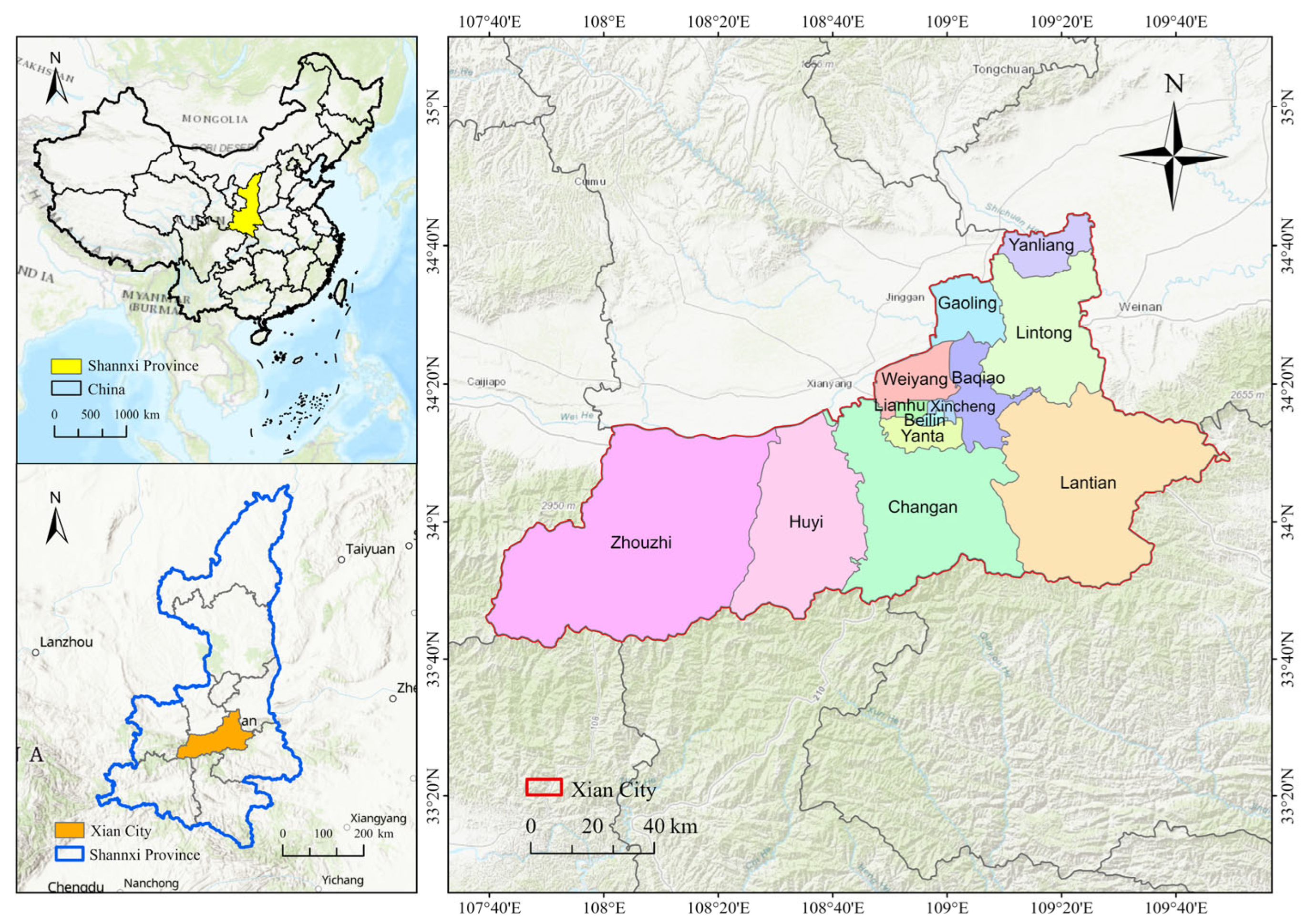
Xi’an is situated in the central part of the Weihe River basin, spanning 33°42′–34°45′ N and 107°40′–109°49′ E, with a total area of approximately 10,108 km2 (see Figure 1).
The stepped topography, bounded by the Qinling Mountains to the south and the Weihe River to the north, has shaped a binary spatial configuration consisting of a southern ecological barrier and a northern plain development zone. The city currently governs 11 districts and 2 counties. In 2023, its GDP reached RMB 1.2 trillion, with a permanent population of 13.16 million. Since its designation as a National Central City in 2018, Xi’an has experienced accelerated administrative expansion, which has revealed significant resource mismatches and functional imbalances.
Between 2018 and 2023, the high-density megacity of Xi’an underwent rapid socioeconomic development. Simultaneously, the system faced rigorous ‘stress tests’ from multi-source risks, including public-health emergencies, extreme meteorological disasters, and infrastructure-related disturbances. The sharp differentiation between infrastructure saturation in the urban core and emergency response deficiencies in peri-urban districts and counties under these shocks has created a distinct evolutionary trajectory. This interplay of “high-intensity agglomeration” and “multi-dimensional shocks” provides a highly valuable empirical arena for identifying the sensitivity characteristics and spatial evolution patterns of resilience systems at the district and county scale.

3.2. Indicator System Construction and Optimization

3.2.1. Indicator System Construction

Based on authoritative frameworks (e.g., UNISDR and ARUP) and previous research [35], this study develops a candidate indicator pool structured around four systemic dimensions: economy, society, ecology, and health [36]. This evaluative reservoir is specifically engineered to align with the unique characteristics of inland high-density megacities while simultaneously integrating the distinct policy context and governance imperatives of Xi’an as a National Central City and a strategic nexus of the “Belt and Road” Initiative.
Within the economic domain, resilience is characterized by industrial structural diversity, fiscal self-sufficiency, post-disaster employment restoration, and consumer market recovery. Specifically, the Herfindahl–Hirschman Index (HHI) for industrial structure and the proportion of fiscal revenue are employed to characterize the system’s risk diversification capacity and institutional regulatory potential under external market fluctuations. Furthermore, the indicator of “new employment per 1000 people” is selected to evaluate the livelihood restoration elasticity of the system following shocks.
The construction logic of the society system emphasizes the precision accessibility of emergency resources and the buffering role of informal networks. By introducing isochrone analysis of fire departments and emergency shelters, this study measures the spatial distribution efficiency of security resources. Concurrently, the number of legal entities in social organizations is utilized to quantify the mobilization and self-rescue capabilities of the grassroots governance system during crises.
The ecological system focuses on the natural endowment of Xi’an—characterized by its proximity to the Qinling Mountains in the south and the Wei River in the north—while addressing the spatial erosion resulting from rapid urbanization. Indicators such as the rate of change in vegetation coverage and the Shannon Diversity Index, which reflects landscape disturbance resistance, are selected to dynamically monitor the self-regulation and restoration thresholds of the ecological base under long-term risks.
The health system accounts for the protection demands of an aging society and existing bottlenecks in public health emergencies, establishing evaluation dimensions that span from grassroots medical penetration to specialized care for vulnerable groups. Through indicators such as medical institution accessibility and the number of nursing home beds per 1000 people, the system not only calibrates the medical support capacity of megacities under public health risks but also encapsulates the features of institutionalized resilience, moving from proactive prevention to long-term security. Based on the aforementioned mechanistic analysis, this study initially establishes a candidate indicator system comprising 40 factors (see Table A1 in Appendix A).

3.2.2. Optimization of the Indicator System

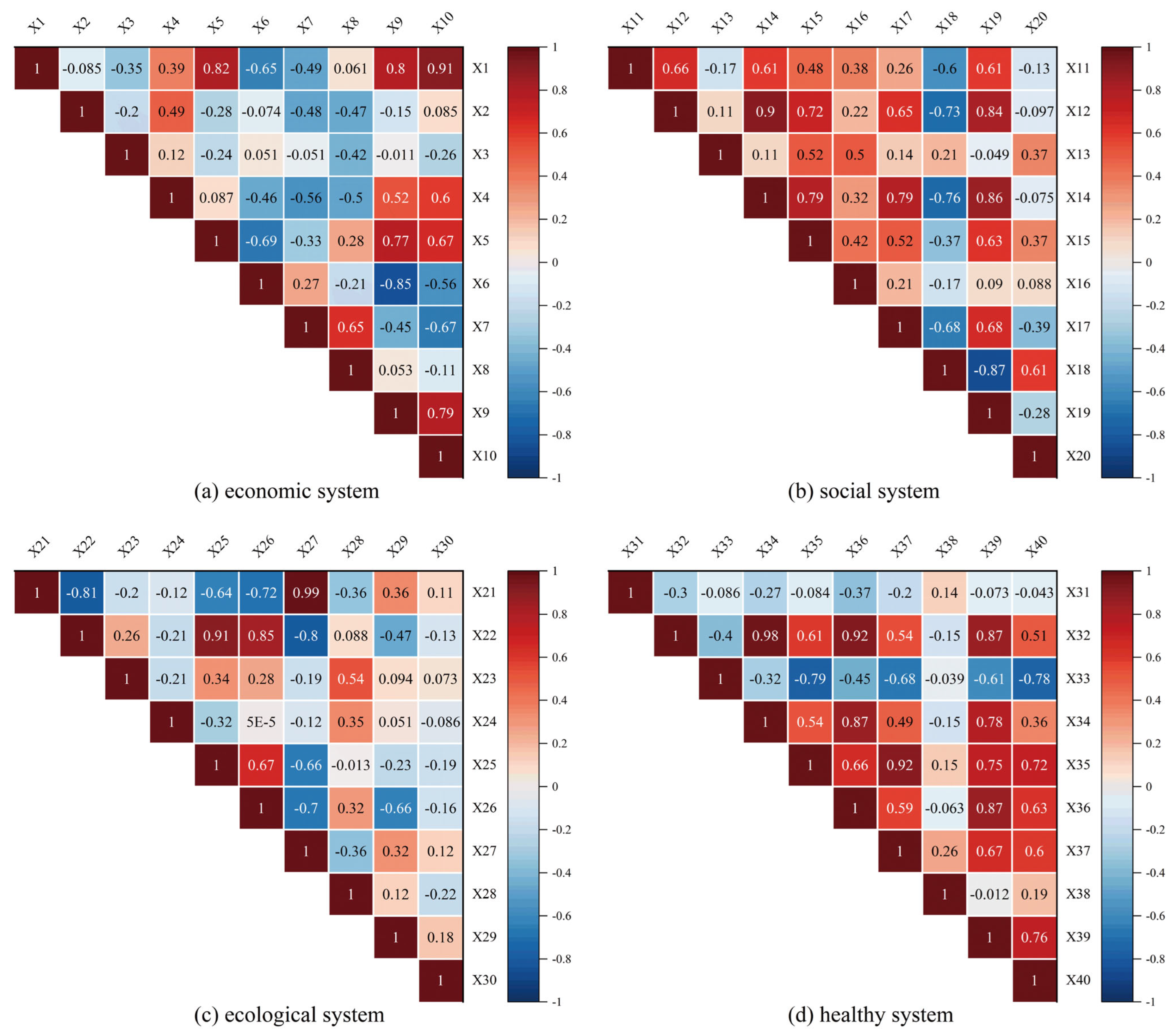
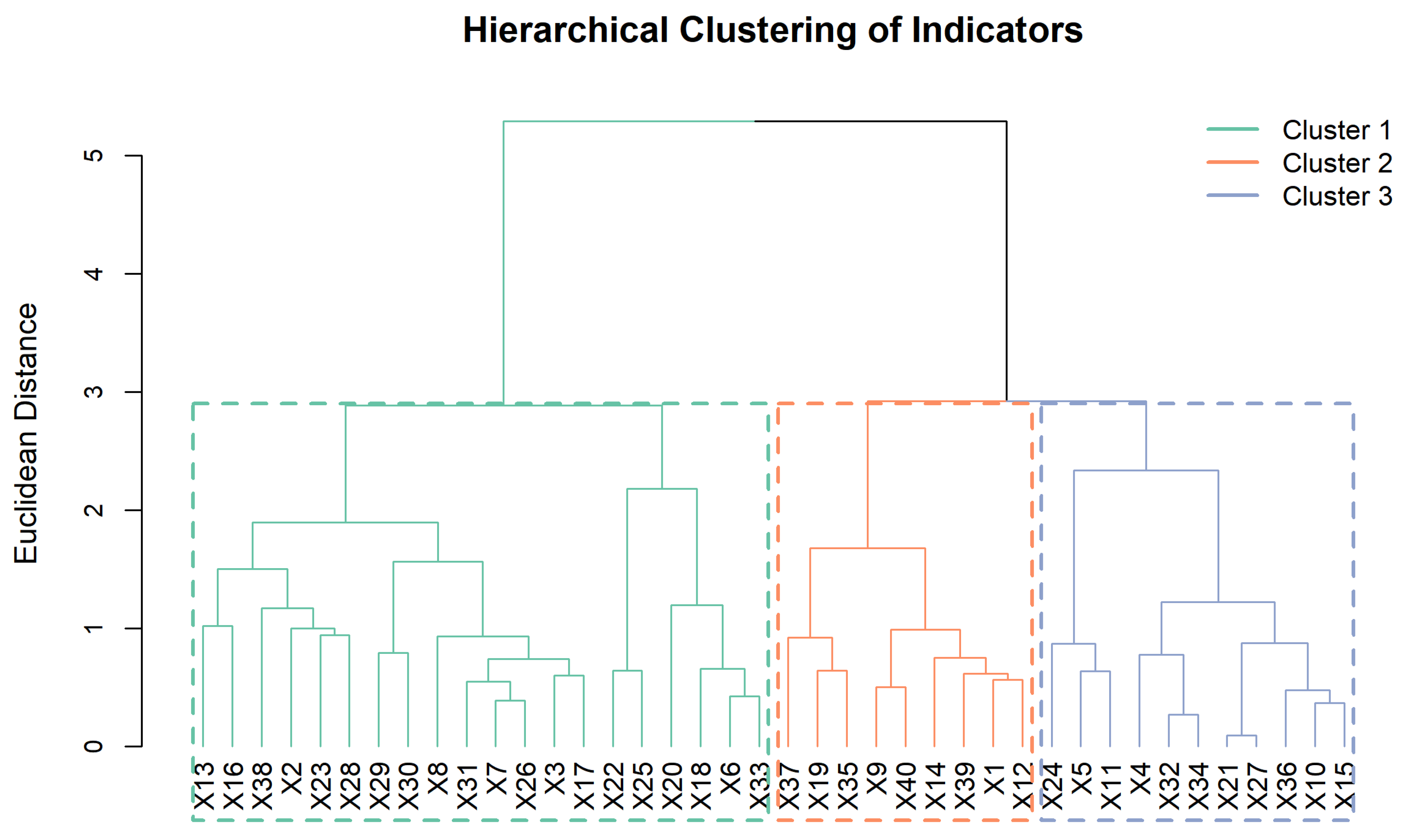
The scientific validity and interpretability of resilience assessment depend fundamentally on the rigor of the underlying indicator system. To ensure discriminatory power and mitigate informational overlap induced by redundancy, a structured statistical refinement pipeline was implemented on the initial pool of 40 candidate indicators. Utilizing standardized data, the standard deviation (SD) and coefficient of Variation (CV) were calculated to examine the capacity of each factor to capture heterogeneous disparities across districts (see Appendix A, Table A2). With SD values predominantly within the 0.270–0.428 range and CV values spanning 0.516–1.616, the results confirm that the selected parameters possess significant sensitivity to the dynamic evolution of resilience in the study area. Following the sensitivity test, Pearson’s correlation coefficients were calculated; variables with r > 0.9 were identified as redundant [37] (see Appendix A, Figure A1). Highly correlated variables were further clustered via dendrogram analysis [38] (see Appendix A, Figure A2), while the information entropy method was introduced as the optimal retention criterion to ensure that only indicators with the highest information load and superior representativeness were retained from redundant groups (see Appendix A, Table A3). The efficacy of this refinement was verified through the redundancy degree (RD) index, which remained consistently below 0.5 across all sub-systems post-exclusion [39] (see Appendix A, Table A4). This transformation from a theoretical candidate pool to a refined sensing grid ensures that the finalized 37 indicators maintain systemic structural integrity and statistical robustness, establishing a high-quality data foundation for subsequent non-linear mechanism deconstruction (the final optimized indicator system is detailed in Table 2).

3.3. Data Sources and Processing

This study constructed a multi-source panel database covering 13 districts and counties in Xi’an from 2018 to 2023. Socioeconomic statistical indicators were primarily extracted from the Xi’an Statistical Yearbook, the Statistical Bulletins of National Economic and Social Development of various districts and counties, and relevant environmental status bulletins. Ecological evolution data were integrated from long-term MODIS NDVI and NPP imagery via the NASA Earthdata platform, as well as the China Land Cover Dataset (Wuhan University, Wuhan, China) with a 30 m spatial resolution. Spatial functional parameters were derived from points of interest (POIs) and road networks. The POIs (medical, fire, shelter, and cooling facilities) were obtained via the Gaode Maps API (AutoNavi, Beijing, China), while the vector road networks were provided by OpenStreetMap (OSM Foundation, Cambridge, UK). Detailed data sources are provided in Table A5 of Appendix A.
During the data-processing stage, sporadic missing values were supplemented using linear interpolation, and all indicators underwent min–max normalization (range standardization) to eliminate dimensional differences. For the advanced processing of statistical data, the Herfindahl–Hirschman Index (HHI) and annual growth rates were selected as representative indicators of industrial structure stability and labor market elasticity. Regarding remote sensing and landscape pattern analysis, Fragstats version 4.3 (developed by Eduard Ene and Kevin McGarigal) was employed to extract landscape metrics, including the green space proportion and connectivity, which were combined with interannual variation parameters to measure the dynamic restoration efficiency of the ecosystem. The calculation of spatial functional dimensions involved constructing a refined network model based on the topological repair of the OSM road network. Speed impedance was assigned according to the Code for Design of Urban Road Engineering. This ensured that the baseline road network capacities across different districts were comparable and accurate. Service area modeling in ArcGIS Pro version 3.4.3 (Esri, Redlands, CA, USA) was used to set multi-level travel time thresholds (4, 8, 12, 15, and 30 min) for various facilities. This approach transformed discrete facility locations into quantifiable spatial service capacities. The integration and processing logic of these multi-dimensional datasets provide an empirical foundation for deconstructing resilience differentiation patterns at the district and county scale. Detailed calculation formulas for specific indicators, and network analysis parameter settings are provided in Table A6 of Appendix A.

3.4. Research Methods

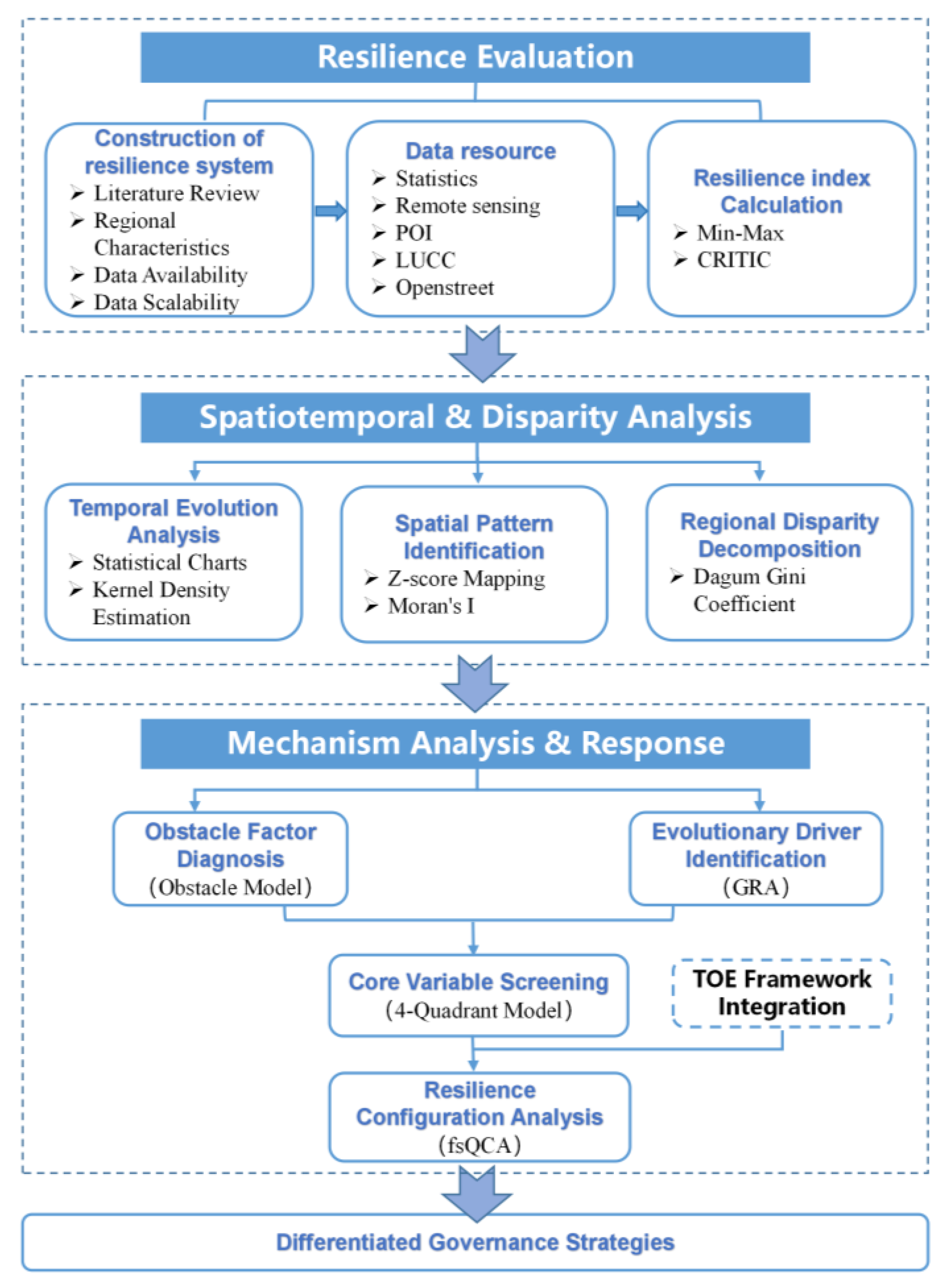
To systematically present the technical implementation logic of this study, the overall research design follows a progressive paradigm: “Theoretical framework construction-Spatio-temporal characteristic measurement-Influence mechanism diagnosis-Governance path response” (as shown in Figure 2). Based on this framework, the following sections provide a detailed elaboration of the core research methods involved.

3.4.1. CRITIC Weighting Method

This study employs the CRITIC method [60]—an objective weighting technique that integrates data variability and inter-indicator correlations—to calculate composite resilience indices for each district. Compared to EWM, AHP, and PCA, this method provides a more robust protocol: it captures the synergistic relationships often ignored by EWM, avoids the a priori bias of AHP [28], and maintains the physical interpretability frequently compromised by PCA. By ensuring both objectivity and semantic clarity, this approach effectively identifies and eliminates redundant information, thereby enhancing the overall precision of the assessment.
The specific calculation formulas are as follows:
C j = σ j i = 1 n ( 1 r i j )
W j = C j j = 1 m C j
R = W j y i j
where C j represents the information content of indicator j ; σ j is the standard deviation; r i j is the correlation coefficient between indicators i and j ; W j denotes the weight of indicator j ; n is the number of indicators; and R i represents the resilience index of the evaluation object i .
To ensure the robustness of the assessment, we implemented a methodological cross-test [61]. The entropy weight method (EWM) was introduced as a benchmark to verify rank stability. The results show that the resilience scores from both methods achieved a Spearman’s correlation coefficient of 0.941 p < 0.001 . This high degree of convergence in both evaluative rankings and evolutionary trajectories (detailed in Appendix A, Table A7) quantitatively substantiates the superior endogenous robustness of the indicator framework, confirming that the assessment findings are not stochastic artifacts dictated by specific algorithmic logic.

3.4.2. Kernel Density Estimation

Kernel density estimation (KDE) is employed to analyze the temporal evolution characteristics of urban resilience across the districts and counties of Xi’an [62].
f ( y ) = 1 n h i = 1 n K y y i h

3.4.3. Spatial Autocorrelation Analysis

Everything in geographic space is interrelated, and this correlation varies with distance. Spatial autocorrelation analysis is a widely used method for investigating the spatiotemporal evolution of geographical attributes. In this study, spatial autocorrelation analysis is employed to identify the spatial clustering characteristics of urban resilience across the districts and counties of Xi’an [63].
M o r a n s   I = n i = 1 n j = 1 n w i j ( x i x ¯ ) ( x j x ¯ ) ( i = 1 n j = 1 n w i j ) i = 1 n ( x i x ¯ ) 2
L o c a l   M o r a n s   I = n ( x i x ¯ ) i = 1 n ( x i x ¯ ) 2 j = 1 , j i n w i j ( x j x ¯ )

3.4.4. Dagum Gini Coefficient

The Dagum Gini coefficient was applied to decompose the spatiotemporal regional disparities of resilience levels. By categorizing Xi’an into core, near-suburban, and far-suburban areas, we identified distribution gaps and the sources of imbalance [64]. The application of the Dagum Gini coefficient allows for an in-depth analysis of the distribution disparities and the sources of UR levels across different regions, facilitating the identification of developmental imbalances. The Dagum Gini coefficient is defined as follows:
G = j = 1 k h = 1 k i = 1 n j r = 1 n h | c t j i c t h r | 2 n 2 μ
where ct ji ( ct hr ) represents the urban resilience level of district i ( r ) within region j ( h ) , μ is the average UR level of all districts, k is the number of regional groups, and n j n h denotes the number of districts within region j ( h ) . The total Gini coefficient can be decomposed into three components: the contribution of intra-group inequality ( G W ) , the contribution of net inter-group inequality ( G nb ) , and the contribution of transvariation ( G nb ) , such that G = G w + G nb + G t .
G w = j = 1 k G j j p j s j
G n b = j = 2 k h = 1 j 1 G j h ( p j s h + p h s j ) D j h
G t = j = 2 k h = 1 j 1 G j h ( p j s h + p h s j ) ( 1 D j h )

3.4.5. Obstacle Degree Model

The obstacle degree model is widely utilized in spatial analysis, urban planning, and environmental protection to identify spatiotemporal obstacle factors constraining the improvement in urban resilience [18]. By incorporating the obstacle degree ( Y j ), factor contribution degree ( F j ), and indicator deviation degree ( V j ), this model diagnoses the impact of specific indicators to provide a reference for enhancing resilience at the district and county level. The calculation formulas are as follows:
V j = 1 E j
F j = W j
y j = V j × F j j = 1 n ( V j × F j ) × 100 %
where E j represents the standardized value of the j -th indicator; V j is the indicator deviation degree; W j denotes the weight of the j -th indicator (i.e., the factor contribution degree, F j ); and y j represents the obstacle degree of a single indicator.

3.4.6. Grey Relational Analysis

Grey relational analysis (GRA) is an effective method for quantitatively evaluating the strength of associations between various factors by comparing the geometric similarities of sequence curves [65]. This study employs GRA to quantify the correlation intensity between each evaluation indicator and the overall urban resilience level of Xi’an’s districts and counties.
(1) Dimensionless processing of sequences:
Y ( k ) = Y ( k ) Y ¯ , X i ( k ) = X i ( k ) X ¯ i
(2) Calculation of the relational coefficient:
ξ i ( k ) = min i   min k   Δ i ( k ) + ρ   max i   max k   Δ i ( k ) Δ i ( k ) + ρ   max i   max k   Δ i ( k )
(3) Calculation of the relational grade:
S i = 1 n k = 1 n ξ i ( k )
where S i represents the grey relational grade; ξ i ( k ) is the relational coefficient; Δ i ( k ) is the absolute difference between the reference sequence and the comparison sequence; and ρ denotes the resolution coefficient, which is typically set to 0.5. A higher value of S i indicates a more significant influence of the indicator on the urban resilience of the districts and counties in Xi’an

3.4.7. Fuzzy-Set Qualitative Comparative Analysis (fsQCA)

Urban resilience is a synergistic outcome of technology, organization, and environment, exhibiting complex non-linear causal characteristics. Given the over-fitting risks of machine learning on a limited sample (N = 13), this study adopts set-theoretic fsQCA [66] using fsQCA software version 4.1 (University of California, Irvine, CA, USA). This method ensures robustness for small datasets and identifies equifinal pathways, providing explicit “governance recipes” for decision-making. The specific procedures are as follows:
(1)
Data calibration: The direct calibration method is employed, selecting the 95th, 50th, and 5th percentiles of each variable as qualitative anchors for “full membership,” the “crossover point,” and “full non-membership,” respectively. This process transforms raw data into fuzzy membership scores ranging from 0 to 1.
(2)
Necessity analysis: the consistency index is utilized to verify whether a single antecedent condition is a necessary prerequisite for the occurrence of the outcome, with the threshold typically set at 0.90.
(3)
Sufficiency analysis: A truth table is constructed and subjected to logical minimization. By comparing complex, parsimonious, and intermediate solutions, various configurational paths driving the generation of high resilience are identified.
(4)
Robustness Check: The stability of the configurational results is verified by adjusting the consistency thresholds or recalibrating the qualitative anchors. This process validates the findings under different parameter settings to ensure the reliability and robustness of the conclusions.

4. Results

4.1. Spatiotemporal Differentiation and Regional Disparities in District-Level Urban Resilience

4.1.1. Analysis of the Temporal Evolution of District-Level Urban Resilience

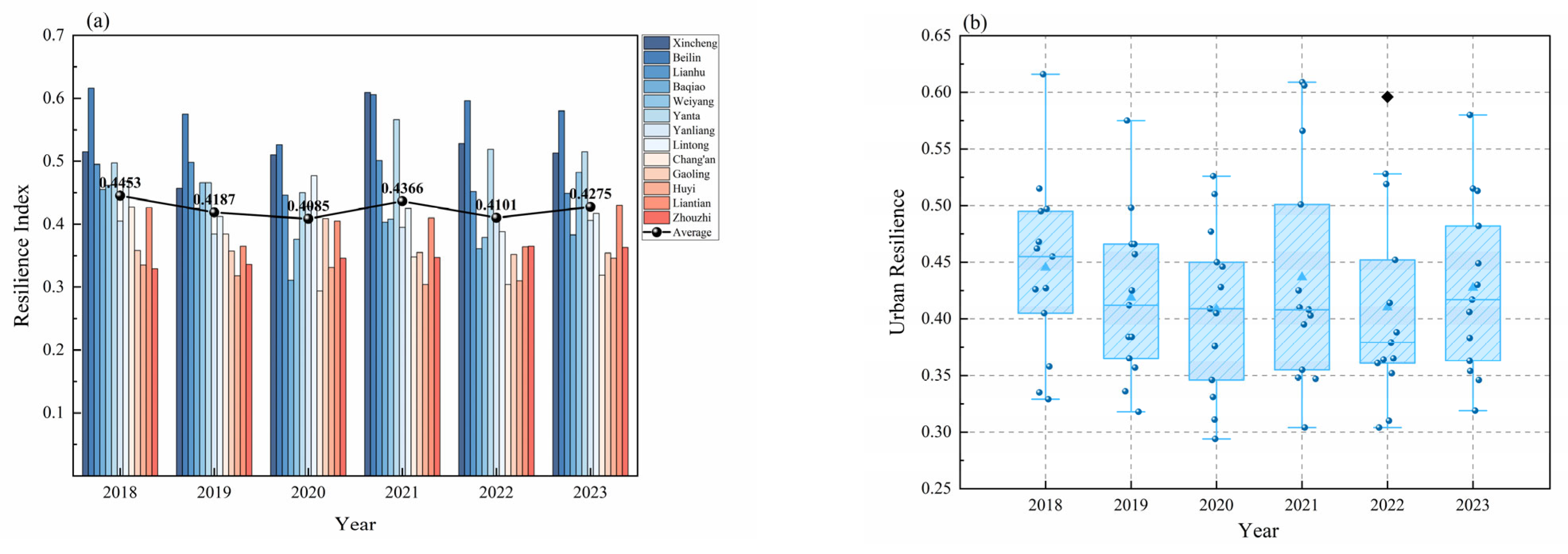
This study calculated the urban resilience index of 13 districts and counties in Xi’an from 2018 to 2023 based on the CRITIC weighting method. The results show that the resilience of each district exhibits a clear tiered hierarchy and significant temporal disparities. Macro-evolutionary trends indicate that urban resilience in Xi’an followed a “V-shaped rebound followed by high-level plateau oscillations.” This pattern is characterized by three stages: fluctuating bottoming out, strong rebound, and differentiated restoration. Impacted by external shocks, the city-wide average resilience bottomed out in 2020 (0.409), reflecting a profound stress test of the urban system by external pressures. Subsequently, under the influence of policy interventions and restoration mechanisms, a robust rebound was achieved in 2021 (with the mean rising to 0.437, representing a recovery magnitude of 6.8%), and the system gradually entered a structural adaptation stage from 2022 to 2023. By 2023, Weiyang and Lantian set new six-year highs, indicating that resilience restoration was shifting from passive response to structural adaptation. In terms of distribution structure, temporal evolution shows a trend of “convergence of extreme values and differentiation of the middle layer.” The overall resilience baseline rose, slightly narrowing the gap between extreme values. However, the city-wide coefficient of variation (CV) escalated from 0.173 in 2019 to 0.233 in 2021. This indicates that internal differentiation among middle-layer districts intensified significantly during this period. In particular, Beilin, as a high-level outlier, not only highlights the strong systemic robustness of the core urban area but also reinforces the time lag existing in the resilience evolution of different regions.
Based on the non-synchronicity of temporal evolution, the resilience paths of each district and county can be summarized into four typical modes: first, the “beyond-recovery type” (Weiyang, Lantian), which experienced a strong rebound after a “deep squat,” with their 2023 levels (0.482 and 0.430, respectively) significantly surpassing the initial baseline; second, the “high-level equilibrium type” (Beilin, Xincheng), whose resilience index has been consistently maintained at a high level above 0.5 (mean 0.547), which has maintained a leading position for a long time but with slowing growth momentum and a trajectory of high-level fluctuations; third, the “low-level steady-state type” (Zhouzhi, Huyi), which maintained a defensive slow rise with low fluctuations during the observation period (with the mean oscillating around 0.34); and fourth, the “impaired slow-release type” (Chang’an, Baqiao), which underwent a slow restoration process following a significant decline from the 0.42–0.45 level after the 2020 shock and had not returned to pre-shock levels by 2023, exhibiting a clear recovery lag effect (see Table 3 and Figure 3).
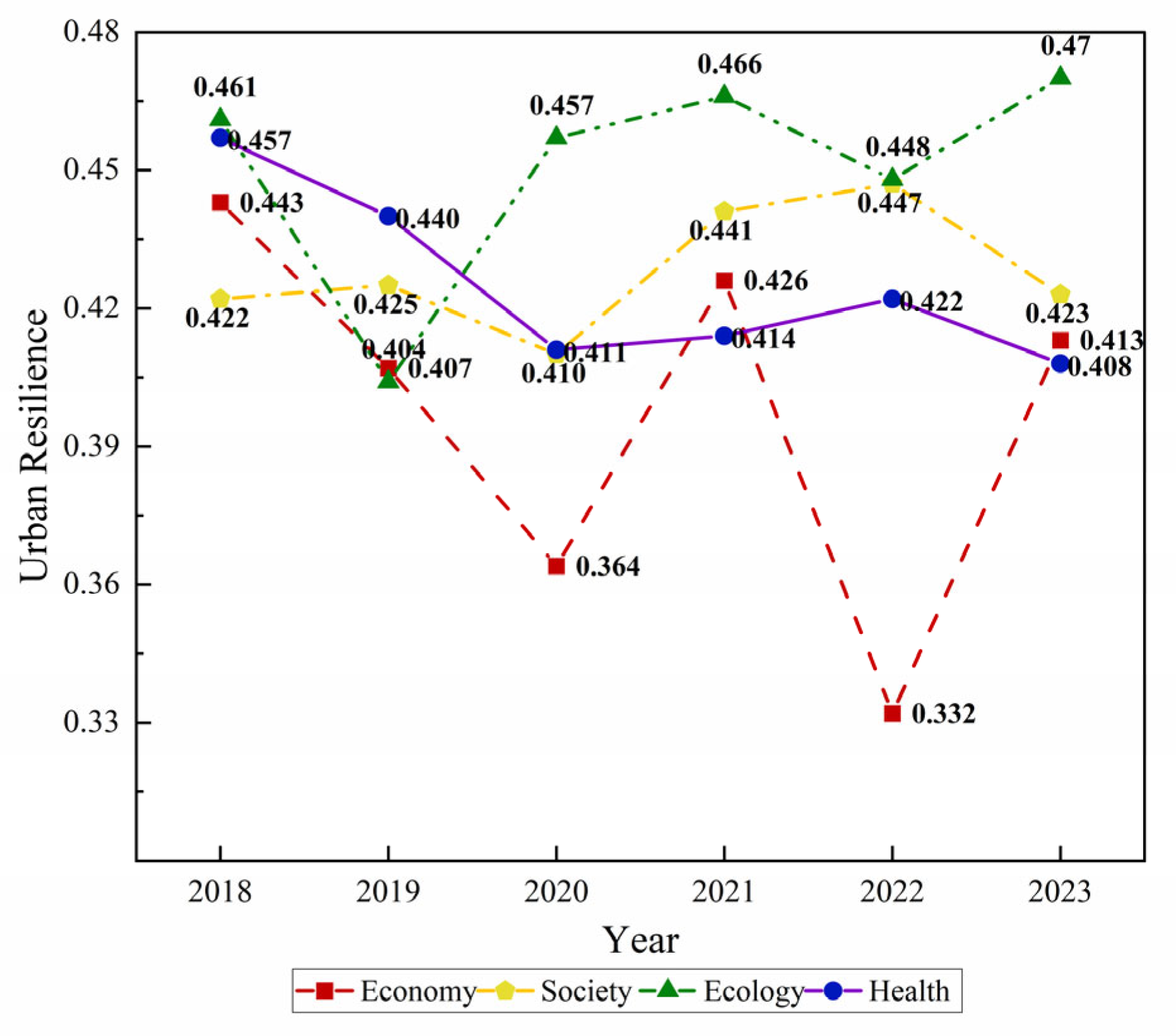
According to the dimensional variations in Figure 4, the economic system exhibited the most pronounced vulnerability; its index fell to 0.364 in 2020 and dropped again to 0.332 in 2022, failing to regain its initial baseline. During this period, spatial heterogeneity within the economic sector widened significantly, peaking at a CV of 0.266 in 2022, reflecting deep-seated issues in industrial structure and resource allocation elasticity. In contrast, ecological resilience maintained a superior level throughout the cycle, with 2021 and 2023 means of 0.466 and 0.470, respectively, demonstrating robust systemic stability. Similarly, the social system remained relatively steady, returning to 0.447 in 2022 with minimal fluctuation. This stability stems from Xi’an’s long-term accumulation in social security and community governance, where grid-based management played a decisive role in bolstering resilience. The health system, however, oscillated sharply, receding to 0.411 in 2020 and sliding further to 0.408 in 2023 despite a temporary 2021 uptick. Notably, spatial polarization within the health sector intensified, as the CV rose from 0.347 in 2018 to a peak of 0.393 in 2023. This confirms an unbalanced contraction of medical resources under sustained stress. These fluctuations mirror structural imbalances in asset distribution and fragile grassroots medical capacity, which hindered resilience stabilization during the phase of normalized pandemic prevention and control.
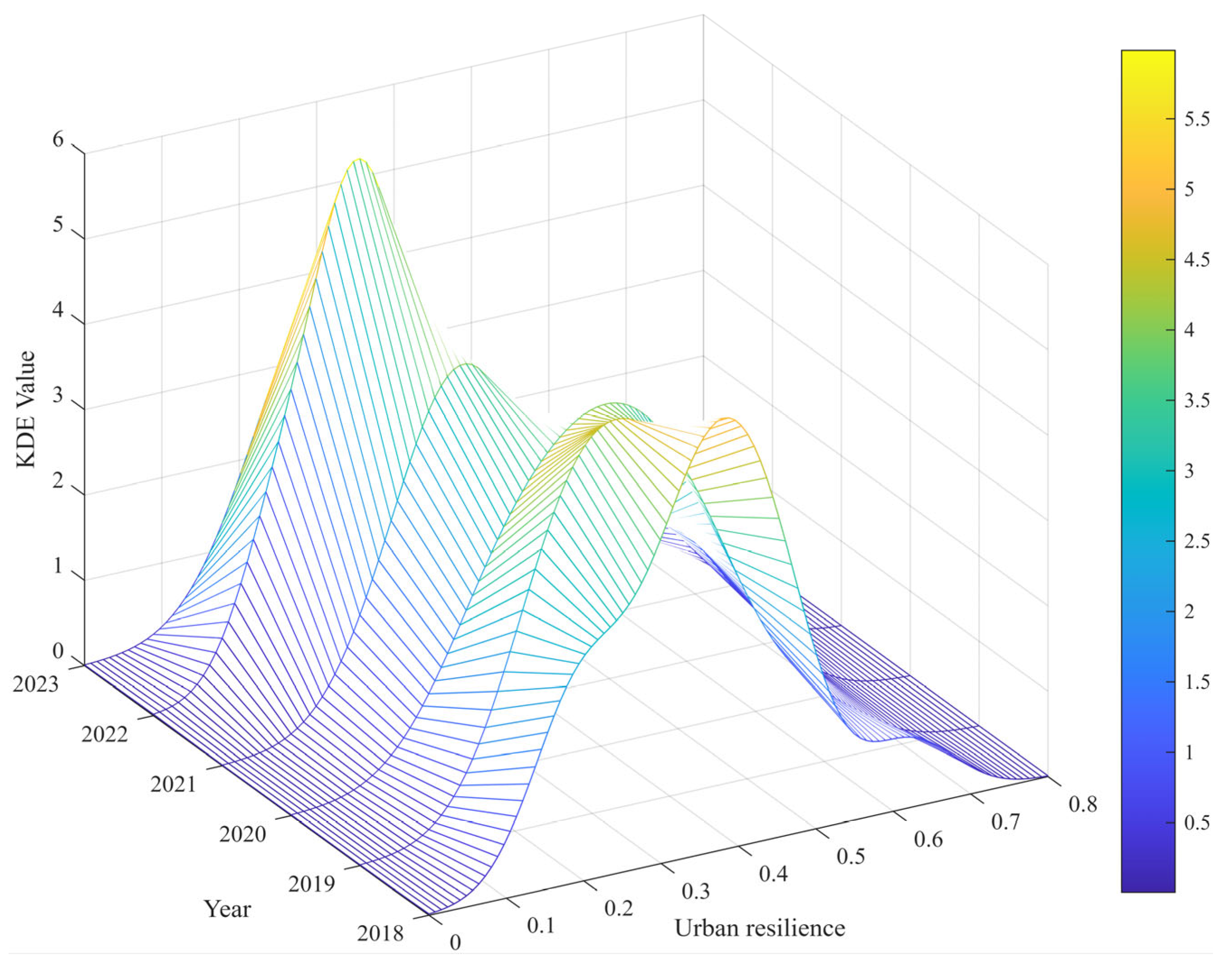
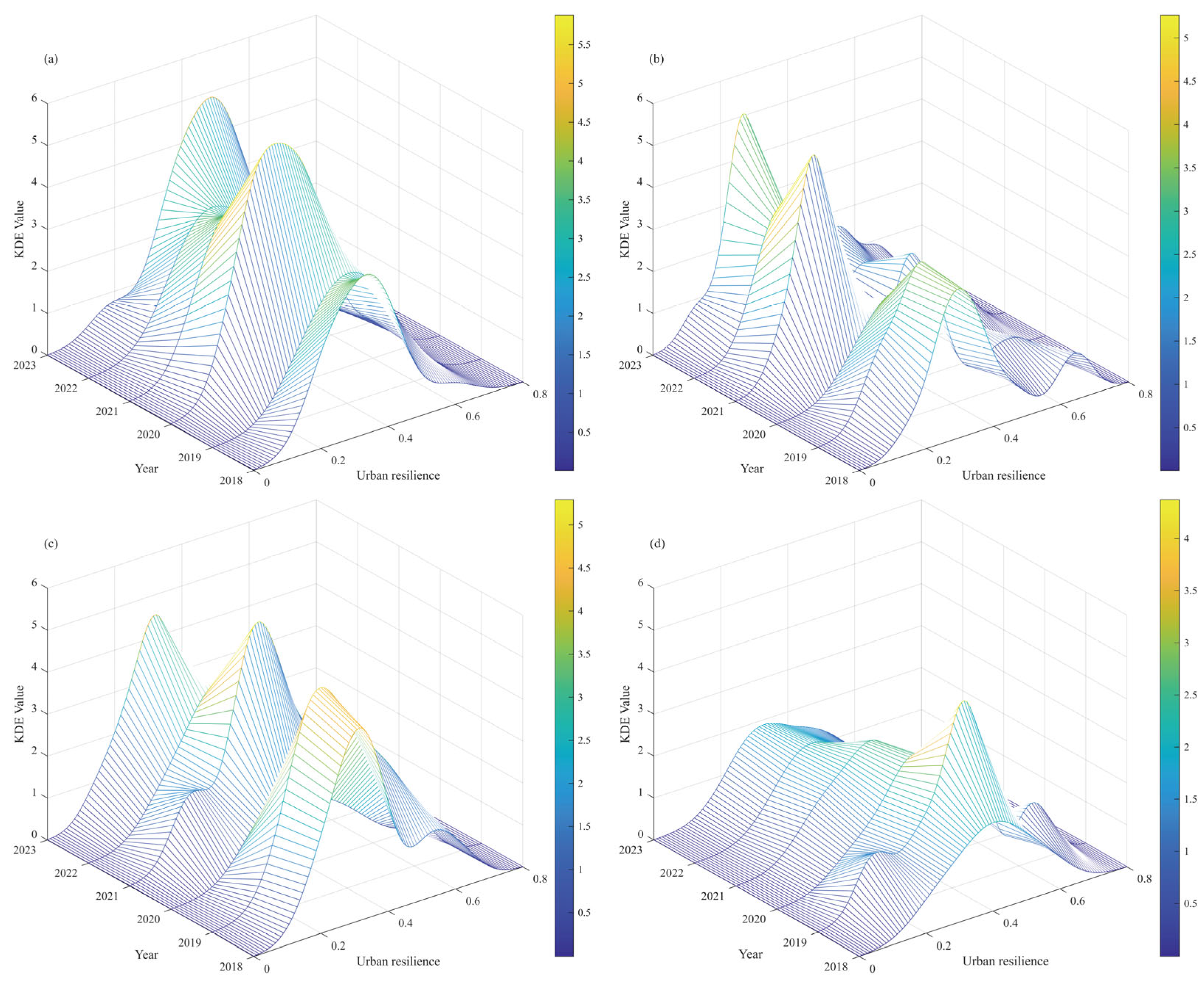
To clarify the temporal dynamics of district-level resilience, this study further employs kernel density estimation (KDE) to examine distribution shifts and analyze temporal trends. Overall, comprehensive resilience exhibits a transition from initial concentration to late-stage dispersion, progressively shifting toward higher resilience levels (see Figure 5). Between 2018 and 2021, resilience scores were primarily concentrated in the medium-low interval (0.1–0.4). In 2021, the distribution peaked at a density of approximately 5.5 within the 0.2–0.3 range. This distinct unimodal distribution reflects a balanced yet fragile foundation for resilience during the early observation period. Since 2022, the distribution’s center of gravity has exhibited a notable rightward shift toward the medium-high interval (0.4–0.6). The peak evolved into a bimodal structure at the 0.3–0.4 and 0.5–0.6 intervals. The broadening distribution curve indicates that inter-district disparities expanded despite universal resilience improvements. By 2023, a clustering tendency of samples emerged within the high-resilience interval near 0.6, indicating that district-level resilience is evolving from “unimodal concentration” toward “tiered polarization.” Although the coefficient of variation (CV) in 2023 (0.182) exhibited a slight convergence relative to its peak value, it remained elevated compared to the pre-shock baseline level.
Viewed through the lens of the four sub-systems, resilience scores between 2018 and 2021 were primarily concentrated in the lower 0.1–0.4 interval (see Figure 6). The economy system displayed a concentrated unimodal structure, where a low early-stage CV (0.211) reflected pervasive systemic weakness coupled with minimal regional disparities. In contrast, the social system exhibited a distinct bimodal trend—peaking at the 0.2–0.3 and 0.4–0.5 intervals—indicating that certain districts achieved superior outcomes in governance and organizational innovation. By 2022, the distribution centers of all four systems generally shifted rightward into the 0.4–0.6 range, signaling widespread improvement. During this stage, the economy and ecology systems recorded smaller gains, primarily populating the 0.3–0.4 interval; this indicates that the former remained hampered by unitary industrial structures, while the latter faced limited growth potential due to its inherent natural endowment. Conversely, the social and health systems manifested bimodal structures as inter-district disparities expanded, with specific districts achieving significant resilience leaps through decentralizing healthcare and advancing community governance. Data from 2023 further corroborated this non-synchronous restoration: the ecological system maintained a leading systemic magnitude (mean of 0.469), whereas the health system reached a peak level of heterogeneity (0.393), thereby exacerbating the structural imbalance of the city-wide resilience landscape.

4.1.2. Spatial Pattern Analysis of District-Level Urban Resilience

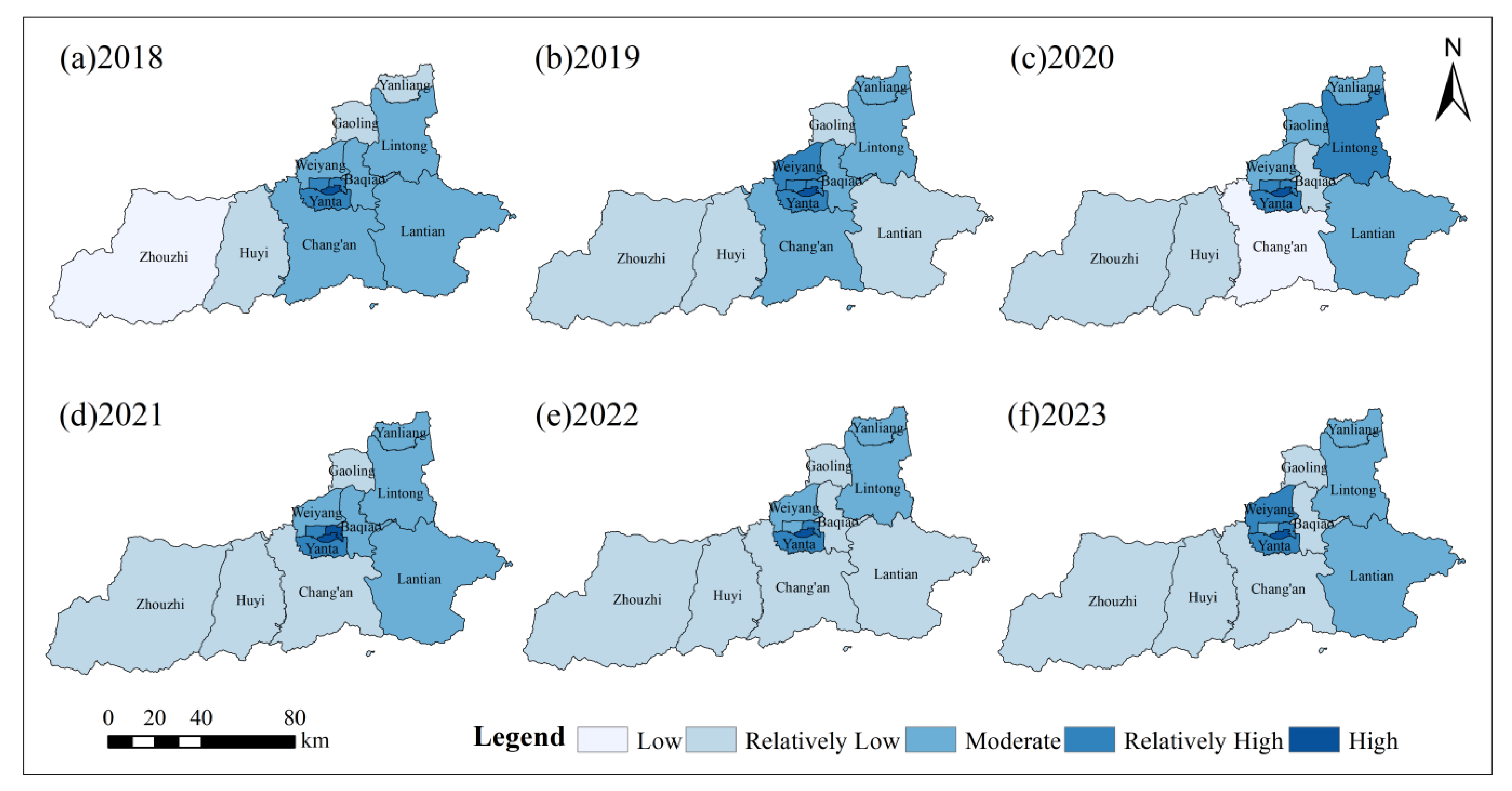
The evolution of urban resilience is reflected not only in temporal fluctuations but also in spatial patterns that manifest hierarchical gradients and regional disparities. Based on the resilience index, this study employs the Z-score standardization method to categorize resilience into five levels: high (Z > 1.5), relatively high (0.5 < Z ≤ 1.5), medium (−0.5 ≤ Z ≤ 0.5), relatively low (−1.5 ≤ Z < −0.5), and low (Z < −1.5). Hierarchical maps were generated to visualize the spatiotemporal trajectories across the study period [67].
From 2018 to 2023, the urban resilience of Xi’an exhibited a concentric gradient decreasing from the urban core toward the periphery. Quantitative analysis indicates that by 2023, the mean resilience of core districts (Xincheng, Beilin) stood at 0.547, approximately 1.51 times that of peripheral units such as Zhouzhi, Huyi, and Chang’an (mean = 0.362). Xincheng and Beilin exhibited high-level stability throughout the study period, particularly in 2021 and 2022, demonstrating robust adaptive and transformative capacities. The Lianhu and Yanta districts, situated in the inner-ring area, showed stable resilience fluctuating between “medium” and “high” levels, reflecting significant restorative potential. In contrast, transitional districts like Baqiao and Chang’an experienced notable declines. Specifically, Chang’an descended to the “low resilience” category in 2020, highlighting its vulnerability to acute external shocks. Finally, distal districts and counties, including Gaoling, Huyi, and Zhouzhi, remained consistently at low resilience levels, revealing persistent structural bottlenecks in their recovery processes (see Figure 7).
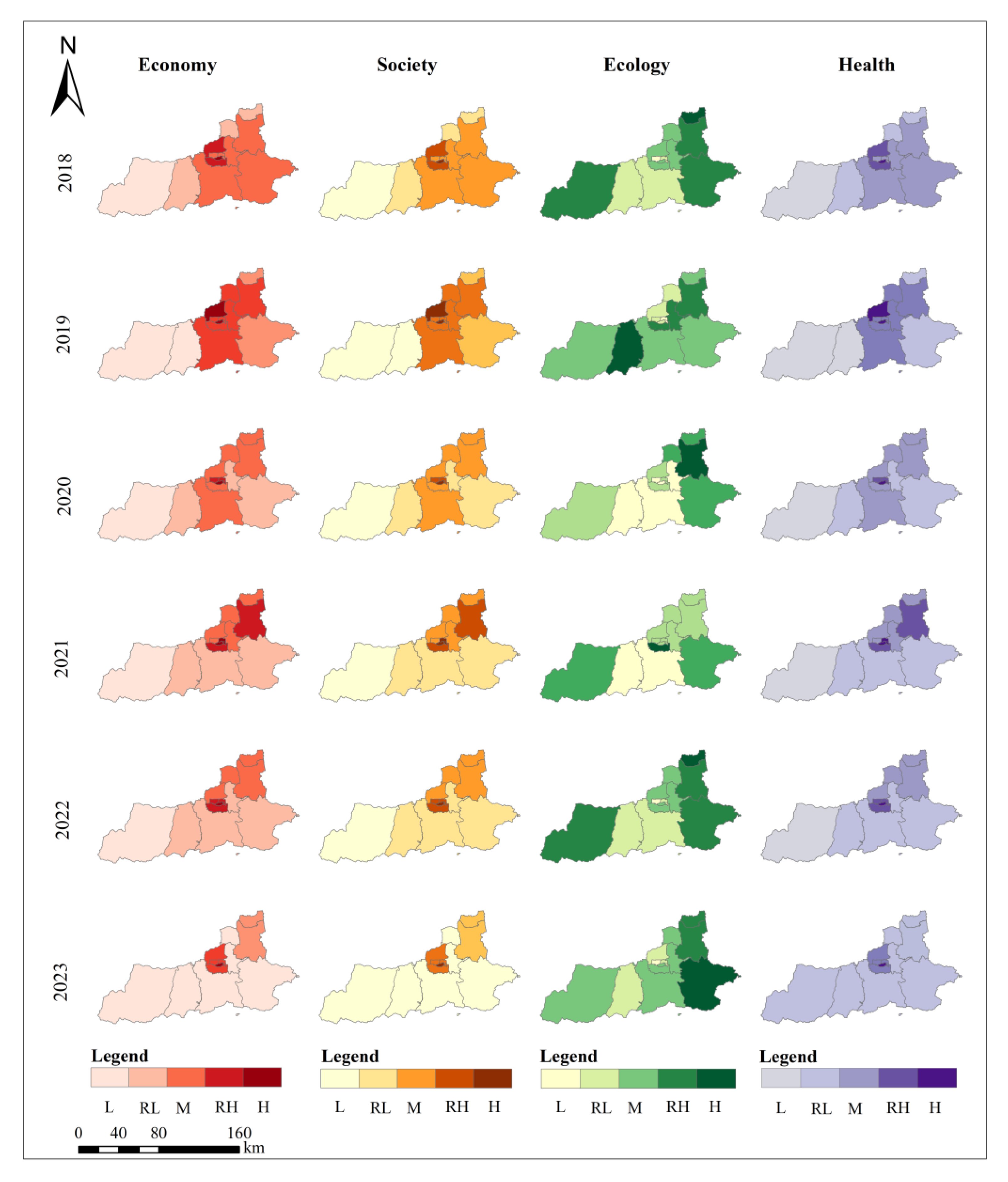
From a systemic perspective, core districts such as Xincheng and Beilin generally exhibit high and overlapping resilience levels, demonstrating robust systemic synergy (see Figure 8). In contrast, peripheral units including Lantian and Zhouzhi maintain high ecological resilience but remain at lower levels in the economic and healthy systems. Statistics from 2023 reveal that city-wide means for economic and health resilience were 0.413 and 0.408, respectively. Notably, the peripheral areas consistently fell below these thresholds. Their “single-system advantage” underscores their vulnerability during multi-system recovery. Eastern districts—such as Gaoling, Lintong, and Yanliang—exhibit significant cross-dimensional disparities. Their restorative capacities are uneven, as evidenced by acute fluctuations in economic and health indicators. Districts such as Huyi, Lantian, and Zhouzhi sustain low resilience scores across multiple systems, forming “multi-system low-value zones” within Xi’an’s spatial landscape. This identifies their structural vulnerability under multi-source shocks; for instance, during the pandemic, the combination of thin economic foundations and sparse medical resources hindered their ability to respond effectively to the crisis.
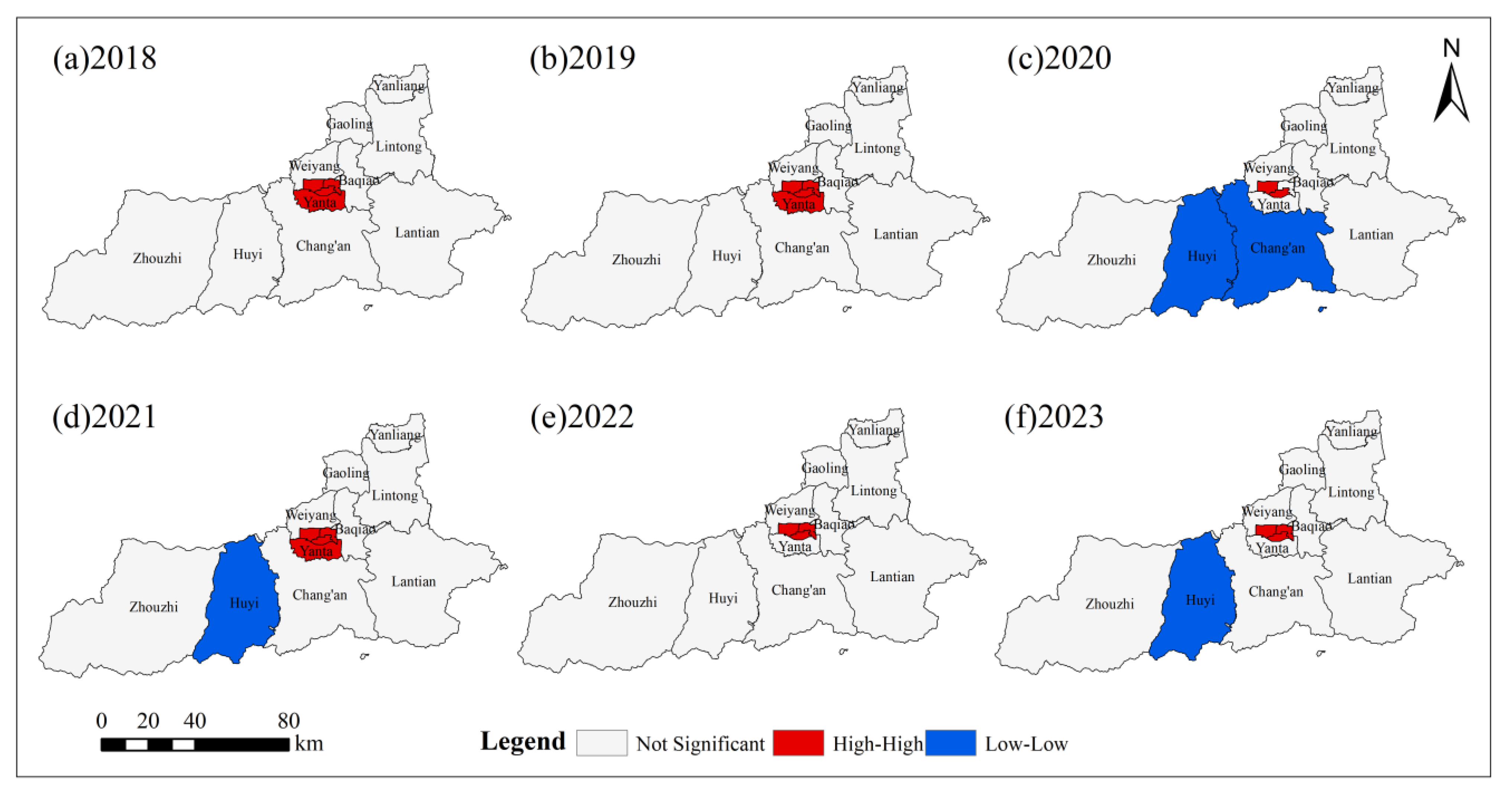
To gain a deeper understanding of the spatial distribution of district-level urban resilience, spatial autocorrelation analysis was applied to reveal the spatial dependence and clustering characteristics among districts. As shown in Table 4, the Global Moran’s I for Xi’an’s comprehensive resilience exhibited distinct temporal fluctuations, with positive Z-scores and p-values consistently below 0.05, indicating statistically significant positive spatial autocorrelation. From 2018 to 2019, the index remained relatively high (I = 0.548 in 2019), reflecting pronounced spatial clustering where districts with similar resilience levels (either high or low) tended to aggregate. In 2020, resilience levels fluctuated under the impact of the pandemic, causing Moran’s I to drop to 0.388, which signified a widening of regional disparities and a temporary weakening of spatial dependence. During 2021–2022, the index rebounded to 0.582 and 0.524, respectively, suggesting a resurgence of the spatial clustering trend. Although the index moderated to 0.425 in 2023, it remained relatively high, indicating that the overall spatial agglomeration of resilience persisted, supported by continuous policy interventions and resource allocation.
From a local perspective (see Figure 9), central urban areas such as the Beilin and Yanta districts have long exhibited a “High-High” (H-H) clustering pattern. This suggests that these core areas leverage significant advantages in industrial development, public service provision, and infrastructure to form robust resilience hubs, generating positive spatial spillover effects on neighboring districts. Specifically, Beilin’s resilience index (0.580) was 35.5% higher than the city-wide average (0.428) in 2023. Conversely, regions such as the Huyi and Chang’an districts were characterized by “Low-Low” (L-L) clustering in certain years, reflecting persistent structural constraints and development bottlenecks. In 2023, Huyi’s resilience (0.346) stood at only about 60% of Beilin’s; this marked gap underscores the center-polarized nature of Xi’an’s resilience landscape. These stage-specific clustering states provide a critical empirical basis for optimizing regional development strategies and promoting the balanced enhancement in urban resilience.

4.1.3. Analysis of Regional Disparities in District-Level Urban Resilience

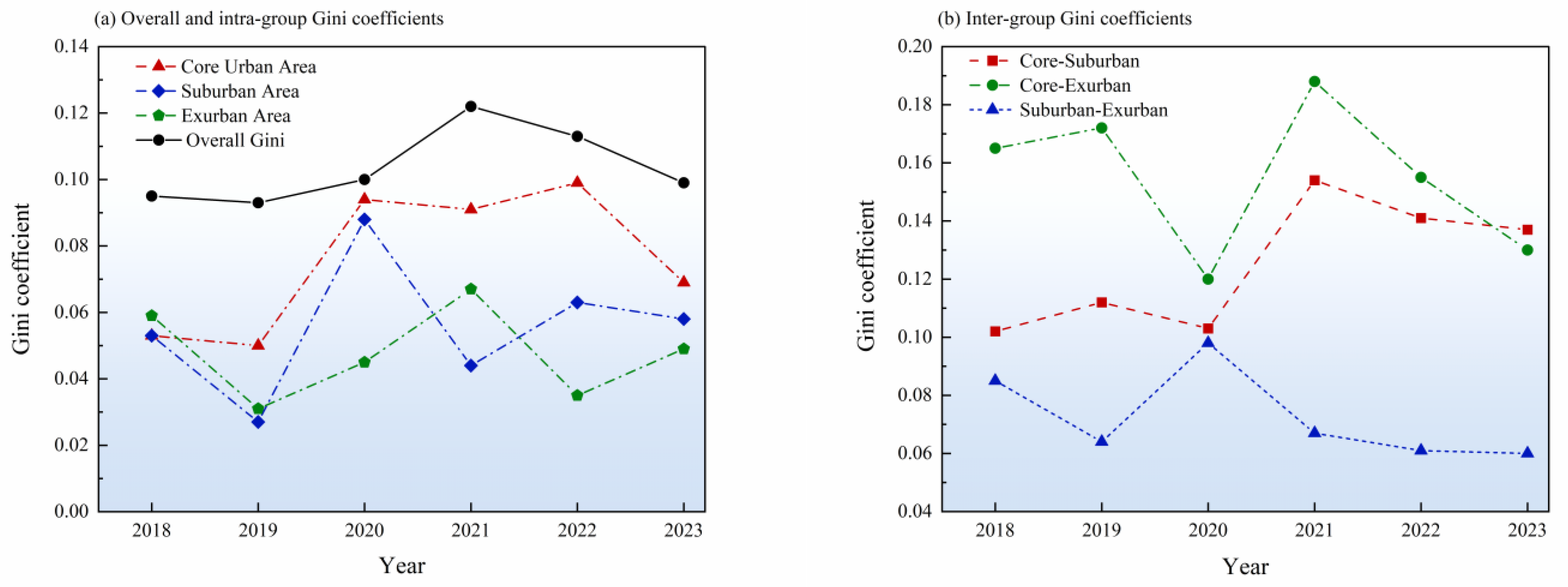
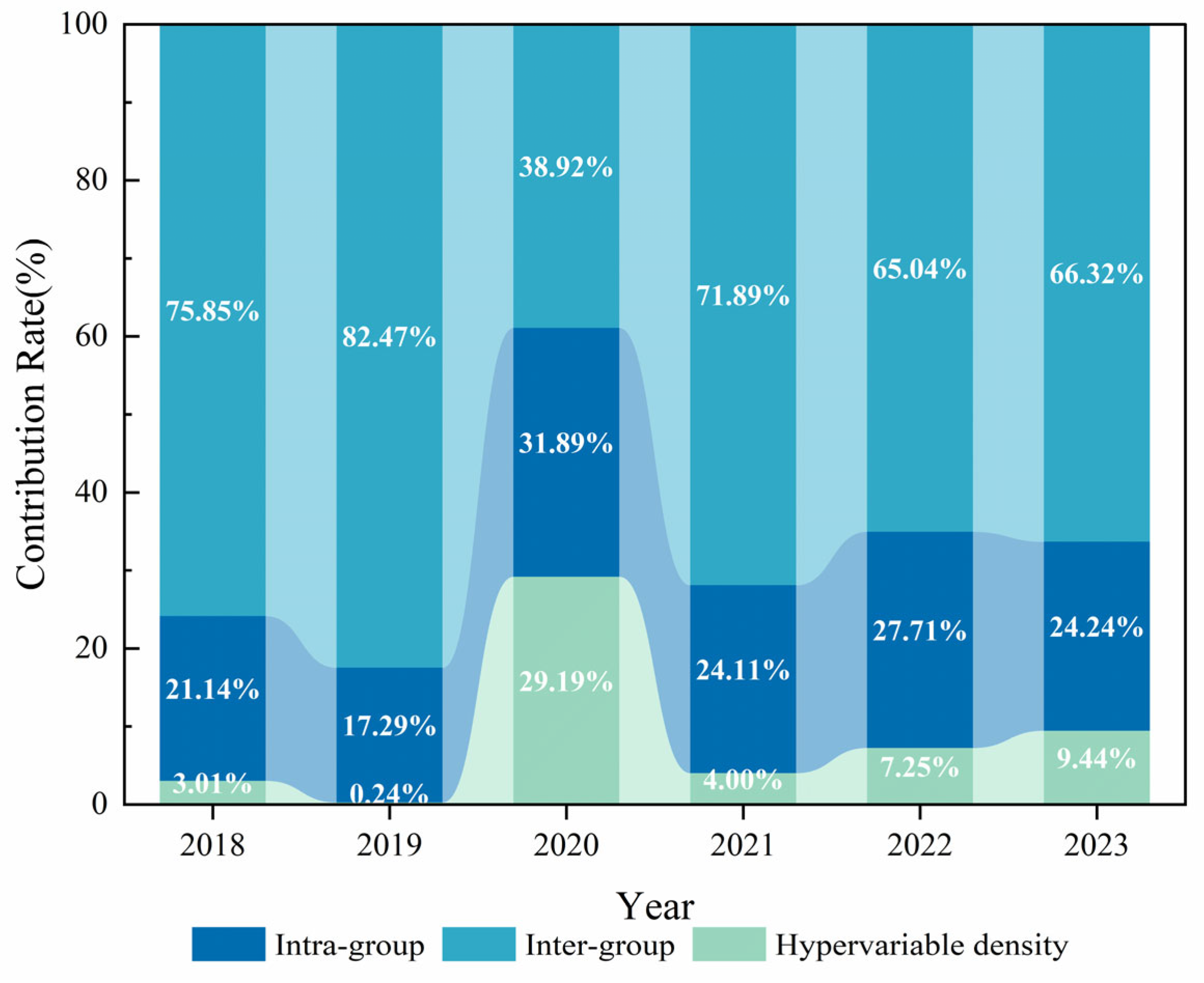
To characterize the spatial hierarchy and internal disparities of district-level urban resilience, the 13 districts and counties were categorized into three functional zones: core urban area, suburban area, and exurban area. The Dagum Gini coefficient method was employed to decompose these disparities from 2018 to 2023. Between 2018 and 2021, the resilience disparity exhibited a widening trend, with the Gini coefficient rising from 0.095 to 0.122 (see Table 5). Subsequently, this disparity gradually contracted, dropping to 0.099 by 2023—below the six-year average—reflecting that the post-pandemic recovery process effectively mitigated regional polarization (see Figure 10).
Decomposition analysis reveals that resilience disparities primarily stem from inter-group gaps (detailed data supporting this decomposition analysis are provided in Table A8 of Appendix B). Over the study period, the average contribution of inter-group differences reached 66.7%, significantly higher than intra-group differences (24.4%) and the intensity of transvariation (hypervariable density) (8.9%), confirming a stable gradient differentiation among the three zones. Further comparison shows that the gap between core urban and far-suburban areas was most pronounced, with the inter-group Gini coefficient peaking at 0.188 in 2021, highlighting substantial imbalances in resource endowment and recovery capacity. During the 2020 shock, the contribution of inter-group differences fell to 38.9%, while the intensity of transvariation surged to 29.2%, indicating that certain far-suburban districts exhibited unexpectedly robust resilience due to low population density and strong ecological buffering, leading to a temporary overlap in resilience performance across zones. As the shock subsided, the influence of transvariation receded to 9.4% by 2023, and the hierarchical disparity structure stabilized. Although internal differences within far-suburban areas have converged, their overall resilience remains constrained by infrastructure supply, and the gradient gaps between the urban core and the periphery persist (see Figure 11).

4.2. Analysis of Influencing Factors of District-Level Urban Resilience

4.2.1. Analysis of Indicator Obstacle Degree

Building upon the identified spatial dependence, this study conducts an obstacle degree analysis to identify specific factors constraining resilience enhancement across districts (see Table 6) The evolution of obstacle factors from 2018 to 2023 exhibits significant spatiotemporal coupling. Core urban areas (Xincheng, Beilin, Lianhu, and Yanta) displayed pronounced path dependence, with the proportion of green space (C24) consistently ranking as the primary constraint, maintaining high obstacle values of 7%–10%. Alongside fiscal expenditure (C6) and medical institution density (C30), these findings reflect that resilience in high-density built-up areas is long-term constrained by the ecological base and primary healthcare allocation under the dual pressures of spatial resource hard constraints and fiscal rigidity.
The 2020 external shock disrupted the regional evolutionary equilibrium, triggering a citywide convergence toward “public service and social mobilization” bottlenecks. Emerging development zones, such as Weiyang and Baqiao, were particularly representative; obstacle factors rapidly shifted from ecological indicators to social governance dimensions. The obstacle degrees for medical facilities (C30) and social organization legal entities (C18) surged, exposing systemic lags in emergency support and social mobilization within rapid population inflow areas under extreme stress tests.
By the 2023 restoration period, far-suburban districts (Lantian, Zhouzhi, Huyi, and Lintong) exhibited an evolutionary transition from economic self-sufficiency constraints to social security deficiencies. While these regions were primarily hindered by fiscal revenue (C2) and employment fluctuations (C17) in 2018, by 2023, the obstacle degrees for nursing home capacity (C35) and public health expenditure (C29) became prominently significant. This indicates that social welfare and healthcare investment in ecological functional zones, against the backdrop of an aging population, have emerged as core bottlenecks for resilience restoration. Consequently, Xi’an’s resilience construction is pivoting from early ecological and economic reinforcement toward a systematic improvement in structural risk response and comprehensive social governance efficacy.

4.2.2. Analysis of Indicator Correlation

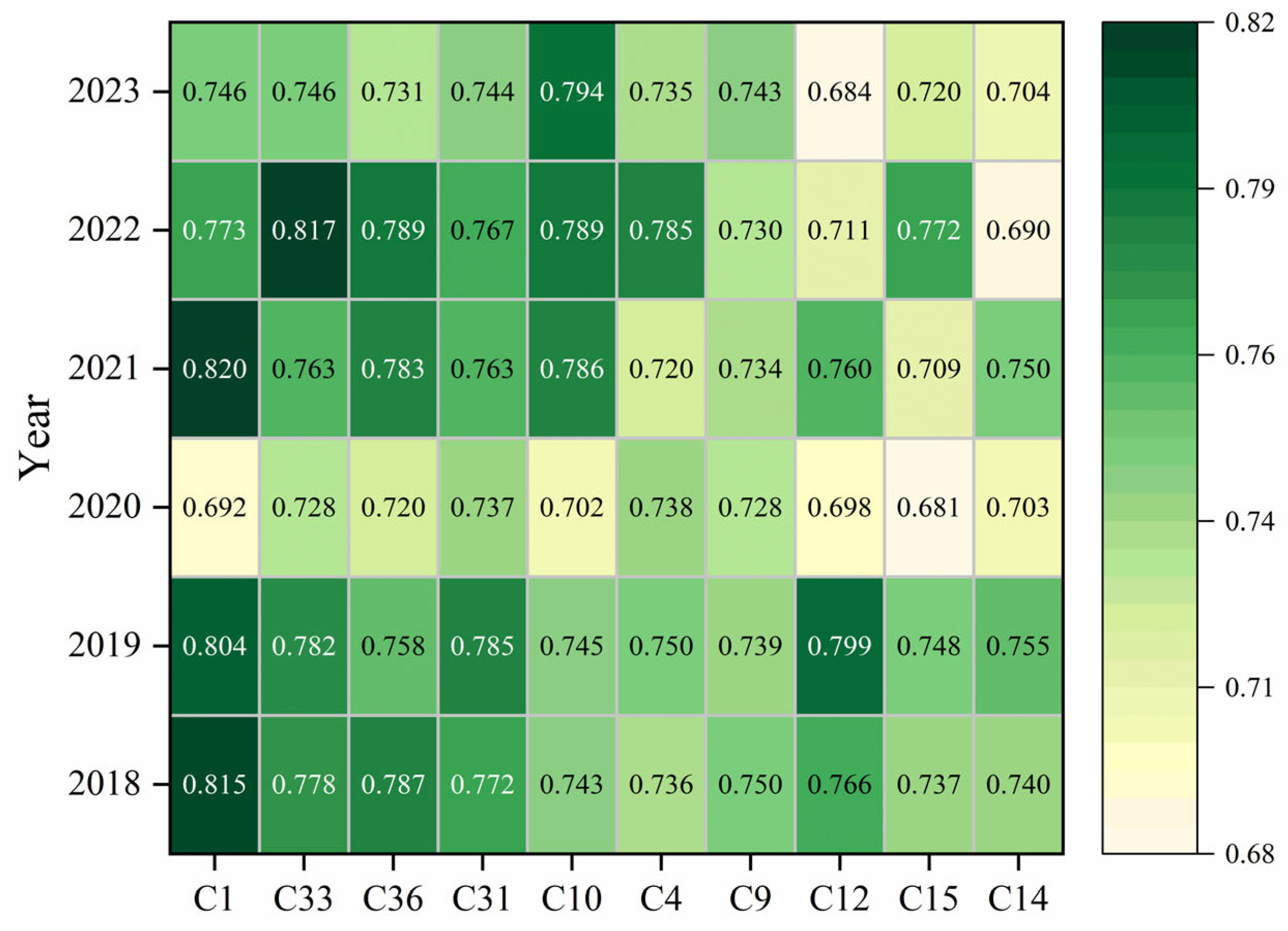
To quantitatively assess the core explanatory factors affecting urban resilience, this study performed a Grey Relational Analysis (GRA) on all 37 indicators. Table 7 presents the top ten indicators ranked by their relational grades with urban resilience, alongside their corresponding mean values from 2018 to 2023. Among them, the Industrial Structure HHI (C1) emerged as the predominant factor with a mean relational grade of 0.775; however, its dynamic trajectory reveals high sensitivity to systemic shocks. Specifically, C1 dropped sharply to 0.692 in 2020, rebounded to 0.820 in 2021, and subsequently gradually receded to 0.773 and 0.746 in 2022 and 2023, respectively, exhibiting a notable fluctuation range of 0.128. This indicates that while industrial structural optimization serves as a primary cornerstone of systemic stability, it remains highly vulnerable to disturbances from external shocks (see Table 7).
The response patterns of cooling facilities and medical resources highlight the heterogeneous characteristics of the public safety service system. Cooling facility accessibility (C33) peaked at 0.817 in 2022, while the per capita provision (C36) formed two peaks in 2018 and 2022. Both indicators declined simultaneously in 2020 before rebounding in 2022; however, they significantly receded in 2023, revealing a periodic decay in the marginal contribution of climate-adaptive infrastructure. The mean relational grade for hospital beds per 1000 people (C31) was 0.761, reaching its pre-pandemic peak in 2019. It did not experience a significant surge during the 2020 shock (0.737) and remained relatively stable, indicating that the supporting role of medical resources for resilience exhibits inelastic or “rigid” characteristics.
The evolutionary trends of innovation drive and emergency systems exhibit structural differentiation. The proportion of science and technology expenditure (C10) is the only indicator showing a continuous upward trajectory, with its relational grade climbing from 0.743 to 0.794 (an average annual growth of 1.1%), highlighting the strengthening marginal effect of innovation drive in resilience construction. In contrast, economic foundation indicators, such as new jobs (C4) and GDP per capita (C9), remained periodic yet stable. Simultaneously, indicators related to the emergency management system show an attenuating trend: the relational grades for emergency expenditure (C12), fire department accessibility (C14), and emergency shelter accessibility (C15) all exhibited varying degrees of decline by 2023. This suggests that the perceived importance or functional efficacy of traditional physical emergency facilities within the resilience framework is experiencing a relative decline compared to dynamic innovation factors (see Figure 12).

4.2.3. Comprehensive Analysis of Indicator Obstacle Degree and Relational Grade

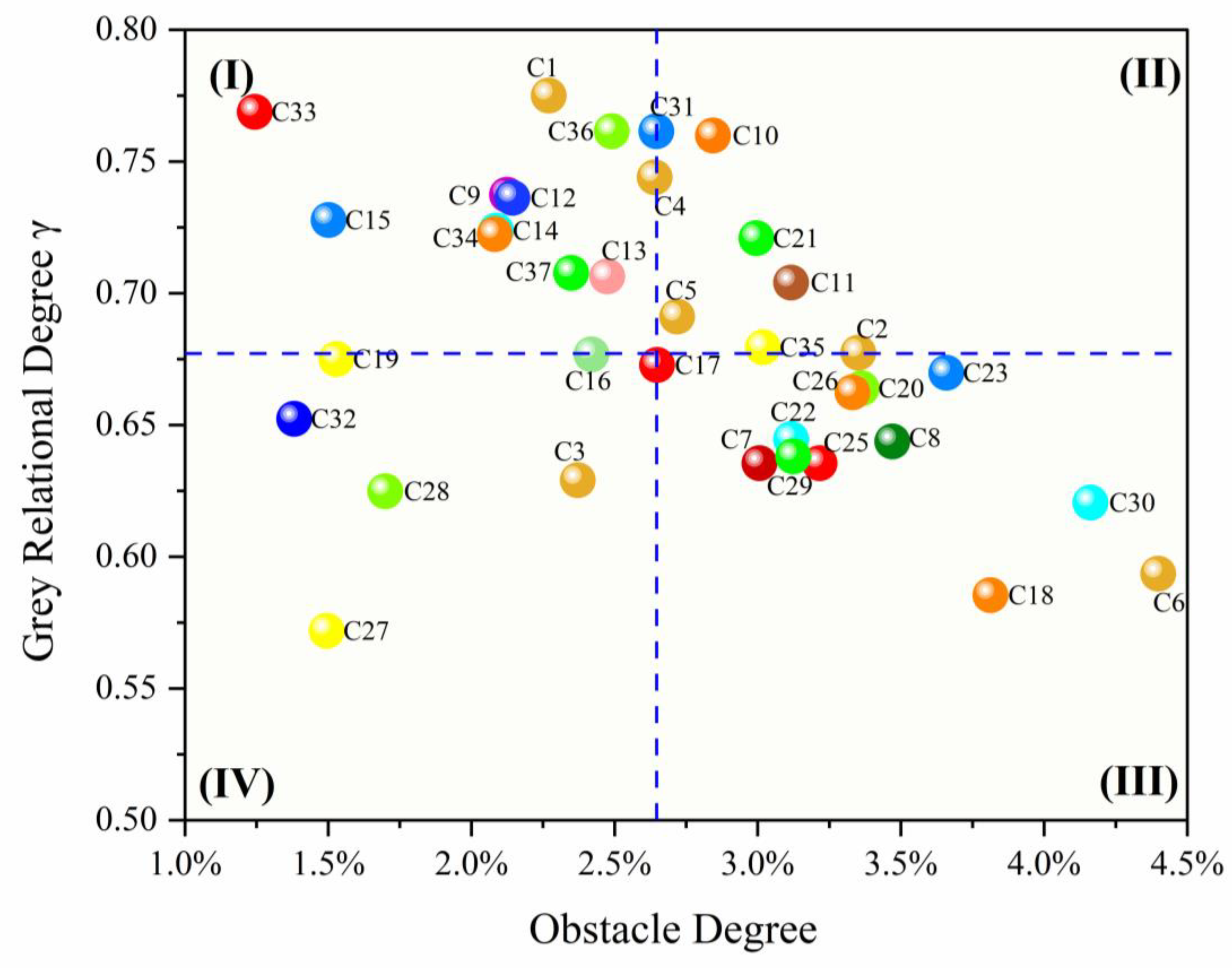
The preceding analyses of obstacle degrees and grey relational grades have delineated the key bottlenecks and the relative influence of various factors on the evolution of urban resilience. However, a unidimensional perspective remains insufficient to comprehensively capture the intricate interactions and strategic priorities among these drivers. To bridge this analytical gap, this study constructs an “Obstacle Degree-Relational Grade” quadrant model. By adopting the medians of both dimensions as thresholds, the 37 factors are categorized into four distinct strategic zones, facilitating a more nuanced identification of core constraints and hierarchical priorities in the resilience evolution process (see Table 8).
Quantitative analysis reveals that the urban resilience of Xi’an’s districts exhibits a structural configuration characterized by deficiencies in critical resource reserves and lagging technological investment, contrasted with robust economic foundations and optimized spatial configurations. Indicators in the “High Obstacle-High Relational” quadrant constitute the pivotal bottlenecks, primarily involving medical reserves and science and technology (S&T) support. For instance, although hospital beds (C31), nursing homes (C35), and emergency shelters (C11) possess strong explanatory power, their high obstacle degrees reflect a capacity deficit in physical infrastructure when responding to sudden public health emergencies. Simultaneously, the high obstacle degree for S&T expenditure (C10) reveals that fiscal allocation toward technological disaster mitigation remains inadequate.
In contrast, the “Low Obstacle-High Relational” quadrant highlights foundational strengths; the low obstacle values for industrial structure (C1) and GDP per capita (C9) confirm robust economic support. Furthermore, the low obstacle degrees for fire department (C14) and emergency shelter accessibility (C15) suggest that the spatial siting and road network planning of public service facilities are relatively scientific, achieving high service coverage efficiency under existing stocks. Additionally, the “High Obstacle-Low Relational” quadrant exposes deep-seated structural contradictions. The obstacle degree for fiscal expenditure (C6) reflects the constraints imposed by rigid fiscal burdens on flexible resource allocation. Meanwhile, the high obstacle degrees for green space ratio (C24) and blue-green connectivity (C23) reveal diminished disaster-buffering functions due to ecological fragmentation. Indicators in the “Low Obstacle-Low Relational” quadrant, such as industrial emissions (C27, C28), suggest that environmental governance has reached a stable efficacy and no longer constitutes a major constraint. Consequently, future resilience-building in Xi’an should prioritize “infrastructure supplementation” and “technological empowerment.” While leveraging existing spatial planning advantages, focus should shift toward bridging physical gaps in medical and shelter facilities, increasing investment in technological disaster prevention, and optimizing ecological network connectivity to achieve systemic resilience enhancement (see Figure 13).

4.2.4. Analysis of Resilience Enhancement Paths for Districts and Counties

The preceding analysis primarily focused on the independent impacts of individual indicators, which is limited in capturing the intricate synergies and conjunctural causation among various elements. Consequently, this study introduces the fuzzy-set qualitative comparative analysis (fsQCA) method. From a “holistic configurational” perspective, this approach explores how key constraints interact and combine to form multiple pathways for enhancing urban resilience, thereby identifying differentiated development strategies tailored to the specific resource endowments of each district.
Variable selection is underpinned by a synthesis of empirical diagnosis and theoretical frameworks. The outcome variable is defined as the longitudinal mean of resilience indices (2018–2023) to mitigate transient fluctuations and reflect the steady-state performance of the system. The selection of antecedent conditions focuses on the “High Obstacle-High Relational” indicators identified in the quadrant model, which are systematically integrated into the Technology–Organization–Environment (TOE) framework. Specifically, proportion of science and technology-related fiscal expenditure (TI) to examine the leveraging effect of innovation on resilience. The organizational dimension integrates fiscal revenue (FS), total retail sales (MV), and hospital bed density (PH) to represent governmental regulatory power, market momentum, and social security capacity, respectively. Instead of green space proportion (PLAND), the environmental dimension selects Shannon’s Diversity Index (SE) to characterize the risk-buffering efficacy of the ecological structure, as resilience theory prioritizes structural diversity and heterogeneity over mere quantity. Data were transformed using the direct calibration method, with the 95th, 50th, and 5th percentiles serving as qualitative anchors to map raw values into fuzzy membership scores. This procedure establishes a logical closed-loop, transitioning from the identification of realistic bottlenecks to the deconstruction of driving pathways.
(1) Necessity Analysis
Before identifying configurational paths, a necessity analysis was conducted for each antecedent condition. The results indicate that when high urban resilience is the outcome variable, the consistency of all individual conditions falls below the 0.9 threshold, suggesting that no single factor is a necessary condition for high resilience. Notably, in the analysis of the absence of high resilience, the consistency of “Science and Technology (S&T) Innovation Investment Intensity” (~TI) reaches 0.944. This underscores that a lack of technological funding is a pivotal bottleneck constraining resilience improvement. The absence of single-factor necessity for high resilience, contrasted with the prominence of a necessary condition for low resilience, confirms that resilience enhancement in Xi’an is driven by complex coupling rather than isolated conditions, further reflecting the causal asymmetry inherent in the system (see Table 9).
(2) Configurational Path Analysis
By constructing a truth table and performing Boolean algebraic operations, this study identified three equifinal configurational paths leading to high urban resilience (UR) based on intermediate and parsimonious solutions. The results show an overall solution consistency of 0.937 and a coverage of 0.734, with each individual path exceeding the 0.800 consistency threshold. This indicates that the model demonstrates high empirical sufficiency and robust explanatory power for the high-resilience phenomenon (see Table 10).
Observing the constitutive logic, science and technology (S&T) investment intensity (TI) emerges as a universal core condition, playing a cross-contextual foundational role in all pathways. Correspondingly, fiscal security (FS) and market momentum (MV) exhibit substitution and complementarity relationships, reflecting that district-level resilience is a product of multi-dimensional coupling between “technical capacity” and “organizational/market conditions.” Furthermore, the negation of landscape ecological diversity (~SE) appears in multiple paths, suggesting that technical empowerment and resource security can effectively compensate for the inherent limitations of physical space. This study further refines these pathways into three driving modes:
Path H1: “Innovation-led Market Compensation” (MV TI ~SE). This path identifies S&T investment as the core driver, supplemented by high market vitality. In core urban areas like Beilin and Yanta, where ecological patch complexity is constrained (~SE), robust market consumption accelerates factor flow. Combined with high-level S&T transformation, this forms an effective “compensation mechanism.” For instance, Yanta District, leveraging its dense research resources, demonstrates quintessential “innovation-driven resilience,” successfully mitigating the ecological carrying capacity limitations of high-density built-up areas through technical-commercial integration.
Path H2: “Government-led Resource Synergy” (FS TI ~SE PH). This path reveals the synergistic linkage between fiscal capacity and public health resources under the aegis of S&T investment. For districts like Beilin and Yanliang, a substantial fiscal reserve provides institutional security for the optimization of public health facilities. This “resource stacking” mode ensures the system maintains strong risk absorption and recovery capabilities through the “fiscal–technical–health” linkage structure, even under conditions of extreme physical densification.
Path H3: “Social-Market Compensatory” (~FS MV TI PH). This path proves that a relative lack of fiscal security is not an insurmountable barrier to resilience. Represented by Xincheng and Weiyang, these districts face fiscal self-sufficiency constraints but achieve “social filling” of resilience by leveraging market momentum and a comprehensive public health system. This endogenous economic resilience relies on the self-repair function of industrial vitality to reduce the negative impact of economic fluctuations on systemic stability.
Based on the principle of causal asymmetry, the configurational paths for non-high resilience (~UR) were further deconstructed. The overall consistency and coverage reached 0.846 and 0.797, respectively. The necessity score for the absence of S&T investment (~TI) reached 0.944, reinforcing the core status of TI and establishing technical empowerment as a “bottom-line” attribute for systemic advancement (see Table 11).
Path N1 (~FS*~TI*SE*~PH): “Transformation Dilemma.” This path characterizes the constraints of distal ecological districts like Zhouzhi and Lantian. Their position on the periphery of fiscal support and S&T investment prevents high-quality natural assets from being activated into effective defensive momentum, confirming that a singular resource endowment cannot independently sustain systemic stress resistance.
Path N2 (FS*~MV*~TI*SE): “Fiscal Efficiency Deficit.” Represented by Lintong and Gaoling, this path manifests how fiscal capacity—lacking market vitality and technical leverage—fails to produce a meaningful catalytic effect. This reflects a structural paucity: districts losing endogenous growth momentum cannot rely on the mere accumulation of external fiscal resources.
Path N3 (FS*MV*TI*~SE*~PH): “Bottleneck Constraint.” This configuration identifies the vulnerability of Baqiao, which despite leading in fiscal strength and S&T intensity, remains susceptible due to extreme shortfalls in public health. This mismatch proves that the deprivation of a core dimension will exert a cancellation effect on otherwise superior elements, leading to a structural breach of the overall defense line.
(3) Robustness Testing
To verify the reliability of the findings, a sensitivity analysis was conducted. By maintaining the original case set, condition set, and prime implicant settings, the consistency threshold for sufficiency was increased from 0.80 to 0.85. The re-analysis showed that the overall solution consistency improved from 0.936 to 0.972, while the solution coverage moderated from 0.734 to 0.658. The fundamental configurational structures remained stable, and core mechanisms—such as the “fiscal–S&T–public health synergy” and the “market–S&T–public health compensation under weak fiscal constraints”—underwent no substantive alterations. The variations were limited to marginal adjustments in the stringency of conditions and case membership. These results confirm that the research findings are highly robust and less sensitive to threshold adjustments.

5. Discussion

The “V-shaped recovery” of district-level resilience in Xi’an (2018–2023) results from non-linear evolution and resource competition among four subsystems. This pattern departs from the steady upward trend identified by city-level stock indicators [68], revealing that macro statistics often obscure the functional decay of grassroots units during shocks. Our meso-scale framework effectively captures the non-linear stress logic and localized vulnerabilities that aggregate growth often conceals. The drastic fluctuations in economic resilience—evidenced by the index’s decline to 0.364 in 2020—dictate the overarching “V-shaped” morphology, mirroring its extreme sensitivity to external shocks and its rigid coupling with growth objectives. In contrast, ecological resilience exhibits remarkable stability (0.470 in 2023), underscoring its role as a passive buffer. Crucially, the relative robustness of social resilience (0.447 in 2022) stands in contrast to the sustained strain on health resilience (0.408 in 2023). This divergence implies a zero-sum tension between maintaining social operations and safeguarding public health under resource constraints. This asymmetric pattern proves that enhancing urban resilience is not a simple additive process. Instead, it constitutes a non-linear optimization characterized by intrinsic trade-offs and adaptive resource prioritization.
This logical decoupling translates spatially into a complex synergy formed by the “high-level plateau oscillation” of core areas and the “impaired-lagged recovery” of suburban zones. The evolution of kernel density from “unimodal concentration” to “bimodal differentiation” reveals a structural decoupling of Xi’an’s internal resilience logic: core districts, such as Beilin and Yanta, have established formidable defensive resilience through the deep accumulation of administrative resources. Conversely, districts at the frontier of spatial expansion, like Chang’an and Baqiao, saw their lags in social mobilization and emergency response rapidly amplified under extreme stress, resulting in a significant time-lag effect in resilience repair. These endogenous differences are rooted in the resource endowment gaps solidified by the “Qinling Mountains–Weihe River” geographical divide. The fact that inter-group differences account for 66.7% of the Gini coefficient is a spatial projection of imbalances in functional positioning. While core urban areas build stable resilience bastions through superior infrastructure, the surge of the transvariation intensity (Gt) to 29.2% in 2020 reveals a “resilience inversion” under extreme shocks: remote counties like Zhouzhi exhibited more robust survival resilience due to lower population density and strong ecological buffering, providing empirical support for the asymmetric role of ecological foundations in risk hedging. It further corroborates the vital compensatory role of the ecological foundation in mitigating the vulnerabilities of socio-economic systems under extreme conditions, providing a robust empirical basis for deciphering the substitution and complementarity across multi-system resilience at varying spatial scales.
The analysis elucidates a mechanism where “flow efficiency compensates for physical stock deficiencies” within high-density environments. The finding that core districts lead the city despite restricted green space ratios suggests that resilience does not absolutely depend on physical spatial redundancy. Xi’an’s dense grid-based layout in the core provides significant scheduling elasticity, compensating for the lack of physical buffer space. Consequently, the focus of resilience has shifted from mere material reserves to dynamic response based on spatial configuration efficiency; by enhancing accessibility and turnover efficiency, high-density areas demonstrate an inherent capacity to dissolve external shocks. By embedding dynamic parameters—such as isochrone accessibility and vegetation productivity evolution rates—the framework captures how core areas utilize extreme scheduling capabilities to offset ecological deficiencies. The high relational ranking of facility accessibility further confirms that in resource-constrained inland districts, security relies more on precise resource delivery via transportation advantages rather than the indiscriminate expansion of large green spaces in land-scarce centers. This downscaling and dynamization of the evaluation perspective proves that scalar downscaling is a fundamental return to the “resource-function” transformation logic.
To transition from diagnosis to mechanism exploration, this study logically links “Obstacle-Relational” dual diagnosis with fsQCA, effectively mitigating the subjective limitations of variable selection. Following the 2020 shock, city-wide obstacles rapidly shifted from ecological to governance dimensions (e.g., social organization and medical reserves), particularly in population-import districts like Weiyang, exposing the “hard infrastructure over soft governance” structural chronic ailment [69]. The pre-diagnostic phase identified S&T expenditure and medical reserves in the “high obstacle-high correlation” quadrant, reflecting Xi’an’s status as a scientific powerhouse with grassroots security shortcomings. Variable screening based on objective pain points ensures that the configurational paths are a logical response to governance realities: S&T investment serves as the “universal leverage” because technological empowerment is the core endogenous driver for overcoming spatial congestion and achieving leapfrog resilience enhancement.
The aforementioned logic shifts from situational diagnosis toward mechanistic deconstruction, restoring the differentiated evolutionary trajectories across Xi’an’s districts. This discovery of “equifinality” from a configurational perspective proves that urban resilience is not a linear blueprint but a systemic emergence achieved through creative reconfiguration under resource constraints [70]. Pathways in Beilin, Yanliang, and Xincheng reveal strategic compensation mechanisms where “technical capability” offsets “resource deficits”, validating “Factor Substitution” [71]—the functional equivalence between market vitality and fiscal capacity across diverse contexts. This highlights the feasibility for grassroots units to achieve resilience through state optimization rather than linear stacking. Conversely, cases like Zhouzhi and Baqiao define the resilience “feasibility domain” [72]. Zhouzhi faces an “asset lock-in” where ecological potential remains untapped, while Baqiao demonstrates the “asymmetric cancellation” effect. Specifically, extreme shortfalls in a single dimension—such as public health—neutralize cumulative techno-fiscal dividends, triggering the structural collapse of the defensive line. This inherent asymmetry in element influence is corroborated by empirical research on multi-scale resilience interactions [73]. Such mechanistic insights mandate that governance must break bottlenecks through configurational optimization, securing rigid bottom lines while pursuing higher marginal returns. This paradigm shift from “universal” to “context-optimal” solutions enriches resilience theory and provides empirical evidence for refined resource allocation. Ultimately, this approach aligns with the grassroots logic of context-strategy matching under resource constraints [74].
Based on the aforementioned mechanistic insights, Xi’an’s resilience improvement should undergo a governance transformation from “standardized resource allocation” to “differentiated path matching.” Decision-makers must scientifically weigh opportunity costs and marginal outputs of resource investment based on distinct conflict structures, implementing hierarchical optimization at the district scale. For core urban areas with limited physical space, micro-renewal should focus on “efficiency compensation for physical stock.” Given the prohibitive cost of blindly expanding redundancy, governance should pivot toward nature-based solutions (NbSs) [75] and digital twin systems to enhance spatial allocation efficiency [76]. This pathway secures higher marginal returns through optimized configuration, representing the optimal strategy to mitigate structural vulnerabilities under high-density rigid constraints. For emerging zones with rapid population influx, the strategic focus must shift from chasing economic increments toward disrupting “negative interactions” among antecedents. Prioritizing shortfalls in grassroots health facilities and social organizations prevents specific bottlenecks from exerting an “inhibitory reduction” on growth dividends, avoiding the brittle collapse of defensive lines caused by element-wise cancellation. For remote ecological zones, governance should focus on breaking the “asset lock-in” dilemma by coupling natural capital with healthcare security for an aging society, thereby fortifying social defense baselines through activating dormant ecological stocks. Furthermore, administrators should leverage the spatial autocorrelation of resilience to establish pairing mechanisms between core and peripheral districts. Through cross-regional resource sharing, the “low-resilience lock-in” pattern can be disrupted, ultimately constructing a self-adaptive urban resilience community through the dynamic interactions of heterogeneous units.

6. Conclusions

6.1. Main Conclusions

Based on a multi-source data-driven serial analytical framework, this study deeply deconstructed the spatiotemporal non-equilibrium and causal complexity mechanisms of urban resilience in Xi’an’s districts and counties from 2018 to 2023. The main conclusions are as follows:
(1)
Non-linear “V-shaped” trajectory and asymmetric systemic response: The empirical units followed a sequence of “fluctuation, trough, and recovery” during 2018–2023. Sub-system analysis reveals profound asymmetry: the economic system remained most fragile with delayed recovery; the health system exhibited severe spatial polarization (CV reaching 0.393); meanwhile, the ecological and social systems demonstrated superior recovery rigidity. The desynchronization of response cycles emphasizes that governance interventions must be phased and graded based on the disparate sensitivity–robustness profiles of different resilience dimensions.
(2)
Stable center-oriented polarization and the “resilience inversion” effect: Inter-group differences (mean contribution 66.7%) driven by administrative siphoning constitute the primary source of spatiotemporal non-equilibrium. The “resilience inversion” observed under extreme shocks confirms that resource-rich urban cores are prone to functional collapse due to saturated capacity. This phenomenon reinforces the sensitivity advantage of processual monitoring in identifying latent vulnerabilities, suggesting that shifting the paradigm toward “operational efficiency” is essential for the accurate assessment of grassroots resilience.
(3)
Dual configurational logic of “synergistic compensation” and “synergistic offset”: Equivalent pathways (e.g., “Market-Tech Compensation”) reinforce the compensatory value of tech-innovation for physical defects. Conversely, the analysis of non-high-resilience configurations reveals a “synergistic offset” effect, where an extreme bottleneck in a single dimension can neutralize other strength-driven dividends, leading to systemic failure. Such non-linear associations prove that resilience leaps depend on configurational optimization of governance elements rather than simple linear resource accumulation.

6.2. Main Contributions

Methodologically, this study facilitates a paradigm leap in resilience evaluation, transitioning from static “resource stock description” to dynamic “spatial allocation efficiency assessment.” By integrating POI network analysis and remote sensing monitoring, the framework more precisely captures the dynamic functional performance of urban systems. This research not only provides an empirical sample for the meso-level governance of inland megacities but also—via a logical closed-loop of situational diagnosis, trend correlation, and configurational paths—overcomes the subjectivity in antecedent variable selection. Ultimately, it establishes a replicable scientific paradigm for deconstructing non-linear causal mechanisms within complex environments.

6.3. Limitations and Future Outlook

Despite these insights, this study is constrained by data frequency; the annual-scale analysis lacks the resolution to capture the micro-evolutionary nuances of urban systems during instantaneous shocks. Similarly, strategic simplifications made for analytical tractability—including standardized speed impedance and fixed calibration anchors—imply that our findings characterize the system’s structural baseline rather than its stochastic, transient performance. Future research should incorporate real-time sensing data—such as transportation and social media flows—to construct models with higher temporal resolution.
Furthermore, the specific coupling mechanisms induced by divergent risks (e.g., floods, earthquakes) across subsystems warrant deeper investigation. Particularly through the lens of complex disaster chains, the trade-offs between opportunity costs and negative cancellation effects require precise mathematical modeling via multi-scenario simulations. Such advancements will yield proactive strategic schemes for optimized resource allocation and resilience-oriented policy-making in megacities facing extreme uncertainty.

Author Contributions

Conceptualization, Y.W., T.H. and S.Y.; methodology, Y.W. and S.Y.; software, S.Y.; validation, Y.W., T.H. and K.C.; formal analysis, S.Y.; investigation, S.Y. and K.C.; resources, Y.W. and T.H.; data curation, S.Y. and K.C.; writing—original draft preparation, S.Y.; writing—review and editing, Y.W., T.H. and K.C.; visualization, S.Y. and K.C.; supervision, Y.W. and T.H.; project administration, Y.W.; funding acquisition, Y.W. and T.H. All authors have read and agreed to the published version of the manuscript.

Funding

This research was funded by (1) National Key R & D Program (Grant No. 2022YFE0119200); (2) “Scientists + engineers” team development project of YuLin High Tech Industrial Development Zone (Grant No. YGXKG-2023-105).

Institutional Review Board Statement

Not applicable.

Informed Consent Statement

Not applicable.

Data Availability Statement

The data that support the findings of this study are available on request from the corresponding author upon reasonable request.

Conflicts of Interest

The authors declare no conflicts of interest.

Appendix A

Table A1. Indicator definitions.
SystemIndicator NameCodeIndicator Definition
EconomyIndustrial Structure HHIX1Measures the degree of industrial diversification and risk dispersion capacity.
Fiscal Revenue as a Share of GDPX2Indicates government fiscal autonomy and the potential for emergency resource reserves.
Energy Consumption per Unit of GDPX3Reflects resource-use efficiency and low-carbon resilience of economic development.
New Jobs per 1000 PeopleX4Measures the labor market’s capacity to absorb and buffer external shocks.
Total Retail Sales of Consumer GoodsX5Reflects domestic demand vitality and the stress-response capacity of the economy system.
Fiscal Expenditure as a Share of GDPX6Indicates the government’s capacity to mobilize resources for pre-disaster prevention and in-crisis support.
Growth Rate of Fixed Asset InvestmentX7Measures the speed of post-disaster infrastructure reconstruction and capital reinvestment.
GDP Growth RateX8Reflects output recovery and rebound momentum after economic shocks.
GDP per CapitaX9Represents the level of regional economic fundamentals supporting long-term adaptive adjustment.
Share of Science and Technology–Related Fiscal ExpenditureX10Measures the capacity to upgrade emergency governance systems through technological innovation.
SocietyNumber of Emergency SheltersX11Reflects government investment intensity in social safety and security.
Share of Emergency Management and Public Safety ExpenditureX12Reflects government investment intensity in social safety and security.
Share of Social Security ExpenditureX13Measures the capacity of the social safety net to buffer risks faced by vulnerable groups.
Fire Service Coverage Rate within 5-Minute Drive TimeX14Indicates the rapid response capacity and spatial coverage efficiency of emergency services.
Accessibility of Emergency SheltersX15Reflects residents” spatial accessibility and absorption efficiency of shelter services.
Number of Special Assistance BeneficiariesX16Measures the capacity of the social system to provide minimum security and stability for special groups.
Growth Rate of Urban New EmploymentX17Reflects the pace of post-shock recovery and stabilization of livelihoods.
Number of Grassroots Social OrganizationsX18Reflects the robustness and organizational capacity of grassroots social governance.
Per Capita Disposable Income of Urban ResidentsX19Measures individual adaptive capacity to post-shock livelihood changes.
Number of Social Organizations per 1000 PeopleX20Reflects social capital vitality and community participation coordination.
EcologyRate of Change in Vegetation CoverX21Reflects baseline ecological stability and resistance to environmental stress.
Shannon Diversity IndexX22Measures structural stability derived from biodiversity.
Number of Days with Good Air QualityX23Reflects environmental quality status and regulation of health risks.
Blue–Green ConnectivityX24Measures spatial connectivity of water–green infrastructure and risk-buffering capacity.
Proportion of Landscape Area in Green Space, PLANDX25Indicates the capacity of green space to absorb urban heat island effects and flooding impacts.
Annual Rate of Change in Net Primary Productivity, NPPX26Reflects vegetation carbon sequestration capacity and ecosystem self-recovery potential.
Monthly Rate of Change in NDVIX27Reflects dynamic recovery sensitivity of ecosystems to seasonal variation.
Environmental Investment in Approved ProjectsX28Measures long-term investment in environmental governance and climate adaptation.
Industrial SO2 EmissionsX29Reflects the level of pollution load control and atmospheric environmental stress.
Industrial Chemical Oxygen Demand EmissionsX30Reflects water pollution control performance and long-term ecological system resilience.
HealthShare of Public Health ExpenditureX31Measures preventive investment and emergency preparedness of the public health system.
Health Technicians per 1000 PeopleX32Reflects the capacity of health workforce reserves to cope with sudden risks.
Medical Institutions per 1000 PeopleX33Measures spatial density and baseline provision of healthcare resources.
Hospital Beds per 1000 PeopleX34Indicates surge capacity of the healthcare system in large-scale health shocks.
Accessibility of Healthcare FacilitiesX35Reflects timeliness of healthcare access and efficiency of risk buffering.
Accessibility of Heat-Relief FacilitiesX36Measures social health protection effectiveness under extreme heat stress.
Number of Community Health Service CentersX37Reflects penetration of primary healthcare networks in post-disaster health recovery.
Number of Nursing Homes per 1000 PeopleX38Measures long-term rehabilitation support for vulnerable groups and social resilience.
Number of Heat-Relief Facilities per 1000 PeopleX39Reflects long-term urban adaptation capacity to extreme heat waves.
Number of Sports Facilities per 1000 PeopleX40Reflects baseline physical fitness and sustainability of community health infrastructure.
Table A2. Standard deviation, coefficient of variation, and information entropy of indicators.
IndicatorStandard DeviationCoefficient of VariationInformation EntropyIndicatorStandard DeviationCoefficient of VariationInformation Entropy
X10.3340.8411.498X210.2781.1881.225
X20.2970.8841.337X220.3950.6851.234
X30.2710.5161.343X230.2640.5921.499
X40.3470.9261.393X240.2831.6160.922
X50.3311.1241.233X250.4130.8121.211
X60.3321.1011.221X260.3370.8141.389
X70.2710.5561.473X270.2791.1771.256
X80.2930.7661.402X280.3261.2531.155
X90.3270.7251.370X290.3350.5161.249
X100.3041.1871.031X300.2820.5661.288
X110.2631.0711.144X310.2910.6621.473
X120.3410.7531.412X320.3321.1541.326
X130.3280.6851.438X330.2810.8511.407
X140.4281.0331.182X340.3150.9691.294
X150.3830.7531.431X350.3590.5561.234
X160.3140.6521.535X360.3750.6281.289
X170.2920.6231.383X370.3480.7001.325
X180.3220.7761.468X380.2860.6781.497
X190.3730.6091.266X390.3050.8031.467
X200.2950.8811.315X400.3180.7531.473
Figure A1. Pearson’s correlation coefficient heatmap.
Sustainability 18 02513 g0a1
Figure A2. Cluster analysis dendrogram.
Sustainability 18 02513 g0a2
Table A3. Results of indicator exclusion.
SystemHighly Correlated (|r| > 0.9)rExcluded Indicators
Ecological X21 *X270.985X27
X25 *X220.911X22
Health X34 *X320.980X32
Note: Indicators marked with an asterisk (*) have higher information entropy compared to their paired indicator.
Table A4. Redundancy.
SystemRedundancy
Economy0.402
Society0.445
Ecology0.271
Health0.443
Total0.401
Table A5. Data sources.
Data CategoryData DescriptionTime PeriodSpatial Resolution/AccuracyData Source
Socioeconomic DataPopulation density, GDP, industrial output, fiscal revenue, employment, etc.2018–2023County levelXi’an Statistical Yearbook; Statistical Bulletins of National Economic and Social Development of each district/county
Land Use DataAnnual land cover classification data, CLCD)2018–202330 mEarth System Science Data platform
https://zenodo.org/records/12779975 (accessed on 5 March 2025)
Remote Sensing DataNormalized Difference Vegetation Index (NDVI), MOD13A3)2018–20231 kmNASA Earthdata platform: https://search.earthdata.nasa.gov/search (accessed on 5 March 2025)
Ecological Productivity DataNet Primary Productivity (NPP), MOD17A3HG F2018–2023500 mNASA Earthdata platform
https://lpdaac.usgs.gov/products/mod17a3hgfv061/ (accessed on 5 March 2025)
Road Network DataVector road networks at multiple levels: expressways, arterials collectors, etc.2018–20231:10,000 vectorOpenStreetMap
POI DataSpatial locations and attributes of emergency shelters and heat-relief facilities2018–2023CoordinatesCollected via Amap API
Basic Geographic InformationAdministrative boundaries of Xi’an and district boundaries2024 revised1:1000,000National Geomatics Center of China (Tianditu): https://www.tianditu.gov.cn/ (accessed on 8 October 2025)
Table A6. Summary of data-processing methods and key parameters.
Data DimensionIndicator/MetricMethod & ToolParameters & Logic
SocioeconomicIndustrial Diversity (HHI)Index calculation H H I = ( x i / X ) 2
Employment Market ResilienceStatistical ratio calculation ( E t E t 1 ) / E t 1 (E: New employment)
Landscape EcologyProportion of Landscape (PLAND)Fragstats 4.2Patch area/total landscape area
Physical Connectivity (CONNECT)Fragstats 4.2Number of actual connections/number of possible connections
Landscape Heterogeneity (SHDI)Fragstats 4.2Shannon diversity index formula
Ecological Recovery EfficiencyRemote sensing statistical ratio ( V t V t 1 ) / V t 1 (V:FVC/NPP)
Spatial Networks (POI & OSM)Healthcare AccessibilityGIS network analysis (Drive time)Summary of data-processing methods and key parameters
Fire Service ResponsivenessGIS network analysis (Drive time)Thresholds: 4, 8, and 12 min; Speeds: 100/70/25 km·h−1
Heat-Relief Facility AccessibilityGIS network analysis (Walk time)Thresholds: 5, 10, and 15 min; Speed: 1.3 m·s−1
Emergency Shelter AccessibilityGIS network analysis (Walk time)Thresholds: 10 and 20 min; Speed: 1.5 m·s−1
Table A7. Comparison of annual resilience scores for the 13 districts and counties of Xi’an under the CRITIC and EWM methods.
District/CountyWeighting Method201820192020202120222023Average
XinchengCRITIC0.5150.4570.5100.6090.5280.5130.522
EWM0.5120.4430.5050.5980.5210.5150.516
BeilinCRITIC0.6160.5750.5260.6060.5960.5800.583
EWM0.6080.5520.5180.5920.5850.5720.571
LianhuCRITIC0.4950.4980.4460.5010.4520.4490.474
EWM0.4910.4850.4320.4960.4440.4550.467
BaqiaoCRITIC0.4550.4250.3110.4030.3610.3830.390
EWM0.4610.4180.3020.3950.3550.3910.387
WeiyangCRITIC0.4620.4660.3760.4080.3790.4820.429
EWM0.4550.4580.3650.3980.3680.4760.420
YantaCRITIC0.4970.4660.4500.5660.5190.5150.502
EWM0.4880.4520.4380.5510.5050.5090.491
YanliangCRITIC0.4050.3840.4280.3950.4140.4060.405
EWM0.3950.3710.4150.3800.4020.3980.394
LintongCRITIC0.4680.4120.4770.4250.3880.4170.431
EWM0.4720.4050.4850.4310.3950.4280.436
ChanganCRITIC0.4270.3840.2940.3480.3040.3190.346
EWM0.4350.3910.2850.3420.3150.3200.348
GaolingCRITIC0.3580.3570.4090.3550.3520.3540.364
EWM0.3420.3410.3980.3420.3380.3420.351
HuyiCRITIC0.3350.3180.3310.3040.3100.3460.324
EWM0.3280.3100.3250.2980.3050.3380.317
LantianCRITIC0.4260.3650.4050.4100.3640.4300.400
EWM0.4180.3550.3980.4020.3580.4220.392
ZhouzhiCRITIC0.3290.3360.3460.3470.3650.3630.348
EWM0.3200.3250.3350.3380.3520.3550.338
Citywide AverageCRITIC0.4430.4160.4090.4490.4220.4350.429
EWM0.4350.4020.3980.4410.4150.4280.420
Note: Correlation analysis shows that the resilience ranking results derived from the two weighting methods demonstrate strong consistency (Spearman’s rank correlation coefficient ρ = 0.941, p < 0.001).

Appendix B

Table A8. Sources and decomposition of differences.
YearOverall GinIntra-Group Gini (Gw)Inter-Group Gini (Gb)Transvariation Component (Gt)Intra-Group Contribution (%)Inter-Group Contribution (%)Transvariation Contribution (%)
20180.0950.020.0720.00321.138%75.850%3.012%
20190.0930.0160.0760.00117.286%82.469%0.246%
20200.10.0320.0390.02931.887%38.927%29.186%
20210.1220.0290.0880.00524.112%71.886%4.002%
20220.1130.0310.0730.00827.709%65.035%7.256%
20230.0990.0240.0650.00924.244%66.317%9.439%
Average0.1040.0250.0690.00924.396%66.747%8.857%

References

  1. Liu, C.; Wang, X.; Li, H. County-Level Land Use Carbon Budget in the Yangtze River Economic Belt, China: Spatiotemporal Differentiation and Coordination Zoning. Land 2024, 13, 215. [Google Scholar] [CrossRef]
  2. Sharifi, A.; Khavarian-Garmsir, A.R. The COVID-19 Pandemic: Impacts on Cities and Major Lessons for Urban Planning, Design, and Management. Sci. Total Environ. 2020, 749, 142391. [Google Scholar] [CrossRef]
  3. Xinhua News Agency. Proposal of the Central Committee of the Communist Party of China for Formulating the 14th Five-Year Plan for Economic and Social Development and the Long-Range Objectives Through the Year 2035. Available online: https://www.gov.cn/zhengce/2020-11/03/content_5556991.htm (accessed on 8 May 2025).
  4. The State Council. Notice of the State Council on Issuing the Five-Year Action Plan for the In-Depth Implementation of the People-Centered New-Type Urbanization Strategy. Gaz. State Counc. People’s Repub. China. Available online: https://www.gov.cn/zhengce/zhengceku/202407/content_6965543.htm (accessed on 10 May 2025).
  5. Xi, J. The Governance of China (Vol. 2); Foreign Languages Press: Beijing, China, 2017. [Google Scholar]
  6. Zhu, Z. County-Level Emergency Management: Main Characteristics and Improvement Paths. Natl. Gov. 2024, 10, 62–67. [Google Scholar] [CrossRef]
  7. Liu, R.; Chen, H.; Zhao, R.; Luo, J.; Huo, X.; Zhao, H. Impact and Pathways of Environmental Risks on Urban Resilience in Xi’an. Environ. Sci. 2025, in press. [Google Scholar] [CrossRef]
  8. Zhang, C.; Zhou, Y.; Yin, S. Interaction Mechanisms of Urban Ecosystem Resilience Based on Pressure-State-Response Framework: A Case Study of the Yangtze River Delta. Ecol. Indic. 2024, 166, 112263. [Google Scholar] [CrossRef]
  9. Mckie, R.E.; Aitken, A. Community Resilience to Flooding in the UK: A Study of Matlock, Derbyshire. Int. J. Disaster Risk Reduct. 2025, 118, 105266. [Google Scholar] [CrossRef]
  10. Muluneh, M.D.; Kidane, W.; Abebe, S.; Stulz, V.; Makonnen, M.; Berhan, M. The Role of Family Planning in Enhancing Community Resilience: Insights from Drought-Affected Youths and Women in Ethiopia. Int. J. Environ. Res. Public Health 2025, 22, 53. [Google Scholar] [CrossRef]
  11. Gu, T.; Hu, J.; Song, X.; Yan, H.; Chen, Z. How to Enhance the Urban Community Resilience from the Perspective of Social Networks? A Case Study of Xuzhou, China. Eng. Constr. Archit. Manag. 2025, in press. [Google Scholar] [CrossRef]
  12. Wu, P.; Duan, Q.; Zhou, L.; Wu, Q.; Deveci, M. Spatial-Temporal Evaluation of Urban Resilience in the Yangtze River Delta from the Perspective of the Coupling Coordination Degree. Environ. Dev. Sustain. 2025, 27, 409–431. [Google Scholar] [CrossRef]
  13. Liu, D.; Yang, K.; Sun, S. Comprehensive Assessment and Obstacle Factor Recognition of Waterlogging Disaster Resilience in Pearl River Delta Urban Agglomeration. J. Econ. Water Resour. 2024, 42, 23–38. [Google Scholar]
  14. Zhang, B.; Liu, Y.; Liu, Y.; Lyu, S. Spatiotemporal Evolution and Influencing Factors for Urban Resilience in China: A Provincial Analysis. Buildings 2024, 14, 502. [Google Scholar] [CrossRef]
  15. You, X.; Sun, Y.; Liu, J. Evolution and Analysis of Urban Resilience and Its Influencing Factors: A Case Study of Jiangsu Province, China. Nat. Hazards 2022, 113, 1751–1782. [Google Scholar] [CrossRef]
  16. Miao, C.; Na, M.; Chen, H.; Ding, M. Urban Resilience Evaluation Based on Entropy-TOPSIS Model: A Case Study of County-Level Cities in Ningxia, Northwest China. Int. J. Environ. Sci. Technol. 2025, 22, 4187–4202. [Google Scholar] [CrossRef]
  17. Shi, W.; Tian, J.; Namaiti, A.; Xing, X. Spatial-Temporal Evolution and Driving Factors of the Coupling Coordination between Urbanization and Urban Resilience: A Case Study of the 167 Counties in Hebei Province. Int. J. Environ. Res. Public Health 2022, 19, 13128. [Google Scholar] [CrossRef]
  18. Chen, N.; Guo, H.; Xiang, H. Evaluation of Urban Resilience Level and Analysis of Obstacle Factors: A Case Study of Hunan Province, China. Front. Earth Sci. 2023, 10, 1033441. [Google Scholar] [CrossRef]
  19. Zhao, Z.; Hu, Z.; Han, X.; Chen, L.; Li, Z. Evaluation of Urban Resilience and Its Influencing Factors: A Case Study of the Yichang-Jingzhou-Jingmen-Enshi Urban Agglomeration in China. Sustainability 2024, 16, 7090. [Google Scholar] [CrossRef]
  20. Wu, C.; Liu, J.; Zhu, Y.; Li, Y. An Analysis of Spatiotemporal Evolution and Influencing Factors of Urban Resilience: A Case Study of Liaoning Province, China. Sustainability 2025, 17, 3565. [Google Scholar] [CrossRef]
  21. Phua, S.Z.; Hofmeister, M.; Tsai, Y.-K.; Peppard, O.; Lee, K.F.; Courtney, S.; Mosbach, S.; Akroyd, J.; Kraft, M. Fostering Urban Resilience and Accessibility in Cities: A Dynamic Knowledge Graph Approach. Sust. Cities Soc. 2024, 113, 105708. [Google Scholar] [CrossRef]
  22. Aleixo, C.; Branquinho, C.; Laanisto, L. Urban Green Connectivity Assessment: A Comparative Study of Datasets in European Cities. Remote Sens. 2024, 16, 771. [Google Scholar] [CrossRef]
  23. Tang, S.; Wang, J.; Xu, Y.; Chen, S.; Zhang, J.; Zhao, W.; Wang, G. Evaluation of Emergency Shelter Service Functions and Optimisation Suggestions-Case Study in the Songyuan City Central Area. Sustainability 2023, 15, 7283. [Google Scholar] [CrossRef]
  24. Yin, Y.; Gu, J.; Li, M. Sustainability-Oriented Urban Resilience Assessment: The Case of China’s Yangtze River Delta Region. J. Clean Prod. 2025, 514, 145835. [Google Scholar] [CrossRef]
  25. Ji, J.; Wang, D. Evaluation Analysis and Strategy Selection in Urban Flood Resilience Based on EWM-TOPSIS Method and Graph Model. J. Clean Prod. 2023, 425, 138955. [Google Scholar] [CrossRef]
  26. Zhang, Y.; Cai, Z.; Zhou, X. Spatial-Temporal Evolution and Obstacle Factors of the Disaster Resilience in the Central Plains Urban Agglomeration, China. Sustainability 2025, 17, 205. [Google Scholar] [CrossRef]
  27. Yin, S.; Shi, R.; Wu, N.; Yang, J. Measuring the Impact of Technological Innovation on Urban Resilience through Explainable Machine Learning: A Case Study of the Yangtze River Delta Region, China. Sustain. Cities Soc. 2025, 127, 106457. [Google Scholar] [CrossRef]
  28. Gu, T.; Zhao, H.; Yue, L.; Liu, Y.; Guo, J.; Tang, J.; Zhao, P. Spatial Heterogeneity of Urban Resilience: Quantifying Key Determinants by Spatial Machine Learning Model Embedded in Density-Structure-Function Framework. Cities 2025, 167, 106305. [Google Scholar] [CrossRef]
  29. Li, S.; Hu, S.; Tong, N.; Xie, W.; Tong, L.; Hu, S. How Urban Resilience Shapes Residents’ Immediate Emotions during Heatwaves: A Panel Fuzzy-Set Qualitative Comparative Analysis (fsQCA)-Based Configurational Analysis. Sustain. Cities Soc. 2026, 136, 107067. [Google Scholar] [CrossRef]
  30. Wang, T.; Xu, T.; Wang, Z.; Wang, H.; Kang, J.; Qiu, L.; Xue, S.; Fang, Z.; Zhang, Y. Where Do Resilient Cities Grow? Exploring the Pathways and Mechanisms of Resilience Development. Sustain. Cities Soc. 2025, 133, 106856. [Google Scholar] [CrossRef]
  31. Gu, T.; Zhao, H.; Yue, L.; Guo, J.; Cui, Q.; Tang, J.; Gong, Z.; Zhao, P. Attribution Analysis of Urban Social Resilience Differences under Rainstorm Disaster Impact: Insights from Interpretable Spatial Machine Learning Framework. Sustain. Cities Soc. 2025, 118, 106029. [Google Scholar] [CrossRef]
  32. Zhao, B.; Bai, J.; Liang, Y. The Multiple Driving Mode of Urban Resilience under the TOE Framework: A Configuration Analysis of Institutional Logic. J. Technol. Econ. 2025, 44, 144–164. [Google Scholar]
  33. Shi, H.; Hu, Y.; Gan, L. Assessing Urban Resilience Based on Production-Living-Ecological System Using Degree of Coupling Coordination: A Case of Sichuan. PLoS ONE 2024, 19, e0304002. [Google Scholar] [CrossRef] [PubMed]
  34. Chen, Y.; Cai, S.; Zhang, D.; Wang, L.; Sun, Y. An Interpretable Machine Learning-Assisted Urban Resilience Evaluation and Determinants Identification: A Case Study of the Yangtze River Economic Belt, China. Sustain. Cities Soc. 2025, 134, 106930. [Google Scholar] [CrossRef]
  35. Datola, G. Implementing Urban Resilience in Urban Planning: A Comprehensive Framework for Urban Resilience Evaluation. Sustain. Cities Soc. 2023, 98, 104821. [Google Scholar] [CrossRef]
  36. Shi, C.C.; Zhu, X.P.; Wang, C.X.; Wu, F. Review and Prospect of Resilient Cities: From the Perspective of Urban Complex Systems. Acta Ecol. Sin. 2023, 43, 1726–1737. [Google Scholar] [CrossRef]
  37. Wang, G.; Zhang, K. Turning Peril into Opportunity: Construction and Validation of a Resilience Assessment System for China’s Coastal Megacities. Sustain. Cities Soc. 2024, 112, 105606. [Google Scholar] [CrossRef]
  38. Sharifi, A. Urban Sustainability Assessment: An Overview and Bibliometric Analysis. Ecol. Indic. 2021, 121, 107102. [Google Scholar] [CrossRef]
  39. Zhu, B.; Frangopol, D.M. Reliability, Redundancy and Risk as Performance Indicators of Structural Systems during Their Life-Cycle. Eng. Struct. 2012, 41, 34–49. [Google Scholar] [CrossRef]
  40. Ding, J.; Wang, Z.; Liu, Y.; Yu, F. Measurement of Economic Resilience of Contiguous Poverty-Stricken Areas in China and Influencing Factor Analysis. Prog. Geogr. 2020, 39, 924–937. [Google Scholar] [CrossRef]
  41. Cheng, Y.; Liu, J. Evaluation of Urban Resilience in the Post-COVID-19 Period: A Case Study of the Yangtze Delta City Group in China. Int. J. Disaster Risk Reduct. 2023, 97, 104028. [Google Scholar] [CrossRef]
  42. Zhang, J.; Yang, X.; Lu, D. Evaluation of Urban Resilience Based on Trio Spaces: An Empirical Study in Northeast China. Buildings 2023, 13, 1695. [Google Scholar] [CrossRef]
  43. Wang, C.; Yan, X. Spatiotemporal Evolution and Obstacles Identification of Urban Resilience in Chengdu-Chongqing Urban Agglomeration. J. Chongqing Univ. (Soc. Sci. Ed.) 2023, 29, 21–33. [Google Scholar]
  44. Li, H.; Wang, Y.; Zhang, H.; Yin, R.; Liu, C.; Wang, Z.; Fu, F.; Zhao, J. The Spatial-Temporal Evolution and Driving Mechanism of Urban Resilience in the Yellow River Basin Cities. J. Clean. Prod. 2024, 447, 141614. [Google Scholar] [CrossRef]
  45. Lu, L.; Zhou, H.; Xu, Q. Application Research on Comprehensive Evaluation of Urban Resilience from the Perspective of Multidimensional Relational Networks. Urban Issues 2020, 8, 42–55. [Google Scholar] [CrossRef]
  46. Zhou, J.; Liu, W.; Lin, Y.; Wei, B.; Liu, Y. The Evaluation and Comparison of Resilience for Shelters in Old and New Urban Districts: A Case Study in Kunming City, China. Sustainability 2024, 16, 3022. [Google Scholar] [CrossRef]
  47. Liu, H.; Cheng, Z.; Wang, D. Study on Evaluation Index System of Urban Fire Resilience. J. Catastrophology 2023, 38, 25–30. [Google Scholar] [CrossRef]
  48. Bao, H.; Li, L. Evaluation Indicator System for Healthy City Planning from the Perspective of Territorial Spatial Planning. Acta Ecol. Sin. 2024, 44, 4081–4091. [Google Scholar] [CrossRef]
  49. Edgemon, L.; Freeman, C.; Burdi, C. Community Resilience Indicator Analysis: Commonly Used Indicators from Peer-Reviewed Research (Updated for Research Published 2003–2021); Argonne National Laboratory (ANL): Lemont, IL, USA, 2023. [Google Scholar]
  50. Oliveira, B.; Fath, B.D. Comparative Resilience Evaluation—Case Study for Six Cities in China, Europe, and the Americas. Land 2023, 12, 1182. [Google Scholar] [CrossRef]
  51. Liu, D.; Xu, L.; Fu, Q. Identification of Resilience Characteristics of a Regional Agricultural Water Resources System Based on Index Optimization and Improved Support Vector Machine. Water Supply 2019, 19, 1899–1910. [Google Scholar] [CrossRef]
  52. Tu, H.; Gapar, G.; Yu, T.; Li, X.; Chen, B. Analysis of Spatio-Temporal Variation Characteristics and Influencing Factors of Net Primary Productivity in Terrestrial Ecosystems of China. Acta Ecol. Sin. 2023, 43, 1219–1233. [Google Scholar] [CrossRef]
  53. Lu, G.; Shan, Z.; Wei, Z. Research on the Construction and Measurement of the Indicator System for Green Low-Carbon Circular Developing Economic System in Southwest China. Ecol. Indic. 2024, 160, 111833. [Google Scholar] [CrossRef]
  54. Nan, Y.; Li, Q.; Yu, J. Has the Emissions Intensity of Industrial Sulphur Dioxide Converged? New Evidence from China’s Prefectural Cities with Dynamic Spatial Panel Models. Environ. Dev. Sustain. 2020, 22, 5337–5369. [Google Scholar] [CrossRef]
  55. Liu, L.; Lei, Y. Research on the Resilience Changes and Influencing Factors of China’s Provincial Capital Cities. Sci. Technol. Econ. 2022, 35, 1–5. [Google Scholar] [CrossRef]
  56. Liu, Z.; Ma, R.; Wang, H.J. Assessing Urban Resilience to Public Health Disaster Using the Rough Analytic Hierarchy Process Method: A Regional Study in China. J. Saf. Sci. Resil. 2022, 3, 93–104. [Google Scholar] [CrossRef]
  57. Liang, Y.; Cheng, Y.; Ren, F. Urban Resilience Assessment Framework and Spatiotemporal Dynamics in Hubei, China. Sci. Rep. 2024, 14, 31391. [Google Scholar] [CrossRef] [PubMed]
  58. Fu, Q.; Zheng, Z.; Sarker, M.N.I. Combating Urban Heat: Systematic Review of Urban Resilience and Adaptation Strategies. Heliyon 2024, 10, e37001. [Google Scholar] [CrossRef] [PubMed]
  59. Yang, X.; Kong, Y. Establishment of an Index System for Evaluating the Construction of Healthy City in Guiyang and Its Empirical Application. Chin. Health Resour. 2019, 22, 386–396. [Google Scholar] [CrossRef]
  60. Diakoulaki, D.; Mavrotas, G.; Papayannakis, L. Determining Objective Weights in Multiple Criteria Problems: The Critic Method. Comput. Oper. Res. 1995, 22, 763–770. [Google Scholar] [CrossRef]
  61. Pei, X.; Wu, J.; Li, Y. Spatiotemporal Assessment of Heatwaves Adaptation in Chinese Cities and Urban Agglomerations: An Integrated ND-GAIN Framework and Multi-Model Approach. J. Clean. Prod. 2025, 520, 146150. [Google Scholar] [CrossRef]
  62. Ding, C.; Gao, X.; Xie, Z. Analysing the Differential Impact of the COVID-19 Pandemic on the Resilience of the Tourism Economy: A Case Study of the ChengduChongqing Urban Agglomeration in China. Int. J. Disaster Risk Reduct. 2024, 102, 104255. [Google Scholar] [CrossRef]
  63. Lu, H.; Lu, X.; Jiao, L.; Zhang, Y. Evaluating Urban Agglomeration Resilience to Disaster in the Yangtze Delta City Group in China. Sustain. Cities Soc. 2022, 76, 103464. [Google Scholar] [CrossRef]
  64. Huang, J.; Lu, H.; Jin, H.; Zhang, L. Urban Resilience in China’s Eight Urban Agglomerations: Evolution Trends and Driving Factors. Environ. Sci. Pollut. Res. 2024, 31, 622–633. [Google Scholar] [CrossRef]
  65. Zhang, H.; Li, S.; Chang, J. Spatiotemporal Evolution and Driving Factors of Coupling Coordination Degree Between New Urbanization and Urban Resilience: A Case of Huaihai Economic Zone. ISPRS Int. J. Geo-Inf. 2025, 14, 271. [Google Scholar] [CrossRef]
  66. He, X.; Qiao, G.; Pan, Z. Study on the Spatio-Temporal Characteristics and Response Configuration Paths of Disaster Resilience in Coastal Zone Cities. J. Catastrophology. 2026, 41, 212–219. [Google Scholar]
  67. Moghadas, M.; Asadzadeh, A.; Vafeidis, A. A Multi-Criteria Approach for Assessing Urban Flood Resilience in Tehran, Iran. Int. J. Disaster Risk Reduct. 2019, 35, 101069. [Google Scholar] [CrossRef]
  68. Zheng, X.; Xiong, Y.; Tong, X.; Zhang, X.; Su, H. Spatiotemporal Evolution and Influencing Factors of Urban Natural Disaster Resilience in Shaanxi Province. Sci. Technol. Eng. 2025, 25, 6993–7003. [Google Scholar]
  69. Su, H. The Development Trend and Strategic Transformation of New Urbanization in China. Gansu Soc. Sci. 2025, 4, 197–206. [Google Scholar] [CrossRef]
  70. Walker, B.; Holling, C.S.; Carpenter, S.; Kinzig, A. Ecology and Society: Resilience, Adaptability and Transformability in Social–Ecological Systems. Ecol. Soc. 2004, 9, 9. [Google Scholar] [CrossRef]
  71. Lin, Y.; Wang, Y.; Yue, W.; Zhu, L. Asymmetry in Factor Substitution and Resource Allocation Efficiency. J. Manag. World 2025, 41, 1–27. [Google Scholar] [CrossRef]
  72. Price, M.F. Panarchy: Understanding Transformations in Human and Natural Systems: Edited by Lance H. Gunderson and C.S. Holling. Island Press, 2002. Xxiv+507 Pages. ISBN 1-55963-857-5 (Paper), $35. Biol. Conserv. 2003, 114, 308–309. [Google Scholar] [CrossRef]
  73. Sun, X.; Wei, Y.; Song, W.; Miao, H. Resilience Dynamics of Economic Systems in Cities and City Networks: A Case Study of the Central and Southern Liaoning Region, China. Habitat Int. 2010, 165, 14. [Google Scholar] [CrossRef]
  74. Zhu, K.; Yue, J. Selective Incentives as the Intrinsic Logic of Grassroots Government’s Social Risk Governance Behavior: Case Analysis Based on Rational Action Perspective. Jinan J. (Philos. Soc. Sci. Ed.) 2025, 47, 124–142. [Google Scholar] [CrossRef]
  75. Li, G.; Wang, W.; Li, J.; An, R.; Bian, H.; Wang, Y. Enhancing Urban Ecological Resilience through Small Wetlands: A Nature-Based Solutions in Changchun City, China. J. Clean Prod. 2025, 518, 145881. [Google Scholar] [CrossRef]
  76. Feng, Y.; Shen, Y.; Li, Q. Smart Cities and Urban Resilience: Evaluating the Impact on Emergency Response in China. J. Asian Archit. Build. Eng. 2026, 25, 433–442. [Google Scholar] [CrossRef]
Figure 1. Study area.
Sustainability 18 02513 g001
Figure 2. Research flowchart.
Sustainability 18 02513 g002
Figure 3. Bar charts and box plots of district-level urban resilience. (a) Bar charts of district-level comprehensive urban resilience; (b) box plots of district-level comprehensive urban resilience. In (b), the triangles within the boxes represent the mean, the scattered dots denote individual data points, and the black diamond indicates an outlier.
Sustainability 18 02513 g003
Figure 4. Annual average variation in system-level resilience dimensions (2018–2023).
Sustainability 18 02513 g004
Figure 5. District-level urban resilience kernel density map.
Sustainability 18 02513 g005
Figure 6. Subsystem resilience kernel density map. (a) Economic system; (b) social system; (c) ecological system; (d) healthy system.
Sustainability 18 02513 g006
Figure 7. Spatiotemporal visualization of urban resilience (2018–2023).
Sustainability 18 02513 g007
Figure 8. Visualization of urban resilience across economic, social, ecological, and healthy systems.
Sustainability 18 02513 g008
Figure 9. District-level comprehensive resilience LISA cluster map.
Sustainability 18 02513 g009
Figure 10. Changes in the Gini coefficient.
Sustainability 18 02513 g010
Figure 11. Cumulative bar chart of contribution rates.
Sustainability 18 02513 g011
Figure 12. Heatmap of grey relational degree for the top 10 indicators (2018–2023).
Sustainability 18 02513 g012
Figure 13. Four-quadrant distribution of obstacle and relational degrees.
Sustainability 18 02513 g013
Table 1. Comparative marking of the proposed framework against contemporary evaluation methods.
DimensionsLinear Weighting/Attribution [18,19,33]Spatial ML + SHAP [27,28,34]Traditional fsQCA [29,30,32]Proposed Framework (This Study)
Observation ScaleMacro-regional (focuses on provincial or regional totals)Polarized: either macro-clusters or micro-urban blocksMacro-city scale (regional capitals or city strata)Meso-scale focusing (filling district-level voids)
Sensing LogicStatic stock snapshots (census-based; perceptual lag)Statistical association (correlation-oriented fitting)Cross-sectional (static sets; No sensing phase)Dynamic spatiotemporal evolutionary sensing
Variable ProtocolGeneric reporting (includes all indicators; no screening)Fitting-driven (feature importance via algorithms)Subjective deduction (theory-led variable choice)Objective calibration (diagnostic-driven screening)
Logical ArchitectureDescriptive parallelism (siloed evaluation/attribution)Post hoc explanation (Explanation as an afterthought)Processual truncation (lacks prior sensing stage)Sequential coupling (closed-loop logic)
Sample AdaptationUniversally applicable (simplified calculation)Vulnerable to over-fitting (requires large N; 100~2000+)Small-N robustness (small/mid-sample logic)Optimized for small-N (N = 13) meso-governance
Table 2. Urban resilience assessment system for districts and counties.
Urban SystemIndicatorReferencesIndicator Weight
EconomyIndustrial structure HHI (−)(+)C1[40]0.0266
Proportion of fiscal revenue in GDP (%)(+)C2[41]0.0253
Energy consumption per unit of GDP (%)(+)C3[42]0.0257
Number of newly employed people per 1000 persons (person)(+)C4[43]0.0338
Total retail sales of consumer goods (100 million yuan)(+)C5[44]0.0274
Proportion of fiscal expenditure in GDP (%)(+)C6[45]0.0264
Growth rate of fixed asset investment (%)(+)C7[42]0.0256
GDP growth rate (%)(+)C8[17]0.0230
GDP per capita (yuan)(+)C9[19]0.0244
Proportion of science and technology-related fiscal expenditure (%)(+)C10[18]0.0161
SocietyNumber of emergency shelters (unit)(+)C11[46]0.0250
Proportion of expenditure on emergency management and public safety (%)(+)C12[37]0.0264
Proportion of social security expenditure (%)(+)C13[18]0.0309
Fire station coverage rate (within 5 min drive)(+)C14[47]0.0360
Accessibility of emergency shelters (completed and permanent)(+)C15[48]0.0254
Number of persons receiving special care and subsidies (person)(+)C16[49]0.0333
Change rate of newly employed urban population (+)C17[43]0.0286
Legal entities in public and social sectors per 1000 persons (+)C18[43]0.0252
Per capita disposable income of urban residents (yuan)(+)C19[50]0.0259
Number of social organizations per 1000 persons (unit)(+)C20[49]0.0319
EcologyChange rate of fractional vegetation cover (%)(+)C21[51]0.0205
Number of days with good air quality (day)(+)C22[41]0.0242
Blue-green connectivity (−)(+)C23[22]0.0255
Proportion of green space (PLAND) (%)(+)C24[43]0.0319
Annual change rate of NPP (%)(+)C25[52]0.0284
Environmental investment in projects completed and accepted this year (+)C26[53]0.0228
Industrial   sulfur   dioxide   ( S O 2 ) emissions (ton)(−)C27[54]0.0336
Industrial chemical oxygen demand (COD) emissions (ton)(−)C28[55]0.0269
HealthProportion of public healthcare expenditure in government expenditure (%)(+)C29[56]0.0352
Number of medical institutions per 1000 persons (unit)(+)C30[57]0.0255
Number of hospital beds per 1000 persons (unit)(+)C31[18]0.0266
Accessibility of medical and health institutions (%)(+)C32[48]0.0237
Accessibility of cooling facilities (%)(+)C33[58]0.0309
Number of community health service centers and stations per 1000 persons (+)C34[59]0.0307
Number of nursing homes per 1000 persons (+)C35[59]0.0247
Number of cooling facilities per 1000 persons (+)C36[58]0.0261
Number of sports venues per 1000 persons (+)C37[59]0.0201
Table 3. District-level urban resilience index.
Year201820192020202120222023
County
Xincheng0.5150.4570.5100.6090.5280.513
Beilin0.6160.5750.5260.6060.5960.580
Lianhu0.4950.4980.4460.5010.4520.449
Baqiao0.4550.4250.3110.4030.3610.383
Weiyang0.4620.4660.3760.4080.3790.482
Yanta0.4970.4660.4500.5660.5190.515
Yanliang0.4050.3840.4280.3950.4140.406
Lintong0.4680.4120.4770.4250.3880.417
Changan0.4270.3840.2940.3480.3040.319
Gaoling0.3580.3570.4090.3550.3520.354
Huyi0.3350.3180.3310.3040.3100.346
Lantian0.4260.3650.4050.4100.3640.430
Zhouzhi0.3290.3360.3460.3470.3650.363
Mean0.445 0.419 0.409 0.437 0.410 0.428
Std.0.079 0.072 0.074 0.102 0.089 0.078
CV0.178 0.173 0.181 0.233 0.216 0.182
Table 4. Global Moran’s I index of district-level comprehensive resilience.
YearMoran’s IZpYearMoran’s IZp
20180.500853.0853980.00203320210.5823153.3637810.000769
20190.5480153.3014080.00096220220.5236123.1490150.001638
20200.3884042.3589160.01832820230.4249562.5860750.009708
Table 5. Overall, intra-group, and inter-group Gini coefficients.
YearOverallIntra-Group Gini CoefficientsInter-Group Gini Coefficients
CoreSuburbanExurbanCore & SuburbanCore & ExurbanSuburban & Exurban
20180.0950.0530.0530.0590.1020.1650.085
20190.0930.050.0270.0310.1120.1720.064
20200.10.0940.0880.0450.1030.120.098
20210.1220.0910.0440.0670.1540.1880.067
20220.1130.0990.0630.0350.1410.1550.061
20230.0990.0690.0580.0490.1370.130.06
Avg.0.1040.0760.0560.0480.1250.1550.125
Table 6. Top five obstacle factors for urban resilience in districts and counties.
CountyYearRank
12345
Xincheng2018C24 (7.90%)C7 (7.12%)C25 (6.91%)C6 (6.81%)C30 (6.55%)
2020C24 (7.87%)C25 (6.83%)C8 (6.70%)C35 (6.02%)C6 (5.96%)
2023C24 (7.95%)C25 (6.83%)C3 (6.43%)C6 (6.18%)C30 (5.84%)
Beilin2018C24 (9.85%)C25 (8.46%)C6 (8.36%)C26 (6.54%)C18 (6.53%)
2020C24 (7.98%)C25 (6.85%)C6 (6.73%)C17 (6.31%)C3 (6.21%)
2023C24 (9.01%)C7 (7.97%)C25 (7.74%)C6 (7.63%)C8 (6.44%)
Lianhu2018C24 (7.72%)C25 (6.63%)C6 (6.18%)C30 (5.42%)C18 (5.31%)
2020C24 (7.00%)C25 (6.01%)C18 (5.55%)C30 (5.55%)C3 (5.46%)
2023C24 (7.06%)C25 (6.07%)C18 (5.76%)C6 (5.59%)C7 (5.44%)
Baqiao2018C3 (5.78%)C27 (5.29%)C6 (5.22%)C18 (4.46%)C30 (4.23%)
2020C18 (4.76%)C30 (4.49%)C17 (4.36%)C3 (4.23%)C20 (4.18%)
2023C18 (5.66%)C30 (5.30%)C6 (5.08%)C20 (4.72%)C27 (4.66%)
Weiyang2018C24 (6.40%)C6 (6.18%)C25 (5.73%)C2 (5.43%)C22 (5.36%)
2020C30 (5.43%)C6 (5.32%)C24 (5.29%)C18 (5.26%)C29 (5.21%)
2023C34 (6.75%)C6 (6.52%)C18 (6.52%)C8 (6.42%)C30 (6.19%)
Yanta2018C24 (7.39%)C18 (7.27%)C30 (7.02%)C6 (6.97%)C2 (5.83%)
2020C24 (6.77%)C18 (6.62%)C30 (6.39%)C6 (6.34%)C25 (5.89%)
2023C24 (7.79%)C18 (7.56%)C30 (7.30%)C6 (7.25%)C25 (6.24%)
Yanliang2018C22 (5.46%)C25 (5.18%)C16 (4.45%)C6 (4.40%)C29 (4.38%)
2020C8 (5.27%)C22 (4.76%)C16 (4.75%)C6 (4.53%)C26 (4.09%)
2023C16 (4.59%)C17 (4.51%)C30 (4.37%)C26 (4.37%)C6 (4.34%)
Lintong2018C25 (5.62%)C20 (4.50%)C37 (4.23%)C23 (4.22%)C18 (4.19%)
2020C20 (4.97%)C8 (4.60%)C23 (4.45%)C10 (4.22%)C5 (4.21%)
2023C8 (4.67%)C20 (4.39%)C26 (4.19%)C21 (4.04%)C23 (3.97%)
Changan2018C6 (5.06%)C20 (4.99%)C2 (4.55%)C26 (4.43%)C23 (4.16%)
2020C22 (4.60%)C30 (4.55%)C6 (4.33%)C18 (4.13%)C20 (4.05%)
2023C30 (4.96%)C22 (4.77%)C6 (4.60%)C18 (4.44%)C20 (4.18%)
Gaoling2018C8 (5.07%)C29 (5.00%)C25 (4.76%)C13 (4.40%)C26 (4.11%)
2020C8 (4.79%)C6 (4.63%)C30 (4.51%)C22 (4.26%)C20 (4.18%)
2023C35 (4.67%)C28 (4.56%)C13 (4.38%)C6 (4.37%)C30 (4.37%)
Huyi2018C35 (4.46%)C28 (4.35%)C34 (3.71%)C23 (3.57%)C10 (3.41%)
2020C28 (4.33%)C27 (4.21%)C35 (4.20%)C25 (4.17%)C26 (3.89%)
2023C26 (3.99%)C27 (3.96%)C6 (3.93%)C34 (3.78%)C22 (3.75%)
Lantian2018C2 (4.91%)C4 (4.34%)C34 (4.26%)C37 (4.18%)C23 (4.17%)
2020C7 (5.63%)C8 (5.32%)C2 (4.16%)C34 (4.12%)C23 (4.08%)
2023C29 (5.28%)C17 (5.25%)C8 (4.82%)C4 (4.27%)C23 (4.27%)
Zhouzhi2018C17 (4.46%)C2 (4.30%)C35 (3.70%)C4 (3.68%)C13 (3.66%)
2020C25 (4.90%)C3 (4.68%)C35 (4.50%)C2 (4.22%)C8 (4.00%)
2023C29 (4.94%)C17 (4.69%)C2 (4.53%)C26 (3.96%)C4 (3.92%)
Table 7. Top 10 indicators of grey relational degree.
Indicator CodeIndicator NameGrey Relational GradeRank
C1Industrial Structure HHI0.7751
C33Accessibility of Cooling Facilities0.7692
C36Number of Cooling Facilities per Thousand People0.7613
C31Number of Hospital Beds per Thousand People0.7614
C10Proportion of Science and Technology-Related Fiscal Expenditure0.7605
C4Number of New Jobs per Thousand People0.7446
C9Per Capita GDP0.7377
C12Proportion of Emergency Management and Public Safety Expenditure0.7368
C15Accessibility of Emergency Shelter0.7289
C14Accessibility of Fire Services0.72410
Table 8. Obstacle–relational degrees of indicators and their quadrant classification.
CodeObstacle DegreeGrey Correlation DegreeQuadrantCodeObstacle DegreeGrey Correlation DegreeQuadrant
C10.7752.27%IC60.5944.40%III
C40.7442.64%IC70.6353.01%III
C90.7372.12%IC80.6443.47%III
C120.7362.14%IC170.6732.65%III
C130.7062.47%IC180.5853.81%III
C140.7242.09%IC200.6643.36%III
C150.7281.50%IC220.6453.12%III
C160.6772.42%IC230.673.66%III
C330.7691.24%IC240.4823.69%III
C340.7222.08%IC250.6363.22%III
C360.7612.49%IC260.6623.33%III
C370.7082.35%IC290.6383.12%III
C20.6773.35%IIC300.624.16%III
C50.6912.72%IIC30.6292.37%IV
C100.762.84%IIC190.6751.53%IV
C110.7043.12%IIC270.5721.49%IV
C210.7213.00%IIC280.6251.70%IV
C310.7612.65%IIC320.6521.38%IV
C350.683.02%II
Note: The categories in the table are defined as follows: I represents low obstacle and high correlation; II represents high obstacle and high correlation; III represents high obstacle and low correlation; IV represents low obstacle and low correlation.
Table 9. Necessity analysis of single conditions.
PreconditionHigh Resilience LevelNon-High Resilience Level
ConsistencyCoverageConsistencyConsistency
FS0.6335400.6375000.5259150.539062
~FS0.5419250.5287880.6463420.642424
TI0.7903720.9322350.3567070.428571
~TI0.5155280.4403180.9435980.820955
MV0.7003100.7683130.3750000.419080
~MV0.4704970.4249650.7926830.729313
SE0.4472050.4253430.7974090.772560
~SE0.7608690.7866430.4068600.428480
PH0.7267080.7722770.4771340.516502
~PH0.5450310.5057640.7896340.746398
Table 10. Configurational analysis of high urban resilience in districts and counties of Xi’an.
PreconditionH1H2H3
Fiscal Security Capacity (FS)
Science and Technology (S&T) investment intensity (TI)
Spatial Environmental Background (SE)
Public Health Capacity (PH)
Market Momentum (MV)
Consistency0.9375000.9639340.969957
Original Coverage0.6055900.4565220.350932
Unique Coverage0.1552800.0760870.052795
Solution Consistency 0.936634
Solution Coverage 0.734472
Note: ● represents core conditions; • represents auxiliary conditions; ⊗ represents peripheral conditions; and — indicates that the condition may or may not be present.
Table 11. Configurational analysis of non-high urban resilience in districts and counties of Xi’an.
PreconditionN1N2N3
Fiscal Security Capacity (FS)
Science and Technology (S&T) investment intensity (TI)
Spatial Environmental Background (SE)
Public Health Capacity (PH)
Market Momentum (MV)
Consistency0.9101940.8220640.978723
Original Coverage0.5716470.3873480.210366
Unique Coverage0.3170730.131250.0838415
Solution Consistency 0.846303
Solution Coverage 0.797409
Note: ● represents core conditions; • represents auxiliary conditions; ⊗ represents peripheral conditions; and — indicates that the condition may or may not be present.
Disclaimer/Publisher’s Note: The statements, opinions and data contained in all publications are solely those of the individual author(s) and contributor(s) and not of MDPI and/or the editor(s). MDPI and/or the editor(s) disclaim responsibility for any injury to people or property resulting from any ideas, methods, instructions or products referred to in the content.