Author Contributions
Conceptualization, S.V., J.Y. and R.M.; methodology, S.V. and J.Y.; validation, S.V., J.Y. and R.M.; formal analysis, R.M.; investigation, S.V.; resources, S.V., J.Y. and R.M.; data curation, S.V.; writing—original draft preparation, S.V. and R.M.; writing—review and editing, S.V. and R.M.; visualization, J.Y.; supervision, S.V. and R.M.; project administration, S.V.; funding acquisition, S.V. and R.M. All authors have read and agreed to the published version of the manuscript.
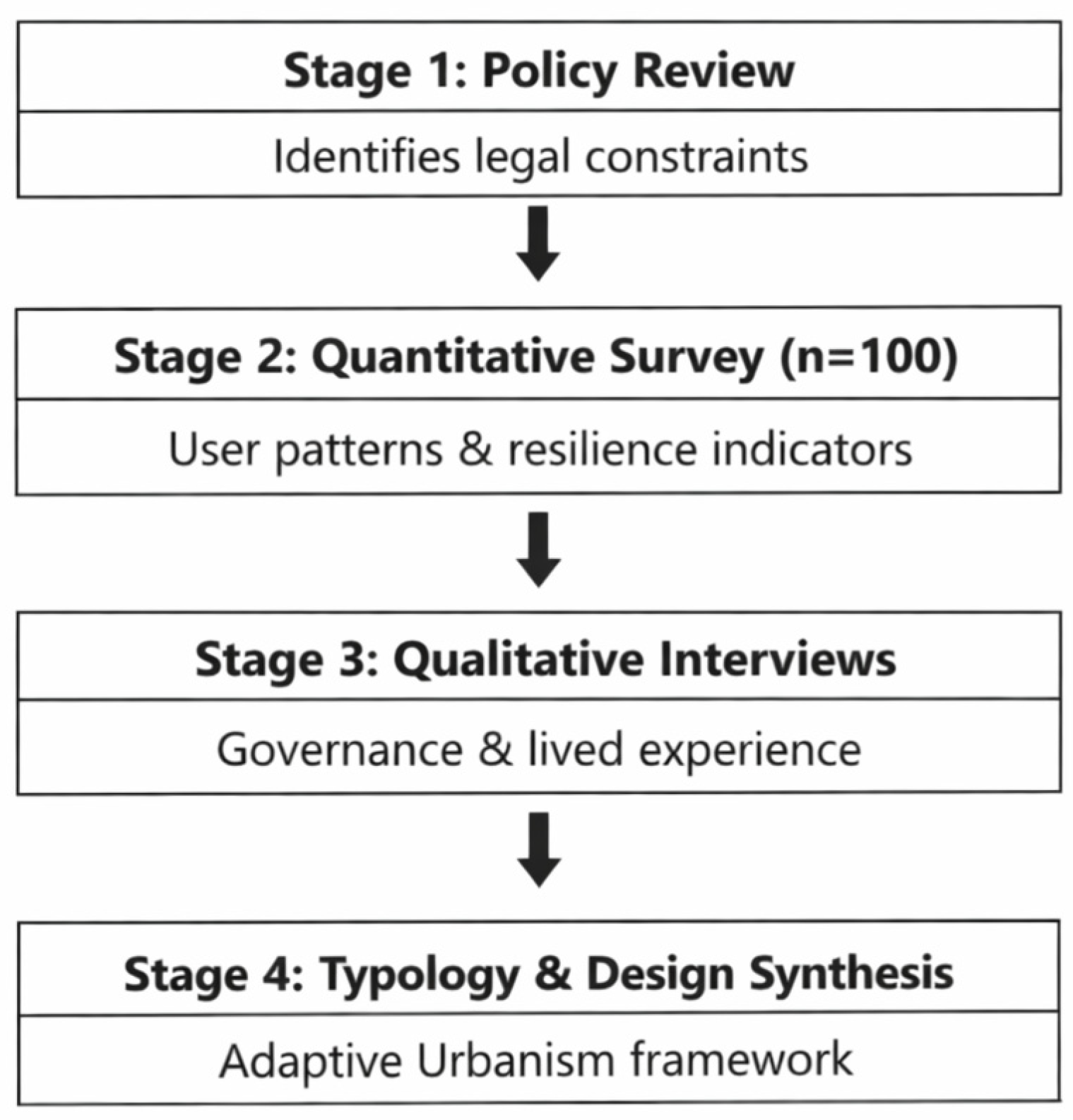
Figure 1.
Methodological Framework of the Study.
Figure 1.
Methodological Framework of the Study.
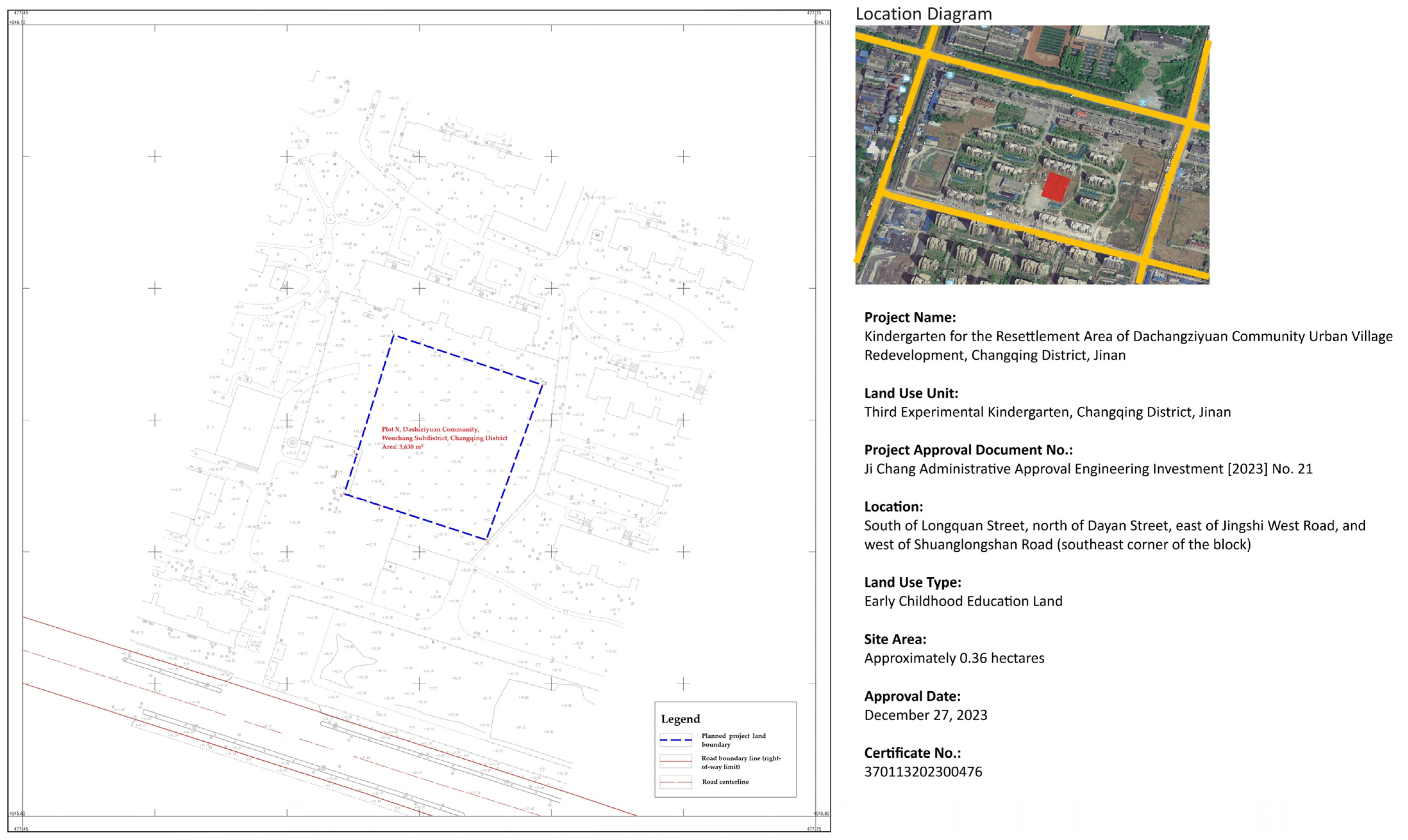
Figure 2.
Location and layout of the Dashiziyuan Community kindergarten plot, Changqing District, Jinan.
Figure 2.
Location and layout of the Dashiziyuan Community kindergarten plot, Changqing District, Jinan.
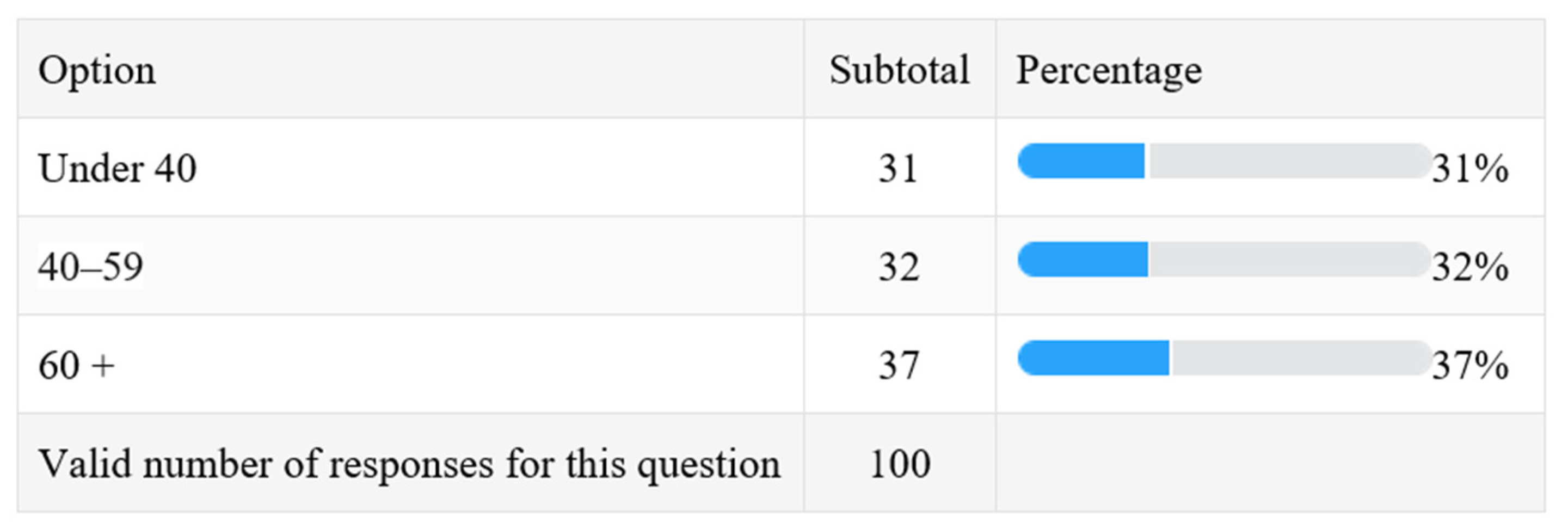
Figure 3.
Age distribution of survey respondents (Question 1, n = 100).
Figure 3.
Age distribution of survey respondents (Question 1, n = 100).
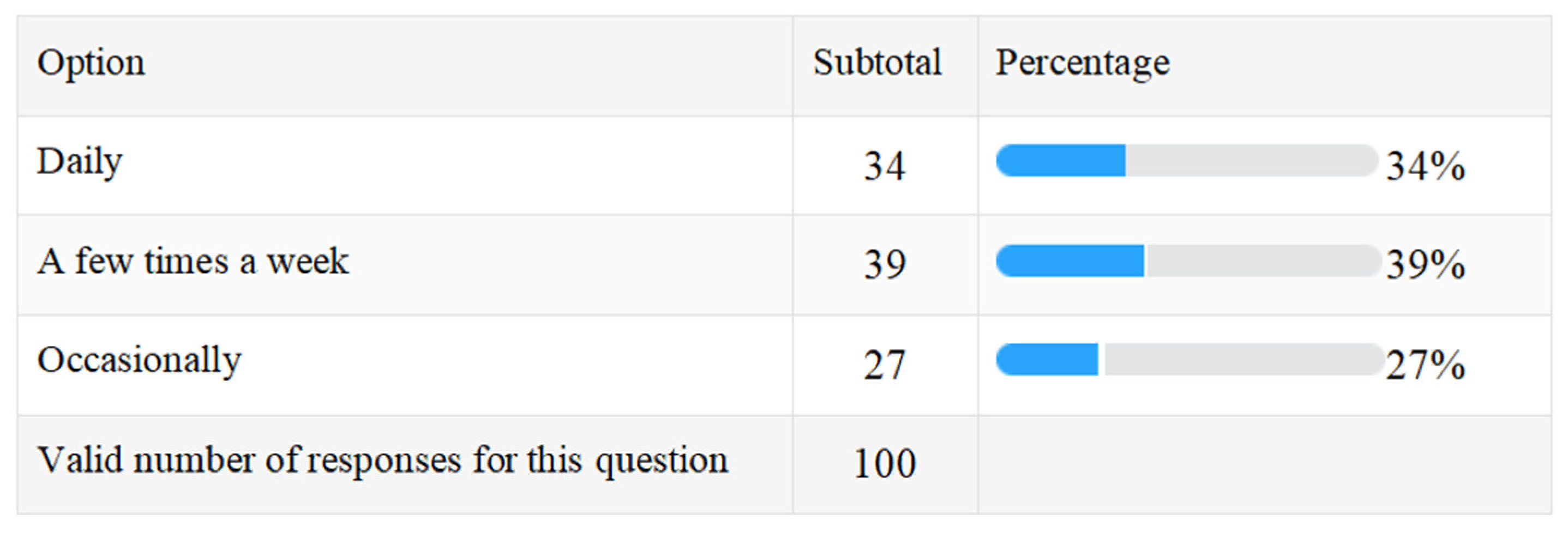
Figure 4.
Frequency of use of the nomadic gardens (Question 4, n = 100).
Figure 4.
Frequency of use of the nomadic gardens (Question 4, n = 100).
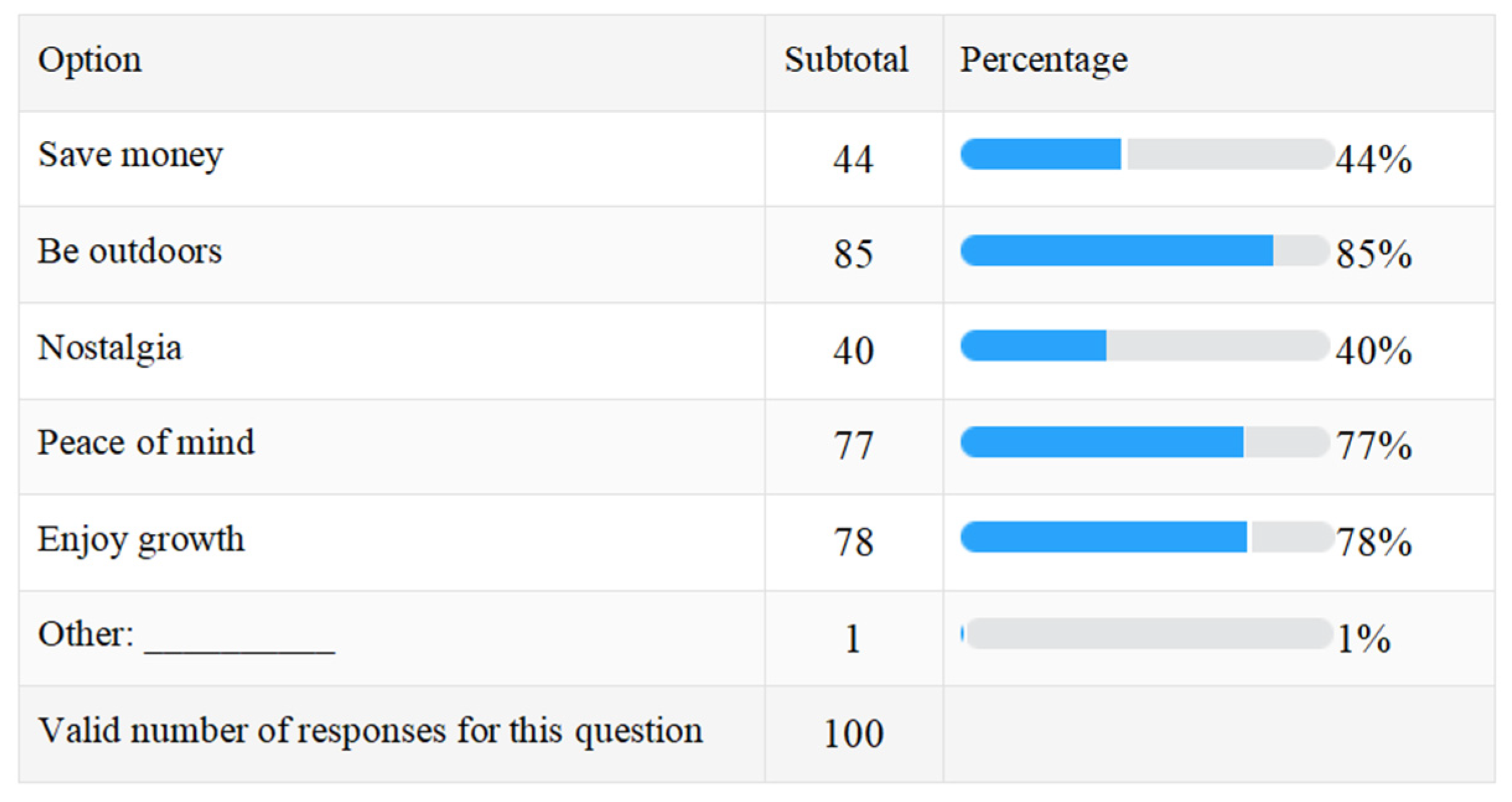
Figure 5.
Personal motivations for engaging with green space (Question 20, n = 100).
Figure 5.
Personal motivations for engaging with green space (Question 20, n = 100).
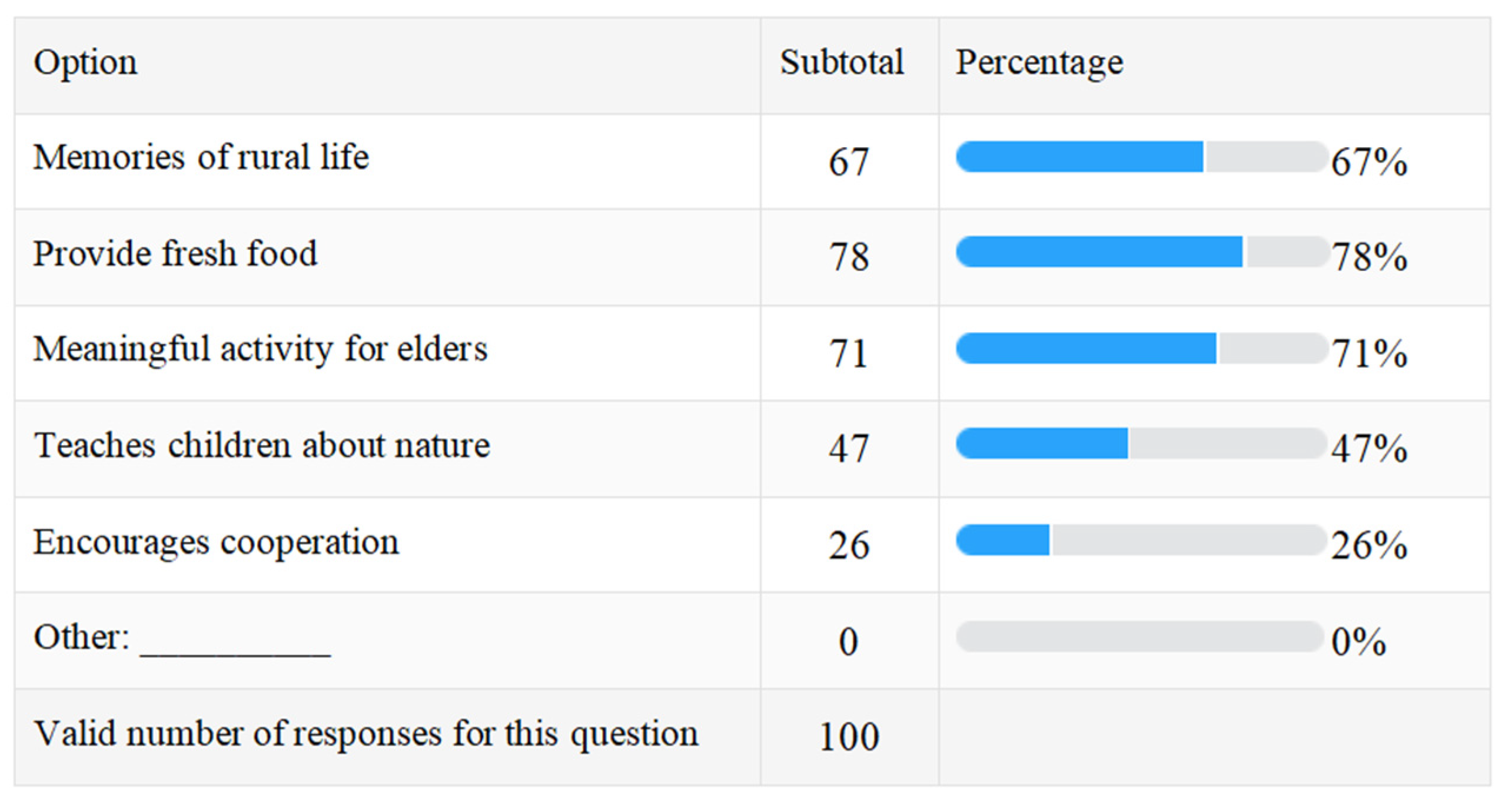
Figure 6.
Cultural motivations for engaging in vegetable gardening (Question 12, n = 100).
Figure 6.
Cultural motivations for engaging in vegetable gardening (Question 12, n = 100).
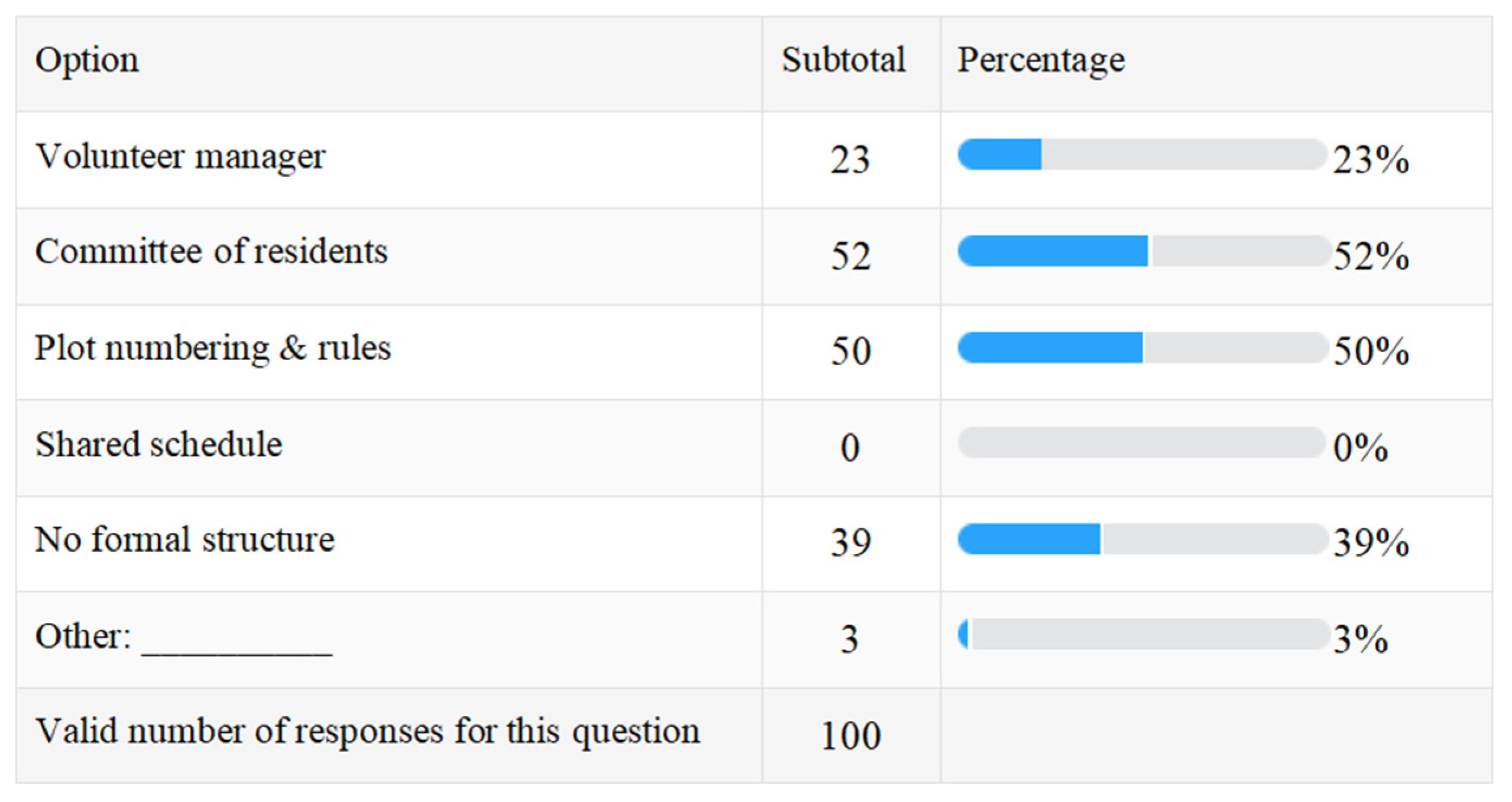
Figure 7.
Preferred governance structures for managing the gardens (Question 17, n = 100).
Figure 7.
Preferred governance structures for managing the gardens (Question 17, n = 100).
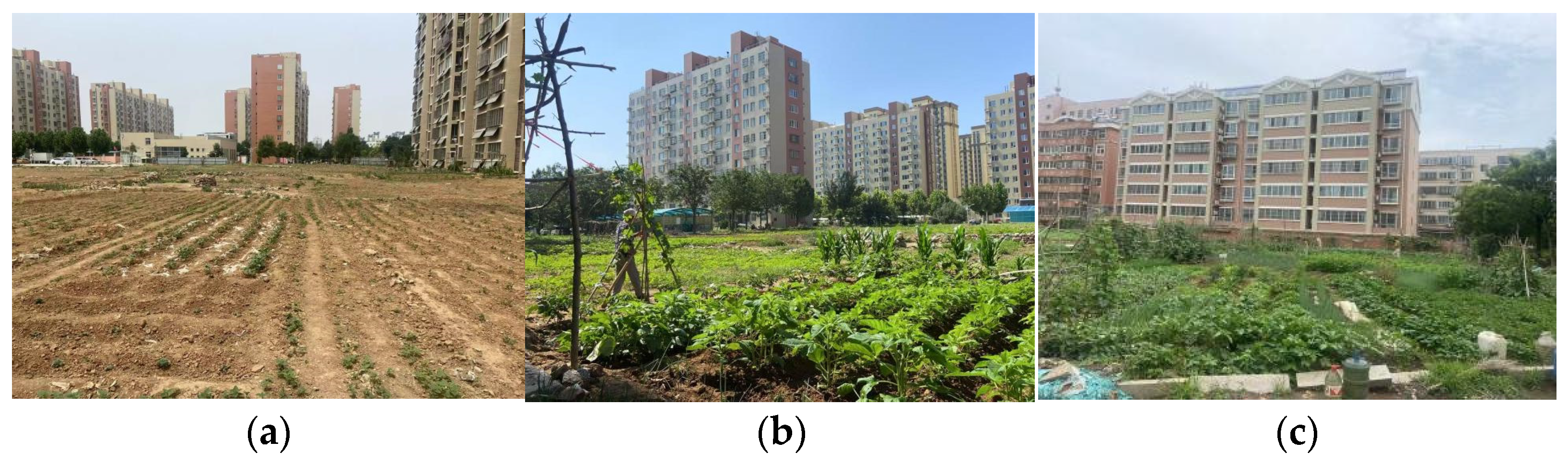
Figure 8.
Dashiziyuan Plot 1 (a); Dashiziyuan Plot 1b (b); and Dashiziyuan Plot 2 (c).
Figure 8.
Dashiziyuan Plot 1 (a); Dashiziyuan Plot 1b (b); and Dashiziyuan Plot 2 (c).
Figure 9.
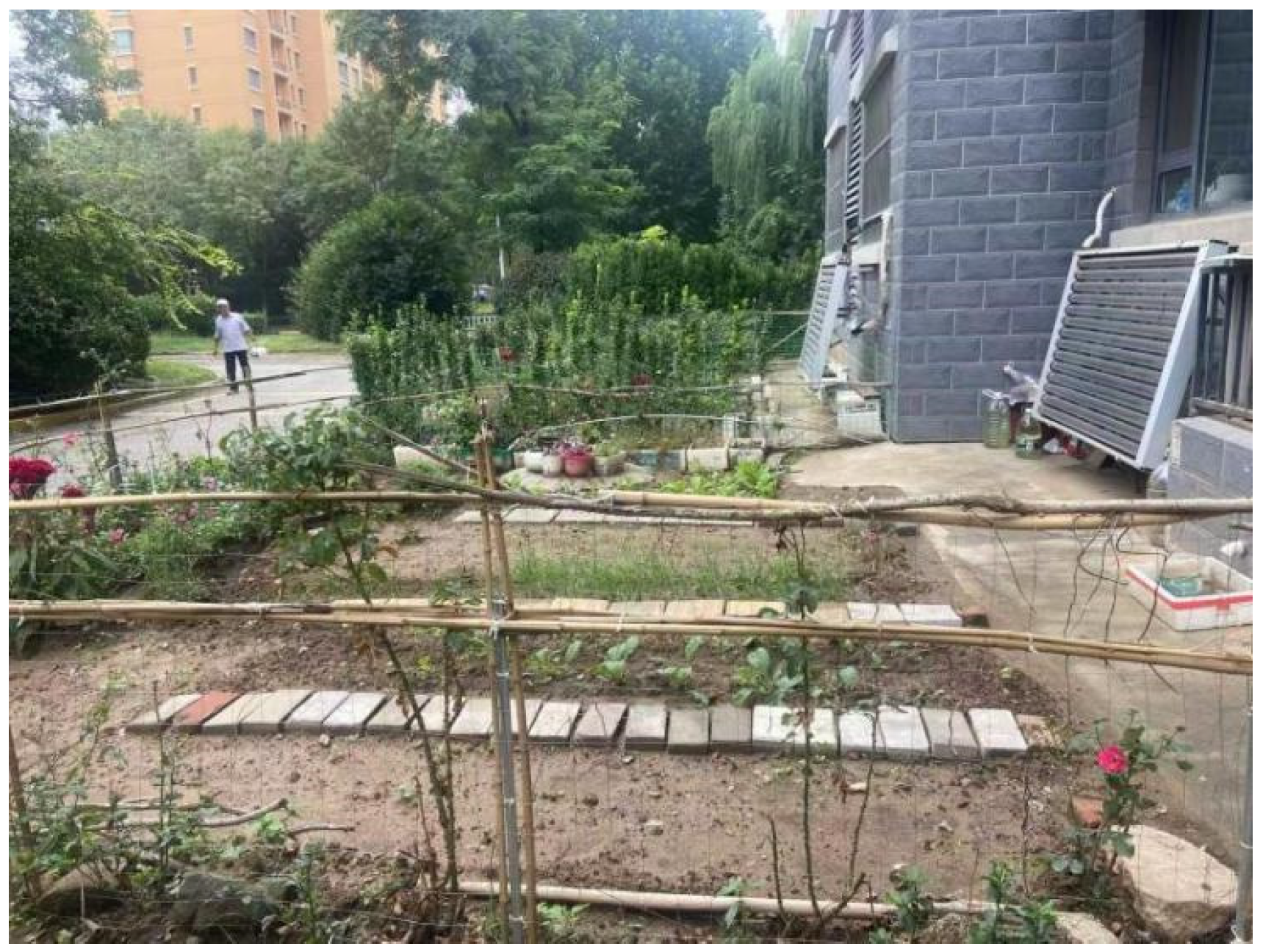
Lushang Changchunteng: interior informal garden within residential compound.
Figure 9.
Lushang Changchunteng: interior informal garden within residential compound.
Figure 10.
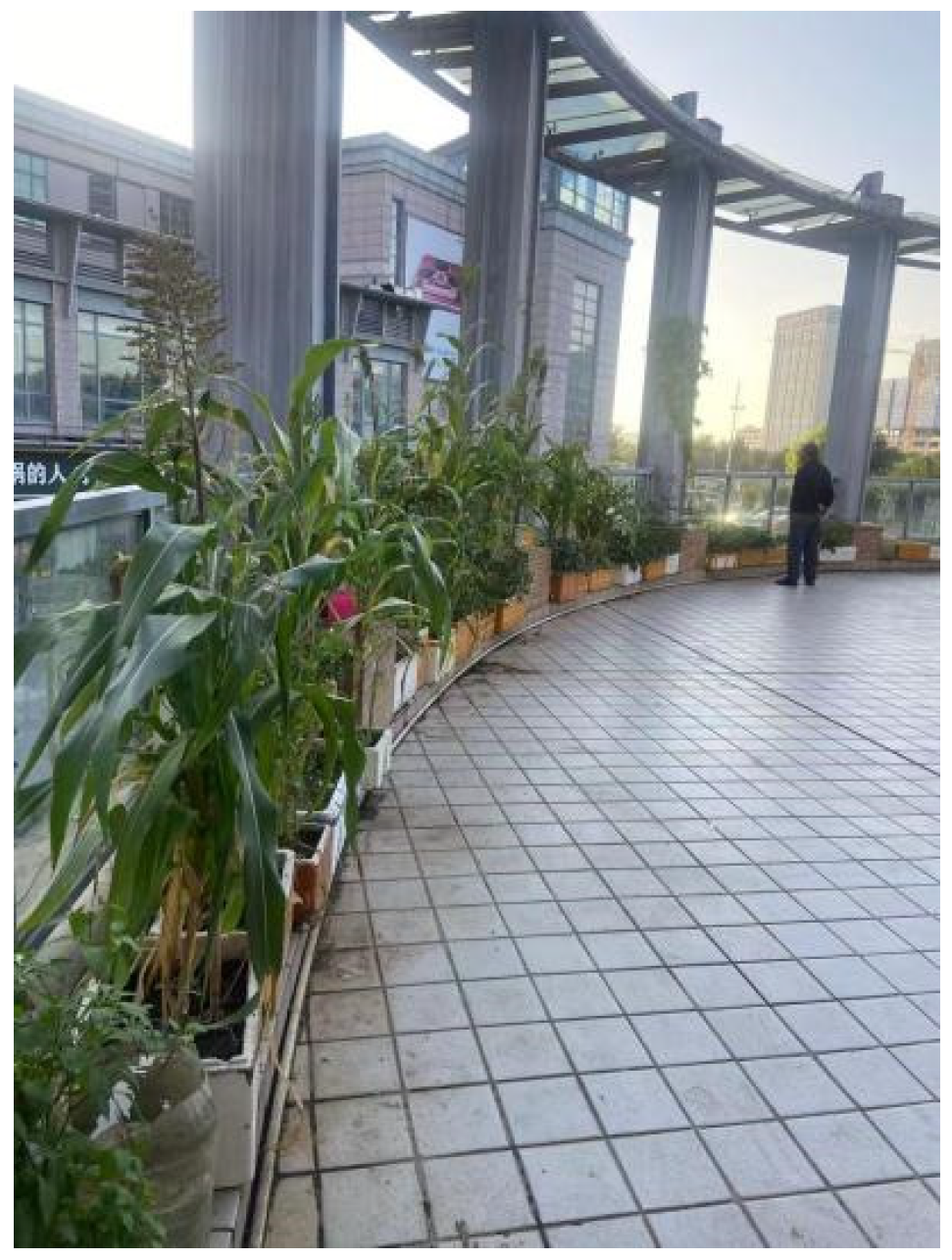
Ivy Commercial Zone: Informal planting along a commercial frontage in Ivy Commercial Zone, demonstrating user-led greening within a dense retail environment and the softening of hard urban edges through improvised vegetation.
Figure 10.
Ivy Commercial Zone: Informal planting along a commercial frontage in Ivy Commercial Zone, demonstrating user-led greening within a dense retail environment and the softening of hard urban edges through improvised vegetation.
Figure 11.
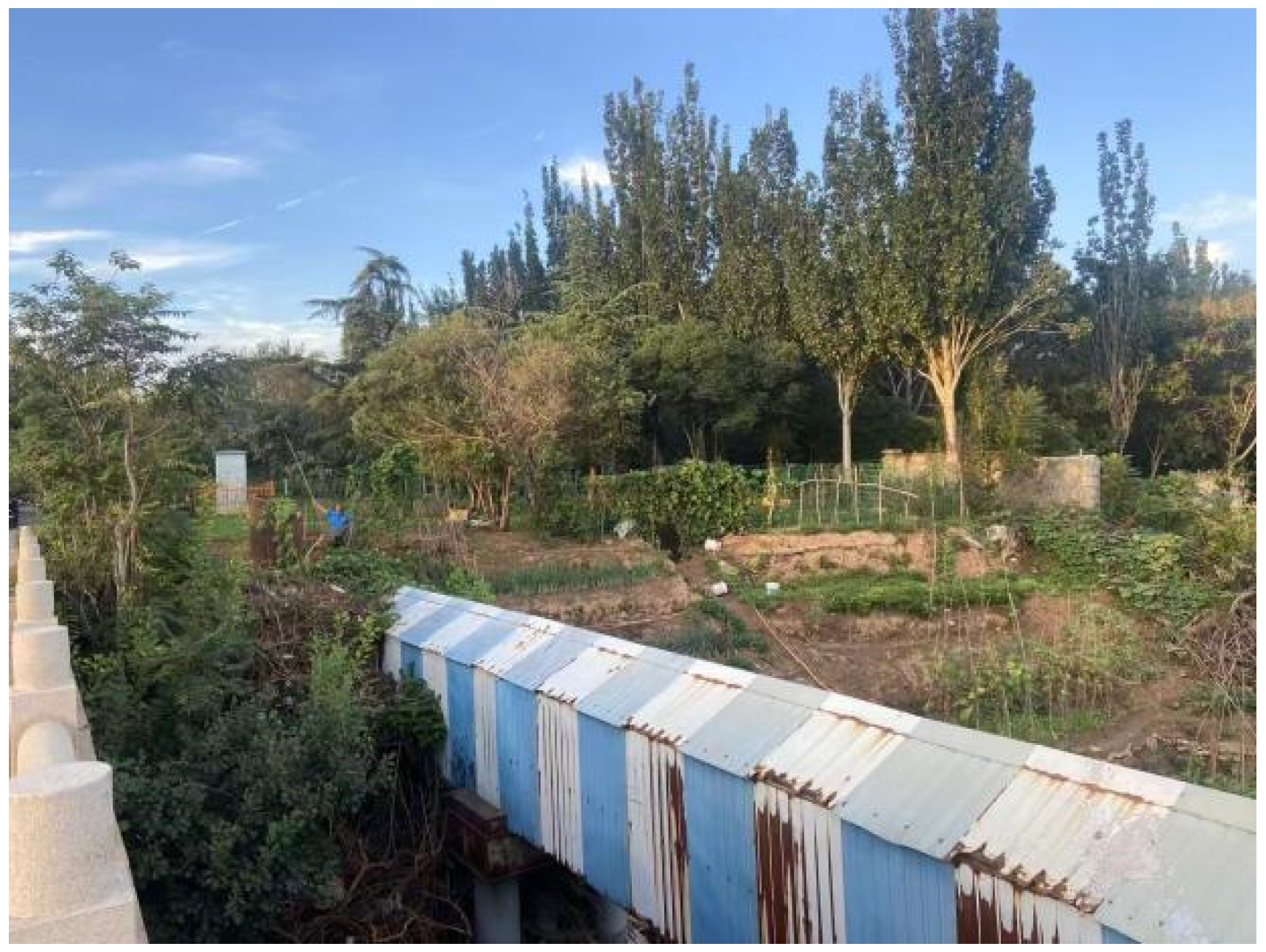
Terraced informal cultivation at the intersection of Ziwei Road and Daxue Road, viewed from an elevated bridge. The site reveals a highly organized landscape of resident-led gardening, show-casing intricate practices of fencing, terracing, and plot subdivision that reflect advanced material improvisation and spatial management.
Figure 11.
Terraced informal cultivation at the intersection of Ziwei Road and Daxue Road, viewed from an elevated bridge. The site reveals a highly organized landscape of resident-led gardening, show-casing intricate practices of fencing, terracing, and plot subdivision that reflect advanced material improvisation and spatial management.
Figure 12.
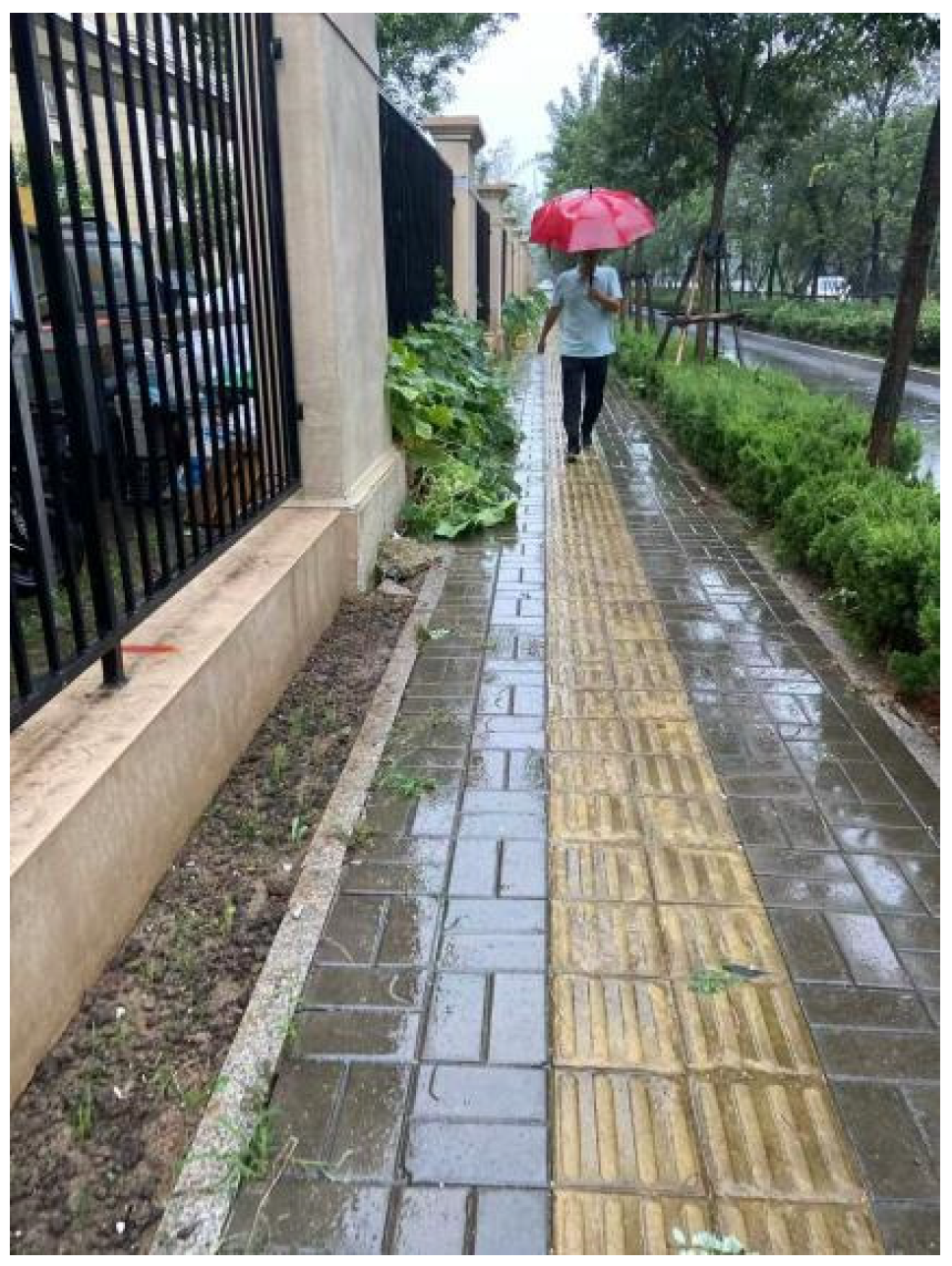
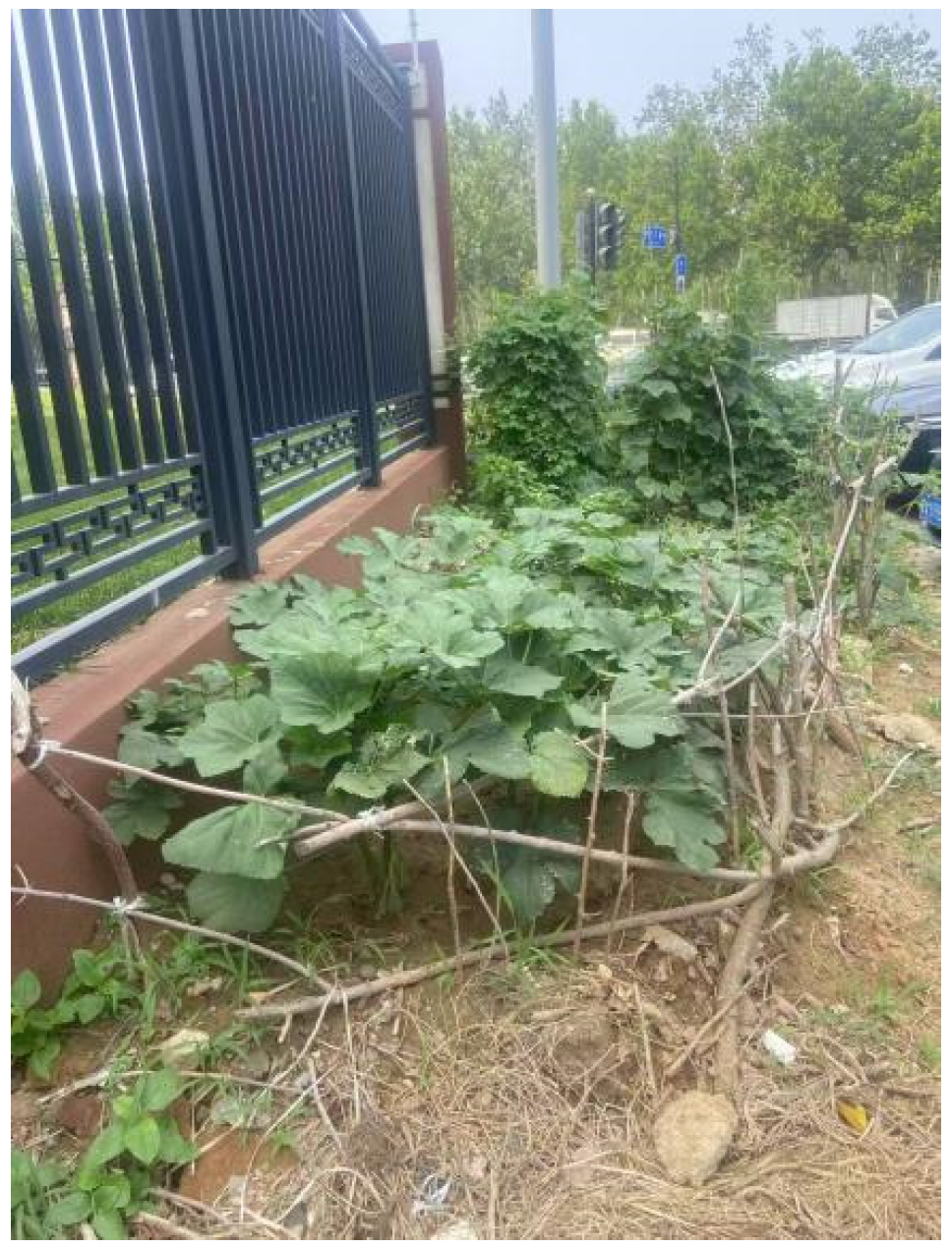
Narrow strip of informal cultivation in Shandong Expressway Lvcheng Lanyuan, located between the compound boundary fence and the adjacent pedestrian sidewalk. The garden occupies a marginal linear space, illustrating res-ident-led appropriation of infrastructural edges and the transformation of residual land into productive green space.
Figure 12.
Narrow strip of informal cultivation in Shandong Expressway Lvcheng Lanyuan, located between the compound boundary fence and the adjacent pedestrian sidewalk. The garden occupies a marginal linear space, illustrating res-ident-led appropriation of infrastructural edges and the transformation of residual land into productive green space.
Figure 13.
Informal boundary garden along the edge of Jishui Bieyuan compound. Located between the perimeter fence and the adjacent sidewalk, the cultivated strip demonstrates resident-led use of narrow edge spaces, with improvised fencing and dense planting reflecting localized material adaptation and spatial negotiation.
Figure 13.
Informal boundary garden along the edge of Jishui Bieyuan compound. Located between the perimeter fence and the adjacent sidewalk, the cultivated strip demonstrates resident-led use of narrow edge spaces, with improvised fencing and dense planting reflecting localized material adaptation and spatial negotiation.
Figure 14.
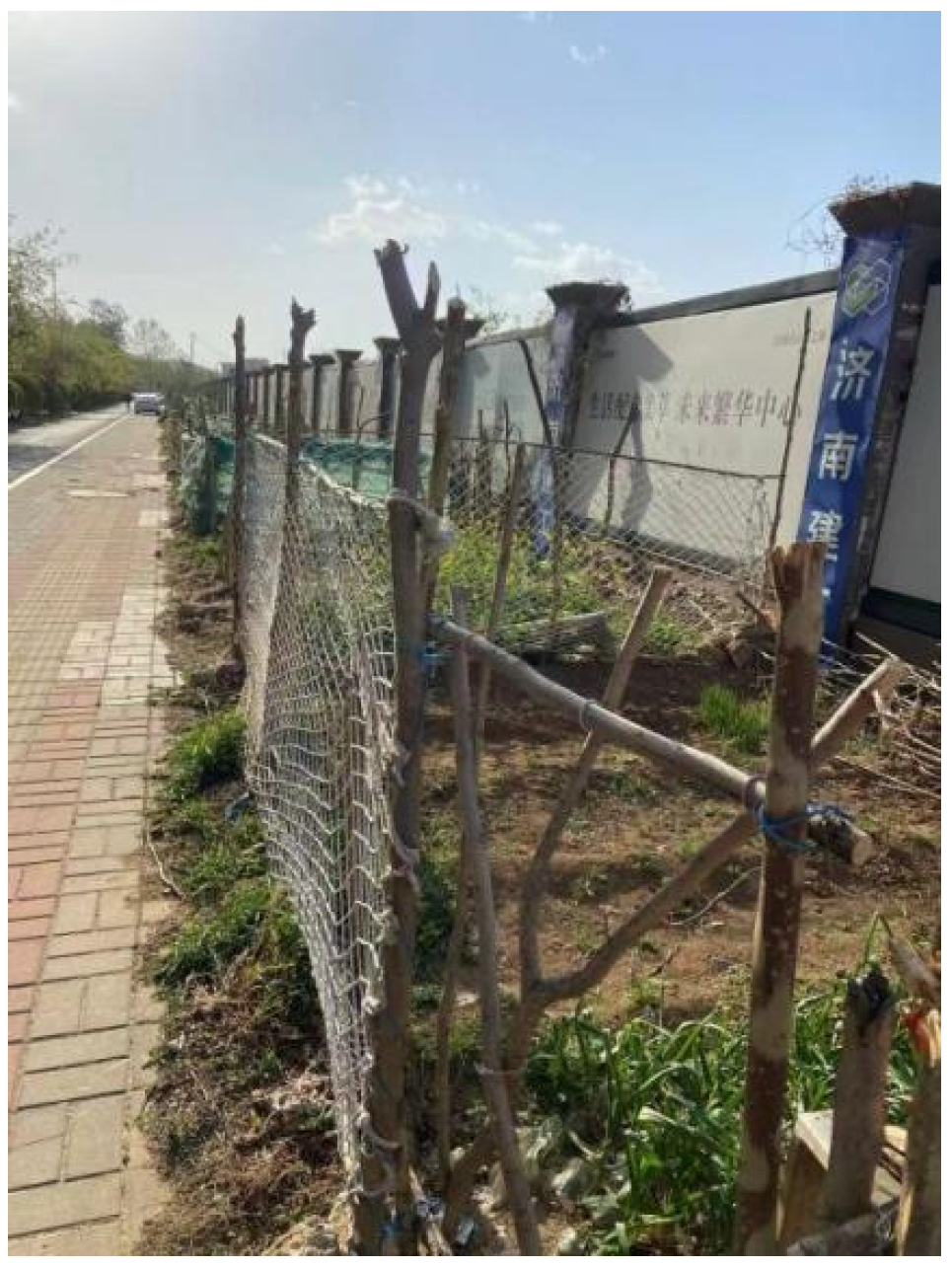
Boundary garden along Wenhui Road, adjacent to the under-development Yuanboyuan Future City residential project in Changqing District, Jinan. The image shows informal cultivation occurring in the narrow strip between the pedestrian sidewalk and the construction boundary fence, illustrating resident-led appropriation of transitional interstitial space under conditions of ongoing urban development.
Figure 14.
Boundary garden along Wenhui Road, adjacent to the under-development Yuanboyuan Future City residential project in Changqing District, Jinan. The image shows informal cultivation occurring in the narrow strip between the pedestrian sidewalk and the construction boundary fence, illustrating resident-led appropriation of transitional interstitial space under conditions of ongoing urban development.
Figure 15.
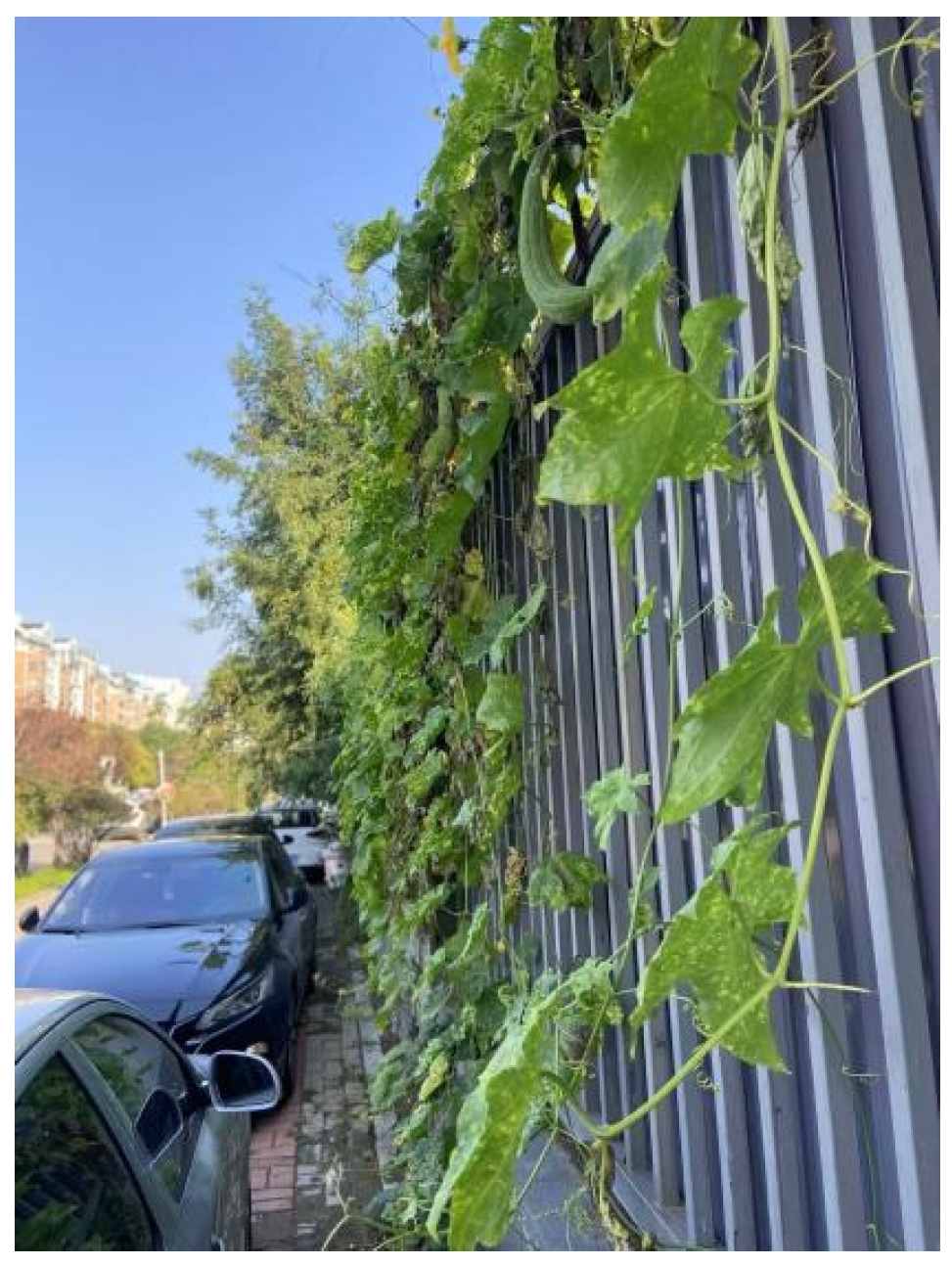
Vertical informal cultivation along the boundary fence of Lushang Bayside Garden, a high-end residential compound. Climbing vegetation transforms the rigid enclosure into a productive green façade, illustrating resident-led adaptation within a highly regulated and exclusive urban environment.
Figure 15.
Vertical informal cultivation along the boundary fence of Lushang Bayside Garden, a high-end residential compound. Climbing vegetation transforms the rigid enclosure into a productive green façade, illustrating resident-led adaptation within a highly regulated and exclusive urban environment.
Figure 16.
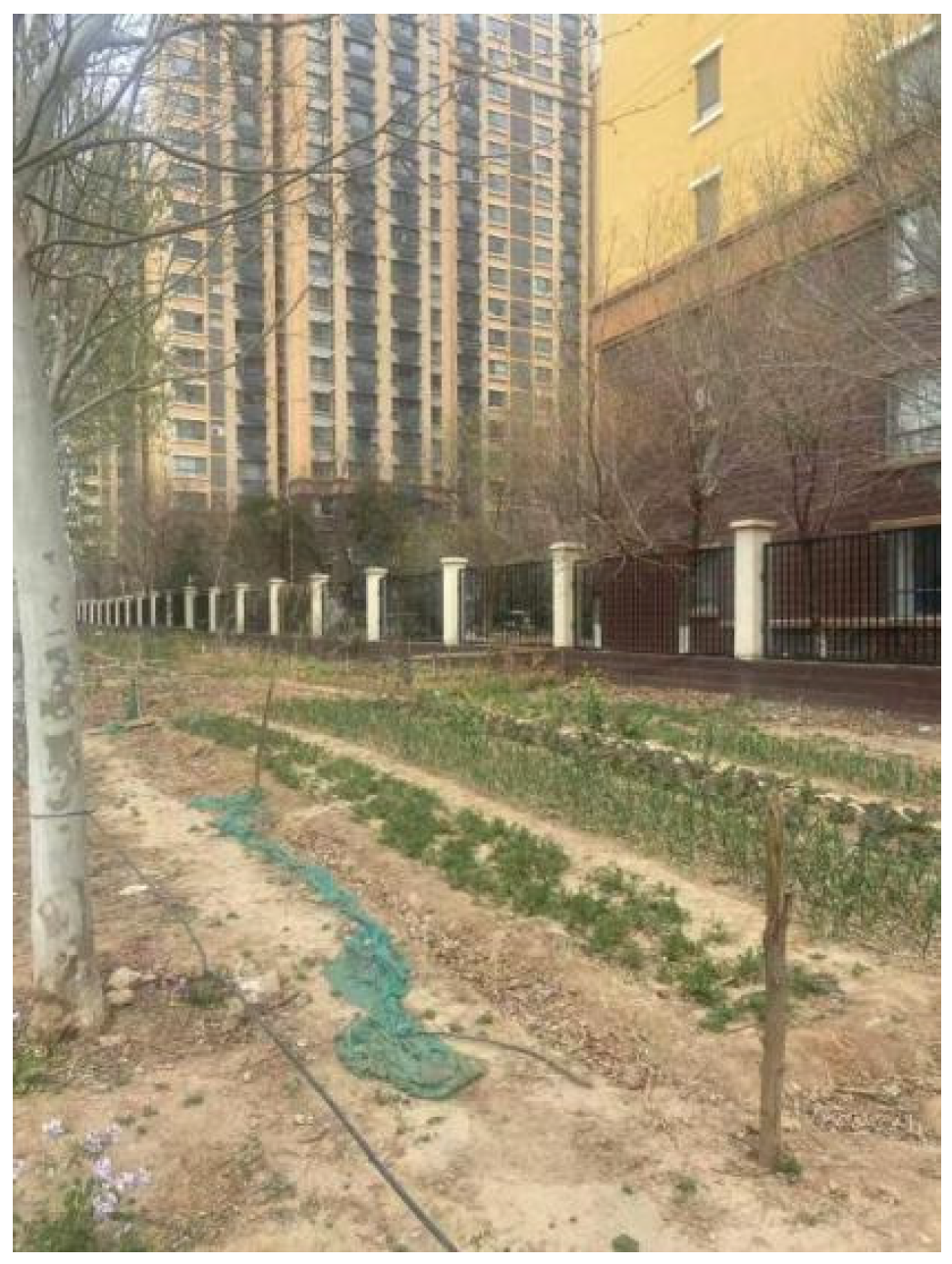
Linear boundary garden in Lushang Changchunteng, located within a roadside green buffer zone. This substantial cultivated strip illustrates organized resident-led use of infrastructural edge space, though its continuity has been disrupted by underground utility works, highlighting the vulnerability of informal gardens to infrastructural intervention.
Figure 16.
Linear boundary garden in Lushang Changchunteng, located within a roadside green buffer zone. This substantial cultivated strip illustrates organized resident-led use of infrastructural edge space, though its continuity has been disrupted by underground utility works, highlighting the vulnerability of informal gardens to infrastructural intervention.
Table 1.
Conceptual Bridge—Operationalizing Theory for Empirical Study.
Table 1.
Conceptual Bridge—Operationalizing Theory for Empirical Study.
| Earlier Work [31,32] | Current Research Contribution |
|---|
| Design as Improvisation: Unintentional design emerges from chance and adaptation. | Informal Gardens: Residents adapt vacant land and reuse found materials; this unofficial quality becomes a design driver. |
| Aesthetic of the Everyday: Finds beauty in unintentional design rather than professional norms. | Aesthetic of Utility: Gardens’ beauty arises from utility, functional resilience, and human imprint rather than polished architecture. Gardens act as socio-ecological buffers against urban heat and social isolation. |
| Human Imprint & Sustainability: Interaction leaves traces that inspire new thinking. | Evidence of Imprints: Human traces in paths, patches, and irrigation generate patterns that can inspire formalized sustainable design. |
| Transitional Spaces: Neglected contexts hold latent inspirational value. | “Waiting Lands”: Community gardens on temporary plots are transitional spaces that absorb the shocks of redevelopment, reducing community vulnerability. |
| Nomadic Gardens as Bridge: Conceptual speculation on temporary urban gardens. | Empirical Case Study: Documentation provides a longitudinal link from concept to practice. |
Table 2.
Summary of Urban Development Projects in Dashiziyuan Community, Jinan (2021–2024).
Table 2.
Summary of Urban Development Projects in Dashiziyuan Community, Jinan (2021–2024).
| Project | Release Date | Purpose/Use | Implications for Informal Gardening | Source |
|---|
| Kindergarten Construction | 3 January 2024 | Institutional facility (0.36 ha) | Formal land use leads to the permanent displacement of gardens, resulting in a disruption of community resilience and the loss of local adaptive capacity for elderly residents. | Jinan City Changqing District Dashiziyuan Community urban village renovation resettlement kindergarten |
| Residential Resettlement & Public Housing | 28 January 2021 | Affordable housing + public facilities (40,516 m2 plot) | Formalization prioritizes housing density over productive landscapes, increasing the socio-spatial vulnerability of the community and altering established resilience-building social practices. | Changqing District Wenchang Sub-district Office Dashiziyuan Community old residence renovation resident livelihood security housing project |
| Land Expropriation Pre-announcement No. 7 | 27 February 2024 | Municipal roads, protective green spaces, urban infrastructure | Signals the total erasure of informal spaces; creates a governance risk where the absence of transitional green infrastructure leaves the community without a socio-ecological buffer during the long construction phase. | Land acquisition pre-announcement Jizhangzheng Pre-Announcement (2024) No. 7 [58] |
Table 3.
The Risk-Management Logic.
Table 3.
The Risk-Management Logic.
| Area of Systemic Risk | Residents’ Concerns (The Vulnerability) | Residents’ Desired Improvements (The Resilience Strategy) |
|---|
| Spatial & Access Risk | Not enough space (70%) | Sitting benches and paths (61%). Strategy: Enhance site safety and equitable access |
| Difficult to navigate (51%). Risk: Social conflict and exclusion of vulnerable groups | Organized garden beds (30%). Strategy: Build community adaptive capacity through self-management |
| Governance Risk | No clear rules or organization (59%). Risk: Site degradation and legal instability | More organization/cleanliness (32%) |
| Environmental Risk | Messy or chaotic appearance (46%). Risk: Public perception of “blight” leads to premature demolition | More trees/shade (74%). Strategy: Create a socio-ecological buffer that provides cooling and aesthetic value |
| Infrastructure | (Lack of water/tools not listed here) | Water supply/tool storage (21%) |
Table 4.
Key Themes and Representative Comments from Residents’ Open-Ended Responses.
Table 4.
Key Themes and Representative Comments from Residents’ Open-Ended Responses.
| Theme | Representative Resident Comments | Frequency/Notes |
|---|
| Access to Land | “Ensure the distribution of land for planting and provide more space” | Recurrent concern about limited plot availability |
| Management & Organization | “There should be someone to manage and more land should be available” | Highlights need for oversight, plot assignment, and rules |
| Water & Tools Availability | “There are no basic resources such as water sources and power supplies”; “Hope to provide water sources, tools, and power supply” | Key resource constraint for gardening participation |
| Environmental Quality & Aesthetics | “Hope to retain planting while maintaining the beauty and tidiness of the community environment” | Residents link planting with improved environment and visual appeal |
Table 5.
Thematic Summary of Interview Excerpts (Semi-Structured Interviews, n > 10).
Table 5.
Thematic Summary of Interview Excerpts (Semi-Structured Interviews, n > 10).
| Theme | Representative Excerpt (Translated) | Analytical Implication |
|---|
| Health and Food Safety | “Vegetables from the supermarket are sprayed. What we grow ourselves is healthier and tastes better.” | Gardening framed as food safety autonomy and embodied health practice |
| Meaningful Activity in Later Life | “Idle is idle. You have to find something to do.”/”Planting is like exercise.” | Cultivation as daily structure, purpose, and physical engagement for elderly residents |
| Tenure Insecurity | “They have cleared it several times… because planting here is not allowed.” | Regulatory ambiguity produces structural precarity |
| Land Scarcity & Competition | “I wanted to plant, but I couldn’t get a plot.” | High demand and absence of formal allocation mechanisms |
| Intergenerational Learning | “Children don’t even recognize vegetables now.” | Gardens function as informal environmental education spaces |
| Governance Preference | “It should be spontaneous… those who want to plant, plant.” | Preference for resident-led, minimally bureaucratic management |
Table 6.
Key Regulations, Implications, and Relevance to Nomadic Gardens.
Table 6.
Key Regulations, Implications, and Relevance to Nomadic Gardens.
| Policy/Regulation | Key Provisions | Relevance to Nomadic Gardens |
|---|
| Land Administration Law (1986) [47] | Defines ownership & use rights; prohibits unauthorized land use. | Gardens on public/collective land are legally precarious; improvised structures may constitute violations. Creates legal vulnerability; prevents the formalization of adaptive capacity in vacant lands. |
| Urban and Rural Planning Law (2008) [48] | Requires land use conformity to statutory plans. | Citizen-led vegetable plots are non-conforming; explains enforcement risk; current rigidity hinders the creation of transitional socio-ecological buffers. |
| China Guideline on Green Development (2021) [50] | Promotes ecological health and green lifestyles. | Opportunity: Aligns with outcomes of nomadic gardens but lacks mechanisms for formal recognition. Use “Green Lifestyles” as a mandate for community-led risk reduction and resilience. |
| Provisional Regulations on Urban Landscaping (1982) [49] | Emphasizes professional, ornamental design. | Constraint: Favors formal landscaping; justifies removal of provisional, productive gardens. |
| Jinan Local Regulations (Redevelopment/Landscaping) | Prioritizes infrastructure, aesthetics, and uniform standards in transitional spaces. | Constraint: Enforcement rules often override aspirational policies, placing informal gardens at risk of removal. Over-prioritization of aesthetics creates a resilience gap, as functional, productive landscapes are removed in favor of ornamental ones. |
Table 7.
Diversity of Forms: Evidence of Scale, Shape, and Context.
Table 7.
Diversity of Forms: Evidence of Scale, Shape, and Context.
| Typology | Typical Location & Scale | Characteristics & Materiality | Socio-Spatial/Theoretical Significance | Risk Profile | Resilience Role |
|---|
| 1. Community-Scale Plots | Large residual lots/courtyards within compounds (≈3000 m2). | Modular, salvaged materials, shared infrastructure (compost, water). | Functions as an Urban Micro-Commons; evidence of Collective Action and resident Governance Strategies. | High social displacement and land-use conflict risk. | Primary socio-ecological buffer; builds high collective adaptive capacity. |
| 2. Micro-Gardens at Building Edges | Front of windows, terraces, stairwell floors (<1 m2). | Vertical planters, pots, climbing vines; highly individualized. | Manifests Micro-Scale Design Agency; contributes to Localized Resilience and aesthetic diversity. | Low visibility risk; high vulnerability to individual displacement. | Personal psychological buffer; demonstrates micro-scale spatial agency. |
| 3. Storefront/Threshold Gardens | Commercial-residential interfaces, shop fronts. | Containers, small beds, vertical climbers; blurs property lines. | Strategic appropriation of the Public–Private Interface; enhances Business Microclimate and functional use of frontage. | Economic/commercial boundary risk; legal ambiguity of public–private interface. | Socio-economic resilience; enhances street-level microclimates and social safety. |
| 4. Fence-Line/Peripheral Gardens | Narrow strips along fences, opposite walls (≈0.5 m wide). | Organized linear beds, hedges; exhibits adaptive aesthetics. | Transformation of Transitional Urban Space; practice of Quiet Negotiation of Legitimacy; intergenerational micro-commons. | High risk of “aesthetic policing” by municipal authorities. | Adaptive boundary management; facilitates intergenerational knowledge transmission. |
| 5. Peripheral Plots (New) | Margins outside newer compound fences (High Visibility/Precarity). | Delineated plots, raised beds, informal fencing; meticulous organization. | Represents highest Regulatory Tension; highlights the Fragility of Informal Tenure in modern development. | High regulatory conflict and “zero-tolerance” enforcement risk. | Organized resistance to spatial vulnerability; tests the limits of formal governance. |
| 6. Informal Riparian Gardens | Margins of disused canals/stormwater channels. | Terracing, intricate wooden/natural structures; site-specific design. | Repurposing of Infrastructural Corridors; fosters Multi-Generational Engagement; high Narrative and Aesthetic Value. | High environmental risk (flooding/pollution) and infrastructural instability. | Ecological remediation; repurposes high-risk “non-spaces” into productive assets. |
| 7. Vertical Façade Gardens | Walls and façades of residential compounds (Vertical Dimension). | Vigorously climbing plants, minimal material investment. | Demonstrates Cultivation Resilience; successful Reclamation of Vertical Surfaces in tightly regulated spaces. | Spatial constraint risk; potential building code/safety non-compliance. | Intensive resourcefulness; maximizes resilience in hyper-dense urban environments. |
| 8. Linear Edge Gardens | Narrow green strips alongside utility corridors. | Careful spatial organization, linear arrangement. | Evidence of Material Improvisation; extreme Vulnerability to Infrastructural Works; low-tenure security. | High infrastructural fragility; extreme vulnerability to underground utility works. | Transitional utility maximization; provides ecological connectivity in high-risk zones. |