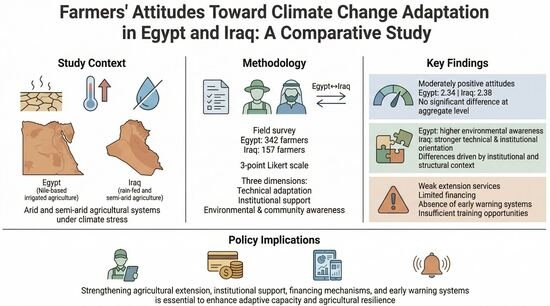
1. Introduction
Climate change has emerged as one of the gravest global challenges of the twenty-first century, exerting profound environmental, economic, and social impacts that particularly endanger the agricultural sector—the cornerstone of food security and sustainable development. Rising temperatures, irregular rainfall, and the growing frequency of extreme weather events have already reduced productivity and undermined rural stability [
1,
2], increasing global risks to food systems [
3]. In the Arab region, this vulnerability is amplified by the dependence of national economies on agriculture. Egypt and Iraq stand among the most exposed countries to climate change. Egypt’s near-total reliance on the Nile faces mounting climatic and geopolitical pressures [
4], while Iraq suffers from escalating drought, desertification, and declining rainfall [
5,
6]. Both countries share structural challenges including limited water resources, high production costs, weak institutional frameworks, and sociocultural constraints that restrict adaptive capacity [
7,
8].
Agriculture’s sensitivity to climate variability manifests through shortened crop cycles, reduced yields, and emerging pest infestations that raise production costs [
9,
10,
11]. In Egypt, any fluctuation in the Nile’s flow directly threatens irrigation sustainability [
4], while in Iraq, severe droughts and soil degradation have reduced land fertility and displaced rural labor [
5,
12]. These stresses not only endanger food production but also intensify human insecurity through migration and social instability [
3].
Adapting to these transformations requires a multidimensional approach encompassing technical, cognitive, institutional, and psychological dimensions. The technical dimension concerns farmers’ actual application of adaptation practices, such as improved irrigation, adjusted planting dates, and climate-resilient crops. The cognitive dimension reflects farmers’ awareness and understanding of climate risks and adaptation options. The institutional dimension refers to the role of extension services, training, credit, early warning systems, and supportive policies in enabling adaptation. Finally, the psychological dimension encompasses farmers’ attitudes, risk perceptions, motivation, and perceived self-efficacy, which influence their readiness to translate awareness into adaptive action. Technically, climate-smart agriculture and integrated soil–water management offer vital pathways to sustain productivity and reduce emissions [
13,
14]. However, limited financial resources and institutional support remain major obstacles [
15,
16]. Behaviorally, adaptation depends on awareness and perception. Studies show that informed farmers are more likely to adopt adaptive practices [
17,
18], yet fatalism and pessimism reduce motivation [
19]. Conversely, optimism and resilience training foster a proactive attitude toward change [
20,
21].
Institutional communication and extension services are also pivotal in translating awareness into practice. Where extension systems are strong, trust and participation increase [
22], but in their absence, farmers rely on inherited methods [
23]. Egypt’s farmers often understand climate risks conceptually yet lack sufficient training or incentives to apply adaptive methods [
14]. In Iraq, ongoing political and economic instability has limited farmers’ willingness to experiment, despite their heightened exposure to climate stress [
6,
24].
Socioeconomic and cultural factors further shape adaptive behavior. Traditional norms and reliance on ancestral knowledge may encourage caution toward innovation [
25]. Integrating women and marginalized groups into adaptation efforts enhances community resilience, as these groups often possess unique coping strategies despite limited access to resources [
26,
27]. Regionally, Egyptian farmers are increasingly turning to salinity-resistant crops and improved irrigation, while Iraqi farmers diversify cropping systems to reduce dependence on rainfall [
6,
8].
Beyond agriculture, climate change poses a wider threat to human security by straining food, water, and health systems and escalating competition over natural resources [
12,
24]. In Iraq, desertification and falling rainfall jeopardize food supply [
5,
6], while Egypt’s water crisis has become a national security concern [
4]. Health risks linked to new pests, malnutrition, and heat stress are rising [
2]. These intersecting pressures highlight the need for integrated climate adaptation strategies that combine scientific innovation, financial empowerment, and institutional reform. Within this context, the present study addresses a key research gap by analyzing farmers’ attitudes toward adaptation mechanisms and practices in Egypt and Iraq. While prior research has examined environmental and economic dimensions, limited attention has been paid to the behavioral and institutional factors shaping farmers’ adaptive capacity in Arab contexts. By comparing two distinct yet comparable agricultural systems, this study seeks to identify the cognitive, social, and policy determinants influencing adaptation behavior, providing an evidence-based framework to strengthen agricultural resilience and inform national and regional climate strategies.
1.1. Research Problem
Climate change poses one of the gravest threats to agriculture in the Arab region, severely affecting production, food security, and farmers’ livelihoods. Its impact is particularly acute in fragile ecosystems such as those in Egypt and Iraq, where limited resources, drought, rising temperatures, soil degradation, and erratic rainfall undermine agricultural sustainability. Despite growing awareness of climate risks, farmers’ attitudes toward adaptation remain diverse, shaped by personal, social, economic, and institutional factors that influence their capacity to adopt adaptive measures. Variations among Arab agricultural settings—linked to institutional frameworks, demographics, education, and participation in agricultural organizations—further explain differences in awareness and response levels.
In this context, the study addresses a central question: What are the attitudes of farmers in Egypt and Iraq toward climate change adaptation mechanisms and practices, and which factors shape these attitudes?
It further explores four sub-questions:
What is the overall level of farmers’ attitudes in both countries?
How are these attitudes related to personal, economic, and social characteristics?
What similarities and differences exist between Egyptian and Iraqi farmers in this regard?
What obstacles hinder adaptation, and what measures could enhance it?
1.2. Research Objectives
This study aims to analyze farmers’ attitudes in Egypt and Iraq toward mechanisms and practices of climate change adaptation through the achievement of the following specific objectives:
To identify the level of farmers’ attitudes toward mechanisms and practices of climate change adaptation.
To determine the nature of the relationship between the degree of farmers’ attitudes toward climate change adaptation and their personal, economic, and social characteristics.
To examine the differences between Egypt and Iraq in the level of farmers’ attitudes toward mechanisms and practices of climate change adaptation.
To identify the main constraints and suggestions reported by farmers regarding the implementation of climate change adaptation practices.
1.3. Research Hypotheses
In line with the operational objectives and theoretical framework of the study, which examines farmers’ attitudes toward mechanisms and practices of climate change adaptation in Egypt and Iraq, the following hypotheses were formulated:
H1. There are statistically significant differences between farmers in Egypt and Iraq regarding their attitudes toward mechanisms and practices of climate change adaptation.
H2. There is a statistically significant relationship between farmers’ attitudes toward climate change adaptation and certain personal, social, and economic characteristics, such as age, educational level, size of agricultural holding, agricultural income, and membership in agricultural organizations.
H3. There are statistically significant differences between farmers attitudes toward climate change adaptation mechanisms and practices according to their demographic and economic characteristics within each country.
1.4. Literature Review
The issue of climate change and agricultural adaptation has been widely discussed in both international and Arab research, though the focus and scope of these studies differ. Internationally, several works such as those by Akhtar et al. and Jamshidi et al. [
17,
20] explored farmers’ perceptions and awareness, emphasizing that prior experience with climate risks strengthens adaptive capacity. These studies were methodologically rigorous and relied on quantitative indicators, yet most were confined to Asian contexts, limiting their applicability to Arab environments characterized by distinct cultural and institutional realities. From a psychological perspective, research by Mahmood et al. and Chipfupa et al. [
19,
21] introduced the idea that adaptation is shaped not only by access to knowledge and resources but also by non-material elements such as beliefs, optimism, and psychological capital. While these studies offered an important theoretical advancement, they did not translate their findings into practical frameworks for agricultural communities.
At the institutional level, studies including those by Abdullah et al. and Kotzé et al. [
22,
28] underscored the importance of participatory communication and access to information in promoting adaptive attitudes.
However, they largely overlooked the political and economic constraints that often weaken institutional effectiveness in developing contexts. In the Arab region, empirical work has been more localized. Al-Tantawi et al., [
29] found that Egyptian tomato farmers showed strong awareness of climate risks but limited practical adaptation. Magdy [
30] identified gaps between policy formulation and on-ground implementation, revealing a disconnect between macro-level strategies and farmers’ micro-level realities. In Iraq, studies such as those by Zgayer and Shandoul, Shams Al-Din and Ali, and Saleh [
31,
32,
33] examined the impacts of drought, desertification, and weak agricultural governance, illustrating sectoral vulnerabilities but paying little attention to farmers’ attitudes themselves. Overall, previous research provides valuable insights into climate impacts and adaptation but remains incomplete in three key dimensions: first, insufficient integration of psychological and behavioral aspects of farmer decision-making; second, limited understanding of how institutional and economic contexts shape individual adaptive behavior; and third, a lack of comparative analyses between Arab countries that could reveal contextual similarities and differences in farmers’ attitudes toward adaptation. Therefore, the present study seeks to fill this gap by analyzing farmers’ attitudes toward climate change adaptation in Egypt and Iraq from a comparative perspective, providing a comprehensive understanding that captures the interplay of influencing factors, and translates them into practical, applicable recommendations at both the local and regional levels.
Table 1 presents a comparative overview of previous studies addressing farmers’ attitudes toward climate change adaptation, highlighting their objectives, methodologies, key findings, strengths, and limitations.
2. Materials and Methods
The study adopted the descriptive–analytical approach as the most appropriate method for achieving its objectives. This approach aimed to analyze farmers’ attitudes and practices toward climate change adaptation in Egypt and Iraq and to compare the similarities and differences between the two contexts. A structured questionnaire was designed as the primary tool for data collection, encompassing several dimensions that covered technical, institutional, environmental, and social aspects related to agricultural adaptation. The validity of the instrument was verified through review by a panel of experts specializing in agricultural extension, environmental studies, and rural development. The internal consistency of the measurement scale was examined using Cronbach’s alpha as a preliminary reliability indicator. The analysis revealed relatively low alpha coefficients across the scale dimensions. This outcome can be attributed to several methodological factors, including the use of a three-point Likert scale, the multidimensional and behavioral nature of climate change adaptation constructs, and the cross-country comparative design of the study, which encompasses heterogeneous institutional and environmental contexts.
In this study, Cronbach’s alpha is therefore treated as a conservative diagnostic measure rather than a strict psychometric criterion. Accordingly, the scale is considered appropriate for exploratory and comparative analysis, focusing on identifying patterns, tendencies, and relative differences between contexts rather than on scale refinement or confirmatory measurement validation.
The field study was conducted in two agricultural environments representing variations in climatic and institutional conditions: Beheira Governorate in Egypt and Duhok Governorate in Iraq. These two regions were selected because they both represent areas of intensive agricultural activity facing clear climatic challenges.
2.1. Study Sample
In Egypt, the study population included all landholders in Beheira Governorate, totaling 501,427 farmers. The three largest districts in terms of the number of landholders Damanhur (79,830), Abu Hummus (58,936), and Itay El-Baroud (56,574) were selected. From each district, one village was randomly chosen: Bani Mousa, Abu Hawash, and Kafr Awana, respectively. The total number of landholders across the three selected villages amounted to 3100. The sample size was determined using the Krejcie and Morgan formula, resulting in 342 respondents, distributed among the villages proportionally to their relative weights. Data were collected over a three-month period, from March to May 2025 (
Table 2).
In Iraq, the population of the study included all landholders in Duhok Governorate, approximately 50,000 farmers, of whom about 3300 were located in the selected villages. Three primary districts (Akre, Bardarash, and Sheikhan) were selected based on agricultural activity and landholder population. From each district, one village was randomly selected to represent the local agricultural environment (Asbi Mal from Akre, Asmawa from Bardarash, and Mala Brawan from Sheikhan). The total number of landholders across the three villages was approximately 3300.
Due to field accessibility, time constraints, and logistical limitations during data collection, an achievable field-based sample of 157 landholders was surveyed. Although this sample size is smaller than the optimal size suggested by Krejcie and Morgan (1970) for a ±5% margin of error, it corresponds to an approximate margin of error of ±7.6% at a 95% confidence level, assuming maximum population variability (p = 0.5). Therefore, the Iraqi sample is considered sufficient for exploratory and comparative analysis, while the results should be interpreted with appropriate caution regarding statistical generalization.
Respondents were distributed across the selected villages in proportion to the relative size of landholders in each village (
Table 3). Data were collected over a three-month period, from March to May 2025.
2.2. Measurement Instrument and Validation
The measurement instrument comprised 30 items equally distributed across three dimensions: technical adaptation (items 1–10), institutional support (items 11–20), and environmental and community awareness (items 21–30). Responses were measured using a three-point Likert scale (1 = disagree, 2 = neutral, 3 = agree), with higher scores indicating a more favorable evaluative orientation toward climate change adaptation mechanisms and practices. Given the limited range of the scale, mean values are interpreted descriptively: scores closer to 3 reflect general agreement, values around 2 indicate neutrality or moderate endorsement, and values closer to 1 indicate disagreement. Directional coding was consistent. Negatively worded items were reverse-coded prior to analysis (items 3, 10, 15, 21, and 23). Content and face validity were ensured through expert review by specialists in agricultural extension and climate change adaptation. Internal consistency was assessed using Cronbach’s alpha, yielding values of 0.086, 0.100, and 0.297 for the technical, institutional, and environmental dimensions, respectively. Although these values indicate low internal consistency, this outcome reflects the behavioral and multidimensional nature of climate change adaptation, the use of a three-point response format, and the cross-country comparative context of the study. Accordingly, Cronbach’s alpha was treated as a conservative reliability indicator, and the instrument was considered suitable for exploratory and comparative analysis rather than strict psychometric assessment.
The measurement scale does not aim to capture a narrowly defined psychological attitude; rather, it reflects a broader evaluative orientation toward climate change adaptation, encompassing beliefs about technological effectiveness, perceived consequences, and contextual institutional and environmental judgments. Accordingly, the scale is treated as a formative composite, and internal consistency indicators are interpreted cautiously without assuming a single latent attitudinal construct.
2.3. Statistical Analysis
Data were analyzed using a combination of descriptive and inferential statistical methods. Descriptive statistics, including frequencies, percentages, means, and standard deviations, were employed to summarize respondents’ characteristics and identify general patterns in attitudes toward climate change adaptation mechanisms and practices.
Inferential analyses were selected according to the level of measurement and distributional properties of the variables. Pearson’s correlation coefficient was used to examine relationships between continuous variables that satisfied normality assumptions, whereas Spearman’s rank correlation was applied for ordinal variables or when normality assumptions were not met. Independent-samples t-tests and one-way ANOVA were conducted to assess differences in mean attitude scores across groups when parametric assumptions were satisfied.
3. Results and Discussion
3.1. Personal and Demographic Variables of the Respondents
The results in
Table 4 indicate that most respondents in Egypt and Iraq fall within the middle-age group (36–50 years), representing 45.3% and 40.8%, respectively. This group forms the backbone of agricultural activity, as their accumulated experience and greater engagement with extension programs enhance their productivity and adaptability. In this regard, Radi [
5] found that middle-aged Iraqi farmers are better able to cope with climatic and economic pressures compared with older farmers who rely on traditional practices. Similarly, Al-Hayali [
25] reported a positive correlation between awareness of climate risks and years of experience, confirming that professional maturity fosters more realistic attitudes toward climate change. Regarding education, clear differences emerged between the two countries. In Egypt, 65.2% of respondents had completed secondary education, whereas in Iraq the majority had primary (29.3%) or intermediate (28.0%) schooling, and only 14.0% held university degrees. This contrast suggests that rural Egypt enjoys a relatively higher educational structure, which contributes to greater awareness of environmental and climatic issues. Supporting this view, ElShafei et al. [
14] found that higher education among farmers in Kafr El-Sheikh significantly improved their understanding of climate risks and adaptation strategies.
With respect to agricultural activity, 69.9% of Egyptian farmers cultivate field crops, while Iraqi farmers tend to diversify their production, with 42.0% engaged in mixed farming and 25.5% growing vegetables and fruits. This variation reflects differences in water resources and production systems. Egypt’s agriculture depends on permanent irrigation in old lands, whereas Iraq’s harsher climatic conditions encourage diversification as a sustainability strategy. This finding aligns with Al-Dulaimi [
10], who emphasized that crop diversification is a key adaptation mechanism to rainfall variability and rising temperatures. Concerning farm size, the gap between the two countries is significant. The average holding is 3.3 dunums in Egypt compared with 48 dunums in Iraq, reflecting structural differences in the agricultural sector. Small and fragmented holdings in Egypt limit farmers’ financial and technological capacity to implement adaptive practices, while larger holdings in Iraq provide greater flexibility in managing risks and resources.
In terms of engagement in farming, 61.1% of Iraqi respondents are fully devoted to agriculture compared with 45.0% in Egypt, where many combine farming with other occupations. This difference illustrates the diversification of rural economies in Egypt, where the relative importance of agriculture has declined due to the growth of services and crafts. Radi [
5] pointed out that such shifts in income sources influence farmers’ priorities and willingness to invest in adaptation practices. Finally, institutional participation remains weak in both contexts. Around 76.4% of Egyptian and 90.1% of Iraqi respondents reported not belonging to any agricultural organization. According to Al-Hayali [
25], this weakness reflects deficiencies in rural institutional structures, which limit effective communication and agricultural extension—two essential mechanisms for strengthening climate adaptation.
3.2. Sources of Information on Climate Change
The results in
Table 5 show that traditional and digital media are the main sources of climate change information for farmers in both Egypt and Iraq, with reliance rates of 64.9% and 67.5%, respectively. This underscores the strong influence of television and the internet in shaping awareness in rural areas. Al-Hayali [
25] noted that media platforms are fast and effective channels for transferring environmental knowledge, though their impact remains limited without field-based interaction or training. Agricultural departments and government agencies ranked second, cited by only 9.9% of respondents in Egypt and 9.6% in Iraq, reflecting the weak institutional role of extension services. Radi [
5] attributed this to limited human and technical resources within government bodies, which hinders outreach to farmers, especially in remote regions. These findings highlight the need to reactivate agricultural extension systems and integrate them with modern communication platforms.
Information sharing through other farmers accounted for 9.9% in Egypt and 8.9% in Iraq, indicating the modest influence of local knowledge and community networks. Meanwhile, reliance on personal experience and field experimentation reached 15.2% in Egypt and 14.0% in Iraq, showing that part of farmers’ climate awareness emerges through direct observation and practice. ElShafei et al. [
14] similarly found that personal experience and field observation significantly shape farmers’ perceptions of climate impacts on productivity, especially when formal extension programs are lacking. Overall, the results suggest that climate information dissemination in both countries remains largely non-institutional, dominated by media and personal learning rather than organized extension channels. Therefore, integrating digital agricultural media with local extension services and creating interactive, context-based content is crucial to enhance farmers’ climate awareness and strengthen adaptation capacity across Arab agricultural systems. Such platforms enable rapid dissemination of localized climate advisories, interactive problem-solving, peer-to-peer knowledge exchange, and real-time communication between farmers and extension agents. Given their widespread adoption, low cost, and ease of use, mobile-based digital extension services offer a realistic pathway to enhance adaptive capacity, particularly in contexts where formal extension systems face resource and outreach limitations.
3.3. Farmers’ Attitudes Toward Mechanisms and Practices of Climate Change Adaptation
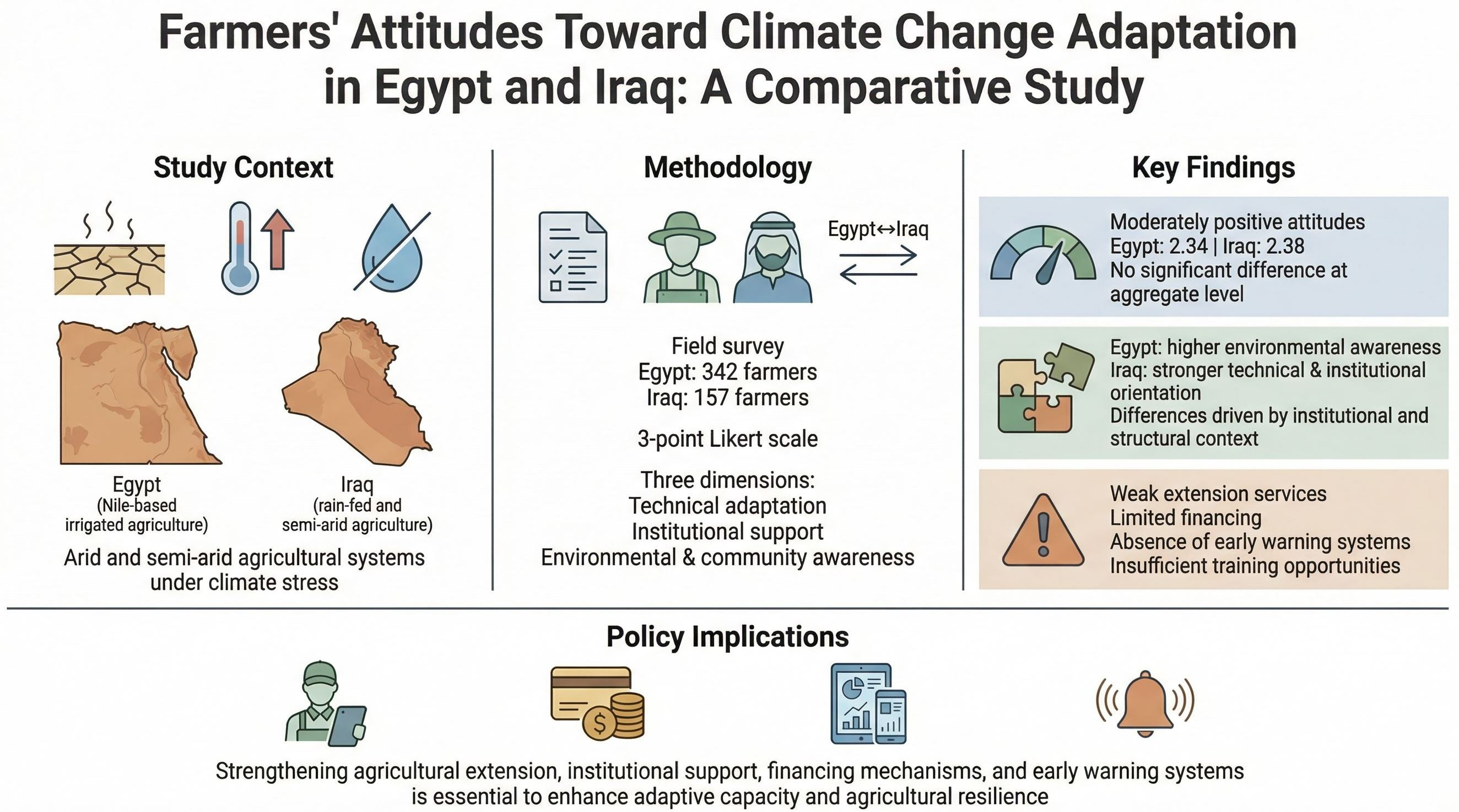
Table 6 reveals clear differences between Egyptian and Iraqi farmers in their attitudes toward climate change adaptation, reflecting structural, environmental, and social variations between the two agricultural systems. The mean attitude score was 2.34 in Egypt and 2.38 in Iraq, showing general agreement but slightly greater favorability among Iraqis. Radi [
5] attributed this to Iraq’s harsher exposure to drought and desertification, which heightens awareness compared with Egypt, where farmers face more moderate risks such as reduced water and soil fertility.
In the technical and technological dimension, farm size appears to play an important contextual role in shaping farmers’ technical adaptation outcomes. The marked difference in average landholding size between Egypt (3.3 dunums) and Northern Iraq (48 dunums) suggests that structural production conditions may partly explain the observed variation in technical adaptation scores. Larger farm holdings typically benefit from economies of scale, greater flexibility in reallocating resources, and higher capacity to absorb risks associated with adopting new technologies, such as modern irrigation systems, climate-resilient crop varieties, and mechanized practices. In contrast, smallholders operating fragmented plots often face financial, technical, and risk-related constraints that limit their ability to translate positive attitudes or awareness into actual technical adaptation measures. Accordingly, the differences observed in technical adaptation should be interpreted not only as reflections of farmers’ attitudes or behavioral dispositions, but also as outcomes shaped by farm structural characteristics, particularly landholding size.
In the technical and technological dimension, mean scores were 2.33 in Egypt and 2.36 in Iraq, reflecting high awareness of adaptive measures like changing planting dates, improving irrigation efficiency, and using drought-resistant crops. The highest-rated items in Iraq were integrated pest management (2.59) and low-water crop varieties (2.52), ranking lower in Egypt. Al-Dulaimi [
10] linked this to better adaptive infrastructure in Iraq, where farmers are forced to innovate, while ElShafei et al. [
14] found that limited hands-on knowledge restricts adoption in Egyptian governorates despite theoretical awareness. For the policies and institutional support dimension, Iraqi farmers showed higher averages (2.57) than Egyptians (2.35), indicating stronger recognition of the need for institutional involvement. The statement on the urgency of training and educating farmers scored 2.65 in Iraq, confirming the demand for technical and extension support. Al-Hayali [
25] emphasized that adaptation success depends on institutional integration, while Radi [
5] noted that early warning systems and insurance policies reduced vulnerability. Egyptian farmers showed similar awareness levels but limited practical application due to weaker institutional mechanisms.
In the environmental and community awareness dimension, Egyptian farmers scored higher (2.34) than Iraqis (2.22), showing greater conceptual understanding of environmental aspects. Their highest scores related to organic farming (2.38) and reducing harmful practices (2.36), consistent with ElShafei et al. [
14] who reported that Egyptian extension programs effectively promoted environmental awareness. Conversely, Iraqi farmers demonstrated more practical than conceptual awareness, responding to immediate pressures [
25]. In summary, farmers in both countries exhibited moderate-to-high attitudes toward adaptation, though actual practices remain limited due to weak integration between knowledge, institutional support, and extension services. Therefore, Egypt and Iraq need to adopt an integrated extension approach that links agricultural education, field advisory services, and supportive policies, so that climate awareness can be effectively translated into practical, sustainable adaptation measures; this is in line with the recommendations of Radi and ElShafei et al. [
5,
14] to strengthen the role of agricultural and educational institutions in promoting sustainable adaptation to climate change.
3.4. The Differences in Farmers’ Attitudes in Egypt and Iraq Toward Mechanisms and Practices of Climate Change Adaptation
Table 7 presents the results of the cross-country comparison of farmers’ overall adaptation orientation toward climate change in Egypt and Iraq. After accounting for variance heterogeneity using Welch’s
t-test, the analysis indicates that the difference between Egyptian and Iraqi farmers is not statistically significant, despite observable differences in mean scores. This finding suggests that, at the aggregate level, farmers in both contexts exhibit broadly comparable adaptation orientations, while differences are more clearly expressed at the dimensional and contextual levels rather than in overall attitudes.
Nevertheless, the observed patterns remain analytically meaningful when interpreted in light of the distinct environmental and institutional contexts shaping adaptation processes. In the Iraqi case, exposure to recurrent drought, water scarcity, and climatic instability has been associated with what Al-Dulaimi [
10] described as “forced adaptation,” whereby environmental pressures compel farmers to adopt adaptive practices as a survival necessity. This interpretation is further supported by Al-Hayali [
25], who reported that reduced water availability encouraged Iraqi farmers to adopt water-saving irrigation technologies and integrated pest management. Such patterns reflect a form of resilience-oriented adaptation, driven less by voluntary preference and more by prolonged exposure to environmental stress.
In contrast, Egyptian farmers tend to demonstrate a more cognitive and awareness-based orientation toward climate change adaptation, with relatively weaker translation into practical behavioral measures. Previous studies have shown that while Egyptian farmers often possess general knowledge of climate change, limited training opportunities and weak extension follow-up constrain practical implementation (ElShafei et al. [
5,
14]). Radi [
5] similarly emphasized that insufficient institutional support and limited interaction between farmers and extension services restrict behavioral adaptation. These contextual interpretations align with the dimensional results reported elsewhere in the study, where Iraqi farmers show stronger engagement in technical and institutional adaptation, while Egyptian farmers score relatively higher in environmental awareness, reflecting a more conceptual orientation toward adaptation (ElShafei et al. [
14]; Radi and Al-Hayali [
5,
25]).
3.5. The Relationship Between Independent Variables and the Degree of Attitude Toward Mechanisms and Practices of Climate Change Adaptation in Egypt and Iraq
Table 8 highlights clear differences between Egyptian and Iraqi farmers regarding the factors shaping their attitudes toward climate change adaptation. This aligns with prior research showing that adaptive attitudes emerge from interactions between cognitive, economic, and institutional factors. In Iraq, adaptation attitudes were positively and significantly correlated with education level, farm size, and membership in agricultural associations, underscoring the role of human and institutional capital in enhancing adaptive capacity. Educated farmers or those linked to organizations have better access to information and advisory services, as noted by Abdullah et al. [
22], who emphasized participatory extension as a key enabler, and Chipfupa et al. [
14], who demonstrated that social and psychological capital mediate awareness through institutional networks.
In Egypt, a significant negative correlation was observed between age and adaptation attitudes, indicating lower willingness among older farmers to adopt modern techniques despite recognizing climate risks. This supports the findings of Meena et al. and Mahmood et al. [
18,
19], who showed that younger farmers are generally more open to innovation, while older ones rely on traditional practices. Other variables were statistically insignificant, likely due to homogeneity in education and limited institutional incentives. ElShafei et al. [
14] confirmed that weak institutional and technical support reduces the influence of education on adaptive behavior in rural settings. The absence of significant effects for “information sources” and “engagement in agricultural work” in both countries further supports Al-Atabi and Kazem [
23], who argued that poor institutional communication limits knowledge transfer and adaptation. Similarly, the weak role of farm size in Egypt indicates that psychological and institutional factors, rather than purely economic ones, are the primary drivers of adaptive attitudes, consistent with Mahmood et al. and Chipfupa et al. [
19,
21]. Comparatively, Iraq shows stronger institutional and educational effects, while in Egypt age is the key determinant, reflecting differences in socio-environmental structures. The higher mean attitude score in Iraq (2.38) reflects stronger institutional presence and perceived climate risk, whereas Egyptian farmers emphasize environmental awareness more conceptually. As previous studies indicate, education alone cannot drive adaptation without institutional support; thus, the variation between the two countries primarily stems from institutional rather than demographic differences. Overall, the findings affirm that adaptive capacity depends not only on individual awareness but also on supportive institutions that foster learning, experimentation, and access to finance and information. Consequently, future adaptation programs should strengthen extension systems and institutional communication in Iraq, while in Egypt they should focus on empowering young farmers through targeted training and incentive-based financing. These conclusions fill a research gap by illustrating how individual and institutional factors jointly shape farmers’ attitudes toward climate adaptation in Arab contexts.
3.6. Analysis of Barriers to Climate Change Adaptation in Egypt and Iraq
Farmers in Egypt and Iraq encounter overlapping cognitive, institutional, economic, and structural barriers that limit their ability to adopt climate adaptation practices, though the severity differs between contexts. Among the main challenges are cognitive and extension barriers, where lack of knowledge and weak agricultural extension services rank high (8th in Egypt and 5th in Iraq). ElShafei et al. [
14] highlighted the absence of specialized adaptation programs in Egypt’s Kafr El-Sheikh, while Al-Hayali [
25] pointed out that poor communication in Iraq produces informal rather than structured learning. Institutional and structural weaknesses also constrain adaptation. In Egypt, poor coordination and centralized planning, which Radi [
5] described as a “planning and implementation gap,” reduce field-level impact. Although coordination in Iraq has improved with international partnerships [
25], institutional fragility persists because of limited integration between research systems and agricultural policy.
Economic and financial barriers remain critical. Limited credit and high input costs (means 2.51 and 2.53 in Egypt; 2.44 and 2.50 in Iraq) restrict farmers’ capacity for preventive investment,
Table 9.
Al-Dulaimi [
10] noted that adaptation is often viewed as managing losses rather than enhancing productivity. Both contexts demonstrate that financial equity is as vital as technical readiness. Structurally, small and fragmented holdings in Egypt, ranked fifth, raise production costs and hinder technology adoption [
14]. Traditional practices, ranked fourth in both countries, further restrict innovation, driven by weak incentives and institutional guarantees [
25]. The absence of effective early warning systems emerges as one of the most critical barriers to climate change adaptation, particularly in Egypt, where it recorded a high mean score (2.84), indicating strong consensus among farmers. This finding underscores a significant institutional gap that constrains farmers’ ability to anticipate and respond proactively to climate-related risks such as heatwaves, floods, and water scarcity. Without timely and localized early warning information, adaptation remains largely reactive, increasing farmers’ vulnerability and limiting the effectiveness of on-farm technical measures. From a policy perspective, this result highlights the urgent need to strengthen climate early warning and forecasting systems through improved data integration, localized dissemination mechanisms, and closer coordination between meteorological services, agricultural extension agencies, and local authorities. Addressing this gap would enhance anticipatory adaptation, reduce climate-related losses, and align national adaptation strategies with risk-informed and resilience-oriented policy frameworks, while Iraq’s moderate progress, ranked eighth, stems from limited international collaboration [
5]. Training gaps, ranked second in Iraq and seventh in Egypt, reveal Iraq’s preference for practical learning and Egypt’s reliance on theoretical instruction. ElShafei et al. [
14] stressed that field-based training is crucial for translating awareness into action. In summary, Egypt’s barriers are largely institutional and cognitive, while Iraq’s are mainly economic and organizational. As Radi and ElShafei et al. [
5,
14] affirmed, bridging these gaps requires coordinated agricultural education, extension, and institutional support to transform awareness into practical adaptation and strengthen rural resilience.
To strengthen the analytical value of the identified barriers, it is important to link these constraints to concrete and actionable intervention pathways. Institutional and financial barriers, such as limited access to extension services, credit, and climate information, point to the need for national-level policy interventions led by ministries of agriculture in coordination with public extension agencies and financial institutions. These actors are primarily responsible for funding capacity-building programs, strengthening extension infrastructure, and facilitating farmers’ access to climate-smart technologies.
At the local governance level, farmer cooperatives, producer organizations, and non-governmental organizations can play a critical role in addressing informational and behavioral barriers by facilitating peer learning, collective action, and localized advisory services. Meanwhile, barriers related to technological access and information dissemination highlight the potential of digital extension platforms and media-based services, which can be implemented through public–private partnerships involving government agencies, mobile service providers, and agritech firms.
3.7. Farmers’ Proposals in Egypt and Iraq to Enhance Adaptation Capacity to Climate Change Impacts
Table 10 shows that farmers in Egypt and Iraq proposed a range of practical strategies to strengthen climate adaptation, reflecting a shift from passive awareness toward more active engagement. The overall importance score was higher in Egypt (2.66) than in Iraq (2.39), indicating stronger institutional readiness. Despite this difference, farmers in both countries focused on three main axes: advancing scientific research, improving institutional and financial support, and promoting behavioral and legislative change.
Supporting scientific research on drought, heat, and salinity-resistant crops ranked first in both contexts (2.56 in Egypt; 2.65 in Iraq). This growing reliance on innovation aligns with Al-Dulaimi [
10] who reported that Iraqi farmers view research as the primary pathway to address water scarcity, and with ElShafei et al. [
14] who linked scientific progress to sustainable food security. Building on this, Egyptian farmers placed strong emphasis on education and extension, particularly on training and integrating climate issues into curricula (2.73–2.74), consistent with the shift in the Nile Delta toward knowledge-based, behavior-changing extension [
14]. In Iraq, although the need for training was recognized (2.43), extension services remain weak and intermittent [
25].
Institutional and financial proposals were also prominent, as farmers in both countries stressed the need for funding, incentives, and stronger public–private collaboration (means 2.45–2.70). Radi [
5] emphasized that adaptation becomes effective only when knowledge is translated into economic incentives. Egyptian farmers showed higher awareness of agricultural insurance (2.80) compared with Iraqi farmers (2.29), while infrastructure and water management remained shared priorities [
14]. Behavioral and legislative measures also ranked highly. Egyptian farmers expressed stronger support for organic agriculture and enforcing environmental laws (2.67 and 2.64), reflecting rising legal awareness [
5]. In Iraq, limited incentives still constrain sustainable practices. This finding aligns with previous evidence indicating that limited access to information and institutional support often results in adaptation responses that are predominantly reactive rather than anticipatory in highly vulnerable agricultural systems [
34,
35]. In this regard, recent studies emphasize that farmers’ adaptation and technology-related decisions are largely influenced by behavioral intentions, institutional arrangements, and the availability of supportive organizational and digital environments, rather than by technical factors alone, which helps explain the prevalence of short-term and reactive responses observed in such contexts [
36,
37]. Early warning and risk management received moderate importance (2.55 Egypt; 2.31 Iraq), with weak forecasting systems in Egypt [
14] and reactive responses in Iraq [
25]. Overall, results show that Egyptian farmers emphasized institutional and educational reform, while Iraqi farmers prioritized scientific and technical solutions.
The study adopts a cross-sectional, observational design, which limits the ability to draw causal inferences between farmers’ characteristics and their attitudes toward climate change adaptation. Reported associations should therefore be interpreted as indicative rather than causal.
The statistical analysis is primarily bivariate, focusing on pairwise relationships without explicitly modeling potential mediating or confounding variables (e.g., farm size, institutional access), which may influence adaptation outcomes.
The findings rely on self-reported data, which may be subject to recall bias or social desirability bias.
The study is context-specific rather than nationally representative. In Egypt, El-Beheira Governorate was selected to capture both old Nile Delta lands and newly reclaimed irrigated areas, while Duhok Governorate in Iraq represents a rain-fed, semi-mountainous farming system. Given the substantial agro-ecological diversity in both countries, results should be interpreted as reflecting system-level adaptation dynamics.
The Iraqi sample size is smaller than that required for ±5% precision; therefore, generalization should be made with caution, and cross-country comparisons emphasize patterns and effect sizes rather than population estimates.
Future research should employ multi-regional, longitudinal designs and multivariate modeling approaches to better capture causal pathways and dynamic adaptation processes
The study identifies several future research avenues to deepen understanding of farmers’ attitudes toward climate adaptation in Arab agriculture:
Regional Comparisons: Expand studies to include more countries with different climatic and agricultural contexts to build a regional database on adaptation behaviors.
Predictive Analysis: Apply advanced techniques such as regression or path analysis to determine the relative influence of key attitudinal and behavioral factors.
Behavioral Focus: Integrate psychological aspects such as resilience, risk perception, and institutional trust to explain how awareness becomes action.
Policy Evaluation: Assess the impact of adaptation programs and financing initiatives through follow-up studies tracking attitudinal change.
Digital Innovation: Use digital tools and artificial intelligence to analyze agricultural and climate data, supporting evidence-based adaptive decision-making.
Based on the field results and the comparative analysis of farmers in Egypt and Iraq, this study proposes several practical measures that can enhance the adaptive capacity of the agricultural sector to climate change:
Strengthening capacity building and agricultural extension through targeted farmer training on water management and climate-smart agriculture, while integrating these programs into curricula and rural media to promote lasting environmental awareness.
Strengthening digital agricultural extension systems by deploying WhatsApp-based advisory groups and mobile application-based services to deliver timely, localized climate information and compensate for the limited outreach of traditional government extension services.
Addressing the generational gap in climate adaptation by prioritizing youth-targeted training, innovation programs, and digital extension services, while adopting tailored outreach approaches for older farmers that emphasize peer learning, demonstration fields, and risk-reduction strategies.
Supporting scientific research and applied innovation to develop drought- and heat-tolerant crop varieties, improve modern irrigation technologies, and enhance knowledge transfer between research institutions and farmers.
Expanding agricultural insurance and green financing to help smallholders adopt adaptive practices and reduce climate-related economic risks.
Developing early warning and climate-risk management systems by building updated databases linked to local extension services, enabling more proactive farming decisions.
Enhancing institutional coordination and regional cooperation among agricultural ministries, research centers, and regional bodies to exchange expertise and establish joint adaptation policies that strengthen food security.