Article

Water Recharge Zone and Community Participation in the Management of the Totorani Micro-Watershed

by
José Antonio Mamani-Gomez
1,2,3,*,
Danitza Luisa Sardón-Ari
4,
Adelaida G. Viza-Salas
5 and
Roberto Alfaro-Alejo
1,6
1
Institute for Research in Water Science and Technology, National University of Altiplano, Puno 21001, Peru
2
Doctorate Program in Science, Hermilio Valdizán National University, Huánuco 10001, Peru
3
Faculty of Civil Engineering, Architecture and Urbanism, State University of Campinas, Campinas 13083-970, Brazil
4
Professional School of Primary Education, National University of Altiplano, Puno 21001, Peru
5
Professional School of Human Nutrition, National University of Altiplano, Puno 21001, Peru
6
Doctorate Program in Water Resources, National Agrarian University La Molina, Lima 15026, Peru
*
Author to whom correspondence should be addressed.
Sustainability 2026, 18(5), 2495; https://doi.org/10.3390/su18052495
Submission received: 28 October 2025 / Revised: 14 February 2026 / Accepted: 27 February 2026 / Published: 4 March 2026

Abstract

Sustainable water management in high Andean ecosystems involves identifying and protecting recharge areas, integrating both biophysical and social knowledge. The purpose of this study was to conduct a participatory analysis of the recharge zone in the Totorani micro-basin, with a total area of 61.39 km2, located in Puno District, Peru, which supplies water to more than 21,000 people. A hierarchical multicriteria analysis in a GIS environment was used, considering five variables (vegetation cover, slope, soil type, geology, and land use), complemented by participatory workshops. The results indicate that moderate recharge predominates in 56.01% of the area, followed by high (39.91%) and very high (3.81%) recharge, associated with the high-altitude Andean wetlands and alluvial plains. Areas of low recharge comprised 0.28% and were found on slopes >30%, with thin soils and low infiltration. The participatory validation process confirmed the alignment between the maps and local knowledge, emphasizing the wetlands and springs as essential areas for water regulation. The stakeholder analysis identified three key groups as direct users: farmers and livestock breeders, public or educational institutions, and social organizations. The stakeholders highlighted threats, such as agricultural expansion, overgrazing, and climate variability, while also emphasizing the importance of traditional conservation practices. Water recharge in Totorani is both a biophysical and social process, requiring the integration of technical methodologies with community participation for effective management. These findings represent a strategic contribution to water governance and offer a replicable model for other high Andean micro-basins.

1. Introduction

Water is one of the most essential natural resources for sustaining life, human well-being, and ecosystem balance. Both its availability and quality are determining factors for food security, public health, economic productivity and the resilience of natural systems to climate change [1,2]. In this framework, water sources play a strategic role in regulating the hydrological cycle, stimulating groundwater infiltration and storage, and ensuring a sustainable flow for domestic, agricultural, and ecological needs [3,4].
The Totorani micro-basin, located in the district of Puno, represents an ecosystem of great socio-environmental importance, providing approximately 10% of the water supply to the city of Puno, which has more than 145,000 inhabitants [5]. The source that supplies the northern part of the city of Puno is groundwater from Totorani, which benefits more than 21,000 residents and supports long-standing agricultural and soil conservation practices. It also hosts wetlands and high-altitude springs that perform essential ecological functions in water regulation and biodiversity preservation [6,7,8]. Increasing anthropogenic pressure, such as uncontrolled urban growth, agricultural expansion, and soil degradation, along with climatic variations, are negatively impacting the natural recharge capacity of the basin [9,10].
In this research, the term bofedales refers to high-altitude Andean wetland grasslands, which represent unique ecosystems located mainly above 3000 m [11,12]. Bofedales act as natural sponges, retaining water from rainfall and snowmelt and gradually releasing it during dry spells, which play a crucial role in local hydrology [13,14]. These wetlands are distinguished by their hydromorphic vegetation, such as Distichia and streamside grasses, and function as essential pastures for feeding camelids in winter, important carbon sinks, and vital water sources for local communities. More than 50% of the bofedales are concentrated in southern Peru [15,16], and their preservation is essential due to threats posed by climate change, overgrazing, and illicit peat moss extraction.
The study of water recharge areas in the Andean regions poses a significant challenge due to the harsh geographical and climatic conditions typical of these areas, where water resources are limited and vulnerable [12,14].
The identification and mapping of recharge areas using scientific approaches and stakeholder participation enable an understanding of hydrological processes, the determination of priorities for critical conservation areas, and sustainable land use planning [2,16]. In recent years, multicriteria analysis models integrated with Geographic Information Systems (GIS) have proven highly effective for delineating recharge areas [3,17]. For example, a GIS-based MCDA approach using AHP successfully identified water recharge areas using a Management Aquifer Recharge (MAR) system in semi-arid conditions in southern Kazakhstan, supported by hydrogeological field data and expert assessment of key criteria, such as aquifer depth and drainage density [18]. In the Ponnaniyaru watershed in India, a GIS, together with AHP and MIF (Multi-Influence Factor) techniques, effectively classified areas with groundwater potential, which was validated by an ROC curve analysis [19]. The multicriteria comparative methods used in the Willochra catchment (Australia) confirmed that integrating GIS with AHP and other decision rules yielded consistent classifications of recharge potential, and that a substantial portion of the basin was identified as having a high recharge potential when validated with the well data [20]. These tools allow for the evaluation of variables, such as vegetation cover, slope, soil type, geology, and land use, as well as other thematic maps, providing highly reliable results even in situations where hydrometeorological information is limited [21,22]. However, several studies agree that purely technical approaches, based on expert-driven engineering designs, hydrological models, and top-down decision-making, without significant input from local stakeholders, are insufficient to achieve sustainable outcomes in watersheds; they need to be combined with social participation, the integration of local knowledge and the involvement of relevant community and institutional actors [23,24,25,26,27,28].
The aforementioned studies were conducted in semi-arid or monsoon-fed regions, which contrasts with the focus of this current research on the challenging Andean environment of the Totorani micro-basin. The Andean region faces distinctive hydrological, climatic, and socio-environmental challenges, driven by the extreme altitude, pronounced seasonal variation, and the vital role of wetlands and springs in regulating water.
The Totorani basin faces specific risks, including rapid urban growth, agricultural demands, and climatic fluctuations, which directly affect the water recharge mechanisms. Addressing these obstacles requires not only technical solutions but also the integration of local knowledge and community involvement to ensure sustainable management.
By combining an advanced spatial analysis with community feedback and traditional knowledge, the study produces findings that are both scientifically rigorous and socially pertinent. This methodology is specifically tailored to the complex characteristics of the Andean setting, carefully considering both the physical and social aspects of water recharge management and providing a pragmatic framework for sustainable water governance in locations such as Totorani, where community involvement is crucial.
In this context, participatory analysis is presented as a fundamental tool for strengthening water governance by involving the local actors in knowledge generation and land management decision-making. In the Totorani micro-basin, traditional knowledge related to wetland management, springs, and ancestral conservation techniques is intertwined with current science, thus enriching water planning and monitoring processes [29,30,31].
From a legal perspective, Peru’s legal framework, specifically Water Resources Act No. 29338 [32], acknowledges the importance of an integrated and participatory approach to water management as a guiding policy for sustainability. Consequently, the identification and protection of water recharge areas not only respond to technical requirements but also align with a national policy focused on water security and the achievement of Sustainable Development Goal 6 (clean water and sanitation) [33,34]. Therefore, this analysis suggests a combined approach integrating local community participation with geospatial tools (multicriteria analysis and GIS). This process aims to combine science, regulations, and ancestral knowledge to generate accurate information on water recharge areas in the Totorani micro-basin. The results will serve as a basis for designing conservation strategies, territorial planning, and promoting water resilience in high-altitude Andean ecosystems in the face of climate change.
This study presents an innovative framework that combines the Analytic Hierarchy Process (AHP), Geographic Information Systems (GIS), and participatory stakeholder involvement to tackle the intricate challenges of Andean and mountainous watersheds. By integrating quantitative spatial modeling with local knowledge, the methodology strikes a harmonious balance between scientific precision and community pertinence, notably enhancing the precision of recharge zone delineation. Specifically tailored to address the region’s distinct hurdles, such as extreme altitude, seasonal variations, and the crucial significance of wetlands and springs, the approach actively engages local stakeholders, linking scientific principles with traditional methods. Through its comprehensive, multicriteria, and participatory approach, the methodology not only enhances understanding of recharge dynamics but also establishes a transferable model for comparable mountainous areas. Above all, the research findings will directly influence policy-making and conservation tactics, setting a novel standard for participatory environmental governance in high-altitude basins.

2. Materials and Methods

2.1. Research Location

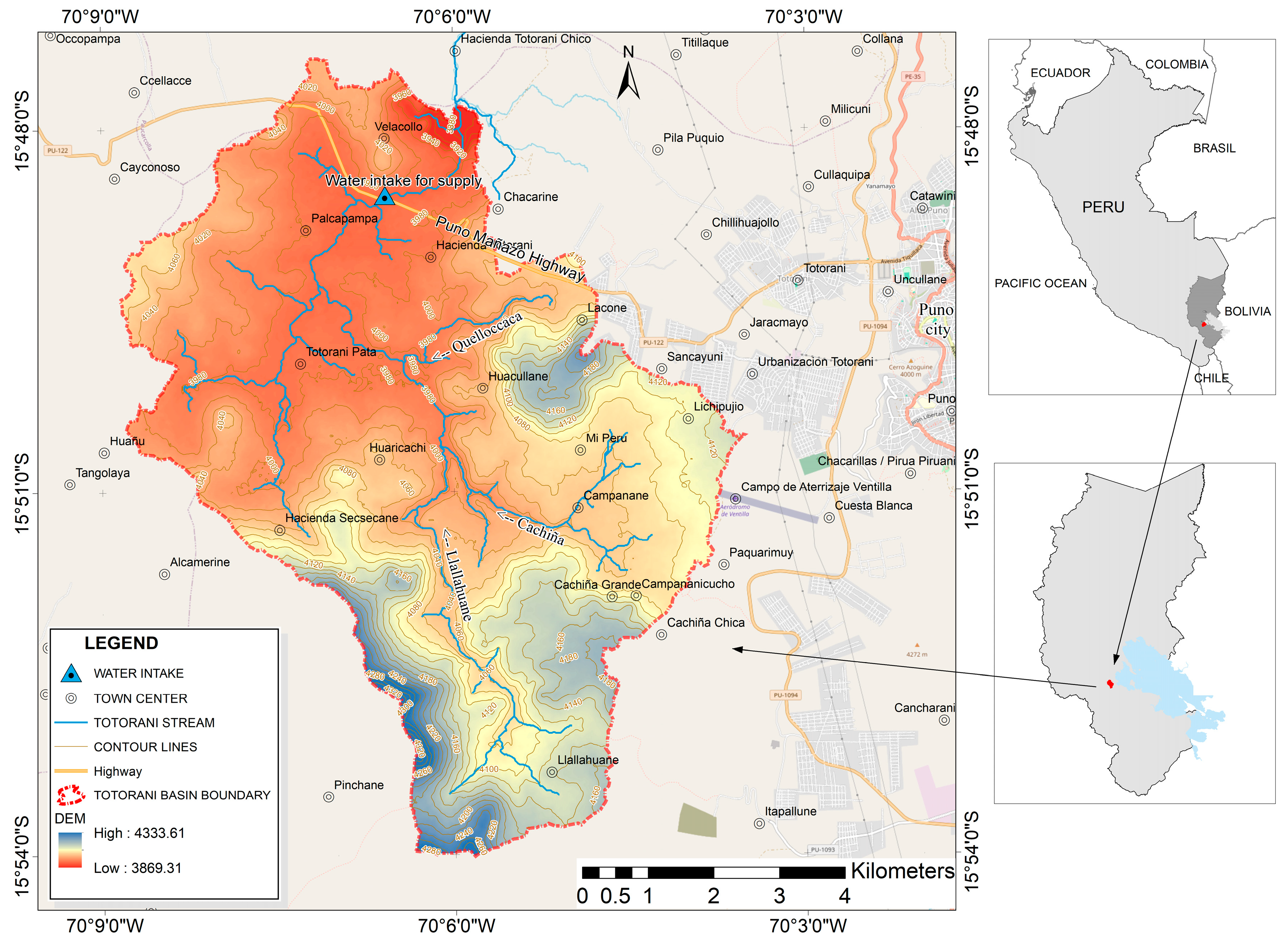
The study was conducted in the Totorani micro-basin, which has an area of 61.39 km2 and a perimeter of 42.042 km. It is located in the Puno District, in the high Andean region of Peru, at an average altitude of 4054.8 m above sea level (Figure 1). This micro-basin is of great importance to the city of Puno, supplying approximately 10% of the water used for human consumption and local agricultural activities. The area is characterized by a cold semi-arid climate, with an average annual temperature of 7 °C, marked seasonality in rainfall from November to April, and a hydrological pattern strongly influenced by topographical and orographic factors. The predominant land cover includes high Andean grasslands, wetlands, and agricultural areas, ecosystems that are fundamental to water regulation.

2.2. Methodological Approach

The study employs a mixed-methods approach, which combines spatial analysis techniques with a participatory approach. This integrated methodology allows for the collection of objective scientific data using Geographic Information System (GIS) tools and multicriteria models, while also incorporating local knowledge and the perspectives of stakeholders involved in water management [24,25]. The combination of methods addresses the need to consider water replenishment as both a biophysical phenomenon and a social process [29].

2.3. Collection of Information

2.3.1. Spatial and Biophysical Data

To obtain the spatial and biophysical information, geological and geomorphological maps, slope maps, and drainage maps from the National Geographic Institute (IGN) and the National Water Authority (ANA) were used.
The terrain slope was obtained from Land Viewer’s Digital Elevation Model (DEM) with a 5 m resolution, which was also used to calculate the micro-basin parameters. The small size of the basin and the need to record the complex variations in slope and terrain in the difficult conditions of the high Andes required such a high spatial resolution. The slope was calculated using the standard QGIS algorithm, which measures the greatest change in elevation between each cell and its neighbors. Before the analysis, the depressions in the DEM were refilled to remove artificial sinks and maintain hydrological consistency.
The geological map used to characterize the lithological units was provided by the Geological, Mining and Metallurgical Institute (INGEMMET). The climate data (precipitation and temperature) were obtained from international databases, such as WorldClim v2.1 [35]. The information on land use and land cover was provided by the Peruvian Ministry of the Environment (MINAM). These were corroborated at various points in the micro-basin.

2.3.2. Social and Participatory Data

Semi-structured interviews were conducted with different local stakeholders, including farmers and livestock breeders (30); community leaders (seven) from Japuchuro, Machallata, Micaela Bastidas, San Miguel de Antonani, Secsani, Totorani Grande, and Yayawani; teachers (four); and local authorities (nine) from various institutions—the Water Administration Authority (AAA), the Puno Municipal Sanitation Company (EMSAPUNO), the National Superintendence of Sanitation Services (SUNASS), the Paucarcolla District Municipality (MDP), and the Puno Provincial Municipality (MPP). Three interactive workshops were held to identify traditional practices for managing wetlands, springs, and grasslands, and to gather information on the threats to water resources. Matrices for setting priorities and collective mapping were used to identify the critical water recharge areas. The participants directly identified the strengths, weaknesses, opportunities, threats, and the institutional actors operating in the micro-basin. In addition, panels of paper with maps and diagrams were used to identify the critical areas in the territory visually. These activities were carried out between January and October 2023.
The interactive workshops were attended by 30 farming families and seven community leaders, representing the main stakeholders in the Totorani micro-basin. Even though the sample size was small, it was representative of the limited population who are directly involved in water resource management within the micro-basin. The sessions focused on improving understanding of integrated water resources management (IWRM) and conservation strategies.

2.4. Multicriteria Analysis

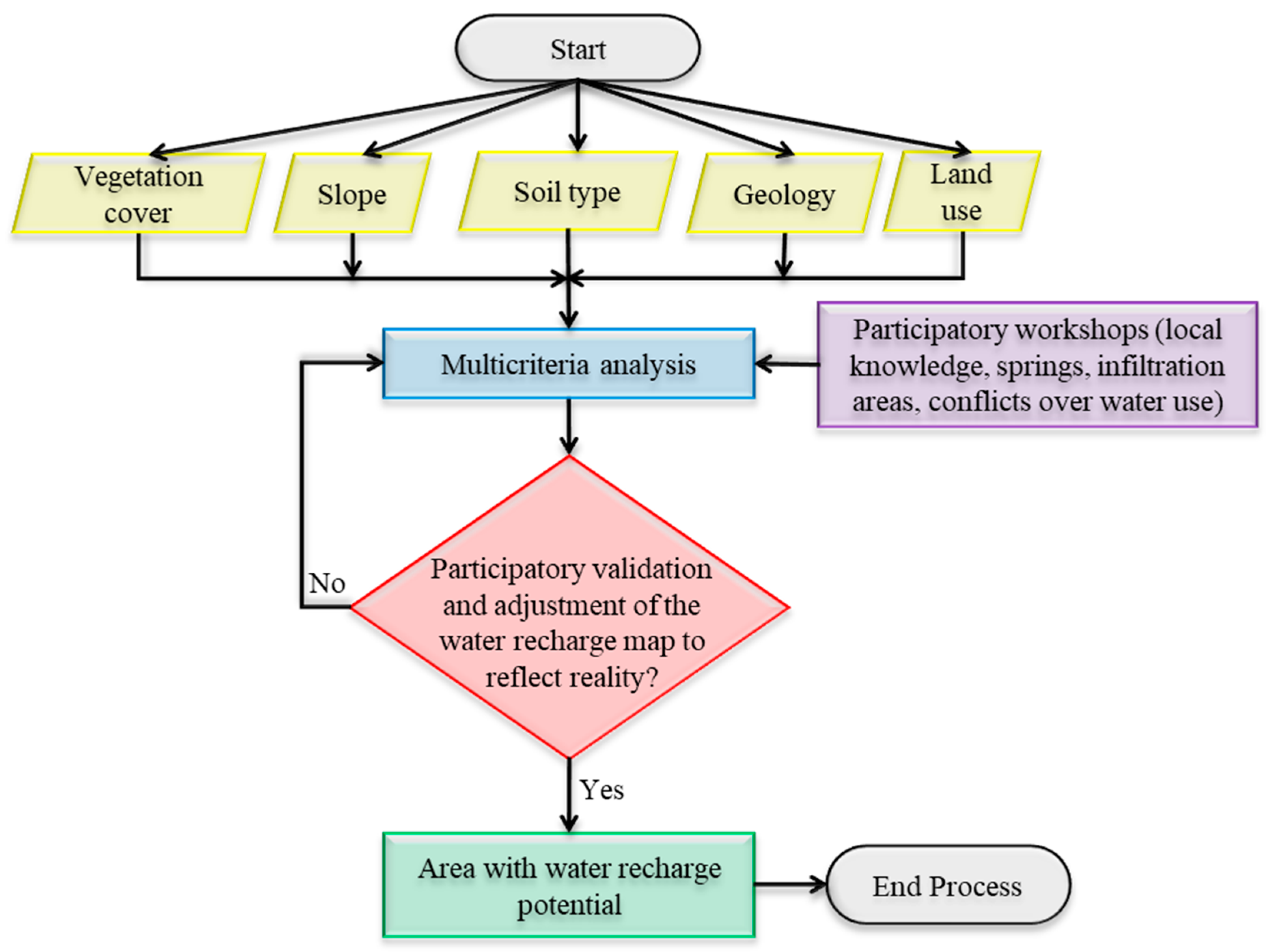
To delimit the water recharge areas, we applied the multicriteria hierarchical analysis technique [36], which is widely recognized in water resource studies [16,17]. There were five key variables: vegetation cover, slope, soil type, geology, and land use. Each variable was weighted using pair-wise comparison matrices, validated by the consistency index (CI < 0.1).
The Analytical Hierarchy Process (AHP) was used to define the water recharge areas within the Totorani River micro-basin, accounting for the critical factors: vegetation cover, slope, soil type, geology, and land use. Stakeholder engagement was methodically integrated through collaborative workshops involving farmers, community leaders, educators, and local officials, who contributed their qualitative perspectives on the relative significance of each factor. These viewpoints were quantitatively amalgamated using pair-wise comparison matrices. While experts determined the final priorities, these assessments were openly communicated and authenticated through consensus and interactive dialogue with local expertise. This method ensured methodological precision and the meaningful integration of community viewpoints, culminating in a robust, contextually relevant model for holistic water resources management in the Totorani micro-watershed.
The five physical variables were selected for their established significance in controlling infiltration, runoff, and subsurface water flow, as corroborated by recent research by Abdullah, Idrak, Kabir and Bhuiyan [3]; Raja and Mathew [17]; and Dongare and Deota [16]. These studies highlight the fundamental role of these factors in assessing the groundwater recharge potential, especially in mountain regions. The geology and soil type influence groundwater mobility and storage; the slope affects infiltration and runoff; and the vegetative cover regulates infiltration and soil retention. The incorporation of these variables into a multicriteria analysis is widely accepted in hydrological research, ensuring a reliable and reproducible method for mapping the recharge areas in the Totorani micro-basin.
The hierarchical pair-wise model was implemented using a 5 × 5 comparative matrix. The characteristics of the physical environment relevant to estimating the water recharge were analyzed using a pair-wise comparison. Subsequently, a normalization matrix for the water recharge was explicitly developed, and the resulting values are presented in Table 1. The normalization matrix showed values of 0.46, 0.28, 0.16, 0.06, and 0.04 (Table 2), reflecting the respective importance of each variable within the model. Subsequently, a paired comparison was carried out, with the results presented in Table 3.
The relative ponderations of each variable were determined using pair-wise comparative matrices and validated using the consistency index (CI) and consistency ratio (CR) test scores, both of which were well below the recommended threshold (CI = 0.02, CR = 0.02), confirming the reliability and accuracy of the weighting process. In addition, the results of interactive workshops were fed through the model: the stakeholders provided feedback on the relevance of each variable, which influenced the final scoring scheme. Such participatory validation ensured that the model components were not only academically robust but also aligned with local knowledge and priorities.
The consistency analysis suggested by [37] considers the calculation of λmax, which is the principal eigenvalue calculated using the eigenvector technique, and n is the number of criteria (factors) using Equations (1) and (2).
λ m a x = i = 1 n ( A v ) i ( n v i )
C I = λ m a x n n 1
where n represents the number of independent rows in the matrix, A represents the pair-wise comparison matrix, and v means the matrix eigenvector. ()i is the i-th element of the matrix–vector product (pair-wise matrix × eigenvector). (i) is the i-th element of the eigenvector multiplied by the number of criteria.
Therefore, pair comparison helps improve the evaluation of error consistency, so it is advisable to use the consistency ratio (Equation (3)).
C R = C I R C I
where RCI is the random consistency index.
Saaty [36] recommended that the CR value be less than 10%; otherwise, the weights must be reevaluated to maintain consistency. The best solution would be an IC = 0. Therefore, consistent values correspond to CR < 1.
The calculation of the weighted sum vector and the prioritization vector for the physical environment parameters yielded the following values, 5.18, 5.13, 5.09, 5.03 and 5.02, with a total sum of 25.45 and an average of 5.09. Based on these results, a consistency index (CI) of 0.02 and a consistency ratio (CR) of 0.02 were calculated. Both values are significantly lower than the recommended threshold of 0.1, confirming that the model is consistent and that the weights assigned to each parameter are appropriate and consistent across the analysis (Table 3).
The added values in Table 3, called the ‘weighted sum vector’, come from the pair-wise comparison matrix for each attribute. This vector has a key role in determining the principal eigenvalue (λmax). To calculate the λmax, each element of the weighted sum vector is divided by the corresponding element of the recharge vector, and the averages are calculated. These calculations are essential for maintaining logical coherence in pair-wise comparisons and validating the reliability of the weights assigned to each parameter in a multicriteria analysis.
The determination and identification of water recharge zones were carried out according to the criteria detailed in Table 4, which presents the weights assigned to the five physical environment variables. These variables were grouped into five main classes, each with its own respective rating level, which allowed for assessing the possibility of water recharge within the Totorani micro-basin.

2.5. Participatory Validation and Analysis

A participatory cross-validation method was used, in which the preliminary maps were shown to the workshop participants to elicit agreement and disagreement regarding their knowledge of the territory [23]. The findings of the spatial analysis were compared with the field data and the impressions of local actors. The final zoning was improved and its social legitimacy was ensured through this process, a crucial element for comprehensive watershed management [30,31].
The research approach enabled analysis of the roles and perspectives of participants involved in water resource management in the Totorani micro-basin. This method was appropriate for understanding the complexity of social dynamics and the relationships related to water. The key actors were carefully identified and selected, including government entities, non-governmental organizations, local authorities, members of the local community, and other important participants.
Data collection was carried out using various techniques, including document review and focus groups. These methods provided qualitative data from the stakeholders regarding their perspectives and experiences in water management.
An analysis of the collected information was conducted by detecting patterns, themes, and trends in the stakeholder responses, which facilitated an understanding of the dynamics and challenges in water resource management. Active stakeholder participation in the research process was encouraged, including feedback sessions in which the preliminary results were discussed to gather their opinions and additional perspectives.
The identification of the main actors involved in the management and administration of water resources was carried out using the nominal group technique, a method for identifying the important actors or groups involved in a central action or problem [38,39,40,41,42]. This technique can also be used to visualize the differences between the actors who may influence a situation or line of action, and those who may be affected by it [43,44].
Once the key actors were identified, they were characterized using the methodological tools of social analysis (collaboration/conflict, legitimacy, interests and power), and to identify the interactions and relationships among them, an analysis of social relations (ASR) was used.
The profiles of the actors were defined based on four factors: relationships of collaboration and/or conflict, legitimacy, interests, and power linked to water resources. To do this, the area was first defined, identifying the key actors involved in the conflict and water resource management. A mental map was then constructed with the actors involved and the strategic links for good management. The following matrices were then systematically developed: power, interests (gains and losses), legitimacy, collaboration, and conflicts [38,39,40,41,42].
To examine the interactions and relationships among the key actors in the basin, a social network analysis was used to visualize the power relations and specific roles among the actors (authorities, organizations, associations, companies, regional authorities, among others), identifying information flows and bottlenecks [45].
In this study, the categorization of “dominant” as proposed by authors Ashley and Carney [46] and Dutta [47] is not used, who characterized the actors in water resource management in a basin [44]. Instead, our approach is based on four categories: “strong”, “respected”, “inactive” and “vulnerable”.

2.6. Ethics in Research

The study was conducted in compliance with the principles of participatory ethics, ensuring informed consent from the stakeholders involved and data confidentiality. Furthermore, efforts were made to ensure that the workshops were not only places for data collection, but also for feedback and strengthening the local capacities for water management.

2.7. Information Processing and Analysis

The layers were then combined in QGIS to create a map showing the likelihood that the areas were water recharge areas (Figure 2). The qualitative data were analyzed using a content analysis, with emerging categories identified for water management practices, risk perceptions, and conservation strategies.
UCINET version 6 software was used to analyze the roles of stakeholders in planning, training, and financing activities. This tool facilitated the identification and visualization of key actors and their interactions in the basin. The qualitative data obtained from the interviews and workshops were systematically coded using UCINET to ensure methodological rigor of the analysis. The study received ethical approval, and all participants provided informed consent.

3. Results

3.1. Delimitation of Water Recharge Through Multicriteria Assessment

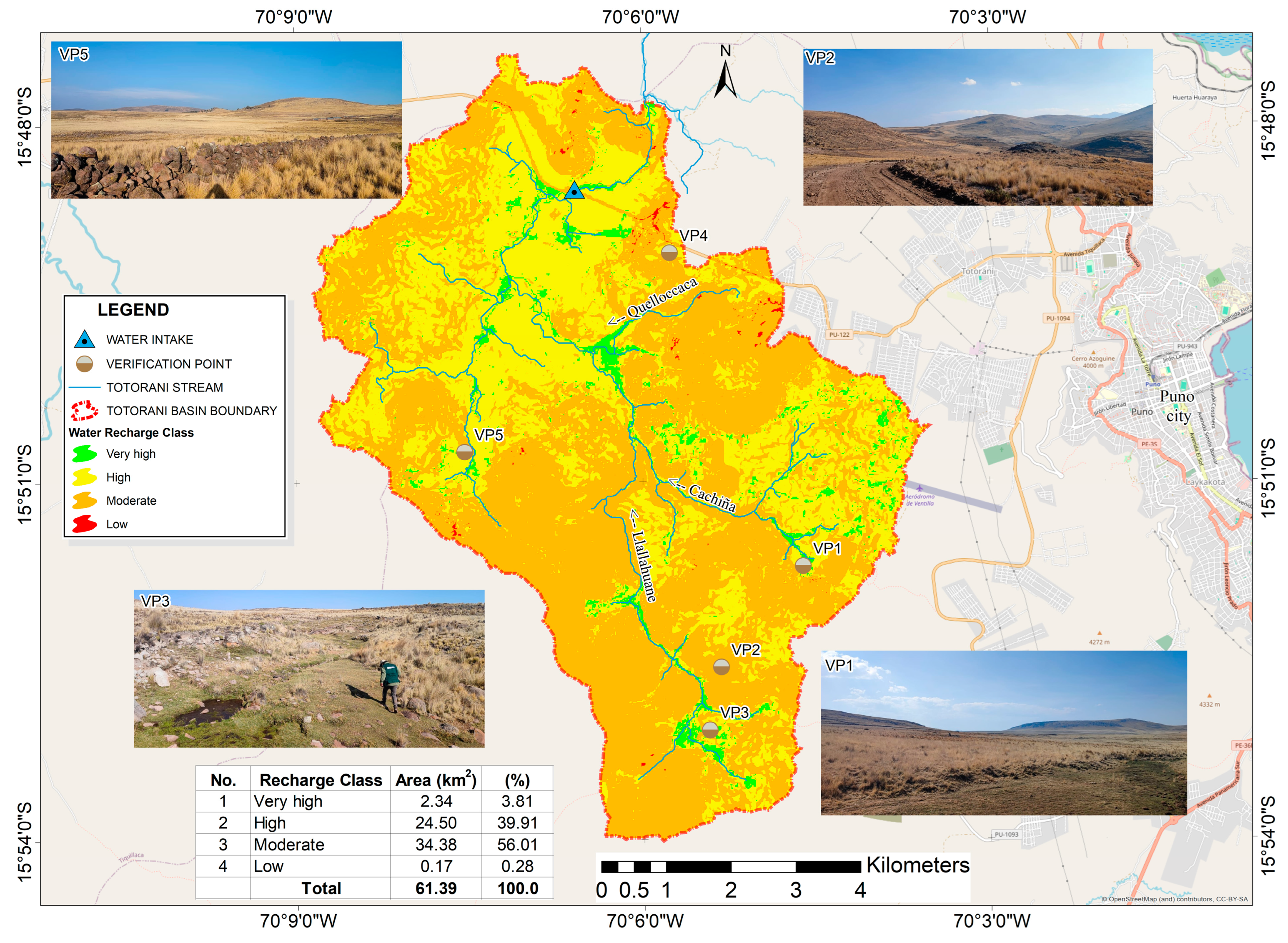
The application of multicriteria hierarchical analysis in the Geographic Information System (GIS) allowed for the zoning and classification of the Totorani micro-basin into four levels of susceptibility to water recharge (Figure 3). Two main areas with significant water recharge potential can be distinguished in the micro-basin, both classified as high and very high.
The spatial examination of the Totorani micro-watershed indicates the prevalence of moderate groundwater recharge, covering 56.01% of the territory (34.38 km2). High recharge areas, which account for 39.91% (24.5 km2), are primarily located in the mid-section of the basin and play a vital role in water infiltration and storage. Very high recharge regions, accounting for 3.81% of the total surface area (2.34 km2), are concentrated in the high-altitude Andean wetlands, springs, and segments of the Totorani, Lluscamayo, Quelloccaca, Cachiña, and Llallahuane ravines. These areas encompass various population centers, such as Totorani, Ceccecani, Totorane Pata, Cachiña Grande, and Campanane, and are of significant importance for the conservation of water resources. Conversely, low recharge zones account for only 0.28% of the micro-watershed (0.17 km2), are primarily found on slopes exceeding 30°, and characterized by scant soils and limited infiltration capacity, and thus represent the smallest portion of the territory in terms of water accumulation and preservation.

3.2. Roles of Stakeholders Through Participatory Action

The participatory workshops largely confirmed the zoning produced by the spatial analysis. The local communities and authorities identified the Llallahuani wetlands and the Campanane springs as significant recharge areas, which coincided with the areas classified as “very high” in the model. They also pointed to areas impacted by overgrazing and urban expansion as critical areas with reduced infiltration capacity, in line with the areas classified as “low” and “very low.”
The combination of technical and participatory findings led to the identification of three water recharge areas for intervention:
  • Upper Zone (Llallahuani–Campanane sector): Includes bofedales and wetlands essential for water regulation.
  • Middle Zone (traditional terraces): Has the potential for restoration and promotion of sustainable agricultural practices.
  • Lower Zone (peri-urban area of Puno): Presents with high human pressure and a risk of spring loss.
The nominal identification of the actors involved in water resource management and administration has been established. So far, only a few state institutions with influence in this area have been identified. Furthermore, these actors must lead and collaborate in the management of the micro-basin along with private organizations.
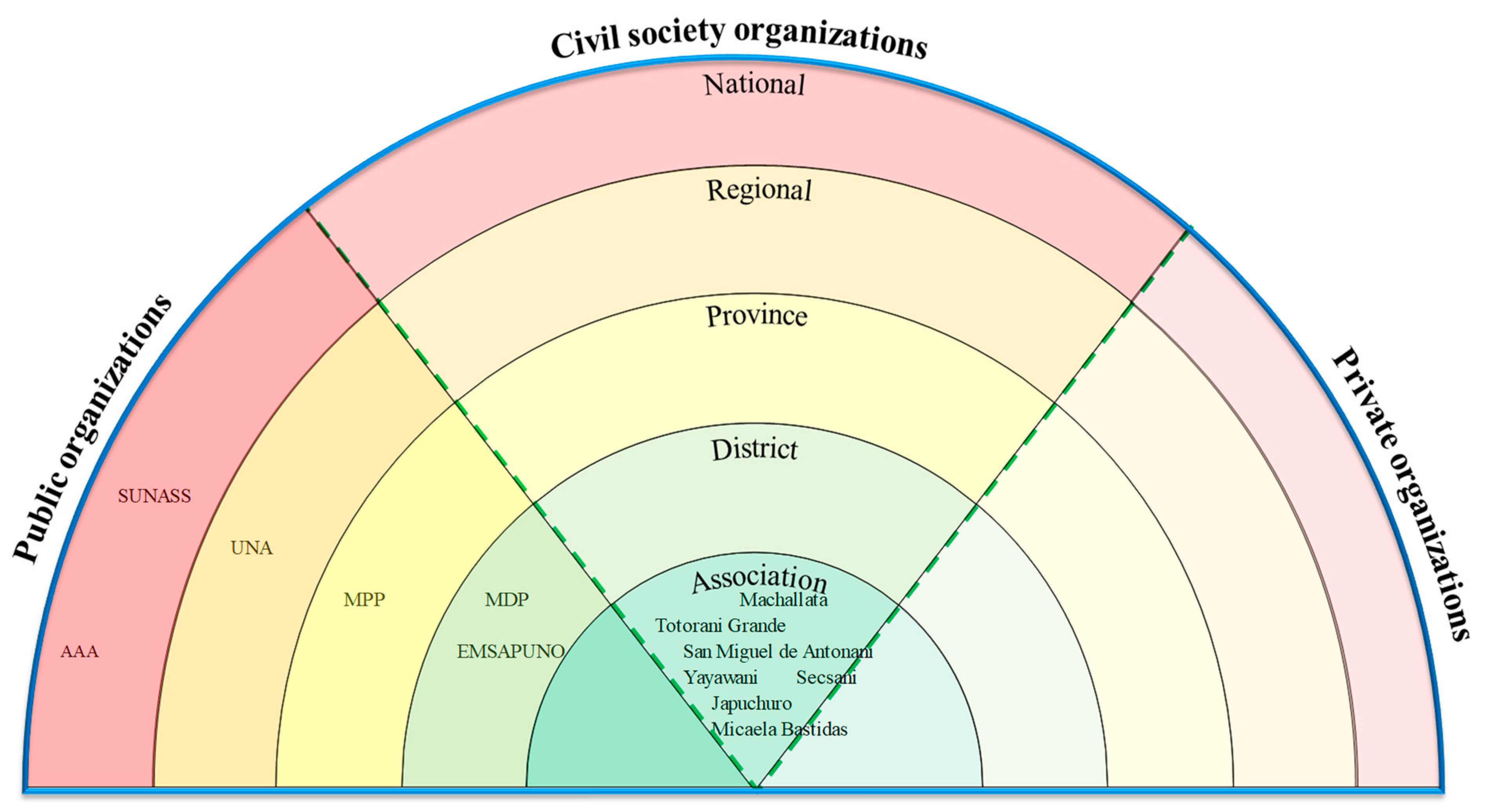
Figure 4 identifies several institutions and organizations that play crucial roles in water resource management in the Totorani micro-basin. These include the Water Administration Authority (AAA), the Puno Municipal Sanitation Company (EMSAPUNO), the Paucarcolla District Municipality (MDP), the Puno Provincial Municipality (MPP), the National Superintendence of Sanitation Services (SUNASS), and the National University of the Altiplano (UNA). Civil society organizations comprise the communities located within the Totorani micro-basin, including Japuchuro, Machallata, Micaela Bastidas, San Miguel de Antonani, Secsani, Totorani Grande, and Yayawani.
In terms of stakeholder characterization, the AAA, EMSAPUNO, and SUNASS have been assigned to the “strong” category due to their predominant influence on decision-making and water resource management in the area. The MDP and MPP are in the “respected” category, meaning they play a significant role but have less influence compared to the strong institutions. Furthermore, all local communities are in the “inactive” category, indicating that their participation and influence in water resource management are currently limited. However, the UNA is considered “vulnerable”, implying that its position is less supported compared to the stronger institutions. The stakeholder characterization provides significant insight into the challenges and dynamics of water resource management in the Totorani micro-basin (Table 5).
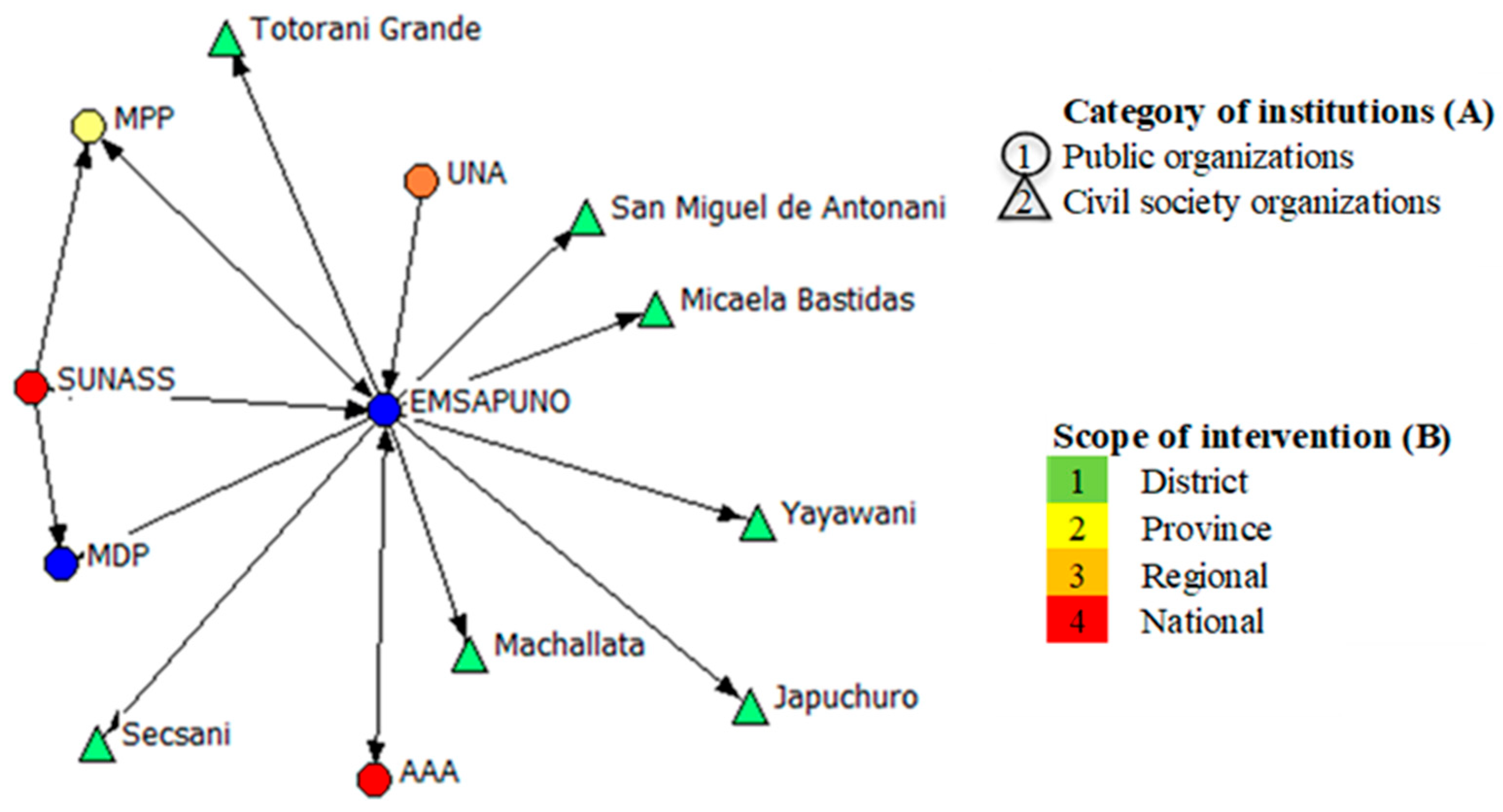
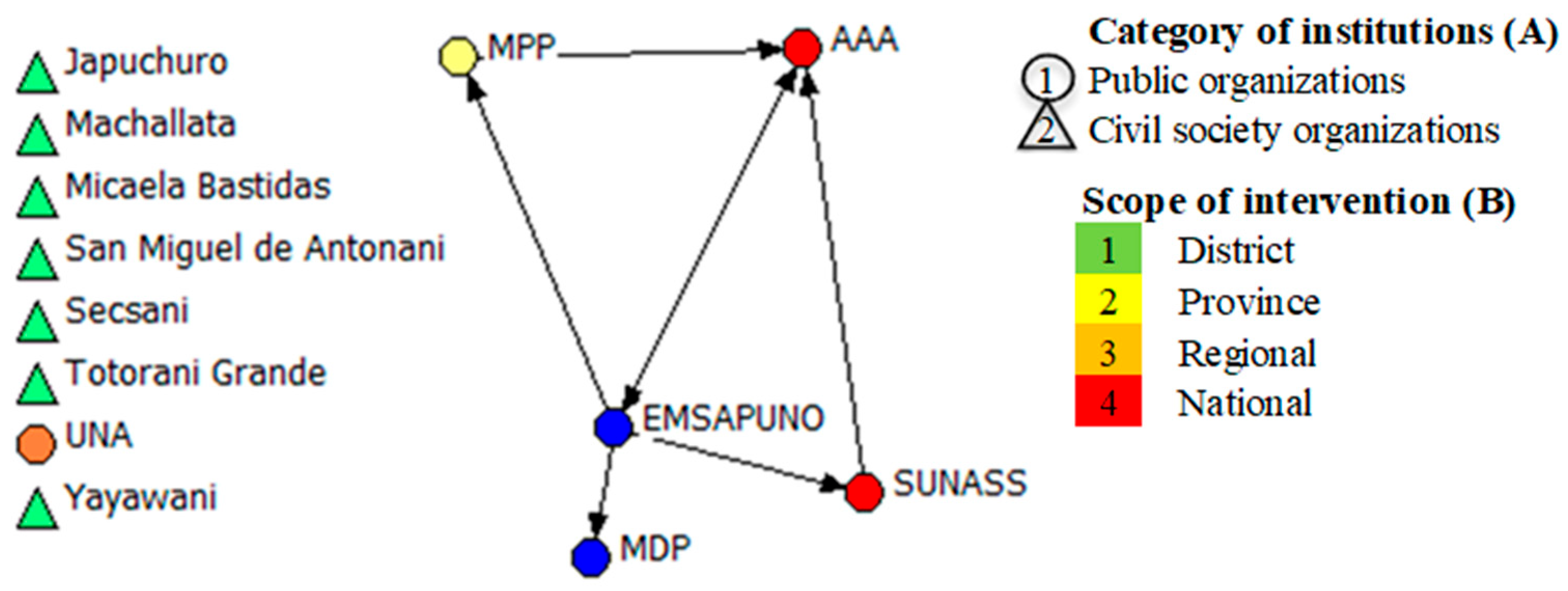
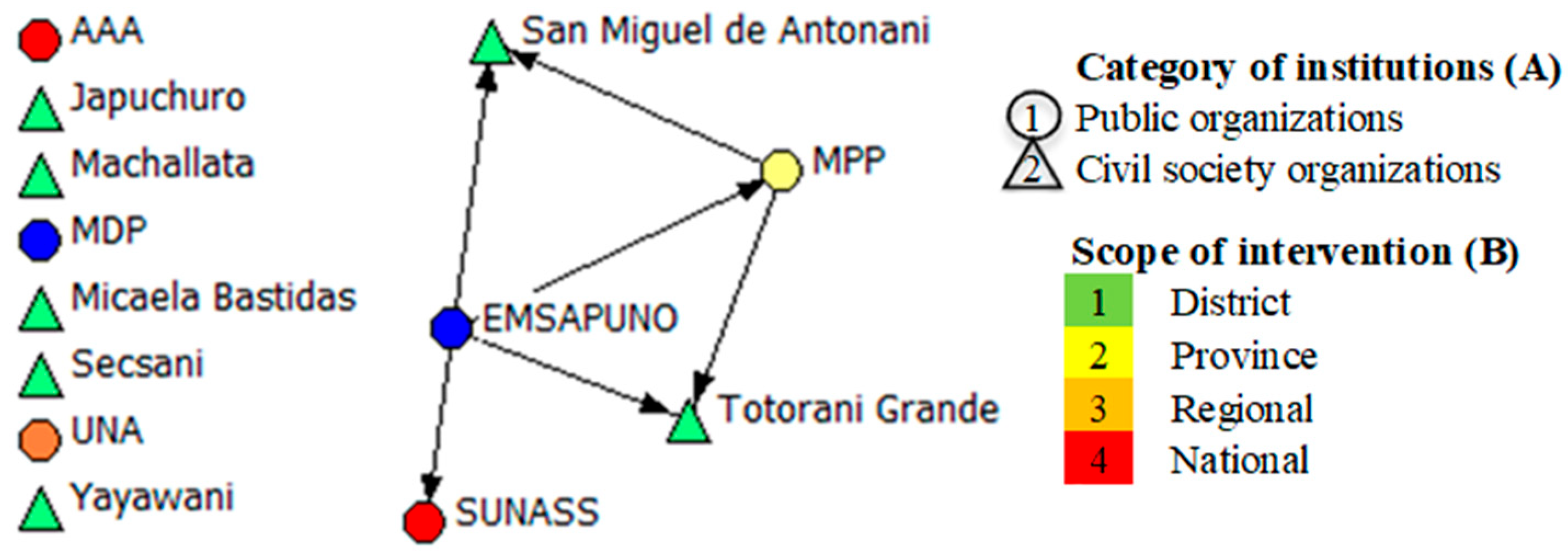
The perspective presented here assumes that the actors categorized as “strong,” including EMSAPUNO, AAA, and SUNASS, have the obligation to lead and coordinate actions related to water resources management and administration. The prominent role of these key actors is crucial to promoting effective actions in this area, including capacity building (Figure 5), planning and implementation (Figure 6), and financing activities (Figure 7).
The participatory analysis reveals the uneven process of the capacity building dynamics of the Totorani micro-watershed. As shown in Figure 5, the outflow density is 87.50%, indicating that the flow of information, technical support, and resources from dominant institutions to local actors is considerably greater than the inflow density of 24.31%, which reflects the response of local communities or organizations and their effective participation. This asymmetry reveals a still centralized governance structure, where the institutional leadership of EMSAPUNO, SUNASS, and AAA predominates in the planning and execution of actions, while community participation is limited and self-management is low.
The network diagrams shown in Figure 5, Figure 6 and Figure 7 examine the interactions of actors in the Totorani basin. In these representations, the nodes represent the individual actors or institutions involved in water resource management, while the arrows depict the relationships or exchanges among the stakeholders (e.g., information, resources, or influence). The thickness of the arrows represents the intensity or frequency of these interactions, and the colors differentiate between types of relationships (e.g., planning, training, and financing). The outgoing density indicates the proportion of connections emanating from a specific actor, revealing their role in the dissemination of resources or information. In contrast, the incoming density measures the proportion of connections received, indicating an actor’s participation or dependence within the network, facilitating a thorough understanding of the dynamics of stakeholders in the basin.
On the one hand, the planning and implementation of actions for water resource management in the Totorani micro-basin show moderate progress. However, there are still notable gaps between institutional design and local-level implementation. As shown in Figure 6, the relationship structure is characterized by an intermediate level of coordination, suggesting that although there are formal coordination mechanisms among some actors, including the National Water Authority, EMSAPUNO, SUNASS, the Puno Regional Government, etc., the effective implementation of plans and projects is highly oriented toward a small number of driving institutions, without achieving solid integration with the communities and water user associations.
At the organizational level, gaps in coordination between levels of government are also identified. Interventions led by the Regional Government and the ANA are not consistently operationally coordinated with the local municipalities, which impedes the sustained implementation of conservation policies. On the other hand, the communities of Totorani, Ichu, and Yanamayo are more effective at implementing adaptive practices, such as conserving riparian vegetation strips and protecting springs, despite limited coverage and funding.
Summarizing what is presented in Figure 6, the above findings suggest that the current challenge is not merely to plan actions technically, but to ensure their coordinated, sustainable, and evaluable implementation. The consolidation of a shared watershed management model, which integrates institutional strategic planning with participatory community action, is critical to achieving effective, resilient management of the Totorani micro-watershed.

3.3. Water Management in the Micro-Basin

The analysis in Figure 7 highlights one of the most critical gaps in the participatory water management process in the Totorani micro-basin: the low density of economic interaction, that is, the limited financial coordination between institutional and community actors. First, it can be observed that the economic relations are low-density, reflecting, first and foremost, that funding sources are scarce, highly dispersed, and highly concentrated in a small group of public and technical cooperation institutions, where the participation of the private sector and organized communities is marginal.
The qualitative data from the participatory workshops corroborate that the National Water Authority, the National Superintendency of Sanitation Services, and the Provincial Municipality of Puno, which fund specific, short-term projects, finance the majority of conservation and water recharge management actions. This circumstance reinforces the structural dependence on public investment, which limits the financial sustainability of the actions, especially those related to natural infrastructure and the maintenance of wetlands and springs.
Based on all the above, the results in Figure 7 also allow us to infer that the problem of the financial deficit constitutes a constraint on the consolidation of Totorani’s water management. The enormous institutional dependence and the lack of mechanisms for local generation and financing impede the continuity of conservation work. Overcoming this limitation is therefore proposed through a comprehensive financial strategy based on co-responsibility, the diversification of partners and sources, and the economic valuation of the ecosystem services provided. Establishing a financial strengthening axis is the structuring force that will ensure the environmental and social sustainability of participatory water management processes in Puno.
The results of this research should be considered in the development of public policies, which must be explicitly linked to the specific evidence described in Section 3.2 and Section 3.3. More specifically, suggestions for improving water governance, engaging stakeholders, and improving information flows are based directly on the study’s findings on the stakeholder configuration, network analysis, and input–output density.
In the stakeholder analysis conducted for the Totorani micro-watershed, “output density” pertains to the percentage of information, technical assistance, and resources that institutional actors (such as government bodies and technical organizations) provide to local stakeholders. On the other hand, “input density” refers to the extent of responses, involvement, and feedback that local communities or organizations provide to those institutions.

4. Discussion

4.1. Water Recharge by Multicriteria Analysis

Through a multicriteria analysis, water recharge areas were identified in the Totorani micro-basin to delimit and establish priorities for critical water recharge areas. These findings contribute to a better understanding of recharge processes in high Andean ecosystems and highlight the importance of protecting strategic areas from threats, such as climate change and unsustainable human activities [3,17]. The identification of recharge areas is key to regulating the hydrological cycle, especially in vulnerable regions such as the Andes [6,7,8,9,14].
The results observed in the Totorani micro-basin indicate that moderate recharge predominates in 56.01% of the area, followed by high (39.91%) and very high (3.81%) recharge, associated with the high-altitude Andean wetlands and alluvial plains. Areas of low recharge constituted 0.28% and were found on slopes > 30%, with thin soils and low infiltration. This distribution coincides with that mentioned by Abdullah, Idrak, Kabir and Bhuiyan [3] and Dongare and Deota [16], who emphasize that gentle topography and dense vegetation are determining factors of infiltration capacity in mountainous environments. Therefore, identifying these areas is essential for territorial planning and the development of conservation strategies that will guarantee water security in the city of Puno [5], which depends on this micro-basin for 10% of its water.
The research on the Himalayas and the Ethiopian Highlands has emphasized the importance of incorporating biophysical and social factors for efficient water recharge management [19,21]. However, the Andean context is notable for the presence of bofedales (high-altitude wetlands), the fundamental role of traditional community practices, and the unique challenges posed by high-altitude climate fluctuations and pressures on land use. Unlike many mountain basins in Asia and Africa, the Totorani basin has a strong participatory governance framework, with local actors actively involved in technical validation and conservation initiatives. This fusion of local expertise with an advanced multicriteria analysis based on GIS distinguishes the Andean approach and offers valuable insights for other regions facing similar hydrological and governance challenges.

4.2. Determinants Affecting Water Recharge

The main factors influencing water recharge according to the hierarchical analysis model, the prioritization vector described in Table 2, are vegetation cover (46%), slope (28%), soil type (16%), geology (6%), and land use (4%), and these should be adopted as definitive weightings for a multicriteria analysis when delimiting recharge areas. These weight distributions were established using the AHP methodology, which reflects expert judgement and stakeholder feedback on the relative importance of each criterion, ensuring the uniformity of the weights and descriptors of the analysis [2,17]. The weighting distributions differ from those observed in similar mountain basins. In South Asia and Africa, for example, studies have often placed greater importance on the slope and geology due to the rugged topography and diverse lithological conditions found there [19,21]. Vegetation cover, especially in wetlands and high Andean forests, is crucial for water infiltration and storage capacity [7,8,21]. Additionally, within the Andean context, there is greater emphasis on the importance of high-altitude wetlands and traditional land management methods, aspects that are less prominent in other regions. It is crucial to recognize potential biases, such as restricted representation and participation in workshops, which could affect the weighting process and stakeholder assessments.
In areas where intensive agriculture is practiced, especially on slopes, the recharge capacity decreases due to soil compaction and deforestation associated with agricultural expansion. Conversely, in regions with shrub vegetation and traditional terracing techniques, greater water retention is observed, highlighting the importance of ancestral knowledge in water management [29,31].
The research, such as that conducted by Huang, Qian and Cao [6], highlights the importance of conservation to maximize the water recharge potential and guarantee access to this resource in a context of growing demand and environmental pressure [2,29]. The analysis also includes variables such as slope, soil type, geology, and land use, enabling a comprehensive assessment [21,48]. In other cases, it is known that soil areas with high levels of A and B horizons and gentle slopes (0–15°) are the most favorable for water infiltration, as reported in previous studies [17,22].
On the other hand, areas with steep slopes (>45°) and soils with low infiltration capacity have lower recharge potential and a higher risk of erosion and runoff, which can compromise water quality in aquatic systems [49].
These spatial patterns correlate with the interactions between the various biophysical factors analyzed. Areas with gentle slopes, permeable soils, and natural grassland cover have greater recharge potential, while urbanized areas and steep-sloped areas have low infiltration capacity [3,16].

4.3. Participatory Stakeholder Analysis

The participatory validation enabled the consideration of qualitative aspects not reflected in the maps, such as perceptions of changes in water availability over recent decades and the impact of climate variability. The residents reported a decline in spring flows over the past two decades, reinforcing regional trends linked to climate change [9,12].
The integration of a participatory approach, which included local communities in the validation and analysis of results, was an essential element of this research and is consistent with the research highlighting the importance of combining technical and traditional knowledge to manage water resources sustainably [23,24]. The involvement of local actors not only legitimizes conservation strategies but also improves communities’ capacities to implement effective long-term water conservation practices [22,25].
The participatory validation verified the overlap between intensive recharge areas and sites commonly recognized by communities as water sources, especially springs and wetlands. This finding underscores the importance of combining technical perspectives with local knowledge, as communities can offer historical and cultural perspectives on land use, while a multicriteria analysis provides spatial accuracy [24,29]. The alignment between both perspectives reinforces the reliability of the results and validates their application in water governance processes.
Furthermore, the dialogue with local stakeholders identified specific threats to recharge areas: agricultural expansion into wetlands, overgrazing, and climate variability. These factors are consistent with the research on other high-mountain watersheds, where human pressure on wetlands has reduced the water storage capacity and accelerated soil degradation [6,7,8]. Similarly, local perceptions of declining spring flows coincide with climate projections indicating greater rainfall variability and reduced natural recharge in the Andes [9,12].
The high density of results indicates that public institutions are making significant efforts to disseminate information and capacities, as well as to hold technical coordination meetings. The low density of contributions suggests that communities still have difficulties in appropriating knowledge; this may be due to the discontinuity of the program, the scarcity or absence of feedback mechanisms, and the generation of local knowledge [24,25]. We agree with Moreano [29], who affirms that the sustainability of water management in the Andes will depend on the development of local capacities and the participation of decision-makers. Since feedback is not conceived as part of the project cycle, but rather as a complementary and dispensable activity, this explains its frequent absence or discontinuity once the technical intervention has been completed. The discontinuity of projects is closely linked to short-term financing schemes, in which resources are concentrated on measurable and rapidly executable products. In the Peruvian Altiplano, water management has historically been characterized by centralized decision-making, in which technical and scientific knowledge has taken precedence over local knowledge [50].
The participatory workshops revealed three main limitations identified by community members: first, the lack of inter-institutional coordination; second, the infrequent provision of training tailored to their harsh cultural realities; and third, the absence of economic or sociocultural incentives for maintaining natural infrastructure, such as wetlands and pacchas. However, local conservation initiatives were evident in the community’s delimitation of grazing areas and manual maintenance of filtration channels, reflecting a growing interest in social power-based water governance, as reported by Shekar and Mathew [31].

4.4. Implications for Water Management

The integration of community perception validates and enriches the technical findings, establishing a participatory management approach that strengthens water governance [23,24].
The identification of water recharge areas requiring intervention in the micro-basin is proposed to implement conservation, restoration, and management strategies for the natural infrastructure, in accordance with the MINAM [51,52] guidelines on natural infrastructure for water security.
The identification of recharge areas in Totorani has direct implications for regional water planning and management. This study complements the National Water Resources Law [32], promoting management based on scientific evidence. It also contributes to achieving Sustainable Development Goal (SDG) 6, which seeks to ensure equitable and sustainable access to water [33,34].
Capacity building was applied to assess the dynamics of stakeholder interactions. The results show that the production density reached 87.50%, indicating proactive participation by institutions in knowledge and resource exchanges. In contrast, the input density was 24.31%, indicating limited community participation and engagement. This notable imbalance highlights a centralized governance system in which institutional influence prevails and community self-governance is delayed [23].
Analysis of these characteristics indicates that capacity building should focus on adaptive co-management, involving regular interaction between trained and untrained actors so that the output density is transformed into two-sided flows of learning and decision-making that will strengthen social resilience to climate variability and to the impacts of recharge exploitation [9,12]. In this way, the Totorani micro-basin will cease to be a biophysical territory for water recharge and become a social laboratory for participatory environmental governance.
In this context, the National University of the Altiplano appears as a key and vulnerable, and at the same time strategic, actor, as it is part of the transformation process between scientific knowledge and local knowledge and shows a balance between the observed relationships, promoting technical training through the generation of knowledge about water resource management through applied research [44,45].
Furthermore, the low density of financial nodes implies an adverse economic feedback loop for the local communities. In this sense, grassroots organizations lack stable mechanisms or counterpart resources to implement their own environmental initiatives; this coincides with what was pointed out by Biswas, Jobaer, Haque, Islam and Limon [33], who found that the sustainability of water management in rural areas depends on the decentralization of economic resources and the generation of local economies linked to sustainable water use.
The study also highlights the need to incorporate mechanisms for collecting payments for ecosystem services that allow communities to receive financial compensation for protecting recharge ecosystems. Successful models in other Andean regions have shown that payments for ecosystem services incentivize water conservation and generate additional sustainable income for local stakeholders [7,8].
The joint analysis suggests that water planning in the Totorani micro-basin primarily follows a top-down approach, with limited bottom-up input from communities. Consequently, the effectiveness of management plans and the sustainability of interventions are seriously compromised. To overcome this barrier, it is argued that strengthening consultation spaces and basin management committees, while promoting participatory planning and community monitoring of projects, is necessary. In other words, as suggested by Shekar and Mathew [30], the concerted and sustainable implementation of micro-basin committee interventions in the province of Puno requires a combination of institutional strategic planning and community action.
For the planning and sustainable management of water resources in the area, these findings provide a detailed overview of the areas with the greatest potential for water recharge in the Totorani micro-basin. This information enables prioritizing conservation strategies, improving water use, and reducing the impacts of human activities and climate change on aquatic ecosystems.
In this sense, the financing of activities in the Totorani micro-basin should migrate to a mixed model that combines public funds with international cooperation and local self-management mechanisms; this implies strengthening communities’ technical and administrative capacity to formulate projects, manage resources, and establish partnerships with government and private entities, as indicated by Hersi, Mulungu and Nobert [9].
The experience gained in Totorani offers lessons that can be applied to other micro-watersheds in the high Andean regions: it is crucial to consolidate institutional capacities, value local knowledge, and create financial procedures that make conservation measures viable in recharge areas.

4.5. Generalizing Governance Models in the Andean Region and Developing Areas

Bozorg [24] and Pennington and Cech [25] have highlighted the predominance of vertical institutional control in water resource management in upland settings, where technical agencies and government entities lead decision-making. While this centralized approach can improve the efficiency of technical interventions, it often leads to shortcomings related to local ownership, sustainability, and responsiveness to community needs. To move from a vertical management model to a collaborative management paradigm, the following practical steps are proposed.
Formation of watershed management committees: Establish committees composed of representatives from institutional bodies and local communities in a balanced manner. These committees should have decision-making power and oversee the planning, implementation, and monitoring of water resource management initiatives.
Adopt participatory monitoring and feedback mechanisms: Introduce routine participatory monitoring schemes that train community members to collect data and provide feedback on project results. This approach strengthens local capacities and ensures that interventions are aligned with community priorities.
Introduction of financial incentives to encourage community participation: Develop schemes, such as payment for ecosystem services or microgrant initiatives, that incentivize communities to undertake conservation activities, such as wetland protection or the adoption of sustainable grazing practices [53].
Focus on capacity building and education: Invest in ongoing training programs for both institutional actors and community members, emphasizing technical skills, governance principles, and adaptive management strategies. Facilitate knowledge transfer between scientific experts and local participants.
Implementation of collaborative pilot projects: Launch pilot initiatives that demonstrate the advantages of co-management, document the key learnings, and extend successful methodologies to other micro-basins.

5. Conclusions

The analysis of multiple criteria revealed that 56.01% of the Totorani micro-basin exhibits moderate recharge potential, with 39.91% identified as high, and nearly 3.81% classified as very high. These critical zones are primarily situated in wetlands and floodplains. Through participatory validation, a strong correlation was found between the technical assessments and local knowledge, as community members consistently pinpointed springs and wetlands as key recharge areas.
The basin plays a crucial role in ensuring water security for more than 21,000 individuals. However, conservation endeavors face challenges due to institutional fragmentation; resource constraints; and various threats, such as agricultural expansion, overgrazing, and climate variability. These findings provide compelling evidence for prioritizing wetlands and floodplains in future conservation strategies and underscore the importance of incorporating community perspectives into sustainable water management.
Several limitations of this study must be acknowledged. The AHP methodology heavily relies on expert judgment and stakeholder input, introducing subjective bias into the variable weighting. The sample size for the participatory workshops was insufficient, potentially impacting the representativeness of stakeholder perspectives. Furthermore, the delineated recharge zones signify susceptibility and potential rather than directly measured water fluxes, which could constrain the precision of hydrological assessments. Future research should prioritize expanding stakeholder engagement to improve representativeness, incorporating direct measurements of recharge fluxes, and combining a multicriteria analysis with dynamic climate models to enhance predictive capabilities and facilitate adaptive water management strategies in high Andean ecosystems.


Author Contributions

Conceptualization, J.A.M.-G., D.L.S.-A. and R.A.-A.; methodology, J.A.M.-G., D.L.S.-A., R.A.-A. and A.G.V.-S.; software, D.L.S.-A., R.A.-A. and J.A.M.-G.; validation, J.A.M.-G., A.G.V.-S., D.L.S.-A. and R.A.-A.; formal analysis, J.A.M.-G., R.A.-A., A.G.V.-S. and D.L.S.-A.; investigation, J.A.M.-G., A.G.V.-S. and R.A.-A.; resources, J.A.M.-G., A.G.V.-S., R.A.-A. and D.L.S.-A.; data curation, J.A.M.-G., A.G.V.-S. and R.A.-A.; writing—original draft preparation, J.A.M.-G., D.L.S.-A., R.A.-A. and A.G.V.-S.; writing—review and editing, J.A.M.-G., R.A.-A., D.L.S.-A. and A.G.V.-S.; visualization, J.A.M.-G., D.L.S.-A. and R.A.-A.; supervision, R.A.-A., A.G.V.-S. and D.L.S.-A.; project administration, J.A.M.-G. and D.L.S.-A.; funding acquisition, J.A.M.-G. and R.A.-A. All authors have read and agreed to the published version of the manuscript.

Funding

This research received funding from the Vice-Rectorate for Research at the National University of the Altiplano, under grant number 077-2023-VRI-UNA-PUNO.

Institutional Review Board Statement

Not applicable.

Informed Consent Statement

Not applicable.

Data Availability Statement

The data supporting the results and conclusions of this article will be made available upon request from the authors.

Acknowledgments

The authors would like to thank the Vice-Rectorate for Research of the National University of the Altiplano Puno, the Municipal Company of Basic Sanitation of Puno S.A. (EMSA Puno), the Titicaca Water Administrative Authority (AAA), and the attendees of the participatory workshops of the Totorani peasant community.

Conflicts of Interest

The authors declare no conflicts of interest.

References

  1. Holden, J. Water Resources: An Integrated Approach, 2nd ed.; Taylor and Francis: Abingdon, VA, USA, 2019; p. 468. [Google Scholar]
  2. Mishra, U.; Mohapatra, A.K.; Mandal, A.; Singh, A. Identification of potential artificial groundwater recharge sites in an alluvial setting: A coupled electrical resistivity tomography and sediment characterization study. Groundw. Sustain. Dev. 2023, 20, 100875. [Google Scholar] [CrossRef]
  3. Abdullah, M.; Idrak, F.; Kabir, P.; Bhuiyan, M.A.H. Suitability of rainwater harvesting in saline and arsenic affected areas of Bangladesh. Heliyon 2024, 10, e34328. [Google Scholar] [CrossRef]
  4. Ako, A.A.; Nzali, C.T.; Lifongo, L.L.; Nkeng, G.E. Rainwater harvesting (RWH): A supplement to domestic water supply in Mvog-Betsi, Yaoundé-Cameroon. Water Supply 2021, 22, 1141–1154. [Google Scholar] [CrossRef]
  5. Mamani, J.A.; Flores, E.L.; Flores, E.; Flores, M.Y.; Sardón, D.L.; Sardón, Z.Y. Determination of the willingness to pay for drinking water in the city of Puno. Int. J. Eng. Trends Technol. 2023, 71, 71–81. [Google Scholar] [CrossRef]
  6. Huang, Z.; Qian, L.; Cao, W. Developing a novel approach integrating ecosystem services and biodiversity for Identifying priority ecological reserves. Resour. Conserv. Recycl. 2022, 179, 106128. [Google Scholar] [CrossRef]
  7. da Costa Junior, M.M.; Schramm, F.; Schramm, V.B. A multicriteria model for assessing payment for environmental Services: Evidence from Brazil with global insights. J. Clean. Prod. 2025, 523, 146406. [Google Scholar] [CrossRef]
  8. Granado, R.; Villanueva, A.J.; Colombo, S. Land manager preferences for outcome-based payments for environmental services in oak savannahs. Ecol. Econ. 2024, 220, 108158. [Google Scholar] [CrossRef]
  9. Hersi, N.A.M.; Mulungu, D.M.M.; Nobert, J. Groundwater recharge estimation under changing climate and land use scenarios in a data-scarce Bahi (Manyoni) catchment in Internal Drainage Basin (IDB), Tanzania using Soil and Water Assessment Tool (SWAT). Groundw. Sustain. Dev. 2023, 22, 100957. [Google Scholar] [CrossRef]
  10. Keegan, R.; Irvine, D.J.; Werner, A.D.; Banks, E.W. Identifying groundwater recharge and discharge zones using geostatistical simulation of hydraulic head and its derivatives. J. Hydrol. 2023, 617, 128993. [Google Scholar] [CrossRef]
  11. Maldonado, M.S. An Introduction to the Bofedales of the Peruvian High Andes. Mires Peat 2014, 15, 1–13. [Google Scholar] [CrossRef]
  12. IPCC. Climate Change 2022: Impacts, Adaptation and Vulnerability; Pörtner, H.-O., Roberts, D.C., Adams, H., Adler, C., Aldunce, P., Ali, E., Begum, R.A., Betts, R., Kerr, R.B., Biesbroek, R., Eds.; Intergovernmental Panel on Climate Change (IPCC): Geneva, Switzerland; Cambridge University Press: New York, NY, USA, 2022; p. 3056. [Google Scholar]
  13. Duhalde, D.; Cortés, J.; Arumí, J.L.; Boll, J.; Oyarzún, R. Exploring the Behavior of the High-Andean Wetlands in the Semi-Arid Zone of Chile: The Influence of Precipitation and Temperature Variability on Vegetation Cover and Water Quality. Water 2024, 16, 3682. [Google Scholar] [CrossRef]
  14. Subba, N.; Gugulothu, S.; Das, R. Deciphering artificial groundwater recharge suitability zones in the agricultural area of a river basin in Andhra Pradesh, India using geospatial techniques and analytical hierarchical process method. CATENA 2022, 212, 106085. [Google Scholar] [CrossRef]
  15. MINAM. Guía de Evaluación del Estado del Ecosistema de Bofedal; Ministerio del Ambiente (MINAM): Lima, Peru, 2019; p. 61. [Google Scholar]
  16. Dongare, C.U.; Deota, B.S. Significance of geomorphic indicators for identification of groundwater recharge potential in the Khapri watershed of Deccan Volcanic Province (DVP), district Dangs, western India. Groundw. Sustain. Dev. 2023, 22, 100956. [Google Scholar] [CrossRef]
  17. Raja, P.; Mathew, A. Assessing groundwater potential zones and artificial recharge sites in the monsoon-fed Murredu river basin, India: An integrated approach using GIS, AHP, and Fuzzy-AHP. Groundw. Sustain. Dev. 2023, 23, 100994. [Google Scholar] [CrossRef]
  18. Onglassynov, Z.; Berndtsson, R.; Rakhimova, V.; Rakhimov, T.; Jabassov, A.; Rakhmetov, I.; Muratova, M.; Tussupova, K. GIS-Based Multicriteria Assessment of Managed Aquifer Recharge (MAR) Zones Using the Analytic Hierarchy Process (AHP) Method in Southern Kazakhstan. Water 2025, 17, 2774. [Google Scholar] [CrossRef]
  19. Abijith, D.; Saravanan, S.; Singh, L.; Jennifer, J.J.; Saranya, T.; Parthasarathy, K.S.S. GIS-based multicriteria analysis for identification of potential groundwater recharge zones—A case study from Ponnaniyaru watershed, Tamil Nadu, India. HydroResearch 2020, 3, 1–14. [Google Scholar] [CrossRef]
  20. Ahmed, A.; Ranasinghe, C.; Alrajhi, A.; Hewa, G. Comparison of Multicriteria Decision-Making Techniques for Groundwater Recharge Potential Zonation: Case Study of the Willochra Basin, South Australia. Water 2021, 13, 525. [Google Scholar] [CrossRef]
  21. Githinji, T.W.; Dindi, E.W.; Kuria, Z.N.; Olago, D.O. Application of analytical hierarchy process and integrated fuzzy-analytical hierarchy process for mapping potential groundwater recharge zone using GIS in the arid areas of Ewaso Ng’iro—Lagh Dera Basin, Kenya. HydroResearch 2022, 5, 22–34. [Google Scholar] [CrossRef]
  22. Upwanshi, M.; Damry, K.; Pathak, D.; Tikle, S.; Das, S. Delineation of potential groundwater recharge zones using remote sensing, GIS, and AHP approaches. Urban Clim. 2023, 48, 101415. [Google Scholar] [CrossRef]
  23. Aju, C.D.; Achu, A.L.; Raicy, M.C.; Reghunath, R. Identification of suitable sites and structures for artificial groundwater recharge for sustainable water resources management in Vamanapuram River Basin, South India. HydroResearch 2021, 4, 24–37. [Google Scholar] [CrossRef]
  24. Bozorg, O. Economical, Political, and Social Issues in Water Resources; Elsevier: Amsterdam, The Netherlands, 2021; p. 276. [Google Scholar]
  25. Pennington, K.L.; Cech, T.V. Introduction to Water Resources and Environmental Issues, 2nd ed.; Cambridge University Press: Cambridge, UK, 2021; p. 440. [Google Scholar]
  26. Wang, G.; Mang, S.; Cai, H.; Liu, S.; Zhang, Z.; Wang, L.; Innes, J.L. Integrated watershed management: Evolution, development and emerging trends. J. For. Res. 2016, 27, 967–994. [Google Scholar] [CrossRef]
  27. Al-Maktoumi, A. A review of factors affecting the performance and impact of managed aquifer recharge projects: Insights from arid regions. J. Groundw. Sci. Eng. 2025, 13, 312–340. [Google Scholar] [CrossRef]
  28. Elshall, A.S.; Arik, A.D.; El-Kadi, A.I.; Pierce, S.; Ye, M.; Burnett, K.M.; Wada, C.A.; Bremer, L.L.; Chun, G. Groundwater sustainability: A review of the interactions between science and policy. Environ. Res. Lett. 2020, 15, 093004. [Google Scholar] [CrossRef]
  29. Moreano, C. Valoración Económica de los Flujos Hidrológicos y la Biodiversidad por el uso del agua en la Cuenca del Río Mariño. Ph.D. Thesis, Universidad Nacional Agraria La Molina, Escuela de Posgrado, Lima, Peru, 2021. [Google Scholar]
  30. Shekar, P.R.; Mathew, A. Integrated assessment of groundwater potential zones and artificial recharge sites using GIS and Fuzzy-AHP: A case study in Peddavagu watershed, India. Environ. Monit. Assess. 2023, 195, 906. [Google Scholar] [CrossRef] [PubMed]
  31. Shekar, P.R.; Mathew, A. Delineation of groundwater potential zones and identification of artificial recharge sites in the Kinnerasani Watershed, India, using remote sensing-GIS, AHP, and Fuzzy-AHP techniques. AQUA Water Infrastruct. Ecosyst. Soc. 2023, 72, 1474–1498. [Google Scholar] [CrossRef]
  32. El Peruano. Ley de Recursos Hídricos del Perú; Ley Nº 29338; Publicado en el Diario El Peruano el 30 de Marzo del 2009; Congreso de la República: Lima, Peru, 2009. [Google Scholar]
  33. Biswas, J.; Jobaer, M.A.; Haque, S.F.; Islam, M.S.; Limon, Z.A. Mapping and monitoring land use land cover dynamics employing Google Earth Engine and machine learning algorithms on Chattogram, Bangladesh. Heliyon 2023, 9, e21245. [Google Scholar] [CrossRef]
  34. World Bank; UNSD; Paris21. Survey on the Implementation of the Cape Town Global Action Plan for Sustainable Development Data; World Bank Group: Washington, DC, USA, 2022; Volume 1, p. 35. [Google Scholar]
  35. Fick, S.E.; Hijmans, R.J. WorldClim 2: New 1-km spatial resolution climate surfaces for global land areas. Int. J. Climatol. 2017, 37, 4302–4315. [Google Scholar] [CrossRef]
  36. Saaty, T.L. The Analytic Hierarchy Process: Planning, Priority Setting, Resource Allocation; McGraw-Hill International Book Co.: New York, NY, USA, 1980. [Google Scholar]
  37. Boulomytis, V.T.G.; Zuffo, A.C.; Imteaz, M.A. Detection of flood influence criteria in ungauged basins on a combined Delphi-AHP approach. Oper. Res. Perspect. 2019, 6, 100116. [Google Scholar] [CrossRef]
  38. Chevaleraud, Y.; Dourojeanni, A.C. Procesos de colaboración y mecanismos de resolución de conflictos por el agua. In Agua y Energía; Fundacion Chile: Santiago de Chile, Chile, 2010; 44p. [Google Scholar]
  39. Chevalier, J. Análisis Social CLIP, Sistema de Análisis Social 2, SAS2; Conceptos y Herramientas para la Investigación Colaborativa y la Acción Social. Available online: https://www.participatoryactionresearch.net/ (accessed on 13 August 2025).
  40. Chevalier, J. Tutoriales Taller de Proyectos, Análisis de la Participación, Análisis Social CLIP, en Sistemas de Análisis Social; Sociocultural Project: Tegucigalpa, Honduras, 2008; 21p. [Google Scholar]
  41. Chevalier, J.; Buckles, D. Guía para la Investigación Colaborativa y la Movilización Social; Centro Internacional de Investigación para el Desarrollo: Ottawa, CA, USA, 2009; p. 328. [Google Scholar]
  42. Chevallard, Y. El análisis de las prácticas docentes en la teoría antropológica de lo didáctico. Rech. Didact. Math. 1999, 19, 221–266. [Google Scholar]
  43. Salgado, M. Análisis de la Gobernanza del Recurso Hídrico en la Cuenca Alta del Río Apurímac, Perú; Centro Agronómico Tropical de Investigación y Enseñanza, Escuela de Posgrado: Turrialba, Costa Rica, 2012. [Google Scholar]
  44. Mamani, J.A. Análisis de Algunos Componentes de la Gestión y la Gobernanza del Recurso Hídrico en la Microcuenca del Río la Balsa, Costa Rica; Centro Agronómico Tropical de Investigación y Enseñanza (CATIE): Turrialba, Costa Rica, 2011. [Google Scholar]
  45. Clark, L. Manual para el Mapeo de Redes Como Una Herramienta de Diagnóstico; Centro Internacional de Agricultura Tropical (CIAT): La Paz, Bolivia, 2006; p. 31. [Google Scholar]
  46. Ashley, C.; Carney, D. Sustainable Livelihoods: Lessons from Early Experience; Department for International Development: London, UK, 1999; Volume 7.
  47. Dutta, V. Water Conflicts and Resistance: Issues and Challenges in South Asia; Taylor and Francis: New York, NY, USA, 2021; p. 285. [Google Scholar]
  48. Ally, A.M.; Yan, J.; Bennett, G.; Lyimo, N.N.; Mayunga, S.D. Assessment of groundwater potential zones using remote sensing and GIS-based fuzzy analytical hierarchy process (F-AHP) in Mpwapwa District, Dodoma, Tanzania. Geosyst. Geoenviron. 2024, 3, 100232. [Google Scholar] [CrossRef]
  49. El-Shirbeny, M.A.; Biradar, C. Chapter 1—Advances in earth observation and artificial intelligence in monitoring vegetation dynamics of dryland agroecosystems. In Vegetation Dynamics and Crop Stress; Dutta, D., Kundu, A., Patel, N.R., Eds.; Academic Press: Cambridge, MA, USA, 2024; pp. 1–19. [Google Scholar]
  50. Oshun, J.; Keating, K.; Lang, M.; Miraya, Y. Interdisciplinary Water Development in the Peruvian Highlands: The Case for Including the Coproduction of Knowledge in Socio-Hydrology. Hydrology 2021, 8, 112. [Google Scholar] [CrossRef]
  51. MINAM. Plan Nacional de Adaptación al Cambio Climático del Perú: Un Insumo para la Actualización de la Estrategia Nacional Ante el Cambio Climático; Ministerio del Ambiente (MINAM): Lima, Peru, 2021; p. 373. [Google Scholar]
  52. MINAM. Política Nacional del Ambiente al 2030; Ministerio del Ambiente (MINAM): Lima, Peru, 2021; p. 600. [Google Scholar]
  53. Osewe, I.; Hălălișan, A.F.; Talpă, N.; Popa, B. Critical Analysis of Payments for Ecosystem Services: Case Studies in Kenya, Uganda and Tanzania. Forests 2023, 14, 1209. [Google Scholar] [CrossRef]
Figure 1. Location map of the Totorani micro-basin.
Sustainability 18 02495 g001
Figure 2. Diagram showing the determination of the water recharge zone in the Totorani micro-basin. Source: Adapted from Upwanshi, Damry, Pathak, Tikle and Das [22].
Sustainability 18 02495 g002
Figure 3. Mapping of potential water recharge zones in the Totorani basin.
Sustainability 18 02495 g003
Figure 4. Mapping of stakeholders by organization type and their involvement.
Sustainability 18 02495 g004
Figure 5. Capacity building (training, resource organization).
Sustainability 18 02495 g005
Figure 6. Planning and implementation of plans and actions.
Sustainability 18 02495 g006
Figure 7. Financing of activities.
Sustainability 18 02495 g007
Table 1. Pair-wise comparison matrix for water recharge.
DescriptorsVegetation CoverSlopeSoil TypeGeologyLand Use
Vegetation cover12478
Slope1/21257
Soil type1/41/2135
Geology1/71/51/312
Land use1/81/71/51/21
Sum2.03.87.516.523.0
1/Sum0.500.260.130.060.04
Table 2. Water recharge normalization matrix.
DescriptorsVegetation CoverSlopeSoil TypeGeologyLand UsePrioritization Vector
Vegetation cover0.500.520.530.420.350.46
Slope0.250.260.270.300.300.28
Soil type0.120.130.130.180.220.16
Geology0.070.050.040.060.090.06
Land use0.060.040.030.030.040.04
Table 3. Pair-wise comparison and normalization.
DescriptorsResults of Matrix OperationsWeighted Vector Sum
Vegetation cover0.460.550.630.440.322.40
Slope0.230.280.310.310.281.42
Soil type0.120.140.160.190.200.80
Geology0.070.060.050.060.080.32
Land use0.060.040.030.030.040.20
Table 4. Weightings up the possibility of recharge in the Totorani micro-basin.
No.Vegetation CoverSlopeSoil TypeGeologyLand Use
1High Andean bofedales/wetlands0–6°Horizon level AAlluvial and Morainic DepositsOpen shrubby/herbaceous vegetation of tola
2Queñoa pine and cypress forests6–15°Horizon level BAyabacas FormationDense grassland of Ichu
3Tola scrub, grassland, chilligua, crespillo15–45°Horizon level CUmayo Formation Andesites and IgnimbritesDense grassland of crespillo/chilligua
4Cultivated land45–65°Horizon level DTacaza Group UndifferentiatedTransitional area crops
5Land with little vegetation>65°Horizon level AAndesitic Intrusive and Labra PorphyryRoads and housing
Table 5. Profile of the actors.
Key Actors/CharacterizationPower (High, Medium and Low)Interest (High, Medium and Low)Legitimacy (High, Medium and Low)SymbologyCategory
AAAMediumHighHighPIStrongHigh
EMSAPUNOMediumHighHighPIStrongHigh
SUNASSMediumHighHighPIStrongHigh
MDPMediumMediumLowLRespectedMedium
MPPMediumMediumLowLRespectedMedium
JapuchuroLowHighMediumPInactiveMedium
MachallataLowHighMediumPInactiveMedium
Micaela BastidasLowHighMediumPInactiveMedium
San Miguel de AntonaniLowHighMediumPInactiveMedium
SecsaniLowHighMediumPInactiveMedium
Totorani GrandeLowHighMediumPInactiveMedium
YayawaniLowHighMediumPInactiveMedium
UNALowLowMediumILVulnerableLow
The abbreviations used in the “Symbology” column (Table 5), such as PI, L, P, and IL, adhere to the conventions outlined by the CLIP methodology for characterizing actors in participatory research. Specifically, PI stands for “Institutional Power,” L for “Legitimacy,” P for “Participation,” and IL for “Institutional Legitimacy.” These codes aid in systematically identifying stakeholder roles and relationships within the basin. Within the “Category” column, phrases like “Strong High” and “Respected Medium” reflect the CLIP-suggested amalgamated evaluation of influence and legitimacy to differentiate between actors with varying levels of power and esteem in water resource management.
Disclaimer/Publisher’s Note: The statements, opinions and data contained in all publications are solely those of the individual author(s) and contributor(s) and not of MDPI and/or the editor(s). MDPI and/or the editor(s) disclaim responsibility for any injury to people or property resulting from any ideas, methods, instructions or products referred to in the content.