


Abstract
Corporate governance serves as the institutional foundation that aligns managerial decisions with stakeholder interests and sustainable growth. It provides the accountability mechanisms necessary for translating environmental and social initiatives into measurable firm value. This paper examines how Environmental, Social, and Governance (ESG) pillars individually influence firm performance in Gulf Cooperation Council countries (GCCs). The paper analyses a balance panel dataset comprising 84 listed firms observed over a five-year period from 2019 to 2023 with 392 observations. The paper employs two-way fixed effects with Driscoll–Kraay robust standard errors to ensure consistent inference by correcting for heteroskedasticity, autocorrelation, and cross-sectional dependence. Firm performance is assessed by Tobin’s Q, return on assets (ROAs), and sustainable growth rate (SGR), reflecting market valuation, accounting profitability, and long-term sustainable growth, respectively. Tobin’s Q results show that GCC firms’ performance is enhanced by higher environmental pillar scores, whereas it responds negatively to increases in social and governance scores. Findings remain qualitatively similar for ROA but of a smaller magnitude. These findings challenge the conventional assumption that ESG dimensions uniformly enhance firm value, revealing instead that governance and social investments may impose agency costs or compliance burdens in emerging markets where institutional frameworks and stakeholder expectations differ fundamentally from developed economies. The environmental pillar exhibits a positive and significant association with firms’ long-term sustainable growth, whereas the social pillar exerts an adverse effect. Conversely, assessing firm performance with SGR reveals that the influence of the governance pillar is statistically insignificant. Theoretically, this paper contributes by demonstrating that ESG pillars operate through differentiated value-creation mechanisms in institutional contexts characterised by weak stakeholder activism and nascent ESG disclosure norms. Findings suggest GCC firms should prioritise environmental initiatives while carefully evaluating costs and benefits of governance and social programmes.
1. Introduction
The integration of Environmental, Social, and Governance (ESG) considerations into corporate strategy has emerged as a defining feature of modern business practice. This is because stakeholders are putting more pressure on companies, regulations are becoming stricter, and more people are realising that sustainability performance can affect a company’s long-term value [1,2,3]. For example, sustainable investing has grown rapidly—ESG assets under management exceeded USD 3.9 trillion by 2021—as investors recognise sustainability as a driver of long-term firm value [4]. Institutional investors managing trillions in assets now systematically incorporate ESG metrics into investment decisions. At the same time, regulators around the world have made it mandatory for companies to report their sustainability performance along with traditional financial metrics [5]. This transformation is particularly pronounced in the Gulf Cooperation Council (GCC) countries—comprising Saudi Arabia, United Arab Emirates, Qatar, Kuwait, Bahrain, and Oman—where governments have launched ambitious economic diversification initiatives [6]. These initiatives prioritise environmental sustainability, social development, and governance reform as pillars of post-oil prosperity [7]. National development agendas like Saudi Arabia’s Vision 2030 and the UAE’s Net Zero 2050 explicitly prioritise environmental protection, social welfare, and governance reform as pillars of economic [3]. In this context of rapid institutional change, a key question arises: how do ESG practices influence corporate performance in the GCC?
A substantial body of research examines the ESG performance nexus, but findings are mixed, especially in emerging markets [2]. Numerous studies in developed economies have documented positive associations between aggregate ESG scores and financial performance [8,9]. Evidence from emerging markets reveals substantial heterogeneity, with some studies reporting performance gains, others finding neutral effects, and still others identifying negative relationships [10]. Critically, much prior work aggregates ESG into a single index, potentially obscuring the individual contributions of each pillar [5,11]. Recently, most studies suggest that the three dimensions capture distinct constructs with potentially divergent performance implications [11]. The question of pillar-specific effects is especially pertinent in the GCC context. Firms are often owned or controlled by families and sovereign entities, board oversight can prioritise loyalty over independence, and labour markets operate under nationalisation mandates [12]. These unique institutional features raise the issue of whether each ESG dimension yields similar or divergent performance impacts in the GCC. In the GCC context, agency costs may arise not only from conflicts between managers and shareholders, but also from conflicts between controlling shareholders (e.g., families or sovereign entities). Therefore, ESG investments may be used either as value-enhancing tools or as instruments that serve private benefits.
The existing literature on ESG and performance in the GCC exhibits two critical gaps. First, most GCC studies examine disaggregating effects by pillar and limit the firm performance measurement by return on assets (ROAs) [13,14]. Second, the theoretical frameworks underpinning ESG research predict uniformly positive ESG performance relationships by emphasising stakeholder satisfaction, social legitimacy, and institutional conformity [15,16,17]. However, these theories offer limited explanatory power when ESG dimensions produce divergent or negative effects. This may arise when Western governance standards are forced on business systems that are based on relationships. Finally, current frameworks fail to elucidate why pillars may exhibit heterogeneous or even contradictory effects within emerging market institutional contexts. Accordingly, this paper proceeds by first developing a pillar-specific theoretical framework tailored to the GCC institutional context. In addition, the paper empirically tests the individual effects of the ESG dimensions on multiple measures of firm performance using panel data analysis.
The paper utilises a balanced panel dataset comprising 84 publicly listed GCC firms, monitored annually from 2019 to 2023, resulting in 392 firm–year observations. To address heteroskedasticity, autocorrelation, and cross-sectional dependence, the paper estimates two-way fixed effects regression models with Driscoll–Kraay robust standard errors. This analysis helps to look at how each ESG pillar affects three performance outcomes. The firm performance is measured by Tobin’s Q, ROA, and sustainable growth rate (SGR), reflecting market valuation, accounting profitability, and long-term sustainable growth, respectively. This methodological approach enables the isolation of intra-firm, temporal effects of ESG pillar modifications while accounting for unobserved firm heterogeneity, thus yielding more reliable causal inferences than cross-sectional designs [18,19].
The paper utilised alternative specifications, incorporating models that omit particular control variables, and adopting various performance metrics. The results enhance the growing literature on ESG in emerging markets by illustrating that each pillar factor influences performance through unique mechanisms with varying effects. In addition, institutional context critically influences which ESG pillars generate or diminish value. This paper makes several significant contributions. The paper presents a systematic pillar-level analysis of ESG effects in the GCC using robust panel data methodologies. It addresses a key gap in the regional literature and shows that while environmental initiatives create value, social and governance investments may impose costs in this context. Importantly, the paper employs three distinct performance measures by Tobin’s Q, ROA and SGR to capture multiple dimensions of firm success. The paper includes operating cash flow scaled by total assets as a control variable to measure cash performance efficiency. This aspect is especially significant in the ESG context, as environmental and social investments are primarily funded through operating cash flows [20,21].
Methodologically, the paper employs fixed-effect Driscoll–Kraay standard errors to tackle the interdependence of GCC economies. This is an econometric issue often overlooked in emerging market research. The use of panel data with firm fixed effects is particularly suitable in this context because it controls for time-invariant unobserved heterogeneity, such as ownership structure, managerial quality, or corporate culture—that may simultaneously influence ESG engagement and firm performance. Therefore, it mitigates omitted variable bias and endogeneity concerns. The paper conducts extensive sensitivity analyses with alternative model specifications to ensure that pillar-level findings are robust to methodological choices. Practically, the findings have direct implications for corporate sustainability strategies in the GCC, as firms should prioritise environmental initiatives that align with government diversity agendas and green financing opportunities.
The remainder of this paper is organised as follows: Section 2 reviews the theoretical frameworks and empirical literature on ESG and firm performance. Section 3 describes the data sources, variable definitions, empirical model specification, and estimation techniques. Section 4 presents the main regression results, along with extensive robustness checks. Section 5 discusses the theoretical and practical implications of the findings. Section 6 concludes with a synthesis of key insights, addresses limitations, suggests directions for future research and policy recommendations.
2. Literature Review
2.1. Theoretical Framework of ESG and Firm Performance
Research on ESG practices and corporate performance is supported by several supplementary theories, especially in the context of GCC nations. Stakeholder theory posits that companies undertake ESG initiatives to meet the expectations of primary stakeholders, hence potentially improving business performance. By addressing stakeholder interests, including environmental responsibility and social well-being, corporations can possibly mitigate conflicts and garner support, resulting in enhanced financial performance [17]. Legitimacy theory asserts that corporations use ESG disclosures and practices to conform to social values and norms, hence ensuring continued legitimacy and resource availability [22]. However, these theories implicitly assume institutional environments where market discipline, regulatory enforcement, and dispersed ownership structures facilitate value creation from ESG engagement. In the GCC context, characterised by concentrated family and state ownership, hierarchical governance systems, and strong regulatory centralization, ESG investments may generate different incentive structures [23].
Institutional theory is another extremely relevant perspective, considering the top-down regulatory and socio-political context of the GCC [15]. GCC governments promote ESG adoption through stock exchange requirements and national initiatives such as Vision 2030 [6,24]. Recent research of GCC enterprises, employing an institutional theory viewpoint, revealed that variations in regulatory strength, external pressures, and the internalisation of sustainability standards explain variations in ESG performance across GCC countries. Strong regulatory frameworks are associated with higher ESG performance, while weaker frameworks lead to lower ESG outcomes [6]. A synthesis of stakeholder, legitimate, and institutional theories offers an appropriate framework for analysing the connections between ESG and performance in GCC countries [13]. Firms may adopt ESG practices to satisfy stakeholders, maintain legitimacy, and comply with institutional pressures, which can ultimately enhance performance in this context.
2.2. ESG and Firm Performance as a Combined Construct
In advanced economies, several studies have examined the influence of an overall ESG score on firm financial performance, producing inconclusive results. A significant meta-analysis conducted by Friede, Busch and Bassen [1] integrates evidence from over 2000 empirical studies investigating the correlation between ESG criteria and corporate financial performance. Their results reveal that around 90% of studies indicate a non-negative relationship, with most demonstrating a positive ESG and financial performance association. Therefore, it offers a robust empirical validation for the business rationale of sustainable investing. A study by Okpa, John, Nkwo and Okarima [8] on UK firms finds positive relationships between ESG and ROA and market value, while Bagh, Zhou, Alawi and Azam [9] suggest nonlinear effects with diminishing returns at high levels of ESG engagement. Conversely, global multi-country evidence reports negative relationships between aggregate ESG and financial performance [25], suggesting implementation costs or timing mismatches between ESG investment and financial returns.
Collectively, these studies demonstrate that aggregated ESG scores obscure internal heterogeneity. The assumption that environmental, social, and governance operate through identical mechanisms limits explanatory precision. Moreover, governance quality appears to moderate ESG–performance outcomes [26], implying that institutional conditions shape value creation. The literature from developed countries indicates predominantly favourable impacts of aggregated ESG on firm performance in numerous instances.
Evidence from emerging markets similarly reveals divergence. While studies in India, Malaysia, Indonesia, Jordan, and ASEAN countries report generally positive associations between ESG and performance [27,28,29,30], others document negative or insignificant effects [31,32,33]. Importantly, even within GCC markets, research indicates that composite ESG may enhance market value while simultaneously reducing accounting profitability [13]. These inconsistencies suggest that treating ESG as a unified construct may conceal pillar-level trade-offs, particularly in institutional contexts where regulatory compliance costs, ownership concentration, and market maturity influence performance transmission mechanisms. Furthermore, evidence from Egypt indicates that herding behaviour has a minimal impact on ESG disclosure, whereas governance factors—particularly board diversity and size—significantly enhance the quality and influence of ESG-related reporting [34,35].
2.3. ESG Pillars and Firm Performance
Several studies in developed markets analyse the three ESG pillars separately to see which aspects influence or impede corporate success. These studies frequently emphasise governance as a dominant pillar influencing sustainability outcomes [20]. Governance structures provide oversight mechanisms that enhance strategic alignment and reduce managerial opportunism. In contrast, evidence from emerging markets presents mixed pillar-level findings. Studies in the Levant and broader emerging markets indicate that environmental and social dimensions may significantly influence performance, while governance effects remain weak or insignificant [36,37]. Conversely, GCC evidence shows governance positively affecting market value while environmental and social pillars are statistically insignificant [13]. Moreover, recent evidence from the GCC indicates that enhanced ESG performance substantially enhances the control of corporate corruption risk, especially when bolstered by efficient risk management committees [38].
Numerous research from emerging countries offers insights relevant to each pillar of their contribution to success. Ismail et al. [39] demonstrate the mechanisms via which each ESG component may generate value. In the Middle East, even emerging markets demonstrate fundamental advantages. A study conducted in Palestine indicated that each individual ESG pillar positively influenced corporate performance [40]. Although certain pillars may exhibit short-term neutral or adverse effects in specific situations, the cumulative evidence in developing nations suggests that robust performance across all three ESG pillars may enhance, or at the very least coexist with, improved financial outcomes. These findings highlight critical insights that ESG pillars operate through distinct value-generation mechanisms and institutional context moderates the relative strength of each pillar. Environmental initiatives may align closely with state-led diversification and green transition policies in the GCC, potentially enhancing market perception. Social initiatives, however, may impose labour-related compliance costs due to nationalisation policies and foreign workforce structures. Governance reforms may introduce transparency benefits but also disrupt entrenched ownership hierarchies, potentially generating resistance or short-term adjustment costs.
Despite extensive international evidence, no comprehensive study systematically evaluates whether environmental, social, and governance pillars exert distinct and potentially contradictory effects on market valuation, accounting profitability, and sustainable growth within GCC institutional settings. Existing GCC studies either treat ESG as an aggregated index or focus on a single performance metric [6,13,23]. Moreover, prior research insufficiently considers how agency costs, concentrated ownership, compliance burdens, and institutional enforcement intensity may condition ESG–performance transmission mechanisms. Consequently, the literature lacks a contextualised framework explaining why ESG pillars may create value in developed markets yet produce neutral or adverse outcomes in emerging institutional environments. This paper addresses this gap by examining pillar-level ESG effects across multiple performance dimensions in GCC firms. Drawing from the theoretical framework and empirical inconsistencies discussed above, the paper formulates the following hypotheses:
H1.
The environmental pillar is positively associated with firm performance in GCC firms. Environmental initiatives align with state-led diversification and sustainability policies, potentially enhancing legitimacy and investor confidence.
H2.
The social pillar is negatively associated with firm performance in GCC firms. Labour market nationalisation policies and workforce structures may increase compliance costs and operational inefficiencies, potentially reducing short-term profitability.
H3.
The governance pillar is negatively associated with firm performance in GCC firms.
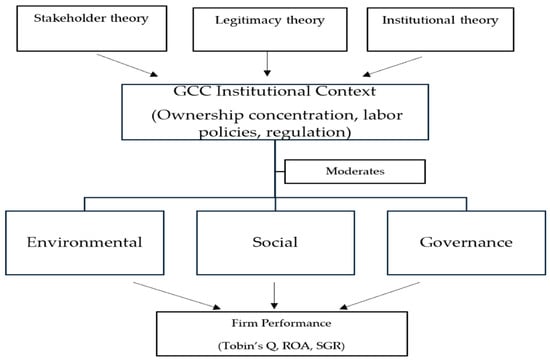
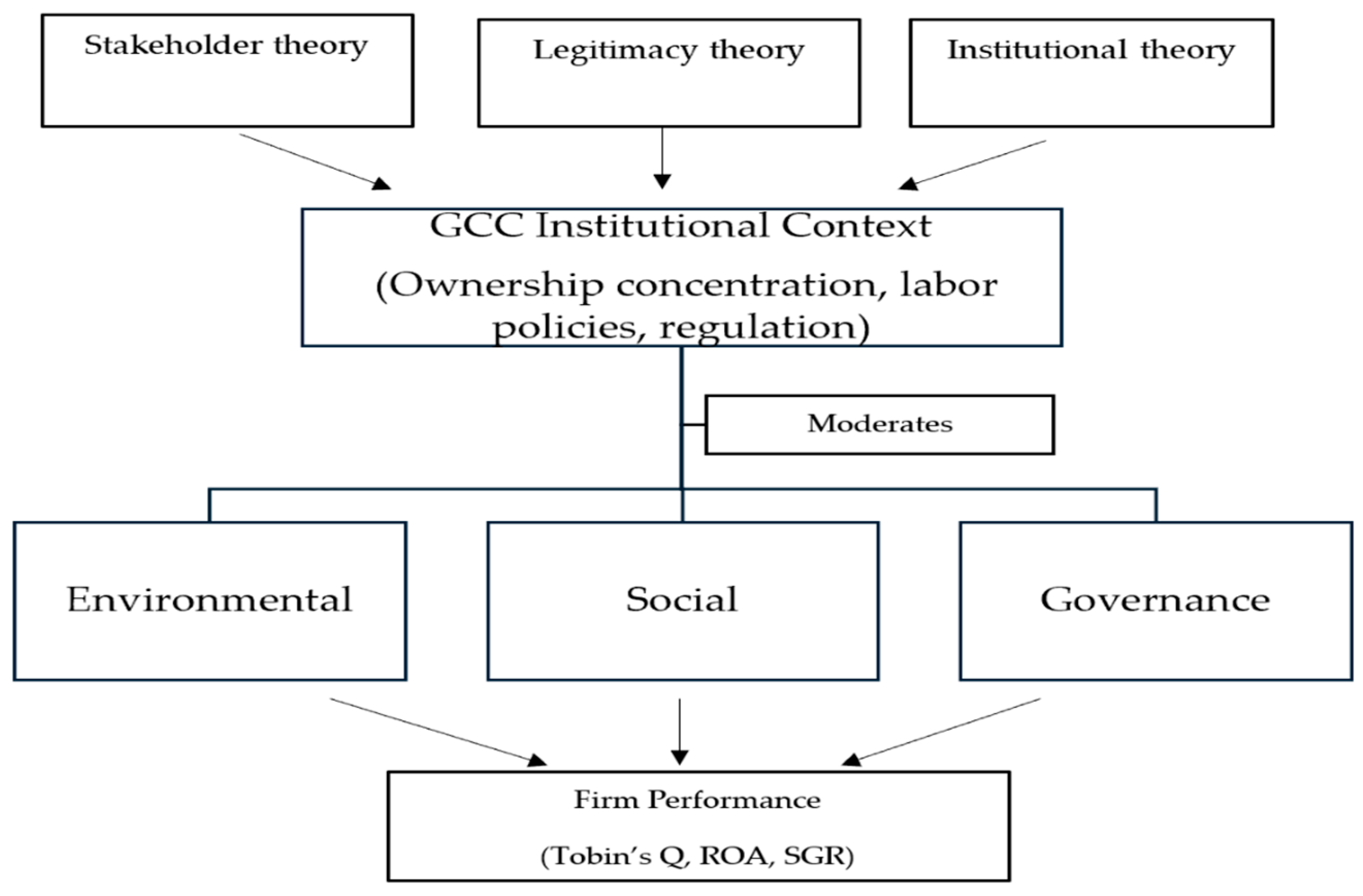
Given highly concentrated ownership structures, governance reforms emphasise board independence and minority shareholder rights. These factors may introduce compliance burdens and alter control dynamics, potentially outweighing short-term financial benefits. Figure 1 presents the theoretical framework linking ESG pillars to firm performance within the GCC institutional context. The framework highlights how stakeholder, legitimacy, and institutional theories underpin ESG engagement, while GCC-specific structural factors shape the performance implications of each pillar.
Figure 1.
Theoretical framework diagram in the GCC context.
3. Data and Methodology
3.1. Data
This paper analyses the varying effects of ESG pillars on corporate performance, utilising the unbalanced panel dataset of 84 publicly traded companies from GCC nations, covering the period from 2019 to 2023, resulting in 392 firm–year observations. The unbalanced structure reflects differences in ESG disclosure availability across firms and years. The unbalanced structure reflects differences in ESG disclosure availability across firms and years. The sample spans multiple industries, reflecting the ongoing diversification of GCC economies beyond hydrocarbon-dependent sectors. Sectoral diversity is especially important for ESG analysis because different industries have different levels of environmental exposure, stakeholder pressures, and governance structures. The study period captures a phase of significant sustainability policy evolution in the GCC, including the acceleration of Saudi Arabia’s Vision 2030, the UAE’s Net Zero by 2050 Strategic Initiative, and enhanced ESG disclosure requirements introduced by regional stock exchanges. The study also encompasses the COVID-19 pandemic, enabling the observation of performance dynamics in both stable and crisis conditions.
Table 1 outlines the sectoral distribution of the sample firms across eight key economic sectors. Financial firms constitute the largest segment, accounting for 33.3% of the sample, followed by materials at 19.0% and industrial firms at 13.1%. The remainder of the sample is spread across real estate, telecommunications, utilities and energy infrastructure, consumer and services, and healthcare and technology sectors. This distribution accurately reflects the structural composition of GCC capital markets and ensures that the sample captures a broad cross-section of industries, enhancing the generalizability of the results.
Table 1.
Sectoral distribution of sample firms.
A systematic screening process was applied to ensure data consistency and quality. The initial population included firms listed on major GCC stock exchanges with available ESG data. Firms were retained if they had non-missing ESG pillar scores and complete financial data required for model estimation during the study period. No sectoral exclusions were made. All financial and ESG data were obtained from the LSEG Refinitiv database (London Stock Exchange Group). Refinitiv’s ESG scoring framework evaluates firms across more than 630 company-level indicators grouped into environmental, social, and governance dimensions. Scores are constructed using publicly available information, including annual reports, sustainability disclosures, regulatory filings, and verified media sources. The database applies a standardised methodology that facilitates cross-country and cross-industry comparability while incorporating sector-specific materiality considerations.
The paper utilises three distinct dependent variables—market valuation, accounting profitability, and long-term sustainable growth capacity—to encapsulate the multidimensional aspects of firm performance and to furnish compelling evidence of the effects of ESG pillars. Tobin’s Q captures investors’ forward-looking expectations about a firm’s ability to generate future cash flows and reflects the market’s assessment of intangible assets, growth opportunities, and management quality. This measure is particularly relevant for assessing ESG impact because sustainability initiatives often create intangible value that may not be immediately reflected in accounting profits but influences market valuation [41]. In the GCC context, where capital markets are increasingly integrating ESG considerations and institutional investors are demanding sustainability performance, Tobin’s Q provides insight into whether ESG pillars translate into market-recognised value.
ROA measures accounting-based profitability and operational efficiency. ROA reflects management’s effectiveness in deploying assets to generate earnings, independent of capital structure decisions. SG-performance research widely uses this metric to capture the direct impact of operational practices on bottom-line profitability. Unlike equity-based returns, ROA is not influenced by leverage or financing choices, making it suitable for cross-firm comparisons in the GCC, where capital structures vary significantly due to differences in ownership concentration, family control, and state involvement [14]. ROA is particularly informative for evaluating whether ESG investments yield tangible cost savings, revenue enhancements, or efficiency gains that improve current profitability.
SGR captures a firm’s capacity for long-term growth without requiring external financing. SGR represents the maximum growth rate a firm can sustain using only internally generated funds, thus reflecting the firm’s ability to finance expansion from operational success rather than external capital infusions [42]. This measure is conceptually aligned with the sustainability concept embedded in ESG, as it captures whether firms can grow in a financially sustainable manner over time. For GCC firms, SGR provides a critical lens for assessing whether ESG practices contribute to enduring growth capacity or merely impose short-term costs. The use of three performance measures serves multiple analytical purposes. First, it addresses the concern that any single performance metric may be incomplete or biassed. Second, it allows us to distinguish between short-term profitability effects, market perception effects, and long-term growth implications of ESG pillars. Third, it enhances the robustness of the findings by demonstrating whether ESG pillar effects are consistent across performance dimensions or vary depending on the outcome of interest.
The selection of these three performance measures is carefully aligned with the study’s objective to capture the varied ways ESG pillars influence corporate performance. Tobin’s Q reflects market valuation by incorporating investor expectations and the value of intangible assets. Return on Assets (ROAs) gauges operational efficiency and accounting profitability, offering insight into whether ESG efforts translate into tangible financial results. The Sustainable Growth Rate (SGR) measures a firm’s ability to sustain internal growth, enabling an assessment of ESG’s impact on long-term expansion. Together, these metrics provide a well-rounded perspective on how ESG pillars affect short-term profitability, market perceptions, and the firm’s long-term financial sustainability—key dimensions central to this research.
The three ESG pillar scores from Refinitiv Eikon are the main independent variables. Each score is measured on a scale from 0 to 100, with higher scores showing better performance in that area. Environmental pillar score (ENV) assesses a firm’s impact on natural systems, including resource use, emissions, and innovation in environmental solutions. In the GCC context, this pillar is particularly noticeable due to firms’ diversification away from fossil fuels and their heavy investments in renewable energy and circular economy initiatives. Firms demonstrating strong environmental performance may benefit from preferential access to government contracts, subsidies for green projects, and enhanced reputation among increasingly environmentally conscious stakeholders.
The social pillar score (SOC) evaluates a firm’s relationships with stakeholders, including workforce management, human rights, community relations, and product responsibility. For GCC firms, the social pillar intersects cultural and religious norms, such as Islamic principles of social responsibility and ongoing nationalisation policies. Social investments may enhance workforce productivity and loyalty, but they may also impose substantial compliance costs, particularly for firms adjusting to new labour regulations and social expectations. Governance pillar score (GOV) measures the quality of a firm’s management systems, board structure, and shareholder rights. Governance is theoretically the most critical ESG dimension, as it provides the institutional framework for implementing environmental and social initiatives effectively. However, in the GCC context, governance reforms may face resistance and impose agency costs without yielding immediate performance benefits. Moreover, international governance standards developed for dispersed ownership structures may not align well with the relationship-based governance models prevalent in the GCC. The primary objective of the study is to categorise ESG into three components: social, environmental, and governance. Pillar-level analysis shows how different aspects of ESG affect each other in different ways, rather than giving you a single score. This method takes into account that different ESG factors can affect a company’s performance in different ways. Composite measures would hide this. We need to look at the effects that are unique to each pillar to see if some parts are worth more than others in the short term.
To separate the independent effects of ESG pillars and reduce omitted variable bias, the paper incorporates various firm-level control variables recognised in the previous literature as significant determinants of firm performance. Firm Size (SIZE) is measured as the natural logarithm of total assets. Larger firms typically enjoy economies of scale, greater bargaining power with suppliers and customers, and an enhanced ability to absorb ESG implementation costs. In the GCC context, firm size often correlates with state ownership or family business group affiliation, which may independently influence both ESG engagement and performance. Firm Age (AGE) is measured as the natural logarithm of the number of years since the firm’s establishment. Older firms generally possess greater experience, established stakeholder relationships, and organisational routines that may enhance performance. However, age may also be associated with organisational inertia, outdated business models, and resistance to sustainable innovations. In the GCC, many prominent firms are relatively young, and some family businesses trace their origins to pre-oil eras.
Leverage (LEV) is calculated as total debt divided by total assets, capturing financial risk and capital structure. Higher leverage increases financial risk and may constrain firms’ ability to invest in ESG initiatives that do not generate immediate cash flows. In the GCC, where Islamic finance principles discourage excessive debt and many firms have access to low-cost government or family capital, leverage patterns differ from Western markets. The paper includes leverage to control for its dual effects on performance and its potential interaction with ESG investments. Cash Flow from Operations to Assets (CFO/Assets) measures operational cash generation capacity, calculated as operating cash flow divided by total assets. Strong cash flow indicates operational health, provides internal funds for ESG investments, and signals the quality of products. This variable is particularly important in the GCC context, where many firms in resource-based or real estate sectors generate substantial cash flows that may be deployed toward sustainability initiatives or distributed to controlling shareholders. All control variables are measured contemporaneously with the dependent variables. Adding these control variables helps to separate the effects of ESG pillars on a company’s performance. Firm size and age account for structural firm characteristics that may influence both ESG engagement and financial outcomes. Leverage controls for financial risk and capital structure decisions that affect performance dynamics. Operating cash flow captures internal resource availability, which may simultaneously influence ESG investment capacity and financial results. By accounting for these factors, we prevent established determinants of firm performance from confounding estimated ESG effects.
3.2. Methodology
To examine how individual ESG pillars influence firm performance while accounting for unobserved heterogeneity and temporal variation, the paper employs a two-way fixed effects panel regression model. This specification controls for time-invariant firm-specific characteristics and common time shocks that could confound the ESG–performance relationship. The baseline empirical model is specified as follows:
The model specifies FP as one of the three dependent variables (Tobin’s Q, ROA, or SGR) for the firm in a given year. ENV, SOC and GOV are the environmental, social, and governance pillar scores, respectively. SIZE, AGE, LEV and CFO/Assets are the control variables. is the idiosyncratic error term. The coefficients of primary interest capture the marginal effects of ENV, SOC, and GOV performance on firm outcomes, holding other factors constant. The two-way fixed effects specification offers several advantages. First, firm fixed effects eliminate bias from unobserved time-invariant firm characteristics that may simultaneously influence ESG adoption and performance. Second, year fixed effects control for macroeconomic shocks, regional policy changes, and global trends such as the COVID-19 pandemic, oil price volatility, or international ESG norm diffusion that affect all firms similarly. Third, by examining within-firm variation over time, the model addresses the concern that cross-sectional ESG performance correlations may reflect reverse causality or omitted variables rather than causal effects. This approach is particularly appropriate for the GCC context, where unobserved institutional factors may drive both ESG engagement and performance but are difficult to measure directly.
This study employs Driscoll and Kraay [43] standard errors, which are robust to heteroskedasticity, autocorrelation of unknown form, and cross-sectional dependence in panel data. This estimator is particularly well-suited to the present context for several reasons. First, it does not require balanced panels or extended time periods, thus accommodating the five-year unbalanced panel utilised in this analysis. Second, it permits arbitrary forms of cross-sectional and temporal dependence, critical consideration given the exposure of firms in the GCC region to common macroeconomic shocks such as oil price volatility, regional regulatory changes, and global crises like COVID-19. Third, the estimator performs well when the cross-sectional dimension is moderate relative to the time dimension. Finally, it has demonstrated strong finite-sample properties and is increasingly adopted in corporate finance and sustainability research [44].
Driscoll–Kraay standard errors are preferred over conventional heteroskedasticity-robust or firm-clustered standard errors because the latter do not adequately address cross-sectional dependence. While cluster-robust standard errors correct for serial correlation within firms, they assume independence across firms—a premise unlikely to hold in the economically interconnected GCC markets subject to shared regional shocks. The Driscoll–Kraay approach explicitly accounts for both serial correlation and cross-sectional dependence, thereby ensuring consistent and reliable inference under the observed data structure.
Prior to the main analysis, a series of diagnostic tests were conducted to validate the empirical strategy. The Hausman test assessed whether firm-specific effects correlate with regressors, justifying the use of fixed effects over random effects [45]. The Breusch–Pagan test rejected the null hypothesis of homoscedastic errors [46], the Wooldridge test rejected the null of no first-order serial correlation [18], and the Pesaran CD test confirmed the presence of cross-sectional dependence among firms [47]. Collectively, these diagnostics support the application of two-way fixed effects combined with Driscoll–Kraay standard errors to ensure robust inference. Robustness checks were performed by re-estimating the baseline model under alternative specifications, including the exclusion of individual control variables. The stability of the ESG pillar coefficients across these specifications reinforces confidence that the results are not driven by arbitrary modelling choices. Table 2 presents the variables definition that employed in the analysis.
Table 2.
Variable definitions.
4. Results
This section presents the empirical findings from the analysis of ESG pillar effects on firm performance in GCC countries. Table 3 presents the summary statistics for all variables included in the analysis. The sample comprises 392 firm–year observations from 84 GCC-listed firms over a five-year period. The dependent variable, Tobin’s Q, exhibits a mean of 1.04 (SD = 1.08), with substantial variation ranging from 0.07 to 8.42, indicating considerable heterogeneity in market valuations across the sample. The distribution is positively skewed (skewness = 2.64) and leptokurtic (kurtosis = 9.38), suggesting the presence of outlier firms with exceptionally high market-to-book ratios. ROA averages 4% with a standard deviation of 6%, displaying similar distributional characteristics (skewness = 2.26, kurtosis = 9.85).
Table 3.
Summary Statistics.
Regarding the ESG pillars, governance performance shows the highest mean score (50.8, SD = 23.4) and exhibits a relatively symmetric distribution (skewness = −0.13). In contrast, environmental performance demonstrates the lowest average (22.4, SD = 22.7) with substantial positive skewness (0.83), indicating that most firms in the sample exhibit relatively weak environmental practices with a small subset of high performers. Social performance scores fall between these extremes (mean = 32.0, SD = 21.6). The considerable standard deviations across all three ESG dimensions underscore significant inter-firm variation in sustainability practices within the GCC context. Control variables reveal that the average firm in the sample has operated for approximately 25 years (ln firm age = 3.21), maintains a leverage ratio of 17%, and reports positive operating cash flows (CFO/Assets mean = 0.07). Firm size, measured as the natural logarithm of total assets, averages 22.9 with relatively low skewness (0.18), suggesting a reasonably balanced distribution of firm sizes in the sample.
Table 4 reports the bivariate correlations among key variables. Tobin’s Q exhibits a strong positive correlation with ROA (r = 0.64, p < 0.001) and operating cash flows (r = 0.64, p < 0.001), consistent with the notion that market valuations reflect underlying profitability and cash-generating capacity. Notably, Tobin’s Q demonstrates weak and mixed correlations with the ESG pillars: a marginally positive association with environmental performance (r = 0.02, ns), a small negative correlation with social performance (r = −0.12, p < 0.01), and a negligible negative correlation with governance (r = −0.07, ns). These preliminary findings suggest that the relationship between ESG dimensions and firm value may be more nuanced than aggregate ESG scores would indicate.
Table 4.
Correlation Matrix.
The three ESG pillars are positively intercorrelated, with social–environmental showing the strongest association (r = 0.76, p < 0.001). This pattern of moderate-to-high intercorrelation among ESG components motivates the use of separate pillar-level analyses to disentangle their distinct effects on firm performance. Firm size correlates negatively with both Tobin’s Q (r = −0.31, p < 0.001) and ROA (r = −0.12, p < 0.01), but positively with all ESG pillars (r = 0.32 to 0.46, all p < 0.001). Operating cash flow demonstrates strong positive correlations with both Tobin’s Q (r = 0.64, p < 0.001) and ROA (r = 0.67, p < 0.001).
Table 5 reports the results of formal specification tests conducted to determine the appropriate panel estimation strategy. The Hausman test strongly rejects random effects in favour of fixed effects (χ2 = 72.18, p < 0.001). The Breusch–Pagan test detects heteroskedasticity (χ2 = 43.84, p < 0.001), the Wooldridge test identifies first-order serial correlation (χ2 = 47.65, p < 0.001), and the Pesaran CD test reveals cross-sectional dependence (z = 9.78, p < 0.001). These diagnostics necessitate two-way fixed effects with Driscoll–Kraay standard errors, which are robust to heteroskedasticity, serial correlation, and cross-sectional dependence.
Table 5.
Model diagnostics.
Table 6 presents the main regression results examining the relationship between individual ESG pillars and firm value, measured by Tobin’s Q. The estimates are derived from a two-way fixed-effects model incorporating firm and year fixed effects, with Driscoll–Kraay standard errors (lag = 1).
Table 6.
Fixed-effects (firm and year) regression results with Driscoll–Kraay standard errors.
The environmental pillar exhibits a positive and statistically significant coefficient (β = 0.0072, t = 5.02, p < 0.001). A one-standard-deviation improvement in environmental performance (22.7 points) translates into an increase of about 0.16 in Tobin’s Q, equivalent to roughly 15% of the sample mean (1.04), reflecting a substantial economic impact.
In contrast, the governance pillar shows a negative and statistically significant effect (β = −0.0022, t = −6.37, p < 0.001), with a one-standard-deviation increase in governance performance (23.4 points) linked to an approximate 0.05 decline in Tobin’s Q. Similarly, the social pillar also exhibits a negative and significant coefficient (β = −0.0042, t = −7.81, p < 0.001), where a one-standard-deviation rise (21.6 points) corresponds to a decrease of about 0.09 in Tobin’s Q. These findings highlight the heterogeneous nature of the relationships across the different ESG dimensions. Among the control variables, firm size carries a negative and significant coefficient (β = −0.631, t = −2.47, p < 0.05), suggesting that larger firms in the GCC sample tend to have lower market valuations relative to their asset base. Leverage shows a marginally negative effect (β = −0.441, t = −1.86, p < 0.10), while operating cash flow and firm age do not exhibit statistically significant associations. Firm size shows a negative and statistically significant coefficient (β = −0.631, p < 0.05), suggesting that larger firms tend to have lower Tobin’s Q values within the GCC sample. In this regional context, many large firms operate in relatively mature domestic markets and are often characterised by concentrated ownership structures. These firms may prioritise stability and consistent cash flows over aggressive growth strategies, leading investors to assign them lower valuation multiples relative to their asset base compared to smaller, more growth-oriented companies.
To assess whether the differential effects of ESG pillars persist when aggregated into composite measures, Table 7 reports results from two alternative specifications. Panel A examines an ESG index constructed as the simple average of the three pillar scores, while Panel B employs an ESG factor derived from principal component analysis (PCA) of the pillar scores.
Table 7.
Robustness checks: ESG index and ESG factor (two-way fixed effects with Driscoll–Kraay standard errors, lag = 1). Panel A: ESG Index (average of governance, social, environmental) and Panel B: ESG Factor (PCA first component of ESG pillars).
Notably, neither composite measure exhibits a statistically significant relationship with Tobin’s Q. The ESG index coefficient is positive but insignificant (β = 0.0012, t = 0.78), while the PCA-based ESG factor similarly fails to achieve significance (β = −0.016, t = −0.82). These null findings stand in sharp contrast to the highly significant pillar-level effects documented in Table 6, underscoring the importance of disaggregating ESG into its constituent dimensions. Control variable estimates remain largely consistent across the composite specifications. Table 8 below reported the model specification diagnostics to test all the applied models.
Table 8.
Model fit and specification diagnostics.
The sensitivity analyses presented in Table 9 reinforce the robustness of the ESG coefficients. Three alternative specifications are examined: the baseline model (replicated from Table 6), a model excluding firm size, and a model excluding leverage.
Table 9.
Sensitivity and alternative specifications (two-way fixed effects with Driscoll–Kraay standard errors, lag = 1).
The environmental pillar consistently remains positive and significant (β = 0.0059 to 0.0072, all t > 4.0, all p < 0.001). The governance pillar stays negative and significant (β = –0.0022 to −0.0031, all p < 0.001), as does the social pillar (β = −0.0033 to −0.0042, all p < 0.001). The magnitude of these coefficients shows minimal variation across models, underscoring the stability of the findings.
To examine whether the differential ESG pillar effects extend beyond market-based performance measures, Table 10 reports results using ROA and SGR as the dependent variable. ROA provides an accounting-based measure of profitability that is less susceptible to market sentiment and speculation than Tobin’s Q, thereby offering a complementary perspective on firm performance.
Table 10.
Alternative dependent variable ROA and SGR (two-way fixed effects with Driscoll–Kraay standard errors, lag = 1).
For ROA, the environmental pillar maintains a positive and statistically significant association (β = 0.0017, t = 4.32, p < 0.001). A one-standard-deviation increase in environmental performance (22.7 points) translates into an approximate 0.039 increase in ROA, which corresponds to nearly one percentage point relative to the sample mean ROA of 4%. Meanwhile, the governance (β = −0.0005, p < 0.001) and social (β = −0.0012, p < 0.001) pillars continue to demonstrate negative and statistically significant relationships. Firm size retains a marginally negative association (β = −0.109, p < 0.10). The model explains about 12% of the within-firm variation in profitability, as indicated by a within-R2 of 0.118, comparable to the explanatory power observed in the Tobin’s Q models.
Sustainable growth SGR is a forward-looking measure that captures a firm’s capacity for self-financed growth without altering its financial leverage or payout policies. This outcome variable is particularly relevant for assessing whether ESG practices contribute to long-term value creation and growth potential. The environmental pillar again shows a positive and significant effect (β = 0.0309, t = 3.17, p < 0.001). Here, a one-standard-deviation increase in environmental performance corresponds to an increase of roughly 0.70 percentage points in the SGR. In contrast, the social pillar exhibits a marginally negative effect (β = −0.0314, p < 0.10), while the governance pillar does not reach statistical significance. Operating cash flow emerges as a strong positive predictor (β = 19.800, p < 0.001). The within-R2 of 0.047 indicates that this model explains a smaller portion of the variation in sustainable growth compared to those for Tobin’s Q and ROA.
5. Discussion
This study explores how the environmental, social, and governance pillars uniquely influence firm performance in GCC countries, revealing distinct patterns across market valuation, accounting profitability, and sustainable growth. The environmental pillar consistently shows a positive impact across all three performance measures, whereas the social and governance pillars are negatively associated with Tobin’s Q and ROA. These findings underscore the importance of analysing ESG components separately, particularly in emerging markets, as the effects of ESG dimensions on firm value are not uniform.
The positive relationship between environmental performance and firm outcomes aligns with key theoretical frameworks and empirical evidence from emerging markets. Stakeholder theory suggests that firms adopt ESG practices to meet evolving stakeholder expectations, thereby enhancing business performance and creating long-term value [17]. In the GCC context, environmental initiatives are especially relevant, reflecting national priorities such as Saudi Arabia’s Vision 2030, which emphasises environmental sustainability as a cornerstone of economic transformation. Legitimacy theory further supports this view, proposing that firms strategically engage in socially valued practices to maintain legitimacy and secure essential resources for survival and growth [22]. Consequently, GCC firms with stronger environmental commitments may benefit from enhanced legitimacy, regulatory alignment, and improved access to emerging green finance opportunities.
Empirical findings from other emerging markets reinforce this environmental effect. Research from the Levant region and broader emerging economies consistently reports positive links between environmental performance and financial outcomes, including ROA [36,37]. Studies in Malaysia and Indonesia highlight how environmental initiatives can drive operational efficiencies and competitive advantages [39]. Together, these insights suggest that environmental investments are increasingly recognised as strategic drivers of firm performance in both emerging and Gulf economies alike.
In contrast, the negative associations observed for the social and governance pillars diverge from conventional theoretical expectations and warrant contextual interpretation. Institutional theory highlights the region’s top-down regulatory environment, where sustainability reporting is increasingly mandated [6,15]. However, variations in institutional maturity and enforcement may hinder the translation of ESG efforts into financial gains. The negative coefficients suggest that, under current conditions, social and governance initiatives may impose compliance or agency costs that outweigh their immediate benefits.
The governance findings can be further understood through a principal–principal lens, which emphasises conflicts between controlling and minority shareholders in concentrated ownership systems common in the GCC [48]. Here, agency problems arise primarily between dominant and minority investors rather than between managers and dispersed shareholders. Governance reforms modelled on Anglo-American standards may not effectively address these conflicts and could introduce monitoring and compliance costs without delivering commensurate efficiency gains. This perspective helps explain why governance improvements, while theoretically value-enhancing, may show negative associations with firm performance in concentrated ownership contexts.
The negative social effect also contrasts with some emerging-market studies where social or composite ESG scores are positively linked to performance [28,29,40]. Yet, other research documents similar negative relationships, particularly in institutional environments characterised by evolving labour markets and stakeholder systems [25,31,32]. Several structural features of GCC labour markets provide relevant context: heavy reliance on expatriate labour, nationalisation policies that increase labour adjustment costs, and a tradition of corporate philanthropy that may not align neatly with formal ESG social programmes [23]. Such programmes often require additional reporting and compliance efforts, which may not yield immediate financial returns.
Comparisons with Southeast Asia further illuminate these dynamics. Both regions share concentrated ownership and evolving regulatory frameworks, but Southeast Asia typically experiences stronger civil society pressures and more developed stakeholder activism. These differences may explain why some ASEAN studies find positive social and governance effects, while others report negative associations similar to those observed here. Thus, the GCC findings contribute to the broader ESG literature by demonstrating that ownership structure and institutional development critically shape ESG–performance relationships, beyond ESG engagement alone.
The governance pillar exhibits a similar nuanced pattern. Although prior GCC-focused research has reported positive governance–performance links [13], differences in sample periods, performance metrics, and institutional evolution likely account for divergent results. This study’s 2019–2023 timeframe and use of multiple performance indicators provide a more comprehensive assessment. Concentrated ownership in GCC firms may limit the effectiveness of governance reforms, emphasising board independence or minority shareholder protections [5]. In such contexts, reforms may not yet translate into measurable efficiency gains or market premiums, particularly where enforcement remains in flux [49].
This study highlights a critical methodological insight: composite ESG scores can mask meaningful variation among individual pillars. Both simple averages and PCA-based ESG indices fail to reach statistical significance, despite clear and contrasting effects at the pillar level. This finding cautions against aggregation that may obscure offsetting relationships within ESG components. This paper demonstrates that the correlation between ESG practices and firm performance is primarily dependent on the institutional context, thereby contesting the notion that each pillar initiative consistently augments value. In the GCC region, environmental initiatives add value by supporting government goals, bringing in green finance, and making operations more efficient. Conversely, social and governance reforms can impose costs due to factors such as labour market segmentation, cultural misalignment, and ownership concentration. As the GCC countries work towards their ambitious goal of turning their economies into sustainable, diverse, knowledge-based ones, it becomes more and more important to know which ESG factors add value to corporate competitiveness and policy effectiveness. The paper provides evidence-based guidance for firms aiming to maximise sustainability value creation and for policymakers tasked with designing regulatory frameworks that encourage effective ESG practices. This paper elucidates that ESG is not a singular construct with uniform effects but a multidimensional phenomenon with diverse, context-dependent implications. It enhances the theoretical understanding and practical application of sustainability principles in emerging markets. The route to sustainable development in the GCC region requires distinct ESG strategies that emphasise environmental leadership, contextualise social responsibility, and customise governance reforms to local institutional contexts—a trajectory that the findings indicate is both essential and attainable.
6. Conclusions and Policy Implications
This paper examines the varying effects of the ESG pillars on corporate performance in the GCC countries, addressing a significant gap in the sustainability literature concerning emerging markets. Utilising a balanced panel dataset comprising 84 publicly listed GCC firms observed from 2019 to 2023, the paper employed two-way fixed-effects regression models with robust Driscoll–Kraay standard errors. These models help analyse whether the three ESG dimensions yield heterogeneous performance implications within the unique institutional context of the GCC region. The analysis incorporated three distinct performance measures that reflect market value, accounting profitability, and long-term growth potential. Furthermore, the paper controlled for operating cash flow to isolate the effects of ESG, considering the firms’ underlying financial capacity to support sustainability investments.
The findings reveal significant heterogeneity at the pillar level, fundamentally challenging the conventional assumption that ESG uniformly enhances firm performance. Notably, the environmental pillar demonstrates positive and highly significant associations with all three performance measures. This indicates that environmental initiatives create measurable value for GCC firms by aligning with government diversification priorities outlined in Vision 2030 and the UAE’s Net Zero by 2050. These initiatives make it easier to access green finance markets, save money on operations by using resources more efficiently, and make companies look more legitimate in global markets that care about sustainability. Conversely, the social and governance pillars exhibit negative and significant relationships with market valuation and accounting profitability. This suggests that investments in social programmes and governance reforms incur costs that outweigh their benefits in the GCC’s institutional context. This trend likely reflects the region’s segmented labour markets, which are characterised by a heavy reliance on expatriate workers and nationalisation policies that impose costly hiring quotas. Critically, when ESG pillars are aggregated into composite indices, these opposing effects offset each other, yielding insignificant overall ESG–performance relationships and explaining the mixed findings in prior GCC studies.
These findings make several important theoretical contributions. First, it explains the uniform-benefit assumption embedded in stakeholder theory, legitimacy theory, and institutional theory; certain ESG pillars may systematically detract from performance through agency costs and compliance burdens that exceed their benefits. Second, the paper enhances contingency theory by demonstrating that the performance effects of ESG practices are inherently dependent on institutional context. This finding necessitates theories that delineate the boundary conditions under which various sustainability practices generate or diminish value. Third, the paper contributes to emerging market corporate governance theory by demonstrating that Western governance standards may not only fail to enhance performance in concentrated ownership contexts. This may also actively reduce value by disrupting relationship-based governance mechanisms. These theoretical contributions call for more nuanced theorising about how institutional context moderates ESG–performance mechanisms.
While this paper makes significant contributions, it is important to acknowledge several limitations. The sample is restricted to publicly listed firms, which may not accurately reflect the circumstances of smaller or privately held enterprises that encounter different institutional pressures and resource constraints. Additionally, the analysis spans the years 2019 to 2023, a timeframe that includes the COVID-19 pandemic, which may have variably influenced the relationships between ESG and performance. Furthermore, the ESG data are sourced from a single rating provider, raising concerns regarding the methodology of the ratings and the definitions of the various pillars. Although the fixed effects specification and cash flow control address many issues of endogeneity, the paper cannot eliminate the possibility of reverse causality, where firm performance may affect ESG practices. Finally, the use of Refinitiv ESG scores may not fully capture GCC-specific social and governance nuances, particularly informal governance practices and culturally embedded social responsibilities.
Future research should aim to expand pillar-level ESG analysis to other emerging market regions and investigate the mediating mechanisms that link ESG pillars to firm performance. It should also examine potential moderators of ESG–performance relationships, adopt longitudinal designs with extended time horizons, and explore stakeholder-specific outcomes beyond financial performance. In addition, qualitative case studies examining how GCC firms implement ESG initiatives would provide deeper insight into underlying mechanisms. Longitudinal analyses beyond the 2030 Vision milestones could assess whether institutional maturation alters ESG–performance relationships over time. Future research should also address reverse causality concerns by employing instrumental variable techniques or lagged ESG specifications to better establish causal inference. Although the fixed-effects model helps control unobserved factors that do not change over time, it cannot completely eliminate the possibility of reverse causality between ESG performance and firm outcomes. It is plausible that better-performing firms have more resources available to invest in ESG initiatives. Future studies could address this issue by employing instrumental variable techniques or dynamic panel models that incorporate lagged ESG variables.
The results have significant practical ramifications for corporate sustainability strategies and public policy. Firms should adopt pillar-specific ESG strategies that prioritise environmental initiatives aligned with government diversification agendas and green finance opportunities. They should also carefully evaluate the costs and benefits of social and governance programmes that may not yield immediate performance payoffs given institutional constraints. Firms should leverage cash flow efficiency to sustain environmental investments over time. In addition, they should communicate pillar-specific ESG performance to investors rather than emphasise aggregate ESG scores that may mask value-creating environmental initiatives. Policymakers should implement pillar-specific ESG regulations. Environmental performance can be encouraged through tax credits, green investment subsidies, accelerated depreciation for clean technologies, and ESG-weighted procurement policies. Social policies should emphasise workforce development and phased compliance mechanisms, while governance reforms should prioritise disclosure transparency tailored to concentrated ownership structures rather than rigid transplantation of Western board models. Governments should strengthen ESG disclosure requirements and enforcement to reduce information asymmetry and greenwashing. They should also invest in institutional infrastructure supporting ESG value creation and monitor ESG–performance relationships over time as institutional environments mature. International ESG rating agencies should account for institutional heterogeneity across regions and design context-sensitive methodologies that assign differential weights to ESG pillars based on regional relevance.
Author Contributions
Conceptualization, N.B.D., J.B., L.A. and H.A.; methodology, N.B.D.; software, N.B.D.; validation, N.B.D., J.B., L.A. and H.A.; formal analysis, N.B.D.; investigation, N.B.D., J.B., L.A. and H.A.; resources, J.B.; writing—original draft preparation, N.B.D., J.B., L.A. and H.A.; writing—review and editing, N.B.D., J.B., L.A. and H.A.; funding acquisition, J.B. All authors have read and agreed to the published version of the manuscript.
Funding
This research was funded by Princess Nourah bint Abdulrahman University Researchers Supporting Project number (PNURSP2026R540), Princess Nourah bint Abdulrahman University, Riyadh, Saudi Arabia.
Institutional Review Board Statement
Not applicable.
Informed Consent Statement
Not applicable.
Data Availability Statement
The data that support the findings of this study were obtained from Refinitiv Eikon workspace through an institutional licence.
Acknowledgments
The authors extend their appreciation to Princess Nourah bint Abdulrahman University Researchers Supporting Project number (PNURSP2026R540), Princess Nourah bint Abdulrahman University, Riyadh, Saudi Arabia.
Conflicts of Interest
The authors declare no conflicts of interest.
References
- Friede, G.; Busch, T.; Bassen, A. Esg and Financial Performance: Aggregated Evidence from More Than 2000 Empirical Studies. J. Sustain. Financ. Investig. 2015, 5, 210–233. [Google Scholar] [CrossRef] [Scilit]
- Buchetti, B.; Arduino, F.R.; Perdichizzi, S. A Literature Review on Corporate Governance and Esg Research: Emerging Trends and Future Directions. Int. Rev. Financ. Anal. 2025, 97, 103759. [Google Scholar] [CrossRef] [Scilit]
- Alareeni, B.A.; Hamdan, A. Esg Impact on Performance of Us S&P 500-Listed Firms. Corp. Gov. Int. J. Bus. Soc. 2020, 20, 1409–1428. [Google Scholar]
- Ali, N.B.M.; Hussin, H.A.A.; Mohammed, H.M.F.; Mohmmed, K.A.A.H.; Almutiri, A.A.S.; Ali, M.A. The Effect of Environmental, Social, and Governance (Esg) Disclosure on the Profitability of Saudi-Listed Firms: Insights from Saudi Vision 2030. Sustainability 2025, 17, 2977. [Google Scholar] [CrossRef] [Scilit]
- Christensen, D.M.; Serafeim, G.; Sikochi, A. Why Is Corporate Virtue in the Eye of the Beholder? The Case of Esg Ratings. Account. Rev. 2022, 97, 147–175. [Google Scholar] [CrossRef] [Scilit]
- ElAlfy, A.; Elgharbawy, A.; Driver, T.R.; Ibrahim, A.J. Sustainability Disclosure in the Gulf Cooperation Council (Gcc) Countries: Opportunities and Challenges. Green Financ. 2025, 7, 40–82. [Google Scholar] [CrossRef] [Scilit]
- Buallay, A. Is Sustainability Reporting (Esg) Associated with Performance? Evidence from the European Banking Sector. Manag. Environ. Qual. 2019, 30, 98–115. [Google Scholar] [CrossRef] [Scilit]
- Okpa, I.B.; John, A.; Nkwo, J.A.; Okarima, R.N. Implications of Environmental, Social and Governance Dimensions of Csr Practice on Firms’ Profitability, Value and Cash Flows in the UK. J. Bus. Manag. 2019, 21, 1–10. [Google Scholar]
- Bagh, T.; Zhou, B.; Alawi, S.M.; Azam, R.I. Esg Resilience: Exploring the Non-Linear Effects of Esg Performance on Firms Sustainable Growth. Res. Int. Bus. Financ. 2024, 70, 102305. [Google Scholar] [CrossRef] [Scilit]
- Barnett, M.L.; Salomon, R.M. Beyond Dichotomy: The Curvilinear Relationship between Social Responsibility and Financial Performance. Strateg. Manag. J. 2006, 27, 1101–1122. [Google Scholar] [CrossRef] [Scilit]
- Berg, F.; Kölbel, J.F.; Rigobon, R. Aggregate Confusion: The Divergence of Esg Ratings. Rev. Financ. 2022, 26, 1315–1344. [Google Scholar] [CrossRef] [Scilit]
- Buallay, A.; Kukreja, G.; Aldhaen, E.; Al Mubarak, M.; Hamdan, A.M. Corporate Social Responsibility Disclosure and Firms’ Performance in Mediterranean Countries: A Stakeholders’ Perspective. Euromed J. Bus. 2020, 15, 361–375. [Google Scholar] [CrossRef] [Scilit]
- Sharma, R.B.; Lodha, S.; Sharma, A.; Ali, S.; Elmezughi, A.M. Environment, Social and Governance Reporting and Firm Performance: Evidence from Gcc Countries. Int. J. Innov. Res. Sci. Stud. 2022, 5, 419–427. [Google Scholar] [CrossRef] [Scilit]
- Abdullah, A.; Talha, M.; Hadi, N.U. The Effects of Esg Performance on Financial Performance: Evidence from Gcc Countries. Corp. Soc. Responsib. Environ. Manag. 2025, 1–18. [Google Scholar] [CrossRef] [Scilit]
- DiMaggio, P.J.; Powell, W.W. The Iron Cage Revisited: Institutional Isomorphism and Collective Rationality in Organizational Fields. Am. Sociol. Rev. 1983, 48, 147–160. [Google Scholar] [CrossRef] [Scilit]
- Suchman, M.C. Managing Legitimacy: Strategic and Institutional Approaches. Acad. Manag. Rev. 1995, 20, 571–610. [Google Scholar] [CrossRef] [Scilit]
- Freeman, R.E. Strategic Management: A Stakeholder Approach; Cambridge University Press: Cambridge, UK, 2010. [Google Scholar]
- Wooldridge, J.M. Econometric Analysis of Cross Section and Panel Data; MIT Press: Cambridge, MA, USA, 2010. [Google Scholar]
- Baltagi, B.H. Econometric Analysis of Panel Data; Rohn Wiley: Hoboken, NJ, USA, 2008. [Google Scholar]
- Lu, L.W. The Moderating Effect of Corporate Governance on the Relationship between Corporate Sustainability Performance and Corporate Financial Performance. Int. J. Discov. Gov. 2021, 18, 193–206. [Google Scholar] [CrossRef] [Scilit]
- Inard, L. Cash Flow Valuation and Esg. In Valuation and Sustainability: A Guide to Include Environmental, Social, and Governance Data in Business Valuation; Springer: Berlin/Heidelberg, Germany, 2023; pp. 99–128. [Google Scholar]
- Burlea, A.S.; Popa, I. Legitimacy Theory. Encycl. Corp. Soc. Responsib. 2013, 21, 1579–1584. [Google Scholar]
- Nimer, K.; Abughazaleh, N.; Tahat, Y.; Hossain, M. Family Business, Esg, and Firm Age in the Gcc Corporations: Building on the Socioemotional Wealth (Sew) Model. J. Risk Financ. Manag. 2025, 18, 241. [Google Scholar] [CrossRef] [Scilit]
- Alluhidan, R.; Binsuwadan, J. The Influence of Sustainability Practices on Stock Performance: Evidence from Saudi-Listed Firms. Sustainability 2026, 18, 1463. [Google Scholar] [CrossRef] [Scilit]
- Shaikh, I. Environmental, Social, and Governance (Esg) Practice and Firm Performance: An International Evidence. J. Bus. Econ. Manag. (JBEM) 2022, 23, 218–237. [Google Scholar] [CrossRef] [Scilit]
- Cancela, B.L.; Neves, M.E.D.; Rodrigues, L.L.; Dias, A.C.G. The Influence of Corporate Governance on Corporate Sustainability: New Evidence Using Panel Data in the Iberian Macroeconomic Environment. Int. J. Account. Inf. Manag. 2020, 28, 785–806. [Google Scholar] [CrossRef] [Scilit]
- Ahmad, M.; Jiang, P.; Majeed, A.; Raza, M.Y. Does Financial Development and Foreign Direct Investment Improve Environmental Quality? Evidence from Belt and Road Countries. Environ. Sci. Pollut. Res. 2020, 27, 23586–23601. [Google Scholar] [CrossRef] [Scilit]
- Ahmad, S.; Mohti, W.; Irfan, M. Does Institutional Quality and Managerial Ability Drive the Association between Esg and Firm Performance: Evidence from Emerging Asian Markets. Found. Univ. J. Bus. Econ. 2024, 9, 252–271. [Google Scholar] [CrossRef] [Scilit]
- Goud, N.N. Corporate Sustainability Performance Vis-À-Vis Esg Disclosure and R&D: Does It Matter to Influence Corporate Performance—Evidence from India. Indian J. Corp. Gov. 2024, 18, 1–37. [Google Scholar]
- Raja Ahmad, R.A.; Samsuddin, M.E.; Azmi, N.A.; Abdullah, N. Is Environmental, Social and Governance (Esg) Disclosure Value Enhancing? Evidence from Top 100 Companies. Asia-Pac. Manag. Account. J. (APMAJ) 2023, 18, 143–163. [Google Scholar] [CrossRef] [Scilit]
- Truong, T.H.D.; Le, N.D.K.; Huynh, T.N.T. Impacts of Environmental, Social, and Governance (Esg) Performance on Firm Value, Profitability and Cash Flows: Evidence in Southeast Asia. J. Financ. Account. Res. 2024, 26, 1–14. [Google Scholar]
- Nareswari, N.; Tarczyńska-Łuniewska, M.; Al Hashfi, R.U. Analysis of Environmental, Social, and Governance Performance in Indonesia: Role of Esg on Corporate Performance. Procedia Comput. Sci. 2023, 225, 1748–1756. [Google Scholar] [CrossRef] [Scilit]
- Atan, R.; Alam, M.; Said, J.; Zamri, M. The Impacts of Environmental, Social, and Governance Factors on Firm Performance: Panel Study of Malaysian Companies. Manag. Environ. Qual. Int. J. 2018, 29, 182–194. [Google Scholar] [CrossRef] [Scilit]
- Abdelmoneim, Z.; El-Deeb, M.S. Bod Characteristics and Their Impact on the Link between Esg Disclosure and Integrated Reporting Disclosure Quality: A Study of Egyptian Non-Financial Firms. Future Bus. J. 2024, 10, 18. [Google Scholar] [CrossRef] [Scilit]
- ElDeeb, M.S.; ElGabry, N.S.; Mounir, N.; Ahmed, M. Nexus among Herding Behavior, Esg Disclosure, and Market Capitalization in the Egyptian Stock Market. Future Bus. J. 2025, 11, 163. [Google Scholar] [CrossRef] [Scilit]
- Bahadori, N.; Kaymak, T.; Seraj, M. Environmental, Social, and Governance Factors in Emerging Markets: The Impact on Firm Performance. Bus. Strategy Dev. 2021, 4, 411–422. [Google Scholar] [CrossRef] [Scilit]
- Al Amosh, H.; Khatib, S.F.A.; Ananzeh, H. Environmental, Social and Governance Impact on Financial Performance: Evidence from the Levant Countries. Corp. Gov. Int. J. Bus. Soc. 2023, 23, 493–513. [Google Scholar] [CrossRef] [Scilit]
- Al-Hajaya, K. Esg Performance and Corporate Corruption Risk Management: The Moderating Role of Risk Management Committees in Gcc Firms. J. Risk Financ. Manag. 2026, 19, 38. [Google Scholar] [CrossRef] [Scilit]
- Ismail, N.; Anridho, N.; Isa, M.A.; Abd Rahman, N.H.; Ismail, N. Corporate Sustainability and Firms’ Financial Performance: Evidence from Malaysian and Indonesian Public Listed Companies. Int. J. Econ. Manag. 2022, 16, 213–224. [Google Scholar]
- Alslaibi, N.; Abdelkarim, N. The Power of Esg Factors in Driving Financial Growth: Insights from Palestine. Discov. Sustain. 2024, 5, 241. [Google Scholar] [CrossRef] [Scilit]
- Buallay, A. Between Cost and Value: Investigating the Effects of Sustainability Reporting on a Firm’s Performance. J. Appl. Account. Res. 2019, 20, 481–496. [Google Scholar] [CrossRef] [Scilit]
- Rahim, N. Sustainable Growth Rate and Firm Performance: A Case Study in Malaysia. Int. J. Manag. Innov. Entrep. Res. 2017, 3, 48–60. [Google Scholar] [CrossRef] [Scilit]
- Driscoll, J.C.; Kraay, A.C. Consistent Covariance Matrix Estimation with Spatially Dependent Panel Data. Rev. Econ. Stat. 1998, 80, 549–560. [Google Scholar] [CrossRef] [Scilit]
- Afolabi, A.R.; Amosun, O.O.; Agbor, M.A.N.; Okunade, S.O. Environmental Sustainability Disclosures and Financial Performance of Listed Oil and Gas Companies in Nigeria: An Application of Driscoll-Kraay Standard Errors Approach. NIU J. Soc. Sci. 2024, 10, 91–104. [Google Scholar] [CrossRef] [Scilit]
- Hausman, J.A.; Taylor, W.E. Panel Data and Unobservable Individual Effects. Econometrica 1981, 49, 1377–1398. [Google Scholar] [CrossRef] [Scilit]
- Baltagi, B.H.; Feng, Q.; Kao, C. A Lagrange Multiplier Test for Cross-Sectional Dependence in a Fixed Effects Panel Data Model. J. Econom. 2012, 170, 164–177. [Google Scholar] [CrossRef] [Scilit]
- Pesaran, M.H. General Diagnostic Tests for Cross-Sectional Dependence in Panels. Empir. Econ. 2021, 60, 13–50. [Google Scholar] [CrossRef] [Scilit]
- Young, M.N.; Peng, M.W.; Ahlstrom, D.; Bruton, G.D.; Jiang, Y. Corporate Governance in Emerging Economies: A Review of the Principal–Principal Perspective. J. Manag. Stud. 2008, 45, 196–220. [Google Scholar] [CrossRef] [Scilit]
- Binhadab, N. Gender Diversity, Board Size, and ESG Performance: Sectoral Evidence from GCC-Listed Firms. Sustainability 2026, 18, 1607. [Google Scholar] [CrossRef] [Scilit]

Disclaimer/Publisher’s Note: The statements, opinions and data contained in all publications are solely those of the individual author(s) and contributor(s) and not of MDPI and/or the editor(s). MDPI and/or the editor(s) disclaim responsibility for any injury to people or property resulting from any ideas, methods, instructions or products referred to in the content. |
© 2026 by the authors. Licensee MDPI, Basel, Switzerland. This article is an open access article distributed under the terms and conditions of the Creative Commons Attribution (CC BY) license.