Article

Corporate Discursive Governance of Water Stewardship: A Longitudinal Multimodal Critical Discourse Analysis of Türkiye’s Initiative


by
Mehmet Yakın
Faculty of Communication, Istanbul Arel University, Istanbul 34537, Turkey
Sustainability 2026, 18(5), 2461; https://doi.org/10.3390/su18052461
Submission received: 9 February 2026 / Revised: 25 February 2026 / Accepted: 27 February 2026 / Published: 3 March 2026
(This article belongs to the Section Sustainable Water Management)

Abstract

Water scarcity and climate stress are increasingly framed as matters of individual consumption, even though structural drivers remain decisive. To examine how corporate communication participates in sustainability governance, this study asks how Finish Türkiye’s “Water of Tomorrow” initiative (2019–2025) defines the water problem, allocates responsibility, and builds legitimacy across time (RQ1–RQ2) using a longitudinal critical discourse analysis of multimodal materials (campaign videos, social media, web content, and reporting genres). We identify three phases: (i) household norm-setting through responsibilization scripts, (ii) scale-shifting legitimation via NGO/media alliances and ecosystem narratives, and (iii) metricization through quasi-institutional “water status” reporting and proprietary indices. While such strategies can raise salience and offer actionable guidance, they may also depoliticize allocation and equity questions by foregrounding consumer routines over infrastructural, agricultural, and industrial determinants. Practically, the paper proposes governance-relevant boundary conditions for corporate sustainability communication in water-stressed contexts: transparent sourcing of quantified claims, explicit role division with public and civil-society actors, alignment with basin-level and equity-sensitive governance, and avoidance of exaggerated individualization.

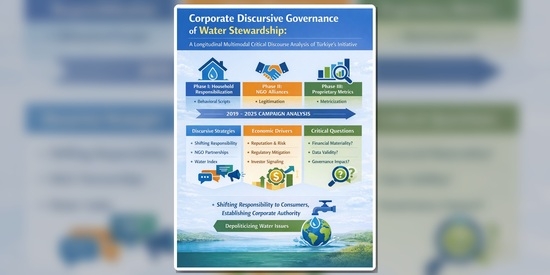
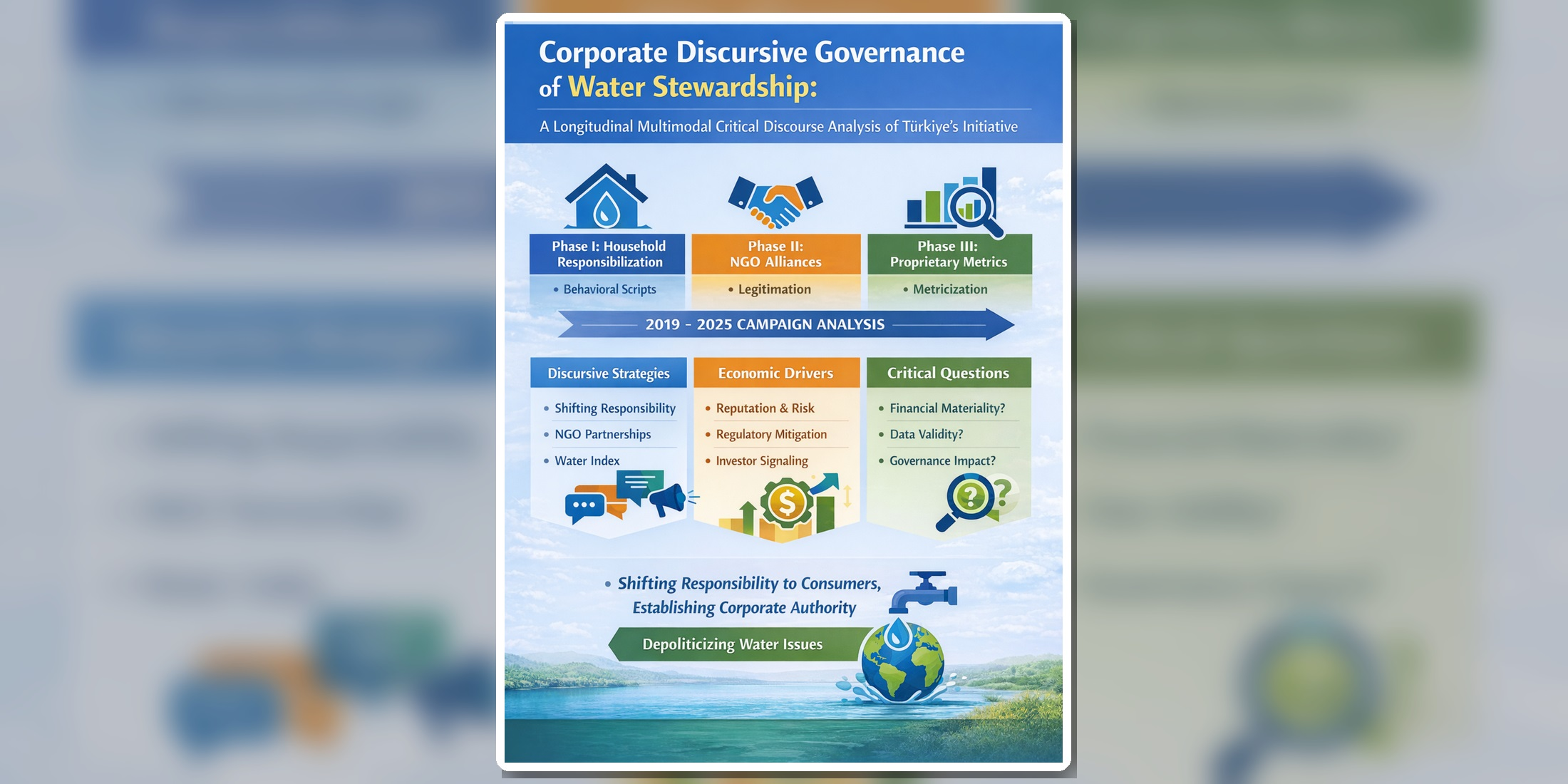
Graphical Abstract

1. Introduction

Water scarcity is increasingly addressed as a sustainability challenge that connects ecological constraints, social practices, and institutional arrangements. While public agencies remain central to water governance, contemporary sustainability transitions frequently unfold in polycentric settings where multiple actor types—public bodies, civil society, media infrastructures, and market actors—shape problem definitions and the social norms through which everyday resource use is governed [1]. Within the UN’s Sustainable Development Goals, water and sanitation are addressed under SDG 6, highlighting the governance salience of both everyday water use and institutional provision [2]. In Türkiye, current assessments classify the country as water-stressed, with elevated risks under climate change and demand growth [3,4]. In such settings, “governance” is not only exercised through formal rules and pricing instruments, but also through public narratives, metrics, and normative cues that define what responsible practice looks like and who is expected to act.
Across 2019–2025, corporate ESG communication expanded rapidly as firms sought to demonstrate climate and resource stewardship to regulators, investors, and the public [5]. In water-stressed countries, this trend intersects with rising expectations that companies contribute to public problem-solving beyond compliance—through partnerships, awareness campaigns, and the production of indicators that translate complex hydrological risks into everyday understandings. This broader shift provides the temporal and political–economic rationale for studying corporate discourse not only as marketing, but as a potential governance practice that can shape how responsibilities and solution spaces are publicly organized. This trajectory is also consistent with recent evidence from Türkiye showing a shift from tactical to strategic sustainability communication in corporate contexts [6].
Corporate actors have become visible participants in these governance landscapes, especially when sustainability concerns intersect with consumption routines. Corporate sustainability communication is often treated either as a strategic tool to influence consumer behavior or, from a critical perspective, as a site of misleading claims and legitimacy management [7]. However, sustainability research has comparatively less longitudinal evidence on how corporate discourse evolves over time, how it shifts across scales (from household practices to ecosystem narratives and national indicators), and how it can function as a form of discursive governance—that is, a mechanism through which corporate actors participate in steering public understandings of responsibility, legitimacy, and “appropriate” solutions.
This article addresses that gap through a longitudinal case study of Finish Turkey’s “Water of Tomorrow” (Yarının Suyu) initiative, launched in June 2019 and continuing through December 2025. The case is analytically valuable because it provides an extended, multi-modal corpus (audio-visual materials, social media, campaign web materials, and recurring “water status” reporting formats) through which one can observe not only messaging content, but also the institutional work performed by the campaign: forging alliances, borrowing authority from scientific and NGO framings, and introducing recurring metrics and reporting conventions that normalize particular interpretations of water stress.
Importantly, the aim of this study is not to evaluate marketing effectiveness (e.g., brand recall, sales, or behavioral impact at the population scale). Rather, it asks how the campaign constructs “water stewardship” as a social expectation and how that construction changes across time, partnerships, and narrative scales. By focusing on discourse as a governance mechanism, the article speaks to sustainability science’s core interest in the interaction between individual practices, institutional structures, and societal problem framings in coupled human–environment systems.

1.1. Research Questions

Guided by sustainability governance concerns and a discourse-analytic approach, the study addresses two questions:
RQ1. How does the “Water of Tomorrow” corpus (2019–2025) define the water problem and allocate responsibility across households, institutions, and broader social actors?
RQ2. How does the campaign’s discursive trajectory position the corporate actor within water governance—particularly through legitimacy-building, scale-shifting, and metricization—and what governance-relevant implications follow from these roles?

1.2. Contribution to Sustainability Science

The article contributes to sustainability science in three ways. First, it specifies discursive governance as a mechanism through which corporate actors can participate in demand-side sustainability transitions—by shaping problem definitions, responsibility allocations, and normative cues around everyday practices. Second, it provides a longitudinal, multi-modal account of how such discourse shifts across phases, enabling the identification of patterned transformations (from household norm-setting to alliance-based legitimation and, later, metricization). Third, it translates discourse findings into governance-relevant implications, outlining conditions under which public–private sustainability engagement can complement (rather than displace) broader demand-management and equity concerns.

2. Literature and Conceptual Contribution to Sustainability Research

2.1. Corporate Actors and Polycentric Sustainability Governance

Sustainability challenges such as water scarcity are governed in contexts where public authorities, firms, civil society organizations, and media infrastructures jointly shape problem attention and solution pathways. This polycentric reality does not imply that corporate actors replace public authority; rather, it highlights multiple, interacting arenas in which responsibility, legitimacy, and practical solutions are negotiated. For sustainability science, the analytical priority is therefore not whether corporate communication is “good” or “bad” in a normative sense, but how corporate initiatives participate in governance dynamics by shaping societal understandings of problems, responsibilities, and feasible actions.
Within this framing, corporate initiatives become empirically relevant when they do more than episodic messaging—when they create stable narratives, partnerships, and quasi-institutional reporting formats that can influence how water stewardship is publicly recognized and routinized. The present study treats the “Water of Tomorrow” initiative as a case of corporate participation in sustainability governance through discourse, without presuming measurable behavioral or ecological impacts. From a marketing-communication perspective, sustainability campaigns often navigate an ambivalent landscape where green marketing has evolved toward more systemic and transformative framings, while still facing scepticism regarding corporate motives and evidence [8,9,10].
Recent scholarship also underscores that corporate water stewardship increasingly extends beyond operational water management into governance and policy arenas, raising accountability and equity questions at the public–private interface. For example, narrative reviews of corporate engagement in water policy highlight both the expansion of stewardship initiatives and the continuing controversy over whether such engagement delivers equitable water-security outcomes or primarily stabilizes corporate legitimacy [11].
At the same time, research on corporate environmental disclosure and sustainability reporting shows that reporting genres and indicator practices are shaped by regulatory change and major events, and that the evolution of ESG communication is itself a moving target across time and sectors [12]. Complementary discourse-oriented work on corporate water communications demonstrates how responsibility can be shifted toward consumers while corporate agency is backgrounded, even when water scarcity is framed as a shared societal issue [13]. These strands support the present study’s focus on longitudinal change, scale-shifting, and metricization as governance-relevant discourse mechanisms.

2.2. Responsibilization and Behavioural Governance as a Discursive Mechanism

Demand-side sustainability transitions often mobilize everyday practices (e.g., household routines) as intervention points. A recurring tension in sustainability governance is that such interventions may enable participation and salience while also narrowing perceived responsibility toward individuals. This tension can be understood through the concept of responsibilization: the discursive allocation of sustainability duties to particular actors (often consumers), frequently via simplified behavioral scripts. Such dynamics also interact with well-documented barriers between environmental attitudes and actual practices [14,15].
Behaviourally oriented approaches (e.g., “nudges” and “choice architecture”) are typically defined by their attempt to steer choices without eliminating options or substantially changing economic incentives [16]. In corporate-led contexts, however, such approaches frequently operate through communication genres—quantified cues, imperatives, and simplified “right practice” scripts—rather than through policy-designed choice environments. This observation resonates with work that synthesizes behaviour-change mechanisms for sustainable consumption and highlights both promise and limitations [14,17]. For this reason, the current study uses behavioural concepts only as sensitizing vocabulary for reading the corpus (e.g., identifying when discourse resembles a behavioural script), not as a claim about effectiveness.

2.3. Scale, Legitimation, and Environmental Problem Framing

Environmental governance scholarship has long shown that problem framings are not neutral: they organize attention, define appropriate scales of action, and privilege certain solution logics. Discourses can shift between household, community, ecosystem, and national scales, linking micro-practices to macro-risk narratives. Such scale-shifting matters for sustainability science because it shapes how coupled human–environment relations become publicly intelligible and how responsibility is distributed across institutions and citizens [18,19].
Legitimation is central in these discursive processes. Corporate sustainability initiatives often build authority through intertextuality—invoking scientific language, borrowing credibility through partnerships, and adopting report-like genres that mimic institutional knowledge production. These mechanisms are governance-relevant because they can stabilize particular definitions of “water stewardship,” even when the underlying measures or claims are not independently verified within the communication space itself.

2.4. Critical Discourse Analysis as an Analytical Bridge to Sustainability Governance

Critical discourse analysis (CDA) is used here not as an accusation-driven approach, but as a governance-oriented analytical lens for examining how language, visuals, and genres organize sustainability meaning-making. Fairclough’s framework is suitable because it connects (i) textual features (lexicon, imperatives, quantification), (ii) discursive practices (production, circulation, intertextuality, partnerships), and (iii) broader social practices (institutional roles, governance logics, socio-ecological narratives) [20,21].
This positioning aligns with Sustainability Science’s emphasis on understanding interactions between social and human systems, institutional dynamics, and societally relevant problem framings, while maintaining analytic caution: the study does not infer intentions or causal impacts; it examines discursive mechanisms through which governance narratives are constructed across time.

2.5. Theoretical Integration Framework: Discursive Governance in Polycentric Water Stewardship

To address concerns about fragmented theorization, this subsection integrates the study’s core concepts into a single explanatory chain. Discursive governance refers to the steering of public understandings of problems, responsibilities, and legitimate solutions through recurring narratives, genres, metrics, and semiotic cues. In polycentric sustainability governance, such steering can occur across multiple arenas (state, civil society, media, and markets), where authority is assembled through alliances, intertextual references, and knowledge formats rather than solely through formal regulation.
Within this chain, responsibilization specifies the mechanism by which discourse assigns duties and action scripts to particular actors—often consumers—by translating complex socio-ecological problems into individualized routines. Scale-shifting explains how campaigns connect micro-practices (households) to macro-frames (ecosystems, national risk, SDG agendas), thereby widening legitimacy claims while potentially narrowing perceived solution spaces. Finally, metricization captures how quantified claims and proprietary indices can stabilize discourse as ‘objective’ knowledge, supporting quasi-institutionalization and epistemic authority.
Terminology note. In this article, corporate sustainability communication refers broadly to the ways firms communicate sustainability-related themes, commitments, and practices to external audiences. Discursive governance, by contrast, is used more narrowly to denote those communication practices that perform governance-like work—i.e., they stabilize problem definitions, allocate responsibilities, build legitimacy through alliances and knowledge formats, and introduce quasi-institutional genres (such as recurring status reports and indices) that can steer public understandings beyond short-term persuasion. This distinction helps avoid treating all sustainability messaging as governance and clarifies the boundary conditions discussed in Section 5, Section 6 and Section 7. A schematic overview of this integration is provided in Supplementary Figure S1.

3. Methods

3.1. Research Design: Critical Discourse Analysis for Sustainability Governance

The study employs Critical Discourse Analysis (CDA) using Fairclough’s three-dimensional framework, which conceptualizes discourse as simultaneously (i) textual/semiotic construction, (ii) discursive practice (production, circulation, and intertextuality), and (iii) social practice (links to broader institutional and political–ecological contexts) [20]. CDA is appropriate for the present research problem because the object of inquiry is not the outcome of communication (e.g., consumer adoption rates), but the governance work performed by discourse: how campaigns construct authority, normalize responsibilities, and stabilize particular solution imaginaries [18,21].
To align CDA with sustainability science expectations of analytical transparency and relevance, the study operationalizes discursive governance through three analytical lenses applied across time:
  • Problem definition and responsibilization (how the issue is framed; who is addressed as responsible; what actions are normalized).
  • Legitimation and authority building (how credibility is assembled through spokespersons, partnerships, institutional references, and “scientific” presentation formats).
  • Metricization and quasi-institutionalization (how recurring indicators, indices, reporting formats, and routine updates stabilize a governance narrative and make it appear objective and permanent).

3.2. Case Boundary and Corpus Construction

The case is defined as Finish Turkey’s “Water of Tomorrow” (Yarının Suyu) initiative from June 2019 to December 2025, corresponding to the campaign’s emergence, maturation, and the establishment of recurring reporting formats within the corpus [22].
A purposive sampling strategy was used to construct a longitudinal, multi-modal corpus capturing the campaign’s most visible and structurally significant materials. The dataset includes:
Platform selection prioritized channels that (a) carried recurring campaign messaging, (b) preserved retrievable records across the 2019–2025 period, and (c) allowed cross-source triangulation between audiovisual, social media, and report-like materials. This necessarily privileges archivable and high-visibility outputs over ephemeral interactions. In particular, some short-video and comment environments (including TikTok) were not included in the retrospective corpus because historical access, completeness, and metadata traceability were inconsistent for the full study period. The corpus composition and sources are summarized in Table 1.
  • Audio-visual materials (n = 15): major TV commercials and long-form YouTube documentaries, including serialized productions referenced within the campaign (e.g., 25 Litre and Göl Yoksa Kuş da Yok).
  • Digital and social media materials (100+ posts): a systematic selection from official brand accounts (Instagram and X/Twitter), emphasizing high-visibility periods (e.g., World Water Day and similar recurring moments) to capture changes in framing and calls-to-action. The campaign website also functions as a hub for dissemination and archiving [22].
  • Institutional reports and reporting formats: annual “Water Status” (Su Durumu) bulletins and corporate sustainability reporting materials used by the campaign to provide “scientific” or quasi-technical backing for claims [23]. The corpus also includes on-site tools and resources used for public engagement (e.g., the water footprint calculator and water-saving tips) [24,25] and recurring knowledge formats hosted on the campaign site, including TSKB-linked materials (e.g., Su: Yeni Elmas and the Su Akademisi resource page) [26,27].
  • Publicity and partnership materials: announcements and co-branded outputs with NGOs and media partners (e.g., WWF, National Geographic), treated as intertextual devices through which authority is borrowed and amplified.
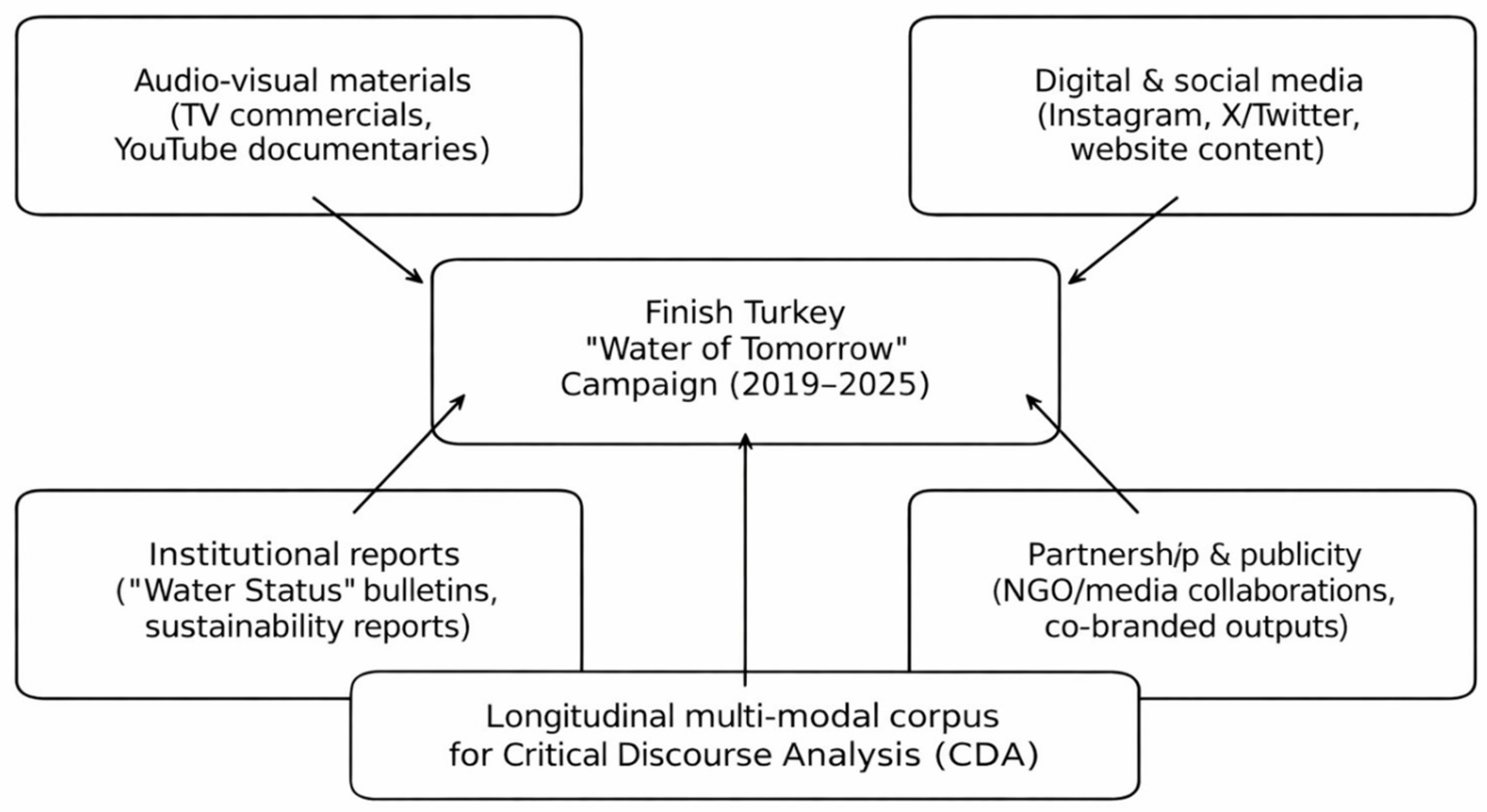
Figure 1 provides an overview of the campaign ecosystem and the corpus components included in the analysis.
To strengthen auditability, the corpus is documented in an Electronic Supplementary Material (ESM) appendix listing each item’s type, date, platform/source, and retrieval details (where publicly available), enabling readers to trace interpretations to specific materials.

3.3. Analytical Procedure

Analysis proceeded in four steps. This four-step analytical strategy is summarized in Supplementary Figure S2. The conceptual integration of mechanisms guiding the analysis is illustrated in Supplementary Figure S3. A modality-specific analysis protocol is detailed in Supplementary Methods S4. The analytical coding framework is summarized in Table 2.
Step 1: Chronological mapping. The corpus was ordered by date to identify discontinuities and emerging formats (e.g., shifts from single-message calls-to-action toward recurring report-like outputs).
Step 2: Iterative coding. Initial codes were derived from the operationalization above (problem definition/responsibilization; legitimation/authority; metricization/institutionalization) and from sensitizing concepts in sustainability communication and environmental governance debates. Coding remained open to emergent categories (e.g., shifts in scale, moral registers, or the introduction of new “objective” indicators).
Step 3: Fairclough’s three-dimensional interpretation. For each phase, the study synthesizes the following:
  • Textual/semiotic patterns (lexical choices, imperatives, quantified signifiers, metaphors, visual conventions where described in captions/materials);
  • Discursive practice (intertextuality, spokesperson roles, institutional referencing, partnership architectures, genre shifts such as “reporting”);
  • Social practice (how discourse aligns with broader governance narratives such as efficiency, stewardship, and individual responsibility).
Step 4: Phase identification and negative-case analysis. The longitudinal trajectory was summarized into three phases based on recurrent pattern shifts. Materials that deviated from dominant framings were treated as negative cases and used to refine boundary conditions (e.g., moments where systemic responsibility is briefly acknowledged or where behavioral cues are softened).

3.4. Reliability, Validity, and Analytical Transparency

Given qualitative interpretation risks, several strategies were used to strengthen rigor and validity:
  • Inter-coder reliability: Two researchers independently coded a 20% subset of the corpus; agreement was assessed via Cohen’s Kappa (0.82), indicating strong consistency in code application.
  • Audit trail: Coding memos and a codebook were maintained and linked to corpus items; phase assignments were justified via explicit textual/genre markers.
  • Triangulation across modalities: Claims about discursive shifts were corroborated across at least two material types (e.g., a slogan shift observed in audio-visual outputs was checked against social posts and reporting formats).
  • Claim discipline: Quantified statements (e.g., “liters saved”) were treated as discursive devices within the campaign unless independently verified; the analysis focuses on how numbers function rhetorically, not on their empirical accuracy. Where the corpus uses terms such as “liters saved,” this refers to the campaign’s own quantified savings claims (typically linked to a specified household practice) and is treated analytically as a rhetorical/legitimating device unless independently corroborated.

3.5. Ethics and Reflexivity

All analyzed materials are public-facing campaign outputs. The study does not involve human subjects, personal data, or intervention. Reflexivity is handled through explicit separation between (i) what the corpus states or implies and (ii) what the analysis can defensibly infer. The paper avoids attributing hidden intentions; instead, it interprets governance effects at the level of discourse (problem definitions, responsibility allocations, legitimating moves) and discusses implications as conditions and risks, not as definitive causal impacts.

4. Results: Discursive Evolution as Governance Work (2019–2025)

Across 2019–2025, the corpus displays a structured transformation in how “water stewardship” is framed and institutionalized. Rather than a stable message repeated over time, the campaign’s discourse evolves through three phases that correspond to distinct governance functions: (I) household norm-setting, (II) scale-shifting legitimation through alliances, and (III) metricization and quasi-institutionalization. The phases are not strictly bounded; however, each introduces dominant genres and authority strategies that reconfigure the campaign’s relationship to water governance.
The three-phase evolution is summarized in Figure 2. It summarizes the three-phase evolution described in Section 4.1, Section 4.2 and Section 4.3.

4.1. Phase I (2019–2021): Household Norm-Setting and Responsibilization

Governance function: establishing a household rule and positioning the consumer as the primary responsible actor.
In the early period, the discourse centers on a single domestic practice—pre-rinsing dishes—constructed as a focal point of water waste and moral responsibility. A quantified signifier (“57 liters”) operates as an anchoring device: it makes the problem appear concrete, measurable, and immediate, while enabling imperative calls-to-action that resemble household rules rather than optional advice [22].
Illustrative case (Phase I). In campaign commercials and short social posts, the “57 liters” figure is repeatedly paired with the directive not to pre-rinse dishes. Semiotically, the number works as an anchor that converts an invisible, systemic resource problem into a household rule: a single routine is framed as the decisive site of responsibility, and compliance is made legible through a measurable-looking claim. Analytically, the focus is on how this quantified imperative stabilizes a responsibilization script, not on verifying the magnitude of savings.
Textual/semiotic patterns (micro). The campaign relies on imperatives and compliance cues (“do not pre-rinse,” “save water”) paired with numerical quantification. The effect is a tight coupling between an everyday routine and a moralized sustainability duty. Rather than discussing multi-sector water governance, the discourse narrows responsibility to the kitchen, producing a simple behavioral script with a clear “right way” to act.
Discursive practice (meso). Credibility is supported through genre choices that blend advertising with documentary-like elements. Celebrity participation functions as an authority amplifier—less as evidence, more as a legitimacy scaffold that normalizes the message as socially endorsed and publicly significant.
Social practice (macro). From a governance lens, this phase exemplifies responsibilization: a complex socio-environmental challenge is rendered actionable through individualized household compliance. This can generate participation and visibility; yet it also risks narrowing the perceived locus of responsibility to consumers and daily routines, potentially sidelining questions of infrastructure, pricing, sectoral allocation, and enforcement. The key point is not that the campaign “causes” such effects, but that its discourse structures a governance narrative in which household behavior is foregrounded as the primary solution space.

4.2. Phase II (2022–2023): Scale-Shifting and Alliance-Based Legitimation

Governance function: expanding the problem scale and constructing the corporate actor as an intermediary aligned with recognized environmental authorities.
Illustrative case (Phase II). In eco-narrative materials, visuals of receding shorelines, dry basins, and affected birdlife support the sloganized logic of ecological loss (e.g., ‘no lake, no bird’ type framings). These symbols shift the interpretive scale from kitchen efficiency to ecosystem vulnerability, while still routing the implied solution back toward consumer-facing practice. The governance relevance lies in this semiotic bridge: household action is presented as morally connected to ecosystem outcomes through emotionally charged imagery.
In the middle period, the discourse shifts from domestic routines to broader ecological narratives. Visual and textual cues foreground drying lakes/wetlands and biodiversity-linked framings (e.g., “No Lake, No Bird”), repositioning the water problem as an ecosystem concern rather than solely a kitchen-efficiency issue.
Textual/semiotic patterns (micro). Lexical emphasis expands from household efficiency to ecological loss, legacy, and stewardship. The moral register becomes less about personal “waste” and more about collective heritage and ecological consequences, enabling the campaign to connect consumer action to wider environmental imaginaries.
Discursive practice (meso). Partnerships and co-branded references (e.g., WWF and National Geographic materials in the corpus) operate as intertextual authority sources. These references do not function as neutral “information”; they are legitimating devices that reposition the brand as a mediator capable of convening trusted actors and translating environmental concern into actionable scripts. Celebrity roles also shift from endorsing a specific household behavior to embodying an ambassador-like position, signaling representation and advocacy [22,28].
Social practice (macro). This phase illustrates scale-shifting as governance work: the campaign’s discourse links micro-level routines to macro-level ecological concern. From a sustainability science perspective, such linking can help bridge cognitive distance and make coupled human–environment relationships visible. At the same time, the discourse continues to prioritize consumer-facing solution pathways, raising governance questions about what remains unaddressed when ecosystem narratives are routed back into product-adjacent behavioral scripts.

4.3. Phase III (2024–2025): Metricization and Quasi-Institutionalization of Stewardship

Illustrative case (Phase III). The ‘Water Status’ bulletins and the proprietary Water Index are presented in report-like layouts that resemble institutional monitoring genres (headline status, sub-scores/dimensions, periodic updates). Even when the underlying data construction is not fully disclosed in the communication space, the multi-component presentation (i.e., an index assembled from several named dimensions) signals objectivity and permanence. In CDA terms, this is metricization: quantified formats help the campaign perform epistemic authority by making water stress appear comparable, trackable, and routinely governable.
Governance function: normalizing water stress through recurring indicators and report-like genres; positioning the corporate actor as a knowledge broker.
By 2024, the corpus increasingly adopts reporting genres—not only awareness messaging. “Water Status” (Su Durumu) bulletins and a proprietary “water index” format represent a notable shift: water scarcity is presented as a routine condition that can be tracked, compared, and updated, resembling the communicative logic of weather reports or economic indicators.
Textual/semiotic patterns (micro). The discourse becomes more technocratic in tone. Instead of singular behavioral injunctions, it offers periodic “status” updates and index-like presentations that imply objectivity. The governance effect is to render water stress legible through metrics that appear stable and institution-like.
Discursive practice (meso). Producing recurring “status” formats implies organizational capacity and epistemic authority: the campaign is no longer only persuading; it is reporting. Intertextual links to policy language and national initiatives (as represented within the campaign’s own materials) further strengthen the impression of alignment with public governance priorities. Here, authority is built less through spokesperson charisma and more through knowledge infrastructures—formats, indices, and periodic updates.
Social practice (macro). Metricization can support governance by stabilizing public attention and enabling comparability. Yet it also raises governance-relevant questions typical for sustainability science: Who defines the indicator? What data sources are used? How are uncertainties communicated? And how do proprietary indices interact with public accountability? The key analytical finding is that the campaign’s discourse moves toward quasi-institutionalization, where stewardship is not only encouraged but routinized through report-like infrastructures that can shape how the public understands “normal” water conditions [3,4].

4.4. Cross-Phase Synthesis: From Nudges to Discursive Governance

Taken together, the phases show a trajectory from behavioral scripting to institutional positioning:
  • Phase I establishes a household norm and responsibilizes the consumer through quantified imperatives.
  • Phase II expands scale and legitimacy through ecological narratives and alliance architectures.
  • Phase III constructs epistemic authority through metrics and recurring reporting conventions.
This trajectory clarifies why the case is governance-relevant: it demonstrates how corporate sustainability discourse can migrate from “encouraging a behavior” to “producing public problem knowledge” and thereby participate in shaping governance narratives.
These implications resonate with broader debates on corporate roles in water governance, where scholars call for more independent evaluation of corporate water initiatives and clearer safeguards when firms engage in catchment- or policy-adjacent arenas [11]. They also connect to emerging work on governing transnational water and climate risks in supply chains, which emphasizes how domestic policy contexts, knowledge transparency, and power constellations shape what firms can credibly claim and implement across scales [29].

5. Discussion: Governance Implications and Boundary Conditions

Because the study is discourse-analytic, it does not claim population-level causal effects on water outcomes, sales, or firm valuation. Its contribution is to explain how communicative practices assemble governance-like expectations, role allocations, and claims to authority in public sustainability discourse. Accordingly, the article addresses a communication and sustainability-governance problem rather than a finance or performance test, while acknowledging that corporate sustainability communication is often shaped by investor-oriented materiality frameworks, regulatory anticipation, and risk management logics [30,31,32,33]. This framing also clarifies the boundary conditions and risks that matter for sustainability governance:
  • Transparency and verifiability of quantified claims. When campaigns rely on single-number anchors (e.g., liters per act), the governance value depends on transparent sourcing and uncertainty communication. Otherwise, numbers may function primarily as moral pressure devices rather than accountable knowledge [30,31,32].
    Policy anchoring in the Türkiye context. The discourse trajectory can be read against the governance agenda implied by SDG 6—which foregrounds not only household practices but also institutional provision, allocation, and equity-sensitive access. When corporate campaigns foreground consumer routines, the key governance question becomes how (and whether) this messaging connects to public water-governance instruments and priorities in Türkiye (e.g., nationally promoted water-efficiency strategies and basin-level planning) rather than substituting for them. Interpreting the campaign alongside such policy texts helps specify where responsibilization narratives align with, or potentially obscure, public responsibilities for infrastructure, enforcement, and distributional fairness [2,34].
  • Complementarity vs. displacement. Corporate discursive governance can complement public agendas by increasing the salience of demand-side practices, but it can also displace attention from structural questions (sectoral allocation, enforcement, equity, infrastructural leakage) if the solution space is narrowed to consumer compliance.
  • Accountability in metricization. Report-like “status” genres and proprietary indices can become governance devices only when methodology, data provenance, calculation rules, and assurance arrangements are sufficiently transparent to enable external scrutiny and, where feasible, replication. Investor-oriented sustainability reporting frameworks emphasize decision-useful and materially relevant disclosure, but firm-controlled metrics may remain communicative artifacts unless audit independence, comparability, and validation procedures are clearly disclosed [30,31,32]. Therefore, the concern is not the presence of metrics per se, but the possibility that quasi-institutionalization produces epistemic authority without commensurate accountability [35,36,37].
  • Equity and differentiated capacities. Household-responsibility narratives can unintentionally obscure unequal capacities to comply (time, appliance access, housing conditions). Governance-relevant communication should therefore avoid implying uniform responsibility and should acknowledge heterogeneity in constraints.

Integrative Synthesis: Discursive Governance Roles and Boundary Conditions

The longitudinal trajectory indicates that the initiative functions less as a static communication campaign than as a discursive governance arrangement whose role changes over time. Across phases, three governance-relevant roles become visible:
Dynamic drivers across phases. While this study does not estimate the internal return on communication spending, the trajectory is consistent with plausible strategic incentives discussed in finance and accounting scholarship on environmental disclosure: reputation management, investor-relations signaling, regulatory-risk mitigation, and the management of issue salience under growing scrutiny of financially material environmental exposures [30,32,33]. Recent water-related studies also suggest that water risk and water disclosure can affect firms’ information environments and financing conditions, providing a plausible economic rationale for sustained communication investments alongside stewardship claims [35,36,37,38].
  • Norm-setting through behavioural scripting (Phase I-dominant). Quantified cues and imperatives stabilize a household “responsible practice” script. Governance relevance emerges from how responsibility is allocated and routinized, not from any presumed magnitude of water savings.
  • Legitimating intermediation through alliances. Cross-sector partnerships can widen audience reach and borrow institutional credibility, but a stronger governance assessment should distinguish symbolic alignment from organizational independence. In discourse terms, the corpus shows how partnerships are narrated as legitimacy bridges; however, without systematic evidence on project financing, sponsorship terms, co-production contracts, or editorial autonomy, the analysis cannot determine whether partner organizations functioned as independent endorsers or as compensated collaborators. This distinction matters for evaluating whether alliances broaden deliberation or consolidate corporate agenda-setting power.
  • Knowledge-format production through metricization and reporting genres (Phase III-dominant). Recurring “status” bulletins and index-like presentations introduce quasi-institutional knowledge infrastructures. This can stabilize attention and provide continuity, but it also generates accountability issues typical of governance: transparency of data sources, indicator construction, uncertainty communication, and the relationship between proprietary metrics and public datasets.
From a sustainability governance perspective, the manuscript therefore uses “governance” in a discursive and coordinative sense: the public structuring of expectations, responsibilities, and knowledge formats around water stewardship. By design, this usage does not substitute for effectiveness testing. Demonstrating behavioral, ecological, commercial, or market effects would require separate empirical designs (e.g., panel outcome models, event studies, or quasi-experiments) that are beyond the evidentiary scope of the present corpus-based discourse analysis [35,36,37,38].

6. Conclusions

6.1. What This Study Adds to Sustainability Science

This article contributes to sustainability science by conceptualizing corporate communication as a mechanism through which sustainability governance is publicly assembled, stabilized, and legitimized over time. Using a longitudinal critical discourse analysis, it identifies a trajectory from household responsibilization to alliance-based legitimation and then to metricization, showing how governance effects can emerge through role scripting, institutional borrowing, and quantified claims even without formal regulatory authority. The contribution remains analytical rather than causal: it clarifies discursive governance dynamics while explicitly separating them from untested behavioral, ecological, and firm-value outcomes.

6.2. Concluding Statement

Overall, the findings indicate that corporate participation in water stewardship can evolve from simple behavioral scripting toward quasi-institutional knowledge-format production. For sustainability science, the key insight is that this evolution is governance-relevant not because it guarantees outcomes, but because it reorganizes how responsibility, legitimacy, and problem knowledge are publicly structured over time.
Operational paths for governance-relevant collaboration. To move beyond abstract principles, corporate–public–civil society engagement can be organized around concrete tasks: (i) basin-level alignment—link consumer-facing advice to basin plans and locally salient demand pressures; (ii) equity-sensitive framing—acknowledge differentiated capacities across urban–rural settings and housing/appliance access; (iii) indicator co-design—develop or validate indices jointly with public agencies and independent experts, disclose data sources and assumptions, and state what the metric does *not* cover; (iv) responsibility division—separate what households can realistically do from what requires infrastructural loss reduction, agricultural efficiency, or industrial regulation; and (v) accountability routines—publish periodic updates that are comparable with public datasets where possible and include uncertainty statements.

7. Implications

7.1. Implications for Sustainability Practitioners and Cross-Sector Engagement

For corporate sustainability teams, NGOs, and public-facing partners, the findings indicate that credibility is not achieved through stronger messaging alone, but through governance-compatible practices: (i) transparent qualification of quantified claims used in public scripts; (ii) clear separation between awareness objectives, behavioral advice, and institutional commitments; and (iii) disclosure of indicator logic when adopting report-like formats. Partnerships can strengthen societal relevance, but only when roles, evidentiary bases, and accountability boundaries are explicit rather than left implicit in co-branding.

7.2. Implications for Sustainability Governance of Water Stewardship

For water governance, the initiative illustrates how stewardship can be publicly normalized through discourse even in the absence of formal regulatory instruments. This suggests a pragmatic governance lesson: corporate discourse may help maintain salience of demand-side practices, but it should be evaluated and engaged as one element of a broader governance ecosystem that includes public accountability, equity-sensitive framing, and clarity about the limits of household-centered solution logics. Where corporate initiatives adopt metricized reporting, governance quality depends on methodological transparency, alignment with public datasets where possible, and communication of uncertainty—so that “status” genres do not generate authority without accountability. This includes alignment with national water-efficiency strategies and public guidance where relevant [34].

8. Limitations and Future Research

This study focuses on producer-side discourse and uses purposive sampling of high-visibility materials to trace narrative change over time; it may therefore overrepresent polished strategic messaging while undercapturing failed messages, hostile engagement, or platform-specific vernaculars. Platform archival asymmetries (including incomplete retrospective retrieval for some short-video and user-comment environments such as TikTok) can introduce selection and survivorship bias despite cross-source triangulation. The study also does not measure downstream behavioral, ecological, or financial outcomes (e.g., household water consumption, sales, or market reactions) [30,31,32,33,35,36,37,38]; does not independently audit the statistical validity of proprietary campaign indices; and does not map financial flows or resource dependencies between the company and NGO/media partners. The resulting claims are interpretive and governance-analytic rather than causal tests of effectiveness or firm value. Finally, as a single-case study of one product line in one national context, transferability should be treated as analytical rather than statistical. Future research should compare firms across water-intensity profiles, regulatory settings, and market contexts [39,40,41] and combine discourse analysis with outcome data and independent metric validation to assess which discourse–governance patterns are case-specific and which are more generalizable.

Supplementary Materials

The following supporting information can be downloaded at https://www.mdpi.com/article/10.3390/su18052461/s1, An itemized corpus inventory and the coding framework are provided as Supplementary Materials (Tables S1 and S2) to support analytical transparency and traceability.

Funding

This research received no external funding.

Institutional Review Board Statement

Not applicable.

Informed Consent Statement

Not applicable.

Data Availability Statement

The corpus consists of publicly available campaign and partner materials. Retrieval metadata and an auditable list of all analyzed items are provided in the Supplementary Materials (Table S1). Where full redistribution is restricted (e.g., copyrighted audio-visual materials), access is enabled via source links and item identifiers in the Supplementary Materials.

Conflicts of Interest

The author declares no conflicts of interest.

References

  1. Ostrom, E. Polycentric systems for coping with collective action and global environmental change. Glob. Environ. Change 2010, 20, 550–557. [Google Scholar] [CrossRef] [Scilit]
  2. United Nations. Sustainable Development Goal 6: Ensure Availability and Sustainable Management of Water and Sanitation for All. Available online: https://sdgs.un.org/goals/goal6 (accessed on 7 December 2025).
  3. World Bank. Country Climate and Development Report: Türkiye; World Bank: Washington, DC, USA, 2022. [Google Scholar] [CrossRef] [Scilit]
  4. World Resources Institute. Aqueduct Water Risk Atlas. Available online: https://www.wri.org/data/aqueduct-water-risk-atlas (accessed on 6 October 2025).
  5. Chen, X.; Song, Y.; Hu, X.; Sun, G. Sustainability Uncertainty and Digital Transformation: Evidence from Corporate ESG Rating Divergence in China. Sustainability 2025, 17, 6515. [Google Scholar] [CrossRef] [Scilit]
  6. Aksoy, Z.; Misci Kip, S. From tactical to strategic sustainability communication: A qualitative study on corporations in Türkiye. Corp. Commun. Int. J. 2025, 30, 313–334. [Google Scholar] [CrossRef] [Scilit]
  7. Lyon, T.P.; Montgomery, A.W. The means and end of greenwash. Organ. Environ. 2015, 28, 223–249. [Google Scholar] [CrossRef] [Scilit]
  8. Peattie, K. Towards Sustainability: The Third Age of Green Marketing. Mark. Rev. 2001, 2, 129–146. [Google Scholar] [CrossRef] [Scilit]
  9. Polonsky, M.J. Transformative green marketing: Impediments and opportunities. J. Bus. Res. 2011, 64, 1311–1319. [Google Scholar] [CrossRef] [Scilit]
  10. Pomering, A.; Johnson, L.W. Advertising corporate social responsibility initiatives to communicate corporate image: Inhibiting scepticism to enhance persuasion. Corp. Commun. 2009, 14, 420–439. [Google Scholar] [CrossRef] [Scilit]
  11. Sojamo, S.; Rudebeck, T. Corporate Engagement in Water Policy and Governance: A Literature Review on Water Stewardship and Water Security. Water Altern. 2024, 17, 292–324. [Google Scholar]
  12. Ferjančič, U.; Ichev, R.; Lončarski, I.; Montariol, S.; Pelicon, A.; Pollak, S.; Sitar Šuštar, K.; Toman, A.; Valentinčič, A.; Žnidaršič, M. Textual Analysis of Corporate Sustainability Reporting and Corporate ESG Scores. Int. Rev. Financ. Anal. 2024, 96, 103669. [Google Scholar] [CrossRef] [Scilit]
  13. Smith, J.; Bowerman, T.; Elliott, B.; Taylor, C. Framing Water for Future Action: Corporate Communications. J. Corpora Discourse Stud. 2025, 9, 89–116. [Google Scholar] [CrossRef] [Scilit]
  14. Kollmuss, A.; Agyeman, J. Mind the gap: Why do people act environmentally and what are the barriers to pro-environmental behavior? Environ. Educ. Res. 2002, 8, 239–260. [Google Scholar] [CrossRef] [Scilit]
  15. Ilhan, A. Social Movements in Sustainability Transitions: Identity, Social Learning & Power in the Spanish and Turkish Water Domains. Ph.D. Thesis, Universitat Autònoma de Barcelona, Bellaterra, Spain, 2009. Available online: https://hdl.handle.net/10803/5817 (accessed on 25 February 2026).
  16. Thaler, R.H.; Sunstein, C.R. Nudge: The Final Edition; Yale University Press: New Haven, CT, USA, 2021. [Google Scholar]
  17. White, K.; Habib, R.; Hardisty, D.J. How to SHIFT consumer behaviors to be more sustainable: A literature review and guiding framework. J. Mark. 2019, 83, 22–49. [Google Scholar] [CrossRef] [Scilit]
  18. Hajer, M.A. The Politics of Environmental Discourse: Ecological Modernization and the Policy Process; Oxford University Press: Oxford, UK, 1995. [Google Scholar]
  19. Ozyirmidokuz, E.K.; Aydin, O.F.; Stoica, E.A. Whose voices shape Turkey’s nuclear discourse? A social media sentiment study of digital environmental activism. Energy Res. Soc. Sci. 2026, 131, 104497. [Google Scholar] [CrossRef] [Scilit]
  20. Fairclough, N. Critical Discourse Analysis: The Critical Study of Language, 2nd ed.; Routledge: London, UK, 2010. [Google Scholar] [CrossRef] [Scilit]
  21. van Dijk, T.A. Discourse and Power; Palgrave Macmillan: Basingstoke, UK, 2008. [Google Scholar] [CrossRef] [Scilit]
  22. Finish Türkiye (Reckitt). Yarının Suyu (Water of Tomorrow) Campaign Website. Available online: https://www.yarininsuyu.com/ (accessed on 2 January 2026).
  23. Reckitt. Sustainability Report 2024. Available online: https://www.reckitt.com/media/vudpe3c0/19-03-25_2_reckitt_sustainability-report-2024-1.pdf (accessed on 4 January 2026).
  24. Finish Türkiye (Reckitt). Su Ayak İzi Hesapla. Available online: https://www.yarininsuyu.com/su-ayak-izini-hesapla (accessed on 6 December 2025).
  25. Finish Türkiye (Reckitt). Su Tasarruf Önerileri. Available online: https://www.yarininsuyu.com/su-tasarruf-onerileri/ (accessed on 10 December 2025).
  26. Türkiye Sınai Kalkınma Bankası (TSKB). Su: Yeni Elmas; TSKB: Istanbul, Türkiye, 2019. Available online: https://www.tskb.com.tr/uploads/file/d28aa637f8031c7c5da422191b36e978-1653041833390.pdf (accessed on 7 January 2026).
  27. Finish Türkiye (Reckitt). Su Akademisi: Türkiye’de Su Kaynakları (TSKB). Available online: https://www.yarininsuyu.com/tskb (accessed on 7 January 2026).
  28. WWF; Zoological Society of London (ZSL). Living Planet Report 2024; WWF: Gland, Switzerland, 2024; Available online: https://www.wwf.org.uk/sites/default/files/2024-10/living-planet-report-2024.pdf (accessed on 7 January 2026).
  29. Gustafsson, M.-T.; Schilling-Vacaflor, A.; Pahl-Wostl, C. Governing Transnational Water and Climate Risks in Global Supply Chains. Earth Syst. Gov. 2024, 21, 100217. [Google Scholar] [CrossRef] [Scilit]
  30. IFRS Foundation. IFRS S1 General Requirements for Disclosure of Sustainability-Related Financial Information; IFRS Foundation: London, UK, 2023. [Google Scholar]
  31. Sustainability Accounting Standards Board (SASB). Conceptual Framework; SASB: San Francisco, CA, USA, 2017. [Google Scholar]
  32. Davies, L.; Martini, M. Watered Down? Investigating the Financial Materiality of Water-Related Risks in the Financial System; OECD Environment Working Papers No. 224; OECD Publishing: Paris, France, 2023. [Google Scholar] [CrossRef] [Scilit]
  33. Krueger, P.; Sautner, Z.; Starks, L.T. The Importance of Climate Risks for Institutional Investors. Rev. Financ. Stud. 2020, 33, 1067–1111. [Google Scholar] [CrossRef] [Scilit]
  34. Republic of Türkiye; Ministry of Agriculture and Forestry; General Directorate of Water Management. Su Verimliliği. Available online: https://www.suverimliligi.gov.tr/ (accessed on 14 December 2025).
  35. Zhou, Z.; Zhou, H.; Zeng, H.; Chen, X. The Impact of Water Information Disclosure on the Cost of Capital: An Empirical Study of China’s Capital Market. Corp. Soc. Responsib. Environ. Manag. 2018, 25, 1332–1349. [Google Scholar] [CrossRef] [Scilit]
  36. Liu, C.; Zhou, Z.; Su, K.; Liu, K.; An, H. Water Risk and Financial Analysts’ Information Environment: Empirical Evidence from China. Bus. Strategy Environ. 2024, 33, 1265–1304. [Google Scholar] [CrossRef] [Scilit]
  37. Wang, M.; Zheng, L.; Zhang, Y. Dried Out and Priced Up: Physical Water Risk, CSR Strategies, and the Cost of Equity. Water 2025, 17, 1881. [Google Scholar] [CrossRef] [Scilit]
  38. Afrin, R.; Peng, N.; Bowen, F. The Wealth Effect of Corporate Water Actions: How Past Corporate Responsibility and Irresponsibility Influence Stock Market Reactions. J. Bus. Ethics 2022, 180, 105–124. [Google Scholar] [CrossRef] [Scilit]
  39. Wang, S.; Li, Q.; Khaskheli, M.B. Management Economic Systems and Governance to Reduce Potential Risks in Digital Silk Road Investments: Legal Cooperation between Hainan Free Trade Port and Ethiopia. Systems 2024, 12, 305. [Google Scholar] [CrossRef] [Scilit]
  40. Cao, Z.; Lai, Z.; Bilawal Khaskheli, M.; Wang, L. The Risk of Global Environmental Change to Economic Sustainability and Law: Help from Digital Technology and Governance Regulation. Sustainability 2025, 17, 7094. [Google Scholar] [CrossRef] [Scilit]
  41. Zhuang, J.; Khaskheli, M.B.; Shen, C.; Jafri, M.A.H.; Shamsi, I.H. A comparative study of economic activity and sustainable development in China and Three South Asian Countries. Discov. Sustain. 2025, 6, 170. [Google Scholar] [CrossRef] [Scilit]
Figure 1. Campaign ecosystem and corpus components included in the analysis.
Sustainability 18 02461 g001
Figure 2. Timeline of discursive phases in the 2019–2025 corpus and their dominant genres/strategies.
Sustainability 18 02461 g002
Table 1. Summary of corpus composition and sources (see Supplementary Table S1 for itemized inventory).
Corpus ComponentWhat it Includes (Summary)Main Platforms/SourcesExamples/Stable Identifiers (see Table S1)Temporal Coverage/Access Window
Audio-visual materials (n = 15)Major TV commercials and long-form YouTube documentaries referenced within the campaign; includes serialized productions.YouTube (official Finish Türkiye channel) and linked campaign pagesYT01; YT02; YT03Campaign period: Jun. 2019–Dec. 2025; accessed Oct.–Dec. 2025
Digital & social media materials (100+ posts)Systematic sample of posts from official accounts; emphasis on high-visibility moments (e.g., World Water Day) to track framing shifts over time.Instagram; X (Twitter)SM01–SM05Campaign period: Jun. 2019–Dec. 2025; accessed Oct. 2025–Jan. 2026
Campaign web materials (hub, tools, knowledge resources)Public-facing campaign website pages and engagement tools that archive and disseminate campaign content, including partner-linked knowledge pages.Campaign website (yarininsuyu.com)WEB01–WEB05; WEB07–WEB08Accessed Oct.–Dec. 2025
Reporting formats & institutional/authority sourcesRecurring “water status” reporting genres and quasi-technical formats; additional institutional reports used as authority backings in the corpus.Campaign reporting pages + external PDF reports + government portalWEB06; PDF01; EXT01–EXT03Accessed Oct. 2025–Jan. 2026
Note: Detailed item list with retrieval dates is provided in Supplementary Table S1.
Table 2. Overview of analytical coding framework (see Supplementary Table S2 for full codebook).
Governance Lens/Code FamilyAnalytical Focus (What is Coded)CDA Levels (Fairclough)Typical Indicators/Cues (Examples)
Problem definition & responsibilizationHow the water issue is framed and how responsibility is allocated (who is addressed; what actions are normalized).Textual/semiotic; Discursive practice; Social practiceHousehold-routine emphasis; imperatives/calls-to-action; quantified signifiers (e.g., “liters saved”); repetition across channels; individualized duty narratives.
Legitimation & authority buildingHow credibility is assembled and borrowed through partnerships, citations, expert roles, and co-branding.Textual/semiotic; Discursive practice; Social practiceInstitutional/NGO naming; scientific/technical lexicon; partnership architectures; spokesperson/celebrity roles; positioning brand as mediator/broker.
Metricization & quasi-institutionalizationHow numbers, indices, and reporting genres stabilize the campaign as an “objective” governance-like apparatus.Textual/semiotic; Discursive practice; Social practiceRecurring indicators/index values; quantified claims; standardized reporting routines; periodic bulletins; normalization of indicators as decision-relevant facts.
Cross-cutting (emergent categories)Iteratively derived categories used to refine phase boundaries and interpret shifts across the longitudinal corpus.All dimensions (iterative coding)Scale shifts (domestic→ecosystem→infrastructural); shifts in moral registers; introduction of new “objective” indicators; negative cases.
Note: Full operationalization and examples are provided in Supplementary Table S2. Additional decision rules and sub-codes are provided in Supplementary Table S5.
Disclaimer/Publisher’s Note: The statements, opinions and data contained in all publications are solely those of the individual author(s) and contributor(s) and not of MDPI and/or the editor(s). MDPI and/or the editor(s) disclaim responsibility for any injury to people or property resulting from any ideas, methods, instructions or products referred to in the content.