1. Introduction
With the rapid advancement of science and technology, sustainable development has become a pivotal and irreplaceable objective of contemporary economic and social progress, with the transportation sector being a key field for advancing global sustainable development goals (SDGs). As a crucial driving force behind the evolution of new energy vehicles and the core of intelligent transportation systems (ITS), autonomous driving technology stands as one of the indispensable enablers for achieving SDGs—including affordable and clean energy (SDG 7), sustainable cities and communities (SDG 11), and climate action (SDG 13). The large-scale deployment of autonomous driving systems can optimize urban traffic flow, reduce vehicle fuel consumption and carbon emissions, and improve transportation safety, all of which are core demands for socio-economic and scientific integration approaches to sustainable development.
Multi-modal 3D object detection [
1,
2,
3], as the core environmental perception technology of autonomous driving systems, has achieved significant progress in complex traffic scenarios by fusing camera and LiDAR sensor information [
4,
5,
6,
7,
8,
9,
10]. Among them, Bird’s-Eye View (BEV)–based fusion frameworks have attracted considerable attention due to their unified spatial representation and strong scalability, becoming a mainstream technical route for autonomous driving perception and a key sustainability tool for improving the reliability of ITS. However, in nighttime or low-light environments, the quality of sensor data degrades significantly, and visual features suffer severe deterioration, leading to a noticeable decline in the overall performance of multi-modal perception systems. This not only restricts the practical application of autonomous driving technology but also hinders the sustainable development of the new energy vehicle industry and intelligent transportation systems.
Most existing multi-modal BEV-based detection methods are primarily designed for daytime or well-illuminated scenarios, and thus face multiple challenges when deployed in nighttime environments, which are incompatible with the quantitative and measurable requirements of sustainable autonomous driving technology development: (1) Nighttime images suffer from insufficient illumination, increased noise, and reduced contrast, weakening the discriminative capability of visual features and degrading cross-modal fusion effectiveness, which directly affects driving safety and transportation efficiency; (2) Transformer-based cross-modal attention mechanisms, though powerful for feature interaction, have high computational complexity and memory consumption, limiting practical deployment on resource-constrained autonomous driving platforms and violating the green and sustainable design principles of intelligent transportation hardware; (3) Nighttime datasets contain a high proportion of small objects and sparse-category samples, and a unified loss function fails to model the varying importance of different samples, leading to unstable training and constrained performance—making it impossible to monitor and evaluate the perception performance of autonomous driving systems in nighttime scenarios accurately.
Motivated by the prevalent challenges in nighttime multi-modal 3D object detection, including perception degradation, imbalanced cross-modal reliability, and uneven training supervision, this work explores a lightweight BEV-based detection framework tailored for nighttime autonomous driving scenarios. Unlike conventional approaches that primarily focus on enhancing the feature fusion stage, we adopt a task-driven perspective that jointly considers nighttime visual characteristics, cross-modal information interaction, and supervision modeling within a unified detection framework. More importantly, this research defines and quantifies the key performance indicators of nighttime autonomous driving perception and provides a technical approach to monitor and improve these indicators, filling the gap in sustainable perception technology for nighttime autonomous driving and laying a solid foundation for the integrated development of sustainable, socio-economic, and scientific intelligent transportation systems.
The main contributions of this paper are summarized as follows:
A lightweight multi-modal 3D object detection framework tailored for nighttime autonomous driving scenarios is proposed. The framework adopts a task-driven joint modeling strategy and effectively enhances perception performance under complex nighttime illumination conditions without significantly increasing computational resources. The framework serves as a practical sustainability tool for autonomous driving perception systems, supporting the low-cost and large-scale deployment of new energy autonomous driving vehicles.
A Dual-modal Gated Fusion (DMGF) mechanism is designed. By adaptively adjusting the feature weights of camera and LiDAR modalities, this mechanism enables stable cross-modal information interaction and effectively mitigates the adverse impact of single-modality degradation on detection performance in nighttime environments. The mechanism improves the reliability of autonomous driving perception, a key factor for the sustainable operation of autonomous driving systems.
In response to the high proportion of small objects, abundant weakly supervised samples, and unstable training in nighttime scenarios, an adaptive supervision strategy based on learnable weight modulation is proposed. By integrating a learnable gamma enhancer module with a night-aware and small-object adaptive weighting mechanism, the supervision strength for different.
The remainder of this paper is organized as follows.
Section 2 identifies the limitations of existing approaches under nighttime conditions.
Section 3 addresses these limitations by introducing a lightweight yet effective detection framework.
Section 4 empirically demonstrates how each proposed component contributes to performance improvement.
Section 5 concludes the study and discusses potential future directions.
3. Method
3.1. Overall Framework
The proposed method is built upon the multi-modal BEV detection paradigm of BEVFusion. While preserving the original BEV representation and detection pipeline, targeted extensions are introduced to enhance key components for nighttime scenarios. Although BEVFusion provides a unified multi-modal BEV perception framework, its original design is primarily oriented toward well-illuminated conditions and lacks explicit modeling of visual feature degradation, imbalanced modality reliability, and inadequate supervision adaptation under nighttime environments.
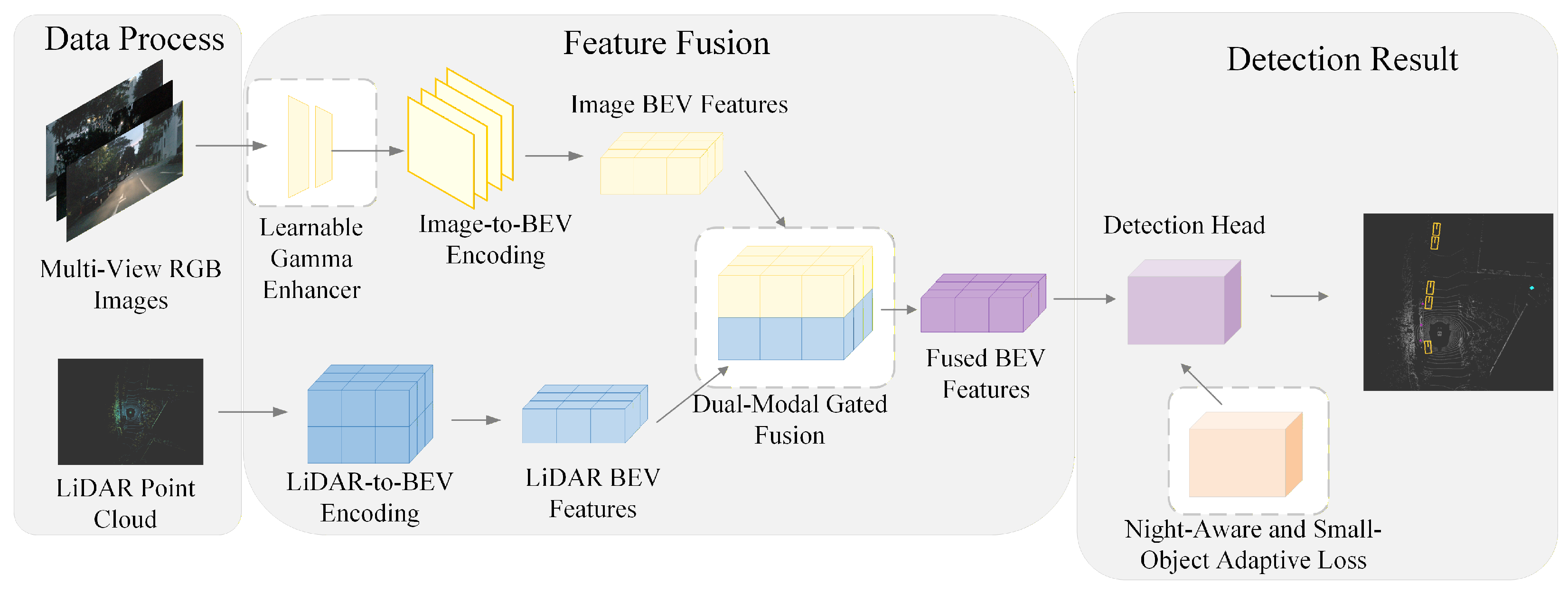
Based on these considerations, the overall framework is designed from three interconnected stages, including input modeling, cross-modal feature fusion, and supervision modeling. These stages are organized in a progressive and interdependent manner, forming a closed-loop design that evolves from perception enhancement to feature representation and further to supervision optimization. As a result, an end-to-end multi-modal 3D object detection framework tailored for nighttime scenarios is established, with practical deployment in real-world nighttime urban environments in mind. The overall architecture of the proposed method is illustrated in
Figure 1.
Figure 1 illustrates the overall architecture, which comprises two input branches and three core modules. Multi-view RGB images are first processed by the Learnable Gamma Enhancer for adaptive brightness correction, then encoded into Image BEV features via view transformation. In parallel, the LiDAR point cloud is voxelized and encoded into LiDAR BEV features. The two BEV representations are fed into the Dual-Modal Gated Fusion module, which computes spatially-adaptive gating weights to determine the per-location contribution of each modality, producing fused BEV features. The fused features are decoded by the detection head to generate 3D bounding boxes, supervised by the Night-Aware and Small-Object Adaptive Loss that dynamically upweights challenging nighttime and small-object samples during training.
3.2. Learnable Gamma Enhancer Module
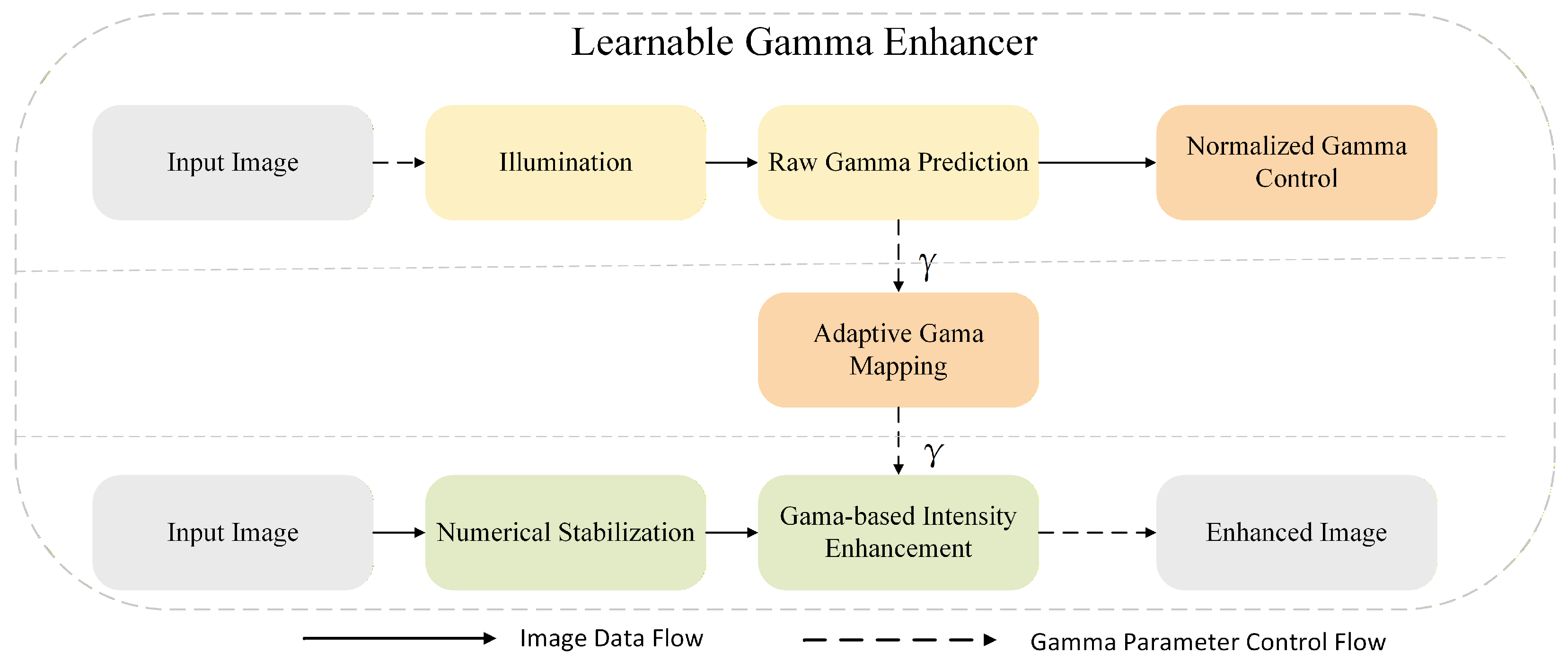
Under nighttime conditions, the image modality commonly suffers from insufficient illumination, increased noise, and reduced contrast, which significantly degrades the discriminative capability of visual features and consequently affects multi-modal fusion and 3D object detection performance. Most existing low-light enhancement methods are optimized for image reconstruction or subjective visual quality, typically require separate pre-training, and do not necessarily yield results that are optimal for downstream detection tasks. In light of this issue, this paper introduces a Learnable Gamma Enhancer and embeds it into the image branch of BEVFusion in an end-to-end manner, allowing the brightness modeling process to be directly optimized by the 3D object detection loss. By adaptively modeling the global illumination characteristics of nighttime images, the proposed module effectively alleviates visual feature degradation caused by low-light conditions, thereby providing more stable visual representations for subsequent cross-modal fusion. The proposed learnable Gamma enhancer is extremely lightweight, introducing negligible computational overhead. It is trained in an end-to-end manner and is directly driven by the detection objective. The module performs view-wise adaptive prediction for all six camera inputs, with independent Gamma estimation for each view. Moreover, the design ensures numerical stability and safe optimization throughout training. The overall structure is illustrated in
Figure 2.
Figure 2 details the internal pipeline of the Learnable Gamma Enhancer. The input image first passes through an illumination estimation network to produce a raw gamma prediction, which is then normalized via Sigmoid scaling to constrain
within
. The resulting
is applied to the numerically stabilized input image (clamped to avoid zero values) through a power-law mapping
, yielding the enhanced image. The entire process is differentiable, enabling end-to-end optimization with the downstream detection loss.
3.2.1. Learnable Gamma Parameter Estimation
This module is designed to adaptively predict a physically plausible and stable Gamma parameter based on the global illumination characteristics of the input image.
Given an input image
, the module first employs a lightweight network composed of convolutional layers and global average pooling to model the global illumination characteristics of the image and predict a corresponding raw Gamma value. This process can be formulated as follows:
Here,
denotes a lightweight convolutional prediction network with a very small number of parameters. To ensure the stability and physical plausibility of the Gamma value, a Sigmoid function is applied to normalize the predicted output, which is then linearly mapped to a predefined Gamma range
, In our implementation,
and
. The upper bound prevents unintended darkening (
), while the lower bound avoids overly aggressive enhancement that may amplify noise, yielding the final adaptive Gamma parameter:
To avoid overly aggressive enhancement during the early stages of training, the prediction network is initialized such that , which yields an initial Gamma value of . This corresponds to a moderate transformation close to an identity mapping, thereby ensuring stable optimization at the beginning of training.
3.2.2. Gamma-Based Low-Light Intensity Enhancement
This module applies controlled nonlinear brightness enhancement to low-light images using the predicted adaptive Gamma parameter.
After obtaining the adaptive Gamma parameter, standard Gamma correction is applied to the input image for brightness enhancement, which can be expressed as follows:
where
is a fixed small constant introduced to prevent numerical instability during the application of the power-law transformation.
When , this operation effectively enhances low-intensity regions, thereby alleviating the degradation of image modality information at nighttime scenarios.
3.2.3. End-to-End Training with Multi-View Support
The proposed Learnable Gamma Enhancer is directly embedded at the front end of the image branch and jointly trained with the BEVFusion backbone network. Since the Gamma parameter is connected to the detection loss through Equations (1)–(4) in an end-to-end differentiable manner, the enhancement strategy can be learned via backpropagation driven by the downstream 3D object detection loss. As a result, the brightness transformation is automatically adjusted toward a form that is most beneficial for the detection task.
In addition, the proposed module naturally supports multi-view input settings. Under a multi-camera configuration, an independent Gamma parameter is estimated for each view, and a consistent enhancement operation is applied accordingly, enabling seamless integration with the multi-view BEV perception framework of BEVFusion.
3.3. Dual-Modal Gated Fusion
In the BEVFusion framework, the fusion strategy between image and LiDAR features plays a decisive role in the performance of multi-modal 3D object detection. Simple feature concatenation lacks explicit modeling of cross-modal interactions, while Transformer-based cross-modal attention mechanisms, although capable of capturing global dependencies, incur computational complexity and memory consumption that grow significantly with BEV resolution, thereby limiting practical deployment in resource-constrained environments. To achieve a more favorable balance between fusion effectiveness and computational efficiency, this paper proposes the DMGF module.
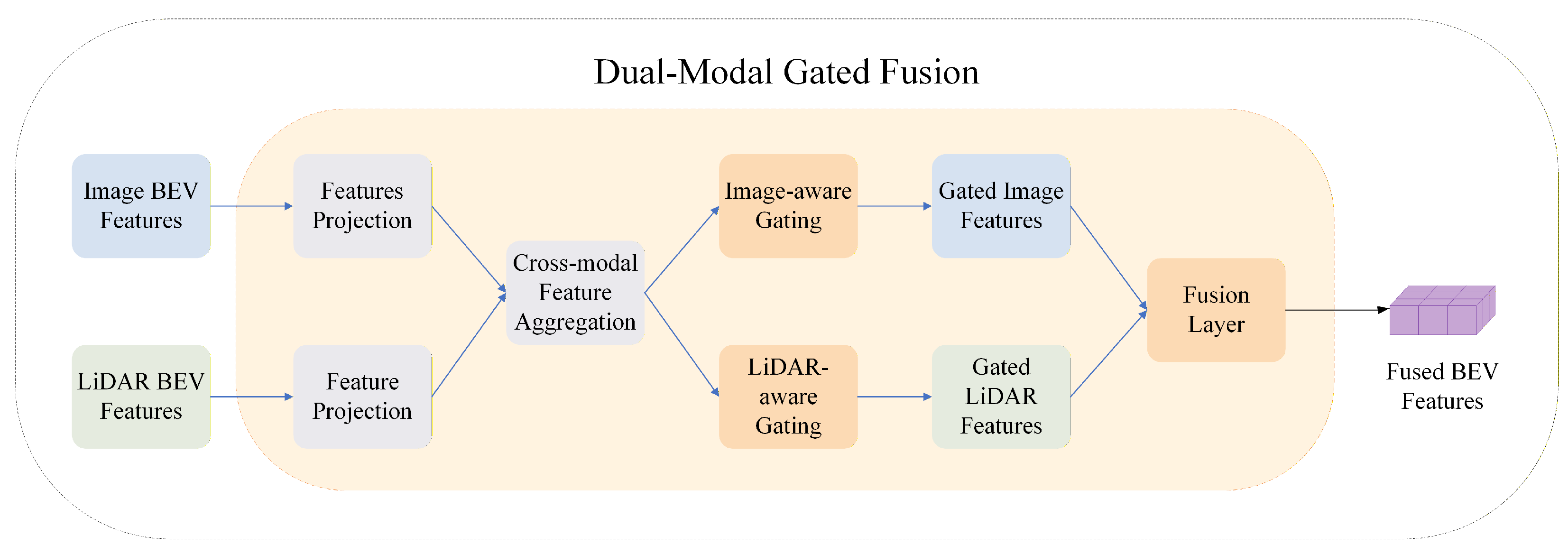
The proposed module employs a convolution-based gating mechanism to approximate bidirectional cross-modal attention, enabling effective information interaction between image and LiDAR BEV features while substantially reducing computational overhead. As a result, it enhances the stability and robustness of multi-modal perception in nighttime scenarios.redAlthough the proposed dual-modal gated fusion reduces the computational burden associated with full self-attention, it retains bidirectional cross-modal interaction as the fundamental design principle. In contrast to standard global attention, which emphasizes long-range dependencies but lacks local inductive bias, the introduced 3 × 3 convolution naturally embeds spatial locality. Such locality-aware modeling is more compatible with BEV representations, where preserving local geometric structures (e.g., vehicle contours and road boundaries) is essential for robust detection. The overall structure of the DMGF module is illustrated in
Figure 3.
Figure 3 illustrates the structure of the Dual-Modal Gated Fusion module. Image and LiDAR BEV features are first projected into a shared embedding space through
convolutions, then concatenated for cross-modal feature aggregation. Two parallel gating branches—Image-aware Gating and LiDAR-aware Gating—compute spatially-adaptive weights via convolutional layers followed by Sigmoid activation, producing Gated Image Features and Gated LiDAR Features respectively. Each gated feature represents a soft weighted combination of both modalities, where the gating weights determine the per-location contribution. The two gated features are concatenated and passed through a fusion layer (
convolution) to produce the final Fused BEV Features.
3.3.1. Feature Projection and Alignment
This module aims to construct a unified and comparable feature representation space for multi-modal feature fusion, thereby providing a consistent embedding basis for subsequent cross-modal interactions.
Given the BEV features from the image branch and the LiDAR branch, denoted as
and
, respectively, convolutional projections are first applied to map the two modal features into a unified embedding space with aligned channel dimensions. This process can be expressed as follows:
where
and
denote lightweight convolutional projection functions, producing output features with identical dimensions.
3.3.2. Cross-Modal Gated Weight Estimation
This module provides adaptive weighting constraints for cross-modal information fusion by modeling the relative reliability between different modal features.
To capture the cross-modal dependencies between image and LiDAR features, convolutional operations are applied to the concatenated features as an efficient approximation of conventional cross-modal attention mechanisms. Specifically, the two modal features are first concatenated along the channel dimension as follows:
Subsequently, convolutional layers followed by a Sigmoid activation function are used to predict the corresponding cross-modal weighting maps:
where
and
denote convolutional weight prediction functions, whose outputs are constrained to the range
and are used to control the strength of cross-modal information enhancement.
3.3.3. Bidirectional Gated Feature Enhancement
This module enhances the complementarity between multi-modal features through a controlled cross-modal interaction mechanism, thereby improving overall perception robustness in complex scenarios.
Based on the predicted cross-modal weights, a bidirectional cross-modal enhancement mechanism is designed to enable mutual reinforcement between image and LiDAR features. Specifically, the enhanced feature representations are formulated as follows:
where ⊙ denotes element-wise multiplication. With this design, the two modalities can complement each other under spatial alignment, thereby enhancing perception robustness in nighttime scenarios.
3.3.4. Fusion Output
Finally, the bidirectionally enhanced features are concatenated along the channel dimension and passed through a convolutional layer to generate the fused output feature representation:
3.4. Night-Aware and Small Object Adaptive Loss
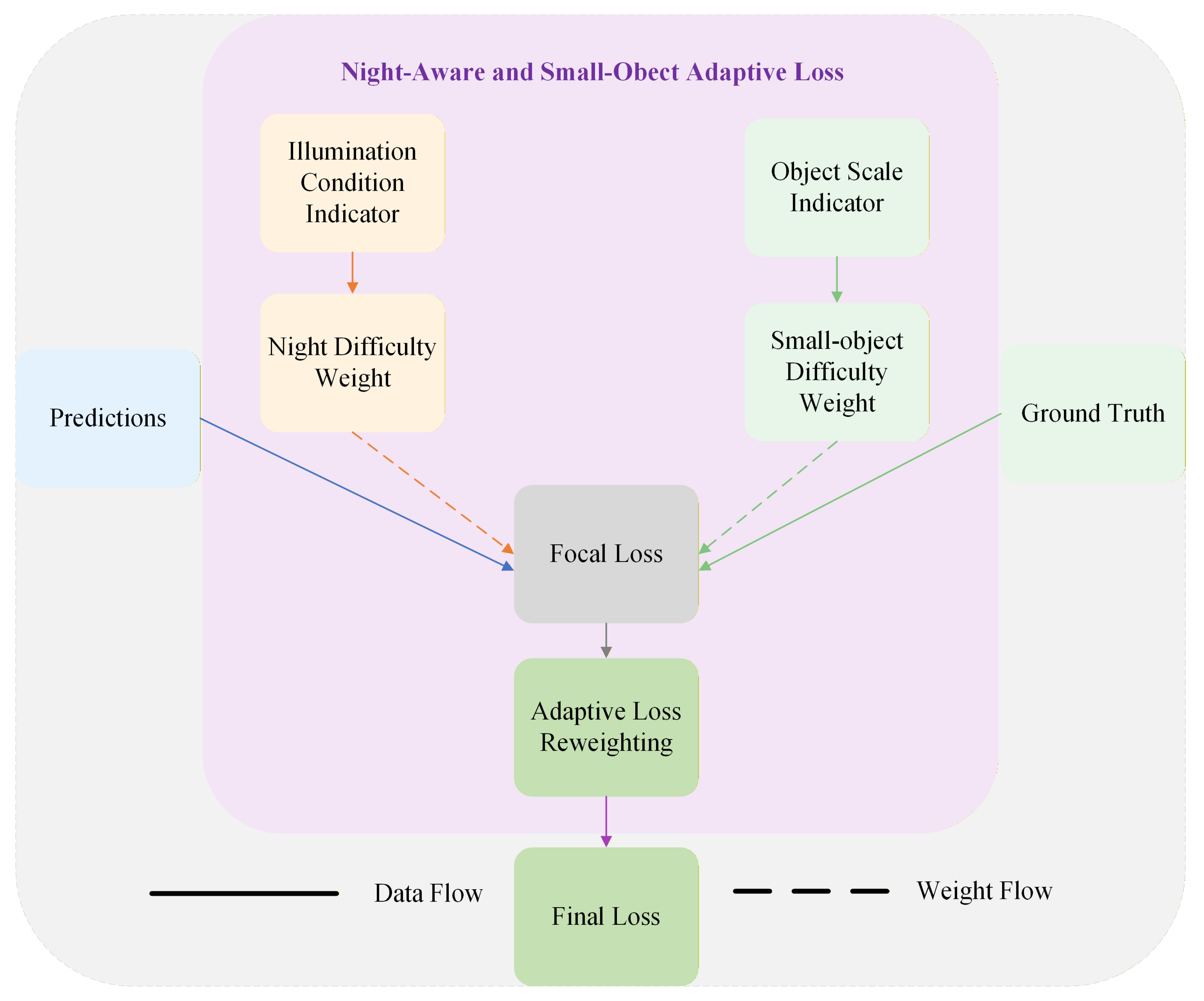
In nighttime autonomous driving scenarios, small-scale objects often co-occur with low-light conditions, and their combined effects significantly increase the difficulty of 3D object detection. Conventional detection loss functions typically treat different illumination conditions and object scales uniformly, which can cause nighttime small-object samples to be dominated by large objects or high-confidence samples during training, thereby limiting the model’s ability to learn from difficult cases. Based on this consideration, this paper proposes a Night-aware and Small-object Adaptive Loss, which dynamically reweights the detection loss by jointly modeling scene illumination information and object scale characteristics. Without introducing additional network parameters, the proposed design effectively strengthens the supervision for nighttime small-object samples, improving training stability and detection robustness in complex low-light environments. The proposed loss formulation is multi-dimensional, continuous, and controllable. It characterizes sample difficulty along three orthogonal axes: scene-level illumination conditions, object-level scale attributes, and prediction-level uncertainty. A clipping mechanism is further incorporated to maintain numerical stability during optimization. Compared to conventional single-dimensional hard-sample mining approaches, our design offers a more comprehensive and principled difficulty-aware reweighting strategy. The module structure is illustrated in
Figure 4.
Figure 4 shows the workflow of the Night-Aware and Small-Object Adaptive Loss. Two difficulty indicators are computed in parallel: the Illumination Condition Indicator derives a night difficulty weight based on image brightness, and the Object Scale Indicator derives a small-object difficulty weight based on the BEV footprint area of each ground-truth box. Both weights are injected into the Focal Loss computed between predictions and ground truth, and combined through an Adaptive Loss Reweighting module to produce the final loss. Solid lines denote data flow while dashed lines denote weight flow, indicating that the difficulty weights modulate the loss magnitude without altering the network’s forward computation.
3.4.1. Night-Aware Difficulty Weight Modeling
This module aims to adaptively model sample difficulty weights based on the degree of low illumination in nighttime images, thereby strengthening the model’s focus on learning from nighttime and low-light samples.
To enhance the model’s learning capability for nighttime low-light samples, a continuous night-aware weighting function is first constructed based on the global brightness information of the input image. Given a normalized brightness value (B), the night-aware weighting coefficient is defined as follows:
where
denotes the maximum nighttime weighting factor, and
represents the brightness threshold. When the image brightness exceeds the threshold, the night-aware weight degenerates to 1; as the brightness decreases, the weight increases continuously, thereby amplifying the influence of low-light samples on model updates. In our experiments, we set
to provide moderate emphasis on low-light samples while maintaining training stability. The brightness threshold
is chosen to approximately distinguish low-illumination images from normally exposed scenes under the 8-bit intensity scale. We observe that the performance is not overly sensitive to small variations of these hyperparameters within a reasonable range.
The brightness variable B is derived from the original input image rather than the enhanced output. Specifically, each RGB image is first converted into grayscale, and the mean pixel intensity is computed and normalized by 255. For multi-view inputs, the final brightness value is obtained by averaging the lowest-intensity views to better capture the global illumination condition. Using the original image to compute B avoids circular dependency between enhancement and detection modules, ensures semantic consistency of illumination estimation, and improves training stability. The brightness estimation is performed on the original image before enhancement, ensuring that it remains independent of the learnable gamma adjustment.
3.4.2. Small-Object Difficulty Weight Modeling
This module aims to adaptively model the detection difficulty weights of small-object samples based on their scale in the BEV space, thereby enhancing the model’s focus on learning small-scale targets.
To address the high proportion of small objects and the increased difficulty in regression and classification under nighttime conditions, a scale-adaptive weighting strategy based on the object footprint in the BEV plane is further introduced. Given the occupied area of an object in the BEV space, defined as
, the small-object weighting factor is defined as follows:
where
denotes the maximum weighting factor for small objects and
controls the scale-dependent decay. This formulation increases supervision for smaller objects while allowing the weight to approach 1 for large-scale targets. In our implementation, we set
, enabling small objects to receive up to
supervision compared to large ones. The threshold is fixed at
, which emphasizes objects with relatively small volumes and maintains stable weighting for larger targets.
3.4.3. Adaptive Loss Reweighting
This module adaptively reweights the detection loss by integrating the night-aware and small-object difficulty weights, thereby strengthening supervision for key challenging samples while maintaining training stability.
After obtaining the night-aware weight and the small-object weight, they are combined in an additive manner, and a clipping operation is applied to constrain the overall weight range to ensure stable training. The final adaptive weighting factor is defined as follows:
where
denotes the upper bound of the weighting factor and
constrains the adaptive weight to the interval
. The lower bound of 1 guarantees that the mechanism only performs up-weighting, so samples under normal illumination and regular object scale retain a unit weight. The upper bound
prevents excessive amplification when multiple difficult conditions (e.g., nighttime and small-scale objects) occur simultaneously, thereby ensuring numerical stability during optimization. In our implementation, we set
, which limits the maximum supervision strength to
the baseline level. This value provides sufficient emphasis on hard samples while avoiding unstable gradient magnitudes caused by overly large weights. We adopt an additive formulation instead of a multiplicative interaction to maintain controlled and predictable reweighting behavior. The final night-aware and small-object adaptive classification loss is defined as:
With this design, nighttime small-object samples receive stronger supervision during training, while daytime or large-object samples remain largely unaffected.
3.5. Discussion
From the perspectives of computational complexity and practical engineering implementation, all modules proposed in this work achieve a favorable balance between performance improvement and efficiency. The brightness-aware adaptive enhancement module introduces only a very small number of learnable parameters and performs global brightness adjustment of nighttime images by predicting a single global Gamma value. This design avoids the additional complexity brought by pixel-wise enhancement while effectively reducing the risk of overfitting to local illumination noise. As a result, the lightweight enhancement mechanism can be stably integrated into the detection framework without causing a noticeable impact on overall training and inference efficiency. Furthermore, at the stage of cross-modal feature fusion, the adopted controlled bidirectional interaction mechanism reduces the computational complexity from the quadratic growth characteristic of Transformer-based methods to linear complexity. While preserving bidirectional cross-modal information exchange, it significantly lowers memory consumption, which also explains why the proposed method maintains stable performance under high-resolution BEV representations. In addition, at the supervision level, the Night-aware and Small-object Adaptive Loss adaptively models nighttime and small-object samples through continuous difficulty-aware weighting without introducing additional network parameters. This design enhances learning effectiveness for challenging samples while ensuring training stability and good generalization capability.
Despite the above advantages, the proposed modules have certain limitations that should be acknowledged. First, the global Gamma enhancement strategy, while computationally efficient, assumes spatially uniform illumination degradation across the entire image. In real-world nighttime driving scenarios where localized strong light sources (e.g., oncoming headlights, streetlamps) coexist with large dark regions, a single global parameter may lead to over-brightening in well-lit areas or insufficient enhancement in darker regions. Extending the current design to spatially-adaptive gamma prediction could potentially address this issue, though careful regularization would be needed to prevent overfitting to local noise patterns. Second, the gating weights in the DMGF module are predicted solely from concatenated BEV features without explicitly incorporating modality-specific quality priors such as image brightness maps or LiDAR point density. Although our visualization results demonstrate that the network can implicitly learn spatially meaningful gating patterns through end-to-end training, the absence of explicit quality guidance may limit the gating precision under extreme sensor degradation conditions. Integrating lightweight modality confidence estimators as auxiliary inputs represents a potential improvement direction. Third, the adaptive loss function relies on empirically determined hyperparameters, including the brightness threshold and the weighting coefficients and . While our sensitivity analysis confirms robustness to moderate parameter variations, the optimal values may not directly transfer to datasets with significantly different sensor configurations or illumination distributions. Exploring fully data-driven weighting strategies, such as learnable thresholds or meta-learning-based sample reweighting, could further enhance the generalizability of the proposed approach.
4. Experiments
To comprehensively evaluate the detection performance, generalization ability, and robustness of the proposed method under nighttime conditions, a series of systematic experiments is designed and conducted. These experiments include not only comparative analyses of overall performance against existing methods, but also further investigations into model behavior with respect to category distribution characteristics and under different testing conditions.
4.1. Experimental Setup
4.1.1. Dataset and Evaluation Metrics
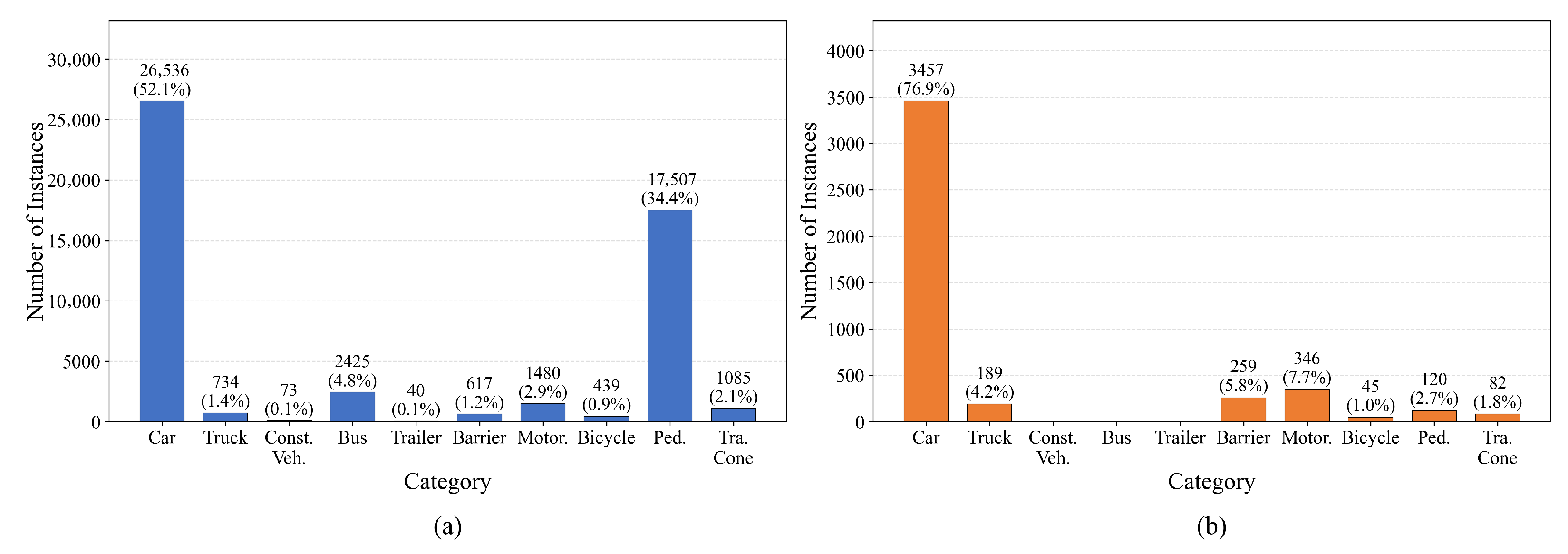
All experiments in this study are conducted on the nuScenes dataset. To specifically investigate multi-modal perception under nighttime conditions, a nuScenes-Night subset is constructed by filtering the original nuScenes dataset to include only multi-modal data collected in nighttime or low-light environments. We first initialized the nuScenes dataset using the official development toolkit. Each scene entry was traversed, and its description attribute was inspected for the presence of the keyword “night.” Scenes meeting this criterion were classified as nighttime scenes, and their scene tokens were recorded. Based on the hierarchical structure of nuScenes, all sample tokens associated with these selected scenes were then obtained through the scene–sample relational mapping, resulting in a complete subset of nighttime samples. During training, all models are trained exclusively on the nuScenes-Night subset. During testing, evaluations are consistently performed on the nuScenes-Night validation set. Model performance is assessed using the official nuScenes evaluation metrics, primarily including mAP and NDS. The classification of the dataset is shown in
Figure 5 and
Table 1.
As illustrated in
Figure 5, both the training and validation sets exhibit a pronounced long-tailed category distribution. In the training split, car instances dominate the dataset, followed by pedestrian and barrier, while categories such as construction vehicle, trailer, and bus appear considerably less frequently. A similar distribution pattern is observed in the validation split, indicating consistent long-tailed characteristics across dataset partitions.
Table 1 further presents the detailed category statistics for both the full nuScenes dataset and the nuScenes-Night subset. Compared with the full dataset, the night subset contains substantially fewer object instances across almost all categories. Moreover, several categories—including construction vehicle, bus, and trailer—are entirely absent in the night validation set. Even among the remaining categories, the distribution is highly skewed, with car instances accounting for the majority, whereas classes such as bicycle and pedestrian are relatively sparse.
These distribution characteristics indicate that the nuScenes-Night subset presents a more challenging evaluation scenario due to aggravated class imbalance and partial category absence, providing a rigorous benchmark for assessing model robustness under nighttime conditions.
As shown in
Table 2, the nuScenes-Night subset is derived directly from the official nuScenes benchmark without modifying annotations or data splits. The subset construction maintains the original hierarchical structure (scene–sample relationship), ensuring that all evaluations remain fully comparable to the standard benchmark protocol. Since the filtering procedure is based solely on official metadata fields, the construction process is fully deterministic and reproducible.
On the nuScenes dataset, model performance is evaluated using the official nuScenes evaluation protocol. Overall detection performance is primarily measured by the nuScenes Detection Score (NDS). In addition, mean Average Precision (mAP) and mean Translation Error (mATE) are reported to characterize detection accuracy and 3D spatial localization precision, respectively.
In this work, model performance on the nuScenes dataset is evaluated using the official nuScenes evaluation protocol. The primary metric used for overall detection performance is the nuScenes Detection Score (NDS), which is a comprehensive measure that reflects both detection coverage and quality by combining multiple evaluation aspects into a unified score. Specifically, NDS integrates average precision with multiple true positive error terms to provide a balanced assessment of detection completeness and localization accuracy under various conditions [
30].
Given that NDS is calculated as an average over all predefined object categories, the long-tailed distribution and partial category absence in the nuScenes-Night validation set directly influence the overall metric. In our evaluation, no categories are removed or adjusted despite missing instances, ensuring strict adherence to the standard evaluation protocol. Consequently, the absolute NDS values appear lower compared to the full-dataset benchmark, but remain fair and directly comparable across all methods under the same experimental setting.
In addition to NDS, the mean Average Precision (mAP) is reported to quantify the detection coverage capability. In the context of nuScenes, mAP measures the ability of the model to detect and correctly localize objects within predefined center-distance thresholds, averaging precision scores across different object categories. A higher mAP indicates better overall recall and precision in object detection [
30].
To further characterize localization performance, the mean Average Translation Error (mATE) is used to evaluate the average deviation between predicted and ground-truth 3D object centers. Lower mATE values correspond to more precise 3D spatial localization, which is essential for accurate perception in autonomous driving systems [
30].
4.1.2. Implementation Details
The proposed method is implemented based on the BEVFusion framework. Model training is performed using the AdamW optimizer with an initial learning rate of 0.0002, together with a learning rate scheduling strategy consisting of linear warm-up (500 iterations) followed by cosine annealing. During training, the batch size is set to 6, and all models are trained for 20 epochs. Unless otherwise specified, all comparison methods and ablation experiments adopt identical training configurations to ensure fairness and comparability of the experimental results. All experiments are conducted on an NVIDIA A6000 GPU with 48 GB of memory. The software environment includes Linux, Python 3.10.19, PyTorch 2.0.1, CUDA 11.8, and cuDNN 8.7. The models are implemented using the MMDetection3D framework.
4.1.3. Comparison Methods and Ablation Settings
To systematically evaluate the impact of each component on nighttime multi-modal 3D object detection, BEVFusion is adopted as the baseline multi-modal detection framework. Based on this baseline, a learnable gamma enhancer module, a DMGF module, and a night-aware and small object adaptive loss function are progressively incorporated to construct different model variants for ablation studies. By comparing the detection results of these variants under identical experimental conditions, the individual contributions and collaborative effects of each module on the overall performance are analyzed. To ensure the reliability and comparability of the experimental conclusions, all ablation experiments are conducted using consistent dataset splits, training strategies, and evaluation metrics.
For the overall performance comparison, CenterPoint is selected as a representative single-modality LiDAR-based 3D object detection method to analyze the performance differences between multi-modal fusion approaches and single-modality solutions in complex nighttime scenarios. In addition, FCOS3D, a representative monocular 3D detection method, is included as an additional baseline to provide a broader comparative perspective, enabling a more comprehensive evaluation of the effectiveness and robustness of the proposed method under nighttime conditions.
4.1.4. Generalization and Robustness Evaluation Setup
To evaluate the generalization ability and robustness of the proposed method under nighttime conditions, a series of experiments is designed and conducted without retraining the model, using the weights obtained after training. All experiments are performed on the full nuScenes validation set to ensure completeness and consistency of the evaluation.
For both generalization and robustness assessments, inference and performance evaluation are carried out on the full nuScenes validation set using the trained model weights, without any additional fine-tuning. By keeping the model architecture, learned parameters, and inference settings unchanged, and only altering the input conditions at the testing stage, the model’s performance under different test scenarios can be systematically analyzed.
Specifically, for the generalization evaluation, the model is directly tested on the original full nuScenes validation set to assess its overall generalization performance under the complete data distribution. For the robustness evaluation, additional nighttime noise perturbations are introduced into the validation inputs to simulate sensor noise and imaging instability commonly encountered in nighttime scenarios. The detection results under noisy conditions are then compared with those obtained under noise-free settings, enabling a quantitative assessment of the model’s stability and robustness under degraded input conditions. All experiments are evaluated using the same set of metrics to ensure comparability across different testing conditions. The corresponding experimental results and analyses are presented in subsequent sections.
4.2. Overall Performance Comparison
Given the differences in perception reliability across modalities in nighttime scenarios, multi-modal fusion strategies have a significant impact on detection performance. Therefore, under a unified experimental setup, this paper conducts comparative experiments to analyze the proposed method alongside various representative detection methods. In addition to the multi-modal baseline model, CenterPoint and FCOS3D [
31] are also introduced as comparison objects. FCOS3D is a single-modality image-based detection method, while CenterPoint is a single-modality LiDAR-based detection method. This paper compares the performance of FCOS3D and CenterPoint as reference methods. The experimental results are summarized in
Table 3.
The proposed method, Ours, achieves the best performance in balancing detection accuracy and localization precision, with mAP and NDS values of 0.2753 and 0.3405, respectively, and a reduced mATE of 0.5272.
In contrast, the CenterPoint method, relying solely on LiDAR, shows lower localization error (mATE = 0.4569) but significantly lower mAP, indicating that relying on a single modality in nighttime scenarios limits detection performance.
FCOS3D performs poorly with low mAP (0.0494), NDS (0.1344), and high mATE (0.9492), indicating its weakness in both object detection and localization, particularly in complex or low-light environments.
Multi-modal methods, combining camera and LiDAR data, offer more stable performance. Introducing the DMGF module to the BevFusion baseline model improves NDS from 0.3292 to 0.3336 and reduces mATE from 0.5572 to 0.5379, highlighting the value of cross-modal feature fusion.
Finally, Ours outperforms the baseline with +0.0026 in mAP, +0.0113 in NDS, and −0.0300 in mATE, demonstrating the effectiveness of the proposed multi-modal co-modeling approach.
Despite challenges like low illumination, small objects, and class imbalance in nighttime scenarios, the proposed method consistently improves performance across evaluation metrics, proving its robustness in complex detection tasks.
4.3. Ablation Study
4.3.1. Module-Wise and Ablation Study Analysis
Although the proposed method improves nighttime perception performance through coordinated modeling of multiple modules, it is still necessary to disentangle and analyze the individual contributions of each component to the overall performance gains. Therefore, this section conducts ablation experiments to further investigate the effects of the input enhancement module, the cross-modal fusion module, and the loss modeling strategy. The experimental results are summarized in
Table 4.
Table 4 reports the ablation results of the proposed key modules on the nuScenes nighttime subset. Based on these metrics, introducing the DMGF module alone yields a stable improvement in NDS, validating its effectiveness in facilitating multi-modal feature interaction under nighttime conditions.
When the learnable Gamma enhancer module is applied in isolation, a slight degradation in overall performance is observed. This indicates that relying solely on low-light enhancement without sufficient task-level constraints may lead to brightness adjustments that are not well aligned with the detection objective. From a feature perspective, the Gamma-based transformation alters the pixel intensity distribution and shifts low-level feature statistics. Although such enhancement improves visual visibility in dark regions, it may simultaneously modify contrast relationships and local texture patterns that the detection backbone has implicitly adapted to during training. This distribution shift can introduce a mismatch between the enhanced image features and the learned feature representations in the detection network, thereby affecting classification confidence and localization stability.
Moreover, brightness enhancement primarily targets perceptual improvement, whereas 3D object detection depends on discriminative semantic cues and cross-modal geometric consistency. Without adaptive loss reweighting or cross-modal coordination, the enhanced features may amplify background noise or overexpose reflective regions, which can negatively influence feature fusion and bounding box regression.
In contrast, the night-aware and small-object adaptive loss achieves a notable improvement in NDS even without image enhancement, highlighting its capability to effectively model weakly supervised samples in nighttime scenarios. When all three modules are jointly employed, the model attains the best performance on both mAP and NDS. This demonstrates that the proposed low-light enhancement, cross-modal fusion, and adaptive loss components exhibit strong synergy and complementarity, leading to a significant improvement in overall nighttime multi-modal 3D object detection performance.
4.3.2. Training Stability Analysis
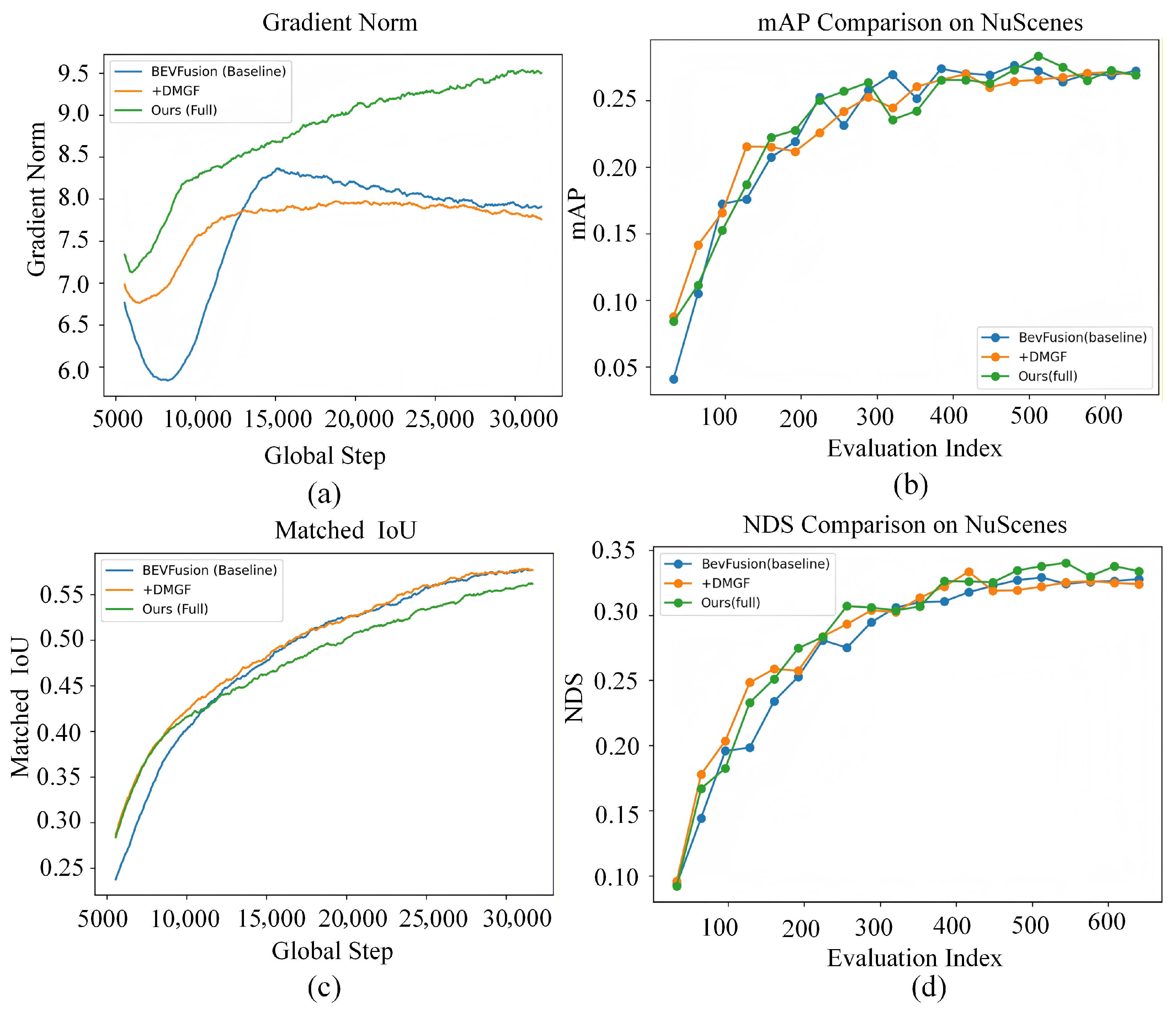
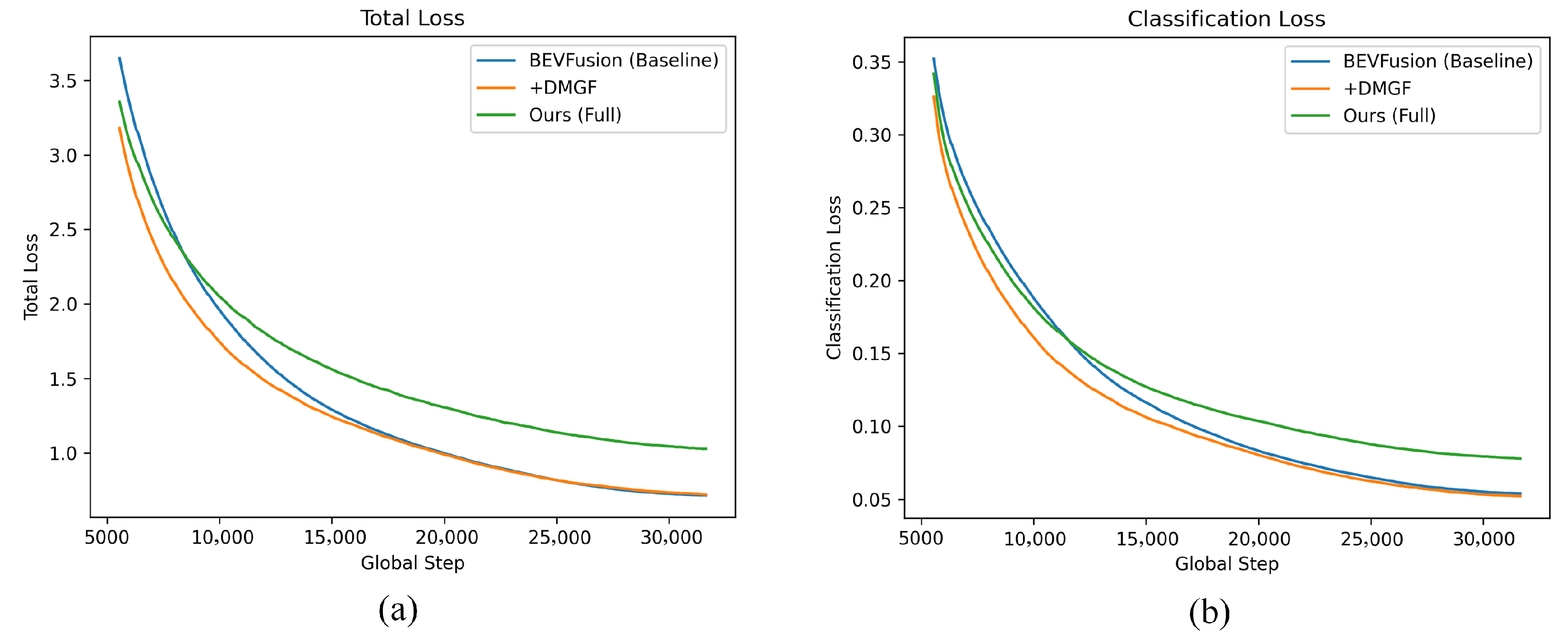
To further analyze the impact of different modules on training behavior and optimization dynamics, a comparative analysis of training stability is conducted based on the ablation experiments. Specifically, the baseline model BEVFusion, the model equipped with the +DMGF module, and the full model Ours are selected for comparison. Their gradient evolution and performance convergence behaviors during training are analyzed, as illustrated in
Figure 6 and
Figure 7.
Figure 6 (a) illustrates the evolution of gradient norms during training for different methods. It can be observed that the baseline model exhibits noticeable gradient fluctuations in the early training stage. After introducing the DMGF module, the gradient variations become smoother, indicating that conflicts between cross-modal features are alleviated to some extent. In comparison, the full model maintains stable gradient behavior while exhibiting a higher overall gradient magnitude, suggesting that the introduced enhancement and supervision mechanisms provide richer and more stable training signals.
Figure 6 (b) to (d) present the evolution of mAP, matched IoU, and NDS throughout the training process. The full model demonstrates more stable performance improvements in the middle and later stages of training and consistently outperforms the compared methods across multiple evaluation metrics. This indicates that the proposed approach not only achieves superior final performance, but also exhibits improved convergence quality and training stability.
As shown in
Figure 7, under a per-GPU batch size of 6, all methods exhibit smooth and steadily decreasing loss curves throughout training. Both the total loss and classification loss demonstrate monotonic convergence trends without noticeable oscillation, sudden spikes, or divergence. In particular, no abnormal fluctuations or instability are observed during the later training stages, indicating that the adopted batch configuration ensures numerically stable and reliable optimization.
It should be noted that, in the training dynamics analysis, training curves for the learnable Gamma enhancer module and the night-aware loss function are not plotted separately. This is because the Gamma enhancement primarily affects feature distribution modeling at the input level and does not directly introduce new optimization dynamics, while the influence of the night-aware and small-object adaptive loss on training behavior is already reflected in the overall gradient evolution and performance convergence of the full model. Therefore, the effectiveness of these modules is validated through a combination of ablation results and overall training dynamics analysis, avoiding redundant visualization of intermediate processes.
4.4. Performance Analysis on Representative Nighttime Categories
Although overall metrics can reflect the general detection capability of a model, they are insufficient to reveal the specific perception challenges faced by different object categories under nighttime conditions. Therefore, this section conducts a category-wise detection accuracy analysis to examine the performance variations of the proposed method across representative nighttime categories. The experimental results are summarized in
Table 5.
Table 5 presents the per-class detection performance under representative nighttime categories. The proposed method exhibits distinct performance variations across different object types, which their scale characteristics and modality dependency can explain.
A substantial improvement is observed for Motorcycle (+0.1230), which represents a medium-small object category that strongly relies on visual cues under nighttime conditions. The combination of Gamma-based illumination enhancement and small-object adaptive reweighting effectively strengthens feature representation for such illumination-sensitive targets. Additionally, Car (+0.0197) and Barrier (+0.0052) show consistent gains, indicating that the proposed cross-modal fusion and enhancement strategy improves complementary feature integration without compromising regular-scale object detection.
For Pedestrian () and Bicycle (), moderate performance decreases are observed. These categories are characterized by extremely small physical size and sparse LiDAR point distribution, making them highly sensitive to noise and illumination inconsistency. Although the enhancement module improves global brightness, fine-grained structural details may remain difficult to recover under complex nighttime lighting conditions.
A relatively larger decrease is observed for Truck (). As a large-scale category with abundant geometric information, Truck detection in the baseline model already relies heavily on LiDAR features. The adaptive reweighting strategy emphasizes small and challenging samples, which may introduce a mild supervision trade-off, slightly reducing optimization focus on large-scale objects.
In summary, the proposed framework significantly improves performance on illumination-sensitive and medium-small categories, while introducing limited degradation on extremely small or large-scale targets. This behavior aligns with the intended design bias of enhancing nighttime robustness and small-object representation, demonstrating the effectiveness of the proposed multi-dimensional adaptive strategy.
4.5. Efficiency Comparison
Given the stringent requirements on real-time performance and computational resources in nighttime autonomous driving perception systems, computational efficiency is as critical as detection accuracy. Therefore, this section presents a comparative analysis of the proposed method and the baseline model in terms of parameter scale and inference efficiency. The experimental results are summarized in
Table 6.
In terms of model size, the original BEVFusion model contains a total of 40.80 M parameters, of which approximately 0.77 M are attributed to the fusion module. After introducing the DMGF module, the total number of parameters increases only marginally to 41.02 M. The additional parameters mainly originate from the fusion layers, resulting in an overall increase of less than 1%, which indicates that the proposed fusion design imposes almost no additional burden on model complexity.
In contrast, the Dual Cross-Attention fusion scheme based on global attention mechanisms significantly increases model complexity. Its total parameter count reaches 46.87 M, with the fusion module alone accounting for 6.84 M parameters. This demonstrates that although Transformer-based cross-modal attention enhances feature interaction, it introduces substantial parameter and computational overhead, making it less suitable for deployment in resource-constrained scenarios.
With respect to inference efficiency, the BEVFusion baseline achieves an inference speed of 2.69 FPS. After incorporating DMGF and the complete proposed method, the inference speed remains approximately 2.69 FPS, with no noticeable degradation. This indicates that the proposed lightweight cross-modal fusion and low-light enhancement strategies can improve detection performance without sacrificing inference efficiency. Due to the large memory consumption of the Dual Cross-Attention module under the current hardware configuration, stable inference could not be achieved; therefore, its FPS results are not reported.
In terms of computational complexity, our method maintains linear computational complexity , similar to BEVFusion and +DMGF, as it relies on convolutional and gated operations. In contrast, Dual Cross-Attention incurs quadratic complexity due to global token interactions. This ensures better scalability without sacrificing cross-modal interaction.
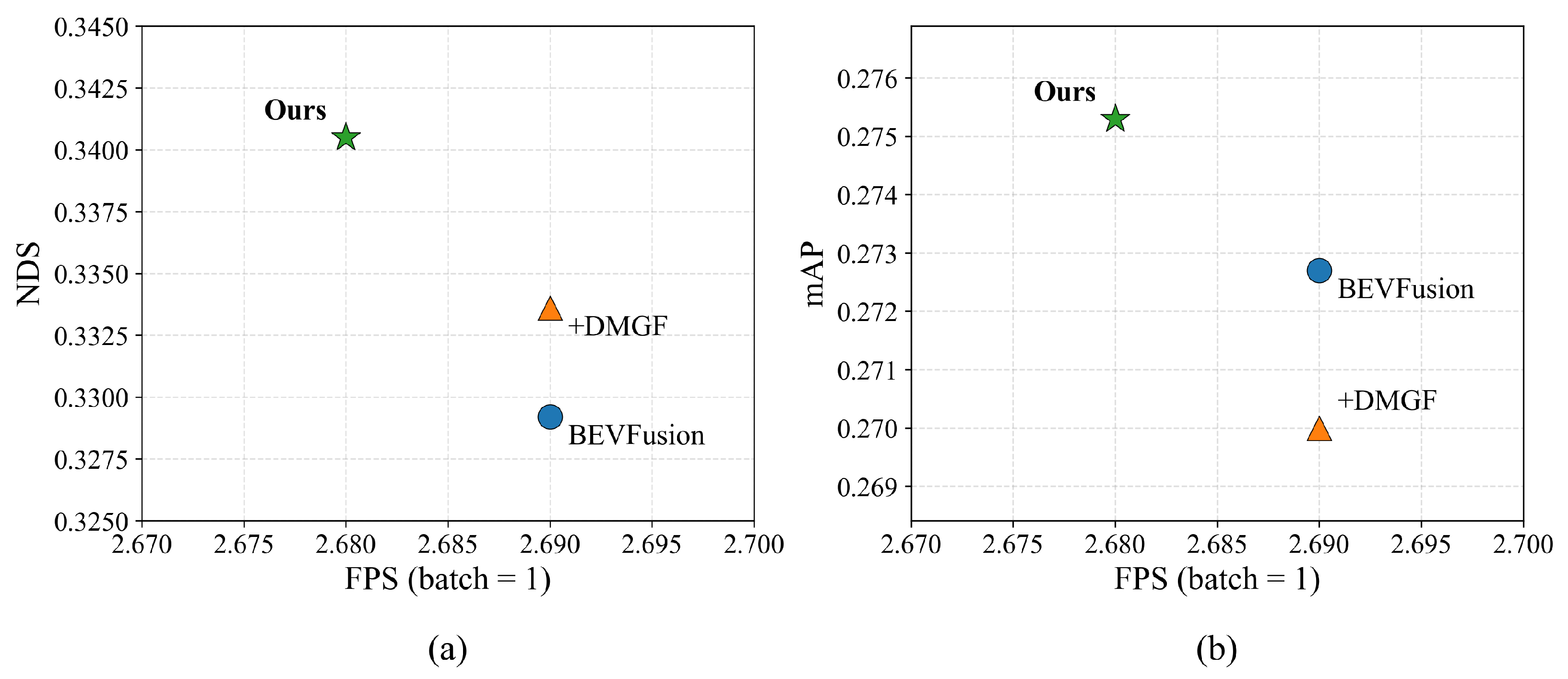
While improving detection performance, inference efficiency remains a critical factor for practical autonomous driving applications. To further analyze the trade-off between performance and efficiency, a comparative evaluation of detection performance versus inference speed under identical inference settings is conducted for different methods, as illustrated in
Figure 8.
As illustrated in
Figure 7 (a) and (b), the compared methods exhibit a clear accuracy–efficiency trade-off in the FPS–NDS and FPS–mAP spaces. Compared with the BEVFusion baseline, +DMGF achieves noticeable performance gains while maintaining almost identical inference speed. The proposed full model attains the highest NDS and mAP with only a marginal reduction in inference speed (from 2.69 FPS to 2.68 FPS), demonstrating superior overall detection performance. These results indicate that the proposed approach achieves substantial accuracy improvements at a negligible efficiency cost, yielding a more favorable Pareto-optimal solution for multi-modal nighttime detection tasks.
4.6. Generalization and Robustness Experiments
To evaluate the generalization and robustness of the proposed method, we conduct two sets of experiments on the full nuScenes validation set, which contains both daytime and nighttime scenes. For generalization evaluation, the model trained on nighttime data is directly applied to the full validation set without any modification, assessing its ability to maintain performance across diverse lighting conditions. For robustness evaluation, we further introduce simulated nighttime degradations (including brightness reduction, contrast reduction, Gaussian noise, and LiDAR point dropout) to the full validation set, testing the model’s resilience to additional sensor noise and imaging instability commonly encountered in nighttime scenarios.
Specifically, brightness attenuation (brightness_factor = 0.3), contrast reduction (contrast_factor = 0.7), and additive Gaussian noise (mean = 0, std = 15.0) are applied in the raw image intensity domain (0–255) before normalization, whereas LiDAR degradation is simulated by uniform random point dropping with points_keep_ratio = 0.7 to approximate reduced effective surface reflectivity and sparse returns under nighttime conditions. This setup aims to assess the stability of the proposed method under more challenging nighttime conditions. The experimental results are summarized in
Table 7 and
Figure 9.
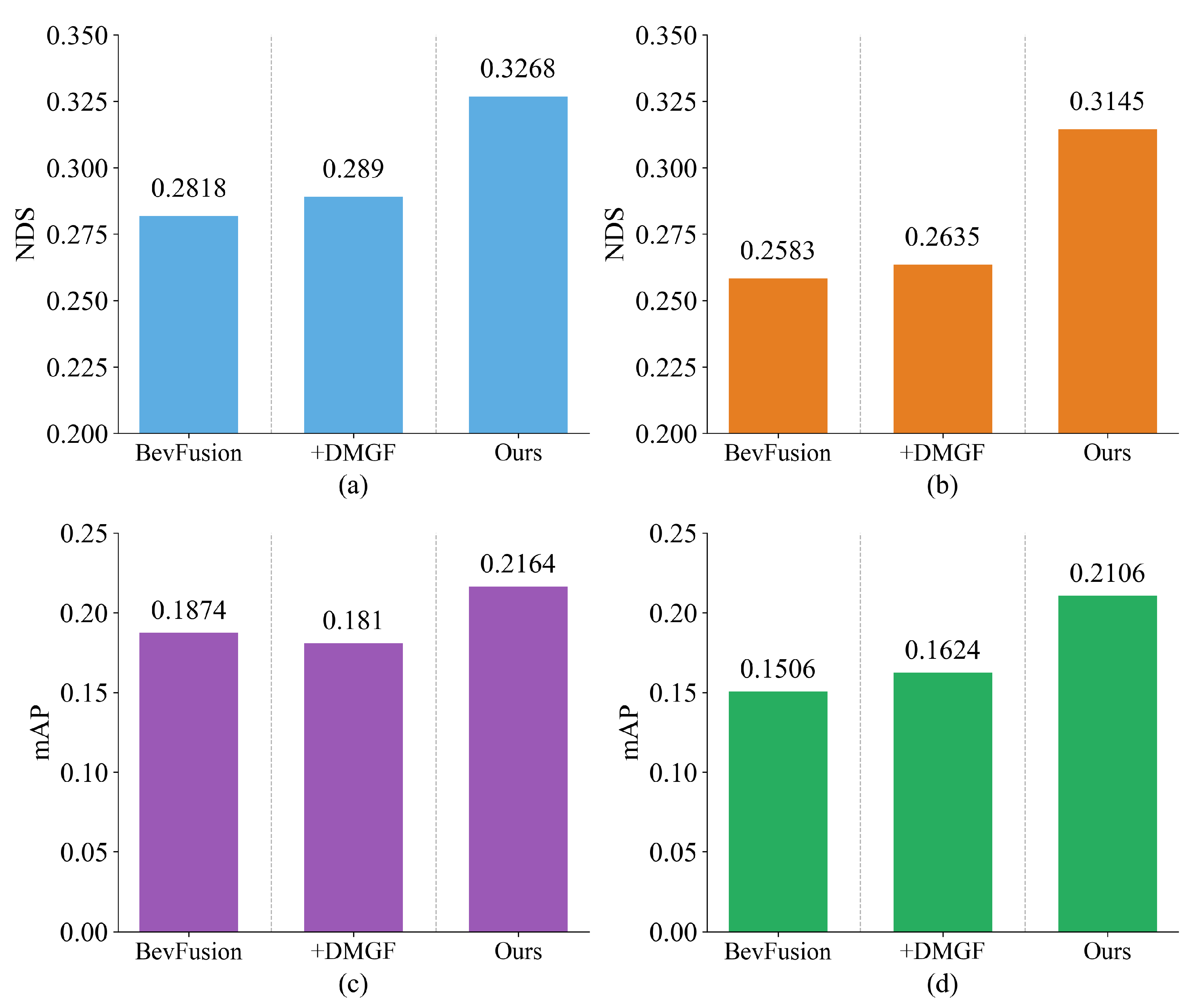
To evaluate the generalization capability of the proposed method under different scene distributions, we directly apply the model trained on nighttime data to the full nuScenes validation set, which contains both daytime and nighttime scenes, without any noise perturbation. As shown in
Figure 9 (a) and (c), the proposed method achieves an NDS of 0.3268 and mAP of 0.2164, outperforming the BEVFusion baseline (0.2818/0.1874) and the +DMGF variant (0.2890/0.1810) by a clear margin. This indicates that the proposed nighttime-oriented modules do not compromise daytime performance, and the model generalizes well across diverse lighting conditions.
To further evaluate robustness under degraded inputs, we introduce simulated nighttime perturbations (including brightness reduction, contrast reduction, Gaussian noise, and LiDAR point dropout) to the full validation set. As shown in
Figure 9 (b), (d), and
Table 7, all methods experience performance degradation after noise injection. However, the proposed method exhibits the smallest drop:
NDS
and
mAP
, compared to
/
for BEVFusion and
/
for +DMGF. This demonstrates that the combination of learnable Gamma enhancer, DMGF fusion module, and adaptive loss weighting provides effective resilience against input degradations, maintaining stable detection performance under challenging conditions.
4.7. Visualization Result Analysis
4.7.1. Visualization of Learned Gating Weights
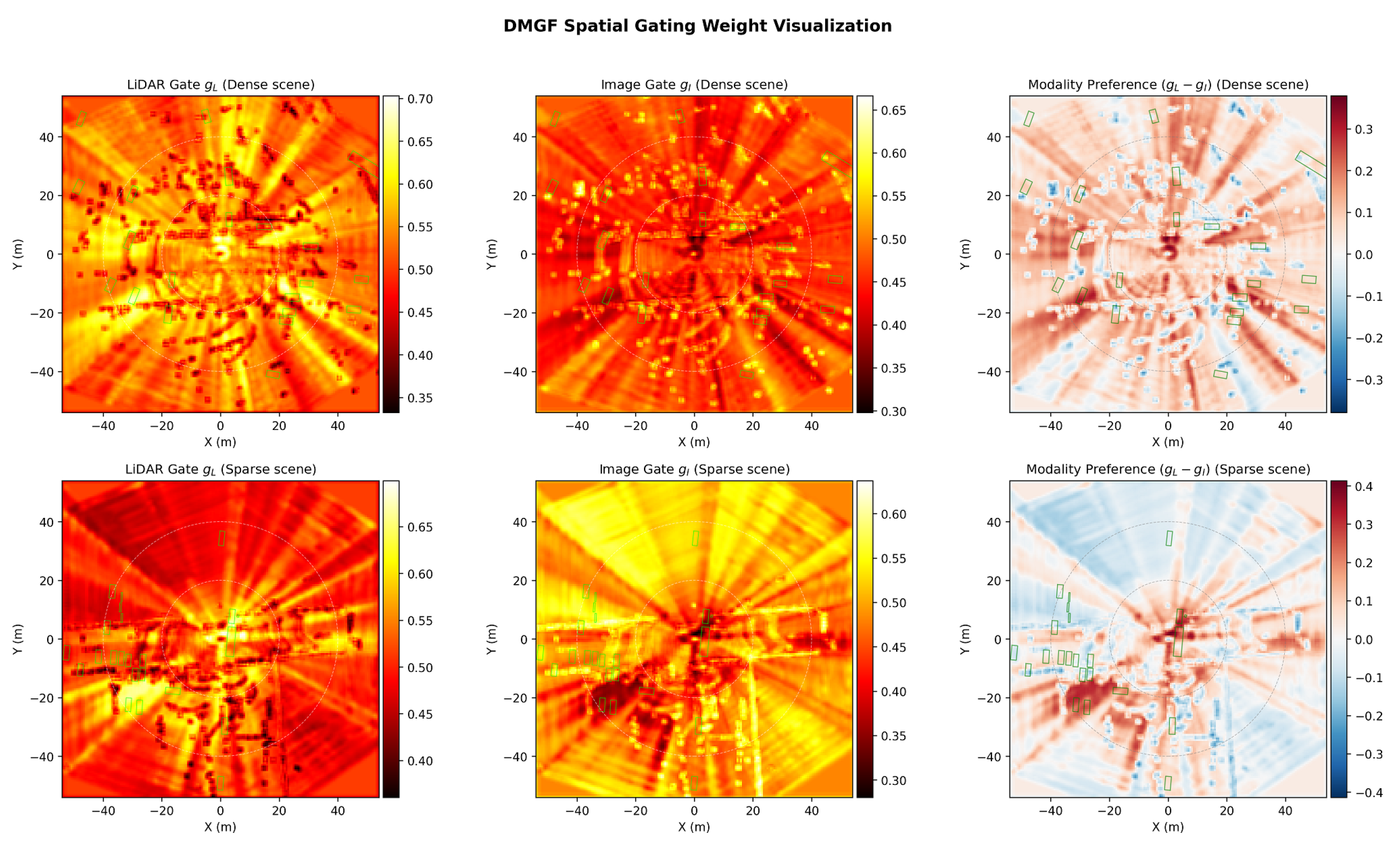
To gain deeper insight into the learned behavior of the DMGF module, we visualize the spatial distribution of gating weights extracted from the trained model on the nuScenes-Night validation set.
Figure 10 presents the gating weight maps for two representative scenes: a dense scene (top row) and a sparse scene (bottom row). The LiDAR gate
and image gate
exhibit clear radial patterns aligned with LiDAR scan lines, indicating that the gating mechanism has implicitly learned to identify regions with reliable LiDAR coverage. In areas with dense LiDAR returns (near the ego vehicle),
tends to be higher, reflecting stronger reliance on LiDAR features. Conversely, in peripheral regions where LiDAR points become sparse, the gating weights shift toward a more balanced fusion of both modalities. The modality preference maps (
, right column) further confirm this spatial pattern: red regions near the ego vehicle indicate LiDAR preference, while the preference gradually diminishes at longer ranges. Green boxes denote ground-truth 3D bounding boxes for spatial reference.
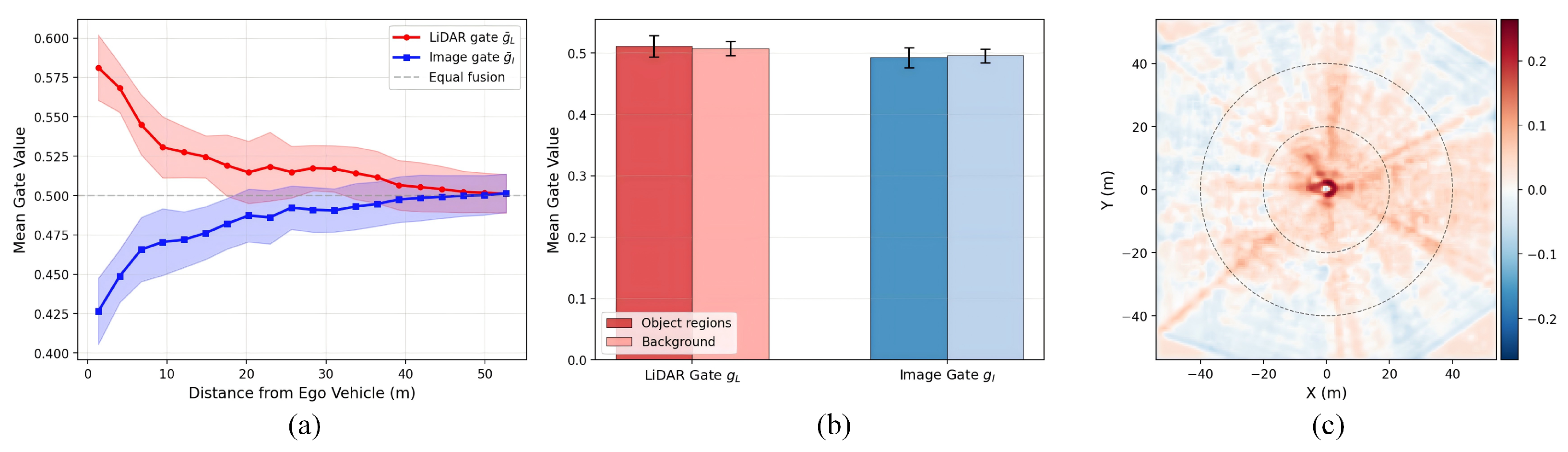
Figure 11 provides a quantitative analysis of the gating behavior across 16 validation samples. The radial profile (
Figure 11 (a)) reveals a clear distance-dependent modality preference: at close range (0–10 m), the mean LiDAR gate value reaches approximately 0.58 while the image gate drops to around 0.43, indicating that the model relies more heavily on LiDAR features where point cloud density is high. Beyond 40 m, both gates converge toward 0.5, reflecting a balanced fusion strategy as LiDAR coverage becomes sparser.
Figure 11 (b) compares the mean gate values in object regions versus background regions, showing that the gating behavior remains relatively consistent regardless of the presence of objects, suggesting that the learned gates primarily encode geometric coverage patterns rather than semantic content.
Figure 11 (c) displays the mean modality preference map averaged over all 16 samples, where the ego-centric radial pattern is clearly preserved, confirming that this spatial gating behavior is a stable and generalizable property of the trained DMGF module rather than a sample-specific artifact.
4.7.2. Analysis of Feature Distribution Shift Caused by Learnable Gamma Enhancer
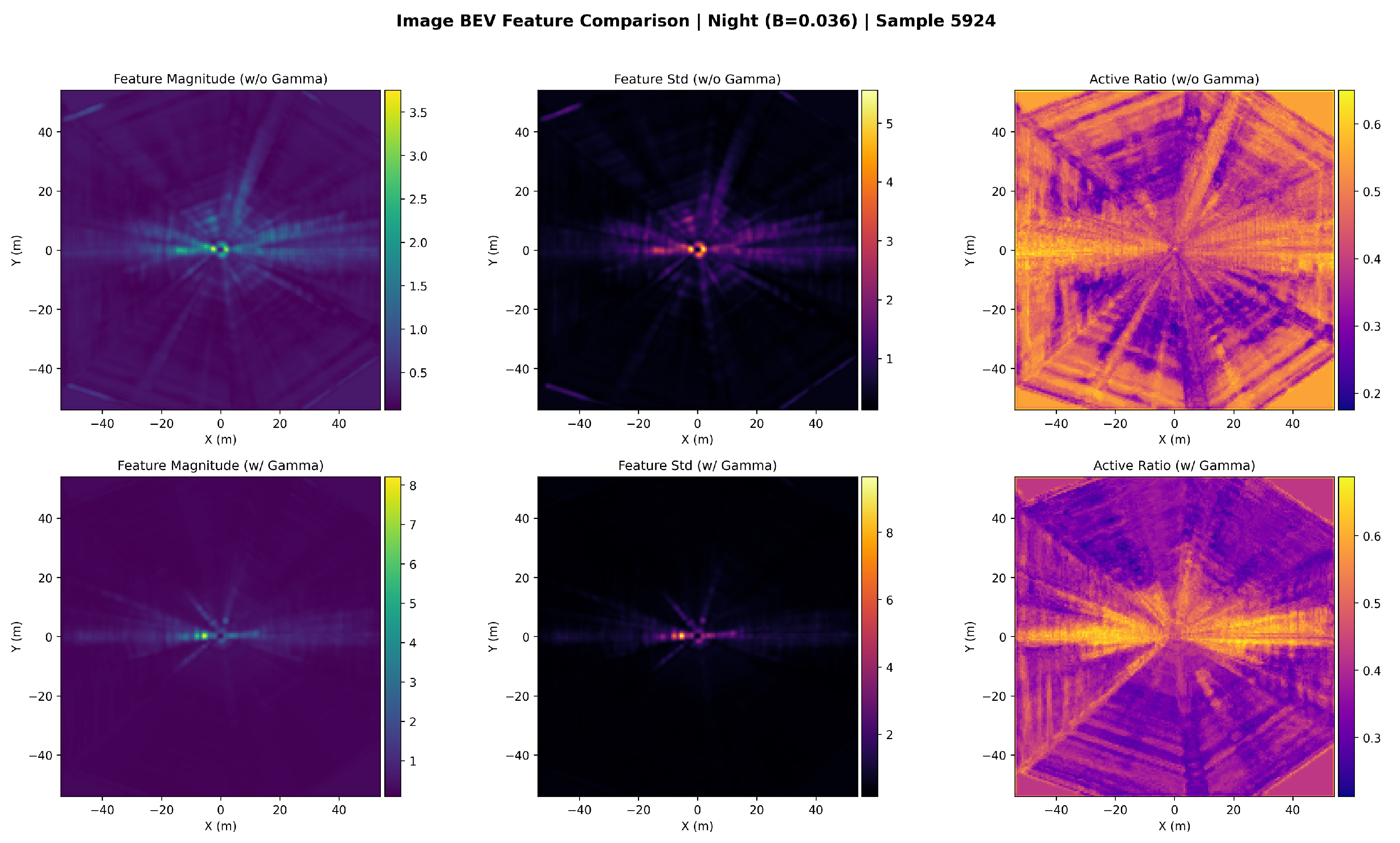
To investigate why the Gamma enhancement module alone leads to performance degradation, we visualize the image BEV features before fusion under a nighttime scene, comparing the model with and without the Learnable Gamma Enhancer (
Figure 12).
Three observations emerge from the comparison. First, the Gamma-enhanced features show a higher peak magnitude near the ego vehicle (up to 8.0 vs. 3.5), indicating that brightness correction amplifies certain feature responses. Second, the feature standard deviation increases after Gamma enhancement (0.54 vs. 0.52 averaged over 8 nighttime samples), suggesting greater variability in the learned representations. Third, and most critically, the channel activation ratio decreases from 0.43 to 0.40, meaning that fewer feature channels carry meaningful information after enhancement. This pattern is consistent across all 8 nighttime validation samples.
These observations confirm that applying Gamma correction introduces a distribution shift in the input images, which propagates through the pretrained Swin Transformer backbone. Since the backbone’s batch normalization layers and convolutional filters are calibrated for the original input distribution, the altered pixel statistics lead to suboptimal feature extraction. This explains the performance drop when the Gamma module is used in isolation.
When jointly trained with the adaptive loss and DMGF fusion module, this issue is mitigated through two mechanisms: the adaptive loss provides stronger supervisory signals for nighttime samples, enabling the backbone to better adapt to the enhanced distribution; the DMGF module can dynamically down-weight degraded image features through its learned gating mechanism, effectively compensating for imperfect enhancement. This analysis justifies our design choice of combining all three modules rather than applying Gamma enhancement as a standalone preprocessing step.
4.7.3. Qualitative Detection Results Under Nighttime Conditions
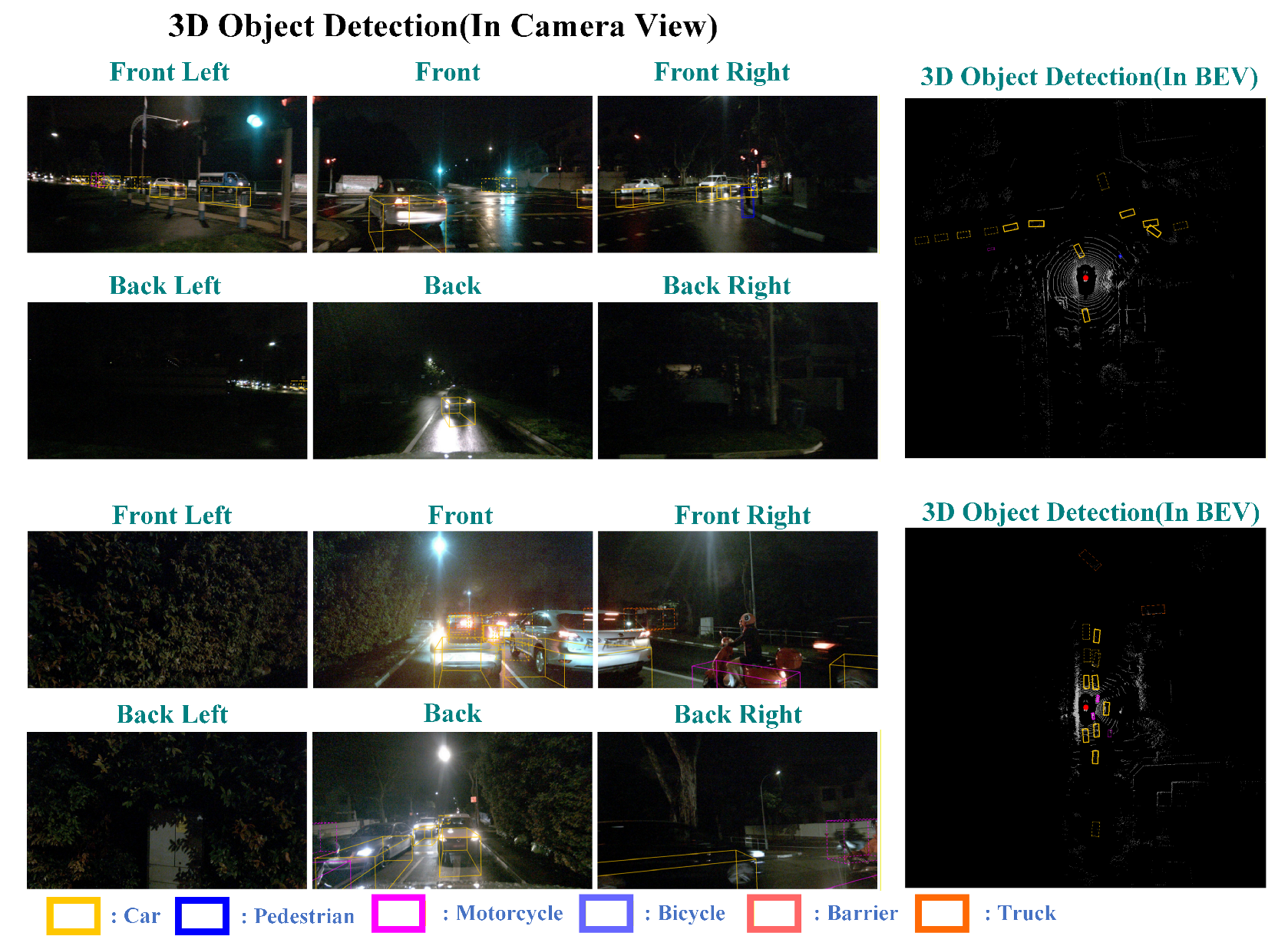
To further provide an intuitive analysis of the detection behavior and spatial modeling capability of the proposed method under complex nighttime scenarios, this section presents qualitative visualizations and analyses of multi-modal 3D object detection results in representative nighttime scenes. The results are illustrated in
Figure 13.
Figure 13 shows multi-view camera images and the corresponding BEV-based 3D detection results under nighttime conditions. In the visualizations, solid 3D bounding boxes indicate successfully detected objects, while dashed bounding boxes denote missed targets under extremely challenging nighttime conditions.
From the camera-view images, it can be observed that nighttime scenes are generally affected by insufficient illumination, local strong light interference, and the small scale of distant objects. Under such conditions, certain targets, especially small or occluded objects at long distances, may still be missed, which is to some extent unavoidable in nighttime autonomous driving perception tasks.
Despite these challenges, the proposed model is able to stably detect major traffic participants, such as vehicles, pedestrians, and two-wheeled objects, across most viewpoints, while maintaining reasonable spatial layouts and object orientations in the BEV representation. Moreover, the missed detections do not cause noticeable disruption to the overall spatial modeling, indicating that the proposed method exhibits satisfactory detection stability and robustness in multi-modal fusion under complex nighttime environments.
5. Conclusions
This paper addresses the challenges of perception degradation and limited cross-modal fusion efficiency in nighttime autonomous driving scenarios by proposing a lightweight night-adaptive multi-modal 3D object detection method based on BEVFusion. Without altering the original BEV representation or detection pipeline, the proposed approach jointly considers low-light image modeling, cross-modal feature fusion, and supervision modeling, thereby constructing an end-to-end trainable and computationally efficient nighttime perception framework. Experiments conducted on the nuScenes nighttime subset demonstrate that the proposed method achieves stable improvements in overall detection performance with negligible increases in model parameters and computational cost, validating its effectiveness and complementarity. Beyond technical performance gains, the proposed approach enhances the reliability of autonomous driving perception under nighttime and low-visibility conditions. From a broader perspective, the proposed method contributes to sustainability in intelligent transportation systems by improving nighttime perception stability, which reduces unnecessary control fluctuations and enhances energy efficiency. Enhanced low-light robustness also supports safer urban mobility by mitigating accident risks associated with nighttime driving. Furthermore, the lightweight design introduces minimal computational overhead, aligning with resource-efficient AI principles. By enabling stable all-weather autonomous operation, the approach contributes to resilient and sustainable smart mobility infrastructure.