Enhancing Energy Performance in Hot Climates: A Multi-Criteria Approach Towards Nearly Zero-Energy Buildings

 ,
,  , ,
, ,
Abstract
1. Introduction
- Development of a validated energy model based on as-built data and actual operational schedules of an institutional building.
- Comparative evaluation of integrated retrofit packages across three ASHRAE climate zones (1B, 2B, and 2A).
- Simultaneous assessment of energy performance, carbon emissions, thermal comfort (PMV and DCH), economic feasibility (IRR, ROI, PBP), and health-resilient ventilation strategies.
- Integration of Glazing Integrated Photovoltaics (GIPV), reflective paints, insulation, DOAS, and rooftop PV within a unified decision-making framework.
- Climate-specific techno-economic comparison revealing performance trade-offs between the three climatic zones: very hot–arid, hot–arid, and hot–humid.
2. Literature Review
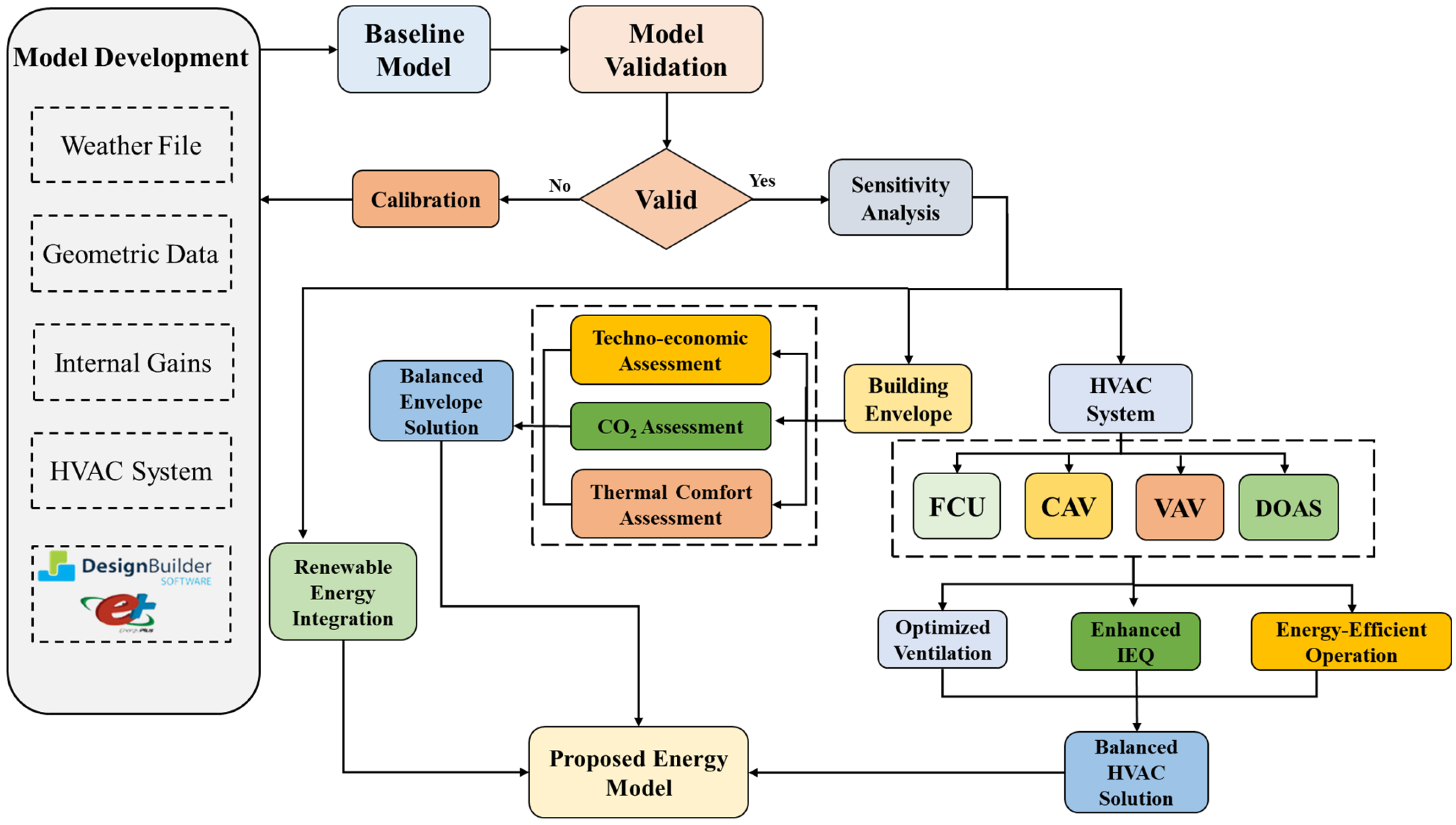
3. Methodology
4. Case Study Model
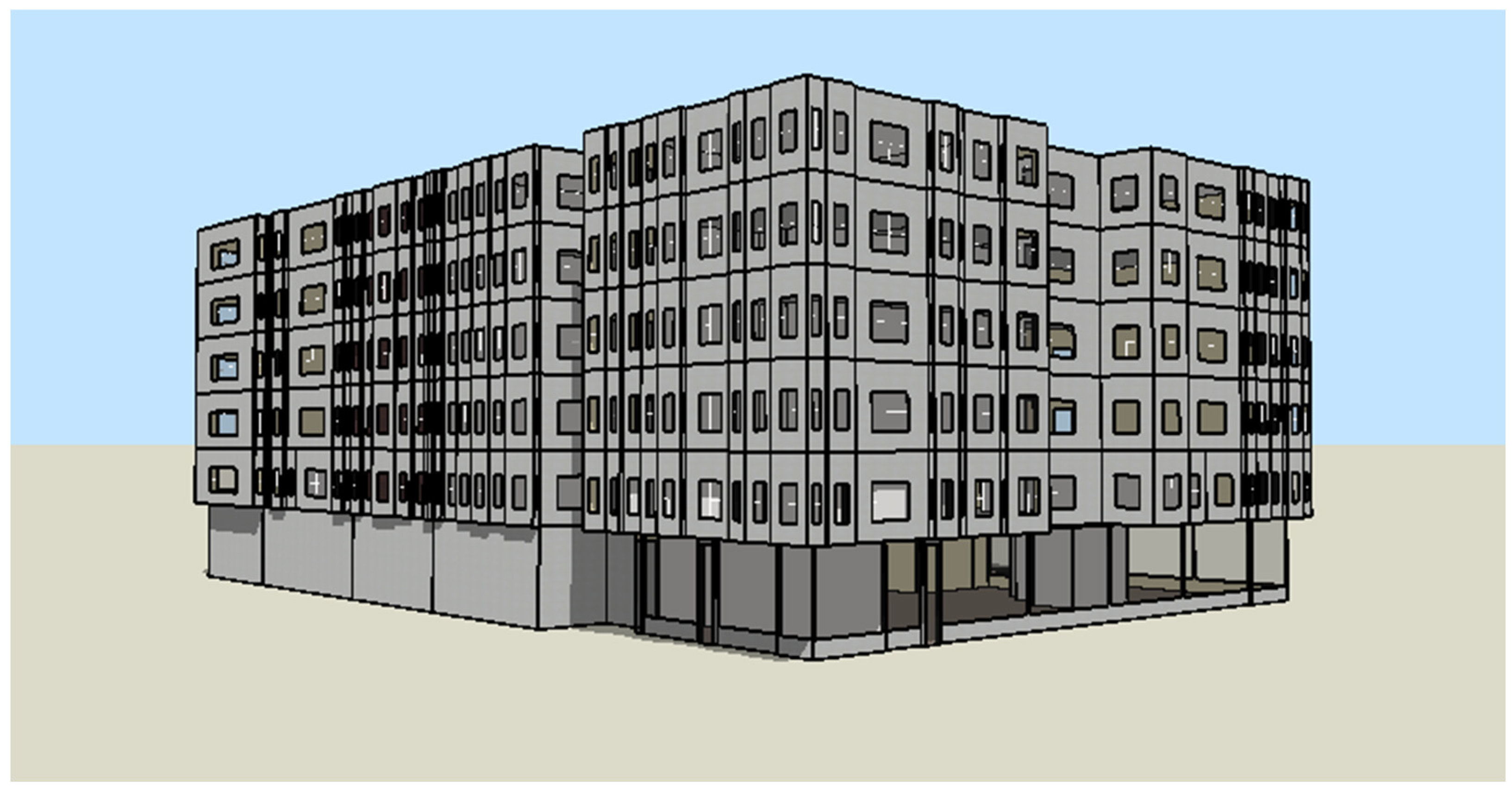
4.1. Model Description
4.2. Climatic Classification
4.3. Internal Loads
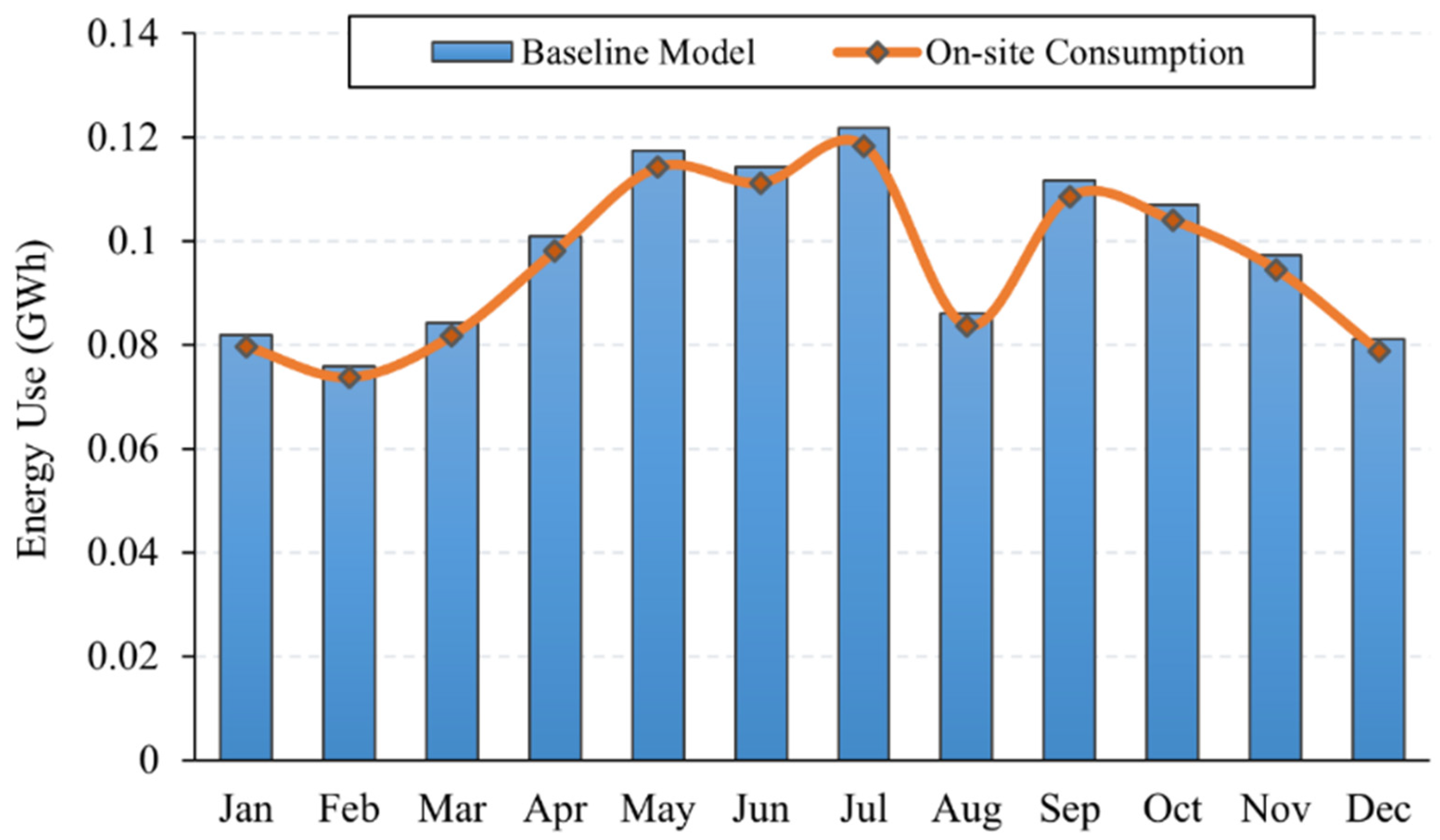
4.4. Model Validation
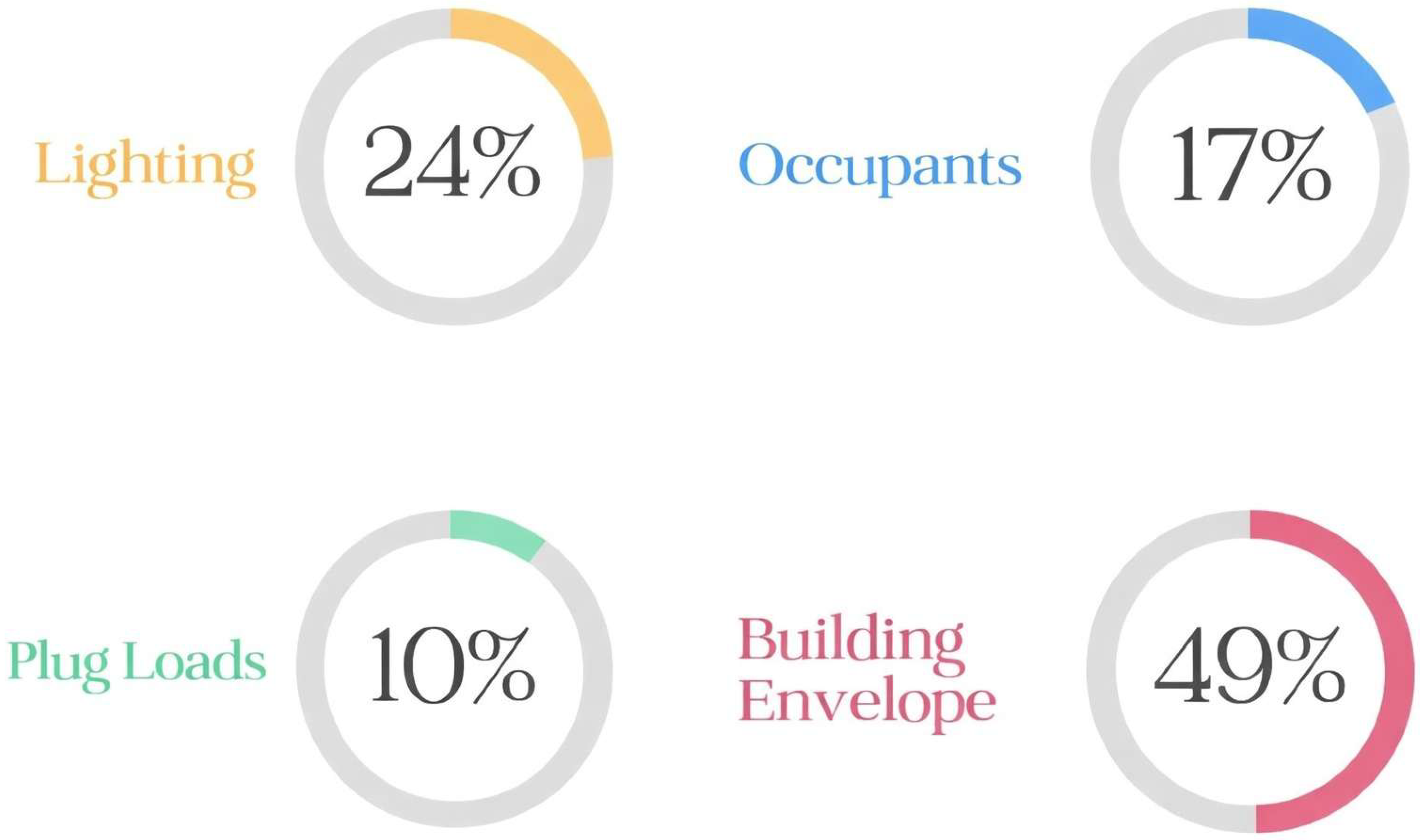
4.5. Sensitivity Analysis
5. Results
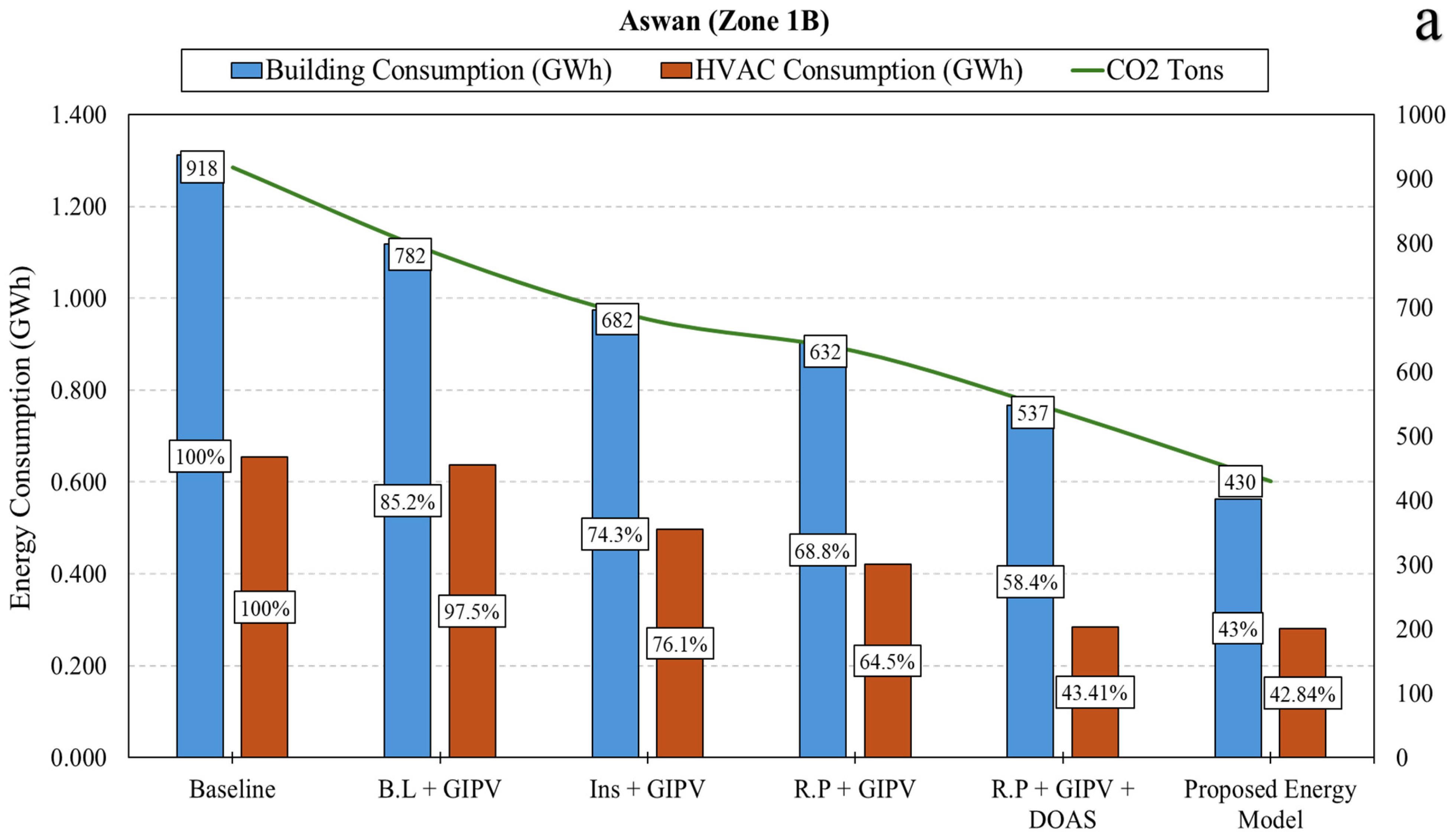
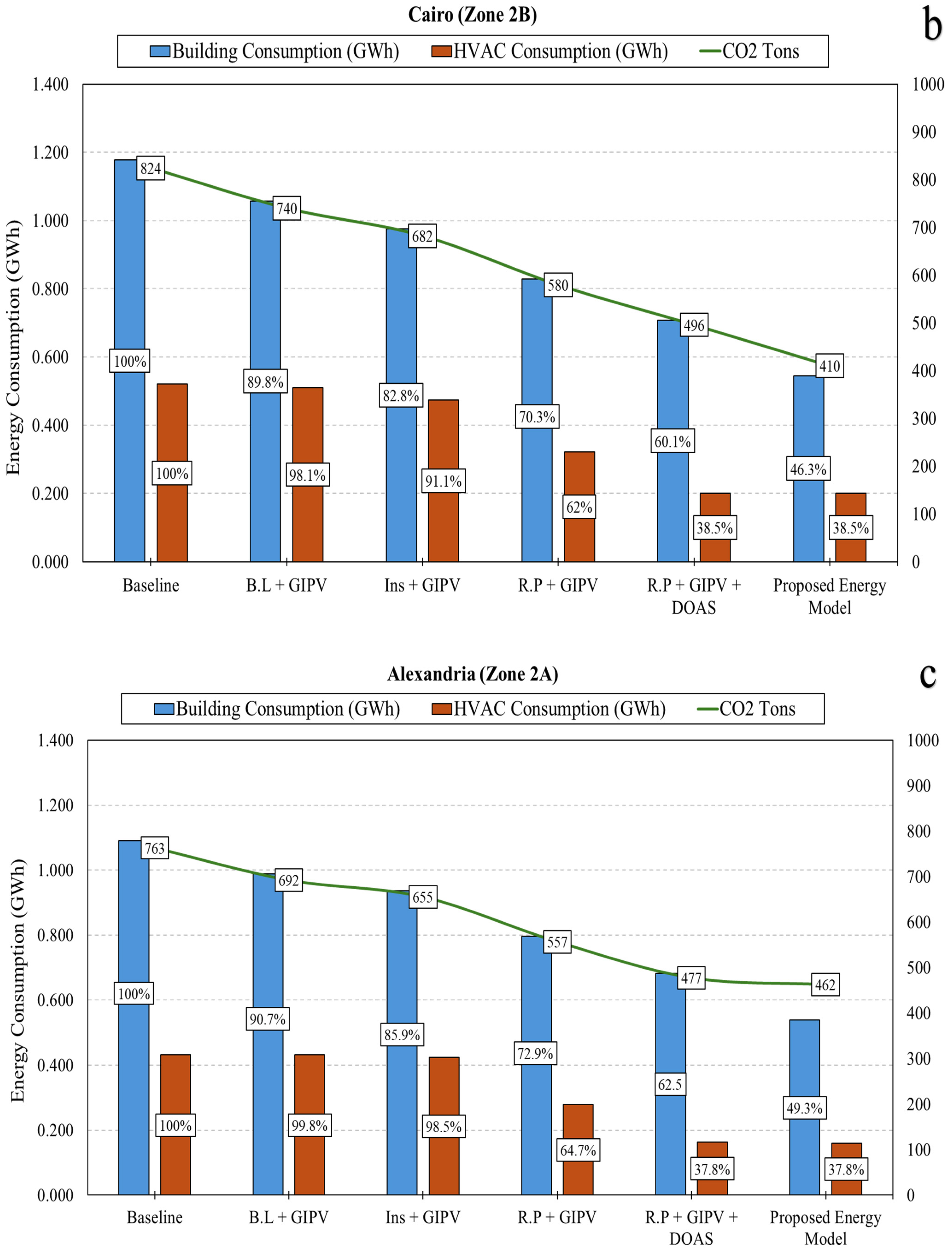
5.1. Building Performance and Carbon Emissions
5.2. Thermal Comfort Evaluation
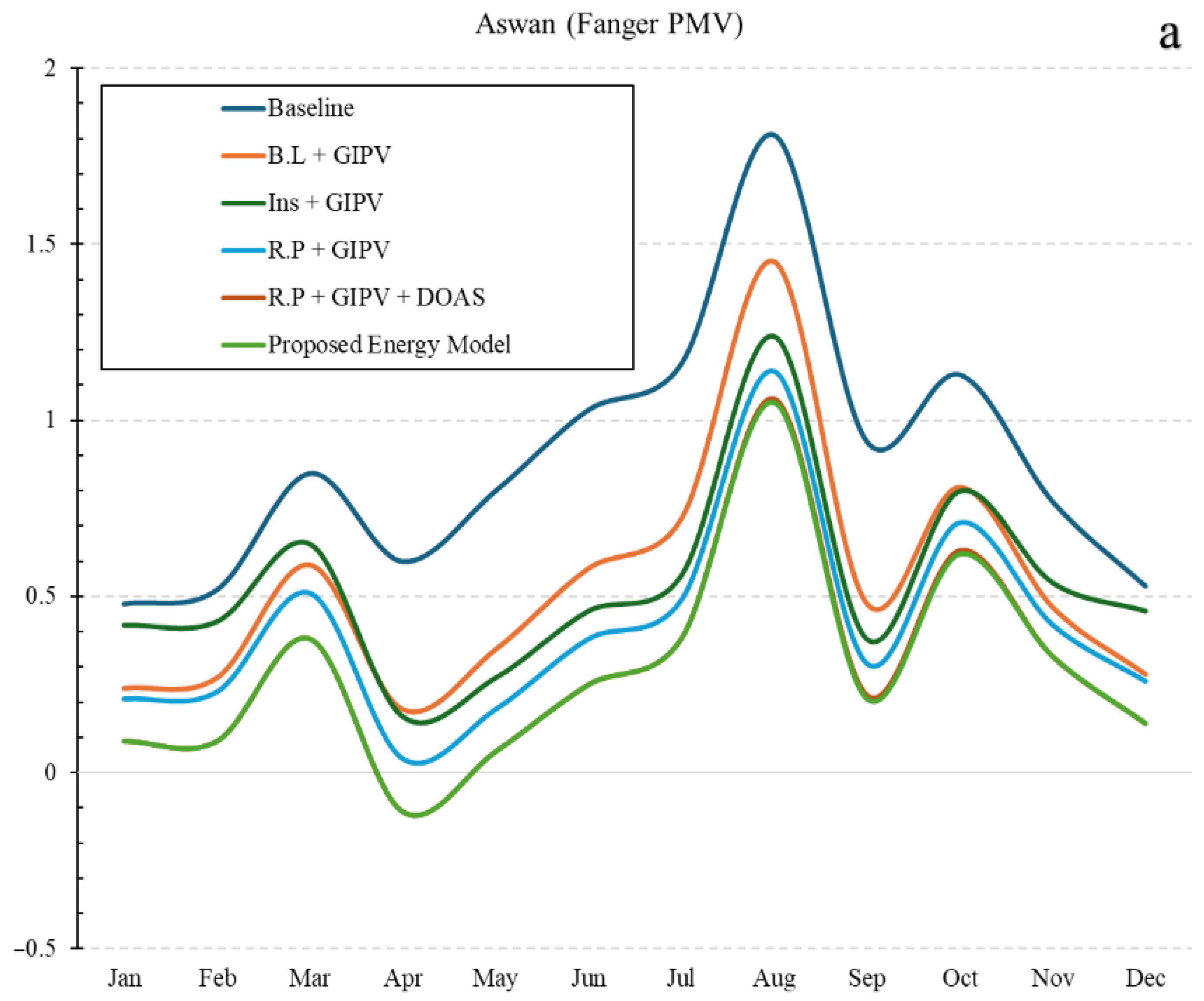
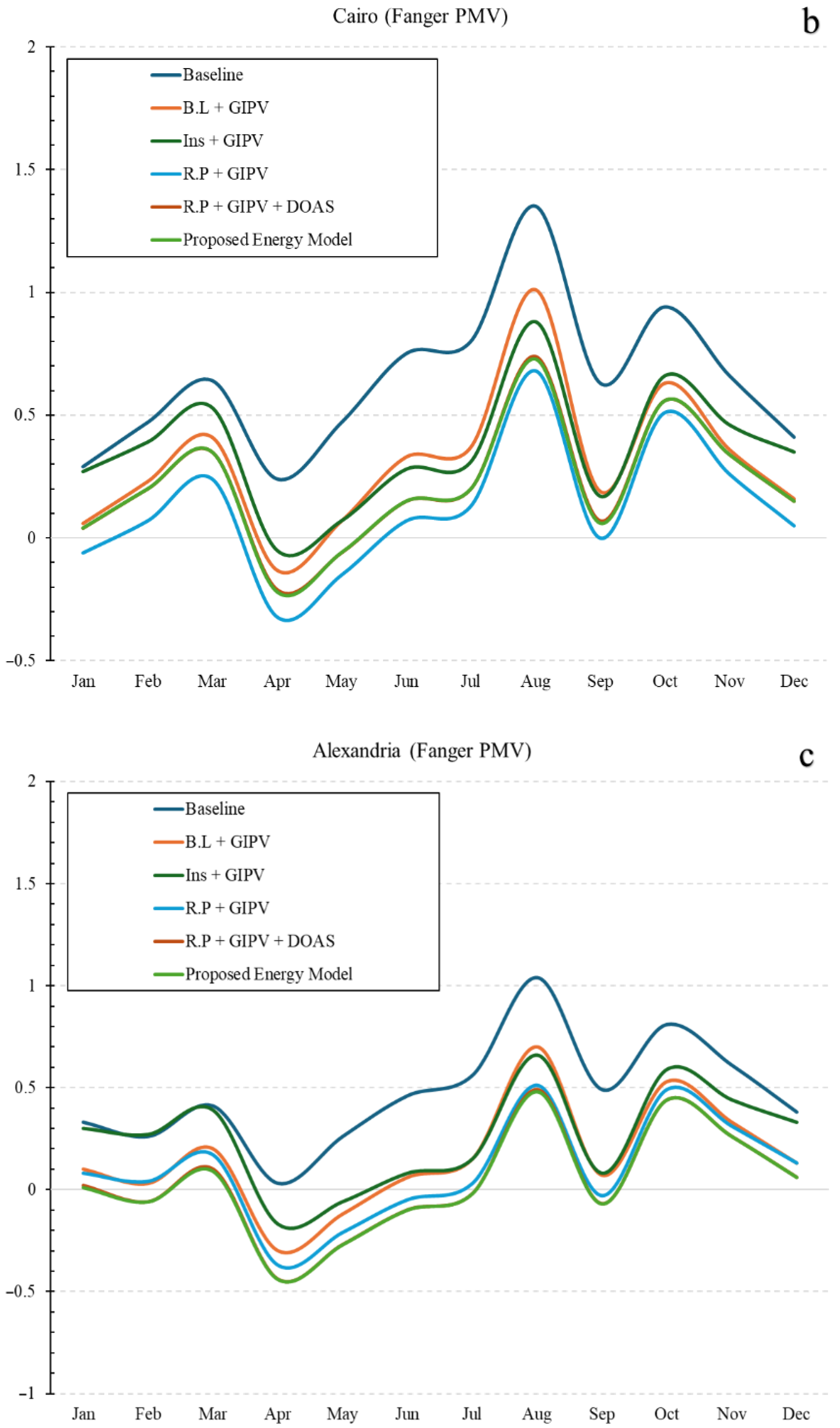
5.2.1. Predicted Mean Vote (PMV)
5.2.2. Discomfort Hours (DCH)
5.3. Techno-Economic Evaluation
- 12 USD/m2 of floor area in the very hot–arid climate (Aswan);
- 22 USD/m2 of floor area in the hot–arid climate (Cairo);
- 30 USD/m2 of floor area in the hot–humid climate (Alexandria).
6. Conclusions
Author Contributions
Funding
Institutional Review Board Statement
Informed Consent Statement
Data Availability Statement
Conflicts of Interest
Abbreviations
| ASHRAE | American Society of Heating, Refrigerating and Air-Conditioning Engineers |
| BES | Building Energy Simulations |
| BIPV | Building-Integrated Photovoltaic |
| CO2 | Carbon Dioxide |
| CVRMSE | Coefficient of Variation of the Root Mean Square Error |
| DBT | Dry Bulb Temperature |
| DCH | Discomfort Hours |
| DOAS | Dedicated Outdoor Air System |
| EUI | Energy Use Intensity |
| GHG | Greenhouse Gases |
| GIPV | Glazing-Integrated Photovoltaic |
| GWh | Gigawatt Hours |
| HVAC | Heating, Ventilation, and Air Conditioning |
| IEQ | Indoor Environmental Quality |
| Ins | Insulation Material |
| IRR | Internal Rate of Return |
| LPD | Lighting Power Densities |
| NMBE | Normalized Mean Bias Error |
| NPV | Net Present Value |
| NZEB | Net Zero Energy Buildings |
| PBP | Payback Period |
| PMV | Predicted Mean Vote |
| PV | Photovoltaic |
| RTPV | Rooftop Photovoltaics |
| ROI | Return On Investment |
| RP | Reflective Paint |
| SHGC | Solar Heat Gain Coefficient |
| U | Overall Heat Transfer Coefficient |
| WBT | Wet Bulb Temperature |
| WWR | Window–Wall Ratio |
Appendix A

| Zone | Area (m2) | Area % |
|---|---|---|
| Call Center | 43 | 0.5 |
| Classrooms | 693 | 7.9 |
| Corridors | 2253 | 25.8 |
| Dry Lab | 407 | 4.7 |
| GYM | 150 | 1.7 |
| Lecture Halls | 707 | 8.1 |
| Libraries | 466 | 5.3 |
| Lobby | 827 | 9.5 |
| Lounges | 453 | 5.2 |
| Meeting Rooms | 276 | 3.2 |
| Offices | 1584 | 18.2 |
| Receptions | 634 | 7.3 |
| Restaurants | 237 | 2.7 |
| Total | 8728 | 100 |
| Zone | LPD (W/m2) |
|---|---|
| Classroom | 13.4 |
| Coffee Stations | 7 |
| Computer Lab | 18.4 |
| Conference/Meeting | 13.3 |
| Corridors | 9.9 |
| Laboratories | 15.5 |
| Lecture Hall | 13.4 |
| Libraries | 11.5 |
| Lounge | 7.9 |
| Main Entry Lobbies | 9.7 |
| Office Spaces | 12 |
| Reception Areas | 5.9 |
| Restaurants | 11.6 |
References
- DeCola, P.; Secretariat, W.M.O. An Integrated Global Greenhouse Gas Information System (IG3IS). WMO Bull. 2017, 66, 38–45. [Google Scholar]
- Sohoo, M.A. Design, Evaluation and Techno-Economic Analysis of a Demand Controlled Ventilation in Hot and Humid Climate. Master’s Thesis, The British University in Dubai, Dubai, United Arab Emirates, 2015. [Google Scholar]
- IEA. World Energy Outlook 2019; IEA: Paris, France, 2019; Available online: https://www.iea.org/reports/world-energy-outlook-2019 (accessed on 9 March 2022).
- Lyakurwa, F.S. Drivers for, and barriers to solar energy use by manufacturing Micro Small and Medium Enterprises (MSMEs) in Tanzania. Renew. Energy Sustain. Dev. 2023, 9, 21. [Google Scholar] [CrossRef]
- IEA. Global Energy Review 2019; IEA: Paris, France, 2020. [Google Scholar] [CrossRef]
- U.S. Energy Information Administration. International Energy Outlook 2013; US Energy Information Administration: Washington, DC, USA, 2013. Available online: https://www.eia.gov/outlooks/ieo/pdf/0484(2013).pdf (accessed on 10 September 2019).
- Ibrahim, M.M.; Suarez-Lopez, M.J.; Hanafy, A.A.; William, M.A. Optimizing NZEB performance: A review of design strategies and case studies. Results Eng. 2025, 25, 103950. [Google Scholar] [CrossRef]
- Abdallah, A.; William, M.A.; Moharram, N.A.; Zidane, I.F. Boosting H-Darrieus vertical axis wind turbine performance: A CFD investigation of J-Blade aerodynamics. Results Eng. 2025, 27, 106358. [Google Scholar] [CrossRef]
- William, M.A.; Suárez-López, M.J.; Soutullo, S.; Hanafy, A.A. Techno-economic evaluation of building envelope solutions in hot arid climate: A case study of educational building. Energy Rep. 2021, 7, 550–558. [Google Scholar] [CrossRef]
- Lee, S.H.; Hong, T.; Piette, M.A.; Taylor-Lange, S.C. Energy retrofit analysis toolkits for commercial buildings: A review. Energy 2015, 89, 1087–1100. [Google Scholar] [CrossRef]
- Zhao, Y.; Zhang, C.; Zhang, Y.; Wang, Z.; Li, J. A review of data mining technologies in building energy systems: Load prediction, pattern identification, fault detection and diagnosis. Energy Built Environ. 2020, 1, 149–164. [Google Scholar] [CrossRef]
- Wani, M.; Swain, A.; Ukil, A. Control Strategies for Energy Optimization of HVAC Systems in Small Office Buildings using EnergyPlusTM. In Proceedings of the 2019 IEEE PES Innovative Smart Grid Technologies. Asia ISGT; IEEE: Piscataway, NJ, USA, 2019; pp. 2698–2703. [Google Scholar] [CrossRef]
- Kim, D.; Bae, Y.; Yun, S.; Braun, J.E.; Kim, D.; Bae, Y. A methodology for generating reduced-order models for large-scale buildings using the Krylov subspace method. J. Build. Perform. Simul. 2020, 13, 419–429. [Google Scholar] [CrossRef]
- Yang, T.; Athienitis, A.K. A review of research and developments of building-integrated photovoltaic/thermal (BIPV/T) systems. Renew. Sustain. Energy Rev. 2016, 66, 886–912. [Google Scholar] [CrossRef]
- International Energy Agency. Available online: https://www.iea.org/ (accessed on 9 March 2022).
- Liu, H.; Liu, Y.; Huang, H.; Wu, H.; Huang, Y. Energy consumption dynamic prediction for HVAC systems based on feature clustering deconstruction and model training adaptation. Build. Simul. 2024, 17, 1439–1460. [Google Scholar] [CrossRef]
- Pérez-Lombard, L.; Ortiz, J.; Pout, C. A review on buildings energy consumption information. Energy Build. 2008, 40, 394–398. [Google Scholar] [CrossRef]
- William, M.A.; Elharidi, A.M.; Hanafy, A.A.; Attia, A.; Elhelw, M. Energy-efficient retrofitting strategies for healthcare facilities in hot-humid climate: Parametric and economical analysis. Alexandria Eng. J. 2020, 59, 4549–4562. [Google Scholar] [CrossRef]
- Vong, N.K. Climate Change and Energy Use: Evaluating the Impact of Future Weather on Building Energy Performance in Tropical Regions. Doctoral Dissertation, University of Hawaii at Manoa, Honolulu, HI, USA, 2016. [Google Scholar]
- ASHRAE. Achieving Zero Energy: Advanced Energy Design Guide for University of Hawaii at Mānoa K-12 School Buildings; ASHRAE: Atlanta, GA, USA, 2018. [Google Scholar]
- Ibrahim, M.M.; William, M.A.; Elharidi, A.M.; Hanafy, A.A.; Suárez-lópez, M.J. Techno-Economic and Environmental Evaluation of Building Retrofit Strategies Toward NZEB Targets in Hot Climatic Contexts. Sustainability 2026, 18, 1991. [Google Scholar] [CrossRef]
- Harish, V.S.K.V.; Kumar, A. A review on modeling and simulation of building energy systems. Renew. Sustain. Energy Rev. 2016, 56, 1272–1292. [Google Scholar] [CrossRef]
- William, M.A.; Suárez-López, M.J.; Soutullo, S.; Hanafy, A.A. Building envelopes toward energy-efficient buildings: A balanced multi-approach decision making. Int. J. Energy Res. 2021, 45, 21096–21113. [Google Scholar] [CrossRef]
- Yong, S.G.; Kim, J.H.; Gim, Y.; Kim, J.; Cho, J.; Hong, H.; Baik, Y.J.; Koo, J. Impacts of building envelope design factors upon energy loads and their optimization in US standard climate zones using experimental design. Energy Build. 2017, 141, 1–15. [Google Scholar] [CrossRef]
- Aktacir, M.A.; Büyükalaca, O.; Yilmaz, T. A case study for influence of building thermal insulation on cooling load and air-conditioning system in the hot and humid regions. Appl. Energy 2010, 87, 599–607. [Google Scholar] [CrossRef]
- Ibrahim, M.M.; William, M.A.; A Hanafy, A.; F Moussa, M.; Suarez-Lopez, M.J. Multi-pronged strategies for enhancing building envelopes toward nearly-zero energy in hot climatic regions. Eng. Res. Express 2024, 6, 045532. [Google Scholar] [CrossRef]
- Moharram, N.A.; Tarek, A.; Gaber, M.; Bayoumi, S. Brief review on Egypt’s renewable energy current status and future vision. Energy Rep. 2022, 8, 165–172. [Google Scholar] [CrossRef]
- Ibrahim, M.M.; William, M.A.; Elharidi, A.M.; Hanafy, A.A.; Suarez-Lopez, M.J. Do solar green roofs contribute to SDGs, fostering energy efficiency and environmental conservation? Renew. Energy Sustain. Dev. 2024, 10, 258. [Google Scholar] [CrossRef]
- Neethling, M.M. Energy Flow Analysis of an Academic Building. Master’s Thesis, Stellenbosch University, Stellenbosch, South Africa, 2011. [Google Scholar]
- Iwayemi, A.; Wan, W.; Zhou, C. Energy management for intelligent buildings. In Energy Management Systems; InTech: Rijeka, Croatia, 2011; p. 22. [Google Scholar]
- Attia, S.; Evrard, A.; Gratia, E. Development of benchmark models for the Egyptian residential buildings sector. Appl. Energy 2012, 94, 270–284. [Google Scholar] [CrossRef]
- Vakiloroaya, V.; Ha, Q.P.; Samali, B. Energy-efficient HVAC systems: Simulation–empirical modelling and gradient optimization. Autom. Constr. 2013, 31, 176–185. [Google Scholar] [CrossRef]
- Fathalian, A.; Kargarsharifabad, H. Actual validation of energy simulation and investigation of energy management strategies (Case Study: An office building in Semnan, Iran). Case Stud. Therm. Eng. 2018, 12, 510–516. [Google Scholar] [CrossRef]
- Ghose, A.; Pizzol, M.; McLaren, S.J.; Vignes, M.; Dowdell, D. Refurbishment of office buildings in New Zealand: Identifying priorities for reducing environmental impacts. Int. J. Life Cycle Assess. 2019, 24, 1480–1495. [Google Scholar] [CrossRef]
- Emil, F.; Diab, A. Energy rationalization for an educational building in Egypt: Towards a zero energy building. J. Build. Eng. 2021, 44, 103247. [Google Scholar] [CrossRef]
- U.S Department of Energy. Right-Size Heating and Cooling Equipment; U.S Department of Energy: Washington, DC, USA, 2002. Available online: https://www.nrel.gov/docs/fy02osti/31318.pdf (accessed on 2 June 2021).
- Woradechjumroen, D.; Yu, Y.; Li, H.; Yu, D.; Yang, H. Analysis of HVAC system oversizing in commercial buildings through field measurements. Energy Build. 2014, 69, 131–143. [Google Scholar] [CrossRef]
- Lstiburek, J.W. Understanding walls. ASHRAE J. 2020, 62, 52–63. [Google Scholar]
- Khoukhi, M.; Hassan, A.; Abdelbaqi, S. The impact of employing insulation with variant thermal conductivity on the thermal performance of buildings in the extremely hot climate. Case Stud. Therm. Eng. 2019, 16, 100562. [Google Scholar] [CrossRef]
- Zhu, N.; Ma, Z.; Wang, S. Dynamic characteristics and energy performance of buildings using phase change materials: A review. Energy Convers. Manag. 2009, 50, 3169–3181. [Google Scholar] [CrossRef]
- Shahin, H.S.M. Adaptive building envelopes of multistory buildings as an example of high performance building skins. Alex. Eng. J. 2019, 58, 345–352. [Google Scholar] [CrossRef]
- Yang, S.; Cannavale, A.; Di Carlo, A.; Prasad, D.; Sproul, A.; Fiorito, F. Performance assessment of BIPV/T double-skin façade for various climate zones in Australia: Effects on energy consumption. Sol. Energy 2020, 199, 377–399. [Google Scholar] [CrossRef]
- Sarihi, S.; Mehdizadeh Saradj, F.; Faizi, M. A Critical Review of Façade Retrofit Measures for Minimizing Heating and Cooling Demand in Existing Buildings. Sustain. Cities Soc. 2021, 64, 102525. [Google Scholar] [CrossRef]
- Khalil, E. Energy Efficient Design and Performance of Commercial Buildings in Developing Countries. In Proceedings of the Second International Energy 2030 Conference; American Institute of Aeronautics and Astronautics: Reston, VA, USA, 2008; pp. 142–147. [Google Scholar]
- Ibrahim, M.M.; William, M.A.; Hanafy, A.A.; Moussa, M.F.; Suarez-Lopez, M.J. Boosting energy efficiency in educational buildings: The role of electrochromic glazing and ASHRAE standard integration. In Proceedings of the AIP Conference Proceedings; AIP Publishing LLC: Melville, NY, USA, 2025; p. 060002. [Google Scholar] [CrossRef]
- Sadineni, S.B.; Madala, S.; Boehm, R.F. Passive building energy savings: A review of building envelope components. Renew. Sustain. Energy Rev. 2011, 15, 3617–3631. [Google Scholar] [CrossRef]
- Moujaes, S.F.; Brickman, R. Thermal Performance Analysis of Highly Reflective Coating on Residences in Hot and Arid Climates. J. Energy Eng. 2003, 129, 56–68. [Google Scholar] [CrossRef]
- Bolattürk, A. Optimum insulation thicknesses for building walls with respect to cooling and heating degree-hours in the warmest zone of Turkey. Build. Environ. 2008, 43, 1055–1064. [Google Scholar] [CrossRef]
- Delgarm, N.; Sajadi, B.; Delgarm, S.; Kowsary, F. A novel approach for the simulation-based optimization of the buildings energy consumption using NSGA-II: Case study in Iran. Energy Build. 2016, 127, 552–560. [Google Scholar] [CrossRef]
- López, M.J.S.; Castro, S.S.; Celemín, M.R.H.; Marigorta, E.B. Energy Refurbishment Assessment of an Existing Educational Building. A Case Study. Proceedings 2018, 2, 1415. [Google Scholar] [CrossRef]
- Torquato, R.; Salles, D.; Oriente Pereira, C.; Meira, P.C.M.; Freitas, W. A Comprehensive Assessment of PV Hosting Capacity on Low-Voltage Distribution Systems. IEEE Trans. Power Deliv. 2018, 33, 1002–1012. [Google Scholar] [CrossRef]
- Saxena, G.; Gidwani, L. Estimation of Energy Production of Grid Connected Rooftop Solar Photovoltaic System at Nagar Nigam Kota, Rajasthan. In Proceedings of the 2018 3rd International Innovative Applications of Computational Intelligence on Power, Energy and Controls with Their Impact on Humanity; IEEE: Piscataway, NJ, USA, 2018; pp. 45–49. [Google Scholar] [CrossRef]
- Le Nguyen, L.D.; Ngoc, S.D.; Cong, D.T.; Thuong, D.L.; Van, S.N.; Hoang Minh, V.N.; Le, N.T. Facade Integrated Photovoltaic Systems: Potential Applications for Commercial Building in Vietnam. In Proceedings of the 2019 International Conference on System Science and Engineering; IEEE: Piscataway, NJ, USA, 2019; pp. 219–223. [Google Scholar] [CrossRef]
- Atluri, K.; Hananya, S.M.; Navothna, B. Performance of Rooftop Solar PV System with Crystalline Solar Cells. In Proceedings of the 2018 National Power Engineering Conference; IEEE: Piscataway, NJ, USA, 2018; pp. 1–4. [Google Scholar] [CrossRef]
- Awad, H.; Nassar, Y.F.; Hafez, A.; Sherbiny, M.K.; Ali, A.F. Optimal design and economic feasibility of rooftop photovoltaic energy system for Assuit University, Egypt. Ain Shams Eng. J. 2022, 13, 101599. [Google Scholar] [CrossRef]
- Jaafar, S.S.; Maarof, H.A.; Salh, R.T.; Sahib, H.; Azeez, Y.H. Non-uniform dust distribution effect on photovoltaic panel performance. Renew. Energy Sustain. Dev. 2023, 9, 1–10. [Google Scholar] [CrossRef]
- Setyonegoro, M.I.B.; Irnawan, R.; Putranto, L.M.; Firmansyah, E.; Atmaja, W.Y.; Adi, N.; Arifin, Z.; Gusti, R.; Prastianto, D. Sarjiya Study of rooftop PV hosting capacity in 20 kV systems in facing distributed generation penetration. Results Eng. 2024, 23, 102517. [Google Scholar] [CrossRef]
- Xue, L.; Liu, J.; Lin, X.; Li, M.; Kobashi, T. Assessing urban rooftop PV economics for regional deployment by integrating local socioeconomic, technological, and policy conditions. Appl. Energy 2024, 353, 122058. [Google Scholar] [CrossRef]
- Cuesta-Fernández, I.; Vargas-Salgado, C.; Alfonso-Solar, D.; Gómez-Navarro, T. The contribution of metropolitan areas to decarbonize the residential stock in Mediterranean cities: A GIS-based assessment of rooftop PV potential in Valencia, Spain. Sustain. Cities Soc. 2023, 97, 104727. [Google Scholar] [CrossRef]
- Wang, X.; Gao, X.; Wu, Y. Comprehensive analysis of tropical rooftop PV project: A case study in nanning. Heliyon 2023, 9, e14131. [Google Scholar] [CrossRef] [PubMed]
- Ng, P.K.; Mithraratne, N.; Kua, H.W. Energy analysis of semi-transparent BIPV in Singapore buildings. Energy Build. 2013, 66, 274–281. [Google Scholar] [CrossRef]
- Sorgato, M.J.; Schneider, K.; Rüther, R. Technical and economic evaluation of thin-film CdTe building-integrated photovoltaics (BIPV) replacing façade and rooftop materials in office buildings in a warm and sunny climate. Renew. Energy 2018, 118, 84–98. [Google Scholar] [CrossRef]
- Alazazmeh, A.; Asif, M. Commercial building retrofitting: Assessment of improvements in energy performance and indoor air quality. Case Stud. Therm. Eng. 2021, 26, 100946. [Google Scholar] [CrossRef]
- William, M.A.; Suárez-López, M.J.; Soutullo, S.; Fouad, M.M.; Hanafy, A.A.; El-Maghlany, W.M. Multi-objective integrated BES-CFD co-simulation approach towards pandemic proof buildings. Energy Rep. 2022, 8, 137–152. [Google Scholar] [CrossRef]
- Saad, M.A.; Hassan, A.; Hanafy, A.; Salem, M.; William, M. Assessing HVAC airflow modulation strategies to reduce short-term aerosol transmission in office environments. Sci. Rep. 2025, 15, 23911. [Google Scholar] [CrossRef]
- Chirico, F.; Rulli, G. Strategy and methods for the risk assessment of thermal comfort in the workplace. G. Ital. Med. Lav. Ergon. 2015, 37, 220–233. Available online: http://europepmc.org/abstract/MED/26934807 (accessed on 9 March 2022).
- Dietz, L.; Horve, P.F.; Coil, D.A.; Fretz, M.; Eisen, J.A.; Van Den Wymelenberg, K. 2019 Novel Coronavirus (COVID-19) Pandemic: Built Environment Considerations To Reduce Transmission. MSystems 2020, 5, e00245-20. [Google Scholar] [CrossRef] [PubMed]
- Carrier Corporation. Air conditioning and COVID-19: Slowing the spread. In Air Conditioning and COVID-19; Carrier: Palm Beach Gardens, FL, USA, 2020. [Google Scholar]
- Koster, L. Indoor Humidity and Your Family’s Health; National Asthma Council: Melbourne, Australia, 2016; Available online: https://www.nationalasthma.org.au/news/2016/indoor-humidity (accessed on 6 October 2021).
- Korolija, I.; Zhang, Y.; Marjanovic-Halburd, L.; Hanby, V.I. Selecting HVAC systems for typical UK office buildings. In Proceedings of the 6th International Symposium on Heating, Ventilating and Air Conditioning ISHVAC 2009; Southeast University: Nanjing, China, 2009; Volume 1, pp. 388–396. [Google Scholar]
- Mihara, K.; Sekhar, C.; Takemasa, Y.; Lasternas, B.; Tham, K.W. Thermal and perceived air quality responses between a dedicated outdoor air system with ceiling fans and conventional air-conditioning system. Build. Environ. 2021, 190, 107574. [Google Scholar] [CrossRef]
- Pan, Y.; Du, C.; Fu, Z.; Fu, M. Re-thinking of engineering operation solutions to HVAC systems under the emerging COVID-19 pandemic. J. Build. Eng. 2021, 43, 102889. [Google Scholar] [CrossRef] [PubMed]
- Guo, M.; Xu, P.; Xiao, T.; He, R.; Dai, M.; Miller, S.L. Review and comparison of HVAC operation guidelines in different countries during the COVID-19 pandemic. Build. Environ. 2021, 187, 107368. [Google Scholar] [CrossRef] [PubMed]
- William, M.A.; Suárez-López, M.J.; Soutullo, S.; Hanafy, A.A. Evaluating heating, ventilation, and air-conditioning systems toward minimizing the airborne transmission risk of Mucormycosis and COVID-19 infections in built environment. Case Stud. Therm. Eng. 2021, 28, 101567. [Google Scholar] [CrossRef]
- Building Technologies Office. EnergyPlus. Available online: http://energyplus.net/ (accessed on 3 February 2021).
- DesignBuilder Software Ltd. DesignBuilder Simulation. Available online: https://designbuilder.co.uk/simulation (accessed on 3 February 2021).
- Cioccolanti, L.; Fonti, A.; Comodi, G. Dynamic modeling of thermal and electrical microgrid of multi-apartment in different European locations. In Proceedings of the 17th International Stirling Engine Conference and Exhibition; Northumbria University: Newcastle upon Tyne, UK, 2016; pp. 24–26. [Google Scholar]
- Castell, A.; Solé, C. Design of latent heat storage systems using phase change materials (PCMs). In Advances in Thermal Energy Storage Systems; Elsevier: Amsterdam, The Netherlands, 2015; pp. 285–305. [Google Scholar] [CrossRef]
- Corrado, V.; Fabrizio, E. Steady-State and Dynamic Codes, Critical Review, Advantages and Disadvantages, Accuracy, and Reliability. In Handbook of Energy Efficiency in Buildings; Elsevier: Amsterdam, The Netherlands, 2019; pp. 263–294. [Google Scholar] [CrossRef]
- William, M.A.; Suárez-López, M.J.; Soutullo, S.; Fouad, M.M.; Hanafy, A.A. Enviro-economic assessment of buildings decarbonization scenarios in hot climates: Mindset toward energy-efficiency. Energy Rep. 2022, 8, 172–181. [Google Scholar] [CrossRef]
- Spitler, J.D. Load Calculations Applications Manual; American Society of Heating, Refrigerating and Air-Conditioning Engineers, Inc. (ASHRAE): Atlanta, GA, USA, 2014. [Google Scholar]
- Rees, S.; Spitler, J.; Davies, M.; Haves, P. Qualitative Comparison of North American and U.K. Cooling Load Calculation Methods. HVAC&R Res. 2000, 6, 75–99. [Google Scholar] [CrossRef]
- ASHRAE. ASHRAE Handbook—Fundamentals (SI); ASHRAE: Atlanta, GA, USA, 2017. [Google Scholar]
- Standard 62.1-2016; Ventilation for Acceptable Indoor Air Quality. American Society of Heating, Refrigerating and Air-Conditioning Engineers, Inc.: Atlanta, GA, USA, 2016.
- Standard 90.1-2016; Energy Standard for Buildings Except Low-Rise Residential Buildings. American Society of Heating, Refrigerating and Air-Conditioning Engineers, Inc.: Atlanta, GA, USA, 2016.
- ASHRAE. ASHRAE GUIDELINE 14 Measurement of Energy, Demand, and Water Savings; American Society of Heating, Refrigerating and Air-Conditioning Engineers, Inc.: Atlanta, GA, USA, 2015. [Google Scholar]
- Peel, M.C.; Finlayson, B.L.; McMahon, T.A. Updated world map of the Köppen-Geiger climate classification. Hydrol. Earth Syst. Sci. 2007, 11, 1633–1644. [Google Scholar] [CrossRef]
- Rubel, F.; Kottek, M. Observed and projected climate shifts 1901-2100 depicted by world maps of the Köppen-Geiger climate classification. Meteorol. Z. 2010, 19, 135–141. [Google Scholar] [CrossRef]
- World Maps of Köppen-Geiger Climate Classification. Available online: http://koeppen-geiger.vu-wien.ac.at/present.htm (accessed on 8 March 2022).
- ENERGYDATA.INFO. Global Solar Atlas. Available online: https://globalsolaratlas.info/map?c=26.94166,30.805664,6&r=EGY (accessed on 19 July 2021).
- Harish, V.; Kumar, A. Reduced order modeling and parameter identification of a building energy system model through an optimization routine. Appl. Energy 2016, 162, 1010–1023. [Google Scholar] [CrossRef]
- United States Environmental Protection Agency. Green Gases Equivalencies—Calculations and References; United States Environmental Protection Agency: Washington, DC, USA, 2019. Available online: https://www.epa.gov/energy/greenhouse-gases-equivalencies-calculator-calculations-and-references (accessed on 28 July 2021).
- International Organization for Standardization (ISO). Ergonomics of the Thermal Environment—Analytical Determination and Interpretation of Thermal Comfort Using Calculation of the PMV and PPD Indices and Local Thermal Comfort Criteria, 3rd ed.; ISO: Geneva, Switzerland, 2005; Volume 7730. [Google Scholar]
- Standard 55-2017; Thermal Environmental Conditions for Human Occupancy. American Society of Heating, Refrigerating and Air-Conditioning Engineers, Inc.: Atlanta, GA, USA, 2017; p. 12.
- Huizenga, C.; Hui, Z.; Arens, E. A model of human physiology and comfort for assessing complex thermal environments. Build. Environ. 2001, 36, 691–699. [Google Scholar] [CrossRef]
- Frontczak, M.; Schiavon, S.; Goins, J.; Arens, E.; Zhang, H.; Wargocki, P. Quantitative relationships between occupant satisfaction and satisfaction aspects of indoor environmental quality and building design. Indoor Air 2012, 22, 119–131. [Google Scholar] [CrossRef]
- RILA. Financing for Energy & Sustainability. In Better Buildings; U.S. Department of Energy: Washington, DC, USA, 2015. [Google Scholar]
- Whitman, D.L.; Terry, R.E. Fundamentals of Engineering Economics and Decision Analysis; Synthesis Lectures on Engineering; Morgan & Claypool: San Rafael, CA, USA, 2012; Volume 7, pp. 1–219. [Google Scholar]


| Study | Climate Scope | Envelope + HVAC Integration | Renewable Integration | Comfort Assessment | Economic Evaluation | Health-Resilient Ventilation | Multi-Criteria Framework |
|---|---|---|---|---|---|---|---|
| Mynhardt [29] | Single (South Africa) | Partial | No | No | Yes | No | No |
| Iwayemi et al. [30] | General | HVAC-focused | No | No | Yes | No | No |
| Attia et al. [31] | Single (Egypt–Residential) | Yes | No | Limited | Limited | No | No |
| Vakiloroaya et al. [32] | Single | HVAC optimization | No | Limited | No | No | No |
| Fathalian et al. [33] | Single (Iran) | Envelope | No | No | Limited | No | No |
| Ghose et al. [34] | Single (New Zealand) | Yes | No | No | Yes | No | No |
| Emil & Diab [35] | Single (Cairo) | Yes | No | No | Yes | No | No |
| Sadineni et al. [46] | Multi-country | Envelope | No | No | No | No | No |
| Moujaes & Brickman [47] | Single | Envelope | No | No | Limited | No | No |
| Delgarm et al. [49] | Single (Iran) | Envelope | No | No | No | No | Optimization only |
| López et al. [50] | Single (Spain) | Envelope | No | No | Limited | No | No |
| Ng et al. [61] | Single (Singapore) | Envelope (BIPV) | Yes | Limited | No | No | No |
| Sorgato et al. [62] | Single (Brazil) | Envelope (BIPV) | Yes | Yes | Yes | No | No |
| Mihara et al. [71] | Single | HVAC (DOAS) | No | Yes | Limited | Yes | No |
| Pan et al. [72] | General | HVAC | No | Yes | No | Yes | No |
| Guo et al. [73] | General | HVAC | No | No | No | Yes | No |
| William et al. [9] | Single | Envelope | No | Yes | Yes | No | No |
| William et al. [74] | Single | HVAC (DOAS) | No | Yes | Yes | Yes | No |
| Present Study | Three sub-climates (1B, 2B, 2A) | Yes | Yes | Yes | Yes | Yes | Yes |
| Wall | |
| U-value (W/m2 K) | 1.924 |
| Roof | |
| U-value (W/m2 K) | 2.27 |
| Glazing | |
| WWR | 30% |
| Glazing | 6 mm Double Pane (Blue) + 6 mm Gap (Air) |
| U-value (W/m2 K) | 3.094 |
| SHGF | 0.503 |
| Location | ASHRAE Climate Zone | Dry-Bulb Temperature (°C) | Wet-Bulb Temperature (°C) | Direct Normal Irradiation (kWh/m2) | Wind Speed (m/s) |
|---|---|---|---|---|---|
| Aswan | 1B | 44.1 | 21.1 | 2254 | 4.04 |
| Cairo | 2B | 38.2 | 21.2 | 2036 | 3.58 |
| Alexandria | 2A | 33.2 | 22.4 | 1955 | 3.92 |
| Aswan (1B) | Cairo (2B) | Alexandria (2A) | ||||
|---|---|---|---|---|---|---|
| Model | Energy Use (GWh) | Tons CO2 | Energy Use (GWh) | Tons CO2 | Energy Use (GWh) | Tons CO2 |
| Baseline | 1.311 | 918 | 1.178 | 824 | 1.091 | 763 |
| B.L + GIPV | 1.117 | 782 | 1.057 | 740 | 0.989 | 692 |
| Ins + GIPV | 0.974 | 682 | 0.975 | 682 | 0.936 | 655 |
| R.P + GIPV | 0.903 | 632 | 0.828 | 580 | 0.795 | 557 |
| R.P + GIPV + DOAS | 0.766 | 537 | 0.708 | 496 | 0.682 | 477 |
| Proposed Energy Model | 0.563 | 430 | 0.546 | 410 | 0.538 | 462 |
| Aswan (1B) | Cairo (2B) | Alexandria (2A) | |
|---|---|---|---|
| Model | DCH | DCH | DCH |
| Baseline | 304 | 276 | 284 |
| B.L + GIPV | 304 | 276 | 284 |
| Ins + GIPV | 229 | 228 | 233 |
| R.P + GIPV | 242 | 247 | 256 |
| R.P + GIPV + DOAS | 173 | 159 | 154 |
| Proposed Energy Model | 173 | 159 | 154 |
| Aswan | Cairo | Alexandria | |||||||
|---|---|---|---|---|---|---|---|---|---|
| Model | IRR % | ROI % | PBP (Years) | IRR % | ROI % | PBP (Years) | IRR % | ROI % | PBP (Years) |
| B.L + GIPV | 10% | 10% | 6.1 | 0% | 6% | 9.8 | –3% | 5% | 11.6 |
| Ins + GIPV | 20% | 15% | 4.1 | 8% | 9% | 6.8 | 2% | 7% | 8.9 |
| R.P + GIPV | 26% | 18% | 3.3 | 22% | 16% | 3.9 | 17% | 13% | 4.6 |
| R.P + GIPV + DOAS | 18% | 14% | 4.5 | 7% | 9% | 7.1 | 0% | 6% | 10.0 |
| Proposed Energy Model | 21% | 15% | 3.9 | 10% | 10% | 6.2 | 0% | 6% | 10.3 |
Disclaimer/Publisher’s Note: The statements, opinions and data contained in all publications are solely those of the individual author(s) and contributor(s) and not of MDPI and/or the editor(s). MDPI and/or the editor(s) disclaim responsibility for any injury to people or property resulting from any ideas, methods, instructions or products referred to in the content. |
© 2026 by the authors. Licensee MDPI, Basel, Switzerland. This article is an open access article distributed under the terms and conditions of the Creative Commons Attribution (CC BY) license.
Share and Cite
William, M.A.; Suárez-López, M.J.; Soutullo, S.; Hanafy, A.A.; Moussa, M.F. Enhancing Energy Performance in Hot Climates: A Multi-Criteria Approach Towards Nearly Zero-Energy Buildings. Sustainability 2026, 18, 2424. https://doi.org/10.3390/su18052424
William MA, Suárez-López MJ, Soutullo S, Hanafy AA, Moussa MF. Enhancing Energy Performance in Hot Climates: A Multi-Criteria Approach Towards Nearly Zero-Energy Buildings. Sustainability. 2026; 18(5):2424. https://doi.org/10.3390/su18052424
Chicago/Turabian StyleWilliam, Micheal A., María José Suárez-López, Silvia Soutullo, Ahmed A. Hanafy, and Mona F. Moussa. 2026. "Enhancing Energy Performance in Hot Climates: A Multi-Criteria Approach Towards Nearly Zero-Energy Buildings" Sustainability 18, no. 5: 2424. https://doi.org/10.3390/su18052424
APA StyleWilliam, M. A., Suárez-López, M. J., Soutullo, S., Hanafy, A. A., & Moussa, M. F. (2026). Enhancing Energy Performance in Hot Climates: A Multi-Criteria Approach Towards Nearly Zero-Energy Buildings. Sustainability, 18(5), 2424. https://doi.org/10.3390/su18052424