1. Introduction
Since the publication of “Our Common Future” in 1987, the first globally accepted definition of sustainable development has highlighted the urgent need for societal and consumer behavior shifts to safeguard future generations’ needs. The report famously defined sustainable development as “meeting the needs of the present without compromising the ability of future generations to meet their own needs” [
1]. However, despite this holistic vision, contemporary discourse often reduces “sustainable beauty” to a narrow focus on ingredient sourcing and product origins [
2].
This narrow focus is critically insufficient given the scale and impact of the cosmetic and personal care industry—which encompasses products legally defined as “any substance or mixture intended to be placed in contact with the external parts of the human body (epidermis, hair system, nails, lips and external genital organs) or with the teeth and the mucous membranes of the oral cavity with a view exclusively or mainly to cleaning them, perfuming them, changing their appearance, protecting them, keeping them in good condition or correcting body odors” [
3]. The sector, which is expected to reach approximately
$580 billion by 2027 [
4], faces increasing scrutiny for its extensive environmental and social impacts [
5,
6,
7]. These include resource depletion (water, energy, raw materials) [
8], pollution (microplastics, packaging waste) [
9,
10], biodiversity loss from unsustainable ingredient sourcing [
11], and ethical violations in supply chains for materials like mica [
12,
13] and palm oil [
14,
15]. These interconnected issues, alongside consumer awareness, have pushed sustainability from the periphery to the core of corporate strategy [
16,
17].
In this context, sustainability certifications and instruments have emerged as critical tools for cosmetic brands seeking to demonstrate compliance with environmental and social standards. This shift reflects a broader recognition that sustainability can no longer be treated as a marketing afterthought; it must be embedded in both operations and product development. Companies are increasingly adopting a dual approach, first implementing sustainable practices internally before communicating these efforts through product labels, aiming to provide credible information, thus helping guide eco-conscious purchasing decisions.
Today, the market features dozens of ecolabels, each addressing different aspects of sustainability. Certifications such as COSMOS and NATRUE focus on formulation standards, ensuring products meet strict criteria for natural or organic ingredients, while others, like Roundtable on Sustainable Palm Oil (RSPO) and Fair for Life, target supply chain ethics, promoting fair labor practices and responsible sourcing [
18,
19]. At the corporate level, broader certifications like B Corp and Cradle to Cradle assess Environmental, Social, and Governance (ESG) practices [
20,
21].
While this diversity of labels reflects the multifaceted nature of sustainability, it has also led to fragmentation, with varying standards and enforcement mechanisms creating confusion for both brands and consumers [
22]. Despite their widespread adoption, sustainability certifications face growing criticism due to their limited scope, inconsistent standards, and inability to cover the entire product lifecycle. A major shortcoming is their selective emphasis—many certifications prioritize singular aspects like product composition (e.g., organic ingredients or animal welfare) while neglecting critical downstream impacts such as packaging recyclability, pollution during product use, or post-consumer waste [
23] (
Table 1). Equally concerning are the social dimensions routinely excluded from certification criteria, like fair wages, indigenous community rights, and gender equity in supply chains which often remain unaddressed. Furthermore, careless verification mechanisms—including self-certification and infrequent audits—enable greenwashing by allowing brands to misuse environmental claims as marketing tools without substantial evidence. Inconsistent third-party verification and limited transparent, independent auditing processes undermine consumer trust in sustainability labels [
24].
In response to these systemic flaws, regulators are implementing stricter frameworks to restore credibility and combat greenwashing. This shift is exemplified by a suite of European regulations that move beyond voluntary standards. The European Union (EU)’s Green Claims Directive targets misleading environmental statements by mandating that all claims be backed by verifiable, independently verified, and science-based evidence, effectively banning vague or unsubstantiated eco-labels [
22]. This complements existing cosmetic regulations like article 20.1 of the EU Cosmetic Products Regulation (EC) No. 1223/2009, which prohibits implying a product has characteristics it does not have [
3]. Furthermore, Regulation 655/2013 establishes six mandatory Common Criteria for cosmetic claims—Legal Compliance, Truthfulness, Evidential Support, Honesty, Fairness, and Informed Decision-Making—applying to all marketing channels from packaging to social media posts [
27]. Beyond consumer-facing claims, the European Corporate Sustainability Reporting Directive (CSRD) mandates large companies to comprehensively report their environmental and social performance across the entire value chain, according to strict European Sustainability Reporting Standards (ESRS), to ensure sustainability data covers sourcing, production, distribution and post-consumer impacts [
28].
Together, these policy shifts signal a decisive transition from compartmentalized certifications toward a system of holistic impact assessment, forcing the industry to provide reliable, audit-based, and lifecycle-aware sustainability assurance. Yet, a critical question remains: do the sustainability certifications currently employed by the cosmetics sector meet this new high bar for comprehensiveness and credibility?
This study positions itself directly within this gap between regulatory ambition and on-the-ground implementation. Herein, we address these challenges, aiming to answer the following research question: to what extent do current leading sustainability certifications and instruments in the cosmetics sector provide comprehensive value chain coverage and rigorous third-party verification?
The study begins with a review of sustainability schemes and their relevance in the cosmetics industry, followed by a systematic comparative analysis of prominent schemes based on defined criteria. By mapping and evaluating widely used certifications, the analysis pursues four key objectives: (1) evaluating whether certifications assess sustainability impacts across the full value chain (from raw material sourcing to post-consumer waste); (2) examining the inclusion of environmental, social, and governance (ESG) criteria; (3) assessing the independence, frequency, and transparency of third-party audits; and (4) identifying inconsistencies and gaps between certification systems. Based on these findings, the paper will conclude with evidence-based recommendations to strengthen certification frameworks and advance industry-wide sustainability goals.
2. Methodology
This study adopts a qualitative comparative approach to evaluate the comprehensiveness and credibility of sustainability schemes relevant to the cosmetics sector. The methodological process comprised three key phases: (i) identification and selection of widely used schemes, (ii) development of an analytical framework based on key sustainability dimensions, and (iii) structured content analysis of publicly available documentation for each scheme. The approach is intentionally diagnostic and comparative, aiming to identify structural patterns, gaps, and overlaps across the current sustainability assurance landscape rather than to rank or score schemes by performance.
For conceptual clarity, the instruments examined in this study are grouped into three analytical categories based on their formal purpose and mode of operation (
Table 2):
- (i)
Certifications, which are defined as schemes involving conformity assessment against defined criteria and some form of third-party verification or auditing, applied at product and/or company level;
- (ii)
Standards and guidelines, which provide technical definitions, calculation methods, or best-practice guidance but are not certifiable by design;
- (iii)
Disclosure and reporting frameworks, which structure sustainability reporting and data transparency without certifying performance.
The inclusion of non-certifiable standards and disclosure frameworks is intentional and analytical. These instruments are frequently mobilized by cosmetic companies to substantiate sustainability narratives alongside formal certifications. They are therefore examined to reflect the full ecosystem of tools shaping sustainability claims, without implying equivalence with certification-based assurance mechanisms.
First, a purposive sampling strategy was employed to identify sustainability instruments that are either directly applied within the cosmetics sector or widely used by cosmetic companies to substantiate sustainability claims. An initial long-list of candidate instruments was compiled based on market surveys, regulatory references, academic literature, and industry practice. From this comprehensive list, a final sample of 24 instruments was selected for analysis. The selection aimed to represent a wide spectrum of certification types: product-specific ecolabels (e.g., COSMOS, EU Ecolabel), ingredient-based standards (e.g., RSPO, USDA Organic), corporate-level frameworks (e.g., B Corp, ISO 14001), and transparency or disclosure platforms (e.g., GRI, CDP). The selection applied four primary inclusion criteria: (i) demonstrable use within the cosmetics or personal care sector, at product, ingredient, or corporate level; (ii) relevance to at least one sustainability dimension (environmental, social, or governance); (iii) publicly accessible documentation, such as standards, criteria, or methodological descriptions; and (iv) evidence of third-party oversight, a formal governance structure, or recognized use in sustainability claims. Exclusion criteria comprised purely proprietary or retailer-owned labels lacking public criteria, claims-based logos without defined standards or verification mechanisms, single-company or pilot-only schemes with limited scalability or market relevance, and regionally restricted labels with negligible international diffusion, unless cited in regulatory or academic contexts. Borderline cases were retained for analysis where their frequent use in sustainability communication or regulatory discourse justified significant discursive influence, while exclusions were made to avoid inflating apparent coverage in narrowly defined domains rather than to understate sustainability performance.
A summary of the sampling process, including inclusion and exclusion rationale, is provided in
Supplementary Table S1 to enhance transparency and reproducibility.
To ensure comparability across different certification systems, we created an evaluation matrix encompassing eleven analytical dimensions organized into three categories:
Value Chain Coverage: assessing upstream impacts, and production, use, and end-of-life phases.
Sustainability Scope: evaluating environmental, social, and governance criteria.
Verification and Transparency: examining certification level (product/company), third-party audit requirements, and transparency (public access to audit findings or certification outcomes).
The matrix is designed as a diagnostic mapping tool to visualize structural presence or absence of coverage across dimensions. It does not constitute a performance ranking, nor does it imply equivalence in depth or rigor between instruments addressing the same dimension.
Primary data were collected from official certification standards, criteria documents, audit protocols, and governance frameworks published by each certifying body. Available supporting materials (sustainability reports, policy briefings, non-governmental organizations (NGO) analyses, peer-reviewed literature) provided additional insights.
Manual coding necessarily involves interpretive judgment. To enhance objectivity and ensure reproducibility, explicit coding rules and decision criteria are documented in
Supplementary Table S2. The study prioritizes analytical transparency over numerical precision, acknowledging the inherent limitations of qualitative comparative assessment.
Each analytical dimension was evaluated using a binary presence/absence logic. A checkmark (“✓”) indicates that an instrument includes explicit, scheme-defined criteria for the corresponding dimension, as documented in its official standards, certification rules, or audit protocols. The absence of a checkmark indicates that the dimension is not explicitly addressed within the formal scope of the instrument. Importantly, a checkmark is not a measure of performance; it does not imply equivalent rigor or assurance strength across fundamentally different instrument types.
All analytical dimensions were treated as equally weighted, and no composite scores or aggregated sustainability indices were calculated. This approach avoids imposing normative assumptions regarding the relative importance of different lifecycle stages or ESG pillars and aligns with the study’s exploratory objective of identifying coverage gaps and structural imbalances.
For qualitative criteria, coverage was recorded only when binding constraints or requirements were present. Aspirational statements or non-mandatory recommendations alone did not qualify as coverage. Differences in depth, enforceability, or quantitative rigor were addressed qualitatively in the narrative analysis rather than through a graded scoring system.
The dimensions of verification and transparency were operationalized through a set of sub-dimensions, including: (i) the presence of independent third-party verification, (ii) the existence of a public registry of certified entities or products, and (iii) the public disclosure of non-confidential audit outcomes. Within the evaluation matrix, a checkmark for verification indicates the presence of formal verification mechanisms, without implying equivalence in audit depth, frequency, or transparency. Differences across schemes in these aspects are documented through the disaggregated verification sub-dimensions (provided in the
Supplementary Materials) and discussed qualitatively in
Section 3 and
Section 4. Guidance documents and disclosure frameworks that lack verification by design were treated accordingly, with the absence of audits interpreted as a structural characteristic rather than a deficiency.
To prioritize interpretive coherence within our framework-driven analysis, we employed a single-coder approach guided by a pre-defined and explicit codebook (
Supplementary Table S2). To enhance consistency and reduce interpretive bias, all schemes were subjected to a structured second-pass validation, focusing on high-ambiguity areas: borderline cases, multi-dimensional schemes, and sensitive dimensions such as social criteria and verification transparency. All cases were reassessed against the documented coding rules, and final decisions were applied uniformly across the dataset.
The outcome of the analysis is presented in both narrative format and a comparative summary table (
Table 3), which consolidates the findings across all criteria. This combined presentation enables clear identification of patterns, overlaps, and systemic gaps across the sustainability instruments landscape relevant to the cosmetic sector.
For transparency,
Supplementary Table S3 lists the official standards and governance documents consulted for coding each sustainability instrument.
3. Analysis of Sustainability Schemes
This section presents a comparative analysis of selected sustainability schemes relevant to the cosmetic industry. Building upon the research objective of assessing the extent to which these instruments ensure value chain-wide sustainability and verification rigor, the analysis evaluates 24 certifications across a common set of criteria. These include coverage of sustainability impacts across the value chain (upstream, production, use phase, and end-of-life), the incorporation of environmental, social, and governance (ESG) dimensions, the scope of certification (product-level or company-level), the presence of third-party verification, and the degree of public transparency regarding audit results. The selected certifications reflect the diversity of instruments available to the industry, ranging from narrowly focused ecolabels for specific ingredients and product-level standards to broad corporate sustainability frameworks and disclosure platforms.
This analysis employs a standardized analytical framework to evaluate the comprehensiveness and credibility of leading cosmetic sector sustainability schemes. Drawing on primary sources—including official standards, procedural manuals, and auditor guidelines—alongside secondary literature, it identifies key differences, overlaps, and potential gaps among the most influential sustainability schemes in the sector. The consolidated results in
Table 2 provide insights into the alignment of these schemes with holistic sustainability principles and their robustness as tools for guiding responsible cosmetic production and consumption.
To support traceability between the narrative interpretation and the underlying coding,
Supplementary Table S4 provides descriptive counts and percentages of schemes covering each analytical dimension, derived directly from the evaluation matrix.
3.1. COSMOS
The COSMetic Organic and Natural Standard (COSMOS) is a global certification for organic and natural cosmetics, established in 2010 by a consortium of leading European organizations: Germany’s Bundesverband Deutscher Industrie- und Handelsunternehmen (BDIH), France’s Cosmebio and Ecocert, Italy’s Italian Association for Organic Agriculture, and the UK’s Soil Association. It is managed by a non-profit, international, independent association—the COSMOS-standard Association Internationale Sans But Lucratif (AISBL) [
2,
29].
The COSMOS aims to ensure that cosmetic products adhere to guidelines for safety, sustainability, and environmental responsibility, with a focus on upstream impacts, evaluating the entire supply chain, from the sourcing of raw materials to final product packaging [
30]. This commitment is operationalized through key actions: promoting organic agriculture and biodiversity, responsibly managing natural resources, adopting clean manufacturing processes that protect health and the environment, and advancing the principles of green chemistry [
31].
COSMOS requires that all ingredients are of natural origin or are organically farmed and strictly prohibits the use of petrochemicals and genetically modified organisms (GMOs). It requires that at least 95% of ingredients are organic, and that at least 20% of the total product (including water and minerals) must be organic, except for rinse-off products, non-emulsified aqueous products, and products with at least 80% minerals or mineral-derived ingredients of mineral origin, which only require 10% organic content in the final product. The remaining 5% can be synthetic, but they must be approved by COSMOS. Products that meet all COSMOS criteria but fall short of the required organic percentages still qualify for the COSMOS NATURAL label [
31].
The manufacturing phase requires organic and natural ingredients to be processed separately to prevent contamination. A robust Quality Control System is required, featuring ingredient and product traceability, documented manufacturing procedures for all stages, product and ingredient testing, and comprehensive records of analysis, production, and storage. Although not directly regulated, the risks of the use phase are minimized by restricting harmful ingredients and promoting skin-compatible formulations. Concerning end-of-life, COSMOS requires that primary and secondary packaging for certified raw materials, finished cosmetic products and base formulas must adhere to sustainability criteria focused on reducing, reusing, renewing, and recycling. It also provides regulations ensuring that the packaging is free of hazardous substances, although no detailed life cycle assessments (LCAs) or formal recyclability testing are mandated [
31].
On the environmental front, the standard promotes the use of biodegradable ingredients, renewable resources, and low-impact processing methods. COSMOS’ social criteria are limited, with prohibited animal testing banned and fair-trade encouraged but not enforced. From a governance perspective, the COSMOS is coordinated by a consortium of the previously referred European certification bodies, with publicly available standards and harmonized auditing protocols. Certification applies primarily at the product level, with no company-wide framework, although brands may apply COSMOS criteria to multiple product lines. Third-party verification is mandatory and must be performed by approved certification bodies. While the control manuals and certified product lists are publicly available, individual audit results are not disclosed to the public [
31].
Key strengths: Robust upstream coverage, with strong criteria for ingredient sourcing and formulation, supported by mandatory third-party certification.
Key gaps: Limited governance and social criteria beyond ingredient-level considerations, and absence of quantified environmental performance thresholds.
Lifecycle limitations: Does not explicitly address the consumer use phase and provides only qualitative guidance for end-of-life and packaging impacts.
3.2. NATRUE
The International Natural and Organic Cosmetics Association (NATRUE) is a Brussels-based non-profit organization founded in 2007 by five European companies—WALA Heilmittel GmbH, Laverana GmbH & Co. KG, CEP Cosmetik, and Primavera Life GmbH (Germany), alongside Weleda (Switzerland) [
32]. NATRUE aims to combat greenwashing and regulatory gaps in the cosmetics industry, and safeguard and promote authentic natural and organic cosmetics by setting standards for product formulation, transparency, and sustainability [
32].
NATRUE is very strict with regard to the origin of the raw materials [
2]. It evaluates both raw materials and final formulations, ensuring comprehensive upstream oversight. The ingredients used must adhere to strict classifications: natural, derived natural, and nature-identical. The minimum thresholds for natural ingredients, as well as the maximum allowable levels for derived natural ingredients, have been defined (
Table 4). To be certified organic, products must contain at least 95% of natural substances of plant and/or animal origin or of derived natural substances from organic farming and/or wild collection [
33].
The NATRUE certification extends to the production phase, with on-site inspections that cover both the raw material supply chains and the manufacturing processes. The use phase is not explicitly addressed in the standard, with no guidelines on the environmental impact during product application. Regarding the end-of-life stage, packaging must be eco-friendly, recyclable and minimize non-renewable materials [
34].
On environmental criteria, NATRUE restricts synthetic ingredients, GMOs, and petrochemical derivatives while encouraging formulations with low ecological impact. NATRUE’s social criteria are limited, but animal testing is explicitly banned. Broader labor or human rights protections are not explicitly addressed by the standard. The governance structure of NATRUE is nonprofit and multi-stakeholder, involving scientific and regulatory experts in standard/regulatory development. Certification is applied at the product level, without a parallel framework for company-wide assessment. Audits are conducted by independent, NATRUE-approved third-party certifiers. Although a comprehensive database of certified products is available online, public access to detailed audit findings remains restricted [
33].
Key strengths: Clear restrictions on ingredient origin and formulation practices for natural and organic cosmetics, with third-party certification.
Key gaps: Limited social and governance criteria beyond animal testing, and absence of quantified environmental performance thresholds.
Lifecycle limitations: Upstream scope, focused on formulation and ingredient sourcing; does not explicitly address use phase or end-of-life impacts.
3.3. RSPO
Founded in 2004 by members including the World Wildlife Fund (WWF), Unilever, and the Malaysian Palm Oil Association (MPOA), the Roundtable on Sustainable Palm Oil (RSPO) is a non-profit that promotes the production and use of sustainable palm oil through global voluntary standards [
19].
Conventional palm oil production has been a significant driver of deforestation, particularly in Indonesia and Malaysia, where vast areas of wild forests and wildlife habitats have been cleared for plantations [
11,
15,
35]. By encouraging sustainable practices, RSPO aims to mitigate these environmental impacts and protect high conservation value areas [
36].
The RSPO assesses upstream sustainability impacts via its Principles and Criteria, which govern plantation practices related to biodiversity conservation, deforestation prevention, and fair labor practices. When applied across the production phase, it implements chain-of-custody systems according to four different models—Identity Preserved, Segregated, Mass Balance, and Book and Claim—to ensure traceability of RSPO-certified palm oil through supply chains. However, the standard’s scope does not extend to regulating the use phase or end-of-life disposal of palm oil products [
37].
Environmentally, RSPO requires responsible land management, strict conservation strategies, and restricted agrochemical use [
36]. On social criteria, it addresses labor rights, stakeholder engagement, and smallholder inclusion [
38]. Governance is rigorous: accreditation of third-party certification bodies must comply with ISO 17065 standards [
39] to maintain consistency and impartiality. RSPO operates as a product-level certification (specific to palm oil content) rather than a corporate-wide standard, with mandatory third-party verification by accredited auditors. Transparency is moderate: while certification statuses and member lists are public, detailed audit reports are not readily accessible to consumers [
40].
Widely regarded as the leading sustainability standard for palm oil, RSPO has gained support from producers, processors, manufacturers, retailers, investors, environmental and social NGOs, and governments. All these stakeholders have a voice and a shared responsibility for protecting the integrity of the RPSO’s standards [
19].
Key strengths: Detailed and auditable sustainability criteria for palm oil production, including environmental and social safeguards.
Key gaps: Commodity-specific focus limits applicability beyond ingredient sourcing; does not address product formulation or branding practices.
Lifecycle limitations: Restricted to upstream agricultural production; no coverage of manufacturing, use phase, or end-of-life.
3.4. Fair for Life
Fair for Life certification is a global standard promoting ethical trade and social responsibility throughout agricultural and artisanal supply chains around the world. Established by the Swiss-based Institute for Market Ecology in 2005, it expanded its standard in 2022 to include cosmetics, pharmaceuticals, and nutraceuticals [
18,
41,
42].
For cosmetics, the certification addresses upstream impacts through its fair sourcing, requiring at least 80% of agricultural materials (except Complex Chemically Processed Agricultural Ingredients) and at least 10% of the final product to be certified. It also examines production-phase considerations, such as processing methods, manufacturing conditions, and equitable pricing arrangements. However, the certification does not explicitly regulate product use phase or end-of-life stage disposal [
42].
Environmentally, the program encourages organic production practices and compliance with environmental norms, addressing criteria such as water conservation, energy management and climate change, waste management, and ecosystem management by protecting biodiversity and wildlife. Furthermore, it promotes an eco-friendly packaging policy, providing a list of prohibited materials. It does not specifically emphasize life cycle metrics [
42].
The standard strongly integrates social criteria by prohibiting forced labor and child labor, guaranteeing workers’ rights to freedom of association, equal opportunities, and ethical working conditions through strict requirements for health and safety, legally binding employment contracts, and the provision of social security benefits. Furthermore, it mandates the payment of fair wages, regulates working hours to prevent exploitation, provides for paid leaves, and promotes regular employment and human resource development to foster a stable and equitable workplace [
42].
Fair for Life operates at both the product level (specific labeling on cosmetic items) and partially at the company level by certifying overall operations and supply chains. Regarding governance, Fair for Life is overseen by the Fair for Life Organization and audited by an ISO 17065-accredited third-party auditor who applies consistent global standards. While all certifications undergo third-party verification, the program maintains confidentiality regarding audit details, making only the overall certification status and scope publicly available [
42].
Key strengths: Broad social and ethical trade criteria, supported by supply chain traceability and third-party verification mechanisms.
Key gaps: Environmental performance requirements are limited in scope and lack comprehensive lifecycle perspective.
Lifecycle limitations: Focused on upstream supply-chain governance; downstream impacts not addressed.
3.5. Cradle to Cradle (C2C)
The Cradle to Cradle Certified
® (C2C) product standard originated from the design philosophy developed by William McDonough and Michael Braungart, as detailed in their 2002 book, Cradle to Cradle: Remaking the Way We Make Things [
43]. Initially launched as a proprietary system by their firm, McDonough Braungart Design Chemistry (MBDC) in 2005, the certification was transferred in 2010 to the non-profit Cradle to Cradle Products Innovation Institute (C2CPII), which now manages it as an independent, third-party standard [
44].
The C2C Certification program offers a framework for evaluating product sustainability during design and manufacturing. It identifies products designed for a safe, circular, and responsible economy, by assessing performance across five categories: material health, product circularity, clean air and climate protection, water and soil stewardship, and social fairness, all of which undergo lifecycle-based audits [
45]. Although the certification does not address the use phase directly, it evaluates how product and packaging design facilitate recyclability or compostability, supporting the transition to a circular economy [
46].
C2C certification goes beyond environmental considerations by promoting products that are safe for both people and the planet while delivering economic and social benefits. The environmental scope is comprehensive, focusing on material composition, energy efficiency, and water management, while social standards evaluate labor rights and community well-being [
45]. Governance is ensured by independent third-party auditing conducted according to ISO 14020 [
47] and ISO 14024 [
48] protocols, with progressive levels encouraging continuous improvement. As a product-specific certification rather than a company-wide standard, C2C requires verification by accredited bodies. While summary reports are available in a public registry, complete audit documents remain confidential [
45].
Key strengths: Comprehensive, multi-criteria framework addressing material health, circularity, renewable energy, water stewardship, and social fairness, supported by third-party assessment.
Key gaps: High complexity and resource intensity limit applicability to small or ingredient-focused cosmetic brands; product-level implementation remains uneven in cosmetics.
Lifecycle limitations: Strong emphasis on material design and circularity; limited explicit coverage of impacts during consumer use phase.
3.6. United States Department of Agriculture (USDA) Organic Certification
The United States Department of Agriculture (USDA)’s National Organic Program (NOP) is the federal regulatory body that develops and enforces uniform standards and criteria for organic agricultural products [
49].
Organic Certification authorizes a farm or business to market its products with the USDA Organic Seal. This label gives consumers a verified choice and is protected by the USDA to ensure its value and integrity. Organic Accreditation is the USDA’s authorization of third-party organizations—whether private, foreign, or state—to inspect and certify farms and facilities as compliant with national organic standards [
50].
To be certified as USDA organic, companies must follow a set of guidelines which include crop rotation, soil and water conservation practices, the use of organic-approved substances for pest and weed control, and several livestock-related criteria [
51]. An annual inspection by USDA or by an accredited agent is mandatory [
49].
For a cosmetic product to be labeled as organic, its entire supply chain—from the farm growing the ingredients to the facility manufacturing the final product—must be certified by a USDA-accredited agent. The product itself must comply with strict NOP standards for production, handling, and processing. If the requirements are met, the product can be certified and use the same USDA organic labeling categories as any other agricultural good. Thus, cosmetic and personal care products that contain agricultural ingredients may qualify for “organic” (≥95% organically produced ingredients, excluding water and salt) or “100% organic” labeling, and display the USDA Organic Seal. The “Made with organic ingredients” label applies to products containing at least 70% organic ingredients (excluding water and salt) and might highlight up to three specific organic ingredients or groups on the front panel. These products cannot use the official USDA Organic Seal. Finally, products with less than 70% organic content are heavily restricted, not being able to use the term “organic” on the front label or display the USDA Organic Seal [
52].
The USDA Organic Certification addresses upstream impacts by mandating organic agricultural practices, sustainable soil and crop management, and restriction of prohibited substances. The standard also governs production/sourcing, with annual inspections, organic system plans, mass-balance controls, and record keeping across processors and handlers. It does not directly regulate use phase or end-of-life, although certified products must comply with labeling and packaging requirements [
53].
The program emphasizes environmental criteria, forbidding GMOs, synthetic pesticides and fertilizers, and growth hormones [
54]. Social and governance elements are indirect, reflected in documentation control rather than social protections [
53]. Certification occurs at the product level, with each stage of the supply chain verified by USDA-accredited third-party certifiers. Detailed audit plans and labels are publicly available in the USDA Organic Integrity Database, but full audit reports remain confidential [
49].
Key strengths: Legally defined and enforceable organic standards for agricultural ingredients, supported by certification and audits.
Key gaps: Designed primarily for the food and agricultural sectors; limited relevance to finished cosmetic products.
Lifecycle limitations: Restricted to ingredient production; does not address formulation, packaging, use phase, or end-of-life stages.
3.7. B Corp
B Corp is a company-level certification assessing organizational performance across environmental, social, and governance dimensions using the B Impact Assessment framework [
55]. The B Corp certification is a model built on the principle of stakeholder governance. This foundational approach requires companies to balance the interests of all their stakeholders—including workers, communities, and the environment—not just shareholders, in their decision-making [
20].
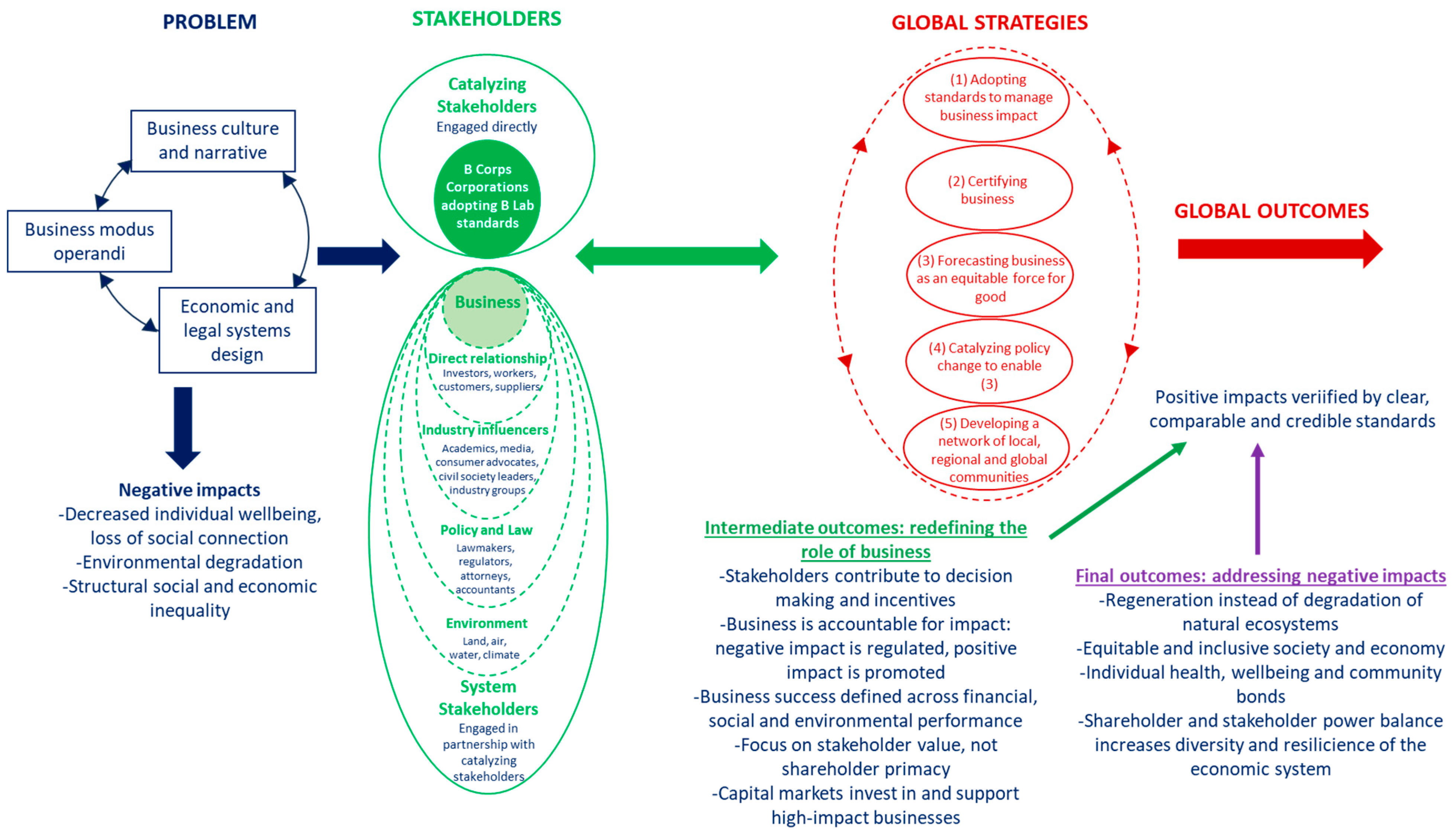
B Lab’s Theory of Change [
55] asserts that the current economic system, driven by harmful business practices, flawed laws, and a narrow cultural definition of success, is responsible for creating widespread inequality, environmental degradation, and social decline. To solve this, B Lab champions a fundamental economic transformation by building a global movement to drive high impact standards, certify and improve businesses, change the narrative around corporate success, advocate for supportive policy, and foster a community of advocates. The ultimate outcome is a transformed, inclusive, equitable, and regenerative economy where business is a leading force for positive change (
Figure 1).
B Lab provides all interested companies, whether or not Certified B Corporations, with the programs and tools needed to evaluate their environmental and social impact [
56]. The B Impact Assessment (BIA) is a free, publicly available digital self-assessment tool that enables companies to evaluate and improve their performance across five key impact areas: governance, workers, community, environment, and customers. Each impact area is organized into several impact topics that examine day-to-day operational practices and overall business model considerations (
Table 5) [
57].
The BIA consists of 100 to 200 straightforward questions that adapt dynamically based on company size, geographic location and industry sector. To qualify for B Corp Certification, companies must achieve a minimum verified score of 80 points out of a possible 250+ points [
20]. Verification is conducted through third-party review, with recertification required periodically. While certified companies are publicly listed, detailed assessment results and audit documentation are not fully disclosed.
While completing the BIA is an essential step toward B Corp certification, its utility extends beyond this single purpose. The BIA serves as both a certification gateway and a standalone strategic tool, enabling companies to understand, manage, and optimize their social and environmental impact [
20,
57,
58].
Key strengths: Broad ESG scope at the corporate level, integrating governance and social criteria that extend beyond product-specific attributes.
Key gaps: Lack of product-specific criteria and limited linkage between company-level certification and individual cosmetic product claims.
Lifecycle limitations: Does not provide product-level lifecycle coverage, particularly for use phase and end-of-life impacts.
3.8. Carbon Trust
The Carbon Trust was founded in 2001 by the UK government to drive decarbonization across businesses, governments, and financial institutions. In 2007 it launched the world’s first carbon footprint label and verification standard, and in 2015 it introduced the first verification for supply chain emissions reduction [
59]. The Carbon trust advocates for a comprehensive Net Zero approach to help secure a livable planet. This strategy calls for radically reducing greenhouse gas emissions to a minimum and then counterbalancing any unavoidable remnants by actively purging them from the atmosphere [
60].
Carbon Trust partners with businesses, financial institutions, local authorities and governments worldwide to accelerate their transition to Net Zero. The organization provides support at the levels of strategy development, risk and opportunity assessment, science-based target setting, and the implementation of carbon reduction plans. It also designs, implements, and evaluates effective policies, business models, and large-scale projects to help clients meet ambitious climate goals. The Carbon Trust Assurance service provides independent verification of carbon footprints, while the Carbon Trust Label provides independent verification of a reduced carbon footprint, empowering informed choices for consumers and businesses seeking trustworthy climate action. The certification is backed by robust data and rigorous international standards like ISO 14067 [
61] and the GHG Protocol, ensuring credibility and trust in its environmental claims [
62].
Beginning in September 2023, Carbon Trust no longer offered new product-level “carbon neutral” certifications. The “carbon neutral” label has been replaced with a stricter “carbon neutral footprint” certification, attributed to companies or products that show a verified decrease in its carbon footprint from previous calculations; have a detailed plan for achieving further carbon reductions; and cancel out any remaining emissions through carbon offsets [
63,
64].
The standard measures upstream, production, and partially end-of-life emissions using a lifecycle-based carbon footprinting approach, while also mandating the establishment of reduction targets and the use of verified offsets for residual emissions [
64,
65,
66].
Environmental criteria in the Carbon Trust framework are narrowly confined to greenhouse gas emissions, carbon reduction strategies, and labeling transparency, without covering broader social or governance aspects. Verification is standardized using ISO 14068-1:2023 [
67], the internationally recognized standard for Carbon Neutrality, and lifecycle audit protocols are overseen by independent auditors accredited by the Carbon Trust [
64]. Certifications are available at both the product level and, in some cases, organizational (company-level) tiers, allowing businesses to obtain footprint recognition for products or their overall operations. Public access to product footprint details is typically limited to packaging labels or online summaries, not full audit documentation [
65].
It is important to note that most beauty industry sustainability claims neglect carbon impact, focusing instead on attributes like “cruelty-free”, “vegan” or “organic”. There is little investment in reducing or communicating product carbon footprints, with less than 2% of claims relating to climate issues. Research shows strong consumer demand for clear carbon impact labeling, which can drive sales and motivate companies to continuously improve emissions performance. Ultimately, increasing transparency around product carbon emissions is critical for industry credibility and enabling more climate-friendly consumer choices [
68].
Key strengths: Quantified methodologies for carbon footprinting and climate-related assessment, supported by third-party verification.
Key gaps: Narrow focus on greenhouse gas emissions; does not address broader environmental or social dimensions.
Lifecycle limitations: Lifecycle coverage limited to carbon impacts; use phase and end-of-life aspects not addressed.
3.9. EU Ecolabel
The EU Ecolabel, also known as the EU Flower, is a voluntary certification introduced by an European Union regulation in 1992 (Regulation EEC 880/92) to identify and highlight products and services with reduced environmental impact, based on reliable scientific assessment across the full life cycle—from raw material extraction to end-of-life disposal [
69,
70].
The rules for the establishment and application of the EU Ecolabel are regulated by Regulation (EC) 2010/66 of the European Parliament and of the Council of 25 November 2009 [
71], and refined via Regulation (EU) 2024/1781, which strengthens transparency and stakeholder involvement, and expands criteria and review processes for emerging environmental and sustainability issues [
72]. The criteria—developed with input from the European Commission and stakeholders—include resource efficiency (e.g., reducing water and energy consumption), hazardous chemical minimization, greenhouse gas emissions reduction, protection of air and water quality, waste reduction, recycling and reuse promotion, and ensure functional performance of products and services, without compromising the environment.
For cosmetic products, specific criteria outlined in Commission Decision (EU) 2021/1870 of 22 October 2021 [
73] require minimal, recyclable or biodegradable packaging, a lower water footprint during product, a high proportion of natural and/or organic and sustainable sourced ingredients, and comprehensive oversight of environmental and social practices, including respect for human and labor rights. Certification requires governance and transparency, with mandatory independent third-party verification by national competent bodies, public registration of licensed products, and product-level (not corporate-level) certification. While verification reports remain confidential, product conformity is publicly guaranteed. This holistic, evidence-based approach enables the EU Ecolabel to strongly promote sustainable consumption and production throughout the European market [
70].
Key strengths: Comprehensive product-level environmental criteria featuring quantified thresholds and lifecycle-based requirements, supported by independent third-party verification.
Key gaps: Limited social and governance coverage beyond compliance with existing legislation.
Lifecycle limitations: Strong coverage of production and use phase impacts; end-of-life addressed primarily through packaging-related requirements.
3.10. Leaping Bunny
The Leaping Bunny Certification is a globally recognized standard for cruelty-free products, i.e., products that have not been tested on animals at any stage of production. Administration of the program is regionally divided: the Coalition for Consumer Information on Cosmetics (CCIC) manages Leaping Bunny applications for US and Canadian companies, while Cruelty Free International oversees certification for companies headquartered outside the US and Canada [
74,
75].
The Leaping Bunny logo was created in 1996 by CCIC, a group of eight North American animal protection groups, to address the confusion and inconsistency caused by companies creating their own “cruelty-free” logos without oversight. The CCIC established a single comprehensive standard and an internationally recognized logo to make it easier for consumers to identify truly animal-friendly products [
74].
Companies seeking Leaping Bunny Certification undergo an independent process that requires full disclosure of product ingredients and manufacturing practices, to ensure no animal testing occurs at any stage. Regular audits and a commitment to ban animal testing indefinitely are mandatory to maintain compliance. Certified products can display the Leaping Bunny logo, allowing consumers to easily identify cruelty-free items [
75].
The Leaping Bunny Certification is recognized by several animal protection organizations as one of the most reliable certifications for cruelty-free products but does not cover other ethical or environmental concerns. Its scope is limited to eliminating animal testing, excluding use phase and end-of-life issues [
75]. Its social or governance criteria are similarly minimal, reflecting its specialized mission. Certification applies strictly at the company level, covering all branded products, and is third-party verified through periodic audits initially and every three years. Transparency includes a public online directory of approved companies, but detailed audit reports remain confidential and available only to certified entities [
75].
Key strengths: Clear and enforceable animal testing prohibition, verified through regular audits and a publicly accessible certified company list.
Key gaps: Narrow single-issue focus with no environmental or broader social sustainability criteria.
Lifecycle limitations: Does not address environmental impacts across any lifecycle stage beyond animal testing compliance.
3.11. EWG Verified
The Environmental Working Group (EWG) is a nonprofit organization dedicated to advancing public health by providing accessible and reliable information to guide informed, health-conscious decisions. Founded in 1993 by Ken Cook and Richard Wiles, EWG operates at the intersection of scientific research and advocacy to promote safer environmental and consumer practices. The organization’s mission is grounded in the belief that empowering individuals with transparent data facilitates smarter choices regarding health and environmental safety [
76]. Its areas of focus include food and water, farming and agriculture, personal care products, energy and family health [
77].
EWG Verified
® is a product-level certification administered by EWG that focuses on ingredient transparency and health safety. Products bearing this certification exclude ingredients identified as hazardous by EWG, including those on the organization’s list of “unacceptable” substances associated with health risks, ecotoxicity, or contamination. Full ingredient disclosure is mandatory, encompassing all components, such as fragrance ingredients, ensuring comprehensive transparency. The certification standards are developed by a multidisciplinary team of scientists, formulators, and toxicologists, reflecting a science-based approach to consumer safety and product integrity [
78].
While the certification indirectly addresses upstream impacts by restricting hazards raw materials, it does not require broader environmental or lifecycle analysis, including production, use, or end-of-life phases. The standard focuses on environmental health criteria rather than on structural sustainability aspects and does not incorporate explicit social or governance factors [
76]. The evaluation process involves an internal review of ingredients and audit-like dossiers by EWG staff, with annual verification serving as a form of third-party oversight. However, detailed audit results are not publicly accessible; only ingredient disclosures and exposure scores are available via EWG’s database, EWG’s Skin Deep
® [
79].
Key strengths: Ingredient safety screening based on hazard assessment and transparency criteria, with growing consumer recognition.
Key gaps: Relies on internal verification processes rather than independent third-party audits; limited scope beyond human health considerations.
Lifecycle limitations: Focused on formulation and ingredient hazards; does not address sourcing, production, use phase, or end-of-life impacts.
3.12. Fairtrade International
Founded in 1997, Fairtrade International or Fairtrade Labeling Organizations International (FLO International) is a nonprofit, multi-stakeholder association comprising 22 member organizations, including 3 producer networks and 19 national Fairtrade organizations. Its global strategy is grounded in the principle that social and environmental justice are core components of sustainability, and its mission is to connect disadvantaged producers with consumers, promote fair trading conditions, and empower producers to alleviate poverty, strengthen their negotiating position, and attain greater control over their livelihoods [
80]. The main independent certifier for Fairtrade is FLOCERT, recognized as one of the world leading social auditing and certification bodies [
81].
Fairtrade addresses upstream impacts by certifying sustainable raw material production (e.g., coffee, coconut, or cocoa), environmental conservation, fair labor and community development standards [
81]. It extends into the production phase through oversight of processing, manufacturing plants, co-operatives, and trading operators. It does not evaluate use or end-of-life stages.
Fairtrade standards articulate environmental, social and economic obligations across its supply chains, encompassing all actors from farmers to traders and manufacturers of finished products. Environmental criteria include restrictions on agrochemicals, forest protection and deforestation prevention, promotion of biodiversity, proper waste management, efficient water use, and no use of GMOs. On the social side, Fair Trade International is robust, ensuring living wages, gender equality, and licensing of producer organizations [
82]. It also integrates governance, requiring democratic processes, financial transparency, and stakeholder participation. The General Assembly balances producer networks and national Fairtrade Organizations, each comprising 50 percent of the representation [
83]. The label is product-focused, certifying ingredients rather than whole companies, and involves third-party certification. Independent certifiers, like FLOCERT, assess the entire supply chain’s adherence to social, economic, and ecological criteria delineated in the Fairtrade Standards [
84]. While broad audit outcomes are reported and licensing info is public, in-depth audit reports are not fully disclosed to consumers.
Key strengths: Strong social criteria, including labor rights and community benefits, supported by certification and auditing mechanisms.
Key gaps: Environmental requirements are secondary to social objectives; limited relevance for non-agricultural cosmetic ingredients.
Lifecycle limitations: Applies to upstream commodity sourcing only; no coverage of production, use phase, or end-of-life.
3.13. ISO 16128
ISO 16128 is a set of guidelines created by the International Standard Organization (ISO) in 2016, to establish a framework for evaluating natural and organic cosmetic ingredients [
85,
86]. This two-part framework provides both qualitative definitions and quantitative measurement methods for evaluating ingredient composition [
2]. The first part (ISO 16128-1:2016) provides guidelines on technical definitions for “natural” and “organic” cosmetic ingredients, creating harmonized criteria to bring transparency to product claims and market communication [
85]. The second part (ISO 16128-2:2017) provides a standardized methodology for calculating natural, natural-origin, organic and organic-origin indices that apply to the cosmetic ingredients defined in ISO 16128-1 [
86].
The standard is frequently referenced in sustainability communication to substantiate natural or organic content claims. However, it does not include binding environmental, social, or governance requirements, nor does it mandate third-party verification or auditing.
This specification introduces four key metrics—natural index, natural origin index, organic index, and organic origin index—that range from 0 to 1, serving as numerical indicators of the extent a cosmetic ingredient aligns with the standard’s definition of natural and organic. The natural index and organic index follow a binary classification, with a value of 1 indicating full compliance with the respective definition, and a value of 0 denoting non-compliance. The natural origin index provides a more granular assessment, with a value of 1 for ingredients meeting the definition of natural (including various water types: constitutive, reconstitution, extraction water, and formulation water), 0.5 to 1 for derived natural or derived mineral ingredients, and a value of 0 for ingredients failing to meet these criteria (including those scoring ≤ 0.5). The organic origin index is 1 for natural ingredients (including constitutive and reconstitution waters), greater than 0 and less than 1 if the ingredient meets the definition of derived organic ingredients, and equal to 0 for non-compliant ingredients. By combining these index values with ingredient concentrations, manufacturers can calculate precise natural or organic content percentages (0–100% mass) for their final formulations [
86].
ISO 16128-1 and ISO 16128-2 focus exclusively on upstream environmental impacts related to ingredient sourcing, but does not address the production, use, or end-of-life phases, nor does it incorporate any explicit social or governance requirements. As a guideline, not a certification standard, it lacks mandatory third-party verification, public audit access, or any form of certification at the product or company-level. Consequently, while brands may use it for internal assessment, its claims are not independently verified by site audits or lifecycle assessments [
87,
88].
Key strengths: Provides standardized terminology and calculation methodology for ingredient characterization.
Key gaps: Absence of binding sustainability criteria, verification mechanisms, or governance requirements.
Lifecycle limitations: Does not address production, use phase, or end-of-life impacts.
3.14. ISO 22715
ISO 22715 is an international standard guiding best practices for packaging and labeling of all cosmetic products as defined according to national regulations or practices [
89]. It covers labeling accuracy, ingredient listing, retailer and consumer information, and batch traceability.
The packaging must be designed to protect the product from damage and deterioration under the manufacturer’s specified conditions for storage, transport, and handling, while ensuring it does not negatively impact the product itself. The labeling on the packaging must provide the following information: name and address of the person responsible for placing the product on the market, list of ingredients, function of the product (if unclear), storage conditions (when appropriate), content at the time of packaging, manufacture batch number and date, use precautions (when appropriate), and instructions for use (when appropriate) [
89].
ISO 22715 does not explicitly address upstream, production emissions, use-phase, or end-of-life sustainability. Environmental considerations are limited to proper disposal instructions and material declarations, while social and governance factures are excluded from its scope. The standard is not a certification per se and involves no certification audits, third-party verification, or public audit reporting. ISO 22715 applies de facto industry-wide guidelines to packaging compliance rather than sustainability credentials at product or corporate level.
Key strengths: Provides guidance on packaging and labeling information related to environmental claims.
Key gaps: Non-certifiable by design; lacks binding sustainability or verification requirements.
Lifecycle limitations: Does not address lifecycle stages beyond informational guidance.
3.15. PETA Cruelty-Free
Founded in 1980 by Ingrid Newkirk, People for the Ethical Treatment of Animals (PETA) is an international non-profit charity based in the USA that works and defends the rights of all animals. PETA focuses on ending animal abuse in laboratories, the food and clothing industries, and entertainment [
90].
PETA offers two primary certification programs for companies committed to cruelty-free and vegan practices. The Global Animal Test-Free Certification is for companies and brands that have verified that they and their suppliers do not conduct, commission, pay for, or allow any tests on animals for their ingredients, formulations, or finished products anywhere in the world, now and in the future. The Global Animal Test-Free & Vegan Certification recognizes companies and brands that meet all the same requirements as The Global Animal Test-Free certification and additionally ensure that their entire product line is free of animal-derived ingredients [
91].
The certification framework addresses upstream impacts by requiring supply-chain declarations, such as supplier agreements affirming a no-animal testing policy. During production, compliance is monitored at the brand-level through supplier audits and oversights. However, it does not extend to evaluating product use or end-of-life phases, nor does it incorporate environmental, social, and governance dimensions [
90]. PETA’s cruelty-free certification is verified by PETA itself, which reviews supplier documentation and conducts audits. The general approval status is publicly listed, but detailed audit reports are not available for download. Unlike the Leaping Bunny certification, which requires independent and regular audits of suppliers [
75], PETA certification only requires a signed, written agreement from the company stating a commitment to no animal testing [
90,
92].
Key strengths: High consumer visibility and clear communication regarding animal testing policies.
Key gaps: Self-declaration-based system without independent third-party verification; no environmental or social sustainability requirements.
Lifecycle limitations: Does not address product lifecycle impacts beyond animal testing claims.
3.16. Rainforest Alliance
The Rainforest Alliance is a non-governmental organization dedicated to advancing sustainability by combating deforestation and climate change, protecting biodiversity, and fostering economic opportunities alongside improved working conditions. Central to its mission is safeguarding the rights and well-being of farmers, forest communities, and workers [
93]. It was founded in 1987 by an American environmental activist, Daniel Katz, who still serves as the chair of the board of directors [
94].
The Rainforest Alliance certification is a globally recognized, independent program, assuring that raw materials like coffee, tea, and cocoa, are sourced through sustainable practices that balance environmental conservation, social equity, and economic viability. To achieve certification, producers must adhere to strict requirements, including ecosystem preservation, natural resource management, livelihood enhancement, fair labor practices, and supply chain transparency [
95]. While widely associated with agricultural commodities, the certification also extends to cosmetics containing certified ingredients. More than a sustainability label, the program embodies a holistic approach to planetary and community resilience. By collaborating directly with farmers and producers, it replaces exploitative practices with regenerative methods, enabling ecosystems and livelihoods to flourish simultaneously. This integration of environmental and human welfare priorities positions the certification as a catalyst for systemic change [
96].
The certification’s framework incorporates robust environmental criteria (e.g., soil health, agroforestry, water management) and social standards (e.g., labor rights, fair wages, community well-being). Governance is reinforced through group management plans, farmer training, and internal monitoring systems. Unlike company-wide certifications, Rainforest Alliance focuses on product-level compliance, with audits conducted by independent third parties. While certification status is public, detailed audit reports remain confidential.
Key strengths: Integrated environmental and social criteria for agricultural commodities, supported by third-party audits.
Key gaps: Limited traceability beyond certified ingredients; does not address cosmetic product formulation or packaging systems.
Lifecycle limitations: Upstream-focused on agricultural production; downstream lifecycle stages not addressed.
3.17. 1% for the Planet Certification
The 1% for the Planet is a global movement founded in 2002 by Yvon Chouinard, the founder of Patagonia, and Craig Mathews, the founder of Blue Ribbon Flies. The initiative encourages businesses and individuals to pledge at least 1% of their annual gross sales or income to environmental non-profit organizations. Companies can opt to certify their entire business, a specific brand, or just a product line as members of the movement [
97].
This model does not account for upstream impacts, production processes, use phase, or end-of-life outcomes. Instead, it provides assurance to consumers through a demonstrated financial commitment to sustainability. It does not include traditional environmental, social, or governance criteria, and does not certify specific products. Validation mainly relies on the submission of sales figures and donation receipts to confirm membership and the right to use the brand logo. Verification is managed internally by the organization, with public access to member lists and program scope, but detailed donation records remain confidential. Overall, this represents a company-level, third-party verified philanthropic commitment, rather than a product-based sustainability standard.
Key strengths: Clear financial commitment mechanism supporting environmental causes.
Key gaps: No requirements related to product sustainability, lifecycle impacts, or operational performance.
Lifecycle limitations: Scope limited to financial support; does not address any product or supply-chain lifecycle stage.
3.18. Environmental Management Systems (ISO 14001) Certification
ISO 14001 is an internationally recognized framework for Environmental Management Systems (EMSs), offering organizations, regardless of their size and sector, a systematic approach to managing environmental responsibilities, promoting sustainable resource use, waste reduction, continuous performance monitoring, and stakeholder engagement [
98].
By adopting ISO 14001, organizations signal a commitment beyond regulatory compliance to ongoing environmental improvement, achieving tangible benefits such as minimized waste, energy conservation, and cost reductions. This standard strengthens market positioning through enhanced credibility and stakeholder trust, which, for businesses operating in global markets, often serves as a prerequisite for participation in global supply chains. Aligning ecological responsibility with business goals, ISO 14001 helps transform sustainability commitments into competitive advantages, positioning organizations for long-term success in an eco-conscious economy [
98].
To obtain ISO 14001 certification, organizations must meet the following requirements: (i) Context of the organization: Establish a general framework for an EMS, including the organizational context, stakeholder needs and expectations, and documentation defining the scope of the EMS; (ii) Leadership: Top management must demonstrate leadership by integrating the EMS into core business processes, defining and endorsing an Environmental Policy committed to pollution prevention, legal and regulatory compliance, and setting a framework for environmental objectives; (iii) Planning: Conduct a systematic evaluation of environmental impacts related to activities, products and services, guiding the setting of objectives, targets, and action plans aligned with the Environmental Policy; (iv) Support: Ensure necessary resources, assess personal competence, provide training and awareness, maintain documented information, and implement effective internal and external communication relevant to the EMS; (v) Operation: Establish controls to minimize environmental impact across operations, and establish procedures to address emergency environmental situations; (vi) Performance evaluation: Regularly monitor, measure, analyze and evaluate key environmental indicators and legal/regulatory compliance. Conduct mandatory periodic internal audits to assess EMS performance, identify issues, and implement solutions. Top management must review the EMS to ensure continuous relevance, adequacy, and effectiveness in driving improvement; (vii) Improvement: Manage nonconformities by addressing deviations, implementing corrective actions, preventing recurrence, and identifying opportunities for continuous improvement [
98,
99].
Being an EMS, ISO 14001 does not directly consider social and governance aspects but provides a framework for managing environmental impacts and improving performance, which indirectly support these areas.
While ISO 14001 provides valuable environmental management guidelines that organizations can apply independently, the certification provides formal validation of compliance. Companies may adopt the standard solely to enhance internal practices or pursue certification to demonstrate credibility to stakeholders and gain competitive advantage in eco-conscious markets. Certification is granted at the company level, requiring third-party verification by accredited auditors under ISO guidelines. Certified organizations are listed publicly, but detailed audit reports are typically internal, remaining confidential [
98].
Key strengths: Structured environmental management system framework at the organizational level, supported by certification audits.
Key gaps: Focuses on management processes rather than performance outcomes; does not define product-specific criteria.
Lifecycle limitations: Indirectly relevant to lifecycle impacts through management systems; no explicit product-level use or end-of-life coverage.
3.19. USDA BioPreferred® Program
The USDA-managed Biopreferred
® program was established by the 2022 Farm Bill and expanded as part of the Agriculture Improvement Act of 2018. It aims to boost the purchase and use of biobased products to support economic development, create new jobs, and open markets for agricultural commodities. The program reduces reliance on petroleum-based goods, encourages renewable resource use, and helps mitigate environmental and health impacts [
100]. It supports various sectors, including agriculture, animal care, and cosmetics, while helping consumers make informed choices [
101].
The USDA Biopreferred
® program defines a biobased product as a commercial or industrial item (excluding food, feed and fuel) that is composed, in whole or in significant part, of renewable biological materials, such as plant, forestry, or marine resources, or serves as an intermediate ingredient or feedstock [
100].
Through the Voluntary Labeling Initiative, companies can apply for certification to use the USDA Certified Biobased Product label, which indicates that the product’s biobased content has been determined using ASTM D6866-16 as standard reference, third-party tested and verified [
102,
103]. The USDA has established minimum biobased content standards for many product categories; to qualify for certification, a product must meet or exceed the minimum biobased content for its category. For products in categories without established standards, at least 25% biobased content is required. Once certified, products are allowed to display the USDA Certified Biobased product label [
103].
A limitation of the USDA Certified Biobased Product label is that it focuses exclusively on the percentage of biobased content in a product, without evaluating other environmental impacts, or a comprehensive approach to overall sustainability. Furthermore, the certification process does not differentiate between products made entirely from renewable resources and those with minimal biobased content, meaning both can receive the same certification if the minimum threshold is met.
The program is an environmental content-based criterion, with no social or governance standards. Certification is product-level, and the products or packaging must undergo independent testing to verify both the materials used and the percentage of biobased ingredients in the final product. The testing is performed on ISO 17025 [
104]-accredited laboratories using the ASTM D6866 analytical method. The USDA strictly oversees this process to ensure the accuracy of claims made on certified product labels, requiring third-party verification and conducting regular audits to maintain the integrity of the certification [
105]. Product listings are public, but full lab audits are not disclosed.
Key strengths: Quantified biobased content verification supported by standardized testing methods and certification.
Key gaps: Focus narrowly limited to biobased content percentage; does not assess broader environmental or social impacts.
Lifecycle limitations: Addresses material composition only; production, use phase, and end-of-life impacts are not evaluated.
3.20. Triple Bottom Line (TBL)
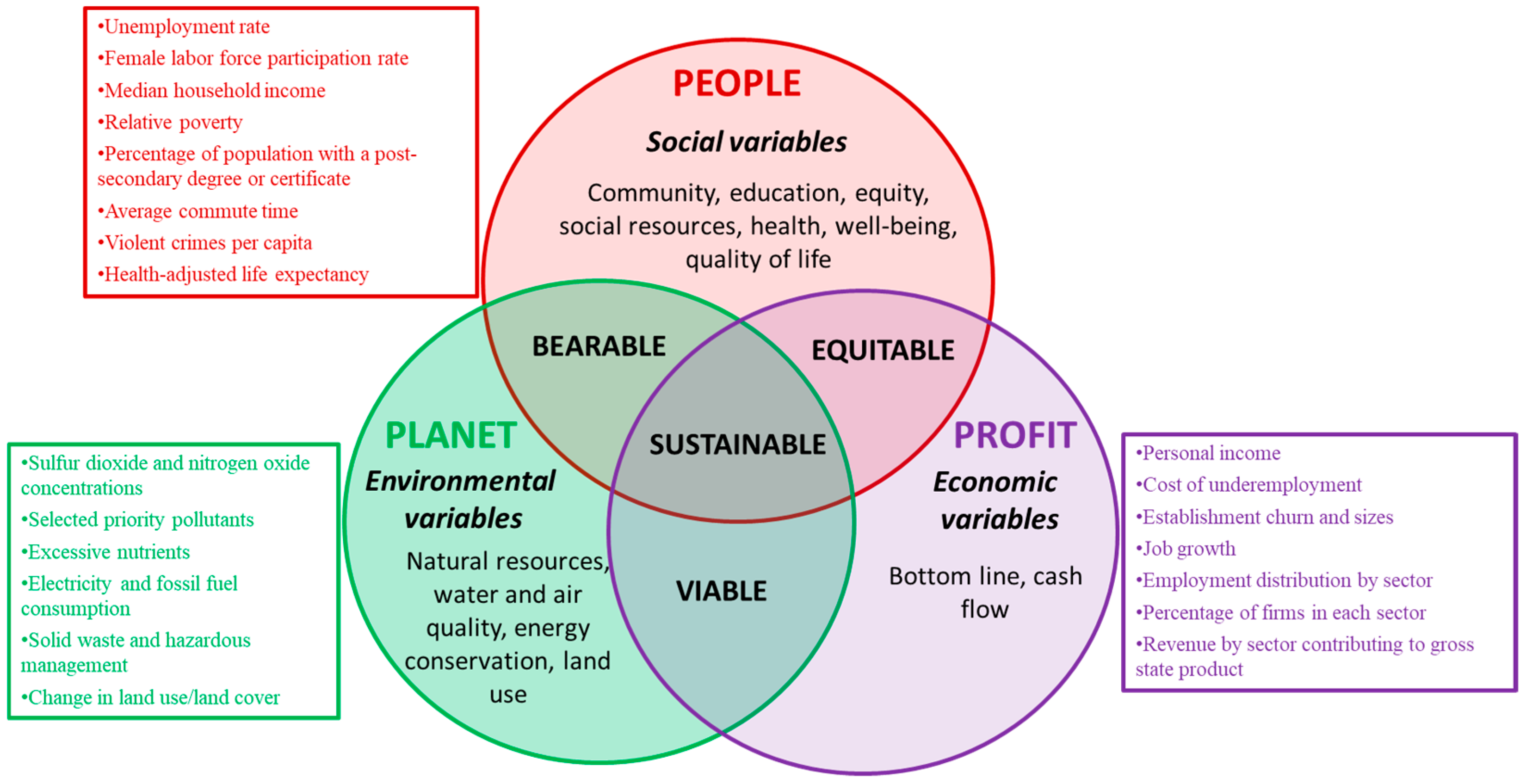
The concept of triple bottom line (TBL or 3BL) originated in 1981 when Spreckley proposed that enterprises—particularly “socially responsible enterprises”—should expand their performance assessments beyond financial metrics. John Elkington later coined the expression in 1994, defining it as a framework for evaluating business success through three interconnected dimensions (the 3 Ps): Profit, People, and the Planet [
106] (
Figure 2).
At its core, TBL challenges companies to measure performance beyond just economic outcomes (the traditional profit and loss account “bottom line”) but also their social (“people account”) and environmental (“planet account”) impacts [
108]. This approach encourages businesses to assess their contributions to society, environmental responsibility, and sustainable operations, all while maintaining financial viability. Embracing TBL principles enables companies to identify areas for improvement—such as supply chains, energy use, and community engagement—and implement strategies to mitigate harm and enhance positive outcomes [
106,
109].
While often associated with corporate social responsibility, the TBL model uniquely balances external societal benefits with internal corporate advantages. Within this framework, sustainability ensures development that safeguards future opportunities, while responsibility highlights a company’s duty to society. Despite different interpretations, TBL reporting fundamentally serves as a tool for transparent communication with stakeholders, illustrating how organizations address economic, social, and environmental responsibilities. Collectively, these principles encourage ethical conduct that aligns profitability with long-term ecological and social health [
106,
109].
Scholars have proposed expanding TBL from three to five sustainability dimensions by adding temporal aspects—including future generation’s needs—and developmental dimensions involving innovation, lifestyle change, and policy regulations [
110,
111]. This broadens its scope to include long-term sustainability perspectives alongside traditional financing reporting, making TBL a valuable tool for strategic decision-making, stakeholder engagement, and sustainability management [
112].
As a conceptual framework rather than a formal standard, TBL does not offer third-party verification, audit reports, or mandated public disclosures. Its strength lies in prompting companies to integrate sustainability thinking across upstream, production, use, and end-of-life stages, but practical implementation varies widely. Some organizations adopt “triple bottom line” reporting via integrated or ESG reports, but without standardized metrics or certification, comparability and credibility remain limited.
Key strengths: Conceptual framework integrating environmental, social, and economic dimensions of sustainability.
Key gaps: Non-operational by design; lacks criteria, metrics, verification mechanisms, or certification processes.
Lifecycle limitations: Does not provide lifecycle-stage assessment or product-level applicability.
3.21. Global Reporting Initiative (GRI)
The Global Reporting Initiative (GRI) was established in Boston, USA, in 1997, driven by public concern over the environmental devastation caused by the Exxon Valdez oil spill of 1989. It originated from the non-profit organizations CERES and the Tellus Institute, with support from the United Nations Environment Programme (UNEP). The initial purpose was to create the world’s first accountability framework to ensure companies follow responsible environmental practices, which later expanded to include social, economic, and governance aspects [
113].
The first version of the GRI Guidelines was launched in 2000, providing a global framework for sustainability reporting. GRI became an independent non-profit in 2001, while releasing updated G2 Guidelines, which evolved with further updates in 2006 (G3) and 2013 (G4). In 2016, GRI transitioned from issuing guidelines to setting the first universal standards for sustainability reporting—the GRI Standards. Sector-specific standards began with Oil and Gas (2021), followed by Agriculture, Aquaculture and Fishing, Coal (2022), Mining, revised Biodiversity standards (2024), and upcoming standards on Climate Change and Energy (2025). Currently, GRI is recognized as one of the most widely used frameworks for environmental, social, and governance (ESG) reporting, with more than 10,000 organizations across 100 countries reporting using GRI standards today [
113,
114].
The GRI covers areas such as governance, ethics, human rights, labor practices, environmental impact, and community engagement. It is structured into three main categories: economic, which covers issues related to an organization’s economic performance; environmental, covering issues related to the environmental impact; and social, focusing on social impact [
113]. The GRI ensures a standardized approach to sustainability reporting that promotes transparency, accountability, credibility, and stakeholder engagement, thereby increasing organizational value [
113,
115,
116]. However, some critiques note that the guidelines may lack sufficient transparency and do not fully address consumer needs [
117].
While GRI enables stakeholders to compare company-level sustainability reporting across economic, environmental, and social dimensions, it does not include certification-backed verification, limiting formal assurance of the reports’ accuracy and completeness. In fact, GRI verification differs from other sustainability assurance methods primarily in that GRI itself does not provide certification or external assurance of reports. Instead, GRI sets the standards and frameworks for sustainability reporting but leaves verification to independent third-party auditors or assurance providers, using accepted standards [
118].
Key strengths: Comprehensive sustainability reporting framework covering environmental, social, and governance topics.
Key gaps: Focuses on disclosure rather than performance; absence of certification or verification of claims.
Lifecycle limitations: Does not assess product lifecycle impacts directly.
3.22. Carbon Disclosure Project (CDP)
The Carbon Disclosure Project (CDP) is a global non-profit organization operating the world’s only independent environmental disclose system, empowering companies, investors, cities, states, and regions to measure, manage, and reduce their environmental impacts [
119].
Founded in 2000, the CDP initially focused on corporate carbon emissions reporting, but has since expanded to cover broader environmental disclosures, including water security, deforestation, and biodiversity [
119,
120]. Over the years, CDP has grown into a leading global platform for environmental transparency, with over 24,800 companies and 1000 cities, states, and regions now disclosing data through its system [
119].
The CDP plays a vital role in guiding organizations through the ever-changing sustainability landscape by providing a platform to disclose climate-related risks and opportunities, and guidance to measure and report their greenhouse gas emissions and set targets for reducing carbon footprint [
119]. It offers a corporate question bank aligned with the most relevant global standards and frameworks, enabling companies to respond with data points that can be acted upon [
121].
Key functions of the CDP include: encouraging corporate accountability by helping companies measure, disclose, and manage their carbon footprint and other environmental impacts; facilitating transparency through a standardized reporting framework that allows the comparison of environmental data across companies; driving climate action by accelerating the transition to a low-carbon economy and mitigating climate change impacts; influencing corporate behavior by disclosing an annual ranking of companies based on sustainability performance, which can influence corporate behavior and motivate positive changes across industries and sectors; and providing investors with valuable insights into company sustainability performance [
119].
Key strengths: Structured disclosure framework for climate, water, and deforestation risks with increasing investor relevance.
Key gaps: Reporting-based tool without certification or product-level assurance.
Lifecycle limitations: Indirectly related to lifecycle impacts through corporate risk disclosure only.
3.23. Forest Stewardship Council (FSC)
The Forest Stewardship Council (FSC) is a global non-profit organization that brings together stakeholders worldwide (individuals, businesses, governments, NGOs) to safeguard forests through trusted sustainability solutions. FSC combats deforestation, climate change, and biodiversity loss, ensuring resilient forests for future generations [
122,
123].
Established in 1994 by a coalition of environmentalists, businesses, and community leaders, the FSC emerged as a pioneering market-driven solution to promote sustainable forest management after the 1992 Earth Summit failed to produce a binding agreement to halt deforestation. Its voluntary certification system balances rigorous environmental criteria—such as maintaining forest health, preventing deforestation, and regulating chemical use—with strong social safeguards for Indigenous peoples, local communities, and workers, alongside economic viability [
123].
The FSC framework offers certification both for organizations (through its chain-of-custody standard) and for specific product levels, such as packaging made from responsibly sourced forest-based products (e.g., wood, paper, and bamboo). It focuses on upstream impacts by setting forest management standards that ensure the protection of biodiversity, worker rights, and community interests. The chain-of-custody component then tracks sustainable fiber through the production phase, from the forest to finished goods like cosmetics packaging. However, while the certification encourages recyclability, it does not explicitly audit the use and end-of-life phases of a product life cycle [
124]. The standard operates under a strict multi-party governance model to ensure balanced oversight and always requires third-party auditing to guarantee integrity and transparency. While detailed audit reports remain confidential with the certifiers, certificate scopes and validity are publicly accessible through the FSC database [
124,
125].
Today, FSC is a global leader in forest certification, with over 150 million hectares of responsibly managed forests and a vast supply chain network linking markets to sustainable sources [
123].
Key strengths: Robust certification of forest management and chain of custody, supporting responsible sourcing of paper-based packaging materials.
Key gaps: Environmental focus limited to forestry; no direct relevance to cosmetic formulation or product performance.
Lifecycle limitations: Addresses upstream material sourcing only; downstream packaging use and disposal impacts not covered.
3.24. Union for Ethical BioTrade (UEBT)
The Union for Ethical BioTrade (UEBT) is an international non-profit organization that certifies the ethical sourcing of biodiversity-derived ingredients, having several types of trading members (brands, producers, processing companies), primarily in the cosmetics, pharmaceuticals, and food sectors [
126].
UEBT traces its origins to the 1992 Rio Earth Summit, where 150 nations adopted the Convention on Biological Diversity (CBD), committing to sustainable development and biodiversity conservation. In 1996, the UN Conference on Trade and Development (UNCTAD) launched the BioTrade Initiative to advance these goals through trade. UEBT emerged within UNCTAD as a business-focused biodiversity program before becoming an independent nonprofit in 2008 [
126].
UEBT emphasizes upstream impacts, evaluating botanical supply chains against its internationally recognized Ethical BioTrade Standard, which addresses key social, environmental, and economic aspects of biodiversity-based sourcing [
127]. It can also encompass the production phase insofar as it covers the ingredient supply chain’s governance systems [
128]. UEBT does not address the use phase or end-of-life aspects. The focus is on strong environmental criteria (conservation of biodiversity) and social criteria (fair benefit sharing, community rights, capacity building), all governed by a multi-stakeholder standard aligned with UN frameworks. UEBT certification is company-level (ethical sourcing systems) and ingredient-level, and its members undergo regular audits by independent third-party verification bodies, such as Control Union Certifications, Ecocert SA, Soil Association, and Rainforest Alliance [
129]. Overall responsible sourcing practices are disclosed publicly, but full audit documentation is not.
Key strengths: Strong governance framework for ethical sourcing of biodiversity-based ingredients, emphasizing access and benefit-sharing.
Key gaps: Limited product-level environmental performance criteria; no quantified lifecycle thresholds.
Lifecycle limitations: Upstream sourcing focused; production, use phase, and end-of-life not addressed.
4. Discussion
This study evaluated the scope and rigor of leading sustainability certifications in the cosmetics industry, with a special focus on (i) comprehensive value-chain coverage, from sourcing upstream to post-use, and (ii) rigorous, transparent third-party verification. Together, the evidence from certification narratives and criteria reveals a largely fragmented landscape. Most schemes are specialized, providing depth in isolated lifecycle stages or single-issue areas (e.g., ingredients, animal testing, carbon footprint, etc.), while few offer broad coverage with verification across environmental, social, and governance dimensions at both product and organizational levels. This fragmentation is not merely an academic point; it directly challenges the cosmetics industry’s ability to comply with EU regulatory trends that call for substantiated, lifecycle-aware sustainability claims and greater transparency in the value chain. Below, we interpret the key patterns, tensions, and implications emerging from the analysis.
The regulatory perspective presented in this discussion is primarily informed by European policy developments, reflecting the European Union’s continued leadership in sustainability governance, driven in large part by the practices and expectations set by European companies, brands, and consumers. While elements of the European sustainability regulatory agenda have experienced periods of recalibration or slowed momentum, the core structural challenges identified here, including certification fragmentation, uneven lifecycle coverage, and limited verification transparency, are broadly evident beyond the European context. Against this backdrop, the following sections interpret the key patterns, tensions, and implications emerging from the analysis.
Importantly, the absence of coverage in certain analytical dimensions should not be interpreted as a deficiency in individual schemes relative to their stated mandates. Rather, such non-coverage reflects structural design choices. For example, disclosure frameworks or ISO guidance documents are not intended to address product-level use-phase or end-of-life impacts. Therefore, the comparative matrix aims to reveal cumulative gaps across the assurance ecosystem, that emerge when instruments are used in combination, rather than to evaluate schemes against criteria beyond their intended scope.
A key initial finding is the imbalance that exists in lifecycle coverage across major certifications. Ingredient-focused standards (e.g., COSMOS, NATRUE, RSPO, Rainforest Alliance, USDA Organic) provide strong upstream oversight—establishing clear rules for agricultural practices, chemical inputs, and biodiversity protection; several also implement chain-of-custody models to maintain integrity during primary processing and trade. However, these schemes seldom address critical downstream impacts—such as use-phase parameters (e.g., water/energy consumption, micro-pollutants) and post-use factors (e.g., end-of-life packaging, take-back, reuse)—beyond setting basic packaging standards or banning specific hazardous substances. This upstream–downstream imbalance reinforces the critique that the beauty sector certifications prioritize product composition over the impacts of consumer use and disposal [
2]. In contrast, the EU Ecolabel adopts a more comprehensive lifecycle approach in specific categories, integrating ingredient restrictions with requirements for packaging reduction/recyclability, performance, and, occasionally, use-phase parameters. Nonetheless, a significant implementation gap remains, as verifying real-world consumer behavior and municipal end-of-life outcomes is inherently challenging. Importantly, the predominance of ingredient- and formulation-focused schemes observed in this analysis should not be interpreted as a sampling artifact, but rather as an empirical reflection of the current certification landscape in the cosmetics sector, where product-level instruments addressing packaging circularity, use-phase impacts, or post-consumer outcomes remain scarce. These qualitative patterns are directly evidenced in the descriptive coverage counts (
Supplementary Table S4), which documents a pronounced decline in scheme coverage from upstream to downstream stages (consumer use and end-of-life) and the consistently lower prevalence of social and governance criteria.
A second finding concerns the limited dimensionality of sustainability that these labels cover. Many prominent certifications are often specialized, creating trust signals on isolated issues like animal testing (Leaping Bunny, PETA) or ingredient hazards and disclosure (EWG Verified). However, this specialization can falsely signal comprehensive sustainability when multiple logos are displayed on a package, a phenomenon that can mislead consumers. For example, a product can be cruelty-free, vegan, and “natural” yet still have a significant carbon footprint, depend on water-heavy formulations, or use unsustainable packaging. Conversely, single-impact labels are not necessarily greenwashing, but risk becoming a vehicle for claim inflation and consumer confusion when they lack proper context and qualified claims [
24]. This fragmentation directly informs new policy, as new regulations for green claims increasingly demand specific evidence for each assertion, clear boundaries on qualifiers like “net zero” and “climate-neutral”, and greater comparability, forcing single-issue logos and marketers to connect their claims with concrete proof.
A third recurring theme is the gap between product-level and company-level certifications. Product-level certifications (e.g., Cradle to Cradle, EU Ecolabel, RSPO, USDA Organic, USDA BioPreferred) guide procurement and design decisions, scale across Stock Keeping Units (SKUs) and signal clearly to buyers, but rarely guarantee enterprise-level governance, strategy, or target-setting. Conversely, frameworks like B Corp and ISO 14001 offer a broader view, focusing on management systems or multi-stakeholder outcomes, which complement product labels. The gap between these two levels now poses a strategic risk under regulations like CSRD/ESRS, which require entity-level double materiality assessments, coverage of the value chain, and target tracking. A brand promoting product-level certifications without corresponding organizational accountability (e.g., scope 1–3 GHG targets, deforestation-free supply chains, human rights due diligence) risks its claims being perceived as partial and misleading when broadly communicated. The solution lies in connecting product and corporate assurance, such as pairing an EU Ecolabel or Cradle to Cradle at the SKU level with verified science-based targets and supplier due diligence at the organizational level [
130].
Fourth, verification rigor and transparency vary significantly across schemes. While some uphold ISO-accredited third-party audits with transparent chain-of-custody protocols (e.g., RSPO, FSC, Cradle to Cradle, EU Ecolabel), others rely on dossier reviews, self-attestations, or periodic supplier confirmations, with limited public disclosure (e.g., EWG’s, PETA). Even among strong systems, public transparency usually remains limited to license registries or summary certificates, with confidential audit reports kept secret. From a market trust perspective, this is understandable but, from a regulatory evidence perspective, it becomes increasingly problematic. New EU green claim regulations, which require independent, science-based proof and comparability, will likely compel certifiers to standardize disclosures (what is published versus what is confidential) and to harmonize audit frequencies, sampling, and sanctions. One practical approach is to publish redacted standardized audit summaries, to balance transparency with commercial confidentiality.
Fifth, the analysis confirms critical gaps in material domains that prevent comprehensive assurance. A significant under-representation exists in carbon-related assurance, despite the Carbon Trust labels and the expansion of corporate climate frameworks. Product-level claims in the beauty sector rarely feature quantified, verified carbon footprints or credible reduction pathways, often favoring vaguer terms like “clean”, “vegan”, “cruelty-free” or “natural”. Credible climate claims, however, require SKU-specific lifecycle assessments that account for category-specific impacts, such as the hot water used for rinsing or the packaging footprint of anhydrous formats [
5,
8]. Additionally, robust systems for deforestation (e.g., palm derivatives) and biodiversity impacts remain essential. While certifications like RSPO and Rainforest Alliance provide vital upstream oversight, comprehensive assurance requires visible downstream brand accountability. This includes linking product claims to company-level no-deforestation commitments, traceable supply chains, grievance mechanisms, and verifiable cut-off dates [
11,
35].
Sixth, the analysis reveals a persistent “ingredients vs. performance” paradox. The absence of standardized, rigorous performance protocols in ecolabeling presents a critical dilemma. Despite intentions to prevent burden-shifting (i.e., sustainable products must still work), the complexity of cosmetic performance (e.g., sensory, efficacy, durability, rinse-ability) leads brands to overuse actives, fragrances, or polymers to meet consumer expectations. This over-formulation unintentionally elevates the product’s environmental footprint through increased toxicity, micro-pollutant release, or water consumption during use [
9,
10]. To solve this, lifecycle-aware certification must combine hazard-based ingredient restrictions with outcome-based performance metrics, such as validated rinse-off efficiency thresholds, minimum efficacy at lower-impact dosages, and product category rules that include consumer-use scenarios [
131]. Without this integration, “better” ingredients will not necessarily yield better real-world outcomes.
Seventh, social and human rights coverage remains inconsistent. Specialized schemes like Fairtrade and Fair for Life include strong social safeguards (wages, working conditions, producer empowerment); RSPO has increasingly incorporated labor rights and smallholder inclusion, while UEBT focuses on benefit-sharing and community rights in biodiversity-based supply chains. In contrast, many ingredient-centric schemes often assume social responsibility without clear criteria or audits. The regulatory landscape, particularly the CSRD/ESRS and upcoming due diligence regulations, is rendering this inconsistency obsolete by mandating companies to identify key human rights risks in their supply chains (e.g., mica mining, palm oil, natural extracts), implement short-term corrective measures, and report on outcomes. This regulatory shift implies that the credibility of “ethical” narratives now depends on anchoring product-level labels within a broader company-level human rights due diligence framework [
13,
132,
133,
134]. Importantly, the observed scarcity of social criteria across schemes reflects a structural pattern in the certification landscape rather than sensitivity to isolated classification choices, as even more permissive ethical-scope interpretations would not alter the overall imbalance identified.
Eighth, the data indicates that a fundamental mismatch exists between audit frequency and scope. Currently, multi-ingredient SKUs with multiple claims are audited in isolation, e.g., one label for an organic oil claim, another for cruelty-free, and a third one for FSC sustainable packaging. This fragmented approach overlooks the critical interactions between these claims, which are exactly what lifecycle principles require us to address (e.g., increasing biobased content might increase land-use or water impacts, or a safer surfactant could increase rinse time). The certification ecosystem, therefore, needs integrated conformity assessments or co-audits capable of evaluating claim interactions and trade-offs, at least within sampled SKU portfolios, to ensure that the overall footprint is not masked by the sum of logos.
Ninth, traceability architecture varies significantly depending on the commodity and claim. While standards like RSPO and FSC have mature chain-of-custody models (identity preservation, segregation, mass balance), these are often ill-suited for the cosmetics sector. Here, ingredients undergo complex chemical processing—transformation into esters, surfactants, and emulsifiers—which can obscure their original sources. This complexity makes it challenging to substantiate specific “organic” or “deforestation-free” claims, especially when feedstocks are diluted or mixed. Even mass balance accounting, while practical, struggles to communicate the precise quantity of certified content at the SKU level and its real environmental impact. A viable path forward likely requires a two-part solution: (1) adopting digital product passports and supplier data rooms to connect batch-level documentation to on-pack label claims, and (2) implementing conservative, standardized marketing language that avoids implying 100% certified feedstock when using book-and-claim or mass-balance systems [
130,
131,
134].
Packaging significant environmental footprint is not matched by the current certification landscape. While standards like FSC (fiber assurance), Cradle to Cradle (packaging composition and circularity traits), and EU Ecolabel (packaging performance) address specific aspects, the market lacks a unified, packaging-specific seal. A leading mark is needed that independently certifies a complete set of criteria: recyclability, verified recycled content through chain of custody, the absence of harmful additives, and design for reuse/refill, all confirmed by independent auditors with traceable post-consumer results. As Extended Producer Responsibility and recyclability standards become stricter, auditable packaging claims must evolve from “recyclable by design” to “recycled in practice at X% capture”, eventually backed by region-specific evidence.
The patterns identified in this study offer three strategic insights for brands and standard setters.
First, alignment with regulatory expectations demands rigorous, claim-specific substantiation framed by lifecycle principles. Driven by the EU’s Green Claims Directive and reforms on unfair commercial practices, alongside CSRD/ESRS, the landscape is shifting from symbolic compliance to verifiable performance. To mitigate risk, certifications must clearly define their scope, system boundaries, materiality assumptions, and verification methods. This requires precise substantiation for different claim types. For example, climate-related claims must reference recognized quantification standards (e.g., ISO 14067, GHG Protocol), documented reduction plans, and adhere to offset-use rules that avoid “offset-first” narratives [
68]. Biodiversity claims linked to UEBT or Rainforest Alliance should be underpinned by company-level targets for high-risk ingredients and supported by grievance logs and supplier development programs. Animal testing claims should specify jurisdictional nuances (e.g., imported testing requirements in some markets) and the frequency of supplier audits to prevent over-generalized promises.
Second, strategic integration has become the primary differentiator in sustainability. Leading companies are moving beyond gathering isolated logos to orchestrating a cohesive “certification stack” that comprehensively addresses key issues across the entire value chain—for example, combining RSPO/UEBT/Fairtrade where relevant upstream risks exist, EU Ecolabel/Cradle to Cradle for product and packaging design, FSC for fiber, Carbon Trust for product footprints, B Corp or ISO 14001 for organizational management, and GRI/CDP for disclosure. However, this orchestration must be driven by a double-materiality assessment and measurable targets, rather than by marketing. The certification stack should align with frameworks like ESRS and include Key Performance Indicators (KPIs) that flow from SKU to portfolio to enterprise. By rationalizing overlaps into fewer, higher-integrity schemes, companies can reduce audit fatigue while enhancing the credibility and power of their sustainability signal.
Third, “transparency by design” will become essential, and operationalized on two key fronts. One is Digital Product Passports (DPPs), which serve as a central repository for claim evidence (ingredient origins, packaging specifications, carbon data, test results) and display user-relevant details via QR codes. The other is public audit summaries that should include minimum common fields: standard version, audit date and scope, material nonconformities, corrective actions and deadlines, and auditor accreditation. This format enhances comparability, enabling scrutiny by peers and non-governmental organizations, and reducing the risk of greenwashing without disclosing sensitive commercial information. Over time, standard data schemes (e.g., for carbon or recycled content) could allow machine-readable validation of claims across digital platforms, from marketplaces to social media.
Finally, any credible sustainability strategy must account for consumer behavior and rebound effects. While certifications can guide better choices, they also risk legitimizing increased consumption. In cosmetics, segment growth (e.g., “clean beauty” and “natural”) often boosts total unit sales, offsetting per-unit price reductions, an effect similar to a rebound in other sectors. To operate within planetary boundaries, the industry must incorporate “sufficiency” principles. This means prioritizing business models and product designs that discourage overuse, such as smaller formats, concentrates, multi-functional products, and refill/reuse systems. Furthermore, marketing communication should actively discourage overconsumption [
6]. Certification schemes could promote sufficiency by introducing bonus criteria for concentrates/refills, verifying reuse rates, and rewarding dose-control designs, while simultaneously discouraging designs that encourage unnecessary use.
In summary, today’s certification ecosystem offers valuable but fragmented assurance. It has advanced considerably in areas such as upstream supply chains, animal testing, and ingredient safety, supported by credible third-party audits and chain-of-custody integrity, and it is extensive enough for brands to adopt a portfolio approach to assurance. However, this system remains a collection of parts, rather than a unified whole. It falls short of being a comprehensive, lifecycle-wide, ESG-integrated system with consistently rigorous verification and transparent, comparable disclosures. The trend, driven by regulation, investor pressure, and evolving consumer expectations, points toward consolidation, integration, and transparency. Organizations that act early to link product-level certifications to corporate-level targets and disclosures, and that publish verifiable evidence connecting claims to impacts, will be best positioned to sustain market trust, as green claims will transition from voluntary marketing narratives to regulated, evidence-based commitments.
Building on this analytical interpretation of certification coverage, verification practices, and lifecycle gaps, the following subsection synthesizes the broader implications of these findings for regulation, corporate strategy, and future sustainability assurance pathways.
Implications and Future Directions
The comparative analysis presented in this study reveals that the current ecosystem of sustainability instruments in the cosmetics sector—comprising certifications, standards, guidelines, and disclosure frameworks—remains structurally fragmented. Although each instrument addresses specific sustainability dimensions, their combined use often fails to deliver comprehensive, lifecycle-wide, and verifiable sustainability assurance. This fragmentation has significant implications for regulatory alignment, corporate strategy, and consumer trust.
From a regulatory perspective, the findings highlight a growing misalignment between many widely used sustainability instruments and emerging European requirements, particularly those stemming from the Corporate Sustainability Reporting Directive (CSRD) and the proposed Green Claims Directive. Instruments narrowly focused on single issues (e.g., ingredient origin, animal testing, or biobased content) or lacking quantified performance criteria and transparent verification are increasingly insufficient as standalone substantiation for sustainability claims. Similarly, while valuable for structuring internal reporting, guidance documents and disclosure frameworks do not provide assurance of performance and therefore cannot replace verified, product- or company-level evidence under evolving regulatory scrutiny.
This misalignment signals a regulatory shift away from accepting generic ecolabels or voluntary claims at face value, toward demanding claim-specific, auditable, lifecycle-based evidence. The lack of harmonized expectations across certification schemes further complicates enforcement and comparability, reinforcing the need for clearer regulatory guidance on acceptable substantiation and minimum verification standards.
For cosmetic brands, the analysis highlights a strategic shift from reliance on individual logos towards more integrated, evidence-based sustainability approaches. In practice, many companies now adopt hybrid or layered strategies, combining multiple instruments, such as ingredient certifications, product-level ecolabels, company-level management systems, and disclosure frameworks, to address diverse sustainability dimensions and stakeholder expectations. While such layering can reduce regulatory and reputational risk, it also introduces complexity and potential for inconsistency if not anchored in materiality assessments and coherent governance structures. Without clear integration, layered certification strategies risk becoming symbolic rather than substantive, thereby reinforcing perceptions of greenwashing rather than mitigating them. The findings therefore suggest that future best practice lies not in accumulating certifications, but in strategically aligning selected instruments with documented lifecycle impacts, governance processes, and measurable performance targets.
For consumers, the proliferation of partial and overlapping sustainability signals continues to pose significant challenges. Multiple labels on a single product can create an illusion of comprehensive sustainability, even when critical lifecycle stages, such as consumer use or end-of-life, remain unaddressed. The absence of standardized disclosure practices and publicly accessible audit outcomes further limits consumers’ ability to differentiate between varying levels of rigor and credibility.
As regulatory frameworks increasingly prioritize informed decision-making, the cosmetic sector may face pressure to supplement labels with clearer contextual information, such as digital disclosures or standardized summaries of certification coverage. Improving transparency is therefore not only a regulatory requirement but also a prerequisite for restoring consumer trust in sustainability claims.
Looking ahead, the findings point to several directions for the evolution of sustainability assurance in the cosmetics industry. First, greater convergence between product- and company-level assurance mechanisms will be necessary to ensure that on-pack claims are supported by organizational governance, supply-chain due diligence, and performance tracking. Second, verification practices may evolve towards more granular and transparent models, including standardized public audit summaries or digital product passports, to balance confidentiality with accountability. Finally, lifecycle-based approaches that explicitly address use-phase impacts and post-consumer outcomes will be essential for certification systems to remain relevant within planetary boundary constraints.
Overall, this study underscores that sustainability certifications, while valuable, are insufficient on their own. Their future effectiveness will depend on their ability to integrate lifecycle thinking, verification rigor, and regulatory alignment within a coherent assurance ecosystem capable of supporting both credible claims and meaningful sustainability transitions.
5. Conclusions and Recommendations
This study contributes a structured, comparative assessment of sustainability instruments used in the cosmetics sector, demonstrating that no single certification or framework currently provides comprehensive, lifecycle-wide, and verifiable assurance. The regulatory framing of this study is primarily informed by European policy developments, reflecting the EU’s leadership in sustainability governance. While this contextual focus is a noted limitation, the core challenges identified—such as certification fragmentation, uneven lifecycle coverage, and verification gaps—are relevant well beyond the European context.
Sustainability certifications in the cosmetics industry, despite their growing prevalence, remain fragmented in their scope, inconsistent in verification rigor and lack full coverage of the value chain. While numerous ecolabels and ethical marks exist, few offer comprehensive assurance across a product’s full lifecycle or fully integrate environmental, social, and governance principles. This highlights a significant mismatch between the multi-dimensional nature of sustainability and the narrow operational focus of most certification schemes. Notably, the dominance of upstream-oriented standards, such as COSMOS, NATRUE, RSPO, and USDA Organic, mirrors the industry’s historical focus on natural sourcing and formulation, while downstream stages (consumer use, disposal, and circularity) remain weakly regulated or are largely absent from certification frameworks.
The comparative analysis presented in this study reveals a critical inconsistency in the application of third-party verification and transparency across certifications. While systems like EU Ecolabel, RSPO, FSC, and Cradle to Cradle use independent, ISO-accredited audits, many others rely on self-assessment or confidential dossier reviews, providing little visibility to external stakeholders. This lack of transparency weakens consumer trust and exposes brands to significant reputational and regulatory risks, especially as binding EU legislation, such as the Green Claims Directive and Corporate Sustainability Reporting Directive, advances towards mandatory, auditable proof of sustainability performance. In this changing landscape, voluntary certification alone can no longer serve as a stand-in for sustainability unless it is supported by verifiable, science-based evidence that is able to withstand public scrutiny.
Similarly, the social and governance dimensions constitute the most significant gap in current sustainability certifications. While a select few certifications—such as Fair for Life, Fairtrade International, B Corp, and UEBT—offer structured approaches to labor rights, community equity, and ethical benefit-sharing, these remain the exception. This oversight is increasingly critical as emerging due diligence frameworks require companies to address human rights and social justice across their operations. Consequently, incorporating social compliance audits and human rights risk mapping into sustainability standards will be essential to ensure alignment with the new EU Due Diligence Directive and the UN Guiding Principles on Business and Human Rights.
From a policy and industry standpoint, three strategic priorities emerge to future-proof sustainability certifications:
First, certification bodies should recalibrate their frameworks to embrace full lifecycle thinking, incorporating measurable criteria for consumer use, packaging circularity, and post-consumer impacts. Aligning certification metrics with established life-cycle assessment standards is crucial to reduce inconsistencies and prevent burden-shifting between environmental factors. For the cosmetics sector, this involves integrating criteria on water and energy consumption during use, microplastic release, and the practical recyclability of packaging, among others.
Second, verification must evolve towards greater transparency and interoperability through publicly accessible audit summaries, harmonized audit cycles, and digital traceability tools, like Digital Product Passports, that strengthen trust in certified claims and ease compliance with new disclosure regulations. Collaboration among certifiers on shared data platforms and mutual recognition agreements is essential to build trust, ensure regulatory compliance, and reduce redundant audits.
Third, integrating product-level and corporate-level certifications should become standard practice rather than a rare occurrence. Merging ecolabels (e.g., EU Ecolabel, Cradle to Cradle) with corporate frameworks (e.g., B Corp, ISO 14001, GRI, CDP) would enable companies to connect SKU-level sustainability accomplishments with overarching organizational goals and materiality disclosures. This comprehensive approach would guarantee that sustainability claims at the product level are backed by governance systems capable of delivering measurable, organization-wide impact.
Beyond operational improvements, the cosmetics sector must also confront its consumption paradox. The very certifications designed to promote sustainability can, paradoxically, incentivize overconsumption by equating “green” purchases as “guilt-free”. To avoid this rebound effect, the industry must pivot from a sole focus on efficiency to actively integrating sufficiency principles. Certification bodies and brands should champion business models and product designs that reduce aggregate material use—for example, by rewarding concentrated, refillable, and multifunctional formats. This strategic shift is essential to align certification practices with the broader sustainability goal of operating within planetary boundaries.
In conclusion, while sustainability certifications remain essential, they are currently insufficient for fostering the system transformation the cosmetics industry requires. They play a key role in enhancing supply-chain practices, promoting transparency, and signaling trust, but their fragmented nature prevents them from offering comprehensive assurance. As regulatory frameworks, investor evaluation, and consumer awareness strengthen, the industry must shift from a logo-based approach to a unified verification system founded on scientific rigor, data transparency, and full supply chain accountability. Improving certification design, governance, and disclosure will not only rebuild credibility but will also establish sustainability certifications as the fundamental infrastructure for compliance and innovation in a sector increasingly expected to demonstrate, not just claim, its environmental and social responsibility.